
Hedwig Village City Zoning Code
ARTICLE V
- ZONING REGULATIONS4
State Law reference— Zoning regulations generally, V.T.C.A., Local Government Code § 211.003.
501. - Districts established.
In order to carry out the goals and objectives of the comprehensive plan and for the purposes of this code, the following districts are hereby created:
(1)
Residential districts:
Residential district A
Residential district C
(2)
Business districts:
Business district B-1
Business district B-2
Business district B-3
Business district B-4.
502. - Permitted uses.
A.
Business districts. No structure or land in a business district of the City of Hedwig Village shall hereafter be constructed, built, erected, moved, altered, remodeled by expanding the size thereof, reconstructed, used, or occupied except in accordance with the requirements of the zoning district and of this code in which the structure is located. However, a structure, use, or lot lawfully existing or permitted at the date of adoption of this zoning code may continue to be occupied as a nonconforming use under the provisions and requirements of this Code.
B.
Residential districts. No structure or land in a residential district of the City of Hedwig Village shall hereafter be constructed, built, erected, moved, altered, remodeled by expanding the size thereof, reconstructed, used, or occupied except in accordance with the requirements of the zoning district and of this code in which the structure is located. However, a land use or structure lawfully permitted shall be allowed to be occupied, altered, remodeled or expanded given the proposed construction reduces or does not increase any existing nonconformity that is prohibited under section 505.D, section 505.E and section 505.F. Such allowance is subject to approval of the building official, whose discretion shall be guided by the following considerations:
(1)
The extent of any existing nonconformity;
(2)
The relation of any existing nonconformity to the potential allowance; and
(3)
The feasibility and relative benefit to the neighborhood of the reduction or termination of any existing nonconformity.
(Ord. No. 742, § 2(Exh. A), 1-17-2019
503. - Subdivisions.
No lot or parcel of land shall be subdivided or subdivided and developed, unless in accordance with the terms and provisions of this zoning code and the rules and regulations for approval of a subdivision plat as specified in Ordinance No. 267 heretofore previously adopted by the City of Hedwig Village.
Two or more sites for single-family residences or commercial establishments may hereafter be established only by subdivision of land in accordance with the requirements of law. In no case shall more than one site be created without all such sites having frontage on a public street. A single site may be located away from a public street only when a permanent private easement for ingress, egress and use of public utilities shall connect said site to a public street. No existing easement of this kind serving a single site may thereafter be made to serve other sites created by subdivision of abutting or contiguous property without its conversion to a public street under the provisions of the ordinances of the City of Hedwig Village.
(Ord. No. 276, § 503, 4-24-1986)
504. - [Reserved.]
Editor's note— Section 504 was repealed by Ord. No. 307, § 2, 3-9-1989.
505. - Residential districts A and C.
A.
Use regulations. In residential districts A and C, no building, structure, land or premises shall be used, and no building or structure shall hereafter be erected, moved, constructed or altered except for one or more of the following uses:
1.
One single-family dwelling.
2.
Temporary buildings and materials for uses incidental to construction work on the premises. These temporary buildings and materials shall be allowed on the premises for a period not to exceed six months beginning with the issuance of a construction permit; provided, however, the building official may grant extensions for additional successive periods of not more than three months each if it is shown that, due to the nature and extent of the construction activity, such extension is necessary to accomplish completion of the project and the construction has proceeded with due diligence. In all events, these temporary buildings and materials shall be removed upon completion or abandonment of construction work.
3.
Accessory uses and buildings, including a private garage and servant's quarters, and such as is customarily incidental to any permitted use when located on the same premises, but such accessory building shall not involve the conduct of a business, trade or profession on the premises.
B.
Limitations. The following limitations and restrictions shall apply to all of the above permitted uses:
1.
Garages. No garage attached to the main building and which faces or opens toward any street shall be any closer to the street than the front of the house, and no garage or out building may be used as a residence or living quarters, except by persons employed on the premises, or except during the construction period of the main residence, and then only for a period not to exceed six months.
2.
Parking. Off-street paved parking area shall be provided on the premises for all vehicles owned or used by the occupants of the dwelling. Parking of vehicles in the front yard and in a side yard which adjoins a street on any lot in any residential district shall be confined to such off-street paved parking areas.
3.
Swimming pools. All swimming pools shall be enclosed by a structural fence to prevent entrance from without except by means of a self-closing and self-latching gate and shall be obscured from view from any public street. Backwash water shall be piped to the sanitary sewer.
Notwithstanding other provisions of this code, the water edge of swimming pools may not be located closer than three feet from a rear or side ground utility easement or closer than five feet from a rear or side property line, whichever is greater. Both aboveground and belowground swimming pools are deemed to be structures for the purposes of all parts of this code.
4.
Recreational vehicles. No vehicle which is or which customarily is equipped with living or sleeping facilities, whether self-propelled or designed to be used as a trailer or for use otherwise in conjunction with any vehicle, whether occupied or not, shall be kept in a front yard for a period longer than a total of 48 hours during any consecutive eight-day period, except where such vehicle or trailer is for use incidental to construction as provided under subsection 505.A.(2).
5.
Watercraft. No boat, houseboat, canoe, raft, surfboard, or other apparatus designed for use on water, including trailers therefor, and no motor or engine designed to propel such craft or apparatus, shall be kept in a front yard for a period totaling more than 48 hours during any consecutive eight-day period.
6.
Trucks. No truck in excess of one-ton capacity nor any vehicle designed to transport more than 12 persons shall be parked within district A or C except for loading and unloading, but in no event shall such parking exceed a total period of 48 hours during any consecutive eight-day period.
7.
Other property. No property not incidental to a permitted use in residential districts A and C, and no utility trailer shall be kept in a front yard for a period longer than a total of 48 hours during any consecutive eight-day period.
8.
Places of public assembly. Places of assembly which were permitted prior to 1955 shall provide off-street parking area or areas on the premises of sufficient size to accommodate one parking space for each two seats in the place of assembly. Each parking space shall constitute an area of not less than 175 square feet. Adequate driveways and space for traffic movement, together with unblocked space for access by emergency vehicles, shall be provided on the site. Parking spaces, areas, driveways, and emergency lanes shall be marked and all of these shall be maintained. Parking spaces, areas, driveways, and emergency lanes shall be constructed to meet requirements for secondary streets as prescribed in Ordinance No. 52, section 2(e)(3), enacted March 29, 1961. Such off-street parking area or areas shall have sufficient grades and surface and/or underground drains with adequate sized drain pipe and number of clean-out facilities.
9.
Business. No business shall be conducted in residential districts A or C.
10.
Fences.
(a)
Unless otherwise allowed by this subsection B.10., no fence shall be more than eight feet in height measured from the elevation grade at the fence line; nor shall the fence extend five feet past the front of the residence's side elevation closest to the fence. All fences along a roadway must have a finished side facing the roadway.
(1)
Exceptions:
a.
Fences fronting Beinhorn Road, Echo Lane, Piney Point Road, and Taylorcrest Road. Front yard fences are allowed for residential properties fronting these roadways in the city. A front yard fence is limited to four feet tall from grade, must be 80 percent open and may have masonry columns and may include up to a one-foot-tall masonry base as part of the fence. Vehicle gates may be up to five feet in height. These fences must be decorative and utilize similar materials of the home and must complement the existing or proposed residence. Front yard fences must be located completely on the property and no portion shall be located on the right-of-way. A Knox box must be installed to ensure fire and emergency access for homes with vehicle gates.
1.
Decorative lighting can be installed on top of a front-yard fence at driveway entrance(s). This decorative lighting can be gas lanterns, or low-level lighting 3k or less color temperature and compliant with dark-sky lighting standards.
2.
All vehicle gates must be setback at least 22 feet back from the edge of pavement closest to the home.
b.
Fences fronting Bunker Hill Road. A front-yard fence along Bunker Hill roadway may be up to a six-foot-tall solid fence. Front-yard fences must be located completely on the property and no portion shall be located on the right-of-way. A Knox box must be installed to ensure fire and emergency access for homes with vehicle gates.
1.
Decorative lighting can be installed on top of the fence at the driveway entrance(s). This decorative lighting can be gas lanterns, or low-level lighting 3k or less color temperature that complies with dark-sky lighting standards.
c.
A perimeter fence that faces a street may tie into the residence's side elevation closest to the fence at six and half feet in height.
d.
Rear and side yard fences within residential districts A and C adjacent to non-residential uses (such as schools, churches, and public uses). A residential rear or side-yard fence that abuts a non-residential use is permitted an increased height of ten feet. Any fence above eight feet must be designed by a licensed engineer to the standards of the currently adopted building code.
e.
Rear-yard fences within Residential District A neighboring the B-2 (Second Commercial District). A rear-yard or side-yard fence is permitted at an increased height of 14 feet at the rear or side property line neighboring B-2. Any fence above eight feet must be designed by a licensed engineer to the standards of the currently adopted building code.
(b)
Fencing materials:
(1)
Finished masonry (not exposed CMU), stained or natural wood, wrought iron painted black fencing materials or combination thereof shall be used for fences, walls, or gates. Chain link fencing is not permitted. Synthetic materials may be used as approved by the building official.
(2)
Vine-covered walls shall be allowed.
(3)
No barbed or razor wire shall be used or maintained as part of any fence, wall, gate or hedge. No sharp point, including glass, shall project from the top of the fence or wall.
(4)
No salvaged materials, scrap wood, or recycled materials shall be used for fencing or walls. Fencing and walls shall be constructed with all new materials.
(5)
Existing legal nonconforming fences or walls shall be maintained or repaired.
(6)
All swinging gates shall be prohibited from encroaching into the public right-of-way.
(7)
No vinyl or plastic slats may be used as a screening material for residential fence.
(c)
For the purposes of this subsection B.10., contiguous lots held under common ownership shall be considered as one lot for the purpose of establishing required yards. No fence shall be erected on a vacant lot unless such vacant lot is contiguous to a lot or lots containing the residence of the owner of the vacant lot or lots.
(d)
This subsection B.10. does not apply to construction related fencing.
11.
Front of dwelling. The front of a dwelling existing at the time this code is enacted shall be the front of any subsequent dwelling constructed on that lot.
12.
Aircraft. Property in residential district A or C shall not be used for the takeoff, landing, parking or storage of helicopters, balloons or other aircraft of any sort. This prohibition shall not apply to the landing and takeoff of emergency or law enforcement helicopters while in the performance of official duties.
13.
Antennas. Dish-type satellite receiving or transmitting antennas shall not be located in a front or side yard, and the highest point on any such antenna shall not be more than 12 feet above ground level.
14.
Accessory buildings. No accessory building shall be located in a front yard.
15.
Windows above second stories. No building or structure in residential district A or C shall have placed or constructed thereon any window above a second story unless such window faces the street to which such building or structure faces.
16.
Floor area above second stories. No building or structure in residential district A or C shall contain more than 500 square feet of habitable floor area above the second story.
17.
Mechanical equipment and trashcan screening. Mechanical equipment, whether ground mounted, roof-mounted, or otherwise attached to the building, shall be screened from view from the street by fencing, building design (such as a parapet), or landscaping. For new construction and additions or remodels greater than 50% screening of trashcans must be provided by either fencing, building design or landscaping after the adopted date of this ordinance.
18.
Flags and flagpoles.
(a)
For any flagpole more than ten feet in height or length, a sign permit, permit fee shall be required for the installation of the flagpole. An engineer's installation standards must accompany the permit application.
(b)
Flagpoles shall be located at least ten feet from any property line.
(c)
Single family residences may erect one flagpole.
(d)
Flagpoles shall not exceed 25 feet in height measured from average grade within five feet of the proposed pole location.
(e)
No flag or flagpole shall be located within any easement.
(f)
Flag size shall not exceed 24 square feet.
(g)
Number of flags shall not exceed three.
C.
Required lot area and width. Unless otherwise provided for on a subdivision plat duly approved by the City of Hedwig Village prior to the date of enactment of this code, the following minimum lot areas and widths shall apply:
(1)
A lot shall have an area of not less than 21,000 square feet in residential district A and not less than 15,000 square feet in residential district C, exclusive of public or private roads or either of them.
(2)
The average width of a lot shall be not less than 110 feet, with a minimum of 90 feet at the front building line.
D.
Ground coverage and lot area covered by impermeable surfaces limitations. The total ground coverage of all buildings on a lot shall not exceed 25 percent of the lot area. Furthermore, not more than a total of 40 percent of the lot area shall be covered by all buildings, driveways, sidewalks, patios, pool decks or other surfaces which are impermeable to water; provided, however, that the surface area of water in outdoor swimming pools shall not be considered a surface which is impermeable to water.
E.
Yard required.
1.
General. No building or accessory structure shall be constructed or erected within any required yard unless otherwise specifically authorized herein.
2.
Front yard. The front yard depth shall be not less than 70 feet at any point from the center line of the public street or street access easement which established the front property line.
3.
Side yard. There shall be two side yards, each side yard having a minimum width of 15 feet.
4.
Rear yard. The rear yard shall be not less than 25 feet; provided, however, accessory structures may be constructed or erected within a required rear yard provided such accessory structure is located not less than 15 feet from any property line.
F.
Building height limit. No building, structure, or device in residential district A or C including anything attached thereto or anything constructed for use in conjunction therewith, shall exceed 35 feet in height above the average mean ground level prior to construction. This limitation shall not apply to chimneys, which may exceed such maximum height by five feet. Notwithstanding the foregoing height limitation, no building or structure in residential district A or C shall exceed in height an imaginary line that is 63.5 degrees, with the horizontal, at the outer edge of the yard upon which such building or structure is located.
G.
Other structures. Notwithstanding other provisions of this code, underground structures not visible at or above grade, other than swimming pools, may be built up to a property line, except that in no event shall they be closer than 30 feet to the centerline of any street.
H.
Exceptions to sections 505. C. and 505. E.
(1)
Exception for deed restrictions on lots platted prior to July 13, 1955. Upon application for a building permit for construction on only one lot lying within a subdivision for which a plat was recorded with the county clerk of Harris County, Texas, prior to July 13, 1955, and a showing by the applicant that such construction complies fully with the terms of currently valid deed restrictions on such lot, the limits on required lot area (section 505.C.) and yards and required yard depth (section 505.E.) shall not apply to such construction insofar as such limits are otherwise specified in such deed restrictions. If such deed restrictions have been changed subsequent to the enactment of this zoning code, then deed restrictions in effect on the date of enactment of this zoning code shall be those with which compliance must be shown by the applicant. Such lot and structures thereon shall be deemed to be permitted nonconforming uses. Nothing herein shall be construed as obligating or permitting the City of Hedwig Village to enforce or otherwise protect deed restrictions on any property to any degree or extent.
(2)
Exception to side and rear yard requirements for additions to existing primary structures constructed before January 1, 1980. Upon application for a building permit for a structure to be added to an existing structure, the yards required will be no less than ten feet wide in the side yard and no less than 15 feet deep in the rear yard. A building permit shall be granted by the building official upon a showing that:
(a)
The structure represents an addition to a portion of an existing primary structure constructed before January 1, 1980;
(b)
The additional structure will not result in a violation of any coverage restrictions(s) for the lot;
(c)
The additional structure will not result in a violation of the building height limit; and
(d)
The additional structure conforms to all federal, state and local codes, ordinances and conditions.
(3)
Exception for new construction for the purpose of connection of an accessory building to a primary structure, the yards required will be no less than ten feet wide in the side yard and no less than 15 feet deep in the rear yard. A permit shall be granted by the building official upon a showing that:
(a)
The connection is the result of the attachment of an accessory building constructed prior to March 31, 2004, to a primary structure constructed prior to January 1, 1980 and, except as permitted in subsection (3)(b) below, does not result in any new construction in the side or rear yard area;
(b)
The connection consists only of an existing structure or an extension of such structure along its existing building line;
(c)
The connection will not result in a violation of any coverage restriction(s) for the lot;
(d)
The connection will not result in a violation of the building height limit; and
(e)
The connection structure conforms to all federal, state and local codes, ordinances and conditions.
(4)
Exception for the alteration or addition to a nonconforming primary structure that was constructed prior to January 1, 1980. Upon application, a building permit will be issued by the building official for the alteration or addition to a nonconforming primary structure that was constructed prior to January 1, 1980, upon showing that:
(a)
Any permitted alteration or addition to a nonconforming primary structure will not result in a violation of any coverage restrictions for the lot;
(b)
Any permitted alteration or addition to a nonconforming primary structure represents no more than 30 percent increase in the square footage of livable space in the existing nonconforming primary structure;
(c)
Any permitted alteration or addition to a nonconforming primary structure will not result in an increase of the specific existing nonconformity; and
(d)
Any permitted alteration or addition shall conform to all federal, state and local codes, ordinances and conditions.
(Ord. No. 310, § 1, 3-9-1989; Ord. No. 311, § 1, 3-9-1989; Ord. No. 344, § 2, 4-11-1991; Ord. No. 373, § 2, 11-12-1992; Ord. No. 394, §§ 2, 3, 11-11-1993; Ord. No. 457, § 2, 10-8-1998; Ord. No. 466, § 2, 9-9-1999; Ord. No. 467, § 2, 9-9-1999; Ord. No. 546, § 2, 3-31-2004; Ord. No. 728, § 2(App. A), 9-20-2018; Ord. No. 742, § 2(Exh. B), 1-17-2019; Ord. No. 792A, § 2(App. A), 12-9-2021; Ord. No. 849, § 1(Exh. A), 9-11-2025)
506. - Business district B.
A.
Use of property.
1.
Uses permitted:
a.
General. In business district B, all business shall be conducted from, and all merchandise stored, kept or displayed within a conforming building except that restaurants may provide a patio for outside dining sales provided that such area shall be counted as part of the building area in calculating setback, coverage, parking or other incidental requirements. Allowed businesses are those permitted as provided in section A.1.(f) below and those that are not specifically prohibited in 506.A.2. (below or in the Code of Ordinances.) A business use is determined by whether 50 percent or more of the revenue of the business is derived by the sale of the designated goods or services. Incidental sales of goods (i.e. which comprise less than 50 percent of the revenue of the business) which are not prohibited below may be allowed with the approval of the building official. The building official shall maintain a more detailed list of specific approved business uses in the business districts.
b.
Business district B-1. No property shall be used and no building shall be hereafter used, erected, reconstructed, altered, or enlarged, unless otherwise provided in this code, except for one or more of the following uses or uses which are equivalent thereto as determined by the planning and zoning commission:
(1)
At least 85 percent of the aggregate net leasable space of the ground floor of a building or 85 percent of the aggregate net leasable space of the ground floors of buildings which comprise a retail center or business office complex shall be used for sales tax generating businesses;
(2)
Businesses on floors above the ground floor are not required to be sales tax generating businesses;
(3)
Healthcare, medical, and social assistance offices must not exceed 30 percent of overall square footage of the building.
c.
Business districts B-2. No property shall be used and no building shall be hereafter used, erected, reconstructed, altered, or enlarged unless otherwise provided in this code, except for one or more of the following uses or uses which are equivalent thereto as determined by the planning and zoning commission:
(1)
At least 50 percent of the aggregate net leasable space of the ground floor(s) of a building or 50 percent of the aggregate net leasable space of the ground floors of buildings which comprise a retail center or business office complex shall be used for sales tax generating businesses;
(2)
Businesses on floors above the ground floor are not required to be sales tax generating businesses;
(3)
Single-family homes on individually platted lots in a medium density development along a public or private street may be approved through a Planned Unit Development under the following conditions;
a.
All homes adjacent to public streets shall adequately address the street frontage by providing landscaping, and pedestrian access for the property owner. These homes may be designed as live and work lofts.
b.
All residences must have a private garage. Access to all garages shall be through a common private drive within the development, and not through a public street.
c.
A minimum of six feet distance between individual dwelling units.
d.
Maximum Height is 45 feet above natural grade within 200 feet of any residential lot in district A or C or 55 feet for dwellings at a distance greater than 200 feet of any residential lot in district A or C.
e.
Minimum development size of 3.5 acres and shall satisfy the density requirements of a medium density residential developments.
f.
One additional parking space per dwelling unit.
(4)
Healthcare, medical, and social assistance offices must not exceed 30 percent of overall square footage of the building.
d.
Business districts B-3. No property shall be used and no building shall be hereafter used, erected, reconstructed, altered, or enlarged unless otherwise provided in this code, except for one or more of the following uses or uses which are equivalent thereto as determined by the planning and zoning commission:
(1)
At least 85 percent of the aggregate net leasable space of the ground floor of a building or 85 percent of the aggregate net leasable space of the ground floors of buildings constituting a retail center or business office complex shall be used for sales tax generating businesses;
(2)
Businesses on floors above the ground floor are not required to be sales tax generating businesses;
(3)
A planned unit development, subject to limits specifically defined for business district B-3, may be developed.
(4)
Healthcare, medical, and social assistance offices must not exceed 30 percent of overall square footage of the building.
e.
Business districts B-4. No property shall be used and no building shall be hereafter used, erected, reconstructed, altered, or enlarged unless otherwise provided in this code, except for one or more of the following uses or uses which are equivalent thereto as determined by the planning and zoning commission:
(1)
At least 75 percent of the aggregate net leasable space of the ground floor of a building or 75 percent of the aggregate net leasable space of the ground floors of. of buildings which constitute a retail center or business office complex shall be used for sales tax generating businesses;
(2)
Businesses on floors above the ground floor are not required to be sales tax generating businesses;
(3)
A planned unit development, subject to limits specifically defined for business district B-4, may be developed.
(4)
Social assistance offices must not exceed 30 percent of overall square footage of the building.
f.
Permitted uses list.
Business districts B-1, B-2, B-3, B-4. No property shall be used and no building shall be hereafter used, erected, reconstructed, altered, or enlarged unless otherwise provided in this code, except for one or more of the following uses or uses which are equivalent thereto as determined by the planning and zoning commission:
NOTE: (RS) denotes "retail sales" tax generating businesses.
(NRS) denotes "non-retail sales" which generates no sales tax revenues for the city.
(1)
Administrative and support services; (NRS).
(2)
Antique stores; (RS).
(3)
Art supplies or galleries; (RS).
(4)
Banks, financial, and insurance service institutions; (NRS).
(5)
Bar: first class for consuming alcohol on premise; (RS).
(6)
Book stores; (RS).
(7)
Beauty store, salon or spa; (RS).
(8)
Building contractors, office only, no materials or equipment on premises; (RS).
(9)
Cigar, tobacco shops; (RS).
(10)
Cleaners, tailors and laundries, retail; (RS).
(11)
Clothing stores: men's, women's, children's and/or babies'; (RS).
(12)
Computer, and electronics stores; (RS).
(13)
Dancing studios, exercise classes; (RS).
(14)
Department stores, except discount department stores; (RS).
(15)
Drug stores and pharmacies; (RS/NRS).
(16)
Educational services and learning centers; (NRS).
(17)
Florist and flower shops; (RS).
(18)
Gas station with no automotive repair; (RS).
(19)
Greeting cards and stationery stores;(RS).
(20)
Hardware store including tools; (RS).
(21)
Healthcare, medical, and social assistance offices; (NRS).
(22)
Hobby, model shops; (RS).
(23)
Home good stores; (RS).
(24)
Hotels; high-end, boutique only; (RS).
(25)
Jewelers; jewelry stores; (RS).
(26)
Libraries; (NRS).
(27)
Liquor stores, excluding drive up or pickup services; (RS).
(28)
Museums; (NRS).
(29)
Musical instruments and supply stores; (RS).
(30)
Numismatic, money and precious metal stores; (RS).
(31)
Other services (except public administration); (NRS/RS).
(32)
Office supplies; (RS).
(33)
Optical goods; (RS).
(34)
Parking garages in connection with permitted on-site office or retail buildings; (RS).
(35)
Pet and pet supply stores; (RS).
(36)
Pool service stores; (RS/NRS).
(37)
Professional, scientific and technical services; (NRS).
(38)
Public administration services; serving the City of Hedwig Village performing municipal responsibilities (NRS).
(39)
Real estate and rental and leasing offices; (NRS).
(40)
Restaurants, full service and limited service, delicatessens; (RS).
(41)
Retail sale of automotive fuels, lubricants and related products; (RS).
(42)
Specialty food stores;(RS/NRS).
(43)
Sporting goods sales, not including boats, boat motors, mopeds, recreational vehicles, ATVs, golf carts, motorcycles, or motor bikes; (RS).
(44)
Supermarkets; (NRS/RS).
(45)
Toy sales; (RS).
(46)
Veterinarian services.
2.
Uses specifically prohibited. Except to the extent specifically permitted in section 506.A.1 of this code, property in business district B shall not be used for the following:
(a)
Manufacturing, which includes the production of one or more articles from scrap, salvage, or junk material, as well as from new or raw material, by processing, formulating, manipulating, or changing the form of an article or by combining or assembling two or more articles.
(b)
The storage or keeping of equipment, earth, signs, vehicles, trailers, tanks, supplies, or other property outside an enclosed building approved by the planning and zoning commission, except to the extent that such items may be necessary in connection with construction on the property and then only during such construction.
(c)
The take-off, landing, parking, or storage of helicopters or other aircraft of any sort other than emergency or law enforcement craft.
(d)
The keeping or displaying of automobiles, trucks or other vehicles on site, with the intent of selling or marketing the same.
(e)
The storing or selling of used or secondhand merchandise excluding antiques or collectibles, requiring more than 20 percent of the floor area of the business. Further, the listing of any retail business in section 506.A.1 of this code is not intended to include or permit the sale of such used or secondhand merchandise.
(f)
Discount stores which advertise and sell goods below a certain price.
(g)
Drive-through facilities
(h)
Credit access businesses that obtain credit for a consumer from an independent third-party lender in the form of a deferred presentment transaction or a motor vehicle title loan, more commonly referred to as "payday loans" or "title loans."
B.
Height of improvements to property.
1.
Parking surfaces. Parking surfaces shall be allowed to the maximum height permitted in section 506.B.3 in business district B-1, 506.B.4 in business district B-2, and 506.B.5 in business districts B-3 and B-4 provided that in such buildings automobiles and interior lighting are screened from public view with building materials used in the main building. The appearance of the parking facility shall also be compatible with the main building.
2.
Attachments to buildings. Nothing attached to a building nor anything constructed for use in conjunction therewith nor any other structure or device of any sort shall exceed ten feet above the roof of a building not including its parapet. Except for a parapet not to exceed four feet in height above the roof of a building, nothing attached to a building nor anything constructed for use in conjunction therewith nor any other structure or device of any sort shall exceed in height the maximum building height specified in sections 506.B.3, 506.B.4, and 506.B.5 of this code.
3.
District B-1. No building in district B-1, including anything attached thereto, except a parapet not to exceed four feet in height, nor anything constructed for use in conjunction therewith, nor any other structure or device of any sort, shall exceed 35 feet in height above average natural grade.
4.
District B-2. No building in district B-2, including anything attached thereto, except a parapet not to exceed four feet in height, nor anything constructed for use in conjunction therewith, nor any other structure or device of any sort, shall exceed 35 feet in height above average natural grade.
5.
Districts B-3 and B-4. No building in district B-3 or district B-4, including anything attached thereto, except a parapet not to exceed four feet in height, nor anything constructed for use in conjunction therewith, nor any other structure or device of any sort, shall exceed the following height:
(a)
Forty-two feet above average natural grade within 200 feet of the nearest point of any residential lot in district A or C; and
(b)
Fifty-six feet above average natural grade at distances greater than 200 feet from the nearest point of any residential lot in district A or C; or
(c)
Seventy feet above average natural grade at distances greater than 300 feet from the nearest point of any residential lot in district A or C, provided at least 20 percent of the total floor area of all buildings except parking garages in each single development is permanently devoted to one or more of the uses permitted in section 506.A.1.(b) of this code.
C.
Setbacks. All buildings above average natural grade, including anything attached thereto or anything constructed for use in conjunction therewith and all other structures or devices of any sort above average natural grade, except uncovered ground level parking surfaces, shall meet at least the following property line setbacks:
1.
Districts B-1 and B-2. The depth of the front and rear yards shall each be a minimum of 25 feet from the property line. The width of each side yard abutting on a dedicated public street or a street easement shall be a minimum of 25 feet, otherwise there shall be no minimum side yard depth.
2.
District B-3. The depth of the front and rear yards shall each be a minimum of 25 feet from the property line. The width of each side yard abutting on a dedicated public street or a street easement shall be a minimum of 25 feet, otherwise there shall be no minimum side yard depth.
Minimum front, rear, and side yard depths thus established shall be increased by six inches for each foot any part of the building exceeds 35 feet in height above average natural grade. These required additional setbacks shall be reduced to three inches for each foot the building exceeds 35 feet in height above average natural grade provided at least 20 percent of the total floor area of all buildings except parking garages in each single development is permanently devoted to one or more of the uses permitted in section 506.A.1.(b) of this code.
3.
District B-4. The depth of the front and rear yards shall each be a minimum of 25 feet from the property line. The width of each side yard abutting on a dedicated public street or street easement shall be a minimum of 25 feet, otherwise there shall be no minimum side yard depth.
Minimum front and side yard depths thus established shall each be increased by six inches for each foot any part of the building exceeds 35 feet in height above average natural grade unless at least 20 percent of the total floor area of all buildings except parking garages in each single development is permanently devoted to one or more of the uses permitted in section 506.A.1.(b) of this code.
4.
Underground structures. Notwithstanding other provisions of this code, underground structures in district B, other than swimming pools, may be built to a property line except that in no event shall they be closer than 30 feet to the centerline of any street or street easement.
5.
Adjustment of setbacks. It is provided for by law that the board of adjustment shall have jurisdiction to hear any case involving the adjustment or request to vary from the required building setback line. The board of adjustment may and is encouraged to consider such factors including, but not limited to, the platted shape of the subject property, and the shape, size, and location of adjoining property and adjacent development in its consideration of request to adjust or vary building setback lines.
D.
Parking.
1.
General. Parking requirements in this code are stated as a minimum number of off-street parking spaces, exclusive of spaces available on streets, roads, and driveways. Each parking space shall constitute an area of not less than 184.5 square feet. Minimum parking space width shall be nine feet and these spaces shall utilize round-ended striping. Adequate driveways and space for traffic movement, together with unblocked space for access by emergency vehicles, shall be provided on the site. Parking spaces, areas, driveways, emergency lanes, and loading and unloading space shall be marked and maintained in a manner approved by the planning and zoning commission and shall be constructed to meet the requirements for secondary streets as provided in Ordinance No. 52, section 2(e)(3), enacted on March 29, 1961. As used herein the term "floor area" shall mean gross enclosed building area.
2.
Parking spaces.
2.5
Bicycle parking reduction.
a.
The total number of required parking spaces for a property may be reduced by one parking space for each bicycle space provided on the property.
b.
The maximum parking space reduction under this subsection 2.5 for a property shall be the lessor of ten percent of the number of required parking spaces or 24 parking spaces.
c.
Bicycle racks must be installed with a minimum of four bicycle spaces.
3.
Loading and unloading space. In addition to parking spaces required by section 506.D.2 of this code, a minimum of one ten-foot by 25-foot loading and unloading space shall be provided for each 10,000 square feet or fraction thereof of floor area in each establishment in district B. No more than two such spaces shall be required. Loading and unloading space shall not occupy the front yard space or drive space required elsewhere in this code.
4.
Shared parking. In commercial districts, a shared parking calculation may be used for any commercial property, vacant commercial property or shopping center with two or more distinguishable uses. Offsite parking may be used for up to 40 percent of the required parking spaces. This parking lot must be within 500 feet of the property or within 1,000 feet if a valet or shuttle service is utilized.
a.
Computation. The number of shared parking spaces for two or more distinguishable land uses on the same property may be determined by the following procedure:
i.
Multiply the minimum parking required for each individual use, as set forth in the minimum parking required in section 506.D.2., by the appropriate percentage indicated in 505.D.4.b., shared parking calculations, for each of the six designated time periods;
ii.
Add the resulting sums for each of the six time periods; and
iii.
The minimum parking requirement shall be the highest sum among the six designed time periods.
b.
Shared parking calculation.
c.
Process. A shared parking calculation or offsite parking lease within the requirements of this section 505.D.4. shall be submitted during the certificate of occupancy process for a tenant or property owner if the tenant or property owner intend to use the parking calculation or offsite parking lease to satisfy the tenant or property owner's parking requirements.
d.
Offsite parking lease. An offsite parking lease must be submitted to the City of Hedwig Village for any offsite property being utilized for required parking. This lease must contain the minimum requirements outlined below:
i.
Lessor;
ii.
Lessee;
iii.
Effective date;
iv.
End date (must be a minimum of one year);
v.
Number of spaces being leased or whether the lot will be utilized for shared parking;
vi.
Times parking will be available, if applicable; and
vii.
Site plans with parking calculations for both properties.
e.
Notification of offsite parking lease cancellation.
i.
In the event that an offsite parking lease is used by the lessee to satisfy the parking requirements of this Zoning Code for the lessee's property or use, the lessee shall immediately notify the city if the offsite parking lease is no longer valid and present the city's building official with the lessee's plan to satisfy the parking requirements for the lessee's property or use. A failure to notify the city shall be considered a separate violation of the zoning code for each day that lessee does not have the required parking in compliance with this zoning code and the city was not aware of the lack of compliance due to the failure of the lessee to notify the city.
ii.
If the offsite parking lease necessary to satisfy the parking requirements is cancelled, the lessee may be found in violation of this zoning code for failing to meet the minimum parking requirements. Each day shall be considered a separate violation
f.
A sign must be posted on the leased property, notifying customers that this parking is available. This non-illuminated wayfinding sign shall be installed with a maximum size of six square feet, and must include the following information;
i.
Name of business(es), or shopping center that is utilizing the property for off-street parking; and
ii.
Hours available, if applicable.
5.
Valet or shuttle service.
a.
In commercial districts, a valet or shuttle service may be used for any commercial property. This parking lot must be within 1,000 feet of the property.
b.
Permit requirements for valet or shuttle service permit:
i.
Applicants name, telephone number, mailing address, street address, name of valet company, and contact information for valet or shuttle service;
ii.
The valet or shuttle service operator shall provide proof of liability insurance for valet or shuttle parking services for a minimum of $500,000.00 garage liability insurance (each occurrence);
iii.
Offsite parking lease as outlined in section 506.4.(c), if applicable. or proof of ownership of the property to be used for the parked cars;
iv.
Site plan showing where valet or shuttle service pickup and drop-off occurs. No valet or shuttle pickup/drop-off areas will be allowed in public rights-of-ways; and
v.
Required fees as determined by the city's fee schedule.
(1)
Valet or shuttle service permits must be renewed every year by December 6, or the following Monday if this date falls on a weekend.
(2)
Renewal will provide the same information as for a regular permit, including annual fees according the City of Hedwig Village's fee schedule.
c.
Pickup/drop-off location.
i.
Valet. A podium with the valet company identification, including phone number must be placed at the pickup and drop-off site. This is the only sign that can advertise the name of the valet or shuttle company on the subject property(s).
ii.
Shuttle. The pickup and drop-off locations for the shuttle service must be properly identified by a small sign and/or other notification as permitted by the building official.
6.
Parking lot landscaping requirements. For any new contiguous parking lot with over 40 parking stalls, the following landscaping standards shall apply:
a.
All rows of parking shall be terminated with a curbed landscaped island that is a minimum of nine feet wide and no less than 19 feet in length (32 feet in length for head-to-head parking stalls).
b.
No off-street parking space shall be more than 75 feet from a canopy tree located within a landscaped area.
c.
All parking lot islands shall be landscaped with a combination of turf grass ornamental grass plantings, plant beds, shrubs, and trees. Rock, chip brick. pavers, pavement and similar hard surfacing shall not be permitted within a parking lot island. Impervious cover is not considered landscape
d.
Sidewalks shall be constructed within a parking lot island as necessary to accommodate pedestrian circulation. No less than one canopy tree shall be planted within each required landscaped island.
E.
Miscellaneous provisions.
1.
Lot width. The width of lots in district B shall be a minimum of 50 feet.
2.
Lot coverage and landscaping. In district B, structures, including parking and loading and unloading areas, driveways and covered walkways, shall not exceed the following percentage of total land area:
Existing multi-family dwellings (in percentage) .....66⅔
Motels and hotels (in percentage) .....75
All others (in percentage) .....90
The remaining land area shall be landscaped and maintained for use as a non-commercial green area.
3.
Existing multi-family dwellings. Each dwelling unit of a multi-family dwelling in district B shall contain not less than 1,250 square feet of living area within such dwelling unit.
4.
Site drainage. Site drainage for the entire site including parking and driveway areas shall be designed and installed with sufficient grades, and underground drains with adequately sized pipe and number of clean-out facilities. Such underground drainage shall be provided to adequately drain the site of storm water into the nearest publicly provided storm drainage system.
5.
Construction. All construction, including new construction, enlargements, and alterations shall conform to the following minimum requirements:
a.
Conforming to code. All new construction, enlargements, and alterations shall conform to the City of Hedwig Village building, electrical, fire, heating, air conditioning, plumbing, and other applicable codes, regulations, and ordinances of the City of Hedwig Village.
b.
Recreational areas. Privately owned swimming pools and recreational or playground areas shall be obscured from view from any public street.
6.
Trash. Trash and garbage collection facilities shall be provided at the rear of the property, shall be obscured from public view, and shall be protected from scattering by wind or animals by a suitably gated fence; provided, however, if existing improvements make construction of a fence impossible, the applicant may substitute a receptacle if shown to the building official to be of sufficient strength and construction to accomplish the same protection as afforded by a fence as described above.
Businesses having regular accumulation of trash, waste materials, junk, or other discarded materials shall arrange for private regular collection of such accumulated materials. Such collections shall be at least twice a month and shall be more frequently if accumulations exceed storage capacity. Such collections shall be as frequent as necessary to prevent objectionable odors.
Incineration of trash or garbage shall not be permitted except where facilities are designed specifically for incineration service and are approved by the fire chief for the City of Hedwig Village. The emissions from such a system shall not be visible and shall not have undesirable emissions or odor.
7.
Fences. No fence of any type, nonbearing wall, or any other similar structural barrier, shall be erected or maintained on any lot, tract, or parcel of land in business district B within any required front or side yard so as to prevent or deter immediate access to the main building by emergency vehicles from a public street abutting such lot, tract, or parcel of land, or which would have the effect of eliminating or severely restricting a clear and full view of such main building from such abutting street by emergency personnel.
Maximum height: Fences shall be a maximum of eight feet tall within commercial districts of the City, unless an increase in height is necessary to screen equipment, trash containers, or provide additional screening of non-residential uses from Residential Districts A and C.
Prohibited locations: Fencing for commercial properties shall not prohibit the public from accessing required parking spaces for the intended use. No fencing may block sight visibility triangles.
Temporary construction fencing: Temporary construction fencing is allowed if there is an active building permit, unless as required by the building official. Major construction sites are required to have temporary construction fencing to prevent access from the public.
Temporary security fencing: Temporary security fencing on vacant lots may be permitted if approved by the building official. All temporary fencing must be maintained and kept clear of graffiti.
Permitted materials:
(1)
Finished masonry (not exposed CMU), stained or natural wood, wrought iron painted black fencing materials, or combination thereof shall be used for fences, walls, or gates. Chain link fencing is not permitted. Synthetic materials may be used as approved by the building official.
(2)
Vine-covered walls shall be allowed.
(3)
No barbed or razor wire shall be used or maintained as part of any fence, wall, gate, or hedge. No sharp point, including glass, shall project from the top of the fence or wall.
(4)
All fence materials must be up to the standards for new construction, except for reclaimed wood.
(5)
All swinging gates shall be prohibited from encroaching into the public right-of-way.
(6)
No vinyl or plastic slats may be used as a screening material.
Mechanical equipment screening: Mechanical equipment, whether ground-mounted, roof mounted, or otherwise attached to the building, shall be screened from view from the street by fencing, building design (such as a parapet), or landscaping.
8.
Requirements for site planning and building orientation.
(a)
Loading and service areas shall be grouped and placed internal to the site, where possible, organized along shared service alleys or roadways, and screened from public view from a street utilizing landscaping and/or building material.
(b)
External mechanical systems shall be incorporated into the building architecture and/or screened from public view from a street.
(c)
On sites of at least one acre in size, the main building entrance shall be on the building elevation with the longest primary street-facing frontage. Exceptions may be made for multi-building developments that are grouped around an interior courtyard or shared parking facility provided that there are clearly marked pedestrian openings visible and accessible from the nearest street.
(d)
The main building entrance of a corner building shall be located either on the longest building elevation or directly on the street-facing corners set at a 45-degree angle to both streets. Main building entrances may not front onto interior drive aisles except in the case of the subsection 506.E.8.(c) above.
(e)
A facade treatment of corner building shall completely wrap the building on both street-facing sides.
9.
Requirements for refuse containers.
(a)
A refuse storage container, such as a dumpster or garbage bin, provided for nonresidential uses shall be located near the rear or side of the building.
(b)
A refuse container shall be placed on a paved surface of either concrete or asphalt.
(c)
The screening around the refuse container shall:
i.
Be fully enclosed by an opaque, all weather wall, which should be substantially similar to the building structure material, that is taller than the refuse container by at least one foot and must have truck access;
ii.
Incorporate continuous landscaping around the enclosure on all sides, that do not abut a building or other structure except for the gate side, that is no less than one foot in height;
iii.
Be oriented so landscaping faces adjoining properties or streets; and
iv.
Not encroach upon any sidewalk or roadway.
10.
Requirements for parking garages.
(a)
All parking garages shall be located at the interior of the site and concealed by a building; or
(b)
A street-facing parking structure shall:
i.
Be architecturally integrated with the building(s) through the use of similar materials and design treatments;
ii.
Conceal a parking structure by wrapping the street-facing ground floor space with sales tax generating uses;
iii.
Utilize planted, "green" walls on unwrapped components of a parking deck that faces Gaylord Drive; and
iv.
Utilize planted, "green" walls, architectural screening, or other decorative façade treatments on the wall(s) of a parking deck visible from the I-10 Frontage Road.
11.
Lighting standards. In addition to the requirements of chapter 30, Environment, article V, Outdoor Lighting Regulations, the following lighting standards shall apply.
(a)
Locations of light poles.
i.
All light poles shall be located outside of the street right-of-way or adjacent utility easements, except by franchised utility companies or by the City of Hedwig Village as part of a street lighting project.
ii.
Where a property owner wishes to locate a light pole within a utility easement, the building official approval is required. If this occurs, a note shall be included on the site plan stating that the "property owner assumes all liability and replacement responsibilities for any damage to light poles place in utility easements."
(b)
Height.
i.
Wall-mounted lighting fixtures shall be no higher than 20 feet.
ii.
Freestanding fixtures shall be fully shielded and shall not exceed the lessor of 20 feet or the height of the building.
(c)
Shielding. Light sources shall be concealed or shielded with luminaries with cut-offs with an angle of 90-degrees or less (i.e. perpendicular to the light pole) to minimize for potential glare and unnecessary diffusion on adjacent property.
(d)
Lighting of a parking structure. In order to reduce light glare from interior lights utilized in a partially open level of a parking structure, the following strategies shall be utilized:
i.
If flush-mounted or pendant lighting fixtures are utilized, which extend the light lens down from the ceiling, the lowest portion of the lens shall not be mounted lower than adjacent structural beams of the parking garage ceiling.
ii.
If pendant fixtures are utilized, which extend the light lens down from the ceiling, and the lowest portion of the lens is mounted lower than adjacent structural beams of the parking garage ceiling, shielding shall be required to ensure light is directed downward and not outward.
iii.
If wall-mounted lighting within the interior of a parking garage structure is utilized, the light shall include a full cut-off fixture in which the light lens does not project lower than the shielding to reduce glare.
Light fixtures on open areas of the parking structure shall utilize cut-off fixtures and shall be no more than 20 feet in height.
F.
Requirement for a permit. A building permit will not be issued until all plans and specifications have been approved by the building official. No permit shall be issued for any structure not in full compliance with all ordinances, rules, and regulations of the City of Hedwig Village. For construction that the building official determines could affect existing traffic patterns, a traffic study, conducted at the expense of the applicant, shall be required. Based on the results of the traffic study, a mitigation plan shall be adopted as appropriate.
G.
Buffer zone. There is hereby established a buffer zone between development in business districts B-2 and B-3 and residential districts A and C, consisting of a 100-foot building setback in business districts B-2 and B-3 from the common line of these districts and districts A or C to the nearest wall of a building in business districts B-2 or B-3.
H.
Required promenade and pedestrian trails for management of pedestrians. The goal of the commercial promenade and pedestrian trails is to promote walkability within the business and residential districts and appropriately manage pedestrian traffic visiting the non-residential uses within the city. A copy of the commercial promenade and trails plan, which has been filed with the city secretary, is hereby adopted, and made a part of this section. Commercial promenades and pedestrian trails shall not be enclosed to prohibit access.
1.
Commercial promenade. Properties within the business zoning districts and abutting Gaylord Drive shall be required to construct and maintain a commercial promenade, as depicted by the city's adopted Commercial Promenade and Trail's Plan, that contains the following minimum requirements, unless modified by an approved planned unit development:
a.
All commercial promenades must be from the eastern boundary to the western boundary of the property and connect to the commercial promenades on the adjacent properties.
b.
A minimum of 12 feet of walkway must be provided, and a minimum of 12 feet of landscaping area must be directly adjacent to the walkway.
c.
The commercial promenade must start and end adjacent to the property line on Gaylord and connect to any existing promenade on adjacent property but may "meander" through the property so that the pathway is not required to be straight.
d.
Any residential project (such as detached single-family residential homes) within a commercial district is required to construct a pedestrian trail along Gaylord Drive in lieu of a commercial promenade.
2.
Pedestrian trail. The pedestrian trail is a minimum of a 12-foot wide concrete for connectivity and management of pedestrian traffic accessing non-residential uses in the city. Such pedestrian trail shall be constructed and maintained on certain property and in the approximate locations as shown on Commercial Promenade and Trails Plan in order to improve pedestrian traffic of such properties.
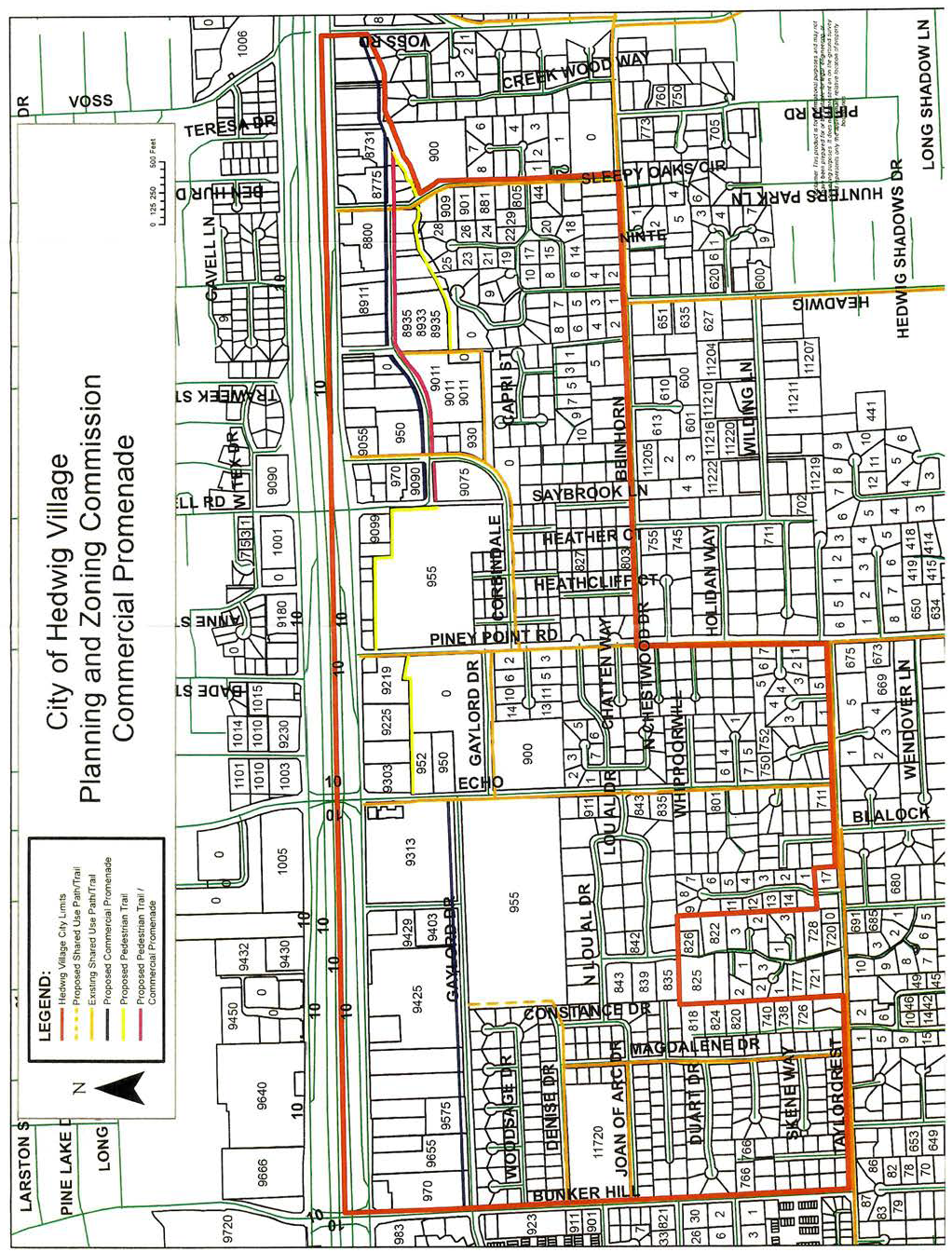
(Ord. No. 312, § 1, 3-9-1989; Ord. No. 313, §§ 1, 2, 3-9-1989; Ord. No. 314, § 1, 3-9-1989; Ord. No. 315, § 1, 3-9-1989; Ord. No. 316, § 1, 3-9-1989; Ord. No. 330, §§ 1—3, 11-9-1989; Ord. No. 344, § 3, 4-11-1991; Ord. No. 372, § 2, 11-12-1992; Ord. No. 497, § 3, 8-3-2001; Ord. No. 518, § 2, 8-8-2002; Ord. No. 544, § 2, 12-11-2003; Ord. No. 549, § 2, 3-31-2004; Ord. No. 558, §§ 2, 3, 12-9-2004; Ord. No. 566, § 2, 7-8-2005; Ord. No. 661, § 1(App. A), 12-12-2013; Ord. No. 673, § 2(App. A), 12-11-2014; Ord. No. 701, § 2(App. A), 7-13-2017; Ord. No. 703, § 2(App. A), 8-10-2017; Ord. No. 710, § 1(App. A), 10-2-2017; Ord. No. 727, § 2(App. A), 9-20-2018; Ord. No. 756, § 2(App. A), 8-15-2019; Ord. No. 776, § 2(App. B), 10-15-2020; Ord. No. 778, § 2(App. A), 12-17-2020; Ord. No. 780, § 2(App. A), 12-17-2020; Ord. No. 792A, § 2(App. A), 12-9-2021; Ord. No. 807, § 2(App. A), 9-8-2022; Ord. No. 822, § 2(App. A), 12-14-2023; Ord. No. 827, § 2(App. A), 2-8-2024; Ord. No. 828, § 2(App. A), 2-8-2024; Ord. No. 830, § 2(App. A), 2-8-2024; Ord. No. 831, § 2(App. A), 2-8-2024; Ord. No. 832, § 2(App. A), 2-8-2024)
Editor's note— At the direction of the city, the amendments to subsection A.1.c. above have been retained from Ord. No. 776, § 2(App. B), adopted Oct. 15, 2020, while the remainder of this section has been amended by the subsequent ordinances.
Cross reference— Businesses, ch. 18.
507. - Signs.
A.
General.
1.
Purpose. The purpose of this section is to provide for the reasonable display of signs necessary for public service or the conduct of business. The regulations herein are intended to protect the safety and welfare of the public and to maintain an attractive community appearance. This section authorizes and regulates the use of signs visible from a public right-of-way and/or adjacent property to:
a.
Provide a reasonable balance between the right of a business to advertise and identify itself and the right of the public to be protected against the unrestricted proliferation of signs;
b.
Support the economic well being of businesses by allowing them to identify their premises and advertise products and services;
c.
Provide minimum standards to safeguard life, health, property and the general welfare by regulating and controlling the design, quality of materials, construction, location, electrification, and maintenance of all signs and sign structures;
d.
Minimize overhead clutter for drivers and pedestrians;
e.
Provide for the orderly and reasonable elimination of existing signs that are not in conformance with this chapter to protect the public health and safety; and
f.
Protect property values by encouraging signs that are appropriate in both scale and design to surrounding buildings and landscape and by discouraging a needless proliferation in the number of signs.
2.
Scope. This section is referred to as the Sign Code and shall apply to all signs in the city. This section regulates the type, size, location, and number of signs, and shall be administrated by the building official, or his or her designee.
3.
General. The following provisions shall apply to all signs of any nature within any district of the city:
a.
Except as otherwise provided herein, no animated, moving, rotating, flashing, intermittently or variably illuminated, noise making or producing, moveable, or portable sign shall be erected, displayed, or used within the city;
b.
Any sign permitted by this section shall be located on the owner's property, shall be set back at least three feet from any road right-of-way or road easement, and shall not constitute a safety or traffic hazard or a public nuisance;
c.
Unless otherwise permitted by state law, no sign shall be constructed, erected, changed, altered, displayed, or used without first obtaining a permit from the city;
d.
All signs shall be structurally sound and approved by the building official or his or her designee;
e.
Existing nonconforming signs may be altered only to make them conform to this Code;
f.
All signs and sign structures shall comply with pertinent requirements of the building and electrical codes of the city.
4.
Electronic message signs. Notwithstanding the general prohibition against electronic message centers or electronic message signs contained in this section, such signs are permitted on a tract of land consisting of at least 2.5 acres, located within 1,255 feet of the IH-10 right-of-way and used primarily by a church, temple or mosque or a public or private school regularly teaching students in classes between kindergarten and 12th grade or for municipal offices, provided that in each case the following requirements apply:
a.
The sign must otherwise meet all size and location requirements of the zoning district in which it is located, unless the sign is replacing an existing pylon sign and will be on a pylon no more than 8 inches in diameter and between 89 and 110 inches high, as measured at ground level, with a sign face no more than 98 inches wide and 62 inches tall;
b.
No more than one electronic message sign is allowed for each school, church, temple, mosque or municipal office;
c.
Messages shall not change more than once in a 24-hour period and messages shall not blink, flash or move;
d.
The sign shall not be located closer than 400 feet to any residential property and should not be oriented toward a residence unless the building official has determined by line of sight that the illumination of the sign is sufficiently minimal and indirect from the perspective of the residence so as not to create a nuisance;
e.
The sign design shall have a white illuminated background with black letters not to exceed six inches in height; and
f.
Brightness shall not exceed 6,500 nits between sunrise and sunset, and 1,250 nits between sunset and sunrise. Each sign shall have a light-sensing device to automatically adjust brightness, shall be programmable so that brightness may be adjusted or the sign may be turned off at night if necessary and shall be certified as to compliance upon installation and continually maintained by the sign owner.
B.
Districts A and C (residential districts). The following provisions shall apply to districts A and C:
1.
Prohibited signs. The following are prohibited in districts A and C except as otherwise specifically authorized in this subsection:
a.
Signs that obstruct, or in all probability would cause to obstruct, ingress or egress, firefighting, or escape from a building;
b.
Signs that constitute a hazard to pedestrian or vehicular traffic;
c.
Signs that do not comply with the general requirements applicable to all signs in the city as set forth in this section 507;
d.
Signs that are illuminated or electronically activated;
e.
Signs located upon any public or private roadway right-of-way, or upon any public bridge, public sidewalk, or public easement;
f.
Signs that direct attention to a commercial enterprise, commodity, or service;
g.
Signs that exceed three feet in height above the surrounding finished grade level, including the height of the supporting structure;
h.
Signs having a sign face that exceeds four feet in area, or having a sign face with a width to height ratio of more than two to one or, alternatively, one to two;
i.
Signs that have attached thereto banners, posters, pennants, ribbons, streamers, racks for dispensing literature or other materials, balloons, strings of lights, spinners, or other similar devices;
j.
Signs that, according to prevailing community standards, contain statements, words, or pictures of an obscene, indecent, or immoral character, which offend public morals or decency;
k.
Signs that make use of any word, phrase, symbol, or character in such a manner as to interfere with, mislead, or confuse vehicular traffic;
l.
Signs that resemble official traffic control signs, signals or devices;
m.
Signs located on property without the written consent of the property owner;
n.
More than a total of three signs located on the property;
o.
Any other sign not specifically authorized by this subsection or another ordinance of the city;
p.
Any sign prohibited under section B.3(a);
q.
Signs in violation of any federal, state, or city law or regulation; and
r.
Commercial signs.
2.
Exceptions and exemptions. The provisions and regulations of this subsection B shall not apply to the following:
a.
Signs erected by the City, Harris County, State of Texas, or federal government, or signs otherwise required to be erected by federal, state or local laws;
b.
Numerical signs and signs containing the name of the resident, illuminated from the front and attached to or depicted on a building, mail box, or curb, identifying the address of the property and/or the name of the resident;
3.
Permitted signs. Signs described below shall be allowed in districts A and C:
a.
Institutional signs.
i.
Permanent signs. Notwithstanding subparagraph B.1(n) of this section, churches, public or private schools, and related administrative offices thereof (hereinafter sometimes called "institutions"), shall be allowed one permanent freestanding sign for each five acres contained in the lot or tract upon which such institution is located or one freestanding sign for each public or private roadway right-of-way adjoining such lot or tract, whichever is greater, but in no event shall more than two freestanding sign for each public or private roadway right-of-way adjoining such lot or tract be allowed. The permanent freestanding signs permitted by this subparagraph a, including any part of the sign structure, shall not exceed five feet in height, measured from the surrounding finished grade level, shall not contain a sign face which exceeds 60 square feet, and shall not be located within 15 feet of any public or private roadway right-of-way.
ii.
Temporary signs. The provisions of subparagraph B.1 (g), (h), and (i) and of this section shall not apply to temporary signs located on lots or tracts upon which an institution is located; provided however, it shall be unlawful for any person to fail to remove from public rights-of-way, drainage courses, drainage easements, or public or private grounds or properties, any damaged, discarded or downed temporary signs authorized to be erected by this subparagraph; and provided further, temporary signs promoting or announcing special events sponsored by the institution shall be displayed only during a seven-day period beginning five days before the event to which they relate.
b.
For sale or for lease signs. Signs that advertise a residential property for sale or lease. Not more than one double face for sale or for lease sign may be erected and maintained on a lot or tract of land. Such sign shall not exceed four square feet in sign area on a face. Such sign may contain, in addition to the words for sale or for lease, only an e-mail address, a telephone number and, if the property owner is represented by a real estate agent or broker, the word "agent" or "broker". Any such sign shall be removed within five days after the closing date of a sale of the property or the execution of a lease or rental agreement on the property to which such signs pertains. No such "for sale" or "for lease" sign shall be located within ten feet of any public or private roadway right-of-way.
c.
Noncommercial signs. Signs containing noncommercial messages only. For the purposes hereof, a "noncommercial message" shall mean a civic, political, religious, seasonal, or personal message that is not displayed for a fee or for compensation or for solicitation of a business or funds and is located on the property owned or lawfully occupied by the person displaying the message. Except as otherwise permitted under state law, signs containing noncommercial messages relating to a particular event or date shall be removed within five days following the occurrence of such event or date to which such signs pertain, but in no event shall such signs remain posted for longer than 30 days total, and no such noncommercial sign shall be located within ten feet of any public or private roadway right-of-way.
d.
Security signs. Signs containing messages informing the public that the premises upon which such signs are located are protected by a security system or service, provided any such signs does not exceed one square foot in sign area. The provisions of paragraph B.1(o) of this section shall not apply to security signs. Provided, further, such security signs may include the name of the business or entity providing the security system or service, it being the finding of the city council hereby that the identity on such signs of the security service provider, whether identified by logo, acronym, or otherwise in and of itself serves as a deterrent to criminal conduct on the premises to which the sign applies, and thus assists the city in providing protection to its citizenry from criminal conduct. No such security sign shall be located within ten feet of any public or private roadway right-of-way.
C.
District B (business districts B1, B2, B3, B4). The following provisions apply to all signs appearing in district B: Each current business having an existing sign that was installed in accordance with the ordinances and regulations in effect at the time of the sign's installation will be exempt from conforming to the requirements of this section until one of the following events occurs: a) the current business lease expires; b) there is a change in ownership of the business or c) there is a change in the category/type of business from its categorization under subsection 506A. Upon the occurrence of such as event, the current business shall have 90 days to bring their sign(s) into compliance with the current regulations governing signage in the commercial district. All new businesses will conform to the following codes governing signage in the commercial district.
1.
Permitted signs - Detached. Any permitted detached sign shall be a monument sign. A monument sign shall be defined as any sign having a solid base for its entire width and which base is in contact with the ground. The overall height-to-length ratio of a monument sign shall approximate the ratio of 1:1.618. There shall be two categories of monument signs: large monument signs that may only face Interstate Highway 1-10 and small monument signs.
a.
Large monument signs. The following provisions shall apply to large monument signs, as defined below:
i.
Any owner of commercial property in district B having a minimum of 275 feet of property line abutting Interstate Highway 1-10 may erect a large monument sign for each 275 feet of property. For purposes of this section, multiple owners having adjoining lots may join their frontage lengths together in order to achieve the minimum feet of property line abutting Interstate Highway 1-10 required hereunder. In such case, said multiple owners may erect a single large monument sign representing the combined properties so long as such sign meets all requirements otherwise set forth herein.
ii.
Any sign permitted under this subsection shall be located on the owner's property and shall be set back at least three feet from any road right-of-way or road easement along Interstate Highway 1-10.
iii.
The maximum height (top) of the sign structure shall be ten feet above the average natural grade ("large monument sign"). The maximum length of the sign shall be 16 feet. The thickness of the sign shall be no less than two feet and no more than five feet.
iv.
Content on the sign, including the number of tenants listed, will be at the discretion of the property owner authorized to construct a sign hereunder.
v.
Owners shall have flexibility in choice of materials for large monument signs, subject to the following: a) the base and exterior surface of the sign, excluding the advertising portion of the sign, shall be formed of a masonry building material such as stone, brick, concrete, marble, granite, or the like and b) such building materials shall either duplicate those materials of the property's building or otherwise be complementary with the building.
vi.
The sign shall include landscaping as set forth herein. Such landscaping shall conform to city authorized landscaping plans. The minimum landscaping ratio for signs will be a circumference ratio of 4:1, or four feet in sign height to one foot for planting out from each sign face. Plans for landscaping will be approved by the parks and beautification committee and will use the accepted plant and tree list provided by the city.
vii.
All sign illumination for large monument signs shall be from within the sign and must be approved by the city. There shall be no lighting affixed to the external structure of the sign.
viii.
The sign may have content on both large faces of the sign. No other portion of the sign, including the base, sides or other support structure for the sign may display content.
ix.
The sign face of each large monument sign shall be perpendicular to the property line along which they are placed and positioned approximately midway along the 1-10 road easement.
x.
A large monument sign shall not be erected with 200 feet of another large monument sign.
b.
Small monument signs. The following provisions shall apply to small monument signs as defined below:
i.
Any owner of commercial property in district B having a minimum of 200 feet of a property line abutting a road may erect a single small monument sign, as defined below, approximately midway along such property line. If any owner of a commercial property in district B has a minimum of 500 feet of property abutting a road, then they may erect up to two small monument signs along such road subject to the spacing requirements set forth in this section. For purposes of this section, multiple owners having adjoining lots may join their frontage lengths together in order to achieve the minimum feet of property line abutting any said road as required hereunder. In such case, said multiple owners may erect a single small monument sign representing the combined properties so long as such sign meets all the requirements otherwise set forth herein.
ii.
The overall size of a sign shall be four feet high from the grade by six point five feet long. The small monument sign structure shall consist of a one foot high base above which is mounted a three-foot-high sign face. The thickness of the sign shall be no less than one foot and no more than two feet.
iii.
Small monument signs shall be perpendicular to the property line alone which they are placed.
iv.
Sign illumination for a small monument sign shall be from the ground or from within the sign and must be approved by the city. There shall be no lighting affixed to the external structure of the sign.
v.
The specific content on the sign, including the number of tenants listed, will be at the discretion of the property owner authorized to construct a sign hereunder.
vi.
Any sign permitted under this subsection shall be located on the owner's property and shall be set back at least three feet from any road right-of-way or road easement.
vii.
A small monument sign shall not be erected within 150 feet of another small monument sign.
viii.
Owners shall have flexibility in choice of materials for small monuments signs, subject to the following: (1) the base and exterior surface of the sign, excluding the advertising portion of the sign, shall be formed of a masonry building material such as stone, brick, concrete, marble, granite, or the like and (2) such building materials shall either duplicate those materials of the property's building or otherwise be complementary with the building.
2.
Permitted signs - Attached.
a.
Attached signs in district B shall be allowed only during the period of time in which one or more of the businesses specified in subsections 506.I.1.b and 506.I.1.c are actually being conducted. Except for signs allowed under paragraph 8 of this subsection, each business shall be limited to one sign displayed on each exterior of the building oriented to each street on which the building has frontage. Signs facing residential districts A and C shall not be illuminated.
b.
An attached sign shall be removed from the building when a business is disconnected, or when the characteristic equipment, furnishings, or inventory of a business have been removed from the premises and have not been replaced within a period of 30 days, or when a building becomes vacant, whichever occurs first.
c.
An attached sign shall not project above the roofline of the building to which it is attached, nor project more than four feet from the face of the building to which it is attached.
d.
The maximum size of any attached sign hereunder shall be limited in area to 20 percent of the area of the side of the building to which it is attached, but in no event shall such attached sign exceed 300 square feet. For the purpose of this section, the area of an attached sign is defined as including the background of such sign if the background is distinguishable from the building to which the sign is attached. If such background is not distinguishable from the building to which the sign is attached, the area of such sign is defined as including the smallest rectangle containing the entire content of the sign, which would enclose such sign.
3.
Flags and flagpoles.
a.
Flags may be displayed in retail centers provided that the content is seasonal, decorative, or relates to the design or theme of the overall center, are integrated into the design of the center, and do not contain messages relating to the sale or promotion of merchandise or services of individual stores. Banners relating to the seasons of the year are permitted. The design, color, size, location and number must be appropriate for the individual retail center. All flags and banners shall be affixed to an acceptable free-standing fixture as determined by the building official or his or her designee.
b.
Notwithstanding the foregoing, a new tenant may display a banner indicting the business is "Now Open" for a period of 60 days from the original opening of the business at the location.
c.
Business may erect one corporate flag and flagpole, per parcel, for a bona fide company or corporate office located within the City of Hedwig Village. A sign permit and permit fee is required, and an engineer's installation standards must accompany the permit application.
d.
Flag poles shall not exceed 35 feet in height.
e.
The maximum flag size shall be based on the height of the flagpole. For flagpoles 20 feet or less in height, the flag size shall be limited to a maximum of 24 square feet (SF). Flagpoles greater than 20 feet but less than 30 feet in height are permitted a maximum flag size of 40 square feet (SF). For flagpoles 30 feet or greater in height, the flag size shall not exceed 60 square feet (SF).
f.
No flag or flagpole may be located within any easement.
g.
Number of flags shall not exceed three.
4.
Temporary signs. Notwithstanding any other provision of this subsection to the contrary, one temporary sign advertising vacant acreage, vacant office space, or vacant commercial space may be permitted for tracts in business district B in order to give information concerning the sale or development or lease of such vacant acreage or space. Any such sign shall comply with the following:
a.
For vacant tracts on one acre or less, such sign does not exceed six square feet in sign area; for vacant tracts of greater than one acre but not more than two acres, such sign does not exceed 16 square feet in sign area; for vacant tracts greater than two acres, such sign does not exceed 32 square feet in sign area:
i.
Such sign shall not include more than five words, one of which words shall be the word lease, rent, or sale, plus one telephone number, one e-mail address, plus a broker's license number, if applicable. The name of the broker or of the broker's firm may be shown on the sign. The sign shall not contain any logos or other wording or indicia. The sign shall not be lighted or illuminated in any manner other than be preexisting background or by previously permitted sign illumination.
ii.
Only one such sign shall be allowed for each tract.
iii.
Such sign is removed prior to commencement of construction or development of tract.
iv.
Such sign otherwise complies with all regulations herein applicable to any such signs.
v.
Vacant acreage, as used herein, shall mean properties upon which no building with an area greater than 500 square feet exists.
b.
For vacant office or commercial space:
i.
Such sign shall not include more than five words, one of which shall be the word lease, rent, or sale, plus one telephone number, one e-mail address, plus a broker's license number, and amount of square footage available if desired. The sign shall not contain any logos or other wording or indicia. The sign shall not be lighted or illuminated in any manner other than by preexisting background or by previously permitted sign illumination.
ii.
Only one such sign shall be allowed per tenant.
iii.
Such sign is removed upon lease or rental of indicated space.
iv.
Such sign otherwise complies with all regulations herein applicable to any such sign.
v.
Such sign is attached to a permanent structure associated with the property (other than a monument sign) or incorporated as part of the advertising space of a monument sign.
vi.
Such sign is a rectangle that does not exceed nine square feet.
5.
Maintenance of signs. All signs and all components thereof shall be kept in good repair. This includes without limitations: supports, braces, anchors, faces, building materials and electrical components. This shall also include maintaining all lighting for illuminated signs. Maintenance shall be completed as soon as commercially reasonable but in no event shall signs remain in any state of disrepair for a greater than 30 days.
6.
Removal/enforcement. Subject to applicable state law, including without limitations V.T.C.A., Local Government Code Ch. 216(A), the following shall apply to all signs in district B:
a.
After removal of all signs no longer applicable to the premises, as provided for in this subsection B, each property owner within district B shall be allowed one temporary for lease for a primary period not to exceed six months upon application to and approval by the building official. The building official is authorized to approve for successive six month periods the display of this for lease sign upon reapplication by the owner. Such sign may be displayed only during the period beginning 30 days prior to the time space in the premises is scheduled to become available for lease and ending seven days after the space is leased. The dimensions of the sign shall not exceed two feet in height nor six feet in width and the top of such sign shall not be more than six feet above ground level where it is displayed. Such sign shall not include more than five words, one of which words shall be the word lease, rent or sale, plus one telephone number, plus a broker's license number, if applicable. The name of the broker or the broker's firm may be shown on the sign. The sign shall not contain any logos or other wording or indicia. The sign shall not be lighted or illuminated in any manner other than by preexisting background or by previously permitted sign illumination.
b.
When it is apparent that a business has been discontinued, or when the characteristic equipment, furnishings, or inventory of a business have been removed from the premises and have not been replaced within a period of 30 days, or when a building becomes vacant, whichever occurs first, the owner(s) of the business and the owner(s) of the property shall remove all signs, both detached and attached, and their supports, within 30 days from the date thereof. If the city shall find that any such sign has not been removed in compliance with this section b, the building official, or his or her designee, shall give written notice to the owner(s), agent(s), or person(s) having the beneficial interest in the business advertised by the sign and/or the building or the premises on which such sign is located. Removal of the sign(s), which caused the city to give notice, shall occur within ten days after receipt of notice. If such removal is not completed by the end of the period, the city is hereby authorized to cause the sign to be removed forthwith at the expense of the owner(s), agent(s), or person(s) having a beneficial interest in the business advertised by the sign and/or the building or the premises on which the sign is located.
c.
The building official, or his or her designee, shall enforce the repair of signs and removal of business signs once a business has been discontinued or moves from a space, which may include removal of the nonconforming sign by the building official, or his or her designee, upon expiration of the relevant time period. The city shall have authority to grant an extension for removal or repair of such signs for a period not to exceed an additional 30 days.
d.
Notwithstanding the foregoing, if the city shall find that any sign is unsafe or insecure, or is a menace to the public, the building official, or his or her designee, shall give written notice to the owner(s), agent(s), or person(s) having the beneficial interest in the business advertised by the sign and/or the building or the premises on which such sign is located. Correction of the condition, which caused the city to give such notice, shall occur within ten days after receipt of notice. If such condition is not corrected by the end of the period, the city is hereby authorized to cause the sign to be removed forthwith at the expense of the owner(s), agent(s), or person(s) having a beneficial interest in the business advertised by the sign and/or the building or the premises on which the sign is located. The building official, or his or her designee, is authorized to cause any sign to be removed summarily and without notice, at the expense of the owner(s), agent(s), or person(s) having a beneficial interest in the business advertised by the sign and/or the building or the premises on which the sign is located, whenever the building official, or his or her designee, determines that such sign is an immediate peril to persons or property.
e.
No building permit shall be issued for construction on any property on which there is situated a nonconforming sign.
f.
A person or business found responsible for violating this ordinance shall be subject to a fine of not less than $100.00, or more than $1,000.00 for each day the violation exists and such other civil penalties as set forth herein. This shall apply to existing and future signs.
g.
The business against which these ordinances are enforced and the owner of the property at which the business is located shall be jointly and severally liable for all fines and penalties arising from violation of this subsection 507(C), as well as all costs of enforcement by the city.
7.
Prohibited signs.
a.
Commercial property abutting residential districts. No sign allowed by paragraphs 1. and 2. shall be placed on that portion of a commercial property which directly abuts either district A or district C of the city.
b.
Electronic message centers are prohibited.
c.
Billboards.
d.
Bus bench signs.
e.
Obscenities. No sign shall bear or contain statements, words, or pictures in which the dominant theme of the material, taken as a whole, appeals to the prurient interest in sex or is patently offensive because it affronts the contemporary community standard relating to the description or representation of sexual material that is utterly without redeeming social value.
f.
Off-premises signs. Any sign that is not located on the property where the business advertised by the sign is located.
g.
Poster(s), pennant(s), banner(s), streamer(s), flashing light(s), strobe light(s), neon lights(s), balloon(s), searchlight(s), clusters of flags, string(s) of twirlers or propellers, flare(s), and other displays of a carnival nature; except on a limited basis as seasonal decorations or as provided by this chapter.
h.
Portable signs.
i.
Commercial signs on light or utility poles.
j.
Three-dimensional statue, caricature or representation of persons, large inflatable balloons and other inflatable displays including characters, animals, merchandise and dirigibles, or merchandise as a sign.
k.
Barbershop poles are excluded from this prevision.
l.
Any sign that is supported by one or more exposed poles or pylons, including but not limited to pylon signs.
m.
Posted signs. Any sign that has not been approved by the building official, or that does not have a permit, which is posted to advertise a business or product.
n.
Signs utilizing digital technology to form images or messages.
8.
Permitting.
a.
Sign display permits. It shall be unlawful to erect, display or alter a sign in the city without a sign display permit issued by the building official, or his or her designee.
b.
It shall be the duty of the building official, or his or her designee, upon the filing of an application for a permanent sign permit or a temporary sign permit, to review the application and to issue, issue with conditions, or deny the permit in accordance with the provisions of this chapter.
9.
Miscellaneous. In districts B1, B2, B3, and B4, in addition to other signs allowed by paragraphs 1 through 7 of this subsection a property owner is allowed two parking/traffic direction signs on the premises for each curb cut.
(Ord. No. 317, § 1, 3-9-1989; Ord. No. 318, § 1, 3-9-1989; Ord. No. 344, §§ 4, 5, 4-11-1991; Ord. No. 385, §§ 3—7, 7-8-1993; Ord. No. 404, §§ 1, 2, 11-10-1994; Ord. No. 419, §§ 4, 5, 4-11-1996; Ord. No. 428, § 2, 4-10-1997; Ord. No. 562, § 2, 2-10-2005; Ord. No. 619, § 1(App. A), 6-11-2009; Ord. No. 685, § 1(App. A), 5-19-2016; Ord. No. 694, § 1(App. A), 3-9-2017; Ord. No. 779, § 2(App. A), 12-17-2020; Ord. No. 849, § 1(Exh. A), 9-11-2025)
508. - Specific use permits.
A.
Purpose. The purpose of the regulations described in this section is to allow within various zoning districts of the city the proper integration of uses which may be suitable only in specific locations. A specific use permit is an amendment to the district regulations of the planning and zoning code that permits the permanent establishment of a specific use within a zoning district.
B.
Uses subject to specific use permits. In addition to the permitted uses set forth in this article V, the following uses may be allowed in the districts indicated upon the granting by the city council of a specific use permit:
(a)
Sewage disposal plants, water system facilities, and water plants.
(b)
Uses not specified in the permitted use table or deemed equivalent thereof for the district in which the proposed use is to be located if:
(1)
The proposed use is found by the city council not to be a material deviation from the city's comprehensive plans, and
(2)
The city council finds that adequate conditions and safeguards are imposed in the specific use permit ordinance to assure the integrity of such comprehensive plan.
(c)
Telecommunications facilities. Buildings, equipment, transmission/receiving towers, and other necessary ancillary structures of telecommunications providers may be allowed in district B-4 east of Campbell Road. Provided however, no specific use permit for a telecommunications facility shall be approved if:
1.
The proposed facility would adversely affect the residential integrity of adjacent or area neighborhoods;
2.
The proposed facility would create visual blight;
3.
The proposed facility would create noise or light pollution; or
4.
The proposed facility would create a nuisance to adjacent or area properties;
5.
The applicant is unable to establish that it cannot provide service to the city from other available locations or existing facilities;
6.
The proposed facility would fail to utilize state of the art technology to achieve the above objectives;
7.
The proposed facility would fail to comply with all safety and regulatory standards promulgated by the Federal Communications Commission, or other agency having jurisdiction thereover; and
8.
Such facility would fail to substantially conform to the administrative requirements and guidelines adopted by city council.
Provided further, each applicant for a specific use permit shall demonstrate that in designing the proposed telecommunications facility it has utilized state of the art technology to minimize adverse effects to the residential integrity of surrounding or area residential properties. In addition, each facility authorized hereby shall comply fully with all applicable safety or other regulatory standards established or hereafter promulgated by any state or federal law, or agency rule or regulation, applicable thereto.
The city council shall, from time to time, adopt by resolution administrative guidelines and regulations to implement this subsection.
C.
Procedure. An ordinance granting a specific use permit is an amendment to this planning and zoning code and, as such, may be adopted only after notice and hearing as required herein and by law for the adopting of amendatory zoning ordinances. Applications for specific use permits shall be made by the property owner or certified agent thereof to the planning and zoning commission. The application shall include the following information:
1.
The applicant's name and address;
2.
The actual shape and dimensions of the lot to be built upon;
3.
The lines within which the proposed buildings and structures are to be built or erected;
4.
The intended use of each building or part of each building.
5.
Site conditions plan. This map or plot plan or series thereof, drawn to an acceptable scale as may be determined by the planning and zoning commission, shall indicate:
(a)
Scale, date, north arrow, and general location map showing relationship of the site to such external facilities as highways, shopping areas, cultural complexes, and adjacent land uses;
(b)
Boundaries of the subject property, all existing streets, buildings, watercourses, easements, section lines, zoning district boundary lines, and other important physical features within and adjacent to the proposed development; and
(c)
The location and size (as appropriate) of all existing drainage, water, sewer, and other utility provisions.
6.
Site development plan. This plan shall be prepared at the same scale as the above site conditions plan and shall indicate:
(a)
The number and type of buildings involved in the overall site, dwelling unit per acre calculations, if any, along with population projections for each; and
(b)
The establishment of minimum design standards which shall govern the site development such as pedestrian ways, internal streets, open space provisions, off-street parking, visual screens, general buffer and landscaped areas, and building height and setback limits.
7.
Development schedule. The application shall be accompanied by a development schedule indicating the approximate date on which construction will commence and the date of completion. A development schedule, if adopted and approved by the city council, shall become part of the development plan and shall be adhered to by the owner, developer, or his successors in interest. Upon the recommendation of the planning and zoning commission and for good cause shown by the owner and developer, the city council may extend the development schedule as may be supported by the facts and circumstances of the case.
8.
Such other information with regard to the lot and neighboring lots as may be necessary to determine and provide for the enforcement of this planning and zoning code.
D.
Certificate of occupancy. The administrative official shall not issue a certificate of occupancy for the specific uses described above in section 508B that are hereafter created, changed, converted, or enlarged, either wholly or in part, until a specific use permit has been obtained in accordance with the amendment procedures set forth in this section 508.
E.
Permits conditional. Specific use permits, revocable, conditional, or valid for a term period may be issued for any of the uses or purposes for which such permits are required or permitted by the terms of this code. Granting a specific use permit does not exempt the applicant from complying with the requirements of the building code or other ordinances.
F.
Fee. The fee to cover administrative and processing costs of a specific use permit application shall be as established by the city council.
G.
Criteria. In considering any application for a specific use permit, the zoning commission shall give due regard to the nature and condition of all adjacent uses and structures. The zoning commission may recommend disapproval of any application for a specific use permit and, in recommending approval of a specific use permit the zoning commission may recommend such requirements and conditions with respect to location, construction, maintenance, and operation, in addition to the regulations of the district in which the particular use is located, as they may deem necessary for the protection of adjacent properties and the public interest.
H.
Recommendations. The zoning commission shall make a recommendation regarding the application, to the city council, which recommendation shall include consideration of:
1.
Whether the proposed structure or use conforms to the requirements and intent of this code and the comprehensive plan of the city;
2.
Whether such use will not, under the circumstances of the particular case, constitute a nuisance or be detrimental to the public welfare of the community.
J.
Issuance of permit. Following passage of a specific use permit ordinance by the city council, the administrative official shall issue building permits as provided in this code and shall ensure that development is undertaken and completed in accordance with said permits and the specific use permit ordinance.
(Ord. No. 307, § 3(508), 3-9-1989; Ord. No. 330, § 4, 11-9-1989; Ord. No. 444, § 1, 12-11-1997)
509. - Planned unit developments.
A.
General provisions
1.
Business Districts:
a.
Purpose. A planned unit development (PUD) is intended to provide for combining and mixing uses into integral land use units such as office, commercial, and retail centers and to provide flexibility in develop regulations; or any appropriate combination of uses which may be planned, developed or operated as integral land use units, whether by single owner or a combination of owners in substantial compliance with the city's comprehensive plan.
b.
Location. A PUD may be established within the business districts in accordance with the procedures and requirements of this section.
2.
Residential Districts:
a.
Purpose. A planned unit development (PUD) is intended to allow for schools on twenty-five (25) acres or more to harmoniously exist within the residential areas of the City in substantial compliance with the city's comprehensive plan.
b.
Location. A PUD may be established within the Residential A Zoning District in accordance with the procedures and requirements of this section.
B.
Specific provisions
1.
Business districts:
a.
Generally. The PUD is an overlay in the business district in which it is approved. The underlying business district zoning continues to the extent not specifically modified by the provisions of the PUD.
b.
Permitted uses. The uses to be permitted in any specific PUD shall be those permitted in the business district in which the PUD is located as well as such uses enumerated in the ordinance which creates such PUD, provided, however, that those uses prohibited by section 506.A.2. of the Code shall not be permitted. Any proposed amendment to the uses permitted within a specific PUD shall be submitted for approval in the same manner as the original PUD.
c.
Size and numbers. In order to encourage the development of property as harmonious units, a minimum of one acre shall be required to be included with a PUD.
d.
Building height. No building within the PUD, except a parapet not to exceed four feet in height, and any additional screening, within the rooftop footprint necessary for plumbing, mechanical equipment, or elevator overruns, shall exceed the height permitted for the business district in which the PUD is located except that, within business districts B3 and B4 the following building height may be permitted:
i.
Forty-two feet above average natural grade within 200 feet of the nearest point of any residential lot in district A or C; or
ii.
Fifty-six feet above average natural grade at distances greater than 200 feet from the nearest point of any residential lot in district A or C; or
iii.
Eighty-one feet above average natural grade at distances greater than 300 feet from the nearest point of any residential lot in district A or C.
e.
Green space: At least ten percent of the PUD site shall be dedicated to green space and outdoor site amenities.
h.
Design guide: Development within the PUD shall conform to the provisions of the city's design guide for PUD development.
2.
Residential district A:
a.
Generally. The PUD is an overlay in which it is approved. The underlying residential zoning continues to the extent not specifically modified by the provisions of the PUD.
b.
Permitted uses. A PUD application may be made for primary and/or secondary school uses, as long as the minimum size is satisfied.
c.
Size. A minimum of 25 contiguous acres is required to apply for a PUD within the residential A zoning district. The PUD site shall comprise the entire platted lot or lots, i.e. no portions of a platted lot unless the plat is amended or the lot replatted.
d.
Building height. No newly constructed building within the PUD, except any additional screening, within the rooftop footprint necessary for plumbing, mechanical equipment, or elevator overruns, shall exceed the height permitted for the residential district in which the PUD is located, except that for buildings used as a cafeteria, classroom, laboratory or for other educational purposes, excluding athletic facilities or parking garages, the following building height may be permitted:
i.
At distances greater than 375 feet from the nearest point of any residential lot in zoning districts A or C, a maximum of 65 feet above finished floor height with a slab reveal of no greater than two feet above adjacent natural grade within five feet of the perimeter of the building.
e.
Windows above 35 feet. No building or structure shall have placed or constructed thereon any windows above 35 feet unless such window faces a public street abutting the PUD site or unless a variance is granted by the city council.
f.
Tall building coverage. Notwithstanding the foregoing, the total coverage of all buildings which exceed 35 feet in height on the PUD site shall not exceed 12 percent coverage of the PUD site.
g.
Green space. At least 20 percent of the PUD site shall be dedicated to green space and outdoor site amenities.
h.
Driveways. No new driveway shall be constructed closer than a distance as approved by the city council from the nearest point of any residential lot in zoning districts A or C.
i.
Pedestrian management. Unless otherwise approved in the planned unit development by city council, the property shall include a commercial promenade or pedestrian trail, as applicable, in accordance with the specifications in section 506.H. of this Code if a promenade or trail is indicated to be on the property in the Commercial Promenade and Trails Plan adopted by the city.
j.
Additional PUD submittal information requirements:
i.
Residential protection. The PUD application shall provide information from the applicant on the proposed protection for the adjacent single-family residences including, but not limited to, increased school traffic in the adjacent neighborhoods, lighting, security, and noise;
ii.
Traffic impact study: A traffic impact study performed by a licensed engineer shall be required. The traffic impact study shall include any change to traffic routing on adjacent streets, proposed mitigation for all roadways and major intersections within one-half mile of the PUD site, peak hours of nearby businesses, schools and religious institutions, any proposed addition of a curb-cut to the tract, or the modification or elimination of any existing curb-cut;
iii.
Fencing plan;
iv.
Parking plan, provided such plan shall not otherwise reduce the required number of parking spaces for schools as provided in section 506 of this Code as if the property is in a commercial district, unless a variance is granted by the city council;
v.
Site plan, showing lot coverage;
vi.
Phasing plan, if applicable;
vii.
Conceptual landscaping plan, tree survey, tree disposition and protection plan, and justification for any tree removal or potential tree damage; and
viii.
Elevations and building materials: In the event of a partial renovation of a school campus, the building materials should be harmonious with the building materials used for the existing improvements. In addition, any parking garage constructed on the PUD site shall be constructed with building materials similar to any adjacent buildings so as to be harmonious with the other buildings on the site.
C.
Application requirements/procedure.
1.
General. The steps necessary for creation of a PUD are as follows:
a.
Pre-application conference between the applicant and the city administrator or his or her designee.
b.
Submission of the formal application with all required material.
c.
Public hearings held in accordance with the requirements of this Code.
2.
Pre-application conference. An applicant for a PUD shall schedule a pre-application conference with the city administrator or his or her designated representative prior to the formal submission of the application materials.
At the pre-application conference, the applicant shall provide a preliminary drawing that includes, but is not limited to the following:
a.
Delineation of site boundaries;
b.
General site layout and conditions indicating relationship of proposed land uses, parking, and street layout(s);
c.
Project renderings, project description and/or narrative demonstrating compliance with the design guide; and
d.
A traffic study as requested by the city.
Based on the information provided by the applicant, the city administrator or his or her designee shall provide initial comments to the applicant concerning the merits of the proposed development and provide any other information necessary to process the application.
3.
Application submission. Any person, group of persons, or corporation having a legal or equitable interest in any property may file an application for a PUD. Such application shall be submitted and processed in accordance with the procedures of this section and shall include as a minimum:
a.
An application fee of $10,000.00 or as set forth in the city's schedule of fees;
b.
Proof of ownership. If all land to be included with the PUD is not under common ownership, applicant must provide an agreement executed by all owners consenting to the creation of the PUD and agreeing to abide by the terms of creation;
c.
A legal description of the PUD prepared by a Texas licensed surveyor including a map of the PUD area suitable for reproduction and a digital file of same;
d.
A site plan showing the layout of proposed building, lighting, parking, streets, walkways, site amenities, green space and landscaping;
e.
Utility information detailing the projected utility needs of the PUD and the anticipated source for such utilities;
f.
A drainage plan showing the anticipated drainage needs of the PUD and the proposed mitigation for such drainage;
g.
A parking plan for the PUD;
h.
A traffic study, unless waived by the city, detailing traffic impacts, including during peak hours of nearby businesses, schools, and religious institutions, and proposed mitigation for all roadways and major intersections within one-half mile of the project; and
i.
A development schedule for completion of all construction.
j.
A list of variances requested from current city zoning ordinances and the design guide.
4.
Formal public hearing. The PUD application must be preliminarily approved by the Hedwig Village Building Official and shall be presented by the PUD applicant to the planning and zoning commission at either a regular or special called meeting prior to any hearing on the application.
The planning and zoning commission and the city council shall hold an advertised joint public hearing in accordance with the procedures set forth in article VII, of this Code for zoning amendments. At the public hearing the PUD applicant shall present an overview of the project to the public prior to citizen comments. This presentation should include the general site layout and conditions indicating relationship of proposed land uses, parking, and street layout(s) and a project rendering with a project description and/or narrative. In addition to the publication of notice required by article VII, notice of the joint public hearing shall be mailed to all property owners of the city at least ten days before the date of the hearing.
Following the conclusion of the public hearing, the planning and zoning commission shall make its recommendation to the city council in accordance with the standard procedures for a change of zoning. The planning and zoning commission may recommend, and the city council may approve the request for a PUD as submitted or with modifications thereto; any such approval, however, is at the sole discretion of the city council.
5.
Approval. If approved by city council, the ordinance establishing a PUD shall specify such height, floor area, density, site coverage, set back, landscaping, off-street parking, signage, drainage and all other standards as are appropriate for the development which are considered necessary to protect the health, safety and general welfare, and to create a reasonable transition to, and protection from, property adjacent to the PUD. The city council shall have authority to adjust the city's standard storm water requirements with appropriate mitigation.
Every PUD approved under the provisions of this section shall be considered an amendment to the Hedwig Village Planning and Zoning Code and applicable only to the property that comprises the PUD.
D.
Development schedule.
1.
A development schedule shall be submitted by the applicant indicating the approximate date on which construction is expected to begin and the rate of anticipated development to completion. The development schedule shall, if adopted and approved by the city council, become part of the ordinance creating such PUD, and shall be adhered to by the owner, developer, and successors in interest.
In carrying out the development of a PUD, the development conditions and the development schedule shall be complied with. Such conditions as are specified for the development of a PUD shall not be construed as conditions precedent to the approval of the zoning amendment, but shall be construed as conditions precedent to the granting of a certificate of occupancy.
2.
The planning and zoning commission or the city council may, if in their opinion, the owner or owners of the property are failing or have failed to meet the approved schedule, and such failure continues for another 90 days after receipt of written notice, initiate proceeding to amend or repeal the ordinance creating the PUD. Such action shall occur in accordance with the procedures of the City's Zoning Code. Upon the recommendation of the commission, and for good cause shown by the owner or developer, the city council may extend the development schedule or adopt such new development schedule as may be indicated by the facts and conditions of the case.
E.
Amendment to planned unit development. Any major amendment, supplement, deletion or modification to a PUD may be granted upon application by any person, group of persons or corporation having a legal or equitable interest therein. Any application for such amendment, supplement, deletion, or modification shall contain the information specified in the section and shall be processed in accordance with the procedures set forth herein for new applications. The city administrator or his or her designee may authorize minor modifications that:
a.
Do not alter the basic relationship of the proposed development to adjacent property;
b.
Do not alter the uses permitted;
c.
Do not increase the maximum density, floor area, height, or site coverage;
d.
Do not decrease the amount of off-street parking; and
e.
Do not reduce the minimum yards or setbacks.
An applicant may appeal the decision of the city administrator or his or her designee to the commission for review and decision.
(Ord. No. 709, § 2(App. A), 10-12-2017; Ord. No. 723, § 2(App. A), 7-12-2018; Ord. No. 735, § 2(App. A), 10-18-2018; Ord. No. 752, § 2(App. A), 5-16-2019; Ord. No. 807, § 2(App. B), 9-8-2022; Ord. No. 808, § 2(App. A), 9-8-2022)

