Henderson City Zoning Code
ARTICLE X
- SIGNS AND OUTDOOR ADVERTISING DISPLAYS10
Editor's note— Ord. No. 26-99, adopted Sept. 14, 1999, completely repealed the provisions of former §§ 10.01—10.11 and replaced them with the similar provisions of §§ 10.01—10.19 as currently set out herein. Former §§ 10.01—10.11 derived from Ord. No. 11-89, § 1, adopted July 25, 1989; Ord. No. 26-91, § 1, adopted Aug. 27, 1991; and Ord. No. 12-99, § 1, adopted April 14, 1999.
Sec. 10.01.- Purposes.
The purposes of these sign regulations are: to encourage the effective use of signs as a means of communication in the city; to maintain and enhance the aesthetic environment and the city's ability to attract sources of economic development and growth; to improve pedestrian and traffic safety; to minimize the possible adverse effect of signs on nearby public and private property; to enable the fair and consistent enforcement of these sign restrictions; and to facilitate emergency services.
(Ord. No. 26-99, § 1, 9-14-99)
Sec. 10.02. - Applicability effect.
A sign may be erected, placed, established, painted, created, or maintained in the city only in conformance with the standards, procedures, exemptions, and other requirements of this article.
The effect of this article as more specifically set forth herein, is:
•
To establish a permit system to allow a variety of types of signs in commercial and industrial zones, and a limited variety of signs in other zones, subject to the standards and the permit procedures of this article;
•
To allow certain signs that are small, unobtrusive, and incidental to the principal use of the respective lots on which they are located, subject to the substantive requirements of this article, but without a requirement for permits;
•
To prohibit all signs not expressly permitted by this article; and
•
To provide for the enforcement of the provisions of this article.
(Ord. No. 26-99, § 1, 9-14-99)
Sec. 10.03. - Definitions and interpretation.
Words and phrases used in this article shall have the meanings set forth in this section. Words and phrases not defined in this section but defined in the zoning ordinance of the city shall be given the meanings set forth in such ordinance. Principles for computing sign area and sign height are contained in section 10.04. All other words and phrases shall be given their common, ordinary meaning, unless the context clearly requires otherwise. Section headings or captions are for reference purposes only and shall not be used in the interpretation of this article.
Abandoned/obsolete signs. Abandoned signs shall be removed within thirty (30) days of abandonment. This section shall not apply to any sign associated with a vacant business or property which is advertised and marketed for sale or lease provided that the sign and the property is maintained in conformance with all applicable provisions as established by the city. When lenses are removed, a new lens or banner wrap shall be installed to existing cabinets within thirty (30) days.
Upon failure of sign owner or lessee, or property owner, to comply with this chapter, the administrator shall issue a written notice to the owner of the property upon which the sign is located. The notice shall state that the sign shall be removed within thirty (30) days. If the owner or agent of the property fails to comply with the written notice to remove the sign, the administrator is hereby authorized to cause removal of the sign. Any expense incidental to the removal of the sign, including reasonable attorney fees, shall be charged to the owner of the property upon which the sign is located and shall constitute a lien upon the property.
For the purpose of dealing with abandoned signs in this chapter, the word remove shall mean:
A.
The sign face, along with posts, columns, or supports of freestanding signs, shall be taken down and removed from the property.
B.
The sign face and supporting structures of projection, roof, or wall signs shall be taken down and removed from the property.
C.
The sign face of painted wall signs shall be removed by painting over the wall sign in such a manner as to completely cover up and hide from sight the sign in question.
Appurtenance sign. Any sign that is an integral part of an essential appurtenance necessary to the use of the premises, such as a menu board or gas pump.
Banner. Any sign of lightweight fabric or similar material that is permanently mounted to a pole or a building by a permanent frame at one or more edges. National flags, state or municipal flags, or the official flag of any institution or business shall not be considered banners.
Banner wrap. Any device used to cover over existing sign faces that may or may not have artwork graphics intended to be used as signage. Usually made of vinyl material, such a wrap might be considered temporary or permanent and is used as a means to cover completely an existing sign as a means of changing or covering sign content without the actual removal of the existing sign. This wrap will be secured to existing sign structure in such manner as to appear permanent and minimize chances for becoming disengaged from original sign during normal exposure period.
Beacon. Any light with one (1) or more beams directed into the atmosphere or directed at one (1) or more points not on the same lot as the light source; also, any light with one (1) or more beams that rotate or move.
Billboard. A sign with a minimum square footage of one hundred (100) square feet, that is affixed to or erected upon a freestanding framework designed or intended to be used for posting information not pertaining directly to the use of the premises on which it is located.
Building marker. Any sign indicating the name of a building and date and incidental information about its construction, which sign is cut into a masonry surface or made of bronze or other permanent material.
Building sign. Any sign attached to any part of a building, as contrasted to a freestanding sign.
Canopy sign. Any sign that is part of or attached to an awning, canopy, or other fabric, plastic, or structural protective cover over a door, entrance, window, or outdoor service area. A marquee is not a canopy.
Changeable copy sign. A sign or portion thereof with characters, letters, or illustrations that can be changed or rearranged without altering the face or the surface of the sign.
Consolidated commercial center sign. A sign constructed for shared use by a commercial center (three (3) or more tenants), whether tenants are located on common property or on individual lots noted on a recorded plat or land use restriction for each individual lot. A consolidated commercial center sign complying with specific requirements of this section shall not be considered an off-premises sign. (See exhibit "A".)
Electronic message sign. Signs shall come equipped with a working ambient light sensing, dimming device that automatically adjusts the sign's brightness in direct correlation with natural ambient light conditions at all times. No electronic message sign may exceed a brightness level of 0.3 footcandles above ambient light as measured using a footcandle meter at a preset distance depending on sign area as shown on exhibit "B."
A.
On premises electronic message signs: Allowed in Highway Commercial and as a conditional use in General Business, Central Business District. Light and Heavy Industrial districts, and Gateway Zone district.
B.
Electronic message billboard signs: Allowed in Highway Commercial and Heavy Industrial districts. Existing legal nonconforming billboards shall require a conditional use permit to be converted to an electronic message billboard sign.
Festoons. A sign consisting of a string of ribbons, small flags or pinwheels. Festoon sign shall also include balloons or umbrellas used for advertising.
Flag. Any fabric, banner, or bunting containing distinctive colors, patterns, or symbols, used as a symbol of the national government, state or municipal government or the official symbol of any institution or business.
Flashing sign. Any illuminated sign, electronic changeable copy, or any other illuminated device, whose lighting fluctuates, alternates, or otherwise varies in brightness, pattern, position or reflection, in order to attract attention or to phase copy changes in or out. Such a sign, copy, or other device is not a flashing sign if its lighting varies in brightness, pattern, position or reflection only instantaneously and concurrently on the entire sign at five-minute minimum intervals. (See Appendix 4.)
Historic sign. A sign that is designated by the city manager as having historic and/or architectural significance.
Illegal sign. A sign which was not in compliance with the regulations in effect at the time the sign was erected.
Illuminated/backlit sign. A sign that is designed to give artificial light directly through a transparent or translucent material from a source of light originating within such sign (i.e. internally lit or neon sign).
Incidental sign. A sign, generally informational, that has a purpose secondary to the use of the zone of the lot on which it is located, such as "no parking," "entrance," "loading only," "telephone," and other similar directives. No sign with a commercial message legible from a position off the lot on which the sign is located shall be considered incidental. For the purpose of this definition, logos shall not be considered a commercial message. Maximum area of incidental sign shall not exceed sixteen (16) square feet.
Lot. Any piece of land or a portion of a subdivision, the boundaries of which have been established by some legal instrument of record, that is recognized and intended as a unit for the purpose of transfer of ownership.
Marquee. Any permanent roof-like structure projecting beyond a building or extending along and projecting beyond the wall of the building, generally designed and constructed to provide protection from the weather.
Marquee sign. Any sign attached to, in any manner, or made a part of a marquee.
Nonconforming sign. Any permanent sign that was erected or displayed prior to the adoption of this article that does not conform with the requirements herein cannot be placed or relocated on premises.
Off-premises sign. Any sign not located on the premises of the business, activity or use to which the sign relates.
Official sign. Public signs erected by or on behalf of a governmental body or hospital to post legal notices, identify public property, convey public information, and direct or regulate pedestrian or vehicular traffic.
Pennant. Any lightweight plastic, fabric, or other material, whether or not containing a message of any kind, suspended from a rope, wire, or string, usually in series, designed to move in the wind.
Permanent freestanding sign. Any sign used for an indefinite period of time which is supported by structures or supports that are placed on, or anchored in, the ground and that are independent from any building or other structure.
Permanent inflatable sign. Any sign used for an indefinite period of time which maintains its shape by air pressurization.
Portable sign. Any changeable copy sign not permanently attached to the ground or other permanent structure, and, including, but not limited to, signs designed to be transported by means of wheels; balloons used as signs; and signs attached to or painted on vehicles parked and visible from the public right-of-way, unless said vehicle is used in the normal day-to-day operations of the business.
Principal building. The building in which is conducted the principal use of the lot on which it is located. Lots with multiple principal uses may have multiple principal buildings, but storage buildings, garages, and other clearly accessory uses shall not be considered principal buildings.
Projecting sign. Any sign affixed to a building or wall in such a manner that its leading edge extends more than six (6) inches beyond the surface of such building or wall. All projecting signs shall be securely attached to the building or structure. Projecting signs where allowed to extend over a city right-of-way shall require a hold harmless agreement, acceptable to the city manager, along with proof of applicable insurance naming the City of Henderson as additional insured to be provided to the administrator prior to a sign permit being issued. Such signs where allowed shall not project from the face of the building or structure over a street right-of-way, alley, or other public space more than ten (10) feet, and in no case shall any such sign project beyond a line drawn perpendicular upward from two (2) feet inside the curb line. A clear space of not less than ten (10) feet shall be provided below all parts of such signs.
Residential sign. Any sign located in a district zoned for residential uses that contains no commercial message except advertising for goods or services legally offered on the premises where the sign is located, if offering such service at such location conforms with all requirements of the zoning ordinance.
Roof sign. Any sign erected and constructed wholly on and over the roof of a building, supported by the roof structure, and extending vertically above the highest portion of the roof.
Roof sign, integral. Any sign erected or constructed as an integral or essentially integral part of a normal roof structure of any design, such that no part of the sign extends vertically above the highest portion of the roof and such that no part of the sign is separated from the rest of the roof by a space of more than six (6) inches.
Rotating sign. A sign which turns on its axis.
Setback. The distance from the property line to the nearest part of the applicable building, structure, or sign, measured perpendicularly to the property line.
Sign. Any device, fixture, placard, or structure that uses any color, form, graphic, illumination, symbol, or writing to advertise, announce the purpose of, or identify the purpose of a person or entity, or to communicate information of any kind to the public. This definition includes supporting structure and frame.
Snipe sign. A sign which is tacked, nailed, posted, pasted, glued or otherwise attached to trees, poles, stakes, or fences, or to other objects, including advertising, company identifications, services offered, etc.
Street. A strip of land or way subject to vehicular traffic (as well as pedestrian traffic) that provides direct or indirect access to property, including, but not limited to, alleys, avenues, boulevards, courts, drives, highways, lanes, places, roads, terraces, trails, or other thoroughfares.
Street frontage. The distance for which a lot line of a lot adjoins a public street, from one (1) lot line intersecting said street to the furthest distant lot line intersecting the same street.
Suspended sign. A sign that is suspended from the underside of a horizontal plane surface and is supported by such surface.
Temporary sign. Any sign that's usefulness is for a limited period of time and is not permanently mounted, including but not limited to menu and sandwich boards, project signs, political signs, real estate signs, special events signs and outdoor advertising consisting of displays of merchandise or product.
Wall sign. Any sign attached parallel to, but within six (6) inches of a wall, painted on the wall surface of, or erected and confined within the limits of an outside wall of any building or structure, which is supported by such wall or building, and which displays only one (1) sign surface.
Window sign. Any sign, pictures, symbol, or combination thereof, designed to communicate information about an activity, business, commodity, event, sale, or service, that is placed inside a window or upon the window panes or glass and is visible from the exterior of the window.
(Ord. No. 26-99, § 1, 9-14-99; Ord. No. 06-08, 4-8-08; Ord. No. 17-11, Exh. A, 7-12-11; Ord. No. 07-21, Exh. A, 4-13-21; Ord. No. 16-21, Exh. A, 7-13-21)
Sec. 10.04. - Computations.
The following principles shall control the computation of sign area and sign height.
(a)
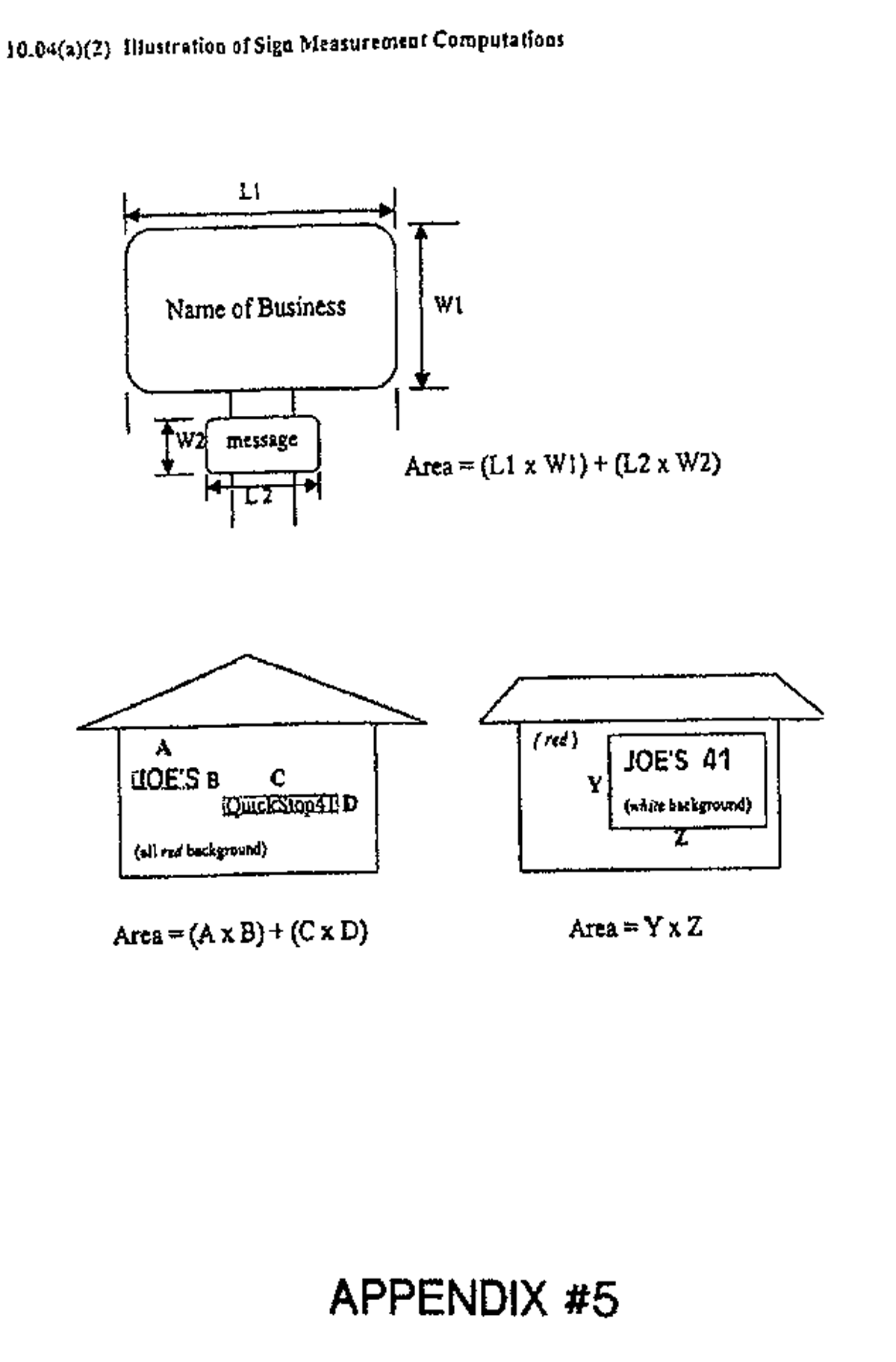
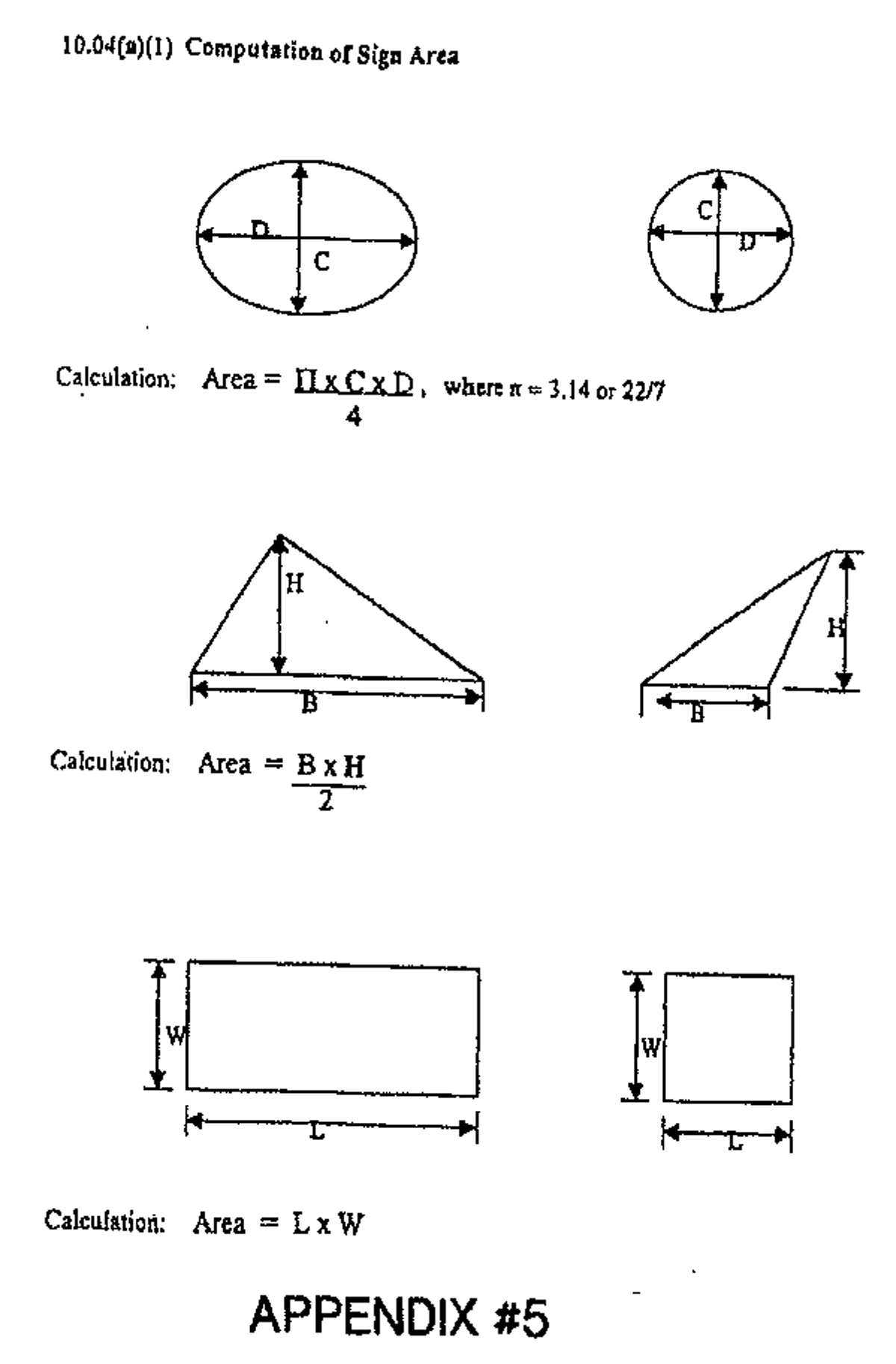
Computation of area of individual signs. The area of a sign face (which is also the sign area of a wall sign or other sign with only one (1) face) shall be computed by means of the smallest square, circle, rectangle, triangle, or combination thereof that will encompass the extreme limits of the writing, representation, emblem, or other display, together with any material or color forming an integral part of the background of the display or used to differentiate the sign from the backdrop or structure against which it is placed, but not including any canopy or marquee or any supporting framework, bracing, or decorative fence or wall when such fence or wall otherwise meets zoning ordinance regulations and is clearly incidental to the display itself. See appendix 5.
(b)
Computation of area of multi-faced signs. The sign area for a sign with more than one (1) face shall be computed by adding together the area of all sign faces visible from any one (1) point. When two (2) identical sign faces are placed back to back, so that both faces cannot be viewed from any point at the same time, and when such sign faces are part of the same sign structure and are not more than forty-two (42) inches apart at the furthest point, the sign area shall be computed by the measurement of one (1) of the faces.
(c)
Computation of height. The height of a sign shall be computed as the distance from the base of the sign at the normal grade to the top for the highest attached component of the sign. Normal grade shall be construed to be the lower of:
(1)
Existing grade prior to the construction; or
(2)
The newly established grade after construction, exclusive of any filling, berming, mounding, or excavating solely for the purpose of locating the sign. In cases in which the normal grade cannot reasonably be determined, sign height shall be computed on the assumption that the elevation of the normal grade at the base of the sign is equal to the elevation of the nearest point of the crown of a public street or the grade of the land at the principal entrance to the principal structure on the lot, whichever is lower.
(Ord. No. 26-99, § 1, 9-14-99; Ord. No. 17-11, Exh. A, 7-12-11)
Sec. 10.05. - Permits required.
If a sign requiring a permit under the provision of this article is to be placed, constructed, erected, or modified on a lot, the owner of the lot shall secure a sign permit prior to the construction, placement, erection, or modification of such a sign in accordance with the requirements of section 10.17.
No sign permit of any kind shall be issued for an existing or proposed sign unless such sign is consistent with the requirements of this article (except for face changes on existing nonconforming signs) in every respect.
(Ord. No. 26-99, § 1, 9-14-99; Ord. No. 17-11, Exh. A, 7-12-11)
Sec. 10.06. - Design, construction, and maintenance.
All signs shall be designed, constructed, and maintained in accordance with the following standards:
• All signs shall comply with applicable provisions of the Kentucky Building Code and the National Electrical Code adopted by the City of Henderson.
• Except for banners, flags, temporary signs, and window signs conforming in all respects with the requirements of this article, all signs shall be constructed of permanent materials and shall be permanently attached to the ground, a building, or another structure by direct attachment to a rigid wall, frame, or structure.
• All signs shall be maintained in good structural condition, in compliance with all building and electrical codes, and in conformance with this Code, at all times.
• When any sign (including nonconforming signs) becomes defective or dangerous, as determined by the administrator, the administrator has the power and authority to remove or cause to have removed such sign when the owner or agent of the property upon which the sign is located has failed to comply within thirty (30) days of time specified by the administrator to repair or make that sign safe or has failed to satisfy the administrator that the sign is not defective or dangerous. The owner of the property upon which the sign is located must bear the full costs of such removal and will be billed accordingly. If the administrator determines that the sign is of possible immediate danger to persons or vehicles that may be passing nearby, the administrator may place or cause to have placed signs or barriers indicating such danger.
(Ord. No. 26-99, § 1, 9-14-99; Ord. No. 06-08, 4-8-08; Ord. No. 17-11, Exh. A, 7-12-11; Ord. No. 07-21, Exh. A, 4-13-21)
Sec. 10.07. - Signage site plan.
No permit shall be issued for an individual sign requiring a permit unless and until a signage site plan for the lot on which the sign will be erected has been submitted to the administrator and approved as conforming with this section. (See Appendix 5 following this article.)
(a)
Signage site plan. For any lot on which the owner proposes to erect one (1) or more signs requiring a permit, the owner shall submit to the administrator a signage site plan containing at a minimum the following:
• An accurately drawn plot plan of the lot;
• Location of buildings, parking lots, driveways, and landscaped areas on such lot;
• Computation of the maximum total sign area, the maximum area for individual signs, the height of signs and the number of freestanding signs allowed on the lot(s) included in the plan under this article; and
• An accurately drawn indication on the plot plan of the proposed location of each present and future sign of any type, whether requiring a permit or not, except that incidental signs need not be shown.
(b)
Limit on number of permanent freestanding signs. The signage site plan, for all lots with individual or multiple uses, shall limit the number of permanent freestanding signs to a total of one (1) for each street on which the lots included in the plan have frontage and may provide for shared or common usage of such signs when multiple uses occupy one lot. Billboards, as regulated under section 10.11, shall not be considered a permanent freestanding sign.
(c)
Consent. The signage site plan shall be signed by all owners or their authorized agents in such form as the administrator requires.
(d)
Procedures. A signage site plan shall be included in any development plan, site plan, planned unit development plan, or other official plan required by the city for the proposed development and shall be processed simultaneously with such other plan.
(e)
Binding effect after approval of a signage site plan. No sign shall be erected, placed, painted, or maintained, except in conformance with such plan, and such plan may be enforced in the same way as any provision of this article. In case of any conflict between the provisions of such a plan and any other provision of this article, the ordinance shall control.
(Ord. No. 26-99, § 1, 9-14-99; Ord. No. 17-11, Exh. A, 7-12-11)
Sec. 10.08. - Signs in the public right-of-way.
No signs shall be allowed or permitted in the public right-of-way except for official signs, emergency warning signs erected by a governmental agency, a public utility company, or a contractor doing authorized or permitted work within the public right-of-way, hanging banners across or along streets and sidewalks, and sandwich board signs in Central Business District as defined below; or in accordance with section 20-1 of the City of Henderson Code of Ordinances.
(a)
[General civic, public events.] In order to promote general events of a civic and public nature in the CBD zone, any person, firm, corporation or organization in charge of events of a civic and public nature may hang a banner in an area designated below vertically, on cantilevered arms, pennants, flags or banners from utility poles equipped by the city for such purposes, to publicize an event or season or generally promoting the community, providing the subsequent guidelines are followed.
(b)
[Additional restrictions.] The banners may reflect only one theme at any given time within a district.
(c)
Guidelines in Central Business District zone.
1.
Banners hanging over any street.
(i)
Application. Applications for a permit must be submitted to the city manager a minimum of thirty (30) days prior to the day the banners are to be installed. Application may take the form of a letter from the chairman or executive director of the sponsoring organization and must contain the name of the person, firm corporation or organization sponsoring the event; the dates the banner(s) are to be installed and remain above the street. All applications shall include a hold harmless agreement, acceptable to the city manager prior to a permit being issued.
(ii)
Material and dimensional requirements. The banner crossing streets must be made of heavyweight, water-resistant material with air pockets cut in and contain at least ten (10) heavy-duty reinforced grommets. The banner shall measure twenty-five (25) feet long and four (4) feet high.
(iii)
Review process. The application will be reviewed by the administrator and municipal facilities superintendent or project manager to insure that the design and materials are satisfactory.
2.
Permit for pole banners.
(i)
Application. Applications for a permit must be submitted to the city manager a minimum of thirty (30) days prior to the day the banners are to be installed. Application may take the form of a letter from the chairman or executive director of the sponsoring organization and must contain the name of the person, firm, corporation, or organization sponsoring the event, and the dates the banner(s) are to be installed and remain above the street. All applications shall include a hold harmless agreement, acceptable to the city manager prior to a permit being issued.
a.
Material and dimensional requirements. Banners must be constructed of heavyweight, water-resistant fabric. Sizes of banners are restricted to twenty-four (24) inches by forty-eight (48) inches in order to fit the installed brackets. The banner shall be constructed to fit the mounting hardware where the banner can be mounted by slipping the banner arms through the sewn, looped top and bottom of the banner. The loops must be three (3) inches in order to slip over the banner arms. The design shall be the same on both sides of the banner.
3.
Sandwich board signs. A sandwich board is a freestanding A-frame sign.
(i)
One (1) sandwich board sign shall be permitted per building facade.
(ii)
Sandwich board signs shall be no taller than seventy-two (72) inches from grade and no wider than thirty (30) inches. Such signs must be secured by a chain or cable in order to remain standing; and shall not have moving parts or be illuminated in any manner. Both faces of the sign must have advertising. No blank faces are allowed.
(iii)
Such signs can only be placed on a sidewalk that has a minimum of eight (8) feet in width. In no instance shall such signs occupy an area that limits any portion of the useable sidewalk to less than five (5) contiguous feet; or interfere with pedestrian or automobile traffic.
(iv)
Sandwich board signs may be partially placed on the brick pavers adjacent to the sidewalk to the extent of up to one-half (½) of the width of the sign with the remainder being on the sidewalk.
(v)
The sign must be displayed in front of the business for which it is advertising. No off-site advertising is allowed.
(vi)
The sandwich board sign can only be displayed during business hours, and must be removed when the business is closed. These signs shall be removed from the public right-of-way at any time that weather conditions render the presence of such signs a hazard (i.e. high wind conditions, snow, ice, etc.)
(vii)
The sign must be constructed of weather-resistant materials and shall be maintained in good repair. Sandwich board signs cannot be anchored to the sidewalk, attached or chained to poles, or other structures or appurtenances. Such signs shall be weighted.
(viii)
The sandwich board sign may have no protruding features attached. Protruding features may include, but are not limited to, flags and other similar objects as determined by the administrator.
(ix)
The code department shall be entitled to request removal or remove any sandwich board sign in the right-of-way if the sign is considered to be a nuisance.
(d)
Other signs forfeited. Any sign installed or placed on public property, except in conformance with the requirements of this section, shall be forfeited to the public and subject to confiscation. In addition to other remedies hereunder, the city shall have the right to recover from the owner or person placing such a sign the full costs of removal and disposal of such sign.
(Ord. No. 26-99, § 1, 9-14-99; Ord. No. 06-08, 4-8-08; Ord. No. 17-11, Exh. A, 7-12-11; Ord. No. 07-21, Exh. A, 4-13-21)
Sec. 10.09. - Signs exempt from regulation under this article.
The following signs shall be exempt from regulation under this article:
(a)
Any public notice or warning required by a valid and applicable federal, state, or local law, regulation, or ordinance;
(b)
Any sign inside a building, not attached to a window or door, that is not legible from a distance of more than three (3) feet beyond the lot line of the lot or parcel on which such sign is located;
(c)
Appurtenance sign;
(d)
Holiday lights and holiday decorations with no commercial message;
(e)
Historic signs;
(f)
Traffic control signs on private property, such as Stop, Yield, and similar signs, the face of which meet department of transportation standards and which contain no commercial message of any sort;
(g)
Flags, as defined;
(h)
Window signs not exceeding fifty (50) percent of the total area of the window and which provide adequate visibility for security and public safety.
(i)
Temporary signs placed on or after April 15 and removed by May 31 of each year and temporary signs placed on or after October 1 and removed by November 15 of each year, providing all such signs shall not be located on public rights-of-way or in the vision sight triangle. (See Appendix 1 located at the end of this article)
(j)
Signs displayed on trucks, buses, trailers or other vehicles that are being operated in the normal course of a bona fide business or transportation service.
(Ord. No. 26-99, § 1, 9-14-99; Ord. No. 06-08, 4-8-08; Ord. No. 07-21, Exh. A, 4-13-21)
Sec. 10.10. - Signs prohibited under this article.
All signs not expressly permitted under this article or exempt from regulation hereunder in accordance with the previous section are prohibited in the city and shall be removed within thirty (30) days of the effective date of this article. Such signs include, but are not limited to:
(a)
Abandoned signs;
(b)
Beacons; and no emergency lights, or flashing lights should be on display;
(c)
Flashing signs;
(d)
Portable signs;
(e)
Animated signs, except in Highway Commercial zone;
(f)
Snipe signs;
(g)
It is a violation of this article for a person to fasten, place, paint, or attach in any way any sign, handbill, poster, advertisement, or notice of any kind, whether political or otherwise, or cause the same to be done in or on any public curbstone, lamp post, telephone pole, telegraph pole, electric light or power pole, hydrant, bridge, culvert, public drinking fountain, public trash container, courtesy benches, rest station building, tree, or in or on any portion of any public sidewalk, street or sign, except as specifically permitted within this chapter;
(h)
All signs placed upon private property must have the written consent of the owner or his agent. If the application is made by a person other than the owner in fee, it shall be accompanied by a verified written statement by the person making the application that the sign is authorized by the owner in fee and that the applicant is authorized to make application.
(Ord. No. 26-99, § 1, 9-14-99; Ord. No. 06-08, 4-8-08; Ord. No. 17-11, Exh. A, 7-12-11)
Sec. 10.11. - Billboards. (See exhibit "A".)
(a)
A billboard may be erected in the Highway Commercial (H-C) district or Heavy Industrial (M-2) district only.
(b)
A billboard must be mounted on a painted steel monopole structure.
(c)
A billboard may contain either one (1) or two (2) faces. Multiple display area may be placed on each face. On two-faced billboards, the faces shall be either:
(1)
Back-to-back not more than ten (10) feet apart; or
(2)
A V-type unit whose faces are not farther than fifteen (15) feet apart at the farthest point between the back of the two (2) faces.
The maximum area per face shall not exceed six hundred and seventy-two (672) square feet, and the maximum area for all faces shall not exceed one thousand three hundred and forty-four (1,344) square feet. The area of a face shall be computed by means of the smallest square, circle, rectangle, or triangle that will encompass its extreme limits exclusive of base supporting members which bear no message.
(d)
An embellishment, which is a temporary addition to the display area on which a continuation of the advertising message is placed, is permitted provided the total area of the embellishment does not exceed ten (10) percent of the maximum area per face of six hundred and seventy-two (672) square feet, for a maximum total of 67.2 square feet. In no instance shall an embellishment cause the maximum height of a face to exceed the maximum height otherwise allowed in subsection (f) herein by more than four (4) feet.
(e)
Billboards which are located on the same side of the street or roadway shall be no less than six hundred (600) feet apart as measured from the closest point of each billboard. In no instance shall a billboard be closer than three hundred (300) feet from another billboard as measured from the closest point of each billboard.
(f)
The minimum height of a billboard shall be fifteen (15) feet above grade as measured from the bottom of the face, and the maximum height of a billboard shall be forty (40) feet above grade as measured from the top of the face.
(g)
No part of a billboard shall extend closer than fifty (50) feet from the front property line of a site. No part of a billboard shall extend closer than fifteen (15) feet to any principal or accessory structure. (See exhibit "A" for setbacks.)
(h)
Electronic message billboards are permitted provided the electronic message display remains static for a minimum of eight seconds before transitioning to another message.
(i)
A billboard may not be erected or placed until a permit has been issued. Application for permits shall be provided in the form as established by the city manager or their designee.
(Ord. No. 26-99, § 1, 9-14-99; Ord. No. 06-08, 4-8-08; Ord. No. 17-11, Exh. A, 7-12-11; Ord. No. 07-21, Exh. A, 4-13-21)
Sec. 10.12. - Temporary signs.
1.
Temporary signs are allowed on lots under the following conditions:
(a)
Two (2) temporary signs will be allowed per lot, except in Residential-1, Residential-2, Residential-3, Residential-4, Residential-Planned Unit Development and Residential Manufactured Homes zones where four (4) temporary signs will be allowed per lot.
(b)
Temporary signs may in no instance be placed closer to the pavement edge than ten (10) feet in all zoning districts. Air puppets and tethered signs shall be no closer to the pavement edge than the total height of the item, plus five (5) feet.
(c)
Temporary signs may not be located in the vision sight triangle. (See Appendix 1 located at the end of this article).
(d)
Any sign attached to or affixed to the property in such a way as to make it not easily movable will not be considered a temporary sign and must obtain a permit for erection.
(e)
Temporary signs, when permitted, may not be used for a period to exceed thirty (30) days.
(f)
Temporary signs shall be limited in square footage as follows:
(1)
Maximum of six (6) square feet in the following zones: R-1, R-2, R-3, R-4, R-5, R-PUD, RMH, R-0, NB, CBD, RF-1, RF-2, RF-3, RF-4, Audubon Residential, Audubon Commercial, Gateway Zone, and Henderson Innovative Planning (HIP) districts.
(2)
Maximum of thirty-two {32) square feet in the following zones: GB, HC, M-1, M-2, and AG districts.
(Ord. No. 26-99, § 1, 9-14-99; Ord. No. 06-08, 4-8-08; Ord. No. 17-11, Exh. A, 7-12-11; Ord. No. 07-21, Exh. A, 4-13-21)
Sec. 10.13. - Permanent freestanding sign placement.
(a)
One (1) permanent freestanding sign may be erected on a lot for each street on which the lot has frontage, provided that no part of the sign shall be placed on the public right-of-way, public easement or in the vision sight triangle. (See appendix 1.)
(b)
If a lot has two (2) road frontages, then a freestanding sign which is one and one-half (1½) times the allowable square footage for that zone may be placed on the lot instead of two (2) signs, and shall be shown on a land use restriction to be recorded.
(c)
Subdivision sign.
(1)
One (1) entry sign, a permanent, indirectly illuminated or nonilluminated ground sign shall be allowed at each side of each entrance of a subdivision.
(2)
The top of the entry sign shall be no higher than eight (8) feet above ground level.
(Ord. No. 26-99, § 1, 9-14-99; Ord. No. 17-11, Exh. A, 7-12-11)
Sec. 10.14. - Central Business District.
In the Central Business District, where buildings may be built up to the street right-of-way line, overhanging and projecting signs shall be permitted, provided that no projection sign shall project from the face of the building or structure over a street right-of-way, alley, or other public space more than ten (10) feet, but in no case shall any such sign project beyond a line drawn perpendicular upward from two (2) feet inside the curb line. A clear space of not less than ten (10) feet shall be provided below all parts of such signs. Projecting signs shall be securely attached to the building or structure. A hold harmless agreement, acceptable to the city manager shall be provided to the administrator prior to a sign permit being issued.
(Ord. No. 26-99, § 1, 9-14-99; Ord. No. 06-08, 4-8-08; Ord. No. 17-11, Exh. A, 7-12-11)
Sec. 10.15. - Maximum height of signs (see exhibit "A").
(Ord. No. 26-99, § 1, 9-14-99; Ord. No. 17-11, Exh. A, 7-12-11)
Sec. 10.16. - Maximum square footage of signs (see exhibit "A").
(Ord. No. 26-99, § 1, 9-14-99; Ord. No. 17-11, Exh. A, 7-12-11)
Sec. 10.17. - General permit procedures.
The following procedures shall govern the application for, and issuance of, all sign permits under this article, and the submission and review of the signage site plan.
(a)
Applications. All applications for a sign permit of any kind and for approval of a signage site plan shall be submitted to the administrator.
(b)
Fees. Each application for a sign permit or for approval of a signage site plan shall be accompanied by the applicable fees.
(c)
Completeness. Within ten (10) business days of receiving an application for a sign permit or a signage site plan, it shall be reviewed for completeness. If the administrator finds that it is complete, the application shall be processed. If the administrator finds that it is incomplete, a notice of the specific ways in which the application is deficient shall be sent to the applicant within five (5) business days, with appropriate references to the applicable sections of this article.
(d)
Action. Within five (5) business days of the submission of a complete application for a sign permit, a sign permit shall be issued if the application conforms in every respect with the requirements of this article.
No permit for a sign shall be issued if the application fails in any way to conform with the requirements of this article. In case of a denial, the applicant shall be informed by written explanation, as to the section or sections of the ordinance or applicable plan with which the application is inconsistent, and given to applicant. A copy will be kept with the code department.
(Ord. No. 26-99, § 1, 9-14-99; Ord. No. 17-11, Exh. A, 7-12-11)
Sec. 10.18. - Permits to construct or modify signs.
Signs shall be erected, installed or created only in accordance with a duly issued and valid sign construction permit from the administrator. Such permits shall be issued only in accordance with the following requirements and procedures.
(a)
Permit for new sign or for sign modification. An application for construction, creation, or installation of a new sign or for modification of an existing sign's height, area or placement shall be accompanied by detailed drawings to show the dimensions, design, structure, and location of each particular sign, to the extent that such details are not contained on a signage site plan then in effect for the lot. One application and permit may include multiple signs on the same lot.
(b)
Duration of permit. The administrator shall cause an inspection to be made of the lot for which each permit for a new sign or for modification of an existing sign is issued during the sixth month after issuance of such permit or at such earlier date as the owner may request. If the construction is not substantially complete at the time of inspection, the permit shall lapse and become void. If the construction is substantially complete but not in full compliance with this article and applicable codes, the owner shall be given notice of the deficiencies and shall be granted an additional thirty (30) days from the date of inspection for the deficiencies to be corrected. If the deficiencies are not corrected by such date, the permit shall lapse.
(Ord. No. 26-99, § 1, 9-14-99)
Sec. 10.19. - Nonconforming signs.
Permanent signs and billboards that are conforming at the time of the adoption of this article but which become nonconforming as a result of the requirements of this article because of size, placement, type or number of signs on the lot or building shall comply with the following requirements.
(a)
No such nonconforming sign may be enlarged or structurally altered in a way which increases its nonconformity, but any portion thereof may be altered to decrease its nonconformity. The change in the text or color of a sign shall not be deemed to be an increase in its nonconformity.
(b)
No nonconforming sign shall be relocated unless such relocation creates a conforming situation.
(c)
Should a nonconforming sign or a portion of a nonconforming sign be damaged it may be repaired, but not to exceed the size and height of the original sign, and not in a manner which alters the original design of the sign structure. The structure must comply with all state and federal regulations.
(d)
No nonconforming sign shall be allowed to remain after twelve (12) months of inactivity on the premises upon which the sign is located.
(e)
No nonconforming off-premises sign shall be allowed to remain after the purpose to which the sign relates has been discontinued for a period of thirty (30) days.
(f)
Whenever any sign that does not comply with the provisions and regulations of this article collapses, or if the sign is removed from its location, except for normal maintenance, the sign may not be replaced or reconstructed except in full compliance with all of the provisions and regulations of this chapter. However, if such a sign is removed or destroyed other than by intentional means of the owner, the sign may be reconstructed provided the owner make application to reconstruct within six (6) months of the date of removal or destruction, but the sign may not be enlarged, extended, or moved.
(g)
If a nonconforming sign that was permitted at the time it was installed is required to be moved due to deed restrictions or encroachment over property boundaries that existed at the time of the original installation, or due to a taking or condemnation for public roadway improvements, and such taking is limited to only a portion of the sign, then the sign may be moved the minimum distance necessary at an angle perpendicular to the property line at the point of encroachment or taking of condemnation to comply with the deed restriction or property boundary, as long as it can be maintained on the same site, and provided that no dimensional changes are made relative to height, square footage, or total usable area.
(h)
The administrator has the power and authority to remove or cause to have removed any and all signs that have been determined to be a traffic hazard when the owner or agent responsible for the maintenance of the sign has failed to eliminate such traffic hazards within two (2) weeks from the date the written notice is mailed by the administrator. The owner or agent must bear the full costs of such removal and will be billed accordingly.
(Ord. No. 26-99, § 1, 9-14-99; Ord. No. 06-08, 4-8-08; Ord. No. 17-11, Exh. A, 7-12-11)
Sec. 10.20. - Signs constituting a nuisance/abatement.
(1)
The following signs shall constitute a nuisance: Refer to definition of an abandoned sign.
a.
A sign in a dilapidated or unsafe condition or in a condition of disrepair.
b.
A sign which remains in place following the period of time within which the sign was to have been removed.
c.
A sign which is in nonconformance with the provisions as set forth in this chapter.
(2)
Whenever the administrator shall deem such a nuisance to exist, the administrator shall issue a notice to the parties hereinafter stated, and such notice shall:
a.
Be in writing;
b.
Specify the identity of the sign and its location;
c.
Request the nuisance to be abated; and
d.
Advise the party(ies) that they have ten (10) days to abate the nuisance by removal or repair, as the case may be, or to make a written demand for a hearing before the board of adjustment, or else the nuisance will be removed and abated by the city at the owner's expense.
(3)
The notice shall be sent by registered mail, return receipt requested, to the last known address of the owner of the property whereon the nuisance is located, as it appears on the current tax-assessment roll. Where the owner of the property is not the occupant thereof, such notice shall also be mailed to the occupant. The notice shall also be sent to the owner of the sign if the owner of the sign is not the owner or occupant of the property. If the owner's address is not known or cannot readily be ascertained, the notice to him to abate may be given by attaching such notice to the sign. If the latter method of service is used, the administrator shall make an affidavit attesting to such facts.
(4)
In the event the owner, occupant, and owner of the sign fail to abate such public nuisance within the time as set forth above following receipt of notice, the administrator is hereby authorized, empowered and directed to remove same and dispose of it.
(5)
Any interested party may appeal the decision of the administrator by appealing to the board of zoning adjustment. If an appeal is taken within the three-day period, the determination of the administrator is stayed pending the proceedings before the board of zoning adjustment. If no appeal is taken within this time period, the administrator shall have the right to cause the sign to be removed and disposed of in any manner as he may provide.
(6)
The cost of the removal and disposal shall be accounted for by the administrator. The owner and occupant of the property upon which the sign is located and the owner of the sign shall be jointly and severally liable for reimbursement of such cost. In the event the full amount due the city for such service is not paid by such persons within thirty (30) day after the disposal of the nuisance, then and in that case, the administrator shall provide information to the city's finance department which includes the cost and expense incurred for the work, the date the work was done, and the location of the property on which the work was done. The finance department shall have recorded a sworn statement in the county clerk's office. The recordation of a sworn statement shall constitute a lien and privilege on the property, and shall remain in full force and effect for the amount due in principal and interest, plus attorney fees and court costs, if any, for collection, until final payment has been made. Sworn statements recorded in accordance with the provisions hereof shall be prima facie evidence that all legal formalities have been complied with and shall be full notice to every person concerned that the amounts due constitutes a charge against the property designated or described in the statement and that the same is due and collectable as provided by law.
(7)
The city shall be entitled to recover from the responsible party or parties the total cost of removal and disposal, plus interest thereon, and all reasonable attorney fees and other costs incurred by the city by reason of the collection upon and enforcement of the responsible party or parties' liability hereunder, and the lien which secures same. Interest shall accrue on such costs at the legal rate of eight (8) percent per annum.
(Ord. No. 06-08, 4-8-08; Ord. No. 17-11, Exh. A, 7-12-11)
Sec. 10.21. - Penalties for violation.
Violation of the provisions of these sign regulations shall constitute a misdemeanor which shall be subject to the fines and penalties as set forth in Article VI for violation of this zoning ordinance.
(Ord. No. 07-21, Exh. A, 4-13-21)
EXHIBIT A
City of Henderson Sign Ordinance Zoning Chart
(Ord. No. 07-21, Exh. A, 4-13-21; Ord. No. 16-21, Exh. A, 7-13-21; Ord. No. 01-22, Exh. A, 1-25-22)
Exhibit B
• For signs with an area in square feet other than those specifically listed in the table (i.e., 12 sq. ft.; 400 sq. ft., etc.), the measurement distance may be calculated with the following formula: Measurement Distance = Square Root area of Sign sq. ft. × 100
APPENDIX 1
Within the area defined by the intersection of any two (2) right-of-way lines of streets or railroads, and a straight line intersecting those two (2) right-of-way lines at points thirty (30) feet from the intersection, no obstruction to vision between a height of two and one-half (2½) feet and twelve (12) feet above the imaginary plane defined by those three (3) points of intersection are permitted. This includes structures, walls, fences, shrubbery or trees, except that shade trees will be permitted where all branches are not less than eight (8) feet above the street level. This requirement shall not apply in the central business district.
APPENDIX 2
All signs are subject to the following provisions: (Subsection 17.04(c) Henderson City Zoning Ordinance)
1.
Signs are to be used for identification and may not be used for advertising.
2.
Signs shall not be illuminated.
3.
Signs are restricted to five (5) feet from any lot line.
4.
Signs shall not obstruct the view of traffic.
5.
Signs are limited to one per property.
6.
No sign shall exceed ten (10) feet in height to the top of the display.
7.
No sign shall exceed twenty-five (25) square feet in size.
APPENDIX 3 [Reserved]
(Ord. No. 07-21, Exh. A, 4-13-21)
APPENDIX 4
Flashing signs are subject to the following provisions:
(1)
Electronic changeable copy shall be permitted for all signs, which shall conform to either of the following two (2) modes:
(a)
Nonflashing mode, with electronic changeable copy displaying only on-premises messages; changes in copy shall be limited so that the sign is not a flashing sign.
(b)
Flashing mode, with electronic changeable copy displaying only on-premises or public service messages.
Changes in copy shall be limited as follows:
(2)
The advertising message may contain words, phrases, symbols, trademarks, or logos.
(3)
A single message or segment of a message shall have a display time of at least two (2) seconds including the time needed to move the message onto the sign board, with all segments of the total message to be displayed within ten (10) seconds.
(4)
A message consisting of one (1) segment may remain on the signboard any amount of time in excess of two (2) seconds.
(5)
An electronic sign requiring more than four (4) seconds to change from one (1) single message to another shall be turned off during the change interval.
(6)
A display traveling horizontally across the signboard shall move between sixteen (16) and thirty-two (32) light columns per second.
(7)
A display may scroll onto the signboard but shall hold for two (2) seconds including the scrolling time.
(8)
A display shall not include an art animation or graphic that portrays motion, except for movement of a graphic onto or off of the signboard.