
Henderson City Zoning Code
ARTICLE IV
GENERAL PROVISIONS4
Except as hereinafter specifically provided, the following general regulations apply:
Editor's note— Ord. No. 23-14, Exh. A, adopted July 8, 2014, amended art. IV in its entirety as herein set out. Former art. IV, § 4.01—4.37 pertained to similar subject matter, and derived from Ord. No. 12-83, adopted June 28, 1983; Ord. No. 58-88, § 1, adopted Nov. 22, 1988; Ord. No. 11-89, § 2, adopted July 25, 1989; Ord. No. 18-91, § 1, adopted May 14, 1991; Ord. No. 3-93, § I, adopted April 13, 1993; Ord. No. 12-98, §§ 1, 2, adopted March 10, 1998; Ord. No. 29-02, § 1, adopted Aug. 27, 2002; Ord. No. 01-13, adopted Jan. 22, 2013.
Sec. 4.01.- Application of regulations.
All existing and future structures and uses of premises within the city shall conform with all applicable provisions of this chapter. Each zoning district is established to permit only those uses specifically listed as permitted, except as provided under the conditional use provisions and is intended for the protection of those uses. No other uses are permitted.
(Ord. No. 23-14, Exh. A, 7-8-14)
Sec. 4.02. - Coordination with subdivision regulations and access standards manual.
In all cases where the ownership of land is divided for the purpose of eventual development of lots of any kind, residential, commercial or industrial, the provisions of the subdivision regulations shall apply in addition to the provisions to the zoning ordinance.
In all cases where applicable, the provisions of the access standards manual, shall apply in addition to the provisions of the subdivision regulations and the zoning ordinance.
(Ord. No. 23-14, Exh. A, 7-8-14)
Sec. 4.03. - Conditional use regulations.
Conditional uses may be permitted in districts as designated under the zoning district regulations, but only when specifically approved by the board of zoning adjustment. All conditional uses shall be subject to the following regulations:
(a)
All districts. The following conditional uses only may be approved in all zoning districts:
(1)
Utility structures and public service buildings.
(2)
Government buildings and uses.
(b)
Specified districts. Other conditional uses may be approved in only those zoning districts where they are specifically designated as conditional uses under the zoning district regulations.
(c)
Procedure. In applying for a conditional use permit, the applicant shall submit an application to the administrative official and follow all procedures set forth in this section. The administrative official shall refer the application to the board of zoning adjustment. The board of zoning adjustment shall hold a public hearing in accordance with the provisions of KSA Ch. 424 and Ch. 100.237.
(d)
Action. The board may approve, modify or deny an application for a conditional use permit. If it approves such permit, it may attach necessary conditions such as time limitations requirements that one (1) or more things must be done before such request can be initiated or conditions of a continuing nature. Any such conditions shall be recorded in the board's minutes and on the conditional use permit, along with a reference to the specific section of this chapter listing the conditional use under consideration. The board shall have the power to revoke a conditional use permit for noncompliance with the conditions thereof. Further the board shall have the right of action to compel offending structures or uses removed at the cost of the violator and may have judgment in personam for such costs.
(e)
Filing. All conditional use permits approved by the board of adjustments shall be kept on file in the office of the code administrator and a certificate of land use restriction shall be recorded by the administrative official of the board of adjustments in the office of the county court clerk at the expense of the applicant.
(f)
Time limit. In any case where a conditional use permit has not been exercised within the time limit set by the board, or within one (1) year, if no specific time limit has been set, such conditional use permit shall not revert to its original designation unless there has been a public hearing held by the board of zoning adjustment in accordance with KSA Chapter 424 and Chapter 100.237. "Exercised" as set out in this section shall mean that binding contracts for the construction of the main building or other improvements is under construction to a substantial investment, is under contract, in development or completed. When construction is not a part of the use, exercised shall mean that the use is in operation in compliance with the conditions as designated in the permit.
(g)
Exemptions. Granting of a conditional use permit does not exempt the applicant from complying with all the requirements of building, housing, and other codes and regulations.
(h)
Review. The administrative official shall review all conditional use permits, except those for which all conditions have been permanently satisfied, at least once annually and shall have the power to inspect the land or structure where the conditional use is located in order to ascertain that the landowner is complying with all of the conditions which are listed on the conditional use permit. If the landowner is not complying with all of the conditions listed on the conditional use permit, the administrative official shall report the fact in writing to the chairman of the board of adjustments. The report shall state specifically the manner in which the landowner is not complying with the conditions on the conditional use permit and a copy of the report shall be furnished to the chairman of the board of adjustments. The board shall hold a hearing on the report within a reasonable time and notice of the time and place of the hearing shall be furnished to the landowner at least one (1) week prior to the hearing. If the board of adjustments finds that the facts alleged in the report of the administrative official are true and that the landowner has taken no steps to comply with them between the date of the report and the date of the hearing, the board may authorize the administrative official to revoke the conditional use permit and take necessary legal action to cause termination of activity on the land which the conditional use permit authorizes.
(i)
Permanent approval. Once the board of zoning adjustment has completed a conditional use permit and all the conditions required are of such type that they can be completely and permanently satisfied, the administrative official, upon request by the applicant may, if the facts warrant, make a determination that the conditions have been satisfied and enter the facts which indicate that the conditions have been satisfied and the conclusion in the margin of the conditional use permit, which is on file in the office of the code administrator. Thereafter, the said use, if it continues to meet the other requirements of the regulations, will be treated as a permitted use.
(Ord. No. 23-14, Exh. A, 7-8-14)
Sec. 4.04. - Approved water supply and sewerage disposal for buildings.
No person shall construct any building without water supply and sewerage disposal facilities approved by the state plumbing inspector. Wherever sewer mains are accessible, buildings shall be connected to such mains in accordance with Henderson Water Utility regulations.
(Ord. No. 23-14, Exh. A, 7-8-14)
Sec. 4.05. - Townhouses.
Townhouses shall be permitted in the R-2, R-3, R-4, R-5, and PUD multifamily residential districts provided that the following requirements are met:
Zero lot line. Each unit of a townhouse dwelling shall be located on a separate lot. Application of zero lot line provisions will require special covenants within the deeds of affected lots, to address issues unique to zero lot line dwelling units including maintenance easements and design control mechanisms. If restrictive covenants are filed on affected lots, copies should be submitted to the code department and planning commission office.
(a)
Development involving new or additional streets or any public dedication of land shall be subject to Planning Commission review and approval, as provided in the subdivision regulations.
(b)
Townhouse minimum setback requirements:
1.
Front and rear setback—Same as district in which it is located.
2.
Side yard of end dwelling units—Ten (10) feet.
3.
Street side yard—Same as district in which it is located.
(c)
Townhouse height: Maximum building height, thirty-five (35) feet.
(d)
Townhouse minimum area requirement: No lot shall contain less than one thousand four hundred forty (1,440) square feet of land; however, there shall be a minimum outdoor living area of three hundred sixty (360) square feet per lot, or twenty-five (25) percent of the total development devoted to outdoor activities for the residents of the proposed development.
(e)
Minimum street frontage for attached dwellings, 20 feet.
(f)
Other requirements for townhouses:
(1)
Off-street parking shall be in compliance with Article IX of the zoning ordinance.
(2)
Maximum area of a lot that can be covered by building floor area shall be forty-five (45) percent.
(3)
No parking is permitted in required front yards, except for driveways connecting to the rear or side yard.
(Ord. No. 23-14, Exh. A, 7-8-14)
Sec. 4.06. - Duplexes.
Duplexes shall be permitted in the R-2, two-family residential district, the R-3, and R-4 multifamily residential district, and PUD, provided that the area, height, bulk and placement regulations are met (see attached Schedule of Regulations, Article XXVII).
(a)
Zero lot line. Each unit of a two-family dwelling (duplex) may be located on a separate lot. In such case the minimum lot size and the minimum lot width for each lot shall be one-half (½) the respective dimensions required by the district for a two-family dwelling and the minimum side yard for each unit's non-common wall side shall be equal to minimum dimension required by the district for a two-family dwelling (the common wall side yard being zero by definition).
Application of zero lot line provisions will require special covenants within the deeds of affected lots, to address issues unique to zero lot line dwelling units including maintenance easements and design control mechanisms. If restrictive covenants are filed on affected lots, copies should be submitted to the code department and planning commission.
(Ord. No. 23-14, Exh. A, 7-8-14)
Sec. 4.07. - Condominiums.
Condominiums shall follow the requirements of the Kentucky Condominium Act, KRS 381.9101 to 381.9207, as amended. Condominiums shall be permitted in any commercial, industrial or multi-family residential zone.
Condominium developments shall meet all yard, setback, area, lot coverage, density, and parking requirements of the zone in which the development is located.
A copy of the condominium declaration and any restrictive covenants shall be filed with the code department and the planning commission office.
(Ord. No. 23-14, Exh. A, 7-8-14)
Sec. 4.08. - Junkyards.
Junkyards are not designated as permitted uses in any district and consequently are nonconforming uses in all districts. They shall conform with articles prescribing regulations for nonconforming uses, and Section 4.35.
(Ord. No. 23-14, Exh. A, 7-8-14)
Sec. 4.09. - Obstructions to vision at street intersection on corner lots.
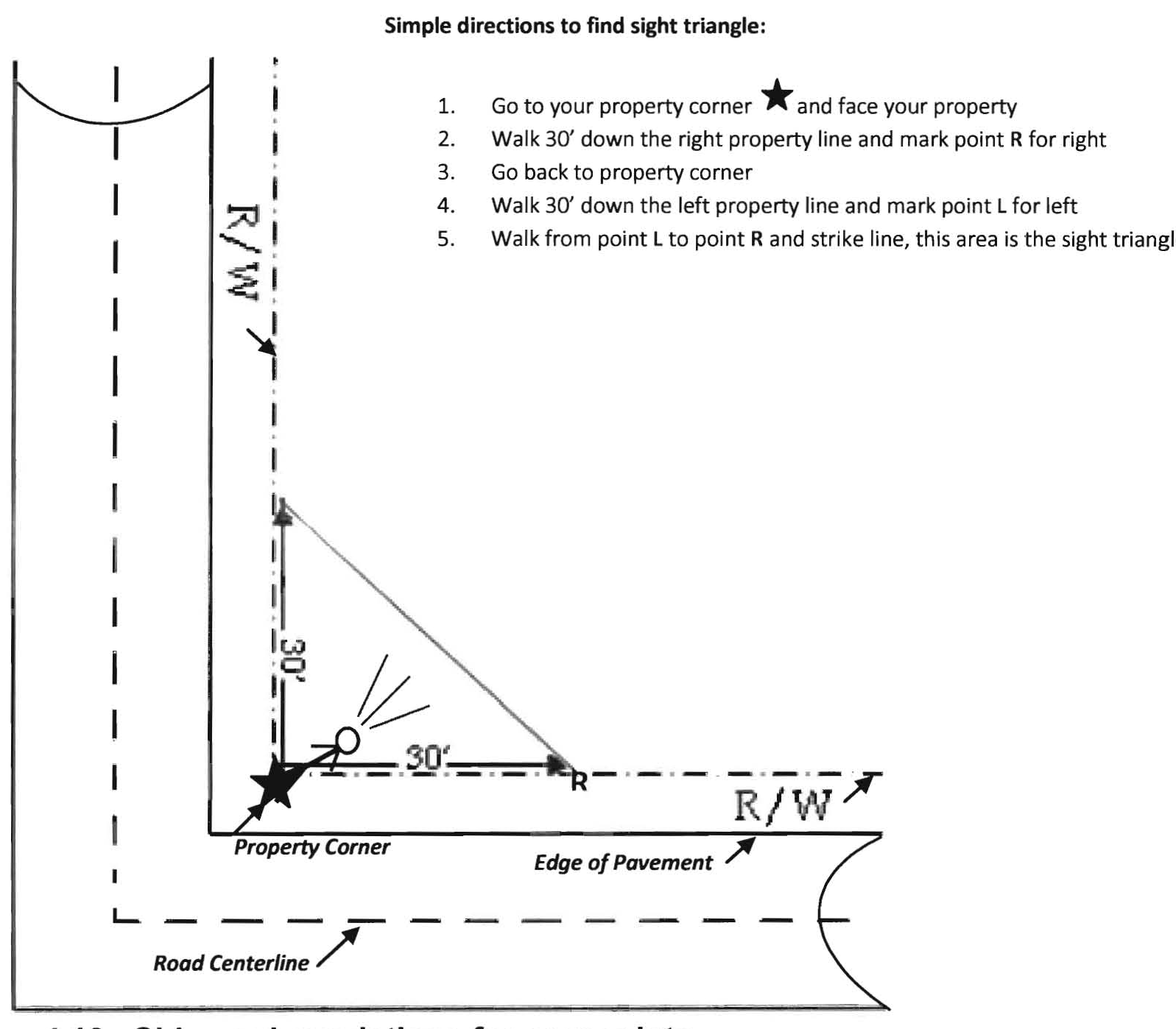
Within the area defined by the intersection of any two (2) right-of-way lines of streets or railroads and a straight line intersecting those two (2) right-of-way lines at points thirty (30) feet from the intersection, no obstruction to vision between a height of two and one-half (2½) feet and twelve (12) feet above the imaginary plane defined by those three (3) points of intersection as permitted, at the plane of the street. This includes structures, walls, fences, shrubbery or trees, except that shade trees will be permitted where all branches are not less than eight (8) feet above the street level. This requirement shall not apply in the Central Business District, the Audubon Commercial Zone, the Henderson Innovative Planning District, the Gateway Zone, and the Riverfront Two (2) Zone.
(Ord. No. 23-14, Exh. A, 7-8-14; Ord. No. 54-17, 8-25-17)
Sec. 4.10. - Side yard regulations for corner lots.
(a)
The street side yard requirement for corner lots in residential zones shall be such that no principal building or accessory structures shall extend toward the side street any closer than the front yard building setback allows.
(b)
The side yard requirement for all principal buildings located on corner lots in commercial and industrial zones, shall be such that no building extends toward the side street more than ten (10) feet beyond the setback line set for buildings along the street to the corner lot. Accessory buildings shall conform to setback lines established on both streets and conform to the requirements of Section 4.24.
(Ord. No. 23-14, Exh. A, 7-8-14)
Sec. 4.11. - Regulations for double-frontage lots.
Double frontage lots shall, on both adjacent streets, meet the front yard requirements of the district in which they are located.
(Ord. No. 23-14, Exh. A, 7-8-14)
Sec. 4.12. - Application for yards to one building only.
No part of a yard required for any building may be included as fulfilling the yard requirements for an adjacent building.
(Ord. No. 23-14, Exh. A, 7-8-14)
Sec. 4.13. - Use of yards for accessory buildings.
No accessory building is permitted in front yards. They are permitted only in rear or side yards according to the dimension and area regulations (see subsection 4.24(b)).
(Ord. No. 23-14, Exh. A, 7-8-14)
Sec. 4.14. - Use exceptions.
Several types of structures and uses are permitted in all districts even though they are not listed as permitted uses under the zoning district regulations. These structures and uses are listed as follows; no building permit or certificate of occupancy required:
(a)
Local public utility distributing and collecting structures such as pipes and transmission lines and transformers. Large utility structures such as electrical substations or gas pumping stations are permitted only as conditional uses.
(b)
Public streets and all official equipment necessary for traffic direction and safety.
(c)
Private drives, private parking areas, and the parking of vehicles incidental to the principal use on the same premises.
(d)
Real estate signs located on the premises or subdivision signs advertising property for sale or rent.
(e)
Signs not over four (4) square feet in area identifying permitted home occupations or the renting of sleeping rooms on the same premises.
(f)
Horticulture and landscaping of any premises.
(g)
All the above comply with Section 4.09, Obstruction to vision at street intersection on corner lots.
(Ord. No. 23-14, Exh. A, 7-8-14)
Sec. 4.15. - Height exceptions.
Height regulations, as specified in the schedule of regulations (Article XXVII), apply to buildings occupied regularly by persons or their activities. They do not apply to structures or portions of buildings such as radio towers, ornamental spires, water towers, and flag poles which are not occupied regularly by persons except for maintenance, unless otherwise stipulated in the zoning ordinance. The board of zoning adjustment shall interpret whether or not the height regulations apply upon application by the enforcement officer in doubtful cases. Airport height restriction regulations (Article XXVIII) shall take precedence over all other height regulations.
(Ord. No. 23-14, Exh. A, 7-8-14)
Sec. 4.16. - Variances and conditional use permits by planning commission—Limited.
The planning commission is empowered to hear and finally determine variances and conditional use permits in the limited instance permitted by KRS 100.203(5) and (6), as the same may be amended from time to time. Please refer to the statute.
The applicant for a map amendment, at the time of the filing of the application for the map amendment, may elect to have any variances or conditional use permits, for the same development, heard and finally determined by the planning commission at the same public hearing set for the map amendment. By filing such application, the applicant shall have elected for the planning commission and not the board of zoning adjustments to hear and finally determine such request. (The applicant could not withdraw the application and then file an application with the board of zoning adjustments; nor could the applicant file a request with the board of zoning adjustments after the application was denied or turned down by the planning commission.) A denied application may not be refiled with either the planning commission or board of zoning adjustments within one (1) year after denial.
In only this limited instance, the planning commission shall assume all of the powers and duties otherwise exercised by the board of zoning adjustments pursuant to KRS 100.231, 100.333, 100.237, 100.241, 100.243, 100.247, 100.251 and in this zoning code/ordinance, as the same are amended from time to time.
(Ord. No. 01-15, Exh. A, 1-27-15)
Sec. 4.17. - Pools, in-ground and above grounds. (Added 9-04-18)
(1)
In-ground swimming pool is any in-ground structure intended for swimming or recreational bathing that contains water more than twenty-four (24) inches (610 mm) deep.
(2)
Above-ground swimming pools is any above ground structure intended for swimming or recreational bathing that contains water more than twenty-four (24) inches (610 mm) deep.
(3)
No swimming pool as defined above shall be constructed or placed prior to the issuance of a proper permit.
(4)
Barrier for swimming pools shall be in conformity with the Kentucky Residential Building Code, Appendix G (current edition).
(5)
Added safety and protection shall be provided for above ground pools by providing a protective barrier at the entrance and/or steps accessing the pool (called safety pool ladders or locking pool ladders).
(6)
If decks are added to the perimeter of above ground pools, then the requirement for barriers and guards as prescribed in the Kentucky Residential Code, Section 312, will apply.
(7)
If above ground pools are inset into the ground, thereby compromising the exterior wall height, then the pool will be considered an in-ground pool and all requirements of the Kentucky Residential Code (current addition) will apply.
(Ord. No. 29-18, 9-25-18)
Sec. 4.18. - Streets, alleys and railroad rights-of-way.
All streets, alleys, and railroad rights-of-way, if not otherwise specifically designated, shall be deemed to be in the same zone as the property immediately abutting upon such street, alley, or railroad right-of-way. Where the center line of a street or alley serves as a district boundary, the zoning of such street or alley, unless otherwise specifically designated, shall be deemed to be the same as that of the abutting property up to such center line.
(Ord. No. 23-14, Exh. A, 7-8-14)
Sec. 4.19. - Permitted uses.
No building shall be erected, converted, enlarged, reconstructed or structurally altered, nor shall any building or land be used, designed or arranged for any purpose than is permitted in the district in which the building or land is located.
(Ord. No. 23-14, Exh. A, 7-8-14)
Sec. 4.20. - Permitted area.
No building shall be erected, converted, enlarged, or reconstructed or structurally altered, except in conformity with the area regulations of the district in which the building is located.
(Ord. No. 23-14, Exh. A, 7-8-14)
Sec. 4.21. - Structures on lot.
Every building hereafter erected or structurally altered shall be located on a lot zoned as herein defined, and in no case shall there be more than one (1) such principal building per lot unless otherwise provided for in the case of a multi-family housing development, group home, or PUD.
Sec. 4.22. - Reserved.
Editor's note— Ord. No. 34-23, Exh. A, adopted November 28, 2023, renumbered the former § 4.22 as § 36.01. The historical notation has been retained with the amended provisions for reference purposes.
Sec. 4.23. - Waiver of yard requirements for handicap accessibility.
Where necessary, the codes administrator may waive the setback requirements for residential and commercial structures that are retrofitting or modifying the exterior of existing structures for handicap accessibility purposes. No such waiver will be granted for new construction.
(Ord. No. 23-14, Exh. A, 7-8-14)
Sec. 4.24. - Accessory buildings.
Except as otherwise permitted in these regulations, accessory buildings shall be subject to the following regulations:
(a)
Where the accessory building is structurally attached to a principal building, it shall be subject to and must conform to all regulations of this ordinance.
(b)
Accessory buildings shall not be erected in any required yard except a rear or side yard, unless approved as a conditional use permit in R-1, RF-4 or AG zones with a minimum lot size of 25,000 sq. ft. All unattached accessory buildings shall be at least three (3) feet from all property lines except as provided in section 4.10, and shall not be placed in any easements without a fully executed encroachment permit signed by the appropriate utilities and the city manager.
(c)
A residential accessory building, detached garage, or carport, shall not exceed one (1) story or fourteen (14) feet in height, and shall not exceed the height of the principal structure as measured from the building grade.
(d)
An accessory building may not occupy not more than twenty-five (25) percent of any non-required yard; provided that in no instance shall the floor area of all combined accessory buildings, exceed the floor area of the principal building, with the exception of lots zoned agricultural, in which the floor area of combined accessory buildings may be larger than principal building.
(e)
Residential lots are limited to one (1) accessory detached garage or carport, and no more than two (2) additional accessory buildings.
(f)
No detached accessory building other than a garage and/or carport shall be located closer than ten (10) feet to any principal building.
(g)
In the case of double frontage lots, accessory buildings shall observe front yard requirements on both street frontages wherever there are any principal buildings fronting on said streets in the same block or adjacent blocks.
(h)
When an accessory building is to be located on a corner lot, the side lot line of said building shall conform to the setback lines established on both streets.
(i)
Detached garages. No detached garage or portion thereof shall extend beyond the front building line of any dwelling.
(j)
Carports constructed in residential zoning districts shall comply with the following requirements:
(1)
A carport that is placed at the side of an existing residence and which consists of a roof and supporting posts made of noncombustible materials may extend to within three (3) feet of an interior side lot line.
(2)
A carport which is structurally part of a residence (i.e., one (1) that is composed of the same building materials as the house of which it is a part, and one (1) that has the same roof line as the house of which it is a part) shall not extend into a required side yard. Such a carport is usually constructed at the same time as the residence of which it is a part.
(3)
No carport shall extend into the required front yard of a lot.
(4)
A carport that encroaches into the required side yard of a lot as permitted by this section may not later be converted into living area, a storage room, garage or other walled structure without the approval of the board of zoning adjustment.
(Ord. No. 23-14, Exh. A, 7-8-14; Ord. No. 26-22, Exh. A, 9-20-22)
Sec. 4.25. - Prohibited uses in all residential districts.
(a)
No appliances such as washing machines and refrigerators shall be stored for more than twenty-four (24) hours in any residential district except in a carport or enclosed building or behind the portion of a building nearest to a street. Automotive vehicles or trailers of any kind or type without current license plates shall not be parked or stored in any residential district other than in completely enclosed buildings. Boats and boat trailers are exempt from the provisions of this section.
(b)
Commercial highway vehicles and tractors, trailers and tractor-trailer vehicles shall not be parked or stored in residentially zoned districts at any time, unless there exists adequate off-street parking to accommodate said vehicles.
(c)
It shall be a prohibited use in an open area in all residentially zoned districts to park or store wrecked or junked vehicles, power-driven construction equipment, used lumber or metal, or any other miscellaneous scrap or salvageable material.
(Ord. No. 23-14, Exh. A, 7-8-14)
Sec. 4.25-1. - Sexually oriented businesses prohibited in all districts except the M-2 heavy industrial district.
Based upon statutory authority and the need to regulate the location of sexually oriented businesses as hereinafter set forth in Section 24.01, no building or land shall be erected or used for a sexually oriented business except in the M-2, heavy industrial district.
(Ord. No. 23-14, Exh. A, 7-8-14)
Sec. 4.26. - Excavation and filling of land; land disturbing activity.
The principal use of land for the excavation, filling or depositing of any type of earth material, topsoil, gravel, rock, garbage, rubbish or other wastes or by-products is not permitted in any zoning district, except under a permit issued by the codes administrator or designee. Before any land disturbing activity, or before any building or structure is erected, constructed or reconstructed, every person proposing such development shall present an erosion and sediment control plan for protection of the site against erosion and for reestablishing permanent ground cover. The plan shall be submitted to the code administrator for review and approval as part of the building permit submittal. A building permit shall not be issued prior to approval of the erosion and sediment control plan.
The erosion and sediment control plan and topographic plan shall be drawn at a scale of not less than fifty (50) feet equals one (1) inch and shall show existing and proposed grades and topographic features and such other data as may be required by the local government engineer. The plan shall detail features that ensure compliance with the city ordinance on erosion and sediment control and cleaning of streets, including measures that:
(a)
Control soil erosion by wind and water, and reduce siltation of ditches, streams and impoundments;
(b)
Preserve native vegetation;
(c)
Protect water quality and enhance aquatic habitat;
Such permit may be issued in appropriate cases upon the filing with the application of a surety bond executed by a surety company authorized to do business in the State of Kentucky, in favor of the planning commission in an amount to be established by the local government engineer which will be sufficient in amount to rehabilitate the property upon default of the operator of such excavating or filling operation, and to cover court costs and other reasonable expenses.
For sites containing more than one (1) acre of disturbed area, when a notice of intent (NOI) is filed with the Kentucky Division of Water, the complete NOI submittal shall be copied to the city, and this will satisfy the requirement for submittal of an erosion and sediment control plan for review. City reserves the right to review the NOI submittal for conformance with this ordinance, and this review is separate and apart from state approval of any plan.
No erosion and sediment control plan is required for any activity disturbing one (1) acre or less of land. For these small sites, certain minimum erosion control requirements shall apply:
(a)
An approved construction entrance;
(b)
Perimeter control, if there is potential for disturbed soil to be deposited onto or in streets, storm sewers, drainage channels or streams;
(c)
Contained washout facility for concrete trucks;
(d)
Trash control;
(e)
Prompt cleanup of any silt or other debris discharged to streets, gutters, storm sewers or streams.
This regulation does not apply to:
(a)
Minor land disturbing activities, including, but not limited to, underground utility repairs; replacement of existing utilities at a single location; home gardens and landscaping;
(b)
Installation of fence, sign, telephone, and electric poles and other kinds of posts or poles;
(c)
Excavation or filling of graves in a cemetery;
(d)
General agricultural uses.
The construction, maintenance or existence of any unprotected, un-barricaded, open and dangerous excavations, holes, or pits which constitute a danger or menace to the public health, safety, or welfare, is hereby prohibited; provided however, this section shall not apply to any excavation under a permit issued pursuant to these regulations or the building code of the governing body where such excavations are properly protected and warning signs posted in such a manner as may be approved by the enforcement officer.
(Ord. No. 23-14, Exh. A, 7-8-14)
Sec. 4.27. - Construction begun prior to adoption of regulations.
Nothing in these regulations shall be deemed to require any change in the plans, construction or designed use of any building upon which actual construction was lawfully begun prior to the adoption of these regulations, and upon which building actual construction has been diligently carried on, and provided further that such building shall be completed within one (1) year from the date of passage of these regulations.
(Ord. No. 23-14, Exh. A, 7-8-14)
Sec. 4.28. - Voting place.
The provisions of these regulations shall not be so construed as to interfere with the temporary use of any property as a voting place in connection with a public election or referendum.
(Ord. No. 23-14, Exh. A, 7-8-14)
Sec. 4.29. - Approval of plats.
No proposed plat of a new subdivision shall hereafter be approved by the planning commission unless the lots within such plat equal or exceed the minimum size and width requirements set forth in the various districts of these regulations and unless such plat fully conforms with the statutes of the State of Kentucky and the City of Henderson.
(Ord. No. 23-14, Exh. A, 7-8-14)
Sec. 4.30. - Essential services.
The erection, construction, alteration or maintenance by public utilities or governmental departments or commission, of underground or overhead gas, electrical, steam or water distribution or transmission systems, collection, communication supply or disposal systems including mains, drains, sewers, pipes, conduits, wires, cables, fire alarm boxes, police call boxes, traffic signals, hydrants, towers, poles and other similar equipment and accessories in connection therewith, but not including buildings, reasonable necessary furnishing of adequate service by such public utilities or governmental departments or commissions, or for the public health or safety or general welfare shall be permitted as authorized and regulated by law and other regulations of the governing body in any use district, it being the intention hereof to exempt such erection, construction, alteration and maintenance from the application of these regulations.
(Ord. No. 23-14, Exh. A, 7-8-14)
Sec. 4.31. - Building grades.
Any building requiring yard space shall be located at such an elevation that a sloping grade shall be maintained to cause the flow of surface water to run away from the walls of the building. A sloping grade, beginning at the sidewalk level, shall be maintained and established from the center of the front lot line to the finished grade line at the front of the building. The rear and side yards shall be sloped to allow for the flow of surface water away from the building without creating a nuisance. However, this shall not prevent the grading of a yard space to provide sunken or terraced areas provided proper means are constructed and maintained to prevent the runoff of surface water from creating a nuisance on the adjacent properties. Final grades shall be subject to the approval of the enforcement officer.
(Ord. No. 23-14, Exh. A, 7-8-14)
Sec. 4.32. - Building to be moved.
Any building or structure which has been wholly or partially erected on any premises located within the jurisdiction of the city shall not be moved to and be placed upon any other premises in the same jurisdiction until a building permit for such removal shall have been secured. Any such building or structure shall fully conform to all the provisions of these regulations in the same manner as a new building or structure. No building or structure shall be moved into the jurisdiction of the governing body until such building permit has been secured.
Before a permit may be issued for moving a building or structure, the enforcement officer shall inspect same and shall determine if it is in a safe condition to be moved, whether it may be reconditioned to comply with the building code and other requirements of the city for the use and occupancy for which it is to be used.
(Ord. No. 23-14, Exh. A, 7-8-14)
Sec. 4.33. - Temporary sales and vending requirements.
Temporary sales and vending may be allowed in the following zones: HC, CBD, and GB, or as a conditional use in any shopping center, provided they meet the following:
1.
Evidence of compliance with health and fire regulations: a certificate of inspection or compliance as required by applicable health regulations and evidence of compliance with the fire code shall be provided;
2.
The outdoor sales tent or vending cart shall meet the setbacks of the underlying zoning district, and in CDB shall be twenty-five (25) feet from the right-of-way.
3.
Only one (1) vending or temporary sales operation may be permitted per parcel;
4.
A minimum of two (2) parking spaces must be provided and maintained;
5.
No portion of the vending cart or temporary sales operation shall be allowed to occupy or obstruct access to any parking stall, access, or parking aisle required by the zoning ordinance;
6.
The outdoor sales tent or cart must be located on a parcel with no less than a paved twenty-four-foot driveway throat width;
7.
Ingress, egress, and internal circulation of vehicular traffic shall not create a hazard for traffic on an adjacent street or on the subject parcel;
8.
The vending cart or sales tent is not within ten (10) feet of an entranceway to any business open to the public;
9.
A letter and/or copy of an official lease agreement from the property owner to vend on the subject parcel and a copy of the property owner's business license must be provided.
10.
The applicant must submit a site plan showing the proposed location of the vending operation on the plan. The code administrator must find that the proposed operation complies with all applicable provisions of this section, and that the proposed operation will not adversely affect the traffic accessibility, or health and public safety;
11.
The temporary sales or vending operation must obtain a permit from the code department on an annual basis;
12.
This section does not apply to any event which has been permitted under city ordinance Section 17-49. However, this exemption must comply with all other applicable regulations.
(Ord. No. 23-14, Exh. A, 7-8-14)
Sec. 4.34. - Signs.
(Reference to Article X, Signs and Outdoor Advertising Displays)
(Ord. No. 23-14, Exh. A, 7-8-14)
Sec. 4.35. - Existing and/or nonconforming junk and/or used auto parts yard.
Junk and/or used auto parts yards shall comply with the following.
(a)
Fences around the entire area of junkyards and/or used auto parts yards or salvage yards, shall be required. Fences shall not be less than six (6) feet nor greater than ten (10) feet in height. Fences shall be designed and constructed in compliance with existing building codes. Fences and/or green belts shall be used to shield contents of such businesses from view of public streets or residential areas. Fences shall be properly maintained at all times.
(b)
Stacking of motor vehicles or parts of motor vehicles in a salvage or used auto parts yard shall be limited to the same height of the fence.
(c)
Stacking in a junkyard shall be limited to ten (10) feet in height. There must be enough space provided so that if any material falls or is blown over, it will fall on the property. The board of zoning adjustment shall have the authority to permit stacking in excess of ten (10) feet in height.
(d)
No items for sale shall be stored or displayed on the fence or outside of the fence area except complete units which have not been damaged which shall be limited to five (5) such units.
(e)
Any new business or old business moving to a new location shall be in full compliance with the regulations of this ordinance.
(Ord. No. 23-14, Exh. A, 7-8-14)
Sec. 4.36. - Annexed areas.
Areas unassigned to a zoning district. In case any area hereinafter becomes a part of the incorporated area of Henderson, the planning commission shall initiate the amendment procedure zone at the time of annexation of such area in order to assign such an area to a zoning district. Zoning permits shall not be issued for such an area until it is assigned to a zoning district.
(Ord. No. 23-14, Exh. A, 7-8-14)
Sec. 4.37. - Utility and drainage easements.
Utility and drainage easements are restricted for the use designated and no property owner may place any permanent structure within any easement except as provided in Section 20.9 of the City Code of Ordinances.
(Ord. No. 23-14, Exh. A, 7-8-14)
Sec. 4.38. - Home occupations.
Home occupations shall be incidental to the principal residential use. Home occupations include only those which are specifically listed here, and meet the following performance standards:
(a)
Home occupations shall be conducted within the principal building only or conditionally within a detached garage. No home occupation may exceed a total area equal to twenty-five (25) percent of the area of the principal building. No more than one (1) home occupation shall be conducted in any dwelling unit.
(b)
A home occupation shall employ no more than one (1) person not a resident of the premises.
(c)
There shall be no visible evidence of the conduct of a home occupation from the exterior of the building other than one (1) sign not exceeding four (4) square feet in area, unlighted, and mounted flat against the wall of the principal building.
(d)
No substantial traffic increase shall be generated in the residential area.
(e)
Home occupations shall not generate fumes, light flashes, glare, electrical interference, odors, noise, vibration, or truck or other heavy traffic.
Home occupations for professional offices and personal services include the following, or any other substantially similar activity:
(a)
Accountant, tax service or bookkeeper.
(b)
Architect, engineer, draftsman.
(c)
Physician, dentist, osteopath, chiropractor, optometrist, or other medical professional.
(d)
Interior decorator, artist, photographer, musician.
(e)
Attorney, paralegal.
(f)
Counselor, mental health professional.
(g)
Broker, financial consultant.
(h)
Manufacturer's agent or representative, contractor (office only).
(i)
Seamstress, tailor.
(j)
Internet-related businesses.
(Ord. No. 23-14, Exh. A, 7-8-14)
Sec. 4.39. - Shopping centers, regulations.
A.
Purpose. The purpose of establishing this section is to:
(1)
Minimize any adverse effect of a shopping center on adjacent property values and to provide for safe and efficient use of the shopping center.
(2)
Provide for a functional and aesthetically pleasing area in which to shop.
(3)
Ensure that the area is designed and located so as to minimize traffic congestion on public highways and streets in the vicinity and to best fit the general land use pattern of the area to be served.
B.
Shopping center classification.
(1)
Neighborhood shopping center. Provides for the sale of daily living needs of the people, "convenience goods," may contain three (3) to fifteen (15) stores generally oriented around a supermarket on a site of from two (2) to ten (10) acres in area.
(2)
Community shopping center. Provides in addition to "convenience goods," wider range of facilities for the sale of "shopping goods," such as apparel and furniture, as well as banking and professional services and recreation. It may contain sixteen (16) to forty (40) stores, including out-lots, generally oriented around a junior department store or variety store on a site of thirty (30) or more acres.
C.
Permitted uses. Permitted uses are those specifically permitted in the underlying zoning district of this ordinance.
D.
Procedure.
(1)
Approval required. No new building or structure of any kind shall be erected within a neighborhood or community shopping center except when such buildings or structures have been authorized under the following conditions and requirements, and must be approved by the planning commission.
i.
Expansion of any existing buildings, or construction of a new building or out-lot in a neighborhood or community shopping center approved before the adoption of this ordinance, must be authorized under the following conditions and requirements, and must be approved by the planning commission.
ii.
Structural alterations, or general maintenance and repair of any building within a neighborhood or community shopping center approved before the adoption of this ordinance are exempt from the requirements of Section 4.39.
(2)
Preliminary plans required. Preliminary plans for a shopping center shall be submitted to the Henderson City-County Planning Commission. Such application shall include the following: A preliminary plat indicating existing topography of contour intervals not greater than two (2) feet, and a site plan including proposed size, location and arrangement of buildings, number of vehicular parking spaces; entrance and exit driveways and their relationship to existing and proposed streets, alleys and other public ways and property; a master signage plan; a lighting plan; a pedestrian flow plan; building elevations; a landscaping plan; proposed playgrounds and other recreational areas. The preliminary plat shall also show the development of adjacent properties within two hundred (200) feet of said shopping center, including the location, type of buildings and structures located thereon.
(3)
Modifications and approval. Preliminary plans for a shopping center may be approved, modified or denied by the HCCPC.
E.
Dimensional and design standards. The following general conditions shall apply to all shopping centers:
(1)
Building materials.
i.
No portion of a building shall be treated with smooth-faced concrete block, tilt-up concrete panels or prefabricated steel panels, unless the visible finish is comprised of a suitable finish material. Materials suitable for treating visible facades may include, but are not limited to, brick, glass, split-face decorative block, stone, or stucco;
ii.
The rear and side facades shall be of materials and design characteristics consistent with that of the front; use of inferior or lesser quality materials for rear or side facades shall be prohibited.
iii.
Facade colors, building trim and accent areas, may contrast, and shall be subtle, neutral or earth tone colors.
(2)
Outlots and auxiliary buildings. The presence of smaller retail stores, restaurants and office buildings gives a center a "friendlier" appearance by creating variety, breaking up large expanses, and expanding the range of the site's activities. All buildings within the development shall meet the following;
i.
All buildings within the shopping center shall conform to the master building architectural, signage, lighting and landscaping plan prepared by the developer of the primary retail and/or office establishments. A draft of such standards shall be presented to the planning commission as part of the master plan for the project.
ii.
Sidewalks and pedestrian connections shall be installed between outparcels and the primary uses, and between each outparcel, to enhance internal circulation and create a streetscape experience for pedestrians.
(3)
Parking.
i.
Parking areas should provide safe, convenient, and efficient access. Parking areas serve not only vehicular traffic, but pedestrian as well and should be designed to meet the needs of both.
ii.
All parking shall be located no more than one hundred eighty (180) feet from a pedestrian facility/sidewalk.
iii.
Parking spaces shall be required at the ratio of eight (8) spaces for the first one thousand (1,000) square feet gross floor area and one (1) space for each additional per two hundred (200) square feet of usable floor area.
iv.
Parking areas shall be designed so that no one (1) parking module contains more than one hundred twenty-five (125) spaces. Individual modules shall have no more than four (4) points of vehicular ingress/egress.
v.
Parking modules shall be surrounded by a minimum fifteen-foot landscape and pedestrian strip, wherein a sidewalk a minimum of five (5) feet in width is included.
vi.
Parking within modules shall be designed such that a nine-foot by eighteen-foot island is provided every ten (10) continuous parking spaces in a row, for a maximum of twenty (20) spaces per bay between islands. At the end of each parking bay within a module a nine-foot by thirty-eight-foot planted island will be provided.
vii.
All planting islands will be provided with two (2) two and one-half-inch caliper canopy trees. The remaining area of the parking island shall be planted with vegetation that complements the structure or a suitable groundcover. The dimensions of the parking islands shall be sufficient to support the health of the canopy trees at maturity.
(4)
Access and loading areas.
i.
Entrances from any public road, street or highway to the shopping center shall not be located at intervals of less than six hundred sixty (660) lineal feet, unless it is determined that a smaller interval would not be detrimental to the development of the shopping center.
ii.
Marginal access streets may be required parallel to and adjacent to all public roads, streets and highways and such frontage road shall be not less than forty (40) feet wide, which shall be improved and paved in accordance with accepted standards.
iii.
Each shop or business shall be provided with a rear or side entrance that is accessible to a service drive. The service drive shall be in addition to and shall not be a part of the drive or circulation system used by the vehicles of customers or shoppers. The arrangement of truck loading and unloading facilities for each shop or business shall be such that in the process of loading and unloading, no truck will block the passage of other vehicles using the service drive or extend into any other private drive, street or avenue or vehicular circulation.
(5)
Pedestrian flow.
i.
Pedestrian accessibility opens auto-oriented developments to the neighborhood, reducing traffic impacts and enabling the development to project a friendlier, more inviting image. This section sets forth standards for public sidewalks and internal pedestrian circulation systems that can provide user-friendly pedestrian access as well as pedestrian safety, shelter, and convenience within the center grounds.
ii.
Pedestrian facilities shall be included in any site plan submitted for review.
iii.
Sidewalks at least five (5) feet in width shall be provided along all sides of a lot that abuts a public or private right-of-way.
iv.
Continuous internal pedestrian walkways, no less than five (5) feet in width, shall be provided from the public sidewalk or right-of-way to the principal customer entrance of all buildings on the site. At a minimum, walkways shall connect focal points of pedestrian activity such as, but not limited to, central features and community spaces transit stops, parking areas, street crossings, building and store entry points, and shall feature adjoining landscaped areas that include trees, shrubs, benches, flower beds, ground covers, or other such materials for no less than fifty (50) percent of their length.
v.
Sidewalks no less than five (5) feet in width, shall be provided along the full length of the building along any facade featuring a customer entrance, and along any facade abutting public parking areas. In instances where arcades are incorporated into the wall, foundation landscaping shall be located outside of the covered area.
vi.
All internal pedestrian walkways shall be distinguished from driving surfaces through the use of durable, low maintenance surface materials such as pavers, bricks, or scored concrete to enhance pedestrian safety and comfort, as well as the attractiveness of the walkways.
(6)
Landscaping.
i.
Perimeter landscaping. The shopping center shall be permanently screened from non-commercial adjoining districts by a wall, fence, evergreen hedge and/or suitable enclosure of a minimum height of six (6) feet and at least six (6) feet high at planting inside the shopping center property line.
ii.
Foundation landscaping. A minimum five-foot foundation landscape strip shall be required along the facade and exposed sides of all buildings within a development. The landscaping shall be composed of mixtures of planting materials. If the building is taller than twenty-five (25) feet the foundation landscaping shall incorporate trees.
iii.
Exemptions from this requirement may be granted when the following circumstances exist or when any of the following conditions are proposed on the site:
(a)
Building entrances and exits.
(b)
Areas used for pedestrian activities (sidewalks, plazas, etc.), in which instances the landscaping must be installed between the building foundation and the back of curb separating the pedestrian area from the vehicle use area. In no case shall the length of the planted area be less than fifty (50) percent of the length of the building facade, minus the width of entrances and exits. A variety of planting beds, street trees and elevated planters may be used.
(c)
For those portions of buildings which have drive up services along the side of the building (i.e., pharmacies, banks, fast-food, dry-cleaners, photo shops, etc.).
(d)
Adjacent to truck loading or service areas not open to public parking or on the rear side of a building when less than ten (10) percent of the total required parking is located in the rear of the building and the rear is not adjacent to any public right-of-way.
(7)
Lighting.
i.
Detailed lighting plan. The lighting plan shall show the location of all site lighting including lights mounted on buildings that are intended to illuminate spaces adjacent to the building. The lighting plan shall include specifications and details of all fixtures, and a photometric plan. The photometric plan and lighting plan shall be submitted with the site plan.
ii.
Orientation and shielding. Light fixtures in excess of one hundred (100) watts or two hundred (200) lumens shall use full cut-off lenses or hoods to prevent glare or spillover from the project onto adjacent lands or right-of-way. Standard decorative street lights are exempt. No illumination in excess of one (1) footcandle across any residentially zoned lot line is allowed. The orientation of all lighting shall be downward.
iii.
Height. Luminary heights shall not exceed twenty-five (25) feet.
iv.
If a luminary is within fifty (50) feet of a residentially zoned parcel, the height of the luminary shall be no greater than eighteen (18) feet with the fixture located along the edge of the parking area and light directed back into the site.
v.
Wherever possible, illumination of outdoor seating areas, building entrances, and walkways shall be accomplished by use of ground mounted fixtures not more than four (4) feet in height.
vi.
Type. Each outdoor luminary shall be a recessed or a full cutoff luminary, and the use of decorative luminaries with full cutoff optics is desired. A full cutoff luminaire is an outdoor light fixture shielded in such a manner that all light emitted by the fixture, either directly from the lamp or indirectly from the fixture is projected below the horizontal plane.
vii.
Location. All exterior lighting fixtures shall not be located within a required buffer area unless they are located at the interior edge.
viii.
Hue. Lighting sources shall be color neutral types such as halogen or metal halide. Light types of limited spectral emission such as low-pressure sodium or mercury vapor lights are prohibited.
ix.
Floodlights and spotlights. Floodlights and spotlights shall be selected, located, aimed, and shielded so that the direct illumination is focused exclusively on a portion of the building facade or other intended site feature and away from adjoining lands or right-of-way. Such lighting shall be installed in a fixture that is shielded so that no portion of the light extends below the bottom edge or above the top edge of the shield and the main beam from the light source is not visible from adjacent lands or the adjacent right-of-way. Floodlights or other type of lighting attached to light poles that illuminate the site and/or buildings are prohibited.
x.
Prohibited lighting. The following lighting fixtures are prohibited: searchlights, laser source lights, or any similar high-intensity light, except in emergencies by police and fire personnel.
xi.
Canopy lighting. Lighting installed on canopies or drive-thru facilities are permitted an average footcandle reading of twenty (20) footcandles under any area that is illuminated. Lighting shall use diffusers and be shielded. No light source or lens in a canopy structure shall extend downward further than the lowest edge of the canopy ceiling, unless the fixture is of a full cut-off design.
xii.
Building lighting. Property owners and managers are encouraged to safely illuminate building entry/exit locations; however, such areas shall only be illuminated using wall mounted lights as described below or off-building lighting that does not generate glare or otherwise allow the light to be viewed directly from off the property. Building walls may be illuminated.
xiii.
Wall mounted lights. Wall mounted lights shall be fully shielded luminaries to prevent the light source from being visible from any adjacent residential property or public street right-of-way. Nothing in this subsection shall prevent the use of sconces or other decorative lighting fixtures with wattage equal to or less than one hundred fifty (150) watts.
(Ord. No. 23-14, Exh. A, 7-8-14)

