
Herndon City Zoning Code
ARTICLE XI
DEVELOPMENT STANDARDS
Sec. 78-110.- Landscaping.
The following sections contain provisions pertaining to site landscaping, buffering, screening, tree preservation, open space and exterior lighting.
(Ord. No. 17-O-13, 8-8-2017)
Sec. 78-110.1. - Landscaping, generally.
(a)
Purpose. It is the purpose of this section to promote and protect the public health, safety and general welfare by providing for the regulation of the planting, maintenance, preservation and removal of trees, shrubs and other plants within the town.
(b)
Intent. The provisions of this section are intended to:
(1)
Ensure and encourage the planting, maintenance, restoration and survival of desirable trees, shrubs and other plants;
(2)
Ensure the protection of community residents and visitors from personal injury and property damage, and the protection of the town from property damage, caused or threatened by the improper planting, maintenance or removal of trees, shrubs or other plants;
(3)
Reduce erosion and sedimentation;
(4)
Reduce stormwater runoff and the costs associated therewith;
(5)
Preserve the water table;
(6)
Ensure ground water recharge;
(7)
Conserve energy through proper plantings;
(8)
Restore soils and land denuded as a result of construction and/or grading;
(9)
Protect and enhance property values and aesthetic qualities in the town;
(10)
Protect and enhance the overall environment of the town;
(11)
Provide visual screening, where appropriate;
(12)
Provide sound attenuation, where appropriate;
(13)
Promote, protect and wildlife habitat;
(14)
Enhance the quality of life of the town and its citizens.
(c)
Applicability. These standards shall apply to all development, and shall be applied at the time of application submittal for a site plan or subdivision plan, whichever occurs first.
(d)
Effect on other requirements. The provisions and requirements of this article shall not be construed in any manner such as to lessen or eliminate any other requirement of this chapter, or of other portions of the Code of the town, or of any other applicable rule, regulation or law.
(e)
Line-of-sight requirement conflict. In case of conflict between screening and line-of-sight distance requirements, the line-of-sight distance requirements shall prevail.
(f)
Compliance and implementation. All development shall be required to comply with the following landscaping standards:
(1)
Landscaping to be on property. In general, required landscaping shall be contained within the boundary of the subject property, unless otherwise noted in this chapter. See also section 78-113.2, open space.
(2)
Components of landscape requirements. Sites shall meet the cumulative requirements enumerated for:
a.
Perimeter buffer strip
b.
Vehicular use areas; and
c.
Site landscaping (areas not otherwise contained in perimeter buffers and vehicular use areas).
(3)
Landscape plan. In order to implement the requirements of this section, a landscape plan that demonstrates compliance with the standards of this section shall be included with or as a part of each site plan required by section 78-155.6, site plan, single lot development plan and building location surveys and shall contain the following elements, and shall be shown on a sheet separate from other required elements, for a plan as described in section 78-152.3(c):
a.
Groups of trees and individual trees standing alone that will be retained on the site, accurately identified and located;
b.
Designated "tree protection areas," accurately identified and located;
c.
A chart of required and proposed plant materials conforming to the requirements of this chapter;
d.
A schedule of the proposed plant species, size, common and botanical name;
e.
Methods of proposed irrigation and drainage;
f.
Any other information that will help demonstrate how the site will meet the landscaping standards in Article XI;
g.
Drawings showing planting details for landscape materials proposed to be placed on the site;
h.
Any other information deemed necessary by the reviewing authority.
(g)
Penalty for violation. Every person who violates any section under this section shall be guilty of a misdemeanor.
(Ord. No. 17-O-13, 8-8-2017)
Sec. 78-110.2. - Planting standards for landscaping.
(a)
Planting standards. Plantings required by this section shall comply with the following standards, unless otherwise specified herein.
(1)
New plantings. New plant materials shall meet the following minimum standards:
a.
Canopy trees shall be a minimum of two inches in caliper at six inches above ground level at the time of planting. Ornamental trees shall have a caliper of 1½ inches at four inches above grade at time of planting.
b.
Evergreen trees shall be a minimum of six feet in height at the time of planting.
c.
Shrubs which are upright in nature shall be a minimum of 24 inches in height at the time of planting, and shrubs which are spreading in nature shall be a minimum of 18 inches in diameter at the time of planting.
d.
All landscape plant materials shall conform to the latest version of the American Standard of Nursery Stock (ANSI Z60.1, as amended). Plant material shall be of standard quality or better, true to name and type of their species or variety.
e.
To curtail the spread of disease or insect infestation in a plant species, new plantings shall comply with the following standards:
1.
When fewer than 20 trees are required on a site, no more than 50 percent shall be of one type.
2.
When more than 20 but fewer than 40 trees are required to be planted on site, no more than 33 percent shall be of one single species.
3.
When 40 or more trees are required on a site, no more than 25 percent of the required trees shall be of a single species.
f.
Landscape plant materials shall be planted in accordance with either the standardized landscape specifications adopted by the state nurserymen's association, the state society of landscape designers, or the state chapter of the American Society of Landscape Architects.
(2)
Existing vegetation. Existing vegetation shall be subject to the following standards.
a.
Existing healthy, well-formed canopy and under story trees, as well as healthy shrubs, shall be credited toward the requirements of this section, provided the vegetation is protected before and during development of the site and maintained thereafter in a healthy growing condition in accordance with section 78-111.4, tree preservation credit. All alien or invasive species, as determined by the community forester, shall be removed by the applicant.
(3)
Stabilization. Upon approval of a landscape plan for a site pursuant to the requirements of this section, the site shall be stabilized with grass or suitable ground cover and be maintained in a way that is consistent with the approved landscape plan.
(4)
Berms. Berms shall comply with the following design standards:
a.
The slope of all berms shall not exceed a 2:1 ratio (horizontal to vertical), shall have a top width at least one-half the berm height, and a maximum height of four feet above the toe of the berm.
b.
All berms, regardless of size, shall be stabilized with a ground cover or other suitable vegetation.
c.
Berms proposed to be placed along street ROW shall be designed and constructed to provide adequate sight distances at intersections and along all other roads.
d.
Berms shall in no case damage the roots of existing healthy vegetation designated to be preserved.
(5)
Easements. Easements within landscaped areas and plantings within easements shall be subject to the following:
a.
Proposed easements shall be located and designed so as to minimize adverse impact on required landscape areas.
b.
No material shall be planted or installed within an underground or overhead utility easement or a drainage easement without the consent of the town.
(b)
Installation of required landscaping. Required landscaping shall be installed as follows:
(1)
Time limit. All landscaping, including mulching and seeding, shall be completed in accordance with the approved site plan or subdivision plan, prior to issuance of an occupancy permit unless the zoning administrator grants an exception to meeting this requirement due to extreme heat, drought, or cold conditions. In this case, an irrevocable letter of credit or other acceptable surety shall be in place to ensure that all landscaping requirements will be met at a predetermined later date. The installation of these requirements shall comply with the required planting standards set forth in this section.
(2)
Extensions and exceptions. The zoning administrator may grant exceptions and extensions to the above time limit in the following circumstances and under the following conditions:
a.
Exceptions may be granted due to unusual environmental conditions, such as drought, ice, over-saturated soil (deep mud), or inappropriate planting season for the plant species. In such cases, the zoning administrator may issue a conditional occupancy permit for a period of 30 to 180 days, depending on the administrator's recommendation for the next earliest planting season.
b.
Exceptions may be granted due to the substitution or unavailability of plant species or acceptable plant size as specified on the landscape plan in cases where such materials are not commercially available within a reasonable time.
c.
Exceptions may be granted due to circumstances beyond the developer's or property owner's control, such as incomplete construction or utility work to occur in a proposed landscaped area within 30 days after expected site completion, provided the developer or property owner submits a letter from the utility company stating the estimated installation date. In such cases, the zoning administrator may issue a conditional occupancy permit for a defined period not to exceed 30 days.
(c)
Maintenance of landscaped areas. The owner, tenant and their agent, if any, shall be jointly and severally responsible for the maintenance of all landscape areas not in the public right-of-way. Such areas shall be maintained in accordance with the approved site plan and so as to present a healthy and orderly appearance free from refuse and debris. Changes to the approved landscape plan shall require the approval of the zoning administrator. All plant life shown on an approved development plan shall be replaced if, in the opinion of the town's community forester, it dies or is seriously damaged or is removed.
(d)
Permitted changes in landscaping plant materials. A change in landscaping plant materials may be permitted where unreasonable or impractical situations, as determined by the town's community forester, would result from application of this section 78-110, landscaping. Alternative materials or methods may be justified based on field conditions such as pre-existing and unalterable utility easements, or natural conditions, such as streams, natural rock formations, topography, and other physical conditions. The appropriate reviewing authority may approve a change in the required amount of landscaping plant material at the time of site plan or subdivision plan review, limited to the following:
(1)
Reduction. A reduction in the count, spacing, or species diversity requirements which would be more desirable in terms of good landscape planning practice considering the merit of existing vegetation or any adverse effect of new plantings on existing conditions on or near the site.
(2)
Increase in cumulative caliper. Up to a ten percent reduction in total number of required trees provided that the cumulative caliper size of all trees to be planted meets or exceeds the total caliper inches which would have been provided otherwise.
(3)
Relocation to public property. A reduction by up to five percent in the total number of required trees on a development site provided that all trees not planted on the site are relocated to designated public property as approved by the town council. A performance guarantee, consistent with the requirements in Article XII, Performance Guarantees, shall be posted for all relocated plant materials.
(Ord. No. 17-O-13, 8-8-2017; Ord. No. 19-O-03, § 1, 2-26-2019)
Sec. 78-110.3. - Site landscaping (not contained in perimeter buffer strips and vehicular use areas).
(a)
Minimum standards for site landscaping.
(1)
Applicability. Landscaping for site areas not otherwise contained in perimeter buffers and vehicular use areas shall be required for all development, except as otherwise stated in section 78-110.3(c) below.
(2)
Amount and type of landscaping. Site landscaping not otherwise contained in perimeter buffers and vehicular use area shall be supplied in the amounts identified in Table 78-110.3(a), Required Site Landscape Plantings, and shall meet the minimum size standards in section 78-110.2, planting standards for landscaping.
(b)
Additional requirements for site landscaping. Landscaping as supplied in Table 78-110.3(a), required site landscape plantings shall meet the following requirements, as well as the minimum size standards in section 78-110.2, planting standards for landscaping.
(1)
Evergreen shrubs. At least one-half of the required shrubs shall be of an evergreen variety.
(2)
Flowering ornamental trees. Flowering ornamental trees, a minimum caliper of one and one-half inches, may be substituted on a one-for-one basis, for up to 25 percent of required canopy trees.
(3)
PD-D townhouse trees and shrubs. For townhouses in the PD-D, trees and shrubs required for individual lots may be located on common area.
(4)
Building perimeter landscaping. For multi-family dwellings, homes for the elderly, public uses, institutional uses, and business uses:
a.
Fifty percent of the perimeter of the principal structure shall have a landscape strip with a minimum width of seven and one-half feet and it shall contain a portion of the landscaping required in Table 78-110.(3)a.;
b.
The building's perimeter landscape strip shall be located immediately adjacent to the building unless it is incorporated into a pedestrian area adjacent to the landscaping.
c.
The building's perimeter landscape strip shall be designed to receive adequate light and moisture to support the growth of healthy plants.
(5)
Zoning administrator may require additional landscaping. The zoning administrator may require additional landscaping beyond these requirements if necessary to buffer an adjacent parcel from noise and light emanating from the subject parcel.
(c)
Certain exemptions for downtown. Properties zoned PD-D and PD-TD shall be exempt from section 78-110.4(c) except as follows:
(1)
Townhouse parcels located within the PD-D and PD-TD. Townhouse parcels located within the PD-D and PD-TD shall provide:
a.
A landscape planting area with a minimum width of four feet located between the façade of the townhouse and the public streetscape running the length of the front façade except where interrupted to accommodate entrances and exits. The planting area shall contain at least one shrub every six linear feet.
b.
One deciduous tree and one shrub located to the rear of the property, except in cases where the rear of the structure adjoins a parking structure.
(2)
Single-family detached parcels located within the PD-D and PD-TD. Single-family detached parcels located within the PD-D and PD-TD shall provide:
a.
A landscape planting area with a minimum width of five feet located adjacent to the front façade and in a multiple frontage condition, along all façades facing a public or private street, except where interrupted to accommodate entrances and exits. The planting area shall contain at least one shrub every six linear feet.
b.
One deciduous tree located within the functional rear yard of the property and one deciduous tree located along all sides of the property facing a public or private street. At least one tree shall be a canopy tree.
(3)
Nonresidential development and mixed-use residential development located in the PD-D and PD-TD. Nonresidential development and mixed-use residential development located in the PD-D and PD-TD shall provide:
a.
Commercial grade planting containers designed to complement (as determined by the historic district review board using recognized standards) the architecture of the building, or planting beds, planted and maintained with evergreen shrubs or live plants affording seasonal color. Such containers or planting beds shall not extend into the required 12-foot public streetscape.
b.
Planting beds or containers shall flank each public entrance. Additional planters or beds may be located along the foundation of the structure.
c.
Minimum container and planting bed dimensions shall be 20 inches by 20 inches.
(4)
Exposed parking deck frontage located in the PD-D and PD-TD. Exposed parking deck frontage located in the PD-D and PD-TD shall be landscaped with:
a.
A landscape planting area with a minimum width of six feet located adjacent to any façade not wrapped by usable ground floor retail, office or lobby space and fronting a public street or pedestrian plaza area.
b.
Such landscape planting area shall run the length of the exposure except where interrupted to accommodate entrances or exits.
c.
The plant material shall be selected based upon the desired screening effect, to be determined by the zoning administrator using recognized standards at the time of zoning map amendment or in the absence of a zoning map amendment, at the time of site plan review.
(Ord. No. 17-O-13, 8-8-2017; Ord. No. 20-O-61, § 1, 11-17-2020)
Sec. 78-110.4. - Perimeter buffer strip landscaping requirements.
(a)
Location of perimeter buffer strips. Required perimeter buffers shall be located as follows:
(1)
Located generally at parcel boundary or right-of-way. The perimeter buffers required by this section shall be located along the outer perimeter of the parcel and shall extend to the parcel boundary line or right-of-way line; however, the buffers may be located along shared access easements between parcels in nonresidential developments.
(2)
Location in unified commercial subdivision. In unified commercial subdivision developments, as described in section 78-40.5(d), and as permitted according to the regulations of Article IV and Article V, buffers are not required along property lines internal to the subdivision.
(3)
Perimeter buffers within required yards or setbacks. Required buffers may occur within required yards or setbacks, except within individual townhouse lots. The required setback or yard shall be no less than the width of the required buffer as established in section 78-110.4(e)(3)a. and section 78-110.4(e)(3)b.
(4)
Screening of parking areas. Screening shall be planted or constructed to a height of not less than seven feet above grade where the property containing a parking area to be screened abuts land zoned for residential use, and to a height of not less than three feet above grade where the property containing a parking area to be screened abuts land zoned for nonresidential use.
(b)
Development within required buffers. Development within required perimeter buffers shall be limited as follows:
(1)
Limits on development. The required buffer shall not contain any development, impervious surfaces, or site features that do not function to meet the standards of this section or that require removal of existing vegetation, unless otherwise permitted in this chapter.
(2)
Land disturbing activities generally prohibited. No grading, development, or land-disturbing activities shall occur within the buffer unless approved by the zoning administrator.
(3)
Sidewalks and trails permitted. Sidewalks and trails may be placed in buffers provided that damage to existing vegetation to be saved is minimized and the town's community forester determines that the required landscape buffer plantings are not adversely impacted.
(4)
Utilities generally prohibited. Utilities are not permitted in buffers unless no reasonable alternative exists. When utilities and other easements must intrude into the required buffer, they shall run perpendicular to the property line.
(c)
Credit for existing vegetation in perimeter buffer area. Existing significant vegetation within the perimeter buffer area shall be preserved and credited toward standards for the type of buffer required, unless otherwise approved by the zoning administrator at the time of landscape plan approval, or unless the existing vegetation is seriously diseased, damaged and treatment would not be practical, or vegetation has given or could give rise to a nuisance situation or is not suitable for the required screening. Wherever practical, vegetation removal should be limited to just those portions of the vegetation area necessary to correct any problems, while the remainder of the vegetation area without problems shall be left intact.
(d)
Perimeter buffer strip requirements adjacent to public rights-of-ways. The following buffer requirements shall apply to property boundaries that are adjacent to public rights-of-way:
(1)
Residential districts. The required buffer width in residential districts is ten feet. It shall contain one canopy tree every 35 linear feet. Alternatively, the trees may be planted between the sidewalk and curb if the distance between the curb and sidewalk is at least five feet in width, and no other buffer shall be required. In developments where land is subdivided for lots, such as townhouses, the required buffer shall be exclusive of land contained within lots for individual dwelling units.
(2)
Business districts (except CC) and office and light industrial district. The required buffer width in the business district (except CC) and office and industrial district is ten feet. It shall contain one canopy tree every 35 linear feet. The trees may be planted between the sidewalk and curb where the distance between the curb and sidewalk is at least five feet in width. When the distance between the curb and sidewalk is less than five feet in width, the trees shall be planted on the property in question, adjacent to the public right-of-way.
(3)
CC, PD-D and PD-TD districts. For buffer requirements in the CC, PD-D and PD-TD districts, see sections 78-40.6(a) and 78-50.3(a), downtown.
(4)
Guidelines for town streetscape projects. Properties along the right-of-way shall incorporate provisions in the Herndon Guidelines for the Planning and Design of Town Streetscape Projects (dated November 25, 2008, as may be amended, located in the Herndon Department of Community Development) as part of an application for development, in accordance with the terms of this article.
(5)
Green streets. Along designated green streets, the buffers adjacent to public rights-of-way shall be augmented by an average of one canopy tree every 35 linear feet and one evergreen tree every 70 linear feet. Trees and shrubs may be clustered, but a continuous screen of evergreen shrubs shall be required if parking and vehicle drive-aisles are visible from the right-of-way. See section 78-505 for additional standards for green streets.
(e)
Perimeter buffer strip requirements not adjacent to public right-of-way. The following buffer requirements and buffer classifications shall apply to property boundaries that are not adjacent to public rights-of-way.
(1)
Applicability. Every parcel of land created upon a subdivision of land other than those parcels to be developed for single-family detached or duplex dwelling units, and every parcel of land for which a site plan is required under the provisions of this chapter, except as provided for in the central commercial (CC), planned development downtown (PD-D), and planned development-traditional downtown (PD-TD) districts, shall contain an area immediately inside the entire perimeter of the parcel, referred to as the buffer strip.
(2)
Walls and fences. When a wall or fence is required as part of the perimeter buffer strip on a property not adjacent to a public right-of-way, and the combined width of the required buffer and the amount of open space abutting the buffer exceeds 50 feet in width on the property in question, a berm with additional landscaping may be substituted for the wall or fence at the discretion of the reviewing authority.
(3)
Buffer types, widths and materials. Buffer types and landscape materials are prescribed in Table 78-110.4(e)(3)a. The width of the buffer strip and type of buffer required between zoning districts are prescribed in Table 78-110.4(e)(3)b. landscape buffer classifications.
(Ord. No. 17-O-13, 8-8-2017; Ord. No. 19-O-20, § 1, 7-9-2019)
Sec. 78-110.5. - Vehicular use area screening and landscaping.
(a)
Screening. Vehicular use areas shall be screened from view of public streets and adjacent properties. Such screening shall be exclusive of the required perimeter buffer. Where a vehicular use area abuts a public right-of-way, or an adjacent property, the following requirements shall apply:
(1)
Screening shall be continuous. Screening for vehicular use areas shall form a continuous visual screen, excluding required visibility clearances at driveways. The owner may incorporate fences, walls, earthen berms or any combination thereof in addition to the required landscaping. See section 78-21(f), visibility clearance.
(2)
Evergreens required. Screening for vehicular use areas shall consist of evergreen shrubs. Shrubs shall be planted no less than three feet on center.
(3)
Height of plantings. Plant materials shall be planted and maintained at a minimum height of 36 inches above the surface elevation of the adjacent vehicular use area, provided the installation meets all visibility clearance standards in section 78-21(f), visibility clearance.
(4)
Curbing required. The screening shall be protected from vehicular intrusion by the installation of curbing. Shrubs shall not be planted within 2.5 feet of the back of the curb. In the absence of curbing, wheel stops, extra width in the buffer, or other methods may be approved by the zoning administrator.
(5)
Located on property. Landscape strips for screening vehicular use areas shall be located on the property, and shall be placed to assure visibility and safety of pedestrians on the public street, as well as those within the parking lot.
(6)
Relation to perimeter buffer strip. Screening strips may be integrated into adjacent perimeter buffers on site, provided that the minimum standards of this section are maintained.
(7)
Parking lots and structures to be screened. Screening requirements shall be met for both parking lots and parking structures. In the case of parking structures, landscaping may be provided on the structure itself in planters with proper irrigation and drainage accommodations.
(b)
Other landscaping requirements in vehicular use areas.
(1)
Subdivision or site plan with more than four spaces. There shall be at least one canopy tree for every eight parking spaces not contained within a covered parking structure or garage when a site plan or subdivision plan indicates more than four parking spaces. Such trees shall be planted within the vehicular use area and not within abutting buffers or other perimeter open space.
(2)
Standards for landscaping within vehicular use areas. The following requirements shall apply for any landscaping placed within vehicular use areas:
a.
Vehicular use area landscaping shall be planted within islands.
b.
No parking space shall be located more than 120 linear feet from a tree provided on the site.
c.
No more than ten percent of vehicular use area trees shall be under story or ornamental species.
d.
Any vehicular use area island used for landscaping, other than groundcover or turf, shall contain a minimum of 120 square feet of unpaved planting area. Islands with less than 120 square feet shall not be considered landscape islands for purposes of placing required landscaping, but may be counted toward any green space requirement if applicable standards are met (see section 78-113.2(b)(4) Composition).
1.
The minimum width of a planting area with a tree shall be eight feet.
2.
For purposes of safety, mobility and clearance, any trees or shrubs planted within the unpaved planting area shall be planted a minimum of three and one-half feet from the edge of pavement. For this purpose, the edge of pavement shall be considered the face of continuous curb or, absent a continuous curb, the edge of pavement.
3.
Each tree shall be surrounded by a minimum of 120 square feet of unpaved planting area.
e.
Islands shall be arranged in the following manner:
1.
There shall be a landscape island at the end of every row of parking spaces.
2.
Landscape islands shall be single islands providing a minimum of 120 square feet of unpaved planting area or they shall be combined to create larger landscaping areas within vehicular use areas. Combined landscape islands shall provide the required minimum of 120 square feet of area of unpaved planting area per tree and shall meet or exceed required clearances stated above in paragraph 78-110.5(b)(2)d.2. Combined islands can be used to provide tree save areas. When utilized for tree save purposes, additional clearance requirements may be required by the zoning administrator to ensure the health of the trees. Pedestrian walks shall not encroach into the required 120 square feet of unpaved planting area.
3.
Vehicular use area landscape requirements shall be met for both parking lots and exposed parking spaces located on parking structures. In the case of parking structures, landscaping shall be provided on the structure itself in planters with proper irrigation and drainage accommodations.
f.
To ensure the survival of existing trees to be retained in a parking lot area, sufficient ground shall be left ungraded around each tree, as determined by an arborist for the town. Proper arboriculture measures, as adopted by the community forester, may be required to allow its survival.
(Ord. No. 17-O-13, 8-8-2017)
Sec. 78-111. - Tree preservation.
The following sections contain provisions pertaining to screening of certain uses and features.
(Ord. No. 17-O-13, 8-8-2017)
Sec. 78-111.1. - Tree preservation, generally.
(a)
Purpose. The purpose of this section is to protect existing tree and vegetation cover during development so as to protect the natural environment of the town and preserve its visual and aesthetic character.
(b)
Intent. This section is intended to establish standards for maintaining, preserving or removing trees on public and private property within the town. Its specific purposes are to promote: maintenance and survival of trees within the town; the use of site design techniques that preserve the natural environment and enhance the developed environment; the conservation of energy through the retention of existing tree cover; the promotion, protection, and enhancement of wildlife habitat; and the enhancement of the quality of life of the town and its citizens.
(c)
Additional tree provisions in Town Code. Chapter, 26, Article II of the Herndon Town Code contains provisions for tree protection on public lands and for maintenance of trees on private property when required for public safety.
(d)
Exemptions. The following are exempt from the standards of this section:
(1)
Removal of dead trees. The removal of dead or naturally fallen trees or vegetation, or trees or vegetation that is determined to be a threat to the public health, safety, or welfare.
(2)
Selective clearing for visibility. The selective and limited removal of trees or vegetation necessary to obtain clear visibility at driveways or intersections, or for the purpose of performing authorized field survey work.
(3)
Imminent threat. The severe pruning or removal of trees if it is demonstrated to the zoning administrator they pose an immediate or imminent threat (but not an emergency) to improved structures.
(4)
Removal of trees on town property. Removal of trees on town-owned property pursuant to chapter 26, Article II of the Herndon Town Code.
(5)
Utility easements. The necessary and reasonable actions of public and private utility companies within their utility easements provided that proper arboriculture techniques are used.
(e)
Applicability to properties under development review. The following standards shall apply to parcels under development review for subdivision, site plan, single lot development plan, special exception.
(1)
Healthy trees to be preserved. No healthy tree shall be destroyed or removed from any parcel of land for which an application for a subdivision plat, subdivision plan, site plan, single lot development plan, or generalized development plan for a special exception has been submitted to the town for approval. No healthy tree may thereafter be destroyed or removed unless such destruction/removal has been specially permitted or required under the terms of an approved subdivision plat, subdivision plan, site plan, single lot development plan, or generalized development plan for a special exception, except on lots for single-family detached dwellings. The provisions of this section shall apply to all trees. Each tree unlawfully removed or destroyed shall constitute a separate violation of this section.
(2)
Tree removal requires review and approval. No subdivision plat, subdivision plan, site plan, single lot development plan or generalized development plan for a special exception that provides for the destruction or removal of any existing healthy tree as regulated by this section shall be approved by the reviewing authority unless, in the discretionary judgment of the zoning administrator, such destruction/removal:
a.
Is necessary for development on the parcel to be accomplished in accordance with the other approved aspects of the plan or plat; or
b.
Would further the purposes of this article allowing for a more appropriate landscape design.
(Ord. No. 17-O-13, 8-8-2017)
Sec. 78-111.2. - Tree and vegetation protection and replacement on private property.
(a)
Retention of existing site canopy. Priority areas for retention of existing trees and vegetation shall include, but shall not be limited to: riparian areas, wetlands, wildlife habitat, aquifer or wellhead protection areas, and other sensitive natural areas. Streets, buildings, and lot layouts shall be designed to minimize disturbance to all trees eight inches in diameter at breast height or larger. For purposes of this section, the area of existing site canopy to be protected shall be known as the "Tree Protection Zone."
(b)
Replacement and mitigation requirements. The following provisions shall apply when tree replacement and mitigation measures are required:
(1)
Tree replacement plan (TRP) may be required. A tree replacement plan (TRP) shall be submitted when the development of a site causes disturbance, destruction or removal of trees or vegetation inside the tree protection zone, or when damage related to the construction of the site in the opinion of the town's community forester will lead to the deterioration or death of protected trees.
(2)
TRP to provide design for replacement trees. A TRP shall be submitted for tree replacement for those trees required to be preserved under the terms of this chapter. A TRP shall provide a design for loss and replacement of trees shown to be preserved on a subdivision plat, subdivision plan, site plan or single lot development plan.
(3)
Applicability. The provisions of this section shall apply when disturbance, destruction or removal of trees or vegetation inside the tree protection zone shall be deemed by the town's community forester to be caused by construction associated with the approved site development plan which includes public improvements.
(4)
Standards for replacement trees. The trees to be replaced under the TRP shall consist of 100 percent of the total diameter at breast height of the trees destroyed. The replacement plants shall be spaced in accordance with sound urban reforestation procedures as provided for in the Reference Handbook for Foresters by the United States Department of Agriculture. If it is determined that the number of trees to be planted exceeds the space in which these trees can be accommodated in the tree protection area, those excess trees can planted elsewhere on the site.
a.
Any tree which is damaged or removed from the protected site canopy area shall be replaced with one or more trees that have a caliper of at least two inches and a cumulative caliper equal to or greater than the original tree.
b.
Any tree eight inches in diameter at breast height or four and one-half feet above the ground (DBH) or larger that is damaged or removed from the protected site canopy area shall be replaced by three trees with a minimum 3.5-inch caliper.
c.
Replacement trees shall be either planted on the developed site if sufficient space is available, or planted on public property as approved by the town council. See also section 78-110(d)(2), permitted changes in landscaping plant materials.
d.
All replacement plant materials shall conform to the requirements set forth in this chapter.
(5)
Maintenance of replacement trees. Replacement trees shall be maintained through an establishment period of at least three years. The applicant shall guarantee the survival and health of all replacement trees during the establishment period and guarantee any associated replacement costs. If the replacement trees do not survive the establishment period, the applicant will purchase and install new replacement trees.
(Ord. No. 17-O-13, 8-8-2017)
Sec. 78-111.3. - Tree protection during construction.
(a)
Property owner shall be responsible. During development of the property, the owner or developer shall be responsible for the erection of any and all barriers necessary to protect any existing or installed vegetation from damage both during and after construction.
(b)
Protective fencing. Tree protection fencing shall be provided as follows:
(1)
Placement of fencing. All existing trees that are to be preserved in the tree protection zone shall be fenced with a sturdy and visible fence before grading begins. Fencing shall extend as far as practical; preferably at least one foot distance from the tree for each inch of caliper, but in no case closer than six feet to the trunk. The applicant and zoning administrator shall consider existing site conditions in determining the exact location of any tree protection fencing.
(2)
Fence height and type. All fencing required by this section shall be a minimum four feet high and of durable construction. Four-foot orange polyethylene laminar fencing is acceptable. Passive forms of tree protection may be utilized to delineate tree save areas that are remote from areas of land disturbance. These must be surrounded by fencing, continuous rope, or durable taping (minimum four inches wide).
(3)
Signage. Signs shall be installed on the tree protection fence visible on all sides of the fenced-in area (at least one every 150 linear feet). The size of each sign must be a minimum of two feet by two feet and shall contain the following language: "TREE PROTECTION ZONE: KEEP OUT."
(4)
Fencing to be shown on plan. The tree protection fencing shall be clearly shown on the site plan, preliminary subdivision plan, or single lot development plan.
(5)
No activity permitted in fenced area. No construction, grading, equipment or material storage, or any other activity shall be allowed within the fenced area.
(6)
Maintenance and removal of fence. Fencing shall be maintained until the final site inspection prior to the occupancy permit is scheduled. The fencing shall be removed prior to final site inspection for the occupancy permit.
(c)
Preventative measures for encroachments. Encroachments within the critical root zones of trees, or within designated tree protection zones, shall occur only in rare instances. If such an encroachment is anticipated, the following preventive measures shall be employed:
(1)
Trenching adjacent to tree save areas. The removal of trees adjacent to tree save areas can cause inadvertent damage to the protected trees. Wherever possible, it is strongly recommended to cut minimum one and one/half-foot trenches along the limits of land disturbance, so as to cut and root prune, rather than tear, roots.
(2)
Compaction. Where compaction might occur due to traffic or materials through the tree protection zone, the area must first be mulched with a minimum four-inch layer of processed pine bark or wood chips, a six-inch layer of pine straw, or an approved specialized mat. Equipment or materials storage shall not be allowed within tree protection zone areas.
(Ord. No. 17-O-13, 8-8-2017)
Sec. 78-111.4. - Tree preservation credit.
(a)
Existing healthy trees may be credited toward landscaping requirements. Except as provided in this section, existing, healthy trees which are to be preserved may be included to meet all or part of the landscaping requirements described in section 78-110, landscaping, if the site plan, preliminary subdivision plan or single lot development plan identifies such trees. Existing trees that are not in a required buffer area shall not be included to meet any part of the landscape requirements for buffers.
(b)
Tree preservation credit multipliers. In order to encourage the preservation of trees on a site, a tree preservation credit for trees that are not destroyed as a result of the construction process may be granted. The credit provided will be 1.25 multiplied by the number of preserved trees as delineated on the site plan, preliminary subdivision plan or single lot development plan and surveyed in the field. A higher factor of up to 4.0 may be used for trees of outstanding size and quality if approved by the zoning administrator. This number shall be subtracted equally from the canopy and evergreen tree requirements.
(Ord. No. 17-O-13, 8-8-2017)
Sec. 78-111.5. - Adjustments to other zoning standards to allow for tree preservation.
(a)
Administrative adjustments from required building setbacks. An encroachment into a required building setback of up to five percent may be approved by the zoning administrator through the administrative adjustment procedure (see section 78-155.5) as a way to accommodate healthy existing trees and their root zones. This provision shall not be construed to allow a structure to exceed the maximum floor area as specified in dimensional standards for individual zoning districts in Article IV, Article V or Article VI.
(b)
Reduction in the minimum number of required parking spaces. Up to a five percent reduction in the number of off-street parking spaces required on the site shall be allowed if the reduction in the amount of required pavement will preserve the root zones of existing healthy trees with a diameter at breast height of ten inches or greater. The amount of reduction can be determined only after taking into consideration any unique site conditions and the impact of the reduction on parking needs for the use, and must be agreed upon by both the applicant and zoning administrator. Alternative paving materials (see section 78-100.8(b)(4), standards for alternative materials) may be required by the zoning administrator in cases where required parking areas encroach upon critical root zones.
(Ord. No. 17-O-13, 8-8-2017)
Sec. 78-111.6. - Monitoring and maintenance of preserved trees.
(a)
Maintenance responsibility. The owners of the property and their agents, heirs, or assigns shall be responsible for the preservation and maintenance of all trees required to be saved and protected under this section.
(b)
Performance guarantees. Prior to the issuance of a grading permit (or building permit if no grading is required), the owner/developer shall post a financial guarantee in accordance with the provisions of Article XII, Performance Guarantees, to ensure that improperly removed, damaged, or destroyed trees are replaced should the applicant fail to follow the requirements of this section. Financial guarantees shall be returned following the issuance of an occupancy permit, or upon completion of the establishment period for replacement vegetation specified in section 78-112(b), replacement and mitigation requirements.
(c)
Separate violation. Each tree unlawfully removed or destroyed after submittal of a site plan, subdivision plan or single lot development plan, or inconsistent with an approved site plan, subdivision plan, single lot development plan, final subdivision plat, proffered zoning map amendment, or special exception shall constitute a separate violation of this chapter.
(Ord. No. 17-O-13, 8-8-2017)
Sec. 78-112. - Special streetscape areas.
(a)
Applicability. To enhance the townscape, provide areas to augment walkability, calm traffic, promote the safe and orderly operation of vehicles in public rights-of-way, and coordinate the interface of public rights-of-way with private development, the standards of this section shall apply to development in every zoning district to development with frontage on a public or private street.
(b)
Streetscape types. Certain streetscape designs apply to certain areas in town as provided for in this section and listed below.
(c)
Standards. The streetscape shall meet the requirements in the Herndon Guidelines for the Planning and Design of Town Streetscape Projects (dated November 25, 2008, as may be amended) and shall be designed in general conformance with the Downtown Pattern Book and the Urban Design and Architectural Guidelines for the Herndon Transit-Oriented Core as determined by the zoning administrator.
(Ord. No. 17-O-13, 8-8-2017)
Sec. 78-113. - Common areas, open space, and private recreational facilities.
The following sections contain provisions pertaining to common areas, open space and private recreational facilities.
(Ord. No. 17-O-13, 8-8-2017)
Sec. 78-113.1. - Common areas.
(a)
Common areas; generally. As defined in Article XVIII, common area refers to land and facilities within a development which are intended to be used or enjoyed in common by the residents or owners of the development including, but not limited to, driveways, parking areas, sidewalks on private land, walkways, recreation facilities, trash facilities, lighting, community buildings and open space.
(b)
Ownership of common areas. Common areas shall be owned, maintained and regulated by an organization created by covenants running with the land that comprises the development. Accordingly, such area shall be conveyed to a nonprofit corporation authorized under the laws of the commonwealth, with proper agreements, and covenants acceptable to the town for the development and maintenance of the open land. The members of such nonprofit corporation shall be the owners of all the lots in the subdivision and such land is to be held and used for the recreation purposes for the owners of the subdivision lots. Covenants shall provide that assessments, charges and costs for the maintenance of open space shall constitute a pro rate lien upon the individual lots of the subdivision, second only to taxes, and any bona fide recorded first trust lien on each lot.
(c)
Ownership arrangements. The following forms of common area ownership shall be permitted:
(1)
Dedication to homeowner's or property owner's association. Wherever possible, all common areas shall be owned jointly or in common by the owners of the development through a recognized homeowner's or property owner's association, which should be established in accordance with the following:
a.
The landowner submits documents for the creation of the homeowners' or property owners' association to the town for review and approval, including its bylaws, and all documents governing ownership, maintenance, and use restrictions for the common area, including a legal description of such areas;
b.
The landowner agrees that the association is established by the landowner or applicant and will be in operation (with financial subsidization by the owner or applicant, if necessary) before approval of the first final subdivision plat for the property; and
c.
Membership in the association is automatic (mandatory) for all purchasers of dwelling units, lots, or other structures therein and their successors in title.
(2)
Retained on private lots. Required open space may be allowed on individual building lots only through the use of an easement prohibiting the area from being fenced off and prohibiting future development of the open space. Such open space shall be clearly marked on the site plan or preliminary and final plats for a subdivision.
(3)
Dedicated to town. In some cases, certain lands designated as common area, such as floodplains, may be dedicated to the town during the development review process. The town council shall determine which lands and under what conditions such dedications will be accepted by the town.
(d)
Maintenance of common areas. The owner(s) of the property are responsible for maintenance of all common areas unless dedicated to the town. If common areas or other community facilities are not maintained consistent with the approved site plan, subdivision site plan, zoning map amendment, or special exception, the town shall cause such maintenance to be performed and assess the costs to the affected property owner(s) or responsible association.
(Ord. No. 17-O-13, 8-8-2017)
Sec. 78-113.2. - Open space.
(a)
Applicability. The provisions of this section shall apply to all property within the town that is subject to the provisions for subdivision plans, zoning map amendments, special exceptions, and site plans. This section addresses the character and design of those portions of development that are not occupied by platted lots or streets and that are reserved for parks, trails, landscaping, and open space uses. The standards of this section apply regardless of whether or not the land involved will be dedicated to the town, and regardless of whether or not such open space will be open to the public or to other residents of the development.
(b)
General open space standards. Open Space shall be subject to the following provisions:
(1)
Amounts of open space required. Development shall provide at least the minimum amounts of open space identified in zoning districts in Articles III, IV, V, in the tables of dimensional standards for residential districts and for business districts, respectively, and in the provisions for planned developments in Article VI. "Open Space" is defined in Article XVIII, Definitions.
(2)
Counted as open space. For the purposes of meeting the open space requirement, types of space may include, but are not limited to:
a.
Areas occupied by required landscaping or features that meet urban forestry requirements;
b.
Areas, whether in the public right-of-way or on private land, that meet the provisions of the Herndon Guidelines for the Planning and Design of Town Streetscape Projects (dated November 25, 2008, as may be amended, located in the Herndon Department of Community Development) as described in sections 78-40.6(a)(1) and 78-50.3(a)(1), downtown streetscape;
c.
Land occupied by outdoor recreational uses such as pools, playgrounds, tennis courts, and jogging trails;
d.
Vegetated roofs when meeting criteria for eligibility for credits of any kind under the LEED Leadership in Energy and Environmental Design Green Building Rating System for New Construction and Major Renovation;
e.
Land area occupied by stormwater management devices, including retention and detention ponds, sand filters, and other bio-retention devices when not located below ground and when landscaped so as to provide an aesthetic amenity on the site, including at least four of the following:
1.
Outside the pond area: plants that are non-invasive and decorative. Plants that may be considered based on the approval of the community forester and the director of public works include:
(a)
Grasses: Warm season grasses and wildflower mixes. In wet areas, plant Sweet flag, Yellow Iris and Soft Rush for color and texture;
(b)
Shrubs: Red Chokeberry (Aronia arbutifolia), Silky Dogwood (Cornus ammomum), Arrowwood (Viburnum Dentatum), Cranberry bush (Viburnum trilobum);
(c)
Trees: Red Maple (Acer rubrum), River Birch (Betula nigra), Sweet gum (Liquidambar styraciflua), various Willows.
2.
Edging a pond or in a pond: native wetland plants that screen or enhance the appearance of the facility without obstructing its effectiveness at stormwater management may be used. The facility may be managed as an upland meadow with grass no shorter than six to eight inches. However, the dam embankment, side-slopes, and emergency spillway of an extended detention dry pond or wet pond should be kept free of woody growth.
3.
Wildlife habitat area;
4.
Landscape features such as fountains that add value to the device as a visual amenity;
5.
Decorative fencing around the device, if fencing is required; or
6.
Features located on a green roof (such as sand filters) when meeting eligibility criteria for credits by the LEED Leadership in Energy and Environmental Design Green Building Rating System for New Construction and Major Renovation.
(3)
Not counted as open space. The following areas shall not be counted as open space:
a.
Public or private streets or rights-of-way, including sidewalks, except as may be allowed expressly in this chapter;
b.
Stormwater management devices that do not meet the standards in section 78-113.2(b)(2)e.;
c.
Parking areas and driveways for dwellings;
d.
Land covered by structures of any kind; or
e.
Designated outdoor storage areas.
(4)
Design standards. Land used as open space shall meet the following design standards:
a.
Location. Open space is located so as to be readily accessible and useable. Where possible, a portion of the open space should provide focal points for the development.
b.
Composition. For uses in areas other than sectors 1, 2 or 3 of the Herndon Downtown Overlay as described in the "Herndon 2030 Comprehensive Plan" (adopted August 12, 2008), as may be amended, 60 percent of the required open space is "green space" as defined in Article XVIII, Definitions. To be counted as green space, candidate spaces have no dimension less than seven and one-half feet. For uses in sectors 1, 2 or 3 of the Herndon Downtown Overlay as described in the "Herndon 2030 Comprehensive Plan" (adopted August 12, 2008), as may be amended, 30 percent of the required open space is "green space" as defined in Article VIII, Definitions. To be counted as green space, candidate spaces have no dimension less than three feet.
c.
Features to be preserved. The required open space is located and organized to include, protect, or enhance as many of the following open areas and features as possible:
1.
Natural features such as stream corridors, bluffs, ridges, steep slopes, mature trees (eight-inch caliper or greater), rock outcroppings, wetlands, native upland ecosystems, and riparian areas;
2.
Landscaped buffers or visual transitions between different types or intensities of land uses;
3.
Natural or geologic hazard areas or soil conditions, such as unstable or potentially unstable slopes, expansive soils, or floodplains; and
4.
Habitat for endangered species as identified by the Commonwealth of Virginia.
(c)
Ownership and maintenance. All open space shall be sufficiently maintained to preserve its value as an aesthetic amenity. For additional provisions about the ownership and maintenance of open space lands, see section 78-113, common areas.
(Ord. No. 17-O-13, 8-8-2017)
Sec. 78-113.3. - Privately provided recreation areas.
(a)
Applicability. On-site recreational amenities shall be provided in development, redevelopment, or substantial site rehabilitation occurring after the effective date of this chapter for townhouse, multi-family, and planned development-residential districts. These provisions do not apply to residential uses in sectors 1, 2 and 3 of the Herndon Downtown Overlay as described in the "Herndon 2030 Comprehensive Plan" (adopted August 12, 2008), as may be amended.
(b)
Standards for private on-site recreation areas. On-site recreational amenities shall meet the following standards:
(1)
Amount. On-site recreational space shall be provided at the rate of 100 square feet per dwelling. Recreational space provided may be eligible to meet the requirements for open space or green space.
(2)
Configuration of recreation uses. The required recreation area shall have no dimension less than ten feet. It shall be located outside the required buffer area.
(Ord. No. 17-O-13, 8-8-2017)
Sec. 78-114. - Screening.
The following sections contain provisions pertaining to screening of certain uses and features.
(Ord. No. 17-O-13, 8-8-2017)
Sec. 78-114.1. - Additional screening requirements.
(a)
Applicability. In addition to the landscaping and buffer standards in this section, screening shall be required for all uses other than single-family detached and townhouses to conceal specific areas of high visual or auditory impact or hazardous areas. Such areas shall be screened at all times, unless otherwise specified, regardless of adjacent uses, districts, or other proximate landscaping material.
(b)
Review. In addition to review as part of a site plan or subdivision plan application, all screening structures shall be subject to review and decision by the architectural review board or historic district review board, as appropriate.
(c)
Items to be screened. The following areas shall be screened in accordance with this section: waste receptacles and refuse collection points; loading and service areas; outdoor storage areas (including storage tanks); generators; roof-mounted features such as mechanical equipment, antennae, utility meters and utility boxes; and ground level mechanical equipment, and utility meters and boxes.
(Ord. No. 17-O-13, 8-8-2017; Ord. No. 20-O-61, § 1, 11-17-2020)
Sec. 78-114.2. - Screening standards.
(a)
Ground level areas and features. The following standards shall apply to features or areas that require screening and that are located at ground level.
(1)
Features or areas visible from a public right-of-way or within 25 feet of a property line abutting a property zoned and used for residential purposes. Ground level features or areas visible from a public right-of-way or that lie within 25 feet of a property line abutting a property zoned and used for residential purposes shall be screened as follows:
a.
Loading and service areas, outdoor storage areas (including storage tanks); generators and ground level mechanical equipment shall be screened with a masonry wall with metal opaque gates on the fourth side.
b.
Required masonry walls shall be tall enough to visually screen the object located within.
c.
The interior surfaces of the required masonry wall shall be designed with sound absorption materials if the equipment being screened produces noise.
(2)
Features or areas not visible from a public right-of-way or 25 feet or more from a property line abutting a property zoned and used for residential purposes. Ground level features or areas that are not visible from a public right-of-way or that lie within 25 feet of a property line abutting a property zoned and used for residential purposes. If determined to be appropriate prior to final approval for the site plan or subdivision plan, the zoning administrator may require screening with a wood fence or landscaping for:
a.
Loading and service areas;
b.
Ground level mechanical equipment, utility meters, and utility boxes that do not generate audible sound at the property line.
(b)
Roof-mounted features (such as mechanical equipment, antennae, utility meters and utility boxes). If determined to be appropriate prior to final approval for the site plan or subdivision plan, the zoning administrator may require:
(1)
Matching materials. Screening material shall be metal, masonry or other material to match the predominant building material.
(2)
Noise abatement. Abate noise generated by the equipment being screened.
(3)
Height. Screening material shall be of a height equivalent to the object being screened; antennae shall be screened to the extent possible to permit function.
(4)
View. Screening material shall effectively block the view from the ground of the roof-mounted object.
(c)
Solid waste receptacles and refuse collection points. Waste receptacles and refuse collection points shall be screened as described below:
(1)
Applicability. These standards for solid waste receptacles and enclosures apply to any nonresidential development and multi-family dwellings. These standards are provided to help ensure the proper and healthful storage of solid waste between refuse collections. Solid waste excludes recyclables and includes all garbage, cardboard, ashes, trash, industrial wastes, swill, abandoned vehicles or parts thereof, discarded industrial appliances, manure, vegetable or animal solid and semisolid wastes, bulky wastes, other discarded materials, and construction and demolition wastes. Recyclables shall also be stored within screening enclosures. Single-family residential uses shall provide for refuse collection as described in Chapter 62, Solid Waste, of the Herndon Town Code.
(2)
Standards for solid waste receptacles and screening enclosures.
a.
Any nonresidential development or multi-family dwelling, shall provide a sufficient number of approved containers for storage of solid waste to prevent overflow between times of collection and to maintain the premises in accordance with the provisions of section 62-5(b)(2) of the Herndon Town Code or as may be amended in the future.
b.
Solid waste containers shall be placed either within a building in a room designed to store solid waste or in a screening enclosure. The waste container and its screening enclosure shall meet the following standards:
1.
Comply with the provisions of maintenance of bulk containers in Chapter 62 of the Herndon Town Code.
2.
Be shown on an approved site plan or minor site plan.
3.
Be located outside of any required buffer or open space on the site.
4.
Have an enclosure that is large enough to accommodate the containers required to serve the uses on the property.
5.
Be placed on the lot for adequate service from the refuse collection company.
6.
Be the subject of an approved building permit for the construction of a new dumpster enclosure.
7.
Enclosure gates shall remain closed at all times except during service.
8.
The design of the enclosure structure must include:
(a)
Brick or concrete block walls with brick facing.
(b)
Walls and gates that fully enclose the dumpster and do not exceed eight feet in height.
(c)
Construction in such a manner that all structural members, including braces, posts, poles and other projections, shall be on the interior side of the walls.
(d)
Construction of the gates with commercial grade hinges, poles hasps and closing latches.
(e)
Gates with supporting poles of metal with a minimum diameter of at least one and five-eighths inches to support the gate.
9.
Be placed on a concrete pad with a minimum concrete depth of four inches.
10.
Have daily washing of dumpsters provided for food service establishments with a French drain in the dumpster pad.
11.
Have a concrete pavement extension at the dumpster pad for truck tires.
12.
Have bollards at the rear and sides of the dumpster location.
13.
Not obstruct access to manholes. A clear zone is required for a distance of three feet around the rim of any manhole cover.
(3)
Maintenance of screening enclosure. The owner of the premises benefited by a solid waste receptacle shall utilize and maintain in a workable and effective condition the screening enclosure, and shall ensure that the tenants, contractors, agents, employees or officers accessing or servicing the solid waste receptacle shall utilize the screening enclosure upon each such access or service. Any person accessing or servicing a solid waste receptacle for which screening or a screening enclosure has been provided shall replace the solid waste receptacle behind or within the screening enclosure immediately after access or service.
(Ord. No. 17-O-13, 8-8-2017)
Sec. 78-115. - Walls, fencing and hedge standards.
The following sections contain provisions pertaining to retaining walls, other types of walls, fencing and hedges.
(Ord. No. 17-O-13, 8-8-2017)
Sec. 78-115.1. - Retaining walls.
(a)
Applicability. Article VIII, Accessory Uses and Structures, establishes that features such as retaining walls are permitted as accessory uses in all zoning districts. The provisions of this section 78-115 shall apply to all construction, substantial reconstruction, or replacement of retaining walls not required for support of a primary or accessory structure.
(b)
Standards for retaining walls. Retaining walls subject to this section shall meet the following standards:
(1)
Adherence to building code. Retaining walls shall be constructed in accordance with the Virginia Uniform Statewide Building Code as applicable.
(2)
Drainage. Retaining walls shall be constructed to maintain or enhance drainage patterns both on- and off-site, and shall avoid adverse effects on neighboring properties.
(3)
Relation to property line. A retaining wall shall not be located closer than two feet to a property line;
(4)
Required information. When shown on the site plan, single lot development plan or subdivision plan, information shall include the wall location, height, adjacent grade and details of design.
(5)
Building permit requirement. In accordance with the Herndon Public Facilities Manual (2004) as amended, and as may be amended from time to time, a separate building permit shall be obtained for any retaining walls utilized in connection with site plan or subdivision development.
(c)
Review and approval of retaining walls. Retaining walls shall be reviewed and approved, if they are approved, in accordance with the following provisions, as applicable:
(1)
Properties within the historic district overlay. The historic district review board shall be the reviewing authority for retaining walls on any property within the historic district overlay.
(2)
Townhouse, multifamily or commercial uses outside the historic district overlay. The architectural review board shall be the reviewing authority for walls on property developed with townhouses, multifamily uses, or commercial uses outside of the historic district overlay.
(3)
Site plan, single lot development plan and building location survey provisions. The provisions of section 78-155.6, site plans, single lot development plans and building location surveys, shall apply to retaining wall reviews as appropriate.
(Ord. No. 17-O-13, 8-8-2017; Ord. No. 20-O-61, § 1, 11-17-2020)
Sec. 78-115.2. - Fencing, walls (except retaining walls) and hedges.
(a)
Applicability. Article XIII, Accessory Uses and Structures, establishes that features such as fences, walls or hedges are permitted as accessory uses in all zoning districts. The provisions of this section, 78-115.2 shall apply to all construction, substantial reconstruction, or replacement of fences, hedges and walls not required for support of a primary or accessory structure, or similar linear barriers.
(b)
Inconsistencies. In the event of any inconsistency between the provisions of this section 78-115.2 and any screening or buffering standard in section 78-110, landscaping, the screening standard in section 78-110 shall govern.
(c)
Approvals. A certificate of appropriateness may be required for fencing or walls in historic district overlay. Approval may be required from the architectural review board for fencing, walls or hedges associated with all uses under the purview of the architectural review board.
(d)
Prohibited fencing. The following fence types and fence materials are prohibited:
(1)
Barbed wire and electric (above-ground). Barbed wire fences and above-ground electrified fences are prohibited in all zoning districts.
(2)
Prohibited fence material. Fences or walls made of debris, junk, rolled plastic, sheet metal, plywood, or waste materials are prohibited in all zoning districts, unless such materials have been recycled and reprocessed into building materials marketed to the general public and resemble customary fencing materials described in section 78-115.2(f)(6) Temporary fences made of materials customarily used for temporary construction purposes (such as silt fences and other barriers) are permitted.
(e)
Fencing, wall and hedge standards. The following standards shall apply within all zoning districts throughout the town unless otherwise stated.
(1)
Location, generally. The following provisions shall apply to location of fences, walls and hedges:
a.
Fences or walls are permitted within a lot or on the property line between two or more parcels of land.
b.
No fence, wall or hedge shall be located as to encroach upon public property including but not limited to public streets and other public rights-of-way.
c.
Hedges shall be planted at a distance from the right-of-way to keep the mature hedge from encroaching into the right-of-way. No hedge shall be allowed to encroach into the public right-of-way.
(2)
Temporary construction fences. Temporary fences for construction sites, tree protection or a similar purpose shall comply with the requirements of this chapter, the Herndon Public Facilities Manual, the approved site plan, and the building code adopted by the town.
(3)
Underground electric fences. Underground electric fences designed for control of domestic animals are permitted.
(4)
Installation standards. The following provisions shall apply to installation of fences and walls:
a.
Unless approved on a site plan, subdivision plan or single lot development plan, no fence or wall shall be installed so as to create, change, block or divert drainage flow on to or off of any other property.
b.
Fences or walls shall be installed so as to minimize disturbance or damage to existing vegetation or installed plant material.
c.
Wherever a fence or wall is installed, if one side of the fence or wall appears more "finished" than the other (for example, one side has visible support framing and the other does not), then the more "finished" side of the fence shall face the perimeter of the lot, rather than facing the interior of the lot.
d.
Fences, walls or hedges shall be installed to prevent obstacles to sight distance at intersections, in accordance with section 78-21(e), Visibility Clearance.
(5)
Maintenance fences and walls shall be maintained in good repair. Any deteriorated, damaged or decayed materials shall be promptly repaired, and any post or section that leans more than 20 degrees from vertical shall be promptly repaired to correct that condition.
(6)
Fencing and wall materials. The following provisions shall apply to wall and fence materials:
a.
Fences or walls shall be constructed of customary fencing or wall materials, including solid wood, masonry, stone, brick, wrought iron, decorative metal materials, or products designed to resemble these materials. Any fence or wall material may be further restricted in the historic district overlay.
b.
Chain link fencing is permitted only for the following purposes:
1.
To surround tennis courts, ball fields, playgrounds, other recreational facilities not located on a lot with a single-family detached or single-family attached dwelling, and schools not associated with a home-based child care business subject to the following:
(a)
Chain link fencing used for recreational use within the historic district overlay shall be coated with black or dark green vinyl and shall be screened from public rights-of-way and abutting properties by landscaping with a growth habit adequate to screen the fencing.
(b)
Installation of the screening and fencing shall be dependent upon review and approval by the historic district review board.
(c)
Where materials are specified for screening or buffering fences or walls on an approved site plan, all other materials are prohibited.
2.
To surround construction sites or construction staging areas for a period of consecutive two years subject to the following:
(a)
The installation of temporary chain link fencing for construction or staging areas shall require prior to installation that the contractor or property owner provide the zoning administrator with a signed letter stating the date that the fencing will be installed, its location and purpose, and contact information for the responsible party. The stated date of installation shall commence the two-year period.
(b)
A time extension for a period of six months may be granted by the zoning administrator. No more than two consecutive extensions shall be granted.
(c)
The fencing shall be removed within ten days of completion of related construction.
(f)
Wall and fence height measurements. All fences and walls shall be subject to the following measurement standards.
(1)
Measured at natural grade. In all cases, heights are measured from natural grade. If a fence is constructed on top of a wall or a fence or wall is constructed on top of fill material over the natural grade, the combined height of the two items shall not exceed the maximum height that would apply to the fence or wall alone.
(2)
Allowance for average deviation. When measuring the height of a fence or wall, the measurement shall allow for an average deviation of up to five percent of the allowable maximum height for the whole fence or wall measured every four feet with no measurement exceeding five inches above the maximum allowable height.
(3)
Finials and decorative elements. Fence and wall posts shall not exceed the maximum allowed fence height by more than six inches inclusive of finials or other decorative elements.
(g)
Walls and fences exempt from height limitations. The following will be exempt from the height limitations of this section:
(1)
Recreational fencing. Customary fencing provided as a part of a permitted tennis court, ball field, or other recreational facility shall be exempt from the height restrictions of this section, except as further restricted by section 78-21(e), Visibility clearance.
(2)
Roadway sound attenuation walls. Walls and fences installed by the town, county, or state for the purpose of protecting property abutting streets from roadway noise are exempt from the height restrictions of this section.
(h)
Height and location restrictions for walls and fences in nonresidential districts.
(1)
Fences and walls up to four feet. Except as further restricted by section 78-21(e), Visibility clearance, fences or walls up to and including four feet in height may be located within a required setback or required yard.
(2)
Fences and walls up to seven feet. Fences and walls up to and including seven feet in height may be located within a required rear yard or required side yard, but shall not extend forward of the architectural front façade of the principal structure.
(3)
Administrative adjustment required for site security plan for walls and fences above permitted height. The owner or tenant of any property in a business zoning district may submit an application for an administrative adjustment to the zoning administrator per section 78-155.5 for a site security plan requesting fences or walls taller than those permitted by this section. The zoning administrator may approve the administrative adjustment, if it is approved, upon findings that:
a.
The condition, location, or use of the property, or the history of activity in the area, indicates the property or any materials stored or used on the property are in significantly greater danger of theft or damage than the surrounding properties.
b.
The additional height of fences or walls indicated in the site security plan will not have a significant adverse effect on the security, functioning, appearance, or value of adjacent properties or the surrounding area as a whole.
c.
Security fences in commercial and industrial zoning districts shall not exceed nine feet in height.
(i)
Height and location standards for walls and fences in residential districts. All fences and walls in residential districts shall conform to the following height and standards.
(1)
Fences and walls up to four feet may locate in any required setback or yard. Fences or walls up to and including four feet in height may be located within any required setback or yard, except as further restricted by section 78-21(e), Visibility clearance.
(2)
Fences and walls up to seven feet may locate in a required rear or side yards, with limitations. Fences and walls up to and including seven feet in height may be located within a required rear yard or required side yard. However, fences and walls in excess of four feet in height shall not extend forward of the architectural front of the principal structure or be located between any portion of the architectural front of the principal structure and the required front setback except as permitted by section 78-115.2(j), perimeter fences and walls for residential development.
(3)
Administrative adjustment required for walls and fences in secondary front yards on corner lots and through lots. On corner and through lots, except as further restricted by section 78-21(e), Visibility clearance, fences or walls up to and including seven feet in height may be located in secondary front setbacks (a front setback that is located to the architectural side or rear of the structure as determined by the zoning administrator) with the approval (if it is approved) of an administrative adjustment per section 78-155.5 provided that the following provisions, as applicable, are met:
a.
No fence or wall exceeding four feet in height shall extend forward of the architectural front (the façade with the primary architectural entrance) of the principal structure on the same or abutting parcels or be located between any portion of the architectural front of the principal structure and the required front setback.
b.
No fence or wall exceeding four feet in height located within a secondary front setback on the property shall be closer than 11.5 feet from edge of pavement or gravel along public rights-of-way without sidewalks or trails.
c.
No fence or wall exceeding four feet in height located within a secondary front setback on the property shall be closer than three feet from the edge of a sidewalk or trail closest to the principal structure along public rights-of-way.
d.
On lots improved with a principal structure that is angled so that the architectural front façade faces the intersection of two streets, no fence or wall exceeding four feet in height shall encroach into the front yard or setback running parallel to the intersecting streets. In addition, fences or walls in excess of four feet shall not extend closer to the adjacent right-of-way than the distance of the right-of-way to the corner of the front façade closest to the fence.
(4)
Explanatory illustrations and diagrams. The regulations established in this section are illustrated on the following diagrams entitled standard interior lot, standard corner lot, through lot, three-sided corner lot with rear of dwelling abutting adjacent property, and three-sided corner lot with side of dwelling abutting adjacent property. These diagrams are incorporated by reference.
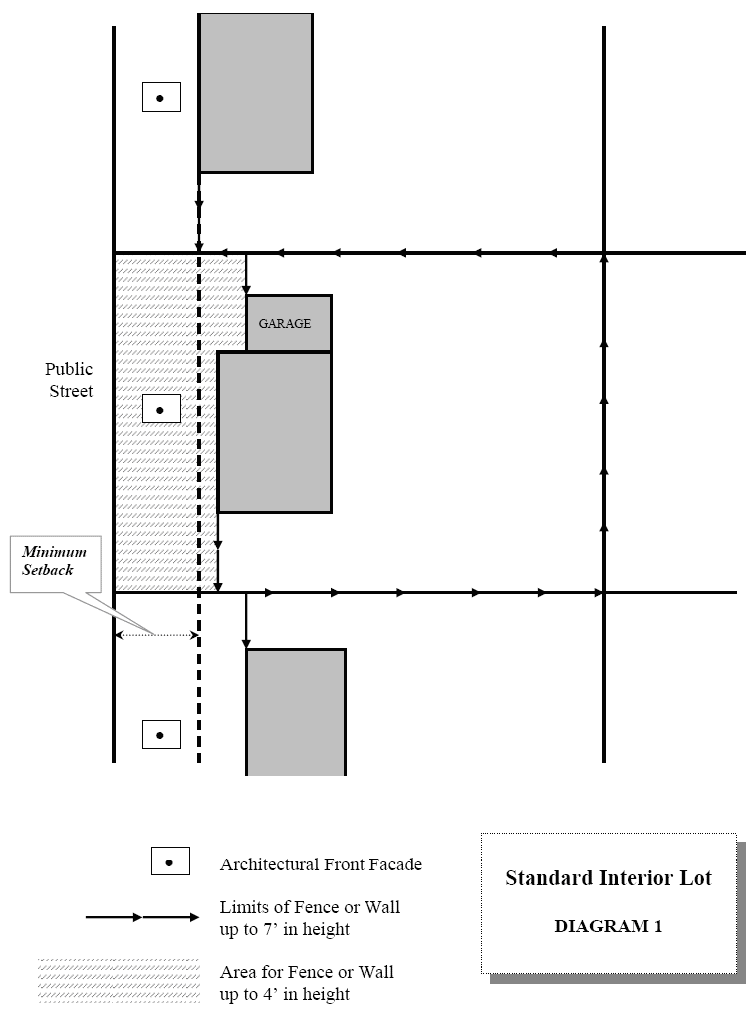
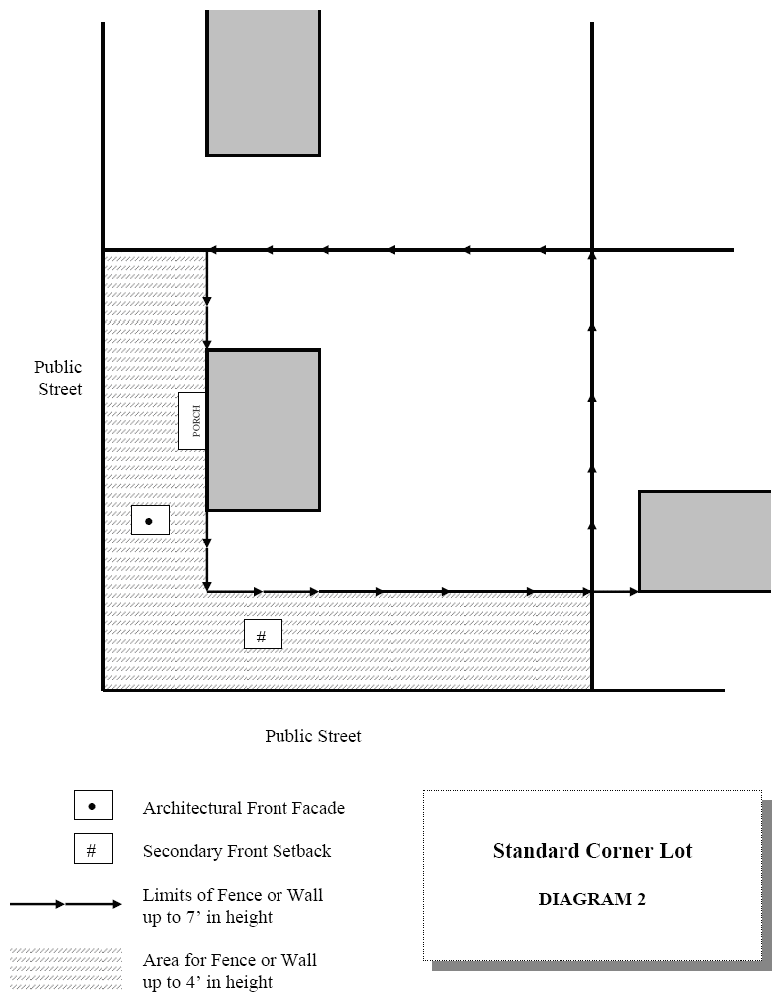
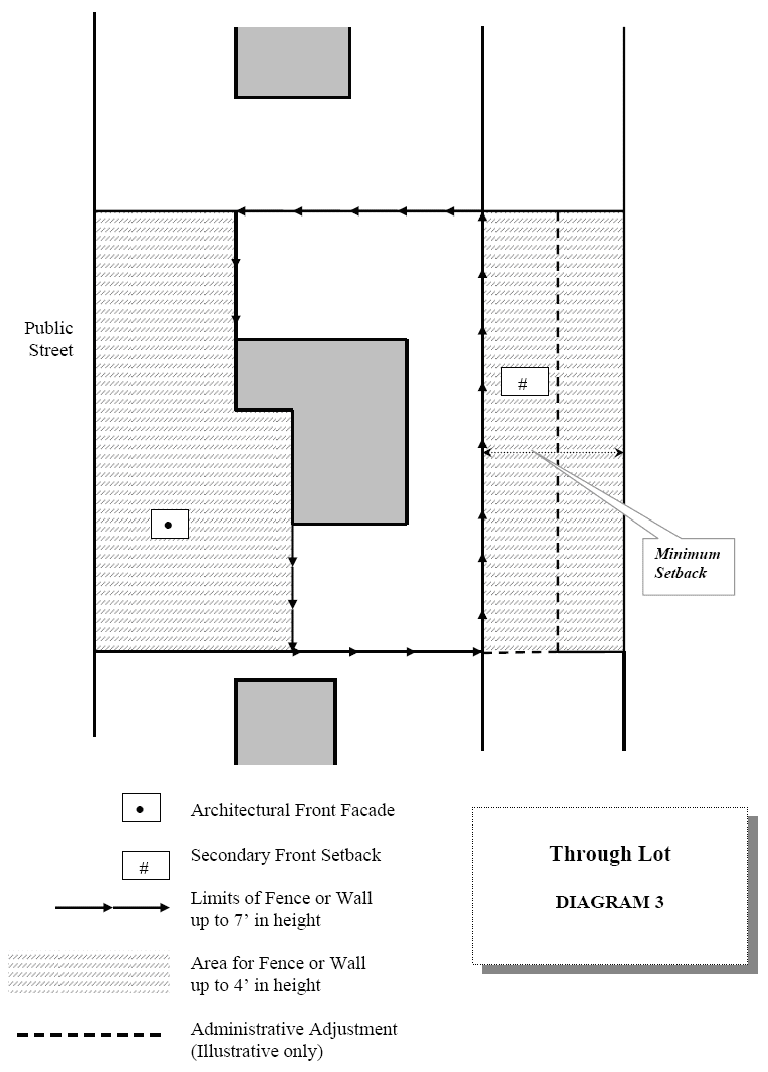
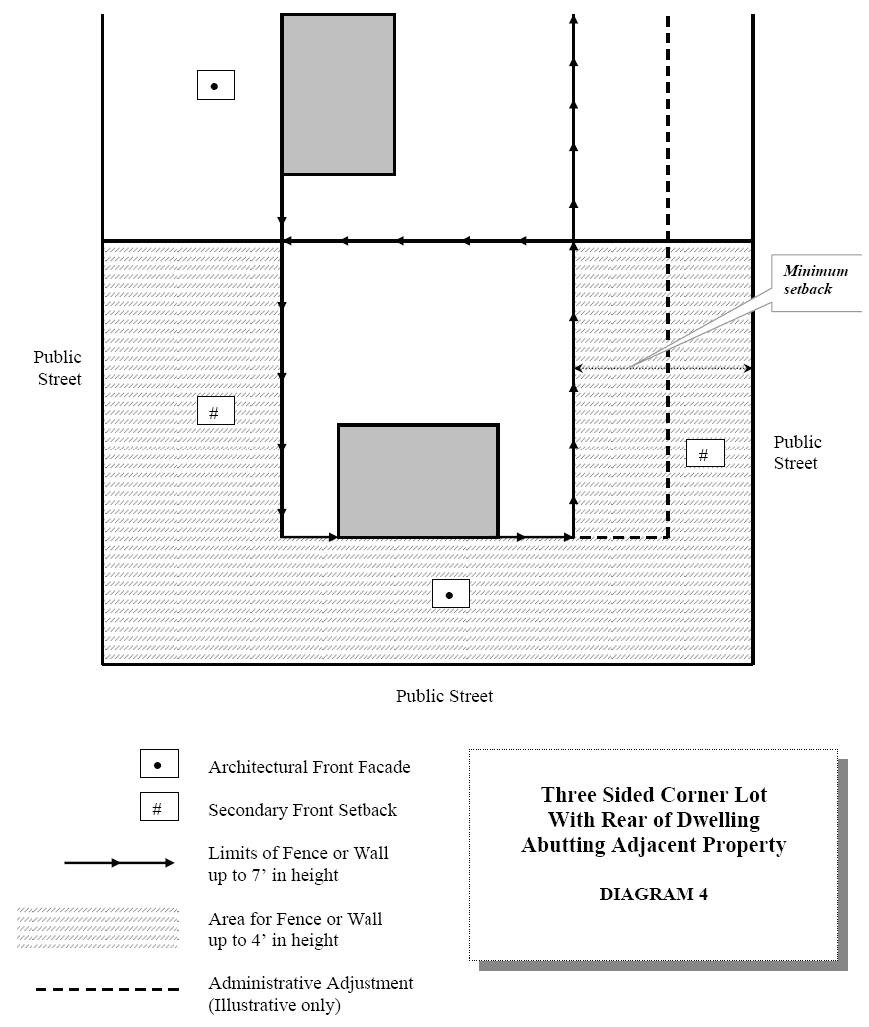
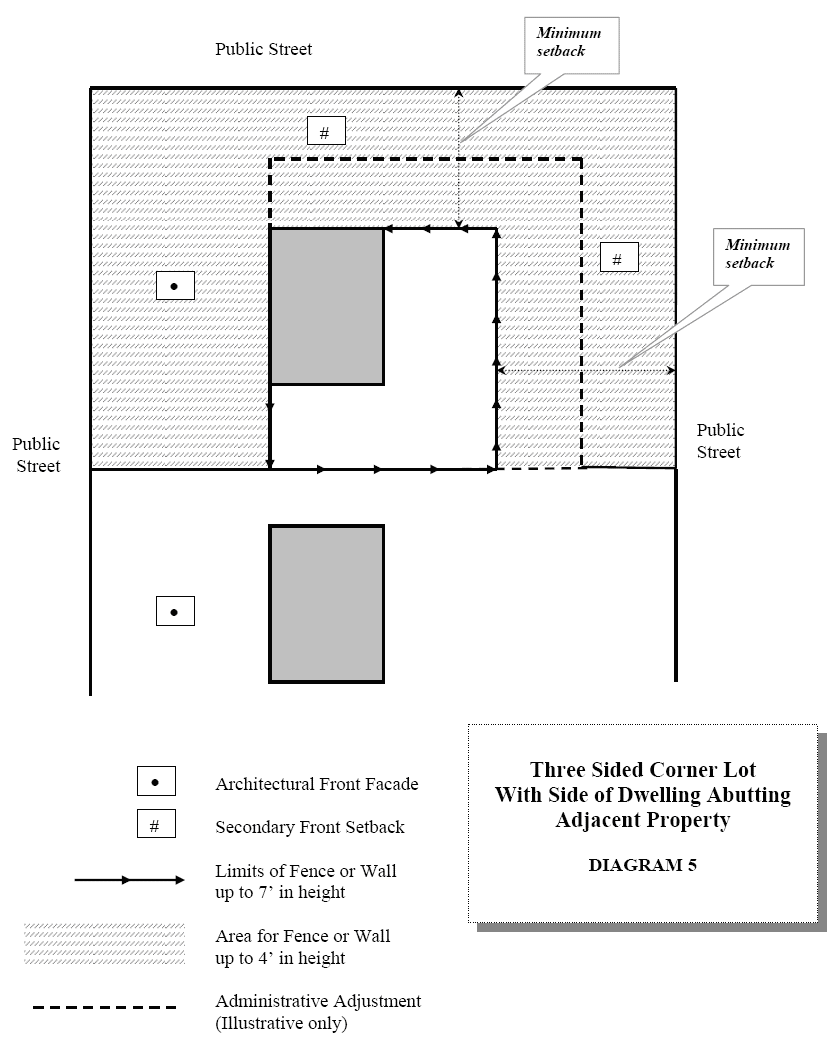
(j)
Perimeter fences and walls for residential development. For purposes of this section, "perimeter fences and walls" means any fence or wall that is located within the common area of any single-family detached, single-family attached or multi-family development and that is within 20 feet of the edge of the right-of-way of a public street. Developments may provide perimeter fences or walls between primary structures and the abutting street. Such fences or walls may be required to meet the screening requirements of section 78-110, landscaping. Whether required under this chapter or provided at the applicant's option, the following standards shall be applied to perimeter fences and walls.
(1)
Landscaping. Perimeter fences and walls that exceed four feet in height shall meet the following landscaping requirements as applicable:
a.
One evergreen shrub is installed for each five feet of fence or wall frontage along the public right-of-way. Shrubs shall be 18 to 24 inches tall at the time of installation. Shrubs may be installed in a clustered or linear fashion, and all plantings shall be installed on the side of the fence that faces the public right-of-way.
b.
One under story or ornamental tree may be substituted for every three evergreen shrubs provided that the tree meets the minimum size standards at the time of planting found in section 78-110 Landscaping.
c.
Required landscape screening of fences or walls may be credited towards landscaping required for streetscape landscaping or perimeter landscape buffers with the approval of the zoning administrator.
(2)
Uniformity. Perimeter fences and walls shall be of a uniform style that meets the standards of this section.
(3)
Maximum length of unbroken wall plane. The maximum length of unbroken fence or wall plane shall be 200 feet. A break in the plane of a fence or wall shall be at least 40 feet long (measured parallel to the street), and at least two feet in depth (measured perpendicular to the street).
(4)
Height. Perimeter fences or walls shall not exceed six feet in height measured from natural grade, except as further restricted by section 78-21(e), Visibility clearance.
(5)
Distance from right-of-way. Perimeter fences and walls shall adhere to the following distance standards.
a.
Perimeter fences and walls up to and including four feet in height shall be at least three feet from the edge of right-of-way.
b.
Perimeter fences and walls over four feet in height shall be at least six feet from the edge of right-of-way.
(Ord. No. 17-O-13, 8-8-2017; Ord. No. 20-O-61, § 1, 11-17-2020)

