
Herndon City Zoning Code
ARTICLE XVIII
DEFINITIONS
Sec. 78-180.- Definitions.
The following words, terms, and phrases, when used in this chapter, shall have the meanings ascribed to them in this section.
A-weighted sound pressure level. The sound pressure level as measured on a sound level meter using the A-weighted network. The level read shall be abbreviated to dBA.
Access easement. Real estate rights for vehicular or other passage over land.
Accessory building. A subordinate building located on the same lot as the principal building, or a portion of the principal building, the use of which is clearly incidental but customarily associated with the principal building.
Accessory dwelling unit. See "dwelling unit, accessory".
Accessory food preparation areas. An area other than the primary kitchen of a structure for the preparation of food. Accessory food preparation areas are divided into two categories consisting of secondary kitchens and wet bars.
Accessory structure. Accessory structures include, but are not limited to, detached garages, gazebos, free-standing decks, storage buildings or tool sheds, accessory dwelling units, and similar forms of land development that are incidental and subordinate to the principal structure. In-ground pools, patios, terraces, tennis courts, synthetic turf, and other impermeable landings that do not permit infiltration to groundwater are considered accessory uses of land, not structures.
Accessory use. A use that is clearly incidental to and customarily associated with the principal use. An accessory use shall be located on the same lot as the principal use. When "accessory" is used in the text, it shall have the same meaning as "accessory use."
Act of God. An act attributable to nature without human interference and not preventable by any human agency. For example, damage from a flood, tornado or a lightning strike would be considered an act of God. For purposes of this section "act of God" shall include any natural disaster or phenomena including a hurricane, tornado, storm, flood, high water, wind-driven water, tidal wave, earthquake or fire caused by lighting or wildfire. (See also "casualty.")
Adaptation measure. A project, practice, or approach to mitigate or address an impact of climate change including sea-level rise, storm surge, and flooding including increased or recurrent flooding.
Adaptive reuse. Rehabilitation or renovation of existing building(s) or structures for any use(s) other than the present use.
Addition. Any construction, including for example porches, sunrooms, finished floor area, or similar structures or buildings, that increases the roofed area of an existing structure or building.
Administrative adjustment (by the zoning administrator). An action described in the Town Code, section 78-155.5, administrative adjustments.
Administrative waiver. An action as described in provisions for the Chesapeake Bay Preservation Area Overlay district, section 78-60.4(p) of the Town Code.
Aggregate area or width. The sum of two or more designated areas or widths to be measured, limited or determined under the provisions of this chapter.
Alcohol production facilities, small scale. A facility for the small-scale production and packaging of alcoholic beverages for retail or wholesale distribution and for on-premises or off-premises consumption. The facility may include accessory uses such as retail sales and tasting rooms. The facility shall meet all applicable laws and regulations as required by the Virginia Alcoholic Beverages Control Act. Such facilities nclude craft breweries, micro-distilleries, micro-cideries, and micro-wineries. Micro-wineries shall not include on-site vineyards. Also see "brewpubs."
Alley. A narrow street not exceeding 20 feet in width which provides only a secondary means of vehicular access to abutting properties and is not intended for general traffic circulation.
Alteration.
(1)
Any change in the total floor area, use, adaptability or external appearance of an existing structure.
(2)
Any act or process that changes one or more of the exterior architectural features of a building or structure including, but not limited to, construction, reconstruction, renovation, and restoration of any structure excluding new construction.
Amusement arcade. An establishment in which four or more amusement machines are available for operation for the amusement of the general public. In no event shall an amusement arcade be considered an accessory use.
Amusement machine. Any mechanical, electronic and/or coin-operated game machine and/or device available for operation for the amusement of the general public. This definition shall not be construed to include coin-operated music players, commonly referred to as jukeboxes, coin-operated rides for children, coin-operated vending machines that merely dispense cigarettes, candy, gum, soft drinks, and toys or like products.
Animal hospital. A facility for the provision of surgical or other medical treatment for small domestic animals (dogs, cats, birds, and the like).
Animal shelter. A facility not operated for profit where stray or unwanted animals are brought and kept for eventual placement with permanent caretakers or humane disposition by euthanasia.
Antennae. Any communications equipment that transmits or receives electromagnetic radio signals used in the provision of any type of wireless communications services, but not including satellite earth stations.
Apartment. See "dwelling, multiple-family."
Apartment house. See "dwelling, multiple-family."
Applicant. Any person submitting any application required or permitted pursuant to any of the provisions of this chapter, and any person on whose behalf such an application is submitted.
Architectural control districts. All land areas in the town which are zoned other than single-family detached residential are hereby designated as architectural control districts. Also, any lot, parcel or area of land within any district zoned for single-family detached residences, which is used for other than a single-family detached residence, or which is the subject of an application for a special exception or building permit involving any such use, is designated an architectural control district.
Architectural front. The façade of a building designed to serve as the primary entrance to the building, often distinguished from the other facades by more elaborate architectural detail. The architectural front entry is not determined upon custom or use but rather upon the exterior and interior design of the building.
Areas zoned for residential use. All areas of the town which have been zoned to a zoning classification which permits one or more residential dwelling units. See also "residential district."
Artist's studio. The workshop of an artist, musician, writer, or craftsperson, including a place where a maximum of five members of the public come at any one time to receive instruction. "Artist's studio" includes custom manufacturing and accessory retail sales of the artist's work. See also "school, special instruction."
Assisted living for the elderly and persons with disabilities. A facility for persons who are unable to live independently and that provides (i) private living quarters, which may include kitchen facilities limited to a sink, refrigerator and/or microwave, (ii) supervision and general care, including but not limited to the provision of meals, housekeeping, health care, and (iii) assistance with moderate activities of daily living.
Auditorium. A building or part of a building used for an assembly hall with seating for an audience of 100 or more persons before a stage, podium, or other focal area for presentations by live speakers or audio-visual media.
Average daily trips. The number of vehicular trips generated by or associated with an existing or proposed use of land over a 24 hour period.
-B-
Base flood. For floodplain management purposes, the flood having a one percent chance of being equaled or exceeded in any given year.
Base flood elevation (BFE). The elevation of surface water resulting from a flood that has a one percent chance of equaling or exceeding that level in any given year. The BFE is shown on the Flood Insurance Rate Map (FIRM).
Basement. That portion of a building between the floor and ceiling which is wholly or partly below grade and having more than one-half of its height below grade. For purposes of flood insurance or administration of the floodplain overlay district: any area of the building having its floor subgrade (below ground level) on all sides.
Bed and breakfast establishment. An operator- or owner-occupied residence that provides lodging with breakfast as a commercial enterprise.
Berm. An elongated earthen mound typically designed or constructed on a site to separate, screen, or buffer adjacent land uses.
Best management practices or BMP. A practice, or combination of practices, determined by a state or designated area-wide planning agency to be the most effective practicable means of preventing or reducing the amount of pollution generated by nonpoint sources to a level compatible with water quality goals.
Billiards parlor. An indoor commercial establishment with four or more billiards tables and equipment for playing billiards for use by members of the public.
Bioretention. On-lot retention of stormwater through the use of vegetated depressions and other facilities that are engineered to collect, store, infiltrate, filter, evaporate, and detain runoff close to its source. Rain gardens and bioretention filters are types of bioretention.
Board. May refer to the board of zoning appeals, the architectural review board, or the historic district review board of the town, where the context so indicates.
Boarding house. A building other than a hotel or apartment hotel where for compensation or by prearrangement for definite periods, meals or lodging and meals, or lodging are provided on a commercial basis for three or more persons, but not exceeding 20 persons.
Bowling alley. An indoor commercial establishment with multiple lanes and equipment for bowling for use by members of the public.
Breezeway. A structure entirely open except for roof and supporting columns which connects a residence and an accessory building on the same lot.
Brewpub. A facility that prepares and serves food and alcoholic beverages for on-premises consumption and which also produces alcoholic beverages such as beer, ale, or other fermented malt beverages, liquor, cider, and wine. As an accessory retail or wholesale use, the facility may also sell alcoholic beverages that are produced on-site and intended for off-premises consumption.
Buffer. An area of land that: (i) typically includes landscaping, berms, walls, fences, setbacks and required yards; (ii) is located between land uses of different character; and (iii) is intended to mitigate negative impacts of the more intense use on a less intense use or vacant parcel. (See also section 78-110, landscaping, for buffer requirements.)
Buffer area. For purposes of the Chesapeake Bay preservation overlay district, an area of natural or established vegetation managed to protect other components of a resource protection area and state waters from significant degradation due to land disturbance.
Buildable width. The width of that part of a lot not included within the open spaces required by this chapter.
Building. A structure that is enclosed and isolated by a roof and exterior walls and used for shelter, support, or enclosure as a residence, business, industry, or other public or private purpose, or accessory thereto, the construction of which may require a building permit under the Uniform Statewide Building Code.
Building, completely enclosed. Any building having no outside openings other than ordinary doors, windows or ventilators.
Building, detached. A building surrounded by open space on the same lot.
Building, elevated. For floodplain management purposes, a non-basement building built to have the lowest floor elevated above the ground level by means of fill, solid foundation perimeter walls, pilings, or columns (posts and piers).
Building elevation. See "elevation drawings."
Building footprint. The area of a lot or a site included within the surrounding exterior walls of a building or portion of a building, exclusive of courtyards.
Building, height. The vertical distance, from the grade to:
(1)
The highest point of the membrane of a flat roof;
(2)
The deck line of a mansard roof;
(3)
To the mean height level between the highest ridge and its highest associated eaves for gable, hip and gambrel roofs. See also "grade."
Building, main. Any building which is not an accessory building.
Bus maintenance facility for public bus service. A facility for maintaining and servicing vehicles that are designed for carrying more than nine passengers over roadways and that are operated directly or indirectly by a governmental entity for use by the general public without restrictions. This term shall not include the storage of vehicles for other than maintenance and servicing.
Business. (From Town of Herndon Town Code section 30-211) A course of dealing which requires the time, attention and labor of the person so engaged for the purpose of earning a livelihood or profit. It implies a continuous and regular course of dealing, rather than an irregular or isolated transaction. A person may be engaged in more than one business. The following acts shall create a rebuttable presumption that a person is engaged in a business:
(1)
Advertising or otherwise holding oneself out to the public as being engaged in a particular business; or
(2)
Filing tax returns, schedules and documents that are required only of persons engaged in a trade or business.
Business districts. The central commercial zoning district (CC), commercial services zoning district (CS), office and light industrial zoning district (O&LI), and planned development-business zoning district (PD-B).
Business incubator. An office establishment where shared space, resources, and support services are available to startup and early-stage businesses. Typical business incubators include shared office or conference space, administrative services, mentoring, and business development assistance.
-C-
Caliper. The diameter of a tree measured six inches above existing grade.
Canopy tree. A tree that typically reaches 35 feet in height or taller when mature.
Car wash. See "vehicle wash" and "temporary vehicle washes by civic and nonprofit organizations."
Caretaker, security guard, or manager residence. A residence for a designated employee and their family in the same building or in an accessory structure on the same lot as their place of occupation and the principal use.
Casualty. An event, including natural disaster or other act of God, that is sudden, unexpected, and unusual, such as a hurricane, earthquake, fire, war, terrorism, flood, accident, vandalism, theft, or similar event that causes injury, death, or loss or damage to property or improvements. See also "natural disaster or other act of God."
Cemetery. Land used or dedicated to the interment of human or animal remains, including crematoriums, mausoleums, and related maintenance facilities.
Certificate of appropriateness. A certificate issued by the zoning administrator, historic district review board, or on appeal by the town council, indicating its approval of plans for alterations, new construction, removal or demolition of a landmark or of a building or structure within the historic district overlay.
Chesapeake Bay Preservation Area (CBPA). Any land designated by the town pursuant to § 9 VAC 25-830-70 to 110 of the Regulations and Section 62.1-44.15:74 of the Bay Act. A CBPA shall consist of the resource protection area (RPA) and the resource management area (RMA). The abbreviated "CBPA" and "CBPAO" (Chesapeake Bay Preservation Area Overlay) shall be used interchangeably where the context does not indicate otherwise.
Chicken tractor. A moveable combination coop and run.
Child care center or daycare center. A nonresidential facility that, for compensation, provides care for children who are under the age of 14 years old and who do not stay overnight at the facility. The facility may provide for limited instruction. A child care center shall not include a business operated as a home occupation, public or private schools organized, operated or approved under state laws, or churches or other religious or public institutions caring for children within the institutional building while their parents or legal guardians are attending services, activities or meetings.
Child care or daycare at home. See "home-based business, child care or daycare".
Civic or nonprofit organization. Any land use activity associated with a private nonprofit organization, such as not-for-profit organizations, corporations, community chest, funds, foundations, or an organization exempt from taxation under Section 501(C) of the Internal Revenue Code, and having a principal place of business in this state or another state.
Clinic. An office building or a group of offices for one or more physicians, surgeons or dentists, engaged in treating the sick or injured but not including rooms for abiding patients.
Club, private. Buildings and facilities owned or operated by a corporation, association or persons for a social, educational or recreational purpose, but not primarily for profit which inures to any individual and not primarily to render a service which is customarily carried on as a business.
Co-locate/co-location. To install, mount, maintain, modify, operate, or replace a wireless facility on, under, within, or adjacent to a base station, building, existing structure, utility pole, or wireless support structure.
Collector street. A street so designated on the adopted major thoroughfare plan of the town, and within the territorial jurisdiction of such plan.
Commercial communication tower. See "communication tower, freestanding."
Commercial districts. See "business districts"
Commercial printing. Facilities for reproduction of printed matter on a wholesale scale beyond ordinary photocopying production. Commercial printing includes publishing, engraving, and lithography.
Commercial recreation/entertainment, indoor. Facilities that offer participatory or spectator recreation or entertainment activities to the public, including billiards parlors, bowling alleys, enclosed dancehalls, enclosed skating rinks, and enclosed swimming pools, but not including theaters or amusement arcades.
Commercial vehicle. See "vehicle, commercial."
Commission. The planning commission of the town.
Common area. Land and facilities within a development which are intended to be used or enjoyed in common by the residents or owners of the development including, but not limited to, driveways, parking areas, sidewalks, walkways, recreation facilities, trash facilities, lighting, community buildings and open space. Such common areas are owned, maintained and regulated by an organization created by covenants running with the land that comprises the development.
Communication tower, freestanding. A monopole or lattice structure erected on the ground that:
(1)
May be supported by guy wires, ground anchors or other means of support;
(2)
May transmit or receive signals by radio, electromagnetic, optical, or other means;
(3)
Is used by commercial, governmental, or other public or quasi-public users;
(4)
Does not include private home use of satellite dishes and television antennas, or amateur radio operators as licensed by the Federal Communications Commission;
(5)
Is non-staffed;
(6)
May include antennas, microwave dishes, horns or similar types of equipment, towers or similar accessory structures supporting such equipment;
(7)
May include an equipment cabinet and a wall or security barrier; and
(8)
Is 50 feet or greater in height or otherwise not defined as a small cell facility.
Communication tower, roof-mounted. See "co-locate/co-location."
Community center. A place, structure, hall or other facility used for and providing fraternal, cultural, social, educational or recreational programs or activities, open to the public or a designated part of the public.
Comprehensive plan amendment. An action to amend the town's comprehensive plan adopted by the town council, and initiated other than by a motion of the town council.
Conference center. A facility used for service organizations, business and professional conferences, and seminars limited to accommodations for conference attendees. The accommodations can include sleeping, eating, and recreation.
Connectivity. The relative degree of connection between streets, sidewalks, or other means of travel.
Construction footprint. The area of all impervious cover created by development or redevelopment of land, including, but not limited to, buildings, roads, driveways, parking areas and sidewalks, and inclusive of any land disturbed for the construction of such improvements.
Construction plan. Any drawing used for the construction of any phase of on-site or off-site improvements. Construction plans may include, but are not limited to, site plans, subdivision site plans, single lot development plans, grading plans, plans, profiles and cross sections.
Construction-related activities. Temporary activities that typically accompany and support work at a site that is undergoing development and construction. Temporary construction-related activities may include construction offices, indoor and outdoor storage, fencing, portable toilets and parking.
Construction, new.
(1)
For historic district overlay purposes: Any construction of a building or structure within the historic district overlay which is independent and exclusive of an existing building or structure, or part thereof, in the historic district overlay.
(2)
For floodplain management purposes: "New construction" means structures for which "start of construction" commenced on or after the effective date of a floodplain management regulation adopted by a community and includes any subsequent improvements to such structures.
(3)
For the purposes of determining insurance rates: Structures for which the "start of construction" commenced on or after August 1, 1979, and includes any subsequent improvements to such structures.
Continuation of public hearing. As described in the Herndon Town Code, section 78-153.2(i)(2)), continuation of public hearing.
Continuous sound. A sound whose intensity remains essentially constant during the period of observation. Continuous sound shall be defined for measurement purposes as sound which is measured by the slow response setting of a sound level meter.
Continuous visual screen. Screening of vehicular use areas by vegetative material, berm, or structures (walls and fences), or a combination of these items designed to completely obstruct off-site views of the vehicular use area typically to a height four feet (48 inches) above the adjacent grade.
Contractor's materials. A specialized collection of items often in an establishment for the wholesaling or rental of building supplies or equipment primarily to contractors or the building trades. This use type includes lumberyards, tool and equipment sales or rental establishments, building contractor's yards, and electrical, heating, lumber, and plumbing supply stores to the wholesale trade
Contributing landmark, building, or structure. One that adds to or is consistent with the historic or architectural qualities, historic associations, or values for which the district was established pursuant to Code of Virginia § 15.2-2306 because it (i) was present during the period of significance, (ii) relates to the documented significance of the district, and (iii) possesses historic integrity or is capable of yielding important information about the period.
Convalescent home. A building where regular nursing care is provided for more than one person not a member of the family which resides on the premises.
Convenience store. An establishment, not exceeding 3,500 square feet of gross floor area, engaged in the retail sale of food, beverages, and other frequently or recurrently needed items for household use.
Convenience store with gas sales. An establishment, not exceeding 3,500 square feet of gross floor area, engaged in the retail sale of food, beverages, and other frequently or recurrently needed items for household use, and which includes accessory gasoline sales.
Coop. The structure within a run that houses fowl and is built and maintained with materials as impenetrable barriers so as to keep such fowl confined and secure from other animals.
Coverage, lot. The percentage of the lot covered by buildings or structures.
Critical root zone. The area of soil surrounding a tree trunk where the minimum amount of roots considered essential for tree health are located. Critical root zone is generally defined as a radius of one foot per inch of trunk diameter at breast height (DBH).
Cultural center or facility. A facility established for the purpose of educating and entertaining members of the public about art, history, heritage, folkways, music, theater, or other social and cultural matters. A cultural center may include areas for exhibit space, classrooms or seminar rooms, auditoriums, and offices.
Customer utility service. All of those wires, conduits, pipes, cables and appurtenant equipment located between the distribution line and the wall of the building occupied by a customer in the case of an electric power, telephone, telegrapher, cable television system and all of those conduits, pipes and appurtenant equipment located between the street main and the wall of the building occupied by a customer in the case of gas, water, steam, petroleum or sewer system.
-D-
Daycare center. See "child care center or daycare center."
Daycare home. See "home based business, child care or daycare."
Daylighted stream. A stream that had been previously diverted into an underground drainage system, has been redirected into an above ground channel using natural channel design concepts as defined in Code of Viriginia § 62.1-44.15:51, and where the adjacent lands would meet the criteria for being designated as a resource protection area, as defined in this section.
Deck. A roofless balcony, platform, porch or terrace, and associated stairs, attached to an outer wall of a dwelling and having no enclosure other than the sides of the dwelling to which it is attached, and a minimum safety railing as required by the town's building code.
Density, gross. The number of dwelling units on a particular tract or parcel of land divided by the entire area of that tract or parcel. Residential density is expressed as "dwellings per acre." See also "intensity."
Density, net. The number of dwelling units on a particular tract or parcel of land divided by the area of that tract or parcel remaining after subtracting land that is dedicated. Residential density is expressed as "dwellings per acre."
Development.
(1)
Generally: The construction, reconstruction, remodeling, conversion, structural alteration, relocation, enlargement, or demolition of any structure, portion of a structure, or sign; any change in use of a property, building, or structure, or material change in the appearance of any structure; any increase in the number of dwelling units, businesses, manufacturing establishments, or offices; any construction or substantial alteration of institutional, recreational, transportation or utility facilities or structures; any mining, excavation, filling, grading, paving, or land disturbance; and any act of subdivision of land.
(2)
For floodplain management purposes: Any manmade change to improved or unimproved real estate, including, but not limited to, buildings or other structures, mining, dredging, filling, grading, paving, excavation or drilling operations or storage of equipment or materials.
Diameter at breast height (DBH). The measurement of the diameter of a tree trunk over 12 inches in diameter taken at a height of four and one-half feet above the ground.
Distribution center. See "warehouse (storage)."
District, zoning.A classification of land under the jurisdiction of the town to regulate, restrict, permit, prohibit, and determine: the use of land, buildings, structures and other premises for agricultural, business, industrial, residential, flood plain and other specific uses; the size, height, area, bulk, location, erection, construction, reconstruction, alteration, repair, maintenance, razing, or removal of structures; the areas and dimensions of land, water, and air space to be occupied by buildings, structures and uses, and of courts, yards, and other open spaces to be left unoccupied by uses and structures, including variations in the sizes of lots based on whether a public or community water supply or sewer system is available and used; or excavation activities. See Code of Virginia, §§ 15.2-2280 and 15.2-2281.
Donation drop-off box. Any container, storage unit, or building that is intended or used for the holding by charitable, non-profit, or for-profit entities, of items left in or adjacent to such donation drop-off box for disposal or donation by the general public and for later collection by the entity operating, owning, or serving the donation drop-off box. These items include but are not limited to clothing, toys, books, household items, newspapers, or magazines. This term does not include a recycling collection point.
Downtown. The land encompassed within sectors 1 through 6 of the Herndon Downtown Overlay policy area, as described in the Herndon 2030 Comprehensive Plan (adopted August 12, 2008), as may be amended.
Dripline. Outermost circumference of a tree's canopy.
Drive-in window service (not drive through). A term used to describe an establishment designed or operated to serve a patron while seated in an automobile parked in an off-street parking space.
Drive-through service. A portion of an establishment designed and operated, in whole or in part, to serve or accommodate patrons while they are seated in an automobile on the premises.
Driveway. A private road connecting one or more houses, garages or other buildings with the street.
Dry cleaning and laundry plants. A commercial facility where linens, clothing, or other cloth or leather goods are cleaned by solvent processes, water washing, or other cleaning processes, but not including self-service laundromats or retail locations where such goods are dropped off by members of the general public for delivery to a central facility where cleaning occurs.
Dry-cleaning/laundry drop-off and pick-up without on-site cleaning, laundromats. A use where articles or goods of fabric are dropped off and picked up by customers and are sent to a different location for cleaning and pressing. See also "laundromats."
Duplex. See "dwelling, two-family."
Durable goods sales. Establishments that display and offer for retail sale, rental, or lease durable goods, including major household appliances; electrical, heating, cooling, and plumbing supplies; lumber and wood; carpet, flooring, and floor coverings; office equipment and supply; and medical equipment and supply; but not including contractors' materials establishments.
Dwelling. Any building or portion thereof, designed or used for residential purposes but, not trailers or mobile homes.
Dwelling unit. A single unit providing complete, independent living facilities for a single-family, including provisions for living, sleeping, eating, sanitation. See "family."
Dwelling, accessory. A dwelling unit established within the same structure or in an accessory structure and clearly subordinate to an existing single-family dwelling unit.
Dwelling, duplex. See "dwelling, two-family."
Dwelling, multi-family. A building designed for or occupied exclusively by three or more families living independently of each other.
Dwelling, quadruplex. A building designed for and occupied by four families living independently of each other. For purposes of this chapter, a quadruplex is a type of multi-family dwelling.
Dwelling, rental townhouse residential development. A housing development in which the owner leases each townhouse unit to tenants. These developments are rental properties and function like an apartment complex or other multi-family residential, rental commercial property. For purposes of this chapter, a rental townhouse residential development is a type of multi-family dwelling, subject to all associated standards and restrictions.
Dwelling, single-family detached. A building designed for not more than one dwelling unit, not physically attached to any other principal structure.
Dwelling, stacked townhouse. A residential building divided into a minimum of three non-communicating dwelling units, each dwelling unit being separated from the other vertically and horizontally.
Dwelling, townhouse. A row of two or more single-family attached dwelling units of at least two floors, separate from one another by party walls without doors, windows or other provisions for human passage or visibility through such walls from basement to roof. The roofs of townhouse dwellings may extend from one such townhouse dwelling unit to another. Typically, each townhouse unit is located on an individual lot.
Dwelling, two-family. A building designed exclusively for two dwelling units on a single lot, each with their own exterior entrance at grade. Also known as a "duplex."
-E-
Easement. A grant by the property owner to the public, a corporation, or other person or persons for the right to use an identifiable piece of land for specified purposes, such as for access or utilities.
Educational institution. See "post-secondary education and career schools."
Electric vehicle (EV) related terms:
(1)
EV capable. The installation of electrical panel capacity with a dedicated branch circuit and a continuous conduit (raceway) from the panel to the future EV parking spot to accommodate the future build-out of EV charging with 208/240-Volt, 40-amp circuits.
(2)
EV ready. The installation of electrical panel capacity and conduit (raceway) to terminate in a junction box or 208/240-volt charging outlet, similar to a dryer circuit.
(3)
EV installed. The installation of a charging station (also known as electric vehicle supply equipment).
Electrical substation. An assemblage of equipment for purposes other than generation or utilization, through which electric energy in bulk is passed for purposes of switching or modifying the characteristics to meet the needs of the general public, provided that in residential districts an electric substation shall not include rotating equipment, storage of materials, trucks or repair facilities, housing of repair crews, or office or place of business.
Electronic warehousing. A telecommunication carrier facility containing equipment for telecommunications use including switches, routers, operation centers, and other infrastructure critical for internet servers, data firms fiber-optic cable, and other technology providers.
Elevation. The height in feet above the mean sea level, reference to the National Geodetic Vertical Datum.
Elevation drawings. A fully dimensioned drawing of the front, rear or side of a building showing features such as windows, doors, siding, and relationship of grade to floor level.
Encroachment. For floodplain management purposes, the advance or infringement of uses, plant growth, fill, excavation, buildings, permanent structures or development into a floodplain, which may impede or alter the flow capacity of a floodplain.
Exception. An action as described in provisions for the Chesapeake Bay Preservation Area Overlay district, section 78-60.4(o) of the Herndon Town Code.
Existing construction. For the purposes of determining flood insurance rates and administration of the flood plain overlay district existing construction means structures for which the "start of construction" commenced before the effective date of the FIRM or before January 1, 1975, for FIRMs effective before that date. "Existing construction" may also be referred to as "existing structures."
-F-
Facade. That portion of any exterior wall of a building extending from grade to top of the parapet, wall or eaves and the entire width of the building elevation.
Facade, front. Those portions of a facade which face and are most closely parallel to the front lot line.
Family. A person living alone, or any of the following groups conforming to the limitations in section 78-170.6, excessive residential occupancy, living together as a single nonprofit and noncommercial housekeeping unit, and sharing common living, sleeping, cooking and eating facilities:
(1)
Subject to the limitations in section 78-170.6, any number of persons all of whom are related to the second degree of consanguinity by blood, marriage, adoption, guardianship, or other duly-authorized custodial relationship, as verified by official public records such as drivers licenses, birth or marriage certificates; or by affidavits. The zoning administrator may require an affidavit in this regard and may reject any such evidence not in the form of an affidavit; or
(2)
Up to four persons not all related to one another to the second degree of consanguinity by blood, adoption, guardianship, or other duly-authorized custodial relationship, as verified by official public records such as drivers licenses, birth or marriage certificates; or by affidavits. The zoning administrator may require an affidavit in this regard and may reject any such evidence not in the form of an affidavit; or
(3)
Subject to the limitations in section 78-170.6, two unrelated persons and any children related to either of them, as verified by official public records such as drivers licenses, birth or marriage certificates; or by affidavits. The zoning administrator may require an affidavit in this regard and may reject any such evidence not in the form of an affidavit; or
(4)
Not more than eight persons who are:
a.
Residents of a residential facility as defined in Code of Virginia § 15.2-2291, or;
b.
Handicapped as defined in the Fair Housing Act, 42 USC § 3602(h) and this chapter. This definition does not include persons currently illegally using or addicted to a "controlled substance" as defined in the Controlled Substances Act, 21 USC § 802(6).
c.
Subject to the limitations in section 78-170.6, the following shall not be included in the number of persons who might comprise a family: up to two (overall) persons who may be servants (or one servant and one minor child of the servant), live-in companions to the elderly or disabled, or "au pair" employees (except for families described under subparagraph (2), definition of "family"). Under the last sentence no more than two such persons, of whatever such nature, may be excluded from the number of persons who might comprise a family. Any one claiming a servant, live-in companion to the elderly or disabled, or "au-pair" employee status for an occupant or for one's self must first verify to the zoning administrator the existence of a bona fide employment relationship by a copy of a record, such as an employment contract, a federal I-9 form, a tax return, or an affidavit.
FAR. See "floor area ratio (F.A.R.)"
Farmers' market, private. A designated area, located on private property, in which producer-only vendors, limited to farmers, growers, or producers of food or plants, on a regularly scheduled basis meet to sell, at retail, farm products, whole shell eggs, meat, baked goods, plants or food to the public as well as accessory uses as permitted by the ordinance.
Fence. A freestanding, tangible barrier constructed of any allowable materials erected on the ground and rising above ground level for the purpose(s) of: confinement, security, protection, preventing uncontrolled access, or screening (visual, acoustic, or both) of materials stored, operations conducted, or activities occurring behind it.
Fill. Material such as sand, soil, gravel, or crushed stone which is placed in an area, often to adjust elevation or create land contouring.
Financial institution. Banks, savings and loan institutions, credit unions, investment or brokerage services and other financial services having a public lobby or customer service area open for business at regular hours.
Flood/floodplain related terms:
(1)
Flood or flooding. For floodplain management purposes:
a.
A general or temporary condition of partial or complete inundation of normally dry land areas from:
1.
The overflow of inland or tidal waters; or
2.
The unusual and rapid accumulation or runoff of surface waters from any source; or
3.
Mudflows which are proximately caused by flooding as defined in paragraph a. of this definition and are akin to a river of liquid and flowing mud on the surfaces of normally dry land areas, as when earth is carried by a current of water and deposited along the path of the current.
b.
The collapse or subsistence of land along the shore of a lake or other body of water as a result of erosion or undermining caused by waves or currents of water exceeding anticipated cyclical levels or suddenly caused by an unusually high-water level in a natural body of water, accompanied by an abnormal tidal surge, or by some similarly unusual and unforeseeable event which results in flooding as defined in paragraph a.1. of this definition.
(2)
Flood depth. For purposes of flood insurance and administration of the floodplain overlay district, the depth of flood waters in shallow flooding areas.
(3)
Flood insurance rate map (FIRM). For floodplain management purposes, an official map of a community, on which the Administrator has delineated both the special hazard areas and the risk premium zones applicable to the community. A FIRM that has been made available digitally is called a digital flood insurance rate map (DFIRM).
(4)
Flood insurance study (FIS). For floodplain management purposes, an examination, evaluation and determination of flood hazards and, if appropriate, corresponding water surface elevations, or an examination, evaluation and determination of mudflow and/or flood-related erosion hazards.
(5)
Flood proofing. Any combination of structural and nonstructural additions, changes, or adjustments to structures which reduce or eliminate flood damage to real estate or improved real property, water and sanitary facilities, structures and their contents.
(6)
Floodplain or flood-prone area. Any land area susceptible to being inundated by water from any source.
(7)
Floodplain, 100-year. All lands that would be inundated by floodwater as a result of a storm event of a one-hundred-year return interval.
(8)
Floodplain study. Hydrology study and related floodplain information prepared using topographic base maps, hydrologic analyses, and hydraulic calculations to arrive at precise water surface profiles and floodplain delineations. See also Chapter 26 and Chapter 70 of the Herndon Town Code.
(9)
Floodway. The channel of a river or other watercourse and the adjacent land areas that must be reserved in order to discharge the base flood without cumulatively increasing the water surface elevation more than a designated height.
Floor area.
(1)
For commercial business and industrial buildings or buildings containing mixed uses: The sum of the gross horizontal areas of the several floors of a building measured from the exterior faces of the exterior walls or from the centerline of walls separating two buildings, but not including:
a.
Attic space providing headroom of less than seven feet;
b.
Basement space not used for retailing;
c.
Uncovered steps of fire escapes;
d.
Accessory water towers or cooling towers;
e.
Accessory off-street parking spaces; and
f.
Accessory off-street loading berths.
(2)
For residential buildings: The sum of the gross horizontal areas of the several stories of a dwelling, exclusive of garages, decks, and open porches. The gross horizontal areas shall be measured from the exterior faces of the exterior walls.
Floor area ratio. A quotient which is determined by dividing the total floor area of all buildings on a lot by the gross area of the lot. Atriums not designed for occupancy and not occupied, and parking structures, both above and below grade, are excluded from the computation of floor area ratio.
Footcandle. A unit of illumination measuring the amount of light that falls onto a surface as emitted by an exterior lighting device.
Fowl. Any domesticated gallinaceous bird, including chickens or roosters, or both. Nothing in this definition shall allow the keeping of a rooster in a residential zoning district.
Freeboard. A factor of safety usually expressed in feet above a flood level for purposes of floodplain management.
Frontage. For a parcel or lot that abuts street (public or private), common area parcel or other defined land area:
(1)
Street frontage: All of the property on one side of the street between two intersecting streets (crossing or termination), measured along the line of the street, or if the street is dead-ended, then all of the property abutting on one side between an intersecting street and the dead end of the street.
(2)
Lot frontage: The distance for which the front boundary line of the lot and the street line are coincident;
(3)
Building frontage: The linear distance of a building, measured along the exterior wall which faces a public right-of-way abutting the parcel of land on which the building is located, except as provided in Article XIII, Signs.
(4)
Establishment frontage: The linear distance of that portion of a building facade measured from centerline to centerline of walls which separate individual businesses.
Full cut-off lens. An artificial outdoor lighting fixture designed to ensure that no light is directly emitted above a horizontal line parallel to the ground.
Funeral home. An establishment for the preparation of the deceased for burial and the display of the deceased and rituals connected therewith before burial or cremation.
-G-
Garage and/or yard sales. The sale, other than retail sales or wholesale for business, of personal property during an event conducted on residential premises in any residential zoning district, including all sales entitled "garage," "lawn," "yard," "attic," "porch," "room," "backyard," "patio," "flea market," or "rummage" sale.
Garage, (residential, private). An accessory building, with doors not exceeding nine feet in height, designed or used for the storage of up to three noncommercial vehicles owned and used by the occupants of the building to which it is accessory. On a lot occupied by a multiple-family dwelling, the private garage may be designed and used for the storage of one and one-half times as many automobiles as there are dwelling units.
Glazing. The portion of an exterior building surface occupied by glass or windows.
Golf course. A tract of land laid out with a course having nine or more holes for playing the game of golf, including any accessory clubhouse, driving range, office, restaurant, concession stand, picnic tables, pro shop, maintenance building, restroom facility, or similar accessory use or structure. This term shall not include miniature golf courses as a principal or accessory use, nor shall it include driving ranges that are not accessory to a golf course.
Governing body (of the town). The town council of the Town of Herndon.
Government buildings, facilities and uses not otherwise categorized. Any facility owned or operated, by an agency of local, regional, state or federal government, including but not limited to any government building, structure, facility, park, golf course, cemetery, public works yard, maintenance, storage, and fueling facilities, playground, parking facility, or other use.
Grade.
(1)
For buildings having a wall adjoining one street only, the grade is the elevation of the sidewalk at the center of the wall adjoining the street.
(2)
For buildings having a wall adjoining more than one street, the grade is the average elevation of the sidewalk at the centers of all walls adjoining the streets.
(3)
For buildings having no wall adjoining the street, the grade is the average level of the finished surface of the ground adjacent to the exterior walls of the building. Any wall parallel to or within ten degrees of being parallel to, and not more than 15 feet from a street line is to be considered as adjoining the street. Sidewalk grades shall be established by the town engineer.
Grading plan. A drawing and associated information sealed by a Virginia registered professional engineer showing existing and proposed topography, environmental controls, demolition, and proposed alterations to the land. May be referred to as "over lot grading" and "rough grading plan" in this chapter and Chapter 26 of the Herndon Town Code.
Green space. Permeable land area that is planted or landscaped with non-invasive plant species in accordance with provisions throughout this chapter.
Ground cover. Any non-invasive living plant designed to grow low to the ground (generally one foot or less) and intended to stabilize soils and protect against erosion.
Group home. In accordance with the Code of Virginia § 15.2-2291, group home means a residential facility in which no more than eight individuals with mental illness, mental retardation, or developmental disabilities reside, with one or more resident counselors or other staff persons. In applying the definition of group home under Code of Virginia § 15.2-2291(A), (i) mental illness and developmental disability shall not include current illegal use of or addiction to a controlled substance as defined in the Code of Virginia § 54.1-3401, or (ii) "residential facility" means any group home or other residential facility for which the department of behavioral health and development services is the licensing authority. In accordance with the Code of Virginia § 15.2-2291(B), group home also means a residential facility in which no more than eight aged (65 years or older), infirm, or disabled persons reside, with one or more residential counselors or other staff persons. In applying the definition of "group home" under the authority of Code of Virginia § 15.2-2291(B), "residential facility" shall mean any assisted living facility or residential facility in which aged, infirm or disabled persons reside with one or more resident counselors or other staff persons and for which the department of social services is the licensing authority.
-H-
Health care facility. A facility providing medical, dental, psychiatric, or surgical service exclusively on an outpatient basis, including emergency treatment, diagnostic services, treatment including alternative treatments or therapies, training, administration.
Health care laboratory. A facility that is designed or equipped for collection, testing and analysis of samples or specimens for the purpose of diagnosing medical or dental conditions, but not including inpatient or outpatient clinical or treatment facilities such as hospitals or clinics.
Health club. An establishment, which may include saunas and steam baths, offering or providing facilities for, and instruction in, general health, physical fitness and controlled exercises such as weight lifting, calisthenics, and aerobic dancing. The facility may be used by members or nonmembers. This term shall not be deemed to include a "school of special instruction."
Hedge. A linear planting of closely spaced shrubs or trees.
Height of building. See "building, height" and "grade."
Historic district overlay. The historic district overlay shall be designated by town council. Boundaries shall encompass and may include areas adjacent to historic landmarks.
Highest adjacent grade. For floodplain management purposes, the highest natural elevation of the ground surface prior to construction next to the proposed walls of a structure.
Highly erodible soils. Soils with an erodibility index from sheet and rill erosion equal to or greater than eight. The erodibility index for any soil is defined as the product of the formula, RKLS/T, in which R is the rainfall and runoff; K is the soil susceptibility to water erosion in the surface layer; LS is the combined effects of slope length and steepness; and T is the soil loss tolerance.
Historic landmarks. Any areas designated by the town council as areas containing buildings or places in which historic events occurred or as having special public value because of notable architectural or other features relating to the cultural or artistic heritage of the community of such significance as to warrant conservation and preservation, and any building or structures designated by the town council as having an important historic, architectural or cultural interest.
Historic structure. For purposes of flood insurance and administration of the floodplain overlay district, any structure that is:
(1)
Listed individually in the National Register of Historic Places (a listing maintained by the Department of Interior) or preliminarily determined by the Secretary of the Interior as meeting the requirements for individual listing on the National Register;
(2)
Certified or preliminarily determined by the Secretary of the Interior as contributing to the historical significance of a registered historic district or a district preliminarily determined by the secretary to qualify as a registered historic district;
(3)
Individually listed on a state inventory of historic places; or
(4)
Individually listed on a local inventory of historic places in communities with historic preservation programs that have been certified either:
a.
By an approved state program as determined by the Secretary of the Interior; or
b.
Directly by the Secretary of the Interior in states without approved programs.
Home-based business. A business that is conducted (i) within a dwelling unit which is the principal and bona fide residence of the practitioner or practitioners of the business and (ii) in accordance with the provisions of Article VII, Use Regulations.
Home-based business, daycare or childcare. A dwelling in which a permanent occupant of the dwelling provides for the care of up to five children or adults, in accordance with the provisions for home-based businesses in Article VII, Use Regulations. Those receiving care are not all related to the occupant or to each other by blood or marriage and are not the legal wards or foster children of the attendant adults, and do not reside on the site.
Hospital. An establishment providing services for surgery and surgical care, in-patient medical, out-patient medical, and the care of sick or injured persons. A hospital may include related facilities such as laboratories, out-patient services, training facilities, central service facilities, and staff offices, provided the related facility is incidental and subordinate to the principal hospital use and is an integral part of the hospital operation.
Hotel (including extended stay hotels). An establishment containing 50 or more separate and distinct sleeping rooms or suites that contain at least one private bath, are offered to the general public for rental, and are occupied by persons on primarily transient basis such that most occupants stay in the building for no longer than one week at a time. A hotel may contain restaurants, ballrooms, banquet halls and meeting and conference rooms. A hotel may also contain a retail sales area provided that the items sold therein are of such nature as to accommodate or comfort persons in transit. A hotel and/or the parcel on which hotel is located may contain pools, saunas and/or other recreational facilities utilized primarily by persons occupying sleeping rooms or suites in the building.
Housing for the elderly. A residential development that is limited to occupancy by elderly persons or persons with disabilities as defined in the Federal Fair Housing Amendments Act of 1988 (as amended). Such a facility shall provide (i) dwelling units with complete kitchen facilities, (ii) supportive services such as meals, personal emergency response systems, recreation and transportation services, and (iii) features of adaptable design specified in 24 CFR 100.205(c)(2)—(3).
-I-
Illuminated tubing. Neon or other internally illuminated tubing designed to convey a commercial message, or provide a decorative outline of windows, building lines or trees.
Impervious surface. A surface composed of any material that significantly impedes or prevents natural infiltration of water into the soil. Impervious surfaces include, but are not limited to roofs, buildings, streets, parking areas, and any concrete, asphalt or compacted gravel area and similar ground coverings. See also "paved surface."
Impulse sound. A single or multiple sound event characterized by a rapid rise to a maximum sound pressure of light intensity, followed by a somewhat slower decrease in sound pressure. The duration of an impulse sound event, which includes a combination of rise and peak, peak amplitude and decay, shall be no more than one second. Impulse sound shall be measured using unweighted peak dB levels and the fast setting of a sound level meter. Impulse sound may include, but not limited to, sound from weapons fire, pile drivers, or blasting.
Industrial districts. See "business districts."
Industrial service uses, all other. Businesses, other than scientific research and scientific development or dry cleaning and laundry plants, that are engaged in the repair or servicing of industrial, business, or consumer machinery, equipment, products, or by-products. Such businesses may include, but are not limited to, welding shops; machine shops; tool repair; electric motor repair; repair of scientific or professional instruments; building, heating, plumbing or electrical contractors; bulk and direct mail insertion and sealing; document production, printing, engraving, commercial publishing and lithography; exterminators; janitorial and building maintenance services; establishments for the mechanical cleaning of garments, articles or goods of fabric; linen or diaper cleaning service establishment; or photo-finishing laboratories.
Infill site. Any vacant lot or parcel where at least 80 percent of the surrounding land has been developed, and where water, sewer, streets, sidewalks, storm drainage, schools, and fire protection have already been developed and are provided. See also "redevelopment."
Inn. A building or complex of buildings containing at least five, but no more than 49, separate and distinct sleeping rooms or suites that do not contain cooking or eating facilities, that are offered to the general public for rental and that are occupied by persons on primarily a transient basis, such that most occupants stay in the establishment for no longer than one week at a time. Meals may be prepared for and provided to the occupants of an inn within a centralized cooking and dining area in the inn.
Intensely developed area (IDA). An area designated by the Chesapeake Bay Preservation Area map for existing development and infill sites at the original adoption date of this article on October 23, 1990, in which development is concentrated and little of the natural environmental remains. IDAs are generally characterized by at least one of the following:
(1)
Development has severely altered the natural state of the area such that it has more than 50 percent impervious surface;
(2)
Public sewer and water systems, or a constructed stormwater drainage system, or both, have been constructed and serve the area by the original adoption date of this article;
(3)
The condition in item (2) does not include areas planned for public sewer and water or constructed stormwater drainage systems. For the purposes of this definition, any property within 500 feet of public sewer and water is considered served by public sewer and water; or
(4)
Housing density is equal to or greater than four dwelling units per acre.
Intensity. The level of concentration of activity occurring on a site or in an area, usually expressed for commercial sites as "floor area ratio." Intensity is sometimes used interchangeably with density. See also "density" and "floor area ratio."
Intermittent stream. A watercourse that flows in a well-defined channel during some seasons of the year but not the entire year.
-K-
Kennel. A place or establishment in which more than three animals, more than one year of age, are kept, bred, raised, fed, boarded or handled for a fee.
Kept as a pet. This phrase means maintained for private, noncommercial, and personal reasons, despite the possible occasional, minimal, and incidental sale off-site of by-products.
Kitchen. An area that is used or designated to be used as an element of an independent dwelling unit for the preparation of food and that contains a sink, refrigerator, or food heating unit. See also "accessory food preparation area."
-L-
Land disturbance or land disturbing activity. A manmade change to the land surface that may result in soil erosion or has the potential to change its runoff characteristics, including, but not limited to, construction activity such as clearing, grading, excavating, or filling of land. For land disturbance exemptions refer to section 26-324.
Land disturbing permit. See section 26-48, definitions, of the Herndon Town Code.
Laundromat. An establishment that provides self-service type washing, drying and ironing facilities for the use of retail customers.
Level of service (traffic). A quantitative measure of traffic congestion identified by a letter scale which indicates the relative free flow of traffic with no delays, where the higher the number of delays, the "higher" the alphabetic indicator.
Library. A publicly-operated facility housing a collection of books, magazines, audio and video tapes, or other media for borrowing and use by the general public.
Light manufacturing uses. Businesses that are engaged in the production of products, the mechanical transformation of predominantly previously prepared materials into new products, or the assembly of component parts and the creation of products for sale. Activities may include the production or repair of small machines or electronic parts and equipment; woodworking and cabinet building; publishing, lithography or bulk production of printed material distributed by commercial vehicles; design and development of computers; production and repair of communication equipment, precision items, and other electrical items; assembly of pre-fabricated parts; manufacture of electronics or optical instruments or devices; manufacture and assembly of artificial limbs, dentures, hearing aids, and surgical instruments; production of apparel; and making of signs.
Livestock. Horses, ponies, donkeys, cattle, sheep, goats, swine (except Vietnamese potbellied pigs) and other hoofed animals.
Live-work development. A structure or part of a structure with areas specifically designed for occupancy by a single owner, tenant, or user to accommodate a residential dwelling unit and a flexible work space. This use does not include a home-based business.
Loading space or loading berth. A space within the main or accessory building or on the same or adjacent lot, providing for the standing, loading or unloading of trucks, having a minimum dimension of 12 feet by 35 feet and a vertical clearance of at least 14 feet.
Lot related terms.
(1)
Lot. Any lawfully created parcel of land, excepting property dedicated to public street purposes.
(2)
Lot, area. The total area included within the lot lines of a lot.
(3)
Lot, corner. A lot located at the intersection of two or more streets.
(4)
Lot, depth of. The mean horizontal distance between the front and rear lot lines.
(5)
Lot, interior. A lot other than a corner lot with only one street frontage.
(6)
Lot line. The legal boundary line of a lot.
(7)
Lot line adjustment. A plat that may be used under certain specified circumstances as a method for making minor revisions to property lines between two or more existing lots or parcels. The lot line adjustment is not a procedure for subdividing property. A lot line adjustment is sometimes called a boundary line adjustment.
(8)
Lot, pipestem. A narrow elongated portion of a lot which has as its predominant purpose providing access from a public right-of-way to the house or garage located on the lot.
(9)
Lot, reversed frontage. A lot in which the frontages at right angles to the general pattern in the area involved. Reversed frontage lot may also be a corner lot or an interior lot.
(10)
Lot, through. An interior lot having frontages on two streets.
(11)
Lot width. The distance between the side lot lines measured at the required front yard line.
Lowest floor. For purposes of flood insurance and administration of the floodplain overlay district the lowest floor of the lowest enclosed area (including basement). An unfinished or flood-resistant enclosure, usable solely for parking of vehicles, building access or storage in an area other than a basement area is not considered a building's lowest floor; provided, that such enclosure is not built so as to render the structure in violation of the applicable non-elevation design requirements of Federal Code 44 CFR § 60.3.
-M-
Mailing and packing service. An establishment providing mailing, packing, and parcel shipping services for individual retail customers who may deliver and pick up items at the establishment on a walk-in basis. Mailing and packing service may include accessory photocopying machines or services. Mailing and packing service does not include installations of the United States Postal Service, express shipping company distribution and collection facilities, facilities that pack and ship materials on a wholesale basis, or commercial printing, publishing, engraving, and lithography establishments.
Manufactured home. A structure, transportable in one or more sections, which is built on a permanent chassis and is designed for use with or without a permanent foundation when connected to the required utilities. For floodplain management purposes, the term "manufactured home" also includes park trailers, travel trailers, and other similar vehicles placed on a site for greater than 180 consecutive days, but does not include a recreational vehicle.
Manufacturing, custom. The production of goods by hand manufacturing involving the use of hand tools, or the use of mechanical equipment commonly associated with residential or hobby uses, or a single kiln.
Manufacturing, light. The production of goods or articles, predominantly from previously prepared materials of finished products or parts, including processing, fabrication, assembly, treatment and packing of such products, and incidental storage, sales, and distribution of such products. Such use shall not involve on the premises the use of heat, noise, or odor generating or producing processes which are detectable off-site.
Mature tree. A canopy tree with a diameter at breast height (DBH) of 12 inches or greater or an understory tree with a DBH of four inches or greater.
Maximum extent practicable or feasible. No feasible or practical alternative exists, as determined by town staff, and all possible efforts to comply with the regulation or minimize potential harmful or adverse impacts have been undertaken by an applicant. Economic considerations may be taken into account but shall not be the overriding factoring determining "maximum extent practicable".
Medical and dental laboratories. See "health care laboratory."
Mini-warehouse. See "self-service storage."
Minor site plan. A site plan that meets the provisions of section 78-155.6(e)(3), minor site plan.
Minor utilities. Small-scale facilities serving a local area, such as pumping stations for water or sewer, hydrants, storm water detention facilities, generators for backup power, electrical transformers and similar equipment in structures that are no larger than 100 square feet and ten feet in height.
Mobile food unit, dispenser, limited-service. A motorized food establishment or a food establishment that is pulled or carried by a motorized vehicle, from which prepackaged food is sold, or heated, plated and sold.
Mobile food unit, preparer, full service. A motorized food establishment or a food establishment that is pulled or carried by a motorized vehicle, within which food is cooked and plated for sale. Such unit shall include an operational commercial kitchen with three-compartment sink and a separate hand sink. The products sold are not prepackaged but are prepared on-site at time of sale.
Modification. An action for planned developments and described in the Town Code, section 78-50.2(d), modification of requirements.
Mortuary. An establishment for the storage of human bodies prior to their burial or cremation.
Motel. A building or group of buildings on one parcel of land containing 50 or more separate and distinct living or sleeping quarters, each quarter containing at least one private bath, which quarters are offered to the general public for rental for more than nominal compensation and are occupied by persons on primarily a transient basis, such that most occupants stay in the building for no longer than one week at a time. A motel and/or the parcel on which a motel is located may contain pools, saunas, and/or other recreational facilities utilized primarily by persons currently occupying living or sleeping quarters in the motel.
Motor vehicle. This term is defined in Code of Virginia (1950) § 46.2-100, as amended, and as may be amended from time to time.
Multi-family dwelling. See "dwelling, multi-family."
Municipal performing arts facility. Any building or structure operated by the municipality, to provide a service to the public such as, but not limited to, performing arts, visual arts, public assembly or governmental service.
-N-
Natural disaster or other act of God. An act attributable to nature without human interference and not preventable by any human agency. For example, damage from a flood, tornado or a lightning strike would be considered a natural disaster or other act of God. (See also "casualty.")
Natural grade. The elevation of the ground according to (i) an approved engineered development plan or (ii) the elevation of the ground immediately before the beginning of the subject development, which includes any deposit of fill material. The applicant for development approval may determine which of the methods of determining natural grade to use. In the absence of such a determination, the zoning administrator shall make such determination.
Nature-based solution. An approach that reduces the impacts of sea-level rise, flooding, and storm events through the use of environmental processes and natural systems.
Nonconforming lot. An otherwise legally platted lot, or an otherwise legally created parcel, in existence on and after July 1, 2006, that does not conform to the minimum area or width requirements of this chapter for the district in which it is located either at the effective date of this chapter, July 1, 2006, or as a result of subsequent amendments to the chapter. Such an otherwise legally platted lot or parcel that does conform to the minimum area and width requirements, but does not conform to other requirements of this chapter, is a conforming lot and shall not be treated as a nonconforming lot.
Nonconforming structure. An otherwise legal building or structure that does not conform with the yard, height, lot coverage, parking or other development regulations of this chapter, for the district in which it is located, either at the effective date of this chapter, July 1, 2006, or as a result of subsequent amendments to the chapter.
Nonconforming use. The otherwise legally established use of a building, structure or tract of land, which has been continued but that does not conform to the use regulations of this chapter for the district in which it is located, either at the effective date of this chapter, July 1, 2006, or as result of subsequent amendments to the chapter.
Nonconformity. The use or development of land, building(s), structure(s), or lot(s), which was lawful at the time of enactment or amendment of zoning regulations but is not in conformity with this chapter or an amendment.
Nonpoint source pollution. Pollution such as sediment, nitrogen, phosphorous, hydrocarbons, heavy metals, and toxics whose sources cannot be pinpointed but rather are washed from the land surface in a diffuse manner by stormwater.
Nonprofit organization. See "civic and nonprofit organizations."
Nontidal wetlands. Those wetlands other than tidal wetlands that are inundated or saturated by surface water or groundwater at a frequency and duration sufficient to support, and that under normal circumstances, do support a prevalence of vegetation typically adapted for life in saturated soil conditions, as defined by the U.S. Environmental Protection Agency pursuant to Section 404 of the Federal Clean Water Act, in 33 CFR 328.3b.
Noxious weeds. Johnson grass, kudzu, poison ivy, ragweed, poison oak, poison sumac, purple loosestrife, multiflora rose, Japanese honeysuckle, mile-a-minute vine and any other species hereinafter identified on the list of "Invasive Alien Plant Species of Virginia," compiled by the Virginia Department of Conservation and Recreation.
-O-
Occupancy, residential. Use of a building or structure as a dwelling unit or place of abode.
Occupant. Any person who is an individual 18 years of age or older, living or sleeping in a building or having possession of a space within a building.
Office. Any room studio, clinic, suite or building wherein the primary use is the conduct of a business for example accounting, correspondence, research, editing, administration or analysis, demographic and market research, technical or academic consulting, among others; or the conduct of a business by sales, sales representatives or manufacturer's representatives, among others; or the conduct of a business by professionals such as engineers, architects, land surveyors, planners, lawyers, real estate brokers, insurance agents, or landscape architects. Office shall not involve manufacturing, fabrication, production, processing, assembling, cleaning, testing, repair or storage of materials, goods and products, or the sale and/or delivery of any materials good or products which are physically located on the premises. An office shall not be deemed to include a health care facility, a health laboratory, or a veterinary clinic.
One hundred year floodplain. All lands that would be inundated by floodwater as a result of a storm event of a one-hundred-year return interval.
Open space. Land which is not occupied by a building, parking or loading space, vehicular travel lane, driveway, street, or sidewalk. Open space may contain landscaping, walks, paths, trails, plazas, stormwater management facilities provided as a landscape amenity, play equipment, pools, basketball courts, and the like. See also definition of "green space," and open space standards in Article XI.
Ornamental tree. See "under story tree."
Outdoor advertising. See Article XI, Development Standards.
Outdoor display of products for sale. An area of designated size used for the display of seasonal merchandise or tangible property normally sold within the contiguous business or organization.
Outdoor retail sales events. See Article VII, Use Regulations.
Outdoor seating (with a restaurant). See "restaurant with outdoor seating."
Outdoor storage. The on-going placement of goods, products, vehicles and other articles outside of a roofed enclosure. See also Article VII, Use Regulations.
Over lot grading plan. Plan showing proposed grading of a lot and related information. See "grading plan."
-P-
Parapets, penthouses for equipment and other roof structures. A structure mounted on a roof for the purpose of screening, protecting, or facilitating activities within the associated building, but not for purposes of advertising or commercial gain. See also antenna and commercial communication towers.
Park or playground. A noncommercial, non-profit facility composed primarily of open land area and improvements, intended to be used for recreation and enjoyment, including both active and passive recreation.
Parking area. Land designed and used for location of parking spaces or loading spaces, or both, or for the storage or display of motor vehicles and related driveways and landscaping.
Parking bay. The parking module consisting of one or two rows of parking spaces or stalls and the aisle from which motor vehicles enter and leave the spaces.
Parking facility, commercial. Land designed and used for parking and storage of motor vehicles on a temporary, daily, or overnight basis, and not accessory to a specific principal use. Commercial parking lot includes parking lots located off the site of a principal use and parking lots that are conducted as commercial ventures offering paid parking.
Parking space, off-street. An all-weather surface area not in a street or alley and having an area of not less than 180 square feet, exclusive of driveways, permanently reserved for the temporary storage of one automobile and connected with street or alley by an all-weather surfaced driveway which affords satisfactory ingress and egress for automobiles.
Parking structure. A structure or facility designed with one or more levels or floors partially or fully enclosed and used exclusively for the parking or storage of motor vehicles, whether accessory to a principal use or located off the site of a principal use. The facility may be above, below, or partially below ground. Parking structure includes parking garages and parking decks.
Parking, off-site. An off-street parking area provided on a different parcel than the use it is intended to serve.
Paved surface. Ground surface or structures above the ground covered with clay-fired bricks, concrete recast paver units (including, but not limited to, grasscrete), poured concrete, blacktop, or other asphaltic or rubber mixture which may include sand or gravel as an ingredient and which creates a hard surface. A graded surface or a surface covered with rolled stone or loose gravel is an impervious surface, but not a paved surface. See also "impervious surface."
Peak hour trips. The hour-long period on any given day where the number of vehicular trips generated by a land use or group of land uses is the highest, typically occurring within the morning and evening commuter periods.
Perimeter landscape strip. Vegetative material, perhaps used with structures (i.e., walls, fences), placed around the perimeter of a lot and used to separate land uses from each other as required by this chapter.
Person. Person shall include but not be limited to human beings, business entities, and non-business entities or organizations. Persons subject to the remedies and penalties set forth in this chapter may include any person who participates in, assists, directs, creates, causes, or maintains a condition that results in or constitutes a violation of this chapter; or an owner, any tenant or occupant, or any other person, who has control over, or responsibility for, the use, occupancy, or development of the property on which the violation occurs.
Personal services, general. See Article VII, Use Regulations, for a description of activities included in this category.
Personal services and retail sales uses, other. See Article VII, Use Regulations, for a description of activities included in this category.
Pet daycare. An establishment where pets are delivered on a recurring basis and kept for less than 24 hours at a time for commercial compensation, but not including a private home in which pet-sitting for animals belonging to another household is done occasionally on a noncommercial basis.
Pharmacy, retail. A business principally devoted to the sale of pharmaceutical items, supplies, and equipment.
Pipestem. See "lot, pipestem."
Portable storage units. Self-storage containers that are placed temporarily at the place of residence or business of the customer. See also "structure, temporary."
Post-secondary education and career schools. See "school, post-secondary education and career."
Preliminary subdivision plan. Plan of a subdivision with lot or site layout, as a basis for consideration by the town prior to the preparation of a record plat and subdivision site plan as described by Chapter 78 of the Town Code.
Preschool. A school for children primarily between the ages of three and five, providing preparation for elementary school.
Primarily indoors. Kept inside the dwelling unit more than 50 percent of the time.
Principal structure. A structure or building having a significant or primary use justifying its own utilization, such as a dwelling or office building, as contrasted to accessory structures which are incidental or subordinate to primary structures and do not alone justify their utilization, such as a tool shed or auto garage used in conjunction with a single-family dwelling unit. Certain structures may be either principal or accessory depending upon their utilization, such as a parking garage as an accessory structure to a high-rise apartment or a principal structure when operated commercially.
Principal use. The significant or primary activity carried out within a structure or upon land.
Private shared parking. Off-street parking facilities shared by two or more uses which are close to one another and the parking area, and which have different operational characteristics such that use of the parking facilities by one use will not generally overlap with the use of the parking area by the other use(s).
Private swimming pool. See "club, private."
Product repair and services. Establishments offering repair of goods and equipment servicing, including household appliance repair, upholstering shops, and office equipment services.
Proffers. Reasonable conditions, in addition to the regulations provided for the zoning district by this chapter, made in writing by owner of the property that is the subject of a zoning map amendment, in advance of the public hearing required by Code of Virginia, § 15.2-2285. These conditions are found in the application for rezoning and accompanying documents, and may supplement or modify the regulations provided for a particular zoning district or zone by the overall zoning ordinance.
Public road. For purposes of the Chesapeake Bay preservation overlay district, public streets or public rights-of-way in the town and publicly owned roads designed and constructed in accordance with water quality protection criteria at least as stringent as requirements applicable to the Virginia Department of Transportation, including regulations promulgated pursuant to the Virginia Erosion and Stormwater Management Act (Code of Virginia § 62.1-44.15:24 et seq.)
Public shared parking. Parking spaces or parking facilities open to the public, generally benefiting a certain use, proffered as a condition attached to a conditional rezoning or as an option chosen by a developer or landowner for provision of parking with respect to a site plan or use approval. Public shared parking is provided and financed in part by a developer or landowner to meet parking requirements as set forth in Article X of this chapter for development and in part by the town to provide public parking. In all cases, public shared parking shall be dedicated to the public purposes of providing public parking, revitalization of the downtown, and conserving land, water and the environment; and shall not include any parking spaces that are specifically designated for the benefit of any particular use or property.
-Q-
Quadruplex. See "dwelling, quadruplex."
-R-
Record plat. The final plat that is approved by the mayor and town council, recorded in Land Records Division of the Fairfax County Circuit Court, as described in Chapter 70 of the Herndon Town Code. See "subdivision plat, final."
Recreation space. Land that is dedicated to recreational pursuits that require physical alteration to the area in which they are performed. Such areas may include but, are not limited to, playgrounds, ball fields, tennis or other courts, fitness trails, walking paths, or swimming pools.
Recreational vehicle.
(1)
Recreation vehicle, (generally): A towed or motorized mobile unit designed, used or intended to be used for recreational purposes, including temporary human occupancy during travel or recreational use. This definition includes jet skis, snow mobiles, all-terrain vehicles, travel trailers, pickup campers, motorized dwellings, tent trailers, boats, boat trailers, house boats and the like.
(2)
Recreational vehicle (for purposes of flood insurance and administration of the floodplain overlay district): A vehicle which is:
a.
Built on a single chassis;
b.
Four hundred square feet or less when measured at the largest horizontal projection;
c.
Designed to be self-propelled or permanently towable by a light duty truck; and
d.
Designed primarily not for use as a permanent dwelling but as temporary living quarters for recreational camping, travel, or seasonal use.
Recreational vehicle parking and storage of individually owned vehicles. A facility owned or operated by a corporation, association, or group of individuals established for the perpetual parking and storing of more than three recreational vehicles in an enclosed, secure area.
Recreational vehicle rental and sales. The display and sale or rental of recreational vehicles.
Recycling collection facility. An area or facility where business or household consumers may deposit waste and used materials such as glass, metals, paper, wood, cardboard, plastics, and rubber, for recycling.
Redevelopment. The process of developing land that is or has been previously developed.
Regulatory flood protection level. For floodplain management purposes, refers to a level of one foot, at minimum, above the 100-year floodplain.
Regulatory floodway. For floodplain management purposes, the channel of a stream plus any adjacent floodplain areas that must be kept free of encroachment so that the 100-year flood discharge can be conveyed without increasing the base flood elevation more than a specified amount.
Religious institution. A structure or place where worship ceremonies, rituals, and education pertaining to a particular system of beliefs are held, together with accessory buildings and uses (including buildings used for educational and recreational purposes). Religious institutions may include what are commonly called churches, synagogues, temples, or mosques.
Rental townhouse residential development. A housing development in which the owner leases each townhouse unit to tenants. These developments are rental properties and function like an apartment complex or other multi-family residential, rental commercial property.
Research laboratory. A facility that is designed or equipped for basic or applied research or experimental study, testing, or analysis in the natural sciences or engineering, including any educational and training activities associated with and accessory to such research.
Residential district. R15, residential district; R10, residential district; RTC, townhouse cluster residential district; RM, multiple-family residential district, and single-family and townhouse/apartment areas of PD-R, planned development-residential.
Residential facility. See definition of "group home."
Residential occupancy. See "occupancy, residential."
Resource management area (RMA). That component of the Chesapeake Bay Preservation Area not classified as a Resource Protection Area. Resource Management Areas include land types which, if improperly used or developed, have the potential for causing significant water quality degradation or for diminishing the functional value of a Resource Protection Area. Resource Management Areas shall be provided contiguous to the entire inland boundary of the Resource Protection Area.
Resource protection area (RPA). That component of the Chesapeake Bay Preservation Area comprised of lands adjacent to water bodies with perennial flow that have an intrinsic water quality value due to the ecological and biological process they perform or are sensitive to impacts which may result in significant degradation to the quality of state waters. The elements of an RPA are set out in Herndon Town Code section 78-60.4.
Restaurant. Any use or building in which, for compensation, food or beverages are dispensed for consumption on or off the premises, including among other establishments, cafes, tearooms, confectionery shops or refreshment stands.
Restaurant, drive-in. See "drive-In."
Restaurant, with drive-through service. See "drive-through service accessory to a retail pharmacy, dry cleaning business, and financial institution, eating establishment or other principal commercial use."
Restaurant, with outdoor seating. Any restaurant that has on its premises for outdoor or open-air dining by customers on a seasonal or year-round basis, a seating area that is (i) subordinate to, clearly associated with, served by, and on the premises of, the restaurant; and (ii) operated as part of the restaurant business and not within any required parking area, open space, sidewalk or public area.
Resubmission. An applicant's written response to comments by town officials on an application that has not received final approval by any reviewing authority.
Retail sales. Establishments that display and offer for retail sale, rental, or lease consumer, home, and business goods and merchandise, including antiques, art, art supplies, barbershop and beauty shop, bicycles, clothing, crafts, decorator supplies, dry goods, electronic equipment, fabric, florist, furniture, garden supplies, gifts, groceries, hardware, home improvements, household products, jewelry (including sales and repair), pets, pet food, pharmaceuticals, plants, printer material, stationery, and videos.
Reviewing authority. The authority designated to make decisions on a specific application as determined by Table 78-151, Development Permit Review Procedures, and the description of review roles in section 78-150, administrative, advisory and decision-making bodies.
Revision. An application to alter any aspect of a plan that was previously approved by a reviewing authority.
Revision, site plan. See "site plan, revised."
Roofline. The juncture of the roof and the perimeter walls of the structure.
Rooming house. See "boarding house".
Run. The area of property enclosed at all times and on all sides, including the top, with a strong fence of mesh wire or other reliable material as a barrier so as to keep all fowl confined and secure from other animals.
-S-
Sales, civic and nonprofit organizations. See "civic and nonprofit organizations" and Article IX, Temporary Uses and Structures.
Sales of fireworks. See Article IX, Temporary Uses and Structures, for provisions governing the sale of fireworks.
School, post-secondary education and career. An institution of learning that provides a post-secondary, technical, vocational or any other program awarding credentials, skills, knowledge, degrees, or certificates beyond the high school level, and that may also provide subordinate community education programs such as adult education.
School, public or private. A public or private institution at the elementary, middle, or high school level that provides educational instruction to students. This definition does not include educational institutions and schools of special instruction.
School, special instruction. Unlike a "post-secondary education and career school," a school of special instruction is primarily devoted to giving instruction and not leading to a career-based degree, diploma, certification, or other qualification. Activities may include classes for recreation, self-improvement, adult education leading to a GED, arts of all kinds, faith-based subjects, language or other special subjects, and not including nursery schools, daycare centers or preschools.
Scientific research and scientific development. Any uses that (i) involve the administration and conduct of investigation, examination or experimentations, but which does not include the operation of laboratory facilities, pilot plants, prototype productions or the assembly, integration, testing, manufacture or production of goods and products on-site, or (ii) involves prototype production limited to computer software development, services and data processing facilities.
Screening. Plantings, walls, fences or earthen berms of sufficient height and density as determined by the zoning administrator using recognized standards to shield effects of one land use from another abutting land use. This term includes variations or other modes of the word "screening."
Seasonal sales of agricultural products at produce stands. Temporary stands offering for sale plants or seasonal produce at appropriate planting or harvest seasons for the items offered.
Second degree of consanguinity. A human relationship that includes husbands, wives, parents, children, grandparents, grandchildren, brothers, sisters, aunts, uncles, nephews, nieces, and first cousins, (including "step" or "half" such relationships) as demonstrated by official public records such as drivers' licenses, birth or marriage certificates; or by affidavits. The zoning administrator may require an affidavit in this regard and may reject any such evidence not in the form of an affidavit. A degree of relationship beyond or outside of the second degree of consanguinity, or that cannot be or is not verified to the zoning administrator by documents, does not constitute a "relation" or does not amount to "related" under this chapter.
Secondary front setbacks. On a corner or through lot, a front setback that is located to the architectural side or rear of the principal building on the lot and not the architectural front of the principal building on the lot.
Secondary kitchen. A food preparation area that does not constitute the primary kitchen on a property and does not comply with the definition of a wet bar as defined in this article and meeting the provisions of section 78-80.(b).
Self-service storage uses. A facility, other than a storage warehouse, with buildings divided into separate compartments that may be climate controlled units, used to meet the temporary storage needs of households and small businesses with no commercial transactions permitted other than the rental of the storage units.
Semi-trailer. This term shall be defined as it is defined in Code of Virginia (1950) § 46.2-100, as amended, and as may be amended from time to time.
Senior center. A place, structure, area, or other facility used for and providing social, educational, or recreational programs or activities for persons age 55 and older, and which may be publicly or privately owned.
Setback. The minimum distance by which any building or structure must be separated from the front lot line or any lot line adjoining a street.
Shallow flooding area. A special flood hazard area with base flood depths from one to three feet where a clearly defined channel does not exist, where the path of flooding is unpredictable and indeterminate, and where velocity flow may be evident. Such flooding is characterized by ponding or sheet flow.
Shopping center. One or more buildings or establishments located on the same lot or parcel of ground which are built at the same time or over an extended period of time, with land, buildings and appurtenant facilities in a single ownership, or under management or supervision of a central authority or subject to such other supervisory lease, ownership control or agreement. One building shall be deemed a shopping center if, at the time of its construction, another building is ultimately planned by the person responsible therefore, which building is to be connected to the first or original building.
Short-term rental. The provision of a room or space that is suitable or intended for occupancy for dwelling, sleeping, or lodging purposes, for a period of fewer than 30 consecutive days, in exchange for a charge for the occupancy. Such unit does not include bed and breakfast establishment, boarding house, hotel (including extended stay hotels), or motels.
Shrub. A woody plant, smaller than a tree, consisting of several small stems emerging from the ground, or small branches near the ground.
Sidewalk and parking lot sales (including temporary retail sales stands of non-agricultural goods). A temporary, outdoor retail sales event governed by provisions in section 78-90.2 for temporary use permits.
Sight distance triangle. The horizontal and vertical areas at the intersections of streets and/or driveways which must remain unobstructed, in order to ensure that drivers can see traffic and pedestrians around the corner of the intersection, entrance or driveway. See Article XI, Development Standards.
Sign related terms. The following definitions pertain to signs and signage in all zoning districts:
(1)
A-frame sign. A-Frame sign means a two-faced sign with supports that are connected at the top and separated at the base, forming an "A" shape. These are also referred to as "sandwich board" signs.
(2)
Awning sign. Awning sign means a sign placed directly on the surface of an awning.
(3)
Blade sign. Blade sign means a projecting sign that is vertically oriented and mounted on a wall perpendicular to the wall plane.
(4)
Box sign. Box sign means a wall sign designed with a cabinet that houses internal illumination and faced with a translucent panel containing the sign copy.
(5)
Building frontage. The linear distance of a building, measured along the exterior wall which faces a public right-of-way, or private street, abutting the parcel of land on which the building is located, except as provided in Article XIII, Signs.
(6)
Canopy sign. Canopy sign means a sign affixed on a canopy.
(7)
Changeable copy sign. Changeable copy sign means a sign or part of a sign that is designed so that characters, letters or illustrations can be changed or rearranged without altering the face or surface of the sign.
(8)
Design guidelines. Design guidelines mean the guidelines found in either the Historic District Overlay Guidelines, the Downtown Herndon Pattern Book or the Urban Design & Architectural Guidelines for the Herndon Transit-Oriented Core.
(9)
Drive-through related sign. A sign located on the same parcel as an establishment with a physical drive-through lane associated with the principal use. Drive-through signs are either primary or secondary.
(10)
Dulles Toll Road tower sign. A wall-mounted sign intended for visibility along the Dulles Toll Road.
(11)
Flag. Flag means a piece of cloth or similar material, typically rectangle, attachable by one edge to a pole or rope.
(12)
Flashing sign. Flashing sign means a sign that includes lights that flash, blink, or turn on and off intermittently.
(13)
Freestanding sign. Freestanding sign means a sign that is supported by structures or supports in or upon the ground and independent of any support from any building or wall.
(14)
Illegal sign. Illegal sign means any sign erected without a required permit or which otherwise does not comply with any provisions of this article.
(15)
Illuminated sign. Illuminated sign means a sign that is halo-lit, internally lit, or indirectly lit, but does not include a neon sign.
(16)
Internal sign. Internal sign means freestanding or wall signs that are located away from the right-of-way (more than 50 feet) on multi-tenant, multi-parcel, and multi-building commercial centers.
(17)
Master sign plan. Master sign plan means a coordinated, comprehensive sign program for a multi-tenant commercial property or center that sets specific sign standards for that property or center.
(18)
Minor sign plan. Minor sign means a wall or freestanding sign not exceeding two square foot in area and not illuminated or neon.
(19)
Moving sign. Moving sign means a sign any part of which moves.
(20)
Neon sign. Neon sign means a sign containing exposed tubes filled with light-emitting gas.
(21)
Nonconforming sign. Nonconforming sign means any sign which was lawfully erected in compliance with applicable regulations of the town and maintained prior to the effective date of this chapter of the zoning ordinance and which fails to conform to current standards and restrictions of the zoning ordinance.
(22)
Normal grade. Normal grade means the grade at the edge of the adjacent public or private street.
(23)
Off-site sign. Off-site sign means a sign that directs attention to a business, product, service or activity conducted, sold or offered at a location other than the premises on which the sign is erected.
(24)
Parapet sign. Parapet sign means a wall sign installed on the parapet of a multi-story building.
(25)
Pole sign. Pole sign means a sign that is mounted on one or more freestanding poles.
(26)
Plaque. A small, low-profile, wall-mounted nonelectric tablet intended for pedestrian scaled messaging and associated with business entrances.
(27)
Projecting banner sign. A sign supported by poles or brackets that extends out from the face of a building made of flexible material such as canvas.
(28)
Projecting sign. Projecting sign means any sign, affixed to a building below the sign band, supported only by the wall on which it is mounted, and oriented perpendicular to the wall plane on which it is anchored.
(29)
Raceway transformer. Raceway transformer means a running electrical transformer box affixed to and housing the circuitry for internally illuminated wall signs.
(30)
Review board. Review board means either the architectural review board or the historic district review board.
(31)
Roof sign. Roof sign means a sign erected or constructed, in whole or in part, upon or above the highest point of a building with a flat roof, or the lowest portion of a roof for any building with a pitched roof.
(32)
Sign. Sign means any word, numeral, figure, design, trademark, flag, pennant, twirler, light, display or other device of any kind which, whether singly or in any combination, is used to attract attention, direct, identify, inform, persuade, advertise for the purpose of visually attracting attention of the public while viewing the sign from outdoors.
(33)
Sign band. A wall-mounted sign installed above a storefront, vehicular or pedestrian entrance, or service bay affixed to an area designed specifically to contain signage.
(34)
Sign face. Sign face means the portion of a sign structure bearing the message.
(35)
Sign structure. Sign structure means any structure bearing a sign face.
(36)
Temporary sign. Temporary sign means any sign intended to be displayed for a limited period.
(37)
Vehicle or trailer sign. Vehicle or trailer sign means any sign attached to or displayed on a vehicle, if the vehicle or trailer is used for the primary purpose of advertising a business establishment, product, service or activity. Any such vehicle or trailer shall, without limitation, be considered to be used for the primary purpose of advertising if it fails to display current license plates, inspection sticker, or municipal decal, if the vehicle is inoperable, if evidence of paid-to-date local taxes cannot be made available, or if the sign alters the standard design of such vehicle or trailer.
(38)
Wall sign. Wall sign means any sign attached to a wall or painted on or against a flat vertical surface of a structure.
(39)
Window sign. Window sign means any sign visible outside the window and attached to or within 18 inches in front of or behind the surface of a window or door.
(40)
Wind sail sign. Wind sail sign means a lightweight, portable sign mounted along one edge on a single, vertical, flexible pole the physical structure of which may resemble a sail, bow, feather, or teardrop.
Single-family detached dwelling. See "dwelling, single-family detached."
Single lot development plan. A construction plan for a single-family detached or duplex dwelling located on an existing lot not subject to a preliminary subdivision plan.
Site plan. Detailed drawings indicating all buildings constructed and improvements required by Article XV of this chapter.
Site plan, revised. A site plan showing any proposed changes or revisions to an existing, previously approved site plan. See provisions of section 78-155.6(e)(3), minor site plan.
Sketch plan. A sketch of a proposed subdivision or other development and of sufficient accuracy and detail to be used for purposes of discussion and classification.
Small cell facility. A type of utility distribution or transmission pole that meets both of the following qualifications:
(1)
Each antenna is located inside an enclosure of no more than six cubic feet in volume, or, in the case of an antenna that has exposed elements, the antenna and all of its exposed elements could fit within an imaginary enclosure of no more than six cubic feet, and;
(2)
All other wireless equipment associated with the facility has a cumulative volume of no more than 28 cubic feet, or such higher limit as established by the Federal Communications Commission. The following equipment is not included in the calculation of equipment volume: electric meter, concealment, telecommunications demarcation boxes, back-up power systems, grounding equipment, power transfer switches, cut-off switches, and vertical cable runs for the connection of power and other services.
Small-scale production establishment or maker space. An establishment where shared or individual tools, equipment, or machinery are used to make or grow products on a small scale, including the design, production, processing, printing, assembly, treatment, testing, repair, and packaging, as well as any incidental storage, retail or wholesale sales and distribution of such products. Typical small-scale production establishments include, but are not limited to, vertical farming or the making of electronics, food products, non-alcoholic beverages, prints, household appliances, leather products, jewelry and clothing/apparel, metal work, furniture, glass, ceramic or paper, together with accessory uses such as training or educational programs. This use does not include small-scale alcohol production facilities.
Social service uses. A service or activity undertaken to advance the welfare of persons in need. Social services may include counseling, management of learning or physical disabilities, training in life management skills, vocational skills, related matters, but not a health care facility or educational institution as a primary use. A social service may include accessory uses such as offices, health clinic, or a food and goods distribution facility.
Sound pressure meter. An instrument to measure sound pressure levels which shall meet or exceed the American National Standards Institute (ANSI) Standards S1.4 for a "Type Two" meter and shall be calibrated by the manufacturer of a company that can certify the calibration at least one time each year.
Special exception. A land use not permitted otherwise in a particular district except by a specific action of the town council as described in section 78-155.3 of the Town Code.
Special flood hazard area. The land in the floodplain subject to a one percent or greater chance of being flooded in any given year as determined in section 78-60.2 of the Town Code.
Stacking or standing area, standing spaces. A portion of the vehicular use area on a site which is dedicated to the temporary storage or "standing" of vehicles engaged in drive-through use of the site or development. Parking or storage of vehicles is not permitted within the stacking/standing area.
Start of construction. For floodplain management purposes, other than new construction and substantial improvement, under the Coastal Barriers Resource Act (P.L. 97-348), means the date the building permit was issued, provided the actual start of construction, repair, reconstruction, rehabilitation, addition, placement, substantial improvement or other improvement was within 180 days of the permit date. The actual start means either the first placement of permanent construction of a structure on a site, such as the pouring of slab or footings, the installation of piles, the construction of columns, or any work beyond the stage of excavation; or the placement of a manufactured home on a foundation. Permanent construction does not include land preparation, such as clearing, grading and filling; nor does it include the installation of streets and/or walkways; nor does it include excavation for a basement, footings, piers, or foundations or the erection of temporary forms; nor does it include the installation on the property of accessory buildings, such as garages or sheds not occupied as dwelling units or not part of the main structure. For a substantial improvement, the actual start of the construction means the first alteration of any wall, ceiling, floor, or other structural part of a building, whether or not that alteration affects the external dimensions of the building.
Steep slopes. Slopes with a gradient equal to or greater than 15 percent.
Storage yard or outdoor sales display. The keeping outside of an enclosed structure of any goods, material, merchandise, or equipment in the same place for more than 24 hours, or the outdoor display or offering for sale of any goods, material, merchandise, or equipment.
Stormwater management device. The system, or portion thereof, including inlets, conduits, channels, ditches, retention and detention ponds, sand filters, and other bio-retention devices and appurtenances which serve to manage the conveyance of stormwater through and from a given drainage area.
Story. That portion of a building other than a basement, included between the surface of any floor and the surface of the floor next above it; or if there is no floor above it, then the space between such floor and the ceiling next above it.
Street related terms.
(1)
Street. The word "street" shall include avenues, boulevards, highways, roads, alleys, lanes, viaducts, bridges and the approaches thereto and all other public thoroughfares in the town, and shall mean the entire width between the property lines thereof. It shall not be construed to include a sidewalk or footpath not adjacent to the motor vehicle travel way, unless the contrary is expressed or unless such construction would be inconsistent with the manifest intent of the town council. The word "street" also includes or is supplemented by the definition of "highway" found in Code of Virginia, § 46.2-100. This latter term controls in cases of conflict or variance with the town council's definition here. In any event, "street" includes the sidewalk adjacent to the motor vehicular travel way. Access easements or alleys are not deemed streets for the purposes of applying sign, height, fence, grade or setback regulations of this chapter. See also "street, private" and "street, public."
(2)
Street frontage. The distance along which a property line of a lot adjoins a public or private street
(3)
Street line. A dividing line between a lot, tract or parcel of land and a contiguous street.
(4)
Street trees. See "tree, street."
(5)
Street, arterial. Higher order streets with controlled access which are intended for through or regional traffic moving between urban centers and not intended for local or residential neighborhood traffic. These streets have multiple travel lanes, provide access to regional travel ways, and carry high volumes of traffic.
(6)
Street, collector. Streets that penetrate various land use classifications to provide both land access and mobility within neighborhoods and commercial areas. Their primary function is traffic service, collecting traffic from intersecting streets and funneling it to major thoroughfares.
(7)
Street, cul-de-sac. A street with a single means of ingress and egress with a turnaround at the terminus.
(8)
Street, loop. A street that has more than one intersection with another street.
(9)
Street, private. Any street in which the public right of passage is owned by an entity other than a government and is or is intended to be constructed to certain minimum standards in accordance with the Town of Herndon Public Facilities Manual.
(10)
Street, public. Any street in which the public right of passage is owned by a unit of government.
Structural alterations. Any change in the supporting members of a building including, but not limited to, bearing walls or partitions, columns, beams or girders or any substantial change in the roof or in the exterior walls.
Structure.
(1)
For flood, plain management purposes: A walled and roofed building, including a gas or liquid storage tank, that is principally above ground, as well as a manufactured home.
(2)
For flood insurance coverage purposes:
a.
A building with two or more outside rigid walls and a fully secured roof, that is affixed to a permanent site;
b.
A manufactured home ("a manufactured home," also known as a mobile home, is a structure: built on a permanent chassis, transported to its site in one or more sections, and affixed to a permanent foundation); or
c.
A travel trailer without wheels, built on a chassis and affixed to a permanent foundation, that is regulated under the community's floodplain management and building ordinances or laws.
d.
"Structure" does not mean a recreational vehicle or a park trailer or other similar vehicle, except as described in paragraph c. of this definition, or a gas or liquid storage tank.
Structure, permanent. Any assembly of materials forming a construction for occupancy or use, (other than a fence, retaining wall, surface parking area or small dish antennae) that requires location on the ground or that is attached to something having a location on the ground including, but not limited to, advertising signs, billboards, or poster boards, stadiums, circus tents, reviewing stands, platforms, stagings, observation towers, radio towers, water tanks, storage tanks (underground and aboveground), trestles, swimming pools, amusement devices, storage bins, or other structures of this general nature.
Structure, temporary. A feature, device, container or vehicle such as a trailer, shipping container, tent, recreational vehicles and certain motor vehicles, without a permanent foundation or footing and which is removed when the designated time period, activity, or use for which the temporary structure was erected has ceased.
Subdivision plat, final. A record plat for a subdivision. See "record plat."
Subdivision site plan. See Herndon Town Code Chapter 70, Article IV, Definitions.
Submittal. Formal delivery to the town by hand, U.S. mail, or courier of a complete development application, including all forms, fees, plans, specifications and other submittal requirements as may be required for specific applications. Items submitted by facsimile or electronic means are not part of the formal submittal.
Substantial alteration. For purposes of the Chesapeake Bay preservation overlay district, any expansion or modification of a structure for development that would result in a disturbance of land exceeding an area of 2,500 square feet in the resource management area.
Substantial damage. For purposes of flood insurance and administration of the floodplain overlay district: "substantial damage" means damage of any origin sustained by a structure whereby the cost of restoring the structure to its before-damaged condition would equal or exceed 50 percent of the market value of the structure before the damage occurred.
Substantial improvement. For purposes of flood insurance and administration of the floodplain overlay district: "substantial improvement" means any reconstruction, rehabilitation, addition, or other improvement of a structure, the cost of which equals or exceeds 50 percent of the market value of the structure before the "start of construction" of the improvement. This term includes structures, which have incurred "substantial damage" regardless of the actual repair work performed. The term does not, however, include either (i) any project for improvement of a structure to correct existing violations of state or local health, sanitary, or safety code specifications which have been identified by the local code enforcement official and which are the minimum necessary to assure safe living conditions; or (ii) any alteration of a "historic structure", provided that the alteration will not preclude the structures continued designation as a "historic structure".
Survey, building location. A plat with bearings and distances for the boundaries and the area of the lot or parcel of land shown in accordance with record data, and determining the location of physical improvements on any parcel of land or lot. For the purposes of this chapter, the building location survey meets the standards describes in section 78-155.6(e)(1), building location survey.
Survey, house location. A plat with bearings and distances for the boundaries and the area of the lot or parcel of land shown in accordance with record data, and determining the location of physical improvements on any parcel of land or lot. The plat is prepared in accordance with the rules and regulations adopted by the Commonwealth of Virginia, Board for Architects, Professional Engineers, Land Surveyors and Landscape Architects (APELSLA) and reflected in 18 Virginia Administrative Code 10-20-380.
-T-
Taxicab service. A service that offers passenger transportation to individuals. The business may include facilities for servicing, repairing and fueling the taxi vehicles.
Telecommunication switching station. A principal structure(s) primarily occupied by technical and electronic equipment for the processing of telecommunications equipment.
Temporary assembly site for day workers. A place where workers or potential workers assemble to seek or accept casual, intermittent, or temporary work off-site; where employers, or potential employers, visit to hire or to seek to hire workers for such work; and as to which the zoning approval is limited in duration. The temporary assembly site for day workers may be referred to as "the site."
Temporary office facilities (including real estate sales offices). The temporary use of a structure such as a trailer, shipping container, or recreational vehicle in conjunction with construction or associated real estate sales or leasing, including those located in a model unit of a residential project, or used during construction to expand or replace a permanent building, and governed by the provisions in Article IX, Temporary Uses and Structures.
Temporary parking for special events. See provisions in Article IX, Temporary Uses and Structures.
Temporary sales. See provisions in Article IX, Temporary Uses and Structures.
Temporary structure. See "structure, temporary."
Temporary uses. A use established for a fixed period of time, with the intent to discontinue such use upon the expiration of such time, and that does not involve the construction or alteration of any permanent structure. See provisions in Article IX, Temporary Uses and Structures.
Temporary uses on town property. A temporary use established on any property owned or managed by the Town of Herndon.
Temporary vehicle washes by civic and nonprofit organizations. A temporary event governed by Article IX, Temporary Uses and Structures, and hosted by a locally-based civic or nonprofit organization as defined herein, for the purpose of fundraising for a charitable cause and consisting of a full-service wash provided by volunteers or the organization.
Theater. A building or part of a building used for showing motion pictures or theatrical, musical, dance, or other live performances on a paid admission basis.
To run at large. To roam, run, or self-hunt off the property of the owner or custodian of an animal and not under such owner's or custodian's immediate control.
Towing service. The removing of an automobile by towing, carrying, hauling, or pushing from public or private property when such vehicle has been ordered to be impounded to a public or private impound lot. This shall not include an "automobile servicing" use that has a tow truck and repair vehicles on site. It shall not include the impoundment and storage of vehicles.
Townhouse dwelling. See "dwelling, townhouse."
Traffic impact study. A document required of applicants under certain circumstances as described in section 78-156.1 of the Town Code to help town officials evaluate a development application.
Trailer. This term shall be defined as it is defined in Code of Virginia (1950) § 46.2-100, as amended, and as may be amended from time to time.
Transient lodging business. A use where transient lodging, lodging and meals, or meals are provided to individuals for money or other thing of value.
Transitional use. A use intended to permit a more gradual change of the character of uses at or near the boundaries of districts which have different use regulations and which may be permitted by the board of zoning appeals in accordance with the provisions of this chapter.
Tree canopy. The leaves and branches composing the crown of one or more self-supporting woody plants which can reasonably be expected to achieve a mature height of 30 feet or greater. See also "canopy tree."
Tree, deciduous. A tree that annually drops its foliage before becoming dormant.
Tree, evergreen. A tree with foliage that is not dropped, or which remains green throughout the year.
Tree protection zone. The portion of a development site located under a tree canopy area to be retained during the development process.
Tree, street. Canopy or shade trees planted at regular intervals within or adjacent to existing street rights-of-way.
-U-
Understory tree. A tree that typically reaches 12 to 35 feet in height when mature.
Used vehicle sales as an accessory use. A use in which used passenger automobiles, trucks, motorcycles, and the like, in operating condition are displayed for sale in conjunction with and subordinate to a new vehicle sales or vehicle service and repair use. This use does not include leasing, rental or storage of such vehicles. This use does not include the sale of air, aquatic, commercial or construction vehicles or equipment or the sales of new vehicles.
Utility distribution or transmission pole. A ground mounted self-supported or guy wire-supported vertical structure made of fabricated metal, treated wood, or concrete used to elevate electrical and communication distribution lines, antennas, wireless facilities, small cell facilities, and related facilities and equipment, whose primary function is the support of wires, conductors, and associated apparatus used for the distribution of electrical energy, communication signals, or other similar utilities.
Utilities, major. Infrastructure services providing regional or community-wide service. Major utilities include water towers; wastewater treatment plants; potable water plants; public transit park and ride facilities; and electrical substations.
Utilities, minor. Infrastructure services that need to be located in or near the neighborhood where the service is provided. Minor utilities include water and sewage pump stations; stormwater retention and detention facilities; pipes for local distribution; transformers; telephone exchanges; and surface transportation stops.
Utility strip. A vegetated strip of ground typically located between the sidewalk and the back of curb or edge of pavement of a public or private street. The utility strip is usually intended for the placement of street trees and underground or above ground utilities.
-V-
Variance. (From Code of Virginia): A reasonable deviation from those provisions regulating the shape, size, or area of a lot or parcel of land, or the size, height, area, bulk or location of a building or structure when the strict application of this chapter would unreasonably restrict the utilization of the property, and such need for a variance would not be shared generally by other properties, and provided such variance is not contrary to the purpose of this chapter. A variance shall not include a change in use which change shall be accomplished by a rezoning or by a conditional zoning.
VDOT. Virginia Department of Transportation.
Vehicle. This term, excluding bicycles, shall be defined as it is defined in Code of Virginia (1950) § 46.2-100, as amended, and as may be amended from time to time.
Vehicle, commercial. See section 42-1 of the Herndon Town Code.
Vehicle fuel sales with or without convenience store. Any buildings and premises wherein the sole use is the supply and/or dispensation at retail of gasoline, oil, grease, batteries, tires, and/or motor vehicle accessories and where, in addition, the following services may be rendered and sales made, but only as accessory and incidental to the use:
(1)
Sales and servicing of spark plugs, batteries and distributors and distributor parts;
(2)
Tire servicing and repair, but not recapping or reproving;
(3)
Replacement of mufflers and tailpipes, water hoses, fan belts, brake fluid, light bulbs, fuses, floor mats, windshield wipers and wiper blades, grease retainers, wheel bearings, oil filters, mirrors and the like;
(4)
Washing and polishing, and sale of automotive washing and polishing materials;
(5)
Greasing and lubrication and radiator flushing;
(6)
Minor servicing and repair of carburetors, fuel pumps, water pumps and lines and minor motor adjustments;
(7)
Installation and repair of electrical wiring;
(8)
Adjusting and repairing brakes;
(9)
In addition to automotive products, sales to be limited to soft drinks, packaged foods and tobacco products;
(10)
Provision of road maps and other information material to customers, and provision of restroom facilities;
(11)
State inspections on automobiles. Uses permissible at a service station shall not include major mechanical and body work, repair of transmissions or differentials, straightening of body parts, painting, welding or other work involving noise, glare, fumes, smoke or other characteristics to an extent greater than normally found in-service stations.
Vehicle full-service wash and detailing. The use of a site for washing, cleaning, and detailing (including related services such as hand waxing) of passenger vehicles, recreational vehicles, or other light duty equipment.
Vehicle, inoperable motor. See section 26-306 of the Herndon Town Code.
Vehicle, junk. A motor vehicle, recreational vehicle, trailer or semi-trailer which has been abandoned or is being held for salvage, scrap or for any purpose other than to restore it to its intended use or to restore it for expository purposes. It shall be presumed to be a junk vehicle if no license plates are displayed, or if the license plates displayed have been invalid for more than 90 days, or if the vehicle remains in an inoperable condition for more than 90 days. No vehicle stored in a completely screened area shall be deemed a junk vehicle. See also "vehicle, inoperable motor."
Vehicle rental and sales as a principal use. Premises on which new or used passenger automobiles, trailers, trucks and other vehicles in operating condition are displayed for sale, lease, or rental. This use does not include the rental, storage, or maintenance of large construction equipment.
Vehicle rental as an accessory use. A use in which new or used passenger automobiles, trucks, motorcycles, and the like, in operating condition are displayed for rent in conjunction with and subordinate to a principal use. This use does not include sale or storage of such vehicles. This use does not include the rental of air, aquatic, commercial or construction vehicles or equipment or the sale of vehicles.
Vehicle repair; transmission and muffler shops. General repair, rebuilding, or reconditioning of engines, motor vehicles, or trailers, including body work, framework, welding, and major painting service.
Vehicle, sales of parts and tires. Premises on which new vehicle parts, tires and accessories are sold and may include installation of minor parts but not the sale of used parts or tire recapping establishments.
Vehicle sales, new. A use in which new passenger automobiles, trucks, motorcycles, and the like, in operating condition are displayed for sale and lease in conjunction with a new vehicle sales use. This use does not include rental or storage of such vehicles. This use does not include the sale of air, aquatic, commercial or construction vehicles or equipment or the sale of used vehicles.
Vehicle servicing. The replacement or repair of any automobile part that does not require removal of the engine head or pan, engine transmission, or differential; incidental body and fender work; minor painting; upholstering service; and oil change and lubrication. See also "vehicle fuel sales with or without convenience store."
Vehicle sign. See "sign, vehicle."
Vehicular use area. The portion of a site or development dedicated to vehicular ingress and egress, off-street parking, parking aisles, internal travel ways, fire lanes, and other areas dedicated to vehicular use, but not necessarily including vehicular storage areas.
Vehicle wash accessory to other automotive uses. An automated vehicle wash operating as an accessory to a use involving vehicle fuel sales, vehicle rental and sales, vehicle repair, vehicle parts and tire sales, or vehicle servicing. This use is governed by provisions for drive through establishments in Article VII.
Vehicular use area landscaping, interior. Vegetative material, structures (walls or fences), berms, and associated ground cover located within the interior of a parking lot, or other vehicular use area for the purposes of providing visual relief and heat abatement.
Vehicular use area landscaping, perimeter. Vegetative material, structures (walls or fences), berms, and associated ground cover located around the perimeter of a parking lot, or other vehicular use area when such areas are adjacent to a street right-of-way or residentially zoned or used property for the purposes of screening the vehicular use area from off-site views.
Veterinary clinic. The commercial provision of medical or animal care services and treatment when conducted solely on the basis of travel by the treating individual(s) to the site where the treated animal is located; veterinary or grooming services performed solely on a "house call" basis.
Vietnamese potbellied pig. A domesticated miniature Vietnamese, Chinese, or Asian potbellied or potbelly pig, a type of swine. A swine is a stout bodied short legged omnivorous mammal of the species "Sus scrofa" and the family "Suidae," with a thick bristly skin and a long mobile snout.
Violation. For floodplain management purposes, the failure of a structure or other development to be fully compliant with the community's flood plain management regulations. A structure or other development without the elevation certificate, other certifications, or other evidence of compliance required in [CFR] Section 60.3(b)(5), (c)(4), (c)(10), (d)(3), (e)(2), (e)(4), or (e)(5) is presumed to be in violation until such time as that documentation is provided.
-W-
Waiver. For site plans, an action as described in section 78-155.6(l) of the Town Code.
Wall. As used in required landscaping, a structure used to delineate a boundary or act as a barrier or means of protection, confinement, or screening.
Warehouse, distribution. A structure or facility for the ongoing receipt, storage, and distribution of goods, products, cargo, or materials, or for the breakdown or consolidation of orders for goods, products, cargo, or materials, to or from sources for distribution to various recipients and locations. Also called "distribution center."
Warehouse, storage. A structure or facility used primarily for the storage of goods and materials by the owner of the goods or operated for a specific commercial establishment or group of establishments in a particular industrial or economic field.
Water body with perennial flow. A body of water that flows in a natural or manmade channel year-round during a year of normal precipitation. This includes, but is not limited to streams, estuaries, and tidal embayments, and may include drainage ditches or channels constructed in wetlands or from former natural drainageways, which convey perennial flow. Lakes and ponds, into, out of, or through which a perennial stream flows are part of the perennial stream. Generally, the water table is located above the streambed for most of the year and groundwater is the primary source for stream flow.
Water course. A lake, river, creek, stream, wash, channel or other topographic feature on or over which waters flow at least periodically. Watercourse includes specifically designated areas in which substantial flood damage may occur.
Water-dependent development. A facility or development that cannot exist outside of the RPA and must be located in the stream proximity by reasons of the intrinsic nature of the operation. These facilities include intakes and outfalls of storm sewers, stream restoration projects, and public water-oriented recreation areas.
Water quality impact assessment, minor and major. A report described in provisions for the Chesapeake Bay Preservation Area Overlay district, section 78-60.4 of the Town Code.
Wet bar. A supplemental food preparation area within a structure or external to the structure when not enclosed on more than two sides, which is not used for the establishment of an additional dwelling unit and which meets the provisions of section 78-80.4(b).
Wetlands. Any tidal and nontidal wetlands that meet the unified federal definition as delineated by hydrology, soils and vegetative characteristics. See CFR, Title 33, Navigation and Navigable Waters, Chapter II, Part 328, Section 3.
Wholesale establishment. Establishments or places of business primarily engaged in selling merchandise to retailers; to industrial, commercial, institutional, or professional business users; or to other wholesalers. Wholesale establishment does not include contractor's materials or office or retail sales of business supplies/office equipment.
-Y-
Yard. That portion of a lot area and the space above it not containing any portion of a principal structure, except as otherwise provided in this chapter.
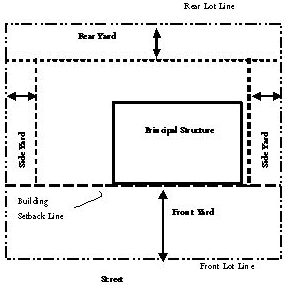
Diagram of Required Yards
Yard, front. A yard extending across the front of a lot between the side lot lines, the minimum depth of which is the required setback. On corner lots, the front yard shall be considered as parallel to the streets upon which the lot has frontage.
Yard, rear. A yard extending across the rear of the lot between the side lot lines on interior lots, the depth of which is the minimum parallel distance between the rear lot line and the rear of the main building.
Yard sale. See "garage and/or yard sales."
Yard, side. A yard between the main building and the side line of the lot and extending from the setback line to the rear yard on interior lots, the width of which being the minimum horizontal distance between the side lot line and the side of the main building.
-Z-
Zoning map amendment. An action to amend the town's official zoning map as provided in section 78-155.1 of the Town Code.
Zoning administrator determination. An interpretation of Chapter 78 by the zoning administrator as provided in section 78-150.6(e) of the Town Code.
Zoning verification letter. A letter by the zoning administrator and provided upon written request from a property owner or agent to verify the zoning status of a property.
(Ord. No. 17-O-13, 8-8-2017; Ord. No. 19-O-43, § 1, 12-10-2019; Ord. No. 20-O-01, § 1, 1-14-2020; Ord. No. 20-O-61, § 1, 11-17-2020; Ord. No. 21-O-18, 8-10-2021; Ord. No. 23-O-05, 2-28-2023; Ord. No. 25-O-01, § 1, 1-28-2025; Ord. No. 25-O-13, § 1, 8-12-2025; Ord. No. 26-O-12, § 1, 4-28-2026; Ord. No. 26-O-14, § 1, 5-26-2026; Ord. No. 26-O-15, § 1, 5-26-2026)

