
Herndon City Zoning Code
ARTICLE XIV
SIGNS
Sec. 78-140.- Signs.
The following sections pertain to signs and signage in all zoning districts.
(Ord. No. 17-O-13, 8-8-2017)
Sec. 78-140.1. - General provisions.
(a)
Purpose. Signs obstruct views, distract motorists, displace alternative uses for land, and pose other problems that legitimately call for regulation. The purpose of this article is to regulate the size, color, illumination, movement, materials, location, height and condition of all signs placed on private property for exterior observation, thus ensuring the protection of property values, the character of the various neighborhoods, the creation of a convenient, attractive and harmonious community, protection against destruction of or encroachment upon historic areas, and the safety and welfare of pedestrians and wheeled traffic, while providing convenience to citizens and encouraging economic development. This article allows adequate communication through signage while encouraging aesthetic quality in the design, location, size and purpose of all signs.
(b)
Intent. A sign placed on land or on a building for the purpose of identification, protection or directing persons to a use conducted therein shall be deemed to be an integral but accessory and subordinate part of the principal use of land or building. Therefore, the intent of this article is to establish limitations on signs in order to ensure they are appropriate to the land, building or use to which they are appurtenant and are adequate for their intended purpose while balancing the individual and community interests identified in subsection (a) of this section. These provisions are further intended to:
(1)
Promote compatibility. These regulations are intended to promote signs that are compatible with the use of the property to which they are appurtenant, landscape and architecture of surrounding buildings, are legible and appropriate to the activity to which they pertain, are not distracting to motorists, and are constructed and maintained in a structurally sound and attractive condition.
(2)
Distinguish between areas. These regulations are intended to distinguish between portions of the town designed for primarily vehicular access and portions of the town designed for primarily pedestrian access.
(3)
Meet purpose and scope of article. These regulations do not regulate every form and instance of visual speech that may be displayed anywhere within the jurisdictional limits of the town. Rather, they are intended to regulate those forms and instances that are most likely to meaningfully affect one or more of the purposes set forth above.
(4)
Provide balance. These regulations do not entirely eliminate all of the harms that may be created by the installation and display of signs. Rather, they strike an appropriate balance that preserves ample channels of communication by means of visual display while still reducing and mitigating the extent of the harms caused by signs.
(c)
Applicability. Signs not expressly permitted as being allowed by right or by specific requirements in another portion of this chapter are forbidden.
(d)
Interpretation and protection of free speech. This article shall be interpreted in a manner consistent with the First Amendment guarantee of free speech.
(e)
Substitution of noncommercial content. Wherever this article permits a sign with commercial content, noncommercial content is also permitted subject to the same requirements of size, color, illumination, movement, materials, location, height and construction.
(f)
Validity. If any provision of this article is found by a court of competent jurisdiction to be invalid, such finding shall not affect the validity of other provisions of this article which can be given effect without the invalid provision.
(g)
Effective date. This chapter shall be effective on and after the date of its adoption.
(Ord. No. 17-O-13, 8-8-2017)
Sec. 78-140.2. - Sign related definitions.
See Article XVIII for definitions pertaining to signs and signage in all zoning districts.
(Ord. No. 17-O-13, 8-8-2017)
Sec. 78-140.3. - Measurements of sign area and height.
The following measurement provisions pertain to signs and signage in all zoning districts.
(a)
Support structures. Supports, uprights or structure on which any sign is supported shall not be included in determining the sign area unless such supports, uprights or structure are designed in such a way as to form an integral background of the display; except, however, when a sign is placed on a fence, wall, planter, or other similar structure that is designed to serve a separate purpose other than to support the sign, the entire area of such structure shall not be computed. In such cases, the sign area shall be computed in accordance with the preceding provisions.
(b)
Multiple tenants. In instances where there are multiple tenants or users on a property or in a building, allowable sign area for all parties shall not exceed the maximum sign area computed as if there were a single tenant or user.
(c)
Sign area. Sign area is calculated under the following principles:
(1)
Sign face. The area of a sign face shall be the area within four straight lines forming a rectangle (a maximum of two abutting or overlapping rectangles may be used) enclosing the extreme limits of the sign including any material or color of the background of the sign that is used to differentiate the sign from the backdrop or structure.
(2)
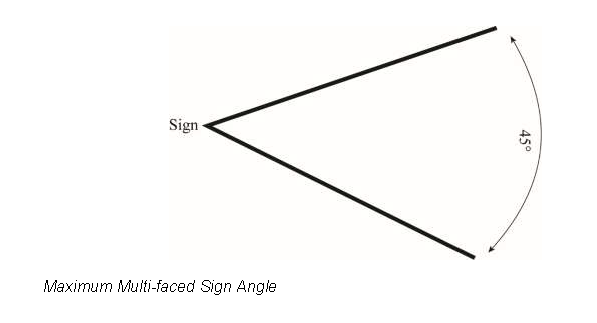
Double-faced signs. The area of a double-faced sign shall be the area of one side only provided that the faces are either parallel or have an internal angle between its two faces of no more than 45 degrees. If one side is larger than the other the larger of the two shall be used to calculate area.
(d)
Sign height. Freestanding sign height is measured from normal grade at the base of the sign to the top of the highest component of the sign. Wall sign height is measured from normal grade at the base of the building elevation on which the sign is located to the top of the highest component of the sign.
(e)
Building frontage (as relates to signage). For freestanding signs, sign area is calculated based on linear footage of the building elevation which faces the public right-of-way on which the sign is located. For wall signs, sign area is calculated based on the linear footage of the building elevation on which the sign is located.
(Ord. No. 17-O-13, 8-8-2017)
Sec. 78-140.4. - Prohibited signs.
(a)
General prohibitions. In addition to signs prohibited elsewhere in this Code or by applicable state or federal law, the following signs are prohibited:
(1)
Signs that violate any law of the Commonwealth relating to outdoor advertising.
(2)
Signs attached to natural vegetation.
(3)
Signs simulating, or which are likely to be confused with, a traffic control sign or any other sign displayed by a public authority. Any such sign is subject to immediate removal and disposal by an authorized city official as a nuisance.
(4)
Vehicle or trailer signs.
(5)
Signs hanging from supports, except against the face of a building.
(6)
Any sign displayed without complying with all applicable regulations of this chapter.
(7)
Signs painted directly on a building, except in the historic district overlay when approved by the HDRB or in the Herndon Transit-Oriented Core and Transit Related Growth districts provided all standards delineated in section 78-140.6 and section 78-141.8 are met.
(8)
Animated signs. This prohibition does not apply to flags expressly permitted under this article or the changing of the message content no more often than once every ten seconds.
(9)
Flashing signs or other signs displaying flashing, scrolling or intermittent lights or lights of changing degrees of intensity.
(10)
Signs consisting of illuminated tubing or strings of lights.
(11)
Signs that emit smoke, flame, scent, mist, aerosol, liquid, or gas.
(12)
Signs that emit sound.
(13)
Any electronic sign that is generated by a series of moving images, such as an LED, digital display, or other video technology, whether displayed on a building, vehicle, or mobile unit.
(14)
Strings of flags or pennants.
(15)
Pole signs.
(16)
Off-site signs.
(17)
Signs erected on public land other than those approved by an authorized town official in writing, required by law without such approval, or permitted under Virginia Code § 24.2-310E. Any sign not so authorized is subject to immediate removal and disposal by any authorized official. Removal of the sign under this provision does not preclude prosecution of the person responsible for the sign.
(18)
Signs on the roof surface or extending above the roofline of a building or its parapet wall.
(19)
Neon signs, except when no more than two square feet and installed in windows, and except as permitted in the CC, PD-D, PD-TD and PD-TOC zoning districts.
(20)
Neon window signs within the CC, PD-D, PD-TD, and PD-TOC zoning districts.
(21)
Any sign located in the vision triangle formed by any two intersecting streets, as regulated by the provisions of section 78-71.2(e).
(22)
Box signs, cabinet signs, and signs with exposed raceway transformers.
(23)
Signs on, worn, or held by humans or animals.
(Ord. No. 17-O-13, 8-8-2017; Ord. No. 20-O-61, § 1, 11-17-2020; Ord. No. 26-O-14, § 1, 5-26-2026)
Sec. 78-140.5. - Sign license required.
(a)
Applicability. A sign license is required prior to the display and erection of any sign except as provided in section 78-140.5(n) of this article.
(b)
License types and approving authorities. Sign licenses shall be approved by either the zoning administrator or the appropriate review board as follows:
(1)
Administrative approvals. Following approval by the HDRB or ARB, the zoning administrator or designee conducts final review of applications for all sign licenses other than those provided for in section 78-140.5(n). The following administratively approvable signs, not requiring review by the HDRB or ARB, are subject to review by the zoning administrator or designee, temporary sign licenses, master sign plan conformance licenses (after approval of a master sign plan license) and any sign which complies with uniform standards adopted by the HDRB and ARB for administratively approved signs. Signs for all arts businesses, as defined in section 7-2 of the Herndon Town Code and licensed to operate as a business in the Herndon Arts District may receive administrative approval of the sign license if the signs comply with the HDRB and ARB approved uniform design standards.
(2)
Review Board Approvals. The architectural review board or historic district review board also conducts final review of sign licenses that do not conform to the adopted uniform standards, as determined by the zoning administrator, within their respective overlay districts.
(c)
Sign license application review and approval process.
(1)
Filing. An application for a sign license shall be filed with the town community development department on forms furnished by that department. The applicant shall provide sufficient information, as determined by the zoning administrator or designee, to evaluate whether the proposed sign is permitted under the zoning ordinance and other applicable laws, regulations, and ordinances.
(2)
Application acceptance and review. The town zoning Administrator or designee shall process a completed sign license application and approve the application, reject the application, notify the applicant of deficiencies in the application, or schedule the application on a review board agenda within ten business days after receipt. Any application that complies with all provisions of this zoning ordinance and other applicable laws, regulations, and ordinances, in addition to applicable design guidelines, as interpreted by the zoning administrator, shall be approved.
(3)
Review process for applications subject to review board approval. The zoning administrator or designee shall prepare a staff report for applications requiring review board approval, and transmit the report to the applicable review board. At hearings for the application, the review board shall consider the application, staff report, relevant support materials, and any other relevant testimony and evidence. At the hearing, the review board shall approve, reject, or defer the application. Deferrals may occur when there are stated deficiencies in the application. Any application that complies with all provisions of this zoning ordinance and other applicable laws, regulations, and ordinances, in addition to applicable design guidelines, as interpreted by the review board, shall be approved.
(4)
Application rejection. If the application is rejected, the town shall provide a list of the reasons for the rejection in writing. An application shall be rejected for non-compliance with the terms of the zoning ordinance, building code, or other applicable law, regulation, or ordinance.
(d)
Architectural Control District Regulations. Permanent signs within the Herndon Architectural Control District shall comply with Town Code chapter 58, planning, in addition to the zoning ordinance, building code, or other applicable law, regulation, or ordinance.
(e)
Reserved.
(f)
Historic district overlay. Permanent signs installed within the historic district overlay shall comply with the relevant design guidelines, as interpreted by the HDRB, and the uniform standards for administrative approval of signs as approved by the HDRB and interpreted by the zoning administrator, or adopted superseding documents.
(g)
Reserved.
(h)
Master sign plans. Any nonresidential development or district in which two or more individual establishments are located may request the approval of a master sign plan, for signs within the development. A master sign plan establishes a comprehensive and coordinated sign program with a specific set of sign standards for the development.
(1)
Master sign plan compliance license. Individual signs that meet all the standards set forth in an approved master sign plan shall be approved administratively with a master sign plan conformance license.
(2)
Noncompliant signs. The Town shall forward applications for signage that do not meet all the standards of a master sign plan to the applicable review board. In order to be approved, proposed signage shall meet the following criteria:
a.
Will result in design quality equal to or greater than that established in the master sign plan through the proposed combination of colors, materials, aesthetic balance and composition, height and width, area, placement, and typeface, or use of any symbols, designs, and logos; and
b.
Will not detract from or be detrimental to the appearance of the development and its signs approved under the master sign plan.
(i)
License fee. A nonrefundable fee as set forth in the fee schedule in section 78-152.2(b) shall accompany all sign license applications.
(j)
Revocation of license. The town may revoke a sign license under any of the following circumstances:
(1)
False or misleading. The town determines that information in the application was materially false or misleading;
(2)
Non-conformity with application approval. The sign as installed does not conform to the sign license application as approved; or
(3)
Violation. The sign violates the zoning ordinance, building code, or other applicable law, regulation, or ordinance.
(k)
License duration and extension. If a sign is not installed within six months following the issuance of a sign license or within 30 days in the case of a temporary sign license, the license shall be void. Upon written request to the zoning administrator prior to license expiration and upon demonstrated good cause, the approved sign license may be extended for an additional six months.
(l)
Appeals. Decisions on sign applications heard by a review board are appealed to the Herndon Town Council in accordance with Article XV. Decisions on all other sign applications are appealed to the board of zoning appeals.
(m)
Inspection. Any sign for which a sign license has been granted shall be subject to inspection by the zoning administrator. If the sign fails to pass inspection, the applicant shall correct the items not in compliance or apply for a new sign license within 30 days of notification of the violation or the sign license shall be deemed invalid and void and the sign shall be removed.
(n)
No sign license required for the following types of signs. A sign license is not required for:
(1)
Required or governmental signs. Signs erected by a governmental body or required by law.
(2)
Flags. Up to three flags no more than 16 square feet in size each and not containing any commercial advertising provided that the flags comply with section 78-140.6(e).
(3)
Changeable copy on licensed sign. The changing of messages on changeable copy signs, when the change does not impact the sign colors, sizes, or general design of the sign face; and, the repair of an existing licensed sign. Repair of a nonconforming sign must comply with section 78-140.7.
(4)
Official court notices. Official notices or advertisements posted or displayed by or under the direction of any public or court officer in the performance of his official or directed duties; provided that all such signs shall be removed no more than ten days after their purpose has been accomplished.
(5)
Certain signs on single-family residential properties. On single-family, residential properties signs conforming to the following provisions may be permitted without a sign license:
a.
One or more temporary signs noncommercial with a total area of no more than 12 square feet, and which are removed within 90 days after being erected, except signs associated with home-based businesses.
b.
One or more temporary noncommercial window signs, provided that the total extent of window signs do not obstruct more than 25 percent of any one window, and which are removed within 90 days after being erected, except signs associated with home-based businesses.
c.
One noncommercial wall sign or sign posted on a mailbox, no more than one square foot in size.
(6)
Certain signs on nonresidential properties. On nonresidential properties signs conforming to the following provisions may be permitted without a sign license:
a.
Up to two minor signs per parcel.
b.
Permanent, non-internally illuminated, window signage, provided that the aggregate area of all window signs on each window does not exceed 25 percent of the total area of the window.
c.
Temporary, non-internally illuminated, window signage, provided that the aggregate area of all window signs on each window does not exceed 25 percent of the total area of the window, which are removed within 90 days after being erected.
d.
One window-mounted neon sign, no more than two square feet, per ground floor business, except in the CC, PD-D, PD-TD, and PD-TOC zoning districts.
(Ord. No. 17-O-13, 8-8-2017; Ord. No. 18-O-20, § 1, 7-10-2018; Ord. No. 20-O-61, § 1, 11-17-2020)
Sec. 78-140.6. - General standards for all signs.
The following standards apply to all signs unless otherwise stated in the specific use or district sections of this article.
(a)
Compliance with building code. All signs shall be constructed and mounted in compliance with the Virginia Uniform Statewide Building Code.
(b)
Freestanding signs. In addition to the size and height limitations included in this article, freestanding signs shall meet the following standards:
(1)
Placement. Except as otherwise permitted, all freestanding signs shall be set back five feet from any street right-of-way.
(2)
Visibility. Freestanding signs shall not pose a visibility clearance danger as determined by the zoning administrator in accordance with section 78-21(e).
(3)
Supporting structure. Freestanding sign structures may extend two feet beyond the maximum sign height. Freestanding signs shall not be mounted on a single pole or post and any voids in the sign structure base between the ground and the bottom edge of the sign shall not exceed three feet in height.
(4)
Landscaping. All non-temporary freestanding signs shall be installed with a minimum surround of four feet of regularly maintained floral and shrubbery landscaping in every direction.
(c)
Wall signs. Wall signs shall be located on building elevations per the following criteria:
(1)
Facing public or private street. Wall signs may be installed on any building elevation that faces an adjacent public or private street.
(2)
Side elevation. Wall signs may be installed on the front half of any side elevation that is visible from the adjacent public or private street.
(3)
Public entrances. Wall signs may be installed on a building elevation that contains a public entrance.
(4)
Limitations on internally illuminated wall sign. Internally illuminated wall signs shall not be placed on any building elevation that faces adjacent properties zoned residential.
(d)
Sign illumination. Lighting shall be the minimum necessary to be visible at night time and shall not create a distraction or other hazard, such as pinpoint glare, to vehicular traffic and shall conform to the following standards:
(1)
Indirect lighting. In the case of indirect lighting, the source shall be so shielded that it illuminates only the face of the sign. Indirect lighting shall consist of full cut-off or directionally shielded lighting fixtures that are aimed and controlled so that the directed light shall be substantially confined to the sign to minimize glare, sky glow, and light trespass. The beam width shall not be wider than that needed to light the sign. The light source shall have a neutral hue and be consistent for all fixtures illuminating a single sign.
(2)
Internal and halo illumination. Internal illumination and halo illumination shall not be permitted to have an illumination spread of more than .05-foot candle at the lot line, shine into on-coming traffic, affect highway safety, or shine directly into a residential dwelling unit. The background of internally illuminated signs shall be designed so that the illumination only penetrates the letters, logos, symbols, or other message copy.
(3)
All electronic display signage is limited to a maximum of 100 nits between dusk and dawn.
(e)
Flags. Up to three flags at a maximum size of 16 square feet each are permitted without a license per section 78-140.5(n)(2). Additional flags are prohibited. Flag pole height cannot exceed 25 feet and the distance from any property line must be at least half the height of the pole. Flags shall not be illuminated unless otherwise required by law.
(f)
Maintained in good repair. All signs and components thereof shall be maintained in good repair and in a safe, neat, clean, and legible condition. Any sign that has deteriorated in general appearance and, in the opinion of the zoning administrator, needs to be repainted, refinished or reworked, in order to restore the original appearance, violates this section.
(g)
Safety hazard. Any sign which becomes a safety hazard or which is not kept in good general condition and reasonably good state of repair and is not, after written notice to the owner of the premises or the permittee, put in a safe and good state of repair may be removed, repaired or otherwise abated by the building official in accordance with Chapter 10 of this Code. Any sign which, in the opinion of the building official, constitutes an immediate or imminent danger to life or property may be caused to be removed or put in a safe condition by him immediately.
(h)
Removal. Any sign, located on commercial property where the use or business has ceased operating shall, within 30 days of the cessation of use or business operation, be removed and the area on which the sign was installed shall be repaired to its original condition by the business or property owner.
(Ord. No. 17-O-13, 8-8-2017; Ord. No. 26-O-14, § 1, 5-26-2026)
Sec. 78-140.7. - Nonconforming signs.
(a)
Nonconforming sign status. Signs lawfully existing on the effective date of this chapter or prior ordinances, which do not conform to the provisions of this chapter, and signs which are accessory to a nonconforming use shall be deemed to be nonconforming signs and may remain except as qualified below. The burden of establishing nonconforming status of signs and of the physical characteristics/location of such signs shall be that of the owner of the property. Upon notice from the zoning administrator, a property owner shall submit verification that sign(s) were lawfully existing at time of erection. Failure to provide such verification shall be cause for order to remove sign(s) or bring sign(s) into compliance with the current ordinance.
(b)
Limitation on expansion and degree of nonconformity. No nonconforming sign shall be enlarged nor shall any feature of a nonconforming sign, such as illumination, be increased or added.
(c)
Limitation on alterations other than repairs. Nonconforming signs shall not be extended or structurally reconstructed or altered in any manner, except a sign face may be changed so long as the new face is equal to or reduced in height and/or sign area. Nothing in this section shall be deemed to prevent keeping in good repair a nonconforming sign.
(d)
Location. No nonconforming sign shall be moved for any distance on the same lot or to any other lot unless such change in location will make the sign conform in all respects to the provisions of this article.
(e)
Restoration after damage. A nonconforming sign that is destroyed or damaged by any casualty to an extent not exceeding 50 percent of its area may be restored within two years after such destruction or damage but shall not be enlarged in any manner. If such sign is so destroyed or damaged to an extent exceeding 50 percent, it shall not be reconstructed but may be replaced with a sign that is in full accordance with the provisions of this article.
(f)
Change in status. A nonconforming sign which is changed to becoming conforming or is replaced by a conforming sign shall no longer be deemed nonconforming, and thereafter such sign shall be in accordance with the provisions of this article.
(g)
Removal. A nonconforming sign structure shall be subject to the removal provisions of section 78-160.3. In addition, a nonconforming sign structure shall be removed if the use to which it is accessory has not been in operation for a period of two years or more. Such structure sign shall be removed by the owner or lessee of the property. If the owner or lessee fails to remove the sign structure, the zoning administrator or designee shall give the owner 15 days' written notice to remove it. Upon failure to comply with this notice, the zoning administrator or designee may enter the property upon which the sign is located and remove any such sign or may initiate such action as may be necessary to gain compliance with this provision. The cost of such removal shall be chargeable to the owner of the property.
(Ord. No. 17-O-13, 8-8-2017)
Sec. 78-141. - Specific sign regulations by use and district.
Signs shall be reviewed for compliance with the following specific district standards as applicable.
(Ord. No. 17-O-13, 8-8-2017)
Sec. 78-141.1. - Sign standards for single-family residential districts.
Except as otherwise prohibited in this article, the following signs are permitted as accessory to properties zoned and used for single-family detached or attached dwelling units; the following standards apply.
(Ord. No. 17-O-13, 8-8-2017)
Sec. 78-141.2. - Sign standards for multi-family residential districts.
Except as otherwise prohibited in this article, the following signs are permitted as accessory to properties zoned and used for multi-family residential; the following standards apply.
(Ord. No. 17-O-13, 8-8-2017; Ord. No. 25-O-13, § 1, 8-12-2025)
Sec. 78-141.3. - Sign standards for nonresidential uses in residential districts.
Except as otherwise prohibited in this article, the following signs are permitted as accessory to any properties zoned and used for nonresidential uses in residential districts; the following standards apply.
(Ord. No. 17-O-13, 8-8-2017)
Sec. 78-141.4. - Sign standards for commercial districts.
(a)
Freestanding, wall and temporary signs. Except as otherwise prohibited in this article, the following signs are permitted as accessory to any properties within the commercial service (CS), commercial office (CO), planned development-business (PD-B), and office and light industrial (O&LI) zoning districts. The following standards apply.
(b)
Projecting, parapet, internal, light pole banner signs, and drive-through related signs. Additional sign types are permitted in the commercial service (CS), commercial office (CO), planned development-business (PD-B), and office and light industrial (O&LI), zoning districts. Additional sign types do not increase the total aggregate sign area permitted per building frontage. The following standards apply.
(Ord. No. 17-O-13, 8-8-2017; Ord. No. 18-O-26, § 1, 9-11-2018; Ord. No. 18-O-27, § 1, 10-9-2018; Ord. No. 23-O-05, 2-28-2023)
Sec. 78-141.5. - Sign standards for properties in the Worldgate District (PD-W).
(a)
Freestanding signs. Except as otherwise prohibited in this article, the following freestanding signs are permitted as accessory to any multi-tenant, mixed use properties within the planned development-Worldgate (PD-W), zoning district. The following standards apply.
(b)
Wall signs. Except as otherwise prohibited in this article, the following signs are permitted as accessory to any multi-tenant, mixed use properties within the planned development-Worldgate (PD-W), zoning district. The following standards apply.
(c)
Freestanding, wall and temporary signs. Except as otherwise prohibited in this article, the following signs are permitted as accessory to any properties within the planned development-Worldgate (PD-W) district that are not multi-tenant mixed use properties. The following standards apply.
(d)
Projecting, parapet, internal and light pole banner signs. Additional sign types are permitted in the Planned Development - Worldgate (PD-W) district that are not accessory to multi-tenant mixed use properties. The following standards apply. Additional sign types do not increase the total aggregate sign area permitted per building frontage.
(e)
Signs in the PD-W district as of January 5, 2005. Signs existing on January 2, 2005 and developed in accord with the provisions of Article 12 and Article 11 of the Fairfax County Zoning Ordinance shall be deemed legal and conforming with respect to this chapter.
(Ord. No. 17-O-13, 8-8-2017; Ord. No. 18-O-26, § 1, 9-11-2018)
Editor's note— Ord. No. 18-O-26, § 1, adopted Sept. 11, 2018, amended § 78-141.5 and in so doing changed the title of said section from "Sign standards for multi-tenant mixed use properties in the Worldgate district (PD-W)" to "Sign standards for properties in the Worldgate District (PD-W)," as set out herein.
Sec. 78-141.6. - Sign standards for downtown mixed-use districts.
(a)
Freestanding, wall and temporary signs. Except as otherwise prohibited in this article, the following signs are permitted as accessory to any properties within the central commercial (CC), planned development-downtown (PD-D), and planned development-traditional downtown (PD-TD) zoning districts, the following standards apply:
(b)
Projecting, canopy/awning and a-frame signs. Additional sign types are permitted in the central commercial (CC), Planned Development-Downtown (PD-D), planned development-traditional downtown (PD-TD) zoning districts, for which the following standards apply.
(c)
Compliance with design guidelines. Signs installed within the central commercial (CC), planned development-downtown (PD-D), planned development-traditional downtown (PD-TD) zoning districts shall comply with the relevant design guidelines of the Historic District Overlay Guidelines and Downtown Herndon Pattern Book, or adopted superseding documents.
(Ord. No. 17-O-13, 8-8-2017; Ord. No. 20-O-61, § 1, 11-17-2020; Ord. No. 23-O-08, 3-14-2023)
Sec. 78-141.7. - Reserved.
Editor's note— Ord. No. 25-O-13, § 1, adopted Aug. 12, 2025, repealed § 78-141.7, which pertained to urban residential district sign standards and derived from Ord. No. 19-O-20, adopted July 9, 2019.
Sec. 78-141.8. - Sign standards for planned development—Herndon Transit-Oriented Core and Transit related growth districts.
The general standards of section 78-140.6 will apply, unless exempted. Each establishment and/or vehicular entrance, pedestrian entrance, or service bay may only use one of the following sign types: sign band, awning sign, or canopy sign. Parapet signs and tower signs are mutually exclusive.
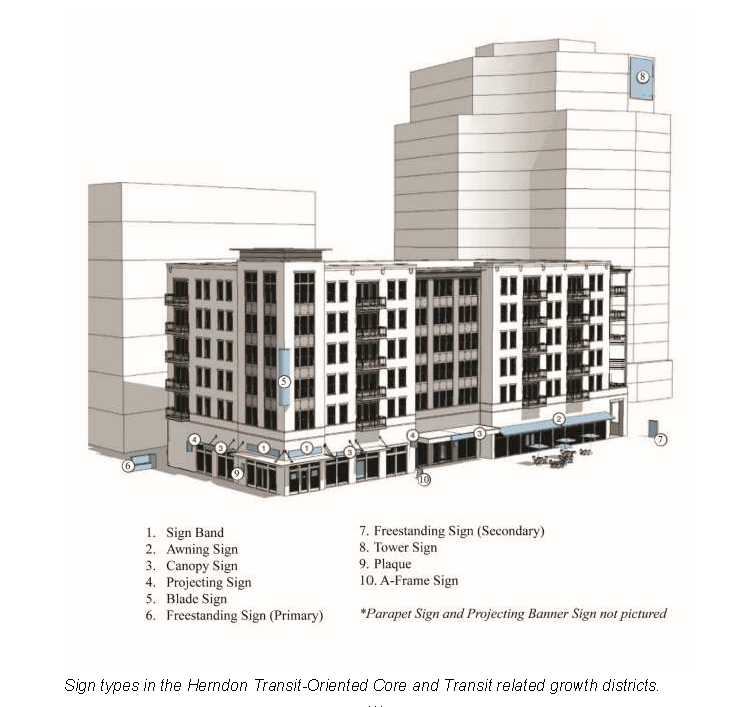
(Ord. No. 25-O-01, § 1, 1-28-2025; Ord. No. 26-O-14, § 1, 5-26-2026)
Sec. 78-142. - Temporary signs.
(a)
Temporary signs permitted. Temporary signs are permitted in all zoning districts.
(b)
Temporary sign licenses. Unless exempt as specified in section 78-140.5(n), temporary signs require a temporary sign license. Temporary signs shall comply with specific zoning district standards of this article in addition to the following. There are two different types of temporary signs permitted with a license:
(1)
Short term temporary signs. Short-term temporary signs may be constructed of any material that is durable enough to safely, securely, and effectively allow for the sign to meet its purpose for the length of the license.
(2)
Long term temporary signs. Long-term temporary signs are only permitted on properties zoned and used as commercial where there is an active building permit, property for sale, or property available for lease and must be constructed in compliance with the following detail and standards or in a similar manner as determined by the zoning administrator.
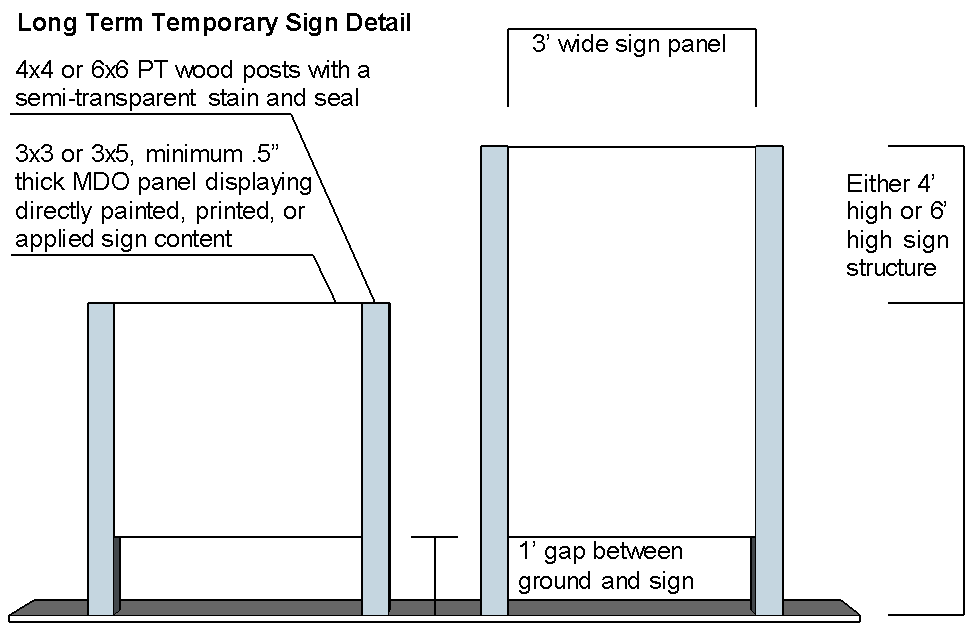
(c)
Duration. Short term temporary signs may be installed up to 60 days from when the license was issued. The sign expiration date shall be indicated on the license. Upon written request to the zoning administrator prior to license expiration and upon demonstrated good cause, the license may be extended for an additional 60 days. Long term temporary signs may be installed up to six months. Upon written request to the zoning administrator prior to license expiration and upon demonstrated good cause, the license may be renewed another six months up to two times.
(d)
Licensing limit. No more than two short term temporary sign licenses may be issued per calendar year, per property or unified commercial subdivision. No more than one long term temporary sign license may be issued per calendar year, per property or unified commercial subdivision. Upon temporary sign license expiration, another temporary sign license shall not be issued for a minimum of 60 days, for the same property or unified commercial subdivision.
(e)
Signs associated with a temporary use permit. Additional temporary signs beyond what is permitted in this article may be permitted as part of a temporary use permit per section 78-90.3(i). Limits on temporary signs types, sizes, locations, numbers, and duration exceed the requirements of this article. These allowances function to ensure sign flexibility for special non-recurring, temporary occurrences.
(f)
Installation. Temporary signs shall be securely fastened or anchored to the surface on which they are attached, in a manner by which regular weather conditions will not compromise the means of installation for the length of time that the sign is installed.
(Ord. No. 17-O-13, 8-8-2017)

