
High Point City Zoning Code
CHAPTER 4
- USES
4.3.- Use Standards
Use standards are additional requirements applied to certain individual use types identified in Table 4.1.9, Principal Use Table by a section reference in the Additional Standards column. Use standards are fully applicable to new principal uses within those individual use types. Use standards are also applicable, to the maximum extent practicable, to existing principal uses within those individual use types.
(Ord. No. 7415/18-44, § 5.A, 5-21-2018; Ord. No. 7476/18-105, § 16, 12-3-2018)
4.1.1.- Use Table Structure
A.
General Table 4.1.9, Principal Use Table, lists principal use types and indicates for each zoning district whether the principal use type is permitted by right, permitted by right only inside the Core City Area, permitted as a special use, or permitted only with an overlay district. Also, the principal use table references district use prohibitions and additional standards that are applicable to a specific use type.
B.
Conditional Zoning Districts The range of permitted uses in a conditional zoning district shall be the same as the range of permitted uses within the corresponding general zoning district unless the conditions associated with the approved conditional zoning district further limit them. In no instance shall the range of permitted uses in a conditional zoning district exceed the range of permitted uses in the corresponding general zoning district.
4.1.2. - Uses Permitted By-Right
A "P" in a cell of the principal use table indicates that the specific use type is permitted by right in the corresponding zoning district, subject to compliance with the additional standards referenced in the principal use table. A "P*" in a cell of the principal use table indicates that the specific use type is permitted by right in the corresponding zoning district only when located inside the Core City Area and subject to compliance with the additional standards referenced in the principal use table.
4.1.3. - Uses Requiring Special Use Review
An "S" in a cell of the principal use table indicates that the specific use type is permitted in the corresponding zoning district only upon approval of a special use in accordance with Section 2.4.12, Special Use, and any additional standards referenced in the principal use table.
4.1.4. - Uses Requiring Overlay District
An "O" in a cell of the principal use table indicates the specific use type is permitted in the corresponding zoning district only upon approval of an overlay district and any additional standards referenced in the principal use table.
4.1.5. - Prohibited Uses
A.
A blank cell in the principal use table indicates that the specific use type is prohibited in the corresponding zoning district.
B.
The following principal uses are prohibited throughout the City's zoning jurisdiction in all zoning districts:
1.
Explosives manufacturing;
2.
Leather and leather products manufacturing involving tanning;
3.
Slaughter or rendering of animals;
4.
Outdoor flea markets;
5.
Manufactured dwellings (except in a Manufactured Housing Overlay District); and
6.
Outdoor shooting ranges (except as a public safety facility).
C.
Section 6.2.13, Standards Applicable in the GWA, identifies uses prohibited within general watershed areas of the WSO.
D.
Section 6.2.14, Standards Applicable in the WCA, identifies uses prohibited within watershed critical area (WCA)s of the WSO.
(Ord. No. 7476/18-105, § 13, 12-3-2018; Ord. No. 7750/21-67, § 5.A, 11-1-2021)
4.1.6. - District Use Prohibition
Regardless of whether the principal use table lists a specific use type as a permitted use, the specific use type may be prohibited in accordance with the overlay district or sub-district provisions in Chapter 3: Zoning Districts. The principal use table references prohibitions for a specific use type in the column titled "District Use Prohibitions."
4.1.7. - Additional Standards
A.
When a specific use type is permitted in a zoning district, there may be additional standards that are applicable. Such additional standards are referenced in the principal use table column titled "Additional Standards." These standards shall apply to a specific use type regardless of the zoning district, unless otherwise specified.
B.
In addition, use types are also subject to the district standards listed in the applicable zoning district in Chapter 3: Zoning Districts.
4.1.8. - Unlisted Uses
For land uses not listed in Table 4.1.9, Principal Use Table, not listed as a part of a use category or use type, and not listed as a prohibited use in Section 4.1.5, Prohibited Uses, the Planning and Development Director shall determine which use category or use type to which the land use belongs in accordance with Section 2.5.4, Determination.
4.1.9. - Principal Use Table
(Ord. No. 7266/17-08, § 13, 1-17-2017; Ord. No. 7287/17-29, §§ 4, 5, 4-3-2017; Ord. No. 7363/17-106, § 5, 11-20-2017; Ord. No. 7365/17-108, § 5, 11-20-2017; Ord. No. 7415/18-44, §§ 4.A, 4.B, 5-21-2018; Ord. No. 7476/18-105, §§ 14.A, 12-3-2018; 7489/19-06, § 1, 2-4-2019; Ord. No. 7554/19-71, § 1, 10-7-2019; Ord. No. 7680/20-96, § 6, 12-9-2020; Ord. No. 7750/21-67, §§ 4.A, 5.B, 11-1-2021; Ord. No. 7813/22-34, § 1, 4-18-2022)
4.2.1.- Purpose
This section is intended to provide a systematic framework for identifying, describing, categorizing, consolidating, and distinguishing land uses to determine how a specific land use activity, or combination of activities, is to be considered when applying the principal use table and other provisions in this Ordinance.
4.2.2. - Organization of Uses
Section 4.2, Use Classifications, Use Categories, and Use Types, organizes principal uses by use classifications, use categories, and use types to provide a systematic basis for identifying, describing, categorizing, consolidating, and distinguishing land uses to determine whether a specific use is permitted in a particular zoning district.
A.
Use Classifications The use classifications identify broad classifications of land use and include agricultural uses, residential uses, institutional uses, commercial uses, and industrial uses. Use classifications are further broken down into a series of general "use categories" and specific "use types."
B.
Use Categories The use categories describe the major sub-groups of the respective use classifications and are based on common functional, product, or physical characteristics, such as the type and amount of activity, the type of customers or residents, how goods or services are sold or delivered, and site conditions. For example, the Residential Use Classification is divided into the Common Elements Recreation, Household Living, Group Living, and Life Care use categories. Use categories are further broken down into a series of individual "use types".
C.
Use Types The specific use types are included in the respective use category. They identify the specific principal uses that are considered to fall within characteristics identified in the use category. For example, family care homes, live/work dwellings, manufactured dwellings, multi-family dwellings, single-family attached dwellings, single-family detached dwellings, and duplex dwellings are use types in the Household Living Use Category.
D.
Developments with Multiple Principal Uses When all principal uses of a development fall within one use category, the entire development is assigned to that use category. A development that contains a coffee shop, bookstore, and bakery, for example, would be classified in the Retail Sales Use Category because all of the development's principal uses are in that use category. When the principal uses of a development fall within different use categories, then each principal use is classified in the applicable use category and each use is subject to applicable regulations for that use category. Developments with multiple principal uses, such as shopping centers, shall incorporate only those use types allowed in the applicable zoning district.
E.
Table Organization The characteristics, use types, and exceptions of each of the use categories in Table 4.1.9, Principal Use Table, are listed in the following tables. Table 4.2.2.E, Use Classification, below shows how the information is organized.
4.2.3. - Agricultural Use Classification
Table 4.2.3, Agricultural Use Classification , sets out the use categories and use types included in the agricultural use classification in Table 4.1.9, Principal Use Table. Table 4.2.3 describes the characteristics of the agriculture use category and defines the use types included within the use category.
4.2.4. - Residential Use Classification
Table 4.2.4, Residential Use Classification, sets out the use categories and use types included in the residential use classification in Table 4.1.9, Principal Use Table. Table 4.2.4 describes the characteristics of the common elements recreation, household living, group living, and life care use categories and defines the use types included within each use category.
(Ord. No. 7926/23-41, § 5, 5-15-2023)
4.2.5. - Institutional Use Classification
Table 4.2.5, Institutional Use Classification, sets out the use categories and use types included in the institutional use classification in Table 4.1.9, Principal Use Table. Table 4.2.5 describes the characteristics of the civic, day care, education, health care, religious institutions, transportation, and utilities use categories and defines the use types included within each use category.
(Ord. No. 7476/18-105, § 15, 12-3-2018; Ord. No. 7680/20-96, § 7, 12-9-2020)
4.2.6. - Commercial Use Classification
Table 4.2.6, Commercial Use Classification, sets out the Use Categories and use types included in the commercial use classification in 4.1.9, Principal Use Table. Table 4.2.6 describes the characteristics of the adult entertainment, animal care, eating establishments, offices, commercial parking, recreation and leisure, retail sales and services, vehicle establishments, and visitor accommodations use categories; and defines the use types included within each use category.
(Ord. No. 7476/18-105, § 14.B, 12-3-2018; Ord. No. 7554/19-71, § 2, 10-7-2019; Ord. No. 7622/20-38, §§ 15.A, 15.B, 8-5-2020; Ord. No. 7750/21-67, § 5.C, 11-1-2021)
4.2.7. - Industrial Use Classification
Table 4.2.7, Industrial Use Classification, sets out the use categories and use types included in the industrial use classification in 4.1.9, Principal Use Table. Table 4.2.7 describes the characteristics of the extractive industry, industrial services, manufacturing and production, warehousing and freight movement, waste-related service, and wholesale trade, and defines the use types included within each use category.
(Ord. No. 7750/21-67, §§ 4.B, 6, 11-1-2021)
4.3.1.- Agriculture Uses
A.
Agriculture
1.
Agricultural Production (crops) Sale of produce grown on-site or on an adjacent lot that is part of the same agricultural operation is permitted provided they take place outside the right-of-way.
4.3.2. - Residential Uses
A.
Common Elements Recreation
1.
Common Elements Recreation Outdoor courts, swimming pools, and athletic fields shall be located at least 50 feet from any lot line abutting a residential district.
B.
Household Living
1.
Duplex Dwelling Duplex dwellings shall comply with the following standards:
(a)
It shall face the street from which the dwelling derives its street address; and
(b)
It shall be limited to a maximum of 1 driveway on a block face in the R-5 and R-7 districts. Circular driveways are excluded from this requirement.
2.
Family Care Home A family care home shall not be located within one-half mile (2,640 feet) of an existing family care home.
3.
Live/Work Dwelling A live/work dwelling shall comply with the following standards:
(a)
The residential portion of the building shall occupy at least 50 percent of the gross floor area.
(b)
The nonresidential portion of the building is limited to an office, personal service, retail sales, or restaurant, minor use type.
(c)
Drive-through facilities are prohibited.
(d)
Signs for the nonresidential portion of the building are allowed in accordance with the nonresidential uses in residential districts standards in Table 5.7.9.D, Attached Signs - Maximum Permitted Sign Area by Sign Type Freestanding signs are prohibited.
4.
Manufactured Dwelling A manufactured dwelling shall comply with the following standards:
(a)
It shall be located on a parcel of land in an MHO district;
(b)
It shall be occupied only as a single family dwelling;
(c)
It shall be served by public water and sewer;
(d)
It shall be set up in accordance with the standards established by the North Carolina Department of Insurance and the most current version of the State of North Carolina Regulations for Manufactured/Mobile Homes;
(e)
It shall maintain a minimum width of 16 feet;
(f)
It shall be oriented with the longest axis parallel to the lot frontage, to the maximum extent practicable;
(g)
Towing apparatus, wheels, axles, and transporting lights shall be removed;
(h)
It shall include a continuous, permanent masonry foundation or masonry curtain wall of solid brick or brick veneer, unpierced except for required ventilation and access, installed under the perimeter;
(i)
It shall include stairs, porches, entrance platforms, ramps, and other means of entrance and exit that are installed or constructed in accordance with the standards set by the North Carolina Building Code. They shall be attached firmly to the primary structure and anchored securely to the ground;
(j)
It shall maintain exterior siding comparable in composition, appearance, and durability to the exterior siding commonly used in standard residential construction, which consists of one or more of the following:
(1)
Vinyl or aluminum lap siding (whose reflectivity does not exceed that of flat white paint);
(2)
Cedar or other wood siding;
(3)
Stucco siding;
(4)
Brick or stone siding.
(k)
It shall maintain a roof pitch with a minimum vertical rise of 3 feet for each 12 feet of horizontal run;
(l)
It shall include a roof finished with a Class C or better roofing material that is commonly used in standard residential construction; and
(m)
It shall provide an eave projection of no less than 6 inches, which may include a gutter.
5.
Multi-Family Dwelling Multi-family development shall comply with the following standards:
(a)
Building Placement
(1)
A minimum 10 feet of separation shall be maintained between all buildings in the development.
(2)
Buildings must be set back from private drives and parking lots a minimum of 10 feet as measured from back of curb or edge of pavement, if no curb is provided.
(b)
Building Length
(1)
The maximum length of a multi-family building shall be 200 linear feet in the RM-5 and TO districts, 250 linear feet in the RM-16, OI, LB, EC and I districts, and 300 linear feet in the RM-26, GB, RC and MS districts.
(2)
No maximum building length shall be applied in the CB, LI and MX districts or in any district if the building is designed for occupancy by the elderly and it has central facilities for dining and recreation contained within the building.
(3)
In no instance shall the provision of a firewall between different building sections constitute 2 separate buildings for the purpose of meeting the building length requirement.
(c)
Open Space The development shall comply with the open space standards of Section 5.12, Open Space.
(d)
Recreation Facilities Active recreation facilities must be placed a minimum of 50 feet from adjacent land used for single-family residential purposes.
(e)
Pedestrian Connections Pedestrian connections shall be:
(1)
Provided between building entrances, parking lots, public sidewalks, and recreational facilities;
(2)
At least 4 feet in width and constructed of a dustless all-weather surface; and
(3)
Configured to connect to parks and greenways that abut the development, to the maximum extent practicable.
(f)
Utilities Underground All electric, communications, water, and sewer utility lines shall be installed underground.
(g)
Adaptive Reuse in the Core City In order to reuse the existing buildings in the Core City in accordance with the City's adopted policy guidance, multi-family uses are permitted in the LI district, subject to the following standards:
(1)
The LI district must be located in the Core City area;
(2)
The new use must reuse an existing building or buildings;
(3)
The total square footage of all building additions for multi-family; personal service, major; major and minor retail sales; major and minor assembly; and major and minor cultural facility uses shall be limited to a maximum of 25 percent of the total gross floor area of all principal buildings existing on the site as of the effective date of this Ordinance.
(4)
The site is only required to meet the standards of 4.3.2.B.5.e and f.
(h)
Permitted Ground Floor Uses Along Main Street
(1)
A minimum of 50 percent of the ground floor building frontage along Main Street shall be dedicated to institutional or commercial use types, or an active amenity which is commonly found within a multi-family dwelling, such as offices, recreation rooms, or common areas. The remainder of the frontage may be occupied by any use type permitted within the applicable zoning district.
(2)
This standard shall only apply to multi-family dwellings with frontage on Main Street within the MS-A, MS-B, MS-C, MX-D and CB Districts.
6.
Single-Family Attached Dwelling Single-family attached development shall comply with the following standards:
(a)
Building Placement
(1)
A minimum ten feet of separation must be maintained between all buildings in the development.
(2)
Buildings must be set back from private drives and parking lots a minimum of ten feet as measured from back of curb or edge of pavement, if no curb is provided.
(b)
Maximum Number of Units per Building
(1)
In the R-5 and R-7 districts the maximum number of attached dwellings shall be 2 per building (twin home).
(2)
In the RM-5 and TO districts, the maximum number of attached dwelling units shall be 6 per building.
(3)
In the RM-16, OI, LB, EC, and I districts, the maximum number of attached dwelling units shall be 8 per building.
(4)
In the RM-26, GB, and RC districts, the maximum number of attached dwelling units shall be 10 per building.
(c)
Internal Street Setback On a street constructed within a single-family attached development, the street setback may be reduced to a minimum of 15 feet in accordance with the following standards:
(1)
For attached units abutting a street or private drive with a sidewalk, the individual driveways for the units must be a minimum length of 20 feet as measured from the sidewalk.
(2)
For attached units abutting a street or private drive without a sidewalk, the individual driveways for the units must be a minimum length of 20 feet as measured from back of curb or edge of pavement for streets and drives without a curb.
(d)
Open Space The development shall be in conformance with the open space standards of Section 5.12, Open Space.
(e)
Recreation Facilities Active recreation facilities must be placed a minimum of 50 feet from adjacent land used for single-family residential purposes.
(f)
Utilities All electric, communications, water and sewer utility lines shall be installed underground.
7.
Triplex and Quadplex Triplex and quadplex dwellings shall comply with the following standards:
(a)
The dwelling shall face the street from which the dwelling derives its street address.
(b)
If a parking lot is provided, it shall be located to the interior side or rear of the dwelling and not be located between the dwelling and the street.
(c)
Where permitted in the R-5 and R-7 Districts, the dwelling shall be limited to a corner lot.
C.
Group Living
1.
Dormitory, Private A private dormitory shall comply with the following standards:
(a)
Be located on a lot or site located within a half-mile radius of the primary college or university it serves.
(b)
Calculate density in accordance with Section 10.2.5, Density and Intensity, (2 bedrooms shall be equivalent to 1 dwelling unit).
2.
Single Room Occupancy (SRO) Single room occupancy uses shall comply with the following standards:
(a)
There shall be a minimum of 70 square feet of gross floor area provided for each rooming unit.
(b)
Each building used for a single room occupancy use shall include a common area in the form of recreation rooms, living rooms, lounges, dining rooms, or other gathering areas at a rate of 5 square feet per unit. In no instance shall a single room occupancy use include less than 250 square feet of common area.
(c)
Bathrooms, laundries, hallways, lobby areas, vending areas, and kitchens shall not be counted as common area.
(d)
On site management shall be provided on a 24-hour basis.
(e)
Calculate density in accordance with Section 10.2.5, Density and Intensity: when calculating density for an SRO, a rooming unit of less than 150 square feet shall be equivalent to ½ a dwelling unit; and a rooming unit of 150 square feet or more shall be equivalent 1 dwelling unit.
3.
Social Service Facility (Major and Minor) A social service facility (major and minor) shall comply with the following standards:
(a)
At least 50 square feet of gross floor area shall be provided for each person being housed or sheltered at the facility.
(b)
The facility operator(s) shall provide continuous on-site supervision during the hours of operation through employee(s) and/or volunteer(s).
D.
Life Care
1.
Assisted Living Facility A major life care facility shall comply with the following standards:
(a)
If provided, shared food preparation, service, and major dining areas shall be centrally located.
(b)
Common social and service facilities shall be provided at a minimum rate of 30 square feet per dwelling or rooming unit in addition to the minimum amount of required open space.
(c)
All facilities and services shall be solely for the use of residents and their guests.
(d)
Facilities for administrative services and limited medical services for the exclusive use of the residents may be located on the site.
(e)
Density should be calculated in accordance with Section 10.2.5, Density and Intensity: 2 bedrooms shall be equivalent to 1 dwelling unit.
2.
Continuing Care Retirement Community (CCRC) A CCRC shall comply with the following standards:
(a)
Retail, personal service, and institutional uses are intended to serve residents and their guests, and shall not be located within individual stand-alone buildings.
(b)
The setback requirements of the zoning district are applied only to the development along the perimeter of the CCRC.
(c)
Unless otherwise stated below, a CCRC shall comply with the development standards in Chapter 5: Development Standards.
(1)
The landscaping requirements in Section 5.5, Landscaping Standards, shall apply to portions of a CCRC within 50 linear feet of the edge of the development.
(2)
A CCRC shall comply with the applicable open space standards for residential development in Section 5.12, Open Space, except that the floor area associated with exercise and rehabilitation facilities shall be credited towards open space requirements.
(d)
Density should be calculated in accordance with Section 10.2.5, Density and Intensity, (2 bedrooms shall be equivalent to 1 dwelling unit).
(Ord. No. 7415/18-44, § 5.B, 5-21-2018; Ord. No. 7750/21-67, § 7.A, 11-1-2021; Ord. No. 7912/23-27, § 4.C, 4-17-2023; Ord. No. 7926/23-41, § 6, 5-15-2023)
4.3.3. - Institutional Uses
A.
Civic
1.
Assembly (Major and Minor) An assembly use (major and minor) shall comply with the following standards, except as exempted in accordance with subsection (g) below:
(a)
Have street frontage on a street classified higher than a residential local street.
(b)
Have no access from a residential local street, unless the use is located on a corner lot with street frontage on a thoroughfare street.
(c)
Outdoor courts, swimming pools, and athletic fields shall be located at least 50 feet from any lot line abutting a residential district.
(d)
Assembly uses in residential districts shall be on a lot of at least 2 acres.
(e)
Assembly uses with permanent seating for 1,000 or more shall require a special use in accordance with Section 2.4.12, Special Use.
(f)
In order to reuse the existing buildings in the Core City in accordance with the City's adopted policy guidance, major and minor assembly uses are permitted in the TO, OI, LB and LI districts, subject to the following standards:
(i)
The TO, OI, LB and LI districts must be located in the Core City area;
(ii)
The new use must reuse an existing building or buildings;
(iii)
The total square footage of all building additions for multi-family; personal service, major; major and minor retail sales; major and minor assembly; and major and minor cultural facility uses shall be limited to a maximum of 25 percent of the total gross floor area of all principal buildings existing on the site as of the effective date of this Ordinance.
(g)
In order to reuse existing buildings in the Core City area in accordance with the City's adopted policy guidance, major and minor assembly uses are permitted in the RM-16 and RM-26 districts, and are exempt from the general Assembly (Major and Minor) use standards (a) through (d) within this section; but are subject to the following standards:
(i)
The RM-16 or RM-26 district must be located in the Core City area;
(ii)
The new use must reuse an existing building or buildings.
2.
Cemetery, Columbarium, Mausoleum A cemetery shall comply with the following standards:
(a)
Be located on a lot or site at least 3 acres in area;
(b)
Provide space for on-site parking and maneuvering of funeral processions;
(c)
Have street frontage on a street classified higher than a residential local street;
(d)
Have no access from a residential local street, unless the use is located on a corner lot with street frontage on a thoroughfare street; and
(e)
Ensure interments take place at least 50 feet from a lot line and comply with the requirements of State law.
3.
Cultural Facility (Major and Minor) In order to reuse the existing buildings in the Core City in accordance with the City's adopted policy guidance, major and minor cultural facility uses are permitted in the LI district, subject to the following standards:
(a)
The LI district must be located in the Core City area;
(b)
The new use must reuse an existing building or buildings;
(c)
The total square footage of all building additions for multi-family; personal service, major; major and minor retail sales; major and minor assembly; and major and minor cultural facility uses shall be limited to a maximum of 25 percent of the total gross floor area of all principal buildings existing on the site as of the effective date of this Ordinance.
4.
Public Recreation Facility Outdoor courts, swimming pools, and athletic fields shall be located at least 50 feet from any lot line abutting a residential district.
B.
Day Care
1.
Day Care Center A day care center shall comply with the following standards:
(a)
Meet all applicable State licensing requirements;
(b)
Have street frontage on a street classified higher than a residential local street;
(c)
Have no access from a residential local street; unless the use is located on a corner lot with street frontage on a thoroughfare street;
(d)
Outdoor recreation areas shall:
(1)
Be located behind the front building line of the principal building;
(2)
Be completely enclosed by a fence that is at least 4 feet in height; and
(3)
Be safely segregated from parking, loading, or service areas.
(e)
Screen outdoor recreation areas adjacent to a residential district with an opaque fence, wall, or other allowed method in Section 5.5.6, Screening Methods, to a height of 6 feet above grade level;
C.
Education
1.
Other Post-Secondary Educational Facility Facilities within a post-secondary school which generate significant noise or fumes, such as auto body or engine repair, industrial/auto body painting, or manufacturing processes, and that are adjacent to a residential district shall be at least 100 feet from any lot line abutting the residential district.
2.
School (Major and Minor) A school (major and minor) shall comply with the following standards:
(a)
Have street frontage and gain primary access on a street classified higher than a residential local street.
(b)
Have no access from a residential local street, unless the use is located on a corner lot with street frontage on a thoroughfare street.
D.
Religious Institutions
A religious institution in a residential district on a lot of 3 acres in area or larger shall comply with the following standards:
(a)
Have street frontage and gain primary access on a street classified higher than a residential local street.
(b)
Have no access from a residential local street, unless the use is located on a corner lot with street frontage on a thoroughfare street.
E.
Transportation
1.
Park and Ride Facility A park and ride facility shall not front on or gain access from a residential local street.
F.
Utilities
1.
Solar Array A solar array use shall comply with the following standards:
(a)
Be on a site of at least 1 acre in area;
(b)
Signage shall be limited to ownership and contact information, and any other information required by government regulation. Commercial advertising is prohibited. Notwithstanding, nothing in this section shall prohibit signage that is legally approved for other uses on the same lot or site on which the solar array facility is located;
(c)
Be enclosed with a fence of at least 6 feet in height; and
(d)
Not create glare or shadows on adjacent lands.
2.
Utility Facility (Major and Minor) Utility facilities (major and minor) shall comply with the following standards:
(a)
Setbacks All facilities, substations and buildings shall meet the setback requirements of the zoning district.
(b)
Height A water tower may exceed the maximum height of the zoning district, if 1 foot of additional setback is provided from all property lines for every 2 feet the tower exceeds the maximum height limit.
(c)
Landscaping Required landscaping shall be planted between the building setback line and the lot line, except landscaping material shall not be required in areas where minimum safety clearances are required.
(d)
Appearance When located in a residential district, or adjacent to a residential district, all habitable principal and accessory buildings shall have a roof pitch with a minimum vertical rise of 3 and one-half feet for each 12 feet of horizontal run, and include materials compatible with buildings in the vicinity.
3.
Wireless Telecommunication Facility
(a)
Purpose This section establishes general standards for the siting of wireless telecommunications facilities that will provide for the public health, safety, and welfare. The standards are intended to ensure that residents, businesses, and public safety operations in the city have reliable access to wireless telecommunications networks and state of the art mobile broadband communications services. More specifically, the provisions of this section are intended to:
(1)
Ensure adequate protection of residential areas and uses from potential adverse visual and equipment failure impacts of wireless facilities, and to generally encourage the location of these facilities in areas where adverse visual and equipment failure impact on the community is minimal;
(2)
Strongly encourage collocation first on existing base stations and wireless support structures (WSS) and second on new base stations so as to minimize the number of new towers throughout the city;
(3)
Establish concealed base stations, utility poles and towers as the primary option for new wireless facilities to minimize adverse visual impact;
(4)
Enhance the ability of wireless providers to provide services to the community quickly, effectively, and efficiently;
(5)
Require wireless facilities that are carefully engineered, sited, and screened to avoid potential damage to adjacent properties from equipment failure;
(6)
Preserve the unique character of the street frontages in neighborhoods and in city rights-of-way by requiring use of concealed utility poles for small wireless facilities in designated areas with existing or proposed decorative lighting standards, to the maximum extent practicable;
(7)
Maintain consistency with the City's adopted policy guidance;
(8)
Protect to the maximum extent possible, aesthetic qualities addressed and described in approved area plans; and
(9)
Minimize adverse visual and aesthetic impacts to the community of new small wireless facilities in all street rights-of-ways with the installation of underground utilities in all street rights-of-way where underground utilities are established or approved to be located or relocated.
(b)
Applicability A new wireless facility, whether considered a principal or accessory use and outside or inside City street rights-of-way, shall comply with the standards of this section, unless specifically exempted in accordance with subsection (c) below. All wireless facilities shall comply with or exceed current standards and regulations of the Federal Aviation Administration (FAA), the Federal Communications Commission (FCC) and any other agency of the State or federal government that regulates telecommunications facilities.
(c)
Exemptions The following shall be exempt from the wireless telecommunication facility standards of this section, but shall be required to comply with all other relevant standards in this Ordinance:
(1)
Removal of transmission equipment on an existing WSS or base station;
(2)
Ordinary maintenance or modification of existing WSS facilities, provided any modification does not constitute a "substantial modification" as defined by this Ordinance;
(3)
Small wireless facilities placed on existing (not replacement) utility poles and antenna placed on electric transmission line towers with the permission of the utility owning the pole or tower;
(4)
Replacement of small wireless facilities with small wireless facilities that are the same size or smaller;
(5)
Temporary wireless communication facilities in accordance with Section 4.5.4 J, Temporary WSS Facilities;
(6)
Government-owned communications facilities, upon the declaration of a state of emergency by federal, State or local government, and a written determination of public necessity by the City's designee; except that such facilities must comply with all federal and State requirements and no communications facility shall be exempt from the provisions of this section beyond the duration of the state of emergency;
(7)
Over the air reception devices (OTARD), as defined by the FCC, including satellite dishes that are 40 inches or less in diameter, in accordance with Section 4.4.5, Standards for Accessory Structures; and
(8)
Installation, placement, maintenance or replacement of micro wireless facilities that are suspended on cables strung between existing utility poles or city utility poles.
(d)
Wireless Facilities Permitted The following are considered wireless facilities and shall only be permitted in accordance with the standards of this section and Section 2.5.15. Wireless Telecommunications Permit:
(1)
A concealed wireless facility;
(2)
A monopole wireless facility;
(3)
A new wireless support structure;
(4)
Collocation of equipment on an existing wireless facility, WSS, or base station in any district;
(5)
A substantial modification of an existing wireless facility, WSS or base station in any district; and
(6)
Small wireless facility, if it is:
(i)
Collocated in a City street right-of-way (within any zoning district) and not extending more than 10 feet above the utility pole, City utility pole, or wireless support structure on which it is collocated; or
(ii)
Outside of City street rights-of-way on property other than a lot for an attached or detached single-family dwelling, duplex dwelling or family care home.
(e)
General Standards and Design Requirements
(1)
Type of Support Structure Permitted
(i)
Small Wireless Facilities Small wireless facilities shall meet the following standards:
a.
Any small wireless facility within a City street right-of-way shall be in compliance with an approved master small wireless facility license agreement.
b.
Small wireless facilities shall comply with the applicable provisions in Table 4.3.3.F1, Small Wireless Facilities Permitted By Zoning District Or Location, and in Table 4.3.3.F2, Small Wireless Facility Maximum Height.
c.
Non-concealed collocations on existing non-concealed utility poles and new non-concealed utility poles and replacement poles are allowed in City street rights-of-way other than in Gateway Corridor Overlay, Local Historic Overlay or Neighborhood Conservation Overlay Districts, and outside City street rights-of-way on property other than residential property containing a single-family attached or detached dwelling, duplex dwelling, or family care home.
d.
Collocation of small wireless facilities shall not extend more than 10 feet above on an existing utility pole, City utility pole or WSS.
e.
When located inside City street rights-of-way of designated local streets, all new utility poles shall be placed adjacent to the common interior property line to minimize visual impact among abutting properties.
f.
To ensure the safety of pedestrian and vehicular traffic and viewsheds, and to avoid the aesthetic impact of "cluttering" of wireless facilities, no small wireless facility in the City street right-of-way shall be located, to the maximum extent practicable, within one hundred sixty-five (165) feet of any other small wireless facility in the right-of-way.
g.
Except for roof-mounted antenna, all wireless support structures, including those anchored or attached to existing buildings or other structures, shall be set back from all lot lines a distance greater than or equal to the minimum distance necessary to ensure the support structure will remain on its site following collapse (its fall zone) as certified by a licensed professional engineer. In the absence of such certification, the required setback shall be equal to 80 percent of the height of the wireless support structure.
h.
Roof mounted antennae and concealed facilities located within other structures are exempt from these requirements.
i.
Any new small wireless facility in a Local Historic Overlay district is subject to approval of a Certificate of Appropriateness by the Historic Preservation Commission.
j.
Any new small wireless facility on a Historic Landmark designated property is subject to approval of a Certificate of Appropriateness by the Guilford County Historic Preservation Commission.
(ii)
Macro Wireless Support Structures Macro WSS shall comply with the applicable provisions in Table 4.3.3.F3, Macro WSS Permitted By Zoning District or Location.
(2)
Search Ring Prior to establishing a new wireless facility, the wireless provider shall provide a search ring and explanation why an existing WSS including utility poles cannot be used for the proposed wireless facility. This provision is not applicable to small wireless facilities and concealed macro WSS.
(3)
Structural Integrity New WSSs and collocations shall be designed pursuant to the design requirements of ACSE 7, including wind speed design requirements, and tower loading/wind design requirements of Electronic Industries Association/Telecommunications Industry Association (EIA/TIA) 222-H, Series II, including any subsequent modifications to those specifications.
(4)
Colocation New WSSs shall be engineered and constructed to accommodate a minimum number of collocations based upon their height.
(i)
WSSs 80 to 100 feet in height shall be designed and constructed to support at least 2 additional telecommunications providers.
(ii)
WSSs greater than 100 feet to 150 feet in height shall be designed and constructed to support at least 3 additional telecommunications providers.
(iii)
WSSs greater than 150 feet in height shall be designed and constructed to support at least 4 additional telecommunications providers.
(iv)
The Planning and Development Director, upon request of the applicant, may grant an Administrative Adjustment to the requirement that reduces up to 2 of the minimum required number of collocations.
(5)
Collocation First Right of Refusal
(i)
The owner of any new WSS, except concealed structures and small wireless facilities, shall offer first right of refusal to the City for purposes of collocation, at least 30 days prior to entering into the first collocation agreement or lease.
(ii)
The City shall respond in writing within 30 days of its receipt of the offer with either a letter of intent or a waiver of rights. If the City decides to locate facilities on the WSS to enhance public safety communications, the site shall be provided at fair market value to the City.
(iii)
If the City waives its right of first refusal, or fails to respond to the owner's notification with the 30-day period, or has not commenced use of the site as intended and has not made a good faith effort to do so within 180 days of communicating its intent to the owner, the collocation site shall be deemed abandoned by the City and the owner shall be under no further obligation to provide a collocation site to the City on that WSS.
(6)
Collocation on an Existing WSS Collocations on existing WSSs are allowed provided the new collocation does not exceed the definition of substantial modification. All collocations on existing concealed WSSs must maintain the concealment elements of the WSS.
(7)
New Collocation on a Base Station New collocations on a base station may be attached to multi-family residential buildings in any district other than the RM-5 District and to any nonresidential building in all districts as a concealed wireless facility in accordance with the following standards:
(i)
The antenna and all accessory equipment shall be concealed to minimize its appearance.
(ii)
The antenna height, including any support structure, shall not extend more than 20 feet higher than the height of the building on which it is located.
(iii)
The antenna and associated equipment shall comply with the applicable provisions of this section.
(iv)
Equipment is preferred to be located within the building; but if on the roof or on the ground it shall be screened to prevent off-site views.
(f)
Undergrounding Requirements for New Small Wireless Facilities Applicants for use of a City street right-of-way for a new small wireless facility shall install all facilities underground, except for antennas (and antennas with radios that are manufactured together as one piece of equipment) and the poles, towers and/or conduit necessary to physically support the antennas.
(1)
All structures and their components must maintain the following minimum separation distance when installed underground:
(i)
5 linear feet from water lines and meters;
(ii)
5 linear feet from fire hydrants, fire department connection (FDC), fire service post indicator valve, or other fire protection equipment;
(iii)
5 linear feet from storm and sanitary sewer lines;
(iv)
1 linear foot from telecommunications equipment;
(v)
1 linear foot from cable television equipment; and
(vi)
10 linear feet from all other utility infrastructure not specifically listed above.
(2)
Any structures that deviate from these distances, must receive individual written approval from the City, which may be granted or denied in the City's sole discretion unless such denial would have the effect of unreasonably precluding coverage to an area.
(3)
No structure or its components are allowed to be located in a City water or sewer easement, unless otherwise approved in writing by the City in its sole discretion.
(4)
Prior to any directional boring, trenching or digging to install any such underground components, applicants shall verify with the Engineering Services Director the intended path and depth of installation to confirm consistency with the standards above.
(5)
To ensure proper identification of underground elements of small wireless facilities, upon request by the City, the applicant shall provide as-built drawings and a statement of compliance with all permit locations. Failure of an applicant to submit completed as-built drawings shall be interpreted as a waiver of all claims for damages or injuries arising from inaccurate locates by the City or third parties as to the location of applicant's underground small wireless facility infrastructure.
(6)
Where above-ground elements of a small wireless facility within a street right-of-way will be installed, utilization of equipment mounting base plates and equipment enclosures that are no wider than the existing pole, and therefore less likely to detract from views of scenic streetscapes, are preferred. Concealment and integrating above-ground wireless facilities by using non-reflective materials and colors that blend in with their surroundings is required. When placed above-ground, small wireless facility components shall either be completely contained and concealed within the interior of an integrated streetlight, be contained within an above ground pedestal, or when technically feasible attached within a shroud at the top of an existing street light or utility pole in a manner where their protrusion is minimized.
(g)
Setbacks
(1)
Towers, including those anchored or attached to existing buildings or other structures shall set back from all lot lines a distance greater than or equal to the minimum distance necessary to insure the support structure will remain on its site following collapse (its fall zone) as certified by a licensed professional engineer. A tower may be constructed using breakpoint technology, in which case the minimum setback distance shall be equal to 110% of the distance from the top of the structure to the breakpoint level of the structure, or the minimum setback standard for that district, whichever is greater. Certification by a registered professional engineer licensed by the State of North Carolina of the breakpoint design and the design's fall radius must be provided together with the other information required herein from an applicant. (For example, on a 100-foot tall monopole with a breakpoint at 80 feet, the minimum setback distance would be 22 feet (110% of 20 feet, the distance from the top of the monopole to the breakpoint) in addition to the minimum setback standards for that zoning district.
(2)
Antennae facilities located inside buildings are exempt from these requirements.
(h)
Lighting and Marking WSSs shall not be illuminated or marked unless required by the FCC or FAA.
(1)
Any lighting required by the FAA must be of the minimum intensity and number of flashes per minute (i.e., the longest duration between flashes) allowable by the FAA. Dual lighting standards are required with strobe during daytime and red flashing lights at night unless prohibited by the FAA.
(2)
Equipment compound lighting shall be filtered or oriented so as not to project directly onto surrounding property or rights-of-way, consistent with FAA requirements.
(i)
Color
(1)
The color of new towers shall be either a galvanized steel finish or be painted a neutral, matte color designed to blend with its surroundings, unless otherwise required by the FCC or FAA.
(2)
Color and design of concealed WSSs shall maximize the use of building materials, colors and textures designed to blend with the existing surroundings.
(3)
Color of new utility poles and external equipment shall match what is in the same right-of-way for a distance of 300 feet.
FIGURE 4.3.3.F1 PAINTED WIRELESS FACILITIES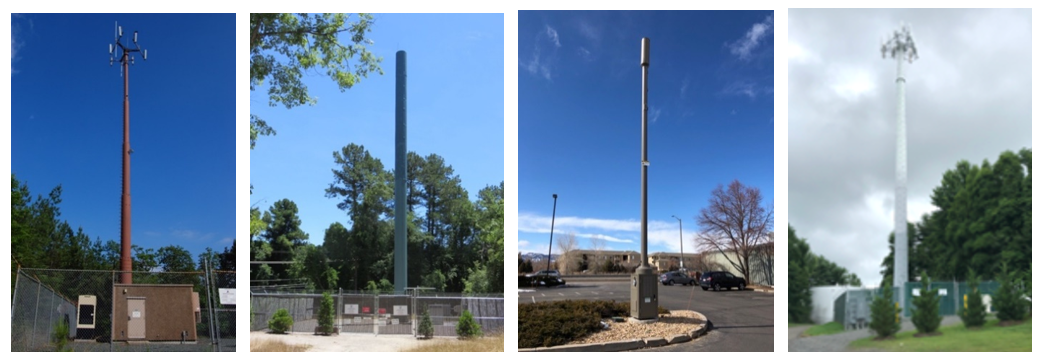
(j)
Signage Only the following type of signage is permitted on wireless facilities:
(1)
Signs shall be provided in an easily visible location to include: FCC ASR registration number (if applicable); site owner's name, site identification number and/or name, phone number of contact to reach in event of an emergency or equipment malfunction, any additional security and safety signs.
(2)
If more than 220 voltage is necessary for the operation of the facility and is present in a ground grid or in the tower, warning signs shall be located every 20 feet attached to the fence or wall and shall display in large, bold, high contrast letters, minimum height of each letter 4 inches, the following: "HIGH VOLTAGE - DANGER."
(k)
Fencing
(1)
WSS ground mounted equipment not located in City street rights-of-way shall be secured and enclosed with a fence not less than 8 feet in height, placed between the equipment compound and any required landscaping.
(2)
Fencing for concealed WSSs shall match the concealment of the WSS and be placed between the compound and any required landscaping.
(l)
Grading Grading shall be minimized and limited only to the area necessary for the base of the new tower and equipment compound.
(m)
Landscaping Landscaping shall be required around the perimeter of the site or equipment compound when ground equipment within the compound is visible from any street and from any adjacent residential use. Landscaping shall be designed to screen such equipment from view in accordance with the ground-based mechanical equipment requirements in Section 5.6, Screening. All required landscaping must be contained on the lot or within the lease area as applicable.
(n)
Radio Frequency Emission Compliance A signed statement from a North Carolina licensed professional engineer shall be provided stating the radio frequency emissions comply with applicable FCC standards for such emissions ("OET-65") as of the date of application. Any collocations, modification or upgrade applications shall contain a statement from a North Carolina professional engineer confirming that following installation the composite facility will remain in compliance with said FCC standards as stated in OET-65.
(o)
Accessory Equipment Accessory equipment, including any buildings, cabinets or shelters, shall be used only to house equipment and other supplies in direct support of the operation of the wireless facility. Any equipment not used in direct support of such operation shall not be stored on the site.
(p)
Additional Standards for Concealed WSSs A concealed WSS shall be designed and located to complement the surrounding landscape in accordance with the following standards:
(1)
A concealed small wireless facility in City street right-of-way can include street lights, banners and other decorative street design features in accordance with City regulations and policies (See Figure 4.3.3.F2, Concealed Small Wireless Facilities).
(2)
A concealed wireless facility not on a tower can include faux shutters, parapets, wall extensions, chimneys and steeples. (See Figure 4.3.3.F3, Concealed Base Station Facilities).
(3)
A concealed wireless facility may include, but is not limited to; bell towers, clock towers, water towers, silos, chimneys, steeples, evergreen trees, or flag poles. (See Figure 4.3.3.F4, Concealed Wireless Support Structures).
FIGURE 4.3.3.F2 CONCEALED SMALL WIRELESS FACILITIES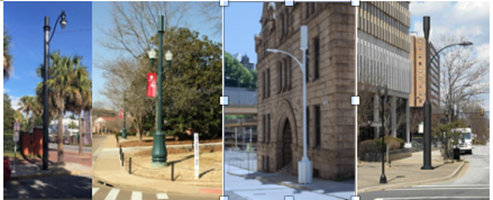
FIGURE 4.3.3.F3 CONCEALED BASE STATIONS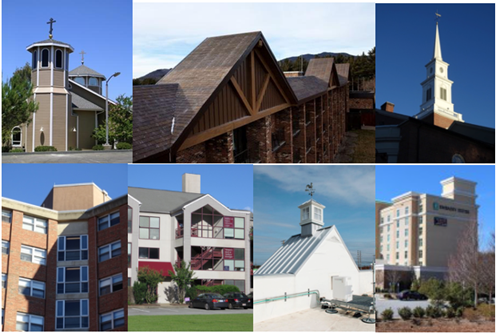
FIGURE 4.3.3.F4 CONCEALED WIRELESS SUPPORT STRUCTURES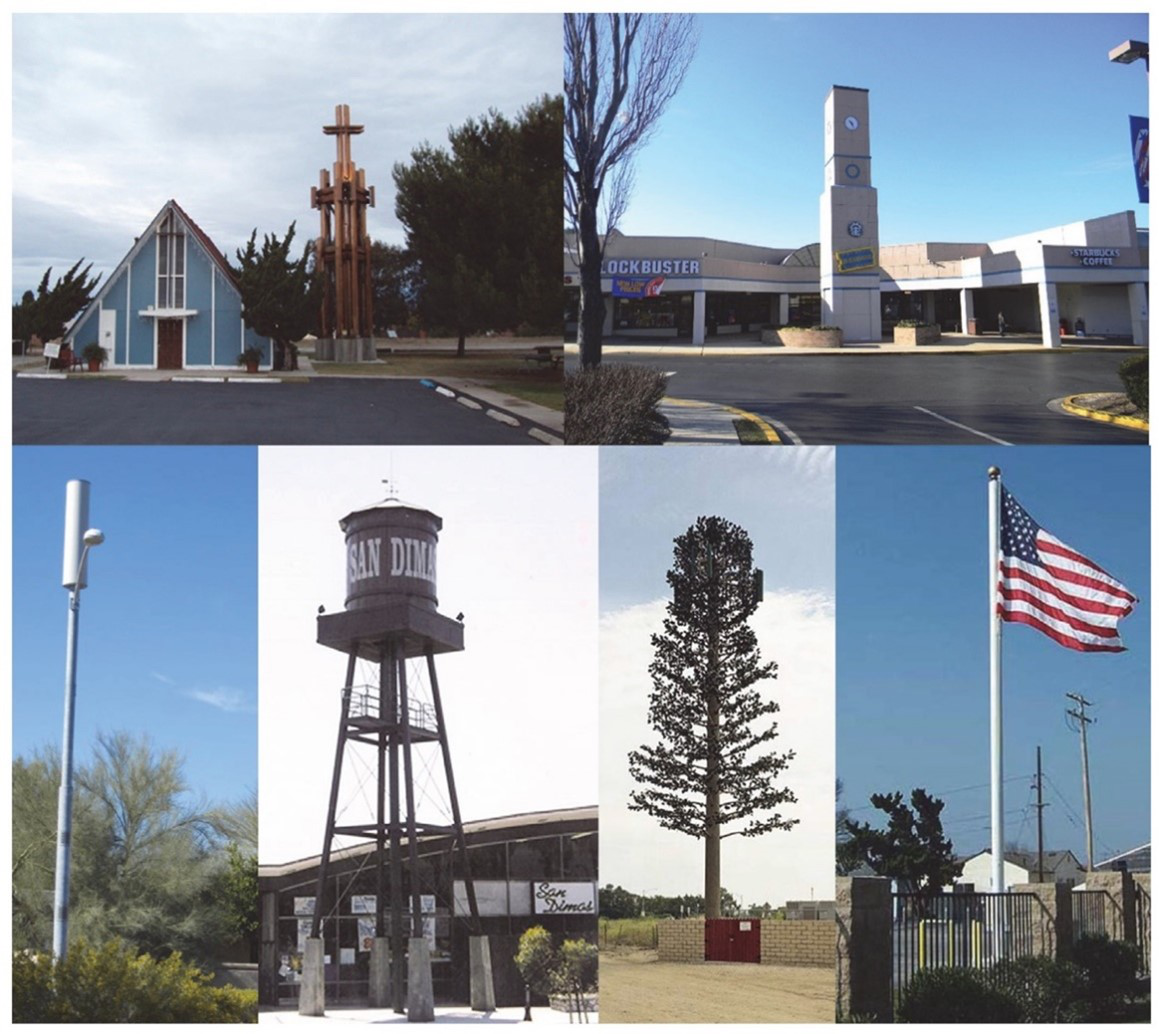
(4)
For concealed small wireless facilities, all accessory equipment shall be internal to the utility pole.
(5)
The equipment compound for non-small wireless facilities shall be designed, located, and concealed in a manner compatible with the wireless support structure portion of the facility. Ground equipment shall be located within a structure or building, to the maximum extent practicable. Antennae, cables, and related appurtenances shall be enclosed, concealed, screened, or obscured so that they are not readily apparent to a casual off-site observer.
(q)
Photo Rendering A photo rendering shall be provided of the collocation, new utility pole, replacement utility pole, City utility pole, base station, or tower structure that illustrates to scale the proposed facility including, but not limited to architectural features and use of colors. Photo renderings should include views from the street(s) and adjacent properties.
(r)
Eligible Facility An existing wireless facility that was legally permitted on or before the effective date of this Ordinance shall be considered a lawful and conforming use if it complies with all applicable provisions of this section, or a nonconforming use or structure in accordance with Chapter 8, Nonconformities, if it does not comply with all applicable provisions of this section.
(s)
Activities at Nonconforming Base Stations or Wireless Support Structures
(1)
Ordinary maintenance may be performed on a nonconforming base station or wireless support structure.
(2)
Collocation on an existing nonconforming base station or wireless support structure shall not be construed as an expansion, enlargement, or increase of a nonconforming structure or nonconforming use and shall be reviewed and approved in accordance with Section 2.5.15, Wireless Telecommunications Permit, provided that the collocation is not considered a substantial modification of the facility or support structure.
(3)
Collocation on an existing nonconforming base station or wireless support structure shall not be construed as an expansion, enlargement, or increase of a nonconformity and shall be reviewed and approved in accordance with Section 2.5.15, Wireless Telecommunications Permit.
(Ord. No. 7266/17-08, § 14, 1-17-2017; Ord. No. 7287/17-29, § 6, 4-3-2017; Ord. No. 7365/17-108, §§ 4.E, 6, 11-20-2017; Ord. No. 7415/18-44, §§ 5.C, 5.D, 5-21-2018; Ord. No. 7680/20-96, § 8, 12-9-2020; Ord. No. 7813/22-34, § 1, 4-18-2022; Ord. No. 7912/23-27, § 4.E, 4-17-2023)
4.3.4. - Commercial Uses
A.
Adult Entertainment
1.
Purpose An adult entertainment establishment, as listed and defined in Article 26A of the North Carolina General Statutes, is recognized as having certain serious objectionable operational characteristics and a deleterious effect on adjacent areas, particularly when such establishments are concentrated. Special regulation of these uses is necessary to ensure their adverse effects do not contribute to degradation or decline of surrounding areas. The primary intent of the standards in this subsection is to prevent a concentration of these uses in any one area of the City's planning jurisdiction.
2.
Separation Standards
(a)
Other Adult Entertainment Establishments An adult entertainment establishment shall not be located within 1,200 feet of any other adult entertainment establishment, measured as a straight line from lot line to lot line.
(b)
Other Uses An adult entertainment establishment shall not be located within 650 feet of a religious institution, school, day care, public park, land in a residential district, or an establishment with an on premise ABC license, measured as a straight line from lot line to lot line.
3.
Maximum Area The gross floor area of any adult entertainment establishment shall not exceed 3,000 square feet.
4.
Prohibition of Sleeping Quarters Except for an adult motel, an adult entertainment establishment shall not have sleeping quarters.
5.
Restriction of Uses
(a)
There shall not be more than 1 adult entertainment establishment in the same building, structure, or portion thereof.
(b)
No other principal or accessory use may occupy the same building, structure, property, or portion thereof with an adult entertainment establishment.
B.
Animal Care
1.
Animal Care, Major Outdoor areas used to house or exercise animals shall be enclosed by a fence at least 6 feet in height and located 50 feet from a lot line abutting a residential district.
C.
Eating Establishments
1.
Bar or Nightclub (Major and Minor) A bar or nightclub shall comply with the following standards:
(a)
Be separated from a religious institution or a school by at least 200 feet. The minimum separation is reduced to 100 feet in the MS district and there is no separation requirement in the MX district.
(b)
Not orient the primary entrance toward an abutting lot in a residential district.
(c)
Have a 6-foot high opaque fence or masonry wall along all lot lines abutting a residential district.
2.
Restaurant (Major and Minor) A restaurant (major and minor) shall have a 6-foot high opaque fence or masonry wall along all lot lines abutting a residential district.
D.
Personal Services
1.
Personal Services Establishment, Major In order to reuse the existing buildings in the Core City in accordance with the City's adopted policy guidance, major personal services establishments are permitted in the LI district, subject to the following standards:
(a)
The LI district must be located in the Core City area;
(b)
The new use must reuse an existing building or buildings;
(c)
The total square footage of all building additions for multi-family; personal service, major; major and minor retail sales; major and minor assembly; and major and minor cultural facility uses shall be limited to a maximum of 25 percent of the total gross floor area of all principal buildings existing on the site as of the effective date of this Ordinance.
2.
Repair Establishments Repair activities shall be conducted within an enclosed building.
E.
Recreation and Leisure
1.
Amusement Parks Amusement equipment, machinery, mechanical devices, or go-kart tracks shall not be operated within 200 feet of a residential district.
2.
Sports and Fitness Centers A sports or fitness center shall comply with the following standards:
(a)
In All Districts Except OI and LB Outdoor courts, swimming pools, and athletic fields shall be located at least 50 feet from any lot line abutting a residential district.
(b)
In the OI and LB Districts
(1)
A sports or fitness center shall be a maximum of 10,000 square feet of gross floor area.
(2)
Outdoor facilities are prohibited.
F.
Retail Sales
1.
Bulky Item Sales The outdoor display of bulky goods shall comply with the following standards:
(a)
Portable storage containers and dumpsters that are utilized for the purpose of display and any item that exceeds 10 feet in height shall not be placed within required setbacks, parking or landscape areas.
(b)
Other bulky items that are less than or equal to 10 feet in height must be located at least 10 feet from any public street and shall not be placed within required parking or landscape areas.
2.
Flea Market/Antique Mall, Indoor All items for sale at an indoor flea market/antique mall must be located within an enclosed building.
3.
Retail Sales Establishment
(a)
Major
(1)
In the MS District In the MS district, a use primarily engaged in the sale of used merchandise shall:
(i)
Not front on Main Street; and
(ii)
For other sites, be less than 25,000 square feet of gross floor area and located in an existing building designed with a single storefront that is intended for a single occupant.
(2)
In the LI District In order to reuse the existing buildings in the Core City in accordance with the City's adopted policy guidance, major retail sales establishments are permitted in the LI district, subject to the following standards:
(i)
The LI district must be located in the Core City area;
(ii)
The new use must reuse an existing building or buildings;
(iii)
The total square footage of all building additions for multi-family; personal service, major; major and minor retail sales; major and minor assembly; and major and minor cultural facility uses shall be limited to a maximum of 25 percent of the total gross floor area of all principal buildings existing on the site as of the effective date of this Ordinance.
(b)
Minor In order to reuse the existing buildings in the Core City in accordance with the City's adopted policy guidance, minor retail sales establishments are permitted in the LI district, subject to the following standards:
(1)
The LI district must be located in the Core City area;
(2)
The new use must reuse an existing building or buildings;
(3)
The total square footage of all building additions for multi-family; personal service, major; major and minor retail sales; major and minor assembly; and major and minor cultural facility uses shall be limited to a maximum of 25 percent of the total gross floor area of all principal buildings existing on the site as of the effective date of this Ordinance.
4.
Truck Stop A truck stop shall comply with the following standards:
(a)
Setbacks All buildings, parking and service areas associated with the use shall be setback at least 50 feet from an abutting residential district.
(b)
Location Have frontage on or be located within a ½ mile of an Interstate or US Primary Highway exit.
G.
Vehicle Establishments
1.
Vehicle Establishments
(a)
General
(1)
Tires shall be stored within an enclosed building or stored within the outdoor vehicle storage area and under cover in such a manner as to prevent a violation of the public nuisance code.
(2)
Salvaging and storage of vehicle for parts is prohibited.
(3)
Repair of all vehicles and the storage of all parts shall be within an enclosed building.
(4)
In all districts except LI and HI, outdoor vehicle storage is limited to an area less than 25 percent of the lot. The storage area shall be located behind the front building line of the principal building and be screened with an opaque, wall, fence, or other approved method to a height of 6 feet above grade.
(5)
In the LI and HI districts, outdoor vehicle storage may occupy up to 50 percent of the lot. The storage area shall be located behind the front building line of the principal building and be screened with an opaque fence, wall, or other approved method, to a height of 6 feet above grade level.
(b)
Major
(1)
Vehicles for sale or rent shall not be:
(i)
Located within the right-of-way,
(ii)
Less than 10 feet from the edge of the pavement or the curb,
(iii)
In a required planting area,
(iv)
In a sight distance easement, or
(v)
In an area required for off-street parking.
(2)
All vehicles shall be located on an all-weather surface.
(c)
Minor Vehicle washing or detailing shall comply with the following standards:
(1)
The washing operation shall take place within a building.
(2)
Buildings shall be setback at least 75 feet from an abutting residential district.
(3)
Specific areas shall be provided for the manual drying, waxing, polishing and vacuuming of vehicles when these services are provided. These areas shall not conflict with on-site circulation patterns.
(4)
The use shall be screened with an opaque fence, wall, or by any other allowed method in Section 5.6.6, Screening Methods, to a height of 6 feet above grade level along all lot lines abutting a residential district.
H.
Visitor Accommodations
1.
Bed and Breakfast A bed and breakfast shall comply with the following standards:
(a)
Be owner-occupied or have a manager who resides on the premises;
(b)
Have no more than 6 sleeping rooms;
(c)
Have only 1 kitchen;
(d)
Limit meals served on the premises to overnight guests only;
(e)
If in a residential district, 1 sign up to a maximum area of 4 square feet and 6 feet in height is allowed.
2.
Recreational Vehicle Park A recreational vehicle park shall comply with the following standards:
(a)
Size A recreational vehicle park shall be a minimum of 3 acres.
(b)
Density A recreational vehicle park shall have maximum of 15 spaces per acre.
(c)
Setbacks Unless otherwise stated below, a recreational vehicle park shall comply with the development standards in Chapter 5: Development Standards:
(i)
Buildings and structures shall meet the district requirements.
(ii)
Minimum 50-foot street and perimeter setback for RV and camping spaces.
(d)
Recreational Vehicle (RV) and Camping Spaces
(i)
Shall be designated on the ground by permanent markers or monuments.
(ii)
Shall be located above the base flood elevation and graded to prevent water from ponding.
(e)
Parking and Drives
(i)
Each RV or camping space shall have an asphalt, concrete, graveled or other approved comparable all-weather surface with sufficient dimensions to accommodate at least one motor vehicle in addition to the RV or camping space.
(ii)
Park drives shall meet the private drive dimensional requirements and must have an asphalt, concrete, graveled or other approved comparable all-weather surface.
(f)
Access No RV or camping space shall have direct vehicular access to a public street.
(g)
Utilities
(i)
Public water and public sewer service are required for the park.
(ii)
Individual sewer hook-ups or a sewage dumping station is required along with individual RV electrical connections for the RV spaces.
(iii)
A central structure or structures is required that will provide separate toilet and bathing facilities for each gender.
(h)
Length of Stay
(i)
No RV shall be used or set up as a permanent dwelling unit.
(ii)
No RV shall be occupied beyond 90 days in any 12-month period.
(Ord. No. 7365/17-108, §§ 4.F, 7, 11-20-2017; Ord. No. 7415/18-44, §§ 5.E, 5.F, 5-21-2018; Ord. No. 7554/19-71, § 3, 10-7-2019; Ord. No. 7750/21-67, § 5.G, 11-1-2021; Ord. No. 7912/23-27, § 4.F, 4-17-2023)
4.3.5. - Industrial Uses
A.
Extractive Industry
1.
Extractive Industry An extractive industry use (including, mining, quarrying, or drilling) shall comply with the following standards:
(a)
Setbacks
(1)
The following features shall be located at least 50 feet from any lot line:
(i)
The edges of a pit where an extraction operation is located;
(ii)
Any equipment used in the processing of rock or gravel; and
(iii)
Any asphalt plant or other industrial use operated in conjunction with an extraction use.
(2)
In an instance where the extraction operation site is bounded by a railroad right-of-way, no setback is required between the railroad right-of-way and the extraction operation.
(b)
Security Fencing A security fence, a minimum of 6 feet in height, shall be provided around the perimeter of both an existing and abandoned extraction operation.
(c)
Rehabilitation
(1)
Within 1 year of the cessation of the use, all equipment and stock piles incidental to the operation shall be dismantled and removed by and at the expense of the landowner;
(2)
Except in an instance where redevelopment for another permitted use is in progress on the site of an abandoned extractive industry use:
(i)
Excavations shall be graded to reduce the surface to gently rolling topography in substantial conformity to the land area immediately surrounding the site; and planted with a cover of sod, trees, shrubs, legumes, or grasses, which will minimize erosion; and
(ii)
The site shall be drained to prevent the accumulation of standing water, and channelization of the drainage shall be designed and controlled so as not to cause erosion or silting of neighboring properties or public ways, nor to appreciably increase the turbidity of any natural water course, or to occlude any existing drainage course.
(d)
Operation An operation involving blasting that is discernible beyond the exterior property line of the use shall only be conducted between the hours of 7:00 AM and 6:00 PM.
(e)
Access
(1)
Vehicular access shall be constructed with an all-weather surface and be maintained in a dust-free condition;
(2)
Access shall be located no closer than 15 feet to any property line other than a railroad right-of-way line; and
(3)
A plan shall be submitted showing truck routes to and from the site. Such routes shall be designed to minimize impacts on residential areas, schools, or other uses negatively affected by truck traffic.
B.
Manufacturing and Production
1.
Asphalt Plant An asphalt plant shall comply with the following standards:
(a)
Setbacks An asphalt plant shall be located at least 50 feet from a property line.
(b)
Security Fencing A security fence, a minimum of 6 feet in height, shall be provided around the use.
(c)
Rehabilitation
(1)
Within 1 year of the cessation of the use, all equipment and stock piles incidental to the operation shall be dismantled and removed by and at the expense of the landowner;
(2)
On the site of an abandoned asphalt plant the site shall be drained to prevent the accumulation of standing water, and channelization of the drainage shall be designed and controlled so as not to cause erosion or silting of neighboring properties or public ways, nor to appreciably increase the turbidity of any natural water course, or to occlude any existing drainage course, except in an instance where redevelopment for another permitted use is in progress.
(d)
Access
(1)
Vehicular access shall be constructed with an all-weather surface and be maintained in a dust-free condition.
(2)
Access roads shall be located no closer than 15 feet from a property line.
(3)
A plan shall be submitted showing truck routes to and from the site. Such routes shall be designed to minimize impacts on residential areas, schools, or other uses negatively affected by truck traffic.
2.
Manufacturing, Minor In order to reuse existing buildings in the Core City in accordance with the City's adopted policy guidance, minor manufacturing uses are permitted in the MX district, subject to the following standards:
(a)
The new use must reuse an existing building or buildings;
(b)
In the MX-D district the building must be located in the area described as follows: beginning at the southeast corner of North Lindsay Street and West English Road, thence in a southerly direction along North Lindsay Street to its intersection with West Martin Luther King Jr. Drive, then in an easterly direction along West Martin Luther King Jr. Drive to its intersection with West Broad Avenue, thence continuing in an easterly direction along West Broad Avenue to its end and intersection with Hayden Place, thence in a northerly direction along Hayden Place to its end and intersection with West English Road, thence in a westerly direction along West English Road to its intersection with North Elm Street, thence in a northerly direction along North Elm Street to its intersection with Appling Way, thence in a westerly direction along Appling Way to its end and intersection with West English Road, thence in a westerly direction along West English Road to the point of beginning.
C.
Warehouse and Freight Movement
1.
Self-storage, External Access An external access self-storage establishment in the GB district shall comply with the following standards:
(a)
Prohibited Storage Outdoor storage and storage of hazardous, toxic, or explosive substances shall be prohibited.
(b)
Use Area
(1)
A self-storage use shall be located on a lot or site between 2 and 5 acres in area.
(2)
No more than 50 percent of the total site may be occupied by buildings.
(c)
Maximum Height Self-storage buildings shall not exceed 20 feet or 1 story in height.
(d)
Operation No activity other than storage shall take place within a storage unit.
2.
Self-Storage, Internal Access An internal access self-storage establishment shall comply with the following standards:
(a)
Visibility No indoor storage material, racks, bins, shelving or other evidence of the warehouse or wholesale operation shall be visible from the public right-of-way. Glass doors and windows shall contain curtains, blinds or other suitable treatment to screen the interior of the building from view.
(b)
Transparency Maintained Windows shall not be boarded or paneled over from the outside or the inside. The depiction of faux storage units and inoperable doors shall be prohibited.
(c)
Outdoor Storage Outdoor storage shall be prohibited.
3.
Warehouse and Distribution A warehouse in the GB district shall comply with the following standards:
(a)
Size The warehouse shall not exceed 10,000 square feet of gross floor area.
(b)
Outdoor Storage Outdoor storage shall be prohibited.
D.
Waste-Related Service
1.
Landfill A landfill shall comply with the following standards:
(a)
General
(1)
Provide a Type A landscape yard around its perimeter (see Section 5.5.11, Perimeter Landscape Yards).
(2)
Access shall be controlled through the use of a fence, wall, gate, or other suitable device to prevent unregulated dumping.
(3)
Vehicular access shall be constructed with an all-weather surface and be maintained in a dust-free condition.
(b)
Major
(1)
A major landfill shall meet all applicable state and federal regulations.
(2)
An existing major landfill located within a WSO (GWA and WCA) may continue to operate or expand, but no new major landfill shall be permitted in the WSO (GWA and WCA).
(c)
Minor A minor landfill shall meet all applicable state and federal regulations.
2.
Recycling Center A recycling center shall comply with the following standards:
(a)
General
(1)
Access shall be controlled through the use of a fence, wall, gate, or other suitable device to prevent unregulated dumping.
(2)
Vehicular access shall be constructed with an all-weather surface and be maintained in a dust-free condition.
(b)
Major
(1)
Area utilized for buildings and outdoor processing areas shall be at least 200 feet from a residential district, except that an accessway or weighing station shall be located at least 100 feet from a residential district.
(2)
Materials may be stored outdoors provided they are located at least 150 feet from all property lines and are screened with an opaque fence, wall, or by any other allowed method in Section 5.6.6, Screening Methods, to a height of 8 feet above grade level.
(c)
Minor
(1)
A minor recycling center shall be located at least 150 feet from a residential district and operated entirely within an enclosed building, except for loading facilities which may be located outdoors.
(2)
Outdoor storage of recyclable materials, whether unprocessed or processed, is prohibited.
3.
Salvage or Junk Yard A salvage or junk yard shall comply with the following standards:
(a)
The property upon which a salvage or junk yard is established shall be at least 5 acres.
(b)
Area utilized for the storage of junk, waste, discarded, salvaged, or similar materials shall be located at least 300 feet from a residential district.
(c)
The storage area shall be located behind the front building line of the principal building and be screened with an opaque wall, fence, or other allowed method in Section 5.6.6. Screening Methods to a height of 8 feet above grade level.
4.
Transfer Station A transfer station shall comply with the following standards:
(a)
Access shall be controlled through the use of a fence, wall, gate, or other suitable device to prevent unregulated dumping.
(b)
Vehicular access shall be constructed with an all-weather surface and be maintained in a dust-free condition.
(c)
Area utilized for the unloading and loading of solid waste, buildings and other structures shall be located at least 150 feet from a residential district. The transfer station shall be operated entirely within an enclosed structure, except for loading/unloading facilities.
(d)
Outdoor storage of waste material is prohibited.
E.
Wholesale Trade
1.
Market Showroom A market showroom use shall comply with the following standards:
(a)
Exterior Product Display Exterior product display shall:
(1)
Not take place within the right-of-way,
(2)
Not exceed 2,500 square feet per lot,
(3)
Consist of products from the same vendor or company that owns or leases space within the building, and
(4)
Not be displayed earlier than 2 weeks prior to the official opening of the market, and be removed within 2 weeks of the official end of the market.
(b)
Structure
(1)
A market showroom shall be located:
(i)
In a permanent building, or
(ii)
In a combination of permanent buildings and a membrane structure located on the same lot, or
(iii)
Entirely in 1 or more membrane structures on the same lot, only if a building permit for a permanent building has been issued.
(2)
If a membrane structure is used as part of a market showroom, it shall:
(i)
Be located on the same lot as a market showroom;
(ii)
Be enclosed on all sides; and
(iii)
Not be in place for more than 120 days in a calendar year.
2.
Toxic Chemicals or Substances, Pesticides, or Fertilizers Toxic chemicals, pesticides, and fertilizers establishments shall comply with the following standards:
(a)
Vehicular access shall be constructed with an all-weather surface and be maintained in a dust-free condition.
(b)
Structures, buildings, and mechanical equipment used for the operation shall be at least 100 feet from a residential district.
(c)
Security fencing, a minimum of 6 feet in height, shall be provided around all outdoor storage areas.
3.
Wholesale (Major and Minor) Vehicular access for wholesale establishments shall be constructed with an all-weather surface and be maintained in a dust-free condition.
(Ord. No. 7363/17-106, § 6, 11-20-2017; Ord. No. 7365/17-108, § 4.G, 11-20-2017; 7489/19-06, § 2, 2-4-2019; Ord. No. 7521/19-38, § 6, 4-15-2019; Ord. No. 7574/19-91, § 1, 11-4-2019; Ord. No. 7750/21-67, §§ 8, 9.A, 11-1-2021)
4.4.1.- Purpose
This section authorizes the establishment of accessory uses and structures that are incidental and subordinate to principal uses. The purpose of this section is to allow a broad range of accessory uses and structures, provided they comply with the standards set forth in this section in order to reduce potentially adverse impacts on surrounding lands.
4.4.2. - Procedure for Establishment
Accessory uses or structures may be approved in conjunction with the approval of the principal use or subsequently following the establishment of the principal use. No accessory use or structure shall be approved, established, or constructed before the principal use is approved in accordance with this Ordinance.
4.4.3. - General Standards
A.
Permitted Accessory Uses and Structures Permitted accessory uses and structures include those listed in this section and those that the Planning & Development Director determines meet the following:
1.
Are clearly incidental to an allowed principal use or structure;
2.
Are subordinate to and serving an allowed principal use or structure;
3.
Are subordinate in area, extent and purpose to the principal use or structure;
4.
Contribute to the comfort, convenience or needs of occupants, business or industry associated with the principal use or structure.
B.
Located on Same Lot as a Principal Use All accessory uses and structures shall be located on the same lot as the principal use or structure and not located within any street right-of-way, except as allowed by this Ordinance for specific accessory uses and structures.
C.
Compliance with Ordinance Requirements Accessory uses and structures shall conform to the applicable requirements of this Ordinance, including this section, the district standards in Chapter 3: Zoning Districts, the development standards in Chapter 5: Development Standards, and the environmental standards in Chapter 6: Environmental Standards.
D.
Signs The standards for any allowed signs for accessory uses and structures are established in Section 4.4.4., Standards for Accessory Structures, and Section 4.4.5., Standards for Specific Accessory Uses.
(Ord. No. 7912/23-27, § 4.G, 4-17-2023)
4.4.4. - Standards for Accessory Structures
A.
Dimensional Standards Accessory structures, which include accessory buildings, shall meet the applicable zoning district dimensional standards and district standards, except as provided in this section and in Section 10.2.4 G, Setback Encroachments.
B.
Easements Accessory structures may not be located in an easement unless the easement or easement holder expressly states the allowance in writing.
C.
Drive-up Accessory Structures Drive-up accessory structures, such as automated teller machines, ice vending, coffee stands, and similar accessory structures that provide drive-up or walk-up service and which are located within a surface parking area shall meet the following standards:
1.
The accessory structure shall not be placed in any required parking spaces.
2.
The location shall be designed so that any access or stacking lanes do not extend into a primary drive aisle.
3.
The surface parking area shall be configured and restriped to maintain access and circulation to the principal use(s).
4.
Any roof-top mechanical equipment shall be screened from the adjacent streets.
5.
All signs must be wall signs and may cover up to a maximum of 50% of the primary facade of the accessory structure, or be a maximum of 25 square feet, whichever is less. All other facades of the accessory structure may cover up to 50% of the allowed maximum coverage area for the primary facade. Signs on accessory structures may be illuminated in accordance with the illumination standards in Section 5.7, Signs.
D.
Residential Accessory Structures An accessory structure, including an accessory building, for a single-family or duplex dwelling shall meet the following:
1.
Setbacks
(a)
Rear and Side Accessory structures must setback 5 feet from side and rear lots lines.
(b)
Corner Side For corner lots, accessory structures must meet the side street setback of the dimensional standards for the applicable zoning district.
(c)
Through or Reverse Frontage Lots For through or reverse frontage lots, all accessory structures shall be setback 10 feet from the rear lot line abutting the street.
(d)
Alleys For accessory structures that are located along an alley, the structure must setback a minimum of 10 feet from the rear lot line abutting the alley.
2.
Utilities Utility service, such as water, sewer and electricity, to the accessory structure shall be provided by branching service from the principal structure.
3.
Encroachments See Section 10.2.4 G, Setback Encroachments, for allowable encroachments into setbacks for specific accessory structures.
4.
Accessory Buildings
(a)
Location In addition to the setback requirements, accessory buildings shall be located behind the front building line of the principal structure, except on lots 2 acres in area or larger, for which 1 accessory building may be located in front of the principal structure provided it meets the street setback.
(b)
Size
(1)
For lots less than 2 acres in area, the maximum total area of all accessory buildings on the lot shall not exceed 50 percent of the gross floor area of the principal structure or 600 square feet, whichever is greater.
(2)
For lots that are 2 acres or more, but less than 5 acres in area, the maximum total area of all accessory buildings on the lot shall not exceed 200 percent of the gross floor area of the principal structure or 2500 square feet, whichever is greater.
(3)
For lots that are 5 acres or more in area, there is no maximum total area for accessory buildings.
E.
Local Historic Overlay District Accessory structures located in a local historic overlay district may be subject to a Certificate of Appropriateness in accordance with Section 2.4.5, Certificate of Appropriateness.
F.
Transitional Office District (TO) All accessory structures located in a Transitional Office (TO) District shall meet the standards in Section 4.4.4 D. Residential Accessory Structures regardless of whether the structure is accessory to a residential or nonresidential use.
(Ord. No. 7542/19-59, §§ 3.A, 3.B, 7-15-2019; Ord. No. 7912/23-27, § 4.H, 4-17-2023)
4.4.5. - Standards for Specific Accessory Uses
In addition to the following specific standards, the listed accessory uses shall meet the requirements of Section 4.4.4, Standards for Accessory Structures, except as expressly stated in the specific accessory use requirements.
A.
Accessory Dwelling Unit An accessory dwelling unit (ADU) is permitted as accessory to a single-family detached dwelling if it complies with the following standards:
1.
General
(a)
No more than 1 ADU shall be located on a lot with a single-family detached dwelling.
(b)
An ADU shall have a maximum of 2 bedrooms.
(c)
An ADU and the principal dwelling shall have the same street address and mailbox.
(d)
An ADU shall not be subdivided or otherwise separated in ownership from the principal dwelling unit.
(e)
An ADU and the principal dwelling shall utilize the same driveway, unless the ADU is accessed from a right-of-way not used by the principal dwelling (e.g., a rear alley or separate street access on a corner or through lot).
(f)
An ADU shall be served by water, sanitary sewer, gas and electrical utilities as part of the principal dwelling.
2.
Design An ADU shall maintain the architectural design, style, appearance and character of the principal dwelling by incorporating design elements such as similar materials, facade treatment, colors, window style, roof design, and roof pitch.
3.
Location
(a)
Principal Structure
(1)
If an ADU is located within the principal structure, the ADU shall not exceed 30 percent of the gross floor area of the structure.
(2)
Entrance doors or exterior stairways to the ADU facing streets shall be prohibited; separate access to the ADU shall be by means of a side or rear door in the principal structure.
(b)
Accessory Structure If an ADU is located in an accessory structure, it shall meet the residential accessory structure requirements in Section 4.4.4, Standards for Accessory Structures.
B.
Caretaker Dwelling One caretaker dwelling unit is permitted as accessory to an agricultural, commercial, institutional or industrial use either within the principal building or in an accessory building on the lot.
C.
Drive-Through See Chapter 3: Zoning Districts, for the applicable drive-through standards by zoning district.
D.
Exterior Lighting See Section 5.10, Exterior Lighting, for the applicable standards.
E.
Fences See Section 5.11, Fences, for the applicable standards.
F.
Helistop A helistop is permitted as accessory to an institutional, commercial or industrial use if it complies with all applicable Federal Aviation Administration regulations.
G.
Home Day Care A home day care is permitted as accessory to a residential dwelling unit if it complies with the following standards:
1.
Care is provided within a dwelling unit, for between 3 and 8 children less than 13 years of age, not more than 5 of which are preschool age, or up to 8 adults, who do not reside in the dwelling, for at least once per week for at least four hours, but less than 24 hours per day.
2.
It complies with all applicable home occupation requirements, except the gross floor area requirement.
3.
It is licensed by the State of North Carolina and complies with all applicable State requirements.
H.
Home Occupation A home occupation is permitted as accessory to a residential dwelling unit if it complies with the following standards:
1.
The home occupation shall be located in the residential dwelling unit and shall not occupy more than 25 percent of the gross floor area of the dwelling unit.
2.
The person operating the home occupation shall reside in the dwelling unit.
3.
No more than 1 person shall work in the dwelling unit that is not a resident of the dwelling unit.
4.
The home occupation shall not change the exterior appearance of the dwelling.
5.
The home occupation shall not create traffic, parking congestion, noise, vibration, odor, glare, vibration, fumes, or electrical or communications interference beyond what normally occurs in the district where located.
6.
No outdoor storage or display of products, materials, or equipment is permitted.
7.
Activities and storage associated with a home occupation shall not take place in an accessory building, such as a detached garage.
8.
No maintenance or repair of commercial equipment may be associated with a home occupation.
9.
Only 1 commercial vehicle with 1 attached trailer associated with the home occupation may be parked or stored on the lot, but neither the truck nor the trailer shall exceed 24 feet in length.
10.
Tutoring and instruction in music, dance, art, yoga, and other subjects shall be limited to no more than 5 students during any single class or instruction period.
11.
The home occupation is allowed 1 wall sign up to a maximum of 4 square feet. Such wall signs may not be illuminated.
I.
Livestock The keeping of livestock is allowed as accessory to a single-family detached or duplex dwelling if it complies with the following standards:
1.
In the AGR district, the accessory keeping of livestock is allowed, but is exempt from these standards.
2.
The keeping of livestock shall require a lot of at least 5 acres in area.
3.
Animals shall be maintained in a fenced area located at least 100 feet from all lot lines.
4.
Fencing shall be at least 4 feet in height.
5.
For large livestock such as horses, cows and other similar large-sized animals, no more than 1 animal over 6 months in age shall be maintained for every 20,000 square feet of fenced area.
6.
For small livestock such as sheep, goats, and other similar-sized animals, no more than 1 animal over 6 months in age shall be maintained for every 10,000 square feet of fenced area.
J.
Off-Street Parking and Loading See Section 5.4, Off-Street Parking and Loading, for the applicable standards.
K.
Outdoor Display Outdoor display is allowed as accessory for retail sales and wholesale trade uses if it complies with the following standards:
1.
The intent of these standards is to allow outdoor display, but not where the display of such goods is unsightly, impedes the flow of pedestrian or vehicular traffic, or creates an unsafe condition.
2.
The outdoor display of non-bulky goods is not subject to the requirements in Section 4.4.4, Standards for Accessory Structures, but shall comply with the following standards:
(a)
Be located adjacent to the storefront or building sides, except for farmers market, plant nursery, garden center or similar operations;
(b)
Not located in drive aisles, loading zones, fire lanes, or required landscaping yards; and
(c)
Maintain at least 5 feet of space along the side of the display free of obstruction to allow for pedestrian and handicap movement, such that handicapped pedestrians and others do not have to enter the drive aisle to walk around the display.
3.
The outdoor display of bulky goods shall comply with the following standards:
(a)
Portable storage containers, dumpsters and any bulky item for display that exceeds 10 feet in height shall meet the requirements in Section 4.4.4, Standards for Accessory Structures;
(b)
Not located in drive aisles, loading zones, fire lanes, or required parking spaces or landscaping yards; and
(c)
Other bulky items that are less than or equal to 10 feet in height are not subject to the requirements in Section 4.4.4, Standards for Accessory Structures, but shall be located at least 10 feet from any public street and shall not be placed within any easements, required parking spaces or landscape yards.
L.
Portable Storage Containers Portable storage containers are allowed as accessory to the principal use on the same lot, provided they comply with the following standards:
1.
Residential Districts Portable storage containers located within any residential district shall comply with the following standards:
(a)
A portable storage container is not subject to the requirements in Section 4.4.4, Standards for Accessory Structures; however, it must be located on the lot and outside any street right-of-way.
(b)
No more than 2 portable storage containers may be located on a lot with a single-family or duplex dwelling.
(c)
The gross square footage of a portable storage container on a lot with a single-family or duplex dwelling shall not exceed 150 square feet.
(d)
A portable storage container may remain on a lot up to 14 days in duration, except when the container is used in association with construction on the same site, which the container may remain for the duration of the construction project and shall be removed upon completion.
2.
Business and Special Districts Portable storage containers located within any business or special district shall comply with the following standards:
(a)
Portable storage containers shall meet the requirements in Section 4.4.4, Standards for Accessory Structures.
(b)
The number, size and duration of portable storage containers on a lot are not regulated.
(c)
Portable storage containers shall not be placed between a principal structure and a public street, except in the AGR, LI and HI districts.
3.
Planned Development Districts Portable storage containers located within any planned district shall comply with the applicable residential, business or special district requirements of this section.
M.
Renting of Rooms The renting of rooms is allowed as accessory to a residential dwelling if it complies with the following standards:
1.
An occupant of the dwelling may rent rooms in the dwelling to a maximum of 2 tenants.
2.
The renting of rooms to more than 2 tenants constitutes a rooming house, which is subject to other standards contained in this Ordinance.
N.
Satellite Dishes, Amateur Radio and Television Antenna Towers Satellite dishes, amateur radio and television antenna towers are allowed as accessory to any use allowed by this Ordinance if they comply with the following standards:
1.
The accessory structure and all supporting cables and anchors shall be contained on the lot.
2.
The accessory structure is prohibited in easements but is not subject to the remaining requirements in Section 4.4.4, Standards for Accessory Structures.
3.
The accessory structure shall not exceed 90 feet in height above grade.
4.
In residential districts, the accessory structure must be located behind the front building line of the principal structure, except for satellite dishes less than 40 inches in diameter which are exempt from this requirement.
5.
Towers attached to a principal structure shall be located on the principal structure's side or rear elevation.
O.
Small Wind Energy Conversion (WEC) System A small (WEC) is permitted as accessory to any agriculture, commercial, institutional or industrial use allowed by this Ordinance if it complies with the following standards:
1.
There shall be no more than 1 small (WEC) on a lot.
2.
The maximum extended height of a small (WEC) shall be the maximum height allowed in the zoning district plus 70 feet.
3.
The tower shall be set back from all lot lines a distance greater than or equal to the minimum distance necessary to insure the structure will remain on its site following collapse (its fall zone) as certified by a licensed professional engineer. In the absence of such certification, the required setback shall be equal to 80% of the height of the structure.
4.
Sound produced by the WEC shall under normal operating conditions, as measured at the lot line, not exceed 55 decibels. The sound level may be exceeded during short term events that occur, that are beyond the landowner's control, such as utility outages and/or wind storms.
5.
The blade tip or vane of any small (WEC) shall have a minimum ground clearance of 15 feet, as measured at the lowest point of the arc of the blades. No blade shall extend over parking areas, public rights-of-way, driveways, or sidewalks.
6.
No illumination of the turbine or tower shall be allowed, unless required by the FAA.
7.
The tower shall be designed to prevent unauthorized climbing.
8.
A small (WEC) shall not include signage visible from a public street other than the manufacturer's or installer's identification, appropriate warning signs, or owner identification.
9.
A small (WEC) intended to connect to the electric utility shall not be installed until evidence is submitted to the Planning and Development Director that the relevant electric utility is informed of the customer's intent to install an interconnected customer-owned generator.
10.
On determining that a small (WEC) is inoperable for 180 days or more, the Planning and Development Director shall send the owner a notice and order requiring restoration of the system. Failure of the owner to restore the system to operating condition shall constitute a violation of this Ordinance.
P.
Solid Waste Collection Facilities See Section 5.6, Screening, for the applicable standards.
Q.
Signage See Section 5.7, Signage, for the applicable standards.
R.
Swimming Pools, Spas and Hot Tubs Swimming pools, spas, and hot tubs with a water depth of 24 inches or greater are permitted as accessory to any use allowed by this Ordinance if they are constructed in accordance with the State Building Code and comply with standards for accessory structures in Section 4.4.4, Standards for Accessory Structures, if applicable.
S.
Vehicles The parking, storage, and use of vehicles are allowed as accessory to any use allowed by this Ordinance if it complies with the following standards:
1.
Disabled Motor Vehicles The parking or storage of disabled motor vehicles shall comply with the following standards:
(a)
Residential Uses
(1)
One disabled vehicle is allowed on a lot with a single-family dwelling or duplex dwelling, provided the disabled vehicle is parked or stored behind the front building line of the principal structure.
(2)
Additional disabled vehicles on a single-family or duplex lot and any disabled vehicle parked or stored on lot with any other residential use shall be located within a fully enclosed principal or accessory structure.
(b)
All Other Uses
(1)
A disabled motor vehicle may be parked or stored on a lot containing an agricultural, institutional, commercial, or industrial use, provided it is totally screened from view from any street or residential zoning district.
(2)
The disabled vehicle shall be stored within a fully enclosed building or fully screened by a building, opaque fence, wall, or other approved method, to a height of 6 feet above grade level.
2.
Improved Parking Area
(a)
Any vehicle located on a lot with a single-family or a duplex dwelling that is parked, stored, or otherwise located between the principal structure and the street shall be parked, stored, or otherwise located on an improved parking area.
(b)
An improved parking area shall be a portion of the lot that is graveled or paved with an all-weather surface (such as asphalt, concrete, brick, stone or similar material) and provides access to the street.
3.
Large Vehicles The parking of vehicles in excess of 24 feet in length, or 14,000 pounds gross vehicle weight is prohibited in residential zoning districts, with the following exceptions:
(a)
Temporary loading and unloading;
(b)
Emergency and disaster service;
(c)
Recreational vehicles, which includes travel trailers;
(d)
Large vehicles on a religious institution or school property; and
(e)
For use in the operation of a permitted principal use or nonconforming use that relies on a large vehicle for standard operation.
4.
Recreational Vehicles The use of recreational vehicles, which includes travel trailers, for living purposes is allowed only in recreational vehicle parks and as a permitted temporary use.
T.
Wireless Telecommunication Facility See Section 4.3.3 F.3, Wireless Telecommunication Facility (Major and Minor) for the applicable standards.
U.
Yard Sales Yard sales are allowed as accessory to a residential dwelling unit if they comply with the following standards:
1.
Yard sales are limited to a maximum of 2 occurrences per dwelling unit per calendar year, and no more than 2 days per occurrence.
2.
Items displayed and sold are limited to household items.
3.
One announcement sign is allowed in compliance with the requirements of Section 5.7.7, Signs Allowed Without a Sign Permit.
(Ord. No. 7365/17-108, § 4.H, 11-20-2017; Ord. No. 7542/19-59, § 1.B, 7-15-2019; Ord. No. 7622/20-38, § 15.C, 8-5-2020; Ord. No. 7912/23-27, §§ 4.I, 4.J, 4-17-2023)
4.5.1.- Purpose
This section allows for the establishment of specific temporary uses of limited duration, provided that such uses do not negatively affect adjacent land, and provided that such temporary uses are discontinued upon the expiration of a set time period. Temporary uses shall not involve the construction or alteration of any permanent building or structure.
4.5.2. - Applicability
The standards in this section apply to non-permanent uses that take place on a temporary basis whether on the same site or in different locations in the jurisdiction. The activities listed in this section require the issuance of a zoning compliance permit, except as exempted, in accordance with the standards in Section 2.5.16, Zoning Compliance Permit.
(Ord. No. 7680/20-96, § 5, 12-9-2020)
4.5.3. - General Standards For Temporary Uses
All temporary uses shall comply with the following general standards, unless otherwise specified in this Ordinance:
A.
General Standards
1.
Secure written permission from the landowner;
2.
Obtain the appropriate permits and licenses from the City and other agencies;
3.
No signs are permitted, other than as specified in Section 4.5.4 Standards for Specific Temporary Uses;
4.
Meet public utility and City requirements for proper connection to water, sewer, electrical and other utility service connections, as applicable;
5.
Not violate the applicable conditions of approval that apply to a site or use on the site;
6.
Not result in a situation where the principal use, if present, fails to comply with the standards of this Ordinance;
7.
Contain sufficient land area for the temporary use and for the parking and traffic movement associated with the temporary use, without impacting environmentally sensitive lands;
8.
Not remain in place for more than 90 days if located within a special flood hazard area;
9.
Provide adequate on-site restroom facilities; and
10.
Cease all outdoor activities within 500 feet of a residential use by 10:00 pm.
B.
General Conditions In approving a temporary use permit, the Planning and Development Director is authorized to impose any of the following general conditions upon the premises benefited by the permit as may be necessary to reduce or minimize any potential adverse impacts upon other property in the area, as long as the condition relates to a situation created or aggravated by the proposed temporary use. The Planning and Development Director is authorized, where appropriate, to require:
1.
Provision of temporary parking facilities, including vehicular access and egress;
2.
Control of nuisance factors, such as but not limited to, the prevention of glare or direct illumination of adjacent properties, noise, vibrations, smoke, dust, dirt, odors, gases, and heat;
3.
Regulation of placement, height and size, location of equipment and open spaces, including buffer areas and other yards;
4.
Provision of sanitary and medical facilities;
5.
Provision of solid waste collection and disposal;
6.
Provision of security and safety measures;
7.
Use of an alternate location or date;
8.
Modification or elimination of certain proposed activities;
9.
Regulation of operating hours and days, including limitation of the duration to a shorter time period than requested or specified in this subsection; and
10.
Submission of a financial guarantee to ensure that any temporary use will be removed from the lot or site within a reasonable time and the lot or site will be restored to its former condition.
(Ord. No. 7912/23-27, § 4.K, 4-17-2023)
4.5.4. - Standards for Specific Temporary Uses
A.
Construction-Related Uses A temporary construction-related use is permitted on a lot in a residential, business, special, or planned development district, subject to the following standards:
1.
Temporary construction-related uses, including construction and business offices, storage buildings, equipment and outdoor storage lots, and employee parking areas, may occur on the same lot or site as the construction activity, or on a lot or site that is adjacent to the construction site.
2.
The temporary use permit shall not be issued until a site plan is approved or a building permit is issued for a principal structure, except as allowed in Section 2.3.12, Effect of Development Approval.
3.
Real estate and construction signs are allowed in accordance with Section 5.7.7, Signs Allowed Without a Sign Permit.
4.
A temporary construction-related use shall be removed within 30 days of issuance of a certificate of occupancy for the structure, or removed immediately if the building permit expires or is revoked.
B.
Itinerant Merchant Sales Itinerant merchant sales, not including mobile food vendors, are permitted on a lot in a business, special, or planned development district, subject to the following standards:
1.
The sale of merchandise, products, or material must be a permitted principal use in the zoning district where the sales are temporarily located.
2.
Itinerant merchant sales shall be located on a lot with a principal use and located outside of street rights-of way, required sight distance easements, required landscape areas, vehicular circulation areas, or areas where pedestrian access is needed to ensure safe movement through or across a site.
3.
No signage is permitted other than signage that is affixed to the vehicle, trailer or stand.
4.
All merchandise and related materials shall be removed from the site or properly stored each day following the sale.
5.
The maximum period of operation of itinerant merchant sales shall be from 8:00 AM to 11:00 PM.
6.
Permitted itinerant merchant sales shall be limited in duration to a maximum of 30 continuous days and there shall not be more than 3 itinerant merchant sales on a lot per calendar year.
C.
Mobile Food Vendors
1.
Exempt Vendors Mobile food vendors are not subject to the requirements of Section 4.5, Temporary Uses, but are subject to the applicable provisions of the City Code of Ordinances if:
(a)
They operate for 2 or fewer days within a 180-day period on a lot with an established principal use;
(b)
They operate in the public right-of-way;
(c)
They are considered part of a special event allowed in accordance with Section 4.5.4 E, Special Events; or
(d)
They are a part of a private event where food is not sold to the general public.
2.
Subject to this Ordinance Mobile food vendors that are not exempted are permitted on a lot in a business, special, or planned development district, subject to the following standards:
(a)
The sale of food must be a permitted principal use in the zoning district where the mobile food vendor is temporarily located.
(b)
Mobile food vendors shall be located on a lot located outside of street rights-of-way, required landscape areas, vehicular circulation areas, or areas where pedestrian access is needed to ensure safe movement through or across a site.
(c)
Mobile food vendors shall not obstruct visibility for motorists at any street intersection in accordance with the standards of Title 6, Chapter 1, Streets and Sidewalks, of the City's Code of Ordinances.
(d)
One A-Frame sign in accordance with Section 5.7.7, Signs Allowed Without a Sign Permit, and any sign that is affixed to the vehicle, trailer, cart, or stand, is allowed.
(e)
The vendor shall properly dispose all solid waste, grease and liquid waste and the vehicle, trailer, cart, or stand shall be removed from the site each day.
(f)
The maximum period of operation of mobile food vendors shall be from 6:00 AM to 11:00 PM, or until the time the principal use on the lot closes, whichever is greater.
(g)
Permitted mobile food vendors shall be limited in duration to a maximum of 12 months, except that the temporary use permit may be renewed.
D.
Outdoor Seasonal Sales Outdoor seasonal sales are permitted on a lot in a residential, business, special, or planned development district, subject to the following standards:
1.
Seasonal sales shall be limited to seasonal agricultural products such as Christmas trees, pumpkins, and living plants.
2.
Outdoor seasonal sales shall only be allowed on a lot in a residential, office or institutional zoning district when operated by and on the site of a religious institution or nonprofit organization.
3.
The maximum hours of operation of an outdoor seasonal sales use shall be from 8:00 AM to 11:00 PM, except when located in a residential district, then the seasonal sales use shall cease by 10:00 PM.
4.
Exterior lighting shall comply with the requirements in Section 5.10, Exterior Lighting.
5.
One limited duration sign per lot frontage is allowed. The sign shall comply with Section 5.7.12, Limited Duration Signs.
6.
One recreational vehicle is allowed as a temporary dwelling for security purposes in association with the seasonal sales use, provided it meets the general standards of Section 4.5.4 F, Temporary Dwelling, and is removed at the end of the sales.
7.
Outdoor seasonal sales shall be limited in duration to a maximum of 90 days and there shall not be more than 3 seasonal sales on a lot per calendar year.
8.
The on-site accessory sales of seasonal products by an agricultural use or retail sales use is not considered outdoor seasonal sales and is not subject to these standards.
E.
Special Events A special event is an infrequent, temporary activity not otherwise allowed by this Ordinance as defined in Section 10.4 of this Ordinance.
1.
Exempt Events A special event is not subject to the requirements in Section 4.5, Temporary Uses, if the event is sponsored by the City, a county, or the State.
2.
Subject to this Ordinance A special event not exempted from the standards in this section is permitted on a lot in a business, special, or planned development district, subject to the following standards:
(a)
Circuses, carnivals and similar amusements may be subject to the applicable provisions of the City Code of Ordinances.
(b)
Temporary dwelling(s) are allowed in association with the special event provided they meet the general standards of Section 4.5.4 F, Temporary Dwelling, and are removed at the end of the event.
(c)
Signs located on the lot where a special event is held are allowed in accordance with Section 5.7.12., Limited Duration Signs.
(d)
A special event shall be limited in duration to a maximum of 14 days, unless otherwise specifically authorized by the Planning and Development Director.
F.
Temporary Dwelling A temporary dwelling is permitted on a lot in a residential, business, special, or planned development district, subject to the following standards:
1.
General Standards
(a)
A temporary dwelling may be either a dwelling that meets all applicable NC State Building code requirements for a dwelling or a recreational vehicle.
(b)
The temporary dwelling shall be located on a lot and meet the dimensional standards of the zoning district to the maximum extent practicable.
2.
Temporary Emergency Dwelling
(a)
Temporary emergency dwellings operated by a religious institution, governmental agency, or nonprofit organization may be located on a lot at least 1 acre in area to provide emergency shelter where fire, flood, or other natural disaster has displaced persons.
(b)
The temporary dwellings shall be limited in duration to a maximum of 6 months, except that the temporary use permit may be renewed for good cause shown.
3.
Temporary Construction Dwelling
(a)
One temporary dwelling may be used to house occupants of the principal dwelling under construction or subject to repair or casualty damage.
(b)
Temporary dwellings may be used on a construction site and occupied by persons having construction or security responsibilities over such construction site.
(c)
Temporary dwellings shall be located on the same lot as the structure under construction.
(d)
The temporary use permit shall not be issued until a site plan is approved or a building permit is issued for a principal structure.
(e)
A temporary dwelling shall be removed within 30 days of issuance of a certificate of occupancy for the structure, or removed immediately if the building permit expires or is revoked.
G.
Temporary Health Care Structure One temporary health care structure is permitted on a lot with a single-family detached dwelling, subject to the following standards:
1.
Structure A temporary health care structure is one that:
(a)
Is transportable and primarily assembled at a location other than the site of installation;
(b)
Is located on a lot with an existing single-family detached dwelling;
(c)
Is limited to 1 occupant who is a mentally or physically impaired person related to the caregiver;
(d)
Is used by a caregiver or legal guardian in providing care for 1 mentally or physically impaired person on property owned or occupied as the caregiver's or guardian's residence;
(e)
Has no more than 300 square feet of gross floor area;
(f)
Is connected with water, sewer and electricity by branching service from the single-family detached dwelling;
(g)
Has the same street address and mailbox as the existing single-family detached dwelling;
(h)
Uses the same driveway as the existing single-family dwelling, unless the structure is accessed from a right-of-way not used by the dwelling (e.g., a rear alley or separate street access on a corner or through lot);
(i)
Meets the dimensional standards of the zoning district for a single-family detached dwelling; and
(j)
Meets the applicable provisions in the NC State Building Code; however, is not located on a permanent foundation.
2.
Need and Relationship
(a)
The occupant of the structure must be a mentally or physically impaired person that is a resident of the State who requires assistance with 2 or more activities of daily living (bathing, dressing, personal hygiene, ambulation or locomotion, transferring, toileting, and eating) as certified in writing by a physician licensed to practice in this State.
(b)
The caregiver must be an individual 18 years of age or older who provides care for the mentally or physically impaired person and is a first or second degree relative of the impaired person. A first or second degree relative is a spouse, lineal ascendant, lineal descendant, sibling, uncle, aunt, nephew or niece, including half, step, and in-law relationships.
3.
Permit Conditions
(a)
Once the applicant provides sufficient proof that the temporary health care structure meets all standards, then the temporary structure shall be permitted for a period of 12 months.
(b)
The applicant may renew the zoning compliance permit for a 12-month period and continue to renew it provided the applicant provides evidence of continued need and compliance with these standards.
(c)
The City may make permit renewal and periodic inspections of the temporary structure at reasonable times convenient to the applicant.
(d)
No signage shall be permitted on the exterior of the temporary structure or on the lot that identifies or promotes the existence of the structure.
(e)
The temporary structure shall not be subdivided or otherwise separated in ownership from the single-family detached dwelling.
(f)
The temporary structure shall be removed within 60 days if the impaired occupant is no longer receiving or in need of assistance.
(g)
The temporary use permit may be revoked or other enforcement actions taken if these standards are violated.
H.
Temporary LCID Landfill A temporary land clearing and inert debris landfill (LCID) is permitted on a lot in a residential, business, special, or planned development district, subject to the following standards:
1.
A temporary LCID may not exceed 2 acres in area and shall meet all applicable State regulations for a LCID.
2.
It shall be permitted for a period not to exceed 12 months, except that the temporary use permit may be renewed for good cause shown.
3.
A LCID not meeting these standards constitutes a minor landfill, which is subject to other standards contained in this Ordinance.
4.
One freestanding sign per lot frontage is allowed. The sign shall be a maximum of 32 square feet, 6 feet in height and may be externally illuminated.
I.
Temporary Real Estate Office A temporary real estate office is permitted on a lot in a residential, business, special, or planned development district, subject to the following standards:
1.
The office is located on a lot that is part of the real estate development being sold or leased.
2.
Real estate and construction signs are allowed in accordance with Section 5.7.7, Signs Allowed Without a Sign Permit.
3.
The office complies with the dimensional standards of the zoning district in which it is located.
4.
The temporary office is converted into a dwelling or removed within 30 days after all units are sold or leased.
J.
Temporary WSS Facilities A temporary wireless telecommunications facility is permitted on a lot in a residential, business, special, or planned development district, subject to the following standards:
1.
A temporary wireless telecommunications facility may be allowed on a lot after a disaster or other emergency for a period not to exceed 30 days, except that the temporary use permit may be renewed for good cause shown.
2.
A temporary wireless telecommunications facility may be allowed on a lot to evaluate the technical feasibility of a site for a period not to exceed 14 days, except that the temporary use permit may be renewed for good cause shown.
3.
A temporary wireless telecommunications facility may be allowed on a lot in association with an event where the anticipated demand cannot be handled by existing facilities for a period not to exceed 14 days.
4.
A temporary wireless telecommunications facility may be allowed on a lot with an existing permanent wireless telecommunications facility where the permanent structure is undergoing reconstruction or maintenance and the temporary facility is needed to maintain sufficient levels of service. The temporary facility shall be removed after reconstruction or maintenance is complete and service restored on the permanent structure.
5.
All temporary wireless telecommunications facilities, including all supporting cables and anchors, shall be contained on the lot.
(Ord. No. 7476/18-105, § 17.A, 12-3-2018; Ord. No. 7622/20-38, § 16.A, 8-5-2020; Ord. No. 7680/20-96, § 9, 12-9-2020; Ord. No. 7912/23-27, § 4.l—4.Q, 4-17-2023)

