
Highlands County Unincorporated
City Zoning Code
City Zoning Code
ARTICLE 11
- LANDSCAPING STANDARDS9
Editor's note— Ord. No. 05-06-30, § 78, adopted April 18, 2006, amended Article 11, in its entirety, to read as herein set out. See also the Code Comparative Table.
DIVISION 1. - OVERLAY DISTRICT LANDSCAPING STANDARDS[10]
Editor's note—Ord. No. 21-22-12, § 4, adopted January 18, 2022, repealed the former division 1, §§ 12.11.100—12.11.114, and enacted a new division 1 as set out herein. The former division 1 pertained to similar subject matter and derived from Ord. No. 05-06-30; Ord. No. 11-12-04; Ord. No. 12-13-12; Ord. No. 13-14-02; Ord. No. 14-15-07 and Ord. No. 19-20-09.
Section 12.11.100. - Purpose and intent.
The purpose and intent of this section is to set forth requirements and standards for the provision of canopy trees and buffer yards, the conservation of native plants and trees, and the conservation of water resources in the county. Specifically, it is intended that buffer yards will aid in reducing the potential negative impacts caused by glare, noise, dust, dirt, litter, odors and view of various land uses on adjacent properties. It is further intended that the planting of canopy trees will aid in lowering the ambient temperature of the air through increased shading; in conserving water; in enhancing the appearance of properties; in improving property values; and generally in protecting the health, safety and welfare of the public through the improvement of the quality of the human environment. As part of the development approval process, the county shall ensure that all new development is properly buffered to prevent adverse impacts on surrounding land uses.
(Ord. No. 21-22-12, § 4)
Section 12.11.102. - Landscape plans, irrigation plans, and permits.
Prior to issuance of a development permit, a landscape and irrigation plan shall be submitted showing canopy tree and buffer yard information required by this section. The landscape and irrigation plan may be submitted separately, but shall be a part of a site development plan submission, where site development plan submission is required.
When landscaping is required under this section, no building, grading or site preparation shall be allowed until the landscape and irrigation plans have been approved by the county. The plans shall be dated and stamped approved by the county, and only these plans and the requirements of this section shall govern the construction of the site landscaping, irrigation, and subsequent maintenance inspections. A permit shall be obtained for the project within 12 months of the approval date of the approved landscape and irrigation plans or the plans shall become invalid, unless granted an extension.
A.
The landscape plan shall:
1.
Be drawn at a scale no smaller than one inch equals 30 feet on sheet size 24 inches by 36 inches, unless otherwise approved in advance by the county and include dimensions, calculations (i.e., linear feet and number of plantings), north arrow, date, title, and project owner's name;
2.
Delineate the existing and proposed parking, vehicular surface areas, buildings, access points, and roadways;
3.
Show all utility lines and easements (in accordance with buffer yards, utilities and utility easements);
4.
Show the location of existing and proposed planting areas and vegetation communities and designate them by species name;
5.
Show the location of permanent vegetation protection devices, such as barricades, curbing, and tree wells;
6.
Show the landscaping required by this article, and any additional landscaping;
7.
Show location of any water bodies or water courses;
8.
Include a chart indicating graphic plant symbol, botanical and common name, quantity, height, spread, spacing, native status, drought tolerance rating (per UF/IFAS standards), and type of mulch that will be used;
9.
Include calculations showing how the canopy cover requirements for the vehicular surface areas (i.e., square feet of asphalt) and transitional buffers have been determined;
10.
Show the zoning classification of all adjoining property;
11.
Include a dimensioned cross section of any proposed transitional buffer showing proposed trees, shrubs, walls, berms, and any ground cover or erosion control;
12.
Include a dimensioned cross section of any proposed vehicular surface planting area when a berm is used, showing slope, height, and crown width;
13.
Show slope, height and crown width on berm cross sections, and show complete construction details on location(s) of any walls and fences cross sections (see engineering plans for any wall and fence details);
14.
Contain the following certificate: "I hereby certify that the landscaping plan shown hereon is in substantial compliance with the Highlands County Land Development Regulations pertaining to landscaping.";
15.
A maintenance plan shall be established on the landscape plan outlining best management practices consistent with the Florida Water Start program; and
16.
The preparer shall submit a signed and sealed "as built" plan and a certificate of completion to the county as a prerequisite to receiving a certificate of occupancy.
B.
The irrigation plan shall:
1.
Be drawn at a scale no smaller than one inch equals 30 feet on sheet size 24 inches by 36 inches, unless otherwise approved in advance by the county and include dimensions, north arrow, date, title, and project owner's name;
2.
Show existing vegetation to remain;
3.
Delineate existing and proposed buildings and other site improvements, parking spaces, aisles, and driveways;
4.
Indicate main, valves, pump locations, pipe sizes and specifications, controller locations and specifications, back flow preventer, and rain sensing devices;
5.
Include a typical sprinkler zone plan indicating type, specifications and spacing, and coverage;
6.
If proposed, drip irrigation or soaker hoses and their layout;
7.
Contain the following statement: "I hereby certify that the irrigation plan shown hereon is in substantial compliance with the Highlands County Land Development Regulations pertaining to irrigation system design.";
8.
Irrigation systems shall be designed to avoid impacts with existing vegetation and field changes may be made to avoid disturbance of such vegetation, such as line routing, sprinkler head placement and spray direction adjustments; and
9.
The preparer shall submit a signed and sealed "as built" plan and a certificate of completion to the county as a prerequisite to receiving a certificate of occupancy.
C.
The county may waive landscape and irrigation plan requirements upon determination that they are not applicable to the proposal.
D.
Security for plat recording and issuing a certificate of occupancy. All required landscaping and irrigation shall be installed in accordance with plans prepared and approved pursuant to this chapter. In the event that the applicant desires to record a final plat or secure a certificate of occupancy prior to the completion of the landscaping and irrigation improvements, the procedure adopted in article 4, chapter 12 of the Highlands County LDRs, entitled "Plats, Site Plans and Improvement Plans" of these regulations shall be followed.
E.
Landscaping shall be maintained in accordance with section 12.05.501.T.7.k., Violations and Penalties.
(Ord. No. 21-22-12, § 4)
Section 12.11.103. - Landscaping.
Landscaping shall include the conservation of native plants and trees; the selection and planting of trees to shade vehicular use areas, sidewalks and other paved surfaces; and the design, selection of trees and shrubbery, and the planting of landscape materials to establish buffer yards.
Single-family, duplex, manufactured home dwellings on individual lots, and agriculture buildings where no paved parking is required are exempt from the requirements of this division, with the exception of the plant species listed in this division.
(Ord. No. 21-22-12, § 4)
Section 12.11.103.1. - Selection of new trees and shrubs; site conditions.
All plants identified in this section are "Florida Friendly" plants for Highlands County, and are well suited to the environment in the Lake Placid Regional Plan Overlay District. A Florida Friendly Landscape is designed to reduce impacts to the environment through the selection of the right plant for the right location, thereby reducing the need for greater landscape maintenance and irrigation.
All vegetation to be planted shall meet the standards listed in this section.
A.
All new living plant material to be installed shall be nursery grown and root pruned stock, free of insects, disease and defects, and shall satisfy the requirements of this section and be Florida Grade No. 1 or better as defined in the most current edition of Grades and Standards for Nursery Plants (GSNP), Florida Department of Agriculture and Consumer Services, Florida Division of Plant Industry. All plants installed on the site shall be in accordance with the plans stamped approved by the county.
B.
Nursery stock shall meet minimum requirements of the American Standards for Nursery Stock (ASNS), published by the American Nursery and Landscape Association. Nursery grown stock shall be in containers or freshly dug field grown, balled and burlapped. Field grown trees shall be heeled in or hardened off.
C.
Caliper measurement, height measurement, height relation to caliper spread, bare foot and ball dimensions, number of canes, types of vines and groundcovers, etc., shall conform to the applicable standards given in the ASNS.
D.
Vines shall be of a size reasonably expected to become a minimum of 30 inches high one year after planting.
E.
Plant material shall be planted in soil and climatic conditions that are appropriate for their growth habits. The county shall review and approve landscape plans when as to whether the required plants used in the landscape design meet the following requirements:
1.
Are appropriate to the conditions in which they are to be planted, including cold-hardiness and drought-tolerance;
2.
Have non-invasive growth habits;
3.
Are suitable for the site with regards to eventual size and spread and given consideration of conflicts which might arise (i.e., views, signage, overhead power lines, underground utilities, lighting, circulation, etc.);
4.
Encourage low maintenance; and
5.
Are otherwise consistent with the intent of this section.
F.
Plant material required by this section shall be chosen from the recommended plant species listed in Tables 12.11.108.A through 12.11.108.H. Plant materials that vary from the lists provided in this section may be used with the approval of the county.
(Ord. No. 21-22-12, § 4)
Section 12.11.103.2. - Preservation of existing trees and shrubs.
Preservation and protection of existing trees and shrubs exemplary to the naturally occurring habitat on the land shall be strongly encouraged, provided such plants are all healthy species and are not listed as an exotic and/or nuisance plant in the most recent Invasive Plant List of the Florida Exotic Pest Plant Council. In these instances, the plant material shall be acceptable to the county and may be maintained in its natural setting and incorporated into the required landscaping areas to fulfill the intent of this section. Using existing plant materials toward buffer and canopy requirements may be granted in accordance with the following:
Landscape plans shall identify the existing plant materials to be preserved, explain how the preservation of the plant material meets the intent of the landscape requirements, and state how much credit the preserved materials earn toward the county landscape requirements.
A.
Trees excluded from preservation credit. No credit shall be given for preserved trees which:
1.
Are not located within the areas of the property for which trees are required by these regulations;
2.
Are located in required natural preservation areas indicated on an approved master land use plan, site plan, or plat;
3.
Are prohibited species identified in this division;
4.
Are dead, dying, diseased, or infested with harmful insects; or
5.
Are located in recreation tracts, golf courses or similar sub-areas within planned developments which are not intended to be developed for residential, commercial or industrial use (unless abutting said use, and the required buffer width is dedicated on the plat as a landscape buffer easement).
B.
Reduction in the minimum number of off-street parking spaces required may be allowed if the reduction in the amount of required pavement will preserve the root zones of existing healthy specimen trees. The amount of reduction may be determined only after taking into consideration any unique site conditions and the impact of the reduction on parking needs for the use. Any reduction shall be agreed upon by both the applicant and the county.
C.
Areas of existing vegetation to remain on site and as noted on landscape plans shall not be encroached upon or damaged during construction by any or all activities above or below ground. Visible barricades shall be placed around these areas and shall be kept clear of all construction materials, traffic and debris. Areas that have been damaged or removed shall be replanted and refurbished to restore the area as much as possible to its original condition.
D.
The following methods and procedures shall be followed when preserving trees:
1.
The use of hand labor may be necessary to clear vegetation within the drip line of those trees to be preserved.
2.
The area within the drip line of any tree to be preserved shall remain undisturbed; no materials, machinery, and soil shall be placed within the drip line.
3.
Materials, wires, signs or nails shall not be attached to any tree unless such materials are used to preserve the tree.
4.
All felled material shall be promptly and carefully removed from the site in order to avoid potential damage to remaining trees and vegetation.
5.
Visible barricades shall be erected around those trees to be preserved. These barricades shall be at the drip line of the tree(s) and no closer than ten feet to the trunk of the tree.
6.
All trees to be preserved shall have their natural soil level maintained.
7.
All efforts shall be made through the grading and drainage plan to maintain the natural drainage to those trees to be preserved.
(Ord. No. 21-22-12, § 4)
Section 12.11.103.3. - Exotic and nuisance plants.
The use of exotic and nuisance plants is prohibited and shall not be accepted as part of an approved landscape plan. For purposes of this section, exotic and nuisance plants shall be those provided in the most recent Invasive Plant List of the Florida Exotic Pest Plant Council.
(Ord. No. 21-22-12, § 4)
Section 12.11.103.4. - Minimum tree planting height, planting area and distance from pavement.
Table 12.11.103.4.A
Minimum Tree Planting Height, Planting Area and Distance from Pavement
(Source: University of Florida "Planting Area Guidelines," 2011; planting area and distance from pavement; based on minimum 3' soil depth).
All newly planted trees shall be staked and guyed immediately after installation and shall remain supported until the root systems have established themselves to adequately support the tree.
(Ord. No. 21-22-12, § 4)
Section 12.11.103.5. - Minimum shrub planting requirements.
Shrubs shall be a minimum of one foot tall at the time of planting, except where they are to act as required screening for residential uses and districts, in which case they shall be a minimum of three feet in height at the time of planting and maintained at a minimum height of five feet at maturity. One-foot-high shrubs shall be spaced no greater than 30 inches on center and three-foot-high shrubs shall be spaced no greater than 36 inches on center. The county may authorize alternate spacing for species which have especially broad coverage.
(Ord. No. 21-22-12, § 4)
Section 12.11.103.6. - Ground covers.
Ground covers shall be spaced no greater than 18 inches on center and may be planted in lieu of lawn grass. Ground covers shall provide reasonably complete coverage within one year after installation. A list of recommended ground cover species is provided in Table 12.11.108.G. of this section.
(Ord. No. 21-22-12, § 4)
Section 12.11.103.7. - Lawn grass.
All new lawn grass applications shall be sodded. A list of lawn grass species and their characteristics, including drought tolerance level, soil type, light requirements, wear tolerance and plant maintenance, are provided in Table 12.11.108.H. The selection of lawn grasses shall be based upon the species and characteristics which are most appropriate for the site.
(Ord. No. 21-22-12, § 4)
Section 12.11.103.8. - Mulch.
Planting beds shall be mulched with standard accepted mulch materials to: 1) prevent the invasion of other plant species; 2) to absorb moisture for the benefit of the plants; and 3) to present a neat and orderly appearance of the landscaped area. The mulched bed shall have a uniform coverage and a minimum depth of two inches and maximum depth three inches after watering in. Mulched areas around trees should be at least eight feet in diameter. Mounding or pyramiding of mulch and the use of cypress mulch is prohibited.
(Ord. No. 21-22-12, § 4)
Section 12.11.103.9. - Planting beds.
The planting bed for all landscaping materials shall be free of weeds, debris, and nuisance/invasive materials and shall consist of a healthy plant growth medium. The planting bed soil shall provide adequate support, drainage, and nutrients for the plants. Planting beds shall be free and clear of road construction materials.
(Ord. No. 21-22-12, § 4)
Section 12.11.103.10. - Landscaping for decorative and masonry walls.
Residential subdivisions and commercial and industrial developments may have decorative entrance and screening walls. Landscaping shall be installed within the property setback/buffer yard area. If there are no specific buffer yard requirements for the development, one tree shall be planted for each 50 linear feet of wall. Buffer yard trees and shrubs required by this section shall be planted on the outfacing side of the fence or wall.
(Ord. No. 21-22-12, § 4)
Section 12.11.103.11. - Tree requirements for residential properties.
Trees for new residential development shall be provided at a rate of two large or medium sized trees per residential lot or one tree per attached unit. Existing trees may be used to satisfy this requirement on individual development parcels provided they are not specifically listed as an invasive species in the most recent invasive plant list of the Florida Exotic Pest Plant Council.
(Ord. No. 21-22-12, § 4)
Section 12.11.103.12. - Encroachments.
A.
Structures. Accessory uses, buildings, and dumpster pads shall not encroach upon or conflict with required landscaped areas. The landscaped area shall be protected by motor vehicle wheel stop or curbing.
B.
Parking stalls. No more than two feet of vehicular overhang shall be allowed into a landscape area and no trees and shrubs shall be planted within the area of encroachment.
(Ord. No. 21-22-12, § 4)
Section 12.11.103.13. - Safe sight distance triangles.
Landscaping shall not obstruct the view of motorists using any street, driveway, private parking aisle or the approach to any street intersection so as to constitute a traffic hazard or a condition dangerous to the public safety upon any such street, driveway, parking aisle or street intersection. Landscaping shall comply with requirements of article 9 of chapter 12 of the Highlands County Land Development Regulations concerning clear visibility triangles.
(Ord. No. 21-22-12, § 4)
Section 12.11.104. - Canopy coverage and tree species.
Trees providing canopy coverage shall be required for the purpose of shading vehicular use areas, sidewalks and other paved surfaces associated with all development in the LPRP overlay, thereby lowering the ambient temperature of the air through increased shading; conserving water; enhancing the appearance of properties; improving property values; and protecting the general health, safety and welfare of the public through the improvement of the quality of the human environment. Buildings and structures shall not be counted as impervious surface for the purpose of calculating the areas that must be shaded with canopy trees.
A.
Canopy trees shall be selected from the recommended plant species lists in Tables 12.11.108.A. through 12.11.108.C.
B.
Clustering of three or more palm trees shall equal one canopy tree. Palms shall not be used to fulfill more than 30 percent of the requirements of this section. Palms used for canopy cover shall have a minimum of ten feet of clear trunk at the time of installation. Palm trees shall be selected from the recommended species list in Table 12.11.108.D.
C.
Canopy coverage trees shall be interspersed throughout all vehicular use areas rather than restricted in any way to only a portion of the site. This allows for flexibility and creative design opportunities.
D.
Trees located in buffer yards may receive partial credit in meeting vehicular use areas interior landscaping canopy requirements.
E.
Planting areas under trees shall be planted with shrubs and/or ground covers which are compatible with site conditions.
F.
Mixed genera of trees. A mix of tree species for canopy cover is strongly encouraged. Where more than 20 canopy trees are required to be planted on a site to meet these regulations, a mix of genera shall be required in accordance with Table 12.11.201.A.
Table 12.11.104.A
Genera of Trees Required
(Ord. No. 21-22-12, § 4)
Section 12.11.104.1. - Interior landscaping and canopy requirements.
A.
"Vehicular use area" is defined as any driveway, travel way, parking space, or vehicular display area and any other area accessed primarily by vehicle without regard to type of construction material or surface.
B.
The standard for canopy is 50 percent coverage for all vehicular use areas, sidewalks and other paved surfaces associated with all land uses subject to these requirements.
(Ord. No. 21-22-12, § 4)
Section 12.11.104.2. - Open space.
This section creates an open system for the Lake Placid Regional Plan Overlay District and establishes open space requirements and standards for both residential and nonresidential development.
A.
Usable open space requirements. Usable open space shall include active and passive recreation areas such as playgrounds, golf courses, beach frontage, waterways, lagoons, floodplains, wetlands, stormwater retention areas, nature trails, and other similar open spaces. Open space areas shall also include those areas set aside for preservation of native vegetation and landscaped areas. Open water area beyond the perimeter of the site, street rights-of-way, driveways, off-street parking areas, and off-street loading areas shall not be counted in determining usable open space.
B.
Special habitat areas. Wherever possible, special habitat areas shall be treated as usable open space in any development plan for the parcel containing them, and these areas will count toward the open space area requirement for the development or parcel.
C.
Residential development. In residential development, at least 30 percent of the gross area shall be devoted to usable open space. The 30 percent open space requirement can be partially met by including, in addition to that described in [subsections] A. and B. of this section, the usable open space required on individual lots and for the purposes of these regulations is calculated as the difference between the lot area and the maximum allowable site coverage as follows:
1.
Low density residential: 50 percent.
2.
Medium density residential: 60 percent.
3.
High density residential: 70 percent.
D.
Nonresidential developments. In nonresidential development, at least 20 percent of the gross area shall be devoted to usable open space. The 20 percent open space requirement can be partially met by including, in addition to that described in [subsections] A. and B. of this section, the usable open space required on individual lots and parcels and for the purposes of these regulations is calculated as the difference between the lot or parcel area and the maximum allowable site coverage as follows:
1.
Agriculture: 20 percent for properties that are 40 acres or less, ten percent for properties that are 40+ to 160 acres, five percent for properties that are 160+ acres in size;
2.
Public/quasi-public facility lands: 75 percent;
3.
Public conservation/management lands: Five percent;
4.
Commercial: 80 percent;
5.
Commercial/industrial mixed use: 80 percent; and
6.
Industrial: 70 percent.
(Ord. No. 21-22-12, § 4)
Section 12.11.105. - Buffer yards.
A buffer yard is an area containing plant material, fences, walls and/or berms which provides a visual screen and physical separation between incompatible land uses. Buffer yards are intended as landscaped open space; therefore, they shall be free of pavement and permanent structures other than fences, walls, berms, unpaved pedestrian paths, and stormwater management and retention facilities. The purpose of this section is to establish minimum buffer yard widths and landscaping requirements, in order to ensure compatibility between adjacent properties and land uses. The minimum required width of the buffer yard is therefore based on the potential degree of incompatibility between two abutting land uses.
(Ord. No. 21-22-12, § 4)
Section 12.11.105.1. - Buffer yards between proposed and abutting land uses and vacant property.
The county provides four different category types of buffer yards, identified as types A, B, C and D. Table 12.11.105.A. establishes the type of buffer yard required between proposed and existing land uses. When property adjacent to a proposed development is vacant, the need for a buffer yard is determined by the zoning classification of the vacant site as provided in Table 12.11.105.B.
(Ord. No. 21-22-12, § 4)
Section 12.11.105.2. - Buffer yards along rights-of-way.
In addition to the standards set forth in this section regarding landscape requirements between proposed and abutting land uses and vacant property, provisions shall also be made to buffer land uses from adjacent public streets or rights-of-way as follows:
A.
Arterial roadways. Land uses, excluding agriculture, located along arterial roadways are required to provide a landscape strip at least ten feet wide with a minimum of five trees for each 100 linear feet of right-of-way frontage, or fraction thereof. In addition, seven shrubs per tree shall be planted within the landscape strip.
B.
Collector roadways. Land uses, excluding agriculture, located along collector roadways are required to provide a landscape strip at least 10 feet wide with a minimum of one tree and seven shrubs for each 50 linear feet 100' of right-of-way frontage, or fraction thereof.
C.
Railroad rights-of-way. Commercial and industrial land uses located along railroad rights-of-way shall not be required to provide buffering between the use and the right-of-way. New residential developments, excluding individual single-family home sites, individual duplex units and individual infill lot development shall meet the requirements of a "D" buffer yard.
D.
Setbacks for vision clearance. Buffer yards shall comply with standards for clear visibility triangle.
(Ord. No. 21-22-12, § 4)
Section 12.11.105.3. - Buffer yards for free standing or satellite parking lots.
Buffer yards for free standing or satellite parking lots shall meet the following requirements:
A.
Residential zoning districts. Standing or satellite parking lots located in residential zoning districts, which serve adjacent businesses, shall meet the following requirements:
1.
Where the parking lot is contiguous to side lot lines of residentially zoned property, a side yard at least ten feet in width shall be provided.
2.
The parking area shall be provided with a continuous, un-pierced masonry wall six feet in height adjacent to all required yards. All such walls shall be smoothly finished and shall not be used for signage.
3.
All yard spaces between the required wall and lot lines shall be landscaped with at least one hedgerow of shrubs, not less than five feet in height, placed next to the walls. The remainder of such yard space shall be covered by lawn grass or other approved ground covers as provided in Tables 12.11.108.G. and 12.11.108.H. All such landscaping shall be maintained in a healthy, growing condition, neat and orderly in appearance. Yard spaces shall be kept free of refuse or debris.
4.
Where the parking lot is separated from residentially zoned property by a street, a buffer yard at least ten feet in width shall be provided along the street frontage.
5.
Where the parking is located upon a street upon which residentially zoned properties front and abut in the same block, a front yard shall be provided at least 25 feet in depth. Where one or both of the lots contiguous to and on each side of the parking lot are developed with residential structures having front yards greater than 25 feet in depth, the front yard on the parking lot shall be not less in depth than the deeper of these existing front yards.
B.
All other zoning districts. With the exception of subsection A. above, standing or satellite parking lots located in all other zoning districts shall be designed in accordance with the following requirements:
1.
The parking area shall be provided with a buffer yard at least ten feet in width along all property lines and streets on which the off-street parking area is located.
2.
See section 12.11.105.2, Buffer yards along rights-of-way, for landscape buffer requirements adjacent to public rights-of-way.
3.
A waiver of buffer yard requirements may be granted by the county along property lines where adjoining businesses propose to share a common parking lot. A site plan is required for review and approval.
C.
Site plan review. The county may consider specific site plan requests under this section. The county may accept or reject the original request, or it may impose conditions or safeguards on the request which it finds necessary to uphold the public interest and the intent of the Highlands County LDRs.
(Ord. No. 21-22-12, § 4)
Section 12.11.105.4. - Tree canopy and buffer yard waivers.
A.
The county may grant a waiver or modification for the following:
1.
Tree canopy requirements for impervious surfaces, which are exclusively used for parking and/or maneuvering of large trucks and/or for storing products or materials.
2.
Buffer yard requirements.
B.
The following shall be provided for any waiver or modification request:
1.
The applicant shall submit an application, site plan, and application fee to the county.
2.
The site plan shall detail the proposed exceptions to the strict application and enforcement of the tree canopy or buffer yard requirements contained in this section.
3.
The county shall forward the application and site plan to the county planning staff, which shall review the request and provide comments to the applicant.
4.
Upon review, the county may approve the request based on consideration of the following findings:
a.
The particular characteristics of the use and/or the site, such as its size, configuration, topography or subsurface conditions, are such that strict application of the tree canopy or buffer yard requirements would result in unreasonable hardship to the developer.
b.
The effect of the waiver or modification does not nullify the purpose and intent of the county's landscape requirements.
c.
The approval of the waiver or modification upholds the public interest.
d.
The approval of the waiver or modification is not contrary to the county's comprehensive plan.
Table 12.11.105.A
Buffer Yard Requirements between Proposed and Abutting Land Uses
* N = No buffer yard required. A through D = Type of buffer yard required. See illustrated examples buffer yard designs.
Table 12.11.105.B
Buffer Yard Requirements between Proposed Land Use and Vacant Property
(Ord. No. 21-22-12, § 4)
Section 12.11.105.4A. - Buffer yard diagrams.
Upon determining the type of buffer yard required for a property (type A, B, C, or D), the yard width and number of plantings shall be calculated. Three options are offered within each buffer yard type, allowing a buffer yard which best fits the constraints and features of the site. Any of the options within a particular buffer yard type will fulfill the buffer yard requirement. For example, if a buffer yard A is required, there are three options to choose from: A ten-foot-wide buffer, a 15-foot foot-wide buffer or a 20-foot foot-wide buffer. The number of trees and shrubs to be planted within the buffer yard area is dependent upon the buffer yard width chosen; a wider buffer yard requires less plant material.
The diagrams specify the number of each type of plant required per 100 linear feet, excluding the width of any driveway access as measured at the point where the driveway and property line intersect. The plant material does not need to be equally spaced and may be placed in any configuration or grouped to best display the plant material within the required buffer yard area. When natural plant material is present, it may be counted towards the total buffer yard requirement for trees and shrubs provided the existing material is generally consistent with the intent of this section.
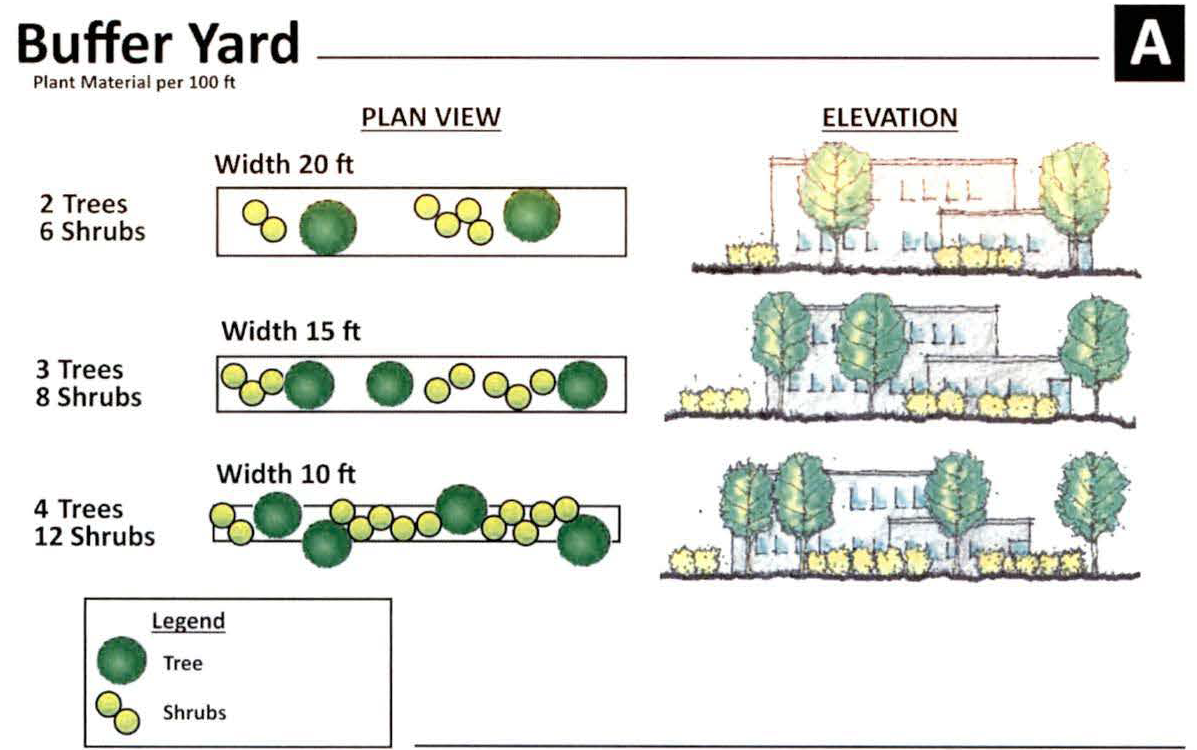
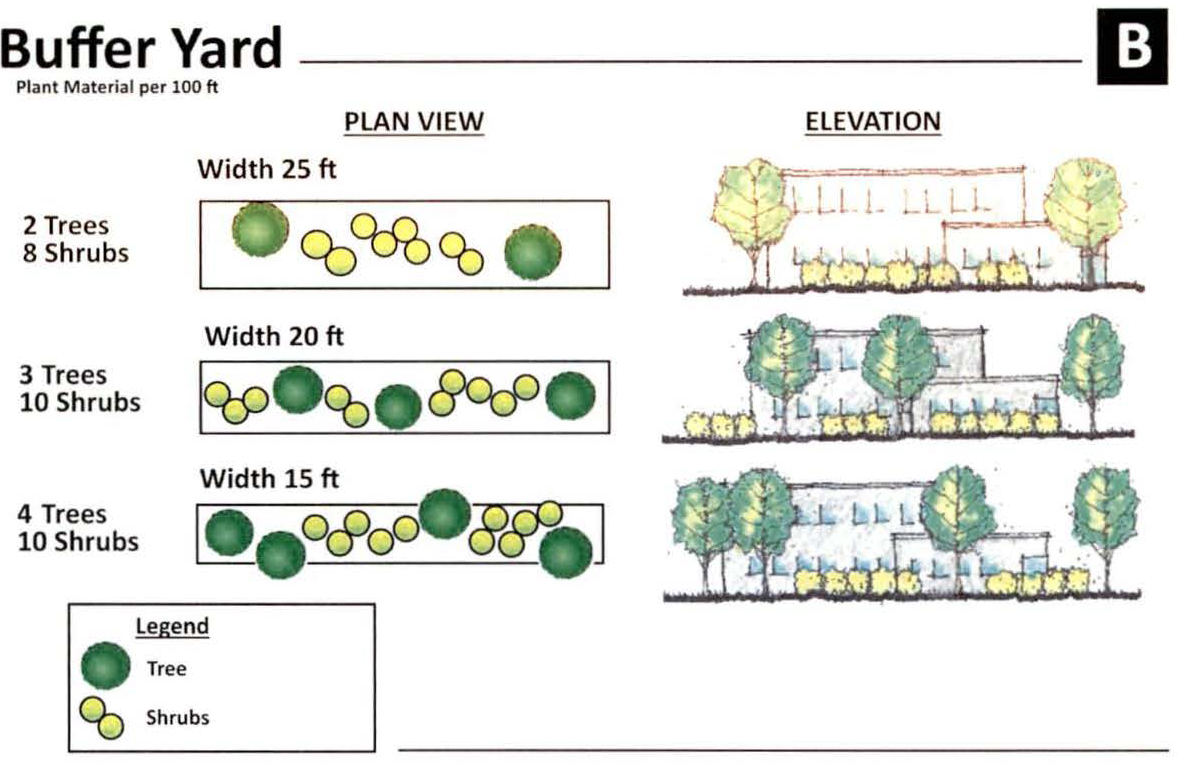
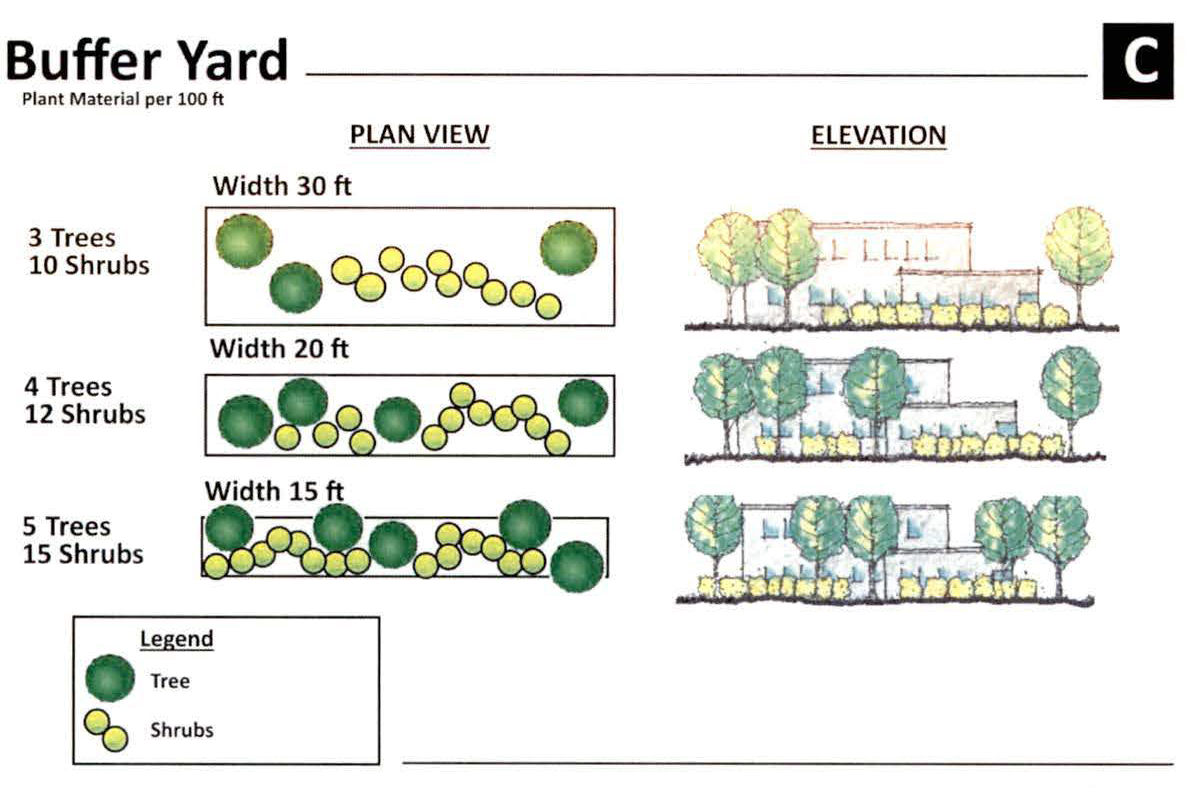
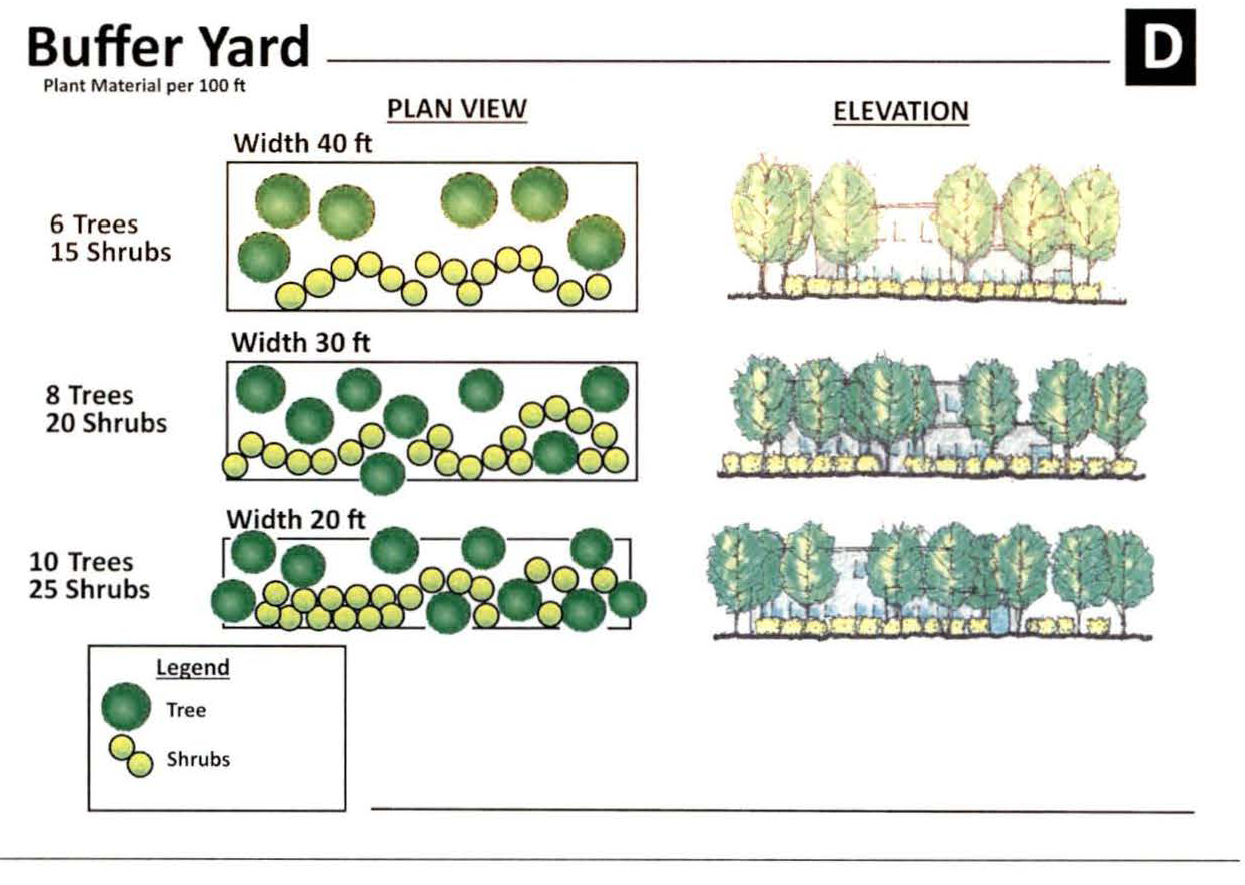
(Ord. No. 21-22-12, § 4)
Editor's note— Ord. No. 21-22-12, § 4, adopted January 18, 2022, set out provisions intended for use as § 12.11.105.4. Inasmuch as there were already provisions so designated, said section has been codified herein as § 12.11.105.4A at the discretion of the editor.
Section 12.11.105.5. - Buffer yards, utilities and utility easements.
Utility easements in a buffer yard do not prohibit the planting of shrubs in the area of the easement of an underground utility, but no tree shall be planted within 12 feet of a buried utility. Large and medium sized trees, as identified in Table 12.11.108.A. and Table 12.11.108.B. should not be planted closer than 15 feet to any required light pole.
Figure 12.11.105.5.A Planting Distance from Power Lines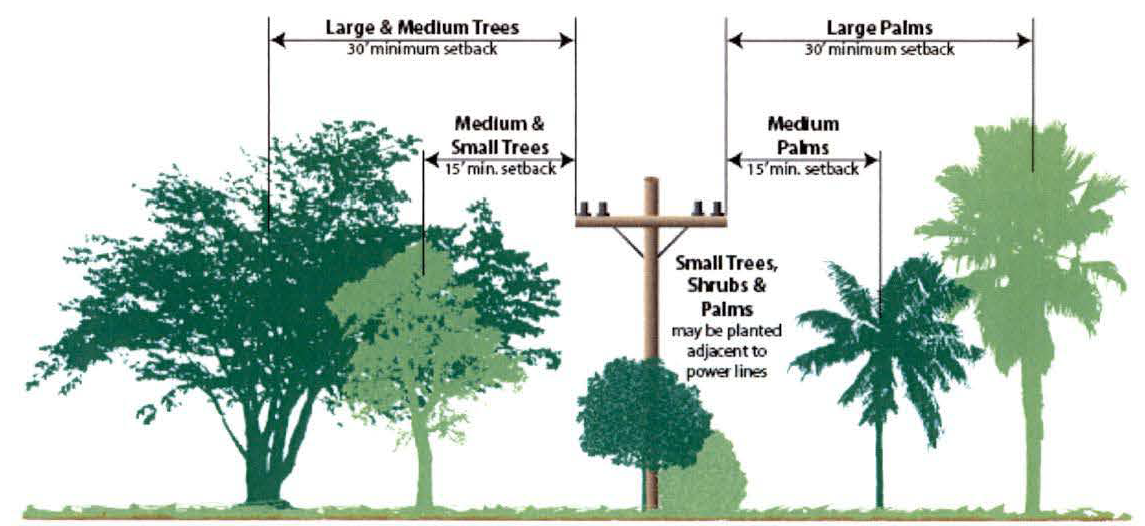
(Ord. No. 21-22-12, § 4)
Section 12.11.106. - Installation, irrigation, inspection, certificate of occupancy/completion and maintenance.
All plants shall be "Florida Grade No. 1" or better, shall be healthy and free of diseases and pests, and shall be of nursery stock in two-gallon containers or larger or field trees of comparable size. Field grown trees shall be balled and burlapped and heeled in or hardened off.
A.
Installation.
1.
All canopy and buffer yard trees shall be provided a minimum of 160 cubic feet of rootzone volume. Where existing conditions preclude the provision of the minimum rootzone volume, the county may approve a lesser volume that meets the arboriculture needs of the tree within the existing conditions.
2.
The developer shall provide an appropriate planting soil medium for required plants and shall irrigate plant materials to sustain healthy growth of all plants to maturity.
3.
Areas on any development site not used for buildings, paved surfaces, or landscape improvements shall be sodded or seeded prior to the issuance of a certificate of occupancy/completion.
4.
Areas within public rights-of-way, and areas off-site which have been disturbed by construction activity, shall be cleaned of all debris, re-graded to the proper elevations, and so as to restore the area to a stabilized and planted state.
5.
Utility and landscaping compatibility.
a.
General. Lighting fixtures; transformer boxes; fire hydrants; power, cable television or telephone lines; sewer or water pipes; or any other existing or proposed utility facilities and associated appurtenances, shall be located and designed to provide adequate service in the presence of landscape materials when such landscape reaches maturity. Reasonable efforts shall be made to install utility service without impacting existing trees. Lighting fixtures shall be located a minimum of 10 feet from all required shade trees. No shade tree that exceeds 40 feet in height at maturity shall be placed within 15 feet of any overhead utility. Fire hydrant connections and building fire connections shall not be obstructed by plant material. Shrubs and ground cover 12 inches or less in height, provided in Tables 12.11.108.E. through 12.11.108.H., be planted to soften the visual impact of these facilities, provided that the necessary access to such facilities is maintained.
b.
Underground utility lines shall not be located within the rootzone volume of an existing or proposed tree, except for those lines that are two-inch diameter or less, and then only where the utility separation requirements in subsection c. below are met.
c.
Minimum utility separation requirement. A minimum of seven and one-half feet is required between new trees and existing or proposed water lines, wastewater force main, reclaimed water, gas, electric and telecommunications main and service utility lines, to protect against root incursion. A minimum separation requirement of 10 feet is required between new trees and existing or proposed wastewater gravity collection mains and laterals. Reduced separation distances to three and one-half feet may be allowed at the discretion of the utility company. In these instances the utility company may require one of the following measures to protect the utility lines, in accordance with the standards established by the utility company:
(1)
Compaction of the soil immediately adjacent to the underground lines to 98 percent proctor density from the utility line to within 12 inches of ground surface;
(2)
Encasing the utility line with excavatable flowable fill. Steel casing, or other acceptable methods;
(3)
Wrapping the utility line with an herbicide-impregnated geo-textile bio-barrier cloth;
(4)
Protecting the utility line with structural barriers of cast-in-place or pre-cast concrete panels, steel or high-density plastic sheet-pile barriers; or
(5)
Steel casing, installed in accordance with standards established by the utility company.
6.
Irrigation of cultivated landscapes.
a.
No irrigation system shall be required where existing natural plant communities are maintained.
b.
All new cultivated landscaped areas shall be provided with an automatic water efficient conservation irrigation system, consistent with the needs of the plants contained therein and designed and installed to meet the requirements of this section. The system shall provide coverage of any landscaping strips within the public right-of-way (i.e., area between sidewalk and curb of roadway/edge of pavement) as measured between the side property lines. Coordination with the Florida Department of Transportation (FDOT) for a right-of-way permit is required for such areas located within FDOT maintained rights-of-way.
7.
Irrigation system requirements.
a.
An irrigation system shall be designed to provide 100 percent head-to-head coverage of all landscape areas minimizing over spraying onto impervious surfaces including pavement, vehicular or pedestrian areas, and/or adjacent properties.
b.
Sprinkler heads irrigating lawns or other high-water demand areas shall be circuited so that they are on a separate zone or zones from those irrigating trees, shrubbery, groundcover, flowers, or other reduced water requirement areas. Head placement shall provide 100 percent head-to-head coverage. Automatically controlled irrigation systems shall be operated by an irrigation controller that is capable of watering high water requirement areas at different frequencies and durations than low water requirement areas. Landscaping shall be watered on an "as needed" basis only, or as allowed by the rules of the appropriate water management district.
c.
Irrigation systems shall be designed for the zoning of high and low water demand areas and based on head type. These requirements may be adjusted for retention areas. The irrigation systems shall be designed and installed in accordance with the Florida Irrigation Society, Standards and Specifications for Turf and Landscape Irrigation Systems, as amended from time to time. Irrigation systems utilizing well water should be designed and maintained in a manner which minimizes staining of buildings, walks, walls, and other site improvements. All systems shall be designed to minimize the application of water to impervious areas.
d.
Irrigation pipes shall be Schedule 40 or Class 315 solvent weld-type PVC pipe for mains or piping under roadways. Class 125 pipe is not permitted for mains or under roadways. IPS Flexible PVC Pipe may be substituted for rigid PVC pipe below grade in lateral lines only to avoid underground obstructions encountered during trenching or tunneling. Above grade pipes shall be a minimum of Schedule 40. PVC fittings must be of the same chemical compound as pipe on which they are installed. PVC cement must be of an appropriate chemical compound for the pipe on which it is used.
e.
Reclaimed or other non-potable water source shall be used for irrigation if available and adequate.
f.
A rain sensor or other approved device, such as a soil moisture sensor, shall be required on automatic irrigation systems to avoid irrigation during periods of sufficient rainfall. Said equipment shall consist of an automatic sensing device or switch, which will override the irrigation cycle of the sprinkler system when adequate rainfall has occurred. To avoid false readings, the device must be placed where it is exposed to unobstructed natural rainfall and shall not be installed over or within five feet of the edge of either an air conditioner compressor or pool heater unit.
g.
Installers of irrigation systems shall provide property owners and users with the following post-construction documentation, including but not limited to: Recommended maintenance activities and schedules, operational schedule, design precipitation rates, instructions on adjusting the system to apply less water after the landscape is established, maintenance schedule, water source, water shut-off method, warranty information and the manufacturer's operational guide.
h.
Inspection and certificate of occupancy/completion. A signed and sealed "as-built" plan and certification of completion shall be submitted to the county and signed off prior to the issuance of a certificate of occupancy/completion. The county shall inspect the landscaping installation to ensure that it is in conformance with the requirements set forth in this section and with the approved landscape plan. The irrigation system shall be operational at the time of inspection.
8.
Maintenance.
a.
Landscape areas shall be maintained and kept in good, living condition so as to present a healthy, neat and orderly appearance and shall be kept free from weeds, refuse and debris, following issuance of a certificate of occupancy.
b.
Irrigation systems shall be maintained and in operating condition so as to properly irrigate required landscape areas in accordance with the approved landscape and irrigation plans, following issuance of a certificate of occupancy.
c.
Dead plants and trees shall be replaced to conform with the approved landscape plan. Such plants and trees shall be replaced with the same or similar variety of species within 30 days from the date of official notification. Any shrubs, ground covers, grasses and mulching that may have been removed or disturbed as part of the replanting shall also be replaced using the same or similar variety of species.
d.
Vegetation required by this division shall only be pruned to promote healthy, uniform, natural growth of the vegetation in accordance with Pruning Standards of the National Arborist Association. Trees and shrubs shall not be severely pruned in order to permanently maintain growth at a reduced height or spread. Pruning shall not interfere with the design intent of the original installation.
e.
If a landscape restoration plan is presented and differs from the original approved landscape plan, three copies of such landscape restoration plan shall be submitted and approved by the county. The county shall re-inspect the property for compliance after the restoration is complete.
f.
Maintenance violations shall be subject to penalty in accordance with this section.
(Ord. No. 21-22-12, § 4)
Section 12.11.107. - Violations and penalties.
Failure to maintain landscaping and irrigation systems consistent with the approved landscape and irrigation plans shall constitute a violation subject to penalties and shall be subject to code enforcement action by the county.
(Ord. No. 21-22-12, § 4)
Section 12.11.108. - Recommended plant species list.
Plants species identified in this section include Florida Friendly native and non-native plants. The recommended species lists have been developed using the Florida Friendly Landscaping Guide to Plant Selection and Landscape Design published by the University of Florida/Institute of Food and Agricultural Sciences (UF/IFAS), Florida Friendly Landscaping Program. The species identified in these lists have been carefully selected, based on cold hardiness zone tolerance and those species conducive to the naturally occurring habitats found in the Greater Lake Placid region. "Right Plant, Right Place" should govern the selection of plant species for a given site, bearing in mind soil, light, water, proximity to power lines (see Figure 12.11.105.5.A), and other site-specific conditions.
Any new plant material, which will serve to meet the county's minimum landscape requirements, shall be selected from the following plant species tables. The county may approve an applicant's request to use a plant species not included in the following tables if the applicant provides the relevant information as included in the tables for said species.
In calculating canopy requirements, each existing tree to be preserved, and each new tree to be planted shall be credited with its mature canopy, as provided in this section. If an on-site preserved tree is not listed as an invasive plant in the most recent invasive plant list of the Florida Exotic Pest Plant Council, and its actual canopy exceeds the canopy area identified in this section, the greater canopy area may be used in calculating canopy coverage.
Table 12.11.108.A
Large Trees
Key:
Type: D = Deciduous, E = Evergreen
Soil type: WD = Well drained, M = Medium drained, W = Wet, A = All types
Light: S = Shade, P = Partial shade, F = Full Sun
P/L: Minimum distance from power lines ( * see Figure 12.11.105.5.A)
Table 12.11.108.B
Medium Trees
Key:
Type: D = Deciduous, E = Evergreen
Soil type: WD = Well drained, M = Medium drained W = Wet, A = All types
Light: S = Shade, P = Partial shade, F = Full Sun
P/L: Minimum distance from power lines ( * see Figure 12.11.105.5.A)
Table 12.11.108.C
Small Trees
Key:
Type: D = Deciduous, E = Evergreen
Soil type: WD = Well drained, M = Medium drained, W = Wet, A = All types
Light: S = Shade, P = Partial shade, F = Full Sun
P/L: Minimum distance from power lines ( * see Figure 12.11.105.5.A)
Table 12.11.108.D
Palms Trees and Palm-Like Plants
Key:
Soil type: WD = Well drained, M = Medium drained, W = Wet, A = All types
Light: S = Shade, P = Partial Shade, F = Full Sun
Drought Tolerance: H = High, M = Medium, L = Low, N = None
P/L: Minimum distance from power lines ( * see Figure 12.11.105.5.A)
Table 12.11.108.E
Large Shrubs
Key:
Soil type: WD = Well drained, M = Medium drained, W = Wet, A = All types
Light: S = Shade, P = Partial shade, F = Full Sun
Drought Tolerance: H = High, M = Medium, L = Low, N = None
Table 12.11.108.F
Small Shrubs
Key:
Soil type: WD = Well drained, M = Medium drained, W = Wet, A = All types
Light: S = Shade, P = Partial shade, F = Full Sun
Drought Tolerance: H = High, M = Medium, L = Low, N = None
Table 12.11.108.G
Ground Covers
Key:
Soil type: WD = Well drained, M = Medium drained, W = Wet, A = All types
Light: S = Shade, P = Partial shade, F = Full Sun
Drought Tolerance: H = High, M = Medium, L = Low, N = None
Table 12.11.108.H
Lawn Grass Species
Source: "Selecting a Turf Grass for Florida Lawns," University of Florida IFAS Extension (ENHO4, 2007).
(Ord. No. 21-22-12, § 4)
Section 12.11.200. - Purpose and intent.
The BCC recognizes that the establishment of properly landscaped and well-maintained areas can reduce the potential incompatibility of adjacent land uses, help to preserve the environment and natural resources, protect established neighborhoods, enhance the aesthetic quality of the county, maintain open space, promote water conservation and energy efficiency, reduce stormwater runoff, contribute to air purification, reduce impacts of natural disasters, and provide essential habitat for various species. The purpose of this division is to minimize the negative impacts of adjacent uses and zoning districts through the provision of landscaped buffers. These buffers are meant to reduce nuisances including dirt, litter, noise, odors, lights, and unsightly buildings, structures, and off-street parking areas. In addition, this division is meant to establish guidelines for the management of landscaped areas which are healthy, environmentally responsible, and resilient to natural disasters, such as high-wind events, droughts, flooding, and wildfire.
(Ord. No. 12-13-12, § 18)
Section 12.11.201. - Applicability.
A.
Except as otherwise provided in this section, the landscaping and buffer requirements as set out in this division shall apply to all public and private land in the unincorporated area of the county with the exception of the Greater Lake Placid Planned Vision Overlay area described in Policy 12.1 of the Future Land Use Element of the Highlands County 2030 Comprehensive Plan.
B.
The regulations as set out in this division for landscaping and buffers do not apply to single-family, duplex, or manufactured home dwellings on a single lot or parcel, or agriculture buildings where no paved parking is required, with the exception of the prohibited plant species listed in this division.
C.
The provision of required buffers, as specified in this division, is the minimum standard. None of the provisions of this division shall be construed as prohibiting additional plant material or buffer area above that required by this division; or prohibiting the modification of existing landscaped buffers to perform to an equivalent degree as the buffer required by this division.
D.
The following categories are required to be landscaped under this division:
1.
Transitional buffers, including street buffers, project boundary buffers and parking buffers;
2.
Vehicular surface areas;
3.
Shopping centers or freestanding retail establishments; and
4.
Littoral zones.
(Ord. No. 12-13-12, § 18)
Section 12.11.202. - General design principles and standards.
A.
Florida-friendly landscape principles. Applicants are encouraged to utilize Florida-friendly landscaping principles.
B.
Existing plant communities. Protection of existing native species of plant material shall be maximized, wherever possible.
1.
The county engineer may adjust the application of the standards of this division to allow credit for the use of existing healthy, native plant material, provided the required percentages of a landscaped area and the numbers of trees or shrubs required are not reduced, unless otherwise allowed within this section.
a.
Credits for existing trees shall be given according to the following table. Fractional measurements shall be attributed to the next lowest category. Species which qualify for credits to meet the minimum tree planting requirements shall be those listed in subsection G. of this section and shall be credited to the total of the corresponding tree requirement (canopy, accent, palm or substitute).
b.
No credit shall be given for existing plant material which:
i.
Is a prohibited species as identified in this division; or
ii.
Is dead, dying, diseased, or infested with harmful insects.
c.
Credit may be permitted for existing plant material located on-site but not located within the areas of the property where landscaping is required by this division. In such instances, one-half credit may be given towards the required plant material, but credits shall not exceed 50 percent of the total plant material required.
d.
Credit may be permitted for existing plant material on adjacent property, provided such plant material is in a permanently protected area, including, but not limited to:
i.
A conservation easement or protected area on adjacent property; or
ii.
An existing county-approved landscape buffer on adjacent property. In this instance, credit may be given for existing plant material and buffer width.
2.
Where existing plant communities are being maintained in a natural state, irrigation shall not be required. Native plant areas that are supplements to an existing plant community or newly installed by the developer shall be irrigated on a temporary basis until adequately established using a temporary irrigation system, water truck, or by hand watering.
3.
During construction, all reasonable steps necessary to prevent the destruction or damaging of existing vegetation to be protected shall be taken. No excess soil, additional fill, equipment, liquids, or construction debris, shall be placed within the drip line of trees or within the footprint any vegetation that is required to be protected, or that will be credited towards the required landscaping.
4.
Protective barriers shall be installed and maintained at or beyond the drip line of the trees and the footprint of any vegetation being retained, and shall remain in place for the duration of the construction phase.
C.
Irrigation of cultivated landscapes. Cultivated landscape areas shall be provided with an automatic irrigation system. Automatic irrigation systems shall be designed and installed as follows:
1.
Sprinkler heads irrigating lawns or other high water demand areas shall be circuited so that they are on a separate zone (or zones) from those irrigating trees, shrubbery, groundcover, flowers, or other reduced water requirement areas. Head placement shall provide 100 percent head-to-head coverage. Automatically controlled irrigation systems shall be operated by an irrigation controller that is capable of watering high water requirement areas at different frequencies and durations than low water requirement areas. Landscaping shall be watered on an "as needed" basis only, or as allowed by the rules of the appropriate water management district.
2.
Irrigation systems shall be designed for the zoning of high and low water demand areas and based on head type. These requirements may be adjusted for retention areas. The irrigation systems shall be designed and installed in accordance with the Florida Irrigation Society, Standards and Specifications for Turf and Landscape Irrigation Systems, current edition. Irrigation systems utilizing well water should be designed and maintained in a manner which minimizes staining of buildings, walks, walls, and other site improvements. All systems shall be designed to minimize the application of water to impervious areas.
3.
All driveway and sidewalk crossings shall be placed in an adequate sized sleeve.
4.
Reclaimed or other non-potable water source shall be used for irrigation if available. For the purposes of this subparagraph, available shall mean where adequate pressure and volume exist to support the proposed irrigation system.
5.
A rain sensor or other approved device, such as a soil moisture sensor, shall be required on automatic irrigation systems. To avoid false readings, the device must be placed where it is exposed to unobstructed natural rainfall.
D.
Safe sight distance triangles. Landscaping shall comply with requirements of section 12.09.103 of this Code concerning clear visibility triangles.
E.
Sodding of public right-of-ways. All sodded areas in a public right-of-way disturbed by development construction shall be completely re-sodded with a like kind and variety of sod.
F.
Plant selection. All plant material required by this division shall meet the standards listed in this section.
1.
All plant material shall be Florida Grade No. 1 or better in accordance with the most recent edition of Grades and Standards for Nursery Plants (GSNP), published by the State of Florida, Department of Agriculture and Consumer Services. Nursery stock shall meet minimum requirements of the American Standards for Nursery Stock (ASNS), published by the American Nursery and Landscape Association.
2.
All plant material shall be sound, healthy and vigorous, and free from mutilation, plant diseases, fungus, and insect pests or their eggs. Plant material shall have healthy, normal root systems. Plants shall be nursery grown stock in containers or field grown, balled and burlapped.
3.
Caliper measurement, height measurement, height relation to caliper spread, bare foot and ball dimensions, number of canes, types of vines and groundcovers, etc., shall conform to the applicable standards given in the ASNS.
4.
Vines shall be of a size reasonably expected to become a minimum of 30 inches high one year after planting. Vines may be used in conjunction with walls and fences to meet the minimum screening requirements of reduced-width transitional (Alternative 3) buffers specified in Section 12.11.203.C.
5.
Landscape plans shall be reviewed to ensure plant material:
a.
Is appropriate to the conditions in which it is to be planted, including cold-hardiness and drought-tolerance;
b.
Has non-invasive growth habits;
c.
Is suitable for the site with regards to eventual size and spread and given consideration of conflicts which might arise (i.e., views, signage, overhead power lines, lighting, circulation, etc.);
d.
Encourages low maintenance; and
e.
Is otherwise consistent with the intent of this division.
6.
Plant material required by this division shall be chosen from the recommended plant species listed in this section. Plant materials that vary from the lists provided in this section may be used with the approval of the county engineer.
G.
Recommended plant material. The following are lists of recommended canopy trees, accent trees, palm trees, substitute trees, and shrubs:
1.
Canopy trees. The following trees shall count as one canopy tree toward the total number required. Canopy trees shall have a minimum of two inch caliper trunk at the time of installation. The following species are recommended canopy trees:
2.
Accent trees. The following trees shall count as one accent tree toward the total number required. Accent trees shall have a minimum of one and three-quarter-inch caliper trunk at the time of installation. The following species are recommended accent trees:
3.
Palm trees. The following trees may be substituted for up to thirty (30) percent of the requirements for canopy trees or accent trees based on the following equivalents: A grouping of three or more palm trees shall be considered the equivalent of one canopy tree, and a group of two palm trees shall be considered the equivalent of one accent tree. Palms shall have a minimum of ten feet of clear trunk at the time of installation. The following species are recommended palm trees:
4.
Substitute trees. The following trees may be substituted for up to 20 percent of the requirements for canopy trees or accent trees. Substitute trees shall have a minimum of two-inch caliper trunk at the time of installation. The following species are recommended substitute trees:
5.
Shrubs. The following shrubs shall count as one shrub toward the total required. Shrubs shall be grown in a three gallon container at the time of installation. Shrubs shall be of a species that, under average conditions, will reach a minimum height of 36 inches in height within 12 months of time of planting. When planted as a hedge, shrubs shall be planted in double-staggered rows and maintained so as to form a continuous, unbroken, solid visual screen within one year after time of planting. The following species are recommended shrubs:
H.
Prohibited plant material. The following plant species are prohibited from use as live landscaping materials, and the importation, transportation, propagation and planting of these plant materials in the county is a violation of the land development regulations. The following species are prohibited:
I.
Mixed genera of trees. Where more than 20 canopy or accent trees are required to be planted on a site to meet the requirements of this division, a mix of genera shall be provided in accordance with Table 6.
J.
Mulches. A layer of organic mulch that is a minimum two inches, after watering-in, and a maximum three inches shall be placed and maintained around all newly installed trees, shrubs, and ground cover planting. The trunk of all trees shall be kept dry and open to the air by keeping it free from direct contact with mulch. When located in the wildland urban interface, mulches should be kept moist and away from other flammable ground cover.
K.
Groundcover. Non-landscaped areas within required landscape buffers shall be provided with turf or groundcover as described in this section. Groundcover, other than grass, shall be installed in a manner which presents a finished appearance and reasonably complete coverage within one year after installation. Stone, gravel or any artificial cover shall not be utilized for more than 20 percent of the landscaped area. When located in the wildland urban interface, a higher percentage of stone or gravel may be permitted with the approval of the county engineer.
L.
Turf areas. Non-landscaped areas within required landscape buffers shall be provided with turf or groundcover as described in this section. Turf areas shall be planted with species normally grown in permanent lawns common to the area. Turf areas may be sodded, plugged or seeded provided solid sod shall be used in swales or other areas subject to erosion and provided further, in areas where other than solid sod or grass seed is used, nurse-grass seed shall be sown for immediate ground coverage until permanent coverage is achieved.
M.
Berms. Berms may be incorporated into transitional buffers provided the following:
1.
All slopes must be fully stabilized and landscaped with turf or plant material.
2.
If turfed, berms shall have side slopes no greater than 4:1.
3.
If planted with groundcover and other plant material, berms shall have side slopes no greater than 3:1.
4.
Existing plant material to remain shall be incorporated into the berm.
N.
Easements. Planting in easements is restricted as follows:
1.
Required fencing or landscaping, other than turf, shall not be placed within easements without written approval from the county engineer and all persons claiming an interest under said easement.
2.
Required landscaping shall not be placed where it interferes with site drainage, subsurface utilities, or overhead utility lines or where they shall require frequent pruning in order to avoid interferences with overhead power lines.
(Ord. No. 12-13-12, § 18)
Section 12.11.203. - Transitional buffer requirements.
A.
In general. This section establishes the minimum requirements for three types of transitional buffers that may be required on any given development site: street buffers, project boundary buffers and parking buffers. The following applies to all required buffers:
1.
Buffers shall be located on the outer perimeter of a lot or parcel, parallel to and extending to the lot or parcel boundary line. Buffers shall not be located on any portion of an existing, dedicated or reserved right-of-way, not to include easements as specified in Section 12.11.202.N.
2.
Driveway widths shall not be counted towards the calculation of the required plant material.
3.
If an unbuilt street is platted, it shall be buffered and treated as a street, even where no pavement currently exists.
4.
All buffers shall be measured from the future right-of-way line determined during site and development plan review.
5.
Where either the principal property or adjacent property lies in more than one zoning district, the transitional buffer type shall be determined by the requirements of this section as though the zoning district line were a property line.
6.
A transitional buffer will not be required at a zoning district line in the interior of a project site for the purpose of meeting the requirements of this section. When a transitional buffer at the zoning district line would bisect the property and limit its use, the transitional buffer may be constructed at the property line as if the zoning district line were at the property line. The more stringent type of transitional buffer required shall govern at the property line, based on either the interior zoning district line or the property line. In no case will that part of the property having a different zoning designation be considered a buffer to allow a less stringent regulation to control the type of transitional buffer required.
7.
While the buffer width is normally calculated as parallel to the property line, design variations are allowed and are calculated on the average width of the buffer per 100 feet or portion thereof. Minimum depth of buffer in any case shall not be less than one-half the required width of the buffer, or less than five feet, whichever is greater. Maximum width for the purposes of installing required landscaping, or receiving credit for existing vegetation, shall not be more than two times the required depth of the buffer chosen.
8.
The quantities of plant material for street buffers and transitional buffers listed in this section are required per 100 feet or portion thereof. Fractional plant material requirements shall be rounded up to the next whole number.
9.
Transitional buffers will not be required adjacent to a stream, lake or wetland.
10.
As a transitional buffer matures, it is anticipated that accent trees and shrubs may not survive the shading by canopy trees. Where canopy trees within existing transitional buffers have matured to sufficiently meet the intent of this section, replacement of such accent trees and shrubs shall not be deemed necessary.
11.
Water management systems, which shall include retention and detention areas, swales, and subsurface installations, shall be permitted within a required buffer provided they are consistent with accepted engineering and landscaping practices and the following criteria:
a.
Trees and shrubs shall be installed at least five feet away from the toe of the slope of a swale.
b.
Existing trees may remain in dry retention ponds provided that the natural grade is undisturbed to the tree line, they are a species adapted to seasonal flooding and the pond is adequately maintained.
c.
Water management systems shall not utilize more than 50 percent of the square footage of any required side, rear or front yard landscape buffer;
d.
Water management systems shall not exceed, at any location within the required side, rear or front transitional buffer, 70 percent of the required buffer width; and
e.
Exceptions to the standards listed in this subsection may be granted by the county engineer on a case by case basis, evaluated on the following criteria:
i.
Water management systems, in the form of dry retention, may utilize an area greater than 50 percent of the transitional buffer when native vegetation is retained at natural grade.
ii.
For lots of record 10,000 square feet or less in size, water management areas may utilize an area greater than 50 percent of the required side and rear yard buffers; a level planting area of at least three feet in width shall be provided in such buffers.
12.
Sidewalks and other impervious areas such as fountains, park benches, lighting, sculptures, gazebos or other similar items that the county engineer deems appropriate may be incorporated into a required transitional buffer. However, the width of the sidewalk or other impervious area does not count towards the required buffer width. Driveways and sidewalks constructed perpendicular to the buffer and providing direct access across the buffer to a parcel are allowed.
13.
Nothing contained in this section shall reduce the minimum requirements of any other buffers required by this division.
14.
Where a solid masonry wall is used to meet the reduced-width project boundary buffer requirements of this section, the masonry wall shall be of the same or compatible with the material and color of the principal building, in terms of texture and quality. The improvement plan or final site plan shall contain a cross section, a plan view and construction details of the wall, including finish and color, both interior and exterior, and an explanation of the compatibility determination. For reduced-width buffer Types A and B, an eight-foot wall shall be required. For reduced-width buffer Types C and D, a six-foot wall shall be required. The exterior face of a wall shall be a minimum of three feet from the property boundary to allow for maintenance.
B.
Street buffers. Street buffers are required for developments adjacent to any road right-of-way, including internal roads of the development project. The type of buffer required shall be based on the functional classification of the street at the time of development as determined by the adopted Comprehensive Plan Existing Functional Classification Map. See Table 7 for determining the type of transitional buffer required for a street. Alternative 3 must be used when overhead utilities are present.
C.
Project boundary buffers. The type of transitional buffer required for a project boundary is determined by the zoning designations of the principal property and the adjacent property. See Table 8 to determine the type of transitional buffer required for a project and refer to Table 9 to determine the minimum requirements for each type of transitional buffer. Table 8 shall be interpreted as follows:
1.
The required type of transitional buffer for a project boundary is represented in the table by two letters. These letters correspond to the buffer requirements found in Table 9.
2.
The second letter represents the total required buffer between any two properties.
3.
Where the proposed project is located adjacent to vacant property, the first letter represents the project's required buffer.
4.
Where the adjacent property is already developed with no buffer, the proposed project is responsible for meeting the total required buffer (the second letter).
5.
Where the adjacent property is already developed with a partial buffer, the proposed project is responsible for meeting the remaining buffer requirements to establish a transitional buffer equivalent to the total required buffer (the second letter).
6.
The "-" symbol indicates that no transitional buffer is required.
7.
The "*" symbol indicates that the required transitional buffer will be determined at the time of rezoning as written in the adopting resolution or prior to improvement plan or site plan review. For the purpose of determining the transitional buffer requirement, it will be assumed that the zoning categories for the proposed development and adjacent developments are the zoning categories where the uses would normally be permitted.
Within Table 9, three alternatives are provided to allow for flexibility in design. The reduced-width transitional buffer (Alternative 3) includes a solid masonry wall per section 12.11.203.A.14., in addition to the buffer requirements listed in Table 9.
D.
Parking buffers. Whenever a parking area, vehicular surface area, equipment display area, or storage or display area for new or used motorized vehicles for sale or rental lies within 50 feet of and is visible from any street right-of-way, the required buffer shall include a continuous evergreen hedge three feet in width for the entire linear extent of the parking area. At the time of installation, the hedge plant material shall meet the minimum requirements for shrubs as set forth in section 12.11.202.G.5. This buffer may be placed within a required street buffer.
(Ord. No. 12-13-12, § 18; Ord. No. 14-15-07, §§ 8, 9)
Section 12.11.204. - Vehicular surface area landscaping.
A.
Applicability. All vehicular surface areas as defined in section 12.02.104 must be landscaped in accordance with this section.
B.
Location and design. Interior landscaped planting areas shall be located either within or adjacent to the parking area as tree islands, at the end of parking bays, or between rows of cars. All interior landscaped plantings shall meet the following minimum requirements:
1.
Landscaped areas, wall structures and walks shall require protection from vehicular encroachment through appropriate wheel stops, curbs, or other structures. The width of all curbing shall be excluded when calculating the required landscape area.
2.
The total on-site interior landscape area shall equal or exceed ten percent of the total vehicular surface area as defined by this subsection.
3.
On an overall average, one canopy tree shall be provided for every 250 square feet of required interior landscaped area (excluding the parking island requirements).
4.
All rows of parking spaces shall contain no more than ten parking spaces within each parking bay, and parking bays in sequence shall be interrupted by a required landscaped island which shall be a minimum of eight feet in width and the full depth of the parking space, excluding curbs.
5.
At least one canopy tree shall be planted in each island for each bay, and two canopy trees shall be planted within the extended island when parking bays are opposite one another. These tree requirements shall be met with existing native trees whenever such trees are located within the parking area and may be feasibly incorporated into the landscaping. Where islands are adjacent to a building, accent trees may be used.
C.
Vehicular overhang of landscaped areas. The front of a vehicle may overhang any landscaped area a maximum of two feet, provided the landscaped area is protected by motor vehicle wheel stops or curbing. Two feet of such landscaped area or walkway may be part of the required depth of each abutting parking space. Walkways shall be a minimum of seven feet in width if a vehicle is to overhang the walkway. Whenever a planting area is created by using a continuous curb as a wheel stop, one of the following may apply:
1.
An additional three feet (or five feet overall) shall be required for the width of the planting area when abutting a fence.
2.
An additional five feet (or seven feet overall) shall be required for the width of the planting area when abutting a building.
3.
An additional three feet (or seven feet overall) shall be required for the width of the planting area when there is an opposite parking bay.
(Ord. No. 12-13-12, § 18)
Section 12.11.205. - Shopping centers or freestanding retail establishments.
A.
In general. An area that is at least seven percent of the size of the vehicular surface areas shall be developed as green space within the front yard or courtyard of any shopping center or freestanding retail establishment with a floor area of 40,000 square feet or greater. Green space shall be labeled as such on all improvement plans and site plans. Green space, as used herein, shall be considered areas designed for environmental, scenic or non-commercial recreation purposes and shall be pedestrian-friendly and aesthetically-pleasing. Green space shall comply with the following:
1.
Green space may only include the following: landscaped areas, natural areas, fountains, manmade water courses (but not water retention areas), park benches, site lighting, sculptures, gazebos, and any other similar items that the county engineer deems appropriate.
2.
Green space shall include:
a.
Walkways within the interior of the green space area not used for shopping; and
b.
A minimum of one tree for each 250 square feet of green space area.
3.
Green space areas shall be located in areas that are in close proximity to the retail shopping area.
(Ord. No. 12-13-12, § 18)
Section 12.11.206. - Littoral zones.
All developments that create lake areas shall provide littoral zone planting of emergent, aquatic vegetation in accordance with the appropriate water management district regulations.
(Ord. No. 12-13-12, § 18)
Section 12.11.207. - Landscape management.
A.
Designated responsible entity. The responsible entity for maintaining all required plant material in good health shall be designated on the landscape and irrigation plans.
B.
Maintenance. Required landscaped areas shall be properly maintained in accordance with this section, Florida-friendly landscape principles, and firewise landscape principles. Failure to maintain plantings and other features of a required landscaped area in a healthy state shall be considered a violation of the land development regulations and subject to enforcement as provided for herein. The following applies to all required landscaping:
1.
Any dead, unhealthy or missing plants shall be replaced within 60 days of notification with vegetation which conforms to the initial planting standards of this division. In the event that plant material is severely damaged due to an unusual weather occurrence or other act of God, the responsible entity shall have six months to replant.
C.
Pruning. Vegetation required by this division shall only be pruned to promote healthy, uniform, natural growth of the vegetation in accordance with Pruning Standards of the National Arborist Association. Pruning shall conform to the following:
1.
Trees and shrubs shall not be severely pruned in order to permanently maintain growth at a reduced height or spread.
2.
Pruning shall not interfere with the design intent of the original installation.
3.
Where a property is located in the wildland urban interface, pruning of trees which extend to a roof is encouraged, including the removal of dead and diseased branches from trees.
D.
Irrigation system maintenance. Irrigation systems shall be maintained in operational condition and in accordance with approved plans.
(Ord. No. 12-13-12, § 18; Ord. No. 13-14-02, § 32)
Section 12.11.208. - Administration and enforcement procedures.
A.
Landscape plan. Prior to the approval of any improvement plan or final site plan or issuance of a final development order, an applicant whose development is covered by the requirements of this division shall submit a landscape plan to the county engineer for approval.
1.
The landscape plan shall:
a.
Be drawn at a scale no smaller than one inch equals 30 feet on sheet size 24 inches by 36 inches, unless otherwise approved in advance by the county engineer, and include dimensions, north arrow, date, title, and project owner's name;
b.
Delineate the existing and proposed parking, vehicular surface areas, buildings, access points, and roadways;
c.
Show all utility lines and easements;
d.
Show the location of existing and proposed planting areas and vegetation communities and designate them by species name;
e.
Show the location of permanent vegetation protection devices, such as barricades, curbing, and tree wells;
f.
Show the landscaping required by this division, and any additional landscaping;
g.
Show location of any water bodies or water courses;
h.
Include a chart indicating graphic plant symbol, botanical and common name, quantity, height, spread, spacing, native status, drought tolerance rating, and type of mulch that will be used;
i.
Include calculations showing how the requirements for the vehicular surface areas and transitional buffers have been determined;
j.
Show the zoning classification of all adjoining property;
k.
Include a dimensioned cross section of any proposed transitional buffer showing proposed trees, shrubs, fences, walls, berms, and any ground cover or erosion control;
l.
Include a dimensioned cross section of any proposed vehicular surface planting area when a berm is used, showing slope, height, and crown width;
m.
Show slope, height and crown width on berm cross sections, and show complete construction details on wall and fence cross sections;
n.
Contain the following certificate: "I hereby certify that the landscaping plan shown hereon is in substantial compliance with the Highlands County Land Development Regulations pertaining to landscaping"; and
o.
Be prepared, and signed and sealed, by a registered landscape architect or engineer licensed in the State of Florida.
2.
The review fee for landscape plans shall be the same as that established by the county for improvement plan review. This fee must accompany each plan submitted for review.
3.
The preparer shall submit an "as built" plan and a certificate of completion to the county engineer as a prerequisite to receiving a certificate of occupancy.
4.
Exemption. The following shall be exempt from the requirement section 12.11.208.A.1:
a.
Developments requiring 60 parking spaces or less and prepared by a licensed engineer in the State of Florida and meets the following:
i.
The engineer will need to certify that all of the plantings for the site will comply with the planting requirements of these regulations.
ii.
The number of required plantings will be required on the final site plan and certified as-built plans.
iii.
Required landscape areas and tree locations are shown on the final site plan and certified as-built plans.
B.
Irrigation plan. Prior to the approval of any improvement plan or final site plan or issuance of the associated final development order, an applicant whose development is covered by the requirements of this section shall submit an irrigation plan to the county engineer.
1.
The irrigation plan shall:
a.
Be drawn at a scale no smaller than one inch equals 30 feet on sheet size 24 inches by 36 inches, unless otherwise approved in advance by the county engineer, and include dimensions, north arrow, date, title, and project owner's name;
b.
Show existing vegetation to remain;
c.
Delineate existing and proposed buildings and other site improvements, parking spaces, aisles, and driveways;
d.
Indicate main, valves, pump locations, pipe sizes and specifications, controller locations and specifications, back flow preventer and rain sensing devices;
e.
Include the sprinkler zone plan indicating type, specifications and spacing, and coverage;
f.
If proposed, drip irrigation or soaker hoses and their layout;
g.
Contain the following statement: "I hereby certify that the irrigation plan shown hereon is in substantial compliance with the Highlands County Land Development Regulations pertaining to irrigation system design"; and
h.
Be prepared, and signed and sealed, by a registered landscape architect or engineer licensed in the State of Florida.
2.
The review fee for irrigation plans shall be the same as that established by the county for improvement plan review. This fee must accompany each plan submitted for review.
3.
The preparer shall submit an "as built" plan and a certificate of completion to the county engineer as a prerequisite to receiving a certificate of occupancy or as a prerequisite to recording a final plat.
4.
Irrigation systems shall be designed to avoid impacts with existing vegetation and field changes may be made to avoid disturbance of such vegetation, such as line routing, sprinkler head placement and spray direction adjustments.
5.
Exemption. The following shall be exempt from the requirement of section 12.11.208.B.1:
a.
Developments requiring 60 parking spaces or less and prepared by a licensed engineer in the State of Florida and meets the following:
i.
The engineer will need to certify that all of the plantings for the site will be irrigated in compliance with the requirements of these regulations.
ii.
The maintenance responsibilities, irrigation controller, and critical components are required to be shown on the final site plan and certified as-built plans.
iii.
Irrigation shall be provided for required landscape areas to ensure appropriate soil moisture promoting healthy plant growth and maintenance.
C.
Completion of landscaping and irrigation. Prior to the issuance of any certificate of occupancy or the recording of any plat, all required landscaping and irrigation shall be installed as set out in the plans approved under this division. In the event that the applicant desires to record a final plat or secure a certificate of occupancy prior to the completion of the landscaping and irrigation improvements, the procedure adopted in section 12.04.113 shall be followed.
(Ord. No. 12-13-12, § 18; Ord. No. 14-15-07, § 10; Ord. No. 16-17-17, § 225; Ord. No. 19-20-09, § 99)

