
Highlands County Unincorporated
City Zoning Code
City Zoning Code
ARTICLE 3
- ADMINISTRATION AND ENFORCEMENT
DIVISION 7. - DEVELOPMENT REVIEW CONFERENCE[4]
Editor's note— Ord. No. 05-06-30, § 6, adopted April 18, 2006, amended Div. 7, in its entirety, to read as herein set out. See also the Code Comparative Table.
DIVISION 9. - RECREATION AND PARKS ADVISORY COMMITTEE[5]
Editor's note—Ord. No. 12-13-09, § 2, adopted March 19, 2013, set out provisions intended for use as div. 8, §§ 12.03.801—12.03.805. For purposes of classification, and at the editor's discretion, these provisions have been included as div. 9, §§ 12.03.901—12.03.905.
Section 12.03.100. - Enforcing official.
A.
An administrative official known as the enforcing official shall administer and enforce the provisions of this chapter, pursuant to article 1, section 12.01.106.
B.
If the enforcing official shall find that any of the provisions of this chapter are being violated, he shall notify, in writing the person responsible for such violations, indicating the nature of the violation and ordering the action necessary to correct it. He shall order discontinuance of illegal use of land, buildings or structures; removal of illegal buildings or structures or of additions, alterations or structural changes thereto; discontinuance of any illegal work being done, or shall take any other action authorized by this chapter to ensure compliance with or to prevent violation of its provisions.
C.
The enforcing official shall make or cause to be made such inspections, approve such plans and specifications, issue permits and certificates and maintain such records of his actions as are necessary to enforce the provisions of this chapter.
(Ord. No. 03-04-1; Ord. No. 16-17-17, § 8)
Section 12.03.101. - Building permit required.
No building or other structure shall be erected, moved, added to or structurally altered without a building permit, therefore, issued by the building department pursuant to the requirements of article 16 of this chapter. No building permit shall be issued except in conformity with the provisions of this chapter. A building permit, when issued, authorizes only the construction and the use therein set out.
(Ord. No. 03-04-1; Ord. No. 16-17-17, § 9)
Section 12.03.105. - Right of entry.
For the purpose of enforcing this chapter when necessary for discharging their responsibilities under it, the enforcing official or his authorized representative shall have a right of entry onto private property and into private buildings, while construction is in progress, at any reasonable time. Any person refusing or obstructing such entry shall be guilty of a violation of this section and punishable as provided under section 12.03.109.
(Ord. No. 03-04-1)
Section 12.03.106. - Zoning supervisor.
The zoning supervisor, or designee, shall maintain the files and records of the P&Z and the BOA. The zoning supervisor, or designee, shall attend all meetings of the P&Z and the BOA and those meetings of the BCC where matters of planning and zoning are under discussion. The zoning supervisor shall further:
A.
Receive petitions for amendments to this chapter and requests for special exceptions, appeals and zoning variances and refer the same to the proper authority;
B.
Issue notices of hearings and such other notifications, when required by the BCC, the P&Z or the BOA under the terms of this chapter; and
C.
Perform such other clerical duties as may be required for the conduct of business.
(Ord. No. 03-04-1; Ord. No. 22-23-02, § 3)
Section 12.03.107. - Duties of zoning supervisor; board of adjustment and BCC.
A.
It is the intent of this chapter that all questions of interpretation and enforcement shall be presented to the BOA, only on appeal from the decision of the zoning supervisor, and that recourse from the decisions of the BOA shall be as provided by law.
B.
It is further the intent of this chapter that the duties of the BCC under this chapter shall not include hearing and deciding questions of enforcement and interpretation that may arise. Under this chapter, the BCC shall have only the duties of:
1.
Considering and adopting or rejecting proposed amendments or appeals of this chapter, as provided by law.
2.
Establishing a schedule of fees and charges as stated in section 12.01.111 of the Code.
3.
Approving special use permits, pursuant to section 12.03.205 of this Code.
(Ord. No. 03-04-1)
Section 12.03.108. - Reserved.
Editor's note— Ord. No. 13-14-02, § 2, adopted December 17, 2013, repealed § 12.03.108, which pertained to complaints regarding violations and derived from Ord. No. 03-04-1.
Section 12.03.109. - Penalties for violation.
A.
Violation of the provisions of this chapter or failure to comply with any of its requirements shall be deemed a misdemeanor and upon conviction be punishable as provided by law. Each day, such violation continues, shall be deemed a separate offense.
B.
The owner or tenant of any building, structure or premises, or part thereof, and any architect, building contractor, engineer, agent or other person who commits, participates in, assists in or maintains such violation, may each be found guilty of a separate offense and suffer the penalties provided by law.
C.
Nothing herein contained shall prevent the county from taking such other lawful action as is necessary to prevent or remedy any violation.
(Ord. No. 03-04-1)
Section 12.03.110. - Permits required.
The use of property may not be substantially changed, clearing, grading, or excavation may not commence, and buildings or other substantial structures may not be constructed, erected, moved, or substantially altered except in accordance with and pursuant to one or more of the following:
A.
A building permit issued by the building department.
B.
Such inspections, permits and certificates as are necessary to enforce the provisions of this chapter by the enforcing official.
C.
A special exception permit or zoning variance issued by the BOA.
D.
A special-use permit issued by the BCC.
E.
The correct and consistent comprehensive plan category on the future land use map and zoning district on the zoning atlas;
F.
Consistency with all required comprehensive plan text and zoning regulation text regulations;
G.
Vacation of public rights-of-way, easements and plats and conveyance of rights-of-ways approved by the BCC;
H
Conformance and consistency with the text of the land development regulations, including:
1.
Application for a final development order;
2.
Preliminary plat;
3.
Final plat;
4.
Preliminary site plan;
5.
Final site plan;
6.
Improvement agreement;
7.
Land development variances;
8.
Landscape and irrigation plans;
9.
Flood hazard development permit applications;
10.
Commercial flood hazard elevation certificates;
11.
Applications for permits for construction within county right-of-way;
12.
Single-family residential, duplex, and manufactured home residential driveway permit applications; and
13.
Concurrency review.
I.
Approval of special clearances when required by the land development regulations:
1.
Archaeological clearance/certificate of appropriateness
2.
Historical resource clearance/certificate of appropriateness or variances to certificate of appropriateness;
3.
Environmental clearance;
4.
Land clearing permits;
5.
Utility permit;
6.
Mining operation permit;
7.
Development agreements;
8.
Florida quality development;
9.
Development of regional impact; and
10.
Transfer of development rights.
J.
Sign permit applications.
K.
Fire code requirements, including the following;
1.
Fire suppression system plans and specifications;
2.
Fire alarm system plans and specifications and;
3.
Permits for storage of flammable and hazardous materials.
(Ord. No. 03-04-1)
Sec. 12.03.111. - Waiver of certain fees for county-initiated petitions.
The fees prescribed pursuant to the comprehensive plan, land development code and any of the applicable building or construction codes, are hereby waived in each instance where the county is the petitioner or applicant for the particular zoning atlas amendment, special permit or building permit or other appropriate relief; provided however, that in no event, shall this be construed as a waiver of the requirement of the appropriate departments, agencies or officers of the county to file, process, conduct inspections and otherwise comply with the pertinent provisions of the particular land development code, building code or construction code applicable to the particular petition or application by the county.
(Ord. No. 05-06-05; Ord. No. 05-06-30, § 4)
Section 12.03.200. - General organization and procedure.
The members of the P&Z shall serve, ex officio, as the BOA, and the alternates to the P&Z shall serve, ex officio, as the alternates to the BOA to serve in the absence of the regular members. The members of the BOA shall serve without compensation but may receive necessary travel and other expenses while on official business outside Highlands County. A quorum of not less than four members (including alternates serving in the absence of regular members) shall be required for all meetings of the BOA.
(Ord. No. 03-04-1)
Section 12.03.201. - Proceedings of the board of adjustment.
A.
The BOA shall adopt rules necessary to the conduct of its affairs and in keeping with the provisions of this chapter. Meetings shall be held at the call of the chairman and at such other times as the BOA may determine. The chairman, or in his absence the acting chairman, may administer oaths and compel the attendance of witnesses. All meetings shall be open to the public and shall be held in a public building.
B.
The BOA shall keep minutes of its proceedings, showing the vote of each member upon each question, or if absent, abstaining, or failing to vote indicating such fact, and shall keep records of its examinations and other public actions, all of which shall be a public record and be immediately filed in the office of the BCC.
(Ord. No. 03-04-1)
Section 12.03.202. - Hearings; appeals; notice.
A.
Appeals to the BOA may be taken by any person aggrieved or by any officer or bureau affected by any decision of the enforcing official.
B.
Such appeals shall be taken within a reasonable time as provided by the rules of the BOA, by filing with the enforcing official and with the BOA a notice of appeal specifying the grounds thereof. The enforcing official shall forthwith transmit to the BOA all papers constituting the record upon which the action appealed from was taken.
C.
The BOA shall fix a reasonable time for the hearing of the appeal, give public notice thereof as well as due notice of the parties in interest, and decide the same within a reasonable time. At the hearing, any party may appear in person or by agent or attorney.
(Ord. No. 03-04-1)
Section 12.03.203. - Requirements of notice.
Where notice to nearby or contiguous property owners is required, such notice shall be mailed by U.S. Mail to such property owners at least 15 days prior to the date of the hearing. For this purpose, the owner of the property shall be deemed to be the person who, with his address, is so shown on the tax records of the county at the time of mailing. A certificate of mailing of such notices shall be submitted and made a part of the permanent record of the hearing. Requirements of notice by mail to specific property owners shall be as follows:
A.
For an appeal from a decision of the enforcing official. All property owners directly contiguous to the premises involved in the appeal.
B.
For a zoning variance. All owners of property within 200 feet of the premises for which the zoning variance is requested.
C.
For a special exception. All owners of property within 500 feet of the land for which a special exception is requested, except that in areas zoned agricultural, notification shall be given to at least six owners of property adjacent to or in the vicinity of the area for which a special exception is sought.
(Ord. No. 03-04-1)
Section 12.03.204. - Stay of proceedings.
An appeal stays all proceedings in furtherance of the action appealed from, unless the enforcing official from whom the appeal is taken certifies to the BOA after the notice of appeal is filed with him, that by reason of facts stated in the certificate, a stay would in his opinion, cause imminent peril to life and property. In such cases proceedings or work shall not be stayed other than by a restraining order which may be granted by the BOA or by a court of record on application, on notice to the enforcing official from whom the appeal is taken and on due cause shown.
(Ord. No. 03-04-1)
Section 12.03.205. - Powers and duties.
The BOA shall have the following powers and duties:
A.
Administrative review. To hear and decide appeals where it is alleged there is error in any order, requirements, decision or determination made by the enforcing official, in the enforcement of this chapter.
B.
Zoning variances; conditions governing applications; procedures. To authorize upon appeal in specific cases such zoning variance from the terms of this chapter as will not be contrary to the public interest where, owing to special conditions, a literal enforcement of the provisions of this chapter would result in unnecessary hardship. A zoning variance from the terms of this chapter shall not be granted by the BOA unless and until:
1.
A written application for a zoning variance is submitted, demonstrating:
a.
That special conditions and circumstances exist which are peculiar to the land, structure or building involved and which are not applicable to other lands.
b.
That literal interpretation of the provisions of this chapter would deprive the applicant of rights commonly enjoyed by other properties in the same district under the terms of this chapter.
c.
That the special conditions and circumstances do not result from the actions of the applicant.
d.
That granting of the zoning variance requested will not confer on the applicant any special privilege that is denied by this section to other lands, structures or buildings in the same district.
2.
Notice of public hearing is given as required in sections 12.03.203 and 12.03.303.
3.
The public hearing is held. Any party may appear in person or by agent or attorney.
4.
The BOA shall find that the requirements of 12.03.205.B.1 of this section have been met by the applicant for a zoning variance.
5.
The BOA shall further make a finding that the reasons set forth in the application justify the granting of the zoning variance; and that the zoning variance is the minimum zoning variance that will make possible the reasonable use of the land, building or structure.
6.
The BOA shall make a further finding that the granting of the zoning variance will be in harmony with the general purpose and intent of this chapter, will not be injurious to the neighborhood or otherwise detrimental to the public welfare.
7.
The decision of the BOA on any matter is final. In the event that a decision of approval is not obtained, then the matter being considered shall be deemed to have been denied, unless a majority of the members present and voting agree by motion, before the next agenda item is called, to take some other action in lieu of denial. Such other action may be moved or seconded by any member regardless of his or her vote on any earlier motion.
8.
In granting any zoning variance, the BOA may prescribe appropriate conditions and safeguards in conformity with this chapter. Violation of any such conditions and safeguards, when made a part of the terms under which the zoning variance is granted, shall be deemed a violation of this chapter and punishable under 12.03.109 of this Code.
9.
Under no circumstances shall the BOA grant a zoning variance to permit a use not generally or by special exception permitted in the district involved, or any use expressly or by implication prohibited by the terms of this chapter in such district.
10.
Any zoning variance authorized by the board of adjustment shall expire six months after the date of action on such zoning variance, unless the construction for which the variance was authorized has been completed or within that six-month period a building permit based upon and incorporating the zoning variance is issued and construction is completed within two years after the variance is authorized. The BOA may only authorize an extension to the expiration date for a zoning variance allowing construction on nonconforming lot(s) of record (pursuant to subsection 12.06.102.A.)
C.
Powers in the granting of special exceptions. The BOA is empowered to hear and decide only such special exceptions as it is specifically authorized to pass on by the terms of this chapter; to decide such questions as are involved in determining whether special exceptions should be granted; and to grant special exceptions with such conditions and safeguards as are appropriate under this chapter; or to deny requests for special exceptions when not in harmony with the purpose and intent of this chapter. A special exception shall not be granted unless and until:
1.
A written application for a special exception is submitted, indicating the section of this chapter under which the special exception is sought and stating fully the grounds on which it is requested, including compliance with the standards set forth in subsections 12.03.205.C. and D.
2.
Notice of a public hearing on such request for special exception is given as required in subsections 12.03.203 and 12.03.303.
3.
The public hearing shall be held. Any party may appear in person, or by agent or attorney.
4.
If all requirements of subsections 12.03.205.C. and D are satisfied by the applicant, the BOA shall issue the requested permit if it finds, based upon the information submitted at the hearing, that the application is complete and that the development will comply with all requirements of this chapter and Florida law.
D.
General standards of approval. Even if the BOA finds that the application complies with all other provisions of this chapter, it may deny the permit if it concludes, based upon the information submitted at the hearing, that if completed as proposed, the development, more probably than not:
1.
Will materially endanger the public health or safety; or
2.
Will substantially injure the value of adjoining or abutting property; or
3.
Will not be in harmony with the area in which it is to be located; or
4.
Will not comply with one or more requirements of the adopted Highlands County Land Development Regulations; or
5.
Will not be in compliance with the adopted Highlands County Comprehensive Plan or other plan officially adopted by the BCC.
E.
Burden of presenting evidence; burden of persuasion. Once a complete application has been submitted, the burden of presenting evidence to the BOA sufficient to establish that the application should be granted shall be upon the applicant. The burden of persuasion remains at all times on the applicant.
F.
The BOA shall make a finding that it is empowered to act under the section of this chapter described in the application for special exception, and that the granting of the special exception will not adversely affect the public interest.
In granting any special exception, the BOA may prescribe any appropriate conditions and safeguards in conformity with this chapter. Violation of such conditions and safeguards when made a part of the terms under which the special exception is granted shall be deemed a violation of this chapter and punishable under section 12.03.109 of this chapter. The BOA may prescribe a time limit within which the action for which the special exception is required shall be begun or completed or both. Failure to begin or complete, or both, such action within the time limit set shall void the special exception.
G.
Interpretation of official zoning atlas. The BOA shall have the power and the duty to interpret district boundaries and designate their proper locations where there is uncertainty, contradiction or doubt, due to the scale or illegibility of the official zoning atlas, or where the street or property layout is at zoning variance with that shown on the atlas.
H.
Powers over district uses not listed. The BOA is authorized after a public hearing, with ten days' notice, to permit in a zoning district a use which it finds to be similar in character to a use specifically permitted in such district under this chapter, provided that such use is not specifically enumerated in this chapter as a permitted use for a less restricted district.
I.
Decisions of the BOA. In exercising any of the above-mentioned powers, the BOA may, so long as the action is in conformity with the terms of this chapter, reverse or affirm, wholly or partly, or may modify the order, requirement, decision or determination appealed from and may make such order, requirement, decision or determination as ought to be made, and to that end shall have powers of the enforcing official from whom the appeal is taken.
The concurring vote of four members of the BOA shall be necessary to reverse any order, requirement, decision or determination of the enforcing official.
(Ord. No. 03-04-1; Ord. No. 06-07-37, § 2; Ord. No. 08-09-63, § 1; Ord. No. 22-23-02, § 4)
Section 12.03.206. - Appeals.
Any person or persons, taxpayer, department, board, officer or bureau of the county aggrieved by any decision of the BOA may, within 30 days after the filing of such decision in the office of the BCC, but not thereafter, apply to the courts for relief in the manner provided by the laws of the state.
(Ord. No. 03-04-1)
Section 12.03.300. - Appointment compensation.
The P&Z shall consist of seven voting members and two nonvoting members, with three alternates to serve in the absence of voting members and two nonvoting alternates to serve in the absence of the nonvoting members. The seven voting members shall be qualified electors of the county appointed by the BCC. The BCC shall also appoint the three alternates, who shall also be qualified electors of the county, to serve in the absence of the voting members. One of the nonvoting members shall be a representative of the school district appointed by the School Board of Highlands County, Florida, which may also appoint one of the nonvoting alternates to serve in the absence of the regular nonvoting member. The other nonvoting member shall be a representative of a military installation wholly or partially located in the county appointed by the commanding officer of that installation, who may also appoint a nonvoting alternate to serve in the absence of that regular nonvoting member. The members of the P&Z shall serve as provided herein for a period not to exceed four years and may be reappointed for successive terms. The members of the P&Z shall serve without compensation, but may receive necessary travel and other expenses while on official business outside the county.
(Ord. No. 03-04-1; Ord. No. 05-06-38, § 1; Ord. No. 16-17-17, § 10)
Section 12.03.301. - Advisory function to the board of county commissioner.
The P&Z shall serve in an advisory capacity to the BCC and to that end may make such studies and investigations as may be required by the BCC or which the P&Z may deem necessary.
(Ord. No. 03-04-1)
Section 12.03.302. - Functions, considerations, decisions, and authority.
A.
The P&Z shall carry on a continuing study of zoning, zoning techniques and the relation of zoning to private and public developments and to any pertinent parts of the county comprehensive plan for the orderly growth and development of the county, and may from time to time submit recommendations to the BCC for the amendment of this chapter after required public hearings.
B.
In making such recommendations, the P&Z shall consider all pertinent factors including:
1.
The applicable portions of any current county comprehensive plan or plans for land use; major and minor streets; recreation, park and beach facilities; schools; neighborhood developments; drainage and housing.
2.
The character of the districts and their peculiar suitability for particular uses.
3.
Conservation of the value of buildings and encouragement of the most appropriate use of land and water throughout the county.
4.
The needs of the county for land areas for specific purposes to serve population and economic activities.
5.
Changes in character of areas in or near an area under consideration for rezoning.
6.
Facts and opinions presented to the P&Z through hearings.
C.
No change or amendment relating to the boundaries of the various zoning districts and/or the regulations applicable thereto shall be made by the BCC unless the proposal or request for such change has first been considered by the P&Z and the BCC shall not act until a recommendation thereon has been received from the P&Z. The actions of the P&Z in considering changes or amendments to this chapter shall also be governed by the applicable provisions of section 12.01.110.
D.
Amendments. The regulations, restrictions and district boundaries may from time to time be amended, supplemented, changed or repealed in accordance with the following procedures.
1.
A petition for a change to these regulations may be filed by the county or any citizen or owner of land or his or her bona fide agent thereof. A petition for the rezoning of land may be filed by an owner of the land for which rezoning is sought or his or her bona fide agent or by the county.
2.
The P&Z shall consider the petition for change in zoning classification or these regulations at an advertised public hearing. The P&Z shall forward a recommendation on the requested change to the BCC for final action. The P&Z shall operate under the criteria and procedures of this and other sections of this chapter in reaching its conclusions.
3.
Proposals originating with the BCC or initiated by the P&Z shall be processed as in this and other applicable sections of this chapter. Petitions shall be filed with the zoning clerk. Such petitions shall contain or be accompanied by all pertinent information which may he required by the P&Z for its proper consideration of the matter.
4.
The development services director or his designee shall deem the application complete or incomplete and shall notify the applicant of the decision within five working days of the application deadline. The development services director shall have 20 working days to declare an application for rural land stewardship to be complete or incomplete and shall notify the applicant as soon as it is determined that the application is complete or incomplete.
E.
Limitations on amendments.
1.
Except as may be provided elsewhere in sections 12.05.290, 12.05.291, and 12.05.292, no amendment to rezone property shall contain conditions, limitations or requirements not applicable to all other property in the district to which the particular property is rezoned.
2.
Whenever the P&Z has taken action to recommend the denial of a petition for the rezoning of property, the P&Z shall not consider any further petition for the same property for six months from the date of such action.
3.
Whenever the BCC has, by amendment, changed the zoning of property, the P&Z shall not consider any petition for rezoning of any part of the same property for a period of six months from the effective date of the amendatory resolution.
4.
The time limits of this section may be waived by the affirmative vote of four members of the P&Z when such action is deemed necessary to prevent injustice or to facilitate the proper development of the county.
F.
Land use amendments and zoning actions.
1.
Function. The P&Z shall hold public hearings on all proposed land use amendments, rezonings, comprehensive plan amendments, special exceptions that meet the criteria for developments of regional impact, special use permits, and any other applications or action in conjunction with same.
2.
Considerations. When deciding whether to adopt a proposed land use ordinance or amendment, rezonings, comprehensive plan amendments, special exceptions that meet the criteria for developments of regional impact, special use permits, and any other applications or action in conjunction with same the P&Z shall consider all criteria, recommendations and issues, as set forth.
3.
Decisions and authority. The decision of the P&Z on any proposed land use ordinance or amendment, rezonings, comprehensive plan amendments, special exceptions that meet the criteria for developments of regional impact, special use permits, and any other applications or action in conjunction with same is a recommendation to the BCC.
4.
Appeals. Appeals of any decision concerning land use ordinance or amendments rezonings, comprehensive plan amendments, special exceptions that meet the criteria for developments of regional impact, special use permits, and any other applications or action in conjunction with same shall be taken in accordance with applicable state law.
G.
The P&Z shall not consider any rezoning or land use amendment other than the rezoning or land use amendment published in the newspaper unless such change is more restrictive (less intense) than the proposed rezoning or land use amendment published and is in the same zoning category (residential, commercial, industrial, or public zoning categories).
H.
The P&Z shall have the authority to recommend attachment of such conditions and requirements to any approval of a request for a special use permit or development of regional impact within its purview, as deemed necessary for the protection of the health, safety, convenience or welfare of the general public. Said conditions or requirements shall be reasonably related to the action requested.
I.
In the event that a decision of approval by the P&Z is not obtained, then the matter being considered shall be deemed to have been denied, unless a majority of the members present and voting agree by motion, before the next agenda item is called, to take some other action in lieu of denial. Such other action may be moved or seconded by any member regardless of his or her vote on any earlier motion.
(Ord. No. 03-04-1; Ord. No. 06-07-37, § 3)
Section 12.03.303. - Notice of hearings in connection with proposed amendments or change in district regulations.
A.
Notice of hearings in connection with proposed amendments or changes in the schedule of district regulations shall be published in a newspaper of general circulation in the county at least ten days prior to the date of such hearings, and a second publication shall be published not less than five days prior to such hearing. Such notice shall specify the time and place of the hearing and the matters to be considered. A copy of said notice shall also be posted in a conspicuous place on the property ten days prior to the date of hearing, and proof of such posting shall be presented at the hearing.
B.
Petitioners for such changes shall be given notice by letter mailed at least 15 days prior to the date of such hearings.
C.
Where the petition is one for a change in zoning district classification, notice by letter, mailed by U.S. mail at least 15 days prior to the date of the hearing shall be given to all owners of property proposed to be rezoned. All owners of property within 500 feet of the land subject to such petition, shall also be given similar notice, except that: (1) in areas zoned agricultural, notification shall be given to at least six owners of property adjacent to or in the vicinity of the area for which rezoning is sought, and (2) notification by mail shall not be required for a hearing on a change in zoning district classification initiated by the BCC for the areas (a) having a zoning district which is inconsistent with the comprehensive plan future land use map category or (b) which are within the boundaries of the Sun 'N Lake of Sebring Improvement District, unless required by F.S. § 125.66. For the purpose of notification, an owner of property shall be deemed to be the person who, with his address, appears on the tax records of the County at the time of mailing. A certificate of mailing of such notices shall be submitted and made a part of the permanent record of the hearing.
D.
Subsections (a), (b) and (c) of this section shall not apply to hearings that are continued to another date, time, and place, established and publicly announced at the public hearing noticed pursuant to subsections (a), (b) or (c) of this section which is being continued.
(Ord. No. 03-04-1; Ord. No. 06-07-37, § 4)
Section 12.03.304. - Rules of procedure.
The P&Z shall adopt rules of procedure to govern the conduct of its work. Such rules shall provide for the election of its officers, the time and place of its regular meetings of which there shall be at least one every two months, the manner of calling additional or special meetings, agenda of meetings, conduct of hearings and other matters necessary to proper performance of its duties. A quorum of not less than four members (including alternates serving in the absence of regular members) shall be required for all meetings of the P&Z.
(Ord. No. 03-04-1)
Section 12.03.305. - Two-step conceptual and final approval of zoning request.
The P&Z may, after hearing a zoning request, invoke a two-step zoning process by a majority vote of the members present at the meeting (including alternates serving in the absence of regular members). In invoking the two-step zoning process, the P&Z may, at the preliminary hearing, give conceptual approval of the proposal by the applicant and may require the applicant to furnish additional documents and information, as specified by the P&Z, at a time certain to be designated by the P&Z; provided, however, the second hearing to be designated by the P&Z shall be designated at a time not to exceed 90 days from the date of the original hearing, unless additional time is requested by the applicant.
(Ord. No. 03-04-1)
Section 12.03.400. - General.
A.
Appointments. The BCC shall appoint the members of the P&Z/LPA, BOA, NRAC, HPC, and CLEAB.
B.
Initiation of zoning actions. The BCC, or its designee, may initiate rezonings, special exceptions that meet the criteria of a DRI, variances, special use permits, developments of regional impact and zoning ordinance amendments.
(Ord. No. 03-04-1)
Section 12.03.401. - Functions, considerations, decisions and authority.
A.
Land use ordinance amendments.
1.
Function. The BCC shall hold public hearings on all proposed land use ordinance amendments rezonings, comprehensive plan amendments, special exceptions that meet the criteria for developments of regional impact, and any other applications or action in conjunction with same.
2.
Considerations. When deciding whether to adopt a proposed land use ordinance or amendment, rezonings, comprehensive plan amendments, special exceptions that meet the criteria for developments of regional impact, and any other applications or action in conjunction with same, the BCC shall consider criteria, recommendations and issues as well as recommendations from the P&Z.
3.
Decisions and authority. The decision of the BCC on any proposed land use ordinance amendment, rezoning, comprehensive plan amendment, special exception that meet the criteria for developments of regional impact, and any other application or action in conjunction with same is final.
4.
Appeals. Appeals of any decision concerning land use ordinance amendments, rezonings, comprehensive plan amendments, special exceptions that meet the criteria for developments of regional impact, and any other applications or action in conjunction with same shall be taken in accordance with applicable state law.
B.
Zoning actions.
1.
Function. The BCC shall hold public hearings on rezonings, amendments to the text of this Code, special use permits, the special exceptions that meet the criteria for developments of regional impact, and any other action in conjunction with same.
2.
Considerations. In rendering its decision, the BCC shall consider:
a.
The criteria set forth and
b.
The substantive recommendations of the P&Z when applicable.
3.
Decisions and authority. In exercising its authority, the BCC shall consider the recommendation of the P&Z, but may, in conformity with the provisions of this chapter, reverse, affirm or modify the recommendations of the P&Z, or remand the recommendation to afford due process.
4.
If a P&Z recommendation for change is not acted upon by the BCC within 60 days of the date of its receipt by the BCC, the petition upon which the recommendation was based shall be deemed to have been denied unless the BCC grants an extension of time to the applicant.
C.
The BCC shall not approve any rezoning other than the rezoning or land use amendment published in the newspaper unless such change is more restrictive (less intense) than the proposed rezoning or land use amendment published and is in the same zoning category (residential, commercial, industrial, or public zoning categories).
D.
The BCC shall have the authority to attach such conditions and requirements to any approval of a request for a special use permit, special exception that meets the criteria for developments of regional impact, or development of regional impact within its purview, as deemed necessary for the protection of the health, safety, convenience or welfare of the general public. Said conditions or requirements shall be reasonably related to the action requested.
E.
The decision of the BCC on any matter is final. In the event that a decision of approval is not obtained, then the matter being considered shall be deemed to have been denied, unless a majority of the members present and voting agree by motion, before the next agenda item is called, to take some other action in lieu of denial. Such other action may be moved or seconded by any member regardless of his or her vote on any earlier motion.
F.
Any denial by the BCC is denial with prejudice unless otherwise specified by said board.
G.
Appeals. Any decision of the BCC may be appealed to circuit court. Any person or persons, taxpayer, department, board, officer or bureau of the county aggrieved by any decision of the BCC may, within 30 days after the filing of such decision in the office of the clerk of courts records division, but not thereafter, apply to the courts for relief in the manner provided by the laws of the state.
(Ord. No. 03-04-1)
Section 12.03.402. - Denials, resubmission of application and judicial review.
If an application is denied, no similar application for rezoning, special exception that meets the criteria for developments of regional impact, or special use permit covering the same property (or portion of said property) shall be resubmitted or initiated for a period of six months from the date of denial. This requirement shall not preclude the application for a different rezoning, special exception or special use permit which, in the opinion of the zoning supervisor is substantially different from the request originally denied.
(Ord. No. 03-04-1)
Section 12.03.405. - Hearings required.
A.
Land use ordinances—Amendments.
1.
Any proposed amendment to this Code or to any land use ordinance or any new land use ordinances shall be enacted pursuant to the requirements of the Florida Statutes.
2.
Prior to a final required hearing by the BCC, the P&Z shall review said amendment at a public hearing.
B.
Rezoning, DRIs, special exceptions that meet the criteria of a DRI, and special use permits.
1.
Any application requesting a rezoning, or DRI, or special exception that meets the criteria of a DRI for less than five percent of the total land area of Highlands County that meets the required criteria for said requests, shall require a minimum of one public hearing before the P&Z one public hearing before the BCC.
2.
Any application requesting a rezoning, DRI or special exception that meets the criteria of a DRI for more than five percent of the total land area of Highlands County, that meets the required criteria for said requests, shall require a minimum of one public hearing before the P&Z and two public hearings before the BCC.
3.
Both hearings by the BCC shall be held pursuant to the requirements of the Florida Statutes.
(Ord. No. 03-04-1)
Section 12.03.406. - Preliminary review and notice certification.
A.
Staff review. No application for a land use ordinance amendment, rezoning, DRI, special exception that meets the criteria of a DRI, special use permit, appeal or any other action requiring a public hearing process shall be heard by the BCC until after planning department staff has reviewed and commented, in writing, on the requested action. All staff comments shall be forwarded to the BCC prior to the scheduled public hearing.
B.
Other reviews. No application or proposed land use ordinance amendment required to be reviewed by the P&Z prior to review by the BCC, shall be heard prior to receiving recommendations or comments from the P&Z. A motion to continue a matter by the P&Z shall not be considered a substantive recommendation.
C.
Notice certification. No public hearing shall be commenced unless proof of required notice publication, posting and mailing is presented for review and submitted to the records keeper for filing along with the minutes of the meeting.
(Ord. No. 03-04-1)
Section 12.03.407. - Public participation.
A.
Land Use Ordinance Amendments. At the public hearing all persons shall be heard, after being recognized by the BCC chairman. The BCC shall have the right to refuse to hear any testimony which is irrelevant, repetitive, defamatory or spurious.
B.
Zoning. At the public hearing, any party, after being recognized by the BCC Chairman shall be afforded the right to address the BCC. The BCC may orally question county staff, attorneys and any party of record present about matters in the written record and points of law and procedure.
(Ord. No. 03-04-1)
Section 12.03.408. - Deferral or continuance of public hearing.
The following procedures and regulations for deferring or continuing a public hearing shall apply for the BCC.
A.
Deferral. A scheduled, but not yet advertised, public hearing may be deferred by the county staff or applicant as follows:
1.
County initiated. County staff may initiate a deferral prior to advertising if additional or corrected information is required to permit an adequate review provided that notice is mailed to the applicant, or his/her authorized agent stating the reason for the deferral and what additional information is required.
2.
Applicant initiated.
a.
An applicant, or his/her duly authorized agent, may request a continuance in writing or appear before the BCC at the beginning of its scheduled agenda and orally request the continuance.
b.
The applicant agrees to have his/her application rescheduled in accordance with the scheduling procedures.
3.
Fees. There shall be no additional fees for either a staff initiated or applicant initiated deferral.
4.
Staff authority. Applicant initiated deferral requests may be deferred without any action by the BCC.
B.
Continuance. A scheduled, advertised public hearing may be continued by the BCC or the applicant as follows:
1.
County initiated.
a.
The BCC upon county staff request or upon its own initiative may continue a public hearing when it is deemed necessary to require additional information, public testimony or time to render an appropriate decision.
b.
The hearing shall be continued to a date, time, and place certain.
c.
There shall be no limitations on the number of county initiated continuances.
d.
The county shall bear all re-notification costs associated with county initiated continuances.
2.
Applicant initiated.
a.
An applicant, or his/her duly authorized agent, may request a continuance in writing or appear before the BCC at the beginning of its scheduled agenda and orally request the continuance.
b.
The BCC may either deny or grant the request for continuance.
(1)
If the request is denied, the hearing shall proceed with the published agenda.
(2)
If the request is approved, the BCC may set a date, time, and place certain for hearing the matter.
3.
Fees. A fee in accordance with the duly adopted fee schedule shall be charged for any applicant initiated continuance over and above the costs for renotification.
(Ord. No. 03-04-1)
Section 12.03.409. - Public notice.
No public hearing required shall be held by the BCC until notice of the public hearing has been provided in accordance with the following requirements.
(Ord. No. 03-04-1)
Section 12.03.410. - Minimum required notice information.
A.
Action proposed.
1.
Land use ordinance amendments. The notice shall describe the chapter or section of the Code to be amended or the subject of the new ordinance with sufficient clarity so as to advise the public of the subject to be amended or adopted. The notice need not describe the exact wording or change.
2.
Rezoning and DRIs. All required notices shall indicate the existing zoning of the property, the proposed zoning and the general location of the property with sufficient information so as to advise the public. The notice need not describe the proposed plans or details or the specific legal description of the property.
3.
Special exceptions that meet the criteria of a DRI and special use permits. All required notices shall indicate the existing zoning of the property, the proposed special exception use that meets the criteria of a DRI, special use permit being requested and the location of the property with sufficient information so as to advise the public. The notice need not describe the proposed plans or details or the specific legal description of the property.
4.
Appeals. The notice shall summarize the decision or action upon which the appeal is based with sufficient clarity so as to advise the public of the subject matter.
B.
Time and place of hearing. The notice shall specify the date, time and location of the place the public hearing will be held.
C.
Public review. The notice shall indicate where copies of the proposed amendment may be obtained or reviewed or where the application for public hearing may be reviewed.
D.
Record of notice. Notices of hearings before the BCC shall be provided in accordance with applicable provisions of this Code and Florida Statutes.
(Ord. No. 03-04-1)
Section 12.03.411. - Special use permit approved by the BCC.
A.
Application: An application for a special use permit shall be submitted to the BCC and the P&Z by filing a copy of the application with the zoning supervisor, pursuant to article 3, division 1, section 12.03.100 and article 8 of this Code. The requirements for special exceptions listed in sections 12.03.203 and 12.03.205C will also apply, except the BCC will hold the final hearings and make all appropriate decisions based on a recommendation from the P&Z.
B.
Approval of application: Subject to subsection C., the BCC may issue the requested permit if it concludes, based upon the information submitted at the hearing, that the application is complete, and that the development will comply with all requirements of this chapter and Florida law.
C.
General standards of approval: Even if the BCC finds that the application complies with all other provisions of this chapter, it may deny the permit if it concludes, based upon the information submitted at the hearing, that if completed as proposed, the development, more probably than not:
1.
Will materially endanger the public health or safety;
2.
Will substantially injure the value of adjoining or abutting property;
3.
Will not be in harmony with the area in which it is to be located;
4.
Will not comply with one or more requirements of the adopted Highlands County Land Development Regulations; or
5.
Will not be in compliance with the adopted Highlands County Comprehensive Plan or other plan officially adopted by the BCC.
D.
Revocation of special use permit: If, during the course of operation, it becomes apparent that the standards of approval are not being met; the board of county commissioners may revoke the special use permit, after a public hearing held pursuant to the requirements contained in article 3 of chapter 12 of the land development regulations for special exceptions.
(Ord. No. 03-04-1; Ord. No. 07-08-31, § 1; Ord. No. 08-09-64, § 2; Ord. No. 16-17-17, § 11)
Section 12.03.500. - Created; composition; terms.
A.
There is hereby created the "county historic preservation commission (HPC)," consisting of seven voting members (four professional and three lay members) and two alternate members (one professional and one lay member) to serve in the absence of the voting members, all of who shall be residents of the county and qualified electors of the county.
B.
The voting members and alternate members of the HPC shall be appointed by the BCC for four-year terms. The terms shall be staggered. Vacancies in office shall be filled by appointment by the BCC, for the remainder of the unexpired term, within 60 days after the creation of the vacancy.
C.
To the extent available in the county and willing to serve, professional members shall be appointed from the disciplines of architecture, landscape architecture, accounting, building design, history, architectural history, planning, archaeology, real estate development, law, building construction or other historic preservation related disciplines, such as urban planning, American studies, American civilization, cultural geography or cultural anthropology. In the absence of the availability or willingness of such professionals, lay persons shall be appointed to the professional positions if they have demonstrated special interest, experience or knowledge in history, architecture or related disciplines.
(Ord. No. 03-04-1; Ord. No. 16-17-17, § 12; Ord. No. 20-21-20, § 2)
Section 12.03.501. - Meetings.
A.
Frequency; minutes. HPC meetings shall occur at regular intervals, but no less than four times each year. All meetings of the HPC shall be open to the public. Minutes of all meetings, including reasons for decisions, shall be kept on file and available for public inspection pursuant to Florida Statutes. All applicants shall be given written notification of decisions of the HPC.
B.
Quorum. Four members shall constitute a quorum for meetings and an affirmative vote of a majority of members present at any meeting shall be necessary for any action to be taken by the HPC.
C.
Notice. Appropriate local officials, owners of record and applicants shall be notified of proposed actions in such manner as may be established by the HPC.
D.
Compensation; reimbursement for expenses. HPC members shall serve without compensation, but shall be reimbursed for expenses necessarily incurred in the performance of their duties, subject to prior approval of the BCC.
(Ord. No. 03-04-1)
Section 12.03.502. - Authority of the historic preservation commission.
The HPC is authorized to:
A.
Annually elect one of its members to serve as chairperson and create and fill such other offices as it may deem desirable;
B.
Prepare an inventory of all properties within the county having the potential for designation as historic properties;
C.
Recommend to the BCC, specific places, districts, sites, buildings, structures or monuments to be designated by ordinance as historic properties or historic districts;
D.
Review applications for certificates of appropriateness and approve or deny them;
E.
Establish specific guidelines under which certain applications for certificates of appropriateness, which do not substantially affect the exterior of a building, may be reviewed and approved or denied by staff;
F.
Review proposed alterations, relocations, demolitions and reconstructions of historic properties and properties within the historic districts in the county;
G.
Review proposed national and state register nominations within the county;
H.
Recommend to the BCC when the designation of any area as a historic district should be revoked or removed;
I.
Conduct education programs on historic properties located within the county;
J.
Make such investigations and studies of matters relating to historic preservation in the county, as may, from time to time, be necessary or appropriate for the purpose of preserving historic resources;
K.
Seek out state and federal funds for historic preservation and make recommendations to the BCC concerning the most appropriate use of any funds so acquired;
L.
Submit to the Division of Historical Resources, Department of State, State of Florida, lists of historic properties or historic districts to be designated;
M.
Perform historic preservation activities as an official agency of the county historic preservation program;
N.
On behalf of and for the county, receive donations, grants, funds or gifts of historic property, upon approval of BCC;
O.
Review and make comments to any state or federal historical preservation office concerning any other nomination of properties within the county, to any Register of Historic Places;
P.
Recommend zoning and building code amendments for historic properties and districts to the BCC for referral and, if it deems appropriate, to the P&Z;
Q.
Adopt rules for the transaction of its business and consideration of applications, provide for the time and place of regular meetings and for the calling of special meetings; and
R.
Any other function which may be designated by resolution or ordinance of the BCC.
(Ord. No. 03-04-1; Ord. No. 16-17-17, § 13)
Section 12.03.503. - Responsibilities of the historic preservation commission.
A.
HPC performance requirements. The HPC shall submit the following to the State Historic Preservation Officer:
1.
At least 30 days advance notice of all commission meetings.
2.
The minutes of each HPC meeting, record attendance for HPC members at HPC meetings, public attendance figures at HPC meetings, and appointments to the HPC within 30 days after such actions.
3.
Immediately provide any new historic designations or alterations of existing designations.
4.
Proposed amendments of this chapter, at least 30 days prior to the date scheduled for adoption.
5.
An annual report, and any other documents required by the state historic preservation officer. The annual report shall include any amendments to this chapter, changes in the rules of procedure, a summary of HPC activities including but not limited to the number of proposals reviewed, new designations, revised resumes of HPC members as appropriate, appointments to the HPC, changes to this chapter, a review of survey and inventory activity with a description of the system used, as well as a progress report on grant-assisted activities. The annual report is due by November 1, and shall cover the previous October 1 through September 30 year.
B.
Responsibilities as complementary. The responsibilities of the HPC shall be complementary to and carried out in accordance with the responsibilities of the State Historic Preservation Officer as set forth at 36 CFR Section 61.4(b), incorporated herein by reference as if fully set forth.
(Ord. No. 03-04-1)
Section 12.03.600. - Construction licensing, enforcement and appeals board.
The construction licensing, enforcement and appeals board (the CLEAB) consists of seven members and two alternates appointed by the BCC.
(Ord. No. 03-04-1; Ord. No. 07-08-32, § 2)
Section 12.03.601. - Membership.
The CLEAB shall consist of seven members and two alternates. Members shall be appointed by the BCC for a period not to exceed four years and may be reappointed for successive terms. The CLEAB shall be composed of four contractors, one of whom must be a general contractor, two members at large from the public, and one member from the building industry. The alternates shall be one member from the building industry and one member at large from the public. A CLEAB member shall not act in a case in which that member has a personal or financial interest.
(Ord. No. 03-04-1; Ord. No. 07-08-32, § 2)
Section 12.03.602. - Terms.
The terms of office of the CLEAB members shall be staggered so not more than one-third of the CLEAB is appointed in any 12-month period. Vacancies shall be filled for an unexpired term in the manner in which original appointments are required to be made. Continued absence of any member from required meetings of the CLEAB may, at the discretion of the BCC, render any such member subject to immediate removal from office.
(Ord. No. 03-04-1; Ord. No. 07-08-32, § 2)
Section 12.03.603. - Quorum and voting.
A simple majority of the CLEAB shall constitute a quorum. The affirmative votes of the majority present, but not less than three affirmative votes shall be required, provided, however that to modify a decision of the building official, not less than four affirmative votes, shall be required. In the event that a regular member is unable to attend a meeting, an alternate member, if present, shall hear and vote on matters in place of the absent member, except as provided by F.S. Ch. 112.
(Ord. No. 03-04-1; Ord. No. 07-08-32, § 2)
Section 12.03.604. - Secretary of board.
The building official or his designated representative shall act as secretary of the CLEAB and shall make a detailed record of all of its proceedings, which shall set forth the reasons for its decisions, the vote of each member, the absence of a member, and any failure of a member to vote.
(Ord. No. 03-04-1; Ord. No. 07-08-32, § 2)
Section 12.03.605. - Powers.
The CLEAB shall have the power to license county qualified contractors and specialty contractors; enforce all state and local laws as related to the construction industry; hear appeals of decisions and interpretations of the building official; enforce and interpret the Florida Building Code; hear grievances and complaints; impose disciplinary action upon locally licensed contractors through the powers as set forth by the BCC including, but not limited to, suspension, revocation, fines, and reprimand; hear appeals and enforce the Standard Housing Code; and investigate and forward information to the proper state agencies on suspected violations of F.S. Ch. 489.
(Ord. No. 03-04-1; Ord. No. 07-08-32, § 2)
Section 12.03.606. - Appeals.
The owner of a building, structure or service system, or his duly authorized agent, or an applicant for a certificate of competency, may appeal to the CLEAB whenever any of the following conditions are claimed to exist:
A.
The refusal to grant the initial certificate of competency to an applicant.
B.
The building official rejected or refused to approve the mode or manner of construction proposed to be followed or materials to be used in the installation or alteration of a building, structure or service system.
C.
The provisions of the Florida Building Code do not apply to this specific case.
D.
That an equally good or more desirable form of installation can be employed in any specific case.
E.
The true intent and meaning of the Florida Building Code have been misconstrued or incorrectly interpreted by the building official.
(Ord. No. 03-04-1; Ord. No. 07-08-32, § 2)
Section 12.03.607. - Rules and regulations.
The CLEAB shall establish rules and regulations for its own procedure not inconsistent with the provisions of this division or Florida Building Code. The CLEAB shall meet on call of its chairman. The CLEAB shall meet within 30 calendar days after notice of an appeal has been received.
(Ord. No. 03-04-1; Ord. No. 07-08-32, § 2)
Section 12.03.608. - Decisions.
The CLEAB shall, in every case, reach a decision without unreasonable or unnecessary delay. Each decision of the CLEAB shall also include the reasons for the decision. If a decision of the CLEAB reverses or modifies a refusal, order, or disallowance of the building official, the building official shall immediately take action in accordance with such decision unless an appeal is taken pursuant to Florida law. Every decision shall be promptly filed in writing in the office of the building official and shall be open to public inspection. A certified copy of the decision shall be sent by mail or otherwise to the appellant and a copy shall be kept publicly posted in the office of the building official for two weeks after filing. Every decision of the CLEAB shall be the final administrative action on the matter decided; subject, however, to such remedy as any aggrieved party might have at law or in equity.
(Ord. No. 03-04-1; Ord. No. 07-08-32, § 2)
Section 12.03.609. - CLEAB Enforcement of the Standard Housing Code.
A.
CLEAB duties.
1.
Duties. The duties of the CLEAB in the enforcement of the Standard Housing Code, pursuant to Article 19 of this Code shall be:
a.
To consider and determine appeals whenever it is claimed that the true intent and meaning of Article 19 or any of its regulations have been misconstrued or wrongly interpreted.
b.
To permit, in appropriate cases where the application of the requirement of this Code in the allowance of the stated time for the performance of any action required hereunder would appear to cause undue hardship on an owner, one or more extensions of time, not to exceed 120 days each, from the date of such decision of the board. Applications for additional extensions of time shall be heard by the board. Such requests for additional extensions of time shall he filed with the building official not less than 30 days prior to the expiration of the current extension.
2.
An appeal should not be considered where an appeal case has been previously decided involving the same premises.
B.
Procedure. CLEAB shall establish its own rules of procedure for accomplishment of its duties and functions, provided that such rules shall not be in conflict with the provisions of this Code and the laws of the state.
C.
Decisions. All decisions of the CLEAB to vary the application of any provision of the provisions of Article 19 or to modify an order of the housing official pursuant to the provisions of Article 19 shall specify in what manner such variance or modification is made, the condition upon which it is made, and the reasons, therefore. Every decision shall be in writing and shall indicate the vote upon the decision. A copy of all decisions shall be promptly filed in the office of the housing official and shall be open to public inspection. The secretary shall notify the appellant in writing of the final action of the board.
D.
Appeals. Any person receiving written notice from the housing official of deficiencies in his property pursuant to the requirements of Article 19 may within 30 days following the date of such notice enter an appeal in writing to the CLEAB. Such appeal shall state the location of the property, the date of the notice of violations, and the number of such notice. The appellant must state the variance or modification requested, the reasons, therefore, and the hardship or conditions upon which the appeal is made.
(Ord. No. 05-06-05; Ord. No. 05-06-30, § 5)
Section 12.03.701. - Purpose of development review conference.
Prior to formal filing of an application for a final development order, an applicant may confer with county staff to obtain information and guidance. The purpose of this conference is to permit the applicant and county staff to review informally a proposed development and determine the most efficient method of development review before substantial commitments of time and money are made in the preparation and submission of preliminary subdivision plats, improvement plans, final subdivision plats, preliminary site plans, final site plans, and related documents. The development review conference is optional for any proposed development.
(Ord. No. 05-06-30, § 6)
Section 12.03.702. - Development review plan.
The developer shall prepare or have prepared a development review plan showing the development concepts, ideas for land usage, and any proposed physical improvements.
(Ord. No. 05-06-30, § 6)
Section 12.03.703. - Written statement.
In addition, the applicant shall provide a written statement, generally describing the condition of the property and the proposed development.
(Ord. No. 05-06-30, § 6)
Section 12.03.704. - Request for development review conference.
At least two weeks in advance, the applicant or the applicant's authorized representative shall request that the development services director arrange a development review conference. Sufficient copies of the plan and written statement must be submitted at the time of such request. Representatives from the county zoning, planning, building, engineering, lakes manager, emergency management, and fire services divisions must attend and the state department of health, natural resource conservation service, Highlands County School Board Superintendent's Office, industrial development authority/economic development commission executive director, and sheriff's office, will be invited.
(Ord. No. 05-06-30, § 6; Ord. No. 16-17-17, § 14)
Section 12.03.705. - Issues of discussion.
The purpose of the conference is to discuss procedures and requirements, and to consider elements of the site as they relate to the proposed development. The development services director shall identify:
A.
Procedural review requirements for the proposed development and applicable review requirements and standards in terms of these regulations that apply to the review of the proposed development. This should include identifying which decision-making body or bodies will review the application and the approximate length of the development review procedure.
B.
Federal, state and local agencies that may be required to review the proposed development, and if possible, identify for the applicant the name and title of persons at these agencies to contact about review procedures, and generally describe the information which will be needed to satisfy the concerns of the relevant federal, state, and local agencies.
C.
The procedure for making application for a final development order. This shall include descriptions of the types of applications, reports, and drawings required, the general form which the preliminary subdivision plat or preliminary site plan shall take, and the information which shall be contained within the final development order application, the preliminary subdivision plat or preliminary site plan, and supporting documentation.
D.
The number of copies of the preliminary subdivision plat or preliminary site plan application that are to be submitted for the proposed development, along with the amount of the fees needed to defray the cost of processing the application.
(Ord. No. 05-06-30, § 6)
Section 12.03.706. - Development review process.
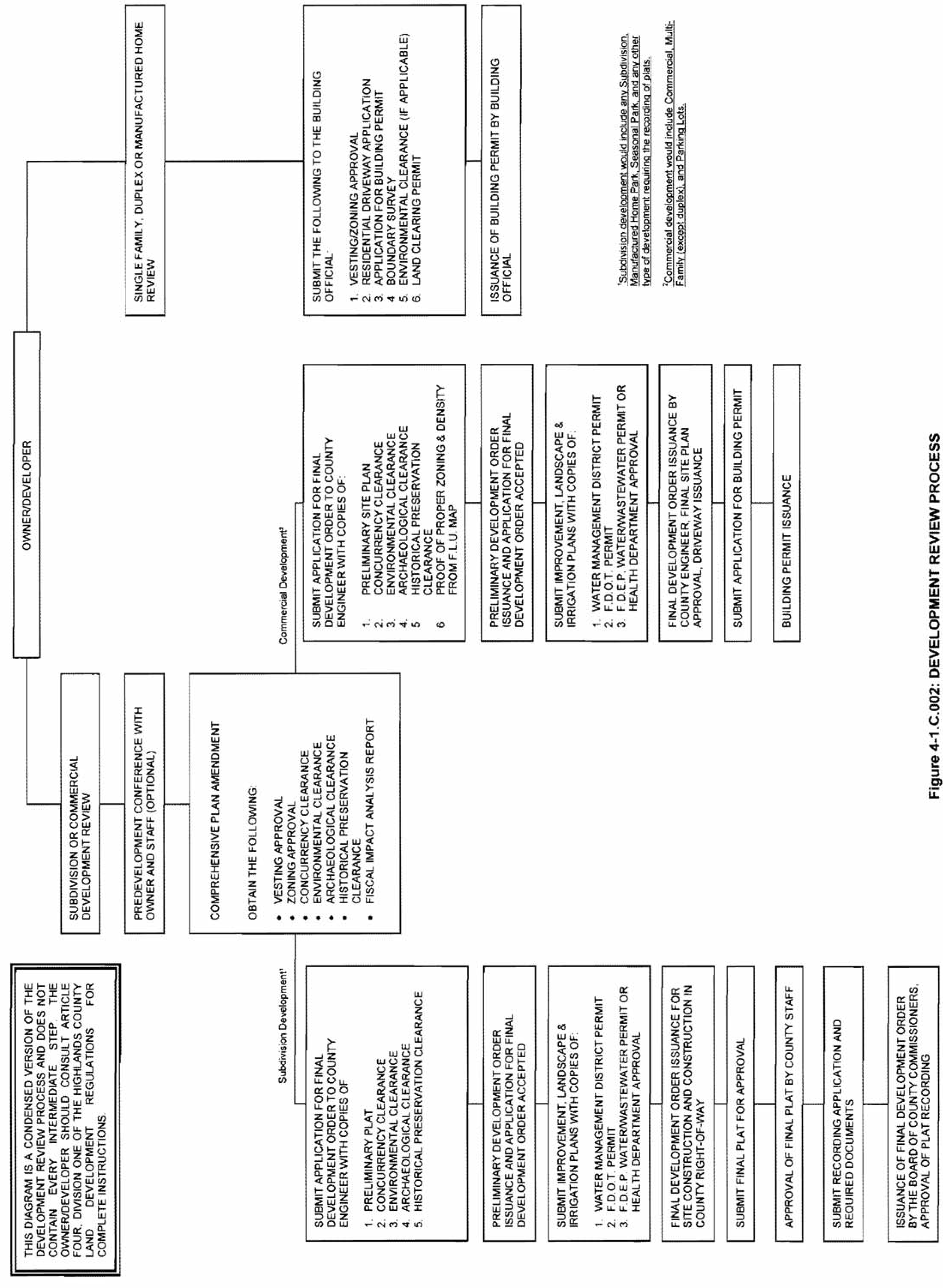
This section contains a simplified flow chart, Figure 4-1.C.002, which is designed to help an applicant follow the County's development review process as it is explained at the development review conference. Because space does not permit the listing of all intermediate steps, the applicant should refer to article 4 of chapter 12, of these regulations, for a detailed description of each step.
(Ord. No. 05-06-30, § 6; Ord. No. 11-12-04, § 3; Ord. No. 13-14-02, § 3)
Section 12.03.800. - Purpose of technical review meeting.
The purpose of this meeting is for the applicant and/or their authorized agent and county staff to discuss any staff revision request or other issues of the site as they relate to the proposed development and to determine the most efficient method of proceeding with the review and/or resubmittal of any preliminary subdivision plats, final subdivision plats, preliminary site plans, final site plans, and related documents. The technical review meeting is mandatory for any proposed development and prior to issuance of any development orders unless otherwise stated in these regulations or unless a written request is made that accompanies the original submittal by the applicant or their authorized agent to omit this process and instructing staff to proceed with the review as outlined in article 4 of chapter 12, of these regulations.
A.
Prior to receiving a preliminary or final development order, unless otherwise stated in these regulations, an applicant and/or their agent must confer with staff during the technical review meeting, after which, the applicant will be provided with a written list of conditions of approval, which must be addressed before the site plan or plat can be approved by the county engineer.
B.
Federal, state and local agencies, that may be required to review the proposed development, may participate in the technical review meeting to discuss issues they have with the plans and generally describe the information, which will be needed to satisfy the concerns of the relevant federal, state, and local agencies.
(Ord. No. 11-12-04, § 4)
Section 12.03.801. - Request to omit technical review meeting.
A written request signed by the applicant or the applicant's authorized agent to omit the technical review meeting, which instructs staff to proceed with the review as outlined in article 4 of chapter 12, of these regulations may be submitted with the original development application or plan submittal. The written request to omit the meeting must describe the applicant's reason for wanting to omit the meeting. Sufficient copies of the development application and/or plan shall be submitted for review and the written statement shall be submitted at the time of this request. Copies of the request shall be provided to all applicable reviewers and/or agencies that may be involved in the review process. Approval of the request is at the sole discretion of the county engineer.
(Ord. No. 11-12-04, § 4)
Section 12.03.802. - Notice.
The notice of meeting shall specify the date, time, and location for the technical review meeting. A list of specific dates for each meeting will be kept in the engineering department.
(Ord. No. 11-12-04, § 4)
Section 12.03.803. - Process.
Within five working days after the technical review meeting, the applicant will be mailed either an approval letter, conditional approval letter or a "request for additional information" letter including a copy of the redlined plans, checklist, conditions of approval, and staff comments, if any. Once the applicant has satisfactorily addressed all of the comments and concerns and incorporates all changes to the revised plans, the revised plans should be resubmitted to the county engineer for review.
(Ord. No. 11-12-04, § 4)
Section 12.03.804. - Representatives.
Representatives from the county engineering, planning, zoning, addressing, environmental health, building, and fire services departments and any other affected municipalities or agencies may attend the technical review meeting. Representatives are not appointed. Technical review meetings are administrative in nature and not subject to the quasi-judicial provisions of Florida Statutes. No testimony may be received from any applicant or member of the public during the course of a technical review meeting. Each representative is responsible for providing written findings, which identify whether the plat or site plan and/or application meets the applicable criteria and standards imposed by codes, regulations, and adopted standards of the county. The written findings are transmitted to the county engineer's office, and made available for public inspection at least one working day prior to discussion during the technical review meeting. The written findings are the basis for the county engineer to approve, conditionally approve, or deny the plat or site plan and/or application for a final development order.
(Ord. No. 11-12-04, § 4)
Section 12.03.901. - Composition of recreation and parks advisory committee.
RPAC shall be comprised of 12 voting members who are appointed by the Highlands County Board of County Commissioners. The members currently serving on RPAC shall continue to serve out their terms. Thereafter, appointment to and voting status on RPAC shall be according to the following categories of representation:
A.
Local government: Ten voting members and five alternate voting members shall be nominated by local governments as follows:
1.
Two voting members and one alternate voting member shall be nominated by the governing body of each municipality from within its jurisdiction (City of Avon Park, Town of Lake Placid, and City of Sebring);
2.
Four voting members and two voting alternates shall be nominated by the board of county commissioners from the unincorporated area of the county.
B.
County-wide agency: Two voting members and two voting alternates shall be nominated by a county-wide agency as follows:
1.
One voting member and one voting alternate member shall be nominated by the Highlands County School Board;
2.
One voting member and one voting alternate member shall be nominated by South Florida State College.
(Ord. No. 12-13-09, § 2; Ord. No. 12-13-11, § 2)
Section 12.03.902. - Term in office and rotation schedule for RPAC members.
A.
The term in office for each RPAC member shall be four years and shall commence on the first RPAC meeting date after appointment. Each member may be reappointed for a consecutive four-year term in accordance with the board of county commissioners policy on board appointments. Each member shall be limited to two consecutive terms of service on RPAC.
B.
Whenever a vacancy occurs on RPAC, the recommending local government or agency will be notified by the parks and natural resources department that it may submit candidates to fill the vacancy. All appointments to RPAC shall be in accordance with the board of county commissioners policy on board appointments.
(Ord. No. 12-13-09, § 2; Ord. No. 12-13-11, § 2)
Section 12.03.903. - Chairman and vice chairman.
A.
Election.
1.
There shall be one chairman and one vice chairman on RPAC, each with a term of one year. There shall be no limitation to the number of consecutive terms a chairman or vice chairman may serve within the two four-year terms permitted each member. No RPAC member shall serve in the capacity as both chairman and vice chairman simultaneously.
2.
At the first RPAC meeting subsequent to the adoption of this article, at which a quorum is present, nominations will be taken from the floor to elect the chairman and vice chairman from among the members. Thereafter, the chairman and vice chairman shall be elected at the RPAC meeting held in January of each year, if a quorum is present, or at the first meeting thereafter at which a quorum is present. Each chairman and vice chairman shall be elected by a majority vote of RPAC members in attendance.
B.
Duties.
1.
The chairman shall be responsible for running the meetings.
2.
The vice chairman shall be responsible for the chairman's duties in the absence of the chairman.
(Ord. No. 12-13-09, § 2; Ord. No. 12-13-11, § 2)
Section 12.03.904. - Meetings, notices, quorums and voting protocols.
A.
RPAC shall meet as the chairman deems necessary. Meetings will be posted at least 72 hours in advance of a scheduled meeting.
B.
RPAC meeting notices shall be posted on the Government Center Public Information Board. The notice shall specify the date, time, and place for the RPAC meeting and shall incorporate a notice for appeals as required by Florida Statutes and a notice for persons requiring reasonable accommodation as provided in the Americans with Disabilities Act and F.S. § 286.26.
C.
A quorum is required for every action of RPAC. The presence of seven voting members shall constitute a quorum. Action by RPAC shall require a vote of 75 percent the voting members in attendance. In the absence of a regular voting member nominated by a local government or county-wide agency the alternate voting member nominated by that local government or county-wide agency shall, if present, be a voting member for all purposes, including quorum and voting, during that meeting, until the regular voting member is present at the meeting.
D.
RPAC meetings shall be conducted according to procedures and rules of order selected and agreed upon by majority vote of the RPAC voting members and in accordance with Florida Statutes.
E.
No action shall be taken on any item that is not listed on the RPAC agenda, unless a finding is made as part of that action that mitigating circumstances of time and public necessity require quick action or that circumstances require emergency action.
(Ord. No. 12-13-09, § 2; Ord. No. 12-13-11, § 2)
Section 12.03.905. - RPAC mission objectives.
A.
RPAC shall advise the board of county commissioners and its staff on issues pertaining to the creation of a balanced county-wide recreation program and integrated recreation facilities inventory, guided by the respective Recreation and Open Space Elements of the Avon Park, Sebring, Lake Placid, and Highlands County Comprehensive Plans. More specific objectives include, but are not limited to:
1.
Identify the recreation constituencies using recreation resources within Highlands County and the incorporated communities;
2.
Identify the existing recreation resources being used by recreation type and facility in both the public and private sectors;
3.
Identify existing latent resources having recreational potential for being integrated into a county-wide recreation program;
4.
Evaluate the potential for linkages to broader regional recreational programs and facilities, both existing and proposed;
5.
Identify user demand by recreation type and facility;
6.
Identify and prepare program scope and spatial criteria by recreation type and facility;
7.
Prepare a county-wide comprehensive recreation plan projecting user demand by recreation type and facility, incorporating program attributes and spatial criteria;
8.
Establish a priority system for program and facility development, incorporating existing and proposed resources guided by the spatial distribution of the users;
9.
Identify new revenue resources associated with selected recreation activities applicable to implementing the county-wide comprehensive recreation plan; and,
10.
Act as an advisory entity for governmental agencies within Highlands County on recreational matters.
B.
RPAC is advisory in nature and does not perform administrative, audit or oversight functions for any constituency group identified with RPAC.
C.
RPAC may be assigned additional authorities, duties or responsibilities, temporary or permanent as deemed necessary by the board of county commissioners to execute the mission objectives listed in subsection A of this section or to implement the policies of the respective comprehensive plans pertaining to recreation, parks, and open space.
(Ord. No. 12-13-09, § 2; Ord. No. 12-13-11, § 2)

