
Highlands County Unincorporated
City Zoning Code
City Zoning Code
ARTICLE 8
- SPECIAL LAND USES
Section 12.08.101.- Alcoholic beverage establishments.
A.
Applicability. Allowed only in B-2, B-3, B-4, I-1, I-2, BC-1, BC-2 and any district where it is considered an ancillary use customarily incidental and subordinate to a permitted use.
B.
Additional application requirements. A site plan showing the building, all entrances and exits, and the distance separation requirements as pursuant to the requirements of this section. When applying for a new beverage license and setbacks are required, a survey by a professional surveyor licensed in the State of Florida shall be submitted as part of the beverage license application to ensure compliance of the setback requirements.
C.
Additional standards for approval.
1.
Other requirements or limitations herein for the sale of liquor, beer or wine for consumption on or off the premises, package liquor stores, cocktail bars, saloons and nightclubs (hereinafter called establishments) are additional requirements and limitations to any other requirements established by the BCC:
a.
These establishments shall be located at least 1,500 feet from any public, private or parochial school. The required 1,500 foot minimum is to be measured by a straight line distance between the front or main entrance of the establishment and the closest property corner or property line of any school.
b.
These establishments shall be located at least 500 feet from any church. The required 500 feet minimum shall be measured by a straight line distance between the front or main entrance of the establishment and the closest property corner or property line of any church.
c.
The requirements of subsections C.1.a. and b. shall not apply to establishments selling alcoholic beverages for consumption on or off the premises which conform to the following:
(1)
Where sale of alcoholic beverages is incidental to the service of food prepared for consumption on the premises and there is at least 2,000 square feet of customer space and at least 125 seats at tables or booths for customers; or the sale of alcoholic beverages is incidental to a hotel operation having more than 50 guestrooms and the entrance to the establishment serving alcohol is within the hotel with no outside direct entrance; provided that there shall be no show window, display, sign or other indication of the establishment's location or existence from the exterior of the building other than a sign not greater than 12 square feet.
(2)
Where sale of alcoholic beverages is incidental to the service of food cooked on the premises of a full-service restaurant that has at least 500 square feet of customer space and at least 50 seats at tables or booths for customers, and no bar; provided that there shall be no show window, display, sign or other indication of the establishment's location or existence visible from the exterior of the building other than a restaurant sign; and further provided that no bar, cocktail, beer, wine, liquor or similar sign shall be visible from the exterior of the building.
(3)
For purposes of this section, the term "full-service restaurant" means an establishment, within a building, having a menu and full course meals prepared, served and consumed on the premises.
d.
The requirements of subsections C.1.a. and b. shall not apply to grocery stores, drugstores, convenience stores, package liquor stores, department stores or similar establishments selling liquor, beer or wine strictly for off-premises consumption. These establishments, when located within the distance requirements of subsections C.1.a. and b. of this section, shall have no beer, wine or liquor signs visible from the exterior of the building.
e.
The requirements of subsections C.1.a. and b. of this section shall not apply to private clubs where members and guests are served and there are no indications on the exterior of the building that alcoholic beverages are served therein.
f.
Nightclubs are subject to the separation requirements of subsections C.1.a. and b. of this section unless the nightclub meets the provisions of subsection C.1.c. of this section.
2.
Where an establishment is located and begins operation in conformity with this section and with this chapter, the subsequent locating of a school within 1,500 feet, or a church within 500 feet of such existing establishment shall not be construed to put such establishment in violation of this chapter.
(Ord. No. 05-06-05; Ord. No. 11-12-04, § 40)
Sec. 12.08.102. - Ethanol or biofuel production.
A.
Definition: The conversion of biomass (material derived from recently living organisms) energy to liquid fuels.
B.
Applicability: Allowed in section 12.05.200, AU Agriculture district, pursuant to section 12.03.411 special use permit approved by the BCC.
C.
Contingent application approval: The board of county commissioners may grant approval of a special use permit application for ethanol or biofuel production contingent upon all listed standards and requirements being satisfied or completed either at time of application for special use permit or if designated by the applicant and approved by the BCC, as part of the approval process for the site plan.
D.
Completeness of application: All information required shall be submitted with the application. An affidavit shall be submitted stating that compliance with all requirements shall be in place prior to the approval of the final site plan. Completeness of the application shall be determined within ten days and shall include certification by the emergency operations center director and fire marshal that the application is complete.
E.
Additional application requirements and standards for approval: The following requirements in addition to or supplementing any other applicable requirements of this chapter, may apply to the location, design, construction, operation and maintenance of ethanol or biofuel production.
1.
A site plan of sufficient detail, as pursuant to an application form approved by the board of county commissioners.
2.
Air quality: Certificate of compliance or letter of approval as a result of an application under the Clean Air Act and an air quality permit issued by FDEP either at time of application for special use permit or as part of the approval process for the site plan.
3.
Noise: The petitioner shall provide a letter from a Florida Registered Professional Engineer indicating that based on the proposed design, the factory is not or will not be expected to violate the Highlands County Noise Control Ordinance either at time of application for special use permit or as part of the approval process for the site plan.
4.
Water use permit: The petitioner shall provide approved water management permits that include potential impacts of any proposed biofuel production facility on the aquifer, or other groundwater source if applicable.
5.
Lighting: The petitioner shall provide a letter from a Florida Registered Professional Engineer indicating that based on the proposed lighting design, the operation does not create or allow lights to shine or glare onto neighboring properties pursuant to the adopted standard contained in this section. Outdoor lighting fixtures shall not be allowed to shine or glare onto adjacent properties. All illumination from lights/fixtures shall be directed towards the ground and shielded to ensure that illumination does not radiate upon other properties unless other adjacent properties are developed together and adopted as a single plan.
6.
Traffic impact: An approved traffic study, pursuant to the standards of the Highlands County Land Development Regulations.
7.
Restriction of wet mill process: If corn grain and other grains shall serve as the primary feedstock, then only ethanol production facilities utilizing the dry mill process shall be permitted.
8.
Odors: If corn grain and other grains shall serve as the primary feedstock, then ethanol fuel plants shall be required to install thermal oxidizers or other similar technology to remove the volatile organic compounds (VOCs) to reduce odors. If other feedstocks shall serve as the primary feedstock, then ethanol fuel plants shall be required to install Best Available Control Technology (BACT) to minimize air emissions in order to reduce odors. The petitioner shall provide a letter from a Florida Registered Professional Engineer at time of application for Special Use Permit indicating that based on the proposed facility design the operation is not expected to create an objectionable odor at all lot lines for neighboring properties.
9.
Natural resources: The petitioner is required to provide an approved Environmental Clearance Report (ECR) pursuant to chapter 12, article 12, division 6 of the Highlands County Code of Ordinances, either at time of application for special use permit or as part of the approval process for the site plan.
10.
Vibration: The petitioner shall provide a letter from a Florida Registered Professional Engineer indicating that based on the proposed facility design that the operation of the biofuel facility is not expected to create vibration as measured at the lot lines of adjacent properties. The standard for vibration shall not be applicable if the property surrounding the plant and plant facilities for a distance of 2,640 feet is owned or under the control of the applicant.
11.
Fire safety plan: The petitioner shall provide a certificate of compliance or letter of approval as a result of development of a fire safety plan that shall be developed as defined by the Occupational and Safety Health Administration, the Environmental Protection Agency, the Department of Transportation, the National Fire Safety Code, and appropriate state and local regulation requirements. If special fire hazards are found to exist in conjunction with the construction or operation of such a use, then the applicant shall provide those resources or facilities on-site to combat such special fire hazards and shall make provisions to keep those resources or facilities in satisfactory maintenance. The applicant shall ensure that all fire safety provisions are satisfied and met for the life of the project. A letter of approval shall be provided by the Highlands County Fire Marshal that confirms that this requirement has been met. Annual inspections shall be allowed by the county's emergency operations director.
12.
Smoke easement: Have a deed restriction or covenant running with the land that will be in favor of the county and surrounding land owners that is recorded which consents to controlled burns on surrounding properties.
(Ord. No. 07-08-31, § 5; Ord. No. 08-09-64, § 5; Ord. No. 16-17-17, §§ 174, 175)
Section 12.08.103. - Bingo games.
A.
Definition. Bingo games shall be defined as provided in F.S. § 849.0931, as from time to time amended. All other definitions are pursuant to article III of chapter 4 of this Code.
B.
Applicability. Allowed only in B-3, B-4, I-1, BC-1, BC-2 and any district where it is considered an ancillary use customarily incidental and subordinate to a permitted use.
C.
Application requirements. All application requirements are pursuant to article III of chapter 4 of this Code. Completeness of the application will be determined by the county administrator.
D.
Additional standards for approval. Additional standards are pursuant to article III of chapter 4 of this Code.
(Ord. No. 05-06-05)
Section 12.08.105. - Camping grounds.
A.
Applicability.Section 12.05.224 CG-1 campground district, 12.05.225 CG-2 campground district, and 12.05.226 CG-3 campground district.
B.
Application requirements. An applicant shall provide a site plan approved by the state department of health and rehabilitative services when applying to the BOA for special exception.
C.
Additional standards for approval.
1.
Minimum size; maximum density. The site proposed for a camping ground shall contain not less than five acres and not more than 15 campsites per acre shall be permitted.
2.
Roads. All weather roads (shell, marl, rock or hard surface) shall be provided and maintained. Two-way roads shall have a minimum travel width of 18 feet and one-way roads 12 feet. Adequate radius shall be provided at all intersections.
3.
Reserved.
4.
Permanent structures prohibited. No structures of a permanent nature shall be erected on any campsite or RV site.
5.
Tank-emptying facilities. Facilities for emptying waste tanks of self-contained trailers shall be provided at all camping grounds.
6.
State regulations. All camping grounds shall meet the requirements of Chapter 64E-15 F.A.C. and such other regulations as may be adopted by the State of Florida and the Highlands County Department of Health pertaining to camping grounds and sanitary facilities.
(Ord. No. 05-06-05; Ord. No. 16-17-17, § 176)
Section 12.08.106. - Carnivals and exhibitions.
A.
Definitions. All definitions are pursuant to section 4-16 of article II of chapter 4 of this Code.
B.
Applicability. Allowed only in B-3, B-4, I-1, BC-1, BC-2 and any district where it is considered an ancillary use customarily incidental and subordinate to a permitted use.
C.
Additional application requirements. All application requirements are pursuant to article II of chapter 4 of this Code. Completeness of the application will be determined by the county administrator.
D.
Additional standards for approval. Application standards are pursuant to article II of chapter 4 of this Code.
(Ord. No. 05-06-05; Ord. No. 05-06-30, § 69)
Section 12.08.107. - Dwellings, single-family, manufactured home and duplex building permit requirements.
The application process for single-family, duplex and manufactured home construction is similar to that for other structures, but is not as lengthy. It is the Highlands County BCC's intention to make the process as simple as possible and still comply with the requirements of the county's adopted comprehensive plan.
A.
Definitions. See article 2, Definitions.
B.
Applicability. Allowed in all residential districts and any district where single-family, manufactured homes and duplexes are a permitted use or an accessory use.
C.
Additional application requirements. Application for a single-family, duplex or manufactured home development order is made to the building official and entails submittal of the following, as applicable:
1.
Application for a final development order;
2.
Evidence that:
a.
Property is a platted lot within a recorded subdivision; or
b.
Property meets one of the exemption criteria of this chapter; or
c.
Property is a lot of record pursuant to the criteria contained in this chapter;
d.
Proof of vesting pursuant to article 13 of chapter 12;
3.
Evidence of positive vesting determination from the planning supervisor, the county's vesting appeal hearing officer, or a court of law;
4.
Application for a building permit;
5.
Evidence of correct zoning classification from the zoning supervisor;
6.
Evidence from the tax collector of having purchased a license tag, or having declared a manufactured home as real property;
7.
A septic system permit or proof of acceptance for connection to a central wastewater system;
8.
Payment of all required fees;
9.
A boundary survey, prepared in accordance with the minimum technical standards for land surveying as defined by Chapter 5J-17.052, Florida Administrative Code, together with the following information:
a.
A legal description of the subject property which is consistent with the description found on the instrument of title;
b.
All recorded public and private easements and rights-of-way, within and adjacent to the parcel, labeled as to type;
c.
Total area of the property in square feet and acres;
d.
Signature and seal of a Florida professional surveyor and mapper; in accordance with F.S. Ch. 472;
e.
FIRM flood hazard zone and base flood elevation referenced to NAVD 1988, or as required by the county engineer, if applicable; and
f.
Location and dimensions of all structures, the required setbacks on the parcel, proposed lowest floor elevation, and lowest floors of adjacent residences;
10.
Environmental clearance; and
11.
The residential driveway permit includes construction of a residential driveway and grading of the lot. The lot shall be graded in such a manner as to prevent flooding of or from adjacent properties. Vegetated swales or discharge into an approved stormwater management system may be used to satisfy retention or detention requirements, provided that state water quality standards are met prior to discharge. The residential driveway permit application form and any attached sheets shall be submitted to the county engineer in triplicate along with all other required items including the permit fee as established by the BCC. An incomplete application may delay issuance of the building permit. Within 15 working days of submission of a complete application, the application shall be approved, approved with conditions, or denied by the county engineer. The applicant or contractor should not initiate any construction until the driveway permit is received from the county engineer. For assistance in preparing the application and drawings, the applicant should refer to Highlands County Technical Standards Manual, current edition.
(Ord. No. 05-06-05; Ord. No. 05-06-30, § 70; Ord. No. 16-17-17, § 177)
Section 12.08.108. - Flea market, open.
A.
Definitions. All definitions are pursuant to article II of this chapter.
B.
Applicability. Permitted in B-3, B-4 and I-1.
C.
Additional application requirements. All application requirements are pursuant to article III of this chapter.
D.
Additional standards for approval. Standards for approval are pursuant to article III of this chapter shall be subject to the following conditions:
1.
The maximum number of vendors on the property shall be specified and shown on a sketch plan submitted with the application. The sketch plan shall be detailed enough to show compliance with all the possible conditions included in this part.
2.
The use shall not be operated within 200 feet of any residential dwelling located on a residentially zoned property. If the use is operated within 300 feet of any residential dwelling unit on residentially zoned property, the applicant shall provide at a minimum a Type B Transitional buffer strip along the sides of the property adjacent to residential. This buffer may be greater at the discretion of the BOA.
3.
The hours and days of operation shall be requested in the publication for the special exception and shall be established by the BOA at the public hearing.
4.
Required off-street parking is two parking spaces per 120 square feet of gross floor area or fraction thereof of the total area of the rental spaces located on the property, as shown on the sketch plan submitted with the application. All parking must be accommodated by off-street parking to ensure safe and convenient pedestrian and vehicular circulation. Required parking must be shown on the sketch plan. Parking of vehicles on any street or highway right-of-way is prohibited and shall be cause for revocation of the special exception.
5.
Goods, materials or products shall not be stored out of doors on the site when the flea market is not in operation, provided, however, that this restriction shall not apply to overnight storage between consecutive days of operation.
6.
Access to the site shall be via a driveway(s) constructed in accordance with all applicable standards and approved by the county engineer.
7.
All trash and debris shall be appropriately collected and disposed of during and after each day of operation.
8.
Sanitary facilities shall be provided on site and in accordance with all applicable standards determined by the county health department.
9.
The operator and all vendors shall comply with all applicable state and local business license procedures and requirements.
10.
Fire and emergency vehicle access lanes shall be shown on the sketch plan submitted with the application, shall provide access to all rental spaces and other public areas, and shall become one of the conditions for approval of the special exception, based on approval by both the county engineer and county fire marshal that those access lanes meet the required standards contained in the Highlands County Land Development Regulations and other applicable regulations. Fire and emergency vehicle access lanes shall remain unobstructed and open at all times of operation.
(Ord. No. 05-06-05; Ord. No. 16-17-17, § 178)
Section 12.08.109. - Home occupations.
A.
Applicability. Allowed in all zoning districts.
B.
Home occupations are permitted as a secondary use to a residential dwelling, shall maintain a business tax receipt, if required, and shall operate in accordance with federal law, Florida law and any county code requirements related to parking, signage, equipment or processes that create noise, vibration, heat, smoke, dust, glare, fumes, or noxious odors or with respect to the use, storage, or disposal of any corrosive, combustible, or other hazardous or flammable materials or liquids.
(Ord. No. 05-06-05; Ord. No. 05-06-30, § 71; Ord. No. 16-17-17, §§ 179, 180; Ord. No. 21-22-25, § 2)
Section 12.08.110. - Garage sales.
A.
Garage or yard sales. Garage or yard sales of tangible personal property shall not exceed two in number during any calendar year in residential zoning districts, provided that:
1.
Such tangible personal property shall be sold only on the premises of a residential dwelling unit by the owner or lessee of such dwelling unit.
2.
Such owner or lessee must be the legal owner or acting in concert with another owner or owners of such tangible personal property at the time of the sale.
3.
No new merchandise (i.e., merchandise acquired for the purpose of resale) shall be sold at such sale.
4.
Such sale shall be confined to the garage, patio, driveway, yard or residence on the premises.
5.
The duration of each such sale shall not exceed three consecutive calendar days.
6.
Such sales conducted by private nonprofit organizations shall be exempt from the provisions of this section.
7.
No such garage or yard sale shall be held without the owner or occupant of the premises having first obtained a permit therefore. Such permit shall be obtained by applying to the Highlands County Office of the Tax Collector, who shall issue such permit upon payment of the fee established from time to time by resolution of the BCC. Such permit shall specify the address and date of such garage or yard sale.
8.
Garage sales located in a mobile home park, campground, RV park, or residential subdivision that are regulated by a homeowners' association can obtain one permit for the entire community. Such a community permit may be obtained no more than two times in a calendar year.
(Ord. No. 24-25-01, § 3)
Section 12.08.111. - Special accessory uses associated with hotels, apartment hotels, motels and multiple-family dwellings as special accessory uses.
A.
Applicability. Allowed in R-3, R-3NC, B-2, B-3, BC-1, BC-2, PD, FUD
B.
Additional standards for approval. In any zoning districts where hotels, apartment hotels, motels and multiple-family dwellings are permitted, the special accessory uses permitted with such activities are subject to the following requirements:
1.
Access to such accessory uses to be limited to the interior of the building. No direct public access from the exterior of the building shall be permitted. Exit doors as required by building codes shall be provided.
2.
No signs or advertising matter relating to such special accessory uses on the exterior or interior of the building visible from any street, water body or adjacent property, except as permitted by this chapter.
3.
No show windows or displays relating to such special accessory uses on the exterior of the building or visible from any street, water body or adjacent property.
4.
Space occupied by such special accessory uses to be on interior of building and no evidence or indication of the existence of such special accessory uses visible on or from exterior of building.
(Ord. No. 05-06-05)
Section 12.08.113. - Junkyards, automotive salvage yards, and salvage yards.
A.
Applicability. Applies to all junkyards established after January 1, 1971. Existing junkyards are exempt from these regulations. New junkyards or junkyards that expand are permitted as a special exception in the I-2 industrial district. Certain uses such as automotive salvage yard and junkyard operations, requiring the storage of inoperable equipment or vehicles for prolonged periods of time, could contribute detrimentally to the health, safety, welfare and aesthetic standards of the community. To preclude this from occurring, the purpose of this section is to establish land use standards unique to the development of new and the alteration or reuse of existing automotive salvage yards and junkyards. These standards are to assure that salvage yards and junkyards, although functionally and aesthetically incompatible with many adjacent uses, minimize visual disturbance, noise generation and environmental pollution.
B.
Additional application requirements. An applicant shall provide a site plan prior to submittal to the BOA.
C.
Additional standards for approval. Junkyards established after January 1, 1971, shall meet the provisions of this section and all other applicable provisions of this chapter:
1.
Minimum lot size. The minimum area of land to be so used shall not be less than four acres.
2.
Setbacks:
a.
Adjacent to residential. No automobile or vehicle not in running order or any other junk or scrap of whatsoever character shall at any time be located for storage, dismantling or any other purpose within 75 feet of any boundary of any residential district; within 50 feet of the front street line; within 30 feet of any side street line; or within 30 feet of any other property line of the lot to be so used.
b.
Adjacent to industrial land use with I-1 or I-2 Industrial district:
Front: 20 feet.
Side: 0 feet.
Rear: 20 feet.
c.
Adjacent to commercial use B-1 through B-4:
Front: 20 feet.
Side: 40 feet.
Rear: 40 feet.
d.
Adjacent to public street:
Front: 20 feet.
Side: 20 feet.
Rear: 20 feet.
3.
Screening. A screen shall be provided around the entire perimeter of the salvage yard or junkyard that will completely obscure the contents within from the abutting or adjacent properties and public rights-of-way. The screening shall be effected by one of the following methods:
a.
Solid wall or fence. When a solid wall or fence is selected as a screen, it shall be a minimum of eight feet in height, constructed of substantial materials such as masonry units, pressure treated woods or composition non-organic materials simulating masonry, concrete or wood materials. The wall or fence shall be constructed without openings except for the entrance/exit. The gate to the entrance/exit shall also be without openings and equipped to be locked at times the yard is not in operation. If painted, the wall or fence colors shall be within the earth tone palette. Plans for such a wall or fence shall be submitted to the BOA, who shall determine if the proposed wall or fence is in compliance with this section.
b.
Vegetative. When vegetation is selected as material for a screen, a continuous border 20 feet wide shall be set outside a security fence (chain-link, six feet in height, with an additional three-strand barbed wire top inclined inward), with non-coniferous evergreen trees consisting of two rows, with trees spaced not more than ten feet apart on centers, staggered alternately, with one row of evergreen scrubs, planted three feet on centers, planted between the two rows of staggered trees, to obscure the area of view between the ground and the beginning of the tree canopy. Plans for such a vegetative screen and fence shall be submitted to the BOA who shall determine if they are in compliance with this section
c.
Earthen berm. When an earthen berm is selected for a screen, a continuous border 20 feet wide shall be set outside a security fence (chain-link, six feet in height, with an additional three-strand barbed wire top inclined inward), within which the berm will be located and built on a maximum slope of 2:1 to four feet in height, covered with an appropriate ground cover and capped with a evergreen shrub hedge trimmed to four feet for an over all height of eight feet. The earthen berm border shall be fully irrigated. Plans for such a berm and fence shall be submitted to the P&ZC, who shall determine if they are in compliance with this section.
d.
Building wall. The walls of a building may be used to form a part of the screen required by this part, provided that the building wall is part of the front setback and the contents of the yard are still obscured. However, the building, if functioning as part of the administration and sales of the facility, recycled parts may be displayed from within the building.
4.
Automotive salvage yard and junkyard location. Automotive salvage and junkyard operations are considered industrial uses and permitted only where specifically listed within an appropriate implementing zoning district, as a special exception. A minimum 300 feet shall separate any new salvage yard or junkyard from any land owned or leased by a government agency for recreation, open space, conservation or related purposes. A minimum 500 feet shall separate yards from a school, hospital or other health care facility, residential use or religious place of worship, measured from the nearest property line of each.
5.
Access. All driveways shall meet the LDR requirements for driveways.
6.
Screening tolerance. No outdoor storage racks, stacked vehicles or other materials are to breach the height limits established for the screening devices. At no time are the contents of the salvage yard or junkyard to be visible above the screening device from outside the property.
7.
Screen maintenance. The applicant must guarantee by affidavit that the screen will be maintained as specified and approved by the BOA. The removal of a portion of the screen or a portion of the screen fails due to neglect, shall be reason to suspend, revoke or modify the license issued for the salvage yard or junkyard operation.
8.
Plan of facility. The applicant shall provide a site plan for the proposed yard. The site plan shall be of sufficient scale to clearly indicate the arrangement of the various activities and materials to be stored or processed within the property. At a minimum the site plan shall indicate the following:
a.
An area sketch indication the location of the property within its immediate vicinity and the distance to the closest intersecting public roads;
b.
The boundaries of the property, with dimensions, including the wall/fence locations or borders if vegetative or berm methods are being used for screening;
c.
Location of any on-site environmental issues such as wetlands, natural seasonal surface water areas or drainage ways;
d.
Locate, as close as possible, the existing vegetation and soil types on the property;
e.
Indicate the topography, surface drainage and location of proposed retention areas;
f.
Location of proposed structures, their sizes and their uses;
g.
Location of any proposed on-site water supply wells and/or septic system drain fields if central utilities are not available for use;
h.
Location of the entrance/exit to the property and width and length of all driveways or internal roadways;
i.
The location of any storage of captured liquid wastes and hazardous materials such as motor oils, gasoline and hydraulic fluids; and
j.
Arrangement of storage aisles of sufficient width to accommodate fire fighting vehicles, with anticipated stored materials and activity areas identified.
9.
Environmental safety. The applicant shall guarantee that all appropriate measures are followed, as directed by the Florida Department of Environmental Protection and the county's fire services agency regarding the integrity of the property's environment, such as:
a.
Motor vehicles and machinery using fossil fuels or batteries are stripped of these hazardous materials and properly stored or disposed of in conformance with NFPA code requirements prior to the vehicles or machinery being stored on the property;
b.
That no liquid wastes are spilled or allowed to enter the ground from any point within the property;
c.
All junk or salvaged tires will be properly stored or disposed of, with no inventory of junk tires stored for more than six months before being removed from the property. Salvaged and re-saleable tires may be kept on-site and properly stored consistent with NFPA Code requirements; and
d.
A mosquito abatement program must be initiated for all water retaining junk surfaces on the property.
10.
Prohibited materials. No materials shall be allowed into any automotive salvage yard or junkyard that are prohibited by local, state and federal law or regulation.
11.
Existing or legally non-conforming yards. Existing and legal non-conforming yards may lawfully continue subject to the following conditions:
a.
The area used for the operation of the automotive salvage or junkyard shall not be increased or intensified at any time.
b.
No additional permanent buildings shall be erected and no presently existing permanent buildings shall be structurally altered to increase their bulk or square footage.
(Ord. No. 05-06-05; Ord. No. 06-07-4, § 17; Ord. No. 16-17-17, §§ 181, 182)
Section 12.08.115. - Junk yards in existence and operating on January 1, 1971.
It is the intent of the BCC to minimize the extension of nonconforming uses and to look to their possible eventual elimination, any junkyard existing and operating as a nonconforming use in any district on January 1, 1971, shall be allowed to continue its operations subject to the following provisions:
A.
The area used for the operation of such junkyard shall not be increased at any time or under any circumstances.
B.
No additional permanent buildings shall be erected and no presently existing permanent buildings shall be structurally altered to increase their bulk or square footage area.
(Ord. No. 05-06-05)
Section 12.08.117. - Mobile homes as accessory uses, offices, or temporary residences.
A.
Applicability.
1.
Allowed as accessory to construction (see 12.08.117C.1 below); or
2.
Allowed as a temporary use permit for a temporary office or shelter pursuant to the provisions of this section in the AU agricultural, BC-1, BC-2, B-3, B-4, I-1 and I-2 zoning districts and all other zoning districts except residential (see section 12.08.117C.2 below); or
3.
Allowed as a special exception for a temporary office in all residential zoning districts not listed in this subsection; (see section 12.08.117C.2 below); or
4.
Allowed as a temporary use permit as a temporary residence (see section 12.08.117C.3 below).
B.
Additional application requirements. A signed affidavit guaranteeing to remove the mobile home, pursuant to the requirements listed in this paragraph.
C.
Additional standards for approval.
1.
A mobile home shall not be considered as an accessory building, except as provided by special exception in certain business and industrial districts.
2.
A mobile home may be used as a temporary office or shelter in all zoning districts except residential zoning districts or shelter in the AU agricultural zoning district incidental to construction or when development of the premises upon which it is located only during the time construction or development is actively under way for a period not in excess of one year or until completion of construction, whichever comes first; such mobile home shall be removed within ten days of the completion of the project. The zoning official may extend this permit for an extra year if construction is still underway. A temporary office may be allowed in all residential zoning districts only as a special exception.
3.
A temporary use permit may allow a mobile home to be used as a temporary residence for a period not in excess of one year or until completion of construction, whichever comes first, in a residential district on property for which a building permit for the construction of a permanent dwelling has been obtained, providing that construction is actively carried forward to completion within the aforesaid year and providing that the mobile home shall be removed in any event within one year of the date of the issuance of the building permit.
4.
In no instance shall two or more mobile homes be connected together so as to constitute one or more residences.
(Ord. No. 05-06-05; Ord. No. 06-07-29, § 3)
Section 12.08.119. - Mobile homes storage and parking in residential zoning districts prohibited.
All parking and storing of mobile homes in any manner is prohibited in all residential districts.
(Ord. No. 05-06-05)
Section 12.08.120. - Required recreation/disaster shelter building.
A.
Applicability. M-2, CG-1, CG-2, CG-3, and RV Park (FUD) Zoning Districts, and within all manufactured home parks, manufactured home subdivisions, mobile home parks, RV parks, campgrounds, and seasonal parks containing 25 or more lots, rental spaces or campsites on which RVs, park models, mobile homes or manufactured homes are placed after November 14, 1994, in a manner requiring a building permit or which are developed after November 14, 1994, a recreation/disaster shelter building meeting the requirements of subsections B. and C. below of this section shall be provided.
B.
Additional standards for approval. A required recreation/disaster shelter building shall have:
1.
A minimum floor area of at least 35 square feet (excluding kitchens, closets, toilets, bathrooms, porches, breezeways and terraces) per lot, rental space or campsite. RV parks and campgrounds which do not contain mobile or manufactured homes may calculate the minimum required area based on 50 percent of the total number of rental spaces within the park or campground; and
2.
A minimum floor elevation at least two feet above the established 100-year flood level; and
3.
The disaster shelter must contain a kitchen; and
4.
Adequate emergency lighting and water supply and adequate emergency generators to power the entire disaster shelter for a minimum of 72 consecutive hours, or until power is restored, whichever comes first; and
5.
Designed and constructed to no less than Risk Category IV Construction standards in compliance with the Florida Building Code, current edition. Construction plans signed and sealed by a registered engineer and/or architect, certifying that the structure meets the requirements of this paragraph, shall be submitted to the building official and approved before final development orders are issued for new manufactured home parks, manufactured home subdivisions, mobile home parks, mobile home subdivisions, RV parks, campgrounds, and seasonal parks developed after November 14, 1994, containing 25 or more lots, rental spaces or campsites and before issuing more than 25 building permits for placement of RVs, park models, manufactured homes or combination thereof, in any existing RV park, campground or mobile home park after November 14, 1994.
C.
Additional requirements.
1.
An area to shelter crated household pets of the residents of the park or subdivision shall be provided. Said area may be located within the disaster shelter, or within a separate structure. Said separate structure shall meet Risk Category II, or higher, construction standards in compliance with the Florida Building Code, current edition; all exterior glass surfaces must be made of impact resistant glass or have storm shutters in place; and the structure shall have a generator sufficient to power an air conditioning unit or fans to adequately cool the area, for a minimum of 72 consecutive hours, or until power is restored, whichever comes first. Pet crates shall securely contain the animal and be leak proof. This requirement shall be satisfied should the park or subdivision provide the county with a copy of recorded covenants or restrictions prohibiting residents from having household pets as defined by this chapter.
2.
A plan shall be provided to the county engineer showing the location of the recreation/disaster shelter building on the site in relation to the existing lots, rental spaces or campsites.
3.
Documentation that the generators required pursuant to 12.08.120.B., are sufficient.
(Ord. No. 05-06-05; Ord. No. 05-06-30, § 75; Ord. No. 16-17-17, § 183; Ord. No. 22-23-05, § 2; Ord. No. 23-24-33, § 4)
Section 12.08.123. - Service stations.
A.
Applicability. B-2, B-3, B-4, I-1, BC-1, BC-2.
B.
Additional application requirements.
C.
Additional standards for approval. The following requirements in addition to or supplementing any other applicable requirements of this chapter, apply to the location, design, construction, operation and maintenance of service stations.
1.
Lot size. The lot size of service stations shall be not less than 100 feet in width and 100 feet in depth.
2.
Required distance from churches, schools, etc. There shall be a minimum distance of 250 feet, the shortest air line measurement between nearest points on any lot, to be used for service station purposes and any lot used or to be used for church, playground, playfield, park, hospital, elementary or high school, public library, theater, auditorium, stadium, arena, assembly hall or other similar public or semipublic place where large numbers of people congregate.
3.
Location of pumps and buildings.
a.
Gasoline pumps shall be located not less than 15 feet from any property line.
b.
No service station building or gasoline pump shall be located within 25 feet of any residentially zoned property.
4.
Lighting. All lighting on a service station must be so arranged and designed as not to glare directly into residentially zoned property.
5.
Driveways and exits. For each 100 feet of lot frontage or major fraction thereof, there shall be two driveways for entrance and exit. There shall be ten feet distance between the two driveways, and no driveway shall be over 50 feet in width at street line. Driveways shall be ten feet from alley or private property lines. Note: County engineers change.
6.
Location of tanks. All tanks for the storage of gasoline, kerosene or other petroleum products shall be located underground, except that tanks holding not in excess of 2,000 gallons used for the storage of liquefied petroleum gas may be located above ground. Such tanks for the storage of liquefied petroleum gas shall not be located within 25 feet of any front lot line, or within 15 feet of any side or rear lot line.
(Ord. No. 05-06-05; Ord. No. 16-17-17, § 184)
Section 12.08.124. - Agricultural worker housing.
A.
Applicability. Agricultural worker housing is allowed as a principal use in the agricultural district, pursuant to section 12.05.200, and may be allowed by special exception in certain residential zoning districts.
B.
Purpose and intent. Agricultural worker housing is provided specifically to house those persons engaged in agricultural labor. New housing specifically directed at housing agricultural workers is established to provide decent, safe and sanitary accommodations.
C.
General requirements. All agricultural worker housing shall meet the following standards.
1.
Location. Agricultural workers may be housed in the agricultural zoning district or by special exception in certain residential zoning districts. Special review is required if such use is located in an overlay district including but not limited to military operating areas and airport protection zones.
2.
Proximity to services.
a.
Developments should be located within two miles of a grocery or general mercantile or should provide management-sponsored transportation to a grocery or general mercantile; a minimum of two visits on working days and two scheduled round trips on non-working days.
b.
Developments shall provide one scheduled round trip on a non-working day per calendar week to laundry facilities if laundry facilities are not provided on-site.
3.
Housing types. The following housing types are permitted either as principal buildings or accessory buildings as allowed by the zoning district in which the housing is located:
a.
Single-family dwellings.
b.
Mobile homes.
c.
Duplexes.
d.
Multifamily dwellings.
e.
Hotels, motels.
4.
Minimum lot size. All agricultural worker housing shall meet the minimum lot size requirements of the zoning district in which the housing is located.
5.
Maximum density. Agricultural worker housing shall comply with the density requirements of the future land use designation for the property. Dwelling units shall be calculated to not exceed ten residents per allowable unit.
6.
Occupancy. Agricultural worker housing facilities shall be inhabited solely by individuals, and their families (if any), who are employees of active agricultural operations, and management personnel as may be required.
7.
The applicant shall submit a site plan which shall include floor plans showing the size and dimensions of all rooms and list the maximum number of persons who may occupy each structure pursuant to the provisions of this section. Such application shall include a state permit to operate a migrant housing facility pursuant to Florida law, if applicable.
8.
Minimum floor area. Pursuant to section 12.19.306.A of this Code, the minimum square footage requirements are as follows:
a.
One occupant = 150 square feet minimum; and
b.
Two occupants = 250 square feet minimum; and
c.
Three occupants = 350 square feet minimum; and
d.
Four occupants = 450 square feet minimum; and
e.
Additional 100 square feet for each additional occupant.
9.
Minimum sleeping floor area. Pursuant to section 12.19.306.B of this Code, the minimum square footage requirements for bedrooms are as follows:
a.
One occupant = 70 square feet minimum; and
b.
Two occupants = 120 square feet minimum; and
c.
Three occupants = 170 square feet minimum; and
d.
Four occupants = 220 square feet minimum; and
e.
Additional 50 square feet for each additional occupant.
10.
Additional requirements.
a.
One fully equipped kitchen per ten beds or increment thereof or a facility that has been deemed appropriately designed to support the residents; and
b.
Two hundred square feet of outdoor space per bed.
c.
If mobile homes are utilized, they shall be under skirted, so no support structures are visible.
11.
Site design standards.
a.
Setbacks. In order to maintain the character of existing or proposed development patterns in the area, agricultural worker housing shall be located on the property so as to minimize any impact on adjacent property.
(1)
All structures shall comply with the setbacks of the zoning district in which they are located.
(2)
The setback requirement may be increased at the discretion of the development services director in order to minimize or eliminate any potential visual impact on surrounding existing residential development.
b.
Internal roads. For properties with a zoning designation of Agricultural District, internal roads shall meet the requirements of the Highlands County Technical Standards Manual for two-lane unpaved roads or for roads surfaced with a hard-dustless material.
c.
Access. Access to agricultural worker housing units shall be by direct access from a private, local, county, state, or federal maintained road with adequate capacity to handle the anticipated traffic volume. Existing on-site agricultural worker housing changing to off-site agricultural worker housing may be allowed to maintain their existing access with a maintenance agreement with the county. For properties with a zoning designation of agricultural district, all access drives shall be maintained with a stabilized base (0.10 structural layer coefficient) and shall have a minimum width of 24 feet. Access shall comply with the requirements of article 9 of this Code.
d.
Parking. All parking must meet the requirements of this Code.
e.
Arrangement of structures. The maximum number of dwelling units may be arranged in a cluster fashion.
f.
Visual buffer. Agricultural worker housing is subject to the applicable landscape requirements. If the abutting use is residential, a Type D transitional buffer shall be required. If the use is located within an active mature grove that has trees surrounding the property, the grove may satisfy buffer yard requirements.
g.
Property maintenance. Developments shall be maintained in a neat, orderly, and safe manner so as not to endanger or jeopardize the health, safety, or general welfare of on-site and adjacent residents, in compliance with all applicable regulations.
12.
Water and sewer. Potable water and sanitary sewage facilities shall be available in compliance with all applicable provisions of all federal, state, and local laws, rules, and regulations.
13.
Notice of conveyance. Wherever an interest in real property within an area covered by an approved subdivision or special approval for agricultural worker housing is sold, the seller shall attach to the instrument of sale a notice directing the buyer's attention to such approval (including any amendment) and the area of a lot of record used as a basis for the agricultural worker housing. The notice shall also generally apprise the buyer of the development rights, requirements, and remedies provided under such approval, under this Code. Such notice shall be on a form approved by the county attorney.
D.
Application requirements. Construction of agricultural worker housing shall not commence until an application has been submitted to the development services director and a permit issued, consistent with this section and all applicable requirements.
1.
Documentation. The applicant shall submit one of the following with an application:
a.
If the proposed agricultural worker housing is located on-site of an existing agricultural operation, provide evidence of a current agricultural ad valorem tax exemption as issued by the Highlands County Property Appraiser.
b.
If the proposed agricultural worker housing is located off-site of an existing agricultural operation, provide evidence of a current agricultural ad valorem tax exemption for the agricultural operation where labor is being performed as issued by the Highlands County Property Appraiser.
c.
An affidavit that all occupants shall be employees of a licensed agricultural labor contractor.
2.
Site plan. A site plan shall accompany the application for agricultural worker housing, consistent with the site plan requirements of this Code.
3.
Expansion of facility. No subsequent expansions of an agricultural worker facility or agricultural worker housing as depicted on an approved site plan shall be allowed without approval by the development services director. However, any subsequent decrease of the approved units is permitted.
E.
On-site property management.
1.
Management personnel. Apartment and dormitory style agricultural worker developments of greater than 50 agricultural workers shall have management personnel available at all times while workers are in residence. A management plan addressing such issues as first aid and direct contact with the employer shall also be required.
2.
Refuse collection and garbage receptacles. No garbage container shall be located at the curb for pickup before 12:00 p.m. of the day prior to pick up, and the garbage container shall be removed before 11:59 p.m. of the day of pickup. In addition, if a property owner or property manager is unable to comply with this requirement around the weekly pick-up day, arrangements for additional refuse collection must be secured by the operator.
3.
Quiet hours. Between the hours of 9:00 p.m. of one day and 6:00 a.m. of the next day, all residents shall observe quiet hours. This means all outdoor activity shall be kept to a reasonable noise level that is non-intrusive and respectful of neighbors. Repeated violations on agricultural worker housing property shall lead to cumulative penalties. Penalties shall be assessed following chapter 5.6 of the Code of Ordinances.
4.
Noise. It shall be unlawful to allow or make any noise or sound which exceeds the limits outlined in the County's noise ordinance.
5.
Fire extinguisher. One fire extinguisher per 1,000 square feet of indoor property must be provided in every unit. If there is a conflict with the fire code, the more restrictive requirement shall prevail.
6.
Registration of units. All units are to be registered as required with Highlands County.
F.
Notice requirements and appeals.
1.
For properties located within the Agricultural District:
a.
Written notice shall be provided by U.S. mail 30 days prior to the decision of the development services director to the abutting property owners, including property owners separated by a roadway.
b.
Any person aggrieved by any decision of the development services director may, within 30 days after the decision is issued, but not thereafter, apply to the board of adjustment for relief in the manner provided by the Highlands County Land Development Regulations for the board of adjustment to conduct administrative review of determinations made by an enforcing official.
2.
Agricultural worker housing located within a residential zoning district shall follow the notice and appeals process as set forth in this Code for a special exception.
(Ord. No. 22-23-11, § 6)
Section 12.08.125. - Sexually oriented businesses/adult establishments.
A.
Definitions. All definitions are pursuant to section 4-102 of Article IV of Chapter 4 of this Code.
B.
Applicability. Allowed in I-1 industrial and I-2 industrial district through a special approval process by the BCC pursuant to Article IV of Chapter 4 of this Code.
C.
Additional application requirements. All application requirements are pursuant to Article IV of Chapter 4 of this Code. Completeness of the application will be determined by the county administrator.
D.
Additional standards for approval. All standards for approval and other requirements are pursuant to Article IV of Chapter 4 of this Code. Distance requirements for adult entertainment establishments are pursuant to section 4-201 et seq.
(Ord. No. 05-06-05)
Section 12.08.126. - Dwelling units located in a CM conservation/management lands zoning district and not located in a state park.
A.
Applicability. CM conservation/management lands zoning district.
B.
Additional application requirements. The following shall be included in the application for a building permit:
1.
A complete building permit application;
2.
Affidavit that the owner will not request a paved road or county maintenance of the road or expect other urban services and other affidavits as may be required by the application on file in the planning department; and
3.
A site plan showing the dwelling will meet the fire-wise standards contained in the adopted fire code.
C.
Additional standards for approval. The following requirements in addition to or supplementing any other applicable requirements of this chapter, shall apply to the location, design, and construction maintenance of such dwelling units:
1.
The applicable firewise standards are met.
2.
All appropriate affidavits are properly submitted, signed, and notarized.
(Ord. No. 05-06-05; Ord. No. 05-06-30, § 72)
Section 12.08.127. - Solid waste.
A.
Applicability. All zoning districts.
B.
Additional standards.
1.
All solid waste, including by way of example, used building materials, junk stoves, refrigerators, water heaters, scrap, junk or abandoned automobiles and trucks, machinery and heavy equipment shall be stored or placed in licensed junkyards or refuse dumps or other permitted sites.
2.
It is the intent of this section to eliminate solid waste from being piled, stacked or otherwise discarded in any district within the county.
3.
Used appliances and trucks not in operational condition or carrying a current license tag will be removed from all districts and placed in licensed junkyards or dumps.
4.
All solid waste materials will be removed and placed in licensed junkyards or dumps within six months after official notification of such removal by the zoning supervisor.
(Ord. No. 05-06-05; Ord. No. 16-17-17, § 185)
Section 12.08.128. - TND land development regulations.
A.
Application procedures and approval process. Prior to the issuance of any development orders for improvements or developments within a designated traditional neighborhood development, the following steps must be completed according to the procedures outlined in this section: 1) the property must have the appropriate mixed use (MU) land use designation on the FLUM and the implementing traditional neighborhood development district on the zoning atlas; 2) the applicant shall have had a pre-application conference; 3) a preliminary site plan and/or preliminary plat shall be submitted that will be consistent and in compliance with the requirements of the future land use map (FLUM) and the requirements of this chapter; and 4) a final site plan and/or final plat, along with an improvement plan, shall be prepared that will be in compliance with the requirements of this chapter in conjunction with a development order (DO).
1.
Pre-application conference. The applicant shall schedule an appointment with the development services director to arrange a meeting to review application procedures with the design review committee (DRC). This meeting is to assist the applicant in understanding the compliance requirements of this chapter and related requirements within the Code of Ordinances.
2.
Development consistent with FLUM and zoning atlas. Before submitting an application for any development order within a traditional neighborhood development, the applicant must initiate an amendment to the future land use map (FLUM) to secure a mixed use (MU) land use designation, in the event a MU land use designation is required, and an amendment to the zoning atlas to secure an implementing traditional neighborhood development district. Both actions may be initiated together. The applicant shall follow established protocol for a large scale plan amendment and rezoning, as established in the Code of Ordinances (See comprehensive plan administrative sections I and II).
3.
Design standards. If any conflicts exist between the design standards of the subdivision regulations and the design guidelines of this chapter, the design provisions of this chapter shall apply only to TND developments.
4.
Development certification. The applicant shall present evidence that the development program and design of the TND have been certified by a Florida registered architect, landscape architect, engineer or urban planner, the latter being certified nationally.
B.
Preliminary site plan. The purpose of a preliminary site plan and/or plat is to determine and establish the program of intent, density and intensity of the proposed development and the spatial distribution of the land use activities. Consistent with the requirements of a preliminary site plan and concurrency clearance that is required from the county engineer, platting may occur within the TND district wherein boundary surveys and individual lots are established. (See sections 12.04.104 through 12.04.105 for preliminary site plans in the Code of Ordinances.) The preliminary site plan shall, in addition to the requirements listed in the references cited above include the following:
1.
An area context plan indicating how the proposed neighborhood interconnects with existing development, if any, how the proposed neighborhood would eventually connect when future proposed adjacent neighborhoods are developed; or how in-fill between the proposed neighborhood and existing development is affected. Gated developments and developments that, by design, isolate or prevent inter-connectivity with existing adjacent development are not permitted (Transportation Element Policy 7.6) (See Figure 1 in Section 12.05.260.I.).
2.
An indication of an architectural theme or style, if prescribed, or open to contemporary architectural expressions; and an accompanying site plan indicating building massing and orientations relative to assigned uses and associated open spaces. The graphics may be conveyed through drawings or computer simulations illustrating typical building footprints and conceptual elevations focusing on facade delineation.
3.
A written schedule or program generally conveying the development's objectives pertaining to densities and intensities and how these will manifest themselves in structures and their types as well as an accounting of the areal distribution of uses and their activities either in acres and/or square feet.
4.
A written report which provides general information about the intent of the development, explaining the covenants, conservation easements or agreements which will determine the use, ownership and maintenance of the proposed development and its parts.
C.
Improvement plan. The improvement plan will reflect compliance with standards and procedures for installation and maintenance of required improvements so that services and facilities are provided in such a manner as to insure the health and safety of the public. All improvements shall be installed in a timely and efficient manner and that, where improvements will be retained in private ownership, the improvements will be maintained perpetually in accordance with the requirements of these regulations. Individual potable-water wells and septic systems are not to be permitted within a traditional neighborhood development district. Central potable water and central wastewater systems only are to be used. See section 12.04.111. Preliminary plats and improvement plans in the Code of Ordinances.
D.
Final site plan. The purpose of a final site plan is to provide a level of detail that may function as a design development plan from which construction documents may be prepared. The plan will provide the means to review in detail the existing site conditions, surrounding properties and specific information unique to a traditional neighborhood development program in order to determine that it complies with the requirements and regulations of this chapter. The final plat requirements will need to be addressed to the extent the final site plan does not. Therefore, the final site plan, in addition to the requirements listed in the references cited in Future Land Use Policy 1.2.D.12., and sections 12.04.106 through 12.04.108: Final site plan; and section 12.04.112: Final plat in the Code of Ordinances, shall include the following:
1.
Elevations of all proposed non-residential buildings and typical elevations of residential buildings illustrating architectural themes or styles. An accompanying site plan indicating building massing and orientations relative to assigned uses and associated open spaces. The graphics may be conveyed through drawings or computer simulations illustrating typical building footprints and conceptual elevations focusing on facade delineation.
2.
A written schedule or program generally conveying the development's objectives pertaining to densities and intensities and how these will manifest themselves in structures and their types as well as an accounting of the areal distribution of uses and their activities either in acres and/or square feet.
3.
A written report which provides general information about the intent of the development, explaining the covenants, conservation easements or agreements which will determine the use, ownership and maintenance of the proposed development and its parts.
4.
Phasing plans where applicable.
E.
Amendments to the final site plan. Whenever any application is submitted to substantially modify the approved final site plan under the district, or to undertake a new development on part of the property not included in the approved initial plan, the application must be approved by the BCC. Minor amendments to an existing plan shall be approved by the development services director and county engineer, who will notify the applicant of their determination within ten working days after receipt of the amendment request, minor changes include the following:
1.
Increases or decreases of ten percent or less in the approved development program pertaining to densities and/or intensities in land use activities, but no more than ten percent cumulatively.
2.
Internal rights-of-way realignments (other than relocation of access and connecting points into the development and adjacent developments) that are due to unforeseen or programmatic issues that will enhance the development without any net decrease in the conservation/preservation areas or required easements.
3.
Changes in exterior building materials.
4.
Relocation or reconfiguration of lakes, ponds or other water facilities subject to the approval of revised water management plans and permits.
F.
Subdivision of land. When the traditional neighborhood development involves the subdivision of land as defined by sections 12.04.111: Preliminary plats and section 12.04.112, Final plat in the Code of Ordinances, the applicant shall submit all required land division documents in accordance with the requirements cited in these sections. If there are any conflicts between the design standards of the subdivision regulations and the design guidelines of this chapter, the design provisions of this chapter shall apply only to developments.
G.
Ownership and maintenance of public space and facilities. Provision shall be made for the ownership and maintenance of streets, squares, parks, open space and other public spaces in a traditional neighborhood development through development agreements where the developer, property owners, organizations, improvement districts, local government or other legal entities may negotiate ownership and maintenance of these community facilities.
H.
Stormwater management. The design and development of the traditional neighborhood development should minimize off-site stormwater run-off, promote on-site filtration and minimize the discharge of pollutants to ground and surface water. Natural topography and existing vegetative cover should be maintained to the maximum extent practical. New development and redevelopment shall meet the following requirements in addition to those cited in sections 12.12.400 through 12.12.404 in the Code of Ordinances and the requirements of the SFWMD and the SWFWMD water management districts.
1.
Untreated direct stormwater discharges to wetlands or surface waters are not permitted.
2.
Redevelopment stormwater management systems should improve existing conditions and meet existing standards to the extent practical.
3.
All treatment systems must have operational and maintenance plans to assure that systems function as designed.
I.
Circulation standards. The circulation system shall allow for different modes of transportation. The system shall provide functional and visual links within the residential areas, mixed use area and open space system of the traditional neighborhood. The system shall provide connected pedestrian and bicycle routes, interconnect with an alley system and provide an integrated interface with existing adjacent streets at the edge of the neighborhood.
1.
Pedestrian circulation. Convenient pedestrian circulation systems that minimize pedestrian-motor vehicle conflicts shall be provided continuously throughout the traditional neighborhood. All streets, except for alleys, shall be bordered by sidewalks on both sides. The following provisions also apply:
a.
Sidewalks in residential areas. Sidewalks shall connect all dwelling entrances to the adjacent public walkway, and shall be a minimum of five feet in width when separated from the back of curb by a seven foot planter strip. The sidewalks should be located as far as practical from the traffic lanes and as close to the right-of-way line as practical. Sidewalks in high density residential areas shall be well lighted. In all cases, sidewalks shall be provided on both sides of the street (See Figure 5 in section 12.08.128.L.).
b.
Sidewalks in mixed use areas. Pedestrian access shall be provided to schools, parks, shopping and transit stops within and adjacent to all residential development. Pedestrian access to these destinations from each house in the development shall be as direct as practical. Clear and well lighted sidewalks shall connect building entrances to the adjacent public sidewalk and to associated parking areas. Such walkways shall be a minimum of five feet in width when separated from the back of curb by a seven-foot planter strip, and when constructed adjacent to the curb, the minimum width shall be six feet.
c.
Sidewalks in commercial areas. Sidewalks in commercial areas shall be a minimum of ten feet from back of curb incorporating tree-wells in lieu of planting strips (See Figure 5 in section 12.08.128.L.).
d.
Sidewalks in public/institutional areas. Sidewalks in public/institutional areas shall be a minimum of ten feet from back of curb incorporating tree-wells in lieu of planting strips.
e.
Disabled accessibility. All pedestrian facilities must comply with the applicable requirements of the Americans With Disabilities Act (ADA) and the Florida Accessibility Code for Building Construction (FACBC).
f.
Crosswalks. Intersection of sidewalks with streets shall be designed with clearly defined edges, utilizing ADA access requirements at the curb line. Crosswalks shall be well lighted and clearly marked with contrasting paving materials or with striping. (See Highlands County Technical Standards Manual for applicable illustration.)
2.
Bicycle circulation. Bicycle circulation shall be accommodated on streets and/or on dedicated bicycle paths. Where feasible, any existing bicycle routes through the neighborhood which are outside the street rights-of-way, shall be preserved and enhanced through stabilized surface materials, appropriate markings and signs, and plant materials. Facilities for bicycle travel may include:
a.
On-street bicycle lane. These bikeways are immediately adjacent to the vehicle lanes and are separated and delineated by a painted white strip on an expanded paved shoulder of the roadway or reserved lane adjacent to the street curb. This four-foot lane is intended to be exclusively used by the bicyclist and is not intended to be a pedestrian way or skating path. When the bikeway is adjacent to a parking lane, the width of both bikeway (four feet) and the parking lane (eight feet) together shall be 12 feet. All dedicated bicycle lanes shall be clearly delineated and signed (see Figure 6 in section 12.08.128.L. and the applicable figure in the Highlands County Technical Standards Manual).
b.
Separate bicycle path. These bikeways are separated from the street and are within their own rights-of-way and are usually shared with pedestrians, skaters, wheelchair users, joggers and other limited powered users. Generally these facilities align within greenways, open spaces and within wider street rights-of-way and are considered multiple use paths constructed with a hard surface with a minimum width of ten feet. In some cases it may be desirable to increase the minimum width to 12 feet in areas where volume of use is greater (see Figure 6 in section 12.08.128.L.).
3.
Public transit access. Where public transit service is available or planned, sidewalk access to transit stops shall be provided. Where transit shelters are provided, they shall be placed in highly visible locations that promote security through visual surveillance, and shall be well lighted.
4.
Motor vehicle circulation. Motor vehicle circulation shall be designed to allow pedestrians, bicycles and automobiles to travel in a compatible manner. Traffic calming features such as curb extensions, traffic circles and medians may be used to encourage slower traffic speeds. Arterial streets should not bisect a traditional neighborhood. Each street type cross-section shall be approved by the county engineer within a traditional neighborhood development and classified according to the following hierarchy:
a.
Collector. This street provides access to commercial or mixed use facilities within the neighborhood. It is the primary collector of vehicular traffic entering and leaving the neighborhood to gain access to the arterial which should be at the periphery of the neighborhood. However, it is also part of the county's major street network. On-street parking, whether diagonal or parallel, contributes to traffic calming, i.e., reduces moving vehicle speeds. Additional parking is provided on the lots on the side or on the rear of the buildings. It is typically a two-lane street (12-foot lanes) with parking lanes on both sides (see applicable figures in the Highlands County Technical Standards Manual).
b.
Local street. This street provides primary access to individual residential properties and connects the alley system into the overall vehicular circulation system. These streets are typically narrower (ten-foot lanes) and design speeds are typically 25 miles per hour, and shall be designed in accordance with adopted design standards (See applicable figures in the Highlands County Technical Standards Manual).
c.
Alley (service lane). These vehicle ways provide rear access to all residential properties within the neighborhood, unless location and spatial circumstances require access from the street. If driveway access must be provided from the street, and approved by the county engineer or his designee, the garage must not face the street unless it is located behind or aligned with the rear face of the primary structure (See Figure 7 in section 12.08.128,.L.). Alleys also provide service access for underground utilities, electronic services and solid waste collection. In the case of mixed use properties, the alley provides that same opportunity for underground utilities, electronic services, solid waste collection, loading zones and access to additional off-street parking within the block of mixed uses when curbside spaces have been taken. Alleys shall not form the boundary of a park, square, greenway or open space. They should be bounded on both sides by the structures they serve assuring the efficiency of use for which they were planned and designed. They are typically 24 feet R.O.W., with 20 feet of paved surface, and preclude all parking (see applicable figures in the Highlands County Technical Standards Manual).
5.
Block size standards. Blocks should be in traditional or modified grid patterns in order to optimize multiple alternate routes for the pedestrian and bicyclist as well as for the motorist. The lot and block design should promote development that minimizes pedestrian and vehicular conflict, promotes street life and activity, reinforces public spaces, promotes public safety and visually enhances development (see Figure 2 in section 12.05.280.I.).
a.
Street layouts should provide for short blocks of varying sizes that on the average are 200 to 400 feet wide and 400 to 800 feet long.
b.
Each residential block shall have an access/service alley which is part of a continuous system of alleys throughout the traditional neighborhood development. Residential garages should be accessible off of the alley unless extenuating circumstances preclude such access due to redeveloping an existing neighborhood where alleys may not be possible.
c.
Each commercial/mixed use block shall have sufficient depth and length to accommodate internal service and off-street parking.
d.
Where a block exceeds 600 feet in length, a dedicated cross alley or pedestrian pathway easement shall be provided for access through the block. Within commercial blocks, pedestrian pathways should be linked with the street front to the interior parking areas wherever possible mid-block.
6.
Street layout. The traditional neighborhood development, in redevelopment or infill areas, should maintain any existing street grid pattern and restore any disrupted street grid where feasible. Streets shall be designed for the specific uses being served and therefore require variations in their cross-sections. This may include traffic calming techniques and streetscape considerations. The following criteria will be followed:
a.
Intersections. Intersections shall be at right angles whenever possible, but in no case less than 75 degrees unless an existing area having an intersection less than 75 degrees is being redeveloped and cannot be modified. Low traffic volume streets or streets with low vehicular speeds, may form into a multiple street intersection with the introduction of a traffic circle, square or diamond, with streets converging at angles less than 75 degrees, designed to appropriate scale for efficiency and safety. T-type intersections, when used, must be offset a minimum of 100 feet from another intersection.
b.
Corner radii. Reducing the radius of street corners or curb returns slows turning traffic and shortens pedestrian crosswalks within the traditional neighborhood. Corner radii at street intersections shall be rounded by a tangential arc with a maximum radius of ten feet for local streets and 15 feet for intersections involving collector or arterial streets. The intersection of a local street and an access lane or alley shall be rounded by a tangential arc with a maximum radius of ten feet. (See Figure 4 in section 12.08.128.L.)
c.
Driveway connections. Driveway connections shall be minimized on arterial streets when the arterial street bounds the neighborhood. Driveway connections for single-family residential access, in the event access by means of an alley is precluded, will only be on local streets. Driveway connections will be permitted on collector streets when accessing parking areas for commercial, public and multiple-family parking areas (see sections 12.09.105 through 12.09.117 of the Code of Ordinances).
d.
Intersection clear sight triangles. Clear sight triangles shall be maintained at intersections, as specified in section 12.09.103. In the Code of Ordinances, unless controlled by traffic control devices.
e.
Street orientation. The orientation of streets should enhance the visual attributes of common open spaces and prominent buildings. All streets should terminate at other streets. The exception is where a street may terminate as a stub to future phases of the neighborhood development. Tee-intersections should be limited only to local streets terminating at peripheral streets The long axis of a street should have appropriate visual termination with either a special use or signature building, a public open space, a traffic circle or square which may contain a monument or water feature. The street should never terminate on a typical structure off-set from the street centerline or on an unarticulated wall.
7.
Off-street parking and loading requirements. Shared parking areas should be encouraged. Typical calculations for off-street parking requirements may be found in sections 12.10.200 through 12.10.218 of the Code of Ordinances. The following additional requirements are to be followed within the traditional neighborhood:
a.
Access to a parking lot or garage shall not be adjacent to a street intersection.
b.
Temporary on-street parking (parallel) is allowed in residential areas in front of residences to accommodate additional guest parking.
c.
Temporary on-street parking (parallel or angled) is allowed in mixed use areas, public/institutional areas and commercial areas in front of businesses to accommodate additional customer parking.
d.
In mixed use areas, public/institutional areas and in commercial areas, parking lots should be located in the rear of buildings or in the center of the mixed-use block.
e.
Parking lots or garages must provide not less than two bicycle parking spaces for every ten vehicle parking spaces. These bicycle spaces may be ganged or grouped together at the entrances of the lots or garages.
f.
Adjacent on-street parking may apply toward the minimum parking requirements in commercial areas.
g.
In a mixed residential area where secondary or auxiliary dwelling units are located, one off-street parking space is required for each secondary or auxiliary dwelling unit.
h.
In a mixed use area, access for service vehicles should, wherever possible, be a direct route to service and loading dock areas, while avoiding movement through any adjacent internal parking areas.
i.
Reduction in impervious surfaces through the use of pervious interlocking pavers is strongly encouraged for areas such as in remote parking lots for periodic use.
8.
Utilities. All permanent utilities (central potable water, central wastewater, power, telecommunication cables, etc.) shall be underground through-out the TND.
a.
Utilities shall be located within the alley rights-of-way wherever possible, unless extenuating circumstances may require alternate routes as might occur within areas of redevelopment or rehabilitation.
b.
Power lines connecting the street lights and other street electrical hardware shall be underground within the street rights-of-way.
J.
Architectural standards. Varying styles of architectural features and building materials are encouraged to give each building or group of buildings a distinct character consistent with the approved TND design theme. In the event the TND is for redevelopment or rehabilitation, circumstances may require on-site adjustments to these requirements with the approval of the county engineer and the development services director.
1.
Guidelines for existing structures.
a.
Redevelopment of existing structures shall follow as close as possible to the intent of the traditional neighborhood development format unless existing extenuating circumstances require specific adjustments to these regulations.
b.
Existing structures within areas of redevelopment, if determined to be historic or architecturally significant and are so noted by local government, shall be incorporated into the TND development and site design, or if untenable, to be issued certificates of appropriateness by local government providing conditions for the relocation or mitigation of the structure where extenuating circumstances may require the structure's demolition or encroachment by the new development.
c.
The U.S. Secretary of the Interior's Standards for Rehabilitation of Historic Properties shall be used as the criteria for renovating historic or architecturally significant structures, in the event the structures may be incorporated into the TND development program and site design.
2.
Guidelines for new structures.
a.
Height. Maximum heights for structures within the traditional neighborhood shall be as follows:
(1)
Single-family residential: Two and one-half stories or 35 feet.
(2)
Multiple-family residential: Five stories.
(3)
Commercial: Two stories; with residential over five stories.
(4)
Commercial with offices over five stories: Note: See definition for building height.
b.
Entries and facades.
(1)
The architectural features, materials and articulation of a facade of a building shall be continued on all sides visible from a public street.
(2)
The front facade of the principal building on any lot in a traditional neighborhood shall face onto a public street.
(3)
The front facade shall not be oriented to face directly toward a parking lot.
(4)
Porches, roof overhangs hooded front doors or other similar architectural elements shall define the front entrance to single-family residences and may encroach into the front setback requirement.
(5)
A minimum of 70 percent of the front facade at ground level, of commercial buildings, shall be transparent, consisting of window or door openings allowing views into and out of the interior.
(6)
New structures on opposite sides of the same street shall follow similar design guidelines.
c.
Building materials. The palette of building materials shall be consistent, guided by an approved pre-determined design theme or style through-out each development phase, unit or section of the TND.
d.
Guidelines for garages and secondary (auxiliary) dwelling units. Garages and secondary dwelling units may be placed on a single-family detached residential lot within the principal building or as an accessory building provided that the secondary dwelling unit or accessory building, combined with the garage, shall not exceed 1,300 square feet gross floor area. Building materials shall match that used for the principal structure. Principal access to the garage should be off of the alley system depending upon the type of street the principal dwelling unit fronts upon. In the event access to the garage is off of the local street, the garage should be oriented to where the garage door does not face the local street nor be aligned with the front of the principal structure. In the event the garage door is to face the local street, than the front of the garage shall be set back to align with the back face of the principal structure (see Figure 7 in section 12.08.128.L.).
e.
Guidelines for exterior signage. A comprehensive sign or graphics program is required for the entire traditional neighborhood development which establishes a uniform sign palette or theme. Signs shall have a common style (e.g., size, shape, material). The following sign types shall be restricted to the following areas within the TND:
(1)
Single-family detached/attached areas. No permanent signs shall be permitted. A temporary contractor sign (to include all the various trades on the site) may be permitted only for the duration of the specific development and not to exceed 12 square feet in area.
(2)
Mixed use areas. Signs within these areas shall be wall/marquee signs or cantilever signs only. Wall/marquee signs shall be limited only to the front facade of a building or on the face of an overhang awning. Cantilever signs shall be mounted perpendicular to the building face and shall not exceed eight square feet.
(3)
Commercial areas. Signs within these areas shall be wall/marquee signs or cantilever signs only. Wall/marquee signs shall be limited only to the front facade of a building or on the face of an overhang awning. Cantilever signs shall be mounted perpendicular to the building face and shall not exceed eight square feet. Back-lit and neon signs are only permitted for wall signs or window signs. Off-premise signs are forbidden throughout the boundary of a traditional neighborhood development.
(4)
Building art. Not to be confused with signage, graphics are encouraged as architectural features such as frescos and other wall paintings where their use is to accent a facade, an entrance to a building or to compliment an architectural style such as art-deco. This form of structural enhancement shall be limited to commercial and public/institutional uses.
f.
Guidelines for lighting.
(1)
Street lighting shall be provided along all applicable streets. More light fixtures of less intense lumens, as opposed to less light fixtures of high intense lumens, should be used. Therefore, light fixtures should be installed on both sides of the street alternating at intervals of no greater than 75 feet on centers, or within the specifications of the selected light fixture. Street lighting design may require modification to the minimum standards developed by the Illumination Engineering Society. Additionally, low-density, single-family dwelling areas may not need street lighting, except at the intersections of neighborhood streets where lighting will be required. A reduction in lighting for areas of transition from urban to rural is recommended.
(2)
Exterior lighting shall be directed downward, with no more than 30 percent off from the vertical, in order to reduce the glare from ambient light onto adjacent properties. The objective is to provide sufficient light onto the sidewalk and street through a light directing lens.
K.
Landscape and screening standards. Overall composition and location of landscaping shall complement the scale of the development and its surroundings. In general, larger well-placed contiguous planting areas shall be preferred to smaller, disconnected areas. Where vegetative screening is required by this chapter, plant materials shall be selected that will provide at least 50 percent opaqueness throughout the year. Required screening shall be satisfied by one or a combination of methods using decorative fencing, masonry walls and a vegetative hedge (Pursuant to sections 12.11.200 through 12.11.208 of the Code of Ordinances. Where conflicts occur, the requirements of this chapter will prevail within the traditional neighborhood development).
1.
Street trees. A minimum of one broad leaf evergreen canopy tree every 30 feet of street frontage or palm every 15 feet, or fractions thereof because of physical circumstances, shall be required. The same species of tree shall be used on any one street through its entire length. Another tree species may be selected for another street. The objective is to maintain consistency through the length of the street. Deciduous trees shall not be used because they do not have the comparative advantage over broad leaf evergreen trees within the climatic environment in south central Florida. Trees should preferably be located between the sidewalk and the curb or edge of pavement depending on the cross-section of the street. Where the pavement may extend from the building front to the curb, as may occur within the mixed use and commercial retail areas, trees shall be placed in planted tree wells, installed with irrigation, and may in some instances include up-lighting for evening hours effect. Tree grates are optional inasmuch as they respond to a maintenance policy issue.
When used in a boulevard, where a median separates the travel lanes, trees shall be located within the medians, either formally or informally depending on the width of the median in providing sufficient room for alternative tree spacing. Where trees within the street rights-of-way will interfere with existing overhead utility lines prior to their being relocated underground, as may occur when redeveloping an existing neighborhood, trees may be planted within the front yard setbacks adjacent to the sidewalk, structures permitting.
2.
Parking area landscaping and screening. All parking and loading areas fronting on public streets, sidewalks or residential areas shall be prohibited. However, where they occur within areas of redevelopment or rehabilitation, the following provisions will be required (Pursuant to sections 12.11.200 through 12.11.208 in the Code of Ordinances. Where conflicts occur, the requirements of this chapter will prevail within the traditional neighborhood development).
a.
A landscape buffer area at least ten feet wide along the public street or sidewalk. If adjacent to a residential area, 20 feet will be required.
b.
One tree for each 25 linear feet of parking lot frontage or edge.
c.
A screening hedge, not less than three feet in height and not less than 50 percent opaque shall be installed along the street and/or sidewalk frontage.
d.
Wherever an exit from a public parking area occurs onto a public street, a visual vertical clear zone between three feet and seven feet shall be maintained for all plant materials within 20 feet in each direction from the exit along the curb line or edge of pavement.
3.
Parking area interior landscaping. Will be required pursuant to sections 12.11.200 through 12.11.208 in the Code of Ordinances.
4.
Installation and maintenance of landscape materials will be required pursuant to sections 12.11.200 through 12.11.208 in the Code of Ordinances.
a.
A developer's agreement (DA) between the county and the developer or property owner shall govern the installation of all landscape improvements required by the approved plan. Covenants and related deed restrictions shall be administered by the property owner association (POA), which shall maintain the public common areas, open space, landscaping and other related requirements cited in the DA.
b.
All plant materials shall be Florida Grade No. 1 or a higher quality in accordance with Grades and Standards for Nursery Plants (GSNP) and installed to meet current industry standards.
c.
Maintenance and replacement, after landscape contract installation warrantees have expired, shall be the responsibility of the property owner or maintenance entity created for this purpose. To sustain the desired community or neighborhood image, property owners and maintenance entities shall prepare POA agreements and/or covenants. Landscape maintenance shall incorporate environmentally sound management practices, including the water and energy efficient irrigation systems and a regular pruning program for materials on public lands.
5.
Materials. Street tree species shall be selected from the following list. This list is not to be considered exclusive because new species become available that will qualify as an acceptable street tree. Also, this list does not preclude the many other tree species (deciduous, conifer, palm and other broad leaf evergreen plant material) that may be used elsewhere within the TND, which may be found in sections 12.11.200 through 12.11.208 of the Code of Ordinances:
_____
Trees:
Note: The species listed on this list as preferred are cultivars that have been propagated for their upright structure which enhances them as street trees.
L.
Graphic illustrations to explain certain TND requirements:
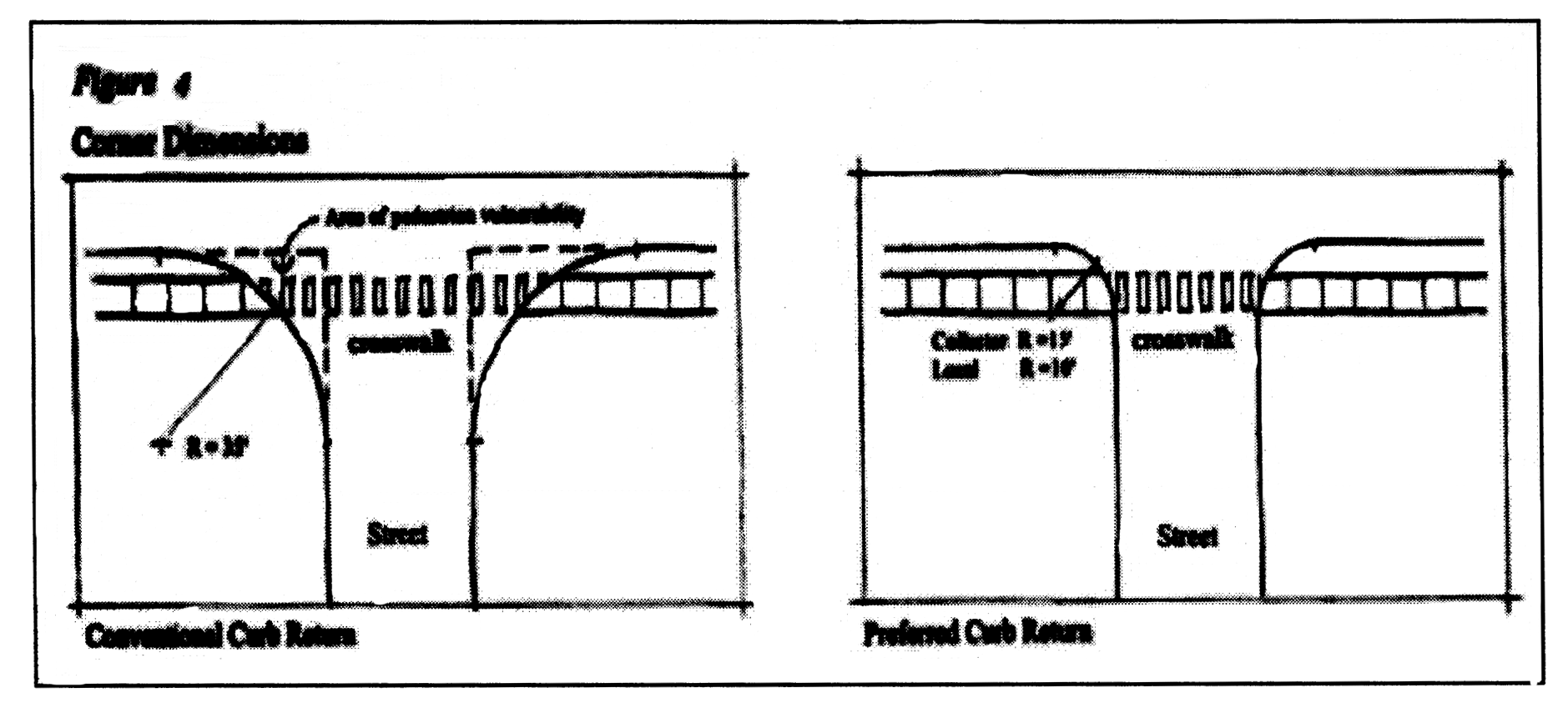
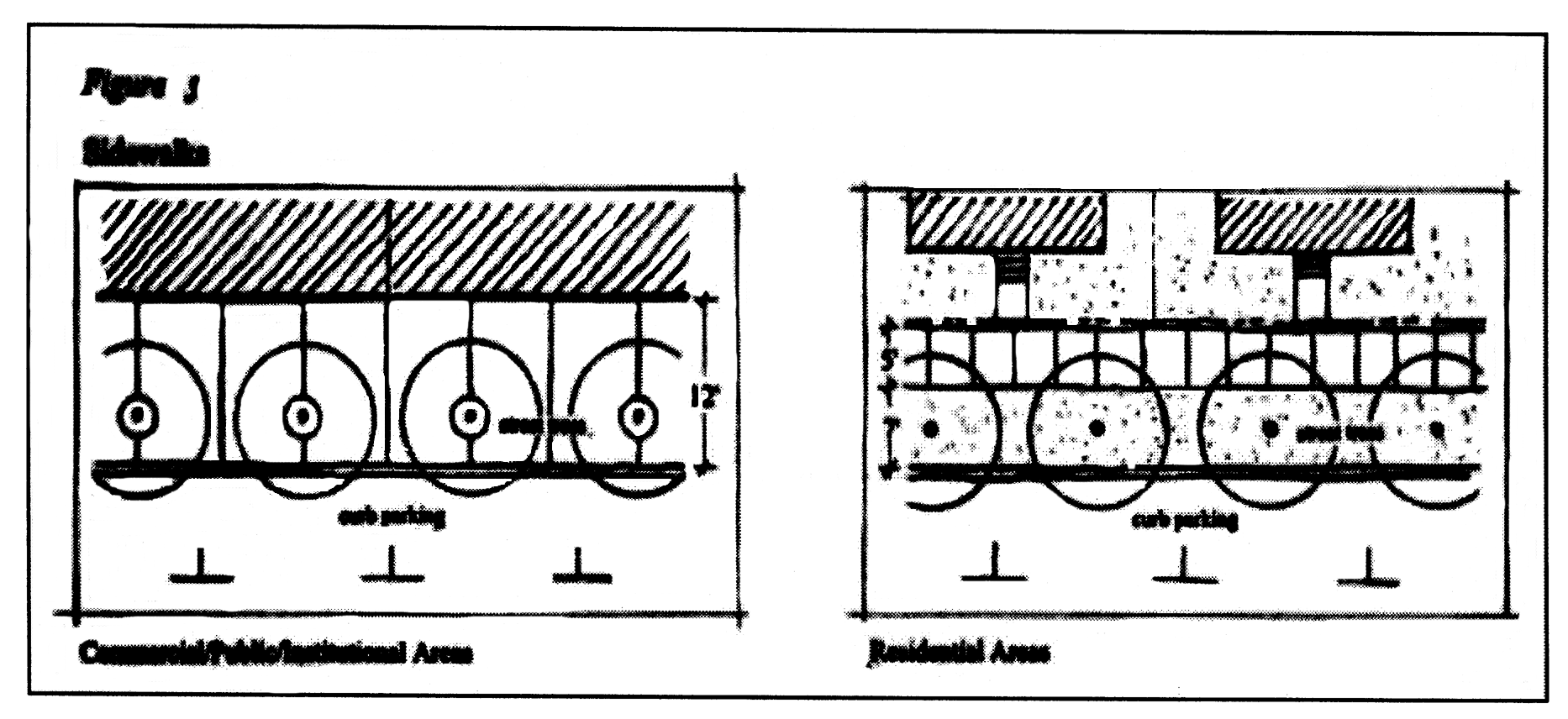
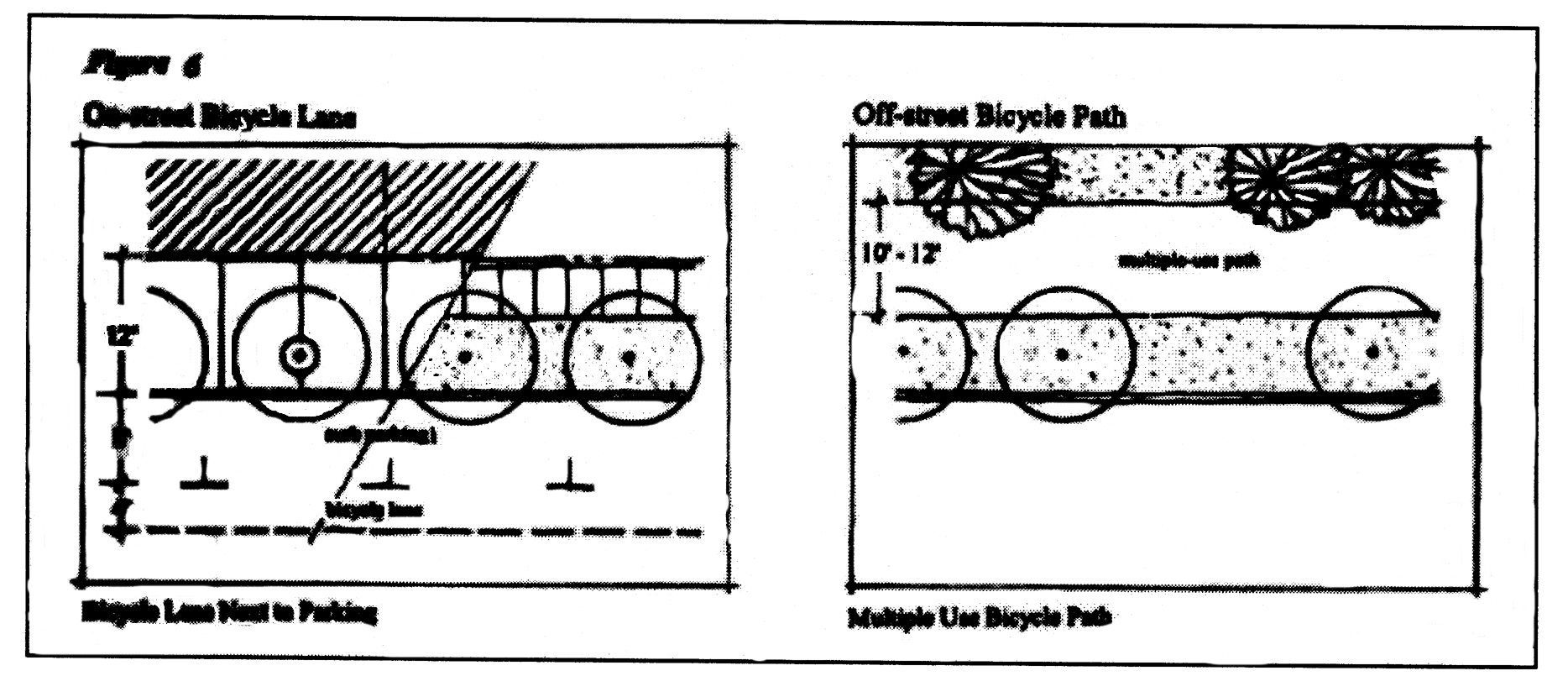
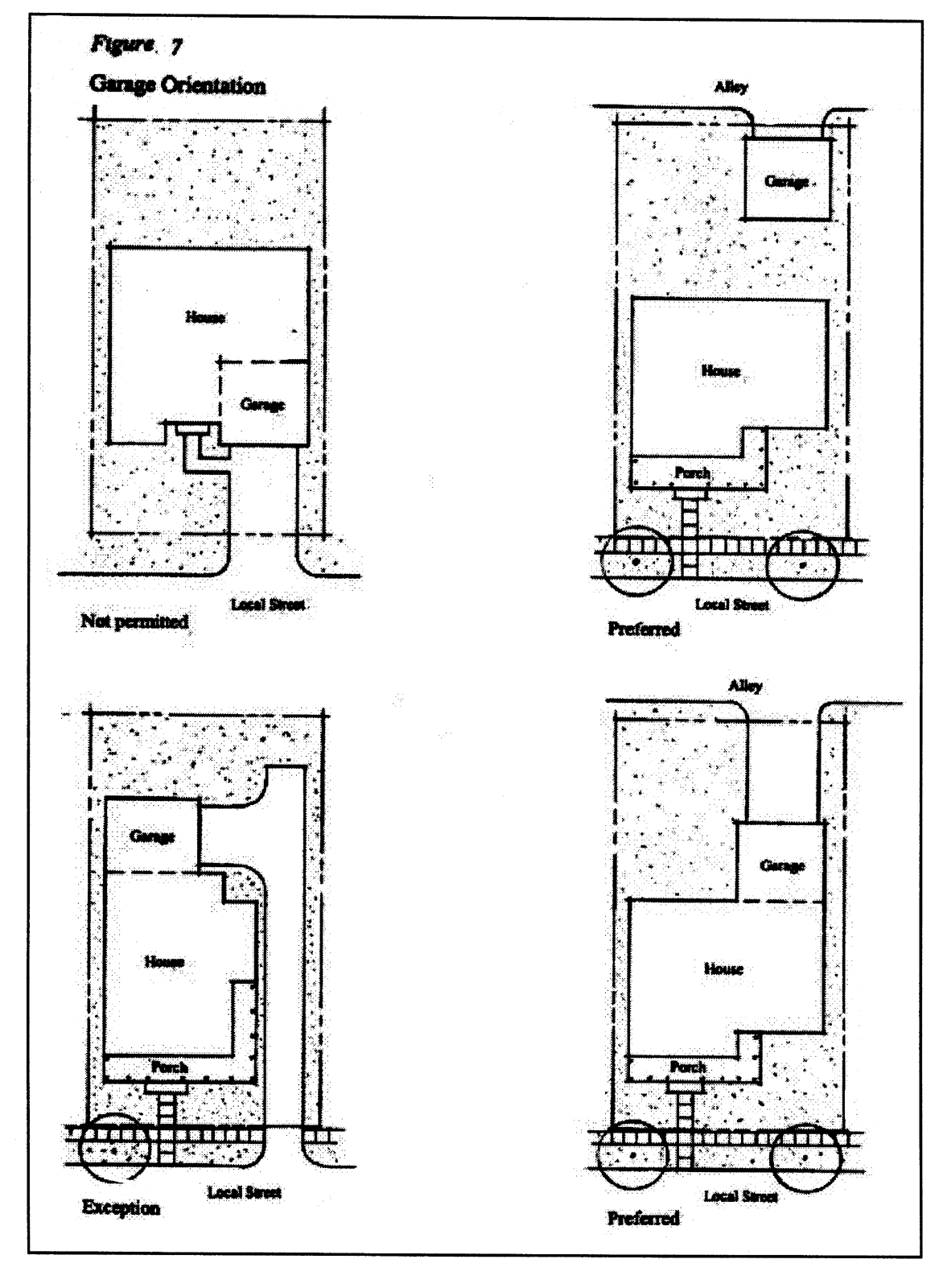
(Ord. No. 05-06-05; Ord. No. 06-07-4, § 19; Ord. No. 16-17-17, §§ 186—201)
_____
Sections 12.08.129, 12.08.130. - Reserved.
Editor's note— Ord. No. 22-23-05, § 2, adopted October 18, 2022, repealed § 12.08.129, which pertained to water facilities (central potable water facilities) covered or included by Florida Administrative Code 40 D-2 or 40 E-2 and derived from Ord. No. 05-06-05 and Ord. No. 16-17-17.
Section 12.08.131. - Central wastewater treatment facilities or structures or water treatment facilities or structures.
A.
Applicability. Permitted pursuant to applicable zoning district requirements.
B.
Additional standards for approval.
1.
Structures and facilities for central wastewater treatment or central potable water treatment shall not be located within 100 feet of any lot line adjacent to residentially zoned property. A landscaped buffer strip not less than eight feet in width shall be provided along all property lines adjacent to residential zoning. The required landscaped buffer strips shall be designed and planted to be at least 80 percent opaque from two to six feet above grade when viewed horizontally at maturity; however, a six-foot-high opaque fence, wall or similar structure may be substituted in lieu of the vegetative screening.
2.
All requirements of division 1, Central Potable Water Standards and division 2, Central Wastewater Systems of article 14 Public Facility Standards of this chapter are applicable.
(Ord. No. 05-06-05; Ord. No. 16-17-17, §§ 203, 204)
Section 12.08.133. - Wireless communication facilities—Antennas and towers as accessory uses.
A.
Applicability. Wireless communication facilities — Antennas and towers as accessory uses are permitted in zoning districts pursuant to the following standards.
B.
Additional standards for approval. The following antennas and towers shall be allowed as permitted accessory uses:
1.
Any antenna not more than one meter in diameter, which is not attached to a transmission tower, shall be a permitted accessory use to any structure of at least three stories in height other than single-family or two-family dwellings provided:
a.
The antenna, its antenna mount and any associated support facilities do not extend more than 20 feet above the highest point of the structure, or the maximum height for permitted accessory use in Table 1 of this article, whichever is less, and the antenna and its mount are not directly attached to the ground;
b.
The antenna complies with all applicable federal and state regulations;
c.
The antenna complies with all applicable building codes;
d.
The antenna complies with the requirements of subsections E., K. and L. of section 12.08.135 of this article.
e.
A structure mounted antenna may be mounted to the exterior of the structure, including but not limited to, the roof of the structure. If the antenna is mounted on the structure roof, the structure-mounted facility may include the antenna supports and/or associated support facilities. Structures to which antennas may be attached include, but are not limited to, commercial, institutional, office and industrial buildings, multi-family residential buildings, water tanks, utility and light poles not located in public rights-of-way or easements, poles at publicly-owned athletic facilities or other structures not originally designed as antenna mounts. A building permit application is required for antennas attached to structures and permitted as an accessory use.
2.
A non-commercial, receive only, antenna and any tower to support the antenna shall be a permitted accessory use to any single-family or two-family dwelling.
C.
Non-commercial receive only antennas which receive direct broadcast satellite service video programming services via multi-point distribution services shall be a permitted accessory use if one meter or less in diameter in residential use zoning districts and three meters or less in diameter in all other zoning districts.
D.
An amateur radio antenna and any tower to support the antenna that is owned and operated by a federally-licensed amateur radio station operator and used exclusively for non-commercial purposes shall be a permitted accessory use in all zoning districts.
E.
Any antenna and any tower to support the antenna that is owned and operated or licensed by the Federal Aviation Administration and used exclusively for aircraft navigation (NAVAIDS) shall be a permitted accessory use in the PU public lands zoning district and the P public and quasi-public lands zoning district.
F.
Any antenna and any tower to support the antenna, not greater than 35 feet in height and used exclusively as an accessory use to an existing principal use or an existing use allowed by special exception shall be a permitted accessory use in any zoning district subject to the requirements of section 12.08.135.
G.
Any antenna and any tower to support the antenna that is owned and operated by the BCC or the Highlands County Sheriff for public safety communications shall be a permitted accessory use in the PU public lands zoning district and the P public and quasi-public lands zoning district.
H.
Any antenna and any tower to support the antenna which: (1) is not greater than 350 feet in height; (2) is located not less than one mile from the property line of adjacent real property under separate ownership; (3) has between the antenna/tower and adjacent property under separate ownership a vegetative buffer which is functionally equivalent to that required by subsection L. of section 12.08.135; and (4) is used exclusively as an accessory use to an existing principal use or an existing use allowed by special exception, shall be a permitted use in the agricultural (AU) district.
(Ord. No. 05-06-05; Ord. No. 11-12-04, §§ 41—44; Ord. No. 16-17-17, §§ 205, 206)
Section 12.08.134. - Special exception application requirements for wireless communications facilities.
A.
Applications for special exceptions shall be processed in accordance with this chapter and shall include the following documentation:
1.
Copies of the following letters and all responses shall be provided to the county administrator for verification: Applicant's letters to other entities owning or using transmission towers in Highlands County and extending to a point one mile outside of Highlands County, as identified on a list maintained by Highlands County Planning Division, sent certified mail, return receipt requested inquiring whether said entities have a need to co-locate antennas or have tower space available for co-location of antennas;
2.
A statement by the applicant as to whether construction of the transmission tower will accommodate co-location of additional antennas for future wireless service providers, including the co-location capacity; or a request to modify the co-location requirements, where such request will not be contrary to the public interest and where, owing to conditions peculiar to the request, a literal enforcement of co-location requirements would result in unnecessary and undue hardship. A request for modification of co-location requirements shall include sufficient reasoning as to why the request should be granted;
3.
A statement by the applicant demonstrating, to the satisfaction of the county, that no existing transmission tower, alternative tower structure, building or other structure within the applicant's geographic search area:
a.
Meets the applicant's engineering requirements for the proposed facility;
b.
Is of sufficient height to meet the applicant's engineering requirement;
c.
Has sufficient strength to support the applicant's proposed antenna;
d.
Has sufficient vertical space to accommodate the applicant's antenna; or
e.
Is available for lease under a reasonable leasing agreement, as determined by the industry standards for the geographic area.
4.
A statement by the applicant indicating that government owned property is, or is not, available within the search ring for the wireless communication facility. If government owned property is available, the statement should include a full explanation if the applicant does not plan to locate on that property;
5.
A letter of intent, committing the tower owner and his or her successors and assigns to allow the shared use and co-location of the tower, if additional user(s) agree in writing to meet reasonable terms and conditions for such shared use, unless a request to modify co-location requirements is approved by the board of adjustment; and
6.
Visual aids of the proposed wireless communication facility site showing pre-development (existing) and post-development conditions. The visual aids for pre-development conditions shall include at a minimum 35 mm, color, eight by ten photographs and/or color video tape. The visual aids shall show the closest public views of the facility from a minimum of four locations. The pre-development visual aids shall be used to show post-development views of the facility (transmission towers, antennas, associated support facilities, landscaping and security fencing). Post-development views shall include views of the facility as it would appear immediately after construction and may include views of 12 and 24 months after construction. The visual aids shall show the relationship and proximity to neighboring residential zoning districts and uses and how the facility will appear from public view points. The visual aids may be accompanied by a corresponding written visual impact analysis prepared by the applicant. These requirements for visual aids are minimums and the county reserves the right to require additional visual aids as determined on a case-by-case basis.
7.
A letter from the property owner consenting to the application.
8.
A letter from the county engineer stating that there are no objections to the consideration of the special exception for the proposed ground-mounted towers with the following condition: At the time of development the ground-mounted tower shall be in accordance with the requirements of section 12.04.215 of this chapter.
9.
A copy of the FAA response to the applicant's notice of proposed construction or alteration, or its replacement.
10.
At the time of initial application, an inventory of all communication facilities (wireless and backhaul) which are under the applicant's control and/or are being used or planned by the applicant, located within the incorporated and unincorporated areas of Highlands County and within one mile outside the county. Information on each transmission tower listed shall include:
a.
The type of tower or supporting structure;
b.
The height of the tower including antennas;
c.
Latitude and longitude and state plane coordinate location;
d.
Street and mailing address of the owner and site address of the facility;
e.
FCC and applicable FAA permit numbers for each transmission tower and antenna facility;
f.
Ability of transmission tower or structure, associated support facilities and site to accommodate additional antenna(s), including the wireless service signal capacity; and
g.
Indication whether the site is co-located and if so, the names of the co-located service providers/owners.
11.
Applications for new wireless communication facilities shall include a letter from the applicant's engineer stating that the transmission tower and associated support facilities will not interfere or obstruct public safety telecommunications.
12.
The applicant shall provide updated information with subsequent applications.
13.
Payment of all fees established by resolution of the BCC.
B.
Time for submittal. The application and documentation, required by subsection A of this section, shall be delivered to the Highlands County Zoning Division not less than ten days prior to the application deadline for a special exception.
(Ord. No. 16-17-17, § 207; Ord. No. 23-24-24, § 2)
Section 12.08.135. - Wireless communications facilities (WCF).
A.
Applicability. This section shall regulate the location, erection, construction and modification of all wireless communication facilities in unincorporated Highlands County. Except as provided in subsection D. of this section, every wireless communications facility allowed by special exception or otherwise shall, at a minimum, satisfy the requirements of this section.
B.
Minimum lot requirements in regard to area and width shall be as follows:
1.
Parcels that are located within the AU district shall have a minimum area of one acre and a minimum width of 100 feet, provided that the parcel has legal access and all other requirements of this Code are met.
2.
All other parcels shall comply with the minimum lot requirements of the zoning district in which they are located.
C.
Reserved.
D.
Exceptions. to the applicability of this section. The requirements of this section do not apply to:
1.
Non-commercial freestanding and structure-mounted "receive only" antennas which receive direct broadcast satellite service video programming services via multipoint distribution services which are one meter or less in diameter in residential zones and three meters or less in diameter in non-residential zones. The antennas shall meet all other requirements of the zoning district as set forth in chapter 12 of the Highlands County Code of Ordinances.
2.
Amateur radio antennas and any tower to support the antenna that is owned and operated by a federally-licensed amateur radio station operator used exclusively for non-commercial purposes.
3.
Any antenna and any tower to support the antenna, owned and operated or licensed by the Federal Aviation Administration, and used exclusively for aircraft navigation (NAVAIDS).
4.
Any antenna and any tower to support the antenna, not greater than 35 feet in height, and used exclusively as an accessory use to essential services.
5.
Any antenna and any tower to support the antenna owned and operated by a governmental entity for public safety communications.
E.
Height limitations. The height of antennas and towers shall be determined pursuant to this section.
1.
The special exception shall specify the height pursuant to Table 1 of this subsection, based on standards of approval in this section.
2.
Measurement of transmission tower height shall include antenna, base pad, and other appurtenances and equipment attached to the tower. Height shall be measured from the ground surface which existed prior to actual erection or construction immediately outside the construction site boundaries of the wireless communication facility.
3.
Structure-attached antenna mounts may extend a maximum of 20 feet above the roof line or top of the structure.
4.
Pole-attached antenna mounts may extend a maximum of 20 feet above the top of the pole.
5.
In all zoning districts other than those listed in Table 1 of this subsection, every antenna shall be incorporated in a camouflaged antenna facility which is a structure-mounted facility or an alternative tower structure and shall not extend more than 20 feet above the roof line of the structure.
_____
6.
The permitted, prohibited, and special exception heights for ground-mounted towers and alternative tower structures are set forth in Table 1 in this subsection as follows:
TABLE 1 — NON RESIDENTIAL HEIGHT REQUIREMENTS
F.
Co-location requirements for ground-mounted towers and alternative tower structures. Ground-mounted towers and alternative tower structures over 50 feet in height shall be designed and constructed to accommodate one co-location for each additional 30 feet in tower height proposed. Towers less than 50 feet in height shall be exempt from this provision. An applicant may include a request to modify the co-location requirements, where such request will not be contrary to the public interest and where, owing to conditions peculiar to the property and not the result of the actions of the applicant, a literal enforcement of co-location requirements would result in unnecessary and undue hardship. A request for modification of co-location requirements shall include sufficient reasoning and evidence as to why the request should be granted.
G.
Camouflage. Structure-mounted facilities, pole-attached antennas, alternative tower structures and all associated support facilities shall be constructed as camouflaged facilities as required in Table 1 herein. Camouflage may be required for other facilities if determined by the BOA that camouflage is appropriate for a specific site to minimize the aesthetic impact of the facility.
H.
Separation distances between towers. The separation distances established in Table 2 of this subsection shall be required unless reduced by special exception as specified in this subsection.
1.
Ground-mounted towers shall comply with the horizontal separation measured between bases of the transmission towers as specified in Table 2, irrespective of jurisdictional boundaries.
2.
Minimum separation between pole-mounted facilities shall be determined by the location of the existing utility poles or structures. All measurements shall be certified by a professional land surveyor.
3.
Separation distances are as follows:
_____
4.
A request by an applicant for a ground-mounted tower for a reduction of the separation distance specified in Table 2 of this subsection shall be granted, in whole or in part, by the BOA if it finds, based upon the record at the public hearing, that the following standards, where applicable, have been met:
a.
The reduction will not be contrary to the public interest;
b.
The reduction will promote co-location;
c.
The reduction will not create significant incompatibilities with the adjacent zoning district(s) or designation(s) specified in subsection (g) of this section;
d.
Locating the tower in compliance with the separation requirements set forth in Table 2 of this section would create a greater aesthetic impact than would be caused by allowing a reduction;
e.
The tower will be substantially screened or concealed from public view in the adjacent protected zoning district(s) or designation(s) by intervening buildings, mature trees, landscaping, structures or similar screening;
f.
The reduction is needed to provide adequate service; and
g.
If the separation is reduced, the reduced separation shall not be less than the setbacks specified in this section.
I.
Separation distances from adjacent residential zoning, residential comprehensive plan category, or residential use.
1.
Separation distances required by this section shall be measured from the boundary lines of the parcel upon which the tower will be located.
2.
Ground-mounted towers (monopole, lattice and guyed tower) shall have a horizontal separation of 200 feet or 300 percent of the tower height whichever is greater from any residential zoning districts or other property having an existing residential use, or conservation management zoning districts, or other areas designated low density residential, medium density residential, high density residential or conservation/management on the comprehensive plan future land use map unless the property within the required separation distance is owned by the same property owner who owns the property upon which the tower will be located or the applicant notifies all property owners within the required separation distance in writing of the proposed tower and its location. Said notification shall be on a form approved by the county and sent with a certificate of mailing; the required certificate of mailing shall be provided with the application for special exception.
3.
Alternative towers require no separation other than the setbacks required by this section.
J.
General setbacks and fall zone setbacks. All ground-mounted towers and alternative tower structures and their associated support facilities shall conform with the following setback standards:
1.
Guy anchors and accessory structures shall meet the minimum setback requirements of the zoning district in which they are located.
2.
Alternative tower structures or ground-mounted towers not located in rights-of-way shall be set back from the property line a distance equal to the fall zone radius of the tower as designed and certified by a professional structural engineer or the minimum zoning district set back, whichever is greater.
3.
Ground-mounted towers and alternative tower structures located in rights-of-way or easements shall meet the requirements of the right-of-way use permit issued by the permitting authority for the right-of-way.
4.
The ground-mounted tower or alternative tower structure may be located on a lot containing other permitted principal uses and must meet specified setbacks, and the lot shall comply with the applicable minimum lot size for the zoning district or be a legal nonconforming lot.
5.
The fall zone shall be entirely within the property of the owner of the wireless communication facility or tower unless the owners of all property within the fall zone grant easements to the owner of the wireless communication facility or tower allowing the fall zone to encroach upon their property. Unless specifically authorized in writing by the property owner(s) owning land within the fall zone upon which the building will be located, no buildings other than wireless facility support facilities shall be allowed within the fall zones. Fall zones for ground-mounted towers shall be determined by a registered professional engineer licensed in the State of Florida.
K.
Secure facility design. Wireless communication facilities shall be designed, constructed, and maintained to satisfy the following requirements:
1.
All parts of the wireless communication facilities shall maintain a minimum horizontal separation of ten feet from any overhead utility lines. This requirement does not preclude a greater separation if required by federal, state, or local laws or regulations or the utility company.
2.
Each ground-mounted facility (including guy wire anchors) and all support facilities shall be surrounded with a chain link fence not less than six feet in height from finished grade (measured from the highest point within ten feet of the fence). The facility site shall be secured by a construction fence prior to the start of transmission tower construction.
3.
Each transmission tower climbing device shall have a removable or retractable section, ten feet in length, at the bottom of the climbing device or otherwise designed to prevent unauthorized persons from climbing the tower.
4.
Structure-mounted facilities shall be located and designed to be accessible to authorized personnel only.
5.
Support facilities shall be of vandal-resistant design.
L.
Landscaping. The aesthetic impacts of wireless communication facilities shall be mitigated through provision of landscaping, as follows:
1.
Landscaping shall be located parallel to and within the outer perimeter of the wireless communication facility construction boundaries.
2.
Landscaping shall be located not less than ten feet from the outside of all security fencing.
3.
Existing vegetation shall be preserved to the maximum extent practicable and may be used as a substitute or to supplement the landscape buffer requirements. Existing vegetation may include, but is not limited to, landscaping or vegetation which is outside of the wireless communication facility construction boundaries, but is within the property boundaries of the lot and under the control of the property owner on which the wireless communication facility is located.
4.
The following landscaping shall be provided and maintained around the perimeter of the tower, all freestanding support facilities, and guy-wire anchors:
a.
A row of large-canopy trees 15 feet in height with a two-inch caliper trunk (at the time of planting). Trees shall be planted 20 feet on center around the perimeter of the fence; and
b.
A continuous hedge of shrubs in front of the trees. The shrubs shall be at least 30 inches high at planting and capable of growing to at least 36 inches in height within 12 months; and
c.
All plants shall be evergreen or broadleaf evergreen and of the approved types as listed in article 11 of chapter 12 (Landscaping) of the Highlands County Code of Ordinances.
5.
Landscaping shall be installed prior to final building inspection by county and shall be maintained in accordance with division 2 of article 11 of chapter 12 (Landscaping) of the Highlands County Code of Ordinances.
M.
Signage. The wireless communications facility shall have signage to identify the facility as a "no-trespassing area" and to provide a current emergency contact, telephone number, site address and other information as may be required by applicable federal, state, or local laws or regulations. No other signage shall be allowed on any wireless communication facility.
N.
Illumination. Wireless communication facilities shall not be artificially lighted except as required by federal, state, or local laws or regulations.
O.
Finished color.
1.
Non-camouflaged ground-mounted towers shall be painted or have a non-reflecting and non-contrasting finish selected to minimize visibility of the facility from public view, except where contrasting color is required by federal, state, or local laws or regulations.
2.
The exterior of non-camouflaged support facilities shall be architecturally designed to blend in with the existing aesthetic and architectural standards of the surrounding environment.
P.
Structural design.
1.
Ground-mounted towers and alternative tower structures shall be constructed to the EIA/TIA 222-F standards, as may be amended, as published by the Electronic Industries Association, which may be amended from time to time, and all applicable county ordinances, rules and regulations.
2.
Any modifications to existing ground-mounted towers and alternative tower structures shall require prior submission to the county building department of plans and certifications prepared by a professional engineer (structural), which demonstrate compliance with the EIA/TIA 222-F standards, as may be amended.
Q.
Wireless communication facility shall not create interference with or degrade the quality of existing broadcast telecommunications. A wireless communication facility shall not create interference with or degrade the quality of existing broadcast telecommunications, including but not limited to, emergency services and essential services communications, cable television, and other wireless communication systems.
1.
Applications for new wireless communication facilities shall include a letter pursuant to section 12.08.134.A.11.
2.
Any interference and/or obstruction pursuant to this subsection shall be corrected by the applicant or wireless communication facility owner at no cost to the county, within the following time frames:
a.
Interference with emergency services or essential services communications—24 hours.
b.
Interference with cable television and other wireless communication systems—45 calendar days.
R.
Modification of existing transmission towers for co-location.
1.
Ground-mounted towers or alternative tower structures existing prior to January 2, 2001, may be modified to permit the co-location of antennas in order to promote co-location and to minimize the adverse aesthetic impacts associated with the proliferation of ground-mounted towers. Modification of ground-mounted towers or alternative tower structures existing prior to January 2, 2001, shall require application and approval of a building permit and shall be considered a permitted use, provided that the modified tower is:
a.
In compliance with all the standards of this chapter except as modified in this section; and
b.
Does not exceed ten feet over the height of the existing tower unless additional height is approved by special exception. The height added through modification shall not exceed the maximum height allowed in the property's zoning district.
2.
Reserved.
3.
Transmission towers which have been modified to accommodate co-location in accordance with this section shall not be deemed to be in violation of zoning district setbacks, the tower to adjacent zoning district/designation separation requirements specified in subsection I. of this section, or the tower to tower separation requirements specified in subsection H. of this section or Table 2 herein.
S.
Replacement of existing transmission towers for co-location.
1.
To promote co-location and to minimize the adverse aesthetic impacts associated with the proliferation of ground-mounted towers, the replacement of existing ground-mounted towers or alternative tower structures to accommodate the co-location of additional antenna(s) shall require application and approval of a site plan, building permit, and shall be considered a permitted use in the zoning districts listed in Table 1, provided that the replacement tower is.
a.
In compliance with all the standards of this chapter except as modified in this section;
b.
Located no more than 100 feet from the existing tower;
c.
Reserved;
d.
The same tower type as the existing tower or a monopole tower or guyed tower replacing an existing lattice tower, or an alternative tower structure replacing a ground-mounted tower;
e.
Does not exceed 40 feet over the height of the existing tower unless additional height is approved by special exception; and
f.
The only transmission tower remaining on the site. The transmission tower which is being replaced must be removed from the site within 30 days of completion of the replacement tower.
2.
An existing ground-mounted tower shall not be replaced more than one time without a special exception for the replacement.
3.
Replacement transmission towers which have been constructed to accommodate co-location in accordance with this section shall not be deemed to be in violation of zoning district setbacks, the tower to adjacent zoning district/designation separation requirements specified in subsection I. of this section, or the tower to tower separation requirements specified in subsection H. of this section or Table 2 herein.
4.
The height added through modification and replacement shall not exceed a total of 40 feet unless otherwise approved by special exception.
T.
Reserved.
U.
Abandonment.
1.
In the event the use of any wireless communications facility is discontinued for a period of 180 consecutive days, the facility shall be deemed to be abandoned. Determination of the date of abandonment shall be made by the county administrator who shall have the right to request documentation and/or affidavits from the transmission tower owner/operator regarding the issue of tower usage. Except where the county has determined the non-use constitutes an unsafe condition and a shorter response period is specified in the county's notice of abandonment, the transmission tower owner/operator shall respond within 60 calendar days to the above notice of abandonment.
2.
Failure or refusal by the transmission tower owner/operator to respond for any reason shall constitute prima facie evidence that the transmission tower has been abandoned.
3.
Upon a determination of abandonment and notice thereof to the property owner and to the transmission tower owner/operator, the tower owner/operator or property owner shall have an additional 90 calendar days within which to:
a.
Activate the use of the facility or transfer the tower to another tower owner/operator who makes actual use of the tower within the 90 calendar day period; or
b.
At no cost to the county, dismantle and remove the wireless communication facility.
4.
At the earlier, of 90 calendar days from the date of abandonment without reactivation or upon completion of dismantling and removal, any previous special exception and/or approval for the facility shall automatically expire.
5.
The tower applicant shall provide security or surety as required in subsection W. of this section sufficient to cover the cost of tower removal in the event the tower is abandoned.
V.
Violations. The owner of the wireless communication facility and the property owner of the land upon which the facility is located at the time the facility is determined to be abandoned shall be jointly and severally liable for any violation of this section.
W.
Agreement for removal of abandoned or dilapidated tower. An agreement between Highlands County and the owner of the tower or the land owner must be submitted. The agreement shall be maintained by the county clerk's office and monitored by the county engineer's office. The county may utilize the security provided under the agreement and complete the removal of the tower if the tower has not been removed within 180 days of abandonment. The agreement must contain a description of the amount and type of security provided to ensure removal of the tower pursuant to the provisions of these regulations and the project engineer's cost estimate of the tower removal. The project engineer's cost estimate shall be renewed every ten years and submitted to the county engineer's office.
1.
The security shall be in the amount of 110 percent of the estimated cost of removing the tower;
2.
Security requirements may be satisfied by a performance bond, cashier's check, cash, interest bearing certificate of deposit, irrevocable letter of credit, or surety bond.
3.
The security must be for the duration of the life of the tower and the length of the permit or whichever is greater. The security must be in a form acceptable to the BCC. The security will have to be renewed, as required by the BCC. At the time of renewal, the amount of the security will be adjusted for increases in removal costs. A security required by other governmental agencies for the purpose of fulfilling the requirement for removal of an abandoned tower may be accepted partially or completely by the BCC.
X.
Permitted use in agricultural. Any antenna and any tower to support the antenna shall be a permitted use in the Agricultural AU district which: (1) is located more than one mile from a platted subdivision or other residential development that contains five or more lots or dwelling units; (2) meets all standards contained in this section; (3) submits an application pursuant to this section to the county engineer; (4) has between the antenna/tower and adjacent property under separate ownership a vegetative buffer which is functionally equivalent to that required by subsection L. of this section; and (5) submits a site plan to the county engineer for approval by the county engineer after review by Highlands County staff and a consultant hired pursuant to subsection Y. of this section.
Y.
Schedule of fees and charges. The BCC may establish from time to time by resolution a schedule of fees, charges and expenses and a collection procedure for administration of this section for the review of applications by county staff and consultants or consulting engineers, hired by the county. Those fees shall be paid by the applicant to the county when the application is filed.
(Ord. No. 05-06-05; Ord. No. 05-06-30, §§ 73, 74; Ord. No. 06-07-4, § 20; Ord. No. 11-12-04, § 45; Ord. No. 16-17-17, §§ 208—214; Ord. No. 17-18-15, § 2; Ord. No. 22-23-05, § 2; Ord. No. 23-24-24, § 3)

