
Highlands County Unincorporated
City Zoning Code
City Zoning Code
ARTICLE 2
- DEFINITIONS AND ABBREVIATIONS3
Editor's note— Ord. No. 05-06-30, § 3, adopted April 18, 2006, amended Art. 2, in its entirety, to read as herein set out. See also the Code Comparative Table.
Section 12.02.100.- Purpose.
The purpose of this article is to define the words, terms and phrases used to express the standards and procedures established in these regulations.
(Ord. No. 05-06-30, § 3)
Section 12.02.101. - Context.
The following words, terms and phrases shall have the meanings as ascribed to them herein. Where the contextual indication of any word, term or phrase herein defined clearly connotes a different meaning, the contextual connotation shall be applied.
A.
Gender. Words used in the feminine shall include the masculine gender and words in the masculine shall include the feminine.
B.
Number. Words used in the singular shall include the plural and words used in the plural shall include the singular.
C.
Tense. Words used in the present tense shall include the future tense and past tense.
D.
The word shall is mandatory. The word may is permissive.
(Ord. No. 05-06-30, § 3)
Section 12.02.102. - Codes.
All definitions found in and inclusive to construction codes adopted by the BCC, such as the Florida Building Code (which includes Energy Conservation, Accessibility, Fuel Gas, Mechanical, Plumbing, Existing Building, Residential, Test Protocols) and other Codes governing construction standards are here included in this article by reference.
(Ord. No. 05-06-30, § 3; Ord. No. 16-17-17, § 3)
Section 12.02.103. - Abbreviations.
As used in this Code, certain abbreviations shall be taken to mean:
(Ord. No. 05-06-30, § 3; Ord. No. 06-07-6, § 1; Ord. No. 06-07-28, §§ 1, 2; Ord. No. 08-09-54, § 1; Ord. No. 11-12-04, § 1; Ord. No. 12-13-09, § 1; Ord. No. 12-13-11, § 1; Ord. No. 13-14-11, § 1; Ord. No. 16-17-17, § 4; Ord. No. 19-20-09, § 2; Ord. No. 21-22-12, § 2; Ord. No. 22-23-03, § 2)
Section 12.02.104. - Definitions and interpretations.
1.
Abandoned. To give up by leaving or ceasing to operate.
2.
Accessory structure. A structure detached from a principal building located on the same lot and customarily incidental and subordinate to the principal building or use.
3.
Accessory use. A use of land or of a building or portion thereof customarily incidental and subordinate to the principal use of the land or building and located on the same lot with the principal use.
4.
Actual crossing operation. That phase of the work authorized by the utility permit, when the casing or incased carrier pipe is being placed within the physical limits prescribed to determine the required casing length; this will not include preliminary work, such as jacking pit construction, equipment set-up, etc.
5.
Addition (to an existing building). Any walled and roofed expansion to the perimeter of a building in which the addition is connected by a common load bearing wall other than a fire wall. Any walled and roofed addition which is connected by a fire wall or is separated by independent perimeter load bearing walls is new construction.
6.
Adequate. The minimum ability necessary to satisfy a requirement of Highlands County.
7.
Adjacent. Immediately adjoining and sharing a common property line or boundary.
8.
Agriculture. The science and art of producing plants and animals for use by mankind, including the preparation of land resource to accommodate such practices and, to a variable extent, the preparation and harvesting of such products. The term "agriculture" encompasses activities that are customarily associated with aquaculture and fisheries, horticulture, viticulture, siviculture, and aeviaculture, livestock and poultry operations, bee keeping, stable and kennel operations, animal husbandry, ranching, dairy operations, forestry, or any other practice that is typical of, and necessary to, or in keeping with these activities.
9.
Agriculture easement. A right to or interest in the use of real property for agricultural uses but not including the right to develop the property.
10.
Agricultural worker(s). A person or persons employed for labor in agriculture.
11.
Agricultural worker housing. The living accommodations of agricultural workers and their families, on one lot or parcel without regard to duration, which occurs exclusively in association with the performance of agricultural labor.
12.
Reserved.
13.
Alteration, altered or repaired. Any changes in structural parts, stairways, type of construction, kind or class of occupancy, light or ventilation, means of ingress and egress or other changes affected or regulated by the building code or this Code except for minor changes or repairs not involving the aforesaid features.
14.
Alternative tower structure. A manmade structure that supports one or more antenna, and that either conceals or camouflages the presence of transmission towers from public view by unobtrusively blending in aesthetically with the surrounding environment. Alternative tower structures include, but are not limited to, simulated trees, clock towers, bell steeples, light and utility pole replacements which match the appearance of the existing or adjacent light and utility poles, and similar structures.
15.
Ammunition. Shall be defined as that term is defined in F.S. § 790.001, (2011).
16.
Reserved.
17.
Antenna. Any apparatus designed for the sending and/or receiving of electromagnetic waves. These include, but are not limited to telephone, radio, television, and satellite or wireless personal communications. Types of antennas, include but are not limited to whip antennas, panel antennas, and dish antennas. As used in this chapter, the term antenna includes all antennas integrated and used as a single unit, such as an antenna array.
18.
Apartment hotel. A multiple-family dwelling having resident supervision which maintains an inter-lobby through which all tenants must pass to gain access to the apartments.
19.
Archaeological confinement zone. Those areas within 300 feet radius of a discovered archaeological resource, that is, either shown on the adopted archaeologically sensitive areas map or not shown, but known to exist. The confinement zone exists until the perimeter of the site is defined, archaeological clearance is obtained, or the FMSF has designated the site as not archaeologically significant or as significant but requiring no further investigation.
20.
Archaeological reconnaissance report. A report submitted by the archaeologist (as referenced in definition # 242 "qualified archaeological agent") conducting the reconnaissance survey which documents the findings of the survey and incorporated recommendations pertaining to the disposition of the findings.
21.
Archaeological reconnaissance survey (ARS). A cursory archaeological survey usually conducted to identify and map sites and to obtain data on site types and distribution. Field methodology in this type of survey involves minimal sub-surface testing. This survey is conducted by a qualified archaeological agent for the purpose of determining whether an archaeological resource is significant, requiring a more in-depth archaeological investigation.
22.
Archaeological resource. All artifacts evidencing human occupation, habitation, or activity or a site which contains artifacts from an historic or prehistoric period. This evidence shall include cultural sites, structures, mounds and middens, artifacts, and physical remains. To be significant, an archaeological resource must contain artifacts which can be used to reconstruct or convey important aspects of the prehistory, history, or culture of the Central Florida region. The definition of archaeological resource includes, but is not limited to, those sites listed by the National Advisory Council on Historic Preservation on the Florida National Register of Historic Places and those sites listed by the Florida Division of Historic Resources in their Florida Master Site File. A "known" archaeological resource is one that exists and is filed in the Florida Master Site File (FMSF).
23, 24.
Reserved.
25.
Arterial road. A roadway providing service which is relatively continuous and of relatively high traffic volume, long trip length, and high operating speed. In addition, every federal highway and every FDOT designated Florida Intrastate Highway System route is an arterial road.
26.
As built. Plans that show horizontal locations and vertical elevations tied to known reference point (e.g., state plane coordinates) of all deviations from county approved plans.
26A.
Assisted living facility. Residences that provide rooms, meals, personal care, and supervision of self-administered medication. They may provide other services, such as recreational activities, financial services, and transportation. See "residential health care facility; retirement community."
26B.
Attic: That part of a building that is immediately below and wholly or partly within the roof framing. See story, half. See diagram for definition # 26B.
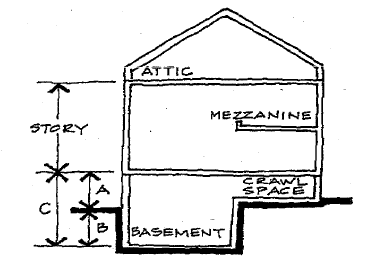
When A is less than B—C is a cellar Diagram for Definition # 26B.
27.
Automobile wrecking. The dismantling or disassembling of motor vehicles or trailers, including the storage, sale or dumping of dismantled, partially dismantled, obsolete or wrecked vehicles or their parts.
28.
Auxiliary lane. The portion of the roadway adjoining the traveled way for parking, access ramps, speed changes, turning, storage for turning, weaving, truck climbing or other purposes supplementary to through traffic movement.
29.
Reserved.
30.
Basement. That portion of a building having its floor sub-grade (below ground level) on all sides.
31.
Reserved.
32.
Boardinghouse. A lodging establishment offering rooms on a short term basis that may not be classified as a hotel, motel, resort condominium, non-transient apartment or transient apartment. The term includes, but is not limited to, rooming houses, hostels and bed and breakfast inns.
32A.
Boarding home for sheltered care. A boarding home for the sheltered care of persons with special needs, which, in addition to providing food and shelter, may also provide some combination of personal care, social or counseling services, and transportation. See "assisted living facility; boardinghouse; community residences for the developmentally disabled; community shelters for victims of domestic violence."
33.
Reserved.
34.
Building:
a.
Any structure, either temporary or permanent, having a roof and used for the shelter or enclosure of persons, animals, chattels or property of any kind. This definition shall include tents, awnings or vehicles situated on private property and serving in any way the function of a building.
b.
Any structure built for support, shelter, or enclosure for any occupancy or storage.
35.
Reserved.
36.
Cabana room. A structure consisting of a rigid frame made of wood, aluminum, steel, block, brick or other support material, a roof, exterior walls which have open areas covered by windows or panels made of or covered by glass or vinyl material and interior walls which are finished with wood, paneling, drywall or other material.
37.
Reserved.
38.
Camper. Any individual who occupies a campsite or otherwise assumes charge of, or is placed in charge of, a campsite.
39.
Campground. A place where sites for recreational vehicles or tents or buildings are rented for use as temporary living quarters for recreational purposes. A plot of ground upon which two or more campsites are located, established, or maintained for occupancy by camping units as temporary living quarters for recreation, education, or vacation purposes.
40.
Campsite. A parcel of land in a campground for the placement of tents or one trailer or recreational vehicle (other than a mobile home) and for the exclusive use of the occupants. Any plot of ground within a campground intended for exclusive occupancy by a camping unit or units under the control of a camper.
41.
Canal. Any manmade waterway used for the purpose of drainage, irrigation, or transportation which collects and then diverts or directs the flow of surface water or groundwater. A ditch is not a canal.
42.
Reserved.
43.
Capital improvement. Physical assets constructed or purchased to provide, improve, or replace a public facility and which are large scale and high in cost.
43A.
Central potable water facilities. Structures or systems designed to collect, treat, or distribute potable water, including water wells, treatment plants, reservoirs, and distribution mains, for which a water use permit must be obtained from a water management district.
43B.
Central wastewater facilities. Structures or systems designed for the collection, transmission, treatment, or disposal of wastewater, including trunk mains, interceptors, treatment plants and disposal systems.
44.
Certificate of appropriateness (C.A.). A document issued by the historic preservation commission, or its staff under certain circumstances, approving a proposal to make specified alterations to or to demolish a designated historic property or a building, structure or monument located within a designated historic district or to construct a building or structure on property located within a designated historic district, which must be obtained before such alteration, demolition or construction may be begun.
44A.
Certificate of archaeological appropriateness (C.A.A.). A document issued by the historic preservation commission, or its staff, which gives its approval for work to be done on a designated archaeological site and which allows the applicant to apply for development orders. The CAA may contain conditions relating to the proposed work regarding measures to either, preserve, protect, or mitigate impact to the affected resource.
44B.
Certificate of historical appropriateness (C.H.A.). A document issued by the historic preservation commission, or its staff under certain circumstances, approving a proposal to make specified alterations to or to demolish a designated historic property or a building, structure or monument located within a designated historic district or to construct a building or structure on property located within a designated historic district, which must be obtained before such alteration, demolition or construction may begin.
45.
Certificate to proceed (C.P.). The document used by the HPC to reaffirm the initial development order, subsequent to securing an archaeological clearance, to proceed towards implementation.
46.
Certified welder. A person who has been trained and meets all applicable requirements for the particular type of welding being performed under a permit.
47.
Change of occupancy. A discontinuance of an existing use and the substitution therefore of a use of a different kind or class. Change of occupancy is not intended to include a change of tenants or proprietors, unless accompanied by a change in the type of use.
48.
Club, night. A restaurant, dining room, bar or other similar establishment providing food or refreshments wherein floor shows or other forms of entertainment are provided.
49.
Club, private. Those associations and organizations of a fraternal or social character, not operated or maintained for profit. The term "private club" shall not include casinos, nightclubs or other institutions operated as a not for profit business.
50.
Co-location. When more than one wireless communication service provider uses a single monopole, lattice or guyed tower, or similar structure to attach antenna(s) for the purpose of providing wireless communications services.
51.
Collector road. A roadway providing service which is of relatively moderate traffic volume, moderate trip length, and moderate operating speed, designed and intended to collect and distribute traffic between local roads or arterial roads.
52.
Commercial uses. Activities which are predominantly connected with the sale, rental, and distribution of products or the performance of services.
53.
Commercial vehicle. Any vehicle designed, intended or used for transportation of people, goods or things, other than private passenger vehicles and trailers.
54.
Reserved.
55.
Community park. A park designed to serve the needs of more than one neighborhood.
55A.
Community residences for the developmentally disabled. A residential facility, licensed by the state, providing food, shelter, and personal guidance, with supervision, to developmentally disabled or mentally ill persons who require assistance, temporarily or permanently, in order to live in the community and shall include group homes, halfway houses, intermediate care facilities, supervised apartment living arrangements, and hostels.
55B.
Community residential home. A dwelling unit licensed to serve clients of the department of children and family services, which provides a living environment for unrelated residents who operate as the functional equivalent of a family, including supervision and care by supportive staff as may be necessary to meet the physical, emotional, and social needs of the residents.
55C.
Community shelters for victims of domestic violence. A residence providing food, shelter, medical care, legal assistance, personal guidance, and other services to persons who have been victims of domestic violence, including any children of such victims, who temporarily require shelter and assistance in order to protect their physical or psychological welfare.
56.
Competent. Legally fit or qualified and adequate for the stipulated purpose.
57.
Comprehensive plan. The Highlands County Comprehensive Plan, as it may be amended from time to time.
58.
Concurrency. The necessary public facilities and services to maintain the adopted level of service standards are available when the impacts of development occur.
59.
Concurrency management system. The procedures and/or process of Highlands County to assure that development orders and permits are not issued unless the necessary facilities and services are available concurrent with the impacts of development.
59A.
Concurrency service area. The geographic area in which the level of service is measured when an application for residential development is reviewed for school concurrency purposes. The concurrency service areas shall be the same as the adopted school attendance zones.
60.
Conduit. An enclosure for protecting wires and cables.
61.
Cone of influence. An area around one or more major water wells, the boundary of which is determined by the government agency having specific statutory authority to make such a determination based on groundwater travel or Drayton depth.
62.
Confining layer. An impermeable stratum separating one aquifer from another aquifer. The confining layer is made up of soils that act as a retardant to the downward flow of groundwater into the confined aquifer. The depth to this layer shall be determined by a Florida registered professional engineer or geologist for a proposed project. The concretaceous layer commonly known as the "hard pan" is not the confining layer for the purposes of this section.
62A.
Congregate living facility. Apartments and dwellings with communal dining facilities and services, such as housekeeping, organized social and recreational activities, transportation services, and other support services appropriate for the residents. (See community residential home #55B.)
63.
Conservation easement. A right or interest in real property which is necessary to retain land or water areas in their natural, scenic, open, or wooded condition; retaining such areas such as suitable habitat for fish, plants, or wildlife; retaining the structural integrity or physical appearance of sites or properties of historical, architectural, archaeological, or cultural significance, as set forth in F.S. § 704.06.
64.
Conservation overlay map. A map maintained by the county and adopted as a general indicator to determine if environmental clearance is required. The map is used as a general indicator for the presence of one or more of the following resources: Xeric uplands; wetlands; cutthroatgrass seeps; historical and archaeological resources; wellhead protection zones; and aquifer recharge areas. The conservation overlay map series consists of the following: Soil Survey of Highlands County (base documents — USDA/SCS, Soil Survey of Highlands County, Florida, July, 1989); Selected Natural Resources Map; Map 600 — Highlands County, Florida Wetlands (U.S. Department of the Interior, Fish and Wildlife Service, National Wetlands Inventory); Archaeological Resource Map; Historic Preservation Resource Map; and Wellhead Protection Zone Map.
65.
Conservation uses. Activities designated for the purpose of conserving or protecting natural resources or environmental quality and includes areas designated for such purposes as flood control, protection of quality or quality of groundwater or surface water, floodplain management, fisheries management, or protection of vegetative communities or wildlife habitats.
66.
Consistency rezone. That action taken by the BCC to make a property's zoning district classification consistent with its land use designation, as this designation appears on the future land use map series by adoption or by amendment.
67.
Continuance. An action to postpone to a later date or time a public hearing, after notice of said public hearing has been submitted as required for publication in a newspaper.
67A.
Continuing care retirement community. An age-restricted development that provides a continuum of accommodations and care, from independent living to long-term bed care, and enters into contracts to provide lifelong care in exchange for the payment of monthly fees and an entrance fee in excess of one year of monthly fees.
68.
Contract for sale and purchase of development rights. A valid contract which must be in writing, pursuant to Florida law, for the sale of real property (development rights).
69.
Contractor. The individual, firm or company contracting with a utility agency/owner (UAO) or Highlands County to work for furnishing materials or in contract as a subcontractor for a prime contractor, firm or company.
70.
Convalescent home. A building or portion thereof, wherein living accommodations and care are provided for persons suffering from illness, other than mental or contagious, which is not of sufficient severity to require hospitalization, or for persons requiring institutional care after being discharged from a hospital other than a mental hospital.
71.
Convenience store. Any establishment offering for sale prepackaged food products, household items, notions and personal products and other goods commonly associated with the same.
72.
County. Highlands County, Florida.
73.
County administrator. The Highlands County Administrator or his/her designee.
74.
County engineer. The administrative entity responsible for the enforcement of certain sections of this chapter. A designated representative may be appointed to carry out these responsibilities.
75.
Cultural site. Those ceremonial or religious sites of Native American Cultures which have been so designated by the Florida Department of State, Division of Historic Resources.
76.
Cutthroatgrass seep. Any area of land supporting cutthroatgrass (Panicum abcissum Swallen,) as the dominant species.
77.
Deed of transfer of development rights. A legal document which transfers the ownership of specified transferable development rights from one owner to another, and which is recorded in the Public Records of Highlands County.
78.
Deferral. An action to postpone to a later date or time a public hearing, prior to the notice of said public hearing being submitted for publication in a newspaper.
79.
Demolition by neglect. Deterioration of a designated historic property or a property in a designated historic district by virtue of the withholding of ordinary maintenance and repair to the extent that the property or structure could be reasonably expected to become unsafe.
80.
Demolition. The act or process of wrecking, destroying or removing a building, structure or monument, or any part thereof.
81.
Density. The number of dwelling units per gross acre of land.
82.
Density bonus. An increase in the residential density of development that the county permits on a parcel of land over and above the starting density permitted by the Highlands County Comprehensive Plan for the land use category in which it is located.
83, 84.
Reserved.
85.
Developer. Any person, including a governmental agency, undertaking any development, or any person who acts in his own behalf or as the agent of the owner of a specific property or properties and engages in the process of development of said property (either proposed or actual).
86.
Development. Any manmade change to improved or unimproved real estate, including, but not limited to, buildings or other structures, mining, dredging, filling, grading, paving, excavating, drilling operations, or permanent storage of materials. The term "development" shall also include the definition of that term found in F.S. § 380.04, as from time to time amended.
87.
Development order/permit. Any order or approval by Highlands County that grants, denies, or grants with conditions an application including but not limited to any building permit, zoning action or permit, plat approval, certification, variance, or other action having the effect of permitting new development, redevelopment, or ongoing development.
88.
Development right. The ability to develop one residential dwelling unit which can be transferred to another property through procedure adopted by the BCC; and where the residential use being transferred is permitted in both the sending and receiving areas by the comprehensive plan and the zoning ordinance. The land owner may sell or donate the development rights and still retain the title to the land and the right to use the surface of the land on a limited basis consistent with the appropriate easement.
89.
Reserved.
90.
Disturb. An improperly conducted intentional or deliberate physical intrusion upon or into an archaeological resource for purposes of development, mining, agriculture, or otherwise, the effect of which diminishes or degrades the original integrity of an archaeological site or its contents.
91.
Disturbed lands. Any surface area that is mined or reconfigured as a direct or incidental result of earth moving activities.
92.
Ditch. A long, narrow, shallow trench or furrow that has been dug in the ground for irrigation, drainage, or boundary line purposes.
93.
Drainage basin. The area defined by topographic boundaries which contributes stormwater to a drainage system, estuarine waters, or oceanic waters, including all areas artificially added to the basin.
94.
Drainage facilities. A system of manmade structures designed to collect, convey, hold, divert, retain, or discharge stormwater, and includes stormwater sewers, canals, detention structure, and retention structure.
95.
Drip line. An imaginary vertical line running from the outermost branches or portion of the tree crown to the ground.
96.
Drug store. See # 227, pharmacy.
97.
Dwelling. Any building or part thereof, other than a mobile home, designed for occupancy in whole or in part, as the residence or living quarters of one or more persons, permanently or temporarily, continuously or transiently, containing living, sleeping, housekeeping accommodations, cooking, and sanitary facilities for occupancy by one or more families.
98.
Dwelling, multiple-family. A dwelling designed for or occupied by three or more families, with separate housekeeping and cooking facilities for each.
99.
Dwelling, single-family or one-family. A detached dwelling designed for or occupied by one family only.
100.
Dwelling, two-family. A dwelling designed for or occupied by two families as a dwelling, with housekeeping and cooking facilities for each.
101.
Dwelling unit. A space, area or portion of a building designed for and occupied by one family as a dwelling, containing living, sleeping, housekeeping accommodations, cooking, and sanitary facilities for occupancy by one or more families with housekeeping and cooking facilities for the exclusive use of such family.
102—106.
Reserved.
107.
Emergency. A situation or occurrence of a serious nature, developing suddenly and unexpectedly, and demanding immediate action that will effect the safety of the public or a condition that will cause damage to the county's right-of-way; during a situation of this type the UAO can and may protect the public safety sooner by using equipment on hand, than by strictly complying with the requirements of this section.
108.
Emergency services. Emergency services are fire, emergency management, and emergency operations services.
109.
Enforcement official. The administrative official designated by the county administrator to administer and enforce the provisions of this chapter. This designation may be pursuant to article 1, section 12.01.106.
110.
Environmental clearance. Those procedures and processes that are used to establish remedies for any negative impacts a specific development proposal may have on natural resources.
111.
Environmental clearance report (ECR). The report and maps prepared in accordance with article 12, section 12.12.614 environmental clearance report (ECR) of these regulations. The ECR will contain the basic information upon which the county shall condition its environmental clearance.
112.
Erected. The term "erected" includes built, constructed, reconstructed, moved upon or any physical operations on the premises required for building. Excavations, fill, drainage and the like shall be considered a part of erection.
113.
Erosion control. The method used to protect county rights-of-way and any of its facilities by complying with all county, state, and federal regulations; normally this is accomplished by placing sod in all areas disturbed by the utility construction.
114.
Essential services. Essential services are police, sheriff, or other public safety services not covered in emergency services.
114A.
Extended care facility. A long-term facility or a distinct part of a facility licensed or approved as a nursing home, infirmary unit of a home for the aged, or a governmental medical institution. (See long-term care facility, # 170A).
114B.
Explosive. Shall be defined as that term is defined in F.S. § 790.001, (2011).
115.
Exterior architectural features. The architectural style, general design and general arrangement of the exterior of a building or other structure, including, but not limited to, the type or texture of the building material, the type and style of all windows, doors and signs; and other appurtenant architectural fixtures, features, details or elements relative to the foregoing.
116.
Fall zone. The area surrounding a ground-mounted tower within which a Florida licensed professional engineer certifies that the tower is designed to fall or collapse in the event of structural failure of all or part of the tower.
116A.
Floor area ratio (FAR). The gross floor area of all buildings or structures on a lot divided by the total lot area. See below Diagram #1 below.
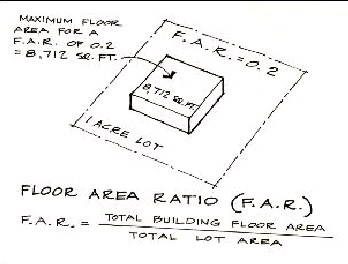
Diagram #1 — Floor Area Ratio (FAR)
117.
Family. One or more persons occupying a single dwelling unit, provided that unless all members are related by blood, marriage or adoption, no such family shall contain over four persons. Domestic employees employed on the premises may be housed on the premises without being counted as a separate family or families. In addition, a related family may have up to two unrelated individuals living with them. The term "family" does not include any organization or institutional group.
117A.
Firearm. Shall be defined as that term is defined in F.S. § 790.001, (2011).
117B.
Firewise landscaping. A set of principles which seek to break up the continuity of vegetation that might otherwise spread fire between adjacent wildlands and urban areas.
118.
Flea market. A market where new and used articles are sold by individual merchants from spaces of display areas.
119.
Flea market, open. Outdoor retail sales area for individual merchants to display and sell goods. An open air flea market use may have walls or partitions that separate individual retail spaces from each other, provided that they are temporary in nature. This use must be in the proper zoning district with a special exception approved by the board of adjustment. Every flea market, open, must comply with the applicable land development regulations in effect from time to time for all existing and future operations. The term "flea market, open" shall not include garage sales or yard sales incidental to a home occupation having a permit issued pursuant to section 12.08.109 of this code.
120—126.
Reserved.
127.
Floor. The top surface of an enclosed area in a building (including basement), i.e., top of slab in concrete slab construction or top of wood flooring in wood frame construction. The term does not include the floor of a garage used solely for parking a vehicle.
128.
Floor area. "Floor area" shall mean the total gross floor area within the exterior enclosing walls of a dwelling or structure not including porches, breezeways, carports, terraces and garages. Where a specific minimum floor area is required for sleeping rooms, "floor area" shall mean the enclosed floor area of the sleeping room, excluding closets, toilets, bathrooms, porches and the like.
129.
Florida Master Site File (FMSF). The FMSF is a comparative data base of all recorded archaeological and historical sites in Florida. It includes site records for properties which no longer exist, and contains the comparative data pertaining to archaeological and historical criteria used in determining site significance. Inclusion in the FMSF authorizes a site to be designated on the comprehensive plan archaeological/historical preservation overlay map as an archaeological sensitive area or resource.
130.
Florida-friendly landscaping. A set of principles which includes planting the right plant in the right place, efficient watering, appropriate fertilization, mulching, attraction of wildlife, responsible yard waste, reduction of stormwater runoff and waterfront protection. Additional components of Florida-friendly landscaping include planning and design, soil analysis, the use of solid waste compost, practical use of turf, and proper maintenance.
131.
Fowl. Any guineas, peafowls, pheasants, pigeons or poultry.
132.
Frontage of a building. The side or wall of a building, approximately parallel to a right-of-way line.
133.
Frontage of a property. The lot line which abuts a street or separates the lot from the street.
134.
Functionally dependent facility. A facility which cannot be used for its intended purpose unless it is located or carried out in close proximity to water, such as docking or port facility necessary for the loading and unloading of cargo or passengers, shipbuilding, ship repair, or seafood processing facilities. The term does not include long-term storage, manufacture, sales, or service facilities.
135.
Garage, community. A building or part thereof, used for indoor parking of a self-propelled private passenger vehicle, for use of residents in the vicinity and providing only incidental services for such vehicles as are parked therein.
136.
Governmental agency:
a.
The United States or any department, commission, agency, or other instrumentality thereof;
b.
The State of Florida or any department, commission, agency, or other;
c.
Any local government, as defined in this chapter, or any department, commission, agency, or other instrumentality thereof; and,
d.
Any school board or other special district, authority, or other governmental entity.
137.
Ground-mounted tower. A monopole tower, lattice tower or guyed Tower.
138.
Group housing. Two or more separate buildings for dwelling purposes erected or placed on the same lot.
139.
Guesthouse. A dwelling unit, which is an accessory structure, separate from and in addition to a main residential building, on a lot, where the occupant of the guesthouse is a guest of the owner or occupant of the main residential building, and the guesthouse is not used for rental purposes.
140.
Guyed tower. A ground-mounted transmission tower that is supported, in whole or in part, by guy-wires and ground anchors.
141.
Haul route. Those roads upon which vehicles transport the excavated materials from the mine to a publicly maintained road as proposed and approved in the mining operations plan.
142.
Hazardous waste:
a.
Any industrial or medical by-product, refuse, waste material, biomass, chemical, or substance which is unsuitable for reuse, remanufacture, or recycling and which requires extraordinary measures or precautions for its containment, storage, transportation, or disposal as a means to protect:
1.
Public health and safety;
2.
The naturally occurring ecology of the county;
3.
The purity of local aquifers and the quality of groundwater recharge occurring in Highlands County; and
4.
The productivity and usefulness of private property. Hazardous waste includes but not limited to, any noxious, poisonous, carcinogenic, contaminated, radioactive, or pathological refuse, by-products, or precipitates resulting from any process to treat or incinerate industrial or medical wastes generated outside Highlands County.
OR
b.
Solid waste, or a combination of solid wastes, which because of its quantity, concentration, or physical, chemical, or infectious characteristics, may cause, or significantly contribute to, an increase in serious irreversible or incapacitating reversible illness or may pose a substantial present or potential hazard to human health or the environment when improperly transported, disposed of, stored, treated or otherwise managed.
143.
Health services. Health care facilities as well as establishments providing support to the medical profession and patients, such as medical and dental laboratories, blood banks, and miscellaneous types of medical supplies and services.
144.
Height of buildings. The vertical distance from the established grade at the center of the front of the building, to the highest point of the roof surface for a flat roof, to the deck line for a mansard roof and to the mean height level between eaves and ridge for a gable, hip or gambrel roof, as shown on the following Diagram # 2:
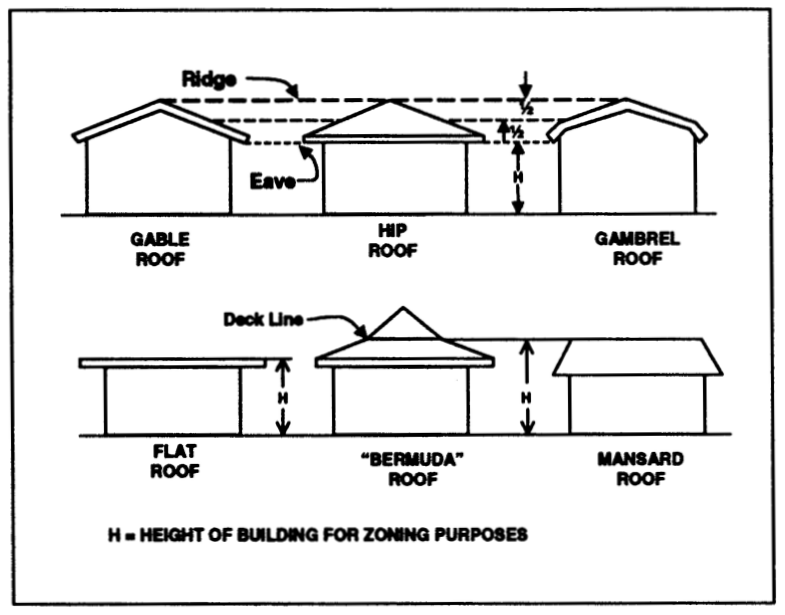
Diagram # 2 — Height of Buildings
145.
Reserved.
146A.
Historic designation. A decision by the BCC to designate a property as a "historic property" or a district as a "historic district" and to thereafter prohibit all alteration, demolition or construction on such property or within such district prior to the issuance of a certificate of appropriateness by the HPC.
146B.
Historic district. A geographically definable area designated by the BCC, which contains structures, sites, monuments or a combination thereof which:
a.
Have special character or special historical or aesthetic interest or value;
b.
Represent one or more eras of the history of the county; and
c.
Cause such area, by reason of such factors, to constitute a visibly perceptible section of the county.
147.
Historic preservation commission (HPC). An appointed commission charged to establish uniform procedures to preserve the county's archaeological and historic resources and to enhance public participation and involvement in the preservation and protection of such resources.
147A.
Historic preservation design guidelines. The United States Secretary of the Interior's "Standards of Rehabilitation," as amended by the BCC, along with any other criteria adopted by the BCC.
148.
Reserved.
149.
Historic property. A landmark structure, site or monument, including the adjacent area necessary for the proper appreciation or uses thereof, deemed worthy of preservation by reason of its value to the county, for one or more of the following reasons:
a.
It is an outstanding example of a structure representing its era;
b.
It is one of the few remaining examples of a past architectural style;
c.
It is a place or structure associated with an event or person of historic or cultural significance to the county; or
d.
It is a site of natural or aesthetic interest that is continuing to contribute to the cultural or historical development and heritage of the county.
e.
Any structure that is:
(1)
Listed individually in the National Register of Historic Places (a listing maintained by the Department of Interior) or preliminarily determined by the Secretary of the Interior as meeting the requirements for individual listing on the National Register:
(2)
Certified or preliminarily determined by the Secretary of the Interior as contributing to the historical significance of a registered historic or a district preliminarily determined by the Secretary to qualify as a registered historic district:
(3)
Individually listed on a state inventory of historic places if the Florida Historic Preservation Program has been approved by the Secretary of the Interior; or
(4)
Individually listed on a local inventory historic places in communities with historic preservation programs that have been certified either:
(a)
By an approved state program as determined by the Secretary of the Interior, or
(b)
Directly by the Secretary of the Interior in states without approved programs.
150.
Historic resources. All areas, districts or sites containing properties listed on the Florida Master Site File, the National Register of Historic Places, or designated by the BCC as historically, architecturally, or archaeologically significant.
151.
Hospitals. An institution providing primary health services and medical or surgical care to persons, primarily inpatients, suffering from illness, disease, injury, deformity, and other abnormal physical or mental conditions and including, as an integral part of the institution, related facilities such as laboratories, outpatient facilities, training facilities, medical facilities, medical offices, staff residences, health club facilities such as weight and aerobic training, racquetball, and handball, gift shops, and day care.
152.
Hotel. A building or part thereof, in which sleeping accommodations are offered to the public and in which there may be a public dining room for the convenience of the guest. Access to the sleeping rooms shall be through an inside lobby or office.
153.
Household pets. Shall include domesticated dogs, cats, birds, fish, rodents, rabbits, a pure-bred pot-bellied pig weighing 80 pounds or less, and the like, and shall not include any other variety of pigs or swine or any cattle, horses, sheep, goats, or other grazing animals, turkeys, poultry, fowl, emus, ostriches, llamas, alpacas, exotic/wild animals or any animals normally raised for food. Refer to section 12.05.316 of this code.
153A.
Impervious surface. Land surfaces which do not allow, or minimally allow, the penetration of water. Examples include building roofs, normal concrete and asphalt pavements, and some fine grained soils such as clays.
153B.
Impervious surface ratio. A measure of the intensity of land use, determined by dividing the total of all impervious surfaces on a site by the gross site area.
154.
Industrial uses. The activities predominantly connected with manufacturing, assembly, processing, or storage of products.
155.
Infill. A land use strategy to encourage the utilization of existing infrastructure for the orderly development of isolated or skipped-over properties within the urbanized areas of the county. "Infill development" means the improvement and building up of such properties for the most suitable density and/or intensity or type of land use that is compatible with surrounding development patterns and infrastructure capacities.
156.
Infrastructure. Those manmade structures which serve the common needs of the population, such as: Central wastewater disposal systems, central potable water systems; potable water wells serving a system; solid waste disposal sites or retention areas; stormwater systems, utilities; piers; docks; wharves; breakwaters; bulkheads; seawalls; bulwarks; revetments; causeways; marinas, navigation channels, bridges, and roadways.
157.
Inspector. Authorized representative of the county.
157A.
Intermediate care facility. A facility that provides, on a regular basis, personal care, including dressing and eating and health-related care and services, to individuals who require such assistance but who do not require the degree of care and treatment that a hospital or skilled nursing facility provides.
158.
Inter-modulation interference. Signal interference caused by a wireless communication facility to the signal of one or more existing wireless communication and/or broadcast systems.
159.
Interference of traffic. The obstruction, impeding, or otherwise disruption of vehicle movement.
159A.
Institutional use. A nonprofit, religious, or public use, such as a church, library, public or private school, hospital, or government owned or operated building, structure, or land used for public purpose.
160.
Junkyard. A place, structure or lot where junk, waste, discarded, salvaged or similar materials such as old metals, wood, slush, lumber, glass, paper, rags, cloth, bagging, cordage, barrel, and containers, are bought, sold, exchanged, baled, packed, disassembled or handled including auto wrecking yards, used lumber yards, house wrecking yards and yards or places for storage or handling of salvage house wrecking and structural steel materials. This definition shall not include pawnshops and establishments for the sale, purchase or storage of usable secondhand cars, salvaged machinery, used furniture, radios, stoves, refrigerators or similar household goods and appliances, nor shall it apply to the processing of used, discarded or salvaged materials as part of manufacturing operation.
161.
Kennel. Any place or premises where animals are kept or boarded for a fee.
161A.
Lake Placid Regional Plan (LPRP): The following definitions are specific to the Lake Placid Regional Plan.
1.
Developed lands (LPRP): Land which has been subdivided by plat into residential lots or subdivided by deed into parcels containing ten acres or less. The presence of a home on a parcel indicates that the parcel is developed land. Platted parcels greater than ten acres which do not contain a house and are not claimed as homestead on the date of adoption of the LPRP overlay district land development regulations, are not considered developed lands.
2.
Flex space (LPRP): Land which may be used for a variety of light assemblage, fabrication, storage, light industrial, office space, and support commercial uses.
3.
Green space (LPRP): Water management areas, parks, multi-use path, private yards, and setbacks, preserves, and landscaped areas.
4.
Gross density (LPRP): The density of residential dwelling units per acre calculated on the total fee owned acres before uncompensated extraction.
5.
Gross non-residential acreage (LPRP): The total acreage within a project, or part thereof, which is proposed for non-residential lots or parcels, and which is also:
a.
Exclusive of all areas considered to be part of a project's gross residential acreage, as defined herein.
b.
Above the ordinary high-water line or ordinary high tide of any naturally occurring waterbody.
c.
Occupied by any man-made waterbody.
d.
Wetland acreage.
e.
Part of any proposed public facility dedicated to, and accepted by, Highlands County, or by the Highlands County School Board, or part of any park or outdoor recreation area.
f.
Inclusive of local streets or other streets internal to the project.
g.
Occupied by any easement for any public or private utility.
h.
Proposed as an open space area.
i.
Adjusted, where applicable, for any reductions in gross residential acreage.
6.
Gross residential acreage (LPRP): The total acreage within a project, or part thereof, which is proposed for residential lots or parcels above the ordinary high water line of any naturally occurring waterbody and exclusive of all areas considered to be part of a project's gross nonresidential acreage, as listed below. The total acreage shall include:
a.
Any man-made waterbody.
b.
Wetland acreage.
c.
Acreage within any required setbacks from such jurisdictional area as required.
7.
Gross residential density (LPRP): The total number of residential dwelling units or equivalent residential units within a residential project, or within a residential parcel contained within a project, divided by gross residential acreage.
8.
Net density (LPRP): The residential density on the lot or parcel for development considering the actual boundary of the developable piece of property or parcel within a larger developable area. Public rights-of-way shall not be included. Internal private roads shall be included.
9.
Net residential acreage (LPRP): The total acreage within a project proposed for residential lots or parcels, including off-street parking areas, and meeting the following limitations:
a.
Not subject to the jurisdiction of any local, state, or federal environmental review agency (wetlands).
b.
Not part of any recreational facility within the project or part of any public facility within the project.
c.
Not part of any natural waterbody below ordinary high water, or ordinary high water, as estimated at time of project review.
d.
Not part of any dedicated conservation easement.
e.
Not within any utility easement (i.e., above ground transmission lines, major underground utility easements).
10.
Net residential density (LPRP): The total number of residential dwelling units or equivalent residential units within a residential project, or within a residential parcel contained within a project, divided by net residential acreage.
11.
Open space (LPRP): Includes private yards, but only the landscaped median portion of public roads. Gross open space shall include recreational uses, manmade waterbodies, conservation and preservation areas, required buffers, pedestrian and bicycle circulation systems, water management areas and community gathering places.
12.
Residential (LPRP): Includes a variety of market units. The residential products may be for rental or home ownership opportunities and may include fee simple or condominium style development. Residential types shall include, but are not limited to single-family, duplexes, multifamily, garden units, townhouses, estate homes, group housing and nursing homes.
162.
Land. The earth, water, and air above, below, or on the surface, and includes any improvements or structures customarily regarded as land including water surfaces and lands under water.
163.
Land clearing. Engaging in a land management practice or practices, which will result in the destruction of natural resources (as identified on the conservation overlay map; i.e., xeric uplands, cutthroatgrass seep, or wetlands), with the natural resource being replaced or succeeded by something else (e.g. bare soil, different resource type, or invaded by non-native species) which precludes the long-term (five years) recovery of the original natural resource type. Land clearing activities which impact listed species may also be subject to state and federal regulation. The following activities do not constitute "land clearing" and do not require a land clearing permit even when undertaken in areas with natural resources as identified on the conservation overlay map:
a.
Maintenance of roads, rights-of-way, and utility easements;
b.
Construction or maintenance of fence lines up to 20 feet on each side of the fence;
c.
Maintenance of existing drainage and stormwater management systems;
d.
Maintenance of the fire breaks and fire lines up to 40 feet wide;
e.
Maintenance burning other than bay heads;
f.
Maintenance of native range according to the Best Management Practices of the U.S. Natural Resources Conservation Service;
g.
Maintenance or improvement of improved pasture and land in active agricultural production;
h.
Removal of non-native vegetation;
i.
Surveying pursuant to Florida Statutes;
j.
Agricultural activities as defined in subsection 12.12.620.E;
k.
Clearing for all activities and uses outside the conservation areas depicted on the conservation overlay map pursuant to Natural Resource Policy 3.3; or
l.
Whenever life or property is threatened or endangered during a civil emergency.
164.
Land development regulations. Include local zoning, subdivision, building, and other regulations controlling the development of land.
164A.
Landscaped areas. The entire parcel less the building footprint, driveways, nonirrigated portions of parking lots, hardscapes such as decks and patios, and other nonplanted areas. Water features such as fountains are included in the calculation of the landscaped area.
165.
Lattice tower. A ground-mounted guyed or self-supporting three or four-sided, open, steel frame transmission tower.
166.
Level of service. An indicator of the extent or degree of service provided by a facility based on and related to the operational characteristics of the facility. Level of service shall indicate the capacity per unit of demand for each public facility or the comparison of public school enrollment to school capacity in a given concurrency service area.
167.
Littoral zone. The area or boundary between land and water where shoreline plants grow.
168.
Livestock. All animals of the equine, bovine or swine class, including horses, mules, cattle, hogs, sheep, goats and other grazing animals.
169.
Local development order. A valid, unexpired permit or development approval, including, but not limited to a building permit, a final subdivision plat or site plan approval, a development agreement made pursuant to the Florida Local Government Development Agreement Act, or other action by the county having the effect of permitting.
170.
Local road. A roadway providing service which is of relatively low traffic volume, short average trip length or minimal through traffic movements, and high volume land access for abutting property.
170A.
Long-term care facility. An institution or a distinct part of an institution that is licensed or approved to provide health care under medical supervision for 24 or more consecutive hours to two or more patients.
171.
Lot. A parcel of land of at least sufficient size to meet minimum requirements for use, coverage and area and to provide such yard and open space as is required. A lot shall have frontage on an improved public road or street where required by the terms of this Code and may consist of:
a.
A single lot of record;
b.
A portion of a lot of record;
c.
A combination of complete lots of record; of complete lots of record and portions of lots; or of portions of lots of record;
d.
A parcel described by meets and bounds;
e.
Provided that in no case of division or combination shall any residual lot or parcel be created which does not meet the requirements of this Code. Includes the words "plot" or "parcel."
172.
Lot frontage. The front of a lot shall be construed to be the portion nearest the right-of-way line. For the purpose of determining yard requirements on corner lots and through lots, all yards of a lot adjacent to a street shall be considered frontage, and yards shall be provided as required.
173.
Lot measurements.
a.
Depth of a lot shall be considered to be the distance between the midpoints of straight lines connecting the foremost points of the side lot lines in front and the rearmost points of the side lot lines in the rear.
b.
Width of a lot shall be considered to be the distance between straight lines connecting the front and rear lot lines at each side of the lot, measured across the rear of the required front yard.
174.
Lot of record. A lot which exists as shown or as described on a plat or deed recorded in the public records of Highlands County, Florida maintained by the Highlands County Clerk of Courts for recording plats and deeds.
175.
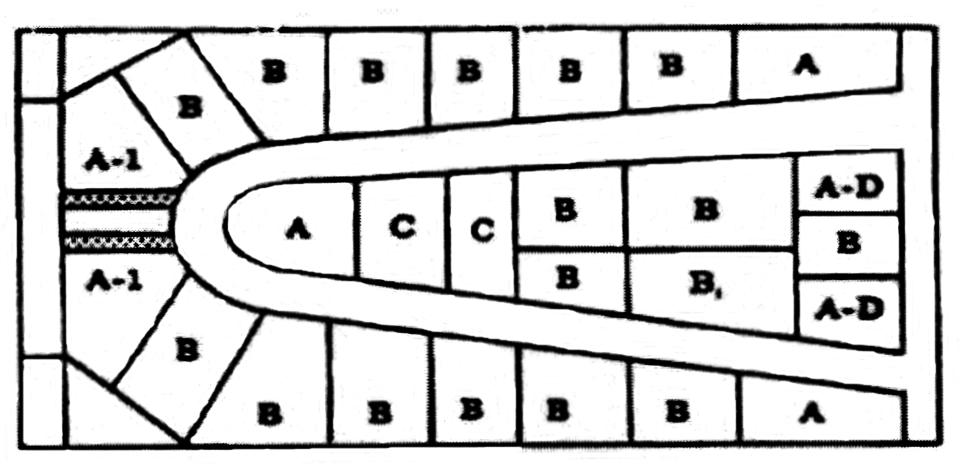
Lot types. The diagram #3, which follows illustrates terminology with reference to "corner" lots, "interior" lots, "reverse frontage" lots and "through" lots:
Diagram No. 3 — Lot Types
a.
A—Corner lot. A lot located at the intersection of two or more streets. A lot abutting on a curved street or streets shall be considered a corner lot if straight lines drawn from the foremost points of the side lot lines to the foremost points of the lot line meet at an interior angle of less than 135 degrees. See lots marked A-1 in diagram.
b.
B—Interior lot. A lot other than a corner lot with only one frontage on a street other than an alley.
c.
C—Through lot. A lot other than a corner lot with frontage on more than one street other than an alley. Through lots with frontage on two streets may be referred to as "double frontage lots."
d.
D—Reverse frontage lot. A lot in which the frontage is at right angles, or approximately right angles to the general pattern in the area involved. A reverse frontage lot may also be a corner lot (see A—D).
176.
Low income families. "Lower income families" as defined under the Federal Section 8 Assisted Housing Program, or families whose annual income does not exceed 80 percent of the median income for Highlands County. The term "families" includes "households."
177.
Major crossing. Pipe crossings eight inches or greater in outside diameter; crossing requiring well point dewatering; and other crossings of an unusual and difficult nature as determined by the county engineer.
178, 179.
Reserved.
180.
Manhole. An opening in an underground system which workmen or other may enter for the purpose of making installations, inspections, repairs, connections and tests.
181.
Manufactured building. The definition of the term "manufactured building" shall be as defined in F.S. § 553.36, as from time to time amended. For the purpose of this chapter, the term "manufactured building" does not include mobile homes.
182.
Manufactured home. The definition of the term "manufactured home" shall be as defined in F.S. § 320.01, as from time to time amended.
183.
Material change in appearance. A change that will affect the exterior architectural features of a historic property or of any structure, site or monument within a historic district and may include any one or more of the following:
a.
A reconstruction or alteration of the size, shape or facade of a historic property, including relocation of any doors or windows or removal or alteration of any architectural features, details or elements;
b.
Demolition of a historic property;
c.
Commencement of excavation;
d.
Change in the location of advertising visible from the public way or any historic property; or
e.
The erection, alteration, restoration or removal of any building or other structure within a historic district, including walls, fences, steps, pavements or other appurtenant features, except exterior paint alterations.
184.
May. Is permissive. Where "may" is used, it is considered to denote permissive usage.
185.
Mean sea level. The average height of the sea for all stages of the tide. It is used as a reference for establishing various elevations within the floodplain.
186.
Median. The portion of a highway or street separating the traveled ways for traffic moving in opposite directions
187.
Mine. An area of land upon which mining operations have been conducted, are being conducted, or are planned to be conducted, as the term is commonly used in the trade.
187A.
Military Airport Zone (MAZ). Area in which impacts from the presence of the Avon Park Air Force Range and the training activities may be experienced.
a.
MAZ I: Area located within a three mile radius of the Avon Park Air Force Range, a military training facility. There is the potential day and night low level aircraft overflight, and military training noise during training exercises. Additional property regulations may apply.
b.
MAZ II: Area located outside of a three mile radius of the Avon Park Air Force Range, a military training facility. There is the potential day and night low level aircraft overflight, and military training noise during training exercises. Additional property regulations may apply.
c.
MAZ III: Area located outside of a three mile radius of the Avon Park Air Force Range, a military training facility. There is some potential for occasional military training noise.
188.
Minerals. All solid minerals, including clay, gravel, phosphate rock, lime, shells (excluding live shellfish), stone, sand, heavy minerals, and any rare earths, which are contained in the soils or waters of the state.
189.
Mining. The commercial extraction of minerals, ores, and organic matter by excavation below natural ground level, including the processing and storage of these raw materials. Mining is further defined as the removal of resources from their natural location so as to make them suitable for commercial, industrial, or construction use; but does not include excavation solely in aid of on-site farming or on-site construction, or the process of searching, prospecting, exploring, or investigating for resources by drilling.
190.
Mining operation. Any activity, other than prospecting, necessary for site preparation, extraction, waste disposal, storage, or reclamation.
191.
Mining operation permit/final development order for mining operations. The legal instrument issued by the county pursuant to this Code which authorizes a mining operator to commence mining activities at a certain site for a specified period of time.
192.
Mining operation plan. A graphic and written description of mining operations and mining related activities to be conducted by the mining operator during the entire time for which the mining site is permitted.
193.
Mining operator. Any person, business, agent, or company engaged in the extraction of raw materials from the earth for off-site use or sale or any person, business, agent, or company who operates a mine for which a mining operation permit is required.
194.
Mining related activities. Any activities directly related to mining including, but not limited to, construction of pipelines and access roads, stockpiling overburden, disposal of by-products, construction of processing facilities, land clearing or alteration of existing contours, and rehabilitation of mined areas.
195.
Reserved.
196.
Mobile home. A residential structure that is transportable in one or more sections, eight body feet or more in width, and over 35 feet in length, built on an integral chassis, and designed to be used as a dwelling when connected to the required utilities, and includes the plumbing, heating, air conditioning and electrical systems contained in the structure, constructed to standards promulgated by the United States Department of Housing and Urban Development, or if fabricated after June 15, 1976, each section shall bear a U.S. Department of Housing and Urban Development label certifying that it is built in compliance with the federal Manufactured Home Construction and Safety Standards.
197.
Mobile home park. A place set aside and offered for either direct monetary or for indirect benefit by any person, firm, corporation, municipality or other public body for the parking and accommodation of two or more mobile homes, travel trailers or recreation units occupied.
198.
Mobile home subdivision. A subdivision designed and intended for residential use where residence in such subdivision is restricted exclusively to mobile homes.
199.
Modular home. A manufactured building as defined by section 12.02.104.181. of this Code designed and intended for residential use. The term "modular home" does not include mobile homes.
200.
Monopole tower. A ground-mounted transmission tower that is freestanding and constructed without guy wires and ground anchors.
201.
Motel. A public lodging establishment which offers rental units with a direct exit to the outside of each rental unit, daily or weekly rates, off-street parking for each unit, a central office on the property with specified hours of operation and a bathroom or connecting bathroom for each rental unit.
202.
National Geodetic Vertical Datum (NGVD). Is a vertical control used as a reference for establishing varying elevations within the floodplain.
203.
Natural drainage features. The naturally occurring features of an area which accommodates the flow of stormwater, such as streams, rivers, lakes and wetlands.
204.
Reserved.
205.
Neighborhood park. A park which serves the population of a neighborhood and is generally accessible by bicycle or pedestrian ways.
206.
New construction. Structures for which the "start of construction" commenced on or after the effective date of this Code.
207.
Nonconforming. The physical features or use of a particular property, which existed prior to this Code's effective date of adoption and which do not conform to the requirements or standards, established herein.
208.
Nonconforming lots of record.
a.
In any category in which dwellings are permitted, notwithstanding limitations imposed by other provisions of this plan, residential dwellings and customary accessory buildings may be erected on any single lot record previously recorded as of January 1, 1971. This provision shall apply even though such lot fails to meet the requirements for minimum size that is applicable in the category, provided that the lot shall conform to all applicable zoning requirements, except those involving area of the category in which the lot is located.
b.
No parcel of land of less than street frontage and area requirements for the category in which it is located may be cut off from a larger parcel of land for the purpose, whether immediate or future, of building or development as a separate single-family lot, except when properly authorized by the applicable planning and zoning regulations.
c.
A building permit for a dwelling shall not be issued unless a lot has at least 30 feet of frontage on a street.
209.
North American Industry Classification System. A classification system published by U.S. Executive Office of the President Office of Management and Budget that classifies all non-residential activities, primarily for industry and business.
209A.
Nursery, retail. The growing, cultivation, storage, and sale of garden plants, flowers, trees, and shrubs to the general public.
210.
Nursery school. A place for the day care and instruction of children not remaining overnight.
210A.
Nursery, wholesale. The growing, cultivation, storage, and sale of garden plants, flowers, trees, and shrubs, to landscapers, developers, builders, and retail nurseries.
211.
Nursing home. A home for aged, chronically ill or incurable persons in which three or more persons not of the immediate family are received, kept or provided with food and shelter and care, but not including hospitals, clinics or similar institutions devoted primarily to the diagnosis and treatment of the sick or injured. See extended care facility; intermediate care facility; long-term care facility.
212.
Objective. A specific, measurable, intermediate end that is achievable and marks progress toward a goal.
213.
Office. A room or group of rooms used for conducting the affairs of a business, profession, service, industry, or government and generally furnished with desks, tables, files, and communication equipment.
214.
Office building. A building used primarily for conducting the affairs of a business, profession, service, industry, or government or like activity and may include ancillary services for office workers, such as a restaurant, coffee shop, newspaper or candy stand, and child-care facilities.
215.
On-site. Within the contiguous limits of an area of land under one ownership or control and upon which farming or construction activities are taking place. Areas of land that are divided by public or private roads, railroads and linear easements are considered contiguous if such areas are under one ownership or control.
216.
Open space(s). Undeveloped lands suitable for passive recreation or conservation uses.
217.
Open space easement. A right or interest in real property where access may be restricted or unrestricted; activities may be passive or active; vegetative cover may be natural or improved; and, where all structures are limited only to non-habitable recreational use.
217A.
Ordinary high water line. The boundary between uplands and submerged lands beneath nontidal navigable natural water bodies.
218.
Overburden. Any soil or rock removed to gain access to the resource in the process of extraction and such soil or rock before or after it is removed. This does not include tailings or screenings generated by processing the resource.
219.
Parcel of land. Any area of land capable of being described with such definitiveness that its location and boundaries may be established, which is designated by its owner or developer as land to be used or developed as a unit, or which has been used or developed as a unit.
220.
Park. A neighborhood, community, or regional park.
221.
Park model. The term "park model" shall have the same definition as provided for the term "park trailer" in F.S. § 320.01.
222.
Parking. The term "parking" shall mean the temporary, transient storage of private passenger automobiles used for personal transportation while their operators are engaged in other activities. It shall not include storage of new or used cars for sale, service, rental, or other purpose other than specified above. "Parking" as defined herein shall apply only to open air storage of automobiles.
223.
Pavement. A paved travel way, normally including an asphalt or concrete surface designed to carry the anticipated traffic for a specified design period.
224.
Permittee. The right-of-way user responsible for permitted maintenance or construction whether by their own forces or by contractors and subcontractors properly licensed by a municipality, the county, or by the state.
225.
Person. Includes a person, firm, association, organization, partnership, trust, company or corporation as well as an individual. Also means an individual, corporation, governmental agency, business trust, estate, trust, partnership, association, two or more persons having a joint or common interest, or any other legal entity.
226.
Personal services. Establishments primarily engaged in providing services involving the care of a person or his or her personal goods or apparel.
227.
Pharmacy. A place where drugs and medicines are prepared and dispensed. Also see drugstore.
228.
Planting. The placing on or setting into the ground of live plant material.
229.
Pole-attached antenna. Antennas attached to electric transmission or distribution poles, street lights, traffic signals or similar facilities.
230.
Policy. The way in which programs and activities are conducted to achieve an identified goal.
231.
Pollution. Is the presence in the outdoor atmosphere, ground or water of any substances, contaminants, noise, or manmade or man-induced alteration of the chemical, physical, biological, or radiological integrity of air or water, in quantities or at levels which are or may be potentially harmful or injurious to human health or welfare, animal or plant life, or property, or unreasonably interfere with the enjoyment of life or property.
232.
Porch. A roofed-over space attached to the outside of an exterior wall of a building which has no enclosure other than the exterior walls of such building. Open mesh screening shall not be considered an enclosure.
233.
Reserved.
234.
Poultry. Any chickens, turkeys, ducks or geese.
235.
Poultry market. A commercial establishment or place where live poultry or fowls are kept and prepared for sale, including killing and cleaning.
236.
Professional engineer. A duly qualified individual currently licensed to practice engineering in the State of Florida, pursuant to F.S. Ch. 471, practicing in the discipline required for the particular task as indicated in the specific section of the regulations governing transmission towers.
237.
Public facilities. Government offices or facilities, transportation systems or facilities, central wastewater systems or facilities, solid waste systems or facilities, drainage systems or facilities, central potable water systems or facilities, educational systems or facilities, parks and recreation systems, and public health systems or facilities.
238.
Public potable water well. Any well serving 15 or more residential households or serving a commercial or industrial property.
239.
Public recreation sites. Sites owned or leased on a long-term basis by a federal, state, regional, or local government agency for purposes of recreational use.
240.
Public services. Any administrative, entitlement, protective, maintenance, or utility service provided by Highlands County to the general public.
240A.
Public utility. An enterprise providing to the public a utility service deemed necessary for the public health, safety, and welfare.
240B.
Public utility facilities. Building, structures, and facilities, including generating and switching stations, poles, lines, pipes, pumping stations, repeaters, antennas, transmitters and receivers, valves, and all buildings and structures relating to the furnishing of utility services, such as electric, gas, telephone, water, wastewater, and public transit, to the public.
241.
Qualified. The ability, shown by license, registration, certification, etc. to perform required tasks as needed to perform certain job duties.
242.
Qualified archaeological agent. Any person, institution, firm, or association who meets the membership qualifications of the Florida Archaeological Council or the Society of Professional Archaeologists in the area of field research or cultural resources management, or as determined by the historic preservation commission.
242A.
Quasi-public use. A use owned or operated by a nonprofit, religious, or eleemosynary institution and providing educational, cultural, recreational, religious, or similar types of programs.
243.
Receiving area. Parcels of land within a designated development area, which are permitted to increase density, as specified herein, and receive development rights purchased from the owners of land in a sending area. The transfer capacity of these development rights is based on the number of transferable development rights which a specified receiving area can accommodate.
244.
Reclamation. Reasonable rehabilitation of land where mining has occurred in accordance with the reclamation criteria of appropriate sections of Chapter 16C, Florida Administrative Code, depending on the type of proposed mining.
245.
Reserved.
245A.
Recreational vehicle park. The term "recreational vehicle park" shall have the same definition as the term "RV park (FUD)". Also see campground.
245B.
Recreational vehicle. The definition of the term "recreational vehicle, shall have the same meaning as provided for the term "recreational vehicle-type unit" in F.S. § 320.01, including the terms "travel trailer," "camping trailer," "truck camper," "motor home," "private motor coach," "van conversion," "park trailer," and "fifth wheel trailer," as defined in F.S. § 320.01, from time to time amended and shall include other recreational vehicle-type units designed for travel, recreation, and vacation uses not specifically described above.
246.
Refuse. All domestic solid waste as defined by this Code.
247.
Regional park. A park which is designed to serve two or more communities.
248.
Relocation. The adjustment of utility facilities required by a road project or a county driveway permit, such as removing and reinstalling the facility, including necessary right-of-way on new locations, moving or rearranging existing facilities or changing the type of facility, including any necessary safety and protective measures; it shall also mean constructing a replacement facility when necessary for continuous operation of the utility service, the project economy, or a sequence of road construction or maintenance operations.
249.
Relocation housing. Those dwellings which are made available to families displaced by public programs, provided that such dwellings are decent, safe and sanitary and within the financial means of the families or individuals displaced.
250.
Repair garage. A facility for the repair of motor vehicles.
250A.
Residential health care facility. Residences usually occupied by the frail elderly that provide rooms, meals, personal care, and health monitoring services under the supervision of a professional nurse and that may provide other services, such as recreational, social, and cultural activities, financial services, and transportation.
251.
Residential uses. Activities within land areas used predominantly for housing.
252A.
Restoration (historic structures). Modifications, changes, or repair of an historic structure in compliance with the Secretary of the Interior's Standards for Rehabilitation and Guidelines for Rehabilitating Historic Buildings, as incorporated into the All Florida Building Code.
252B.
Restoration (land). The recontouring and revegetation of lands in a manner, consistent with the criteria and standards established in Chapter 16C-16, Florida Administrative Code, which will return the type, nature, and function of the ecosystem to the condition in existence prior to mining operations. In requiring restoration of an area, the county engineer shall recognize technological limitations and economic considerations. Restoration shall be required only for phosphate mining operations.
253.
Retail sales. Establishments engaged in the selling or rental of goods or merchandise (usually to the general public for personal or household use, although they may also serve business and institutional clients) and in rendering services incidental to the sale of such goods.
253A.
Retail sales, outdoor. The display and sale of products and services, primarily outside of a building or structure, including garden supplies, flowers, shrubs, and other plant materials; gas, tires, and motor oil; food and beverages; vehicles, boats, and aircraft; farm equipment; motor homes; burial monuments; building and landscape materials; and lumberyards.
253B.
Retail services. Establishments providing services or entertainment, as opposed to products, to the general public for personal or household use, including eating and drinking places; hotels and motels; finance, real estate, and insurance offices; personal services; theatres; amusement and recreation services; health, educational, and social services; museums; and galleries.
254.
Right-of-way. Land which has been obtained by the state, a county, or a municipality by dedication, prescription, recorded plat, deed, or easement for a transportation or utility use. Right-of-way includes county maintained and non-county maintained rights-of-way, private right-of-way, federal right-of-way, state right-of-way, municipal right-of-way and transmission line right-of-way.
255.
Roadway functional classification. The assignment of roads into categories according to the character of service they provide in relation to the total road network. Basic functional categories include limited access facilities, arterial roads, and collector roads, which may be sub-categorized into principal, major or minor levels. Those levels may be further grouped into urban and rural categories.
256.
Roof. The exterior upper covering of a structure or trailer.
257.
Rooming house. Any dwelling or that part of a dwelling containing one or more rooming units, in which space is let by the owner or operator to four or more persons who are not husband or wife, son or daughter, mother or father, or sister or brother of the owner or operator.
258.
Routine maintenance. The everyday maintenance of one's facilities.
259.
Reserved.
260.
RV park (FUD). A place set aside and offered by any person, firm, corporation, municipality or other public body for the parking and accommodation of two or more park models, travel trailers or recreation units occupied for sleeping or eating for either direct money consideration or for indirect benefit to the owner, lessee or operator of such place. An area of not less than five acres will be required for approval of an RV park, or CG-1, CG-2, CG-3 and/or M-2, or a combination of the foregoing classifications. All RV parks shall be required to submit a (FUD) flexible unit development application.
261.
Salvage yard. Any area, lot, land, parcel, building, or structure or part thereof, where waste products are utilized and something is extracted (as from rubbish) as valuable or useful.
262.
Sanitarium. An establishment for the medical treatment of people who are convalescing or have a chronic illness.
263.
School. Pursuant to F.S. § 1003.01(2), a school is an organization of students for instructional purposes on an elementary, middle or junior high school, secondary or high school, or other public school level authorized under rules of the state board of education.
263A.
School capacity. The demand that can be accommodated by a school facility at the adopted level of service, as determined by the school district. Any school capacity remaining after subtracting the current number of students enrolled in existing school facilities, student stations that are reserved by a finding of available school capacity, and student stations that are reserved for exempt developments is considered available.
263B.
School concurrency. Pursuant to F.S. § 163.3180(6), to achieve and maintain the adopted levels of service for school capacity where adequate school facilities will be in place or under actual construction within three years of approval of a proposed development.
263C.
School district. The School District of Highlands County, Florida.
263D.
School facilities. Permanent public school buildings provided by the school district, as defined by the most current edition of the Florida Inventory of School Houses (FISH), published by the Florida Department of Education, or a charter school approved by the school district as school capacity, or land for a school facility. A school facility is considered existing if it is constructed and operational. A school facility is considered planned if it is listed in the school district five-year district facilities work program as being in place or under actual construction within three years.
263E.
School, parochial. A school supported and controlled by a church or religious organization. See school, private.
263F.
School, private. Pursuant to F.S. § 1002.01(2), a private school is a nonpublic school defined as an individual, association, co-partnership, or corporation, or department, division, or section of such organizations, that designates itself as an educational center that includes kindergarten or a higher grade or as an elementary, secondary, business, technical, or trade school below college level or any organization that provides instructional services that meet the intent of F.S. § 1003.01(13), or that gives pre-employment or supplementary training in technology or in fields of trade or industry or that offers academic, literary, or career training below college level, or any combination of the above, including an institution that performs the functions of the above schools through correspondence or extension, except those licensed under the provisions of F.S. ch. 1005. A private school may be a parochial, religious, denominational, for-profit, or nonprofit school. This definition does not include home education programs conducted in accordance with F.S. § 1002.41. Any building or group of buildings the use of which is a school but is not a public school and provides elementary, secondary, or higher education and which use does not secure the major part of its funding from any governmental agency.
263G.
School, public. A public school is a school funded and operated by the School Board of Highlands County, Florida.
263H.
School, vocational. A secondary or higher education facility primarily teaching usable skills that prepare students for jobs in a trade and meeting the state requirements as a vocational facility.
264.
Screen room. A structure consisting of a rigid frame made of wood, aluminum, steel, block, brick or other support material, a roof and exterior walls. The frame shall constitute no more than 30 percent of the area of any wall, and except for the exterior walls of a utility building under the same roof, at least 70 percent of the area of each wall, including doors, shall consist of wire or plastic screening mesh. No glass, vinyl or other covering shall be allowed. Interior blinds shall be allowed.
265.
Reserved.
266.
Sending area. An area containing the land based resource which the TDR program is designed to protect, as specified in article 13, and from which development rights are transferred pursuant to provisions of division 3 (Transfer of Development Rights Options) of article 13 (Other Administrative Procedures).
267.
Services. The programs and employees determined necessary by local government to provide adequate operation and maintenance of public facilities and infrastructure as well as those educational, health care, social and other programs necessary to support the programs, public facilities, and infrastructure set out in the local plan or required by local, state, or federal law.
268.
Service station. A facility, including land and improvements, where motor fuel is offered for sale, at retail, to the motoring public.
269.
Setback. The minimum distance between a side of a structure and the nearest adjacent lot line or right-of-way line, whichever is closest to the structure.
270.
Shall. Is mandatory. A mandatory condition.
271.
Shoreline or shore. The interface of land and water and, as used in the coastal management element requirements, is limited to oceanic and estuarine interfaces.
272.
Should. An advisory condition. Where "should" is used, it is considered to denote permissive usage.
273.
Sign. Any device designed to inform or attract the attention of persons not on the premises on which the sign is located; provided, however, that the following shall not be included in the applications of the regulations herein:
a.
Signs not exceeding one square foot in area and bearing only property numbers, post box numbers, names of occupants of premises or other identification of premises not having commercial connotations.
b.
Banners and insignias, except when displayed in connection with commercial promotion.
c.
Legal notices; identification, information, directional or regulatory signs erected or required by governmental bodies.
d.
Integral decorative or architectural features of buildings, except letters, trademarks, moving parts or moving lights.
e.
Signs directing and guiding traffic and parking on private property but not bearing any advertising matter.
274.
Sign, billboard. Any combination of structure and message in the form of an outdoor sign, display, device, figure, painting, drawing, message, placard, poster, advertising structure, advertisement, logo, symbol or other form, whether placed individually or on a V-type, back to back, side to side, stacked or double-faced display, designed, intended or used to advertise or inform, any part of the advertising message or informative contents of which is visible from any place on the main-traveled way. The term does not include an official traffic control sign, official marker or specific information panel erected, caused to be erected or approved by the state or county.
275.
Sign, combination vertical and roof. A vertical projecting sign which extends above the roof line and is combined with a roof sign. The surface of such sign shall be continuous on both parts and shall be contiguous to the wall and the roof.
276.
Sign, ground. A sign attached to and supported by the ground.
277.
Sign, off-site. A sign other than an on-site sign.
278.
Sign, on-site. A sign relating in its subject matter to the premises on which it is located or to products, accommodations, services or activities on the premises. On-site signs do not include signs erected by the outdoor advertising industry in the conduct of the outdoor advertising business.
279.
Sign, name plate. A sign indicating the name and/or profession of a person or persons residing on the premises or legally occupying the premises or indicating a home occupation legally existing on the premises.
280.
Signs, number and surface area. For the purpose of determining number of signs, a sign shall be considered to be a single display surface device containing elements organized, related and composed to form a unit. Where matter is displayed in a random manner without organized relationship of elements or where there is reasonable doubt about the relationship of elements, each element shall be considered to be a single sign. This definition does not include pennants and streamers.
281.
Reserved.
282.
Sign, pylon. A wall sign on the wall of an enclosed structure which is erected above the ground or as an extension above or an addition to a building, primarily for the purpose of providing support and/or background for the sign copy.
283.
Single-family or one-family. Designed for and occupied by only one family.
284.
Snipe signs. A sign which is tacked, nailed, posted, pasted, glued or otherwise attached to trees, poles, stakes or fences or to other objects, and the advertising content appearing thereon is not applicable to the present use of the premises upon which such sign is located or which makes malicious attacks or remarks.
284A.
Solar energy systems. Solar energy systems are systems that transfer solar energy to another medium using mechanical, electrical, or chemical means.
285.
Solid waste. Sludge from a waste treatment works, water supply treatment plant, or air pollution control facility or garbage, rubbish, refuse, or other discarded material, including solid, liquid, semisolid, or contained gaseous material resulting from domestic, industrial, commercial, mining, agricultural, or governmental operations.
286.
Reserved.
287.
Special exception. A special exception is a use that would not be appropriate generally or without restriction throughout the zoning district but which, if controlled as to number, area, location or relation to the neighborhood would promote the public health, safety, welfare, morals, order, comfort, convenience, prosperity or general welfare. Such uses are permitted in such zoning district as special exceptions where specific provisions for such exception is made in this chapter.
288.
Spoil. Any overburden that has been displayed.
289.
Start of construction. Includes substantial improvement, and means the date the building permit was issued, provided the actual start of construction, repair, reconstruction, or improvement was within 180 days of permit date. The actual start means the first placement of permanent construction of a structure (including a manufactured home) on a site, such as the pouring of slabs or footings, installation of piles, construction of columns, or any work beyond the stage of excavation or the placement of permanent construction of a structure (including a manufactured home) on a site, such as the pouring of slabs or footings, installation of piles, construction of columns, or any work beyond the stage of excavation or the placement of a manufactured home on a foundation. Permanent construction does not include land preparation, such as clearing, grading and filling; nor does it include excavation for a basement, footings, piers or foundations or the erection of temporary forms; nor does it include the installation on the property of accessory buildings, such as garages or sheds not occupied as dwelling units or not part of the main structure.
289A.
Storage, outdoor or outdoor storage. The keeping of any goods, junk, material, merchandise, or vehicles in a place, other than an enclosed structure, for more than 24 hours.
290.
Stormwater. The flow of water which results from a rainfall event.
290A.
Story. That portion of a building included between the surface of any floor and the surface of the floor next above it, or if there is no floor above it, then the space between the floor and the ceiling next above it and including those basements used for the principal use. See Diagram for Definition # 290B.
290B.
Story, half. A space under a sloping roof that has the line of intersection of the roof and wall face not more than three feet above the floor level and in which space the possible floor area with head room of five feet or less occupies at least 40 percent of the total floor area of the story directly beneath. See diagram for definition # 290B.
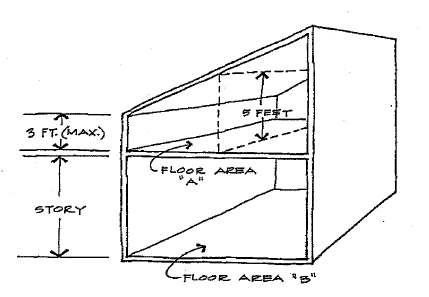
If floor area "A" is at least 40 percent of floor area "B", then "A" is a half story. (Diagram for definition # 290B.)
291.
Street. A public or private travel-way which affords principal means of access to abutting property.
292, 293.
Reserved.
294.
Structure. Anything constructed, installed, or portable, the use of which requires a location on a parcel of land. It includes a movable structure while it is located on land which can be used for housing, business, commercial, agricultural, or office purposes either temporarily or permanently and also includes fences, billboards, swimming pools, poles, pipelines, transmission lines, tracks, a gas or liquid storage tank and advertising signs, unless exempt by state or federal law. Structure also includes anything constructed or erected with a fixed location on the ground or attached to something having a fixed location on the ground.
294A.
Structure, enclosed or enclosed structure. Any structure having a roof and four solid walls extending from the roof to the floor, which is intended for shelter, housing, or enclosure of any person, animal, process, equipment, goods, or materials of any kind. An enclosure having a tarp, canopy, screen, and similar material for a roof or wall shall not be considered to be an enclosed structure.
295.
Structure-mounted facility. A wireless communications facility, the antennas for which are attached to an existing structure or building. The facility includes all support facilities regardless of where such facilities are located with respect to the antennas.
296.
Subdivision. The division of real property into three or more lots, parcels, tracts, tiers, blocks, sites, units, or any other division of land; and includes establishment of new streets and alleys, additions, resubdivisions; and when appropriate to the context, relates to the process of subdividing or to the lands or areas subdivided.
297.
Reserved.
298.
Support facilities. Any on-site or off-site building, cabinet or equipment enclosure which houses the electronics, backup power, power generators and other freestanding equipment associated with the operation of a wireless communications facility.
299.
Tourist home. A building or part thereof, other than a motel or hotel, where sleeping accommodations are provided for transient guests, with or without meals, and which also serves as a residence of the operator.
300.
Towers. See transmission tower or tower, lattice towers, guyed towers, or monopole towers and ground-mounted tower and alternative tower structure.
301, 302.
Reserved.
303.
Transfer of development rights (TDR) easement. An easement over real property that restricts the use of the property to agricultural, open space, or conservation use, as specified in easement.
303A.
Transitional care home. A facility in which individuals live for a short period while receiving physical, social, or psychological therapy and counseling to assist them in overcoming physical or emotional problems.
303B.
Transitional care clinic. A clinic operated as a subordinate use in connection with and on the premises of a transitional care home, solely for providing physical, social, and psychological therapy or counseling by qualified personnel whose patients are limited to those who have recently resided in the transitional care home or families of those who are residing in or have recently resided in a transitional care home.
304.
Transmission tower or tower. A structure that is designed and constructed for the purpose of supporting one or more antennas, including but not limited to, lattice towers, guyed towers, or monopole towers.
305.
Transportation disadvantaged. Those individuals who because of physical or mental disability, income status, or age are unable to transport themselves to or purchase transportation and are, therefore, dependent upon others to obtain access to health care, employment, education, shopping, social activities, or other life-sustaining activities.
306.
Travel way. The portion of the roadway for the movements of vehicles, exclusive of shoulders and auxiliary lanes.
306A.
Turf areas. Any area sodded, plugged, or seeded with a mat layer of monocotyledonous plants such as, but not limited to, Bahia, Bermuda, Centipede, Paspalum, St. Augustine, and Zoysia.
307.
Undue economic hardship. An exceptional financial burden that would amount to the taking of property without just compensation, or failure to achieve a reasonable economic return in the case of income producing property.
308.
Used or occupied. Includes the words "intended, designed or arranged to be used or occupied."
309.
Utility. All privately, publicly or cooperatively owned lines, facilities and systems for producing, transmitting or distributing communications, power, electricity, light, heat, gas, oil, crude products, central potable water, steam, central wastewater and stormwater not connected with highway drainage, and other similar commodities, including television transmission signals, publicly owned fire and police signal systems and street lighting systems, which directly serve the public or any part thereof; the term "utility" shall also mean the UAO, inclusive of wholly owned or controlled subsidiaries.
310.
Utility facilities. All privately, publicly or cooperatively owned lines, facilities and systems for producing, transmitting or distributing communications, power, electricity, light, heat, gas, oil, crude products, water, steam, waste and stormwater not connected with highway drainage, and other similar commodities, including television transmission signals, publicly owned fire and police signal systems and street lighting systems, which directly serve the public or any part thereof.
311.
Utility or storage building. A storage structure that is either an accessory structure or an accessory use.
312.
Utility trailer. A utility trailer is a device on a wheel or wheels with an unloaded gross weight of less than 4,050 pounds, capable of bearing a load of whatsoever shape, size or description and capable of being towed or being made capable of being towed behind an automobile, tractor or other prime mover.
313.
Variance, Building Code. A building code variance is a relaxation of the terms of article 16 of this chapter where such building code variance will not be contrary to the public interest and where, owing to conditions peculiar to the property and not the result of the actions of the applicant, a literal enforcement of this chapter would result in unnecessary and undue hardship.
314.
Variance, land development regulations. A land development regulation variance is a relaxation of article 4, article 9, article 10, article 11, divisions 2, 3, 4, and 7 of article 12, division 1 of article 13, and article 14 of the terms of this chapter where such land development regulation variance will not be contrary to the public interest and where, owing to conditions peculiar to the property and not the result of the actions of the applicant, a literal enforcement of this chapter would result in unnecessary and undue hardship.
315.
Variance, zoning. A zoning variance is a relaxation of the terms of this chapter where such zoning variance will not be contrary to the public interest and where, owing to conditions peculiar to the property and not the result of the actions of the applicant, a literal enforcement of this chapter would result in unnecessary and undue hardship. As used in this chapter, a zoning variance is authorized only for height, area and size of structure, setbacks, base building lines, or size of yards and open spaces as required by article 5, and for yard or setback requirements as set forth by other articles of this chapter 12. Establishment or expansion of a use otherwise prohibited shall not be allowed by zoning variance, nor shall a zoning variance be granted because of the presence of non-conformities in the zoning division or district or adjoining zoning divisions or districts.
316.
Vegetative communities. Ecological communities, such as coastal strands, oak hammocks and cypress swamps, which are classified based on the presence of certain soils, vegetation and animals.
316A.
Vehicular surface area. Any driveway, travel way, parking space, equipment display area, and any other area accessed primarily by vehicle without regard to type of construction material or surface.
317.
Vesting. A legal procedure by which Highlands County acknowledges that an individual relied on an act of government to confer specific rights to develop property for certain uses, densities, and intensities of use before the effective date of the comprehensive plan or its amendments, even though such development may be inconsistent with this plan or its amendments.
318.
Vinyl room. A structure consisting of a rigid frame made of wood, aluminum, steel, block, brick or other support material, a roof, exterior walls which have open areas covered by windows or panels made of or covered by vinyl material and interior walls which are not finished with wood, paneling, drywall or other material.
319.
Water-dependent uses. Activities which can be carried out only on, in or adjacent to water areas because the use requires access to the water body for: waterborne transportation including ports or marinas; recreation; electrical generating facilities; or water supply.
320.
Reserved.
321.
Watering station. A facility for filling the water storage tanks of trailers with potable water from an approved water system pursuant to the provisions of chapter 64E of the Florida Administrative Code.
321A.
Weapon. Shall be defined as that term is defined in F.S. § 790.001, (2011).
322.
Wetland. Those areas that are inundated or saturated by surface water or groundwater at a frequency and a duration sufficient to support, and under normal circumstances do support, a prevalence of vegetation typically adapted for life in saturated soils. Soils present in wetlands generally are classified as hydric or alluvial, or possess characteristics that are associated with reducing soil conditions. The prevalent vegetation in wetlands generally consists of facultative or obligate hydrophytic macrophytes that are typically adapted to areas having soil conditions described above. These species, due to morphological, physiological, or reproductive adaptations, have the ability to grow, reproduce, or persist in aquatic environments or anaerobic soil conditions. Florida wetlands generally include swamps, marshes, bayheads, bogs, cypress domes and strands, sloughs, wet prairies, riverine swamps and marshes, hydric seepage slopes, tidal marshes, mangrove swamps and other similar areas. Florida wetlands generally do not include longleaf or slash pine flatwoods with an understory dominated by saw palmetto. The landward extent of wetlands shall be delineated pursuant to Sections 62-340.100 through 62-340.550, F.A.C., as ratified by F.S. § 373.4211, "Source: Florida Statutes: 373.019(17) Definitions.
323.
Whip antenna. A type of antenna having a diameter of between two and six inches, and a height of not more than eight feet, which emits a signal in a 360 degree horizontal plane with a compressed vertical plane. Stick, omni-directional and pipe antennas are whip antennas.
323A.
Wildland urban interface. The line, area or zone where structures and other human development meet or intermingle with undeveloped wildland or vegetative fuels.
324.
Wireless communication services. Any personal wireless services as defined in the Federal Telecommunications Act of 1996, including but not limited to, cellular, personal communications services (PCS), specialized mobile radio (SMR), enhanced specialized mobile radio (ESMR), paging, and similar services that currently exist or that may in the future be developed.
325.
Wireless communications facility. A facility that sends and/or receives radio frequency signals, including towers, antenna(s), associated support facilities, and accessory structures.
326.
Xeric uplands. Those areas containing both the soils listed below and the plant species listed below. Xeric uplands are those areas that are dry or relatively dry sites which contain a unique assembly of plants not found in any other Ecosystems (the unique suite of plants and which are endemic to central Florida) and contains the appropriate soil, as identified by the following soils: Paola Sand 0 to 8 percent slope (map symbol 1), St. Lucie Sand 0 to 8 percent slope (map symbol 2), Duettee Sand 0 to 5 percent slope (map symbol 4), Daytona Sand 0 to 5 percent slopes (map symbol 5), Tavares Sand 0 to 5 slope (map symbol 6), Astatula Sand 0 to 8 percent slopes (map symbol 9), Orsino Sand (map symbol 11), Satellite Sand (map symbol 14), Archbold Sand 0 to 5 percent slopes (map symbol 28), Tavares-Basinger-Sanabel Complex Rolling (map symbol 34), Pomello Sand 0 to 5 percent slopes (map symbol 36), Astatula-Urban Land Complex 0 to 8 percent slopes (map symbol 42), Satellite-Basinger-Urban Land Complex (map symbol 44), Paola-Basinger Sands Rolling (map symbol 45). Those plants included in these areas are listed but not limited to the following species (found on pages 55 and 56 of "Notes on Plants Endemic to Florida Scrub"):
327.
Yard. A required open space unoccupied and unobstructed by any structure or portion of a structure from 30 inches above the general ground level of the graded lot upward. Fences and walls may be permitted in any yard subject to the limitations as noted herein. Certain encroachments are allowed as specified in section 12.05.401. Yards shall extend and be measured inward from the respective lot lines.
328.
Yard, front. A yard extending across the full width of the lot between the front lot line and the nearest line of the main building on the lot.
329.
Yard, rear. A yard extending across the full width of the lot between the rear lot line and the main building.
330.
Yard, side. A yard extending from the front yard to the rear yard, between the side lot line and the nearest line of any building or use on the lot. The width of a side yard shall be the shortest distance between the side lot line and the nearest use or building on the lot.
331.
Zoning district(s). As shown in the official schedule of zoning regulations and as delineated on the official zoning atlas.
(Ord. No. 05-06-30, § 3; Ord. No. 05-06-33, §§ 1—5; Ord. No. 06-07-4, §§ 1—3; Ord. No. 06-07-37, § 1; Ord. No. 07-08-32, § 1; Ord. No. 08-09-54, § 2; Ord. No. 08-09-64, § 1; Ord. No. 10-11-10, §§ 2, 3; Ord. No. 11-12-04, § 2; Ord. No. 12-13-12, § 1; Ord. No. 13-14-11, § 2; Ord. No. 14-15-02, § 1; Ord. No. 16-17-17, §§ 5—7; Ord. No. 19-20-09, § 3; Ord. No. 21-22-12, § 2; Ord. No. 22-23-03, § 2; Ord. No. 22-23-11, § 2; Ord. No. 24-25-01, § 2)

