
Highlands County Unincorporated
City Zoning Code
City Zoning Code
ARTICLE 12
- RESOURCE PROTECTION STANDARDS11
Editor's note— Ord. No. 05-06-30, § 79, adopted April 18, 2006, amended Article 12, Divisions 1—5, in their entirety, to read as herein set out. See also the Code Comparative Table.
DIVISION 5. - FLOOD HAZARD PROTECTION[12]
Editor's note—Ord. No. 15-16-02, § 2, adopted November 3, 2015, repealed the former division 5, §§ 12.12.500—12.12.508, and enacted a new division 5 as set out herein. The former division 5 pertained to similar subject matter and derived from Ord. No. 05-06-30; Ord. No. 06-07-4; Ord. No. 11-12-04 and Ord. No. 13-14-02)
DIVISION 7. - MINING PERMITS[13]
Editor's note— Ord. No. 05-06-30, § 81, adopted April 18, 2006, amended Division 7, in its entirety, to read as herein set out. See also the Code Comparative Table.
Section 12.12.100. - General resource protection standards.
The purpose of this article is to insure that future growth, development, and redevelopment in Highlands County conforms to certain minimum criteria. These criteria are provided for the express purpose of achieving the goals of the county as stated in its comprehensive plan as well as implementing objectives and policies adopted to insure fulfillment of those goals. The design standards and criteria contained in this section are provided to protect the general health, safety, and welfare of the county and its citizens; to insure the beneficial impacts of growth and guard against negative impacts of growth; and to protect neighboring properties as well as the general public from potential adverse impacts from a proposed use.
The standards and criteria provided in this article are mandatory and apply to all properties in the unincorporated area of Highlands County unless exempted elsewhere in these regulations. These standards describe minimum acceptable design and development standards that must be met as a prerequisite to obtaining a final development order for a proposed development.
It should be noted that county approval of standards in these regulations does not invalidate deed restrictions nor restrictive covenants, nor does the county enforce such private contractual agreements.
(Ord. No. 05-06-30, § 79)
Section 12.12.101. - Purpose and intent.
This article is intended to provide those standards and regulations necessary to protect important resources of the county and to insure for current and future citizens clean and plentiful water; protection from flood damage; protection of wetlands and habitats; and to protect the health, safety, and general welfare of the public. It is specifically the intent of the county to protect against potentially adverse impacts of urbanization that may threaten the natural character, scenic beauty, and quality of resources in Highlands County.
(Ord. No. 05-06-30, § 79)
Section 12.12.200. - Surface water quality and wetlands protection and improvement—Purpose and intent.
The purpose of this division is to describe requirements for the protection of surface water quality and to insure both the safety and aesthetic appeal of water bodies in Highlands County for present and future residents and visitors. This division also provides for protection of wetlands and their beneficial functions while also protecting the rights of property owners. Specifically, it is the intent of this division to protect wetland systems and their ecological functions to ensure their long term, economic, environmental, and recreational value and encourage restoration of wetland systems to a functional condition. Highlands County finds that protection of wetlands promotes the well being of the people and of the natural resources of Highlands County. It is further found that wetlands serve many beneficial functions, as listed below:
A.
Wetlands provide natural storage and conveyance of flood waters and minimize erosion and sedimentation by reducing flood flows and the velocity of flood waters.
B.
Wetlands adjoining larger lakes and rivers protect wildlife and the shoreline from destructive wave action.
C.
Wetlands assimilate, filter, and help decompose sediments, nutrients, and other natural and manmade pollutants that would otherwise degrade surface and ground waters.
D.
Wetlands support commercial and recreational fishing by providing habitat, essential nutrients, and hatcheries for aquatic life.
E.
Wetlands provide habitat for rare and endangered species as well as essential breeding and protective habitats for waterfowl, other birds, mammals, reptiles, amphibians, and fish.
F.
Wetlands constitute an important surface water site and filtering mechanism.
(Ord. No. 05-06-30, § 79)
Section 12.12.201. - Determination of wetlands boundary.
A.
Cuttroatgrass seep. For the purpose of these regulations, the term cutthroatgrass seep shall be defined as any area of land supporting cutthroatgrass (Panicum abscissum Swallen) as the dominant plant species. As pertains to this definition, the term dominant plant species shall apply to any area where the greatest percent cover of any individual herbaceous species is that of cutthroatgrass.
B.
Wetlands. For the purpose of these regulations, the term wetlands shall mean those areas that are inundated by surface or ground water with a frequency sufficient to support, and under normal circumstances do or would support, a prevalence of vegetative or aquatic life that requires a saturated or seasonally saturated soil condition for growth or reproduction, such as swamps, marshes, bayheads, cypress ponds, naturally formed sloughs, wet prairies, wet meadows, river overflows, mud flats, and natural ponds.
C.
Determination of wetlands boundary. Any determination of wetland areas within the project boundary must be performed by an environmental consultant or contained in an approved permit pursuant to relevant state or federal wetlands regulations. A report of findings by the consultant must be submitted to the county prior to the issuance of a building and or land clearing permit. The consultant's report must include a description of the site and a map showing delineated wetlands and or cutthroatgrass seeps. Should SWFWMD or SFWMD, FDEP, USACOE, and/or NRCS jurisdiction(s) apply within the project boundary, said agency approval will be required before issuance of a building and or land clearing permit.
(Ord. No. 05-06-30, § 79; Ord. No. 06-07-4, § 21A)
Section 12.12.202. - Standards for protection.
A.
In addition to other provisions of this division, Highlands County is committed to the protection of ecological functions of wetland systems through certain actions listed here. When development is proposed in any of these areas, the developer shall, where feasible, design the project so as to cooperate with the county in meeting these commitments by, among other measures, protecting the natural functions and hydrology of all wetland systems, including cutthroatgrass seeps, by buffering against incompatible land uses and by mitigating development impacts to the system in accordance with applicable natural resource policies.
B.
Where the presence of jurisdictional wetlands or cutthroat grass seeps is known to be within the project development boundaries, and the proposed development will impact these jurisdictional areas, all final development orders and/or land clearing permits shall be conditioned upon the issuance of a wetlands permit by the Army Corps of Engineers, the Florida Department of Environmental Protection, and/or the South or Southwest Florida Water Management Districts, as their jurisdictions may apply. The county shall require such permits to be obtained as a condition of approval for the project's final development order or land clearing permit and shall issue the appropriate environmental clearance determination upon issuance of such permit. In addition to an approved permit or an approved simplified ECR, pursuant to section 12.12.201 at the time of development approval, the landowner shall sign an affidavit stating that they understand that wetlands may be impacted by land clearing or development on their property and that they must comply with state and federal regulations.
C.
Any wetland or cutthroatgrass area which is used for mitigation purposes to gain approval of a county final development order shall be recorded as a conservation easement prior to issuance of the applicable final development order. These conservation easements shall be recorded as separate instruments in the Official Records of Highlands County, or where possible, delineated on the final plats at the time of recording.
D.
Unless specifically permitted or exempted by the provisions of this division, no development activity shall be undertaken in a wetlands area.
E.
Exemption. For purposes of implementing division 6, so long as landowners comply with state and/or federal regulations in areas that contain xeric upland habitat, where environmental clearance would otherwise be required, the county shall exempt the following from environmental clearance upon payment of an environmental mitigation fee to be set by the BCC:
1.
Up to one-half acre for land clearing or construction of commercial, industrial, single-family, duplex, and manufactured home residential dwelling units and accessory structures on individual lots of record established prior to September 15, 1993;
2.
Up to two acres on land for development with urban zoning and urban FLUM designation; and,
3.
Up to two acres for residential development (one single-family home) on legal lots with rural land use and rural zoning.
All environmental mitigation fees shall be placed in the county's conservation trust fund. This provision does not exempt the applicant from the requirement to obtain all applicable FDEP, ACOE and SFWMD or SWFWMD permits, as required in subsection B. above.
(Ord. No. 05-06-30, § 79; Ord. No. 06-07-4, § 21B; Ord. No. 19-20-09, § 100)
Section 12.12.203. - Setback from surface water bodies and wetlands.
A.
Setback standards. All dwellings, commercial buildings, and industrial buildings shall be set back a minimum of 25 feet from an identified wetland and a surface water body, perpendicularly measured from the ordinary high water line. As used herein, the term ordinary high water line means the line or elevation to which the ground or surface water can be expected to rise due to a normal wet season.
B.
Exceptions. In lieu of the above, for dwellings lawfully constructed with a certificate of occupancy issued on or before December 31, 2024, the setbacks otherwise required by these regulations, and state and federal laws and regulations shall apply.
C.
Septic systems. A septic system for all development shall be set back a minimum distance of 75 feet from the ordinary high water line of a lake, river, creek, or any other body of surface water. The Florida Department of Environmental Protection may require even greater setback distances for some systems.
D.
Use of conservation easements. Provided all requirements of sections 12.12.201.C. and 12.12.204 of this division are observed, conservation easements contained on an individual lot or parcel may be used, either wholly or partially, to meet zoning requirements of these regulations pertaining to yard setbacks.
E.
Implementation. For the purpose of implementing wetland setbacks, the county shall allow:
1.
Density attributable to any wetland setback area to be transferred to the portions of the site that might be developed;
2.
Flood control improvements within the setback area which are necessary for the protection of life and property;
3.
The right to maintain existing or to construct new hiking and equestrian trails within the setback area;
4.
The right to use existing grazing, pasture, and crop lands within the setback area for agricultural purposes;
5.
The right-of-way over or to a wetland, subject to obtaining all required permits from jurisdictional agencies; and
6.
Crossings by linear facilities that provide essential public services, subject to obtaining all required permits from jurisdictional agencies.
(Ord. No. 05-06-30, § 79; Ord. No. 16-17-17, §§ 226, 227; Ord. No. 19-20-09, §§ 101, 102; Ord. No. 21-22-24, § 2; Ord. No. 24-25-01, § 4)
Section 12.12.204. - Conditions of approval.
A.
Except as otherwise provided for in these regulations and/or the county's adopted comprehensive plan, the following conditions of approval must be adhered to whenever construction is proposed in the vicinity of a natural surface water body or wetland. The county shall require the applicant to provide adequate evidence and assurances that these conditions will be met during construction.
1.
That construction or construction activities shall not encroach into the setbacks or conservation easements described by section 12.12.203 of this division.
2.
That, if required by state permits or environmental clearance report conclusions as they may apply to the development proposal, existing topography and vegetation shall be retained within the setbacks or conservation easement.
3.
That site preparation and/or land clearing shall not commence prior to the county's issuing a final development order and a land clearing permit, when applicable, pursuant to the provisions in division 6 of these regulations.
4.
That whenever clearing or grading of the construction site is proposed, silt screens shall be placed between the construction and the surface water body and wetland;
5.
That acceptable erosion control measures shall be provided during construction.
6.
That acceptable dust control measures shall be provided during construction.
7.
That the setback or conservation easement line shall be marked and posted prior to the commencement of construction activities at the development site.
8.
That vegetation within the setback or conservation easement shall be retained or be reestablished if damaged during construction, as appropriate, so as to stabilize soil conditions along the boundary of development, to minimize siltation from eroded soils, and to control stormwater runoff from the developed area.
B.
No requirements beyond mandated state or federal requirements for wetlands or cutthroatgrass seeps. In accordance with F.S. § 163.3177(1)(e), Highlands County will not impose any requirements for wetlands and cutthroatgrass seeps in addition to those required by either the Florida Department of Environmental Protection or the applicable water management district. No development in wetlands regulated by the State of Florida will be permitted by Highlands County except as permitted by state law.
C.
Water quality standards. In addition to the design standards of drainage system design and construction standards, of the Highlands County Technical Standards Manual, current edition, all developments adjacent to wetlands and/or water bodies shall meet the water quality standards of the receiving wetlands/water bodies for stormwater discharge pursuant to Chapter 62-40.431, FAC (FDEP Requirement).
D.
Vegetation removal. Except for maintaining existing lots where lake vegetation has been removed, removal of xeric upland vegetation along lake frontages shall be limited to the minimum necessary to achieve reasonable access to the lake. A note to this effect shall appear on all final site plans, and improvement plans where development is proposed adjacent to water bodies.
E.
Damaged wetlands. Any wetlands area damaged during construction shall be completely restored. Complete restoration means that the restored area shall function equivalently to the wetland prior to damage.
F.
Allowable uses for conservation easements. The following shall be allowed within resource protection easements:
1.
Flood control improvements which are necessary for the protection of life and property.
2.
Existing or new hiking and equestrian trails.
3.
Continued grazing, use of existing pasture, and use of crop lands for agricultural purposes.
4.
The right-of-way over or to a surface water body, subject to obtaining all required permits from jurisdictional agencies.
5.
Existing or new docks and boat ramps, subject to obtaining all required permits from jurisdictional agencies.
6.
Crossings by linear facilities that provide essential public services.
G.
Deposition of fill. Where a development proposal includes provisions for deposition of fill, shores resulting from such deposition shall not exceed a slope of 6:1.
H.
Shoreline slopes. Shorelines with existing slopes steeper than 10:1 shall be protected by shallow filter or spreader berms.
(Ord. No. 05-06-30, § 79; Ord. No. 16-17-17, § 228)
Section 12.12.205. - Restoration of degraded wetland systems.
A.
Where a parcel of land is to be developed, and the parcel contains degraded or damaged jurisdictional wetlands, the developer may elect to restore such wetland area to a higher functional condition under the provisions of this section rather than destroy and mitigate for such wetlands, or leave them in their present condition. By restoring the wetland area, the developer will be allowed to transfer density from those restored wetlands under the developer's ownership or control to other areas of the contiguous property under development and/or to offsite development. Both contiguous property and offsite property may be developed at a density as high as the top of the land use density range, but in no case higher than the top of this density range as established by the comprehensive plan and these regulations.
B.
The transferable density of the restored wetland will be based on the land use category to which it is being assigned at a rate as follows:
C.
Density credits. The development services director or designee shall reference and include in the environmental clearance final report, the developer-proposed plans and details for wetlands restoration. Any unused density credits that the developer has earned through restoration of wetlands will be available to the original developer or his assignee for future use.
D.
Restored wetlands size. There is no minimum size for the restoration of a wetland. The density credit calculation will always be rounded up to the nearest whole number, thereby assuring at least one transferable density credit for a restored wetland.
E.
Plan submittal. In order to receive credit for restored wetlands, the developer or owner must submit a plan for restoring and maintaining the restored area. This plan must be prepared by a county-approved environmental consultant and reviewed and approved by the appropriate agency(ies) having jurisdiction over the restored wetland. Prior to issuance of a final development order for the development involving density transfers, a surety acceptable to the county engineer and the board attorney to guarantee the implementation, maintenance and monitoring of the plan shall be approved and accepted by the BCC. A restored wetland shall be dedicated as a wetland conservation easement.
(Ord. No. 05-06-30, § 79)
Section 12.12.206. - Major drainage projects.
Major drainage projects, such as channelization of streams and rivers (not including maintenance activities which are consistent with previously permitted projects) or construction of canals not associated with a surface water management system approved by the appropriate water management district, shall not be permitted in proposed development or redevelopment unless the drainage projects are clearly in the public interest as determined by the public interest test described below. Development proposals containing such major drainage projects must first obtain environmental clearance pursuant to these regulations.
After receipt of such clearance, the applicant shall submit permit review fees along with nine sets of plans prepared, signed, and sealed by a Florida registered professional engineer, together with copies of required permits as identified by the environmental clearance report. Upon review by county staff of the plans and upon the project's compliance with the requirements of the public interest test described below, a final development order may be issued by the BCC.
A.
Public interest test. The public interest test requires the drainage project to demonstrate clear and specific proof of public benefit. Determination of such public benefit shall be based upon the need of such projects for one or more of the following:
1.
Flood control;
2.
Water conservation;
3.
Water quality protection;
4.
Habitat conservation;
5.
Cultural resources protection.
B.
Description of public interest test where a major drainage project is proposed, the design engineer shall submit for staff approval along with the improvement plan for the project, a narrative explaining in detail why, in his opinion, the project passes the public interest test and qualifies for approval.
(Ord. No. 05-06-30, § 79)
Section 12.12.300. - Groundwater and wellhead protection.
A.
Purpose and intent. Groundwater protection standards are intended to safeguard the health, safety, and welfare of the citizens of Highlands County. Availability of adequate dependable sources of good quality water for domestic, agricultural, and industrial use is of primary concern to the future development of the county. Therefore, standards are described in this division with the intent of protecting both quantity and quality of groundwater supply. It is further the intent of this division to control development in and adjacent to designated wellhead protection zones (WHPZs) to protect groundwater supplies from potential contamination.
B.
The following types of wells shall be exempt from the requirements of this division:
1.
Wells for nonpotable water use.
2.
Wells regulated by H.R.S. under Chapter 64E-8, F.A.C.
(Ord. No. 05-06-30, § 79)
Section 12.12.301. - General regulations.
A.
Wellhead protection zones (WHPZs) established. All public potable water wells shall have WHPZs established around them, with new public potable water wells constructed after the adoption of these regulations being positioned so that the WHPZs are contained entirely within the property where such wells are located including property subject to easements consistent with the requirements for WHPZs. For the purposes of this division, a public potable water well shall mean any well connected to a public or private potable water supply system that provides piped water for human consumption to 15 or more service connections, or regularly serves a minimum of 25 persons daily at least 60 days per year as defined by Chapter 62-550, F.A.C.
B.
Wellhead protection zones (setbacks) shall consist of two concentric circular zones centered on an individual wellhead. The first, a zone of exclusion, with a radius of 200 feet in which only specified land uses and activities shall be allowed, shall be established to protect wells from unexpected contaminant releases. The second, a zone of control, with a radius of 600 feet in which certain land uses and activities are prohibited, shall also be established. The zone of control shall include that area between the outer limits of the 200-foot radius zone of exclusion and the outer limits of the 600-foot radius circle.
1.
Zone of exclusion is that area within a 200-foot radius around an affected wellhead. Only the following future land uses and development activities shall be allowed:
a.
Uses functionally related to the water supply system;
b.
Open space, parks, playgrounds, playing courts, open air shelters, and other similar recreation facilities;
c.
One single-family dwelling unit per parcel, tract, or lot that may be entirely or partially within the zone of exclusion, provided that the parcel, tract, or lot was created on or before September 27, 1993, and provided that the residence cannot feasibly or practicably be located outside this zone; and
d.
No parking areas, structures, or impervious surfaces, except for those listed above or accessory to residential uses, shall be allowed within the zone of exclusion.
2.
Zone of control: An area within a 600 foot radius around an affected wellhead. All of the land uses and activities listed below shall be prohibited:
a.
The bulk storage, mixing, processing, production, or disposal of:
(1)
Off-site generated hazardous waste;
(2)
Special solid waste as defined by the county land development regulations; and
(3)
Medical waste;
b.
Central wastewater system lift stations, wastewater treatment plants, percolation ponds, and sludge or septic land application sites;
c.
Landfills, landfill operations, open dumps, junkyards, and the processing or disposal of solid waste which is not generated at the site;
d.
Mines and mining operations which intersect or disturb the groundwater table;
e.
The bulk storage, mixing, processing, production, or disposal of:
(1)
Any pesticide for which an area of groundwater contamination has been delineated by the Florida Department of Environmental Protection within Highlands County under Chapter 62-555 F.A.C.; and
(2)
Sewage and sludge;
f.
The bulk storage or disposal of pesticide containers;
g.
Agricultural and industrial processing plants;
h.
Feed lots or other concentrated livestock yards or facilities;
i.
The bulk storage, mixing, processing, production, or disposal of substances listed in the federal Comprehensive Environmental Response Compensation Liability Act (CERCLA) in 40 CFR Part 302, Table 302.4, which are known to pollute or contaminate groundwater; and
j.
The application of fertilizers, except if done in accordance with application rates recommended by the Institute of Flood and Agricultural Services (IFAS) or in accordance with the Best Management Practices published by IFAS, whenever applicable.
Health department review: The health department shall review plans for apparent land use or activity all items listed in this section and the final development order for a development shall restate zone of control prohibitions.
3.
Within the zone of control, the land uses and activities listed below shall be restricted:
a.
Gasoline—Use, reporting, and disposal shall be done in accordance with the regulatory requirements as determined by the Florida Department of Environmental Protection and/or the Florida Department of Economic Opportunity (formerly the department of community affairs) Sara Title III Program.
b.
Motor oils/lubricants—Use, reporting, and disposal shall be done in accordance with the regulatory requirements as determined by the Florida Department of Environmental Protection and/or the Florida Department of Economic Opportunity's (formerly the department of community affairs) Sara Title III Program.
c.
Solvents—Use, reporting, and disposal shall be done in accordance with the regulatory requirements as determined by the Florida Department of Environmental Protection and/or the Florida Department of Economic Opportunity's (formerly the department of community affairs) Sara Title III Program.
d.
Lead acid batteries—Use, reporting, and disposal shall be done in accordance with the regulatory requirements as determined by the Florida Department of Environmental Protection and/or the Florida Department of Economic Opportunity's (formerly the department of community affairs) Sara Title III Program.
e.
Pesticides—Use, reporting, and disposal shall be done in accordance with the labeling and regulatory requirements as determined by the Florida Department of Agriculture and Consumer Services and/or the Florida Department of Economic Opportunity's (formerly the department of community affairs) Sara Title III Program.
f.
Industrial land uses and development activities not covered above, including the installation of infrastructure in support of such development, excepting that which is necessary for well construction, appurtenant operational and distribution facilities, and well maintenance activities.
g.
Golf courses, citrus groves, caladium fields, plant nurseries, or other commercial food crop cultivation or high intensity agriculture operation.
Health department review: The health department shall review plans for apparent activity items 3.a., b., c., d., and e. of this subsection, and the final development order for a development shall restate zone of control restricted activities.
(Ord. No. 05-06-30, § 79; Ord. No. 16-17-17, § 229; Ord. No. 19-20-09, § 103)
Section 12.12.302. - Nonconforming land uses and activities.
The setback standards and prohibitions expressed in section 12.12.301 above shall not apply to existing land uses or activities around non-public potable wellheads. The term "existing" in this context shall mean prior to the effective date of May 2, 1994. If, however, the existing land use or activity changes status after the effective date, the setback standards and prohibitions shall apply henceforth to the property.
(Ord. No. 05-06-30, § 79; Ord. No. 16-17-17, § 230)
Section 12.12.303. - Change of setback standards.
The setback standards expressed in this division may be increased or decreased on the basis of specific hydrological data which supports an expansion or a reduction of the area encompassed by a wellhead protection zone.
A.
Any changes to the setback standards based on such data shall require approval of the health department prior to the county issuing a final development order for a project involving construction of a new public potable water well.
B.
Furthermore, these setback standards may be reduced or increased in specific instances where:
1.
The governing regulations of state permitting agencies prescribe a setback distance from the wellhead; or
2.
In the case of pesticide applications, the label requires that applications not be done within a certain distance from a drinking water well.
C.
If groundwater contamination is traced to the use of labeled pesticides, the county shall request that the department of agriculture consumer services (DACS) review the pesticide to determine whether additional DACS restrictions are necessary to protect groundwater from further contamination by the use of any such pesticides.
(Ord. No. 05-06-30, § 79; Ord. No. 16-17-17, § 231)
Section 12.12.304. - Standards.
A.
Areas designated as WHPZs shall be identified by reference to United States Geological Survey Seven and One-Half Minute Quadrangle Maps and, after it becomes available, by an official map of the county available at the county engineer's office showing the location of wellheads and their wellhead protection zones.
B.
Delineation of the radius of any new WHPZ shall be the responsibility of the person making application for a public supply well construction permit. Documentation of the wellhead location, specifications, rates, and distances shall be certified by a Florida registered professional engineer or hydrogeologist responsible for the project. If the requirements of this division are not completely met, or if the use of the modified setback requirements of section 12.12.303 is elected, a complete explanation and justification shall be included with the application for a final development order.
C.
An applicant must provide evidence of ownership of the entire WHPZ or easements consistent with the requirements for a WHPZ.
D.
No county agency shall approve a development order for any development that is located, wholly or in part, within a WHPZ without clearance and approval of county staff. The county may defer to the permitting authority of any state or regional agency having jurisdiction over and regulating discharges of contaminants.
(Ord. No. 05-06-30, § 79)
Section 12.12.400. - Stormwater management.
A.
Purpose and intent. This division is intended and shall be interpreted to protect, maintain, and enhance both the immediate and long-term health, safety, and general welfare of the citizens of Highlands County through the following:
1.
Preventing activities that adversely affect ground and surface waters.
2.
Encouraging construction of stormwater management systems that aesthetically and functionally approximate natural systems, consistent with regulatory agency requirements.
3.
Protecting natural drainage systems.
4.
Minimizing runoff pollution of ground and surface waters.
5.
Minimizing erosion and sedimentation of receiving waters.
B.
General provisions. In addition to meeting the requirements of this division, the design and performance of all stormwater management systems shall comply with applicable State regulations (Chapter 62-25, F.A.C.), requirements of SWFWMD (Chapters 40D-4 and 40D-40, F.A.C.), or SFWMD (Chapters 40E-4 and 40E-40), and shall meet the design and construction requirements of these regulations.
C.
Exemption. Action taken under emergency conditions to prevent imminent harm or danger to persons, or to protect property from imminent fire, violent storms, hurricanes, or other hazards shall be exempt from the requirements of this article. However, a report of the emergency action shall be made to the county engineer as soon as practicable.
D.
Single-family residential, duplex, and manufactured home. County's residential driveway permit application shall be submitted to the county engineer in compliance with section 12.09.106 and include the information described in section 12.09.114.
(Ord. No. 05-06-30, § 79)
Section 12.12.401. - Stormwater management systems applicability.
Submittal of plans and materials required by section 12.12.402 and section 12.12.403 of this division shall be used to satisfy the requirements of the following:
A.
Drainage, grading, and water retention plan for commercial structures. This plan is required by section 12.04.107.C.4. of these regulations as a component of the final site plan required for commercial building structures agricultural structures within an approved surface water management permit are exempt from these requirements.
B.
Master drainage plan for subdivisions. This plan is required by section 12.04.111.D.4.b. of these regulations as a component of the improvement plan required for subdivisions, manufactured home parks, planned unit developments, and cluster/PUD developments, more completely described in section 12.04.11.A. of these regulations.
(Ord. No. 05-06-30, § 79)
Section 12.12.402. - Standards for stormwater management systems.
A.
The proposed development and development activity shall not violate the water quality standards as set forth in Chapter 62-302, F.A.C.
B.
Detention and retention systems shall be designed in conformance with the drainage system design and construction standards described in the Highlands County Technical Standards Manual, current edition.
C.
The design and construction of the proposed stormwater management system shall be certified as meeting the requirements of these regulations by a professional engineer registered in the State of Florida.
D.
No surface water shall be channeled or directed into central wastewater systems or sinkholes.
E.
The proposed stormwater management system shall be compatible with the drainage systems or drainage ways of surrounding properties or streets.
F.
In phased developments, stormwater management systems for each integrated stage of completion shall be capable of functioning independently.
G.
All detention and retention basins, except natural water bodies used for this purpose, shall be freely accessible for maintenance.
H.
Methods to calculate runoff shall be as specified in section 12.12.400.B. of this division.
I.
The characteristics of stormwater conveyed from the site should approximate the rate, volume, quality, and timing that occurred on the site under conditions preceding the proposed development.
(Ord. No. 05-06-30, § 79; Ord. No. 16-17-17, § 232)
Section 12.12.403. - Stormwater management plan.
Unless otherwise exempted by these regulations, a stormwater management plan shall be submitted as a part of all final site plans and improvement plans. The stormwater management plan shall contain sufficient information to allow county staff to determine whether the proposed plan meets the requirements of these regulations. The Highlands County Technical Standards Manual, current edition describes stormwater management drainage system design and construction standards.
A.
The following specific background information shall be submitted or a note as to why the information is not applicable.
1.
A recent aerial photograph encompassing the project area and total land areas; (the scale shall be no smaller than one inch equals 200 feet; photo copies are not acceptable);
2.
A topographic map of the site clearly showing the location, identification, and elevation of bench marks, with at least one bench mark for each major water control structure; (the contour interval of the topographic map shall be not greater than one foot);
3.
An overall project area map showing existing hydrography and runoff patterns and the size, location, topography, and land use of any off-site areas that drain onto, through, or from the project area;
4.
A soils map of the site (existing USDA Natural Resource Conservation Service (NRCS) soil survey maps are acceptable);
5.
Seasonal high water table elevations and information describing the method used in determining them;
6.
A map of vegetative cover only if wetlands are present (information may be shown on the aerial or soils map);
7.
A map showing the locations of any soil borings or percolation tests. Percolation tests representative of design conditions shall be performed if the stormwater management system will use percolation (retention), or exfiltration (detention with filtration) designs;
8.
Grading plans specifically describing the interface between the proposed development and abutting properties;
9.
A structure, road, and paving plan showing the location, dimensions, and specifications of roads and buildings including ground or slab elevations;
10.
An erosion and sedimentation control plan describing the type and location of control measures, the stage of development at which they will be put into place or used, and maintenance.
B.
A description of the proposed stormwater management system shall be provided including the following information and plans or a note as to why the information is not applicable:
1.
Proposed channel, direction, flow rate, flow arrows, and volume of stormwater that will be conveyed from the site with a comparison to natural or existing conditions;
2.
Detention and retention areas (including plans for discharge of contained waters), maintenance plans, and a statement of expected surface water quality changes;
3.
Areas of the site to be used or reserved for percolation including an assessment of the impact on groundwater quality where the proposed development is near water wells within a wellhead protection zone;
4.
Location of all water bodies (natural and artificial) to be included in the surface water management system with details of hydrography, side slopes, depths, and water surface elevations or hydrographs;
5.
Where development is proposed adjacent to a body of water, a note stating "except for maintaining existing lots where lake vegetation has been removed, removal of xeric upland vegetation along lake frontages shall be limited to the minimum necessary to achieve reasonable access to the water body";
6.
Drainage basin or watershed boundaries identifying locations of routes of off-site waters onto, through, or around the project;
7.
Any off-site rights-of-way or easements required for proper functioning of the system;
8.
Rights-of-way and easements for the system including locations and a statement of the nature of the reservation of all areas to be reserved as part of the stormwater management system;
9.
Location of off-site water resource facilities such as surface water management systems, wells, or well fields that might be affected by the proposed project, listing the names and addresses of the owners of the facilities;
10.
The entity or agency responsible for operation and maintenance of the stormwater management system.
C.
Review fees for stormwater management plans shall be as described in section 12.04.101, of these regulations and shall accompany the plan upon first submittal.
(Ord. No. 05-06-30, § 79; Ord. No. 16-17-17, § 233)
Section 12.12.404. - Review fees.
Review fees for stormwater management plans shall be as described in section 12.04.101.H. of these regulations and shall accompany the plan upon first submittal.
(Ord. No. 05-06-30, § 79)
Section 12.12.405. - Right of entry.
Whenever it becomes necessary to enter upon private property to make an inspection to enforce any of the articles of these regulations, the county engineer may enter such private building, structure or premises at all reasonable times to inspect the same or to perform any duty imposed upon the county engineer by these regulations, provided that if such building or premises is occupied, he shall first make a reasonable effort to locate the owner or other persons having charge or control of such an entry request. If entry is refused, the county engineer shall have recourse to every remedy provided by law to secure entry.
(Ord. No. 05-06-30, § 79)
Section 12.12.406. - Powers and duties of the county engineer.
Where it pertains to the enforcement of the articles listed in section 12.12.405 above, the county engineer shall have the same authority as that granted to the building official in section 12.16.202, powers and duties of the building official, of these regulations.
(Ord. No. 05-06-30, § 79)
Section 12.12.407. - National Pollutant Discharge Elimination System.
A.
Purpose/intent. The purpose and intent of this section is to protect the health, safety, and general welfare of the citizens of Highlands County through the regulation of non-stormwater discharges to storm drainage systems as required by federal and state law. This section shall apply to all discharges entering the storm drain system generated from any developed or undeveloped lands unless explicitly exempted by law. This section establishes methods for controlling the introduction of pollutants into the Highlands County municipal separate storm sewer system (MS4) in order to comply with requirements of the National Pollutant Discharge Elimination System (NPDES) permit process and state law. The objectives of these regulations are:
1.
To regulate the contribution of pollutants to the MS4 stormwater discharges.
2.
To prohibit illicit connections and discharges to the MS4.
3.
To authorize the county, through its staff, contractors, subcontractors, or other representatives, to carry out all inspection, monitoring and enforcement procedures necessary to ensure compliance with this section.
B.
Definitions. Unless specifically defined below, words or phrases used in this division shall be interpreted to give this division its most reasonable interpretation consistent with chapter 12 of the Code of Ordinances, Highlands County, Florida, state law and other regulations. The following terms shall have the following meanings unless the context otherwise requires:
Best management practices (BMPs) means methods that are the most effective means of preventing or reducing pollution from non-point sources, such as pollutants carried by runoff. BMPs can be structural (e.g., ponds, oil and water separator, silt fence, hay-bales) or non-structural (e.g. education, maintenance).
Construction activity means any manmade change to improved or unimproved real estate, including, but not limited to, buildings or other structures, clearing, mining, dredging, filling, grading, paving, excavation or drilling operations, altering natural or historic drainage, and other site preparation that disturbs one or more acres as well as discharges from smaller parcels that are part of a larger common plan of development or sale.
Illegal discharge means any direct or indirect non-stormwater discharge to the storm drain system, except as exempted in subsection C, discharge prohibitions; or any discharge that causes or tends to cause water pollution.
Illicit connection means either of the following:
1.
Any surface, or subsurface, drain or conveyance which allows an illegal discharge to enter the storm drain system, including but not limited to, any conveyances which allow any non-stormwater discharge including sewage, wastewater, and wash water to enter the storm drain system and any connections to the storm drain system from indoor drains and sinks, notwithstanding whether said drain or connection had been previously allowed, permitted, or approved by an authorized agency; or
2.
Any drain or conveyance connected from a commercial or industrial land use to the storm drain system which has not been documented in plans, maps, or equivalent records and approved by an authorized agency.
Industrial activity means activities subject to NPDES industrial permits as defined in 40 CFR, Section 122.26(b)(14).
Municipal separate storm sewer (MS4) means a conveyance or system of conveyances like roads with stormwater systems, municipal streets, catch basins, curbs, gutters, constructed channels or storm drains as defined in Rule 62-624.200, Florida Administrative Code.
National Pollutant Discharge Elimination System (NPDES) stormwater discharge permit means a permit or authorization to use the State of Florida Generic Permit, issued by the Florida Department of Environmental Protection to allow discharge of stormwater from a municipal separate stormwater system (MS4).
Non-stormwater discharge means any discharge to the storm drain system that is not comprised entirely of stormwater.
Pollutant means anything which causes or contributes to pollution. Pollutants may include, but are not limited to: Paints, varnishes, and solvents; oil and other automotive fluids; non-hazardous liquid and solid wastes and yard wastes; refuse, rubbish, garbage, litter, or other discarded or abandoned objects, and accumulations, so that same may cause or contribute to pollution; pesticides, herbicides, and fertilizers; hazardous substances and wastes; sewage and other biological waste, dissolved and particulate metals; animal wastes; wastes and residues that result from constructing a building or structure; and noxious or offensive matter of any kind.
C.
Prohibitions. The commencement, conduct or continuance of any non-stormwater discharge to the municipal separate storm sewer system is prohibited unless specifically allowable as defined in Rule 62-624.200(2) Florida Administrative Code. All other discharges, including those from car wash operations operating without a state permit or exemption letter, are hereby classified as illegal discharges and are prohibited unless the following conditions are met:
1.
The wash operations last no more than 12 hours during any 24-hour period of time and for no more than four days in any 30-day period of time.
2.
All wash water is contained on the site of the premises, either in an existing detention or retention area or in a grassy or pervious area of the site.
3.
Washing and rinsing of the vehicle may be accomplished by a hose and nozzle set-up, but without the benefit of any mechanical apparatus intended to increase the pressure or velocity of the wash water beyond what would otherwise be available utilizing the available pressure from the water source.
4.
All backflow requirements are met upon connection.
5.
Use of biodegradable dish detergent only.
D.
Industrial or construction activity discharges. Any person subject to an industrial or construction activity NPDES stormwater discharge permit shall comply with all provisions of that permit. Proof of compliance with that permit is required in a form acceptable to the county prior to the allowance of discharges to the MS4.
The county, through its staff, contractors, subcontractors, or other representatives, is authorized to enter upon, inspect and monitor the site or sites of the industrial or construction activity (collectively the "facility") as follows:
1.
The county is authorized to enter and inspect facilities subject to regulation as often as may be necessary, at reasonable times to determine compliance with this division. Facility operators shall make the necessary arrangements to allow access to representatives of the county. Failure to allow the county to access a permitted facility is a violation of a stormwater discharge permit and of this section.
2.
Facility operators shall allow the county ready access to all parts of the premises for the purposes of inspection, sampling, examination and copying of records that are required pursuant to the terms and the conditions of an NPDES permit to discharge stormwater, and the performance of any additional duties as defined by state and federal law.
3.
The county is authorized to set up on any permitted facility such devices as are necessary to conduct monitoring and/or sampling of the facility's stormwater discharge.
a.
The county is authorized to require the discharger to install monitoring equipment as necessary. The facility's sampling and monitoring equipment shall be maintained at all times in a safe and proper operating condition by the discharger at its own expense. All devices used to measure stormwater flow and quality shall be calibrated to ensure their accuracy.
b.
Any temporary or permanent obstruction which impairs the county's access to a facility for the purpose of regulation in accordance with this division shall be promptly removed by the operator at the written request of the county and shall not be replaced. The costs of clearing that obstruction shall be borne by the operator of the facility.
E.
Requirement to prevent, control, and reduce storm water pollutants by the use of best management practices and to adhere to state water quality standards.
1.
Best management practices shall be utilized for any activity, operation, or facility which may cause or contribute to pollution or contamination of stormwater, the storm drain system, or waters of the United States. The owner or operator of a commercial or industrial establishment shall provide, at the operator's expense, reasonable protection from accidental discharge of prohibited materials or other wastes into the municipal storm drain system or watercourses through the use of structural or non-structural BMPs. Any person responsible for a property or premises which is the source of an illegal discharge, shall be required to implement, at said person's expense, additional structural or non-structural BMPs to prevent further discharge of pollutants to the municipal separate storm sewer system. Compliance with all terms and conditions of a valid NPDES permit authorizing the discharge of stormwater associated with industrial activity is required. These BMPs shall be part of a stormwater pollution prevention plan (SWPPP) as necessary for compliance with requirements of the NPDES permit.
2.
Development or redevelopment on any site zoned for industrial, commercial, or residential use of more than three living units where that development or redevelopment does not otherwise qualify for an exemption for water quality treatment by the water management district, shall incorporate specific design features into the site for the purposes of water quality treatment. Those design features shall be designed by a professional engineer licensed in Florida and shall be accompanied with, at a minimum, a signed and sealed engineering report or memorandum detailing and including by reference the minimum State of Florida water quality criteria requirements. The engineering report or memorandum shall include characteristics of pre-existing and proposed site conditions as well as the calculation methods used to determine the size, configuration, and selection of the water quality system and its anticipated performance in providing pre-treatment of stormwater runoff prior to discharge to any portion of the MS4.
3.
All sites, regardless of size where construction activity requires the issuance of a Florida Building Permit for any type of construction or where a locally issued permit for clearing or grading is issued, shall implement erosion and sediment controls to prevent the discharge of sediment laden runoff from the site. Those controls may be based on generally accepted sediment and erosion control methods adopted by any department of the State of Florida as long as the controls are effective.
4.
All sites, regardless of size where construction activity requires the issuance of a Florida Building Permit for any type of construction or where a locally issued permit for clearing or grading is issued, shall utilize BMPs practices, not limited to containment and removal, in order to manage waste such as discarded building materials, concrete truck washout, chemicals, litter, and sanitary waste at the construction site that if uncontrolled could become part of non-stormwater discharge from the site.
F.
Notification of discharge. Notwithstanding other requirements of law, if any person responsible for a facility or operation, is aware of any known or suspected release of materials which may result in illegal discharges or pollutants discharging into a storm drain system or Florida waters that person shall notify the county and immediately take all necessary steps to ensure the discovery, containment, and cleanup of such release. If the discharge of prohibited materials emanates from an industrial or construction activity, the owner or operator shall also retain an on-site written record of the discharge and the actions taken to prevent its recurrence. Such records shall be retained for at least three years or as required by federal or state law, whichever is longer.
G.
Enforcement.
1.
Whenever the county finds through documented observations of non-stormwater discharges that a person or developed site has violated or failed to meet a requirement of this section, the county is authorized to order compliance by delivery of written notice of the violation to the responsible person. In addition, violations of the provisions of this division, or failure to comply with any of the requirements set forth herein, shall be subject to any or all of the following actions administered by the county:
a.
The performance of monitoring, analyses, and reporting may be required;
b.
The elimination of illicit connections and illegal discharges shall be required;
c.
An order to cease and desist the violating discharges, practices, and operations;
d.
The abatement or remediation of stormwater pollution or contamination hazards and the restoration of any affected property within a specified period of time;
e.
The implementation of source control or treatment BMPs; and
f.
Notification of the state FDEP or water management district to enable those agencies to also pursue remedies and corrective action as allowed by state law.
2.
If a violation has not been corrected, the violation shall be subject to enforcement in accordance with the Code of Ordinances, Highlands County, Florida.
(Ord. No. 18-19-08, § 1)
Section 12.12.600. - Endangered and threatened species and habitat protection.
A.
Purpose and intent. The most common cause of wildlife population reduction in Highlands County is alteration of the natural habitat to which a species has adapted, thereby destroying the natural balance of the ecological communities to a level where it can no longer support the survival of the dependent wildlife species. It is the purpose of this division to provide standards to identify, protect, acquire, and preserve the native vegetative communities which are endemic to Central Florida and Highlands County, and to restrict activities known to adversely affect the endangered and threatened species and their habitat, including those of special concern. It is further the purpose of this division to describe a procedure for protecting all endangered and threatened species including species of special concern that have been designated as such by state or federal law. Protection of all species or habitat, so designated, if found to exist on a proposed development site, or if shown on the county's adopted conservation overlay map, shall be addressed in the environmental clearance report required by these regulations.
B.
Protection of imperiled scrub vegetative habitat. While protection of all endangered species, including those of special concern, is an integral part of the County's species and habitat protection policy, this division places special emphasis on the protection of the ridge land scrub found in Highlands County and the plant and animal species that are supported by this habitat. Subsection C. below contains a list of species that can be expected to be found in the scrub land area on the Lake Wales Ridge in Highlands County, and every environmental clearance report (ECR) prepared by an environmental professional shall address the existence or absence of these species on the proposed development site. This list will be amended as new information is made available. The environmental professional shall also certify that to the best of his or her knowledge, none of these species exist onsite except for the ones included in the report.
C.
Endangered and threatened species endemic to Highlands County Xeric Uplands. The following species, endemic to xeric uplands found in Highlands County, have either been designated endangered, threatened, or of special concern by the federal Endangered Species Act of 1973, as amended, Pub. L. No. 93-205 (87 Stat. 884), the Florida Statutes, and/or the Florida Administrative Code. Some of the plants have not been found anywhere else in North America.
D.
Other species and habitat. The following species, while not endemic exclusively to Highlands County, are either designated endangered or threatened, and, if found onsite, must be included in the environmental clearance report required by section 12.12.603. The professional preparing the report shall certify that to the best of his or her knowledge, none of these species exist except for the ones included in the report.
E.
Additional endangered species. Every required ECR shall first address the species listed in this division. In addition, any other endangered or threatened species including species of special concern, listed in the following documents and not included in this division, shall be included in the ECR. These three documents list all endangered or threatened species including species of special concern required to be addressed by these regulations. As these lists are amended by state or federal laws, the amended lists shall supersede the lists adopted by these regulations. The documents are:
1.
The Federal Endangered Species Act of 1973, as amended, Pub. L. No. 93-205 (87 Stat. 884).
2.
Chapter 5B-40, F.A.C., Preservation of Native Flora of Florida.
3.
Chapter 68A-27 et seq., F.A.C., Rules Relating to Endangered or Threatened Species.
(Ord. No. 05-06-05; Ord. No. 16-17-17, § 235)
Section 12.12.601. - Environmental conservation.
The purpose of this section is to provide incentives for certain development to set aside land for conservation purposes and to establish guidelines and requirements for making such transfers. Conservation land under consideration in this section is limited to habitat which preserves and avoids impact to endangered or threatened species including species of special concern, and includes, but is not limited to, scrub and xeric uplands.
A.
Conservation land. Where a parcel of land is to be developed, clustering of lots as a means of concentrating the development on land not otherwise known to be conservation lands is allowed as follows:
Clustering with a transfer of density from conservation lands, including that which is provided over and beyond the minimum required by state and federal permit requirements, to land not otherwise known to be conservation land will be allowed at the maximum density. A transfer of development rights easement in favor of the county would be placed on the property from which density was transferred. Proposals for transfer of density on those conservation lands above and beyond the minimum required will be examined on a case by case basis, and in many cases an arrangement of this type will facilitate additional saleable lots for the developer at a lower development cost, while at the same time providing additional conservation land.
B.
Release of development rights easements. The transfer of development rights Easement which will be placed on property from which density is transferred will remain on the property until additional development rights are restored to that property through a comprehensive plan amendment or through the acquisition of development rights transferred from another property.
(Ord. No. 05-06-05)
Section 12.12.602. - Environmental clearance purpose and intent.
It is the intent of Highlands County to protect natural resources or to mitigate any potential negative impact that development or land clearing may pose to protected natural resources. These regulations are designed to ensure that certain natural resources will be adequately protected and their viability will be reasonably assured by establishing administrative procedures for:
A.
Obtaining environmental clearance for any affected development orders;
B.
Identifying the presence of natural resources on properties in the unincorporated area of Highlands County;
C.
Determining when an environmental clearance report is required, how it is prepared, reviewed, and approved; and
D.
Establishing a development review process which coordinates local, state, and federal agencies' regulatory activities involving the protection of endangered or threatened species, protection of wetlands, wellhead protection areas, and recharge areas.
(Ord. No. 05-06-05)
Section 12.12.603. - Environmental clearance report (ECR) required.
A.
Whenever a proposed development site contains xeric uplands, wetlands, cutthroatgrass seeps, wellhead protection zones, or aquifer recharge areas, or if any of those resources are otherwise known to occur on the property, an environmental professional, pursuant to the requirements of this division, is required to prepare an environmental clearance report (ECR). For purposes of this section, the term "known to occur" means any information received from an environmental professional, a government agency with appropriate jurisdiction, any scientific study, or any reference material contained in the comprehensive plan or the base documents that supported development of the comprehensive plan. The development services director is responsible for reviewing applications for and issuing environmental clearance and land clearing permits as required by this division.
B.
Environmental clearance reports and review are required (unless otherwise exempted or an appropriate substitute as allowed) for:
1.
Large scale comprehensive plan amendments.
2.
Re-zones, site plans and plats consisting of an area greater than ten acres or 50 lots or more, regardless of the acres.
3.
Building permits and land clearing permits for any land clearing of an area greater than two acres.
C.
All projects proposing any use that poses a significant potential to diminish existing air quality must prepare an environmental clearance report that provides acceptable mitigation measures to assure the maintenance of on-site and off-site air quality and prohibits activities that will negatively impact the ambient air quality of nearby residential areas.
D.
Typical projects that are required to prepare an ECR include but are not limited to incinerators, including commercial open air incinerator facilities, asphalt plants, paper mills, and fuel burning generation facilities. Exemptions to this requirement include controlled burns related to agriculture activities and the management of land, and all exemptions included in the definition of land clearing.
(Ord. No. 05-06-05; Ord. No. 06-07-4, § 23; Ord. No. 16-17-17, § 236)
Section 12.12.604. - Environmental mitigation fee for existing lots and small sites.
A.
Environmental mitigation fee. For purposes of implementing this division, where landowners comply with state or federal regulations in areas that contain xeric upland habitat, the county shall exempt the following from environmental clearance upon payment of an environmental mitigation fee to be set by the BCC:
1.
Up to one-half acre for land clearing and construction on individual lots of record established prior to September 15, 1993;
2.
Up to two acres on land for development with urban zoning and urban FLUM designations; and
3.
Up to two acres on land for residential development (one single-family home) on legal lots with rural land use and rural zoning.
All environmental mitigation fees shall be placed in the county's conservation trust fund.
B.
Other environmental mitigation fee exemptions. No environmental mitigation fee will be collected for building permits to replace existing mobile homes, recreational vehicles, and residential dwellings at their existing location; construction of accessory or unoccupied structures; remodeling or adding to existing structures, pursuant to section 12.12.605.C. of this division; and recreational vehicles, as defined by Florida Statutes.
(Ord. No. 05-06-05; Ord. No. 16-17-17, § 237; Ord. No. 19-20-09, § 104)
Section 12.12.605. - Environmental clearance not required.
A.
The development services director shall make the environmental clearance determination without further review whenever a particular site is not in an area where the conservation overlay map shows the listed natural resources. The development services director shall have five working days to respond to the applicant.
B.
Other exemptions from highlands county environmental clearance requirements. The county shall exempt the following from the environmental clearance process for land clearing or construction:
1.
Where a structure is to be constructed on a lot for which environmental clearance has previously been granted by the county, no additional environmental clearance will be required. The property owner or developer shall be responsible for providing proof of the previously granted environmental clearance.
2.
Previously mitigated DRI or binding letter. A lot or parcel situated in a subdivision or development which has obtained a development of regional impact or a binding letter of vested rights determination from the Florida Department of Economic Opportunity (formerly the department of community affairs) is fully mitigated for a protected natural resources in accordance with the specific terms and conditions of the particular Florida Department of Economic Opportunity (formerly the department of community affairs) order issued to the subdivision or to a part of the subdivision, pursuant to F.S. Ch. 380, except where:
a.
Substantial deviations are sought for a DRI development order, and then, these regulations shall apply only to those portions of the development for which the deviation is sought.
b.
The county can demonstrate that substantial changes in the conditions underlying the approval of the development order have occurred or the development order was based on substantially inaccurate information provided by the developer or that the application of these regulations to the development order is clearly established to be essential to the public health, safety and welfare.
3.
Remodeling and/or reconstruction. Development authorized by building permits issued solely for remodeling, reconstruction, or restoration of residential units or nonresidential units are exempt from the environmental clearance and land clearing permit requirements provided that the building permits do not authorize an increase in the number of permanent dwelling units, or an increase in the square-footage of nonresidential use, or an increase in the environmental impacts of the development.
4.
No physical alteration of land, or actions that are ministerial or legislative. Environmental clearance provisions do not apply to development order actions that do not directly result in land clearing, or that are ministerial or legislative in their effect, such as comprehensive plan amendments and rezones, except as required in section 12.12.603.B.
5.
Bona-fide agriculture. Land clearing for purposes of agriculture is exempted from environmental clearance, pursuant to section 12.12.620.F. of this division. Evidence of a bona fide agricultural operation is the county property appraiser's determination.
6.
Property which has been cleared of vegetation prior to the May 2, 1994, effective compliance date of the Highlands County Comprehensive Plan, and has been maintained in the cleared condition so that xeric habitat has not recovered. The April 1993 aerial maps and subsequent aerial maps, or a field investigation may be used to confirm that the proposed development site was cleared of vegetation.
(Ord. No. 05-06-05; Ord. No. 16-17-17, § 238; Ord. No. 19-20-09, § 105)
Section 12.12.606. - Relationship of this division to archaeological and historical resource clearance.
Whenever a proposed development site is shown on the conservation overlay map to contain historical or archaeological resources, or if the site is otherwise known to contain historical or archaeological resources, the applicant shall comply with the requirements of Article 15, Division 1, Historic Preservation, and/or Article 15, Division 2, Archaeological Resources.
(Ord. No. 05-06-05)
Section 12.12.607. - County review process.
The county's application and review procedure for environmental clearance described in this division is similar to that described in review procedure for special habitats (Central Florida Regional Planning Council (CFRPC), May 17, 1991). The environmental professional preparing an ECR may find it beneficial to consult this document which may be examined at the planning department office or obtained from the CFRPC. Both the county's procedure and that of the CFRPC coordinate regulatory authority with local, state, and federal agencies. This process is intended to ensure that protection is provided for the protected natural resources listed in sections 12.12.600, 12.12.603, and 12.12.611 of this division.
(Ord. No. 05-06-05)
Section 12.12.608. - County action upon receipt of a development application.
Prior to the issuance of a county land clearing permit or building permit, the development services director shall have five working days to use the conservation overlay map, as amended, or any information received from an environmental professional, a government agency with appropriate jurisdiction, any scientific study, or any reference material contained in the comprehensive plan or the base documents that supported development of the comprehensive plan to make the following determination:
A.
Protected natural resources do not exist. Whenever a particular site is not in an area where the natural resources listed in sections 12.12.600, 12.12.603 and 12.12.611 of this division are mapped on the conservation overlay map or are otherwise known to occur, no ECR will be required, and the development services director shall have five working days from the date of application to make the environmental clearance determination without further review.
B.
Protected natural resources may exist. Whenever a particular site is in an area where natural resources listed in sections 12.12.600, 12.12.603 and 12.12.611 of this division are mapped on the conservation overlay map or are otherwise known to occur, and the applicant submits to the planning department a simplified ECR pursuant to section 12.12.612 or a simplified ECR report pursuant to section 12.12.201 which has been prepared by an environmental professional, firm, government agency, or institution which establishes that none of the natural resources listed in sections 12.12.600, 12.12.603 and 12.12.611 of this division actually exist on site, the environmental clearance determination shall be made by the development services director without further review. The development services director shall have five working days to respond to the applicant.
C.
Protected natural resources do exist. Whenever a particular site is in an area where the natural resources listed in sections 12.12.600, 12.12.603 and 12.12.611 of this division are mapped on the conservation overlay map or otherwise are known to occur the applicant shall submit an ECR to the planning department, which shall review and make an environmental clearance determination pursuant to the requirements of this article. If the consultant's report pursuant to section 12.12.201 has wetlands, then the applicant must apply for and receive a permit from DEP or grant assurances to the county that construction shall take place outside the wetlands and required wetland setbacks pursuant to section 12.12.203 (setback from natural surface water bodies and wetlands).
(Ord. No. 05-06-05; Ord. No. 06-07-4, § 21C)
Section 12.12.609. - Conservation overlay map.
The conservation overlay map is adopted as a general indicator to determine if environmental clearance is required. The conservation overlay map series consists of the following: Soil Survey of Highlands County (base document - USDA/SCS, Soil Survey of Highlands County, Florida, July, 1989); Conservation Overlay Map (base maps are USGS Quadrangle Maps - United States Geologic Survey); Map 600 - Highlands County, Florida Wetlands (US Department of the Interior, Fish and Wildlife Service, National Wetlands Inventory); Archaeological Resource Map; Historic Preservation Resource Map; and, Wellhead Protection Zone Map.
(Ord. No. 05-06-05)
Section 12.12.611. - References to be used in ECRs.
If more recent editions of the information or documents exist, then those more recent editions must be used.
A.
The following applicable source documents shall be used to identify endangered or threatened species, including species of special concern by the preparing professional for the ECR:
1.
United States Fish and Wildlife Service memorandum listing endangered and threatened species in Highlands County, Florida, dated September 20, 1991;
2.
F.S. § 581.185(2) and (3), Endangered Plant List and Threatened Plant List;
3.
The Florida Natural Areas Inventory and Florida Department of Natural Resources, "The Guide to Natural Communities of Florida", 1990;
4.
Florida Division of Forestry publication F89G46 entitled "Forest Trees of Florida", 16th Edition dated June 1989;
5.
Florida Game and Fresh Water Fish Commission publication entitled "Florida's Endangered Species, Threatened Species and Species of Special Concern Official Lists" dated 1 August 1997.
B.
The following documents shall be used as references for establishing mitigation, on-site protection, and remedial actions for the protection of habitats and listed species by the preparing professional for ECRs:
1.
Office of Environmental Services of the Florida Game and Fresh Water Fish Commission's Non- game Wildlife Program Technical Report:
a.
No. 4 entitled "Ecology and Habitat Protection Needs of Gopher Tortoise (Gopherus polyphemus); Populations Found on Lands Slated for Large-Scale Development in Florida" dated December 1987;
b.
No. 8 entitled "Ecology and Development-Related Habitat Requirements of the Florida Scrub Jay (Aphelocoma coerulenscens)" dated April 1991;
2.
Chapter 39-27.002(4), Florida Administrative Code, which establishes regulations and enforcement for the protection of species of special concern.
3.
U.S. Fish and Wildlife Service publication entitled "Habitat Management Guidelines for the Bald Eagle in the Southeast Region," Third Revision dated January 1987.
4.
"Multi-Species Recovery Plan for South Florida," U.S. Fish and Wildlife Service, 1999.
(Ord. No. 05-06-05)
Section 12.12.612. - Simplified ECR.
An applicant may submit a simplified ECR whenever a proposed development site is shown on the conservation overlay map to contain one or more of the protected natural resources pursuant to section 12.12.600, 12.12.603 and 12.12.611 of this division, but the protected natural resources do not exist on the site. The simplified ECR has to be prepared by an environmental professional, firm, agency, or institution. If this simplified ECR finds that any of the listed resources exist on site, an ECR will be required. The simplified ECR will include the information required pursuant to section 12.12.614 of this division with the comment "not applicable" or "no impacted species located," as appropriate.
When wetlands or when cutthroatgrass seeps exist or known to occur for a single-family dwelling lot, the contents of simplified ECR may be pursuant to section 12.12.201 and 12.12.202. The development services director shall issue environmental clearance after the receipt of:
A.
The report indicating no wetlands or cutthroat see;, or
B.
The relevant agency permit; or
C.
Assurances that all development takes place outside the wetlands and required wetland setback pursuant to section 12.12.203.
(Ord. No. 05-06-05; Ord. No. 06-07-4, § 21D)
Section 12.12.614. - Environmental clearance report (ECR).
The ECR will contain the basic information upon which the county shall condition its environmental clearance. The report shall be prepared by an environmental professional, firm, agency, or institution pursuant to the requirements of this division, and shall be submitted to the planning department along with an initial ECR review fee determined from time to time by the BCC. An application for environmental clearance shall be made using an official form available from the planning department.
A.
Minimum contents. An environmental clearance report shall contain, at a minimum, the following:
1.
The county strap number(s) and the most recent scale aerial photographic print of the site; scale no smaller than one inch equals 400 feet);
2.
Scale excerpt of published soil survey covering the site;
3.
Scale excerpt of most recently updated USGS Topographic Series maps covering the site;
4.
Listed animal species surveys: Pursuant to section 12.12.611 of this division, for each mapped vegetation association describe the survey methodology used to determine the presence or absence of each of the listed species which may be expected to utilize the area (approved Florida Fish and Wildlife Conservation Commission survey protocols required if applicable), including an explanation for the absence of expected listed species;
5.
Vascular plant surveys: Pursuant to section 12.12.611 of this division, describe the survey methodology used to determine the presence or absence of the listed plant species for each mapped vegetation association. Address special survey conditions or timing for particular species as appropriate;
6.
A photographic record of the site;
7.
Maps and a description of natural vegetative communities occurring on a proposed development site shall include an evaluation in terms of their habitat functions and the significance thereof;
8.
A map(s) of those protected natural resources listed in sections 12.12.600, 12.12.603, and 12.12.611 of this division which occur on the site. Describe the current condition or status of these resources as they exist on the site. This requirement may be combined with subsections 4. and 5. above, as long as it is clear that it is being addressed.
9.
An assessment of potential impacts which would be sustained by those protected natural resources listed in sections 12.12.600, 12.12.603, and 12.12.611 of this division, as a result of the proposed development. Locate the specific site(s) of the impacts on an appropriate map. Include the location of all grading and all land clearing and a description how that land clearing or grading will impact the natural resources. For xeric uplands, cutthroat grass seep and wetlands include the number of acres for each, before and after development;
10.
A map showing the location of all grading and all land clearing and a description how that land clearing or grading will impact the natural resources (this map may be combined with the map in subsection 7. above);
11.
An evaluation of water quality inputs and outputs;
12.
Proposed measures for appropriate mitigation and on-site protection of the natural resources;
13.
Proposed land maintenance and management procedures to assure the continued viability and function of the protected natural resources after development;
14.
A list of agencies which may have permit requirements pertaining to the proposed development, and attest/document that the ECR has been submitted to each of these agencies for review and comment (see section 12.12.614.D. below);
15.
Where development is proposed in an aquifer recharge area and the impacts of a proposed use may have reasonable potential to deplete or degrade the aquifer, include the collection of site specific hydro-geologic data (including soil borings or difference in the potentiometric head pressure of the aquifers involved);
16.
Proposed measures to prohibit activities that will negatively impact the ambient air quality of nearby residential areas;
17.
An evaluation of existing wetlands according to current ranking criteria identifying them according to their type, value, function, size, condition and location, pursuant to NRE Policy 4.2;
a.
The wetland rapid assessment procedure (WRAP) established by the FDEP, ACOE and WMDs may be used;
b.
Include a ranking of their disposition as to critical, partially critical or not critical for preservation consistent with the practices of the afore mentioned agencies;
c.
As described in NRE Policy 2.A, identify each wetland according to location criteria:
(1)
Priority A: Wetlands that are located within existing and proposed (lands earmarked for public acquisition) conservation/management lands (C.A.R.L. and other public conservation lands);
(2)
Priority B: Wetlands that are part of a wetland system (functioning hydrologically, i.e., perennial streams/creeks that are non-seasonal) that impacts existing and proposed conservation/management lands, or
(3)
Priority C: Wetlands that are isolated and not related to existing and proposed conservation/management lands, especially those adjacent to native upland systems.
d.
The following wetland types, abstracted from Florida Land Use, Cover Forms Classification System (FLUCCS) shall be identified and mapped within the above priority areas:
(1)
Stream and lake swamps (river, creek and lake floodplain or overflow areas);
(2)
Inland ponds and sloughs (area depressions and drainage areas not associated with streams or lakes);
(3)
Bay heads and cypress domes (dominant trees include bay varieties and pond or bald cypress);
(4)
Lake shorelines (includes all freshwater marshes and emergent aquatic vegetation);
(5)
Wet prairies (dominantly grassy vegetation on wet soils having less water than marshes); and
(6)
Mixed forest wetlands (includes hardwoods and conifers mixed with either being dominant).
18.
Identify adjacent or nearby (within 500 feet) conservation/management lands and likely impacts to these lands from the proposed development. Include opportunities for cooperative natural resource management; and
19.
When a plant, animal or boundary survey is required in order to complete the environmental clearance report, lines shall be cut using either a machete or a chain saw. No heavy equipment shall be used. The width of survey lines shall not exceed three feet.
B.
Substitute for part of an ECR application for wetlands or cutthroat grass seeps. A completed notarized application for an appropriate and applicable state or federal permit for wetlands or cutthroat grass seeps may be substituted for an ECR application to the extent that application contains the information required in section 12.12.614 for an ECR. A permit filed with a state or federal agency may be substituted as part or all of the ECR so long as all of the requirements of section 12.12.614 are satisfied. The application/permit/ECR shall be reviewed as described in this division.
C.
Measures for environmental consultation. The following conservation measures shall be considered, evaluated, and utilized, if appropriate, by the professional preparing the ECR in order to protect its native vegetative communities and the habitats of endangered or threatened species and species of special concern. The professional shall determine the most appropriate measure to implement the findings of the ECR, including:
1.
Acquisition of lands using public funds and grants;
2.
Lease of land;
3.
Tax abatement;
4.
Land swaps and transfers of title;
5.
Use of conservation or open space easements through the local development approval and permit processes;
6.
Density bonuses up to the top end of the density range for those cluster developments which voluntarily provide more than the minimum set aside of land for conservation purposes;
7.
Density bonuses up to the top end of the density range for new development and redevelopment which preserves habitat and avoids impact to endangered or threatened species, including species of special concern;
8.
Density transfers from the conservation set aside areas to the buildable portions of the development site;
9.
Mitigation fees and mitigation fee credits;
10.
Sale to the federal, state, or local government, or an agent of a private not for profit corporation purchasing for conservation purposes.
D.
Transmittal and recommendation by NRCS, NRAC and notice to other agencies. The applicant shall submit 14 copies of the environmental clearance request and the ECR to the planning division for distribution to NRCS and NRAC for review and comments. The applicant is responsible for notifying and transmitting copies to state and federal agencies as outlined below:
1.
State and federal agencies. The applicant shall notify and transmit copies of the environmental clearance application and the ECR to all agencies listed in the ECR as possibly having permit requirements pertaining to the proposed development in advance of submitting the ECR to the planning division. The official form letter provided in the Highlands County Technical Standards Manual, current edition, notice of application for environmental clearance, shall be copied, signed, and used by the applicant to notify permitting agencies listed in the ECR. The environmental professional that prepares the ECR shall certify, on a copy of each letter to the state and federal agencies, that the notification letters were actually mailed, and these certified copies shall be submitted to the planning division along with the application packet. Each of the permitting agencies shall have 45 days from the transmittal date to determine and notify the county whether its permit is required prior to the commencement of the proposed development.
2.
Highlands County Natural Resources Conservation Service (NRCS). Within seven days of receiving the application for environmental clearance and the ECR, the planning division shall forward a copy to the NRCS for review and comment. The NRCS will be requested to respond within 14 days with comments, recommendations, or requests for additional information.
3.
NRAC. The application for environmental clearance and the ECR shall be forwarded to the NRAC for their review and recommendation for the following types of development:
a.
Large-scale comprehensive plan amendments;
b.
Re-zones, site plans, plats and land clearing requests consisting of an area greater than ten acres, or 50 lots or more regardless of the acres;
c.
Non-residential development where the development impacts more than two acres of those natural resource categories listed in Policy 3.2.
For these types of development NRAC review and action is required prior to environmental clearance. For NRAC review (large-scale environmental clearance), the application and ECR must be submitted to the planning division three weeks prior to the next regular NRAC meeting in order to be included on the agenda for that meeting. For small-scale environmental clearance requests the application, ECR and the record of staff actions will be included in the next NRAC agenda as an informational item subsequent to the environmental clearance determination. Comments, conditions, and recommendations by NRAC shall be completed within the same 45-day review period.
4.
The development services director shall have five working days from the end of the 45-day review period as outlined in section 12.12.614.D to make an environmental clearance determination in writing to the applicant. The determination shall be either approval, denial, or approval with conditions pursuant to the requirements of this division.
(Ord. No. 05-06-05; Ord. No. 05-06-30, § 80; Ord. No. 06-07-4, § 24; Ord. No. 16-17-17, § 239)
Section 12.12.615. - Options for waiver of ECR requirement.
A.
Approved permit for wetlands or cutthroat-grass seeps exempts applicant from ECR requirement. Whenever a particular site having wetlands or cutthroat-grass seeps has received a permit from the state or federal agency charged with reviewing and approving the applicable permit, the development services director shall make the environmental clearance determination without further review as to activities allowed by that state or federal permit by incorporating the terms and conditions of that state or federal permit in the county land clearing permit, building permit, or other final development order. This does not exempt the applicant from ECR requirements for xeric uplands or other protected natural resources listed in section 12.12.600, 12.12.603 and 12.12.611 of this division unless the permit application and permit conditions address their presence. The development services director shall have five working days to respond to the applicant.
B.
Other approved permits exempts applicant from ECR requirement. Other permits by state and federal agencies not covered in section 12.12.615.A. Above that deal with environmental impacts to protected natural resources listed in section 12.12.600, 12.12.603 and 12.12.611 of this division shall be prima facie evidence of satisfaction of environmental mitigation for those particular species. The development services director shall make the environmental clearance determination without further review as to activities allowed by that state or federal permit by incorporating the terms and conditions of that state or federal permit in the county land clearing permit, building permit, or other final development order. The development services director shall have five working days to respond to the applicant.
C.
Satisfactory completion of mitigation option exempts applicant from ECR requirement. Satisfactory completion of a mitigation option listed in section 12.12.617 can eliminate the requirement to complete an ECR, pursuant to sections 12.12.600, 12.12.603, 12.12.611, 12.12.614, 12.12.617 and other requirements of this division, if:
1.
A simplified ECR is prepared and submitted pursuant to sections 12.12.610, 12.12.611 and 12.12.612; and,
2.
The parcel to be developed does not exceed the maximum density or intensity allowed under the future land use category applicable to that parcel or the zoning district regulations applicable to that parcel;
3.
When land is preserved, the environmental quality of the land to be preserved is equal to or greater in quality than the land impacted, as established by an approved permit from an appropriate federal or state agency, where applicable, and a simplified ECR;
4.
Satisfactory completion of mitigation option listed as section 12.12.617.A. and B. of this division will eliminate the requirement to complete an ECR for xeric upland or cutthroat grass seep that is not a wetland, only when the quantity of land impacted or developed is less than ten percent of the parcel, the balance of which is preserved or mitigated, as established by a simplified ECR;
5.
Satisfactory completion of mitigation option listed as section 12.12.617.C. of this division will eliminate the requirement to complete an ECR when the contribution to the county's conservation trust fund for the payment in-lieu for preserving or mitigating either on-site or off site will fund the total costs of acquiring comparable property, identified prior to exemption from the ECR as a site suitable for acquisition by the natural resource director/district conservationist;
6.
Satisfactory completion of mitigation option listed as section 12.12.617.D. of this division will eliminate the requirement to complete an ECR. This option can only be used when: (a) the quantity of land impacted or developed is less than ten percent of the parcel, the balance of which is preserved or mitigated; and (b) the environmental quality of land preserved is equal to or greater in quality than the land impacted, as established by an approved permit from an appropriate federal or state agency, where applicable, and a simplified ECR.
D.
Incorporation of permit conditions in development orders. The conditions of the applicable state or federal clearance or permit will be incorporated into development orders by county staff, pursuant to section 12.12.619.
(Ord. No. 05-06-05)
Section 12.12.616. - Natural resource conservation service (NRCS) and NRAC review of ECRs.
A.
ECR transmitted to NRCS and NRAC. Prior to issuing a land clearing permit or local development order for affected projects, the county shall present the ECR to NRCS and/or NRAC in accordance with section 12.12.614. NRCS and/or NRAC shall prepare comments and recommendations and shall transmit them to the development services director within the time frame established in section 12.12.614.D. of this division.
B.
NRAC recommendations. Prior to taking action on a development order that is on part or all of a parcel that has been subject to the large-scale ECR review process, NRAC shall outline specific reasons in support of actions to incorporate or not incorporate the recommendations in the ECR into the development order. These reasons in support of recommendations may include, but not be limited to, the following benefits to the county:
1.
Protect and preserve the water quality or natural functions of floodplains and drainageways, potable water wells, and wetlands;
2.
Protect and preserve the function of native vegetative communities endemic to Central Florida or the habitats of endangered species, threatened species, or species of special concern;
3.
Preserve and protect historical and archaeological resources;
4.
Establish measures to protect life and property from flood hazards;
5.
Establish land maintenance and management procedures for the natural resource to assure its continued viability or function after development.
C.
Basis for NRCS and/or NRAC recommendation. NRCSs and/or NRACs recommendations are to be based on the adequate avoidance, preservation and mitigation or remedial actions for the protection of environmental resources identified in this division and in the comprehensive plan, and shall be consistent with the wetlands, floodplain, aquifer recharge, water quality, and cultural resource protection measures set forth within the policies framework of the comprehensive plan. In the environmental clearance application review, extra weight will be assigned to the environmental professional's successful attempt to preserve any protected natural resource on site. Other types of compliance such as mitigation and providing off-site replacement natural resources will carry secondary weight.
(Ord. No. 05-06-05)
Section 12.12.617. - Mitigation options for environmental clearance.
In accordance with the preservation priorities established by comprehensive plan NRE Policy 3.3B, the preparing professional, NRCS, NRAC, and the county staff shall consider the following options when developing their decisions or recommendations for all affected developments. The use of these options will require the approval of the BCC:
A.
On-site option. Provision of the required acreage as a public or private conservation/open space easement;
B.
Off-site option. Provision of the required acreage at an approved off-site location;
C.
In-lieu option. Contribution to the county's conservation trust fund amounting to the fair market value for comparable acreage;
D.
Sale option: Sale to the federal, state, or local government, or a not for profit corporation purchasing for conservation purposes;
E.
No further mitigation option: If any state, federal or regulatory agency is already requiring mitigation, that mitigation may meet county mitigation options and if it does, no additional county mitigation will be required;
F.
County mitigation bank option: County Mitigation Bank payment of funds into a Department of Environmental Protection or U.S. Fish and Wildlife Service authorized mitigation bank in Highlands County for use within the County; or
G.
Combination option: A combination of the above options.
(Ord. No. 05-06-05; Ord. No. 16-17-17, § 241, 242)
Section 12.12.619. - Environmental clearance and development order approval.
A.
Environmental clearance required prior to issuance of a final development order. Unless exempted or otherwise modified in this division, environmental clearance shall be required prior to the issuance of a Highlands County development order whenever land clearing will result from that development order and whenever the protected natural resources listed in sections 12.12.600, 12.12.603 and 12.12.611 of this division, occur on an affected unincorporated property in Highlands County.
B.
Environmental clearance approval. Approval of the ECR reports and recommendations or conditions by NRCS, NRAC or by staff will be transmitted to the decision making authority for the appropriate development order. All conditions will be considered for incorporation into development orders, as appropriate. A final determination by the development services director will constitute environmental clearance. Environmental clearance must provide reasonable assurance that recommendations and permitting requirements can be combined to accomplish the following:
1.
Protect and preserve the water quality or natural functions of floodplains and drainageways, potable water wells, and wetlands;
2.
Protect and preserve the function of native vegetative communities which are endemic to Central Florida or the habitats of endangered species, threatened species, or species of special concern;
3.
Establish measures to protect life and property from flood hazards;
4.
Establish land maintenance and management procedures for the natural resource to assure its continued viability or function after development;
5.
Provide acceptable mitigation measures to assure the maintenance of on-site and off-site air quality and, prohibit activities that will negatively impact the ambient air quality of nearby residential areas.
C.
On the basis of the above reasonable assurances, environmental clearance for approval of a building permit or land clearing permit shall be issued with conditions or denied by the development services director, or the BCC, as applicable.
D.
Use of resource protection standards. The development and design standards mandated by article 12, divisions 1 through 7, Resource Protection Standards of these regulations are utilized as minimum standards for the protection or mitigation measures that are conditions for the issuance of a county development order. However, these standards may be exceeded with more rigorous standards imposed by an ECR for the protection of a natural resource.
E.
Incorporation of ECR and NRAC/NRCS conditions and findings into all development orders and notification of applicable agencies. Prior to taking action on an application on any development order, all county departments shall incorporate the mandated conditions and findings of the environmental clearance determination into the applicable development order. In addition, all applicable agencies shall be notified of the conditions and findings of the environmental clearance determination by the county planning department to ensure that any county approval does not violate the permitting requirements of jurisdictional agencies that have responded.
F.
No requirements beyond mandated state or federal requirements for wetlands or cutthroat grass seeps. In accordance with F.S. § 163.3177(1)(e), Highlands County will not impose any requirements for wetlands and cutthroat grass seeps in addition to those required by either the Florida Department of Environmental Protection or the applicable water management district. No development in wetlands regulated by the State of Florida will be permitted by Highlands County except as permitted by state law.
G.
Property owner's responsibility to notify appropriate state or federal agencies. Individual property owners or developers are responsible for obtaining state or federal permits or authorizations prior to clearing land when a resource is located on site.
H.
Final development order conditioned upon obtaining all required permits. The county shall require that, in addition to the protection requirements of the Code, the necessary federal, state and local permits be obtained as a condition of the project's final development order.
I.
Delivery to the building department an affidavit accepting responsibility for complying with federal or state laws concerning threatened or endangered species or habitat prior to issuance of building permits. All applicants for building permits for properties that have received environmental clearance under this division shall be required to deliver to the building department a signed acknowledgment that their property may contain habitat or species that are protected under state or federal law and that the receipt of a building permit does not absolve the owner or builder of responsibility for complying with all requirements of federal or state law when clearing land or building structures.
J.
Appeal process.
1.
An appeal for reconsideration of an environmental clearance determination or development order conditions can be made to the NRAC and BCC. The form of appeal shall be in a letter and contain specific reasons why the decision should be reconsidered; (1) that the decision was based on erroneous information or; (2) that more suitable alternatives were not considered. NRAC may recommend upholding the determination or provide recommendations for alternative development order conditions. The final decision rests with the BCC.
2.
A property owner or authorized agent desiring to appeal the determination of the NRAC or county staff shall file a verified notice of appeal according to chapter 2, article 6 of this Code, within 30 days after filing of such decision in the office of the county administrator but not thereafter. This is established for hearing appeals from applicants concerning environmental clearance and land clearing permits either denied or issued conditionally. Review in the circuit court shall be by petition of writ of certiorari, which shall be governed by the Florida Rules of Appellate Procedure.
(Ord. No. 05-06-05; Ord. No. 16-17-17, § 242)
Section 12.12.620. - Land clearing.
A.
Land clearing is defined pursuant to definition # 161 of Article 2 of this chapter.
B.
Activities which do not constitute "land clearing" and do not require a land clearing permit even when undertaken in areas with natural resources as identified on the conservation overlay map are listed under the land clearing definition, # 161 of Article 2 of this chapter.
C.
Land clearing permits. Land clearing permits are required for approval of all building permits. Except as provided in section 12.12.620.E. of this division and the land clearing definition in sections 12.12.620.A. and B. above, no land clearing shall be allowed to commence on a site where natural, archaeological, or historical resources are known to exist without first obtaining a county land clearing permit. When an ECR is not required, a land clearing permit will automatically be issued for the land clearing, as proposed in the environmental clearance application. A land clearing permit will be issued upon payment of the environmental mitigation fee pursuant to section 12.12.604. A land clearing permit will be issued upon review of the required ECR or simplified ECR, unless that report determines that protected natural resources listed in sections 12.12.600, 12.12.603, and 12.12.611 of this division exist on the site. Whenever a protected natural resource listed in sections 12.12.600, 12.12.603, and 12.12.011 of this division is identified on the site, the land clearing Permit will be issued in accordance with the regulations for environmental clearance.
D.
State and federal permits. Individual property owners or developers prior to clearing land when a resource is located on site are responsible for obtaining appropriate state or federal permits or authorizations.
E.
Agricultural exemption. No county land clearing permit shall be required for any agricultural activity not requiring a Highlands County land development order conducted by a lawfully operating and bona fide agricultural operation that is in business for the purpose of growing plants, crops, trees, silviculture, or other agricultural or forestry products or that is in business for the purpose of raising livestock, when the agricultural activity occurs on property owned or lawfully occupied by the person conducting said agricultural activity and said property is designated by the future land use map as agricultural and the land clearing is done in pursuit of said activity. Evidence of a bona fide agricultural operation is the county property appraiser's determination. When land clearing has been performed under this exemption based upon the use of the property for an agricultural operation, the following shall apply:
1.
No land development order shall be approved for any non-agricultural use on the same site within three years of the completion of such land clearing; and,
2.
Agricultural operations are encouraged to implement a soil and water conservation district approved conservation plan, including the use of Best Management Practices, as applicable to the specific area being cleared, and to secure all other permits required by state and federal agencies exercising jurisdiction over the protected natural resources listed in sections 12.12.600, 12.12.603, and 12.12.611 of this division and found on said property.
F.
Penalties for illegal land clearing. The county, in consultation with the property owner, shall impose one or more of the following penalties as appropriate if land is cleared without appropriate environmental clearance review or a county land clearing permit:
1.
A penalty mitigation fee shall be imposed based on a set of fees approved by the BCC, based on the amount of land cleared; or
2.
No development or additional land clearing shall be permitted for a period of three years after such clearing; or
3.
The vegetation shall be replaced or the habitat allowed to restore itself through development and implementation of a management plan; or
4.
A land clearing company and/or registered contractor clearing land without a land clearing permit on behalf of a land owner shall be subject to penalties.
5.
Any mitigation or penalties imposed by the state or federal agencies for the same land clearing violation may substitute for county mitigation or penalties.
County penalty fees shall be placed in the conservation trust fund.
The decision to impose a land clearing penalty may be appealed pursuant to section 12.12.619.J.
(Ord. No. 05-06-05)
Section 12.12.700. - Purpose and intent.
The purpose and intent of this section is to regulate the mining of land and the activities employed thereupon for the extraction and off-site shipment of minerals, ores, organic matter, and other raw materials within the unincorporated areas of Highlands County, Florida, pursuant to the requirements of the Natural Resources Element of the Highlands County Comprehensive Plan. In the interest of public health and safety and the general welfare of the citizens of Highlands County, these regulations are promulgated for the purposes of:
A.
Insuring the safe and orderly removal of raw materials in a manner which is consistent with the goals, objectives, and policies of the comprehensive plan;
B.
Protecting the property of all of Highlands County land owners from significant adverse impacts associated with mining activities;
C.
Protecting the county's natural resources and minimizing any adverse impacts on these resources;
D.
Insuring that all mining activities are carried out in a manner which does not prevent the productive and healthful reuse of mined lands;
E.
Assuring that any mining activity does not present a financial cost or health risk to the citizens of Highlands County.
(Ord. No. 05-06-30, § 81)
Section 12.12.701. - Procedure and requirements for obtaining a final development order.
A.
Applicability. A final development order/permit for mining operations shall be required prior to the commencement of any mining or the establishment of any mining operation or mining related activities located within the unincorporated areas of Highlands County, Florida. The county engineer is charged with the responsibility of reviewing applications for and issuing a final development order for mining operations. The issuance of a mining operation permit by Highlands County does not relieve the applicant from the requirement of any other applicable local, state, or federal regulation or permit requirement. Mining which will result in adverse effects on environmentally sensitive areas shall not be allowed unless the impacted areas can be restored pursuant to F.S. § 187.201(14)5.
B.
Exemptions. The following activities shall be exempt from the mining operation permit requirements of this section provided that all applicable federal, state and local permits and/or authorizations have been obtained:
1.
Removal of material from a site for the construction or removal of foundations for any building or structure, and for allowable accessory uses, e.g., swimming pools, septic systems, retention ponds, watering ponds and fish ponds less than or equal to one acre in size, provided that a building permit or demolition permit has been issued if required, or for road maintenance operations and construction performed and/or permitted by the county.
2.
Removal of material from a site solely for on-site farming;
3.
Removal of materials, except phosphate, limestone, heavy minerals, or Fuller's earth clay, from one acre or less at any one site in a given year, not to exceed five acres over the life of the mine; however, the mining operator shall submit the following for the county engineer's approval:
a.
A sketch plan showing the size, shape, and location of the proposed excavation; and
b.
Setback of 25 feet from any adjacent property line;
4.
Removal of peat for agricultural purposes;
5.
Mining and mining related activities associated with a surface area that had received all government approvals to commence mining prior to the date of adoption of these regulations, provided the entity responsible for such activities submits supporting documentation.
C.
General procedure. Prior to filing an application for a final development order for a mining operation, an applicant may attend a development review conference pursuant to section 12.03.700 of these regulations to discuss issues including, but not limited to, the proposed mining operation, review procedures, referral agencies, application contents, application copies and fees. Following the pre-development conference and prior to filing the application for a final development order, the applicant shall obtain the following:
1.
Concurrency clearance pursuant to article 13, division 1 of these regulations;
2.
Archaeological clearance pursuant to article 15, division 2 of these regulations;
3.
Historical resource clearance pursuant to article 15, division 2 of these regulations;
4.
Proof of proper zoning; and
5.
Environmental clearance pursuant to article 12, division 6.
D.
Application contents. Applicants shall submit nine copies of an executed application form, attachments and any supplementary documents to the county engineer. The attachments shall include two types of documents.
1.
Type I documents shall include the following clearances/approvals and be submitted to the county engineer:
a.
Concurrency clearance;
b.
Archaeological clearance;
c.
Historical resource clearance;
d.
Proof of proper zoning;
e.
Proof of proper land use; and
f.
If the access road is not public right-of-way, provide a copy of the legal instrument authorizing its use.
2.
Type II documents shall include the following reports/plans and be submitted to the county engineer and other agencies pursuant to section 12.12.701.E. of this division:
a.
An environmental clearance report (ECR) if required, pursuant to section 12.12.614, environmental clearance report, of these regulations; the environmental clearance will have to be obtained from the development services director;
b.
A mining operation plan as described in section 12.12.701.F. of this division;
c.
A proposed reclamation plan as described in section 12.12.701.G. of this division;
d.
A soil boring report as described in section 12.12.701.H. of this division.
E.
Notifying other agencies. The applicant shall notify all agencies listed below and any other agencies required by the ECR, for their review and comment on the proposed mining operation. The official form provided in the Highlands County Technical Standards Manual, current edition, Notice of final development order application for a mining operation, shall be copied, signed, and used by the applicant to notify the agencies. The agencies shall be furnished with the same documents and information that will be submitted to the county engineer under Type II documents listed above in section 12.12.701.D. The owner or owner's agent shall certify on a copy of each letter to other agencies that the notification letters were actually mailed, and these certified copies shall be submitted to the county engineer along with the application package. The agencies are:
1.
U.S. Natural Resource Conservation Service;
2.
Florida Department of Environmental Protection, Bureau of Mines;
3.
Florida Department of Environmental Protection, Divisions of Water Management and Water Facilities;
4.
Florida Department of Economic Opportunity (formerly the department of community affairs);
5.
South Florida or Southwest Florida Water Management Districts;
6.
Central Florida Regional Planning Council;
7.
Highlands County NRAC.
F.
Mining operations plan. An application for a final development order for a mining operation shall be accompanied by a mining operations plan which shall be prepared by a Florida registered professional engineer. Plans shall be submitted on 24-inch by 36-inch sheets, at a scale of one inch equals 30 feet or larger, or as allowed by the county engineer depending upon the size of the site. The county engineer shall approve, conditionally approve, or disapprove the mining operations plan, the contents of which shall include:
1.
The plan view and cross-sectional view of the excavation project;
2.
Description of the property lines, ownership and boundary of the property, including bearings and distances;
3.
A topographic survey clearly showing the existing and proposed grades referenced to the 1988 North American Vertical Datum (NAVD 88), or other datum acceptable to the county engineer;
4.
The right-of-way lines and easement lines;
5.
The distance of excavation activity from right-of-way lines, easement lines and property lines;
6.
The North arrow, date and scale on all the drawings;
7.
The proposed depth and side slopes of the excavation area, and depth of groundwater on a cross-sectional drawing referring to the 1988 North American Vertical Datum (NAVD 88), or other datum acceptable to the county engineer;
8.
A mine area layout plan which:
a.
Describes the type of mining operation and the methods to be used for extracting the site resources;
b.
Maps mining activities;
c.
Locates any permanent structures or roads at the mining site; and
d.
Establishes methods and locations for waste storage;
9.
A schedule of proposed time and days of weekly mining operations;
10.
A schedule of phased mining activities including clearing, excavating and reclamation;
11.
An impact mitigation plan based upon the mining ECR, whenever mitigation measures are required;
12.
A traffic circulation plan which addresses the following:
a.
Major access routes to and from the mining site, a description of the type of transport vehicles used (including their gross loaded weights), and a general schedule of transport times;
b.
The points of access to the proposed excavation;
c.
The proposed haul route and improvements on publicly maintained roads;
d.
The design of paved entrances based on all the requirements of article 10 of these regulations;
13.
Depiction or description of existing natural and manmade features such as water courses, wetlands, general identification of vegetative communities, streets, utility lines, wells, septic systems, drain fields, chemical/fuel storage-tanks (surface and subsurface), existing buildings and other physical features within 150 feet of the proposed excavation area's perimeter; if blasting is used, this information shall be provided for an area within a one-half mile perimeter of the excavation;
14.
The location of soil borings shown in the soil boring report;
15.
The proposed method of de-watering and use of retention/settling ponds;
16.
Information about all potable water wells or lakes within a radius of 600 feet;
17.
Dust control or preventative methods;
18.
Detailed erosion control methods such as turbidity screens and/or hay bales, seeding and mulching, and sodding;
19.
Location and conservation plan for all wetland areas within 150 feet of the site;
20.
The technique that will be used to vegetate littoral zones, if littoral zones are to be included for the excavation;
21.
Any other specific information requested by the county engineer due to the uniqueness or complexity of the excavation project; and
22.
Any information previously submitted to or received from other government agencies that is germane to the mining plan and applicable to satisfying any of the above requirements.
G.
Reclamation plan. The reclamation plan submitted with the application shall be prepared by the property owner or his representative and shall:
1.
Describe how restructuring, reshaping and/or re-vegetation will be accomplished;
2.
Be drawn to a minimum scale of one inch equals 30 feet or as allowed by the county engineer, and shall contain a north arrow;
3.
Show existing natural and manmade features including, but not limited to, water courses, water bodies, wetlands, general vegetative communities and concentrations, streets, utility lines, wells, septic systems, drain fields, chemical/fuel storage tanks (surface and subsurface), easements and similar physical features of the site;
4.
Show all areas to be reclaimed by depicting and/or describing what manmade and natural features will exist when the reclamation plan is completed;
5.
Depict at least two typical cross-sections with elevations, generally oriented north to south and east to west, showing water elevations and areas to be filled, backfilled, reconstructed, and/or reshaped;
6.
Depict the area to become a lake;
7.
Depict the fence or wall or vegetative buffer, if proposed, and include at least one cross-section;
8.
Document the type and location of vegetation to be preserved or planted including, but not limited to, grass(es), tree(s), and shrubs;
9.
Note that all spoil piles and stockpiles of material shall be removed from the site or incorporated into the reclamation plan when the excavation and reclamation plan is complete;
10.
Document methods to control erosion; and
11.
Note that the reclamation plan is consistent with the requirements of applicable sections of Chapter 62C-16.0051, F.A.C. and F.S. ch. 380 depending on the type of proposed mining.
H.
Soil boring report. There shall be a minimum of two borings per excavation or one boring per ten acres of excavation area, whichever is greater. Copies of results, signed and sealed by a professional engineer or geologist registered in the State of Florida, must be provided. In no case is the excavation allowed deeper than two feet above the confining layer as determined and certified by a professional engineer or geologist registered in the State of Florida.
I.
Application completeness. An applicant for a mining operation permit or an extension of permit shall use an application form established for such a purpose by the engineering department and submit it to the county engineer along with an application fee as adopted by the BCC. Within ten working days after receipt of the application the county engineer shall determine whether or not the application is complete.
1.
If incomplete: If all items required by section 12.12.701.D. of this division are not included, the application shall be deemed incomplete and the applicant notified in writing, requesting the additional information or materials. The applicant shall have 30 calendar days to supply the missing information, after which time, if not received, the county engineer shall deny the application. The applicant must then resubmit his application as if it were a completely new submission. Credit will be given for any application fee or review fees submitted with the first application toward applicable fees for any subsequent application for a mining operation permit for the same project submitted within 12 months from the date the applicant was notified that his application had been deemed incomplete.
2.
If complete: If all items required by section 12.12.701.D. of this division are included, and otherwise in conformance with the submission requirements of these regulations, the application shall be deemed complete, and the applicant notified in writing.
(Ord. No. 05-06-30, § 81; Ord. No. 11-12-04, §§ 85, 86; Ord. No. 16-17-17, § 243—247)
Section 12.12.702. - Approval process.
Once the mining operation permit application has been deemed complete it will be reviewed as follows:
A.
Type II documents: The application for a mining operation permit can not be acted upon by the county engineer until the environmental clearance is obtained. Thereafter, the county engineer shall have 20 working days to approve or disapprove the application.
1.
If disapproved, the application and supporting documents will be returned to the applicant for revision and re-submittal as required by notes on the plans or on the checklist that will accompany the application.
2.
If approved, the county engineer will issue a letter of intent to issue permit.
B.
Prior to issuing a final development order for a mining operation, the county engineer must receive the approved reclamation surety from the applicant as described below.
1.
If the mining operator proposes to utilize a public road for a primary haul route (greater than or equal to 75 percent of all his truck traffic to or from the site) which road is deemed substandard by the county engineer, the mining operator shall negotiate a road maintenance agreement with the county engineer for submission and approval of the BCC.
2.
A surety in the amount to be established by the BCC shall be deposited into a restricted escrow account or a performance bond in that amount shall be secured. The amount will be based on quantities mined in relation to the acres reclaimed and evaluated on an annual basis. Escrow funds or the performance bond shall forfeit to the county should the mining operator fail to perform according to the approved mining reclamation plan and schedule.
The surety must be for 18 months or the length of the permit plus six months, whichever is less, for reclamation, and must be in a form acceptable to both the county engineer and the board attorney, and is subject to final acceptance by the BCC. This surety will have to be renewed on an annual basis until the permitted mining operation is completed. At the time of renewal, the amount of the surety will be adjusted for reclamation performed and any changes in the quantities to be mined. A surety or performance bond required by other governmental agencies for the purpose of fulfilling reclamation requirements may be accepted partially or completely by the county engineer.
C.
Upon receipt of the road maintenance agreement if applicable, and the approved reclamation surety, the county engineer will issue a final development order for that mining operation. The permit shall:
1.
Show all the conditions or stipulations imposed including requirements of all necessary federal, state, regional, and related county permits to be issued prior to commencement of mining activities;
2.
Include the requirement of an annual report of operations and submission of copies of all applicable permits along with the first annual report;
3.
Show the operating days and times;
4.
Show the length of the permit which shall not exceed ten years;
5.
Be conditioned to expire within three years if mining activities do not commence at the approved mining site;
6.
Show the name(s) of the owner(s) and/or applicant(s);
7.
Be posted at the excavation site for the duration of the excavation; and
8.
Incorporate recommendations contained in the ECR as conditions of approval whenever mitigation measures are required.
(Ord. No. 05-06-30, § 81)
Section 12.12.703. - Permit extensions and transfer.
A.
Requests for extensions of the initial permit shall be reviewed in the same manner as outlined in this section for the initial mining operation permit, and an additional application fee will be required.
B.
All plans and data must be updated and submitted along with the application for permit extension.
C.
If the initial permit expires before the permit extension is approved, the applicant shall cease all mining operations until a valid permit has been issued.
D.
If the ownership or operation of the mine should change during the initial or extended term of the permit, the new owner or operator shall be required to apply for and receive from the county engineer, a transfer of the original permit. The transferred permit shall be in the name of the new owner or operator and shall be required prior to the new owner or operator conducts mining activities.
E.
If the amount of material to be removed from the mining site increases in the request for permit extension, then:
1.
The road maintenance agreement if applicable, shall be adjusted to reflect the increased material leaving the site; and
2.
The surety for reclamation shall be adjusted to reflect the increased material leaving the site.
(Ord. No. 05-06-30, § 81)
Section 12.12.704. - Land development regulation variances.
The county engineer shall have the authority to grant land development regulation from the terms of this section in accordance with section 12.04.118 variances. When a variance request is denied by the county engineer, the applicant may appeal the decision through the appeals process described in section 12.12.706 of this division.
(Ord. No. 05-06-30, § 81)
Section 12.12.705. - Violations.
A.
If, at any time during the mining operating period, the county engineer finds that the permit conditions have been violated, the county engineer may issue an immediate stop work order. The stop work order shall be in effect until the mining operation is brought into compliance with the permit.
B.
In the event the mine operator receives a stop work order due to violation of the conditions of his permit and initially corrects the cause for the violation but makes no effort to adjust his mining operation to prevent repeat violations resulting in additional stop work orders, the county engineer may seek revocation of his mining operation permit from the BCC.
(Ord. No. 05-06-30, § 81)
Section 12.12.706. - Appeals.
An applicant who has been denied a mining operation permit or has received conditional approval may appeal the county engineer's decision to the county administrator, whose decision may also be appealed to the BCC.
(Ord. No. 05-06-30, § 81)
Section 12.12.707. - Standards for location and operation of a mine.
A.
Setbacks and buffers for mining.
1.
In the absence of applicable state or federal requirements, mining excavation shall be set back a minimum distance which is the greater of:
a.
50 feet from any property line;
b.
100 feet from the boundary of any residential land use district; or
c.
150 feet from any existing dwelling.
2.
Buffering requirements may be satisfied with a five-strand barbed wire or six-foot high solid fence when the adjacent land use is designated other than residential. When the adjacent property has a residential land use designation, a six-foot high solid fence with landscaping placed on the outside of the fence will be required. The fence and landscaping shall be located no further than 50 feet from the adjacent property which is to be buffered.
a.
Landscaping shall consist of the requirements for a transitional protective yard Type A. The trees and shrubs shall meet the plant material standards and installation standards of Article 11 of these regulations.
b.
No vegetative buffering or fence required by this section shall be planted inside a utility or drainage easement without the consent of the county and the easement holder.
c.
Existing vegetation which meets or exceeds the quantity, spacing and height standards, may be used to satisfy the requirements of these regulations.
d.
The permittee is responsible for maintaining all required shrubs and trees in good health. Any dead, unhealthy or missing plants or trees must be replaced with locally adapted vegetation which conforms with the initial planting standards and these regulations. But in the event that trees or shrubs are severely damaged due to an unusual weather occurrence or other act of God, the owner shall have one year to replant.
3.
When locating adjacent to existing mining sites, new residential developments shall be subject to the same setback and buffering requirements as described herein, as well as comply with other requirements of these regulations.
4.
Additional setbacks, buffering, landscape, and other requirements may be required as part of the special exception.
B.
Operations.
1.
If a haul route contains unpaved segments of road, the applicant shall maintain the unpaved segment of road in a satisfactory operating condition as determined by the county engineer and shall control dust generated by the excavation's trucks within 500 feet of any residence. Appropriate traffic control signs are required. These include, but are not limited to, stop, traffic entering, etc., and these signs must be consistent with the Manual of Uniform Traffic Control Devices, current edition. No mining operation permit may be issued for a mining operation which proposes to utilize, as part of its haul route, roads which are not publicly maintained, unless approval is obtained from the entity responsible for maintenance of the road.
2.
Applicants must ensure the proposed operations meet the standards of the Florida Department of Environmental Protection and/or proper water management district, where applicable.
3.
There shall be no disposal of any liquid or solid wastes into the mine area either during or subsequent to mining operations without prior review and approval by the appropriate reviewing agencies. Stormwater may be discharged into the excavated area if included in the mining operation plan which was approved by the county engineer.
4.
Reclamation shall be substantially completed or significant progress made within six months after the permit expiration date, or within six months of cessation of all mining related activities or else the surety for reclamation shall be drawn upon by the county to complete the reclamation.
5.
The standard slope for the side of an excavation shall be no steeper than one foot vertical drop for every four feet of horizontal distance measured from the edge of the excavation at existing grade to a depth of no less than three feet below the seasonal high water table elevation. Below a depth of three feet, the grade may not exceed a drop of one foot horizontal to one foot vertical. If the applicant desires a slope greater than the standard described above, he shall specify this in the application along with a justification for the deviation from the standard. The county engineer will consider whether conditions warrant a deviation from the slope requirement.
6.
The mine shall be operated in such a manner that dust emissions are minimized. Unpaved roads may require regular watering to minimize dust emissions. The mining operation may be halted if dust emissions occur which exceed DEP standards and result in or cause a public nuisance.
7.
Burning or incineration associated with a proposed mine must obtain all appropriate permits in accordance with Highlands County regulations and any state regulatory requirements.
8.
All mining operations shall be secured with a fence around the excavated area to prevent unauthorized access to the excavation. All points of access shall be secured when no activity is occurring in the excavation.
9.
The county engineer may require reasonable restrictions on the hours of operation of any excavation when such reasonable restrictions are necessary to protect the public's health, safety and welfare. Where applicable, these hours of operations shall be included in the mining operation permit.
10.
Additional operational requirements may be required as part of the special exception requirements.
C.
Annual report of operations. An annual report of operations including "as-built" plans and certification by a Florida registered professional engineer that the excavation is being carried out according to approved plans, shall be submitted annually along with a fee established by the BCC to the county engineer for each mining operation permit at least 90 days prior to the annual anniversary date of the permit. This report shall address the excavation and reclamation progress to date, identify lands planned for excavation during the next year, state the total amount in cubic yards of excavation material excavated to date and the proportion of such material excavated in relation to the total amount of material permitted to be excavated, state the amount in cubic yards of excavation material intended to be excavated in the next year and the proportion of such material in relation to the total amount permitted to be excavated. The report shall be prepared by a registered professional engineer. The county engineer shall renew, conditionally renew, or not renew a mining operation permit upon his review and determination of compliance with the approved mining operation plan and permit conditions during the preceding year. A substantial deviation from the approved mining operations plan shall require an amendment to the mining operation permit, and shall be reviewed in the same manner as outlined in this section for the initial mining operation permit and an additional application fee will be required. The county engineer's decision may be appealed as described in section 12.12.706 of this [division.]
(Ord. No. 05-06-30, § 81; Ord. No. 16-17-17, § 248)
Section 12.12.800. - Purpose and intent.
The Avon Park Air Force Range (APAFR), located in northeast Highlands County, is a training facility serving all branches of the military, the National Guard, and some civilian organizations, such as the South Florida State College Law Enforcement Academy.
The Military Airport Zone (MAZ) Overlay is established to ensure that land uses and activities are compatible with the operations of the APAFR, in order to protect the health and safety of residents and to preserve the mission of the APAFR. This section contains the development standards and criteria applicable within the MAZ Overlay. Where there is conflict between these overlay standards and other regulations of these land development regulations, these overlay standards shall be followed.
(Ord. No. 13-14-11, § 3)
Section 12.12.801. - Applicability.
These MAZ Overlay standards shall apply to the unincorporated areas of Highlands County located within the three MAZs (MAZ I, MAZ II, and MAZ III) as shown in Figure 12.12.801.01.
Figure 12.12.801.01 — Military Airport Zones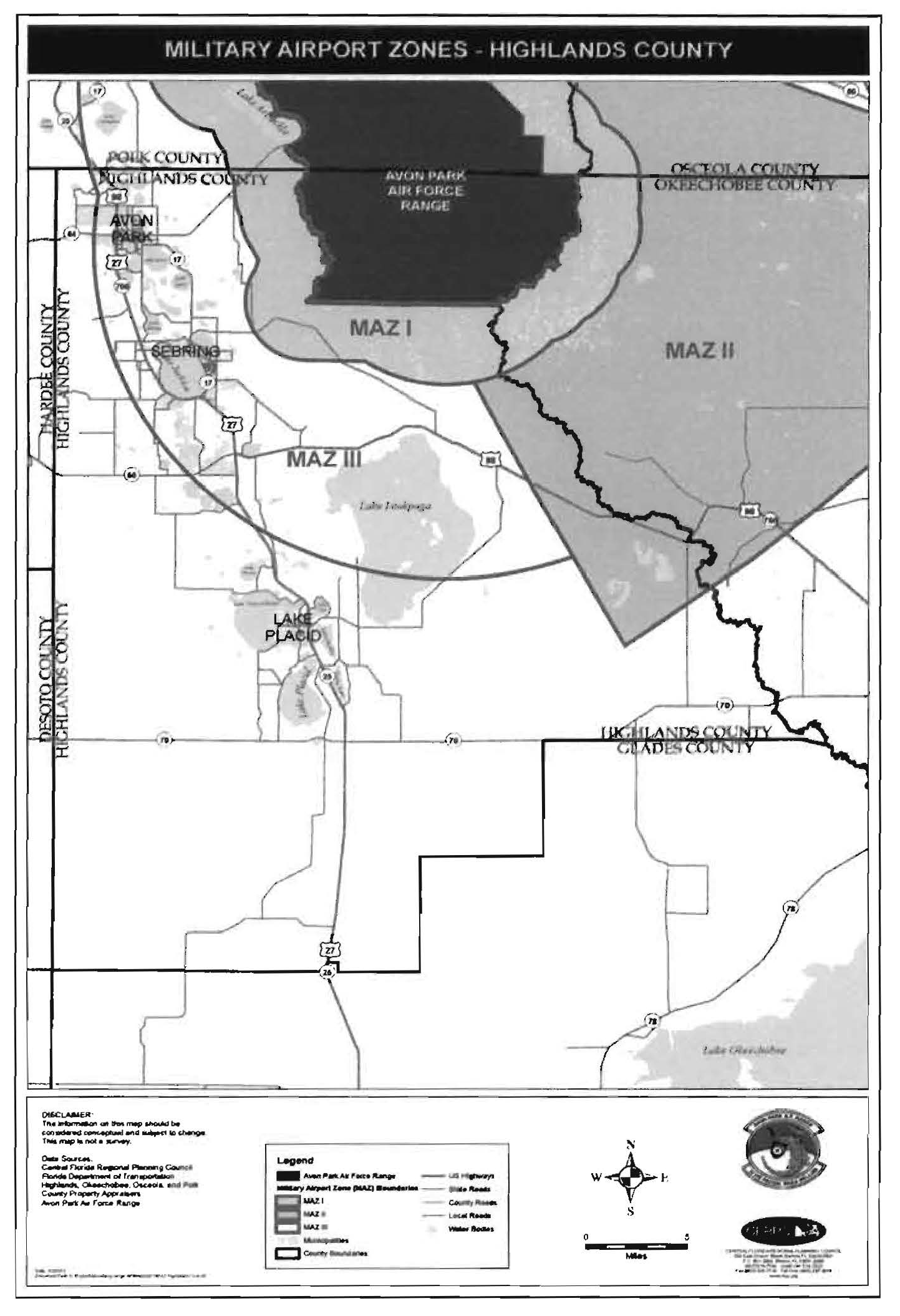
Figure 12.12.801.01 indicates areas in proximity to the APAFR Military Training Facility which may be subject to potential day and night low level aircraft overflight and military training noise during training exercises. Additional property development regulations may apply.
(Ord. No. 13-14-11, § 3)
Section 12.12.802. - Development standards.
A.
Development within the MAZ Overlay shall be consistent with the following criteria:
1.
MAZ I: For redevelopment and new development, any structure taller than 50 feet will require a variance in compliance with section 12.03.205 of this chapter.
2.
MAZ I and MAZ II: Redevelopment and new development within MAZ I and MAZ II shall be consistent with the following:
a.
All structures, including towers, are not to exceed the height requirements established by the FAA for land side improvements. All airspace management and approach procedures are to take precedence in setting height limitations on all structures;
b.
The location of new landfills, as defined in chapter 8.5 of this Code, shall be prohibited because these activities may induce aircraft bird strike hazards; and
c.
Any expansion beyond the March 2008 Conceptual Site Master Plan of the Highlands County Landfill located on the north side of Arbuckle Creek Road shall be approved through the Highlands County Site Plan Review Process and allow for review and comment by the APAFR, Sebring Regional Airport, and the Highlands County Development Review Committee.
d.
Outdoor lighting will be required to comply with the following:
i.
Street light fixtures shall be limited to 16 feet in height, unless exempted or otherwise further restricted in these land development regulations.
ii.
Parking lot lighting fixtures shall be limited to 25 feet in height.
iii.
All lighting shall be fully shielded with cut-off, non-glare fixtures directed only onto the subject site (see Figure 12.12.802.01). Non-shielded fixtures without cut-offs are prohibited.
e.
Non-residential development lighting:
i.
Electrical reflectors, spotlights, floodlights and other sources of illumination may be used to illuminate buildings, landscaping, signs, parking and loading areas, on any property provided the illumination is cast downward and the fixtures focus the illumination only onto the aforementioned features and prevent illumination upon adjacent properties or any public right-of-way.
ii.
All lighting shall be fully shielded with cut-off, non-glare fixtures directed only onto the subject site (see Figure 12.12.802.01).
Figure 12.12.802.01 — Street Lighting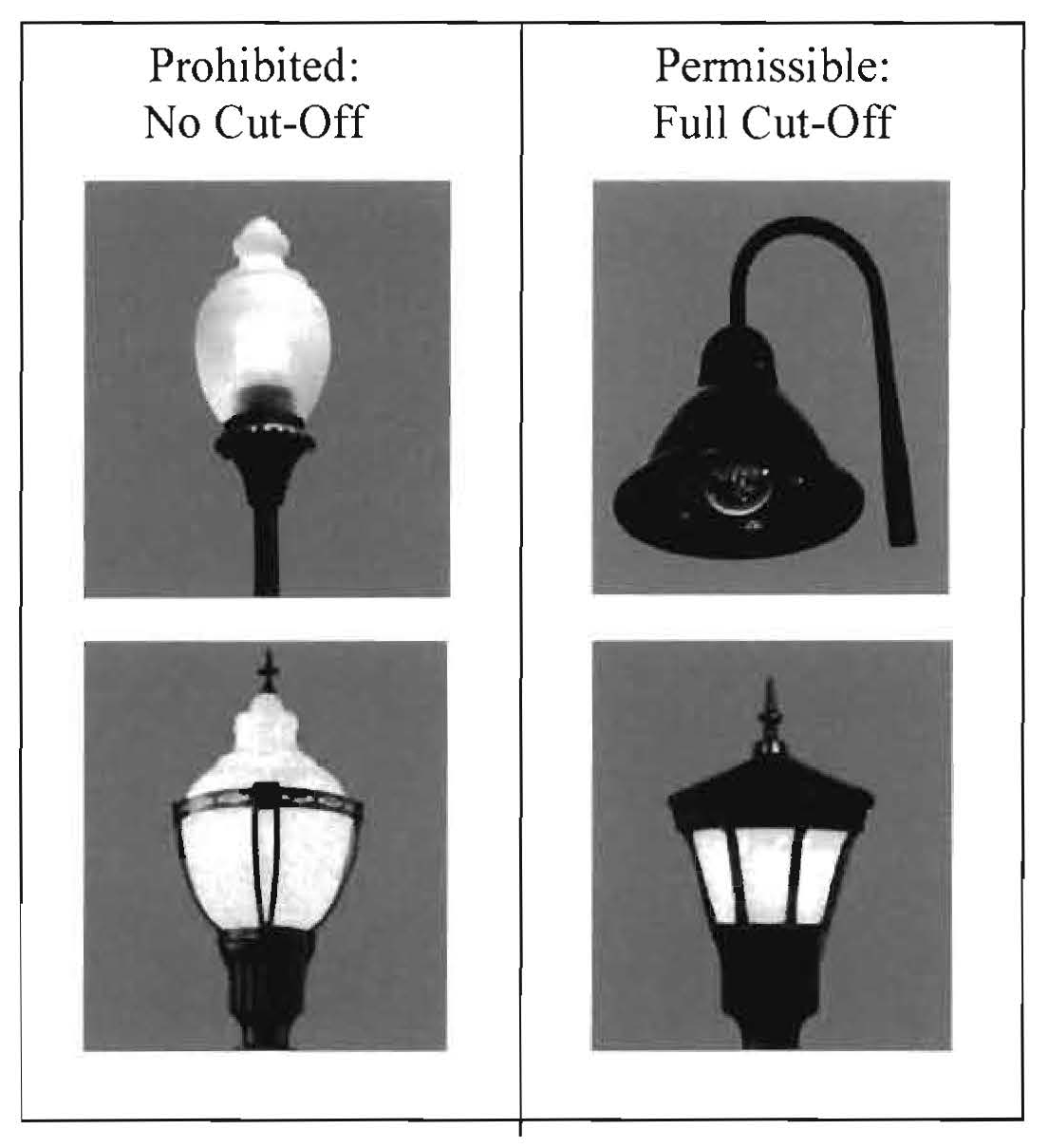
f.
Sign lighting:
i.
Sign lighting shall be downward projecting or backlit. Lighting attached to signage shall be projected directly at the sign and downward using light shields, hoods, and cut-off type fixtures.
g.
Lighting curfew:
i.
After closing hours and until sunrise, businesses shall turn off any unnecessary lights (those not associated with safety, security or signs).
h.
Prohibited light sources:
i.
Mercury vapor lamps and fixtures.
ii.
Any illumination patterns common to aviation (similar to runway guidance lighting, flood lights above horizontal plane, etc.) when used on buildings.
iii.
Laser source light when projected above the eaves of structures.
iv.
Searchlights or laser source lighting used for advertising or entertainment purposes.
i.
Lighting exempt from these regulations:
i.
Exit signs and other illumination required by building codes.
ii.
Lighting for stairs and ramps, as required by the building code.
iii.
Holiday lighting for no more than 30 days per calendar year.
iv.
Ballpark field lighting and other sporting venue lighting approved prior to the adoption of this section.
v.
Low voltage landscape lighting, but such lighting should be shielded in such a way as to eliminate glare and cast downward to prevent illumination upon adjacent properties or any public right-of-way.
vi.
Highway and street lighting fixtures and traffic control devices on public roads.
vii.
Residential lighting in swimming pools and other residential water features governed by Article 680 of the National Electrical Code.
j.
Variances:
i.
Variances from the land development regulations of this article may be granted in accordance with section 12.04.118 of this chapter.
ii.
Variances for the height of structures may be granted in compliance with section 12.03.205 of this chapter.
3.
MAZ I, MAZ II, and MAZ III:
a.
The county shall, in writing, inform all applicants of proposed development within the MAZs of potential noise nuisance and of sound-level reduction (SLR) standards that could be implemented to mitigate nuisances caused by recurring over-flight and other military training activities.
b.
Consistent with applicable law, all development within the MAZs shall be subject to the county's development review procedures.
(Ord. No. 13-14-11, § 3)
Section 12.12.500. - General.
A.
Title. These regulations shall be known as the Floodplain Management Ordinance of Highlands County, hereinafter referred to as "this division."
B.
Scope. The provisions of this division shall apply to all development that is wholly within or partially within any flood hazard area, including but not limited to the subdivision of land; filling, grading, and other site improvements and utility installations; construction, alteration, remodeling, enlargement, improvement, replacement, repair, relocation or demolition of buildings, structures, and facilities that are exempt from the Florida Building Code; placement, installation, or replacement of manufactured homes and manufactured buildings; installation or replacement of tanks; placement of recreational vehicles; installation of swimming pools; and any other development.
C.
Intent. The purposes of this division and the flood load and flood resistant construction requirements of the Florida Building Code are to establish minimum requirements to safeguard the public health, safety, and general welfare and to minimize public and private losses due to flooding through regulation of development in flood hazard areas to:
1.
Minimize unnecessary disruption of commerce, access and public service during times of flooding;
2.
Require the use of appropriate construction practices in order to prevent or minimize future flood damage;
3.
Manage filling, grading, dredging, mining, paving, excavation, drilling operations, storage of equipment or materials, and other development which may increase flood damage or erosion potential;
4.
Manage the alteration of flood hazard areas, watercourses, and shorelines to minimize the impact of development on the natural and beneficial functions of the floodplain;
5.
Minimize damage to public and private facilities and utilities;
6.
Help maintain a stable tax base by providing for the sound use and development of flood hazard areas;
7.
Minimize the need for future expenditure of public funds for flood control projects and response to and recovery from flood events; and
8.
Meet the requirements of the National Flood Insurance Program for community participation as set forth in the Title 44 Code of Federal Regulations, Section 59.22.
D.
Coordination with the Florida Building Code. This division is intended to be administered and enforced in conjunction with the Florida Building Code. Where cited, ASCE 24 refers to the edition of the standard that is referenced by the Florida Building Code.
E.
Warning. The degree of flood protection required by this division and the Florida Building Code, as amended by Highlands County, is considered the minimum reasonable for regulatory purposes and is based on scientific and engineering considerations. Larger floods can and will occur. Flood heights may be increased by man-made or natural causes. This division does not imply that land outside of mapped special flood hazard areas, or that uses permitted within such flood hazard areas, will be free from flooding or flood damage. The flood hazard areas and base flood elevations contained in the flood insurance study and shown on flood insurance rate maps and the requirements of Title 44 Code of Federal Regulations, Sections 59 and 60, may be revised by the Federal Emergency Management Agency, requiring Highlands County to revise these regulations to remain eligible for participation in the National Flood Insurance Program. No guaranty of vested use, existing use, or future use is implied or expressed by compliance with this division.
F.
Disclaimer of liability. This division shall not create liability on the part of Highlands County, its board of county commissioners or any officer or employee thereof for any flood damage that results from reliance on this division or any administrative decision lawfully made thereunder.
(Ord. No. 15-16-02, § 2)
Section 12.12.501. - Applicability.
A.
General. Where there is a conflict between a general requirement and a specific requirement, the specific requirement shall be applicable.
B.
Areas to which this division applies. This division shall apply to all flood hazard areas within Highlands County, as established in section 12.12.501.C. of this division.
C.
Basis for establishing flood hazard areas. The Flood Insurance Study for Highlands County and Incorporated Areas, dated November 18, 2015, and all subsequent amendments and revisions, and the accompanying flood insurance rate maps (FIRM), and all subsequent amendments and revisions to such maps, are adopted by reference as a part of this division and shall serve as the minimum basis for establishing flood hazard areas. Studies and maps that establish flood hazard areas are on file at the Development Services Department, 501 South Commerce Avenue, Sebring, Florida 33870.
D.
Submission of additional data to establish flood hazard areas. To establish flood hazard areas and base flood elevations, pursuant to section 12.12.505 of this division, the floodplain administrator may require submission of additional data. Where field surveyed topography prepared by a Florida licensed professional surveyor or digital topography accepted by Highlands County indicates that ground elevations:
1.
Are below the closest applicable base flood elevation, even in areas not delineated as a special flood hazard area on a FIRM, the area shall be considered as flood hazard area and subject to the requirements of this division and, as applicable, the requirements of the Florida Building Code.
2.
Are above the closest applicable base flood elevation within an area delineated as a special flood hazard area on a FIRM, the area shall be regulated as a special flood hazard area unless the applicant obtains a letter of map change that removes the area from the special flood hazard area.
E.
Other laws. The provisions of this division shall not be deemed to nullify any provisions of local, state or federal law.
F.
Abrogation and greater restrictions. The ordinance from which this division is derived supersedes any ordinance in effect for management of development in flood hazard areas. However, it is not intended to repeal or abrogate any existing ordinances including but not limited to land development regulations, zoning ordinances, stormwater management regulations, or the Florida Building Code. In the event of a conflict between the ordinance from which this division is derived and any other ordinance, the more restrictive shall govern. This division shall not impair any deed restriction, covenant or easement, but any land that is subject to such interests shall also be governed by this division.
G.
Interpretation. In the interpretation and application of this division, all provisions shall be:
1.
Considered as minimum requirements;
2.
Liberally construed in favor of the governing body; and
3.
Deemed neither to limit nor repeal any other powers granted under state statutes.
(Ord. No. 15-16-02, § 2)
Section 12.12.502. - Duties and powers of the floodplain administrator, county engineer and building official.
A.
Designation. The director of development services is designated as the floodplain administrator. The floodplain administrator may delegate performance of certain duties to other employees.
B.
General. The floodplain administrator is authorized and directed to administer and enforce the provisions of this division. The floodplain administrator shall have the authority to render interpretations of this division consistent with the intent and purpose of this division and may establish policies and procedures in order to clarify the application of its provisions. Such interpretations, policies, and procedures shall not have the effect of waiving requirements specifically provided in this division without the granting of a variance pursuant to section 12.12.507 of this division. The floodplain administrator shall also hear and decide appeals from decisions of the building official, county engineer and planning supervisor in the administration and enforcement of this division.
C.
Applications and permits. The floodplain administrator, in coordination with other pertinent offices of the county, shall:
1.
Review applications and plans to determine whether proposed new development will be located in flood hazard areas;
2.
Review applications for modification of any existing development in flood hazard areas for compliance with the requirements of this division;
3.
Interpret flood hazard area boundaries where such interpretation is necessary to determine the exact location of boundaries; a person contesting the determination shall have the opportunity to appeal the interpretation;
4.
Provide available flood elevation and flood hazard information;
5.
Determine whether additional flood hazard data shall be obtained from other sources or shall be developed by an applicant;
6.
Review applications to determine whether proposed development will be reasonably safe from flooding;
7.
Issue flood hazard development permits or approvals for development other than buildings and structures that are subject to the Florida Building Code, including buildings, structures and facilities exempt from the Florida Building Code, when compliance with this division is demonstrated, or disapprove the same in the event of noncompliance; and
8.
Coordinate with and provide comments to the building official to assure that applications, plan reviews, and inspections for buildings and structures in flood hazard areas comply with the applicable provisions of this division.
D.
Substantial improvement and substantial damage determinations. For applications for building permits to improve buildings and structures, including alterations, movement, enlargement, replacement, repair, change of occupancy, additions, rehabilitations, renovations, substantial improvements, repairs of substantial damage, and any other improvement of or work on such buildings and structures, the floodplain administrator, in coordination with the building official, shall:
1.
Estimate the market value, or require the applicant to obtain an appraisal of the market value prepared by a qualified independent appraiser, of the building or structure before the start of construction of the proposed work; in the case of repair, the market value of the building or structure shall be the market value before the damage occurred and before any repairs are made;
2.
Compare the cost to perform the improvement, the cost to repair a damaged building to its pre-damaged condition, or the combined costs of improvements and repairs, if applicable, to the market value of the building or structure;
3.
Determine and document whether the proposed work constitutes substantial improvement or repair of substantial damage; for proposed work to repair damage caused by flooding, the determination requires evaluation of previous permits issued to repair flood-related damage as specified in the definition of "substantial damage;" and
4.
Notify the applicant if it is determined that the work constitutes substantial improvement or repair of substantial damage and that compliance with the flood resistant construction requirements of the Florida Building Code and this division is required.
E.
Modifications of the strict application of the requirements of the Florida Building Code. The floodplain administrator shall review requests submitted to the building official that seek approval to modify the strict application of the flood load and flood resistant construction requirements of the Florida Building Code to determine whether such requests require the granting of a variance pursuant to section 12.12.507 of this division.
F.
Notices and orders. The floodplain administrator shall coordinate with appropriate local agencies for the issuance of all necessary notices or orders to ensure compliance with this division.
G.
Inspections. The floodplain administrator shall make the required inspections as specified in section 12.12.506 of this division for development that is not subject to the Florida Building Code, including buildings, structures and facilities exempt from the Florida Building Code. The Floodplain Administrator shall inspect flood hazard areas to determine if development is undertaken without issuance of a permit.
H.
Other duties of the floodplain administrator. The floodplain administrator shall have other duties, including but not limited to:
1.
Establish, in coordination with the building official, procedures for administering and documenting determinations of substantial improvement and substantial damage made pursuant to section 12.12.502.D. of this division;
2.
Require that applicants proposing alteration of a watercourse notify adjacent communities and the Florida Division of Emergency Management, state floodplain management office, and submit copies of such notifications to the Federal Emergency Management Agency (FEMA);
3.
Require applicants who submit hydrologic and hydraulic engineering analyses to support permit applications to submit to FEMA the data and information necessary to maintain the flood insurance rate maps if the analyses propose to change base flood elevations, flood hazard area boundaries, or floodway designations; such submissions shall be made within six months of such data becoming available; and
4.
Notify FEMA when the corporate boundaries of Highlands County are modified.
I.
Duties and responsibilities of the county engineer. The duties of the county engineer in implementing this division shall include, but not be limited to:
1.
Review applications for and issue all flood hazard development permits upon assurance that the permit requirements of these regulations have been satisfied.
2.
Advise permittee that additional federal or state permits may be required, and if specific federal or state permit requirements are known, require that copies of such permit applications be provided and maintained on file with the flood hazard development permit.
3.
Notify adjacent communities and the Central Florida Regional Planning Council prior to any known alteration or relocation of a watercourse, and submit evidence of such notification to the Federal Emergency Management Agency.
4.
Assure that maintenance is provided within the altered or relocated portion of said watercourse so that the flood-carrying capacity is not diminished.
5.
For all structures except single-family, duplex, manufactured home dwellings, residential additions, and residential accessory structures, verify and record the actual elevation of the lowest floor (including basement) of all new or substantially improved structures, in accordance with section 12.12.504.E. of this division.
6.
When flood-proofing is utilized for a particular structure, the county engineer shall obtain certification from the applicant's registered professional engineer or architect, in accordance with sections 12.12.511.B.2. and 12.12.511.E.2. of this division.
7.
For all structures except single-family, duplex, manufactured home dwellings, residential additions, and residential accessory structures, where interpretation is needed as to the exact location of boundaries of the areas of special flood hazard (for example, where there appears to be a conflict between a mapped boundary and actual field conditions) the county engineer shall make the necessary interpretation; any person contesting the location of the boundary shall be given a reasonable opportunity to appeal the interpretation as provided in section 12.12.507 of this division.
8.
For all structures except single-family, duplex, manufactured home dwellings, residential additions, and residential accessory structures, when base flood elevation data or floodway data have not been provided in accordance with section 12.12.501.C. of this division, then the county engineer shall review and reasonably utilize any base flood elevation and floodway data available from a federal, state or other source, in order to administer the provisions of subdivision 3, Flood Resistant Development, of this division.
9.
For all structures except single-family, duplex, manufactured home dwellings, residential additions, and residential accessory structures, verify and record the actual elevation of the lowest floor (including basement) of all new or substantially improved structures, in accordance with section 12.12.504.E. of this division and review required design certifications and documentation of elevations specified by this division and the Florida Building Code to determine that such certifications and documentations are complete;
10.
All records pertaining to flood hazard development permits or elevation certificates approved and/or issued by the county engineer shall be maintained in that office and shall be open for public inspection.
J.
Duties and responsibilities of the building official. The duties of the building official in implementing this division shall include, but not be limited to:
1.
Verify and record the actual elevation of the lowest floor (including basement) of all new or substantially improved structures, in accordance with section 12.12.504.E. of this division. Review required design certifications and documentation of elevations specified by this division and the Florida Building Code to determine that such certifications and documentations are complete.
2.
For single-family, duplex, manufactured home dwellings, residential additions, and residential accessory structures, where interpretation is needed as to the exact location of boundaries of the areas of special flood hazard (for example, where there appears to be a conflict between a mapped boundary and actual field conditions) the building official shall make the necessary interpretation; any person contesting the location of the boundary shall be given a reasonable opportunity to appeal the interpretation as provided in section 12.12.507 of this division.
3.
For single-family, duplex, manufactured home dwellings, residential additions, and residential accessory structures, when base flood elevation data or floodway data have not been provided in accordance with section 12.12.501.C. of this division, then the building official shall obtain, review and reasonably utilize any base flood elevation and floodway data available from a federal, state or other source, in order to administer the provisions of subdivision 3, Flood Resistant Development, of this division.
4.
All records pertaining to elevation certificates approved and/or issued by the building official shall be maintained in that office and shall be open for public inspection.
K.
Floodplain management records. Regardless of any limitation on the period required for retention of public records, the floodplain administrator shall maintain and permanently keep and make available for public inspection all records that are necessary for the administration of this division and the flood resistant construction requirements of the Florida Building Code, including flood insurance rate maps; letters of change; records of issuance of permits and denial of permits; determinations of whether proposed work constitutes substantial improvement or repair of substantial damage; required design certifications and documentation of elevations specified by the Florida Building Code and this division; notifications to adjacent communities, FEMA, and the state related to alterations of watercourses; assurances that the flood carrying capacity of altered watercourses will be maintained; documentation related to appeals and variances, including justification for issuance or denial; and records of enforcement actions taken pursuant to this division and the flood resistant construction requirements of the Florida Building Code. These records shall be available for public inspection at the Development Services Department, 501 South Commerce Avenue, Sebring, Florida 33870.
(Ord. No. 15-16-02, § 2)
Section 12.12.503. - Kissimmee River Floodplain.
A.
Purpose and intent. This section implements special measures for flood protection within the Kissimmee River's special flood hazard area according to the applicable objectives and policies expressed in the natural resources element of the county's adopted comprehensive plan and this division. Measures to conserve water, protect water quality, conserve habitat, and protect cultural resources in the Kissimmee River's special flood hazard area are implemented in other divisions of these regulations. This division also insures that proposed land use activities within the Kissimmee River's special flood hazard area are not inconsistent with the stated goals of the resource management plan for the Northern Everglades and Estuaries Protection Plan and the Lake Okeechobee Basin Management Action Plan, pursuant to F.S. § 373.4595. This section's requirements are in addition to all other requirements of this division.
B.
Measures supporting Kissimmee River Resource Management Plan. Where development is proposed within the Kissimmee River's special flood hazard area, the developer should examine certain pertinent facts concerning such development as a part of his or her initial planning process. Furthermore, because the county has stated its intention to support the Kissimmee River Resource Management Plan and its objectives, all development in the Kissimmee River's special flood hazard area will be reviewed subject to its ability to:
1.
Maintain, at a minimum, the present water quality conditions, but enhance or improve water quality where possible and practical;
2.
Provide assurance that the economic development is in an appropriate area with further assurance that future development does not interfere with protection of the area's critical resources;
3.
Ensure reasonable level of flood protection and water conservation, thereby preventing excessive damage to the areas' critical resources, both natural and manmade;
4.
Maintain or enhance the Kissimmee River's riverine system to ensure the continuation of indigenous fish and wildlife, the river's aesthetic appeal, boating, recreation, and other benefits; and
5.
Provide protection for as many of the archaeological, historical, and distinctive cultural features as possible.
C.
Development requirements for Kissimmee Floodplain. All new development, redevelopment, and land clearing proposals within the Kissimmee River's special flood hazard area shall comply with the following as they might apply:
1.
The establishment of a planned unit development zoning district on the site prior to submitting a site plan or plat.
2.
The application of stormwater treatment techniques and the use of mandatory stormwater retention to bring post-development outputs to acceptable water quality/quantity standards prior to discharge into the Kissimmee River.
3.
The inclusion of proposed flood protection and design specifications in the proposal.
4.
The inclusion of erosion control specifications in final site plans and improvement plan for development.
5.
The incorporation of open space buffers, land set asides, and setbacks pursuant to the policies of the county's adopted comprehensive plan and land development regulations in the proposal.
D.
Low density within Kissimmee Floodplain. Within the Kissimmee River's special flood hazard area, all unvested residential development or subdivision shall be according to agricultural densities at one dwelling unit per ten gross acres. Clustered development or lot configurations space/riparian easements shall be encouraged. Natural Resources Element, Policy 10.6.
E.
Best management practices for Kissimmee Floodplain. All development orders for agricultural operations located within the Kissimmee River's special flood hazard area shall be conditioned upon the application of best management practices.
F.
Clearinghouse procedures when developing Kissimmee Areas.
1.
The county shall generally support restoration of the Kissimmee River's special flood hazard area as it reviews proposals for new development, redevelopment, and land clearing proposals for consistency with the plans and programs of the following agencies:
a.
The U.S. Army Corps of Engineers pursuant to the Kissimmee River Restoration Plan and the Comprehensive Everglades Restoration Plan.
b.
The Florida Department of Environmental Protection pursuant to the Lake Okeechobee Basin Management Action Plan as identified in F.S. § 373.4595.
c.
The Florida Department of Economic Opportunity pursuant to the cited Resource Management Plan for the Lower Kissimmee River.
d.
The South Florida Water Management District pursuant to the Northern Everglades and Estuary Protection Plan and the Lake Okeechobee Basin Management Action Plan pursuant to F.S. § 373.4595 and the Kissimmee River Restoration Plan cited above.
e.
The Central Florida Regional Planning Council pursuant to the resource management plan for the Lower Kissimmee River cited above, and the regional policy plan then in effect.
f.
The Florida Department of Agriculture and Consumer Services for the implementation of agricultural best management practices pursuant to F.S. § 373.4595, the Northern Everglades and Estuary Protection Plan, and Lake; Okeechobee Basin Management Action Plan.
2.
In addition to the requirements of section 12.12.504 of this division, when a developer contemplates new development, redevelopment, or land clearing in the Kissimmee River's 100-year floodplain, the following action by the developer shall be required:
a.
Proof of notification. All applications for flood hazard development permits within the Kissimmee River's special flood hazard area shall include proof of notification to the agencies listed in section 12.12.503.F.1. of this division and the Highlands County Natural Resources Advisory Committee (NRAC). Transmitted information to the various agencies and NRAC shall include copies of the application for a final development order including all attachments and the flood hazard development permit application. This proof of notification shall be in the form of copies of transmittal letters to the various agencies, and a signed and sealed certificate prepared by the project engineer noting the date that the copies were forwarded. The transmittal letter as shown in the Highlands County Technical Standards Manual, current edition, which asks the agencies and NRAC to respond directly to Highlands County shall be used.
b.
Other requirements and recommendations. Requirements of any agency's permits which are communicated back to the county within 45 days shall be incorporated into the county's final development order for the project. Other recommendations for development and mitigation received from NRAC or these agencies may, at the discretion of the BCC, also be applied as conditions of approval for the county's final development order.
G.
Final development orders. Requirements of this section which concern solely the lands within the Kissimmee River Floodplain shall only apply to final development orders for lands over 20 acres in size or the clearing of undisturbed native vegetation on tracts of land over ten acres in size. Final development orders to construct one single-family home, one accessory dwelling, and attendant accessory structures shall be exempt from this section 12.12.503 regardless of lot size.
(Ord. No. 15-16-02, § 2)
Section 12.12.504. - Permits.
A.
Permits required. Any owner or owner's authorized agent (hereinafter "applicant") who intends to undertake any development activity within the scope of this division, including buildings, structures and facilities exempt from the Florida Building Code, which is wholly within or partially within any flood hazard area shall first make application to the floodplain administrator, and the building official if applicable, and shall obtain the required permit(s) and/or approval(s). No such permit or approval shall be issued until compliance with the requirements of this division and all other applicable codes and regulations has been satisfied.
B.
Flood hazard development permits or approvals. Flood hazard development permits or approvals shall be issued pursuant to this division for any development activities not subject to the requirements of the Florida Building Code, including buildings, structures and facilities exempt from the Florida Building Code. Depending on the nature and extent of proposed development that includes a building or structure, the floodplain administrator may determine that a flood hazard development permit or approval is required in addition to a building permit.
C.
Establishment of flood hazard development permit. A flood hazard development permit is hereby established and shall be required prior to development in a flood hazard area as established in section 12.12.501.C. of this division.
1.
Subdivisions, manufactured home parks, and seasonal parks. When required by this section, an application for a flood hazard development permit shall be submitted to the county engineer concurrently with the improvement plan for a development requiring the recording of a final plat, and this application must receive approval prior to approval of the improvement plan and issuance of a final development order for construction of the improvements.
2.
Structures. When required by this section, an application for a flood hazard development permit shall be submitted to the county engineer concurrently with the final site plan. This application must receive approval prior to approval of the final site plan and issuance of a final development order for construction of the improvements. However, a structure shall not require a flood hazard development permit where the construction is proposed on property for which an overall flood hazard development permit has been issued by virtue of the review and approval of the improvement plan and subsequent recording of a subdivision, mobile home park, or seasonal park.
3.
Compliance. No structure or land shall hereafter be located, extended, converted or structurally altered without full compliance with the terms of this division and other applicable regulations.
4.
Abrogation and greater restrictions. This division is not intended to repeal, abrogate, or impair any existing easements, covenants, or deed restrictions. However, where this division and another division of these regulations conflict or overlap, whichever imposes the more stringent restrictions shall prevail.
5.
Interpretation. In the interpretation and application of this division all provisions shall be:
a.
Considered as minimum requirements.
b.
Liberally construed in favor of Highlands County.
c.
Deemed neither to limit nor repeal any other powers granted under state statutes.
D.
Buildings, structures and facilities exempt from the Florida Building Code. Pursuant to the requirements of federal regulation for participation in the National Flood Insurance Program (44 C.F.R. Sections 59 and 60), flood hazard development permits or approvals shall be required for the following buildings, structures and facilities that are exempt from the Florida Building Code and any further exemptions provided by law, which are subject to the requirements of this division:
1.
Railroads and ancillary facilities associated with the railroad.
2.
Nonresidential farm buildings on farms, as provided in F.S. § 604.50.
3.
Temporary buildings or sheds used exclusively for construction purposes.
4.
Mobile or modular structures used as temporary offices.
5.
Those structures or facilities of electric utilities, as defined in F.S. § 366.02, which are directly involved in the generation, transmission, or distribution of electricity.
6.
Chickees constructed by the Miccosukee Tribe of Indians of Florida or the Seminole Tribe of Florida. As used in this paragraph, the term "chickee" means an open-sided wooden hut that has a thatched roof of palm or palmetto or other traditional materials, and that does not incorporate any electrical, plumbing, or other non-wood features.
7.
Family mausoleums not exceeding 250 square feet in area which are prefabricated and assembled on site or preassembled and delivered on site and have walls, roofs, and a floor constructed of granite, marble, or reinforced concrete.
8.
Temporary housing provided by the department of corrections to any prisoner in the state correctional system.
9.
Structures identified in F.S. § 553.73(10)(k), are not exempt from the Florida Building Code if such structures are located in flood hazard areas established on flood insurance rate maps.
E.
Elevation certificate. Highlands County hereby adopts the elevation certificate, FEMA Form 086-0-33, as it may be amended or superseded, and provided by the Federal Emergency Management Agency, as its means of complying with FEMA's requirement that the county "obtain the elevation of the lowest floor (including basement) of all new and substantially improved structures, and maintain a record of all such information." This is in keeping with section 12.12.500.C.8. of this division and the county's objective to maintain eligibility in the National Flood Insurance Program and comply with FEMA requirements. These elevation certificates shall be filed as follows:
1.
For single-family, duplex, manufactured home dwellings, residential additions, and residential accessory structures. Elevation certificates shall be filed with the building official concurrently with the application for a building permit.
2.
For structures other than single-family, duplex, manufactured home dwellings, residential additions, and residential accessory structures. Elevation certificates shall be filed with the county engineer concurrently with the submittal of the final site plan for review.
3.
Filing procedure. The elevation certificate shall be completed by a professional land surveyor in compliance with FEMA instructions included with the elevation certificate.
a.
Section A., property information, section B., flood insurance rate map (FIRM) information, and section C., building elevation information shall be completed and submitted to either the county engineer or building official as described in section 12.12.504.E.1. and section 12.12.504.E.2. of this division.
b.
Section D., certification shall be completed, signed, and sealed by a professional land surveyor upon placement of the lowest floor or upon placement of the horizontal structural members of the lowest floor, whichever is applicable.
c.
Section G., community information shall be completed by a professional land surveyor when it is determined that the "reference level" elevation, as described in the FEMA instructions, is different from the "lowest floor" elevation. The "lowest floor" elevation in relation to the datum referenced on the FIRM.
4.
The building official and/or the county engineer shall review the floor elevation survey data submitted. Deficiencies detected by such review shall be corrected by the permit holder immediately and prior to further progressive work being permitted to proceed. Failure to submit the survey or failure to make said corrections required hereby, shall be cause to issue a stop-work order for the project.
F.
Floodproofing certificate. Where floodproofing is employed in lieu of the structure being elevated as described in section 12.12.511.B.2. of this division, a registered professional engineer or architect shall certify that the requirements of this section have been satisfied. The certification shall be submitted to the county engineer.
G.
Application for a permit. To obtain a flood hazard development permit the applicant shall first file an application with the county engineer in writing on a form furnished by the county engineer. Three copies of the application shall be submitted and this application shall receive approval prior to the approval of the improvement plan or final site plan and issuance of a final development order for construction. The information provided shall include:
1.
The identification and description of the development to be covered by the permit or approval, to include developer/owner's name and current address and name and address of engineer preparing application, plans, and supporting documents.
2.
A description of the land on which the proposed development is to be conducted by legal description, street address or similar description that will readily identify and definitively locate the site.
3.
A statement of the use and occupancy for which the proposed development is intended, to include any existing or proposed storage of materials.
4.
A statement of the type of construction, i.e., structure, subdivision, manufactured home park, or seasonal park.
5.
A site plan or construction documents as specified in section 12.12.505 of this division.
6.
A statement of the valuation of the proposed work.
7.
The signature by the applicant or the applicant's authorized agent.
8.
A soils map and a soils analysis prepared by a registered professional engineer or a soil scientist with the Natural Resource Conservation Service, delineating the upland, pine flatwood, and wetland soils classifications with respect to the property in question.
9.
Copies of any other required governmental or private permits for construction within a flood hazard area.
10.
Drainage facilities.
11.
Location of any wetlands and/or watercourses and water bodies.
12.
The following certification statement signed by the engineer: "I hereby certify that to the best of my knowledge and belief, the design of this project complies with the requirements of the Highlands County Land Development Regulations pertaining to development within a flood hazard area as defined by the regulations."
13.
The following additional information:
a.
FIRM designation of property.
b.
Total land area of the project in acres.
c.
Total land area of the project in acres lying within a flood hazard area as defined by these regulations.
d.
Amount of site alteration within wetlands.
e.
Lowest existing floor elevation.
f.
Base flood elevation and method of establishment
g.
A description of the extent to which any watercourse will be altered or relocated as a result of proposed development.
14.
The following statement by the owner: The undersigned applicant hereby binds and obligates himself to conform to the project description, information, sketches and development plans associated with this project, and to comply with all requirements of the Highlands County Land Development Regulations pertaining to development within a flood hazard area as defined by the regulations.
15.
A narrative, prepared by the registered engineer, describing base flood elevation and method used for determination of base flood elevation, existing conditions, proposed construction, the lowest proposed elevation for roads and lowest floors of structures, and methods that will be used to assure that construction within the flood hazard area, when required, will be floodproofed; the narrative should explain the benefits of the project to the owner and public, and why such construction in a flood hazard area is needed.
16.
The plan review fee as established by the board of county commissioners.
17.
Other data and information as required by the county engineer.
H.
Application for approval. To obtain approval for single-family, duplex, and manufactured home dwellings, residential additions, and residential accessory structures on existing lots or parcels, the applicant shall first file an application for residential/addition building permit in writing on a form furnished by the building official and submit the application with an elevation certificate to the building official. The information contained in the application shall:
1.
Identify and describe the development to be covered by the approval.
2.
Describe the land on which the proposed development is to be conducted by legal description, street address or similar description that will readily identify and definitively locate the site.
3.
Indicate the use and occupancy for which the proposed development is intended, to include any existing or proposed storage of materials.
4.
Be accompanied by a site plan or construction documents as specified in section 12.12.505 of this division and be accompanied by an elevation certificate per section 12.12.504.E.
5.
State the valuation of the proposed work.
6.
Be signed by the applicant or the applicant's authorized agent.
7.
Give such other data and information as required by the county building official.
I.
Validity of permit or approval. The issuance of a flood hazard development permit or approval pursuant to this division shall not be construed to be a permit for, or approval of, any violation of the ordinance from which this division is derived, the Florida Building Codes, or any other ordinance of the County. The issuance of permits based on submitted applications, construction documents, and information shall not prevent the Floodplain Administrator from requiring the correction of errors and omissions.
J.
Expiration. A flood hazard development permit or approval shall become invalid unless the work authorized by such permit is commenced within 180 days after its issuance, or if the work authorized is suspended or abandoned for a period of 180 days after the work commences. Extensions for periods of not more than 180 days each shall be requested in writing and justifiable cause shall be demonstrated.
K.
Suspension or revocation. The floodplain administrator is authorized to suspend or revoke a flood hazard development permit or approval if the permit was issued in error on the basis of incorrect, inaccurate or incomplete information, or in violation of the ordinance from which this division is derived or any other ordinance, regulation or requirement of the county.
L.
Other permits required. Flood hazard development permits and building permits shall include a condition that all other applicable state or federal permits be obtained before commencement of the permitted development, including but not limited to the following:
1.
The applicable water management district, either the South Florida Water Management District or the South West Florida Water Management District; F.S. § 373.036.
2.
Florida Department of Health for onsite sewage treatment and disposal systems; F.S. § 381.0065, and Chapter 64E-6, F.A.C.
3.
Florida Department of Environmental Protection for activities subject to the Joint Coastal Permit; F.S. § 161.055.
4.
Florida Department of Environmental Protection for activities that affect wetlands and alter surface water flows, in conjunction with the U.S. Army Corps of Engineers; Section 404 of the Clean Water Act.
5.
Federal permits and approvals.
(Ord. No. 15-16-02, § 2)
Section 12.12.505. - Site plans and construction documents.
A.
Information for development in flood hazard areas. The site plan or construction documents for any development subject to the requirements of this division shall be drawn to scale and shall include, as applicable to the proposed development:
1.
Delineation of flood hazard areas, floodway boundaries and flood zone(s), base flood elevation(s), and ground elevations if necessary for review of the proposed development.
2.
Location of watercourses, water bodies, and wetlands.
3.
Where base flood elevations, or floodway data are not included on the FIRM or in the flood insurance study, they shall be established in accordance with section 12.12.505.B.2. or section 12.12.505.B.3. of this division.
4.
Where the parcel on which the proposed development will take place will have more than 50 lots or is larger than five acres and the base flood elevations are not included on the FIRM or in the flood insurance study, such elevations shall be established in accordance with section 12.12.505.B.1. of this division.
5.
Location of the proposed activity and proposed structures, and locations of existing buildings and structures.
6.
Location, extent, amount, and proposed final grades of any filling, grading, or excavation.
7.
Where the placement of fill is proposed, the amount, type, and source of fill material; compaction specifications; a description of the intended purpose of the fill areas; and evidence that the proposed fill areas are the minimum necessary to achieve the intended purpose.
8.
Existing and proposed drainage facilities.
9.
Existing and proposed alignment of any proposed alteration of a watercourse.
10.
Total land area of the project in acres.
The floodplain administrator is authorized to waive the submission of site plans, construction documents, and other data that are required by this division but that are not required to be prepared by a registered design professional if it is found that the nature of the proposed development is such that the review of such submissions is not necessary to ascertain compliance with this division.
B.
Information in flood hazard areas without base flood elevations (approximate Zone A). Where flood hazard areas are delineated on the FIRM and base flood elevation data have not been provided, the floodplain administrator shall:
1.
Require the applicant to include base flood elevation data prepared in accordance with currently accepted engineering practices.
2.
Obtain, review, and provide to applicants base flood elevation and floodway data available from a federal or state agency or other source or require the applicant to obtain and use base flood elevation and floodway data available from a federal or state agency or other source.
3.
Where base flood elevation and floodway data are not available from another source, where the available data are deemed by the floodplain administrator to not reasonably reflect flooding conditions, or where the available data are known to be scientifically or technically incorrect or otherwise inadequate:
a.
Require the applicant to include base flood elevation data prepared in accordance with currently accepted engineering practices; or
b.
Specify that the base flood elevation is two feet above the highest adjacent grade at the location of the development, provided there is no evidence indicating flood depths have been or may be greater than two feet.
4.
Where the base flood elevation data are to be used to support a letter of map change from FEMA, advise the applicant that the analyses shall be prepared by a Florida licensed engineer in a format required by FEMA, and that it shall be the responsibility of the applicant to satisfy the submittal requirements and pay the processing fees.
C.
Additional analyses and certifications. As applicable to the location and nature of the proposed development activity, and in addition to the requirements of this section, the applicant shall have the following analyses signed and sealed by a Florida licensed engineer for submission with the site plan and construction documents:
1.
For development activities proposed to be located in a regulatory floodway, a floodway encroachment analysis that demonstrates that the encroachment of the proposed development will not cause any increase in base flood elevations; where the applicant proposes to undertake development activities that do increase base flood elevations, the applicant shall submit such analysis to FEMA as specified in section 12.12.505.D. of this division and shall submit the conditional letter of map revision, if issued by FEMA, with the site plan and construction documents.
2.
For development activities proposed to be located in a riverine flood hazard area for which base flood elevations are included in the flood insurance study or on the FIRM and floodways have not been designated, hydrologic and hydraulic analyses that demonstrate that the cumulative effect of the proposed development, when combined with all other existing and anticipated flood hazard area encroachments, will not increase the base flood elevation more than one foot at any point within the county. This requirement does not apply in isolated flood hazard areas not connected to a riverine flood hazard area or in flood hazard areas identified as Zone AO or Zone AH.
3.
For alteration of a watercourse, an engineering analysis prepared in accordance with standard engineering practices which demonstrates that the flood-carrying capacity of the altered or relocated portion of the watercourse will not be decreased, and certification that the altered watercourse shall be maintained in a manner which preserves the channel's flood-carrying capacity; the applicant shall submit the analysis to FEMA as specified in section 12.12.505.D. of this division.
D.
Submission of additional data. When additional hydrologic, hydraulic or other engineering data, studies, and additional analyses are submitted to support an application, the applicant has the right to seek a letter of map change from FEMA to change the base flood elevations, change floodway boundaries, or change boundaries of flood hazard areas shown on FIRMs, and to submit such data to FEMA for such purposes. The analyses shall be prepared by a Florida licensed engineer in a format required by FEMA. Submittal requirements and processing fees shall be the responsibility of the applicant.
(Ord. No. 15-16-02, § 2)
Section 12.12.506. - Inspections.
A.
General. Development for which a flood hazard development permit or approval is required shall be subject to inspection.
B.
Development other than buildings and structures. The floodplain administrator shall inspect all development to determine compliance with the requirements of this division and the conditions of issued flood hazard development permits or approvals.
C.
Buildings, structures and facilities exempt from the Florida Building Code. The floodplain administrator shall inspect buildings, structures and facilities exempt from the Florida Building Code to determine compliance with the requirements of this division and the conditions of issued flood hazard development permits or approvals.
D.
Buildings, structures and facilities exempt from the Florida Building Code, lowest floor inspection. Upon placement of the lowest floor, including basement, and prior to further vertical construction, the owner of a building, structure or facility exempt from the Florida Building Code, or the owner's authorized agent, shall submit to the floodplain administrator:
1.
If a design flood elevation was used to determine the required elevation of the lowest floor, the certification of elevation of the lowest floor prepared and sealed by a Florida licensed professional surveyor; or
2.
If the elevation used to determine the required elevation of the lowest floor was determined in accordance with section 12.12.505.B.3.b. of this division, the documentation of height of the lowest floor above highest adjacent grade, prepared by the owner or the owner's authorized agent.
E.
Buildings, structures and facilities exempt from the Florida Building Code, final inspection. As part of the final inspection, the owner or owner's authorized agent shall submit to the floodplain administrator a final certification of elevation of the lowest floor or final documentation of the height of the lowest floor above the highest adjacent grade; such certifications and documentations shall be prepared as specified in section 12.12.506.D. of this division.
F.
Manufactured homes. The building official shall inspect manufactured homes that are installed or replaced in flood hazard areas to determine compliance with the requirements of this division and the conditions of the issued permit. Upon placement of a manufactured home, certification of the elevation of the lowest floor shall be submitted to the building official.
(Ord. No. 15-16-02, § 2)
Section 12.12.507. - Variances and appeals.
A.
Variances. The building official, the county engineer, and the planning supervisor shall review and decide on requests for variances from the strict application of this division.
B.
Appeals. The floodplain administrator shall hear and decide appeals when it is alleged there is an error in any requirement, decision, or determination made by the building official, county engineer or planning supervisor in the administration and enforcement of this division. Any person aggrieved by the decision of the floodplain administrator may appeal such decision to the circuit court, as provided by Florida Statutes.
C.
Limitations on authority to grant variances. The building official, county engineer and planning supervisor shall base their decisions on variances on technical justifications submitted by applicants, the considerations for issuance in section 12.12.507.G. of this division, and the conditions of issuance set forth in section 12.12.507.H. of this division. The building official, the county engineer and the planning supervisor have the right to attach such conditions as they deem necessary to further the purposes and objectives of this division.
D.
Restrictions in floodways. A variance shall not be issued for any proposed development in a floodway if any increase in base flood elevations would result, as evidenced by the applicable analyses and certifications required in section 12.12.505.C. of this division.
E.
Historic buildings. Upon approval by the building official, county engineer and planning supervisor and the concurrence of the historic preservation commission, the building official may authorize a variance to be issued for the repair, improvement, or rehabilitation of a historic building that is determined eligible for the exception to the flood resistant construction requirements of the Florida Building Code, Existing Building, Chapter 11 Historic Buildings, upon a determination that the proposed repair, improvement, or rehabilitation will not preclude the building's continued designation as a historic building and the variance is the minimum necessary to preserve the historic character and design of the building. If the proposed work precludes the building's continued designation as a historic building, a variance shall not be granted and the building and any repair, improvement, and rehabilitation shall be subject to the requirements of the Florida Building Code.
F.
Functionally dependent uses. A variance is authorized to be issued for the construction or substantial improvement necessary for the conduct of a functionally dependent use, as defined in this division, provided the variance meets the requirements of section 12.12.507.D., is the minimum necessary considering the flood hazard, and all due consideration has been given to use of methods and materials that minimize flood damage during occurrence of the base flood.
G.
Considerations for issuance of variances. In reviewing requests for variances, the building official, county engineer and planning supervisor shall consider all technical evaluations, all relevant factors, all other applicable provisions of the Florida Building Code, this division, and the following:
1.
The danger that materials and debris may be swept onto other lands resulting in further injury or damage;
2.
The danger to life and property due to flooding or erosion damage;
3.
The susceptibility of the proposed development, including contents, to flood damage and the effect of such damage on current and future owners;
4.
The importance of the services provided by the proposed development to the county;
5.
The availability of alternate locations for the proposed development that are subject to lower risk of flooding or erosion;
6.
The compatibility of the proposed development with existing and anticipated development;
7.
The relationship of the proposed development to the comprehensive plan and floodplain management program for the area;
8.
The safety of access to the property in times of flooding for ordinary and emergency vehicles;
9.
The expected heights, velocity, duration, rate of rise and debris and sediment transport of the floodwaters and the effects of wave action, if applicable, expected at the site; and
10.
The costs of providing governmental services during and after flood conditions including maintenance and repair of public utilities and facilities such as sewer, gas, electrical and water systems, streets and bridges.
H.
Conditions for issuance of variances. Variances shall be issued only upon:
1.
Submission by the applicant, of a showing of good and sufficient cause that the unique characteristics of the size, configuration, or topography of the site limit compliance with any provision of this division or the required elevation standards;
2.
Determination by the building official, the county engineer or the planning supervisor that:
a.
Failure to grant the variance would result in exceptional hardship due to the physical characteristics of the land that render the lot undevelopable; increased costs to satisfy the requirements or inconvenience do not constitute hardship;
b.
The granting of a variance will not result in increased flood heights, additional threats to public safety, extraordinary public expense, nor create nuisances, cause fraud on or victimization of the public or conflict with existing local laws and ordinances; and
c.
The variance is the minimum necessary, considering the flood hazard, to afford relief;
3.
Receipt of a signed statement by the applicant that the variance, if granted, shall be recorded in the office of the clerk of the court in such a manner that it appears in the chain of title of the affected parcel of land; and
4.
If the request is for a variance to allow construction of the lowest floor of a new building, or substantial improvement of a building, below the required elevation, a copy in the record of a written notice from the floodplain administrator to the applicant for the variance, specifying the difference between the base flood elevation and the proposed elevation of the lowest floor, stating that the cost of federal flood insurance will be commensurate with the increased risk resulting from the reduced floor elevation (up to amounts as high as $25.00 for $100.00 of insurance coverage), and stating that construction below the base flood elevation increases risks to life and property.
(Ord. No. 15-16-02, § 2)
Section 12.12.508. - Violations.
A.
Violations. Any development that is not within the scope of the Florida Building Code but that is regulated by this division that is performed without an issued permit, that is in conflict with an issued permit, or that does not fully comply with this division, shall be deemed a violation of this division. A building or structure without the documentation of elevation of the lowest floor, other required design certifications, or other evidence of compliance required by this division or the Florida Building Code is presumed to be a violation until such time as that documentation is provided.
B.
Authority. For development that is not within the scope of the Florida Building Code but that is regulated by this division and that is determined to be a violation, the floodplain administrator is authorized to serve notices of violation or stop work orders to owners of the property involved, to the owner's agent, or to the person or persons performing the work.
C.
Unlawful continuance. Any person who shall continue any work after having been served with a notice of violation or a stop work order, except such work as that person is directed to perform to remove or remedy a violation or unsafe condition, shall be subject to penalties as prescribed by law.
(Ord. No. 15-16-02, § 2)
Section 12.12.509. - General.
A.
Scope. Unless otherwise expressly stated, the following words and terms shall, for the purposes of this division, have the meanings shown in this section.
B.
Terms defined in the Florida Building Code. Where terms are not defined in this division and are defined in the Florida Building Code, such terms shall have the meanings ascribed to them in that code.
C.
Terms not defined. Where terms are not defined in this division or the Florida Building Code, such terms shall have ordinarily accepted meanings such as the context implies.
(Ord. No. 15-16-02, § 2)
Section 12.12.510. - Definitions.
1.
Accessory structure (appurtenant structure). A structure which is located on the same parcel of property as the principal structure and the use of which is incidental to the use of the principal structure. Accessory structures should constitute a minimal initial investment, may not be used for human habitation, and must be designed to have minimal flood damage potential. Examples of accessory structures include, but are not limited to, decks, detached garages, carports, storage sheds, pole barns, and hay sheds.
2.
Addition (to an existing building). Any walled and roofed expansion to the perimeter of a building in which the addition is connected by a common load-bearing wall other than a firewall. Any walled and roofed addition, which is connected by a firewall or is separated by independent perimeter load bearing walls, is new construction.
3.
Alteration of a watercourse. A dam, impoundment, channel relocation, change in channel alignment, channelization, or change in cross-sectional area of the channel or the channel capacity, or any other form of modification which may alter, impede, retard or change the direction and/or velocity of the riverine flow of water during conditions of the base flood.
4.
Appeal. A request for a review of the floodplain administrator's interpretation of any provision of this division.
5.
ASCE 24. A standard titled flood resistant design and construction that is referenced by the Florida Building Code. ASCE 24 is developed and published by the American Society of Civil Engineers, Reston, VA.
6.
Base flood. A flood having a one-percent chance of being equaled or exceeded in any given year. [Also defined in FBC, B, Section 202.] The base flood is commonly referred to as the "100-year flood" or the "one-percent-annual chance flood."
7.
Base flood elevation. The elevation of the base flood, including wave height, relative to the National Geodetic Vertical Datum (NGVD), North American Vertical Datum (NAVD) or other datum specified on the flood insurance rate map (FIRM). [Also defined in FBC, B, Section 202.]
8.
Building. Has the same definition as structure.
9.
Basement. The portion of a building having its floor subgrade (below ground level) on all sides. [Also defined in FBC, B, Section 202.]
10.
Design flood. The flood associated with the greater of the following two areas: [Also defined in FBC, B, Section 202.]
a.
Area with a floodplain subject to a one-percent or greater chance of flooding in any year; or
b.
Area designated as a flood hazard area on the community flood hazard map, or otherwise legally designated.
11.
Design flood elevation. The elevation of the "design flood," including wave height, relative to the datum specified on the community legally designated flood hazard map. In areas designated as Zone AO, the design flood elevation shall be the elevation of the highest existing grade of the building's perimeter plus the depth number (in feet) specified on the flood hazard map. In areas designated as Zone AO where the depth number is not specified on the map, the depth number shall be taken as being equal to two feet. [Also defined in FBC, B, Section 202.]
12.
Development. Any man-made change to improved or unimproved real estate, including but not limited to, buildings or other structures, tanks, temporary structures, temporary or permanent storage of equipment or materials, mining, dredging, filling, grading, paving, excavations, drilling operations or any other land disturbing activities.
13.
Elevation certificate. The effective National Flood Insurance Program, elevation certificate (FEMA Form 086-0-33), used to document building elevations and other information about buildings. When required to be certified, the form shall be completed by a licensed professional land surveyor.
14.
Encroachment. The placement of fill, excavation, buildings, permanent structures or other development into a flood hazard area which may impede or alter the flow capacity of riverine flood hazard areas.
15.
Existing building and existing structure. Any buildings and structures for which the "start of construction" commenced before February 16, 1983. [Also defined in FBC, B, Section 202.]
16.
Existing manufactured home park or subdivision. A manufactured home park or subdivision for which the construction of facilities for servicing the lots on which the manufactured homes are to be affixed (including, at a minimum, the installation of utilities, the construction of streets, and either final site grading or the pouring of concrete pads) is completed before February 16, 1983.
17.
Expansion to an existing manufactured home park or subdivision. The preparation of additional sites by the construction of facilities for servicing the lots on which the manufactured homes are to be affixed (including the installation of utilities, the construction of streets, and either final site grading or the pouring of concrete pads).
18.
Federal Emergency Management Agency (FEMA). The federal agency that, in addition to carrying out other functions, administers the National Flood Insurance Program.
19.
Flood or flooding. A general and temporary condition of partial or complete inundation of normally dry land from: [Also defined in FBC, B, Section 202.]
a.
The overflow of inland or tidal waters.
b.
The unusual and rapid accumulation or runoff of surface waters from any source.
20.
Flood damage-resistant materials. Any construction material capable of withstanding direct and prolonged contact with floodwaters without sustaining any damage that requires more than cosmetic repair. [Also defined in FBC, B, Section 202.]
21.
Flood hazard area. The greater of the following two areas: [Also defined in FBC, B, Section 202.]
a.
The area within a floodplain subject to a one-percent or greater chance of flooding in any year.
b.
The area designated as a flood hazard area on the community flood hazard map, or otherwise legally designated.
22.
Flood hazard development permit or approval. An official document or certificate issued by the community, or other evidence of approval or concurrence, which authorizes performance of specific development activities that are located in flood hazard areas and that are determined to be compliant with this division.
23.
Flood insurance rate map (FIRM). The official map of the community on which the Federal Emergency Management Agency has delineated both special flood hazard areas and the risk premium zones applicable to the community. [Also defined in FBC, B, Section 202.]
24.
Flood insurance study (FIS). The official report provided by the Federal Emergency Management Agency that contains the flood insurance rate map, the flood boundary and floodway map (if applicable), the water surface elevations of the base flood, and supporting technical data. [Also defined in FBC, B, Section 202.]
25.
Floodplain administrator. The office or position designated and charged with the administration and enforcement of this division (may be referred to as the floodplain manager).
26.
Floodway. The channel of a river or other riverine watercourse and the adjacent land areas that must be reserved in order to discharge the base flood without cumulatively increasing the water surface elevation more than one foot. [Also defined in FBC, B, Section 202.]
27.
Floodway encroachment analysis. An engineering analysis of the impact that a proposed encroachment into a floodway is expected to have on the floodway boundaries and base flood elevations; the evaluation shall be prepared by a qualified Florida licensed engineer using standard engineering methods and models.
28.
Florida Building Code. The family of codes adopted by the Florida Building Commission, including: Florida Building Code, Building; Florida Building Code, Residential; Florida Building Code, Existing Building; Florida Building Code, Mechanical; Florida Building Code, Plumbing; Florida Building Code, Fuel Gas.
29.
Functionally dependent use. A use which cannot perform its intended purpose unless it is located or carried out in close proximity to water, including only docking facilities, port facilities that are necessary for the loading and unloading of cargo or passengers, and ship building and ship repair facilities; the term does not include long-term storage or related manufacturing facilities.
30.
Hardship (as related to variances of this division). The exceptional hardship that would result from a failure to grant the requested variance. A variance is required in a situation that is exceptional, unusual, and peculiar to the property involved. Mere economic or financial hardship alone is not exceptional. Inconvenience, aesthetic considerations, physical handicaps, personal preferences, or the disapproval of one's neighbors likewise cannot, as a rule, qualify as an exceptional hardship. All of these problems can be resolved through other means without granting a variance, even if the alternative is more expensive, or requires the property owner to build elsewhere or put the parcel to a different use than originally intended.
31.
Highest adjacent grade. The highest natural elevation of the ground surface prior to construction next to the proposed walls or foundation of a structure.
32.
Historic structure. Any structure that is determined eligible for the exception to the flood hazard area requirements of the Florida Building Code, Existing Building, Chapter 11 Historic Buildings.
33.
Letter of map change (LOMC). An official determination issued by FEMA that amends or revises an effective flood insurance rate map or flood insurance study. Letters of map change include:
a.
Letter of map amendment (LOMA): An amendment based on technical data showing that a property was incorrectly included in a designated special flood hazard area. A LOMA amends the current effective flood insurance rate map and establishes that a specific property, portion of a property, or structure is not located in a special flood hazard area.
b.
Letter of map revision (LOMR): A revision based on technical data that may show changes to flood zones, flood elevations, special flood hazard area boundaries and floodway delineations, and other planimetric features.
c.
Letter of map revision based on fill (LOMR-F): A determination that a structure or parcel of land has been elevated by fill above the base flood elevation and is, therefore, no longer located within the special flood hazard area. In order to qualify for this determination, the fill must have been permitted and placed in accordance with the community floodplain management regulations.
d.
Conditional letter of map revision (CLOMR): A formal review and comment as to whether a proposed flood protection project or other project complies with the minimum NFIP requirements for such projects with respect to delineation of special flood hazard areas. A CLOMR does not revise the effective flood insurance rate map or flood insurance study; upon submission and approval of certified as-built documentation, a letter of map revision may be issued by FEMA to revise the effective FIRM.
34.
Light-duty truck. As defined in 40 C.F.R. 86.082-2, any motor vehicle rated at 8,500 pounds gross vehicular weight rating or less which has a vehicular curb weight of 6,000 pounds or less and which has a basic vehicle frontal area of 45 square feet or less, which is:
a.
Designed primarily for purposes of transportation of property or is a derivation of such a vehicle, or
b.
Designed primarily for transportation of persons and has a capacity of more than 12 persons; or
c.
Available with special features enabling off-street or off-highway operation and use.
35.
Lowest floor. The lowest floor of the lowest enclosed area of a building or structure, including basement, but excluding any unfinished or flood-resistant enclosure, other than a basement, usable solely for vehicle parking, building access or limited storage provided that such enclosure is not built so as to render the structure in violation of the non-elevation requirements of the Florida Building Code or ASCE 24. [Also defined in FBC, B, Section 202.]
36.
Manufactured home. A structure, transportable in one or more sections, which is eight feet or more in width and greater than 400 square feet, and which is built on a permanent, integral chassis and is designed for use with or without a permanent foundation when attached to the required utilities. The term "manufactured home" does not include a "recreational vehicle" or "park trailer." [Also defined in 15C-1.0101, F.A.C.]
37.
Manufactured home park or subdivision. A parcel (or contiguous parcels) of land divided into two or more manufactured home lots for rent or sale.
38.
Market value. The price at which a property will change hands between a willing buyer and a willing seller, neither party being under compulsion to buy or sell and both having reasonable knowledge of relevant facts. As used in this division, the term refers to the market value of buildings and structures, excluding the land and other improvements on the parcel. Market value may be established by a qualified independent appraiser, actual cash value (replacement cost depreciated for age and quality of construction), or tax assessment value adjusted to approximate market value by a factor provided by the property appraiser.
39.
New construction. For the purposes of administration of this division and the flood resistant construction requirements of the Florida Building Code, structures for which the "start of construction" commenced on or after February 16, 1983, and includes any subsequent improvements to such structures.
40.
New manufactured home park or subdivision. A manufactured home park or subdivision for which the construction of facilities for servicing the lots on which the manufactured homes are to be affixed (including at a minimum, the installation of utilities, the construction of streets, and either final site grading or the pouring of concrete pads) is completed on or after February 16, 1983.
41.
Park trailer. A transportable unit which has a body width not exceeding 14 feet and which is built on a single chassis and is designed to provide seasonal or temporary living quarters when connected to utilities necessary for operation of installed fixtures and appliances. [Defined in F.S. § 320.01.]
42.
Recreational vehicle. A vehicle, including a park trailer, which is: [See in F.S. § 320.01.)
a.
Built on a single chassis;
b.
Four hundred square feet or less when measured at the largest horizontal projection;
c.
Designed to be self-propelled or permanently towable by a light-duty truck; and
d.
Designed primarily not for use as a permanent dwelling but as temporary living quarters for recreational, camping, travel, or seasonal use.
43.
Structure. A walled and roofed building that is principally above ground, a manufactured home, a gas or liquid storage tank, or other manmade facilities or infrastructures.
44.
Special flood hazard area. An area in the floodplain subject to a one percent or greater chance of flooding in any given year. Special flood hazard areas are shown on FIRMs as Zone A, AO, A1-A30, AE, A99, AH, V1-V30, VE or V. [Also defined in FBC, B Section 202.]
45.
Start of construction. The date of issuance of permits for new construction and substantial improvements to existing structures, provided the actual start of construction, repair, reconstruction, rehabilitation, addition, placement, or other improvement is within 180 days of the date of the issuance. The actual start of construction means either the first placement of permanent construction of a building (including a manufactured home) on a site, such as the pouring of slab or footings, the installation of piles, the construction of columns. Permanent construction does not include land preparation (such as clearing, grading, or filling), the installation of streets or walkways, excavation for a basement, footings, piers, or foundations, the erection of temporary forms or the installation of accessory buildings such as garages or sheds not occupied as dwelling units or not part of the main buildings. For a substantial improvement, the actual "start of construction" means the first alteration of any wall, ceiling, floor or other structural part of a building, whether or not that alteration affects the external dimensions of the building. [Also defined in FBC, B Section 202.]
46.
Substantial damage. Damage of any origin sustained by a building or structure whereby the cost of restoring the building or structure to its before-damaged condition would equal or exceed 50 percent of the market value of the building or structure before the damage occurred. The term also includes flood-related damage sustained by a structure on two separate occasions during a 10-year period for which the cost of repairs at the time of each such flood event, on average, equals or exceeds 25 percent of the market value of the structure before damage occurred. [Also defined in FBC, B Section 202.]
47.
Substantial improvement. Any repair, reconstruction, rehabilitation, addition, or other improvement of a building or structure, the cost of which equals or exceeds 50 percent of the market value of the building or structure before the improvement or repair is started. If the structure has incurred "substantial damage," any repairs are considered substantial improvement regardless of the actual repair work performed. The term does not, however, include any project for improvement of a building required to correct existing health, sanitary, or safety code violations identified by the building official and that are the minimum necessary to assure safe living conditions.
48.
Variance. A grant of relief from the requirements of this division, or the flood resistant construction requirements of the Florida Building Code, which permits construction in a manner that would not otherwise be permitted by this division or the Florida Building Code.
49.
Violation. The failure of a structure or other development to be fully compliant with this division and the applicable requirement of the Florida Building Code. A structure or other development without the elevation certificate, other certifications, or other evidence of compliance required in this division is presumed to be in violation until such time as that documentation is provided.
50.
Watercourse. A river, creek, stream, channel or other topographic feature in, on, through, or over which water flows at least periodically.
(Ord. No. 15-16-02, § 2)
Section 12.12.511. - Buildings and structures.
A.
Design and construction of buildings, structures and facilities exempt from the Florida Building Code. Pursuant to section 12.12.504.D. of this division, buildings, structures, and facilities that are exempt from the Florida Building Code, including substantial improvement or repair of substantial damage of such buildings, structures and facilities, shall be designed and constructed in accordance with the flood load and flood resistant construction requirements of ASCE 24. Structures exempt from the Florida Building Code that are not walled and roofed buildings shall comply with the requirements of section 12.12.517 of this division.
B.
Specific standards. This section is included to reinforce the requirements contained within the Florida Building Code. In all areas of special flood hazard where base flood elevation data have been provided, as set forth in section 12.12.501.C., section 12.12.502.I.7., and section 12.12.502.J.2. of this division, the following provisions are required:
1.
Residential construction. New construction or substantial improvement of any residential structure shall have the lowest floor, including basement, elevated no lower than two feet above the base flood elevation. Should solid foundation perimeter walls be used to elevate a structure, openings sufficient to facilitate the unimpeded movements of flood waters shall be provided in accordance with standards of the Florida Building Code, Residential, section R322.2.2.
2.
Non-residential construction. New construction or substantial improvement of any commercial, industrial, or non-residential structure shall have the lowest floor, including basement, elevated no lower than two feet above the level of the base flood elevation. Structures located in all A-zones may be flood-proofed in lieu of being elevated provided that all areas of the structure below the required elevation are water tight with walls substantially impermeable to the passage of water, and use structural components having the capability of resisting hydrostatic and hydrodynamic loads and the effect of buoyancy. A registered professional engineer or architect shall certify that the standards of this subsection are satisfied. Such certification shall be provided to the official as set forth in section 12.12.504.E. of this division.
3.
Elevated buildings. New construction or substantial improvements of elevated buildings that include fully enclosed areas formed by foundation and other exterior walls below the base flood elevation shall be designed to preclude finished living space and designed to allow for the entry and exit of floodwaters to automatically equalize hydrostatic flood forces on exterior walls.
a.
Electrical, plumbing, and other utility connections are prohibited below the base flood elevation.
b.
Access to the enclosed area shall be the minimum necessary to allow for parking of vehicles (garage door) or limited storage of maintenance equipment used in connection with the premises (standard exterior door) or entry to the living area (stairway or elevator).
C.
Floodways. This section is included to reinforce the requirements contained within the Florida Building Code. Located within areas of special flood hazard established in section 12.12.501.C. of this division, are areas designated as floodways. Since the floodway is an extremely hazardous area due to the velocity of flood waters which carry debris, potential projectiles and has erosion potential, the following provisions shall apply:
1.
Prohibit encroachments, including fill, new construction, substantial improvements and other developments unless certification (with supporting technical data) by a registered professional engineer is provided demonstrating that encroachments shall not result in any increase in flood levels during occurrence of the base flood discharge;
2.
If section 12.12.511.E. of this division is satisfied, all new construction and substantial improvements shall comply with all applicable flood hazard reduction provisions of section 12.12.511 of this division; and
3.
Prohibit the placement of manufactured homes (mobile homes), except in an existing manufactured homes (mobile homes) park or subdivision; a replacement manufactured home may be placed on a lot in an existing manufactured home park or subdivision provided the anchoring standards of section 12.12.514.C. of this division and the elevation standards of Section 12.12.514.D. of this division are met.
D.
Standards for streams without established base flood elevation and/or floodways. This section is included to reinforce the requirements contained within the Florida Building Code. Located within the areas of special flood hazard established in Section 12.12.501.C. of this division are areas where small streams exist but where no base flood data have been provided or where no floodways have been provided. In these areas the following provisions apply:
1.
No encroachments, including fill material or structures shall be located within a distance of the stream bank equal to one times the width of the stream at the top of bank or 20 feet each side from top of bank, whichever is greater, unless certification by a registered professional engineer is provided demonstrating that such encroachments shall not result in any increase in flood levels during the occurrence of the base flood discharge.
2.
New construction or substantial improvements of structures shall be elevated or flood-proofed to elevations established in accordance with section 12.12.502.I.8. and section 12.12.502.J.3. of this division.
E.
Standards for areas of shallow flooding (AO Zones). This section is included to reinforce the requirements contained within the Florida Building Code. Located within the areas of special flood hazard established in section 12.12.501.C. of this division are areas designated as shallow flooding areas. These areas have special flood hazards associated with base flood depths of one to three feet where a clearly defined channel does not exist and where the path of flooding is unpredictable and indeterminate; therefore, the following provisions apply:
1.
All new construction and substantial improvements of residential structures shall have the lowest floor, including basement, elevated to the depth number specified on the flood insurance rate map, in feet, above the highest adjacent grade; if no depth number is specified, the lowest floor, including basement, shall be elevated, at least two feet above the highest adjacent grade, and;
2.
All new construction and substantial improvements of non-residential structures shall:
a.
Have the lowest floor, including basement, elevated to the depth number specified on the flood insurance rate map, in feet, above the highest adjacent grade; if no depth number is specified, the lowest floor, including basement shall be elevated at least two feet above the highest adjacent grade; or
b.
Together with attendant utility and sanitary facilities be completely flood-proofed to or above that level so that any space below that level is watertight with walls substantially impermeable to the passage of water and with structural components having the capability of resisting hydrostatic and hydrodynamic loads and effects of buoyancy.
(Ord. No. 15-16-02, § 2)
Section 12.12.512. - Subdivisions.
A.
Minimum requirements. Subdivision proposals, including proposals for manufactured home parks and subdivisions, shall be reviewed to determine that:
1.
Such proposals are consistent with the need to minimize flood damage and will be reasonably safe from flooding;
2.
All public utilities and facilities such as wastewater, gas, electric, communications, and water systems are located and constructed to minimize or eliminate flood damage;
3.
Adequate drainage is provided to reduce exposure to flood hazards; in Zones AH and AO, adequate drainage paths shall be provided to guide floodwaters around and away from proposed structures; and
4.
Base flood elevation data shall be provided for subdivision proposals and other proposed development (including manufactured home parks and subdivisions) which is greater than the lesser of 50 lots or five acres.
B.
Subdivision plats. Where any portion of proposed subdivisions, including manufactured home parks and subdivisions, lies within a flood hazard area, the following shall be required:
1.
Delineation of flood hazard areas, floodway boundaries and flood zones, and design flood elevations, as appropriate, shall be shown on preliminary plats;
2.
Where the subdivision has more than 50 lots or is larger than five acres and base flood elevations are not included on the FIRM, the base flood elevations determined in accordance with section 12.12.505.B.1. of this division; and
3.
Compliance with the site improvement and utilities requirements of section 12.12.513 of this division.
(Ord. No. 15-16-02, § 2)
Section 12.12.513. - Site improvements, utilities and limitations.
A.
Minimum requirements. All proposed new development shall be reviewed to determine that:
1.
Such proposals are consistent with the need to minimize flood damage and will be reasonably safe from flooding;
2.
All public utilities and facilities such as wastewater, gas, electric, communications, and water systems are located and constructed to minimize or eliminate flood damage; and
3.
Adequate drainage is provided to reduce exposure to flood hazards; in Zones AH and AO, adequate drainage paths shall be provided to guide floodwaters around and away from proposed structures.
B.
Wastewater facilities. All new and replacement central wastewater sewage facilities, private wastewater treatment plants (including all pumping stations and collector systems), and on-site waste disposal systems shall be designed in accordance with the standards for onsite wastewater treatment and disposal systems in Chapter 64E-6, F.A.C. and ASCE 24 Chapter 7 to minimize or eliminate infiltration of floodwaters into the facilities and discharge from the facilities into flood waters, and impairment of the facilities and systems.
C.
Water supply facilities. All new and replacement water supply facilities shall be designed in accordance with the water well construction standards in Chapter 62-532.500, F.A.C. and ASCE 24, Chapter 7 to minimize or eliminate infiltration of floodwaters into the systems.
D.
Limitations on sites in regulatory floodways. No development, including but not limited to site improvements, and land disturbing activity involving fill or regrading, shall be authorized in the regulatory floodway unless the floodway encroachment analysis required in section 12.12.505.C.1. of this division demonstrates that the proposed development or land disturbing activity will not result in any increase in the base flood elevation.
E.
Limitations on placement of fill. Subject to the limitations of this division, fill shall be designed to be stable under conditions of flooding including rapid rise and rapid drawdown of floodwaters, prolonged inundation, and protection against flood-related erosion and scour. In addition to these requirements, if intended to support buildings and structures (Zone A only), fill shall comply with the requirements of the Florida Building Code.
(Ord. No. 15-16-02, § 2)
Section 12.12.514. - Manufactured homes.
A.
General. All manufactured homes installed in flood hazard areas shall be installed by an installer that is licensed pursuant to F.S. § 320.8249, and shall comply with the requirements of Chapter 15C-1, F.A.C. and the requirements of this division.
B.
Foundations. All new manufactured homes and replacement manufactured homes installed in flood hazard areas shall be installed on permanent, reinforced foundations that are designed in accordance with the foundation requirements of the Florida Building Code Residential Section R322.2 and this division. Foundations for manufactured homes subject to Section 12.12.514.F. of this chapter are permitted to be reinforced piers or other foundation elements of at least equivalent strength.
C.
Anchoring. All new manufactured homes and replacement manufactured homes shall be installed using methods and practices which minimize flood damage and shall be securely anchored to an adequately anchored foundation system to resist flotation, collapse or lateral movement. Methods of anchoring include, but are not limited to, use of over-the-top or frame ties to ground anchors. This anchoring requirement is in addition to applicable state and local anchoring requirements for wind resistance.
D.
Elevation. Manufactured homes that are placed, replaced, or substantially improved shall comply with section 12.12.514.E. or section 12.12.514.F. of this division, as applicable.
E.
General elevation requirement. Unless subject to the requirements of section 12.12.514.F. of this division, all manufactured homes that are placed, replaced, or substantially improved on sites located: (a) outside of a manufactured home park or subdivision; (b) in a new manufactured home park or subdivision; (c) in an expansion to an existing manufactured home park or subdivision; or (d) in an existing manufactured home park or subdivision upon which a manufactured home has incurred "substantial damage" as the result of a flood, shall be elevated such that the bottom of the frame is at or above the elevation required, as applicable to the flood hazard area, in the Florida Building Code, Residential Section R322.2 (Zone A).
F.
Elevation requirement for certain existing manufactured home parks and subdivisions. Manufactured homes that are not subject to section 12.12.514.E. of this division, including manufactured homes that are placed, replaced, or substantially improved on sites located in an existing manufactured home park or subdivision, unless on a site where substantial damage as result of flooding has occurred, shall be elevated such that either the:
1.
Bottom of the frame of the manufactured home is at or above the elevation required in the Florida Building Code, Residential Section R322.2 (Zone A); or
2.
Bottom of the frame is supported by reinforced piers or other foundation elements of at least equivalent strength that are not less than 36 inches in height above grade.
G.
Enclosures. Enclosed areas below elevated manufactured homes shall comply with the requirements of the Florida Building Code, Residential Section R322 for such enclosed areas.
H.
Utility equipment. Utility equipment that serves manufactured homes, including electric, heating, ventilation, plumbing, and air conditioning equipment and other service facilities, shall comply with the requirements of the Florida Building Code, Residential Section R322.
(Ord. No. 15-16-02, § 2; Ord. No. 16-17-17, § 234)
Section 12.12.515. - Recreational vehicles and park trailers.
A.
Temporary placement. Recreational vehicles and park trailers placed temporarily in flood hazard areas shall:
1.
Be on the site for fewer than 180 consecutive days; or
2.
Be fully licensed and ready for highway use, which means the recreational vehicle or park model is on wheels or jacking system, is attached to the site only by quick-disconnect type utilities and security devices, and has no permanent attachments such as additions, rooms, stairs, decks and porches.
B.
Permanent placement. Recreational vehicles and park trailers that do not meet the limitations in section 12.12.515.A. of this division for temporary placement shall meet the requirements of section 12.12.514 of this division for manufactured homes.
(Ord. No. 15-16-02, § 2)
Section 12.12.516. - Tanks.
A.
Underground tanks. Underground tanks in flood hazard areas shall be anchored to prevent flotation, collapse or lateral movement resulting from hydrodynamic and hydrostatic loads during conditions of the design flood, including the effects of buoyancy assuming the tank is empty.
B.
Above-ground tanks, not elevated. Above-ground tanks that do not meet the elevation requirements of section 12.12.516.C. of this division shall be permitted in flood hazard areas provided the tanks are anchored or otherwise designed and constructed to prevent flotation, collapse or lateral movement resulting from hydrodynamic and hydrostatic loads during conditions of the design flood, including the effects of buoyancy assuming the tank is empty and the effects of flood-borne debris.
C.
Above-ground tanks, elevated. Above-ground tanks in flood hazard areas shall be attached to and elevated to or above the design flood elevation on a supporting structure that is designed to prevent flotation, collapse or lateral movement during conditions of the design flood. Tank-supporting structures shall meet the foundation requirements of the applicable flood hazard area.
D.
Tank inlets and vents. Tank inlets, fill openings, outlets and vents shall be:
1.
At or above the design flood elevation or fitted with covers designed to prevent the inflow of floodwater or outflow of the contents of the tanks during conditions of the design flood; and
2.
Anchored to prevent lateral movement resulting from hydrodynamic and hydrostatic loads, including the effects of buoyancy, during conditions of the design flood.
(Ord. No. 15-16-02, § 2)
Section 12.12.517. - Other development.
A.
General requirements for other development. All development, including man-made changes to improved or unimproved real estate for which specific provisions are not specified in this division or the Florida Building Code, shall:
1.
Be located and constructed to minimize flood damage;
2.
Meet the limitations of section 12.12.513.D. of this division if located in a regulated floodway;
3.
Be anchored to prevent flotation, collapse or lateral movement resulting from hydrostatic loads, including the effects of buoyancy, during conditions of the design flood;
4.
Be constructed of flood damage-resistant materials; and
5.
Have mechanical, plumbing, and electrical systems above the design flood elevation, except that minimum electric service required to address life safety and electric code requirements is permitted below the design flood elevation provided it conforms to the provisions of the electrical part of building code for wet locations.
B.
Fences in regulated floodways. Fences in regulated floodways that have the potential to block the passage of floodwaters, such as stockade fences and wire mesh fences, shall meet the limitations of section 12.12.513.D. of this division.
C.
Retaining walls, sidewalks and driveways in regulated floodways. Retaining walls and sidewalks and driveways that involve the placement of fill in regulated floodways shall meet the limitations of section 12.12.513.D. of this division.
D.
Roads and watercourse crossings in regulated floodways. Roads and watercourse crossings, including roads, bridges, culverts, low-water crossings and similar means for vehicles or pedestrians to travel from one side of a watercourse to the other side, that encroach into regulated floodways shall meet the limitations of section 12.12.513.D. of this division. Alteration of a watercourse that is part of a road or watercourse crossing shall meet the requirements of section 12.12.505.C.3. of this division.
(Ord. No. 15-16-02, § 2)

