
Hollister City Zoning Code
CHAPTER 17
20 - SIGNS2
Editor's note— Ord. No. 1188, § 1, adopted April. 6, 2020, repealed Ch. 17.20, §§ 17.20.010—17.20.130, and enacted a new Ch. 17.20 as set out herein. The former Ch. 17.20 pertained to similar subject matter and derived from Ord. 1038, § 2, 2008; Ord. 1056, § 23, 24, 2009; Ord. 1063, §§ 2, 3, 2010; Ord. 1083, § 2, 2012; Ord. 1146, § 4, 2018; and Ord. 1177, §§ 6, 7, 2019.
17.20.010 - Purpose.
The purpose of this chapter is to establish uniform sign regulations that are intended to:
A.
Implement the City's Community Design and Safety Standards as set forth in the General Plan;
B.
Maintain and enhance the city's appearance by regulating the design, character, location, number, type, quality of materials, size, illumination and maintenance of signs;
C.
Protect and improve pedestrian and vehicular traffic safety by balancing the need for signs which facilitate the safe and smooth flow of traffic (i.e. traffic directional signs) without an excess of signage which may distract motorists, overload their capacity to quickly receive information, visually obstruct traffic signs or otherwise create congestion and safety hazards;
D.
Eliminate the traffic hazards to pedestrians and motorists posed by off-site signs bearing commercial messages;
E.
Generally limit commercial signage to on-site locations in order to protect the aesthetic environment from the visual clutter associated with the unrestricted proliferation of signs, while providing channels of communication to the public;
F.
Allow the communication of information for commercial and noncommercial purposes without regulating the content of noncommercial messages;
G.
Allow the expression of political, religious, and other noncommercial speech at all times and allow for an increase in the quantity of such speech in the period preceding elections;
H.
Respect and protect the right of free speech by sign display, while reasonably regulating the structural, locational, and other non-communicative aspects of signs, generally for the public health, safety, welfare and specifically to serve the public interests in traffic and pedestrian safety and community aesthetics;
I.
Minimize the possible adverse effects of signs on nearby public and private property;
J.
Serve the city's interests in maintaining and enhancing its visual appeal for tourists and other visitors, by preventing the degradation of visual quality which can result from excess signage;
K.
Defend the peace and tranquility of residential zones and neighborhoods by prohibiting commercial signs on private residences, while allowing residents the opportunity, within reasonable limits, to express political, religious and other noncommercial messages from their homes; and
L.
Enable the fair, consistent and efficient enforcement of the sign regulations of the city.
(Ord. 1188, § 1, 2020)
17.20.020 - Definitions.
Except where the context otherwise requires, the definitions set forth herein shall govern the construction of the provisions of this chapter.
A-Frame sign—See Sandwich board sign.
Abandoned sign means a sign located on a parcel of land or on a structure either of which is vacant or unused for a period of 90 days or more, or a sign pertaining to a past occupant or establishment different from the present occupant or establishment on the premises.
Aggregate sign area means the total area of sign for all signs located on or in one parcel, one commercial center, or one building.
Alteration of a sign means any change in the supporting structure or in the sign other than a change in the message.
Animated sign means any sign which is designed to give a message through a sequence of progressive changes of parts or lights or degree of lighting; includes digital screens/signs displaying video, still-frames, rolling photography, etc.
Area of sign means the face of a sign as measured in accordance with Section 17.20.120 (Regulations and Design Standards) of this chapter.
Art means any work or visual creation including but not limited to a sculpture, monument, mural, fresco, relief, painting, drawing, decoration, inscription, statue, fountain, banner, mosaic, works of calligraphy, photography or graphic art, crafts (including crafts in ceramic, clay, textile, fiber, wood, metal, plastic, glass and like materials), or mixed media (including a collage assemblage, or any combination of the above-referenced art media), that is installed on private property and visible to the public right-of-way, that does not identify or advertise a product, service, or business. Art does not demonstrate any relationship to the business. Art normally does not include landscaping, paving, or architectural ornamentation. Art shall not contain obscene subject matter as defined in Penal Code Section 311.
Awning means a roof-like structure, attached to and supported entirely by the exterior wall of a building, often made of canvas or similar material that serves as a shelter over a storefront, window, door, or deck.
Awning sign means a sign printed or painted on or attached flat or otherwise incorporated onto the valence of an awning.
Banner means a visual display device, with or without copy, usually rectangular in shape, made of flexible material, usually cloth, paper or plastic.
Base of sign means the material used exclusively for the structural support of a sign.
Billboard means any permanent sign structure used for the display of messages promoting or advertising a business, individual, product, service, or entertainment which is sold, produced, manufactured, or furnished at a place other than on the property on which the sign is located.
Building sign means a sign mounted, painted, or otherwise attached to a building such as wall signs, projecting/blade signs, hanging signs, awning and canopy signs, multi-story tenant identification signs, marquee signs, and window signs but excluding freestanding signs.
Cabinet sign.See Can-type sign.
Canopy means a permanent projecting roof-like structure other than an awning with or without ground supports extending from part or all of a building face that serves as a shelter over a storefront, window, door, or deck.
Canopy sign means a sign painted or printed on or attached flat or otherwise incorporated onto a canopy but does not include hanging signs that are suspended from or below a canopy.
Can-type sign means a sign affixed to or an integral part of a cabinet which is designated as a single unit.
Channel letters means individual letters or figures, illuminated or non-illuminated, affixed to a building or freestanding sign structure.
City means the city of Hollister, California.
Civic sign means any sign that identifies or states the location of, describes the services available or performed upon, describes the function of, describes the activities conducted upon, or states the conditions or use of, premises of facilities used, maintained, or owned by any governmental entity.
Commercial signage or commercial message means any sign or sign copy with wording, logo, color or other representation that, directly or indirectly, names, advertises, or calls attention to a business, product, service, or other commercial activity, or which proposes a transaction, n or relates primarily to commercial interests.
Construction sign means a temporary sign identifying the person, firms, or businesses directly connected with a construction, remodeling, or development project.
Directional sign means a sign that provides information or direction to the viewer and contains no advertising message excluding menu and pre-menu boards.
Director means the Development Services Director of the city or his or her designee.
Erection of a sign means the construction, placement, relocation, enlargement, alternation, posting, or display of a sign.
Face change means a change in color, material, copy, graphics, or visual image that requires the installation of a new or modified sign face, but which does not involve any change to an existing sign structure or mounting device.
Fascia means a flat, usually horizontal, part of a building having the form of a flat band or board fillet used as a molding covering the joint between the top of a wall and the projecting eaves.
Fin sign means a two-sided projecting sign intended to be viewed from the side.
Flag means a banner that is the emblem of a government entity.
Flashing sign means an illuminated sign containing an intermittent or sequential flashing light source or any other such means to attract attention.
Flat-mounted sign means an attached sign mounted flush against or parallel to the surface of a building façade, typically consisting of signage on a background board, signage enclosed within a cabinet or box, or individual letters. Symbols, displays, devices, or graphics painted directly onto a building surface are also included. Plaques are flat-mounted signs which are typically one-piece construction made out of material such a bronze, terra cotta, or stone.
Freestanding sign means a sign not attached to a building but permanently erected upon or standing in the ground and usually supported from the ground by one or more poles, columns, uprights, braces, or cement anchors, including pole signs and monument signs but not portable signs.
Front wall means that wall of a structure which contains the entrance or entrance to the premises. If there are principal entrances in more than wall, the longest of the walls in which principal entrances are located shall be primary building face. Front wall includes not only the wall itself but all doors, windows, and other openings and projections.
Gateway sign means a freestanding sign placed by a federal, state, or local government adjacent to a highway to advertise off-site goods, businesses, or services.
Grade means the top of the curb closest to a sign or, if there is no curb, the centerline of the street closest to the sign.
Grand opening means a temporary promotional activity, not exceeding 20 calendar days, used by newly established businesses, with 60 days after initial occupancy, to inform the public of their location and services available to the community. "Grand opening" does not mean annual or occasional promotion of retail sales by a business.
Ground sign. See Freestanding sign.
Hanging sign means a sign that is suspended from or below a canopy or marquee.
Holiday promotional sign. See Section 17.20.060.
Hospitality sign means a freestanding sign placed by a governmental agency or a service club adjacent to any of the boundaries of the city where the content of the sign is limited to welcoming visitors to the city, providing notice of the meeting times and places of service clubs in the city, or notifying the motoring public of points of interest in the city. A hospitality sign is one which does not include any commercial message or advertisement.
Identification sign means a sign whose function is to provide information so viewers may identify the premises and the occupants or tenants thereof.
Illegal sign means any sign not in strict conformity with this chapter and not a legal nonconforming sign.
Illuminated sign means a sign that uses an artificial light source to enhance or increase visibility.
Indirect illumination means a light cast on the surface on a sign from an exterior source.
Internal lighting means the illumination of a sign by a light source that is fully incorporated into the sign itself.
Kiosk sign means a small structure with one or more open sides that is used to vend merchandise (such as newspapers), information, or services; does not include digital information screens (see animated sign or menu board sign).
Light source means a device when activated electronically or otherwise emits light, including but not limited to, incandescent filament bulb, electronic discharge bulb, neon tube, and fluorescent tube.
Logo means a trademark, copyright, brand name, or symbol of an organization or business designed for ready recognition by the public.
Marquee. See Canopy.
Marquee sign means a changeable copy sign located on or affixed to a canopy for a theater or cinema,
Master sign plan or program means a sign plan that identifies the placement, construction, size, materials, colors, method of lighting, and other related requirements for those signs that are subject to the plan.
Mechanical movement sign means a sign having parts which physically move, rather than merely appear to move as found in an animated sign, but shall not include wind-activated movement such as occurs with flags or banners.
Menu board sign means a changeable copy sign displayed in conjunction with a drive-through or drive-in business, which advertises the goods, products, or services offered for sale, and which is provided as a convenience for on-site customers using the drive-through or the drive-in.
Message surface means the surface on a sign which the message of the sign is visually communicated.
Monument sign means a freestanding sign not erected on one or more poles or similar supports but erected to rest on the ground or to rest on a monument base designed as an architectural unit with the sign.
Multi-faced sign mean a sign with three or more sign faces.
Mural means art that is a noncommercial painted or mosaic tile-style exhibit which covers all or a major of one wall or one building façade and which contains no commercial message.
Neon sign means glass tube lighting in which a gas and phosphors are used in combination to create a colored light. Similar banding type lighting illuminated by LEDs, etc., shall be treated as "neon signs" for application of the sign ordinance.
Noncommercial message sign means any sign which is intended to convey a noncommercial message including by way of example and not limitation, commentary on social, political, educational, scientific, artistic, philosophical, or charitable subjects, including signs regarding fundraising or membership drive activities for noncommercial or nonprofit concerns.
Nonconforming sign means a sign that was legal when built but which does not conform to current requirements.
Occupancy frontage means the lineal length of a building wall, excluding building eaves, awnings/canopies, or roof overhangs, that faces a public or private street or an alley. For buildings that do not face a public or private street or an alley or which have multiple non-residential tenant occupancies, such as shop buildings, that exterior portion of the building wall that faces a pedestrian plaza, walkway, drive aisle, or parking area and which provides the primary pubic pedestrian entrance to the tenant shall be considered the occupancy frontage.
Offsite sign means any sign that advertises goods, products, services, or facilities not sold, produced, manufactured, or furnished on the premises on which the sign is located. These signs are also known as outdoor advertising, off-site subdivision directional, or advertising sign, off-site open house signs, and billboards. Off-site signs do not include signage permitted by a Master Sign Program for a commercial or industrial center as defined by this Code.
On-site sign means any sign that advertises goods, products, services, or facilitates sold, produced, manufactured, or furnished on the premises on which the sign is located.
Open house sign means a sign that identifies a building which is available to be inspected by the public for sale or lease at the time the sign is displayed.
Pedestrian sign means a sign hanging on a building that is not longer than three square feet and is visible to pedestrian circulation on adjacent sidewalks.
Pennant. See Banner.
Planning Commission means the Planning Commission of the city of Hollister.
Plaque sign means a sign attached to a building that designates the name or address or a business or the words entrance or exit.
Pole sign. See Freestanding sign.
Portable sign means any moveable sign not permanently attached to the ground or a building including:
1.
A sign which is worn by or attached to a human or an animal; and
2.
Sandwich board signs.
Projecting/blade sign means a sign that is attached to and projects from the structure or building face and is not parallel to the structure to which it is attached. Projecting sign usually have two message surfaces and include fin signs and vertical projecting sign.
Promotional sign means a sign erected on a temporary basis to promote new hours of operation, new management, the sale of new products, a new service, or to promote a special sale (see Section 17.20.090).
Public property means any property owned or controlled by a public entity including but not limited to:
1.
Recreational areas such as public parks, playgrounds and gardens;
2.
Public buildings such as libraries, fire stations, auditoriums, theaters and City Hall; and
3.
Public rights-of-way and structures on public right-of-way, including but not limited to lampposts, utility poles, utility wires, street signs, traffic signs, benches, hydrants, fountains, trees, bushes, public bridges, sidewalks, park strips, and curbstones.
Public right-of-way means a public street, alley, or other public outdoor area such as a plaza or a park.
Public service information sign means any sign placed by federal, state, or local government or governmental agency intended primarily to promote items of general interest to the community such as time, temperature, date, atmospheric conditions, news, or traffic control.
Reader board sign means a sign that is designated so that message elements on sign copy may be readily changed through the use of individual letters or characters, separate panels, or electrical messages.
Real estate sign means a temporary sign relating to the sale, exchange, lease, or rental of land or buildings.
Reconstruction sign means the rebuilding or making over of the sign or supporting structure from the remaining parts.
Relocation of a sign means the movement of the sign to a new or changed location and includes without limitation any movement of the sign to a new location on the same structure on the same parcel, or elsewhere. Any movement of a sign, no matter how slight, constitutes relocation.
Roof sign means a sign which projects above the cornice or parapet of a building, or is located above the lowest point of a sloped roof, or is attached to a structure located on a roof.
Rotating sign means a sign or portion thereof that physically revolves around an axis.
Safety codes means those building and safety codes and regulations which are adopted by the city and are intended to protect the public health and safety, including but not limited to, building, electrical, plumbing, grading, demolition, and drainage, to name a few.
Sandwich board sign mean an outdoor double-sided temporary sign type, generally in the shape of an isosceles triangle, with the angle at the apex being less than 60 degrees.
Service club mean a voluntary, secular non-profit organization open to all adults regardless of race, color, creed, gender, sexual orientation, or political preference and whose members meet regularly to perform charitable works by direct hands-on or fundraising efforts.
Shop building means a building, typically located in a shopping center, that has two or more separate and clearly distinct tenant spaces or occupancies that share common parking, landscaping, and other exterior amenities. A defining characteristic of this type of building is that each space or occupancy has its own public entrance that opens directly to the outside of the building rather than into an interior common area or hall but excludes buildings with multiple tenants in the same space or suite, enclosed shopping malls, and indoor swap meets.
Sign or signage means a visual communication device, including any structure, display, device, balloon, or graphic, used to convey a message to its viewers, including every advertising message, announcement, declaration, insignia, color, surface, or space erected or maintained in view of the observer for identification, advertisement, or promotion of the interests of any person, entity, product, or service. A sign does not include a mural.
Sign copy means any words, letters, numbers, figures, designs, graphics, colors (including background colors), or other symbolic representation incorporated into a sign for the purpose of attracting attention.
Sign face means the portion of sign that is used for displaying sign copy, together with any frame, color, panel, ornamental molding, or condition which forms an integral part of the sign copy and which is used to differentiate the sign copy from any wall or background against which it may be place. Those portions of the supports, uprights, or base of assign that do not function as a sign shall not be considered as part of a sign face.
Street frontage means the property line of a parcel abutting the public right-of-way to which that parcel has a legal right of access.
Subdivision directional sign means the property line of a parcel abutting the public right-of-way to which that parcel is located with the city limits of Hollister.
Supporting structure mean the supports, uprights, braces, or framework on which any freestanding sign is mounted and any guys or anchors used to attach the sign.
Temporary sign means a sign that is erected for a limited time period.
Unimproved parcel means:
1.
A parcel without any permanent structures or other permanent improvements; or
2.
A portion of a parcel which is at least one acre in size without any permanent structures or other permanent improvements.
Vertical banner means a banner hung or projecting from a banner pole in the public right-of-way designated for such use by the city.
Vertical projecting sign means a projecting sign located vertically along several floors on the face of a building and which may be comprised of one continuous vertical sign or several signs that are aligned vertically, but not including projections of marquees.
Wall sign any sign posted, painted, or suspended from or otherwise affixed to the wall or fascia of any building or structure in an essentially flat position, or with the exposed face of the sign in a plan approximately parallel to the pane of such a wall.
Window sign means a sign applied directly onto a window or internal to a window within 12 inches of the widow and visible from the public right-of-way, including the application of words and logos onto window glass, the use of hanging signs and paper signs, and displays of merchandise in windows.
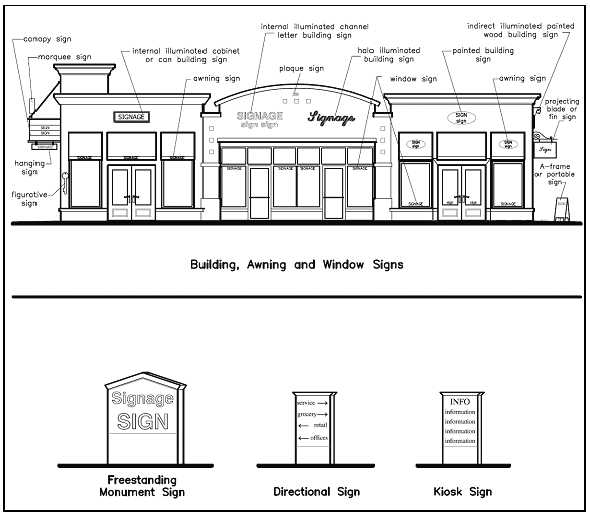
Figure 17.20-1 Sign Types
(Ord. 1188, § 1, 2020)
17.20.030 - Applicability.
Signs shall only be erected or maintained in any zoning District in compliance with this chapter. The sign regulations outlined in this chapter are intended to be maximum standards. The sign design standards are intended to ensure the architectural and visual compatibility of signs. Therefore, the review and approval of sign permits, including any Master Sign Plan, shall comply with the sign regulations and design standards of this chapter.
(Ord. 1188, § 1, 2020)
17.20.040 - General provisions.
A.
Owner's Consent Required. The consent of the property is required before any sign may be displayed on any real or personal property with the city. No sign may be displayed without the consent of the legal owner(s) of the property on which the sign is mounted or displayed. For purposes of this policy, "owner" means the holder of the legal title to the property and all parties and persons holding a present right to possession, control or use of the property. In the case of public property, the owner's consent shall be pursuant to a policy adopted by the city Council.
B.
Substitution of Noncommercial Message. Subject to the owner's consent, a noncommercial message of any type may be substituted for all or part of the commercial or noncommercial message on any sign allowed under this chapter.
C.
Substitution of Commercial Message. No additional sign permit shall be required for a permitted sign for any of the following:
1.
Replacement of sign copy on a commercial sign due to age, wear, other aesthetic or safety reasons;
2.
Replacing the sign copy panel on an existing can-type sign with sign copy panel of that same size which requires no other modifications in the location, height, or size on the sign cabinet or support structure.
3.
Structural, attachment, or electrical modifications of a sign. This substitution provision does not allow the free substitution of a commercial message in a pace where only a noncommercial message is allowed.
D.
Legal Nature of Sign Rights and Duties. All rights, duties, and responsibilities related to permanent signs attached to, and run with, the land on which the sign is mounted, affixed, or displayed. The city may demand compliance with this chapter and with the terms of any sign permit from the permit holder, the owner of sign, the property owner, or the person mounting the sign.
E.
Transfer of Signage Rights. Rights and duties relating to permanent signs may not be transferred between different parcels of real property except as part of a Master sign Plan approved for a shopping center or multi-parcel development. All duly issues and valid sign permits for permanent signs affixed to land shall automatically transfer with the right to possession of the real property on which the sign is located.
F.
Building Permit Required. A building permit is required for all building sign types with the exception of non-illuminated window signs.
G.
Encroachment Permit Required. An encroachment permit is required for any building sign that projects into a public right-of-way such as a projecting, hanging, blade, pedestrian, figurative, marquee, canopy, or awning sign.
H.
Sign Permits and Master Sign Plan Required.
1.
Sign Permit. No sign, unless otherwise exempt by this chapter, shall be erected, constructed, displayed, or structurally altered unless a sign permit, or other applicable permit as required by this chapter, is approved by the city in accordance with the following:
a.
Application filing sign permit applications, including temporary permits, shall be filed on the forms provided by Development Services Department and shall include all information described in the city's sign permit application instructions and other applicable application requirements as required by this chapter, and the required filing fee.
b.
Review and decision. A sign permit shall be approved or denied by the City Planner in compliance with this section.
The following additional conditions for review may apply:
c.
The sign permit or temporary sign permit shall contain any conditions on which approval was granted.
d.
The City Planner may require submittal of a Master Sign Plan in accordance with subsection (F)(3) of this section prior to approval of a sign permit.
e.
The City Planning Commission may allow expectation to these regulations as part of a Master Sign Plan, or where such exceptions would be allow signs that would be better integrated with the architecture or historic character of the existing or propose building, the project site, or surrounding neighborhood.
f.
For non-exempt, temporary signs complying with the sign area and sign standards of this chapter, the City Planner may issue a temporary sign permit for up to 30 days, if it is found that the temporary sign is necessary to establish or main identity until a permanent sign can be erected. The City Planner may approve a temporary sign necessary to avoid a dangerous condition, and may approve temporary signs pertaining to a use permitted by a Temporary Use Permit.
2.
No permit for any sign shall be issued by any Department, official, or public employee of the city without meeting the requirements of this chapter, and any permit issued that does not comply with the requirements of this chapter shall be null and void. It shall be the duty of the City Planner to enforce the provisions of this chapter pertaining to the use of any property for a sign.
3.
Master Sign Plan. A Master Sign Plan shall be required for any site having two or more nonresidential tenants and shall be submitted and approved by the City Planning Commission prior to the issuance of any sign permit. Applications for a Master Sign Plan shall be submitted to the Development Services Department and shall include the following:
a.
A site plan drawn to scale, delineating the site proposed to be included within the signing program, the lineal street frontage of the site, the lineal occupancy frontage of all buildings, and the locations of all existing and existing and proposed signs;
b.
Drawing indicating the exterior surface (elevations) of all buildings on the site on which wall signs, directory signs, or projecting signs are proposed, including any existing signs to be retained;
c.
Drawings indicating typical sign design, height, colors, faces, and methods of construction, including method of attachment for walls signs, for all proposed signs;
d.
A statement of the reasons for any requested modifications to the regulations or standards of this section;
e.
A summary indicating the maximum total sign area allowed for the site, the sign area of all existing signs and the allocation of the sign area by sign type, such as freestanding, wall, multi-tenant, directional, and location in the development;
f.
The plan shall have provisions for sign maintenance and removal, replacement of nonconforming signs and other items as determined by the City Development Services Department;
g.
A Master Sign Plan may include deviations from the standards of this section, provided that the total sign area shall not exceed the area otherwise permitted for onsite sign regulations for both building and freestanding signs. In approving a Master Sign Plan, the Planning Commission shall determine that such Master Sign Plan:
i.
Would be consistent with the style and character of existing signs on the site;
ii.
Would be compatible with the character of signs on adjacent properties;
iii.
Would not detract or adversely impact the use and enjoyment of adjacent properties;
iv.
Would not have an adverse impact on the safe and efficient movement of vehicular or pedestrian traffic.
h.
The Planning Commission may require any reasonable conditions necessary to carry out the intent of the Master Sign Plan requirements;
i.
An alternate means of compliance with this section may be approved by the City Planning Commission;
j.
Master Sign Plans may be part of Site and Architectural Review, a Conditional Use Permit, or a Planned Unit Development. Is such other application requires the approval of the Planning Commission or the City Council, that approval authority may approve the Master Sign Plan.
4.
Creative Signs.
a.
Purpose. This section establishes standards and procedures for the design, review, and approval of creative signs. The purpose of this Creative Sign Program are to:
i.
Encourage signs of unique design which exhibit a high degree of thoughtfulness, imagination, inventiveness, spirit, and a sense of place;
ii.
Provide a process for the application of sign regulations in ways that will allow creatively designed signs that make a positive visual contribution to the overall image of the city.
b.
Applicability. An applicant may request approval of a Master Sign Program under the Creative Sign Program to authorize on-site signs that employ standards that differ from the other provisions of this chapter but comply with the provisions of this section.
c.
Approval Authority. A Master Sign Program application for a creative sign shall be subject to approval by the Planning Commission.
d.
Application Requirements. A sign permit application for a creative sign shall include all information and materials required by the Department, and the filing fee set by the City's Fee Resolution.
e.
Design Criteria. In approving an application for a creative sign, the Planning Commission shall ensure that a proposed sign meets the following design criteria:
i.
Design Quality: The sign shall:
1.
Constitute a substantial aesthetic improvement to the site and shall have a positive visual impact on the surrounding area;
2.
Be of unique design, and exhibit a high degree of thoughtfulness, imagination, inventiveness, and spirit;
3.
Provide strong graphic character through the imaginative use of graphics, color, texture, quality materials, scale, and proportion.
ii.
Contextual Criteria: The sign shall contain at least one of the following elements:
1.
Creative imagery reflecting current or historic character of the city;
2.
Symbols or imagery relating to the use of the property;
3.
Inventive representation of the use, name, or logo of the structure or business.
iii.
Architectural Criteria: The sign shall:
1.
Utilize and/or enhance the architectural elements of the building; and
2.
Be placed in a logical location in relation to the overall composition of the building's façade surrounding uses and not cover and key architectural features/details of the façade.
5.
Appeal. The applicant may appeal a decision of the City Planner to the Planning Commission and a decision of the Planning Commission to the City Council in accordance with the requirements for Appeals contained in this chapter.
6.
Findings for Approval. A sign permit, temporary sign permit, or Master Sign Plan application may be approved, in whole or in part, with or without conditions, only if the flowing findings are met:
a.
The proposed sign is permitted within the zoning District and compiles with all applicable provisions of this chapter, and any other applicable standards;
b.
The sign is in proper proportion to the structure on site on which it is located and as an identification device does not excessively compete for the public's attention;
c.
The sign's materials, color, texture, size, shape, height, and placement are compatible with the design of the structure, property, and neighborhood of which it is a part;
d.
The sign's illumination is at the lowest reasonable level as determined by the City Planner while ensuring adequate identification and readability, and is directed solely at the sign or is internal to it;
e.
The sign is not detrimental to the public interest, health, safety, or welfare;
f.
The sign is compliance with this chapter's sign standards.
(Ord. 1188, § 1, 2020)
17.20.050 - Design standards.
A.
Purpose.
1.
The following design standards are intended to assist the designer in understanding the city's requirements for sign design. These standards complement the sign regulations contained in this chapter by providing good examples of potential design solutions and by providing design interpretations of various regulations. The design standards are general and may be interpreted with some flexibility in their application to specific projects. The standards will be used with other regulations to ensure the highest level of design quality while at the same time providing the flexibility necessary to encourage creativity on the part of project designers.
B.
General Regulations.
1.
Location.
a.
Signs in mixed-use Districts and within commercial retail centers should be oriented in scale and location to pedestrians on sidewalks. Examples of preferred sign types include projecting blade signs, character, pedestrian signs, awning and canopy signs, and window signs.
b.
Signs should be placed to indicate the location of access to a business. Signs shall be placed at or near the entrance to a building or site to indicate the most direct access to the business.
c.
Signs should be made smaller if they are oriented to pedestrians. The pedestrian-oriented sign is usually read from a distance of 15 feet to 20 feet; the vehicle-oriented sign is viewed from a much greater distance. The closer a sign's viewing distance, the smaller that sign needs to be.
d.
Building signs shall not project above and apparent eave or parapet, including the eave of a mansard roof, except that with approval of a Master Sign Plan, a building sign may be located on an architectural building feature such as a clock tower or similar feature if the City Planner determines the location and design of such signs to be compatible with and complementary to the architectural design of the building.
e.
Building signs for tenants located within shop buildings shall be placed on that portion of the building where the establishment being advertised is located and which provides the primary pedestrian (public) access to the establishment unless otherwise authorized by a Master Sign plan.
f.
Building signs shall only be located on the occupancy frontages of a building otherwise authorized by a Master Sign Plan.
2.
Compatibility with Building/Site.
a.
Signs should be proportionate to the size and setback of the building(s) and size of the site. The size of signs should also be compatible with other signs and land uses in the surrounding area.
b.
Sign colors, design and materials shall be compatible with and complement the architectural theme or design and use of the principal building(s) at the site.
c.
Graphics, symbols, and logos that communicate the nature for the business should be used to add interest and character to signs and place. The use of graphics consistent with the nature of the product to be advertised is encouraged, i.e. hammer symbol for a hardware store, mortar and pestle for a drug store.
d.
Colors should complement the architectural features of the building façade.
3.
Where there is more than one sign, all signs shall be complementary to each other in the following ways:
a.
Type of construction materials (sign copy, supports, etc.);
b.
Letter size and style of copy;
c.
Method used for supporting or attaching sign (wall or ground base);
d.
Configuration and shape of sign area and related components; and
e.
Height, location and spacing of signs on a building or site shall be generally consistent.
4.
Signs with strange shapes should be avoided. Signs that are unnecessarily narrow or oddly shaped can restrict the legibility of the message. If an unusual shape is not symbolic, it is probably confusing.
5.
All electrical transformer boxes, conduits and raceways should be concealed from the public view.
6.
Signs in the North Gateway, West Gateway, and Downtown Commercial and Mixed Use Districts shall comply with adopted strategic plans and/or design guidelines.
7.
Illuminated Signs.
a.
Signs in all but the home office and residential Districts shall be indirectly and continuously illuminated.
b.
Signs shall not have exposed fluorescent tubes or incandescent bulbs, unless such signs are approved as part of a Master Sign Plan or a Site Plan Review for a cinema or theater.
c.
Excluding neon window signs in the Downtown Mixed-Use Zoning District [See Section 17.20.110(C)(1)], illuminated signs visible from and within 100 feet of a residential or mixed-use District shall not be illuminated between 10:00 p.m. and 7:00 a.m. unless approved as part of a Master Sign Plan. In order to approve the Master Sign Plan, the City Planner shall determine that the proposed sign:
1.
Identifies a business or use that is open for business during those hours; and
2.
Has been oriented, sited, or otherwise designed to minimize glare or lighting impacts on the adjacent residential or mixed-use District.
d.
Lighting. Escape of light to the atmosphere from illuminated signs shall be minimized. The use of upward directed sign lighting is prohibited. External illumination for signs shall be fully shielded in such a manner that all light emitted by the fixture, either directly from the lamp or indirectly from the fixture, is projected below the horizontal plane as determined by photometric test or certified by the manufacturer.
e.
Outdoor internally illuminated signs shall be constructed either with an opaque background and translucent letters and symbols or with a colored (not white, cream, off-white or yellow) background and lighter letters and symbols. Signs should be turned off at 11:00 p.m. or when the business closes, whichever is later.
f.
Neon signs are prohibited in the Residential [RE, R1, R2, R3, R4, R4-20, OT(M), OT(H)], Home Office (HO), West Gateway Mixed Use (WG), and Neighborhood Mixed Use (NMU) Zoning Districts.
8.
Measurement of Sign Area and Height. For the purposes of determining compliance with this division, the area and height of signs shall be measured as provided below.
a.
Sign Area. The area of a sign shall be computed as follows:
1.
Wall, Awning, Marquee, Canopy, and Window Signs. Sign area shall be computed by measuring the square or rectangle that will encompass the extreme limits of the writing, graphic representation, emblem or other display, together with any material or color forming an integral part of the background of the message or display or otherwise used to differentiate the sign from the backdrop or structure against which it is placed including any supporting framework. When signs are composed of individual elements, the area of all sign elements, which together convey a single complete message, shall be considered a single sign. When a sign face has an irregular shape or form, measure the area by encircling the face in a rectangle from which the area of the sign face can be calculated (see Figure 17.20-2).
2.
Freestanding Signs. Sign area shall be computed by measuring the entire area contained within the frame or cabinet but excluding the monument base if it contains an address and no advertising and is clearly distinguishable from the sign copy area through the use of different texture, color, and design (see Figure 17.20-2).
3.
Pole Signs.Sign area shall be computed as the entire area of the surface(s) upon which the sign message is placed including the supporting column(s) if decorated or displayed with advertising.
4.
Two-Sided Signs. The sings area for a two-sided sign shall be computed by calculating the area on one sign face.
5.
Flags, Banners, Pennants, Etc. Sign area shall be computed as the surface area of both the sides of the flag or pennant. For banners, the side(s) containing sign copy shall be counted as sign area.
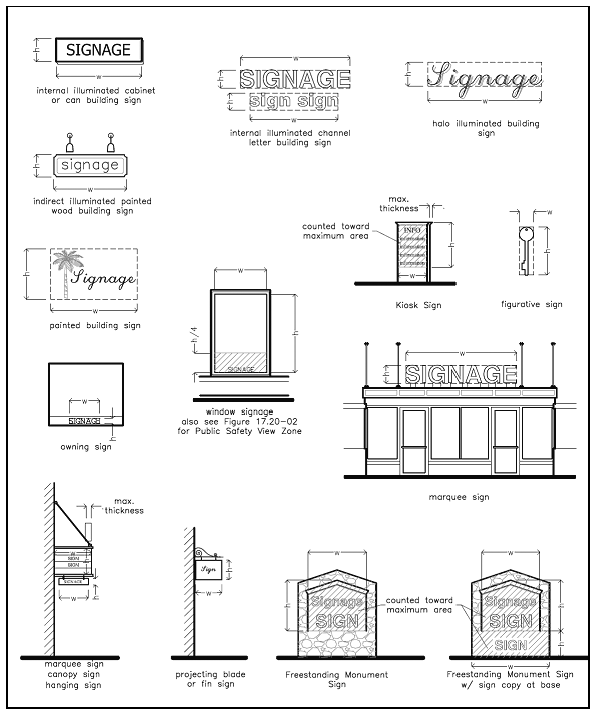
Figure 17.20-2 How to Measure Sign Area
b.
Sign Height. Sign height shall be measured as the greatest vertical distance from the finished grade adjacent to the sign footing or wall or below a suspended sign, to the top of the sign, including the support structure and any design elements (see Figure 17.20-3).
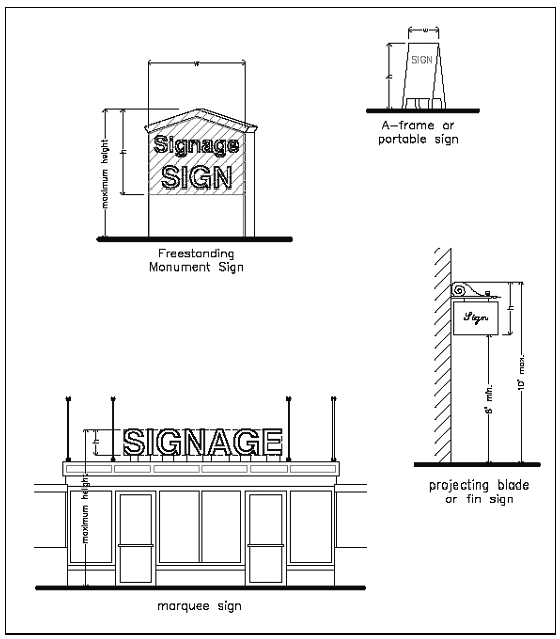
Figure 17.20-3How to Measure Sign Height
C.
Regulations by Signage Type.
1.
Wall Signs.
a.
Wall signs shall not project more than 12 inches from the face of the building on which such signs are placed, except that wall signs, any portion of which is less than eight feet above grade, shall not project more than six inches from the face of the building.
b.
Wall signs shall not occupy more than 75 percent of the height or length of a building fascia.
c.
Wall signs shall be compatible with the predominant visual architectural elements of the building façade.
d.
Wall signs should be placed to establish façade rhythm, scale, and proportion where such elements are weak. In many existing buildings that have a monolithic or plain façade, signs can establish or continue appropriate design rhythm, scale, and proportion.
e.
Wall signs raceways shall be painted to match the exterior color of the building where the sign is located.
f.
Wall signs shall be sized appropriately and in proportion to the scale of the building or fascia.
g.
Direct and indirect lighting methods are allows provided that they are not harsh or unnecessarily bright and are not directed upward without shield.
h.
The use of individually cut or channel letter signs are the preferred sign type in new development or replacement signs. Other types of wall signs may be allowed if they comply with the requirements of this chapter and guidelines approved by the City Council, and if they meet the scale of, and are compatible with, the architecture of the building. Can signs shall be prohibited unless an exception is approved with a master sign program.
2.
Projecting/Blade/Pedestrian/Hanging Signs.
a.
The maximum size of projecting/blade signs shall be two square feet per sign face in the HO, CO, and residential Districts; eight square feet per sign face in the Public Facility/Institutional, Airport, Open Space, Industrial, and Airport Support Zoning Districts; and sixteen square feet in the commercial Districts.
b.
The maximum size of a pedestrian sign shall be three square feet in all zoning Districts.
c.
The maximum size of a hanging sign shall be two square feet per sign face in an HO, CO, R, NMU, WG, or DMU District, and six square feet per sign face in all other zoning Districts.
d.
No portion of a projecting/blade/pedestrian/hanging sign shall be less than eight feet above the surface 14 feet above a roadway surface) over which it projects, or project more than five feet into a public right-of-way. No projecting/blade sign shall project closer than two feet to a curb. An encroachment permit is required for any projecting/blade sign (or a portion thereof) located within the public right-of-way (See Figure 17.20-4).
e.
No projecting/blade/pedestrian/hanging sign shall project into an alley or truck service driveway more than two feet.
f.
Projecting/blade/pedestrian/hanging signs shall be set back at least five feet from an interior property line.
g.
No portion of a projecting/blade/pedestrian/hanging sign shall project above an apparent eave or parapet, including the eave of a simulated mansard roof.
h.
No portion of a projecting/blade/pedestrian/hanging sign shall exceed 20 feet in height measured from finished grade.
i.
A fabric banner of two dimensions that is suspended perpendicular to a wall from a pole may be displayed in lieu of a projecting/blade sign, provided that a banner shall not be less than six square feet or more than 40 square feet in size.
j.
Pedestrian signage shall be placed to be visible to pedestrian circulation on adjacent walkways.
k.
Hanging Signs.
1.
A hanging sign shall be perpendicular to the building.
2.
A minimum distance of 15 feet shall be provided between hanging signs.
3.
A hanging sign shall only be used at ground-floor locations except for upper floor businesses with covered porches, covered entries, or covered balconies.
4.
A hanging sign shall not be internally illuminated.
3.
Awning and Canopy Signs.
a.
Sign area/copy shall be proportional to and complementary with the style and scale of the awning canopy.
1.
Sign area shall not occupy more than 60 percent of the length or height of any portion of an awning or canopy. The limitation on sign area shall apply to each portion of the valance of an awning or canopy (including the shed, ends, and flap).
2.
Awning or canopy signs with backlit graphics or which are otherwise internally illuminated are not permitted. Lighting directed downward that does not illuminate and awning or canopy may be allowed if the lighting is complementary to and compatible with the architectural design of the building.
3.
Awnings or canopies shall not project above an apparent eave or parapet including the eave of a mansard roof.
4.
No portion of an awning or canopy shall be less than eight feet above the surface 14 feet above a roadway surface) over which it projects, or project more than five feet into a public right-of-way. An encroachment permit is required for any awning or canopy (or a portion thereof) located or projecting within the public right-of-way (see Figure 17.20-4). Awnings or canopies must be permanently attached to the building.
5.
Awnings or canopies without sign area, or message copy, are not subject to this chapter.
b.
Awnings/canopies used in conjunction with awning/canopy signs shall not be located so as to obscure transom windows, piers, pilasters, or other architectural building features, and shall generally be designed to project over individual doors and window openings where feasible. Awnings/canopies that are a continuous feature extending over several windows, doors, and similar architectural features are generally discouraged.
c.
The size of the awning/canopy shall be proportional in scale with the building to which it is attached.
d.
The style of the awning/canopy shall complement the architectural style of the building to which it is attached. Awnings should generally have a simple horizontal valance if located over rectangular or square window/door openings.
e.
An awning with a single solid color is preferred. The color of the awning/canopy shall be compatible with and complement the exterior color(s) of the building. Awning/canopy colors that call more attention to the awning than the building are inappropriate. Awnings/canopies with highly contrasting corporate/franchise identity colors are not allowed.
f.
Awnings/canopies shall be regularly cleaned and kept free of visible defects and wear.
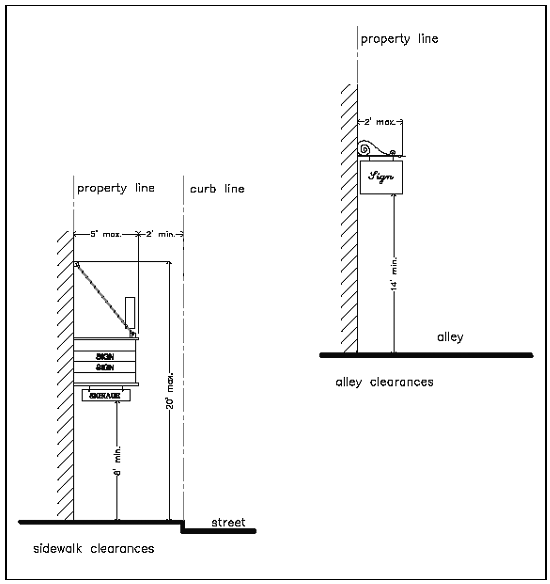
Figure 17.20-4 Projecting Sign and Waning Clearance
4.
Freestanding Signs.
a.
Decorative architectural features such as cornices and pediments may exceed both the maximum sign area specified for a monument sign by 25 percent and the maximum height by two feet.
b.
A freestanding sign shall be at least ten feet from the nearest curb and be placed within a landscaped area. A reduced setback of five feet may be allowed where topography, buildings, and parking requirements encroach on the setback area.
c.
A freestanding sign shall not extend over a public right-of-way and shall not be located on the same street frontage as a projecting/blade sign extending over a public right-of-way. The supports for any freestanding sign shall be located entirely in or upon private property.
d.
A freestanding sign shall not be closer to an interior property line than one-half its height.
e.
Freestanding signs shall be set back five feet from driveways, walkways, and other buildings, except in the Downtown Mixed Use Zoning District.
f.
A freestanding sign shall not be closer than 100 feet to another freestanding sign or projecting/blade sign on the same site.
g.
A freestanding sign shall have a maximum of two sides.
h.
A building permit is required for a freestanding sign.
i.
Unless otherwise indicated by this chapter, approval of a Master Sign Plan or Site and Architectural Review application by the Planning Commission is required for a freestanding sign.
j.
Freestanding Signs - Information Contained.
1.
Freestanding signs are intended to provide street addresses and identification for the freestanding building or commercial center development as a whole.
2.
The number of tenant names on a multi-tenant ground sign is limited to five. For multi-tenant signs in a commercial District only, each tenant name shall not be less than six inches in height with a minimum of a four inch space between tenant names. A shopping center or other multi-tenant commercial development with a center name shall emphasize the center's name on the sign.
3.
Street address numbers or the range of numbers for businesses shall be clearly displayed on the freestanding sign for easy visibility by passing motorists. If no freestanding sign exists, the street address number or range shall be clearly displayed on the building. Street address numbers shall be a minimum of five inches.
k.
All tenant freestanding signs on a site shall be generally uniform in size, height, type, and color, and shall be compatible with the architectural design or theme of the principal building(s) at the site.
1.
Where there is more than one freestanding sign located in a commercial shopping center, all such signs shall be designed to be related to each within similar construction materials, letter style of sign copy, and illumination and shape of the sign.
l.
Freestanding signs should be place perpendicular to approaching vehicular traffic only.
m.
Low-scale monument type signs are required, except in new development when the Planning Commission finds that as part of a Master Sign Plan that existing site factors (such as site orientation or location, building architecture, building and driveway locations, existing vegetation, surrounding development or other factors) warrant the use of another sign type for visibility and/or aesthetic considerations.
n.
Each freestanding sign shall be located within a planted landscaped area, which is of a shape and design that will provide a compatible setting and ground definition to the sign. Raised planters are encouraged.
o.
The number and dimensions of freestanding monument signs shall conform to the standards in Table 17.20-4.
p.
The dimensions of the sign surface area shall be proportional to and visually balanced with the height of the sign unless the design is an integral component of an icon sign.
5.
Window Signs.
a.
Window Signs in all Zoning Districts may not exceed more than 25 percent of the window area and/or sign area of a building/business.
1.
A "window" for the purpose of calculating 25 percent area space shall be considered any window or group of windows in a storefront which is not separated by wall space.
2.
Each "window" area may not be covered by more than 25 percent by window signage.
b.
All window sings, except for neon signs which are displayed from the interior of the building, are exempt from administrative sign permit review by the Planning Department.
c.
The placement of window signs within the "Public Safety View Zone" (between three and six feet above ground level) is strongly discouraged, see Figure 17.20-5 Public Safety.
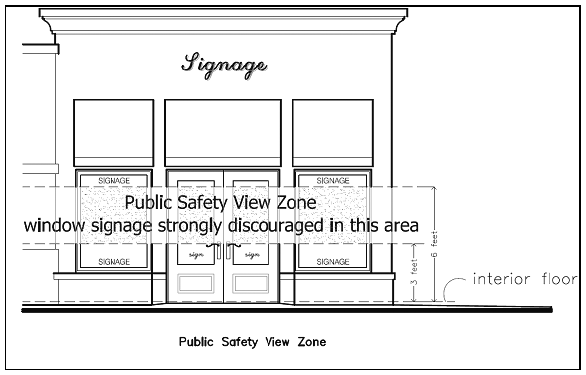
Figure 17.20-5 Public Safety
6.
Kiosk Signs.
a.
One kiosk sign, with a maximum height of 8 feet, is permitted per site, located on private property.
b.
Setbacks: Five feet from driveways, walkways, or other buildings or structures and signs placed on private property shall maintain and open, unobstructed pedestrian pathway to all building entrances and exits and on walkways consistent with the accessibility standards required by the Americans with Disabilities Act.
c.
Permits: An Administrative Sign Permit and Building Permit shall be required to determine that the location is pedestrian oriented, does not impede natural surveillance and is consistent with the scale, design, and building materials with the primary building(s) at the site.
1.
Sign is subject to Site and Architectural Review if over 20 square feet.
7.
Automobile Dealerships (New Car Sales). The following additional regulations shall apply to automobile dealerships that deal in new car sales in which the business is located.
a.
An additional freestanding sign may be permitted for each used car business, each new franchise dealership, and each secondary business associated with the main franchise to a maximum of four total, in addition to the main dealership sign, when all of the following conditions can be met.
1.
The Secondary business and/or franchises will have a separate and distinct display lot, showroom, office, and/or display area.
2.
Each proposed sign shall:
a.
Not exceed 15 feet in height for any franchise dealership or used car business, or be monument style with a maximum height of seven feet for any secondary business associated with the main franchise.
b.
Not be closer than 100 feet from other freestanding signs on the same side of the street.
c.
Be limited to a maximum area of 50 square feet.
d.
Be designed in a manner consistent with materials and features used for the main dealership sign.
8.
Winery Directional Signs. In addition to any signs allowed by this chapter, where allowed by state law adjacent to roads leading to a winery and/or tasting room, for the purpose of directing patrons to the site, winery directional signs are subject to the following conditions:
a.
Maximum Area and Height. A winery directional sign shall not exceed a maximum area of 4 ½ square feet if located in a CALTRANS right-of-way and five square feet if located on private property with a maximum height of ten feet above the elevation of the adjoining roadway.
b.
Written Permission. Written consent of the owner or other lawful resident of the property on which the winery directional sign is to be placed shall be provided in conjunction with the sign permit application.
c.
Design. All winery directional signs shall be of a uniform design, consistent with California Department of Transportation (CALTRANS) standards for tourism-oriented signs.
d.
Sign copy shall consist only of directional information, but shall contain the name of the individual wineries and winery logo, if space permits.
e.
Additional Permits. Necessary permits shall be obtained from CALTRANS where applicable, prior to installation of winery directional signs.
(Ord. 1188, § 1, 2020)
17.20.060 - Exempt signs.
A.
A sign permit shall not be required for exempt signs. Such signs shall be exempt from the regulations and design standards of this chapter except for those regulations related to prohibited sign locations herein. Exempt signs include:
1.
Traffic, danger, emergency, or other signs required under the police power of the city or federal, state, or other local government, and any sign or notice, authorized, permitted, expressly or implied, by any governmental agency on any street, alley, other public way, or public property.
2.
Official notices of any court, public body, utility, or public or quasi-public agent or officer or any person giving legal notice as required by law.
3.
Any signage required by State or Federal law or local ordinance to be affixed to a vehicle.
4.
Street address numbers.
5.
Monumental citations, commemorative tablets, and the like made an integral part of the structure, and not exceeding 20 square feet in sign area.
6.
Temporary on-site barricades and other signs within commercial and industrial Districts that inform the public of potential hazards resulting from the construction or remodeling activities occurring on the same site as the temporary barricades are located. These signs must be removed at the time of completion of the construction or remodeling activities.
7.
One temporary construction sign with maximum sign area of 64 square feet per street frontage and not exceeding a maximum of eight feet in height located on a construction site during the course of construction and which is removed prior to final occupancy of the building.
8.
One temporary on-site real estate sign per street frontage that advertises the sale, lease, or rental of a structure or land. If freestanding, the sign shall not exceed six feet in height. The sign shall be removed within 15 days following the sale, lease, or rental of the property.
9.
One temporary on-site open house sign, not exceeding six square feet in area. If freestanding, the sign shall not exceed four feet in height. An open house sign may be erected only on the day on which the property is available for public showing. Portable signs are permitted for use as open house signs.
10.
Eight temporary off-site directional open house signs per residential or mixed-use zoning District being offered for sale which shall meet the following standards:
a.
The sign(s) shall be no larger than four square feet of sign area per sign side with no more than two sides per sign;
b.
The sign(s) shall be no more than three feet in high measured from the grade of the sidewalk or adjacent ground level; and shall have a maximum length of any part of the sign of three feet;
c.
The sign(s) shall maintain at 36 inches of clear and continuous width along a sidewalk or pathway plus any other area needed for disabled accessibility, and shall not restrict in any way the safe vision of any vehicular or pedestrian traffic or obstruct any directional or safety or other sign permitted by the city;
d.
Such sign(s) may be located on private property on the public right-of-way as specified herein;
e.
Such off-site real estate signs may be erected only on days on which the property is available for public showing;
f.
A sign(s) in the public right-of-way shall be removed by sunset.
g.
The sign(s) shall not be located on the street or on street medians;
h.
The sign(s) shall not be illuminated;
i.
The sign(s) shall not be located on private property without the oral or written consent of the owner or other person entitled to possession of said property.
11.
On-site parking and other directional signs, not exceeding one double-faced sign per entrance and not exceeding six square feet in total area and four feet in height or ten square feet in more than 100 feet from a public way. If the sign is not readable from a public or private street, there shall be no limitation on the number of directional signs within a site. Directional signage may not include advertising materials.
12.
One on-site official state inspection sign constructed of a permanent material for each type of inspection service offered on-site, locate flat against the wall of a building and not exceeding four square feet.
13.
Sign manufactured as a standard, integral part of a mass-produced product accessory to a commercial or public or semipublic use, including telephone booths, vending machines, automated teller machines, and gasoline pumps.
14.
Credit card, trading stamp, or trade association signs not exceeding one-half square foot each.
15.
Flags of any governmental entity.
16.
Signs located within the interior of buildings and structures, including enclosed malls that are not visible from the outside of said building or structure.
17.
Window signs not exceeding 25 percent of the visible area of a window in the General Commercial, Downtown Commercial Mixed-Use, Gateway Commercial, or Industrial District and commercial building or the commercial portion of a building in the West Gateway and Mixed-Use Zoning District. Note, neon window signs are not exempt from administrative sign review, however, they are still counted toward the window area coverage.
18.
Holiday lights and displays not advertising a product or sale-site, erected no sooner than 45 days before holiday and removed with 14 days following the holiday.
19.
Non-helium filled balloons of a non-advertising nature and not exceeding two feet in any dimension, used for decorative purposes for not more than 20 days during a calendar year to celebrate a special event.
20.
Plaque signs not exceeding one square foot in area.
21.
Temporary noncommercial message signs, not exceeding 32 square feet may be placed in any zoning District on private property. Such signs shall be removed within ten days of an election except that signs posted in connection with a primary election may be maintained until ten days following the final election. In the event of cancellation or postponement of an election, such signs shall be removed within ten days following the official action declaring the election canceled or postponed.
22.
Murals containing no commercial message.
23.
One portable on-site sandwich board sign per business, located on the private property of the business being advertised. All sandwich board signs shall be made of durable, weather and rust resistant materials, sufficiently weighted to resist being blown over by the wind, and shall have a finished and professional appearance. Stapled or taped copy shall not be permitted. Sign copy shall be limited to the name or type of business or any special promotions relating to that business. The sign shall have a height of no less than three feet and no more than four feet and a maximum width of three feet (Maximum 12 SF). Signs placed on private property shall maintain an open, unobstructed pedestrian path to building entrances and exits and on walkways consistent with the accessibility standards required by the Americans with Disabilities Act.
24.
Temporary signs and banners for noncommercial promotion of civic, charitable, religious, educational, or service organizations are permitted in any zoning District when the signs are erected no earlier than 30 days prior to the event and removed within ten days after completion of the event. Such signs shall not exceed four square feet in any Residential District. Temporary banners in other zoning District shall not exceed the sign area of the permanent sign area and shall not block signs identifying adjoining establishments. Such signs promoting the same event shall be located no closer than 25 feet from each other.
25.
Two on-site, freestanding or wall menu/pre-menu board signs not exceeding a maximum of 50 square feet in total sign area and a maximum of eight feet in height for commercial drive-through or drive-in uses.
26.
Poster frames of theaters, not over 40 square feet in area, when affixed to the building and not projecting over any sidewalk more than 12 inches.
27.
Miscellaneous permanent information signs that indicate address, hours and days of operation, whether a business is open or closed, emergency contact information when located in nonresidential zones, with an aggregate sign area not to exceed three square feet at each public entrance and a maximum of ten square feet for all such signs.
28.
Menu holder display case attached to the exterior of a wall of a restaurant. The size of the lettering shall not exceed one-half inch in height and the menu holder shall be limited to the size of two pages of the menu used by the restaurant. The menu holder shall not be used for additional business identification signage.
29.
Temporary on-site proposed project sign(s) in accordance with Section 17.24.070(D) of the Hollister Municipal Code.
30.
Holiday promotional signs. Within the seven identified holiday periods identified below, temporary promotional signs, as allowed by this subsection, may be displayed within a commercial, office, or industrial area without a sign permit or prior review and approval by the Director. The allowed holidays and promotional display periods, totaling not more than 58 days, are as follows:
a.
Valentine's Day and the preceding six days;
b.
Easter and the preceding four days;
c.
Memorial Day and the preceding four days;
d.
July 4 th and the preceding four days;
e.
Halloween and the preceding four days;
f.
Thanksgiving and the preceding nine days and the following five days;
g.
Christmas/New Year's (December 16 th to December 31 st )
(Ord. 1188, § 1, 2020)
17.20.070 - Prohibited signs.
A.
The following signs are prohibited:
1.
Canvas signs, excluding awning signs, banners, pennants, flags, streamers, balloons, or other temporary or wind signs except as otherwise provided in sections entitled Exempt Signs, On-Site Sign Regulations, and Off-Site Sign Regulations of this chapter.
2.
Roof or canopy signs extending above a building roof, except that with approval of a Master Sign Plan, a wall sign may be architecturally integrated into a sloping roof fascia or mansard roof.
3.
Signs that resemble any official marker erected by the city, state, or any governmental agency, or that by reason of position, shape, color, or illumination would conflict with the proper functioning of any traffic sign or signal or would be a hazard to pedestrian or vehicular traffic.
4.
Signs which produce odor, sound, smoke, fire, or other such emissions.
5.
Animated signs, flashing signs, moving signs, or rotating signs except as otherwise allowed in this chapter.
6.
Window signs that exceed 25 percent of the visible window glass panel area of a window in the Airport, Airport Support, General Commercial, Commercial Office, Downtown Commercial Mixed Use, Gateway Commercial, or Industrial District and commercial buildings or commercial portion of a building in the West Gateway and Mixed-Use Zoning Districts. Window signs are prohibited in the Residential and Home Office Zoning Districts.
7.
Off-Site Advertising Signs. Except for temporary off-site subdivision directional signs and specified exempt signs, off-site advertising signs are not permitted within the city. Existing off-site advertising signs shall be considered nonconforming. Nonconforming off-site advertising signs may only be reconstructed or relocated pursuant to the following:
In accordance with a relocation agreement between the city and the sign owner, consistent with Section 5412 of the California Business and Professional Code, if the sign area (including the sign structure) does not exceed a maximum dimension of 12 feet by 25 feet per sign face and 22 feet in height above existing or street grade, whichever is higher, both sides of off-site advertising signs may be used for purposes of advertising.
8.
Signs advertising commercial uses, child care homes, day care homes, residential care facilities, and similar uses on sites where the principal use is a residential dwelling unit unless otherwise allowed in this title or in accordance with state law.
9.
Signs affixed to trees, shrubs, utility poles, traffic control devices, and the like.
10.
Signs on any floor above the first floor unless approved by the Planning Commission or pursuant to adopted sign standards.
11.
Abandoned signs.
12.
Multi-faced signs of more than two surface areas of signage.
13.
Billboards.
i.
Billboard policy. The city completely prohibits the construction, erection or use of any billboards, other than those which legally exist in the city, or for which a valid permit has been issued and has not expired, as of the date on which this provision is first adopted. No permit shall be issued for any billboard which violates this policy, and the city will take immediate enforcement or abatement action against any billboard constructed or maintained in violation of this policy. In adopting this provision, the City Council affirmatively declares that it would have adopted this billboard policy even if it were the only provision in this chapter.
The City Council intends for this billboard policy to be severable and separately enforceable even if other provision(s) of this chapter may be declared, by a court of competent jurisdiction, to be unconstitutional, invalid or unenforceable. This provision does not prohibit agreements to relocate presently existing, legal billboards, as encouraged by Business and Professions Code Section 5412.
14.
Neon signs in the Residential, Neighborhood Mixed Use, West Gateway Mixed Use, and Home Office Zoning Districts.
(Ord. 1188, § 1, 2020)
17.20.080 - Prohibited locations.
A.
At street intersections, no sign shall create a visual obstruction within vertical space between three feet above the adjacent curb and a maximum height of ten feet above the adjacent curb, which area lies between the intersecting street right-of-way lines, 25 feet from the point of their intersection, or the intersection of the prolongation of such right-of-way lines.
B.
No sign shall be affixed to any vehicle or trailer on a public right-of-way or public or private property unless the vehicle or trailer is currently and regularly being used in its normal business capacity and is not for the sole purpose of attracting business.
C.
The City Engineer may require additional offset or setback than identified in this section to clear site visibility when a site visibility analysis indicates the need for such additional clearance to promote public safety.
(Ord. 1188, § 1, 2020)
17.20.090 - Temporary signs.
The following regulations shall apply to temporary signs:
A.
For the purposes of the section, a temporary sign or banner shall only be erected for a period not to exceed 20 days, including promotional sale or grand opening signs, with the exception of holiday promotional signs as outlined in Section 17.20.060.
B.
A temporary banner or sign may be allowed pursuant to an Administrative Permit up to 20 consecutive days in connection with an operating business.
C.
A maximum of four Administrative Permits for a temporary sign may be issued to a business in a calendar year.
D.
No temporary sign shall project more than 12 inches over any street, alley, public right-of-way, or any public property. The signs shall lay flat against the building and shall not exceed the maximum size permitted within the zoning classification for the building.
E.
A temporary sign may be placed at each public entrance to a building or business.
(Ord. 1188, § 1, 2020)
17.20.100 - Signs in residential zoning districts.
A.
All signs within residential Districts shall be complimentary to the building design, as determined by and subject to the approval of the Zoning Administrator. Only signs which are examined in Section 17.20.060 or which meet the following standards will be permitted in any residential zoning district:
1.
One freestanding house number-apartment building identification sign or one wall sign, located flat against a wall and not projecting above the cornice or roof line of a structure located on the premises, shall be permitted for each multifamily complex or mobile home park containing between five and 30 units. Such signing, if freestanding, shall not exceed six square feet in area, shall not be illuminated nor rotating, shall not exceed four feet in height, and shall be set back at least ten feet from the front property line. Such signing, if located flat against a wall, shall not exceed 12 square feet in area, and shall not be illuminated.
2.
One freestanding house number-apartment building identification sign or one wall sign, located flat against a wall and not projecting above the cornice or roof line of a structure located on the premises, shall be permitted for each street frontage of each multifamily complex or mobile home park containing 30 or more units. Such signing, if freestanding, shall not exceed 18 square feet in area, shall not illuminated nor rotating, shall not exceed six feet in height, and shall be set back at least ten feet from the front property line. Such signing, if located flat against a wall, shall not exceed 24 square feet in area, and shall not be illuminated.
3.
Residential subdivision signs, advertising a tract having five or more units for sale, may locate one freestanding or wall on-site sign, up to 32 square feet in area plus locate up to three off-site directional signs, located on private property within Hollister, up to 32 square feet each. Such signs shall be non-illuminated, with a maximum height of eight feet. Such signs shall be removed immediately after completion of sales or after one year, whichever occurs first, unless granted an extension by the Planning Director.
a.
Off-Site Subdivision Directional Signs. One off-site non-illuminated temporary directional sign shall only be allowed on vacant, undeveloped property, subject to approval of a temporary use permit with the following standards:
i.
Such signage shall not exceed 64 square feet in area of each ten acres in a subdivision, up to a maximum of 128 square feet.
ii.
Directional signs for subdivisions with a combined total area less than ten acres shall not exceed 64 square feet.
iii.
The maximum height of an off-site directional sign shall be eight feet.
iv.
Off-site directional signs may contain, in addition to travel directions to the subdivision, the name of the land development project to which it pertains, including a characteristic trademark or other identifying insignia.
v.
Such signs shall be located at least 700 feet from any other such sign.
vi.
Expiration of Temporary Use Permit. The Temporary Use Permit shall expire seven days after the sale of the last residential dwelling unit in the advertised subdivision.
vii.
Removal of Signs. The applicant shall remove the off-site sign from the property within seven days of the sale of the last residential dwelling unit in the advertised subdivision.
viii.
Requirement for Bond. The applicant of any off-site subdivision directional signage shall post a bond to ensure removal of the sign.
ix.
The City Planner may impose any additional conditions that it deems necessary to make the sign, to the extent feasible, compatible to the development in the vicinity. Such Conditions shall include but not be limited to the requirement for a signed statement by the applicant, owner of the signs and the owner or lessee of the property on which the signs are to be placed, agreeing that if such signs are not removed within seven days after expiration of permit, they may be removed by the city without further notice.
4.
Bed and breakfast establishments shall be allowed one sign, as described in Section 17.22.080 (Bed and Breakfast Inns). Such signs shall match the architectural features of the structure. The words "hotel" or "motel" shall not be allowed and comply with requirements of the applicable zoning District.
5.
Churches and commercial uses allowed in residential Districts according to Chapter 17.04 and 17.06 shall be allowed non-illuminated signs not to exceed 32 square feet of sign area. Churches will be allowed an additional 32 square feet for "bulletin" board signage.
Table 17.20-1 Freestanding Signs in Residential Zoning Districts
Note: The use of neon signs shall be prohibited in the Residential and Home Office Zoning Districts. The use of neon in the Downtown Mixed-Use District is permitted with approve of an Administrative Sign Review Permit.
(Ord. 1188, § 1, 2020)
17.20.110 - Signs in mixed-use zoning Districts.
A.
Mixed Use Zones. In any zone where both residential and nonresidential uses are allowed, the sign related rights and responsibilities applicable to any particular parcel or use shall be determined as follows: Residential uses shall be treated as if they were located in a zone where a use of that type would be allowed as by right, and nonresidential uses shall be treated as if they were located in a zone where that particular use would be allowed, either by right or subject to a Conditional Use Permit or similar discretionary process, unless otherwise indicated in this section.
Table 17.20-2 Building Sign Requirements - Mixed Use Zoning Districts
B.
Additional Regulations - Neighborhood Mixed Use (NMU) and West Gateway Mixed Use (WG) Zoning Districts.
1.
Neon signs.
i.
Not permitted in the NMU and WG Zoning Districts.
2.
Pedestrian Signs. A pedestrian sign may be permitted for each business as follows:
i.
Consisting of only a symbol relating to the activity on the premises;
ii.
Projecting no more than three feet beyond the building façade if a building faces a public street;
iii.
Not internally illuminated.
C.
Additional Regulations - Downtown Mixed Use (DMU) Zoning District.
1.
Neon Signs.
i.
Neon signs may be permitted through Administrative Sign Permit Review in the Downtown Mixed Use Zoning District in accordance with the regulations of Section 17.20.050(C)(5).
1.
All neon signs must be displayed from inside the building.
2.
Any sign, including neon, which is displayed in a window shall contribute to the calculation of window coverage, which is not to exceed 25 percent.
ii.
Neon signs in the Downtown Mixed Use Zoning District may receive approval to be illuminated during the hours of operation of the business in which they are displayed. Neon signs must be turned off when the business is not in operation.
iii.
Neon signs of any size may be displayed internally within the business location without approval of a sign permit provided they are not in public view.
2.
Pedestrian Signs. A pedestrian sign may be permitted for each business as follows:
i.
Consisting of only a symbol relating to the activity on the premises;
ii.
Projecting no more than three feet beyond the building façade if a building faces a public street;
iii.
Not internally illuminated.
3.
Portable Signs/A-Frame Signs.
i.
Intent and Purpose. The propose of this section is to secure and promote the public health, safety and general welfare of persons using city sidewalks by regulating the placement, appearance, size, stability and maintenance of portable signs located upon certain public sidewalks within Downtown Mixed-Use Zoning District, in additional to exempt portable signs placed on private property as identified in Section 17.20.060(A)(23).
ii.
Definitions.
1.
The following words and phrases, when used in this article, shall have the meaning respectively ascribed to them unless the context otherwise clearly indicates:
Permittee shall mean the person authorized by the city to place a portable sign upon a city sidewalk and responsible for maintaining and otherwise attending to such sign.
Person shall mean any person or entity, including but not limited to a corporation, limited liability company, partnership, unincorporated association or joint venture.
Portable sign shall mean a sign that rests on the sidewalk or is attached to sidewalk railings and that is neither temporarily nor permanently affixed to the sidewalk or railing or to an adjacent building or structure.
Sidewalk shall mean any surface provided for the use of pedestrians.
iii.
Portable sign permit required. It shall be unlawful for any person to erect or maintain any portable sign on or within any public right-of-way in the Downtown Mixed-Use Zoning District except within the Portable Sign Placement area pursuant to a permit from the Development Services Director approving the location, construction, stability and other aspects of such portable sign under the provisions of the section. Any portable sign that has not been authorized by a valid permit by the city under this section may be removed by the city without notice.
iv.
Portable sign permits; term; transfer of permit.
1.
Portable sign permits may be issued only to the owner or proprietor of the business adjacent to the location where the portable sign will be displayed.
2.
Applications for a portable sign permit must be submitted to the Development Services Director in writing on a form provided the city and shall be accompanied by:
a.
A certificate of insurance with a limit of at least $1,000,000.00 per occurrence, showing the city as an additional insured, covering any liability arising out of the placement or maintenance of the portable sign. The insurance carrier must be rated B+ or better. The application shall contain:
i.
The name and address of the applicant.
ii.
The proposed location of the portable sign; and
iii.
The signature of the applicant.
b.
A written statement, in a form satisfactory to the City Attorney, agreeing to indemnify and hold harmless the city, its offices and employees from any loss, liability or damage, including expenses and costs, for bodily or personal injury or property damage sustained by any person as a result of the installation, use or maintenance of the portable sign for which the permit is issued.
c.
The Development Services Director decision whether to issue or deny the issuance of a permit shall be made within 15 days following the date that a complete application has been submitted to the city.
d.
Permits shall be valid for one year unless revoked prior.
e.
Permits shall not be transferable to another person or another location.
v.
Placement and removal of portable signs.
1.
Portable signs must either be placed on the surface of the sidewalk or affixed to sidewalk railings in the manner prescribed in this subsection:
a.
Portable sign placed on the surface of a sidewalk must be located either no further than 32 inches from the wall of the building, or on the curb-side of the sidewalk, subject to Engineering review. No portable sign shall be permitted in the middle of the sidewalk.
b.
Any portable sign placed on a sidewalk shall contain advertising text only on two sides of such portable sign.
c.
Portable signs attached to sidewalk railings, such as those enclosing sidewalk cafes, shall be secured tightly to the railing to protect against them being blown by the wind and shall be attached in such a manner as to be removable during the hours that the business is closed. No more than two portable sign surfaces containing advertising script may be attached to any such railing enclosure.
2.
No portable sign placed on the surface of a sidewalk may be placed, installed, used or maintained:
a.
Within three feet of any marked pedestrian crosswalk or entrance to any public transit shelter;
b.
With five feet of any fire hydrant, fire call box, police call box or any other emergency facility or any handicap parking space;
c.
On any portion of a pedestrian access ramp for disabled persons;
d.
Within three feet of any of the following: parking meter posts, traffic control cabinets, bicycle parking racks, public telephone enclosures, kiosks, public works of arts, entrances to any sidewalk café enclosure or any portion of a driveway;
e.
On any portion of utility cover, meter and and/or valve box cover, vent cover for underground utilities or decorative sidewalk without special approval from the Development Services Director;
f.
Within the passenger boarding area of a designated bus stop;
g.
At a location used for public utilities , transportation or other public or governmental purposes that, in judgment of the Development Services Director, is incompatible with portable signs;
h.
In a manner that endangers persons or property or property or unreasonably interferes with or impedes:
i.
The flow of pedestrian traffic or the ingress to or egress from any residence of place of business; or
ii.
The use or maintenance of poles, posts, traffic signs or signals, hydrants, mailboxes or other objects permitted at or near said location.
i.
In any location where the sign is not sufficiently illuminated by ambient light to be readily visible to pedestrians.
3.
Portable signs placed on the surface of a sidewalk shall not be secured to any city property such as a light pole, signpost or tree, and shall not be secured to the surfaces upon which they are situated by bolts, but must instead be secured by weight or other anchoring device approved by the Development Services Director, and shall not be anchored by penetration of soil beneath tree grates.
4.
No more than one portable, or two sign surfaces in the case of portable signs attached to sidewalk railings, shall be permitted for each business contained in the building that is adjacent to the location of the sign.
5.
All portable signs shall be removed from the sidewalk or railing at the close of business hours of the permittee. The location and condition of such signs shall be regularly and routinely monitored and attended by the permittee during business hours.
vi.
Construction, size, appearance and maintenance of portable signs.
1.
Portable sign shall be constructed in such a manner as to withstand normal wear and tear and normal weather conditions to prevent collapse and otherwise being constructed to remain stable in the approved location.
2.
Portable signs shall not exceed four feet in height, three feet in width, and 12 square feet in total area.
3.
Portable signs shall not be illuminated except by ambient light, nor shall they be made of any material with a retroreflectivity measurement in excess of two millicandelas or of any material that glows or emits light.
4.
Each portable sign shall be maintained in a neat and clean condition and in good repair at all times. Specifically, but without limiting the generality of the foregoing, each portable sign shall be maintained so that:
a.
It is reasonably free of chipped, faded, peeling and cracked paint in the visible painted areas;
b.
It is reasonably free of rust and corrosion;
c.
It is free of sharp edges;
d.
It is free of graffiti; and
e.
All structural parts thereof are intact.
vii.
Revocation. In the event that the California Department of Transportation determines to take jurisdiction of the issuance of permits on sidewalks adjacent to state highways, and request the city to revoke permits granted under this section, the Development Services Director may summarily revoke any permits issued hereunder.
viii.
Violations.
1.
Upon determination by the Development Services Director that a portable sign has been installed, used or maintained in violation of the provisions of this article, the Development Services Director may order the permittee to correct the offending condition. Such order shall be sent by e-mail or by registered mail, return receipt requested, to the permittee. The order shall describe the offending condition, state the actions necessary to correct the condition and establish a date for compliance that is not less than five working days from the date that the order is sent to the permittee. The order shall inform the permittee of the right to appeal pursuant to Section 17.24.140 of this Ordinance. The Development Services Director may remove the offending portable sign and revoke the permit if the permittee has not appealed the order or removed the sign by the date set for compliance in the order and the offending condition has not been cured by said date. The Development Services Director shall cause an inspection to be made of any corrected condition of a portable sign or of a portable sing that is reinstated after removal under this article.
2.
Any impounded portable sign shall be treated as unclaimed property and disposed of by the city if not claimed within 30 calendar days of the date of impoundment.
ix.
Appeals
1.
Any person or entity aggrieved by a finding, determination, notice, order or action taken under the provisions of this article may appeal to the Development Services Director as provided in City Manager as provided in Section 17.24.140.
(Ord. 1188, § 1, 2020)
17.20.120 - Signs in commercial/industrial zoning Districts.
A.
Signs Attached to a Building.
Table 17.20-3 Attached Signs - Commercial and Industrial Zoning Districts
Additional Notes:
(1) Maximum placement height of awning/canopy/wall signage is 20 feet in the Home Office (HO), General Commercial (GC), North Gateway (NG), Light Industrial (M1), Industrial Business Park (IBP), Airport (A), and Airport Support (AS) Zoning Districts. (For Commercial Office, see note 2)
(2) Maximum placement height of awning/canopy/wall signage is 15 feet in the CO Zoning District.
(3) Maximum placement height of blade/projecting signage is 20 feet in the HO, CO, GC, M1, IBP, A, and AS Zoning District. (For North Gateway, see note 4). Note that all projecting signage in all zoning Districts must have a minimum clearance of eight feet over walkways or 14 feet over roadways.
(4) Maximum placement height of blade/projecting signage in the North Gateway (NG) Zoning District can be approved at a height greater than 20 feet to allow the signage to be placed above the grade of the roadway for visibility.
(5) Maximum placement height of pedestrian signs is ten feet.
(6) All Window Signs, excluding neon signs displayed from the interior of a building and visible to the public, are exempt from Administrative Sign Permit Review.
Table 17.20-4 Freestanding Signs - Commercial and Industrial Zoning Districts
Additional Notes:
(1) Low scale monument type sign are required except that another type sign may be utilized in new development when the Planning Commission finds that as part of Master Sign Plan that existing site factors (such as site orientation or location, building, building architecture, building and driveway locations, existing vegetation, surrounding development or other factors) warrant the use of the other sign type for visibility and/or aesthetic considerations.
(2) An exception to the height requirement may be allowed up to a maximum height of 45 feet where findings can be made that there is an obstruction to the visibility of the property due to grade, sound wall or similar barrier to visibility for motorist and pedestrians.
(3) The General Commercial sign standards may be applied with the approval of a Master Sign Plan if a commercial use is approved in the Airport Support Zoning District or a Conditional Use Permit is approved for commercial use in the Industrial Zoning District. The signs) that exceed the standards in the Industrial Zoning District shall become nonconforming when the Conditional Uses cease and are removed within 90 days.
(4) An exception to the height and size requirement may be allowed for hospitality sign, gateway sign or a creative sign with Planning Commission approval of a Master Sign Program. See creative sign requirements.
(5) The use of neon signs shall be prohibited in the Residential and Home Office Zoning Districts. The use of neon in the Downtown Mixed-Use District is permitted with approve of an Administrative Sign Review Permit.
(Ord. 1188, § 1, 2020)
17.20.130 - Signs in public facility/institutional and open space zoning Districts.
A.
Public and quasi-public uses located continuous to a residential zoning district shall be subject to the sign standards of the Commercial Office (CO) Zoning District except that a church would be allowed a freestanding sign with a Master Sign Plan approval with a maximum height of 15 feet and size of 50 square feet.
B.
Public and quasi-public uses located contiguous to any nonresidential District shall be subject to the regulations of the most restrictive zoning District contiguous to the use in the Public Facility/Institutional or Open Space District.
Table 17.20-5 Freestanding Signs in Public Facility/Institutional/Open Space Zoning Districts
(Ord. 1188, § 1, 2020)
17.20.140 - Signs on agricultural lands.
Only signs which meet the following standards will be permitted in any agricultural zoning District.
Sign may be permitted to advertise the sale of only those farm products which are grown on the site where the product(s) is sold, and such signs may not exceed a total of 32 square feet of sign area, which may include only one freestanding sign.
(Ord. 1188, § 1, 2020)

