08 - COMMERCIAL ZONE LAND USES AND PERMIT REQUIREMENTS
This chapter provides regulations applicable to development and new land uses in the commercial zoning and mixed-use districts established by Section 17.02.030 (Zoning Districts Established). The purposes of the commercial zoning districts are as follows:
A.
CO (Commercial Office) District. The Commercial Office (CO) Zoning District is intended for commercial areas characterized by administrative, executive, medical, dental, and business offices, and similar uses. The CO Zoning District is consistent with the General Commercial land use category of the General Plan.
B.
GC (General Commercial) District. The General Commercial (GC) Zoning District provides for neighborhood-serving mixed-use districts by offering products and services that vary from those found elsewhere. General Commercial areas should support Downtown Hollister and larger chain stores, grocery stores, or other automobile-oriented retailers are appropriate development types in General Commercial Zoning District. The GC Zoning District is consistent with the General Commercial (GC) land use category of the General Plan.
C.
NG (North Gateway) District. The North Gateway (NG) Zoning District is intended to encourage large-scale retail commercial uses, office park, and service-oriented businesses along the north entrance to Hollister along the Highway 25 and San Felipe Road corridors. The district also includes existing auto dealerships and opportunity for future dealerships along the San Felipe Road corridor south of Wright Road. The North Gateway District provides an opportunity for the assembly of larger parcels for the development of larger retail commercial and/or office park uses on an entry boulevard to the city that is not available in most other commercial Zoning Districts in Hollister. The NG Zoning District is consistent with the North Gateway Commercial (NG) land use category of the General Plan and is part of the North Gateway Special Planning Area.
D.
Mixed Use Districts.
1.
DMU (Downtown Mixed Use) District. The Downtown Mixed Use (DMU) Zoning District provides for a vertical or horizontal combination of commercial and residential uses around the central core of the community. The designation is intended to encourage ground floor, pedestrian friendly, retail sales and service uses with upper floors of office and residential uses. The DMU District should be a unique destination with restaurants, theaters, boutique retail, neighborhood convenience stores, regionally-oriented specialty stores, medical and dental offices, and residential densities of 25 to 45 units per net acre. The DMU Zoning District is consistent with the Downtown Commercial and Mixed Use (D-MU) land use category of the General Plan.
2.
NMU (Neighborhood Mixed Use) District. The Neighborhood Mixed Use (NUM) Zoning District provides for pedestrian-oriented commercial uses of low intensity and of a neighborhood character which serves the convenience retail and service needs of nearby residents and high-density residential at densities of 25-40 units per net acre. The neighborhood shopping centers accommodated by this zoning district typically have anchor market and drug stores, with supporting neighborhood-related convenience businesses. The NMU Zoning District is consistent with the Mixed-Use Commercial and Residential (MU) land use category of the General Plan.
3.
WG (West Gateway) District. The West Gateway (WG) Mixed-Use Zoning District provides for a series of parcels with neighborhood commercial and multifamily residential uses as a retail-oriented entry boulevard at the west entrance to the city of Hollister near the San Benito River. The designation is intended to provide convenience services to regional traffic on Highway 156, encourage community shopping, retail and offices with medium to high density residential uses at a density of 20 to 35 units per net acre outside of downtown Hollister. The WG Zoning District is consistent with the West Gateway Mixed Use (WG) land use category and the West Gateway Special Planning Area of the General Plan.
(Ord. 1038, § 2, 2008; Ord. 1177, § 12, 13, 2019)
The following table identifies the uses of land allowed by this Zoning Ordinance in each commercial and mixed-use zone, and the land use permit required to establish each use, in compliance with Section 17.02.030 (Districts Established and Designated).
Site and Architectural Review shall be required for construction of new buildings, and master sign programs in the Commercial and Mixed-Use Zoning Districts unless a Master Architectural, Landscaping, Lighting and Sign Program has been approved by the Planning Commission for the property within the last three years and the Development Services Director determines that the submittal substantially conforms with the approved program. Site and Architectural Review shall also be required for façade improvements to the roof lines or the location of doors or window of existing buildings that face streets or public use areas. Administrative Site and Architectural Review is required for some uses that involve outdoor sales activities such as auto sales and nursery products or minor alterations to the exterior of a building.
A.
Administrative or administrative review shall be required for the following:
1.
Administrative Permit Review. Uses that involve outdoor sales activities such as auto sales and nursery products or changes to the façade of a building that faces a public street or road.
2.
Façade Improvement/Alteration. For the addition or removal of up to two doors or windows where the Director determines that the alteration is harmonious with the defining architectural characteristics of the building in relation to materials, scale, size and color and that the building will comply with applicable codes for health and safety, fire, ingress and egress and standards for commercial development. The City Planner may require the addition of an awning or similar feature to comply with the intent of the Commercial and Mixed-Use General Development Standards.
Table 17.08-1 Commercial and Mixed-Use Zone Uses and Permit Requirements
Additional Use Regulations and Notes:
(1) Administrative Permit Review shall be required to ensure compliance with standards in Section 17.24.190(B)(2) (Site and Architectural Review Project Review).
(2) See Section 17.22.070, Alcohol uses.
(3) Vehicles rented for hauling shall be stored within an enclosed building or off-site in the M-1 Zoning District.
(4) An Administrative Permit Review is required for establishment of outdoor storage to assure compliance with standards for screening in Sections 17.08.030(E), (J) and (N) and Section 17.22.160 (Outdoor merchandise and display activities).
(5) Use is allowed with an Administrative Permit Review or if required a Site and Architectural Review to assure compliance with Chapter 17.18 (Pedestrian, Bicycle, Parking and Loading Standards).
(6) Maintenance and repair service shall be accessory to retail sales and located within a portion of the building screened from public view and the sales floor and display areas.
(7) Exempt if property is within a city-approved parking assessment district in compliance with Section 17.18.090(A)(4) (General Parking Reduction).
(8) There shall be a minimum distance of 750 feet between pawn shops.
(9) There shall a maximum of one per street frontage on a block.
(10) No firearm or weapon sales shall be allowed.
(11) Recreational Vehicle parks shall be sited at least 500 feet from State Highway 25 or San Felipe Road.
(12) Minor retail sales that directly relate to the principal use are permitted as an accessory use in the CO district. Retail sales shall not occupy more than ten percent of the total gross floor area of the structure(s) on a site and shall be incidental to the principal use except for professional pharmacies that are part of a medical office complex.
(13) Minor auto services uses such as an oil change/smog facility, tire shop and repairs that would be accessory to a fuel service station or dealership will be allowed. Welding is prohibited in the Mixed-Use Zones.
(14) Limited auto-related uses that would normally be permitted in an Industrial Zoning District may be allowed in the North Gateway District with an Administrative Permit Review subject to the following requirements:
(a) The automobile repair or alteration of the body or exterior of an automobile use(s) shall be located on an interior lot that does not have frontage on Highway 25 or San Felipe Road or behind buildings that front San Felipe Road.
(b) The operation shall be contained within an enclosed building. Roll-up doors shall be oriented away from public streets and screened from public use area on adjoining properties.
(c) Storage of automobiles for repair or service shall be within an enclosed building or concealed by an attractive masonry garden wall or similar vegetative screen. The use of a cyclone fence with wood slats or barbed wire shall be prohibited.
(d) Visible off-street parking shall be limited to a 20-minute loading zone for customer pick-up/drop off and employee parking.
(e) The facility shall not share a boundary with property located in a Residential Zoning District or a hotel/motel.
(f) The cumulative area of the auto-related uses shall not constitute more than 20 percent of the uses on an interior street or lot ten percent of the uses in the North Gateway Zoning District.
(15) Auto Repair, Tune-up, Body Shop, Tire Store. One auto service facility that would serve the West Gateway District and surrounding residential land uses will be allowed within the WG district with a conditional use permit with the following standards. The combined auto repair/maintenance use(s) shall be confined to an area not larger than two acres.
(a) In order to establish an attractive entrance to Hollister and avoid an industrial appearance, all vehicles shall be contained within an enclosed building or concealed by an attractive garden wall or similar vegetative screen with the exception of a 20-minute loading zone for customer pick-up/drop and employee parking.
(b) The facility shall not share a boundary with property located in the R1, R-2, R-3 or R4 District.
(16) A Conditional Use Permit is required for any vehicle washing, drying or vacuuming done by mechanical means within 250 feet of a residential zoning district or the property line of a building with a mix of commercial and residential uses. An acoustic study may be required by the City Planner.
(17) The following additional regulations shall apply to all limited warehousing uses:
(a) All storage shall be kept within an enclosed building, except propane or gasoline powered engines or storage tanks or any boats or vehicles incorporating such components shall be stored only in designated screened areas.
(b) Offices, animal-related uses and animal storage, manufacturing, assembly of goods, and retail or wholesale distribution of any item stored within the facility shall be prohibited at the limited warehouse facility.
(c) The repair, construction, or reconstruction of any boat, engine, motor vehicle, furniture, appliance, machinery and the storage of any propane or gasoline storage tank is prohibited within any structure used for limited warehousing or on the premises of such limited warehousing, unless otherwise provided for in this Zoning Code.
(18) Major facilities shall be located a minimum of 500 feet from a Residential Zoning District or school. Stealth telecommunication facilities are required with a CUP on properties located in the North Gateway Zoning District. Telecommunication facilities shall be aesthetically and architecturally compatible with adjacent structures and features in terms of shape, materials and colors and the City Planner may require stealth telecommunication facilities in the GC Zoning District to assure compatibility with surrounding land uses. Facilities shall comply with requirements in Section 17.22.240, Article II, (Telecommunications).
(19) Municipal wells, drainage, and flood control facilities may be considered subject to an Administrative Permit for compliance with standards in Section 17.24.190(B) (Site and Architectural Review) of this title.
(20) A single-family residence lawfully established prior to the effective date of the ordinance codified in this chapter may be reconstructed if the building is involuntarily damaged or partially damaged by a fire or other calamity. The building shall be constructed consistent with the standards in the Old Town Zoning District.
(21) An exception may be allowed for lots located in the Fault Hazard Overlay Zone and if is not feasible for the property owner to conduct a surface fault investigation for a commercial or multifamily use due to the size of the property and surrounding land uses.
(22) Small temporary residential shelters (STRS) or large temporary residential shelter (LTRS) is permitted by right in the NG Zoning District provided that if it is located at least 1,000 feet from another STRS or LTRS, 500 feet from a public park, a public or private K-12 school or an R1, R2 or OT Zoning District and within 1,000 feet of a bus route. An exception to the 1,000-foot separation from an R1, R2 or OT District may be made if the shelter is located on the opposite side of Highway 25 or San Felipe Road. The STRS and LTRS shall comply with standards in Section 17.22.120 (Homeless Shelters or Transitional Housing) of this title. A Conditional Use Permit is required for a STRS that does not comply with the location and development standards or in the NG Zoning District.
(23) Permitted where a single-family residence was established on a legal lot that is less than 8,000 square feet in size and the accessory second unit complies with the standards in Chapter 17.32 (Accessory Dwelling Units) and there is not potential for lot consolidation with adjoining parcels to accommodate future multifamily development.
(24) Establishment of the land use is prohibited if the property is located in the Flood Hazard Overlay Zone.
(25) Minor vehicle repair facilities are not permitted within the Downtown Hollister Historic District.
(26) Restaurants drive-through or drive-in are not permitted within the Downtown Hollister Historic District.
(27) Outdoor vehicles sales shall not be permitted within the Downtown Hollister Historic District or the Monterey Street Historic District.
(28) See Chapter 5.42 "Cannabis Facilities Regulatory Permit" for information on criteria, procedures, standards, requirements, regulations, and provisions for cannabis.
Table 17.08-3 Commercial District Development Regulations
Additional Use Regulations and Notes:
(2) Development on Existing Lots of Record. A legally created lot having a width or area less than required for the district in which it is located shall be developed subject to the same property development regulations as a standard lot. No substandard lot shall be further reduced in area or width.
(3) The minimum lot sizes may be reduced when the exclusive use of such lots is intended for utility substations, pumping substations, and other similar facilities, or in conjunction with shopping centers and office complexes where two or more separate lots would be created and be subject to a reciprocal agreement utilizing shared parking, landscaping, and related facilities when it can be demonstrated that the purpose of the district can be achieved and that the public health, safety, and general welfare will be maintained.
(4) See Section 17.16.110 for exceptions to setbacks from building projections such as stairs, terraces, balconies, porches, cornices, eaves, canopies, awnings and stairs.
(5) The front yard setback in the CO zone may be reduced to the average distance of the existing buildings from their front property line on the two abutting lots adjoining the front property line.
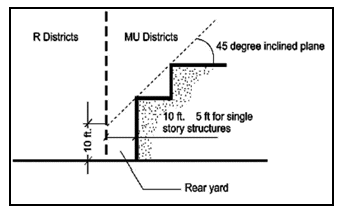
(6) Structures shall not intercept a 45-degree inclined plane inward from a height of ten feet above existing grade at a residential district boundary line. Single story structures and ground level parking may encroach a maximum of five feet into required side and rear yards.
(7) The area between the front and corner side property line and building that is not part of a driveway shall be landscaped or developed for outdoor seating.
(8`) Up to 20 percent of the required landscaping can be credited from outdoor seating areas and shaded dedicated pedestrian walks through parking areas.
(Ord. 1038, § 2, 2008; Ord. 1056, §§ 10, 11, 2009; Ord. 1083, § 3, 2012; Ord. 1146, §§ 5—8, 2018; Ord. 1177, § 5, 2019; Ord. 1194, § 1, 2020; Ord. 1235, § 1(1.6), 2023)
The following development standards are intended to retain Hollister's small-town character, and foster attractive pedestrian-friendly commercial uses and natural surveillance. Key design elements that will be considered when reviewing a commercial development project will include:
1.
Does the architecture of the proposal relate to the architectural style of structures and scale of adjoining properties and other structures in the block it is located?
2.
Has the development been designed to avoid large unarticulated shapes in favor of design in favor of four-sided architecture with variation of the building façade with color, façades, rooflines and building heights to create interesting differentiated building forms and shapes?
3.
Has the site been organized to provide inviting attractive, pedestrian-friendly access between structures, parking areas and along street frontages and other properties?
4.
Has the building and site been designed to consider air circulation, natural lighting, solar orientation, sharing of interior and exterior spaces and energy efficiency?
5.
Has parking been attractively landscaped and placed behind buildings rather than in front of buildings to retain the small-town character of the area and improved pedestrian access?
6.
Does the proposed development provide for shaded seating and bicycle racks?
7.
Does the development relate to the character of the surrounding neighborhood including but not limited to the street, the massing of structures (including height and lot sizes), bulk and scale?
A.
Air Emissions. Restaurant and drive-through businesses shall be situated to avoid odor emissions to existing and undeveloped residential properties.
B.
Architecture. A diversity of harmonious but not necessarily uniform architectural styles is encouraged in small-and large-scale developments. Building additions, alterations and accessory structures shall be architecturally compatible with the primary structure.
1.
Large unarticulated shapes in building design such as blank walls shall be avoided.
2.
Four-sided architecture shall be used to provide an attractive façade on all building frontages that face a public entrance to a building, public use area, street or residences.
3.
Signs shall be integrated with the design and shall not overwhelm, be out of proportion with, or dominate the project in compliance Chapter 17.20 (Signs).
C.
Connections Between Properties. Orient structures, access and parking areas in a manner that will safely connect pedestrians and vehicles to adjoining properties, buildings and uses. Require where practical the removal of existing barriers to pedestrian or vehicle access between lands uses for infill/reuse of buildings and properties.
D.
Drainage. Site improvements shall be designed to comply with city standards to substantially detain storm water runoff on the subject property to pre-development levels with a combination of methods including but not limited to vegetative swales in the landscape areas, directing drainage from roof gutters to landscape area and permeable paving in interior pedestrian areas or courtyards. Dual use of collection facilities for public gathering areas is encouraged.
E.
Fencing/Walls. Both sides of perimeter walls or fences shall be architecturally treated and compatible with the predominant architectural style of the site. In addition, anti-graffiti mechanisms such as landscaping or graffiti coating will be required on all new perimeter walls and fences.
F.
Height. Irrespective of the requirements in this section (Commercial Zone and Mixed-Use General Development Standards), the Commission may limit the height and mass of new structures to be consistent with those of adjacent properties and assure solar access in the neighborhood.
G.
Landscaping and Open Design Elements.
1.
Open space areas shall be clustered into larger, landscaped areas rather than equally distributing them into areas of low impact such as at building peripheries, behind structures, or in other areas of little impact to the public view. Landscaping for commercial uses shall be used to define specific areas by helping to focus on entrances to buildings and parking lots, define the edges of various land uses, provide transition between neighboring properties (buffering), and provide screening for loading and equipment areas.
2.
Landscaping shall be in scale with adjacent structures and be of appropriate size at maturity to accomplish its intended purpose and maintain accessibility of pedestrian facilities.
3.
Landscaping around the base of structures is recommended to soften the edge between the parking lot and the structure. This shall be accented at entrances to provide focus.
4.
Medium to large size trees shall be used and in scale with the commercial areas and serve as sidewalk canopies, screening and parking area shade and relief to provide 50 percent shade canopy in five years.
5.
Trees shall be located throughout the parking lot and not simply at the ends of parking aisles to provide shade and visual relief (i.e., a ratio of one tree per four parking stalls, one tree for per ten spaces in projecting islands and 40 percent of shade coverage at tree maturity or within five years, whichever comes first) landscaping shall be protected from vehicular and pedestrian encroachment by raised planting surfaces, depressed walks, or the use of concrete curbs.
6.
Vines and climbing plants integrated upon buildings, trellises, covered walkways and walls are strongly encouraged.
7.
Use of potted plants in clay or decorative concrete containers, especially for enhancement of sidewalk shops, plazas, and courtyards, and to soften the hardscape is encouraged.
8.
At maturity, trees shall be able to be trimmed ten feet above ground and shrubs shall be maintained at a height of approximately three feet when visibility is required.
9.
Commercial Office Projects—Required Open Space. At least 40 percent of the lot area of a commercial office project shall be open space, not covered by a building, parking spaces or driveways. In existing residential structures converting to a commercial office that do not comply with this requirement, no addition to the structure will be allowed unless specifically required by the Uniform Building Code in order to meet health and safety standards.
An exception for landscaping may be waived in Downtown Mixed-Use District where the building has a common boundary with a city sidewalk or alley on the street side of the building.
H.
Lighting. The design of light fixtures and their structural support shall be architecturally compatible with the principal structure(s) on the site and be pedestrian-oriented and scaled. The following additional standards shall apply to on-site lighting, including lighting of signs, structures, landscaping, plazas, parking, and service areas.
1.
Light fixtures installed for all outdoor lighting shall be shielded to confine light spread within the site boundaries and reduce "sky glow" impacts and arranged to prevent horizontal glare or direct illumination on adjoining property or streets. Fixtures shall be consistent with the design and types recommended by the International Dark Sky Association.
2.
Install low-or high-pressure sodium or alternative lights recommended by the International Dark Sky Association or a similar organization in all commercial and mixed-use areas. Prohibit mercury vapor utility yard lights or other light fixtures with high-intensity discharge lamps or bulbs, which are not designed to limit or control light direction or which do not shield the light source from view of neighboring residential properties, shall be permitted.
3.
Allow an exception to the prohibition of mercury vapor lights for outdoor display of products such as automobiles where clarity of color is important.
I.
Lighting Applications.
1.
Architectural Enhancement. Accent lighting of architectural features is encouraged to highlight building massing and rhythm and enhance the pedestrian environment. Accent lighting shall not be a source of glare, reflected glare, or excessive light, especially when viewed from dwellings, streets, walkways, or open spaces. Neon lighting does not qualify as accent lighting.
2.
Building Entries. Building entries with high activity levels shall be illuminated. Appropriate treatments include: bathing entry surfaces with light, allowing the building interior light glow through glazing, or using decorative lighting fixtures to announce entries.
3.
Service Areas. Building-mounted down light fixtures, in combination with pole fixtures, are preferred for the illumination of building service areas. Such fixtures do not cause glare or light leakage beyond the service areas.
4.
Plazas, Walkways, and Paths. Plazas, walkways, and other pedestrian paths shall be lit by pole or lighting bollard type fixtures that are of a human scale, typically not to exceed 16 feet or four feet in height, respectively.
5.
Allow an exception to the prohibition of mercury vapor lights for outdoor display of products such as automobiles, where clarity of color is important.
J.
Limited Outdoor Sales or Display of Merchandise, Materials, Equipment or Conduct of Business. All retail businesses allowed within the Commercial and Mixed-Use Districts by this section (Commercial Zones and Permit Requirements) shall be operated entirely within an enclosed building with the following exceptions:
1.
Auto service stations with accessory automobile repair or car washing. Outdoor operations shall be limited to pumping motor vehicle fluids, checking and supplementing various fluids, mechanical inspection and adjustments;
2.
Automobile, boats, recreational vehicles, motorcycles and construction vehicles offered for sale or rent only;
3.
Automatic teller machines (ATMs);
4.
Farmer's markets, street fairs and swap meets that do not otherwise qualify as a temporary use;
5.
Merchandise displayed within a completely roofed alcove, kiosk, or entryway and inside the line of the building face, which does not impact pedestrian circulation, parking, or landscaped areas;
6.
Nurseries, provided that non-plant materials are screened from an abutting public street;
7.
Permitted fruit and vegetable stands;
8.
Sidewalk café, restaurants and drinking establishments with approved outdoor eating areas;
9.
Reverse vending machines and small collection facilities;
10.
Temporary use permit authorized pursuant to Section 17.24.190 (Temporary Uses).
A solid fence or wall shall be required for all uses requiring a screen. The height of merchandise, materials, and equipment stored or displayed shall not exceed the height of the screening fence or wall. The City Planner may require additional screening in highly visible areas and may impose reasonable restrictions on the type of storage or display, or the location of outdoor storage and display areas to avoid adverse visual effects.
K.
Loading Facilities. Loading facilities and related service areas must be located away from and screened from view of streets, parks, plazas, and landscaped walkways, and shall generally be located within the interior of the development, whenever feasible.
L.
Natural Surveillance. Whenever feasible, design and placement of buildings and other physical features are encouraged to maximize visibility and facilitate natural surveillance from public rights-of-way and other public areas. This includes building orientation, placement of windows, doors, and balconies, building and site entrances and exits, placement of parking, lighting, and refuse containers, placement and type of landscape materials, plazas, and other open space areas, location of walkways, types of walls and fences (including the use of picket, wrought iron, and similar materials to promote visibility when appropriate), and other physical obstructions in a manner that discourages the potential for criminal activity. Graffiti coating shall be required on buildings to discourage graffiti.
M.
Parking Lots.
1.
Parking areas should be oriented behind buildings in the Mixed-Use Districts and are encouraged to be located behind buildings in other commercial districts.
2.
Separate vehicular and pedestrian circulation systems shall be a high priority for parking lot design. Pedestrian linkages between uses in commercial developments and to public sidewalks shall be emphasized, including distinct pedestrian access from parking areas in large commercial developments, such as shopping centers.
3.
Parking aisles shall be separated from vehicle circulation routes whenever possible.
4.
Common driveways that provide vehicular access to more than one site are encouraged.
5.
Parking areas shall be separated from structures by either a raised concrete walkway or landscaped strip, preferably both. Situations where parking spaces directly abut structures shall be avoided whenever possible.
6.
Where parking areas are connected, interior circulation shall allow for a similar direction of travel, and parking bays in all areas to reduce conflict at points of connection.
7.
Whenever feasible, locate site entries on side streets in order to minimize pedestrian/vehicular conflicts. When this is not feasible, design the front site entry with appropriately patterned concrete or pavers to differentiate it from the sidewalks.
8.
Parking access points shall be located as far as possible from street intersections so that adequate stacking room is provided. The number of access points shall be limited to the minimum amount necessary to provide adequate circulation.
9.
Differential paving shall be required within parking areas for pedestrian crossings through vehicle traffic areas.
N.
Screening.
1.
Screening for outdoor storage (including cart storage) shall be determined by the height of the material or equipment being screened. When allowed, exterior storage shall be confined to portions of the site least visible to public view. Where screening is required, a combination of elements shall be used, including solid masonry walls, berms, and landscaping. Chain link fencing with or without slatting shall not be permitted.
2.
Any outdoor equipment, whether on the roof or side of a structure, or on the ground, shall be appropriately screened from public view. The method of screening shall be architecturally integrated with the adjacent structure in terms of materials, color, shape, and size. Where individual equipment is provided, a continuous screen is desirable.
3.
When permitted, roll-up doors, vehicle bays, drive-through aisles, car wash entrances/exits, wash stalls, and similar features shall be screened from view of adjacent streets by building orientation or the provision of landscaping, berms, trellises, or low walls that are consistent with the architecture and exterior materials of the building.
O.
Shared Parking/Dual-Use. The use of recorded reciprocal parking agreements is encouraged to reduce overall paving requirements if compatible hours of operation or types of use can be proven. Dual use of underutilized seasonal parking areas in commercial centers for plazas, courtyards, outdoor eating shall be considered during design review.
P.
Solid Waste. Solid waste and recycling receptacles shall be sited where associated odors and noise will not adversely affect residential use. Receptacles must be screened from residential dwelling units.
Q.
Utility/Roof-Mounted Equipment. Roof-mounted equipment including antennas, satellite dishes, air conditioners and similar equipment shall be screened from public view by well-designed roof parapets or screened walls to conceal the mechanical equipment. To the extent practical, utilities such as reduced pressure pipes and meters shall be concealed with landscaping and site design.
(Ord. 1038, § 2, 2008)
The northern portion of the North Gateway District includes large unincorporated and incorporated parcels with potential for large-scale commercial retail, office parks, tourist, auto sales and regional commercial uses. Most parcels with frontage on Highway 25 will require access from interior streets and may benefit from off-site signs to direct motorists in the Gateway corridor to commercial uses. A coordinated approach to infrastructure, circulation, bicycle/pedestrian facilities, signage, infrastructure, streetscape, architecture and landscaping will be a priority in order to foster a vibrant mix of larger retail uses and office parks. Piecemeal development north of Gateway Drive is undesirable and should be discouraged.
Supplemental key design element that will be considered when reviewing a North Gateway Commercial development project shall include the following:
A.
Street Network/Infrastructure Plan. Master planning for multiple properties is a priority to establish coordinated, well-planned commercial centers. Proposals for development of individual undeveloped parcels will be required to prepare infrastructure plans. The plans shall be approved by the Development Review Committee prior to consideration of a Site and Architectural Review for a new development.
B.
Master Architectural, Landscaping, Lighting and Sign Programs. The development of master architectural landscaping, lighting and sign programs will be a priority for large parcels in order to streamline subsequent approval processes and to establish an attractive entry to Hollister.
C.
Landscaping and Building Design.
1.
Development shall establish an attractive entry to Hollister with a high standard of Architectural Design for a distance of 300 feet from State Highway 25 or San Felipe Road or properties that would be visible from the gateway roads corridors.
2.
Incorporation of public art, plazas into office parks and large retail centers is encouraged in order to establish an attractive entry to the North Gateway of Hollister.
3.
Submittal of a street network and bikeway plan with prezoning or Site and Architectural Review application is required to facilitate coordinated safe multi-modal access and associated funding for transportation improvements to properties that may be confined by Highway 25, the Southern Pacific Railroad tracks and San Felipe Road.
4.
A 20-foot wide landscape corridor with a double row of trees on the Highway 25 gateway entry to Hollister between Flynn Road and San Felipe Road with 15-gallon black walnut trees or California pepper, mixed with smaller flowering fruit trees such as ornamental pears, cherry and crabapple, for every 20 lineal feet of property line in order to create an entry statement that reflects the agricultural heritage of orchard crops that were prevalent in Hollister.
5.
A ten-foot wide landscape strip along the San Felipe Road, Flynn Road and internal North Gateway street corridors with a minimum of one 15-gallon tree planted for every 20 lineal feet of property. The requirement for a landscape strip may be substituted with Planning Commission approval if commercial development orients the buildings toward the street and incorporates pedestrian oriented frontage improvements such as a plaza, paseo, public art, decorative landscaping and screens off-street parking areas from Highway 25, San Felipe Road and local streets.
6.
Landscape design elements to screen all parking and loading areas where elevation of Highway 25 or San Felipe Road is above the project area.
7.
Screen the view of all outdoor storage areas from view within 300 feet of Highway 25 between Flynn Road and San Felipe Road. Class II Bicycle lanes shall be required on the frontage of all interior roads in the North Gateway district. A Class I Bicycle lane shall be required on the west side of San Felipe Road and on city arterials.
8.
Design to remedy the impacts and use and parking of shopping carts with parking lot design for large retail uses.
(Ord. 1038, § 2, 2008)
The Mixed-Use Zoning Districts allow for a combination of commercial and residential uses within a property, area or building. The commercial or residential portion of the development shall comply with the regulations in this chapter. A Site and Architectural Review shall be required for the conversion of all or a portion of a building from a single use to a mixed use or vice-versa. Conversion of a single-family residential lot to a commercial use shall be subject to a Conditional Use Permit. A conversion of a single-family home in the Downtown Commercial Mixed-Use District shall be subject to the standards in Section 17.06.020 (Home Office Land Uses and Permit Requirements).
A.
General Development Regulations.
1.
Minimum Lot Size. There shall be no specific minimum lot area required in the mixed-use districts except that there shall be sufficient area to satisfy any off-street parking loading requirements as established in Chapter 17.18 and general development standards in this chapter.
2.
Height. Structures shall provide for adequate light and air, and shall provide for considerations of solar access from adjacent properties. The maximum height in the mixed-use districts are as follows:
a.
Downtown Mixed Use: 75 feet
b.
West Gateway: 50 feet
c.
Neighborhood Mixed Use: 50 feet
The Planning Commission may approve a maximum building height of 60 feet in the West Gateway and Neighborhood Mixed Use Districts if the additional height is required for a roof garden, plaza, restaurant or mechanical equipment concealed by an attractive architectural element.
3.
Setbacks.
a.
Nonresidential and mixed-use buildings may have a build-to line of zero feet except that the front or corner side street facades of such buildings may be set back to accommodate pedestrian oriented outdoor uses and amenities which the City Planner determines are appropriate to an urban setting, such as outdoor patio dining areas, plazas and courtyards, fountains, public art, entry forecourts, and landscaping.
b.
The scale and relationship to the development pattern of adjoining property shall be used to evaluate the required setback. Design emphasis shall be placed on enhancing a pedestrian environment with adequate sidewalk width, street trees, and pedestrian scaled signs and building façades.
c.
The Site and Architectural Review process shall be used to assure that buildings are designed and oriented on lots to provide adequate light and air, assure sufficient distance between adjoining uses to minimize any incompatibility, and to promote excellence of development.
d.
In order to ensure light and air for residential units in mixed-use buildings, the following minimum setbacks apply for any interior or rear yard.
In any case in which the interior yard is also adjacent to a residential district boundary, the greater of the following setbacks, or those required by Section 17.04.030 shall apply: (i) five feet for any wall with windows; or (ii) ten feet for any wall with bedrooms or kitchen windows. Structures and buildings with ground floor residential uses shall have front and corner side yards of at least five feet, but no greater than ten feet. Stairs, landings, patios, unenclosed porches and architectural entry features, landscaping and similar features may occupy such yards.
e.
Mixed Use buildings shall be designed with forms stepping down to the north and south.
4.
Lot Coverage. There shall be no specific maximum lot coverage in the Mixed-Use District except as follows:
a.
Sufficient space shall be provided to satisfy off-street parking and loading area requirements.
b.
Undeveloped areas and redeveloped areas shall be designed with Low Impact Development Principals.
c.
Standards for open space are met.
d.
General standards for Commercial and Mixed-Use Development are met.
5.
Residential Open Space.
a.
Private Residential Open Space. Each multifamily unit shall have at least 64 square feet of private open space with natural ventilation when it is provided by a deck, porch, roof garden, or balcony with a minimum of eight feet for both width and length. Private open space at the ground level shall be at least 100 square feet.
b.
Public Open Space in the Neighborhood Mixed Use and West Gateway Mixed Use Districts.
i.
Common use areas for residential developments in the Neighborhood Mixed Use and West Gateway Mixed Use District shall be accessible to all residents and designed to serve the needs of the occupants of the housing units.
ii.
Common use areas shall not be required for a row house, town house or condominium with a private open space area with a dimension of at least 20 by 15 feet.
6.
Waiver of the Minimum Density.
a.
The Planning Commission may approve a conditional use permit to waive the minimum density requirement for a multifamily residential housing project in a Mixed-Use Zoning District as follows:
i.
The residential project is a one 100 percent multifamily affordable housing project where it is demonstrated that the minimum density standard poses a constraint to the development. The manager's unit may be excluded from the affordability requirement.
ii.
The applicant has demonstrated that there is not a possibility for lot consolidation. Compliance with minimum development densities and other standards in this section is not feasible due to small lot size, configuration of the parcel or other environmental constraints such as fault hazard.
B.
Site Planning. The location of structures and other site improvements shall create a pedestrian-oriented environment with safe, pleasant, convenient, and accessible pedestrian routes to public sidewalks, transit facilities, and adjacent uses. Site planning shall incorporate the following:
1.
Structures shall be sited along street frontages of sites with parking in the rear or in limited circumstances to the side. Placing parking areas behind rather than in front of buildings helps preserve an attractive streetscape and improves pedestrian access to surrounding activities and uses. It also provides an urban border for the street.
2.
Placement of structures, entrances, and open space areas, such as plazas and courtyards, shall be oriented to provide direct access to public sidewalks, and provide midblock corridors and streets to the maximum extent possible to facilitate pedestrian access and movement between adjacent uses.
3.
Buildings shall be arranged to create a sense of unity and overall harmony with adjacent structures. A visual link between separate structures can be established through the use of an arcade system, trellis, or similar feature.
4.
Buildings shall be sited in a manner that maximizes visibility of plazas, courtyards, streets, and alleys to provide opportunities for people engaged in their normal behavior to observe the spaces around them.
5.
The location of outdoor spaces shall have clear, recognizable shapes that reflect careful planning and are not simply left over areas between structures. Such spaces shall provide pedestrian-oriented amenities such as shaded areas, art, benches, fountains, landscaping, etc.
C.
Mixed Use Building. Ground floor uses along a street frontage shall be limited to commercial uses. Residences, storage and parking should be oriented at the rear or interior building frontages. Residences should be allowed above the first floor or to the rear or side of the commercial use on the ground floor.
1.
The main building entrance or entrances shall be oriented to the street or plazas, as applicable, to maximize natural surveillance and provide "eyes on the street." The main entries to buildings shall be clearly demarcated, visible and accessible from the street or pedestrian walkways. Main entries shall be recessed or framed by a sheltering element such as an awning, arcade, porch, or portico. Such entrances shall open directly to the outside and shall not require a pedestrian to first pass through a garage, parking lot, or loading area to gain access to the entrance from the street. Secondary building entries may be from parking areas.
2.
All residential dwellings fronting on streets shall have a main entrance opening onto the front or corner side façade of the dwelling at the ground floor level. Such an entrance shall open directly to the outside. The entrance may be above grade level through a porch, stoop, portico, or similar architectural feature. Ground floor single-family attached dwellings fronting on a street shall have separate entries directly from the sidewalk or a pedestrian walkway. Upper story and ground floor residential dwelling units in a multifamily or mixed-use building fronting on streets may share one or more entries accessible directly from the street.
3.
Multifamily residential buildings with façades over 150 feet in length facing a street frontage shall provide a minimum of two or more pedestrian building entrances on that frontage.
4.
Entrances to residential units shall be physically separated from the entrance to the permitted commercial uses and clearly marked with a physical feature incorporated into the building or an appropriately scaled element applied to the façade.
5.
Structures and buildings with ground floor residential uses shall have a front and corner side yards of at least five feet, but no greater than ten feet. Stairs, landings, patios, unenclosed porches and architectural entry features, landscaping and similar features may occupy such yards.
D.
Mass and Scale and Façade.
1.
The mass and scale of a new development shall be compatible with neighboring developments and not overwhelm them with disproportionate size or a design that is out of character or obstructs solar access.
2.
Floors above the first floor shall be stepped back a minimum of five feet and an additional five feet for floors above the second floor but not more than 15 feet, particularly in the West Gateway District. However, the step-back requirement may be waived if the project includes window treatments, entry placement, façade relief and other architectural treatments to provide visual interest and pedestrian-sensitive design at the street level and to maintain a human scale in the streetscape and avoiding a monolithic street façade.
3.
At residential edges, buildings shall maintain low profiles to provide a transition between urban and residential areas. Taller elements of the building shall increasingly step back from adjacent single-family residential zones and include features to provide solar access. Structures shall not intercept a 45-degree inclined plane inward from a height of ten feet above existing grade at a residential district boundary line. Single-story structures and ground level parking may encroach a maximum of five feet into required side and rear yards.
4.
Building scale shall be reduced through the proper use of window patterns, structural bays, roof overhangs, awnings, moldings, fixtures, and other details that promote a human scale.
5.
Building design shall avoid large monotonous façades, long straight-line building fronts, plain box shapes, and barren exterior treatment. All building façades visible from streets or public areas such as plazas shall be highly articulated, and incorporate the chosen design theme in a consistent manner.
E.
Open Space.
1.
Functional use of open space should be developed in favor of placement of landscaping in unusable areas or passive landscape area.
2.
The design of the common usable open space shall complement the street pedestrian realm with plazas, pocket parks, public gathering spaces, street furniture, multi-purpose drainage facilities and landscaping.
3.
Nonresidential and mixed-use projects are encouraged to incorporate plazas and courtyards, which are oriented to the public realm/sidewalks, into their design. Buildings can be clustered to create usable pedestrian areas.
4.
The design shall provide visual and physical cues that demark the public space from the private space.
5.
To integrate new buildings within the surrounding area, such buildings are encouraged to provide passageways that allow for light and air to adjacent buildings.
6.
In mixed-use residential and residential projects, common usable open space shall be provided in large, meaningful areas that are visible from the residential dwellings they serve.
7.
Common open space areas shall be convenient to the majority of dwellings and shall contain amenities appropriate to the project's size.
8.
In mixed use and residential projects, private usable open space shall be contiguous to the dwelling unit it serves and be screened from public view for privacy. All balconies and patios that front a public street shall be designed to screen items being stored on the balcony or patio.
9.
Rooftop open space may be used as common usable open space or private usable open space, when directly accessible to the dwelling unit(s) it serves.
F.
Pedestrian Orientation.
1.
Primary building entrances should be located on public street frontages.
2.
Windows on public street frontages should be at a height that enables pedestrians to easily view retail products and services within the building.
3.
Darkly tinted and mirrored windows that obstruct two-way visibility are prohibited on the ground floor facing streets and pedestrian corridors.
4.
Pedestrian linkages between buildings and uses shall include features such as walkways, corner entrances, paseos, outdoor patios, water features, benches and tangible public art in mixed-use developments.
5.
The preferred sidewalk width is ten feet.
G.
Privacy for Residences in the Mixed-Use Development.
1.
Windows should be oriented away from loading, service, recycling and solid waste disposal areas.
2.
Views from public right-of-way or other businesses or residences into primary living areas should be avoided by: (a) locating residences on the upper floor(s); (b) orienting windows away from other adjacent windows; (c) using translucent, louvered or offset windows; (d) incorporating privacy screening with landscaping, fencing or in combination with garden walls for outside private open space areas.
3.
To the extent residential windows face the windows of an adjacent dwelling unit, the windows shall be offset or incorporate other features to provide privacy.
H.
Treatment Adjacent to Residential Districts.
1.
To provide privacy for adjacent dwelling units, windows on the second and higher floors of buildings, which directly face or abut residential zones, should be designed either as translucent, louvered, offset from existing residential windows, or utilizing another solution to achieve privacy for the adjacent dwelling units.
2.
Parking areas shall be located and designed to be convenient in order to minimize parking problems in residential neighborhoods.
3.
Building façades and garages that face existing dwelling units shall be designed to be compatible with the setbacks and scale of the existing development.
I.
Yards/Setbacks.
1.
Buildings with ground floor residential uses shall have a maximum front yard and corner side yard of ten feet to accommodate stairs, landings, porches, covered architectural entry features, and similar building features.
2.
When provided, the front or corner side yard shall include landscaping or a hard-surface expansion of the sidewalk. Walkway connections to building entrances shall include special paving treatment or materials. The use of awnings, canopies, and arcades shall be incorporated as appropriate to provide visual interest, shade, and protection of pedestrians from the elements.
3.
All other buildings shall generally have no required yard and be located directly behind the sidewalk to facilitate pedestrian access to the public realm. Portions of the front or corner-side street façades may be set back to allow for pedestrian-oriented outdoor areas and amenities only, such as plazas and courtyards, outdoor patio dining areas, public art, fountains, entry forecourts, landscaping, or other amenities appropriate to an urban setting. When provided, such yards shall generally be no more than ten feet, except where ground floor building space is occupied by retail or other pedestrian-oriented uses with entrances opening directly to a plaza or courtyard. In such cases, the City Planner may allow the maximum front or corner-side yard to be extended.
(Ord. 1038, § 2, 2008; Ord. 1056, § 12, 2009; Ord. 1061, § 3, 2010)
A.
Site Development and Orientation of Land Use.
1.
Coordinate with property owners to use of flexible parking standards in establishing public plazas and outdoor gathering areas.
2.
Multifamily residential buildings or mixed-use buildings are encouraged near existing residential properties.
B.
Plaza/Outdoor Gathering Areas. The Planning Commission shall have the authority to authorize a reduction in total landscape requirements, and increase the Floor Area Ratio to 0.2 for projects in the West Gateway plazas for outdoor gathering areas.
C.
Multifamily residential buildings or mixed-use buildings are encouraged near existing residential properties and commercial building shall be oriented toward public streets.
D.
Parking. The establishment of a parking assessment district(s) is strongly encouraged for the undeveloped areas in the West Gateway.
The Planning Commission shall have the authority to authorize a reduction in the total off-street parking requirements for all uses in a mixed-use development provided that all off-site parking requirements for the residential land uses have been met and 50 percent of the off-street parking requirements for the commercial buildings have been satisfied. The reduction shall be approved by the Planning Commission and shall include measures to assure long-term funding to reduce off-street parking demand such as:
1.
Recordation of reciprocal parking agreements for the entire development area;
2.
A plan to denote parking areas reserved for residents;
3.
A travel demand program that will include measures to reduce parking demand such as traffic calming, additional bicycle parking facilities, two-wheel vehicle parking, rental housing for employees in the West Gateway, a Zip Car, and improved transit or vanpool access.
(Ord. 1038, § 2, 2008)

08 - COMMERCIAL ZONE LAND USES AND PERMIT REQUIREMENTS
This chapter provides regulations applicable to development and new land uses in the commercial zoning and mixed-use districts established by Section 17.02.030 (Zoning Districts Established). The purposes of the commercial zoning districts are as follows:
A.
CO (Commercial Office) District. The Commercial Office (CO) Zoning District is intended for commercial areas characterized by administrative, executive, medical, dental, and business offices, and similar uses. The CO Zoning District is consistent with the General Commercial land use category of the General Plan.
B.
GC (General Commercial) District. The General Commercial (GC) Zoning District provides for neighborhood-serving mixed-use districts by offering products and services that vary from those found elsewhere. General Commercial areas should support Downtown Hollister and larger chain stores, grocery stores, or other automobile-oriented retailers are appropriate development types in General Commercial Zoning District. The GC Zoning District is consistent with the General Commercial (GC) land use category of the General Plan.
C.
NG (North Gateway) District. The North Gateway (NG) Zoning District is intended to encourage large-scale retail commercial uses, office park, and service-oriented businesses along the north entrance to Hollister along the Highway 25 and San Felipe Road corridors. The district also includes existing auto dealerships and opportunity for future dealerships along the San Felipe Road corridor south of Wright Road. The North Gateway District provides an opportunity for the assembly of larger parcels for the development of larger retail commercial and/or office park uses on an entry boulevard to the city that is not available in most other commercial Zoning Districts in Hollister. The NG Zoning District is consistent with the North Gateway Commercial (NG) land use category of the General Plan and is part of the North Gateway Special Planning Area.
D.
Mixed Use Districts.
1.
DMU (Downtown Mixed Use) District. The Downtown Mixed Use (DMU) Zoning District provides for a vertical or horizontal combination of commercial and residential uses around the central core of the community. The designation is intended to encourage ground floor, pedestrian friendly, retail sales and service uses with upper floors of office and residential uses. The DMU District should be a unique destination with restaurants, theaters, boutique retail, neighborhood convenience stores, regionally-oriented specialty stores, medical and dental offices, and residential densities of 25 to 45 units per net acre. The DMU Zoning District is consistent with the Downtown Commercial and Mixed Use (D-MU) land use category of the General Plan.
2.
NMU (Neighborhood Mixed Use) District. The Neighborhood Mixed Use (NUM) Zoning District provides for pedestrian-oriented commercial uses of low intensity and of a neighborhood character which serves the convenience retail and service needs of nearby residents and high-density residential at densities of 25-40 units per net acre. The neighborhood shopping centers accommodated by this zoning district typically have anchor market and drug stores, with supporting neighborhood-related convenience businesses. The NMU Zoning District is consistent with the Mixed-Use Commercial and Residential (MU) land use category of the General Plan.
3.
WG (West Gateway) District. The West Gateway (WG) Mixed-Use Zoning District provides for a series of parcels with neighborhood commercial and multifamily residential uses as a retail-oriented entry boulevard at the west entrance to the city of Hollister near the San Benito River. The designation is intended to provide convenience services to regional traffic on Highway 156, encourage community shopping, retail and offices with medium to high density residential uses at a density of 20 to 35 units per net acre outside of downtown Hollister. The WG Zoning District is consistent with the West Gateway Mixed Use (WG) land use category and the West Gateway Special Planning Area of the General Plan.
(Ord. 1038, § 2, 2008; Ord. 1177, § 12, 13, 2019)
The following table identifies the uses of land allowed by this Zoning Ordinance in each commercial and mixed-use zone, and the land use permit required to establish each use, in compliance with Section 17.02.030 (Districts Established and Designated).
Site and Architectural Review shall be required for construction of new buildings, and master sign programs in the Commercial and Mixed-Use Zoning Districts unless a Master Architectural, Landscaping, Lighting and Sign Program has been approved by the Planning Commission for the property within the last three years and the Development Services Director determines that the submittal substantially conforms with the approved program. Site and Architectural Review shall also be required for façade improvements to the roof lines or the location of doors or window of existing buildings that face streets or public use areas. Administrative Site and Architectural Review is required for some uses that involve outdoor sales activities such as auto sales and nursery products or minor alterations to the exterior of a building.
A.
Administrative or administrative review shall be required for the following:
1.
Administrative Permit Review. Uses that involve outdoor sales activities such as auto sales and nursery products or changes to the façade of a building that faces a public street or road.
2.
Façade Improvement/Alteration. For the addition or removal of up to two doors or windows where the Director determines that the alteration is harmonious with the defining architectural characteristics of the building in relation to materials, scale, size and color and that the building will comply with applicable codes for health and safety, fire, ingress and egress and standards for commercial development. The City Planner may require the addition of an awning or similar feature to comply with the intent of the Commercial and Mixed-Use General Development Standards.
Table 17.08-1 Commercial and Mixed-Use Zone Uses and Permit Requirements
Additional Use Regulations and Notes:
(1) Administrative Permit Review shall be required to ensure compliance with standards in Section 17.24.190(B)(2) (Site and Architectural Review Project Review).
(2) See Section 17.22.070, Alcohol uses.
(3) Vehicles rented for hauling shall be stored within an enclosed building or off-site in the M-1 Zoning District.
(4) An Administrative Permit Review is required for establishment of outdoor storage to assure compliance with standards for screening in Sections 17.08.030(E), (J) and (N) and Section 17.22.160 (Outdoor merchandise and display activities).
(5) Use is allowed with an Administrative Permit Review or if required a Site and Architectural Review to assure compliance with Chapter 17.18 (Pedestrian, Bicycle, Parking and Loading Standards).
(6) Maintenance and repair service shall be accessory to retail sales and located within a portion of the building screened from public view and the sales floor and display areas.
(7) Exempt if property is within a city-approved parking assessment district in compliance with Section 17.18.090(A)(4) (General Parking Reduction).
(8) There shall be a minimum distance of 750 feet between pawn shops.
(9) There shall a maximum of one per street frontage on a block.
(10) No firearm or weapon sales shall be allowed.
(11) Recreational Vehicle parks shall be sited at least 500 feet from State Highway 25 or San Felipe Road.
(12) Minor retail sales that directly relate to the principal use are permitted as an accessory use in the CO district. Retail sales shall not occupy more than ten percent of the total gross floor area of the structure(s) on a site and shall be incidental to the principal use except for professional pharmacies that are part of a medical office complex.
(13) Minor auto services uses such as an oil change/smog facility, tire shop and repairs that would be accessory to a fuel service station or dealership will be allowed. Welding is prohibited in the Mixed-Use Zones.
(14) Limited auto-related uses that would normally be permitted in an Industrial Zoning District may be allowed in the North Gateway District with an Administrative Permit Review subject to the following requirements:
(a) The automobile repair or alteration of the body or exterior of an automobile use(s) shall be located on an interior lot that does not have frontage on Highway 25 or San Felipe Road or behind buildings that front San Felipe Road.
(b) The operation shall be contained within an enclosed building. Roll-up doors shall be oriented away from public streets and screened from public use area on adjoining properties.
(c) Storage of automobiles for repair or service shall be within an enclosed building or concealed by an attractive masonry garden wall or similar vegetative screen. The use of a cyclone fence with wood slats or barbed wire shall be prohibited.
(d) Visible off-street parking shall be limited to a 20-minute loading zone for customer pick-up/drop off and employee parking.
(e) The facility shall not share a boundary with property located in a Residential Zoning District or a hotel/motel.
(f) The cumulative area of the auto-related uses shall not constitute more than 20 percent of the uses on an interior street or lot ten percent of the uses in the North Gateway Zoning District.
(15) Auto Repair, Tune-up, Body Shop, Tire Store. One auto service facility that would serve the West Gateway District and surrounding residential land uses will be allowed within the WG district with a conditional use permit with the following standards. The combined auto repair/maintenance use(s) shall be confined to an area not larger than two acres.
(a) In order to establish an attractive entrance to Hollister and avoid an industrial appearance, all vehicles shall be contained within an enclosed building or concealed by an attractive garden wall or similar vegetative screen with the exception of a 20-minute loading zone for customer pick-up/drop and employee parking.
(b) The facility shall not share a boundary with property located in the R1, R-2, R-3 or R4 District.
(16) A Conditional Use Permit is required for any vehicle washing, drying or vacuuming done by mechanical means within 250 feet of a residential zoning district or the property line of a building with a mix of commercial and residential uses. An acoustic study may be required by the City Planner.
(17) The following additional regulations shall apply to all limited warehousing uses:
(a) All storage shall be kept within an enclosed building, except propane or gasoline powered engines or storage tanks or any boats or vehicles incorporating such components shall be stored only in designated screened areas.
(b) Offices, animal-related uses and animal storage, manufacturing, assembly of goods, and retail or wholesale distribution of any item stored within the facility shall be prohibited at the limited warehouse facility.
(c) The repair, construction, or reconstruction of any boat, engine, motor vehicle, furniture, appliance, machinery and the storage of any propane or gasoline storage tank is prohibited within any structure used for limited warehousing or on the premises of such limited warehousing, unless otherwise provided for in this Zoning Code.
(18) Major facilities shall be located a minimum of 500 feet from a Residential Zoning District or school. Stealth telecommunication facilities are required with a CUP on properties located in the North Gateway Zoning District. Telecommunication facilities shall be aesthetically and architecturally compatible with adjacent structures and features in terms of shape, materials and colors and the City Planner may require stealth telecommunication facilities in the GC Zoning District to assure compatibility with surrounding land uses. Facilities shall comply with requirements in Section 17.22.240, Article II, (Telecommunications).
(19) Municipal wells, drainage, and flood control facilities may be considered subject to an Administrative Permit for compliance with standards in Section 17.24.190(B) (Site and Architectural Review) of this title.
(20) A single-family residence lawfully established prior to the effective date of the ordinance codified in this chapter may be reconstructed if the building is involuntarily damaged or partially damaged by a fire or other calamity. The building shall be constructed consistent with the standards in the Old Town Zoning District.
(21) An exception may be allowed for lots located in the Fault Hazard Overlay Zone and if is not feasible for the property owner to conduct a surface fault investigation for a commercial or multifamily use due to the size of the property and surrounding land uses.
(22) Small temporary residential shelters (STRS) or large temporary residential shelter (LTRS) is permitted by right in the NG Zoning District provided that if it is located at least 1,000 feet from another STRS or LTRS, 500 feet from a public park, a public or private K-12 school or an R1, R2 or OT Zoning District and within 1,000 feet of a bus route. An exception to the 1,000-foot separation from an R1, R2 or OT District may be made if the shelter is located on the opposite side of Highway 25 or San Felipe Road. The STRS and LTRS shall comply with standards in Section 17.22.120 (Homeless Shelters or Transitional Housing) of this title. A Conditional Use Permit is required for a STRS that does not comply with the location and development standards or in the NG Zoning District.
(23) Permitted where a single-family residence was established on a legal lot that is less than 8,000 square feet in size and the accessory second unit complies with the standards in Chapter 17.32 (Accessory Dwelling Units) and there is not potential for lot consolidation with adjoining parcels to accommodate future multifamily development.
(24) Establishment of the land use is prohibited if the property is located in the Flood Hazard Overlay Zone.
(25) Minor vehicle repair facilities are not permitted within the Downtown Hollister Historic District.
(26) Restaurants drive-through or drive-in are not permitted within the Downtown Hollister Historic District.
(27) Outdoor vehicles sales shall not be permitted within the Downtown Hollister Historic District or the Monterey Street Historic District.
(28) See Chapter 5.42 "Cannabis Facilities Regulatory Permit" for information on criteria, procedures, standards, requirements, regulations, and provisions for cannabis.
Table 17.08-3 Commercial District Development Regulations
Additional Use Regulations and Notes:
(2) Development on Existing Lots of Record. A legally created lot having a width or area less than required for the district in which it is located shall be developed subject to the same property development regulations as a standard lot. No substandard lot shall be further reduced in area or width.
(3) The minimum lot sizes may be reduced when the exclusive use of such lots is intended for utility substations, pumping substations, and other similar facilities, or in conjunction with shopping centers and office complexes where two or more separate lots would be created and be subject to a reciprocal agreement utilizing shared parking, landscaping, and related facilities when it can be demonstrated that the purpose of the district can be achieved and that the public health, safety, and general welfare will be maintained.
(4) See Section 17.16.110 for exceptions to setbacks from building projections such as stairs, terraces, balconies, porches, cornices, eaves, canopies, awnings and stairs.
(5) The front yard setback in the CO zone may be reduced to the average distance of the existing buildings from their front property line on the two abutting lots adjoining the front property line.
(6) Structures shall not intercept a 45-degree inclined plane inward from a height of ten feet above existing grade at a residential district boundary line. Single story structures and ground level parking may encroach a maximum of five feet into required side and rear yards.
(7) The area between the front and corner side property line and building that is not part of a driveway shall be landscaped or developed for outdoor seating.
(8`) Up to 20 percent of the required landscaping can be credited from outdoor seating areas and shaded dedicated pedestrian walks through parking areas.
(Ord. 1038, § 2, 2008; Ord. 1056, §§ 10, 11, 2009; Ord. 1083, § 3, 2012; Ord. 1146, §§ 5—8, 2018; Ord. 1177, § 5, 2019; Ord. 1194, § 1, 2020; Ord. 1235, § 1(1.6), 2023)
The following development standards are intended to retain Hollister's small-town character, and foster attractive pedestrian-friendly commercial uses and natural surveillance. Key design elements that will be considered when reviewing a commercial development project will include:
1.
Does the architecture of the proposal relate to the architectural style of structures and scale of adjoining properties and other structures in the block it is located?
2.
Has the development been designed to avoid large unarticulated shapes in favor of design in favor of four-sided architecture with variation of the building façade with color, façades, rooflines and building heights to create interesting differentiated building forms and shapes?
3.
Has the site been organized to provide inviting attractive, pedestrian-friendly access between structures, parking areas and along street frontages and other properties?
4.
Has the building and site been designed to consider air circulation, natural lighting, solar orientation, sharing of interior and exterior spaces and energy efficiency?
5.
Has parking been attractively landscaped and placed behind buildings rather than in front of buildings to retain the small-town character of the area and improved pedestrian access?
6.
Does the proposed development provide for shaded seating and bicycle racks?
7.
Does the development relate to the character of the surrounding neighborhood including but not limited to the street, the massing of structures (including height and lot sizes), bulk and scale?
A.
Air Emissions. Restaurant and drive-through businesses shall be situated to avoid odor emissions to existing and undeveloped residential properties.
B.
Architecture. A diversity of harmonious but not necessarily uniform architectural styles is encouraged in small-and large-scale developments. Building additions, alterations and accessory structures shall be architecturally compatible with the primary structure.
1.
Large unarticulated shapes in building design such as blank walls shall be avoided.
2.
Four-sided architecture shall be used to provide an attractive façade on all building frontages that face a public entrance to a building, public use area, street or residences.
3.
Signs shall be integrated with the design and shall not overwhelm, be out of proportion with, or dominate the project in compliance Chapter 17.20 (Signs).
C.
Connections Between Properties. Orient structures, access and parking areas in a manner that will safely connect pedestrians and vehicles to adjoining properties, buildings and uses. Require where practical the removal of existing barriers to pedestrian or vehicle access between lands uses for infill/reuse of buildings and properties.
D.
Drainage. Site improvements shall be designed to comply with city standards to substantially detain storm water runoff on the subject property to pre-development levels with a combination of methods including but not limited to vegetative swales in the landscape areas, directing drainage from roof gutters to landscape area and permeable paving in interior pedestrian areas or courtyards. Dual use of collection facilities for public gathering areas is encouraged.
E.
Fencing/Walls. Both sides of perimeter walls or fences shall be architecturally treated and compatible with the predominant architectural style of the site. In addition, anti-graffiti mechanisms such as landscaping or graffiti coating will be required on all new perimeter walls and fences.
F.
Height. Irrespective of the requirements in this section (Commercial Zone and Mixed-Use General Development Standards), the Commission may limit the height and mass of new structures to be consistent with those of adjacent properties and assure solar access in the neighborhood.
G.
Landscaping and Open Design Elements.
1.
Open space areas shall be clustered into larger, landscaped areas rather than equally distributing them into areas of low impact such as at building peripheries, behind structures, or in other areas of little impact to the public view. Landscaping for commercial uses shall be used to define specific areas by helping to focus on entrances to buildings and parking lots, define the edges of various land uses, provide transition between neighboring properties (buffering), and provide screening for loading and equipment areas.
2.
Landscaping shall be in scale with adjacent structures and be of appropriate size at maturity to accomplish its intended purpose and maintain accessibility of pedestrian facilities.
3.
Landscaping around the base of structures is recommended to soften the edge between the parking lot and the structure. This shall be accented at entrances to provide focus.
4.
Medium to large size trees shall be used and in scale with the commercial areas and serve as sidewalk canopies, screening and parking area shade and relief to provide 50 percent shade canopy in five years.
5.
Trees shall be located throughout the parking lot and not simply at the ends of parking aisles to provide shade and visual relief (i.e., a ratio of one tree per four parking stalls, one tree for per ten spaces in projecting islands and 40 percent of shade coverage at tree maturity or within five years, whichever comes first) landscaping shall be protected from vehicular and pedestrian encroachment by raised planting surfaces, depressed walks, or the use of concrete curbs.
6.
Vines and climbing plants integrated upon buildings, trellises, covered walkways and walls are strongly encouraged.
7.
Use of potted plants in clay or decorative concrete containers, especially for enhancement of sidewalk shops, plazas, and courtyards, and to soften the hardscape is encouraged.
8.
At maturity, trees shall be able to be trimmed ten feet above ground and shrubs shall be maintained at a height of approximately three feet when visibility is required.
9.
Commercial Office Projects—Required Open Space. At least 40 percent of the lot area of a commercial office project shall be open space, not covered by a building, parking spaces or driveways. In existing residential structures converting to a commercial office that do not comply with this requirement, no addition to the structure will be allowed unless specifically required by the Uniform Building Code in order to meet health and safety standards.
An exception for landscaping may be waived in Downtown Mixed-Use District where the building has a common boundary with a city sidewalk or alley on the street side of the building.
H.
Lighting. The design of light fixtures and their structural support shall be architecturally compatible with the principal structure(s) on the site and be pedestrian-oriented and scaled. The following additional standards shall apply to on-site lighting, including lighting of signs, structures, landscaping, plazas, parking, and service areas.
1.
Light fixtures installed for all outdoor lighting shall be shielded to confine light spread within the site boundaries and reduce "sky glow" impacts and arranged to prevent horizontal glare or direct illumination on adjoining property or streets. Fixtures shall be consistent with the design and types recommended by the International Dark Sky Association.
2.
Install low-or high-pressure sodium or alternative lights recommended by the International Dark Sky Association or a similar organization in all commercial and mixed-use areas. Prohibit mercury vapor utility yard lights or other light fixtures with high-intensity discharge lamps or bulbs, which are not designed to limit or control light direction or which do not shield the light source from view of neighboring residential properties, shall be permitted.
3.
Allow an exception to the prohibition of mercury vapor lights for outdoor display of products such as automobiles where clarity of color is important.
I.
Lighting Applications.
1.
Architectural Enhancement. Accent lighting of architectural features is encouraged to highlight building massing and rhythm and enhance the pedestrian environment. Accent lighting shall not be a source of glare, reflected glare, or excessive light, especially when viewed from dwellings, streets, walkways, or open spaces. Neon lighting does not qualify as accent lighting.
2.
Building Entries. Building entries with high activity levels shall be illuminated. Appropriate treatments include: bathing entry surfaces with light, allowing the building interior light glow through glazing, or using decorative lighting fixtures to announce entries.
3.
Service Areas. Building-mounted down light fixtures, in combination with pole fixtures, are preferred for the illumination of building service areas. Such fixtures do not cause glare or light leakage beyond the service areas.
4.
Plazas, Walkways, and Paths. Plazas, walkways, and other pedestrian paths shall be lit by pole or lighting bollard type fixtures that are of a human scale, typically not to exceed 16 feet or four feet in height, respectively.
5.
Allow an exception to the prohibition of mercury vapor lights for outdoor display of products such as automobiles, where clarity of color is important.
J.
Limited Outdoor Sales or Display of Merchandise, Materials, Equipment or Conduct of Business. All retail businesses allowed within the Commercial and Mixed-Use Districts by this section (Commercial Zones and Permit Requirements) shall be operated entirely within an enclosed building with the following exceptions:
1.
Auto service stations with accessory automobile repair or car washing. Outdoor operations shall be limited to pumping motor vehicle fluids, checking and supplementing various fluids, mechanical inspection and adjustments;
2.
Automobile, boats, recreational vehicles, motorcycles and construction vehicles offered for sale or rent only;
3.
Automatic teller machines (ATMs);
4.
Farmer's markets, street fairs and swap meets that do not otherwise qualify as a temporary use;
5.
Merchandise displayed within a completely roofed alcove, kiosk, or entryway and inside the line of the building face, which does not impact pedestrian circulation, parking, or landscaped areas;
6.
Nurseries, provided that non-plant materials are screened from an abutting public street;
7.
Permitted fruit and vegetable stands;
8.
Sidewalk café, restaurants and drinking establishments with approved outdoor eating areas;
9.
Reverse vending machines and small collection facilities;
10.
Temporary use permit authorized pursuant to Section 17.24.190 (Temporary Uses).
A solid fence or wall shall be required for all uses requiring a screen. The height of merchandise, materials, and equipment stored or displayed shall not exceed the height of the screening fence or wall. The City Planner may require additional screening in highly visible areas and may impose reasonable restrictions on the type of storage or display, or the location of outdoor storage and display areas to avoid adverse visual effects.
K.
Loading Facilities. Loading facilities and related service areas must be located away from and screened from view of streets, parks, plazas, and landscaped walkways, and shall generally be located within the interior of the development, whenever feasible.
L.
Natural Surveillance. Whenever feasible, design and placement of buildings and other physical features are encouraged to maximize visibility and facilitate natural surveillance from public rights-of-way and other public areas. This includes building orientation, placement of windows, doors, and balconies, building and site entrances and exits, placement of parking, lighting, and refuse containers, placement and type of landscape materials, plazas, and other open space areas, location of walkways, types of walls and fences (including the use of picket, wrought iron, and similar materials to promote visibility when appropriate), and other physical obstructions in a manner that discourages the potential for criminal activity. Graffiti coating shall be required on buildings to discourage graffiti.
M.
Parking Lots.
1.
Parking areas should be oriented behind buildings in the Mixed-Use Districts and are encouraged to be located behind buildings in other commercial districts.
2.
Separate vehicular and pedestrian circulation systems shall be a high priority for parking lot design. Pedestrian linkages between uses in commercial developments and to public sidewalks shall be emphasized, including distinct pedestrian access from parking areas in large commercial developments, such as shopping centers.
3.
Parking aisles shall be separated from vehicle circulation routes whenever possible.
4.
Common driveways that provide vehicular access to more than one site are encouraged.
5.
Parking areas shall be separated from structures by either a raised concrete walkway or landscaped strip, preferably both. Situations where parking spaces directly abut structures shall be avoided whenever possible.
6.
Where parking areas are connected, interior circulation shall allow for a similar direction of travel, and parking bays in all areas to reduce conflict at points of connection.
7.
Whenever feasible, locate site entries on side streets in order to minimize pedestrian/vehicular conflicts. When this is not feasible, design the front site entry with appropriately patterned concrete or pavers to differentiate it from the sidewalks.
8.
Parking access points shall be located as far as possible from street intersections so that adequate stacking room is provided. The number of access points shall be limited to the minimum amount necessary to provide adequate circulation.
9.
Differential paving shall be required within parking areas for pedestrian crossings through vehicle traffic areas.
N.
Screening.
1.
Screening for outdoor storage (including cart storage) shall be determined by the height of the material or equipment being screened. When allowed, exterior storage shall be confined to portions of the site least visible to public view. Where screening is required, a combination of elements shall be used, including solid masonry walls, berms, and landscaping. Chain link fencing with or without slatting shall not be permitted.
2.
Any outdoor equipment, whether on the roof or side of a structure, or on the ground, shall be appropriately screened from public view. The method of screening shall be architecturally integrated with the adjacent structure in terms of materials, color, shape, and size. Where individual equipment is provided, a continuous screen is desirable.
3.
When permitted, roll-up doors, vehicle bays, drive-through aisles, car wash entrances/exits, wash stalls, and similar features shall be screened from view of adjacent streets by building orientation or the provision of landscaping, berms, trellises, or low walls that are consistent with the architecture and exterior materials of the building.
O.
Shared Parking/Dual-Use. The use of recorded reciprocal parking agreements is encouraged to reduce overall paving requirements if compatible hours of operation or types of use can be proven. Dual use of underutilized seasonal parking areas in commercial centers for plazas, courtyards, outdoor eating shall be considered during design review.
P.
Solid Waste. Solid waste and recycling receptacles shall be sited where associated odors and noise will not adversely affect residential use. Receptacles must be screened from residential dwelling units.
Q.
Utility/Roof-Mounted Equipment. Roof-mounted equipment including antennas, satellite dishes, air conditioners and similar equipment shall be screened from public view by well-designed roof parapets or screened walls to conceal the mechanical equipment. To the extent practical, utilities such as reduced pressure pipes and meters shall be concealed with landscaping and site design.
(Ord. 1038, § 2, 2008)
The northern portion of the North Gateway District includes large unincorporated and incorporated parcels with potential for large-scale commercial retail, office parks, tourist, auto sales and regional commercial uses. Most parcels with frontage on Highway 25 will require access from interior streets and may benefit from off-site signs to direct motorists in the Gateway corridor to commercial uses. A coordinated approach to infrastructure, circulation, bicycle/pedestrian facilities, signage, infrastructure, streetscape, architecture and landscaping will be a priority in order to foster a vibrant mix of larger retail uses and office parks. Piecemeal development north of Gateway Drive is undesirable and should be discouraged.
Supplemental key design element that will be considered when reviewing a North Gateway Commercial development project shall include the following:
A.
Street Network/Infrastructure Plan. Master planning for multiple properties is a priority to establish coordinated, well-planned commercial centers. Proposals for development of individual undeveloped parcels will be required to prepare infrastructure plans. The plans shall be approved by the Development Review Committee prior to consideration of a Site and Architectural Review for a new development.
B.
Master Architectural, Landscaping, Lighting and Sign Programs. The development of master architectural landscaping, lighting and sign programs will be a priority for large parcels in order to streamline subsequent approval processes and to establish an attractive entry to Hollister.
C.
Landscaping and Building Design.
1.
Development shall establish an attractive entry to Hollister with a high standard of Architectural Design for a distance of 300 feet from State Highway 25 or San Felipe Road or properties that would be visible from the gateway roads corridors.
2.
Incorporation of public art, plazas into office parks and large retail centers is encouraged in order to establish an attractive entry to the North Gateway of Hollister.
3.
Submittal of a street network and bikeway plan with prezoning or Site and Architectural Review application is required to facilitate coordinated safe multi-modal access and associated funding for transportation improvements to properties that may be confined by Highway 25, the Southern Pacific Railroad tracks and San Felipe Road.
4.
A 20-foot wide landscape corridor with a double row of trees on the Highway 25 gateway entry to Hollister between Flynn Road and San Felipe Road with 15-gallon black walnut trees or California pepper, mixed with smaller flowering fruit trees such as ornamental pears, cherry and crabapple, for every 20 lineal feet of property line in order to create an entry statement that reflects the agricultural heritage of orchard crops that were prevalent in Hollister.
5.
A ten-foot wide landscape strip along the San Felipe Road, Flynn Road and internal North Gateway street corridors with a minimum of one 15-gallon tree planted for every 20 lineal feet of property. The requirement for a landscape strip may be substituted with Planning Commission approval if commercial development orients the buildings toward the street and incorporates pedestrian oriented frontage improvements such as a plaza, paseo, public art, decorative landscaping and screens off-street parking areas from Highway 25, San Felipe Road and local streets.
6.
Landscape design elements to screen all parking and loading areas where elevation of Highway 25 or San Felipe Road is above the project area.
7.
Screen the view of all outdoor storage areas from view within 300 feet of Highway 25 between Flynn Road and San Felipe Road. Class II Bicycle lanes shall be required on the frontage of all interior roads in the North Gateway district. A Class I Bicycle lane shall be required on the west side of San Felipe Road and on city arterials.
8.
Design to remedy the impacts and use and parking of shopping carts with parking lot design for large retail uses.
(Ord. 1038, § 2, 2008)
The Mixed-Use Zoning Districts allow for a combination of commercial and residential uses within a property, area or building. The commercial or residential portion of the development shall comply with the regulations in this chapter. A Site and Architectural Review shall be required for the conversion of all or a portion of a building from a single use to a mixed use or vice-versa. Conversion of a single-family residential lot to a commercial use shall be subject to a Conditional Use Permit. A conversion of a single-family home in the Downtown Commercial Mixed-Use District shall be subject to the standards in Section 17.06.020 (Home Office Land Uses and Permit Requirements).
A.
General Development Regulations.
1.
Minimum Lot Size. There shall be no specific minimum lot area required in the mixed-use districts except that there shall be sufficient area to satisfy any off-street parking loading requirements as established in Chapter 17.18 and general development standards in this chapter.
2.
Height. Structures shall provide for adequate light and air, and shall provide for considerations of solar access from adjacent properties. The maximum height in the mixed-use districts are as follows:
a.
Downtown Mixed Use: 75 feet
b.
West Gateway: 50 feet
c.
Neighborhood Mixed Use: 50 feet
The Planning Commission may approve a maximum building height of 60 feet in the West Gateway and Neighborhood Mixed Use Districts if the additional height is required for a roof garden, plaza, restaurant or mechanical equipment concealed by an attractive architectural element.
3.
Setbacks.
a.
Nonresidential and mixed-use buildings may have a build-to line of zero feet except that the front or corner side street facades of such buildings may be set back to accommodate pedestrian oriented outdoor uses and amenities which the City Planner determines are appropriate to an urban setting, such as outdoor patio dining areas, plazas and courtyards, fountains, public art, entry forecourts, and landscaping.
b.
The scale and relationship to the development pattern of adjoining property shall be used to evaluate the required setback. Design emphasis shall be placed on enhancing a pedestrian environment with adequate sidewalk width, street trees, and pedestrian scaled signs and building façades.
c.
The Site and Architectural Review process shall be used to assure that buildings are designed and oriented on lots to provide adequate light and air, assure sufficient distance between adjoining uses to minimize any incompatibility, and to promote excellence of development.
d.
In order to ensure light and air for residential units in mixed-use buildings, the following minimum setbacks apply for any interior or rear yard.
In any case in which the interior yard is also adjacent to a residential district boundary, the greater of the following setbacks, or those required by Section 17.04.030 shall apply: (i) five feet for any wall with windows; or (ii) ten feet for any wall with bedrooms or kitchen windows. Structures and buildings with ground floor residential uses shall have front and corner side yards of at least five feet, but no greater than ten feet. Stairs, landings, patios, unenclosed porches and architectural entry features, landscaping and similar features may occupy such yards.
e.
Mixed Use buildings shall be designed with forms stepping down to the north and south.
4.
Lot Coverage. There shall be no specific maximum lot coverage in the Mixed-Use District except as follows:
a.
Sufficient space shall be provided to satisfy off-street parking and loading area requirements.
b.
Undeveloped areas and redeveloped areas shall be designed with Low Impact Development Principals.
c.
Standards for open space are met.
d.
General standards for Commercial and Mixed-Use Development are met.
5.
Residential Open Space.
a.
Private Residential Open Space. Each multifamily unit shall have at least 64 square feet of private open space with natural ventilation when it is provided by a deck, porch, roof garden, or balcony with a minimum of eight feet for both width and length. Private open space at the ground level shall be at least 100 square feet.
b.
Public Open Space in the Neighborhood Mixed Use and West Gateway Mixed Use Districts.
i.
Common use areas for residential developments in the Neighborhood Mixed Use and West Gateway Mixed Use District shall be accessible to all residents and designed to serve the needs of the occupants of the housing units.
ii.
Common use areas shall not be required for a row house, town house or condominium with a private open space area with a dimension of at least 20 by 15 feet.
6.
Waiver of the Minimum Density.
a.
The Planning Commission may approve a conditional use permit to waive the minimum density requirement for a multifamily residential housing project in a Mixed-Use Zoning District as follows:
i.
The residential project is a one 100 percent multifamily affordable housing project where it is demonstrated that the minimum density standard poses a constraint to the development. The manager's unit may be excluded from the affordability requirement.
ii.
The applicant has demonstrated that there is not a possibility for lot consolidation. Compliance with minimum development densities and other standards in this section is not feasible due to small lot size, configuration of the parcel or other environmental constraints such as fault hazard.
B.
Site Planning. The location of structures and other site improvements shall create a pedestrian-oriented environment with safe, pleasant, convenient, and accessible pedestrian routes to public sidewalks, transit facilities, and adjacent uses. Site planning shall incorporate the following:
1.
Structures shall be sited along street frontages of sites with parking in the rear or in limited circumstances to the side. Placing parking areas behind rather than in front of buildings helps preserve an attractive streetscape and improves pedestrian access to surrounding activities and uses. It also provides an urban border for the street.
2.
Placement of structures, entrances, and open space areas, such as plazas and courtyards, shall be oriented to provide direct access to public sidewalks, and provide midblock corridors and streets to the maximum extent possible to facilitate pedestrian access and movement between adjacent uses.
3.
Buildings shall be arranged to create a sense of unity and overall harmony with adjacent structures. A visual link between separate structures can be established through the use of an arcade system, trellis, or similar feature.
4.
Buildings shall be sited in a manner that maximizes visibility of plazas, courtyards, streets, and alleys to provide opportunities for people engaged in their normal behavior to observe the spaces around them.
5.
The location of outdoor spaces shall have clear, recognizable shapes that reflect careful planning and are not simply left over areas between structures. Such spaces shall provide pedestrian-oriented amenities such as shaded areas, art, benches, fountains, landscaping, etc.
C.
Mixed Use Building. Ground floor uses along a street frontage shall be limited to commercial uses. Residences, storage and parking should be oriented at the rear or interior building frontages. Residences should be allowed above the first floor or to the rear or side of the commercial use on the ground floor.
1.
The main building entrance or entrances shall be oriented to the street or plazas, as applicable, to maximize natural surveillance and provide "eyes on the street." The main entries to buildings shall be clearly demarcated, visible and accessible from the street or pedestrian walkways. Main entries shall be recessed or framed by a sheltering element such as an awning, arcade, porch, or portico. Such entrances shall open directly to the outside and shall not require a pedestrian to first pass through a garage, parking lot, or loading area to gain access to the entrance from the street. Secondary building entries may be from parking areas.
2.
All residential dwellings fronting on streets shall have a main entrance opening onto the front or corner side façade of the dwelling at the ground floor level. Such an entrance shall open directly to the outside. The entrance may be above grade level through a porch, stoop, portico, or similar architectural feature. Ground floor single-family attached dwellings fronting on a street shall have separate entries directly from the sidewalk or a pedestrian walkway. Upper story and ground floor residential dwelling units in a multifamily or mixed-use building fronting on streets may share one or more entries accessible directly from the street.
3.
Multifamily residential buildings with façades over 150 feet in length facing a street frontage shall provide a minimum of two or more pedestrian building entrances on that frontage.
4.
Entrances to residential units shall be physically separated from the entrance to the permitted commercial uses and clearly marked with a physical feature incorporated into the building or an appropriately scaled element applied to the façade.
5.
Structures and buildings with ground floor residential uses shall have a front and corner side yards of at least five feet, but no greater than ten feet. Stairs, landings, patios, unenclosed porches and architectural entry features, landscaping and similar features may occupy such yards.
D.
Mass and Scale and Façade.
1.
The mass and scale of a new development shall be compatible with neighboring developments and not overwhelm them with disproportionate size or a design that is out of character or obstructs solar access.
2.
Floors above the first floor shall be stepped back a minimum of five feet and an additional five feet for floors above the second floor but not more than 15 feet, particularly in the West Gateway District. However, the step-back requirement may be waived if the project includes window treatments, entry placement, façade relief and other architectural treatments to provide visual interest and pedestrian-sensitive design at the street level and to maintain a human scale in the streetscape and avoiding a monolithic street façade.
3.
At residential edges, buildings shall maintain low profiles to provide a transition between urban and residential areas. Taller elements of the building shall increasingly step back from adjacent single-family residential zones and include features to provide solar access. Structures shall not intercept a 45-degree inclined plane inward from a height of ten feet above existing grade at a residential district boundary line. Single-story structures and ground level parking may encroach a maximum of five feet into required side and rear yards.
4.
Building scale shall be reduced through the proper use of window patterns, structural bays, roof overhangs, awnings, moldings, fixtures, and other details that promote a human scale.
5.
Building design shall avoid large monotonous façades, long straight-line building fronts, plain box shapes, and barren exterior treatment. All building façades visible from streets or public areas such as plazas shall be highly articulated, and incorporate the chosen design theme in a consistent manner.
E.
Open Space.
1.
Functional use of open space should be developed in favor of placement of landscaping in unusable areas or passive landscape area.
2.
The design of the common usable open space shall complement the street pedestrian realm with plazas, pocket parks, public gathering spaces, street furniture, multi-purpose drainage facilities and landscaping.
3.
Nonresidential and mixed-use projects are encouraged to incorporate plazas and courtyards, which are oriented to the public realm/sidewalks, into their design. Buildings can be clustered to create usable pedestrian areas.
4.
The design shall provide visual and physical cues that demark the public space from the private space.
5.
To integrate new buildings within the surrounding area, such buildings are encouraged to provide passageways that allow for light and air to adjacent buildings.
6.
In mixed-use residential and residential projects, common usable open space shall be provided in large, meaningful areas that are visible from the residential dwellings they serve.
7.
Common open space areas shall be convenient to the majority of dwellings and shall contain amenities appropriate to the project's size.
8.
In mixed use and residential projects, private usable open space shall be contiguous to the dwelling unit it serves and be screened from public view for privacy. All balconies and patios that front a public street shall be designed to screen items being stored on the balcony or patio.
9.
Rooftop open space may be used as common usable open space or private usable open space, when directly accessible to the dwelling unit(s) it serves.
F.
Pedestrian Orientation.
1.
Primary building entrances should be located on public street frontages.
2.
Windows on public street frontages should be at a height that enables pedestrians to easily view retail products and services within the building.
3.
Darkly tinted and mirrored windows that obstruct two-way visibility are prohibited on the ground floor facing streets and pedestrian corridors.
4.
Pedestrian linkages between buildings and uses shall include features such as walkways, corner entrances, paseos, outdoor patios, water features, benches and tangible public art in mixed-use developments.
5.
The preferred sidewalk width is ten feet.
G.
Privacy for Residences in the Mixed-Use Development.
1.
Windows should be oriented away from loading, service, recycling and solid waste disposal areas.
2.
Views from public right-of-way or other businesses or residences into primary living areas should be avoided by: (a) locating residences on the upper floor(s); (b) orienting windows away from other adjacent windows; (c) using translucent, louvered or offset windows; (d) incorporating privacy screening with landscaping, fencing or in combination with garden walls for outside private open space areas.
3.
To the extent residential windows face the windows of an adjacent dwelling unit, the windows shall be offset or incorporate other features to provide privacy.
H.
Treatment Adjacent to Residential Districts.
1.
To provide privacy for adjacent dwelling units, windows on the second and higher floors of buildings, which directly face or abut residential zones, should be designed either as translucent, louvered, offset from existing residential windows, or utilizing another solution to achieve privacy for the adjacent dwelling units.
2.
Parking areas shall be located and designed to be convenient in order to minimize parking problems in residential neighborhoods.
3.
Building façades and garages that face existing dwelling units shall be designed to be compatible with the setbacks and scale of the existing development.
I.
Yards/Setbacks.
1.
Buildings with ground floor residential uses shall have a maximum front yard and corner side yard of ten feet to accommodate stairs, landings, porches, covered architectural entry features, and similar building features.
2.
When provided, the front or corner side yard shall include landscaping or a hard-surface expansion of the sidewalk. Walkway connections to building entrances shall include special paving treatment or materials. The use of awnings, canopies, and arcades shall be incorporated as appropriate to provide visual interest, shade, and protection of pedestrians from the elements.
3.
All other buildings shall generally have no required yard and be located directly behind the sidewalk to facilitate pedestrian access to the public realm. Portions of the front or corner-side street façades may be set back to allow for pedestrian-oriented outdoor areas and amenities only, such as plazas and courtyards, outdoor patio dining areas, public art, fountains, entry forecourts, landscaping, or other amenities appropriate to an urban setting. When provided, such yards shall generally be no more than ten feet, except where ground floor building space is occupied by retail or other pedestrian-oriented uses with entrances opening directly to a plaza or courtyard. In such cases, the City Planner may allow the maximum front or corner-side yard to be extended.
(Ord. 1038, § 2, 2008; Ord. 1056, § 12, 2009; Ord. 1061, § 3, 2010)
A.
Site Development and Orientation of Land Use.
1.
Coordinate with property owners to use of flexible parking standards in establishing public plazas and outdoor gathering areas.
2.
Multifamily residential buildings or mixed-use buildings are encouraged near existing residential properties.
B.
Plaza/Outdoor Gathering Areas. The Planning Commission shall have the authority to authorize a reduction in total landscape requirements, and increase the Floor Area Ratio to 0.2 for projects in the West Gateway plazas for outdoor gathering areas.
C.
Multifamily residential buildings or mixed-use buildings are encouraged near existing residential properties and commercial building shall be oriented toward public streets.
D.
Parking. The establishment of a parking assessment district(s) is strongly encouraged for the undeveloped areas in the West Gateway.
The Planning Commission shall have the authority to authorize a reduction in the total off-street parking requirements for all uses in a mixed-use development provided that all off-site parking requirements for the residential land uses have been met and 50 percent of the off-street parking requirements for the commercial buildings have been satisfied. The reduction shall be approved by the Planning Commission and shall include measures to assure long-term funding to reduce off-street parking demand such as:
1.
Recordation of reciprocal parking agreements for the entire development area;
2.
A plan to denote parking areas reserved for residents;
3.
A travel demand program that will include measures to reduce parking demand such as traffic calming, additional bicycle parking facilities, two-wheel vehicle parking, rental housing for employees in the West Gateway, a Zip Car, and improved transit or vanpool access.
(Ord. 1038, § 2, 2008)
