
Hollister City Zoning Code
CHAPTER 17
18 - PEDESTRIAN, BICYCLE, PARKING AND LOADING STANDARDS
17.18.010 - Purpose.
The purpose of pedestrian, bicycle and off-street parking and loading standards is to:
A.
Provide safe pedestrian connections between sidewalks, parking lots and buildings;
B.
Provide sufficient pedestrian, bicycle and parking facilities to meet the needs generated by the proposed use;
C.
Provide accessible, attractive, secure, properly lighted, and well-maintained and screened pedestrian, bicycle and off-street parking and loading facilities;
D.
Reduce traffic congestion and hazards;
E.
Encourage the use of alternative modes of transportation by providing for safe, adequate pedestrian corridors and convenient bicycle and carpool parking;
F.
Protect neighborhoods from the effects of vehicular noise and traffic;
G.
Ensure access and maneuverability for emergency vehicles; and
H.
Provide loading and delivery services in proportion to the needs generated by the proposed use.
(Ord. 1038, § 2, 2008)
17.18.020 - Applicability.
Every permanent use (including a change of use), and every structure shall have permanently maintained pedestrian, bicycle, transit off-street parking facilities in compliance with the provisions of this chapter.
(Ord. 1038, § 2, 2008)
17.18.030 - General pedestrian, bicycle and parking regulations.
Circulation Plan. A circulation plan for vehicular and pedestrian access and parking facilities shall be required for new development, a building addition(s) or a change of use that the Engineering Department determines substantially increases the off-street parking requirements. The plan shall include the following:
A.
Parking facilities as required in this chapter.
B.
A shaded (deciduous trees are acceptable) pedestrian path with an American with Disabilities Act (ADA) accessible paving surface that contrasts with and can be clearly distinguished from paved areas for vehicles. Paint shall not be allowed to provide contrast. The pedestrian paths shall be separated from internal roads and parking aisles with landscaping, building orientation or other strategies.
C.
Pedestrian paths shall be designed to provide a continuous series of connections between sidewalks, buildings and adjoining properties. The plans shall show a minimum of one pedestrian path per street frontage and one path for every three parking aisles. Crossings through internal roads shall have contrasting paving (paint shall not be used for contrast).
D.
The circulation plan shall incorporate any approved Bicycle and Pedestrian Master Plan or guidelines adopted to implement the city of Hollister General Plan policies and programs for multi-modal access.
E.
All paved surfaces shall provide a continuous, smooth, vibration-free surface that complies with ADA requirements and ensures safe access for bicycles.
F.
On-site signs shall have a minimum clearance of seven feet between the sign and the ground.
G.
All on-site grates and similar stormwater facilities shall be suitable for crossing on a bicycle.
H.
Transit facilities based on consultation with the San Benito County Local Transportation Authority.
I.
Outdoor seating shall be integrated into the plan with a variety of strategies including raised planters and/or fountains with seating and benches that are designed to deter the use of skateboards.
(Ord. 1038, § 2, 2008)
17.18.040 - Commercial vehicle parking—Residential areas.
No commercial vehicle exceeding eight feet in height or 20 feet in combined total length, or tow truck or tow equipment, shall park between the hours of 6:00 p.m. and 6:00 a.m. on private property or public rights-of-way within residential zoning districts. This prohibition shall not apply to construction sites during the construction process or to vehicles in the process of making delivery or pickup.
(Ord. 1038, § 2, 2008)
17.18.050 - Accessible clearance.
An American with Disabilities Act (ADA) accessible path of travel of at least five feet shall be maintained at all times around display areas, transit shelters, bicycle racks, ATM, building entrances and temporary facilities (e.g., mail deposit, A-frame sign on private property).
(Ord. 1038, § 2, 2008)
17.18.060 - Number of parking spaces required.
Each land use shall provide the minimum number of off-street parking spaces required by this section, except where a greater number of spaces is required through land use permit approval.
A.
Expansion of Structure, Change in Use. When a structure is enlarged or increased in capacity or intensity, or when a change in use is required by this title to provide more off-street parking, additional pedestrian facilities and parking spaces for automobiles and bicycles shall be provided in compliance with the provisions of this section. For building additions or change in the occupancy capacity of a use of 20 percent or less, a reduction in the required number of off-street automobile and bicycle parking spaces may be allowed if the administrative review by the Engineering Department determines that there is sufficient capacity on site.
B.
Mixed Uses/Multiple Tenants. A site or facility proposed for multiple tenants or uses (e.g., a hotel with meeting halls, a building with ground-floor shops and second-floor offices, etc.) shall provide the aggregate number of parking spaces required by this section (Number of Parking Spaces Required) for each separate use; except where shared parking is allowed in compliance with Section 17.18.090(B) (Reduction of Off-Street Parking Requirements—Shared Parking Reduction). The parking requirements for any one use may not be used to satisfy the requirements for another use in the same structure or on the same parcel.
C.
Single-family Homes. Two off-street parking spaces shall be provided and maintained for each dwelling in any single-family residential zoning district.
D.
Parking required by development agreements and specific plans. Parking requirements established by development agreements or specific plans supersede the provisions of Section 17.24.040 (Number of Parking Spaces Required).
E.
Uses Not Listed. Land uses not specifically listed by the following subsection F, shall provide parking as required by the Director. In determining appropriate off-street parking requirements, the Director shall use the requirements of subsection G of this section as a general guide in determining the minimum number of off-street parking spaces necessary to avoid undue interference with public use of streets.
F.
Computation of Spaces Required. Where the number of required parking spaces results in a fraction of 0.50 or higher, the requirements shall be rounded up to the next whole number of spaces.
G.
Bicycle and Vehicle Parking Requirements By Land Use. The following minimum number of parking spaces shall be provided for each use (additional spaces may be required through Conditional Use Permit or Planned Development Permit conditions of approval, where applicable):
Table 17.18-1 Off-Street Parking and Bicycle Spaces Required by Land Use Type
(1)
A reduction to off-street parking requirements may be granted with a Conditional Use Permit for a 100 percent affordable multifamily housing project that does not qualify for a density bonus in Chapter 17.04, Article II, Density Bonus.
(Ord. 1038 § 2, 2008; Ord. 1056 § 21, 2009; Ord. 1061 § 4, 2010; Ord. 1071 § 14, 2011; Ord. 1100 § 3, 2014)
17.18.070 - Bicycle parking design standards.
For the purpose of this section, bicycle parking facilities shall refer to bicycle racks, lockers and like facilities, unless otherwise specified.
A.
All bicycle parking provided shall be on concrete or like surface.
B.
Bicycle parking facilities shall be securely anchored to the lot surface so they cannot be easily removed and shall be of sufficient strength to resist vandalism and theft.
C.
Bicycle parking facilities shall support bicycles in a stable position without damage to wheels, frame or other components.
D.
Bicycle parking facilities within auto parking areas shall be separated by a physical barrier to protect bicycles from damage by automobiles and other moving vehicles. Such mentioned barriers may be in the form of curbs, wheel stops, poles or other similar features.
E.
At a minimum, bicycle parking spaces shall be at least two feet in width by six feet in length to allow sufficient space between parked bicycles.
F.
Bicycle parking facilities, particularly bicycle parking racks, are subject to the following criteria:
1.
Located a minimum of two feet away from a parallel wall.
2.
Located 30 inches from a perpendicular wall, as measured from the edge of the facility closest to the wall and in the direction bicycles are to be parked.
3.
Provide a minimum five-foot wide aisle or space behind all required bicycle parking to allow room for bicycle maneuvering.
G.
If bicycle parking racks are to be utilized to provide the required minimum off-street bicycle parking, racks shall be designed to support the bicycle by its frame and allow the use of either a cable lock or a U-shaped lock.
(Ord. 1038, § 2, 2008)
17.18.080 - Location of bicycle racks.
Bicycle parking facilities shall be located in a convenient, highly visible and well-lighted area to minimize theft and vandalism, generally within 50 feet of a building entrance and within view of pedestrian traffic.
(Ord. 1038, § 2, 2008)
17.18.090 - Reduction of off-street parking requirements.
A.
General Parking Reduction. The Director may grant a reduction in off-street parking requirements in compliance with Section 17.24.160 (Administrative Permit Review with Notice and Right of Appeal). The applicant shall provide evidence to demonstrate, to the satisfaction of the Director, that any requested reduction is necessary for the efficient operation of the subject use and will not result in a parking deficiency though the submittal of a parking study which demonstrates need and industry standards.
Additionally, the Director may grant a reduction in off-street parking requirements, in compliance with Section 17.24.160 (Administrative Permit Review with Notice and Right of Appeal) for development projects:
1.
That are located in close proximity to a public transit stop, where possible;
2.
Where the applicant agrees to provide housing for low- and very low-income persons in compliance with Chapter 17.04 Article II (Residential Density Bonuses);
3.
Where the Council has adopted a resolution establishing the value of an off-street parking space, based on the value of land and construction costs of a top-grade parking lot. This in-lieu parking fee alternative shall only be available in the following manner:
a.
The Council shall first authorize the issuance of an "In Lieu Certificate," with each certificate representing the cost of one off-street parking space;
b.
The Council shall set up a special fund for revenues from the certificates, with the revenues to be used to establish public off-street parking facilities; in the vicinity of the project requesting the certificate;
c.
The applicant may then agree to purchase one certificate for each off-street parking space requested to be waived from the requirements of this chapter. The certificate shall be purchased in conjunction with the issuance of the Building Permit for the subject development. The certificates may be paid in installments not to exceed five years, providing an agreement, approved by the City Attorney, is signed by the applicant.
4.
The off-street parking requirements for property located within the Local Improvement District 75-1 Downtown Parking Assessment District, or other city-approved parking assessment Districts, may be met by the inclusion of the property in said Parking District if the property is used for permitted commercial or permitted mixed use purposes. For uses other than permitted commercial or permitted mixed use, off-street parking requirements for properties within the Parking District will be calculated by subtracting the number of parking spaces attributed to the property in the resolution establishing the Parking District from the number of parking spaces required by this chapter for the property.
B.
Shared parking reduction. Nonresidential parking facilities may be shared if multiple uses cooperatively establish and operate the facilities and if these uses generate parking demands primarily during hours when the remaining uses are not in operation. (For example, if one use operates during evenings or weekdays only, or where patrons are likely to visit more than one business establishment on a single trip.) The applicant shall provide documentation (i.e., shared parking use analysis) to the satisfaction of the Director, substantiating the reasons for the requested shared parking reduction. Shared parking may be approved only if:
1.
A sufficient number of spaces are provided to meet the greater parking demand of the participating uses;
2.
Satisfactory evidence, as deemed by the Director, has been submitted by the parties and affected parties and operating affected parties the shared parking facility. The evidence shall describe the nature of the uses and the times when the uses operate so as to demonstrate the lack of potential conflict between them; and
3.
Additional documents, covenants, deed restrictions, or other agreements, as may be deemed necessary by the Director, are executed to ensure that the required parking spaces provided are maintained and used as approved for the life of the non-residential development.
(Ord. 1038, § 2, 2008)
17.18.100 - Disabled parking requirements.
Parking areas shall include parking spaces accessible to the disabled in the following manner:
A.
Number of Spaces, Design Standards. Disabled parking requirements are established by the State and are contained in the California Code of Regulations, Title 24, Part 2, Chapter 2-71, Section 2-7102, and in the California Vehicle Code, Section 22511.8. State law may be amended from time to time, so reference should be made directly to the California Code of regulations for standards on the required number, dimensions, and location of handicapped parking spaces, signs, and related facilities. The Department will provide information on current requirements and space design upon request;
B.
Reservation of Spaces Required. All disabled accessible spaces required by this section shall be reserved by the property owner/tenant for use by the disabled throughout the life of the approved land use;
C.
Upgrading and Maintenance of Markings Required. If amendments to State Law change State standards for the marking, striping, and signing of disabled parking spaces, all disabled spaces within the city shall be upgraded in compliance with the new state standards. This upgrading shall be completed by affected property owners within 60 days of their being notified in writing by the city of the new state standards; and
D.
Fulfilling of Requirements. Disabled parking spaces required by this section shall count toward fulfilling off-street parking requirements.
(Ord. 1038, § 2, 2008)
17.18.110 - Design and development standards for off-street parking.
Off-street parking areas shall be provided on the subject site, outside of any public right-of-way, in the following manner:
A.
Access.
1.
Parking areas shall provide suitable maneuvering room so that all vehicles may enter an abutting street in a forward direction. Single-family homes and duplexes are exempt from this requirement and the Director may approve exceptions for other residential projects;
2.
A commercial or industrial use that is designed to provide 20 or more parking spaces shall have access driveways that are not intersected by a parking aisle, parking space, or another access driveway for a minimum distance of 20 feet from the street right-of-way, to provide a stacking area for vehicles entering and exiting the parking area. See Figure 17.18-1.
3.
A minimum unobstructed clearance height of seven feet six inches shall be maintained above all areas accessible to vehicles.
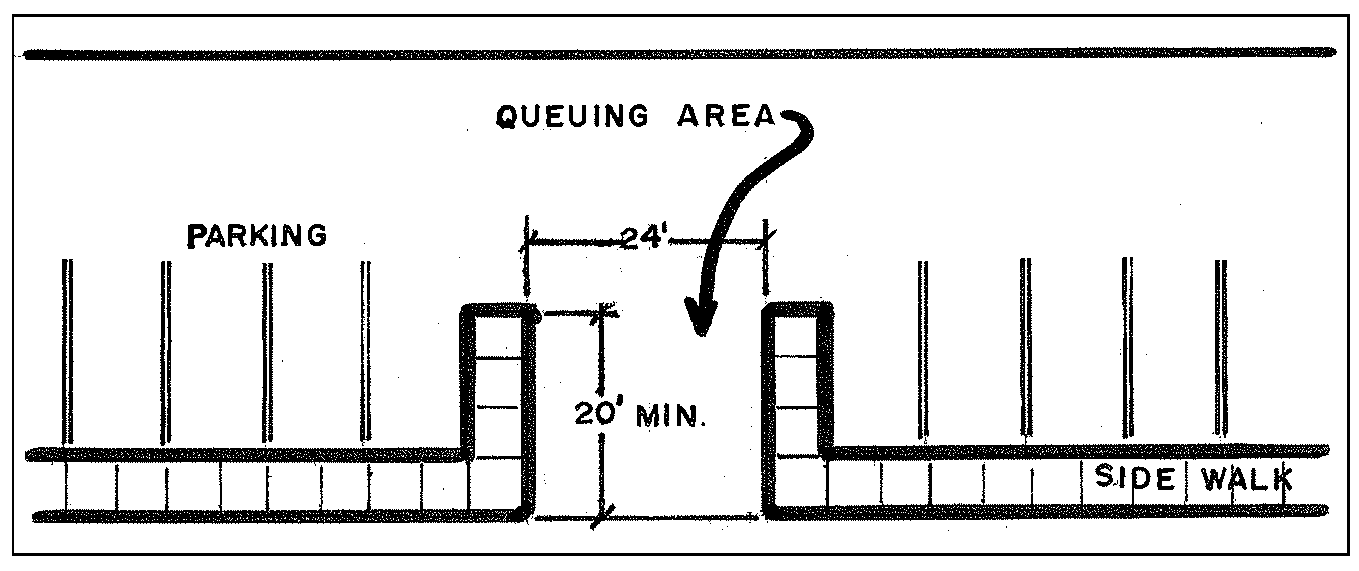
Figure 17.18-1 Access
B.
Adjacent Site Access. Applicants for nonresidential developments shall be encouraged to provide cross-access to adjacent nonresidential properties for convenience, safety and efficient circulation of motor vehicles. A Mutual Access Agreement shall be executed where cross-access is provided.
C.
Street-Fronting Parking Lots. A commercial, office shall and industrial use should minimize street-fronting parking lots, and where possible locate the parking areas behind buildings.
D.
Parking Within Required Setbacks. No parking space or aisle providing access to individual parking spaces shall occupy a required front setback, or a street side setback of a corner lot. No residential parking space shall occupy a required side or rear setback, except within an enclosed garage that complies with the garage setback requirements of the applicable zoning District and Section 17.16.020 (Accessory Residential Uses and Structures).
E.
Parking Within the DMU District. Parking areas downtown, in the DMU District, shall be clustered in structures, behind buildings, and on streets.
F.
Parking Within the HO District. Parking lots in front of offices shall be prohibited. Parking shall be accommodated on-site behind or to the side of structures.
G.
Parking Lot and Space Dimensions.
1.
General Requirements. Minimum parking dimensions shall be as indicated in the following table and as illustrated by Figure 17.18-2.
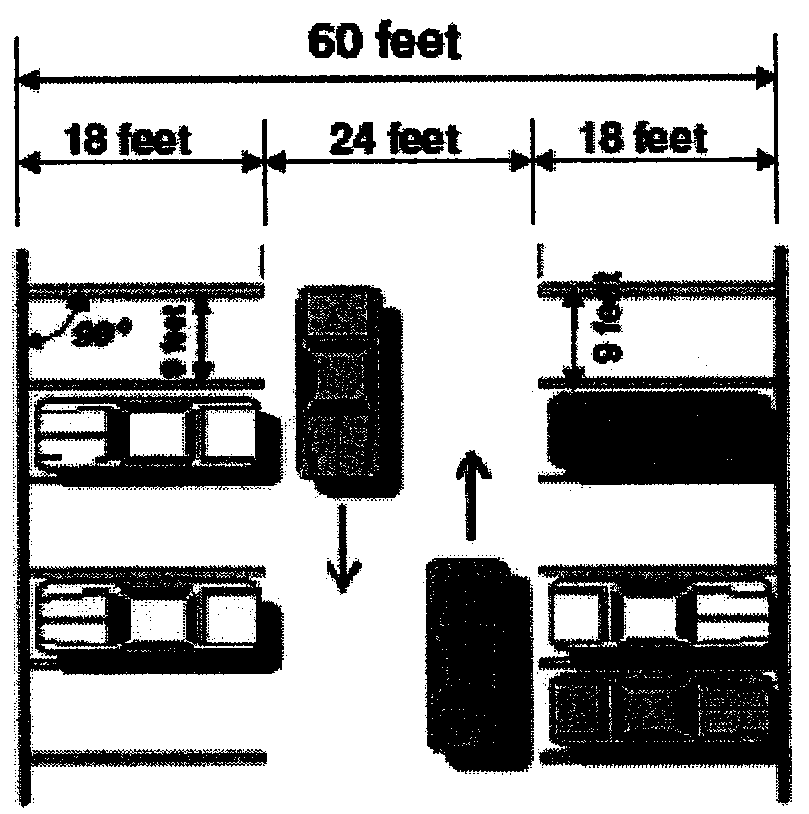
Figure 17.18-2 Dimensions
Minimum Parking Stall Dimensions
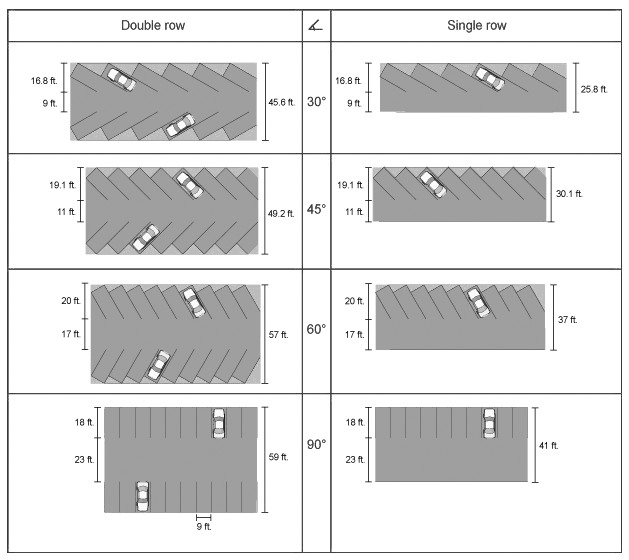
Figure 17.18-3 Parking Designs
2.
Dimensions for Private Garages. A minimum unobstructed inside dimension of ten feet by 20 feet shall be maintained, for a private one-car garage. A minimum unobstructed inside dimension of 20 feet by 20 feet shall be maintained for a private two-car garage. A minimum inside dimension of 30 feet by 20 feet shall be maintained, for a private three-car garage;
3.
Parallel Parking Spaces. Parallel parking spaces shall have a minimum width of nine feet and a minimum length of 24 feet; and
H.
Drainage. All required off-street parking/loading areas shall be designed and constructed:
1.
So that surface water will not drain over any sidewalk (drainage from a site to a street across a driveway may be approved), or adjacent parcels, unless otherwise approved by the City Engineer;
2.
In compliance with the Water Resources Performance Standards and Stormwater Management and Flooding Performance Standards; and
3.
In compliance with the City's Best Management Practices, adopted in compliance with the requirements of the National Pollution Discharge Elimination System (NPDES).
I.
Landscaping. Required parking area landscaping shall be provided as follows unless otherwise specified in this chapter:
1.
Area of Landscaping Required. A minimum of ten percent of the total off-street parking area shall be landscaped to provide a minimum 40 percent shade coverage at tree maturity or five years whichever occurs first. The parking area shall be computed by adding all areas used for access drives, aisles, stalls, and maneuvering within that portion of the site that is devoted to parking and circulation.
2.
General Landscaping Standards. Landscaping shall be installed and maintained in compliance with Section 17.16.080 (Landscaping Design and Standards).
3.
Perimeter Landscaping.
a.
Adjacent to Streets. Parking areas with more than ten spaces adjacent to a public right-of-way, shall be designed to provide a landscaped planting strip between the right-of way and parking, equal in depth to the setback required by the zoning District or ten feet, whichever is less. Any planting, sign, or other structure within sight distance triangle of a driveway shall not exceed 36 inches in height.
b.
Adjacent to Residential Use. Parking areas for nonresidential uses adjacent to residential uses shall be designed to provide a landscaped planting strip a minimum of ten feet in width between the parking area and the property line bordering the residential use. A screening wall shall also be provided in compliance with subsection N of this section.
4.
Interior Landscaping.
a.
Planting Island Between Parking Aisles. Parking areas with multiple parking aisles shall be designed to provide a continuous planter island between each aisle. The planter island shall be six feet wide, with six-foot by 18-foot projecting landscaped islands every ten parking spaces. Adequate pedestrian paths shall be provided throughout the landscaped areas where deemed necessary. At least one 24-inch box shade tree for every three spaces shall be included in the development of the overall landscaping program; appropriate clustering of trees may be approved by the Director. The landscaping program (including tree species selected) shall be designed to provide shading for 50 percent of the parking lot area within a 15-year period.
b.
Areas Not Used for Parking. Areas in a parking lot not used for driveways, maneuvering areas, parking spaces, or walks, shall be landscaped and permanently maintained, in compliance with an approved site plan.
c.
Bumper Overhang Areas. To increase the parking lot landscaped area, a maximum of two feet of the parking stall depth may be landscaped with low-growth, hearty materials in lieu of asphalt, allowing a bumper overhang while maintaining the required parking dimensions.
5.
Curbing, Irrigation. All areas containing plant materials shall be bordered by a concrete curb at least six inches high and six inches wide, and provided with an approved automatic irrigation system.
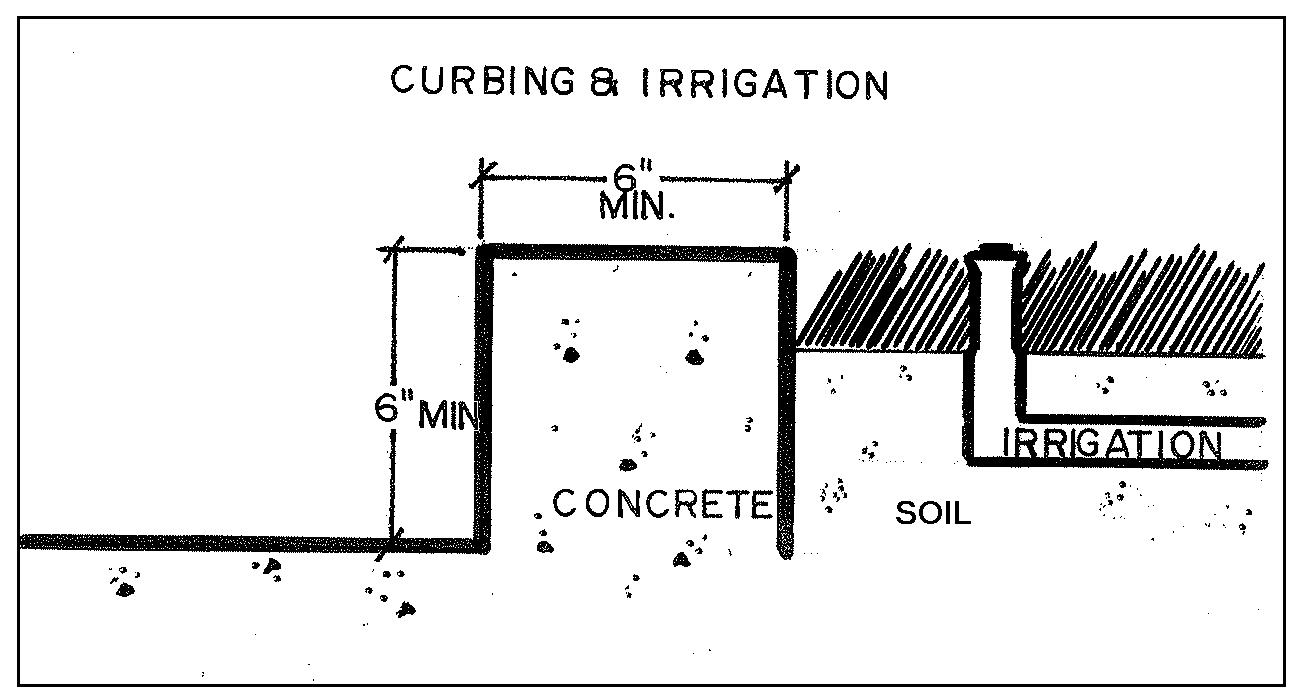
Figure 17.18-4 Curbing and Irrigation
J.
Lighting. Parking areas shall have lighting capable of providing adequate illumination for security and safety. Lighting standards shall be energy-efficient and in scale with the height and use of the on-site structure(s). Any illumination, including security lighting, shall be directed downward, away from adjoining properties and public rights-of-way in compliance with Section 17.16.090 of this title.
K.
On-Site Location Required. All parking spaces shall be located on the same parcel as the primary structure or use, unless approved otherwise by the Director. The Director may approve a portion or all of the required off-street spaces to be located on an adjacent parcel. This approval shall be based on accessibility to the primary structure or use, and the use and development of the neighboring parcel. The applicant shall provide evidence, to the satisfaction of the Director, that a suitable long-term lease or other binding agreement can be executed and recorded which would guarantee that the parcel containing the primary structure or use has an irrevocable right to utilize the adjacent parcel for parking.
L.
Maintenance. All required parking facilities shall be permanently maintained by the property owner/tenant, free of litter and debris, potholes, obstructions, and stored material.
M.
Residential Guest Parking. Required guest parking in residential zoning districts shall be so designated and restricted, with appropriate signs/pavement markings, for the exclusive use of the guests and located within 150 degrees of the unit intended to serve.
N.
Screening. Multifamily, commercial, industrial/manufacturing, and public parking areas abutting residentially zoned parcels shall have a wood or decorative masonry wall, not less than six-foot high, to properly screen the parking area(s), subject to approval by the Director. The Director may waive or modify this requirement to protect the views of adjacent residences. All wall treatments shall occur on both sides.
O.
Site Coverage. The requirements for open space and off-street parking on any parcel shall not exceed 75 percent of the gross area of the parcel. Any portion of a structure designed to be used for vehicle parking, when no more than 25 percent of the spaces are to be used for public parking, shall not be counted in calculating the maximum allowable gross floor area contained in the applicable zoning District.
P.
Striping and Marking. Parking stalls shall be identified by four-inch wide stripes of paint, or other durable striping material approved by the Public Works Director/City Engineer on the parking lot surface. All parking stalls shall be clearly outlined with double stripes except parallel spaces which may be marked with single lines.
Q.
Surfacing. All off-street parking lots shall be surfaced with four inches of Portland Cement Concrete, or two inches of asphaltic concrete, or oil surfacing, placed on four inches of a suitable base and built to a thickness which meets city street standards, subject to the approval of the Director/City Engineer.
R.
Tandem and Valet Parking. Tandem parking shall not be permitted to satisfy off-street parking requirements, except within mobile home parks, in the mixed use Districts or where authorized by Conditional Use Permit approval. Valet parking shall not be permitted to reduce off-street parking requirements, except where authorized by Conditional Use Permit approval.
S.
Wheel Stops/Curbing. Continuous concrete curbing at least six inches high and six inches wide shall be provided for all parking spaces located adjacent to walls, fences, property lines and structures. All parking lots shall have curbing around all parking areas and aisle planters in compliance with subsection (I)(4) of this section. Wheel stops shall not be used in lieu of curbing.
(Ord. 1038, § 2, 2008; Ord. 1056, § 22, 2009; Ord. 1071, §§ 15, 16, 2011)
17.18.120 - Driveways and site access.
Driveways providing ingress and egress to off-street parking spaces shall be designed, constructed, and maintained as follows:
A.
Number of Access Points. One driveway access point for each ownership shall be permitted unless a development or circulation plan is provided to the City Engineer indicating that more than one access is required to handle traffic volumes or specific designs, (e.g., residential circular driveways). Access points across from one another shall be aligned. Additional access shall not be permitted if it is determined to be detrimental to traffic flow and safety of adjacent public streets. Whenever a property has access to more than one road, access shall be generally limited to the lowest volume road where the impact of a new access will be minimized. All access from private property to a public street shall require an Encroachment Permit in compliance with Chapter 12.16 of the Municipal Code.
B.
Location of Access.
1.
Distance from Street Intersections. No portion of a driveway access shall be permitted within curb returns. The edge of the access shall not be less than ten feet from the end of curb return for single-family residential developments. For all other developments, this distance shall not be less than 150 feet. Where the parcel size does not permit the access to be located 150 feet from the end of curb return, the access shall be located the maximum distance possible from the end of the curb return, subject to the approval of the Director. This distance does not include the three-foot transition or wing sections on each side of the driveway.
2.
Driveway Spacing. Two or more driveway access points on a public street shall be separated as follows:
a.
Single-family Residential Development. Where two or more accesses serve adjacent single-family residential parcels, the minimum distance between the nearest points of the two accesses shall be at least 20 feet, unless a shared, single driveway access is approved by the Director. The 20-foot separation does not include the three-foot transition or wing sections on each side of the driveway.
b.
Multifamily and Nonresidential Development. Where two or more accesses serve the same or adjacent non-single-family residential development, the minimum distance between the centerline of accesses shall be preferably at least 200 feet on streets with design speeds below 30 mph and 300 feet on streets with design speeds above 30 mph.
c.
Corner and Double Frontage Parcels. For corner and double frontage residential parcels, one access on each frontage may be permitted if it is determined by the City Engineer that two driveways are needed to provide safe access for traffic entering and leaving the parcel because of site distance and geometric design considerations.
3.
Driveway Alignments—Commercial Development. Where commercial parcels are not large enough to allow accesses on opposite sides of the street to be aligned, the center of driveways not in alignment shall normally be offset a minimum of 150 feet on all collector roads, and 300 feet on all major and arterial roads. Greater distances may be required if needed for left-turn storage lanes.
C.
Driveway Width and Length.
1.
Residential Zoning Districts. Driveways in the residential zoning districts shall have a minimum width of 12 feet, with direct access to a garage. Maximum width shall be 20 feet for a double or 30 feet for a three-car garage. The minimum length of a single-family driveway shall be 20 feet measured from the property line to the front of the garage, in order to permit a vehicle to park in the driveway without blocking the sidewalk. Where access to a garage, carport, or open parking space is perpendicular (90 degrees) to the driveway, a minimum 24-foot deep unobstructed back-out area shall be provided.
2.
Commercial Zoning Districts. Driveways shall be a minimum width of 25 feet and a maximum of 35 feet with adequate truck turning radius. Curb return radius shall be a minimum of 20 feet where curb returns are deemed necessary by the City Engineer.
3.
Industrial/Manufacturing Zoning Districts. Accesses serving industrial uses shall be a minimum of 35 feet in width and a maximum of 40 feet, with adequate truck turning radius, and with minimum curb return radius of 25 feet, or as otherwise specified by the City Engineer. Site distance triangles shall be indicated on all site plans to ensure unobstructed vision clearance.
D.
Clearance from Appurtenances. The nearest edge of any driveway curb cut shall be at least three feet from the nearest property line (except where the Planning Commission has approved a shared driveway between two parcels), the centerline of a fire hydrant, utility pole, drop inlet, or appurtenances, traffic signal installations, or light standards. The nearest edge of any driveway shall also be at least five feet from the nearest projection of this type of installation. Street trees shall be a minimum of ten feet from the driveway access.
E.
Sight Distance at Driveways. At least 350 feet of clear sight distance shall be provided for all access onto local streets; 400 feet for collector streets; 500 feet for arterial streets, as approved by the City Engineer.
F.
Signs. All exists from parking lots shall be clearly posted with "STOP" signs.
G.
Temporary Access. Temporary access may be granted to underdeveloped property prior to approval of all development permits required by this Zoning Ordinance, or completion of development, if access is needed for construction. Temporary accesses are subject to removal, relocation, or redesign after all permits are approved.
(Ord. 1038, § 2, 2008)
17.18.130 - Off-street loading space requirements.
A.
Number of Loading Spaces Required. Unless modified by the Director in compliance with Section 17.24.160 (Administrative Permits with Notice and Right of Appeal) for standards in this section, off-street freight and equipment loading spaces shall be provided for all nonresidential uses, except hotels and motels. The following minimum number of loading spaces shall be provided for each use:
Requirements for uses not specifically listed shall be determined by the Director based upon the requirements for comparable uses and upon the particular characteristics of the proposed use, in compliance with Section 17.18.060 (Number of Parking Spaces Required).
B.
Development standards for off-street loading. Off-street loading areas shall be provided in the following manner:
1.
Dimensions. Required freight and equipment loading spaces shall be not less than 15 feet in width, 25 feet in length, with 14 feet of vertical clearance;
2.
Lighting. Loading areas shall have lighting capable of providing adequate illumination for security and safety. Lighting standards shall be energy-efficient and in scale with the height and use of the structure(s). Any illumination, including security lighting, shall be directed away from adjoining parcels and public rights-of-way and comply with Section 17.16.090 (Lighting, Outdoors)
3.
Loading Doors and Gates. Loading bays and roll-up doors shall be located on the rear of the structure only. Bays and doors may be located on the side of a structure, away from a street frontage, where it can be demonstrated that the bays, doors, and related trucks will be adequately screened from public view from any street or public right-of-way;
4.
Loading Ramps. All plans for loading ramps or truck wells shall be accompanied by a profile drawing showing the ramp, ramp transitions, and overhead and adjoining wall clearances;
5.
Location. Freight and equipment loading spaces shall be located and designed as follows:
a.
Next to, or as close as possible to, the main structure, and limited to the rear two-thirds of the parcel;
b.
Situated to ensure that the loading facility shall not be visible from any major public rights-of-way;
c.
Situated to ensure that all loading and unloading takes place on-site, and in no case within adjacent public rights-of-way, or other traffic areas on-site;
d.
Situated to ensure that all vehicular maneuvers occur on-site; and
e.
Situated to avoid adverse noise impacts upon neighboring residential properties, in compliance with city noise regulations.
6.
Screening. All loading areas abutting residentially zoned parcels shall have a six-foot high solid, architecturally treated decorative masonry wall, approved by the Director, to properly screen the loading area(s). All wall treatments shall occur on both sides; and
7.
Striping. Loading areas shall be striped indicating the loading spaces and identifying the spaces for "loading only." The striping shall be permanently maintained by the property owner/tenant in a clear and visible manner at all times.
(Ord. 1038, § 2, 2008)

