
Hollister City Zoning Code
CHAPTER 17
16 - PERFORMANCE STANDARDS
17.16.010 - Access.
Every structure or use shall have frontage upon a public street or permanent means of access to a public street by way of a public or private easement or recorded reciprocal (mutual) access agreement, consistent with state law, as determined appropriate by the Director. Driveways shall be developed in compliance with the standards in Section 17.18.120. Efforts shall be made to keep driveway length to a minimum.
(Ord. 1038, § 2, 2008)
17.16.020 - Accessory residential uses and structures.
Accessory buildings and structures are permitted or conditionally permitted in any residential District, as specified by the regulations set forth in this section. Accessory buildings may be constructed either at the same time as the main structure or subsequent to the main structure. When an accessory building is attached to the main building, it shall be considered a part of the main building and all requirements of this chapter applicable to the main building shall be complied with as for a single structure. Accessory buildings and structures include, but are not limited to detached garages, greenhouses, swimming pools, workshops, and patio covers.
A.
General Requirements. All accessory buildings or structures are subject to the following standards, except where other requirements are established by other provisions of the section or chapter.
1.
Lot Coverage. A single accessory building or structure shall not occupy more than 30 percent of the required rear yard area, nor shall all such buildings or structures collectively occupy more than 40 percent of the required rear yard area. The required rear yard area is defined as that area of the property between the rear property line and the required rear yard setback line for the main building. The total coverage for all buildings, including the main or principal building and all accessory buildings or structures, shall not exceed 50 percent of the lot. An uncovered patio, deck, in-ground pool or spa, water-shedding patio cover (no more than two sides enclosed), or barbecue area shall be excluded from lot coverage calculations.
2.
Setbacks and Height Limitations.
a.
Accessory buildings or structures of 120 square feet or less of area and not exceeding eight feet in height must be set back from the rear or side property line a minimum of one foot six inches.
b.
Accessory buildings or structures greater than 120 square feet of area or greater than eight in height, but not exceeding15 feet in height, must be setback from the rear and side property lines a minimum of three feet as measured from the wall or eave of the accessory structure, whichever is closer to the property line. A fire wall that complies with the California Building Code shall be required for accessory structures with a setback of less than five feet.
c.
Accessory buildings or structures exceeding 15 feet in height are subject to Conditional Use Permit approval by the Planning Commission. The Commission may conditionally approve or deny a use permit for an accessory building or structure if it finds that said building or structure may have a demonstrated reduction of privacy on adjoining properties, a negative aesthetic effect on adjoining properties, a reduction in air flow onto adjoining properties, or the shading of an adjoining property that may reduce vegetative use or solar access of said property.
d.
Accessory buildings or structures of 120 square feet or less of area and not exceeding 15 feet in height shall be a minimum of five feet from any inhabited building and three feet from any other accessory buildings or structures on the same property. All other accessory buildings or structures shall be a minimum of ten feet from the main building and five feet from any other accessory buildings or structures on the same property.
3.
Building Locations.
a.
No accessory building or structure shall project beyond the inner line of the required or existing front yard on an adjoining parcel, where the rear lot line adjoins the front yard of the adjoining parcel.
b.
An accessory building or structure shall not occupy the required front yard.
c.
An accessory building or structure shall not occupy the required street side yard on a corner lot.
B.
Standards for Specific Accessory Uses and Structures. The following requirements apply to the specific types of accessory structures listed, in addition to the requirements of subsection A of this section, as applicable.
1.
Breezeways. A breezeway may be permitted to provide shelter between an accessory building and a main building. A breezeway is a covered passageway which does not exceed ten feet in width and which has a least one side open, exclusive of necessary supporting columns.
2.
Garages. A garage for a single-family dwelling in the residential and mixed-use zoning Districts shall comply with the following requirements. A garage for a multifamily project shall comply with the site development standards for the applicable zoning District and general development requirements of Section 17.18.030.
a.
Limitation on Number. Except in the RE and R1 Zoning Districts, a single parcel shall have only one attached or detached garage or for second units where standards for setbacks and lot coverage can be met.
b.
Setback Requirements.
i.
Front Setback. Garages shall comply with the garage front setback requirements of the applicable zoning District.
ii.
Side Setbacks. A garage shall be set back a minimum of five feet from side property lines, except that the Planning Commission may authorize a zero side setback abutting a property line where the adjacent property owner has granted a maintenance easement, provided that the garage is located at least eight feet from the opposite side property line, and the maintenance easement is first reviewed and approved by the city.
iii.
Rear Setback. An attached garage shall comply with the rear setback requirements of the applicable zoning District. A detached garage shall be set back a minimum of five feet from the rear property line where vehicles access the garage from the front of the lot, and shall be located a minimum of 25 feet from the opposite side of the alley where accessed from an alley.
c.
Façade Width. The façade of any garage facing a street shall not exceed a width of 25 feet.
3.
Remodel of Accessory and Nonhabitable Building Areas to Habitable Area(s). The remodel of the nonhabitable portion of a building such as a carport or garage to a habitable area is permitted in a residential zoning district, as specified by the regulations set forth in this section.
a.
Any portion of the structure remodeled to habitable space shall comply with side, front and rear yard setbacks for the main house.
b.
The portion of the building altered to a living area shall comply with California Building Code requirements for a residential occupancy.
c.
The addition of a second kitchen is prohibited.
d.
The use of the remodeled area as a second unit is prohibited unless a permit for an accessory second unit is secured incompliance with the requirements for secondary residential units in this section.
e.
The use of a remodeled accessory structure for a business is prohibited unless a Conditional Use Permit for a home occupation is approved by the Planning Commission.
f.
A building permit and approved final occupancy inspection is required prior to occupancy of the converted area as a habitable space.
g.
The fire requirements for the entire house or building shall be included in the remodel.
4.
Additional Requirements for a Garage Remodel. The following supplemental requirements apply to the remodel of a garage or carport to habitable space:
a.
Two off-street parking spaces shall be maintained on site.
b.
If the two off-street parking spaces are in a different location other than the existing driveway, the existing driveway and drive approach shall be replaced with landscaping and a standard curb.
c.
If the two off-street parking spaces are in front of the former garage, but the driveway length exceeds 20 feet, the space between the end of the 20-foot driveway and the wall of the house shall be landscaped the width is 18 inches or more.
d.
The entire garage or carport shall be remodeled to habitable space.
e.
The enclosure for a carport that faces the street or the roll-up garage door shall be replaced with a façade that is consistent with the front elevations, building materials and colors of the residence. The addition of a window, porch or other visual elements shall be required to avoid blank walls and to promote natural surveillance.
f.
The conversion of a garage attached to a residence shall be designed and continuously maintained as part of the circulation of the residence.
5.
Swimming Pools.
a.
An in-ground permanent swimming pool may be located in the rear or side yard, with a minimum of a five-foot setback between the pool and the rear and side property lines and a five-foot setback between the pool and the main building.
b.
The coverage limitations as set forth by subsection (A)(1) of this section do not apply to swimming pools.
c.
An in-ground swimming pool shall be secured by fencing or building walls with a minimum height of five feet. Any gates in the fencing must be provided with self-closing and self-latching mechanisms. Fences shall comply with fence provisions in Section 17.16.050 and state law.
d.
An above-ground swimming pool in excess of 50 gallons shall be secured by fencing or building walls with a minimum height of five feet. Any gates in the fencing must be provided with self-closing and self-latching mechanisms. Fences shall comply with fence provisions in Section 17.16.050 and State Law.
e.
Pool equipment shall comply with requirements in this section of screening.
6.
Patio Covers. Patio covers are permitted as accessory structures. Patio covers are attached to the main residential building with no more than two sides enclosed including the main building itself. All attached patio covers require a building permit regardless of size.
C.
Exception to setbacks and lot coverage in the home office and Old Town and single-family homes constructed before the enactment of this Zoning Ordinance in the Downtown Commercial Mixed-Use Zoning Districts. The following exceptions to the regulations set forth in this section apply to residential properties with alley access located in the home office, Old Town and single-family residences in the Downtown Commercial Mixed-Use Zoning Districts.
1.
An accessory building must be setback a minimum of four feet from side property line, or may be located on one side property line as long as with the opposite property line having a minimum setback of eight feet. Those properties that have a minimum of four feet of side yard setback between the main building and the side property lines, an accessory structure may be constructed in the rear yard adjoining the alley from side yard property line to side property line, subject to Site and Architectural Review by the Planning Commission.
2.
Accessory buildings adjoining an alley shall be set back pursuant to the requirements set below:
In determining the depth of the rear yard of any building, but not for any dwelling group, where such rear yard opens into an alley, one-half the width of such alley but not exceeding ten feet may be considered as a portion of such rear yard; provided however, that this provision shall not be so applied as to reduce the depth of any residential year yard to less than 15 feet to the property line provided, further, that in no case shall the door of any building or improvement, except a fence, which door opens into an alley, be erected, constructed or established closer to the center of such alley than a distance of 15 feet.
3.
Accessory garages that are constructed in the required rear yard need not comply with the coverage limitations as set forth by subsection (A)(1) of this section in those cases where there is an equivalent open area between the required rear yard area and the main dwelling.
(Ord. 1038, § 2, 2008; Ord. 1071, § 12, 2011; Ord. 1198, § 1, 2020)
17.16.030 - Archaeological and historic resources.
In the event that archaeological or historic resources are discovered during any construction, construction activities shall cease, and the Department shall be notified so that the extent and location of discovered materials may be recorded by a qualified archaeologist or historian for historic resources, subject to the approval of the Director, and disposition of artifacts may occur in compliance with applicable State and Federal laws.
(Ord. 1038, § 2, 2008)
17.16.040 - Dust and dirt.
All land use activities (i.e., construction, grading, gardening and operation) shall be conducted so as to create as little dust or dirt emission beyond any boundary line of the parcel as possible. To ensure that this occurs, appropriate grading procedures shall include, but are not limited to, the following:
A.
Erosion and control plan per city engineering standards;
B.
Disturb as little native vegetation that has been determined to be significant to prevent erosion;
C.
Water graded areas as often as necessary or hydro seed and install a temporary irrigation system, subject to the approval of the Director; and
D.
Revegetate graded areas as soon as possible to minimize dust and erosion.
(Ord. 1038, § 2, 2008)
17.16.050 - Fencing, screening, and walls.
A.
Purpose. The purpose of this section is to protect economic and aesthetic values, and ensure safe travel and vision clearance by regulating the development of fences, walls, and screening.
B.
Applicability. The requirements of this section apply to all fences and walls unless otherwise stated. Fences exceeding the general height limit or setback requirements in the applicable zoning Districts will require a land use permit.
1.
Fences or Wall in Flood Hazard Area. A fence or wall in an area subject to flooding identified on a Federal Flood Insurance Rate Map (FIRM) on file in the Department shall require a Building Permit, and shall comply with all requirements of the City Engineer in addition to the requirements of this section.
2.
Retaining Walls. Retaining walls greater than two feet in height shall be subject to administrative engineering approval.
3.
Exemptions. These regulations do not apply to fences or walls required by regulations of a state or federal agency, or by the city for reasons of public health safety.
C.
Fence Height Limits. Each fence, wall, and hedge shall comply with the height limits shown in Table 17.16-1 and Figure 17.16-1. A fence or wall with a height greater than six feet outside of a residential zoning district shall require an Administrative Permit in compliance with standards in the applicable zoning District and this subsection.
D.
Measurement of Fence and Wall Height.
1.
Fence height shall be measured as the vertical distance between the finished grade at the base of the fence and the top edge of the fence material.
2.
The height of fencing atop a wall shall be measured from the base of the wall.
3.
Where the ground elevation within six feet of the base of a fence differs from one side of the fence to the other (as when a fence is placed on top of a slope or on a retaining wall), the height shall be measured from the side with the lowest grade.
E.
Specific Fencing and Wall Requirements.
1.
Fencing Between Different Land Uses. Fencing between different land uses shall be provided in compliance with subsection F (Screening) of this section.
2.
Swimming Pools, Spas and Similar Features. Swimming pools/spas and other similar water features shall be fenced in compliance with Building Code requirements, regardless of the other requirements of this section.
3.
Outdoor Equipment, Storage and Work Areas. Screening of nonresidential outdoor uses and equipment adjacent to a residential use shall be provided in compliance with subsection F (Screening) of this section.
4.
Temporary Fencing During Construction. Temporary fencing may be necessary to protect archaeological or historic resources, trees, or other similar sensitive features during site preparation and construction.
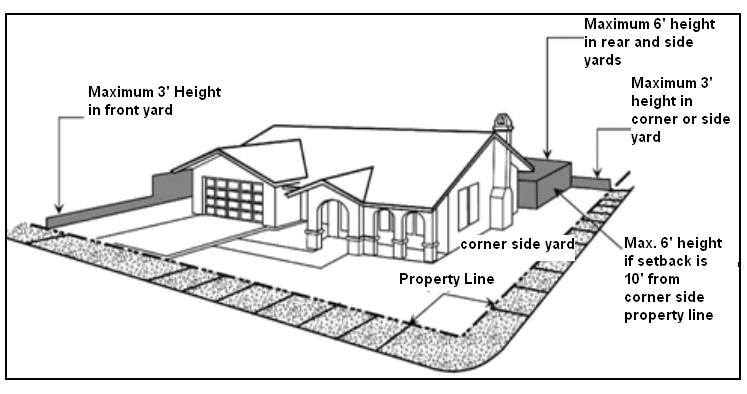
Figure 17.16-1 Fence Heights
Table 17.16-1 Maximum Height of Fences and Walls
5.
Temporary Security Fencing. Temporary security fencing (including chain link) with a maximum height of six feet may be erected around the property lines of vacant property. The vacant property shall be maintained in a weed and litter free condition.
6.
Retaining Walls. The location of any retaining wall located within a front yard or the side yard of a corner lot shall be at least two feet from the back of the sidewalk but subject to administrative approval from the engineering Department to assure that the structure is located outside of public rights-of-way and does not conflict with easements. There is no minimum setback requirement for a retaining wall located in a rear yard or the side yard of an interior lot less than 36 inches in height above finished grade. A higher wall may be allowed within a required setback with approval from the engineering Department. Embankments to be retained that are over 48 inches in height shall be benched so that no individual retaining wall exceeds a height of 36 inches, and each bench is a minimum width of 36 inches. Wood retaining walls are prohibited.
7.
Prohibited Materials. Sheet or corrugated iron, steel, aluminum, bamboo, or asbestos are prohibited, with the exception of ornamental fences approved by the Director. Barbed wire, razor wire, or electrified or similar type fences are prohibited.
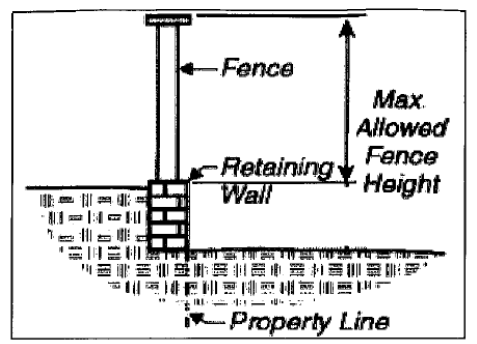
Figure 17.16-2 Fences and Retaining Walls
F.
Screening. Standards for the screening and separation of adjoining residential and nonresidential land uses, equipment and outdoor storage areas, and surface parking areas are as follows:
1.
Screening Between Different Land Uses. A commercial or industrial land use proposed on a site adjacent to a residential zoning district shall provide screening at the parcel boundary as follows. Other nonresidential uses adjacent to a residential use may also be required by the Planning Commission to comply with these requirements.
a.
The screen shall consist of plant materials or a solid, decorative wall of masonry, as approved by Planning Commission, or similar durable material, eight feet in height. The property owner shall be responsible for the long-term maintenance of the landscape screening. Openings or pedestrian connections may be required at the discretion of the Planning Commission.
b.
The decorative wall shall be architecturally treated on both sides, subject to the approval of the Planning Commission.
c.
A landscaping strip with a minimum width of five feet shall be installed adjacent to a screening wall.
(Ord. 1038, § 2, 2008; Ord. 1056, § 19, 2009; Ord. 1071, §§ 6, 7, 2011; Ord. 1083, § 7, 2012; Ord. 1100, § 2, 2014)
17.16.060 - Height measurement and height limit exceptions.
All structures shall meet the following standards relating to height, except for fences, which shall instead comply with Section 17.16.050 (Fencing, Screening and Walls).
A.
Maximum Height. The height of structures shall not exceed the height limit established by the applicable zoning District in this chapter, except as otherwise provided by this section. Maximum height shall be measured as the vertical distance from finished grade to an imaginary plane located the allowed number of feet above and parallel to the finished grade.
B.
Height Measurement. The maximum allowable height shall be measured as the vertical distance from the natural grade of the site to an imaginary plane located at the allowed number of feet above and parallel to the grade (see Figure 17.16-3). The location of the natural grade shall be determined by the Director, and shall not be artificially raised to gain additional building height.
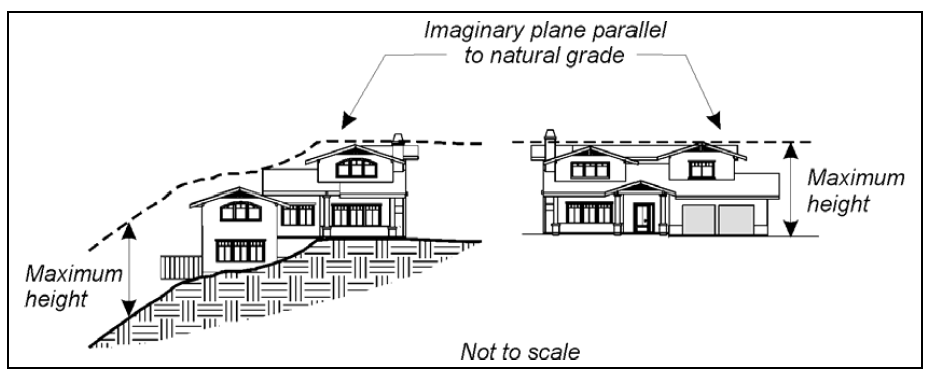
Figure 17.16-3 Height Measurement
C.
Detached Accessory Structures. Accessory buildings or structures exceeding 15 feet on a residential lot are subject to a Conditional Use Permit approval by the planning Commission.
D.
Fences. Height limits for fences are established by Section 17.16.050 (Fencing, Screening and Walls).
E.
Exceptions to height limits. The following structures and structural features may exceed the height limits of this Zoning Ordinance as noted:
1.
Elevator Penthouses and Lofts. Elevator penthouses, monitor and scenery lofts, and water tanks may exceed the height limits of this Zoning Ordinance, provided no side wall of these structures exceeds 50 percent of length of the nearest street property line of the site. The total floor area of all structures extending above the height limit on any site in compliance with this section, shall not exceed 25 percent of the lot area. These structures shall be set back at least 25 feet from all property lines other than those adjacent to streets.
2.
Public Assembly. Public assembly rooms in churches, schools and other allowed public and semi-public structures may exceed the height limit, provided that they are located on the first floor of the structure and that for each one foot by which the height of the structure exceeds the maximum height allowed in the zoning District, the side and rear setbacks shall be increased by an additional foot over the side and rear setbacks required for the highest structure allowed in the zoning District.
3.
Public Structures. In any zoning District where the maximum height is less than 75 feet, public and semi-public structures, public utility structures, churches, hospitals, schools, and other institutions allowed in the zoning District may be erected to a height not exceeding 75 feet; provided, that the required front, side and rear yards shall be increased by one foot for each one foot by which the structure exceeds the height limit established by the zoning District.
4.
Spires, Towers, Water Tanks, Etc. Belfries, chimneys, cupolas, domes, flag poles, gables, monuments, penthouses, scenery lofts, spires, towers (e.g., hose, radio, utility, water, etc.), water tanks, similar structures and necessary mechanical appurtenances may be authorized by the Planning Commission to exceed the height limit established for the applicable zoning District.
(Ord. 1038, § 2, 2008)
17.16.070 - Infill development.
The following standards apply to "infill development"—that is, multifamily structures or individual houses that entirely replace existing units or are constructed on vacant parcels between existing units. The standards are intended to provide for infill projects of high architectural quality that are compatible with existing development. They are also intended to promote the conservation and reuse of existing older houses, and to preserve the historical character of the city's older neighborhoods. Preservation and rehabilitation efforts in the older neighborhoods shall protect the architectural features of a home that identify its individual style and contribute to the character of the area.
A.
General Principles. Infill residential development shall:
1.
Be Compatible in Scale, Siting, Detailing, and Overall Character with Adjacent Buildings and Those in the Immediate Neighborhood. This is crucial when a new or remodeled house is proposed to be larger than others in the neighborhood. When new homes are developed adjacent to older ones, the height and bulk of the new construction can have a negative impact on adjacent, smaller scale buildings.
2.
Continue Existing Neighborhood Patterns. For example, patterns such as front porches and entries facing the street, finished floor height, and garages located at the rear of lots.
B.
Building Design. An infill residential structure shall incorporate the traditional architectural characteristics of existing houses in the neighborhood, including window and door spacing, exterior materials, roof style and pitch, ornamentation and other details.
C.
Visual Impacts from Building Height. The height of infill projects shall be consistent with of surrounding residential structures. Where greater height is desired, an infill structure should set back upper floors from the edge of the first story to reduce impacts on adjacent smaller homes, and to protect solar access.
D.
Outdoor Living Areas. The use of balconies, verandas, porches, and courtyards within the building form of infill structures is strongly encouraged.
E.
Exterior Finish Materials. The thoughtful selection of building materials can enhance desired neighborhood qualities such as compatibility, continuity, and harmony. The design of infill residential structures shall incorporate an appropriate mixture of the predominant materials found in the neighborhood.
F.
Exterior Colors. Color schemes for infill residential structures must consider the colors of existing houses in the neighborhood, to maintain compatibility.
(Ord. 1038, § 2, 2008)
17.16.080 - Landscaping design and standards.
A.
Purpose. This section implements the requirements of Government Code Sections 65591 et seq., by providing landscaping regulations that conserve water. These regulations are also intended to visually enhance the appearance of developments, reduce heat and glare, control soil erosion, screen incompatible land uses, preserve the integrity of neighborhoods, and improve pedestrian and vehicular traffic and safety and contribute to the image and appeal of the community.
B.
Application. A conceptual landscaping plan shall be submitted as part of an application for development. After approval of the development project application such as a Site and Architectural Review, Conditional Use Permit or Subdivision Map, a landscape plan application that complies with Chapter 15.22, Water Efficient Landscape, shall be prepared and submitted for review and approval at the time that an application for grading permit, building permit, or stormwater permit is submitted.
C.
Removal of Landscaping. Replacement of approved landscape area with nonporous or impervious surfaces shall be prohibited without the approval of an Administrative Permit from the Planning and Engineering Departments to assure compliance with landscape standards for the applicable land use and compliance with the city of Hollister Stormwater Permit.
D.
General Landscaping Standards. All landscaping required by this chapter, and all landscaping shown on preliminary and comprehensive landscaping and irrigation plans shall comply with the following requirements:
1.
All setback areas, parkways, and nonwork/storage areas that are visible from a public street or from a parking lot available to the public shall be landscaped. Areas proposed for development in another phase shall be temporarily treated to control dust and soil erosion if the phase will not begin construction within six months of completion of the previous phase;
2.
Trees shall be planted throughout the project in areas of public view, predominantly adjacent to and along structures and street frontages at a rate of at least one tree for each 30 linear feet of structure wall or street frontage;
3.
Landscape areas shall be a minimum of six feet to eight feet wide (excluding curbs). Narrower landscape areas may be permitted, but shall not be counted toward meeting minimum coverage requirements;
4.
Trees and shrubs shall be planted that are low maintenance, drought resistant, and so that at maturity they do not interfere with utility service lines, street lighting, traffic safety sight areas, pedestrian rights-of-way, on-site signs, and basic property rights of adjacent property owners, particularly the right of solar access;
5.
Trees planted near public bicycle trails, curbs and sidewalks shall be listed on the city of Hollister approved street tree planting list and shall be planted according to city standards.
6.
Landscape areas shall have plant material selected and plant methods used that are suitable for the soil and climatic conditions of the site. All plant material shall be maintained and replaced as needed;
7.
Parkway strips shall include design provisions to ensure blending and smooth transitions between different types and patterns of landscaping, or public and private property, utilizing street trees and complementary landscaping;
8.
All development sites shall provide landscaping within the front yard setback;
9.
Plant materials sizes shall comply with the following minimum mix and coverage capability:
Required Plant Materials Characteristics
10.
Mature specimen trees in 36-inch and 48-inch boxes with a minimum four-inch trunk diameter shall be provided within the project;
11.
Concrete mow strips (one foot wide) are required to separate all turf areas from other landscaped areas;
12.
Appropriate shrubbery and creeping vines are required along sound walls and fences adjoining public rights-of-way to reduce visual impact and discourage graffiti;
13.
When inorganic groundcover is used, it shall be in combination with live plants and shall be limited to an accent feature. Artificial plant material is prohibited;
14.
All single-family, multifamily, commercial, and industrial/manufacturing landscaping shall have automatic irrigation systems;
15.
Non-irrigated hydromulch seeds are acceptable for natural or undisturbed slopes. Hydromulch seeds shall be applied following the first measurable rainfall in the fall of the year or a temporary irrigation method shall be provided to ensure germination and minimum growth. If the natural rainfall fails to provide adequate moisture for germination, supplemental irrigation, and replanting may be required;
16.
An organic mulch at least two inches deep is an acceptable alternative to groundcover between shrubs and on non-slope areas. Whenever feasible, the origin of this mulch material shall be recycled yard trimmings and other organic wastes of local origin; All mulch must be contained in such a way as stormwater will not move the mulch;
17.
All new and infill single-family residential developments shall be provided with a combination of trees, shrubs, groundcover, and automatic irrigation systems in the front yard and that portion of the side yards visible from public rights-of-way;
18.
Where possible, comprehensive landscaping plans shall complement existing landscaping on neighboring properties to further promote compatibility;
19.
Above ground utility boxes may be placed within required landscaped areas, and utility facilities shall be screened from public view;
20.
Drainage easements and drainage ponds are required to be landscaped as approved by the City Engineer. A maximum slope of 4:1 within the drainage areas is required, or as approved by the City Engineer;
21.
Minimum requirements may be modified based upon the proposed use, design of adjacent use, and overall scale and impact of the project;
22.
Landscaped buffers shall be provided between incongruous land uses; eliminating intrusions into residential areas from nonresidential areas;
23.
Where possible, preserve existing significant trees and tree grouping, and replace trees removed due to site development;
24.
Where possible, plant drought-resistant native landscaping and including dual water lines for residential projects (one for clear water and one for recirculation of gray-water);
25.
Landscaping shall be designed to detain stormwater runoff with rain gardens, landscape swales and other strategies and capture sediments. Paving materials are encouraged to be permeable.
E.
Street Trees. On all new construction along street frontages within areas designated by the General Plan as special planning areas, the planting of parkway/street trees, of a variety from the City's Master Tree List is required. Street trees shall be installed in compliance with the following standards:
1.
Minimum Spacing Requirements.
a.
Spacing between trees.
i.
Spacing on single-family residential lots shall be one tree per street frontage except that street trees on lots with monolithic curbs shall be planted ten feet from the back of the curb,
ii.
Spacing on commercial or residential multifamily lots shall be one tree per 30 lineal feet provided that spacing requirements in subsection (b) are met;
b.
Spacing between trees and various street and utility fixtures shall be as follows:
i.
Thirty feet from the corner or stop sign,
ii.
Fifteen feet from streetlight and utility poles, and
iii.
Ten feet from driveways, sewers, and waterlines, fire hydrants.
2.
Street tree species shall be selected in compliance with the following standards/criteria:
a.
New street tree plantings in older areas of the city shall reflect, to the extent feasible, the existing species along the street, and every effort shall be made to match or effectively blend with existing plant materials;
b.
Street trees for a particular street shall generally require a uniform tree variety within a specified area in order to ensure ease of maintenance and maintain general aesthetic appearance;
c.
Trees that typically grow taller than 20 feet in height and that do not lend themselves to top trimming shall not be permitted under utility wires;
d.
Root barriers shall be provided for trees in landscape planters less than ten feet in width or located five feet or closer to a permanent structure, and no trees are permitted having roots that pull up sidewalks or wrap around underground utilities; and
e.
Trees shall be standard single trunk, not multi-trunked, except for a limited number of specimen trees; and a minimum size of 15-inch box with a minimum three-inch trunk diameter shall be required for each street tree. Each tree shall be eight to 12 feet tall with a minimum four-foot wide head at the time of planting.
3.
Safety Requirements. Landscape materials shall be located so that at maturity they do not:
a.
Interfere with safe sight distances for vehicular, bicycle, or pedestrian traffic,
b.
Conflict with overhead utility lines, overhead lights, or walkway lights, or
c.
Block or encroach into pedestrian or bicycle ways;
4.
Where parkways exist between the sidewalk and curb, street trees shall use tree wells with root barriers to mitigate against uprooting of sidewalks and curbs;
5.
Where the parkway is located behind the sidewalk, street trees shall be planted a minimum distance of five feet behind the sidewalk measured from the outer edge of the sidewalk to mitigate sidewalk and curb damage;
6.
All trees shall be free of insects, disease, mechanical injuries and other objectionable features at the time of planting;
7.
Any person/firm contracting to plant street trees shall post a performance bond guaranteeing the faithful performance of all irrigation and tree maintenance for a one-year period. The bond shall be an amount equal to the cost of the planting, irrigation, and maintenance as determined by the City Engineer; and
8.
No street tree shall be removed without the approval of the City Public Works Department.
F.
Maintenance of Landscaping.
1.
Ongoing maintenance of approved/installed landscaping is required and shall consist of regular watering, mowing, pruning, fertilizing, clearing of debris and weeds, the removal and replacement of dead plants, and the repair and replacement of irrigation systems and integrated architectural features.
2.
Prior to the approval of a Certificate of Occupancy for new development with a comprehensive landscaping plan, the project proponent shall file, with the city, a maintenance agreement and easement subject to the approval of the City Attorney. The agreement and easement shall ensure that if the landowner, or subsequent owner(s), fails to maintain the required/installed site improvements, the city may file an appropriate lien(s) against the property in order to accomplish the required maintenance.
(Ord. 1038, § 2, 2008; Ord. 1071, § 8, 2011)
17.16.090 - Lighting (outdoors).
A.
Purpose. The purposes of the outdoor illumination standards are to:
1.
Provide adequate lighting for safety and security;
2.
Reduce light pollution, light trespass, glare, sky glow impacts, and offensive light sources;
3.
Prevent inappropriate, poorly designed or installed outdoor lighting;
4.
Encourage quality lighting design, light fixture shielding, uniform light intensities, maximum lighting levels within and on property lines, and lighting controls; and
5.
Promote efficient and cost-effective lighting and to conserve energy.
B.
Applicability. Outdoor lighting on public, quasi-public and private property shall comply with the following requirements.
1.
An outdoor lighting feature shall be limited to a maximum height of 14 contiguous to residential neighborhoods and 24 feet or the height of the nearest building whichever is less in other areas.
2.
Outdoor lighting shall utilize energy-efficient (high pressure sodium, low pressure sodium, hard-wired compact fluorescent, or other lighting technology that is of equal or greater energy efficiency) fixtures/lamps. Alternatives are permitted provided they meet the requirements for an exception as detailed in IESNA (Illuminating Engineers Society of North America and the International Dark Sky Association) recommendations. Use of mercury vapor lighting shall be limited to outdoor display of commercial products such as the portion of a car lot with display of automobiles for sale where color recognition is important.
C.
Exemptions. The standards of this section shall not apply to the following types of exterior lighting:
1.
Ornamental Lighting. Ornamental landscape lighting where the maximum wattage of any single light fixture does not exceed the equivalent of 15 watts incandescent or 100 lumens and is not used from 10:00 p.m. to dusk.
2.
Strings of Light. Strings of light on residential properties shall be exempt from the requirements of this chapter.
3.
Aviation Lighting. Lighting used exclusively for aviation purposes. All heliport lighting shall be turned off when the heliport is not in use.
4.
Right-of-Way Lighting. Public lighting located within 15 feet from a property line within or next to a residential zoning district or within ten feet of a public right-of-way shall be aimed away from the property line or right-of-way, classified as IESNA Type III or Type IV, and shielded on the side facing the residential property or public right-of-way.
5.
There are special circumstances or conditions applying to the land, buildings, or outdoor light fixtures for which the exception is sought, which circumstances or conditions are unique to such land, buildings or outdoor light fixtures and do not apply generally to the land, buildings or outdoor light fixtures in the subdivision: The exception shall be subject to Administrative Site and Architectural Review.
D.
Outdoor Lighting Design Standards.
1.
Lighting shall be shielded with full cut-off or recessed to reduce light bleed to adjoining properties, public rights-of-way and the night sky as shown on Figure 17.16-4 with the following:
a.
Ensuring that the light source (e.g., bulb, etc.) is not visible from off the site; and
b.
Confining glare and reflections within the boundaries of the property;
c.
Each light fixture shall be directed downward and away from adjoining properties and public rights-of-way.
2.
No permanently installed lighting shall blink, flash, or be of unusually high intensity or brightness, as determined by the Director.
3.
All lighting fixtures shall be appropriate in scale, intensity, and height to the use they are serving.
4.
Pan channel signs (letters only) shall not exceed maximum luminance ratings (unit of brightness). Enforcement will occur on a complaint basis for LED or luminance greater than 1,000 candela per meter squared or 1,000 flits. All lighting of signage shall comply with the adopted sign regulations.
5.
Replacement of fixtures shall be a conforming light fixture and fully shielded and mounted to downward away from adjoining properties.
6.
Small Decorative Lights on Strings. Small low wattage or low voltage decorative lights on a string may be used subject to the Development Services Director approval or as part of the lighting plan for a Site and Architectural Review to create ambiance and pleasing pedestrian spaces in an energy efficient manner. Such lighting shall be limited to pedestrian areas including plazas, patios, landscape features and primary entries into buildings. No such illumination is allowed in any required landscaped setback adjacent to a street; or for lighting displays from the second Thursday in November through the last Thursday in January.
7.
Canopy lighting. Lighting fixtures mounted on canopies shall be installed such that the bottom of the light fixture or its lens, whichever is lower, is recessed or mounted flush with the bottom surface of the canopy and parallel to the ground. A full cut off light fixture may project below the underside of a canopy. All light emitted by an under canopy fixture shall be substantially confined to the ground surface directly beneath the perimeter of the canopy. No lighting except that permitted by the sign ordinance shall be permitted on the top or sides of a canopy (see Figure 17.16-6).
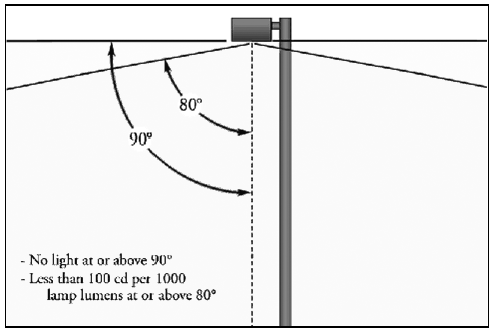
Figure 17.16-4 Full Cutoff Fixture
D.
Hours of Operation.
1.
Standards for the Operation of Light Fixtures. All light fixtures shall operate in accordance with the requirements of this section.
a.
When Lights are to be Turned Off. Lights shall be controlled by automatic timers and turned off by 10:00 p.m. or within one hour of the close of the facility. After 10:00 p.m., controls such as motion sensors are required during post-curfew hours. Motion sensors or timers may also be used to activate additional lighting during emergency situations.
b.
Parking Lot Light Fixtures. All parking lot light fixtures, except the minimum necessary for security, shall be extinguished by 10:00 p.m. or within one hour after the close of the facility, and remain extinguished until dawn or one hour prior to the commencement of business, whichever is earlier.
c.
Nonessential Lighting. All nonessential lighting shall be turned off after the close of business. Nonessential lighting includes but is not limited to lighting of landscaping, architectural features, tennis courts, ball fields, etc.
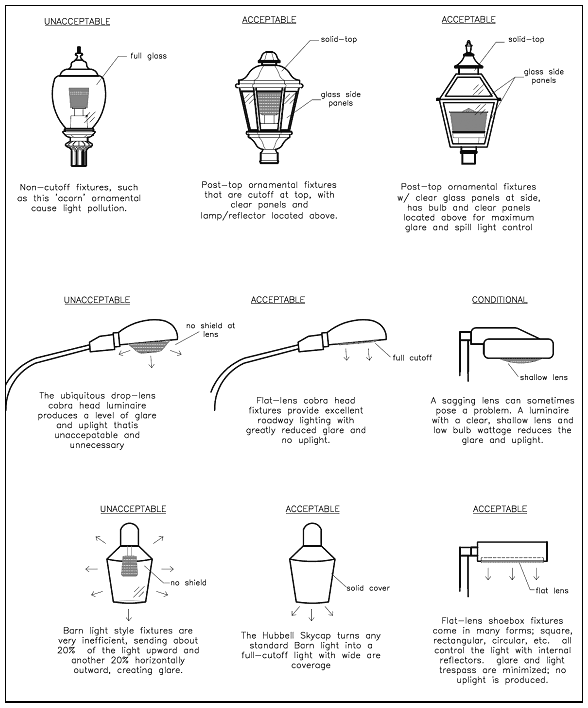
Figure 17.16-5 Lighting Fixtures
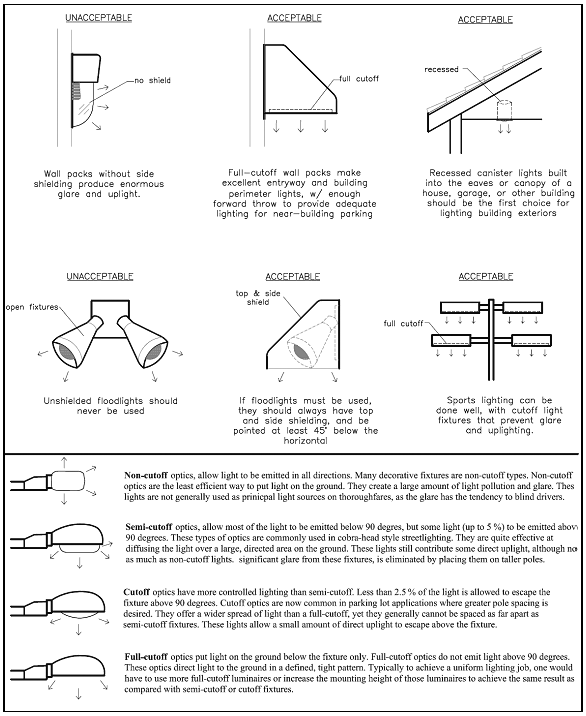
Figure 17.16-6 Lighting Fixtures
(Ord. 1038, § 2, 2008)
17.16.100 - Noise.
A.
Unless Otherwise Exempt, Commercial Construction. Commercial construction activities on and contiguous to residential properties shall be limited to the hours of 7:00 a.m. to 6:00 p.m., Monday through Friday and 8:00 a.m. to 6:00 p.m. on Saturday and shall be prohibited on Sundays and federally recognized holidays.
B.
Commercial Landscaping and Grounds Maintenance.
1.
Routine commercial landscaping and grounds maintenance activities for a duration of one-half hour or less with noise generating equipment such as gas lawn mowers, leaf blowers, chippers and similar equipment shall be limited within and near residential properties to the hours of 8:00 a.m. to 6:00 p.m., Monday through Friday and 8:00 a.m. to 6:00 p.m. on Saturdays and Sundays and federally recognized holidays.
2.
Commercial landscaping activities with noise generating equipment used for a duration of one hour or more shall be limited within and near residential properties to the hours of 8:00 a.m. to 6:00 p.m., Monday through Friday and 8:00 a.m. to 5:00 p.m. on Saturday and shall be prohibited on Sundays and federally recognized holidays.
C.
This section shall not apply to works of construction, landscaping or grounds maintenance by the occupants of a residential property conducting the works of construction, landscaping or grounds maintenance for personal non-commercial use.
(Ord. 1137, §§ 1, 2, 2017)
17.16.110 - Setback measurements and permitted projections.
A.
Purpose. This section establishes standards for the use of and the minimum size of yards. The purpose of these standards is to provide for open areas around structures for: visibility and traffic safety; access to and around structures; access to natural light, ventilation and direct sunlight; separation of incompatible land uses; and space for privacy, landscaping and recreation.
B.
Setback Requirements. All structures shall conform with the setback requirements established for each zoning District in this chapter, except as otherwise provided by this section. In no case shall any portion of any structure, including eaves or roof overhangs, extend beyond a property line or into an access vehicular easement or street right-of-way. Each required yard shall be open and unobstructed from the ground upward, except as provided in this section.
C.
Exemptions from Setback Requirements. The minimum setback requirements of this Zoning Ordinance apply to all uses except the following:
1.
A building feature that projects into a required setback allowed by subsection E of this section;
2.
A fence or wall eight feet or less in height above the grade of the site, when located outside of a front or street side setback;
3.
Decks, earthworks, steps, terraces, and other site design elements that are placed directly upon grade and do not exceed a height of 18 inches above the surrounding grade at any point;
4.
A retaining wall less than 36 inches in height above finished grade. A higher wall may be allowed within a required setback with design review.
D.
Measurement of Setbacks. Setbacks shall be measured as follows:
1.
Front Yard Setbacks. The front yard setback shall be measured from the back of the sidewalk to the nearest point of the wall of the structure. The front property line is the most narrow dimension of a lot adjacent to a street.
a.
Flag Lots. The measurement shall be taken from the nearest point of the wall of the structure to the point where the access strip meets the bulk of the parcel; establishing a building line parallel to the lot line nearest to the public street or right-of-way.
b.
Corner Lots. The property line to be used for the front yard setback measurement shall be determined by the entry to the structure except when the garage entrance is on the other street frontage.
c.
Double-Frontage Lots. Proposed development on a double-frontage lot shall comply with the front yard setback requirements of the applicable zoning District on both street frontages.
2.
Side Yard Setbacks. The side yard setback shall be measured at right angles from the nearest point on the side property line of the parcel to the nearest line of the structure establishing a setback line parallel to the side property line, which extends between the front and rear yards.
3.
Street Side Yard Setbacks. The side yard on the street side of a corner lot shall be measured from the back of the sidewalk.
4.
Rear Yard Setbacks. The rear yard shall be measured at right angles from the nearest point on the rear property line of the parcel to the nearest line of the structure establishing a setback line parallel to the rear property line, except as follows: The rear yard on the street side of a double frontage lot shall be measured from the nearest point of the rear property line adjoining the street; provided, however, that if an access easement or street right-of-way line extends into or through a rear yard, the measurement shall be taken from the nearest point of the easement or right-of-way line.
a.
Cul-de-Sac and Irregular Lots. At the Director's discretion, as long as health and safety requirements are not jeopardized, where the side lot lines converge to a point, a line five feet long within the parcel, parallel to and at a maximum distance from the front lot line, shall be deemed to be the rear lot line for the purpose of determining the depth of the required rear yard. In these circumstances, the Director can establish rear setback of ten feet (See Figure 17.16-7).
b.
Rear Yard Adjacent to an Alley. The rear yard shall be measured at right angles from the nearest point on the rear property line to the nearest line of the structure, establishing a setback line parallel to the rear property line. This provision shall not reduce the depth of any residential rear yard to less than 15 feet to the property line, provided, that in no case shall the door of any structure, except a fence, which door opens into an alley, be established closer than 15 feet to the center of the alley.
5.
Side or Rear Yard Setbacks on Irregular Lots. Where the building wall is not parallel to a side or rear lot line, the required least dimension of the side yard or the rear yard along such line may be applied to the average, provided that no such side yard shall be less than three feet in width at the corner of the building, and no such rear yard shall be less than ten feet in depth at an edge of a building or at any point.
E.
Permitted Projections into Setbacks. The following architectural features may extend beyond the wall of the structure and into the front, side and rear yard setbacks, as follows:
1.
Chimneys. A chimney may extend 30 inches into a required setback, but shall be no closer than four feet to a property line;
2.
Cornices, Eaves and Roof Overhangs. Cantilevered architectural features including balconies, bay windows, canopies, cornices, eaves and solar equipment, which do not increase the floor area within the structure, may extend up to three feet into a required yard but shall not be closer than three feet to a property line (this does not apply to accessory structures within five feet of a property line);
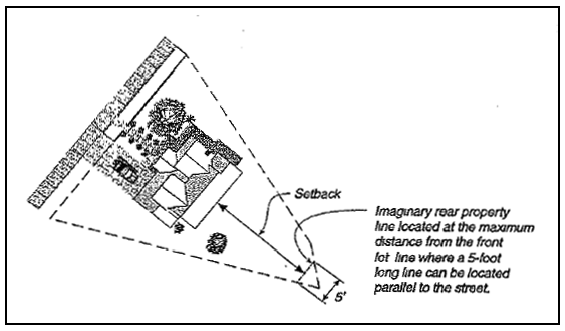
Figure 17.16-7 Rear Setback for Irregular Parcels
3.
Decks. An attached deck or uncovered landing place, not exceeding 30 inches in height above the surrounding natural/finish grade, may extend into required setbacks as follows:
a.
Side Yard. An uncovered deck may extend up to three feet into a required side yard setback, but shall be no closer than four feet to a side property line; and
b.
Rear Yard. An uncovered deck may extend up to five feet into a required rear yard setback.
4.
Fire Escapes. No fire escape shall project into a required yard more than four feet, six inches.
5.
Porches. A covered, unenclosed porch, located at the same level as the entrance floor of the structure may extend into required yards as follows:
a.
Front Yard. A porch may extend up to six feet into a required front yard setback except in front of garages.
b.
Side Yard. A porch may extend up to three feet into a required side yard setback, but no closer than five feet to a side property line.
6.
Stairways. Stairways and landings that are not roofed or enclosed above or below the steps, or does not extend above a ground floor entrance, except for the railing, may extend into required setbacks as follows:
a.
Side Yard. A stairway may extend up to three feet into a required side yard setback, but no closer than four feet to a side property line; and
b.
Rear Yard. A stairway may extend up to six feet into a required rear yard.
7.
Patio Covers.
a.
All water shall be contained on the property.
b.
Patio covers attached to a main residential building may be located in the required rear or side yard as follows:
(i)
All posts supporting the patio cover must be a minimum of five feet from the side or rear property line.
(ii)
For those residential buildings not parallel to the side or rear lot line, the patio cover may have a setback of not less than three feet at the corner of the cover.
(iii)
Eaves may be permitted for patio covers within the required setback not more than one-third of the required setback, unless not authorized by the City Building Code.
F.
Setback Requirements for Specific Structures.
1.
Detached Accessory Structures. See Section 17.16.040 (Residential Accessory Uses and Structures).
2.
Fences. See Subsection 17.16.050 (Fencing and Screening).
(Ord. 1038, § 2, 2008; Ord. 1056, § 20, 2009)
17.16.120 - Solar energy development standards.
Passive heating and cooling opportunities shall be incorporated in all developments in the following manner:
A.
Orientation of Structures. All future structures shall be oriented to maximize solar access opportunities;
B.
Lot Design. Lot sizes/configurations shall be designed to maximize the number of structures oriented so that the south wall and roof area face within 45 degrees of due south, while permitting the structures to receive cooling benefits from prevailing breezes and existing and proposed shading.
C.
Collector Installation. Solar collectors shall be located/installed in the following manner:
1.
Roof-mounted solar collectors shall be placed in the least conspicuous location without reducing the operating efficiency of the collectors;
2.
Wall-mounted and ground-mounted collectors shall be screened from public view, to the maximum extent feasible;
3.
Roof-mounted collectors shall be installed at the same angle or as close as possible to the pitch of the roof;
4.
Appurtenant equipment, particularly plumbing and related fixtures, shall be installed in the attic whenever possible or screened from public view, to the maximum extent feasible; and
5.
Encourage for new construction the use of exterior surfaces of the collectors and related equipment shall have a matte finish and shall be color-coordinated to harmonize with roof materials and other dominate colors of the structure.
(Ord. 1038, § 2, 2008)
17.16.130 - Solid waste/recyclable materials storage.
This section provides standards for the construction and operation of solid waste and recyclable material storage areas in compliance with the California Solid Waste Reuse and Recycling Access Act (Public Resources Code Sections 42900 through 42911, as may be amended from time to time).
A.
Residential Structures. Multifamily residential developments, with five or more dwelling units, shall provide solid waste and recyclable material storage areas as follows:
1.
Individual Unit Storage Requirements. Each dwelling unit shall include an area with a minimum of six cubic feet designed for the internal storage of solid waste and recyclable material. A minimum of three cubic feet shall be provided for the storage of solid waste and a minimum of three cubic feet shall be provided for the storage of recyclable material; and
2.
Common Storage Requirements. The following are minimum requirements for common solid waste and recyclable material storage areas for multifamily developments, which may be located indoors or outdoors as long as they are readily accessible to all residents. These requirements apply to each individual structure. All required areas are measured in square feet.
B.
Nonresidential Structures and Uses. Nonresidential structures and uses within all zoning Districts shall provide solid waste and recyclable material storage areas. The following are minimum storage area requirements. These requirements apply to each individual structure. All required areas are measured in square feet.
C.
Location Requirements. Solid waste and recyclable materials storage areas shall be located as follows:
1.
Solid waste and recyclable material storage shall be adjacent/combined with one another. They may only be located inside a specially-designated structure, on the outside of a structure in an approved fence/wall enclosure, a designated interior court or yard area with appropriate access, or in rear yards and interior side yards. Exterior storage area(s) shall not be located in any required front yard, street side yard, any required parking, landscaped or open space areas or any area(s) required by the Municipal Code to be maintained as unencumbered;
2.
The storage area(s) shall be accessible to residents and employees. Storage areas within multifamily residential developments shall be located within 250 feet of an access doorway to the dwellings which they are intended to serve;
3.
Driveways or aisles shall provide unobstructed access for collection vehicles and personnel and provide at least the minimum clearance required by the collection methods and vehicles utilized by the designated collector. In all cases where a site is served by an alley, all exterior storage area(s) shall be directly accessible to the alley; and
4.
Solid waste receptacles for single-family homes shall be stored within the enclosed garage or behind a fence, if such structure exists.
D.
Design and Construction. The design and construction of the storage area(s) shall:
1.
Be compatible with the surrounding structures and land uses;
2.
Be properly secured to prevent access by unauthorized persons, while allowing authorized persons access for disposal of materials;
3.
Provide a concrete pad within the fenced or walled area(s) and a concrete apron which facilitates the handling of the individual bins or containers;
4.
Protect the areas and the individual bins or containers provided within from adverse environmental conditions which might render the collected materials unmarketable; and
5.
The storage area(s) shall be appropriately located and screened from view on at least three sides. The design shall be architecturally compatible with the surrounding structures and subject to the approval of the Director.
6.
Trash enclosures shall be designed to meet city of Hollister waste disposal provider standards. The trash enclosure must be constructed out of cinderblock concrete or stucco material and be easily accessible.
(Ord. 1038, § 2, 2008)
17.16.140 - Stormwater management.
All new development and redevelopment land use activities (i.e., residential, commercial, industrial, recreation, public/quasi-public, construction, grading, landscaping and paving) are subject to the State of California MS4 General Permit Order No. 2013-0001-DWQ, subsequent amendments, or successor orders, as applicable. To ensure that this occurs, appropriate stormwater management procedures shall include, but are not limited to, the following:
A.
Drainage.
1.
All new development and redevelopment post-construction drainage improvements shall be designed in accordance with the requirements of the California Regional Water Quality Control Board, Central Coast Region, Resolution R3-2013-0032 or subsequent amendments thereto, as applicable.
2.
Drainage from roof gutters from residential, commercial, industrial, public and other buildings including accessory structures shall be directed to rain gardens, landscape areas, vegetative swales, or retention or detention ponds approved by the City Engineering Department.
3.
The use of multi-use stormwater management facilities including: parks and recreation areas, permeable paving in interior pedestrian areas, patios or plazas is encouraged.
4.
Whenever feasible, every effort to design, construct, and install underground stormwater infiltration basins for all new and redevelopment projects instead of utilizing open retention or detention ponds for stormwater management shall be made. If it is infeasible for a development to meet this requirement the development's design engineer shall submit a letter explaining the reason it is infeasible for the City Engineer's review and approval consideration.
5.
Projects unable to meet the post-construction drainage standards shall be required to pay fees for city-wide stormwater pollution control and management.
6.
Existing properties shall be maintained to comply with the adopted city of Hollister Stormwater Management Program.
B.
Grading Permit. Any person engaged in activities involving land disturbance, soils storage, clearing and grading operations, construction and installation of improvements in new development and redevelopment projects, as well as, any and all activities which alter the volume, rate or direction of stormwater runoff shall obtain required permits pursuant to Chapter 15.24 "Grading Best Management Practices Control" of the Hollister Municipal Code from the city of Hollister Engineering Department.
C.
Stormwater Quality. Any person engaged in activities which may result in pollutants entering the city storm drain system shall undertake all practicable measures to reduce such pollutants, including, but not limited to grease and sediment collections facilities and shall be responsible for maintaining the facilities.
1.
Standard for Parking Lots and Similar Structures. Persons owning or operating a parking lot, gas station pavement, contractor's equipment yard or similar structures having impermeable surfaces, shall clean such structures as frequently and thoroughly as practicable. Sweepings shall be collected in a manner that does not result in discharge of pollutants to the city storm drain system or surface water.
2.
Compliance with Stormwater Best Management Practices. Where stormwater best management practices guidelines or stormwater requirements have been adopted by any federal, state of California, central coast regional water quality control board, or the city of Hollister, for any activity, operation, or facility which may cause or contribute to stormwater pollution or contamination, illicit discharges, or discharge of non-stormwater to the stormwater system, every person undertaking such activity or operation, or owning or operating such facility, shall comply with such guidelines or requirements as may be prescribed by the City Engineer.
3.
Littering. No person shall throw, deposit, leave, maintain, keep, or permit to be thrown, deposited, placed, left or maintained, any refuse, rubbish, garbage, or other discarded or abandoned objects, articles, and accumulations, in or upon any street, alley, sidewalk, storm drain, inlet, catch basin, conduit or other drainage structures, business place, or upon any public or private lot of land in the city, so that the same might be or become a pollutant, except in refuse containers or in lawfully established waste disposal facilities. The occupant or tenant, or in the absence of occupant or tenant, the owner, lessee, or proprietor of any real property in the city of Hollister in front of which there is a paved sidewalk shall maintain said sidewalk free of dirt or litter to the maximum extent practicable.
(Ord. 1038, § 2, 2008; Ord. 1063, § 4, 2010; Ord. 1071, § 13, 2011; Ord. 1177, § 5, 2019)

