
Homewood City Zoning Code
ARTICLE X
- SIGNS
Sec. 44-10-01.- Intent and purpose.
The purpose of this section is to ensure the regulation of signage in a manner that is protective of public safety, health, and general welfare while promoting the overall aesthetic quality and maintenance of the Village of Homewood. This section is written to achieve the following purposes in the interest of the public:
•
Protect the safety of motorists and pedestrians through the placement of signage in safe and appropriate locations along public and private streets.
•
Ensure contextually appropriate signage that contributes to the scale, form, and overall character of existing or planned development.
•
Balance the aesthetic enhancement of the public community with the economic needs and rights of private property owners.
•
Regulate signage in a manner that preserves the right to free speech and expression as protected by state and federal law.
•
Establish fair and comprehensive procedures for administrative decisions and public review for signage.
•
Define and establish property responsibility and courses of action for abandoned and non-conforming signage structures.
(Ord. No. MC-1089, § 2.4.(Exh. A), 8-26-2025)
Sec. 44-10-02. - Applicability.
(a)
General applicability. All signs constructed, maintained, displayed, or altered within the village shall receive an approved sign permit, except those explicitly identified in subsection 44-10-02(b) as exempt from permit requirements. All signs required to receive a sign permit within the Village of Homewood shall be required to conform to all requirements set forth in this section.
(b)
Exempt signs. The following sign types are exempt from sign permit requirements. Exempt sign types shall be subject to the provisions of Table 44-10-02(b)(1). Exempt sign types constructed in any manner not conforming to the regulations of Table 44-10-02(b)(1) are prohibited unless otherwise explicitly permitted in this section. Any exempt sign type constructed, maintained, displayed, or altered within the village shall remain subject to applicable building codes adopted by the Village of Homewood.
(c)
Regulatory protections and restrictions. All sign requirements and sign review procedures shall be subject to the following regulatory protections:
(1)
In no event shall consideration for approval be based upon the messaging or specific content of any proposed or existing sign.
(2)
All approved signage shall be accessory to a permitted principal use on any property.
(3)
In no event shall consideration for approval be based upon the principal use to which a sign is an accessory, except where use restrictions are stated within the content of this chapter.
(4)
The provisions of this chapter regulating the location, placement, size, projection, height and number of signs or other related structures shall be subject to and may be further restricted by any applicable provision of the present or hereafter adopted zoning ordinance of the village, including provisions therein relating to nonconforming structures and uses.
(5)
No proposed construction, installation or alteration of a sign or sign structure shall be regulated in any manner not explicitly stated in the provisions, prohibitions and exemptions stated in this section.
(Ord. No. MC-1089, § 2.4.(Exh. A), 8-26-2025)
Sec. 44-10-03. - Prohibited signs.
(a)
General prohibitions. It is unlawful to erect or maintain any of the following sign types in any zoning district within the Village of Homewood, except in instances explicitly permitted in this section:
(1)
Signs located on fences and walls not part of a building or structure, including both temporary and permanent signs;
(2)
Signs located on stationary vehicles with the primary purpose of attracting attention or providing messages;
(3)
Signs including illuminated tubing, rope lights, neon lights, and other exposed lighting tracing architectural features or sign components (including any sign messaging);
(4)
Flashing signs;
(5)
Moving or animated signs;
(6)
Advertising signs;
(7)
Roof signs;
(8)
Signs mounted to trees, utility poles, or other areas not designed to support the installation of a sign or sign component;
(9)
Signs located in public right-of-way, unless explicitly permitted by regulations or exempted from regulation;
(10)
Off-premises signs.
(Ord. No. MC-1089, § 2.4.(Exh. A), 8-26-2025)
Sec. 44-10-04. - Sign measurements.
(a)
Sign area measurements.
(1)
Wall signs.
a.
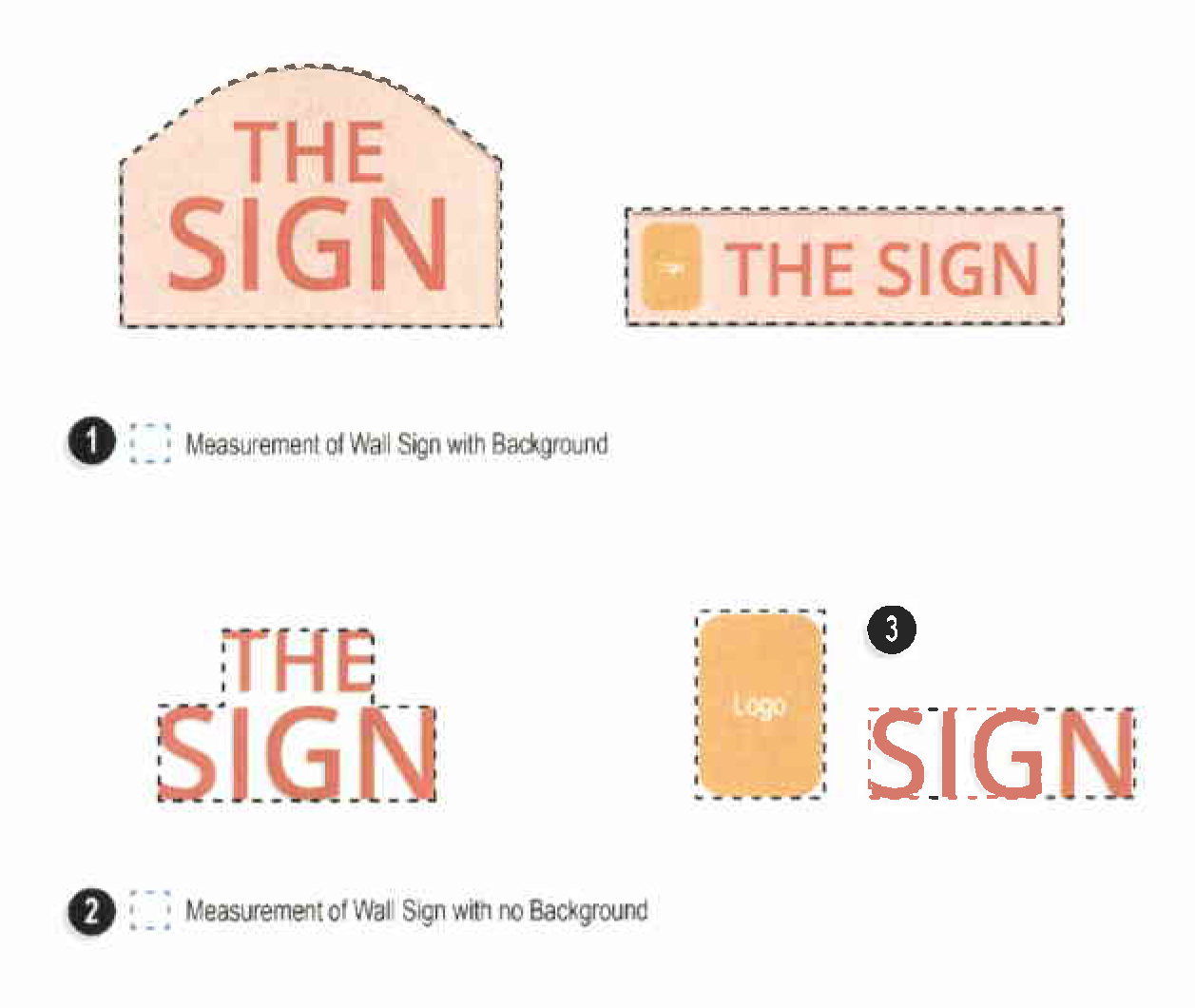
Wall sign with background. For any wall sign that is framed, outlined, painted, or otherwise constructed in a manner that creates a background to differentiate the sign from the structure on which it is placed, the entire area of the sign, including all background colors and features, shall be included in the total sign area. Wall signs with backgrounds shall be measured using the guide in Figure 44-10-04(a)(1).
b.
Wall sign with no background. For any wall sign that consists of distinct letters, logos, or other elements placed directly on a structure, the area of the sign shall consist of the smallest simple geometry forming a perimeter around the extreme limits of the sign. Wall signs with no background and formed from distinct letters, logos, and other elements shall be measured using the guide in Figure 44-10-04(a)(1).
Figure 44-10-04(A)(1) Wall Sign Area Measurements
(2)
Freestanding signs.
a.
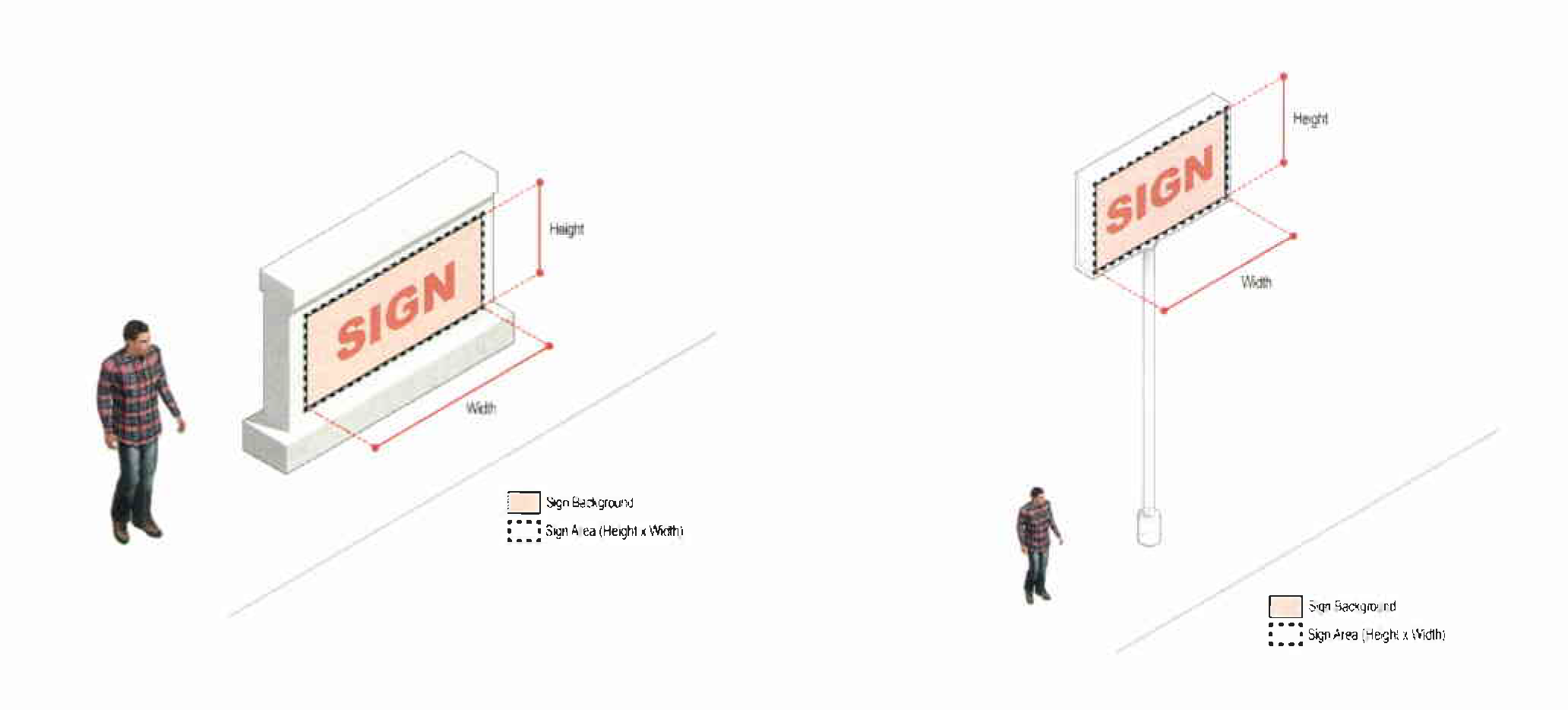
Monument signs. For any monument sign, the area of the sign shall consist of the smallest geometry forming a perimeter around the sign, including any background. Architectural or structural elements utilized in the design of a monument sign shall not be counted in the sign area. Monument signs shall be measured using the guide in Figure 44-10-04(a)(2).
b.
Pole/pylon signs. For any pylon sign, the area of the sign shall consist of the smallest geometry forming a perimeter around the sign, including any background. Architectural or structural elements, including poles or other support structures, shall not be counted in the sign area. Pole/pylon signs shall be measured using the guide in Figure 44-10-04(a)(2).
Figure 44-10-04(a)(2) Freestanding Sign Area Measurements
(3)
Other sign types.
a.
Painted signs. The area of any painted sign shall be measured as the full extent of the area to which paint is applied, which is distinct from the overall color, material, or finish of the structure on which the sign is located.
b.
Awning signs. The area of any awning sign shall consist of the smallest geometry forming a perimeter around any letters or logos affixed to the awning structure.
c.
Electronic changing message (ECM) signs. The entire area of any electronic display installed as an electronic changing message (ECM) sign shall be measured as the sign area.
(b)
Sign height measurements.
(1)
Height.
a.
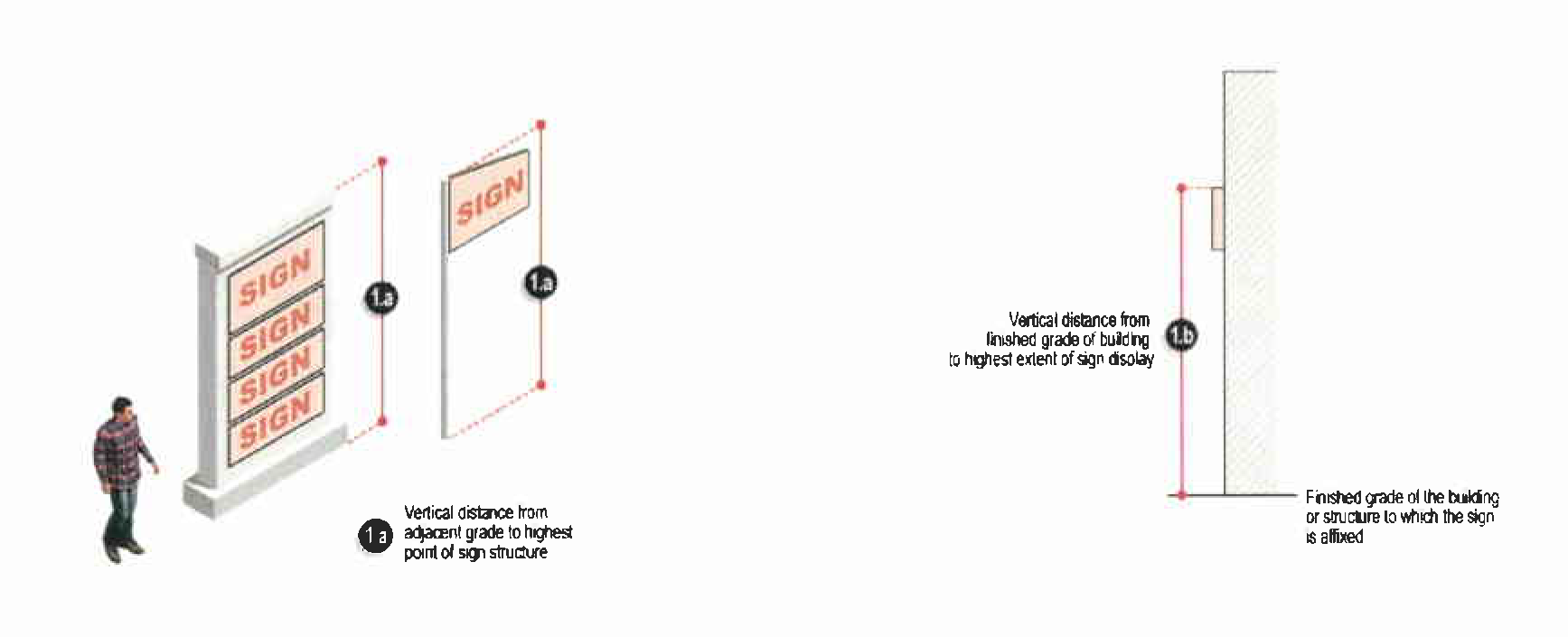
Freestanding signs (pole/pylon sign, ground/monument sign). The height of a freestanding sign shall be measured as the vertical distance from the adjacent grade to the highest point of the structure. The measurement shall include all structural or architectural elements surrounding, enclosing, or affixed to the sign structure. Height shall be measured using the guide in Figure 44-10-04(b)(1).
b.
All other signs. The height of any sign not included in subsection 44-10-04(b)(1)a. shall be measured as the vertical distance from the adjacent grade of the building or structure to which the sign is affixed to the highest extent of any lettering, logos, or backgrounds comprising the sign display. Height shall be measured using the guide in Figure 44-10-04(b)(1).
Figure 44-10-04(b)(1) Sign Height Measurements
(2)
Clearance.
a.
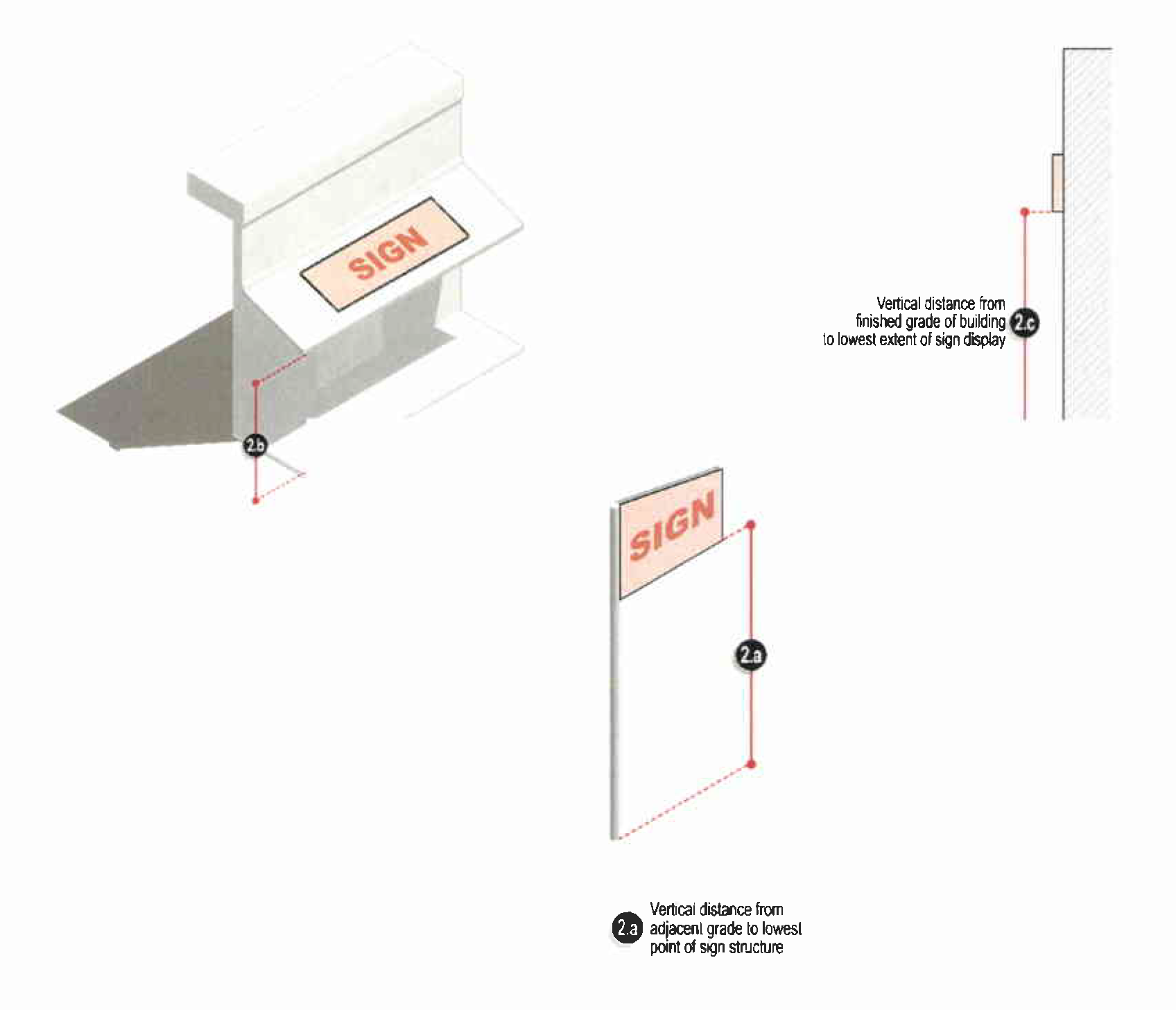
Freestanding signs (pole/pylon sign). Clearance of a freestanding sign shall be measured as the vertical distance from the adjacent grade to the lowest point of the structure, not including pole supports or architectural elements less than six feet above the adjacent grade.
b.
Awning signs. Awning clearance shall be measured as the vertical distance from the finished grade of the building to the lowest point of the structure, including valences or other hanging elements.
c.
All other signs. Clearance for all signs not included in subsection 44-10-04(b)(2)a. or subsection 44-10-04(b)(2)b. shall be measured as the vertical distance from the finished grade of the building to the lowest extent of any lettering, logos, or backgrounds comprising the sign display.
Figure 44-10-04(b)(2) Sign Clearance Measurements
(c)
Frontage measurements.
(1)
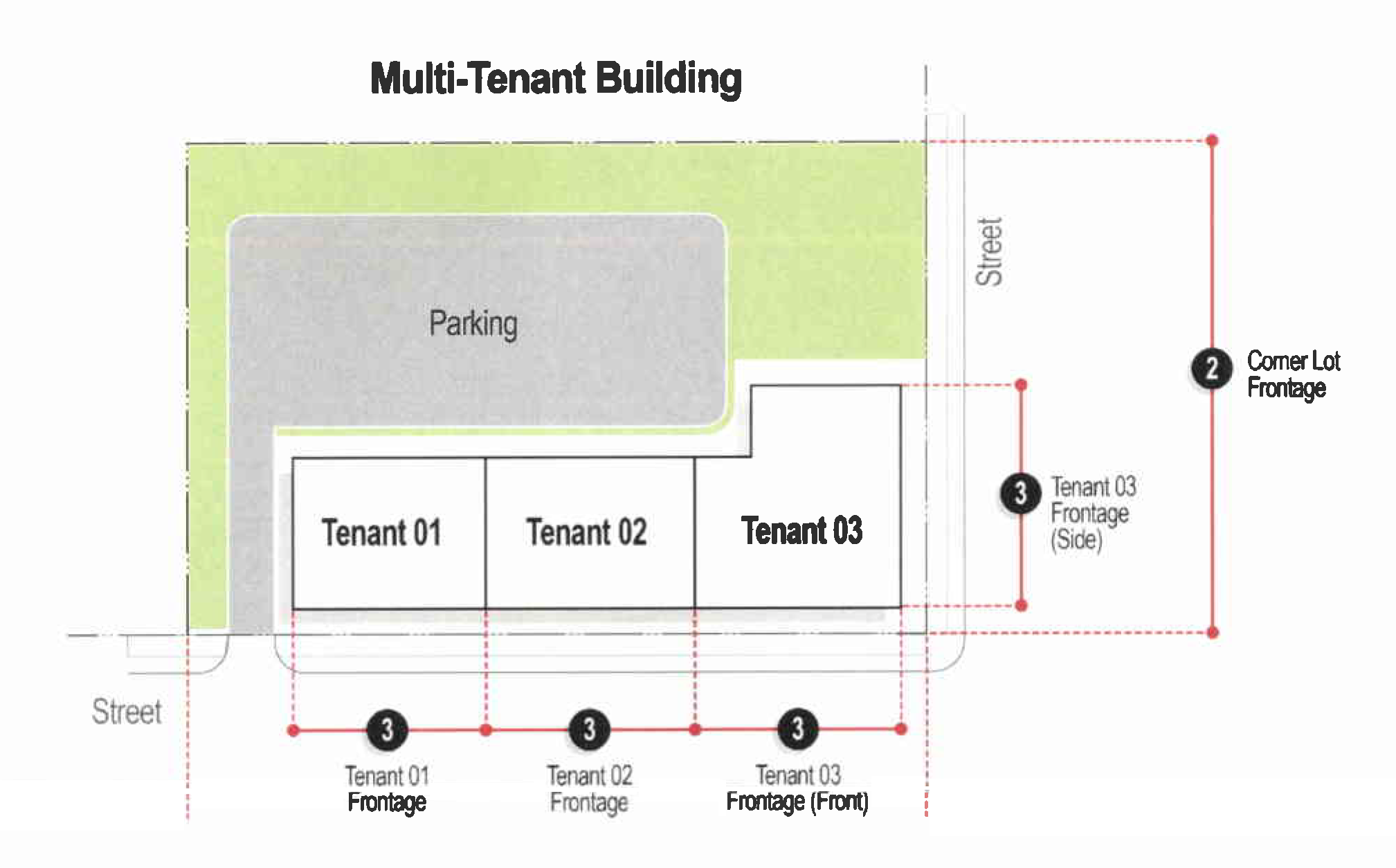
Lot frontage. Lot frontage is to be measured as the length of a lot line adjacent to a street or other public right-of-way.
(2)
Corner lot frontage/multiple lot frontages. For lots with two or more frontages on a public street or other public right-of-way, lot frontage is to be measured as the sum of the lengths of each lot line adjacent to the street or public right-of-way.
(3)
Tenant frontage. Tenant frontage is to be measured as the maximum horizontal extent of the floor plan of a single tenant on the facade or building side on which the tenant entrance is located. In single-tenant buildings, the tenant frontage shall consist of the frontage of the entire building. In multi-tenant buildings, tenant frontage shall be measured as the maximum width of a tenant space based on approved floor plan drawings.
Figure 44-10-04(c)(1) Frontage Measurements for Single-Tenant Buildings
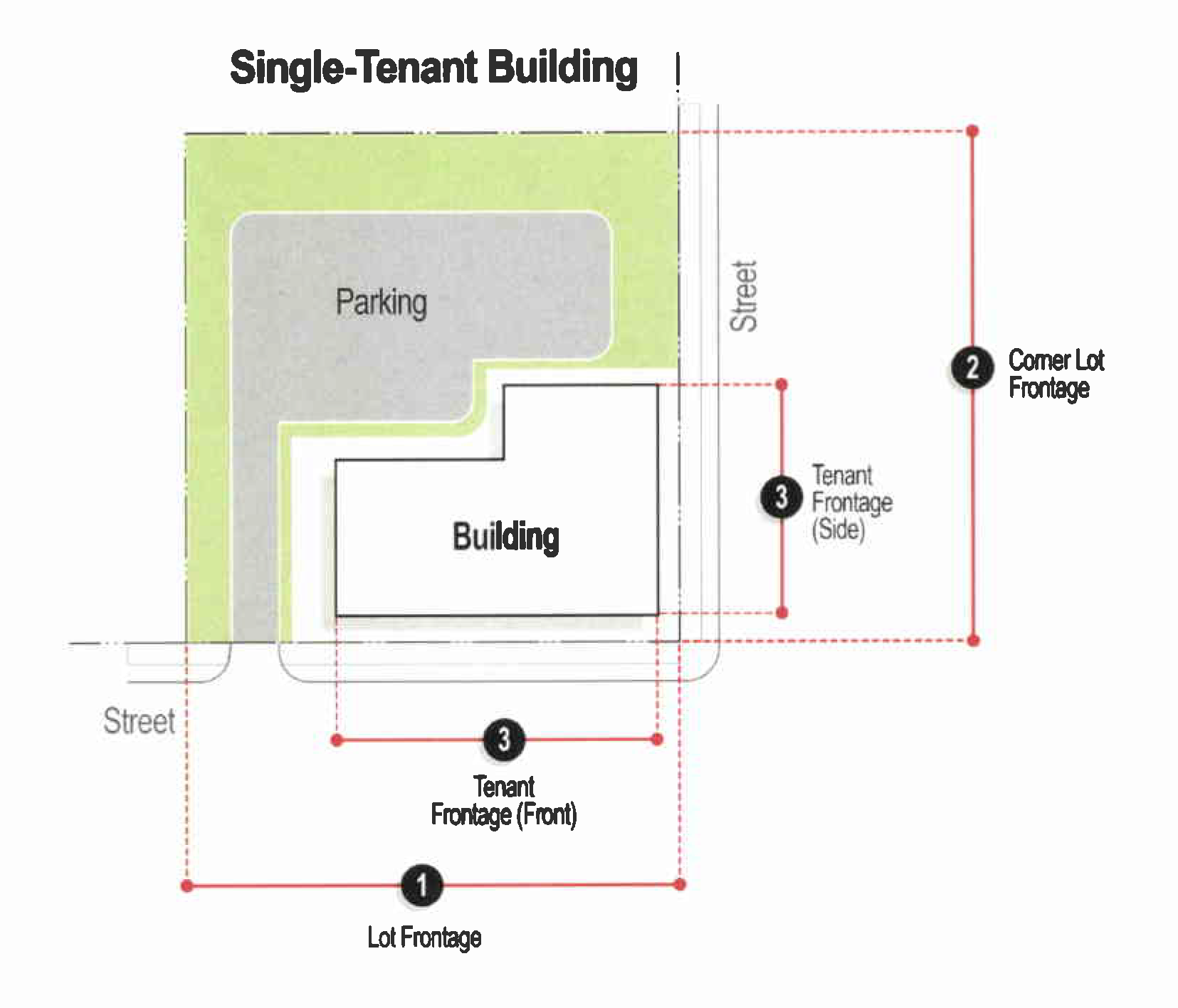
Figure 44-10-04(c)(2) Frontage Measurements for Multi-Tenant Buildings
[RESERVED—Additional sign measurements upon zoning interpretation]
(Ord. No. MC-1089, § 2.4.(Exh. A), 8-26-2025)
Sec. 44-10-05. - Non-commercial and historical signs.
(a)
Residential signs.
(1)
Single-family residential/duplex. No sign regulated by the provisions of this section shall be displayed on any building or premises, or that portion thereof used for single-family dwellings or duplex dwellings, regardless of the zoning district in which it is located, except for exempt sign types included in subsection 44-10-02(b)(1).
(2)
Multi-family residential. Signs displayed on buildings or premises, or that portion of properties thereof, used for multi-family residential uses with greater than two dwelling units, shall be restricted to the following types of signage:
a.
Multi-family monument signs subject to the provisions of Table 44-10-05(a)(1).
b.
One multi-family wall sign subject to the provisions of Table 44-10-05(a)(2).
c.
Non-commercial and non-illuminated signs behind or affixed to windows or doors of each dwelling unit.
(3)
Temporary signs. Temporary signs are permitted on any residential property, subject to the provisions of section 44-10-07.
(b)
Civic, educational and charitable institutions.
(1)
Allowable types of signage. Signs displayed on buildings or premises, or that portion of properties thereof, for uses defined in this chapter as civic and charitable institutions, in any zoning district as permitted or legally non-conforming, shall be restricted to the following types of signage:
a.
One freestanding monument sign subject to the provisions of Table 44-10-06(b)(3), with electronic changing message (ECM) signs permitted in any zoning district for civic, educational, or charitable institutions operating as places of assembly, non-commercial (indoor or outdoor) as defined by section 44-09-18 of the zoning ordinance.
b.
One wall sign per building frontage subject to the provisions of Table 44-10-06(b)(12).
(2)
Maximum sign area. The total area of signage displayed on any given building or premises used for use defined in this chapter as civic and charitable institutions shall not exceed 100 square feet in the B-1 or B-2 zoning districts.
(c)
Historical signs.
(1)
Landmark signs. Landmark signs, defined as distinct signs designated as having unique historical value by the village board of trustees, are exempt from the standards for commercial or non-commercial signage identified in this chapter. However, all landmark signs must conform to the following provisions:
a.
Landmark sign designation. Signs that have been reviewed and approved by the village board of trustees and/or special commission, board, or department granted authority to approve landmark applications, as described in the landmark sign review process found in section 22-21 of this Code, shall be considered exempt from the standards in this section.
b.
Landmark sign alterations. Any proposed addition, alteration, demolition, or other change to a sign designated as a landmark shall be reviewed by the appearance commission and approved by the village board of trustees, pursuant section 22-56 of this Code.
(2)
Historical markers. All historical markers as defined in section 44-10-11 shall be subject to the following provisions:
a.
Location. Any freestanding historical markers shall be located in a manner that does not interfere with safe vehicular and pedestrian circulation or public safety signals and signs.
b.
Maximum size. No historical marker shall exceed 20 square feet in total sign area.
c.
Pedestrian access. Historical markers shall be located in a manner that permits pedestrian access from a public sidewalk or public right-of-way to a distance within five feet of the historical marker.
(3)
Historical plaques. All historical plaques, as defined in section 44-10-11, shall be subject to the following provisions:
a.
Location. Historical plaques shall be located on a wall face in a manner that does not interfere with any doors, windows, fire access points, or other building ingress/egress points.
b.
Maximum size. No historical plaque shall exceed 20 square feet in area.
c.
Pedestrian access. Historical plaques shall be located in a manner that permits pedestrian access from a public sidewalk or public right-of-way to a distance within five feet of the historical plaque.
(Ord. No. MC-1089, § 2.4.(Exh. A), 8-26-2025)
Sec. 44-10-06. - Commercial signs.
(a)
Permitted signs by zoning district. The following permitted commercial sign types are allowed for permitted uses in zoning districts as identified in Table 44-10-06(a)(1). All permitted sign types are subject to the provisions and standards for each sign type stated in this section.
P = Permitted; AC = Appearance Review Required; U = Use Restrictions or Additional Use Requirements
(b)
Commercial sign regulations.
(1)
Awning signs.
a.
All awning signs, as defined in section 44-10-11 of this zoning ordinance, shall conform to the following standards:
b.
All awning signs shall conform to the additional form standards below:
1.
Placement. Awning signs may only be placed on valence or primary awning surface. Awning signs shall be centered on the awning structure on which the sign is affixed.
2.
Material. Awning signs may not be painted directly onto surface material of awning.
3.
Clearance. All awning structures and signs shall be constructed no less than eight feet above grade.
4.
Encroachments. No awning sign may be placed on an awning projecting beyond legal encroachments as defined in section 44-03-03. No awning sign shall increase the encroachment distance of any existing awning structure.
c.
Signs placed on retractable awning structures with an approved building permit shall follow all provisions of this section regulating awning signs.
d.
Awning sign standards may be modified with approval of a comprehensive signage plan (CSP) by the appearance commission.
(2)
Canopy signs.
a.
All canopy signs, as defined in section 44-10-11 of this chapter, shall conform to the following standards:
b.
All canopy signs shall conform to the additional form standards below:
1.
Number permitted. Canopy signs shall be permitted on one approved canopy structure attached to a principal building.
2.
Placement. The sign face of any canopy sign shall be located no more than three feet behind the edge of a canopy structure, nor project more than one foot from the edge of a canopy structure.
3.
Height. The maximum height of any lettering, logos, or other individual sign elements shall be 24 inches, as measured from the maximum height of the canopy structure upon which the sign is affixed.
4.
Encroachments. Any canopy sign encroaching into a public right-of-way or required setback shall meet the following requirements:
i.
No canopy sign shall project more than 24 inches into a public right-of-way.
ii.
When a canopy sign is proposed on a structure that legally encroaches into public right-of-way or required setback as defined in section 44-03-03 of the zoning ordinance, no canopy sign affixed to the structure shall exceed the maximum encroachment permitted for the existing canopy structure.
c.
Canopy sign standards may be modified with the approval of a comprehensive signage plan (CSP) by the appearance commission.
(3)
Electronic changing message (ECM) signs.
a.
All electronic changing message (ECM) signs, as defined in section 44-10-11 of this chapter, may be constructed with a monument or pylon sign and shall conform to the following standards:
b.
All electronic changing message (ECM) signs shall conform to the additional form standards below:
1.
Limited uses. Civic, educational, and charitable institutions operating as indoor non-commercial places of assembly or outdoor non-commercial places of assembly shall be permitted to construct one ECM sign in the B-1 and B-2 zoning districts, as permitted in subsection 44-10-05(b).
2.
Image display. All images displayed on an ECM signboard shall be static. Sign images shall not include any change in intensity or brightness, nor divisions between two screens, flashing, or blinking images.
3.
Image duration. The display duration for any single image shall be no less than eight seconds.
4.
Off-premises advertising. Under no circumstances shall any ECM sign be permitted to include off-premise commercial advertising in any image displayed on the sign.
5.
Hours of operation. Exterior signs located on any lot adjacent to residential uses may be illuminated only during business hours or between 6:00 a.m. and 11:00 p.m., whichever is later.
6.
Impacts on residential properties. The brightness of any ECM sign shall be limited to 0.3 foot-candles at any lot line abutting a nonresidential use, and 0.00 foot-candles at any lot line abutting a residential use.
7.
Adjustments for brightness and color. Any new ECM board constructed after the effective date of this section shall include functionality to adjust brightness and color with ambient light levels to ensure appropriate operation.
8.
Sign malfunctions. In the event of a malfunction, ECM signboards shall be turned to dark screens with no illuminated elements of the sign face until the malfunction is corrected.
9.
Landscape buffer. All freestanding ECM signage shall be installed with a landscape buffer of three feet on each side of the sign, with ground cover or shrubs at a height that does not obscure the visibility of the sign face.
10.
Materials. All foundations constructed to support ECM signs shall have architectural features, exterior materials, or colors compatible with the principal building on the property or parcel.
c.
Any sign, including a proposed electronic changing message (ECM) signs, require an appearance review as set forth in section 44-07-15.
(4)
Gas station canopy signs.
a.
All gas station canopy signs, as defined in section 44-10-11 of this zoning ordinance, shall conform to the following standards:
b.
All gas station canopy signs shall conform to the additional form standards below:
1.
Limited uses. Gas station canopy signs may only be installed on canopy structures accessory to vehicle-related uses, as defined in Table 44-03-04 of this zoning ordinance.
2.
Placement. No more than one sign may be constructed for each face of a canopy structure, not to exceed four total signs. Signs may be relocated to other sides of the canopy structure, provided no more than two signs are located on any given side and the form standards in (c) and (d) are met.
3.
Sign area allowed. The total area of signage shall not exceed 30 percent of the total area of any given canopy face on which the sign(s) are located.
4.
Height. The height of any sign shall not exceed 80 percent of the height of the canopy face on which the sign is located.
5.
Impacts on residential properties. When a canopy structure is located on a property adjacent to residential uses, gas station canopy signs shall not be installed on any canopy face oriented toward the adjacent residential property.
c.
Standards for gas station canopy signs may be modified with the approval of a comprehensive signage plan (CSP) by the appearance commission.
(5)
Instructional signs.
a.
Freestanding instructional signs, as defined in section 44-10-11, shall be permitted in any zoning district in any quantity, subject to the following requirements:
1.
Freestanding instructional signs. Freestanding instructional signs shall also be designed in conformance with the following form standards:
i.
Sign dimensions. No freestanding instructional sign shall exceed eight square feet or ten percent of the maximum sign area for monument signs permitted in the zoning district for which the sign is proposed, whichever is greater.
ii.
Distance from vehicle routes. All freestanding instructional signs shall be placed at least 12 inches from any curb line or pavement boundary of any driveway, access aisle, parking space, or other area reserved for the sole use of vehicular access and parking.
iii.
Pedestrian and bicycle routes. All freestanding instructional signs shall be placed in a manner that does not obstruct any sidewalk, bicycle path, bicycle parking area, or other area reserved for the sole use of non-vehicular access and parking.
iv.
Sign materials. Freestanding instructional signs shall be designed as permanent structures. Temporary or other movable freestanding instructional signs shall be reviewed as a temporary sign subject to the requirements of section 44-10-07.
b.
Wall-mounted instructional signs, as defined in section 44-10-11, shall be permitted in any zoning district in any quantity, subject to the following requirements:
1.
Wall-mounted instructional signs. Wall-mounted instructional signs shall also be designed in conformance with the following form standards:
i.
Sign dimensions. No wall-mounted instructional sign may exceed 50 percent of the maximum size of any wall sign permitted in the zoning district in which the sign is proposed, as established in subsection 44-10-06(b)(12).
ii.
Sign materials. Wall-mounted instructional signs shall be designed as permanent structures. Temporary or otherwise movable wall-mounted instructional signs shall be reviewed as a temporary sign subject to the requirements of section 44-10-07.
(6)
Marquee signs.
a.
All marquee signs, as defined in section 44-10-11 of this chapter, shall conform to the following standards:
b.
All marquee signs shall conform to the additional form standards below:
1.
Sign area. The sign area for the sign shall include any sign surface included on the marquee, including any lower panels constructed into a canopy structure at the base of a marquee sign.
2.
Placement. Marquee signs shall only be located above a building entrance located on the front side of the principal structure on the site.
3.
Height. No marquee sign may extend beyond the maximum height allowance of the zoning district in which the sign is constructed.
4.
Projection. Marquee signs may not project greater than 15 feet from a principal building. No marquee may project greater than five feet into any public right-of-way.
5.
Illumination. Marquee signs may be permitted to utilize exposed bulbs to outline letters or messaging on any portion of the sign. No neon, string lights or other sign features prohibited in section 44-10-03 may be utilized on any marquee structure.
c.
All proposed marquee signs require appearance review approval as set forth in section 44-07-15.
d.
Form standards for marquee signs may be modified when included as part of the comprehensive signage plan (CSP) approved by the appearance commission.
(7)
Menu board signs.
a.
Menu board signs shall only be permitted as a sign accessory to an approved drive-through facility, as defined in section 44-04-14 of this Code.
b.
All menu board signs are subject to the accessory use requirements of subsection 44-04-14(g)(3).
(8)
Monument signs.
a.
All monument/ground signs, as defined in section 44-10-11 of this chapter, shall conform to the following standards:
b.
All monument/ground signs shall conform to the additional form standards below:
1.
Number permitted. Additional monument signs may be permitted on a lot in the following circumstances:
i.
Multiple buildings on lot. Where multiple buildings exist on a single lot, and each building is occupied by one or more unique tenants, one additional monument sign may be permitted per building.
ii.
Extended frontage. Where lot frontage exceeds 300 feet, up to one additional monument sign may be permitted.
iii.
Multiple frontages. Where lots have greater than one frontage, one additional monument sign may be permitted per frontage.
2.
Sign area allowed. The sign face area is measured as the total sign area of a single side of a monument sign. Should a second identical sign face be provided and positioned at a minimum of 90 degrees from the first sign face (e.g. a double-sided sign), only one sign face shall be used to calculate the total sign area.
3.
Height projection. An additional two feet of sign height may be permitted if the area above eight feet in height is used solely for architectural features.
4.
Building separation. Monument signs shall be located at least ten feet from any other structure, including accessory structures.
5.
Lot line separation. Monument signs shall be located at least ten feet from any lot line, including interior lot lines and front lot lines. Monument/ground signs may be placed within front, interior side, and exterior side yard setbacks.
6.
Landscaping. A minimum landscape buffer of three feet is required surrounding any monument sign. Landscaping materials shall be selected to match the landscape palate used on the lot on which the sign is located, or as by recommended by the village arborist.
7.
Foundation. The foundation of the sign below the sign area shall meet the following requirements:
i.
Width. The foundation of the sign shall be a minimum of two-thirds of the width of the maximum width of the sign area. No exposed support poles or other structural elements are permitted below the sign area.
ii.
Materials. The foundation of the sign shall utilize materials that match or demonstrate architectural compatibility to other materials used on buildings on the lot on which the sign is located.
8.
Encroachments. No monument sign shall encroach into any public right-of-way, or any easement, unless specifically permitted as an allowed improvement within the easement area.
9.
Electronic displays. No greater than 50 percent of the total allowable monument sign area may be utilized for electronic changing message (ECM) board sign displays, as defined in section 44-10-11. Any ECM board sign installed on a monument sign shall follow all requirements for electronic sign displays found in subsection 44-10-06(b)(3).
(9)
Painted wall signs.
a.
All painted wall signs, as defined in section 44-10-11 of this chapter, shall conform to the following standards:
b.
Painted wall signs shall be permitted when conforming to the additional form standards:
1.
Sign dimensions. Sign dimensions for painted wall signs shall be determined by wall sign regulations for the zoning district as found in subsection 44-10-06(b)(12).
2.
Wall material. No sign shall be painted on a porous surface, including masonry and stucco materials. All painted wall signs shall be applied to a metal or other approved non-porous surface.
c.
All proposed painted wall signs require appearance review approval as set forth in section 44-07-15.
(10)
Projecting signs.
a.
All projecting signs, as defined in section 44-10-11 of this chapter, shall conform to the following standards:
b.
All projecting signs shall conform to the additional form standards below:
1.
Sign maximum height. The maximum height of any projecting sign shall be the height of the base of second-story windows or 15 feet, whichever is lower.
2.
Sign base clearance. The base of any wall sign shall be no lower than eight feet above grade.
3.
Maximum projection. All projecting signs shall meet the following projection standards:
i.
No projecting sign may project more than five feet, as measured from the wall face from which the sign is projecting.
ii.
Projecting signs with projections of greater than three feet shall have a minimum separation of six inches from the wall face from which the sign is projecting.
4.
Encroachments. No projecting sign shall project more than five feet into the public right-of-way. No encroachment shall be permitted within two feet of any curb line on a public street.
5.
Signs on multiple frontages. Tenants with more than one frontage may construct one additional projecting sign on one additional facade. No more than one projecting sign shall be permitted per frontage for any tenant.
c.
Projecting sign standards may be modified with the approval of a comprehensive signage plan (CSP) by the appearance commission.
(11)
Pylon signs.
a.
All pylon signs, as defined in section 44-10-11 of this chapter, shall conform to the following standards:
b.
All pylon signs shall conform to the additional form standards below:
1.
Number permitted. A maximum of one pylon sign is permitted for any lot with a minimum of 100 feet of lot frontage.
2.
Building separation. Pylon signs shall be located a minimum of ten feet from any other structure, including accessory structures.
3.
Lot line separation. Pylon signs shall be located at least ten feet from any lot line, including interior lot lines and front lot lines. Pylon signs may be located within front and exterior side yard setbacks.
4.
Sign separation. No pylon sign shall be constructed within 100 linear feet of an existing pylon sign.
5.
Clearance. A minimum clearance of eight feet shall be required for any pylon sign, measured as the distance from the final grade to the base of the sign area.
6.
Landscaping. A minimum landscape buffer of three feet is required surrounding any monument/ground sign. Landscaping materials shall be selected to match the landscape palette used on the lot on which the sign is located, or as recommended by the village arborist.
7.
Materials. All pylon signage shall utilize materials and design features that match or demonstrate architectural similarity to other materials used on buildings on the lot on which the sign is located.
8.
Encroachments. No pylon shall encroach into any public right-of-way or any easement unless specifically permitted as an allowed improvement within the easement area.
9.
Electronic displays. No greater than 50 percent of total allowable pylon sign area may be utilized for electronic changing message (ECM) board sign displays, as defined in section 44-10-11. Any ECM board sign installed on a monument sign shall following all requirements for electronic sign displays found in subsection 44-10-06(b)(3).
c.
All proposed pylon signs require appearance review approval, as set forth in section 44-07-15.
d.
Form standards for poly (pylon) signs may be modified when included as part of the comprehensive signage plan (CSP) approved by the appearance commission.
(12)
Wall signs.
a.
All wall signs, as defined in section 44-10-11, shall conform to the following standards:
b.
All wall signs shall conform to the additional form standards below:
1.
Maximum height. All wall signage shall be limited in height by the height of the building on which the sign is affixed or 25 feet above grade, whichever is lower. No wall sign shall be permitted to extend beyond the roofline of the building.
2.
Base clearance. The base of any wall sign shall be no lower than eight feet above grade.
3.
Encroachments. No wall sign shall project more than 24 inches into any public right-of-way.
4.
Multiple frontages. Tenants or buildings with additional frontages as defined by this article shall be permitted to install one additional sign per frontage. No more than one sign per tenant shall be placed per frontage.
c.
Wall sign standards may be modified with the approval of a comprehensive signage plan (CSP) by the appearance commission.
(13)
Window signs.
a.
All permanent window signs, as defined in section 44-10-11, shall conform to the following standards:
b.
All window signs shall conform to the additional form standards below:
1.
Illumination. Window signs may be illuminated with neon lights or other illuminated tubing or bulbs otherwise prohibited in subsection 44-10-03(a)(3). Signage comprised of neon or other exposed illuminated tubing or bulbs shall not comprise greater than 25 percent of the allowable window sign area on any facade.
2.
Material. Window signs shall be constructed from durable materials that do not require regular removal or replacement.
3.
Large tenant exemption. Commercial uses occupying greater than 10,000 square feet of gross floor area, and set back a minimum of 150 feet from the front lot line of the property on which the use is located, shall be permitted to increase maximum sign area for each sign to 100 percent of any individual transparent area, and increase maximum sign area for all window signs to 50 percent of total transparent area on any facade.
(Ord. No. MC-1089, § 2.4.(Exh. A), 8-26-2025)
Sec. 44-10-07. - Temporary signs.
(a)
General provisions.
(1)
No temporary sign, except those exempted from sign regulations in section 44-10-02, shall be constructed unless permitted in this section and in conformance with all applicable requirements.
(2)
Any temporary sign permitted by this section may be installed accessory to any commercial or nonresidential use, including civic, educational, or charitable institutions and other non-commercial uses.
(3)
No approval for any temporary sign permit may be conditioned to limit or deny use of temporary signs based upon the details of a specific event or activity.
(b)
Temporary sign allowances. The following temporary sign types are permitted within the village with temporary sign approval:
(1)
Banners and wall-mounted fabric signs. No banner or other moving fabric sign of any type may be installed unless the following regulations are met:
a.
All banners shall be constructed in a manner in which all corners of the banner are secured with a device connected directly to the building or ground within the property on which the sign is displayed.
b.
All banners shall be constructed with heavy fabric with hemmed edges and weighting devices necessary to minimize movement of the sign, including metal grommets, braces, or frames as appropriate for the sign.
c.
Banner is installed for no more than 14 consecutive days.
d.
A permit for a banner shall not be issued more than once per 90 days.
(2)
Pennants and freestanding fabric signs. No pennant or other freestanding fabric sign of any type, including inflatable signs and temporary flags, shall be installed unless the following regulations are met:
a.
All pennants and other freestanding fabric signs shall be placed in a manner which does not obstruct vehicle or pedestrian circulation on public or private property, or any required parking areas on public or private property, including vehicle and bicycle parking.
b.
All pennants and freestanding fabric signs shall be anchored to the ground.
c.
Pennants and freestanding fabric signs may be installed for no more than 14 consecutive days.
d.
A permit for a pennant or freestanding fabric sign shall not be issued more than once per 90 days.
(3)
Temporary window signs. No temporary window sign as defined in section 44-10-11 shall be installed unless the following regulations are met:
a.
No more than 25 percent of the total window area on any individual facade may be covered by approved temporary window signs. Commercial uses with a minimum of 10,000 square feet of floor area and a minimum 150-foot setback from the front lot line shall be permitted to cover 50 percent of the total window area on any facade with approved temporary window signs.
b.
Window signs may be installed for no more than 30 consecutive days.
c.
A permit for a temporary window sign is not issued more than once per 90 days.
(4)
Temporary direct window applications. Temporary markings to windows presenting commercial speech, including, but not limited to, paint, marker, or other materials with which sign copy is directly applied to the glass surface, covering less than 25 percent of the area of any transparent area, may be permitted without any permit. No such temporary markings on windows covering greater than 25 percent of the area of any transparent area shall be installed unless the following regulations are met:
a.
No more than 50 percent of any individual transparent area, nor 50 percent of total transparent area on any individual facade, shall be covered with such temporary markings;
b.
Temporary markings may be installed for no more than 30 consecutive days;
c.
A permit for such temporary markings is not issued more than once per 90 days.
(c)
Temporary sign approval.
(1)
Requirements. The following materials shall be submitted to the director of economic and community development for a temporary sign permit:
a.
Completed application form, including the requested number of days the signage will be permitted.
b.
Plans indicating the location and dimensions of proposed signage.
(2)
Action by director of economic and community development. Upon receipt of a complete application, the director of economic and community development shall review the materials to ensure the application conforms to the provisions of the article. Should the application conform to the provisions of this article, the director of economic and community development shall provide written authorization permitting the signage for the duration requested.
(3)
Fees. The chief building inspector shall determine fees for any temporary sign permit in accordance with the village fee schedule.
(4)
Removal. All permitted temporary signs shall be removed at the expiration of the original written authorization for the temporary sign. Any sign that is not removed at the time of expiration of the written authorization for the temporary sign shall be removed by the village after receipt of written notice. Written notice shall be provided 48 hours in advance of sign removal.
(Ord. No. MC-1089, § 2.4.(Exh. A), 8-26-2025)
Sec. 44-10-08. - Comprehensive signage plans (CSP).
(a)
Applicability.
(1)
A comprehensive sign plan (CSP) shall be required for any new nonresidential development that meets one or more of the following criteria:
a.
The development includes more than one nonresidential tenant or use within the same building.
b.
The development includes more than one freestanding building, not including permitted accessory buildings as defined in section 44-04-14.
2.
A comprehensive sign plan (CSP) shall not be required for any existing nonresidential development until amortization criteria in subsection 44-10-08(e)(1) are met.
3.
Any property owner may apply to create a comprehensive signage plan (CSP) to be applied to any property within the owner's control.
(b)
Purpose. The purpose of a comprehensive signage plan (CSP) is to establish a site's overall sign program, to achieve the following:
(1)
Provide coordination to ensure adequate signage for all current and future non-residential tenants or uses in a particular development.
(2)
Ensure visual consistency and compatibility between signs within a development with multiple tenants or buildings.
(3)
Provide design direction for future tenants to ensure continued consistency and compatibility between signs.
(4)
Encourage unique design and provide a suitable venue for modification to standards when such modification may provide a public benefit or a unique design that an applicant may be otherwise unable to achieve solely with compliance with village sign ordinances.
(5)
Streamline review and approval of signs proposed in a coordinated manner, meeting the standards of this section and the village appearance plan.
(c)
Required elements. The following elements are required for submittal with any comprehensive signage plan (CSP) application:
(1)
Completed comprehensive signage plan (CSP) application form;
(2)
Property owner authorization;
(3)
Area map or other map indicating the parcel or property boundaries within which shall comply with the comprehensive signage plan (CSP), if approved;
(4)
Elevation drawings or annotated images for any elevation upon which signage is proposed or for sign band areas proposed for signage placement;
(5)
Individual sign details for any signage to be installed upon completion of the comprehensive signage plan (CSP);
(6)
Any design or form standards proposed for all current or future signage within the defined area of the comprehensive signage plan (CSP), as applicable to any application;
(7)
Responses to modification standards, as applicable to any application.
(d)
Standards. In addition to conforming to all sign requirements in this section, all applications for a comprehensive signage plan (CSP) shall meet the following standards, as reviewed by village staff and/or the appearance commission:
(1)
Signage for each tenant has a clear relationship with the design of surrounding properties, including signage affixed to adjacent buildings and the architectural character of the buildings to which they are affixed.
(2)
All sign structures are placed in locations where they are clear, legible, and provide a clear relationship to the tenant(s) to which the signs are related.
(3)
The dimensions of each sign shall be appropriate for visibility, legibility, and achieving the purpose of the proposed sign.
(4)
All signage shall be consistent with the architectural design of the project.
(5)
The colors and materials of the sign, sign base and other sign-related fixtures shall be consistent and compatible with the architecture of the structure.
(6)
All signage meets the requirements of the village zoning ordinance and all other applicable local codes and ordinances.
(7)
All signage is in conformance with the guidelines of the village appearance plan.
(e)
Modifications. Comprehensive sign plans (CSPs) may include proposed modifications that deviate from the standards for signage within the zoning district within which the signage is located. Modifications may be approved provided the applicant specifically identifies each requested modification within the comprehensive sign plan (CSP) application materials, and how each modification is compatible with one or more of the following additional standards:
(1)
Economic performance and viability. The modification enhances the visibility, economic viability or performance of a business or use beyond that which would otherwise be achieved with signage fully compliant with the sign requirements of this section;
(2)
Creative design and placemaking. The modifications increase architectural creativity or allow for unique sign design in a manner that contributes to creating a unique sense of place or improving the overall character of an area;
(3)
Sustainability and environmental performance. The modification permits a demonstrable reduction in energy consumption from signs, or promotes sign design which increases the overall sustainability of the proposed development;
(4)
Historical preservation. The modification permits the creation of signage which increases the visibility of historical buildings, signs or other structures within the village, or provides reference to historical structures within the village or furthers the stated goals of historical preservation within the village;
(5)
Building material quality. The modification uses high-quality building materials or promotes sign construction that will provide greater resistance to wear, weather impacts or damage than signage that would otherwise be achieved with signage fully compliant with the sign requirements of this section.
(f)
Comprehensive signage plans (CSPs) for existing developments.
(1)
Any development with nonresidential uses meeting the applicability criteria in subsection 44-10-08(a)(1) but constructed prior to August 26, 2025, shall not be required to submit a comprehensive sign plan (CSP) unless one or more of the following conditions have been met:
a.
A proposal is submitted to the Village of Homewood to increase the total sign area on the development site by a minimum of ten percent of the current total sign area;
b.
A proposal is submitted to the Village of Homewood, altering a minimum of 25 percent of the total existing signage on the development site;
c.
A proposal is submitted to the Village of Homewood increasing the number or intensity of uses on the development site.
(2)
Any site meeting the criteria in subsection 44-10-08(e)(1) shall receive written notice of the requirement of a comprehensive sign plan (CSP) requiring the submittal of a comprehensive sign program (CSP) application within three months of notice. The application shall be reviewed following the procedure set forth in subsection 44-07-14(b).
(Ord. No. MC-1089, § 2.4.(Exh. A), 8-26-2025)
Sec. 44-10-09. - Legal nonconforming signs.
(a)
Applicability. All signs erected before August 26, 2025, which do not conform to the regulations of section 44-10 of this chapter shall be considered as nonconforming signs.
(b)
Limitations on nonconforming signs. The following limitations are to be applied to any legal nonconforming sign:
(1)
Alteration. The sign may not be altered in any manner that changes the location, shape, size, illumination, material, or appearance unless the sign is brought into conformance with the regulations of this section.
(2)
Replacement. The sign may not be replaced unless the replacement of the sign results in compliance with the regulations in this section.
(3)
Change of use, intensity, or expansion. Should the use of the property on which the sign is located be changed, expanded or increase in overall intensity, the sign shall be brought into conformance with the regulations of this section.
(4)
Damage. Should the sign be damaged, the following limitations shall apply:
a.
Major damage repair. If major damage is sustained by a sign or sign structure by an event which is not within the means or control of the sign owner, the sign or sign structure shall not be rebuilt or repaired unless the sign is constructed to conform to the regulations of this section. A sign is considered to have major damage if at least one of (i) or (ii) is determined to have occurred:
i.
Greater than 50 percent of the sign area is damaged in the event.
ii.
The cost of damage sustained to the sign or sign structure in the event exceeds 50 percent of the construction cost of a comparable sign.
b.
Minor damage repair. If minor damage is sustained to the sign or sign structure by any event which is not within the means or control of the sign owner, the sign or sign structure shall be repaired within 180 days of the date on which the damage occurred. A sign or sign structure is considered to have minor damage if at least one of (i) or (ii) is determined to have occurred and the sign is determined not to have sustained minor damage as defined in [subsection] (4)(a):
i.
Less than 50 percent of sign area is damaged in the event;
ii.
The cost to repair damage sustained to the sign or sign structure in the event does not exceed 50 percent of the construction cost of a comparable sign.
(c)
Maintenance of nonconforming signs. Normal maintenance and incidental repair or replacement, including electrical and lighting repairs, minor damage repair, repainting, cleaning, or related maintenance actions, shall be permitted for the nonconforming sign. No maintenance shall occur that alters the location, shape, size, illumination, material, sign copy, or appearance of the sign.
(d)
Exceptions. The following exceptions are in place for nonconforming signs. Signs that meet the conditions of these exceptions shall be permitted to be exempt from the limitations of subsection 44-10-09(b).
(1)
Landmark signs. Signs designated as landmark signs by decision of the village board of trustees shall be exempt from limitations on nonconforming signs set forth in subsection 44-10-09(b). Landmark signs are also exempt to the sign requirements of section 44-10-05 and section 44-10-06.
(2)
Replacement of sign copy. The replacement of sign panels, letters, or sign copy area is exempt from all limitations on alterations to nonconforming signs, provided no work is done in a manner that alters the location, shape, size, illumination, material, sign copy, or appearance of the sign.
(3)
Instructional sign repair and replacement. Nonconforming instructional signs damaged by an event not within the means or control of the sign owner may be replaced, exempt from the limitations on nonconforming signs found in this section.
(4)
Public right-of-way improvements. If improvements to public right-of-way are initiated that require movement or replacement of a nonconforming sign, the sign shall be permitted to be replaced in a new location exempt from the limitations on non-conforming signs found in this section.
(e)
Sign abandonment. Any sign advertising or describing a business that is no longer in operation or use no longer present on the premises on which the sign is located shall be removed by the property owner or tenant. Removal shall occur no more than 180 days from the last date of operation. After 180 days, abandoned signs will be removed by the village at the owner's expense.
(Ord. No. MC-1089, § 2.4.(Exh. A), 8-26-2025)
Sec. 44-10-10. - Construction and maintenance standards.
(a)
Construction standards. The construction, erection, and maintenance of any sign within village limits shall comply with the 2018 International Building Code or the current building code adopted by the village board of trustees, in addition to the following standards:
(1)
No freestanding sign shall be erected with sign area within ten feet of any other freestanding structure.
(2)
No signs shall be erected, constructed, or maintained to obstruct any fire escape, required exit, window, or door opening used as a means of egress.
(3)
Freestanding signs shall be designed in compliance with applicable ANSI and ASCI standards.
(4)
Signs shall be located and designed in a manner that does not interfere with safe vehicular and pedestrian circulation or public safety signals and signs.
a.
No sign shall be constructed or maintained in such a manner as to likely interfere with, obstruct the view of, or be confused with any authorized traffic sign, signal, or device, including the use of words "stop," "go," "look," slow", "danger" or any other similar phrase or word, nor employ any sign elements such as colored lamps and lights which are red, amber or green, in a manner which may interfere with, mislead or confuse vehicular or non-vehicular traffic.
b.
All illuminated signs shall adhere to the following construction standards:
i.
Light sources shall be shielded from all adjacent buildings, streets, and properties. Shielding shall be installed in a manner that minimizes light emission above the highest vertical extent of the fixture.
ii.
Lighting shall not create excessive glare to pedestrians or motorists, nor obstruct the visibility of authorized traffic signs, signals, or devices, or any authorized public information signs.
(b)
Maintenance standards.
(1)
All signs shall receive maintenance in a manner that alleviates damage and deterioration, keeps signs free from constituting a public danger or hazard to public safety, and maintains an aesthetic quality in alignment with the original approval of the sign. Maintenance of signage shall also adhere to the following standards:
a.
Maintenance of permitted signs is allowed in all circumstances where maintenance activities do not alter the design of the sign as previously permitted.
b.
Maintenance shall be performed for all signs in a manner that keeps surface materials and components free of chipping, peeling, fading, cracks, holes, buckles, warps, splinters, rusting, or other wear visible from any abutting street or property. The chief building inspector of the Village of Homewood reserves the right to determine the presence of wear that constitutes a violation of this provision.
c.
Any sign or component of a sign that is damaged or deteriorated and constitutes a danger or hazard to public safety shall be promptly repaired or replaced. The chief building inspector shall provide written notice to the property owner to repair, replace, or remove the damaged or deteriorated sign. If the action is not completed within 30 days of receipt of the written notice, damaged or deteriorated signs will be removed by the building division at the owner's expense.
d.
Maintenance for illuminated signs shall be performed in a manner which keeps all lighting and illuminated components in good working condition. Illuminated signs with malfunctioning components shall not be operated until the malfunctioning component is repaired and adherent to the standards of this section. The chief building inspector of the Village of Homewood reserves the right to determine the presence of malfunction or wear that constitutes a violation of this requirement.
e.
Maintenance for electronic changing message (ECM) signs shall be performed in a manner that keeps all lighting and illuminated components in good working condition. Electronic changing message (ECM) signs with malfunctioning components shall not be operated until the malfunctioning component is repaired and adheres to the standards of this section. The chief building inspector reserves the right to determine the presence of malfunction or wear which constitutes a violation of this requirement.
(Ord. No. MC-1089, § 2.4.(Exh. A), 8-26-2025)
Sec. 44-10-11. - Definitions.
(a)
Interpretation. The terms and words whenever used in this chapter shall be constructed as herein defined.
(1)
Undefined terms. Any words not defined in this section shall be construed as defined in standard dictionary usage.
(2)
Illustrations, tables, or images. In case of any difference of meaning or implication between the text of this section and any caption, illustration, or table, the text shall control. No image shall be construed to limit the scope or intent of the text of the section.
(b)
Definitions. The following terms and words shall be used to interpret and administer the sign regulations found throughout chapter 44-10:
Abandoned sign means a sign that has not advertised a current business, activity, service, owner, or product for at least 180 days.
Abut (or abutting) means a lot, parcel, structure or other feature sharing a common lot line or zoning district boundary, without being separated by a street or alley.
Accessory means any structure, building or object which is subordinate to but located on the same lot as a principal building or use, whether attached or detached from the principal structure.
Address sign means a sign that identifies the street number or any portion of a property address as legally designated by the United States Postal Service or another government entity.
Adjoin (or adjoining). See Abut.
Advertising sign means a sign that directs attention to a business, commodity, service or entertainment conducted, sold, or offered on premises other than where such a sign is located or to which it is affixed.
A-frame sign means a freestanding sign constructed of two ridged sheets of material that are hinged on top that is used to display the name of the business, information concerning the services or products provided by the business, and the cost of the same.
Alteration means any change to a sign or sign structure that changes one or more of the following: the location, shape, size, illumination method, material, or appearance of a sign.
Area (sign). See section 44-10-04.
Awning means a permanent or semi-permanent structure composed of non-rigid materials projecting from an exterior wall face of a building. May be permanently fixed in place or retractable against the building to which the awning is affixed.
Awning face means the fixed exterior surface area of an awning, excluding valances.
Awning sign means any permanent commercial messaging affixed to an awning structure.
Background means any area of a sign located behind or around a sign designed to promote the visibility of lettering, logos, or other sign elements.
Balloon means any non-rigid, non-durable sign element filled with lighter-than-air gas and attached to a building, structure, or the ground and designed to direct attention to a commercial business, activity, or profession conducted, or to a commodity, service, or entertainment conducted, sold or offered upon the premises where such a sign is located or to which it is affixed.
Banner means a temporary sign constructed from non-rigid, non-durable materials and attached to a structure, poles, framing, or other rigid fixtures at two or more corners. Messaging is typically printed or attached to non-rigid material. May or may not be a portion of a freestanding structure.
Building means any structure with walls and roof securely affixed to the land and having a permanent foundation, designed or intended for shelter or enclosure of persons, animals, chattels, or movable property.
Canopy means a permanent roof structure supported by columns, posts, or poles and constructed of rigid materials. The structure may be freestanding or attached to a permitted adjacent structure. See Awning.
Canopy face means any surface of a canopy structure visible from ground level, excluding the roof (top face) of the canopy structure.
Canopy sign means a sign that is directly attached to a canopy structure. See Canopy.
Civic/charitable institution means a nonresidential institution that is non-taxable and is designed to provide a public benefit or service, including, but not limited to, non-profit institutions, religious institutions, and educational facilities.
Clearance means distance as measured from a final grade to the lowest point of a sign structure, excluding support pylons. See section 44-10-04.
Commercial messaging means any message, including text, logos, or other federally protected speech, which is expressly used to direct attention toward or refer to a commercial business, activity, or profession conducted, or to a commodity, service or entertainment conducted, sold, or offered.
Commercial sign means any sign that includes messaging with text, logos, symbols, or other messaging depicting or advertising a commercial product, service, or business.
Compatibility means the interpreted ability for how a proposed sign or structure is designed in a manner which is consistent with adjacent existing development, and minimizes negative impact on existing developments or property surrounding the proposed sign or structure.
Comprehensive signage plan (CSP) means a plan demonstrating the location, size, placement, and design of all signage on a single property. A comprehensive signage plan (CSP) shall contain one or more of the following:
(1)
Location and placement of current and future proposed signs;
(2)
Form standards, including, but not limited to, letter styles, materials, and permitted and prohibited sign types.
Comprehensive sign plans allow the modification of sign requirements, established in section 44-10, to improve design quality, site usability, and site planning innovation to a level higher than is possible should applicable sign regulations be strictly applied.
Contractor-architect sign (or construction sign) means a sign indicating the name and contact information of contractors, architects, or other licensed or approved firms associated with an active construction project.
Copy (sign) means an exterior display surface of a sign, including non-structural trim and backgrounds, which is occupied by messaging (letters, numbers, graphics, or other content) exclusive of the supporting structure to which the sign copy is affixed.
Damage means deterioration to a sign or structure supporting a sign, caused by circumstances outside of the control of a property owner or tenant that results in the loss of usefulness, normal functionality, structural integrity, or value of that sign or structure supporting a sign.
Durability means the interpreted ability of a sign to withstand wear and damage caused during normal operation of a permanent exterior sign. Materials that are unable to withstand such wear and damage for extended periods shall be considered as nondurable materials.
Easement means a legally stated right to use a designated part of property owned by another party for a specified purpose.
Electronic changeable message (ECM) sign means a sign, or a portion of a sign, with characters, letters, or illustrations changed automatically by electronic means without altering the structure or physical surface of the sign.
Encroachment means a permitted placement of a sign within an area that is otherwise prohibited by local ordinance.
Flag means any non-fixed sign imprinted or painted on cloth or similar non-rigid material attached to a pole or other structural element on only one edge or at two corners.
Flashing sign means a sign that includes illumination elements that are not kept in a constant intensity of illumination at all times when in use, or which demonstrates a change in color, direction, or brightness.
Footcandle means a unit of measurement, measuring the brightness of an illumination source. The unit is defined as the brightness necessary to illuminate areas exactly one foot from a source of light equal to one lumen per square foot (lu/ft.A2).
Foundation (sign) means the area of a freestanding sign is measured from the surface grade to the lowest measurable point of the sign area. This area may include structural elements necessary for the construction of the sign or structure supporting the sign, and decorative or architectural elements.
Freestanding sign means any sign permanently affixed to the ground but not to any individual structure or building.
Frontage means the following definitions shall be utilized to interpret frontage requirements in this Code. Refer to specific measurement standards in section 44-10-04.
Lot frontage means the linear distance of a single lot line adjacent to a public street or other public right-of-way.
Multiple frontage/corner lot frontage means the linear distance of all lot lines adjacent to a public street or other public right-of-way when more than one lot line (as defined by section 44-09) is adjacent to the public streets or other public rights-of-way.
Tenant frontage means the linear distance of the facade(s) on which the entrance of a tenant is located, as measured from the maximum extent of the floor area of the tenant space.
Gas station canopy means a canopy structure accessory to automotive use as defined in section 44-03-04 of this zoning ordinance. The structure may or may not protect equipment dispensing fuel or other accessory structures related to automotive use.
Gas station canopy sign means a sign affixed to a gas station canopy structure.
Government sign means any sign constructed or maintained to discharge, enforce, or disseminate information related to a governmental function or posted by a political jurisdiction or government agency as required by law, ordinance, or other public regulation. Signs include, but are not limited to, street signs, signs identifying government buildings, signs directing or managing traffic of any mode, warning signs indicating a potential public hazard, or signs indicating penalties for illegal actions.
Grade (surface) means the level of the finish grade on the ground at the point closest to the location of a sign or structure.
Gross surface area (sign) means the total surface area of a sign, exclusive of structures supporting the sign. Refer to specific measurement standards in section 44-10-04.
Height (sign) means the length from the ground (or grade) to the maximum vertical extent of a sign. Section 44-10-04.
Historical means any structure, messaging or other constructed feature which holds significance due to age, architectural style, cultural association, educational value, or other role in the community's development over time. Historical may or may not refer to structures or other features receiving a formal designation of historical status.
Historical marker means a freestanding sign constructed or maintained by a public or private entity, lacking commercial messaging and for the expressed purpose of identifying the location of a historical event, person, location, or phenomenon.
Historical plaque means a wall sign constructed or maintained by a public or private entity, lacking commercial messaging and for the expressed purpose of identifying the location of or interpreting the significance of a historical event, person, location, or phenomenon.
Historical sign means any sign, whether commercial or non-commercial, that is installed or maintained for the purpose of preserving historical resources, including through the display of historical information or the preservation of structures, messaging, or other features which are determined to provide historical value.
Holiday decoration means non-permanent displays or signs, including lighting, celebrating a national, state, or local government holiday, religious observance, or other event.
Illuminated lighting means illuminated tubing, rope lights, and string lights, including neon, LED, and incandescent, are used to outline, stripe, highlight, or decorate portions of commercial buildings or building elements such as doors, windows, or awnings.
Illuminated sign means any sign that has characters, letters, figures, designs, or outlines lit (internal or external) by electric lights, luminous tubes, or any other light source.
Illumination means light from an artificial source that is either direct (incorporated into a sign or sign structure) or indirect (reflected from another source) and designed to improve visibility or draw attention to a sign or sign structure.
Internal. Illumination from a light source concealed or contained within a sign or sign structure that becomes visible in darkness, shining through a translucent surface or illuminating a portion of a sign or sign structure, such as an electronic screen.
External. Illumination from a light source located away from a sign or sign structure, which casts illumination onto the sign or sign structure. The source of light may or may not be visible.
Image duration means the length of time in which a single static image is displayed, without movement or animation, as measured on a changeable copy or electronic changing message (ECM) board sign.
Instructional sign means a sign installed to support and facilitate traffic flow, wayfinding, and navigation, or support the operation of a particular use or site layout on private property for public benefit. Instructional signs may be freestanding or mounted to the wall of a permitted building or structure.
Integrated center (or multi-tenant center) means a development site with two or more tenants integrated into a building, a series of attached buildings, or separate buildings under single ownership or management, or have contractual agreements between separate buildings' owners, which may or may not share use of parking areas or other structures.
Landmark sign means a sign that has been designated with landmark status by the village board of trustees according to section 22-56 of this Code.
Landscaping means the creation of a finished grade, preserving existing vegetation, installing trees, shrubs, groundcover, grass or other plant material, and maintaining the area to present a well-kept appearance.
Legal nonconforming sign means a sign or sign structure lawfully constructed or maintained according to previous sign regulations and before the adoption of current sign regulations that no longer complies with current sign regulations.
Legibility means the interpreted ability for a sign to be easily read or understood by pedestrians, drivers, or other individuals reading the sign.
Logo means any emblem, letters, characters, pictograph, trademark, symbol or other artwork used to represent or advertise any firm, organization, entity, or provider of a service.
Maintenance means replacing or repairing a part of a sign made unusable or unsightly by ordinary wear and tear or damage beyond the control of the owners, or the reprinting of existing copy without changing the wording, composition, or color of the sign as it was approved.
Marquee sign means a projecting sign extending from a wall face, consisting of a fixed hood, designed primarily for advertising purposes, which is constructed of metal or other noncombustible material, supported solely by and extending from the building to which it is attached.
Maximum sign area means the maximum permitted area for all signs of a particular type on a building.
Menu board sign means a sign constructed adjacent to a drive-through facility or building entrance for the expressed purpose of communicating information about products or services available on-site at a particular location.
Monument (ground) sign means any sign supported by uprights, a solid base, columns, poles, posts, or braces placed in the ground and not attached to any building.
Moving sign means any sign with components with moving elements, regardless of whether the movement is initiated by external means (natural force, human input, etc.) or by internal means (motor, electrical power, etc.). Moving signs include, but are not limited to, flags, banners, pennants, and rotating signs. Signs with moving images without movement of any structural element, such as images on an electronic screen, are not considered moving signs.
Mural means a public-facing artwork applied to an exterior surface of a building or structure that is installed for the purpose of artistic expression, communication or decoration. Murals do not contain text, logos, symbols, or other messaging depicting a product or service, whether on-premises or off-premises, nor any advertising or identification of a particular business. See Painted sign.
Neon sign means an illuminated sign is constructed from translucent tubing internally illuminated by neon gas or another electrically charged gas.
Non-commercial sign means any sign that does not include messaging with text, logos, symbols, or other messaging depicting or advertising a commercial product, service, or business.
Nonconforming structure means a structure that was lawfully established prior to, and existing on, the effective date of the ordinance from which this chapter is derived and that does not conform to the requirements of the zoning district in which it is located.
Nonconforming use means a use which was lawfully established prior to, and is being conducted on, the effective date of the ordinance from which this chapter is derived and which does not conform to the requirements of the zoning district in which it is located.
Off-premises advertising means any depiction, including text, logos, symbols, or other messaging, that directs attention to a business, commodity, service, or entertainment conducted, sold, or offered on premises other than where such a sign is located or to which it is affixed.
Off-premises sign means a sign that depicts information about a product, service, business, use, or other activity (whether commercial or non-commercial) occurring on a property or site different from that upon which the sign is located. See On-premises sign.
Outline lighting means an arrangement of incandescent lamps or electric discharge tubing that outlines or calls attention to certain features of a building or sign, including, but not limited to, its shape.
Painted sign means a sign that is directly painted or otherwise applied to an exterior surface of a building or structure that contains text, logos, symbols, or other messaging depicting a product or service occurring, provides advertising, identification, or other commercial messaging related to a particular business or use.
Pennant means a freestanding temporary sign constructed from non-rigid, non-durable materials attached to a rigid frame fixed to or placed on the ground. Messaging is typically printed or attached to non-rigid material.
Permitted sign means a sign in compliance with all current applicable sign regulations.
Personal sign means any non-commercial sign which is placed for the purpose of expressing protected speech.
Portable sign means a temporary sign that is not permanently attached to the ground or a building or a structure and may be removed without any special equipment or machinery.
Prohibited sign means a sign, which may not be erected in any zoning district within the Village of Homewood.
Projecting sign means a sign that projects from the exterior surface of a building or structure with a sign area that is perpendicular to the surface to which the sign is mounted.
Projection means the distance between a wall or exterior surface of a building or structure and the maximum extent of a projecting sign mounted to the wall or exterior surface of a building or structure.
Public art means a freestanding structure constructed for artistic expression on property (except single-family residential properties), which does not contain text, logos, symbols, or other messaging depicting a product or service, nor advertising or identification of a particular business. Public art installations may include, but are not limited to, sculptures, monuments, statues, light displays, and other permanent artistic structures.
Pylon sign means a freestanding sign, mounted or otherwise attached to a steel column or other rigid structure, is fixed in the ground and designed to separate the sign area from the ground.
Real estate sign means signs related to the sale, rental, management, or lease of real property.
Replacement means the reconstruction of a sign in the same location as a former sign, with identical specifications to the sign that previously existed at the location.
Rigidity means the resistance of a sign structure or material to bend or move under normal environmental conditions, including typical weather conditions.
Roof sign means a sign or sign structure, any portion of which is erected, constructed, and maintained above any portion of the roof of a building.
Rotating sign means a moving sign that rotates or moves in a circular motion, regardless of whether the movement is initiated by external means (natural force, human input, etc.) or by internal means (motor, electrical power, etc.)
Separation:
Building separation means the distance from a building or structure to a sign or sign structure, as measured to the closest point of the sign or sign structure to the building or structure.
Lot line separation means the distance from a lot line to a sign or sign structure, as measured to the closest point of the sign or sign structure to a lot line.
Sign separation means the distance from a sign or sign structure to another sign or sign structure, as measured from the closest point on either sign or sign structure to one another.
Sign means any name, figure, character, outline, display, announcement, messaging, or device designed to attract attention outdoors toward any particular purpose, use, or activity requiring the issuance of a sign permit by the Village of Homewood. A sign shall not include landscaping elements, architectural elements, or support structures, which comprise a sign structure. See Sign structure.
Sign permit means a building permit is issued for any sign or sign structure that complies with all current applicable sign regulations of the Village of Homewood.
Sign structure means any structure supporting a sign. Sign structures are not included in any sign area measurement. See section 44-10-04. See Sign.
Site means a zoning lot or parcel with boundaries within which the construction or alteration of a sign or sign structure is proposed.
Streamer. See Banner.
Temporary sign means any sign, banner, bunting, pennant, valance, or advertising displayed for a limited time allowed by this Code or village ordinances or regulations.
Traffic control sign means a government sign designed to communicate public safety or law enforcement information related to the movement of vehicle or pedestrian traffic, parking requirements, or other traffic information. This definition does not include signs constructed on private property to support and facilitate traffic flow, wayfinding, and navigation, or supporting the operation of a particular use or site layout on private property. See Instructional sign.
Transparent area means any area, including windows, doors, or other openings in a building or structure, which permits visibility of the interior of a building or structure from the exterior of the same building or structure.
Valence (awning) means a non-fixed hanging portion of an awning structure.
Variance (sign) means a variation from sign requirements approved by the Village of Homewood due to a particular extenuating hardship not self-imposed by the property owner.
Visibility means the interpreted ability of a sign to be viewed easily from the location of its intended audience.
Wall sign means a sign that is attached to or affixed to the wall of a building or structure.
Window sign means a sign, whether temporary or permanent, located within a transparent area of a building with the expressed intent of being visible from the exterior of a building. Window signs include signs located interior of a building that are visible primarily from the exterior of a building.
(Ord. No. MC-1089, § 2.4.(Exh. A), 8-26-2025)

