
Homewood City Zoning Code
ARTICLE VI
PLANNED DEVELOPMENT STANDARDS AND PROCEDURES
Sec. 44-06-01.- Intent and purpose.
The purpose of the regulations, standards, and criteria contained in this article is to provide an alternate zoning procedure under which land can be developed or redeveloped with innovation, imagination, and creative architectural design when sufficiently justified under the provisions of this article. The objective of the planned development is to encourage a higher level of design and amenity than is possible to achieve under otherwise applicable zoning regulations. The end result can be a product which fulfills the objectives of village plans and policies, including, but not limited to, the comprehensive plan and downtown master plan, while departing from the strict application of the regulations of this chapter. The planned development is intended to permit and encourage such flexibility and to accomplish the following purposes:
(a)
To stimulate creative approaches to the commercial, residential, and mixed-use development of land.
(b)
To provide more efficient use of land.
(c)
To preserve natural features and provide open space areas and recreation areas in excess of that required under existing zoning regulations.
(d)
To develop new approaches to the living environment through variety in type, design and layout of buildings, transportation systems, and public facilities.
(e)
To unify building and structures through design.
(f)
To promote long term planning pursuant to the Village of Homewood Comprehensive Plan, downtown master plan and other relevant plans and village policies, which will allow harmonious and compatible land uses or combination of uses with surrounding areas.
(Ord. No. MC-1068, § 2(Exh. B), 1-10-2023)
Sec. 44-06-02. - General provisions.
(a)
The following must be approved as a planned development in accordance with this chapter:
(1)
Any development on a lot or lots greater than 25,000 square feet.
(2)
Any development in the B-1 and/or B-2 district.
(b)
Any development other than single-unit detached residential uses may be approved as a planned development.
(c)
Each planned development should be presented and judged on its own merits. It shall not be sufficient to base justification for approval of a planned development solely upon an already existing planned development except to the extent such planned development has been approved as part of a development master plan.
(d)
The burden of providing evidence and persuasion that any planned development is necessary and desirable shall rest with the applicant.
(Ord. No. MC-1068, § 2(Exh. B), 1-10-2023)
Sec. 44-06-03. - Standards for review.
Approval of development through the use of the planned development process will be considered by the village only in direct response to the provision of tangible benefits from the planned development to the village or the neighborhood in which it would be located. These benefits shall be in the form of exceptional amenities; outstanding environmental, landscape, architectural, and/or site design; or the conservation of special manmade or natural features of the site. The approval of modifications to the conventional zoning and subdivision regulations is not guaranteed. No application for a planned development shall be approved unless the village board finds that the application meets all of the following standards:
(a)
Plan and policy alignment. The planned development is consistent with the goals, objectives, and policies set forth in the comprehensive plan, downtown master plan, and other adopted plans and policy documents of the village.
(b)
Placemaking. The planned development has a distinctive identity and brand that is utilized in the signs, streetscape, architecture, public gathering spaces, open spaces, etc.
(c)
Integrated design with identifiable centers and edges. The planned development shall be laid out and developed as a unit in accordance with an integrated overall design, in which the various land uses included function as a cohesive whole and support one another. The design shall provide identifiable centers, which form focus areas of activity in the development, and edges, which define the outer borders of the development, through the harmonious grouping of buildings, uses, facilities, public gathering spaces, and open space.
(d)
Public welfare. The planned development is designed, located, and proposed to be operated and maintained so that it will not impair an adequate supply of light and air to adjacent property and will not substantially increase the danger of fire or otherwise endanger the public health, safety, and welfare.
(e)
Compatibility with adjacent land uses. The planned development includes uses which are generally compatible and consistent with the uses of adjacent parcels. If the uses are not generally compatible, all adverse impacts have been mitigated through screening, landscaping, public open space, and other buffering features that protect uses within the development and surrounding properties.
(f)
Impact on public facilities and resources. The planned development is designed so that adequate utilities, road access, drainage, and other necessary facilities will be provided to serve it. The planned development shall include such impact fees as may be reasonably determined by the village board. These required impact fees shall be calculated in reasonable proportion to the impact of the planned development on public facilities and infrastructure.
(g)
Archaeological, historical or cultural impact. The planned development does not substantially adversely impact an archaeological, historical, or cultural resource, included on the local, state, or federal register, located on or off the parcel(s) proposed for development.
(h)
Drives, parking and circulation. The planned development makes adequate provision to provide necessary parking. Principal vehicular access is from dedicated public streets, and access points shall be designed to encourage smooth traffic flow with controlled turning movements and minimum hazards to vehicular or pedestrian traffic. With respect to vehicular and pedestrian circulation (including walkways, interior drives, and parking), special attention has been given to the location and number of access points to public streets, the width of interior drives and access points, general interior circulation, separation of pedestrian and vehicular traffic, adequate provision for service by emergency vehicles, and arrangement of parking areas that are safe, convenient, and do not detract from the design of proposed buildings and structures and the neighboring properties. Access points are limited through the use of cross access connections.
(Ord. No. MC-1068, § 2(Exh. B), 1-10-2023)
Sec. 44-06-04. - Site development modification standards.
(a)
Site development modifications.
(1)
Site development modifications allow for a deviation from the standards of the underlying zoning district set forth outside of this article.
(2)
Notwithstanding any limitations on variances which can be approved as contained elsewhere in this chapter, site development modifications may be approved provided the applicant specifically identifies each site development modification on the proposed site plan and demonstrates how each site development modification would be compatible with surrounding development; is necessary for proper development of the site; and is aligned with a minimum of one of the modification standards detailed in subsection 44-06-04(b) below.
(b)
Modification standards. In addition to the standards for review established in section 44-06-03, the following modification standards shall be considered for site development modifications. These standards shall not be regarded as inflexible but shall be used as a framework by the village to evaluate the quality of amenities, community benefits, and design and desirability of the proposal.
(1)
Landscape conservation and visual enhancement. The planned development preserves and enhances existing landscape, trees, and natural features such as rivers, streams, ponds, groves, and landforms.
(2)
Sustainable design. The planned development is designed with demonstrable reductions in energy consumption and/or stormwater management as a result of methods of site design and building location, architectural design of individual buildings, and landscaping design.
(3)
Public gathering space. The planned development includes public gathering space, the amount of which is proportional to the size of buildings or number of dwelling units. The public gathering space is activated through the use of elements or features such as moveable tables and chairs, a fountain or other water feature, a sculpture or other public art feature, benches, seat walls, raised landscape planters, pedestrian scale and celebratory lighting such as string or Tivoli lights. The public gathering space is integrated into the overall design of the planned development and has a direct functional or visual relationship to the main building(s) and is not of an isolated or leftover character.
(4)
Mix of uses. The planned development is comprised of a mix of nonresidential uses and/or a mix of housing types.
(5)
Universal design. The planned development includes buildings and site features designed with accessible features such as level access from the street and/or zero entry thresholds.
(6)
High quality building materials. The planned development utilizes time and weather tested building materials that are of a higher quality than what is otherwise required by this chapter.
(Ord. No. MC-1068, § 2(Exh. B), 1-10-2023)
Sec. 44-06-05. - Procedures.
(a)
Pre-filing review and transmittal of application.
(1)
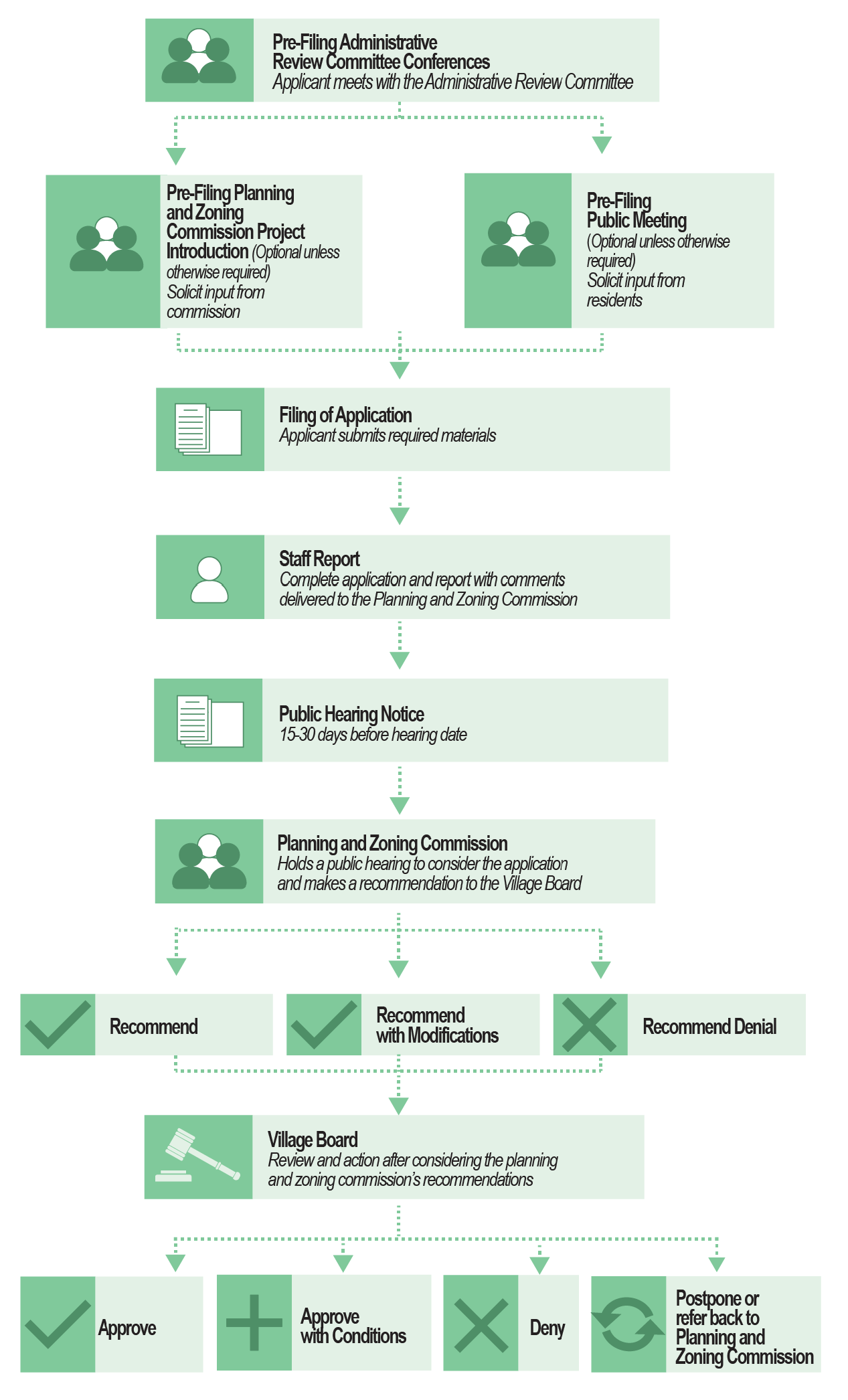
Pre-filing administrative review committee conference(s). A prospective applicant, prior to submitting a formal application for a planned development, shall meet for a pre-filing conference(s) with the administrative review committee. The purpose of the conference(s) is to help the applicant understand: village plans and policies, including, but not limited to, the comprehensive plan and downtown master plan; the zoning ordinance; site development modifications; the standards by which the application will be evaluated; and the application requirements.
(2)
Pre-filing planning and zoning commission project introduction (optional). After the initial prefiling conference, the prospective applicant may introduce their project to the planning and zoning commission. The planning and zoning commission may provide feedback to the applicant based on materials presented. Feedback from the planning and zoning commission is intended to provide the applicant with an initial impression relative to the character, appropriateness, and intensity of the proposed development, prior to the applicant officially filing for a planned development. Any comments and feedback from the planning and zoning commission at this meeting is non-binding. The applicant is expected to provide a brief narrative and development concept plan sufficient to communicate the character of the proposed development.
(3)
Pre-filing public meeting (optional, unless otherwise required). After the pre-filing administrative review committee conference(s), the applicant may schedule a public meeting to discuss the proposed planned development and its impact on area residents. The director of economic and community development may require the applicant to conduct the public meeting at the discretion of the administrative review committee. If required, meeting notice requirements will be determined by the director of economic and community development. A written summary of comments made at the meeting shall be maintained and submitted by the applicant with the application.
(4)
Application requirements waiver request. After completing the pre-filing administrative review committee conference the applicant may request a waiver of any application requirement which in the applicant's judgment should not apply to the proposed planned development. Such request shall be made in writing prior to the submission of the formal application documents. A final determination regarding the waiver shall be made by the director of economic and community development and given to the prospective applicant following the decision. An appeal of the determination of the director of economic and community development may be brought to the planning and zoning commission for consideration.
(5)
Filing of application. After completing the pre-filing staff conference, pre-filing planning and zoning commission project introduction, and the pre-filing public meeting, the applicant may file an application for a planned development including all of the information required in appendix A, with the exception of items that have received a waiver per subsection 44-06-05(a)(4).
(6)
Review for completeness. The director of economic and community development shall determine whether the application is complete. If the director of economic and community development determines that the application is not complete, they shall notify the applicant in writing of any deficiencies and shall take no further steps to process the application until the deficiencies are remedied. If the director of economic and community development determines that the application is complete they shall deliver copies of the application to other appropriate village departments or agencies for review and comment.
(7)
Staff report. A copy of the complete application and a written report incorporating the comments of village staff and other agencies regarding the compliance of the proposed planned development with the requirements and standards of this article shall be delivered to the planning and zoning commission prior to the public hearing.
(8)
Determination not binding. Neither the director of economic and community development's determination that an application is complete, nor any comment made by the director of economic and community development, village staff, or other agencies at a pre-filing conference or as part of the review process shall be intended or construed as a formal or informal recommendation for the approval of a planned development or component part thereof, nor shall be intended or construed as a binding decision of the village.
(b)
Action by the planning and zoning commission. Upon receipt of a completed application, the director of economic and community development will schedule a public hearing at the planning and zoning commission. The planning and zoning commission shall consider the proposed planned development, the staff report, and the public comment and make a recommendation to the village board to approve, approve with conditions, or deny the planned development based on the applicable review standards.
(c)
Action by the village board. The director of economic and community development, on behalf of the planning and zoning commission, shall transmit a report containing its recommendation to approve, approve with conditions, or deny the application to the village board. The village board shall consider the recommendation of the planning and zoning commission and:
(1)
Approve the application and adopt the planned development ordinance;
(2)
Approve the application with conditions and adopt the planned development ordinance with such conditions incorporated;
(3)
Deny the application;
(4)
Postpone further consideration pending the submittal of additional information, including any application requirement previously waived. In postponing, the village board may refer the application back to the planning and zoning commission for further review.
(d)
Records. A record of all applications and determinations for action related to planned developments shall be kept on file in the office of the director of economic and community development and shall be available on request to any person pursuant to the Freedom of Information Act, 5 ILCS 140/1 et seq.
Figure 6.1. Planned Development Procedure
(Ord. No. MC-1068, § 2(Exh. B), 1-10-2023)
Sec. 44-06-06. - Application requirements.
(a)
An application for a planned development may be filed only by the property owner, or by a lessee or agent or contract purchaser specifically authorized by the owner to file such application.
(b)
An application for a planned development shall be filed with the director of economic and community development.
(c)
Every application shall contain, at a minimum, the information detailed for planned development in the zoning application requirements document in appendix A.
(d)
The application shall include a completed application form provided by the village and supporting materials in format and quantity as required per the application instructions.
(e)
All plans shall be of sufficient clarity and detail to indicate the location, nature, and extent of work proposed and demonstrate conformance with the provisions of this chapter and other applicable regulations.
(f)
Every application shall be accompanied by the required filing fee as established and modified, from time to time, by the village board.
(1)
Applications costs, as established in the village fee schedule, may defray the costs of providing notice and contracting with independent professionals to review applications, as required. Such professional costs may include, but are not limited to, engineering, legal fees, traffic analyses, environmental impact studies, land use design, or other similarly related professional studies.
(2)
The failure to pay such fee when due shall be grounds for refusing to process the application and for denying or revoking any permit or approval for the subject property.
(Ord. No. MC-1068, § 2(Exh. B), 1-10-2023)
Sec. 44-06-07. - Effect of approval or denial.
(a)
Approval of the planned development application and adoption of the planned development ordinance by the village board authorizes the applicant to proceed with any necessary applications for building permits, certificates of occupancy, and other permits which the village may require for the planned development. The director of economic and community development shall review applications for these permits for compliance with the terms of the planned development ordinance approved by the village board. No permit shall be issued for development which does not comply with the terms of the adopted planned development ordinance.
(b)
Zoning map amendment. Upon approval of the planned development and adoption of the planned development ordinance by the village board, the village board shall direct the director of economic and community development to amend the zoning map to reflect the existence and boundaries of the planned development.
(c)
Expiration.
(1)
Subject to subsection 44-06-07(d) below, the adoption of a planned development ordinance by the village board shall be null and void if the recipient does not file an application for a building permit relative to the planned development within nine months after the date of adoption of the ordinance.
(2)
Subject to subsection 44-06-07(d) below, the adoption of a planned development ordinance by the village board shall be null and void if construction has not commenced within 15 months after the date of adoption of the ordinance.
(3)
Subject to subsection 44-06-07(d) below, the adoption of a planned development ordinance with a phasing plan by the village board shall be null and void if construction has not commenced or is not completed in accordance with the terms of that phasing plan.
(4)
An extension of the time requirements established in subsections 44-06-07(c)(1)—(3) may be granted by the village board for good cause shown by the applicant, provided a written request is filed with the village at least four weeks prior to the respective deadline.
(d)
No application for a planned development which was previously denied by the village board shall be considered by the planning and zoning commission or the village board if it is resubmitted in substantially the same form and/or content within one year of the date of such prior denial. The director of economic and community development shall review the application for a planned development and determine if the application is or is not substantially the same. An appeal of the determination of the director of economic and community development may be brought to the village board for consideration.
(Ord. No. MC-1068, § 2(Exh. B), 1-10-2023)
Sec. 44-06-08. - Amendments to planned developments.
(a)
Determination. Upon receiving a planned development ordinance amendment application, including the information required by the director of economic and community development, the director of economic and community development shall determine whether the amendment is a major amendment, or a minor amendment based on the criteria detailed in subsections 44-06-08(b) and (c) below.
(b)
Major amendment. A major amendment is any proposed change to an adopted planned development that results in one or more of the following changes:
(1)
Increase in density;
(2)
Increase in the height of buildings;
(3)
Reduction of open space by more than five percent;
(4)
Modification of the proportion of housing types;
(5)
Change in the parking areas in a manner that is inconsistent with this chapter;
(6)
Increase in the approved gross floor area by more than 500 square feet;
(7)
Alteration of the alignment of roads, utilities, or drainage;
(8)
Modification of any other site feature inconsistent with any standard or condition imposed by the village board in approving the planned development and adopting the planned development ordinance, as determined by the director of economic and community development.
(c)
Minor amendment. A minor amendment is any proposed change to an adopted planned development ordinance that is consistent with the standards and conditions upon which the planned development application was approved and planned development ordinance adopted, which does not alter the concept or intent of the planned development, and is not considered a major amendment as detailed in subsection (b).
(d)
Approval processes.
(1)
A major amendment to an adopted planned development ordinance shall follow the procedure set in section 44-06-05.
(2)
A minor amendment to an approved planned development ordinance may be approved by the director of economic and community development.
(Ord. No. MC-1068, § 2(Exh. B), 1-10-2023)

