
Homewood City Zoning Code
ARTICLE IV
USE-SPECIFIC STANDARDS
Sec. 44-04-01.- Purpose and intent.
(a)
Purpose and intent.
(1)
Use specific standards provide additional requirements for certain uses that may have a more significant impact than other uses on neighboring properties or village infrastructure.
(2)
The use standards set forth in this article are requirements in addition to those established by other chapters of this Code and zoning ordinance. Where applicable, such uses shall meet all federal, state and local requirements including, but not limited to, licensing, health, safety and building code requirements, as adopted and amended per chapter 10 of this Code.
(3)
Use specific standards may apply to permitted uses, special uses, or limited uses. All use specific criteria listed herein is in addition to the standards for a special use or limited use as set forth in [sections] 44-07-05 and 44-07-11.
(4)
On lots with multiple uses subject to use-specific standards, all use-specific standards applicable to the individual uses shall apply. Use specific standards applicable to individual uses co-located on a site shall apply cumulatively.
(Ord. No. MC-1068, § 2(Exh. B), 1-10-2023)
Sec. 44-04-02. - Agricultural and open space use standards.
(a)
Community garden.
(1)
The name and contact information of the responsible person or organization shall be clearly posted and maintained for the duration of the existence of the community garden.
(2)
Accessory structures shall be limited in gross floor area to 30 percent of the of the lot used for the community garden, shall have a maximum height of 17 feet and shall be limited to the following accessory structure types:
a.
Storage sheds;
b.
Hoop houses;
c.
Cold frames; and
d.
Shade structures.
(3)
All compost and/or organic matter on the site:
a.
Shall not cover more than ten percent of the total area of the property;
b.
Shall be screened from view from adjacent property and the public right-of-way;
c.
Shall be managed to prevent the harborage of rodents and pests;
d.
Shall be maintained to prevent odors; and
e.
Shall be located to prevent leachate from flowing onto adjacent property or into natural or human-made storm channels.
(4)
The site shall be designed and maintained to prevent water from irrigation and/or other activities and/or fertilizer from draining onto adjacent property.
(5)
Trash areas shall be provided and screened from view from adjacent property and the public right-of-way.
(Ord. No. MC-1068, § 2(Exh. B), 1-10-2023)
Sec. 44-04-03. - Residential use standards.
(a)
Dwelling, duplex.
(1)
Attached garages are encouraged to be located on rear facades. Garages shall comply with subsection 44-04-14(b)(2).
(b)
Dwelling, multiple-family, all units.
(1)
Where existing alleys intersect with the side street, the alley must either be accommodated by new development, or reconfigured and dedicated as part of the new development in order to preserve alley access to other properties on the block.
(2)
The back of curb of off-street parking areas located in the interior side yard shall be set back a minimum of one foot from the front elevation of the primary building.
(c)
Dwelling, townhouse.
(1)
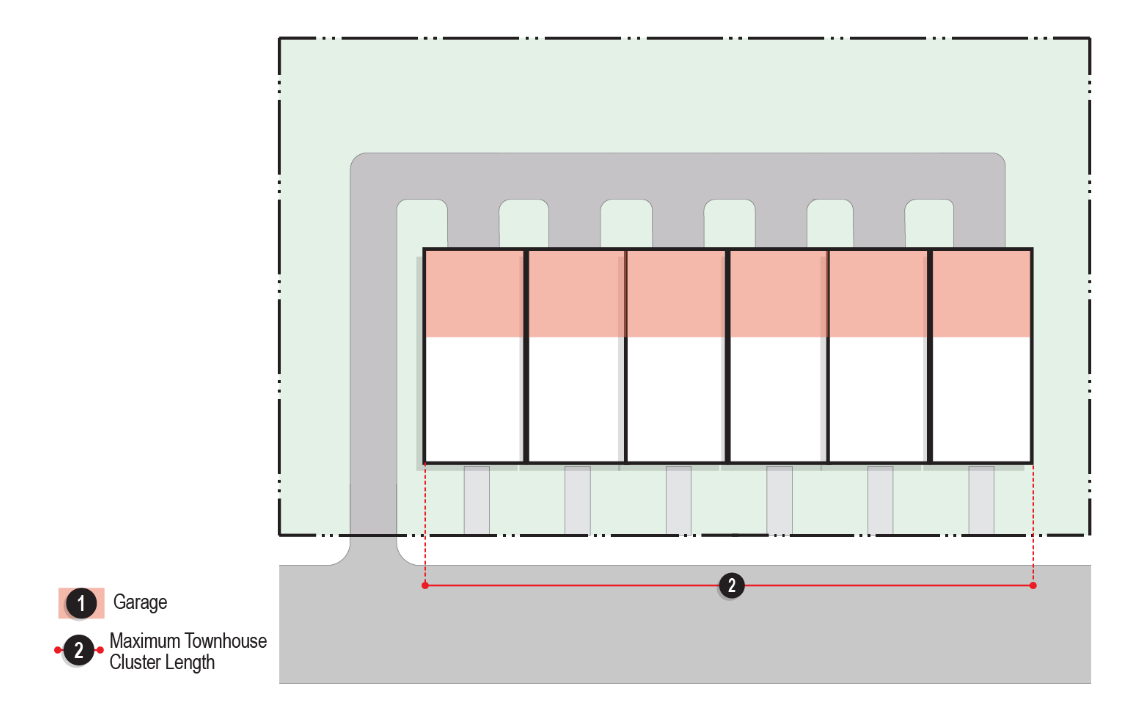
Attached garages shall be located on rear or interior side facades unless otherwise approved. Garages shall comply with subsection 44-04-14(b)(2).
(2)
The maximum length of a townhouse cluster shall be 150 linear feet.
Figure 4.1. Townhouse Dwelling
(d)
Group homes, all units.
(1)
Each group home, before admitting residents, shall have proof of compliance with all applicable local, state, and federal standards.
(2)
Each group home shall submit a copy of its Illinois license or certification and the sponsoring agency's Illinois license of certification to the director of economic and community development.
(3)
The group home operator shall submit a statement detailing the number of residents, the number and type of personnel that will be employed, and the qualifications of the agency operating the group home.
(4)
To the greatest extent practical, a group home shall conform to the type and outward appearances of the residences in the neighborhood in which it is located.
(e)
Senior housing, dependent and independent.
(1)
The site plan shall address resident pick-up/drop-off operations.
(2)
The applicant shall provide a traffic study analyzing impacts on the adjacent neighborhood and emergency response times if deemed necessary by the director of economic and community development.
(Ord. No. MC-1068, § 2(Exh. B), 1-10-2023)
Sec. 44-04-04. - Place of assembly use standards.
(a)
Civic uses of public property. In the PL-1 or PL-2 districts, any civic use of any public building or property shall be permitted when authorized by the government agency owning or controlling such property. Such use shall not impose an undue adverse effect on neighboring streets or property.
(b)
Indoor place of assembly, commercial and non-commercial, all sizes.
(1)
Indoor places of assembly shall be located on collector and/or arterial streets.
(c)
Outdoor place of assembly, commercial and non-commercial.
(1)
Outdoor places of assembly shall be located on collector and/or arterial streets.
(2)
The operating hours of outdoor places of assembly shall be limited to between 7:00 a.m. and 10:00 p.m.
(3)
The location of entrances, exits, exterior lighting, speakers, service areas, and parking and loading facilities shall be designed to minimize traffic congestion and hazards to pedestrians and adverse impacts on adjoining properties.
(Ord. No. MC-1068, § 2(Exh. B), 1-10-2023)
Sec. 44-04-05. - Retail and mixed-commercial use standards.
(a)
Firearms retailers. The purpose and intent of this subsection is to establish reasonable and uniform regulations to prevent any deleterious location or concentration of firearms retailers within Homewood. It is not the intent of this subsection to impose any limitation on firearm ownership or firearm sales generally as an activity. Firearms retailers shall comply with the following requirements:
(1)
Prior to beginning operation, every firearms retailer shall provide their federal firearms license certified by the Illinois State Police pursuant to 430 ILCS 68 as amended.
(2)
No firearms retailer shall be located within 1,000 feet of the property line of a school, childcare center, adult daycare center, park, non-commercial place of assembly, or another firearms retailer.
(3)
Hours of operation shall be limited to 9:00 a.m. to 9:00 p.m.
(4)
No individual less than the minimum age to purchase a firearm in the state of Illinois shall be allowed on the premises unless accompanied by a parent or legal guardian.
(5)
No person less than 21 years of age shall be employed by the business.
(6)
All employees must possess a valid firearms owners identification card considered valid in the state of Illinois.
(7)
No indoor gun range shall be permitted on the premises and no firearms shall be discharged on the premises.
(8)
Images or depictions of firearms shall not be displayed in windows, nor shall they be advertised by signs or posters viewable from the building exterior.
(9)
The applicant shall submit a site security and safety plan for approval by the Homewood chief of police, or their designee. The site security and safety plan shall be renewed for approval by the chief of police at least once every three years after the initial submittal. The chief of police shall have the authority to require an updated site security and safety plan at any time. Once a site security and safety plan has been approved by the chief of police, no changes may be made to the site without the prior approval of the chief of police. The site security and safety plan shall address the following:
a.
The structure housing the firearms retailer must be constructed so as to prevent penetration of the building through an adjacent tenant space or by a vehicle; or the party-wall or exterior of the building must be protected by a barrier approved by a licensed architect and/or engineer designed to prevent a vehicle from reaching the structure where the firearms retailer is located;
b.
Any HVAC ductwork located on the building's exterior shall be secured to prevent penetration into the firearms retailer;
c.
An interior security system over windows and alarm system shall be provided;
d.
Any other site security or safety measures deemed necessary by the chief of police to promote the public health, safety, comfort and welfare;
e.
Firearms shall not be displayed in windows and shall be secured at all times. Firearms shall only be displayed inside a locked counter or locked wall display case within the premises.
(b)
Outdoor itinerant merchants.
(1)
The construction or assembly of any type of display structure, although temporary, shall be prohibited.
(2)
The space occupied by an outdoor itinerant merchant may be no closer than 150 feet to any permanent building.
(3)
Only one outdoor itinerant merchant may conduct business at a location at any given time.
(4)
No wires, signs, pennants, banners, products, or any other marketing device may be attached by, or on behalf of, the itinerant merchant to poles or structures in public lands including rights-of-way, parkways and easements.
(5)
The quantity of off-street parking spaces required shall be determined through the temporary use process in section 44-07-07.
(6)
No licensee or anyone on their behalf shall use any device that emits or produces sound plainly heard on public rights-of-way to attract attention to any goods or service that such licensee proposes to sell.
(7)
No licensee under this section, nor anyone in their behalf, shall use any public street, sidewalk, or alley to sell, offer for sale, or display their goods, wares, merchandise, or service unless expressly allowed in this section.
(Ord. No. MC-1068, § 2(Exh. B), 1-10-2023)
Sec. 44-04-06. - Service and office use standards.
(a)
Adult day care.
(1)
The site plan shall address pick-up/drop-off operations.
(2)
Provide a traffic study analyzing impacts on the adjacent neighborhood and emergency response times.
(b)
Kennel.
(1)
Such uses shall not create a nuisance as defined in this Code.
(2)
A type C transition area, as detailed in subsection 44-05-06(h), shall be required along lot lines adjacent to any parcel in a nonresidential district.
(3)
A type D transition area, as detailed in subsection 44-05-06(h), shall be required along lot lines adjacent to any parcel in a residential district.
(4)
Drainage from outdoor storage or animal exercise areas shall be directed to gravel, grassed, or other planted areas in a manner that prevents direct discharge to storm drain inlets and surface waters.
(c)
Child care center.
(1)
The center shall comply with all local, state, and federal regulations, and shall be registered and licensed by the Department of Children and Family Services (DCFS) prior to the issuance of a special use permit.
(2)
The center shall annually supply a copy of its DCFS license or registration to the director of economic and community development.
(3)
Child care centers in the B-2 downtown transition zoning district shall operate in a single-use, freestanding, principal building of at least 3,000 square feet in gross floor area.
(d)
Tattoo and/or body piercing establishments.
(1)
Tattoo and/or body piercing facilities shall be located a minimum of 1,000 feet from another tattoo and/or body piercing facility.
(e)
Veterinary clinic.
(1)
A type B transition area, as detailed in subsection 44-05-06(h), shall be required along lot lines adjacent to any parcel in a nonresidential district when outdoor activities such as dog runs or outdoor walking areas are included on-site.
(2)
A type C transition area, as detailed in subsection 44-05-06(h), shall be required along lot lines adjacent to any parcel in a residential district when outdoor activities such as dog runs or outdoor walking areas are included on-site.
(3)
Drainage from outdoor storage or animal exercise areas shall be directed to gravel, grassed, or other planted areas in a manner that prevents direct discharge to storm drain inlets and surface waters.
(Ord. No. MC-1068, § 2(Exh. B), 1-10-2023; Ord. No. MC-1084, § 2.B., 11-26-2024)
Sec. 44-04-07. - Eating and drinking use standards.
(a)
Carry-out facilities.
(1)
Vehicular access to the facility shall be provided from a collector or arterial street.
(2)
The operator shall provide daily litter clean up along the rights-of-way abutting the property and adjacent properties subject to litter from the establishment.
(Ord. No. MC-1068, § 2(Exh. B), 1-10-2023)
Sec. 44-04-08. - Lodging use standards.
(a)
Bed and breakfast.
(1)
The use shall be located within a single-family detached dwelling.
(2)
Guest rooms shall not include cooking facilities.
(3)
The maximum stay by any guest shall be limited to 30 consecutive days.
(4)
All required guest parking shall be provided on-site.
(Ord. No. MC-1068, § 2(Exh. B), 1-10-2023)
Sec. 44-04-09. - Vehicle related use standards.
(a)
Autobody repair.
(1)
The minimum lot size shall be 15,000 square feet in area.
(2)
Vehicles may not be stored for longer than 30 days.
(3)
Operations shall not create obstructions to traffic circulation on public streets.
(4)
A type C transition area, as detailed in subsection 44-05-06(h), shall be required along lot lines adjacent to any parcel in a nonresidential district.
(5)
A type D transition area, as detailed in subsection 44-05-06(h), shall be required along lot lines adjacent to any parcel in a residential district.
(6)
Drainage from outdoor storage and/or activity areas shall be directed to a catch basin with an oil separator.
(b)
Car wash.
(1)
The minimum lot size shall be at least 15,000 square feet in area.
(2)
Operations shall not create obstructions to traffic circulation on public streets.
(3)
A type B transition area, as detailed in subsection 44-05-06(h), shall be required along lot lines adjacent to any parcel in a nonresidential district.
(4)
A type D transition area, as detailed in subsection 44-05-06(h), shall be required along lot lines adjacent to any parcel in a residential district.
(5)
Drainage from outdoor storage and/or activity areas shall be directed to a catch basin with an oil separator.
(c)
Fuel sales.
(1)
The minimum lot size shall be at least 15,000 square feet in area.
(2)
Operations shall not create obstructions to traffic circulation on public streets.
(3)
Two vehicle stacking spaces shall be provided for each fuel pump located on a fuel sales site, one at the fuel pump and one to the rear of the fuel pump. Each stacking space shall have a minimum depth of 18 feet.
(4)
All fuel pumps and fuel pump canopies shall be located a minimum of 50 feet from any residential district boundary line.
(5)
Fuel pump canopies shall have a maximum height of 17 feet.
(6)
Fuel pump canopy columns shall be clad in masonry, stucco, fiber cement, or stone veneer systems with a minimum thickness of three inches, for a minimum of four feet from the base of the column.
(7)
Fuel pump canopies shall be lit with only fully recessed lighting.
(8)
A type B transition area, as detailed in subsection 44-05-06(h), shall be required along lot lines adjacent to any parcel in a nonresidential district.
(9)
A type D transition area, as detailed in subsection 44-05-06(h), shall be required along lot lines adjacent to any parcel in a residential district.
(10)
Drainage from outdoor storage and/or activity areas shall be directed to a catch basin with an oil separator.
(d)
Motor vehicle sales and motor vehicle rental.
(1)
The minimum lot size for motor vehicle sales shall be three acres in area.
(2)
Operations shall not create obstructions to traffic circulation on public streets.
(3)
A type B transition area, as detailed in subsection 44-05-06(h), shall be required along lot lines adjacent to any parcel in a nonresidential district.
(4)
A type D transition area, as detailed in subsection 44-05-06(h), shall be required along lot lines adjacent to any parcel in a residential district.
(5)
Parking lots for the outdoor display of motor vehicles for sale shall be exempt from the landscape spacing requirements for the parking area perimeter zone, as detailed in subsection 44-05-06(f), and instead may cluster required landscape elements in order to preserve views to motor vehicles offered for sale.
(6)
Drainage from outdoor storage and/or activity areas shall be directed to gravel, grassed, or other planted areas in a manner that prevents direct discharge to storm drain inlets and surface waters.
(Ord. No. MC-1068, § 2(Exh. B), 1-10-2023)
Sec. 44-04-10. - Industrial use standards.
(a)
Artisan manufacturing, assembly, fabrication.
(1)
Gross floor area per individual artisan manufacturer space shall not exceed 3,000 square feet.
(2)
Outdoor storage and/or outdoor operations or activities shall be prohibited.
(3)
Retail sales of goods manufactured on-site shall be required and shall comprise a minimum of 15 percent of the total area of the building. Retail sales areas shall be located on the ground floor and shall be directly adjacent to storefront windows.
(4)
A maximum of one residential unit per artisan manufacturer shall allowed.
(b)
Crematorium.
(1)
Any crematorium shall be a minimum 500 feet from:
a.
Any residential district and any lot or parcel upon which one or more residences are the primary use at the time of initial application for a special use permit for a crematorium;
b.
Any school or public playground, park, or recreational area.
(2)
Exterior doors of the crematorium shall remain closed so that the cremator/retort shall not be visible from any public right-of-way.
(3)
Except when vehicles are entering or exiting the crematorium, all business vehicles containing human remains and associated with the crematorium shall not be visible from any public right-of-way.
(4)
The crematorium shall comply with all applicable state and federal laws and regulations.
(c)
Mining and aggregate extraction.
(1)
No open pit shall be closer to an exterior lot line that is not adjacent to property owned or under the control of the same or related owner than the distance set by Illinois Department of Natural Resources rules and regulations in effect from time to time.
(2)
The exterior lot lines of the property shall be fenced with a chain link or similar fence at least six feet in height when the property is adjacent to or across the street from any district other than a heavy manufacturing zoning district. The fence shall be constructed in compliance with [section] 44-06-09 of this Code.
(3)
A landscape plan for the property boundaries shall be submitted for approval by the appearance commission. The content of the landscape plan shall be as required by [section] 44-05-06 of this chapter. Upon approval of the landscape plan, it shall be the owner's responsibility to continually maintain in good condition all landscaping elements required by the approval landscape plan as stated in [section] 44-05-06 of this chapter. The owner shall be responsible for the removal of debris that accumulates within the required landscaped areas and along fence lines on property boundaries adjacent to rights-of-way.
(4)
Reclamation of the land will be in accordance with Illinois Department of Natural Resources requirements and may include the importation of inert fill to assist in the reclamation process.
(5)
Due to the unique nature of the use the limitations contained in this section and the additional limitations and restrictions that may be imposed by the special use permit, performance standards and other restrictions of this chapter shall not be applicable to the special use granted pursuant to this section.
(6)
No blasting or other use of explosives is permitted unless specifically requested and authorized with the special use permit after the required public hearing by the planning and zoning commission. If permitted by the village board, blasting must conform to the Surface-Mined Land Conservation and Reclamation Act (225 ILCS 715) and Aggregate Blasting Rules (62 IAC 300) and shall be conducted only in accordance with existing state and federal laws and regulations and the following standards:
a.
The use handling and detonation of explosives (sometimes referred to as "blasting") in connection with quarrying operations shall be conducted by or under the direct supervision of trained and competent persons. If such persons are required to be licensed by any federal agency, State of Illinois or Cook County, such persons shall meet the licensing requirements and obtain such license.
b.
The storage of explosives shall be in accordance with all applicable federal and state laws and regulations and shall be stored in magazines, buildings, or structures, which shall meet the safety requirements of such laws and regulations.
c.
Blasting procedures shall be in accordance with modern techniques, generally accepted in the quarrying industry, whereby a shot shall consist of a series of drill holes containing quantities of explosives fired or detonated in sequence of multiple delays at intervals of milliseconds, so as to counteract and reduce the ground motion or vibration from each successive detonation (sometimes referred to as "short period delay blasting"). Peak particle velocity, measured at the closet protected structure, shall meet the Illinois Department of Natural Resources alternate compliance standard using the United States Bureau of Mines RI 8507 blast level chart, commonly referred to as Z-curve chart.
d.
Air blasts shall be controlled so that it does not exceed the values specified in Table 44-04-09(c)(6)d. below at the closest protected structure, unless such structure is owned by the person who conducts the mining. The measuring systems used shall have a flat frequency response of at least 200 Hz at the upper end. The person who conducts blasting may satisfy the provisions of this subsection (d) by meeting any of the three specifications in Table 44-04-10(c)(6)d.
e.
Blasting procedures shall be subject to and comply with the applicable lawful requirements of the Illinois Pollution Control Board, Illinois Department of Mines and Minerals, Mine Safety and Health Administration ("MSHA"), or the United States Department of the Interior, and any other government agency having jurisdiction thereof.
f.
Blasting procedures shall be in conformity with approved safety regulations, customs and practices generally accepted in the quarrying industry, and the safety regulations of governmental agencies having jurisdiction thereof.
g.
Compliance with provision of these regulations governing blasting procedures and quarrying operations shall be subject to review and inspection from time-to-time by authorized village officials, upon reasonable prior notice and during reasonable business hours.
h.
All blasting shall be conducted between sunrise and sunset except in emergency situations where unscheduled blasting is required to ensure operator or public safety. In such cases, the operator shall notify the village within 72 hours after the unscheduled blast, indicating the reason(s) for the unscheduled blast. No blasting shall take place on the following holidays: New Year's Day, Memorial Day, Independence Day, Labor Day, Thanksgiving Day, and Christmas Day.
(d)
Self storage.
(1)
A type C transition area, as detailed in subsection 44-05-06(h), shall be required along lot lines adjacent to any parcel in a nonresidential district.
(2)
A type D transition area, as detailed in subsection 44-05-06(h), shall be required along lot lines adjacent to any parcel in a residential district.
(3)
Doors serving individual self-storage units accessed directly from the outside shall not be visible from any public right-of-way.
(4)
Lighting and security cameras shall be provided to ensure safe operations on the site.
(5)
Use limitations.
a.
Storing hazardous or toxic materials is prohibited.
b.
No self-storage space shall be used for residential occupancy, business sales or operation, the storage of commercial or industrial inventory or raw materials or the operation of machinery.
c.
Outdoor storage and/or activity is prohibited.
(Ord. No. MC-1068, § 2(Exh. B), 1-10-2023)
Sec. 44-04-11. - Adult use standards.
(a)
Adult uses.
(1)
Purpose.
a.
The purpose and intent of this section is to regulate sexually oriented businesses in order to promote the health, safety, morals, and general welfare of the citizens of the village and to establish reasonable and uniform regulations to prevent any deleterious location and concentration of sexually oriented businesses within the village. The provisions of this section have neither the purpose, intent nor effect of imposing a limitation or restriction of the content of any communicative materials, including sexually oriented materials.
b.
Similarly, it is not the purpose, intent, or effect of this section to restrict or deny access by adults to sexually oriented materials protected by the First Amendment, or to deny access by the distributors and exhibitors of sexually oriented entertainment to their intended market, when permissible under the First Amendment. Neither is it the purpose, intent, or effect of the section to condone or legitimize the distribution of obscene material.
(2)
Requirements.
a.
The design and operation of the facility shall not adversely affect the public health and safety.
b.
Operations shall not create undue traffic congestion in the public streets and highways in the area in which it is located.
c.
Operations of the facility shall not cause additional public expense for fire and/or police protection.
d.
The following conditions shall be imposed on any special use granted for an adult cabaret:
1.
No dancer or performer shall fondle, caress, or otherwise touch any patron or permit any patron to fondle, caress or otherwise touch any dancer or performer.
2.
No patron shall be permitted to fondle, caress, or otherwise touch any dancer or performer.
3.
No patron shall directly pay or give any gratuity to any dancer or performer and no dancer or performer shall solicit or accept any pay or gratuity from any patron.
4.
Dancing or other performances shall not occur within ten feet of any patron.
(3)
Location. No adult use shall locate within 1,000 feet of the property line of another adult use, any school, or any place of worship.
(4)
No liquor license. No adult use shall be issued a liquor license. Nor shall any establishment with a liquor license operate as an adult use. The operator of an adult use shall not permit patrons to bring alcoholic beverages onto the premises and no alcoholic beverages shall be consumed on the premises.
(5)
Hours of operation. Hours of operations shall be between 10:00 a.m. and 2:00 a.m.
(Ord. No. MC-1068, § 2(Exh. B), 1-10-2023)
Sec. 44-04-12. - Cannabis related use standards.
Cannabis dispensing organization and cannabis infuser organization. A limit of one cannabis dispensing organization and one cannabis infuser organization may be located within the village.
(Ord. No. MC-1068, § 2(Exh. B), 1-10-2023)
Sec. 44-04-13. - Transportation use standards.
Reserved.
(Ord. No. MC-1068, § 2(Exh. B), 1-10-2023)
Sec. 44-04-14. - Accessory use standards.
(a)
Accessory dwelling unit.
(1)
Quantity. One detached, attached, or internal accessory dwelling unit shall be allowed per lot.
(2)
Location.
a.
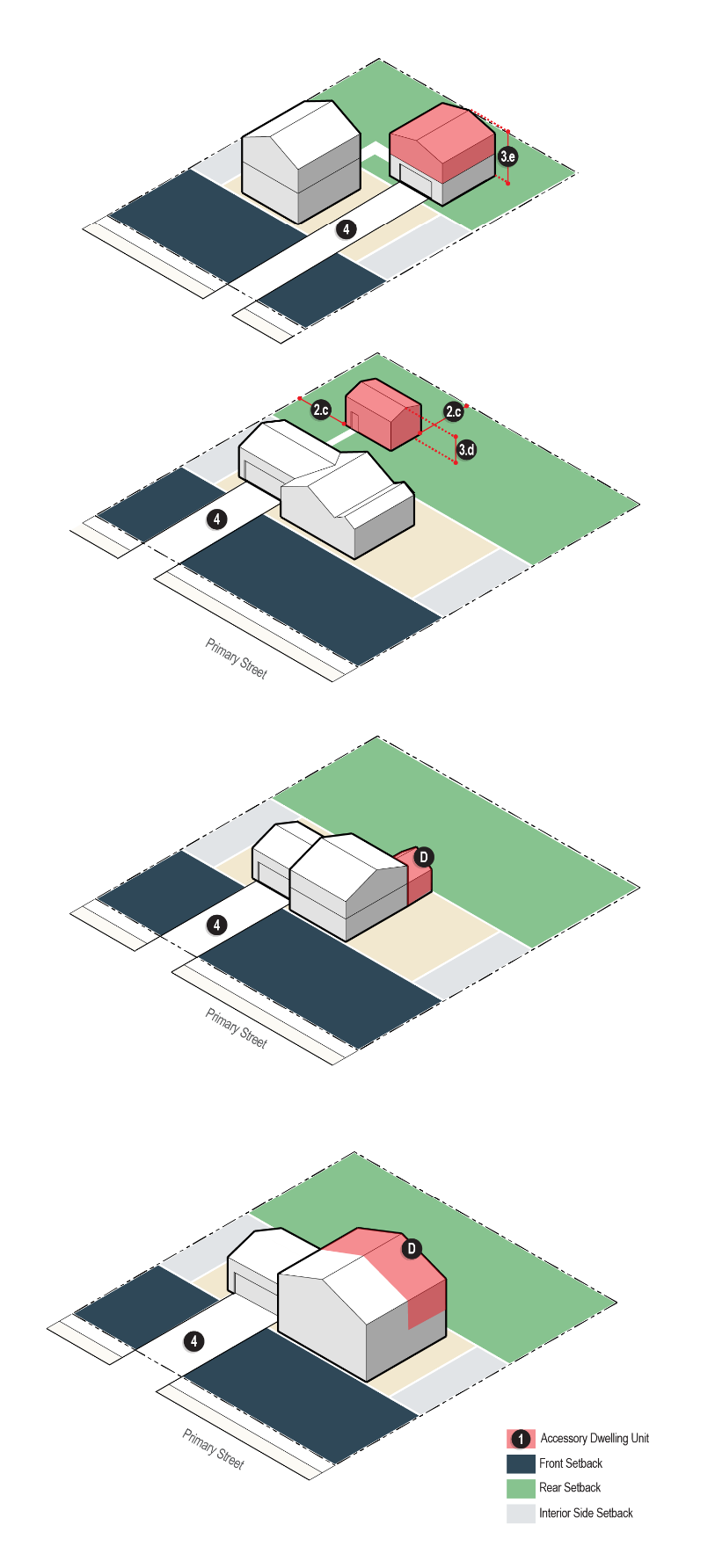
If a lot has a detached garage, a detached accessory dwelling unit shall be located above the detached garage. A standalone detached garage and standalone detached accessory dwelling unit shall not be allowed on a lot.
b.
Detached accessory dwellings shall be located to the interior side or rear of the principal dwelling.
c.
Detached accessory dwellings shall be setback a minimum of five feet from the rear and interior side yard lot lines.
d.
Attached/internal accessory dwellings shall comply with all regulations applicable to the principal building on the lot.
e.
Architectural features that are structurally part of the accessory dwelling unit shall be allowed to encroach subject to the regulations of Table 44-03-03.
(3)
Dimensions.
a.
The minimum size of an accessory dwelling unit shall be 220 square feet.
b.
The maximum size of the internal accessory dwelling shall be 25 percent of the floor area of the principal building.
c.
The maximum building footprint of a detached accessory dwelling shall be 936 square feet.
d.
The maximum height of a standalone detached accessory dwelling shall be 17 feet or the height of the principal dwelling, whichever is less.
e.
The maximum, combined height of a detached accessory dwelling located above a detached garage and the detached garage shall be 27 feet or the height of the principal dwelling, whichever is less.
(4)
Access. The principal dwelling and accessory dwelling shall be served by a common driveway.
(5)
Design. The accessory dwelling shall have architectural features and exterior materials compatible with the principal building. Accessory dwelling units deemed incompatible by the director of economic and community development shall go before the appearance commission for review and final approval, approval with conditions, or denial.
(6)
Ownership.
a.
The principal dwelling or accessory dwelling shall be the primary residence of the owner of the property.
b.
An accessory dwelling must be kept in common ownership with the principal dwelling on the property.
Figure 4.2. Accessory Dwelling Units
(b)
Accessory structure/building.
(1)
Location of accessory buildings and structures. All accessory buildings and structures shall follow the location requirements of this section.
a.
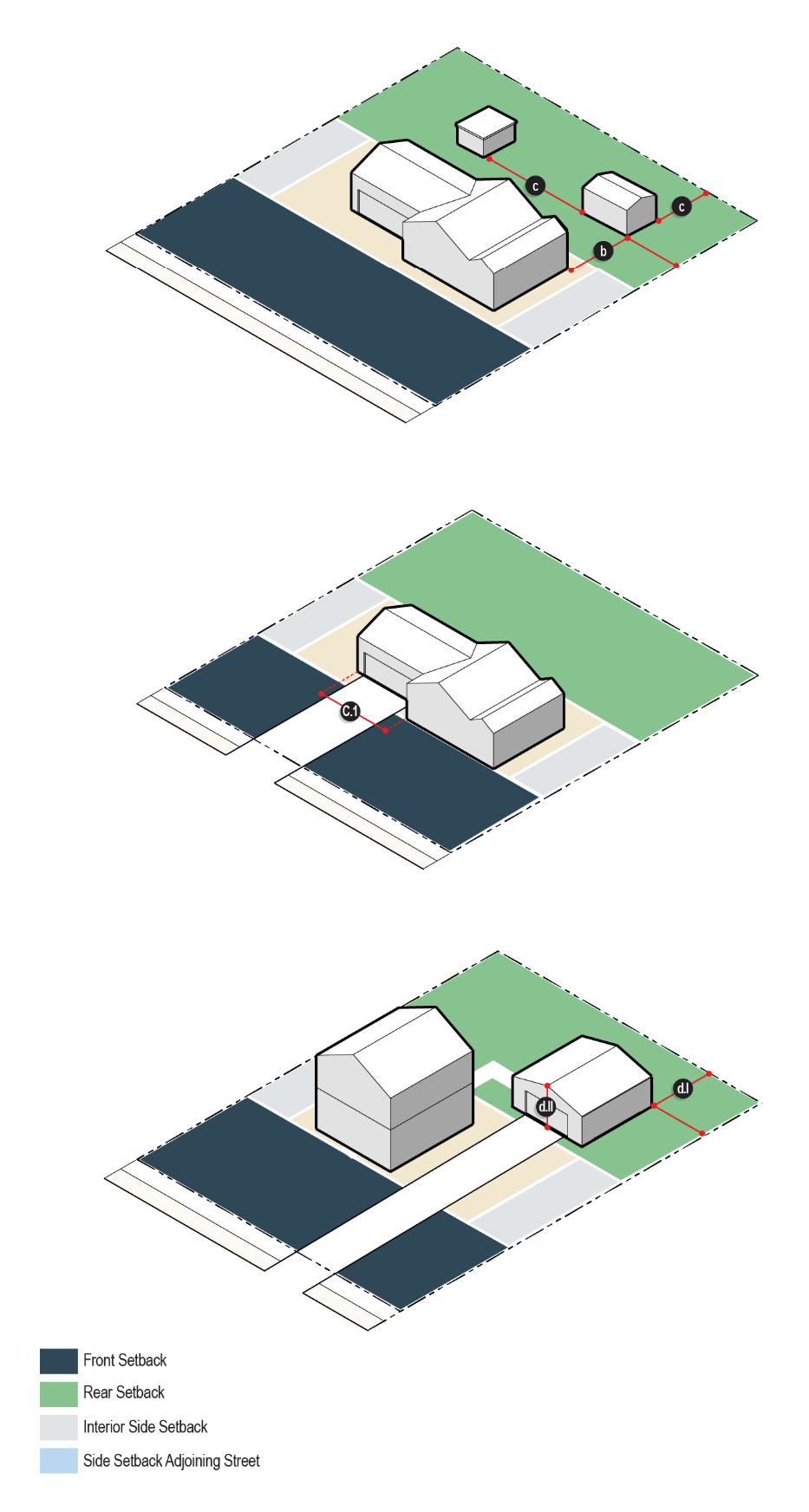
An accessory building or structure shall be located either:
1.
Completely within the interior side or rear yard of the principal building and at least five feet from lot lines; or
2.
Completely within the buildable area of the lot.
b.
Any accessory building or structure shall be located a minimum of ten feet from the principal building.
1.
The required distance may be varied to a minimum of five feet from the principal building when the exterior walls of the accessory building or structure has a minimum of a one-hour fire-resistance rating.
c.
Any accessory building or structure shall be located a minimum of five feet from all other buildings on the lot and abutting properties.
Figure 4.3. Accessory Building/Structure
(2)
Garages.
a.
Applicability. This section shall apply to all single-family detached, duplex, or townhome.
b.
General.
1.
No garage shall exceed an area of 936 square feet.
2.
Only one garage shall be allowed on a residential lot. Such garage shall be either an accessory portion of a principal building or an accessory building.
3.
The parking spaces in the garage shall not be used as a means to access other parking spaces or to any other area located on or off the lot.
c.
Attached garages.
1.
Attached garage doors located on the front facade of the principal building shall not constitute 50 percent or more of the front elevation as measured in linear frontage and in square footage.
2.
Attached garages located on the front facade shall be recessed from the front facade by at least five feet.
3.
Side-loading attached garages shall have a similar front facade as the principal dwelling.
d.
Detached garages.
1.
Detached garages shall be located in the rear yard and set back at least five feet from the rear and side yard lot lines.
2.
Detached garages shall have a maximum height of 17 feet.
(3)
Accessible steps or ramps.
a.
Accessible steps or ramps shall be designed to be integrated with the architecture of the building.
b.
Accessible steps or ramps may be located no closer than two feet from any side lot line and no closer than ten feet from any front lot line.
c.
Accessible steps or ramps may also include, in compliance with the Illinois Administrative Code, a landing that does not exceed five feet by five feet.
d.
Accessible steps or ramps shall be constructed in accordance with chapter 10 of this Code.
e.
Any accessible steps or ramp not meeting the above requirements may be approved by the director of economic and community development as a limited use, provided that:
1.
There is no other practical conforming location on the lot.
2.
A physician certifies in writing that the ramp is medically necessary.
3.
The homeowner agrees to remove the ramp when it is no longer medically necessary.
(4)
Sheds, cabanas, greenhouses, playhouses, gazebos, and decks.
a.
Quantity. One shed, cabana, greenhouse, playhouse, or gazebo, in addition to a detached garage or standalone detached accessory dwelling unit, and one deck shall be allowed per lot.
b.
Dimensions for sheds, cabanas, greenhouses, playhouses, and gazebos.
1.
The maximum size shall be the lesser of 144 square feet or 30 percent of the required rear yard.
2.
Detached gazebos shall have a maximum height of 14 feet.
3.
Attached gazebos, as measured from the deck, shall have a maximum height of 14 feet or the height of the roofline at the closest point of the principal building, whichever is less.
c.
Location.
1.
Sheds, cabanas, greenhouses, playhouses, and gazebos shall be located in an interior side or rear yard only. Decks shall be located in a rear yard only.
2.
Any structures shall be located a minimum of three feet from any lot line.
3.
No structure shall be located in an easement.
(5)
Household recreational facilities.
a.
Household recreational facilities shall be less than 17 feet in height.
b.
Trampolines shall be located at least ten feet from interior side and rear lot lines and all principal and accessory buildings and accessory structures.
c.
Any noise generated by the activity shall comply with the regulations of this chapter and [subsection] 44-301(g) of this Code.
(6)
Outdoor fireplaces.
a.
Barrels, half-barrels and drums are not permitted.
b.
Outdoor fireplaces and fixed, permanent masonry fire pits shall comply with [subsection] 44-301(k) of this Code.
c.
Fuel shall be dry wood, producing a minimum of smoke and particulate matter.
d.
When in use, adult supervision shall be present at all times.
e.
Outdoor fireplaces shall be located at least 20 feet from any building structure, building overhang or vehicle.
(7)
Swimming pools and spas.
a.
Pools are permitted in rear yards only and shall conform to all requirements of section 44-143 of this Code.
b.
Pumping and filtering equipment for pools and spas shall be located at least ten feet from the interior side and rear lot lines and no water shall drain onto adjacent properties.
(c)
Cargo container storage, stacking—Permanent.
(1)
The facility utilizing the cargo container shall carry adequate insurance (as determined by the director of economic and community development) and provide the village a certificate of insurance prior to the issuance of a special use permit.
(2)
Location.
a.
The containers shall conform with setback requirements for a principal building.
b.
The containers shall be located in the interior side or rear yard.
c.
The containers shall be entirely on private property and are prohibited from being parked or placed upon any street, highway, roadway, right-of-way, designated fire lane, required parking space, drive aisle, or sidewalk.
d.
The containers shall not be placed in such a fashion as to impede or obstruct the flow of drainage waters, nor impede or obstruct emergency access to the property.
e.
The containers shall only be located on concrete paved surfaces in accordance with the paving standards set forth by the Illinois Department of Transportation (IDOT) for an 80,000-pound truck route.
f.
The site layout shall provide adequate means for fire and emergency vehicles (as approved by the fire chief) to access cargo containers both on and off a chassis in the event of an emergency.
g.
The containers shall be screened with a solid fence, landscaping, and berm so as not be visible from the public right-of-way and adjacent properties.
(3)
Height. Cargo containers shall not measure or be stacked to a height greater than 14 feet.
(4)
Operations and maintenance.
a.
Cargo containers shall not be used for occupancy or sleeping; housing of animals; housing or storage of firearms, hazardous or flammable materials, material that is required to be placarded as class 7 (radioactive material) according to the U.S. Department of Transportation (DOT) Emergency Response Guideline (ERG), or storage of materials which are otherwise unlawful to possess (e.g. fireworks or other unlawful material or substances).
b.
Cargo containers shall not include windows, heating and cooling, refrigeration systems, plumbing or have multiple entrances except for what is necessary to meet the minimum codes and standards for light and air circulation for storage purposes.
c.
Cargo containers shall be closed and secured from unauthorized access at all times when not under the direct supervision of the permit applicant.
d.
Cargo containers shall not be used to display signage or otherwise advertise a commercial activity other than a design or logo permanently affixed to the container that identifies its owner.
e.
Containers shall be kept at all times in a like-new condition.
(d)
Cargo container storage, stacking—Temporary.
(1)
Residential, commercial and public lands/open space. Cargo containers are prohibited except they may be used on a temporary basis provided they are issued a permit and meet the following conditions:
a.
The cargo container shall be used for the purpose of a construction project duly proceeding toward completion.
b.
The cargo container shall be located on the same lot on which the construction activity is occurring until such time as the construction project is complete.
c.
Upon completion of the construction activity that the container supports, the container must be promptly removed from the site.
d.
The cargo container shall be maintained in a like-new condition.
e.
The cargo container shall not measure or be stacked to a height greater than 14 feet.
f.
The cargo container shall not be used to display signage.
g.
No more than one cargo container shall be located on a lot in a residential district at one time for construction purposes.
h.
No more than three cargo containers shall be located on a lot in a commercial or public lands/open space district at one time when used for construction purposes.
i.
No more than one cargo container shall be located on a commercial lot, limited to no longer than 60 days in a calendar year, when used for the purpose of storage of seasonal inventory.
j.
The permit shall be affixed to the container for the duration of its use.
k.
The director of economic and community development may approve containers that exceed the allowable number, allowable size, or length of time.
(2)
M-1 limited manufacturing. Cargo containers may be located in a M-1 district on a temporary basis provided they are issued a permit and meet the following conditions:
a.
Cargo containers utilized for temporary storage shall be restricted to a period of time not to exceed 30 days in one calendar year.
b.
Cargo containers used for the purpose of a construction project duly proceeding toward completion and located on the same lot on which the construction activity is occurring may be allowed until such time as the construction project is complete. Upon completion of the construction activity that the container supports, the container must be promptly removed from the site.
c.
At all times, any and all cargo containers must be maintained in a like-new condition.
d.
No more than three temporary cargo containers shall be located on a lot located in the M-1 district at one time.
e.
Cargo containers may not measure or be stacked to a height greater than 14 feet.
f.
The permit shall be affixed to the container for the duration of its use.
g.
The director of economic and community development may approve containers that exceed the allowable number, allowable size, or length of time.
(e)
Civic uses of public property. In the PL-1 or PL-2 districts, any civic use of any public building or property shall be permitted when authorized by the government agency owning or controlling such property. Such use shall not impose an undue adverse effect on neighboring streets or property.
(f)
Contractors trailers and real estate model units.
(1)
Contractors' trailers and real estate model units are allowed when accessory to a construction project or a new development.
(2)
Such use shall be limited to a period not to exceed the duration of the active construction phase of such project or the active selling and leasing of space in such development.
(3)
No such use shall contain any sleeping or cooking accommodations, except those located in a model unit.
(4)
No such trailer, unit, or office shall be used as the general office or headquarters of any firm.
(g)
Drive-through facility.
(1)
Design and layout.
a.
Provide minimum six inches high barrier curbs to protect accessories such as menu boards and canopy supports from vehicular circulation.
b.
The location of the curb cut shall be subject to the approval of the village engineer.
(2)
Stacking.
a.
The stacking spaces shall be designed so as not to interfere with the ingress and egress to the off-street parking, traffic circulation on or off site, and traffic visibility.
b.
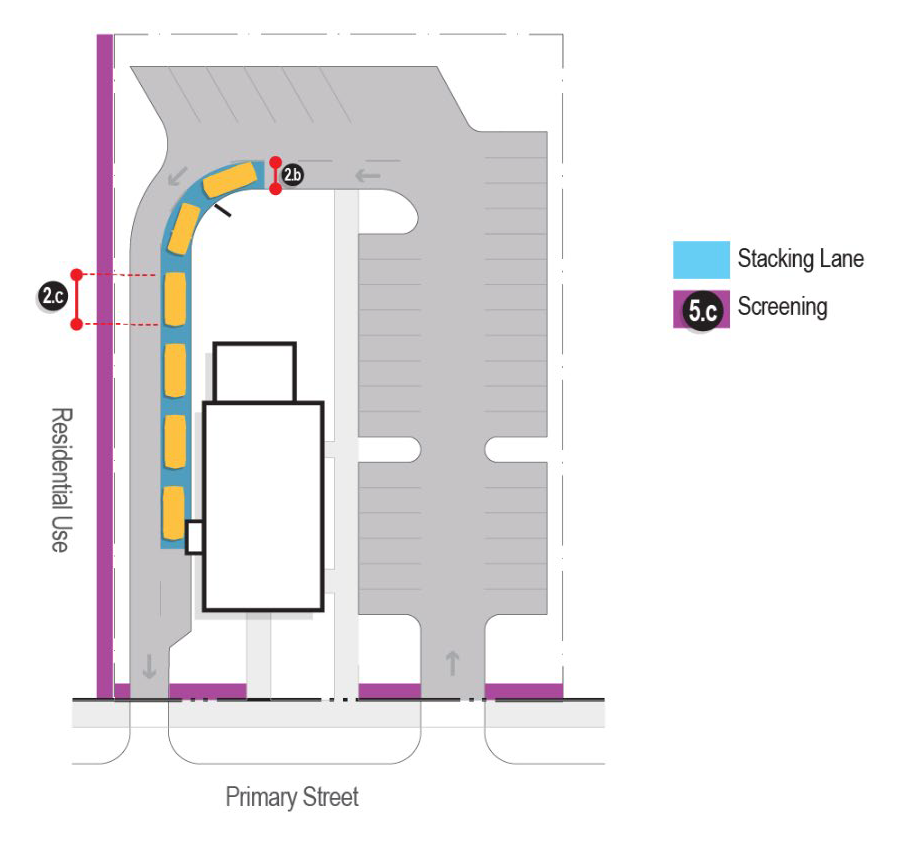
Stacking lanes shall have a minimum depth of 20 feet per stacking space and the following minimum lane widths:
1.
One lane: 12 feet;
2.
Two or more lanes: ten feet per lane.
c.
Drive-through facilities shall be required to provide a minimum number of vehicle stacking spaces as detailed in Table 44-04-14(d)(2)d.
(3)
Menu boards.
a.
A drive-through facility shall be permitted a maximum of two menu boards.
b.
The combined maximum area of the menu boards shall be 80 square feet.
c.
Each menu board shall not exceed:
1.
Sixty square feet in area; and
2.
Ten feet in height.
d.
Menu boards may utilize digital display boards for 100 percent of the permitted menu board area.
(4)
Overhead canopy.
a.
The total height of any overhead canopy of similar structure shall not exceed 20 feet as measured to the highest part of the structure.
b.
Any overhead canopy or similar structure shall maintain a uniform and consistent roof line with the building to which the drive-through facility is a part.
c.
Any overhead canopy or similar structure shall have columns, solid walls or semi-solid walls placed so that they are similar in their relation to the roof as that of the exterior walls of the building to which the drive-through facility is a part.
d.
Any overhead canopy or similar structure shall be finished with exterior cladding materials consistent with the primary building facade.
(5)
Screening. The following regulations shall apply to any drive through adjacent to a residential use regardless of the use to which it is accessory.
a.
Drive aisles must be effectively screened from view along public rights-of-way and at the edges of sites adjacent to residential properties to minimize the visual impact of menu boards and headlight glare and audio impact of intercoms.
b.
Screening shall meet all sight triangle requirements as established in section 44-05-10.
c.
Screening shall be a minimum of six feet wide, and must consist of:
1.
An opaque masonry wall or solid wood fence with a minimum height of four feet and a maximum height of six feet;
2.
One ornamental tree per every 25 linear feet of screening; and
3.
One shrub or native grass per every three feet of screening.
Figure 4.4. Drive Through Facility
(h)
Dumpsters, temporary. Temporary dumpsters shall meet the following conditions:
(1)
The refuse container shall be obtained from a scavenger service licensed with the Village of Homewood.
(2)
No more than one temporary dumpster shall be located on a lot at a time.
(3)
The container shall be maintained in a neat and orderly fashion with all refuse contained within and not higher than the height of the container.
(4)
The temporary dumpster shall be located on an impervious surface on private property.
(5)
The placement of a temporary dumpster shall be restricted to a period of time not to exceed 30 days, per calendar year.
(6)
The director of economic and community development may approve containers that exceed the allowable number, size, surface, or length of time.
(i)
Electric vehicle charging stations.
(1)
Equipment.
a.
Electric vehicle charging stations that are accessory to all mixed-use, multi-family, and nonresidential uses shall be a level 2 charging capacity.
b.
Electric vehicle charging station equipment shall be protected by a wheel stop, curb, or bollards.
c.
In parking lot applications, all connections of the charging station to electrical utility equipment shall be underground.
d.
All electric vehicle charging station equipment shall comply with the National Fire Protection Association/National Electrical Code and be approved by the Underwriters Laboratory.
e.
All equipment should be made of low-maintenance, durable materials appropriate to withstand northeast Illinois weather and shall be vandal-proof to the extent possible.
f.
All equipment shall provide a cord management system that minimizes tripping hazards for pedestrians. Charging cords may not cross sidewalks, walkways, or driveways.
(2)
Design considerations.
a.
Electric vehicle charging station equipment shall be located in a manner that will not obstruct pedestrian walkways. A minimum of three feet of clear area shall be maintained.
b.
Electric vehicle charging stations shall be located to optimize ease of use for all potential users.
c.
Electric vehicle charging station shall provide a safe and clearly delineated area for maneuvering around the vehicle for connecting to the equipment.
d.
A sign indicating that the electric vehicle parking is for use while charging only shall be provided.
e.
All charging stations shall be illuminated. Lighting shall comply with the limitations in section 44-05-12.
(3)
Electrical equipment siting and screening.
a.
Electric vehicle charging stations shall be located to minimize the distance to electrical supply equipment.
b.
When locating the electrical supply equipment consider blind spots and visibility obstructions for drivers and pedestrians.
c.
To the extent practical, electrical supply equipment shall be screened by walls, fences, landscaping, or a combination thereof to be effective year-round.
(4)
Accessibility. A minimum of one accessible charging station is required with any installation of electric vehicle charging stations. The accessible charging station shall provide equipment, reach, clear area, route, and other applicable building blocks to comply with the Illinois Accessibility Code as well as incorporating industry recommended best practices and current federal accessibility recommendations.
(5)
Maintenance.
a.
The property owner on which electric vehicle charging stations are located is responsible for ensuring that the equipment is intact and will not pose a hazard to any visitors to the property. This shall include ensuring that cords are hung to prevent tripping hazards.
b.
All electric vehicle charging station equipment shall be maintained to working condition. Equipment that is no longer functional must be decommissioned within 60 days.
(j)
Food cart or truck.
(1)
A stand-alone food cart or truck whether motorized or non-motorized may be set up on a regular, semi-regular, or one-time basis subject to the following criteria:
a.
The owner or operator of the food cart or truck shall obtain and maintain all required licenses at all times.
b.
The permit shall be displayed to the public in a visible location on the food cart or truck.
c.
Operations shall not be located in a driveway or drive aisle.
d.
Operations shall not obstruct parking lot circulation or block access to a public street, alley, or sidewalk.
e.
The operation of the food cart or truck shall not block a pedestrian walkway or public sidewalk in a manner which reduces the width of that walkway or sidewalk to less than five feet or causes damage to any improvements within the public right-of-way.
f.
Operations of any food cart or truck shall be at least 500 feet from any eating and drinking establishment lawfully existing at the time the permit or renewal permit was issued and is open for business unless written permission is granted by the eating or drinking establishment located within that distance.
g.
No food cart or truck shall be set up on any privately owned lot or parcel without written permission of the owner.
h.
Trash receptacles shall be provided, and the owner/operator shall be responsible for keeping the area surrounding the food cart or truck clear of any litter and properly cleaned.
i.
Signs, except for a-frame/sandwich board signs shall be permanently affixed to or painted on the food cart or truck. Each food cart or truck may have one sandwich board sign which may not be located in any right-of-way or impede pedestrian or vehicular traffic and shall be within 25 feet of the food cart or truck.
j.
Canopies, umbrellas, and outdoor tables and chairs shall not block a pedestrian walkway or public sidewalk in a manner which reduces the width of that walkway or sidewalk to less than five feet or creates a visual obstruction to traffic.
k.
Food carts or trucks may locate on the same lot or parcel so long as each vendor has the property owner's written permission and all other provisions contained herein are be met.
l.
No food cart or truck shall be located within 50 feet of the established outer boundary of any village-permitted or licensed event where the sale of merchandise and food has been allowed unless it is part of the event.
m.
When not in operation, a food cart or truck shall be stored on private property.
n.
If located in a village right-of-way:
1.
No merchandise shall be offered, displayed or sold and no customers served except from the sidewalk;
2.
Only non-motorized carts may be located on sidewalks;
3.
Carts or trucks shall be located at least 25 feet from any intersection (measured from the edge of sidewalk to the cart or truck) and 15 feet from any driveway;
4.
Food carts or trucks shall comply with all traffic and parking ordinances of the village, as they may be amended.
o.
Any location in a village right-of-way, including sidewalks, may be subject to temporary suspension or revocation without cause, but for reasons that may include construction, repairs, maintenance or emergencies as determined by the village.
p.
A permit shall not be required for food carts or trucks that are:
1.
Part of a village-permitted event; or
2.
For a private, catered event occurring on private property (private parties, reunions, weddings and the like) in any district.
q.
A street closure permit may be required in order to locate on any village street or right-of-way where the provisions contained in this section cannot be met. Food carts or trucks may not cater private events from either the sidewalk or road right-of-way without an approved street closure permit.
r.
The provisions of this section shall not apply to any minor-operated business.
(k)
Home-based business.
(1)
Purpose. To protect residents from deleterious effects of commercial uses being conducted in residential areas, the following provisions regulate and restrict commercial uses in residentially zoned districts.
(2)
Requirements. No home-based business shall be permitted without the prior issuance of a zoning permit for the home-based business. Permits shall be granted to a designated person who resides at the residential address. If the applicant is not the owner of the property, a letter from the owner authorizing the applicant shall be submitted with the application. Permits shall not be assigned from person to person or transferred from address to address. Home-based business permits shall expire April 30 of each year and require annual review. Once granted, permits may be renewed by paying the annual renewal fee, subject to the provisions of this section, failure to timely apply for renewal, and/or failure to pay the annual home-based business permit or inspection fee, shall be grounds for revocation of a home-based business permit.
a.
Exceptions. No home-based permit shall be required for individuals operating an office out of their residence, provided that the office meets the following use limitations:
1.
No routine attendance of patients, clients, subcontractors, or employees associated with the home-based business as part of regular conduct of the occupation.
2.
No merchandise shall be offered for retail sale on the premises.
(3)
Annual inspection.
a.
There shall be one annual inspection by the village of the premises of a home-based business.
b.
The village shall have the right to enter and inspect the premises of all home-based businesses.
c.
The village shall have the right at any time, upon reasonable request, to enter and inspect the premises of all home-based businesses for safety and compliance purposes.
d.
Such inspection shall only be made between the hours of 8:00 a.m. and 5:00 p.m., Monday through Friday, or may be made Saturday and Sunday during those hours, if the business is conducted on those days.
e.
The annual inspection fee for each premise where a home-based business is conducted shall be paid within ten days after such billing has been mailed by the village.
(4)
Limitation. Only one class I or class II home-based business shall be allowed per lot.
(5)
Location allowed. Either the principal or accessory dwelling on a subject lot may be used as a class I or class II home-based business.
(6)
Standards. All home-based businesses shall conform to the following standards:
a.
Only one nonresident of the premises may be employed to work at the premises.
b.
The applicant for a class I or class II permit must reside at the location of the proposed home-based business.
c.
No signs shall be permitted, unless authorized by the sign regulations of that district.
d.
No exterior storage of business equipment, materials, merchandise, inventory, or heavy equipment shall be permitted. However, garage storage of business equipment, merchandise, inventory, or heavy equipment shall be permitted provided it complies with all requirements of this chapter and this Code.
e.
Home based businesses shall be conducted entirely indoors.
f.
Merchandise shall not be displayed or offered for retail sale on the exterior of the residence.
g.
Home-based businesses providing house or office cleaning service or limousine service shall be limited to dispatching only.
h.
Home-based businesses shall comply with the environmental performance standards in section 44-05-13.
i.
Off-street loading and parking requirements of sections 44-05-02 and 44-05-03 must be met.
j.
The area set aside for home-based business use shall not exceed 20 percent of the total floor area of the residence. However, child day care homes shall be required to meet all DCFS requirements, including a designated play area for the children.
k.
Child day care homes shall submit annually a copy of their DCFS license to the director of economic and community development.
l.
Trucks or commercial vehicles shall not operate out of the residential premises. Any truck or commercial vehicle owned by the holder of a class I or class II permit, or their immediate family, and used in the business, may, if otherwise authorized to be parked at the premises overnight, be driven from the premises in the morning and be driven onto the premises in the evening, but shall not be driven back and forth from the premises during the day.
m.
No truck or commercial vehicle, other than a class B truck or class B commercial vehicle, as defined in the Illinois Motor Vehicle Code, may be parked or stored in any residential zoning district except as permitted in section 44-05-02.
(l)
Murals and art installations (murals defined as an accessory use).
(1)
General provisions. Any mural, defined in section 44-10-11, erected in the Village of Homewood after August 26, 2025, may be erected upon approval of a mural and art installation application and meeting the following conditions:
a.
Commercial messaging. Under no circumstances may a mural contain any commercial messaging, including, but not limited to, business names, brand artwork, insignias or logos, or other references, whether direct or implicit, to the use occurring within the building upon which the mural is located. Commercial messaging painted on a building facade shall constitute a painted sign and be subject to the requirements for painted signs in section 44-10-06.
b.
Encroachments. No component of any mural shall encroach into the public right-of-way.
c.
Obstructions. No mural or art installation shall be placed where visibility from the public right-of-way is partially or fully obstructed by permanent structures or site elements, including, but not limited to, architectural features, landscaping, or ground and wall-mounted equipment.
d.
Applications. All murals and art installations proposed within village limits shall be reviewed pursuant to the process requirements in section 44-07-16, including adherence to all standards found in section 44-07-16. Murals applications initially by the Village of Homewood shall be exempt from the review process unless otherwise directed by the village board of trustees.
(m)
Outdoor display/sale of merchandise.
(1)
Only those goods and materials offered for sale by the existing on-site use may be displayed or sold.
(2)
Permanent outdoor display or sales areas shall not be located within any required yard setback or required parking area or loading space.
(3)
Permanent outdoor display or sales areas shall be surfaced with an approved hard surface material. Partially paved or unpaved outdoor retail sales areas shall be prohibited.
(4)
Permanent outdoor display or sales areas shall not exceed ten percent of the gross floor area of the principal building on the property unless approved as a special use.
(n)
Outdoor itinerant merchants.
(1)
The construction or assembly of any type of display structure, although temporary, shall be prohibited.
(2)
The space occupied by an outdoor itinerant merchant may be no closer than 150 feet to any permanent building.
(3)
Only one outdoor itinerant merchant may conduct business at a location at any given time.
(4)
No wires, signs, pennants, banners, products, or any other marketing device may be attached by, or on behalf of, the itinerant merchant to poles or structures in public lands including rights-of-way, parkways and easements.
(5)
An outdoor itinerant merchant may not occupy parking spaces needed to meet the minimum parking requirements as set forth in section 44-05-01.
(6)
No licensee or anyone on their behalf shall use any device that emits or produces sound plainly heard on public rights-of-way to attract attention to any goods or service that such licensee proposes to sell.
(7)
No licensee under this section, nor anyone in their behalf, shall use any public street, sidewalk, or alley to sell, offer for sale, or display their goods, wares, merchandise, or service unless expressly allowed in this section.
(o)
Outdoor seating for restaurants. Outdoor seating accessory to a restaurant, bar, or craft brewery shall be a allowed, provided it complies with the requirements of chapter 12, article VII of this Code and has been issued a permit with approval from the health officer.
(p)
Outdoor storage, permanent.
(1)
Permanent outdoor storage areas shall be surfaced with an approved hard surface material. Partially paved or unpaved outdoor storage areas shall be prohibited.
(2)
Outdoor storage shall not be in the required front or exterior side yard, closer to the front or exterior side lot line than the front or exterior side facing elevation of the primary building, nor ten feet from the interior side or rear lot line.
(3)
A solid wall constructed from materials identical to those used on the exterior of the principal building and not less than six feet and not more than eight feet in height or landscaping of an equivalent height that provides year-round screening shall be provided to screen those portions of permanent outdoor storage areas visible from any right-of-way, excluding alleys, and/or a property in any residential, business, or special district, as listed in section 44-02-01.
(4)
No signage is permitted in conjunction with the outdoor storage.
(5)
Such materials shall not occupy or interfere with the use of required parking spaces or aisles.
(6)
Any permanent outdoor storage shall meet applicable building codes.
(q)
Portable temporary storage container. Portable temporary storage containers are allowed subject to the following conditions:
(1)
Only one portable temporary storage container may be located on a lot at a time.
(2)
No portion of any container may extend onto the public right-of-way, including, but not limited to, sidewalks, parkways, streets, or alleys.
(3)
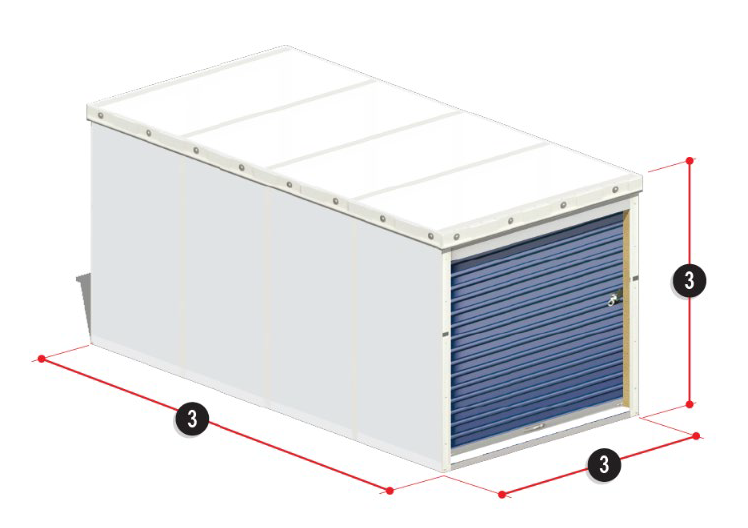
The portable temporary storage container shall not exceed eight feet in width, 12 feet in length and eight feet in height, or 768 cubic feet.
(4)
The portable temporary storage container must be located on an impervious surface.
(5)
Placement of a portable temporary storage container shall be limited to 14 days per residential lot, per calendar year.
(6)
Placement of a portable temporary storage container shall be limited to 30 days per commercial, public lands/open space or manufacturing lot, per calendar year.
(7)
Every portable temporary storage container must be locked and secured when not being loaded or unloaded.
(8)
The permit shall be prominently displayed during the approval period.
(9)
The director of economic and community development may approve containers that exceed the allowable number, size, surface, or length of time.
Figure 4.5. Portable Temporary Storage Container
(r)
Solar energy collection system, canopy.
(1)
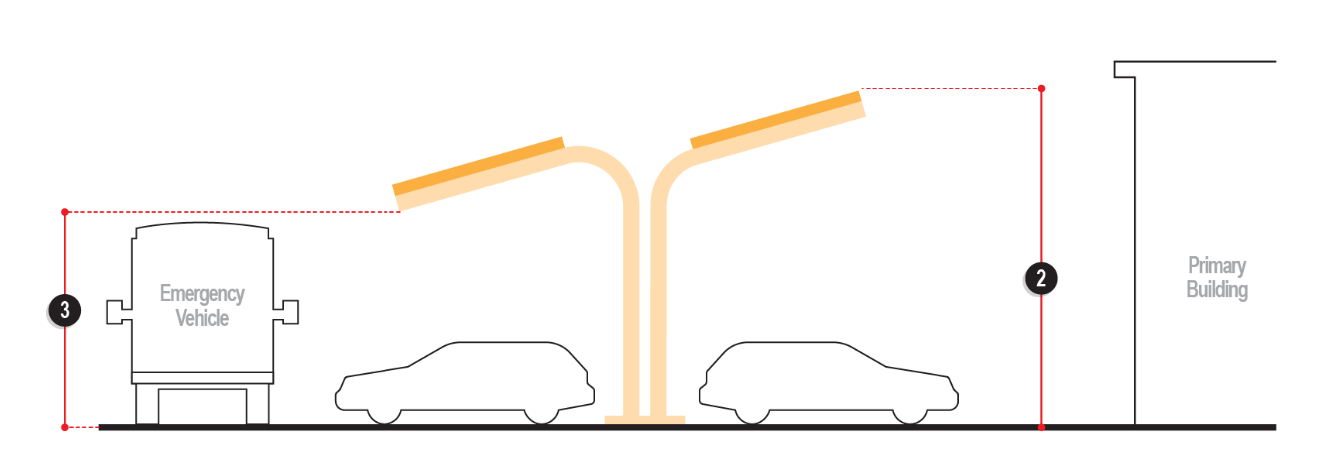
Canopy solar energy collection systems are permitted over any parking area.
(2)
The height of canopy solar energy collection systems shall not exceed the height of the principal building that the parking area serves.
(3)
The minimum height of solar energy collection systems shall allow clearance for emergency and service vehicles.
Figure 4.6. Solar Energy Collection System, Canopy
(s)
Solar energy collection system, ground, less than one-acre site.
(1)
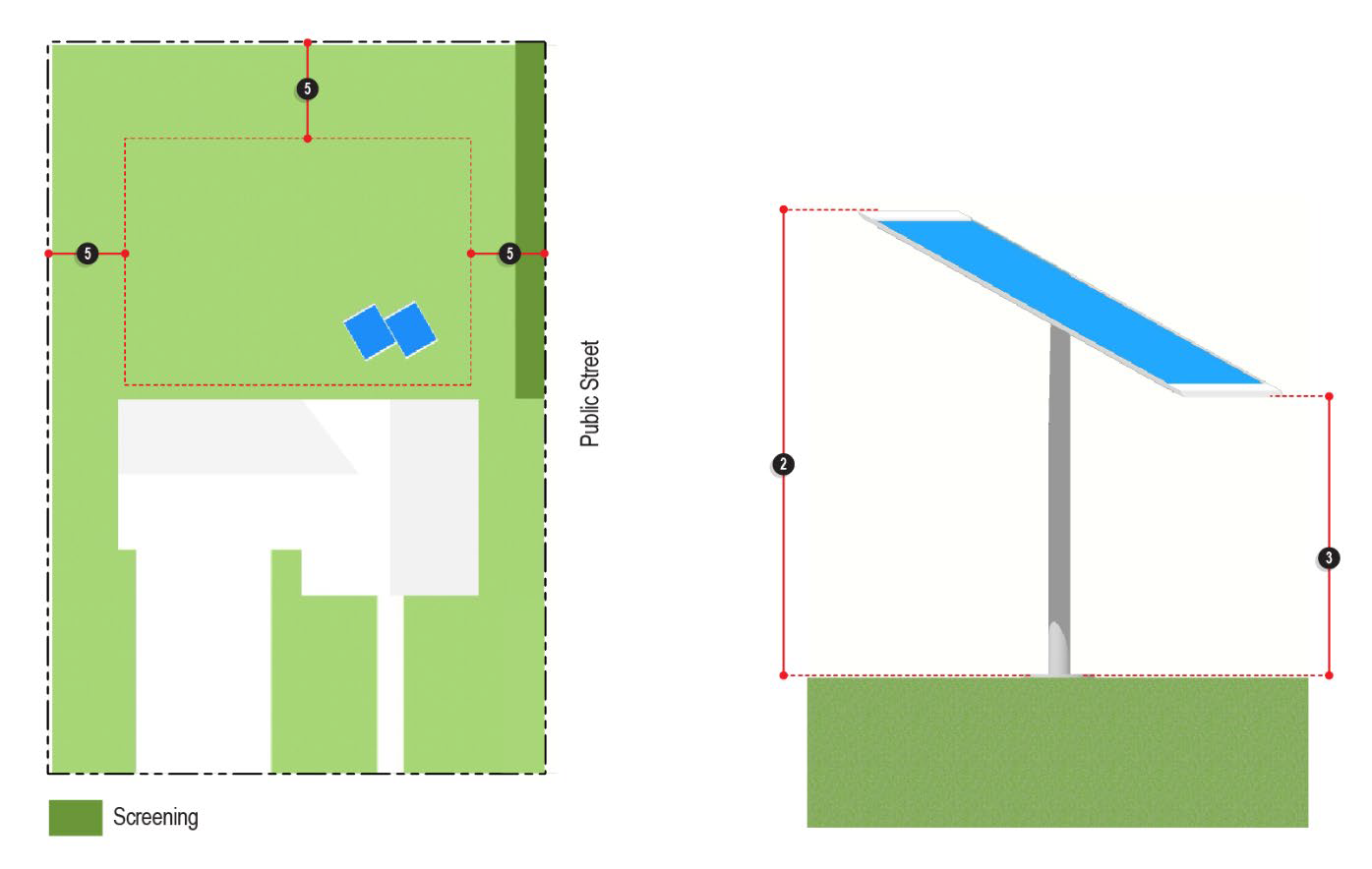
Ground-mounted solar energy collection systems shall be permitted in the rear setback only.
(2)
The maximum height of ground-mounted solar energy collection systems shall be five feet in height, measured from the grade at the base of the pole to the highest edge of the system.
(3)
Minimum clearance between the lowest point of the system and the surface on which the system is mounted shall be 12 inches.
(4)
Ground-mounted solar energy collection systems shall be exempt from the impervious surface limits if the ground directly under the solar panel is plated with native plantings and groundcover.
(5)
All parts of the freestanding system shall be set back five feet from the side and rear lot lines and shall not be located in a public utility easement.
(6)
Solar panels shall be screened from view from any public right-of-way unless otherwise approved by the director of economic and community development.
Figure 4.7. Solar Energy Collection System, Ground, Less Than One Acre
(t)
Solar energy collection system ground, one- to five-acre site.
(1)
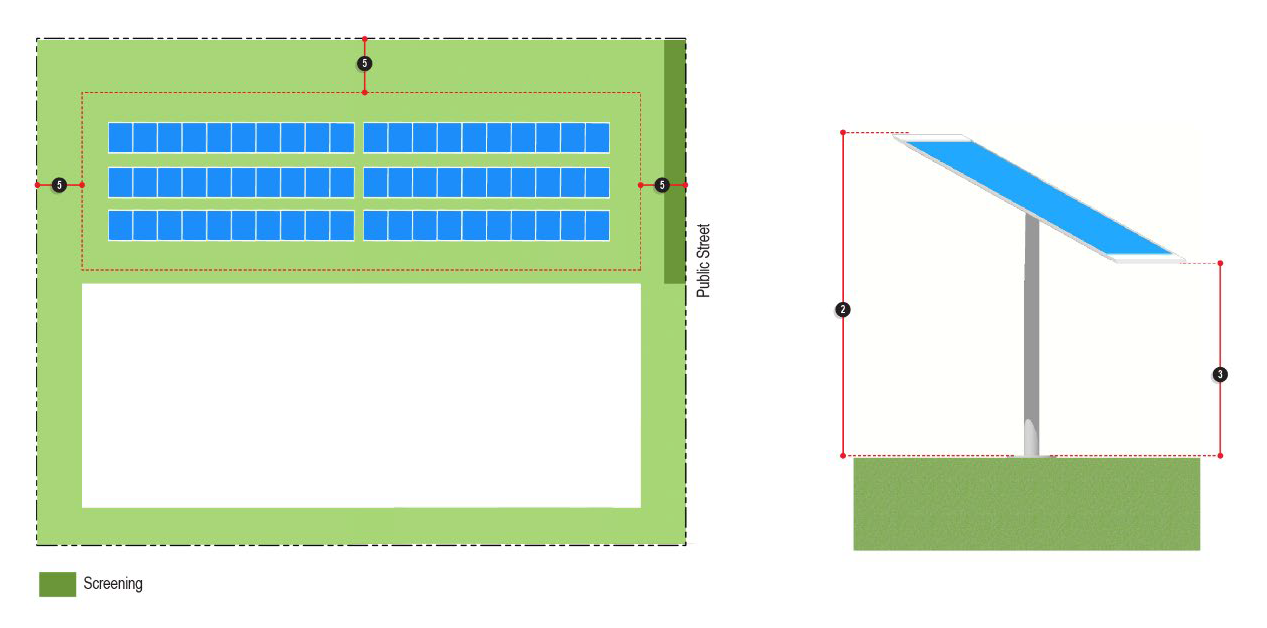
Ground-mounted solar energy collection systems shall be permitted in the rear setback only.
(2)
The maximum height of ground-mounted solar energy collection systems shall be five feet in height, measured from the grade at the base of the pole to the highest edge of the system.
(3)
Minimum clearance between the lowest point of the system and the surface on which the system is mounted shall be 12 inches.
(4)
Ground-mounted solar energy collection systems shall be exempt from the impervious surface limits if the ground directly under the solar panel is plated with native plantings and groundcover.
(5)
All parts of the freestanding system shall be set back five feet from the side and rear lot lines and shall not be located in a public utility easement.
(6)
Solar panels shall be screened from view from any public right-of-way unless otherwise approved by the director of economic and community development.
(7)
Information regarding the owner of the property and operator of the solar energy system shall be submitted to the village and updated with any change in the property owners or operator.
(8)
Decommissioning required. Any solar energy use that is not actively in use for 12 consecutive months the operator shall decommission the operator shall have six months to fully decommission the use, including all panels, structures, accessories, and appurtenances, shall be entirely removed from the lot.
(9)
Decommissioning plan. Prior to receiving approval, the applicant for any solar energy use shall submit a decommissioning plan to ensure that the project is properly decommissioned, which shall include:
a.
Procedures for the removal of structures, debris, and cabling, including those below the soil surface;
b.
Provisions for the restoration of the natural soil and vegetation;
c.
A provision that the terms of the decommissioning plan shall be binding upon the owner or operator and any of their successors, assigns, or heirs.
Figure 4.8. Solar Energy Collection System, Ground, One to Five Acres
(u)
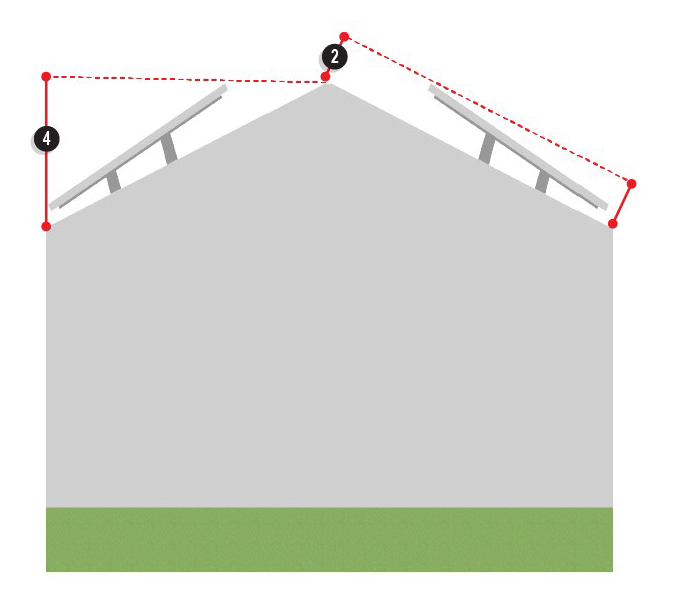
Solar energy collection system, roof.
(1)
Roof-mounted solar energy collection systems may be located on any roof face of principal or accessory buildings. Systems should be flush mounted when possible.
(2)
Systems on residential structures shall not extend beyond 12 inches parallel to the roof surface of a pitched roof or flat roof.
(3)
Systems on nonresidential structures shall not extend beyond 36 inches parallel to the roof surface of a pitched roof or flat roof.
(4)
Systems on all structures shall not extend above the highest peak of a pitched roof.
(5)
All materials used for racking, mounts, mounting clamps, and flashings shall be of a color consistent with the color of the roof surface to minimize visibility.
(v)
Reserved.
(w)
Tents. Unless the village board has granted their approval, no tent in excess of 200 square feet shall be allowed to remain for a period of more than two days longer than the period with which the use it is associated is allowed to remain or, in the absence of any such restriction, ten days.
Figure 4.9. Solar Energy Collection System, Roof
(Ord. No. MC-1068, § 2(Exh. B), 1-10-2023; Ord. No. MC-1075, § 2B., 5-9-2023; Ord. No. MC-1089, § 2.2., 8-26-2025)

