
Homewood City Zoning Code
ARTICLE V
- DEVELOPMENT STANDARDS
Sec. 44-05-01.- General off-street parking requirements.
(a)
General provisions. Off-street parking is permitted as an accessory use in all zoning districts, provided that it complies with this section. Off-street parking as a principal use is permitted only when expressly authorized by the regulations of the applicable zoning district.
(1)
Reduction of required spaces. Any off-street parking or loading space required in connection with buildings or structures existing on January 10, 2023, shall not be removed, except in conformance with the requirements of this chapter. Any building or structure that is erected or substantially altered after the effective date of the ordinance from which this chapter is derived shall provide off-street parking and loading spaces in accordance with this section, unless otherwise approved by the director of economic and community development as an administrative exception (section 44-07-06).
(2)
Change in land use. When the existing use of a building or structure is changed to a new type of use, parking and loading facilities shall be provided as required for such new type of use, unless otherwise approved by the director of economic and community development as an administrative exception (section 44-07-06).
(3)
Change in intensity of use. When a building or structure shall undergo any increase in the number of dwelling units, gross floor area, or other unit of measurement, parking and loading facilities shall be provided for such density increase, unless otherwise approved by the director of economic and community development as an administrative exception (section 44-07-06).
(4)
Buildings erected prior to January 10, 2023.
a.
This article shall not be construed to require the addition of any parking or loading spaces for uses in buildings or structures existing on the effective date of the ordinance from which this chapter is derived.
b.
Notwithstanding subsection 44-05-01(a)(3) and subsection 44-05-01(a)(4), no building or structure existing on the effective date of the ordinance from which this chapter is derived shall be required to provide any additional parking spaces unless and until the aggregate increase in the required number of spaces shall be greater than 50 percent of the spaces existing on the effective date of the ordinance from which this chapter is derived.
c.
Notwithstanding subsection 44-05-01(a)(3) and subsection 44-05-01(a)(4), no building or structure existing on the effective date of the ordinance from which this chapter is derived shall be required to provide any additional loading spaces unless and until the aggregate change shall equal the full square footage for which one additional loading space is required.
(b)
Computation.
(1)
Basis for computation.
a.
The total number of required parking and loading spaces shall be based upon the requirements for the use of the zoning lot.
b.
When more than one use occupies the same zoning lot, the number of required spaces shall be the sum of the separate requirements for each use unless otherwise approved by the director of economic and community development.
c.
When square feet are specified in Table 44-05-01(c) the area measured shall be the gross floor area of the structure(s) on the property within which the use operates.
(2)
Fractional spaces. When determination of the number of required off-street parking or loading spaces results in a requirement of a fractional space, any fraction of one-half or less may be dropped, while a fraction in excess of one-half shall be counted as one parking space.
(c)
Required parking and maximum established. All uses shall provide at least the minimum number of off-street parking spaces as detailed in Table 44-05-01(c). No use shall exceed the minimum number of off-street parking spaces required by more than 25 percent unless otherwise approved by the director of economic and community development.
(d)
Limitations on parking spaces.
(1)
General provisions. All off-street parking facilities shall be solely for the parking of passenger automobiles of patrons, occupants, or employees of such use. No vehicle shall be used for living, sleeping, or housekeeping purposes. No vehicle shall be parked or stored that creates a dangerous or unsafe condition.
(2)
Prohibited uses.
a.
No motor vehicle repair work of any kind shall be permitted in any parking space, parking lot, or loading space. The repair, maintenance, detailing or storage of motor vehicles conducted as a business or commercial activity is prohibited in all residential districts.
b.
Required off-street parking spaces shall not be used for the storage of materials, goods, or vehicles. Temporary uses may be permitted in compliance with this chapter.
(3)
Trucks and limousines. No trucks, limousines, or commercial vehicles may be parked or store in any residential zoning district, except a class B vehicle as defined by the state motor vehicle code, in compliance with the following:
1.
Vehicles shall display current state license plates and current village vehicle stickers.
2.
Vehicles shall be temporarily parked in residential zoning districts for loading and unloading purposes not to exceed one hour.
3.
Vehicles shall be parked or stored on an approved hard surface within the rear yard or within a space that is enclosed on all sides and not open to the sky.
4.
Vehicles shall be maintained in a mobile condition and no repair shall be performed in any residential zoning district.
(4)
Recreational vehicles.
a.
General provisions. In a residential zoning district, no more than two recreational vehicles (as defined in subsection 44-09-18(a)) may be parked or stored on any lot, and no recreational vehicle shall be parked or stored unless that vehicle complies with the following requirements:
1.
The vehicle shall be owned by a village resident.
2.
The vehicle shall display a current state license plate or current village vehicle sticker, if required by state law or local ordinance.
3.
The vehicle shall not exceed 40 feet in length.
4.
The vehicle shall be parked or stored at the residence of the vehicle owner on a driveway or parking pad as detailed in section 44-05-05.
5.
The vehicle shall be maintained in good and operable condition and shall not be used for living, sleeping, or general housekeeping.
6.
Notwithstanding the above, a recreational vehicle may be parked or stored within a space that is enclosed on all sides and not open to the sky.
b.
Seasonal exceptions.
1.
From April 1 to October 31, residents shall be permitted to park recreational vehicles provided the requirements of subsection 44-05-01(d)(4)a. are met and parking in the front yard is otherwise in accordance with section 44-05-02 of this chapter.
2.
From November 1 to March 31 of the following year, recreational vehicles shall not be parked or stored in a front yard. The village manager may waive this prohibition on a case-by-case basis by issuance of a written waiver. Waivers shall be effective for a maximum five-month period and shall only be granted provided both of the following conditions are met:
i.
The subject vehicle complies with subsection 44-05-01(d)(4)a.; and
ii.
The lot in question has no vehicular access to the rear or side yard.
c.
Nonresident exception. Nonresidents whose vehicles otherwise meet the requirements of subsection 44-05-01(d)(4)a. and subsection 44-05-01(d)(4)b. may, with permission of the property owner, park a recreational vehicle on a residential lot for no more than 14 days per calendar year.
(Ord. No. MC-1068, § 2(Exh. B), 1-10-2023; Ord. No. MC-1082, § 2.B., 8-13-2024)
Sec. 44-05-02. - Off-street parking standards.
(a)
Applicability. The regulations of this section shall apply to multi-family residential, mixed-use, and all nonresidential uses. Single-family residences, duplexes, and townhomes shall comply with the requirements for driveways [in] section 44-05-05.
(b)
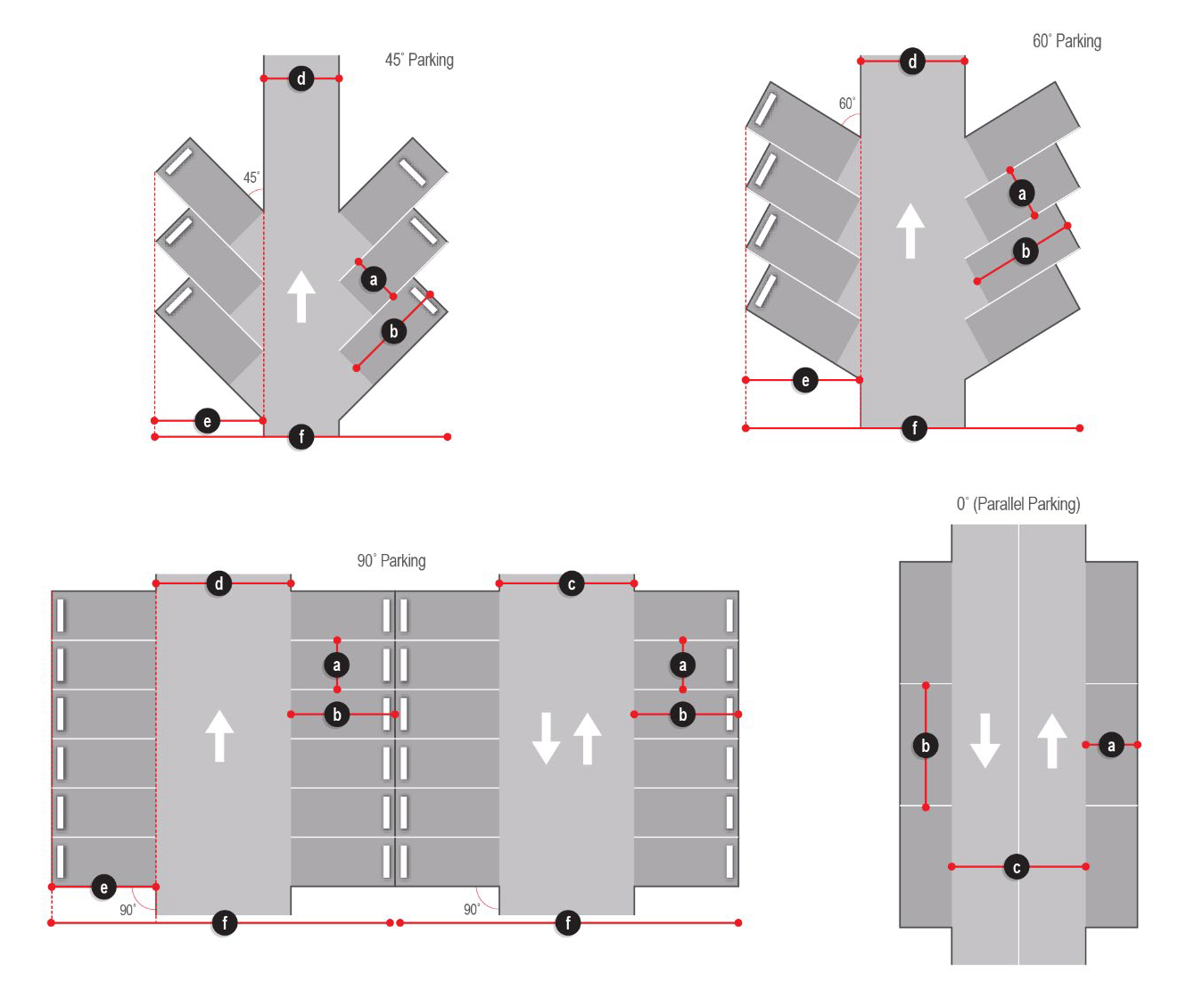
Dimensions. Required off-street parking spaces shall have vertical clearance of at least seven feet. The dimensions of parking spaces and aisles shall be as shown in Table 44-05-02(b).
Figure 5.1. Standard Parking Stall and Aisle Dimensional Requirements
(c)
Curb cut width. The width of the curb cut at the property line shall be a minimum ten feet and a maximum 25 feet, unless otherwise approved by the village engineer.
(d)
Materials. All off-street parking areas and driveways shall be improved with a hard surface pavement as specified in the current edition of the Illinois Department of Transportation Design Manual or alternate approved by the village engineer. Striping of the surface to define each parking space shall be provided and visible at all times.
(e)
Parking access.
(1)
A fire lane of not less than 20 feet in width shall be provided where required by the fire department.
(2)
All required off-street parking facilities shall have vehicular access from a street, alley, or driveway, containing all weather, hard-surfaced pavement.
(3)
All off-street parking facilities shall be provided with appropriate means of vehicular access in a manner that least interferes with traffic movements and allows the driver of the vehicle to proceed forward into traffic rather than back out.
(4)
Whenever applicable, access to the off-street parking area shall be obtained from an alley or corner side street.
(5)
No curb cut for entrance or exit to a property shall be allowed within 20 feet from an intersection, measured from and along the curb.
(6)
No more than one access point for a property shall be allowed on each street where the property is at the corner or intersection of two streets.
(7)
No lot can have multiple driveways for purposes of vehicular ingress and egress without a minimum of 150 feet of separation between such curb cuts along the same street frontage.
(8)
Each required off-street parking space shall open directly upon an aisle or a driveway of such width and design as to provide safe and efficient means of vehicular access to the parking spaces.
(9)
The location and route of access to such a parking area shall be identified and the route shall not transverse any other parking spaces.
(f)
Drainage. All parking and loading areas shall be graded and drained to dispose of surface water accumulation by means of an approved stormwater drainage system. Runoff from parking lots shall be detained on-site in accordance with the Watershed Management Ordinance of the Metropolitan Water Reclamation District of Greater Chicago and chapter 16 of this Code.
(g)
Lighting. Parking areas of more than ten spaces shall be illuminated. Illumination of off-street parking areas shall be in accordance with section 44-05-12.
(h)
Slope. Off-street parking and associated entrances and exits shall have a maximum eight percent slope. Access ramps and parking within parking decks shall comply with the regulations of the building code.
(i)
Maintenance. Except in the M-1 and M-2 districts, no cleaning or maintenance of parking lots utilizing motorized equipment may be performed between 11:30 p.m. and 6:00 a.m. each day, except for the removal of snow.
(j)
Location of spaces.
(1)
Off-street parking spaces may be provided in surface lots, below grade, beneath a building and, in those zoning districts where specifically allowed, in parking structures.
(2)
Off-street parking spaces may be located in the rear or interior side yard.
(3)
Parking spaces required per subsection 44-05-01(c) shall be located on the same lot as the use served except for uses in the B-1 district established after the effective date of the ordinance from which this chapter is derived, January 10, 2022, or unless otherwise approved by the director of economic and community development.
(4)
Parking in the B-1 downtown core and B-2 downtown transition districts.
a.
Within the B-1 downtown core and B-2 downtown transition districts, uses in existence on the effective date of the ordinance from which this chapter is derived, January 10, 2022, which are subsequently altered or enlarged, and all new uses may be served by parking facilities located on land other than the lot on which the use is located.
b.
Such facilities shall be located within 300 feet and shall be approved by the director of economic and community development, who shall consider safety standards and sound traffic design in making their decision.
c.
In cases where parking facilities are permitted on land other than the lot on which the use is located, such facilities shall be located on property controlled by the same party who owns the lot on which the use to be served is located. Such control may be by deed or by long-term lease.
1.
Such deed or lease shall be filed with the director of economic and community development and recorded with the office of the recorder of deeds by the village at the developer's expense.
2.
The deed or lease shall require the owner or his heirs and assigns to maintain the required number of parking facilities for the duration of the use served or of the deed or lease, whichever shall terminate sooner, and to notify the village if terms of the lease change.
3.
If the deed or lease terminates prior to the use served, the deed or lease shall not be released until the required off-street parking spaces are provided on the same lot as the use served or until another lot meeting all the requirements of this section is used to provide the required parking or until the village board grants a variance.
(k)
Shared parking.
(1)
Intent and purpose. Shared parking allowed in this subsection is encouraged a means of conserving land resources, reducing stormwater runoff, reducing the heat island effect caused by large, paved areas, and improving community appearance.
(2)
Location. All shared off-street parking allowed under this subsection shall be located within 500 feet of each individual use to be served unless otherwise approved by the director of economic and community development.
(3)
Standards. Off-street parking and loading facilities may be reduced by 25 percent of the quantity required in Table 44-05-01(c) between a daytime uses and an evening or weekend use which have different peak hours of parking need. For the purposes of this section, daytime and evening or weekend uses shall be as determined in Table 44-05-02(j)(3). A petitioner may also request a reduction for any two daytime or any two evening or weekend uses when the hours of peak parking do not overlap as determined by the director of economic and community development.
(4)
Requirements. The petitioner shall provide sufficient data to indicate that there is not a substantial conflict in the principal hours of operation of the uses.
(l)
Accessible parking. In all off-street parking facilities accessible parking spaces shall be provided. The number of accessible parking spaces shall be counted toward the total number of required parking spaces. The quantity, location, design, and markings shall be in accordance with the requirements of the latest edition of the Illinois Accessibility Code and Americans With Disabilities Act as amended.
(m)
Electric vehicle ready charging stations.
(1)
Applicability. All new off-street parking lots containing 40 or more parking spaces and any existing off-street parking area where the expansion would result in 40 or more parking spaces shall provide electric-vehicle ready (EV-ready) parking spaces in accordance with the quantity required in subsection (2).
(2)
Quantity required.
a.
All off-street parking for non-residential uses shall provide five percent of off-street parking spaces as EV-ready parking spaces.
b.
All off-street parking for multi-family residential and mixed use shall provide ten percent of off-street parking spaces as EV-ready parking spaces.
(3)
Design requirements. All EV-ready parking spaces required by this section shall comply with applicable regulations of subsection 44-04-14(n).
(n)
Off-street bicycle parking.
(1)
Applicability. All uses requiring site plan review as specified in section 44-07-09 shall provide off-street bicycle parking in accordance with this section, except:
a.
Vehicle-related uses as defined in this chapter.
b.
Uses in the B-1 district.
(2)
Quantity.
a.
Unless otherwise specified herein, the number of required bicycle parking spaces shall be one space for every 20 off-street parking spaces required, up to a maximum number of off-street bicycle parking spaces as deemed appropriate by the director of economic and community development.
b.
When the required quantity of bicycle parking is two spaces or less, the use shall provide a minimum of two spaces in a bicycle parking area.
(3)
Location.
a.
Required bicycle parking shall be provided on the same lot as the use for which it is intended to serve.
b.
Bicycle parking spaces shall be adequately lit and located such that they are highly visible from the street and/or building entrance(s) from where bicyclists approach.
c.
The location of bicycle parking shall not conflict with pedestrian and/or vehicle circulation.
d.
Bicycle parking shall be sited within 50 feet of a building's main entrance. If provided indoors, bicycle parking shall be located within a common area designated for secure bicycle storage.
e.
Bicycle parking adjacent to a pedestrian walkway shall be sited to ensure that a minimum five-foot walkway clearance is maintained.
(4)
Design criteria.
a.
Bicycle racks shall be securely anchored to the ground.
b.
Bicycle racks shall support the bicycle in at least two places, preventing it from tipping over, and shall provide multiple points of locking to secure both the frame and one or both wheels.
c.
Bicycle racks shall accommodate a variety of bicycle types and sizes. The inverted-U or post and ring styles are preferred.
(5)
Dimensional standards.
a.
All bicycle parking facilities shall be designed in accordance with standards established by the National Association of City Transportation Officials or the Association of Pedestrian and Bicycle Professionals.
b.
Each bicycle parking space shall be a minimum of six feet in length.
c.
Bicycle racks shall be located at least three feet in all directions from any obstruction, including, but not limited to, other bicycle racks, walls, doors, posts, columns, or landscaping.
d.
A minimum vertical clearance of seven feet shall be maintained above all bicycle parking facilities.
(Ord. No. MC-1068, § 2(Exh. B), 1-10-2023)
Sec. 44-05-03. - Off-street loading standards.
(a)
Required spaces.
(1)
Any building or structure, which is erected or substantially altered after the effective date of the ordinance from which this chapter is derived, and which requires the receipt or distribution of materials or merchandise by trucks or other similar vehicles, shall provide at least one loading space.
(2)
Any loading operation shall not create traffic congestion or traffic hazards on the public streets. Space allocated for an off-street loading space shall not be used to satisfy the space requirements for any off-street parking facilities. All required off-street loading spaces shall be completed before occupancy of the building or structure.
(b)
Dimensions. A required off-street loading space shall be at least 12 feet in width by at least 30 feet in length, exclusive of aisle and maneuvering space, and shall have vertical clearance of at least 14 feet.
(c)
Materials. All open off-street loading spaces shall be surfaced with a durable, hard surfaced pavement as specified in the current edition of the Illinois Department of Transportation Design Manual or alternate approved by the village engineer.
(d)
Access.
(1)
Each required off-street loading spaces shall be designed with appropriate means of vehicular access to a street or alley in a manner to minimize interference with traffic movements.
(2)
No curb cut to access a loading spaces shall be allowed within 20 feet from an intersection, measured from and along the curb.
(3)
No curb cut across public property that serves an off-street loading space shall exceed 24 feet in width.
(e)
Location.
(1)
Loading spaces may be located in any interior side, exterior side, or rear yard or within the confines of a building.
(2)
All required loading spaces shall be located on the same lot as the use to be served and no portion of any vehicle shall, while occupying any loading space, project into a street or alley.
(3)
In the M-1 and M-2 districts, loading spaces for vehicles of more than two-ton capacity shall be located a minimum 100 feet from any residence district.
(4)
Uses which require off-street loading facilities, but which are located in buildings or structures of less floor area than is specified for such use, shall be provided with receiving facilities, accessible by motor vehicles, off any adjacent alley, service drive, or open space on the same zoning lot.
(f)
Maneuvering space. Every loading space shall be provided with sufficient maneuvering space on the zoning lot where it is located to allow vehicles to access and exit the space without having to make a backing movement onto any public street.
(Ord. No. MC-1068, § 2(Exh. B), 1-10-2023)
Sec. 44-05-04. - Sidewalk and walkway standards.
(a)
Requirements.
(1)
Sidewalks and walkways shall be provided on-site to ensure the safety of pedestrians, bicyclists, and motorists throughout the site and to connect off-street parking to the on-site destination and public sidewalks.
(2)
The on-site walkways shall connect all buildings on the site to one another and provide connections to required parking spaces.
(3)
The on-site walkways shall connect building entrances to adjacent public sidewalks along direct routes of travel.
(4)
Where public sidewalks do not exist they shall be provided along each frontage to connect to adjacent properties. New sidewalks shall connect to existing sidewalks or walkways on adjacent properties, or to the likely future location of walkways on those properties. The director of economic and community development may waive this requirement upon determining that no walkway exists, a future walkway is unlikely to exist, or such connection would create a safety hazard.
(5)
Where driveways, parking, and loading entrance and exits cross pedestrian walkways, the pedestrian walkway shall be designed with minimal disruptions to safe, continuous pedestrian connectivity.
(6)
In parking lots with an interior parking lot median, pedestrian walkways shall be collocated with the median, unless otherwise approved by the director of economic and community development.
(7)
On-site walkways shall connect a shared parking area allowed under subsection 44-05-02(k) with each use to be served.
(b)
Materials. All sidewalks and walkways shall be surfaced with a durable, hard surfaced pavement.
(c)
Design criteria.
(1)
All sidewalks and walkways shall comply with Illinois Accessibility Code and ADA standards.
(2)
All sidewalks or walkways shall be a minimum five feet in width, unless otherwise approved by the director of economic and community development.
(Ord. No. MC-1068, § 2(Exh. B), 1-10-2023)
Sec. 44-05-05. - Driveway.
(a)
Applicability. A driveway shall be considered the private access to parking and/or a garage for single-family detached, duplex, and townhomes. All other uses shall follow the ingress/egress requirements for off-street parking.
(b)
Location. Off-street parking shall be provided on the same lot as the dwelling(s) served.
(c)
Materials. All driveways and parking pads shall be constructed of durable, hard surface materials suitable for the northeast Illinois climate, such as asphalt, concrete, paving units, or similar materials approved by the village engineer.
(d)
Driveway standards. All driveways, providing access from the right-of-way to legal off-street parking, shall be provided in conformance with the following criteria.
(1)
Quantity. A maximum of one driveway is permitted per principal dwelling.
(2)
Dimensions.
a.
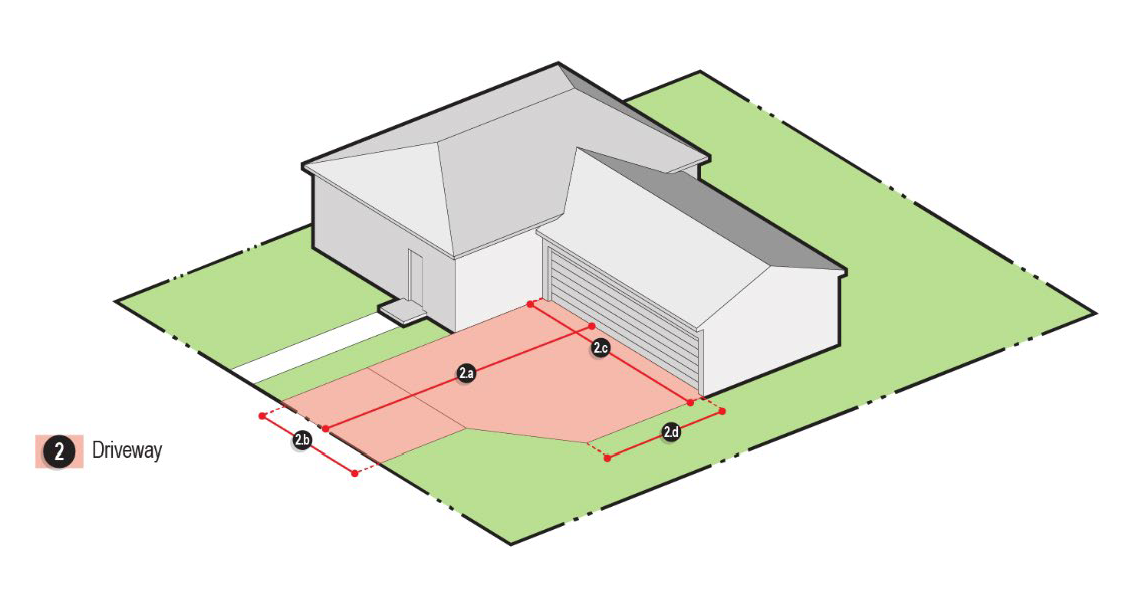
Length. All driveways shall be a minimum length of 25 feet, unless otherwise approved by the director of economic and community development.
b.
Width at property line. All driveways as measured at the property line shall be a minimum width of eight [feet] and a maximum width of 24 feet.
c.
Maximum width. Driveways as measured at the face of garage, is allowed a width of the garage doors plus three on either side of the garage door.
d.
Taper required. Driveways shall extend no more than 16 feet from the face of garage before tapering to the maximum width allowed at the property line. When a parking pad is provided, the driveway may exceed this maximum width, in compliance with the requirements of subsection 44-05-05(e).
e.
Ribbon driveways. Overall dimensions of ribbon driveways shall comply with the governing dimensions of section 44-05-05 and the following criteria.
1.
The width of each ribbon shall be a minimum of two feet and maximum of three feet.
2.
Ribbons shall be a minimum of three feet between the two ribbons. The space between the ribbons shall be planted in turf grass or other ground cover plant material.
f.
Slope. Driveways shall be a maximum eight percent slope, unless otherwise approved by the village engineer.
Figure 5.2. Driveway Standards
(e)
Parking pad standards.
(1)
Quantity. A limit of one parking pad is allowed for a single-family detached, duplex, or townhouse dwelling.
(2)
Location.
a.
A parking pad may be located in a front, interior side, or exterior side yard.
b.
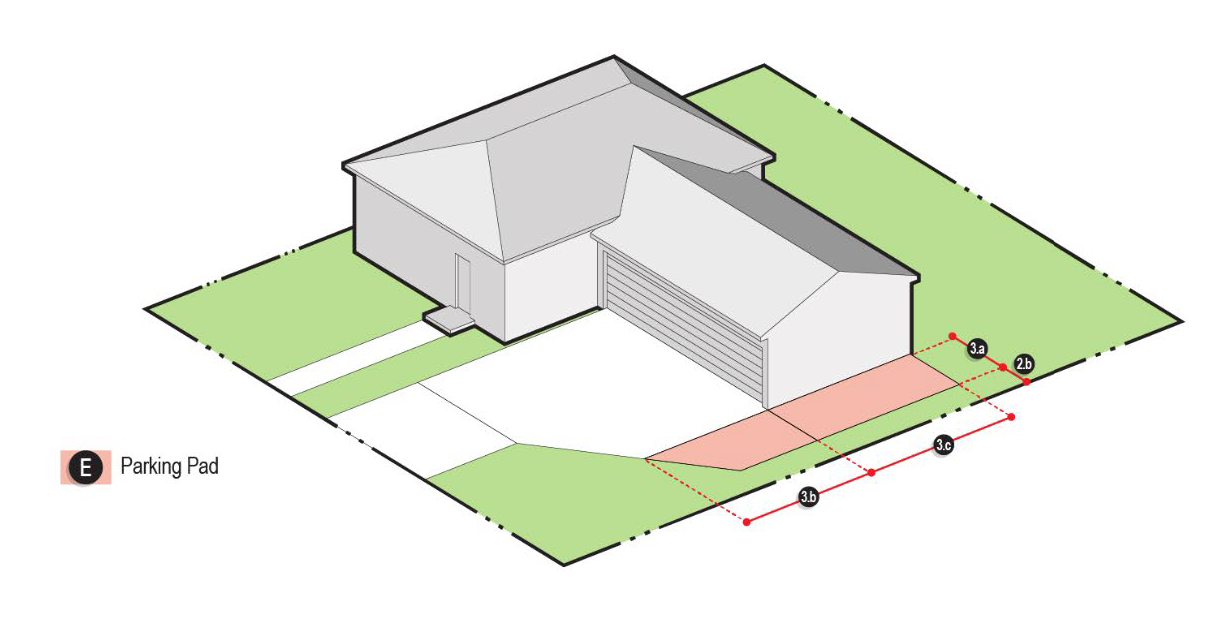
The parking pad shall be set back a minimum of three feet from any interior side property line.
c.
A parking pad may be located adjacent to the driveway and in front of the garage or adjacent to the garage.
(3)
Dimensions.
a.
A parking pad shall be a maximum of ten feet wide.
b.
Any portion of the parking pad adjacent to the driveway shall have a maximum length of 20 feet, as measured from the front facade line of the garage. A minimum seven-foot taper shall be included in the 20-foot maximum.
c.
Any portion of the parking pad adjacent to the garage shall have a maximum length equal to the depth of the garage, as measured from the front facade line of the garage.
Figure 5.3. Parking Pad Standards
(Ord. No. MC-1068, § 2(Exh. B), 1-10-2023)
Sec. 44-05-06. - Landscape requirements.
(a)
Applicability. Landscape improvements required by this section shall apply to all multi-family, mixed use, and nonresidential development and consist of living plants in a combination of trees, shrubs, native grasses and/or groundcover.
(b)
Specification and planting standards.
(1)
Unless otherwise stated in this section, all size specifications for plant materials shall be based upon the time of planting. Landscape plans shall show plants at two-thirds mature growth.
(2)
When caliper is specified for tree planting, the caliper of the tree trunk shall be measured 12 inches from the ground.
(3)
When measuring the diameter of existing trees, the measurement shall be taken four and one-half feet from the ground.
(4)
No plants identified as an invasive species by the Illinois Department of Natural Resources Invasive Species List as published shall be allowed.
(5)
Unless otherwise stated per landscape zone requirements, a minimum of 75 percent of each planting bed shall be covered in plant material with ground cover or organic mulch three inches deep to cover all remaining area.
(6)
Plant species diversity requirements. All developments shall comply with the following plant species diversity requirements, unless otherwise approved by the director of economic and community development in conjunction with approval of vegetated stormwater management areas.
a.
For parcels less than one-half acre, a minimum of 50 percent of the plant material shall be drought tolerant native species.
b.
For parcels greater than one-half acre and less than five acres, a minimum of 60 percent of the plant material on a parcel shall be drought tolerant native species. Total plant material, excluding turf and other groundcover, shall not be comprised of more than 30 percent of any single species or 50 percent of any genus.
c.
For parcels greater than five acres, a minimum of 75 percent of the plant material on a parcel that shall be drought tolerant native species. Total landscape elements, excluding turf and other groundcover, shall not be comprised of more than 20 percent of any single species or 25 percent of any genus.
(c)
Planting type and size requirements.
(1)
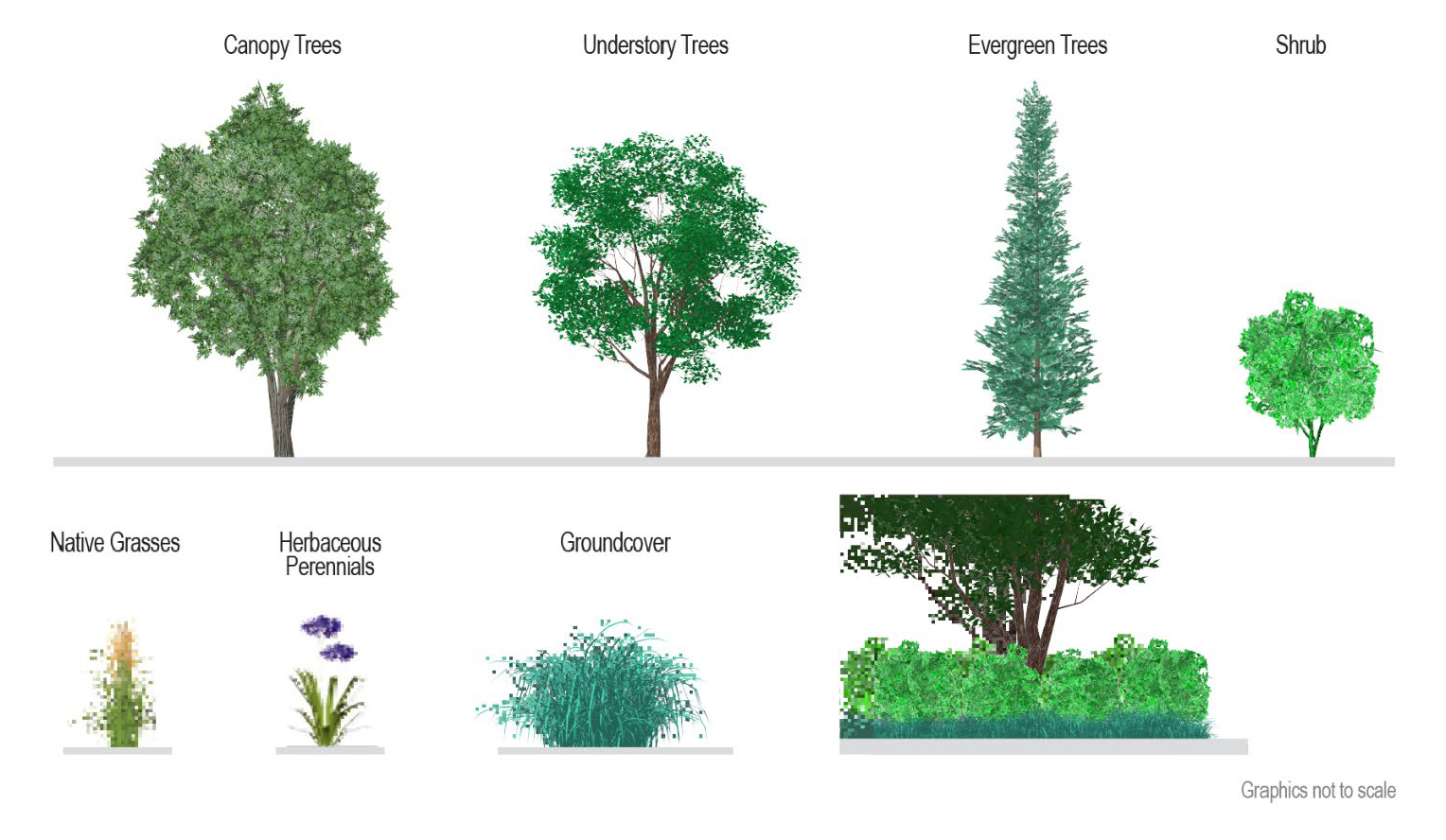
Canopy trees. A woody plant (deciduous or evergreen) having not less than a two and one-half inch caliper with single central axis which typically reaches a minimum 40 feet mature height and a minimum 15 feet mature spread.
(2)
Understory trees. A woody plant having minimum one and one-half inch caliper, or six feet tall for multiple stem species, that normally attains a minimum 15-foot mature height.
(3)
Evergreen trees. A tree having foliage that persists and remains green throughout the year and has a minimum six-foot height at installation and maturing to a minimum 20-foot height.
(4)
Shrub. A woody plant (deciduous or evergreen) of low to medium height characterized by multiple stems continuous from its base and a minimum two-foot height.
(5)
Native grasses. Grasses that are native or adapted to the state of Illinois, not including noxious weeds.
(6)
Herbaceous perennials. Plants with non-woody stems whose above-ground growth largely or totally dies back during winter months but whose underground plant parts (roots, bulbs, etc.) survive.
(7)
Groundcover. Herbaceous plants or prostrate shrubs normally reaching an average maximum height of 18 inches at maturity, not including turf grass.
Figure 5.4. Planting Types
(d)
Required landscape zones.
(1)
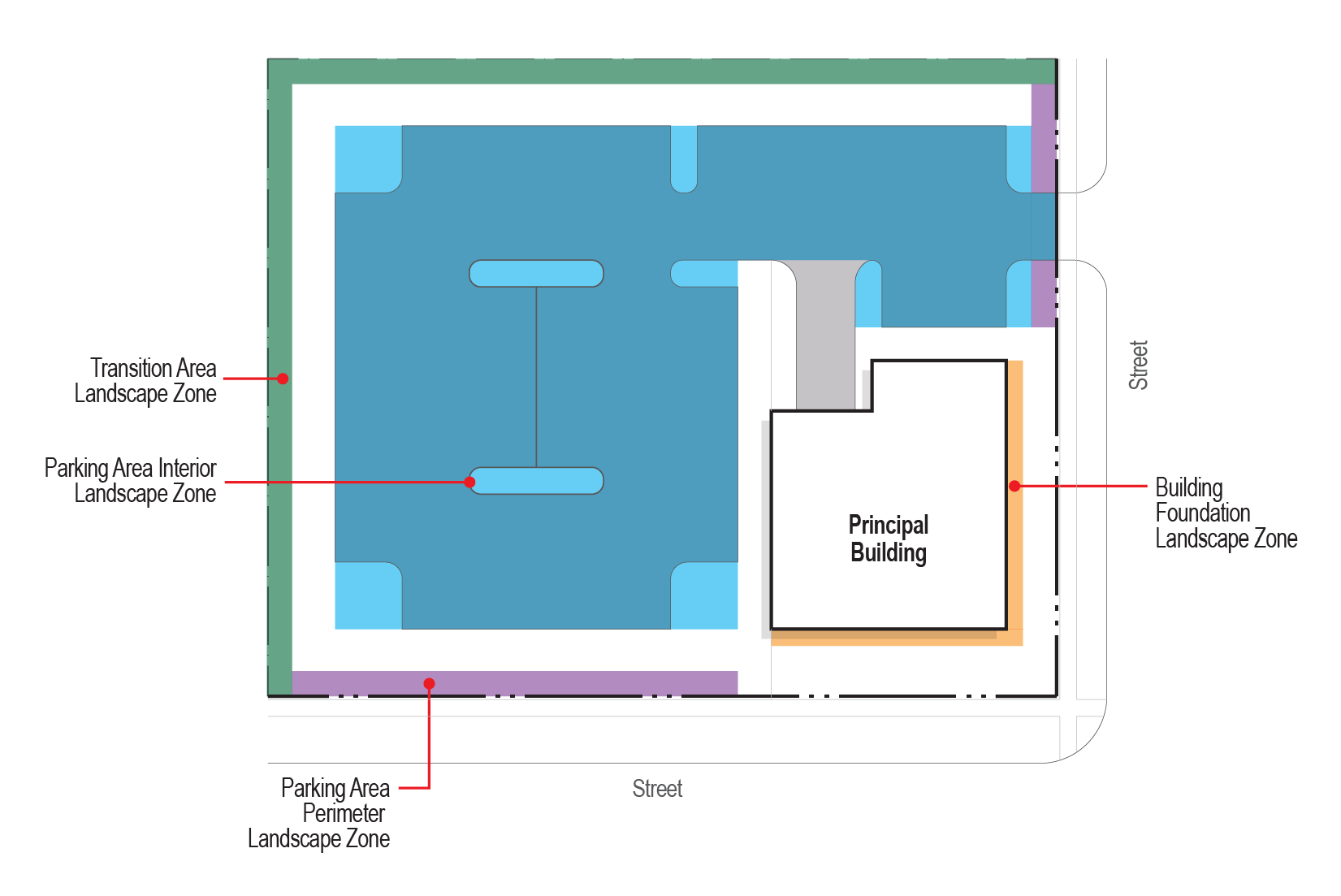
Figure 5.5 illustrates the location of the required landscape zones as detailed in the following sections. The requirements of each landscape zone are cumulative and the same plants shall not be counted towards meeting more than one requirement, unless approved by the director of economic and community development.
(2)
In the M-1 district or M-2 districts, the director of economic and community development may approve up to a 25 percent reduction in the overall required amount of landscape material for areas not visible from properties in commercial or residential districts or from major thoroughfares.
(3)
Where it is deemed impractical to provide the required number of trees cash-in-lieu may be provided for trees not accommodated on the site as established in the village fee schedule. The director of economic and community development shall determine and approve situations in which the tree requirements are impractical.
(4)
Stormwater green infrastructure is encouraged in lieu of traditional plantings for any of the required landscape zones. Creative and alternative application of the landscaping requirements may be considered when including performance landscapes.
(5)
The director of economic and community development may approve a landscape plan that does not meet all the minimum plant quantity requirements of this section, but is demonstrably superior to what could be achieved using the minimum standards herein and is consistent with the intent of the section.
Figure 5.5. Required Landscape Zones
(e)
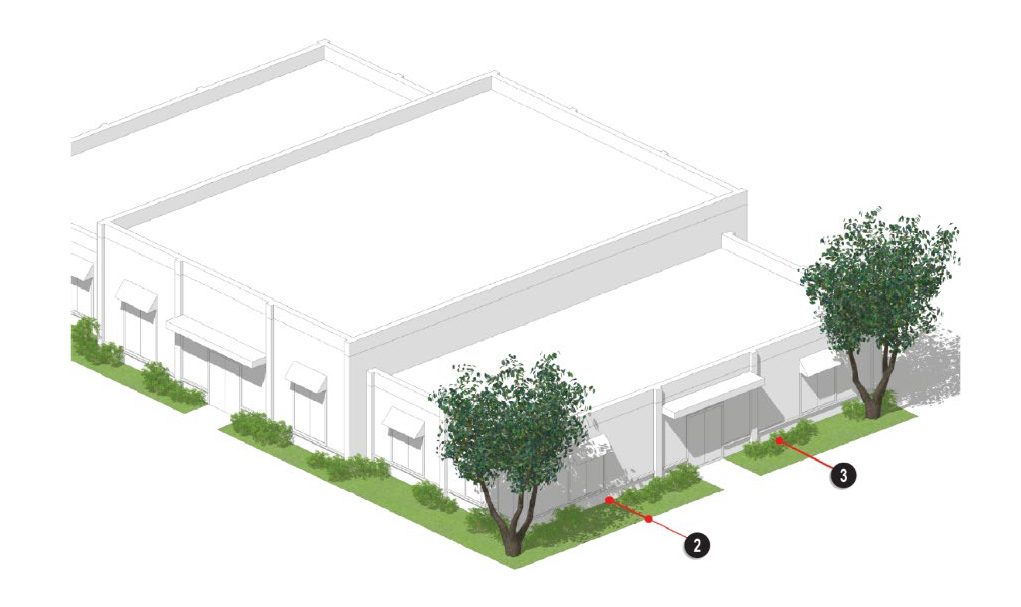
Building foundation landscape zone. The objective of building foundation landscaping is to soften the base of the building, add visual interest, and integrate the building with the site.
(1)
Applicability.
a.
All new construction and additions or alterations subject to site plan review per section 44-07-09 shall provide the required building foundation landscaping.
b.
When expanding or altering an existing building, the building foundation landscaping shall be required only for the area of building foundation within the proposed scope of work.
c.
Food processing facilities regulated by the FDA are exempt from providing foundation landscaping and shall provide an approved alternative.
d.
Buildings that have no required front yard setback shall provide an approved alternative.
(2)
Location. Provide building foundation landscaping at front and exterior side yards with a minimum seven-foot width.
(3)
Requirements.
a.
Foundation plantings shall be installed across 80 percent of the length of the building facade unless the design and location of plantings is otherwise approved by the director of economic and community development.
b.
Foundation plantings shall be designed to enhance architectural features and visually soften long expanses of walls.
c.
Foundation plantings may include trees, shrubs, native grasses, and groundcover. Trees and shrubs may shade or screen but shall not obstruct windows.
(4)
Alternatives.
a.
Stormwater detention planters located away from the face of the building may be used in lieu of foundation plantings. Design and plant selection shall be reviewed for performance as stormwater green infrastructure.
b.
Where the area between the building and parking lot or street curb is entirely paved for pedestrian use, provide canopy trees in lieu of foundation landscaping at a quantity of one tree per 50 linear feet of building facade. The canopy trees shall be planted in tree pits with grates, providing a minimum structural soil 600 cubic feet of structural soil per tree pit.
Figure 5.6. Building Foundation Landscape Zone
(f)
Parking area perimeter landscape zone. The objective of parking area perimeter landscaping is to provide screening between off-street parking areas and rights-of-way, and to facilitate the integration of stormwater management with required landscaping.
(1)
Applicability.
a.
All new off-street parking areas shall provide perimeter landscaping.
b.
When expanding any existing off-street parking area, provide the perimeter screening for the expanded area at a minimum.
(2)
Location. Provide parking area perimeter landscaping for all off-street parking areas abutting a public or private right-of-way, excluding alleys.
(3)
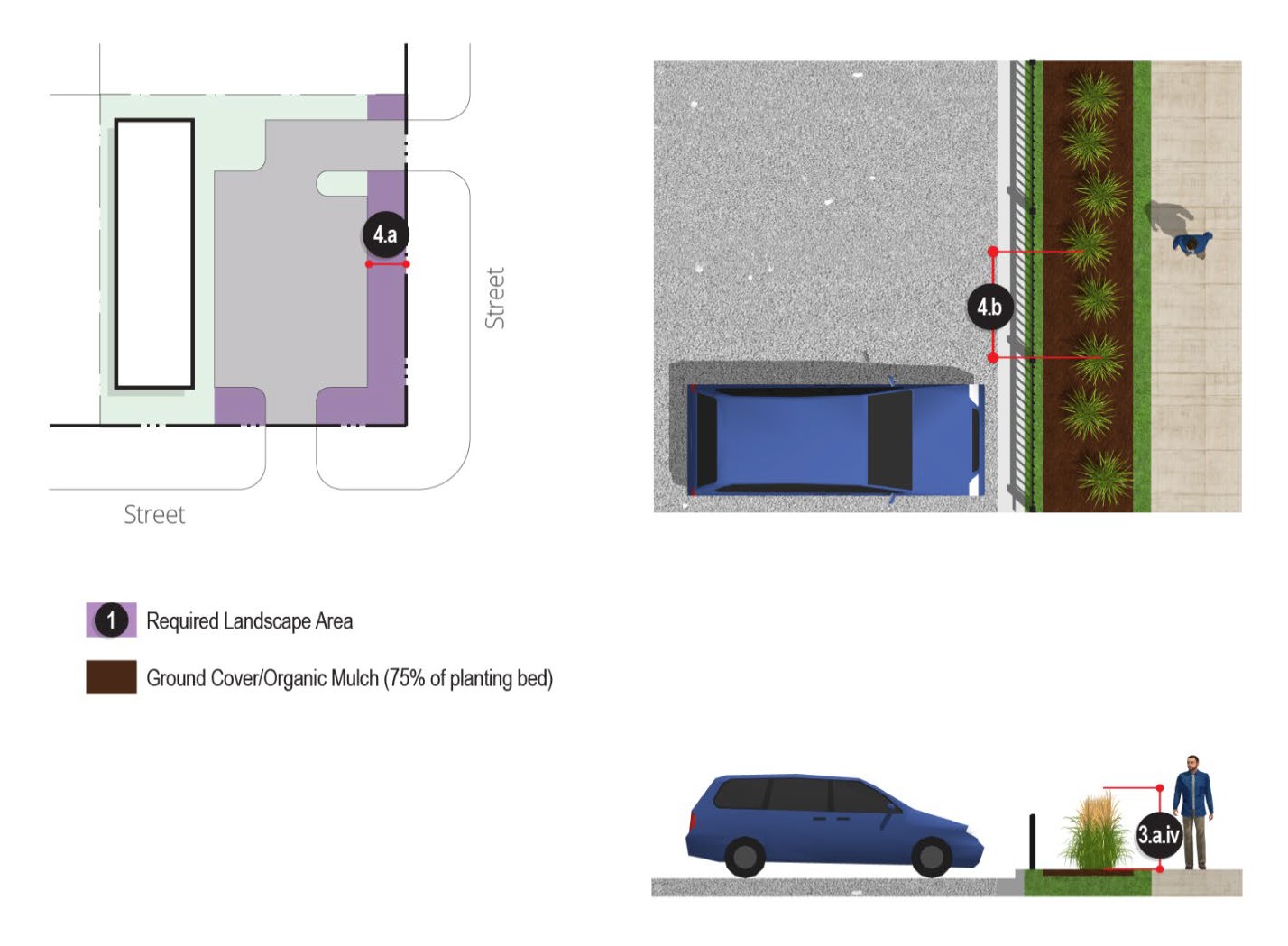
Requirements for lots fronting Halsted Street.
a.
Principal building set back 30 feet or less from back of curb.
1.
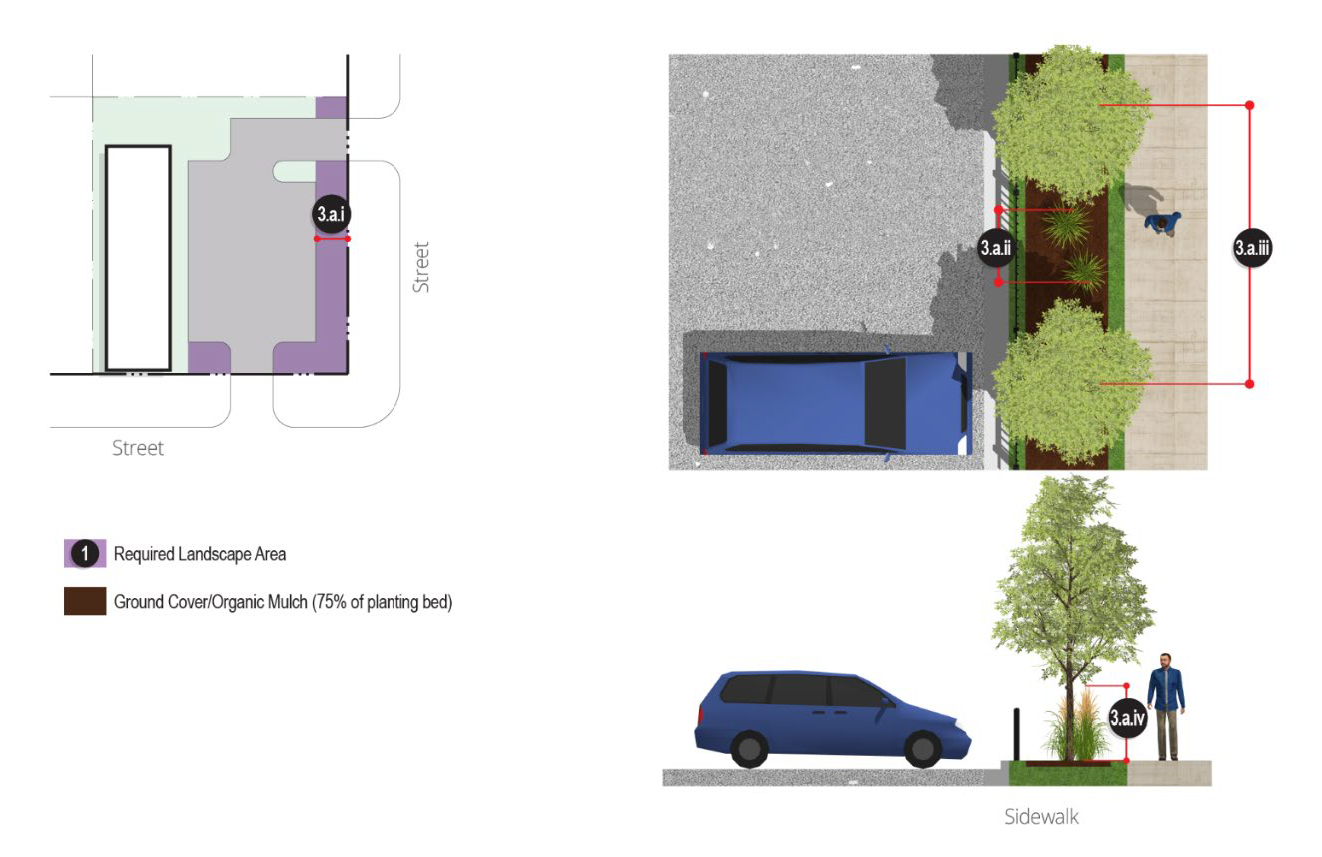
Parking area perimeter landscaping shall be a minimum seven feet wide as measured from the back of curb of the off-street parking area, to accommodate vehicle bumper overhang and ensure planting areas that are adequate in size.
2.
For every three feet of landscape area length, provide a minimum of one shrub or native grass.
3.
For every 25 feet of landscape area length, provide a minimum of one canopy tree.
4.
The height of parking area perimeter plants shall be a minimum of three feet and maximum of five feet tall. Where the parking spaces are designed for the car bumper to overhang the landscape area, plantings may be lower.
5.
Landscaped areas outside of shrubs/native grasses shall be planted in live groundcover.
Figure 5.7. Parking Area Perimeter Landscape Zone—Halsted Street,
Building 30 Feet or Less from Back of Curb
b.
Principal building set back greater than 30 feet from back of curb.
1.
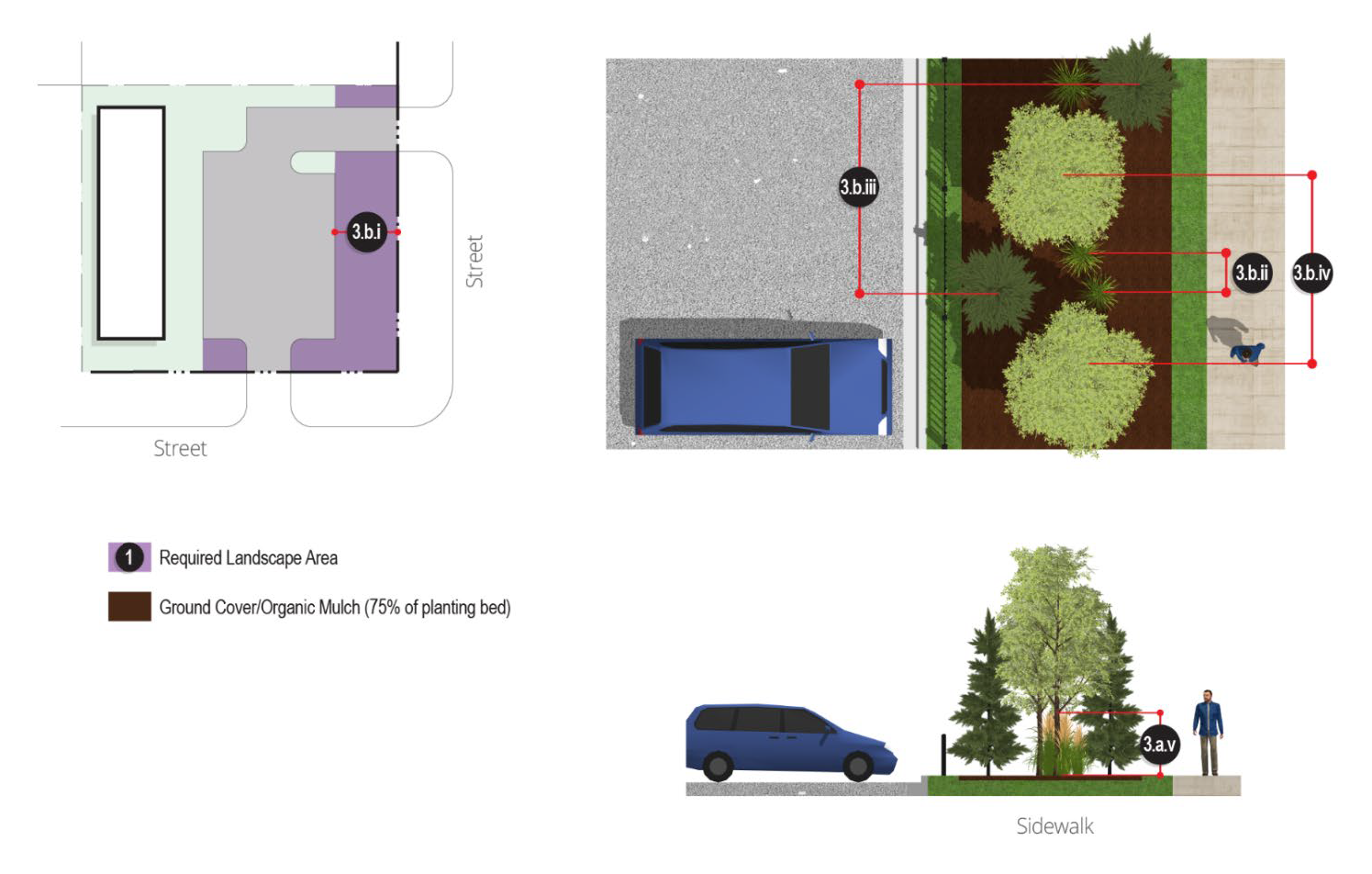
Parking area perimeter landscaping shall be a minimum 15 feet wide as measured from the back of curb of the off-street parking area, to accommodate vehicle bumper overhang and ensure planting areas that are adequate in size.
2.
For every three feet of landscape area length, provide a minimum of one shrub or native grass.
3.
For every 25 feet of landscape area length, provide a minimum of one understory/evergreen tree.
4.
For every 25 feet of landscape area length, provide a minimum of one canopy tree.
5.
The height of parking area perimeter plants shall be a minimum of three feet and maximum of five feet tall. Where the parking spaces are designed for the car bumper to overhang the landscape area, plantings may be lower.
6.
Landscaped areas outside of shrubs/native grasses shall be planted in live groundcover.
Figure 5.8. Parking Area Perimeter Landscape Zone—Halsted Street,
Building Greater Than 30 Feet From Back of Curb
(4)
Lots fronting all other roadways. All other lots shall provide a parking area perimeter landscape zone as follows.
a.
Parking area perimeter landscaping shall be a minimum seven feet wide as measured from the back of curb of the off-street parking area, to accommodate vehicle bumper overhang and ensure planting areas that are adequate in size.
b.
For every three feet of landscape area length, provide a minimum of one shrub or native grasses.
c.
The height of parking area perimeter plants shall be a minimum of three feet and maximum of five feet tall. Where the parking spaces are designed for the car bumper to overhang the landscape area, plantings may be lower.
d.
Landscaped areas outside of shrubs/native grasses shall be planted in live groundcover.
Figure 5.9. Parking Area Perimeter Landscape Zone, Lots Fronting All Other Roadways
(5)
Alternatives.
a.
A low masonry wall or ornamental fence a maximum of four feet high may be used in conjunction with required landscaping as detailed above. Plant materials shall be installed between the sidewalk and the fence or wall to provide a softening effect. The fence or wall shall be located to provide adequate clearance from any anticipated bumper overhang.
b.
Stormwater green infrastructure is encouraged. Design and plant selection shall be reviewed for performance as stormwater green infrastructure.
(g)
Parking area interior landscape zone. The objective of parking area interior landscaping is to provide shade within parking areas, break up large expanses of parking area pavement and mitigate heat island effects, support stormwater management, improve the appearance of parking lots as viewed from rights-of-way, and provide a safe pedestrian environment.
(1)
Applicability.
a.
All new off-street parking lots containing 30 or more parking spaces shall provide all parking area interior landscaping.
b.
When expanding any existing off-street parking area where the expansion would result in 30 or more parking spaces provide all parking area interior landscaping for the expanded area at a minimum.
c.
New or expanded off-street parking areas consisting of fewer than 30 contiguous spaces that are located in front, exterior side, or interior side yards shall provide a parking area end cap, unless otherwise approved by the director of economic and community development.
d.
Off-street parking areas consisting of fewer than 30 contiguous spaces that are located in rear yards shall be exempt from parking area interior landscape zone requirements.
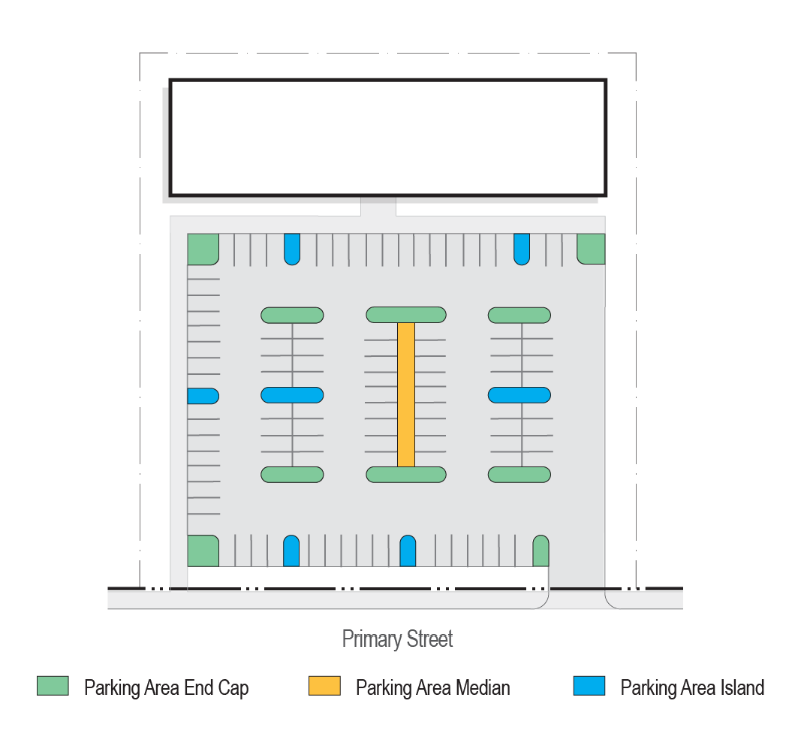
(2)
Requirements. The amount of required parking area interior landscape shall be determined by the location of the off-street parking area as detailed below.
a.
Off-street parking areas in front or side of principal buildings.
1.
Parking area end caps. A parking area end cap shall be located at the end of any bay of parking bordered by a drive aisle, public or private street, or pedestrian circulation system.
2.
Parking area medians. Parking area medians shall be placed between every third bay of parking.
3.
Parking area islands. Parking area islands shall be located on parking bays which are not required to have parking area medians. Parking area islands shall be spaced not more than 90 feet or ten continuous spaces apart.
Figure 5.10. Parking Area Interior Landscape Zone for Parking Areas in Front or Side of Principal Building
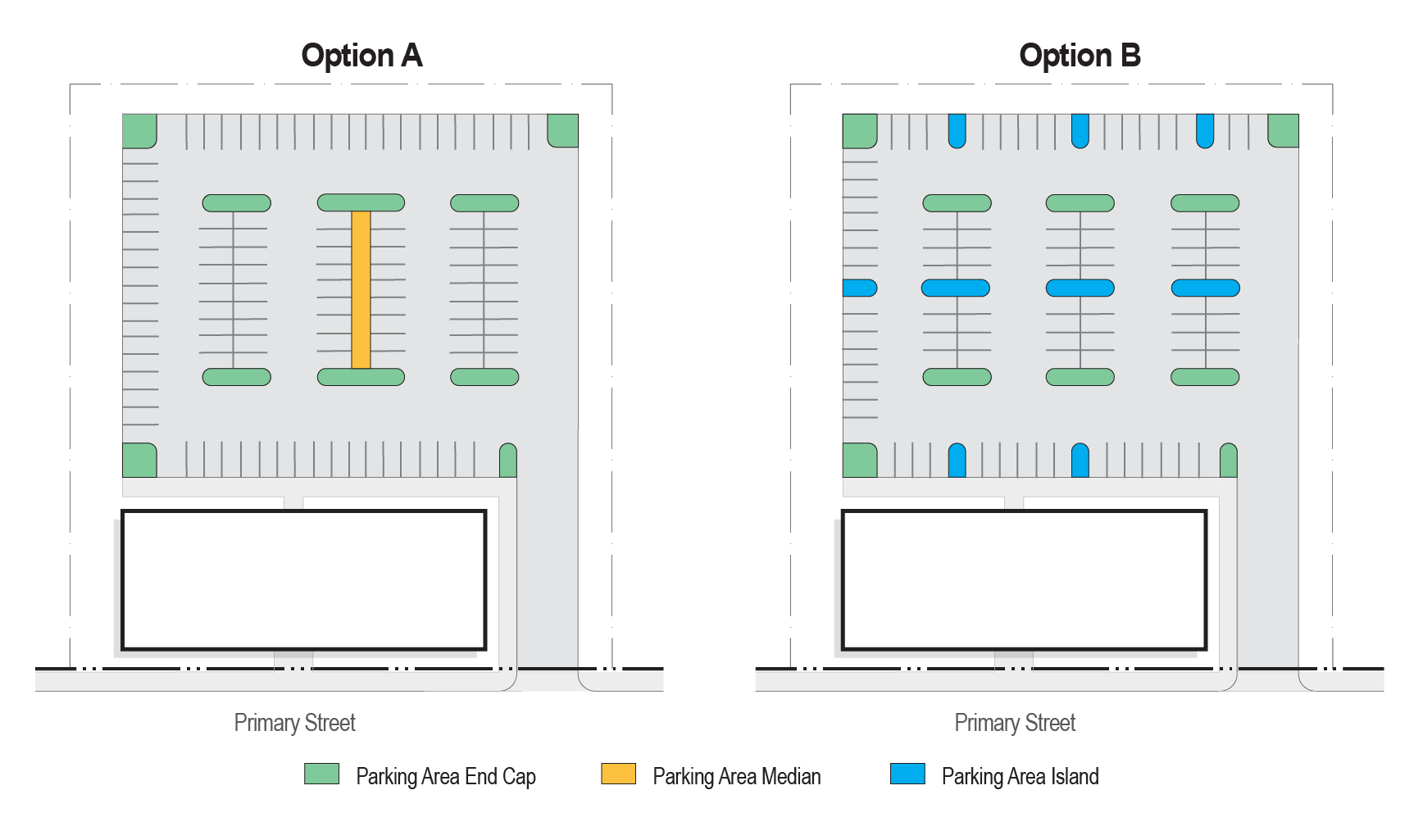
b.
Off-street parking areas in rear of principal building.
1.
Parking area end caps. A parking area end cap shall be located at the end of any bay of parking bordered by a drive aisle, public or private street, or pedestrian circulation system.
2.
Parking area medians or parking area islands. The developer may choose to install either parking area medians or parking area islands, in compliance with the requirements above.
Figure 5.11. Parking Area Interior Landscape Zone for Parking Areas in Rear of Principal Building
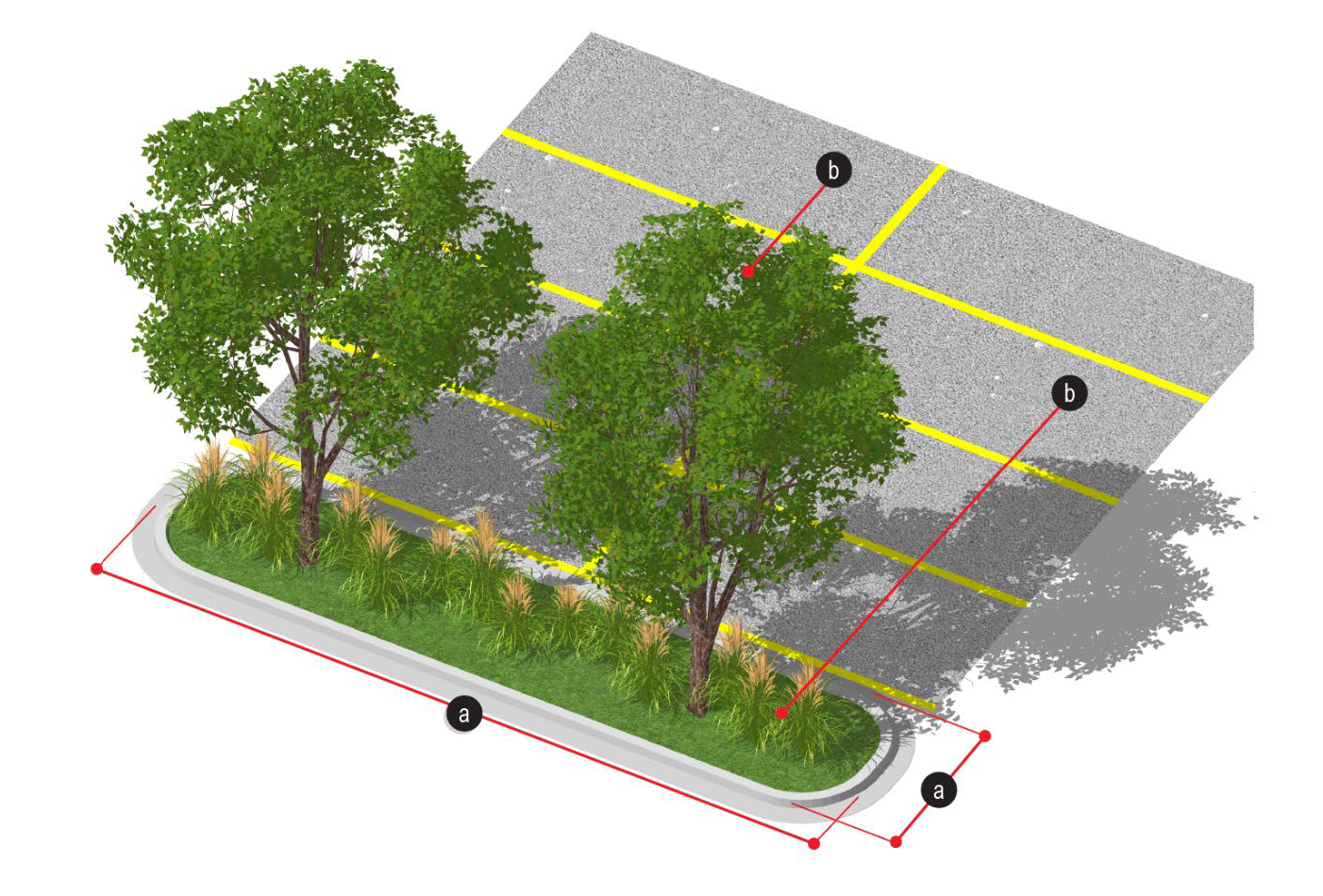
(3)
Parking area end cap standards.
a.
Size. Parking area end caps shall be a minimum nine feet wide by 18 feet long. Double rows of parking shall provide parking area end caps opposite one another to form continuous single end cap.
b.
Planting. A minimum of one canopy tree and three shrubs or native grasses shall be provided for every parking area end cap. If the end cap extends the width of a double bay, then two canopy trees shall be provided.
Figure 5.12. Parking Area End Cap Standards
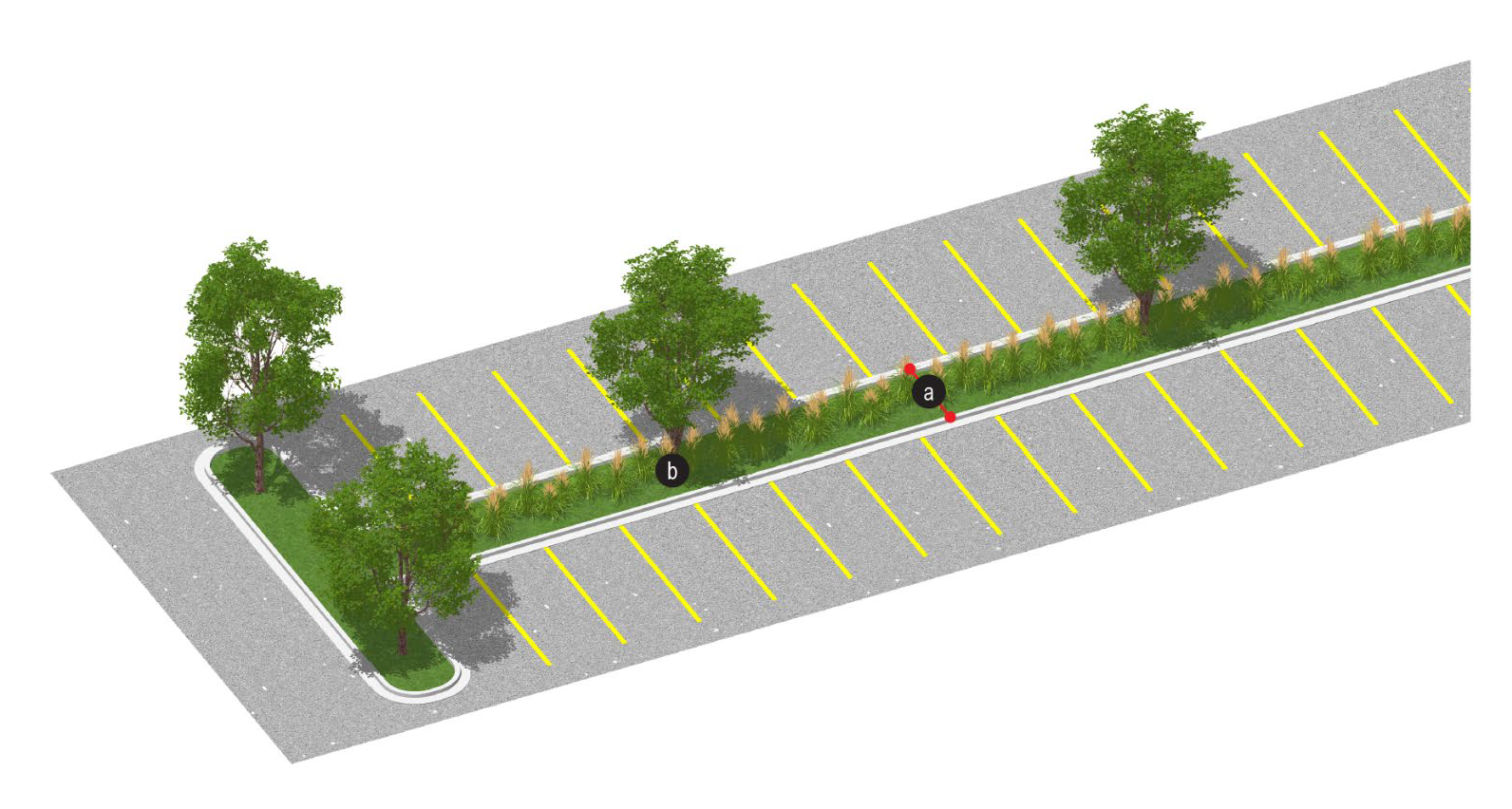
(4)
Parking area median standards.
a.
Size. Parking area medians shall have a minimum width of nine feet and run the full length of the parking bay.
b.
Planting. A minimum of one canopy tree and 15 shrubs or native grasses shall be planted for each 50 linear feet of parking area median.
Figure 5.13. Parking Area Median Standards
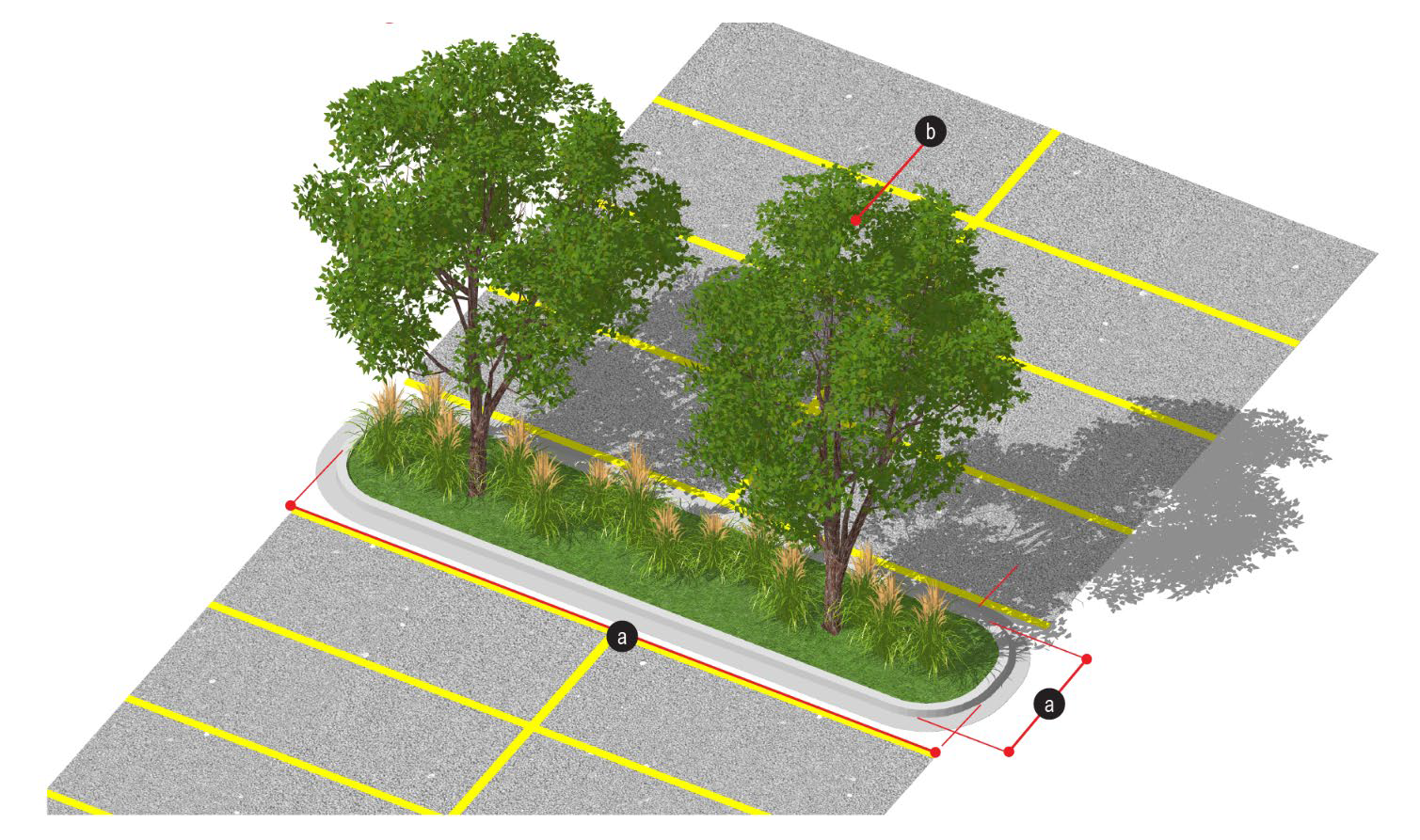
(5)
Parking area island standards.
a.
Size. Parking area islands shall be a minimum nine feet wide by 18 feet long. Double rows of parking shall provide parking area islands opposite one another to form continuous single islands.
b.
Planting. A minimum of one canopy tree and three shrubs or native grasses shall be provided for every parking area island. If the island extends the width of a double bay, then two canopy trees and six shrubs or native grasses shall be provided.
Figure 5.14. Parking Area Island Standards
(6)
General standards.
a.
All landscape areas shall have a minimum 36 inches of soil depth.
b.
All interior parking area landscaping shall be protected with concrete curbing or other suitable barriers approved by the director of economic and community development and shall be properly drained or irrigated as appropriate to the site conditions to ensure survivability of plant materials or proper stormwater management function.
c.
Canopy trees shall be the primary plant materials used in parking area islands, and canopy trees and shrubs or native grasses shall be the primary plant materials used in parking area medians.
d.
Understory trees, evergreen trees, shrubs, native grasses, groundcover, and other plant materials may be used to supplement the required plantings but shall not create visibility concerns for automobiles and pedestrians.
e.
If medians or islands are designed as stormwater management areas, deviations from required plantings may be approved by the village engineer or village arborist.
f.
Where landscape areas are identified for stormwater green infrastructure function, design and plant selection shall be reviewed for performance as stormwater green infrastructure.
(h)
Transition zone landscape requirements. The objective of transition zone landscaping is to minimize land use conflicts and enhance aesthetics between different use types. It is not expected that the transition area will totally screen such uses.
(1)
Applicability.
a.
All new construction and additions or alterations subject to site plan review per section 44-07-09 shall provide the required transition zone landscaping.
b.
When expanding any existing building, provide the transition zone landscaping for the expanded area at a minimum.
c.
All new uses in an existing development shall provide transition zone landscaping, unless otherwise approved by the director of economic and community development.
(2)
Location. Transition zone landscaping shall be provided along interior property lines. Required yard setbacks may be used for transition zone landscape.
(3)
Transition zone type requirement. Transition zones shall be provided based on the land use of the subject property and the land use of the adjacent property, provided in Table 44-05-06(h)(3). The director of economic and community development may waive requirements where adjacent uses are of a similar nature, scale, and intensity.
(4)
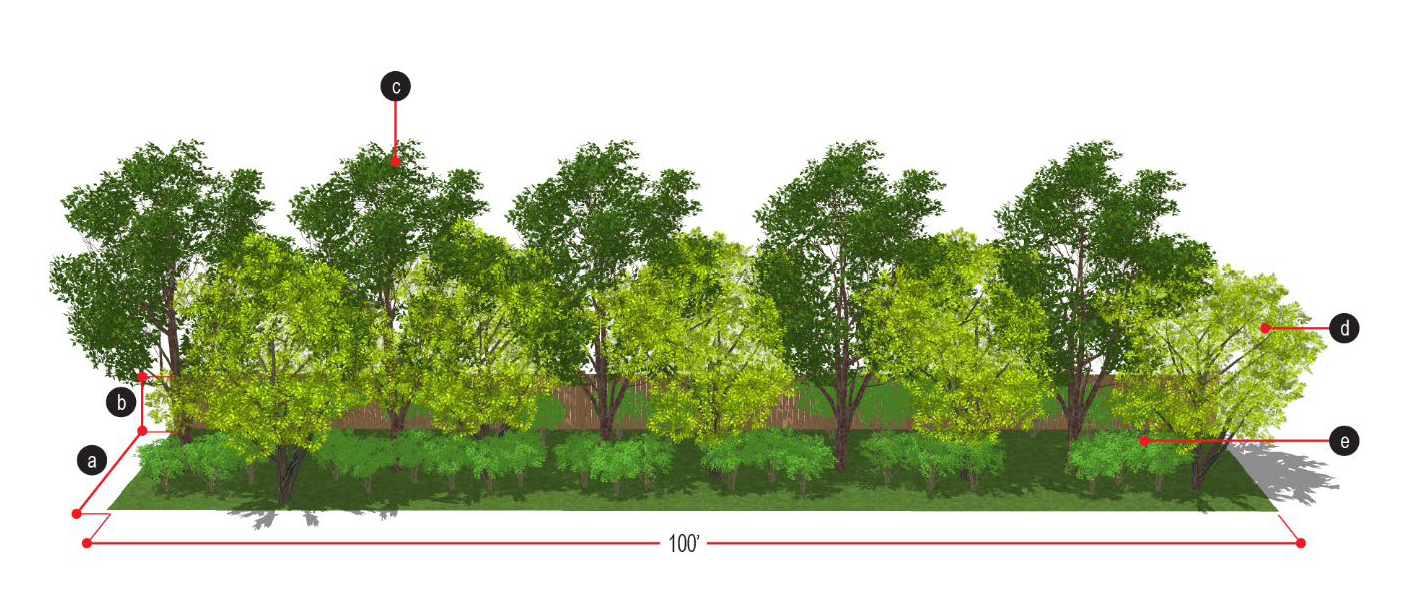
Transition zone types. Four transition zone types are established in recognition of the different contexts that may exist, as shown in Table 44-05-06(h)(4).
Figure 5.15. Transition Zone Type A
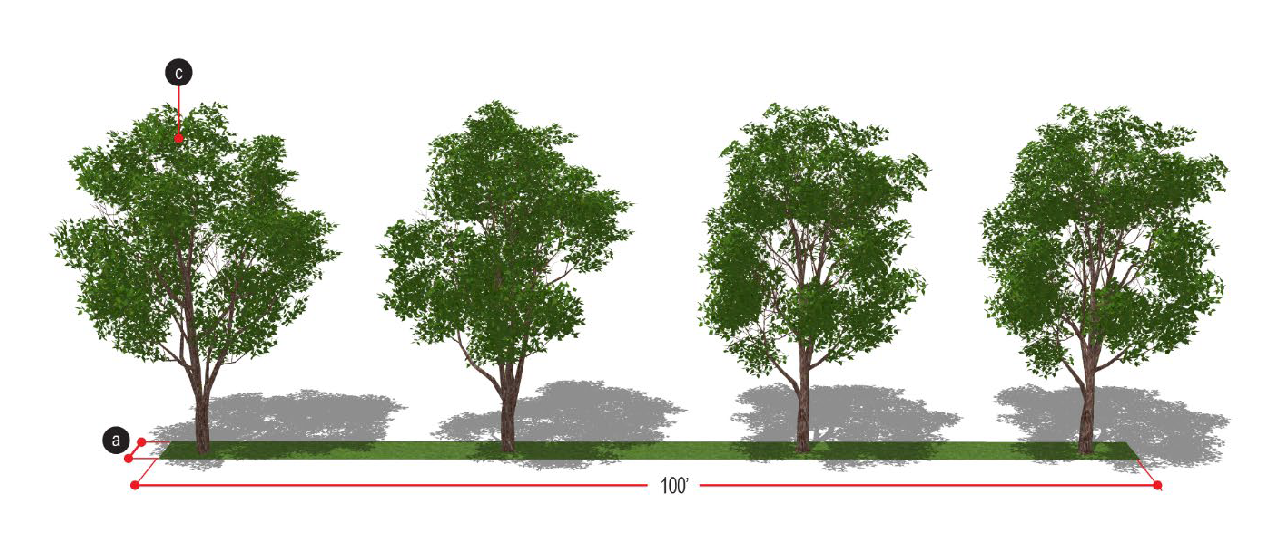
Figure 5.16. Transition Zone Type B
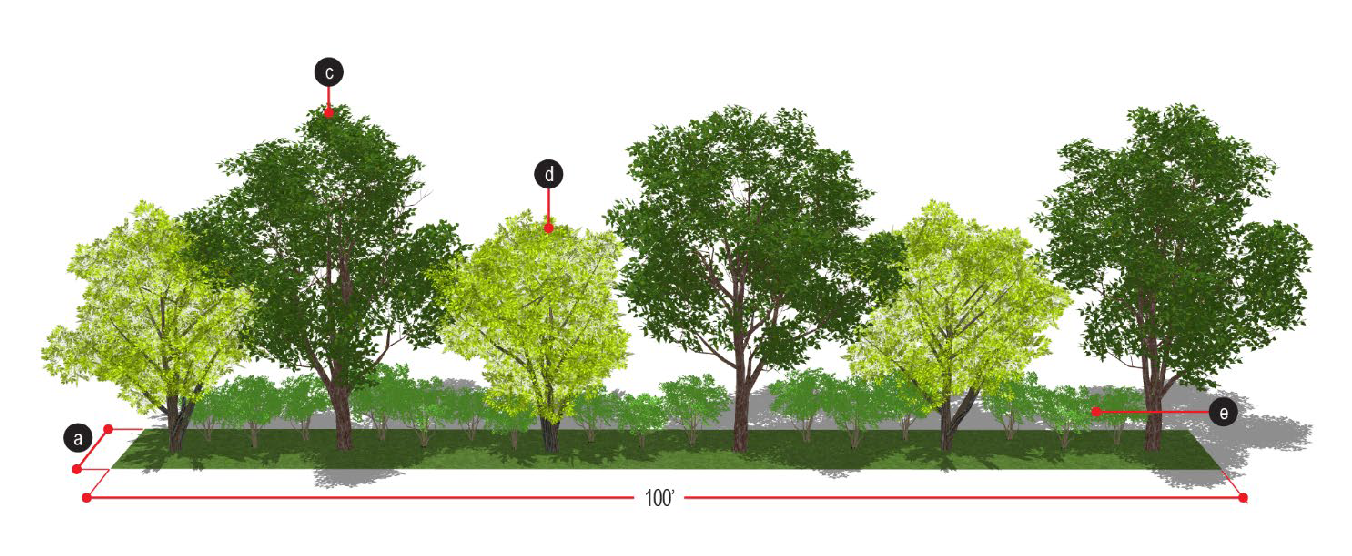
Figure 5.17. Transition Zone Type C
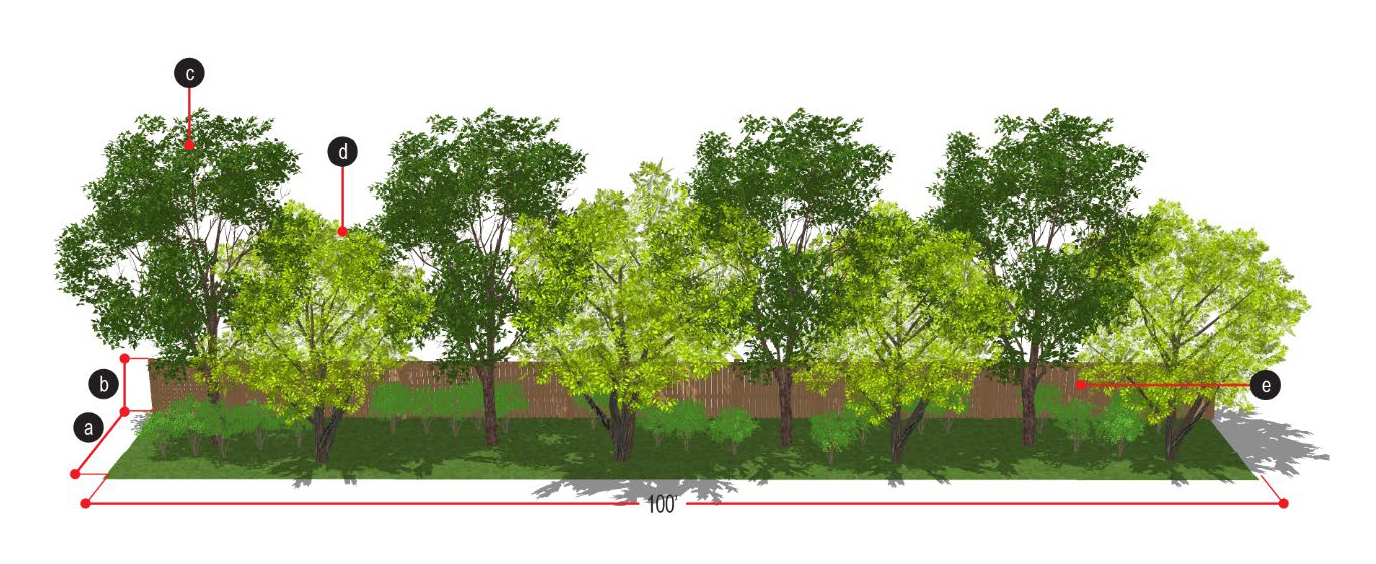
Figure 5.18. Transition Zone Type D
a.
Alternatives allowed.
1.
Fence or wall requirements specified in Table 44-05-06(h)(4) may be satisfied by a solid evergreen or arborvitae hedge with a maximum six feet in height, as approved by the director of economic and community development.
2.
Fewer trees than required in Table 44-05-06(h)(4) may be provided when providing a swale planted with natural grasses to provide stormwater green infrastructure. Design and plant selection shall be reviewed for performance as stormwater green infrastructure.
(i)
Installation and maintenance of landscape areas.
(1)
All installed landscape shall conform to the most recently approved American Standard for Nursery Stock (ANSI Z60.1), published by the American National Standards Institute.
(2)
The director of economic and community development may approve, on a case-by-case basis, an exception to the requirement for installation of landscaping prior to approval of a certificate of occupancy for applications submitted between November 1 and April 30. Exceptions shall only be approved in accordance with the procedures and requirements below.
a.
The applicant or their designee shall provide a written request to the community development department for an exception prior to or concurrent with the submission of a certificate of occupancy application. The written request shall include an estimate for the anticipated installation (commencement and completion), and contact information.
b.
The written request shall be submitted with all of the following:
1.
Quote from the landscape architect or landscaping professional for all landscape elements included in village-approved landscape plans and installation/labor costs. Where landscaping has been partially completed, the quote shall include only the remaining elements and installation/labor costs.
2.
A copy of the approved landscape plan upon which the quote is based. Where landscaping has been partially completed, the remaining elements must be clearly identified on the plans.
(3)
Dead plant materials shall be replaced within 60 days taking into consideration the season of the year and shall have at least the same quantity and quality of landscape elements as initially approved. If the particular project is constructed in more than one phase, the 60-day timeframe shall apply to each individual phase.
(4)
All landscape shall be maintained in a healthy, neat, trimmed, clean, and weed-free condition. With the exception of surface areas in vegetated stormwater management areas where mulch is not specified, the ground surface of landscape areas shall be covered with either turf and/or other types of pervious groundcover located beneath and surrounding trees and shrubs.
(5)
For stormwater management areas where irrigation is not specified, all installed plantings shall be guaranteed for a period of 18 months following municipal approval of installation. During this guarantee period landowner shall supply water as necessary to promote successful establishment and growth.
(6)
All plantings required under this chapter, including landscaping installed pursuant to an approved landscape plan, shall be maintained perpetually and replaced if they die or are substantially weakened or damaged. If plantings succumb due to disease or environmental conditions, they shall be replaced with more suitable or appropriate species of the same type (e.g. tree, shrub, groundcover).
(Ord. No. MC-1068, § 2(Exh. B), 1-10-2023)
Sec. 44-05-07. - Tree preservation.
(a)
Applicability. All property within the village shall require an approved tree preservation and removal plan prior to removing any existing living and healthy trees as determined by the village arborist with 12 inches diameter or greater.
(b)
Measurement standard. Diameter is measured at four and one-half feet from the ground.
(c)
Requirements.
(1)
The tree preservation and removal plan shall include an inventory of all trees subject to tree preservation.
(2)
The plan shall indicate the location, size, species, and health of the tree as determined by a certified arborist or landscape architect.
(3)
The plan shall be prepared by a certified arborist or landscape architect and approved by the village arborist.
(4)
Every reasonable effort shall be made to incorporate trees identified in the inventory into the landscape required for the proposed development.
(5)
Prior to granting approval to remove a mature, high-quality tree the village engineer or village arborist must determine that one of the following criteria apply:
a.
The tree is dead, dying, diseased, or a threat to public health or safety.
b.
The tree interferes with the provision of public services or is a hazard to traffic.
c.
The location of the tree prevents development or redevelopment that cannot be designed to protect the tree.
d.
The tree is an identified invasive species.
(6)
All trees subject to tree preservation approved for removal shall be replaced in accordance with the following standards:
a.
The trees to be removed shall be replaced within one year of the date of approval and guaranteed as detailed in subsection 44-05-07(c)(6)d.
b.
All replacement trees shall have a minimum diameter of two and one-half inches at the time of installation.
c.
The trees plan shall be replaced at the rate specified in Table 44-05-07(c)(6)d. Replacement trees may be used to satisfy the landscape requirements of this section.
(7)
Fee-in-lieu option. An applicant may provide a fee-in-lieu as established in the Village of Homewood fee schedule instead of the tree replacement requirements of this section.
(d)
Trees damaged during construction. In the event that a tree designated for preservation is destroyed, damaged, or removed during the construction process, the property owner shall be assessed a fine for the tree based on a landscape value equation, determined by the village arborist. The value of a tree shall be determined by the village arborist in accordance with the methods developed by the Council of Tree and Landscape Appraisers in the most recent Guide for Plant Appraisal.
(Ord. No. MC-1068, § 2(Exh. B), 1-10-2023)
Sec. 44-05-08. - Screening.
(a)
Applicability. All screening requirements of section 44-05-08 shall apply to all uses except single-family detached dwellings, duplexes, or townhomes.
(b)
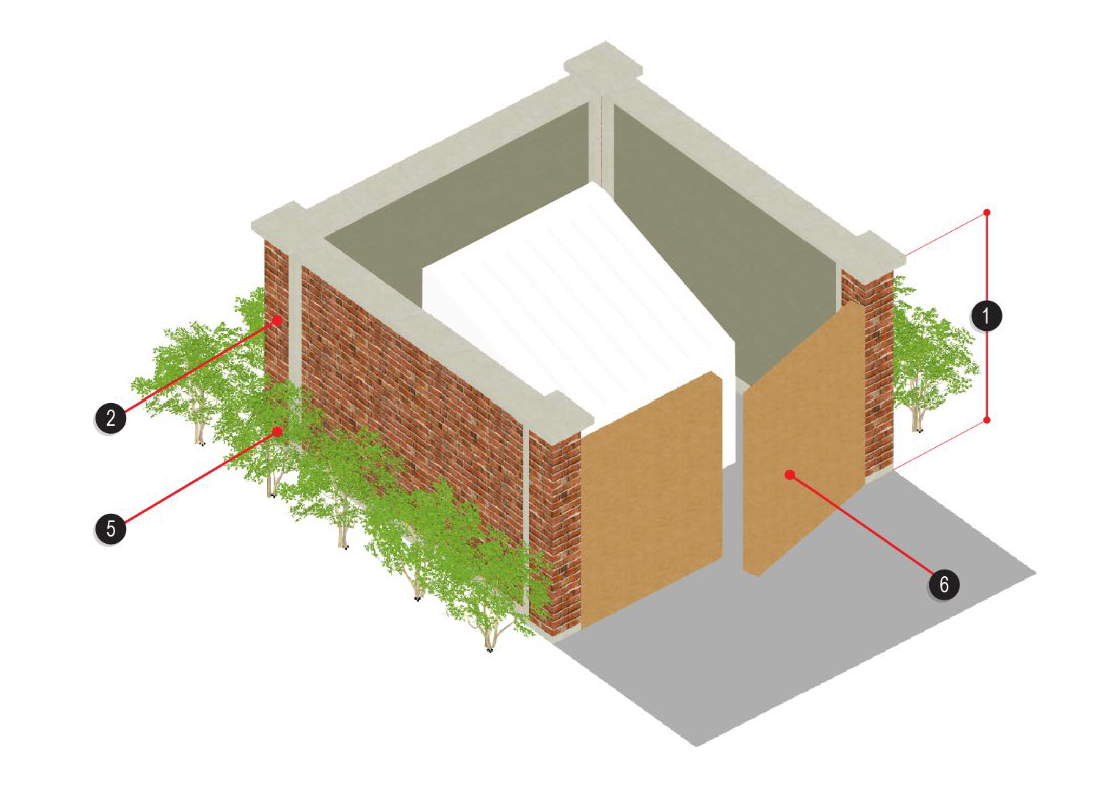
Grease traps, trash, and recycling receptacles.
(1)
Requirement. Grease traps, trash, and recycling receptacles shall be screened on all four sides with solid, opaque materials, including the gate.
(2)
Location.
a.
Grease traps, trash, and recycling receptacle enclosures shall not occupy areas designate for required parking spaces or loading spaces.
b.
Enclosures shall not be located in the front or exterior side yard setback, unless otherwise approved by the director of economic and community development.
(3)
Dimensions.
a.
Walls shall be a minimum six feet and a maximum eight feet tall.
b.
Enclosures shall be of an adequate size to accommodate expected containers. The enclosure shall be designed to be expandable to accommodate future additional containers.
(4)
Materials.
a.
Materials used for screening shall complement the exterior building cladding materials of the primary building.
b.
Materials and elevations for enclosures that are attached to buildings shall be designed to be integrated into the primary building.
(5)
Landscaping. Shrubs or native grasses shall be installed every three feet along the exterior of the enclosure, with the exception of enclosure openings, to provide a softening effect.
(6)
Operations and maintenance.
a.
Enclosure openings shall be kept closed at all times except for when the receptacle is being accessed.
b.
Property owners shall be responsible for ensuring that grease traps, trash, and recycling receptacles be placed in the enclosure at all times other than when it is being accessed.
c.
Access drives shall be constructed of durable, hard-surfaced materials and to a thickness to accommodate truck loading. Year-round access to the enclosure area for service trucks shall be maintained by the property owner or tenant.
d.
Enclosure structures shall be designed to protect the walls from damage by containers. Such protection may be provided by the use of barrier curbing, reinforced masonry walls, bollards, bumpers, or other similar means.
Figure 5.19. Grease Traps, Trash, and Recycling Receptacles
(c)
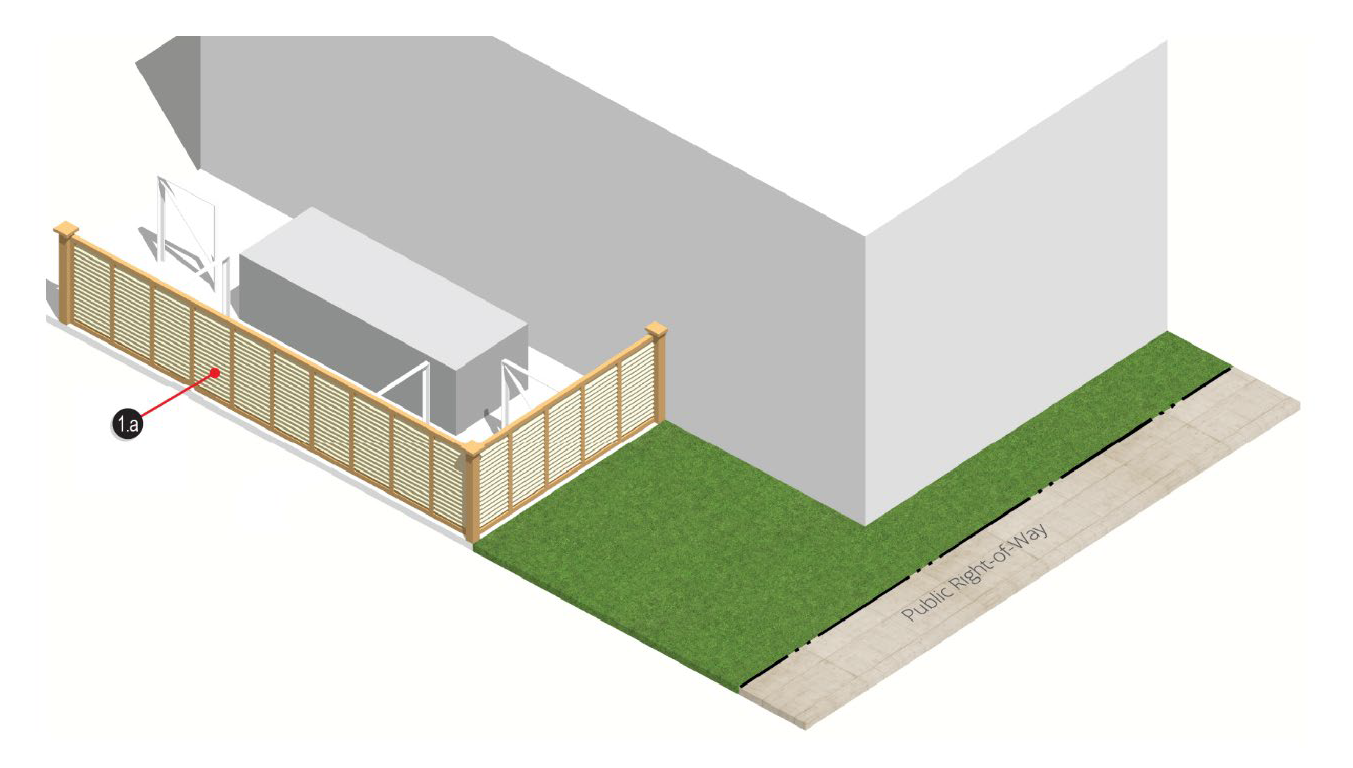
Ground or wall mounted building equipment.
(1)
Requirements.
a.
Provide screening for all ground or wall-mounted building equipment, including, but not limited to: generators, air conditioning condensers, heat pumps, ventilation units, and any related utility structures and equipment.
b.
Tanks and/or silos accessory to a brewery, winery, and/or distillery are exempt from these requirements.
c.
Provide screening for equipment that is visible from any public right-of-way or adjacent property. Equipment that is located in an interior side or rear yard and is otherwise screened by landscaping, fence, or building or distance so that it is not visible from the right-of-way or adjacent property shall not require additional screening.
d.
Locating building equipment within the building, as practical, is encouraged in order to minimize exterior visual impacts. Ground mounted equipment is prohibited within the front yard, regardless of whether screening is provided.
(2)
Materials.
a.
Materials used for screening shall be designed and established so that the area or element being screened is no more than 20 percent visible through the screen. Evergreen hedges or non-transparent walls such as stone masonry shall be allowed.
b.
Chain-link fence or slats in chain-link fence are prohibited for meeting this requirement.
Figure 5.20. Ground or Wall Mounted Building Equipment Screening
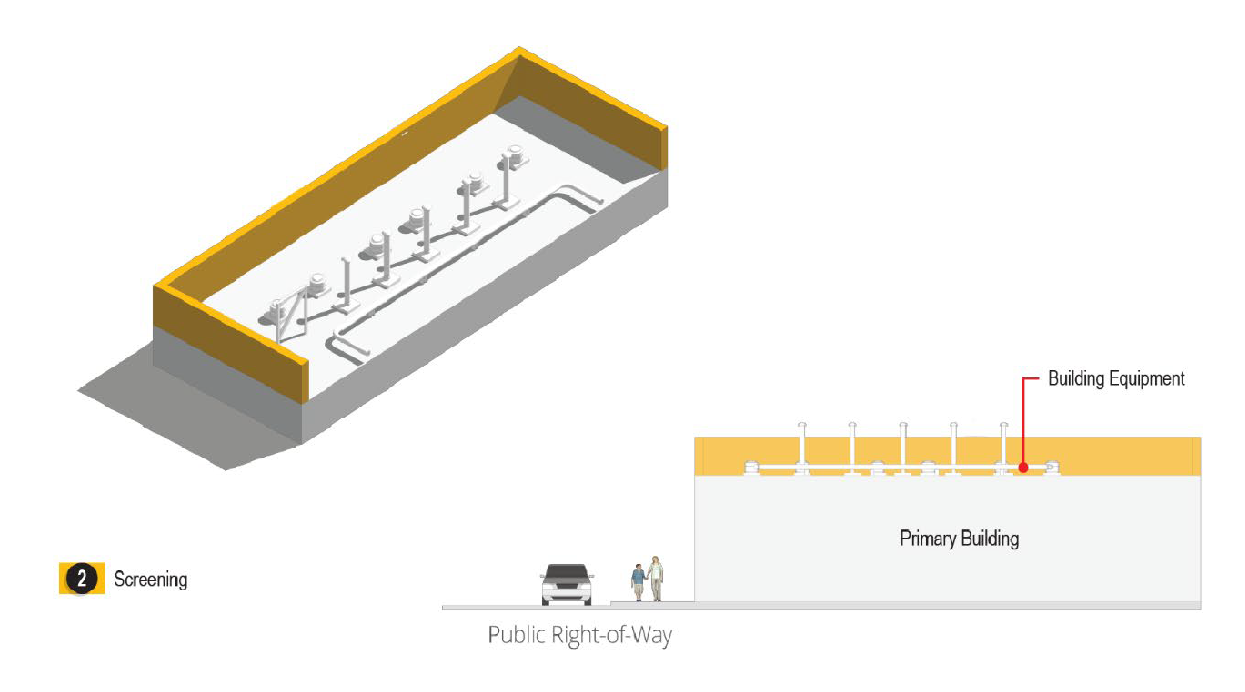
(d)
Roof-mounted building equipment.
(1)
Requirements.
a.
Provide screening for all roof-mounted building equipment, including, but not limited to: air-conditioning condensers, heat pumps, ventilation units, and any related utility structures and equipment.
b.
Locating building equipment within the primary building, as practical, is encouraged in order to minimize exterior visual impacts.
c.
Provide complete screening from the public view for equipment that is visible from any public right-of-way.
d.
Screening shall be required when new equipment is installed and shall be provided around both new and existing roof mounted mechanical units in order to provide visual continuity. Normal maintenance of roof mounted mechanical units shall not mandate the screening requirements.
(2)
Materials. Materials used for screening shall be architecturally integrated with the building and shall be continuous and permanent.
(3)
Loading docks and truck-parking areas. Loading docks and truck parking areas that are visible from any property in a residential district shall be completely screened from view with a type D transition zone as specified in Table 44-05-06(h)(3).
Figure 5.21. Roof Mounted Building Equipment Screening
(Ord. No. MC-1068, § 2(Exh. B), 1-10-2023)
Sec. 44-05-09. - Fences.
(a)
General provisions.
(1)
Permit required. Prior to the erection of any fence, a fence permit shall be required as detailed in section 10-130 of this Code.
(2)
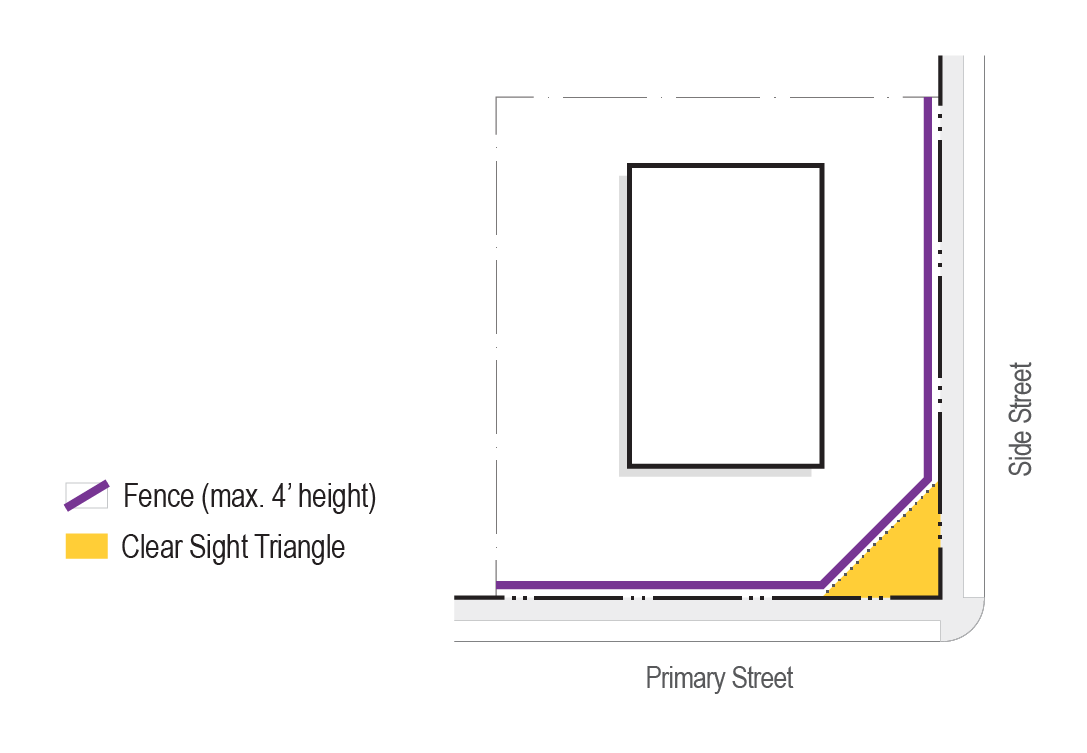
Location. All fences shall be located outside of the clear sight triangle as detailed in section 44-05-10 and in conformance with the placement requirements of chapter 10.
(3)
Dimensions. Fence height shall be measured from grade to the top of the fence materials, including posts, and shall follow grade along its length. A deviance of six inches shall be allowed to compensate for minor grade changes.
a.
Exception: Ornamental caps on fence posts may be excluded from the overall height.
b.
When placement of the fence requires installation above grade to allow for stormwater drainage, the distance from grade to the bottom of the fence may be subtracted from the overall fence height.
(4)
Materials.
a.
Permitted fence materials shall be only those materials which are designed and intended for use in fence installations and shall be limited to:
1.
Wood, chemically treated or naturally resistant to decay;
2.
Wood composites;
3.
Aluminum;
4.
Vinyl/PVC;
5.
Wrought iron;
6.
Chain link without slats; and
7.
As approved by the director of economic and community development.
b.
Prohibited materials include: barbed wire, razor wire, or makeshift materials such as plywood or tarps.
1.
Exception. In the M-1 and M-2 districts, barbed wire may be utilized in interior side and rear yard fences and shall be limited to a maximum one-foot height, and a maximum three strands of wire. The barbed wire shall not be included in the determination of fence height.
(b)
Fences on lots with single-family detached, duplex dwellings, and townhomes.
(1)
Front and exterior side yards.
a.
Fences in front and/or exterior side yards may have a maximum four feet in height.
b.
Fences in front yards and/or exterior side yards shall be an open-style ornamental fence with a maximum of 50 percent solid.
Figure 5.22. Front and Exterior Side Yard Fence Location on Lots with
Single-Family Detached, Duplex, or Townhouses
(2)
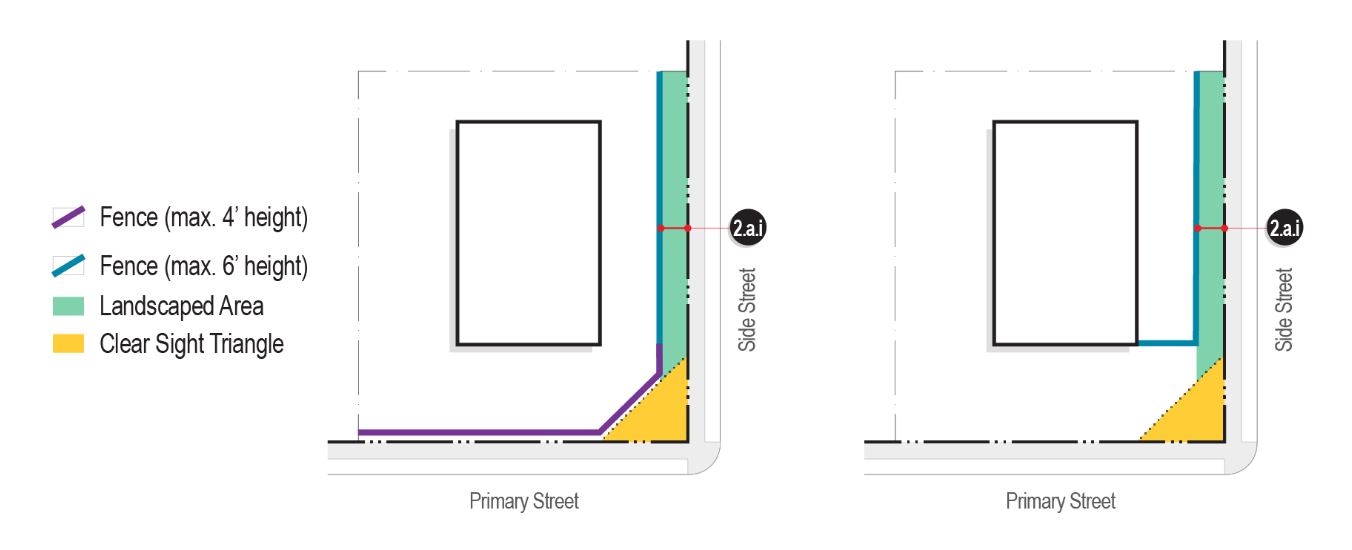
Exterior side yard exception.
a.
Fences in exterior side yards may have a maximum height of six feet compliant with the following:
1.
The fence is located a minimum of three feet from the property line; and
2.
The area between the fence and the property line is landscaped with a combination of shrubs, native grasses, and perennials to cover a minimum 75 percent of the planting bed along the full length of the fence fronting the street.
3.
Fences complying with these requirements may be 80 percent solid.
Figure 5.23. Exterior Side Yard Fence Location Exception on Lots with
Single-Family Detached, Duplex, or Townhome Uses
(3)
Interior side and rear yards.
a.
Fences in interior side and rear yards may have a maximum height of six feet.
b.
Fences in interior side and rear yards may be 100 percent solid.
(4)
Fence materials utilized in front yards and/or exterior side yards shall complement fence materials utilized in other yards.
(c)
Fences on lots with multi-family, mixed use, and nonresidential uses.
(1)
Height.
a.
Fences may have a maximum height of six feet.
b.
In the M-1 and M-2 districts, fences may have a maximum height of eight feet.
(2)
Location.
a.
Fences shall be located in rear and interior side yards only.
b.
In the M-1 district or M-2 district, fences may be also be located in exterior side yards.
c.
Ornamental fences may be located in a front or exterior side yard for parking lot perimeter screening.
(Ord. No. MC-1068, § 2(Exh. B), 1-10-2023)
Sec. 44-05-10. - Clear sight triangle.
(a)
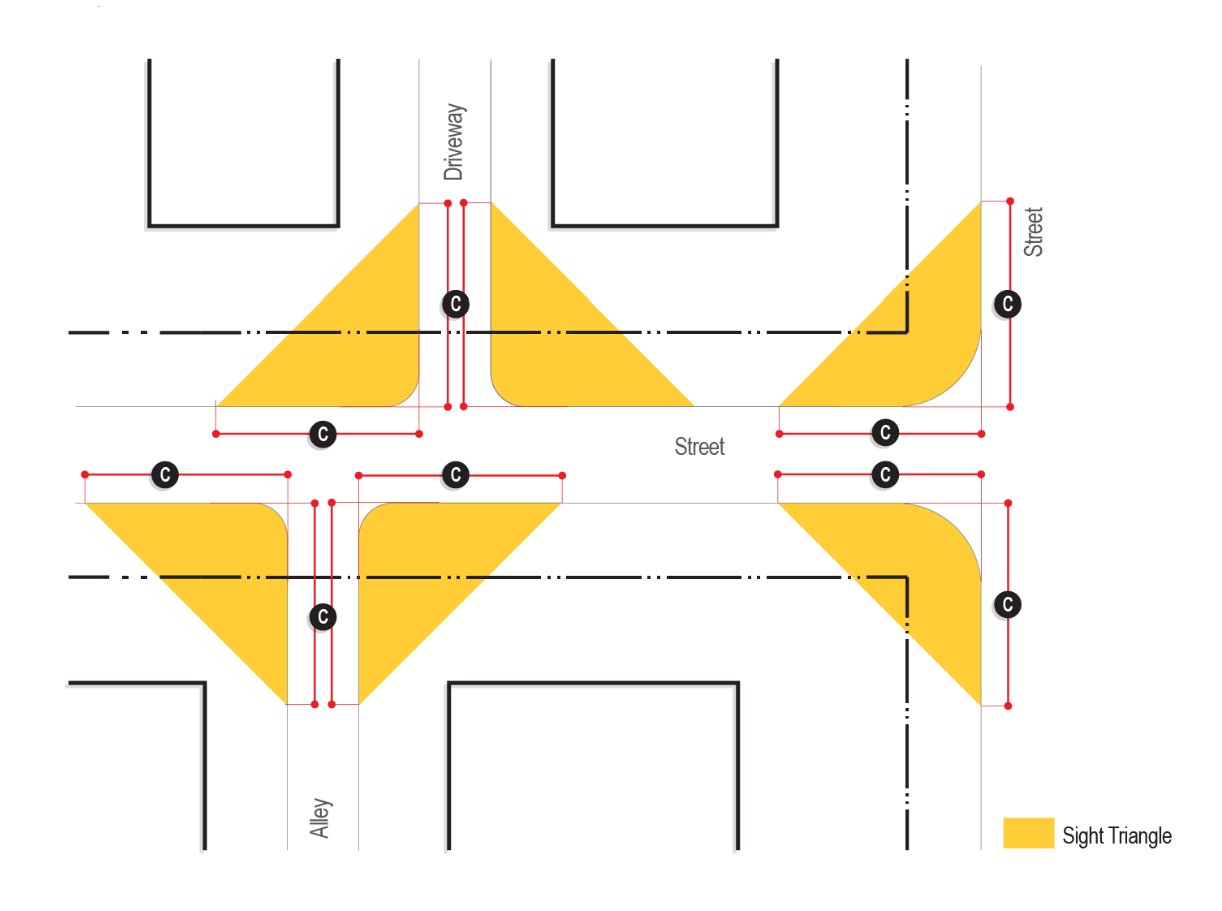
Unobstructed visibility shall be maintained at the intersection of any driveway and right-of-way, and at the intersection of two or more streets. Such area of unobstructed visibility shall be referred to as a clear sight triangle.
(b)
The clear sight triangle shall be measured perpendicular to and starting at the back of curb of each intersecting street or driveway.
(c)
The minimum distance at any intersection shall be 15 feet. Greater distances may be required based on the criteria of the American Association of State Highway and Transportation Officials (AASHTO), the Illinois Department of Transportation (IDOT), and the discretion of the village engineer.
(d)
The maximum height of any building or structure within the clear sight triangle shall be three feet.
Figure 5.24. Clear Sight Triangle
(Ord. No. MC-1068, § 2(Exh. B), 1-10-2023)
Sec. 44-05-11. - Design standards.
(a)
Applicability.
(1)
Design standards of section 44-05-11 shall apply to all uses except single-family detached dwellings, duplexes, or townhomes.
(2)
The appearance commission shall review building elevations for compliance with the regulations herein, and conformance to the appearance plan, per chapter 28, article II of this Code.
(3)
All new construction and additions or alterations subject to site plan review per section 44-07-09 shall comply with the design standards.
(4)
When expanding any existing building, compliance with design standards shall apply to new, altered or expanded construction.
(5)
Buildings within a planned development that front a public right-of-way, private drive aisle, or parking on three or more sides, shall apply the requirements of one front and two exterior sides.
(b)
Exterior building materials. Table 44-05-11(b) below details the requirements of primary exterior building materials. Openings for windows and doors shall not be included in the material calculations.
(1)
Tier I. Tier I materials are characterized by their high quality and long-lasting durability. These materials may commonly reflect traditional building methods and serve as a unifying element throughout buildings in the village. Tier I materials shall include:
a.
Brick;
b.
Natural and manufactured stone;
c.
Terra cotta;
d.
Architectural concrete masonry units; and
e.
Concrete materials.
(2)
Tier II. Tier II materials are characterized by their medium-to-high quality with lasting durability, but more frequent maintenance required than tier I materials. Tier II materials are generally lower cost than tier I. These materials provide variety and design expression on the building and have scale, texture and pattern creating visual interest. Tier II materials shall include:
a.
Siding (natural wood or composite materials) in a lap, vertical beaded or batten board, or shake application;
b.
Composite board or fiber cement board with a maximum joint pattern of two feet by four feet;
c.
Architectural metal panels with a maximum joint pattern of two feet by four feet.
(3)
Tier III. Tier III materials are medium quality materials and/or monolithic in visual appearance. These materials may require more frequent maintenance than tier I or tier II but provide up-front cost savings. Tier [III] materials contribute to variety and design expression but offer less visual interest. Tier [III] materials shall include:
a.
Natural and synthetic stucco, including EIFS;
b.
Composite board or fiber cement board with a maximum joint pattern of four feet by eight feet;
c.
Architectural metal panels with a maximum joint pattern of four feet by eight feet.
(4)
Prohibited materials. The following materials are prohibited:
a.
Corrugated metal siding;
b.
Vinyl siding; and
c.
Unfinished concrete block, except in areas of loading docks, screened from view from the street or neighboring properties.
(c)
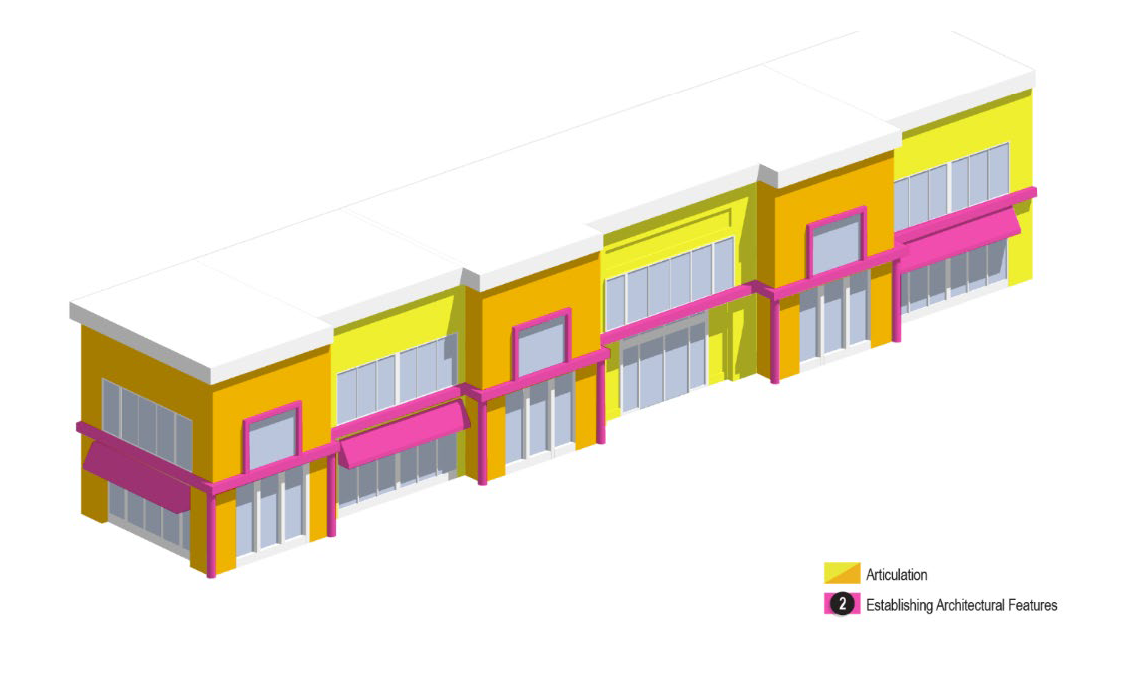
Facade articulation. Facades greater than 60 feet long shall incorporate articulation to avoid large expanses of blank faces and provide visual interest. Articulation may be horizontal, vertical or a combination. Articulation should be applied in a thoughtful and cohesive manner. Elements of articulation may include:
(1)
Changes of depth of the facade such as projections and recesses;
(2)
Architectural features such as pilasters, cornices or other ornament;
(3)
Change in materials;
(4)
Windows and doors;
(5)
Awnings and canopies; or
(6)
Public art.
Figure 5.25. Facade Articulation
(d)
Transparency.
(1)
Applicability. All new uses in an existing development shall provide the required transparency to the extent possible within existing conditions, unless otherwise approved by the director of economic and community development.
(2)
Requirements.
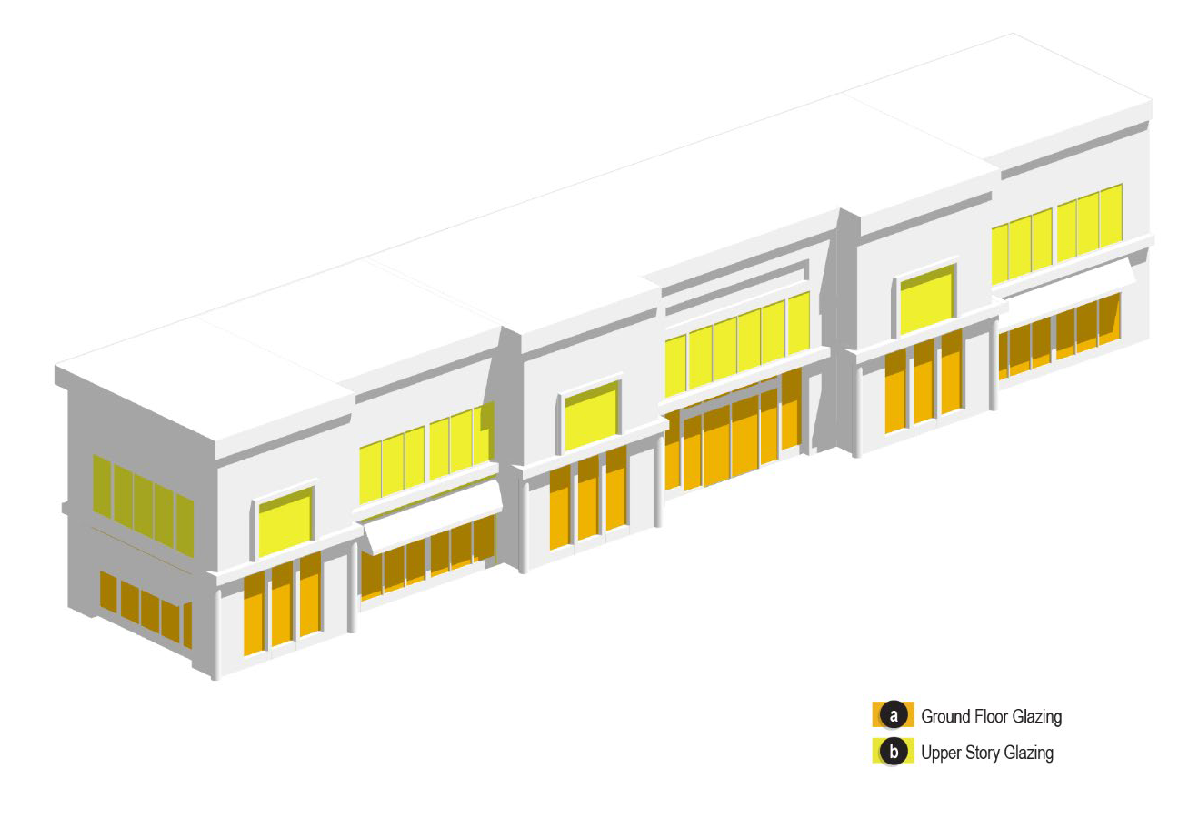
a.
Ground floor requirements. Provide at a minimum the percentage transparent glazing required by Table 44-05-11(d)(2)b. within a zone measured two and one-half feet above grade to head of the first-floor doors.
1.
Exception. Retailers in the B-4 zoning district with a gross floor area of 50,000 square feet or more shall comply with the M-1 zoning district minimum requirements.
b.
Upper story requirements. For each story above the ground floor, provide a minimum 20 percent transparent glazing per elevation.
(3)
Materials. Glazing shall not be mirrored nor heavily tinted rendering the glass opaque.
(4)
Maintenance. The required transparency shall be maintained during hours of operation and shall not obstructed by interior walls, window displays, or other permanent installations.
Figure 5.26. Transparency Requirements
(Ord. No. MC-1068, § 2(Exh. B), 1-10-2023)
Sec. 44-05-12. - Outdoor lighting.
(a)
Fixture classification. All outdoor lighting fixtures, with the exception of wall mounted accent lighting, shall either have a fixture cutoff classification of "full cutoff" or be fully shielded, unless otherwise expressly permitted in this chapter.
(b)
LED fixtures. All outdoor lighting utilizing a light-emitting diode (LED) fixture shall meet the following standards:
(1)
Color rendering. Outdoor LED fixtures shall be rated a minimum color rendering index (CRI) value of 70 or higher.
(2)
Color temperature. Outdoor LED fixtures shall have a correlated color temperature between 4,000 and 5,000 degrees Kelvin.
(c)
Pole mounted outdoor lighting.
(1)
Pole placement. Pole-mounted outdoor lighting shall be located outside of utility easements, designed in coordination with site features and required landscape zones.
(2)
Maximum pole height. Pole-mounted fixtures shall be mounted at heights above grade no greater than those specified in Table 44-05-12(c)(2).
(d)
Wall mounted accent lighting. Wall mounted accent lighting shall be integrated with the architectural character of the building and shall use low-luminosity lamps, with 2,000 source lumens or less. The illumination on any vertical surface shall not exceed one-half maintained foot candle and shall not spill over roof lines or building edges.
(e)
Outline lighting prohibited. Outline lighting shall be prohibited from signs, buildings, and structures.
(f)
Maximum light level at property line.
(1)
On lots adjacent to lots in a nonresidential zoning district, all outdoor lighting fixtures shall be designed and located so that the maximum light level shall be one-half maintained foot candles at any property line.
(2)
On lots adjacent to lots in a residential zoning district, all outdoor lighting fixtures shall be designed and located so that the maximum light level shall be zero maintained foot candles at any property line.
(g)
BUG rating. Backlight uplight glare (BUG) ratings are a published luminaire classification system to comprehensively address light pollution from all directions. All lighting fixtures shall not exceed the following BUG rating established by zoning district in Table 44-05-12(g).
(h)
Light level measurement.
(1)
Location. Light level measurements shall be made at the property line of the property upon which the light to be measured is being generated. If measurement on private property is not possible or practical, light level measurements may be made at the boundary of the public street right-of-way that adjoins the property of the complainant or at any other location on the property of the complainant. Measurements shall be made at finished grade (ground level), with the sensor in the horizontal position and not mounted more than six inches above ground level, and with the light-registering portion of the meter held parallel to the ground and pointing upward.
(2)
Light meter specifications. Light levels shall be measured in foot candles with a direct-reading portable light meter. The meter shall:
a.
Have cosine and color correction;
b.
Have an accuracy tolerance of no greater than plus or minus five percent; and
c.
Have been calibrated within the last two years.
(Ord. No. MC-1068, § 2(Exh. B), 1-10-2023)
Sec. 44-05-13. - Environmental performance.
All uses shall comply with the performance standards established in this section unless any federal, state, county or village law, ordinance or regulation establishes a more restrictive standard, in which event the more restrictive standard shall apply.
(a)
Noise. No activity or use shall be conducted in a manner that generates a level of sound as measured on another property greater than that allowed by noise regulations of the state pollution control board, as amended from time to time. The limits shall not apply to noises emanating from safety signals or warning devices, noises not directly under the control of the owner or occupant of the property, and transient noises from moving sources such as, railroads and aircraft.
(b)
Glare and heat. Any activity or operation of any use producing glare or heat shall be conducted so that no glare or heat from the activities or operations shall be detectable at any point off the lot on which the use is located. Flickering or intense sources of light shall be controlled or shielded so as not to cause a nuisance across lot lines.
(c)
Vibration. No earth-borne vibration from any operation of any use shall be detectable at any point off the lot on which the use is located.
(d)
Dust and air pollution.
(1)
Dust and other types of air pollution borne by the wind from sources such as storage areas, yards, roads, conveying equipment and the like within lot boundaries shall be kept to a minimum by appropriate landscaping, screening, sheltering, paving, fencing, wetting, collecting or other acceptable means. No persons shall cause or allow the emission of fugitive particulate matter across lot lines visible to an observer looking generally toward the zenith, beyond the property line.
(2)
This requirement shall not apply when the wind speed is greater than 25 miles per hour. Determination of wind speed for the purposes of this rule shall be by a one hour average or hourly-recorded value at the nearest official station of the U.S. Weather Bureau or by wind speed instruments operated on the site.
(e)
Discharge and disposal of radioactive and hazardous waste. The discharge of fluid and the disposal of solid radioactive and hazardous waste materials shall comply with applicable village, state and federal laws and regulations governing such materials or waste. No operation that produces radioactive or hazardous waste material shall commence without prior notice to the village administrator. Notice shall be given at least three weeks before the operation is commenced. Radioactive and hazardous material waste shall be transported, stored and used in conformance with all applicable federal, state and local laws.
(f)
Electromagnetic interference. Electromagnetic interference from any operations of any use in any district shall not adversely affect the operation of any equipment located off the lot on which such interference originates.
(g)
Odors. The release of materials intrinsically odorous, or capable of being odorous, by either bacterial decomposition or chemical reaction, which renders it perceptible from beyond the lot and constitutes a public nuisance, shall be prohibited.
(h)
Toxic substances. The storage, handling or transport of toxic substances shall comply with the State of Illinois Pollution Control Board requirements.
(i)
Water pollution. All uses shall comply with the State of Illinois Pollution Control Board Rules and Regulations, 35 Illinois Administrative Code, Subtitle C, and "Water Pollution."
(j)
Fire and explosion hazards. Materials that present potential fire and explosion hazards shall be transported, stored and used only in conformance with all applicable federal, state and local laws.
(Ord. No. MC-1068, § 2(Exh. B), 1-10-2023)

