
Homewood City Zoning Code
ARTICLE VII
ZONING PROCEDURES
Sec. 44-07-01.- Zoning procedures responsibilities.
(a)
Village board of trustees. The village board shall, with respect to this chapter, make final decisions on applications for text and map amendments, planned developments, and special uses, with or without conditions, and final decisions on applications for certain variances set forth in section 44-07-12, with or without conditions.
(b)
Planning and zoning commission.
(1)
With respect to this chapter, the planning and zoning commission shall:
a.
Hear and decide appeals of any order, requirement, decision or determination made by authorized village personnel under this chapter.
b.
Hear, consider, make a written report with findings of fact and recommendations to the village board on all applications for map and text amendments, special uses, subdivisions, and planned developments.
c.
Consider and render final decisions for applications through the site plan review process deferred by the administrative review committee.
d.
Make recommendations to the village board on variances or make final determinations for variances as specified in section 44-07-12.
e.
Consider and make final decisions on administrative appeals.
f.
Make decisions on other matters referred to it upon which it is required to pass under this chapter.
g.
Assist in the development, review, and amendment of the comprehensive plan, as requested by the village board.
(2)
In carrying out its duties and exercising its authority, the commission shall adhere to the following procedure:
a.
Testimony. All testimony by witnesses shall be given under oath. The chairperson or, in their absence, the acting chairperson, may administer oaths. All meetings of the planning and zoning commission shall be open to the public, in accordance with the State Open Meetings Law.
b.
Voting. All decisions arrived at by the planning and zoning commission shall require a majority vote of all members for passage or approval of the matter being considered.
(c)
Director of economic and community development.
(1)
The director of economic and community development shall have the following powers and duties with regard to this chapter:
a.
To receive, file, and forward to the planning and zoning commission, all applications which the commission is required to consider under this chapter.
b.
To forward to the building inspector and department heads copies of all applications which they are required to pass under this chapter.
c.
To review plans submitted by applicants for development approval in conformity with the terms of this chapter.
d.
To approve applications for zoning compliance permits, limited use permits, administrative exceptions, temporary use permits, and minor amendments to approved planned developments and special use permits.
e.
To conduct inspections of the uses of land to determine compliance with the terms of this chapter and other applicable ordinances.
f.
To propose new or revised zoning regulations, as may be required from time to time, based on changes in state law, case law, market conditions, or technical standards.
g.
To maintain permanent and current records of all zoning related ordinances and documents, including, but not limited to, all maps and text amendments, special uses, variances, appeals, site plan review, interpretations, and planned developments.
h.
To interpret the provisions of this chapter.
i.
To enforce this chapter and issue notices of violation.
j.
To provide technical assistance to the planning and zoning commission, village board, and other bodies with authority under this chapter.
k.
To perform such other duties as may be required by the village board, including providing assistance to village commissions, committees, and agencies.
(d)
Building inspector.
(1)
The building inspector shall have the following powers and duties with regard to this chapter:
a.
To review requests for and to issue building permits and certificates of occupancy and maintain records thereof.
b.
To conduct inspections of buildings and structures to determine compliance with the terms of this chapter and other applicable ordinances.
c.
To enforce the provisions of this chapter and to issue notices of violations.
d.
To provide technical assistance to the village board and other bodies with authority under this chapter and this Code.
e.
To perform such other duties as may be requested by the village board, including providing assistance and advice as may be required to various commissions, committees and agencies of the village.
(e)
Village manager. The village manager shall appoint members of the village administration to enforce this chapter, to provide such clerical and technical assistance as may be required by the planning and zoning commission in the exercise of their duties, and to perform such other duties as may be appropriate.
(f)
Administrative review committee.
(1)
An administrative review committee is established for the review of all board and/or commission approved zoning procedures and consists of the:
a.
Director of economic and community development;
b.
Village planner;
c.
Director of public works;
d.
Village engineer;
e.
Building inspector;
f.
Fire chief;
g.
Police chief; and
h.
Village manager.
(2)
Members of the administrative review committee may delegate a member of their department to act for the committee member.
(3)
The director of economic and community development shall be the chairperson.
(4)
Meetings will be called by the chairperson as needed.
(Ord. No. MC-1068, § 2(Exh. B), 1-10-2023)
Sec. 44-07-02. - General application requirements.
(a)
Authority.
(1)
An application for any zoning procedure may be filed only by the property owner, or by a lessee or agent or contract purchaser specifically authorized by the owner to file such application.
(2)
An application for a text or map amendment may also be filed by the village board, the director of economic and community development, or the planning and zoning commission.
(b)
Filing.
(1)
Applications for any zoning procedure shall be filed with the director of economic and community development.
(2)
The application shall contain, at a minimum, the information detailed per approval type in the zoning application requirements document, in appendix A.
(3)
The application shall include a completed application form provided by the village and supporting materials in format and quantity as required per the application instructions.
(4)
All plans shall be of sufficient clarity and detail to indicate the location, nature, and extent of work proposed and demonstrate conformance with the provisions of this chapter and other applicable regulations.
(c)
Completeness.
(1)
The director of economic and community development shall determine whether the application is complete.
(2)
If the application is not complete, the director of economic and community development shall notify the applicant of any deficiencies and shall take no steps to process the application until the deficiencies are remedied. If the deficiencies are not remedied within 60 days of the initial filing, the application shall be dismissed without prejudice with no further action by the village.
(3)
Once the director of economic and community development has determined that the application is complete, the application shall be scheduled for consideration at the appropriate meeting.
(d)
Fees.
(1)
Every application shall be accompanied by the required filing fee as established and modified, from time to time, by the village board.
(2)
The failure to pay such fee when due shall be grounds for refusing to process the application and for denying or revoking any permit or approval for the subject property.
(3)
No fees shall be waived, and no fees shall be refunded except those authorized by the village manager or their designee in their sole discretion.
(4)
A current fee schedule is included in the village fee schedule as adopted.
(e)
Withdrawal of an application.
(1)
An applicant shall have the right to withdraw an application at any time prior to the decision on the application by a village official, commission, or board. Such withdrawal shall be in writing.
(2)
Re-filing a withdrawn application shall not constitute a successive application.
(f)
Successive applications.
(1)
A subsequent application shall not be reviewed or heard within one year of the date of denial, unless there is substantial new evidence available or if a significant mistake of law or of fact affected the prior denial.
(2)
Such subsequent applicant shall include a detailed statement of the grounds justifying its consideration.
(3)
The director of economic and community development shall make a determination as to whether the subsequent application is seeking essentially the same relief.
(4)
If the director of economic and community development finds that there are no grounds for consideration of the subsequent application, they shall summarily and without hearing deny the request.
(g)
Concurrent applications. Applications for multiple zoning actions related to a subject property may be processed concurrently. Applications for the appearance commission, pursuant to chapter 28 of this Code, may be processed concurrently with an application for zoning action.
(h)
Records.
(1)
A record of all applications and determinations for zoning action shall be kept on file in the office of the director of economic and community development.
(2)
A record of all issued building permits and certificates of occupancy shall be kept on file in the office of the building inspector.
(3)
Pursuant to the Freedom of Information Act, 5 ILCS 140/1 et seq., record files shall be available on request to any person.
(Ord. No. MC-1068, § 2(Exh. B), 1-10-2023)
Sec. 44-07-03. - General review and approval procedures.
(a)
Administrative authority. The following village staff shall have the authority to receive applications and make determinations for the following administrative procedures:
(1)
Building inspector.
a.
Building permit.
b.
Certificate of occupancy.
(2)
Director of economic and community development.
a.
Zoning compliance permit.
b.
Limited use permit.
c.
Administrative exception.
d.
Temporary use permit.
e.
Interpretations.
(3)
Administrative review committee.
a.
Site plan review.
(b)
Planning and zoning commission authority.
(1)
All public hearings for zoning procedures shall be conducted at the planning and zoning commission.
(2)
The planning and zoning commission shall make findings of fact and provide a recommendation to the village board of trustees for all zoning actions in which the village board makes the final decision.
(3)
The planning and zoning commission shall have final decision-making authority on variances specifically designated in section 44-07-12.
(4)
The planning and zoning commission shall have final decision-making authority on administrative appeals pursuant to section 44-07-13.
(5)
The planning and zoning commission shall have final decision-making authority on site plan review deferred to the commission by the administrative review committee pursuant to section 44-07-9.
(6)
The planning and zoning commission shall have final decision-making authority on major planned development amendments as specified in section 44-06-08 and approved special use as specified in subsection 44-07-11(h).
(7)
If the applicant has two consecutive unexcused absences for a public hearing, the requested action shall be dismissed without prejudice.
(c)
Village board authority. The village board shall make the final decision for all applications for map and text amendments, special use permits, planned developments, variances other than those expressly designated to the planning and zoning commission in section 44-07-12.
(d)
Public hearing notices.
(1)
Notice requirements by procedure. Table 44-07-03(d)(1) summarizes the notice requirements per board and commission review and approval procedure.
a.
In the case of a comprehensive zoning text or map amendment, notice shall be in accordance with the statutes of the state.
(2)
Mailed notices. The village shall send written notification via first class mail to all occupants within 250 feet of the subject property line, as determined by the village's records.
(3)
Published notices. The village shall publish notice in a newspaper of general circulation within the village. The notice shall include the date, time, place and purpose of such hearing, the name of the applicant and the address of the subject property. Such notice shall be published not less than 15 days nor more than 30 days in advance of the scheduled hearing date.
(4)
Cost of notice. All costs associated with mailed and published notice, as required by this chapter, shall be the responsibility of the applicant.
(e)
Pre-filing staff conference(s). A prospective applicant, prior to submitting a formal application for zoning procedure to be decided by the planning and zoning commission or village board, shall meet for a pre-filing conference(s) with the director of economic and community development. The purpose of the conference(s) is to help the applicant understand: village plans and policies, including, but not limited to, the comprehensive plan and downtown master plan; the zoning ordinance; application requirements as detailed in the zoning application requirements document; and the standards by which the application will be evaluated.
(f)
Recording of documents. The director of economic and community development shall file record documents with the Cook County clerk—recording division as required by the village in instances of subdivision, lot consolidation, amendments, variances, ordinances, and documents otherwise required by state statutes. Recording shall be completed in a timely manner and at the expense of the applicant. Notice of all fees shall be furnished to the applicant and paid prior to the recording of documents.
(g)
Building permit.
(1)
A building permit, as required by chapter 10 of this Code, must be obtained before any work may commence to alter any building, structure, or land.
(2)
When approval by the appearance commission is required by chapter 28 of this Code, the applicant shall receive approval from the appearance commission prior to the issuance of a building permit.
(3)
Prior to obtaining a building permit, a building or structure must comply with the terms of this chapter and have completed all approvals required by this article.
(4)
The building inspector shall be responsible for determining compliance with this and all other applicable ordinances prior to the issuance of the building permit.
(h)
Certificate of occupancy.
(1)
Applicability.
a.
No vacant land, new structure, or existing structure undergoing addition or alteration shall be occupied or used, in part of in full, before obtaining a certificate of occupancy.
b.
The change of use of a building, or part thereof, shall require of a certificate of occupancy.
c.
The certificate of occupancy shall state that the building complies with all the building and health laws and ordinances and with the provisions of this chapter, and with state and federal licensing requirements, as applicable.
d.
The certificate of occupancy shall not be issued until the premises has been inspected and determined the structure is in complete compliance with the plans and specifications upon which the building permit was based, and any other approvals required by this chapter.
e.
The building inspector shall be responsible for determining compliance with this and all other applicable ordinances before the issuance of the certificate of occupancy.
(2)
Continued occupancy of existing building. Nothing in this section shall prevent the continuance of the present occupancy or use of any existing building, except as may be necessary for safety of life and property and as required in article VIII, nonconformities.
(3)
Action by the building inspector.
a.
Upon passing final inspections, the building inspector shall issue a certificate of occupancy. The certificate of occupancy shall be dated and signed by the building inspector and shall identify the approved use or occupancy of the building or structure and state that the use or occupancy complies with the terms of this chapter.
b.
If final inspections find the building or structure non-compliant with the codes, the building inspector shall provide written notice to the applicant with the reasons for failing inspections and denying the certificate of occupancy.
(4)
Temporary and conditional certificate of occupancy.
a.
The fire chief may issue a temporary or conditional certificate of occupancy if all life safety codes are complied with to allow the premises to be occupied for the proposed use.
b.
Such certificate shall become final only upon full compliance with this chapter and this Code.
(Ord. No. MC-1068, § 2(Exh. B), 1-10-2023)
Sec. 44-07-04. - Zoning compliance permits.
(a)
Applicability. A zoning compliance permit must be obtained before any person may construct, move, or structurally alter any building or structure used for nonresidential purposes, or establish any new nonresidential use on a lot or within a building or structure.
(b)
Action by the director of economic and community development. Upon receipt of a complete application, the director of economic and community development shall review the materials to ensure the application conforms with the provisions of this article and approve, approve with conditions, or deny the application for a zoning compliance permit. The director of economic and community development issue the permit or notify the applicant in writing of reasons for denial.
(c)
Expiration. The zoning compliance permit shall automatically expire without further action by the village if the applicant fails to obtain a certificate of occupancy within one year of the approval of the permit. An extension of the time requirements may be requested in writing and granted by the director of economic and community development for good cause shown by the applicant, provided a written request is filed with the village at least four weeks prior to the respective deadline.
(Ord. No. MC-1068, § 2(Exh. B), 1-10-2023)
Sec. 44-07-05. - Limited use permits.
(a)
Purpose. In order to provide flexibility and to help diversify uses within a district, specified uses are permitted in certain districts subject to the granting of a limited use permit. Because of their unusual or special characteristics, limited uses require review and evaluation so that they may be located properly with respect to their effects on surrounding properties. The review process set forth in this section is intended to assure compatibility and harmonious development between limited uses, surrounding properties, and the village at large.
(b)
Procedures.
(1)
Pre-application conference. The applicant for a limited use permit is advised to meet with the director of economic and community development prior to submitting an application to discuss the submittal requirements, review criteria, and review process.
(2)
Action by the director of economic and community development.
a.
Upon receipt of a completed application, the director of economic and community development will review the materials to ensure the application conforms to the criteria in subsection (c) below. Based upon their review, the director of economic and community development shall approve, approve with conditions, advance the application to a special use, or deny the application.
b.
If denied, the director of economic and community development shall report the deficiencies to the applicant. The applicant shall have six weeks from the date of notification of the deficiencies to correct the deficiencies; otherwise, the limited use permit application will be considered abandoned without further notice from the village.
(c)
Limited use permit review criteria. Limited uses are permitted within the district where designated when they comply with specific conditions and limitations as set forth in this chapter. The scope and operations of any limited use may be limited or qualified by the conditions of the subject property. A listed limited use that cannot meet the specific conditions and limitations set forth in this chapter shall not be allowed under a limited use permit.
(1)
General criteria. The limited use permit shall be approved upon a finding by the director of economic and community development that the following general criteria have been met, to the extent they may be applicable:
a.
The proposed use will conform with or further the goals, objectives and strategies of the village's comprehensive plan and other adopted plans;
b.
The site, building(s), and use meet all criteria specified for the use and all applicable regulations and development standards as specified in this chapter and for the district in which the use is located; however, nonconforming sites and/or buildings must be brought into conformance if required to do so pursuant to article VIII, nonconformities, of this chapter;
c.
The proposed use will not substantially alter the basic character of the district in which it is located, or jeopardize the development or redevelopment potential of property within the district;
d.
The proposed use will not have a significant adverse impact on the adjacent uses or properties, or result in hazardous conditions for pedestrians or vehicles within or in close proximity to the site;
e.
The proposed use will be adequately served with public utilities, services, and facilities and not impose an undue burden above and beyond those of the permitted uses of the district in which it is located; and
f.
Potential negative impacts of the limited use on the surrounding properties have been or may be mitigated through specific setbacks, architecture, screen walls, landscaping, site arrangement or other methods required in the permit as conditions and/or limitations of permit approval. The applicant shall satisfactorily address each of the following impacts:
1.
Traffic;
2.
Activity levels;
3.
Light;
4.
Noise;
5.
Odor;
6.
Building type, style and scale;
7.
Hours of operation;
8.
Dust; and
9.
Stormwater management, drainage, and erosion control.
(2)
Use-specific standards. In addition to the general criteria for review of a limited use permit listed above, certain uses, due to their unique characteristics, must also comply with the special provisions specific to those uses contained in article IV, use-specific standards, of this chapter.
(d)
Permit transferability.
(1)
A limited use permit may be transferred to any other person to operate the same use on the same property and/or within the same building according to the same terms of the permit. A limited use permit may not be transferred to any other property or other building.
(2)
The owner or operator holding the limited use permit may apply in writing to the director of economic and community development, using a form provided by the village, requesting to transfer the limited use permit. The director of economic and community development shall review the request and issue a determination in writing to grant the transfer or require a new application for limited use permit for further review.
(e)
Expiration. A limited use permit shall automatically expire without any further action by the village if the use for which the permit was granted has not been established at the approved location within a period of one year from the date the permit was approved, or the use for which the permit was issued has been discontinued for a period of one year or longer. An extension of the time requirements may be requested in writing and granted by the director of economic and community development for good cause shown by the applicant, provided a written request is filed with the village at least four weeks prior to the respective deadline.
(Ord. No. MC-1068, § 2(Exh. B), 1-10-2023)
Sec. 44-07-06. - Administrative exceptions.
(a)
Purpose. Administrative exception is an administrative process through which certain minor variances may be approved by the director of economic and community development. Administrative exceptions are intended to allow a limited amount of flexibility in the siting and height of certain buildings and/or structures.
(b)
Authority. The director of economic and community development shall have the authority to grant or deny applications for administrative exceptions for such circumstances as this chapter allows, subject to the requirements of this section. No site plan shall be approved or building permit issued for a proposal requiring an exception to a zoning standard listed below unless an administrative exception is approved.
(c)
Applicability.
(1)
An administrative exception to certain requirements of this chapter may be granted:
a.
To permit a yard up to five percent less than the yard required by the applicable regulations.
b.
To permit the use of a lot for a use otherwise prohibited solely because of the insufficient area of the lot. The maximum variance that may be grant shall be five percent.
c.
To reduce the applicable off-street parking or loading requirements to the extent of not more than one parking space or loading space, or five percent of the spaces required by applicable regulations, whichever number is greater.
d.
To allow any permitted nonresidential use in a residential district to exceed the floor area ratio imposed by the applicable regulations by no more than five percent of that area limit imposed by applicable regulations.
e.
To permit the direct replacement of a stoop and stairs that encroaches into the required front or side yard with a structure of the same dimensions.
f.
To permit an accessory structure to be located less than ten feet, but not less than five feet, from the principal structure, provided the accessory structure is constructed with no less than a one-hour fire resistance rating.
(2)
No administrative exception shall be considered where the setback is five feet or less.
(3)
In the case of a requested addition to a structure, no exception shall be considered where the existing structure does not meet the minimum setback.
(4)
No exception shall be considered for a reduction of a setback for property in the M-1 or M-2 districts if the yard in which the setback reduction is requested is adjacent to any residential use.
(d)
Procedure.
(1)
Pre-application conference. The applicant for an administrative exception is encouraged to meet with the director of economic and community development prior to submitting an application to discuss the submittal requirements, review criteria, and review process.
(2)
Neighbor notice. The village shall provide written notice to all adjacent property owners detailing the exception being requested and including the contact information of the director of economic and community development to whom protest to the administrative exception should be sent. If protest is received, the director of economic and community development shall elevate the administrative exception to a variance per section 44-07-12.
(3)
Action by the director of economic and community development. Upon receipt of a completed application, the director of economic and community development will review the materials to ensure the application conforms to the criteria in subsection (e) below. Based upon their review, the director of economic and community development shall approve, approve with conditions, advance the application to a variance, or deny the application.
(e)
Administrative exception review criteria. The administrative exception shall be approved if the director of economic and community development finds that the proposed exception meets the following criteria:
(1)
Is consistent with the comprehensive plan and other adopted village plans;
(2)
Is consistent with the purpose of the underlying district;
(3)
Will not result in incompatible development;
(4)
Will not result in adverse impacts unless adequately mitigated; and
(5)
Is of a technical nature and is required to:
a.
Compensate for an unusual condition;
b.
Eliminate a minor inadvertent failure to comply with this chapter; or
c.
To protect a sensitive resource or natural feature.
(f)
Expiration. The administrative exception shall automatically expire without further action by the village if the applicant fails to obtain a building permit within one year of the approval of the administrative exception. An extension of the time requirements may be requested in writing and granted by the director of economic and community development for good cause shown by the applicant, provided a written request is filed with the village at least four weeks prior to the respective deadline.
(Ord. No. MC-1068, § 2(Exh. B), 1-10-2023)
Sec. 44-07-07. - Temporary use permits.
(a)
Applicability. A temporary use permit shall be required prior to the commencement of a temporary use identified in Table 44-03-04.
(b)
Action by the director of economic and community development. Upon receipt of a completed application, the director of economic and community development will review the materials to ensure the application conforms to the criteria in subsection (c) below. Based upon their review, the director of economic and community development shall approve, approve with conditions, or deny the application.
(c)
Temporary use permit review criteria. To approve the issuance of temporary use permit, the director of economic and community development, in consultation with the administrative review committee, shall make an affirmative finding that the following criteria are met:
(1)
Land use compatibility. The temporary use must be compatible with the purpose and intent of this chapter and the district in which it will be located. The temporary use shall not impair the normal, safe, and effective operation of a permanent use on the same site. The temporary use shall not endanger or be materially detrimental to the public health, safety, or welfare, or injurious to property or improvements in the immediate vicinity of the temporary use, given the nature of the activity, its location on the site, and its relationship to parking and access points.
(2)
Compliance with other regulations. A building permit, life safety inspection, or temporary certificate of occupancy may be required before any structure used in conjunction with the temporary use is approved, constructed, or modified. All structures and the site as a whole shall meet all applicable building code, ordinance, and fire code standards and shall be promptly removed upon the cessation of the use or event. Upon cessation of the use or event, the site shall be returned to its previous condition (including the removal of all trash, debris, signage, attention attracting devices, or other evidence of the special event or use).
(3)
Hours of operation and duration. The duration and hours of operation of the temporary use shall be consistent with the intent of the event or use, and compatible with the surrounding land uses. The duration and hours of operation shall be established by the director of economic and community development at the time of approval of the temporary use permit.
(4)
Traffic circulation. The temporary use, as determined by the village engineer, shall not cause undue traffic congestion or accident potential given anticipated attendance and the design of adjacent streets, intersections, and traffic controls.
(5)
Off-street parking. Adequate off-street parking shall be provided for the temporary use, as determined by the director of economic and community development, and it shall not create a parking shortage for any of the other existing uses on the site.
(6)
Public conveniences and litter control. Adequate on-site restroom facilities and on-site solid waste containers may be required. The applicant shall provide a written guarantee that all litter generated by the event or use shall be removed at no expense to the village.
(7)
Appearance and nuisances. The temporary use shall be compatible in intensity, appearance, and operation with surrounding land uses in the area, and shall not impair the usefulness, enjoyment, or value of adjacent property due to the generation of excessive noise, dust, smoke, glare, spillover lighting, or other forms of environmental or visual pollution.
(8)
Signs and attention-getting devices. The director of economic and community development shall review all signage in conjunction with the issuance of the permit, although a sign permit is not required. The director of economic and community development may approve the temporary use of attention-getting devices. The number and types of signs and attention-getting devices allowed shall be evaluated on the following criteria:
a.
Type and size of the proposed event or use;
b.
Safety considerations (sight distance setbacks, sidewalks in area, etc.);
c.
Lighting considerations (disturbance of nearby residents or adverse effects to traffic on adjacent streets);
d.
Aesthetic concerns (appearance, illumination, number, and size of signs and attention-getting devices proposed).
(9)
Other conditions. The director of economic and community development may establish any additional conditions deemed necessary to ensure land use compatibility and to minimize potential adverse impacts on nearby uses, including, but not limited to, time and frequency of operation, temporary arrangements for parking and traffic circulation, requirements for screening/buffering, and guarantees for site restoration and cleanup following the temporary use. Conditions may include, but shall not be limited to:
a.
Modifications or restrictions to the hours of operation, duration of the event, size of the activity or other operational characteristics.
b.
If the permit applicant requests the village to provide extraordinary services or equipment or if the director of economic and community development otherwise determines that extraordinary services (e.g., traffic control or security personnel) or equipment should be provided to protect the public health or safety, the applicant shall be required to pay to the village a fee sufficient to reimburse the village for the costs of these services if not provided by the applicant. This requirement shall not apply if the event or use has been anticipated in the budget process and sufficient funds have been included in the budget to cover the costs incurred.
(Ord. No. MC-1068, § 2(Exh. B), 1-10-2023)
Sec. 44-07-08. - Interpretations.
(a)
Purpose. The provisions of this chapter, though detailed and extensive, cannot as a practical matter, address every specific situation to which may arise. The interpretation authority established herein is not intended to add or change the essential content of this chapter but to allow authoritative application of that content to specific cases.
(b)
Intent. The director of economic and community development may issue interpretations of the provisions of this chapter to clarify the standards or requirements as they relate to a particular type of development on a particular property. The interpretation does not itself authorize the establishment of a use but provides guidance for any approvals or permits required by this chapter, and the interpretation shall be advisory in nature and shall not be binding upon the planning and zoning commission or the village board in their functions under this chapter. The interpretation shall specify the facts, reasons, analysis, and standards upon which the interpretation is based. The interpretation shall respond to the specific facts, details, and description of the proposed development as provided by the requesting party.
(c)
Action by the director of economic and community development. Upon receipt of a request for interpretation, the director of economic and community development will issue a written interpretation to the requesting party, and place a record on file.
(Ord. No. MC-1068, § 2(Exh. B), 1-10-2023)
Sec. 44-07-09. - Site plan review.
(a)
Purpose. The purpose of site plan review is to certify compliance with all applicable provisions of this chapter, this Code, and the goals, objectives and strategies of the village's comprehensive plan and other adopted plans.
(b)
Applicability.
(1)
Every building permit application for new construction, additions equal to or greater than 20 percent of the existing floor area of the building, and any modifications to an existing site development that alters parking or circulation shall be subject to site plan review and approval.
(2)
Site plan review shall not apply to:
a.
Building permits for construction that are limited to interior remodeling, exterior modifications not impacting the site, or additions less than 20 percent of the existing floor area of the building; and
b.
Building permits for detached single-family dwellings, duplexes, or their accessory structures.
(3)
No building permit shall be issued unless and until site plan approval has been granted.
(c)
Action by the administrative review committee.
(1)
Upon receipt of a completed application, the administrative review committee shall review the materials to ensure conformance with this Code, zoning ordinance, and adopted plans.
(2)
If areas of noncompliance are found, the committee will issue a comment letter to the applicant, to revise and resubmit the plans for further review.
(3)
Upon the receipt of applicable revisions, the administrative review committee shall approve, approve with conditions, refer the application to the planning and zoning commission for review, or deny the application.
(d)
Action by the planning and zoning commission.
(1)
Should the administrative review committee refer the application to the planning and zoning commission for review, the director of economic and community development will schedule the application for consideration by the planning and zoning commission in a public meeting and prepare a report to the planning and zoning commission.
(2)
The planning and zoning commission shall review the proposed site plan and any oral and written comments received at the public meeting and determine the level of compliance with the zoning ordinance. The planning and zoning commission shall approve, approve with conditions, or deny the proposed site plan.
(e)
Expiration. The site plan approval shall automatically expire without further action by the village if the applicant fails to obtain a building permit within one year of the approval of the site plan. An extension of the time requirements may be requested in writing and granted by the director of economic and community development for good cause shown by the applicant, provided a written request is filed with the village at least four weeks prior to the respective deadline.
(Ord. No. MC-1068, § 2(Exh. B), 1-10-2023)
Sec. 44-07-10. - Zoning text and map amendments.
(a)
Purpose. The regulations imposed and the districts created under the authority of this chapter may be amended, from time to time. The amendment process is intended to adjust this chapter in response to changed conditions or changes in village policy. Amendments are not intended to relieve particular hardships or confer special privileges or rights upon any person or party.
(b)
Authority.
(1)
Amendments to the regulations and districts of this chapter shall be in accordance with state statutes. No such amendment shall be made without a public hearing before the planning and zoning commission. The planning and zoning commission shall report their findings of fact and recommendations to the village board. The village board shall make final decisions on zoning text and map amendments.
(2)
The director of economic and community development is authorized to make minor, non-substantive additions, corrections, or deletions to verbiage and punctuation as necessary to correct typographical and editing errors incurred during the comprehensive amendment of April 2002, and any subsequent amendment to this chapter.
(c)
Procedure. Upon receipt of a completed application for a zoning text or map amendment, the director of economic and community development will schedule the application for consideration by the planning and zoning commission and complete the public hearing notification.
(1)
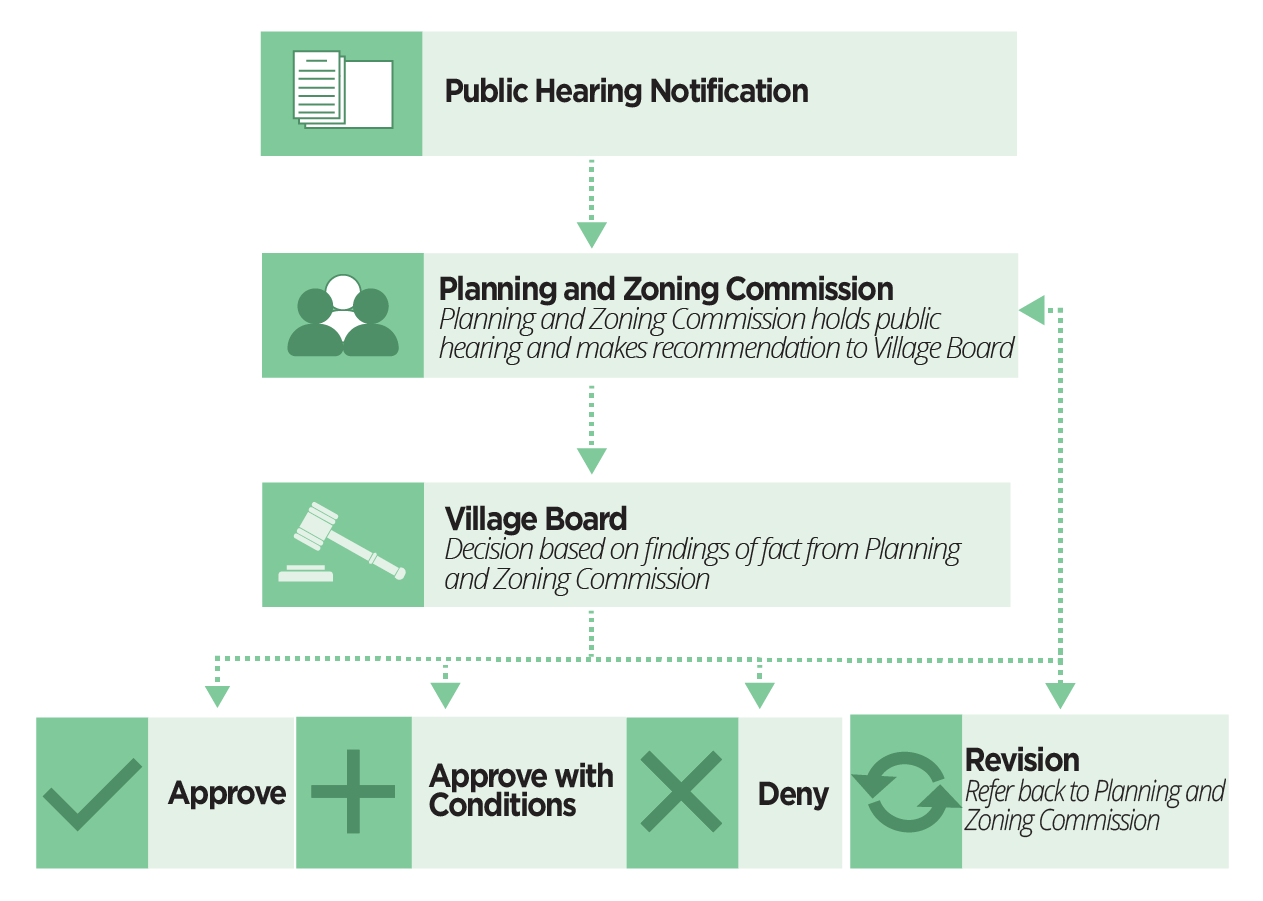
Action by the planning and zoning commission. The planning and zoning commission shall review the proposed amendment, any oral and written comments received at the public hearing, and responses by the applicant to the standards and make findings of fact to specify the reasons for their recommendation. The planning and zoning commission shall then forward to the village board its findings of fact and recommendation to approve, approve with conditions, or deny the proposed amendment.
(2)
Action by the village board of trustees. Following the public hearing, the planning and zoning commission shall forward its findings of fact and its recommendation to the village board. Upon receiving the report from the planning and zoning commission, the village board shall approve, approve with conditions, refer the matter back to the planning and zoning commission for further consideration, or deny the proposed amendment. The village board shall make the final decision on all zoning text and map amendments.
(d)
Standards. In making their recommendations on the map or text amendment, the planning and zoning commission and village board shall review responses by the applicant to the standards set forth below. Not one of the standards is controlling.
(1)
Zoning map amendments.
a.
Does the current zoning or the proposed zoning more closely conform to the stated goals in the comprehensive plan?
b.
Have major land uses, conditions or circumstances changed since the original zoning was established?
c.
Do sites exist for the proposed use in existing districts permitting such use?
d.
Is the requested change compatible with the existing uses, development patterns and zoning of nearby properties?
e.
Does the present development of the area comply with existing ordinances?
f.
Does the existing zoning impose an unreasonable hardship or can a reasonable economic benefit be realized from uses permitted by the existing zoning?
g.
What is the extent of the diminishment of property values, if any, resulting from the current zoning?
h.
How long has the property been vacant as compared to development occurring in the vicinity?
i.
Is the property physically suitable for the zoned uses or for the proposed use?
j.
Does the proposed use satisfy a public need?
k.
Will the proposed change conflict with existing or planned public improvements or adversely impact schools, parks or other public facilities?
l.
In the vicinity, will the environment or traffic patterns be adversely affected?
m.
To what extent will the proposed change diminish property values of the surrounding properties?
n.
Will the proposed change deter the use of properties in the area or contribute to redevelopment?
o.
Will the proposed change be detrimental to the health, safety and welfare of the neighborhood or of the village as a whole?
(2)
Text amendments.
a.
Is the proposed text amendment consistent with the stated goals in the comprehensive plan?
b.
Does the proposed text amendment address a particular issue or concern for the village?
c.
Will the proposed text amendment impose an unreasonable hardship on existing uses?
d.
Have major land uses, conditions or circumstances changed since the original zoning ordinance text was established?
e.
Is the requested change compatible with the existing uses and development patterns of the community?
f.
Will the proposed change be detrimental to the health, safety and welfare of the neighborhood or of the village as a whole?
(e)
Written protest. In the case of a written protest against any proposed amendment of the regulations or districts, signed and acknowledged either by the owners of 20 percent of the frontage proposed to be altered, or 20 percent of the frontage immediately adjacent to or across an alley therefrom, or by the owners of 20 percent of the frontage abutting or directly opposite the frontage proposed to be altered, the amendment shall not be passed except by a favorable vote of two-thirds of the members of the village board. In such cases, a copy of the written protest shall be served, by the protestor, to both the applicant for the proposed amendment and the applicant's attorney, if any, by certified mail at the address of such applicant and attorney shown in the application for the proposed amendment.
Figure 7.1. Zoning Text and Map Amendment Procedure
(Ord. No. MC-1068, § 2(Exh. B), 1-10-2023)
Sec. 44-07-11. - Special use permit.
(a)
Purpose. Special Uses encompass those uses which require a case-by-base consideration to assess the potential impact upon neighboring properties and the suitability of the proposed special use for the particular location, to serve the needs of the public. The special use process addresses these unique circumstances and regulates such uses to protect the public health, safety and welfare.
(b)
Procedure. Upon receipt of a completed application for a special use permit, the director of economic and community development will schedule the application for consideration by the planning and zoning commission and complete the public hearing notification.
(1)
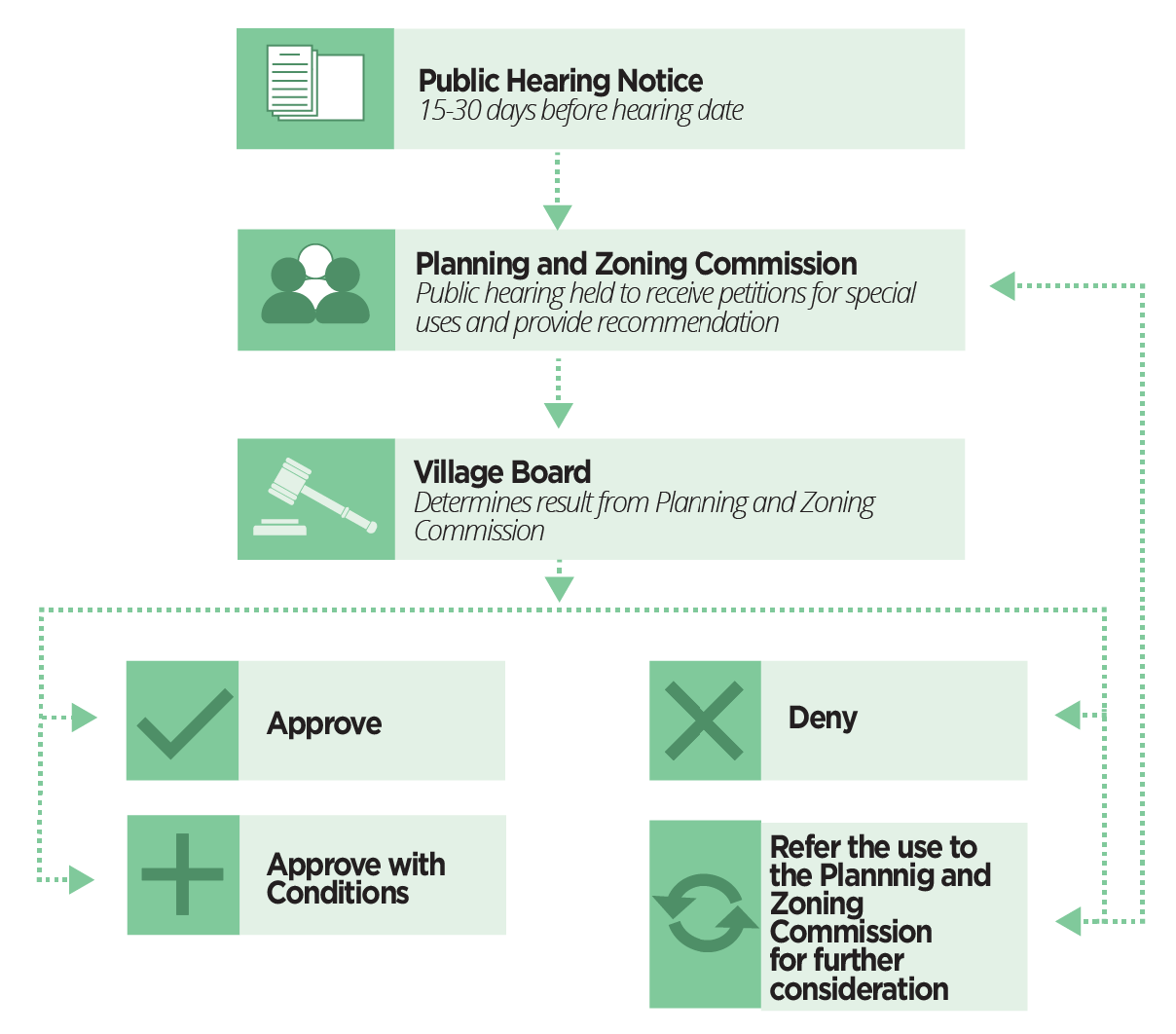
Action by the planning and zoning commission. The planning and zoning commission shall review the application, any oral and written comments received at the public hearing, and responses by the applicant to the standards and make findings of fact to specify the reasons for their recommendation. The planning and zoning commission shall then forward to the village board its findings of fact and recommendation to approve, approve with conditions, or deny the application.
(2)
Action by the village board. Following the public hearing, the planning and zoning commission shall forward its findings of fact and its recommendation to the village board. Upon receiving the report from the planning and zoning commission, the village board shall approve the special use, approve the special use with conditions, refer the matter back to the planning and zoning commission for further consideration, or deny the application. The village board shall make the final decision on all special uses.
(c)
Standards. In considering an application for a special use permit the planning and zoning commission and village board shall review the responses by the applicant to the standards set forth below. Not one of the standards is controlling.
(1)
Is the special use deemed necessary for the public convenience at that location?
(2)
Will the special use be detrimental to the economic welfare of the community?
(3)
Will the special use be consistent with the goals and policies of the comprehensive plan and other adopted plans of the village?
(4)
Is the special use at the subject property so designed, located, and proposed to be operated, that the public health, safety, and welfare will be protected?
(5)
Is the special use a suitable use of the property and, without the special use, could the property will be substantially diminished in value?
(6)
Will the special use cause substantial injury to the value of other property in the neighborhood in which it is located?
(7)
Will the special use be consistent with the uses and community character of the neighborhood surrounding the subject property?
(8)
Will the special use be injurious to the use or enjoyment of other property in the neighborhood for the purposes permitted in the zoning district?
(9)
Will the special use impede the normal and orderly development and improvement of surrounding properties for uses permitted in the zoning district?
(10)
Does the proposed special use at the subject property provides adequate measures of ingress and egress in a manner that minimizes traffic congestion in the public streets?
(11)
Is the subject property adequately served by utilities, drainage, road access, public safety and other necessary facilities to support the special use?
(12)
Will the special use have a substantial adverse effect on one or more historical, archeological, cultural, natural or scenic resources located on the parcel or surrounding properties?
(d)
Conditions. The planning and zoning commission may recommend and the village board may impose conditions and restrictions upon the construction, location and operation of a special use. Such conditions must be deemed necessary to comply with the standards set forth in this chapter, to promote the general objectives of this article, and to minimize or reduce the injury to the value of property in the neighborhood. Such conditions shall be expressly set forth in the ordinance granting the special use. Failure to maintain such conditions or restrictions as may have been imposed shall constitute grounds for revocation of such special use approval.
(e)
No presumption of approval. The listing of a use as a special use within a zoning district does not constitute an assurance or presumption that such special use will be approved. Rather, each proposed special use shall be evaluated on an individual basis, in relation to the standards in this section, the standards in article III of this chapter and the standards for the district in which it is located. Such evaluation will determine whether approval of the special use is appropriate at the particular location and in the particular manner proposed.
(f)
Limitation on special uses.
(1)
Expiration. The special use approval shall automatically expire without further action by the village if the applicant fails to obtain a building permit within one year of the approval of the special use. In applications within an existing building or structure with no alterations, the special use shall expire one year from the approval if the applicant fails to obtain the required licenses or permits for operation. An extension of the time requirements may be requested in writing and granted by the director of economic and community development for good cause shown by the applicant, provided a written request is filed with the village at least four weeks prior to the respective deadline.
(2)
Permit transfer. A special use permit is granted to a specific property and authorizes the conduct of the special use only on the property represented on the application and is not transferable to other properties.
(g)
Expiration. The special use permit shall automatically expire without further action by the village if the applicant fails to obtain a building permit within one year of the approval, or the use for which the permit was issued has been discontinued for a period of one year or longer. An extension of the time requirements may be requested in writing and granted by the director of economic and community development for good cause shown by the applicant, provided a written request is filed with the village at least four weeks prior to the respective deadline.
(h)
Amendments to approved special use permits.
(1)
Determination of level of change. Upon receiving a completed application for a special use permit amendment the director of economic and community development shall determine whether the amendment is a major amendment, or a minor amendment based on the criteria detailed in subsections a. and b. below.
a.
Major amendment. A major amendment is any proposed change to an adopted planned development that results in one or more of the following changes:
1.
Increase in the intensity of the site's use;
2.
Additional noise, glare, odor, or other impacts that are detectable from off-site;
3.
Affects the subject property in a manner that inhibits its continued use or reuse; or
4.
Results in a change inconsistent with any standards or conditions imposed by the village board in approving the specific use permit, as determined by the director of economic and community development.
b.
Minor amendment. A minor amendment is any proposed change to an approved special use permit that is consistent with the standards and conditions upon which the special use permit was approved, which does not alter the concept or intent of the special use permit and is not considered a major amendment as detailed in subsection 44-07-11(h)(1)a.
c.
Approval process.
1.
A major amendment to an approved special use permit shall follow the procedure for a special use permit approval defined in section 44-07-11.
2.
A minor amendment to an approved specific use permit may be approved by the director of economic and community development.
Figure 7.2. Special Use Permit Procedure
(Ord. No. MC-1068, § 2(Exh. B), 1-10-2023)
Sec. 44-07-12. - Variances.
(a)
Purpose. The variance process is designed to provide a narrowly circumscribed means by which relief may be granted from unforeseen applications of this chapter that create practical difficulties or particular hardships. A variance may be granted for practical difficulties or particular hardships barring a strict application of the regulations of this chapter.
(b)
Authority of the planning and zoning commission. As authorized in section 44-07-03, the planning and zoning commission may make the final decision in variance requests only in the following instances:
(1)
To permit a yard setback less than the yard setback required by the applicable regulations.
(2)
To permit the use of a lot for a use otherwise prohibited solely because of the insufficient area of the lot. The maximum variance that may be granted shall be ten percent.
(3)
To modify the applicable off-street parking or loading requirements to the extent of not more than one parking space or loading space, or 20 percent of the off-street parking spaces required by applicable regulations, whichever number is greater.
(4)
To allow any permitted nonresidential use in a residential district to exceed the building coverage imposed by the applicable regulations by no more than ten percent of that area limit imposed by applicable regulations.
(5)
To allow the modification of height restrictions for fences as specified in section 44-05-09.
(c)
Procedures. Upon receipt of a completed application for a variance, the director of economic and community development will schedule the application for consideration by the planning and zoning commission and complete the public hearing notification.
(1)
Action by the planning and zoning commission. The planning and zoning commission shall review the application, any oral and written comments received at the public hearing, and responses by the applicant to the standards and make findings of fact to specify the reasons for their recommendation.
a.
For applications pertaining to those areas of authority of the planning and zoning commission granted in subsection 44-07-03(b), the planning and zoning commission shall make its findings of fact and approve, approve with conditions, refer to the village board for review, or deny the application.
b.
For all other applications, the planning and zoning commission shall forward to the village board its findings of fact and recommendation to approve, approve with conditions, or deny the application.
(2)
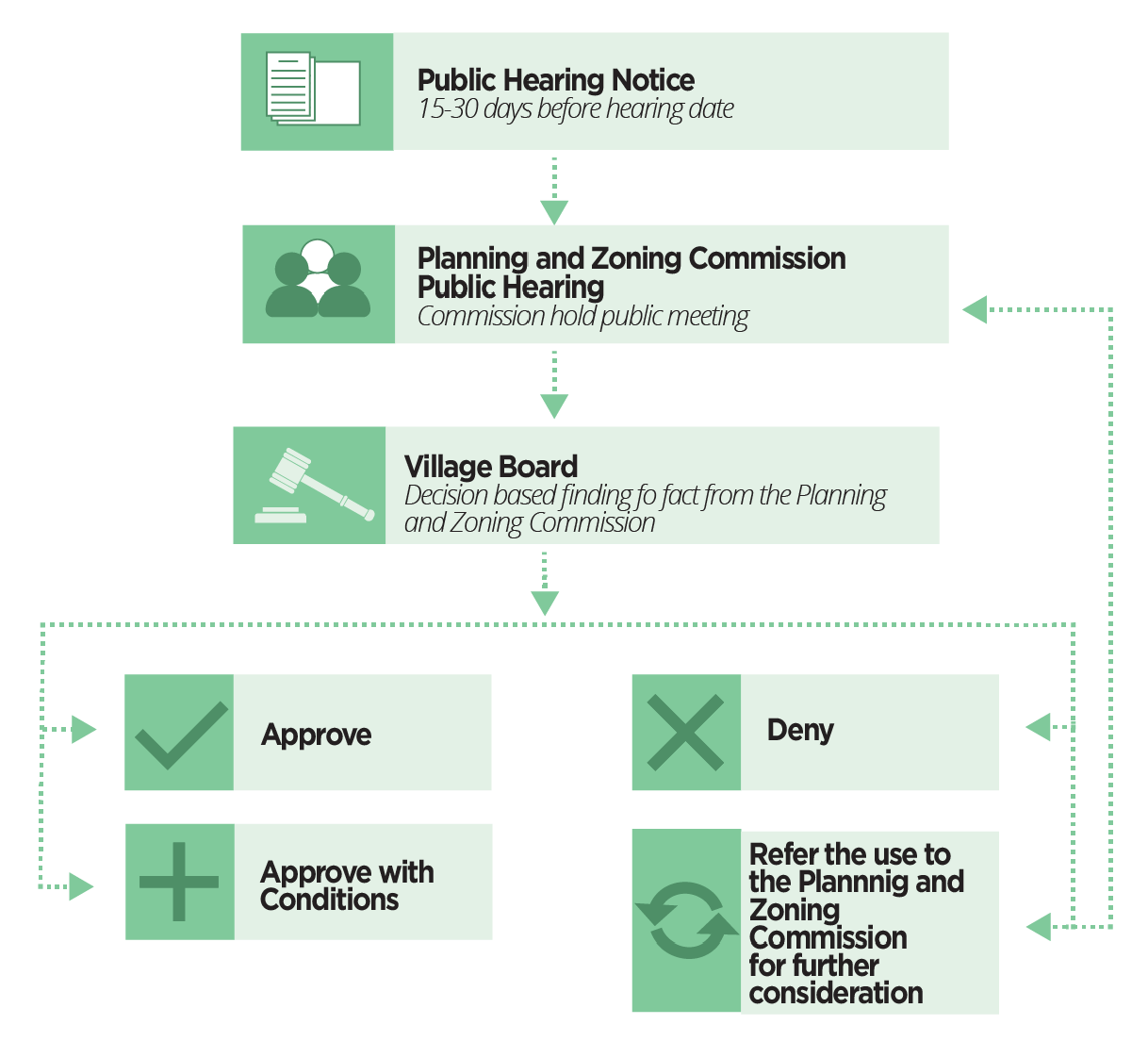
Action by the village board. Following the public hearing, the planning and zoning commission shall forward its findings of fact and its recommendation to the village board. Upon receiving the report from the planning and zoning commission, the village board shall approve, approve with conditions, refer the matter back to the planning and zoning commission for further consideration, or deny the application.
(d)
Standards. In considering an application for a variance, the decision-making authority shall review the responses by the applicant to the standards set forth below.
(1)
No variance shall be granted unless findings of fact for each specific application demonstrate a true hardship and the least deviation from this chapter necessary, as provided in the applicant's response to each of the following standards:
a.
Can the property in question yield a reasonable return if permitted to be used only under the conditions allowed by the regulations governing the district in which it is located?
b.
Is the plight of the owner due to unique circumstances?
c.
If granted, will the variance alter the essential character of the locality?
(2)
Supplemental to the above standards, the decision-making authority shall also consider and make findings of fact on the character of the alleged hardship and the potential impacts to neighboring properties of granting the variance, as provided in the applicant's response to each of the following standards. Not one of the standards is controlling.
a.
Do the particular physical surroundings, shape, or topographical conditions of the subject property pose a particular hardship upon the owner, as distinguished from a mere inconvenience, under the strict application of these regulations?
b.
Would the conditions upon which the petition for variance is based be generally applicable to other property within the same zoning classification?
c.
Has the alleged practical difficulty or particular hardship been created by any person presently having an interest in the property?
d.
If granted, will the variance be detrimental to the public welfare or injurious to other neighboring property?
e.
If granted, will the variance: impair an adequate supply of light and air to adjacent property; or substantially increase the danger of fire or otherwise endanger the public safety; or substantially diminish or impair values of neighboring property?
(e)
Expiration. The approved variance shall automatically expire without further action by the village if the applicant fails to obtain a building permit within one year of the approval. An extension of the time requirements may be requested in writing and granted by the director of economic and community development for good cause shown by the applicant, provided a written request is filed with the village at least four weeks prior to the respective deadline.
Figure 7.3. Planning and Zoning Commission Variance Procedure
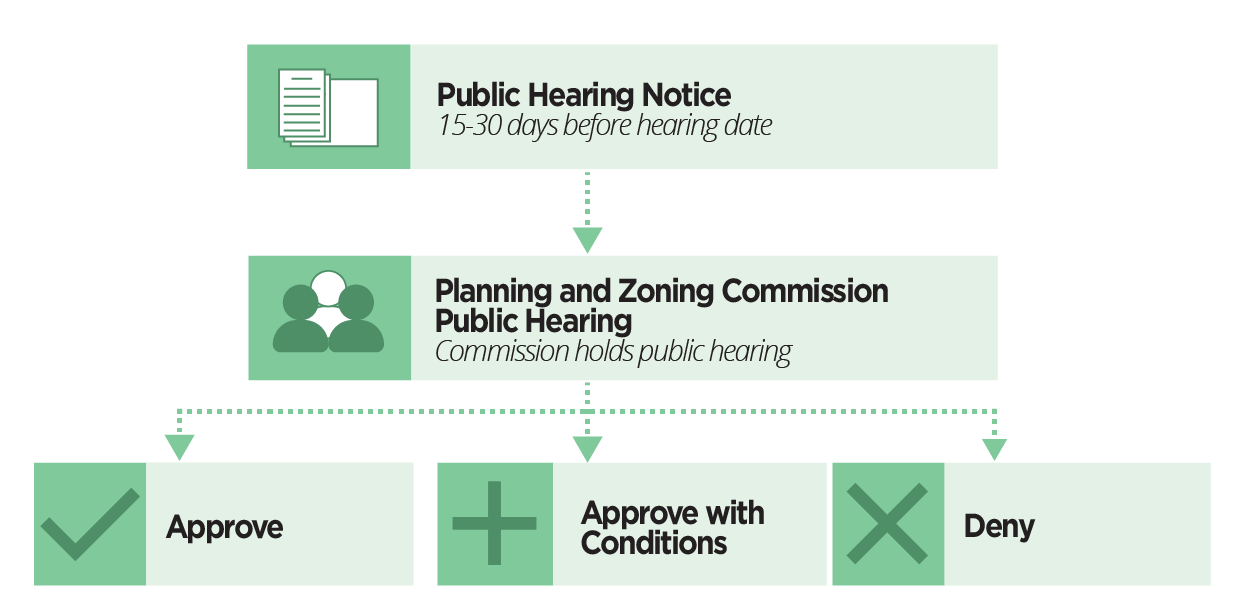
Figure 7.4. Village Board Variance Procedure
(Ord. No. MC-1068, § 2(Exh. B), 1-10-2023)
Sec. 44-07-13. - Administrative appeals.
(a)
Applicability. An administrative appeal may be made to the planning and zoning commission by any person, firm or corporation, or by any office, department, board, bureau, or commission, aggrieved by a decision of the building inspector, director of economic and community development, administrative review committee, or other authorized officials. The appeal process provides checks and balances on administrative authority.
(b)
Procedure.
(1)
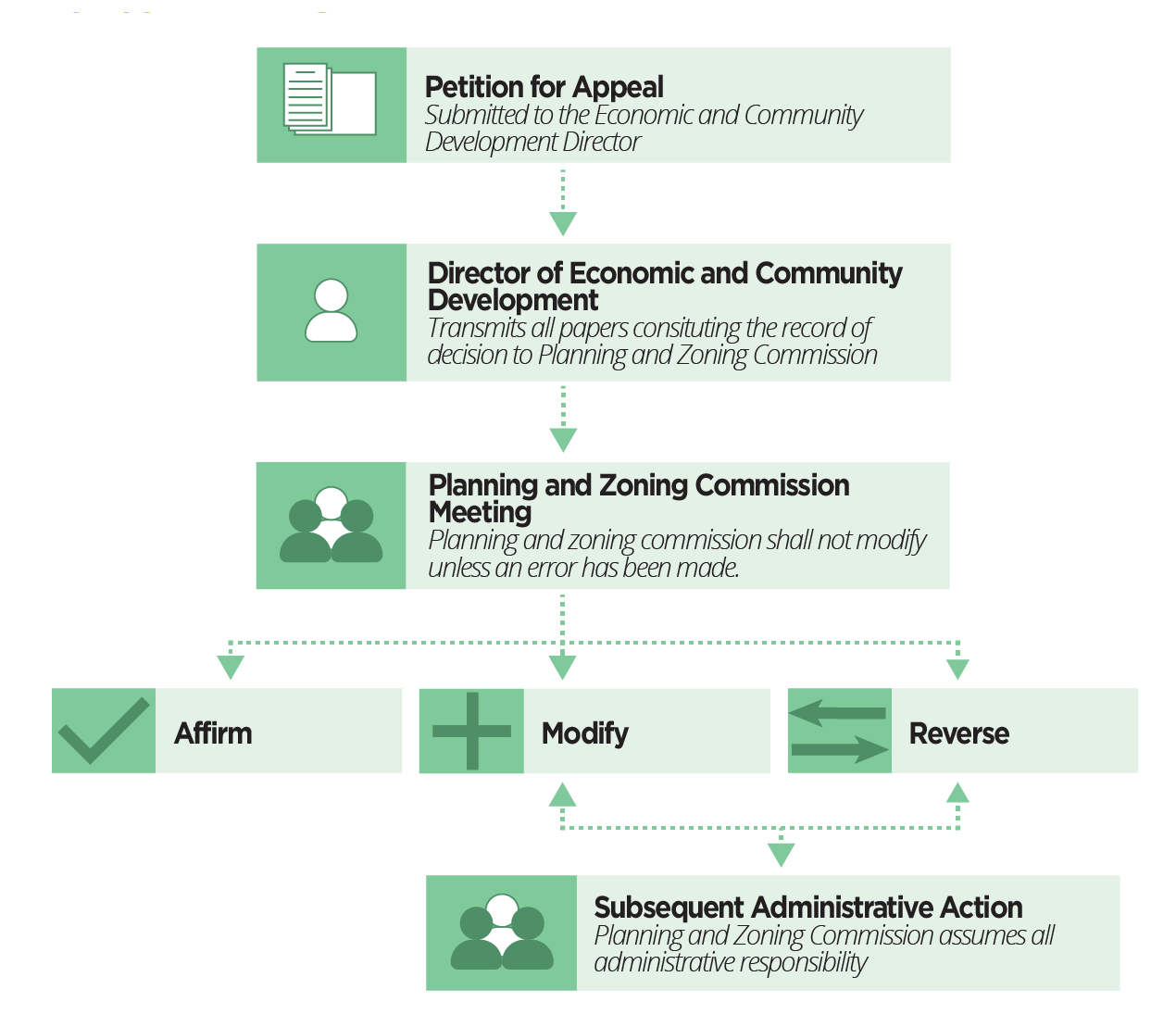
A petition for an appeal before the planning and zoning commission shall be filed in writing within 30 days after the date of the contested decision. The filing of the appeal shall stay any proceedings and any development permitted by the contested action, until a final decision has been rendered by the planning and zoning commission, unless the stay would cause imminent peril to life or property.
(2)
Upon filing of an administrative appeal, the director of economic and community development shall transmit to the planning and zoning commission all the papers constituting the record of the decision. The director of economic and community development shall place the appeal on the agenda of the planning and zoning commission for consideration at the earliest available meeting. The director of economic and community development shall provide the person who filed the appeal with written notice of the date, time and place of the scheduled meeting.
(3)
Action by the planning and zoning commission.
a.
By motion, the planning and zoning commission shall reverse, affirm, or modify the contested decision. In reversing, modifying or affirming the contested decision, the planning and zoning commission shall have all the related powers of the administrative officer whose decision is being appealed.
b.
The contested decision shall not be modified unless the planning and zoning commission finds that an error has been made in the application or interpretation of the terms of this chapter, any other related codes, ordinances or policies adopted by the village. The contested action shall not be reversed or modified except by the concurring vote of four members of the planning and zoning commission.
(4)
Further appeal. In the event that the contested action is reversed or modified, all subsequent administrative actions concerning the subject matter shall be in accordance with the reversal or modification by the planning and zoning commission. All decisions of the planning and zoning commission made pursuant to this part shall be final administrative decisions. Any appeal from such decisions shall be made to the circuit court.
Figure 7.5. Administrative Appeal Procedure
(Ord. No. MC-1068, § 2(Exh. B), 1-10-2023)
Sec. 44-07-14. - Sign reviews.
(a)
Sign permit review.
(1)
Applicability. A sign permit must be obtained before any person may construct, move, alter or maintain any sign type permitted by section 44-10-03, except temporary non-structural signs permitted by section 44-10-07.
(2)
Requirements. The following materials shall be submitted to the director of economic and community development for a sign permit:
a.
Completed application;
b.
Plans indicating dimensions of proposed signage, total sign area, materials, location on property, structural elements including bracing and support, means of attachment, and illumination method.
(3)
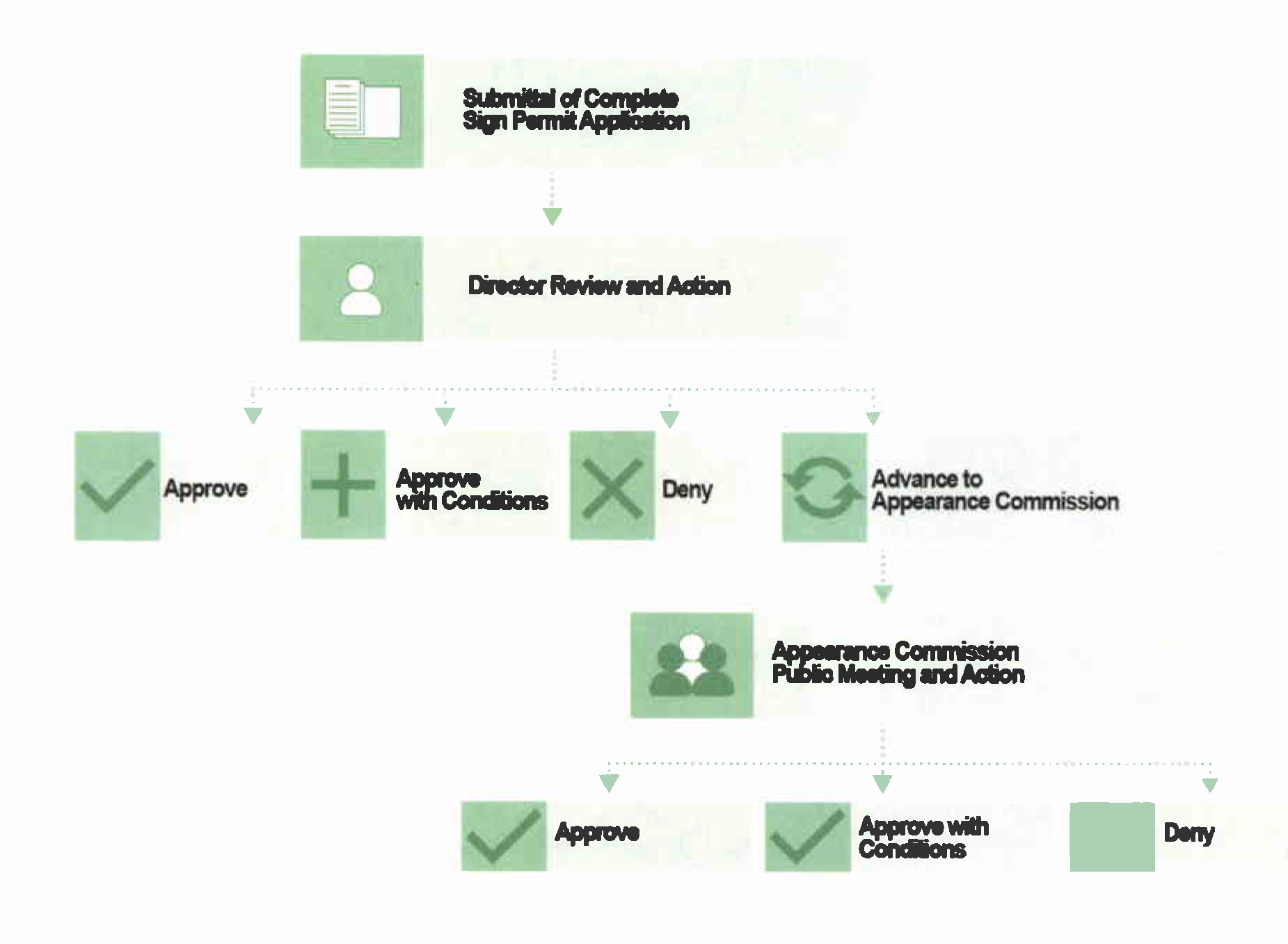
Action by director of economic and community development. Upon receipt of a complete permit application, the director of economic and community development shall review the materials to ensure the application conforms to the provisions of this section and may approve, approve with conditions, advance the application to an appearance commission as an appearance review, or deny the application. The director shall provide a letter to the applicant indicating the decision and public meeting information.
(4)
Action by appearance commission. Any sign permit application advanced as an appearance review shall be reviewed by the appearance commission. The appearance commission shall review application materials and any oral or written comments received at the public meeting. The appearance commission shall then approve, approve with conditions, defer the application to the village board, or deny the application in accordance with the procedure in section 44-07-14. The decision shall be forwarded to the chief building inspector and the director of economic and community development.
(5)
Fees. The chief building inspector shall determine fees for any signage permit in accordance with the village's fee schedule.
(6)
Additional permits. Any permit required elsewhere in this Code for electrical or structural work in connection with any sign must be obtained in addition to the sign permit provided for in this section. The chief building inspector, who issues final permits for the sign, shall oversee these approvals.
(7)
Expiration. A sign permit shall automatically expire without any further action by the village if the sign for which the permit was granted has not been established at the approved location within a period of one year from the date the permit was approved. An extension of the time may be granted by the director of economic and community development for good cause shown by the applicant, provided a written request is filed with the village at least four weeks prior to the respective deadline.
Figure 44-07-14(a)(1) Sign Permit Review Procedures
(b)
Comprehensive sign program (CSP) review.
(1)
Applicability. A comprehensive sign program (CSP) must be approved prior to the issuance of any sign permit within a development meeting the requirements within subsection 44-10-08(a).
(2)
Requirements. The following materials shall be submitted to the director of economic and community development upon receipt of a comprehensive sign program application:
a.
Completed application form;
b.
Property owner authorization;
c.
Map of parcel(s) and boundaries within which signs shall comply with the comprehensive sign program (CSP);
d.
Elevation drawings or annotated images for any building elevation where signage is proposed or where sign band areas are proposed for permitted future signage placement, as demonstrated in Figure 44-07-13(b)(2) and Figure 44-07-13(b)(3);
e.
Elevation drawings or annotated images for any freestanding sign, including monument/ground signs and pole (pylon) signs proposed;
f.
Any design or form standards proposed for all current or future signage within the defined area of the comprehensive signage plan (CSP), as applicable to any application;
g.
Responses to modification standards, as applicable to any application.
(3)
Action by director of economic and community development. Upon receipt of a complete application, the director of economic and community development shall review the materials for compliance with the provisions of this section. The director of economic and community development shall then schedule the application for consideration by the appearance commission.
(4)
Action by appearance commission. The appearance commission shall review the application, the staff report, any oral or written comments received at the public meeting, and responses by the applicant to the standards for comprehensive sign programs (CSP), as defined in subsection 44-10-09(d). The appearance commission shall then approve, approve with conditions, defer the application to the village board, or deny the application.
(5)
Records. A record of all sign permit applications within an area subject to an approved comprehensive sign program, amendments to the comprehensive sign program approval, or interpretations related to the comprehensive sign program, shall be kept on file in the office of the director of economic and community development and shall be available on request to any person pursuant to the Freedom of Information Act, 5 ILCS 140/1 et seq.
(6)
Additional permits. A comprehensive sign program (CSP) shall not constitute a sign permit for any individual sign.
(7)
Appearance review exemption. Signs, which are compliant with sign standards within an approved comprehensive sign program (CSP), shall be approved or denied administratively by the director of economic and community development.
(8)
Amendment and repeal. The comprehensive sign program (CSP) shall remain in effect for all property within the area defined by the original application unless amended or repealed.
a.
Amendment. Amendment applications shall be completed and filed with the director of economic and community development. The director of economic and community development shall review the application and approve, approve with conditions, advance the application to the appearance commission, or deny the application.
b.
Repeal. A repeal of the comprehensive sign program shall require the written agreement of all property owners within the defined boundaries of the comprehensive sign program, filed with the director of economic and community development at least 30 days in advance of the proposed date of repeal.
1.
Modifications and nonconformities. Any sign which was approved with modifications as found in a repeated comprehensive sign program shall be considered a legal nonconforming sign structure and shall be subject to the limitations for such signs found in subsection 44-10-09(b).
Figure 44-07-14(b)(1) Comprehensive Sign Plan Review Procedures
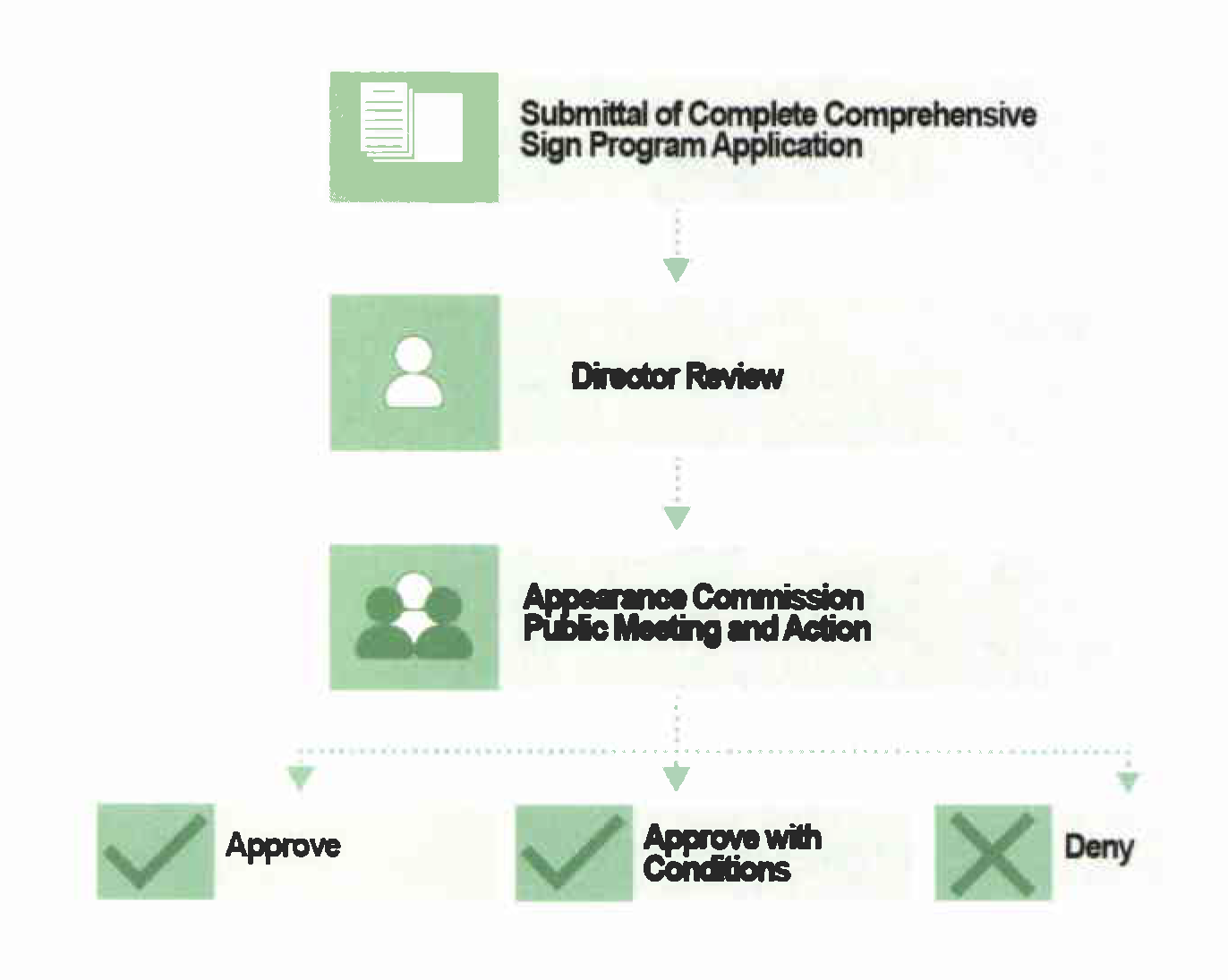
Figure 44-07-14(b)(2) Comprehensive Sign Plan Site Submittal Example
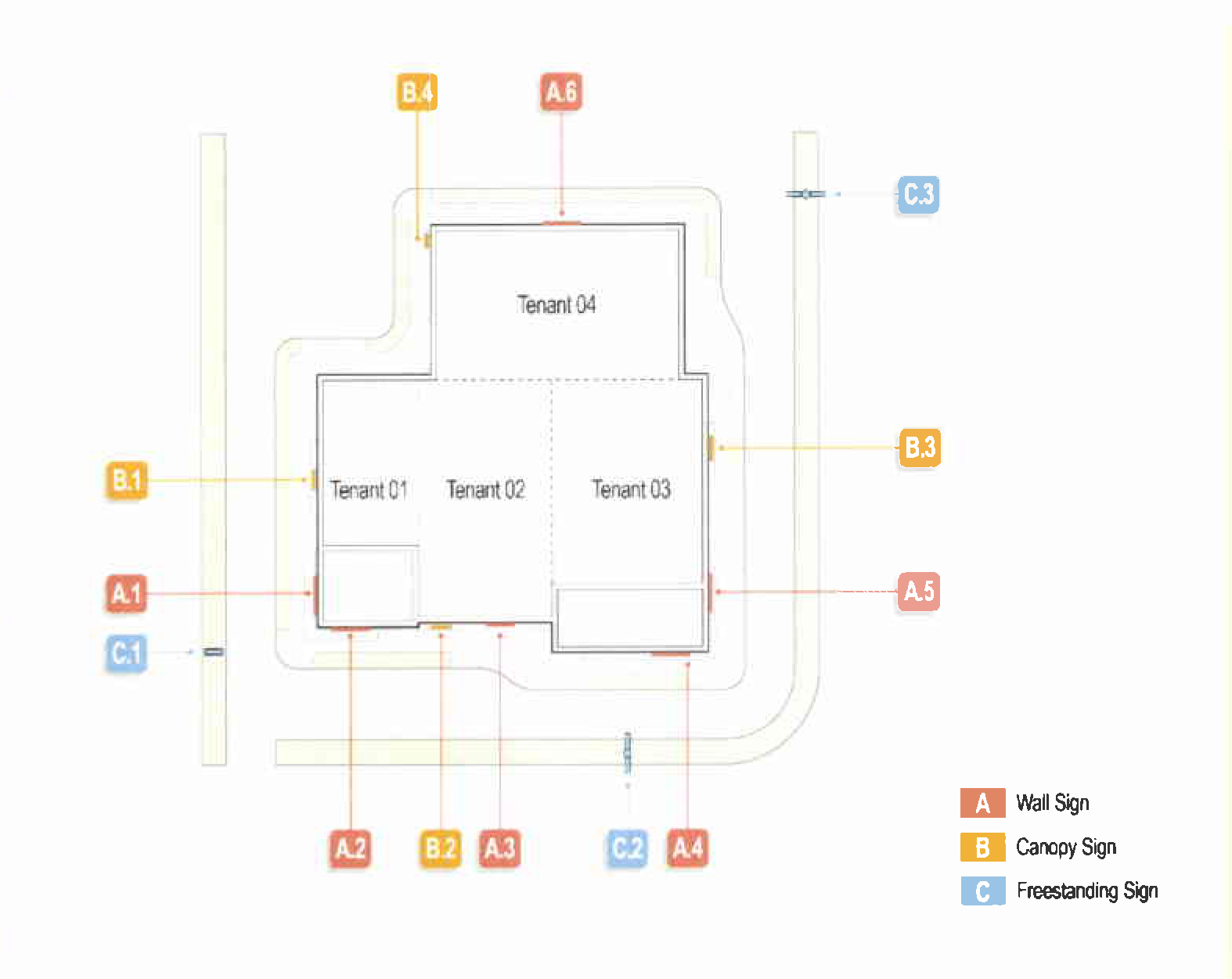
Figure 44-07-14(b)(3) Comprehensive Sign Plan Elevation Submittal Example
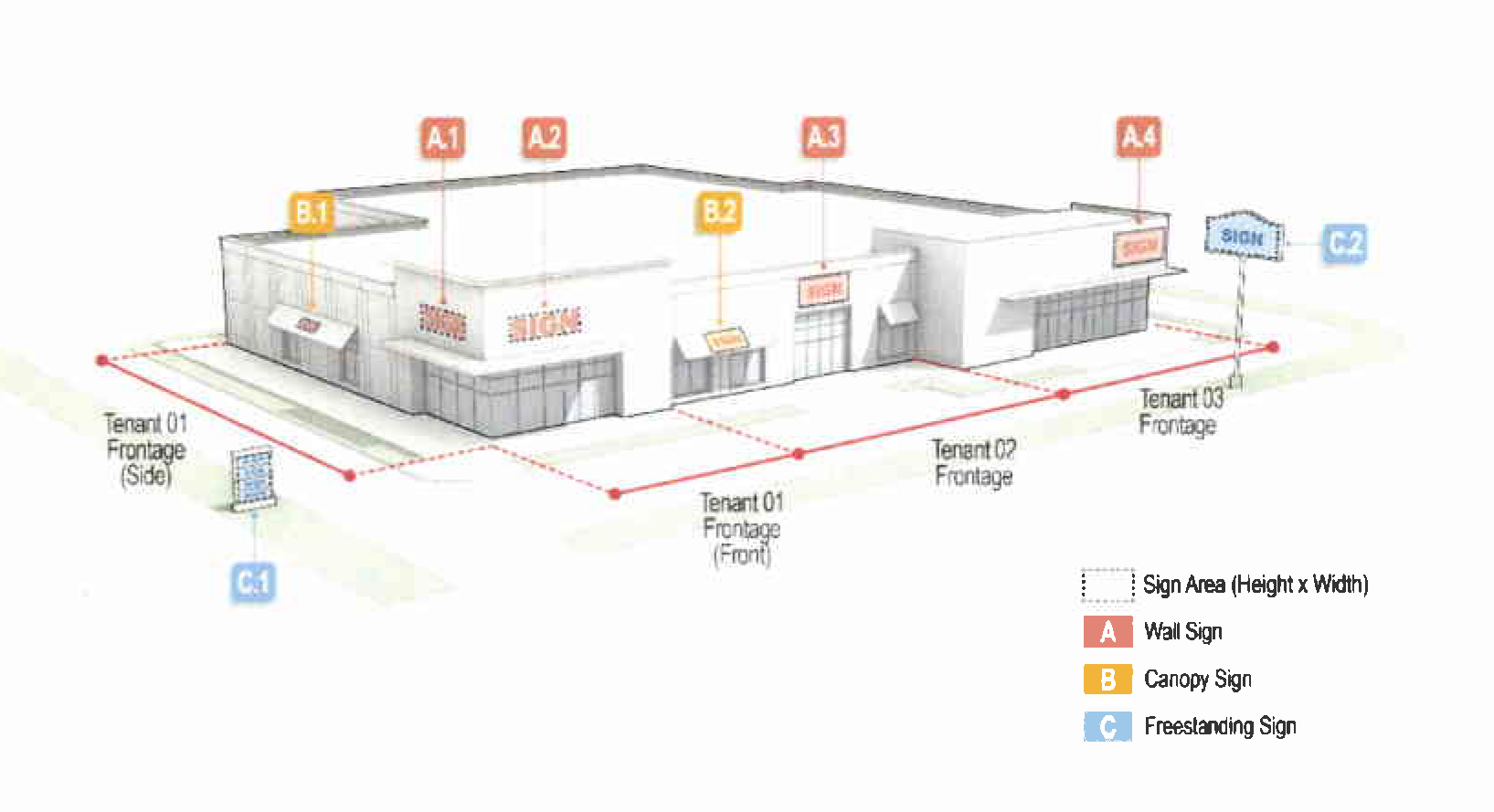
(c)
[Sign variances.]
(1)
Purpose. Given the unique commercial significance and design considerations applied to sign decisions, sign variances are considered as a unique process from other variances in this article. The sign variance process is designed to provide a narrowly circumscribed method of relief from unforeseen applications of section 44-10 which may create practical difficulties or particular hardships. A sign variance may be granted for practical difficulties barring a strict application of the regulations of this article, which stem from a particular hardship on a property. Modifications that are not caused by a hardship prohibiting the strict application of this article shall be reviewed via the comprehensive sign plan (CSP) review process.
(2)
Authority of the appearance commission. As authorized in section 44-07-03, provided the request is due to a unique circumstance or hardship related to the location, orientation, frontage placement, or demonstrable feature of the property, the appearance commission has authority to make the final decision in sign variance requests only in the following instances:
a.
To permit a sign area that exceeds the maximum sign area ratio or total for a particular sign type;
b.
To modify the requirements for the number of permitted signs;
c.
To modify the requirements for sign height.
(3)
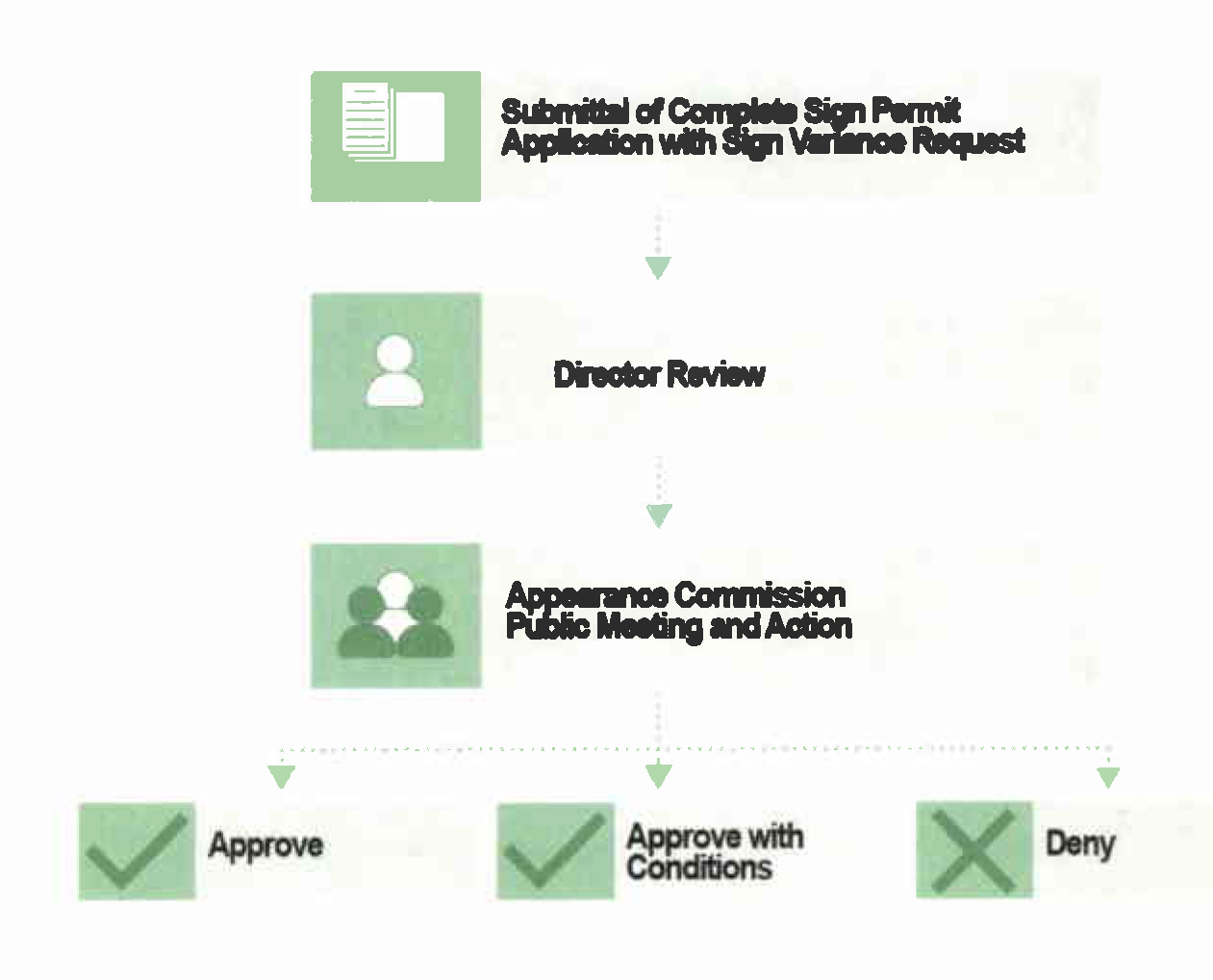
Sign permit application concurrent. The sign variance application shall be reviewed with a sign permit application, including all materials required for a sign permit application per subsection 44-07-14(a).
(4)
Action by the director of economic and community development. Upon receipt of a complete application, the director of economic and community development shall review the materials against the standards of sign variance in this section. The director of economic and community development shall then schedule the application for consideration by the appearance commission.
(5)
Action by the appearance commission. The appearance commission shall review the application, the staff report, any oral or written comments from the public meeting, and the applicant's responses to the standards. The appearance commission shall then approve, approve with conditions, or deny the application. The decision shall be forwarded to the chief building inspector and the director of economic and community development.
(6)
Standards of sign variance. In considering an application for a variance, the decision-making authority shall review the responses by the applicant to the standards set forth below:
a.
Can the property in question yield a reasonable return if permitted only under the signage regulations governing the district within which the property is located?
b.
Is the plight of the owner due to unique circumstances that are not self-imposed, including property location, orientation, frontage placement, or demonstrable feature of the property, which is communicated by the applicant?
c.
If granted, will the sign variance adversely affect the health, safety, or public welfare near the sign?
d.
If granted, will the sign variance negatively affect or harm the architectural character of the area in which the sign is proposed?
e.
Is the sign variance in alignment with the comprehensive plan, appearance plan, and other adopted plans of the village?
(7)
Expiration. The approved sign variance shall automatically expire without further action by the village if the applicant fails to obtain the sign permit concurrent with the variance within one year of the approval. An extension of the time requirements may be requested in writing and granted by the director of economic and community development for good cause shown by the applicant, provided a written request is filed with the village at least four weeks prior to the respective deadline.
Figure 44-07-14(c)(1) Sign Variance Procedures
(Ord. No. MC-1089, § 2.3.a.(Exh. A), 8-26-2025)
Sec. 44-07-15. - Appearance review.
(a)
Appearance review procedure.
(1)
Purpose. The appearance review process serves as a design review procedure for new development occurring within village limits. The design review procedure is guided by the appearance plan, village zoning ordinance and the village comprehensive plan, and is designed to encourage development, which is harmonious with and improves the quality and effectiveness of urban design within village limits. The appearance review procedure serves as the mechanism by which the appearance commission is to fulfill its stated power and duty to "consult with other municipal and governmental bodies on matters affecting the appearance of the village."
(2)
Applicability. An appearance review shall be required for any of the following applications or proposals:
a.
Any erection, construction, alteration or repair of any building or structure other than a single-family residential building;
b.
Any movement of any existing structure or building onto any lot in the village;
c.
Any sign permit review elevated to the appearance commission by the director of economic and community development pursuant to subsection 44-07-14(a)(3);
d.
Murals and other public art installations;
e.
Any proposed public work or public improvements excluding public infrastructure projects having no changes to landscaping or site improvements;
The following improvements are exempt from appearance review:
f.
Any interior project requiring a building permit exempt from zoning review, including interior signs which are not directly visible from the public right-of-way;
g.
Building permit applications for the construction offences and other structures accessory to a single-family residential principal use, excluding accessory dwelling units as defined in section 44-04-14.
(3)
Requirements. The following materials shall be submitted to the director of economic and community development for appearance review:
a.
Completed application;
b.
Narrative describing all proposed improvements;
c.
Site plans depicting all proposed improvements;
d.
Landscape plans;
e.
Elevation drawings or annotated images depicting all proposed improvements;
f.
Color and material board depicting all proposed materials and colors to be utilized on proposed improvements; and
g.
Photometric plan depicting all lighting fixtures to be used on any proposed improvements.
All required items except for [subsection] (1) may be waived by the director of economic and community development as a requirement for any application.
(4)
Action by the director of economic and community development. Upon receipt of a complete application and waiving any required materials, the director of economic and community development shall review the materials for compliance with the provisions of this chapter and other village ordinances. The director of economic and community development shall then schedule the application for consideration by the appearance commission.
(5)
Action by the appearance commission. The appearance commission shall review the application, the staff report, and any oral or written comments received at the public meeting. The appearance commission shall consider the application for compliance with the approved appearance plan pursuant to section 28-26 of this Code. The commission shall then issue a recommendation to approve, approve with conditions, or deny the application as proposed. The appearance commission may also defer an appearance review decision to the village board of trustees for a final decision.
(6)
Action by the chief building inspector. Upon the approval by the appearance commission, a notice of decision and all materials upon which the recommendation was granted shall be provided to the chief building inspector, designee for completing approval of building permits, or other applications submitted to the building division.
(7)
Planning and zoning commission. Should any improvement subject to an appearance review require a public hearing before the planning and zoning commission, the director of economic and community development shall schedule the planning and zoning commission hearing to occur prior to the appearance commission meeting.
(Ord. No. MC-1089, § 2.3.b.(Exh. A), 8-26-2025)
Sec. 44-07-16. - Murals and art installations.
(a)
Purpose. Murals are defined in section 44-10-11, "Mural." Murals represent unique opportunities for the display of private artwork on the facades of buildings within the village in a manner visible to the public. Murals require a unique review to assess the location's potential contribution of artwork to the welfare of the village while providing opportunities for input from the public regarding visible art installations within the village.
(b)
Procedure. Upon receiving a completed mural/art installation application, the director of economic and community development will review the mural against the zoning requirements for murals and public art installations in section 44-07-16. The director shall then schedule the application for recommendation by the appearance commission and a decision by the village board.
(1)
Action by the appearance commission. The appearance commission shall review the application, and any oral and written comments received at the public meeting, and determine the level of compliance with zoning requirements and standards for murals and art installations. The appearance commission shall forward its recommendation to approve, approve with conditions, or deny the application.
(2)
Action by the village board. Following the public meeting, the appearance commission will forward its recommendation to the village board. Upon receiving the report from the appearance commission, the village board shall approve or deny the application.
(c)
Standards. In considering an application for a mural or art installation, the following standards shall be used to measure the suitability of the proposed improvement:
(1)
Will the proposed artwork cause injury or harm to specific individuals, groups of individuals, or organizations within the village that may threaten public peace or well-being?
(2)
Is the location and design of the proposed artwork in alignment with the comprehensive plan and other adopted plans of the village?
(3)
Is the proposed artwork located and designed in alignment with the design guidelines of the village appearance plan?
(4)
Is the proposed artwork so designed and located to protect public health, safety, and welfare?
(5)
Is the mural or art installation located in a manner architecturally appropriate for the size, scale, and orientation of the proposed artwork?
(6)
Will the proposed artwork be publicly visible and accessible in a manner that does not impede the safety, health, or welfare of the viewer?
(7)
Does the proposed artwork provide positive cultural contributions to the community, including highlighting historical, archeological, cultural, natural, or scenic resources located within the village?
(8)
Is the artwork proposed in such a manner that the building on which the mural or artwork is affixed will not be damaged or suffer long-term deterioration due to the placement of the mural?
(9)
Are the materials proposed for use in the artwork appropriate for the location of the artwork, including the material of the facade on which the artwork is to be affixed?
(d)
Conditions. The appearance commission may recommend, and the village board may impose conditions or restrictions on the approval of the proposed artwork. Under no circumstances shall any condition impose a content-based restriction on any proposed artwork.
(e)
Expiration. The mural or art installation approval shall automatically expire without further action by the village if the applicant fails to commence work on the proposed mural or art installation within one year of the approval. An extension of time requirements may be requested in writing and granted by the director of economic and community development for good cause shown by the applicant, provided a written request is made to the village at least one week prior to the respective deadline.
(Ord. No. MC-1089, § 2.3.c.(Exh. A), 8-26-2025)

