
Horry County Unincorporated
City Zoning Code
City Zoning Code
ARTICLE XIII
DEVELOPMENT IMPACT FEES
Sec. 1300.- Title and authority.
This article shall be referred to as "Development Impact Fees," which is adopted pursuant to and in compliance with the authority conferred by the South Carolina Development Impact Fee Act, S.C. Code tit. 6, ch. 1, art. 9.
Sec. 1301. - Adoption of technical report.
The County hereby adopts and incorporates by reference the report titled "Capital Improvement Plan and Development Impact Fee Study," prepared by TischlerBise, dated April 3, 2020, which supports the necessity, amounts, levels of service, and reasonableness of the Impact Fees imposed by this article.
Sec. 1302. - Findings.
The County hereby declares and finds that:
1.
Pursuant to S.C. Code tit. 6, ch. 29, the Horry County comprehensive plan, Imagine 2040, was adopted on December 10, 2019; and
2.
In accordance with the South Carolina Development Impact Fee Act, including S.C. Code § 6-1-960, the County adopts a Capital Improvements Plan, which describes the types and magnitude of planned System Improvements needed to address the impacts of New Development on Public Facilities to be funded with Impact Fee revenues, which will benefit Fee Payors pursuant to the provisions of this article; and
3.
The County retained TischlerBise to analyze land use assumptions, in accordance with the South Carolina Development Impact Fee Act, and to determine the additional demand created by New Development for Public Facility System Improvements; and
4.
Based on such analysis, TischlerBise has prepared a report titled "Capital Improvement Plan and Development Impact Fee Study," and dated April 3, 2020, which in all material respects was submitted to and reviewed by County staff and officials, the Horry County Planning Commission, and the Horry County Council; and
5.
The Technical Report describes the levels of service the County Council deemed acceptable, as applicable to each Public Facility for which Impact Fees are collected pursuant to this article; and
6.
The Technical Report has been presented to and reviewed by County Council, which has determined, in accordance with the requirements of law, that:
Impact Fees are necessary to offset the costs to the County associated with meeting the necessary facility demand created by projected new residential and non-residential Development;
a)
Impact Fees imposed by this article are calculated in accordance with generally accepted principles and professional standards as specifically described in the Technical Report;
b)
The Impact Fees imposed by this article reasonably relate to the service demands and needs of New Development subject to this article, are based on actual improvement costs or reasonable estimates of such costs, are supported by sound engineering studies, and do not exceed a proportionate share of the costs incurred by the County in providing System Improvements to serve New Development;
c)
The expenditure of Impact Fees, pursuant to the terms of this article, will result in a beneficial use to New Development reasonably related to the Impact Fees, and any benefits to property owners or developers, other than Fee Payors, within the impact fee service area, resulting from the expenditure of Impact Fee revenues pursuant to this article, if any, are incidental;
d)
Following due consideration of the Technical Report, the County's recovery of a portion of capital costs through Impact Fees will not significantly affect the costs or availability of Affordable Housing within Horry County, see Appendix A (Housing Affordability Analysis) attached to the ordinance from which this article derived;
e)
The demand for and the benefits resulting from System Improvements to be funded with Impact Fee revenues are reflected in the Impact Fee Service Areas established by the Technical Report and as provided by this article; and
f)
The County has prepared and will review and, as needed, update the Capital Improvements Plan that include Public Facility improvements to ensure New Development paying Impact Fees under this article receive a beneficial use from System Improvements constructed through the expenditure of Impact Fees, as required by law; and
g)
This article is necessary in order, among other things, to ensure the adequacy of the County's public facilities as new residential and nonresidential Development continues in unincorporated Horry County.
Sec. 1303. - Interpretations of article and fee schedule.
Interpretation of the provisions of this article shall be made by the Administrator consistent with the Technical Report, the South Carolina Development Impact Fee Act, the purpose and legislative intent of the County Council, and other requirements of law.
Sec. 1304. - Effect on other regulations and requirements.
1.
This article may not be construed to alter, amend, or modify any other provision of the County Code of Ordinances, which shall be operative and remain in full force and effect notwithstanding any contrary provisions, definitions, or intentions that are or may be expressed or implied in this article, unless expressly providing for herein.
2.
The payment of Impact Fees shall not entitle the applicant to a building or development permit unless all other applicable land use, zoning, planning, and other applicable requirements, standards, and conditions have been met. Such other requirements, standards, and conditions are independent of the requirement for payment of Impact Fees required by this article.
Sec. 1305. - Definitions.
The following terms, as used in this article, shall have the meanings specified below. To the extent a term is not defined, including any land use proposed, which is subject to this article, the Administrator shall determine the meaning of the term, pursuant to § 1303, above.
Administrator means the County Administrator of Horry County or the Administrator's designee.
Affordable Housing means housing affordable to families whose incomes do not exceed eighty percent (80%) of the median income in Horry County.
Capital Improvements means improvements including, but not limited to, land, buildings, and structures with a useful life of five (5) years or more and equipment and vehicles with an individual unit purchase price of not less than one hundred thousand dollars ($100,000), by new construction or other action, which increase the service capacity of a Public Facility.
Capital Improvements Plan or CIP means the County's schedule of planned Public Facility System Improvements upon which impact fees may be used as a funding source under this article, including those in the Technical Report, as implemented by and consistent with the County's annual budgets and 5-year capital improvements planning program.
County means Horry County, South Carolina.
County Public Safety Service Area means the Impact Fee Service Area within which the County provides public safety Public Facilities to serve New Development within its boundaries, which are on file with the County Department of Planning and Zoning.
Development means construction or installation of a new building or structure, or a change in use of a building, structure, or land, which creates additional demand and need for Public Facilities. A building or structure shall include, but not be limited to, modular buildings and manufactured housing. Development does not include alterations made to existing single-family homes.
Expenditure means legally obligated or otherwise committed to use by appropriation, contract, payment, repayment, or purchase order of the County or a partnering agency in the provision of System Improvements.
Fee Payor means a Person undertaking Development who is required to pay an Impact Fee in accordance with the terms of this article.
Impact Fee or Development Impact Fee means a fee imposed pursuant to this article, in the amounts set forth herein.
Impact Fee Account means an internal account established by the County for the purpose of segregating from other County funds Impact Fee revenues collected for a particular Public Facility and, as applicable, from within a particular Impact Fee Service Area, as specifically provided in this article.
Impact Fee Service Area means the geographic area or areas described in § 1307 of this article, within which Public Facilities provide service to New Development and Impact Fee revenues will be spent.
Murrells Inlet-Garden City (MIGC) Public Safety Service Area means the Impact Fee Service Area within which the County provides public safety Public Facilities to serve New Development within its boundaries, which are on file with the County Department of Planning and Zoning.
New Development means Development subject to the terms of this article.
Non-Commencement means the cancellation of a construction activity making a material change in a structure, or the cancellation of any other Development activity making a material change in the use or appearance of land.
Offset means a credit, reimbursement, or waiver of Impact Fees, given pursuant to the terms of this article, as a result of the dedication, construction, or funding of an Offset-Eligible Improvement.
Offset-Eligible Improvement means System Improvements, constructed, dedicated, or funded by a party other than the County, which is not a Project-Level Improvement.
Parks and Recreation Service Area means the Impact Fee Service Area within which the County provides parks and recreation Public Facilities to serve New Development within its boundaries, which are on file with the County Department of Planning and Zoning.
Person means an individual, corporation, governmental agency, business trust, estate, trust, partnership, association, two or more Persons having joint or common interest, or any other legal entity.
Project-Level Improvements means improvements necessary to mitigate impacts attributable solely to a particular development; including but not limited to, direct access improvements, turn lanes, median openings, frontage roads, private security vehicles, or private parks.
Public Facilities means System Improvements, for which Impact Fees are collected pursuant to this article, including for parks and recreation, public safety, and solid waste.
Service Unit means a standardized measure of consumption, use, generation, or discharge attributable to an individual unit of development calculated in accordance with generally accepted engineering or planning standards for a particular category of Public Facilities, as provided in this article and the Technical Report.
Solid Waste Water Service Area means the Impact Fee Service Area within which the County provides solid waste Public Facilities to serve New Development within its boundaries, which are on file with the County Department of Planning and Zoning.
System Improvements means Capital Improvements to a Public Facility included on the County's CIP or provided by a partnering agency, which are designed to provide service to New Development in an Impact Fee Service Area. "System Improvements" do not include Project-Level Improvements.
System Improvement Costs means costs incurred for construction or reconstruction of System Improvements, including design, acquisition, engineering, and other costs attributable to the improvements, and also includes the costs of providing additional Public Facilities needed to serve New Development. System Improvement costs do not include:
a)
Construction, acquisition, or expansion of Public Facilities other than Capital Improvements identified in the Capital Improvements Plan;
b)
Repair, operation, or maintenance of existing or new capital improvements;
c)
Upgrading, updating, expanding, or replacing existing capital improvements to serve existing development in order to meet stricter safety, efficiency, environmental, or regulatory standards;
d)
Upgrading, updating, expanding, or replacing existing capital improvements to provide better service to existing development;
e)
Administrative and operating costs of the County, including those associated with development or calculation of impact fee amounts; or
f)
Principal payments and interest or other finance charges on bonds or other indebtedness, except financial obligations issued by or on behalf of the County to finance Capital Improvements identified in the CIP to serve New Development.
Technical Report means the report titled "Capital Improvement Plan and Development Impact Fee Study," prepared by TischlerBise, dated April 3, 2020.
Temporary Uses means uses that are required in the construction phase of Development or are uniquely seasonal in nature, including, but not limited to: contractor's project offices, project sales offices, seasonal sales of trees or farm produce, carnivals, and tent meetings.
Sec. 1306. - Applicability of this article.
1.
Type of development affected.
a)
Except as expressly provided otherwise herein, the provisions of this article shall apply to New Development in the unincorporated areas of Horry County.
b)
No Impact Fees shall be assessed with respect to a property for which a valid building permit or certificate of occupancy has been issued or construction has lawfully commenced before the Effective Date of this article.
c)
Impact Fees shall be paid by New Development, as provided in this article, unless the proposed Development specifically is not subject to or is exempt from the terms of this article, or has received an Offset pursuant to this article.
d)
Impact fees imposed by this article in an area annexed by a municipality remain subject to the requirements of this article unless the municipality assumes any liability which is to be paid with the impact fee revenue.
2.
Type of development not affected.
The following types of Development shall not be subject to the terms of this article:
a)
Rebuilding the same amount of floor space of a structure that was destroyed by fire or other catastrophe;
b)
Construction, reconstruction, remodeling, or repairing a structure or other activity that does not result in an increase in the number of Service Units;
c)
Replacing a residential unit, including a manufactured home, with another residential unit on the same lot, if the number of Service Units does not increase;
d)
Placing a construction trailer or office on a lot during the period of construction on the lot;
e)
Constructing an addition on a residential structure which does not increase the number of Service Units;
f)
Adding uses that are typically accessory to residential uses, such as a tennis court or a clubhouse, unless it is demonstrated by the Administrator that the accessory use creates a measurable impact on Public Facility capacity in addition to the associated residential uses;
g)
All or part of a particular development project if:
i.
The project is determined to create Affordable Housing; and
ii.
The exempt development's proportionate share of System Improvements is funded through a revenue source other than Impact Fees.
h)
Construction of elementary, middle, or secondary schools;
i)
Construction of a new volunteer fire department;
j)
Temporary Uses;
k)
Alternations to an existing single-family home; or
l)
A project that mitigated or mitigates its impact on Public Facilities, which would otherwise be subject to this article, through a development agreement or other commitment by the developer.
Sec. 1307. - Impact fee service areas established.
There are hereby established the following Impact Fee Service Areas within which the County provides Public Facility services and within which Impact Fees are assessed.
1.
Public safety. There are two Impact Fee Service Areas for public safety.
a)
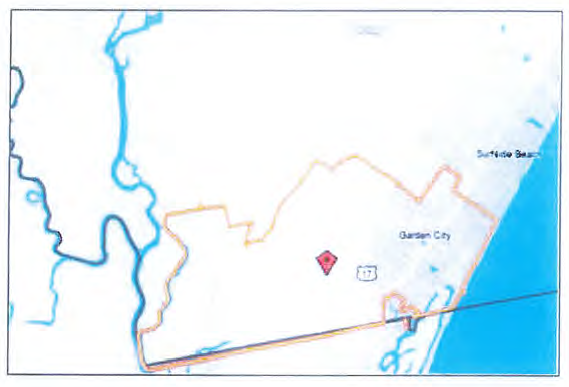
The Murrells Inlet-Garden City (MIGC) Public Safety Service Area includes unincorporated lands within the MIGC Fire District, which is illustrated in subparagraph (c) below.
b)
The County Public Safety Service Area includes unincorporated lands outside of the MIGC Fire District.
c)
The map below illustrates the general boundaries of the MIGC Fire District. Official maps of the boundaries of the MIGC Public Safety Service Area and the County Public Safety Service are on file with the Horry County Department of Planning and Zoning.
2.
Parks and recreation. There is a single Impact Fee Service Area for parks and recreation, designated as the Parks and Recreation Service Area, which includes all lands within the unincorporated areas of Horry County.
3.
Solid waste. There is a single Impact Fee Service Area for solid waste designated as the Solid Waste Service Area, which includes all lands within the unincorporated areas of Horry County.
Sec. 1308. - Impact fee amounts, how calculated; collection; failure to pay; effect of payment.
1.
Impact fee amounts. Impact Fees shall be assessed and collected from New Development, pursuant to the provisions of this article, in accordance with the fee schedule below, unless the developer has received an Offset, credit, exemption, or otherwise has provided its proportionate share of Public Facilities, as allowed by this article.
2.
How calculated. Impact Fees were calculated based on New Development's proportionate share impact on Public Facilities and the cost for the County and its partnering agencies to address that impact, based on the levels of service and methodologies described in the Technical Report, which is on file with the County and incorporated by this reference.
3.
When collected. Impact Fees will be assessed against New Development at the time of issuance of a building permit or development permit if no building permit is required, except as otherwise specifically provided by this article. Unless an applicant has received an Offset, credit, or exemption or has provided an approved individual assessment, pursuant to this article, Impact Fees shall be paid in the amounts set forth in applicable fee schedules in § 1308 of this article. In the event that a proposed use is not listed in the fee schedule, the Administrator shall apply the Impact Fee applicable to the most comparable land use listed in the fee schedule. In making the determination, the Administrator may rely on professionally-recognized documentation indicating the impacts of the proposed use on Public Facilities including, but not limited to, the Technical Report, the ITE Trip Generation manual, or the APA's Land-Based Classification Standards.
4.
Failure to pay. No building permit, or development permit if no building permit is required, shall be issued unless Impact Fees owed pursuant to the provisions of this article are paid in full. If a Fee Payor fails to pay Impact Fees as required herein, the County may assess penalties and liens against a property or property owner, based on the percentage, penalties, and timeframes applicable for failure to pay property taxes.
5.
Effect of payment. Payment of Impact Fees according to the provisions of this article constitutes full and complete payment of the developer's proportionate share of System Improvement costs, as required by law.
Sec. 1309. - Individual assessment of impact fee.
1.
Generally.
a)
An individual assessment may be submitted by a Fee Payor to determine whether a proportionate share demand on Public Facilities created by the proposed development will be less than the fees set forth in § 1308.
b)
The County may have an individual assessment completed when a proposed New Development includes a land use not listed in § 1308 or for which an assessment is required pursuant to the fee schedules in that section.
c)
The individual assessment shall be calculated according to the cost assumptions and methodology used for the particular Public Facility in the Technical Report and the costs of the individual assessment shall be borne by the applicant.
d)
The individual assessment may be based only upon impact or use characteristics that are shown to exist throughout the expected life of the structure or use and may not be based upon temporary or transitory use characteristics.
2.
Procedure for applicant-initiated individual assessments.
a)
Prior to submitting an individual assessment analysis to the County, the applicant must schedule and attend a preapplication meeting with the Administrator in order to establish the studies parameters and requirements, consistent with this section and the specific characteristics of the proposed Development.
b)
The individual assessment analysis shall be prepared by qualified professionals in the fields of planning and engineering, impact analysis and economics, as necessary to comply with the requirements of this section.
c)
Within fifteen (15) working days of receipt of an individual assessment analysis, the Administrator shall determine if the individual assessment analysis is complete. If the Administrator determines the application is not complete, the Administrator shall send a written statement specifying the deficiencies to the Person submitting the application. Until the deficiencies are corrected, the Administrator shall take no further action on the application.
d)
When the Administrator determines the individual assessment analysis is complete, the Administrator shall review it within thirty (30) working days. The Administrator shall approve the proposed fee if he or she determines that the data, factors, and methodology used to determine the proposed Impact Fee are professionally acceptable and fairly assess the proportionate share costs for the Development's System Improvements to County Public Facilities, based on the methodologies used in the Technical Report, input by the County Engineer, and applicable County data. If the Administrator determines that the data, factors, or methodology do not support a fee different than those set forth in § 1308 of this article, the proposed fee shall be denied, and the developer shall pay the Impact Fees according to the schedules established in § 1308.
Sec. 1310. - Offsets against impact fees.
1.
Generally. A Fee Payor or developer may enter into an Offset agreement with the County, including, if applicable, an agreement entered into pursuant to the South Carolina Local Government Development Agreement Act, providing for payments instead of Impact Fees for Public Facilities. An Impact Fee may not be imposed on a Fee Payor or developer who has contributed a project's proportionate share of System Improvements.
2.
Amount and limitation.
a)
Impact Fee Offset amounts shall be based on the actual cost of the Offset-Eligible Improvement, but in no case shall exceed the amount of the Impact Fees due pursuant to this article.
b)
If the County wishes to reimburse a developer for provision of facilities in excess of the amount of the Impact Fees due, County Council must do so pursuant to a separate agreement, including, a development agreement as provided under Chapter 15, Article VI of the Horry County Code of Ordinances, as applicable. Such agreements shall provide for reimbursements in excess of the amount of the Impact Fees due, pursuant to this article, from a source other than revenues from collected Impact Fees.
c)
In no case shall a developer be required to pay more than its proportionate share of System Improvement costs, including the payment of money or contribution or dedication of land, or to oversize System-Improvements for use of others outside of the project without fair compensation or reimbursement from Impact Fees or other sources.
3.
Requirements and procedures for impact fee offsets. Requests for offsets must be accompanied by a proposed offset agreement as provided herein.
a)
Offset-eligible improvements. No Offset shall be granted except for Offset-Eligible Improvements.
b)
By public facility category. In order to be eligible for Impact Fee Offsets, the System Improvements proposed for dedication, construction, or funding must be an Offset-Eligible Improvement of the same Public Facility category for which Impact Fees are required.
c)
Procedure.
i.
Upon receipt of a request for Offsets and a proposed Offset agreement, the Administrator, County attorney, and other appropriate staff will review the request and proposed agreement, as well as such other relevant information and evidence, and the Administrator will forward to the County Council a report as to whether an Offset is proper based on the provisions of this article and the South Carolina Development Impact Fee Act.
ii.
Based on the report of the Administrator, the provisions of this article, the CIP, the comprehensive plan, adopted County budget, and the Technical Report, the County Council will make a final decision to accept, reject, or accept with conditions the proposed dedication, construction, or funding of an Offset-Eligible Improvement and Offset agreement in exchange for an Offset against Impact Fees owed.
d)
Calculation of the value of the offset. The actual costs of Offsets shall be calculated as follows:
i.
Facilities and equipment associated with the Offset-Eligible Improvement. Actual cost of construction or equipment, as evidenced by receipts, bids, and other sufficient documentation certified by a qualified and licensed engineer in the State of South Carolina.
ii.
Dedication of land associated with the Offset-Eligible Improvement. The fair market value of the land as determined by a certified property appraiser hired and paid for by the applicant. If the County rejects the applicant's appraisal, the County may hire and pay for a second appraiser to appraise the property. If either party rejects the second appraisal, a third appraisal may be performed by an appraiser chosen by the first and second appraisers, the costs of which are to be shared equally by the County and the developer. The third appraisal is binding on both parties. All appraisals must be consistent with generally-accepted appraisal techniques for the area.
e)
Offset agreement requirements. No System Improvements may be accepted by the County in exchange for an Impact Fee Offset except pursuant to an executed Offset agreement between the County and the provider of the Offset-Eligible Improvement, which agreement shall include the following:
i.
A schedule for the initiation and completion of the construction of the proposed Public Facility;
ii.
A schedule for the County's issuance of the Offsets;
iii.
The amount of the Impact Fees, by type, proposed to be Offset by the County;
iv.
The mechanism for addressing interproject transfers, if any;
v.
The method of accounting for reimbursements and Offsets;
vi.
A provision that all construction will be in accordance with County specifications and all regulations set forth in the County Code; and
vii.
Such other terms and conditions as are deemed necessary by the County for compliance with the provisions of this article and the South Carolina Development Impact Fee Act.
Sec. 1311. - Use of funds collected, impact fee accounts.
1.
Impact Fees collected pursuant to this article shall be used solely for the purpose of System Improvement Costs to create additional Public Facility capacity reasonably related to the proportionate share demands and needs of New Development, which will result in a beneficial use to New Development.
2.
Impact Fees may be spent for System Improvement Costs on the Capital Improvements Plan.
3.
Impact Fees may be spent for only the category of Public Facility for which they were collected within the Impact Fee Service Area from which they were collected.
4.
Impact Fees collected shall be expended for the construction of Public Facilities within three (3) years of the date they are scheduled on the CIP for expenditure, and not more than seven (7) years from the date of collection. Impact Fees shall be considered expended in the order received by the County on a first-in, first-out basis.
5.
In order to ensure that Impact Fee revenues are earmarked and spent solely for the expansion of Public Facilities necessary to offset the impacts of New Development, the following provisions apply:
a)
The County shall establish and maintain a separate bank account for the purpose of segregating Impact Fee revenues collected pursuant to this article from all other County funds.
b)
In addition, the County shall establish and maintain internal Impact Fee Accounts for each Public Facility for which Impact Fees are collected, separated by Impact Fee Service Area, to ensure Impact Fee Revenues are spent solely for the category of Public Facility for which they were collected, within the Impact Fee Service Area from which they were collected.
c)
The external Impact Fee bank account shall be interest-bearing and all interest income shall be deposited therein and be subject to all restrictions placed on the use of Impact Fees pursuant to the provisions of this article and the South Carolina Development Impact Fee Act.
d)
Impact Fee revenues for each Public Facility shall remain segregated from Impact Fee Accounts for other Public Facilities and from other County funds.
e)
Other than interest that accrues on the account, no other funds shall be included in the Impact Fee Account and all revenues shall be spent only on System Improvement Costs Public Facilities.
f)
Amounts withdrawn from an Impact Fee Account must be used solely in accordance with the provisions of this article. Impact fees shall not be used for any expenditure that would be classified as a maintenance, operations, or repair expense or to address existing deficiencies in capacity.
Sec. 1312. - Refunds.
1.
Impact Fees shall be returned to the owner of record of property on which Impact Fees have been paid, as follows:
a)
In the event Impact Fees are not expended within three (3) years from the date they are scheduled on the CIP for expenditure or within seven (7) years from the date of collection, as provided in § 1311 of this article; or
b)
In the event a building permit, development permit, or permit for the installation of a manufactured home is denied, an approved Development is canceled due to Non-Commencement of construction, or the building or development permit expires or is revoked prior to completion or occupancy.
2.
When the right to a refund exists, the County shall send the refund to the owner of record within ninety (90) days after it is determined by the County that a refund is due.
3.
Refunds shall include the pro rata portion of interest earned while on deposit in the County's Impact Fee Account.
Sec. 1313. - Annual review.
1.
The Administrator will prepare and present to the County Council an annual report that describes the amount of Impact Fees collected, appropriated, and spent during the preceding fiscal year for each Impact Fee Service Area in which Impact Fees are collected.
2.
On at least an annual basis, the Administrator will review the Technical Report CIP and advise the Planning Commission whether changes are recommended. If changes are recommended, the Administrator will forward same to the Planning Commission for a recommendation by resolution to County Council. Changes to the Technical Report CIP shall be by ordinance and in the same manner as the approval of the original CIP, as required by the South Carolina Development Impact Fee Act and in conformance with this article.
3.
The Planning Commission will review and update the Technical Report, including the associated Capital Improvements Plan, and this article in the same manner and on the same review cycle as is required for comprehensive plans, if not more frequently, by resolution to the County Council.
Sec. 1314. - Appeals.
1.
Right to appeal. Any Person has a right to appeal a final decision made pursuant to this article, in accordance with this section.
2.
Procedure.
a)
A developer or Fee Payor may file an administrative appeal regarding any final decision of the Administrator or other County official or agency made pursuant to this article.
b)
Such appeal must be filed with the County Administrator within fifteen (15) days of the final decision sought to be appealed, and be accompanied by a twenty-five dollar ($25.00) processing fee. If the appellant has not paid Impact Fees owed, no building or development permit will be issued, unless the appellant posts a bond or submits an irrevocable letter of credit for the full amount of the Impact Fees calculated by the County to be due.
c)
The appeal shall include a full explanation of the reasons for the appeal, specifying the grounds therefore, and containing any documentation that the appellant desires to be considered, including the name and address of the appellant and their capacity to act as a representative or agent if they are not the owner of the property.
d)
Within forty-five (45) days after receipt of a request for appeal, unless continued by agreement of the appellant and County Administrator, a hearing officer shall review the appellant's request, supporting documentation, and any relevant input from County staff and/or the County Attorney, and may hold a hearing on the appeal at a time and place of which the appellant has been given notice. Within thirty (30) days thereafter, the hearing officer shall issue a written decision on the appeal, which shall be served on all parties or their representatives.
3.
Payment under protest. A Fee Payor may pay an Impact Fee under protest. Payment under protest does not preclude the developer from filing an administrative appeal nor is the Fee Payor stopped from receiving a refund of an amount considered to have been collected illegally. In lieu of paying under protest, a Fee Payor may post a bond or submit an irrevocable letter of credit for the amount of Impact Fees due, pending the outcome of an appeal.
4.
Mediation. Upon voluntary agreement by the Fee Payor and the County, the County shall provide for mediation by a qualified independent party to address a disagreement related to the administration or validity of this article, including Impact Fees calculated by the County. Neither a request for, nor participation in, mediation shall preclude a Fee Payor from pursuing other remedies provided by this article or otherwise available by law.
Sec. 1315. - Termination of fee.
1.
Impact Fees imposed pursuant to this article shall be terminated within ten (10) years after the Effective Date, or when sufficient fees have been collected to fund all System Improvements eligible for Impact Fee funding identified in the CIP, whichever occurs first, unless the County Council adopts a revised Technical Report or CIP for a subsequent time period.

