
Horry County Unincorporated
City Zoning Code
City Zoning Code
ARTICLE IV
GENERAL PROVISIONS
Sec. 400.- Nonconforming buildings or uses.
Nonconforming buildings or land uses are declared by this ordinance to be incompatible with permitted uses in the districts involved. However, to avoid undue hardship, the lawful use of any buildings or land uses at the time of enactment or amendments of this ordinance may be continued even though such use does not conform with the provisions of the ordinance, except as follows:
A.
Nonconforming building or uses. The nonconforming building or land use shall not be changed to another nonconforming use.
B.
Enlargements and alterations.
1.
The nonconforming building, if it houses an allowed land use, may be enlarged or altered to any degree provided that the enlargement or alteration meets all setbacks and other requirements of the district.
2.
Any building or structure, conforming or nonconforming which houses a nonconforming land use shall not be enlarged or altered in excess of twenty (20) percent of existing floor area. The twenty (20) percent expansion can only occur if all applicable district requirements (setbacks, height restriction, etc.) are met. If not, the twenty (20) percent expansion shall be prohibited.
3.
Structures may be elevated for flood protection as long as the structure is not enlarged or altered in a manner that causes further encroachment into the required setback. Any building or structure, conforming or non-conforming may be raised up to three feet above base flood elevation in special flood hazard areas without having to come into compliance with required setback or height restrictions; no structure may exceed the maximum allowable height as allowed by the Airport Environ Overlay.
C.
Restoring safe condition. Nothing in this section shall be deemed to prevent the strengthening or restoring to a safe condition any building or part thereof declared to be unsafe by an official charged with protecting the public safety, upon order of such official.
D.
Replacement of structures. The intent of this section is to allow existing nonconforming buildings to be replaced or rebuilt if the following conditions are met:
1.
A nonconforming structure must obtain a building permit within twelve (12) months of being removed or destroyed.
2.
In zoning districts where manufactured homes are a permitted use, a nonconforming manufactured home shall have thirty-six (36) months to obtain a building permit after being removed or destroyed.
3.
Reconstruction (including replacement) of existing buildings and swimming pools shall be allowed as long as the structures are not enlarged or expanded to the extent that the structure or structures exceed the gross square footage which existed on the lot before enactment of this ordinance. (The gross square footage of previously existing structures, in this case, does not include previously existing structurally enclosed parking spaces. In addition, new structurally enclosed parking which is developed to meet the parking requirements of the new principal use structure does not count against the gross square footage permitted in this replacement.)
4.
No reconstruction of a nonconforming building may be seaward of the existing building line (for oceanfront properties) nor shall it in any manner encroach farther into required setback areas than the existing nonconforming structure that it is replacing. In addition, no reconstruction of a nonconforming building may encroach more than fifty (50) percent into required side yards, rear yards or front yards (with the exception of oceanfront).
5.
Such reconstruction is exempt from maximum building coverage and maximum height restrictions of the zone. The reconstruction or replacement of structures is allowed only if such new structures conform to all other development control and/or drainage regulations applicable at the time of reconstruction, redevelopment or replacement.
6.
When structures which are to be replaced contain nonconforming uses, the nonconforming uses are not permitted to be continued when the new structure is built.
7.
Single-wide manufactured homes may be replaced with double-wide units in any zoning district, provided all applicable district regulations can be met.
8.
Reconstruction seaward of the South Carolina Coastal Council (SCCC) 40-year setback line complies with SCCC requirements and has been approved, in advance, by the SCCC. In the event that conflicts exist between the requirements of this section and sections § 400D1 through 8, the more restrictive requirements shall apply.
E.
Existing tow yards. Locations that were operating and had a business license as of May 2013 may be permitted to continue to operate as "legal nonconformities" subject to the following limitations:
1.
They must come into compliance with the signage requirements of § 906A3, of this ordinance, by December 31, 2014.
2.
They must come into compliance with the fencing and screening requirements of § 411 & § 906, of this ordinance, by December 31, 2017.
F.
Existing asphalt and/or concrete batch/bulk plants. Locations that were legally operating in Limited Industrial (LI) or Heavy Industrial (HI) zoning districts before enactment of these provisions may be permitted to continue to operate as "legal non-conformities" subject to the following limitations:
1.
Expansion of the existing facility may occur up to the setbacks of the zoning district in which the facility is located provided all applicable county building permits are obtained.
2.
Hours of operation for the facility shall be in accordance with those specified in the Horry County Code of Ordinances (Noise Control).
G.
Existing heliports and helipads. Locations that were legally operating before the enactment of § 916 in a place other than at a public use airport shall discontinue, or be located in conformity with this ordinance, not later than January 1, 2024.
H.
Existing commercial poultry house or swine facility. If a commercial poultry house or swine facility is damaged greater than fifty (50) percent or destroyed due to an act of nature (i.e. fire, flood, hurricane, tornado) or a catastrophic event and a building permit is obtained within twelve (12) months and construction is completed within twenty-four (24) months of such damage or destruction, the above standards shall not apply. This exemption; however, shall not relieve the property owner of having to meet all applicable building, zoning, or DHEC regulations in place at the time of reconstruction.
I.
Existing bars. Any building or structure which houses a bar shall not be enlarged or altered in excess of twenty (20) percent of existing floor area, unless all applicable district requirements (setbacks, height restriction, etc.) are met and the addition receives a special exception.
J.
Fences or walls. A legal nonconforming front yard privacy fence or wall that is destroyed more than fifty (50) percent, not maintained, or removed, may not be replaced or "mirrored" to another non-conforming front yard fence. Replacement of front yard fences or walls must meet current regulations.
K.
Airport environs overlay. Pre-existing, legal nonconforming structures, natural vegetation, or uses replaced, replanted, rebuilt or altered within the Airport Environs Overlay shall not be permitted to grow higher, so as to constitute an increase of the degree of nonconformity of § 823.
L.
Existing RE3 zoning districts. Parcels that were zoned Convenience & Auto-related Services (RE3) District prior to August 1, 2023 shall still be permitted to establish a multi-family, townhouse, and/or quadruplex development provided it meets all applicable standards and the following requirements:
1.
Townhouse dimensional & density standards.
Minimum Lot Size—0.75 Acre
Front Yard Setback—Twenty-five (25) Feet
Side Yard Setback—Ten (10) Feet
Rear Yard Setback—Fifteen (15) Feet
Corner Yard Side Setback—Fifteen (15) Feet
Maximum Building Height—Forty (40) Feet
Maximum Density—Fifteen (15) du/ac
Minimum Building Separation—Twenty (20) Feet
2.
Multi-family and quadruplex dimensional & density standards.
Minimum Lot Size—One (1) Acre
Front Yard Setback—Thirty (30) Feet
Side Yard Setback—Twenty (20) Feet
Rear Yard Setback—Twenty-five (25) Feet
Corner Yard Side Setback—Thirty (30) Feet
Maximum Building Height—One Hundred Twenty (120) Feet
Maximum Density—Fifteen (15) du/ac
Minimum Building Separation—Twenty (20) Feet
(Ord. No. 62-2023, § 1, 8-15-23; Ord. No. 96-2023, § 3, 9-19-23)
Sec. 401. - Nonconforming building or use discontinuance.
Notwithstanding other provisions of this ordinance, certain nonconforming buildings or land uses, after this ordinance is enacted into law, shall be discontinued and/or shall be torn down, altered or otherwise made to conform with this ordinance within the periods of time set forth below. Upon application to the board of appeals, the board, either according to general rule or upon findings in the specific case, may permit not more than one (1) extension as indicated below. Notice shall be sent by the zoning administrator to all nonconforming uses stating wherein they do not conform to said ordinance and stating the date by which they must either comply or cease to exist. The date that a nonconforming use must either comply or cease to exist shall be measured from the date of enactment, or amendment, of this ordinance and shall be observed regardless of whether notice of nonconformity is sent by the zoning administrator or received by the affected owner.
Sec. 402. - Accessory buildings, structures, and uses.
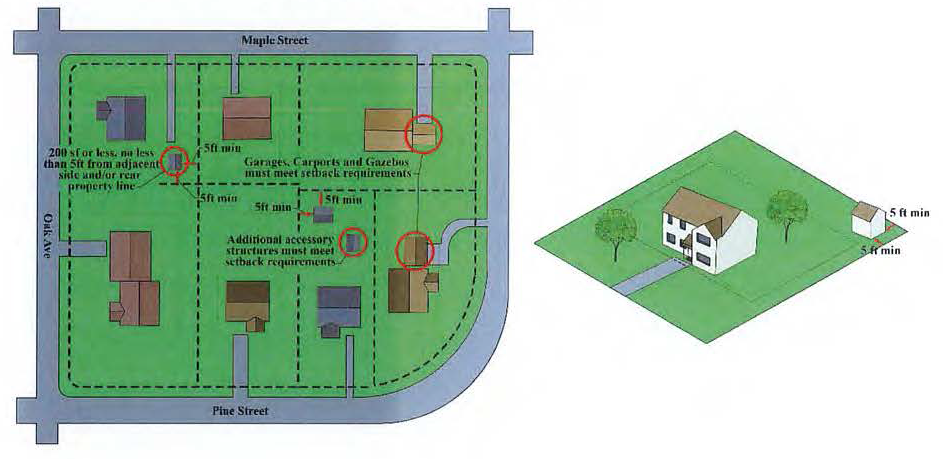
Except as otherwise provided, no accessory building, structure, or any use in any zoning district shall be established, erected, or maintained without a principal use. Such buildings, structures and uses must meet setbacks for the district. Accessory uses shall not be located forward of the principal structure.
A.
The following exceptions are allowed to the above.
1.
One (1) accessory structure at a single family residence, two hundred (200) square feet or less in size, may be located no closer than five (5) feet from an adjacent side and/or rear property line and further provided that no accessory structure may be located within any easement. Any additional accessory structures must meet setback requirements.
2.
Garages, carports and gazebos may be located in any yard provided all setback requirements are met.
3.
ATM kiosks at existing commercial locations are allowed in any yard provided all setback requirements are met.
B.
Helipads. Helipads shall be considered accessory uses incidental and subordinate to hospitals, law enforcement, and firefighting.
C.
Outdoor dry rack. Outdoor dry rack storage accessory to a Marina must have exterior siding on any side exposed to a residential use or residential zoning district.
Accessory Buildings, Structures and Uses
D.
Swimming pool exceptions to the above.
1.
Above-ground swimming pools 33 inches in depth or less and without a pool enclosure or deck are exempt from these standards.
2.
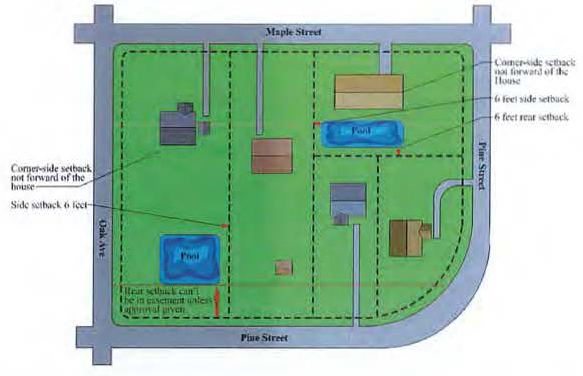
Above-ground swimming pools greater than 33 inches in depth that do not have a pool enclosure or deck are exempt from setback requirements provided that: there is a principal use or structure on the land; the pool is not located forward of the principal structure or on a street/corner side; and, the pool is located within and screened by a six (6) foot high opaque privacy fence.
3.
Above-ground and in-ground swimming pools may meet a six (6) feet minimum setback requirement in any zoning district; provided that there is a principal use or structure on the land, and that the pool is not located forward of the principal structure or on a street/corner side. Pool enclosures and decks over twelve (12) inches in height must meet setback requirements of the zoning district.
Pools
Sec. 403. - Vision clearance and outdoor product display.
In all districts, businesses/person(s) displaying product for sale that directs the attention of persons to such product and is located within the view of the general public, from a public road right-of-way must comply with the following conditions:
1.
Place no structures, vehicles or stock so as to obstruct the vision of vehicular or pedestrian traffic using any street, driveway or walkway; and
2.
Keep all stock displayed out of the highway right-of-way; and
3.
Stock, product or structures that are displayed that are greater than six (6) feet in height shall be no closer than ten (10) feet from the property line abutting any street or driveway. Items under six (6) feet in height shall be no closer than seven (7) feet from the property line abutting any street or driveway.
4.
Displaying of motorized vehicles/auto's, boats, jet ski's, motorcycles, etc., not housed under any permitted structure, are exempt from setbacks provided vision clearance is maintained. All display must remain outside of and behind required landscape buffers.
5.
Stock or product may be displayed provided:
a)
The product or stock is not displayed in a manner that it could be considered on-site signage.
b)
The stock or product may not be attached to or suspended to structures, trees, utility poles, fences, existing signage.
c)
The stock or product may not be placed in or outside of the required perimeter landscape buffer, or displace any required parking.
d)
Any stock or product that is considered overstock or outdoor storage must be stored in an area not in the view of the general public and screened in accordance with § 411.
Sec. 404. - Street frontage.
Except as herein provided, no lot shall be created which does not have at least fifty (50) feet of frontage on a street, except:
1.
That lots fronting on a cul-de-sac may have a minimum road frontage of twenty-five (25) feet if lot is at least fifty (50) feet in width at the building setback line.
2.
That townhouses on individual lots may be excluded from the provision.
3.
That semi-detached structures on individual lots may be excluded from the provision.
4.
Where a lot without any frontage exists prior to the adoption of the Zoning Ordinance, the planning commission may determine whether private access is adequate for the development of the lot.
5.
When such lots are located on streets within a Planned Unit Developments (PUD), Planned Development District (PDD) or Multi-Residential District (MRD). Lots shall have no less than forty (40) feet of street frontage except when such lot is located on a cul-de-sac. The lot frontage may be reduced to twenty-five (25) feet when located on a cul-de-sac provided a minimum lot width of forty (40) feet is obtained at the building setback line.
6.
Tiny home lots may be excluded from the provision.
7.
A Destination Park shall have a minimum of one hundred fifty (150) feet of frontage on a public street.
Sec. 405. - One principal building on a single family residential lot.
Only one (1) principal building and its customary accessory buildings may hereafter be erected on any single-family residential lot unless otherwise specified in § 918. The connection of two (2) buildings by means of an open porch, breezeway, carport, or other such open structure, with or without a roof, shall not make them one (1) building.
Sec. 406. - Multiple commercial businesses on a single parcel.
Any district which allows a commercial business, is permitted to have multiple commercial businesses on the same parcel of land.
Sec. 407. - Multiple commercial buildings on a single parcel.
Any district which allows a commercial building, is permitted to have multiple commercial buildings on the same parcel of land.
Sec. 408. - Dumpsters, roll-offs, and compactors.
Property owners shall maintain screening, access, and safety for garbage and recycling dumpsters.
A.
Screening.
1.
Dumpsters shall be screened on three (3) sides to a height of at least one (1) foot above the top of the dumpster. Screen material may be either an architectural wall or a privacy fence that forms an opaque enclosure.
2.
Dumpsters cluster. Individual screening will not be required when several dumpsters are clustered at one location. Instead, the entire site will be enclosed to prevent dispersal of loose trash.
3.
All dumpsters shall be stored on the property behind the front building line of the principle structure. Dumpsters must be fully contained within a gated enclosure if visible from a public right-of-way.
B.
Access and safety.
1.
Dumpsters shall not impede the lawful passage of vehicular or pedestrian traffic on public rights-of-way not impede authorized public or private parking or other lawful uses on those public rights-of-way adjacent to the site on which the dumpster is located.
2.
No dumpster shall be placed so as to impede or prevent access to any public easement, or public utility installation.
3.
No public street or highway shall be used except on an emergency or temporary basis for maneuvering of vehicles accessing or servicing dumpsters.
4.
Dumpsters shall be placed on a concrete pad with bollards or similar device to protect enclosure and enclosure must be appropriately sized to accommodate storage of all dumpsters.
C.
Refuse and garbage.
1.
All owners or occupants must have a sufficient capacity of dumpsters to hold all solid waste accumulated between scheduled collections and shall not allow solid waste to be stored or to accumulate on their property in a manner deemed to be a public nuisance.
2.
Commercial developments that meet or exceed the total square footage or unit count shown in the table must provide an enclosure of the minimum dimensions as specified below:
D.
Recycling.
1.
Multifamily Recycling. Multifamily projects and developments under common ownership proposing 25 or more units must include an enclosure to accommodate an 8 yard recycling dumpster or roll-off, in addition to any dumpster(s) for garbage. Minimum dimensions of enclosure shall be 22' x 8' as a single or multiple stall design.
2.
Enclosure or dumpster used for recycling shall be placarded with a list of the acceptable recyclable materials as determined by Horry County Solid Waste Authority.
3.
It shall be unlawful for any person to deposit any material other than acceptable recyclable material in a dumpster which is designated for recycling.
4.
In order to facilitate the establishment of recycling programs, and encourage full participation on the part of established businesses, it may be necessary to waive some requirements of this Code of Ordinances relating to siting and screening of dumpsters.
If there is insufficient area on the property to site the recycling dumpster(s) in full compliance with all of the provisions of this code, the Zoning Administrator shall be authorized to the minimum extent required, to waive the provisions in the following particulars:
a)
Screening requirements may be waived or modified as necessary; provided that the dumpsters will not be visible from any public right-of-way.
b)
Required parking spaces may be reduced by up to two spaces to allow for the placement and access to recycling dumpsters.
E.
Exemptions and exceptions.
1.
Collection service. Dumpsters may be placed outside of the enclosure as required for service.
2.
Internal storage. Projects proposing to design space within a building for the storage of all solid waste materials are exempt from the screening requirements.
3.
Temporary construction. Dumpsters for the collection of construction materials at a permitted building site are exempt from these provisions.
4.
Existing non-conforming. All dumpsters must meet the requirements for screening, access, and safety within 24 months except for any dumpster that is granted an extension or variance by the Horry County Zoning Board of Appeals. Existing commercial uses may continue to operate without an enclosure unless a dumpster is necessary to comply with D1 of this provision.
Sec. 409. - Public utilities.
Utility installations will be allowed in all zoning districts provided the review as required by S.C. Code § 6-29-540 is complete and the requirements stated herein are met.
When a conflict exists between any standards herein and those of any other county ordinance the more restrictive standards shall apply.
A.
Intent. This section provides standards relative to the construction and location of utility installations necessary to support the needs of the citizens and all applicable utility providers within Horry County.
This section is further established to:
1.
Provide for the appropriate screening and security of utility infrastructure to preserve the health, safety and welfare of the citizens of Horry County; and
2.
Provide for the appropriate screening and security of utility infrastructure to preserve property values in Horry County; and
3.
To preserve view planes throughout the county, thereby stabilizing and enhancing the aesthetic and economic vitality and values within which such views are preserved.
B.
Applicability. The standards established herein shall apply to all freestanding utility installations and associated equipment not excluded from § 409D.
C.
Requirements.
1.
All utilities not excluded in § 409D shall be required to secure the equipment compound with a fence as defined herein.
2.
Utility installations are subject to the landscaping requirements of Overlay Zones if located therein.
3.
Equipment compounds shall be landscaped and maintained with a buffer of plant materials. Existing mature vegetation and natural landforms on the site shall be preserved to the maximum extent possible, or replaced to present a natural, undisturbed appearance in keeping with the intent of this section. The buffer shall consist of a single row of evergreens no less than twenty-four (24) inches in height at the time of planting and spaced a maximum six (6) feet on center along the outside perimeter of a fenced enclosure. Such plants shall be capable of reaching a height of no less than five (5) feet within two (2) years of planting, reaching a height at maturity no less than eight (8) feet.
4.
In instances where these landscape and buffer requirements cannot be met, a site specific screening plan for each utility installation shall be submitted for review by the Zoning Administrator. A utility may establish different landscaping and buffer areas than those established herein if an agreement is reached for such with the applicable development, neighborhood, adjacent property owners or jurisdiction. Upon plan submittal, the Zoning Administrator or designee shall have up to fifteen (15) days to review and provide any comments.
5.
Dying, diseased, or dead vegetation shall be removed by the property owner from a buffer provided minimal disturbance occurs to healthy plant materials earmarked to be retained. Vegetation thus removed shall be replaced where necessary to meet the screening requirements contained herein.
6.
In locations where the visual impact of equipment compounds would be minimal, or where the requirements of this section are otherwise impracticable, the landscaping and screening requirements of this section may be reduced or waived by the Zoning Administrator. Examples of instances whereby the Zoning Administrator could waive the landscaping requirements are:
a)
If the facility is in a wooded area. The applicant may choose to retain a natural vegetated buffer strip of undisturbed trees that is at least five (5) feet in depth, and at least six (6) feet in height, around the perimeter of the facility. The area shall remain undisturbed in appearance, except where minimally necessary to allow for an access drive.
b)
If the facility is located in an area that is under cultivation during the growing season, the planting of additional screening vegetation is not required. The intent of this subsection is to allow for the maximum use of productive farmland. In this instance it will be suitable to screen the fenced enclosure with a coated fence or fabric wrap.
D.
Exclusions.
1.
Overhead transmission/distribution lines and underground utilities of any type and/or use shall be exempt from the standards set forth herein.
2.
The landscaping requirements in § 409C are only applicable to utility installations purchased after the effective date of this ordinance.
3.
Utility installations occupying less than seven hundred fifty (750) square feet in area shall be exempt from the standards set forth herein.
4.
Telecommunication towers covered under § 942 of the Horry County Zoning Ordinance.
5.
Towers that are not telecommunication towers are exempt as long as it is for public utility use only.
E.
Prohibited.
1.
No land shall be used or occupied and no structure shall be designed, erected, altered, used or occupied except in conformity with all regulations established in this ordinance and upon performance of all conditions herein set forth.
2.
New wastewater and sewer treatment facilities are prohibited from locating within one thousand (1,000) feet of a residential subdivision as defined herein. Existing wastewater and sewer treatment facilities shall be exempt from the standards set forth herein.
F.
Review procedures. The supplemental information listed below shall be submitted for a utility installation to the Horry County Planning and Zoning Department.
1.
Utility owner(s). Identification of the owner(s) of all infrastructure to be located on the site;
2.
Copy of all pertinent permits, if secured, required by federal or state authorities to operate said utility installations.
3.
Location map (to scale). A current County map showing the location of the facility and any existing residential subdivisions as defined herein within one (1) mile of the proposed location (measured from the parcel boundary);
4.
A site plan, at a scale no less than 1" = 100', that illustrates the following:
a)
A boundary survey of the proposed utility location site.
b)
A description of the principal structure and all associated equipment to support the operation of a utility;
c)
The location, height/depth of transmission lines and/or underground equipment to a distance of twenty-five (25) feet from the equipment compound fencing;
d)
Screening and landscaping.
Sec. 410. - Light and glare.
Exterior lighting shall meet functional and security needs in a way that does not adversely affect the adjacent properties or street right-of-way. Lighting shall be oriented and shielded to provide onsite illumination that minimally impacts the surrounding environment.
1.
Definition: footcandle. The illumination at all points one (1) foot distant from a uniform point source of one (1) candle power.
2.
In all districts, any operation or activity which produces light or glare, except for cars, trucks, and other vehicles traveling on highways, streets, or railways, shall not cause illumination in excess of one (1) footcandle across any residential lot line in any residential district.
3.
Public streetlights, temporary lighting, seasonal decorations, and decorative lighting are exempt from this requirement.
4.
Lighting of predominately horizontal surfaces. Light fixtures shall be full-cutoff that meet Illuminating Engineering Society of North America (IESNA) criteria, and shall be aimed straight down.
5.
Lighting of predominately non-horizontal surfaces. Light fixtures in excess of one hundred (100) watts or two hundred (200) lumens shall be full-cutoff or directionally shielded and shall be aimed and controlled so that light is confined, as much as possible, to the objects that are intended to be lit and does not project into the windows of neighboring residences, adjacent uses, past the object being illuminated, skyward, or onto a public roadway.
6.
Excessive illumination. Lighting within any lot that unnecessarily illuminates and substantially interferes with the use or enjoyment of any other property is prohibited. Blinking or flashing lights shall be prohibited unless the lights are required as a safety feature or as permitted as part of a sign in accordance with Article VI Sign Regulations.
Sec. 411. - Storage yard screening.
To prevent unsightly views from adjacent roadways and land uses, all outdoor storage, junk, salvage, dump yards and high bulk merchandise storage yard areas in commercially zoned districts (unless otherwise defined or directed) shall be screened by a completely opaque fence, or wall not less than six (6) feet in height and shall not be stacked higher than the maximum height allowed for a fence or wall in such commercially zoned district.
Completely opaque screening of all outdoor storage, junk, salvage, dump yards, stock yards and high bulk merchandise areas in industrial and manufacturing districts shall be required if abutting a public roadway (unless otherwise defined) and/or unlike zoning districts. Businesses that are adjacent to like industrial and/or manufacturing are exempt from the screening requirement along the shared property boundaries. Stacking shall also be limited to the maximum allowed fence height. See § 412 [of this Zoning Ordinance]. Items such as recreation vehicles which are not stacked only need be screened to a height of six (6) feet. Junk Cars and salvage yards are required to be screened to a height of eight (8) feet. See section 10-35 of the general code.
Industrial and manufacturing businesses within an industrial park shall be exempt from opaque screening and stacking of stored product.
Sec. 412. - Fences and walls.
A.
Height. The maximum height for fences or walls in the AC, HC, LI, AM2, RE4, MA1, MA2, MA3, MI and HI Districts shall be twelve (12) feet. In all other zoning districts, fences or walls shall not exceed eight (8) feet in height. No fence or wall shall be designed in a manner that obstructs the vision of vehicular traffic at street and/or driveway intersections.
B.
Requirements.
1)
Apply for a building permit when fence is greater than seven (7) feet.
2)
Provide a scaled site plan indicating setbacks, locations and elevations for fences that are required to obtain building permits.
3)
Any use requiring privacy fence or wall must locate the fence or wall internal to any required landscape buffers.
4)
Privacy fences or walls installed in front and/or corner side yards are required to:
a)
Meet ten-foot setbacks from front and corner side property lines that abut the road right-of-way or shared private drive.
b)
Where legal nonconforming privacy fences that are properly maintained exist along adjacent front and/or corner side yards property lines, a "like type" fence may be installed provided it is no higher or extending no further towards the roadway than the existing fence, and the existing fence is not designed or located in a manner that obstructs the vision of vehicular traffic at a street and/or driveway intersection.
c)
Non-privacy type fences such as split rail, uncluttered chain link and picket fences with less than fifty (50) percent opacity placed in front and/or corner side yards are exempt from setback requirements.
5)
Emergency access. All fences or walls shall be designed to permit emergency access to the enclosed area, whether by use of gate or a breakaway section.
Sec. 413. - Public uses
Publicly owned buildings, facilities, or lands, excluding firearm training and sports facilities are allowed in all districts provided the review as required by S.C. Code § 6-29-540 is complete. Firearm training and sports facilities shall be reviewed under § 912 of the Horry County Zoning Ordinance.
Sec. 414. - Developments of regional significance.
A.
Design guidelines and standards.
1.
Intent. The intent of the Design Guidelines and Standards for Developments of Regional Significance is to minimize the environmental, aesthetic and transportation impacts caused by the bulk, scale and size of such establishments.
2.
Applicability. The Design Guidelines and Standards are applicable to all new Developments of Regional Significance which are permitted after the adoption of this ordinance. These standards also apply to any site where an existing Development of Regional Significance is demolished and replaced even if partially where the total square footage of structures to be replaced exceed 100,000 square feet.
3.
Modifications to standards. The Planning and Zoning Department is empowered to grant variances to the standards, when alternative site planning and building design approach meets the design guidelines.
B.
Facades and exterior walls.
1.
Guideline. Facades should be articulated to reduce the massive scale and the uniform, impersonal appearance of large buildings and provide visual interest that will be consistent with the community's identity, character and scale.
2.
Standard.
a)
No portion of a building shall be treated with smooth-faced concrete block, tilt-up concrete panels or prefabricated steel panels, unless the visible finish is comprised of a suitable finish material.
b)
Predominant exterior building materials shall be high quality materials, including but not limited to: Brick, stucco, Glass, Synthetic clapboard siding (cementitious, vinyl, metal or wood), Split face or colored decorative block, Wood, Sandstone, stone, other native stone or cementitious siding, Tinted, textured, concrete masonry units, Brushed, stamped or polished aluminum panels.
c)
Colors. Facade colors shall be subtle, neutral or earth tone colors. Building trim and accent areas may feature brighter colors, including primary colors.
d)
Building facades must include a repeating pattern with no less than three (3) of the elements listed below. At least one (1) of these elements shall repeat horizontally. All elements shall repeat at intervals of no more than thirty (30) feet, either horizontally or vertically.
i.
Color change.
ii.
Texture change.
iii.
Material module change.
e)
No length of any facade shall exceed thirty (30) linear feet without including at least one (1) of the following vertical elements: pilasters, columns, offsets, reveals, projecting ribs canopies/porticos, colonnades, windows, trellis with vines, or an equivalent element that subdivides the wall into human scale proportions.
f)
Retail building walls facing the front yard shall have window(s) and door(s). Such facades shall have display windows a minimum of six (6) feet in height along no less than twenty (20) percent of their horizontal length. Side or rear walls that face walkways may include false windows and door openings defined by frames, sills and lintels, or similarly proportioned modulations of the wall.
C.
Roofs.
1.
Guideline. Variations in rooflines should be used to add interest to and reduce the massive scale of large buildings.
2.
Standard.
a)
Rooflines shall be varied with a change in height every one hundred (100) linear feet in the building length.
b)
Rooftop equipment shall be shielded from the public view via architectural treatment. Parapets, mansard roofs, gable roofs, hip roofs, or dormers shall be used to conceal flat roofs.
D.
Entryways.
1.
Guideline. Entryway design elements and variations should give orientation and aesthetically pleasing character to the building.
2.
Standard. Each building on a site shall have clearly defined, highly visible customer entrances featuring no less than three (3) of the following:
a)
Awnings, canopies or porticos.
b)
Overhangs, recesses, arcades or projections.
c)
Raised corniced parapets over the door, peaked roof forms or arches.
d)
Patios.
e)
Display windows.
f)
Integral planters or wing walls that incorporate landscaped areas and/or places for sitting.
E.
Landscaping, screening and vegetation.
1.
Guideline. Existing trees should be incorporated into the design of large establishments to assure ecological and aesthetic benefits.
2.
Standard. The following landscaping and screening provisions apply:
Perimeter Landscaping
a)
Where the development abuts a residential use or district, the amount of landscape buffer material shall be increased by fifty (50) percent and the buffer width increased twenty-five (25) percent along the shared property line required in Article V of the Horry County Zoning Ordinance. A privacy fence no less than six (6) feet in height shall also be provided interior to the landscaping.
b)
Existing specimen and protected trees, within the perimeter landscaped area shall be retained. See Protected and Specimen Trees in Article V of the Zoning Ordinance.
F.
Outdoor storage, loading areas, and utility locations.
1.
Guideline. Loading areas and outdoor storage areas exert visual and noise impacts on surrounding neighborhoods. These areas, when visible from adjoining properties and/or public streets, should be screened, recessed or enclosed.
2.
Standard.
a)
Loading and unloading of commercial vehicles or of any other vehicles used for commercial purposes including trash/recycling collection is only permitted between the hours of 6:00 a.m. and 11:00 p.m. when property assigned a residential zoning classification or used for residential purposes is within two hundred (200) feet of the loading area.
b)
Loading docks, truck parking, outdoor storage, utility meters, HVAC equipment,, and other service functions shall be incorporated into the overall design of the building and the landscaping so that the visual and acoustic impacts of these functions are fully contained and out of view from adjacent properties and public streets, and no attention is attracted to the functions by the use of screening materials that are different from or inferior to the principal materials of the building and landscape.
c)
Non-enclosed areas for the storage and sale of seasonal inventory shall not be located within required parking areas.
G.
Pedestrian flows.
1.
Guideline. Pedestrian accessibility opens auto-oriented developments to the neighborhood, reducing traffic impacts and enabling the development to project a friendlier, more inviting image. This section sets forth standards for public sidewalks and internal pedestrian circulation systems that can provide user-friendly pedestrian access as well as pedestrian safety, shelter, and convenience within the center grounds.
2.
Standard.
a)
Pedestrian facilities shall be included in any landscaping plan submitted for review.
b)
Sidewalks at least five (5) feet in width.
c)
Sidewalks shall be provided along all public and private rights of way within and adjacent to the project.
d)
Sidewalks, shall be provided from the right-of-way to the principal customer entrance of all publicly accessible buildings on the site.
e)
Sidewalks and pedestrian connections shall be installed between outparcels and the primary uses, and between each outparcel, to enhance internal circulation and create a streetscape experience for pedestrians.
f)
Sidewalks shall be provided along the full length of the building along any facade featuring a customer entrance, and along any facade abutting public parking areas.
g)
All internal pedestrian walkways shall be distinguished from driving surfaces through the use of durable, low maintenance surface materials such as pavers, bricks, or scored concrete to enhance pedestrian safety and comfort, as well as the attractiveness of the walkways.
h)
All parking shall be located no more than one hundred eighty (180) feet from a pedestrian facility/sidewalk.
H.
Lighting.
1.
Guideline. Adequate lighting for public safety is supported, yet excessive lighting resulting in unnecessary waste of energy as well as causing light pollution should be discouraged.
2.
Standard. A lighting plan will be required with submittal of all commercial development plans.
a)
Detailed lighting plan. The lighting plan shall show the location of all site lighting including lights mounted on buildings that are intended to illuminate spaces adjacent to the building. The lighting plan shall include specifications and details of all fixtures, and a photometric plan.
b)
Height.
i.
Luminary heights shall not exceed twenty-five (25) feet.
ii.
If a luminary is within fifty (50) feet of a residentially zoned parcel, the height of the luminary shall be no greater than eighteen (18) feet with the fixture located along the edge of the parking area and light directed back into the site.
iii.
Wherever possible, illumination of outdoor seating areas, building entrances, and walkways shall be accomplished by use of ground mounted fixtures not more than four (4) feet in height.
c)
Canopy lighting.
i.
Lighting installed on canopies or drive-thru facilities are permitted an average foot-candle reading of twenty (20) foot candles under any area that is illuminated. Lighting shall use diffusers and be shielded.
ii.
Wall mounted lights. Wall mounted lights shall be fully shielded luminaries to prevent the light source from being visible from any adjacent residential property or public street right-of-way. Nothing in this subsection shall prevent the use of sconces or other decorative lighting fixtures with wattage equal to or less than one hundred fifty (150) watts.
Sec. 415. - Commercial centers.
1.
Sale/rental/lease of Auto/boat/motorcycle/recreation vehicle/truck/construction & farm equipment shall not be located within a commercial center.
2.
Sale/rental/lease of Auto/boat/motorcycle/recreation vehicle/truck/construction & farm equipment can be allowed on the same parcel as a commercial center provided:
a)
The zoning districts allows both uses.
b)
The zoning district allows multiple commercial structures/uses on the same property.
c)
They are located in a separate approved commercial structure.
d)
The site must have adequate area for the vehicles/trailers for display, rent, lease) in addition to the required parking for the existing commercial use/s on site. Must have a minimum of 2,000 sf of display area which can be combination of interior and exterior.
e)
Prior to issuance of a certificate of zoning compliance, a site plan drawn to scale showing existing structure/s, parking and landscaping, the proposed sales/display area and proposed building/s must be submitted for review and approval.
Sec. 416. - Water and air pollution.
All uses must satisfactorily comply with the requirements of the South Carolina Department of Health and Environmental Control regarding the protection of waterways and atmosphere from pollution by dust, smoke, chemicals, or other waste materials.
Such uses shall not produce noise, vibration, smoke, gas, fumes, odor, dust, fire hazards, dangerous radiation or any other condition that creates a public or private nuisance beyond the premises.
Sec. 417. - Manufactured homes.
Manufactured homes or mobile homes on individual lots shall be permitted only where allowed by the district; provided the mobile home shall be placed on a permanent foundation, properly anchored and underpinned in conformance with the current regulations published by the RVIA and HUD regarding the construction of mobile homes.
Sec. 418. - In-common development.
A.
Applicability. It is the intent of this section to provide an alternative to fee simple development by allowing single-family, multi-family, duplexes, quadruplexes and townhomes, or a mix thereof on property held in common by all owners.
B.
Development standards.
1.
Minimum site size—Shall be equal to combined lot size for each dwelling planned to be constructed within the development. The lot size shall, at a minimum, allow for the project to meet the maximum density requirements within that zoning district.
2.
Minimum building setback from any exterior project property lines of Twenty-five (25) feet.
3.
Minimum building separation required is twenty (20) feet, unless indicated by zoning district.
C.
Ownership and maintenance of common areas. Title to all streets, parks, recreation facilities, planted or forested areas, utilities, and other improved or unimproved real property lying within the project site shall be held as undivided interests by the owners of lots lying within the project site or by an association of the residents thereof, each of whom, jointly or severally, shall be charged with the proper care and maintenance of such property.
Sec. 419. - Mining.
Unless exempt, a certificate of zoning compliance must be obtained by the property owner or operator of any mining operation prior to removal of excavated materials to be hauled off-site. The following exemptions, performance and design criteria and levels of review and approval are hereby established for mining.
A.
The following uses or acreages are exempt from this section:
1.
If all excavated material is kept on-site, no review or approval is required and said excavation is exempt from this section.
2.
A mining operation subject to a state or federal approval, Mining Operating Permit, Mining General Permit, mine-related permit for Mining discharges and stormwater, or air emission permitting program is deemed compliant with all county zoning ordinances and is exempt from this section.
3.
The removal and hauling of excavated material for the construction of a commercial development or residential subdivision that has received construction plan approval and a county stormwater permit is exempt from this section.
4.
The removal and hauling of excavated material if all excavated materials from a site are used solely for the construction of a public project, including projects undertaken by the federal government, the state or any political subdivision of the state, including Horry County, public agency or special purpose district (a "Public Project") is exempt from this section. The exemption in this subsection is limited to the Public Project or SCDOT contract. To qualify for an exemption pursuant to this paragraph, the following information and documentation must be provided by the property owner and/or site operator to the Zoning Administrator:
A letter from the South Carolina Department of Transportation ("SCDOT") or Public Project engineer identifying the contractor, the SCDOT file# or Public Project name, the start date and end date of the contract, and copy of the Mine-Related NPDES permit for Discharges and Stormwater issued by SCDHEC.
5.
Mines/ponds up to and including five (5) acres are exempt from the requirements of this sub-section. To qualify for an exemption pursuant to this section, the following design criteria is established:
a)
Mines/ponds shall be a minimum of twenty-five (25) feet from waters of the U.S. and State, unless a Clean Water Act § 404 permit is issued by U.S. Army Corps of Engineers;
b)
Ponds shall be a minimum of twenty-five (25) feet from a property line unless a written agreement with an adjacent property owner is obtained; and
c)
Permits or approvals may be required from SCDHEC and/or UDSA for farm pond approvals.
B.
All other mining activity shall be allowed in all zoning districts as conditional uses subject to the following conditions:
Mining activity greater than five (5) acres shall be allowed as conditional uses in all zoning districts subject to the following design and performance criteria:
1.
Mines shall be a minimum of twenty-five (25) feet from waters of the U.S. and State, unless Clean Water Act § 404 permit is issued by U.S. Army Corps of Engineers;
2.
Mines shall be a minimum of twenty-five (25) feet from a property line unless a written agreement with an adjacent property owner is obtained; and
3.
Where an unpaved county road is used to access the site, the owner and/or operator shall maintain two hundred (200) feet in the direction of traffic to and from the site, using Best Management Practices, as defined in S.C. DHEC regulations and maintaining the road in a condition such that the road conditions are not less than the pre-existing condition prior to commencement of any mining activity.
4.
A pre-construction meeting with county engineering must be held to assess county road conditions for the two hundred feet of site access in the direction of travel and develop a maintenance plan for such roads, which maintenance plan shall address:
a)
Grading and watering for county dirt roads;
b)
Sweeping for county paved roads;
c)
Shall show the anticipated routing of all truck traffic to minimize impact to surrounding residences; and
d)
Identify areas that require signage, if needed, for safety purposes.
5.
Mining operations must be screened and buffered as follows: (i) by a six (6) foot high opaque screen of natural vegetation within a fifty (50) foot buffer area; or (ii) a six (6) foot high berm, or fence with an opaque privacy screen or wall at least six (6) feet in height above grade shall be required within a twenty-five (25) foot buffer area. Provided, however, that no screen is required along any property boundary where the mining operations are setback two hundred and fifty (250) feet, or more from the property line. These screening and buffering provisions shall supersede the requirements of the parking, landscape, buffer, stormwater and tree preservation standards otherwise delineated in Horry County Code of Ordinances.
Sec. 420. - Commonly owned amenities within subdivisions.
Commonly owned amenities are allowed on parcels platted and designated for said amenities in subdivisions. Amenities can include but are not limited to a swimming pool, tennis court, clubhouse and open space. Amenities can also include boat ramps and docks as well as outdoor storage of boats and recreational equipment, subject to provisions elsewhere in this ordinance. Title to all improved and unimproved commonly owned amenities lying within the subdivision shall be held as undivided interests by the owners of lots within the subdivision, each of whom jointly and severally shall be charged with proper care and maintenance of such property through a lawfully established association of lot owners approved by the county and recorded with the final plat documents. One-half (½) of the standard parking requirement for the improved subject amenity shall be provided on site.
A.
Licensed recreational equipment and boat storage may be parked or stored on open space amenity lots, subject to the following:
1.
Parking or storage of recreational vehicles or boats shall be limited to vehicles or boats owned by the owners or occupants of the development.
2.
Maintenance of recreational equipment or boats shall not be permitted with the exception of cleaning or replacement of tires, batteries, spark plugs or other minor repairs which do not involve the exchange of engine parts or paint or body work.
3.
At no time while parked or stored shall sewer or electrical service connections be attached to a recreational vehicle or boat, except that electrical service connections may be attached for a maximum of forty-eight (48) hours prior to and in preparation for departure from the property.
4.
All boats, except canoes and boats less than twelve (12) feet in length, must be on a boat trailer.
5.
Storage areas must have a dust free parking surface.
6.
Storage areas must be accessible only from internal to the subdivision.
7.
Storage areas must be fenced by a minimum six-foot privacy fence.
8.
Storage areas fenced compound must be separated from adjacent residential uses and external roadways by a minimum of thirty (30) feet landscape buffer. Storage areas fenced compound must be separated from internal roadways by a minimum of twenty (20) feet landscape buffer. Said landscape buffer needs to meet at a minimum the supplemental buffer requirement in Article V Landscape, Buffer and Tree Preservation of this Ordinance.
9.
In order for an Open Space Area to qualify for use as storage it must either be labeled as "Recreational Equipment and Boat Storage" on the original recorded plat for that phase of the subdivision or the homeowners association must apply for and receive a special exception by the Zoning Board of Appeals.

