
Horry County Unincorporated
City Zoning Code
City Zoning Code
ARTICLE XIV
GLOSSARY
Sec. 1400.- Interpretation of certain terms or words.
Except as specifically defined herein, all words used in this ordinance have their customary dictionary definitions. For the purpose of this ordinance, certain words or terms used herein are defined as follows: Words used in the present tense include the future tense. Words used in the singular include the plural, and words used [in] the plural include the singular. The word "shall" is mandatory. The word "lot" includes the words plot or parcel. The word "building" includes the word structure. The word "person" includes a firm, association, organization, partnership, trust company, or corporation as well as an individual. The words "used" or "occupied" as applied to any land or building shall be construed to include the words intended, arranged, or designed to be used or occupied. The words "map" or "zoning map" shall mean the Official Zoning Map of Horry County, South Carolina.
Sec. 1401. - A.
Access. The right to cross public and private property, for purposes of ingress and egress.
Accessory dwelling units. A secondary dwelling unit located on a parcel of owner-occupied land accessory to or within an existing principal single-family dwelling unit.
Accessory use. A use of land or of a building, or portion thereof, which is customarily incidental and subordinate to the principal use of the land or building. Accessory uses must be located on the same lot with the principal use.
Administrative officer. The local official (i.e., zoning administrator) responsible for granting permits as required by this ordinance.
Adult entertainment. See Article IX, § 901 of the Zoning Ordinance for definitions.
Aggregate processing. A business which crushes, stores and/or transfers nonmetallic minerals such as stone, sand, gravel, recycled concrete and asphalt. Does not include mining operations.
Agricultural product processing for crops or animals not grown on-site. An off-site facility where crops, livestock or livestock products are brought to be processed into goods that are used for intermediate or final consumption including goods for nonfood use.
Airport. An area of land or water which is used or intended for use for the landing and takeoff of aircraft, and any appurtenant areas which are used, or intended for use, for airport building or other airport facilities or rights-of-way, together with all airport buildings and facilities located thereon. This includes any airport, heliport, helistop, vertiport, glider port, seaplane base, ultralight flight park, manned balloon launching facility, or other aircraft landing or takeoff area.
Public use airport. As defined by Section 503(17) of the Airport and Airway Improvement Act of 1982 means:
1)
Any public airport;
2)
Any privately owned reliever airport; and
3)
Any privately owned airport which is determined by the Secretary of the FAA to enplane annually two thousand five hundred (2,500) or more passengers and receive scheduled passenger service of aircraft.
Private use airport. All other airports not defined as public use airport.
Agricultural buildings.
Agricultural building, farm animals. Any stable, shelter, manure pile, pits or bins associated with the raising, care and handling of animals and/or livestock.
Agricultural building, no animals. Buildings or structures used for the sole purpose of providing shelter for agricultural implements, farm products or other horticultural products.
Agricultural building, horses only. Any stable, shelter, manure pile, pits or bins associated with the raising, care and handling of horses
Animal facility. Land, building or structure, which is used for the raising, care and handling of animals.
Average animal live weight. As defined by SC DHEC R.61-43 § 50(K)
Commercial animal facility. An animal facility that produces animals for commercial sale, boarding of equine and/or farm animals, rents animals or provides a service utilizing the animals for a fee. Does not include small or large animal production facilities, as defined below.
Commercial horse facility. An animal facility that produces animals for commercial sale, boarding of equine, rents animals or provides a service utilizing the animals for a fee. Does not include small or large animal production facilities, as defined below.
Large animal production facility. An animal facility where five hundred thousand one (500,001) or more pounds of normal production animal live weight are located on-site at any one time, or as defined by SC DHEC R.61-43 § 50(NN).
Small animal production facility. An animal facility where between ten thousand one (10,001) to five hundred thousand (500,000) pounds of normal production animal live weight are located on-site at any one time, or as defined by SC DHEC R.61-43 § 50(HHH).
Wild game processing. An animal facility that processes wild game on a small scale for consumption.
Animal services. Animal service uses can be defined as any of the following uses.
Animal boarding. An establishment where domesticated dogs and cats owned by another person are temporarily boarded overnight for a fee, includes Dog Daycares.
Animal grooming/pet grooming. Brush, bathe and style hair or fur of domestic pets, usually dogs. Additional services may include nail trimming, ear cleaning, and maintenance of general appearance.
Typically occurs in kennels, veterinary clinics, animal shelters and pet supply stores. Can take place at a salon or as a house call. May operate with/without the sale of supplies.
Animal hospital/veterinary offices.
Animal hospital. Any establishment offering veterinary services. Animal hospitals can treat all types of animals and can include outdoor and overnight boarding of animals.
Vet clinic. A building used primarily for the treatment, by a veterinarian, of small domestic animals such as dogs, cats, rabbits, birds, or fowl. No outdoor boarding of animals is permitted.
Dog training. Non-residential facility offering classes or one-on-one coaching for compensation.
Apartment. A part of a building consisting of a room or rooms intended, designed, or used as a dwelling by an individual or a single family.
Aqua farm. A managed body of fresh or salt water used for cultivating or rearing aquatic plants or animals.
Assisted living facility. Housing for the frail who require limited supportive services for their daily living activities. Such facility typically requires residents to be mobile and capable of performing most routine tasks.
Auditoriums/theatres. A building or structure designed or intended for use for the gathering of people as an audience to hear music, lectures, plays, and other presentations.
Theater, movie. A structure that contains audience seating, one or more screens and auditoriums, and a lobby and refreshment stand.
Automobile storage. The storage of vehicles including, but not limited to: cars, recreational vehicles, motorcycles, and boats that are inoperable condition or awaiting major repairs. This does not include the storage of wrecked, junked or salvaged vehicles.
Licensed automobile storage. The storage of vehicles is limited to vehicles which have been titled and registered by a governing authority.
Automobile wrecking, junk, and salvage yards. Any land or structure used for a salvaging operation, including but not limited to the storage and sale of wastepaper, rags, scrap metal, discarded materials, consumer goods, equipment, and the collection, dismantlement, storage, and salvage of ten (10) or more unlicensed or inoperative vehicles or a place where junk, waste, discarded, or salvaged materials are bought, sold, exchanged, stored, baled, packed, disassembled, or handled. This definition includes automobile wrecking yards, house wrecking, and structural steel materials and equipment, but does not include the purchase or storage [of] used furniture and furniture and household equipment, used cars in operable condition, used or salvaged materials as part of manufacturing operations.
(Ord. No. 155-2024, § 2, 1-21-25)
Sec. 1402. - B.
Bait and tackle shop. A retail store where items such as fishing tackle, gear and rods are sold.
Banks/savings and loans. Any building wherein the primary occupation is concerned with such federal or state-regulated businesses as banking, savings and loans, loan companies, and investment companies.
Barber/beauty shop/salon/stylist/hair dressers. Any establishment where cosmetology services are provided including hair care, nail care, and skin care on a regular basis for compensation.
Batch plant, asphalt/concrete. A facility or temporary facility engaged in the mixing, batching, crushing and processing of aggregates used in the production, demolition or recycling of asphalt and/or concrete products.
Batting cage. A commercial establishment for batting practice that is enclosed by fencing or netting.
Beer, wine and spirit production. A facility used to process raw materials to finished product, and to age, bottle, and store said products.
Bed and breakfast. Bed and breakfast means a residential-type lodging facility having no more than ten guestrooms where transient guests are fed and lodged for pay. This does not apply to other types of transient accommodations, such as hotels, motels, motor inns, resorts, rooming houses, boarding houses, hunting lodges, or campgrounds. S.C. Code § 45-4-20.
Boarding or rooming houses. An establishment with lodging provided with or without meals for compensation for six (6) or more, but not exceeding sixteen (16), persons. Total number of bedrooms shall not exceed eight (8), with no more than two (2) occupants per room. The occupants must not have separate cooking facilities provided for any boarder. No separate exterior doorways for individual boarding rooms shall be permitted. "Boarding or rooming house" shall not include similar uses such as bed and breakfast, hotels or motels, healthcare facilities, group homes, halfway houses, hospitals, rehabilitation facilities or rescue missions.
Boat construction. The design and construction of boats and their systems.
Boat sales/rental. Premises on which new or used boats and/or watercrafts in operating condition are displayed in the open for sale or rental.
Boat service. Establishments primarily engaged in the provision of boat repair services, or the installment of additional parts or accessories to a boat. Such establishments can engage in the repair of other watercrafts, but may not engage in the repair of any other types of vehicles.
Boat storage. The storage of boats and/or watercrafts that are operable condition. This does not include the storage of wrecked, junked or salvaged boats.
Building. Any structure having a roof supported by columns or walls and intended for the shelter, housing, or enclosure of persons, animals, or chattel.
Principal building. A building in which is conducted the main or principal use of the lot on which said building is located. The connection of two (2) buildings by means of an open porch, breezeway carport, or other such open structure, with or without a roof, shall not make them one (1) building. (See § 405).
Accessory building. A building customarily incidental and subordinate to the principal building and located on the same lot with such building.
Building height. The vertical distance measured from the mean elevation of the finished grade at the front of a building or structure to the mid-point between the eaves and the highest point of the roof. Except that within special flood hazard areas height shall be measured from the base flood elevation, plus up to 3 feet of elevation to accommodate provisions for flood hazard reduction as specified in Chapter 9 of the Horry County Code of Ordinances.
Building setback line. A line delineating the minimum allowable distance between the property line or shared private driveway easement and a building on a lot. No building or other structure shall be placed in such area, except as otherwise provided in these regulations.
Bus depot. A place where buses are housed and maintained and from which they are dispatched for service.
Sec. 1403. - C.
Campground. A parcel of land upon which three (3) or more camping sites are located, established, or maintained for temporary occupancy by primitive use, travel trailer, recreational vehicle, park model or permanent structure. Uses where recreational vehicles are offered for sale or lease, or are stored, are not included.
Carport. A structure used for the storage of vehicles and having no enclosure other than its roof and such necessary support as will present the minimum obstruction of light, air, and view.
Car wash. A structure for washing and cleaning of passenger vehicles, recreational vehicles, or other light duty equipment.
Casino boat. Includes all cruise vessels offering cruises of less than twenty-four (24) hours in duration with gambling or gaming, docking at facilities within Horry County to load and unload passengers.
Cemeteries/mausoleum. Land or structures dedicated for the internment of human or animal remains.
C&D transfer station. A site where construction materials and debris are collected and sorted in preparation for processing or landfill.
Civic, fraternal, and social associations. Buildings and facilities owned or operated by an association or persons for a social or recreational purpose, but not operated primarily for profit or to render a service which is customarily carried on as a business.
Commercial center. A group of three (3) or more commercial establishments within the same structure, which may include retail, trade shops, personal storage units, restaurants, etc., planned, developed, and/or managed as a unit with off-street parking provided on the property. All uses must be either permitted or conditional within the zoning district.
Commercial marina. Provide boat slips on a rental basis in addition to some or all of the following accessory activities: sale of fuel, tackle, convenience store for the sale of merchandise associated with boating activities, repair, sale and/or trade boats, motors, and trailers but not as a principal activity (no retail showroom sales), restaurants, offices associated with the marina operation, site seeing and dinner cruise boats.
Commercial parking lot/garage. An off-street facility including parking spaces along with adequate provisions for drives and aisles for maneuvering and gaining ingress and egress. The requirements for off-street parking are contained in the Parking Standards of Horry County.
Commercial pier. A platform that is supported by piles or pillars and that extends over the Atlantic Ocean and is operated for commercial purposes. Such use may have additional commercial uses located on it, including, but not limited to: retail, restaurants and arcades.
Community care facility. A facility housing more than five (5) persons unrelated by blood or marriage and operating as a group family household, which is maintained and operated to provide nonmedical residential care for individuals who are physically and/or mentally handicapped.
Community/personal services. Establishments providing non-medical services to individuals including accessory retail sales of products related to the services provided. This use includes, but is not limited to, the following: Building cleaning/maintenance service, carpet/upholstery cleaning service, commercial art/photography service, dressmaker/seamstress/tailor.
Conditional use. A use permitted in a particular zoning district only upon demonstration that such use in a specific location will comply with all of the conditions and standards for location and/or operation of such use as specified in the zoning ordinance.
Condominium. A building, or group of buildings, in which units are owned individually, and the structure, common areas, and facilities are owned by all the owners on a proportional, undivided basis. A full legal interpretation can be found in S.C. Code § 27-31-10 et seq., Continuing Care Retirement Community (CCRC).
Cluster of a variety of housing options to meet the spectrum of needs and interests ranging from residential dwellings (single family through multi-family) through assisted living, often including on-premises skilled nursing facilities. CCRC's primary feature is the provision of "lifetime" supportive services from independence through end of life or some portion thereof. A master plan is required to consider these combination of uses a CCRC.
Counseling facilities that distribute prescription medication on site.
Mental health facility/psychiatric hospital. A facility, institution, unit, or ward for diagnosing, treating, caring for, or counseling people requiring mental health services in confinement.
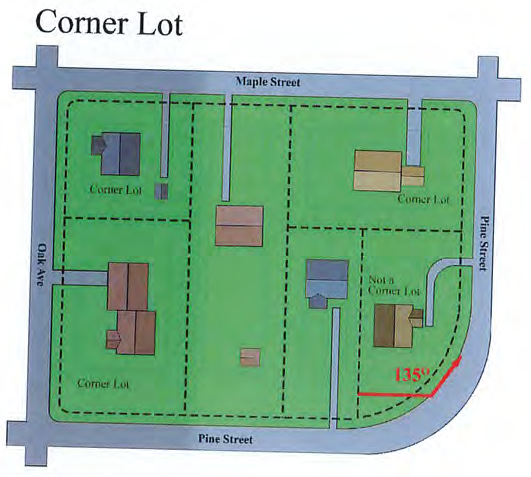
Corner lot. A lot adjacent to the intersection of two (2) or more streets or a lot abutting a curved street shall be considered a corner lot if straight lines drawn from the foremost point of the side lot lines to the foremost point of the lot (or an extension of the lot where it has been rounded by a street or road radius) intersect at an angle of less than one hundred thirty-five degrees (135°). In the case of a corner lot with curved street frontage, the corner is that point on the street lot line nearest to the point of intersection of the tangents described above. A tangent is a straight line extended from the outer edges of a curve which intersect to form a corner.
Crop production.
Commercial crop production. Commercial agricultural field and orchard uses including production of: field crops, flowers and seeds, fruits, grains, melons, ornamental crops, tree nuts, trees and sod, vegetables. Also includes associated crop preparation services and harvesting activities, such as mechanical soil preparation, irrigation system construction, spraying, crop processing, and sales in the field not involving a permanent structure.
Non-commercial crop production. The production of: crops, flowers and seeds, fruits, grains, melons, ornamental crops, tree nuts, trees and sod, and vegetables for personal enjoyment. This use is allowed in all zoning districts.
(Ord. No. 101-2025, § 1, 1-6-26)
Sec. 1404. - D.
Day/child care facility. A child care facility [or day-care center] shall mean and include any agency, institution, center, home, child nursery school, play school, or other place, however styled and whether operated under public auspices, or as a private business, in which one (1) or more children not related to child care family or staff of facility are received for temporary custodial care apart from the parents, part of the day or all day or part of the night, and upon any number of successive days.
The term shall not include any kindergarten or school which has as its primary function educational instruction and which operates under the supervision of a State Board of Education or a County Board of Education, has a qualified teacher, and/or operates less than four (4) hours per day.
Density.
Density, gross. The number of dwelling units divided by the total project area.
Density, net. The total number of dwelling units divided by the buildable acreage. Buildable acreage being that portion of a tract or parcel of land which can be developed, not including existing platted rights-of-way and utility easements, natural water bodies (streams/lakes), and wetlands under the jurisdiction of the U.S. Army Corps of Engineers unless such wetlands are to be filled upon issuance of a "fill" permit. Wetland buffers may be included in the developable acreage, but may not be encroached upon unless specified by a permit and approved development plan.
Development of regional significance. Single use retail establishments which exceed one hundred thousand (100,000) square feet and/or all commercial and office developments in which the gross floor area of combined buildings within a unified master plan exceeds five hundred thousand (500,000) square feet.
District. Any section or sections of Horry County, South Carolina, for which the regulations governing the use of land and the use and density, bulk, height, and coverage of buildings and other structures are uniform.
Dwelling unit. A room or suite of two (2) or more rooms that is designed for and not occupied by more than one (1) family doing its own cooking therein and having only one (1) kitchen facility, located within a building.
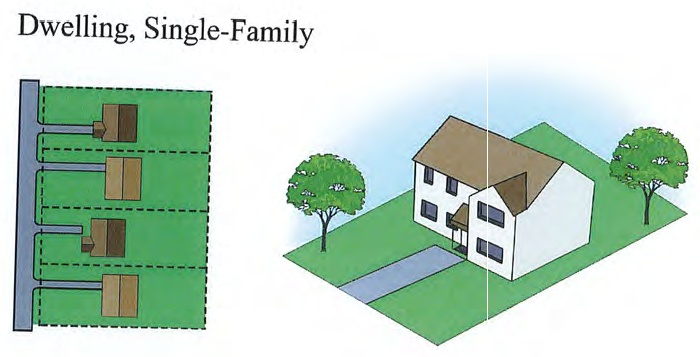
Dwelling, single-family. A building designed, constructed, and used for one (1) dwelling unit.
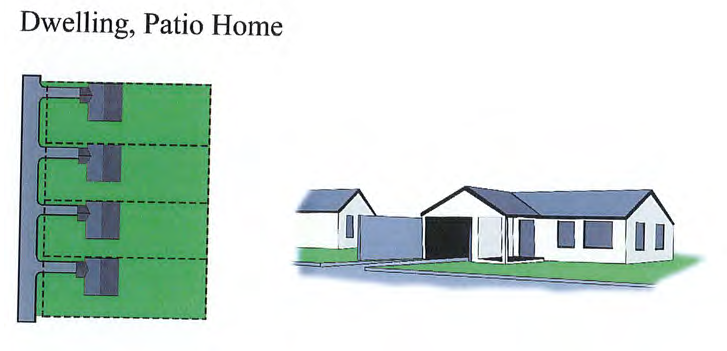
Dwelling, patio home. A single-family dwelling on an individual lot with open yard setbacks usually on three (3) sides. These are a type of zero lot line dwellings.
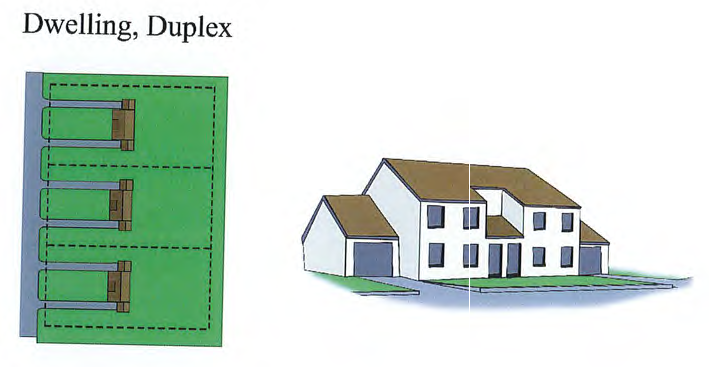
Dwelling, duplex. A building used for two (2) dwelling units that are connected by a common wall.
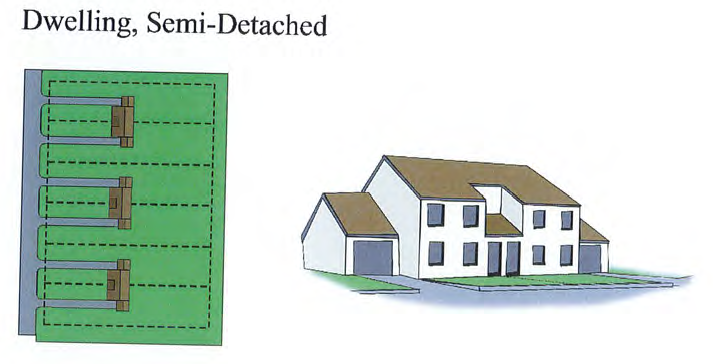
Dwelling, semi-detached. A dwelling attached to one (1) other dwelling by a common vertical wall, and each dwelling located on an individual lot.
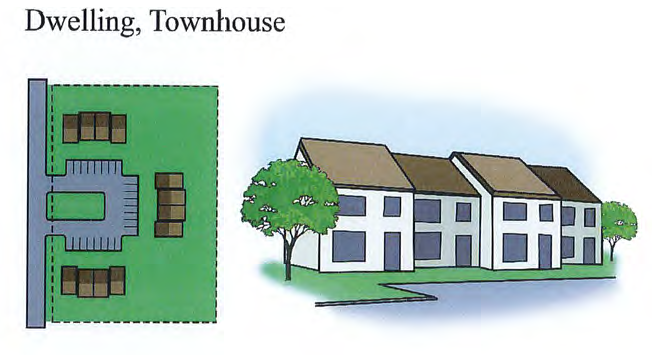
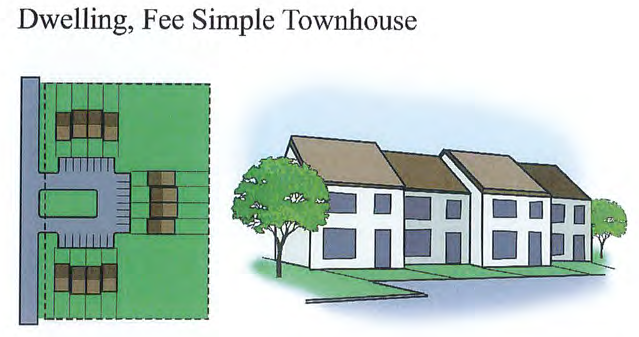
Dwelling, townhouse. A single-family dwelling in a row of at least three (3) and no more than eight (8) such units in which each unit has its own front and rear access to the outside, no unit is located over another unit, each unit is separated from any other unit by one (1) or more common fire-resistant walls, and each unit is serviced by separate utilities. These units may be subdivided on fee simple lots. Where units are subdivided, an easement shall be provided to allow utilities to cross parcel lines to provide service to attached units.
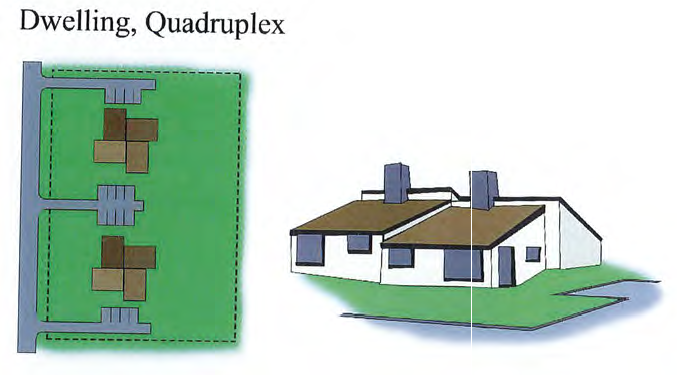
Dwelling, quadruplex. A multiplex containing four (4) attached dwellings in one (1) structure. Each unit has two (2) open space exposures and shares one (1) or two (2) walls with adjoining unit(s).
Dwelling, multi-family. A building used for more than two (2) vertically stacked dwelling units, with each dwelling unit having a common wall with any other dwelling unit.
Sec. 1405. - E.
Educational facilities. A public or private institution that provides educational instruction to students.
Educational facilities, elementary & secondary. A school offering instruction at the elementary, junior, and/or senior high school levels in the branches of learning and study required to be taught in the school.
Educational facilities, post-secondary. An institution other than a trade school that provides full-time or part-time education beyond high school.
Educational facilities, specialty. A school established to provide for the teaching of industrial, clerical, managerial, vocational or artistic skills. This definition applies to schools that are owned and operated privately for profit and that do not offer a complete educational curriculum. This use includes dance, gymnastics and karate establishments.
Sec. 1406. - F.
Fair housing compliance. This definition shall not be used to deny housing or impose different rules on people with disabilities. Groups of people with disabilities living together shall be treated the same as any other group of five (5) or less unrelated people living together under this definition, in accordance with the Fair Housing Act.
Family. An individual, or two (2) or more persons related by blood, marriage, or adoption, living together as a single household unit, or a group of not more than five (5) persons not related by blood, marriage, or adoption, living together as a single household unit
Family fun park. An event open to the public which includes rides, play areas and concessions. Said parks shall be limited to twelve (12) rides. The majority of rides shall be sized to accommodate children.
Firearm training and sports facilities. Commercial or public facilities designed and specifically designated for training, safe shooting practice and competition with firearms, whether open to the public, open only to private membership, open to organization training such as law enforcement, or any combination thereof.
Fitness centers and health spas. A heath, recreational, and social facility geared towards exercise, sports, and other physical wellness activities.
Floor area ratio. The gross floor area of all buildings on a lot divided by the lot area.
Food vending.
Mobile food vendor means any person selling food from a mobile unit.
Mobile food unit means a self-contained, vehicle-mounted food service unit that returns daily to its base of operations as approved by DHEC and is used for either the preparation or the sale of food products, or both. This does not include mopeds.
Food trailer means an enclosed attached or detached trailer that is equipped with facilities for preparing, cooking, and selling various types of food products.
Food truck means an enclosed motor vehicle equipped with facilities for preparing, cooking, and selling various types of food products.
Ice cream truck means motor vehicle containing a freezer and from which a vendor sells frozen prepackaged food products such as ice cream, frozen yogurt, frozen custard, flavored frozen water, etc. Sale of coffee and other non-alcoholic beverages are allowed so long as they meet DHEC exemption requirements.
Mobile food pushcart means any portable vending device, pushcart or other wheeled vehicle or device which may be moved without the assistance of a motor and which is not required to be licensed and registered by the department of motor vehicles, used for the displaying, storing or transporting of articles offered for sale by a vendor, and which does not exceed four feet in width, six feet in length, and five feet in height, excluding canopy or cover.
Prepackaged food truck means an enclosed motor vehicle equipped to sell various types of prepackaged food products.
Snow cone/ice truck means motor vehicle containing a freezer and from which a vendor sells prepared frozen food products such as flavored ice, etc.
Fraternity/sorority house. Any building used as a dwelling occupied by and maintained exclusively or primarily for college, university, or professional school students who are affiliated with a social, honorary, or professional organization recognized currently or in the past by a college, university, or professional school; and used for congregational purpose by that organization.
Funeral home, crematory & mortuary. A structure designed specifically for the purpose of conducting the ritual ceremonies held in connection with the burial of the dead.
Crematory/crematorium. A facility containing a furnace which is designed and licensed for cremation of human or animal remains. Commonly an accessory use at a funeral chapel or mortuary.
Mortuary. A place where dead bodies are prepared or kept for identification prior to arrangement for burial.
(Ord. No. 101-2025, § 2, 1-6-26)
Sec. 1407. - G.
Game machines. Machines of the payout type, or an in-line pin game, or a video game with free-play features operated by a slot wherein is deposited any coin or thing of value (except machines of the non-payout pin table type with levers or "flippers" operated by the player by which the course of the ball can be altered or changed).
Golf, amusement.
Driving range. An area on which golf players drive golf balls from a central driving tee, such area to include the driving tee and other incidental activities pertaining to this activity.
Miniature golf. A novelty version of golf played with a putter and a golf ball on a miniature course, typically with artificial playing surfaces, and including obstacles such as bridges and tunnels.
Golf course. A tract of land for playing golf and which may include accessory and subordinate uses such as clubhouses, snack bars, golf merchandise, sales and maintenance buildings. Par three and executive courses are included.
Gas station. A lot, building or structure used for the retail sale of motorized vehicle fuels. A convenience store and automatic merchandising machines may be part of the retail operation.
Go-carts & bumper cars. A small car made to be driven around.
Grocery store. A retail store where most of the floor area is devoted to the sale of food products for home preparation and consumption, which typically also offer other home care and personal care products and which are substantially larger and carry a broader range of merchandise than convenience stores.
Group homes. A facility housing more than five (5) persons unrelated by blood or marriage and operating as a group family household. A Group Home includes homes for orphans, foster children, or battered children and women.
(Ord. No. 101-2025, § 3, 1-6-26)
Sec. 1408. - H.
Halfway facility. A facility housing more than five (5) persons unrelated by blood or marriage and operating as a group family household, with the primary purpose of supporting their rehabilitation and reintegration into society following imprisonment, hospitalization, or institutionalized treatment.
Hardware store. A retail store where items such as plumbing, heating, electrical and lawn/garden supplies, sporting goods, paints, feed and grain, tools and household appliances are sold. Such use could include: Feed and Grain Stores, home improvement stores, with outdoor display and storage. This use does not include a Bulk Landscape Material Supplier.
Health care facility. Any facility, place, or building maintained and operated to provide medical care.
Emergency medical centers, freestanding. A facility that is structurally separate and distinct from a hospital and provides emergency care.
Hospital. A health care institution providing emergency, in-patient and/or out-patient treatment with specialized medical and nursing staff and medical equipment.
Heliport/helipad. Is an area of land, water, or structure, either at ground level or elevated on a structure, that is used for the landing and take-off of one (1) or more helicopters, which may or may not contain all or part of such auxiliary facilities as parking, waiting rooms, administrative offices, hangars, fueling, passenger loading, cargo loading, and maintenance areas.
High bulk retail. Those retail establishments selling primarily one-stop items usually high bulk and very often more expensive items than those found in general retail establishments, including stores selling major household appliances, floor coverings and furniture. This use includes, but is not limited to, the following: Appliance store, carpet or flooring store, equipment store, home furniture, furnishing and equipment stores, lumber/building material supply store, and pool sales.
Home occupations. A home occupation is a business conducted entirely within a residential dwelling and/or fully enclosed attached or detached structure that is an accessory use/structure to the residential dwelling. The business use must be owned and operated by the resident owner and/or occupant.
Horticulture farm. The use of land for the growing or production for income of fruits, vegetables, flowers, nursery stock, including ornamental plants and trees, and cultured sod.
Hotel/motel/convention center with lodging. An establishment providing, for a fee, sleeping accommodations and customary lodging services. Related ancillary uses may include but shall not be limited to conference and meeting rooms, restaurants, bars, and recreational facilities.
(Ord. No. 101-2025, § 4, 1-6-26)
Sec. 1409. - I.
Impervious surface ratio. This ratio is calculated by dividing the area of impervious surface by the gross site area.
In-common development. A development where any mix of single-family houses, multifamily, duplexes, quadruplexes and townhomes are located on commonly owned property and ownership of the land is held collectively by all owners of the dwelling units and governed by a property regime.
Indoor amusement. The provision of entertainment or games of skill to the general public for a fee where the activity takes place inside of a building, including, but not limited to: Billiard Hall, Bowling alley, Game Room, Aquarium (Indoor), Indoor shooting range, Indoor paintball range, Museum & Gallery, Skating rink, Video game arcade.
Inpatient drug and alcohol addiction treatment facility. A facility housing more than five (5) persons unrelated by blood or marriage and operating as a group family household, with the primary purpose of supporting their recovery from drug or alcohol addiction.
(Ord. No. 101-2025, § 5, 1-6-26)
Sec. 1410. - J.
Junkyards. See automotive wrecking, junk, and salvage yards.
Sec. 1411. - K.
Reserved.
Sec. 1412. - L.
Landfill. A lot or part thereof used primarily for the disposal by abandonment, dumping, burial, burning, or other means and for whatever purpose, of garbage, sewage, trash, refuse, junk, discarded machinery, vehicles or parts thereof, or nontoxic waste material of any kind.
Landscape businesses.
Bulk landscape material supplier. An establishment which engages in the sales of bulk landscape materials. Including, but not limited to: mulch, stone, gravel, straw, etc. Such establishments usually have outside displays and/or outdoor storage.
Lawn/garden nurseries. A retail establishment which engages in the handling of any article, substance or commodity related to the planting, maintenance or harvesting of garden plants, shrubs, trees, packaged fertilizers, soils, chemicals, or other nursery goods and related products in small quantities to the consumer.
Laundry facility, retail. A facility to wash, dry, or dry clean clothing in machines that are self-operated by customers on the premises.
Dry cleaners store. A facility to launder or dry clean articles dropped off on the premises directly by the customer or where articles are dropped off, sorted, and picked up but where laundering or cleaning is done elsewhere.
Linen supply and industrial launderer. A facility or establishment that supplies and/or launders linen of commercial businesses including but not limited to restaurants, hotels, and hospitals.
Livestock/agricultural auction facility. A place of business where the public may consign livestock or agriculture for sale by auction.
Loading space. A space within the main building or on the same lot therewith, providing for the standing, loading, or unloading of a vehicle.
Lot. A parcel of land which fronts on a street and which is occupied or intended to be occupied by a building or use with customary accessories and open space.
Lot area. The total surface area of land included within the lot lines.
Lot coverage, building. The horizontal area measured within the perimeter of the exterior walls of the floor most protruding toward the property lines of all principal and accessory buildings on a lot. This does not include covered patios or decks
Lot depth. The average distance from the street line of the lot to its rear line, measured in the direction of the side lines of the lot.
Lot lines. The boundary dividing a given lot from the street, a shared private driveway easement, an alley or adjacent lots.
Lot width. The width of a lot at the Front building setback line measured at right angles to its depth.
Lot of record. A lot, the boundaries of which are filed as a legal record.
Lot frontage. The distance for which the boundary lines of the lot and the street right-of-way or shared private driveway easement are coincident.
LP gas dealer. The retail sale of liquefied petroleum gas tanks less than 1000 gallons.
Sec. 1413. - M.
Manufactured home or mobile home. A structure, transportable in one (1) or more sections, which, in the travel mode, is eight (8) body feet or more in width, or forty (40) body feet or more in length, or when erected on site, is three hundred twenty (320) or more square feet, and which is built on a permanent chassis and designed to be used as a dwelling with or without a permanent foundation when connected to the required utilities, and includes the plumbing, heating, air conditioning, and electrical systems contained therein; except that such term shall include any structure which meets all the requirements of this paragraph except the size requirements and with respect to which the manufacturer voluntarily files a certification required by the secretary (of HUD) and complies with the standards established under S.C. Code tit. 31, as amended.
Manufactured home park. Any plot of ground upon which five (5) or more manufactured home dwelling units are located or intended to be located (does not include sites for unoccupied manufactured homes which are on display for sales.)
Manufacturing, heavy. The mechanical or chemical transformation of materials or substances into new products, including the assembling of component parts, the manufacturing of products, and the blending of materials. Unlike other manufacturing this use involves extensive manufacturing, processing, or assembly operations which may produce injurious or obnoxious noise, vibration, smoke, gas, fumes, odor, dust, fire hazard, or other objectionable conditions. This use includes, but is not limited to, the following: Rubber and rubber product manufacturer, textile mill/textile manufacturer, general grinding operations, Chemical and allied product manufacturer. This use does not include asphalt and concrete batch plant.
Manufacturing, light. The production of small goods that will be sold to the people who use them rather than to another manufacturer. This use includes but is not limited to the following: Apparel & other finished product manufacturer, fabricated metal products (except machinery & transportation equipment), food/beverage manufacturing and processing.
Manufacturing, medium. The mechanical or chemical transformation of materials or substances into new products, including the assembling of component parts, the manufacturing of products, and the blending of materials. This use includes, but is not limited to, the following: industrial & commercial machinery manufacturer, paper & allied product manufacturer, stone, clay & glass manufacturer (does not include extraction operations), transportation & transportation equipment manufacturer.
Manufacturing of precision instruments. The use of machine tools produce precision metal parts or electronic components. Although they may produce large quantities of one part, precision machinists often produce small batches or one-of-a-kind items.
Medical offices/clinics. An office or clinic for the private practice of health care professionals licensed by the State of South Carolina. The majority of patient encounters in the office or clinic involve examination, diagnosis, or treatment. This definition excludes any facilities that have been more specifically defined in this Ordinance. This use includes, but is not limited to, the following: blood bank, donor center and plasmapheresis center, dialysis center, medical & dental office/clinic/lab (except Outpatient treatment clinic for alcoholism and drug addiction), outpatient treatment surgery facility.
Mining. An area of land upon which operations to extract valuable mineral deposits or other materials typically, but not limited to, clay or sand—have been conducted, are being conducted, or are planned to be conducted.
Mini-warehouse. A building or group of buildings consisting of at least four (4) individual, self-contained units leased to individuals, organizations or businesses for self-service storage of personal property. These units are not designed to be occupied for individual business needs. Outside storage is an accessory use, unless otherwise restricted by this ordinance.
Mixed industrial use. Multiple industrial, retail, commercial and service uses and/or buildings on a single parcel of land. All uses must be either permitted or conditional within the district.
Modular unit. A building including the necessary electrical, plumbing, heating, ventilating, and other service systems, manufactured off-site and transported to the point of use for installation or erection, with or without other specified components, as a finished building and not designed for ready removal to another site. This term is not to be limited to residential dwellings. All modular building units must meet all provisions of S.C. Code tit. 23, as amended, and be certified by the South Carolina Building Codes Council.
Motion picture and allied productions.
Production facility, multimedia. Land, buildings, or structures used as a media production facility. Typically structures involved with the production of motion pictures, radio and television shows or movies, recording or broadcasting facilities, and other motion picture production and distribution services offices.
Motor freight transportation and warehousing. Facilities characterized by extensive warehousing, frequent heavy trucking activity, outdoor storage of material, or nuisances such as dust, noise, and odors, but not involving manufacturing or production.
Multiple dwelling units on one parcel. A parcel of land which allows more than one dwelling unit on the property if all applicable conditions are met. This use does not include an accessory dwelling unit.
(Ord. No. 28-2025, § 1, 4-15-25)
Sec. 1414. - N.
Net area. Gross parcel area minus public dedications—streets, etc.
Non-commercial personal use building. An owner-occupied structure permitted on a vacant parcel of land for personal use purposes only. This use may include kitchen facilities.
Nonconforming use. Any structure or land lawfully occupied by a use that does not conform, upon and after the effective date of this ordinance to the regulations of the district in which it is located.
Non-profit and/or religious spiritual centers and/or retreats. Premises and facilities used occasionally or periodically for the accommodation of members of groups or associations for outdoor recreational activities.
Sec. 1415. - O.
Offices. Administrative, executive, professional, research or similar organizations, and laboratories having only limited contact with public, provided that no merchandise or merchandising services are sold on the premises, except such that are incidental or accessory. This use includes, but is not limited to, the following: administrative, business, general purpose, professional, research/development businesses, centers and facilities. This does not include medical offices/clinics.
Outdoor amusement. The provision of entertainment or games of skill to the general public for a fee where the activity takes place outside of a building, this use includes, but is not limited to: Amphitheater & Drive-in theater, Aquarium (Outdoor), Theater/auditorium with animals entertainment & outside grazing, waterpark, water-related show & commercial pool.
Outdoor display. An outdoor arrangement of objects, items, products, or other materials, typically not in a fixed position and capable of rearrangement, designed and used for the purpose of advertising or identifying a business, product, or service.
Outdoor sales. Land used for the purpose of selling and/or rental of new, or used materials or equipment.
Outdoor storage. Land used for the storage of new, or used materials or equipment that does not require a structure on-site.
Outpatient treatment clinic for alcoholism and drug addiction. An establishment primarily engaged in outpatient care of a specialized nature, to wit, the treatment of alcoholism and drug addiction, with permanent facilities and with medical staff to provide diagnosis, treatment, or both for patients who are ambulatory and do not require inpatient care.
Sec. 1416. - P.
Paintball facility. An indoor or outdoor facility where people engage in the recreational activity of shooting paintball guns.
Parks. A noncommercial, not-for profit facility designed to serve the recreation needs of the residents of the community. Such facilities include subdivision recreation facilities (neighborhood parks), and community parks. Such facilities shall be limited to, school and religious institution ballfields, football fields, and soccer fields, if they meet the above definition. Commercial amusement and sports facilities shall not be considered parks. Parks are allowed in all zoning districts.
Pervious surface. Any material which permits full or partial absorption of storm water into previously unimproved land.
Petroleum & petroleum products (wholesale distribution). The wholesale and distribution of petroleum and petroleum products.
Produce stands. A stand, shelter or vehicle used for the retail sale of seasonal agricultural produce and products (i.e. honey), local shellfish, and ice.
Public uses. Public parks, schools, administrative, cultural and service buildings or uses
Public utilities. Includes every corporation and person delivering natural gas distributed or transported by pipe, and every corporation and person furnishing or supplying in any manner heat (other than by means of electricity), water, sewerage collection, sewerage disposal, and street railway service, or any of them, to the public, or any portion thereof, for compensation; provided, however, that a corporation or person furnishing, supplying, marketing, and/or selling natural gas at the retail level for use as a fuel in self-propelled vehicles is not a public utility by virtue of the furnishing, supplying, marketing, and/or selling of natural gas and a corporation or person whose only purpose is the furnishing, supplying, marketing, and/or selling of treated effluent for irrigation purposes is not a public utility by virtue of the furnishing, supplying, marketing, and/or selling of treated effluent if the effluent is not permitted for consumption by a regulatory agency. S.C. Code § 58-5-10.
Electrical utility. Includes municipalities to the extent of their business, property, rates, transactions, and operations without the corporate limits of the municipality, persons and corporations, their lessees, assignees, trustees, receivers, or other successors in interest owning or operating in this State equipment or facilities for generating, transmitting, delivering, or furnishing electricity for street, railway, or other public uses or for the production of light, heat, or power to or for the public for compensation; but it shall not include an electric cooperative or a consolidated political subdivision and shall not include a person, corporation, or municipality furnishing electricity only to himself or itself, their residents, employees, or tenants when such current is not resold or used by others. S.C. Code § 58-27-10.
Equipment compound. The fenced area designated for principal equipment and all associated structures necessary for the safe operation of a utility.
Fence. An eighty (80) percent or greater opaque fence or wall measuring at least six (6) feet in height.
Public or any portion thereof. Means the public generally, or any limited portion of the public, including a person, private corporation, municipality, or any political subdivision of the State for which the service is performed or to which the commodity is delivered and whenever such corporation or person performs a service or delivers a commodity to the public, or any portion thereof, for which compensation is required such corporation or person is hereby declared to be a public utility subject to the jurisdiction and regulation of the Public Service Commission, the Office of Regulatory Staff, and S.C. Code tit. 58, ch. 5, arts. 1, 3, and 5 to the extent of its activities within the State. S.C. Code § 58-5-10.
Telephone utility. Includes persons and corporations, their lessees, assignees, trustees, receivers or other successors in interest owning or operating in this State equipment or facilities for the transmission of intelligence by telephone for hire, including all things incident thereto and related to the operation of telephones. S.C. Code § 58-9-10.
Planned unit development (PUD). An area of a minimum contiguous size, as specified by this ordinance, to be planned and developed as a single entity containing one (1) or more residential clusters or planned unit residential developments, and one (1) or more public, quasi-public, commercial or industrial areas.
Planned development district (PDD). A development project comprised of housing of different types and densities and of compatible commercial uses, or shopping centers, office parks, and mixed-use developments. A planned development district is established by rezoning prior to development and is characterized by a unified site design for a mixed use development.
Sec. 1417. - Q.
Reserved.
Sec. 1418. - R.
Racing motor sports. A facility consisting of a paved roadway used primarily for the sport of automobile racing. A racetrack may include seating, concession areas, suites, and parking facilities.
Radio/tv broadcasting.
Broadcasting studio. An establishment containing one or more studies for over-the-air cable or satellite delivery of radio or television programs, or studios for the audio or video recording or filming of musical performances, radio or television programs or motion pictures
Railroad depot. A terminal where trains load or unload passengers or goods.
Recreational equipment. Shall mean one of the following:
Camping trailer. A vehicular, portable unit mounted on wheels and constructed with collapsible partial side walls which fold for towing by another vehicle, and unfolded at the site to provide temporary living quarters for recreational, camping or travel use.
Truck camper. A truck equipped with a portable unit, designed to be loaded onto, or affixed to, the bed or chassis of the truck and constructed to provide temporary living quarters for recreational, camping or travel use.
Motor home. A vehicular unit which is:
A.
Built on a single chassis;
B.
Four hundred (400) square feet or less when measured at the largest horizontal projection;
C.
Designed to be self-propelled or permanently towable by a light-duty truck; and
D.
Designed primarily not for use as a permanent dwelling but as temporary living quarters for recreational, camping, travel, or seasonal use.
Off-road vehicle. A motorized vehicle designed and intended solely for recreational activities and not as a means of transportation on public streets.
Park model. A unique trailer-type RV that is designed to provide temporary accommodation for recreation, camping or seasonal use.
Travel trailer, including fifth-wheel travel trailer. A vehicular, portable unit mounted on wheels, of such a size or weight as not to require special highway movement permits when drawn by a motorized vehicle. It is primarily designed and constructed to provide temporary living quarters for recreational, camping or travel use. It has a body width of no more than eight and one-half (8½) feet and an overall body length of no more than forty (40) feet when factory-equipped for the road.
Recycling facilities. A building or an area where the primary activity is the separation of materials prior to shipment for remanufacture into new materials. This shall not include junkyards or wrecking yards.
Repair services. Establishments primarily engaged in the provision of repair services to individuals and households, rather than businesses, but excluding automotive and equipment repair use types. Such use includes, but is not limited to: bicycle repair and sales shops, repair shops for household, personal and professional goods, computer repair and sales shops, appliance, radio, television repair shops, shoe repair shops, light mechanical repair stores - watch, camera, bicycle, TV, gun, repair shops for business machines, clocks/watches, computers, furniture refinishing/upholstering, household equipment, jewelry, radio/televisions, refrigeration/air conditioning systems, and shoes.
Restaurant. A commercial enterprise whose primary function is the preparation and serving of foods. Outdoor cafes and delicatessens are to be considered as restaurants. A restaurant can also be considered a bar when alcoholic beverages are served to be consumed on-premises and such establishment has an alcoholic beverage license to sell beer, wine or liquor.
Bar. A building, room or place that serves alcoholic beverages for consumption on-premises. Such establishment must possess a South Carolina Alcoholic Beverage License to sell beer, wine or liquor.
Retail. The selling of goods, wares, or merchandise directly to the ultimate consumer. All retail sales must be conducted within an approved permanent building. This uses includes, but is not limited to, the following: ABC and liquor stores, antique store, apparel/clothing/accessory store, auto parts/accessory store (no salvage), art supply store, bakery (baked and sold on-site), blue print/copy store, book, magazine, newspaper store, camera/photographic supply store, department store, drug and proprietary store, farmer's market, florist, general retail business, variety store, gift shop, locksmith/gunsmith store, misc. food store (not to include grocery stores), medical equipment leasing, music/video store, optical store, pet shop/supply store (No outside boarding), seafood shop or market, sewing and piece goods store, sporting goods store, used merchandise store, convenience store (without gas) and direct selling business.
Right-of-way. Land reserved, used, or to be used for a highway, street, alley, walkway, drainage facility, or other public purpose. Except for existing county roads located on prescriptive easements, rights-of-way as defined herein are characterized by fee-simple ownership. For roads maintained by the county without fee simple ownership, the right-of-way shall be measured from the point of the ditch farthest from the centerline of the road.
Road or roadway. The actual road surface including necessary road shoulders and drainage facilities, including ditches and curbs, which is utilized to transport motor vehicles.
Rural tourism. Tourism activities in rural areas that simultaneously preserve open space and farm land.
Sec. 1419. - S.
Schools, private. A school supported by a private organization or private individuals rather than by the government. Including private elementary, secondary and post-secondary schools, and specialty schools. See Educational Facilities for definitions.
Schools, public. A school supported by public funds. Including elementary, secondary, and post-secondary schools, and specialty schools. See Educational Facilities for definitions.
Scientific research & testing facility. A place, laboratory, institution, medical care facility, government facility, or public or private educational institution in which a scientific test, experiment, or investigation is conducted, or attempted.
Scrap metal processor. Any person maintaining an establishment having facilities for processing iron, steel, or non-ferrous scrap and whose principal product is scrap iron and steel or non-ferrous scrap for sale for re-melting.
Self-storage facility. A building or group of buildings consisting of at least four (4) individual, self-contained units leased to individuals, organizations or businesses for self-service storage of personal property. These units are not designed to be occupied for individual business needs. Outside storage is an accessory use, unless otherwise restricted by this ordinance.
Sports facility. A facility which is typically used to host sporting events and tournaments for a profit. These facilities may include structures with tiers of seats rising around a field or court, intended to be used primarily for the viewing of athletic events, concession stands and other auxiliary structures.
Street. Any public or private way set aside for vehicular travel. The word "street" shall include the words "alley," "road," "roadway," "highway," "commercial access easements" and "thoroughfare." Street types are defined per the Horry County Land Development Regulations.
Structure. A combination of materials to form a construction for use, occupancy, or ornamentation whether installed on, above, or below the surface of land or water.
Sec. 1420. - T.
Tattoo parlor. Any room or space where indelibly marking or coloring the skin by subcutaneous introduction of nontoxic dyes or pigments is performed for compensation.
Taxi, limousine and ground transportation vehicles. Carrying or transporting passengers for a fee in motor vehicles driven or operated by an employee.
Telecommunication tower. Shall mean any structure that is designed and constructed primarily for the purpose of supporting one (1) or more antennas, including self-supporting lattice towers, guy towers or monopole towers. The term includes radio and television transmission towers, personal communications service towers (PCS), specialized mobile radio (SMR), enhanced specialized mobile radio (ESMR), microwave towers, common-carrier towers, cellular telephone towers, alternative tower structures, and the like. This definition does not include any structure erected solely for a residential, non-commercial individual use, such as television antennas, satellite dishes or amateur radio antennas.
Telecommunications facilities. Antennae and towers, either individually or together.
Antenna. A device, dish, or array used for the sending and/or receiving of electromagnetic waves for telephonic, radio, television or personal wireless services.
Break point. The location of a communication tower where a failure of the communication tower would result in the tower falling entirely within the boundaries of the property on which it is located.
Co-location. The practice of installing and operating multiple wireless carriers, service providers, and/or radio common carrier licensees on the same antenna support structure or attached wireless communication facility using different and separate antenna, feed lines and radio frequency generating equipment.
Freestanding telecommunication towers. Structures including lattice, monopoles and guyed and all other towers that are not attached as part of a building or structure.
Guyed tower. A communication tower that is supported, in whole or in part, by guy wires and ground anchors.
Height of a communication tower. The distance from the base of the communication tower, at grade level, to the top of the communication tower.
Lattice tower. A wireless communication support structure which consists of metal crossed strips or bars to support antennas and related equipment.
Concealed monopole. A communication tower consisting of a single pole, constructed without guy wires and ground anchors. All antennas must be internally concealed within the tower and all associated support facilities and equipment shelters or cabinet must be concealed from public view or made compatible with the architecture of the surrounding structures or placed underground.
Standard monopole. A communication tower consisting of a single pole, constructed without guy wires and ground anchors. Antennas and associated support facilities are not concealed from public view.
Self-support tower. A communication tower that is not constructed with guy wires and ground anchors.
Stealth tower. A communication tower designed and installed in such a manner that the antennas, supporting apparatus and associated structures are aesthetically and architecturally similar to the structure on which it is attached or to the immediate environment in which it is located. Examples include, but are not limited to, antennas in church steeples, flagpoles, light poles, water towers and bell towers.
Temporary use or special events. As defined by § 13-34 of the general code.
Therapeutic massage. Any building, room, place, or establishment other than a regularly licensed and established hospital where nonmedical or nonsurgical manipulative exercises or devices are practiced upon the human body manually or otherwise by any person other than a licensed physician, surgeon, dentist, occupational or physical therapist, chiropractor, or osteopath with or without the use of therapeutic, electrical, or mechanical devices.
Tiny home. Tiny homes are single family dwelling units that have a maximum size of seven hundred fifty (750) sf. They must be on a permanent foundation and are not attached to a chassis. They cannot be manufactured homes as defined by HUD or a recreational vehicle (park model) as defined by National Fire Protection Association (NFPA) and American National Standards Institute (ANSI).
Total floor area. The area of all floors of a building included finished attic, finished basement, and covered porches. In nonresidential structures, unfinished attic space used for storage will not be included in total floor area calculations. Whenever such space is converted to business or office use, it shall be included in the structure's total floor area.
Tradeshop. Shops of all kinds, including cabinet, carpentry, electrical, plumbing, heating and air conditioning, welding, sheet metal and machine shops, trophy and extermination shops, furniture refinishing and reupholstering, building cleaning and maintenance service, carpet/upholstery cleaning service; contractors office. Does not include retail sales or warehouse/distribution facilities.
Transportation/truck terminal facility. A facility for the receipt, transfer, short-term storage, and dispatching of goods transported by truck.
Sec. 1421. - U.
Use. The purpose or activity for which a piece of land or its buildings is designed, arranged, or intended, or for which it is occupied or maintained.
Principal use. The primary purpose for which a lot is occupied and/or used.
Accessory use. A use customarily incidental, appropriate, and subordinate to the principal use of land and located on the same lot therewith.
Sec. 1422. - V.
Value-added product processing. Value-added agricultural product means the enhancement or improvement of the overall value of an agricultural commodity to a higher value. The enhancement or improvement includes, but is not limited to, marketing, agricultural processing, transforming packaging, and educational presentation activities and tours that relate to agriculture or agricultural products.
Variance. A modification of the strict terms of this ordinance granted by the Zoning Board of Appeals.
Vehicle & equipment repairs. Repair of construction equipment, agricultural implements and similar heavy equipment, including automobiles, where major engine and transmission repairs are conducted. Typical uses include automobile and truck repair garages, transmission shops, radiator shops and other similar uses.
Vehicle, equipment and manufactured home sales/rental. Premises on which new or used passenger automobiles, trailers, manufactured homes, or equipment in operating condition are displayed in the open for sale or rental.
Sec. 1423. - W.
Water transportation, except casino boats. A boat, ferry, barge, or similar structure carrying or transporting passengers for a fee.
Warehouse. A commercial use engaged in storage of manufactured products, supplies, overstock and/or equipment. This use does not include manufacturing or wholesale and distribution.
Wetlands. As defined by the Army Corps of Engineers.
Wildlife refuge. An area maintained in a natural state for the preservation of both animal and plant life.
Wholesale & distribution. An establishment where goods are received and/or stored to be redistributed to retailers, to wholesalers, or directly to consumers. Such a use may include the retail sale of products by television, tele-marketing, catalog, internet and mail order.
Sec. 1424. - X.
Reserved.
Sec. 1425. - Y.
Yard. An open space on the same lot with the principal building, open, unoccupied, and unobstructed by buildings.
Front yard. The area extending across the entire width of the lot between the front line and the nearest part of the principal building.
Side yard. The area extending along the side lot line from the front yard to the rear lot line and lying between the side lot line and the required setback line.
Rear yard. The yard extending across the rear of the lot between the rear property line and the nearest part of the principal structure (excluding side yards).
Sec. 1426. - Z.
Zero lot line. The location of a building on a lot in such manner that one or more of the building's sides rest directly on a lot line.
Zoo. Any establishment at which an exhibit of animals is featured for the purpose of amusement and entertainment, and at which the public pays an admission fee.

