
Horry County Unincorporated
City Zoning Code
City Zoning Code
ARTICLE VII
PARKING REGULATIONS
Sec. 700.- Intent/purpose.
The purpose of this article is to provide for the orderly and uniform provision of motorized and non-motorized vehicle parking facilities as applied to various land uses developed in the unincorporated sections of Horry County.
Sec. 701. - General provisions.
A.
Acceptable parking surfaces. Required off-street parking and drive aisles shall be improved to a dust free surface (asphalt, concrete, pavers, stone). Alternative parking surfaces shall require review and approval of the Zoning Administrator or his/her designee.
B.
Bay doors and indoor parking. Uses and buildings featuring roll up bay doors for vehicular ingress/egress may count each door as a required parking space. Additionally, indoor parking, used to meet the minimum parking standards, shall use the same dimensions as established in § 702 provided a parking plan is reviewed and approved by the zoning administrator or his/her designee.
C.
Change of use or expansion.
1.
Nothing in this article shall require the furnishing of additional parking spaces for existing buildings which are not enlarged or changed to a new use.
2.
When there is a change to a use which has a greater parking requirement than the previous use, the minimum off-street parking requirement in accordance with the provisions of this article shall be provided according to the requirements for the new use.
3.
When an existing structure is expanded or enlarged, the minimum off-street parking requirements in accordance with the provisions of this article shall only be required to be provided for the area or capacity of such expansion or enlargement. However, compliance with the minimum off-street parking requirements shall not be required for the expansion or enlargement when such expansion or enlargement is to provide an accessibility improvement.
D.
Compact car parking. Spaces provided for compact cars may constitute a maximum of ten (10) percent of the required. All compact parking spaces shall use signage per § 703.
E.
Fleet vehicle storage. Required parking shall not be used for fleet vehicle parking and storage unless the required parking is located to the rear of the primary building.
F.
Maneuvering room. Maneuvering space for off-street parking shall be located on the lot upon which parking is provided. Individual driveways for single-family residential units on an existing public paved road shall include sufficient turnaround space (min. 10' x 10') of similar material to eliminate backing onto the roadway. Individual driveways to single family residential units within a major residential subdivision shall be exempt.
G.
Maximum parking. A use requiring fifty (50) or more parking spaces shall not exceed 125 percent of the minimum required parking unless pervious surfaces as defined herein are incorporated.
H.
Minimum parking. All uses (except single-family residential and mail kiosks) shall have a minimum four (4) parking spaces unless otherwise stipulated in § 704.
I.
New and used vehicle display lots. Businesses engaged in buying, selling or trading new and used vehicles (automobiles, motorcycles, mopeds, recreational vehicles, camping trailers, golf carts, boats) shall not use vehicle display areas for customer or employee parking. Additionally, required parking shall not be used to store vehicles overnight for any purpose.
J.
Off-site parking. Off-site parking for residential uses shall be located in common area directly adjacent to the use. Maneuvering room shall be located internal to the project and outside of all rights-of-way. Off-site parking for commercial uses shall meet the requirements of § 701.S. Off-site parking approved prior to this ordinance shall be considered legal and conforming with the standards herein.
K.
Passenger loading/unloading. Areas designated for passenger loading and unloading shall count towards the minimum parking required herein provided an acceptable drive aisle as defined is maintained.
L.
Parking delineation. All required parking spaces shall be delineated. Spaces may be delineated on a paved surface by pavement markings while on an acceptable dust free surface wheel stops shall be used. Compact parking and handicap accessible spaces in all instances shall require signage per § 703, below.
M.
Pervious surfaces. Parking spaces utilizing pervious materials shall be limited to pervious concrete or pavers overlaid on top of an approved drainage design. In no instance shall base material, milled asphalt or crushed stone be considered pervious.
N.
Phased developments. Each phase of a multi-phase development shall meet all applicable parking standards established in this article prior to initiation of the next phase.
O.
Square feet. Measured as gross floor area for purposes of calculating required minimum parking herein.
P.
Use of off-street parking. Required parking spaces shall not be used for the display of merchandise, seasonal or otherwise, or for the purpose of advertisement by means of permanent or temporary signage, banners and flags.
Q.
Use of street right-of-way. In no instance shall a right-of-way or access easement be used to meet the minimum off-street parking requirement of this ordinance.
R.
Vehicle stacking spaces. Off-street stacking shall be provided in accordance with Table 1 below. The following requirements shall be met.
1.
Stacking spaces are measured as eight by twenty (8' x 20') feet.
2.
Stacking spaces may not impede on or off-site traffic movements or movements into or out of off-street parking spaces.
3.
Stacking spaces must be separated from other internal driveways and aisles.
4.
Fifty (50) percent of stacking spaces may count as required parking for the use.
S.
Shared parking. It is the intent of this subsection to provide opportunities for commercial uses to establish shared parking to meet the off-street parking requirements of § 704. Shared parking may allow up to 50% of the required parking to be located off-site provided the following provisions are met:
1.
Location.
a)
Adjacent. If the shared parking is adjacent to the use it will serve a cross access for two-way traffic will be required.
b)
Nonadjacent. If the shared parking is not adjacent to the use, an improved pedestrian access to the commercial use it serves must be provided. The off-site parking area shall be located across no more than two (2) lanes of through traffic, and no more than 400 feet from the use it will serve, measured by pedestrian access distance from property line to property line. If the parking is located across the street from the use a crossing through the form of a crosswalk or a signalized intersection must be utilized.
Non-adjacent shared parking that is unable to meet the requirement stated above may be established if a shuttle service (excluding rideshare) is provided to and from the establishments utilizing the shared parking.
When the shared parking is not adjacent to the use it serves. shared parking signage shall be provided at each site location to direct the public to the shared parking spaces. Shared parking signage shall meet the requirements of § 605.A.
2.
Site plan. The applicant must provide a commercial site plan which shows all parcels and parking areas involved in the shared parking agreement. The site plan shall indicate all uses and the required parking for each. Total shared parks shall meet the minimum parking requirements for all uses, and all required handicapped parking shall be located on the site which it serves. Any improvements within a public right-of-way will require an encroachment permit.
For non-adjacent parking the site plan should include, when applicable, the following additional items:
a)
Improved pedestrian access, including the crossing if applicable;
b)
Shared parking signage for each site; and
c)
If a shuttle service is provided it must be noted on the site plan.
3.
Shared parking agreement. A shared parking plan shall be enforced through a written agreement among all property owners of record. A notarized copy of the agreement between the owners of record shall be recorded prior to issuance of zoning compliance.
A shared parking agreement shall only be revoked if all required off-site parking spaces are provided on-site or an alternative shared parking agreement is supplied which provides the required parking.
(Ord. No. 139-2022, § 1, 1-24-23; Ord. No. 97-2023, § 1, 9-19-23)
Sec. 702. - Parking design criteria.
A.
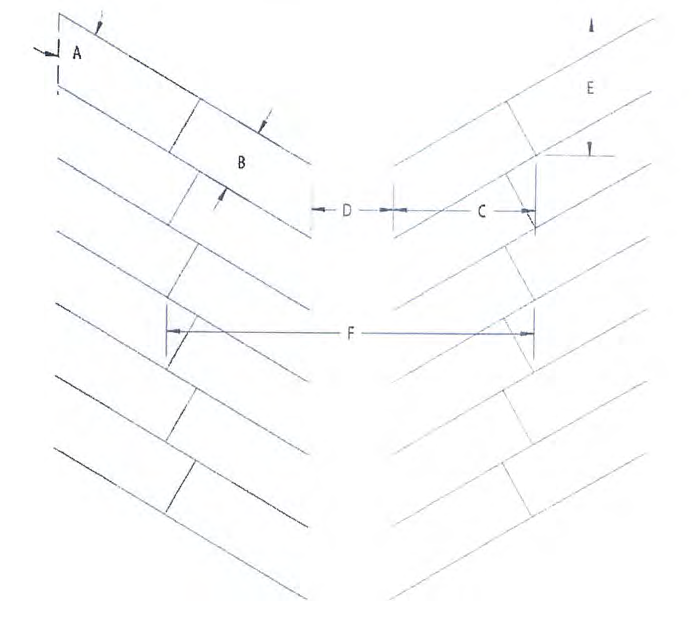
Angled parking. Parking stalls intended for standard size cars shall be a minimum of 9' x 19'. Compact car stalls shall be a minimum size of 7' x 15'. Parking stalls for tour buses shall be a minimum size of 10' x 45'. All angled parking stalls shall be provided with the minimum aisle width specified below depending on their angle of entry. The width is designed to accommodate traffic flow within the parking area and allow reasonable room for maneuvering in and out of parking stalls.
B.
Parallel parking. Parallel parking stalls for standard size cars shall have a minimum size of 9' x 23' and 8' x 19' for compact cars. Parallel parking stalls for tour buses shall have a minimum size of 9' x 50'. All parallel parking stalls shall have a minimum of twelve (12) feet for maneuvering space in one-way traffic and twenty-two (22) feet in two-way traffic.
C.
Handicapped parking.
1.
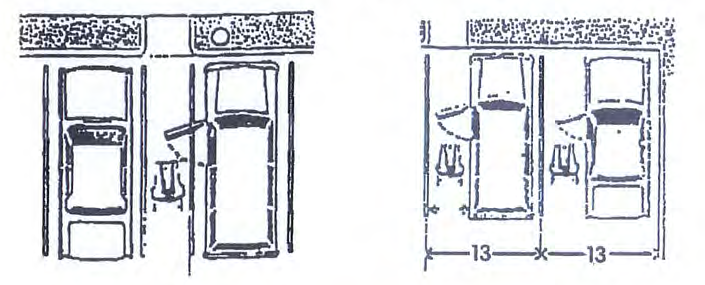
Handicapped parking stalls shall be paved and have a minimum size of 13' x 19' or an eight-foot stall adjacent to a five-foot walkway. Two (2) handicapped spaces may share a common five-foot walkway. Such parking shall be in closest proximity to the building. Accessibility to buildings shall be provided from all handicapped parking to allow easy and unobstructed access.
Handicapped Parking
2.
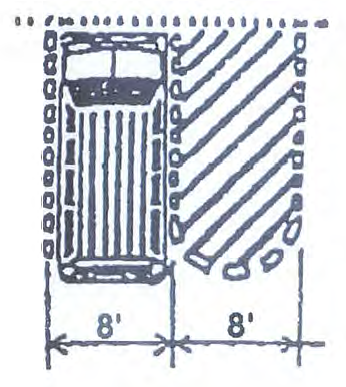
Van accessible parking stalls shall have a minimum size of 16' x 19' or an eight-foot stall adjacent to an eight-foot walkway. One (1) out of every eight (8) handicap parking spaces shall be van accessible.
Van accessible parking
3.
Determination of the required number of handicapped spaces shall be made in accordance with the following chart:
Sec. 703. - Signage.
A.
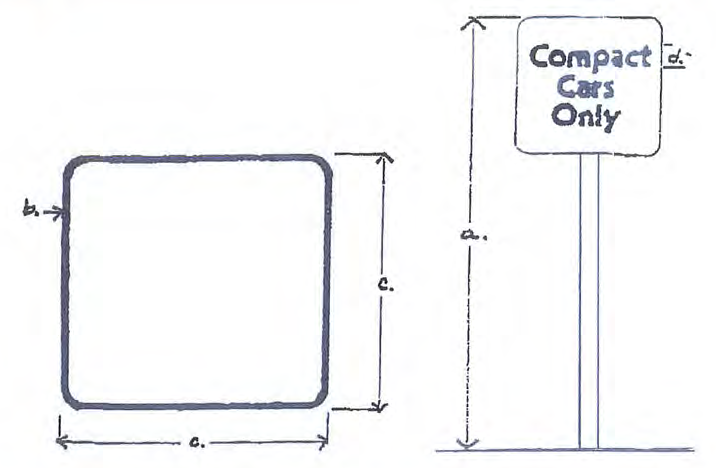
Compact parking. When three (3) or more spaces are located together, two (2) compact automobile signs will be required. One (1) sign shall be located at the left corner of the first space, and the right hand corner of the last space. Each sign shall read "Compact Cars Only," with a directional arrow delineating the spaces. Single spaces will require one (1) sign at each space.
1.
Sign dimensions.
(a)
4'0".
(b)
¼".
(c)
8".
(d)
2" centered.
2.
Color. White (reflective) on brown background.
B.
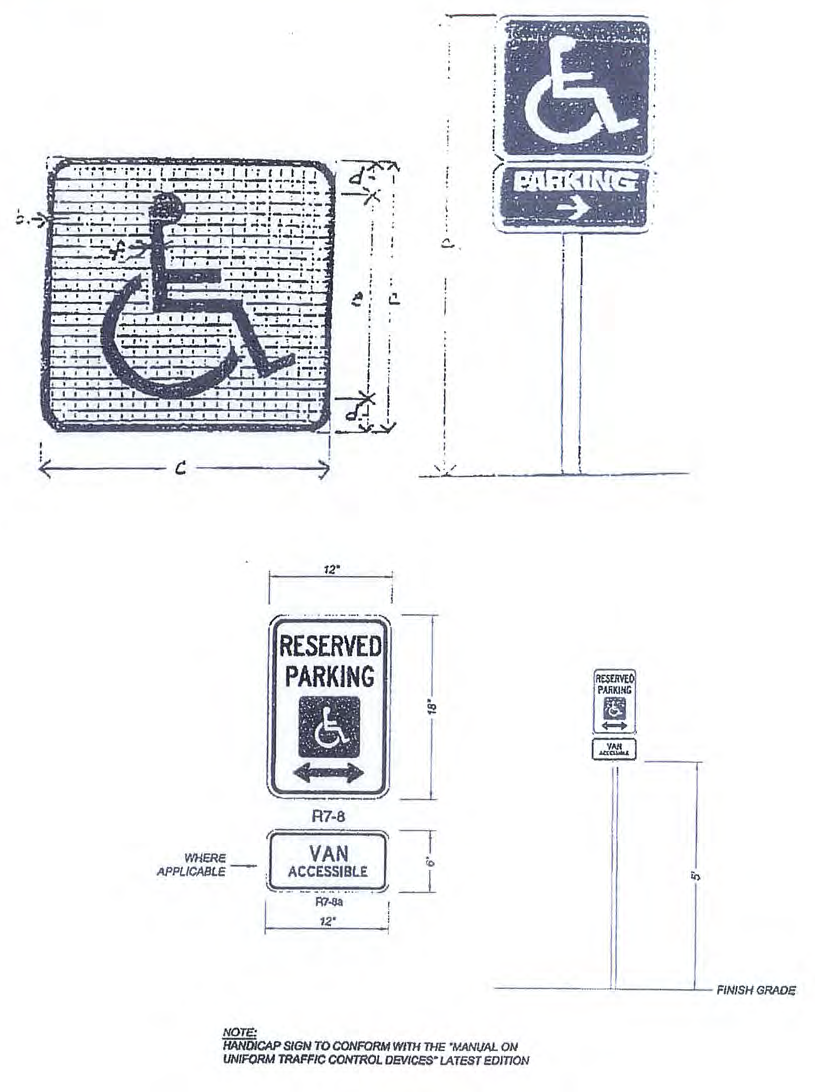
Handicapped parking. Each parking space shall display one (1) handicapped parking sign (International Symbol of Access) and the parking surface shall be identified with the handicapped parking symbol and pavement striping. Such sign shall be located four (4) feet on center from the wheel stop.
1.
Sign dimensions.
(a)
4'0".
(b)
¼".
(c)
8".
(d)
1".
(e)
6".
(f)
3/8".
2.
Color. White (reflective) on blue background, or without border, blue on white background.
C.
One-way drive aisles. Access to parking provided via one-way drive aisles shall be posted with "Begin One Way" at the entrance to the drive aisle and "End One Way" at the exit to the drive aisle. Signs shall measure 24" x 30". The top of the sign shall measure 4' from the adjacent finished grade. Color shall be black lettering on a white (reflective) background.
Sec. 704. - Off-street parking requirements per land use.

