Huntersville City Zoning Code
ARTICLE 6
OFF-STREET PARKING
6.1 Off-Street Parking Design
Design Standards. Off-street parking areas should be designed to minimize breaks in the pedestrian environment along the public street and create safe and comfortable passage for pedestrians. The following standards shall therefore be met.
- Parking lots shall be placed behind buildings; side of the building parking will be permitted only as indicated by Building Type and shall be measured along the build-to line. Off-street parking is not permitted in front of the primary building facade, except where specified in an adopted street section, detailed as a public plaza, or associated with a golf clubhouse and located a minimum of 800 feet from designated thoroughfare(s).
- Uninterrupted areas of parking lot shall be limited in size. Large parking lots shall be broken by buildings and/or landscape features.
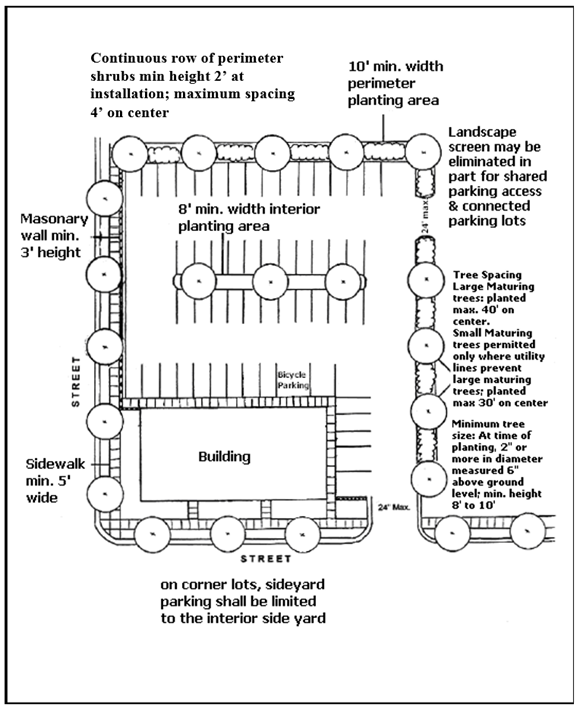
- Parking lots are to be treated as enclosed rooms for cars, with enclosure provided by tree planting and/or building walls(s). For small lots (thirty-six spaces or less), landscaping shall be required at the perimeter; for large lots (more than thirty-six spaces), landscaping shall be at the perimeter and placed to break the lot into parking modules of no more than thirty-six spaces. See diagram on following page.
- Parking lots shall be designed to allow pedestrians to safely move from their vehicles to the building. On small lots, this may be achieved by providing a sidewalk at the perimeter of the lot. On larger lots, corridors within the parking area should channel pedestrians from the car to the perimeter of the lot or to the building. These corridors may be delineated by a paving material which differs from that of vehicular areas and planted to provide shade. Small posts or bollards may be included.
- To maintain pedestrian comfort and calm the speed of entering traffic, driveways to parking areas should be no wider than 24 feet. Driveways connecting to state roads shall meet the requirements of the NC Department of Transportation.
- To the extent practicable, adjoining parking lots serving non-residential buildings shall be interconnected.
- All commercial driveway and parking areas shall be paved with asphalt, concrete, or brick pavers except for areas used for overflow, special events, peak parking, and Riding Academies and Commercial Stables. Any non-paved surface used for overflow, special events, and peak parking that cannot be maintained with healthy, living turf grass or similar ground cover shall be paved with asphalt, concrete, pervious pavement or brick pavers.
Amount Required. While it is expected that on-street parking will contribute substantially to every day parking needs, sufficient off-street parking must also be provided to serve the particular needs of the building(s). The following minimum requirements apply:
Residential
1 bedroom dwelling unit: 1 space
Dwelling units with more than one bedroom: 1.5 spaces
Congregate housing: no minimum parking required
Commercial, Industrial, Office
1 space per 500 sq. ft.
Warehouse
.25 spaces per 1000 Sq. Ft.
Civic
No minimum
Hotels, motels
1 space per room plus 1 space per 500 sq. ft. of ancillary use
Exceptions.
- In the Town Center (TC) District, existing buildings which were legally constructed without the provision of on-site parking, and infill housing on existing lots of record may meet requirements with on-street parking and will be construed conforming as to parking. Such buildings are eligible for change of use permits, for building upfits, and for expansion.
- Residential buildings may meet or contribute to meeting parking requirements with on-street parking if individual driveways are minimized and the fronting street is specifically designed to meet the parking needs of the residential buildings.
- Where vehicular access is provided between adjoining non-residential sites and the peak operating hours of adjoining uses do not overlap, the uses may share up to 50 percent of required parking spaces. Shared use of parking shall be guaranteed by a contract or other legally binding agreement.
- In order to preserve the natural, environmental, and historic character of publicly owned nature preserves and wildlife refuges, parking access driveways and parking areas for such uses may be paved with gravel, crushed stone, or pea gravel provided the area of the parking lot and driveway for the use does not exceed 20,000 square feet.
Bicycle Parking. All non-residential buildings should include an area for parking bicycles. This area may be a designated parking space within the parking lot near the building or an area outside the parking lot adjacent to the building. The bike parking area must include a bike rack with locking area.
Overflow Parking. Off-street areas used for special event parking (to accommodate occasional overflow volumes) may be constructed of any dust-free, compacted, pervious ground cover; the owner of the property shall be responsible for the maintenance of such parking in a clean and dust-free condition. Grass and mulch are examples of pervious ground cover; gravel and pavement are examples of impervious surfaces.
Landscaping of Parking Lots. Perimeter landscaping of parking shall meet all standards below:
- Screening shall be provided by installing along the perimeter of the parking lot a continuous row of evergreen shrubs max, separation 4’ on center but in no case less than what is necessary to achieve a complete visual screening depending on the variety of shrubs planted (minimum height 2’ at installation, expected height at maturity at least 6’ except adjacent to street right-of-way where the expected height at maturity is at least 4’) and/or a masonry wall 3’ to 6’ in height. This screen may be penetrated for access between parking lots.
- As an alternative screening requirement for parking lot edge(s) which abut street rights-of-way, a 3’ masonry wall to provide casual seating may be installed in place of the continuous row of shrubs described in A., above.
- In addition to screening, large maturing canopy trees shall line the parking lot; they shall be planted at a maximum of 40 ft. on center. Tree planting strips at perimeter of lots shall be a minimum of 10 feet in width. Only where pre-existing overhead utility lines prevent use of large maturing trees may small maturing trees maximum 30 ft. on center be substituted.
- Existing vegetation which meets, in whole or in part, the purposes of perimeter landscaping above, may be applied toward requirements.
Interior landscaping of parking lots shall consist of large maturing canopy trees placed such that each section of parking (up to 35 spaces per section) is enclosed by trees (or building wall), with a maximum spacing of 40 ft. on center. Tree planting areas within parking lots shall be at least eight feet wide, a minimum of 200 square feet in area, edged with a curb at least six inches in height, and designed to minimize damage to trees by parking or moving vehicles. Only where pre-existing overhead utility lines prevent use of large maturing trees may small maturing trees maximum 30 ft. on center be substituted.
Dumpsters shall be set on a concrete bed and shall be hidden by an opaque fence or wall of sufficient height to screen the bin and any appurtenances, but not less than 6’ in height. Wooden shadow box fences are recommended. Trash containers such as dumpsters shall not be located abutting residential property.Wherever used, fences and walls should be constructed to match the architectural detail of the main building(s).Lots with less than 5 parking spaces are not subject to the parking area landscaping provisions of this section.All mechanical equipment shall be screened from view with an opaque screen.
Lighting for Parking Lots. Lighting of parking lots shall be on standards ranging from 8’ to 30’ in height and shall meet the standards of Article 8.26.
Typical Conditions/Corner Lot.