
Huntersville City Zoning Code
ARTICLE 9
CONDITIONS FOR CERTAIN USES
9.1 Accessory Dwelling
- An accessory dwelling may be attached, within, or separate from the principal dwelling.
- The principal structure of the lot shall be a detached house or townhouse.
- No more than one accessory dwelling shall be permitted on a single deeded lot in conjunction with the principal dwelling unit.
- The accessory dwelling shall not be served by a driveway separate from that serving the principal dwelling unless the accessory dwelling is accessed from a rear alley and the principal dwelling is accessed from a street.
- A detached accessory dwelling shall be housed in a building not exceeding 650 square feet of first floor area (maximum footprint) or 50% of the first floor area of the principal dwelling, whichever is greater; the structure may be dwelling only or may combine dwelling with garage, workshop, studio, or similar use.
- A detached accessory dwelling shall be located in the established rear yard and meet the standards for the applicable building and lot type, Article 4, and the limitations on rear yard use of Section 8.8.
- An accessory dwelling must be registered with the Planning Director at the time a certificate of occupancy is obtained for the accessory dwelling.
Amended by Ord. Draft TA25-08 Part 1 on 8/19/2025
Amended by Ord. Draft TA25-01 on 8/19/2025
9.2 Adult Establishments
Studies have shown that adult establishments tend to have serious deleterious effects upon nearby residential areas and uses where juveniles congregate, specifically schools, religious institutions, child care centers, parks and playgrounds. Further, studies have shown that lowered property values and increased crime tend to accompany geographic concentrations of adult establishments. It is the intent of this section to establish regulations to prevent the concentration of adult establishments and to separate adult establishments from residential areas, schools, religious institutions, child care centers, parks, and playgrounds.
- Adult establishments are permitted in the HC District subject to the requirements below:
- Any structure in which an adult establishment is the principal or accessory use shall be separated by a distance of at least 1,000 feet from any residential or mixed-use zoning district and from the following principal or accessory uses, defined as protected uses for purposes of this section: dwelling units, elementary and secondary schools, religious institutions, child care centers, parks and playgrounds.
- Any structure in which an adult establishment is the principal or accessory use shall be separated by a distance of at least 1,000 feet from any other adult establishment.
- The distance of separation from residential and mixed use zoning districts and from the protected uses listed in a), above, shall be measured from the closest point of the lot occupied by an adult establishment to the nearest residential or mixed-use zoning district or the property line of a protected use. The distance of separation between adult establishments shall be measured from the closest points of the lots occupied by adult establishments.
- No more than one adult establishment may be located within the same structure or on the same lot.
- In the interest of public health and safety, mini-motion picture booths shall be constructed without doors, and shall orient the customer entrance of each booth toward the principal sales counter.
9.3 Agricultural Industry In The Rural And Transitional District
Agricultural Industry, limited to the production of commercial poultry or small livestock in enclosed buildings, according to the procedures of Section 11.4.10.
The Town Board shall issue a Special Use Permit for the production of commercial poultry or small livestock in enclosed buildings in the Rural and Transitional District if, but not unless, the evidence presented at the Special Use Permit hearing establishes:
- That no part of the proposed use will be located or operated so as to emit dust, noise, fumes, or odors in concentrations or amounts that would constitute a nuisance to persons of ordinary sensitivities on nearby properties; and
- That there will be a separation of no less than 250 feet between structures housing the agricultural industry and any property located in a residential district or developed for residential or mixed-use purposes; and
- That the proposed use shall be located on a lot of no less than ten acres.
9.4 Airports
Airports are permitted in the SP District subject to a Special Use Permit, according to the procedures of Section 11.4.10.
The Town board shall issue a Special Use Permit for the subject facility in the SP District if, but not unless, the evidence presented at the Special Use Permit hearing establishes:
- That the proposed use will not constitute a nuisance to properties located in residential or mixed-use districts or developed for residential purposes with respect to noise, dust, fumes, light, vibration, or traffic; and
- That the proposed use will comply with all applicable Federal Aviation Administration regulations.
9.5 Amusement Facilities (Outdoor)
- Outdoor amusement facilities will be separated by an opaque screen from any abutting property located in a residential or mixed use district;
- No amusement facilities, such as miniature golf courses, skateboard courses, or mechanical rides shall be located within 200 feet of any abutting property located in a residential district;
- Hours of operation will be no earlier than 6:00 a.m. and no later than 12:00 midnight.
9.6 Car Wash
The outdoor service area of a car wash shall be placed and screened in accordance with the standards for on-site parking, Article 6.
9.7 Cemeteries
- Tombstones, crypts, monuments, and mausoleums must be located at least 25 feet from any street right-of-way line or abutting property.
- Buildings for maintenance, management, rent and /or sale of cemetery lots must conform to a building type permitted in the zoning district.
9.8 Religious Institutions
The scale and activity level of religious institutions is a function of size and the range of accessory uses associated with the institution; very high activity levels have the potential to be disruptive to residential and small scale mixed-use areas. To diminish disruptive impacts by ensuring appropriate locational and design standards, the development and expansion of religious institutions and accessory uses in residential, town center, and neighborhood center districts shall meet the following standards:
- Religious institutions shall meet the standards for civic building and lot type, Article 4.
- Development Standards.
- Exterior lighting shall be in accordance with Section 8.26, Site Lighting.
- Accessory dwelling units for persons associated with or employed by the religious institution may be provided at a ratio of 1 unit for each 3 acres of site; these limits do not apply to the placement of convents, rectories, parsonages or similar uses on the site.
- Accessory uses such as religious institution offices, religious bookstores serving the immediate congregation, parking lots, family life centers, multi-purpose facilities, outdoor recreational facilities, cemeteries and day care centers on the same site or sites contiguous to the principal use shall be permitted wherever religious institutions are permitted and shall meet the civic building and lot type, or another building and lot type permitted in the zoning district. Similar uses on non-contiguous sites or on a site separated from the principal use by a public street shall be considered principal uses in their own right and be regulated as such. Tombstones, crypts, monuments, and mausoleums in accessory cemeteries shall be located at least 25 feet from any street right-of-way line or abutting property.
- Religious institution accessory uses which are not permitted as principal uses in a district shall adhere to the following restrictions:
- no merchandise or merchandise display shall be visible from outside the building;
- no business or identification sign pertaining to the accessory uses shall be visible from outside the building;
- Except as noted in 3., above, accessory uses not permitted as principal uses (including television stations, radio stations, printing presses, or sports complexes) are prohibited. This provision shall in no way restrict accessory use family life centers and multipurpose facilities, a part of whose function may include recreation and sports activities.
- Application for a building permit shall include a comprehensive site plan which addresses the required standards and conditions for the main site and all abutting holdings.
9.9 Commercial Communication Tower
A Commercial Communication tower is subject to the following conditions:
- To encourage future shared use of commercial communication towers, the tower owner must demonstrate that the tower will support a specified number of antennas and must file a letter of intent with the town to lease the space to other users in good faith. In turn, the owner may charge users a proportionate share of capital, financing, and operating costs, plus the cost of insulating equipment so that the transmissions do not interfere with one another. To encourage collocation of commercial communication antenna and facilities and to reduce the need for new commercial communication towers, co-location of such antennae and facilities shall be permitted on any commercial communication tower or tower for radio communication for business or governmental purposes of which the tower was in existence on July 20, 2009, regardless of when it was constructed, the underlying zoning district, or any condition of approval for the existing tower other than a condition which was imposed or accepted by the Board of Commissioners. To the extent practical as determined by the Planning Director, all standards of this Section 9.9 shall be applicable.
- No new commercial communication tower may be established if there is a technically suitable space available on an existing communications tower within the geographic area that the proposed tower is to serve.
- The entire facility must be aesthetically compatible with its environment. If not otherwise camouflaged, towers shall be of a coloration that will blend with the surroundings. Example: brown/green/gray.
- Fencing must be provided to secure the communication equipment on site. If chain link or similar fencing material is used on the site, an opaque screen shall be provided on the exterior side of the fence.
- All obsolete or unused facilities must be removed within 12 months of cessation of operations at the site.
- Equipment, mobile or immobile, not used in direct support of the transmission or relay facility shall be stored or parked on the site unless repairs to the facility are being made.
- Towers shall not be artificially lighted except to ensure human safety as required by the Federal Aviation Administration (FAA) regulations. To the extent possible, tower lighting shall be located and directed to avoid flashing or shining into the interior spaces of dwellings.
- An opaque screen expected to reach minimum 8’ height at maturity shall be planted around the perimeter of the area occupied by the tower, security fencing, and auxiliary uses such as parking. In addition, existing onsite trees and other vegetation shall be preserved to the extent possible.
- No more than one communication tower shall be constructed on a single tract of land.
- If such a structure is located on a lot adjacent to a lot or lots located in a residential or mixed-use district, it must be located at least 200 feet from all property lines adjacent to the residential or mixed use district(s).
- To be permitted as an incidental accessory use in any zoning district, a tower shall be camouflaged on, with, or in an existing or proposed conforming structure (e.g., inside religious institution steeple, on utility transmission line tower). A detailed site plan and structural elevations must be submitted to the Planning Department for approval. The affirmative decision of the Planning Department shall be based upon a determination that the proposed tower is so camouflaged as to be unnoticeable to the public; or if placed upon a utility transmission line tower, that the additional equipment would not further diminish the quality of the view from surrounding properties and public streets, nor would additional light(s) intrude upon the private interior or exterior living areas of existing dwellings.
- Commercial Communication Towers, in addition to satisfying the conditions set forth in 9.9.1-9.9.10, and 9.9.12-9.9.13 may be allowed in the Rural (R) district only if they satisfy the following additional conditions:
- The height of the commercial communication tower may not exceed 199 feet above ground level;
- The commercial communication tower may only be placed on properties in eight and a half (8.5) acres on a tract that existed as an eight and a half (8.5) acre tract or greater on February 6, 2012;
- The commercial communication tower must be set back a distance of at least 500 feet from any public right-of-way and 200 feet from any property line;
- The commercial communication tower may only be placed on a property where it will not require artificial illumination;
- The commercial communication tower must provide technically-suitable space for at least four (4) users;
- The commercial communication tower must be set back a distance of at least the tower’s fall zone, as certified by a North Carolina Professional Engineer, from any occupied structure.
- All commercial communication towers in the Rural district shall be constructed using a monopole design.
- A new communication tower cannot be placed within a one-mile radius of an existing tower.
- Collocation on town-owned utility poles shall be in accordance with N.C.G.S. 160D-937.
- Nothing in Article 9.9 shall be interpreted to conflict with the provisions of N.C.G.S. 160D-938.
Amended by Ord. TA22-13 on 2/20/2023
Amended by Ord. T24-12 SUP on 9/17/2024
9.10 Commercial Outdoor Kennel
The outdoor containment of animals shall be at least 250 feet from abutting property located in a residential or mixed-use district.
9.11 Day Care Centers And Small Day Care Homes
- Child Day Care Center.
- A center must meet a permitted building and lot type for the district in which it is to be located.
- Play space must be provided in accordance with the regulations of North Carolina Department of Human Resources.
- Outdoor play space must be enclosed on all sides by building, and/or permitted types of walls or fences; it may not include driveways, parking areas, or land otherwise unsuited for children's play space; play space may not be in the established front yard.
- Sufficient stacking lanes for drop-off and pick-up shall be provided onsite so that traffic circulation is not impeded on any public right-of-way.
- In the Transit-Oriented Development-Residential (TOD-R) District, day care centers have a limit of 8,000 sq. ft. of gross floor area.
- In the Transit-Oriented Development-Residential (TOD-R) District, day care centers have a limit of 8,000 sq. ft. of gross floor area.
- Adult Day Care Center.
- A center must meet a permitted building and lot type for the district in which it is to be located.
- There is no limit on the hours of operation of an Adult Day Care Center, but it shall not serve any client on a continuous 24-hour basis.
- Sufficient stacking lanes for drop-off and pick-up shall be provided onsite so that traffic circulation is not impeded on any public right-of-way.
- Child Day care home, small, accessory.
- The day care operation must be located within the residential dwelling unit occupied by the operator of the service. Preschool instruction and daytime care is limited to 6 children not related to the operator.
- A Child Day Care home shall meet the following standards:
- Child Day Care Homes must be licensed by the North Carolina Department of Health and Human Services.
- Play space must be provided in accordance with the regulations of the North Carolina Department of Health and Human Services.
- Outdoor play space must be fenced or otherwise enclosed on all sides and may not include driveways, parking areas, or land otherwise unsuited for children's play space; Outdoor play space is prohibited in any established building setback from a street.
- Chain link and similar fencing materials shall be planted on exterior side with evergreen shrubs minimum 3 feet in height and 6 feet on center at installation or be obscured by a comparable screening treatment.
- A day care home must be clearly incidental to the residential use of the dwelling and must not change the essential residential character of the dwelling; all building and lot standards for residential dwellings shall be maintained.
- There are no specific limitations on the hours of operation of a Day Care Home, but no outdoor play shall be permitted after sundown.
- Adult Day Care Home, small.
- An Adult Day Care home must be located within the residential dwelling unit occupied by the operator of the service. Care is limited to no more than 6 adults who do not reside in the dwelling.
- An Adult Day Care home shall meet the following standards:
- A day care home must be clearly incidental to the residential use of the dwelling and must not change the essential residential character of the dwelling; all building and lot standards for residential dwellings shall be maintained.
- There is no limit on the hours of operation of an Adult Day Care Center, but it shall not serve any client on a continuous 24-hour basis.
Amended by Ord. T24-12 SUP on 9/17/2024
9.12 Drive Through Windows As An Accessory Use
- Drive-through service windows, stacking lanes, and circulation are prohibited in the established front setback of the principal building, or in an established side yard which abuts a street;
- Drive-through service windows, stacking lanes, and circulation are treated as components of on-site parking for the purposes of screening as described in Article 6 of this ordinance;
- The length of on-site stacking lane(s), taken together, shall be a minimum of 200 feet if window access is provided directly from a major or minor thoroughfare; a minimum of 100 feet if window access is provided directly from a street of lesser capacity.
- The drive-through lane(s) must be distinctly marked by special striping, pavement markings, or traffic islands. A separate circulation drive must be provided for passage around and escape from the outermost drive-through service lane.
- Screening is not required for walk-up service accessories such as depositories and ATM’s.
9.13 Duplex On Corner Lot
Duplexes are permitted on corner lots in any residential or mixed-use district according to the following standards:
- The entrances to each unit in the structure will face different streets;
- The dwelling must meet the minimum front yard setback from both streets upon which a unit faces;
- The lot has at least 1.5 times the minimum lot area, if any, for the district.
- Duplexes which meet the standard for the attached house or apartment building, are permitted without corner lot restrictions in those districts which permit attached housing and apartment building types.
9.14 Essential Services 1 And 2
- Utility distribution lines, which deliver service to the end user from a substation fed by a transmission line providing service to an area larger than the individual parcel or project area, should be installed underground, unless subsurface conditions make underground installation not possible or practical.
- Facilities used for the operation of essential services should, whenever possible, be located on interior properties rather than on properties aligned with other lots that have continuous street frontage.
- Buildings and other structures which cannot adhere to the scale, volume, spacing, setback and typology of existing buildings along fronting streets shall be provided an opaque screen to shield the view from all public rights-of-way and from abutting properties.
9.15 Essential Services 3
Essential Services, Class 3, are permitted in the SP District subject to a Special Use Permit, according to the procedures of Section 11.4.10.
The Town board shall issue a Special Use Permit for the subject facility in the SP District if, but not unless, the evidence presented at the Special Use Permit hearing establishes:
- That the proposed use will not constitute a nuisance to properties located in residential districts or developed for residential or institutional purposes with respect to noise, dust, odors, light, vibration, or traffic; and
- That area of active use will be enclosed by a fence, not easily climbable, at least six feet in height, and the fence must be located at least 20 feet from the public street right-of-way and 100 feet from abutting property lines; and
- That a minimum separation of 100 feet, fully vegetated, will be provided between the fenced use area and any abutting property line; existing vegetation shall be preserved to the extent practicable and supplemented with new plantings as may be required to provide a year-round opaque buffer from abutting properties; and
- That the site shall be screened from the street(s) by a screen composed of a masonry wall or a solid fence, planted on the exterior side with a semi-opaque vegetative screen with expected height of at least 8 feet at maturity; security fencing shall be placed on the interior side of the vegetation and wall/fence.
9.16 Facilities For The Intake And Transfer Off-Site Of Inorganic Household Waste And Residential Recyclables; And The Intake And Processing Of Yard Waste
- Recyclable materials from residential sources shall be limited to tires, scrap metal such as lawnmowers and play equipment; white goods such as refrigerators, clothes dryers and stoves; lead acid batteries; motor oil; cardboard; and other recyclables of residential origin.
- The area of active use must be enclosed by a fence, not easily climbable, from six to seven feet in height, and the fence must be located at least 20 feet from the public street right-of-way and 100 feet from abutting property lines.
- A minimum separation of 100 feet, fully vegetated, shall be provided between the fenced use area and any abutting property line; existing vegetation shall be preserved to the extent practicable and supplemented with new plantings as may be required to provide a year-round opaque buffer from abutting properties.
- The site shall be screened from the street(s) by a screen composed of a masonry wall or a solid fence, planted on the exterior side with a semi-opaque vegetative screen with expected height of at least 8 feet at maturity; security fencing shall be placed on the interior side of the vegetation and wall or fence.
9.17 Hazardous Or Infectious Material Incineration, Handling, Or Storage
Hazardous or infectious materials, storage and treatment facilities are permitted in the Special Purpose (SP) District subject to a Special Use Permit, according to the procedures of Section 11.4.10.
The Town Board shall issue a Special Use Permit for the subject facility in the SP District if, but not unless, the evidence presented at the Special Use Permit hearing establishes:
- That the use complies with the Federal Resource Conservation and Recovery Act of 1976, as amended (42 U.S.C. §6901 et seq) and the North Carolina Solid Waste Management Act, as amended, (Article 9, G.S. 130A-290 et seq) for design, siting, and monitoring, and for materials to be stored or treated; and
- That all storage, treatment, and loading facilities handling hazardous or infectious materials will be located at least 200 feet from any exterior property line and at least 2,000 feet from any lot zoned or used for residential, institutional, or office purposes; and
- That the use will be entirely fenced with fencing material to a height of at least 7 feet; and the site shall be screened from the street(s) by a screen composed of a masonry wall or a solid fence, planted on the exterior side with a semi-opaque vegetative screen with expected height of at least 8 feet at maturity; security fencing shall be placed on the interior side of the vegetation and wall or fence; and
- That vehicular access to the operation will be provided only by way of a designated thoroughfare; and
- That all surface water and groundwater on the property shall be protected so as to minimize to the greatest extent possible the probability of contamination by hazardous materials; and
- That the site will be served by a publicly operated sewage disposal system and all sanitary sewer and storm water management systems on the property will be protected so as to minimize to the greatest extent possible the probability of contamination by hazardous or infectious materials; and
- That no structures or operations of any kind on the site shall be located within 200 feet of any adjacent lot.
9.18 Helistop As An Accessory Use
A helistop shall be permitted as an accessory use in the CI, CB and the SP District provided it complies with all applicable Federal Aviation Administration regulations and guidelines.
9.19 Home Occupation
A home occupation is permitted accessory to any dwelling unit (except manufactured housing) in accordance with the following requirements:
- The home occupation must be clearly incidental to the residential use of the dwelling and must not change the essential residential character of the dwelling.
- A home occupation conducted in an accessory structure shall be housed only in a garage or other accessory structure typically associated with a dwelling.
- The use shall employ no more than one person who is not a resident of the dwelling.
- A home occupation housed within the dwelling shall occupy no more than 25 percent of the total floor area of the dwelling.
- There shall be no visible outside display of stock in trade which is sold on the premises.
- There shall be no outdoor storage or visible evidence of equipment or materials used in the home occupation, excepting equipment or materials of a type and quantity that could reasonably be associated with the principal residential use.
- Operation of the home occupation shall not be visible from any dwelling on an adjacent lot, nor from a street.
- Only vehicles used primarily as passenger vehicles will be permitted in connection with the conduct of the home occupation.
- The home occupation shall not utilize mechanical, electrical, or other equipment which produces noise, electrical or magnetic interference, vibration, heat, glare, or other nuisances outside the dwelling or accessory structure housing the home occupation.
- Home occupations shall be limited to those uses which do not draw clients to the dwelling on a regular basis.
- Outdoor kilns used for the firing of pottery shall be provided with a semi-opaque screen to obstruct the view from the street and from adjacent properties located in residential districts, shall have a secured work area, and shall be a minimum of 10 feet from abutting property lines.
- No business identification or advertising signs are permitted.
9.20 Junk Yards
- The area of active use must be enclosed by a fence, not easily climbable, from six to seven feet in height, and the fence must be located at least 20 feet from the public street right-of-way and 100 feet from abutting property lines.
- A minimum separation of 100 feet, fully vegetated, shall be provided between the fenced use area and any abutting property line; existing vegetation shall be preserved to the extent practicable and supplemented with new plantings as may be required to provide a year-round opaque buffer from abutting properties.
- The site shall be screened from the street(s) by a screen composed of a masonry wall or a solid wooden fence, planted on the exterior side with a semi-opaque vegetative screen with expected height of at least 8 feet at maturity; if security fencing of chain link or similar material is used, it shall be placed on the interior side of the vegetation and wall or fence.
9.21 Neighborhood And Outdoor Recreation
- Buildings constructed in association with neighborhood recreation or outdoor recreation shall meet one of the building types permitted in the zoning district.
- Permanent parking lots shall meet the standards of Article 6, Off-Street Parking.
- Service areas will be separated by an opaque screen from the view from any street and from abutting properties.
- Chain link and similar fencing materials, if used, shall be planted on exterior side with evergreen shrubs minimum 3 feet in height and 6 feet on center at installation.
- Outdoor lighting associated with outdoor recreational facilities shall be designed as follows:
- Facilities shall use fully shielded lighting fixtures except where luminaries are:
- Provided with internal and/or external glare control louvers and installed so as to minimize up light and offsite light trespass, and;
- Installed and maintained with aiming angles that permit no greater than five percent (5%) of the light emitted by each fixture to project above the horizontal.
- Lighting plans shall limit light trespass to the maximum extent possible. A maximum of .5 foot-candles at any location on any non-residential property, and .1 foot-candles at any location on any residential property, as measurable from any orientation of the measuring device, shall be met.
- Lighting shall be extinguished after 11:00 p.m. Illumination of the sports facility shall be permitted after this time only to conclude a scheduled event that was unable to conclude before this time due to unusual circumstances.
- Facilities shall use fully shielded lighting fixtures except where luminaries are:
- Hours of operation shall be no earlier than 6:00 a.m. and no later than 11:00 p.m.
9.22 Neighborhood And Highway Commercial Gasoline Stations
- Neighborhood Gasoline Stations, by definition, permit retail sale of gasoline and convenience products and the minor service and repair of motor vehicles; they have no more than two gasoline service islands. Highway Commercial gasoline stations permit major service and repair of motor vehicles and are unlimited as to gasoline service islands.
- Buildings shall meet the requirements of Article 4, Building and Lot Types.
- Gasoline pumps, canopies, and associated service areas are prohibited in any established yard abutting a street.
9.23 Off-Site Land Clearing And Inert Debris (LCID) And Construction And Demolition (C And D) Landfills
Off-Site LCID and C&D Landfills are permitted in the SP District subject to a Special Use Permit, according to the procedures of Section 11.4.10. The Town Board shall issue a Special Use Permit for the subject facility in the SP District if, but not unless, the evidence presented at the Special Use Permit hearing establishes the conditions below.
- That the Site will operate in compliance with the rules according to the NCDENR for C&D and LCID landfills, as amended.
- That the comprehensive site plan addresses each of the environmental and development standards below:
- A landfill which would be larger than 10 acres shall be accessed from a major or minor thoroughfare or from a street built to Industrial Collector Street standards that connects directly to a major or minor thoroughfare. Landfills 10 acres or less must directly connect to a major or minor thoroughfare, or to an Industrial Collector Street or Industrial Local Street where available. However, if such thoroughfares or streets are not reasonable available, the Board may nevertheless issue a special use permit upon finding that the use for which the permit is granted would not likely cause any injurious effect on the property adjacent to the access.
- That the proposed or existing use will be in compliance with the rules and regulations as established by Traffic Impact Analysis (TIA) Article 14.
- Neither clearing, grading, land disturbing activities nor any portion of a C&D or LCID landfill may be located within 100 feet of any exterior property line. Further, the buffer requirements for the site are required per the state permitting criteria. The requirements stated below take precedence over any and all modifications made by the state unless the state standards become more restrictive.
• 500-foot buffer from existing residential water supply wells to fill area.
• 200-foot buffer from adjacent property to fill area.
• No fill in designated wetlands or the FEMA and/or Community Special Flood Hazard Areas.
• 50-foot buffer from delineated streams.
• 50-foot buffer from road right-of-way to fill area (non state requirement). - Driveway access to the facility must be paved for a distance of at least 100’ from the public street.
- Vehicular and pedestrian access to the site must be controlled; the site must be closed and secured during hours when filling activities are not under way. A non-climbable fence, at least 6’ high, shall be installed around the landfill and all of its operations as a safety device. These fences must be constructed of wire mesh with openings not to exceed 2 inches by 4 inches or equivalent and must be placed on the interior side of screening/buffering devices.
- All driveways which serve the site must be wide enough to accommodate two-way traffic for a distance of at least 100 feet from the public street so that no traffic waiting to enter the site will be backed up on any public right-of-way.
- That the landfill operator will be responsible for removal of any and all debris, dirt, or other materials which fall from trucks entering or leaving the landfill from all adjoining streets on at least a weekly basis. Failure to comply constitutes a violation of this ordinance and may constitute grounds for revocation of the operating permit.
- That use of the site for any purpose shall be limited to the hours of 7:00 a.m. until 6:00 p.m. Monday through Saturday, if the site adjoins or is across the street from property located in a residential district.
- That a timetable has been submitted with the application indicating the development phases and the projected life expectancy of the landfill.
- That a reclamation plan is provided that shows how the site will be reclaimed upon the closing of the landfill. The reclamation plan shall state the proposed method of conservatorship and perpetual maintenance or use. It shall demonstrate that the site, when closed, will pose no threat to public safety; that the finished contours and groundcover will reestablish a compatible appearance with surrounding lands and buildings; and that the method of maintenance or use will cause no future environmental degradation.
- An existing LCID landfill shall not be required to be brought into compliance with the provisions of this ordinance provided:
- The landfill has been continuously operating since 1990 and was not within the zoning jurisdiction of the Town of Huntersville in 1991;
- The landfill has a valid LCID or demolition landfill permit and/or obtains any renewals of the LCID or demolition landfill permit required by the State of North Carolina and/or Mecklenburg County;
- The landfill has a closure plan approved by the State of North Carolina and/or Mecklenburg County; and
- In no event shall the landfill operate under a demolition landfill permit later than December 4, 2016 and further provided that on the earlier of the final date permitted for operation of the landfill or the date the landfill permanently ceases operation, the owner and/or operator of the landfill shall immediately commence and continuously pursue to completion closure of the landfill according to the provisions of the then current closure plan approved by the State of North Carolina and/or Mecklenburg County. Failure to complete closure according to such approved plan shall be a violation of this ordinance enforceable by all remedies and penalties available to the Town.
- In no event shall a landfill operate under an LCID landfill permit later than March 3, 2028 and further provided that on the earlier of the final date permitted for operation of the landfill or the date the landfill permanently ceases operation, the owner and/or operator of the landfill shall immediately commence and continuously pursue to completion closure of the landfill according to the provisions of the then current closure plan approved by the State of North Carolina and/or Mecklenburg County. Failure to complete closure according to such approved plan shall be a violation of this ordinance enforceable by all remedies and penalties available to the Town. Recycling from an LCID landfill shall be considered an LCID activity and shall not be considered an expansion for purposes of determining nonconformance.
- A landfill operating under an LCID landfill permit as described in e) shall meet the following requirements to the extent reasonably practicable without violating County, State, or Federal regulations:
- In the event that, after September 5, 2017, a driveway is permitted to replace an existing permitted driveway for the facility, the new driveway shall be paved for a distance of 100 feet from the public right of way, or, if the Planning Director determines that 100 feet of pavement is not reasonable due to topographic conditions, for such lesser distance as is determined by the Planning Director;
- Landscaping along street frontages to the extent commercially reasonable; and
- The landfill operator will be responsible for removal of any and all debris, dirt, or other materials which fall from trucks entering or leaving the landfill from all adjoining streets on at least a weekly basis, or more as needed.
- Any existing C&D landfill shall be permitted to continue operation in the zone in which it is located provided the landfill has an unexpired special use permit. Any expansion beyond the property boundary of an existing C&D landfill as approved on November 11, 2005 must be located in the SP district with a special use permit in accordance with the provisions of this Section.
9.24 Environmentally Sensitive Uses Not Expressly Permitted
Uses not expressly named in this ordinance, but which may constitute a greater than average impact on the environment or diminish the use and enjoyment of nearby property by generation of noise, smoke, fumes, odors, glare, commercial vehicle traffic, or similar nuisances, are permitted in the SP District subject to a Special Use Permit, according to the procedures of Section 11.4.10.
The Town Board shall issue a Special Use Permit for the subject facility in the SP District if, but not unless, the evidence presented at the Special Use Permit hearing establishes:
- That a comprehensive site plan addresses the development standards below:
- Adjoining properties and streets are protected from adverse impacts of the use and buildings on the proposed site by the locations of buffers and/or screens;
- Any areas of the site which may present a danger to residents, their children, pets, or livestock shall be fenced with non-climbable fencing material to a height sufficient to avert said danger; fencing shall be installed on the interior of any buffering or screening;
- Vehicular access to the proposed use will be provided by way of a road sufficiently sized to accommodate the generated trips and the vehicles typically associated with the use; a use considered under the standards of this special use permit process shall not be accessed through a residential neighborhood nor from a Residential Local street.
9.25 Outdoor Display Of Vehicles And Boats For Sale, Lease, And Cleaning
The following requirements shall apply to the outdoor display of vehicles and boats associated with sales, rental, cleaning, mechanical repair, body repair, and similar services.
- Vehicles and boats for sale shall not be displayed in an established front yard or in an established side yard abutting a street.
- Vehicles and boats for sale may be displayed in a side yard which does not abut directly on a street, so long as:
- the display is placed behind the established front setback line of the building, extended to the side lot lines;
- the display area meets the standards for a parking lot as described in Article 6 of this ordinance;
- the display area is screened from abutting properties by an opaque screen as described in Section 7.6 of this ordinance.
- Nothing in this section shall prohibit a break in a planted screen or wall for the crossing of a driveway which provides access to on-site parking from the fronting street or a rear alley, or access between the parking lots of abutting businesses.
9.26 Outdoor Storage
- Outdoor storage defined:
- includes all goods and materials not returned to an enclosed building at the end of each business day; regardless of whether such goods or materials are kept on the premises for retail sale, wholesale sale, storage, or use by a business on or off the lot; (to be classified as goods for sale and therefore exempt from regulation as outdoor storage, items must be placed within an enclosed building at the end of each business day);
- includes up to two storage trailers placed on a single lot or in conjunction with a single principal use;
- includes all items awaiting or in process of repair except customary passenger vehicles awaiting repair which are not visibly damaged or are not used or intended to be used as “parts” vehicles; (rather than being considered outdoor storage, such vehicles may await repair in any conforming off-street parking lot associated with the principal use);
- includes vehicles with more than two axles, boats, manufactured homes, and trailers of tractor trailers awaiting or in process of repair;
- does not include construction equipment; where permitted, outdoor storage of construction equipment is regulated by Section 9.27.
- Outdoor storage, where expressly permitted, may be established on a lot according to the following standards:
- where permitted as an accessory use in conjunction with a building, the area of storage shall not be placed in any established yard abutting a street;
- where permitted as a principal use on a lot, the area of storage shall be no closer than 40 feet from an abutting street right-of-way;
- all areas established for outdoor storage shall be screened from view from the street(s) and from all abutting properties by an opaque screen as described in Section 7.6 of this ordinance; wherever security fencing is desired, it shall be placed on the interior side of the opaque screen.
9.27 Outdoor Storage Of Construction Equipment
Outdoor storage of construction equipment, where expressly permitted, may be established on a lot according to the following standards:
- where permitted as an accessory use in conjunction with a building, the area of storage shall not be placed in any established yard abutting a street;
- where permitted as a principal use on a lot, the area of storage shall be no closer than 40 feet from an abutting street right-of-way;
- the area of outdoor storage shall be screened from view from the street(s) and from all abutting properties by an opaque screen as described in Section 7.6 of this ordinance; wherever security fencing is desired, it shall be placed on the interior side of the opaque screen.
9.28 Parking Lot As Principle Use
Parking lots not associated with a building shall adhere to the standards of Article 6, Off-Street Parking, except that parking lots may be constructed up to the prevailing established setback line for structures within 300’ in either direction on the same side of the street. The prevailing established setback applies for both the fronting street and any abutting side street.
9.29 Parks (Including Greenways)
- Buildings constructed in association with a park or greenway shall meet one of the building types permitted in the zoning district.
- Permanent parking lots associated with parks and greenways shall meet the standards of Article 6, Off-Street Parking.
- Dust-free, pervious surface areas are encouraged for overflow or event parking; such areas, if maintained in a natural condition, need not conform with Article 6.
- Service areas shall be separated by an opaque screen from view from any street and from abutting properties as described in Section 7.6 of this ordinance.
- Outdoor lighting associated with active outdoor recreation shall not shine directly into yards associated with a residential use nor into the windows of a residential structure.
- Hours of operation of outdoor recreation will be no earlier than 6:00 a.m. and no later than 11:00 p.m. for uses located in or abutting a residential district.
9.30 Petroleum Storage Facilities
- The use meets the requirements established by the fire prevention code of the National Board of Fire Underwriters and the latest edition of the "Flammable and Combustible Liquids Code, NEPA 30" of the National Fire Protection Association;
- All storage tanks and loading facilities will be located at least 100 feet from any exterior property line;
- Vehicle access to the use shall be provided by way of a major or minor thoroughfare, or an Industrial Street directly connecting to a thoroughfare.
9.31 Quarries
Quarries are permitted in the SP District subject to a Special Use Permit, according to the procedures of Section 11.4.10.
The Town board shall issue a Special Use Permit for the subject facility in the SP District if, but not unless, the evidence presented at the Special Use Permit hearing establishes:
- That the quarry and all its buildings, pits, and processing equipment will be separated by a 100-foot buffer from the street and from any adjacent property that is located in a residential district or developed for residential or institutional use; and
- That the quarry and all its buildings, pits, and processing equipment will be provided with an opaque screen to shield the view from the public street and from all abutting properties, regardless of use; and
- That a non-climbable fence, at least 6 feet high, will be installed around the quarry and all of its operations as a safety device. These fences must be constructed of wire mesh with openings not to exceed 2 inches by 4 inches or equivalent and must be placed on the interior side of screening and/or buffering devices; and
- Vehicle access to the quarry shall be provided by way of a major or minor thoroughfare, or an Industrial Street directly connecting to a thoroughfare; and
- That any crushing of rock or processing of material must be done in such a way as to minimize the amount of air-borne dust created; and
- That the minimum distances of quarry operations from adjacent properties shall be:
a. for any quarry building 100 feet b. for any crushing of rock, processing of stone, gravel or other material 300 feet c. for any blasting 500 feet - And that upon termination of quarrying operation, the site must be reclaimed in accordance with NC General Statutes.
9.32 Raceways And Drag Strips
Raceways and Drag strips are permitted in the SP District subject to a Special Use Permit, according to the procedures of Section 11.4.10.
The Town board shall issue a Special Use Permit for the subject facility in the SP District if, but not unless, the evidence presented at the Special Use Permit hearing establishes:
- That the use will be located on a lot of at least 50 acres; and
- That vehicular access to the use will be provided only by way of a major or minor thoroughfare; and
- That no direct beams of light from outdoor lighting fixtures, signs, or vehicles maneuvering on the site will shine into any abutting property located in a residential district; and
- That a minimum separation of 100 feet, fully vegetated, shall be provided between the fenced use area and any abutting property line; existing vegetation shall be preserved to the extent practicable and supplemented with new plantings as may be required to provide a year-round opaque buffer from abutting properties; and
- That the site shall be screened from the street(s) by a masonry wall or a solid wood fence, planted on the exterior side with a semi-opaque vegetative screen with expected height of at least 8 feet at maturity; if security fencing of chain link or similar material is provided, it shall be placed on the interior side of the vegetation and wall or fence; and
- That hours of operation will be no earlier than 8:00 a.m. and no later than 11:00 p.m.
9.33 Riding Academies And Commercial Stables
Riding academies are permitted in the Rural and Transitional District if the following standards are met.
- All buildings and structures related to the care of animals and to the conduct of the academy must be located at least 100 feet from property boundaries.
- Maximum number of horses is 2 per acre.
- Off-street parking, service areas, and buildings which are not used for residential purposes, farm purposes, or the stabling of horses, shall be separated by an opaque screen from the view from any street and from abutting properties.
- Entrance drives, internal drives, parking and service areas may be gravel, crushed stone, or other suitable material approved by the Planning Director. These areas shall be well maintained and kept free of potholes, weeds, etc. The initial 50 feet of the driveway from the public roadway connection shall be paved with concrete or asphalt.
9.34 Sanitary Landfill
Sanitary Landfills are permitted in the SP District subject to a Special Use Permit, according to the procedures of Section 11.4.10.
The Town board shall issue a Special Use Permit for the subject facility in the SP District if, but not unless, the evidence presented at the Special Use Permit hearing establishes:
- That the comprehensive site plan addresses each of the development standards below:
- The use shall be located on a lot of at least 50 acres;
- All land filling operations and off-street parking and service areas will be separated by a 100-foot buffer from all adjacent properties and shielded by an opaque screen from the view from a public street;
- No structure or land filling operation will be located within 100 feet of any property line nor within 200 feet of abutting property located in a residential district or developed for residential or mixed use;
- Vehicle access to the proposed use shall be provided by way of a major or minor thoroughfare, or an Industrial Street directly connecting to a thoroughfare; and
- That the plan for development and operation of the site addresses the environmental standards below:
- The siting and design of the facility will comply with the "Siting and Design Requirements for Disposal Sites" of the North Carolina Solid Waste Management Rules (Title 15A NCAC Chapter 13B) in effect at the time of review of the application;
- Monitoring of surface water and groundwater will be conducted in accordance with the State of North Carolina permit and monitoring documents developed pursuant to the State of North Carolina Solid Waste Management Rules;
- The facility complies with the Mecklenburg County Department of Environmental Protection's policy concerning Actual and Suspected Contaminants of Mecklenburg County Surface and Groundwater; and
- That there is a general timetable indicating the development phases and projected life expectancy of the landfill; and
- That there is a detailed plan for the re-use of the property, after landfill operations cease, that is not in conflict with the objectives of the most detailed plan approved for the area; and
- That the plan for close-out of the landfill includes the creation of an escrowed fund to finance close-out, with contributions to the fund escrowed annually, beginning at the time facility development begins.
9.35 Schools
- Schools shall conform principal buildings to the standards of Civic Buildings and lots, Article 4. Accessory and incidental buildings may be placed within a street fronting yard if they conform to a building and lot type permitted in the zoning district. Buildings which do not so conform shall be placed within established rear and side yards which do not abut a street.
- Permanent parking lots associated with schools shall meet the standards of Article 6, Off-Street Parking. However, areas designated for temporary bus parking that also serves as a recreational area shall not be subject to interior parking lot landscaping requirements.
- Notwithstanding 1. and 2., above, where the safe transport of students requires functional separation of parking and circulation areas (i.e. school bus, auto drop-off, etc.), the location of parking and circulation according to building and lot type may be modified, so long as streets abutting parking and circulation areas are, to the extent practicable, detailed as plazas. Sufficient stacking lanes for drop-off and pick-up shall be provided onsite so that traffic circulation is not impeded on any public right-of-way. Stacking on Town streets may be allowed if all of the following are met:
- Site is zoned TND-R, TND-U or TND-Overlay;
- Maximum enrollment shall not exceed 360 kindergarten to 8th grade students;
- Two-way traffic maintained on Town streets along the entire pick up/drop-off zone;
- Pick-up/drop-off zone shall have a minimum width of eight (8) feet exclusive of the two-way traffic lanes.
- The school shall provide at a minimum a 11.5-foot-wide hardscaped area behind the back of curb. Street trees with grates are allowable, but bushes/shrubs in the area are not allowed.
- A traffic impact analysis, including a mandatory circulation plan and queuing analysis must be approved by the Town of Huntersville Engineering & Public Works Department prior to plan approval. Should conditions in the field vary from the analysis, the Town Engineer has the ability to modify the circulation plan.
- Dust-free, pervious surface areas are encouraged for overflow or event parking; such areas need not conform with Article 6 if they are maintained in a natural condition (for example, as a grassed field).
- Service areas shall be separated by an opaque screen from the view from any street and from abutting properties as described in Section 7.6 of this ordinance.
- Where chain link and similar fencing material are installed in an established yard abutting a street, such fencing shall be planted on the exterior side with evergreen shrubs minimum 3 feet in height (expected height at maturity minimum 6 feet), 6 feet on center at installation.
- Outdoor lighting associated with active outdoor recreational facilities shall be designed as follows:
- Facilities shall use fully shielded lighting fixtures except where luminaries are:
- Provided with internal and/or external glare control louvers and installed so as to minimize up-light and offsite light trespass; and
- Installed and maintained with aiming angles that permit no greater than five percent (5%) of the light emitted by each fixture to project above the horizontal.
- Lighting plans shall limit light trespass to the maximum extent possible. A maximum of .5 foot-candles at any location on any non-residential property, and .1 foot-candles at any location on any residential property, as measurable from any orientation of the measuring device, shall be met.
- Lighting shall be extinguished after 11:00 p.m. Illumination of the sports facility shall be permitted after this time only to conclude a scheduled event that was unable to conclude before this time due to unusual circumstances.
- Facilities shall use fully shielded lighting fixtures except where luminaries are:
- Elementary and Junior High Schools shall be located on streets sized to accommodate traffic volumes of background uses plus the additional traffic projected to be generated by the school(s).
- Senior high schools shall be on a lot which abuts a minor or major thoroughfare; primary vehicular access shall be provided from the thoroughfare.
- When permitting temporary classroom units, the entire site shall be reviewed for compliance with applicable codes (i.e. sidewalks, landscaping, turn-lanes). Applicants are encouraged to bring the site into compliance where deficiencies are identified relative to the intensification of use proposed.
- Sufficient stacking lanes for drop-off and pick-up shall be provided onsite so that traffic circulation is not impeded on any public right-of-way.
- In a Corporate Business zoning district, schools shall only be allowed subject to the following additional conditions:
- Schools shall only be allowed on existing lots and in existing buildings. The school buildings shall be2010 no greater than 50,000 sq. ft. in size. Additions to buildings intended for school use will be limited to 10% of the existing floor area of the building.
- Schools shall be limited to a temporary use. in this district The length of time allowed for the school to operate shall not to exceed three (3) years from the occupancy of the temporary building. If the school does not occupy the building within one (1) year approval, the approval will become null and void. A school may apply for an additional two (2) years in the CB district. At no time shall an individual school be located in the CB district at the same location for more than a total of five (5) years.
- The maximum number of students shall be 300.
- In a CB zoning district, the school site shall be designed, located, and accessed such that primary passenger vehicles routes avoid those that will be primarily used by truck/industrial traffic.
Amended by Ord. T24-12 SUP on 9/17/2024
9.36 Solid Waste Incineration
Solid Waste Incineration, materials that are neither hazardous not infectious, is permitted in the SP District subject to a Special Use Permit, according to the procedures of Section 11.4.10.
The Town Board shall issue a Special Use Permit for the subject facility in the SP District if, but not unless, the evidence presented at the Special Use Permit hearing establishes:
- That the incineration units(s) will be constructed and operated in compliance with environmental regulations, both current and future, as annotated in the United States Code of Federal Regulations, particularly 40 CFR § 63.988, which deals with environmental regulations, as amended by the State of North Carolina and Mecklenburg County Department of Environmental Protection; and
- That all storage, handling, incineration, and loading facilities will be located at least 200 feet from any exterior property line and at least 1,250 feet from any lot located in a residential or mixed use district or developed for residential, institutional, or mixed use; and
- That structures, off-street parking and service areas will be separated by a 100-foot buffer from all adjacent properties and shielded by an opaque screen from the view from all public streets; and
- That active use portions of the site will be entirely fenced with non-climbable fencing material to a height of at least six feet, which shall be installed on the interior of the buffer; and
- That vehicular access to the operation will be provided only by way of a designated thoroughfare; and
- That all surface water and groundwater on the property shall be protected so as to minimize to the greatest extent possible the potential for contamination; and
- That the site will be served by a publicly operated sewage disposal system and all sanitary sewer and storm water management systems on the property will be protected so as to minimize to the greatest extent possible the potential for contamination.
9.37 Temporary Uses And Structures, Including Seasonal Markets
- The establishment of temporary sales lots for farmers markets, Christmas trees, and other seasonal agricultural products, plus related goods, are permitted for up to a maximum of three months per site and calendar year upon the issuance of a temporary use permit by the Zoning Administrator. The following conditions apply.
- Storage of goods in or sale of goods from trailer(s) on the site is prohibited.
- The use may only be located on a vacant lot or on a lot occupied by a nonresidential use.
- The use shall be conducted behind the prevailing established setback line for structures within 300’ in either direction on the same side of the street.
- Off-street parking may be provided behind or to the side of the established use, but not forward of the prevailing established setback line, defined in (c), above.
- On-site parking may be provided on a dust-free, pervious surface area and need not comply with Article 6.
- Signs on the premises of a temporary use shall meet the same standards as the correlative building and lot type permitted in the district.
- The establishment of temporary mobile food sales are permitted as an accessory use upon issuance of a temporary use permit by the Zoning Administrator. The following conditions apply.
- Trailers, carts and related storage shall be removed by the close of each business day.
- The use may only be located on a lot occupied by a non-residential use.
- The use shall be located a minimum of 15’ behind existing road right-of-way, shall not impede the flow of pedestrian traffic, nor shall be located in any required parking space, loading space, or vehicle maneuvering area.
- Off-street parking may be provided in existing parking spaces, as long as they are not part of the required number of spaces for the principal use.
- No signage shall be permitted, except signs that are painted on or applied directly to the mobile food unit.
- All applicable local and state regulations, including, but not limited to, Health Department, Environmental Health, and Environmental Protection, shall be met.
- All discharge, waste and trash shall be properly disposed of in accordance with the applicable regulations by the close of each day.
- A temporary use permit shall be required and is valid for one year and may be renewed annually. Prior to the issuance of a temporary use permit all appropriate approvals, as provided in the Mecklenburg County Environmental Health Department’s Mobile Food Unit and Pushcart Flow Chart, shall be provided to the Planning Department.
- At the issuance and renewal of a temporary use permit, the applicant shall supply the Zoning Administrator with a schedule of the days of operation of the business along with permission from the property owner to locate on the property.
- The use shall not create any additional non-conformities on the existing site.
- Temporary accessory structures, including but not limited to, school mobile classrooms and temporary offices placed on development sites during construction and sale of buildings, are permitted for up to a maximum of two years, renewable thereafter in one year increments, upon the issuance of a temporary use permit by the Zoning Administrator. Such structures shall meet the standards for building and lot type to the extent practicable, given the location of existing buildings and improvements on the site and location of permitted of construction areas. Temporary structures associated with construction projects shall be removed upon completion of construction.
- Temporary Storage Containers are permitted as temporary accessory use for residences, when not associated with new construction, subject to the following: (construction addressed in Section 9.37.3)
- Temporary storage containers shall be removed within thirty days of being placed on a lot and shall not be replaced for six months from the date of removal. Temporary storage containers may be placed on a property twice during a twelve-month period.
- The temporary storage container cannot be located in a street right of way.
- The temporary storage container shall not be placed in required parking spaces.
9.38 Transfer Station For Organic And Inorganic Waste Products
Transfer Stations are permitted in the SP District subject to a Special Use Permit, according to the procedures of Section 11.4.10.
The Town board shall issue a Special Use Permit for the subject facility in the SP District if, but not unless, the evidence presented at the Special Use Permit hearing establishes:
- That the comprehensive site plan addresses the development standards below:
- The active use areas of the site shall be separated by a 100-foot buffer from all adjacent properties and shielded by an opaque screen from all public streets; and
- That active use portions of the site will be entirely fenced with non-climbable fencing material to a height of at least six feet, which shall be installed on the interior of the buffer and screen; and
- No active area will be located within 100 feet of any property line nor within 200 feet of abutting property located in a residential district or developed for residential, institutional, or mixed use; and
- Vehicular access to the proposed use shall be provided by way of a major or minor thoroughfare, or an Industrial Street directly connecting to a thoroughfare.
9.39 Transit Shelter
- Transit shelters may be located within any street right-of-way or within an established yard fronting a street, but may not be located so as to obstruct the sight distance triangle (Section 8.9).
- Only governmental signs are permitted in association with a transit shelter.
- If constructed by other than the Town of Huntersville, a schematic plan must be submitted and approved by the Board of Commissioners. The plan must include the following:
- the location of the proposed shelter relative to street, property lines, and established building yards; and
- the size and design of the shelter, including front, side, and rear elevations, building materials, and any public convenience or safety features such as telephone, lighting, heating, or trash containers.
- A building permit shall be issued only after approval by the Board of Commissioners of the proposed schematic plan in 3., above.
- A transit shelter located within a street right-of-way or an established yard may be removed by the Town of Huntersville if the Town Board determines that it no longer serves the best interest of the public.
9.40 Trucking Terminals
Trucking Terminals are permitted in the SP District provided:
- The area designated for truck parking shall be located no closer than 40 feet from an abutting street right-of-way. Truck parking areas are not classified as parking lots. They are exempt from the standards of Article 6, but subject to the alternative standard in 2., below.
- The area of truck parking shall be screened from view from the street(s) and from all abutting properties by an opaque screen; wherever security fencing is desired, it shall be placed on the interior side of the screening materials.
- The use shall be located on or directly accessible to a major thoroughfare, or Industrial Streets; truck terminals shall not be sited such that residential or town streets are regularly traversed to access the larger capacity road.
9.41 Correctional Facilities
Correctional Facilities are permitted in the SP District subject to a Special Use Permit, according to the procedures of Section 11.4.10.
The Town Board shall issue a Special Use Permit for a correctional institution in the SP District if, but not unless, the evidence presented at the Special Use Permit hearing establishes:
- That the proposed use will comply with all standards which this ordinance applies to uses in the SP Districts; and
- That the principal structure and any accessory use or structure (excluding property boundary fencing) will be located at least 500 feet from any property located in a residential district or mixed-use district; and
- That property boundary fencing shall not employ barbed wire, razor wire, electrical fencing, or similar materials where abutting property located in a residential district or mixed-use district; and
- That security fencing will be provided an opaque screen on the exterior of fencing wherever it is adjacent to a street or property in a residential or mixed-use district; and
- That all lighting for the facility will be oriented so that direct beams of light shine away from all abutting properties and into the correctional facility property; and
- That the use will be located on a lot of at least 10 acres if the facility has beds for more than 100 inmates; and
- That the use will be located on a lot of at least five acres if the facility has beds for 100 or fewer inmates.
9.42 Marinas (Accessory To Residential Use)
A marina is permitted as an accessory use to residential development in the R, TR, GR, NR, NC, both TND districts, and in the MH-O District provided:
- No sale of goods or services or other commercial activities shall occur at the marina.
- The number of boat slips shall not exceed 110 percent of the number of dwelling units in the residential development which the marina serves.
- Areas for parking and service shall meet all applicable screening and landscape requirements of this ordinance.
- Dry boat storage (indoor or outdoor) is not permitted at marinas accessory to residential developments.
- Any accessory marina serving more than 50 dwelling units shall have a boat launching facility for use by residents only.
- Accessory marinas shall adhere to pier and water facilities development standards in Section 9.43.
9.43 Special Requirements For Facilities Located On Or Adjacent To The Catawba River And Its Impoundments (Lake Norman And Mountain Island Lake)
The purpose of this Section is to provide supplemental restrictions to protect and enhance water quality, safety, and public recreational opportunities on the Catawba River and its impoundments (Lake Norman and Mountain Island Lake). These requirements shall apply to the surface waters of the Catawba River and its impoundments and all land areas within 1,000 feet of their shorelines. In the case of Lake Norman, the regulatory boundary shall be measured as 1,000 feet horizontally and upland of the designated full pond level of 760 feet contour elevation. This contour elevation shall also serve as the standard from which all related measurements will be taken. In the case of the Catawba River and its impoundments, the shoreline shall be the mean high-water mark. The restrictions of this section shall be supplemental to any other standards established in these regulations.
- All water-related structures shall be approved by Duke Energy Lake Services prior to any construction. After the issuance of a zoning compliance for a building permit, the applicant must obtain and submit the required authorization from Duke Energy Lake Services or any other pertinent outside agency.
- Individual Private Facilities (residential piers) are permitted on lots currently in single-family residential use.
- Piers and other shoreline projections must be located and constructed within the area described by and in accordance with the standards below:
- A projection over the water may be established at each of the two property corners. Each projection shall bisect the angle between two points where a 10-foot radius from a common property corner intersects the property lines defining the shoreline, as illustrated in Figure 9.43(a). If there is no common property corner, the center of the radius shall be the point on the side property line closest to the water, as illustrated in Figure 9.43(b). A line is then drawn from the new center of the radius parallel to the property line defining the shoreline for the adjacent property and the projection is created from that center of radius as illustrated in Figure 9.43(c).
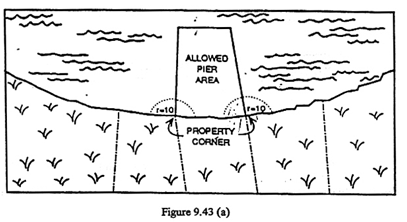
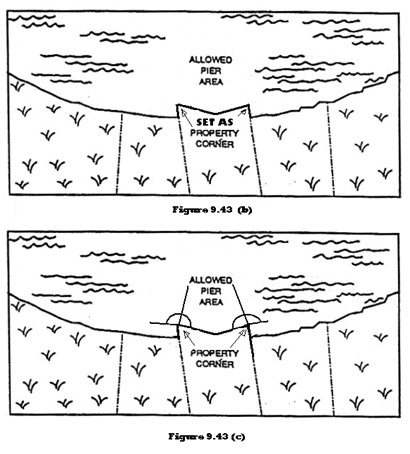
- A projection over the water may be established at each of the two property corners. Each projection shall bisect the angle between two points where a 10-foot radius from a common property corner intersects the property lines defining the shoreline, as illustrated in Figure 9.43(a). If there is no common property corner, the center of the radius shall be the point on the side property line closest to the water, as illustrated in Figure 9.43(b). A line is then drawn from the new center of the radius parallel to the property line defining the shoreline for the adjacent property and the projection is created from that center of radius as illustrated in Figure 9.43(c).
9.44 Beneficial Landfills
- Prior to commencement of fill activity, a change of use permit accompanied by a site plan shall be issued to ensure compliance with the standards found herein.
- Any such site may not be operated for more than 12 months, after which time it must be closed in an approved fashion according to Mecklenburg County Department of Environmental Protection standards.
- The site may be operated only between the hours of 8:00 a.m. and 6:00 p.m. Monday through Saturday.
- Final fill elevations must match or compliment adjacent surrounding topography. The final contours and drainage patterns of the fill area may not adversely affect adjacent properties.
- No fill which includes used asphalt may be placed in any portion of a regulatory flood plain, including both the floodway and floodway fringe area.
- No portion of any such site may be located within 30 feet of any exterior property lines. This includes structures, equipment storage, parking areas and fill areas. When required by other sections of this ordinance, buffer yards shall be used as required.
- Any beneficial landfill must obtain disposal site approval from the Mecklenburg County Environmental Protection Department and comply with the standards of the State of North Carolina.
- At the time of permitting the location of any such site must be indicated on any required final subdivision plat. Further, any parcel or lot which contains any part of any such site must have notification of the existence and extent of the site recorded at the time of permitting as part of the deed for the lot or parcel, even if no subdivision plan is required for the development of the property.
- Fill activity is not exempt from and must comply with, all other applicable Federal, State, and local laws, ordinances, rules and regulations, including, but not limited to, other zoning restrictions, flood plain restrictions, watershed regulations, wetland restrictions, mining regulations, sedimentation and erosion control regulations.
- The landfill operator shall be responsible for removal of any and all debris, dirt, or other materials which fall from trucks entering or leaving the landfill from all adjoining streets on at least a weekly basis or more frequently if needed. Failure to comply constitutes a violation of this ordinance and may constitute grounds for revocation of the operating permit.
- The individual operating the landfill and the property owner, if other, shall provide their name(s), mailing address, and phone number at the time of permitting.
- All driveways which serve the site must be wide enough to accommodate two-way traffic at all times and an area on the site must be provided to accommodate vehicles entering the site so that no traffic waiting to enter the site will be backed up on any public right-of-way. The first 50 feet of any driveway access to the facility must be paved and must directly connect to a major or minor thoroughfare or to an Industrial or Retail/Mixed-Use Collector or Local Street. Driveway permits from the appropriate agency must be issued.
- The actual fill area must be located at least 300 feet from any existing residential structure.
- Vehicular access to the site must be controlled; and must be closed and secured during hours when filling activities are not under way.
Beneficial fill sites less than one-fourth acre do not require a zoning permit or site approval and are exempt from this section, except for conditions (2), (3), (4), (5), (8), (9), and (10) above. In addition (7) is required, if it contains material such as concrete, concrete block, brick or used asphalt.
9.45 Hotels And Motels
Hotels are permitted in the Highway Commercial and Corporate Business Districts subject to the requirements below; Motels are permitted in the Corporate Business District only, subject to the requirements below:
- Any structure in which a hotel or motel is the principal or accessory use shall be separated by a distance of at least 250 feet from any residential or mixed-use zoning district, measured from the closest point of the lot occupied by the hotel or motel to the closest point of lots in residential and mixed-use zoning districts.
- Any structure in which a hotel or motel is the principle or accessory use shall be separated by a distance no less than three (3) times the height of the proposed structure closest to the common lot line of the adjoining residential and mixed-use zone, but in no case less than 100 feet.
- That all other site design requirements stated in this code are met.Any structure in which a hotel or motel is the principal or accessory use is spaced less than established in 1 above shall require a conditional zoning and
- Vehicular access to the use shall be provided only by way of a major or minor thoroughfare, or a Retail/Mixed-Use Local or Collector Street within a commercial or mixed-use project.
- Any structure in which a hotel or motel is the principal or accessory use may exceed the permitted building height of the zoning district, not to exceed six (6) stories, subject to a conditional rezoning, and the requirements of Article 9.45.2.
Amended by Ord. T24-12 SUP on 9/17/2024
9.46 Plant Nurseries
Plant nurseries as defined in Section 12.2.1 are permitted in any R and TR district according to the following standards:
- No part of the proposed use will be located or operated so as to emit dust, noise, fumes or odors in concentrations or amounts that would constitute a nuisance to persons of ordinary sensitivities on nearby properties.
- There shall be a separation of no less than 250 feet between structures located on the tract and any property located in a residential district or developed for residential or mixed-use purposes. The total square footage of all structures located on the tract shall not be greater than five percent (5%) of the total area within the tract. No structures on the tract shall be predominantly metal. Greenhouses are permitted but each greenhouse structure shall not be greater than 36 feet wide, 200 feet long or 14 feet high.
- The proposed use shall be located on a tract of not less than 30 acres. Up to 50% of the tract may be impervious with gravel and up to 12% may be impervious with structures and paved areas.
- Any nonorganic goods or materials available for sale which are positioned in such a way as to be visible from any public right-of-way shall either be returned to an enclosed building each night or screened from view from all public rights-of-way using a semi-opaque screen as defined in Section 7.6 of this ordinance.
- The proposed use shall be accessed by a major thoroughfare. The number of ingress and egress points shall be limited to the total road frontage for the tract divided by 300. Each point of ingress and egress shall be paved for the first 40 feet from the thoroughfare right-of-way.
- The proposed use shall be open to the public only between the hours of 7:00 a.m. and 9:00 p.m.
9.47 Special Uses In TOD-R Districts
Uses permitted in the TOD-R district that exceed maximum first floor area or exceed the maximum limit for non-residential uses are permitted subject to the following conditions:
- Along any street providing primary pedestrian access to a transit station the following requirements apply:
- Street level building edge(s) shall line at least one-half of the approved block length; and
- The distance between pedestrian entries at street level shall not exceed 100 feet; and
- At least thirty percent (30%) of the area of the street level façade shall be composed of windows and doors; and
- The standards set forth in this subsection shall be met by either the principal building, or by the construction of liner buildings along street level.
- The proposed buildings and uses shall not increase the demand for automobile access to the transit-oriented development by 50% or more.
- The proposed buildings and uses meet the Intent statement for the district.
Amended by Ord. T24-12 SUP on 9/17/2024
9.48 Special Uses In TOD-E Districts
Uses permitted in the TOD-E district that have the potential for reducing employment intensity are permitted subject to the following conditions:
- The use is in the area between the ¼ mile and the ½ mile walk from the station site.
- For buildings along any street in the district that provides primary pedestrian access to a transit station:
- Street level building edge(s) shall line at least one-half of the approved block length; and
- The distance between pedestrian entries at street level shall not exceed 100 feet; and
- at least thirty percent (30%) of the area of the street level façade shall be composed of windows and doors; and
- The standards set forth in this subsection shall be met by either the principal building, or by the construction of liner buildings along street level.
- The proposed buildings and uses shall not substantially increase the demand for truck and automobile access through the pedestrian-oriented street system of the TOD by 50% or more.
- The proposed buildings and uses meet the Intent statement for the district.
- Light manufacturing limited to a maximum of 5 acres.
- Accessory warehousing limited to 25% of the finished floor area of the principal use.
Amended by Ord. T24-12 SUP on 9/17/2024
9.49 Transit-Oriented Parking Lots As A Principal Use
Transit-oriented parking lot as a principal use shall be permitted in any zoning district subject to the following standards:
- Transit-oriented parking lots shall adhere to the standards of Article 6, Off-Street Parking, except that in the NR district parking lots may be constructed up to the prevailing established setback line for structures within 300’ in either direction on the same side of the street. The prevailing setback applies for both the fronting street and any abutting streets. In all other zoning districts, transit-oriented parking lots may be constructed up to 10 feet from street right-of-way.
- Buildings associated with transit-oriented parking lots shall meet the standards of Article 9.39, Transit Shelters.
- Transit-oriented parking lots in the Corporate Business (CB), Campus Institutional (CI), or Special Purpose (SP) Districts shall be exempt from the 80’ buffer yard requirement along public streets. All other buffer yard standards of Article 7.6 apply.
- Up to 50% of a transit-oriented parking lot may be unpaved.
9.50 Retirement Communities Are Permitted In The Neighborhood Residential (NR) District Subject To The Conditions Below
- Community must meet the requirements concerning massing and scaling in Article 3.2.4 d-1.
- A minimum of eighty percent (80%) of residents must be fifty-five (55) years of age or older.
9.51 Commercial Use In A Detached House Building Type
- All outdoor display of goods shall be located immediately adjacent to the storefront on the front porch during the hours of operation only; display goods shall not block building access. No other outdoor activity, including outdoor seating, is permitted.
- The hours of operation shall be compatible with the residential area. The hours of operation shall be between 8AM and 9PM. The following activities are prohibited outside of business hours: loading and unloading of materials, exterior maintenance, refuse removal, and other activities that create a nuisance.
- Site lighting shall meet the requirements of Article 8.26 Site Lighting.
Amended by Ord. TA23-05 on 10/16/2023
9.52 (Reserved)
Amended by Ord. T24-12 SUP on 9/17/2024
9.53 Wind Energy Facilities
- No wind energy facility, or addition of a wind turbine to an existing wind energy facility, shall be constructed unless a Special Use Permit has been issued to the facility owner or operator approving construction of the facility under this Ordinance.
- Any physical modification to an existing and permitted wind energy facility that materially alters the size and/or type of wind turbines or other equipment shall require a Special Use Permit modification under this Ordinance. Like-kind replacements shall not require a permit modification.
- Permit Requirements. In addition to Special Use Permit Requirements found in Article 11.4.10, the permit application shall contain the following:
- A narrative describing the proposed wind energy facility, including an overview of the project;
- The proposed number, representative types and height or range of heights of wind turbines to be constructed, dimensions and a description of ancillary facilities;
- Identification and location of the properties on which the proposed wind energy facility will be located;
- A site plan showing the planned location of all wind turbines, property lines, setback lines, access roads and turnout locations, substation(s), electrical cabling from the wind energy facility to the substation(s), ancillary equipment, building(s), and transmission and distribution lines. The site plan must also include the location of all structures and properties, demonstrating compliance of the setbacks;
- Other relevant information as may be reasonably requested by the Town of Huntersville to ensure compliance with the requirements of this Ordinance.
- Decommissioning plans that describe the anticipated life of the wind power project, the estimated decommissioning costs in current dollars, the method for ensuring that funds will be available for decommissioning and restoration, and the anticipated manner in which the wind power project will be decommissioned and the site restored;
- Signature of the Landowner and Applicant.
- Certification of compliance with applicable local, state, and federal regulations, such as Federal Aviation Administration and Federal Communications Commission regulations.
- The applicant shall avoid any disruption or loss of radio, telephone, television or similar signals, and shall mitigate any harm caused by the Wind Energy Facility.
- All wind energy conversion systems shall be equipped with manual (electronic or mechanical) and automatic over speed controls to limit the blade rotation speed to within the design limits of the residential wind energy system.
- General Requirements.
- Setbacks. The following dimensional requirements shall apply to the installation of wind turbines and/or wind energy facilities:1 The setback is calculated by multiplying the minimum setback requirement number by the wind turbine height and measured from the center of the wind turbine base to the property line, public street, or nearest point on the foundation of an occupied structure.
Wind Energy Facility Type Minimum Setback Requirements1 Maximum
Height
from GradeMinimum
Turbine
Blade
ClearanceOccupied Structures (Subject Property) Occupied Structures (Adjacent Property) Property Lines Street Right-
of-WayMinor 0.02 2.5 2.0 2.0 75ft. 20ft. Major 1.0 2.5 2.0 2.0 150ft. 20ft.
2 Minor wind facilities attached to the roof of a structure are prohibited. - Minimum Lot Size Requirements.
- The minimum lot size required for a minor wind facility shall be 10 acres.
- The minimum lot size required for a major wind energy facility shall be 30 acres.
- Maximum number of turbines.
- There shall be no more than one wind turbine that serves as a minor wind energy facility on a single property.
- Any property with more than one wind turbine shall be considered a major wind facility.
- Setbacks. The following dimensional requirements shall apply to the installation of wind turbines and/or wind energy facilities:
- Installation and Design.
- The installation and design of the Wind Energy Facility shall conform to applicable industry standards, including those of the American National Standards Institute, and take into consideration local conditions.
- All structural, electrical and mechanical components of the Wind Energy Facility shall conform to relevant and applicable local, state and national codes.
- Any on-site collector system shall, to the maximum extent possible, be placed underground.
- The visual appearance of Wind Energy Facilities shall at a minimum:
- Turbine(s) shall be of a coloration that will blend with the surroundings (example: brown, green, gray, off-white or white).
- Not be artificially lighted, except to the extent required by the Federal Aviation Administration or other applicable authority that regulates air safety; and,
- Not display advertising (including flags, streamers or decorative items), except for identification of the turbine manufacturer, facility owner and operator.
- The base of the turbine(s) shall be a monopole construction rather than a guyed pole or lattice construction.
- Noise.
- Audible sound from a Major or Minor Wind Energy Facility shall not exceed fifty-five (55) dBA as measured from any adjacent property line of any Non-Participating Landowner.
- Decommissioning.
- The Wind Energy Facility Owner shall have 6 months to complete decommissioning of the Facility if no electricity is generated for a continuous period of 12 months.
- Decommissioning shall include removal of wind turbines, buildings, cabling, electrical components, and any other associated structures required by staff.
- Disturbed earth shall be graded and re-seeded.
9.54 Solar Energy Facilities
- Any major or minor solar energy facility shall require approval from all applicable state and federal agencies as well as the affected energy provider.
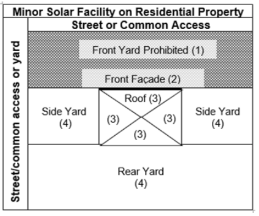
- Minor Solar Energy Facilities (refer to illustration).
- General Requirements for Minor Solar Energy Facilities.
- All minor free-standing facilities must comply with accessory structure setbacks and spacing as set forth in Article 8.8.
- All minor free-standing facilities shall be a maximum of five (5) feet in height as measured from the grade at the base of the structure to the apex of the structure.
i. This provision shall be waived for minor-free standing facilities on residential property if its application would prevent the reasonable use of a solar collector for the residential property.
ii. This provision shall be waived for minor free-standing facilities on commercial property if its application would prevent the reasonable use of a solar collector above vehicular surface parking or ground-level pedestrian walkways that are 14 feet or less in height and located behind an 80-foot buffer.
2. Residential Property.
1. Front yard placement is prohibited pursuant to N.C.G.S. § 160D-914(c)(3) when the placement would cause the solar facility to be visible by a person on the ground.
2. Placement on the façade of a structure that faces areas open to common or public access is permitted as a by-right accessory use in all districts subject to the issuance of a zoning permit.
3. Placement on the roof is permitted by-right accessory use in all districts subject to the issuance of a zoning permit.
4. Side and rear yard placement is permitted as by-right accessory use in all districts subject to the issuance of a zoning permit.
3. Non-Residential Property.
1. Front yard placement, as depicted by area (1) in the above illustration, is prohibited when the placement would cause the solar facility to be visible by a person on the ground.
from the public street
2. Placement of minor free-standing solar facilities on non-residential property in locations other than the front is permitted as a by-right accessory use in all districts subject to the issuance of a zoning permit.
3. Minor rooftop solar facilities on non-residential property are allowed on all roof surfaces.
- General Requirements for Minor Solar Energy Facilities.
- Major Solar Energy Facilities.
- Major solar energy shall require the issuance of a Special Use Permit in accordance with the requirements set forth in Article 11.4.10.
- The minimum lot size requirement for major solar facilities is 10 acres.
- Setbacks for major solar energy facilities shall:
- meet the minimum required setbacks for the underlying zoning district for installations in the R and TR zoning districts.
- be a minimum of 20 feet from any property line in the SP zoning district.
- Free standing major solar facilities shall be a maximum of eight (8) feet in height as measured from the grade at the base of the structure to the apex of the structure. This provision shall be waived for major-free standing facilities on residential property if its application would prevent the reasonable use of a solar collector for the residential property. Major Solar Energy Facilities shall be exempt from any parking requirements in the Huntersville Zoning Ordinance if there is no commercial or office building component.
- Town of Huntersville to be given copies of any lease agreement and plan for removal of facility/equipment.
- Major Solar Energy Facilities shall be exempt from any parking requirements in the Huntersville Zoning Ordinance if there is no commercial or office building component.
- An existing features plan as described in Article 6.300.1.14 of the Subdivision Ordinance must be submitted with the application for the above-described Special Use Permit. Placement of solar panels shall be based on preserving existing features to the exten practical.
- Major solar energy shall require the issuance of a Special Use Permit in accordance with the requirements set forth in Article 11.4.10.
Amended by Ord. TA23-04 on 7/17/2023
Amended by Ord. TA25-09 on 9/16/2025
9.55 Halfway Houses
Halfway houses are permitted in the Special Purpose (SP), Highway Commercial (HC) and Campus Institutional (CI) zoning districts subject to a Special Use Permit, according to the procedures of Section 11.4.10.
The Town Board shall issue a Special Use Permit for a halfway house in the SP, HC, or CI district if, but not unless, the evidence presented at the Special Use Permit hearing establishes:
- The following shall be prohibited:
- Persons dangerous to others
- Sex offenders
- Active (but not recovering) substance abusers
- A Halfway house must meet a permitted building and lot type for the district in which it is to be located.
- No Halfway house may be located within a one-half (1/2) mile radius of any other halfway house or any schools (public or private), parks, playgrounds, day care centers, public and private youth centers.
- Applicant must include in their submittal an area plan showing zoning classifications and land uses of all properties within a one-half mile radius of the site of the proposed halfway house.
- This minimum separation requirement may be waived in situations where its purpose can be otherwise met.
- Applicant must provide:
- Copy of arrest/release records for all occupants.
- Copy of any contracts or policies for the operation of the facility.
- Copy of the rules for the residents of the halfway house.
- Documentation stating that a supervisor will be on duty at all times.
9.56 Crematoriums, Accessory
Crematoriums are permitted in the HC district subject to a Special Use Permit, according to the procedures of Section 11.4.10.
The Town Board shall issue a Special Use Permit for the use in the HC District if, but not unless the evidence presented at the Special use Permit hearing establishes:
- Are accessory to an established Funeral Home.
- That the proposed use will not endanger the public health and safety, substantially reduce the value of nearby property, nor emit noticeable odors; and
- That the proposed use will be constructed and operated in compliance with all applicable environmental regulations; and
- That all storage, handling, incineration, and loading facilities will be located at least 50 feet from any exterior property line; and
- The number of cremations shall be below that requiring an air quality permit by Mecklenburg County per current calendar year.
- That active use portions of the site will be entirely enclosed in the principal structure.
9.57 Automotive Country Club
An Automotive Country Club is a retreat destination and storage facility for rare, collectible, high-end, vintage, and exotic vehicles for club members. Such facilities are permitted in the Corporate Business District if the conditions below are met.
- The club shall only be permitted within a gated and private development (all buildings will front upon and be accessed by privately designed and maintained paved parking and maneuvering areas which shall have adequate widths and turning radii for emergency service access to all individual Units).
- The club may be comprised of both for sale and rental spaces that accommodate Vehicles to be stored, displayed, and for minor repair and maintenance by club members and occupants, but excluding retail repair operations.
- The club shall be established on a site not less than 15 acres in size with frontage upon a public street.
- The club shall include a clubhouse facility and may include a management or sales office.
- The club shall permit garage/storage units (“Units”) to be individually sold or leased. Each building may be comprised of varying Unit sizes separated by demising walls.
- The club shall limit the total number of overnight stays by occupants to a maximum of thirty (30) per year.
- The club may permit up to 24 memorabilia or charity auctions, fundraisers, rallies, car shows, or similar events per calendar year.
- The Automotive Country Club use shall include the definition of a “Vehicle” as any motorized device considered to be rare, collectible, high-end, vintage or exotic.
- The club shall prohibit outdoor storage.
- The club shall prohibit automotive wholesale and retail sales of Vehicles.
- No part of the automotive country club use will be located or operated so as to emit noise in concentrations or amounts that would constitute a nuisance to persons of ordinary sensitivities on nearby or adjacent properties.
9.58 Internet Sweepstakes
Internet Sweepstakes are permitted in the Highway Commercial (HC) and Special Purpose (SP) Zoning Districts, subject to the following standards:
- Internet Sweepstakes are not permitted as an accessory use;
- Any structure in which an Internet Sweepstakes is the principal use shall be separated by a distance of at least 400 feet from any residential or mixed-use zoning district and from the following principal or accessory uses, defined as protected uses for purposes of this section: dwelling units, elementary and secondary schools, religious institutions, child care centers, parks and playgrounds;
- Any structure in which an Internet Sweepstakes is the principal use shall be separated by a distance of at least 400 feet from any other Internet Sweepstakes;
- The distance of separation from residential and mixed-use zoning districts and from the protected uses listed in 2., above, shall be measured from the closest point of the lot occupied by an Internet Sweepstakes to the nearest residential or mixed use zoning district or the property line of a protected use. The distance of separation between Internet Sweepstakes shall be measured from the closest points of the lots occupied by Internet Sweepstakes;
- No alcohol may be sold or consumed on the premises;
- Operations must be visible and open to the front of the store. Tinted glass with a minimum visual transmittance factor of 35 is permitted.
- Patrons must be 18 years of age or older.
9.59 Banquet Facility
Banquet Facilities are permitted in the Rural Zoning District subject to the following conditions:
- That the hours of operation, including set-up and break-down, for events will be no earlier than 8:00 am and no later than midnight (12:00 am).
- That events must comply with the noise restrictions identified in the Town of Huntersville Noise Ordinance whether the property is located within the Town’s corporate limits or the Extraterritorial Zoning Jurisdiction (ETJ);
- That the use will be located on a lot of at least 10 acres in size with a minimum of 30 feet of frontage on a public road either by fee simple ownership or by exclusive easement.
- One residence (single-family detached house) may be located on the site.
- New buildings shall maintain a rural character and be compatible with surrounding area.
- Events may take place inside a building, tent, or outdoors. Catered activities and receptions may take place in tents or buildings.
- Entrance drives, internal drives, parking and service areas may be gravel, crushed stone, or other suitable material approved by the Planning Director. These areas shall be well maintained and kept free of potholes, weeds, etc. The initial 50 feet of driveway from the public roadway connection shall be paved with concrete or asphalt.
- That there will be a separation of no less than:
- Parking areas shall be located one hundred (100) feet from arterial roads and thoroughfares, and fifty (50) feet from adjacent properties. Parking areas will be visually buffered from arterial roads, thoroughfares and adjoining properties.
- Event areas shall be visually buffered and located sixty (60) feet from any property boundary located in a residential district or developed for residential or mixed-use purposes.
- Any newly constructed accessory structure such as barns, gazebos and Agriculture or Farm related structures shall be located at a minimum of sixty (60) feet from any property boundary located in a residential district or developed for residential or mixed-use purposes.
- As each property is unique, the Town Board may modify the buffers for a Banquet Facility based on particular topographical issues and uses of the property. For instance, additional buffer requirements may be appropriate for event areas and/or reduction in buffer area may be appropriate for farming or pasture areas.
- The facility shall have adequate off-street parking to accommodate the maximum number of attendees.
- The method for providing potable water and a system of sanitary sewage collection and disposal for the maximum number of attendees shall be provided.
- Mobile food/beverage vehicles are allowed on the premises with the following conditions:
- The mobile food/beverage vehicles must cater to the guests of invitation only events, for a time period limited to the event, and are not open to public use.
- The mobile food/beverage vehicles must park in a designated spot, indicated on the special use plan. This area will be screened from public view and adjacent land owners, by an opaque screen.
- No more than three mobile food/beverage vehicles allowed at one time.
- No trucks will be stored overnight on the property
Amended by Ord. T24-12 SUP on 9/17/2024
9.60 (Reserved)
Amended by Ord. T24-12 SUP on 9/17/2024
9.61 (Reserved)
Amended by Ord. T24-12 SUP on 9/17/2024
9.62 Dormitory
Dormitories for a bona fide farm are permitted in the Rural and Transitional Zoning Districts subject to the following conditions:
- The use shall not conflict with long range plans.
- The use shall not violate any applicable nuisance ordinance or other applicable laws.
- Buildings, parking, trash facilities shall be setback at least 100’ from any adjoining property line and 500’ from any public street right-of-way.
- The use shall be visual screened year round from all adjoining properties and public streets.
- The driveway and parking area shall, at minimum, be ground asphalt
- The dormitory is located on a bona fide farm and is on the land being farmed by the occupants on a full time basis.
- The dormitory cannot exceed two (2) stories in height; 15,000 sq. ft. per building; and five buildings total.
- Building and housing will be constructed and maintained to meet H-2A program requirements or similar federal programs applicable at the time.
Dormitories located in the Town's ETJ and used for a bona fide farm purpose as defined in N.C.G.S.160D-903 are exempt from the conditions set forth above.
Amended by Ord. T24-12 SUP on 9/17/2024
9.64 (Reserved)
Adopted by Ord. TA22-16 on 3/20/2023
Amended by Ord. Draft TA25-06 Buffer Yards on 8/19/2025

