
Huntington City Zoning Code
CHAPTER THREE
GENERAL ZONING PROVISIONS3
Editor's note— The Huntington Zoning Ordinance codified as Chapters Three to Nine of this Part Thirteen - Planning and Zoning Code was adopted December 14, 1998. Subsequent amendments to the Zoning Ordinance will be indicated by legislative histories placed at the end of the affected sections.
ARTICLE 1313 - ZONING PURPOSES AND AUTHORITY[4]
State Law reference— Zoning authority generally, W. Va. Code, § 8-24-39; conflict of laws, W. Va. Code, § 8-24-70.
ARTICLE 1315 - DEFINITIONS AND MEASUREMENTS[5]
Cross reference— General definitions, § 101.02.
State Law reference— Statutory definitions, W. Va. Code, § 8-24-3.
1313.01 - SHORT TITLE.
This ordinance and ordinances supplemental or amendatory thereto, shall be known and may be cited as the "Zoning Ordinance of the City of Huntington, West Virginia".
1313.02 - PURPOSES.
This ordinance is enacted pursuant to a Comprehensive Plan for the following purposes:
A.
To promote, protect, and facilitate one or more of the following: the public health, safety, morals, general welfare, coordinated and practical community development, proper density of population, civil defense, disaster evacuation, airports, and national defense facilities; and the provision of adequate light and air, police protection, vehicle parking and loading space, transportation, water, sewerage, schools, public grounds, and other public requirements.
B.
To prevent one or more of the following: over crowding of land; blight; danger and congestion in travel and transportation; loss of health; life or property from fire; flood; panic; or other dangers.
1313.03 - AUTHORITY.
This ordinance is enacted pursuant to the authority contained in the Urban and Rural Planning and Zoning Act, Chapter Eight of the Code of West Virginia, as amended, and in accordance with the Charter of Huntington, West Virginia, 1960.
1313.04 - USE OF PROPERTY.
No building, land area, or water body shall hereafter be used or occupied and no building or part thereof shall be erected, altered, or relocated unless in conformance with the regulations herein specified for the zoning district in which it is located. The use or occupation of any building, land area, or water area, or part thereof, which is not specifically permitted by any rule or regulation of the ordinance, is a violation of this ordinance.
1313.05 - EFFECTIVE DATE.
This ordinance shall take effect on the day of enactment.
1313.06 - STATEMENT OF CONSISTENCY.
This ordinance is enacted with consideration for the natural and manmade environment of the city, the character of this community, its various parts and the suitability of the various parts for particular uses and structures. Furthermore, this ordinance is enacted in accordance with an overall program, the City of Huntington Comprehensive Plan.
1313.07 - BUILDING CODE.
The City of Huntington, in accordance with State Code, has enacted a Building Code. The Building Code and this zoning ordinance are complimentary and the requirements of each document must be considered with the most restrictive applying.
1313.08 - VALIDITY.
Should any section or provision of this ordinance be declared by a court of competent jurisdiction to be invalid or unconstitutional, such decision shall not affect the validity of this ordinance as a whole or any part thereof, and the parts of or sections remaining shall remain in effect as though the part or section declared invalid or unconstitutional has never been a part thereof.
1315.01 - INTERPRETATION OF WORDS.
For the purpose of this ordinance, certain terms and words used herein shall be interpreted or defined as follows:
1.
Words used in the present tense shall include the future.
2.
Words used in the singular shall include the plural.
3.
Words used in the plural shall include the singular.
4.
The word "person" includes a profit or non-profit corporation, company, partnership, individual or an association of individuals.
5.
The word "lot" includes the words "plot" or "parcel."
6.
The terms "shall" and "will" are always mandatory.
7.
The word "may" is permissive.
8.
The words "used" or "occupied" as applied to any land or building shall be construed to include the words "intended, "arranged" or "designed" to be used or occupied.
9.
The word "building" includes the word "structure".
10.
Unless otherwise specified, all distances shall be measured horizontally.
11.
The masculine shall include the feminine.
1315.02 - MEANING OF WORDS.
Unless otherwise stated, the following words shall, for the purpose of this Ordinance have the following meanings:
(A)
ACCESSORY DATA CENTER - A prefabricated, unstaffed unit that is intended to be a supportive remotely operated unit, often dispersed in clusters close to where end users are physically located or to include equipment for the primary user of the lot. Accessory units must be smaller in size than the primary permitted use on the lot.
ACCESSORY STRUCTURE - A structure detached from a principal building on the same lot and customarily incidental and subordinate to the principal building. Examples include, but are not limited to: private garage, carport, tennis court, basketball backboard, household swimming pool, volleyball court, gazebo, storage shed, greenhouse, children's playhouse and children's play equipment.
ACCESSORY USE - A use customarily incidental and subordinate to the principal use and located on the same lot with such principal use. For examples of "Accessory Use," see "Accessory Structure."
ADULT BOOKSTORE - Any commercial establishment in which is offered for sale as a substantial or significant portion of its stock in trade video cassettes, movies, books, magazines or other periodicals or other media which are distinguished or characterized by their emphasis on nudity or sexual conduct or on activities which if presented in live presentation would constitute adult entertainment.
ADULT BUSINESS - An adult bookstore, commercial movie theater or movie house, or other adult entertainment as defined herein. In the event that an activity or business which might fall under a use category other than adult business is combined with and/or includes activities which constitute an adult bookstore, adult movie theater or movie house or adult entertainment as defined herein, then such activity or business shall constitute an adult business and shall be governed by those provisions in this ordinance applicable to any other use category.
ADULT ENTERTAINMENT - A commercial establishment providing, either as a sole use or in connection with or in addition to other uses, entertainment consisting of any exhibition, display, or dance which involves the exposure to view of any portion of the female breast below the top of the areola, male genitals, female genitals, or the pubic hair, anus, or cleft of the buttocks of any person or male genitals in a discernibly turgid state even if completely and opaquely covered.
ADULT MOVIE THEATER OR MOVIE HOUSE (including adult mini-theaters or adult arcades) - Any commercial establishment to which the public is permitted or invited, where for any form of consideration, films, motion pictures, video cassettes, slides or similar photograph reproductions are regularly shown depicting actual acts of masturbation, sexual intercourse, oral copulation, sodomy or displaying human genitals in a state of sexual stimulation, arousal, or tumescence, or depicting excretory functions as part of or in connection with any of the activities set forth in this section.
ADULT USE - Shall be a term that includes "Adult Bookstore," "Adult Business," "Adult Entertainment," or "Adult Movie Theater or Move House."
AGRICULTURAL USE - Any portion of land used for agriculture including horticulture truck gardening, floriculture, trees, grain, forage crops, or any use of the same general character, but not the raising of livestock.
ALLEY - A public service way providing a secondary means of public access to abutting property and not intended for general traffic circulation.
ALTERATION - Any change, addition, or modification in construction or occupancy of a structure.
ALTERATION, STRUCTURAL - Any change in the supporting members of a building such as bearing walls, columns, beams, or girders, or in the dimensions or configurations of the roof or exterior walls.
ANIMAL BOARDING AND TRAINING - A facility for the boarding, raising, grooming, selling, training, or other animal husbandry activities for dogs, cats, or other animals for financial or other compensation.
ANIMAL HOSPITAL/CLINIC - A use or structure intended or used primarily for the testing and treatment of animals on an emergency or outpatient basis; synonymous with veterinary hospital. This may or may not include grooming and boarding of animals.
ANTENNA, STANDARD - A device, partially or wholly exterior to a building, that is used for receiving and /or transmitting short-wave or citizens band radio frequencies or for receiving television, radio or similar frequencies, but not including a satellite dish antennae or a commercial communication antennae. This includes any accessory supporting structures.
AREA, BUILDING - The total of the exterior areas taken on a horizontal plane at the main floor of the principal building and all accessory buildings, exclusive of uncovered porches, terraces, and steps.
AREA, LOT - The total area within the lot lines.
ASSISTED LIVING OR CONGREGATE HOUSING - A facility which use does not meet the definition of single/household unit, boarding or dormitory housing, group residential facility, or group residential home but meets one of the following definitions:
a.
ASSISTED LIVING HOUSING - Any residential facility, residence, or place of accommodation, however named, available for four or more residents for the express or implied purpose of having personal assistance or supervision, or both, provided to any residents therein who are dependent upon the services of others by reason of physical or mental impairment and who may also require nursing care at a level that is not greater than limited or intermittent nursing care. Other names for this definition include but are not limited to nursing homes, convalescent home, or convalescent hospital.
b.
CONGREGATE HOUSING - A residence for four or more elderly persons (age 60 and older) within which are provided living and sleeping rooms, meal preparation, laundry services, and room cleaning. Congregate housing may also provide other services, such as transportation for routine social and medical appointments and counseling. Other names for this definition include retirement home or retirement community.
AUTO SERVICE STATION AND REPAIR SHOP - Any structure or premises used primarily for the servicing and repair of motor vehicles. May include minor repair work - including not limited to, oil changes, replacement of tires, and replacement of batteries - and major repair work - including but not limited to motor replacement, body and fender repair, or spray painting.
AUTOMOTIVE AND OTHER VEHICLES SALES - Any building or land used for the display, sale or rental of new or used motor vehicles in operable condition. Such use may also include the display, sale, or rental of motorcycles, mopeds, or other motorized two- or three-wheeled vehicles. Auto services and repairs are a permitted accessory use.
(B)
BANQUET HALLS OR CONFERENCE CENTERS - Facilities or buildings available for lease by private parties that may include kitchen facilities for the preparation or catering of food, the sale of alcoholic beverages for on-premises consumption during scheduled events not open to the public, and/or outdoor gardens, decks, or reception facilities.
BAR - Premises used primarily (gross revenue from alcoholic beverages sale are greater than one-half of total revenue) for sale or dispensing of alcoholic beverages by the drink for on site consumption, and where food may be available for consumption on the premises as accessory to the principal use.
BARGE TERMINAL - Facilities for launching, mooring, docking, loading, unloading and servicing river barges, including backup land for storage and transshipment.
BASE FLOOD -The flood which has been selected to serve as the basis upon which the flood plain management provisions of this and other ordinances have been prepared; for purposes of this ordinance, the 100-year flood.
BASEMENT - A space having one-half or more of its floor-to-ceiling height above the average adjoining grade and with a floor-to-ceiling height of not less than six and one-half feet. However, for the purposes of flood plain management abasement is any area of the building having its floor subgrade (below ground level) on all sides.
BED AND BREAKFAST OR TOURIST HOUSE - A house or portion thereof, where short term lodging rooms and meals are provided. The operator of the house shall live on the premises or in adjacent premises.
BEDROOM - A private room planned and intended for sleeping, separable from other rooms by a door, and accessible to a bathroom without crossing another bedroom.
BILLBOARD - See SIGN, BILLBOARD.
BLOCK - A unit of land bounded by streets or by a combination of streets and public land, railroad rights-of-way, waterways, or any other barrier to the continuity to development.
BLUE ROOF - A roof of a building that is designed explicitly to provide initial temporary water storage and then gradual release of stored water, typically rainfall, as part of a storm water management system.
BOARD - The Board of Zoning Appeals of the City of Huntington.
BOARDING HOUSE - A residential use in which: a) two or more individual rooms that do not meet the definition of a dwelling unit are rented for habitation or b) a dwelling unit that includes greater than the permitted maximum number of unrelated persons. A boarding house shall not include a use that meets the definition of hotel, dormitory, motel, life care center, personal care center, group residential facilities, or nursing home. A college fraternity or sorority house used as a residence shall be considered a type of boarding house. A boarding house may either involve or not involve the providing of meals to residents. This use shall only involve renting living accommodations for minimum periods of five consecutive days.
BREWPUB - A restaurant which includes the brewing of beer or the fermentation of wine or cider as an accessory use for sale at the same premises of not more than 5,000 barrels per year for either consumption on premises or sold directly to the consumer. (A barrel is equivalent to 31 U.S. gallons.)
BUFFER YARD - A strip of land that a) separates one use from another use or feature, and b) is not occupied by any building, parking, outdoor storage or any use other than open space or approved pedestrian pathways. A buffer yard may be part of the minimum setback distance, but land within an existing or future street right-of-way shall not be used to meet a buffer yard requirement.
BUILD-TO LINE - An imaginary line parallel to a right-of-way line, created when the minimum setback and maximum setback for building facades are the same.
BUILD-TO ZONE - An area of the lot bounded by interior side and/or corner side lot lines and two imaginary lines, which are parallel or radial to a right-of-way line and correspond to the minimum and maximum setback for the façade of a principal building.
BUILDING - Any structure having a roof supported by columns or walls and intended for the shelter, housing or enclosure of any individual, animal, process, equipment, goods or materials of any kind or nature. When separated by party walls, without any opening through walls, each portion of a building shall be considered a separate structure.
BUILDING CODE - The Building Code of the City of Huntington as adopted by article 1711 of the Huntington Codified Ordinances.
BUILDING COVERAGE - The horizontal area measured within the outside of the exterior walls of the ground floor of all principal and accessory buildings on a lot.
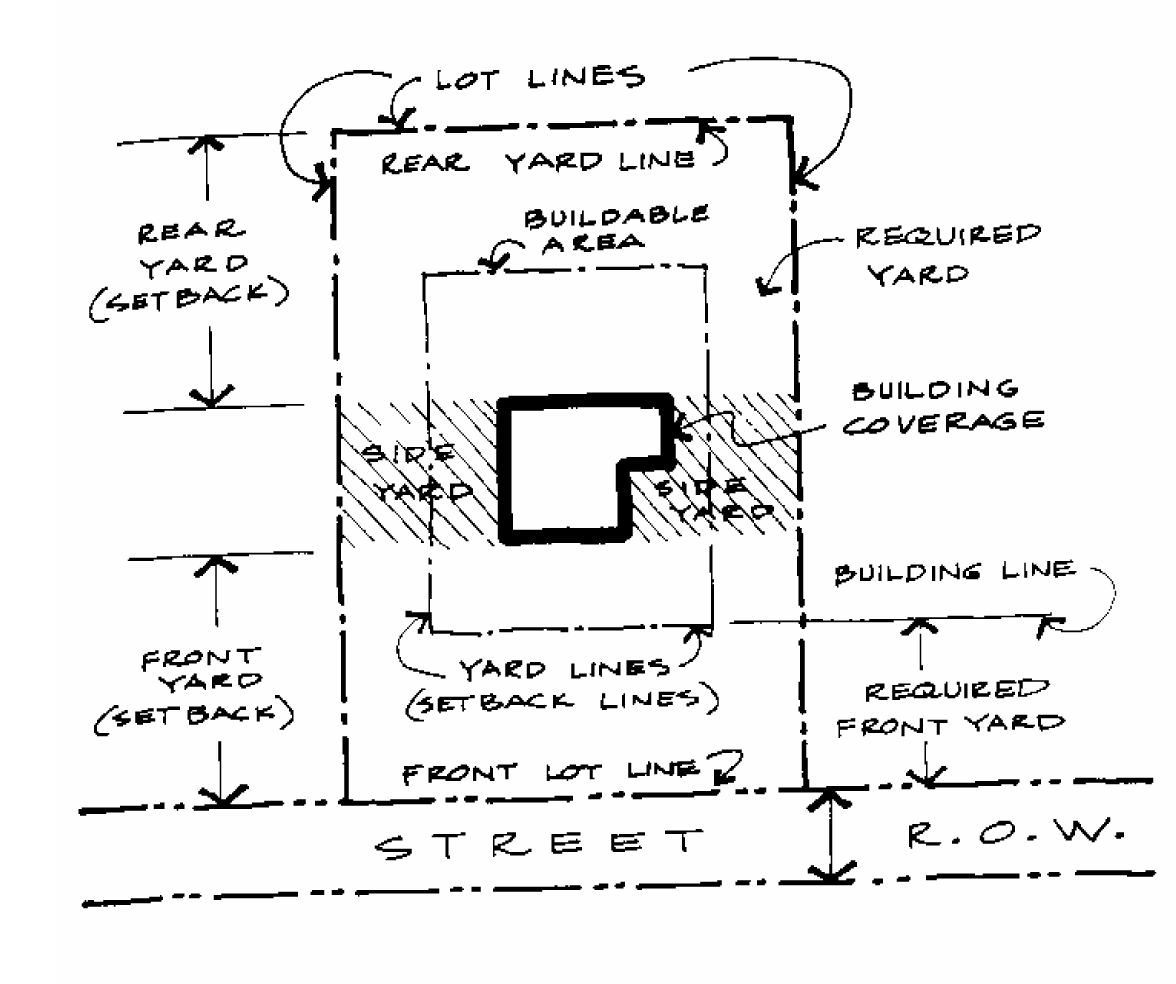
Figure 1315.A
BUILDING HEIGHT - The vertical distance measured from the average elevation of the finished grade of the structure to a point on the structure as determined by the regulations within section 1315.07 Building Height.
BUILDING LINE - A line parallel to the street line that passes through the point of the principal building nearest the front lot line. See SETBACK.
BUILDING PERMIT - A permit signed by the code official stating that proposed improvement, development, or use compare with the provisions of this ordinance and the Building Code.
BUILDING, PRINCIPAL - A building in which is conducted the principal use of the lot on which it is located. Where a part of an accessory building is attached to the principal building in a substantial manner, as by a roof, such accessory building shall be considered a part of the principal building, provide that a carport shall not be considered a part of the principal building.
BUILDING WIDTH - The horizontal measurement between two structural walls of one building that are generally parallel, measured in one general direction that is most closely parallel to the required lot width. For a townhouse, this width shall be the width of each dwelling unit.
BUSINESS - The engaging in the purchase, sale, barter or exchange of goods, wares, merchandise or services; the maintenance or operation of offices, or recreational and amusement enterprises for profit.
(C)
CARPORT - An open space for the storage of one or more vehicles in the same manner as a private garage, which may be covered by a roof supported by columns or posts except that one or more walls may be the walls of the main building to which the carport is an accessory building or extension.
CARWASH - A building or lot that has its primary purpose as washing vehicles and may include self-service facilities or automatic washing facilities.
CEMETERY - Land used for the burial of the dead and dedicated for cemetery purposes, including columbariums, mausoleums and mortuaries when operated in conjunction with and within the boundary of such cemetery.
CERTIFICATE OF APPROPRIATENESS - A certificate issued by the Huntington Historic Preservation Commission indicating its approval of plans for additions to a landmark, building, structure or site; removal or demolition of a landmark, building, structure or site; or new construction within a designated historic district zone.
CERTIFICATE OF OCCUPANCY - A certificate signed by the code official as defined by city ordinances stating that the occupancy and use of land or a building or structure complies with the provisions of this ordinance and the Building Code.
CHARITABLE ORGANIZATIONS - As regards "exempt" tax status, such includes: Corporations, and any community chest, fund, or foundation, organized and operated exclusively for religious, charitable, scientific, testing for public safety, literary, or educational purposes, or to foster national or international amateur sports competition (but only if no part of its activities involve the provision of athletic facilities or equipment), or for the prevention of cruelty of children or animals, no part of the net earnings of which inures to benefit of any private shareholder or individual, no substantial part of the activities of which is carrying on propaganda, or otherwise attempting, to influence legislation.
CHILD CARE CENTER - See "Day Care, Child or Adult."
CLEAR-SIGHT TRIANGLE - The triangular area formed by two intersecting street centerlines and a line interconnecting points established on each centerline and further described by section 1341.03 of this ordinance.
CODE OFFICIAL - The officer or other designated authority charged with the administration and enforcement of this Code, the Building Code, or other pertinent city development codes.
COMMERCIAL COMMUNICATIONS TOWER/ANTENNAE - A structure, partially or wholly exterior to a building, used for transmitting or retransmitting electronic signals, such as but not limited to antenna used for transmitting commercial radio or television signals or cellular telephone communications. This shall not include a standard antenna.
COMMERCIAL GREENHOUSE - A building used for the growing, storage, and sale of legal garden plants, shrubs, trees, or vines for retail or wholesale sales. Greenhouses that are part of a larger agricultural use shall be considered accessory to the principal agricultural use of the land.
COMMERCIAL RECREATIONAL FACILITIES (INDOORS) - Facilities that are not owned or operated, in whole or in part, by the city, county, state, or a non-profit agency, and which are open to the general public for a fee that shall include, but is not limited to: roller blade rental, billiard parlors, ice skating rinks, indoor swimming pools, and other similar businesses. All activities take place within an enclosed building. May include incidental alcohol sales.
COMMERCIAL RECREATIONAL FACILITIES (OUTDOORS) - Land or facilities that are not owned or operated, in whole or in part, by the city, county, state, or a non-profit agency, and which are open to the general public for a fee that shall include, but is not limited to: pay-to-play athletic fields, golf courses, outdoor swimming pools, amusement parks, racetracks, and other similar businesses. May include incidental alcohol sales.
COMMISSION - The Planning Commission of the City of Huntington.
COMMON OPEN SPACE - A parcel or parcels of land or an area of water suitable for recreational purposes or a combination of such land and water within a development site and designed and intended for the use or enjoyment of residents of the development, not including streets, off-street parking areas, and areas set aside for public facilities. Common open space shall be substantially free of structures, but may contain such improvements as are in the development plan as finally approved and as are appropriate for the recreation of residents.
COMMON WALLS - A common wall, also known as a party wall, is a dividing partition between two adjoining buildings.
COMMUNICATIONS NETWORK FACILITY, HEADEND, OR HUB - A building used for housing telecommunication equipment for receiving and distributing communications for internet or intranet, phone, television, or similar services. The building and site is often characterized by features such as satellite dishes, large telecommunication lines (either aerial or underground) such as phone line, cable line, fiber optic, or similar communication lines. The building may be staffed or unstaffed and is typically surrounded by some type of security fencing. A network facility, headend, or hub may be an accessory use to another principal use and located on the same lot. Principal uses may include radio or television stations, hospitals, or government offices and facilities.
COMMUNITY CENTER - A building (1) used for recreational, social, educational, and/or cultural activities, open to the public or a designated part of the public, and (2) owned or operated by a public, non-profit group or agency, or for-profit agency that provides services to the residential area. This does not include retail, personal, or professional services.
COMPREHENSIVE PLAN - The Comprehensive Plan for the City of Huntington, West Virginia.
CONDITIONAL USE - Uses that are publicly operated and those uses traditionally affected with a public interest and those uses entirely private in character but of such an unusual nature that their operation may give rise to unique problems with respect to their impact upon neighboring property and public facilities. Also called "Special Permit."
CONDOMINIUM - An estate in real property consisting of an undivided interest in common with other purchasers in a portion of a parcel of real property, together with a separate interest in space in a residential building, such as an apartment. A condominium may include, in addition, a separate interest in other portions of such real property. A condominium is an ownership arrangement, not a land use; therefore, it is allowed in any district and under the same restriction as the land uses that it comprises. A condominium shall not negate lot nor other requirements intended to provide adequate light, air, and privacy.
CONVENTIONAL SUBDIVISION - A subdivision in which all or most of a plot or parcel is divided into lots and streets with little or no area reserved as common open space.
CRAFT PRODUCTION FACILITY (MICROBREWERY/MICRODISTILLERY/MICROCIDERY) - A facility in which beer, wine, or other alcoholic beverages are brewed, fermented, or distilled for distribution and consumption, and which possesses the appropriate license from the State of West Virginia. On premise production includes more than 500 barrels per year. Tasting rooms for the consumption of on-site produced beer, wine, or distilled products are permitted on premises as an accessory use. Retail sales are also permitted in hand-capped or sealed containers in quantities up to one-half barrel or 15.5 gallons sold directly to the consumer.
CULTURAL INSTITUTIONS - Public or private facilities use for display, performance, or enjoyment of heritage, history, or the arts. This use includes, but is not limited to, museums, libraries, art performance venues, cultural centers, and interpretative sites but does not include "theaters."
(D)
DATA CENTER - An establishment engaging in the storage, management, processing, and/or transmission of digital data, equipped with computer and network systems, servers, appliances, and related components essential for digital operations. Typically, this facility is designed with supportive infrastructure, including backup power supplies, redundant data communication connections, environmental controls (such as air conditioning and fire suppression), and advanced security measures. See also MICRO DATA CENTER.
DAY CARE (CHILD OR ADULT) - A facility administering to the needs of infants, toddlers, pre-school children, and school children outside of school hours, by persons other than their parents or guardians, custodians, or relatives by blood, marriage or adoption for any portion of the 24-hour day in a building other than the child's own home. This use may include, but is not limited to, after school programs, office day care centers and principal structures used for only day care/nursery school programs. This term may also include adult day care centers where persons other than children, family members, or guardians care for adult for a portion of a 24-hour day in a building other than the adult's home.
DECK - A constructed open area, usually attached to or part of and with direct access to or from, a building.
DENSITY - A measure of the number of dwelling units which occupy, or may occupy, an area of land.
DEVELOPER - The legal or beneficial owner or owners of a lot or of any land included in a proposed development including the holder of an option or contract to purchase, or other persons having enforceable proprietary interests in such land.
DEVELOPMENT - The division of a parcel of land into two or more parcels; the construction, reconstruction, conversion, structural alteration, relocation or enlargement of any structure; any mining, excavation, landfill or land disturbance, and any use or extension of the use of land.
DEVELOPMENT PLAN - A drawing, including a legal or site description, of the real estate involved which shows the location and size of all existing and proposed lots, building, structures, and yards; location and dimension of the building lines and easements; widths and lengths of all entrances and exits to and from said real estate; location of all adjacent or adjoining streets; all of which presents a unified or organized arrangement of streets, lots, buildings and public and service facilities and other improvements such as landscape development, and public parking areas, all of which shall have a functional relationship to the real estate comprising the planned development and to the use of properties immediately adjacent thereto.
DISABLED (HANDICAPPED) - Any person who has a physical or mental impairment which substantially limits one or more major life activities or a record of such impairment or being regarded as having such an impairment. A physical or mental impairment includes, but is not limited to, diseases and conditions such as orthopedic, visual, speech, and hearing impairments, cerebral palsy, autism, epilepsy, muscular dystrophy, multiple sclerosis, cancer, heart disease, diabetes, HIV infection, developmental disabilities, mental illness, drug addiction (other than addiction caused by current illegal use of a controlled substance), and alcoholism.
DISTRIBUTION FACILITIES - A use where goods are received and/or stored for delivery to the ultimate customer or user at remote locations.
DISTRICT OR ZONING DISTRICT - An area constituted by or pursuant to this ordinance and delineated by text and map as to location, extent, nature, and contents.
DORMITORY - A residential use in which: a) two or more individual rooms that do not meet the definition of a dwelling unit are rented for habitation or b) a dwelling unit that includes greater than the permitted maximum number of five unrelated persons. A dormitory house shall not include a use that meets the definition of hotel, motel, group residential facilities, or assisted living and congregate housing. A college fraternity or sorority house used as a residence shall be considered a type of dormitory.
DRIVE-IN OR DRIVE-THRU - An establishment which by design, physical facilities, service, or by packaging procedures encourages or permits customers to receive services, obtain goods, or be entertained while remaining in their motor vehicles. Includes "Drive-Through."
DWELLING - A building or portion thereof, used primarily as a place of abode for one or more human beings, but not including hotels, motels, lodging or boarding houses, or tourist homes as defined in this ordinance.
DWELLING TYPE:
(1)
RESIDENTIAL CONVERSION UNIT - To be considered a conversion, any proposed alteration must be confined to the interior of an already existing structural shell. Any proposal to extend the sides or increase the height of an existing structure or to alter the foundation shall not be considered a conversion and shall be required to meet the appropriate provisions established in that district for that particular use.
(2)
SINGLE-FAMILY ATTACHED/TOWNHOUSE - A one-family dwelling attached to two or more one-family dwellings by common vertical or "party" walls and also referred to as row houses.
(3)
SINGLE-FAMILY DETACHED - A dwelling unit which is designed for and occupied by not more than one-family and surrounded by open space or yards.
(4)
SINGLE-FAMILY DUPLEX - Two dwelling units accommodating two families which are attached side by side through the use of adjoining walls, and having one side yard adjacent to each dwelling unit.
(5)
ACCESSORY DWELLING UNIT - An accessory dwelling unit, also known as a carriage house or garage apartment, is a small building typically designed for a dwelling unit or a home occupation that may be above a garage at ground level.
(6)
MULTI-FAMILY DWELLING UNITS - Any building or structure having more than two dwelling units.
(7)
MANUFACTURED HOME - A dwelling unit fabricated in an off-site manufacturing facility for installation or assembly at the building site, bearing a label certifying that it is built in compliance with the Federal Manufactured Housing Construction and Safety Standards Act of 1974 (42 USC 5401, et seq.), which became effective June 15, 1976. The structure shall be transportable in one or more sections, built on a permanent chassis, and designed for use with or without a permanent foundation when connected to the required utilities. The term "manufactured home" does not include a "recreational vehicle".
(8)
MODULAR HOME - A factory-fabricated, transportable building consisting of two or more sections designed to be incorporated at a building site on a permanent foundation into a permanent structure, to be used for residential purposes and which bears a seal of compliance with regulations of the International Residential Code one and two-family building code or the International Building Code and other building codes adopted by the City of Huntington by ordinances.
(9)
MOBILE HOME - A transportable, factory-built home, designed to be used as a year-round residential dwelling and built prior to the enactment of the Federal Manufactured Housing Construction and Safety Standards Act of 1974, which became effective June 15, 1976.
DWELLING UNIT - A single unit of one or more rooms providing complete, independent living facilities for one family including permanent provisions for living, sleeping, and eating, and kitchen and bathroom facilities but not including a tent, cabin, hotel, motel, recreational vehicle, or other temporary or transient structure or facility. See "Kitchen" and "Family/Household Unit".
(E)
EDUCATIONAL INSTITUTION - Public or parochial pre-primary, primary, grade, high, preparatory school or academy; junior college, college or university, if public or founded or conducted by or under the sponsorship of a religious or charitable organization.
E-CIGARETTE - An electrical or electronic device that provides a smoke, vapor, fog, mist, gas or aerosol suspension of nicotine or another substance that, when used or inhaled, simulates the activity of smoking. The term e-cigarette includes, but is not limited to, a device that is composed of a heating element, battery or electrical or electronic circuit, or a combination of heating element, battery and electrical or electronic circuit, which works in combination with e-cigarette liquid to produce an inhalable product. The term e-cigarette includes, but is not limited to, any so designed, or similarly designed, product that is manufactured, distributed, marketed or sold as an e-cigarette, e-cigar, e-pipe or under any other name or descriptor. The term "simulates the activity of smoking," in the context of this definition, means replicating, mimicking or reproducing an experience similar to inhaling, or otherwise drawing into the mouth or nose, or exhaling the smoke or combustion product of burning tobacco or any other product or material that can be used in a similar fashion.
E-CIGARETTE LIQUID - Any of the liquids or liquid mixtures used in e-cigarettes and is also known as e-juice, e-fluid, e-liquid, vape juice, or e-liquid product. E-cigarette liquid includes e-cigarette liquid mixing kits and e-cigarette liquid mixing kit components. When used in, or with, an e-cigarette, e-cigarette liquid is vaporized or otherwise converted into an inhalable product. E-cigarette liquid may or may not include, without limitation, propylene glycol, vegetable glycerin, nicotine from any source or flavorings.
EXISTING MANUFACTURED HOME PARK OR SUBDIVISION - A manufactured home park or subdivision for which the construction of facilities for servicing the lot on which the manufactured homes are to be affixed (including, at a minimum, the installation of utilities, the construction of streets, and either final site grading or the pouring of concrete pads) is completed before the effective date of this ordinance.
EXPANSION TO AN EXISTING MANUFACTURED HOME PARK OR SUBDIVISION - The preparation of additional sites by the construction of facilities for servicing the lot on which the manufactured homes are to be affixed (including the installation of utilities, the construction of streets, and either final site grading or the pouring of concrete pads).
(F)
FAMILY/HOUSEHOLD UNIT - All persons living in the same household who are related by birth, marriage, or adoption. Additionally, family refers to the following:
A.
An individual, or two or more persons related by blood, marriage, or adoption, living together in a dwelling unit.
B.
A group of not more than five unrelated people living together as a single housekeeping unit in a dwelling unit sharing common facilities as considered reasonably appropriate for a family related by blood, marriage, or adoption. For a household unit for the disabled (See "Disabled" in definitions), a single staff person may reside on the premises and shall not be included in the total number of occupants. Any additional staff shall be included in the total number of occupants. (For household unit for disabled, see also "Group Residential Facility").
FENCE - An artificially constructed barrier of any material or combination of materials erected to enclose or screen areas of land.
FINANCIAL INSTITUTIONS - Establishments engaged in deposit banking. Banks and financial institutions may include, but are not limited to, commercial banks, loan or mortgage companies, stockbrokers, savings institutions, credit unions, and other similar uses.
FIREARMS SALES ESTABLISHMENTS - An establishment engaged in the sale, manufacture for sale, or repair of fire arms, ammunition and ammunition components, and hunting or shooting equipment.
FLAG - Any fabric or other flexible material attached to or designed to be flown from a flagpole or similar device.
FLEA MARKET - An occasional or periodic sales activity held within a building, structure, or open area where groups of individual sellers offer goods, new and used, for sale to the public, not to include private garage sales.
FLOOD - A general and temporary inundation of normally dry land areas.
FLOOD PLAIN - 1) A relatively flat or low land area adjoining a river, stream, or watercourse which is subject to partial or complete inundation; 2) an area subject to the unusual and rapid accumulation or run-off of surface waters from any source.
FLOOD PROOFING - Any combination of structural and non-structural additions, changes or adjustments to structures which reduce or eliminate flood damage to real estate or improved real property, water and sanitary facilities, structures, and their content.
FLOODWAY - The channel of a river or other watercourse and the adjacent land area that must be reserved to discharge the base flood without increasing the water surface elevation of that flood more than one foot at any point.
FLOOR AREA, GROSS - The sum of the gross horizontal areas of the several floors of a building measured from the exterior face of exterior walls or from the centerline of a wall separating two buildings, but not including interior parking spaces, loading space for motor vehicles, or any space where the floor-to-ceiling height is less than six feet.
FLOOR AREA, GROUND - The square foot area of a residential building within its largest outside dimensions computed on a horizontal plane at the ground floor level exclusive of open porches, breeze-ways, terraces, garages, and exterior stairways.
FLOOR AREA, NET - The total of all floor areas of a building, excluding stairwells and elevator shafts, equipment rooms, interior vehicular parking or loading; and all floors below the first or ground floor, except when used or intended to be used for human habitation or service to the public.
FLOOR AREA RATIO - The gross floor area of all buildings on a lot divided by the lot area.
FRATERNITY OR SORORITY - See "Boarding House".
FRONTAGE - That side of a lot abutting on a street; the front lot line.
FRONT YARD - See "Yard, Front."
FUEL SALES - An establishment that sells unleaded and diesel gasoline or any other fuel used in vehicles.
FUEL STORAGE - The storage of unleaded or diesel gasoline, or other similar fuels, in large quantities for distribution, industrial use, or other similar activities not related to the retail sale of fuel.
(G)
GARAGE, PRIVATE - An enclosed building for the storage of one or more motor vehicles. No business, occupation or service shall be conducted in a private garage that is accessory to a dwelling, except as may be allowed as a home occupation.
GARAGE SALE - The accessory use of any lot for the occasional sale or auction of only common household goods and furniture and items of a closely similar character.
GOVERNING BODY - The City Council of the City of Huntington, West Virginia.
GRADE - The degree of rise or descent of a sloping surface.
GRADE, ESTABLISHING - The elevation of the centerline of the streets as officially established by the municipal authorities.
GRADE, FINISHED - The completed surfaces of lawns, walks, and roads brought to grades as shown on official plans or designs relating thereto.
GREEN ROOF - A roof of a building that is partially or completely covered with vegetation and a growing medium, planted over a waterproofing membrane.
GROUP RESIDENTIAL FACILITY - A facility which is owned, leased, or operated by a behavioral health service provider which provides residential services and supervision for six to 12 individuals who are disabled as defined within this ordinance and has not more than three staff persons who reside on the premises, is licensed by the Department of Health and Human Resources, and complies with the state Fire Commission for residential facilities.
(H)
HALFWAY HOUSE - A licensed home for inmates on release from more restrictive custodial confinement or initially placed in lieu of such more restrictive custodial confinement, wherein supervision, rehabilitation, and counseling are provided to mainstream residents back into society, enabling them to live independently. Such placement is pursuant to the authority or consent of the West Virginia Department of Corrections. This use shall be subject to the rules and regulations for the dwelling unit type for which the persons are housed in, to include the limitation of the number of persons permitted to live within a dwelling unit type.
HAZARDOUS MATERIAL - Hazardous material includes but is not limited to explosives and blasting agents, compressed gases, flammable and combustible liquids, flammable solids, organic peroxides, oxidizers, pyrophoric materials, unstable (reactive) materials, water-reactive solids and liquids, cryogenic fluids, highly toxic and toxic materials, radioactive materials, corrosives, carcinogens, irritants, sensitizers, and other health hazards. Hazardous material is also waste material including but not limited to poisons, pesticides, herbicides, acids, caustics, pathological wastes, radioactive materials, flammable or explosive materials, and similar harmful chemicals and wastes which require special handling and must be disposed of in a manner which conserves the environment and protects the public health and safety.
HEIGHT - See "Building, Height of."
HELIPORT - An area, either at ground level or elevated on a structure, licensed or approved for the loading and takeoff of helicopters, and including auxiliary facilities such as parking, waiting room, fueling and maintenance equipment.
HISTORIC STRUCTURE -
(1)
Listed individually in the National Register of Historic Places (a listing maintained by the Department of Interior) or preliminarily determined by the Secretary of the interior as meeting the requirements for individual listing on the National Register;
(2)
Certified or preliminarily determined by the Secretary of the Interior as contributing to the historical significance of a registered historical district or a district preliminarily determined by the Secretary to qualify as a registered historic district;
(3)
Individually listed on a state inventory of historic places in states with historic preservation programs which have been approved by the Secretary of the Interior; or
(4)
Individually listed on a local inventory of historic places in communities with historic preservation programs that have been certified either:
a.
By an approved state program as determined by the Secretary of the Interior; or
b.
Directly by the Secretary of the Interior in states without approved programs.
HOME OCCUPATION or HOME-BASED BUSINESS - An accessory, non-residential use of any business for the manufacture, provision, or sale of goods or services that is owned and operated by the owner or tenant of a residential dwelling where the commercial activity takes place inside a residential dwelling and the commercial activities:
(1)
Are limited to the sale of lawful goods and services;
(2)
Do not generate on-street parking or a substantial increase in traffic through the residential area; and
(3)
Do not have signage visible from the street.
HOMEOWNERS ASSOCIATION - A community association, other than a condominium association which is organized in a development in which individual owners share common interests in open space or facilities.
HOSPITALS - An institution providing health services primarily for human in-patient medical/surgical care for the sick or injured and including related facilities such as laboratories. The use may also include out-patient departments, training facilities, central service facilities and staff offices that are an integral part of the facility and goes beyond general care typically administered within a doctor's office.
Types of hospitals include general, mental, chronic disease, and allied special hospitals such as cardiac, contagious disease, maternity, orthopedic, cancer and the like.
HOTEL/INN - A building or buildings including rooms rented out to persons as clearly transient and temporary living quarters. Any such use that customarily involves the housing of persons for periods of time longer than 30 days shall be considered a "boarding house" and shall meet the requirements of that use. A hotel, motel or inn may include a restaurant, nightclub, newsstand or tavern, provided that such uses are clearly accessory to the principal use of overnight accommodations.
HOUSEHOLD PET - Animals that are customarily kept for personal use or enjoyment within the home. Household pets shall include but not be limited to domestic dogs, domestic cats, domestic tropical birds, and rodents.
HOUSEHOLD UNIT - See "Family/Household Unit."
(I)
ILLUMINATED SIGN - See "Sign, Illuminated".
IMPERVIOUS COVERAGE - The percentage of a property that is covered with non-infiltrating material. This includes all structures, roofed areas, slabs, and paving material.
IMPROVEMENT LOCATION PERMIT - See "Building Permit".
INDOOR SHOOTING RANGE - An indoor facility in which the supervised discharging of firearms is authorized by city permit along with other related activities such as the sale of legal firearms, legal ammunition and targets and the instruction of the use of firearms.
INDUSTRY - Those fields of economic activity including forestry, fishing, hunting, trapping; mining; construction; manufacturing; transportation, communication, electric, gas and sanitary services; and wholesale trade.
INSTITUTIONAL USE - A non-profit or quasi-public use or institution such as a church, library, public, or private school, hospital, or municipally owned or operated building, structure or land used for public purpose.
(J)
JUNKYARD OR SALVAGE CENTERS - Land or buildings used for one of the following operations:
a.
The purchase, sale, exchange, storage, baling, packaging, disassembly, or handing of waste, used materials, or secondhand materials including, but not limited to, batteries, scrap iron and other old scrap ferrous or non-ferrous materials, metals, paper, rubber tires, tires, debris or waste, electronic parts, and bottles;
b.
The dismantling or wrecking of motor vehicles or trailers, or the storage, sale or dumping of dismantled, or partially dismantled, obsolete, or wrecked vehicles or their parts;
c.
The storage, keeping, buying or selling of wrecked, scrapped or dismantled motor vehicles or motor parts. The presence on any lot or parcel of land of two or more motor vehicles, which, for a period exceeding 30 days, have not been capable of operating under their own power and from which parts have been removed for reuse or sale, shall constitute a vehicle or automotive wrecking or salvage yard; or
d.
A service that provides towing or conveyance of a wrecked, inoperable, disabled, or illegally parked motor vehicle in conjunction with one of the above services.
(K)
KITCHEN. Any room or portion of a room principally used, intended, or designed to be used for cooking or the preparation of food. The presence of a range (or cooktop and oven), shall be considered as establishing a kitchen. The meaning of "kitchen" shall exclude a bar or butler's pantry.
(L)
LABORATORY - A building or group of buildings in which are located facilities for scientific research, investigation, testing, or experimentation, but not facilities for the manufacture or sale of products, except as incidental to the main purpose of the laboratory.
LANDOWNER - The legal or beneficial owner or owners of land including the holder of an option or contract to purchase (whether or not such option or contract is subject to any condition), a lessee if he is authorized under the lease to exercise the rights of the landowner, or other person having a proprietary interest in land.
LAUNDRY AND CLOTHES CLEANING ESTABLISHMENT TYPES:
1)
LAUNDROMAT - An establishment providing self-service laundry equipment, typically coin-operated, for use on the premises. This does not include dry cleaning services.
2)
LAUNDRY AND DRY CLEANING PICK-UP - An establishment providing dry cleaning and laundry pickup services, but where no dry cleaning and laundering are done on the premises.
3)
LAUNDRY AND DRY CLEANING SERVICE - An establishment providing dry cleaning and laundering services where dry cleaning and laundering are done on the premises.
LIGHTING:
(a)
DIFFUSED - That form of lighting wherein the light passes from the source through a translucent cover or shade.
(b)
DIRECT OR FLOOD - That form of lighting wherein the source is visible and the light is distributed directly from it to the object to be illuminated.
(c)
INDIRECT - That form of lighting wherein the light source is entirely hidden, the light being projected to a suitable reflector from which it is reflected to the object to be illuminated.
LIMITED VIDEO LOTTERY/KENO ESTABLISHMENT - Any establishment offering limited video lottery/Keno forms of entertainment. This shall include any establishment which requires a license from the West Virginia Lottery Commission to operate. See also "Limited Video Lottery/Keno, Incidental".
LIMITED VIDEO LOTTERY/KENO, INCIDENTAL - Any establishment offering limited video lottery/Keno forms of entertainment incidental to other non-residential permitted uses such as a restaurant, as long as the space dedicated for such entertainment and services does not exceed 30% of the gross floor area of the establishment. This establishment requires a license from the West Virginia Lottery Commission to operate.
LIVE/WORK UNITS - A use that combines a commercial activity allowed in the zoning district with a residential living space for the owner of the commercial business, or the owner's employee, and that person's household. The unit is also where the resident owner or employee of the business is responsible for the commercial activity performed.
LOADING SPACE - An off-street space or berth used for the loading or unloading of commercial vehicles.
LODGE, PRIVATE CLUB, OR SOCIAL HALL - A facility for the use of a membership organization or association with elected officers and directors, pursuant to a charter or bylaws, that excludes the general public from its premises and holds property for the common benefit of its members. The following shall also apply:
1.
A lodge or private club may not charge a temporary membership fee in order to allow non-members to enter or use the premises.
2.
A lodge or private club may serve meals for members and their guests only. Alcohol service for members and guests is only permitted with a conditional use permit for a bar.
LOT - A designated parcel, tract or area of land established by a plat, subdivision, or as otherwise permitted by law and to be used, developed or built upon as a unit. See Figure 1315.C.
LOT AREA - The total area within the lot lines of a lot, excluding any street rights-of-way.
LOT, CORNER - A lot or parcel of land abutting upon two or more streets at their intersection, or upon two parts of the same street forming an interior angle of less than 135 degrees. See Figure 1315.C.
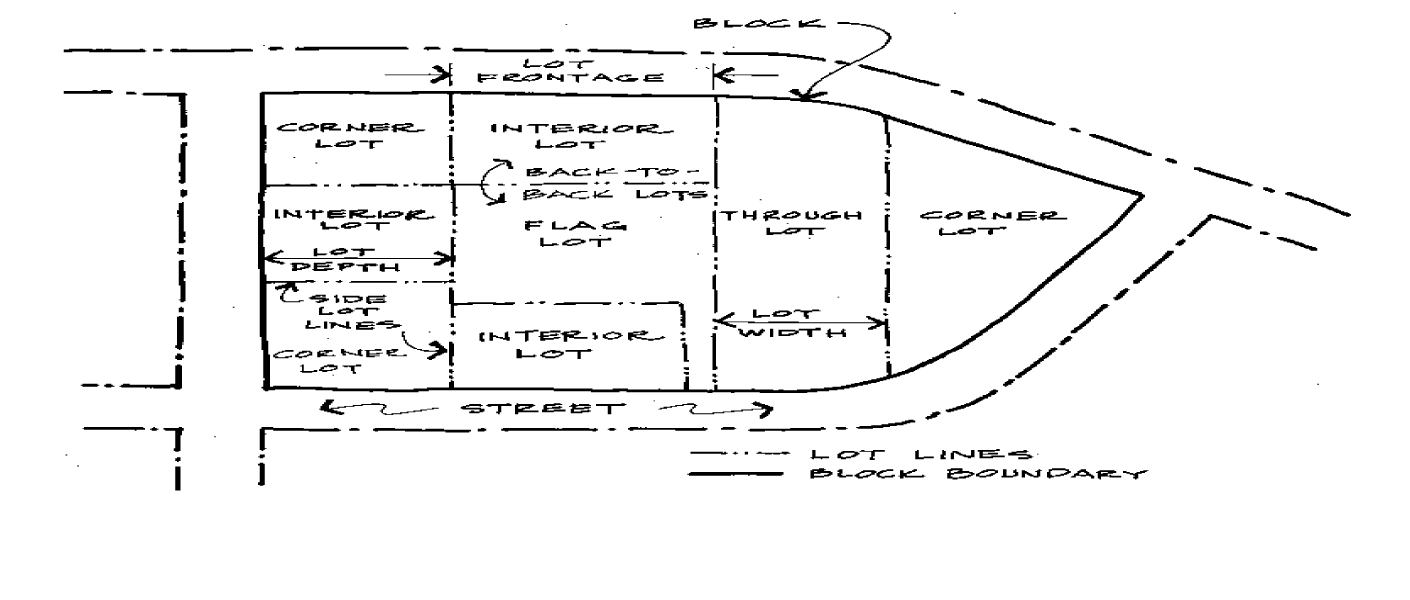
Figure 1315.C
LOT COVERAGE - The area of a site covered by buildings, impervious surfaces, or roofed areas, excluding allowed projecting eaves, balconies, and similar features.
LOT DEPTH - The average horizontal distance between the front and rear lot lines. For lots where the front and rear lot lines are not parallel, the lot depth should be measured by drawing lines from the front to rear lot lines, at right angles to the front lot line, every ten feet and averaging the length of these lines. See Figure 1315.C.
LOT, FLAG - A lot not fronting on or abutting a public road and where access to the public road is a narrow, private right-of-way. See Figure 1315.C.
LOT, FRONTAGE - The length of the front lot line measured at the street right-of-way line. See Figure 1315.C.
LOT, INTERIOR - A lot other than a corner lot or through lot. See Figure 1315.C.
LOT LINE - A line of record bounding a lot which divides one lot from another lot or from a public or private street or any other public space.
LOT LINE, FRONT - The lot line separating a lot from a street right-of-way. A corner or through lot shall have two front lot lines.
LOT LINE, REAR - The lot line opposite and most distant from the front lot line; or in the case of triangular or otherwise irregularly shaped lots, a line ten feet in length entirely within the lot, parallel to and at a maximum distance from the front lot line.
LOT LINE, SIDE - Any lot line other than a front or rear lot line. See Figure 1315.C.
LOT OF RECORD - A lot which exists as shown or described on a plat or deed which is recorded in the Office of the Clerk of the County Court of either Cabell or Wayne County.
LOT, THROUGH - A lot which fronts upon two parallel streets, or which fronts upon two streets which do not intersect at the boundaries of the lot. See Figure 1315.C.
LOT WIDTH - The horizontal distance between the side lines of a lot measured at right angles to its depth along a straight line parallel to the front lot line at the minimum required building setback line. See Figure 1315.C.
LOWEST FLOOR - The lowest floor of the lowest enclosed area (including basement). An unfinished or flood resistant enclosure, usable solely for parking of vehicles, building access or storage in an area other than a basement area is not considered a building's lowest floor; provided, that such enclosure is not built so as to render the structure in violation of the applicable non-elevation design requirements of this ordinance.
(M)
MANUFACTURED HOMES - See "Dwelling Type."
MANUFACTURED/MOBILE HOME PARK - A manufactured home park for which the construction of facilities for servicing the lots on which the manufactured homes are to be affixed including at a minimum, the installation of utilities, the construction of streets, and either final site grading or the pouring of concrete pads.
MANUFACTURING AND PRODUCTION (HEAVY OR OUTDOORS) - An establishment engaged in manufacturing, assembly, fabrication, packaging or other industrial processing of products primarily from extracted or raw materials, or the bulk storage and handling of such products and materials, or an industrial establishment having potential to produce dust, smoke, fumes, glare, odors or vibration beyond its lot line. Such use shall also include any manufacturing or assembly facility that requires outdoor storage areas that exceed 10,000 square feet in area or 30% of the principle structure square footage, whichever is greater.
MANUFACTURING AND PRODUCTION (INDOORS) - The manufacturing, processing, fabrication, packaging, or assembly of products within a fully enclosed structure where odor, light, dust, smoke, fumes, or vibrations is not noticeable from the adjacent properties. This use type shall not include establishments that provide electroplating, metal stamping or forging, or vehicle processing. Manufacturing and production indoors may also include ancillary storage, sales, and distribution of such products. See also "manufacturing and production (heavy or outdoors)" and "manufacturing and production with caustic or hazardous materials."
MANUFACTURING AND PRODUCTION WITH CAUSTIC OR HAZARDOUS MATERIALS - An establishment that is defined as a "manufacturing and production (heavy or outdoors)" use above but that also utilizes caustic or hazardous materials as may be defined by the city. See "Hazardous Material".
MANUFACTURING AND SALES, ARTISAN - The manufacturing, processing, fabrication, packaging, or assembly of products within a fully enclosed structure which includes retail sales for the products produced within the same structure. Retail sales may include products produced offsite. No processes or equipment may be used that creates heat, glare, dust, smoke, fumes, odors, or vibration beyond its lot line. Retail space may be included on site and shall be located at the primary entrance of the structure.
MARINA - A facility for storing, servicing, fueling, berthing, and securing and launching of private pleasure craft that my include the sale of fuel and incidental supplies for the boat owners, crews, and guests.
MEDICAL CLINIC - A use involving the treatment and examination of patients by state-licensed physicians, dentists, chiropractors, physical therapists, psychologists, social workers, naturopathic physicians, and other similar state licensed care professionals, provided that no patients shall be kept overnight on the premises. The total gross floor area of the office is in excess of 4,000 square feet.
MEDICAL OFFICE - A use involving the treatment and examination of patients by state-licensed physicians, dentists, chiropractors, physical therapists, psychologists, social workers, naturopathic physicians, and other similar state licensed care professionals, provided that no patients shall be kept overnight on the premises. The total gross floor area of the office cannot exceed 4,000 square feet.
MICRO DATA CENTER - A smaller scale data center that is located on a parcel no larger than 0.50 acres, typically intended to be closer to the end-user.
MIXED USE BUILDINGS (WITH RESIDENTIAL USES) - A lot or buildings that contains a mixtures of uses that are permitted in the applicable zoning district and where residential dwelling units may be permitted on any floor above the first and/or ground floor.
MOBILE HOME SALES - A lot of facility used for the business of selling or leasing mobile homes but where no mobile home shall be permanently located or used for residential purposes.
MOTEL - A building or series of buildings in which lodging is offered for compensation, and which is distinguished from a hotel primarily by reason of providing direct independent access to, and adjoining parking for, each rental unit.
MOTOR, RAIL, OR AIR FREIGHT TERMINAL - A building or lot where trucks, rail cars, or airplanes can be loaded or unloaded of passengers or goods for transport.
(N)
NANOBREWERY - A facility in which beer is brewed, fermented, and produced in quantities not to exceed 500 barrels per year and which meet the requirements of the zoning district and possess the appropriate license from the State of West Virginia. Tasting rooms for the consumption of on-site produced beer, wine, or distilled products are permitted on premises as an accessory use. Retail sales are also permitted in hand-capped or sealed containers in quantities up to one-half barrel or 15.5 gallons sold directly to the consumer.
NEW CONSTRUCTION - Structures for which the start of construction as herein defined commenced on or after the effect date of this ordinance and includes any subsequent improvements to such structures.
NIGHTCLUB - A place operated for profit, where food may or may not be served for consumption on the premises and one or more forms of amusement are provided or permitted for a consideration that may be in the form of a cover charge or may be included in the price of the food and beverages, or both, purchased by patrons. This use type does not include "adult uses".
NONCONFORMING LOT - A lot, the area, dimensions or location of which was lawful prior to the adoption, revision or amendment of the zoning ordinance, but which fails by reason of such adoption, revision or amendment to conform to the present requirements of the zoning district.
NONCONFORMING SIGN - Any sign lawfully existing on the effective date of an ordinance, or an amendment thereto, which renders such sign nonconforming because it does not conform to all the standards and regulations of the adopted or amended ordinance.
NONCONFORMING STRUCTURE OR BUILDING - A structure or building the size, dimensions or location of which was lawful prior to the adoption, revision or amendment to a zoning ordinance, but which fails by reason of such adoption, revision or amendment, to conform to the present requirements of the zoning district.
NONCONFORMING USE - A use or activity which was lawful prior to the adoption revision or amendment of a zoning ordinance, but which fails, by reasons of such adoption, revision or amendment, to conform to the present requirements of the zoning district.
NURSING HOME - A facility licensed by the state for the housing and intermediate or fully-skilled nursing care of three or more persons.
(O)
OFFICE(S) - Establishments providing executive, management, administrative, or professional services including, but not limited to, real estate, architecture, legal, travel, employment, advertising, design, engineering, architecture, accounting, and similar uses.
OIL AND GAS EXPLORATION - A hole bored into the earth that produces natural gases and oils that are brought to the surface for further refining and distribution.
100-YEAR FLOOD - A flood that has one chance in 100 or a 1% chance of being equaled or exceeded in any given year.
OPEN SPACE - Any parcel of land or water essentially unimproved and set aside, dedicated, designated or reserved for public or private use or enjoyment, or for the use and enjoyment of owners and occupants of land adjoining or neighboring such open space.
OUTDOOR DINING - Areas on sidewalks (public or private), patios, or other unenclosed areas, excluding vehicular use areas) that are designated for outdoor seating where patrons may be served food and beverage for on-site dining.
OUTDOOR MATERIAL AND SUPPLY BULK SALES - A facility or lot used for the outdoor sales and storage of materials that are to be used for construction or for manufacturing processes and where such uses are the principal use of the lot. Such use may also include the bulk sale of any stored item.
OWNER - The duly authorized agent, attorney, purchaser, devisee, fiduciary or any person having vested or equitable interest in the lot in question.
(P)
PARKING AREA - Any public or private land area designed and used for parking motor vehicles including parking lots, garages, private driveways and legally designated areas of public streets.
PARKING BAY - The parking module consisting of one or two rows of parking spaces and the aisle from which motor vehicles enter and leave the spaces.
PARKING GARAGES - A multi-level structure built either above or below grade and used to provide parking spaces along with adequate drives and aisle, for maneuvering, so as to provide access for entrance and exit for the parking motor vehicles. This may be permitted as a principal use of a lot or as an accessory use in accordance with this zoning ordinance.
PARKING LOT - Surface areas used to provide parking spaces along with adequate drives and aisle, for maneuvering, so as to provide access for entrance and exit for the parking of more than two vehicles. This may be permitted as a principal use of a lot or as an accessory use in accordance with this zoning ordinance.
PARKING SPACE - A space for the parking of a motor vehicle within a public parking area.
PAWNSHOP - Any business that loans money on deposit of personal property or deals in the purchase or possession of personal property on condition of selling the same back again to the pledger or depositor, or loans or advances money on personal property by taking chattel mortgage security thereon, and takes or receives such personal property.
PERMANENT COSMETICS - A cosmetic technique involving the injection of pigment into the skin as a means of producing designs that resemble makeup, such as eyebrows, eye-lining and other permanent enhancing colors to the skin of the face, lips and eyelids.
PERSON - Any individual or group of individuals, corporation, partnership, association or other entity, including state and local governments and agencies.
PERSONAL SERVICE - An establishment that provides a service oriented to personal needs of the general public and which does not involve primarily retail or wholesale sales or service to businesses. Personal services include barber and beauty shops, permanent cosmetics, massage therapy, photography studios, shoe repair shops, household appliance repair shops, dry cleaning and laundry, and other similar establishments.
PET STORE/PET SERVICES -A retail sales establishment primarily involved in the sale of domestic animals, such as dogs, cats, fish, birds, and reptiles, excluding exotic animals and farm animals such as horses, goats, sheep, and poultry. May also include the sale of supplies, and accessory services such as: boarding, grooming, and/or training services.
PLACE - An open, unoccupied, officially designated space other than a street or alley, permanently reserved for use as the principal means of access to abutting property.
PLANNED UNIT DEVELOPMENT - A development of land that is under unified control and is planned and developed as a whole in a single development operation or programmed series of development stages. The development may include streets, circulation ways, utilities, buildings, open spaces, and other site features and improvements.
PLAT - A map or chart indicating the subdivision or re-subdivision of land, either filed or intended to be filed for record.
PONDING BASIN - A designated area to store excess storm run off or stream water.
PORCH - A roofed open area, which may be screened, usually attached to or part of and with direct access to or from, a building.
PORTE-COCHERE (COACH DOOR) - A roofed structure that extends from a building over a driveway, providing an entryway and protection from the weather.
PRINCIPAL BUILDING - The building in which the principal use of a lot is conducted. Any building that is physically attached to a principal building shall be considered part of that building.
PRINCIPAL USE - A dominant use(s) or main use on a lot, as opposed to an accessory use.
PRINCIPALLY ABOVE GROUND - Where at least 51 percent of the actual cash value of a structure, less land value, is above ground.
PRIVATE SCHOOL - Private, primary, grade, high, preparatory school or academy, but not including trade or business schools.
PUBLIC PARK AND RECREATIONAL FACILITIES - Any park or recreational facility that is owned or managed, in whole or in part, by the city, county, state, or a non-profit agency, that requires grading of the land, construction of facilities, lighting, or is developed for athletic fields, tennis courts, swimming pools, skate parks, disc golf, and other similar outdoor facilities.
PUBLIC RIGHT-OF-WAY - Land reserved for use as a road, street, alley, crosswalk, pedestrian way or other public purpose.
PUBLIC USE OR BUILDING - Buildings, structures, or facilities used by a government agency or similar public agency for administrative or service purposes including, but not limited to, fire stations, police stations, government offices, and other similar uses.
PUBLIC UTILITY INSTALLATIONS - The erection, construction, alteration, or maintenance by public utilities or municipal departments or commissions, of underground or overhead gas, electrical, steam, or water transmission or distribution systems, including poles, wires, mains, drains, sewers, pipes, conduits, cables, fire alarm boxes, police call boxes, traffic signals, hydrants, transmission towers or poles, and other similar equipment and accessories in connection therewith, reasonably necessary for the furnishing of adequate service by such public utility or municipal departments or commissions or for the public health or safety or general welfare.
(Q) Reserved.
(R)
RADIO AND TELEVISION STATIONS - Facilities used to produce, operate, or develop radio or television programs for distribution through various telecommunication formats.
RECREATIONAL VEHICLE - A vehicle which is:
a.
Built on a single chassis.
b.
Four hundred square feet or less when measured at the largest horizontal projection.
c.
Designed to be self-propelled or permanently towable by a light duty truck.
d.
Designed primarily not for use as a permanent dwelling, but as temporary living quarters for recreational, camping, travel or seasonal use.
RECYCLING COLLECTION CENTER - A use for collection and temporary storage of more than 500 pounds of common household material for recycling, but that does not involve processing or recycling other than routine sorting, baling and weighing of materials. This term shall not include the indoor storage of less than 500 pounds of household recyclables and their customary collection, which is a permitted by-right accessory use in all zoning districts, without additional regulations. A recycling collection center is also a permitted by-right accessory use to a public or private primary or secondary school, a religious use, a city-owned use, an emergency services station or a college or university.
RELIGIOUS USES - Buildings, synagogues, churches, religious retreats, monasteries, seminaries and shrines used primarily for religious and spiritual worship and that are operated for non-profit and non-commercial purposes. A religious use may include one dwelling unit as an accessory use for housing of employees of the religious use and their family. If a religious use is primarily residential in nature, it shall be regulated under the appropriate dwelling type.
REPAIR SHOP - Shops for the repair of appliances, watches, guns, bicycles and other household items.
RETAIL SALES AND SERVICES - Establishments primarily engaged in the sale of goods and materials to the general public. Retail commercial uses may include, but are not limited to, bookstores, antique stores, convenience stores, bakeries, grocery stores, and other similar uses.
RETAIL SALES AND SERVICES, NEIGHBORHOOD - A retails and services establishment that shall not exceed a building footprint of 6,000 square feet. See also "retail sales and services".
RESTAURANT - An establishment whose principal business is the selling or dispensing of food and beverages to the customer in a ready to consume state, in individual servings. Restaurants may include seating for on-site dining or may be for carry-out but shall not include the provision or dispensing, for on-site consumption, any fermented malt beverage, malt beverage, special malt, vinous, or spirituous liquors.
RESTAURANT SERVING ALCOHOLIC BEVERAGES - An establishment whose principal business is the selling or dispensing of food and beverages to the customer in a ready to consume state, in individual servings that includes the provision or dispensing, for on-site consumption, any fermented malt beverage, malt beverage, special malt, vinous, or spirituous liquors. Restaurants with alcoholic beverages contain only on-site dining. Carry-out services may be provided for food and non-alcoholic beverages. The gross revenue from alcoholic sales shall not exceed 50% of total gross revenue.
RIGHT-OF-WAY - Land reserved for the public or others for use as a street or other purpose. Unless otherwise stated, "right-of-way" shall mean the existing street right-of-way.
(a)
RIGHT-OF-WAY, EXISTING OR LEGAL - The line separating a lot from the established official street right-of-way that either the city or the state will own after the completion of any proposed land use or development of a use under this ordinance.
(b)
RIGHT-OF-WAY, FUTURE OR ULTIMATE - Land that is dedicated or is required to be defined or reserved for future dedication for uses as a street and for related public improvements. The terms "ultimate right-of-way", "right-of-way reserved for future dedication", and "future right-of-way" shall have the same meaning.
RIGHT-OF-WAY LINES - The lines that form the boundaries of a right-of-way.
(S)
SATELLITE DISH ANTENNA OR SATELLITE ANTENNA - A ground-based reflector, usually parabolic in shape, that receives electronic signals from a satellite. This term shall also include any pedestal or attached structure.
SCHOOL - A facility that provides a curriculum of elementary and secondary academic instruction, including kindergartens, elementary schools, middle schools, and high schools.
SELF-STORAGE DEVELOPMENT - A building or group of buildings divided into individual separate access units which are rented or leased for the storage of personal and small business property.
SELF-STORAGE, INDOORS - A structure containing separate, individual and private storage spaces of varying sizes that are leased or rented by individual lease for varying periods of time, with the use contained within one building and the storage bays accessed primarily from the interior of the building.
SETBACK - The required minimum horizontal distance between the building line and the related front, side, or rear property line.
SHELTER/MISSION - A facility whose general purpose is to provide temporary food, clothing or sleeping arrangements to persons, families, or parts of families on a temporary occupancy who are homeless or displaced. Short term counseling during stay may also be provided. The shelter shall have appropriate supervisory personnel. Such facility must meet all applicable standards of the department of health, State Fire Marshal, and any other federal, state, county or city agency which has regulatory power over the said facility.
SHIPPING CONTAINER - A reusable transport and storage unit of metal construction also known as an intermodal freight container, cargo container, or transport container and is intended to be loaded on trucks, trains, or ships for moving products and raw materials.
SHOPPING CENTER - A group of three or more retail business and service uses on a single site with common parking facilities.
SIGN - Any object, device, display, painting, decal, structure, or part thereof, situated outdoors or indoors, which is used to advertise, announce, identify, inform, display, direct, or attract attention to an object, person, institution, organization, business, product, service, event or location by any means, including words, letters, figures, design, symbols, fixtures, colors, illumination, or projected images, including all associated brackets, braces, supports, wires, and structures, which is displayed for informational or communicative purposes. See Figure 1315.D.
SIGN, ANIMATED OR MOVING - Any sign or part of a sign which changes physical position by any movement or rotation or which gives the visual impression of such movement or rotation.
SIGN AREA - The entire face of a sign and any framing, trim or molding, but not including the supporting structure.
SIGN, AWNING, CANOPY OR MARQUEE - A sign that is mounted or painted on, or attached to, an awning, canopy, or marquee that is otherwise permitted by ordinance. See Figure 1315.D.
SIGN, BANNER - A temporary sign composed of cloth, canvas, plastic, fabric or similar lightweight, non-rigid material that can be mounted to a structure with cord, rope, cable, or a similar method or that may be supported by stakes in the ground.
SIGN, BILLBOARD OR OFF-PREMISE - A sign which directs attention to a business, commodity, service or entertainment conducted, sold or offered at a location other than the premises on which the sign is located. The following shall not be considered an off-premise sign: Directional or official sign authorized by law, real estate signs, or on-premise signs.
SIGN, BLADE - A temporary sign that is constructed of cloth, canvas, plastic fabric or similar lightweight, non-rigid material and that is supported by a single vertical pole mounted into the ground or on a portable structure.
SIGN, CHANGEABLE COPY - A sign which is designed to be changed on a regular basis usually consisting of interchangeable letters, numbers, and/or logos
SIGN, COMMERCIAL MESSAGE - One where the message concerns goods or services offered for consideration by a person or entity engaged in a profit-oriented business, includes any written representation, emblem, graphic, logo, symbol or other display that names, advertises or references a business, operator, product, service or other for-profit activity.
SIGN, CONSTRUCTION - A temporary sign erected on the premises on which construction is taking place, during the period of such construction, indicating the names of the architects, engineers, landscape architects, contractors or similar artisans, and the owners, financial supporters, sponsors, and similar individuals or firms having a role or interest with respect to the structure or project.
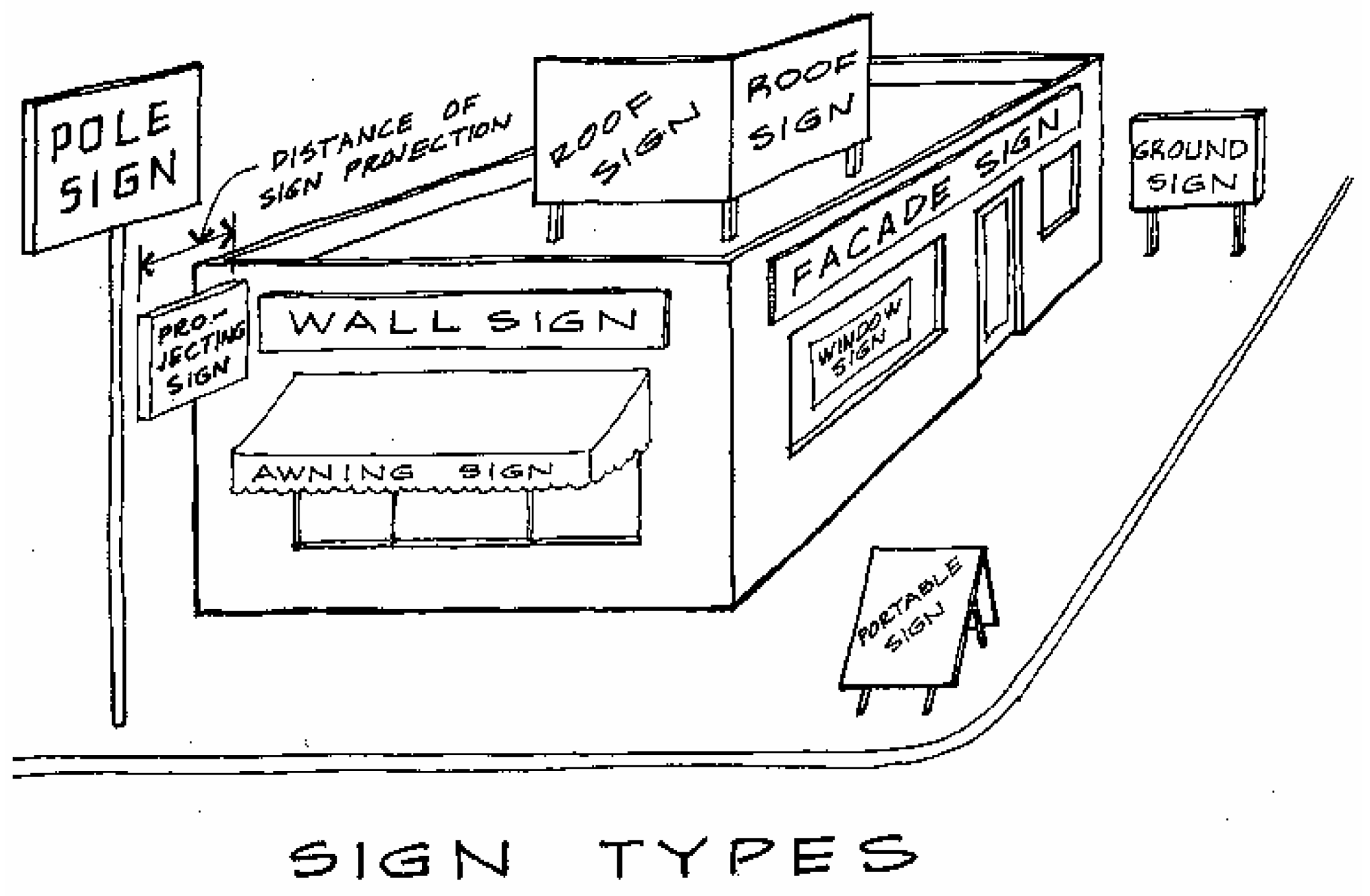
Figure 1315.D
SIGN, DIRECTIONAL - Signs limited to directional messages, principally for pedestrian or vehicular traffic, such as "one-way", "entrance", and "exit".
SIGN, ELECTRONIC MESSAGE BOARDS - An electrically activated display whose variable message and/or graphic presentation can be electronically programmed. These signs include displays using incandescent lamps, LEDs, LCDs, or a flipper matrix.
SIGN, FACE - The area or display surface used for the message and visible in one direction at one time.
SIGN, FLASHING - Any directly or indirectly illuminated sign which exhibits changing natural or artificial light or color effects by any means whatsoever.
SIGN, FREESTANDING - Any nonmovable sign not affixed to a building.
SIGN, GOVERNMENTAL - A sign erected and maintained pursuant to and in discharge of any governmental functions, or required by law, ordinance or other governmental regulation.
SIGN, GROUND - Any sign, other than a pole sign, placed upon or supported by the ground independent of any other structure. See Figure 1315.D.
SIGN, HOME OCCUPATION - A sign, not visible from the street, containing only the name and occupation of a permitted home occupation.
SIGN, IDENTIFICATION - A sign giving the nature, logo, trademark or other identifying symbol; address, or any combination of the name, symbol and address of a building, business, development or establishment on the premises where it is located.
SIGN, ILLUMINATED - A sign lighted by or exposed to artificial lighting either by lights on or in the sign or directed towards the sign.
SIGN, LIGHT POLE BANNER - A temporary banner or sign that is designed to be attached to a permanent light pole or other pole structure, and where the temporary sign element can be changed without modifying the permanent structure.
SIGN, MEMORIAL - A sign, tablet or plaque memorializing a person, event, structure or site.
SIGN, NAME PLATE - A sign, located on the premises, giving the name or address, or both, of the owner or occupant of a building premises.
SIGN, OFF-SITE DIRECTIONAL - A sign of any nature which is located not on the site it is advertising or directing customers to.
SIGN, ON-SITE DIRECTIONAL - A sign of any nature which is located on the site it is advertising or directing customers to.
SIGN, POLE - A sign that is mounted on a freestanding pole or other support so that the bottom edge of the sign face is six feet or more above ground. See Figure 1315.D.
SIGN, POLITICAL - A temporary sign announcing or supporting political candidates or issues in connection with any national, state or local election.
SIGN, PORTABLE - A sign that is not permanent, affixed to a building, structure or the ground. See Figure 1315.D.
SIGN, PORTABLE MESSAGE CENTER - A sign not permanently affixed to the ground, building, or other structure, which may be moved from place to place, including, but not limited to, signs designed to be transported by means of wheels. Such signs may include changeable copy or electronic message boards.
SIGN, PRIVATE SALE OR EVENT - A temporary sign advertising private sales of personal property such as "house sales," "garage sales," "rummage sales" and the like or private not-for-profit events such as picnics, carnivals, bazaars, game nights, art fairs, craft shows and Christmas tree sales.
SIGN, PROJECTING - A sign that is wholly or partly dependent upon a building for support and which projects more than 12 inches from such building. See Figure 1315.D.
SIGN, REAL ESTATE - A sign pertaining to the sale or lease of the premises, or a portion of the premises, on which the sign is located.
SIGN, RESIDENTIAL DEVELOPMENT DESIGNATION - A permanent sign which is erected to indicate the name of a residential subdivision or development. Such signs are usually located at the principal access points of such a development.
SIGN, ROOF - A sign that is mounted on the roof of a building or which is wholly dependent upon a building for support and which projects above the point of a building with a flat roof, the eave line of a building with a gambrel, gable or hip roof or the deck line of a building with a mansard roof. See Figure 1315.D.
SIGN, SIDEWALK - A freestanding sign which is ordinarily in the shape of an "A," "T" or some variation thereof, which is readily moveable, and is not permanently attached to the ground or any structure.
SIGN, SUSPENDED OR PROJECTION - A two-side sign that projects outward from the exterior wall of a structure.
SIGN, TEMPORARY - Are signs not affixed to a permanent structure in any permanent way. Such signs are usually constructed with material not intended to be permanent or material susceptible to damage through exposure to ordinary weather or seasonal changes.
SMOKE SHOP/TOBACCO STORE - Any business that sells at retail tobacco, tobacco products, vape products, e-cigarette devices, vape juice, e-cigarettes, e-cigarette liquids or tobacco paraphernalia; provided, however, that any grocery store, supermarket, convenience store or similar retail use that only sells conventional cigars, cigarettes, vape products, e-cigarettes or tobacco as less than 25% of retail sales shall not be defined as a "smoke shop and tobacco store."
TRI-VISION SIGN - An off-premise sign comprised of sections which rotate to display a series of advertisements, each advertisement being displayed for at least six seconds continuously without movement; of section between advertisements not exceeding two seconds.
SIGN, VEHICULAR OR TRAILER - A sign permanently or temporarily attached to or placed on a vehicle or trailer and used primarily as a stationary sign.
SIGN, WALL - A sign that is painted to, attached flat to or mounted away from, but parallel to, any exterior wall of a structure.
SIGN, WINDOW - A sign that is applied or attached to the exterior or interior of a window or located in such manner within a building that it can be seen from the exterior of the structure through a window. See Figure 1315.D.
SINGLE-FAMILY DWELLING - See "Dwelling, Single Family".
SITE PLAN - A plan, prepared to scale, showing accurately and with complete dimensions, the boundaries of a site and the location of all buildings, structures, uses, and principal site development features proposed for a specific parcel of land. Site development features include sanitary sewers, drainage, grading, pavement, walkways, electric lines, communication lines, water lines, gas lines, adjacent roadway, and landscaping features.
SPECIAL PERMITS - See "Conditional Use."
SPECIAL SCHOOL - Any school which has as its primary purpose the instruction, care and rehabilitation of typical or exceptional children or adults such that the usual statutory educational requirements expressly or implicitly do not apply.
START OF CONSTRUCTION - For other than new construction or substantial improvements under the Coastal Barrier Resources Act, Pub. Law 97-348, includes substantial improvements, and means the date the building permit was issued, provided the actual start of construction, repair, reconstruction, rehabilitation, addition, placement or other improvement was within 180 days of the permit date. The actual start means either the first placement of permanent construction of a structure on a site, such as the pouring of the slab or footings, the installation of piles, the construction of columns, or any work beyond the stage of excavation; or the placement of a manufactured home on a foundation. Permanent construction does not include land preparation, such as clearing, grading and filling; nor does it include excavation for a basement, footings, piers, or foundations or the erection of temporary forms; nor does it include the installation on the property of accessory building, such as garages or sheds not occupied as dwelling units or not part of the main structure. For a substantial improvement, the actual start of construction means the first alteration of any wall, ceiling, floor or other structural part of a building whether or not that alteration affects the external dimensions of the building.
STORY - That portion of a building included between the surface of any floor and the surface of the floor next above it, or if there be no floor above it, then the space between any floor and the ceiling next above it.
STORY, HALF - That portion of a building under a sloping gable, hip, or gambrel roof, the wall plates on at least two opposite exterior walls of which are not more than three feet above the floor level of such half-story.
STORY, HEIGHT OF - The vertical distance from top to top of two successive tiers of beams or finished floor surfaces; and, for the topmost story, from the top of the floor finish to the top of the ceiling joists or, where there is no ceiling, to the top of the roof rafters.
STREET - Includes street, avenue, boulevard, road, highway, freeway, parkway, lane, alley, viaduct, and any other ways used or intended to be used by vehicular traffic or pedestrians whether public or private.
STRUCTURAL ALTERATION - Any change in either the supporting members of a building, such as bearing walls, columns, beams and girders, or in the dimensions or configurations of the roof or exterior walls.
STRUCTURE - A combination of materials to form a construction for use, occupancy, or ornamentation whether installed on, above, or below the surface of land or water. However, regarding flood plain management a structure is a walled and roofed building, including a gas or liquid storage tank, that is principally above ground, as well as a manufactured home.
SUBSTANTIAL DAMAGE - Damage of any origin sustained by a structure whereby the cost of restoring the structure to its before damaged condition would equal or exceed 50 percent of the market value of the structure before the damage occurred.
SUBSTANTIAL IMPROVEMENT - Any repair, reconstruction, rehabilitation, addition or other improvement of a structure, the cost of which equals or exceeds 50 percent of the market value of the structure before the start of construction of the improvement. This term includes structures which have incurred "substantial damage", as defined herein, regardless of the actual repair work performed. The term does not, however, include either:
a.
Any project for improvement of a structure to correct existing violations of state or local health, sanitary or safety code specifications which have been identified by the local code enforcement official and which are the minimum necessary to assure safe living conditions, or
b.
Any alteration of a "historic structure", provided that the alteration will not preclude the structure's continued designation as a "historic structure".
SWIMMING POOL, HOUSEHOLD - A manmade area with walls of manmade material intended to enclose water at least 30 inches deep for recreational bathing or swimming and that is intended to serve the residents of only one dwelling unit and their occasional guests.
SWIMMING POOL, NON-HOUSEHOLD - A manmade area with walls of manmade material intended to enclose water at least 30 inches deep for recreational bathing or swimming and that does not meet the definition of a "household" swimming pool. This includes: 1) a "semi-public" pool that serves only residents of a development or members of a club and their occasional guest or 2) a "public" pool intended to serve the general public.
(T)
TATTOO PARLOR - Any building, room, space or portion thereof that provides services for the creation of an indelible mark, figure, work, or graphic illustration upon a human body by the insertion of pigment under the skin or by the production of scars. For the purposes of the zoning ordinance, facilities offering permanent cosmetics shall not be considered tattoo parlors.
TEMPORARY STRUCTURE - A structure without any foundation or footings and which is removed when the designated time period, activity, or use for which the temporary structure was erected has ceased.
TEMPORARY USE - A use established for a fixed period of time with the intent to discontinue such use upon the expiration of the time period.
TOBACCO PARAPHERNALIA - Any equipment, device, or instrument that is primarily designed or manufactured for the smoking, chewing, absorbing, dissolving, inhaling, snorting, sniffing, or ingesting by any other means into the body of tobacco, tobacco products, or other controlled substances. Items or devices classified as tobacco paraphernalia include, but are not limited to, the following: pipes, punctured metal bowls, bongs, water bongs, e-cigarettes, electronic cigars, electronic hookahs, electronic bongs and electronic pipes, whether manufactured, distributed, marketed, or sold as an electronic cigarette, electronic cigar or electronic pipe, e-cigarette juice, buzz bombs, vaporizers, hookahs, and devices for holding burning material. Lighters and matches shall be excluded from the definition of tobacco paraphernalia. This definition shall not apply to medical treatments prescribed or administered by medical professionals.
TOBACCO PRODUCT - Any product in leaf, flake, plug, liquid, or any other form, containing nicotine derived from the tobacco plant, or otherwise derived, which is intended to enable human consumption of the tobacco or nicotine in the product, whether smoked, chewed, absorbed, dissolved, inhaled, snorted, sniffed, or ingested by any other means. For the purposes of this chapter, the term "tobacco product" excludes any product that has been specifically approved by the United States Food and Drug Administration (FDA) for sale as a tobacco/smoking cessation product or for other medical purposes, where such product is marketed and sold solely for such an approved purpose.
TOWING SERVICES - A service that provides towing or conveyance of a wrecked, inoperable, disabled, or illegally parked motor vehicle. May include the storage or keeping of wrecked, inoperable, or impounded vehicles. Towing services shall not include the storage, buying, or selling of scrapped or dismantled motor vehicles or motor parts.
TRADE OR BUSINESS SCHOOL - Secretarial or business school or college when not publicly owned or conducted by or under the sponsorship of a religious, charitable or non-profit organization; or a school conducted as a business enterprise for teaching instrumental music, dancing, barbering or hair dressing, drafting or for the teaching of industrial or technical arts.
TRAILER (TRAVEL AND RELATED CAMPING AND RECREATIONAL EQUIPMENT) - Shall include travel trailers, pickup coaches, motorized homes and recreational equipment as follows:
(a)
TRAVEL TRAILER - A portable structure built on a chassis, designed to be towed and used as a temporary dwelling for travel, recreational and vacation purposes, and permanently identified as a travel trailer by the manufacturer of the trailer.
(b)
PICKUP COACH OR RECREATION VEHICLE - A structure designed primarily to be mounted on a pickup or other truck chassis with sufficient equipment to render it suitable for use as a temporary dwelling for travel, recreational and vacation purposes.
(c)
MOTORIZED HOME OR RECREATION VEHICLE - A portable dwelling designed and constructed as an integral part of a self-propelled vehicle.
(d)
BOAT - A vessel designed to travel on water.
(e)
BOAT TRAILER - A trailer designed to haul a boat as defined above.
TRANSFER STATIONS FOR SOLID WASTE - A facility where solid waste from collection vehicles is consolidated and temporarily stored for subsequent transport to a permanent disposal site.
(U) Reserved.
(V)
VARIANCE - A modification of the specific requirements of this ordinance granted by the board of zoning appeals in accordance with the terms of this ordinance for the purpose of assuring that no property, because of special circumstances applicable to it, shall be deprived of privileges commonly enjoyed by other properties in the same vicinity and district.
VISITABILITY - A movement to change home construction practices so that new homes - not merely those custom-built for occupants who currently have disabilities - offer a few specific features making the home easier for mobility-impaired people to live in and visit. Such features include a level access at grade, a slab raised foundation, and an accessible bathroom on the ground floor.
(W)
WAREHOUSES - A business establishment primarily engaged in the storage of merchandise, goods, and materials, not including any storage classified as self-storage. May include both commercial and private warehousing. Neither manufacturing nor production shall occur as a principal use.
(a)
Light warehousing - Smaller scale warehousing typically used as off-site storage for a related business where heavy trucking activity and nuisances such as dust, noise, and odors are rare and the storage is either indoors or completely screened from view. Light warehousing does not include "Self-Storage, Indoors."
(b)
Traditional warehousing - Warehousing where regular trucking activity occurs and characterized by loading berths less than 45 feet in length, indoor loading docks, two or less external loading bays with berths of 45 feet or greater in length, or railroad loading docks and the storage is either indoors or completely screened from view.
(c)
Heavy warehousing - Facilities characterized by extensive warehousing with 100,000 square feet of building footprint or larger, three or more external loading bays with berths of 45 feet or greater in length, frequent heavy trucking activity, or open storage of material.
WHOLESALE BUSINESSES - An establishment primarily engaged in the selling and/or distributing of merchandise or other goods to retailers or to industrial, commercial, institutional, or professional business users, or to other wholesalers rather than to the general public.
(X) Reserved.
(Y)
YARD - An open space that lies between the principal or accessory building or buildings and the nearest lot line. Such yard is unoccupied and unobstructed from the ground upward except as may be specifically provided in the zoning ordinance. See Figure 1315.E.
YARD DEPTH - The shortest distance between a lot line and a yard line.
YARD, FRONT - A space extending the full width of the lot between any building and the front lot line, and measured perpendicular to the building at the closest point to the front lot line. Such front yard is unoccupied and unobstructed from the ground upward, with the exception of permitted encroachments. See Figure 1315.E.
YARD LINE - A line drawn parallel to a lot line at a distance there from equal to the depth of the required yard.
YARD, REAR - A space extending across the full width of the lot between the principal building and the rear lot line, and measured perpendicular to the building to the closest point of the rear lot line. See Figure 1315.E.
YARD, REQUIRED - The open space between the lot line and the buildable area within which no permanent structure shall be located with the exception of permitted yard encroachments. See Figure 1315.E.
YARD, SIDE - A space extending from the front yard to the rear yard between the principal building and the side lot line measured perpendicular from the side lot line to the closest point of the principal building. See Figure 1315.E.
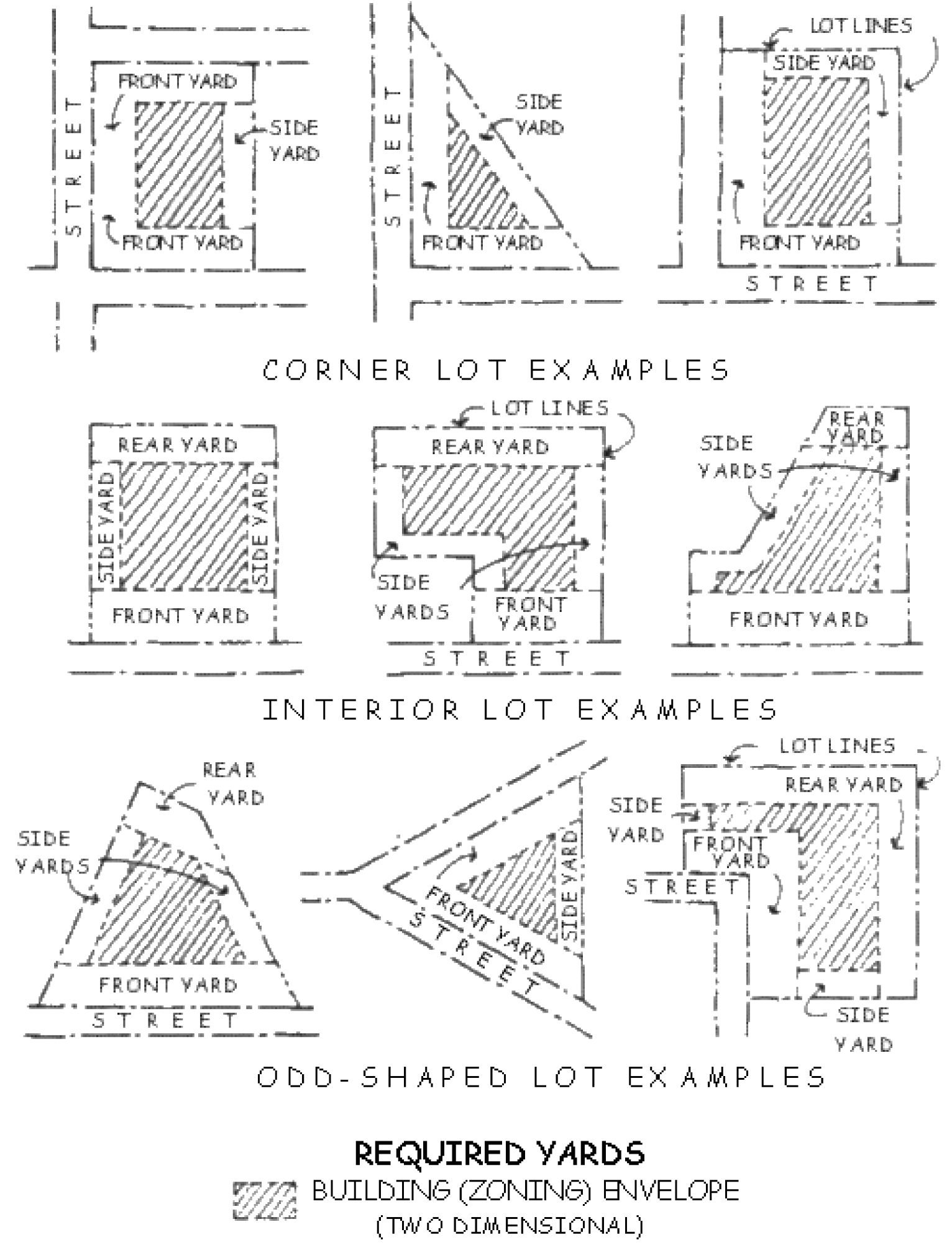
Figure 1315.E
(Z)
ZONE OR ZONING DISTRICTS - A specifically delineated area or district within which regulations and requirements uniformly govern the use, placement, spacing and size of land and buildings.
ZONING - A legal and administrative process whereby a municipality divides its territory into districts and applies to each district a number of regulations to control the use of land, the height and bulk of buildings, and the area of ground built upon.
ZONING MAP - The map or maps, which are a part of this zoning ordinance, and delineate the boundaries of the zone districts.
ZONING ORDINANCE OR THIS ORDINANCE - The zoning ordinance enacted December 14, 1998, as amended.
(Ord. 12-14-98; Ord. 3-13-00; Ord. 2-9-04; Ord. 3-8-04; Ord. of 1-24-11(2); Ord. of 11-28-11(1); Ord. of 6-25-12(3); Ord. of 4-27-15(1); Ord. of 5-26-15(1); Ord. of 9-28-15(3); Ord. of 11-23-15(1); Ord. of 2-22-16(1); Ord. No. 2018-O-14, 12-10-18; Ord. No. 2019-O-3, 2-11-19; Ord. No. 2019-O-13, 6-10-19; Ord. No. 2019-O-25, 10-29-19; Ord. No. 2020-O-15, 6-22-20; Ord. No. 2020-O-41, 12-28-20; Ord. No. 2022-O-09, 6-13-22; Ord. No. 2023-O-11, 6-12-23; Ord. No. 2024-O-25, 10-15-24; Ord. No. 2025-O-29, 9-8-25)
1315.03 - MEASUREMENTS AND EXCEPTIONS.
The purpose of this section is to provide the definitions and standards to which most elements within this code are measured. In addition, this section also establishes which elements may be exempted from certain measured requirements, in addition those also established within the zoning districts and article 1341, general regulations.
(Ord. No. 2020-O-15, 6-22-20)
1315.04 - LOT DIMENSIONS.
A.
Lot area. Lot area is measured as the total area contained within the boundary lines of a lot, excluding any rights-of-way.
B.
Lot width. Lot width is measured as the horizontal distance between side lot lines along the front lot line, with the following exception:
1.
On a lot which is on a cul-de-sac or which has a curved front lot line, the setback line is used to measure lot width.
2.
On a corner lot, the lot width is measured on front yard property line that is parallel to the front façade. If there is no principal structure, the lot width is measured along the front lot line along the principal right-of-way.
3.
Flag lots shall measure the lot width only on the larger portion of the lot referred to as the flag portion.
C.
Lot depth. Lot depth is measured as the horizontal distance from the midpoint of the front lot line to the midpoint of the rear lot line of a lot, with the following exceptions:
1.
Corner lots measure the lot depth as follows:
a.
If there is no principal structure, the lot depth is measured perpendicular to front lot line along the principal right-of-way.
b.
If there is a principal structure, the lot depth is measured perpendicular to the front lot line parallel to the front façade of the principal structure.
2.
On a flag lot, only the flag portion, the larger area of the lot at the end of a narrow strip that begins at the front lot line, is used to measure depth.
3.
On a lot accessed by an access easement, the easement is not used to measure the lot depth.
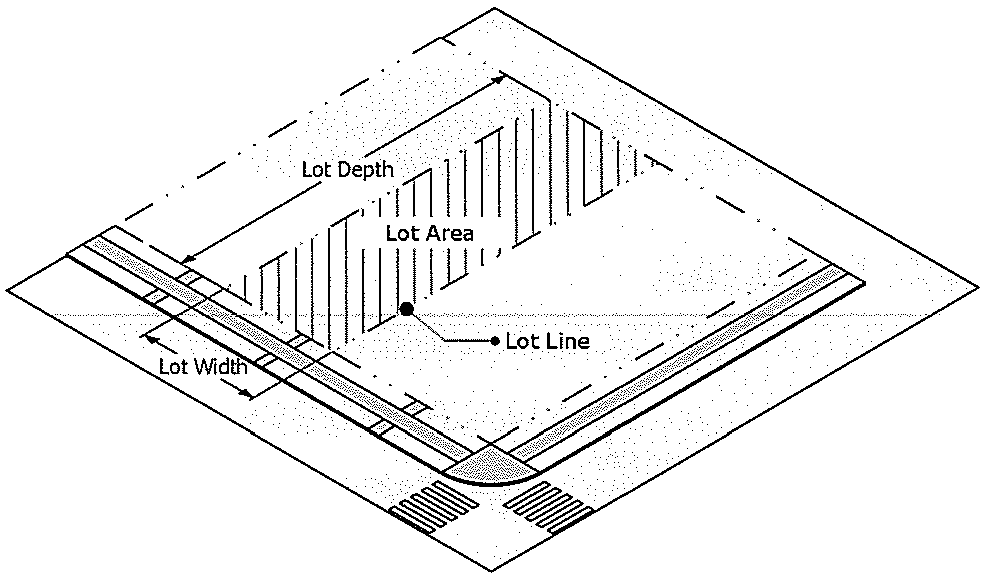
Figure 1315.F: Example of a lot and lot measurements
(Ord. No. 2020-O-15, 6-22-20)
1315.05 - LOT COVERAGE.
A.
Building coverage. Building coverage is measured by dividing the total area of building footprints of all principal and accessory structures by the total lot area.
B.
Impervious surface. Impervious surface is measured by dividing the total area of the building footprints of all principal and accessory structures and all paved surfaces of the site, by the total lot area, with the following exceptions:
1.
When semi-pervious paving is used, it is calculated at a reduced percentage of impervious coverage, as follows:
a.
Pervious concrete and open grid paving systems are calculated as 50% impervious surface, provided that no barrier to infiltration is installed beneath the material. Open grid pavers must be installed on a sand base, without an impervious liner, to qualify.
b.
Other types of pervious surfaces, such as permeable pavers, porous asphalt, or gravel-crete, are credited based upon field performance data and coefficients of permeability provided by the manufacturer.
2.
When a green or blue roof is installed, the area of the building that includes the green or blue roof is calculated as 50% impervious surface.
C.
Lot coverage. The percentage of a lot that is covered by buildings, roofed areas, or impervious surfaces, excluding the following:
1.
Balconies in accordance with section 1315.06.
2.
Eaves in accordance with section 1315.06.
3.
Similar features as determined by the planner.
(Ord. No. 2020-O-15, 6-22-20)
1315.06 - BUILDING SETBACKS.
Building setbacks are the required minimum horizontal distance between the building line and the related front, side, or rear property line. This section outlines most of the key information needed to determine setbacks and exceptions.
A.
Required yards. A required yard is the area of a lot that must be maintained clear of permanent structures, with the exception of the following permitted encroachments:
1.
Accessory structures. Accessory structures may encroach upon required side and rear yards up to three feet from the property line with the following exceptions:
a.
Garages must be setback five feet from all property lines and be located in the rear yard unless site features such as topography or other barriers prevent access. In the event that a garage cannot be located in the rear yard, it may be located in the side yard.
b.
Carports must be located in the rear yard unless site features such as topography or other barriers prevent access. In the event that a carport cannot be located in the rear yard, it may be located in the side yard.
2.
Building features. Certain building features may encroach upon the required yards up to three feet from any property line as follows:
a.
An accessibility ramp may encroach upon any required yards to the extent necessary to perform its proper function.
b.
A balcony may encroach on any yard up to eight feet.
c.
A bay window or turret that is less than ten feet wide may encroach up to three feet into a required yard.
d.
An awning or canopy may encroach up to eight feet upon any required yard with the following exceptions:
1)
Commercial structures may have awnings or canopies that extend up to the property line.
2)
Commercial structures may have awnings or canopies that extend onto the public right-of-way with approval from public works director and the planner.
e.
A chimney, flue, or smokestack may encroach up to four feet.
f.
A porch or stoop may encroach up to eight feet upon any required yard, with the following exceptions:
1)
A stoop of less than 18 square feet may encroach upon any required yard as long as it remains at least one foot from all property lines.
g.
A porte-cochere (coach door) may encroach upon any side or rear yard.
h.
Architectural features such as sills, cornices, eaves, roofs, overhangs, or similar features may encroach up to four feet into any yard.
i.
Site features such as ornamental lighting, lamp posts, and lawn decorations, such as benches, statues, birdbaths, sculptures, or similar elements approved by the planner.
3.
Fences and walls. Fences and walls may encroach upon required yards in according with section 1341.19.
4.
Pedestrian and cyclist facilities. Pedestrian or cyclist facilities, such as sidewalks, multi-use paths, and bicycle parking, may encroach upon required yards.
5.
Signs. Signs may encroach upon required yards in accordance with section 1345.
6.
Vehicle parking. Vehicles parking, including driveways and drive aisles, may encroach upon any required yard in accordance with section 1343 and the provisions within each district.
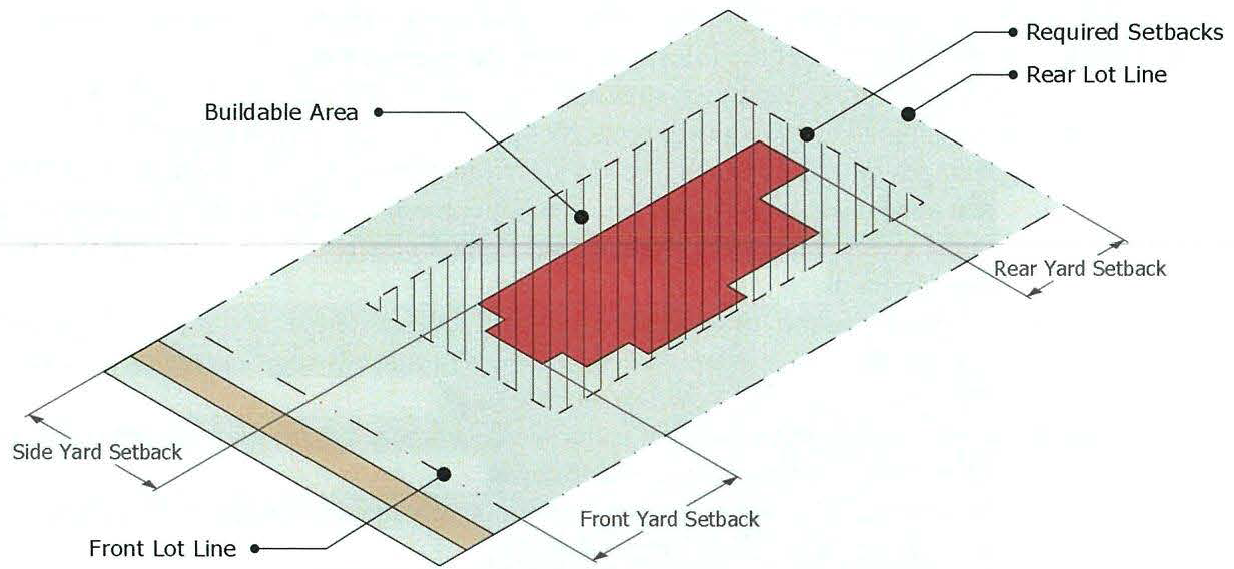
Figure 1315.G: Example of a setbacks and buildable area
B.
Corner lots. A setback area equal to the minimum front yard setback shall be provided along all portions of a corner lot abutting any public street with the following exceptions:
1.
Residential structures. Where the applicant proves to the satisfaction of the planning director that the provisions of a smaller setback of a different yard for a residential building will conform with the clearly prevailing yard pattern on numerous existing developed adjoining lots fronting on the same street. The yard directly opposite the front door of the house shall be the designated rear yard.
C.
Prevailing front yard setback line. The prevailing front yard setback line is the mean front yard line of all principal buildings along a block face and which are located in the same zone, except as follows:
1.
Where less than 25% of the combined lot widths along a block face consist of lots that are improved with principal buildings, the prevailing front yard line will be determined by the planner.
2.
Where one or more adjacent properties, located on the same block face as the subject property, vary from the mean front yard setback line by at least ten feet, the prevailing front yard line will be determined by the planner.
3.
When determining the prevailing front yard line, the planner must consider the following criteria:
a.
The prevailing front yard line is consistent with the intended development pattern of the zone.
b.
The prevailing front yard line is harmonious with adjacent development.
c.
The prevailing front yard line allows for adequate light and air for the subject property and adjacent properties.
d.
The recommended setback for a residential use only structure is a minimum setback of 20% of the lot depth and a maximum setback of 30% of the lot depth.
D.
Corner lot vision clearance.
1.
A triangular area as described in this section shall be graded and shall be kept free of sight obstructions between a height of three feet and 12 feet above the established street grade, including structures, non-transparent fences, vegetation and signs, but not including sign posts of less than one foot in width or utility posts or the trunks of trees.
2.
This sight distance shall be shown on development plans submitted to the city and be shown on any plan required to be recorded. Such triangle shall serve as a permanent setback line for all such visual obstructions and shall be binding upon present and future owners of the land.
3.
The sight triangle shall be measured at the intersection of the right-of-way lines, and the triangular space is determined by a diagonal line connecting two points measured 15 feet along each of the street right-of-way lines. This requirement may be reduced to eight feet in commercial zones.
E.
Side and rear yard exceptions. The required side or rear yard setbacks may be reduced by the following exceptions:
1.
One-half of an alley abutting a side or rear yard may be included in required setbacks.
F.
Prevailing side yard setback line. The prevailing side yard setback line is the mean side yard line of all principal buildings along a block face and which are located in the same zone.
1.
The required side yard may be reduced where the applicant proves to the satisfaction of the planning director that the provision of a smaller side yard setback will conform to the prevailing side yard pattern of the developed lots fronting the same street. In no event shall the required side yard be reduced to less than three feet unless permitted by the district.
G.
Build-to and façade measurements.
1.
Build-to percentage. The build-to percentage specifies the percentage of the width of the building façade, measured along the adjacent right-of-way line, which must be located within a build-to zone or along a build-to line. The following are exceptions to the build-to percentage:
a.
An arcade, forecourt, or plaza frontage is counted as meeting the required build-to percentage.
b.
An alcove, entry door recess, or recessed upper-story balcony not wider than 16 feet in width is counted as meeting the build-to percentage.
c.
A chamfered corner or beveled edge of a building, designed to achieve corner visibility on a corner lot or driveway entrance, is counted as meeting the build-to percentage as long as it is not more than 16 feet measured along each of the street right-of-way lines.
2.
Build-to zone. A build-to zone is an area of the lot bounded by two imaginary lines, which are parallel to a right-of-way line and correspond to the minimum setback and maximum setback for the façade of a principal building.
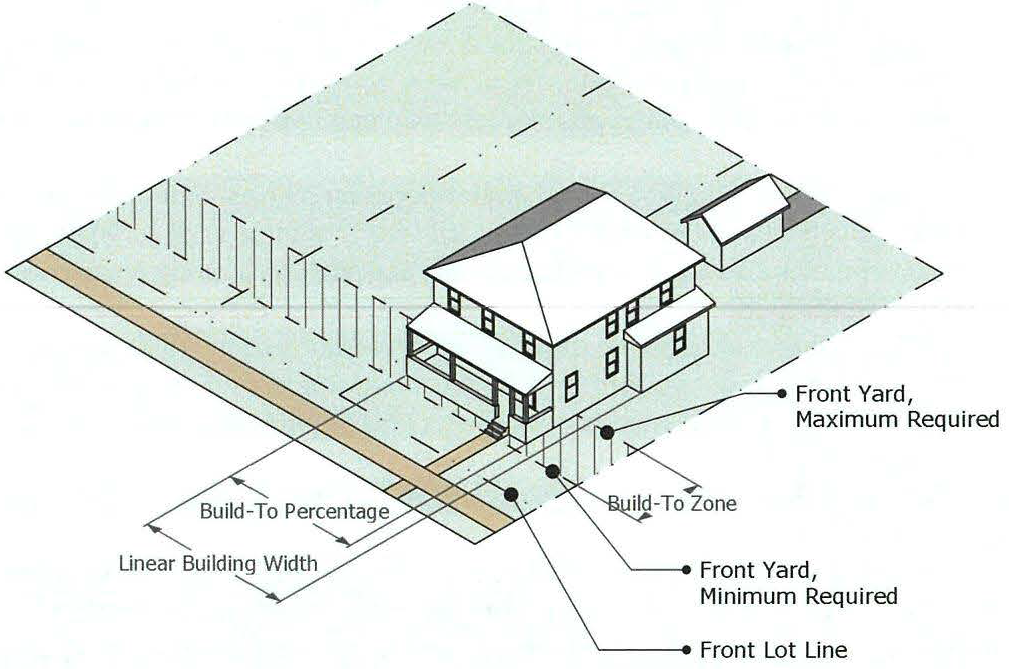
Figure 1315.H: Example of a build-to zone
3.
Build-to line. A build-to line is an imaginary line parallel to a right-of-way line, created when the minimum setback and maximum setback for the building facades are the same number.
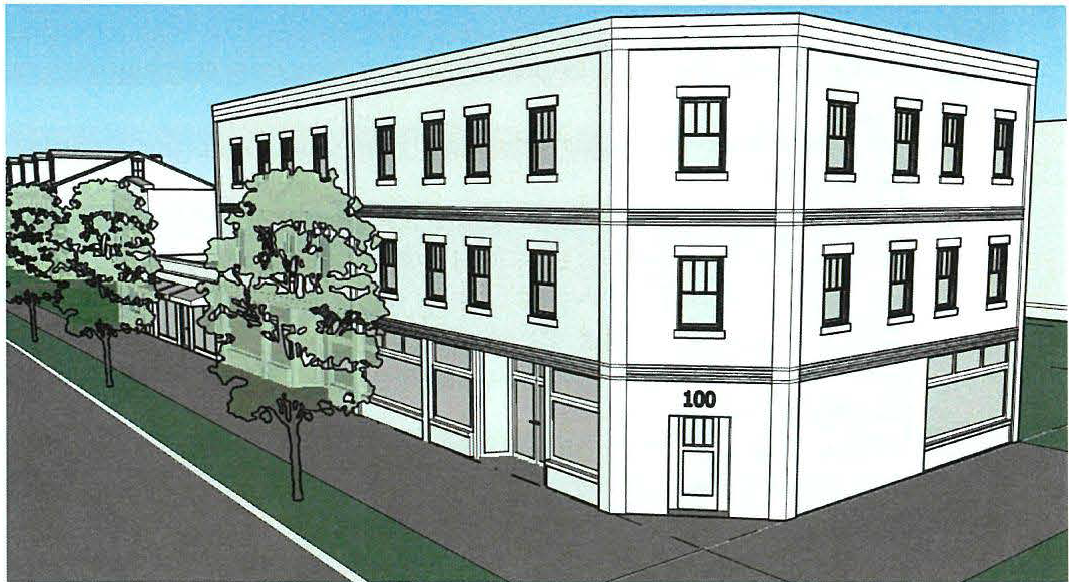
Figure 1315.I: Example of a chamfered corner
a.
Façade articulation, such as window or wall recesses or projections, is counted as meeting the required build-to percentage, so long as the variation goes not exceed 18 inches of depth or projection.
b.
An outdoor dining area is counted as meeting the required build-to percentage, so long as the outdoor dining area is created by the recess of only the ground floor of the building façade, and the recess is no greater than 12 feet in depth from the building façade.
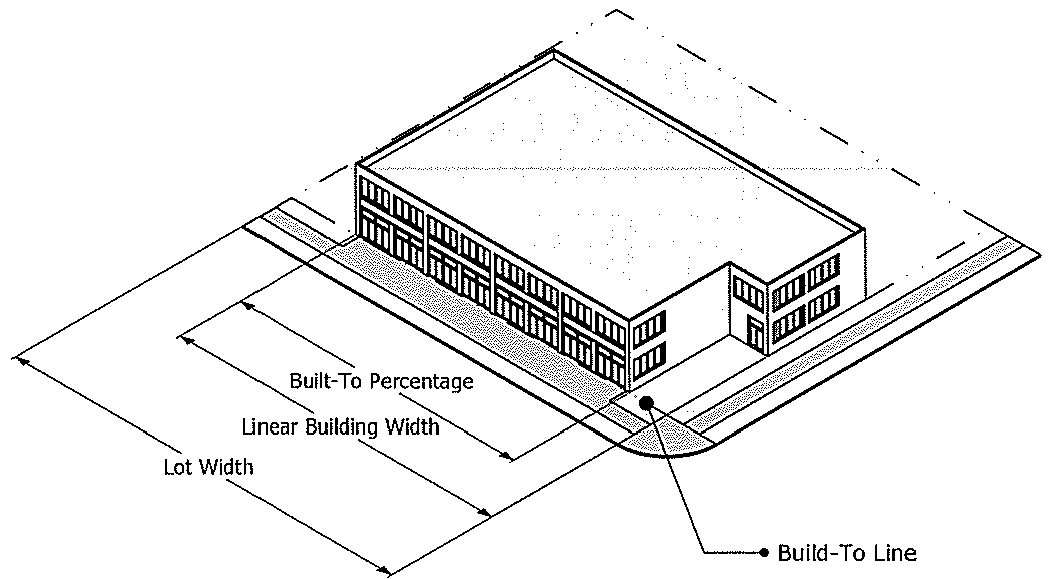
Figure 1315.J: Example of a commercial structure with a built-to line and percentage
4.
Façade bay width. Façade bay width is the area of a building's façade divided into architecturally distinct vertical sections with similar proportions. Features that divide a building façade into bays are elements such as pilasters, columns, and or changes in wall depths or floor and roof levels. The bays shall be in harmony with each other in terms of scale, proportion, detailing, and design.
(Ord. No. 2020-O-15, 6-22-20)
1315.07 - BUILDING HEIGHT.
A.
Building height, feet. When building height is measured by linear feet, building height is measured as the vertical distance from average ground level to:
1.
The peak of a flat roof.
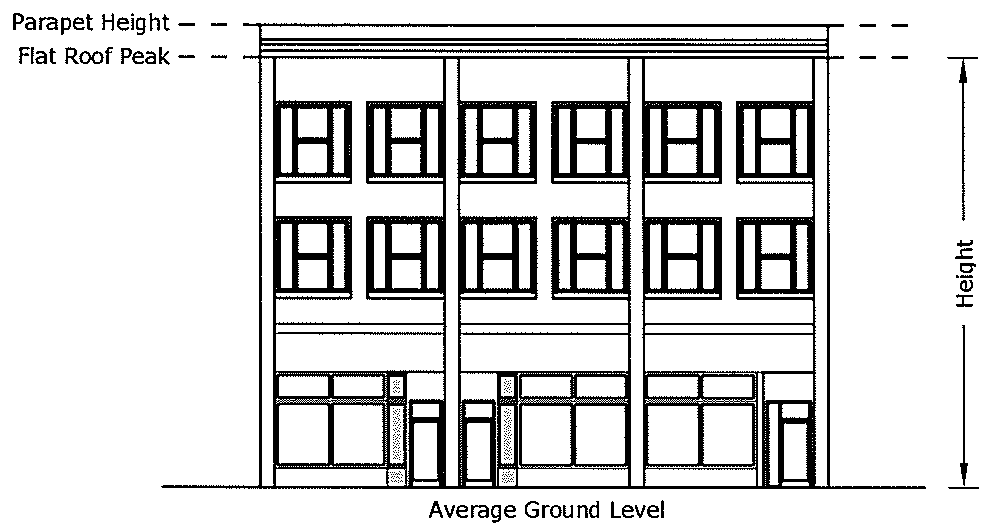
Figure 1315.K: Building height for a flat roof
2.
The peak of a gambrel or mansard roof.
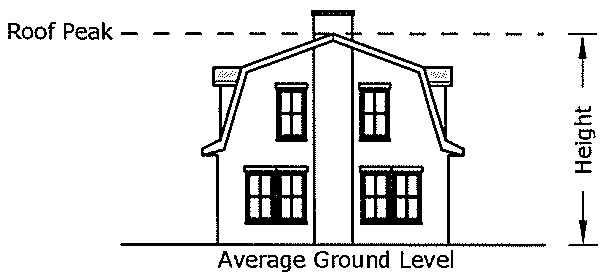
Figure 1315.L: Building height for a gambrel or mansard roof
3.
The midpoint between the eaves and the ridge in the case of a pitched roof (gable, hip, or shed roof).
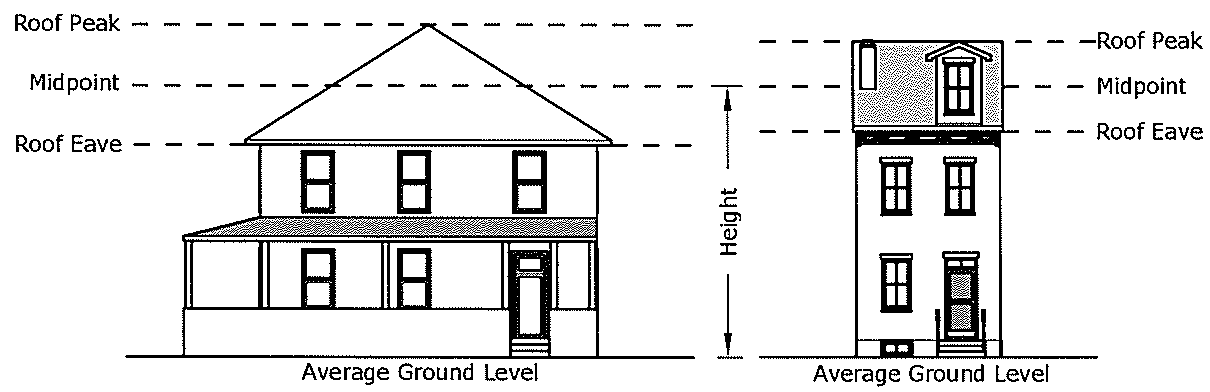
Figure 1315.M: Building height for gable, hip, or shed roof
B.
Building height, stories. When building height is measured by number of stories, building height is measured as follows:
1.
The first story of a structure is measured from the finished ground floor level to the surface of the second floor or, in the case of a one-story building, from the finished ground floor level to the surface of the roof. Each upper story of a structure is measured from the surface of the floor to the surface of the floor above it or, if there is no floor above, from the surface of the floor to the surface of the roof above it.
2.
When building height allows for half-stories, the half-story is calculated as the space under a sloping roof where the line of intersection of roof decking and exterior wall face is no more than five feet above the top floor level.
3.
When a lot slopes downward from the front lot line, additional stories are permitted in addition to the maximum number allowed only on the lower rear portion of the lot.
C.
Building height exceptions. The following are exempt from the minimum and maximum building height requirements:
1.
Accessory structures, which are governed by the zoning district in which they are located in.
2.
Chimneys, fire escapes, flues, ventilators, and smokestacks.
3.
Cooling towers, grain elevators, gantry cranes, derricks, conveyors, essential mechanical appurtenances, air ducts, or other structures used for a manufacturing or transshipment process.
4.
Cupolas, domes, bell towers, minarets, monuments, spires, steeples, belfries, and ornamental towers, so long as they are not intended for occupancy.
5.
Bulkheads, elevator enclosures, penthouses for elevators and stairways, skylights, scenery lofts, and water tanks, so long as these structures occupy no more than 25% of the total area of the roof.
6.
Green roofs and other facilities used to manage stormwater.
7.
Parapet walls, limited to a height of five feet.
8.
Utilities.
9.
Wireless communication towers, antennas, and ancillary structures, subject to section 1341.12. Antennas or similar appurtenances mounted on a buildings may not exceed the maximum building height by 25 feet.
10.
Train cars, shipping containers, and similar structures when repurposed for permanent use and occupancy. This exception applies only to the minimum height requirement in feet but does not exempt a structure from the minimum number of stories required. The maximum building height still applies.
D.
Finished ground floor height. Finished ground floor height is the vertical distance between the average ground level at the primary entrance and the finished floor height of the building. The following exception shall apply:
1.
If the structure is located in a designated floodplain area, in accordance with article 1349 of this zoning ordinance, the structure may be exempted from finished ground floor height requirements in order to meet the requirements for structures located in a floodplain.
E.
Story separation. Story separation is the architectural distinction between the ground floor and the upper stories of the building by doing one of the following on the façade:
1.
A horizontal band such as a cornice or soldier course at the top of the first story.
2.
Change of wall material at the top of the first story.
3.
Change of the color of masonry used at the top of the first story.
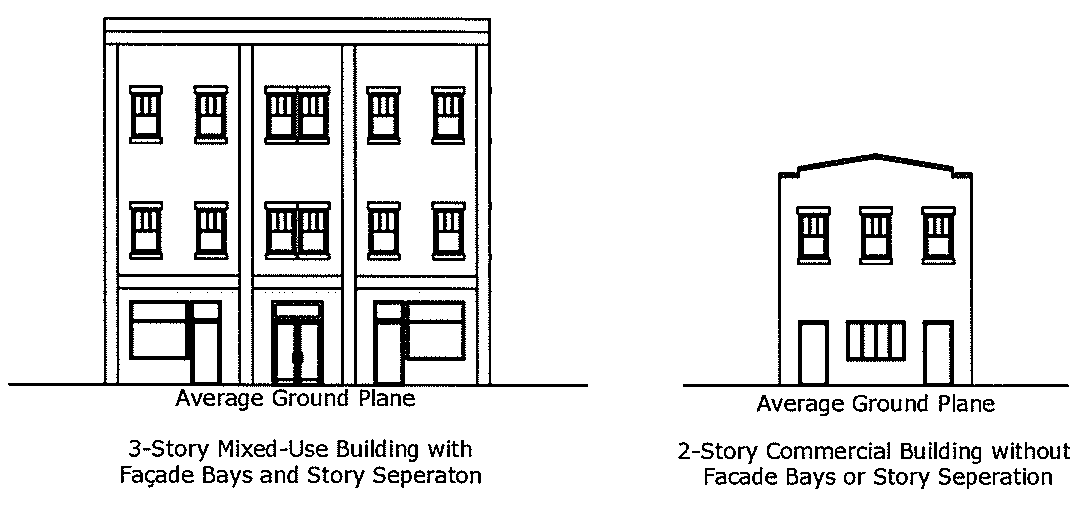
Figure 1315.N: Facade and story separation
(Ord. No. 2020-O-15, 6-22-20)
1315.08 - TRANSPARENCY.
A.
Transparency is the required area of a building's façade to be occupied by fenestrations, also known as windows and doors. Transparency is measured as follows:
1.
Ground floor transparency is calculated based on the total façade area located between two feet and eight feet above finished ground floor level.
2.
Upper floor transparency is calculated based on the total façade area located between the surface of any floor to surface of the floor above it or, if there is no floor above, from the surface of the floor to the top of the wall plate.
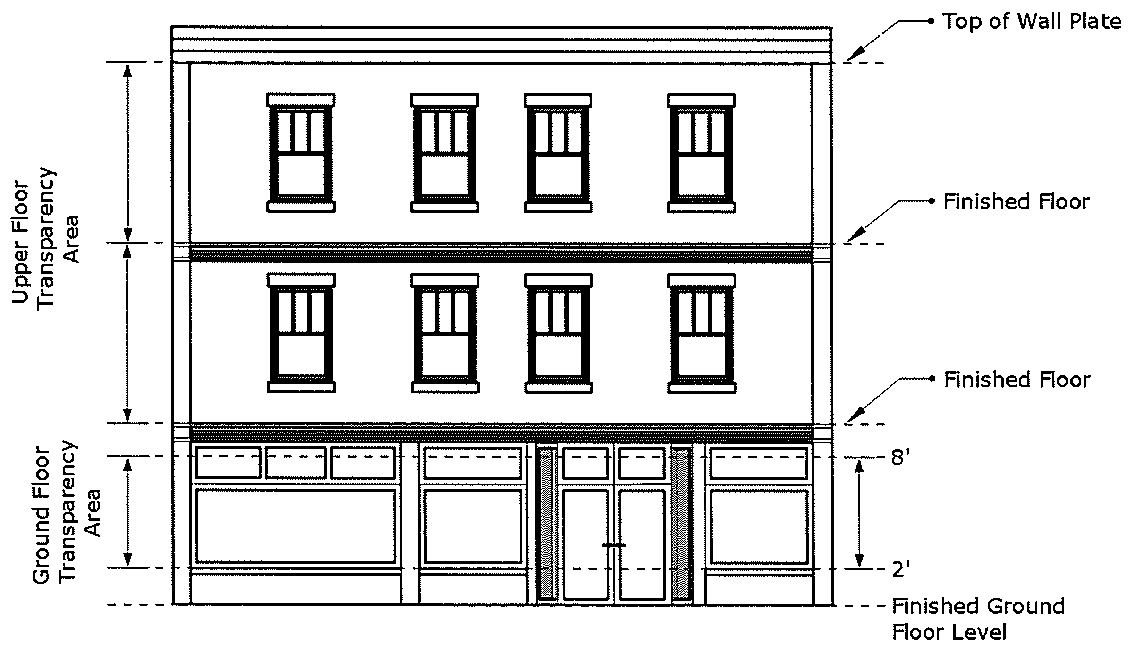
Figure 1315.O: Ground and Upper Floor Transparency Area
3.
Window transparency area. The entirety of a window, to the outer extent of the frame, may be used to calculate transparency area with the following exceptions:
a.
A mullion or other opaque element between sashes or fixed panes, greater than eight inches in width shall not count for the transparent area of a window. This shall include the separation between transom windows and other windows below them.
4.
Door transparency area. The entire area of the door, not to include the casing or frame, may be used to calculate transparency area. A transom window above a door shall be included in the area of the door with the following exception:
a.
The separation between the transom window above the door and the door itself is not greater than eight inches, to include the casing and mullion. If the separation is greater than eight inches, the opaque area between the transom and the door is not included in the calculated transparency area.
5.
Storefront and curtain wall transparency area. The entire area of a storefront and curtain wall, a non-loadbearing wall that is primarily glass with typically aluminum or wood mullions separating doors and panes of glass, may be used to calculate transparency area with the following exceptions:
a.
A mullion or other opaque element greater than eight inches within such a wall system shall not count for the transparent area of a storefront or curtain wall.
b.
If mullions or other opaque elements account for 20% or more of the total area of a storefront or curtain wall, the transparency shall be measured based upon the area of each pane of glass not covered by an opaque element and the area of the door itself.
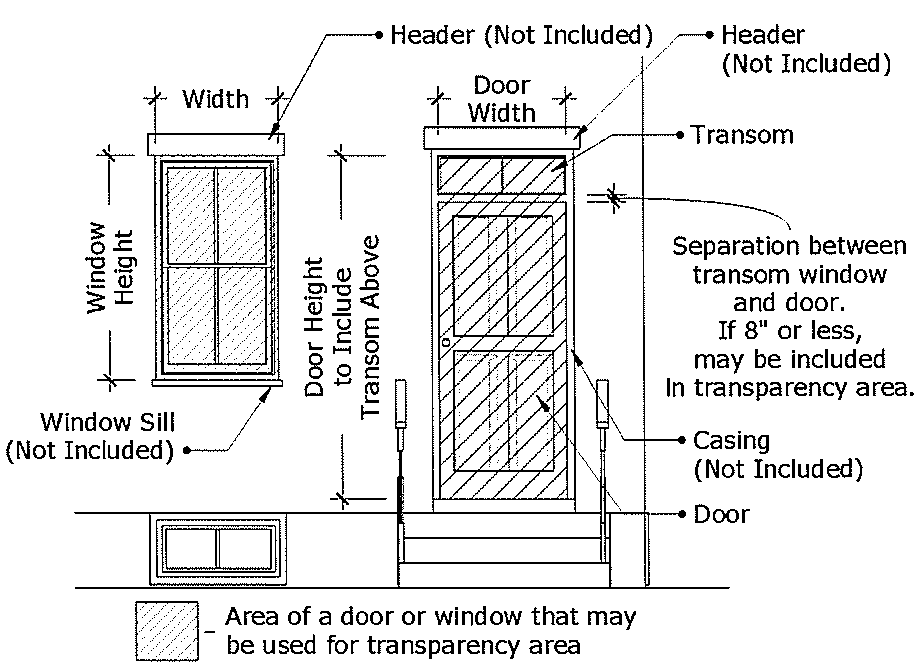
Figure 1315.P: Area of a Window and Door That May be Used to Calculate Transparency;
See also Section 1315.08.A.1 - Ground Floor Transparency
B.
Window qualifications. For any windows to be included in the transparency calculation, the glazing must meet the following criteria:
1.
For ground floor glazing, the glazing must have a minimum 60% visible light transmittance (VLT) and no more than 15% visible light reflectance (VLR).
2.
For upper floor glazing, the glazing must have a minimum of 40% VLT and no more than 15% VLR.
3.
No interior obstructions are permitted to restrict the view to the interior with the exception of displayed merchandise and signs in compliance with article 1345. Blinds, curtains, or similar window treatments that are easily adjusted to control glare or privacy, as determined by the planner, do not count as obstructions.
4.
Windows used in bathrooms, restrooms, dressing rooms, locker rooms, or similar spaces as determined by the planner may have tempered glass, laminated glass, or similar treatments to provide for adequate privacy for those spaces while still allowing for the transmission of light.
C.
Door qualifications. For any door to be included in the transparency calculation, the door must be part of a main entrance, open to and operable by customers or occupants during business hours in the case of a non-residential use, or operable at any time by occupants in the case of residential use.
D.
Ground floor blank wall width. The ground floor blank wall width is measured as any linear dimension of contiguous building wall on the ground floor that does not contain any fenestration.
E.
Front façade. The front façade is the street right-of-way facing façade for a structure. If there are multiple facades that face a street, the front façade will be determined by the planner based on the following criteria:
1.
Which façade faces a more primary street.
2.
Where the primary entrance is located.
3.
Where hierarchical forms of the building are located to signify a more primary entrance if there are multiple, such as a large canopy covered walkway extending to the street or a large vertical extension of a parapet to signify where the entrance is.
F.
Corner side façade. The corner side façade is a street right-of-way facing façade on a corner lot that is not the front façade.
G.
Chamfered corner or beveled edge on buildings. A chamfered corner or beveled edge of a building, designed to achieve corner visibility on a corner lot or driveway entrance, shall be measured as follows:
1.
If located on the corner of a lot where two rights-of-way intersect, the wall can be measured one of two ways. If the wall contains an entrance that is only for uses and spaces on the upper floor, the wall will be counted as a corner side façade. If the wall contains an entrance that is for ground level uses or spaces, the wall will be counted as a front façade.
H.
All fenestrations on the street facing facades must remain transparent to the interior. Windows and doors may not be covered unless for construction with an issued permit, or if the building is vacant and for a period of time until the building is no longer vacant. The covering of windows and doors shall be in compliance with article 1741 and article 1743.
I.
Transparency exceptions. Exceptions for transparency are as follows:
1.
Common walls. The portion of a structure that is a common wall is exempt from any transparency requirements.
(Ord. No. 2020-O-15, 6-22-20)
1315.09 - BUILDING ORIENTATION AND PEDESTRIAN ACCESS.
A.
Main entrance. A main entrance is a principal point of access for pedestrians into a building, prominently visible from the adjacent right-of-way or avenue of approach. To be considered a main entrance, a door must be open to and operable by the general public, for both entering and exiting, during business hours in the case of a non-residential use, or operable at any time by occupants in the case of a residential use. An emergency exit, service door, or similar entryways are not considered a main entrance.
B.
Residential structures. All residential structures shall be required to have a front door facing the street unless the applicant proves to the satisfaction of the planner that the prevailing condition of the developed lots fronting the same street would warrant a different orientation.
(Ord. No. 2020-O-15, 6-22-20)

