
Hyrum City Zoning Code
17.64 Agritourism
A. Definitions.
1. Agricultural Enterprise - "Agricultural Enterprise" means a small or large farm.
2. Agritourism - "Agritourism" means the combination of agricultural production with accessory uses to attract guests from the general public to an agricultural enterprise.
3. Agritourism Operator "Agritourism Operator" means a person who operates an agricultural enterprise with agritourism accessory uses.
B. Purpose and Intent.
1. The purpose and intent of this chapter is to support the agricultural heritage and rural open space in Hyrum City by providing agricultural enterprises which are committed to maintaining agricultural property the ability to allow guests to participate in accessory uses that generate additional income from agritourism.
C. Conditional Use Permit and Business License Required.
1. No accessory use shall be conducted without first obtaining a conditional use permit and business license.
D. Supplemental Conditional Use Permit Application Narrative.
1. In addition to the conditional use permit application requirements listed in this Section, all accessory use applications shall be accompanied by a detailed narrative describing the agricultural enterprise and the overall vision for the proposed accessory uses identified in this Section, and shall also include the following:
a. Description of the anticipated changes to the agricultural enterprise, its general function and maintenance; and
b. Description of the intended guests that are expected to participate; and
c. Description of agriculturally related and non-agriculturally related types of facilities and equipment to be uses for accessory uses; and
d. Description of anticipated traffic, vehicle access, vehicle maneuvering, and a parking plan that accommodates the needs for both guests and employees.
E. Plot Plan and Floor Plan Required.
1. A plot plan drawn to scale, as part of the conditional use permit, that includes property lines, location of all building structures including setbacks from property lines, entrances, and designated off-street parking.
2. A floor plan drawn to scale with labels on rooms indicating proposed uses and includes the square feet clear floor space area of each room.
3. Site plan approval shall be required as regulated by this Title.
4. Zoning clearance shall be required as regulated by this Title.
F. Agricultural Enterprise Qualifications and Classification.
1. The following establishes the qualifications and classification for agricultural enterprises based on acreage"
a. Small Farm. Includes a legal parcel that is a lot size of one (1) to five (5) acres.
b. Large Farm. Includes a legal parcel that is a lot size greater than five (5) acres in size; or contiguous legal parcels that accumulate more than five (5) acres in size.
G. Accessory Use Table.
1. The following accessory uses are determined desirable in conjunction with the agricultural enterprise. "C" denotes allowed conditional use agritourism activities in agricultural enterprise classifications. "NA" denotes accessory uses that are not allowed.
2. Accessory uses may be subject to other requirements in this Title.
3. Minimum setback distances shall be in feet from any existing residential dwelling that is not included in the accessory use.
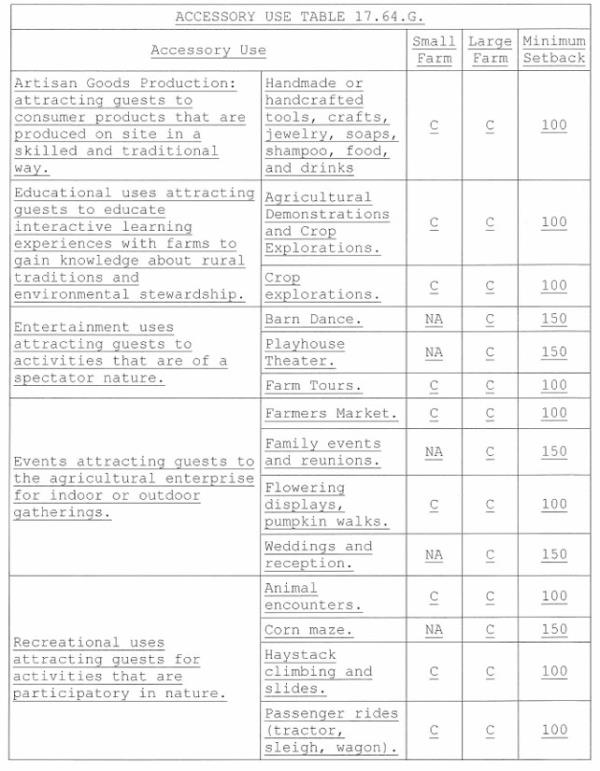
H. Accessory Uses that shall not be considered as an approved agritourism use:
1. Alcohol sales or service (sale or distribution of alcohol, tavern, brewery, or winery)
2. Agricultural Product Processing (slaughtering, processing and packing of chickens, fowl, small or large animals).
3. Commercial /Retail Activities (permanent, high-volume commercial or retail uses).
4.Extractive Activities (mining or extraction of onsite soil, aggregate, or forestry products).
5. High-Impact Entertainment (large festival or music concert).
6. Hunting Preserve or Shooting Range.
7. Intensive Recreational Facilities (non-agricultural, or permanent commercial, entertainment-based structures).
8. Overnight Accommodations (lodging house, recreational vehicles, camping, etc).
I. Occupancy Requirements
1. Occupancy requirements for accessory uses shall be established by the Fire Code Official provided a maximum occupancy load does not exceed more than two hundred and fifty (250) guests visiting the agricultural enterprise.
2. Accessory uses for which attendance exceeds guest occupancy requirements:
a. For the purpose of this Section, the limitations provided herein only apply to guests visiting the accessory use as stated in the application and shall not count towards the primary use occupancy requirements.
b. For the purpose of this Section, the accessory use occupancy requirement apply to the maximum use capacity or anticipated attendance, as determined prior to the accessory use, and shall not be based solely on the number of guests present at any single moment in time.
c. The number of guests assembled shall be determined by the maximum number of guests reasonably anticipated, as evidenced by the accessory use activity advertising, invitations, registrations, vendor permits, parking or traffic plans, site layouts, fire or building occupancy limits, or materials submitted with the application pursuant to this Section.
d. The City shall not be required to establish the actual number of guests present at the premises at any given time to allow enforcement of this Section.
e. No accessory use shall be structured, segmented, or scheduled in a manner intended to evade the guest limitations set forth in this section.
J. Standards.
1. Proximity of accessory uses to adjacent existing properties, existing buildings, and existing uses shall be considered in approving the conditional use permit.
2. Accessory uses, structures, and parking shall not be located within the minimum front yard setback.
3. Existing enclosed buildings and structures that are used exclusively for agricultural use are allowed for guests to participate in accessory use if approved by the Building and Fire Code Official for occupancy.
4. Newly constructed main buildings and structures shall be limited to residential or agricultural use.
5. Newly constructed accessory buildings and structures shall be limited to the requirements of accessory buildings and reflect the architectural character that is consistent with prioritizing rural character.
6. Temporary Structures or Coverings:
a. All applicable zoning and building code requirements must be met.
b. Shall be secured to the ground in order to prevent such from being moved by natural meteorological events.
c. Shall be maintained in a state of good repair and order, including replacement of torn, tattered, faded or peeling materials.
d. Any temporary outdoor facility shall be removed within three (3) days after temporary use.
7. Permanent sanitary sewer facilities are required if located within three hundred (300) feet of an existing city sewer line unless specifically waived by the City Council prior to conditional use permit and business license acceptance.
a. Exemption: If permanent sanitary sewer facilities are waived by the City Council, temporary sanitary sewer facilities shall be incorporated into the design of the agritourism operation and shall be completely screened from the view from public streets and adjacent properties.
8. Exterior lighting shall be prevent glare onto adjacent properties and shall be dark-sky sensitive.
9. One identification sig not to exceed 12 sq. ft. in size either affixed to a structure or on a pole less than eight feet (8') in height may be placed on site. The placement and consideration in approving the conditional use permit.
10. Food preparation must obtain the appropriate food handler's permits or other licensing through the county health department.
11. Amplified or excessive sounds operated by stereos, speakers, musical instruments, live music, concerts, festivals, accessory uses, etc., shall comply with the Hyrum City Code Noise Disturbance. Applications for a permit for relief from the noise levels designated in the Hyrum City Code may be granted by the City Council through a Special Permit with conditions upon a reasonable time that the permit shall be effective and any conditions or requirements they deem necessary to minimize adverse effects upon the community of the surrounding neighborhood.
12. Hours of operation shall be within the hours of 7:00 a.m. and 10:00 p.m.
13. Accessory uses are subject to Hyrum City zoning ordinance, business license ordinance, and conditional use permits ordinance.
14. The use is subject to Hyrum City nuisance ordinances regarding garbage collection and disposal, weed control, dust, noise disturbance, and offenses against public peace, morals, and welfare. More than three (3) violations within a calendar year may result in the revocation of the conditional use permit and business license.
K. Vehicle Access and Parking Requirements
1. Vehicle access locations and the number of parking spaces shall be considered in approving the conditional use permit.
2. Vehicle access shall be from a city street and shall be approved by the City Engineer. Access from any state highway shall be permitted by the Utah Department of Transportation.
3. Vehicle access and parking must provide adequate provisions of ingress and egress by standard-sized automobiles.
4. No on-street parking within the public right of way is permitted.
5. Parking stall are to be nine (9) feet by twenty (20) feet and be contained onsite of the agritourism site.
6. Parking stall setbacks shall be no closer than fifteen (15) feet from an abutting property line that is not included in the agritourism site.
7. If a building structure is included in the agritourism activity, a twenty (20) feet wide all-weather driveway surface from the public right of way to the building structure shall be required for fire and life safety emergency access on and off the site. The Fire Code Official shall inspect and provide a letter that emergency access is adequate.
L. Fire Safety Inspection Required.
1. The business license application shall be referred for approval to the Hyrum City Fire Department for investigation and inspection as to whether or not all ordinances and codes pertaining to fire and safety compel compliance prior to the issuance of a business license.
Approved by Ord. 26-09 on 3/5/2026

