
Hyrum City Zoning Code
17.32 Residential
Zone R-3
17.32.005 Purpose
17.32.010 Use Regulations
In this zone no land use shall be permitted except those designated below:
- Permitted Uses:
- Single-family dwellings with driveways, garages, off-street parking, fences and landscaping, utility lines, gardens, family food production and recreation animals per HCC 17.85.
- Public schools with attendant off-street parking, accessory buildings, and playground.
- Public structures such as electrical, gas, telephone transmission, and fire stations.
- Public parks and playing fields.
- Accessory buildings.
- Churches with associated off-street parking and accessory buildings.
- Professional child care.
- Residential facilities for persons with a disability.
- Single-family dwellings with driveways, garages, off-street parking, fences and landscaping, utility lines, gardens, family food production and recreation animals per HCC 17.85.
- Permitted Accessory Uses:
- Private swimming pool.
- Home occupation.
- Private swimming pool.
- Conditional Uses:
- Residential facilities for the elderly.
- Residential facilities for the elderly.
17.32.020 Area Regulations
The minimum lot area for any residence shall not be less than one half (1/2) acre.
17.32.030 Frontage Regulations
- The setback line from the property line for all main buildings shall not be less than thirty (30) feet.
- The minimum width of lot shall be one hundred (100) feet.
- Establishing setback for lots with concave or convex front property lines: It is intended that the nearest portion of the building to the street be setback at least thirty (30) feet from the front property line, and that the width of the property be not less than one hundred (100) feet at that point (see illustration). The property may not be narrower than forty feet at the front property line.
17.32.040 Yard And Height Regulations
- Side yards shall have a minimum of twelve (12) feet on one side which has no encroachment (to provide vehicular access to back yard) and eight (8) feet on the other. The total width of the two required side yards shall not be less than twenty (20) feet. On corner lots, the side yard width which faces the street shall not be less than thirty feet (30) for main and accessory buildings. Also, on corner lots the back yard thirty-foot (30’) setback shall be allowed on the long axis of the property, irrespective of which street the house faces.
- The minimum setback for main building front walls shall not be less than thirty feet (30) from the property line. An exception is allowed if the other houses on the block, on the same side of the street, are setback less than thirty (30) feet. In this case the setback shall be the average the existing buildings, but in no case shall setback be less than fifteen (15) feet.
- Attached garages are considered a part of the main building for purposes of establishing front, side and rear setbacks.
- Detached garages may be emplaced at the thirty (30) foot front setback line but the combination of house and garage must still meet the side yard setback stipulated in “A” above if the front of the garage is not behind a line established by the back wall of the house.
- Detached garages emplaced elsewhere on the lot shall have minimum side and rear setbacks of one (1) foot from the roof edge.
- All other accessory buildings (ie sheds, barns, etc.) shall be emplaced at least ten (10) feet to the rear of the main building and have minimum side and rear lot line setbacks of one (1) foot from the roof edge. Persons wishing to deviate from this standard may seek exception by presenting a design for review to the Planning Commission. The Planning Commission will consider structure design, landscaping, proximity to neighboring dwellings, and other pertinent data.
- The minimum rear yard depth from any main building shall not be less than thirty (30) feet.
- Front setback will be measured from the property line to the nearest point on the front wall of the structure with the following exceptions:
- When a porch extends toward the street having a roof supported by columns. The measurement will be made to the closest column.
- When a structure has an extended roof overhang or porch roof in excess of two feet, the setback will be measured to the front edge of the roofline and will be reduced to a twenty-eight (28) foot minimum.
- Where both extended roof overhang and support columns exist, the measurement will be made to whichever point (overhang or columns) that yields the greater setback.
- When a porch extends toward the street having a roof supported by columns. The measurement will be made to the closest column.
- Side setback will be measured from the side property line to the nearest point on the side wall of the structure with the following exceptions:
- If any portion of the structure (except the roof), extends closer to the property line than the side wall, it will become the measurement point (e.g. bay windows, foundations, etc).
- When the side roof overhang extends more than two (2) feet beyond the wall. Side setback will be measured from the property line to the roof edge. The required minimum will be reduced by two (2) feet. (Example, a roof overhang extends three (3) feet out from the side wall and a twelve (12) foot setback is required on that side. The adjusted setback of ten (10) feet would be measured from the property line to the edge of the roof).
- If any portion of the structure (except the roof), extends closer to the property line than the side wall, it will become the measurement point (e.g. bay windows, foundations, etc).
- Rear setback will be measured from the rear property line to the rear wall of the structure with the following exceptions:
- If a covered patio is attached to the house, the rear wall of the patio will become the measurement point.
- If a covered patio is attached to the house, the rear wall of the patio will become the measurement point.
- Roofs and side lots must be designed as to ensure that snow and water runoff falls within the property on which the structure is located. Side lots must be configured so as to minimize roof runoff flowing to neighboring properties.
- No building shall be erected to a height greater than two and one-half (2½) stories or thirty-five (35) feet except as otherwise provided. No dwelling structure shall be entered to a height of less than ten (10) feet.
Minimum Residential Setbacks Corner Lot House Non Corner Lot House
Facing short or long side of yard. The 8' and 12' side setbacks can be on either side.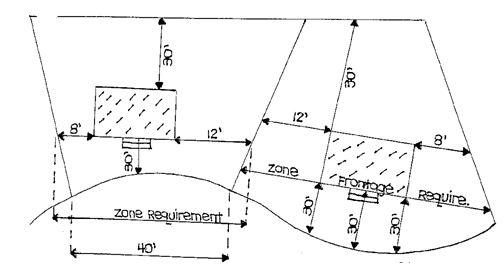
Amended by Ord. 19-04 on 3/7/2019
17.32.042 Residential Landscaping
- It is the intent of this Section to ensure the timely installation of landscaping within the front yard areas of residential lots issued a building permit after December 4, 2008.
- The front yard area of any residential lot containing a new dwelling shall be landscaped. It shall be unlawful for the owner of any residential lot within the City to refuse to install and maintain landscaping within the front yard area of any residential lot containing a dwelling.
- Major Subdivisions: The front yard area shall consist of the entire lot area from and including the front planting strip to the face of the dwelling, or the front setback area, whichever is greater. Corner lots have two (2) front setback areas. On lots with unusually large frontage areas, a request for possible adjustment to this requirement may be made to the Planning Commission.
- Minor Subdivisions: Lots not located in a major subdivision are required to landscape a minimum area of thirty (30) feet wide and eighty two and one half (82 1/2) feet in length, in front of the dwelling. If dwelling is located on a corner lot, a minimum of thirty (30) feet is also required to be landscaped on the side of the dwelling adjacent to the street. On all lots landscaping shall be properly maintained including removing weeds and mowing turf areas. Turf grass shall not exceed six inches (6") in height.
- Major Subdivisions: The front yard area shall consist of the entire lot area from and including the front planting strip to the face of the dwelling, or the front setback area, whichever is greater. Corner lots have two (2) front setback areas. On lots with unusually large frontage areas, a request for possible adjustment to this requirement may be made to the Planning Commission.
- The term “landscaping” shall mean and include the installation of any combination of turf (including either sod or seeded area), planter beds, gardens, trees and shrubs, statuary, boulders, rock areas or other customary landscape features that occupy the entire unpaved portion of the front yard area.
- Xeriscape Permitted - Nothing in this Section shall be construed to prohibit the use of drought tolerant vegetation (xeriscape), and non-vegetative materials. Provided, however, failure of an owner to install and maintain landscaping within the front yard area under the guise that the vegetation and bare ground that occur naturally on the site constitutes xeriscaping shall not qualify as conforming with the provisions of this Section.
- Xeriscape Permitted - Nothing in this Section shall be construed to prohibit the use of drought tolerant vegetation (xeriscape), and non-vegetative materials. Provided, however, failure of an owner to install and maintain landscaping within the front yard area under the guise that the vegetation and bare ground that occur naturally on the site constitutes xeriscaping shall not qualify as conforming with the provisions of this Section.
- Prior to issuance of a building permit, a cash deposit of two thousand dollars ($2,000) will be issued to the City. The two thousand dollar ($2,000) construction deposit can be used to satisfy this requirement, together with a landscaping completion agreement signed by the owner of the property. The proceeds from this deposit may be released as the landscape improvements are completed, with a maximum of three (3) draws, as approved by the Zoning Administrator or other designated City Employee.
- The landscape features required by this Section shall be installed within eighteen (18) months of issuance of a Final Occupancy Approval for the dwelling. Notice of this requirement shall be given to the Owner/Builder prior to, or at the time of Final Occupancy Approval.
- The Zoning Administrator, or other designated City Employee, is hereby charged with the responsibility for enforcement of this Section.
- The owner of any dwelling aggrieved by the issuance of an Administrative Citation or deposit forfeiture shall have and maintain a right to appeal to the Administrative Appeals Hearing Officer, provided appeal shall be submitted not less than ten (10) days following the issuance of the Administrative Citation or forfeited deposit.
- Any public or private entity violating any of the provisions of this Section, as determined by a finding by the Zoning Administrator or other designated City Employee, shall be subject to penalties outlined in HCC 17.08.180. (Ord. 08-22)
17.32.045 Lot Line Adjustments
17.32.050 Manufactured Housing
17.32.060 Public Structures
Public structures such as electrical, gas, telephone transmission, and fire stations are permitted within this zone provided the following conditions are met:
- Landscaping required in front yard area.
17.32.070 Residential Facilities For Persons With A Disability
- A residential facility for persons with a disability shall:
- be occupied on a 24-hour-per-day basis by not more than four (4) unrelated persons with a disability, as pursuant to the definition of “family” in HCC 17.04.070, unless a reasonable accommodation is granted in conformance with item H of this section.
- conform to all applicable standards and requirements of the Department of Human Services; and
- be operated by or operated under contract with that department.
- be occupied on a 24-hour-per-day basis by not more than four (4) unrelated persons with a disability, as pursuant to the definition of “family” in HCC 17.04.070, unless a reasonable accommodation is granted in conformance with item H of this section.
- The permitting process is as follows:
- Applicant shall submit an application to the City Recorder or Zoning Administrator which shows proof of ownership and agreement with the following conditions.
- the facility meet all municipal building, safety, and health ordinances applicable to similar dwellings;
- the operator of the facility provide assurances that the residents of the facility will be properly supervised on a 24-hour basis;
- the operator of the facility establish a municipal advisory committee through which all complaints and concerns of neighbors may be addressed;
- the operator of the facility provide adequate off-street parking space;
- the facility be capable of use as a residential facility for persons with a disability without structural or landscaping alterations that would change the structure’s residential character.
- no person who is being treated for alcoholism or drug abuse be placed in a residential facility for persons with a disability;
- no person who has demonstrated that they are a threat/danger to themselves or others, may be placed in a residential facility for persons with a disability; and
- placement in a residential facility for persons with a disability shall be on a strictly voluntary basis and may not be a part of, or in lieu of confinement, rehabilitation, or treatment in a correctional institution.
- Applicant shall submit an application to the City Recorder or Zoning Administrator which shows proof of ownership and agreement with the following conditions.
- If the City Recorder and/or Zoning Administrator determines that the residential facility for persons with a disability complies with the ordinances it shall grant the requested permits to that facility.
- Only one residential facility for persons with a disability will be permitted per City block, and must be at least 660 feet from another residential facility for persons with a disability.
- The use granted and permitted by this subsection is nontransferable and terminates if the structure is devoted to a use other than a residential facility for persons with a disability or, if the structure fails to comply with applicable health, safety, and building codes.
- Municipal ordinances prohibit discrimination against persons with a disability and against residential facilities for persons with a disability.
- The decision of a municipality regarding the application for a permit by a residential facility for persons with a disability must be based on legitimate land use criteria, and may not be based on the facility’s residents.
- Reasonable accommodations required: None of the foregoing conditions shall be interpreted to limit reasonable accommodations necessary to allow the establishment or occupancy of a residential facility for person(s) with a disability.
- Application: any person or entity who wishes to request a reasonable accommodation shall make application to the Planning Commission. Said applications shall specifically articulate, in writing, the following:
- The name, mailing address, and phone number of the applicant.
- The nature and extent of the disability.
- An exact statement of the ordinance or policy from which the applicant needs a reasonable accommodation.
- The applicant reasonable accommodation(s).
- A statement detailing why a reasonable accommodation is reasonable and necessary in order to afford handicapped persons equal opportunity to use and enjoy housing.
- The physical address of the property where the facility is located.
- Decision. The Planning Commission shall render a decision on each application for a reasonable accommodation within ninety (90) days. The decision shall be based on evidence of record demonstrating all of the following:
- The requested accommodation will not undermine the legitimate purposes of existing zoning regulations notwithstanding the benefit that the accommodation would provide to a person with a disability.
- That but for the accommodation, one (1) or more persons with a disability will be denied an equal opportunity to enjoy housing within the community.
- That equal results will be achieved as between the person with a disability requesting the accommodation and a nondisabled person.
- The requested accommodation will not undermine the legitimate purposes of existing zoning regulations notwithstanding the benefit that the accommodation would provide to a person with a disability.
- Appeal. Any person adversely affected by a final decision of the Planning Commission may appeal that decision in compliance with HCC 17.16. (Ord. 09-04)
- Application: any person or entity who wishes to request a reasonable accommodation shall make application to the Planning Commission. Said applications shall specifically articulate, in writing, the following:
17.32.080 Residential Facilities For Elderly Persons
- A residential facility for elderly persons may not operate as a business.
- A residential facility for elderly persons shall:
- be owned by one of the residents or by an immediate family member of one of the residents or be a facility for which the title has been placed in trust for a resident;
- be occupied on a 24-hour-per-day basis by not more than four (4) unrelated elderly persons, as pursuant to the definition of “family” in HCC 17.04.070, in a family-type arrangement. Up to eight (8) individuals may be allowed if conditions applied are consistent with those required for multi-family housing dwellings as approved by the Planning Commission.
- be owned by one of the residents or by an immediate family member of one of the residents or be a facility for which the title has been placed in trust for a resident;
- A residential facility for elderly persons may not be considered a business because a fee is charged for food or for actual and necessary costs of operation and maintenance of the facility.
- The permitting process is as follows:
- Applicant shall submit an application to the Planning Commission requesting a conditional use permit and a permit for a residential facility for elderly persons. It will show proof of ownership (Per B-1 above) and agrees to the following conditions:
- the facility meet all municipal building, safety, zoning, and health ordinances applicable to similar dwellings;
- adequate off-street parking space be provided;
- the facility be capable of use as a residential facility for elderly persons without structural or landscaping alterations that would change the structure’s residential character;
- only one residential facility for elderly persons will be permitted per City block, and must be at least 660 feet from another residential facility for elderly persons;
- no persons being treated for alcoholism or drug abuse be placed in a residential facility for elderly persons; and
- placement in a residential facility for elderly persons be on a strictly voluntary basis and not a part of, or in lieu of, confinement, rehabilitation, or treatment in a correctional facility.
- the facility meet all municipal building, safety, zoning, and health ordinances applicable to similar dwellings;
- Applicant shall submit an application to the Planning Commission requesting a conditional use permit and a permit for a residential facility for elderly persons. It will show proof of ownership (Per B-1 above) and agrees to the following conditions:
- If the Planning Commission determines that the residential facility for elderly persons complies with the ordinances it shall grant the requested permits to that facility.
- The use granted and permitted by this subsection is nontransferable and terminates if the structure is devoted to a use other than a residential facility for elderly persons or, if the structure fails to comply with applicable health, safety, and building codes.
- This ordinance prohibits discrimination against elderly persons and against residential facilities for the elderly persons.
- The decision of the Planning Commission regarding the application for a permit by a residential facility for elderly persons must be based on legitimate land use criteria, and may not be based on the age of the facility’s residents. (Ord. 09-04)
17.32.090 Use Of Trailers, Campers, And RVs On Residential Lots
- This ordinance is intended to set some guidelines and conditions for the temporary use of trailers, campers, and recreation vehicles on residential lots. It is recognized that many Hyrum residents use these vehicles on a temporary basis to house family and guests. The ordinance is not intended to unduly restrict that right, but rather to ensure against their long term use as a second dwelling on a residential lot.
- No permit is required for the first seven days of occupancy. If requested, two (2) consecutive thirty (30) day permits may be issued after an inspection conducted by the city insures that all items in Section E are being adhered to. The permits are available at the City Offices.
- A permit for houses under construction may be given for a time period not to exceed six (6) months. This permit is only available for property owners who have a lot with a house under construction. The permit is available at the City Offices.
- Any other permits will require approval of the Planning Commission.
- The following conditions apply to all uses of trailers, campers, and RVs on residential lots:
- The vehicle will be located on a lot which either has an existing residential building or on a building lot for which a building permit has been issued.
- The vehicle may be temporarily hooked up to water, electrical, and sewer of the host residence.
- The vehicle shall not be located on public property.
- Only one vehicle shall be inhabited at a time.
- Successive “guests” shall be considered a continuation of a use if less than a thirty (30) day interval passes between previous guest usage.
- There shall be no charge for use of the vehicle. It is not to be considered a rental unit.
- Property owners are responsible to ensure that persons staying in trailers, campers, and RVs on their property shall exercise such comportment as to not disturb the residential nature of the neighborhood. Complaints by neighbors may result in cancellation or non-renewal of a permit.
Amended by Ord. 14-05 on 7/17/2014
17.32.100 Driveways
- No concrete driveways will be permitted beyond private property lines except in areas where curb, gutter, and sidewalk are installed.
- No driveway shall be emplaced closer than thirty feet from an intersection (measured from the edge of the driveway nearest the intersection to the edge of the public right of way. This would be the gutter area where curb and gutter exist).
Amended by Ord. 19-04 on 3/7/2019
17.32.110 Off-Street Parking Required
There shall be provided at the time of erection of any building or at the time any main building is enlarged or increased in capacity, minimum off-street hard surface parking space with adequate provisions of ingress and egress by standard-sized automobiles as hereinafter provided.
Amended by Ord. 19-04 on 3/7/2019
17.32.120 Off-Street Parking - General Requirements
17.32.130 Off-Street Parking - Specific Requirements
- House: two (2) spaces;
- Churches and places of public assembly: one (1) space for each five (5) fixed seats and one (1) space for fifty (50) square feet of floor area for moveable seats under maximum seating arrangement;
- Dwelling unit occupied by four (4) individuals unrelated by blood, marriage or adoption: two (2) spaces per three (3) individuals, plus one (1) additional space for each additional individual exceeding three (3).
Amended by Ord. 19-04 on 3/7/2019
17.32.140 Off Street Parking - Special Regulations
- In computing the parking requirements for any building or development, the total parking requirements shall be the sum of the specific parking space requirements for each class of use included in the building or development.
- Parking for a single family dwelling shall be provided only in a private garage, or in an area properly located for a future garage.
- Prior to issuance of any building permit, a plan which clearly and accurately designates parking spaces, access aisles, driveways and the relationship to the use to be served by the off-street parking shall be provided to the City Engineer. Approval will be based on:
- Adequate number of spaces;
- Relation of parking to use;
- All parking spaces must be usable and accessible by adequate roadway-parking configuration to be approved by the City Engineer.
- Parking stalls to be nine (9) feet by twenty (20) feet and of a hard surface such as asphalt, cement or brick. Gravel, road base, etc. are not considered hard surfaces. Access to the stall (the driveway) shall also be, at minimum, sixteen (16) feet wide and will require hard surface. Residential driveway accesses (curb cuts) shall be limited to a maximum width of thirty-five feet (35) feet. Platted major subdivisions will require hard surface driveways to the paved street.
- Location of Parking Space. Parking space, as required herein, shall be on the same lot with the main building, or in the case of nonresidential buildings, may be located not further than three hundred (300) feet there-from.
- Parking requirements for nursing homes and private schools will be determined during the review of approval for a conditional use permit.
Amended by Ord. 19-04 on 3/7/2019
Approved by Ord. 23-11 on 12/7/2023
17.32.150 Off-Street Truck Leading Space
17.32.160 Walls, Fences Or Hedges
17.32.170 Movement Of Structures
17.32.180 Building Prohibited
No required yard or other open space around an existing building, or which is hereafter provided around any building, shall be considered as providing a yard or open space for any other building, nor shall any yard or open space on an adjoining lot be considered as providing a yard or open space on a lot whereon a building is to be erected.
17.32.190 Dwelling To Be Located And Maintained On A Lot
17.32.200 Yards To Be Unobstructed - Exceptions
17.32.210 Area Of Accessory Buildings
No accessory building nor group of accessory buildings in any residential zone shall cover more than fifty (50) percent of the rear yard.
Amended by Ord. 19-04 on 3/7/2019

