Indian River County Unincorporated
City Zoning Code
City Zoning Code
CHAPTER 926
LANDSCAPE AND BUFFER REGULATIONS
Section 926.01.- Short title.
This chapter shall be known and may be cited as the "Indian River County Landscape and Buffer Ordinance."
(Ord. No. 90-16, § 1, 9-11-90; Ord. No. 2007-012, § 1, 3-20-07)
Section 926.02 - Purpose and intent.
The board of county commissioners recognizes that the unique characteristics and qualities of Indian River County justify regulations to retain and perpetuate a beneficial, natural, and visually pleasing environment. It is the purpose and intent of this chapter to establish standards for the installation and continued maintenance of landscaping, without inhibiting creative landscape design, so as to improve the appearance of proposed developments. These standards are intended to protect and preserve the appearance, character, and value of surrounding neighborhoods.
Moreover, landscape vegetation benefits the environment and living conditions by contributing to the production of oxygen, transfer of water, precipitation of airborne pollutants, and conversion of carbon dioxide, in addition to the provision of cooling shade, and reduction of noise.
It is further the purpose and intent of this chapter to promote water conservation through the preservation of existing native Florida vegetation into landscape designs, the use of drought-tolerant plant materials, the promotion of landscape plans which do not require permanent irrigation systems and instead utilize temporary systems for establishing new drought tolerant plantings, the use of efficient low-volume systems where permanent irrigation is necessary, and the use of reuse water for irrigation when available.
(Ord. No. 90-16, § 1, 9-11-90; Ord. No. 2007-012, § 1, 3-20-07)
Section 926.03. - Applicability.
The provisions of this chapter shall apply to the development and maintenance of unincorporated Indian River County property which is subject to the provisions of Chapter 914, Site Plan Regulations; Chapter 915, Planned Development; and Chapter 913, Subdivisions and Plats, of the County Land Development Code, Section 926.15 of this chapter shall apply to the development and maintenance of property in the unincorporated area of the county that is subject to the provisions of Chapter 912, Single-Family Development, of the County Land Development Code.
(Ord. No. 90-16, § 1, 9-11-90; Ord. No. 2004-041, § 3, 12-7-04; Ord. No. 2007-012, § 1, 3-20-07)
Section 926.04. - Definitions referenced.
The definitions of certain terms used in this chapter are set forth within this chapter, including appendices, and in Chapter 901, Definitions, of the County Land Development Code.
(Ord. No. 90-16, § 1, 9-11-90; Ord. No. 2007-012, § 1, 3-20-07)
Section 926.05. - General requirements.
(1)
Unlawful activity. It shall be unlawful for any person to establish, remove or alter landscape contrary to the provisions of this chapter. The lack of maintenance of landscape installed pursuant to a county approved landscape plan shall also be a violation subject to penalties provided by law.
No construction requiring site plan review shall be undertaken in Indian River County until a landscape plan has been approved by the planning and zoning commission. The planning and zoning commission will not approve any landscape plan unless it conforms to the requirements of this chapter.
When the redevelopment, reconstruction, upgrading, expansion or change in use of a previously developed site is such that site plan review is required by county regulations, then this chapter shall be applied to such site as if it were previously undeveloped.
(2)
Landscape plan required. A landscape plan showing proposed landscape design shall be submitted for review and approval by the county. Such plan shall be required for all applicable development as referenced in section 926.03. For residential projects (including subdivisions, major site plans, and planned developments) over twenty (20) units or for nonresidential projects over forty thousand (40,000) square feet of new impervious surface, the landscape plan shall be prepared by either a Florida registered landscape architect or a Florida certified landscape designer. Landscape plans shall include and indicate the following:
(a)
Location, species, and size of all existing trees to be preserved or removed pursuant to Chapter 927, Tree Protection;
(b)
Location of all structures, freestanding signs, parking areas, drives, vehicular use areas and other improvements to remain or proposed for installation on the property;
(c)
Location of overhead powerlines and adjacent rights-of-way;
(d)
Location and description of existing native plant communities to remain undisturbed, as applicable;
(e)
Location, species (with identification if native or non native), size, and quantity of all proposed landscape materials;
(f)
Plant list including quantity of all proposed landscape materials;
(g)
General notes including mulching requirements, fertilization and installation details, and such other information as needed;
(h)
Planting details as needed;
(i)
Dimensions of the property;
(j)
Required opaque features, including berms; and
(k)
Tabulations which clearly show relevant statistical information necessary to evaluate compliance with provisions of this chapter. This shall include, but not be limited to, required buffers, vehicular use landscaping/screening, nonvehicular landscaping, an such other information as needed.
(3)
Irrigation plan required. In conjunction with a landscape plan, an irrigation plan shall be required. Such plan shall clearly illustrate compliance with section 926.11 of this chapter.
(4)
Certificate of occupancy. No final certificate of occupancy shall be given or issued to an owner or his agent until all conditions of this chapter have been met and the code enforcement official has given an approval. Temporary power, however, may be issued in those instances where all improvements on a site except landscaping have been completed, where power is required for the irrigation system, and where the developer of the project certifies in writing that the required landscaping for the project will be installed as depicted on the plan and provides a timetable for installation of the landscaping. Failure to fulfill the proposed timetable shall be grounds for immediate and summary revocation of the temporary power allowance.
(5)
Exotic species removal. For all new development, or redevelopment of existing property, the applicant is required to remove, under county environmental supervision, all invasive, exotic plant species defined and listed in Appendix B prior to issuance of a certificate of occupancy or certificate of completion, whichever is applicable.
(6)
Prohibitive plantings. The following is a list of prohibited plants that shall not be planted within any landscape areas:
Cattley Guava;
Common Guava;
Loquat;
Rose Apple;
Surinam Cherry;
Orange Jasmine;
Chinese Box Orange.
(7)
Exceptions. Governmental institutions or other research centers under contract with governmental agencies conducting scientific research are exempt from any regulations prohibiting the planting of Caribbean fruit fly and citrus greening host plants. Any group utilizing this exemption must verify their status with the community development department.
(8)
Reduction of landscaping requirements for projects in remote agricultural locations. For a development project subject to Chapter 926 landscape and buffer requirements, situated on property designated AG-2 (Agricultural 2 up to 1 unit per 10 acres) or AG-3 (Agricultural 3 up to 1 unit per 20 acres), and located west of 102 nd Avenue, an applicant may request a reduction in the requirements of section 926.08 perimeter buffer standards and section 926.10 non-vehicular area landscaping standards. Such request shall be considered by the community development director and may be granted by the director upon a finding that a reduction in requirements is warranted based on mitigating factors which may include, but are not limited to, the following:
(a)
Separation of the project development area from adjacent property under different ownership.
(b)
Separation of the project development area from an adjacent residential use.
(c)
Presence of intervening vegetation (existing vegetation located between the project development area and adjacent property) or other intervening features.
(d)
Separation and/or intervening vegetation between the project development area and an adjacent road used by the public.
The project site plan shall note any approved reduction in landscaping requirements and shall show the project-specific required landscaping improvements.
A decision of the community development director may be appealed as provided in section 902.07 "Appeals from decision of the community development director or his designee".
(Ord. No. 90-16, § 1, 9-11-90; Ord. No. 2007-012, § 1, 3-20-07; Ord. No. 2007-036, § 2, 10-23-07; Ord. No. 2017-009, § 1, 7-11-17)
Section 926.06. - Landscape materials standards.
(1)
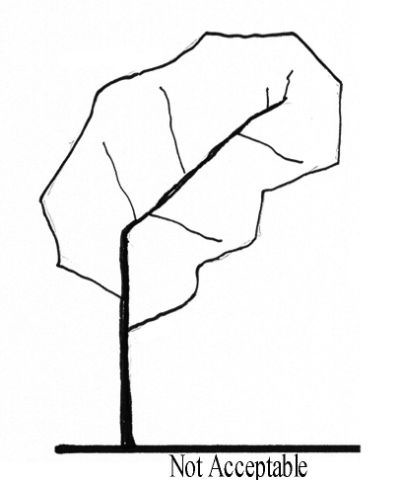
Quality. Plant materials used in conformance with the provisions of this chapter shall conform to the Standards for Florida No. 1 or better, unless specifically excepted below, as given in the most current edition of "Grades and Standards for Nursery Plants" Part I and Part II, State of Florida, Department of Agriculture, Tallahassee, or equal thereto. A canopy tree may be deemed to meet Florida No. 1 standards if the main leader splits into no more than two (2) leaders at or above a height of ten (10) feet. Palms shall have a full, healthy head and shall not be excessively pruned. Grass sod shall be clean and free of weeds and noxious pests or diseases. Grass seeds shall be delivered to the job site in bags with Florida Department of Agriculture tags attached, indicating the seed grower's compliance with the department's quality control program. Plant materials which are known to be intolerant of paving environments, or whose physical characteristics may be injurious to the public, shall not be specified for use.
(a)
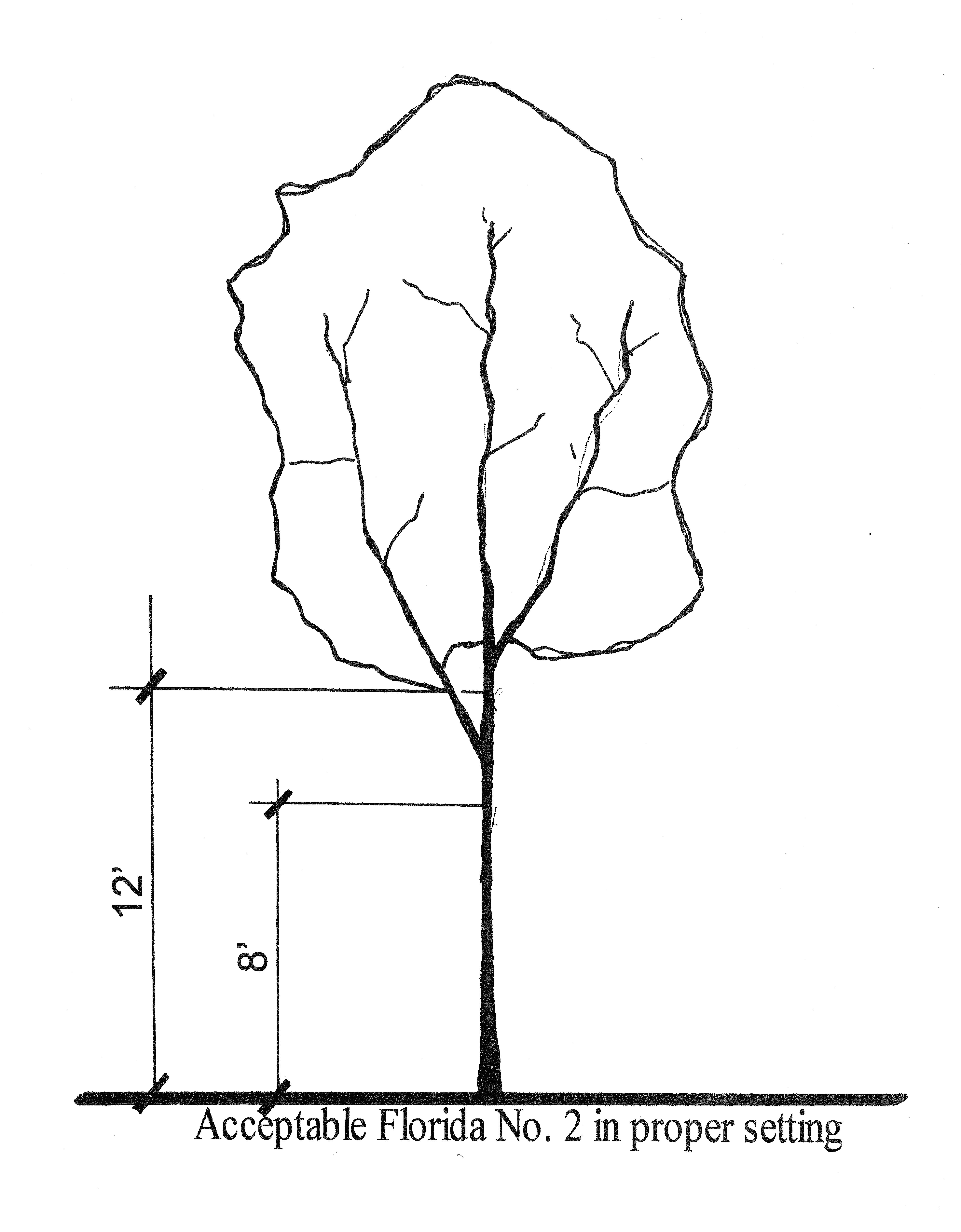
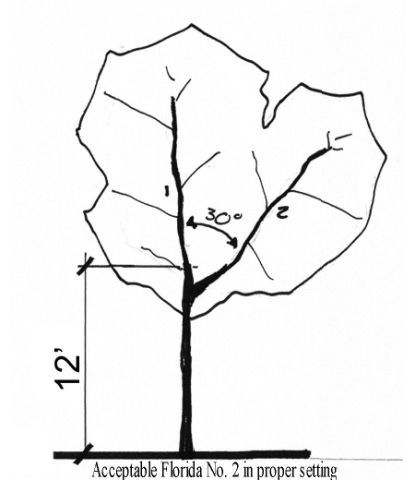
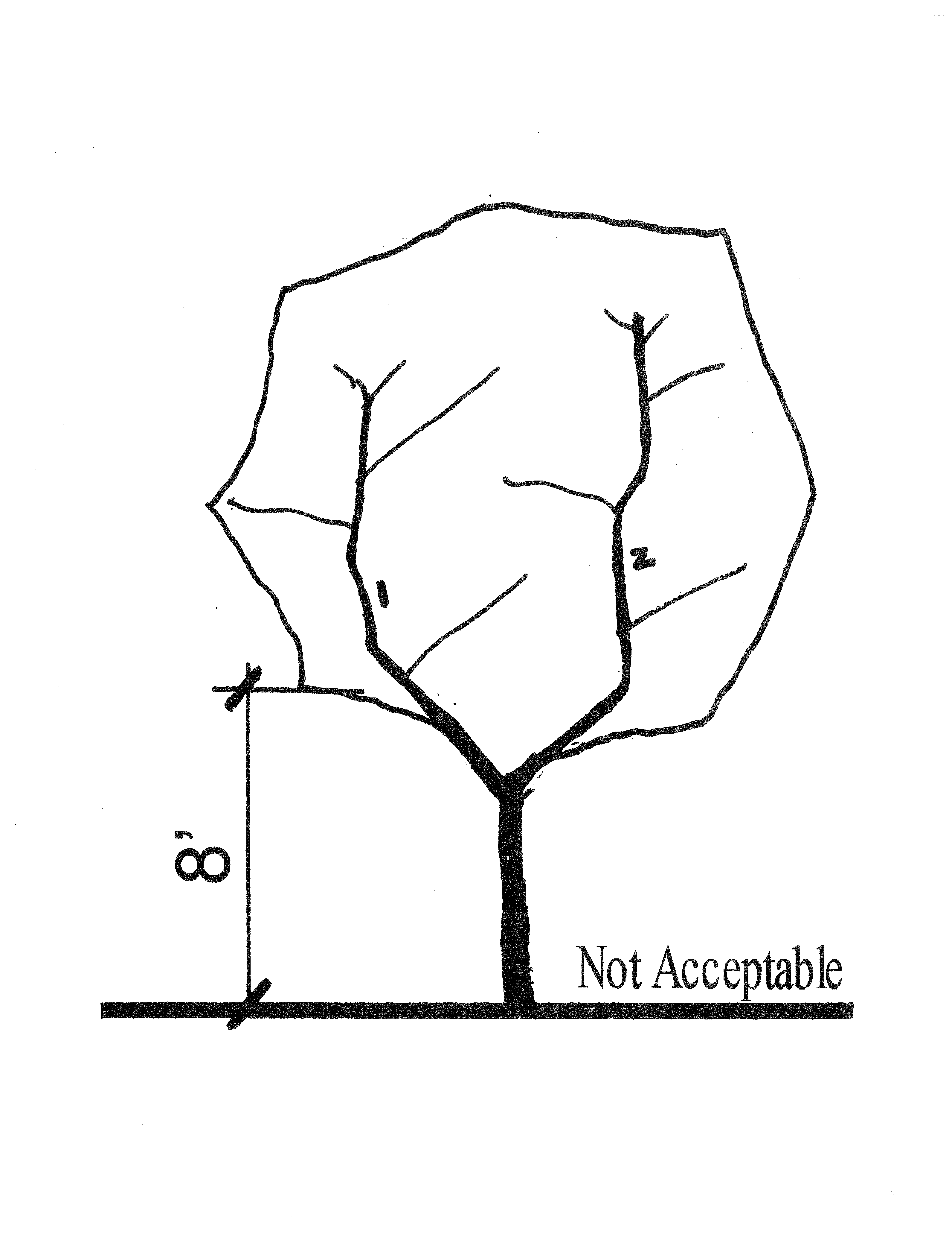
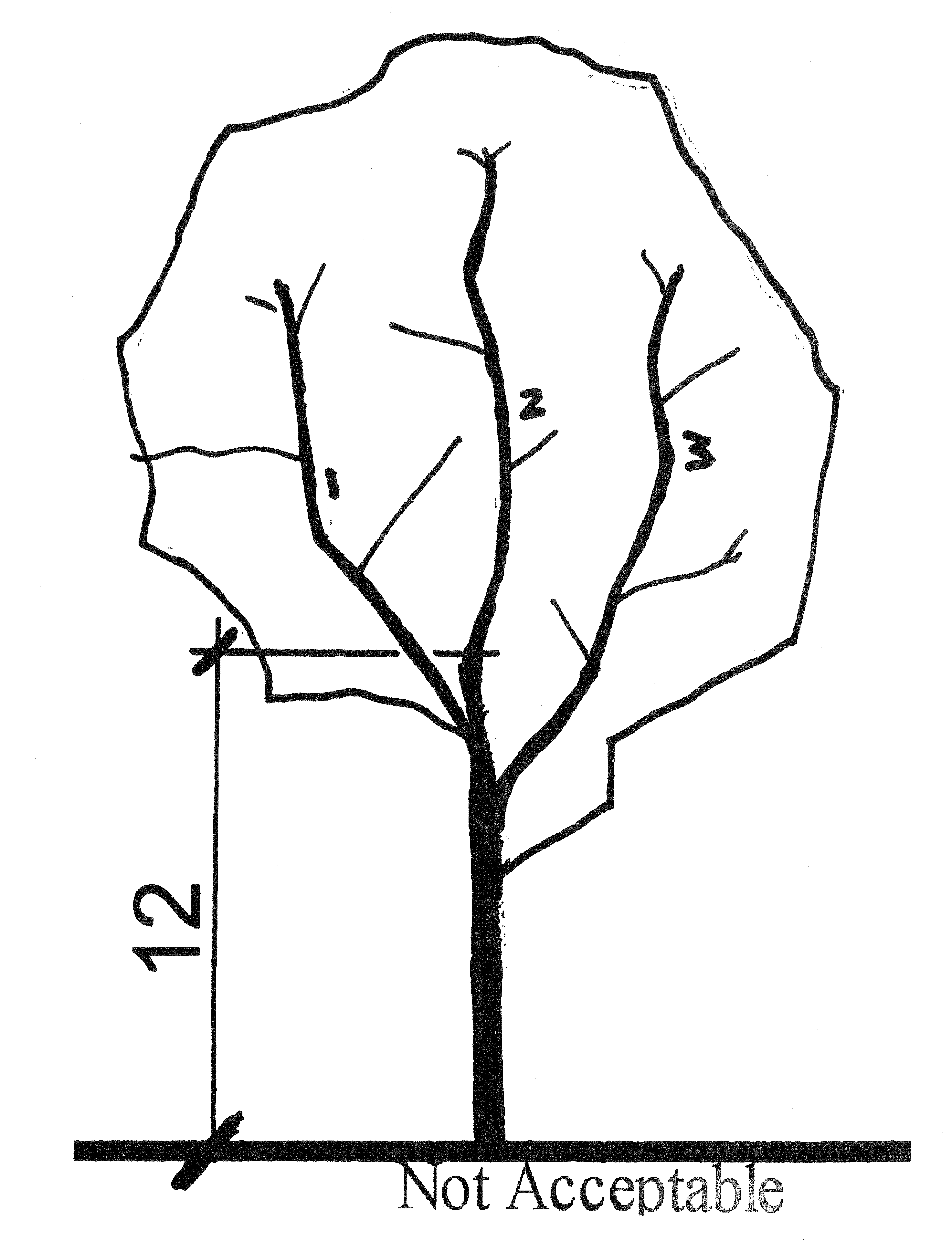
County-acceptable Florida No. 2 1 or better required canopy trees may be used around water bodies and stormwater areas, within park and common green space areas, around and within conservation or preservation areas, and within rear yard and side yard buffers where the buffer depth is greater than or equal to forty (40) feet. In no instance shall a required canopy tree that is less than Florida No. 1 be installed closer than twenty-five (25) feet to the nearest building, driveway, street, or parking area.
1 A "county-acceptable Florida No. 2 canopy tree" shall mean a Florida No. 2 tree with no distorted or lop-sided crown, no split leader below eight (8) feet, no more than two (2) leaders below twelve (12) feet, and no split leader below twelve (12) feet with a degree of separation that exceeds thirty (30) degrees.
(2)
Drought tolerance requirements. A minimum of fifty (50) percent of total cumulative landscape plant material used to meet the provisions of this chapter shall be "moderately" or "very" drought tolerant, as classified and listed in the most recent edition of the "South Florida Water Management District Xeriscape Plant Guide" or a comparable publication. Existing native plant species preserved on-site may be considered as credit toward the drought tolerance percentage requirement.
(3)
Trees.
(a)
Canopy trees.
1.
Canopy trees, except for narrow canopy tree species identified under [subsection] 926.06(3)(d)1.b., below, shall be species having an average mature crown spread of greater than fifteen (15) feet (under local climatic conditions) and having a trunk(s) with over five (5) feet of clear wood. "Clear wood" refers to that portion of the trunk between the ground and the lowest lateral limbs.
2.
All new canopy trees shall be planted in a planting area of at least one hundred forty-four (144) square feet, with minimum dimensions being at least twelve (12) feet in any direction. Larger areas may be required by the community development director or his designee for newly planted or existing trees to be preserved, as required by Chapter 927, tree protection.
3.
Clusters of palms, such as sabal palms, may be used as canopy trees provided that a minimum of three (3) palms are clustered to equal one (1) canopy tree. Clusters of palms and specimen palms (specified below), if used, shall consist of no more than one-third (⅓) of the total canopy tree requirement.
a.
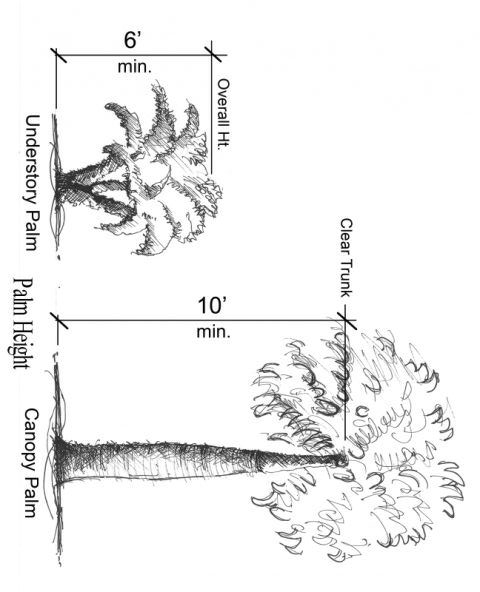
A multi-trunk palm may be substituted for one (1) canopy tree provided that the total height of the combined clear trunks (ground to lowest frond, measured along the truck) is a minimum of eighteen (18) feet.
b.
A Canary Island date palm, Sylvester palm, Bismark palm, or palm with a similar quality large "frond canopy" as approved by planning staff with a clear trunk of at least two (2) feet and an overall height of at least twelve (12) feet may count as one (1) canopy tree. Such a palm may count as two (2) canopy trees if it has a clear trunk of at least eight (8) feet and an overall height of at least eighteen (18) feet.
c.
A palm of the Roystonea genus with a minimum clear trunk of ten (10) feet may be counted as one (1) canopy tree.
4.
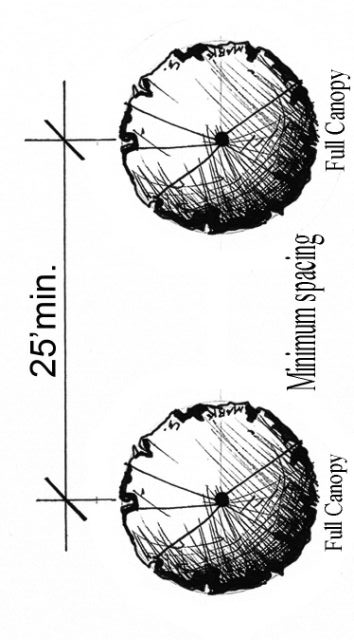
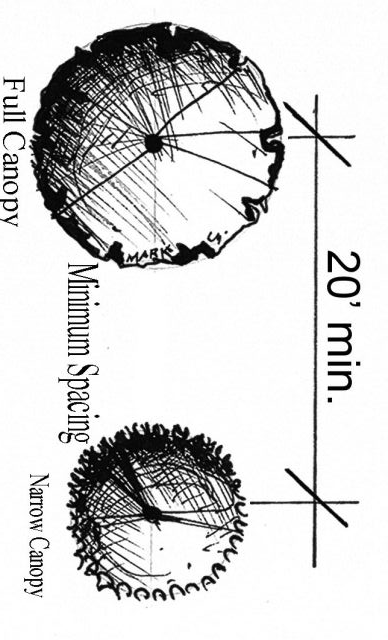
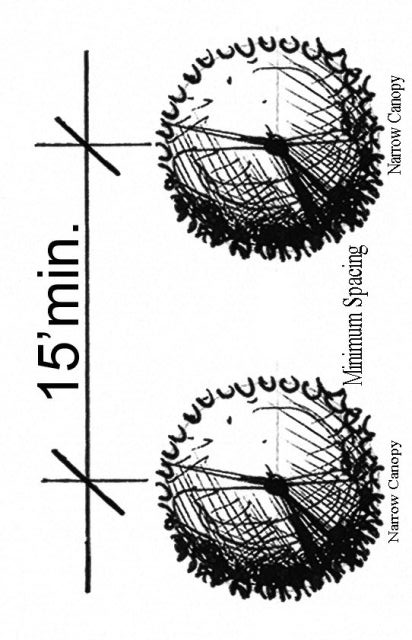
Minimum canopy tree spacing shall be provided as follows:
a.
Between full canopy trees (e.g. oak, pine, bay): twenty-five (25) feet.
b.
Between narrow canopy tree varieties (e.g., cypress and holly) not including magnolia: Fifteen (15) feet.
c.
Between full canopy trees and narrow canopy tree varieties (e.g., cypress and holly) not including magnolia: Twenty (20) feet.
(b)
Trees having an average mature crown spread less than fifteen (15) feet may be substituted by grouping the same so as to create the equivalent of a fifteen-foot crown spread.
(c)
Understory trees shall be species defined as medium or small trees having a mature crown spread of fifteen (15) feet or less.
(d)
Tree sizes:
1.
Required canopy trees shall be a minimum of twelve (12) feet overall in height and two (2) inch diameter at one-half (0.5) feet above grade with a minimum crown spread of four and one-half (4.5) feet, at the time of planting, except as follows:
a.
Unless otherwise specified in [subsection] (3)(a) above, palms used toward canopy tree credit shall have a minimum clear trunk (ground to lowest frond, measured along the trunk) of ten (10) feet. Where an arrangement of such palms with varying heights between six (6) feet clear trunk and eighteen (18) feet clear trunk is proposed and the average clear trunk of the arrangement is ten (10) feet, each palm in the arrangement shall count as one (1) ten-foot clear trunk palm for tree canopy requirement purposes.
b.
Narrow, upright canopy tree species, such as varieties of cypress, holly, and magnolia, shall have a minimum spread of three and one-half (3.5) feet at three (3) feet above ground level.
c.
Where a building between twelve (12) feet and twenty-five (25) feet in height is proposed to be located within fifty (50) feet of a perimeter property line that separates the development project from an abutting residential use located outside the project, canopy trees within required buffers (Types A-C) located between the building and a site perimeter shall be a minimum of fifteen (15) feet in height with a three-inch diameter at 0.5 feet above grade at planting and a minimum six-foot spread. Where a building between twelve (12) feet and twenty-five (25) feet in height is proposed more than fifty (50) feet from a perimeter, the canopy tree height requirements of [subsection] (d)1. above, shall apply to canopy trees within the buffer.
d.
Where a building over twenty-five (25) feet in height is proposed to be located within seventy (70) feet of a perimeter property line that separates the development from an abutting residential use located outside the project, all canopy trees within required buffers (Types A-C) located between the building and a site perimeter shall be a minimum of sixteen (16) feet in height with a three-inch diameter at one-half (0.5) feet above grade and a minimum eight-foot spread at planting. Where a building over twenty-five (25) feet in height is proposed more than seventy (70) feet from a perimeter, the canopy tree height requirements of [subsection] (d)1. above, shall apply to canopy trees within the buffer.
2.
Required understory trees shall be a minimum of six (6) feet overall in height and one- and one-half (1.5) inches diameter at one-half (0.5) feet above grade at the time of planting. Multi-trunk trees shall have a combined one- and one-half-inch caliper for all trunks at six (6) inches above grade. Palm trees used as understory trees shall have a minimum overall height of six (6) feet and shall not comprise more than one-third (⅓) of the total understory tree requirement.
(e)
The number of different species of trees, other than palms, shall be as follows:
Table 1
For sites or parcels located in a sand ridge or xeric scrub environment as determined by county environmental planning staff, a minimum of three (3) species shall be required, regardless of the required number of trees. Such trees shall be indigenous to, and tolerant of, sand ridge or xeric scrub conditions.
(f)
At least fifty (50) percent of all required canopy trees, understory trees, and palms shall be a native species as listed in Appendix A.
(g)
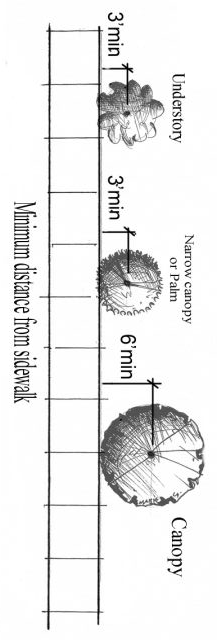
Trees in proximity to public works or easements. Trees of a species whose roots are known to cause damage to sidewalks, roads, or driveways shall not be planted closer than six (6) feet to such structures unless a tree root system barrier, approved by the public works director or his designee, is provided that protects the structure(s) from damage by the root system. Said root barrier, where required, shall be installed prior to issuance of a certificate of occupancy or certificate of completion.
(h)
Prohibited trees. The installation of any of the species listed in Appendix B is prohibited.
(i)
Credits for the use of newly planted trees larger than the minimum size shall be as indicated in Table 2. Fractional measurements shall be attributed to the next lowest category. See Table 3 regarding credits for trees pre-existing or relocated on-site.
Table 2
(4)
Shrubs.
(a)
Shrubs shall be a minimum of eighteen (18) inches in height when measured immediately after planting, except that shrubs of non-native viburnum and ligustrum species shall be a minimum of twenty-four (24) inches in height immediately after planting.
(b)
Shrubs, where required, shall be planted in an offset double row and maintained so as to form a continuous, unbroken, solid screen. Where required to form a continuous screen to satisfy a buffer or opaque feature requirement, shrubs shall be planted on twenty-four (24)-to-thirty (30) inch centers, unless a greater spacing is necessary to accommodate larger shrubs and is approved by planning division staff.
(c)
Every landscape plan shall contain a minimum number of shrub species as indicated in the table below. Excluding shrubs used in opaque features, at least fifty (50) percent of the required number of shrubs shall be of native species, listed in Appendix A.
(5)
Vines. Vines shall be a minimum of eighteen (18) inches in height directly after planting and no less than thirty (30) inches apart. Vines may be used in conjunction with fences, screens or walls to meet physical barrier requirements as specified. At least fifty (50) percent must be native. Vines qualifying as native are listed in Appendix A. The installation of any species listed in Appendix B is prohibited.
(6)
Mulch and ground covers. The use of cypress mulch is prohibited. Mulch that is not cypress may be used, Ground covers (not including sod grass) shall be planted in such a manner as to present a finished appearance and reasonably complete coverage within one year after planting. At least fifty (50) percent of the area covered by living material shall be of native species. Refer to Appendix for a list of native ground covers and flowers. The complete coverage of an area by ground covers precludes the use of mulch thereafter.
(7)
Turf grass. Turf grass areas shall be identified on the landscape plan and shall be limited to a maximum of fifty (50) percent of the total irrigated, landscaped and vegetated project area, excluding rights-of-way, active recreation areas (e.g. playfields), and slopes within dry retention areas. Turf grass shall be placed so that it can be irrigated in a separate zone. Preferred turf grasses are those qualifying as native and are listed in Appendix C.
Grass areas may be sodded, plugged, strigged or seeded, except that solid sod or hydro-seeding shall be used in swales or other areas subject to erosion. Seed, where used, shall be of a variety that will produce coverage within ninety (90) days from sowing; where other than solid sod, grass seed or grass sprigging is used, nurse grass seed shall be sown for immediate effect and protection until coverage is otherwise achieved. When necessary, a reseeding program shall be implemented to produce complete coverage within one (1) year.
(8)
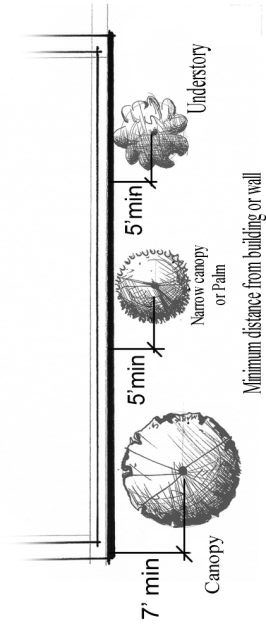
Walls. The wall articulation and wildlife opening requirements stated in Chapter [subsection] 913.09(9)(C)4. shall apply to all walls provided in perimeter buffers and landscape areas. In addition, no required canopy tree shall be installed closer than seven (7) feet to any wall (excluding a short retaining wall), and no palm or understory tree shall be installed closer than five (5) feet to any wall (excluding a short retaining wall). Exception: narrow, upright canopy tree species, such as varieties of cypress, holly, and magnolia, may be located the same as understory trees and palms.
(9)
Buffers of Florida native vegetation. For the purposes of conserving water and promoting original native landscape, an unelevated buffer of undisturbed Florida native vegetation preserved in situ, or a buffer planted to re-create native uplands (as listed in Appendix A) is preferred over the creation of a landscaped berm. Supplemental native plantings may be added to meet the specifications of the required buffer type. Solid opaque features, such as panel-system walls, may be required within native buffers where the approving body (i.e. staff, the planning and zoning commission, or the board of county commissioners) determines that such features are needed to mitigate potential noise impacts.
(10)
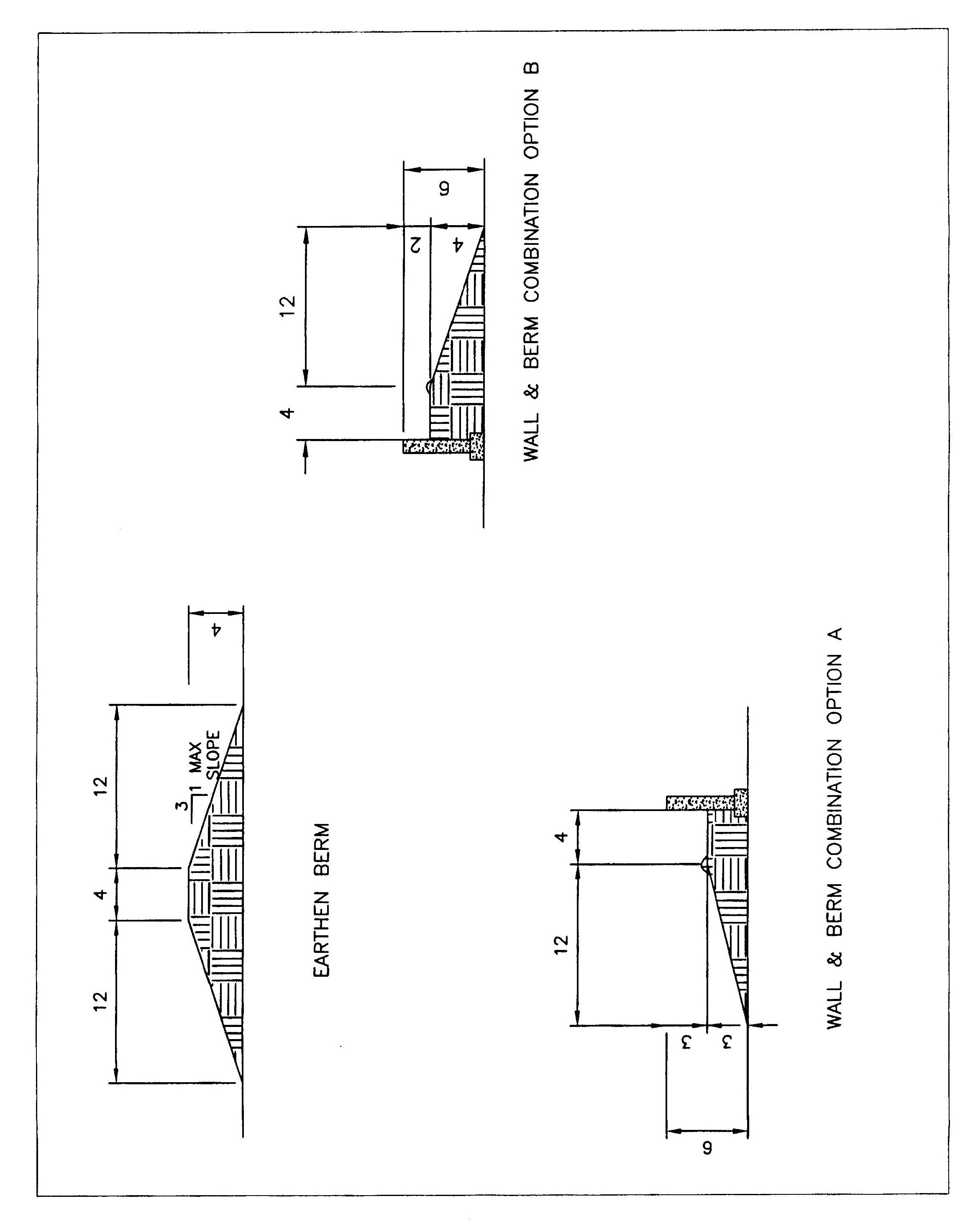
Berms. Earthen berms shall have a slope no steeper than three (3) feet horizontal to one (1) foot vertical. The crest of the berm shall have a four-foot planting area plateau, with ridges on the ends for the retention of water on top of the berm. Berms must be constructed of appropriate soils; the use of either hydric soils or excessively drained soils in constructing berms is prohibited. All berms Guidelines for soils are referenced in Appendix D.
(11)
Fences. When fences are installed, the side of the fence facing public view shall have a finished appearance. Fences shall be consistent with all corridor plan criteria. Landscaping is required on the side of the fence facing a roadway, in conformance with the requirements set forth in paragraph (5) above and Chapters 911, 913, 915 and 971. Fences shall provide openings to allow for wildlife passage as specified for walls in subsection 913.09(9)(C)(4).
(Ord. No. 90-16, § 1, 9-11-90; Ord. No. 92-39, § 22, 9-29-92; Ord. No. 97-29, § 7, 12-16-97; Ord. No. 2007-012, § 1, 3-20-07; Ord. No. 2010-008, §§ 6—8, 3-23-10; Ord. No. 2019-010, § 1, 6-11-19)
Section 926.07. - Landscape point system and tree preservation credits.
(1)
Landscape point system. Notwithstanding the other provisions of this chapter, each landscape plan must satisfy a minimum of thirty (30) points from the following list of options:
(a)
Irrigation system:
1.
Moisture sensing controller .....5
2.
Plan submitted with low, moderate and high water usage zones indicated .....5
(b)
Shrubs:
1.
Fifty (50) to seventy-five (75) percent of total quantity of plants rated "very drought tolerant" .....5
2.
Seventy-six (76) to one hundred (100) percent of total quantity of plants rated "very drought tolerant" .....10
(c)
Trees:
1.
Fifty (50) to seventy-five (75) percent of total quantity of trees rated "very drought tolerant" .....5
2.
Seventy-six (76) to one hundred (100) percent of total quantity of trees rated "very drought tolerant" .....10
(d)
Extra shade/canopy trees in vehicular use areas:
1.
Twenty (20) to forty (40) percent more than required .....5
2.
More than forty (40) percent more than required .....10
(e)
Sod/grass areas:
1.
Thirty-one (31) to fifty (50) percent of landscape area .....5
2.
Less than thirty (30) percent of landscape area .....10
(f)
Florida native landscape:
1.
One hundred (100) percent of landscape area is preserved or re-established Florida native vegetation, or new native plantings of species listed in Appendix A and Appendix C. Plan must include trees, understory, and groundcover with a maximum of fifty (50) percent of site sodded/grassed .....30
2.
Seventy-five (75) to ninety-nine (99) percent of landscape area is preserved or re-established Florida native vegetation, or new native plantings of species listed in Appendix A and Appendix C. Plan must include trees, understory, and groundcover with a maximum of fifty (50) percent of site sodded/grassed .....15
(2)
Tree preservation credits.
(a)
Existing trees preserved or re-located on site that have been determined to be in good health by a certified arborist or by county environmental planning staff may be credited towards the minimum tree planting requirements of this chapter according to the following table. Fractional measurements shall be attributed to the next lowest category.
Table 3
Calculation of Tree Preservation Credits
(b)
Protected trees re-located from approved building footprint areas to other areas of the same development site may count toward Chapter 926 landscaping requirements and Chapter 927 tree mitigation requirements.
(c)
Trees excluded from preservation credit. No credit shall be given for preserved trees which are:
1.
Not located within the area of the property (e.g., buffer area, parking lot) for which trees are required by this chapter;
2.
Required to be preserved by law, such as mangroves;
3.
Not properly protected from damage during the construction process, as provided for in Chapter 927, tree protection;
4.
Prohibited or controlled species identified in [sub]section 926.06(3)(h);
5.
Dead, dying, diseased, or infested with harmful insects; or
6.
Located on golf courses, in conservation/preservation areas, or in similar subareas which are not intended for residential, commercial, or industrial use and which are exempted from non-vehicular open space landscaping requirements.
(Ord. No. 90-16, § 1, 9-11-90; Ord. No. 91-48, § 43, 12-4-91; Ord. No. 2007-012, § 1, 3-20-07; Ord. No. 2010-008, § 9, 3-23-10)
Section 926.08. - Perimeter buffer standards.
(1)
A perimeter buffer is a landscaped strip along parcel boundaries that serves as a buffer between incompatible uses and zoning districts, as an attractive boundary of the parcel or use, or as both a buffer and attractive boundary. Existing native vegetation and upland native plant communities as described in Chapter 929, Upland Habitat Protection, may be utilized to meet buffer requirements.
(2)
The width and degree of vegetation required depends on the nature of the adjoining thoroughfares and uses. Chapter 915, Planned Development, Chapter 911, Zoning, and Chapter 971, Specific Land Uses, of the County Land Development Code, set forth buffer type requirements for adjacent properties, based on land use and zoning districts.
(3)
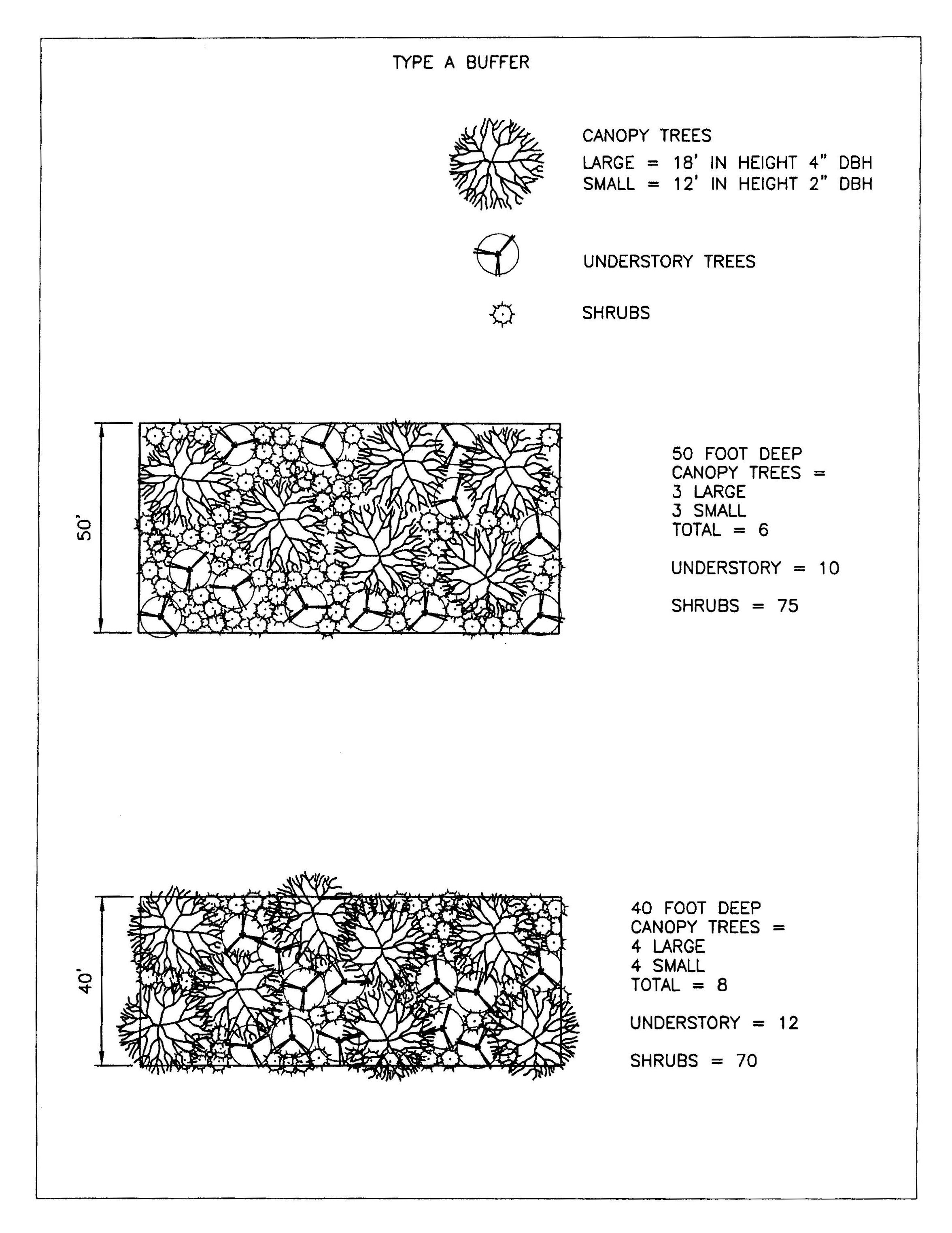
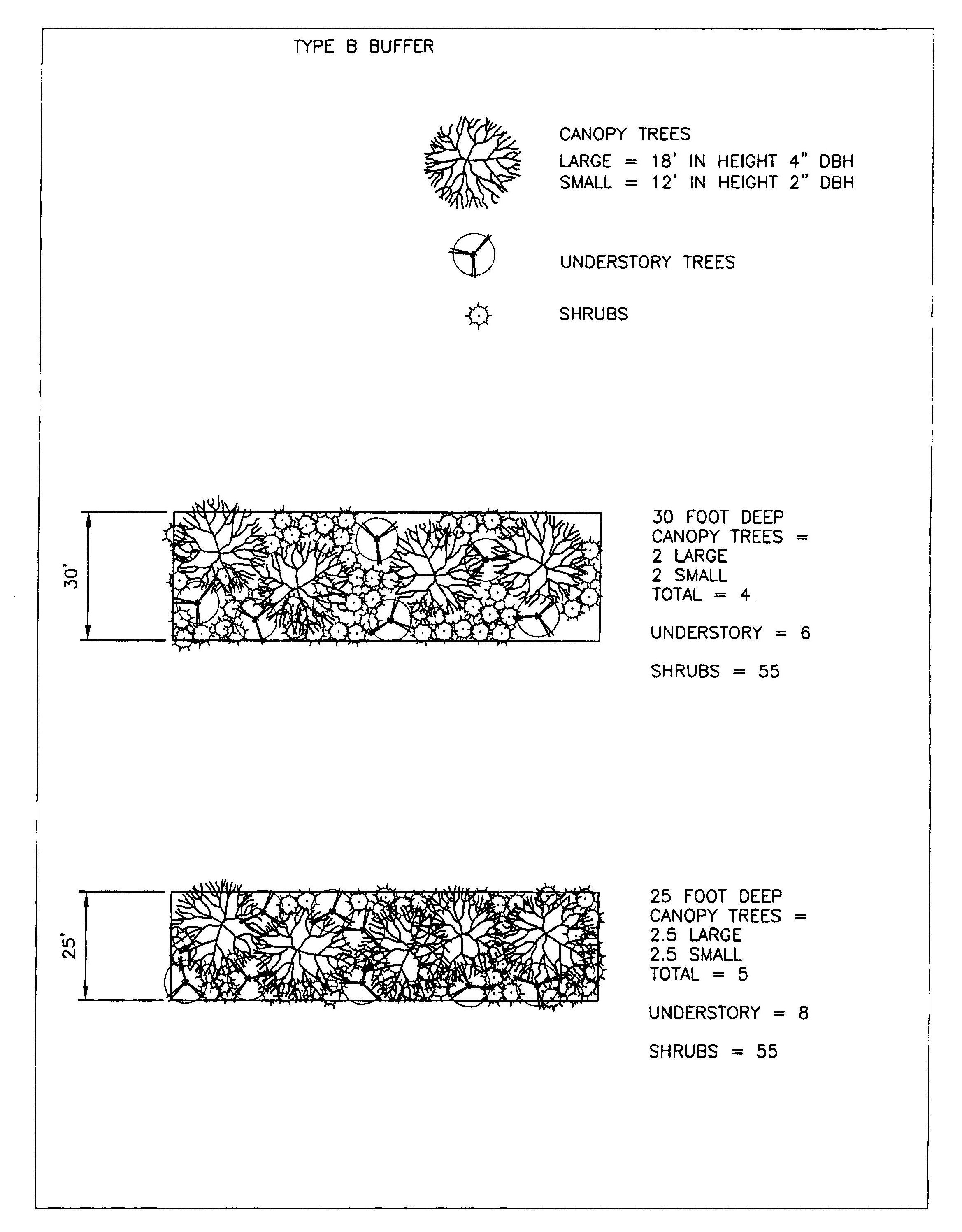
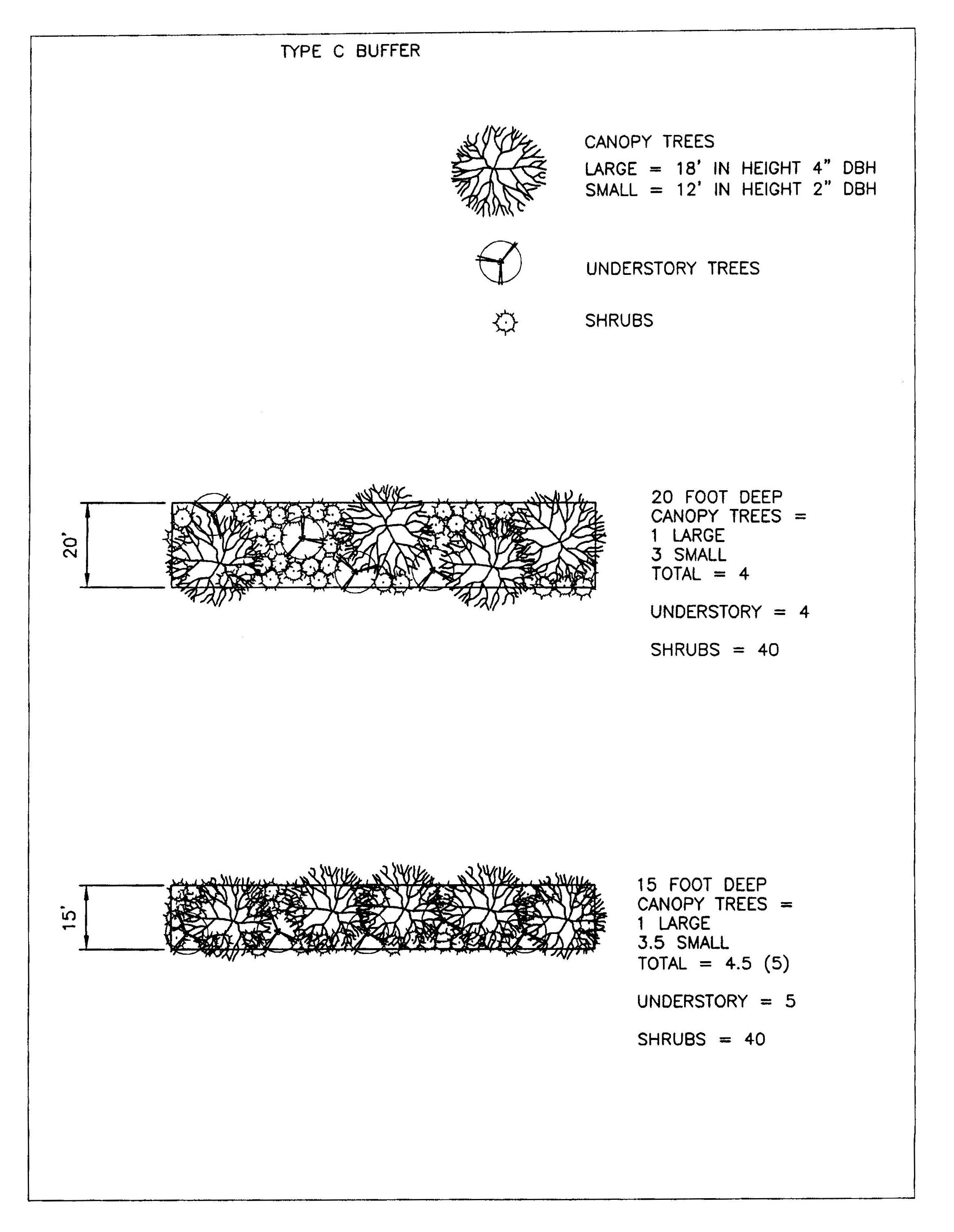
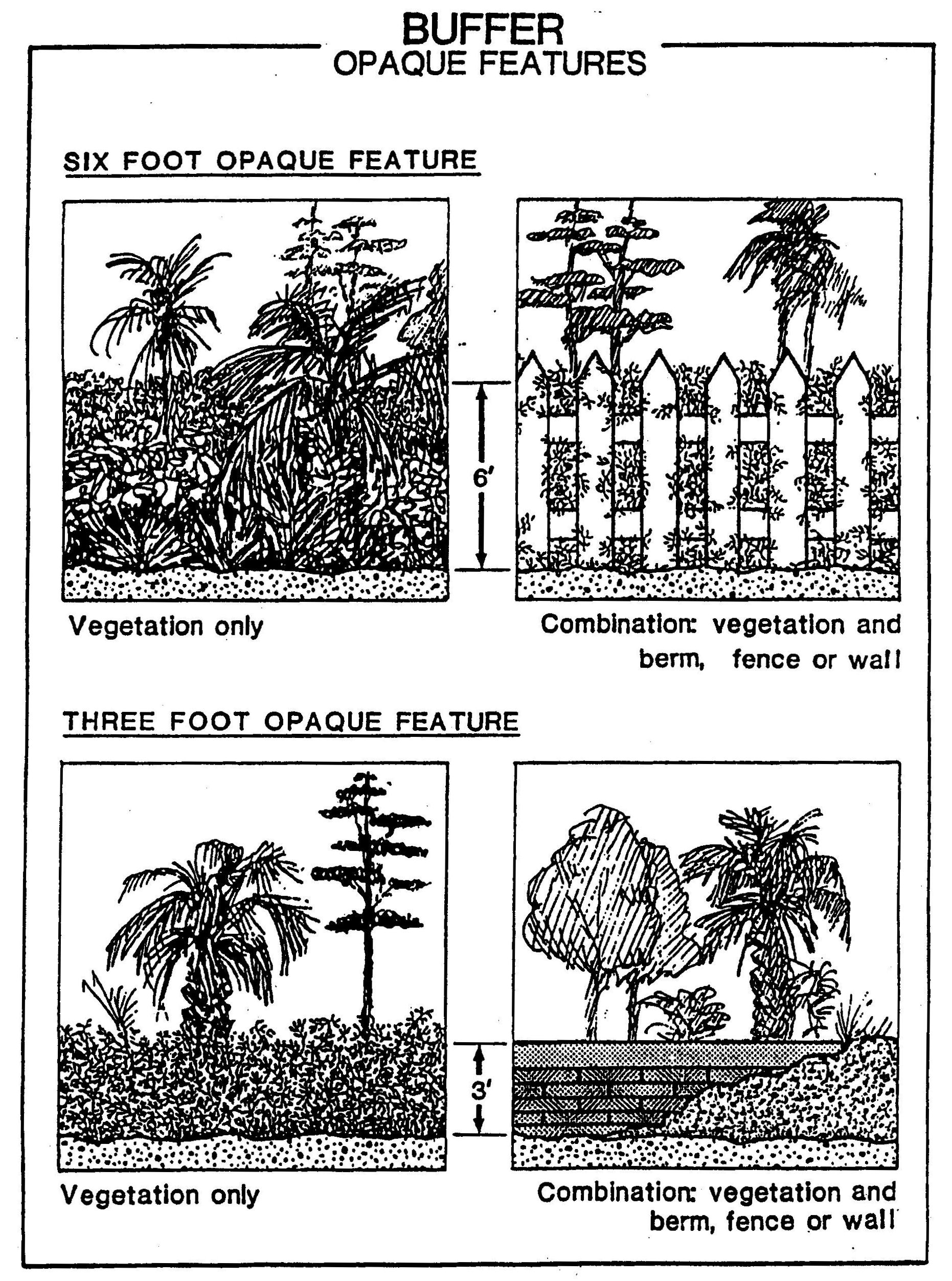
Buffer types and opaque features. There are three (3) buffer types to be utilized in Indian River County. They are, in order of intensity, as follows: Type A buffer; Type B buffer; and Type C buffer. Buffers may require opaque features, including three-foot and six-foot opaque features, where specified in the land development regulations.
(a)
The following table summarizes the Type A buffer, Type B buffer, and Type C buffer requirements. The trees and shrubs shall be spread in a staggered, off-set pattern to establish a full and opaque buffer. Buffer type options are further defined in Chapter 901, Definitions, of the County Land Development Code.
*Must be seventy-five (75) percent native plantings.
For sites less than one hundred fifty (150) in depth, the required depth of a Type C buffer shall not exceed ten (10) percent of the depth of the site, measured perpendicular to the road. For all sites, the required depth of a Type A or Type B buffer shall not be required to exceed twenty (20) percent of the depth of a site, measured perpendicular to the road. Where buffer depth is reduced by this provision, the applicant shall obtain planning division staff approval of a modified planting plan that generally satisfies the planting density of the respective buffer type.
(4)
Opaque features. Three-foot and six-foot opaque features may be required within buffers, where specified in the land development regulations.
(a)
A required six-foot opaque feature shall consist of a solid native plant buffer, a masonry wall, an earthen berm, or a combination berm/vegetation (berm must comprise at least three (3) feet of required opaque feature; vegetation shall consist of shrubs planted in an off-set double row) unless the planning and zoning commission approves a substitute material (such as a completely opaque living landscape barrier) based upon the use and conditions of the project site and adjacent site. Landscaping is required along both sides of a wall unless otherwise approved by the planning and zoning commission. To minimize the impact upon existing tree roots in cases where a wall is to be located among existing trees, such wall shall should be a pre-cast concrete panel wall or other similar system that minimizes footer impacts to root systems. Wherever a wall is used as the opaque feature, required understory trees and shrubs shall be planted on the side of the wall facing a public street or adjacent property, whichever is applicable.
(b)
A required three-foot opaque feature may consist of a wall, berm, or a continuous screen of shrubs. Shrubs planted to form this opaque feature shall be arranged in an off-set double row.
(c)
Required three-foot and six-foot opaque features shall be measured from the finished floor elevation of the proposed structure(s). This requirement may be modified by the planning and zoning commission based upon grade differences and the relationship between the height and mass of the proposed building and its setback from the property line. The maximum required height of an opaque feature shall be eight (8) feet above the finished site grade where the feature is located.
(d)
In cases where an abutting use/district is separated from the project site by a thoroughfare plan road, the height of a six-foot opaque feature shall be reduced to three-feet, except in cases where the buffer is to be provided around the perimeter of a single-family or multi-family residential development as required by subsection 911.07(8) or 911.08(8).
(Ord. No. 90-16, § 1, 9-11-90; Ord. No. 97-29, § 11, 12-16-97; Ord. No. 2007-012, § 1, 3-20-07)
Section 926.09. - Landscaping along roadways.
(1)
Required landscaping adjacent to rights-of-way.
(a)
A landscape buffer shall be provided along the entire length of a site's frontage (excluding driveways) upon a thoroughfare plan road, local road or exclusive driveway (as defined in the traffic ordinance) For purposes of calculating trees required within the buffer, thirty (30) feet of frontage for each freestanding sign located along the frontage shall be exempt from canopy and understory tree requirements. Within the buffer, the following landscaping shall be provided:
1 In locations where understory trees conflict with existing canopy, two (2) forty-two-inch, non-native/thirty-six-inch native shrubs may be substituted for one (1) understory tree.
Project sites with a depth from a thoroughfare plan road of four hundred (400) feet or less shall have a minimum buffer depth of fifteen (15) feet. Sites with a depth over four hundred (400) feet shall have a minimum buffer depth of twenty (20) feet. The required depth of the thoroughfare plan road/local road buffer on any site shall not exceed ten (10) percent of the depth of the site, measured perpendicular to the thoroughfare plan road. In such cases where the roadway buffer depth is reduced, the required amount of plant material may also be reduced on a prorated basis.
(b)
A four-foot-high visual screen is required between any project site parking area and any adjacent roadway or exclusive driveway. This visual screen may consist of a berm with shrubs planted across the top in either an offset double row or a serpentine pattern, or a four-foot vegetative screen. The visual screen must be at least four (4) feet high above the grade of the project site parking area or adjacent roadway, whichever elevation is lower, and must be installed prior to the issuance of a certificate of occupancy (CO). In no case shall the visual screen be less than two and one-half (2.5) feet above the project parking area grade.
Shrubs shall be planted on twenty-four- to thirty-inch centers. Berms if used shall have a slope no steeper than three (3) horizontal to one vertical, with a four-foot plateau. Berm modifications may be necessary for tree preservation as determined by the community development director or his designee.
To provide a less formal appearance, clustering trees along the buffer strip is encouraged and uniform spacing of trees is discouraged, except where used to emphasize a particular planting theme or development style.
(c)
Single-family and multi-family residential developments have special roadway landscaping/buffering requirements that are specified in subsection 913.09(3)(C)(5) and subsection 911.08(8), respectively.
(2)
Perimeter landscaping relating to abutting properties; exemption.
(a)
On the site of a building or structure or open lot use providing an off-street parking area; where such areas will not be entirely screened visually by any intervening building or structure from abutting property, that portion of such area not so screened shall be provided with an off-set double row of shrubs or other durable landscape barrier maintained at not greater than six (6) feet in height nor less than four (4) feet in height to form a continuous opaque screen between the off-street parking area and such abutting property.
(b)
Such landscaped barrier shall be located between the common lot line and the off-street parking area, and shall be planted in a planting strip no less than five (5) feet in width.
(c)
In addition, one tree shall be provided for each forty (40) lineal feet of such landscape barrier or fractional part thereof.
(d)
Such trees shall be located between the common lot line and the off-street parking area.
(e)
Each such tree shall be planted in at least one hundred forty-four (144) square feet of planting area with a minimum dimension of at least twelve (12) feet.
(f)
Each such planting area shall be landscaped with grass, ground cover or other landscape material, excluding paving, in addition to the required tree. Turf grass, where planted, shall be in conformance with the provisions of [subsection] 926.06 (7).
(g)
The provisions of subsection 926.09(2)(a) shall not be applicable in the following situations:
1.
When a property line abuts a dedicated alley, or those portions of the property that are opposite a building or other structure located on the abutting property.
2.
Where the subject property and abutting property are zoned or used for nonresidential uses, only the tree provision with its planting area as prescribed in this subsection shall be required.
(3)
Parking area interior landscaping. For additional landscaping requirements, refer to the corridor overlay districts in Sections 911.18 through 911.22.
(a)
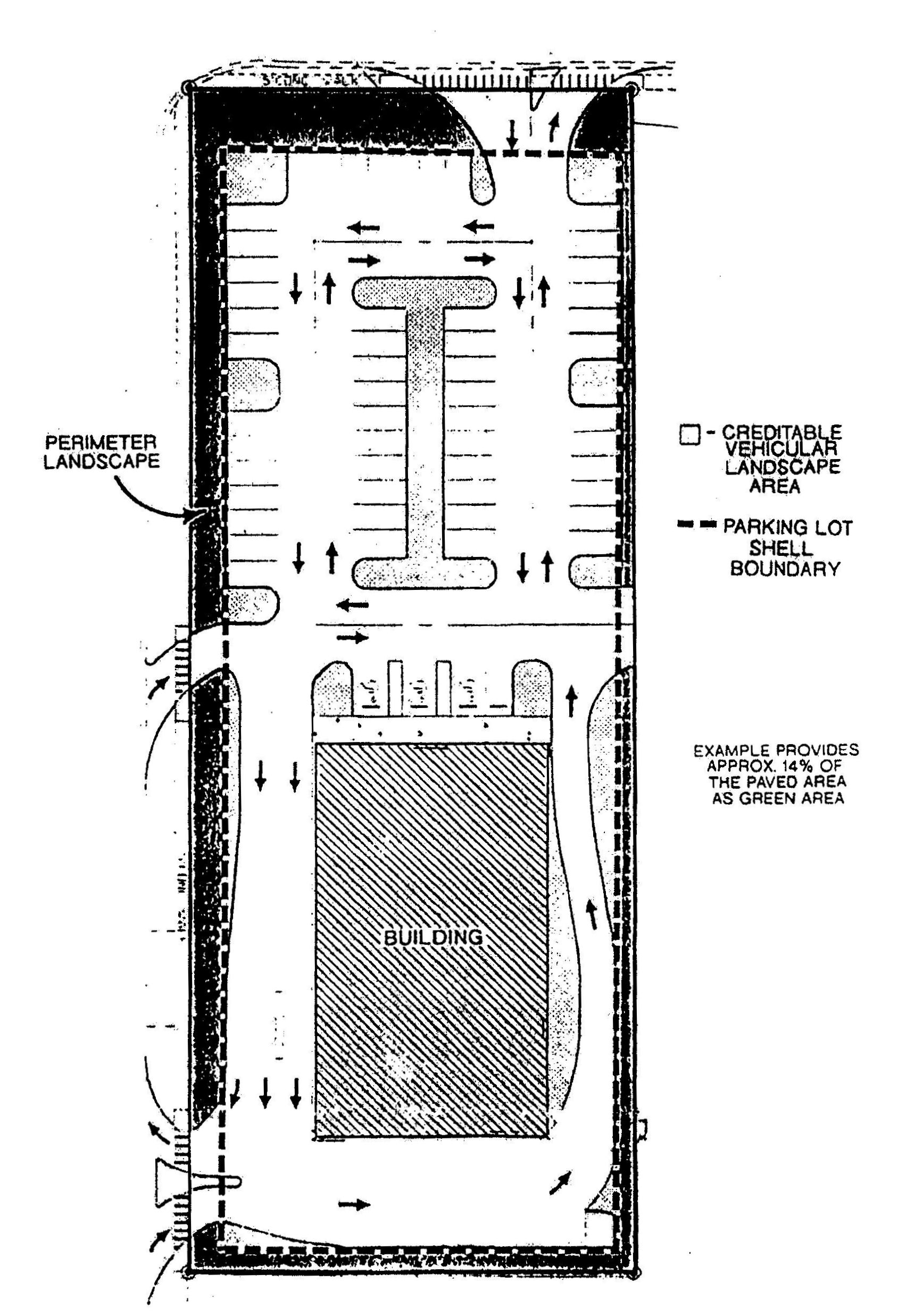
For off-street parking (driving aisles, driveways, parking spaces, loading areas), areas equal to at least twelve (12) percent of the total paved area (driving aisles, driveways, parking spaces, loading areas) shall be provided with interior landscaping. See diagram for an illustration of how this requirement is calculated.
(b)
Each separate, required landscaped area shall contain a minimum of one hundred forty-four (144) square feet with minimum dimensions of at least twelve (12) feet in areas where a tree is planted, and shall include at least one tree having a clear trunk of at least five (5) feet, with the remaining area adequately landscaped with shrubs, ground cover or other authorized landscaping material not to exceed three (3) feet in height.
1.
To preserve adequate sight distance, end islands at intersection of internal driveways shall be designed and maintained to preserve a visual "clear window" for the area between three (3) feet and seven (7) feet above the adjacent parking lot grade.
(c)
The total number of trees shall not be less than one for each three hundred (300) square feet of fraction thereof of required interior landscaped area. Such landscaped areas shall be located in such a manner as to divide and break up the expanse of paving.
(d)
When, upon the request of the developer and in the opinion of the community development director, the placing of all required interior trees would create an impractical landscape effect, a portion of the required interior trees may be placed along the perimeter of the parking area to satisfy this requirement.
(e)
The area to be counted for interior landscaping requirements shall be graphically depicted on landscape plans by cross-hatching or other graphic means.
(4)
Protection from vehicle encroachment. Landscape areas shall be protected from vehicular encroachment by use of curbs, tire stops, or other types of barriers approved by the community development director. Tire stops, where used, shall be placed at least three (3) feet from the edge of such landscaped areas. Where a tire stop or curb is utilized, the paved area between the curb/tire stop and the end of the parking space may be omitted, provided it is landscaped in addition to landscaping otherwise required. Tire stops shall be located so as to prevent damage to any planting areas by automobiles.
(5)
Sight distance for landscaping adjacent to roadways and points of access.
(a)
All landscape plans submitted hereunder shall meet the minimum sight distance requirements established herein, as viewed from the perspective of the driver of a vehicle leaving the project premises to access the abutting public or private roadway.
(b)
Crossing maneuver. The sight distance required for the safe execution of a crossing maneuver is dependent upon the acceleration capabilities of the vehicle, the crossing distance, and the design speed of the street or highway to be crossed. The minimum required sight distance in both directions, measured from the centerline of the roadway being entered to the initial position of the vehicle before the crossing (as shown on Figure No. 1) for various classes of vehicles shall be as stated in Tables 4 and 5, which follow. Table 4 or 5 shall be applied, as the case may be, depending upon whether a given vehicle class constitutes five (5) percent or more of the total crossing traffic, or if that class experiences thirty (30) or more crossings per day. A developer shall provide sufficient information on the nature of vehicles using the project to substantiate which class of vehicle table is being incorporated into the landscaping plan.
(c)
Assumptions. The vehicle offset shall be assumed to be at least ten (10) feet from the nearest pavement edge. The setback required for sight distance shall be at least five (5) feet greater than the vehicle offset, as reflected in Figure No. 1.
(d)
All landscaping shall be installed and maintained in a manner which provides unobstructed visibility within the sight distance area calculated hereunder, at a level between two and one-half (2½) feet and ten (10) feet above grade; provided, however, trees or palms having limbs or foliage trimmed in such a manner that no limbs or foliage extend into the visibility area shall be allowed, provided they are so located as not to create a traffic hazard. Other landscaping, except required grass or ground cover, shall not be located closer than six (6) feet from the edge of any access way pavement, unless otherwise approved by the public works director or his designee.
(e)
Left-turn crossings. Sight distance for left-turn crossings shall be measured in the same manner as provided for crossing maneuvers. On median-separated roadways, sight distance to the left may be based upon the sight distance required for a two-lane road.
(6)
Landscaping near overhead electrical transmission or distribution lines.
(a)
When canopy trees are proposed to be planted within thirty (30) feet (horizontal distance) of overhead electrical transmission or distribution lines (not service lines), the following shall apply:
1.
A cross-section shall be provided on the landscape plan, depicting the estimated canopy shape and size at maturity in relation to the location of the lowest electrical overhead transmission or distribution wire, and the distance from the mature tree canopy edge to the wire.
2.
The distance from the estimated mature tree canopy edge to the wire shall be at least ten (10) feet.
(b)
Within a horizontal distance of thirty (30) feet of an overhead electrical transmission or distribution line (not a service line), in addition to generally prohibited exotic nuisance species, the following plant species are prohibited from being used on any landscaping plan proposed for county approval: Earleaf Acacia, Woman's Tongue Tree, Norfolk Island Pine, Bischofia, Schefflera, Ear Tree, Eucalyptus, Non-Native Ficus, Silk Oak, Chinese Tallow Tree, and Java Plum.
(7)
Landscaping near utility poles, guy wires, and transformer pads. Trees, shrubs, and vines shall be planted and maintained so as to provide a clearance of at least five (5) feet around utility poles, guy wires and anchors, and transformer pads.
LANDSCAPING
TABLE 4
DESIGN VEHICLES: PASSENGER CAR,
SINGLE UNIT TRUCK,
SINGLE UNIT BUS
Sight Distance
TABLE 5
DESIGN VEHICLE: SEMI-TRAILER
COMBINATION
INTERMEDIATE, AND LARGE
Sight Distance
(Ord. No. 90-16, § 1, 9-11-90; Ord. No. 97-29, §§ 7, 9, 10, 12-16-97; Ord. No. 2005-004, § 1, 2-22-05; Ord. No. 2007-012, § 1, 3-20-07; Ord. No. 2010-008, § 10, 3-23-10)
Section 926.10. - Nonvehicular area landscaping standards.
(1)
General landscaping treatment. All nonvehicular open spaces, on any site proposed for development in all zoning districts, except for single-family dwellings shall conform to the landscaping requirements provided in Section 926.06. Nonvehicular open space is ground that is not covered by buildings, paving, or other structures.
(2)
Canopy trees required. Canopy trees shall be planted in the nonvehicular open space to meet the following requirements:
(a)
Multiple-family residential zoning districts and mobile home residential zoning districts requiring site plan approval: a minimum of one tree per each one thousand (1,000) square feet of nonvehicular open space or fraction thereof;
(b)
Commercial zoning districts (except "heavy commercial") and medical districts: a minimum of one (1) tree per each two thousand (2,000) square feet of nonvehicular open space or fraction thereof;
(c)
Heavy commercial, and industrial zoning districts: a minimum of one (1) tree per each three thousand (3,000) square feet of nonvehicular open space or fraction thereof.
(3)
Canopy trees required around lakes/ponds including stormwater retention/detention areas. For proposed lakes/ponds or lake/pond systems that are one (1) acre in area or larger, the lake/pond bank must be designed in a non-rectangular, irregular shape to provide an aesthetic amenity. Regardless of size, all lakes/pond shall have at least three native, water tolerant trees planted per one hundred (100) feet of shoreline. The trees may be clustered along the upland shoreline in a manner that facilitates access for lake maintenance. Littoral zones shall be provided as required in Section 934.05. The common areas contiguous with and above the littoral zones are subject to the non-vehicular landscaping requirements set forth in 926.10, and the landward edges of the littoral zone shall be clearly delineated by a raised lip.
(Ord. No. 90-16, § 1, 9-11-90; Ord. No. 97-29, § 9, 12-16-97; Ord. No. 2007-012, § 1, 3-20-07)
Section 926.11. - Irrigation standards.
(1)
Required irrigation. Underground irrigation systems shall be required for all development subject to the provisions of this chapter. New construction which does not require any supplemental landscaping or contain cultivated landscape areas shall be exempt from this provision. Irrigation plans must include a system which provides for restrictions on irrigation use as specified by the St. Johns River Water Management District.
(2)
Irrigation system design. All landscape plans shall contain a certification that the irrigation system shall be designed to conform to the requirements of this section and the restrictions on irrigation use as specified by the St. Johns River Water Management District.
(a)
Landscape demand.
1.
Irrigation of existing and undisturbed vegetation shall not be required.
2.
Irrigation of reestablished native vegetative communities shall be required for a minimum of one year after initial installation. Once the landscape materials have been firmly established, the irrigation system must be abandoned.
3.
Cultivated landscape areas shall be watered with an underground irrigation system designed to provide one hundred (100) percent coverage on a day when winds are no more than five (5) miles an hour. Cultivated landscape areas shall include all areas not described in paragraphs 1. and 2. above.
(b)
System design. Irrigation systems shall be designed, constructed, and permitted to include:
1.
Automatic irrigation controllers, when utilized, shall contain a functional rain sensor device, capable of being set to one minute run times, and battery backup capability to retain programming in the event of a power failure;
2.
A rain sensor placed on a stationary structure, free and clear of any overhead obstructions and above the height of the sprinkler coverage;
3.
Equipment with check valves used in low-lying areas to prevent low head drainage;
4.
Backflow prevention methods;
5.
Irrigation design with the appropriate uniformity for the type of plant being grown and for the type of soil;
6.
Irrigation system equipment installed as designed;
7.
Irrigation zones divided according to: available flow rate, vegetated groupings (i.e., turf, shrubs, native plants, etc.), sprinkler types (i.e., sprinklers with matching precipitation rates), and soil characteristics;
8.
Spray heads and rotors not mixed in same zone;
9.
Distribution equipment in a given zone having matched precipitation rates;
10.
Application rates that avoid runoff and permit uniform water infiltration into the soil, considering land slope, soil hydraulic properties, vegetative ground cover, and prevailing winds;
11.
A minimum separation of four (4) inches between distribution equipment and pavement;
12.
A minimum separation of twelve (12) inches between distribution equipment and buildings and other vertical structures;
13.
No direct spray onto walkways, buildings, roadways, and drives;
14.
Lawn spray patterns providing head to head coverage;
15.
Water conveyance systems with a flow velocity of five (5) feet per second or less;
16.
Pipelines designed to provide the system with the appropriate pressure required for maximum irrigation uniformity;
17.
Pressure regulating heads; and
18.
A maintenance checklist provided to the property owner by the irrigation contractor accompanied by a recommended maintenance schedule, proper irrigation system settings according to season, recommendations for checking rain sensor device, filter cleaning recommendations and information on the current water restrictions.
(c)
System Layout and Native Vegetation Retention. Irrigation systems shall comply with the following requirements:
1.
A high volume irrigation area shall not exceed fifty (50) percent of the landscaped area. Low or medium volume irrigation areas may be utilized in lieu of any high volume irrigation area.
2.
A medium volume irrigation area shall not exceed twenty-five (25) percent of the landscaped area. However, the landscaped area may contain up to seventy-five (75) percent medium volume irrigation area, if no high volume irrigation area is utilized on site.
3.
A low volume irrigation area may be utilized for an entire landscaped area with the exception of native vegetation areas regulated by subsection 926.11(2)(b)(4).
4.
In the alternative to subsection 926.11(2)(b)(1 through 3) above, if twenty-five (25) percent of the pre-existing native vegetation is retained on site, the remaining seventy-five (75) percent of the landscaped area may be a high volume irrigation area. For all pre-existing native vegetation retained on a parcel:
a.
No supplemental water shall be applied to the native vegetation area;
b.
Only hand pruning of native vegetation is allowed;
c.
Mechanical mowing or clearing is prohibited.
(d)
System operation flows. Systems shall dispense no more than:
1.
One inch of water per week for high volume irrigation areas;
2.
One-half inch of water per week for medium volume irrigation areas;
3.
One-quarter inch of water per week for low volume irrigation areas.
(e)
Irrigation system operation and maintenance. Systems shall be operated and maintained according to the Green Industries Best Management Practices for Protection of Water Resources in Florida (DEP 2002) or (for homeowners) the Florida Yards and Neighborhood program.
1.
Irrigation systems shall be operated properly and in compliance with this section.
2.
All automatic controllers shall be programmed to the appropriate level of water conservation set forth in this section.
3.
Irrigation systems shall be maintained to meet the requirements of this section.
(f)
Sources of irrigation water.
1.
Reclaimed or other non-potable water source shall be used in accordance with the requirements for subsection 918.04(3) In order to supplement the retention system, property owners may utilize wells when the county system cannot meet their needs. When the water supply for the irrigation system is from a well, a constant pressure flow control device or pressure tank with adequate capacity shall be required to minimize pump cycling.
2.
All new landscape irrigation systems shall be required and all existing irrigation systems shall be encouraged to connect to wastewater effluent lines when determined to be available. The reuse of wastewater effluent in such cases shall be required.
3.
All new landscape irrigation systems shall be designed for ultimate connection to proposed wastewater effluent lines.
4.
Developments with wet retention/detention areas are required to use this water to meet project irrigation needs or justify why this water cannot be used as an irrigation source.
5.
All new development projects shall use effluent re-use water, water from project retention ponds, or other source required by the St. Johns River Water Management District, instead of water from wells, as the primary source of irrigation. Water from a well may be used as a supplemental source of irrigation water for the project, subject to approval of the St. Johns Water Management District. Use of an irrigation well as the primary source of irrigation for a project may be approved by a joint decision of the County Utility Services Director, Public Works Director, and the Community Development Director when it is determined that there is no adequate available primary source of irrigation from effluent re-use water or from a retention pond sized to meet applicable stormwater management requirements.
(3)
Conformance.
(a)
Prior to or at the time a site inspection is requested for a certificate of occupancy or a certificate of completion, whichever is applicable, the irrigation installer shall submit to planning division staff a written certification that all irrigation requirements of this section have been satisfied and that the system is set to operate in conformance with this section and the restrictions on irrigation use as specified by the St. Johns River Water Management District.
(Ord. No. 90-16, § 1, 9-11-90; Ord. No. 92-39, § 21, 9-29-92; Ord. No. 2007-012, § 1, 3-20-07; Ord. No. 2012-025, § 6, 7-10-12)
Section 926.12. - Installation and maintenance standards.
(1)
Installation.
(a)
All landscaping shall be installed in a sound workmanlike manner and according to accepted good planting procedures, with the quality of plant materials as herein described. Prior to or at the time a certificate of occupancy inspection is requested of code enforcement staff, the project landscape architect or landscape contractor shall certify in writing the date he or she last inspected the landscape installation and that all installed landscape material that is required by ordinance is Florida No. 1 or better.
All elements of landscaping, exclusive of plant material, shall be installed so as to meet all other applicable ordinances and code requirements. Landscaped areas shall require protection from vehicular encroachment. A code enforcement official shall inspect all landscaping, and no final certificates of occupancy or similar authorization will be issued unless the landscaping meets the requirements provided herein.
(b)
Bonding to guarantee installation. Required landscape materials can be bonded-out for future installation in the event of a board of county commissioners recognized disaster (e.g. freeze or hurricane) that adversely affects availability of landscape materials. At the time that it recognizes such a disaster, the board shall set a time frame by which required landscaping must be installed.
In addition to bonding-out after such disasters, the planning and zoning commission is authorized to approve bonding-out for installation of required landscape materials where such installation needs to be delayed in coordination with adjacent road construction that would disrupt adjacent landscape areas.
To bond-out for future (post C.O.), installation, a cash bond must be posted with the county in the amount of one hundred fifteen (115) percent of the contract installation price.
(2)
Maintenance.
(a)
The owner, or his agent, shall maintain all landscaping depicted on the approved plan in good condition, so as to present a healthy, neat and orderly appearance, free from refuse and debris, and in a manner quantity and variety required by this article, for the duration of use of the site. All landscaped areas shall be provided with an adequate irrigation system, as provided for in section 926.11. Completed project sites shall be reviewed periodically by code enforcement officials for compliance with these provisions, and any violations shall be presented to the code enforcement board.
(b)
Native plant areas used for landscaping purposes may be left in their natural condition, providing they are maintained so as not to create a health or safety hazard. These areas may also be excluded from the water supply requirements, providing they are in a healthy condition upon issuance of a final certificate of occupancy. Consistent with section 929.08, all approved sites and "native plant areas" shall be required to maintain the site free of any nuisance exotic plant species, as listed in Appendix B.
(c)
Mature trees shall not be pruned to reduce the canopy to less than the minimum fifteen-foot spread, except for the removal of dead or diseased wood.
(d)
Pruning techniques that are unhealthy for or produce an unnatural appearance of a tree or native palm are prohibited. Such prohibited techniques include excessive topping, over-lifting, hat-racking, lolly-popping, and excessive removal of green fronds and inflorescences, among others. Topping of trees is prohibited except where necessary to mitigate conflicts with powerlines or other structures and performed to the minimum extent necessary to provide adequate mitigation.
1.
Standards for acceptable pruning practices. The following pruning standards are intended to ensure avoidance of prohibited pruning techniques and to promote strong, health, and attractive trees:
a.
Crown thinning. Crown thinning may be used as a method of pruning to increase light penetration and air movement through the crown of a tree. Crown thinning shall consist of selective removal of branches that:
• Favors (retains) branches with strong, U-shaped angles of attachment.
• Removes branches with weak, V-shaped angles of attachment and/or included (ingrown) bark.
• Results in evenly spaced lateral branches, especially on young trees.
• Removes branches that rub or cross another branch.
• Results in lateral branches that are no more than fifty (50) percent to seventy-five (75) of the diameter of the leader or main stem.
• Results in no more than twenty-five (25) percent of the living crown of a tree removed through pruning.
b.
Crown raising. Crown raising may be used as a method of pruning to provide clearance for pedestrians, vehicles, buildings, lines of sight, and vistas. Crown raising shall consist of removal of lower branches that:
• Maintains live branches on at least sixty (60) percent of the tree's total height.
• Removes basal shoots (sprouts) and vigorous epicormic sprouts.
• Results in no more than twenty-five (25) percent of the living crown of a tree to be removed through pruning.
(3)
Removal and replacement of vegetation and required landscaping.
(a)
Vegetation (including trees) preserved on site as shown on an approved project development plan (site plan) shall not be removed unless authorized under the provisions and regulations of Chapter 927, Tree Protection and Land Clearing. Where vegetation is removed, replacement of vegetation (including trees) shall be provided as required below.
(b)
Required landscape vegetation (including trees) planted on site during or after project development may be removed and replaced if the vegetation has died, is diseased or in declining condition, or has an adverse impact on health, safety, site maintenance, or the visibility of authorized commercial signage.
(c)
The size of replacement landscape vegetation shall be the size that the originally planted material should have attained since the time of project C.O. (certificate of occupancy) or post-C.O. installation, as follows:
• From zero (0) to eighteen (18) months after project C.O. or post-C.O. installation, landscape materials must be replaced at a size no smaller than indicated on the approved site plan.
• More than eighteen (18) months but less than seven (7) years after project C.O. or post-C.O. installation, replacement shrubs shall be a minimum of thirty (30) inches in height, replacement canopy trees shall be a minimum of sixteen (16) feet in height and three (3) inches in diameter at 0.5 feet above grade, and replacement understory trees shall be a minimum of seven (7) feet tall with a one and one-half (1½) inch diameter at 0.5 feet above grade.
• Seven (7) years or more after project C.O. or post-C.O. installation, replacement canopy trees shall be a minimum of eighteen (18) feet in height and four (4) inches in diameter at one (1) foot above grade.
(Ord. No. 90-16, § 1, 9-11-90; Ord. No. 97-29, § 8, 12-16-97; Ord. No. 2001-031, § 1, 10-23-01; Ord. No. 2007-012, § 1, 3-20-07; Ord. No. 2010-008, § 11, 3-23-10; Ord. No. 2012-025, § 7, 7-10-12)
Section 926.13. - Upland habitat protection regulations referenced.
Chapter 929, Upland Habitat Protection, of the County Land Development Code sets forth criteria to conserve native upland plant communities occurring on a development site. Such provisions apply in addition to or overlap the requirements of this chapter, as specifically provided for in Chapter 929.
(Ord. No. 90-16, § 1, 9-11-90; Ord. No. 2007-012, § 1, 3-20-07)
Section 926.14. - Tree protection regulations referenced.
Chapter 927, Tree Protection, of the County Land Development Code sets forth criteria regulating land clearing and tree removal activities, in addition to the provisions of this chapter.
(Ord. No. 90-16, § 1, 9-11-90; Ord. No. 2007-012, § 1, 3-20-07)
Section 926.15. - Single-family lot development canopy tree requirements.
(1)
Two (2) canopy trees, as defined in Chapter 901, shall be planted or preserved on single-family lots in conjunction with lot development. Said trees are required to be planted or preserved prior to county issuance of a certificate of occupancy for the residence. This requirement of two (2) canopy trees shall not apply to any single-family lot where an initial building permit application for home construction was submitted prior to March 14, 2005 (the effective date of this ordinance). Planted canopy trees shall be of a size, quality and type as specified in section 926.06 of this chapter. The owner of the lot shall be required to maintain the canopy trees in viable condition.
(2)
The following trees are approved for use to meet the single-family lot canopy tree requirement of this section. Other canopy tree species may be used subject to county staff approval.
Live oak (Quercus virginiana)
Laurel oak (Quercus hemisphaerica)
Diamond-leaf oak (Quercus laurifolia)
Red maple (Acer rubrum)
Dahoon holly (Ilex cassine)
East Palatka holly (Ilex x attenuata 'East Palatka')
Southern magnolia (Magnolia grandiflora)
Sweet Bay Magnolia (Magnolia virginiana)
Southern Red Cedar (Juniperus silicicola)
Persimmon (Diosypros virginiana)
Red Bay (Persea borbonia)
Swamp Bay (Persea palustris)
Loblolly-Bay (Franklinia lasianthus)
Florida Elm (Ulmus Americana var. floridana)
Sugarberry, Hackberry (Celtis laevigata)
Sweet gum (Liquidambar styraciflua)
Sycamore (Platanus occidentalis)
Red mulberry (Morus rubra)
Slash pine (Pinus elliottii)
Bald Cypress (Taxodium distichum)
(Ord. No. 2004-041, § 3, 12-7-04; Ord. No. 2007-012, § 1, 3-20-07)
Appendix A: Native Plants
Listed below are plant species native to Indian River County. While not required, the use of these species is encouraged on all landscape plans. A common definition of native plants is species indigenous to the land before European settlers arrived. A practical definition is a plant that occurs naturally in this area, with no assistance from any humans, and one that has established an interrelationship with the other organisms of the area in which it grows. Sources for Florida native plants currently available for landscaping are easily found on http://www.afnn.org. (See Appendix B for definition of "exotic".) Plants qualifying as native species that grow in this county include but are not limited to the following:
(1)
Native trees and shrubs for dunes or coastal hammock region. For purposes of this section, the coastal hammock region is the land located east of US Highway 1.
(a)
Native trees:
1.
Semi salt-tolerant, suitable for barrier island:
Live oak (Quercus virginiana)
Red bay (Persea borbonia)
Seagrape (Coccoloba uvifera)
Cabbage palm (Sabal palmetto)
Gumbo limbo (Bursera simaruba)
Hercules club (Xanthoxylum clava-herculis)
Buttonwood, green or silver (Conocarpus erectus)
Black mangrove (Avicennia germinans)
White mangrove (Laguncularia racemosa)
Red mangrove (Rhizophora mangle)
White stopper (Eugenia axillaris)
Spanish stopper (E. foetida)
2.
Suitable for hammocks or sandy areas not on barrier island:
Slash pine (Pinus elliottii var densa)
Live oak (Quercus virginiana)
Scrub/Sand live oak (Quercus geminata)
Sand pine (Pinus clausa)
Chapman oak (Quercus chapmanii)
Runner oak (Quercus minima)
Myrtle oak (Quercus myrtifolia)
Wax myrtle, Bayberry (Myrica cerifera)
Scrub hickory (Carya floridana)
Bluejack oak (Quercus incana)
(b)
Native Palms: all considered salt-tolerant and cold hardy. Varied characteristics: clumping, shrub, understory or tree height.
Cabbage palm (Sabal palmetto)
Paurotis palm (Acoelorraphe wrightii)
Saw palmetto, green or silver varieties (Serenoa repens)
(c)
Native Shrubs:
1.
Semi salt-tolerant, suitable for barrier island:
Florida privet (Forestiera segregata)
Simpsons stopper (Myricanthes fragrans)
Marlberry (Ardisia escallonioides)
Myrsine (Rapanea punctata)
White indigo berry (Randia aculeata)
Necklacepod (Sophora tomentosa)
Simpsons stopper or Twinberry (Myricanthes fragrans)
Fiddlewood (Citharexylum fruticosum)
Wild coffee, shiny leaved (Psychotria nervosa)
Cocoplum (Chrysobalanus icaco)
Jamaican caper (Capparis cynophallophora)
Snowberry (Chiococca alba)
Saw palmetto (Serenoa repens)
2.
Non salt-tolerant. Suitable for hammocks or sandy areas not on barrier island.
Firebush (Hamelia patens)
Beautyberry (Callicarpa americana)
Swamp hibiscus (Hibiscus grandiflorus)
Rusty lyonia (Lyonia ferruginea)
Wild coffee, soft leaved (Pyschotria sulzneri)
Walter's viburnum (Viburnum obovatum)
Tallowwood (Ximenia americana)
(2)
Native trees and shrubs for inland pine flatwoods or hammocks. For purposes of this section, inland area is land located west of US Highway 1.
(a)
Native Trees.
1.
Prefer low-lying areas:
Loblolly bay (Gordonia lasianthus)
Swamp red bay (Persea palustris)
Bald cypress (Taxodium distichum)
Sweet gum (Liquidambar styraciflua)
Sweet bay magnolia (Magnolia virginiana)
Red maple (Acer rubrum)
Dahoon holly (Ilex cassine)
Diamond leaf oak (quercus laurifolia)
2.
Prefer upland areas:
Sugarberry, Hackberry (Celtis laevigata)
Florida elm (Ulmus Americana)
Live oak (Quercus virginiana)
Laurel oak (Quercus hemisphaerica)
Cabbage palm (Sabal palmetto)
Slash pine (Pinue elliottii var densa)
Longleaf pine (Pinus palustris)
Persimmon (Diosypros virginica)
Southern magnolia (Magnolia grandiflora)
Southern red cedar (Juniperus silicicola)
Sumac, winged or shiny (Rhus copallina)
East Palatka holly (Ilex attenuata 'East Palatka)
Wax myrtle, Bayberry (Myrica cerifera)
(b)
Native Shrubs.
1.
Prefer low-lying areas:
Carolina willow (Salix caroliniana)
Virginia willow (Itea virginica)
Shiny lyonia, fetterbush (Lyonia lucida)
Florida anise (Illicium floridanum)
Gallberry (Ilex glabra)
2.
Prefer upland areas:
Florida privet (Forestiera segregata)
Rusty lyonia (Lyonia ferruginea)
Beautyberry (Callicarpa Americana)
Gallberry (Ilex glabra)
Walters viburnum (Viburnum obovatum)
Cocoplum (Chrysobalanus icaco)
Coontie (Zamia floridana)
Coralbean (Erythrina herbacea)
Firebush (Hamelia patens)
Golden dewdrop (Duranta repens)
Scarlet Hibiscus (Hibiscus coccineus)
Marlberry (Ardisia escallonioides)
Necklacepod (Sophora tomentosa)
Yucca (Yucca aloifolia)
Snowberry (Chiococca alba)
Simpsons stopper or Twinberry (Myricanthes fragrans)
Saw palmetto (Serenoa repens)
(3)
Native ground covers and flowers.
(a)
Semi salt-tolerant suitable for barrier island:
Beach sunflower (Helianthus debilis)
Blanket flower (Gaillardia pulchella)
Prickly pear cactus (Opuntia humifusa)
Sand cordgrass (Spartina bakerii)
Saltmarsh cordgrass (Spartina patens)
Railroad vine (Ipomoea pes-caprae)
Sea oats (Uniola paniculata)
Sea Ox-eye Daisy (Borrichia frutescens)
Horsemint (Monarda punctata)
(b)
Suitable for hammocks or sandy areas not on barrier island:
Gopher apple (Licania michauxii)
White lantana (Lantana involucrata)
Sunshine mimosa (Mimosa strigulosa)
Pink muhly grass (Muhlenbergia capillaris)
Blue porterweed (Stachytarpheta jamaicensis)
Southern shield fern (Thelypteris kunthii)
Blechnum fern (Blechnum serrulatum)
Red sage (Salvia coccinea)
Sword fern (Nephrolepis exaltata)
(4)
Native climbing vines suitable for fences:
Coral or southern honeysuckle (Lonicera sempervirens)
Maypop (Passiflora incarnata)
Native grape (Vitis spp.)
Virginia creeper (Parthenocissus quinquefolia)
Morning Glory (Ipomoea spp.)
Climbing Aster Symphyotrichum carolinianum
Carolina Yellow Jessamine Gelsemium sempervirens
Appendix B: Exotic, Invasive Plants
Exotic plants are not native to Florida, defined as those introduced, either purposefully or accidentally. Some exotic plants can expand on their own, thereby out-competing, displacing, and disrupting naturally occurring native plant communities. Invasive exotic plants listed on the Florida Exotic Pest Plant Council's "Category I List of Invasive Species" are prohibited. The updated list may be viewed at:
http://www.fleppc.org/list/list.htm
Appendix C: Preferred Grasses.
Preferred grasses are those native to South Florida Flatwoods as listed by the Soil Conservation Service of the United States Department of Agriculture. Preferred grasses require little or no fertilizer, irrigation or mowing, to achieve ornamental effect. If the grasses listed below are not available, bahia may be used.
Chalky bluestem (Andropogon capillipes)
Creeping bluestem (Schizachyrium stoloniferum)
Lopsided Indiangrass (Sorghastrum secundum)
South Florida bluestem (Schizachyrium rhizomatum)
Low panicum (Panicum spp.)
Pineland threeawn (Aristida stricta)
Seashore Paspalum
Appendix D: Definitions of Soils for Use in Landscape Construction.
(1)
Myakka soil: The soil type adopted (May 22, 1989) as the state soil. Its composition is as follows:
Surface layer: gray fine sand
Subsurface layer: light gray fine sand
Subsoil: dark reddish brown fine sand with organic stains
Substratum: brown and yellowish brown fine sand
Source: US Department of Agriculture Natural Resources Conservation Society.
(2)
Criteria for hydric soils: all Histosols except Folists; soils that are frequently ponded for long duration, or very long duration during the growing season; or soils that are frequently flooded for long duration or very long duration during the growing season.
Source: USDA Natural Resources Conservation Service, Hydric Soils, Criteria/NRCS Soils
(3)
Examples of hydric soils in Indian River County:
Terra Ceia muck
Canova muck
Gator muck
McKee mucky clay loam
Manatee mucky loamy fine sand, depressional
Floridana mucky fine sand depressional
Samsula muck
Delray muck
Kesson Muck
Source: Florida Portion of the National Hydric Soil List, August 11, 2005.
Appendix E: Littoral Species.
(1)
Native species suitable for littoral shelf plantings.
(a)
Transitional zone (planting depth: 0 to 1 ft. above the ordinary water line):
1.
Trees and shrubs:
Buttonbush (Cephalanthus occidentalis)
Cypress (Taxodium spp.)
Cocoplum (Chrysobalanus icaco)
Dahoon holly (ilex cassine)
Firebush (Hamela patens)
Laurel oak (quercus laurifolia)
Leather fern (Acrostichum danaeifolium)
Pond-apple (Annona glabra)
Redbay (Persea borbonia)
Red maple (Acer rubrum)
Swamp fern (Blechum serrulatum)
Sweet bay magnolia (Magnolia virginiana)
Wax myrtle (Myrica cerifera)
Wild coffee (Psychotria nervosa)
2.
Wetland plants:
Blue flag iris (Iris virginicus)
Lizard's tail (Saururus cernuus)
Muhly grass (Muhlenbergia capillaris)
Sand cordgrass (Spartina bakeri)
Short spike rush (Eleocharis geniculata)
Soft rush (Juncus effusus)
St. John's wort (Hypericum fasiculata)
(b)
Shallow zone (planting depth: 0 to 1 ft. below the ordinary water line):
Arrow-arum (Peltandra virginica), likes shade
Blue flag iris (Iris virginicus)
Coastal arrowhead (Sagittaria graminea)
Common arrowhead (Sagittaria latifolia)
Duck potato (Sagittaria lancifolia)
Fire flag (Thalia geniculata)
Floating hearts (Nymphoides aquatica)
Golden canna (Canna laccida)
Lizard's tail (Saururus cernuus)
Pickerelweed (Pontedaria cordata)
Soft rush (Juncus effusus)
Soft-stem bulrush (Scirpus validus)
Swamp lily (Crinum americanum)
(c)
Mid-range zone (planting depth: 1 to 2 ft. below the ordinary water line):
Bulrush (Scirpus spp.)
Pickerelweed (Pontedaria cordata)
Soft-stem bulrush (Scirpus validus)
Spike rush (Eleocharis interstincta, Eleocharis cellulosa)
(d)
Deep zone (planting depth: 2 to 3 ft. below the ordinary water line):
Fragrant water lily (Nymphaea odoata)
Spatterdock (Nuphar luteum)
(2)
Exotic-invasive and undersirable-invasive plant species (Prohibited from littoral zone plantings):
Alligator weed (Alternanthera philoxeroides)
Cattails (Typha spp.)
Common reed (Phragmites australis)
Elephant grass (Pennisetum purpurea)
Elephant, wild taro (Colocasia esculenta)
Hydrilla (Hydrilla verticillata)
Maidencane (Panicum hemitomon)
Primrose willow (Ludwigia peruviana)
Torpedograss (Panica repens)
Water hyacinth (Eichhornia spp.)
Water lettuce (Pistia stratiotes)
Willow (Salix spp.)