Indian River County Unincorporated
City Zoning Code
City Zoning Code
CHAPTER 902
ADMINISTRATIVE MECHANISMS
Section 902.01.- Title.
This chapter, the terms and provisions contained herein, shall be known as "Administrative Mechanisms Ordinance" of Indian River County, Florida.
(Ord. No. 90-16, § 1, 9-11-90)
Section 902.02. - Purpose and intent.
It is the purpose of this chapter to identify the functions of the boards, commissions and administrative officials as related to planning and development activities.
(Ord. No. 90-16, § 1, 9-11-90)
Section 902.03. - Definitions.
See Chapter 901.
(Ord. No. 90-16, § 1, 9-11-90)
Section 902.04. - Role of board of county commissioners in planning and development.
(1)
The board of county commissioners shall adopt and amend the comprehensive plan pursuant to F.S. ch. 163.
(2)
The board of county commissioners of Indian River County shall have the power to consider, amend, adopt, repeal or reject land development regulations.
(3)
The board of county commissioners shall consider, amend, adopt, repeal or reject proposed amendments to the county's official zoning atlas.
(4)
The board of county commissioners shall establish fees, charges, and expenses applicable to land development related applications.
(5)
The board of county commissioners shall consider and make decisions regarding special exception uses.
(6)
The board of county commissioners shall hear and take action regarding appeals of decisions regarding site plans and uses requiring administrative permits, when required to do so by the regulations of Title IX of this Code.
(7)
The board of county commissioners shall enforce land development regulations through initiation of appropriate administrative and legal action.
(8)
The board of county commissioners shall appoint and confirm members of the planning and zoning commission, the board of adjustment, and any other board or committee as required by the comprehensive plan or by other regulations.
(9)
The board of county commissioners shall consider approval of final plats, development of regional impact (DRI) development orders, amendments to development orders, right-of-way abandonments, easement releases, subdivision variance requests, and plat vacations.
(10)
The board of county commissioners shall hear appeals of planning and zoning commission decisions.
(11)
The board of county commissioners shall direct studies relating to planning issues or problems.
(12)
The board of county commissioners shall designate historic resources as such, and apply and enforce the rules and regulations of Chapter 933, Historic and Archeological Resource Protection and other relative land development regulations of Indian River County and, as applicable, the State of Florida, concerning historical resources within the county.
(13)
The board of county commissioners shall levy fines and/or additional penalties for violations of these land development regulations.
(14)
The board of county commissioners may hear requests for temporary suspensions of compliance, as provided below.
(A)
Purpose and intent. This section is established to provide procedures for reviewing temporary suspensions of compliance (including appeals and referrals) by the board of county commissioners and staff. A temporary suspension of compliance is of limited duration, pertains to regulations not directly related to public safety, and is intended to provide site plan, planned development, and subdivision project applicants an opportunity to obtain a certificate of occupancy or certificate of completion with a condition that minor deficiencies are corrected within a specified and limited timeframe.
(B)
Approving authority. The board of county commissioners is hereby authorized to grant temporary suspensions of compliance in accordance with the provisions of this section and may attach conditions to temporary suspensions of compliance granted. In addition, the county administrator or his designee is authorized to grant temporary suspensions of compliance, in accordance with the provisions of this section.
1.
Temporary suspension of compliance by the county administrator or his designee. A temporary suspension of compliance with land development regulations not directly related to public safety may be granted by the county administrator or his designee, without board of county commissioners approval, under the following circumstances.
a.
The development project is certified by the project design professional or owner/designer to be complete and in substantial conformance with the approved development plan in accordance with site plan ordinance sections 914.12(3)(a) and (b) or subdivision ordinance section 913.07(5)(I), whichever is applicable, and required landscaping is certified by a landscape architect or landscape contractor as Florida No. one (1) or better in accordance with landscape ordinance section 926.12(1)(a).
b.
The development project has been inspected by county staff, a "punchlist" of discrepancies has been issued, and the project developer has provided staff a written request specifying the discrepancies he or she wishes to be temporarily suspended.
c.
The project deficiencies that are the subject of the suspension request are found to be minor in nature and extent, and are found to be correctable within a timeframe not to exceed ninety (90) days.
d.
The suspension timeframe is specified in writing and does not exceed ninety (90) days from the date of the suspension.
e.
The corrective action(s) is specified in writing and found to be sufficient to bring the development project into compliance upon completion.
f.
The project developer and owner agree to the specified suspension timeframe and the obligation to complete the specified corrective action(s) within the specified timeframe.
(C)
Procedures for approval by the county administrator or his designee. The applicant may apply to the planning division for a temporary suspension by filing a temporary suspension application form provided by the planning division. The county administrator or his designee shall act on any temporary suspension request within two (2) business days of receiving the request. For each temporary suspension of compliance determination, staff shall provide notice of the determination decision in writing to the project owner, project developer, and board of county commissioners. Each suspension determination granting approval shall specify the maximum duration of the suspension, required mitigation and/or corrective action(s), and any condition(s) attached to the suspension.
(D)
Procedure for referral or appeal to the board of county commissioners. The project owner, or project developer, may appeal a decision of the county administrator or his designee to the board of county commissioners within ten (10) days of the mailing of the written determination referenced in subsection (C) above. Each appeal shall be accompanied by a fee established by resolution of the board of county commissioners.
The county administrator or his designee may refer a request to the board of county commissioners. Any referral or appeal shall be:
1.
Made in writing to the chairman of the board of county commissioners with a copy provided to the project developer, project owner, county administrator (if an appeal), and board of county commissioners. Upon receipt of a referral or appeal, the chairman shall call a meeting of the board of county commissioners as soon as practicable to conduct a hearing on the suspension request, subject to the requirements of subsections (D)2. and 3. below.
2.
Noticed at least seven (7) days prior to the hearing via written notice of the hearing mailed to each owner of property adjacent to the development project site. The notice shall contain the name of the applicant, a description of the appeal/temporary suspension request and the development project location, as well as the date, time, and place of the hearing.
3.
Considered at a hearing held no more than twelve (12) business days after receipt of the appeal or referral. At the hearing, the board of county commissioners may approve a temporary suspension request if it finds that all temporary suspension criteria of subsection (B)1.a.—f. above are satisfied.
(E)
Conditions authorized. The county administrator or his designee or, upon referral or appeal, the board of county commissioners may impose conditions including, but not limited to, a cash deposit which will be forfeited for non-compliance within a time specified.
(F)
Consequences of non-compliance. In the event that the specified corrective action(s) is not completed prior to the end of the specified suspension timeframe, the project owner shall be deemed in violation of the land development regulations, shall forfeit any required cash deposit for compliance, and shall be subject to code enforcement action. In addition, the county shall withhold issuance of any future development order, building permit, certificate of completion, or certificate of occupancy associated with the project site unless and until the violation is corrected. Notwithstanding the above, a certificate of occupancy may be issued for a residential unit within a subdivision project site deemed to be in violation if security is posted with the county that guarantees correction of the violation. For purposes of these regulations, the subdivision project site shall mean the development area that is the subject of the certificate of completion.
(G)
Limitation. No temporary suspension of compliance shall be granted for building code or fire code items, or other items directly related to public safety.
(15)
The board of county commissioners may hear requests for permanent exceptions to specific land development regulations for individual development projects, as provided below.
(A)
Purpose and intent. This section is established to provide criteria and procedures for reviewing permanent exceptions to specific land development regulations for individual development projects by the board of county commissioners. A permanent exception is a waiver or modification of a land development regulation not related to public safety or other particular types of standards or requirements defined herein, and is intended to allow development with a superior or functionally equivalent alternative design and/or improvements than would otherwise result under strict compliance with the excepted regulation.
(B)
Approving authority and required findings. The board of county commissioners is authorized to grant a permanent exception to a land development regulation as applied to an individual development project, upon making the following findings of fact:
1.
That the permanent exception does not relate to any of the following types of standards or requirements:
a.
Building code;
b.
Fire code;
c.
Setbacks;
d.
Building height;
e.
Open space or building coverage;
f.
Uses;
g.
Specific land use criteria;
h.
Public safety.
2.
That the purpose and intent of the land development regulation being excepted is achieved through a superior or functionally equivalent alternative design and/or through superior or functionally equivalent alternative improvements provided by the development.
3.
That the proposed superior or functionally equivalent design and/or improvements includes one (1) or more of the following:
a.
Enhanced development features or improvements that provide public benefits that are proportionate to the degree of exception or variation requested.
b.
Innovative use of new materials, methods, or technologies that result in a better or equivalent quality of development.
c.
Lay-out that results in a more efficient and/or integrated development pattern.
d.
Plan that reduces environmental impacts or enhances/restores environmental resources.
e.
Plan that provides a better way to meet or exceed the protections offered by the regulation being excepted.
4.
That granting the exception and having the development constructed with the superior or functionally equivalent alternative design and/or superior or functionally equivalent alternative improvements will not adversely impact surrounding properties, public facilities, or environmental or historic resources.
(C)
Procedures for approval by the board of county commissioners. The project developer shall apply to the planning division for a permanent exception by filing a permanent exception application form provided by the planning division. The application shall be accompanied by a fee approved by the board of county commissioners and five (5) sets of development plans depicting the proposed superior or functionally equivalent alternative design and/or superior or functionally equivalent improvements. In addition, theapplicant shall submit a description of the land development regulation being excepted and the proposed alternative design and/or improvements, an explanation of how the alternative will achieve or exceed the purpose and intent of the regulation being excepted, reasons for the request, and how the request satisfies each of the four (4) findings of fact criteria in subsection (B), above.
1.
Within thirty (30) days of receiving the permanent exception application, the planning division shall schedule a public hearing at which the board of county commissioners shall consider the request.
2.
Prior to each permanent exception hearing, staff shall provide notice of the hearing in writing to the project owner, and project developer. Notice to adjacent property owners shall also be provided as specified below.
a.
Notice shall be mailed to each owner of property adjacent to the development project site at least seven (7) days prior to the hearing. The notice shall contain the name of the applicant, a description of the permanent exception request, the development project location, and the date, time, and place of the hearing.
3.
The hearing shall be advertised (published notice) in the same manner as are rezoning hearings (reference section 902.12).
(D)
Conditions authorized. The board of county commissioners may attach conditions to the development approval and/or require guarantees to ensure implementation of the superior alternative or functionally equivalent design and/or provision and performance of the superior alternative or functionally equivalent improvements. Guarantees required may include but are not limited to posted security.
(E)
Time limit. A permanent exception shall remain valid as long as the associated development project site plan or preliminary plat approval remains valid and shall expire if and when the associated development project site plan or preliminary plat approval expires.
(F)
Enforcement. No certificate of occupancy or certificate of completion shall be issued for a development project which has received a permanent exception unless the superior or functionally equivalent alternative design is implemented as approved or unless the development project is constructed as a conventional development that conforms to all applicable land development regulations.
(16)
The board of county commissioners shall, when appropriate, authorize grant applications for assistance available from state, federal, or private sources for planning or land development related projects.
(17)
The board of county commissioners shall exercise all powers and duties consistent with the grant of power contained in F.S. § 125.01.
(18)
Notwithstanding any section to the contrary and, as an alternative to misdemeanor prosecution or other enforcement procedures, an alleged violator of regulations found in County Land Development Regulations, Chapters 927, 928, 929 or 932.06(11) may request that the board of county commissioners, at a public meeting, determine whether or not a violation of the land development regulations has occurred. The alleged violator may appear, with or without attorney, and present evidence and information on the alleged violation. The burden of proof shall be on staff to show by a preponderance of the evidence that a violation has occurred. If the board of county commissioners determines that a violation has occurred, the board may impose a fine not to exceed five hundred dollars ($500.00) or an amount set forth in the various penalty sections of the regulations and/or require restoration; if applicable. The decision of the board shall be final. The alleged violator may reject this alternative procedure, in which case the county may prosecute the alleged violator in the same manner as a misdemeanor in county court or take other enforcement action.
(Ord. No. 90-16, § 1, 9-11-90; Ord. No. 92-39, § 5, 9-29-92; Ord. No. 2009-005, § 1, 5-19-09; Ord. No. 2009-017, § 1, 10-13-09)
Section 902.05. - Role of planning and zoning commission in planning and development.
(1)
The planning and zoning commission shall act as the designated local planning agency.
(2)
The planning and zoning commission of Indian River County shall have the power to recommend to the board of county commissioners land development regulations, ordinances, and amendments to land development regulations which are designed to promote orderly development and implement the Indian River County Comprehensive Plan.
(3)
The planning and zoning commission shall consider whether or not any proposed amendments to the Indian River County Comprehensive Plan are consistent with the overall growth management goals and objectives of the county, and shall make recommendations regarding all such amendments to the board of county commissioners.
(4)
The planning and zoning commission shall consider whether or not any proposed rezoning requests are consistent with the Indian River County Comprehensive Plan and make recommendations regarding all rezonings to the board of county commissioners.
(5)
The planning and zoning commission shall consider whether or not specific proposed developments conform to the principles and requirements of the county's land development regulations and the comprehensive plan, shall make decisions on development applications, and shall make recommendations to the board of county commissioners based thereon.
(6)
The planning and zoning commission shall keep the board of county commissioners and the general public informed and advised on matters relating to planning and development.
(7)
The planning and zoning commission shall conduct such public hearings as may be required to gather such information for the drafting, establishment and maintenance of the various components of the comprehensive plan, and such additional public hearings as are specified under the provisions of these land development regulations.
(8)
The planning and zoning commission shall review and make decisions regarding applications for preliminary plat and site plan approval.
(9)
The planning and zoning commission shall receive petitions for special exception uses; review these petitions pursuant to the applicable special exception use criteria; receive input at an advertised public hearing; and recommend approval, approval with conditions, or denial of the petitions to the board of county commissioners.
(10)
The planning and zoning commission shall consider whether proposed administrative permit uses requiring planning and zoning commission review and approval conform to the specific use requirements and make decisions related thereto.
(11)
The planning and zoning commission may recommend that the board of county commissioners direct the planning staff to undertake special studies on the location, condition and adequacy of specific facilities. These may include, but are not limited to, studies on housing, commercial and industrial facilities, parks, playgrounds, beaches and other recreational facilities, public buildings, public and private utilities, transportation, parking, and development of regional impact (DRI) applications.
(12)
The planning and zoning commission of Indian River County shall have the power to hear and decide appeals where it is alleged there is error in any order, requirement, decision, or determination made by an administrative official in the enforcement of these land development regulations. The decision of the planning and zoning commission is final unless appealed to the board of county commissioners.
(13)
The planning and zoning commission shall interpret these land development regulations at the request of the community development director.
(14)
The planning and zoning commission shall perform any other duties which may be lawfully assigned to it.
(15)
The commission shall have and exercise the powers of the airport zoning commission as specified in F.S. § 333.05, under rules consistent with said section and with the Code of Indian River County.
(16)
The commission shall have and exercise the powers of the board of adjustment, in accordance with sections 902.08 and 902.09.
(Ord. No. 90-16, § 1, 9-11-90; Ord. No. 92-11, § 15, 4-22-92; Ord. No. 95-10, § 15B, 5-31-95; Ord. No. 2015-004, § 1, 3-24-15)
Section. 902.06. - Reasonable accommodation procedures.
(1)
This section implements the policy of Indian River County (the "county") for processing of requests for reasonable accommodation to its ordinances, rules, policies, and procedures for persons with disabilities as provided by the Federal Fair Housing Amendments Act (42 U.S.C. 3601, et. seq.) ("FHAA") and Title II of the Americans with Disabilities Act (42 U.S.C. Section 12131, et. seq.) ("ADA"). For purposes of this section, a "disabled" individual or person is an individual that qualifies as disabled and/or handicapped under the FHAA and/or ADA. Any person who is disabled (or a qualifying entity) may request a reasonable accommodation with respect to the county's land use or zoning laws, rules, policies, practices and/or procedures as provided by the FHAA and the ADA pursuant to the procedures set out in this section. Unless specifically allowed in any other section within the county's land development regulations, any licensed or certified residential provider (including any certified recovery residence as defined in section 397.311 (5), Fla. Stat.) seeking approval from the county for reasonable accommodation must apply as set forth herein.
(2)
A request by an applicant for reasonable accommodation under this section shall be made in writing by completion of a reasonable accommodation request form, which form is maintained by (and shall be submitted to) the planning and development services (PDS) department. The reasonable accommodation request form shall be substantially in the form set forth in section 10 below and upon receipt by the county, will be date-stamped. If additional information is required by the county, the application will not be considered complete, and the county will notify the applicant in writing within the first thirty (30) days after receipt. The applicant shall have thirty (30) days after the receipt of the notice for more information from the county to provide the missing information. The applicant's failure to respond in whole or in part shall be deemed an abandonment of the application, and it will be considered withdrawn.
(3)
Should the information provided by the applicant to the county include medical information or records, including records indicating the medical condition, diagnosis or medical history of the disabled individual, the applicant may, at the time of submitting such medical information, request that the county, to the extent allowed by law, treat such medical information as confidential information. The county shall thereafter endeavor to provide written notice to the applicant, and/or their representative, of any request received by the county for disclosure of the medical information or documentation, which the applicant has previously requested be treated as confidential by the county. The county will cooperate with the applicant, to the extent allowed by law, in actions initiated to oppose the disclosure of such medical information or documentation, but the county shall have no obligation to initiate, prosecute or pursue any such action, or to incur any legal or other expenses (whether by retention of outside counsel or allocation or internal resources) in connection therewithin and may comply with any [prior order], without prior notice to the applicant.
(4)
The PDS director, or his/her designee, shall have the authority to consider and act on requests for reasonable accommodation, after notice and a hearing to receive any additional information from the applicant. The PDS director, or designee, shall issue a written determination within sixty (60) days of the date of receipt of a completed application and may, in accordance with federal law, (1) grant the accommodation request, (2) grant a portion of the request and deny a portion of the request, and/or impose conditions upon the grant of the request, or (3) deny the request. Any such denial shall be in writing and shall state the specific objective and evidence-based grounds for denial and identify any deficiencies or actions necessary for reconsideration. All written determinations shall give notice of the right to appeal. The notice of determination shall be sent to the requesting party (i.e., the disabled individual or qualifying entity or his/her/its representative) by certified mail, return receipt requested. Unless the county and the applicant agree otherwise, if a final written determination is not issued by the county within sixty (60) days after receipt of a completed application, the request shall be deemed granted. In addition, any reasonable accommodation that has been granted may be revoked for cause, including, but not limited to, a violation of any of the conditions for approval or, in the case of any licensed or certified operator, the lapse, revocation, or failure to maintain licensure or certification, if not reinstated within one hundred eighty (180) days.
(5)
In determining whether the reasonable accommodation request shall be granted or denied, the requesting party shall be required to establish protections under the FHAA and/or ADA by demonstrating a handicap or disability, as defined in the FHAA and/or ADA. Although the definition of disability is subject to judicial interpretation, for purposes of this section, the applicant must show: (i) a physical or mental impairment which substantially limits one (1) or more major life activities; (ii) a record of having such impairment; or (iii) that they are regarded as having such impairment. Next, the requesting party will have to demonstrate that the proposed accommodations being sought are reasonable and necessary to afford handicapped/disabled persons equal opportunity to use and enjoy housing. The foregoing (as interpreted by the courts) shall be the basis for a decision upon a reasonable accommodation request made by the PDS director, or designee.
(6)
Within thirty (30) days after the PDS director, or designee's, determination on a reasonable accommodation request is mailed to the requesting party, such applicant may appeal the decision to the county administrator. Such appeal shall not be a hearing de novo but shall be limited to appellate review of the record created before the PDS director or designee. An appeal shall be filed within thirty (30) days of the execution of the determination.
(7)
There shall be no fee imposed by the county in connection with a request for reasonable accommodation under this section, and the county shall have no obligation to pay a requesting party's (or an appealing party's, as applicable) attorneys' fees or costs in connection with the request, or an appeal.
(8)
While an application for reasonable accommodation, or appeal of a determination of same, is pending before the county, the county will not enforce the subject zoning ordinance, rules, policies, and procedures against the applicant. However, should the applicant proceed with any property purchase, building, construction, or other work associated with establishing a project or residence housing individuals covered by the FHAA and/or ADA while an application or appeal for reasonable accommodation is pending, the applicant understands that any of these actions are done at the applicant's own risk because the application or appeal may be denied. If denied, the property will need to be returned to compliance with original zoning ordinances, rules, and standards or the property will become subject to a code violation.
(9)
The following general provisions shall be applicable.
(a)
The county shall display a notice on the county's webpage (and shall maintain copies available for review in PDS, the building & facilities services department, and the clerk to the board office) advising the public that an applicant may request reasonable accommodation as provided herein.
(b)
An applicant may apply for a reasonable accommodation on his/her/its own behalf or may be represented at all stages of the reasonable accommodation process by a person designated by the applicant.
(c)
The county shall provide such assistance and accommodation as is required pursuant to FHAA and ADA in connection with the applicant's request for reasonable accommodation.
(10)
Reasonable accommodation request form.
(a)
Name and contact information of the applicant;
(b)
Name and contact information of applicant's representative, if applicable;
(c)
Address and parcel identification number of housing or other location at which accommodation is requested;
(d)
Description of qualifying disability or handicap;
(e)
Description of the accommodation being requested and the specific regulation(s) and/or procedure(s) from which relief is sought;
(f)
Reasons the reasonable accommodation may be necessary for the individual with disabilities to use and enjoy the housing or other service;
(g)
Other information, which may include details of any proposed site improvements, parking needs, transportation protocols, utility facilities, etc., as necessary;
(h)
Signature of applicant.
(Ord. No. 2026-002, § 1, 2-10-26)
Section 902.07. - Appeals from decisions of the community development director or his designee.
(1)
Purpose and intent. This section is established to provide a mechanism for the hearing and resolution of appeals of decisions or actions by the community development director or his designee and for further appeals from decisions and actions from the planning and zoning commission.
(2)
Authorization.
(a)
The planning and zoning commission of Indian River County shall be authorized to:
1.
Hear and decide appeals when it is alleged that there is an error in any order, requirement, decision, or determination made by the community development director or his designee in the application and enforcement of the provisions of the land development regulations.
2.
Hear and decide appeals when it is alleged that there is an error in the interpretation or application of a provision(s) of these land development regulations in relation to a development application.
Decisions rendered by the planning and zoning commission may be appealed to the board of county commissioners which shall have the power to hear and decide such appeals.
(b)
Upon appeal and in conformance with the land development regulations, the planning and zoning commission in exercising its powers may reverse, may affirm wholly or partly, or may modify the order, requirement, decision, interpretation, application or determination of the community development director or his designee.
(c)
Any action amending or reversing wholly or partly the community development director's decision shall require four (4) affirmative votes of the planning and zoning commission.
(3)
Appeal procedures.
(a)
The applicant, or any other person(s) whose substantial interests may be affected during the development review process, may initiate an appeal.
(b)
Appeals must be filed within twenty-one (21) days from the date of notification letter rendering the decision by the respective official. Appeals may be concurrent with requests for approval of a development application(s).
(c)
An appeal must be filed within the specified time limit with the planning division on a form prescribed by the county. All such appeals shall recite the reasons such an appeal is being taken. The appeal shall identify: the error alleged; the ordinance allegedly improperly interpreted, or the decision or order allegedly improperly issued; the land development regulations supporting the applicant's position; and the goals, objectives and/or policies of the comprehensive plan supporting the applicant's position. The appeal shall be accompanied by a fee to be determined by resolution of the board of county commissioners. The community development director shall schedule the appeal at the earliest available meeting of the planning and zoning commission.
(d)
Notice of the appeal, in writing, shall be mailed by the planning division to the owners of all land which abuts the property upon which an appeal is sought at least seven (7) days prior to the hearing. The property appraiser's address information for said owners shall be used in sending all such notices. The notice shall contain the name of the applicant for the appeal, a description of the land sufficient to identify it, and a description of the appeal requested, as well as the date, time and place of the hearing.
(e)
All appeals shall be heard at a meeting of the planning and zoning commission. At the appeal hearing, all interested parties shall have a right to appear and address specific concerns directly related to the appeal. Any person may appear by agent or attorney. All such hearings shall be conducted as de novo hearings and in compliance with the rules of procedure for the planning and zoning commission. The time and place scheduled for the hearing shall be provided to the applicant in writing after an appeal application is submitted.
(f)
Prior to the appeal hearing, all relevant information regarding the action from which the appeal is taken shall be compiled and transmitted by staff to the planning and zoning commission.
(4)
Action by the planning and zoning commission, findings of fact. At the appeal hearing, the planning and zoning commission, in conformity with the provisions of law and these land development regulations, may uphold, overturn, or overturn and affirm in part the decision being appealed. In reviewing an appeal, the planning and zoning commission shall make findings in the following areas:
(a)
Did the reviewing official fail to follow the appropriate review procedures? If so, what procedural error was made?
(b)
Did the reviewing official fail to properly interpret or apply the applicable zoning district regulations? If so, what error in interpretation or application of zoning district regulations was made?
(c)
Did the reviewing official fail to properly evaluate the application or request with respect to the comprehensive plan and land development regulations of Indian River County? If so, what error was made in evaluating the application or request with respect to the comprehensive plan policy or land development regulations?
The decision of the planning and zoning commission shall be final unless further appealed. Not withstanding findings (a) through (c) above, the planning and zoning commission may make additional findings of fact.
(5)
Further appeals from actions by the planning and zoning commission. At any time within twenty-one (21) days following action by the planning and zoning commission, the applicant, the county administration, any department thereof, or any other person whose substantial interests may be affected by the proceeding may seek review of such decision by the board of county commissioners. The decision of the board of county commissioners shall be final. At the hearing scheduled for the purpose of considering an appeal of the planning and zoning commission's action, the board of county commissions may, in conformity with the provisions of law and these land development regulations, uphold, amend, or reverse wholly or partly the decision by the planning and zoning commission which is being appealed. Appeals of planning and zoning commission decisions to deny rezoning applications are regulated in section 902.12. All other types of appeals to the board of county commissioners shall be conducted in accordance with the provisions of subsection 902.07(3), and the board of county commissioners shall review the appeals with respect to the findings criteria of subsection 902.07(4). Any action by the board of county commissioners reversing a planning and zoning commission decision shall require three (3) affirmative votes.
(6)
Effect of filing an appeal. The filing of an appeal shall terminate all proceedings which further the action appealed until the appeal is resolved, except when the halting of such action poses a threat to life or property. The planning and zoning commission shall make this determination. Notwithstanding this provision, proceedings involving review of a development application may proceed when an appeal of an administrative decision has been filed and will be considered concurrent with the development application request.
(Ord. No. 90-16, § 1, 9-11-90; Ord. No. 91-7, § 2, 2-27-91; Ord. No. 93-29, §§ 8A, 8B, 9-7-93; Ord. No. 2002-004, § 1, 2-12-02; Ord. No. 2012-014, § 1, 7-10-12)
Section 902.08. - Role of board of adjustment.
(1)
The board of adjustment shall receive and consider applications for variances from the terms of the county's land development regulations and shall grant such variances as will not be contrary to the public interest, pursuant to the procedures and requirements of the variance section of the land development regulations, section 902.09.
(2)
The board shall have and exercise the powers specified in F.S. § 333.10, relating to airport zoning regulations, under rules consistent with said section and with the Code of Indian River County.
(3)
The planning and zoning commission shall act as the board of adjustment.
(Ord. No. 90-16, § 1, 9-11-90; Ord. No. 92-11, § 16, 4-22-92; Ord. No. 2015-004, § 2, 3-24-15)
Section 902.09. - Variances.
(1)
Purpose and intent. This section is established to provide procedures for reviewing variances by the board of adjustment. A variance runs with the land and is a departure from the dimensional or numerical or other technical requirements of the land development regulations where such variance will not be contrary to the public interest and where owing to conditions peculiar to the property and not the result of the actions of the applicant or his predecessors in title, a literal enforcement of the land development regulations would result in an unnecessary and undue hardship.
(2)
Approving authority. The board of adjustment is hereby authorized to grant variances in accordance with the provisions of this section and can attach conditions to variances granted.
(3)
Type of variance to be allowed. The board of adjustment shall have the authority to grant the following variances:
(a)
A variance from the yard area requirements of any zoning district where there are unusual and practical difficulties in carrying out these provisions due to an irregular shape of the lot, topography, or other conditions, provided such variation will not seriously impact any adjoining property or the general welfare.
(b)
Other technical variances that occur when an owner or authorized agent can show that a strict application of the terms of the land development regulations relating to the use of the land will impose unusual and unique difficulties, but not loss of monetary value alone.
(c)
De-minimus setback variance. A de-minimus setback variance can be granted automatically at the staff level, under certain circumstances, without board approval. This applies in the following circumstances where the setback variance:
1.
Is for a structure properly permitted where no form-board survey was required;
2.
Is for 0.5 feet or less from the setback required at the time the structure was constructed or erected on the site; and
3.
Is from property line(s) which have not been altered so as to cause or increase the nonconformity.
(4)
When variances are not allowed.
(a)
No variance shall be granted which would permit the establishment or expansion of a use in a zone or district in which such use is not permitted by these land development regulations, or any use expressly or by implication prohibited by the terms of these land development regulations for said district.
(b)
No variances shall be granted which would permit the establishment or expansion of a special exception use in any zoning district without the approval required in the special exception section, and including specific land use criteria.
(c)
No variance shall be granted which would permit the establishment or expansion of a use requiring an administrative permit in any zoning district without the approval required in the administrative permit section, and including specific land use criteria.
(d)
No variance shall be granted which relates in any way to a nonconforming use, except as allowed in the nonconformities section.
(e)
No variance shall be granted which modifies any definitions contained within these land development regulations.
(f)
No variance shall be granted which would in any way result in any increase in density above that permitted in the applicable zoning district regulations.
(5)
Procedures.
(a)
Any property owner may apply for a variance after a decision by the community development director that an existing property condition or a development proposal of such property owner does not comply with the provisions of these land development regulations.
(b)
The applicant must file an application for a variance along with the appropriate fee payable to Indian River County with the planning division. The application shall be in a form approved by the community development director and shall contain the following information:
1.
Identification of the specific provisions of these land development regulations from which a variance is sought.
2.
The nature and extent of the variance sought; an explanation why it is necessary; and the basis for the variance under section 902.09(3)(a) or (b).
3.
The grounds relied upon to justify the proposed variance.
4.
A legal description of the property, a copy of the warranty deed for the property, and a detailed plot plan of the property.
(c)
On all proceedings held before the board of adjustment, the staff of the planning division shall review the application and file a recommendation on each item. Such recommendation shall be transmitted to the board of adjustment prior to final action on any item before the board of adjustment, and shall be part of the record of the application.
(d)
Notice of the variance, in writing, shall be mailed by the planning division to the owners of all land which abuts the property upon which a variance is sought, at least seven (7) days prior to the hearing. The property appraiser's address for said owners shall be used in sending all such notices. The notice shall contain the name of the applicant for the variance, a description of the land sufficient to identify it, a description of the variance requested, as well as the date, time and place of the hearing.
(6)
Review by the board of adjustment.
(a)
In order to authorize any variance from the terms of these land development regulations, the board of adjustment shall determine that the application for variance is complete, that the public hearing has been held with the required notice and that the opportunity has been given for the aggrieved parties to appear and be heard in person or be represented by an attorney at law, or other authorized representatives. The board of adjustment shall also find that all of the following facts exist before granting a variance:
1.
That special conditions and circumstances exist which are peculiar to the land, structure, or building involved, and which are not applicable to other lands, structures, or buildings in the same zoning district.
2.
That the special conditions and circumstances do not result from the actions of the applicant or illegal acts of previous property owners.
3.
That granting the variance requested will not confer on the applicant any special privilege that is denied by the regulation to other lands, buildings, or structures in the same zoning district.
4.
That literal interpretation of the provisions of the regulations would deprive the applicant of rights commonly enjoyed by other properties in the same zoning district under the terms of the regulations and would constitute an unnecessary and undue hardship upon the applicant.
5.
That the variance granted is the minimum necessary in order to make possible the reasonable use of the land, building, or structure.
6.
That the granting of the variance will be in harmony with the general purpose and intent of the land development regulations, and the Indian River County Comprehensive Plan.
7.
That such variance will not be injurious to the surrounding area or otherwise be detrimental to public welfare.
8.
That the property cannot be put to a reasonable use in a manner which fully complies with the requirements of these land development regulations.
(b)
The following regulations also apply to the authorization of a variance:
1.
No nonconforming use of neighboring lands, structures, or buildings in the same zoning district and non-permitted use of lands, structures, or buildings in other zoning districts shall be considered grounds for the authorization of a variance.
2.
No application or request may be reheard or reconsidered unless otherwise directed by a court of competent jurisdiction, or unless new circumstances or information can be presented with a new application.
(c)
In granting any variance, the board of adjustment may make the authorization of the variance conditional upon such alternate and additional restrictions, stipulations and safeguards as it may deem necessary to ensure compliance with the purpose and intent of this chapter and consistency with the Indian River County Comprehensive Plan. Violation of such conditions, when made a part of the terms under which the variance is granted, shall be deemed a violation of this chapter.
Such conditions restrictions, stipulations, and safeguards may include, but are not limited to, time within which the action for which the variance is sought shall be begun or completed or both; the establishment of screening and/or buffering techniques; and provision for extensions or renewals.
(7)
Decision. The board of adjustment shall approve, approve with conditions, or deny the application, furnishing the applicant a written statement of the reasons for any denial. A decision of the board of adjustment may be appealed to the board of county commissioners as provided in section 902.07(5).
(Ord. No. 90-16, § 1, 9-11-90; Ord. No. 2015-004, § 3, 3-24-15)
Section 902.10. - Technical review committee.
(1)
Establishment of the technical review committee. The technical review committee is hereby established for the purpose of performing technical evaluations of subdivisions, planned developments (PDS), developments of regional impact (DRIs), and site plan applications. The technical review committee shall be empowered to undertake studies and/or reviews necessary to complete an appropriate analysis of those applications pursuant to the procedures of these land development regulations.
(2)
Composition of technical review committee. The technical review committee is composed of:
(a)
The community development director or his designee, chairman;
(b)
A staff planner of the planning division, designated primary review responsibility for each development project;
(c)
The public works director or his designee;
(d)
County traffic engineer;
(e)
County drainage engineer;
(f)
Representative of the county utility department;
(g)
Representative of department of environmental health; and
(h)
The technical review committee may request input from other county divisions and governmental agencies including, but not limited to, the drainage district representative, FDOT, school board, code enforcement division, and municipalities as needed. The county attorney's staff will provide legal counsel to the committee as needed.
(3)
Role of technical review committee. The technical review committee has the following duties and responsibilities regarding the review and consideration of subdivisions, planned developments, developments of regional impact, special exceptions, and site plan applications:
(a)
The technical review committee shall undertake technical evaluations of all subdivisions, planned developments, developments of regional impact, and major site plan applications to identify deficiencies and/or discrepancies from the provisions of the county's land development regulations. Additionally, the technical review committee shall have the ability to review administrative approvals, if warranted.
(b)
The technical review committee, through its chairman (the community development director or his designee), shall approve, approve with conditions, disapprove or postpone consideration of minor site plans (as defined herein) and certain administrative permit uses allowed to be reviewed and approved by the committee. Actions by the technical review committee regarding staff-level approvals shall be final unless appealed to the planning and zoning commission consistent with section 902.07, appeals from decisions of the community development director or his designee.
(4)
Open meetings. Meetings of the technical review committee are staff meetings and shall be open to the public and shall be held on a regular basis. Such meetings shall not require the notification of those property owners surrounding the site being reviewed. Members of the public may not participate in the technical review committee deliberations unless final action is being taken on minor site plan applications.
(Ord. No. 90-16, § 1, 9-11-90; Ord. No. 94-25, § 7, 8-31-94; Ord. No. 95-10, § 15C, 5-31-95; Ord. No. 2012-014, § 2, 7-10-12)
Section 902.11. - Authority of community development director.
(1)
The community development director approves all administrative approval applications, and certain administrative permit uses allowed to be reviewed and approved by the community development director or his designee, and may require technical review committee review of administrative approval applications.
(2)
The community development director approves waivers of information for minor site plan applications.
(3)
The community development director shall act as chairman of the technical review committee.
(4)
The community development director shall make interpretations regarding issues of use and criteria.
(5)
The community development director or his designee approves temporary use permits, alcoholic beverage permits, sign permits, land clearing permits and tree removal permits.
(6)
The community development director is responsible for providing recommendations to the board of county commissioners, planning and zoning commission, board of adjustment, and code enforcement board.
(7)
The community development director is responsible for providing staff support to the board of county commissioners, planning and zoning commission, board of adjustment and code enforcement board.
(8)
The community development director or his designee is authorized to grant de-minimus setback variances as provided for in section 902.09(3)(c) of this chapter.
(9)
The community development director or his designee can designate a number of the planning division staff to act with his authority.
(10)
The community development director is authorized to make nonconformity determinations subject to the requirements allowed in Chapter 904, Nonconformities.
(Ord. No. 90-16, § 1, 9-11-90; Ord. No. 95-10, § 15D, 5-31-95)
Section 902.12. - Amendments to the land development regulations text and official zoning atlas.
(1)
Purpose and intent. The purpose of this section is to provide a means for changing the text of the land development regulations or the official zoning atlas. It is not intended to relieve particular hardships or confer special privileges or rights to any person.
(2)
Changes and amendments. The board of county commissioners may from time to time, on its own motion, the motion of the Indian River County Planning and Zoning Commission, or the petition of the owner or the owner's authorized agent, amend, supplement, change, modify, or repeal by ordinance, pursuant to the authority and in the manner provided herein, any of the provisions of the land development regulations or any boundaries within the zoning atlas.
(3)
Standards of review. In reviewing the application of a proposed amendment to the text of the land development regulations or an application for a proposed amendment to the official zoning atlas, the board of county commissioners and the planning and zoning commission shall consider:
(a)
Whether or not the proposed amendment is in conflict with any applicable portion of the land development regulations;
(b)
Whether or not the proposed amendment is consistent with all elements of the Indian River County Comprehensive Plan;
(c)
Whether or not the proposed amendment is consistent with existing and proposed land uses;
(d)
Whether or not the proposed amendment is in compliance with the adopted county thoroughfare plan;
(e)
Whether or not the proposed amendment would generate traffic which would decrease the service levels on roadways below level adopted in the comprehensive plan;
(f)
Whether or not there have been changed conditions which would warrant an amendment;
(g)
Whether or not the proposed amendment would decrease the level of service established in the comprehensive plan for sanitary sewer, potable water, solid waste, drainage, and recreation;
(h)
Whether or not the proposed amendment would result in significant adverse impacts on the natural environment;
(i)
Whether or not the proposed amendment would result in an orderly and logical development pattern, specifically identifying any negative effects on such pattern;
(j)
Whether or not the proposed amendment would be in conflict with the public interest, and is in harmony with the purpose and interest of the land development regulations; as well as
(k)
Any other matters that may be deemed appropriate by the planning and zoning commission or the board of county commissioners in review and consideration of the proposed amendment such as police protection, fire protection, and emergency medical services.
NOTE: Some of these items of consideration may be deemed as inapplicable in the review and approval of Land Development Regulation amendment requests.
(4)
Amendment procedures.
(a)
Application and content. All applications (other than board of county commissioners initiated amendments) for changes and amendments shall contain all the information required of this section and shall be in a form prescribed by the community development department and approved by the board of county commissioners. The following information shall be provided by the applicant for an amendment to the official zoning atlas.
1.
Legal description; boundary survey. The application shall describe by legal description and any street address, where possible, the property to be affected by the proposed change, setting forth the present zoning applicable thereto and specifying the district, zone or use requested by the applicant. The application shall also include a copy of the deed and at least one other conveying instrument indicating present legal and/or equitable ownership together with notarized authorization from the owner of the subject property if the applicant is not the owner. The application shall also include a boundary survey, sealed by a registered land surveyor, of the property proposed to be rezoned.
2.
Statement of verification. All such applications or petitions shall include a verified statement showing each and every individual person having legal and/or equitable ownership interest in the property upon which the application for rezoning is sought.
3.
Concurrency certificate. Each application shall include a valid conditional, or initial concurrency certificate or evidence of a concurrency certificate application.
4.
Fees. Each application shall include a publication and application fee for each requested change; provided, however, that as many lots or parcels of property as the applicant may desire may be included in a single petition if they constitute one contiguous area. Such fee shall be established by the board of county commissioners.
5.
Application time limitations. A rezoning or land development regulation text amendment application shall be considered active for a period of one year after it is submitted to the community development department. If the application is not complete or if the board of county commissioners does not hold a public hearing on the application because of delays by the applicant, the application shall be terminated one year after the submittal date.
(b)
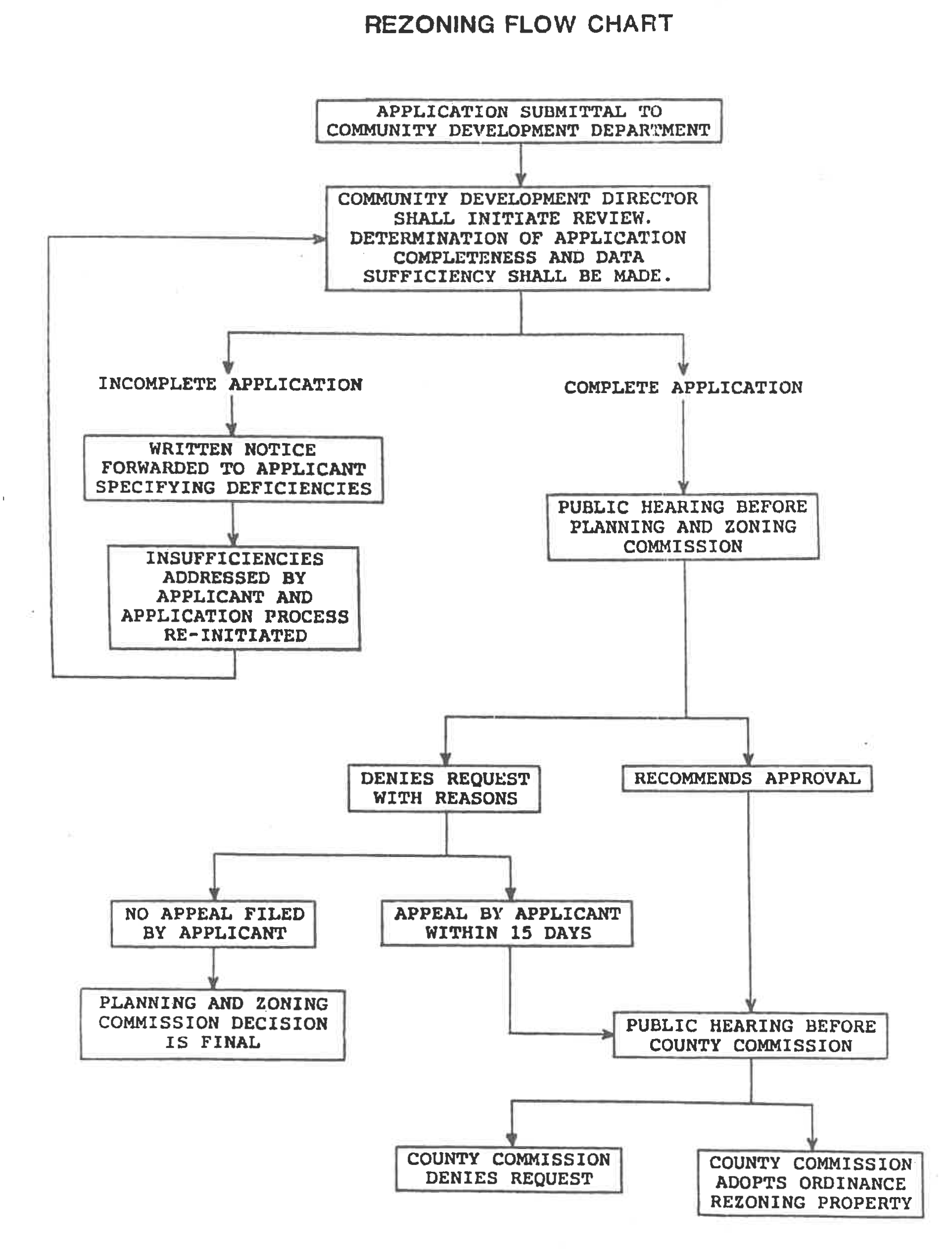
Staff review. The community development department shall have twenty (20) working days from the date the completed application and required fees are submitted to review and comment upon the application. The community development department shall then place the completed application on the agenda of a regularly scheduled county planning and zoning commission meeting; provided, however, the following notice and publication requirements are met prior to the public hearing before the county planning and zoning commission.
1.
Published notice requirement. The community development department shall publish the material contents of the application, together with a map indicating the area proposed to be rezoned, (map required only for rezoning requests and land development regulations amendment requests where state regulations require the publishing of a map), at least ten (10) days prior to the county planning and zoning commission's public hearing on the application, unless Florida Statutes mandate different notice requirements.
2.
Mailed notice; posted notice. Additionally, the community development department shall send by regular mail a written courtesy notice to all owners of property within three hundred (300) feet of the outer limits of the area described in the petition requesting a change, advising all such owners as shown upon the last prepared and completed tax assessment roll of the county, in simple terms, the proposed change and the time and place of the public hearing. In the event that more than ten (10) lots or parcels are proposed for rezoning, notification shall be by published notice only. For rezoning requests the community development department shall erect and conspicuously place upon the subject property at least one notice which shall contain the following information:
a.
Map of property which is the subject of the rezoning petition;
b.
Present zoning and requested rezoning classification; and
c.
Dates of scheduled hearings.
3.
Failure to provide notice. The provisions hereof for mailing notice are directory only and the failure to mail such notices shall not affect any change or amendment of said land development regulations. Moreover, regarding rezoning requests, failure to maintain a conspicuous notice on the property shall not affect said requests.
(c)
Action by planning and zoning commission. After the public hearing, the county planning and zoning commission shall report its recommendations to the board of county commissioners for final action. For rezoning requests, a denial of the application by the county planning and zoning commission, unless appealed as provided for herein, will be final.
(d)
Appeals of decisions by the planning and zoning commission to deny a rezoning application. Any applicant who is aggrieved by a decision of the county planning and zoning commission regarding denial of a rezoning application may file a written notice of intent to appeal the county planning and zoning commission decision with the director of the community development department, the chairman of the county planning and zoning commission, and the chairman of the board of county commissioners. Such appeal must be filed within twenty-one (21) days of the decision of the county planning and zoning commission.
(e)
Action by the board of county commissioners. Upon receipt of the recommendations from the county planning and zoning commission, or upon receipt of a written notice of intent to appeal, the board of county commissioners shall consider the proposed change, amendment or rezoning application and appeal within forty-five (45) days of the submission of said recommendations or written notice of intent to appeal, at an advertised public hearing as required by F.S. § 125.66. An appeal of a denial of a rezoning application shall be heard de novo.
(5)
Time for reapplying. No new application for an amendment, change or modification of the official zoning atlas shall be permitted to be filed until after the expiration of at least twelve (12) months from the filing of a previous application with the community development department, covering substantially the same lands.
(6)
Interim zoning. The board of county commissioners may adopt stop-gap or interim zoning for periods of time not to exceed one year designed to preserve the status quo in any area in the county, pending the completion of zoning, water and sewer, urban renewal or other similar type plans.
(Ord. No. 90-16, § 1, 9-11-90; Ord. No. 91-7, § 32, 2-27-91; Ord. No. 91-23, § 2, 5-15-91; Ord. No. 96-6, § 8, 2-27-96; Ord. No. 98-9, § 7, 5-19-98; Ord. No. 2002-004, § 5, 2-12-02)