Indian River County Unincorporated
City Zoning Code
City Zoning Code
CHAPTER 910
CONCURRENCY MANAGEMENT SYSTEM
Section 910.01.- Title, background and intent.
(1)
Title. This chapter shall be known as the "Indian River County Concurrency Management System."
(2)
Background. On February 13, 1990, the Indian River County Board of County Commissioners adopted the Indian River County Comprehensive Plan. The adoption of a comprehensive plan is required by the Local Government Comprehensive Planning and Land Development Regulation Act, Chapter 163, Part II, Florida Statutes, as amended (the Act), a primary objective of which is to effectively manage the problems associated with Florida's rapid population growth. A key element of the Act (Section 163.3177 (10)(h), Florida Statutes) is the concept of "concurrency" expressed as follows:
"It is the intent of the Legislature that public facilities and services needed to support development shall be available concurrent with the impacts of such development."
The Act further requires that each local government adopt locally acceptable levels of service (LOS) for its various public facilities and then provide for the capital improvements necessary to maintain these adopted levels of service. Levels of service adopted by local governments must be reasonably attainable and financially feasible.
In addition to introducing the general concept of concurrency, the Act compels local governments to comply with specific requirements related to concurrency. The Act (Section 163.3202 (2)(g), Florida Statutes) prohibits local governments from issuing "a development order or permit which results in a reduction in the service for the affected public facilities below the level of service provided in the comprehensive plan of the local government." This section of the Act further requires that this prohibition be implemented through local land development regulations to be adopted no later than one year after the date the local government was required to submit its plan to the Florida Department of Community Affairs for review. The plan submittal date for Indian River County was September 1, 1989. The Act (Section 163.3177(3)(b), Florida Statutes) also requires that the capital improvements element of the Comprehensive Plan "shall be reviewed on an annual basis and modified as necessary."
(3)
Intent. The purpose of a concurrency management system is to provide the necessary regulatory mechanism for evaluating development orders to ensure that adequate public facilities are available concurrent with development impacts, thereby fulfilling the Legislature's intent regarding "concurrency." An additional component of a concurrency management system is the establishment of a framework for determining public facility needs and providing a basis for meeting those needs through capital improvements programming.
Through adoption of the Indian River County Comprehensive Plan, the board of county commissioners exercised its legislative authority by establishing acceptable level of service standards for roads, potable water, sanitary sewer, solid waste, drainage, parks, and public school facilities.
The capital improvements program in the capital improvements element of the comprehensive plan identifies the schedule of capital projects and funding mechanisms necessary to maintain adequate public facilities at or above the adopted standards. Additional policies and requirements for establishing an effective framework for managing and directing development in a manner consistent with the Florida Legislature's concept of concurrency are contained in the land use, traffic circulation, recreation and open space, and the public school facilities elements of the comprehensive plan.
The approval of all development orders shall be subject to the availability of adequate levels of service for roads, potable water, sanitary sewer, solid waste, drainage, parks, and public school facilities based on the level of service standards contained in the capital improvements element.
The primary intent of these regulations is to provide Indian River County with the tools to meet the statutory requirements. This concurrency management system will serve as the principal mechanism for ensuring that growth is managed in a manner consistent with the provisions of the comprehensive plan and will serve as a key monitoring device for measuring the effectiveness of the comprehensive plan and the programming of capital improvements, including public school facilities.
(Ord. No. 90-16, § 1, 9-11-90; Ord. No. 2008-011, § 1, 6-3-08, eff. 7-1-08)
Section 910.02. - Certificate of concurrency determination.
Certificate of concurrency determination means concurrency certificate. Three (3) types of concurrency certificates are hereby established; these are: initial (or initial/final) concurrency certificate, final concurrency certificate, and conditional concurrency certificate. These concurrency certificates will be issued only after review and approval of concurrency applications. No development order will be issued unless an applicant has a valid concurrency certificate.
(Ord. No. 90-16, § 1, 9-11-90; Ord. No. 2002-025, § 1, 8-6-02)
Section 910.03. - No taking or abrogation of vested rights.
(1)
Nothing in the Indian River County Concurrency Management System shall be construed or applied to result in a temporary or permanent taking of private property without due process of law and just compensation.
(2)
Nothing contained herein shall be construed as affecting validly existing vested rights. It shall be the duty and responsibility of the person alleging vested rights to demonstrate affirmatively the legal requisites of vested rights. Rights shall vest based upon a determination by the board of county commissioners that the person alleging vested rights:
(a)
Has relied in good faith to his detriment upon some act or omission of the government; and
(b)
Has made such a substantial change in position or incurred such extensive obligations and expenses that it would be highly inequitable and unjust to destroy the rights he has acquired.
(3)
An applicant who is alleging vested rights and has been denied a development order based upon concurrency management system regulations may, within fifteen (15) days of such denial, file a petition for vested rights determination by the board of county commissioners. Any petition for vested rights determination shall meet the criteria established in section 910.12.
(4)
The mere existence of zoning or any other development order issued prior to the effective date of this chapter shall not be sufficient to vest rights.
(5)
Nothing contained herein shall limit or modify the rights of any person to complete any development that has been authorized as a development of regional impact pursuant to Chapter 380, Florida Statutes; nothing contained herein shall limit or modify the rights of any person to complete any development which has been issued a final local development order prior to the effective date of this chapter where the development order remains active.
(Ord. No. 90-16, § 1, 9-11-90)
Section 910.04. - Definitions.
All terms defined in Chapter 901, Definitions, are applicable in this chapter.
(Ord. No. 90-16, § 1, 9-11-90)
Section 910.05. - Interpretation and administration of the Indian River County Concurrency Management System.
(1)
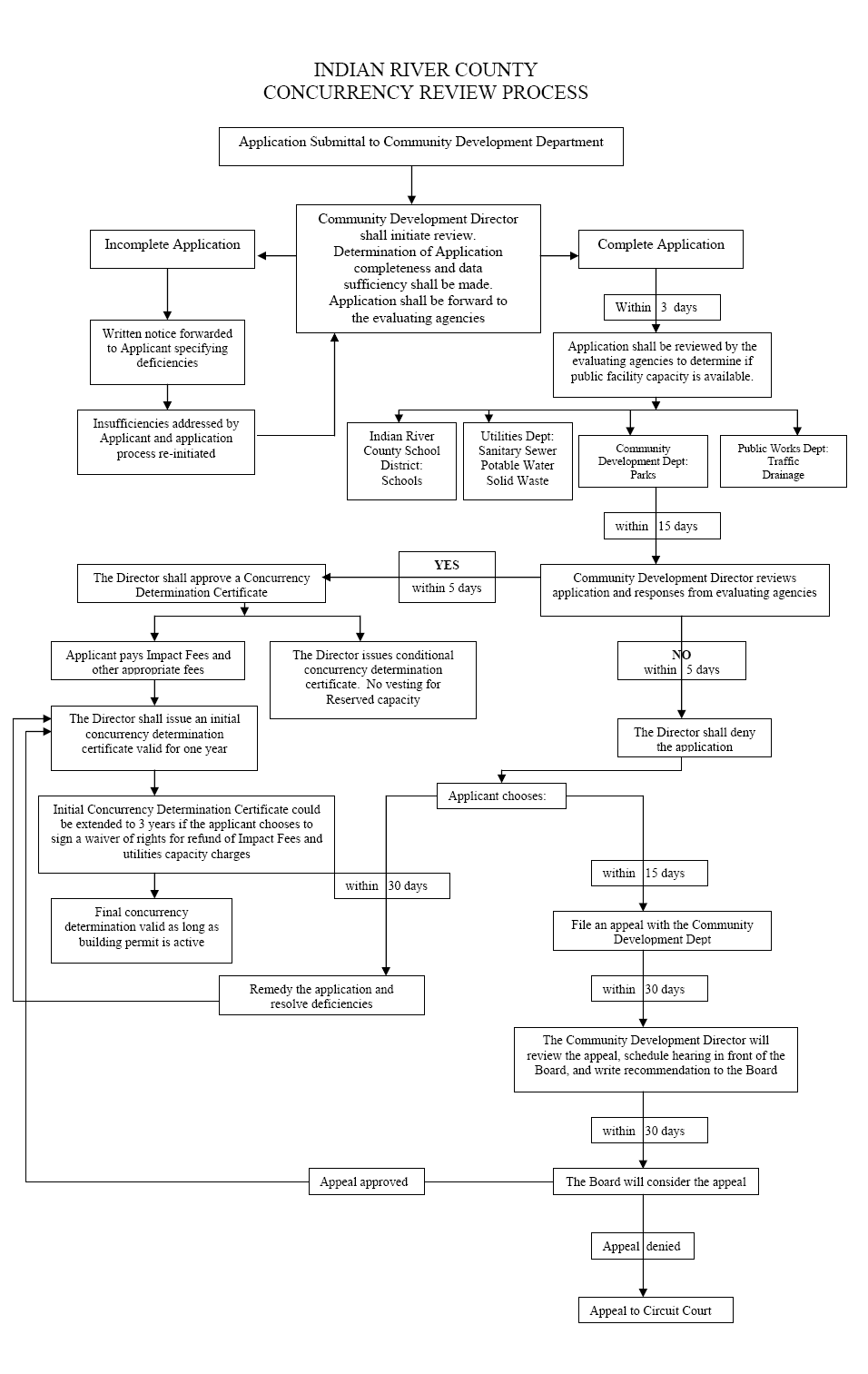
An applicant who has been denied a development order based upon concurrency management system regulations may, within fifteen (15) days of such denial, file a petition for additional review by the board of county commissioners. Any appeal of a concurrency determination shall meet the criteria established in section 910.12.
(Ord. No. 90-16, § 1, 9-11-90)
Section 910.06. - Establishment of fee for concurrency review.
The board of county commissioners shall by resolution establish a fee for concurrency determination reviews.
(Ord. No. 90-16, § 1, 9-11-90)
_____
Section 910.07. - Development review system.
(1)
No development order shall be approved unless a corresponding concurrency certificate has been issued or a determination is made that the development proposed is exempt from concurrency review.
(a)
The various types of development orders and the required corresponding concurrency certificates are listed below.
1 ;hg;Vesting is allowed for projects with an approved proportionate share agreement, as provided in section 910.12, or projects with an approved guaranteed developer's agreement for major roadway improvements, as provided in section 910.07(1)(e). Vesting for projects with agreements for proportionate share or major roadway improvements shall occur concurrent with approval of the applicable proportionate share or developer's agreement and payment of applicable fees. Said vesting shall be allowed for a period of seven (7) years. Vesting for site plan projects may occur upon approval of a site plan and payment of applicable fees including impact fees and capacity charges. Said vesting shall be allowed for a period of one (1) year or three (3) years. For residential projects that require issuance of a land development permit, vesting shall not be allowed unless there is a valid approved preliminary plat for the project and shall not occur until submittal of a complete land development permit application (including full engineering plans).
2 Upon issuance of a building permit, the final concurrency certificate shall remain valid for as long as the building permit is valid.
_____
(b)
No concurrency certificate shall be issued unless there is sufficient capacity available to maintain adopted levels of service as provided in section 910.09.
(c)
Prior to issuance of a development order, the community development director or his designee shall make a determination that concurrency requirements are satisfied for the type of development order under review.
(d)
Whenever a proportionate fair share agreement consistent with section 910.12 is executed and other concurrency requirements specified in the agreement or in section 910.12 are satisfied, the development project which is the subject of the proportionate fair share agreement shall be vested with a seven-year initial concurrency certificate regardless of the development order stage of the project.
(e)
Whenever a non-proportionate fair share developer's agreement is executed by an applicant and that developer's agreement commits the applicant to construct major capacity producing transportation improvements, the applicant's project may be vested for concurrency with a seven-year initial concurrency certificate if the board of county commissioners finds that:
1.
The applicant's proposed improvements will provide significant benefits to the transportation system, and
2.
All other concurrency requirements, including payment of all applicable impact fees and capacity charges as well as demonstration of available capacity on all impacted links and in all applicable concurrency facilities, are met.
For purposes of this provision, a "major capacity producing transportation improvement" is a project which adds travel lanes to an existing roadway or a corridor and expands the capacity of the roadway or corridor by at least twenty-five (25) percent.
(f)
Determinations of exemption from concurrency review shall be made by the community development director or his designee. Exemptions may be based on vested rights determinations, application of de minimis criteria, or determinations that there will be no increase in density or intensity. Appeals of determinations shall follow the procedures of section 910.05.
(2)
The following are exempted from concurrency review:
(a)
Projects which have a vested rights determination pursuant to section 910.03;
(b)
Existing nonresidential buildings to be modified, altered, or repaired unless the modification will increase square footage or increase the intensity of use. Where existing projects (residential or nonresidential) seek expansion which will increase the number of dwelling units or square footage for nonresidential projects, only the net increase or expansion shall be subject to concurrency review;
(c)
Vested final subdivision plats to be modified unless modification creates additional lots;
(d)
Replacement of existing residential units unless there is an increase in number of units;
(e)
Any development orders, including land use amendments and rezoning applications, which do not increase density or intensity of use; and
(f)
Permits for single-family homes deemed as "de minimis" under Florida Statutes 163.3180(6). This exemption shall apply to the permitting of a single-family home on a lawfully created lot or parcel of record that is not subject to a plat notice which states that there is no guarantee of concurrency for development of the lot. This de minimis exemption will not apply where the impacts of the proposed home will exceed the adopted level-of-service standard for any affected designated hurricane evacuation route. Designated hurricane evacuation routes are:
(1)
17th Street from SR A-1-A to US Highway 1.
(2)
SR60.
(3)
Indian River Blvd from the Merrill Barber Bridge to SR60.
(4)
CR510.
(5)
CR512.
(6)
US Highway 1.
(7)
Interstate 95.
Applications for exempted single-family homes will be processed through the county's concurrency management system (CMS), and a concurrency certificate shall be issued for exempted homes.
Exemption from concurrency review shall not affect any obligation to pay applicable impact fees and utility capacity charges.
(3)
The designation of a single agency for coordinating each level of the concurrency review process is necessary to ensure that every concurrency application is reviewed in accordance with these regulations prior to the issuance of a development order. The community development department shall be the coordinating agency for the concurrency review process and shall be responsible for coordinating the review of the development applications identified in section 910.07(1) and for approving or rejecting concurrency determinations. The community development director shall initiate the review process by review of an application for completeness and data sufficiency within three (3) days of receipt of the application. A copy of the complete application will then be forwarded to the evaluating departments and the school district.
Upon submission, each concurrency application will be placed in a queue. Each application will then be evaluated in the order in which it was received. As each application is evaluated, the demand reflected by that application will be compared to the available capacity for each facility, as described in sections 910.08, 910.09 and 910.11. As demand is allocated by approving applications, available capacity will be reduced.
If any facility has insufficient capacity to accommodate a proposed application, the following will occur:
(a)
If the applicant has indicated on his concurrency application that he would accept less capacity than requested if available capacity is inadequate to accommodate his demand, then he will be allocated the remaining available capacity, and the concurrency certificate will be conditioned on a comparable reduction in project size.
(b)
If the applicant has indicated on his concurrency application that he would not accept less capacity than requested if available capacity is inadequate to accommodate his demand, then his application request will be denied.
An applicant may have the option to apply for proportionate fair-share mitigation for transportation facilities or public school facilities. Regulations for proportionate fair-share mitigation for transportation facilities are provided in section 910.12, below. Regulations for proportionate fair-share mitigation for public school facilities are provided in section 910.13, below.
(4)
The following departments and school district shall be responsible for evaluating the adequacy of existing and planned facilities with regard to concurrency applications:
(a)
The utilities department shall evaluate solid waste levels of service;
(b)
The public works department shall evaluate roadway levels of service;
(c)
The public works department shall evaluate drainage levels of service;
(d)
The utilities department shall evaluate potable water levels of service;
(e)
The utilities department shall evaluate sanitary sewer levels of service; and
(f)
The community development department shall evaluate park levels of service.
(g)
The school district shall evaluate public school facilities levels of service.
(5)
The evaluating departments and school district, within fifteen (15) working days of receipt of the application from the community development department, shall provide the coordinating agency a letter or other instrument for each concurrency application. The evaluating agencies shall assess the level of service for all facilities which will be impacted by the proposed development, determine the extent of the impact generated by the proposed development, and determine whether those facilities have sufficient capacity to serve the development at, or above, adopted levels of service.
The applicant shall meet all the requirements of the evaluating agencies in order to be eligible for approval of the concurrency application. No concurrency certificate will be approved until each evaluating department and the school district are satisfied that sufficient capacity is available to accommodate the demand represented by the application. The applicant, through an enforceable development agreement or proportionate fair-share mitigation agreement with the evaluating department's board or school district, may mitigate deficiencies in order to satisfy the concurrency review.
(6)
The coordinating agency will be responsible for issuing a concurrency certificate or letter of denial within five (5) working days after receipt of the last evaluating agency concurrency review, except for final concurrency applications. Final concurrency certificates shall be issued at the time of building permit issuance. Each concurrency certificate will include:
(a)
The proposed use and quantity of development covered by the concurrency certificate, and
(b)
The expiration date of the concurrency certificate
(7)
For each concurrency application review, the coordinating agency will be responsible for monitoring and enforcing any conditions and/or stipulations contained in previous concurrency determinations. This will be done in order to ensure that consistent concurrency review procedures are maintained and that unnecessary duplication as a result of different concurrency reviews is avoided.
(Ord. No. 90-16, § 1, 9-11-90; Ord. No. 91-23, § 4, 5-15-91; Ord. No. 91-48, § 8, 12-4-91; Ord. No. 92-39, § 6, 9-29-92; Ord. No. 96-6, § 10, 2-27-96; Ord. No. 2002-025, § 2, 8-6-02; Ord. No. 2007-001, § II(1), (2), 1-23-07, eff. 3-1-07; Ord. No. 2008-002, § 1, 1-8-08; Ord. No. 2008-011, § 2, 6-3-08, eff. 7-1-08)
Section 910.08. - Determination of concurrency, generally.
(1)
Consistent with comprehensive plan policies, the approval of development orders shall be contingent upon a finding that adequate public facilities are available, consistent with their adopted levels of service and concurrent with the impact of the proposed development. Such determination of concurrency made during the review of a concurrency application which is not an initial or final concurrency certificate does not guarantee that there will automatically be a finding of concurrency at subsequent steps in the process for a given property or a proposed development. However, a finding of concurrency made at the initial concurrency stage may be used as a basis for a finding of concurrency during the review of a final concurrency application provided that:
(a)
The previously approved concurrency determination remains in effect, as determined by the time limit imposed upon the concurrency certificate;
(b)
The impact of the proposed development under consideration was fully taken into account during the concurrency review and in the finding of concurrency associated with the previously approved concurrency certificate;
(c)
The conditions related to land uses and facility availability upon which the previous finding was based have not changed due to an act of nature or other situation out of the county's control; and
(d)
All conditions or stipulations regarding the timing or phasing of the development or the provision of facility improvement by either the developer or the county imposed on the previously approved development order have been satisfied.
(2)
In order to ensure that the capacity of various public facilities is available concurrent with the impact of the proposed development, the review of all concurrency applications shall be based upon the following criteria:
(a)
Conditional concurrency determination. A conditional concurrency certificate is a determination that sufficient capacity to accommodate a given development proposal is available at the time of the determination. A conditional concurrency certificate shall be issued prior to approval of the following types of development orders:
• Comprehensive plan land use amendments.
• Rezonings.
• Conceptual plans.
• Preliminary plats and preliminary PD plans.
• Site plans.
A conditional concurrency certificate will indicate that the facilities and services are available at the time of issuance of the conditional concurrency certificate but may not be available at the time of any subsequent concurrency review. Issuance of a conditional concurrency certificate shall not be construed to guarantee the availability of adequate facilities at the time of building permit applications or land development permit applications.
1.
A conditional concurrency certificate issued in conjunction with the review of a proposed development order type specified above shall be considered valid for purposes of approving the associated development order.
2.
A conditional concurrency certificate may be issued with a condition identifying off-site improvements necessary to meet an adopted level of service and the cost-feasible mechanism for implementing the necessary improvements.
3.
Prior to issuance of a conditional concurrency certificate, the applicant shall sign an agreement with the county indicating that the applicant understands that the conditional concurrency certificate does not guarantee the availability of facilities at the time of the final concurrency review. The county will not reserve capacity and will not be liable if capacity is not available in the later stages of the review process.
4.
Where the proposed project is a non-PD (planned development) rezoning or comprehensive plan amendment, the concurrency impact assessment will be based on the following criteria:
For conceptual plans, the conditional concurrency determination will be based upon the development parameters of the conceptual plan (includes PD rezonings).
(b)
Initial concurrency determination. An initial (or an initial/final) concurrency certificate is a determination and guarantee of availability of adequate capacity for an approved development project with an approved proportionate share agreement as provided in section 910.12, or an approved development project with an approved guaranteed developer's agreement for major roadway improvements as provided in section 910.07(1)(e). Initial concurrency certificates for such projects shall be issued with a duration of seven (7) years. All other initial concurrency certificates shall be issued with a duration of one (1) year or three (3) years. Initial concurrency certificates vest capacity for the duration of the certificate, either one (1) year, three (3) years or seven (7) years. All applications for initial concurrency certificates shall expire if applicable impact fees and capacity charges are not paid and department approvals are not obtained within twelve (12) months from the date a complete application is received by the planning division. All applications will be subject to review according to the provisions of sections 910.08, 910.09 and 910.11 of these regulations. Prior to approval and issuance of a certificate of initial concurrency, the applicant must satisfy reviewing departments' requirements and pay all impact fees and utility capacity charges associated with the improvements allowed by the certificate of concurrency.
1.
Initial concurrency certificates associated with approved proportionate share agreements or guaranteed developer's agreements as referenced in section (b), above, are valid for seven (7) years after approval. At the time of initial concurrency application submittal, the applicant shall sign a waiver of rights for the refund of impact fees and utility capacity charges for the initial seven-year concurrency certificate. Such waiver is also required for three (3) year initial concurrency certificates. No such waiver is required for one (1) year initial concurrency certificates.
2.
Prior to expiration of an initial concurrency certificate, the developer may apply for a new initial concurrency certificate subject to the application process provided herein. In such circumstances, the county shall not accept the new application more than thirty (30) days in advance of the original certificate expiration.
(c)
Notice required for new single-family platted lots. When a final plat application is filed to create single-family lots, the following notice shall appear on the face of the final plat:
"No building permit will be issued for development of any lot or tract unless and until an initial and final concurrency certificate for development of the lot or tract is obtained. Indian River County does not guarantee that adequate capacity will exist at the time when an applicant or applicant's successor chooses to apply for and obtain a concurrency certificate."
In addition to the notice on the face of the final plat, a separate but similar off-plat notice shall be prepared by the final plat applicant in a manner approved by the county attorney's office. The applicant shall have the off-plat notice recorded in the Indian River County public records at the time that the final plat is recorded. A copy of the off-plat notice shall be attached to and recorded as an exhibit to the first deed that conveys each lot or tract to a party other than the subdivision developer. This deed exhibit requirement shall not apply to any lot or tract conveyed with a single-family residential unit already constructed on the lot at the time of conveyance.
(d)
Final concurrency determination. A final concurrency certificate must be obtained prior to issuance of a building permit for:
• A new building or residential unit
• Expansion of a use
• Increase in the intensity of use.
No final concurrency application will be accepted unless and until the associated building permit application is filed.
1.
In order to obtain a building permit for a new building, expansion of a use, or increase in the intensity of use, the applicant must have a valid final concurrency certificate. If an application for a final concurrency determination is submitted while the initial concurrency certificate is valid, then the capacity will have been reserved and the issuance of the final concurrency certificate is automatic. If the amount of the impact fees associated with the improvements represented by the initial concurrency certificate increases before the final concurrency certificate is issued, the applicant must pay the additional increment. A final concurrency certificate is valid for twelve (12) months from approval. Upon issuance of the building permit, the final concurrency certificate shall be valid as long as the building permit is active.
2.
Building permit applications for single-family residences shall be evaluated to determine if adequate capacity is available to meet adopted levels of service for the concurrency components specified in section 910.09. No building permit shall be issued for a single-family residence not vested for concurrency or exempt from concurrency as provided in section 910.07(2) unless adequate capacity is available to meet adopted levels of service for the concurrency components specified in section 910.09.
(Ord. No. 90-16, § 1, 9-11-90; Ord. No. 2002-025, § 3, 8-6-02; Ord. No. 2007-001, § II(3), 1-23-07, eff. 3-1-07; Ord. No. 2008-002, § 2, 1-8-08)
Section 910.09. - Determination of concurrency, components.
Concurrency management consists of seven (7) separate components. In order for a concurrency determination application to be approved and a certificate of concurrency determination to be issued, the concurrency review for the subject application must indicate that there is sufficient available capacity in the system for each component of the concurrency management system to maintain the level of service established in the comprehensive plan. The seven (7) components of the concurrency management system are traffic circulation, potable water, sanitary sewer, solid waste, drainage, recreation, and public school facilities. If the review of an individual concurrency determination application indicates that the increased demand attributable to the application would decrease the level of service to an unacceptable level for any component, the concurrency determination certificate will not be issued. The concurrency management system will consist of a data base which will have updated information regarding supply and demand for each facility within each component of the system.
(1)
Sanitary sewer and potable water. Two (2) types of sanitary sewer and potable water concurrency determinations are hereby established. These are: on-site and centralized. Each concurrency determination application shall be reviewed pursuant to the standards of Chapter 918, Sanitary Sewer and Potable Water Regulations, to determine if the application is subject to connection to a centralized water and sewer system or if on-site facilities may be utilized. For those applications requiring connection to a centralized system based upon the regulations of Chapter 918, concurrency determinations shall meet the criteria of (a) through (d) below. For applications which may utilize on-site facilities based upon Chapter 918, concurrency determinations shall be based upon meeting those requirements established by the Indian River County Department of Environmental Health for on-site facilities.
(a)
Sanitary sewer and potable water supply. The sanitary sewer and potable water portion of the concurrency management data base will consist of updated information regarding supply and demand for each sanitary sewer or potable water facility. The resulting balance (supply-demand) will constitute the available capacity for each facility. No concurrency determination certificate will be issued when the available capacity is less than demand projected to be generated by a proposed application.
For purposes of evaluating concurrency determination applications, the supply (capacity of a facility) shall be determined by adding together:
1.
The total existing capacity of the facility:
a.
Design capacity of the sanitary sewer treatment plant measured by gallons per day for sanitary sewer facilities;
b.
Design capacity of the potable water plant measured by gallons per day for potable water facilities; and
2.
The total capacity of proposed improvements to the facility or the total capacity of proposed facilities, if any, that will become available within the service area, if one (1) or more of the following is demonstrated:
a.
Construction of the new facilities is underway at the time the application for the concurrency determination is being evaluated;
b.
The new facilities are the subject of a binding executed contract for the construction of the facilities or the provision of services at the time the application for the concurrency determination is being evaluated;
c.
The new facilities have been included in the adopted Indian River County Capital Budget for the fiscal year in effect at the time the application for the concurrency determination is being evaluated;
d.
The new facilities are guaranteed in an enforceable development agreement for the development under consideration. An enforceable development agreement may include, but is not limited to, development agreements pursuant to Section 163.3220 et seq., Florida Statutes. Such facilities shall be consistent with the Capital Improvements Element of the Indian River County Comprehensive Plan, as it may be amended from time to time; or
e.
The new facilities are guaranteed in an enforceable development agreement for a development different than the one (1) under consideration, provided that the new facilities are the subject of a binding executed contract for construction with a start date during the fiscal year in effect at the time the application for the concurrency determination is being evaluated; or
f.
A development order or permit is issued subject to the condition that the necessary facilities and services will be in place and available at the time of the issuance of a certificate of occupancy.
(b)
Sanitary sewer and potable water demand. The demand on a facility shall be determined by adding together:
1.
The demand for the services or facilities created by existing development (existing flows);
2.
The projected demand for the services or facilities created by the anticipated completion of other approved developments for which initial or final concurrency determination certificates have been approved and the projected demand anticipated by completion of other vested development projects; and
3.
The projected demand for the services or facilities created by the anticipated completion of the proposed development under consideration for initial or final concurrency determination.
(c)
Sanitary sewer and potable water available capacity. Available capacity for each facility is the resulting balance of supply minus demand not including demand for the application under consideration.
(d)
Sanitary sewer and potable water facility monitoring. To effectively implement the concurrency requirement, it is necessary that the evaluating agency maintain an estimate of available capacity for each public facility subject to level-of-service requirements. By maintaining an accurate and current available capacity estimate for each facility, projected demand from concurrency determination applications can be compared to the available capacity for the facility to determine if the project can be approved. The purpose of the monitoring program is to maintain a current estimate of available capacity for each facility.
In order to ensure the maintenance of the level of service established in the comprehensive plan, the following criteria have been established in the comprehensive plan:
1.
Design for additional capacity for regional facilities shall begin when the current operational demand on a facility is at fifty (50) percent of the plant's designed capacity.
2.
Construction of additional capacity shall begin when the current operational demand on a facility is at sixty-five (65) percent of the plant's designed capacity.
3.
The utilities department shall prepare annual summaries of capacity and demand information for each facility within the county service area.
4.
As part of the concurrency management system, the utilities department shall identify existing flows for each water and sewer treatment plant on a quarterly basis.
5.
To account for reserved capacity (reserved ERU's) and not impose undue requirements on the facilities which are operating below their design capacity, the following requirement shall be met; when total sold capacity (existing ERU's connected plus reserved ERU's) reaches one hundred (100) percent of the designed capacity of the plant, the county must apply for an expansion permit regardless of the existing operating demand.
(2)
Solid waste.
(a)
Solid waste available capacity. Due to the fact that there is only one (1) landfill which serves the entire county, monitoring of the available facility capacity for solid waste is less complicated than other components of the concurrency management systems. Based on projected demands and landfill capacity, the entire county has been pre-approved until October 1, 2002.
(b)
Solid waste facility monitoring. With regard to the following expansion criteria established in the comprehensive plan, the concurrency management system for solid waste will monitor the capacity of the landfill by ensuring sufficient capacity in the active segment of the landfill.
1.
Design for additional burial segments of the landfill shall be completed before the active segment of the landfill is at seventy (70) percent of its capacity.
2.
Construction of additional burial segments shall begin when the active segment is at seventy-five (75) percent of its capacity.
3.
If the active segment is at ninety (90) percent of its capacity and the new segment is not ready, additional development shall not be permitted.
4.
The solid waste disposal district shall prepare annual summaries of demand and capacity information for the active segment of the landfill.
5.
As part of the concurrency management system, the solid waste disposal district shall provide quarterly estimates of the volume of the active segment of the landfill which has been used and remaining available capacity.
(3)
Recreation.
(a)
Recreation supply. Recreation supply can be determined by adding together:
1.
The total park acreage of existing parks by type by park district; and
2.
The total park acreage of proposed parks by type by park district if:
a.
The proposed park is the subject of a binding executed contract providing for property acquisition within one (1) year of issuance of the certificate of occupancy; or
b.
The proposed park is guaranteed in an enforceable development agreement providing for property acquisition within one (1) year of the issuance of the certificate of occupancy.
(b)
Recreation demand. Recreation demand is calculated for residential development only. Recreation demand for each park type in each park district shall be determined by adding together:
1.
The demand for each park type in the applicable park district created by existing development. This is calculated by multiplying the existing population by the level of service standards established for each park type;
2.
The projected demand for each park type in the applicable park district created by the anticipated completion of other approved developments for which initial or final concurrency determinations have been approved and the projected demand anticipated by completion of other vested development projects; and
3.
The projected demand for each park type in the applicable park district created by the anticipated completion of the proposed development under consideration for initial or final concurrency determination. This shall be calculated by applying the proposed development's projected population (determined by multiplying a person per household factor of 2.2 for multifamily or mobile home units and 2.4 for single-family units to the number of units proposed for the project) to the level of service standards established for each park type.
(c)
Recreation available facility. Available capacity for each park type in the applicable park district is the resulting balance of supply minus demand for each park type not including demand for the application under consideration.
(d)
Recreation monitoring. To effectively implement the concurrency requirement, it is necessary to maintain an estimate of available capacity for each park type in each park district subject to level of service standard requirements. By maintaining an accurate and current available capacity estimate for each facility, projected demand from concurrency determination applications can be compared to the available capacity for each park in the applicable park district to determine if the project can be approved. The purpose of the monitoring program is to maintain a current estimate of available capacity for each park type in each park district.
(4)
Transportation.
(a)
Transportation supply (capacity). Transportation supply shall be determined on a segment by segment basis. For concurrency purposes, all segments on the county's thoroughfare plan shall be considered. Capacity for segments will be based either on FDOT's generalized capacity tables or individual segment capacity studies approved by the public works director pursuant to the criteria specified in Chapter 952, Traffic. Transportation supply for each segment is:
1.
The segment's existing peak hour, peak season, peak direction capacity; or
2.
The segment's new roadway capacity if facility expansion for the segment is proposed and if:
a.
At the time the development order or permit is issued, the facility expansion is under construction; or
b.
A development order or permit is issued subject to a condition that the facility expansion needed to serve the new development is included in the county's adopted five-year schedule of capital improvements and is scheduled to be in place or under actual construction not more than three (3) years after issuance of the project's first building permit or its functional equivalent. For purposes of this section, the county may recognize and include transportation projects included in the first three (3) years of the adopted Florida Department of Transportation five-year work program. In order to apply this provision to a facility expansion project, the Capital Improvements Element must include the following policies:
i.
The estimated date of commencement of actual project construction and the estimated date of project completion (for Indian River County, this is included in policy 5.11 of the county's CIE and within Appendix B of the county's CIE), and
ii.
A provision that a plan amendment is required to eliminate, defer, or delay construction of any road or mass transit facility or service which is needed to maintain the adopted level of service standard and which is listed in the five-year schedule of capital improvements (for Indian River County, this is included in Policy 1.2 of the county's CIE); or
c.
At the time a development order or permit is issued, the facility is the subject of a binding executed agreement which requires the facility to be in place or under actual construction no more than three (3) years after the issuance of the project's first building permit or its functional equivalent; the agreement may assign all or a portion of the created capacity; or
d.
At the time a development order or permit is issued, the facility is guaranteed in an enforceable development agreement, pursuant to Section 163.3220, F.S., or an agreement or development order issued pursuant to Chapter 380, F.S., to be in place or under actual construction not more than three (3) years after issuance of a building permit or its functional equivalent. [Section 163.3180(2)(c), F.S.]; the agreement may assign all or a portion of the created capacity; or
e.
The segment is the subject of a proportionate fair-share agreement. In such case, the segment capacity increase reflected in the proportionate fair share agreement shall be available only to the parties to a proportionate fair share agreement.
(b)
Transportation demand. The demand on each roadway segment shall be determined by adding together:
1.
The existing peak season, peak hour, peak direction volume for the segment;
2.
The projected peak season, peak hour, peak direction volume for the segment created by the anticipated completion of other approved developments for which initial or final concurrency determination certificates have been approved and the projected demand anticipated by completion of other vested development projects; and
3.
The projected peak season, peak hour, peak direction volume that the segment is expected to receive upon completion of the development project under consideration for concurrency approval.
a)
For development projects such as subdivisions, planned developments, and site plan developments, the project's volume for the segment shall be based on an approved traffic study. That study shall assign trips on the county's thoroughfare roadway network within the project's area of influence. That area of influence shall consist of roadway segments that receive from the project eight (8) or more peak season/peak hour/peak direction trips for a two-lane roadway or fifteen (15) or more peak season/peak hour/peak direction trips for a four-lane (or wider) roadway).
b)
For individual single-family dwelling unit concurrency determinations, the projected volume for the segment shall be the fractional trip assigned to the segments based on the appropriate approved traffic study for the overall parent development project (subdivision, planned development, site plan development) or determination of the traffic engineer for single-family homes proposed in projects for which no traffic study was required.
(c)
Transportation available capacity. Available capacity for each segment is the resulting balance of supply minus demand not including demand for the application under consideration.
(d)
Transportation monitoring. The purpose of the monitoring program is to maintain a current estimate of available capacity on each segment. The public works department and the community development department will compile and maintain capacity information for each segment. This information, at a minimum, must include the existing level of service for each segment, the existing peak hour, peak season, peak direction traffic volume on each segment, the committed capacity for each segment, the existing available capacity for each segment, available rights-of-way, and improvements designated in the five-year capital improvements program. The community development department will assign project trips for concurrency applications to each segment based on the following criteria:
1.
Cumulative effect of all single-family permits on a quarterly basis;
2.
Staff's trip assignment for a project generating an average of one hundred (100) trip ends or less per day;
3.
Trip assignment for a project generating more than one hundred (100) average trip ends per day based on a traffic impact study and trip assignment approved by the public works department.
For each concurrency application, project trips will be entered into the concurrency data base manually for each segment. For projects other than single-family units, trips will be tracked on all segments within the project's area of influence. A project's area of influence consists of those roadway segments that receive eight (8) or more project peak season/peak hour/peak direction trips for a two-lane roadway or fifteen (15) or more project peak season/peak hour/peak direction trips for a four-lane (or wider) roadway. For single-family only, the most directly accessed segment will be considered. On each segment the number of trips projected to be generated/attracted by an application being reviewed for a concurrency determination will be compared to the available capacity. If the available capacity is more than the projected demand, a concurrency determination certificate will be issued. If there is not sufficient capacity available, the applicant has the option to mitigate for additional capacity. No concurrency determination certificate will be issued if the demand exceeds available supply.
In addition to the manually updated computerized concurrency database, the community development department will maintain an updated socioeconomic database by traffic analysis zone. This database will be updated automatically with approval of concurrency certificates, building permits, certificates of occupancy and other project approvals. This database shall constitute the vested alternative database. Using the vested alternative database and the existing conditions database, the staff will on a regular basis, but not less than once each six (6) months, run the FSUTMS model. For each segment on the network, a new existing plus vested volume will be obtained by taking the difference between the vested run and the existing run and adding that differential to the last counted volume for the segment.
(5)
Drainage.
(a)
Drainage supply (capacity). The drainage portion of the concurrency management data base will provide updated information regarding supply and demand for drainage facilities in each drainage basin or sub-basin as identified in the Drainage sub-element in the 1990 Comprehensive Plan. The resulting balance (supply-demand) will justify issuing a positive concurrency determination if the drainage system can adequately perform to the adopted level of service (both quality and quantity) and if the level of service for the drainage basin or sub-basin can be maintained or bettered. The resulting balance (supply-demand) will justify denying the concurrency determination application if the demand exceeds supply (both quality and quantity) or if the result is to lower the level of service below the acceptable standards for the drainage basin. For the purpose of evaluating concurrency applications which are considered to be initial or final concurrency determinations, the capacity of each drainage basin or sub-basin will constitute drainage supply. The capacity of each basin or sub-basin will be determined by analysis of the basin's drainage facilities including structures, open channels and swales, which serve the basin. The basin's capacity will be expressed as a maximum discharge rate per acre throughout the basin or sub-basin. For each basin or sub-basin, the capacity shall be:
1.
The maximum discharge rate per acre throughout the basin or sub-basin; or
2.
The new maximum discharge rate per acre throughout the basin or sub-basin, if new drainage facilities or drainage facility improvements are proposed within the basin or sub-basin. Proposed new drainage facilities or drainage facility improvements shall be considered in determining a new maximum discharge rate only if one (1) or more of the following is demonstrated:
a.
Construction of the new facilities is underway at the time the application for the concurrency determination is being evaluated;
b.
The new facilities are the subject of a binding executed contract for the construction of the facilities or the provision or services at the time the application for the concurrency determination is being evaluated;
c.
The new facilities have been included in the adopted Indian River County Capital Budget for the fiscal year in effect at the time the application for the concurrency determination is being evaluated;
d.
The new facilities are guaranteed in an enforceable development agreement for the concurrency determination application under consideration. An enforceable development agreement may include, but is not limited to, development agreements pursuant to Section 163.3220 et seq., Florida Statutes. Such facilities shall be consistent with the capital improvements element of the Indian River County Comprehensive Plan, as it may be amended from time to time;
e.
The new facilities are guaranteed in an enforceable development agreement for a development different than the one (1) under consideration, provided that the new facilities are the subject of a binding executed contract for the construction of the facilities with a construction start date during the fiscal year in effect at the time the application for the concurrency determination is being evaluated; or
f.
A development order or permit is issued subject to the condition that the necessary facilities and services will be place and available at the time of the issuance of a certificate of occupancy.
(b)
Drainage facility demand. The drainage facility demand for a basin or sub-basin is the volume of stormwater discharged from all sites in the basin or sub-basin during the design storm event. The drainage demand will be considered in the analysis of each basin or sub-basin and reflected in the basin or sub-basin's maximum discharge rate. For concurrency purposes, a project's demand will be the proposed discharge rate of stormwater leaving the site during the design storm event.
(c)
Drainage facility available capacity. Available capacity for each basin or sub-basin is the maximum discharge rate per acre adopted by the appropriate adopting authority having jurisdiction over the basins or sub-basins for the respective basins or sub-basins. For those basins or sub-basins where no maximum discharge rate has been established, available capacity will be equal to the pre-existing discharge rate for the design storm. In these cases, a positive concurrency determination may be issued where a project proposes no off-site stormwater discharge during the design storm event or where the project proposes a discharge rate equal to or less than the pre-existing discharge rate and a discharge of no more than the existing volume of stormwater runoff for the design storm event.
(d)
Drainage facility monitoring. The purpose of the monitoring program is to maintain a current estimate of available capacity for each drainage basin and sub-basin. The public works department will collect facility capacity information for each drainage basin and sub-basin. This information, as a minimum, must include the design capacity of the primary and secondary drainage canals, common retention/detention volume in acre-feet, and adopted maximum discharge rate for each basin. The public works department will review each project to ensure that offsite discharge does not exceed the maximum discharge rate adopted for each basin. If the maximum discharge rate is not adopted, the post-development runoff shall not exceed pre-development runoff.
In order to ensure the maintenance of the level-of-service established in the comprehensive plan, the following criteria have been established:
1.
Design for additional capacity for primary existing county maintained facilities shall begin when the current operational demand on the facility is at seventy-five (75) percent of its original designed capacity, or no discharge to the facility beyond the predevelopment discharge rate from the proposed development can be permitted, based upon the design storm. If it is not permissible or feasible to enlarge primary outfall capacity, a controlled discharge rate will be applied so that the discharge capacity of each outfall is not exceeded.
2.
Construction of additional capacity shall begin when the current operational demand on a facility is at eighty (80) percent of its design capacity, where applicable.
3.
The public works department shall prepare annual summaries of capacity and demand information for each county facility within the county service area. For drainage district facilities, the discharge rates adopted by each drainage district shall be used.
4.
As part of the concurrency management system, the public works department shall identify the available capacity of drainage facilities on a yearly basis.
(6)
Public school facilities.
(a)
Public school facilities supply (capacity). Public school facilities supply (capacity) shall be determined for each public school facility (elementary schools, middle schools, high schools), not including charter schools or magnet schools. The supply (capacity) for each school shall be its FISH (Florida Inventory of School Housing) Capacity, including the FISH Capacity of programmed construction in the first three (3) years of the School District Five-Year Facilities Work Program. Capacity shall be calculated for each school service area and shall include capacity-producing mitigation guaranteed through any proportionate share mitigation agreements approved in accordance with section 14.8 of the adopted "Interlocal Agreement for Coordinated Planning and School Concurrency" and the Public School Facilities Element of the comprehensive plan.
The determination of public school facilities capacity shall be made by the school district.
(b)
Public school facilities demand. Public school facilities demand shall be calculated for residential development only, with the following exemptions for certain residential development:
1.
All legal, single-family lots of record on July 1, 2008.
2.
Any residential development that received a final site plan or land development permit approval prior to July 1, 2008, where that approval has not expired and the approval remains valid.
3.
Any amendment to any previously approved residential development which does not increase the number of dwelling units or change the type of dwelling units (e.g. single-family or multi-family) so as to increase the number of students generated by the project.
4.
Any age restricted community with no permanent residents under the age of eighteen (18). Exemption of an age restricted community will be subject to a restrictive covenant limiting the age of permanent residents to eighteen (18) years and older. Said covenant shall be in a form acceptable to the applicable county attorney's office and shall be recorded in the public records prior to site plan release or issuance of a land development permit or land development permit waiver.
Upon request by a developer submitting a land development (development order) application with a residential component, the school district shall issue a determination as to whether or not the development, lot or unit is exempt from the requirements of school concurrency. Residential development that fits into one (1) of the four (4) categories referenced in this section shall be exempt from public school facilities concurrency review.
The system demand shall be calculated for each public school facility (elementary schools, middle schools, high schools), not including charter schools or magnet schools, and shall consist of student enrollment as counted for the fall FTE (full time equivalent), students projected to be generated from residential development vested for school concurrency under these school concurrency regulations, and students projected to be generated from approved residential development that falls within exemption categories 1 and 2 above and for which a building permit has been issued.
Project demand shall be calculated based on the student generation rates contained in the adopted "Interlocal Agreement for Coordinated Planning and School Concurrency" and the Public School Facilities Element of the comprehensive plan.
The determination of public school facility demand shall be made by the school district.
(c)
Public school facilities available capacity. Available public school facilities capacity shall be derived by using the following formula:
Available School Capacity = School Capacity 1 - (Enrollment 2 + Vested 3 )
Where
1 School Capacity = FISH Capacity, including the FISH Capacity of schools programmed for construction in the first three (3) years of the School District Five-Year Facilities Work Program.
2 Enrollment = Student enrollment as counted at the fall FTE.
3 Vested = Students projected to be generated from residential developments approved after the implementation of school concurrency where all school impact fees have been paid, plus students projected to be generated from residential building permits issued since implementation of school concurrency for lots that existed prior to implementation of school concurrency where either (1) no certificate of occupancy has been issued or (2) a certificate of occupancy has been issued since the last fall FTE.
1.
At the fall FTE, the vested number of students will be reduced by the number of students represented by the vested residential units that received certificates of occupancy within the previous twelve-month period.
2.
If a proposed residential development causes the adopted level of service to be exceeded in the school service area in which the proposed residential development is located, the available capacity in the adjacent school service area(s) shall be used.
3.
The determination of available capacity shall be made by the school district. That determination shall be stated in a school capacity availability determination letter (SCADL), as required in the adopted "Interlocal Agreement for Coordinated Planning and School Concurrency". Each SCADL shall state the total number and type of residential units for which school capacity is available and shall be sent to the coordinating agency (community development) and the applicant.
(d)
Public school facilities concurrency test. The test for public school facilities concurrency shall be a comparison of project demand and available capacity. A project shall be deemed to meet public school facilities concurrency if available capacity exceeds project demand.
(e)
Public school facilities monitoring. In accordance with the adopted "interlocal agreement of coordinated planning and school concurrency", the school district shall maintain a database by school service area for existing and programmed school facilities, capacities committed through proportionate share mitigation agreements, FISH capacities, student enrollment, vested students by development project together with the duration of time vested, certificates of occupancy issued for vested residential units by project (subdivision), and available capacity.
(7)
Data requirements.
(a)
Applicant submissions.
1.
All applications for conceptual or initial concurrency determination shall be submitted on a form provided by the community development department and shall include sufficient information for the staff to determine whether the impact of such development is consistent with these concurrency evaluation criteria. Such information shall include, but not be limited to:
a.
Identification of the total number and type of dwelling units for residential development applications;
b.
Identification of type and intensity of nonresidential use, where appropriate, at a level of detail consistent with the type of development application;
c.
Location of the proposed development and identification of facilities impacted by development pursuant to the provisions of section 910.11 of these regulations;
d.
Identification of project phasing, where applicable;
e.
Traffic impact analysis, or traffic impact statement if required;
f.
Copy of proposed or executed developer's agreement to provide additional capacity for a facility, if applicable;
g.
Statement from applicant indicating whether a concurrency certificate will be accepted for less density or intensity than requested, if insufficient capacity is available; and
h.
Other documents and information as required by the evaluating or coordinating agencies.
2.
All applications for final concurrency determination shall be submitted on a form provided by the community development department and shall include a copy of a valid initial concurrency determination certificate. Final concurrency determination applications for single-family residential units shall not be required to submit evidence of a valid initial concurrency certificate. Pursuant to section 910.08(1) if all conditions pertaining to the approval of the initial concurrency determination certificate remain the same, issuance of a final concurrency determination will be automatic.
(b)
Concurrency data base.
1.
The county shall develop and maintain an inventory of existing land uses and projected land uses, based upon concurrency determination certificate approvals, in order to monitor the impact of concurrency determination certificate approvals on the availability of public facilities. These data will be updated regularly and will be designed to provide incremental data pertaining to existing, approved, and planned development. The concurrency data base will provide the following information:
a.
Existing supply for each facility or service;
b.
Committed supply for each facility or service;
c.
Existing demand by facility or service;
d.
Committed demand by facility or service;
e.
Duration of time for which a capacity is committed; and
When a project receives a certificate of occupancy, the committed demand will change to existing demand.
2.
The planning division will be responsible for developing the county's concurrency data base. The concurrency data base shall be designed to function as a component of a unified data base designed to provide support to appropriate county departments engaged in concurrency determination and permit review and monitoring, and in the planning and/or provision of public facilities.
(Ord. No. 90-16, § 1, 9-11-90; Ord. No. 97-21, § 3(A)—(E), 7-15-97; Ord. No. 2006-011, § 2, 4-11-06; Ord. No. 2007-001, § II(4), 1-23-07, eff. 3-1-07; Ord. No. 2008-011, §§ 3, 4, 11, 6-3-08, eff. 7-1-08; Ord. No. 2012-019, § 1, 7-10-12)
Section 910.10. - Level of service standards established in the comprehensive plan.
In this section the various level of service standards established in the comprehensive plan are identified.
(1)
Drainage.
(a)
The county hereby adopts the following level-of-service standard for all new drainage systems within the unincorporated county: New development requiring major site plan approval or subdivision platting shall construct a complete drainage system to mitigate the impacts of a twenty-five-year/twenty-four-hour design rainfall event using the soil conservation service type 2 modified rainfall curves. Post development runoff shall not exceed pre-development runoff unless a maximum discharge rate has been adopted for the applicable drainage basin and the discharge does not exceed that rate. If a maximum discharge rate has not been adopted for the applicable basin, post development discharge may not exceed pre-development discharge.
(b)
All new roads constructed in Indian River County after September, 1990, shall meet the following design criteria:
Local Road Protection Level of Service
(c)
By 2010, all existing roadways in the county shall be improved to meet the following level-of-service standard:
1.
Minimum road crown elevation for existing roads shall be raised during resurfacing/rebuilding to the flood elevation resulting from the two-year/twenty-four-hour storm event on local streets.
2.
The center two (2) lanes of rebuilt roads must be at or above flood levels resulting from a ten-year/twenty-four-hour storm event on arterial and collector roads.
(d)
All drainage basins will meet the following level of service standards:
(e)
The county hereby adopts the following water quality level-of-service standard; as a minimum, retention of the first one (1) inch of rainfall is required prior to offsite discharge. An additional fifty (50) percent treatment is required for all direct discharge into the Indian River Lagoon due to its designation as an outstanding Florida water, as required by Ch. 17-25.025 (9), F.A.C.
(f)
All new buildings shall have the lowest habitable floor elevation no lower than the elevation of the one hundred-year flood elevation as shown on the Federal Emergency Management Agency (FEMA) [map] or as defined in a more detailed study report.
(2)
Potable water. The level of service standards for the county's potable water facilities of two hundred fifty (250) gallons per day (GPD) per equivalent residential unit (ERU), based on County Ordinance No. 84-18, are hereby adopted and shall be utilized for determining the availability of facility capacity and the demand generated by a development. Wellfield capacity, storage capacity and delivery pressure shall be based on the following:
Wellfield capacity shall be the average daily use plus the largest well being out of service.
Storage tank capacity shall be at least ½ of the average daily consumption volume.
High service pump capacity shall at least be equal to the maximum daily demand.
Pressures of the high service pumps for the county plants shall be a minimum of forty (40) PSI delivery pressures.
At fire flow conditions the system shall be able to provide delivery pressures of twenty (20) PSI.
Water quality shall at least meet EPA and State of Florida safe drinking water requirements.
(3)
Solid waste. The following level of service standards are hereby adopted for solid waste facilities in the county, and shall be used as the basis for determining the availability of facility capacity and the demand generated by a development:
(4)
Sanitary sewer. The level of service standards for the county's sanitary sewer facilities of two hundred fifty (250) gallons per day (GPD) per equivalent residential unit (ERU), based on county Ordinance 84-18, with a peak monthly flow factor of 1.25 are hereby adopted and shall be utilized for determining the availability of facility capacity and the demand generated by a development.
(5)
Recreation and open space. The county hereby adopts recreation levels-of-service as follows:
(a)
Urban district parks, specialty parks (beach), and specialty parks (river) are considered countywide parks. The following levels-of-service are applicable county-wide.
(b)
Community park levels-of-service are hereby set separately for the north and south districts. For the south district, two (2) levels-of-service are set, one (1) for the period from 1989 to 1995 and the other from 1996 to 2010.
(6)
Traffic circulation. The county hereby adopts traffic circulation level of service standards. These standards are as follows. Level of service "C" shall be maintained for rural principal arterials and rural freeways during peak hour, peak season, peak direction conditions. During peak hour, peak season, peak direction conditions, level of service "D" or better shall be maintained on all other freeway, arterial and collector roadways.
(7)
Public school facilities. The county hereby adopts the LOS (level of service) standard for public school facilities at one hundred (100) percent of permanent FISH (Florida Inventory of School Houses) Capacity. This LOS standard is consistent with Public School Facilities Element Policy 1.1 and section 13 of the adopted "Interlocal Agreement for Coordinated Planning and School Concurrency."
(Ord. No. 90-16, § 1, 9-11-90; Ord. No. 2008-011, § 5, 6-3-08, eff. 7-1-08)
Section 910.11. - Determination of concurrency, specifically.
(1)
Transportation.
(a)
[Generally.] Proposed developments seeking the issuance of a concurrency determination certificate shall be evaluated by the public works department and community development department in terms of potential development generated traffic impacts on those segments serving said development. A determination shall be made as to whether or not sufficient service volume is available to support said development at or above the adopted level of service for the impacted segments. Such a determination shall be made through the utilization of the following information produced by the Indian River County Public Works Department and Community Development Department:
1.
An inventory of all arterial and collector roads, including, at a minimum, the following data for each segment on each road:
a.
Existing peak hour, peak season, peak direction (design hour) volume based upon traffic counts or assumed volumes, the existing level of service designation, and available capacity based upon the segment's adopted level of service;
b.
Additional capacity to be added through the construction/implementation of roadway improvements for which a funding commitment has been included in the county capital budget, or which are guaranteed in an enforceable development agreement which satisfies the requirements of section 910.09(4)(a)1 and 2;
c.
Traffic volume projected to be added by approved development having an initial or final concurrency determination certificate or vested pursuant to the terms of this chapter.
2.
A trip distribution/assignment table for the entire development project (all phases) which will be used to identify those segments which can be expected to receive at least eight (8) or more peak season/peak hour/peak direction project trips for a two-lane roadway or fifteen (15) or more peak season/peak hour/peak direction project trips for a four-lane (or wider) roadway. For phased projects, individual project phases shall be evaluated as set forth in 910.11(1)(b) below.
3.
Information regarding the proposed application for which issuance of a concurrency determination certificate has been requested shall be provided by the applicant, subject to verification by the public works department and community development department, and shall contain at a minimum:
a.
Project location;
b.
Type and quantity of proposed land use(s), including but not limited to number of dwelling units, and square footage for nonresidential uses;
c.
Project phasing; and
d.
Traffic impact analysis (TIA) or traffic impact statement (TIS), as required by Chapter 952, Traffic.
(b)
Concurrency analysis. The public works department and community development department shall be the agencies responsible for determining whether adequate capacity is available to support traffic expected from a given proposed development such that a finding of concurrency may be rendered. Using the information inventoried pursuant to section 910.11(1)(a) above, expected development generated traffic shall be assigned to those two-lane roadway segments identified as receiving at least eight (8) or more peak season/peak hour/peak direction trips and those four-lane (or wider) roadway segments identified as receiving fifteen (15) or more peak season/peak hour/peak direction trips generated by the development under consideration pursuant to section 910.11(1)(a)2 above. The community development department will review and assign trips to segments for all individual single family residential traffic concurrency determination applications. Trips for individual single-family concurrency determinations shall be assigned as provided in 910.09(4)(b)3. Traffic Engineering Division staff will review and assign trips to segments for all projects generating less than four hundred (400) average trips per day.
For larger projects generating four hundred (400) or more average trip ends per day, the applicant shall submit a traffic impact analysis (TIA) or traffic impact statement (TIS) as required by Chapter 952 regulations. Based on this TIA or TIS, the public works department will assign trips to roadway segments. The community development staff will update the database as concurrency determination certificates are issued.
Trip generation, trip assignment, area of influence, and level of significance for each individual phase of a multi-phase project shall be based on the traffic study of the entire multi-phase (all phases) project. Accordingly, the traffic study for an individual phase of a multi-phase project shall reflect the individual phase's proportioned share of total (all phases) project traffic.
In the event that development generated traffic assigned to one (1) or more of the roadway segments exceeds the available capacity, the community development department shall notify the applicant that a concurrency certificate may not be issued. In such a case, the applicant may choose to decrease the intensity of his development to reduce demand to or below the level of available capacity, or initiate an agreement to expand capacity as provided in Chapter 910.12. If the applicant chooses not to amend his or her request and chooses not to initiate an agreement, then the concurrency application shall be held until it expires.
(2)
Potable water.
(a)
[Generally.] Concurrency determination applications shall be analyzed by the utilities department to determine the availability of adequate capacity using the following:
1.
An inventory of all central water systems serving the unincorporated areas of Indian River County, the City of Sebastian, and the Town of Orchid, which includes, at a minimum, the following data for each system:
a.
System capacity;
b.
Capacity of wellfield, or other source of raw water supply;
c.
Historical average flow of potable water;
d.
Historical peak flow of potable water;
e.
Number of hook-ups, in terms of equivalent residential units; and
f.
Number of hook-ups, in terms of equivalent residential units, for all reserved ERUs.
2.
Project data pertaining to the concurrency determination application under consideration shall be provided by the applicant, subject to verification by the county utilities department, and shall at a minimum, contain the following:
a.
The specific location of the project, including the identification of the entity expected to provide service to the project;
b.
The proposed land uses and land use intensities, in terms of equivalent residential units;
c.
Total potable water demand and peak demand expected to be generated by proposed project; and
d.
Project phasing information, if applicable.
3.
If the proposed service provider is other than the Indian River County Utility System, documentation will be required from the provider that the project is within its service area and that the potable water facility has the capacity to serve the project as proposed. If the ability of a provider to serve a proposed project is contingent upon planned facility expansion, details regarding such planned improvements shall also be submitted.
4.
Prior to the issuance of an initial or final concurrency determination certificate by the county, the applicant may be required to provide evidence of a contract with the service provider, indicating the provider's commitment and ability to serve the proposed project.
5.
Private wells and private potable water plants are allowed according to the requirements of the Chapter 918, Sanitary Sewer and Potable Water Regulations.
(b)
Concurrency analysis. Using the data supplied under section 910.11(2)(a) above, the county utilities department shall evaluate the impacts of the concurrency determination application to determine whether adequate capacity is available, or will be available concurrent with the impacts of the development. In the event that the data described in section 910.11(2)(a)1. above are not available in their entirety, the required data may be provided by the applicant subject to verification by the county utilities department. In the case that development generated demand exceeds the available capacity, the concurrency determination certificate shall be denied.
(3)
Sanitary sewer.
(a)
[Generally.] Concurrency determination applications shall be analyzed by the utilities department to determine the availability of adequate capacity using the following:
1.
An inventory of all regional sanitary sewerage systems serving the unincorporated area of Indian River County, the City of Sebastian, and the Town of Orchid, which includes, at a minimum, the following data for each system:
a.
System capacity;
b.
Historical average daily flow of treated sewage;
c.
Historical peak flow of treated sewage;
d.
Number of hook-ups, in terms of equivalent residential units; and
e.
Number of hook-ups, in terms of equivalent residential units, for all reserved ERUs.
2.
Project data pertaining to the concurrency determination application under consideration shall be provided by the applicant, subject to verification by the county utilities department, and shall, at a minimum, contain the following:
a.
The specific location of the project, including the identification of the entity expected to provide service to the project;
b.
The proposed land uses and land use intensities, in terms of equivalent residential units;
c.
Total sewage treatment demand and peak demands expected to be generated by proposed projects;
d.
Project phasing information, if applicable.
3.
If the proposed service provider is other than the Indian River County Utility System, documentation will be required from the provider that the project is within its service area and that the sanitary sewer plant has the capacity to serve the project as proposed. If the ability of a provider to serve a proposed project is contingent upon planned facility expansion, details regarding such planned improvements shall also be submitted.
4.
Prior to the issuance of an initial or final concurrency determination certificate by the county, the applicant may be required to provide evidence of a contract with the service provider indicating the provider's commitment and ability to serve the proposed project.
5.
Septic tanks and private package treatment plants are allowed according to the requirements of the Chapter 918, Sanitary Sewer and Potable Water Regulations.
(b)
Concurrency analysis. Using the data supplied under section 910.11(3)(a) above, the county utilities department shall evaluate the impacts of the concurrency determination application to determine whether adequate capacity is available, or will be available concurrent with the impacts of the development. In the event that the information described in section 911.11(3)(a)1. above is not available in its entirety, the required data may be provided by the applicant subject to verification by the county utilities department. In the case that development generated demand exceeds the available capacity, the concurrency determination certificate shall be denied.
(4)
Parks.
(a)
Requirements set forth in this section related to the determination of adequate parks and recreational facility capacity shall only apply to concurrency determinations, or those portions of concurrency determinations, which pertain to residential development.
(b)
Concurrency determination applications shall be analyzed by the community development department to determine the availability of adequate capacity using the following:
1.
An inventory of all parks and recreational facilities, including undeveloped park land, owned by Indian River County including, at a minimum, the following data for each facility:
a.
Type of facility (e.g. regional, community, neighborhood or special park);
b.
Acreage by type of facility;
c.
Inventory of available recreation activities;
d.
Accessibility and/or development status.
2.
Project data pertaining to the concurrency determination application under consideration shall be provided by the applicant, subject to verification by the county community development department, and shall, at a minimum, contain the following:
a.
The specific location of the project;
b.
The total number of residential dwelling units proposed, by type;
c.
The total estimated residential population of the proposed development, derived by applying a person's per household factor of 2.2 for multifamily or mobile home units and 2.4 for single-family units to the number of units projected for the proposed development;
d.
The total park demand for each park type, derived by applying the projected population of the proposed development by the level of service standard for each park type; and
e.
Project phasing information, if applicable.
(c)
Concurrency analysis. Using the data supplied under section 911.11(4)(b) above, the county community development department shall evaluate the impacts of the concurrency determination application to determine whether adequate parks capacity is available, or will be available concurrent with the impacts of the development. In the event that the information described in section 910.11(4)(b)1. above is not available in its entirety, the required data may be provided by the applicant subject to verification by the community development department. For purposes of this analysis, the acreage of a park will be included only if sufficient development of recreation facilities has occurred, or will occur consistent with the required time frames provided for concurrency determination. In the case that development generated demand exceeds the available capacity, the concurrency determination certificate shall be denied.
(5)
Drainage.
(a)
Concurrency determination applications shall be evaluated by the public works department to determine the availability of adequate capacity of drainage systems using the following:
1.
An inventory of all major and minor water management facilities and documentation of the ability of such facilities to accommodate the design storms as specified in the level of service standard;
2.
Identification of the adopted maximum discharge rate for the drainage basin, if any; and
3.
Project data pertaining to the concurrency determination application under consideration provided by the applicant.
(b)
Concurrency analysis. Using the data supplied under section 910.11(5)(a) above, the county public works department shall evaluate the impacts of the concurrency determination application to determine whether adequate drainage capacity is available or will be available concurrent with the impacts of the development. In the event that the information described in section 910.11(5)(a) above is not available in its entirety, the required data may be provided by the applicant subject to verification by the public works department. In the case that development generated demand exceeds the available capacity, the concurrency determination certificate shall be denied.
(6)
Solid waste.
(a)
Concurrency determination applications shall be analyzed by the utilities department to determine the availability of adequate capacity using the following:
1.
Documentation projecting annual usage rates of solid waste disposal through the expected life of the active segment of the sanitary landfill, using population projections consistent with the comprehensive plan;
2.
Project data pertaining to the concurrency determination application under consideration shall be provided by the applicant, subject to verification by the county utilities department, in sufficient detail to determine the annual impact of the proposed development on the solid waste facilities, including at a minimum:
a.
The number and type of residential units;
b.
The type and intensity of non-residential uses and estimated generation of solid waste; and
c.
Project phasing information, if applicable.
(b)
Concurrency analysis. Using the data applied under section 910.10(6)(a) above, the county utilities department shall annually prepare a statement indicating that sufficient landfill capacity exists to meet existing and projected solid waste disposal requirements.
(7)
Public school facilities.
(a)
Concurrency determinations relating to public school facilities shall pertain to those certain residential developments defined in section 910.09(6)(b) of this ordinance [chapter].
(b)
Concurrency determinations relating to public school facilities shall be analyzed by the school district in accordance with section 14 of the adopted "Interlocal Agreement for Coordinated Planning and School Concurrency", as may be amended from time to time.
(Ord. No. 90-16, § 1, 9-11-90; Ord. No. 2007-001, § II(5), 1-23-07, eff. 3-1-07; Ord. No. 2008-011, § 6, 6-3-08, eff. 7-1-08; Ord. No. 2018-002, § 1, 3-13-18)
Section 910.12. - Proportionate fair-share mitigation for transportation facilities.
(1)
Purpose and intent. The purpose of this section is to establish a method whereby the impacts of development on transportation facilities can be mitigated by the cooperative efforts of the public and private sectors, to be known as the Proportionate Fair-Share Program, as required by and in a manner consistent with F.S. § 163.3180(16).
(2)
Findings.
(a)
The Indian River County Commission finds and determines that transportation capacity is a commodity that has a value to both the public and private sectors and that the County Proportionate Fair-Share Program:
1.
Provides a method by which the impacts of development on transportation facilities can be mitigated by the cooperative and creative efforts of the public and private sectors;
2.
Allows developers to proceed under certain conditions, notwithstanding the failure of transportation concurrency, by contributing their proportionate fair share of the cost of expanding or improving a transportation facility;
3.
Contributes to the provision of adequate public facilities for future growth and promotes a strong commitment to comprehensive facilities planning, thereby reducing the potential for moratoria or unacceptable levels of traffic congestion; and
4.
Maximizes the use of public funds for adequate transportation facilities to serve future growth, and may, in certain circumstances, allow the county to expedite transportation improvements by supplementing funds currently allocated for transportation improvements in the capital improvements element.
(3)
Applicability. The proportionate fair-share program shall apply to any development project in Indian River County where the project's traffic impact study or the county traffic engineer determines that there is insufficient capacity on one (1) or more segments to satisfy the development project's transportation concurrency requirements. The proportionate fair-share program does not apply to developments of regional impact (DRIs) using proportionate fair share under F.S. § 163.3180(12), or to developments exempted from concurrency as provided in this concurrency chapter.
(4)
General requirements.
(a)
An applicant whose project meets the criteria of section 910.12(3) may choose to satisfy transportation concurrency requirements by making a proportionate fair-share contribution, pursuant to the following requirements:
1.
The proposed development is consistent with the comprehensive plan and applicable land development regulations, and
2.
The five-year schedule of capital improvements in the County Capital Improvements Element (CIE) includes one or more transportation improvements that, upon completion, will provide sufficient capacity for the deficient segments to accommodate the traffic generated by the proposed development.
(b)
The county may choose to allow an applicant to satisfy transportation concurrency for a deficient segment, through the proportionate fair-share program, by the developer contributing to an improvement that, upon completion, will create additional capacity on the deficient segment sufficient to accommodate the additional traffic generated by the applicant's proposed development even if the improvement project for the deficient segment is not contained in the five-year schedule of capital improvements in the CIE where:
The board of county commissioners holds an advertised public hearing to consider the proportionate share agreement and corresponding future changes to the five-year CIE, and
The county adopts, by ordinance, an amendment adding the improvement to the five-year schedule of capital improvements in the CIE. To qualify for consideration under this section, the proposed improvement must be reviewed by the board of county commissioners, and determined to be financially feasible pursuant to F.S. § 163.3180(16)(b)1, consistent with the comprehensive plan, and in compliance with the provisions of this ordinance. Financial feasibility for this section means that additional contributions, payments or revenue sources to fund the improvement project are reasonably anticipated during a period not to exceed ten (10) years.
(c)
Any improvement project proposed to meet a developer's fair-share obligation must meet design standards of the county for locally maintained roadways and those of the Florida Department of Transportation (FDOT) for the state highway system.
(5)
Application process.
(a)
Upon identification of a lack of capacity to satisfy transportation concurrency, an applicant may choose to satisfy transportation concurrency through the proportionate fair-share program pursuant to the requirements of section 910.12(4).
(b)
Prior to submitting an application for a proportionate fair-share agreement, the applicant shall attend a pre-application meeting with planning and traffic engineering staff to discuss eligibility, application submittal requirements, potential mitigation options, and related issues. If the impacted facility is on the Strategic Intermodal System (SIS), then the Florida Department of Transportation (FDOT) will be notified and invited to participate in the pre-application meeting.
(c)
Eligible applicants shall submit an application to the county that includes an application fee as established by resolution and the following:
1.
Name, address, and phone number of owner(s), developer and agent;
2.
Property location, including parcel identification numbers;
3.
Legal description and survey of property;
4.
Project description, including type, intensity, and amount of development;
5.
Phasing schedule, if applicable;
6.
Description of requested proportionate fair-share mitigation method(s);
7.
Copy of concurrency application;
8.
Copy of the project's Traffic Impact Statement (TIS) or Traffic Impact Analysis (TIA); and
9.
Location map depicting the site and affected road network.
(d)
Within ten (10) business days, planning staff shall review the application and certify that the application is sufficient and complete. If an application is determined to be insufficient, incomplete, or inconsistent with the general requirements of the proportionate fair-share program as indicated in section 4 910.12(4), then the applicant shall be notified in writing of the reasons for such deficiencies within ten (10) business days of submittal of the application. If such deficiencies are not remedied by the applicant within thirty (30) days of receipt of the written notification, then the application shall be deemed abandoned. The board of county commissioners may, in its discretion, grant an extension of time not to exceed sixty (60) days to cure such deficiencies, provided that the applicant has shown good cause for the extension and has taken reasonable steps to effect a cure.
(e)
Pursuant to F.S. § 163.3180(16)(e), proposed proportionate fair-share mitigation for development impacts to facilities on the Strategic Intermodal System requires the concurrence of the Florida Department of Transportation (FDOT). If an SIS facility is proposed for proportionate share mitigation, the applicant shall submit evidence of an agreement between the applicant and the FDOT for inclusion in the proportionate fair-share agreement.
(f)
When an application is deemed sufficient, complete, and eligible, a proposed proportionate fair-share obligation and binding agreement will be prepared by the county or the applicant with direction from the county and delivered to the appropriate parties for review, including a copy to the FDOT for any proposed proportionate fair-share mitigation on a Strategic Intermodal System (SIS) facility, no later than sixty (60) days from the date at which the application was determined to be sufficient and no fewer than fourteen (14) days prior to the board of county commissioners meeting when the agreement will be considered.
(g)
The county shall notify the applicant regarding the date of the board of county commissioners meeting at which the agreement will be considered for final approval. No proportionate fair-share agreement will be effective until approved by the board of county commissioners.
(6)
Determining proportionate fair-share obligation.
(a)
Proportionate fair-share mitigation for concurrency impacts may include, separately or collectively, private funds, contributions of land, and construction and contribution of facilities as provided in F.S. § 3180 (16)(c).
(b)
A development shall not be required to pay more than its proportionate fair share. The fair market value of the proportionate fair-share mitigation for the impacted facilities shall not differ based on the form of mitigation as provided in F.S. § 163.3180 (16)(c).
(c)
The methodology used to calculate an applicant's proportionate fair-share obligation shall be as provided for in F.S. § 163.3180 (12), as follows:
The cumulative number of peak hour, peak direction trips from the complete buildout of the proposed development, or buildout of the stage or phase being approved, that are assigned to the proportionate share program segment divided by the change in the peak hour directional maximum service volume (MSV) of the proportionate share program segment resulting from construction of the proportionate share program improvement, multiplied by the anticipated construction cost of the proportionate share project in the year that construction will occur.
This methodology is expressed by the following formula:
Proportionate Fair Share = |Ms [[(Development Trips;sub\sub;) ° (SV Increase;sub\sub;)] X Cost;sub\sub;]
(Note: In the context of the formula, the term "cumulative" does not include a previously approved stage or phase of a development.)
Where:
|Ms = Sum of all deficient links proposed for proportionate fair-share mitigation for a project.
Development Trips;sub\sub; = Those trips from the stage or phase of development under review that are assigned to roadway segment "i" and have triggered a deficiency per the concurrency management system;
SV Increase;sub\sub; = Service volume increase provided by the eligible improvement to roadway segment "i";
Cost;sub\sub; = Adjusted cost of the improvement to segment "i". Cost shall consist of all improvements and associated costs, including design, right-of-way acquisition, planning, engineering, inspection, and physical development costs, directly associated with construction at the anticipated cost in the year that construction will occur.
(d)
For purposes of determining proportionate fair-share obligations, the county shall determine improvement costs based upon the actual and/or anticipated costs of the improvement in the year that construction will occur. These costs will be determined by the county's public works department.
(e)
If the county has accepted an improvement project proposed by the applicant, then the value of the improvement shall be based on an engineer's certified cost estimate provided by the applicant and approved by the county's public works director or other method approved by the county's public works director.
(f)
If the county has accepted right-of-way dedication for the proportionate fair-share payment, credit for the dedication of the non-site related right-of-way shall be valued on the date of the dedication at 120 percent of the most recent assessed value by the county property appraiser or, at the option of the applicant, by fair market value established by an independent appraisal approved by the county and at no expense to the county. Said appraisal shall assume no approved development plan for the site. The applicant shall supply a drawing and legal description of the land and a certificate of title or title search of the land to the county at no expense to the county. If the estimated value of the right-of-way dedication proposed by the applicant (based on a county-approved appraisal) is less than the county estimated total proportionate fair-share obligation for that development, then the applicant must also pay the difference. If the estimated value of the right-of-way dedication proposed by the applicant (based on a county-approved appraisal) is more than the county estimated total proportionate fair-share obligation for the development, then the county will give the applicant traffic impact fee credit for the difference.
(7)
Impact fee credit for proportionate fair-share mitigation.
(a)
Proportionate fair-share mitigation payments for a development project shall be applied as a credit toward the traffic impact fees assessed to that development project.
(b)
Impact fee credits for a proportionate fair-share contribution will be determined when the traffic impact fee obligation is calculated for the proposed development. If the applicant's proportionate fair-share obligation is less than the development's anticipated road impact fee for the specific stage or phase of development under review, then the applicant must pay the remaining impact fee amount.
(c)
A proportionate fair-share contribution is intended to mitigate the transportation impacts of a proposed development at a specific location. As a result, any traffic impact fee credit based upon proportionate fair-share contributions for a proposed development may not be transferred to any other location.
(d)
The amount of traffic impact fee (TIF) credit for a proportionate fair-share contribution may be up to but shall not exceed the project's proportionate fair share amount and will be determined based on the following formula:
TIF Credit = [(Proportionate fair share impacted roadways' VMT) ° (Total Project VMT)] × (Total Project Traffic Impact Fee Liability)
Where:
VMT (Vehicle miles of travel on a link) = (length of link) × (number of trips assigned to that link)
Total Project VMT = Total vehicle miles of travel on all links impacted by proportionate fair share project
(e)
A proportionate fair share impact fee credit shall be applied consistent with the following formula:
Applicant payment = [(Total project traffic impact fees assessed) + (Proportionate Share Payment)] - (TIF CREDIT)
(8)
Proportionate fair-share agreements.
(a)
Upon executing a proportionate fair-share agreement (Agreement) and satisfying other concurrency requirements, an applicant shall receive a CCI5 (or its successor upon amendment of initial concurrency regulations) county certificate of concurrency approval. Should the applicant fail to apply for building permits within the timeframe provided for in the county concurrency certificate, then the project's concurrency vesting shall expire, and the applicant shall be required to reapply. Once a proportionate share payment for a project is made and other impact fees for the project are paid, no refunds shall be given. All payments, however, shall run with the land.
(b)
Payment of the proportionate fair-share contribution for a project and payment of other impact fees assessed to that project shall be due and must be paid prior to the effective date of the proportionate fair share agreement. The effective date shall be specified in the agreement and shall be the date the agreement is approved by the board or its designee.
(c)
All developer improvements accepted as proportionate fair share contributions must be completed within three (3) years of the issuance of the first building permit for the project which is the subject of the proportionate fair share agreement and be accompanied by a security instrument that is sufficient to ensure the completion of all required improvements. The security instrument shall conform to the subdivision construction security requirements of 913.10(1)(D). It is the intent of this section that any required improvements be completed within three (3) years of the issuance of the first building permit for the project which is the subject of the proportionate fair share agreement.
(d)
Dedication of necessary right-of-way for facility improvements pursuant to a proportionate fair-share agreement must occur prior to the effective date of the proportionate fair share agreement.
(e)
Any requested change to a development project subsequent to issuance of a development order shall be subject to additional proportionate fair-share contributions to the extent the change would increase project costs or generate additional traffic that would require mitigation.
(f)
Applicants may withdraw from a proportionate fair-share agreement at any time prior to the execution of the agreement. The application fee and any associated advertising costs to the county are nonrefundable.
(g)
The county may enter into proportionate fair-share agreements for selected corridor improvements to facilitate collaboration among multiple applicants on improvements to a shared transportation facility.
(9)
Appropriation of fair-share revenues.
(a)
Proportionate fair-share revenues shall be placed in the appropriate project account for funding of scheduled improvements in the county capital improvements element, or as otherwise established in the terms of the proportionate fair-share agreement. Proportionate fair-share revenues may also be used as the fifty (50) percent local match for funding under the FDOT Transportation Regional Incentive Program (TRIP).
(b)
In the event a scheduled facility improvement is removed from the CIP, then the proportionate fair share revenues collected for its construction may be applied toward the construction of alternative improvements within that same corridor or sector where the alternative improvement will mitigate the impacts of the development project on the congested roadway(s) for which the original proportionate fair share contribution was made.
(Ord. No. 2006-011, § 3, 4-11-06; Ord. No. 2008-011, § 7, 6-3-08, eff. 7-1-08)
Section 910.13. - Proportionate fair-share mitigation for public school facilities.
The proportionate fair-share mitigation provisions for public school facilities shall apply to any residential development project subject to school concurrency located in Indian River County where the school district has determined that there is insufficient public school facilities capacity to satisfy the development's public school facilities concurrency requirements. The school district shall process for consideration all requests for proportionate fair-share mitigation for public school facilities and shall administer resulting mitigation agreements in accordance with Section 14.8 of the adopted "Interlocal Agreement for Coordinated Planning and School Concurrency" and the public school facilities element of the comprehensive plan.
(Ord. No. 2008-011, § 8, 6-3-08, eff. 7-1-08)
Section 910.14. - Appeal process and vested rights determination.
(1)
Purpose and intent. This section is established to provide a mechanism for the hearing and decision of appeals of decisions or actions by the community development director or his designee on concurrency determinations and vested rights determinations.
(2)
Authorization.
(a)
The board of county commissioners of Indian River County is hereby authorized to:
1.
Hear and decide appeals when it is alleged that there is an error in any order, requirement, decision, or determination made by the community development director or his designee in the concurrency determination.
2.
Hear and decide appeals when it is alleged that there are vested rights.
(b)
Upon appeal and in conformance with land development regulations, the board of county commissioners in exercising its powers may reverse or affirm wholly or partly, or may modify the order, requirement, decision, interpretation, application, or determination of the community development director or his designee.
(c)
A majority vote of a quorum of all members of the board of county commissioners shall be necessary to reverse any order, requirement, decision, interpretation, application or determination of the community development director or his designee.
(3)
Appeal procedures.
(a)
The applicant, or any other person(s) whose substantial interests may be affected or determined in the proceeding may initiate an appeal.
(b)
Appeals must be filed within fifteen (15) days following action or determination by the respective official.
(c)
An appeal must be filed with the community development department on an application form prescribed by the county within the specified time limit. All such appeals shall recite the reasons why such an appeal is being taken.
The appeal shall be accompanied by a fee to be determined by resolution of the board of county commissioners. The community development director shall schedule the hearing of the appeal in front of the board of county commissioners within thirty (30) days following receipt of the application.
(d)
The community development director must review the appeal and prepare a report which contains the department's findings and recommendation.
(e)
All appeals shall be heard at a meeting of the board of county commissioners. All interested parties shall have a right to appear before the board of county commissioners and address specific concerns directly related to the appeal. Any person may appear by agent or attorney. All such hearings shall be conducted in compliance with the rules of procedure for the board of county commissioners. The time and place scheduled for hearing shall be given to the applicant in writing.
(f)
The final decision of the board of county commissioners must be reached within sixty (60) days following the receipt of the appeal by the community development department director.
(g)
The same procedure identified in section 910.12(3) will be applicable to the vested rights determination. The criteria identified in section 910.03 will be utilized for the vested rights determination.
(Ord. No. 90-16, § 1, 9-11-90; Ord. No. 2006-011, § 4, 4-11-06; Ord. No. 2008-011, § 9, 6-3-08, eff. 7-1-08)
Section 910.15. - Assignability and transferability.
(a)
A certificate of concurrency determination shall run with the land and shall transfer to a successor in interest to the original applicant upon written disclosure of such transfer to the community development department as to the identity of the successor. The disclosure shall provide the full legal name of the person or business entity acquiring the interest in the property; the nature of the interest; the address of the principal place of business of the successor; telephone number, name and address of registered agent if corporation; name, address and title of officers or agents authorized to transact business with the county, together with proof of authorization if other than president or vice-president or general partner; and the name and address of any new design professional for the project if applicable. A transferee applicant must also assume in writing on form acceptable to the county attorney all commitments, responsibilities, and obligations of the prior applicant, including all special conditions of the concurrency determination certificate.
(b)
Failure to make the required disclosure and assumption shall suspend a concurrency determination certificate until such time as proper disclosure and assumption are made.
(c)
Transfer of the certificate of concurrency determination shall not toll or modify the calculation of time limits set forth in the concurrency determination certificate. Following any transfer, such time limits shall be calculated as if the transfer had not occurred.
(d)
A concurrency determination certificate shall not be assignable or transferable to other developments.
(Ord. No. 90-16, § 1, 9-11-90; Ord. No. 2006-011, § 4, 4-11-06; Ord. No. 2008-011, § 10, 6-3-08, eff. 7-1-08)
Note— Formerly § 910.14.