
Jennings City Zoning Code
ARTICLE 22
- FENCE REGULATIONS
Sec. 22.1.- Purpose statement.
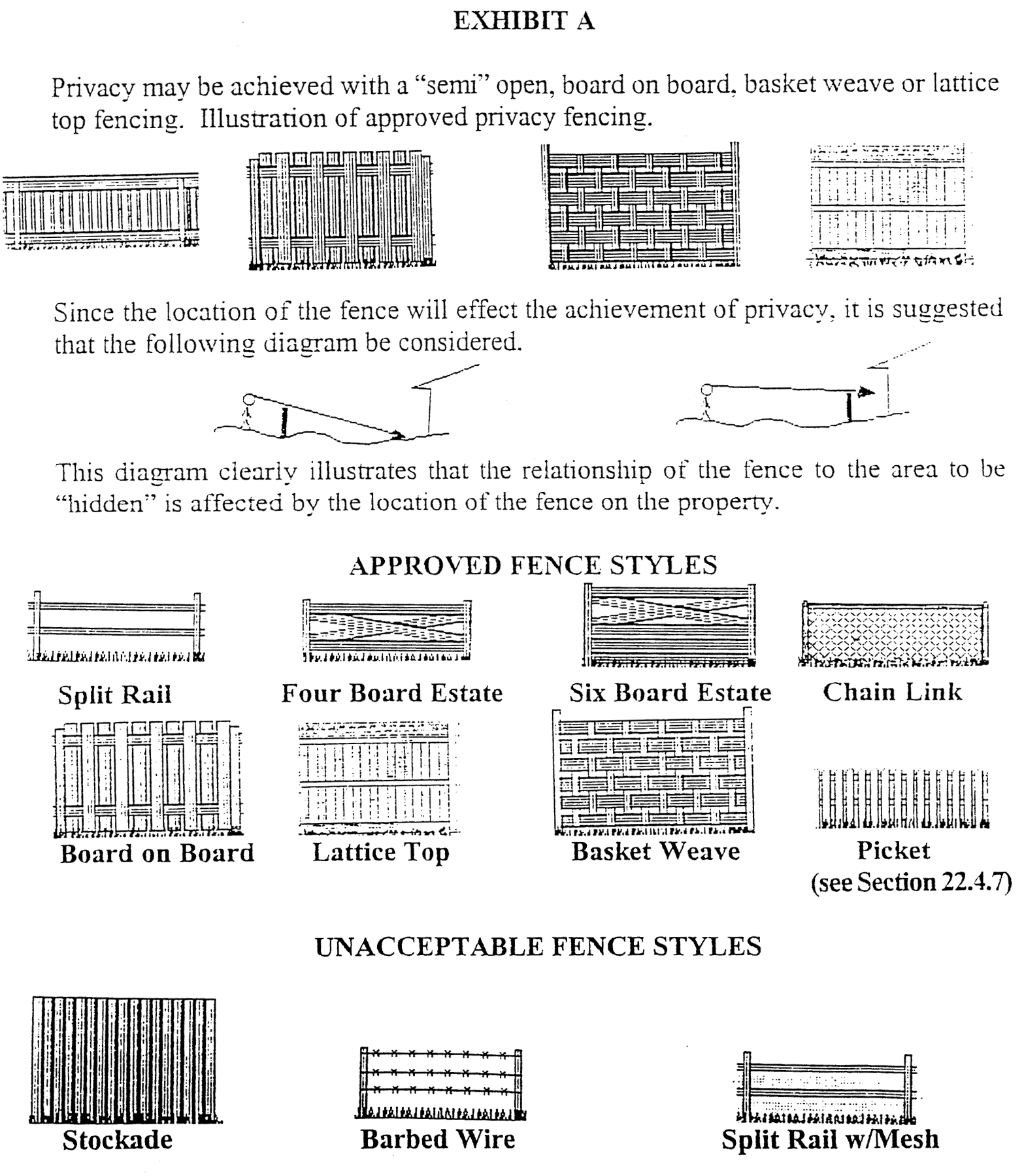
The fence regulations set forth shall supplement the regulations for each district in this chapter. Exhibit A attached hereto shall be a part of the regulations.
(Ord. No. 2095, § 1, 1-29-07)
Sec. 22.2. - Definitions.
For the purpose of this article the following terms shall be deemed to have the meaning indicated below.
(1)
Fence: A structure, partition or wall, including gates, erected for the purpose of enclosing or separating land or for the purpose of providing shade, privacy screening or security. Shrubs, hedges, trees and other plant material shall not be considered a fence.
(2)
Gate: A moveable barrier attached to a permanent support structure.
(3)
Stockade fence: A fence comprised of a line of stout vertical posts or stakes set side-by-side and held firmly together.
(4)
Courtyard: Enclosure wall, which is architecturally integrated into, connected at both ends to an existing structural wall of and located within the general exterior circumference of the main building on a lot.
(Ord. No. 2095, § 1, 1-29-07)
Sec. 22.3. - Permit required.
It shall be unlawful to erect any fence in the City of Jennings without first having filed, with the director of public works, an application for a fence permit together with a sketch or diagram of the type of fencing, design and color and its location and having obtained a permit for its erection. There will be a fee of twenty-five dollars ($25.00) for such permit.
(Ord. No. 2095, § 1, 1-29-07)
Sec. 22.4. - General regulations.
(1)
No fence shall be erected, permitted or maintained in any zoning district within the dedicated street right-of-way.
(2)
Fences shall be designed and constructed to resist a horizontal wind pressure of not less than thirty pounds per square foot (30 lbs./sq. ft.)
(3)
All fences shall be constructed with the finished surface facing neighboring property with support posts placed to the inside, except in cases where the posts are an integral part of the fence design which enhances the aesthetic appearance of the fence.
(4)
Every fence, which creates a wholly enclosed area and adjoins an existing or proposed street right-of-way, shall include a gate to provide access to the right-of-way.
(5)
Fence constructed by permit prior to the adoption of this ordinance, which does not conform to the provisions of this ordinance, shall be considered legal nonconforming structures. An existing fence may be maintained, repaired or structurally altered, however, no such repair or structural alteration shall create an additional nonconformity or increase the degree of nonconformity. In the event a fence is damaged or destroyed to the extent that the cost of restoration exceeds fifty (50) percent of the cost of a new fence, no repairs or reconstruction shall be made unless such restoration or construction shall thereafter conform to the regulations in this ordinance. If damage or destruction does not exceed fifty (50) percent all repairs and restoration shall be completed within ninety (90) days from the date of damage or destruction.
(6)
No barbed wire, razor wire or electrically charged fence shall be erected, permitted or maintained. Stockade fences shall be permitted. Split rail with mesh fences are prohibited.
(7)
No fence shall be erected, permitted or maintained which has sharp ends or sharp pointed pickets or is otherwise dangerous to life and limb.
(8)
Courtyards shall not be deemed fences for the purpose of these regulations.
(9)
Fences in a required front yard are prohibited.
(10)
Fences constructed of light gage wire, such as poultry wire, rabbit wire, barbed wire, razor wire, concertina wire along with bamboo or other flimsy material are prohibited.
(11)
See Exhibit A for approved fence styles and unacceptable fence styles.
(Ord. No. 2095, § 1, 1-29-07; Ord. No. 2600, §§ 1, 2, 8-23-21)
Sec. 22.5. - Material requirements.
(1)
Chain link shall:
(a)
Be no greater than two-inch diamond mesh;
(b)
Be constructed of galvanized steel wire not less than No. 12 gauge steel wire.
(c)
Be supported by at least one and one-half (1½) inch diameter steel posts, each embedded in concrete to a minimum depth of three (3) feet below grade, such posts to be spaced no more than ten (10) feet apart. Top and bottom horizontal rails shall be installed at a minimum of one and one-half (1½) inches in diameter, in galvanized steel, except that a minimum of No. 9 gauge galvanized steel wire may be substituted for the bottom rail. All posts to have a minimum of four (4) inches of concrete surrounding post.
(2)
Wood construction shall:
(a)
Have vertical boarding attached to supporting members all of which are arranged in such a manner so as not to facilitate climbing from the outside. Such vertical boards shall be not less than one (1) inch by four (4) inches nominal dimensions spaced not more than four (4) inches apart and no less than two (2) inches apart; and
(b)
Be supported by a minimum of thirty-six (36) inches diameter cedar posts, nominal dimensions, spaced not more than eight (8) feet on centers embedded in concrete to a minimum of thirty-six (36) inches below grade. All posts to have a minimum of four (4) inches of concrete surrounding post. That portion of the wood post below grade shall be treated with a wood preservative. Top and bottom horizontal rails shall be provided of wood two (2) inches by four (4) inches minimum nominal dimensions. All fencing over four (4) feet shall have a center horizontal support.
(3)
Vinyl fences shall:
(a)
Be constructed of two (2) pieces of one-half (½) inch rebar inserted in opposing corners of all hinges, latches and end posts. The posts shall be filled with concrete to cover the rebar and gate hardware.
(b)
Be secured in position, along middle rails with two (2) #8-1½ inch screws. Space evenly along rail to avoid sag.
(c)
Be constructed as above, or in accordance with manufacturer's specific guidelines for installation.
(Ord. No. 2095, § 1, 1-29-07)
Sec. 22.6. - Height and locations.
The measured height of a fence shall include any opening between the bottom of the fence and grade not to exceed six (6) inches, and shall be as follows:
(1)
Maximum fence heights in the R-1, R-2, R-3 Residential Zoning Districts:
(2)
Maximum fence heights in the C-1, C-2, C-2S, C-3 Commercial Zoning Districts:
(3)
Maximum fence heights in the L-1 Light Industrial Zoning District:
(Ord. No. 2095, § 1, 1-29-07)
Sec. 22.7. - Special fences.
(1)
Swimming pool fences enclosing outdoor swimming pools shall be erected and maintained to surround the entire swimming pool area and shall be sufficient to make such body of water not readily accessible to small children and shall meet or exceed the requirements of the City of Jennings Municipal Building Code. The enclosure, including gates therein, shall extend from the ground to a height, measured on the outside of the enclosure, or not less than five (5) feet and not more than eight (8) feet. The enclosure shall be constructed to prevent a spherical object having a diameter of four (4) inches from passing through or under such enclosure.
The enclosure shall have no rails or other horizontal or diagonal bracing or attachments on the outside that would facilitate climbing.
All gates or doors providing access to a pool shall be self-closing and self-latching with the latches placed a minimum of fifty-four (54) inches above finished grade and shall be equipped with a gate or door alarm as per the City of Jennings Municipal Code.
(2)
Tennis court fences surrounding tennis courts shall be open mesh fences and shall not exceed twelve (12) feet in height.
(3)
Fences enclosing an institution, public park, public playground, elementary, high school or college site may be eight (8) feet high providing such fence is at least fifty (50) percent open.
(4)
No fences shall be constructed within any required front yard as set forth elsewhere in this chapter, except that ornamental type fences meeting the general standards hereafter set forth may be erected upon approval of a permit.
Such ornamental fence shall not exceed twenty-four (24) inches vertical support and at least fifty (50) percent of its surface shall be open. Its primary purpose is aesthetic and not as a barrier. Wood posts, pickets, boards and lumber shall be painted so as to be compatible with their surroundings.
No wire or steel mesh or wire fencing may be used in any manner as part of the ornamental fence: but steel or wire mesh fencing may be used as a temporary protection around shrubs, in the required front yard, but in no case shall such steel or wire fencing exceed eighteen (18) inches in height.
(5)
All dog runs shall be of chain link, per Section 22.5, paragraph (1) and shall be a minimum of ten (10) feet in length by four (4) feet in width, by six (6) feet in height, and shall have a four (4) inch thick poured concrete floor or a pre-cast concrete interlocking patio block floor. All dog runs shall meet the yard set back requirements in this Code.
(6)
Residential Districts R-1, R-2, R-3 and C-1 Commercial. The fence may be located on or within the property lot lines in rear yards and side yards unless prohibited by subdivision or deed restrictions. In the case of corner building lots, side or rear yard fences may be extended beyond that portion of the building line abutting a street to the property line or right-of-way, provided a special use permit is obtained from the city council after a recommendation by the city plan commission. Such a request must be made to the city plan commission. The plan commission shall make a report to the city council, which may deny or grant such request without a public hearing. No fencing shall be allowed in front yards as determined by public hearing. All posts must be located on the inside of the area fenced, and in no case shall the fence exceed four (4) feet in height and shall be constructed of woven wire only.
(Ord. No. 2095, § 1, 1-29-07; Ord. No. 2147, 6-22-09)
Sec. 22.8. - Maintenance.
In order to protect the property rights and values, public health, safety, morals and general welfare of all citizens of the City of Jennings, fences must be kept in good repair, properly painted or preserved. The property owner shall repair, paint, remove or otherwise attend to any fence if it becomes unsightly or a menace to public safety, health or welfare. The director of public works is hereby empowered to issue notices to property owners to comply with this section. Owners will be given a reasonable time to comply with this section, but not to exceed forty-five (45) days except that a longer period may be given at the discretion of the director.
(Ord. No. 2095, § 1, 1-29-07)
Sec. 22.9. - Penalty.
Every person erecting, repairing or altering any fence, screen, wall or exterior partition in violation of or contrary to the requirements of this article, and every person who shall fail, neglect, or refuse to observe the requirements of this Article or violate the same shall be guilty of a violation and upon conviction thereof shall be subject to a fine of not more than five hundred dollars ($500.00) or to imprisonment, in addition to paying the cost of prosecution. Each day such violation is committed or permitted to continue shall constitute a separate offense and shall be punishable as such.
(Ord. No. 2095, § 1, 1-29-07)
Fences
(Ord. No. 2095, Exh. A, 1-29-07)

