
Jennings City Zoning Code
ARTICLE 3
- DEFINITIONS
Unless contrary intention clearly applies, the following words and phrases shall have the meanings given in the following definitions for the purposes of this appendix. Words and phrases, which are not defined, shall be given their usual meaning except where the context clearly indicates a different or specific meaning.
Words used in the present tense shall include the future; each personal pronoun shall include the "masculine", "feminine", and "neuter genders"; the singular number shall include the plural and the plural the singular; the word "shall" is mandatory and not directory. Any word not herein defined shall be as defined in any recognized standard English dictionary.
Acre: Unit of land measure: 43,560 square feet. As a square, each line segment measures 208.71 feet.
Adult uses: The definition of adult uses specifies the types of establishments that offer for sale or for viewing, for any form of consideration, any books, magazines, periodicals, or other printed matter, instruments, devices, or paraphernalia that are designed for use in connection with sexual activities. Adult uses also include photographs, films, motion pictures, video cassettes, dvd, slides, or other visual or electronic representations that are characterized by an emphasis upon the depiction or description of sexual activities or anatomical areas. The definition further includes massage parlors where, for any form of consideration, massage, alcohol rub, fomentation, electric or magnetic treatment, or similar treatment or manipulation of the human body is administered, unless such treatment or manipulation is administered by a medical practitioner, chiropractor, acupuncturist, physical therapist, or similar professional person licensed by the state. This definition does not include an athletic club, health club, school, gymnasium, reducing salon, spa, or similar establishment where massage or similar manipulation of the human body is offered as an incidental or accessory service. The lot containing such adult uses shall not be located within two hundred (200) feet of any lot containing any school or place of worship.
Alley: A public or private thoroughfare, which affords only a secondary means of access to abutting property.
Alteration: A physical change in a structure or an addition to a structure. The term alteration includes renovation, modification, rehabilitation and restoration.
Amateur radio and amateur television antenna: Any device that transmits and/or receives electro-magnetic signals for voice, data or video communication purposes including, but not limited to, television, am/fm radio, microwave, and other similar forms of communications owned by and operated by any amateur radio operator or amateur television operator licensed by the FCC. The term shall exclude satellite earth station antenna less than three (3) feet in diameter used only for home television reception.
Antenna support structure: Any structure designed and constructed for the support of antennas, including any tower or disguised support structure, but excluding those support structures under twelve (12) feet in height owned by and operated by an amateur radio operator licensed by the FCC. The term antenna support structure shall also include any related and necessary cabinet or shelter.
Apartment house: See "Dwelling, Multiple".
Art academy: Academy to teach the arts; including painting, dancing, theater, karate, and similar disciplines.
Atrium: A multiple story open area that is enclosed or partially enclosed by glass walls or a glass roof, or both.
Automobile agency: A showroom used for the sale and display of automobiles both new and used; repairs to automobiles are not permitted.
Basement: That portion of a building which is partly below and partly above grade and having at least one-half of its height above grade.
Blighted area: An area which, by reason of predominance of defective or inadequate street layout, unsanitary or unsafe conditions, deterioration of site improvements, improper subdivision or obsolete platting, or the existence of conditions which endanger life or property by fire and other causes, or any combination of such factors, retards the provision of housing accommodations or constitutes an economic or social liability or a menace to the public health, safety, morals, or welfare in its present condition and use.
Buffer area: An area separating two (2) or more uses from one another.
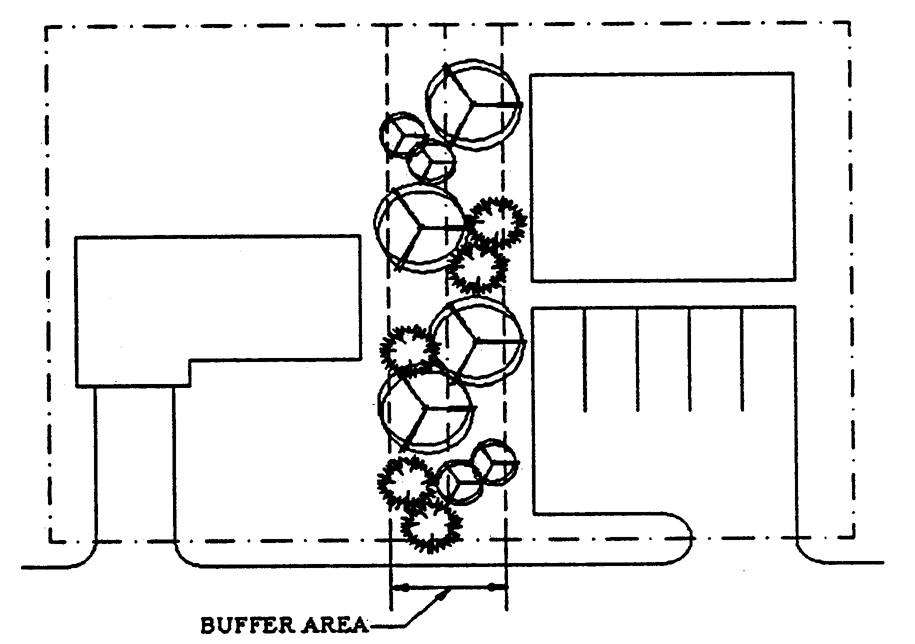
Buffer area
Buildable area: That part of the lot remaining to be built upon after provisions of all required
front, side and rear yard setbacks are considered.
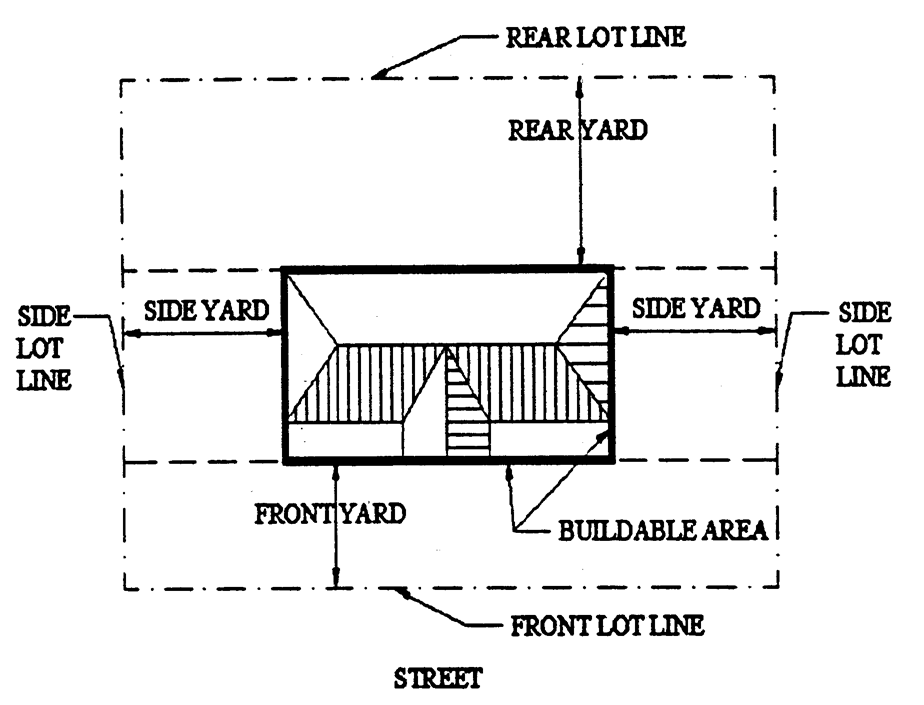
Buildable area
Buildable width: The width of the lot to be built upon after the side yard setbacks are provided.
Building: Any structure, including a roof supported by walls or columns, for the shelter, support or enclosure of persons, animals, chattels or property of any kind. When separated by dividing walls without openings, each portion of such building so separated shall be deemed a separate building.
Building, accessory: A subordinate building or subordinate use customarily incidental to and located on the same lot occupied by the primary building or use, subordinate in area, extent, or purposes to the primary building, limited to and contributing to the comfort, convenience or necessity of the occupants of the primary building (e.g., garages, storage buildings, tool sheds).
Building bulk: The height, depth, width, density and volume of a building.
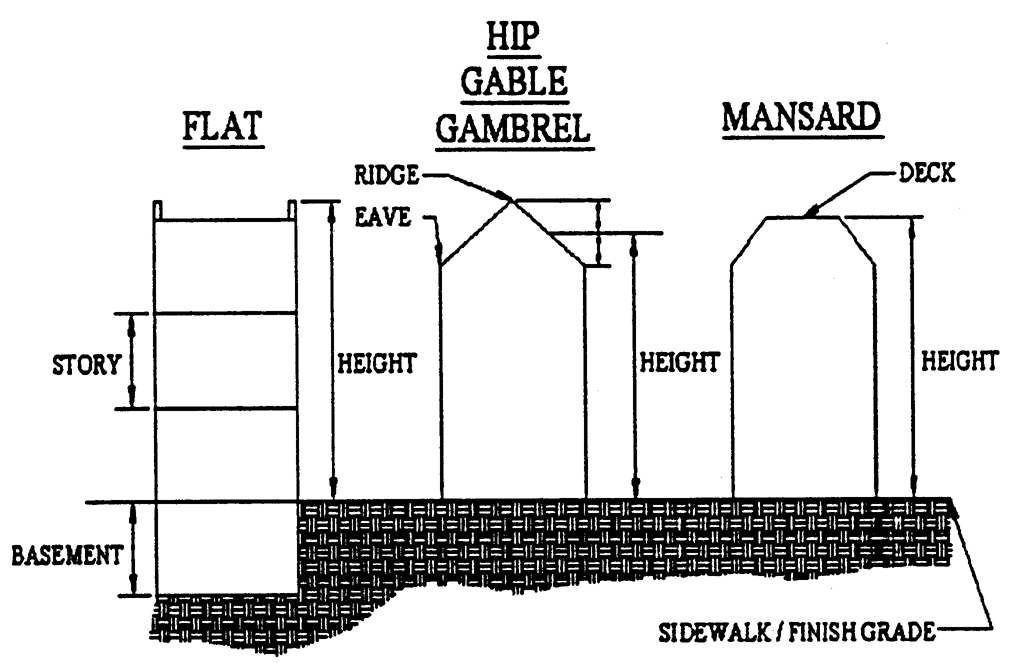
Building, height of
Building, height of: The vertical distance measured from the sidewalk level or its equivalent established grade opposite the middle of the front of the building to the highest point of the roof in the case of a flat roof, to the deck line of a mansard of gambrel roof, provided that where buildings are set back from the street line, the height of the building may be measured from the average elevation of the finished lot's grade at the front of the building.
Building line: That line which represents the closest points that a structure can be erected to the front, side and rear property lines.
Building, primary: Any building not an accessory building or accessory use.
Cabinet: A structure for the protection and security of communications equipment associated with one or more antenna, where direct access to equipment is provided from the exterior and whose exterior horizontal dimensions do not exceed four (4) feet by six (6) feet.
Cafeteria: A restaurant at which patrons serve themselves at a counter, taking the food to tables to eat.
Cellar: That portion of a building which is partly below and partly above grade and having more than one-half of its height below grade.
Certificate of occupancy: The certification issued by the director of public works which permits the use of a building and which certifies compliance with the provisions of this Code for the use and occupancy of the building in its several parts together with any special stipulations or conditions.
Child day care home: A single-family dwelling that receives not more than eight (8) children, under nine (9) years of age, for care during the day. The maximum of eight (8) children includes the family's natural, adopted, or foster children under age eighteen (18) and those children who are in the home for such care. A state license shall be required for a child day care home in which such care is provided to five (5) or more children who are not the natural, adopted, or foster children of the occupant of the single-family dwelling. A home-based business certificate and business license shall be required for any child day care home requiring state licensing.
City: The City of Jennings, Missouri.
City clerk: The City Clerk of the City of Jennings, Missouri.
Clinic: An establishment where patients, who are not lodged overnight are admitted for examination and treatment by a group of physicians, or state licensed medical providers or practitioners.
Club: A building or portion thereof, or premises, owned or operated by a person for a social, educational or recreational purpose, but not primarily for profit nor to primarily render a service which is customarily carried on as a business.
Commission: The planning commission of the City of Jennings, Missouri.
Common land (or common ground): The land set aside for open space including storm water, retention lakes, ponding or recreational use for the owners of residential lots in a subdivision. This land is conveyed by the developer in fee simple absolute title by a warranty deed to the trustees of the subdivision. The trust indenture for common land shall provide that it be used for the sole benefit, use and enjoyment of the residential lot owners present and future and shall be the maintenance responsibility of the trustees of the subdivision. No lot owner shall have the right to convey his interest in common land (or common ground) except as an incident of his ownership of a regularly platted lot.
Conditional use: A use allowed in a zoning district only after a permit is granted according to provisions of Article 25 of this appendix.
Condominiums: All the land, property and space comprising the parcel or parcels, all improvements and structures erected, constructed or contained therein or thereon, including the building and all easements, rights and opportunities belonging thereto, and other fixtures and equipment intended for the mutual use, benefit, or enjoyment of the unit owners, subject to the provisions of Chapter 448 RSMo. and this appendix.
Courtyard: An open space with or without direct street access, around which is arranged a single building or a group of related buildings.
Council: The City Council of the City of Jennings, Missouri.
Day care facility: Any land, building, structure or premises used for educational instruction and/or supplemental parental care for four (4) or more children, either on an hourly or daily basis, with or without compensation.
Designated developer: The person, or their successors and/or assigns, who submits a development plan approved by the council.
Development: Any man-made change to improved or unimproved real estate, including but not limited to buildings or other structures, mining, dredging, filling, grading, paving, excavating or drilling operations.
Development contract: The contract or agreement entered into between the city and a urban redevelopment corporation pursuant to an approved development plan.
Development/redevelopment costs: An amount equal to the actual cost of redevelopment of the redevelopment areas. Such costs shall include, but not be limited to, the reasonable expense of planning, including preliminary studies and surveys; professional services; interest during construction; the actual cost of the acquisition of the real property or any part thereof whether acquired partly or wholly in exchange for cash, securities, or otherwise; the actual cost of environmental remediation, if any; the actual cost of demolition of existing structures, if any; the actual cost of utilities, landscaping, and roadways; the actual cost of construction, equipping, and furnishing of buildings and improvements including professional fees; the actual costs of the reconstruction, remodeling, or initial repair of existing buildings and improvements; reasonable management and operations cost until the redevelopment area is ready for use; and the actual cost of improving those portions of the redevelopment area which are to remain as open spaces or which are to be used as amenities; together with such additions to development costs as shall equal the actual cost of additions to or changes in the redevelopment project in accordance with the original development plan or after approved changes therein or amendments thereto.
Development plan: A plan, together with any amendments thereto, for the development/redevelopment of all or any part of a blighted area, which is approved by the city council, by ordinance.
Development standards: Regulations and standards of this appendix, as defined by the size, bulk or site conditions of buildings or uses located within a designated district.
Director: The director of public works division of housing and economic development, or a designee, of the City of Jennings, Missouri.
Disguised support structure: Any freestanding manmade structure designed solely for the support of communication antennas, the presence of which is camouflaged or concealed as an architectural or natural feature. Such structures may include, but are not limited to, clock towers, campaniles, observation towers, pylon signs, water towers, light standards, flag poles and artificial trees.
Display window: A window of at least eight (8) horizontal feet in length installed in the wall of a first or second floor of a retail establishment fronting a street for the purpose of displaying merchandise or products offered for sale on the premises.
District: A part or parts of the City of Jennings for which this appendix establishes regulations governing the development and use of land therein.
Dormitory: A building or portion thereof which contains living quarters for students, staff or members of an accredited college, university, boarding school, theological school, hospital, religious order or comparable organization; provided that said building is owned and managed by said organization.
Dwelling: Any building, or portion, thereof, which is designed and used exclusively for residential purposes.
Dwelling, attached single-family: One of a series of dwellings designed for single-family or group home occupancy and located on individually subdivided lots of record, or located on land owned in common.
Dwelling, single-family: A building designed and used for occupancy for one (1) family or a group home.
Dwelling, two-family: A building containing two (2) separate dwelling units, each unit designed and used for occupancy by one (1) family.
Dwelling, multiple: A building or portion thereof designed and used for occupancy by three (3) or more families each in a separate dwelling unit.
Dwelling unit: One or more rooms in a dwelling occupied or intended to be occupied as separate living quarters by a single, individual family as defined herein, with facilities which are used or intended to be used for living, sleeping, cooking and eating.
Easement: A grant by a property owner to the public, or a person, for the use of land for a specific purpose.
Encroachment: An extension of a structure or use into the required setback or public right-of-way.
Erect: To build, construct, install, attach, hang, place, inscribe, suspend, affix, paint or repaint.
FAA: The Federal Aviation Administration.
Family:
1.
An individual living as a single non-profit housekeeping unit in a dwelling unit;
2.
Two (2) or more persons related by blood, marriage, adoption or foster care relationship living together as a single non-profit housekeeping unit in a dwelling unit;
3.
A group of not more than three (3) persons who need not be related by blood, marriage, adoption or foster care relationship, living together as a single non-profit houskeeping unit in a dwelling unit; or
4.
Two (2) unrelated individuals having a child or children related by blood, adoption or foster care relationship to both such individuals, plus the biological, adopted or foster children of either such individual, living together as a single non-profit housekeeping unit in a dwelling unit.
5.
Two (2) unrelated individuals plus any other persons related directly to either such individual by blood, marriage, adoption, or foster care relationship, living together as a single non-profit housekeeping unit in a dwelling unit.
FCC: The Federal Communication Commission.
Fence: A constructed barrier between portions of a lot or between two or more lots, or between a lot and any right-of-way.
Flag lot: See Lot, Flag.
Floor area: The gross horizontal area of each floor (including basements, cellars, and penthouses), measured from the exterior faces of a building. Areas within a building used for parking and/or mechanical penthouses, or atriums, or landscaped decorative pedestrian areas, shall be excluded from the measurement of floor area.
Floor area ratio: The total floor area of all structural improvements on a lot, divided by the area of the lot.
Front yard: See Yard, Front.
Frontage: That portion of a lot abutting on a street or right-of-way and ordinarily regarded
as the front of the lot. For the purpose of determining yard requirements on corner
lots, all sides of a lot which abut streets or rights-of-way shall be considered frontage.
(See Lot.)
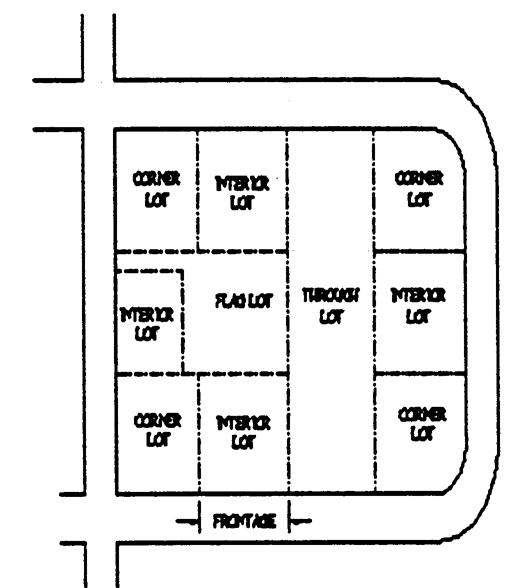
Frontage
Garage, private: An accessory building or portion of the primary building designed and used for the storage of four (4) or fewer motor-driven vehicles owned by the occupants of the property on which it is accessory.
Garage, public: A building or portion thereof, other than a private garage, designed or used for the short or long term parking of more than four (4) motor-driven vehicles.
Gasoline station: Any premises where gasoline and other petroleum products are sold and/or maintenance activities such as engine tune-ups, lubrication, minor repairs, and carburetor cleaning are conducted. Gasoline stations shall not include premises where heavy automobile maintenance activities such as engine overhauls, automobile painting, and body work are conducted. May also include convenience stores in conjunction with the gasoline station.
GFA: Gross floor area.
Grade: A reference plane representing the average of finished ground level adjoining the building at all exterior walls. When the finished ground level slopes away from the exterior walls, the reference plane shall be established as the lowest point within the area between the building and the lot line or, when the lot line is more than six (6) feet from the building, between the building and a point six (6) feet from the building.
Group homes: The classification single family dwelling or single family residence shall include any home in which eight (8) or fewer unrelated mentally or physically handicapped reside, and may include two (2) additional persons acting as houseparents or guardians who need not be related to each other or to any of the mentally or physically handicapped persons residing in the home.
Guest: A person who occupies or has the right to occupy a dwelling as a visitor for a period of twenty (20) days or less, annually.
Height (tower): The vertical distance measured from the average grade to the highest point of a telecommunications tower, and including the main structure and all attachments thereto.
Home-based business: Any commercial activity conducted in a residential dwelling. The regulations governing home based businesses are as follows:
a.
The home-based business shall not employ on the premises persons not residing in the home as shown on the certificate of occupancy.
b.
Signage shall consist of only one non-illuminated nameplate attached to the building. Such sign shall be no more than one (1) square foot in area.
c.
No mechanical equipment shall be installed except that which has a normal domestic function.
d.
No commodity shall be sold from the premises.
e.
No more than twenty-five (25) percent of the floor area of any story shall be used for the home-based business.
f.
No use requiring a conditional use permit, or other special permit, in any district shall be utilized as a home-based business.
g.
Only one (1) home-based business shall be permitted per dwelling.
h.
Permission granted by this definition shall not be construed as an exemption from any local, state, federal regulation or licensing requirements pertinent to the activity pursued.
Hospital: An establishment, including sanitariums, providing physical or mental health services, inpatient or overnight accommodations, with accompanying training and research facilities; such establishments may include medical or surgical care of the sick or injured.
Hotel: A building in which lodging is provided and offered to transient guests for compensation. Primary ingress and egress to and from rooms is made through an inside lobby, and an office for the hotel is on the lot.
Institution: An organization, establishment, foundation, society, or the like, devoted to the promotion of a particular cause or program, especially one of a public, educational or charitable character.
Impervious material: A surface that has been compacted or covered with a layer of material so that it is highly resistant to infiltration by water. Impervious material includes, but is not limited to, surfaces such as compacted sand, lime, rock or clay, asphalt or concrete driveways, as well as retaining walls, stairwells, stairways, walkways, pools, decks and patios at grade level, and other similar structures.
Impervious surface: That portion of a lot that is covered by impervious materials.
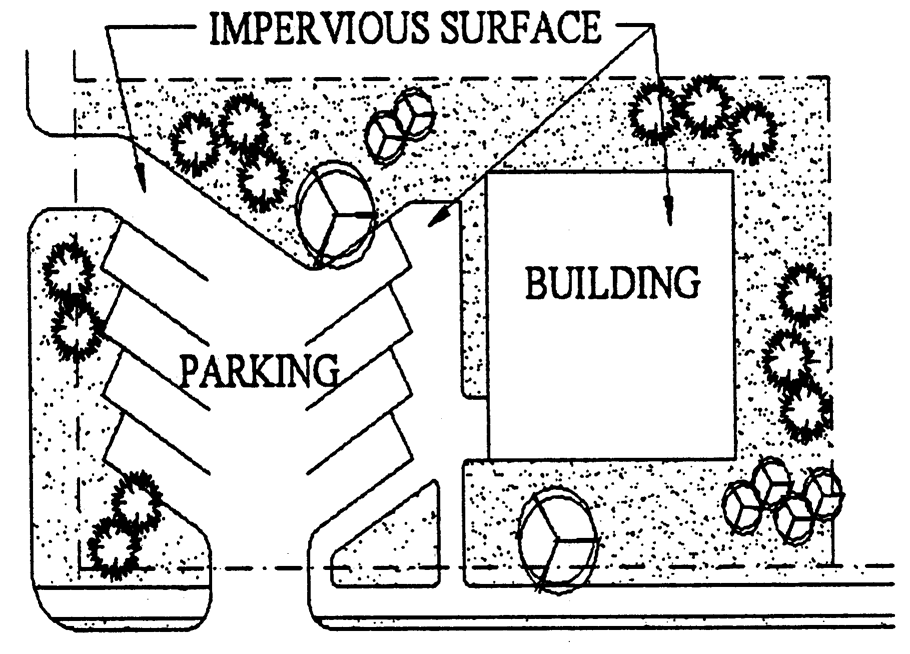
Impervious surface
Kiosk: A structure used and erected by the city, for providing and disseminating public information.
Landscaped space: Open space on a lot devoted to plants rooted directly in the ground or plants in permanent planters.
Laundry shop: A building or portion thereof equipped with no more than thirty (30) automatic type laundry and drying machines in total.
Loading space: A space within the primary building or on the same lot therewith, providing for the standing, loading or unloading of trucks, and having a minimum dimension of twelve (12) feet by thirty-five (35) feet and vertical clearance of at least fourteen (14) feet.
Lodge hall: A building or portion thereof, or premises serving as a meeting place of a branch of certain fraternal organizations.
Lot: A plot or parcel of land occupied or intended for occupancy by one (1) primary building
together with its accessory buildings, including the open spaces and parking spaces
required by this appendix and having its primary frontage upon a street or upon an
officially approvedplace. Lots created in conjunction with conditional use as provided
for in Article 25 need not conform to these provisions when the resubdivision is approved as a part
of the planned unit development.
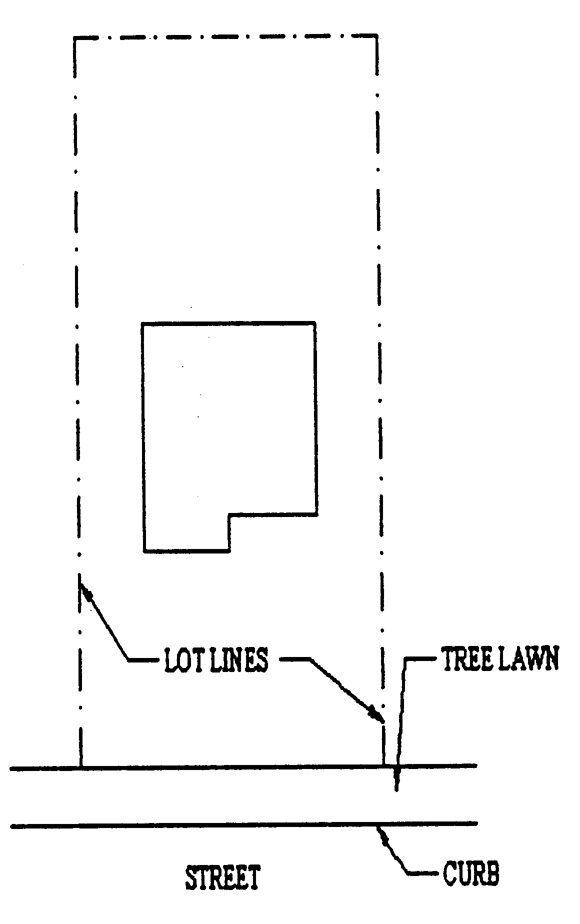
Lot
Lot, corner: A lot abutting upon two (2) or more streets at their intersection.
Lot coverage: The area of a site covered by building or roofed areas, excluding allowed projecting eaves, balconies, and similar features.
Lot, depth of: The distance between the front lot line and the rear lot line. In the case of an irregular shaped lot, the depth of the lot shall be the mean horizontal distance between the front and rear lot lines.
Lot, double frontage: See Lot, Through.
Lot, flag: A lot located behind another lot, with no direct access to the street other than a driveway or other narrow corridor.
Lot, interior: A lot other than a corner lot.
Lot lines: The lines bounding a lot as defined herein.
Lot of record: A lot which is a part of a subdivision, the map of which has been recorded at the Office of the St. Louis County Recorder of Deeds, or a lot described by metes and bounds, the description of which has been recorded at the Office of the St. Louis County of Recorder of Deeds.
Lot, through: A lot having a frontage on two (2) nonintersecting streets, as distinguished from a corner lot. Such through lot is also referred to as a double frontage lot.
Lot, width: The average horizontal distance between the side lot lines.
Massage parlor: See Adult Uses.
Mayor: The Mayor of the City of Jennings, Missouri.
Medical marijuana dispensary: A facility licensed by the State of Missouri to acquire, store, sell, transport and deliver marijuana, marijuana-infused products, and drug paraphernalia used to administer marijuana for medical purposes to a qualified patient, a primary caregiver, another medical marijuana dispensary facility, a medical marijuana testing facility, or a medical marijuana-infused products manufacturing facility.
Metes and bounds: A system of describing and identifying land by measure (meters) and directions (bounds) from an identifiable point of reference such as a survey monument, the corner of intersecting streets or other permanent feature.
Micro brewery: A business whose sole activity is the brewing and selling of packaged beer and related non-alcoholic novelty beverages, for consumption only off the premises. A micro brewery shall have an annual production of five thousand (5,000) barrels or less. The production must meet all federal, state and local laws, ordinances, regulations and guidelines and those of the Metropolitan St. Louis Sewer District. Beer brewed on the premises shall be the only alcoholic beverage sold. Persons under the age of twenty-one (21) shall not be permitted on the premises unless accompanied by a person twenty-one (21) years of age or older. Only retail sales shall be permitted and there shall be no consumption of alcoholic beverages on-site, including buildings, parking lots, yards, and adjacent public property, other than "tasting" inside the building. A micro brewery shall not emit any odors of any type whatsoever, either resulting from the brewing of beer or non-alcoholic novelty items or resulting from the discharge or disposal of waste or by-products from brewing activities.
Mixed use building: A building which includes at least two of the following activities or uses; residential, retail, wholesale, service, industrial, office (where such office is a separate activity, and its utilization neither supports nor relates to another activity or use listed in this definition).
Motel: A building or group of buildings containing individual sleeping or living units for the temporary residence of transient motorists or travelers, and with parking facilities conveniently located to each such unit.
Motor vehicle: A vehicle which is propelled by a motor and which is used for the purpose of carrying persons or commodities.
Motor vehicle oriented business: Motor Vehicle Oriented Business ("MVOB") means any commercial activity which, by design, type of operation, or nature of business, has as one of its functions, the provision of goods, merchandise or services to motorists or occupants of motor vehicles in a short time span, or the provisions of goods, merchandise or services while patrons remain in their motor vehicle. The list of businesses which constitute motor vehicle oriented businesses includes service stations, drive-in banks, drive-in or drive-through restaurants, drive-in beverage sales, and car wash operations which are not accessory to a permitted use. This enumeration does not serve as an inclusive list of such MVOB businesses.
Multiple level parking facility: Public or private garage as defined herein, with multiple levels accessed by a vehicular circulation system.
NAICS: North American Industry Classification System is an industry classification system that groups establishments into industries based upon the activities in which they are primarily engaged.
Nonconforming lot of record: A lot lawfully created prior to the adoption, revision or amendment of this appendix whose area, dimensions or location would be prohibited or further restricted under the terms of this appendix.
Nonconforming use: Any building, structure, use or property which when erected or established was not in conformance to the provisions of the City of Jennings' Zoning Ordinance.
Nonconforming use, legal: Any building, structure, use or property that when erected or established conformed to the provisions of the City of Jennings Zoning Ordinance, but due to zoning revisions and amendments effecting the subject zoning district no longer complies with the permitted use and/or some other provision(s) of this appendix.
Nonconformity, site related: A characteristic of the site, such as off-street parking or loading, landscaping, storm water and erosion control or similar matters which are incidental to the principal use of the property but which do not satisfy current city standards, as established by this appendix.
Notice (public notice): A statement, posted at city hall, concerning a pending matter before an official body of the City of Jennings and, where applicable, proposed action(s) to be taken in regard to the matter. The terms "notice" and public notice" are used interchangeably.
Nursing or convalescent home: A home for the aged, chronically or terminally ill in which three (3) or more persons are provided with food, shelter and medical care, for compensation; but does not include hospitals, clinics or similar institutions devoted primarily to the diagnosis, treatment or care of the sick or injured.
Open space: That portion of a lot or property which is primarily vacant, or is improved with grass, plantings, parking, or patios.
Package liquor store: A place of business primarily or exclusively for the retail sale of alcoholic beverages in their original package for consumption off the premises.
Park: An open area available to the general public for recreational, educational, educational or scenic purposes.
Parking lot: Any place, lot, parcel or other street level property used in whole or in part for parking of four (4) or more vehicles.
Parking spaces: An impervious surface either adjacent to the street or enclosed within a building, which provides vehicle parking.
Party wall: A common wall separating dwelling units.
Permitted use: A use allowed by the regulations of this appendix for the district in which the use is located.
Person: Any individual, firm, partnership, joint venture, association, company, organization or corporation, whether organized for profit or not (except an urban redevelopment corporation organized pursuant to the provisions of the urban redevelopment corporations law), estate, trust, business trust, receiver or trustee appointed by any state or federal court, syndicate, or any other group or combination acting as a unit, and shall include the male as well as a female gender and the plural as well as the singular number.
Place of worship: An institution that people regularly attend to participate in or hold religious services, religious meetings or other religious activities. The term place of worship shall not carry a secular connotation and shall include buildings in which the religious services of any denomination are held.
Planned unit development: A planned unit development is defined as (i) two (2) of the following three (3) categories of land uses in a single development where no single use exceeds eighty (80) percent of the total floor area: (1) office use; (2) retail use; or (3) residential use; and/or (ii) any development for which planned unit development review and approval is required pursuant to Chapter 38, Article 10, Section 10.9.
Plat: A map, plan or layout, to scale, or a tract of land to be subdivided showing such information as required in applicable articles found elsewhere in this appendix.
Porte-cochere: A large porch outside the entrance of the building under which vehicles may be driven.
Premises: A lot inclusive of all buildings and structures thereon.
Private road: A portion of private property configured, used and permanently reserved as the primary means of access to abutting property.
Private school: An institution offering general education similar to that provided in public elementary and high schools. This does not include day care facilities, secretarial schools or other limited purpose institutions.
Property owner: The owner of record of a building or lot.
Real property: Land, buildings, improvements, land under water, waterfront property, and any and all easements, franchises and hereditaments, corporeal or incorporeal, and every estate, interest, privilege, easement, franchise and right therein, or appurtenant thereto, legal or equitable, including restrictions of record, created by plat, covenant or otherwise, rights-of-way and terms for years, and all that is erected or growing upon or affixed to the land.
Redevelopment area: An area designated by the city, in respect to which the city has made a finding that there exists conditions which cause the area to be classified as a blighted area, a conservation area, an economic development area, an enterprise zone (pursuant to Sections 135.200 to 135.250 RSMo.,) or a combination thereof, which area includes only those parcels of real property directly and substantially benefited by the proposed redevelopment project.
Redevelopment project: A specific work or improvement to effectuate all or any part of a development plan.
Repair shop, auto: Any premises where heavy automobile maintenance activities such as engine overhauls, automobile painting, and body fender work are conducted.
Residential group living facility: A residential group living facility operated by a not-for-profit corporation which is supervised twenty-four (24) hours per day by a qualified person. A "qualified person" is a person qualified by education, training, experience or any combination, for the position which they hold in the residential group home. Excluded from this definition of a residential group living facility are homes established for or occupied by residents who are permitted to live in "halfway houses" including residences in which the residents are criminal offenders in work-release sentence or on parole or probation, or persons who use or are addicted to a controlled substance. A residential group living facility is a conditional use and if approved is to be operated in conformance with conditions and standards specified by the planning commission and all other applicable governmental regulations and requirements.
Restaurant: Any place where food is intended for individual service and consumption is routinely provided completely prepared. The term includes any place, regardless of whether consumption is on or off the premises and regardless of whether there is a charge for the food. The term includes restaurants, coffee shops, cafeterias, short order cafes, luncheonettes, taverns, sandwich stands, soda fountains, food vending carts and all other eating or drinking establishments, as well as kitchens, commissaries or other places in which food or drink is prepared for individual sale elsewhere. The term does not include a private home where food is prepared for non-commercial home use. It does not include the location of food vending machines.
Retail establishment: A retail establishment shall include barber shops, beauty shops and nail salons (barber shops, beauty salons and nail salons requires a Conditional Use permit regardless of zoning district), copying and duplicating services; dressmaking or tailor shops; suntan parlors; travel agencies; typing and stenography services; antique shops; art and school supplies; bicycle shops; bookstores; camera and film developing; candy stores; card and stationer shop; florist shops; gift shops; hobby shops; jewelry shops; newspaper and magazine stores; music shops; tobacco and pipe shops; clothing and apparel stores; department stores; sporting goods shops; audio/video equipment stores; dry goods stores; toy stores; retail repair shops and other similar merchandise.
Right-of-way: A strip of land reserved or acquired by dedication, prescription, condemnation, gift, purchase, eminent domain or any other legal means, occupied or intended to be occupied as a street, sidewalk, railroad, utility, sewer or other similar use.
Satellite dish: A concave dish-shaped reflector serving to focus electromagnetic energy a part of a transmitter or receiver of radio, television, or microwave signals.
Screen: Any individual or groups of shrubbery, hedges, tree(s) or other plant growth substantial enough in height, width and dimension to provide sight or noise barriers from the street or adjacent properties. Additionally, any wall, fence or other solid material that surrounds mechanical equipment, trash containers, wood compost piles or other similar uses in yards, on roof-tops, where such screening provides a barrier to the negative impacts associated with sight, smell or noise.
Setback: The distance from the adjacent street line in which no building or use shall be erected or maintained.
Shelter: A building for the protection and security of communications equipment associated with one or more antennas and where access to equipment is gained from the interior of the building. Human occupancy for office or other uses is prohibited. The storage of other materials and equipment not in direct support of the antennae is prohibited.
Sign: Any identification, description, illustration or device (either illuminated or non-illuminated) which is visible from any public place or is located on private property and exposed to the public and which directs attention to a product, service, place, activity, person, institution, business or solicitation, including any emblem, painting, placard designed to advertise, identify or convey information, with the exception of window displays, any national flags, state flags, county flags or other governmental flags. The term includes pennants, streamers, moving mechanisms and lights. For the purpose of removal, signs shall also include all sign structures.
Sign, attached: Any sign supported by structures or supports, that are attached or otherwise made part of a primary building, or appurtenant structure, wherein a legal use or activity is conducted.
Sign, banner: Any sign of lightweight fabric or other nonrigid material that is mounted to a pole or a building by a frame at one or more edges. National flags, state flags, county flags or other government flags shall not be considered banners.
Sign, business: Any sign which gives only basic information concerning the existence of a commercial enterprise, service or other activity conducted, sold or offered on the premises upon which the sign is erected.
Sign, canopy: Any sign that is a part of or attached to an awning, canopy, or other fabric, plastic, or structural protective cover over a door, entrance, window or outdoor service area.
Sign, directional: Any sign which identifies entrances, exits, aisles, ramps and similar traffic-related information.
Sign, doubled-faced: Any ground, wall, pole or freestanding sign having two independent surfaces, displaying a street graphic, supported by the same pole or structure.
Sign, face: Any surface displaying or illustrating a street graphic sign.
Sign, freestanding: Any sign supported by structures or supports that are placed on, or anchored in, the ground and that are independent from any building or other structure.
Sign, ground: Any street graphic sign supported by one or more uprights, posts or bases permanently affixed to the ground and not attached to any part of a building.
Sign, illuminated: Any street graphic sign which has characters, letters, figures, designs or outline illuminated by electric lights or luminous tubes.
Sign, informational: Any sign which identifies a residence, a non-commercial activity or conveys cautionary and similar information. An historic marker is an information sign.
Sign, marquee: Any street graphic sign affixed to a permanent canopy over the entrance to a building.
Sign, pole: Any street graphic sign supported by one or more poles permanently placed in the ground, not attached to any part of a building and exceeds the maximum height for a ground sign.
Sign, portable: Any sign that is not permanently affixed to a building, or other unmovable structure, or the ground.
Sign, projecting: Any street graphic sign attached to and projecting from a building and not in the same plane as the wall.
Sign, reader board: Any street graphic sign that has changeable or removable lettering which is permanently mounted as a wall, pole or ground sign.
Sign, roof: Any street graphic painted, erected, constructed or maintained upon the roof of a building.
Sign, street graphic: Any character, letter, figure, symbol, design work, model or device, on attendant background field, used to attract attention and/or convey a message and which is visible outside of a building.
Sign, temporary: Any sign attached to the interior of, or displayed in a window or door for a limited period.
Sign, wall: Any street graphic sign painted on, or attached to a wall or a building and in the same plane as such wall.
Sign, window: Any street graphic sign applied, painted or affixed to or in the window of a building.
Site development plan: A detailed drawing of the activities proposed on a parcel, or parcels of property, as outlined in Article 22 of this appendix.
Storage: The act of storing any stock, vehicle, equipment or material enclosed or unenclosed for a period of more than forty-eight (48) hours.
Story: That portion of a building, other than a cellar, between the surface of any floor and the surface of the floor next above it, or if there are no floor(s) above it, then the space between the floor and the ceiling next above it.
Story, half: A story under a gable, hip or gambrel roof, the wall plates of which on at least two (2) opposite exterior walls are not more than three (3) feet above the top floor level of such story.
Street: A paved public or private right-of-way, which provides access to abutting properties from the front. The term includes all facilities, which normally occur within the right-of-way, including such other designations as highway, esplanade, thoroughfare, parkway, expressway, road, pike, avenue, boulevard, land, place, court, but shall not include an alley or pedestrian way, or any part or side or part of the side, or any of the same.
Structural alterations: Any change in the supporting members of a building, such as bearing walls, columns, beams or girders, or any substantial change in the roof or the exterior walls, not including, however, changes in doors or windows or alterations which affect primarily the appearance and not the life of the structure.
Structure: A combination of materials constructed, or erected at a fixed location, including, but not limited to, a retaining wall, dwelling unit, shed or other such uses, which require positioning on the ground or attachment to something affixed to the ground.
Subdivision: The division of any land, vacant or improved, into two (2) or more lots, parcels, sites, units, plots or interests for the purpose of offer, sale, transfer of ownership, lease or development or redevelopment, either on the installment plan or upon any and all other plans, terms and conditions, including re-subdivision. Subdivision includes the division, development or redevelopment of residential and non-residential zoned land, whether by deed, metes and bounds description, devise, intestacy, lease, map, plat or other recorded instrument. Subdivision further includes the dedication or establishment of a public or private street through a tract of land.
Substantial damage: Damage of any origin sustained by a structure whereby the cost of restoring the structure to its pre-damaged condition would equal or exceed sixty (60) percent of the market value of the structure before the damage occurred.
Telecommunications facility: Any cables, wires, lines, wave guides, antennas, and any other equipment or facilities that transmit and/or receive electromagnetic signals for voice, data or video communications purposes including, but not limited to, televisions, am/fm radio, microwave, cellular telephone, and similar forms of telecommunications. The term shall exclude amateur radio and amateur television antennas and towers for private use, and satellite dishes and satellite earth stations used for private transmitting or receiving of television, radio, or microwave signals.
Tower: A structure designed for the support of one (1) or more antennas and including guyed towers, self-supporting (lattice)t or monopoles but not disguised support structures or buildings. The term shall not include any structure under twelve (12) feet in height owned and operated by an amateur radio or amateur television operators licensed by the FCC.
Townhouse/villa: An attached single-family dwelling erected in a row and being separated from an adjoining
townhouse(s)/villa(s) dwelling or dwellings by masonry wall or other approved fire-rated
wall without openings extending from the basement floor to the roof, except that basement
areas used as a common garage area for such townhouse(s)/villa(s) need not have such
separation.
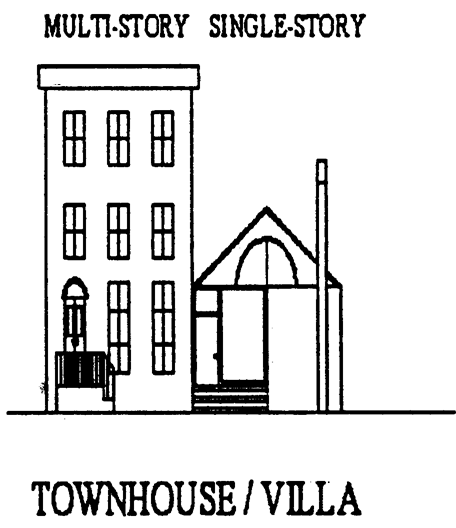
Townhouse/villa
Trust indenture: A deed involving two (2) or more principals which stipulates that each has certain rights, responsibilities and obligations to the other.
Urban redevelopment corporation: A corporation organized pursuant to RSMo, Chapter 353, except that any life insurance company organized pursuant to the laws of, or admitted to do business in the State of Missouri may from time to time within five years after April 23, 1946, undertake, alone or in conjunction with, or as a lessee of any such life insurance company or urban redevelopment corporation, a redevelopment project pursuant to RSMo, Chapter 353, and shall, in its operations with any such redevelopment project, but not otherwise, be deemed to be an urban redevelopment corporation for the purposes of the City of Jennings Zoning Ordinance and RSMo, Chapter 353, Sections 353.010, 353.040, 353.060 and 353.110 to 353.160.
Use: The purpose(s) or activity(ies) for which land or a building is designed, arranged, and used, and shall include any performances of such activity(ies) in compliance with the requirements of this appendix.
Use limitations: Regulations intended to limit or emphasize the nature and quality of uses permitted within a zoning district.
Use regulations: Regulations which relate to a specific quantifiable condition such as density or intensity, or relate to building's size, bulk, or sitting conditions occurring anywhere and for any type of building located within a given zoning district.
Variance: A grant or relief from the requirements of this appendix which permits construction or use in a manner otherwise prohibited by this appendix where specific enforcement would result in an extreme hardship or severe practical difficulty to the applicant for such variances.
Wholesale sale: The sale of goods, merchandise and commodities for resale.
Yard: An open space, other than a courtyard, on the same lot with a building, unoccupied and unobstructed by any structure, or portion thereof, from the ground upward, except as otherwise provided herein. In measuring a yard for the purpose of determining its width, the average depth between the building and lot line shall be used.
Yard, front: A yard extending across the front of a lot between the side lot lines and being the minimum horizontal distance between the front lot line and the primary building or any projections, other than steps, uncovered balconies, uncovered porches or terraces.
Yard, rear: A yard extending across the rear of a lot measured between the side lot lines and being the minimum horizontal distance between the rear lot line and the primary building or any projections other than steps, uncovered balconies, uncovered porches or terraces. The rear yard shall, in all cases, be at the opposite end of the lot from the front yard.
Yard, side: A yard between the building and the side lot line extending between the front and
rear yards, being the minimum horizontal distance between the side lot line and the
primary building or any projections other than steps, uncovered balconies, uncovered
porches or terraces.
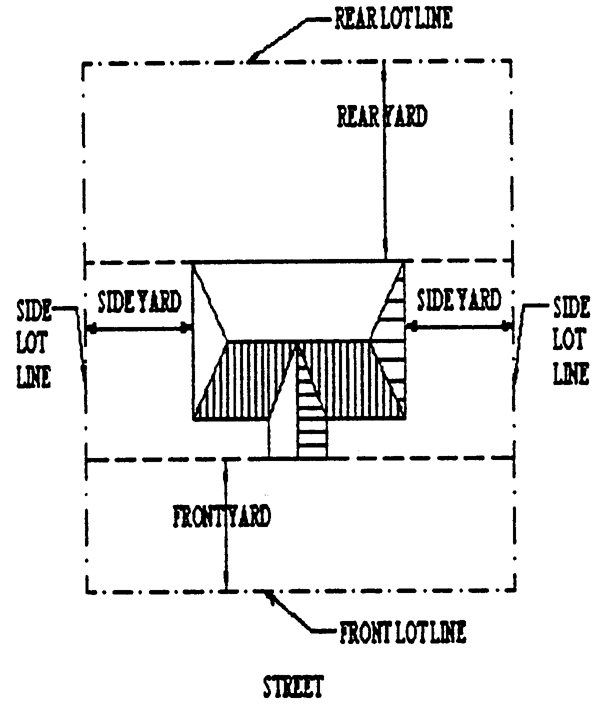
Yard
Zoning district: Any portion of the city in which the use of all the land therein is governed by the same article (Articles 4 through 11) within this appendix, and may be governed by other articles of this appendix.
Zoning map: A map incorporated into this appendix illustrating the locations and boundaries of the zoning districts established in the City of Jennings, Missouri.
Zoning text amendment: A change, supplement, repeal or amendment of any article, or part thereof, of this appendix, approved by the city council.
(Ord. No. 2024, § 1, 10-25-04; Ord. No. 2102, § 2, 5-21-07; Ord. No. 2308, §§ 1(A)(1), 1(B), 1-27-14)

