
Kern County Unincorporated
City Zoning Code
City Zoning Code
CHAPTER 19
08 - INTERPRETATION AND GENERAL STANDARDS
19.08.010 - Purpose.
The purpose of this chapter is to establish guidelines for the interpretation of this title and to enumerate miscellaneous requirements applicable generally to the matters included in this title.
(Prior code § 7282.01)
19.08.015 - Special treatment areas within Kern County—Indian Wells Valley Land Use Management Plan.
The Indian Wells Valley Land Use Management Plan area is defined as:
Sections 1—36 of Township 25 South, Ranges 38 and 39 East;
Sections 2—11, 14—23, and 26—35 of Township 25 South, Range 40 East;
Sections 1—36 of Township 26 South, Ranges 38 and 39 East;
Sections 3—10, 13—24, and 26—35 of Township 26 South, Range 40 East;
Sections 1—36 of Township 27 South, Ranges 38 and 39 East;
Sections 2—11, 14—23, and 26—35 of Township 27 South, Range 40 East;
Sections -1-36 of Township 28 South, Ranges 38 and 39 East;
Sections 2—11, 14—23, and 26—35 of Township 27 South, Range 40 East.
The Indian Wells Valley Land Use Management Plan area is subject to specific additional provisions, as noted in Section 19.08.015 (Interpretations and General Standards), Section 19.80.015 (Special Development Standards), and Chapter 19.86 (Landscaping).
(Ord. No. G-8558, § 2, 5-19-15)
19.08.020 - Zoning district boundaries.
Where uncertainty exists as to the boundaries of any zoning district shown on the official zoning maps, the following rules shall apply:
A.
Where district boundaries are indicated as approximately following street, highway, railroad and alley lines or lot lines, such lines shall be construed as extending to the centerline of such street, highway, railroad or alley.
B.
In unsubdivided property or where a zoning district boundary divides a lot, the location of district boundary, unless specified by dimensions, shall be determined by use of the scale appearing on the map.
C.
In case any uncertainty exists, the planning director shall determine the location of district boundaries.
D.
Where any public street or alley is officially vacated or abandoned, the regulations applicable to abutting property shall apply to the vacated or abandoned street or alley.
E.
Where any private right-of-way or easement of any railroad, railway, canal, transportation or public utility company is vacated or abandoned, the regulations applicable to abutting property shall apply to the centerline of such vacated or abandoned property, unless said right-of-way or easement has been previously zoned.
(Ord. G-6077 § 12, 1994; prior code § 7282.02)
19.08.030 - Determination of similar use—Generally.
When a property owner, applicant or potential applicant proposes or contemplates a use of property not expressly authorized as a permitted use or as a conditional use in any district by the regulations of the applicable zoning district or districts, he/she may apply for a determination of similar use in accordance with the procedures set out in Sections 19.08.040 through 19.08.080 of this chapter. A determination of similar use may also be initiated by the planning director.
(Ord. G-6077 § 14, 1994: Ord. G-5803 § 5, 1992: Ord. G-5684 § 13, 1991: prior code § 7282.03 (part))
19.08.040 - Determination of similar use—Application—Contents.
An application for similar use shall be in writing on forms provided by the director of the planning department and shall include the following:
A.
Name of the applicant;
B.
Description of the proposed or contemplated use;
C.
Identification of the zoning district or districts in which the use is proposed or contemplated;
D.
Identification of the use or uses listed as permitted uses or conditional uses that most nearly resemble the proposed or contemplated use;
E.
Explanation of why the property owner, applicant or potential applicant feels the proposed or contemplated use meets the criteria in Section 19.08.080 of this chapter for determination of similar use.
(Ord. G-6077 § 15, 1994: prior code § 7282.03(A))
19.08.050 - Determination of similar use—Application—Time.
An application for similar use may be submitted in conjunction with an application for a ministerial or discretionary permit described in this chapter or at any other time as may be convenient to the applicant.
(Prior code § 7282.03(B))
19.08.055 - Cannabis-related facilities, cultivation, and activities.
A.
Purpose and Application. The purpose of this section is to ban commercial medicinal and recreational cannabis businesses and activities of all kinds that are, the subject of the Medicinal and Adult-Use Cannabis Regulation and Safety Act (formerly known as the Medical Marijuana Regulation and Safety Act and the Adult Use of Marijuana Act) in order to promote the health, safety, and general welfare of the citizens of the county. It is also the purpose of the chapter to affirm that personal cannabis use in the county of Kern must comply with state law requirements.
B.
Commercial Recreational Cannabis Businesses Prohibited. Businesses conducting commercial recreational cannabis activity licensed under the Medicinal and Adult-Use Cannabis Regulation and Safety Act are prohibited in all zone districts. No local authorization for any of the activities covered by the license classifications identified in Business and Professions Code 26050 shall be granted for any zone district in the unincorporated area of the county of Kern.
C.
Commercial Medicinal Cannabis Businesses Prohibited. Businesses conducting commercial medicinal cannabis activity licensed under the Medicinal and Adult-Use Cannabis Regulation and Safety Act are prohibited in all zone districts. No local authorization for any of the activities covered by the license classifications identified in Business and Professions Code 26050 shall be granted for any zone district in the unincorporated area of the county of Kern.
D.
Public Nuisance. Any use, structure, or property that is altered, enlarged, erected, established, maintained, moved, or operated contrary to the provisions of this section, is hereby declared to be unlawful and a public nuisance and is subject to the enforcement provisions of subsection (J) of this section, in addition to any other enforcement remedy available to the county under any applicable state or federal statute, the Kern County Ordinance Code, or any other lawful power the county may possess.
E.
Applicability.
1.
All provisions of this section shall apply outdoors and indoors.
2.
All provisions of this section shall apply to public and private property within the county's jurisdiction.
3.
All provisions of this section shall apply to any persons, including primary caregivers and qualified patients.
4.
Nothing in this section is intended, nor shall be construed or inferred to burden any defense to criminal prosecution under the Compassionate Use Act of 1996, the Adult Use of Marijuana Act of 2016 or the Medicinal and Adult-Use Cannabis Regulation and Safety Act.
F.
Definitions. For purposes of this chapter, these words and phrases shall be defined as follows:
1.
"Cannabis" shall have the same definition as in California Business and Professions Code 26001(f) and Health and Safety Code Section 11018 as they now read or as amended.
2.
"Cannabis products" has the same meaning as in Section 11018.1 of the Health and Safety Code as it now reads or as amended.
3.
"Commercial medicinal cannabis activity" includes cultivation, possession, manufacture, distribution, processing, storing, laboratory testing, labeling, transportation, delivery or sale of cannabis and cannabis products for non-personal medicinal purposes as provided in the Medicinal and Adult-Use Cannabis Regulation and Safety Act.
4.
"Commercial recreational cannabis activity" includes cultivation, possession, manufacture, distribution, processing, storing, laboratory testing, labeling, transportation, delivery or sale of cannabis and cannabis products for non-personal non-medicinal purposes as provided in the Medicinal and Adult-Use Cannabis Regulation and Safety Act.
5.
"Commercial cannabis activity" includes cultivation, possession, manufacture, distribution, processing, storing, laboratory testing, labeling, transportation, delivery or sale of cannabis and cannabis products as provided in the Medicinal and Adult-Use Cannabis Regulation and Safety Act.
6.
"County" means the county of Kern or the unincorporated area of the county of Kern as required by the context.
7.
"Cultivate" or "cultivation" is the planting, growing, harvesting, drying, curing, grading, trimming processing, or storage of marijuana in any location.
8.
"Marijuana" shall have the same definition as cannabis.
9.
"Medicinal cannabis" or "medicinal cannabis product" means cannabis or cannabis product used for medicinal purposes in accordance with the Compassionate Use Act of 1996, found at section 11362.5 of the Health and Safety Code, by a medicinal cannabis patient in California who possesses a physician's recommendation as required by the Medicinal and Adult-Use Cannabis Regulation and Safety Act.
10.
"Medicinal cannabis dispensary" or "dispensaries" means any operation, including a store-front facility or structure, mobile facility, or delivery service, wherein medical cannabis is made available, sold, offered for sale, given, distributed, traded, or otherwise provided to primary caregivers or qualified patients, as defined by this chapter.
"Medicinal cannabis dispensary" or "dispensaries" shall not include the following uses, as long as the location of such uses are otherwise regulated by code or applicable law: (i) a clinic licensed pursuant to Chapter 1 of Division 2 of the California Health and Safety Code; (ii) a health care facility licensed pursuant to Chapter 2 of Division 2 of the California Health and Safety Code; (iii) a residential care facility for persons with chronic life-threatening illness licensed pursuant to Chapter 3.01 of Division 2 of the California Health and Safety Code; (iv) a residential care facility for the elderly licensed pursuant to Chapter 3.2 of Division 2 of the California Health and Safety Code; and (v) a residential hospice or a home health agency licensed pursuant to Chapter 8 of Division 2 of the California Health and Safety Code, as long as any such use complies strictly with applicable law including, but not limited to, California Health and Safety Code Section 11362.7 et seq.
11.
"Primary caregiver" shall have the same definition as in California Health and Safety Code Section 11362.7 et seq., as it now reads or as amended.
12.
"Planning director" shall refer to the director of the planning and natural resources department of the county of Kern.
13.
"Private residence" means a house, an apartment unit, a mobile home, or other similar dwelling.
14.
"Recreational cannabis" means cannabis used for non-medicinal purposes in accordance with the Medicinal and Adult-Use Cannabis Regulation and Safety Act.
15.
"Qualified patient" shall have the same definition as California Health and Safety Code Section 11362.7 et seq., as it now reads or as amended.
G.
Personal Recreational Cannabis Use. Except as provided below, personal recreational cannabis use shall comply with the Medicinal and Adult-Use Cannabis Regulation and Safety Act, including, but not limited to, California Health and Safety Code Sections 11362.1 through 11362.45 as currently stated or as otherwise amended. Outdoor planting and cultivation of cannabis is prohibited.
H.
Personal Medicinal Cannabis Use. Except as provided below, personal medicinal cannabis use shall comply with the Medicinal and Adult-Use Cannabis Regulation and Safety Act, including, but not limited to, California Health and Safety Code Sections 11362.1 through 11362.79 as currently stated or as otherwise amended. Outdoor planting and cultivation of marijuana is prohibited.
I.
Amortization of Existing Medicinal Cannabis Dispensaries. Any medicinal cannabis dispensary which was in operation on or before May 10, 2016, when the moratorium set forth in former Chapter 5.86 on the establishment of new medicinal marijuana dispensaries went into effect, and is also currently in compliance with former Kern County Ordinance Code Section 5.84.010, for zoning, setbacks and building code shall be deemed to be a temporary lawful medicinal cannabis dispensary and shall obtain a temporary license from the State of California for a period of time not more than twelve (12) months beyond the effective date of the ordinance from which this section derives. The planning director shall issue a letter to the State of California authorizing the issuance of a cannabis license after satisfaction of the following: (i) confirmation that the facility complies with all requirements of former Section 5.84.010 for setbacks and appropriate zoning for a pharmacy; and (ii) an inspection has been completed by the Kern County building inspection division of the interior and exterior of the building used for the cannabis dispensary for compliance with the building code; and (iii) all work has been completed by the property owner/or tenant for any deficiencies found. Except as otherwise provided below, any such dispensary shall be allowed to operate at its current location for one (1) year from the effective date of the ordinance from which this section derives. At the expiration of one (1) year, the dispensary shall cease operations.
In the event a temporary lawful medicinal cannabis dispensary ceases operation for a period of thirty (30) consecutive days or more after the effective date of the ordinance from which this section derives, it shall be deemed to have been abandoned and shall not re-open as a medicinal cannabis dispensary.
To mitigate any substantive economic impact and to allow a dispensary owner to recoup the value of his or her investment not otherwise realized during the one (1) year of operation as provided above, the owner of a temporary lawful medicinal cannabis dispensary may apply for an extension of time within which to cease operations. The application shall be made on forms provided by the planning and natural resources department with the applicable fees and shall be filed no more than one hundred twenty (120) days and no less than ninety (90) days prior to the day the dispensary is required to cease operations. No application for extension filed less than ninety (90) days prior to the day the dispensary is required to cease operations shall be considered. The applicant shall provide all of the information required by the application. Refusal or failure to provide this information shall constitute a waiver of the right to seek an extension of time in which to operate.
The planning director shall notify the applicant of the time and place of a hearing to be held on such request before the planning director. After such hearing, the planning director shall issue a written order on the request for extension no less than sixty (60) days prior to the date scheduled for closure of the dispensary.
The planning director shall consider all relevant circumstances and factors in considering the request for an extension to the amortization period, including, but not limited to, the following to the extent they are applicable:
1.
Character of the land and land uses in the surrounding area
2.
Location of the use in relation to surrounding uses
3.
Length of time the use has been in existence and the length of time the use has been nonconforming
4.
Amount of capital investment by the owner of the dispensary in the property
5.
Amount of investment realized to date and the amount remaining
6.
Existence or nonexistence of lease obligations
7.
Removal costs directly attributable to discontinuance of the use
8.
Burden on the property owner resulting from discontinuance of the use
9.
Benefit to the public from discontinuance of the use.
The decision of the planning director shall be final ten (10) calendar days after the date of issuance of the order.
An applicant may appeal the decision of the planning director to the Kern County Board of Supervisors. The applicant may appeal the decision by filing with the planning and natural resources department a request for appeal prior to the time the decision becomes final. The appeal shall be accompanied with the fee established by the board pursuant to Section 19.06.040 of this title. The appeal shall include supporting documentation and basis for the appeal. The board of supervisors shall consider the appeal in a public session as part of one of its regularly scheduled meeting. The matter shall be set on the board agenda by the planning and natural resources department on the next available agenda. Selection of the date shall be coordinated with the applicant and written notification of the date shall be provided to the applicant. The planning and natural resources department shall consult with county counsel on the preparation of the matter for the board's consideration. A copy of the report provided to the board shall be sent to the applicant when the report is normally released to the public by the clerk of the board. A determination made by the board on the appeal shall be final.
J.
Enforcement. Violations of this section shall be subject to the enforcement provisions set forth in this subsection, as well as any other enforcement remedy available to the county under any applicable state or federal statute, the Kern County Ordinance Code, or any other lawful power the county may possess. If applicable, each day a violation of this section continues shall be considered a separate offense.
1.
Violations of this section pertaining to personal cannabis use shall be punishable according to all applicable statutes as currently stated or as otherwise amended, including but not limited to, those statutes set forth in Chapter 6, of Division 10, of the California Health and Safety Code.
2.
Any person, business, or owner or possessor of any property who violates this section pertaining to commercial cannabis activity, or who, with the lawful authority to prevent it, causes, permits or allows such a violation, is guilty of a misdemeanor punishable by a fine of not more than one thousand dollars ($1,000.00) or by imprisonment in the county jail for a time not exceeding six (6) months, or by both such fine and imprisonment.
3.
Any person, business, or owner or possessor of any property who violates this section pertaining to commercial cannabis activity, or who, with the lawful authority to prevent it, causes, permits or allows such a violation, is subject to the administrative procedures and penalties set forth in Chapter 8.54 of the Kern County Ordinance Code.
4.
Any person, business, or owner or possessor of any property who violates this section pertaining to commercial cannabis activity, or who, with the lawful authority to prevent it, causes, permits or allows such a violation, is subject to the summary abatement procedures set forth in Chapter 8.44 of the Kern County Ordinance Code.
5.
Any person, business, or owner or possessor of any property who violates this section pertaining to commercial cannabis activity, or who, with the lawful authority to prevent it, causes, permits, or allows such a violation, is subject to a civil action in the state court system as set forth in Section 19.114.080 of the Kern County Ordinance Code.
K.
Severability. If any part of this section is for any reason held to be invalid, unlawful, or unconstitutional, such invalidity, unlawfulness, or unconstitutionality, shall not affect the validity, lawfulness, or constitutionality of any other part of this section.
(Ord. No. G-8739, § 5, 10-24-17, eff. 11-24-17)
19.08.060 - Determination of similar use—Procedure.
Where an application for similar use is submitted in conjunction with an application for a ministerial permit or if a proposed or contemplated use is asserted to be similar to a permitted use in the applicable zoning district or districts where no permit application is submitted, the planning director shall make the determination of similar use. Such determination shall be made in accordance with the following procedures:
A.
The determination shall be made in conjunction with the ministerial or discretionary decision on the application submitted in accordance with the procedures set out in Sections 19.102.040 through 19.102.060 or 19.102.070 through 19.102.120 of this title or, where no ministerial or discretionary permit is involved, within forty-five (45) calendar days of submission of the application.
B.
Written notice of such determination shall be given by mail within a timely manner after the date of the determination to the applicant and any person filing a written request for notice of the determination.
C.
The decision of the planning director shall be final on the expiration of seven (7) calendar days from and including the date of mailing of notice of the decision, as required by subsection (B) of this section, unless a notice of appeal is filed with the planning director within such time.
(Ord. G-6077 § 16, 1994: prior code § 7282.03(C))
19.08.070 - Determination of similar use—Appeal.
The determination of similar use by the planning director shall be subject to appeal to the board of supervisors.
A.
The applicant for the determination may appeal from the decision of the planning director on the application for determination of similar use by filing a written notice of appeal with the planning director prior to the time the decision becomes final.
B.
The board of supervisors may affirm or modify the determination of similar use by the planning director.
(Ord. G-6077 § 17, 1994: prior code § 7282.03(D))
19.08.080 - Determination of similar use—Criteria.
The determination of similar use shall constitute a ministerial action. In making a determination of similar use, the planning director, or board of supervisors, acting on an appeal shall determine that a proposed or contemplated use is similar to a use or uses expressly authorized in the applicable zoning district or districts if the proposed or contemplated use meets the following criteria:
A.
The use resembles or is of the same basic nature as a use or uses expressly authorized in the applicable zoning district or districts in terms of the following:
1.
The activities involved in or equipment or materials employed in the use,
2.
The effects of the use on the surrounding area, such as traffic impacts, noise, dust, odors, vibrations and appearance;
B.
The use is consistent with the stated purpose of the applicable district or districts.
(Ord. G-6077 § 18, 1994: prior code § 7282.03(E))
19.08.085 - Alternative to determination of similar use.
As an alternative to the determination of similar use provisions specified above, the planning director may authorize the filing of a conditional use permit application to allow the establishment of a use not expressly authorized as a permitted or conditionally permitted use in this chapter, provided that the planning director determines that the proposed use is not inherently incompatible with the purposes of the applicable zoning district. If the planning director authorizes the filing of such a conditional use permit application, the application shall be processed in accordance with the provisions of Chapter 19.104 of this title.
(Ord. G-6967 § 4, 2003)
19.08.090 - Public utility uses—County review.
The provisions of this title shall not be construed to apply to the construction, installation, operation and maintenance of public utility distribution and transmission lines or supporting towers, and poles and underground facilities for providing gas, water, electricity, or telephone and telegraph services by public utility companies or any other company under the jurisdiction of the California Public Utilities Commission. Additionally, the provisions of this title shall not apply to privately constructed, operated or maintained electrical transmission lines and towers, provided that said lines are constructed, maintained and operated in accordance with, and subject to, the requirements of the California Public Utilities Commission and further provided that said transmission lines are tied into a public utility grid system, and except as otherwise provided for in Chapter 19.64. Microwave and cellular transmission facilities shall be subject to the provisions of this title, except where local land use authority is expressly preempted by state or federal laws or regulations.
(Ord. G-6297 § 6, 1996: Ord. G-6191 § 8, 1995: Ord. G-6077 § 20, 1994: Ord. G-5684 § 14, 1991: Ord. G-4832 § 14, 1988: prior code § 7282.04)
19.08.100 - Interpretation of minimum lot sizes.
For the purpose of complying with the minimum lot size and minimum lot area per dwelling unit requirements and other provisions of this title, the lot sizes or lot areas shall have the following meanings:
A.
¼ acre: One-quarter (¼) acre or ten thousand eight hundred ninety (10,890) net square feet;
B.
½ acre: One-half (½) acre or twenty-one thousand seven hundred eighty (21,780) net square feet;
C.
1 acre: One (1) net acre;
D.
2½ acres: Two and one-half (2½) gross acres or a quarter (¼) of a quarter (¼) of a quarter (¼) of a quarter (¼) section of land containing not less than two (2) gross acres;
E.
5 acres: Five (5) gross acres or a half (½) of a quarter (¼) of a quarter (¼) of a quarter (¼) section of land containing not less than four (4) gross acres;
F.
10 acres: Ten (10) gross acres or a quarter (¼) of a quarter (¼) of a quarter (¼) section of land containing not less than eight (8) gross acres;
G.
20 acres: Twenty (20) gross acres or a half (½) of a quarter (¼) of a quarter (¼) section of land containing not less than sixteen (16) gross acres;
H.
40 acres: Forty (40) gross acres or a quarter (¼) of a quarter (¼) section of land containing not less than thirty-five (35) acres;
I.
80 acres: Eighty (80) gross acres or a half (½) of a quarter (¼) section of land containing not less than seventy (70) gross acres.
(Prior code § 7282.05)
19.08.110 - Determination of accessory uses and structures.
If any question arises as whether any particular use or structure is accessory to the primary use or structure in question, it shall be resolved based on the definitions of accessory building or structure or accessory use found in Chapter 19.04 of this title and the following criteria:
A.
Nature and size of the primary use or structure;
B.
Nature and size of the accessory use or structure;
C.
Relationship of the accessory use or structure to the primary use or structure.
(Prior code § 7282.06)
19.08.120 - Front yard setback exception.
Notwithstanding any of the minimum front yard setbacks required in all of the E, R-1, R-2 and R-3 districts, the front yard minimum setback specified in these districts may be reduced where lots comprising forty percent (40%) or more of the frontage on one (1) side of a street between intersecting streets are developed with buildings having an average front yard with a variation of not more than ten (10) feet. In such cases, no building newly erected or structurally altered may project beyond the average front yard line established by the existing buildings. In making this determination, buildings located more than thirty-five (35) feet from the front property line or buildings facing a side street on a corner lot shall not be counted. In no case shall any building or structure be located within any planned future right-of-way.
(Prior code § 7282.07)
19.08.130 - Less restrictive uses prohibited.
The express enumeration and authorization in this title of a particular class of building, structure, premises or use in a designated zoning district shall be deemed a prohibition of such building, structure, premises or use in all zoning districts of more restrictive classification, except as otherwise specified.
(Prior code § 7282.08)
19.08.140 - Location of dwellings.
Except where otherwise provided for in this title, every dwelling shall face or have frontage upon a street or permanent means of access to a street by way of a public or private easement or passageway other than the alley.
(Prior code § 7282.09)
19.08.150 - Height of buildings.
No penthouse or roof structures for the housing of elevators, stairways, tanks, ventilating fans or similar equipment, towers, steeples, roof signs or other structures shall exceed the height limit provided in this title.
(Prior code § 7282.10)
19.08.160 - Height of structures.
A.
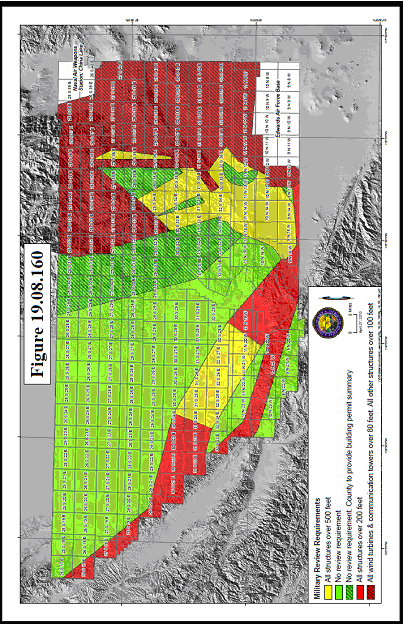
Notwithstanding any other provisions in this title, within the area depicted in Figure 19.08.160, no zone modification or zone variance may be approved, and no building permit may be issued where a zone modification or zone variance is not required, for any structure or building that exceeds the maximum permitted heights shown in Figure 19.08.160 unless the military authority responsible for operations in that flight area first provides the planning director with written concurrence that the height of the proposed structure or building would create no significant military mission impacts.
B.
In instances where the required written concurrence from the military is requested but not received within a reasonable period of time, the required zone modification or zone variance may be considered by the board of supervisors. A variation to the height-related development standard above may be approved by the board of supervisors generally following the zone variance procedures set forth in Chapter 19.106 and payment of related fees, upon a finding that the benefits of the requested height deviation outweigh the potential impacts on military flight operations.
(Ord. G-7189 § 6, 2005; Ord. G-7081 § 3, 2004: Ord. G-7072 § 3, 2004: Ord. G-6297 § 7, 1996: Ord. 5803 § 6, 1993: Prior code § 7282.11)
(Ord. No. G-8226, § 3, 11-8-11)
19.08.170 - Dwellings above other uses—Yard requirements.
Where a dwelling is located, placed or erected above another type of use in zoning districts other than the E, E (½), E (1), E (2½), E (5), E (10), E (20), R-1, R-2 or R-3 districts, the rear and side yards for the floors occupied for dwelling purposes shall comply with the regulations of the R-3 district.
(Prior code § 7282.12)
19.08.180 - Accessory buildings.
The following regulations shall apply to the location of accessory buildings unless otherwise provided in this title:
A.
Except in the case of accessory dwelling units approved pursuant to Chapter 19.90 of this title, accessory buildings in the R-1, R-2, R-3, and E districts located within the Metropolitan Bakersfield General Plan area shall be subject to the requirements listed in this subsection and accessory buildings in the R-1, R-2, R-3, and E districts located outside the Metropolitan Bakersfield General Plan area shall be subject to the require ments of subparagraphs (1) and (2) of this subsection. Square footage and heights exceeding those specified by this section may be allowed when approved by the planning director following the procedure described in subsection (5) below. Except for a detached garage, all other accessory buildings shall be located no closer to the front property line than the principal dwelling.
1.
On any residentially zoned parcel containing less than one-quarter (¼) acre, detached accessory buildings shall not exceed a combined total of six hundred (600) square feet. The accessory buildings shall not exceed the height of the principal dwelling.
2.
On any residentially zoned parcel containing an area between one-quarter (¼) acre and one-half (½) acre, detached accessory buildings shall not exceed a combined total of one thousand (1,000) square feet, or the square footage equivalent of the principal dwelling, whichever is greater, and shall not exceed the height of the principal dwelling.
3.
On any residentially zoned parcel containing more than one-half (½) acre, but less than three (3) acres, detached accessory buildings shall not exceed a combined total of three thousand six hundred (3,600) square feet or twice the square footage equivalent of the principal dwelling, whichever is greater, and shall not exceed a height of twenty (20) feet or the height of the principal dwelling, whichever is greater.
4.
On any residentially zoned parcel containing three (3) acres or more, detached accessory buildings shall not exceed a combined total of five thousand (5,000) square feet or three (3) times the equivalent square footage of the principal dwelling, whichever is greater, and shall not exceed the maximum building height permitted in the applicable zoning district.
5.
A public hearing is conducted using the procedure in Chapter 19.110, except that Section 19.110.050 shall not apply to such hearing. Heights and square footages exceeding the maximums otherwise permitted by this section may be allowed if the director makes the following findings:
a.
The increased height or square footage will permit appropriate development on the property;
b.
The increased height or square footage is compatible with development in the vicinity; and
c.
The increased height or square footage will not be materially detrimental to the public health, safety, or welfare or to property or residents in the vicinity.
B.
No accessory buildings on the rear of a reverse corner lot in the E, E (½), E (1), E (2½), E (5), E (10), E (20), R-1, R-2 or R-3 districts shall be located nearer to the side lot line on the street side of such reversed corner lot than the front yard depth required on the key lot in the rear.
C.
No accessory buildings or structures shall be located within a required front, side, or rear yard, except as provided for in this title.
D.
Accessory buildings may be considered a part of the main building if connected by a common wall of not less than five (5) feet in length, or if not more than twenty (20) feet from the main building and connected thereto by a roof of not less than five (5) feet in width.
E.
One (1) detached accessory building for use as a private garage may be permitted to occupy the required front yard of an interior lot in the E, E (½), E (1), E (2½), E (5), E (10), E (20), R-1, R-2 or R-3 districts when the slope of the front half of such lot is greater than one (1) foot rise or fall in the horizontal distance of four (4) feet from the established street elevation at the front property line; provided, however, that no portion of any such building shall be less than five (5) feet from the side or front property line of the lot, and further provided that no such building shall exceed thirty-five (35) feet in height.
F.
Cargo containers are permitted "by right" as an accessory structure in the A, A-1, NR, M-1, M-2, and M-3 districts. Cargo containers require approval of a conditional use permit in the E, R-1, C-2 and RF districts. Cargo containers, where permitted, shall not be used for human occupancy. Signs shall not be permitted on, or attached to, cargo containers, except those required by law that contain public safety information for the container. Cargo containers, where permitted, shall not be stacked. Cargo containers shall also be permitted in any zone district in conjunction with an authorized construction project. Except for temporary cargo containers specifically authorized in conjunction with a construction project, cargo containers shall be painted a uniform earthen hue color (e.g. beige, tan, brown).
G.
Outside of industrial zoning districts and approved miniwarehouse facilities, temporary, portable on-demand storage units (e.g., PODS) are permitted for up to thirty (30) days in residential, mobilehome park, and platted lands zoning districts and up to ninety (90) days in the agricultural, recreation-forestry, natural resource, drilling island, and commercial zoning districts. The planning director may authorize an extension of time for an additional thirty (30) days in residential zoning districts and up to an additional ninety (90) days in the agricultural, recreation-forestry, natural resource, drilling island, and commercial zoning districts. Additional time may be authorized when the portable storage unit is necessary and related to authorized on-site construction or when approved in conjunction with the approval of a conditional use permit, as provided for in Chapter 19.104. Signage on such units shall be limited to the name of the manufacturer and public safety information.
(Ord. G-7482 § 3, 2007: Ord. G-7189 § 7, 2005; prior code § 7282.13)
(Ord. No. G-7821, §§ 13, 14, 1-27-09; Ord. No. G-8226, § 5, 11-8-11; Ord. No. G-8725, §§ 6, 7, 7-11-17)
19.08.190 - Through lots—Setback requirements.
On through lots, either line separating the lot from a public thoroughfare may be designated by the owner as the front yard; however, the rear yard setback shall be the same as the front yard setback required on adjacent lots. Where a through lot is a lot within a recorded subdivision tract and the rear lot line abuts a secondary or major highway onto which access is restricted, the required rear yard shall be five (5) feet or as otherwise required by the applicable zoning district. (See Figure 19.08.190.)
(Ord. G-5684 § 15, 1991: Prior code § 7282.01)
19.08.200 - Yard encroachments.
Where yards are required by this title, those yards shall not be less in depth or width than the minimum dimension specified for any part, and they shall be at every point open and unobstructed from the ground upward, except as follows:
A.
Cornices, canopies, eaves, fireplaces, or other similar architectural features not containing vertical supports and not providing additional floor space within the building may extend into a required front, side or rear yard no more than three (3) feet.
B.
Open, unenclosed, uncovered porches, platforms or landing places which do not extend above the level of the first floor of the building may extend into any front yard not more than six (6) feet and into a side or rear yard not more than three (3) feet, provided, however, that an open work railing, not more than thirty-six (36) inches in height for residential structures and not more than forty-two (42) inches in height for commercial structures, may be installed or constructed on any such porch, platform or landing place.
C.
Stairwells and connected platforms or landings extending above the level of the first floor of a building may protrude into a required front yard no more than six (6) feet.
D.
Detached accessory buildings, less than one hundred twenty (120) square feet in size and eight (8) feet or less in height, may encroach into required side and rear yards up to five (5) feet, excluding street-side side yards, provided, that the structure is not placed on a permanent foundation and further provided that drainage from the roof of the structure is retained on site.
(Ord. G-5346 § 6, 1990; Ord. G-4993 § 5, 1989; Ord. G-4832 §§ 15, 16, 1988; Prior code § 7282.15)
19.08.210 - Fences, walls and hedges.
A.
In the E (¼), E (½), E (1), E (2½), R-1, R-2 and R-3 districts, no fence, wall or hedge located in the rear or side yards shall exceed a height of six (6) feet, except when a higher fence, wall or hedge is required as a condition of approval of a discretionary permit except when approved by the director in the manner contained in subsection G of this section.
B.
In the E (¼), E (½), E (1), E (2½), R-1, R-2 and R-3 districts, no fence, wall or hedge located in the required front yard shall exceed a height of four (4) feet, except when a higher fence, wall or hedge is required as a condition of approval of a discretionary permit or except when approved by the director in the manner contained in subsection G of this section.
C.
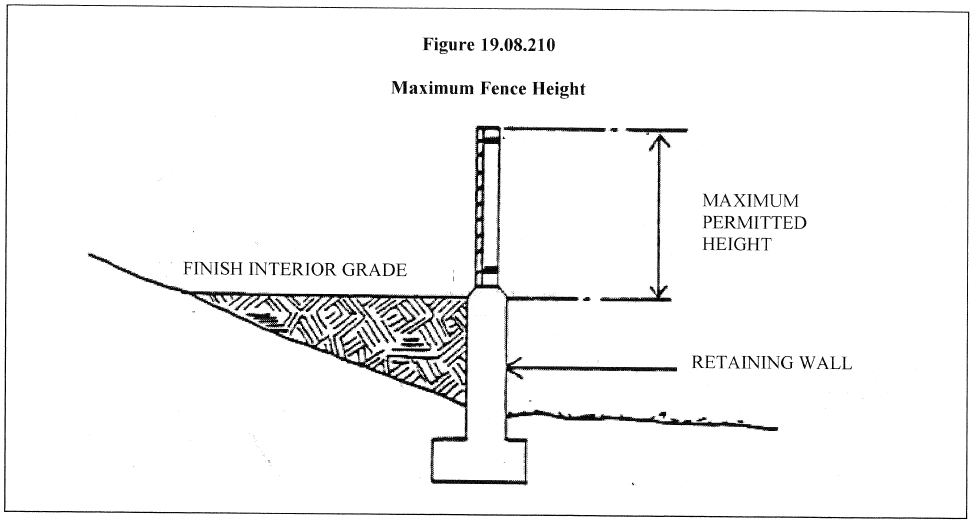
Maximum fence, wall, or hedge height shall be measured from the finished interior grade. That portion of a wall or fence functioning as a retaining wall shall not be counted in determining overall fence or wall height. (See Figure 19.08.210.)
D.
In the E (¼), E (½), E (1), E (2½), R-1, R-2, and R-3 districts, no barbed wire shall be used or maintained as part or on any fence, wall, or hedge located along the front, side, or rear lines of any lot, or within three (3) feet of such lines, and no sharp wire or points shall project at the top of any fence or wall less than six (6) feet in height. No electrified fences shall be permitted, regardless of location, except for purposes of animal containment on lots zoned with the residential suburban (RS) combining district and which contain a minimum lot size of two and one-half (2½) acres.
E.
In the E (¼), E (½), E (1), E (2½), R-1, R-2, and R-3 districts, no fence, wall, or hedge located in the rear twenty-five (25) feet of a through lot shall exceed four (4) feet in height, except when a higher fence, wall, or hedge is required as a condition of approval of a discretionary permit, or except when approved by the director following the procedure described in subsection (G) of this section.
F.
In the E (¼), E (½), E (1), E (2½), R-1, R-2, and R-3 districts, no fence, wall, or hedge located within ten (10) feet of the rear lot line of a reversed corner lot between the street and the established front-yard setback line on the key lot to the rear shall exceed a height of four (4) feet, except when a higher fence, wall, or hedge is required as a condition of an approval of a discretionary permit, or except when approval by the planning director following the procedure described in subsection (G) of this section.
G.
A public hearing is conducted using the procedure in Chapter 19.110, except that Section 19.110.050 shall not apply to such hearing. Heights exceeding the maximum heights otherwise permitted by this section may be allowed if the director makes the following findings:
1.
The increased height will permit appropriate development on the property;
2.
The increased fence height is compatible with development in the vicinity; and
3.
The increased fence height will not create traffic hazards in the project vicinity.
(Ord. G-6551 § 12, 1998; Ord. G-6412 § 4, 1997: Ord. G-6191 § 9, 1995: G-5346 § 8, 1990: Ord. G-4993 § 6, 1989; Ord. G-4832 §§ 17, 18, 1988; Prior code § 7282.16)
19.08.220 - Storage in yards.
Except as otherwise provided in subsection (G) of Section 19.82.090 of this title, no portion of any required front yard or side yard on the street side of a corner lot shall be used for the permanent storage, defined as any forty-eight (48) hour period, of motor vehicles, trailers, airplanes, boats, parts of any of the foregoing, except that one (1) recreational vehicle designed for human occupancy or one (1) boat may be so stored, provided that the recreational vehicle or boat is fully operational and is currently licensed and/or registered. Additionally, no such areas shall be utilized for the storage of scrap metals or other scrap materials, machinery, appliances, furniture, or equipment or parts thereof, except for building materials and equipment for use on the premises stored thereon during the time a valid permit is in effect for construction on the premises.
(Ord. G-5346 § 9, 1990: Prior code § 7282.17)
19.08.225 - Structures and storage in public roads.
No structures shall be constructed, erected or maintained within a county road right-of-way or public access easement, except where otherwise expressly authorized by law. Storage of any equipment or material shall be prohibited within a county road right-of-way or public access easement, except where otherwise expressly authorized by law.
(Ord. G-5346 § 10, 1990)
19.08.230 - Regional or interstate transmission pipeline facilities—County review.
Before any right-of-way for transmission lines is acquired for regional or interstate facilities, the proposed route shall be submitted for the planning director review and recommendation.
(Ord. G-6551 § 14, 1998; Ord. G-6077 § 21, 1994; Prior code § 7282.18)
(Res. No. 2020-116, § 2, 5-19-20; Ord. No. G-8992, § 2, 3-8-21)
Editor's note— Ord. No. G-8992, § 2, adopted March 8, 2021, changed the title of § 19.08.230 from "Private oil pipelines and related facilities—County review" to "Regional or interstate transmission pipeline facilities—County review," as set out herein.
19.08.240 - Building across property lines.
Provided legal parcels of record are owned by the same property owner(s), a building or buildings that establish the main use may be developed across property lines to merge the properties into one (1) parcel for the determination of property development standards.
(Prior code § 7282.19)
19.08.252 - Truck parking as a residential accessory use.
Truck parking, when accessory and incidental to an established residential use, shall be permitted; provided that, there is no more than one (1) truck which does not exceed a gross weight of five (5) tons and which is driven to and from the resident's place of employment on a regular basis or which is utilized in conjunction with an approved home occupation pursuant to Chapter 19.94 of this title. No commercial vehicle having a manufacturer's gross vehicle weight rating of ten thousand (10,000) pounds or more shall be parked or stored on any public or private street within a residential district.
The parking of one (1) truck which exceeds a gross weight of five (5) tons may be authorized by the director subject to the provisions contained in Sections 19.102.040 through 19.102.060 (Ministerial Permits), except as otherwise specified in this section. Such authorization shall be limited to legally created lots with a net lot size of one-half (½) acre or larger, developed with a single-family dwelling, and where the written consent of the property owner and each abutting property owner accompanies a written request for such authorization. Any such authorization shall be for a maximum period of three (3) years, limited to one vehicle and shall not include trailers; except that one (1) trailer may also be authorized on qualifying lots with a minimum gross lot size of two and one-half (2½) acres, if included as part of the original request. This two and one-half (2½) acre lot size requirement may be reduced to one (1) gross acre if a conditional use permit is obtained as specified below. For approval to store or park a trailer on a lot smaller than two and one-half (2½) acres but with an area of at least one (1) gross acre; or, in the event that not all abutting property owners' signatures can be obtained or in the event that authorization is being sought for more than three (3) years, the applicant may elect to file a conditional use permit request for approval by the hearing body following the procedures of Chapter 19.104 (Conditional Use Permits) of this title. Under no circumstances shall more than one (1) truck or truck/trailer combination be authorized under this section.
Violation of this section shall subject the responsible party to a civil penalty of eighty dollars ($80.00) per violation. Violations shall be subject to, and processed and enforced in accordance with, Sections 40200 et seq. of the California Vehicle Code.
(Ord. G-7189 § 9, 2005: Ord. G-6641 § 4, 1999: Ord. G-6077 § 22, 1994: Ord. G-5346 § 11, 1990: Ord. G-4832 § 19, 1988)
(Ord. No. G-7821, § 16, 1-27-09)
19.08.260 - Oil and gas exploration by scientific means.
The provisions of this title shall not be construed to apply to the exploration for oil and gas by scientific means.
(Prior code § 7282.21)
19.08.270 - County review of projects related to national security.
The provisions of this title shall not be construed to apply to the construction, installation, operation and maintenance of facilities on private land which are required in the interest of national security or the national defense, as determined by the planning director.
(Ord. G-6077 § 23, 1994: Ord. G-4832 § 20, 1988)
19.08.280 - Emergency occupancy of mobilehomes, travel trailers, or commercial coaches.
In the event a previously permitted dwelling or private school is destroyed or rendered uninhabitable by fire, earthquake, or similar calamity, the planning director may authorize the temporary placement of a mobilehome or travel trailer for residential use in the case of a dwelling or a commercial coach in the instance of a private school, on the property, regardless of the zoning district classification of the property, for a period not to exceed one hundred eighty (180) days. A request for such authorization shall be submitted in writing within thirty (30) days from the time the dwelling is destroyed or rendered uninhabitable. The director shall provide such authorization in writing and may stipulate any necessary conditions as determined by the director, for the protection of the public health and safety or for the protection of the personal health and safety of the proposed occupants.
(Ord. G-6077 § 24, 1994: Ord. G-4832 § 21, 1988)
(Ord. No. G-8226, § 6, 11-8-11)
19.08.290 - Temporary batch plants.
Temporary portable batch plants related to a specific construction project and for a one-time period of one hundred sixty (160) days or less may be authorized by the planning director in the A (exclusive agriculture), NR (natural resource), M-2 (medium industrial), and M-3 (heavy industrial) districts after review and approval of a written request, which shall include an operations statement describing the equipment and processes to be utilized, the purpose of the temporary batch plant, and a plot plan.
(Ord. G-6077 § 25, 1994: Ord. G-5346 § 12, 1990)
19.08.300 - Public access easements.
All setback requirements contained in this title shall apply to all public access easements, in addition to publicly maintained streets or roads. All public access easements shall be kept free and clear of all obstructions.
(Ord. G-5346 § 13, 1990)
19.08.320 - Fireworks stands and Christmas tree sales.
In addition to the specific zone districts which allow temporary fireworks stands and Christmas tree sales, the planning director may also authorize fireworks stands and Christmas tree sales on publicly owned property, including property owned by school districts, and on property developed with church facilities in any zone district.
(Ord. G-6191 § 10, 1995: Ord. G-6077 § 26, 1994: Ord. G-5861 § 2, 1992)
19.08.340 - Temporary events.
Temporary carnivals, circuses, or similar events not exceeding a combined total of twelve (12) days on any one (1) parcel during any calendar year may be permitted in any zone district pursuant to the procedures set forth in Sections 19.102.070 through 19.102.120 of this title. In conjunction with such an approval, the hearing officer may impose reasonable conditions to safeguard public health and safety. If the hearing officer determines that the nature or scope of the proposed event could have a significant adverse impact on surrounding properties, the hearing officer may deny the issuance of a temporary event permit. In processing a temporary event permit, the director may require the processing of a conditional use permit following the procedures set forth in Chapter 19.104 (Conditional Use Permits) if it is concluded that the size or scope of the proposed event could potentially create adverse impacts to surrounding properties. No permit issued for a temporary event shall ever ripen into the status of a permanent entitlement or legal, nonconforming use.
(Ord. G-6967 § 5, 2003: Ord. G-6551 § 15, 1998: Ord. G-6297 § 8, 1996: Ord. G-6077 § 27, 1994)
(Ord. No. G-7821, § 17, 1-27-09)
19.08.360 - Large water systems—Aboveground facilities.
Notwithstanding the requirements of each base zoning district pertaining to large water systems, aboveground structures related to large water systems, excluding well heads, well housing, booster pumps, small pressure tanks, and similar small aboveground structures, as determined by the planning director, shall require the processing of a conditional use permit following the procedures set forth in Chapter 19.104 (Conditional Use Permits) in the R-1, R-2, R-3, E (¼), E (½) and E (1) districts.
(Ord. G-6191 § 11, 1995)
19.08.370 - Potbellied pigs.
Vietnamese potbellied pigs shall be considered to be a household domestic pet and are permitted in conjunction with the residential use of property subject to the following conditions:
A.
There shall be no more than two (2) potbellied pigs kept on any legal lot.
B.
There shall be a minimum of five hundred (500) square feet of securely fenced outside yard area that is available and accessible for each potbellied pig. The fence shall be designed and maintained to prevent escape from the enclosed area.
C.
No potbellied pig shall exceed a weight of two hundred (200) pounds or a shoulder height of twenty-three (23) inches.
D.
Each potbellied pig shall be spayed or neutered.
E.
No potbellied pig shall be located any closer than thirty (30) feet from any off-site dwelling.
F.
All male potbellied pigs older than two (2) years shall have their tusks removed or filed by a licensed veterinarian.
G.
Upon request by the county, written certification of compliance with subsections (C), (D) and (F) of this section from a licensed veterinarian shall be provided by the owner.
H.
All potbellied pigs shall be kept in compliance with any requirements of the animal control services section of the Kern County environmental health services department.
(Ord. G-6412 § 5, 1997: Ord. G-6297 § 9, 1996)
19.08.375 - Pygmy goats.
Pygmy goats, with a height of less than twenty-four (24) inches, shall be considered to be a household domestic pet and are permitted in conjunction with the residential use of property. Except where otherwise permitted, there shall be no more than two (2) adult (over the age of four (4) months) pygmy goats kept on any legal lot.
(Ord. G-6967 § 6, 2003)
19.08.380 - Temporary occupancy of recreational vehicles.
Notwithstanding the requirements of Kern County Ordinance Code Chapter 17.44, one (1) motor home or one (1) travel trailer may be authorized for temporary occupancy on any lot with a minimum lot size of twenty (20) acres and located in an A, A-l, E, NR, or RF district, provided that no dwellings or other buildings have been established on the lot and that the primary residence of the property owner is located thirty (30) or more miles from the lot and further provided that the recreational vehicle will be occupied exclusively by the property owners. A conditional use permit shall be required pursuant to the requirements of Chapter 19.104 to authorize the temporary occupancy of a recreational vehicle pursuant to this section.
(Ord. G-6331 § 2, 1996)
19.08.390 - Waste stockpile—Financial assurances.
In conjunction with approval of any conditionally permitted use in any district which involves the stockpiling or land application of organic or inorganic waste or recyclable materials, as determined by the planning director, a surety bond or other approved financial assurance, may be required to guarantee site clean-up and remediation. The amount of the bond or other financial assurance shall be determined by the planning director and the form of the bond or other financial assurance shall be approved by county counsel.
(Ord. G-6412 § 6, 1997)
19.08.400 - Street identification requirements.
In addition to street identification requirements contained in the county's land division ordinance (Title 18), an applicant for any discretionary permit may be required to erect street identification signs when, in the opinion of the planning director, there is inadequate street identification to the site and the planning director further determines that the installation of the street identification signs is deemed necessary to safeguard the public health, safety, and welfare. If street identification sign installation will be required pursuant to this section, the street sign shall be designed, constructed, and installed in a manner consistent with the Kern County Development Standards Manual, or as otherwise authorized by the planning director, and shall be installed at on-site or off-site locations approved in advance by the planning director.
(Ord. G-6412 § 7, 1997)
19.08.405 - Setback requirements from section and midsection lines.
Within the San Joaquin Valley portion of Kern County, section lines and midsection lines located on properties below one thousand (1,000) feet above mean sea level shall be reserved for arterial and collector highway purposes, respectively, unless otherwise specified by the circulation element of the Kern County General Plan, Western Rosedale Specific Plan, Metropolitan Bakersfield 2010 General Plan or other adopted plan. A minimum setback of forty-five (45) feet and fifty-five (55) feet shall be required for all permanent buildings and structures from midsection and section lines, respectively.
(Ord. G-6864 § 6, 2002)
19.08.410 - Land divisions.
Land division actions, including subdivision tracts, parcel maps, parcel map waivers and lot line adjustments shall comply with the requirements of Title 18, the Kern County development standards, the Uniform Code of Building Regulations adopted by Kern County and the requirements of this title.
(Ord. 6864 § 7, 2002)
19.08.415 - Small wind energy system.
A.
A small wind energy system, as defined in Section 19.04.775, is a single system designed to supplement other electricity sources or as an accessory use to existing buildings or facilities, wherein the power generated is used primarily for on-site consumption. No small wind energy system shall be installed until after a "small wind energy system permit" is obtained pursuant to Section 19.102.070 of this title, except as provided for in this section.
B.
The following development standards shall apply to all small wind energy systems, except as provided for in this section:
1.
The overall height of the tower and blade extension shall not exceed one hundred twenty (120) feet and is subject to Section 19.08.160.
2.
A minimum setback of sixty-five (65) feet shall apply from all property lines that abut a residential zoning district (E, R-1, R-2 and R-3). This setback may be reduced to thirty (30) feet, if the overall height of the tower and blade extension do not exceed eighty (80) feet and decibel levels for the system do not exceed forty-five (45) decibels (dBA) at any time, as measured from the exterior surface of any off-site residence existing at the time the system is installed. A minimum setback of thirty (30) feet shall apply from all property lines that abut any other zoning district.
3.
Except as provided above, decibel levels for the system shall not exceed sixty (60) decibels (dBA) at any time, as measured from the exterior surface of any off-site residence existing at the time the system is installed.
4.
The system shall employ no lighting, except as may be required as a condition of approval.
5.
The system's turbine shall have been approved for use by the California Energy Commission.
6.
The tower and blades shall have a nonreflective surface.
7.
Additional conditions may be required pursuant to Section 19.102.070 of this title.
C.
Where the lot on which the small wind energy system will be installed contains a minimum area of one-half (½) acre and the overall height of the tower and blade extension does not exceed eighty (80) feet, a "small wind energy system permit" pursuant to Section 19.102.070 and adherence to the development standards specified in subsection (B) above shall not be required, provided that the installation complies with the following standards:
1.
The tower shall be located no closer than one (1) times the overall height of the tower and blade extension or thirty (30) feet, whichever is greater, from any property line and guy wire anchors, if used, shall not be located within ten (10) feet of any property line. Roof-mounted turbines shall not exceed a height of eight (8) feet above the tallest roof ridgeline.
2.
The tower shall be located no closer than fifty (50) feet from any existing off-site dwelling. This restriction does not apply to roof-mounted systems.
3.
Decibel levels for the system shall not exceed thirty-five (35) decibels (dBA) at any time, as measured from the exterior surface of any off-site residence existing at the time the system is installed.
4.
The system shall employ no lighting.
5.
The system's turbine shall have been approved for use by the California Energy Commission under its Emerging Renewables Program, or similar program, or has been certified by a national program recognized and approved by the commission.
6.
The tower and blades shall have a nonreflective surface.
(Ord. G-7505 § 2, 2007; Ord. G-7482 § 4, 2007: Ord. G-7189 § 10, 2005; Ord. G-6968 § 3, 2003)
(Ord. No. G-7821, §§ 18, 19, 1-27-09; Ord. No. G-8226, § 7, 11-8-11)
19.08.420 - Dog keeping in residential districts.
No more than three (3) dogs over the age of four (4) months shall be kept or housed as an accessory use on any property located within the E (¼), R-1, R-2, and R-3 residential zoning districts on any parcel less than ten thousand eight hundred ninety (10,890) square feet in size located within the Metropolitan Bakersfield General Plan area, except for kennels and animal shelters, as provided for by this title. Only licensed dogs in residence on the effective date of this section (March 2, 2003) in excess of the three (3) dogs otherwise permitted herein may remain on the same parcel for up to fifteen (15) years without constituting a violation of this section so long as they remain licensed.
(Ord. G-6952 § 4, 2003)
(Ord. No. G-7821, § 21, 1-27-09)
19.08.430 - Animal shelters grace period.
Prior to the enactment of a formal definition of "animal shelter" in 2002 (see Section 19.04.047), animal shelters and rescue centers were treated as "kennels" for permitting purposes. Any animal shelter use existing as of July 1, 2002, that is not or does not become a legal, nonconforming use on that date in accordance with the provisions of Chapter 19.108 of this title, shall have a grace period of up to one (1) year from that date to legalize its status under the zoning ordinance.
(Ord. G-6870 § 3, 2002)
19.08.440 - Commercial auto restoration.
Commercial auto restoration facilities which specialize in the restoration of classic or antique automobiles, including two-axled light trucks, are permitted uses in the C-2, M-1, M-2, and M-3 Districts subject to the following standards:
A.
All restoration jobs shall be under an active work order, including noncommercial restoration for the proprietor, family, or friends.
B.
On-site storage shall be screened from view from adjacent properties and all roads, access easements, and alleys and shall be limited to:
1.
Automobiles, including light trucks, under-going restoration.
2.
No more than one "parts" vehicle associated with each restoration job.
3.
New and used auto parts and equipment.
C.
All restoration jobs shall be completed within twelve (12) months unless the planning director approves a written request to exceed the twelve- (12-) month maximum for a particular restoration job.
D.
A restoration job customer may furnish a "parts" vehicle to the restoration business in conjunction with a work order for restoration work on a separate vehicle of the same model. At the conclusion of the restoration job, the remains of the "parts" vehicle shall be returned to the customer or, if authorized in writing by the customer, shall be sold as scrap within thirty (30) days following the completion of the related work order.
E.
No dismantler's permit is needed from the State Department of Motor Vehicles, except where a conditional use permit for a vehicle salvage yard has been approved as provided for in the M-2 and M-3 Districts.
F.
Except for a machine lathe and grinder, no on-site machining shall be conducted, except where "light machining" and "machine shops" are permitted in the applicable base zoning district. Except for those base zoning districts that authorize sandblasting and welding, sandblasting, soda blasting, and welding shall take place within a fully enclosed structure.
(Ord. G-7482 § 5, 2007)
19.08.450 - Street vendors and food peddlers.
Any use of private property involving street vendors or food peddlers, as defined in Title 5 of the Kern County Ordinance Code, who individually, or in combination, occupy all or a portion of said property for a period of time of eight (8) hours or more on any calendar day for more than fourteen (14) total days in any given calendar year, shall be considered to be a commercial use of the property and shall be permitted only in commercial and industrial districts, or on property developed with legally established commercial or industrial uses, and shall be subject to the special development standards and plot plan approval requirements specified in Chapter 19.80 which are applicable to commercial uses.
(Ord. No. G-7830, § 2, 3-3-09)
19.08.460 - Meteorological (MET) towers.
Permanent MET tower installations are permitted in the A, C-2, CH, M-1, M-2, M-3, RF, NR zoning districts and any zoning district with which the WE combining district has been added. MET tower installations for a temporary period not exceeding three (3) years may be authorized by the planning director in all other zoning districts. MET towers shall be setback a minimum distance of one (1) times the overall height of the tower from all property lines, except when adjacent to property included within the WE combining district, in which case the required setback shall be ten (10) feet. MET tower installations shall be subject to the maximum permitted height of the applicable base zoning district and with Figure 19.08.160 of this title.
(Ord. No. G-7821, § 23, 1-27-09)
19.08.470 - Noncommercial liquified petroleum gas (LPG), liquified natural gas (LNG) and compressed natural gas (CNG).
Non-commercial LPG, LNG, and CNG storage tanks sites exceeding two thousand (2,000) gallons, when incidental and accessory to a permitted or conditionally permitted use in the A, M-2, M-3 or NR districts, may be permitted by the planning director, provided that the location of the tank(s) is at least one-half (½) mile from any residentially zoned property (E, R-1, R-2, or R-3 Districts) and the Kern County Fire Department has approved the installation. The planning director may require the processing of a conditional use permit, pursuant to Chapter 19.104 of this title, to allow noncommercial LPG, LNG, and CNG storage tanks in excess of two thousand (2,000) gallons combined total volume to be located within one-half (½) mile of any residentially zoned property.
(Ord. No. G-7821, § 24, 1-27-09)
19.08.480 - Beverage container recycling (CRV) collection center.
A.
CRV recycling centers are permitted when accessory to an existing retail establishment that sells beverages. CRV recycling centers shall meet the requirements of and shall be certified by the state department of conservation. Unmanned CRV recycling centers shall consist of reverse vending machines and manned CRV recycling centers shall use "igloo-type" collection bins or up to two (2) cargo containers or roll-off bins which open from the end of the units, provided that the opening end of the containers or bins are concealed from public view and the units are painted. Except for unmanned CRV recycling centers consisting of reverse vending machines, the facility shall be staffed during all hours of operation. CRV recycling centers shall be kept free from litter and debris, and all recyclables shall be kept within authorized containers at all times. Prior to the establishment of a CRV recycling center, the operator shall submit the following to the planning department:
1.
A site plan, which shall demonstrate that there will be no significant impacts to on-site parking or circulation;
2.
A letter or lease signed by the property owner authorizing the CRV recycling center and the use of the retail store's restroom facilities;
3.
If cargo containers or roll-off bins are to be used, the proposed method of concealing the opening end of the containers or bins consisting of a picture or elevation drawing and the proposed painting scheme;
4.
A copy of the state department of conservation recycling center certificate, or application for same;
5.
A facility maintenance plan, including provisions for wash-down of residual liquids.
B.
The planning director shall review and approve the proposed site plan, method of concealment and facility maintenance plan prior to providing land use approval for facility set-up and operations. CRV recycling centers not meeting the requirements of this section may be permitted under the conditional use permit provisions pursuant to Chapter 19.104 of this title.
(Ord. No. G-7821, § 25, 1-27-09)

