


Kern County Unincorporated
City Zoning Code
City Zoning Code
CHAPTER 19
82 - OFF-STREET PARKING
19.82.010 - Purpose and application.
The purpose of this chapter is to reduce street congestion and promote the safety and convenience of the residents of Kern County by requiring the provision of adequate and well-designed parking in connection with the land uses authorized by this title. Parking required by this chapter shall be provided at the time any main building or structure is erected or enlarged, or use is established, changed or expanded. Development involving individual or cumulative expansion constituting fifty percent (50%) or more of the development existing on the effective date of this chapter shall comply with the off-street parking requirements of this chapter for both the existing and new development, except that existing parking facilities shall be exempt from the landscaping requirements. The standards in this chapter are minimum standards.
(Prior code § 7220.01)
19.82.020 - Required parking spaces.
Uses permitted by this chapter shall provide off-street parking spaces according to the following schedule:
A.
Residential Uses.
1.
Accessory dwelling unit: One (1) per bedroom, not to exceed two (2) per unit or as otherwise provided for in Chapter 19.90.
2.
Boarding house, rooming house, residential hotel, fraternity or sorority house, or dormitory: One (1) per bedroom.
3.
Duplex, triplex, quadruplex, multifamily dwelling, or condominium: One (1) per efficiency unit, studio, or one-bedroom unit, and, for complexes consisting of five (5) or more units, an additional space for every five (5) such units for guest parking; two (2) per unit for each unit containing two (2) or more bedrooms, and, for complexes consisting of five (5) or more units, an additional space for every ten (10) such units for guest parking.
4.
Mobilehome and recreational vehicle park: Two (2) spaces per designated mobilehome space and one (1) space per every five (5) designated mobilehome spaces for guest parking; one (1) space per every designated recreational vehicle space.
5.
Retirement or rest home, transitional housing facility, supportive housing facility or emergency shelter: One (1) per four (4) resident beds.
6.
Single-family dwelling or mobilehome: Two (2) per dwelling unit.
B.
Recreation, Entertainment, and Tourist Facilities.
1.
Ballfield: Ten (10) per diamond,
2.
Batting cage: One (1) per cage,
3.
Bowling alley: Four (4) per lane,
4.
Dance hall, ballroom, or discotheque: One (1) per thirty (30) square feet of gross building area,
5.
Golf course: Three (3) per hole,
6.
Golf driving range: One (1) per tee,
7.
Hotel or motel: One (1) per room plus two (2) for the manager's quarters and one (1) per full-time staff member,
8.
Miniature golf course: Two (2) per hole,
9.
Movie theater: One (1) per three (3) seats,
10.
Pool and billiard parlor: Two (2) per pool or billiard table,
11.
Skateboard parks: One (1) per five hundred (500) square feet of use area,
12.
Shooting range or gun club: One (1) per shooter station,
13.
Soccer fields: Twenty (20) per field,
14.
Sports arena: One (1) per three and one-half (3 ½) seats,
15.
Swimming pool: One (1) per one hundred (100) square feet of pool and deck area plus bicycle parking racks containing a minimum of ten (10) spaces,
16.
Tennis club or health club: One (1) per one hundred (100) square feet of open indoor recreational area plus two (2) per tennis or racquetball court,
17.
Video games arcade: One (1) per one hundred (100) square feet of gross building area plus bicycle parking racks containing a minimum of ten (10) spaces,
C.
Offices.
1.
Business or professional office: One (1) per two hundred fifty (250) square feet of gross building area,
2.
Financial institution, including bank, savings and loan or credit union: One (1) per two hundred (200) square feet of gross building area,
3.
Medical or dental office, veterinary office, clinic: One (1) per two hundred (200) square feet of gross building area;
D.
General Retail Sales.
1.
Auto sales: One (1) per two thousand (2,000) square feet of sales area plus one (1) per two hundred fifty (250) square feet of office area,
2.
Bar, tavern or cocktail lounge: One (1) per seventy-five (75) square feet of gross building area,
3.
Cardroom: One (1) per three (3) seats or one (1) per one hundred (100) square feet of gross building area, whichever is greater,
4.
Convenience store: One (1) per two hundred (200) square feet of gross building area,
5.
Convenience store with fast-food drive-thru: One (1) per one hundred fifty (150) square feet of gross building area,
6.
Furniture store: One (1) per five hundred (500) square feet of gross building area,
7.
General retail: One (1) per two hundred fifty (250) square feet of gross building area,
8.
Nursery, retail: One (1) per two hundred fifty (250) square feet of indoor display area plus one (1) per two thousand (2,000) square feet of outdoor sales area,
9.
Heavy equipment, recreational vehicles or truck sales: One (1) per two thousand (2,000) square feet of sales area plus one (1) per two hundred fifty (250) square feet of office area,
10.
Restaurant, cafe or coffee shop: One (1) per one hundred (100) square feet of gross building area,
11.
Restaurant, delivery only, where no seating area is provided: One (1) per two hundred fifty (250) square feet of gross building area,
12.
Restaurant, fast food: One (1) per seventy-five (75) square feet of gross building area,
13.
Shopping center: One (1) per two hundred (200) square feet of gross floor area, or the sum of individual tenant parking space requirements, whichever is less;
E.
Services.
1.
Auto repair, tire sales and service: One (1) per three hundred (300) square feet of gross building area,
2.
Barber or beauty shop: One (1) per one hundred (100) square feet of gross building area or one (1) per chair, whichever is less,
3.
Equipment rental: One (1) per two thousand (2,000) square feet of outside display area or storage area plus one (1) per two hundred fifty (250) square feet of office area plus one (1) per five hundred (500) square feet of inside display area,
4.
Laundromat, self-service: One (1) per three (3) washing machines,
5.
Mini-warehouse: Three (3) plus one (1) for each two hundred (200) units or portion thereof plus two (2) per residence or manager's living quarters plus one (1) per two hundred fifty (250) square feet of office area,
6.
Mortuary or funeral parlor: One (1) per three and one-half (3½) seats or one (1) per forty (40) square feet of assembly area, whichever is less,
7.
Video rental: One (1) per one hundred (100) square feet of gross building area;
F.
Industrial Uses.
1.
Contractor storage yard: One (1) per five thousand (5,000) square feet of lot area,
2.
Manufacturing or assembly: One (1) per five hundred (500) square feet of floor area plus one (1) per two hundred fifty (250) square feet of office area,
3.
Warehouse or wholesale distribution: One (1) per one thousand (1,000) square feet of storage area for the first ten thousand (10,000) square feet, one (1) per three thousand (3,000) square feet thereafter plus one (1) per two hundred fifty (250) square feet of office area;
G.
Institutional Uses.
1.
Auditorium: one (1) per three and one-half (3½) seats,
2.
Cemetery: one (1) per three and one-half (3½) seats in the chapel plus one (1) per two hundred fifty (250) square feet of office space,
3.
Church or auditorium: one (1) per three and one-half (3½) seats,
4.
Community care facilities and rehabilitation facilities: one (1) per three (3) beds, plus one (1) for each full-time employee on the shift with the largest number of employees,
5.
Convalescent hospital or sanitarium: one (1) per four (4) patient beds,
6.
Hospital: one (1) per two (2) patient beds,
7.
Library or museum: one (1) per five hundred (500) square feet of public use area,
8.
Meeting halls and other places of public assembly where no fixed seating is provided: one (1) per forty (40) square feet of gross floor area;
H.
Educational Institutions and Schools.
1.
College, business school, trade school: One (1) per employee plus one (1) per two (2) students at full enrollment,
2.
Dance or karate school: One (1) per three hundred (300) square feet of gross building area,
3.
Elementary and junior high school: One (1) per employee plus one (1) per twenty (20) students at full enrollment,
4.
High school: One (1) per employee plus one (1) per eight (8) students at full enrollment,
I.
Miscellaneous Uses.
1.
Child care center or preschool: One (1) per eight (8) children for which the facility is licensed plus one (1) per employee;
J.
Where the calculation of parking needs results in the requirement for a fraction of a parking space, the additional parking space shall be provided;
K.
Floor area shall mean gross floor area unless otherwise specified;
L.
Where a proposed use is not listed in this section, the planning director shall determine parking needs based on the listed use which most nearly resembles the proposed use;
M.
Where parking requirements are based on the number of seats, eighteen (18) inches of pew or bench seating shall be equivalent to one (1) seat;
N.
Where no fixed seating is provided, seven (7) square feet of floor space shall be equivalent to one (1) seat.
O.
In conjunction with a drive-through restaurant or coffee shack, a credit of two (2) parking spaces may be applied to the applicable off-street parking requirement.
P.
In conjunction with a convenience market that also provides gasoline service, a credit of one (1) space may be applied to each gasoline pump.
Q.
Where a lot contains a use with existing legal nonconforming parking, no additional parking shall be required unless there is a change of use, a new building proposed or an existing building or use is enlarged. Parking shall then be assessed as follows:
1.
When there is change in use to another use with the same or lesser amount of required parking, no additional parking is required, except that as may be necessary to comply with the handicapped parking requirements of Section 19.82.050.
2.
When new buildings or building additions are proposed, only the gross square footage of the new building area shall be subject to the requirements of this chapter.
3.
If a new building will replace an existing building not associated with a change in use of the property and for which parking has been determined to be legal nonconforming, the planning director may authorize a credit of up to the amount of parking provided for the amount of square footage associated with the historical use to be applied to the new building.
(Ord. G-7189 §§ 80, 81; Ord. G-6967 §§ 25, 26, 2003; Ord. G-6864 § 61, 2002; Ord. G-6641 §§ 37, 18, 1999; Ord. G-6551 § 89, 1998; Ord. G-6297 § 58, 1996; Ord. G-6191 §§ 81, 82, 1995; Ord. G-6077 § 261, 1994: Ord. G-5861 § 26, 1992; Ord. G-5803 § 46, 1992; Ord. G-5346 § 87, 1990; Ord. G-4832 § 166, 1988; prior code § 7220.02)
(Ord. No. G-7821, §§ 64—67, 1-27-09; Ord. No. G-8226, § 85, 11-8-11; Ord. No. G-8725, § 18, 7-11-17)
19.82.030 - Parking space dimensions.
All parking spaces shall be at least nine (9) feet by twenty (20) feet, except that:
A.
Compact automobile parking spaces shall be at least eight (8) feet by sixteen (16) feet.
B.
Handicapped automobile parking spaces shall comply with the requirements of Chapter 2-71 of Title 24 of the California Administrative Code.
C.
Where a raised curb or wheel blocks are provided, parking spaces may be permitted a two (2) foot overhang, except where such an overhang would interfere with the use of a pedestrian walkway or landscape planter, as determined by the planning director.
D.
Parallel spaces shall be at least nine (9) feet by twenty-two (22) feet.
E.
Motorcycle parking spaces shall be at least four (4) feet wide by eight (8) feet deep.
F.
Loading spaces, when required, shall have a minimum length of thirty-five (35) feet, a minimum width of ten (10) feet, and a minimum vertical clearance of fourteen (14) feet, except the minimum length for the first such space required shall be twenty-five (25) feet and the minimum vertical clearance shall be twelve (12) feet.
(Ord. G-6077 § 262, 1994: Ord. G-5684 § 81, 1991: prior code § 7220.03)
(Ord. No. G-7821, § 69, 1-27-09)
19.82.040 - Compact car and motorcycle parking.
A.
Up to twenty percent (20%) of the spaces in a parking facility with ten (10) or more spaces may be designed and designated for compact cars.
B.
Up to two percent (2%) of the spaces in a parking facility with fifty (50) or more spaces serving non-residential uses may be designed and designated for motorcycle parking.
(Prior code § 7220.04)
(Ord. No. G-7821, § 70, 1-27-09)
19.82.050 - Handicapped parking.
A.
Parking spaces for the handicapped shall be provided and designed in accordance with the requirements of Title 24 of the California Administrative Code and all applicable federal requirements.
B.
All handicapped parking spaces and access between the handicapped parking spaces and the primary entrances of associated buildings or facilities shall be surfaced in a manner to facilitate wheelchair use.
(Ord. G-6297 § 60, 1996: Ord. G-5346 § 89, 1990; Prior code § 7220.05)
19.82.060 - Off-street loading spaces.
A.
For every building or facility occupied by manufacturing, storage, warehouse, wholesale or retail store, market, passenger terminal, apartment complexes consisting of more than fifty (50) dwelling units, theater, hotel, motel, restaurant, hospital, laundry, dry cleaning plant, or similar use requiring the receipt or distribution of vehicles or merchandise, adequate space for standing, loading, and unloading shall be provided and maintained on the same lot in addition to the automobile parking required by Section 19.82.020 of this chapter.
B.
Freight loading space requirements are as follows:
(Prior code § 7220.06)
(Ord. No. G-7821, § 71, 1-27-09)
19.82.070 - Location of parking.
Required residential off-street parking facilities shall be located on the premises they are intended to serve. Off-street parking for other than residential uses shall be located on the premises they are intended to serve or within five hundred (500) feet thereof. Where required parking is provided on a site other than that of the principal use, the property owner shall file with the Kern County recorder's office a covenant, on a form provided by the Kern County planning department and approved by the planning director, that provides for the maintenance of the parking facility as long as the associated principal use is maintained. Approval of the covenant shall be subject to the applicant's submittal of a detailed plot plan of the site upon which the additional parking will be provided. The plan shall illustrate that any required parking at that site will not be reduced. All required off-street parking spaces shall be designed, located, constructed and maintained so as to be fully and independently usable and accessible at all times, except as provided for in Section 19.82.090(D).
(Ord. G-6077 § 263, 1994: Ord. G-5803 § 48, 1992: Ord. G-5684 § 82, 1991: Prior code § 7220.07)
19.82.080 - Joint use of parking areas.
If more than one (1) use required to provide parking spaces in accordance with this chapter occupies the same building or premises, off-street parking shall be provided in an amount equal to the total number of spaces required for the separate uses, provided, however, that upon written request the planning director can reduce the number of spaces required in such cases by up to twenty percent (20%) if he/she determines that it is unlikely the combination of uses in the same building or premises will at periods of peak use necessitate provision of the number of parking spaces that would be required if the uses were developed independently. The parking space requirement for the primary use shall be calculated as specified in Section 19.82.020. No reduction shall be permitted for the number of parking spaces required for the primary use, as determined by the planning director.
(Ord. G-6077 § 264, 1994: Ord. G-5684 § 83, 1991: Prior code § 7220.08)
19.82.090 - Parking area design and development standards.
Off-street parking areas required to be provided by this chapter shall be designed and developed in accordance with the following standards:
A.
All off-street parking areas and ingress and egress to parking areas shall be surfaced with the following materials:
1.
For all residential, recreation, entertainment and tourist facilities, commercial, industrial, institutional and other high-intensity uses in any Type A improvement area (see Appendix), parking areas shall be surfaced with one (1) of the following materials on a prepared base:
a.
Two (2) inches of asphaltic concrete,
b.
Three and one-half (3½) inches of portland cement concrete;
2.
Except as specified by Chapter 19.80 of this title, for all uses in any other area, the required parking areas shall be surfaced with one (1) of the following materials:
a.
Three (3) inches of bituminous road mix,
b.
Two (2) inches of asphaltic concrete,
c.
Three and one-half (3½) inches of Portland cement concrete,
d.
Three (3) inches of decomposed granite,
e.
Three (3) inches of compacted rock dust,
f.
Three (3) inches of gravel;
3.
All required surfacing shall be continuously maintained in good condition, as determined by the planning director;
4.
Driveways serving single-family residential dwellings are exempt from the paving requirements specified in subsections (1) and (2) of this section if greater than one hundred (100) feet in length. The required parking area is still subject to the aforementioned paving provisions;
5.
In the case of uses subject to discretionary approval, the required parking areas shall be surfaced with the materials specified in accordance with the conditions of approval.
B.
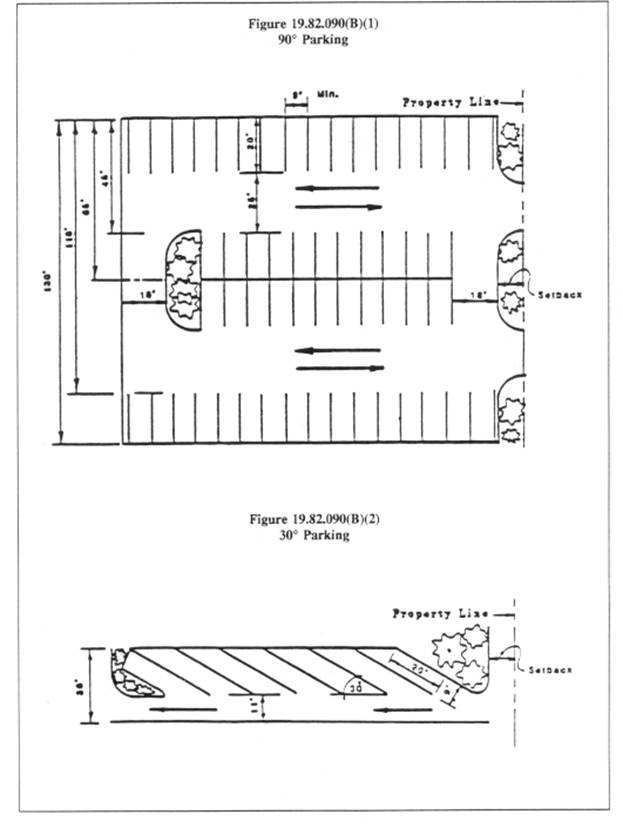
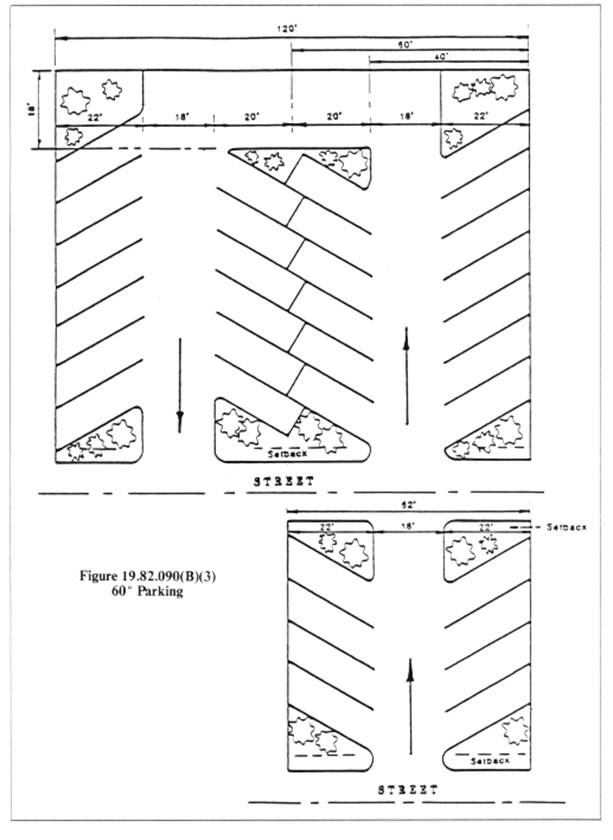
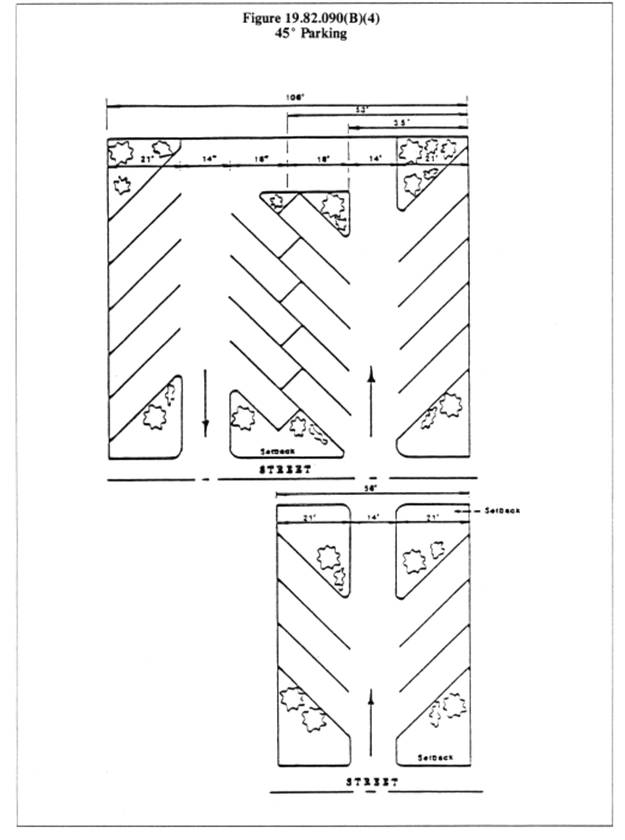
Parking aisles shall comply with the following minimum standards (see Figures 19.82.090 (B)(1) through (B)(4)):
C.
All parking spaces shall be clearly marked. Where paved parking is required, all parking spaces shall be designated by white painted stripes, except for parking spaces serving a single-family residence; and concrete wheel blocks or a six (6) inch raised A.C. curb shall be installed at each parking space that abuts a structure or property line, except for parking spaces that serve a single-family residence, or as otherwise required by the planning director.
D.
Off-street parking facilities shall be designed so that each space can function independently of any other parking space, except in the case of lots containing up to two (2) dwelling units. Required off-street parking spaces serving commercial and industrial buildings shall not abut roll-up doors or any other doorway or opening that would conflict with the proposed use of the building.
E.
Driveways for residential developments shall be a minimum of fourteen (14) feet (includes three (3) foot taper on each side) in width with fifteen (15) feet of unobstructed vertical clearance. Driveways for commercial and industrial developments shall be a minimum of eighteen (18) feet (includes three (3) foot taper on each side) in width with fifteen (15) feet of unobstructed vertical clearance. These requirements may be reduced by the planning director upon recommendation of the Kern County fire chief.
F.
Parking spaces requiring backing into a street or road right-of-way are prohibited, except in the case of driveways for lots containing two (2) or fewer dwelling units. For lots containing a third dwelling unit for which access is taken from other than an arterial or collector road, direct backing into a street or road right-of-way may be authorized by the roads department.
G.
In no case shall any parking be located within an existing right-of-way, proposed secondary or major highway, or within an adopted official or specific plan line and, except in the case of lots containing only one (1) single-family dwelling or mobilehome and lots zoned for commercial and industrial purposes, off-street parking may not be located in a required front-yard or required side-yard setback abutting a street.
H.
Where a parking facility containing five (5) or more spaces or a drive aisle which abuts property zoned E, R-1, R-2, or R-3, the parking facility shall be separated from the abutting property by a solid masonry wall six (6) feet in height, except that from the front property line to a depth equal to the required front yard on the abutting residentially zoned property, the wall shall be four (4) feet in height.
I.
For all parking lots containing ten (10) or more spaces, at least five percent (5%) of the total interior area devoted to parking shall be landscaped. Trees shall be planted and maintained throughout the parking area at a minimum ratio of one (1) tree per six (6) parking spaces placed at a maximum of sixty-five- (65-) foot intervals. Minimum tree size shall be fifteen (15) gallon container. An irrigation system adequate for the maintenance of the landscaping shall be installed.
J.
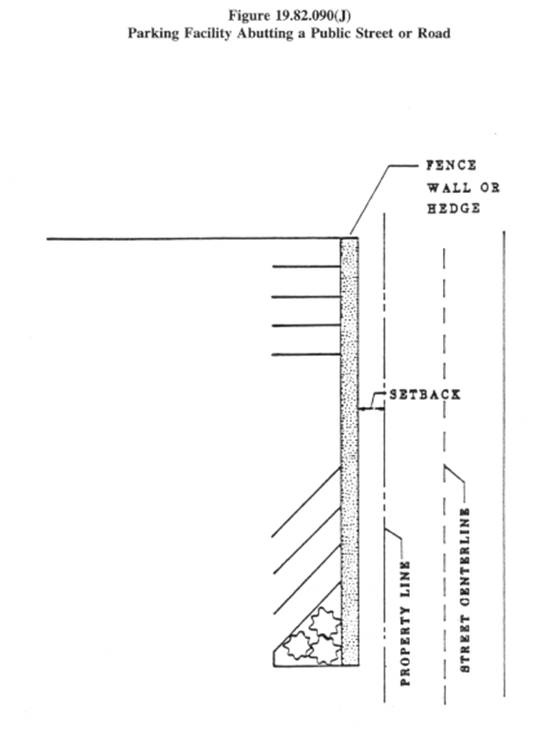
Where a parking facility containing five (5) or more spaces includes diagonal or perpendicular parking spaces that abut a public street or road, an ornamental fence, wall, evergreen landscaping or berm, or any combination of the above, of not more than four (4) feet in total height shall be erected between the parking facility and the street or road to eliminate headlight glare. (See Figure 19.82.090(J).)
K.
Lights used to illuminate parking area shall be directed away from any adjacent properties and streets.
(Ord. G-6864 § 63, 2002; Ord. G-6077 §§ 265—268, 1994; Ord. G-5684 §§ 84—86, 1991; Ord. G-5346 § 91, 1990; Ord. G-4832 § 167, 1988; Prior code § 7220.09)
(Ord. No. G-7821, §§ 72—75, 1-27-09)
19.82.100 - Off-street parking plot plan review—Required.
No use shall be established or changed, no development shall occur or be expanded, and no building or grading permit or business license for any use or development shall be issued until an application for plot plan review has been submitted to and approved by the planning director.
(Ord. G-6077 § 270, 1994: Prior code § 7220.10 (part))
19.82.110 - Plot plan review—Application—Contents.
The application for a plot plan review shall contain the following:
A.
Name and address of the applicant;
B.
Name(s) and address(es) of the property owner(s);
C.
Assessor's parcel number(s);
D.
Legal description of the property;
E.
A plot plan drawn at the scale specified by the planning director, including the following:
1.
Topography and proposed grading,
2.
Location of existing buildings and structures where such buildings and structures are to remain,
3.
Location of proposed buildings and structures,
4.
Proposed uses of all buildings or structures,
5.
Dimensions of the existing and proposed buildings or structures or other information (e.g., seating capacity) of the proposed buildings allowing the planning director to determine parking needs in accordance with the requirements set out in Section 19.82.020 of this chapter,
6.
Layout of proposed parking lot, including location of parking spaces, internal circulation pattern, and ingress and egress points,
7.
Dimensions of parking stalls and aisles,
8.
Location of landscaping and irrigation system, including identification of plant materials to be used,
9.
Location of lighting,
10.
North arrow.
(Ord. G-6077 § 271, 1994: Prior code § 7220.10(A))
19.82.120 - Application review and approval.
A.
Where a discretionary or ministerial approval is required for the use or uses for which the parking is being provided, the off-street parking plot plan application shall be reviewed and approved in conjunction with that discretionary or ministerial approval process. No plot plan application shall be required for lots containing only one (1) single-family dwelling.
B.
Where no discretionary or other ministerial approval is required for the use or uses for which parking is being provided, the off-street parking plot plan application shall be reviewed and approved in accordance with the standards and procedures set out in Sections 19.102.040 through 19.102.060 of this title.
(Ord. G-4832 § 168, 1988; Prior code § 7220.10(B))
19.82.130 - Permit revocation and modification.
Any permit issued pursuant to this chapter may be revoked or modified pursuant to Section 19.102.020 of this title.
(Prior code § 7220.10(C))