Kern County Unincorporated
City Zoning Code
City Zoning Code
CHAPTER 19
84 - SIGNS
19.84.010 - Purpose and application.
The purpose of this chapter is to promote the orderly and attractive construction, placement and display of signs throughout the county. It is the policy of the county that the primary purposes of signs are identification and public information. Signs that cause distraction and represent potential safety hazards as well as aesthetic problems are either discouraged or prohibited. These general provisions serve as specific development standards to be applied in addition to the basic sign provisions within each zoning district.
(Prior code § 7225.01)
19.84.020 - Design and development standards—Monument signs.
Freestanding monument signs shall comply with the following standards:
A.
No monument sign shall be located within any existing or designated future road right-of-way line.
B.
The maximum height of the monument sign shall be eight (8) feet as measured from grade level.
C.
Monument signs shall be a minimum of twenty (20) feet apart, including from existing monument signs on adjacent lots.
D.
Lighting of monument signs shall be arranged so as not to produce a glare on other properties in the vicinity.
(Ord. G-6077 § 272, 1994; Ord. G-5346 § 93, 1990; Prior code § 7225.02(A))
19.84.030 - Design and development standards—Pole signs.
Freestanding pole signs shall comply with the following standards:
A.
The maximum area of a pole sign shall not exceed two hundred (200) square feet per side, except as otherwise specified in the applicable base district.
B.
Pole signs shall be located so that no part of the sign extends into any existing or proposed street right-of-way line.
C.
The maximum height of a pole sign shall be twenty-four (24) feet, except as otherwise specified in the applicable base district.
D.
Pole signs be a minimum of twenty (20) feet apart, including from existing pole signs on adjacent lots.
E.
Lighting of pole signs shall be arranged so as not to produce a glare on other properties in the vicinity.
(Ord. G-5966 §§ 127, 128, 1993; Ord. G-5346 § 95, 1990; Prior code § 7225.02(B))
19.84.040 - Design and development standards—Signs attached to buildings.
Signs attached to a building or wall shall comply with the following standards:
A.
All signs attached to a building shall be attached flat against the building and parallel thereto and shall not extend more than eighteen (18) inches from the wall of the building. For the purpose of this subsection, a wall is a surface not less than sixty (60) degrees from the horizontal. Exceptions to this provision are as follows:
1.
Signs may be attached to a building providing that the sign does not exceed ten (10) feet in height and that the sign does not project above the peak of the roof of the building.
B.
Lighting of signs attached to buildings shall be arranged so as not to produce a glare on other properties in the vicinity, and the source of light shall not be visible from adjacent property or a public street.
C.
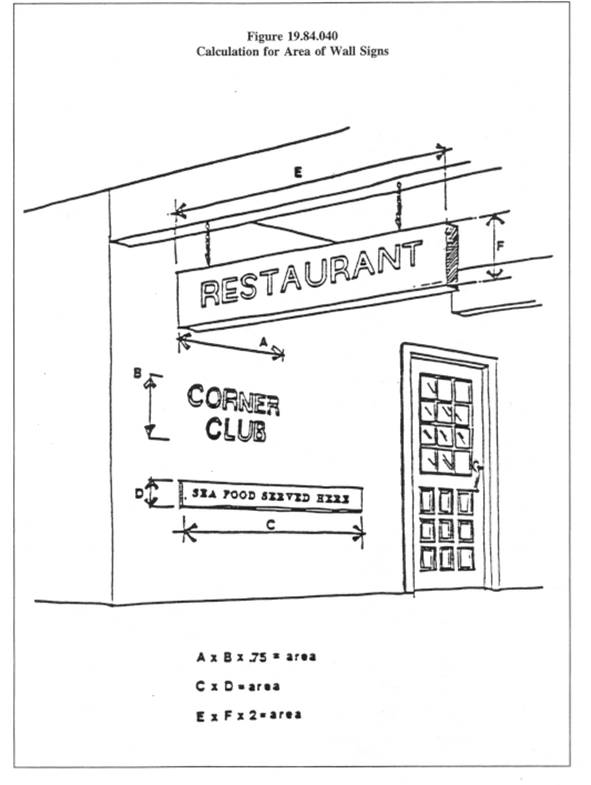
Sign copy which is applied on the building in such a manner that no background is distinguishable from the overall architectural motif of the building shall be counted at seventy-five percent (75%) of the area within straight lines enclosing the copy. All other signs shall be computed at one hundred percent (100%) (See Figure 19.84.040.)
(Ord. G-6191 § 84, 1995: Ord. G-5966 § 130, 1993: Prior code § 7225.02(C))
19.84.050 - Design and development standards—Off-site advertising signs.
Off-site advertising signs shall comply with the following standards:
A.
Except as otherwise indicated, the total area of any face of any off-site advertising sign shall not exceed seven hundred (700) square feet nor shall the sign face exceed the length of fifty (50) feet, nor the height of sixteen (16) feet. In no case shall a sign face be taller than it is wide, nor shall the square footage exceed the amount specified by the sign regulation of the zoning district in which the sign is to be located. The total area of any face of any off-site advertising sign shall not exceed three hundred (300) feet within the boundaries of the Metropolitan Bakersfield General Plan area. Off-site advertising signs within the Metropolitan Bakersfield General Plan area that are located on lots adjacent to a state freeway and which are designed to be read from that freeway shall be excluded from the three hundred (300) square-foot restriction.
B.
No more than two (2) sign faces per outdoor advertising structure shall be permitted. Back-to-back and V-type signs shall be allowed provided that they are on the same structure, and are of uniform size and further provided that the V-type display has separation between sign faces of not more than thirty degrees (30°). Any single sign face may contain multiple advertisements.
C.
Each off-site advertising sign shall be located not less than one thousand (1,000) feet from any other off-site advertising sign located on the same side of the street or highway. On lots with multiple street frontages, the one thousand (1,000) foot setback requirement shall be measured radially. No off-site advertising sign shall be located within one thousand three hundred twenty (1,320) feet of the business or activity which it advertises. No off-site advertising may be located closer than twenty-five (25) feet from any other type of business identification sign. In no case shall an off-site advertising sign be located within five (5) feet of an interior side or rear property line.
D.
A legally installed off-site advertising structure which becomes a legal, nonconforming structures pursuant to subsections (A) or (C) of this section may, with the written concurrence of both the sign structure permit holder and the underlying property owner, be relocated at the same or proximate location on the same parcel as authorized by the planning director. In no case shall a separation of less than five hundred (500) feet from another legal off-site advertising sign be permitted.
E.
No part of an off-site advertising sign shall be located within an existing or proposed street right-of-way.
F.
The maximum height for off-site advertising signs shall be thirty-five (35) feet, except as otherwise specified in the applicable base district.
G.
No outdoor advertising display shall be located within one hundred fifty (150) feet (measured radially) of property located in an E, R-1, R-2, R-3 or MP district. In no case shall an outdoor advertising display be located within one hundred (100) feet of any residential dwelling.
H.
Lighting of off-site advertising signs shall be arranged so as not to produce a glare on other properties in the vicinity, and the source of light shall not be visible from adjacent property or a public street.
I.
The applicant shall comply with the applicable provisions of the Outdoor Advertising Act, administered by the State Department of Transportation, and shall provide the county with the locations of all existing off-site advertising signs within one thousand (1,000) feet and on the same side of the street or highway as the proposed sign location.
J.
Off-site advertising signs may employ light emitting diode (LED) or digital message centers and sign face changes provided that no portion of any electronic display shall be changed any more frequently than once every four (4) seconds and shall additionally be subject to Section 5405(d) of the California Business and Professions Code, which includes provisions prohibiting flashing, blinking, or moving lights and which further prohibits any portion of the sign of the message to be in motion, simulated motion, or from changing intensity. Entry and exit modes shall be consistent for all frames, and the sign shall not employ hold modes such as twinkle or similar effects. Signs containing changeable copy shall include automatic brightness compensation features to adjust brightness to compensate for sun angle and ambient lights conditions. The planning director may require adjustments related to brightness and intensity when deemed necessary.
(Ord. G-7482 §§ 98, 99, 2007; Ord. G-7012 § 49, 2003; Ord. G-6953 §§ 2, 3, 2003; Ord. G-6871 §§ 2,3, 2002; Ord. G-6297 § 61, 1996: Ord. G-6191 § 85, 1995: Ord. G-6077 § 274, 1994; prior code § 7225.02(D))
19.84.060 - Design and development standards—Temporary real estate signs.
Temporary real estate signs advertising the particular property on which the sign is located shall comply with the following standards:
A.
Not more than one (1) temporary real estate sign shall be placed on the lot, provided, however, that an auxiliary rider sign shall be allowed if attached to the same sign support, and further provided that where the lot is bounded by more than one street, one (1) sign with an auxiliary rider sign shall be allowed along each adjacent street frontage.
B.
Temporary real estate signs shall not be illuminated.
C.
Temporary real estate signs shall be a minimum of ten (10) feet from any adjacent street and property line.
D.
If attached to a building, the temporary real estate sign shall not extend above the roof line or parapet wall of the building. If freestanding, the sign shall not exceed eight (8) feet in height.
E.
This subsection shall not restrict the number or size of temporary real estate signs erected out-of-doors within courtyard or mall spaces below the height of the enclosed buildings within the buildable area of the lot, provided that the signs are not visible from a public street or adjoining property.
F.
Notwithstanding the prohibition in Section 19.84.050 of this chapter, portable, temporary off-site directional real estate signs may be used in conjunction with open house real estate sales activity provided that each portable directional sign does not exceed an overall size of nine (9) square feet, including support, does not exceed a height of two and one-half (2½) feet, and is not located within a road or street right-of-way. Signs shall be on display only when property is open for inspection.
G.
Real estate signs shall be removed within ten (10) days after sale of the property or immediately upon being leased.
(Ord. G-6077 § 276, 1994; prior code § 7225.02(E))
19.84.070 - Design and development standards—Temporary subdivision signs.
A.
Temporary directional subdivision signs shall comply with the following standards:
1.
Each sign shall not exceed ten (10) feet in height and shall not exceed one hundred (100) square feet in area;
2.
Up to six (6) signs may be permitted for each subdivision on any one (1) road alignment;
3.
No sign shall be installed until such time as any of the following occurs: a final subdivision map has been recorded, grading permits for the subdivision have been issued, or a public report for the subdivision has been issued and a copy filed with the director of the Kern County planning department;
4.
Each sign shall be located completely outside of any private or public road right-of-way;
5.
Each sign shall be located a minimum distance of six hundred (600) feet apart and shall be located no closer than twenty (20) feet from any other sign or structure;
6.
Contents of each sign shall be limited to the name of the subdivision, name of contractors, logos, pricing information, telephone number, directional information and directional arrow;
7.
Each sign shall be a pole sign, and no streamers, banners, flags or electronic display boards shall be permitted;
8.
Each sign shall be removed within eighteen (18) months from the date of installation or within fourteen (14) days from the date the subdivision is sold out, whichever occurs first. A maximum of two (2) eighteen (18) month extensions may be authorized by the director of the Kern County planning department.
B.
On-site subdivision signs shall comply with the following standards:
1.
The signs shall be located at the primary entrance to the subdivision or at the model homes;
2.
Each sign shall not exceed ten (10) feet in height and shall not exceed thirty-two (32) square feet in area.
C.
In addition to the above-stated entitlements to temporary subdivision signs, the following additional provisions for all that unincorporated area included within the boundaries of the Metropolitan Bakersfield 2010 general plan shall apply pertaining to the establishment of kiosks to provide off-site directional information pertaining to residential subdivision identification:
1.
Requirements for Directional Kiosks.
a.
Kiosks shall be permitted in all zone districts except in the FPP (floodplain primary) district and except on a lot developed with a single-family residence. They may be permitted on private land or public right-of-way that is maintained by the property owner provided the property owner's permission has been granted in writing. Signs may also be permitted within the public right-of-way or parkway that is maintained by the county or the county's contractee, subject to approval and issuance of an encroachment permit by the Kern County roads department. Any such sign installed within a public road right-of-way shall be installed a minimum of ten (10) feet from the existing edge of pavement (or flowline) except as otherwise authorized by the Kern County roads department director. If the Kern County roads department director subsequently determines that the sign constitutes a safety hazard or must be removed to accommodate road widening, the permittee shall remove the sign within thirty (30) days of a written request to do so at no cost to the county.
b.
Kiosks shall be constructed of wood or similar product with individual panels provided for placement of subdivision or project names and direction.
c.
Kiosk locations shall be approved by the planning director or appointed designee. A kiosk shall not be placed closer than one thousand (1,000) feet from an existing kiosk or approved site where a kiosk is to be constructed. The planning director or appointed designee may reduce the distance between kiosks where:
i.
Kiosks are located at different corners of an intersection and face different directions;
ii.
The street intersection where the kiosk is proposed is less than one thousand (1,000) feet away from a street intersection that contains a kiosk and it is necessary to provide direction to subdivisions or projects to which that street provides the most direct or only access;
iii.
Kiosks (two (2) maximum) are necessary to be placed adjacent to one another because the number of subdivisions or projects that are being identified exceeds the number of panels allowed on one (1) kiosk.
d.
Architectural design, color, letter style, and any other design elements of the kiosk shall be consistent with the standards shown in Figure 19.84.070(C).
e.
Kiosks shall not exceed a height of twelve (12) feet and a width of six (6) feet. An individual panel shall be limited to a maximum width of six (6) feet and a height of ten (10) inches. No more than eight (8) individual name panels shall be permitted on a kiosk.
f.
Kiosks may have more than one (1) face. Multiple faces are encouraged where the kiosk can be sited to serve traffic traveling in opposite directions, or where it would reduce the amount of kiosks needed to provide adequate direction to residential subdivisions. Multiple-faced kiosks shall be approved by the planning director or appointed designee.
g.
A name panel shall be limited to a single line of text that may contain only the subdivision, project, builder or developer's name, or combination thereof. All panels shall include a direction arrow pointing in the direction of the identified project. Mileage to the specific subdivision or project may be also provided under the direction arrow. Name panels shall conform to all design elements as approved pursuant to subsection (C)(1)(d).
h.
Tag signs, streamers, banners, balloons, devices, display boards, or other appurtenances shall not be added, placed upon or erected adjacent to or within a radius of one hundred (100) feet of any existing kiosk.
i.
Kiosks shall not be illuminated nor shall they emit any kind of radio or microwave signal.
j.
Kiosks shall not obstruct the use of sidewalks, walkways, bicycle or hiking trails and shall not obstruct the free and clear vision of motor vehicle operators, cyclists, pedestrians or the visibility of traffic control signs and lights as determined by the Kern County roads department director.
k.
Kiosks shall be set back a minimum of twenty-five (25) feet from side and rear property lines. No setback shall be required from street frontages or those kiosks located within public rights-of-way, except as otherwise specified pursuant to subsection (C)(1)(a).
2.
Permits.
a.
Any sign company or developer of a new recorded residential subdivision which contains approved lots or homes which have never been sold, may apply for a permit to install a kiosk to provide direction to their subdivision. The individual named as the permittee shall be held legally responsible for compliance with the terms of this Section 19.84.070(C).
b.
Applications for kiosks shall be made on forms provided by the planning director or appointed designee, be signed under penalty of perjury by the applicant, and shall require at a minimum, the following information:
i.
The name, mailing address, title and telephone number of the property owner, subdivider and developer/builder of the specific development;
ii.
The name, mailing address, title and telephone number of the permittee;
iii.
The name and location of the specific development;
iv.
A plot plan showing the exact location of the proposed sign structure;
v.
A statement that the development contains approved lots or new homes which have not yet been sold;
vi.
If the permit is for the construction of a sign structure within a public road right-of-way, an encroachment permit issued by the Kern County roads department.
c.
The planning director or appointed designee may issue a permit if:
i.
The application is complete and truthful;
ii.
The applicant is the person or entity selling new lots or new homes;
iii.
The development is located entirely within the Metropolitan Bakersfield 2010 general plan area;
iv.
The kiosk and panels meet all of the design criteria within this section;
v.
The location criteria of this section has been satisfied;
vi.
Appropriate fees have been paid.
d.
The installation of panels shall be administered by the permittee. If a dispute arises over the installation of a sign panel, the planning director shall make the decision concerning the installation of that panel. The decision of the planning director shall be final.
3.
Program Administration.
a.
Sign structures permitted under this Section 19.84.070(C) shall be continuously maintained in good condition by the permittee. Upon approval by the county, sign maintenance may be assumed by a responsible party other than the permittee.
b.
Kiosks shall be sited based on demand and where they will provide the best direction to residential subdivisions where homes/lots are being sold.
c.
Sign panels shall be available to all developments selling new homes on a first-come-first-serve basis, beginning with the highest panel on the kiosk and progressing downward on the kiosk with each subsequent name. Waiting lists shall be established for each kiosk (existing or proposed) for new name panels on a first-come-first-serve basis of applications that have met the requirements of subsection (C)(2)(c).
d.
When a panel name is changed or a panel is removed from a kiosk, all lower panels shall be moved upwards so that any new panel is placed on the bottom of the kiosk.
e.
All panel changes shall be the responsibility of the permittee.
f.
A specific subdivision is limited to one (1) panel for each kiosk. Multiple panels shall not be combined to identify or provide information regarding the same specific subdivision. There shall be no limit on the number of kiosks a specific project may be identified on provided the kiosk is within a five (5) mile radius of the exterior boundaries of the subdivision to be identified.
g.
Within ten (10) days after selling the last lot or home or within two (2) years after recordation of the final map for the subdivision of which the project is located, whichever occurs first, panel signs that identify the project shall be removed from all kiosks. Two (2) extensions of time may be granted by the planning director not to exceed one (1) year for each request if the extension is needed to complete any sales in that project.
h.
Any kiosk sign structure shall be completely removed by the permittee whenever any of the following occur:
i.
A period of five (5) years has elapsed since original permit approval;
ii.
There have been no new residential subdivisions recorded in the last three (3) years within a two (2) mile radius of the sign structure;
iii.
The permittee has been notified by the Kern County roads department director to remove the sign on the basis of public safety or necessity.
i.
For any kiosk sign structure erected within a county road right-of-way, a performance bond in an amount sufficient to remove the structure shall be approved by and posted with the Kern County roads department.
4.
Violations and Abatement.
a.
Any permit issued pursuant to this section shall be immediately revoked by the planning director if it has been found that the permit holder has erected and maintained any sign in violation of this section. My affected kiosk sign structure or panel shall be completely removed within thirty (30) days upon written notification by the planning director or the roads department director to do so.
b.
Any order of the planning director or roads department director shall be made in writing, addressed to the permit holder, and shall set forth the findings for revoking any permits and the method to appeal the decision. If no appeal is filed, the decision of the planning director or the roads department director shall be final and conclusive.
5.
Appeal.
a.
Any decision of the planning director or roads department director to deny or revoke a permit pursuant to this Section 19.84.040(C) shall be subject to appeal by the permittee to the Kern County planning commission.
b.
The applicant may file with the planning director a notice of appeal to the action of the planning director indicating the basis of appeal within seven (7) calendar days of such action. The appeal shall be accompanied by the fee established by the board of supervisors pursuant to Section 19.06.030 of this title.
c.
The planning commission shall consider the appeal within thirty (30) days of the filing of such appeal. No public hearing or notice shall be required.
d.
The planning commission may reverse or affirm the action of the planning director. The action of the planning commission shall constitute a ministerial action and shall be based solely on whether or not the proposed use or development meets the development standards and conditions specified in or established pursuant to the applicable section or sections of this title.
e.
The decision of the planning commission pursuant to this section may be appealed to the board of supervisors pursuant to subsection (A) of Section 19.102.170 of this chapter.
(Ord. G-6551 § 91, 1998; Ord. G-6077 § 278, 1994: Ord. G-5861 § 28, 1992: Prior code § 7225.02(F))
19.84.080 - Design and development standards—Permanent subdivision area identification signs.
Permanent identification signs, including signs identifying a subdivision, mobilehome park, apartments, townhouses, condominiums or any other residential project, shall comply with the following standards:
A.
Permanent subdivision identification signs may be either attached to an entrance fence or structure or be a monument sign. The sign shall not exceed eight (8) feet in height or forty-eight (48) square feet in size and shall be located in a maintained landscaped area on a parcel within the subdivision at a primary entrance.
B.
The sign shall not be illuminated except for low silhouette spotlighting that does not create glare on other properties in the vicinity.
C.
The design and materials of the sign shall be ap-proved by the planning director.
(Ord. G-6077 §§ 279, 280, 1994; Ord. G-5966 § 132, 1993; Prior code § 7225.02(G))
19.84.090 - Design and development standards—Temporary construction signs.
Where a building is under construction, temporary signs may be erected to identify the project owner, architect, landscape architect, contractor, builder, proposed business, or lender provided they comply with the following standards:
A.
There shall be no more than three (3) such temporary construction signs per project.
B.
The sign shall not exceed thirty-two (32) square feet in area.
C.
The sign shall not be illuminated.
D.
If attached to the building, the sign shall not extend above the roof line or parapet wall of the building. If freestanding, the maximum height is six (6) feet.
E.
The sign shall be stationary.
F.
The sign shall be removed at the time of final inspection of the job.
(Ord. G-4832 § 169, 1988; Prior code § 7225.02(H))
19.84.100 - Design and development standards—Temporary campaign signs.
Temporary political, religious and civic campaign signs may be erected for a period not to exceed ninety (90) days and shall comply with the following standards:
A.
The signs shall be removed within fifteen (15) days following the conclusion of the campaign.
B.
In residential districts, each sign shall not exceed six (6) square feet in area or a height of four (4) feet.
(Prior code § 7225.02(I))
19.84.110 - Design and development standards—Agricultural signs.
Agricultural signs advertising agricultural products raised or produced on the subject property may be erected in all agricultural zoning districts, provided they comply with the following standards:
A.
There shall be no more than one (1) agricultural sign per legal lot.
B.
The sign shall not exceed sixteen (16) square feet in area for parcels less than five (5) acres nor exceed twenty-four (24) square feet for parcels exceeding five (5) acres. The sign shall not exceed six (6) feet in height.
C.
The sign shall be a minimum of ten (10) feet from any street right-of-way.
D.
The sign shall not be illuminated.
E.
The sign shall be stationary.
F.
The sign shall not be an off-site sign.
(Prior code § 7225.02(J))
19.84.120 - Design and development standards—Agricultural industry signs.
Signs identifying agricultural industries located on the subject property may be erected in all agricultural zoning districts, provided they comply with the following standards:
A.
There shall be no more than two (2) agricultural industrial signs per legal lot.
B.
Each sign shall not exceed two hundred (200) square feet in area nor twenty-four (24) feet in height.
C.
The sign shall be a minimum of ten (10) feet from the street or road right-of-way.
D.
The sign shall not be illuminated.
E.
The sign shall be stationary.
F.
The sign shall not be an off-site sign.
(Ord. G-5966 § 134, 1993; Prior code § 7225.02(K))
19.84.130 - Design and development standards—Institutional identification signs.
Signs identifying churches, public and private schools, colleges, hospitals, universities, or fraternal, benevolent and social service organizations located on the same property shall comply with the following standards, except that when such institutions are located in a commercial zoning district, the sign regulations applicable to signs in the commercial district shall govern:
A.
There shall be no more than two (2) institutional identification signs per each street frontage, not to exceed a total of six (6) such signs on a lot.
B.
Each sign shall not exceed one hundred (100) square feet in area.
C.
Lighting of institutional identification signs shall be indirect and nonflashing and shall not produce glare on other properties in the vicinity.
D.
The signs shall not extend into any existing or proposed road or street right-of-way.
E.
Freestanding signs shall not exceed eight (8) feet in height. Signs attached to buildings shall not extend above the roof line or parapet wall of the building.
F.
All signs shall be stationary.
G.
Generally recognized and acceptable religious symbols that are freestanding or are attached to or part of a church (or attached to or part of a freestanding sign) may be exempted by the planning director from the provisions herein regarding height, area and number of signs.
(Ord. G-6077 §§ 282—284, 1994; Prior code § 7225.02(L))
19.84.135 - Design and development standards—Oilfield identification signs.
A.
There shall be no more than one (1) oilfield identification sign per legal lot;
B.
Each sign shall be a maximum of forty-eight (48) square feet in area and fifteen (15) feet in height;
C.
There shall be a minimum of one-quarter (¼) mile between each oilfield identification sign;
D.
The sign shall be at least ten (10) feet from a street or road right-of-way;
E.
The sign shall not be illuminated;
F.
The sign shall be stationary;
G.
The sign shall not be an off-site sign.
(Ord. G-5861 § 29, 1992)
19.84.140 - Exempt signs.
The following signs, except as provided elsewhere in this title, are exempt from the provisions of this chapter:
A.
Approved highway directional signs;
B.
Railroad signal signs;
C.
Signs prohibiting trespassing and hunting, provided that they do not exceed two (2) square feet in area;
D.
Warning signs required by law or erected by public agencies;
E.
Utility company signs identifying cables, conduits or hazards;
F.
Public notices and announcements authorized by courts and public officials;
G.
Advertising signs on buses and taxis;
H.
Signs attached to bus stops and shelters;
I.
Signs on automobiles and trucks that are painted on or attached flat against the vehicle to identify or advertise the associated business, provided that the vehicle is primarily used for the business and is parked on private property as a normal function;
J.
Window display signs limited to painted signs on glazing, poster paper signs, and placards attached to the inside of glazing of store fronts, provided that the store front glazing is not covered in excess of fifty percent (50%);
K.
Signs that are painted on or attached to the windshield of a vehicle or boat, properly located for display;
L.
Public telephone identification;
M.
Signs of an instructive nature or which include information required by county, state or federal enforcement agencies including: telephone booth, gas pump use instructions, instructions for recreational vehicle dump station, brake and smog certification, restroom identification, no smoking, propane tank identification, gas pump identification, air and water, drive to forward pump, cashier, hours of operation, required gallon-to-liter conversion, full-service and self-service signs at each island not exceeding four (4) square feet in area, and traffic directional signs as approved by enforcement agencies for necessary traffic control and direction provided that they do not exceed four (4) square feet in area each and do not exceed thirty (30) inches in height in front or side street yard and no symbol, name, or other message is on such signs;
N.
Signs erected inside enclosed malls;
O.
Signs erected out-of-doors within courtyards and mall spaces (below the height of enclosed buildings) within the buildable portion of the lot where signs are not visible from a public street or adjacent parcel;
P.
Directional, warning or identification signs for petroleum drilling and extraction activities not exceeding two (2) square feet in area;
Q.
Residential name and address signs not exceeding two (2) square feet in area.
(Prior code § 7225.03)
19.84.150 - Prohibited signs.
The following signs are prohibited in all zoning districts:
A.
Moving or rotating signs;
B.
Signs with flashing, moving or animated illumination, including electronic illumination of any type, except as specified in subsection (J) of Section 19.84.050 and subsection (A) of Section 19.84.170 of this chapter;
C.
Any sign displaying any obscene, indecent or immoral matter;
D.
Advertising signs that include the words "Stop, Look, Listen" or any other word, phrase, symbol, lights, motion, sound, fumes, mist or other effluent that may interfere with, mislead or confuse the driving public;
E.
Portable signs, except for temporary real estate signs as provided in Section 19.84.060 of this chapter;
F.
Signs on inflatable advertising devices when the device is attached or secured to the ground;
G.
Signs extending above roofs and roof signs, except where specifically provided for under the provisions of this title for signs attached to buildings;
H.
Signs projecting from buildings, except where specifically provided for;
I.
Wind-activated signs;
J.
Any other advertising device attached to a building, fence, pole or vehicle on display not specifically authorized by this title.
(Ord. G-7482 § 101, 2007; Ord. G-5684 §§ 87, 88, 1991; Prior code § 7225.04)
19.84.160 - Computation of area.
The following methods will be used to compute the area of sign copy:
A.
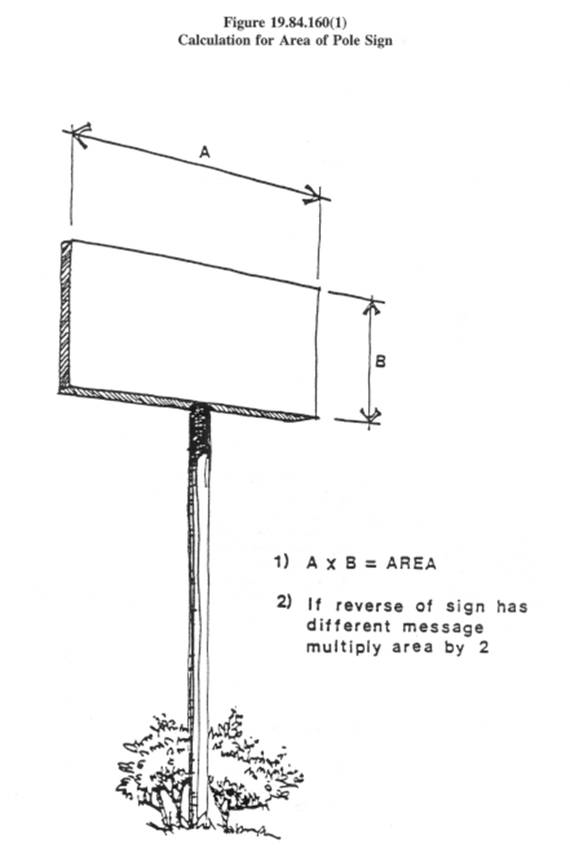
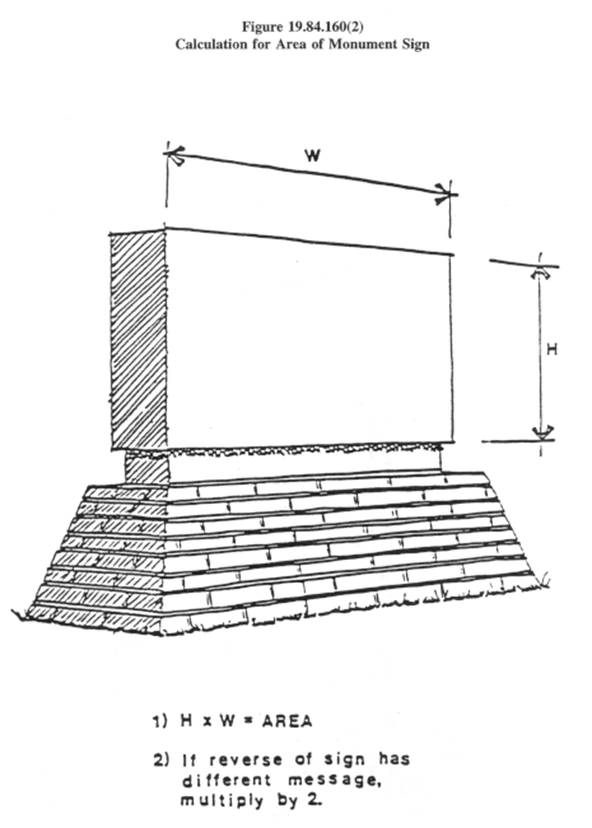
The area of a monument or pole sign is to be computed by multiplying the total height by the total length of the sign or signs for one (1) sided signs, excluding framework of separate single wood post or masonry column and single wood or masonry beam. The base of a monument sign shall not be considered part of the sign when constructed of wood or masonry (See Figures 19.84.160 (1) and (2));
B.
Where a two (2) sided monument or pole sign contains identical copy on each side, the area of the sign shall be computed by multiplying the total height by the total length of only one (1) side. (See Figures 19.84.160 (1) and (2));
C.
The area of a freestanding sign which has three (3) or more faces shall be computed by adding the areas of each face of the sign;
D.
The area of a freestanding sign that is an object or statuary shall be computed by the appropriate mathematical equation for determining total surface of an object.
(Prior code § 7225.05)
19.84.170 - Special sign provisions.
A.
Electronic time and temperature signs as part of an on-site advertising sign are permitted as regulated by development standards. Signs with electronic face changes which do not flash, blink, travel, or animate may be permitted, provided that the message content changes no more frequently than every four (4) seconds, and all messages are limited to the advertising of on-site products or services.
B.
Exit, entrance or other on-site traffic directional signs are permitted, provided that the signs do not exceed six (6) feet in height and contain no advertising or message other than for traffic directions.
C.
Illuminated signs in storefront window glazing visible from a public street shall be considered signs and shall comply with the requirements of this chapter.
D.
Special signing required for drive-in windows for drive-in restaurants, banks or similar businesses is permitted, provided the sign copy is necessary for information, instruction or directions and specifically related to the special use, subject to review and approval of the planning director, who shall use discretion in approval of subject signs related to number, location, height, size and design.
E.
Signs for uses approved in conjunction with a conditional use permit shall be as specified in the conditions of approval for that conditional use permit.
F.
Temporary special event signs and promotional devices, including, but not limited to, portable signs, balloons and inflated devices, and searchlights may, where not otherwise permitted by this chapter, be authorized by the planning director for up to forty-five (45) days per calendar year at any one (1) location. Balloons and inflated devices shall not exceed an overall height of one hundred (100) feet and shall be securely anchored to the ground or a structure.
(Ord. G-7482 § 103, 2007; Ord. G-7012 § 51, 2003; Ord. G-6864 § 65, 2002; Ord. G-6077 § 286, 1994; Ord. G-5684 §§ 89, 90, 1991; Ord. G-4832 § 170, 1988; prior code § 7225.06)
19.84.180 - Nonconforming signs.
Nonconforming signs shall be subject to the requirements of Section 19.108.070 of this title.
(Prior code § 7225.07)