


Kern County Unincorporated
City Zoning Code
City Zoning Code
CHAPTER 19
81 - OUTDOOR LIGHTING "DARK SKIES ORDINANCE"
19.81.010 - Purpose and application.
A.
Residents in many areas of Kern County currently enjoy a dark night sky and have expressed interest in continued access to natural dark skies. In order to maintain the existing character of Kern County, a minimal approach shall be taken to outdoor lighting, as excessive illumination can create a glow that may obscure the night sky and excessive illumination or glare may constitute a nuisance. The purpose of this chapter is to provide requirements for outdoor lighting within specified unincorporated areas of Kern County in order to accomplish the following objectives:
1.
Encourage a safe, secure, and less light-oriented nighttime environment for residents, businesses, and visitors.
2.
Promote a reduction in unnecessary light intensity and glare, and to reduce light spillover onto adjacent properties.
3.
Protect the ability to view the night sky by restricting unnecessary upward projections of light.
4.
Promote energy conservation and a reduction in the generation of greenhouse gases by reducing wasted electricity that can result from excessive or unwanted outdoor lighting.
B.
The figures/drawings incorporated in this chapter or shown on informational sheets produced by the county of Kern are provided as guidelines for the public and staff to use in meeting the intent of this chapter. The figures serve only as examples. The county of Kern does not endorse or discriminate against any manufacturer or company that may be shown, portrayed, or mentioned as examples.
C.
Should a conflict arise between this chapter and the California Green Building Standards Code, the more restrictive of the two shall apply.
(Ord. No. G-8226, § 84, 11-8-11)
19.81.020 - Definitions.
For the purposes of carrying out the intent of this title, words, phrases, and terms shall be deemed to have the meaning ascribed to them below. In construing the provisions of this title, specific provisions shall supersede general provisions relating to the same subject, and text shall supersede diagrams relating to the same subject. Words, phrases, and terms not defined in this section shall have the meaning commonly or logically associated therewith.
A.
Architectural Feature: Unique roofline, gable, mast, extension, overhang, or other architectural embellishment intended to add architectural interest to a building or structure.
B.
Attached Lighting: A light fixture that is attached to a building or structure. Any light fixture that is directly or indirectly attached to a structure with a diameter and/or width of more than twelve (12) inches is considered attached lighting.
C.
Fixture: A complete lighting unit including the lamp and parts designed to distribute the light, position and protect the lamp, and connect the lamp to a power source. Also referred to as a luminaire. The fixture may include an assembly housing, a mounting bracket or polo socket, lamp holder, ballast, a reflector or mirror, and a refractor or lens.
D.
Floodlight: An outdoor lighting fixture intended to illuminate a large area. Often utilized to broadcast light over a substantial area for security and recreational purposes.
E.
Freestanding Lighting: A light fixture that is not attached to a building or structure. Any light fixture attached to a structure with a diameter and/or width of twelve (12) inches or less (such as a pole) is considered freestanding lighting.
F.
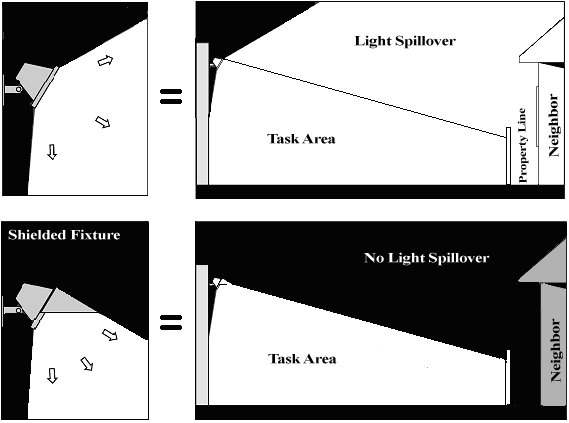
Fully Shielded: An outdoor lighting fixture that is shielded with a non translucent barrier or constructed in such a manner that the light rays emitted by the fixture, either directly from the lamp or indirectly from the fixture, are projected below a horizontal plane passing through the lowest point of the fixture where light is emitted. Light rays emitted by a fully-shielded fixture shall not cast direct light onto any adjacent property other than a common solid fence (See Figures in Section 19.81.040(A).
G.
Glare: A direct and unshielded light striking the eye to result in reduced visual performance.
H.
Incandescent: Light produced by a filament heated to a high temperature by electric current.
I.
Internally Illumined Signage: Sign illuminated by a light source internal to sign enclosure and not directly visible externally.
J.
Lamp/Bulb: A generic term for an artificial light source typically installed in the socket portion of a fixture. Commonly referred to as a bulb.
K.
Light Pollution: Any adverse effect of artificial light sources including, but not limited to, discomfort to the eye or diminished vision due to glare, uncontrolled uplighting, uncomfortable distraction to the eye, or any artificial light that substantially diminishes the view of the night sky.
L.
Lumen: A unit of standard measurement used to describe the amount of light that is produced; a measurement of the brightness/intensity of a light source.
M.
Low Voltage Landscape Lighting: Freestanding electric lighting powered fifteen (15) volts or less and limited to sixty (60) watts or seven hundred fifty (750) lumens, whichever is less, per fixture, for the purpose of illuminating trees, shrubbery, and other natural external elements.
N.
Night Sky: The overhead sky, between dusk and dawn; ideally allows view of stars, despite necessary or desired illumination of private and public property.
O.
Outdoor Lighting Fixture: Any lighting fixture that is installed, located, or used in such a manner to provide illumination of objects or activities outside. Outdoor lighting fixtures include all fixtures mounted to the exterior of a structure, poles, or other freestanding structures, or placed so as to provide direct illumination on any exterior area or activity.
P.
Outdoor Performance/Sport/Recreational Facilities: Public or private facilities designed for the conduct of sports, leisure activities, and other customary recreational activities.
Q.
Partially Shielded Fixture: A fixture employing a top shield to eliminate all direct upward light, but otherwise does not shield the lamp from view. May allow some light to pass through a semi-translucent barrier, and/or may allow visibility of the lamp/bulb from certain perspectives.
R.
Seasonal Lighting: Seasonal displays of forty-five (45) days or less within one (1) calendar year.
S.
Temporary lighting: means lighting that is intended to be used for a special event for twelve (12) days or less per calendar year.
T.
Uplight: Light emitted from a fixture into the hemisphere at or above the horizontal plane. Uplighting is prohibited, except as permitted by Section 19.81.040(F)
(Ord. No. G-8226, § 84, 11-8-11)
19.81.030 - Applicability.
A.
New Outdoor Lighting. All new temporary or permanent outdoor lighting fixtures that is both permitted and installed on and after the effective date of this chapter shall conform to the requirements established by this chapter.
B.
Existing Outdoor Lighting. All existing outdoor lighting fixtures installed prior to the effective date of this chapter shall be addressed as follows:
1.
Legal, nonconforming: All outdoor light fixtures which are existing and legally installed prior to the date of adoption of this chapter are legal, nonconforming uses and are exempt from the requirements of this chapter.
2.
Additions or Alterations to Property: When an addition of fifty percent (50%) or more in terms of additional dwelling units, gross floor area, cumulative seating capacity, parking spaces, either with a single addition or with cumulative additions occurs on any property, all existing nonconforming lighting fixtures on the entire property shall be made to comply with the requirements of this chapter. Additionally, all new outdoor lighting fixtures shall meet the requirements of this chapter.
(Ord. No. G-8226, § 84, 11-8-11)
19.81.040 - General requirements.
The following general standards apply to all outdoor lighting fixtures subject to this ordinance.
A.
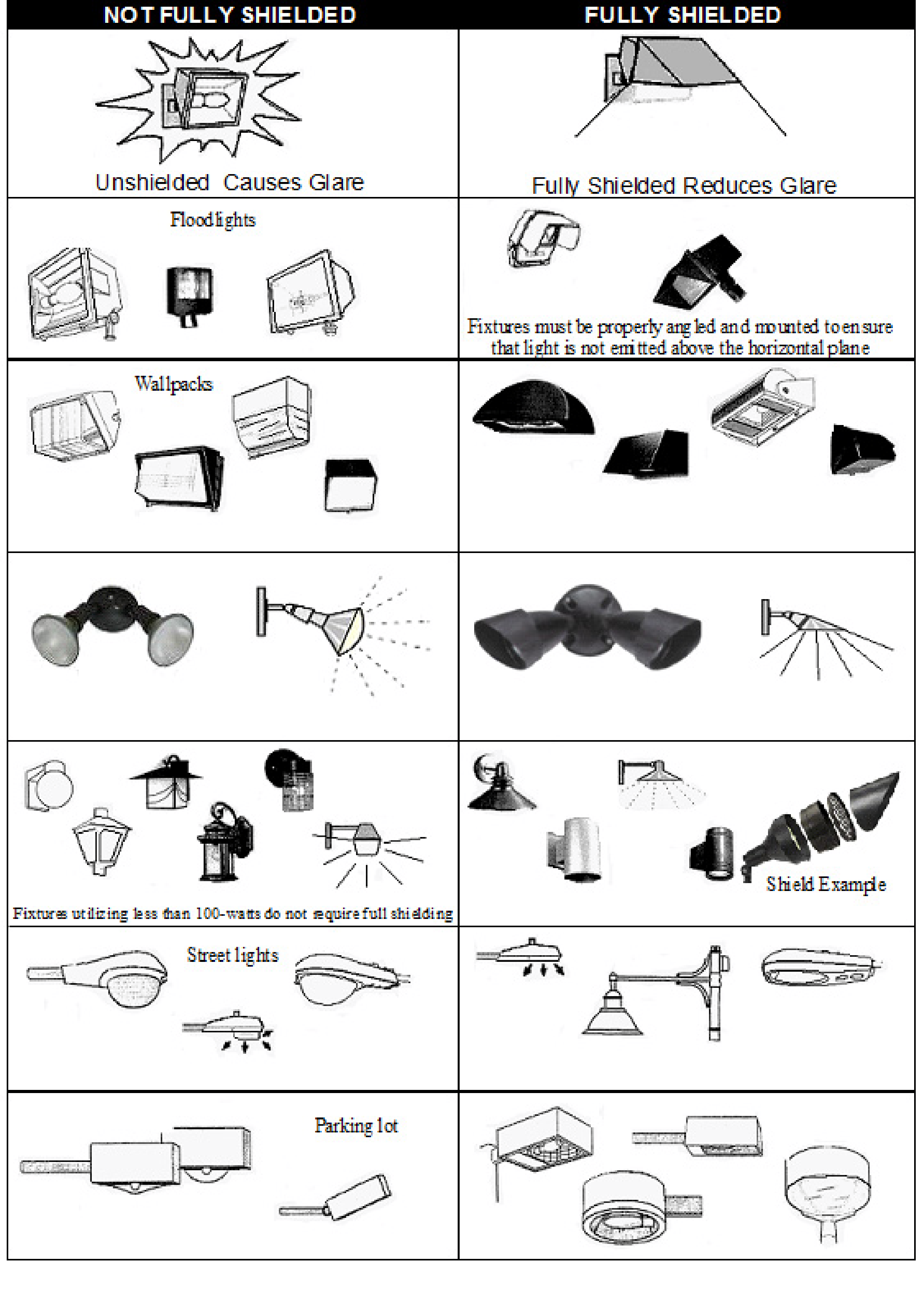
Shielding. All outdoor lighting fixtures which utilize one hundred (100) watts or more (based on an incandescent bulb), or emit one thousand six hundred (1,600) lumens or more per fixture, shall be fully shielded per the definition listed in this chapter, unless the fixture is exempted by this chapter. All floodlights which utilize less than one hundred (100) watts per fixture must be at least partially shielded to reduce light spillover onto adjacent properties.
Additionally, the light source (bulb) within all lighting fixtures shall be oriented downward to prevent direct uplighting, except as permitted by Section 19.81.040(F).
B.
Prohibited Light Source Types. The following exterior light source types shall be prohibited in and within twenty-five (25) feet of all residential zone districts (E, R-1, R-2, and R-3): metal halide, mercury vapor, and quartz.
C.
Maintanence. Outdoor light fixtures shall be kept in good working order and shall be continuously maintained in a manner that serves the original design intent of the system and ensures continued compliance with this chapter.
D.
Fixture Height. All light fixtures that are mounted on a building or structure (attached lighting) and all lighting fixtures that are not attached (freestanding lighting) shall conform to the mounting height limitations as listed in the table below (Table 19.81.050.C.1). Maximum fixture height shall be measured from the finished interior grade of the mounting area to the top point of the lighting fixture.
E.
Fixture Types. The following figures illustrate examples of fully shielded and not fully shielded outdoor lighting fixtures. Note: Even those types of fixtures shown as fully shielded must be installed and aimed properly to comply with this chapter.
F.
Uplighting And Lighting Aimed Against Structures Or Landscaping. Direct upward lighting and lighting aimed against structures shall be prohibited except as follows:
1.
Accent lighting of architectural features: Architectural features may be illuminated by vertical uplighting, provided that no glare or off-site light spillover is produced. Lamps used for this type of accent lighting shall be low intensity to produce a subtle lighting effect and shall utilize less than one hundred (100) watts and shall emit less than one thousand six hundred (1,600) lumens per fixture.
2.
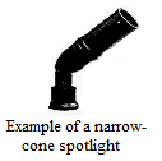
Accent lighting of other objects: For statues, public art, or other objects of interest where the light cannot be effectively contained by the structure and where objects cannot be illuminated with down lighting, upward lighting may be used in the form of narrow-cone spotlights that utilize less than one hundred (100) watts and emit less than one thousand six hundred (1,600) lumens and confine the illumination to the object of interest. Unrestricted uplighting of a displayed United States Flag or the State of California State Flag shall be permitted.
3.
All other lighting aimed against structures: An outdoor lighting fixture may be aimed against a structure only if: (1) the light is effectively contained by the structure; (2) no glare is visible from off site; and (3) the fixture is fully shielded so that none of the light which is emitted above the horizontal plane crosses over the property line of the parcel where the subject light is located.
4.
Low voltage landscape light: Low voltage landscape lighting such as that used to illuminate fountains, shrubbery, trees, walkways, etc., shall be permitted provided that such lighting is limited to fixtures utilizing a maximum of sixty (60) watts (or seven hundred fifty (750) lumens, whichever is or less), per fixture, the fixture is not mounted to poles or buildings, and the fixture is shielded to eliminate glare and light spillover onto adjacent properties.
G.
Outdoor Performance, Sport And Recreational Facilities.
1.
Where playing fields or other special activity areas are to be illuminated by floodlight, lighting fixtures shall be mounted, aimed, and shielded so that their beams fall within the primary playing area and immediate surroundings, and so that off-site light spillover onto any residentially zoned (E, R-1, R-2, R-3) property is minimized. This subsection shall not apply to legal, nonconforming fixtures.
2.
Recreational facilities shall be illuminated for public or private use only when the facility is being utilized, except for security lighting authorized by Section 19.81.040.J. All non-security lighting must be turned off no later than 11:00 p.m. or thirty (30) minutes after the termination of the event and/or use, whichever occurs last. At the conclusion of the event and/or use, a reduced-level lighting system shall be used to facilitate patrons leaving the facility, cleanup, nighttime maintenance, and other closing activities. This subsection shall not apply to legal, nonconforming fixtures and illumination patterns.
H.
New Off-Site And On-Site Outdoor Advertising Signs. New off-site outdoor advertising signs installed after the effective date of this chapter and which include externally mounted light fixtures shall be subject to the following: The externally mounted light fixtures shall be mounted to the top of the adverting structure, shall be oriented downward and shall be fully shielded, except for fixtures utilizing less than one hundred (100) watts and emitting less than one thousand six hundred (1,600) lumens per fixture. Externally mounted light bulbs or lighting tubes that are not filled with neon, argon, or krypton shall not be visible from any portion of an adjacent public right-of-way or adjoining property. Internally illuminated signs shall be exempt from this chapter and shall be regulated as set forth by Chapter 19.84 (Signs) of the Kern County Zoning Ordinance.
I.
Searchlights and Laser Lights.
1.
Searchlights and laser lights may only be utilized in the following circumstances:
a.
As approved in conjunction with a temporary event permit (TEP) issued by the Kern County Planning and Community Development Department pursuant to Section 19.08.340.
b.
In conjunction with grand openings where a TEP is not required. A grand opening shall commemorate an initial building or project opening, a change in ownership of an exiting business, or remodel/enlargement of over fifty percent (50%) of the floor area or a new business in an existing building. Use of a searchlight or laser light in conjunction with a grand opening shall not exceed a combined total of three (3) days in any calendar year.
c.
In emergencies, by/at the direction of sheriff/fire or other emergency personnel.
J.
Hours Of Operation (Curfew) And Security Lighting.
1.
Outdoor light fixtures located anywhere within a residential zone district (E, R-1, R-2, R-3) or within any other zone district where the new fixture is located within twenty-five (25) feet of an existing single-family residence, shall adhere to the following:
a.
Lighting fixtures (such as carriage lights, under-eave lights and porch lights) that utilize less than one hundred (100) watts and emit less than one thousand six hundred (1,600) lumens per fixture and that do not project light above the horizontal plane shall not be subject to an illumination curfew.
b.
Security lighting fixtures that utilize one hundred (100) watts or more (or emit one thousand six hundred (1,600) lumens or more) shall be controlled by a motion-sensor device if used after 11:00 p.m., and the fixture shall only be illuminated when activated by the device. The motion sensor device shall be programmed so that the fixture remains illuminated for no more than ten (10) minutes if activated by the device. Each fixture shall conform to all other provisions of this chapter, including shielding requirements.
c.
All other non-exempt outdoor lighting fixtures shall be turned off between the hours of 11:00 p.m. and sunrise.
2.
Outdoor lighting fixtures located outside of a residential zone district (E, R-1, R-2, R-3), or located more than twenty-five (25) feet from any existing single-family residence within any other zone district shall adhere to the following:
a.
All lighting fixtures shall be subject to the shielding provisions as listed in Section 19.81.040 of this chapter.
b.
Lighting fixtures listed under this provision shall not be subject to an illumination curfew.
(Ord. No. G-8226, § 84, 11-8-11)
19.81.050 - Exemptions.
The following are permanently exempt from the provisions of this chapter:
1.
Outdoor lighting specifically approved in conjunction with a discretionary permit.
2.
Federal and State Facilities: Outdoor light fixtures on, in, or in connection with facilities and land owned or operated by the government of the United States of America or the State of California; however, these agencies are encouraged to comply with the provisions of this chapter.
3.
Airports and Other Lighting Required by the Federal Aviation Administration: Outdoor lighting for public and private airports and any other uses that are regulated by the Federal Aviation Administration.
4.
Correctional Institutions: Outdoor lighting for federal, state, and county-owned or operated correctional institutions; however, voluntary compliance with the intent and provisions of this chapter is encouraged.
5.
Emergency Light: Temporary emergency lighting needed by the sheriff's department, police department, fire department, public utility, rescue operation or in conjunction with any other emergency service.
6.
Temporary Construction: All temporary lighting used for the construction or repair of roadways, utilities, and other public infrastructure.
7.
Internally Illuminated Signs: All internally illuminated signs, including those used for on-site and off-site advertising purposes. Such signs are regulated by the provisions of Chapter 19.84 (Signs) of the Kern County Zoning Ordinance.
8.
Neon, Argon, or Krypton: All fixtures illuminated solely by neon, argon, or krypton.
9.
United States Flag and State of California Flag: Lighting used to illuminate a properly displayed United States Flag and/or the State of California Flag.
10.
Lighting Required by Building Codes or other Regulations: Communication towers, exit signs, lighting for stairs/ramps, lighting for points of ingress/egress to buildings, and all other illumination required by air navigation safety provisions, building codes, OSHA standards, and other permitting requirements from State or federal agencies.
11.
Fossil Fuel Light: All outdoor light fixtures producing light directly by the combustion of fossil fuels (such as kerosene lanterns, gas lamps, etc.)
12.
Street Lighting: Lighting equipment within a public or private right-of-way or easement for the principal purpose of illuminating streets, roadways, and/or other areas open to transport by vehicle or pedestrian traffic.
13.
Seasonal Displays: Displays using multiple low wattage bulbs or lasers, provided that they do not constitute a fire hazard, create a nuisance, and are maintained in a safe condition. Such displays shall not be illuminated for more than forty-five (45) days per calendar year.
14.
Water Features: Lighting in swimming pools and other water features governed by Article 680 of the National Electrical Code.
15.
Temporary Event Lighting: Temporary lighting for special events that does not conform to this chapter shall be reviewed as part of an application for a Temporary Event Permit (TEP), pursuant to Chapter 19.08.340 of the Kern County Zoning Ordinance. Any temporary lighting exemption approved via the TEP process shall be utilized for a period of time that exceeds a combined total of twelve (12) combined days on any one (1) parcel during a calendar year. Exemptions are renewable for a period of not more than twelve (12) additional combined days. Requests for renewal of a temporary exemption shall be processed in the same manner as the original request. No outdoor light fixtures shall be exempted from this chapter for more than twenty-four (24) days combined during a calendar year.
16.
Steeples: Lighting used to illumination the tall ornamental tower that forms the superstructure of a church, temple, office building, etc., shall be exempt from this chapter.
17.
Temporary Agricultural Activities: Lighting used to illuminate temporary agricultural activities such as harvesting on property zoned A (Exclusive Agriculture) or A-1 (Limited Agriculture) and lasting no more than twelve (12) consecutive days and no more than twenty four (24) combined days on any one (1) parcel during a calendar year.
(Ord. No. G-8226, § 84, 11-8-11; Res. No. 2020-116, § 2, 5-19-20; Ord. No. G-8992, § 22, 3-8-21)
19.81.060 - Outdoor lighting plans.
A.
An outdoor lighting plan shall be submitted in conjunction with any application for a building permit within a commercial or industrial zone district (CO, CH, C-1, C-2, M-1, M-2, M-3) where new outdoor lighting fixtures will be installed as a part of the project for which the building permit is required. At minimum, an outdoor lighting plan shall include the following:
1.
Manufacturer specification sheets, cut sheets, or other manufacturer provided information for all proposed outdoor lighting fixtures to show fixture diagrams, light source type, and light output levels (in watts or lumens per fixture).
2.
The proposed location, mounting height, and aiming point of all outdoor lighting fixtures (a site plan is preferred).
3.
If building elevations are proposed for illumination, the plan shall include drawings for all relevant building elevations showing the placement of fixtures, the portions of the elevations to be illuminated, and the aiming point for any remote light fixture.
4.
The outdoor lighting plan shall be correlated with any required landscaping plan that is submitted with the building permit application package and shall demonstrate that outdoor lighting shall not be unreasonably obscured or obstructed by existing or future foliage growth.
B.
The above required plans and descriptions shall be sufficiently complete to enable the Kern County Engineering, Surveying, and Permit Services Department to readily determine whether the proposal is in compliance with this chapter. If such plans and descriptions do not enable this determination, the director of that department may require additional information following the initial outdoor lighting plan submittal, including but, not limited to; a written narrative to demonstrate the objectives of the lighting and manufacturer data as determined by that department as being necessary to determine compliance with the provisions of this chapter.
(Ord. No. G-8226, § 84, 11-8-11)
19.81.070 - Violations and complaints.
A.
All outdoor lighting fixtures installed after the effective date of this chapter shall conform to the requirements established by this chapter. It shall be unlawful and a nuisance to install or operate any new outdoor lighting fixture in violation of this chapter.
B.
Complaints: Complaints alleging noncompliance with the provisions of this chapter shall be filed with the Kern County Engineering, Surveying, and Permit Services Department/Code Compliance Division. Complaints shall be filed in writing and shall specifically cite the applicable provisions of this chapter for which the complaint is submitted. Photographic evidence to support the alleged noncompliance may be submitted with written complaints.
(Ord. No. G-8226, § 84, 11-8-11)
19.81.080 - Persons seeking an exception to this chapter.
A.
Any person desiring to install or operate an outdoor lighting fixture in such a manner that is not permitted by this chapter may apply for relief from the regulation in question. Any such request shall include the following:
Exceptions: The applicant shall submit a written request to the planning director. The request shall include a written description of the proposed lighting, shall address the need for the lighting, shall describe the type of shielding to be utilized, if any, and a shall include a statement as to how the lighting fixture will be made to comply with the overall objectives of this chapter. The written statement shall be accompanied by photographs of any affected existing lighting fixtures and a filing fee of two hundred fifty dollars ($250.00). In the case of new lighting fixtures, the request shall include a copy of the manufacturer's specifications. Upon a determination that sufficient information has been submitted to adequately consider the requested exception, the exception shall be considered generally according to the procedures set out in Sections 19.102.080, 19.102.100, 19.102.110, and 19.102.120 of the Kern County Zoning Ordinance, and as set forth below:
1.
Not fewer than seven (7) days prior to the date on which the decision will be made regarding issuance of the exception, a notice of opportunity for public hearing shall be sent by mail or delivered to the property owners of all parcels which abut the exterior boundaries of the property for which the exception is being requested. No hearing on the application shall be held before a decision is made unless a hearing is requested by the applicant tor other affected person.
2.
If a public hearing is requested by the applicant or other affected person, a notice of public hearing shall be sent by mail or delivered to all property owners of property located within a one hundred (100) foot radius of the exterior boundaries of the property for which the exception is being requested, so that the request can be considered at a hearing to be held by the planning director. The application shall be scheduled for consideration at the next available hearing that would allow for adequate time for public advertisement of the project. After considering input at a public hearing, the planning director shall render a decision in accordance with Section 19.102.100 of the Kern County Zoning Ordinance, subject to the findings specified in subsection (B) of this section.
B.
An exception shall only be granted if it is determined that strict application of the requirements of this chapter will create an undue hardship on the applicant and it can be determined that the objectives of this chapter will still be realized in granting the exception.
C.
Appeals: Any affected party may appeal the decision of the planning director to the board of supervisors as provided for in Section 19.102.110 of the Kern County Zoning Ordinance.
(Ord. No. G-8226, § 84, 11-8-11)