


Kronenwetter City Zoning Code
§ 520-86
Exterior storage standards.
A.
Purpose. The purpose of this section is to regulate the use of property for exterior storage, except as otherwise specifically regulated in this article. This section is designed to promote the safety and general welfare of the public. Additional standards for outdoor storage applicable to specific land uses as specified in article IV shall also apply.
B.
Exterior trash and recyclable storage. Exterior (outside) storage of trash shall be subject to applicable standards in chapter 441 of the Municipal Code. Within each residentially and RR zoned property, there shall be no construction dumpster for a period greater than 30 days in any calendar year, except with the written approval of the zoning administrator. For all land uses other than a single-family detached residence, two-family residence, and any agricultural use, all exterior storage of trash and recyclables, including associated containers, carts, and enclosures, shall further meet all of the following requirements:
(1)
Trash and recyclables shall be subject to accessory structure setback requirements included in figures V(2) and V(6).
(2)
Trash and recyclables shall not be placed in any minimum required front or streetside yard.
(3)
Trash and recyclables shall be placed to the interior side or rear of the principal structure, unless such a location is not possible in the determination of the zoning administrator.
(4)
Trash and recyclables shall be placed on a permanent hard surface.
(5)
All trash and recyclables shall be fully screened from public rights-of-way and adjacent residential properties by any combination of building walls and decorative, opaque fences, walls, and gates not exceeding six feet in height. See example in figure 520-86. Chain-link fences and gates with slats are not permitted for this purpose.
(6)
All enclosures shall be equipped with a solid door or gate, which shall be used to gain access to the storage area.
(7)
Prior to installation, the enclosure design and location shall be approved by the user's contracted solid waste/recycling hauler to ensure reasonable access by the service truck.
(8)
The exterior storage of trash or recyclables, and associated dumpsters, carts, and enclosures, which are not in compliance with this subsection as of the effective date of this chapter shall have one year from such date to comply.
Figure 520-86: Example of Appropriate Dumpster Enclosure Design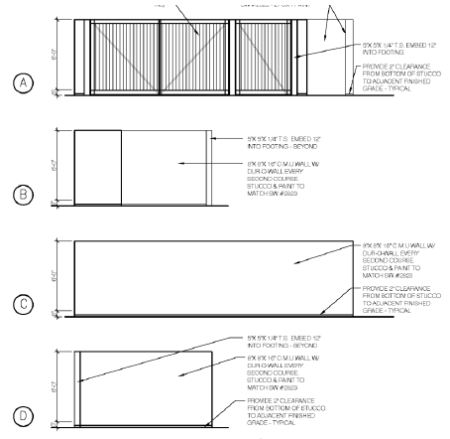
C.
Motor vehicle storage. Except in agricultural zoning districts, storage of operable and licensed motor vehicles shall be allowed in accordance with the hard- or gravel-surface setback requirements of article V and landscaped in accordance with article XI. Storage or parking of semitrailers, buses, and heavy-duty trucks in residential districts is prohibited.
D.
Inoperable vehicles and junk. The outside storage of inoperable or unlicensed vehicles, appliances, and other junk or trash shall be prohibited, except for within junkyard or salvage yard land uses approved in accordance with the requirements of this chapter. Storage of inoperable vehicles is also subject to the regulations set forth in chapter 382 of the Kronenwetter Municipal Code.
(Ord. No. 16-07, 6-20-2016)