


Kronenwetter City Zoning Code
§ 520-90
Exterior lighting standards.
A.
Purpose. The purpose of this section is to regulate the spillover of light and glare on operators of motor vehicles, pedestrians, and land uses in the vicinity of a light source in order to promote traffic safety and to prevent the creation of nuisances.
B.
Applicability. The requirements of this section apply to all exterior lighting and all interior light visible from the exterior on private property within the jurisdiction of this chapter, except for lighting within public rights-of-way; on communications towers or airports, heliports, helipads, or other similar facilities where required to meet federal and state safety regulations; and as excepted in Subsection J.
C.
Depiction on required site plan. Any and all exterior lighting shall be depicted as to its location, orientation, and configuration on any site plan, if required under subsection 520-16.J.
D.
Orientation of fixture. Exterior lighting fixtures shall be full cutoff lighting fixtures. In no instance shall an exterior lighting fixture be oriented so that the lighting element (or a clear shield) is visible from a residentially zoned property or allowed to direct light skyward. Shielded luminaires and careful fixture placement shall be used to ensure that exterior lighting prevents direct lighting above a horizontal plane, except that architectural lighting that focuses all light below the roofline may exceed the horizontal plane. Search lights are prohibited except for any search light deemed necessary by the FAA.
Figure 520-90: Illustration of Required Pole Lighting Orientation and Height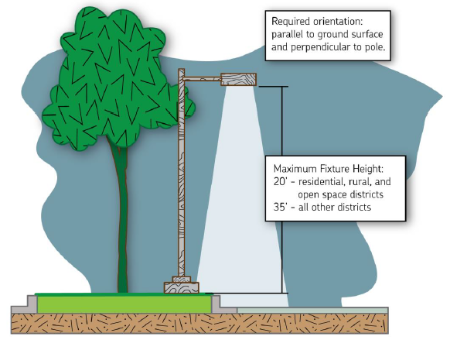
E.
Intensity of illumination. The amount of illumination attributable to exterior lighting, as measured at the property line, shall not exceed 2.0 footcandles above ambient lighting conditions on a cloudless night. The maximum average lighting within any lit area shall not exceed 5.0 footcandles, except where the zoning administrator determines that greater illumination is necessary for public safety.
F.
Fixture heights. The maximum height from the base of the pole or its support to the fixture shall be 20 feet in residential, rural, and open space zoning districts, and 35 feet in all other districts.
G.
Location. Light fixtures shall not be located within any required buffer yard under this chapter, or closer than three feet from a property line.
H.
Flashing, flickering and other distracting lighting. Flashing, flickering, moving (such as search spot or search lights), and/or other lighting that may distract motorists is prohibited.
I.
Qualitative requirements. Design and color of light fixtures and poles shall be compatible with building design and color on the same lot. Street intersections, driveway intersections, and pedestrian access routes shall be illuminated with lights of appropriate scale to the function, without providing an obviously uneven illumination pattern across the site.
J.
Exceptions. The appropriate site plan approval authority may grant exceptions to the requirements of this section in the following circumstances:
(1)
Outdoor recreation use and assembly areas such as athletic fields.
(2)
Gas station pump islands and other uses in which motor vehicles and pedestrians routinely operate in close proximity with one another. Use of recessed canopy lighting to minimize off-site impacts may be required.
(3)
Lighting for special events, per an approved special event permit.
K.
Nonconforming lighting. All lighting fixtures existing prior to the effective date of this chapter shall be considered legal conforming structures and may be continued (see article XIV). However, as part of a site plan approval for a new, expanded, or remodeled project or use on the same site, the site plan approval authority may require that such lighting be reoriented to achieve greater or full compliance with this section.
(Ord. No. 16-07, 6-20-2016)