
La Quinta City Zoning Code
CHAPTER 9
50 - RESIDENTIAL DEVELOPMENT STANDARDS
9.50.010 - Mobilehome park development standards.
Mobilehome parks shall conform to the following standards:
A.
Minimum thirty percent (30%) common open area;
B.
Landscaped perimeter setbacks for structures: minimum twenty (20) feet at any point and minimum twenty-five (25) feet average over the entire perimeter;
C.
Perimeter setbacks shall not count toward the common open area requirement or vice versa.
(Ord. 550 § 1, 2016; Ord. 284 § 1, 1996)
9.50.020 - Height limits and setbacks near image corridors.
In order to facilitate noise screening for residents and preserve visual openness, it is necessary to limit building heights for residential development. Therefore, notwithstanding the height standards set forth elsewhere in this code, additional height limitations shall apply to buildings within one hundred fifty (150) feet of the edge of right-of-way of the following general plan-designated image corridors:
A.
Image Corridors: All buildings shall not exceed twenty-two (22) feet in height. Any proposed building height over twenty-two (22) feet requires minor use permit approval and shall not exceed a maximum building height of the existing zone.
B.
Rear yard setbacks for residential units abutting the image corridors shall be a minimum of twenty-five (25) feet. The RVL development standard shall be required as specified in Section 9.30.020.
(Ord. 588 § 2(Exh. A), 2-2-2021; Ord. 550 § 1, 2016; Ord. 341 § 1, 2000; Ord. 325 § 1, 1998; Ord. 284 § 1, 1996)
9.50.030 - Table of development standards.
A.
Definitions. See Chapter 9.280.
B.
Table of Standards. Table 9-2 and the illustrations in Section 9.50.040, following, set forth standards for the development of property within residential districts. However, standards different from those in Table 9-2 shall apply if special zoning symbols described in Section 9.20.030 are designated on the official zoning map.
Table 9-2 Residential Development Standards
* As shown on the approved specific plan for the project.
** As provided in the underlying base district.
1 Minimum lot frontage on cul-de-sacs and knuckles shall be thirty-five (35) feet. Minimum lot frontage for flag lots shall be fifteen (15) feet.
2 Not including basements. Also, notwithstanding above table, the maximum structure height equals twenty-two (22) feet for all buildings within one hundred fifty (150) feet of any general plan-designated image corridor, except in the RC zone, which is seventeen (17) feet. Any proposed building height over twenty-two (22) feet requires minor use permit approval and shall not exceed a maximum building height of the existing zone.
3 Projects with five (5) or more adjacent single-family dwelling units facing the same street shall incorporate front setbacks varying between twenty (20) feet and twenty-five (25) feet or more in order to avoid streetscape monotony. For side-entry type garages, the garage setback may be reduced to twenty (20) feet in the RVL district and fifteen (15) feet in all other residential districts.
4 The following are exceptions to the minimum side setbacks shown: For interior side yards in the RL, RM and RMH districts, if the building is over seventeen (17) feet in height, the setback is five (5) feet plus one (1) foot for every foot over seventeen (17) feet in height or fraction thereof, to a maximum setback of ten (10) feet. The additional setback may be provided entirely at grade level or a combination of at grade and airspace above the seventeen (17)-foot building. For RH, five (5) feet minimum plus one (1) foot additional setback for every foot of building height above twenty-eight (28) feet, or fraction thereof, up to a maximum setback of fifteen (15) feet when said height above seventeen (17) feet is located between five (5) and ten (10) feet from said side yard property line. For interior setbacks, if the building is over twenty-eight (28) feet in height the setback is ten (10) feet plus one (1) foot for every foot over twenty-eight (28) feet in height or fraction thereof, to a maximum setback of fifteen (15) feet. The additional setback may be provided entirely at grade level or may be a combination of at grade and airspace above the twenty-eight (28)-foot building height.
5 Common open area and perimeter landscape requirements do not apply to single-family detached projects unless a specific plan is required. Common open area equals percent of net project area. Perimeter landscape setbacks are adjacent to perimeter streets: first number equals minimum at any point; second number equals minimum average over entire frontage (thus, 10/20). See Section 9.60.230 and additional landscape/open area standards.
6 Rear and side yard setbacks for residential units abutting the image corridor shall be a minimum of twenty-five (25) feet with the exception of RVL zone district where it only applies to the side yard.
7 Existing recorded lots prior to May 1, 1997.
(Ord. 606, § 1 (Exh. A), 2023; Ord. 588 § 2(Exh. A), 2-2-2021; Ord. 584 § 2, 2020; Ord. 562 § 1, 2017; Ord. 550 § 1, 2016; Ord. 466 § 1, 2009; Ord. 434 § 2, 2007; Ord. 325 § 1, 1998; Ord. 299 § 1, 1997; Ord. 284 § 1, 1996)
9.50.040 - Illustration of development standards.
Figure 9-1
DEVELOPMENT STANDARDS: RVL AND RL DISTRICTS
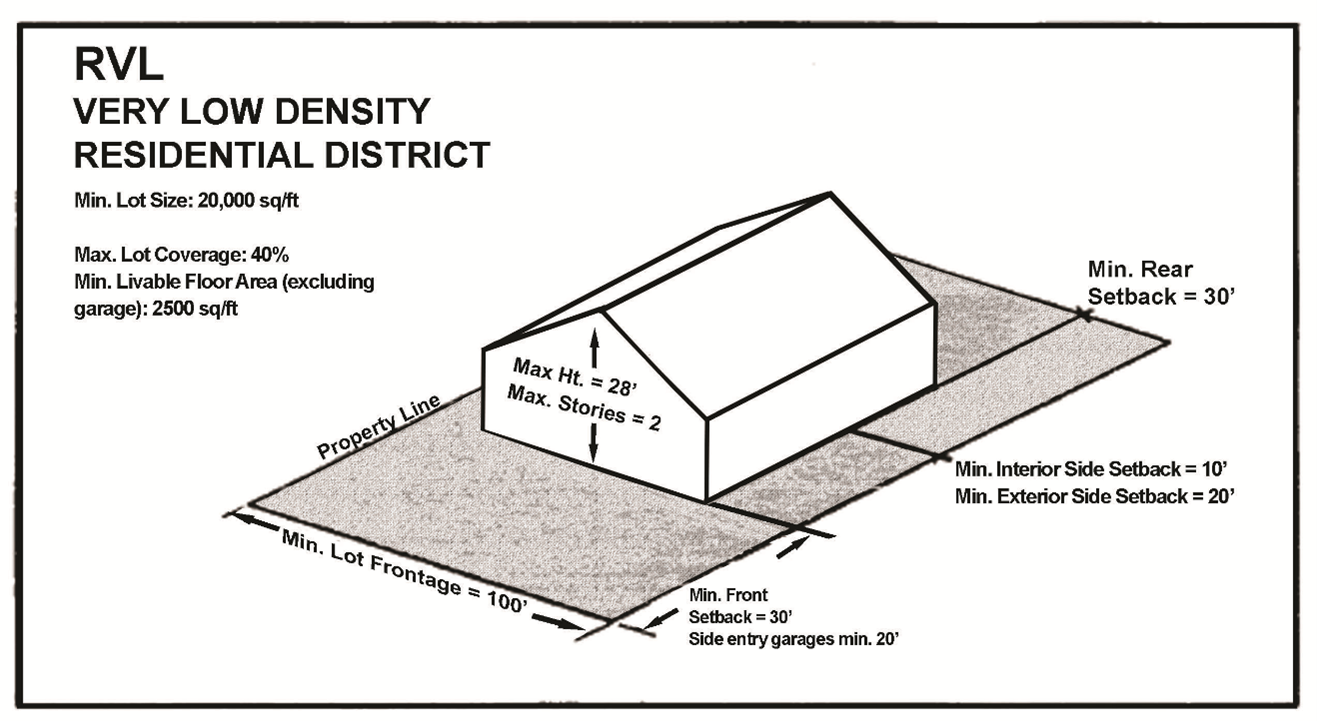
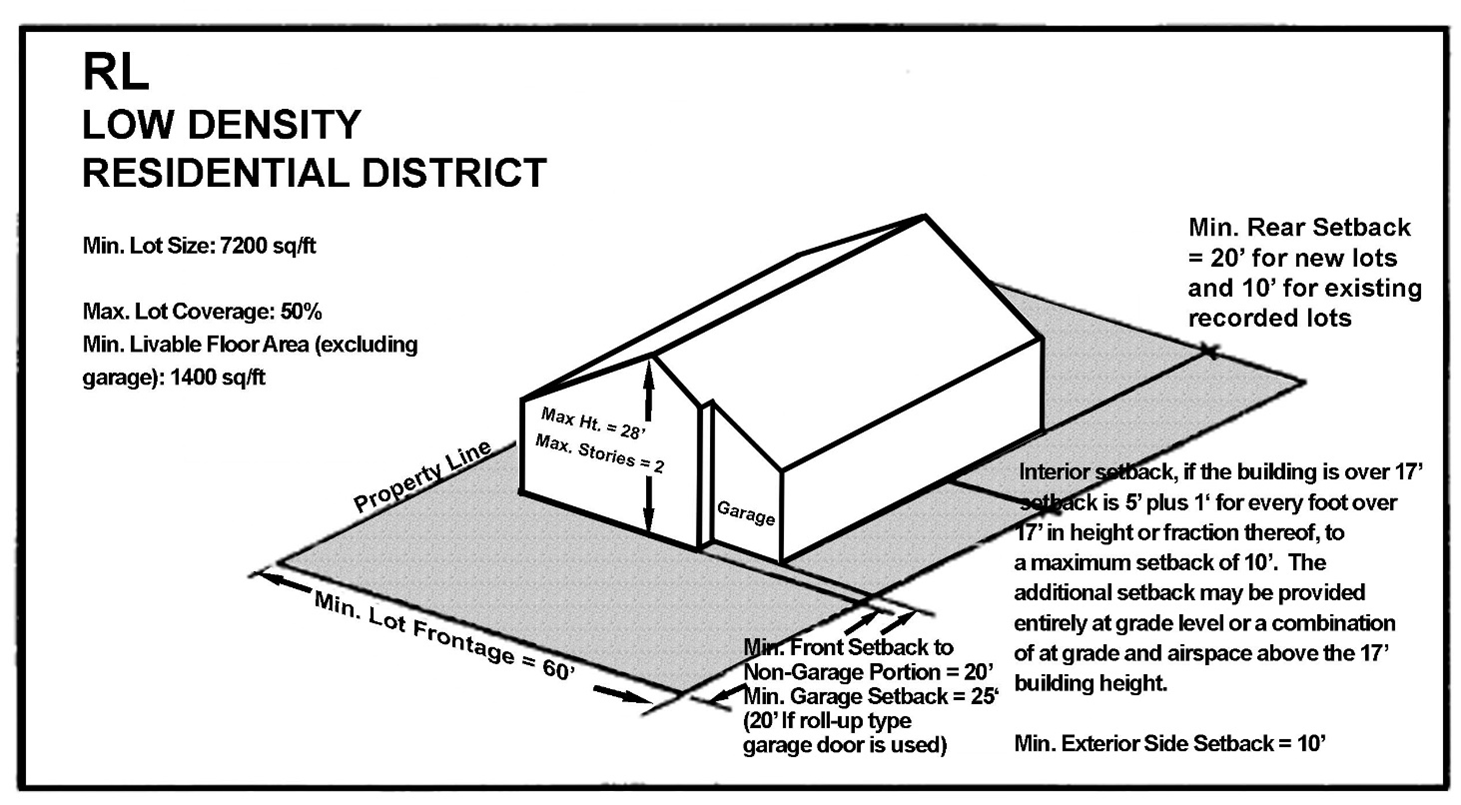
Figure 9-2
DEVELOPMENT STANDARDS: RC DISTRICT
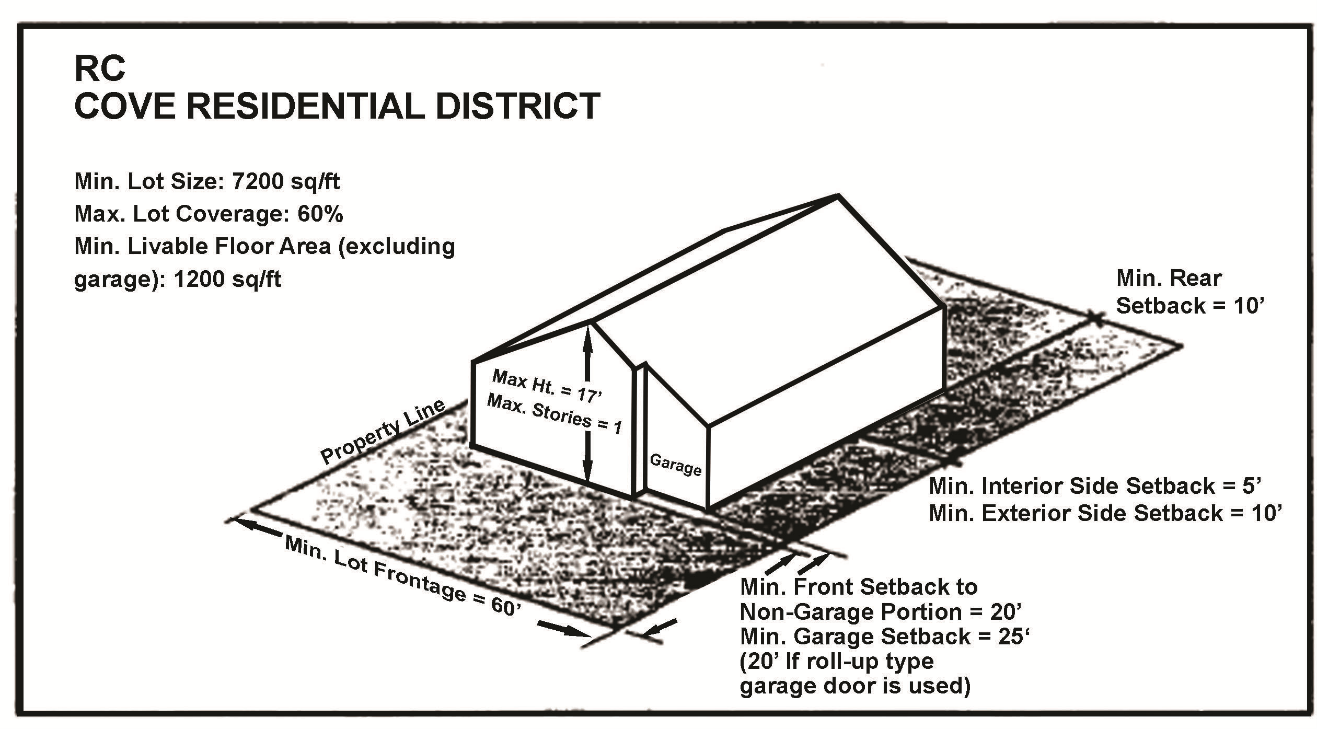
Figure 9-3
DEVELOPMENT STANDARDS: RM AND RMH DISTRICTS
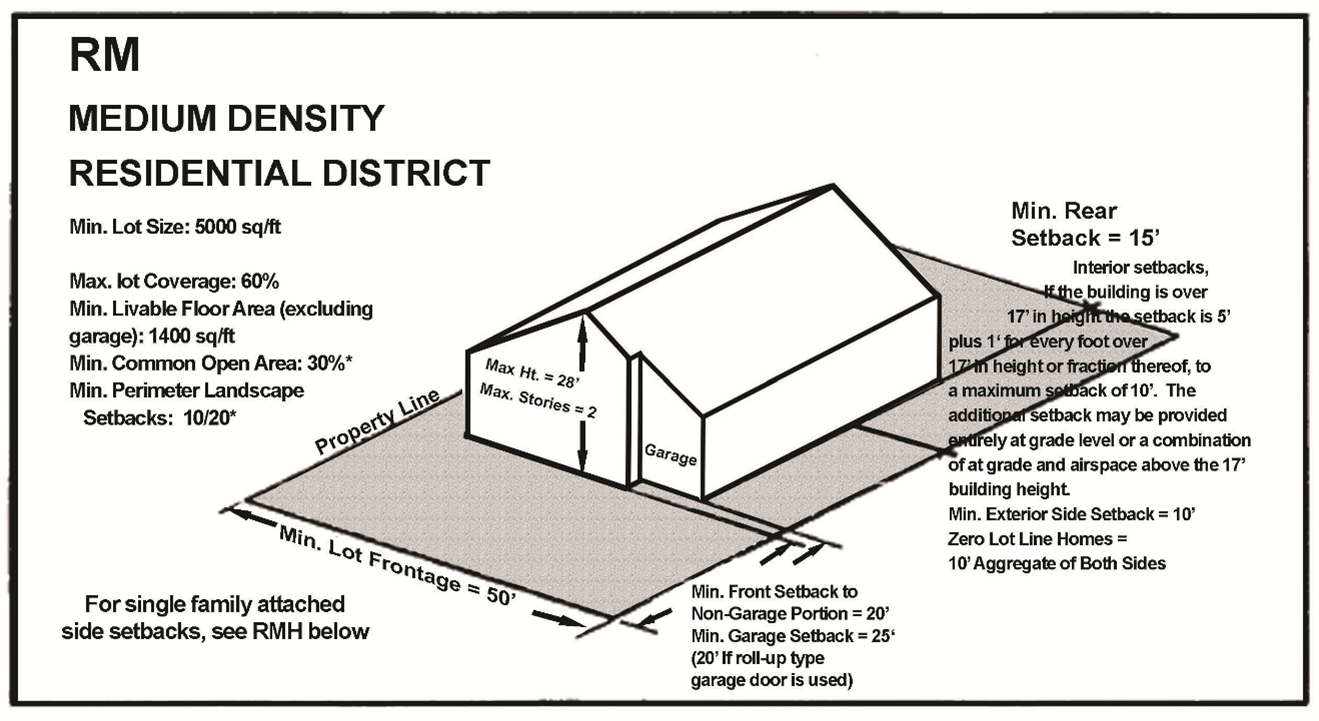
* Common open area = % of net project area. Perimeter landscape setbacks are adjacent to perimeter streets: 1st no. = min. at any point; 2nd no. = min. avg. over entire frontage (thus, 10/20). This standard does not apply to detached single family residential. See Section 9.60.240 for additional landscape/open area standards.
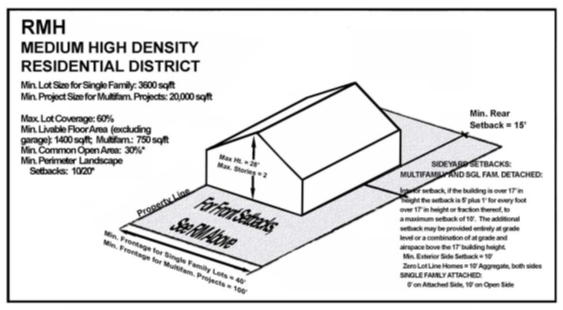
Figure 9-4
DEVELOPMENT STANDARDS: RH AND RSP DISTRICTS
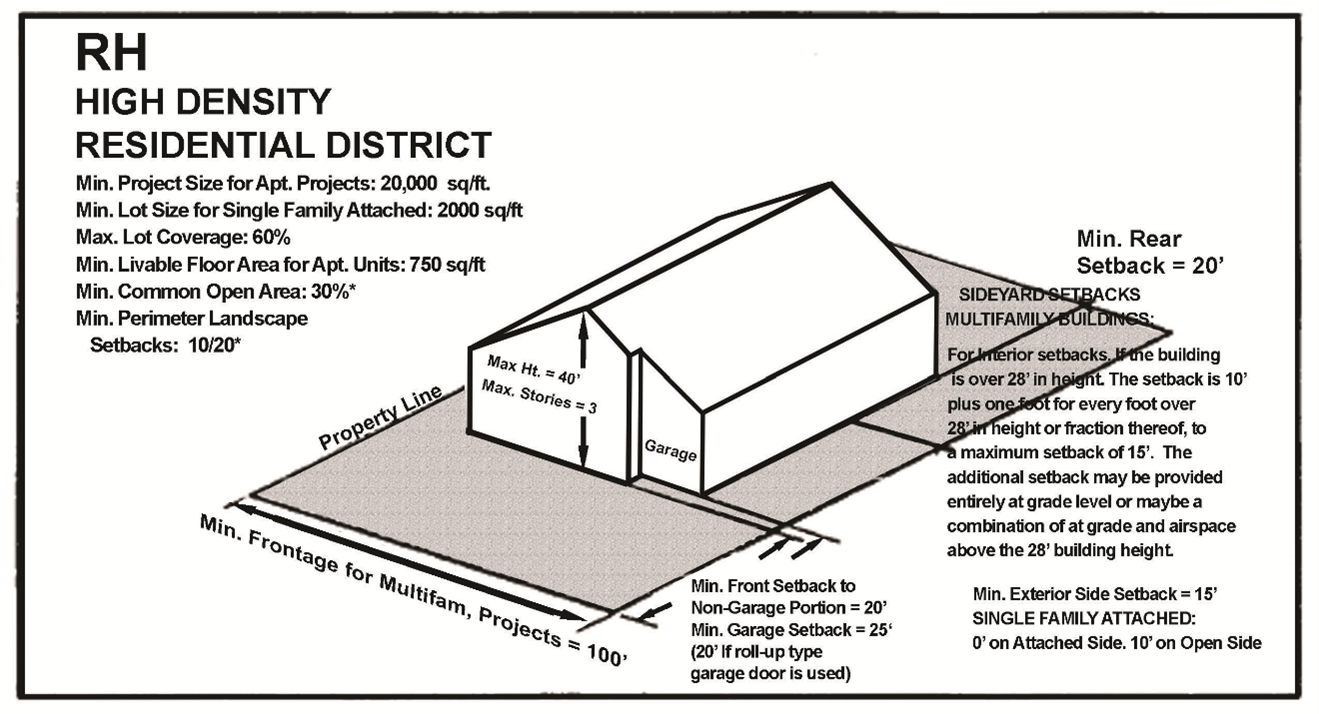
* Common open areas and perimeter landscape requirements do not apply to single family detached projects unless a specific plan is required. Common open areas = % of net project area. Perimeter landscape setbacks are adjacent to perimeter streets: 1st no. = min. at any point: 2nd no. = min. avg. over entire frontage (thus, 10/20). See Section 9.60.240 for additional landscape/open area standards.
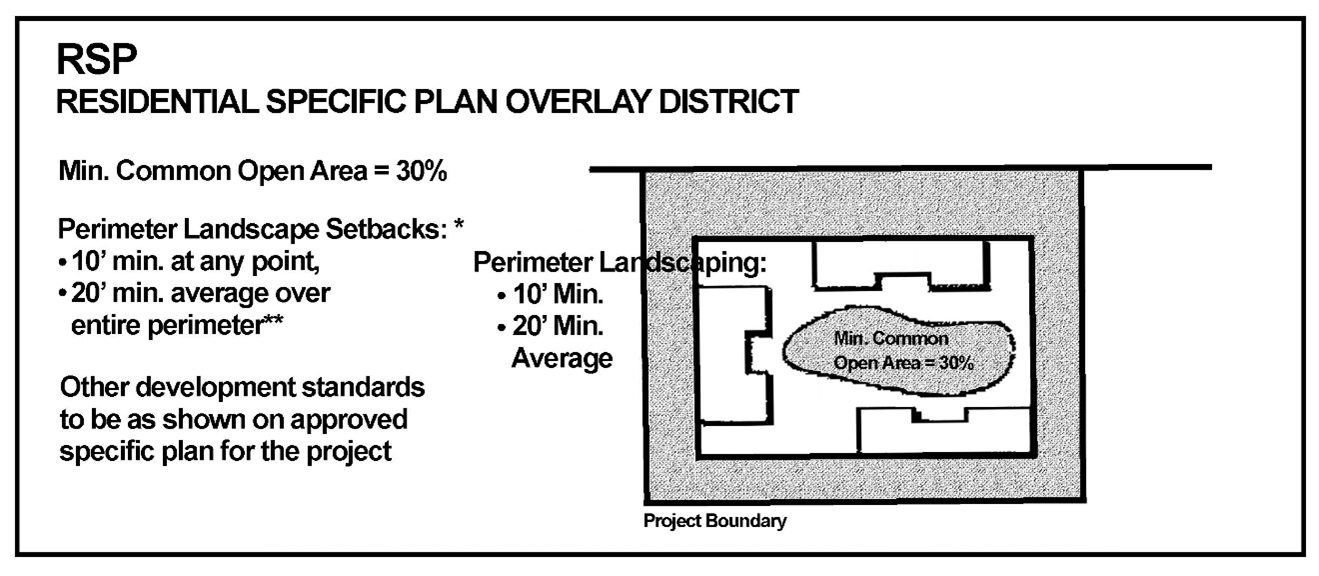
** Perimeter setback area shall not be counted as common open area or vice versa.
(Ord. 550 § 1, 2016; Ord. 325 § 1, 1998; Ord. 284 § 1, 1996)
9.50.050 - Maximum building height.
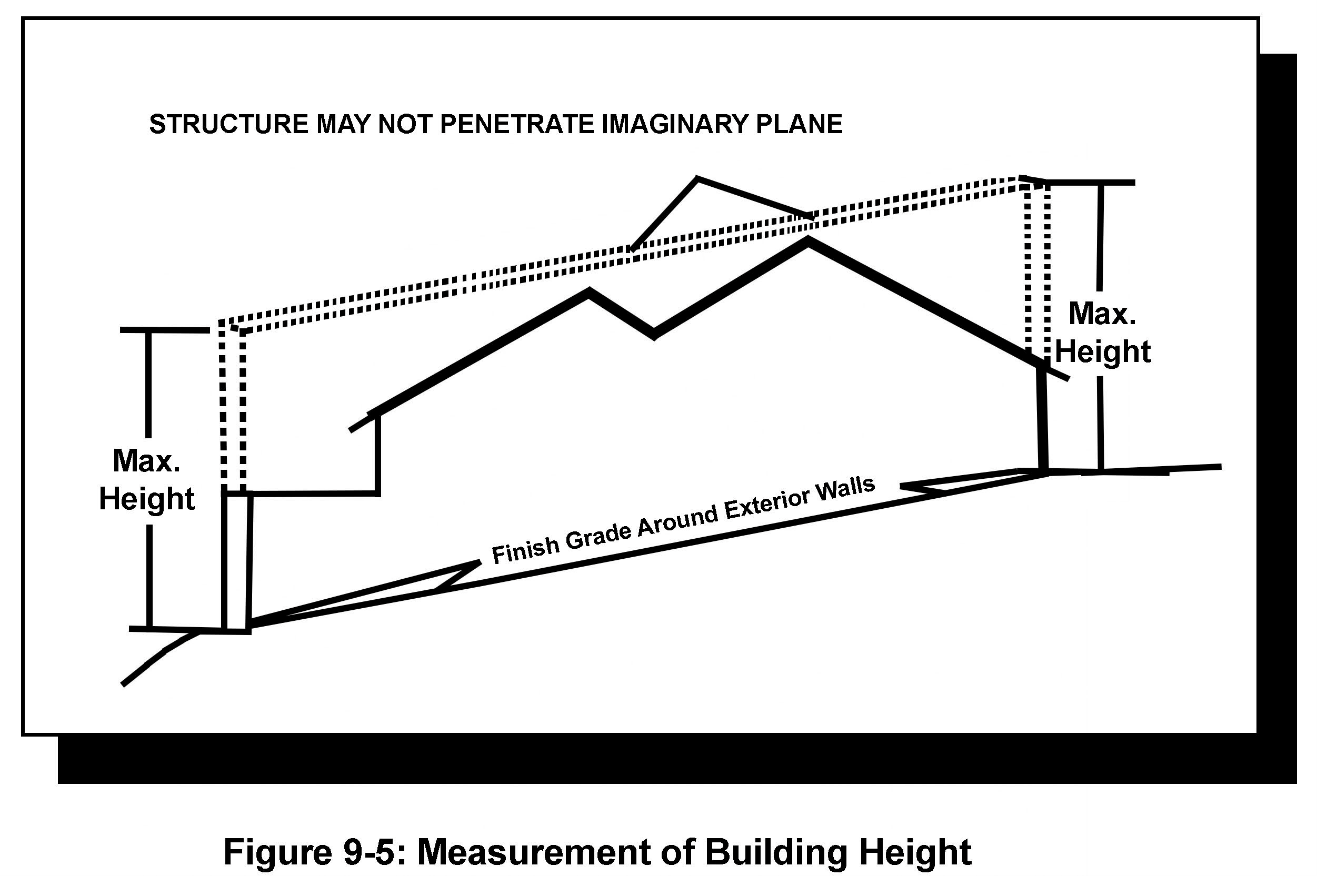
For purposes of this code, the maximum height of buildings and other structures shall be defined as the vertical distance from finish grade to an imaginary plane above the building site. The imaginary plane shall be established above and parallel to the finish grade adjacent to the exterior walls at a vertical distance equal to the specified maximum height. This definition is illustrated below:
(Ord. 550 § 1, 2016; Ord. 284 § 1, 1996)
9.50.055 - Front elevations for tract development.
Each prototype plan proposed within a tract shall be provided with a minimum of two (2) different front elevations with structural changes including, but not limited to roof type, height, finishes, and color to ensure variety within the project.
(Ord. 550 § 1, 2016)
9.50.060 - Architectural projections.
A.
Roof Projections. Notwithstanding Figure 9-5, chimneys, roof vents, finials, spires, and similar architectural features not containing usable space are permitted to extend up to three (3) feet above the maximum structure height set forth in Table 9-2.
B.
Projections. Architectural projections such as the following are permitted to encroach into the required setbacks specified in Table 9-2:
1.
Roof overhangs, chimneys, awnings and canopies may encroach a maximum of two (2) feet into any required setback provided such projections are no closer than three and one-half (3½) feet from any property line.
2.
Architectural projections such as cantilevered seating windows or ledges, which are located a minimum of one (1) foot above the floor and do not increase a building's usable floor area, may encroach a maximum of two (2) feet into any required setback provided such projections are no closer than three and one-half (3½) feet from any property line.
3.
Balconies, exterior stairways, and elevated uncovered decks may encroach a maximum of four (4) feet into required front and rear setbacks provided such projections are no closer than three and one-half (3½) feet from any property line. Such projections shall not encroach into required side setbacks nor increase a building's usable floor space.
(Ord. 550 § 1, 2016; Ord. 325 § 1, 1998; Ord. 299 § 1, 1997; Ord. 284 § 1, 1996)
9.50.070 - Irregular lots.
A.
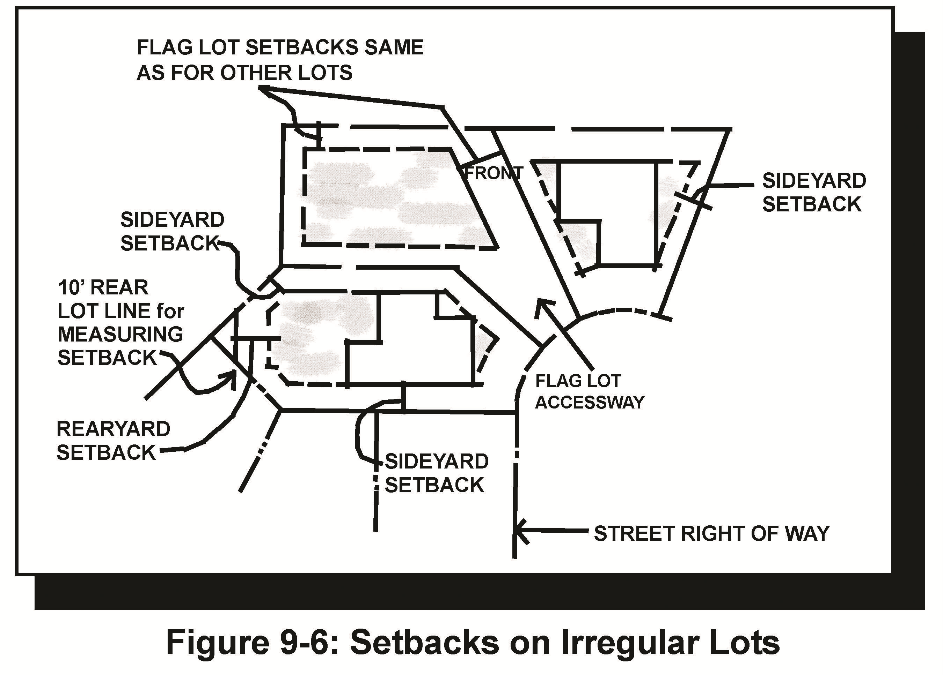
Purpose. Setback distances established for residential districts are based on rectangular lots. Nonrectangular lots, lots with three (3) sides or more than four (4) sides, and other nonstandard lots require special measurement techniques in order to achieve the purpose of setback requirements, i.e., the appropriate separation of structures from streets and other properties. The purpose of this subsection is to provide standards for the establishment and measurement of setbacks on irregular lots. (See Chapter 9.280 for definition of lot lines.)
B.
Front Setbacks. Front yard setbacks shall be measured from the ultimate street right-of-way line.
C.
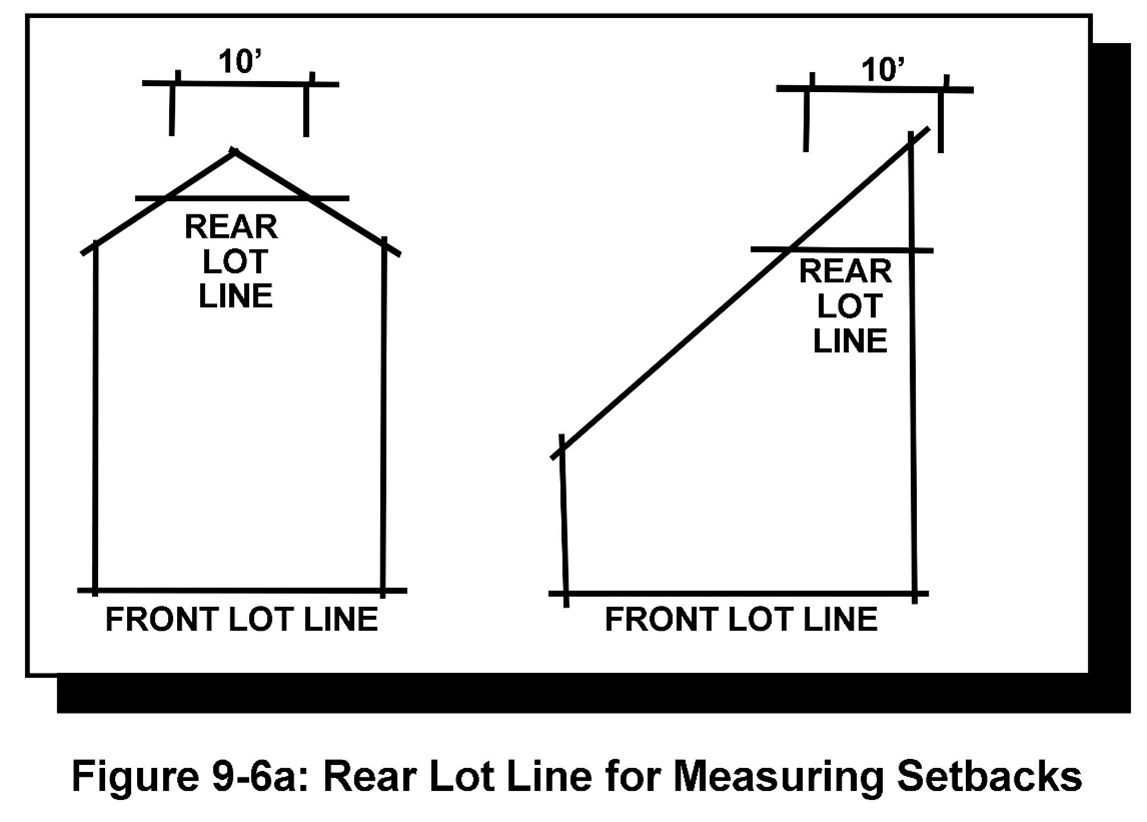
Rear Setbacks. In the case of an irregularly shaped lot, a ten (10)-foot line which is within the lot and parallel to and most distant from the front lot line shall be considered the rear lot line for purposes of determining required setbacks and for interpretation of other provisions of this code (see illustration).
D.
Side Setbacks. All lot lines which are not front or rear lot lines shall be considered side lot lines for the purpose of measuring setbacks.
E.
Pie-Shaped Lots. Setbacks on pie-shaped lots shall be measured at the closest point between the building and the angled lot line.
F.
Flag or Panhandle Lots.
1.
Definition. For purposes of this section, "panhandle lot," "flag lot," "panhandle building site" and "flag building site" all mean the following: a lot or building site having its only vehicular access by way of a narrow accessway which serves no other property and which is less than forty (40) feet wide and more than twenty (20) feet long.
2.
Setbacks. All setbacks shall be the same as for other lots in the applicable district. The front lot line shall be the line closest to perpendicular to the street on which the lot accesses, unless determined otherwise by the director.
3.
No Structures in Panhandle. No structures shall be permitted in the panhandle portion of the lot nor shall that portion be credited to minimum lot area requirements.
4.
Minimum Accessway Frontage. Twenty (20) feet.
G.
Determination by Director. Where a building site is situated such that any of the property lines are not readily determinable, required setbacks shall be as determined by the director in compliance with the following criterion: required setbacks shall not permit the placement of buildings on the site in a manner that will constitute a grant of special privileges inconsistent with the limitations placed on other properties in the vicinity and incompatible with surrounding uses.
(Ord. 550 § 1, 2016; Ord. 325 § 1, 1998; Ord. 284 § 1, 1996)
9.50.080 - Setbacks from surface easements.
Where a surface easement for street, vehicular access, bikeway, or recreation trail purposes has been granted across any portion of a lot, the building setback shall be measured from the property line or to the edge of easement, whichever is closer to the building.
(Ord. 550 § 1, 2016; Ord. 284 § 1, 1996)
9.50.090 - Architectural design standards.
In addition to the requirements of Chapter 9.30 (Residential Districts) and Chapter 9.60 (Supplemental Residential Regulations) the following shall be required for homes:
A.
Requirements.
1.
Architectural Design Guidelines. The city council shall, by resolution, adopt architectural design guidelines to be used as guidelines in reviewing landscape materials, architectural style, exterior building materials, colors, and mass and scale;
2.
Architectural Variety. Duplication of houses having the same architectural design features on the front elevation of other houses located within two hundred (200) feet of each other shall make provisions for architectural variety by using different colors, roof treatments, window treatments, garage door treatments, and methods;
3.
Reserved.
4.
Reserved.
5.
Reserved.
6.
Reserved.
7.
Reserved.
8.
Landscaping. All front and exterior side yards shall be landscaped to property line;
9.
The landscaping shall include trees, shrubs and ground cover of sufficient size, spacing and variety to create an attractive and unifying appearance;
10.
An irrigation system shall be provided for all areas required to be landscaped;
11.
The landscaping shall be continuously maintained in a healthy and viable condition;
12.
Screening. Refuse containers and bottled gas tanks shall be concealed by view-obscuring landscaping, fencing or walls, as referenced in screening Section 6.60.140(B)(1)(e);
13.
Reserved.
14.
Lighting. All exterior lighting shall be located and directed so as not to shine directly on adjacent properties, as referenced in outdoor lighting Section 9.100.150(F)(4);
15.
Reserved.
16.
Earth fill shall not exceed what is necessary to provide minimum required drainage to the street.
(Ord. 594 §§ 1, 2(Exh. A), 6-1-2021; Ord. 588 § 2(Exh. A), 2-2-2021; Ord. 574 § 1, 2018; Ord. 562 § 1, 2017; Ord. 550 § 1, 2016; Ord. 505 § 1, 2012; Ord. 361 § 1, 2001; Ord. 325 § 1, 1998)
Editor's note— Ord. 588 § 2(Exh. A), adopted Feb. 2, 2021, amended the title of § 9.50.090 from "RC district development standards" to "Architectural design standards," as herein set out.
9.50.100 - Additional bedrooms.
This section provides the following minimum developmental standards applicable to the addition to an existing single-family dwelling or modification to the floor plan configuration of an existing single-family dwelling that results in additional bedrooms.
A.
Existing single-family dwelling units may not exceed maximum bedrooms as follows:
Single-Family Dwellings
B.
The total area of all bedrooms shall not exceed thirty-five percent (35%) of the total livable area of the dwelling. The calculation of bedroom area shall not include closets or bathrooms.
C.
When as a result of new construction or modification of a single-family dwelling the number of bedrooms is proposed to equal or exceed four (4), an additional garage space of ten (10) by twenty (20) feet shall be provided if such single-family dwelling has existing garage space for only two (2) vehicles. Access to the additional garage space shall be from existing driveways and not result in new street curb cuts. Additional garage space may not be required if applicant can provide evidence of sufficient off-street parking spaces (e.g., driveway space, carport), to the satisfaction of the design and development director or designee.
D.
Bedrooms added as a result of new construction or modification of a single-family dwelling shall be used only by the occupants of the main residence, their non-paying guests, or domestic employees. No additional bedrooms may be rented or used as a short-term vacation rental ("STVR") except upon application and issuance of a STVR permit pursuant to Chapter 3.25 of this code.
(Ord. 577 § 1, 2019; Ord. 571 § 1, 2018; Ord. 489 § 1, 2011; Ord. 440 § 2, 2007)

