
La Quinta City Zoning Code
CHAPTER 9
60 - SUPPLEMENTAL RESIDENTIAL REGULATIONS
9.60.010 - Purpose and intent.
This chapter sets forth requirements for accessory structures, fences and walls, swimming pools, and other special aspects of land use in residential districts. These requirements are in addition to the regulations for residential uses set forth in Chapters 9.30 through 9.50.
(Ord. 550 § 1, 2016; Ord. 284 § 1, 1996)
9.60.020 - Signs and parking.
Refer to Chapter 9.150 for parking regulations and Chapter 9.160 for sign regulations.
(Ord. 550 § 1, 2016; Ord. 284 § 1, 1996)
9.60.030 - Fences and walls.
A.
Purpose. For purposes of this section, "fence" or "wall" means any type of fence, wall, retaining wall, sound attenuation wall, screen or windscreen. The terms "fence" and "wall" are used interchangeably in this section to mean any or all of the preceding structures. Rear and side yards shall be completely enclosed and screened by view-obscuring fencing, walls, or combinations, unless:
1.
Adjoining property owners waive the rear or side yard fencing requirements; or
2.
The fence abuts open space, such as golf course, lake front, or similar areas; or
3.
A minor use permit is approved by the design and development director for an alternative approach.
B.
Measurement of Fence Height. Except as otherwise specified in this section, fence heights shall be measured from finish grade at the base of the fence to the highest point of the fence on the interior or exterior side, whichever is higher.
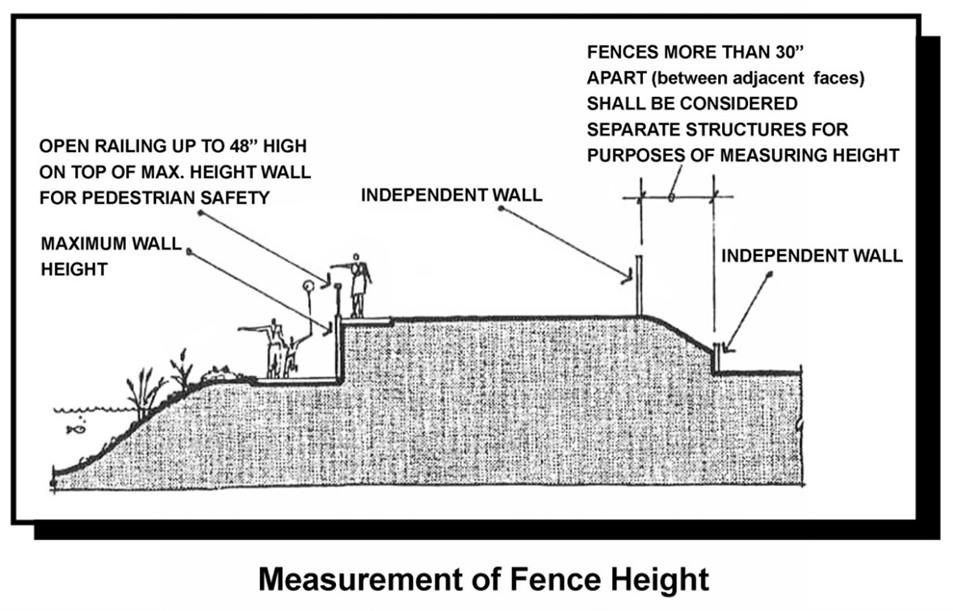
In addition, the following provisions shall apply to the measurement of fence height:
1.
Open railings, up to forty-eight (48) inches high, placed on top of a retaining or other wall and required for pedestrian safety shall not be included in the height measurement.
2.
Fences less than thirty (30) inches apart (measured between adjoining faces) shall be considered one (1) structure and fence height shall be measured from the base of the lower fence to the top of the higher fence. Fences thirty (30) inches or more apart shall be considered separate structures and their heights shall be measured independently. The director may require that the area between such fences be provided with permanent landscaping and irrigation.
C.
Fence Heights. The construction and installation of fences shall be in compliance with the following standards:
1.
Within Main Building Area. In the area of a lot where a main building may be constructed, the maximum freestanding fence height shall be twelve (12) feet.
2.
Setback Areas Not Bordering Streets. The maximum fence height shall be six (6) feet within any required setback area not adjoining a street. Where the elevation of an adjoining building site is higher than the base of the fence within a side or rear setback area, the height of the fence may be measured from the elevation of the adjoining building site to the top of the fence. However, fence height shall not exceed eight (8) feet measured from either side with the exception of the RC district.
3.
Setback Areas Bordering Streets, Alleys and Other Accessway.
a.
Within all districts, the maximum fence height shall be six (6) feet within any front, rear or side setback area adjoining a public street.
b.
Notwithstanding other fence height restrictions, where, because of the orientation of the lots, a property line fence separates a front yard on one (1) lot from a rear yard on an adjacent lot, the maximum fence height shall be six (6) feet.
c.
Arches or trellises up to nine (9) feet in overall height and five (5) feet interior width may be constructed over a gate on a lot provided the arch/trellis is integrated into the fence/gate design. The director may refer arch designs exceeding the standard to the planning commission for approval.
d.
Any portion of a building site where vehicular access is taken shall conform to the access intersection requirements of subsection (C)(4) of this section.
e.
City- or state-required sound attenuation walls bordering freeways or arterial highways may exceed six (6) feet in height if so recommended by a noise attenuation study and approved by the director.
f.
When there is a combined retaining and garden wall, and the retaining wall exceeds three (3) feet, the garden wall shall not exceed five (5) feet in height;
4.
Adjacent to a Nonresidential Zone or Use. The maximum fence height between a residential zone or use and a nonresidential zone or use shall be eight (8) feet.
a.
The height of fences, trees, shrubs and other visual obstructions shall be limited to a maximum height of thirty (30) inches within the triangular area formed by drawing a straight line:
i.
Between two (2) points located on and twenty (20) feet distant from the point of intersection of two (2) ultimate street right-of-way lines.
ii.
Between two (2) points located on and five (5) feet distant from the point of intersection of an ultimate street or alley right-of-way on one hand and the edge of a driveway or another alley right-of-way on the other if parkway width is less than twelve (12) feet wide.
b.
For purposes of this code, "point of intersection" means the intersection of the prolongation of the right-of-way lines, excluding any curved portion joining the two (2) lines.
c.
The height restrictions of this subdivision shall apply to fences, walls, trees, shrubs, vegetation, or any other material which obstructs or may obstruct visibility.
D.
Gates.
1.
Materials. Gates shall be constructed of ornamental iron/tubular steel, vinyl and/or wood. Such gates may be placed in any location provided they meet the requirements of this section and provided any wood used is not less than a grade of construction heart or merchantable and better redwood or No. 2 and better (no holes) western red cedar, stained or painted to match or complement the adjacent wall or structure. Alternatively, if left in natural color, all wood shall be treated with a water-repellant material. Wood gates over thirty-six (36) inches wide shall have a metal frame. Chain link gates are prohibited. Vehicular driveway gates shall be constructed of ornamental iron/tubular steel and metal if solid. If screening an RV, the gate shall be constructed of a solid opaque material.
2.
Width. Pedestrian gates shall not exceed five (5) feet in width, except that gates may be any width within side yard setbacks of at least twelve (12) feet.
E.
Fence Construction and Materials. All fencing in residential districts shall conform to the following construction and material standards:
1.
Wood Fencing.
a.
Except for gates, split two (2)-rail fencing, and for equestrian fencing regulated by Section 9.140.060, wood or similar recycled fencing materials are permitted in rear or interior side yards only, and only if not visible from the street. Wood-framed fencing with a stucco finish is permissible in any location on the lot provided the color of the masonry or stucco matches or complements the adjacent wall or structure. Gates may be of wood in any location provided they comply with the standards of this section.
b.
All wood fencing shall be constructed of not less than a grade of construction heart or merchantable and better redwood or No. 2 and better (no holes) western red cedar, stained or painted to match or complement the adjacent wall or structure. Alternatively, if left in natural color, all wood shall be treated with a water-repellant material.
c.
Fence boards may be horizontal or vertical. Support posts shall be a minimum of nominal four inches by four inches (4″×4″) redwood, pressure-treated lumber, tubular steel or block and installed per the Uniform Building Code.
d.
Split Rail Fencing. Split two (2)-rail fencing shall be allowed in the front yard or along the front property line with columns a maximum height of four (4) feet and three (3) feet for the top rail. All columns shall be cemented with footings. Materials for the columns shall be wood, brick, or block. The rails may be either wood or other non-wood products that have the appearance of split rail. A building permit shall be obtained prior to construction.
2.
Ornamental Iron and Tubular Steel Fencing. Ornamental iron or tubular steel fencing may be used along the front or street side yards only. The iron or steel shall be painted to match or complement the adjacent wall or structure.
3.
Masonry Fencing. Solid masonry fencing (i.e., block, rock, brick, with or without stucco covering) is permitted in any location on the lot provided the color of the masonry or stucco matches or complements the adjacent wall or structure. Precision concrete block shall not be used unless all exterior surfaces visible from outside the property are covered with stucco, paint, texture coating, or other comparable coating approved by the director.
4.
Material Combinations. Combinations of two (2) or more of the preceding materials may be used provided that the bottom one-half (½) of the fence is constructed of a masonry material. Combinations incorporating wood materials shall only be used for the rear and interior side yards and only when not visible from the street.
5.
Other Materials. Other fence materials or combination of fence materials such as, but not limited to, corrugated metal, vinyl, bamboo, and glass may be permitted in the front or street side yard by the director in conjunction with approval of a building permit for fence construction if the permit application includes a materials sample, a site plan with proposed fence alignment, photographs of the main dwelling, and the following findings are made:
a.
The design of the fence, including, but not limited to, the architectural style, materials, colors, architectural details, and other architectural elements is compatible with a main dwelling existing on site or in development review at time of application.
b.
The fence meets all screening requirements.
c.
The material(s) are of good and durable quality.
d.
The material(s) will not be detrimental to the health, safety and general welfare of the community in the area.
F.
Fence Landscaping and Maintenance.
1.
Landscaping. The area between the back of curb and any fencing shall be landscaped, have a suitable permanent irrigation system, and be continuously maintained by the property owner.
2.
Maintenance. All walls and fences shall be continuously maintained in good repair. The property owner shall be provided thirty (30) days after receiving notice from the city to repair a wall or fence. The building official may grant an extension to such time period not to exceed sixty (60) days.
G.
Prohibited Fence Materials and Construction Fences. The use of barbed wire, razor wire, chain link, or similar materials in or on fences is prohibited in all residential districts. Chain link fencing is permitted for temporary construction fences when authorized by a minor use permit issued in accordance with Section 9.210.025. Said minor use permit shall not be approved until a permit for grading, or construction, has been filed for, whichever comes first.
H.
Equestrian Fencing. Notwithstanding any other requirements of this section, fencing shall be regulated by the provisions of Section 9.140.060 (Equestrian overlay regulations) where the keeping of horses is permitted.
I.
Nonconforming Fences. Any fence which does not meet the standards of this section but which was legally established prior to the adoption of these standards may be maintained provided such fence is not expanded nor its nonconformance with these standards otherwise increased. Any fence which is destroyed or damaged to the extent of more than fifty percent (50%) of its total replacement value shall not be repaired, rebuilt, or reconstructed except in conformance with these standards.
(Ord. 618 § 1, Exh. A, 12-3-2024; Ord. 588 § 2(Exh. A), 2-2-2021; Ord. 584 § 2, 2020; Ord. 560 § 1, 2017; Ord. 550 § 1, 2016; Ord. 466 § 1, 2009; Ord. 378 § 1, 2002; Ord. 361 § 1, 2001; Ord. 325 § 1, 1998; Ord. 299 § 1, 1997; Ord. 284 § 1, 1996)
9.60.040 - Patio covers, decks and play equipment.
A.
Applicability. For purposes of this section, the term "patio covers, decks, and play equipment" includes any type of yard structure other than a building or a carport. Such structures include, but are not limited to, open and solid patio covers, gazebos, trellises, arbors, and to play equipment which is more than eight (8) feet in height. All such structures shall be "open" (no side walls) and are referred to in this section as "yard structures." Enclosed structures shall be considered accessory buildings (see Section 9.60.050). Uncovered decks and other structures less than eighteen (18) inches above finish grade shall not be subject to the provisions of this section.
B.
Standards. Patio covers, decks, gazebos, play equipment or other yard structures, attached to or detached from the main building shall comply with front and side yard setbacks for the main building and the following requirements:
1.
The location of decks shall be governed by the standards for wall projections in Section 9.50.060.
2.
No yard structure shall be more than twelve (12) feet in height.
3.
Yard structures shall not be constructed or established in the panhandle portion of a panhandle or flag lot.
4.
No yard structure shall be located less than five (5) feet from any adjacent residential lot or from any rear property line adjacent to a public or private right-of-way.
5.
No yard structure shall be located less than three (3) feet from any rear property line adjacent to any common use easement or open space or recreational area which is at least ten (10) feet deep.
6.
Eaves or roofs may overhang into the required setback a maximum of eighteen (18) inches. Setbacks shall be measured from the nearest supporting member of the structure to the property line or, if the property line is at the toe of a slope, from the top of the slope.
7.
Structures shall be constructed in a manner so as to prevent rooftop water from draining onto any adjacent parcel.
8.
Wood lattice cross-members in patio covers or trellises shall be of minimum nominal two (2) inches by two (2) inches material.
9.
No patio cover, trellis, gazebo, arbor, similar structure, or combination thereof shall cover more than fifty percent (50%) of the rear area required setback.
(Ord. 550 § 1, 2016; Ord. 325 § 1, 1998; Ord. 299 § 1, 1997; Ord. 284 § 1, 1996)
9.60.045 - Barbeques, waterfalls, fountains, fireplaces and similar structures.
A.
Applicability. Permanently installed freestanding barbeques, waterfalls, fountains, fireplaces and similar structures such as permanently installed tables and benches, etc., may be constructed on a residential lot containing a primary residence.
B.
Standards. Freestanding barbeques, waterfalls, fountains, fireplaces and similar structures shall comply with the following requirements:
1.
Said construction of structures, except freestanding fireplaces, are allowed within the required front, side, or rear setbacks, including adjacent to a property line. In side yard areas, a single clear passageway of five (5) feet wide shall be provided.
2.
Allowed construction of structures shall not be attached to property line walls or fences, and shall meet all required distance clearances (i.e., for barbeques, fireplaces).
3.
Within five (5) feet of any property line, the height of the feature or construction shall not exceed the height of the closest wall or fence. If no wall or fence exists, the construction or feature shall not exceed the height of the wall allowed along the property line in question.
4.
Outdoor fireplaces shall not be closer than five (5) feet from a property line, except when adjacent to permanent open space such as a golf course, common landscape or hardscape area, drainage channel, etc., in which case it may be within three (3) feet of the property line. The height of the chimney may be up to six (6) feet unless required to be higher to comply with building code requirements. In such cases, the height shall not be higher than the minimum height required.
(Ord. 550 § 1, 2016; Ord. 361 § 1, 2001)
9.60.050 - Storage and other accessory buildings.
A.
Applicability. Accessory buildings, such as storage or gardening sheds, are permitted on a residential lot containing a primary residence subject to the requirements of this section. (Carports and garages are regulated separately by Section 9.60.060, patio covers by Section 9.60.040, swimming pools and spas by Section 9.60.070, and recreational vehicle parking by Section 9.60.130.)
B.
Drainage from Roofs. Accessory buildings shall be constructed in a manner so as to prevent rooftop water from draining onto any adjacent parcel.
C.
Lot Coverage Maximums. The placement of accessory buildings on a lot shall not result in violation of the lot coverage maximums set forth in Section 9.50.030.
D.
Standards. Setbacks and Maximum Height. Detached accessory buildings shall conform to the following setback standards:
Table 9-3 Standards for Detached Accessory Buildings
(Ord. 550 § 1, 2016; Ord. 299 § 1, 1997; Ord. 284 § 1, 1996)
9.60.060 - Garages and carports.
A.
Height. The maximum structure height shall be fourteen (14) feet for a detached carport and seventeen (17) feet for a detached garage, except that garages may be up to twenty-eight (28) feet in height if a second dwelling unit complying with the provisions of Section 9.60.090 is located above the garage.
B.
Setbacks.
1.
In the RVL district, the minimum garage or carport setback shall be thirty (30) feet. In all other residential districts, the minimum setback for front-entry type garages or carports shall be twenty (20) feet. For side-entry type garages, the minimum garage setback shall be twenty (20) feet in the RVL district and fifteen (15) feet in all other residential districts. A side-entry garage designed as tandem parking, when permitted under this code, shall not be located along any street frontage. The conversion of side-entry garages to habitable area is only permitted if the side-entry garage conforms to the minimum garage setback for a front-entry type garage.
2.
When alleys, private streets or common driveways at the rear of a lot are provided specifically as vehicular access to garages and carports and when separate access and circulation systems are provided for pedestrians, guests and emergency vehicles, garages and carports may be placed up to a minimum of five (5) feet from such alley, private street or common driveway.
C.
Lot Coverage Maximums. The placement of a garage or carport on a lot shall not result in violation of the lot coverage maximums set forth in Section 9.50.030.
D.
Maximum Garage Size. For single-family homes, garage shall not exceed fifty percent (50%) of livable area of home.
(Ord. 618 § 1, Exh. A, 12-3-2024; Ord. 584 § 2, 2020; Ord. 550 § 1, 2016; Ord. 505 § 1, 2012; Ord. 284 § 1, 1996)
9.60.070 - Swimming pools.
A.
Applicability. The provisions of this section shall apply to any outdoor swimming pool, whirlpool, spa (in-ground or above-ground), or open tank or pond containing or normally capable of containing water to a depth of eighteen (18) inches or more at any point. For purposes of this section, the term "pool" means all or any of the foregoing facilities.
B.
Standards. Pools are permitted as accessory uses in residential districts subject to the following requirements:
1.
Location. Pools shall be located at least three (3) feet (measured from water's edge) from any property line. No adjustments to this minimum shall be approved, with the exception of private gated communities where any property line is adjacent to common open area.
2.
Filtering and Heating Equipment. Use of equipment shall comply with the following requirements:
a.
Mechanical pool equipment such as a pump, filter, or heater, may be located within the front or rear yard areas. The equipment shall be enclosed on at least three (3) sides by a masonry wall with an open side not visible to the street.
b.
Mechanical pool equipment may be in an area between the side property line and the residence provided a five (5)-foot side yard, clear of any permanent obstructions is maintained between the side yard property line and any mechanical pool equipment.
c.
Where there is no side property line wall, mechanical pool equipment may be in a side yard of five (5) feet or less only if a recorded easement in perpetuity exists for the subject property to use the adjacent side yard of the abutting property for access and a minimum five (5) feet distance between the equipment and adjacent obstruction (i.e., building wall) is provided.
d.
Mechanical pool equipment may be in a side yard of five (5) feet or less if approved by the design and development director if extenuating circumstances exist and there is a three (3)-foot clearance of any permanent obstructions.
3.
Fencing Requirements. All pools shall be fenced in accordance with the provisions of the city's building code Chapter 8.02, state law and other applicable laws and ordinances.
4.
Screening shall be provided as required in Section 9.60.140(B)(2).
(Ord. 588 § 2(Exh. A), 2-2-2021; Ord. 577 § 1, 2019; Ord. 550 § 1, 2016; Ord. 361 § 1, 2001; Ord. 325 § 1, 1998; Ord. 299 § 1, 1997; Ord. 284 § 1, 1996)
9.60.075 - Ground mounted mechanical equipment.
Use of equipment shall comply with the following requirements:
A.
Ground mounted mechanical equipment such as air conditioner condensing units, water softeners, etc., may be located within the rear yard areas. For lots of five thousand (5,000) square feet or less, said equipment can be in the front yard if there is a wall around the yard, or it is screened by a masonry wall.
B.
Where there is no side yard property line wall, mechanical equipment may be in an area between the side property line and the residence provided a five (5)-foot side yard, clear of any permanent obstructions is maintained between the side yard property line and any mechanical equipment.
C.
Mechanical equipment may be in a side yard of five (5) feet or less if: (1) a recorded easement in perpetuity exists for the subject property to use the adjacent side yard of the abutting property for access and a minimum five (5) feet distance between the equipment and adjacent obstruction (i.e., building wall) is provided; or (2) if approved by the design and development director if findings are made that extenuating circumstances exist.
(Ord. 588 § 2(Exh. A), 2-2-2021; Ord. 577 § 1, 2019; Ord. 562 § 1, 2017; Ord. 550 § 1, 2016; Ord. 361 § 1, 2001)
9.60.080 - Satellite dish and other antennas.
A.
Purpose. Satellite dish and other antennas consistent with the design and location provisions of this section shall be permitted as accessory structures within any residential district.
B.
Permitted Commercial Antennas. Commercial television, radio, microwave, communication towers, and related facilities are permitted as principal uses in all districts subject to approval of a conditional use permit and conformance with the requirements of Chapter 9.170 (Wireless Telecommunication Facilities). Satellite dish and other antennas are permitted as accessory structures in nonresidential districts in accordance with Section 9.100.070.
C.
Permitted Noncommercial Antennas (See Chapter 9.170). Noncommercial privately owned television and/or radio antennas shall be contained entirely within a building except for: (1) satellite dish antennas and other antennas which cannot function when completely enclosed by a building; and (2) amateur radio antennas used by operators licensed by the Federal Communications Commission (FCC, pursuant to 47 CFR Section 97). Such permitted outdoor antennas shall comply with the following design standards and requirements:
1.
Number. No more than one (1) satellite dish and one (1) amateur radio antenna shall be permitted per lot.
2.
Height and Diameter. Satellite dish antennas shall not exceed eight (8) feet in height measured from adjacent grade or finish floor and shall be no more than eight (8) feet in diameter.
3.
Ground-Mounted Antennas.
a.
Location. All ground-mounted antennas shall be located within the rear yard or may be located within an interior side yard if not within the required side yard setback. Such antennas are prohibited from exterior street side yards unless not visible from the street. All antennas over six (6) feet in height shall be set back a minimum of ten (10) feet from all property lines.
b.
Screening. Ground-mounted satellite dish antennas shall be screened from view, including views from adjacent yards, by landscaping or decorative structures (trellis, arbor, fence, etc.). The dish antenna shall be a single color that blends with its surroundings (e.g., off-white, dark green, brown, gray or black).
c.
Disguised Antennas. An antenna which has the appearance of typical backyard furniture or equipment (e.g., satellite dish antenna manufactured to have the appearance of a patio umbrella) is not required to comply with the preceding location and screening standards but shall comply with height and size limits. Such an antenna may be placed on any patio or deck.
4.
Building-Mounted Antennas. Roof-mounted and other building-mounted antennas are prohibited in all residential districts if over twenty-four (24) inches in diameter unless completely screened from horizontal view via a parapet wall or other feature which is integrated into the architecture of the building.
D.
Exempt Antenna. Amateur radio antennas.
(Ord. 550 § 1, 2016; Ord. 492 § 1, 2011; Ord. 299 § 1, 1997; Ord. 284 § 1, 1996)
9.60.090 - Accessory dwelling units.
A.
Purpose. This section provides standards and criteria for the establishment of accessory dwelling units and junior accessory dwelling units, consistent with California Government Code Sections 65852.2, subdivision (a)(1) and 65852.22. Accessory dwelling units shall be permitted only in the zones that allow single family or multifamily uses: RVL, RL, RC, RM, RMH, RH, CR, CP, CC, CN, TC, CO and VC zone districts. Junior accessory dwelling units are permitted in single family zones: RVL, RL, RC, RM, RMH, and RH zone districts.
B.
Definitions. See Chapter 9.280. The following definitions shall apply for the purposes of this Section 9.60.090 notwithstanding any definition to the contrary in Chapter 9.280 or elsewhere in this Municipal Code.
1.
"Accessory dwelling unit." For purposes of this section, "second residential unit," "second dwelling unit," "second unit," and "granny flat" as defined in Section 9.280.030 (or successor section) shall not apply, and, instead, "accessory dwelling unit" as defined in California Government Code Section 66313(a) (or successor section in the Government Code) shall apply. An accessory dwelling unit shall be either "attached" or "detached" to the primary residence as described in Government Code Section 66313(a) (or successor statute). In addition, the following definitions shall apply for purposes of this section.
2.
"Junior accessory dwelling unit" means a unit that is no less than one hundred fifty (150) square feet and no more than five hundred (500) square feet in size and contained entirely within a single-family residence, or as defined by Government Code Section 66313 (d) (or successor section). A junior accessory dwelling unit may include separate sanitation facilities, or may share sanitation facilities with the existing structure.
3.
"Living area" shall have the same meaning as California Government Code Section 66313(e) (or successor section in the Government Code),.
4.
"Primary residence" shall have the same meaning as "dwelling, main or Primary residence" as defined in Section 9.280.030 (or successor section).
5.
"Public transit" means a location, including but not limited to, a bus stop or train station, where the public may access buses, trains, subways, and other forms of transportation that charge set fares, run on fixed routes and are available to the public or as defined by Government Code Section 66313(l) (or successor section).
C.
Standards for Accessory Dwelling Units. The following standards shall apply to accessory dwelling units:
1.
Except as provided in Government Code Section 66341 (or successor section) as provided in Subsection G of this Section 9.60.090, the accessory dwelling unit may be rented separate from the primary residence, but may not be sold or otherwise conveyed separate from the primary residence.
2.
The lot is zoned to allow single-family or multifamily dwelling residential use and includes a proposed or existing dwelling.
3.
The accessory dwelling unit is either attached to, or located within, the proposed or existing primary dwelling, including attached garages, storage areas or similar uses, or an accessory structure or detached from the proposed or existing primary dwelling and located on the same lot as the proposed or existing primary dwelling, including detached garages.
4.
The total floor area of an attached accessory dwelling unit shall not exceed fifty (50) percent of the primary dwelling if there is an existing primary dwelling or eight hundred fifty (850) square feet, or one thousand (1,000) square feet for a unit that provides more than one (1) bedroom.
5.
The total floor area for a new detached accessory dwelling unit shall not exceed one thousand two hundred (1,200) square feet.
6.
An accessory dwelling unit shall include a kitchen and bathroom.
7.
An efficiency unit as defined by Section 17958.1 of the California Health and Safety Code must be a minimum of one hundred fifty (150) square feet.
8.
No passageway shall be required in conjunction with the construction of an accessory dwelling unit.
9.
No setback shall be required for an existing living area or accessory structure or a structure constructed in the same location and to the same dimensions as an existing structure that is converted to an accessory dwelling unit or to a portion of an accessory dwelling unit, and a setback of no more than four (4) feet from the side and rear lot lines shall be required for an accessory dwelling unit that is not converted from an existing structure or a new structure constructed in the same location and to the same dimensions as an existing structure.
10.
The building code requirements in effect at the time a building permit is secured shall apply to detached dwellings. The construction of an accessory dwelling unit shall not constitute a Group R occupancy change under the building code, as described in Section 310 of the California Building Code (Title 24 of the California Code of Regulations), unless the building official or Code Compliance officer makes a written finding based on substantial evidence in the record that the construction of the accessory dwelling unit could have a specific, adverse impact on public health and safety. Nothing in this clause shall be interpreted to prevent the Building Official from changing the occupancy code of a space that was unhabitable space or was only permitted for nonresidential use and was subsequently converted for residential use pursuant to this section.
11.
The accessory dwelling unit must be approved by the Riverside County Department of Environmental Health and the Regional Water Quality Control Board where a private sewage disposal system is being used or proposed.
12.
Parking requirements for accessory dwelling units shall not exceed one (1) parking space per accessory dwelling unit or per bedroom, whichever is less. These spaces may be provided as tandem parking on a driveway.
a.
Off-street parking shall be permitted in setback areas or through tandem parking, unless specific findings are made that parking in setback areas or tandem parking is not feasible based upon specific site or regional topographical or fire and life safety conditions.
b.
There shall be no additional parking requirement for an accessory dwelling unit where prohibited by Government Code Sections 61314 (d)(10) 66322 (or successor sections) in any of the following instances:
i.
The accessory dwelling unit is located within one-half (½) mile walking distance of public transit.
ii.
The accessory dwelling unit is located within an architecturally and historically significant historic district.
iii.
The accessory dwelling unit is part of the proposed or existing primary residence or an accessory structure.
iv.
When on-street parking permits are required but not offered to the occupant of the accessory dwelling unit.
v.
When there is a car share vehicle located within one (1) block of the accessory dwelling unit.
vi.
When a permit application for an accessory dwelling unit is submitted with a permit application to create a new single-family dwelling or a new multifamily dwelling on the same lot, provided that the accessory dwelling unit or the parcel satisfies any other criteria listed in this subsection.
c.
When a garage, carport, or covered parking structure is demolished in conjunction with the construction of an accessory dwelling unit or converted to an accessory dwelling unit, those off-street parking spaces need not be replaced.
13.
One (1) accessory dwelling unit and one (1) junior accessory dwelling unit is permitted per lot with a proposed or existing single-family dwelling if all of the following apply:
a.
The accessory dwelling unit or junior accessory dwelling unit is within the proposed space of a single-family dwelling or existing space of a single-family dwelling or accessory structure and may include an expansion of not more than one hundred fifty (150) square feet beyond the same physical dimensions as the existing accessory structure. An expansion beyond the physical dimensions of the existing accessory structure shall be limited to accommodating ingress and egress.
b.
The space has exterior access from the proposed or existing single-family dwelling.
c.
The side and rear setbacks are sufficient for fire and safety.
d.
The front yard setback of the underlying zone shall apply, unless either the attached or detached units does not permit at least an eight hundred (800) square foot accessory dwelling unit with four (4)-foot side and rear yard setbacks to be constructed in compliance with all other development standards.
e.
The junior accessory dwelling unit complies with the requirements of Government Code Section 66333.
14.
One (1) detached, new construction, accessory dwelling unit that does not exceed four (4)-foot side and rear yard setbacks for a lot with a proposed or existing single-family dwelling. The accessory dwelling unit may be combined with a junior accessory dwelling unit described in subsection D, if the accessory dwelling unit complies with the following:
a.
A total floor area limitation of not more than eight hundred (800) square feet.
b.
A height limitation of sixteen (16) feet on a lot with an existing or proposed single family or multifamily dwelling unit.
c.
A height of eighteen (18) feet for a detached accessory dwelling unit on a lot with an existing or proposed single family or multifamily dwelling unit that is within one-half (½) of one (1) mile walking distance of a major transit stop or a high-quality transit corridor, as those terms are defined in Section 21155 of the Public Resources Code.
d.
An additional two (2) feet in height to accommodate a roof pitch on the accessory dwelling unit that is aligned with the roof pitch of the primary dwelling unit.
e.
A height of eighteen (18) feet for a detached accessory dwelling unit on a lot with an existing or proposed multifamily, multistory dwelling.
f.
A height of twenty-five (25) feet or the height limitation that applies to the primary dwelling, whichever is lower, for an accessory dwelling unit that is attached to a primary dwelling.
15.
Multiple accessory dwelling units are permitted within the portions of existing multifamily dwelling structures that are not used as livable space, including, but not limited to, storage rooms, boiler rooms, passageways, attics, basements, or garages, if each unit complies with state building standards for dwellings.
a.
One (1) accessory dwelling unit is permitted within an existing multifamily dwelling and up to twenty-five (25) percent of the existing multifamily dwelling units may contain an accessory dwelling unit.
b.
Not more than two (2) accessory dwelling units that are located on a lot that has an existing or proposed multifamily dwelling, but are detached from that multifamily dwelling are permitted, and are subject to height limits as listed in subsection 14, and four (4)-foot rear yard and side setbacks. If the existing multifamily dwelling has a rear or side setback of less than four (4) feet, no modification of the existing multifamily dwelling shall be required.
16.
Accessory dwelling units shall not be required to provide fire sprinklers if they are not required for the primary residence. The construction of an accessory dwelling unit shall not trigger a requirement for fire sprinklers to be installed in the existing primary dwelling.
17.
A demolition permit for a detached garage that is to be replaced with an accessory dwelling unit shall be reviewed with the application for the accessory dwelling unit and issued at the same time. The applicant shall not be required to provide written notice or post a placard for the demolition of a detached garage that is to be replaced with an accessory dwelling unit, unless the property is located within an architecturally and historically significant historic district.
18.
An accessory dwelling unit that is rented must be rented for terms longer than thirty (30) days. Under no circumstances shall an accessory dwelling unit be eligible for a short-term vacation rental permit.
19.
In the event of any conflicts between the standards set forth in this section and those set forth in the regulations of the applicable zoning district, the provisions of this section shall prevail.
20.
The applicant shall pay to the city all applicable fees imposed on such new development of an accessory dwelling unit or new or rehabilitated primary residence that will include an accessory dwelling unit, provided, however, that no impact fee shall be imposed upon the development of an accessory dwelling unit less than seven hundred fifty (750) square feet, and any impact fees charged for an accessory dwelling unit of seven hundred fifty (750) square feet or more shall be charged proportionately in relation to the square footage of the primary dwelling unit.
21.
The City shall not allow occupancy for an accessory dwelling unit before occupancy of the primary dwelling unit has been granted.
D.
Standards for Junior Accessory Dwelling Units. The following standards shall apply for junior accessory dwelling units:
1.
Junior accessory dwelling units shall be limited to one (1) per residential lot zoned for single-family residences with a single-family residence already built or proposed to be built, on the lot.
2.
Prior to issuance of occupancy approval of the junior accessory dwelling unit, the city may require the property owner to enter into a restrictive covenant with the city prohibiting the sale of the junior accessory dwelling unit separate from the sale of the single-family residence, including a statement that the deed restriction may be enforced against future purchasers; and restricting the size and attributes of the junior accessory dwelling unit that conforms with this section and Government Code Section 66333 (or successor section).
3.
A junior accessory dwelling unit must be constructed within the walls of the proposed or existing single-family residence.
4.
A junior accessory dwelling shall provide a separate entrance from the main entrance to the proposed or existing single-family residence.
5.
A junior accessory dwelling unit shall include an efficiency kitchen, which shall include all of the following:
a.
A cooking facility with appliances, and
b.
A food preparation counter and storage cabinets that are of reasonable size in relation to the size of the junior accessory dwelling unit.
6.
If the junior accessory dwelling unit does not include a separate bathroom, the junior accessory dwelling unit shall include a separate entrance than the main entrance to the structure with an interior entry to the main living area.
7.
Parking: A junior accessory dwelling unit shall not require parking in addition to that required for the proposed or existing single-family residence.
8.
For the purposes of providing service for water, sewer, or power, including a connection fee, a junior accessory dwelling unit shall not be considered a separate or new dwelling unit.
9.
Owner-occupancy in the single family residence in which the junior accessory dwelling unit is permitted is required. The owner may reside in either the remaining portion of the structure or the newly created junior accessory dwelling unit. Owner-occupancy shall not be required if the owner is another governmental agency, land trust, or housing organization.
E.
A permit application for an accessory dwelling unit or a junior accessory dwelling unit shall be considered and approved ministerially without discretionary review or a hearing. The director, or his/her designee, shall either approve or deny the application within sixty (60) days from the date City receives a complete application if there is an existing single-family or multifamily dwelling on the lot. If the permit application to create an accessory dwelling unit or a junior accessory dwelling unit is submitted with a permit application to create a new single-family or multi-family dwelling on the lot, the director may delay acting on the permit application for the accessory dwelling unit or the junior accessory dwelling unit until the issuance of a building permit for the new single-family or multi-family dwelling. If the applicant requests a delay, the sixty (60)-day time period shall be tolled for the period of the delay.
1.
If the director denies an application for an accessory dwelling unit or junior accessory dwelling unit, the director shall, within the time period described above, return in writing a full set of comments to the applicant with a list of items that are defective or deficient and a description of how the application can be remedied by the applicant.
2.
The director shall not deny an application for a permit to create an accessory dwelling unit due to the correction of nonconforming zoning conditions, building code violations, or unpermitted structures that do not present a threat to public health and safety and are not affected by the construction of the accessory dwelling unit.
F.
If an application for an accessory dwelling unit or junior accessory dwelling unit is submitted or required to be submitted with any other applications that require or permit ministerial or discretionary review under the code, nothing in this section precludes the processing and review of those other applications pursuant to those other provisions in the code.
G.
Sale of Accessory Dwelling Unit. An accessory dwelling unit can be sold or conveyed separately from the primary residence to a qualified buyer if all of the following apply:
1.
The accessory dwelling unit or the primary dwelling was built or developed by a qualified nonprofit corporation; and
2.
There is an enforceable restriction on the use of the land pursuant to a recorded contract between the qualified buyer and the qualified nonprofit corporation that satisfies all of the requirements specified in paragraph (10) of subdivision (a) of Section 402.1 of the Revenue and Taxation Code; and
3.
The property is held pursuant to a recorded tenancy in common agreement that includes all of the following:
a.
The agreement allocates to each qualified buyer an undivided, unequal interest in the property based on the size of the dwelling that each qualified buyer occupies; and
b.
A repurchase option that requires the qualified buyer to first offer the qualified nonprofit corporation to buy the accessory dwelling unit or primary dwelling if the buyer desires to sell or convey the property; and
c.
A requirement that the qualified buyer occupy the accessory dwelling unit or primary dwelling as the buyer's principal residence; and
d.
Affordability restrictions on the sale and conveyance of the accessory dwelling unit or primary dwelling that ensure the accessory dwelling unit and primary dwelling will be preserved for low-income housing for forty-five (45) years for owner-occupied housing units and will be sold or resold to a qualified buyer; and
e.
If the tenancy in common agreement is recorded after December 31, 2021, it shall also include all of the following:
i.
Delineation of all areas of the property that are for the exclusive use of a cotenant. Each cotenant shall agree not to claim a right of occupancy to an area delineated for the exclusive use of another cotenant, provided that the latter cotenant's obligations to each of the other cotenants have been satisfied; and
ii.
Delineation of each cotenant's responsibility for the costs of taxes, insurance, utilities, general maintenance and repair, improvements, and any other costs, obligations, or liabilities associated with the property. This delineation shall only be binding on the parties to the agreement, and shall not supersede or obviate the liability, whether joint and several or otherwise, of the parties for any cost, obligation, or liability associated with the property where such liability is otherwise established by law or by agreement with a third party; and
iii.
Procedures for dispute resolution among the parties before resorting to legal action.
4.
A grant deed naming the grantor, grantee, and describing the property interests being transferred shall be recorded in the county in which the property is located. A Preliminary Change of Ownership Report shall be filed concurrently with this grant deed pursuant to Section 480.3 of the Revenue and Taxation Code.
5.
Notwithstanding other provisions of this Section, if requested by a utility providing service to the primary residence, the accessory dwelling unit has a separate water, sewer, or electrical connection to that utility.
6.
Nothing in this section limits the ability of an accessory dwelling unit to be sold or otherwise conveyed separate from the primary residence as a condominium.
7.
For purposes of this subsection, the following definitions apply:
a.
Qualified buyer means persons and families of low or moderate income, as that term is defined in Section 50093 of the Health and Safety Code.
b.
Qualified nonprofit corporation means a nonprofit corporation organized pursuant to Section 501(c)(3) of the Internal Revenue Code that has received a welfare exemption under Section 214.15 of the Revenue and Taxation Code for properties intended to be sold to low-income families who participate in a special no-interest loan program.
This Subsection G is intended to be duplicative of Government Code Section 66340 et seq.. To the extent this Section is in conflict with Government Code Section 66340 et seq., the provision in the Government Code shall prevail.
(Ord. 618 § 1, Exh. A, 12-3-2024; Ord. 606, § 1 (Exh. A), 2023; Ord. 602 Exh. A, 2022; Ord. 588 § 2(Exh. A), 2-2-2021; Ord. 561 § 1, 2017; Ord. 550 § 1, 2016; Ord. 445 § 2, 2007; Ord. 299 § 1, 1997; Ord. 284 § 1, 1996)
9.60.100 - Guesthouses.
A.
Purpose. This section provides standards and criteria for the establishment of guesthouses where such units are permitted in accordance with Section 9.40.030 and are not detached accessory dwelling units subject to Section 9.60.090(D).
B.
Definitions. See Chapter 9.280.
C.
Limitations. One (1) guesthouse may be established on any single-family residential lot as a permitted accessory use. In the cove residential, medium density residential, medium-high density residential and high density residential zones, only one (1) guesthouse may be permitted on a lot, unless otherwise approved through a specific plan. In the very low density residential and low density residential zones, more than one (1) guesthouse may be permitted with director approval.
D.
Standards for Guesthouses. Guesthouses shall not be permitted when duplexes, triplexes, or apartments occur on the lot. All guesthouses shall conform to the following standards:
1.
Detached guesthouses shall conform to all applicable building code standards and all development and design standards of the zoning district in which they are located. In addition, the height of the guesthouse shall not exceed seventeen (17) feet and shall not be more than one (1) story.
2.
Guesthouses shall be architecturally compatible with the main unit.
3.
The floor area of the guesthouse shall not exceed thirty percent (30%) of the existing living area of the principal residence.
4.
The placement of a guesthouse on a lot shall not result in violation of the lot coverage maximums set forth in Section 9.50.030.
5.
If a private sewage disposal system is used, approval of the local health officer shall be required.
6.
When constructed with tract homes or prototypical residential units, guesthouse location and design shall be reviewed and approved as a part of the site development permit process. On an individual single-family lot of record, guesthouses shall be reviewed and approved for conformance with these provisions during the building permit plan check process.
7.
Guesthouses shall have no more than two (2) bedrooms.
(Ord. 584 § 2, 2020; Ord. 571 § 1, 2018; Ord. 550 § 1, 2016; Ord. 512 § 1, 2013; Ord. 480 § 1, 2010; Ord. 445 § 3, 2007; Ord. 394 § 2, 2003; Ord. 325 § 1, 1998; Ord. 284 § 1, 1996)
9.60.110 - Home occupations.
A.
Purpose. The regulations set forth in this section are provided so that certain incidental and accessory uses may be established in residential neighborhoods under conditions that will ensure their compatibility with the neighborhood.
B.
Permit Required. Establishment and operation of a home occupation shall require approval of a home occupation permit processed by the director of building and safety in accordance with Section 9.210.060. Information shall be provided to ensure that the proposed home occupation complies with the requirements of this section. Additional information necessary to make the findings required for approval may be required by the city.
C.
Use and Development Standards. In addition to the requirements for each residential district, the following standards shall apply to the establishment and operation of home occupations:
1.
The establishment and conduct of a home occupation shall be an incidental and accessory use and shall not change the principal character or use of the dwelling unit involved.
2.
Only residents of the dwelling unit may be engaged in the home occupation.
3.
A home occupation shall be conducted only within the enclosed living area of the principal dwelling unit or within the garage provided no garage space required for off-street parking is used. The home occupation shall not occupy more than twenty-five percent (25%) of the combined floor area of the house and garage.
4.
A home occupation shall not be conducted within a detached accessory structure, although materials may be stored in such a structure.
5.
There shall be no signs, outdoor storage, parked vehicles or other exterior evidence of the conduct of the home occupation. Neither the dwelling nor the lot shall be altered in appearance so that it appears other than a residence, either by color, materials, construction, lighting, sounds, vibrations or other characteristics.
6.
Electrical or mechanical equipment which creates interference in radio, television or telephone receivers or causes fluctuations in line voltage outside the dwelling unit shall be prohibited.
7.
The home occupation shall not create dust, noise or odors in excess of that normally associated with residential use.
8.
No sales activity shall be conducted from the dwelling except for mail order sales. The dwelling unit shall not be the point of customer pickup or delivery of products or services, nor shall a home occupation create greater vehicular or pedestrian traffic than normal for the district in which it is located. Exception: Musical instruction and academic tutoring where not more than two (2) students are present at the residence at the same time shall be permitted.
9.
Medical, dental or similar occupations in which patients are seen in the home are prohibited.
10.
All conditions attached to the home occupation permit shall be fully complied with at all times.
D.
Revocation or Suspension of Permit. The director of building and safety may revoke or suspend any permit for a home occupation if the director determines that any of the performance and development standards listed in subsection C of this section have been or are being violated, that the occupation authorized by the permit is or has been conducted in violation of any state statute or city law, or that the home occupation has changed or is different from that authorized when the permit was issued.
E.
Permit Nontransferable. No permit issued for a home occupation shall be transferred or assigned, nor shall the permit authorize any person other than that named in the permit, to commence or carry on the home occupation for which the permit was issued.
(Ord. 550 § 1, 2016; Ord. 418 § 1, 2005; Ord. 299 § 1, 1997; Ord. 284 § 1, 1996)
9.60.115 - Cottage food operations.
A.
Purpose. The city council has adopted the following provisions to establish minimum development standards and requirements for cottage food operations, as defined in California Health and Safety Code Section 113758. Cottage food operations are permitted in all residential zones, subject to the standards listed in this section. It is the city council's intent to provide appropriate land use and zoning standards for cottage food operations to be established in residential neighborhoods, under conditions that these uses shall not alter or disturb the character of the surrounding residential environment regarding spacing and concentration, traffic control, parking, and noise control. The standards and requirements set forth in this section are therefore established toward ensuring protection of the public health, safety and general welfare.
B.
Definitions. See also Chapter 9.280.
1.
For the purpose of this section, a "cottage food operation" means an enterprise wherein an individual prepares and packages non-potentially hazardous foods in a primary residential dwelling unit, which serves as his or her private residence, said foods being for the direct and/or indirect sale to consumers, and that does not have more than one (1) full-time equivalent employee, and generates not more than: 1) thirty-five thousand dollars ($35,000.00) in gross annual sales in 2013; 2) forty-five thousand dollars ($45,000.00) in gross annual sales in 2014; 3) fifty thousand dollars ($50,000.00) in gross annual sales in 2015 and beyond as identified in California Health and Safety Code Section 113758.
2.
For the purpose of this section, a primary residential dwelling unit means a main dwelling or primary residence, as defined in Section 9.280.030.
3.
For the purpose of this section, "not potentially hazardous foods" are defined as those foods listed in Health and Safety Code Section 114365.5, and as adopted and posted on the California Department of Public Health's Internet website.
4.
All other definitions related to cottage food operations as set forth in California Health and Safety Code Section 113758 are hereby incorporated by reference, as currently enacted and as may hereafter be amended.
C.
Permit Required and Compliance with Permit.
1.
Cottage food operations shall be permitted in any residential zoning district, subject to conformance with the standards of this section. The operator of the cottage food operation shall be the individual who conducts the cottage food operation from his or her private residential dwelling unit and is the owner of the cottage food operation. A cottage food operation shall be permitted if the cottage food operation complies with the requirements set forth in this chapter, and the underlying zoning district, and all other municipal code provisions regarding spacing and concentration, traffic control, parking, and noise control.
2.
Failure to comply with the applicable requirements and standards may result in termination action by the city.
3.
The individual who conducts the cottage food operation from his or her private residential dwelling unit must be the owner of the cottage food operation.
a.
If operator is not the owner of the property on or in which the cottage food operation will be conducted, the property/dwelling owner's written authorization must be provided.
b.
If the property on or in which the cottage food operation will be conducted is part of an active homeowners association, the operator shall provide written authorization by the homeowner association to conduct the cottage food operation from the property.
D.
Development Standards. These standards consist of the following:
1.
The cottage food operation shall be registered or permitted as a "Class A" or "Class B" operation by the Riverside County Department of Environmental Health, in accordance with Riverside County Ordinance 916 and Section 114365 of the California Health and Safety Code. Evidence of said registration or permit issuance by the county shall be provided to the city prior to issuance of a city of La Quinta business license.
2.
All cottage food operations shall require a city of La Quinta business license to be procured.
3.
The cottage food operation shall be clearly incidental to the use of the structure as a dwelling unit, and shall not create dust, noise or odors in excess of that normally associated with residential use.
4.
The cottage food operation shall not generate pedestrian or vehicular traffic in excess of that normally associated with residential use.
5.
No direct sales or service from the residence or property on which the residence is located in permitted. The cottage food operation shall not be the point of customer pickup or delivery of products or services, nor shall a cottage food operation create greater vehicular or pedestrian traffic than normal for the district in which it is located.
6.
Where a cottage food operation is permitted in a legal nonconforming residence, the cottage food operation shall not cause any such nonconforming situation(s) to be increased.
7.
The cottage food operation shall be conducted solely within a primary residence.
8.
No sign(s) identifying the cottage food operation shall be permitted to be posted or displayed on the premises, nor on or within anything located on the premises, except as may be required by any federal, state, and/or local permitting agency. Neither the dwelling nor the property shall be altered to appear other than a residence, either by color, materials, construction, lighting, sounds, vibrations or other characteristics.
9.
No more than one (1) cottage food employee, as defined by California Health and Safety Code Section 113758(b)(1), shall be employed by the cottage food operation, not including any residing family or household member.
10.
A business license issued under this section may be revoked for any violation of this section or of Section 114365 et seq. of the California Health and Safety Code. The city may, for inspection purposes, access the area of a private home where a cottage food operation is located if the city has, on the basis of any complaint(s), reason to suspect that the cottage food operation has violated the provisions of this section and/or California Health and Safety Code Section 114365 et seq. Furthermore, the city may also conduct routine periodic inspections to ensure compliance with the provisions and conditions of the cottage food operation's city business license.
(Ord. 550 § 1, 2016; Ord. 515 § 1, 2013)
9.60.120 - Pets and other animals.
In addition to the required setbacks for structures set forth in this code for the applicable zoning district, all pens, cages (except dog runs), and other structures specifically for keeping animals overnight, other than in the residence, shall be located at least five (5) feet from any adjoining existing residential structure, or, if no residential structure exists, at least fifty (50) feet from such areas where a residential structure may be legally located. Such areas may be defined by any combination of zoning setback requirements, easements or recorded CC&Rs. Notwithstanding the provisions of this section, the keeping of horses shall be regulated by Section 9.140.060 (Equestrian overlay regulations).
(Ord. 550 § 1, 2016; Ord. 284 § 1, 1996)
9.60.130 - Recreational vehicle parking.
A.
Intent. It is the intent of this section to provide for the orderly storage of recreational vehicles. It is intended to supplement any applicable state and/or local regulations which may be applicable.
B.
Purpose. Recreation vehicles may be parked or stored on residentially zoned property only in accordance with the provisions set forth in this section. Recreational vehicles parked within a validly established recreation vehicle storage facility are exempt from the requirements of this section.
C.
Definition. See Chapter 9.280. Passenger vans which have been converted for use as a recreational vehicle and do not exceed nine (9) feet in height are exempt from this section. This section shall not apply to commercial or construction vehicles which are regulated by Sections 12.32.110—12.32.130.
D.
Storage of RVs.
1.
Street Parking. No RV shall be parked, or stored, for more than seventy-two (72) consecutive hours or for a combined total exceeding seventy-two (72) hours during any seven (7)-day period, at any public street location or combination of public street locations within the city.
2.
Storage on Residential Property. No person shall store, park, or maintain any RV or parts thereof in any required front yard area of any property zoned RVL, RL, or RM. The recreational vehicle or parts thereof may be stored or parked in a side or rear yard provided that a lawfully installed and permanently maintained solid wall or fence six (6) feet in height screens such RV, or parts thereof from abutting property and from the public right-of-way. The area in which the RV is parked or stored, must be paved with concrete, asphalt, gravel, or similar materials, and must extend to the width and length of the RV. Areas containing grass or native soil are not approved for the parking or storage of RVs.
RVs may be parked or stored in the front, side, or rear yards of residential properties located in the RC zone; provided, that the area in which the RV is parked or stored is paved with concrete, asphalt, gravel, or similar materials, and must extend to the width and length of the RV. A property owner who owns a vacant lot immediately adjacent to their permanent place of residence, may park only their RV on said lot with appropriate pad. Areas containing grass or native soil are not approved for the parking or storage of RVs. RVs parked in the driveway or immediately adjacent to and parallel to the driveway, may encroach into the right-of-way, provided that no part of the RV extends over any sidewalk, curb, or travelway.
E.
Storage on Commercial Property. The storage of RVs is prohibited on commercially zoned property unless it is in a validly established RV storage, sales, or repair facility.
F.
Habitation. Habitation of any RV legally parked or stored, is not to exceed seventy-two (72) hours or for a combined total exceeding seventy-two (72) hours during any seven (7)-day period, at any location or combination of locations within the city.
G.
Utilities. Legally parked or stored RVs may be connected to an approved source of electricity in conformance with the National Electric Code. Except for in a legally established RV park, water and sewer connections cannot be made to any RV unless it is for temporary maintenance purposes. No generator may be used in any RV parked or stored in the city unless it is for temporary servicing or during a lapse of commercial electrical power in the area in which the RV is located.
H.
RV Maintenance. It is unlawful and a public nuisance to park, store, or leave standing in public view, upon any public or private property, any RV that is wrecked, dismantled, unregistered, inoperative or otherwise unsightly. Any RV shall be deemed unsightly when body parts rust or become corroded, paint becomes faded, chipped, or peeled, or the RV exterior becomes otherwise dilapidated.
I.
Enforcement.
1.
Any violation of this section which occurs in the public right-of-way is declared a public nuisance and is subject to citation and/or removal at the owner's expense.
2.
Any violation of this section which occurs on private property is declared a public nuisance and is subject to citation and/or formal abatement procedures as contained in Chapter 11.72 of the La Quinta Charter and Municipal Code.
(Ord. 550 § 1, 2016; Ord. 325 § 1, 1998; Ord. 301 § 2, 1997)
9.60.140 - Screening.
A.
Parking Area Screening. Screening of common parking areas shall be provided for all residential projects in accordance with the requirements for nonresidential uses in Section 9.100.050.
B.
Equipment Screening.
1.
Roof-Mounted Equipment. Roof-mounted utility and mechanical equipment, including, but not limited to, air conditioning, heating, restaurant exhaust fans, electrical elevator structures, roof accesses, etc., may be permitted only as follows:
a.
For flat roofs, a screened enclosure behind the parapet wall may be used if it is made to appear as an integral part of the building. Screening shall be an integral part of the roof design and not appear as an afterthought.
b.
Such screening shall be provided so that the highest point of the equipment is below the surrounding architectural feature and is screened from view to a minimum horizontal sight distance of one thousand three hundred twenty (1,320) feet as viewed from a point five (5) feet above finish grade, whichever provides the most screening.
c.
Roof-mounted equipment shall be screened from view of surrounding two (2)-story (or more) residential development and, where feasible as determined by the city, from two (2)-story commercial and other types of development.
d.
No equipment shall be placed on any sloped roof.
e.
Refuse containers and bottled gas tanks shall be concealed by view-obscuring landscaping, fencing or walls;
2.
Ground-Mounted Equipment. Ground-mounted utility, mechanical, and pool, spa, or water feature equipment shall be screened from ground view of surrounding properties. Such screening may consist of perimeter walls or fencing (if permitted), screen walls, or landscape planting. Equipment within unenclosed exterior side yards shall be screened by an opaque wall.
3.
Solar Equipment. Solar heating equipment, whether roof- or ground-mounted shall be installed so that the underside of the equipment is not visible from surrounding properties.
4.
Access Ladders. Wall-mounted exterior roof access ladders are prohibited unless screened from view by surrounding features.
C.
Facility Screening. Within multifamily and condominium projects, storage, trash and loading areas shall be screened as follows:
1.
Storage Areas. All storage, including cartons, containers, materials or equipment shall be screened from public view as required by Section 9.100.110 (Outdoor storage and display).
2.
Trash Areas. All outdoor trash and waste bins shall be enclosed by a solid wall not less than six (6) feet in height in accordance with Section 9.60.210. Decorative overhead structures such as trellises shall be integrated into the enclosure design if it is visible from higher terrain.
3.
Loading Areas. Loading platforms and areas shall be screened from view from adjacent streets and residential, open space and recreation areas.
(Ord. 588 § 2(Exh. A), 2-2-2021; Ord. 584 § 2, 2020; Ord. 550 § 1, 2016; Ord. 325 § 1, 1998; Ord. 284 § 1, 1996)
9.60.150 - Tennis and other game courts.
A.
Permits Required. Construction of tennis and other game courts, including fencing, may be permitted as indicated in Section 9.40.030. Enclosed game courts shall comply with Section 9.60.050, Storage and other accessory buildings. All lighted game courts, where permitted, shall require approval of a minor use permit by the director or conditional use permit by the planning commission processed in accordance with Section 9.210.020.
B.
Development Standards. Game courts shall meet the following minimum development standards:
1.
Fences. A maximum twelve (12)-foot-high fence (measured from the finished grade of the court) shall be allowed. Fences may include a dark, nonreflective screening material. If the fencing is chain link, it shall be vinyl-coated or painted in a dark color such as dark green or black.
2.
Setbacks. Minimum setbacks from property lines for game courts shall be:
a.
Front yard: twenty (20) feet.
b.
Side yard: ten (10) feet.
c.
Rear yard: ten (10) feet.
The preceding minimum setbacks shall be increased by three (3) feet for every foot of abutting court fence height over eight (8) feet.
3.
Block Wall. Where the tennis or game court is set back ten (10) to thirty (30) feet from the front, side, or rear property lines, a block wall six (6) (feet) in height shall exist or shall be constructed along those property lines.
4.
Lighting. Game court lighting shall conform to the requirements of Section 9.60.160 (Outdoor lighting). In addition, a maximum of eight (8) lights (i.e., eight (8) individual light sources) shall be permitted and mounting standard height shall not exceed eighteen (18) feet measured from the court surface. Courts shall not be lighted after 10:00 p.m.
5.
Glare. The surface area of any game court shall be designed, painted, colored and/or textured to reduce the reflection from any light source.
6.
Landscaping. Landscaping shall be installed and maintained between the court fence and property line. A landscape plan shall be submitted with the building permit application, reviewed and approved by the director, and implemented at the same time as court construction.
(Ord. 606, § 1 (Exh. A), 2023; Ord. 584 § 2, 2020; Ord. 550 § 1, 2016; Ord. 299 § 1, 1997; Ord. 284 § 1, 1996)
9.60.160 - Outdoor lighting.
All residential land uses shall conform to the standards of Section 9.100.150.
(Ord. 550 § 1, 2016; Ord. 361 § 1, 2001; Ord. 284 § 1, 1996)
9.60.170 - Special events—Residential.
A.
Special Events. Within residential districts, or residential areas for property or parcel(s) zoned mixed-use (referred to in this section as "residential district(s)"), special events shall include, but are not limited to:
1.
Pageants, fairs, carnivals and large athletic events, religious or entertainment events, block parties, large neighborhood or community gatherings.
2.
Events at a privately owned residential dwelling, such as, but not limited to, a single-family detached or multiple-family attached unit, apartment house or complex, condominium, cooperative apartment, duplex, residential dwelling with a short term vacation rental permit, or any portion of such dwellings, rented for compensation or without compensation for the purpose of staging a special event that includes a combination of any two (2) or more of the following characteristics: outdoor amplified music, a stage or staging, event lighting, tents, additional parking accommodations, traffic restrictions, and other characteristics consistent with larger gatherings that are not consistent with occasional residential parties or small events.
B.
Standards. Special events are permitted in residential districts as indicated in Table 9-1 with the approval of a special event permit by the Design and Development Director, or designee, in accordance with the following:
1.
One (1) special event may not exceed three (3) consecutive days.
2.
Reserved.
3.
Reserved.
4.
Reserved.
5.
An application for a special event permit shall be submitted to the design and development department no later than forty-five (45) days prior to the proposed special event.
6.
The city manager or designee may allow for an expedited application of a special event permit, which may be submitted later than the application deadline set forth in the subsection above, and may suspend the appeal procedures after a decision of the permit is rendered, if the special event will have limited parking and traffic impacts, will not have outdoor tents or other structures that require a building permit, will have limited or no outdoor amplified music, will not require a permit from the California Department of Alcoholic Beverage Control for consumption of alcohol, and the applicant for the special event certifies that these limitations will apply and be enforced. An expedited application fee shall apply for submittal of applications later than forty-five (45) days prior to the proposed special event.
7.
Findings. The following findings shall be made by the Design and Development Director or designee in conjunction with approval of a special event permit:
a.
The event will not be detrimental to the health, safety and general welfare of the community in the area of the proposed event.
b.
There is adequate area to conduct the event and to accommodate the anticipated attendance.
c.
Parking plan has been provided that demonstrates sufficient parking will be provided for the anticipated attendance and the potential impacts on the surrounding residential streets are minimized, to the satisfaction of the Design and Development Director.
d.
Food service operations, medical facilities, solid waste facilities, sewage disposal methods and potable water service have been provided. (Approval by the health officer may be required.)
e.
Fire protection plans and facilities have been provided to the satisfaction of the fire marshal.
f.
Security plans and facilities have been provided to the satisfaction of the sheriff.
g.
Public roadways providing access to the event are capable of accommodating the anticipated traffic volumes in a reasonable and safe manner with minimal disruption to local traffic circulation.
8.
Regardless of the number of attendants, activities conducted on property owned by or leased to the city or on public rights-of-way may require an encroachment permit issued by the city manager or designee.
9.
A cash bond or other guarantee as determined by the city manager or designee for removal of the temporary use and cleanup and restoration of the activity site within seven (7) days of the activity conclusion may be required.
10.
Applications for permits or certificates required by this section shall be referred by the design and development department to other affected departments, cities or public agencies as may be appropriate for review and comment.
11.
The applicant shall provide evidence that the applicant mailed or delivered written notification of the special event(s) to all property owners shown on the last equalized county assessment roll and all occupants of each dwelling unit within five hundred (500) feet of the proposed special event property. Such notice shall be issued no later than fourteen (14) days prior, and completed no more than seven (7) days prior to the special event. The notice shall include:
a.
The date, time, hours of operation and complete description of all activities for the event as required to be submitted as part of the application.
b.
The name and twenty-four (24)-hour contact phone number of the local contact person for the property and the police department.
12.
Signs for pageants, fairs, carnivals and large athletic events, religious or entertainment events, block parties, large neighborhood or community gatherings shall be allowed as follows:
a.
Maximum of one (1) temporary banner per street frontage, not to exceed thirty-two (32) square feet.
b.
Maximum one (1) temporary portable sign on- or off-site on private property, not to exceed fifty-five (55) square feet.
c.
Maximum thirty off-site temporary directional signs, nine (9) square feet in area, subject to the provisions of Section 9.160.060, subsections C through H, with the exception of subsection E.
d.
Maximum fifteen (15) bunting signs, with maximum size to be approved by the city manager or designee.
e.
Posting period, locations and related details shall be as approved in the temporary use permit for the event.
f.
Other signs and advertising devices, such as pennants, flags and A-frame signs are prohibited.
13.
Related issues, including, but not limited to, police and security, food and water supply, consumption of alcohol, use of tents and canopies, fugitive dust control, sanitation facilities, medical services, noise, signage, fire protection and traffic control, shall be satisfactorily addressed by the applicant, as required by the city manager or designee, sheriff, fire chief or health officer in their administration of other city codes. Such other codes may require the applicant to obtain permits such as building, electrical, County Health, California Department of Alcoholic Beverage Control and tent permits.
14.
A permit may be issued for special events in nonresidential districts or at nonresidential areas of mixed-use property or parcel(s) pursuant to Section 9.100.130 of this code.
C.
Violations. A violation of this section may include any of the following:
1.
Permit Limitation. The city manager or designee may summarily deny, suspend, or revoke any current or pending special event permit pursuant to the provisions set forth in Section 2.04.100 (Appeals to Council), or other applicable procedural provisions in the municipal code, for any or all of the following: (a) A violation by the applicant, occupants, responsible party, owner(s) or the owner's authorized agent or representative of any of the conditions of approval or any provisions in the municipal code; (b) The applicant, occupants, responsible party, owner(s) or the owner's authorized agent or representative performs activities described in the application for the special event permit in a manner that poses a threat to the public health and safety, endangers the preservation of property, engages in activities outside the scope of the activities described in the application, or fails to timely reimburse the city for costs associated with enforcement of the conditions of approval or any provisions in the municipal code. Additionally, for any violation under this section or other provisions of the municipal code resulting from a special event at a short term vacation rental, the city manager or designee may summarily deny, suspend, or revoke the short term vacation rental permit and licenses related to the operation thereto. Any revocation of a special event permit pursuant to this section, after notice and public hearing and final determination for revocation, shall result in the applicant, occupants, responsible party, owner(s) or the owner's authorized agent or representative, operating under the revoked permit, being ineligible to apply or re-apply for any special event permit for at least one (1) year.
2.
Notice of Violation. The city may issue a notice of violation to any occupant, responsible party, owner(s) or the owner's authorized agent or representative, pursuant to Section 1.01.300 (Notices—Service) of the municipal code, if there is any violation of this section or any other provisions of the municipal code, caused or maintained by any of the above parties.
3.
Two (2) strikes policy. Subject to a violation reprieve request, two (2) violations of any provision of this section, any conditions of approval or other provisions of this municipal code within one (1) year by any applicant, occupant, responsible party, owner(s) or owner's authorized agent or representative, shall result in an immediate suspension of allowing any further special events at the subject property with subsequent ability to have a hearing before the city, pursuant to this chapter, to request a lifting of the suspension. For purposes of this subsection, a violation reprieve request means a written request submitted to the city's code compliance officer for relief from counting one (1) or more violations within the one (1) year period as a violation.
4.
Administrative and misdemeanor citations. The city may issue an administrative citation to any applicant, occupant, responsible person, owner or owner's authorized agent or representative, pursuant to Chapter 1.09 (Administrative Citations) (or successor provisions, as may be amended from time to time) of this code, if there is any violation of this section, any conditions of approval, or any other provisions of the municipal code committed, caused or maintained by any of the above parties. Nothing in this section shall preclude the city from also issuing an infraction citation upon the occurrence of the same offense on a separate day. An administrative citation may impose a fine for one (1) or more violations of this chapter in the maximum amount allowed by state law or this code in which the latter amount shall be as follows:
a.
Violations of any provision of this section, any conditions of approval or other provisions of the municipal code.
i.
First violation: one thousand dollars ($1,000.00);
ii.
Second violation: two thousand dollars ($2,000.00);
iii.
Third violation: three thousand dollars ($3,000.00).
b.
Operating a special event without a valid special event permit.
i.
First violation: one thousand and five hundred dollars ($1,500.00);
ii.
Second or more violations: three thousand dollars ($3,000.00);
iii.
Third or more violations: five thousand dollars ($5,000.00);
iv.
In addition to the fines set forth above, the first, second, third, or subsequent violation of operating a special event without a valid special event permit shall be cause for an owner to be prohibited for all time from being eligible to be issued a special event permit for use of the property for a special event.
c.
Hosting a special event at a short-term vacation rental unit without a special event permit as required by Section 9.60.170 (or successor provision, as may be amended from time to time) of this code.
i.
First violation: five thousand dollars ($5,000.00);
ii.
Second violation: five thousand dollars ($5,000.00).
5.
Additional Conditions. A violation of any provision of this section or other provisions of the municipal code by any of the occupants, responsible party, owner(s) or the owner's authorized agent or representative shall authorize the city manager, or designee, to impose additional conditions on special event permit to ensure that any potential additional violations are avoided.
6.
Public Nuisance. It shall be a public nuisance for any person to commit, cause or maintain a violation of this section or other provisions of the municipal code, which shall be subject to the provisions of Section 1.01.250 (Violations public nuisances) of Chapter 1.01 (Code Adopted).
(Ord. 618 § 1, Exh. A, 12-3-2024; Ord. 552 § 1, 2017; Ord. 550 § 1, 2016; Ord. 299 § 1, 1997; Ord. 293 § 1, 1996; Ord. 284 § 1, 1996)
9.60.180 - Manufactured housing and mobile homes.
A.
Purpose. This section is intended to provide standards and criteria for the placement, design, and construction of manufactured, modular and mobile homes in residential districts consistent with Section 65852.3 et seq. of the State Government Code.
B.
Definition. See Chapter 9.280. For purposes of simplicity, the term manufactured home is used in this section.
C.
Mobile Home Parks. In accordance with Section 65852.7 of the State Government Code, mobile home parks are permitted in all residential districts if a conditional use permit is approved. Development standards for such parks shall be as follows: minimum thirty percent (30%) common open area and minimum perimeter setbacks of twenty (20) feet at any point and twenty-five (25) feet average over the entire perimeter.
D.
Individual Manufactured Homes. individual mobile homes are permitted as permanent dwellings on single-family lots within the RVL, RL, RC, RM, and RMH districts.
E.
Mobilehomes must meet the same development standards as provided for single-family homes for each district as set forth in Chapter 9.50 and elsewhere in this code.
(Ord. 602 Exh. A, 2022; Ord. 584 § 2, 2020; Ord. 550 § 1, 2016; Ord. 325 § 1, 1998; Ord. 299 § 1, 1997; Ord. 284 § 1, 1996)
9.60.190 - Child daycare facilities.
A.
Purpose. The purpose of this section is to provide standards for the establishment and operation of child daycare facilities within residential districts consistent with Chapters 3.4 and 3.6 of Division 2 of the State Health and Safety Code. Local laws, regulations, or rules shall not directly or indirectly prohibit or restrict the use of a facility as a family daycare home, including, but not limited to, precluding the operation of a family daycare home in accordance with Section 1597.40 of the State Health and Safety Code.
B.
Small and Large Child-Care Facilities. Child-care facilities serving up to fourteen (14) children are permitted in all residential districts. The use of a home as a small or large family child-care facilities shall be considered a residential use of property and a use by right for the purposes of all local ordinances, including, but not limited to, zoning ordinances consistent with Section 1597.45 of the State Health and Safety Code.
(Ord. 584 § 2, 2020; Ord. 550 § 1, 2016; Ord. 325 § 1, 1998; Ord. 299 § 1, 1997; Ord. 284 § 1, 1996)
9.60.200 - Temporary construction and guard offices.
The temporary placement of a trailer, recreational vehicle or other relocatable building, or the temporary use of a permanent structure on an active construction or grading site to serve as a construction and/or guard office, and the establishment of a materials and equipment storage yard, may be permitted with a grading or building permit subject to the following requirements:
A.
The office shall not be moved onto the site or otherwise established until issuance of a precise grading permit or, if there is no grading permit, until issuance of a building permit.
B.
Any temporary use and/or structure shall be removed from the site prior to the issuance of certificates of occupancy for the last new building on the site.
C.
Any permanent structure or portion thereof devoted to a temporary use shall be converted to a permanent permitted use prior to the issuance of a certificate of occupancy for the last new building on the site.
D.
The use of a recreational vehicle as a construction or guard office shall require approval of a minor use permit by the director in accordance with Section 9.210.020.
(Ord. 550 § 1, 2016; Ord. 284 § 1, 1996)
9.60.210 - Trash and recyclable materials storage.
All condominium and multifamily projects shall comply with the trash and recyclable materials storage requirements of Section 9.100.200.
(Ord. 550 § 1, 2016; Ord. 284 § 1, 1996)
9.60.220 - Noise control.
Residential land uses shall comply with the noise control standards set forth in Section 9.100.210.
(Ord. 550 § 1, 2016; Ord. 284 § 1, 1996)
9.60.230 - Landscaping and open area.
A.
General Requirement. All multifamily, single-family attached and specific plan projects shall include both perimeter landscaping and common open area in accordance with the standards of this section. Perimeter landscaping shall not count toward common open area requirements or vice versa.
B.
Perimeter Landscaping. Perimeter landscape setbacks shall be installed to the depth specified in Section 9.50.030 (Table of development standards). Rights-of-way, parking areas, private patios and private yards shall not count toward the perimeter landscaping requirement.
C.
Common Open Area. Common open area shall meet the percent of net project area standards specified in Section 9.50.030 (Table of development standards). Common open area shall consist of passive landscaped and active recreation area. Rights-of-way, parking areas, private patios, private yards and slopes steeper than twenty percent (20%) shall not count toward the common open area requirement.
D.
Active Recreation Area. At least thirty percent (30%) of the required common open area shall be suitable for active recreational uses such as: swimming pool, spa and related facilities; clubhouse; tot lot with play equipment; court game facilities such as tennis, basketball or racquetball; improved softball or other playfields; or similar facilities for active recreational use. Active recreation area shall not include any common area which is less than fifteen (15) feet wide or less than three hundred (300) square feet in area or which has an average slope gradient greater than five percent (5%).
E.
Landscaping Standards. A landscape plan shall be prepared and implemented for all affected projects. Perimeter and common open area landscaping shall be installed and maintained in accordance with the following standards:
1.
At intersections or corners of the following public or private streets, alleys, or driveways, the height of shrubs, planting, and other visual obstructions (such as boulders, etc.) shall be limited to a maximum height of thirty (30) inches within the following triangular areas described in paragraphs a and b below:
a.
At a corner, the area formed on two (2) sides by the straight portions of the intersection of the back of street curb or edge of pavement. The third side of the triangle is formed by drawing a line that is tangent to the intersection of the two (2) closest property lines and creates a triangle of approximately equal length sides with the curbs or edge of pavement.
b.
Between two (2) points located on and five (5) feet distant from the point of intersection of an ultimate street or alley right-of-way on one (1) hand and the edge of a driveway or another alley right-of-way on the other if parkway width is less than twelve (12) feet wide.
c.
For purposes of this code, point of intersection shall mean the intersection of the prolongation of the street curbs or edge of pavement, excluding any curved portion joining the two (2) lines.
d.
Trees may be planted within this triangular area provided the bottom of the canopy (leafy branches) of the tree is at least four (4) feet above finish grade of the street adjacent to the tree. However, trees shall not be planted in such numbers that their trunks create a visibility obstruction for vehicles or pedestrians.
2.
All landscaped areas shall be separated from adjacent parking or vehicular areas by a curb or other barrier at least six (6) inches higher than the parking or vehicular area to prevent vehicular damage to the landscaped area.
3.
All landscaping shall be maintained in a neat, clean and healthy condition, including proper pruning, mowing of lawns, weeding, removal of litter, fertilizing, replacement of plants when necessary and regular watering. Permanent automatic irrigation facilities shall be provided for all landscaped areas.
F.
Perimeter setback and parkway areas shall have undulating terrain. Seventy-five percent (75%) of the longitudinal length adjacent to the street shall have above curb-level berms and mounds exceeding two (2) feet, but not more than three (3) feet. The berms and mounds shall be undulated and fluctuating in position to accommodate the meandering sidewalk and shall cover not less than sixty-five percent (65%) of the landscape setback area. No retention of storm waters is allowed within the setback area other than incidental storm water that falls on the setback. The maximum slope steepness shall not exceed four (4) to one (1) anywhere in the landscape setback area, and shall not exceed eight (8) to one (1) in the first six (6) feet adjacent to the curb in the right-of-way.
(Ord. 550 § 1, 2016; Ord. 361 § 1, 2001; Ord. 325 § 1, 1998; Ord. 284 § 1, 1996)
9.60.240 - Model home complexes.
A.
Model Home Complex and Sales Offices. Temporary model home complexes, real estate sales offices and related signage may be established if a minor use permit is approved in accordance with Section 9.210.025 and the following requirements are satisfied:
1.
The complex is used solely for the original sale of new homes or the first rental of apartments in projects of twenty (20) or more units.
2.
The complex is located within the area of the project for which it is established. The temporary sales office shall not be located within one hundred (100) feet of an existing dwelling unit which is not a part of the new project.
3.
Notwithstanding other provisions of this code, the parcel of land on which a temporary real estate office is established is not required to be a building site provided the parcel is precisely described.
4.
The following structures and facilities are permitted in conjunction with the establishment of a temporary real estate office in conformance with an approved minor use permit:
a.
Model homes in compliance with the zoning regulations applicable to the properties that are being sold;
b.
Garages, attached and detached, in compliance with the zoning regulations applicable to the properties that are being sold;
c.
Temporary sales office buildings or relocatable buildings;
d.
Accessory buildings and structures in compliance with the zoning regulations applicable to the properties that are being sold;
e.
Recreational facilities that will become a permanent portion of the project in compliance with the zoning regulations applicable to the properties that are being sold;
f.
Permanent streets and driveways that will be part of the project after the closure of the real estate office use;
g.
Temporary children's playgrounds;
h.
Temporary and permanent fencing, walks and structural amenities;
i.
Temporary vehicle parking and maneuvering areas to provide off-street parking as necessary for employees and guests;
j.
Temporary vehicular access ways;
k.
Temporary landscaping.
B.
Signs. Signs in connection with a temporary model home complex shall be permitted within a project subject to the following requirements:
1.
Project identification signs are permitted at each street entrance and shall conform to the provisions of Section 9.160.070 (Permitted semi-permanent signs):
2.
The sign copy shall be limited to matters relating to the project within which the signs are located.
3.
Time limits for display of signs shall be concurrent with that of the permitted model home complex.
C.
Flags. Flags in connection with a temporary model home complex may be permitted within a residential project subject to the following requirements:
1.
Number. A maximum of eight (8) flags shall be permitted. There shall be no more than one (1) flag per pole. United States, state, and other similar flags shall count in the maximum of eight (8) flags.
2.
Height. Flag poles shall be a maximum of twenty (20) feet in height on the perimeter of the project and sixteen (16) feet in height in the interior. Pole heights shall be measured from finish grade at the nearest project perimeter.
3.
Pole Diameter. Pole diameter shall be determined by the lateral load and size of the flag. The director shall provide applicants with diameter standards.
4.
Size. Flags shall be a maximum of eighteen (18) square feet in area on the perimeter of the project and twelve (12) square feet in the interior.
5.
Flag Copy. Commercial or advertising flag copy is prohibited.
6.
Color. Flags may vary in color or have multiple colors but fluorescent colors are prohibited.
7.
Time Periods. Time limits for display of flags shall be concurrent with that of the permitted model home complex.
D.
Prohibited Advertising Devices. The following advertising devices or activities are expressly prohibited within or outside the project: banners, balloons, portable trailer signs, or human indicators.
E.
Requirements for Approval. Any approving action shall include those conditions and requirements deemed by the decision-making authority to be necessary or advisable to protect the public safety and the general welfare, together with a one thousand dollar ($1,000.00) cash deposit that the structures and facilities will be removed or made consistent with applicable zoning regulations within ninety (90) days after the expiration of the permit or discontinuation of the use the permit is approved for.
F.
Time Limitations. A minor use permit may be approved for a maximum time period of two (2) years from the date of approval. A time extension of up to one (1) year may be approved by the director if the director finds that all requirements of this section and all other city requirements and conditions have been met.
(Ord. 584 § 2, 2020; Ord. 550 § 1, 2016; Ord. 361 § 1, 2001; Ord. 325 § 1, 1998; Ord. 299 § 1, 1997; Ord. 284 § 1, 1996)
9.60.250 - Condominium conversions.
A.
Purpose. The purpose of this section is to:
1.
Provide standards and criteria for regulating the conversion of rental housing to residential condominium, community apartment or stock cooperative types of ownership and for determining when such conversions are appropriate;
2.
Mitigate any hardship to tenants caused by their displacement; and
3.
Provide for the public health, safety and general welfare.
B.
Applicability. The provisions of this section shall apply to all conversions of rental housing into condominiums, community apartments or stock cooperatives notwithstanding any other provision of this zoning code.
C.
Use Permit and Subdivision Required. All conversion projects subject to this section shall require approval of a conditional use permit in accordance with Section 9.210.020 and approval of tentative and final subdivision maps.
D.
Zoning and Subdivision Standards. Conversion projects shall conform to: (1) the applicable standards and requirements of the zoning district in which the project is located at the time of approval; and (2) the applicable provisions of the subdivision code.
E.
Tenant Notification. Applicants for conversion projects shall be responsible for notifying existing and prospective rental tenants as follows:
1.
Existing Tenants. At least sixty (60) days prior to the filing of an application for conversion of rental or lease property, the applicant or the applicants agent shall give notice of such filing in the form set forth in Section 66452.9 of the State Subdivision Map Act to each tenant of the subject property. Further, if the conversion project is approved, the applicant shall give all tenants a minimum of one hundred eighty (180) days advance notice of the termination of their tenancy.
2.
Prospective Tenants. At least sixty (60) days prior to the filing of an application for conversion of rental or lease property, the applicant or the applicants agent shall give notice of such filing in the form set forth in Section 66452.8 of the Subdivision Map Act to each person applying after such date for rental or lease of a unit of the subject property. Pursuant to the Subdivision Map Act, failure of an applicant to provide such notice shall not be grounds to deny the conversion but shall make the applicant subject to the penalties specified in Section 66452.8 of the Subdivision Map Act.
3.
Evidence of Tenant Notification. Each application for conversion shall include evidence to the satisfaction of the director that the notification requirements specified in subsections (E)(1) and (2) of this section have been or will be satisfied.
F.
Tenant Purchase Option. The property owner shall provide tenants with a ninety (90)-day preemptive right to purchase a unit or a right of exclusive occupancy upon more favorable terms and conditions than those on which such unit or share will be initially offered to the general public. Such right shall be irrevocable for a period of ninety (90) days after the commencement of sales and notification of the tenant of such right.
G.
Application Requirements. Each application for a conversion project shall be accompanied by the following in addition to the standard filing requirements for conditional use permit and subdivision applications:
1.
Engineering Report. An engineering report on the general condition of all structural, electrical, plumbing and mechanical elements of the existing development, including noise insulation, and the estimated cost of repair or improvements, if any. The report shall be completed to the satisfaction of the director, signed and dated by the director, and made available to prospective buyers if the conversion is completed.
2.
List of Tenants. A complete mailing list of all tenants occupying the subject property and two (2) corresponding sets of stamped addressed envelopes. Within ten (10) days after the filing of the application, the director shall notify each tenant of the application, forward a copy of the engineering report required by subsection (G)(1) of this section, and list the procedures to be followed. The director shall mail a notice of public hearing at least ten (10) days before the hearing to each tenant on the mailing list.
3.
Housing Program. Each application for a conversion project shall be accompanied by a housing program. The program shall include but not be limited to the following:
a.
The means by which the provision of affordable rental housing will be achieved (e.g., by maintaining affordable rental condominium units within the converted project or by providing affordable rental units elsewhere in La Quinta);
b.
A housing report addressing the balance of housing in the immediate area, including vacancy rates and other available housing of similar type and rent, the current rents and estimated monthly payments and fees of the units to be converted, and all improvements and renovations contemplated;
c.
A survey of existing tenants as to their length of occupancy and the number of those who express the intention of purchasing one (1) of the units; and
d.
A relocation plan which identifies the steps which will be taken to ensure the successful relocation of each tenant if the conversion is completed. The relocation plan shall also state what specific relocation assistance existing tenants will be given, such as costs relating to physically moving tenants and their possessions, first month's rent in the tenant's new unit, security and cleaning deposits, and phone connection and utility deposits. Particular consideration shall be given to the needs of elderly and disabled individuals, families with children, and other tenants who may encounter difficulty in finding a new residence.
H.
Affordable Units in Condominium Conversions. The provision of affordable dwelling units in connection with the conversion of apartments to condominiums shall be governed by the provisions of this section and of Section 9.60.260.
(Ord. 584 § 2, 2020; Ord. 550 § 1, 2016; Ord. 284 § 1, 1996)9.60.250
9.60.260 - Density bonuses for affordable housing.
A.
Purpose and Application. The purpose of this section is to (1) establish procedures for implementing state density bonus requirements, as set forth in California Government Code Section 65915, as amended, (2) increase the production of affordable housing, consistent with the city's goals, objectives, and policies and (3) implement the provisions of the city's general plan housing element policies and programs relating to the provision of affordable housing. When an applicant seeks a density bonus for a housing development, or for the donation of land for housing, within the city's jurisdiction, the city shall provide the applicant incentives or concessions for the production of housing units and child daycare facilities as prescribed in this section.
B.
Definitions. See Chapter 9.280. Also, the following definitions shall apply to this section:
1.
"Applicant" means a developer or applicant for a density bonus pursuant to Government Code Section 65915, subdivision (b), of the California Government Code and subsection C of this section.
2.
"Development standard" includes a site or construction condition, including, but not limited to, a height limitation, a setback requirement, a floor area ratio, an onsite open-space requirement, or a parking ratio that applies to a residential development pursuant to any ordinance, general plan element, specific plan, charter, or other City condition, law, policy, resolution, or regulation.
3.
"Housing development," means one (1) or more groups of projects for residential units in the planned development of the city. "Housing development" also includes a subdivision or common interest development, as defined in Section 1351 of the California Civil Code, approved by the city and consisting of residential units or unimproved residential lots and either a project to substantially rehabilitate and convert an existing commercial building to residential use or the substantial rehabilitation of an existing multifamily dwelling, as defined in subdivision (d) of Government Code Section 65863.4, where the result of the rehabilitation would be a net increase in available residential units.
4.
"Located within one-half (½) mile of a major transit stop" means that any point on a proposed development, for which an applicant seeks a density bonus, other incentives or concessions, waivers or reductions of development standards, or a vehicular parking ratio pursuant to this section, is within one-half (½) mile of any point on the property on which a major transit stop is located, including any parking lot owned by the transit authority or other local agency operating the major transit stop.
5.
"Lower income student" means a student who has a household income and asset level that does not exceed the level for Cal Grant A or Cal Grant B award recipients as set forth in paragraph (1) of subdivision (k) of Section 69432.7 of the Education Code. The eligibility of a student to occupy a unit for lower income students under this section shall be verified by an affidavit, award letter, or letter of eligibility provided by the institution of higher education in which the student is enrolled or by the California Student Aid Commission that the student receives or is eligible for financial aid, including an institutional grant or fee waiver from the college or university, the California Student Aid Commission, or the federal government.
6.
"Major transit stop" has the same meaning as defined in subdivision (b) of Section 21155 of the Public Resources Code.
7.
"Maximum allowable residential density" means the density allowed under the zoning ordinance and land use element of the general plan, or, if a range of density is permitted, means the maximum allowable density for the specific zoning range and land use element of the general plan applicable to the project. If the density allowed under the zoning ordinance is inconsistent with the density allowed under the land use element of the general plan, the general plan density shall prevail.
8.
"Qualified mobile home park" means a mobile home park that limits residency based on age requirements for housing for older persons pursuant to Section 798.76 or 799.5 of the California Civil Code.
9.
"Senior citizen housing development" means senior citizen housing as defined in Sections 51.3 and 51.12 of the California Civil Code.
10.
"Specific adverse impact" means any adverse impact as defined in paragraph (2), subdivision (d), of Government Code Section 65589.5, upon public health and safety or the physical environment, or on any real property that is listed in the California Register of Historical Resources, and for which there is no feasible method to satisfactorily mitigate or avoid the specific adverse impact without rendering the housing development unaffordable to low- and moderate-income households.
11.
"Total units" or "total dwelling units" means a calculation of the number of units that:
a.
Excludes a unit added by a density bonus awarded pursuant to this section.
b.
Includes a unit designated to satisfy an inclusionary zoning requirement.
C.
Qualifications for Density Bonus and Incentives and Concessions.
1.
The city shall grant one (1) density bonus as specified in subsection G of this section, and incentives or concessions as described in subsection E, when an applicant seeks and agrees to construct a housing development, excluding any units permitted by the density bonus awarded pursuant to this section, that will contain at least any one (1) of the following:
a.
Ten (10) percent of the total units of a housing development for rental or sale to lower income households, as defined in Section 50079.5 of the Health and Safety Code.
b.
Five (5) percent of the total units of a housing development for rental or sale to very low income households, as defined in Section 50105 of the Health and Safety Code.
c.
A senior citizen housing development, as defined in Sections 51.3 and 51.12 of the Civil Code, or a mobilehome park that limits residency based on age requirements for housing for older persons pursuant to Section 798.76 or 799.5 of the Civil Code.
d.
Ten (10) percent of the total dwelling units of a housing development are for rental or sale to persons and families of moderate income, as defined in Section 50093 of the Health and Safety Code.
e.
Ten (10) percent of the total units of a housing development for transitional foster youth, as defined in Section 66025.9 of the Education Code, disabled veterans, as defined in Section 18541, or homeless persons, as defined in the federal McKinney-Vento Homeless Assistance Act (42 U.S.C. Sec. 11301 et seq.). The units described in this subparagraph shall be subject to a recorded affordability restriction of fifty-five (55) years and shall be provided at the same affordability level as very low income units.
f.
Twenty (20) percent of the total units for lower income students in a student housing development that meets the following requirements:
i.
All units in the student housing development will be used exclusively for undergraduate, graduate, or professional students enrolled full time at an institution of higher education accredited by the Western Association of Schools and Colleges or the Accrediting Commission for Community and Junior Colleges. In order to be eligible under this subclause, the developer shall, as a condition of receiving a certificate of occupancy, provide evidence to the city, county, or city and county that the developer has entered into an operating agreement or master lease with one (1) or more institutions of higher education for the institution or institutions to occupy all units of the student housing development with students from that institution or institutions. An operating agreement or master lease entered into pursuant to this subclause is not violated or breached if, in any subsequent year, there are not sufficient students enrolled in an institution of higher education to fill all units in the student housing development.
ii.
The applicable twenty (20)-percent units will be used for lower income students.
iii.
The rent provided in the applicable units of the development for lower income students shall be calculated at thirty (30) percent of sixty-five (65) percent of the area median income for a single-room occupancy unit type.
iv.
The development will provide priority for the applicable affordable units for lower income students experiencing homelessness. A homeless service provider, as defined in paragraph (3) of subdivision (e) of Section 103577 of the Health and Safety Code, or institution of higher education that has knowledge of a person's homeless status may verify a person's status as homeless for purposes of this subclause.
For purposes of calculating a density bonus granted pursuant to this subparagraph, the term "unit" as used in this section means one (1) rental bed and its pro rata share of associated common area facilities. The units described in this subparagraph shall be subject to a recorded affordability restriction of fifty-five (55) years.
g.
One hundred (100) percent of all units in the development, including total units and density bonus units, but exclusive of a manager's unit or units, are for lower income households, as defined by Section 50079.5 of the Health and Safety Code, except that up to twenty (20) percent of the units in the development, including total units and density bonus units, may be for moderate-income households, as defined in Section 50053 of the Health and Safety Code.
2.
As used in subsection (C)(1) of this section, the term "total units" does not include units permitted by a density bonus awarded pursuant to this section or any other local law granting a greater density bonus.
3.
Election of Density Bonus Category. Each applicant who requests a density bonus pursuant to this section shall elect whether the bonus shall be awarded on the basis of subsection a, b, c, d, e, or g of subsection (C)(1). Each housing development is entitled to only one (1) density bonus, which may be selected based on the percentage of either very low affordable housing units, lower income affordable housing units or moderate income affordable housing units, or the development's status as a senior citizen housing development, student housing development or qualified mobile home park. Density bonuses from more than one (1) category may not be combined.
4.
Previous Density Bonuses. The density bonus provisions shall not apply to any parcel or project area which has previously been granted increased density through a general plan amendment, zone change or other permit to facilitate affordable housing.
D.
Continued Affordability.
1.
Prior to the issuance of building permits for any dwelling unit, an applicant shall enter into a written agreement with the city to ensure and guarantee the continued affordability of all low and very low income units that qualified the applicant for the award of the density bonus for a period of fifty-five (55) years or a longer period of time if required by the construction or mortgage financing assistance program, mortgage insurance program, or rental subsidy program. Rents for affordable housing units for lower income households shall be set at an affordable rent. Owner-occupied affordable housing units shall be available at an affordable housing cost.
a.
The terms and conditions of the agreement shall run with the land, shall be binding upon all successors in interest of the applicant, and shall be recorded in the office of the Riverside County Recorder.
b.
The agreement shall also include the following provisions:
i.
The applicant shall grant the city the continuing right of refusal to purchase or lease any or all of the designated units at fair market value;
ii.
The deeds to the designated units shall contain a covenant stating that the applicant or the applicant's successor in interest shall not sell, rent, lease, sublet, assign, or otherwise transfer (whether voluntarily, involuntarily or by operation of law) any interest in such unit without written approval of the city, confirming that the sales price or lease/rent amount of the unit is consistent with the limits established for low- and very-low income households as adjusted by the Consumer Price Index; and
iii.
The city shall also have the authority to enter into other agreements with the applicant or purchases or lessees of the dwelling units as may be necessary to assume that the designated dwelling units are continuously occupied by eligible households.
2.
Prior to the issuance of building permits for any dwelling unit, an applicant shall agree to, and the city shall ensure, that the initial occupant of moderate-income units that are related to the receipt of the density bonus, are persons and families of moderate income and that the units are offered at an affordable housing cost. With respect to moderate-income units, the city shall require the applicant to enter and shall enforce an equity-sharing agreement, unless it is in conflict with the requirements of another public funding source or law. The following shall apply to the equity-sharing agreement:
a.
Upon resale, the seller of the moderate-income unit shall retain the value of any improvements, the down payment, and the seller's proportionate share of appreciation. The city shall recapture any initial subsidy and its proportionate share of appreciation, which shall then be used within five (5) years for any of the purposes that promote homeownership as described in subdivision (e) of Section 33334.2 of the California Health and Safety Code.
b.
For purposes of this subsection (D)(2), the city's initial subsidy shall be equal to the fair market value of the moderate-income unit at the time of initial sale minus the initial sale price to the moderate-income household, plus the amount of any down payment assistance or mortgage assistance. If upon resale the market value is lower than the initial market value, then the value at the time of the resale shall be used as the initial market value.
c.
For purposes of this subsection (D)(2), the city's proportionate share of appreciation shall be equal to the ratio of the initial subsidy to the fair market value of the moderate-income unit at the time of initial sale.
d.
The applicant shall grant the city a right of first refusal to purchase any or all of the designated units at fair market value, which right of first refusal shall apply to subsequent sellers.
E.
Incentives and Concessions.
1.
An applicant for a density bonus may also submit to the city a proposal for specific incentives or concessions in exchange for the provision of affordable housing units in accordance with this section. The applicant may also request a meeting with the city to discuss such proposal. The city shall grant the concession or incentive requested by the applicant unless the city makes a written finding, based upon substantial evidence, of either of the following:
a.
The concession or incentive is not required in order to provide for affordable housing costs or for rents for the targeted units to be set as specified in subsection D of this section (i.e., the applicant is unable to demonstrate that the waiver or modification is necessary to make the housing units economically feasible); or
b.
The concession or incentive would have a specific adverse impact, as defined in paragraph (2) of subdivision (d) of Section 65589.5 of the Health and Safety Code, upon public health and safety or the physical environment or on any real property that is listed in the California Register of Historical Resources and for which there is no feasible method to satisfactorily mitigate or avoid the specific adverse impact without rendering the development unaffordable to low- and moderate-income households.
c.
The concession or incentive would be contrary to state or federal law.
2.
If the conditions of subsection C and subsection 1 of this subsection E are met by an applicant, the city may grant an applicant applying for incentives or concessions the following number of incentives or concessions:
a.
One (1) incentive or concession for housing developments that include: At least ten percent (10%) of the total units affordable to lower income households; or at least five percent (5%) of the total units affordable to very low income households; or at least ten percent (10%) of the total units affordable to persons and families of moderate income in a development in which the units are for rental or sale.
b.
Two (2) incentives or concessions for housing developments that include: At least seventeen percent (17%) of the total units affordable to lower income households; or at least ten percent (10%) of the total units affordable to very low income households; or at least twenty percent (20%) of the total units affordable to persons and families of moderate income in a development in which the units are for rental or sale.
c.
Three (3) incentives or concessions for housing developments that include: At least twenty-four percent (24%) of the total units for lower income households; or at least fifteen percent (15%) for very low income households; or at least thirty percent (30%) for persons and families of moderate income in a development in which the units are for rental or sale.
d.
Four (4) incentives of concessions if the project includes one hundred percent (100%) affordable housing units, excluding the manager's unit. If the project is within one-half (½) mile of a major transit stop, the applicant shall also receive a height increase of up to three (3) additional stories, or thirty-three (33) feet.
e.
One (1) incentive or concession for projects that include at least twenty (20) percent of the total units for lower income students in a student housing development.
3.
For the purposes of this section, available concessions or incentives may include any of the following:
a.
A reduction in site development standards or a modification of zoning code requirements or architectural design requirements that exceed the minimum building standards approved by the California Building Standards Commission as provided in Part 2.5 (commencing with Section 18901) of Division 13 of the California Health and Safety Code, including, but not limited to, a reduction in setback and square footage requirements and in the ratio of vehicular parking spaces that would otherwise be required that results in identifiable, financially sufficient, and actual cost reductions.
b.
Approval of mixed use zoning in conjunction with the housing development if commercial, office, industrial, or other land uses will reduce the cost of the housing development and if the commercial, office, industrial, or other land uses are compatible with the housing project and the existing or planned development in the area where the proposed housing development will be located.
c.
Other regulatory incentives or concessions proposed by the applicant or the city that result in identifiable, financially sufficient, and actual cost reductions.
d.
For purposes of this section, the parking ratios set forth in Government Code Section 65915 (and subsection K of this section) for qualified affordable housing projects shall be deemed a concession or incentive available to the applicant.
4.
This subsection does not limit or require the provision of direct financial incentives for the housing development, including the provision of publicly-owned land, by the city or the waiver of fees or dedication requirements. Nor does any provision of this subsection require the city to grant an incentive or concession found to have a specific adverse impact.
5.
The granting of a concession or incentive shall not be interpreted, in and of itself, to require a general plan amendment, zoning change, or other discretionary approval.
6.
The application and review process for a proposal of incentives and concessions is set forth in subsection L of this section.
F.
Waiver/Modification of Development Standards.
1.
Applicants may, by application, seek a waiver, modification or reduction of development standards that will otherwise preclude or inhibit the use of density bonus units in a housing development at the densities or with the concessions or incentives permitted by this section. The applicant may also request a meeting with the city to discuss such request for waiver/modification. In order to obtain a waiver/modification of development standards, the applicant shall show that (a) the waiver or modification is necessary to make the housing units economically feasible, and (b) that the development standards will have the effect of precluding the construction of a housing development meeting the criteria of subsection (C)(1), at the densities or with the concessions or incentives permitted by this section.
2.
Nothing in this subsection shall be interpreted to require the city to waive, modify or reduce development standards if the wavier, modification or reduction would have a specific adverse impact.
3.
The application and review process for a waiver/modification of development standards is set forth in subsection L of this section.
4.
Waiver or Reduction of Development Standards.
a.
In no case may the city apply any development standard that will have the effect of physically precluding the construction of a development meeting the criteria of subsection C at the densities or with the concessions or incentives permitted by this section. An applicant may submit to the city a proposal for the waiver or reduction of development standards that will have the effect of physically precluding the construction of a development meeting the criteria of subsection C at the densities or with the concessions or incentives permitted under this section, and may request a meeting with the city. If a court finds that the refusal to grant a waiver or reduction of development standards is in violation of this section, the court shall award the plaintiff reasonable attorney's fees and costs of suit. Nothing in this subdivision shall be interpreted to require the city to waive or reduce development standards if the waiver or reduction would have a specific, adverse impact, as defined in paragraph (2) of subsection (d) of Section 65589.5, upon health, safety, or the physical environment, and for which there is no feasible method to satisfactorily mitigate or avoid the specific adverse impact. Nothing in this subdivision shall be interpreted to require the city to waive or reduce development standards that would have an adverse impact on any real property that is listed in the California Register of Historical Resources or to grant any waiver or reduction that would be contrary to state or federal law.
b.
A proposal for the waiver or reduction of development standards pursuant to this subdivision shall neither reduce nor increase the number of incentives or concessions to which the applicant is entitled pursuant to subsection C.
G.
Specified Density Bonus Percentages. Only housing developments consisting of five (5) or more dwelling units are eligible for the density bonus percentages provided by this subsection. The amount of density bonus to which the applicant is entitled shall vary according to the amount by which the percentage of affordable housing units exceeds the percentage established in subsection (C)(1).
1.
For housing developments meeting the criteria of subsection (C)(1)(a), the density bonus shall be calculated as follows:
2.
For housing developments meeting the criteria of subsection (C)(1)(b), the density bonus shall be calculated as follows:
3.
For housing developments meeting the criteria of subsection (C)(1)(c) and (e), the density bonus shall be twenty percent (20%).
4.
For housing developments meeting the criteria of subsection (C)(1)(f), the density bonus shall be thirty-five percent (35%).
5.
For housing development meeting the criteria of subsection (C)(1)(g), the following shall apply:
i.
The density bonus shall be eighty percent (80%) of the number of units for lower income households.
ii.
If the housing development is located within one-half (½) mile of a major transit stop, the city shall not impose any maximum controls on density.
4.
For housing developments meeting the criteria of subsection (C)(1)(d), the density bonus shall be calculated as follows:
5.
An applicant may elect to accept a lesser percentage of density bonus than that to which the applicant is entitled under this section. All density bonus calculations resulting in a fractional number shall be rounded upwards to the next whole number. The granting of a density bonus shall not be interpreted, in and of itself, to require a general plan amendment, zoning change, or other discretionary approval.
6.
For the purpose of calculating a density bonus, the residential units do not have to be based upon individual subdivision maps or parcels. The density bonus shall be permitted in geographic areas of the housing development other than the areas where the units for the lower income households are located.
7.
The application and review process for a density bonus as provided by this section is set forth in subsection L of this section.
H.
Land Donation. When a developer of a housing development donates land to the city as provided for in this subsection, the applicant shall be entitled to a fifteen percent (15%) increase above the otherwise maximum allowable residential density under the applicable zoning ordinance and land use element of the general plan for the entire housing development, as follows:
This increase shall be in addition to any increase in density mandated by subsection C, up to a maximum combined mandated density increase of thirty-five percent (35%), if an applicant seeks both the increase required pursuant to this subsection and subsection C. All density calculations resulting in fractional units shall be rounded up to the next whole number. Nothing in this subsection shall be construed to enlarge or diminish the city's authority to require an applicant to donate land as a condition of development.
1.
An applicant shall be eligible for the increased density bonus described in this section if the city is able to make all the following findings:
a.
The applicant donates and transfers the land no later than the date of approval of the final subdivision map, parcel map, or residential development application.
b.
The developable acreage and zoning classification of the land being transferred are sufficient to permit construction of units affordable to very low income households in an amount not less than ten percent (10%) of the number of residential units of the proposed development.
c.
The transferred land is at least one (1) acre in size or of sufficient size to permit development of at least forty (40) units, has the appropriate general plan designation, is appropriately zoned for development as affordable housing, and is or will be served by adequate public facilities and infrastructure. The land shall have appropriate zoning and development standards to make the development of the affordable units feasible. No later than the date of approval of the final subdivision map, parcel map, or development application for the housing development, the transferred land shall have all of the permits and approvals, other than building permits, necessary for the development of very low income housing units on the transferred land, except that the city may subject the proposed development to subsequent design review to the extent authorized by subdivision (i) of Government Code Section 65583.2 if the design is not reviewed by the local government prior to the time of transfer.
d.
The transferred land and the very low income units constructed on the land will be subject to a deed restriction ensuring continued affordability of the units consistent with this section, which restriction will be recorded on the property at the time of dedication.
e.
The land is transferred to the city or to a housing developer approved by the city. The city may require the applicant to identify and transfer the land to such city-approved developer.
f.
The transferred land shall be within the boundary of the proposed development or, if the city agrees in writing, within one-quarter (¼) mile of the boundary of the proposed development.
g.
A proposed source of funding for the very low income units shall be identified not later than the date of approval of the final subdivision map, parcel map, or residential development application.
2.
The application and review process for a donation of land and related density bonus is set forth in subsection L of this section.
I.
Child Daycare Facilities.
1.
When an applicant proposes to construct a housing development that includes affordable units as specified in subsection C and includes a child daycare facility that will be located on the premises of, as part of, or adjacent to such housing development, the city shall grant either of the following if requested by the developer.
a.
An additional density bonus that is an amount of square feet of residential space that is equal to or greater than the amount of square feet in the child daycare facility.
b.
An additional concession or incentive that contributes significantly to the economic feasibility of the construction of the child daycare facility.
2.
A housing development shall be eligible for the density bonus or concession described in this subsection if the city, as a condition of approving the housing development, requires all of the following to occur:
a.
The child daycare facility will remain in operation for a period of time that is as long as or longer than the period of time during which the affordable housing units are required to remain affordable pursuant to subsection D.
b.
Of the children who attend the child daycare facility, the percentage of children of very low income households, lower income households, or moderate income households shall be equal to or greater than the percentage of affordable housing units that are proposed to be affordable to very low income households, lower income households, or moderate income households.
c.
Notwithstanding any requirement of this subsection, the city shall not be required to provide a density bonus or concession for a child daycare facility if it finds, based upon substantial evidence, that the community already has adequate child daycare facilities.
3.
The application and review process for the provision of child daycare facilities and related density bonus or concessions or incentives is set forth in subsection L of this section.
J.
Condominium Conversions. Any developer converting condominiums of a housing development of five (5) units or more who seeks a density bonus, shall make such application in conjunction with its tract map application pursuant to the Subdivision Map Act, Section 9.60.260 of this code and consistent with Government Code Section 65915.5. Any appeal of any concession or incentive or review by the planning commission or city council shall automatically require an appeal of the underlying map to that body. An applicant shall be ineligible for a density bonus or other incentives under this section if the apartments proposed for conversion constitute a housing development for which a density bonus or other incentives were provided under Government Code Section 65915.
K.
By-Right Parking Incentives. Housing developments meeting any of the criteria of subsection (C)(1), shall be granted the following maximum parking ratios, inclusive of handicapped and guest parking, which shall apply to the entire development, not just the restricted affordable units, when requested by a developer:
1.
Zero (0) to one (1) bedroom dwelling unit: one (1) onsite parking space;
2.
Two (2) to three (3) bedrooms dwelling unit: one and one-half (1½) onsite parking spaces;
3.
Four (4) or more bedrooms: two and one-half (2½) parking spaces.
If the total number of spaces required results in a fractional number, it shall be rounded up to the next whole number. For purposes of this subsection, a development may provide "onsite parking" through tandem parking or uncovered parking, but not through on-street parking.
If a development includes at least twenty percent (20%) low-income units or at least eleven percent (11%) very low income units and is located within one-half (½) mile of a major transit stop, and there is unobstructed access to the major transit stop from the development, then, upon the request of the developer, the city shall not impose a vehicular parking ratio, inclusive of parking for persons with a disability and guests, that exceeds 0.5 spaces per unit.
If a development includes at least forty percent (40%) moderate-income units and is located within one-half (½) mile of a major transit stop, and the residents of the development have unobstructed access to the major transit stop from the development then, upon the request of the developer, the city shall not impose a vehicular parking ratio, inclusive of parking for persons with a disability and guests, that exceeds 0.5 spaces per bedroom.
For purposes of this subdivision, "unobstructed access to the major transit stop" means a resident is able to access the major transit stop without encountering natural or constructed impediments. For purposes of this subparagraph, "natural or constructed impediments" includes, but is not limited to, freeways, rivers, mountains, and bodies of water, but does not include residential structures, shopping centers, parking lots, or rails used for transit.
If a development consists solely of rental units, exclusive of a manager's unit or units, with an affordable housing cost to lower income families, then, upon the request of the developer, the city shall not impose vehicular parking standards if the development meets either of the following criteria:
a.
The development is located within one-half (½) mile of a major transit stop and there is unobstructed access to the major transit stop from the development.
b.
The development is a for-rent housing development for individuals who are 62 years of age or older that complies with Sections 51.2 and 51.3 of the Civil Code and the development has either paratransit service or unobstructed access, within one-half (½) mile, to fixed bus route service that operates at least eight (8) times per day.
If a development consists solely of rental units, exclusive of a manager's unit or units, with an affordable housing cost to lower income families, and the development is either a special needs housing development, as defined in Section 51312 of the Health and Safety Code, or a supportive housing development, as defined in Section 50675.14 of the Health and Safety Code, then, upon the request of the developer, the city shall not impose any minimum vehicular parking requirement. A development that is a special needs housing development shall have either paratransit service or unobstructed access, within one-half (½) mile, to fixed bus route service that operates at least eight (8) times per day.
L.
Application and Review Procedures.
1.
A written application for a density bonus, incentive, concession, waiver, or modification pursuant to this section shall be submitted with the first application that is submitted for approval of a housing development and processed concurrently with all other applications required for the housing development. Notwithstanding any other requirements, affordable housing projects processed under this section shall require approval of a conditional use permit, subject to the requirements of Government Code Section 65589.5(d). The application shall be submitted on a form prescribed by the city and shall include at least the following information:
a.
Site plan showing total number of units, number and location of affordable housing units, and number and location of proposed density bonus units.
b.
Level of affordability of affordable housing units and proposals for ensuring affordability.
c.
A specific description of any requested incentives, concessions, waivers or modifications of development standards, or modified parking standards. The application shall include evidence that the requested incentives and concessions are required for the provision of affordable housing costs and/or affordable rents, as well as evidence relating to any other factual findings required under subsection E.
d.
If a density bonus or concession is requested in connection with a land donation, the application shall show the location of the land to be dedicated and provide evidence that each of the findings included in subsection H can be made.
e.
If a density bonus or concession/incentive is requested for a childcare facility, the application shall show the location and square footage of the child daycare facilities and provide evidence that each of the findings included subsection I can be made.
2.
An application for a density bonus, incentive or concession pursuant to this section shall be considered by and acted upon by the approval body with authority to approve the housing development and subject to the same administrative appeal procedure, if any. In accordance with state law, neither the granting of a concession, incentive, waiver, or modification nor the granting of a density bonus shall be interpreted, in and of itself, to require a general plan amendment, zoning change, variance, or other discretionary approval.
3.
For housing developments requesting a waiver, modification or reduction of a development standard, an application pursuant to this subdivision shall be heard by the planning commission. A public hearing shall be held by the planning commission and the commission shall issue a determination. Pursuant to Government Code Section 65915, the planning commission shall approve the requested waiver/modification or reduction of development standards, unless one (1) of the following conditions applies:
a.
The waiver/modification is not required to make the proposed affordable housing units feasible; or
b.
The waiver/modification will have a specific adverse impact.
The decision of the planning commission may be appealed to the city council in the manner provided in Section 9.200.120 of the La Quinta Municipal Code.
4.
Notice of any city determination pursuant to this section shall be provided to the same extent as required for the underlying development approval.
(Ord. 602 Exh. A, 2022; Ord. 550 § 1, 2016; Ord. 512 § 1, 2013; Ord. 451 § 1, 2008; Ord. 284 § 1, 1996)
9.60.270 - Bed and breakfast regulations.
A.
Purpose. The city council finds that bed and breakfast facilities constitute small commercial lodging facilities in residential districts. This requires special regulations that are not normally covered by standards for motels and hotels.
B.
Definitions. See Chapter 9.280.
C.
Limits on Occupancy.
1.
The bed and breakfast shall be conducted only by a person owning the dwelling and residing therein as their principal place of residence. The use permit shall be voided upon the sale or transfer of the property ownership.
2.
The bed and breakfast shall accommodate a maximum of eight (8) guests in four (4) rooms.
D.
Where Permitted. Bed and breakfast are permitted subject to approval of a minor use permit only in residential zoning districts.
E.
Development Standards.
1.
Individual units shall not contain cooking facilities.
2.
Parking shall be provided on-site, in accordance with Chapter 9.150, Parking.
3.
No change in the outside structure is permitted and any change inside must be convertible to the original residential use. A minimum of one hundred (100) square feet is required for each of the sleeping rooms and not more than twenty-five percent (25%) of the structure can be used for rental.
4.
Landscaping may be required to screen parking areas from the view of adjacent properties and from public/private streets.
5.
Locating another bed and breakfast use within three hundred (300) feet is prohibited.
6.
Signs shall not exceed two (2) square feet attached to the house.
F.
Required Finding. In addition to the requirements for findings of fact as established by California law or other provisions of this code, the approval of a conditional use permit for a bed and breakfast shall require the following additional findings:
1.
The property is physically suitable for use as a bed and breakfast facility;
2.
The use of the property as a bed and breakfast will not cause an undue burden on adjacent and nearby property owners.
G.
Transient Occupancy Tax. Bed and breakfast facilities shall be subject to all applicable provisions of Chapter 3.24 of the municipal code.
H.
Commencing January 3, 2024, which is the effective date of Ordinance No. 618 which modified this section, there shall be no processing of, or issuance for, any applications for a Bed and Breakfast Inn. This section shall not apply to an existing Bed and Breakfast Inn with a valid Minor Use Permit or Conditional Use Permit.
(Ord. 618 § 1, Exh. A, 12-3-2024; Ord. 588 § 2(Exh. A), 2-2-2021; Ord. 550 § 1, 2016; Ord. 299 § 1, 1997)
9.60.280 - Timeshare regulations.
A.
Purpose. The city council finds that timeshare facilities constitute a commercial hotel use. Due to the mixed method of operation, hybrid ownership, the potential generation of large numbers of people and vehicles, and the potential impact on the tourism-related facilities in the city, special development criteria are warranted. Also, this section is intended to establish criteria by which timeshare facilities will function as hotels/motels. Any conversion of an existing facility to timeshare use will be required to meet the same standards as new facilities.
B.
Definitions. See Chapter 9.280.
C.
Limits on Occupancy.
1.
In no instance shall a person occupy one (1) or more timeshare units in a timeshare facility for more than thirty (30) days. Units which do not meet such criteria shall be considered to be residential units and shall be subject to all applicable zoning restrictions.
2.
Units in a timeshare facility shall not be used as a residence unless:
a.
The residential use is allowed by the underlying zone (1) designation; and
b.
The residential use was specifically allowed by the conditional use permit or other city discretionary permit.
D.
Where Permitted.
1.
Timeshare facilities and conversions to timeshare use are permitted subject to approval of a minor use permit. Such facilities and conversions are expressly prohibited in all other districts. Further, the conversion of timeshare units to residential condominium uses is prohibited unless one hundred percent (100%) of the units in the development are converted simultaneously.
2.
Timeshare facilities may include other uses, either as minor ancillary uses to the timeshare facility or independent facilities so long as the specific use is allowed by the underlying zone designation. Such uses shall meet all city laws and requirements.
E.
Development Standards. The following shall constitute the minimum development standards for timeshare facilities and the conversion of existing facilities to timeshare use. Additional requirements may be attached to a conditional use permit or other discretionary permit if found to be necessary to assure that the development is consistent with the purpose of this section:
1.
Density. The density of the timeshare project shall not exceed the density permitted by the general plan or by the applicable zoning district.
2.
Setback, Height and Lot Coverage. The minimum required setbacks and minimum height and lot coverage shall be those as established in the underlying zone designation. Additional setbacks and height and lot coverage restrictions may be required to ensure that the facility is adequately buffered from surrounding uses.
3.
Parking. The minimum parking requirements for timeshare facilities shall be those required by law for hotel/motel uses, plus requirements for ancillary uses (for example, restaurants and shops). Other uses which are included in the facility, but which are not ancillary uses, shall meet all requirements of this code. Additional parking may be required if the design of the facility and units indicates that additional parking is necessary.
4.
Signs. The sign requirements shall be those as established by Chapter 9.160.
5.
Management. The management of a timeshare facility shall be in accordance with the requirements established by the California Department of Real Estate for timeshare uses. An on-site manager is required.
6.
Required Facilities. The provision of facilities, amenities or design features usually associated with hotels/motels (e.g., lobbies, check-in area, registration desks, service closets, laundry facilities) shall be required to ensure that the timeshare facility will adequately function as a hotel/motel.
F.
Conversions to Timeshare Uses. The following standards shall apply to conversions of existing facilities to timeshare uses:
1.
The conversion of any type of existing unit or facility to timeshare use shall be subject to the approval of a conditional use permit. Conversions shall be evaluated in terms of the physical suitability of the units or facilities for timeshare use. Items to be considered shall include, without limitation, the general maintenance and upkeep of the structures; general physical condition of the facility; age of the structures; suitability of the units for the type of occupancy proposed; availability of kitchen facilities; the age, condition and general repair of any recreational facility; the potential impact on nonconverting units within the facility; and conformance with appropriate building, safety or fire standards. The upgrading of the facility may be required to mitigate any identified deficiencies.
2.
All facilities converted to timeshare use shall meet all applicable city requirements, including building, safety and fire standards.
3.
The conversion of apartments to timeshare use shall be subject to the same relocation benefits as are or may be established for the conversion of apartments to condominiums.
4.
Conversion to timeshare use must be explicitly permitted by any covenants, conditions and restrictions which are recorded against the property proposed to be converted.
G.
Application Requirements.
1.
In addition to any application requirements established by Section 9.210.020 and any other applicable requirements of this code, the following information shall also be submitted as part of any application to develop or establish a timeshare facility:
a.
Typical floor plans for each timeshare unit;
b.
The phasing of the construction of the timeshare use;
c.
The type of timeshare method to be used (e.g., fee simple, leasehold, tenancy-in-common, license, membership) and how such use may be created;
d.
The identification of timeshare intervals and the number of intervals per unit;
e.
Identification of which units are in the timeshare program, the use of the units not included in the program, and the method whereby other units may be added, deleted or substituted;
f.
A description of any ancillary uses which are proposed in conjunction with the timeshare facility;
g.
A description of the availability of the timeshare project and ancillary facilities to the general public;
h.
A description of the method of management of the project and indication of a contact person or party responsible for the day-to-day operation of the project;
i.
A description of the type and operation of any other uses (residential, commercial or recreational) which are included in the facility;
j.
The formula, fraction or percentage, of the common expenses and any voting rights assigned to each timeshare unit and, where applicable, to each unit within the project which is not subject to the timeshare program;
k.
A description of the methods to be used to guarantee the future adequacy, stability and continuity of a satisfactory level of management and maintenance;
l.
Any restrictions on the use, occupancy, alteration or alienation of timeshare units;
m.
Copies of all enabling documentation, including, but not limited to, articles of incorporation, bylaws, declarations of covenants, conditions and restrictions, and membership or license agreements;
n.
Copies of all California Department of Real Estate applications and permits, including any public report issued;
o.
A description of the method to be used in collecting and transmitting the transient occupancy tax to the city;
p.
Any other information or documentation the applicant, the director or the planning commission deems reasonably necessary to the consideration of the project, including any required environmental documents; and
q.
Applications for the conversion of any portion of an existing facility to a timeshare facility shall include the following information in addition to the other information required by this subsection:
i.
A property report describing in detail the condition and useful life of the roof, foundations and mechanical, electrical, plumbing and structural elements of all existing buildings and structures. Such report shall be prepared by a registered civil or structural engineer, a licensed architect or a licensed general contractor,
ii.
A descriptive report containing acoustical test data which indicate the noise attenuation characteristics of the existing party walls and ceilings. The data for such report shall include a sampling of at least ten percent (10%) of the dwelling units involved, but in no case fewer than two (2) dwelling units, and shall be compiled by an independent consultant experienced in the field of acoustical testing and engineering,
iii.
If the conversion is of an apartment or condominium facility or any portion thereof, a certified list of the names and addresses of all tenants residing in the project proposed to be converted at the time the application is filed, whether or not the unit in which the tenant resides will be converted,
iv.
A comprehensive list of all improvements, upgrading and additional facilities proposed, and
v.
A report describing all repairs and replacements needed, if any, to bring all structures into substantial compliance with the Uniform Building Code, Uniform Housing Code, National Electrical Code, Uniform Plumbing Code, Uniform Fire Code, Uniform Mechanical Code, and any other building related codes as modified and adopted by the city.
2.
The information required by this section shall be reviewed by the director, who will require its revision and resubmittal if found to be inadequate or incomplete. Approval shall be subject to the required documentation being received, and the failure of an applicant to submit such documentation shall be grounds for disapproval.
H.
Required Notice. Public notice shall be given for all conditional use permits associated with timeshare facilities as required by this code. In addition, in the event an apartment or condominium facility or any portion thereof is proposed to be converted to a timeshare facility, written notice shall be mailed to all persons residing in the facility, whether or not the unit in which the person resides will be converted, not less than ten (10) days prior to the planning commission hearing. Such notice shall be mailed by the planning division at the expense of the applicant, and shall state the following:
1.
The date, time, place and purpose of the hearing;
2.
Notification that if the permit is approved, tenants may be required to vacate the premises;
3.
Notification that if the permit is approved, the property owner will be required to give all tenants a minimum of one hundred twenty (120) days' notice to vacate. However, such notice shall not restrict the exercise of lawful remedies pertaining to, but not limited to, tenants' defaults in the payment of rent or defacing or destruction of all or a part of the rented premises; and
4.
A description of any available relocation benefits to be provided by the project applicant.
I.
Required Findings. In addition to the requirements for findings of fact as established by California law or other provisions of this code, the approval of a conditional use permit for a timeshare facility shall require the following additional findings:
1.
The proposal is in conformance with the city's general plan, this section, and other applicable requirements of this zoning code;
2.
The property is physically suitable for use as a timeshare facility; and
3.
The use of the property as a timeshare facility will not cause an undue burden on adjacent and nearby property owners.
J.
Transient Occupancy Tax. Timeshare facilities shall be subject to all applicable provisions of Chapter 3.24 of the municipal code.
(Ord. 550 § 1, 2016; Ord. 299 § 1, 1997; Ord. 284 § 1, 1996)
9.60.290 - Compatibility review for partially developed subdivisions.
A.
Purpose. Residential subdivisions are often developed in phases, either by the same or different developers or by individual owner-builders. This section imposes requirements to ensure that units in later phases of such projects are compatible in design and appearance with those already constructed.
B.
For purposes of this section, the term "compatible" means residential buildings which are similar in floor area and harmonious in architectural style, mass, scale, materials, colors, and overall appearance.
C.
Applicability. This section applies to all second story additions, proposed major design deviations, and new residential units which are different from those originally constructed and/or approved and which are proposed for construction within a partially developed subdivision, except for a custom home subdivision, project or phase. Proposed minor design deviations are not subject to this section. These requirements are in addition to other applicable regulations in this code.
1.
Minor Design Deviation. A minor design deviation can be approved by the planning division without a public hearing. Minor design deviation means a modification of an approved architectural unit within a subdivision that involves items such as, but not limited to, less than ten percent (10%) change in square footage of existing constructed or approved units; columns, dormer vents, window size changes, plant-on locations, color, and stucco texture changes. The director may refer the minor design deviation to the planning commission as a business item under the site development permit process.
2.
Major Design Deviation. A major design deviation is subject to the compatibility review for partially developed subdivisions. A major design deviation means a ten percent (10%) or more change in square footage of existing constructed or approved units; any exterior architectural modification not defined as a minor design deviation.
D.
Site Development Permit Required. Residential units subject to this section are subject to approval of a site development permit by the original decision-making authority per Section 9.210.010. Applications for such permits shall be filed with the planning division on forms prescribed by the director together with: (1) all maps, plans, documents and other materials required by the director; and (2) all required fees per Chapter 9.260. The director shall provide the necessary forms plus written filing instructions specifying all materials and fees required to any requesting person at no charge.
E.
Acceptance of Applications as Complete. Within thirty (30) days of receipt of a permit application, the director shall determine whether the application is complete and shall transmit such determination to the applicant. If the application is determined not to be complete, the director shall specify in writing those parts of the application which are incomplete and shall indicate the manner in which they can be made complete. No application shall be processed until all required materials have been submitted and the application deemed complete.
F.
Public Hearing Required. A public hearing shall be noticed and held per Section 9.200.110 prior to planning commission approval or denial, if planning commission is the original decision-making authority, of any site development permit consisting of the construction of a total of five (5) houses within a tract under the compatibility review provisions of this section. Construction of a total of five (5) or less units shall require review and approval of the planning commission as a business item, if planning commission is the original decision-making authority. The director may require that additional notice be given by enlarging the notification radius or by other means determined by the director.
G.
Precise Development Plan. A site development permit approved under the compatibility review provisions of this section constitutes a precise development plan. Therefore, the residential development authorized under the site development shall be in compliance with the plans, specifications and conditions of approval shown on and/or attached to the approved permit.
H.
Required Findings. In addition to the findings required for approval of a site development permit, the following findings shall be made by the decision-making authority prior to the approval of any site development permit under the compatibility review provisions of this section:
1.
The development standards of subsection I of this section have been satisfied.
2.
The architectural and other design elements of the new residential unit(s) will be compatible with and not detrimental to other existing units in the project.
I.
Development Standards for Compatibility Review. No residential unit shall be approved under compatibility review unless the original decision-making authority determines that it complies with the following development standards:
1.
A two (2)-story house shall not be constructed adjacent to or abutting a lot line of an existing single-story home constructed in the same subdivision.
2.
If lot fencing has been provided in the subdivision, the new developer shall provide the same or better type of fencing for the new dwelling(s), as determined by the original decision-making authority, including any perimeter subdivision fencing.
3.
Proposed single-family dwellings shall be compatible to existing dwellings in the project or to dwellings which are approved for construction as shown on the plans and materials board, unless otherwise approved by the original decision-making authority, with respect to the following design elements:
a.
Architectural material such as roof material, window treatment and garage door style;
b.
Colors;
c.
Roof lines;
d.
Lot area; and
e.
Building mass and scale.
4.
At least one (1) specimen tree (i.e., minimum of a twenty-four (24)-inch box size (one and one-half (1½)-inch to two (2)-inch caliper) and minimum ten (10)-foot tall, measured from top of box) shall be provided in the front yard and street side yard with the total number of trees on each lot to be the same as that provided for on the original units.
5.
Residential units with identical, or similar, front elevations shall not be placed on adjacent lots or directly across the street from one another.
J.
Original Decision-Making Authority Discretion on Unit Types. The original decision-making authority, in reviewing dwelling units under this section, may limit the type and the number of a particular unit to be constructed within a subdivision.
K.
Appeals. The applicant or another aggrieved party may appeal decisions of the decision-making authority in accordance with the provisions of Section 9.200.110.
(Ord. 584 § 2, 2020; Ord. 562 § 1, 2017; Ord. 550 § 1, 2016; Ord. 509 § 1, 2013; Ord. 361 § 1, 2001; Ord. 325 § 1, 1998; Ord. 299 § 1, 1997; Ord. 284 § 1, 1996)
9.60.300 - Restrictions on multistory buildings at project boundaries.
Any structure within seventy (70) feet of an existing one (1) story residence within an adjacent subdivision shall be limited to one (1) story.
(Ord. 550 § 1, 2016; Ord. 299 § 1, 1997; Ord. 284 § 1, 1996)
9.60.310 - Resort residential.
A.
Purpose. Resort residential provides for the development and regulation of a range of specialized residential uses that are individually owned but rented for periods of thirty (30) consecutive days or less, on a regular basis and oriented to tourist and resort activity. Land uses include single-family detached or attached residential uses, eating and drinking facilities, small accessory retail and personal service shops, and recreational buildings.
B.
Review Process. Resort residential uses are permitted.
C.
Development Standards. The following standards apply to the development of resort residential uses:
Note: Partial attachment of two (2) buildings is made when an enclosed area having a typical interior function such as a hot water heater closet, furnace closet, or other essential use, is attached to two (2) otherwise separate buildings. Construction standards and fire ratings shall meet U.B.C. requirements.
1.
Chimneys, roof vents, finials, spires, and similar architectural features not containing usable space are permitted to extend up to three (3) feet above the maximum structure height.
2.
Residential units supporting mechanical equipment shall be allowed within side yard setback area with a minimum three (3)-foot clearance to the side property.
D.
Allowable Resort Residential Units and Commercial Uses. The density of the allowable units is determined by the underlying general plan land use designation. The eating and drinking facilities, small accessory retail and personal service shops, and recreational buildings shall be an integral part of the development. These facilities shall not utilize more than five (5) acres of the total site.
E.
Transient Occupancy Tax. Resort residential shall be applicable to all provisions of Chapter 3.24 of this code.
(Ord. 588 § 2(Exh. A), 2-2-2021; Ord. 550 § 1, 2016; Ord. 325 § 1, 1998)
9.60.320 - Reasonable accommodation.
A.
Purpose and Intent.
1.
To establish a procedure for requesting reasonable accommodation for persons with disabilities in the application of land use, zoning and building policies and practices.
2.
To fully comply with the intent and purpose of the federal Fair Housing Act and California Employment and Housing Act.
3.
The city encourages the development community to coordinate with property owners to incorporate interior residential design modifications for people requiring special adaptations, when requested by the property owner. Such modifications may include wider interior doorways, zero (0)-entry showers, and lowered kitchen countertops that enhance accessibility.
B.
Applicability. This section applies to persons with disabilities, their representatives, and developers of housing for individuals with disabilities who seek equal access to housing under fair housing laws and flexibility in the application of relevant regulations, policies, practices, and procedures.
C.
Definitions. See Chapter 9.280.
D.
Submittal Procedure. Any person with a disability, his/her representative, or developer of housing for individuals with disabilities may request reasonable accommodation as it pertains to land use, zoning, and building regulations according to the following parameters:
1.
A written request shall be submitted to the director and shall contain the following information.
a.
Applicant's name, address, and telephone number;
b.
Address of the property for which the request is being made;
c.
Property owner(s) name and address;
d.
Current use of the property;
e.
Description of requested accommodation and why it is deemed necessary;
f.
Policy or regulation for which reasonable accommodation is being sought.
2.
The city shall provide assistance, if necessary, to ensure that the reasonable accommodation process is accessible.
3.
Information identified as confidential by the applicant shall be safeguarded and shall not be made available to the public.
4.
If the project for which the reasonable accommodation request is being made requires other discretionary approvals (such as design review, conditional use permit, zone change, etc.), the applicant shall file the written reasonable accommodation request in conjunction with the application for discretionary approval.
E.
Review Procedure.
1.
If no approvals are being sought other than the request for reasonable accommodation, the request shall be reviewed by the director or his/her designee, and he/she shall make a written determination within forty-five (45) days of the original request date.
2.
If the request for reasonable accommodation is submitted concurrently with other discretionary land use applications, it shall be reviewed by the authority reviewing the discretionary application, and the authority shall make a written determination within thirty (30) days of the original request date.
3.
The reviewing authority may request additional information from the applicant, consistent with fair housing laws, if deemed necessary. In this event, the thirty (30)-day review and decision period is stayed until the applicant responds to the request.
F.
Findings and Determination Procedure.
1.
The authority's written decision shall grant, grant with modifications, or deny the request for reasonable accommodation, consistent with fair housing laws.
2.
The findings shall be based on the following considerations:
a.
Whether the subject property will be used by an individual with disabilities protected under fair housing laws;
b.
Whether the requested accommodation is necessary to make housing available to an individual with disabilities protected under fair housing laws;
c.
Whether the requested accommodation would impose undue financial or administrative burdens on the city;
d.
Whether the request for accommodation would require a fundamental alteration in the nature of a city program or law;
e.
Potential impacts on surrounding land uses;
f.
Alternative reasonable accommodations that may provide an equivalent level of benefit;
3.
The reviewing authority may impose conditions of approval deemed reasonable and necessary.
4.
The reviewing authority's written determination shall give notice of the applicant's right to appeal.
5.
If the reviewing authority fails to render a written decision within the thirty (30)-day time period, the request shall be deemed granted.
While a request for reasonable accommodation is pending, all laws and regulations otherwise applicable to the subject property shall remain in effect.
G.
Appeals Process.
1.
The applicant may appeal an adverse decision in writing to the planning commission within thirty (30) days of the date of the reviewing authority's written decision.
2.
If necessary, the city shall provide assistance in filing an appeal to ensure that the appeals process is accessible.
(Ord. 550 § 1, 2016; Ord. 512 § 1, 2013)
9.60.330 - Planned unit development standards.
A.
Purpose. The purpose of the planned unit development is to allow flexibility in the design of residential projects, and encourage the development of creative, high-quality residential projects that provide attractive living environments in a setting that is different from standard single family home development.
B.
Permit Required. Planned unit developments (PUDs) shall require approval of a conditional use permit.
C.
Design Guidelines Required. All PUDs shall be required to submit design guidelines that include:
1.
A site plan that shows building and unit footprints, common and private open space areas, parking areas, roadways/driveways/alleys, and access points.
2.
Architectural plans that include elevations, floor plans, roof plans, lighting and landscaping plans. The graphic plans must be accompanied by text that describes minimum development standards, building materials, landscape palette and lighting details.
3.
For projects proposing two (2) or more story structures, a massing plan that depicts the relationship of the structures within the project to each other, and to development adjacent to the project. The massing plan shall be accompanied by text that describes how the project is compatible with surrounding development.
4.
A common area plan that describes in text the area(s) to be devoted to common area, and the amenities to be provided, as well as a calculation of the percentage of common area provided in relation to the residential units.
5.
A circulation plan that provides graphics and text describing the roadway/driveway/alleyway cross-section dimensions, parking areas, and entryway treatments.
D.
Development Standards. All PUDs shall be subject to the following development standards.
1.
Density. The maximum density allowed in a PUD shall not exceed the general plan and zoning designation on the property.
2.
In order to encourage creative design, development standards in PUDs can be proposed by the applicant. The applicant must demonstrate in the project's design guidelines that reduced setbacks are offset with project amenities.
3.
Common Areas. A PUD must provide thirty percent (30%) of the net project area (not including city street dedications, interior streets or parking areas), as common area. Common area cannot include parking lot landscape areas, landscaped areas of less than five (5) feet in width, or any open space area provided for the exclusive use a residential unit. Common areas can include passive and active areas, and must provide amenities for the community as a whole. Amenities can include:
•
Passive park, at least one-half (½) acre in size, and not including retention basins
•
Swimming pool, with or without spa
•
Clubhouse/recreation room
•
Tot lot with play equipment
•
Picnic tables and barbeque areas
•
Tennis court
•
Basketball court
•
Volleyball court
•
Bocce ball or horseshoe pitch
•
Softball, baseball or soccer field
•
Putting green, driving range or similar golf-oriented area
•
Par course
•
Off-street continuous trail or paseo (allowing a loop through the project)
•
Community garden
•
Daycare center or similar children's activity building
•
Other facilities as determined appropriate by the director
A minimum number of amenities shall be provided based on the number of units within a project, as shown below.
4.
Parking. Parking shall be provided consistent with Chapter 9.150. As provided in that chapter, variations from parking requirements can be proposed in a PUD, with appropriate substantiation.
5.
Signage. Signage shall be provided consistent with Chapter 9.160.
E.
Required Findings. The following findings shall be made by the decision-making authority prior to the approval of any planned unit development:
1.
Consistency with General Plan. The project is consistent with the general plan.
2.
Consistency with Zoning Code. The project is consistent with the provisions of this zoning code.
3.
Compliance with CEQA. Processing and approval of the permit application are in compliance with the requirements of the California Environmental Quality Act.
4.
Architectural Design. The architectural design of the project, including, but not limited to, the architectural style, scale, building mass, materials, colors, architectural details, roof style and other architectural elements are compatible with surrounding development and with the quality of design prevalent in the city.
5.
Site Design. The site design of the project, including, but not limited to, project entries, interior circulation, pedestrian and bicycle access, pedestrian amenities, screening of equipment and trash enclosures, exterior lighting, and other site design elements are compatible with surrounding development and with the quality of design prevalent in the city.
6.
Landscape Design. Project landscaping, including, but not limited to, the location, type, size, color, texture and coverage of plant materials, has been designed so as to provide visual relief, complement buildings, visually emphasize prominent design elements and vistas, screen undesirable views, provide a harmonious transition between adjacent land uses and between development and open space, and provide an overall unifying influence to enhance the visual continuity of the project.
(Ord. 550 § 1, 2016; Ord. 538 § 3, 2016)
9.60.340 - Flagpoles.
Flagpoles shall be allowed in all residential zoning districts subject to the following standards:
A.
Height of flagpoles shall not exceed twenty (20) feet.
B.
Flagpoles shall not be allowed within any yard, except if a yard abuts open space, a golf course, or a street, flagpoles shall maintain a minimum setback distance of five (5) feet from any property line.
C.
Installation of flagpoles shall require a building permit.
D.
For residential zoning districts, in which single family dwellings are located within a common interest development and subject to a declaration of covenants, conditions, and restrictions (CC&Rs) and managed by a homeowner association, the placement of flagpoles on lots with single family dwellings shall not be limited to the standard set forth in subsection (B) of this section, if the proposed placement of a flagpole is consistent with the CC&Rs governing the single family dwelling and the board of directors of the homeowner association approves the placement of the flagpole. The applicant shall submit a letter or other city-required document from the homeowner association that confirms the approval of the placement of the flagpole with a building permit application.
E.
Flagpoles that were installed prior to February 14, 2019, but otherwise meet the height limitation in this section, shall be allowed to remain in place so long as a building permit is obtained if there was no building permit issued previously. Proof of installation or existence of flagpoles prior to February 14, 2019, may be required.
(Ord. No. 609, § 1(Exh. A), 2-6-2024; Ord. 606, § 1(Exh. A), 2023; Ord. 584 § 2, 2020; Ord. 580 § 1, 2019; Ord. 577 § 1, 2019)

