
Lakeland City Zoning Code
ARTICLE 5
- STANDARDS FOR SPECIFIC USES
5.1 - INTENT AND APPLICABILITY
5.1.1
INTENT
It is the intent of this article to establish minimum standards for uses and facilities that have unique operating characteristics or impacts to assure a quality urban form that is compatible with the context.
5.1.2
APPLICABILITY
a.
Unless otherwise provided in this Code, no building, structure, or land located within the city shall hereafter be developed except in conformity with these standards.
b.
In cases where any provision of this article is in conflict with adopted Design Guidelines for a Historic District, conditions of a Special Public Interest District, conditions of a Planned Unit Development or conditions of a Conditional Use, the more restrictive shall prevail.
5.2 - ADULT GAME ARCADES
5.2.1
DEFINITIONS
Adult game arcade: An establishment, room, or place where seven or more amusement games or machines are available to the public and which derives more than 50 percent of its gross revenues from amusement games or machines. Provided, an establishment which does not award cash or other items of a negotiable nature or merchandise, points, coupons, vouchers or other symbols of value, excepting free replays of amusement games or machines at the same business location, to any patron exceeding $20.00 in value in any twenty-four hour period shall not be deemed an Adult game arcade for the purposes of this section.
Amusement game or machine: Any machine, device, instrument or computer operated or activated by means of coin, bill, currency, credit card, debit card, account, token or slug, for use as a game, contest of skill or amusement of any description that provides or may provide players with anything of value including money, merchandise, services, or any points, coupons, vouchers or other species that can be exchanged or used to receive anything of value. This definition shall not include merchandise vending machines, mechanical or electrical musical devices, or amusement rides.
5.2.2
PROCEDURES AND STANDARDS FOR ESTABLISHMENT
If permitted as conditional uses in a district, Adult game arcades shall be established subject to the development standards generally applicable in the district as well as the specific standards set forth in Sub-Section 5.2.3.
5.2.3
SPECIFIC STANDARDS FOR APPROVAL
a.
Adult game arcades shall be operated in accordance with Chapter 849, F.S.
b.
The applicant for conditional use for an Adult game arcade shall provide a current list of all amusement games and machines including the manufacturer, the model number, the serial number, and, if applicable, the software version of each such game or machine.
c.
No conditional use shall be granted to an Adult game arcade located within 500 feet of a public or private school, day-care center, house of worship, public library or public park. The distance prescribed herein shall be measured by following the shortest route of travel along or across roads, alleys, streets, sidewalks, or thoroughfares from the centerline of the principal entrance of the Adult game arcade and the centerline of the principal entrance of the protected land use.
d.
Adult game arcades shall be prohibited from being open past 11:00 PM and prior to 9:00 AM.
e.
All points, coupons, vouchers or other symbols of value received by a player may be used or exchanged only at the same business location where the game or machine operated by the player is located. No points, coupons, vouchers or other symbols of value received by a player may be used or exchanged for any gift certificate or similar conveyance that is redeemable at another business location.
f.
All merchandise, points, coupons, vouchers or other symbols of value received by a player shall not exceed a cash value of $40.00 in any twenty-four hour period, excepting those received for replays of amusement games or machines at the same business location. No award of cash or other negotiable instrument may be provided.
g.
No conditional use shall be granted for any Adult game arcade if any person with an interest in the business, or an employee of the business, has been convicted of a violation of any Federal or State statute or any local ordinance pertaining to gambling or any other crime involving moral turpitude within five years preceding the application. The city is authorized to conduct background checks of any or all employees to assure conformance with this requirement.
h.
An adult who is twenty-one years of age or older shall be present on the Adult game arcade premises and shall supervise the operation thereof at all times during all hours of operation.
i.
No alcoholic beverages including beer and wine shall be sold or consumed on the premises of an Adult game arcade.
j.
No person under the age of eighteen years shall be permitted on the premises of an Adult game arcade before 4:00 PM on any day that the public or private schools are in session, unless such person is accompanied by his or her parent or legal guardian.
k.
Violation of any provision of this section shall be sufficient cause for revocation of the conditional use.
5.3 - ADULT (REGULATED) USES
5.3.1
DEFINITIONS
The definitions used in this section shall be the same as those provided within ordinances relating to adult (regulated) uses.
5.3.2
PROCEDURES AND STANDARDS FOR ESTABLISHMENT
If permitted as conditional uses in a district, adult (regulated) uses shall be established subject to the development standards generally applicable in the district as well as the specific standards set forth in Sub-Section 5.3.3.
5.3.3
SPECIFIC STANDARDS FOR APPROVAL
a.
Distance or Location Requirements
No person shall cause or permit the establishment or substantial enlargement of an adult (regulated) use within 500 feet of any residentially zoned districts or within 500 feet of another adult (regulated) use, any church, school, child care facility, or public recreation area use. Substantial enlargement shall mean the aggregate increase in size of the premises upon which the regulated use is conducted by more than 10 percent.
b.
Measurement of Distance
Distance from another adult (regulated) use or other above-specified uses shall be measured along a straight line from the point of the property line of the premises containing the adult (regulated) use nearest another adult (regulated) use or other above-specified use and the nearest point of the property line of said other regulated or adult use or other above-specified use.
c.
Non-conforming Use; Amortization
Adult (regulated) uses which have been lawfully established at their existing locations prior to annexation into the city and which are not in conformance with the requirements of this land development code shall be required to discontinue such regulated use within one year from the effective date of annexation if the adult (regulated) use continues to be in violation of the distance requirements of this section; however, in no event shall the adult (regulated) use of such establishment be allowed to continue beyond that date upon which it would have been required to discontinue said adult (regulated) use had the property not been annexed into the city.
When a non-conforming use of such establishment has been discontinued for 30 days or more, its future use shall revert to the uses permitted in the district in which the establishment is located.
d.
Variance from Location Requirements
The Zoning Board of Adjustment and Appeals is authorized to grant a variance from the location requirements of this section if it finds:
1.
That the proposed regulated use will not be contrary to the public interest or injurious to nearby properties and that the spirit and intent of the code will be observed;
2.
That establishment of the proposed adult (regulated) use in the area will not be contrary to any programs of neighborhood conservation or urban revitalization;
3.
That all appropriate regulations of this code will be observed;
4.
That a sufficient physical barrier separates the adult (regulated) use for which a variance is being sought from the land uses(s) which has caused the regulated or adult use not to be in compliance with the distance or locational requirements of this section so as to substantially fulfill the purpose of these requirements. Such physical barriers include, but are not limited to, limited access streets or highways, walls, and natural or manmade waterways; and
5.
That the strict application of the provisions of this section will work an undue hardship unique to the applicant for a particular location.
5.4 - ALCOHOLIC BEVERAGE ESTABLISHMENTS
5.4.1
INTENT
It is the intent of this section to regulate alcoholic beverage establishments which the City Commission finds have the potential for impacts that may be injurious to surrounding land uses and to the sensibilities of the community at large if not so regulated. Such impacts may include but are not limited to the disruptive behavior of patrons, noise, and litter.
5.4.2
APPLICABILITY
a.
The applicability of this section to a particular establishment shall be as set forth in Table 5.4-1.
b.
The provisions of this section shall not apply to manufacturers, distributers, or importers of alcoholic beverages as governed by any State of Florida licensing and permitting requirements.
c.
Where a conditional use is necessary for an alcoholic beverage establishment, these standards shall apply in addition to the standards outlined in Section 2.4 for the approval of conditional uses.
d.
Where conformance to the distance requirements specified herein would cause unnecessary hardship, the Zoning Board of Adjustment and Appeals may issue a variance.
e.
The provisions of Sub-Sections 5.4.4 and 5.4.5 shall not apply to restaurants as defined herein. For the purpose of determining if an establishment meets this definition, the owner of the establishment shall maintain records on the premises which accurately document the gross sales of food and non-alcoholic beverages and the gross sales of alcoholic beverages for each calendar year. Upon request, the owner shall make such records available to the Community Development Department.
Table 5.4-1: Applicability of Alcoholic Beverage Establishment Distance Requirements
5.4.3
DEFINITIONS
Alcoholic Beverage Establishment: An establishment where alcoholic beverages, as defined and licensed by the State of Florida, are available or permitted for sale, distribution or consumption on the premises. This definition includes bars and bottle clubs but does not include restaurants as defined herein.
Banquet Hall: An establishment, excluding restaurants and hotels, that provides facilities for wedding receptions, meetings, banquets and other similar events as its primary business operation. Such events may include the consumption of food and beverages, including alcoholic beverages. Use of the establishment is restricted to those groups or individuals who have contracted for the use of the facilities and their invitees; however, events shall not be open to the general public. The fact that a cover charge or other price of admission is charged shall not mean that the premises are closed to the general public.
Bar: An establishment devoted during any time of operation predominantly or totally to serving alcoholic beverages and where the serving of food, if any, is incidental to the consumption of any such beverage.
Bottle Club: An alcoholic beverage establishment as defined by Florida State Statutes that is not licensed to sell alcoholic beverages but provides facilities for the on-premises consumption of alcoholic beverages by its patrons.
Restaurant: An establishment licensed by the State of Florida as a public food service establishment where the principal use is the preparation, serving and selling of food for immediate consumption on or in the vicinity of the premises; called for or taken out by customers; or prepared prior to being delivered to another location for consumption. If available, the sale of alcoholic beverages shall be incidental such that 51% or more of the gross sales of the establishment are derived from the sale of food and non-alcoholic beverages.
5.4.4
STANDARDS FOR ALL ZONING DISTRICTS EXCEPT C-6 AND C-7
a.
Distance Requirements
1.
Minimum Distance Required From Schools
No alcoholic beverage establishment shall be located within 1,000 feet of any school. Such distance shall be measured by following the shortest legal route of pedestrian travel along or across public roads, alleys, streets, sidewalks, or thoroughfares from the centerline of the principal entrance of such establishment to the nearest point of the school ground in use as part of the school facility.
For the purpose of this section, schools shall mean all public or private establishments conducting courses of academic education but not including nurseries or kindergartens or private elementary schools not comprised of all grades through the sixth year level as recognized by the Florida Department of Education, and not including those schools devoted exclusively to vocational or business training not culminating in graduation from secondary school.
2.
Minimum Distance Required From Churches, Synagogues, and Other Houses of Worship
No alcoholic beverage establishment shall be located within 500 feet of any church, synagogue, or other house of worship. Such distance shall be measured by following the shortest legal route of pedestrian travel along or across public roads, alleys, streets, sidewalks, or thoroughfares from the centerline of the principal entrance of such establishment to the centerline of the principal entrance of the church, synagogue, or other house of worship.
3.
Measurement of Distance in Shopping Center
Where an alcohol beverage establishment is located or intended to be located within a shopping center, or where the principal entrance of such business abuts private property or private parking area, such distance from houses of worship shall be computed by measuring the shortest legal route of pedestrian travel along or across public roads, alleys, streets, sidewalks, or thoroughfares from the centerline of the principal entrance of such business to the principal entrance of such house of worship. Such distance from schools shall be computed by measuring the shortest legal route of pedestrian travel along or across public roads, alleys, streets, sidewalks, or thoroughfares from the centerline of the principal entrance of such business to the nearest point of the school ground in use as part of the school facility.
5.4.5
STANDARDS FOR AREAS ZONED C-6 AND C-7
a.
Intent to Limit Potential Impacts
The number and or concentration of alcoholic beverage establishments may be limited by the City Commission if it determines that any such establishment or concentration of establishments will be detrimental to the city's downtown redevelopment plan or to the general effort of the city to eliminate slum and blight within such area.
In making this determination, the City Commission shall consider:
1.
Whether the proposed use will result in a concentration of such uses within a particular block or part of a block so as to be detrimental to the growth and revitalization of downtown.
2.
Whether the proposed use is in close proximity to other land uses that may be particularly sensitive or unduly harmed by the negative impacts of the proposed use, such as facilities for children or for the elderly.
3.
Whether the size or scale of the proposed use is appropriate at the specific location.
4.
Whether the owners and operators of the establishment are unlikely to manage and control negative impacts as evidenced by prior criminal records, code enforcement citations or police service calls concerning other properties owned or operated by them, citizen complaints, or similar indicators.
5.
Whether the Board of Directors of the Lakeland Downtown Development Authority supports the proposed use.
6.
Other criteria which the City Commission shall consider appropriate in the particular case.
b.
Distance Required From Schools and Churches, Synagogues, and Other Houses of Worship
No alcoholic beverage establishment shall be located within 300 feet of any school or the church, synagogue, or other house of worship. Such distance shall be measured by following the shortest legal route of pedestrian travel along or across public roads, alleys, streets, sidewalks, or thoroughfares from the centerline of the principal entrance of such business to the centerline of the principal entrance of the nearest the church, synagogue, or other house of worship or the nearest point of a school ground in use as part of the school facility.
For the purpose of this section, schools shall mean all public or private establishments conducting courses of academic education, but not including nurseries or kindergartens or private elementary schools not comprised of all grades through the sixth year level as recognized by the Florida Department of Education, and not including those schools devoted exclusively to vocational or business training not culminating in graduation from secondary school.
c.
Hours of Operation
Except as otherwise specifically restricted by the City Commission, operating hours for alcoholic beverage establishments allowing on-premises and off-premises consumption shall be controlled by Chapter 6 of the City of Lakeland Code.
d.
Grounds for Revocation
The City Commission may revoke a city issued business tax receipt and/or conditional use if the alcoholic beverage establishment violates the provisions of any applicable conditional use or receives more than five City of Lakeland Code Enforcement violations or more than five Lakeland Police Department registered incident reports in a given calendar year.
5.5 - AMUSEMENT PARKS, CARNIVALS OR CIRCUSES—TEMPORARY
5.5.1
PROCEDURES AND STANDARDS FOR ESTABLISHMENT
A temporary amusement park, carnival or circus shall be established subject to the development standards generally applicable in the district where they are proposed to be located, as well as the specific standards set forth in Sub-Section 5.5.2.
5.5.2
SPECIFIC STANDARDS FOR APPROVAL
a.
Each temporary amusement park, carnival or circus shall contain not more than ten separate rides or amusement devices.
b.
There shall be no use of any mobile home or trailer for sleeping purposes.
c.
There shall be no use of any type of siren or noise-making device.
d.
Operation of such use shall be for not more than seven consecutive days at any one location.
e.
There shall be not less than 300 feet of distance between any existing residence structure and any internal combustion engine, device, ride or structure used in connection with the temporary amusement park, carnival or circus.
f.
Temporary itinerant amusement parks, carnivals or circuses that do not conform to these provisions may be approved by the City Commission for property owned by the city.
(Ord. No. 5455, 07-21-14)
5.6 - BED & BREAKFAST ESTABLISHMENTS
5.6.1
DEFINITIONS
Bed & Breakfast Establishment: An establishment in a single-family detached dwelling, not an inn or hotel, offering guest rooms to the general public as transient lodging accommodations and which may offer meals to registered guests as part of the accommodation.
5.6.2
PROCEDURES AND STANDARDS FOR ESTABLISHMENT
If permitted by right or as a conditional use in a district, bed & breakfast establishments shall be established subject to the development standards generally applicable in the district as well as the specific standards set forth in Sub-Section 5.6.3.
5.6.3
SPECIFIC STANDARDS
a.
Limited to single-family detached dwellings.
b.
Minimum lot size: 12,000 sq. ft.
c.
Located on a collector street or on the corner of two local streets.
d.
Located at least 500 feet from any existing bed & breakfast establishment.
e.
The dwelling shall be the legal residence of the owner or operator of the establishment.
f.
The dwelling shall retain a residential scale and appearance.
g.
A minimum of one off-street parking space shall be provided per guest room in addition to two off-street parking spaces for the owner/operator.
h.
One indirectly illuminated ground sign shall be permitted not to exceed eight square feet in area or six feet in height. Such signs in historic districts shall be subject to design review.
i.
Guest rooms shall not be independent dwelling units and shall not contain kitchens.
j.
If offered, meals shall be provided only as part of the accommodation to registered guests.
5.7 - COMMERCIAL KENNELS
5.7.1
PROCEDURES AND STANDARDS FOR ESTABLISHMENT
If permitted by right or as conditional use in a district, commercial kennels shall be established subject to the development standards generally applicable in the district as well as the specific standards set forth in Sub-Section 5.7.2.
5.7.2
SPECIFIC STANDARDS
a.
No pens, runs, buildings or structures used for the confinement or shelter of household animals shall be closer than 100 feet to an existing dwelling not on the premises, or a dwelling on premises devoted to another commercial kennel, agricultural use or veterinary hospital.
b.
No pens, runs, buildings or structures containing the kenneled animals shall be closer than 50 feet to any property line common to property not devoted to another commercial kennel, livestock raising or feeding, poultry or rabbit ranches, agricultural use or veterinary hospital.
c.
No pens, runs, buildings or structures containing the kenneled animals shall be closer than 100 feet to any street or highway.
5.8 - COMMUNITY GARDENS
5.8.1
INTENT AND APPLICABILITY
5.8.1.1
Intent
It is the intent of this section to provide minimum standards for community gardens and to ensure compatibility with the surrounding land uses and context. Community gardens help provide nutritious food at affordable cost and physical, emotional and social benefits to those who engage in community gardening.
5.8.1.2
Applicability
Where permitted by right or as a conditional use in accordance with Article 2, community gardens shall be conducted in accordance with these standards.
5.8.2
DEFINITION
Unless the context clearly indicates a different meaning, for the purposes of this section, the following shall be defined as follows:
Community Garden: An area of land managed and maintained by a group of individuals to grow and harvest food crops and/or non-food, ornamental crops such as flowers, for personal or group use, consumption, sales or donation. Community gardens may consist of separate plots cultivated by individuals or collectively by members of the group and may include common areas maintained and used by group members.
5.8.3
SPECIFIC STANDARDS
5.8.3.1
Structures
Tool sheds, greenhouses and other structures 18 inches or more above grade shall be set back behind the front façade line of principal structures on adjacent properties but in no case less than 20 feet from primary and secondary street rights-of-way. Such structures shall be set back a minimum of five feet from all other property boundaries. All structures shall not cover more than 15 percent of the lot area. No structure shall be higher than 12 feet. Planting stakes, trellises, raised planting beds and other types of plant containers and supports shall not be considered structures for purposes of this section.
5.8.3.2
Buffers
Where adjacent to a residential use, a 6-foot high view blockage fence or wall shall be installed.
5.8.3.3
Irrigation Water
Irrigation water shall be available to support the cultivation practices on the site.
5.8.3.4
Drainage
The site shall be designed and maintained to prevent irrigation water and any sediment, pesticides, fertilizers or chemicals from draining onto adjacent properties, streets or stormwater collection facilities.
5.8.3.5
Storage of Compost and Organic Matter
All compost or organic matter stored on site shall not cover more than ten percent of the lot area and shall be stored toward the rear of the site.
5.8.3.6
On-Site Sale or Distribution Prohibited
The on-site sale or distribution of garden produce or ornamentals is prohibited.
5.8.3.7
Parking
Where on-street parking is not available, vehicles may park on grass or stabilized portions of the site only while gardening activity is underway.
5.8.3.8
Operation
a.
Gardening activity shall be limited to one-half hour before sunrise until 10 pm.
b.
No tools, equipment, fertilizers, chemicals, pesticides, etc., shall be stored on-site except within a permitted storage shed or building.
c.
The site shall be maintained in compliance with Sec. 86-2 of the City of Lakeland Code of Ordinances.
d.
The site shall be kept free of trash and rubbish.
e.
The site shall be operated and maintained so as to prevent odors, the harborage of rodents and pests and wind drift of material onto adjacent properties.
5.9 - RESERVED
Editor's note— Ord. No 6055, § 2(Att. A), adopted Sept. 16, 2024, repealed § 5.9, which pertained to electric vehicle charging facilities and derived from Ord. No. 5455, adopted July 21, 2014.
5.10 - HOME-BASED BUSINESSES
5.10.1
INTENT AND APPLICABILITY
5.10.1.1
Intent
Home-based businesses are businesses that operate in whole or in part from a residential property. It is the intent of this section to provide minimum standards for home-based businesses in order to ensure compatibility with surrounding land uses and consistency with Section 559.955, Florida Statutes.
5.10.1.2
Applicability
Home-based businesses shall be conducted in accordance with these standards. Community Residential Homes and Family Day Care Homes as defined by Florida Statutes shall be permitted in residential zoning districts in accordance with applicable statutes and are not subject to the requirements of this section.
5.10.2
STANDARDS FOR HOME-BASED BUSINESSES
a.
Employees of the business who work at the residential dwelling must also reside in the residential dwelling, except that up to a total of two employees or independent contractors who do not reside at the residential dwelling may work at the business. The business may have additional remote employees that do not work at the residential dwelling.
b.
The activities of the home-based business shall be secondary to the property's use as a residential dwelling. A home-based business may operate in a completely enclosed structure or a detached accessory structure. The home-based business may not conduct retail transactions at a structure other than the residential dwelling; however, incidental business uses and activities may be conducted at the residential property.
c.
As viewed from the street, the use of the residential property shall be consistent with the uses of the residential areas that surround the property. External modifications made to a residential dwelling to accommodate a home-based business shall conform with the residential character and architectural aesthetics of the neighborhood. There shall be no external advertising, external display of goods, or any other external evidence of any home-based business, except for signage in accordance with Section 4.9.
d.
All business activities shall comply with any relevant local, state, and federal regulations with respect to the use, storage, and disposal of any corrosive, combustible, or other hazardous or flammable materials or liquids.
e.
Such occupation shall not result in any continuous, intermittent, pulsating or other noise or vibration that can be detected by a normal person off the premises. The business activities shall comply with the City's Land Development Code and Code of Ordinances with respect to equipment or processes that create noise, vibration, heat, smoke, dust, glare, fumes, or noxious odors.
f.
Home-based businesses shall meet all requirements of this Code pertaining to the parking of commercial vehicles as specified in Sub-Section 5.17.3.6. Parking related to the business activities of the home-based business shall comply with the general parking requirements within the Land Development Code and the need for parking generated by the business may not be greater in volume than would normally be expected at a similar residence where no business is conducted. Vehicles and trailers used in connection with the business must be parked in legal parking spaces that are not located within the right-of-way, on or over a sidewalk, or on any unimproved surfaces at the residence. Heavy equipment used in conjunction with the home-based business shall not be visible from the street or any neighboring property. For the purposes of this section, the term "heavy equipment" shall mean commercial, industrial, or agricultural vehicles, equipment, or machinery.
(Ord. No. 5900, Att. C, 10-18-21)
Editor's note— Ord. No. 5900, Att. C, adopted Oct. 18, 2021, amended § 5.10 in its entirety to read as herein set out. Former § 5.10 was entitled "Home Occupations," and derived from Ord. No. 5455, adopted July 21, 2014.
5.11 - MOBILE HOME PARKS AND SUBDIVISIONS
5.11.1
INTENT
It is the intent of the City Commission through the regulations of this article to provide separate areas for mobile home development. Separate areas are provided because mobile homes are constructed to different design standards than conventional dwelling units and the mixture of the two has a destabilizing effect on both housing types. Separate areas for mobile home development are also needed to allow for the provision of adequate emergency shelter for mobile home residents in accordance with adopted policy of the Central Florida Regional Planning Council.
Uses permitted by right include mobile home parks and mobile home subdivisions. Mobile home parks are developments in which individual mobile home pads are rented, leased or held in condominium ownership by occupants. Mobile home subdivisions are developments in which mobile home lots are individually owned as in conventional single-family subdivisions.
Recreational vehicle parks are permitted as conditional uses. It is the intent of this code that recreational vehicle park facilities not be mixed with mobile home subdivisions. A maximum of 5 recreational vehicle spaces may be included in a mobile home park subject to the provision of adequate facilities.
Development regulations in the Mobile Home District are intended to provide a reasonably spacious and well-designed environment which offers a desirable level of amenity.
The MH Mobile Home District is intended for mapping in areas designated RM and RH by the City of Lakeland Future Land Use Plan.
5.11.2
USE RESTRICTIONS
5.11.2.1
Principal Uses Permitted by Right
Mobile home parks, including mobile homes located on individual sites, under common or condominium ownership
Mobile home subdivisions, including mobile homes located on lots under individual ownership
Family day care homes
Public and quasi-public non-commercial principal uses, Level I
Utility and essential service facilities, Level 1
Enclosed storage for use by park or subdivision residents
Outdoor storage areas for use by park or subdivision residents
5.11.2.2
Principal Uses Permitted as Conditional Uses
Churches, synagogues and other houses of worship
Day care centers
Ground-mounted personal wireless service facilities
Recreational vehicle parks, provided that no recreational vehicle occupies a site for more than 180 consecutive days
Shipping containers as dwelling units in accordance with Section 5.25
Utility and essential service facilities, Level II
5.11.2.3
Uses Permitted Accessory to Mobile Home Dwelling Units
Any use typically incidental to a principal use permitted by right or as a conditional use when conducted as an accessory to such principal use
Home Offices in accordance with Section 5.10.
Foster care services accessory to mobile home dwelling units
Golf courses and other recreational facilities
Structure-mounted personal wireless service facilities
Utility pole mounted personal wireless service facilities accessory to electric transmission and distribution facilities, street lights, traffic signals and similar facilities within a public right-of-way or easement
5.11.2.4
Structures Accessory to Individual Mobile Home Dwelling Units
a.
Accessory Structures Permitted In Required Setback Areas
Driveways and parking areas
Fences and garden walls
Heating, ventilating and air conditioning equipment
Pumps
b.
Accessory Structures Permitted In Conformance with Mobile Home Unit Setbacks
Carports, attached or detached
Decks, patios, porches, terraces, walkways greater than 12 inches above grade but not greater than four feet above grade
Garages, attached or detached
Screen enclosures
Storage sheds
5.11.2.5
Structures Accessory to Mobile Home Parks, Mobile Home Subdivisions and Recreational Vehicle Parks
a.
Accessory Structures Permitted In Required Perimeter Setback Areas
Decks, patios, porches, terraces and walkways not greater than 12 inches above grade
Docks
Driveways and parking areas
Fences and garden walls
Parking lots
Pumps
Safety and security buildings necessary to control points of access
Signs
Swimming pool filters
b.
Accessory Structures Permitted In Conformance with Perimeter Setbacks
All accessory structures permitted in required yards/perimeter setback areas
Antenna-type transmitters and receivers such as radio, television, and ham radio
Boat houses
Carports, attached or detached
Community buildings, including a park office
Decks, patios, porches, terraces and walkways greater than 12 inches above grade
Dish-type transmitter and receivers such as satellite dish receivers
Garages, attached or detached
Greenhouses
Laundry buildings
Parking structures
Recreation facilities, indoor, such as gymnasiums, indoor swimming pools, indoor racquet-ball courts and indoor tennis courts
Recreation facilities, outdoor, such as golf courses, executive golf courses, parks, outdoor swimming pools and outdoor tennis courts
Screen enclosures
Sheds and tool houses
Storage areas, paved
Storage buildings
Swimming pools, in ground or above ground
5.11.2.6
Prohibited Uses
Any use not listed as permitted shall be prohibited unless it is determined to be essentially the same as a permitted use pursuant to the provisions of Sub-Section 5.11.2.
(Ord. No. 5722, 06-18-18; Ord. No. 5901, § 2(Att. A), 10-18-21)
5.11.3
STANDARDS APPLICABLE TO MOBILE HOME PARKS, MOBILE HOME SUBDIVISIONS AND RECREATIONAL VEHICLE PARKS
5.11.3.1
Perimeter Setback Requirements
Mobile home sites, mobile home lots and recreational vehicle sites shall be set back from the perimeter of mobile home parks, mobile home subdivisions and recreational vehicle parks as follows:
Minimum perimeter setback: 20 feet
Minimum perimeter setback from local street: 25 feet
Minimum perimeter setback from collector street: 40 feet
Minimum perimeter setback from arterial street: 55 feet
5.11.3.2
Perimeter Landscaped Buffer
A landscaped buffer not less than 15 feet in depth shall be provided around the entire perimeter of each mobile home park, mobile home subdivision and recreational vehicle park. The landscaped buffer shall be interrupted only where necessary to provide for vehicular and pedestrian access. It shall contain a visual screen consisting of berms and vegetation which have a minimum opacity of 75 percent to a height of not less than six feet. It shall be landscaped as set forth in Section 4.5. Masonry or wooden fences meeting the requirements of Section 4.4 may be substituted along common property lines other than street right-of-way lines.
5.11.3.3
Recreation Space Requirements
Minimum percent of total mobile home park, mobile home subdivision or recreational vehicle park devoted to recreation space: 7 percent
Maximum percent of total recreation space devoted to recreationally used water bodies: 30 percent
Minimum size of any single recreation area: 5,000 square feet
Minimum dimension of any single recreation area on one side: 60 feet
Minimum separation of active recreation area from any mobile home site: 30 feet
Developers of new mobile home parks, mobile home subdivisions or recreational vehicle parks shall provide an onsite structure(s) to shelter the development's projected hurricane season population. Such shelters may include, but not be limited to, clubhouses and recreation centers.
5.11.3.4
Underground Placement of Utilities Required
All utilities distribution and collection systems, including water supply, sewage disposal, electricity, gas, telephone and television cable, shall be placed underground.
5.11.3.5
Connection to Public Water and Sewer Facilities
All water supply and sewage disposal systems shall be connected to public facilities.
5.11.4
STANDARDS SPECIFIC TO MOBILE HOME PARKS AND MOBILE HOME SUBDIVISIONS
5.11.4.1
Development Regulations
a.
Size and Density Regulations
Minimum development area: 20 acres 1
Maximum number of mobile home dwelling units per gross acre: 7 units 2
b.
Access Requirements
Minimum number of access points: 2
c.
Internal Street Construction Requirements
Internal streets which are dedicated to public use shall be constructed according to the City of Lakeland Subdivision Regulations. Internal streets which are reserved for private use shall be constructed with subgrade, base and surface combinations meeting minimal structural requirements established by the Department of Public Works.
d.
Internal Street Width Requirements
Right-of-way and pavement widths for internal streets which are dedicated to public use shall be determined according to the standards contained in Article 9 (Subdivision Regulations).
Right-of-way and pavement widths for internal streets which are reserved for private use shall be determined according to function, anticipated traffic volume and subject to site plan approval, provided that no right-of-way or pavement shall be less than as follows:
Minimum right-of-way width for private interior streets: 30 feet
Minimum pavement width of private access drives, excluding curbs: 20 feet
Minimum pavement width of private collector streets, excluding curbs: 24 feet
Minimum pavement width of one-way lanes divided by landscaped median, excluding curbs: 12 feet
e.
Common Area Maintenance Provisions For Mobile Home Subdivisions
The Planning and Zoning Board shall approve a final plat for a mobile home subdivision only after making a determination that there is a feasible program for the full maintenance and operation of common areas, common improvements and common facilities included in the plat consistent with the common area maintenance provisions contained in Article 9 (Subdivision Regulations).
5.11.4.2
Individual Site Regulations
a.
Mobile Home Site Area and Width Requirements
Minimum lot area: 4,000 square feet 2
Minimum lot width: 40 feet 2
b.
Mobile Home Unit Setback Requirements
Minimum front and street side setback from pavement: 15 feet
Minimum interior side setback: 5 feet
Minimum rear setback: 10 feet
c.
Mobile Home Unit Parking Requirements
Minimum number of paved on-site parking spaces per mobile home site: 1 space
5.11.4.3
Site Plan Review
Applications for a permit to construct a mobile home park shall be processed in a manner similar to the procedures established in Article 9 (Subdivision Regulations). A site plan and construction plans shall be submitted in accordance with Sections 9.4 and 9.5. A final plat of record is not required.
Applications for a permit to construct a mobile home subdivision shall be processed in accordance with the platting procedures outlined in Article 9 (Subdivision Regulations).
(Ord. No. 5901, § 2(Att. A), 10-18-21)
1 When adjacent to existing legally conforming mobile home park land uses, new parks which do not meet the minimum development area of 20 acres may be considered through the conditional use process.
2 To promote the use of innovative manufactured housing, new mobile home parks with a maximum density of 12 units/acre and a minimum lot size of 30' x 100' feet (3,000 sq. ft.) may be considered though the conditional use process. To be considered for approval, such parks shall include creative and innovative manufactured housing designs along with enhanced amenities such as outdoor recreation and civic open space.
5.11.5
STANDARDS SPECIFIC TO LEGAL NONCONFORMING MOBILE HOME PARKS AND MOBILE HOME SUBDIVISIONS
5.11.5.1
Placement and Replacement of Units Permitted
a.
Mobile home parks and mobile home subdivisions located within mobile home zoning districts, and which do not meet the development standards specified by Sub-Section 5.11.4, shall be deemed legally non-conforming. Units may be placed or replaced in such parks in accordance with the separation and setback requirements of Sub-Section 5.11.5.3, provided that resulting density does not exceed that originally approved.
b.
Mobile home parks and mobile home subdivisions located outside of mobile home zoning districts shall be deemed non-conforming uses. Units in such parks, if destroyed or otherwise removed, shall only be replaced with new manufactured housing through the conditional use process, subject to the separation and setback requirements specified in Sub-Section 5.11.5.3.
For the purposes of this section, new manufactured housing shall be any HUD-certified home that was manufactured within 25 years of the time of permitting. As conditions for approval, the owner of a non-conforming park may be required to make certain improvements to the premises including, but not limited to, landscaping, buffering and stabilization of existing driveways and other vehicle use areas.
Should the actual use or occupancy of all mobile homes and/or manufactured housing units within a mobile home park or mobile home subdivision located outside of a mobile home zoning district completely cease for a period of 365 consecutive days or longer, the non-conforming status shall be deemed terminated and any mobile homes or manufactured housing units on the premises shall be subject to immediate removal.
5.11.5.2
Alterations to Meet Site Improvement Requirements Permitted
Alterations or development site area expansions which increase conformance with site improvement requirements are permitted. All regulations pertaining to use non-conformities as set forth in Article 13 (Nonconformities) shall apply to non-conformities within MH Districts.
5.11.5.3
Separation and Setback Requirements for New or Replaced Units
Minimum separation between side of one mobile home and side or end of another mobile home measured perpendicular to each side or side and end: 10 feet
Minimum end-to-end and corner-to-corner separation between mobile homes: 6 feet
Minimum separation between noncombustible appurtenances (such as screen rooms, awnings, carports and accessory storage buildings) measured perpendicularly to sides and ends: 3 feet
Minimum setback of permanent buildings and mobile home units from perimeter boundaries: 5 feet*
* An existing mobile home located closer than five feet to a perimeter boundary may be replaced with another unit at the same location.
(Ord. No. 5715, 06-18-18; Ord. No. 5901, § 2(Att. A), 10-18-21)
5.11.6
STANDARDS SPECIFIC TO RECREATIONAL VEHICLE PARKS
5.11.6.1
Recreational Vehicle Park Size and Density Regulations
Minimum recreational vehicle park area: 15 acres
Maximum number of recreational vehicle units per gross acre: 12 units
5.11.6.2
Vehicle Site Requirements
Minimum area of vehicle site: 2,500 square feet
Minimum width of vehicle site: 35 feet
5.11.6.3
Access Requirements
Minimum easement of internal street: 25 feet
Minimum pavement width: 18 feet
5.11.6.4
Central Refuse Collection Requirements
All refuse shall be stored in water- and pest-proof containers located within a convenient distance from all vehicle sites and shall be collected and placed in one or more central containers daily. Collection from central containers shall be in accordance with the collection schedule of the city Refuse Division.
5.11.6.5
Individual or Central Sewage Disposal System Requirements
Facilities for disposal of liquid wastes from vehicle holding tanks may be provided at each vehicle site or at central sanitary stations. Central sanitary stations, if used, shall be provided at a ratio of at least one for every 75 vehicle sites or fractional part thereof. Such sanitary stations shall be separated from any vehicle site by a minimum distance of 50 feet and shall be suitably screened from other activities by visual barriers such as fences, walls or natural barriers.
5.11.6.6
Site Plan Review
A site plan shall be submitted with applications for a permit to construct a recreational vehicle park. The site plan shall include complete engineering plans and specifications in sufficient detail to demonstrate full compliance with all applicable provisions of this land development code and other applicable municipal ordinances.
5.11.6.7
Tiny Homes
As defined in Section 1.6, tiny homes may be located within an approved recreational vehicle park or designated recreational vehicle spaces within an existing mobile home park.
(Ord. No. 5901, § 2(Att. A), 10-18-21)
5.12 - MOTOR VEHICLE SERVICE USES
Motor vehicle service uses shall be developed in accordance with the following standards:
a.
Buffering
Motor vehicle service uses shall provide the same frontage buffers as vehicular use areas and buffer screens accordance with Section 4.5.
b.
Pump Island Canopies
1.
Minimum setback from any parcel boundary: 30 feet
2.
Maximum overall height: 17 feet
3.
Maximum clear height below canopy: 14 feet
4.
Lighting shall be in accordance with Section 4.6.
5.
Signage shall be in accordance with Section 4.9.
6.
Canopies shall be architecturally compatible with the principal structure with the architectural elements applied consistently on all sides.
7.
Canopies may be integrated into the principal structure but shall meet these requirements.
c.
Vehicle Washing Facilities
1.
All mechanical washing, drying and polishing machinery shall be located within a building.
2.
Vehicle washing facilities shall be set back a minimum of 100 feet from the boundary of any lot or parcel containing a residential use.
3.
The entrances and exists to vehicle washing facilities shall be oriented away from any residential use.
(Ord. No. 5455, 07-21-14)
5.13 - NEIGHBORHOOD CONVENIENCE CENTERS
5.13.1
INTENT AND APPLICABILITY
5.13.1.1
Intent
The intent of this section is to establish minimum standards which allow for the introduction of small scale, neighborhood-oriented retail and service commercial uses in a manner that is compatible with the residential context. Neighborhood Convenience Centers enhance neighborhoods by providing goods and services necessary for daily living within walking distance of residents and reducing vehicle trips and are of particular value to those who cannot or choose not to drive.
(Ord. No. 5716, 06-18-18)
5.13.1.2
Applicability
In accordance with Table 2.3-1, Neighborhood Convenience Centers (NCCs) are permitted in specific residential and office zoning districts by conditional use approval only, subject to the restrictions and standards of this section.
(Ord. No. 5716, 06-18-18)
5.13.2
USE RESTRICTIONS
5.13.2.1
Permitted Principal Uses
a.
All uses permitted in the underlying zoning district in accordance with the development regulations applicable to those zoning districts.
b.
Specialty retail outlets for the sale of antiques, food, drugs, cosmetics, clothing, cards, gifts, toys, sundries and notions, books and stationary, leather goods, jewelry, cameras, small electronic equipment, flowers, fabric, arts and crafts and similar products.
c.
Service establishments such as barber or beauty shops, shoe repair, watch and jewelry repair, interior decorators, photographic studios, picture framing shops, dance or music studios, self-service laundries, laundry or dry cleaning pickup stations, tailors and dressmakers, duplication and copying services and similar uses.
d.
Child and adult day care centers.
e.
Low-turnover restaurants, carryout restaurants, sandwich shops and snack bars, bakeshops (but not wholesale bakeries) and delicatessens.
f.
Retail establishments manufacturing goods for sale only at retail on the premises, such activities being clearly incidental and subordinate to the permitted retail use.
g.
Residential, one or more dwelling units located above the first floor.
(Ord. No. 5716, 06-18-18)
5.13.2.2
Permitted Accessory Uses
Uses customarily associated with and clearly incidental and subordinate to permitted principal uses which do not involve operations not in keeping with the character of the district.
5.13.2.3
Prohibited Uses
a.
Manufacturing, except as specifically provided herein.
b.
Warehousing or storage, except as clearly incidental and subordinate to permitted principal uses.
c.
Outdoor display of goods and/or services, including outdoor vending machines.
d.
The sale of motor vehicle fuel.
e.
Drive through facilities
f.
Pawn shops.
g.
Tattoo parlors.
h.
The sale of alcoholic beverages as a freestanding or principal use. Alcoholic beverages may be served in conjunction with a restaurant permitted as a principal use. The sale of alcoholic beverages for consumption off-premises may be permitted if specifically approved as part of the conditional use.
5.13.3
MINIMUM LOCATION STANDARDS
a.
Limited to urban context sub-districts.
b.
Shall front on a collector, minor arterial or arterial street type.
c.
Shall not be located within 1/4 mile of any existing NCC or activity center.
(Ord. No. 5716, 06-18-18)
5.13.4
MINIMUM DESIGN STANDARDS
a.
The building-lot type shall be a Single Story Commercial or Commercial Mixed Use Small type in accordance with all standards and regulations applicable to the building-lot type and Urban Neighborhood context.
b.
Retail outlets permitted herein shall not be open for business between the hours of 12:00 midnight and 6:00 a.m.
c.
Signage shall be limited to building signs and non-illuminated monument signs.
d.
The conditional use may specify other standards and conditions that exceed these minimums.
e.
The maximum floor area for any single use shall be limited to 5,000 square feet.
(Ord. No. 5716, 06-18-18)
5.14 - NEWSRACKS
5.14.1
INTENT
It is the intent visions of this section to establish comprehensive regulations applicable to newsracks in public and private rights-of-way and on public and private property in a manner which advances and improves safety and aesthetics by controlling the size, construction and appearance of newsracks. More specifically, to protect against the dangers of: impairing or distracting the vision of motorists and pedestrians; the hazards of unreasonably interfering with the use of public property for its intended purpose; unduly restricting access to the use of poles, posts, traffic signs or signals, hydrants, mailboxes or locations used for transportation purposes; unsightly structures; neglectful servicing of newsracks resulting in visual blight on public property and detracting from the aesthetics of store window displays, adjacent landscaping and other improvements; reduction in value of surrounding property; unnecessary exposure of the city to personal injury or property damage claims or suits; and public display of harmful or offensive matters.
5.14.2
DEFINITIONS
Advertising Circular: Any publication that is predominantly advertising and containing minimal or no news reports.
Base: A concrete pad installed or used to support a newsrack.
Modular Newsrack: A connected grouping of two to fourteen compartments within a single structure, with all coin operated newsracks having a coin mechanism for each compartment, which may be placed on a mount or pedestal bolted to a base surface or be bolted directly to the paved surface, which is installed or used for the display, sale or distribution of newspapers, advertising circulars or similar publications. For purposes of these regulations, the term "newsrack" means "modular newsrack".
Mount: A pedestal or other structure holding a newsrack and attached to a base.
Newspaper: Any publication that is predominantly comprised of news reports or other non-commercial articles or information.
Newsrack Compartment: Each compartment within a newsrack designed to contain the newspapers, advertising circulars or similar publications being sold or distributed from that newsrack.
On-Street Parking Area: Those portions of the roadway directly adjacent to a curb or sidewalk where motorized vehicular parking is permitted.
Owner: The particular person or legal entity who is responsible for installing and/or maintaining a newsrack, or the owner or one who distributes newspapers, periodicals advertising circulars or other publications from the newsrack.
Private Property: All property other than public property, including private rights-of-way.
Public Property: Parks, rights-of-way, easements and any and all other real property owned by the public, any governmental agency or the city.
Public Right-of-way: Land dedicated or deeded to the public, occupied or intended to be occupied by a street, highway, sidewalk, pedestrian path, parkway, bicycle path or alley.
Roadway: That portion of a street improved, designed or ordinarily used for vehicular travel.
Sidewalks: Any surface within a right-of-way provided for the exclusive or primary use of pedestrians.
5.14.3
GENERAL PROVISIONS
5.14.3.1
General Locations Throughout the City
Newsracks may be located on publicly and privately maintained rights-of-way and on publicly and privately owned property in any office, commercial or industrial zoning district or in any Planned Unit Development zoning district which allows office, commercial or industrial land uses. Newsracks may be located on privately owned property in any multiple-family zoning district or in any Planned Unit Development zoning district which allows multiple-family land uses. Newsracks may not be located in any single-family zoning district, unless a variance for a specific location is requested of and granted by the City Commission, after public hearing on an application for same.
a.
Placement of Newsracks on Street Rights-of-way
Subject to the criteria set forth in Sub-Section 5.14.3.1.c below and any provision to the contrary therein, in areas where sidewalks abut the curb, newsracks shall be placed on the edge of the sidewalk farthest from the traveled street or parking lane, parallel to the street. In the event a wall of a building is located at the back edge of the sidewalk, the newsrack shall be placed parallel to and not more than six inches from the wall of the building.
b.
Placement of Newsracks on Public or Private Property
Subject to the criteria set forth in sub-section c. below, newsracks may be placed on publicly or privately owned property with the consent of the property owner, in compliance with the provisions of these regulations.
c.
Installation and Maintenance
1.
No person shall install, use or maintain any newsrack which projects onto, into, or over any part of the roadway of any public or private street, or which rests, wholly or in part, upon, along or over any portion of a roadway, including medians.
2.
No person shall install, use or maintain any newsrack which projects onto, into, or over any part of any public or private right-of-way or other public or private property, when such installation, use or maintenance endangers the safety of persons or property, or when such newsrack unreasonably interferes with or impedes the flow of pedestrian or vehicular traffic including any legally parked or stopped vehicle, the ingress into or egress from any residence, place of business, or the use of poles, posts, public utilities, public transportation, traffic signs or signals, hydrants, mailboxes, or other objects permitted at or near said location.
3.
Newsracks shall be placed and maintained in accordance with the following criteria:
(a)
Modular newsracks constructed of metal shall be the only type of newsracks allowed to be installed and maintained in the City of Lakeland, except that newsracks installed inside of an enclosed building or over 50 feet from the nearest public or private right-of-way may be any type allowed by the owner of the property. Additionally, newsracks of any type allowed by the owner of property may be placed on private property within the 50-foot setback, provided they are all of a uniform color and are placed parallel to and not more than six inches from the wall of the principle permanent structure located thereon. Subject to the separation requirements set forth herein, no more than two single-compartment metal newsracks of the required color may be installed and maintained in any properly zoned location in which there is not a need or demand for three or more compartments; however, in the event that a need or demand arises which cannot be accommodated because of the separation requirement, the single-compartment newsrack(s) must be removed to accommodate the placement of a multiple-compartment newsrack.
(b)
Except within the boundaries of the Lakeland Downtown Development Authority, a 100-foot radius separation shall be maintained between all newsracks located on public property or within public or private right-of-way.
(c)
Within the boundaries of the Lakeland Downtown Development Authority (LDDA), a 400-foot radius separation shall be maintained and no more than two newsracks shall be installed upon public property or right-of-way within the perimeter of a city block. Newsracks installed upon public property or right-of-way within the LDDA boundaries shall be limited to a maximum of eight compartments and, when installed on a public sidewalk, shall be located so that the front of the newsrack shall face away from the street and the back of the newsrack shall be a distance of 2½ feet from the curb line.
(d)
Newsrack compartments shall be arranged so as to provide an overall square or rectangular shape to the entire modular newsrack.
(e)
For locations on public and private rights-of-way, the color of the newsrack mounts, pedestals, frames and boxes shall be hunter green. A color sample is available in the Building Inspection Division, City Hall. For locations which are more than 50 feet from a public or private right-of-way, on publicly and privately owned property, other than rights-of-way, the color of newsrack mounts, pedestals, frames and boxes shall be at the discretion of the owner of the property. The City Manager may, at his/her discretion, specify another color for newsracks located at The Lakeland Center, Lakeland Electric Administration Building, Lakeland Linder Regional Airport, Lakeland Regional Medical Center, Cleveland Heights Golf & Country Club, City Hall, Tigertown, the City Libraries, Train Station or the Citrus Connection transfer station.
(f)
Newsracks shall not exceed 54 inches in height and 24 inches in depth.
(g)
Newsracks shall not be chained, attached or otherwise secured to utility poles, signs, benches or other fixtures within public right-of-way or property.
(h)
Newsracks shall contain no advertising except:
i.
The name of the publication being distributed; and
ii.
Cardholders visible through the compartment window, provided they are kept in neat and untorn condition describing the publication being distributed.
(i)
Newsracks shall be maintained in a neat and clean condition, and in good repair at all times. Each newsrack shall be serviced and maintained so that:
i.
It is free of graffiti;
ii.
It is reasonably free of dirt and grease;
iii.
It is reasonably free of chipped, faded, peeling and cracked paint in the visible painted areas thereof;
iv.
It is reasonably free of rust and corrosion in the visible metal areas thereon;
v.
The clean plastic or glass parts thereon, if any, through which the publications are viewed, are unbroken and reasonably free of cracks, dirt, blemishes and discoloration;
vi.
The paper or cardboard parts or inserts thereof are reasonably free of tears, peeling or fading;
vii.
The structured parts are not broken or unduly misshapen;
viii.
The surrounding area upon which the newsrack is placed will also be maintained in a neat and orderly condition; and
ix.
The Advertising Circular or Newspaper publication content shall be current and not out-of-date, so that it will have timely value to its intended consumer or user.
(j)
Each coin-operated newsrack shall be equipped with a coin return mechanism to provide an immediate refund if unable to receive the publication paid for. The coin return mechanism shall be maintained in good working order.
(k)
The name, address and telephone number of a responsible person who may be contacted at any time concerning the newsrack shall be displayed in a conspicuous place on the newsrack in such a manner as to be readily visible and readable to a prospective customer.
(l)
No newsrack shall be placed, installed, used or maintained:
i.
Within a visibility triangle.
ii.
Within five feet of any fire hydrant, fire call-box or other emergency facility, traffic sign or signal, bus bench, bus shelter or building entrance.
iii.
Within ten feet of any marked crosswalk.
iv.
Within ten feet of the point where any driveway intersects with a public or private street.
v.
Within five feet ahead of, and 15 feet of the rear of, any sign marking a designated bus stop, measured along the edge of pavement.
vi.
At any location that does not provide a clear width of continuous passage of at least 36 inches for pedestrians and wheelchairs.
vii.
In a designated parking space or driveway.
viii.
At any location in such a manner as to block any display window of any building abutting the sidewalk or in such a manner as to impede or interfere with the reasonable use of such window for display purposes.
5.14.4
ADMINISTRATION AND ENFORCEMENT
5.14.4.1
Building Official
The Building Official or his/her designee shall be responsible for administering the regulations or the placement of newsracks of the type and location herein specified, and upon compliance with the criteria set forth herein.
5.14.4.2
Nonconforming Newsracks
All newsracks located on private property within the City of Lakeland, on public or private rights-of-way, or on public property within the boundaries of the Lakeland Downtown Development Authority must be in compliance with the terms of these regulations within six months after October 1, 2001. All newsracks located on public or private rights-of-way, or on public property outside of the boundaries of the Lakeland Downtown Development Authority must be in compliance with the terms of these regulations within 24 months after October 1, 2001, except those located at The Lakeland Center, Lakeland Electric Administration Building, Lakeland Linder Regional Airport, Lakeland Regional Medical Center, Cleveland Heights Golf and Country Club, City Hall, Tigertown, the City Libraries, Train Station and the Citrus Connection transfer station, which must be in compliance within 12 months after October 1, 2001. Any newsrack found to be in violation at the end of the applicable period or at any time thereafter, shall be brought into compliance or removed by the owner within 15 days after written notification from the Building Official. Upon failure to comply with such notice within the time specified by such order, the Building Official shall notify the Code Enforcement Board and request a hearing.
5.14.4.3
Abandonment
In the event 51 percent of the total newsrack compartments in a modular newsrack remain empty for 14 continuous days, it shall be deemed abandoned and the City shall notify the owner to remove the newsrack or replace it with a smaller newsrack. For purposes of enforcing this provision, a compartment shall be considered abandoned if the content of the publication therein is not current and is out-of-date, so that it is of little or no value to its intended user or consumer.
5.14.4.4
Grandfathered Newsracks
For purposes of the enforcement of these regulations, those modular metal newsracks located at the Lakeland Yacht Club, the Cleveland Heights Golf & Country Club, the Chamber of Commerce Building and U.S. Post Office facilities on Lakeland Hills Boulevard and North Missouri Avenue as of October 1, 2001 shall be permitted to remain with the number of existing compartments; however, such racks shall be subject to reduction or removal in the event of abandonment and shall otherwise comply with the provisions of these regulations.
5.14.5
NEWSRACK MOUNTING STANDARDS
a.
Every newsrack located on public and private rights-of-way, publicly owned property, or within the 50-foot setback on private property shall be installed level and plumb on a hard surface. Every newsrack on a single pedestal or a multiple post shall be securely bolted to a level, concrete base set in the ground. Each newsrack shall be constructed, installed and maintained in a safe and secure condition.
b.
Any damage to public property or public right-of-way at the time of installation or removal of a newsrack shall be the responsibility of the owner. Upon removal of the newsrack, the owner shall be responsible for restoring the property surface to its pre-installation condition, subject to reasonable wear and tear.
5.14.6
INSURANCE AND INDEMNIFICATION
a.
Each person or entity who places or maintains a newsrack on public right-of-way or public property shall furnish, prior to installation, a Certificate of Insurance, which shall be kept current and renewed as long as the person or entity maintains a newsrack on public right-of-way or public property. Such insurance shall be Comprehensive General Liability Insurance on an occurrence basis with limits of liability not less than $500,000 per occurrence and/or aggregate combined single limit, personal injury, bodily injury and property damage. Coverage shall include the following extensions:
1.
Contractual liability;
2.
Products and completed operations;
3.
Independent contractor's coverage; and
4.
Broad form general liability extensions or equivalent. The City of Lakeland shall be named an additional insured.
b.
As a condition precedent, each person or entity who places or maintains a newsrack on a public right-of-way or public property shall execute a Hold Harmless/Indemnification, as set forth below. This shall not be construed to affect in any way the City's rights, privileges and immunities set forth in Section 768.28 of Florida Statutes.
5.15 - OUTDOOR SALES, DISPLAY AND STORAGE
5.15.1
INTENT
It is the intent of this section to establish minimum standards to avoid or mitigate the potentially adverse impacts of outdoor sales, display and storage uses including aesthetic, public health, safety, environmental and circulation impacts.
5.15.2
OUTDOOR SALES AND DISPLAY AS A PRINCIPAL USE
5.15.2.1
Applicability
This section shall apply to Outdoor Retail Sales of New and Used Merchandise; the outdoor sale and display of motor vehicles, boats, trailers, mobile homes, equipment; and any other use in which the outdoor sale and display of goods or materials is allowed as a principal use. This section shall not apply to the parking, storage and use of motor homes, boats, trailers, commercial vehicles or construction equipment as defined and regulated in Section 5.17.
5.15.2.2
Standards
a.
Where adjacent to a protected use, the property shall be buffered in accordance with Sub-Section 4.5.9.
b.
Where a buffer is required, goods or materials shall not be displayed higher than the buffer structure within 20 feet of the property boundary requiring the buffer.
c.
Goods or materials displayed outdoors shall not include signage not otherwise allowed in accordance with Section 4.9.
d.
Goods or materials shall not be displayed where it obstructs any ingress/egress to any building; where it obstructs any required off-street parking spaces, loading areas, drive aisles, pedestrian ways, visibility triangles or emergency vehicle access; or on any required landscaped areas.
e.
The display of goods or materials shall comply with all fire code requirements.
f.
The display of goods or materials shall not obscure the visibility of posted street address numbers from the primary street frontage.
(Ord. No. 5455, 07-21-14)
5.15.3
OUTDOOR STORAGE
5.15.3.1
Applicability
This section shall apply to Storage Yards and any other use in which the outdoor storage of goods, materials, equipment, vehicles or other objects is allowed as a principal or accessory use. The requirements of this section shall apply in addition to the requirements of Section 5.17 as they relate to the parking, storage and use of motor homes, boats, trailers, commercial vehicles or construction equipment. Where any provision of this section is in conflict with any other provision of this Code, the more stringent shall apply.
5.15.3.2
Standards
a.
No goods or materials intended for indoor use including but not limited to indoor furniture, bedding, carpets, household goods, clothing or electronic equipment shall be stored outdoors.
b.
Where adjacent to a protected use, the property shall be buffered in accordance with Sub-Section 4.5.9.
c.
Outdoor storage visible from the right-of-way shall, at a minimum, be screened using a Type A buffer in accordance with Sub-Section 4.5.9.
d.
Where a buffer is required, outdoor storage shall not occur higher than the buffer within 20 feet of the property boundary requiring the buffer.
e.
Outdoor storage shall not obstruct any ingress/egress to any building; obstruct any required off-street parking spaces, loading areas, drive aisles, pedestrian ways, visibility triangles or emergency vehicle access; or be placed on any required landscaped areas.
f.
Outdoor storage shall comply with all fire code requirements.
g.
Outdoor storage shall comply with all ADA standards.
h.
Outdoor storage shall not obscure the visibility of posted street address numbers from the primary street frontage.
i.
Outdoor storage areas shall be maintained so as to prevent odors, the harborage of rodents and pests and the wind drift or draining of material onto adjacent properties, streets or stormwater collection facilities.
j.
Tires shall not be stored outdoors except in bins or roll-off containers that are emptied at least monthly.
5.16 - PARKING AS A PRINCIPAL USE
5.16.1
WHEN OPERATED ACCESSORY TO A USE LOCATED ON ANOTHER LOT IN THE SAME DISTRICT
5.16.1.1
Applicability
If permitted by right or as a conditional use in a district, off-street parking shall be established subject to the development standards generally applicable in the district as well as the specific standards set forth in Sub-Section 5.16.1.2.
5.16.1.2
Standards
a.
The entire area of the lot on which the parking is located shall be within 500 feet of and adjacent to, or immediately across a public street not classified as an arterial, or across a public alley abutting the use served.
b.
The parking lot shall comply with all requirements otherwise applicable to parking lots including those requirements set forth in Sections 4.5 and 4.11.
5.16.2
WHEN LOCATED IN A SINGLE-FAMILY OR TWO-FAMILY DISTRICT WHEN OPERATED ACCESSORY TO A USE LOCATED IN ANOTHER DISTRICT
5.16.2.1
Applicability
If permitted by right or as a conditional use in a district, off-street parking shall be established subject to the development standards generally applicable in the district as well as the specific standards set forth in Sub-Section 5.16.2.2.
5.16.2.2
Standards
a.
The entire area of the parking lot shall be within 300 feet of and adjacent to, or immediately across a public alley abutting the use served; provided, however, that when the use served is a church or other place of assembly, the lot on which the parking is located may be immediately across a public street abutting the use served.
b.
The parking lot shall comply with all requirements otherwise applicable to parking lots including those requirements set forth in Sections 4.5 and 4.11.
5.17 - PARKING AND STORAGE OF COMMERCIAL VEHICLES, BOATS, TRAILERS, AND CONSTRUCTION EQUIPMENT
5.17.1
INTENT
The intent of this section is to protect the health, safety, peace and welfare of the citizens of the city, to reduce congestion on city streets by assuring the continued use thereof for vehicular travel rather than as storage areas, and to provide a means for the storage of motor homes, boats and trailers without detracting from the general appearance and living environment of residential and non-residential areas. The Zoning Board of Adjustment and Appeals shall not have the power to vary any portion of this regulation for the parking, storage and use of motor homes, boats, trailers, commercial vehicles and construction equipment.
5.17.2
DEFINITIONS
Boat: A waterborne vessel capable of being propelled by oars, paddles, sail or motor.
Commercial Trailer: Any vehicle without motor power, designed to be drawn by a motor vehicle and used for carrying equipment, tools, products, materials, or other cargo used in connection with a commercial business or enterprise. This definition does not include recreational or recreational accessory vehicles.
Commercial Vehicle: Any vehicle which possesses one or more of the following characteristics:
a.
Has a Gross Vehicle Weight Rating equal to or greater than 12,500 pounds;
b.
Is greater than 80 inches in width;
c.
Is greater than 26 feet in length;
d.
Has more than two axles on the road;
e.
Is equipped with air brakes, refrigeration equipment, hydraulic lifts, cranes, loading ramps, or similar equipment;
f.
Is equipped with a utility body or commercial equipment racks;
g.
Has attached or visible equipment or tools, whether or not the vehicle, equipment or tools are covered with a tarpaulin or any opaque or translucent covering;
h.
Has signage of a commercial nature. Bumper stickers, decorative license plates and dealer stickers are not considered commercial signage.
For the purposes of this section, commercial vehicles do not include recreational or recreational accessory vehicles.
Construction Equipment: Equipment customary to construction, demolition, or excavation activities or projects, including, but not limited to, cranes, bulldozers, bobcats, front end loaders, ditch diggers and tractors.
Gross Vehicle Weight Rating (GVWR): The maximum allowable total weight of a vehicle, including passengers, cargo and fuel, as designated by the manufacturer.
Trailer: Any portable or movable structure or non-self-propelled vehicle used for moving freight, equipment or merchandise, including, but not limited to, travel trailers, collapsible camping trailers and construction trailers, and storage trailers placed upon the site (including storage units commonly referred to as "PODS," or overseas freight containers, etc.).
5.17.3
PARKING REGULATIONS
5.17.3.1
Parking on Public Rights-of-Way and Public Land Restricted
It shall be unlawful for any person to park any mobile home, motor home, boat, trailer, commercial vehicle or construction equipment on any street, alley or highway, or other public place, or on any tract, lot, piece or parcel of land within the city, except as provided in this section.
5.17.3.2
Parking in Mobile Home Parks and Subdivisions Permitted
Parking of mobile homes shall be permitted in properly zoned and licensed mobile home parks or mobile home subdivisions. Parking of motor homes, boats, or trailers shall be permitted within properly zoned and licensed mobile home parks, mobile home subdivisions and recreation vehicle parks in accordance with the regulations of this code.
5.17.3.3
Construction and Storage Trailers Permitted and Regulated
Construction trailers may be permitted to be parked upon construction sites where construction of buildings or improvements is actually in progress; provided, that such trailers shall be used exclusively for construction offices and equipment storage. The location of such trailers upon commercial construction sites shall be authorized by the Building Official at the time of issuance of the building or construction permit. On residential sites, construction and storage trailers shall be located in accordance with the minimum side or rear setbacks applicable to accessory buildings in the underlying zoning district. Such trailers may only be located in residential front yards for no more than 72 hours.
5.17.3.4
Parking in Conjunction with Sales, Rental, Service and Storage
Parking or storage of boats, unoccupied motor homes, trailers or mobile homes shall be permitted where the sales, rental, servicing or storage of such is permitted provided that no sleeping, eating or living shall be permitted, nor shall any business be conducted in such vehicle while such vehicle shall be so parked or stored.
5.17.3.5
Parking and Storage on Residential Property Permitted and Regulated
Parking of boats, unoccupied motor homes, or trailers (excluding semi-trailers), by any owner upon such owner's own residential premises, shall be permitted in any district; provided, however, that no sleeping, eating or living shall be permitted, nor shall any business be conducted in said motor home, boat or trailer while so parked or stored; and further provided, that such motor home, boat or trailer shall not be parked or located within any front or street-side yard as defined in Section 1.6 and Figure 1.6-10 of the Land Development Code.
5.17.3.6
Parking of Commercial Vehicles and Commercial Trailers Regulated
It shall be unlawful for any person to park any commercial vehicle or commercial trailer on any residentially zoned tract, lot, piece or parcel of land within the city, except:
a.
One commercial vehicle per dwelling unit shall be permitted provided each of the following requirements is met:
1.
The Gross Vehicle Weight Rating (GVWR) of the commercial vehicle is less than 12,500 pounds.
2.
The commercial vehicle is less than 80 inches wide.
3.
The commercial vehicle is less than 26 feet in length.
4.
The commercial vehicle has only two axles on the road.
5.
The commercial vehicle is not equipped with air brakes, refrigeration equipment, hydraulic lifts, cranes, loading ramps, or similar equipment.
b.
Sub-Section 5.17.3.6.a notwithstanding, the following commercial vehicles shall be prohibited on all residentially zoned tracts, lots, pieces or parcels of land within the city:
1.
Semi-trucks and/or trailers, either as one unit or separately;
2.
Wreckers and tow trucks;
3.
Box trucks;
4.
Dump trucks;
5.
Bucket trucks.
c.
Any vehicles and trailers used in conjunction with a home-based business shall be parked in legal parking spaces that are not located in the right-of-way, on or over a sidewalk, or on any unimproved surfaces at the residence.
d.
Any vehicle owned by a public or private utility provider, when used in the event of emergencies requiring immediate attention, shall be exempt from the requirements of this section.
5.17.3.7
Parking of Construction Equipment Regulated
The parking or storage of construction equipment shall be prohibited except:
a.
On property where the sale, rental, servicing or storage of construction equipment is a land use permitted by right or as a conditional use;
b.
On property where a building permit has been issued and construction is actually in progress.
(Ord. No. 5455, 07-21-14; Ord. No. 5900, Att. D, 10-18-21)
5.17.4
PARKING AND USE OF SPECIALLY-EQUIPPED VEHICLES AND TRAILERS IN ASSOCIATION WITH MEDICAL OFFICES
This section permits the parking and use of certain motor homes and trailers as defined herein as accessories to medical offices. Such motor homes and trailers shall be limited to those which contain instruments, diagnostic equipment and other specialized technical equipment which is used in the practice of medicine at the location to which the motor home or trailer is accessory. Permits for the use of such motor homes and trailers shall be issued only upon an administrative determination by the Director of Community Development that the use is necessary because: 1) the motor home or trailer will accommodate equipment which cannot feasibly be accommodated within the permanent structure housing the principal use, and 2) the use will not have a significant detrimental impact on adjacent and nearby residential or non-residential uses.
The application must set forth a site plan for the property where the trailer is intended to be located, which site plan shall depict the proposed location of the trailer and the relationship of the trailer to any improvements upon the property and the relationship of the property to surrounding properties and improvements. The application shall further set forth the type of equipment, instruments or materials to be housed in the trailer, the purpose of said equipment, instruments or materials, and an explanation of the reason why it is necessary that the trailer be used for such purpose. In reviewing the application, the Director of Community Development may consider any relevant facts including, but not limited to, the size of the lot and the amount of building coverage thereon, any impact that said trailer may have upon vehicular or pedestrian traffic, any noise generated on the site, the impact upon the surrounding properties and whether the trailer, if used for its intended purpose, would violate any statute, code or ordinance of any governmental authority. The Director of Community Development may, as a condition of approval, impose such restrictions and other requirements as determined to be appropriate under the circumstances, including without limitation a requirement for buffer fencing and noise mitigation measures.
(Ord. No. 5581, 05-16-16)
5.18 - PERSONAL WIRELESS SERVICE FACILITIES
5.18.1
INTENT AND APPLICABILITY
It is the intent of this section to create the legal framework for the regulation of Personal Wireless Service Facilities. The City Commission has determined that the public has a primary interest in controlling the location, siting and design of PWS facilities to protect the attractiveness, health, safety and property values of the community, avoid the proliferation of visually obtrusive structures, and promote the development of an advanced wireless communication infrastructure consistent with the Master Plan for Personal Wireless Service Facilities and the Comprehensive Plan.
If permitted by right or as a conditional use in a district, PWS facilities shall be established subject to the development standards generally applicable to the district as well as to the specific standards set forth in this section.
5.18.2
DEFINITIONS
Antenna (PWS Antenna): A device for sending or receiving radio signals used by Personal Wireless Services. This shall include multiple antennas arranged in a set or array that function as a single unit.
Antenna Mount (Mount): Any supporting structure used to hold a PWS antenna at a desired height.
Co-location: The use of a single structure or mount to support the antennas of more than one PWS provider.
Equipment Shelter: Any support building or cabinet which houses the electronics, backup power and other equipment associated with the operation of a PWS antenna.
FAA: Federal Aviation Administration
FCC: Federal Communications Commission
Ground-Mounted Facility: A free-standing antenna mount constructed upon the ground. Utility pole-mounted facilities shall not be considered ground-mounted facilities. The facility shall include any associated equipment shelters regardless of where they are located with respect to the mount.
Location: The geographic location of a PWS facility within the City of Lakeland.
Personal Wireless Services (PWS): Commercial mobile services, unlicensed wireless services and common carrier wireless exchange access services.
Personal Wireless Service (PWS) Facilities: Facilities for the provision of personal wireless services.
Personal Wireless Service (PWS) Provider: A company authorized by the FCC to operate a personal wireless services system. A PWS carrier.
Public View: Viewed at ground level from a public street, a place where the public is admitted for general use, or residential use. A PWS facility shall not be considered to be in the public view if 75 percent or more of the mount is concealed or obscured from view.
Siting: The positioning of a PWS facility on a particular parcel of land.
Structure-Mounted Facility: An antenna mount attached to or upon any commercial, industrial, office, or institutional structure, or any multi-family structure of three or more stories. This shall include buildings, water tanks, private light poles, light poles at publicly owned athletic facilities or other structures not originally designed as PWS antenna mounts. PWS facilities shall not be mounted on single-family structures, two-family structures or on multi-family structures less than three stories. The facility shall include any associated equipment shelters regardless of where they are located with respect to the mount.
Utility Pole-Mounted Facility: An antenna mount attached to or upon a publicly owned electric transmission or distribution pole, street light, traffic signal, or similar facility located within a public right-of-way or utility easement. The facility shall include any associated equipment shelters regardless of where they are located with respect to the mount.
Visually Obtrusive Structures: Physical structures which due to their height, shape, design, reflectivity, color, or lighting are noticeably undesirable and tend to detract from the character, scale or attractiveness of surrounding land uses.
Figure 5.18-1 Personal Wireless Service Facility Types
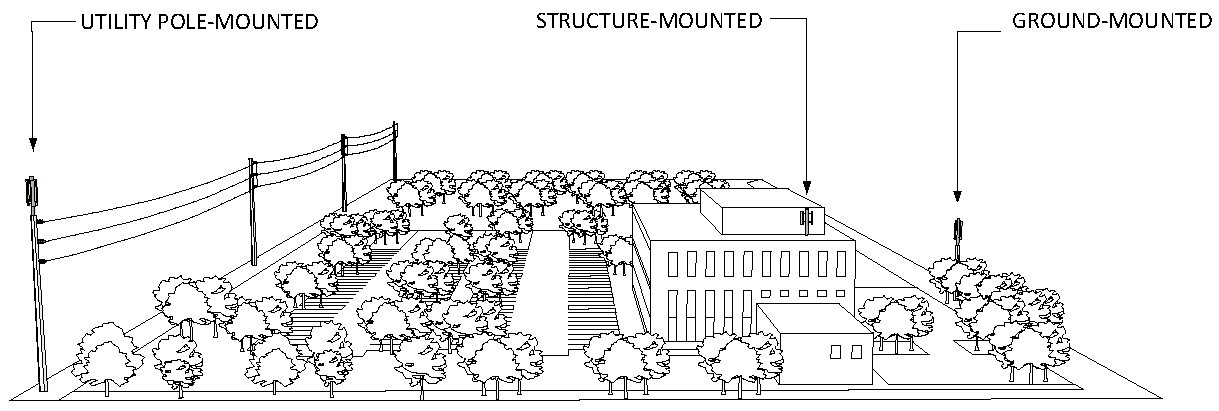
5.18.3
GENERAL STANDARDS
5.18.3.1
Compatibility
It is the intent of this article to encourage the location, siting and design of PWS facilities in a manner which limits their visual impact on the public view and to ensure their compatibility with surrounding land uses.
5.18.3.2
Color
PWS facilities shall be of a color or colors selected to blend into the surrounding environment. Where visible against the sky, facilities shall be galvanized or of gray or similar color to minimize visibility, except where contrasting color is required for public safety purposes or by the FCC or FAA.
5.18.3.3
Lighting
PWS facilities shall not be artificially lighted except as required for public safety purposes or by the FCC or FAA. Required lighting shall be shielded and/or directed to not project onto residential districts.
5.18.3.4
Signage
No signage shall be allowed on any PWS facility except as required for public safety purposes or by the FCC or FAA.
5.18.3.5
Secure Design
a.
All parts of PWS facilities shall maintain a minimum separation of 10 feet from any overhead utility lines.
b.
PWS mounts shall have removable climbing pegs or shall otherwise be designed to render them unclimbable by unauthorized persons or shall be provided with a suitable security barrier.
c.
PWS equipment shelters shall be of vandal-resistant design or shall be provided with a suitable security barrier.
5.18.4
STANDARDS FOR STRUCTURE-MOUNTED FACILITIES
5.18.4.1
General
a.
Structure-mounted PWS facilities shall be permitted as accessory uses in all zoning districts.
b.
Structure-mounted PWS facilities are facilities attached to or upon any commercial, industrial, office, or institutional structure, or any multi-family structure of three or more stories. This shall include buildings, water tanks, private light poles, light poles at publicly owned athletic facilities or other structures not originally designed as PWS antenna mounts. PWS facilities shall not be mounted on single-family structures, two-family structures or on multi-family structures less than three stories in height. The facility shall include any associated equipment shelters regardless of where they are located with respect to the mount.
c.
Placement of a PWS facility on a legally non-conforming structure shall not be considered an expansion of the non-conforming structure.
d.
PWS facilities shall not project into a required setback more than the maximum projection permitted in the zoning districts in which the facilities are located.
e.
Structure-mounted PWS facilities shall be located and designed to be accessible to authorized persons only.
5.18.4.2
Maximum Height
a.
Structure-mounted PWS facilities may extend above the roofline or highest point of the structure on which they are mounted a maximum of 20 feet, subject to the height limitations of the Polk County Airport Zoning Regulations.
b.
The height of a rooftop installation shall be measured from the finish level of the portion of the roof on which it is mounted.
c.
This section shall not apply if the facility is incorporated into a steeple, bell tower, or similar architectural feature of a church, school or institution, subject to the height limitations of the Polk County Airport Zoning Regulations.
5.18.4.3
Visual Compatibility
a.
To the greatest practical extent, structure-mounted PWS facilities shall be placed on the structure out of public view. When this is not practical, the use of enclosures or screens made of fiberglass or other material pervious to radio signals is encouraged to conceal the facility from public view in a manner that is compatible with the scale, color, and architectural character of the structure.
b.
When it is necessary to place the facility in public view, to the greatest practical extent, it shall be integrated into the structure in a manner that is compatible with the scale, color, and architectural character of the structure. When use of a pole or mast antenna mount is necessary, the use of cross-polarized (dual-polarized) antennas or similar designs that reduce the visual obtrusiveness of the facility is encouraged.
c.
To the greatest practical extent, equipment shelters associated with structure-mounted PWS facilities shall be located inside the existing structure, or concealed from public view, or made compatible with the scale, color, and architectural character of the structure.
5.18.5
STANDARDS FOR GROUND-MOUNTED FACILITIES
5.18.5.1
General
a.
Ground-mounted PWS facilities shall be permitted by right in the following zoning district classifications: 0-2, 0-3, C-2, C-3, C-4, C-5, I-1, I-2 and I-3. Ground-mounted PWS facilities may be permitted as conditional uses in the following zoning district classifications: RA-1, RA-2, RA-3, RA-4, RB, MF-12, MF-16, MF-22, MH, LD, O-1, C-1. The determination as to whether a ground-mounted PWS facility is permitted by right or as a conditional use in the PUD zoning district classification shall be based on the conventional zoning district which most closely approximates the use or uses permitted in the particular PUD district.
b.
Ground-mounted facilities are free-standing facilities constructed upon the ground. Utility pole-mounted facilities shall not be considered ground-mounted facilities. The ground-mounted facility shall include any associated equipment shelters regardless of where they are located with respect to the mount.
c.
The use of existing structures as antenna mounts shall be preferred to the construction of new ground-mounted facilities. An applicant for a new ground-mounted facility shall submit a report inventorying the availability of existing structures, including utility poles, within the applicant's search area which may serve as alternatives to the proposed ground-mounted facility. The applicant must demonstrate that the proposed facility cannot reasonably be accommodated on such existing structures due to one or more of the following factors:
1.
The structure provides insufficient height to allow the applicant's facility to function reasonably in parity with similar facilities.
2.
The structure provides insufficient structural strength to support the applicant's antenna and related equipment.
3.
The structure provides insufficient space to allow the applicant's antenna to function effectively and reasonably in parity with similar equipment.
4.
Use of the structure would result in electromagnetic interference that cannot reasonably be corrected.
5.
The structure is unavailable for lease under a reasonable leasing agreement.
6.
Use of the structure would create a greater visual impact on surrounding land uses than the proposed alternative or otherwise would be less in keeping with the goals, objectives, intent, preferences, purposes, criteria or standards of this article, the Master Plan for Personal Wireless Service Facilities, Lakeland Comprehensive Plan and Land Development Regulations.
7.
Other limiting factors.
d.
Ground-mounted PWS facilities may be located on zoning lots containing other principal uses.
e.
Ground-mounted PWS facilities shall not be permitted in Historic Districts or in areas zoned C-6 or C-7.
f.
A ground-mounted PWS facility shall be separated from any residential lot line a minimum of two feet horizontally for each one foot in facility height.
g.
A ground-mounted PWS facility shall be separated from limited-access highways (including frontage roads), arterial streets and highways and collector streets, as designated in the Comprehensive Plan, a minimum of two feet horizontally for each one foot in facility height.
h.
A ground-mounted PWS facility may be permitted in a residential district as a conditional use only if it is located on a parcel containing a non-residential land use such as a golf course, parking lot, cemetery, church, school, electric utility substation or on a vacant parcel of 50 acres or more.
i.
Ground-mounted PWS facilities shall be of the monopole type unless the applicant can demonstrate that another type of mount would be less visually obtrusive.
j.
Ground-mounted PWS facilities shall observe the minimum setback requirements for principal structures of the respective zoning districts.
k.
Ground-mounted PWS facilities shall be considered a non-residential use for purposes of determining if a buffer fence or wall is required.
l.
Ground-mounted PWS facilities shall be accessible by service vehicles.
5.18.5.2
Maximum Height
a.
Ground-mounted PWS facilities shall observe the following maximum heights in the zoning district and Future Land Use Intensity Area in which they are located, subject to the height limitations of the Polk County Airport Zoning Regulations:
Table 5.16-1: Maximum Height
b.
The maximum heights established by this section shall be the vertical distance of a PWS facility measured from average elevation of the finished grade within 20 feet of the facility to the highest point of the completed facility including antennas, platforms, or other attachments.
5.18.5.3
Horizontal Separation
a.
Ground-mounted PWS facilities shall maintain the following minimum horizontal separations from existing ground-mounted PWS facilities:
Table 5.16-2: Minimum Horizontal Separation
b.
Horizontal separation distances shall be measured from the base of the mount and shall apply irrespective of jurisdictional boundaries.
c.
In the event that an existing PWS facility is non-conforming as to height on the date of adoption of this article, for the purpose of determining the horizontal separation requirement for a proposed facility, the height of the existing facility shall be the maximum height allowed at that location under Sub-Section 5.18.5.2, rather than the actual height of the existing facility.
5.18.5.4
Visual Compatibility
a.
To the greatest practical extent, ground-mounted PWS facilities shall be sited where they are concealed from public view by other objects such as trees or buildings.
b.
When it is necessary to site the facility in public view, to the greatest practical extent it shall be designed to limit visual impact on surrounding land uses. The use of cross-polarized (dual-polarized) antennas or similar designs that reduce the visual obtrusiveness of the facility is encouraged.
c.
To the greatest practical extent, equipment shelters associated with ground-mounted PWS facilities shall be concealed from public view or shall be buffered to be compatible with surrounding land uses.
5.18.5.5
Co-Location
a.
Ground-mounted PWS facilities shall be designed to accommodate the following number of users:
b.
As proof that a proposed facility can accommodate co-location, a registered professional engineer shall certify that the mount has been designed for a loading capacity to support two or more users.
c.
The modification or reconstruction of an existing single-user, ground-mounted PWS facility to accommodate the co-location of one or more additional users shall be permitted to a maximum of 20 feet over the height of the original facility without requiring new or additional conditional use approval, or additional horizontal separation, provided that the modification or reconstruction shall not change the type of mount except that any type of mount may be reconstructed as a monopole. The height change may only occur one time per mount and shall be subject to the height limitations of the Polk County Airport Zoning Regulations.
5.18.5.6
Additional Standards for Lake Views
Conditional use consideration shall be required for any ground-mounted PWS facility proposed to be located within 2,000 feet of the water line and within public view of the shores of the following lakes: Lake Beulah, Lake Bonnet, Lake Bonny, Lake Crago, Lake Gibson, Lake Hollingsworth, Lake Holloway, Lake Hunter, Lake Mirror, Lake Morton, Lake Parker and Lake Wire. This standard shall not apply if the proposed facility is located in an industrial zoning district.
(Ord. No. 5900, Att. E, 10-18-21)
5.18.6
STANDARDS FOR UTILITY POLE-MOUNTED FACILITIES
5.18.6.1
General
a.
Utility pole-mounted PWS facilities shall be permitted as accessory uses in all zoning districts.
b.
Utility pole-mounted PWS facilities are facilities attached to or upon a publicly owned electric transmission or distribution pole, street light, traffic signal, or similar facility located within a public right-of-way or utility easement. The facility shall include any associated equipment shelters regardless of where they are located with respect to the mount.
c.
Utility pole-mounted PWS facilities or extensions on utility poles to accommodate the mounting of PWS antennas shall be of the monopole type.
d.
Equipment shelters associated with utility pole-mounted PWS facilities which are located outside of the public right-of-way shall meet the setbacks for accessory structures for the zoning districts in which the equipment shelters are located.
5.18.6.2
Maximum Height
Utility pole-mounted PWS facilities may extend a maximum of 20 feet above the top of the original utility pole notwithstanding the maximum heights for ground-mounted facilities established by Sub-Section 5.18.5.2, subject to the height limitations of the Polk County Airport Zoning Regulations.
5.18.6.3
Horizontal Separation
Minimum horizontal separation between utility pole-mounted PWS facilities shall be determined by the location of the existing utility poles.
5.18.6.4
Visual Compatibility
a.
To the greatest practical extent, utility pole-mounted PWS facilities shall be sited where they are concealed from public view by other objects such as trees or buildings.
b.
When it is necessary to site the facility in public view, to the greatest practical extent it shall be designed to limit visual impact on surrounding land uses. Cross-polarized (dual-polarized) antennas or similar designs that reduce the visual obtrusiveness of the facility are considered visually compatible when mounted on existing utility poles or extensions of existing utility poles and do not require additional review for visual compatibility.
c.
Equipment shelters associated with utility pole-mounted PWS facilities which are located within the public right-of-way shall be of a scale and design that make them no more visually obtrusive than other types of utility equipment boxes normally located within the right-of-way. To the greatest practical extent, equipment shelters associated with utility pole-mounted PWS facilities which are located outside of the public right-of-way shall be concealed from public view or shall be architecturally designed or buffered to be compatible with surrounding land uses.
5.18.7
STANDARDS FOR PWS FACILITIES AS CONDITIONAL USES
It is the intent of the City Commission to set forth standards for review, approval, approval with conditions, or disapproval of exceptions to the placement or construction of PWS facilities as permitted by right and the regulations which control the placement or construction of such facilities as contained in this article. These standards are instituted to provide an opportunity to place or construct a PWS facility, which under usual circumstances, could be detrimental to other land uses and cannot normally be permitted, but which may be permitted under circumstances particular to the proposed location and subject to conditions which provide protection to adjacent land uses, which protect the attractiveness, health, safety and property values of the community, which avoid the proliferation of visually obtrusive structures, and which promote the development of an advanced wireless communication infrastructure.
a.
Exceptions to the standards for the placement or construction of PWS facilities shall be considered as conditional uses. The conditional use procedure may be considered for the following:
1.
Requests for ground-mounted PWS facilities proposed to be located in residential, O-1, C-1, and LD zoning districts and within 2,000 feet of the lakes specified in Sub-Section 5.18.5.6.
2.
Requests for exceptions to specific standards established in this Article for maximum height; horizontal separation; separation from residential districts, limited-access highways (including frontage roads), arterial streets and highways and collector streets; and alternatives to the monopole type mount.
b.
In addition to the standards set forth in Sub-Section 2.4.4 (Specific Standards for All Conditional Uses), prior to approving any PWS facility as a conditional use, the City Commission shall find, based on competent and substantial evidence, that the proposed facility is located, sited and designed to be compatible with the character of the general area in which it is located, avoids the proliferation of visually obtrusive structures, and promotes the development of an advanced wireless communication infrastructure consistent with the Master Plan for Personal Wireless Service Facilities.
c.
In determining whether to grant a conditional use pursuant to this section, the City Commission shall consider the following factors:
1.
The height and visual obtrusiveness of the facility;
2.
The degree of visibility from the public view;
3.
The proximity of the facility to residential structures and residential district boundaries;
4.
The character of the uses and structures on adjacent and nearby properties;
5.
The character of the land, including topography and tree coverage;
6.
The design of the facility with particular reference to design characteristics that have the effect of reducing or eliminating visual obtrusiveness;
7.
The degree to which the facility reduces the proliferation of visually obtrusive structures through co-location; and
8.
Competent evidence that reasonable alternatives to the proposed conditional use do not exist.
d.
In addition to the information required on an application for approval of a PWS facility as a conditional use, an applicant may be required to submit information sufficient to evaluate the visual impact of the proposed facility. This may include, but shall not necessarily be limited to, photo simulations, photo montage or other techniques to illustrate how the facility will appear from public view.
(Ord. No. 5900, Att. E, 10-18-21)
5.18.8
ADMINISTRATION
5.18.8.1
Building Permit Required
a.
It shall be unlawful for any property owner, contractor or PWS provider to erect, construct, alter or relocate within the city any PWS facility without first obtaining a permit from the Building Inspection Division and making payment of required fees.
b.
For each PWS facility, the following information shall be submitted in addition to the information required under Sub-Section 12.5.6:
1.
Legal description. Including parent tract and any leased parcel.
2.
Site plan. Indicating the location, type, height and setbacks of the proposed facility including mounts, foundations, equipment shelters, cable runs, security barriers, access points, buffers and landscaping, property lines and easements, and existing structures. Also, separation distances as required from residential uses, limited-access highways (including frontage roads), arterial streets and highways and collector streets, and existing ground-mounted PWS facilities for new ground-mounted facilities.
3.
Front and side elevations. Indicating color and finish of exposed parts, visual screens or enclosures, buffer treatments and lighting. Also, the color, finish and material of the building or structure on which the facility is mounted for structure-mounted facilities.
4.
Existing Structures Report. (For new ground-mounted facilities only.) A report inventorying the availability of existing structures, including utility poles, within the applicant's search area which may serve as alternatives to the proposed ground-mounted facility. The report shall evaluate why the proposed facility cannot reasonably be accommodated on such existing structures.
5.
Co-Location Statement. A statement of intent that co-locators will be permitted in cases where facilities are required or proposed to accommodate more than one provider. The positions of anticipated co-locator antennas on the mount and the space provided for co-locator equipment shelters shall be shown on all site plans and elevations.
5.18.8.2
Retention of Technical Experts
The city shall have the right to retain independent technical consultants and experts that it deems necessary to properly evaluate applications for PWS facilities and to charge a reasonable cost for such services to the applicant.
5.18.8.3
Period of Validity
a.
A PWS facility that has received conditional use approval or a building permit shall be considered an existing PWS facility as long as such approval is valid and not expired.
b.
A conditional use approval or building permit which has been granted for a PWS facility shall cease to be valid if construction of the facility has not commenced within six months of the approval or permit. In the event construction has not commenced within six months, a request for an extension of the building permit may be considered by the Chief Building Official or a request for an extension of the conditional use may be considered by the City Commission.
5.18.8.4
Abandonment
In the event that the use of any PWS facility is discontinued for a period of 180 consecutive days, the facility shall be deemed to be abandoned. Determination of the date of abandonment shall be made by the Director of Community Development who shall have the right to request documentation and/or affidavits from the facility owner/operator regarding the active use of the facility. The owner/operator of the facility shall have 180 days from the date of abandonment to: (1) reactivate the use of the facility or transfer the facility to another owner/operator who makes actual use of the facility, or (2) dismantle and remove the facility. At the earlier of 181 days from the date of abandonment without reactivation, or upon completion of dismantling and removal, any approval for the facility shall automatically expire. If the owner/operator of a facility files a notice of intent to cease operations with the FCC, a copy shall be provided to the City.
5.19 - PRODUCE STANDS/MARKETS—TEMPORARY
(Ord. No. 5532, 09-21-15)
5.19.1
DEFINITIONS
Produce Stand/Market: The temporary outdoor retail sale of primarily agricultural products, such as trees, plants, fruits or vegetables, and certain types of "Cottage Food Products" in accordance with Florida Statutes.
(Ord. No. 5532, 09-21-15)
5.19.2
PROCEDURES AND STANDARDS FOR ESTABLISHMENT
a.
Where Permitted
Produce stands/markets shall be permitted in commercial zoning districts; Planned Unit Developments or Special Public Interest districts zoned for commercial or mixed uses; schools, places of worship and other non-residential uses in residential zoning districts; and the common areas of multi-family developments containing 100 units or more. Produce stands/markets shall not be permitted where any type of hazardous chemicals or gasoline is sold.
b.
Permit Procedures
1.
A produce stand/market shall require a temporary use permit issued by the Director of Community Development or his designee. Permits shall be valid for up to 365 consecutive calendar days. The Director may deny the reissuance of a permit or may revoke a permit if he determines that the produce stand/market has negative impacts on the subject or neighboring properties or is in violation of the standards set forth herein.
2.
Application for a temporary use permit for a produce stand/market shall include:
(a)
Proof of the property owner's consent and owner's contact information.
(b)
A sketch plan showing the property boundaries and proposed access points, tents or other temporary structures, sales areas, parking, signage, utilities and mechanical equipment. The plan shall indicate the setbacks of all structures, equipment and signage from adjacent properties.
(c)
Application fee.
(Ord. No. 5532, 09-21-15)
5.19.3
SPECIFIC STANDARDS FOR APPROVAL
a.
Hours of operation shall be limited to the hours between 7:00 a.m. and 9:00 p.m.
b.
Maximum total sales area shall not exceed 5,000 square feet.
c.
Applicable permits shall be obtained for signs, tents and other temporary structures.
d.
All waste and debris shall be removed from the site daily.
e.
The Community Development Director or designee may place additional conditions or restrictions on the temporary use permit.
(Ord. No. 5532, 09-21-15)
5.20 - RESERVED
Editor's note— Ord. No. 5914, § 2(Att. A), adopted Feb. 21, 2022, deleted § 5.20, entitled "Sidewalk Cafes," which derived from Ord. No. 5455, adopted July 21, 2014.
5.21 - SOLAR ENERGY SYSTEMS AND SOLAR POWER GENERATION FACILITIES
5.21.1
SOLAR ENERGY SYSTEMS
5.21.1.1
Intent
It is the intent of this section to establish standards for solar energy systems as an accessory use to any principal use in all zoning districts.
5.21.1.2
Definitions
Ground-Mounted Solar Energy System: A solar energy system in which the components that collect solar energy are placed on freestanding supports, masts or poles on the ground.
Rooftop Solar Energy System: A solar energy system in which the components that collect solar energy are placed on the roof of a building or structure. Ancillary equipment used for the purposes of storing solar energy or converting the solar energy to electricity may be located on the ground.
Solar Energy System: A set of components that can collect, store and convert solar energy for the purpose of providing electric generation, water heating, pool/spa heating, space heating or space cooling as an accessory use to a permitted principal use. This definition allows for net metering of any surplus energy to an electric utility provider. A rooftop solar energy system as defined by this section shall allow for the interconnection of the system with an electric utility provider whereby all or part of the electric power that is produced is consumed off-site and is distributed and sold by the electric utility provider.
5.21.1.3
Specific Standards
a.
Residential Districts
Solar energy systems shall be permitted as an accessory use in all residential zoning districts and within any Planned Unit Development that allows residential uses, subject to the provisions in this section.
1.
Ground-Mounted Solar Energy Systems.
Ground-mounted solar energy systems shall be installed in accordance with the setbacks of principal buildings and within required side yards and rear yards subject to the following provisions:
(a)
Minimum street side setback: 20 feet
(b)
Minimum interior or rear setback: 5 feet
(c)
Maximum height: 10 feet
(d)
Ground-mounted solar systems are prohibited within front yards except where the lot depth allows for the placement of the solar system a minimum of 100' from the front lot line.
2.
Rooftop Solar Energy Systems.
Rooftop solar energy systems shall be installed on principal and accessory structures in accordance with the setback and height limitations of such structures except that the components of the system may exceed the maximum height up to a maximum of 3 feet. In no case shall the solar energy system extend more than 3 feet above the roof or, when placed on a pitched (gable, hip and gambrel) roof, cover more than 50 percent of the roof area of the structure.
b.
Non-Residential Districts
1.
Solar energy systems shall be permitted as an accessory use in all zoning districts that are not residential districts, subject to the provisions in this section.
2.
Ground-mounted solar energy systems shall be installed in accordance with the setbacks of principal buildings and within required side yards and rear yards subject to the following provisions:
(a)
Minimum interior side and rear setback from non-residential lot line: 15 feet
(b)
Minimum interior side and rear setback from residential lot line: 30 feet
(c)
Minimum street side setback: 30 feet
(d)
Maximum height: 15 feet
(e)
Ground-mounted solar systems are prohibited within front yards except where the lot depth allows for the placement of the solar system a minimum of 100' from the front lot line.
3.
Rooftop solar energy systems shall be installed on principal and accessory structures in accordance with the setback and height limitations of such structures except that the components of the system may exceed the maximum height up to a maximum of 5 feet. In no case shall the solar energy system extend more than 5 feet above the roof.
c.
Historic Districts and Other Special Districts
Solar energy systems that are installed within a designated local historic district and within the Lakeland Downtown Development Authority special taxing district, shall be subject to design review by the board or authority designated to perform such design review.
5.21.2
SOLAR POWER GENERATION FACILITIES
5.21.2.1
Procedures and Standards for Establishment
Solar power generation facilities shall be permitted as a principal use within all industrial zoning districts and within any Planned Unit Development that lists permitted uses as those within an industrial zoning district. Solar power generation facilities shall be permitted as a conditional use within the Limited Development (LD) zoning district except that such facilities shall not be permitted in areas designated Preservation (P). Such facilities shall be subject to the development standards generally applicable to the district in which they are located and to the standards set forth in this section.
5.21.2.2
Definitions
Solar Power Generation Facility: A production facility for electric power that utilizes photovoltaic modules (panels) to convert solar energy to electricity whereby all of the electricity that is produced is consumed off-site and is distributed and sold by an electric utility provider. This definition does not preclude the use of photovoltaic modules that are installed on a rooftop in accordance with Sub-Section 5.21.1 and whereby the electric power that is produced is consumed off-site and is distributed and sold by an electric utility provider.
5.21.2.3
Specific Standards
a.
All photovoltaic modules (panels) and associated above-ground equipment that is used in the conversion of solar energy to electricity shall be located no closer than 50 feet from all parcel boundaries. This distance may be reduced to 30 feet for interior side yards that are adjacent to property that is zoned for industrial uses.
b.
A buffer fence or wall shall be required along all parcel boundaries that are adjacent to or across the street from residentially zoned property or adjacent to a public right-of-way. The buffer wall or fence shall meet the standards of Section 4.5.
5.22 - UTILITY AND ESSENTIAL SERVICE FACILITIES, LEVEL I
5.22.1
INTENT AND APPLICABILITY
It is the intent of this section to establish specific development standards for Level I Utility and Essential Service Facilities.
5.22.2
SPECIFIC STANDARDS FOR SAFETY AND SECURITY FACILITIES
Where located adjacent to residential uses, safety and security facilities including police, fire and ambulance facilities shall incorporate a Type A buffer in accordance with Figure 4.5-9. Security fencing may be incorporated in accordance with Section 4.4.
5.22.3
SPECIFIC STANDARDS FOR OTHER LEVEL I UTILITY AND ESSENTIAL SERVICE FACILITIES
a.
Where located adjacent to any residential use, all electric substations and all Level I Utility and Essential Service Facilities 3,000 square feet or more in area, other than Safety and Security Facilities shall incorporate a Type A buffer in accordance with Figure 4.5-9. Security fencing shall be incorporated in accordance with Section 4.4.
b.
All wastewater lift stations and all Level I Utility and Essential Service Facilities less than 3,000 square feet in area, other than Safety and Security Facilities: No perimeter buffer required. Security fencing may be incorporated in accordance with Section 4.4.
5.23 - VETERINARY CLINICS
5.23.1
PROCEDURES AND STANDARDS FOR ESTABLISHMENT
If permitted by right or as a conditional use in a district, veterinary clinics shall be established subject to the development standards generally applicable in the district as well as the specific standards set forth in Sub-Section 5.23.2.
(Ord. No. 5455, 07-21-14)
5.23.2
SPECIFIC STANDARDS
a.
Such hospitals and clinics and any treatment rooms, pens, or cages shall be maintained within a completely enclosed, soundproof building.
b.
Such hospitals and clinics shall be operated in such a manner as to produce no objectionable odors outside their walls.
c.
All buildings shall maintain a minimum distance of 75 feet from any residential property line.
5.24 - FOOD TRUCKS[1]
5.24.1
GENERAL DEVELOPMENT STANDARDS
a.
Where allowed in Table 2.3-1, no more than one (1) food truck shall be in operation on a given property as an accessory use to another permitted principal commercial use. Two or more food trucks may only be considered through a conditional use for a food truck court.
b.
With the exception of special events, such as food truck rallies which are approved through a special event permit, food trucks shall not be located within any public or private right-of-way.
c.
Food trucks, and any accessory outdoor tables or seating, shall be setback a minimum of five (5) feet from any sidewalks, ten (10) feet from any driveways and above ground utilities, fifteen (15) feet from any fire hydrants, and fifty (50) feet from any residentially-zoned property.
d.
Food trucks, and any accessory outdoor tables or seating, shall not block or otherwise impede access to any sidewalks, driveways, ADA accessible parking or fire lanes.
e.
Food trucks shall only be located on an improved, stabilized surface such as concrete, gravel, asphalt or other similar material. If located within an off-street parking area, any parking spaces used will count against the minimum parking ratio required to support the principal use of the property. The amount of parking used shall not result in a reduction of the number of available off-street parking required to support the principal use, as specified by Table 4.11-1.
f.
Solid waste collection receptacles shall be provided for use by food truck customers. All solid waste collected shall be properly disposed of either off-site or on-site within an approved solid waste collection bin (dumpster) through an agreement with the property owner.
g.
Electrical service may be provided by either an on-board generator or through a temporary electric connection, subject to compliance with all codes and any permitting requirements. Permanent connections for electrical service shall be prohibited.
h.
Liquid Waste Disposal
1.
There shall be no discharge of liquid waste or grease trap waste into any storm or sanitary sewer system. Liquid waste shall be disposed of through one of the following methods:
(a)
A licensed contracted commissary or A licensed designated sanitary sewer disposal site. All commissaries and disposal sites must have approved grease traps, and monitoring manholes per City of Lakeland Standards and Specifications.
(b)
Direct connection to sanitary sewer by new or existing services.
If a food truck is located on a property that has a grease trap and monitoring manhole approved by the Water Utilities Department, connection to the sanitary sewer shall require compliance with all water utility requirements and approval by the Water Utilities Department. If at any time the Water Utilities Department has concerns about the connection, immediate disconnection shall occur.
2.
Disposal Documentation Log
All food truck operators shall maintain a Disposal Documentation Log. The disposal log shall be kept in the food truck at all times and shall include date, time, address location, and the amount of liquid waste, grease or used cooking oil disposed. At the request of the Water Utilities Department and/or upon inspection, the food truck operator shall provide copies of the disposal log. The Disposal Documentation Log to be used by the food truck operator can be found on the City of Lakeland Water Utilities' website, or by contacting the department.
i.
Water Consumption
1.
Water shall be provided from one of the following methods:
(a)
A licensed contracted commissary or A licensed designated potable water fill site
There shall be no connection to any non-potable water source. All commissaries must have an approved backflow prevention device per City of Lakeland Standards and Specifications.
(b)
Direct connection to water by a new or existing domestic service.
If a food truck is located on a property that has a City installed domestic water meter and backflow prevention device approved by the Water Utilities Department, connection to the water service line, downstream of the backflow prevention device, shall be in accordance with all water utility requirements. If at any time the Water Utilities Department has concerns with the connection, or the meter and/or backflow prevention device are bypassed, immediate disconnection shall occur.
2.
Potable Water Acquisition Log: The food truck operator shall maintain a Potable Water Acquisition Log. The log shall be kept in the food truck at all times and shall include date, time, address location, and the amount of potable water obtained. At the request of the Water Utilities Department, and/or upon inspection, the food truck operator shall provide copies of the log. The Acquisition Log to be used by the food truck proprietor can be found on the City of Lakeland Water Utilities' website, or by contacting the department.
(Ord. No. 5794, § 1.2(Att. B), 11-18-19)
5.24.2
REQUIRED DOCUMENTATION
a.
All licensing and permitting of food trucks shall be done through the Department of Business and Professional Regulation in accordance with applicable state statutes.
b.
Prior to operating within the City of Lakeland, the food truck proprietor shall submit a Food Truck Sanitary Sewer Disposal & Potable Water Source Form to the City of Lakeland Water Utilities Department. This form, which can be found on the City of Lakeland Water Utilities' website or by contacting the department, must be completed and signed by the Water Utilities Department.
c.
In accordance with Section 78-4 (b) of the City of Lakeland Code of Ordinances, the proprietor shall also obtain written consent from the property owner which authorizes the food truck use and guarantees access to permanent bathroom facilities on the site. The Food Truck proprietor shall provide documentation of such consent upon request by City of Lakeland Code Enforcement Division.
d.
The food truck proprietor shall maintain a Disposal Documentation Log. The disposal log shall be kept in the food truck and shall include date, time, address location, and the amount of liquid waste, grease or used cooking oil disposed. Food Truck operator shall provide copies of the disposal log when requested by the Water Utilities Department and/or upon inspection.
(Ord. No. 5794, § 1.2(Att. B), 11-18-19; Ord. No 6055, § 2(Att. A), 9-16-24)
Editor's note— Ord. No. 5794, § 1.2(Att. B), adopted Nov. 18, 2019, set out provisions intended for use as 5.10. To avoid duplication of section numbering, at the editor's discretion, and with the concurrence of the city, these provisions have been included as § 5.24.
5.25 - SHIPPING CONTAINERS AS DWELLING UNITS AND AS ACCESSORY STRUCTURES FOR CERTAIN COMMERCIAL USES
5.25.1
INTENT AND APPLICABILITY
It is the intent of this section to establish specific development standards allowing for the use of shipping containers as dwelling units and as accessory structures for certain commercial uses.
5.25.1.1
Definitions
Shipping Container: A large, standardized container designed for intermodal transport of goods and materials that is without wheels and any vehicle chassis.
5.25.1.2
Shipping Containers for Use as Dwelling Units
a.
Through the conditional use process, shipping containers may be used as dwelling units on properties located in MF (Multi-Family Residential) zoning districts and in existing or proposed mobile home parks that are zoned as part of a MH (Mobile Home) zoning district.
b.
All shipping containers used as dwelling units shall be installed on a permanent foundation and comply with the Florida Building Code and Florida Fire Prevention Code.
c.
The use of shipping containers as dwelling units shall be contingent upon certain architectural modifications being made to the exterior of the structures. Such modifications shall include the use of residential windows and doors, awnings, and finishing materials such stucco, fiber cement siding or other materials appropriate for the residential use.
d.
For shipping container dwellings proposed for use in mobile home parks, architectural elevations are required to illustrate the types of architectural treatments and finishing materials that will be used. A typical lot layout is also required to illustrate setbacks, off-street parking and any appurtenances that will be used such as carports and decks.
e.
For properties zoned for multi-family uses, a detailed site plan showing setbacks, building footprints, parking, and required landscaping and buffering is required. Architectural elevations shall also be provided to show the types of architectural treatments and finishing materials that will be used.
f.
All other development standards shall be in accordance with the underlying zoning district in which the property is located.
5.25.1.3
Shipping Containers as Accessory Structures for Certain Commercial Uses
a.
All shipping containers used as accessory structures shall be installed on a permanent foundation and comply with the Florida Building Code and Florida Fire Prevention Code.
b.
Use as commercial accessory structures shall be limited to the following uses when permitted as a principal use in the underlying zoning district:
1.
Small-scale restaurants in which fresh food products are prepared on-site and sold directly to consumers for either on-premises or off-premises consumption.
2.
Small-scale, specialty retail sales of antiques, fresh, packaged and prepared foods, cosmetics, clothing, gifts, toys, books, jewelry, small electronics, flowers, arts and crafts and other similar goods.
3.
Indoor hydroponic production of fruits, vegetables, flowers and herbs.
4.
Other uses not specifically listed when the Director of Community and Economic Development determines that the use is compatible with the surrounding uses.
c.
No more than one shipping container shall be installed per premises. The installation of two or more shipping containers for innovative commercial projects such as container food courts and other uses may be considered through a conditional use permit.
d.
Shipping containers used as an accessory building for restaurant or retail sales uses shall be located in accordance with the setbacks applicable to the principal structure on the lot or parcel on which they are located.
e.
Shipping containers used for hydroponic production shall be located in accordance with the setbacks for General Accessory Structures specified by Table 4.3-4.
f.
Shipping containers used as accessory structures shall not be located within any required off-street parking spaces, vehicle driveways or drive aisles, fire lanes or pedestrian facilities.
g.
Design and Performance Standards
1.
All shipping containers used as accessory structures shall be painted and maintained in good condition at all times with no visible structural damage, corrosion or graffiti.
2.
Shipping containers used for restaurant and retail uses shall be modified and enhanced through the use of architectural features such as commercial doors and windows, awnings, outdoor lighting, seating, and landscaping planters.
3.
Signage shall be limited to building mounted signs with a maximum sign area not to exceed 25 square feet per wall face and 50 square feet total.
4.
Any solid waste generated shall be collected and disposed using the solid waste collection bins serving the principal structure on the premises.
(Ord. No. 5900, Att. B, 10-18-21)
5.26 - MULTI-FAMILY AFFORDABLE HOUSING PROJECTS IN NON-RESIDENTIAL ZONING DISTRICTS
5.26.1
INTENT AND APPLICABILITY
Intent
It is the intent of this section to establish procedures and standards which will incentivize and allow for the development of affordable housing on properties in certain industrial and commercial districts on vacant or underutilized properties. Approvals sought pursuant to the article shall be subject to certain location criteria and the minimum development standards specified below. Affordable housing projects proposed under these provisions shall be limited to new construction of multi-family or mixed-use residential structures as described below.
5.26.2
DEFINITIONS
Affordable Housing: In accordance with 420.0004(3), Florida Statutes, affordable housing shall mean housing in which monthly rents or mortgage payments, including taxes, utilities, and insurance, do not exceed 30 percent (30%) of that amount which represents the percentage of the median adjusted gross annual income for households whose total annual income does not exceed 120% of the median annual adjusted gross income of the Lakeland -Winter Haven Metropolitan Statistical Area (MSA). This definition also includes "Persons with special needs" defined in 420.0004(13), Florida Statutes.
Applicant: The developer of an affordable housing project, or their authorized agent, seeking approval in accordance with the provisions in this section.
Application: Pursuant to 166.04151(6), Florida Statutes, any request for approval of an affordable housing development in a non-residential zoning district where multi-family residential uses would otherwise not be permitted.
5.26.3
PROCEDURES AND STANDARDS FOR ESTABLISHMENT
a.
Location Criteria.
The development of affordable housing shall be permitted on property zoned I-1, C-1, C-2, C-3, C-4 or C-5 provided that the property is located within ¼ mile (0.25 miles) of a designated Transit Oriented Center or Transit Oriented Corridor; or is located along a fixed transit route. The route on which the property is located must provide service at headways, or a frequency of sixty minutes or less and must have a designated transit stop located within 1,320 feet (¼ mile) of the proposed project.
b.
Development Standards: In accordance with MF-12/MF-16/MF-22 Urban Neighborhood (UNH) context sub-district except as follows:
1.
Minimum Development Site: One (1) acre
2.
Minimum Density: 12 DU/acre
3.
Maximum Density: 75 Du/acre
4.
Minimum Number of Dwelling Units per Building: Four (4)
5.
Minimum Building Height: Two (2) stories
c.
Additional Requirements.
1.
All qualifying projects shall have a restrictive covenant which requires a minimum of twenty-five percent (25%) of the dwelling units to be made affordable to qualified buyers or renters who earn 120 percent (120%) of Area Median Income (AMI) or less, adjusted for family size, for a minimum time of thirty (30) years.
2.
If a project contains both affordable and market rate units, affordable units shall be comparable in terms of both quality and size to units offered at market rate rents and have shared access to any amenities offered.
d.
Mixed-use Developments: Affordable housing projects located in non-residential zoning districts may be designed as mixed-use projects in which residential dwelling units are located above another ground floor commercial use. Permitted commercial uses shall be limited to office, restaurant, retail, and personal services uses that are permitted by right in the underlying zoning district, excluding motor vehicle-oriented uses. Such projects shall employ urban design elements that maximize walkability using enhanced streetscaping, including but not limited to, decorative lighting and street furniture, outdoor seating areas, increased sidewalk coverage, landscaping, underground utilities, transit and bicycling infrastructure, crosswalks, curb extensions, railings, bollards, planters, and other traffic calming measures.
e.
Compatibility Review.
1.
Prior to site plan or building permit approval, the applicant shall submit to the Planning and Zoning Board a conceptual site development plan and complete building elevations which depict the architectural style, roof treatment, windows, doors, finishing materials, and other exterior architectural elements for the proposed multi-family use. At the discretion of planning staff, supplemental documentation such as architectural renderings, sectional drawings, and line-of-site analysis may be required as part of the review process.
2.
The Planning and Zoning Board shall notify the owners of record of properties within 250 feet of the subject property and shall conduct a public hearing on the matter at a regular meeting.
3.
In making its determination, the Planning and Zoning Board shall find:
a.
That the proposed multi-family development is compatible with adjacent land uses and that established commercial or industrial uses do not generate excessive noise, odors, heavy truck traffic, or other conditions or have business operations during hours which would be deemed a nuisance and detrimental to a residential use.
b.
That approval of a multi-family residential use would not significantly impact the business operations of established commercial or industrial uses through the generation of complaints related to business activities.
c.
That adequate open space is provided for the residents in accordance with the provisions for Civic Open Space specified in Subsection 3.4.6.3.
d.
That the design of the project is compatible with the urban context. Such a finding shall be based on the consideration of setbacks, building mass, building orientation, building height, frontage buildout, parking location, building materials, window arrangement, amenities, landscaping, and any other pertinent considerations.
e.
The Planning and Zoning Board may impose any conditions or limitations upon the establishment, location, construction, maintenance, or operation of the multi-family residential use which in its judgment may reasonably be necessary to prevent the use from becoming detrimental to other permitted land uses, to promote the public interest, and protect the health, safety, and welfare of residents and adjacent property owners. Conditions and requirements stated as part of the approval shall be a continuing obligation of the property owners.
f.
If approved by the Planning and Zoning Board, the applicant shall apply for site plan and building permit review within one year (365 days) of the date of approval. Following approval, if substantial changes are made to the design of the project, including but not limited to, an increase in density, building height, massing, or architectural design, an additional review may be required by the Planning and Zoning Board.
5.26.4
SITE PLAN SUBMITTAL REQUIREMENTS
a.
Pre-Application Meeting: Prior to applying for concept or site plan review, the applicant shall meet with staff to review and discuss the proposed affordable housing project. At that time, the applicant shall provide a general overview of the project including the proposed number of housing units, unit-type mix, and targeted income levels. The applicant shall also provide a conceptual site plan and building elevations, renderings, or other visual aids which depict the location of building footprints, off-street parking, amenities, stormwater retention areas, access driveways, architectural style, building heights and other design elements for the proposed affordable housing project.
b.
Concept Plan Review: Prior to applying for compatibility review, the applicant shall apply for concept plan review by the City's Development Review Team (DRT) to confirm that adequate infrastructure and services are in place for the project to move forward. For concept plan review, the applicant shall submit a detailed site plan which depicts the design and location of all building footprints, off-street parking areas, amenities, stormwater retention areas, access driveways, landscape buffers, and solid waste collection facilities, and identifies any existing trees that will be preserved and incorporated into the project.
(Ord. No 5976, § 2(Att. B), 3-20-23)

