
Lancaster County Unincorporated
City Zoning Code
City Zoning Code
ARTICLE 1
- DEFINITIONS2
For the purpose of this ordinance, certain words and terms are defined as follows. Words used in the present tense include the future. Words in the singular include the plural, and the plural includes the singular.
Abattoir.
A commercial slaughterhouse.
Accessory use or structure.
A subordinate use or structure customarily incidental to and located upon the same or adjacent lot occupied by the main use or building, including private water and sewage facilities.
(Ord. of 12-4-92; Ord. of 4-95)
Acreage.
A parcel of land, regardless of area, which is not a numbered lot on any recorded subdivision plat.
Administrator, the.
The official charged with the enforcement of this zoning ordinance. He shall be appointed by formal resolution to the position by the board of supervisors. He may serve with or without compensation as determined by the board of supervisors.
Agricultural and Commercial Solar Installation.
An installation of solar photovoltaic, solar thermal, solar hot water, or any similar type of energy or heat capture from sunlight intended for use on and within an Agricultural or Commercial enterprise located on the same or adjacent parcel that is intended to provide some or all of the energy needs for that use and not a utility scale solar project. Such an installation could be grid-tied, but its primary purpose would not be to derive direct revenue from utility sales. (Ord. of 5-27-21)
Agricultural lands.
Those lands used for the planting and harvesting of crops or plant growth of any kind in the open; pasture; horticulture; dairying; floriculture; or raising of poultry and/or livestock.
Agriculture.
The tilling of the soil, the raising of crops, horticulture, forestry, and gardening, including the keeping of animals and fowl.
Airport.
A facility for the landing and takeoff of aircraft, together with servicing facilities including service to patrons, from which revenue is derived.
Airport, private.
A facility for the landing, takeoff and tiedown of private aircraft weighing not more than 12,500 pounds (maximum gross weight), from which no flight instruction, charter, or rental service is given and from which no revenue is derived; except that the use of the facility as a temporary base of operations for fish spotter, sprayer and duster aircraft is permitted.
Alteration.
Any change in the total floor area, use, adaptability, or external appearance of an existing structure.
Amusement enterprise.
A building or structure used to provide or stage public entertainment for which a charge is imposed in the form of an entrance fee or separate fees for the use of amusement devices therein.
Antique shop.
The commercial activity of purchasing, storing, displaying, repairing, refinishing, selling, including auctions, of antique chattels and related refinishing materials.
Apartment house.
Any building, including townhouses, condominiums as defined in [this] article, or cooperative apartments used or intended to be used as the residence of three or more families living independently of each other.
Applicant.
The person or entity who submits an application to the locality for a permit or authorization to operate, construct, or install any item or action as required by county ordinance. (Ord. of 5-27-21)
Artist studio.
A facility where original arts and crafts may be created from such materials as ink, paint, clay, fiber, glass, metal and stone, where instruction in the use of such materials may be carried out; and where similar such works may be displayed and sold.
(Ord. of 12-12-90; Ord. of 10-24-96(1))
Assembly plant.
A structure used for the fitting together of parts or components to form a complete unit.
Automobile graveyard.
Any lot or place which is exposed to the weather upon which there are more than five motor vehicles of any kind, incapable of being operated, and which it would not be economically practical to make operative.
Basement.
A story having part, but not more than one-half of its height below highest grade. A basement shall be counted as a story for the purpose of height regulations.
Bed and breakfast.
A dwelling where overnight lodging is provided, with or without food, for compensation.
(Ord. of 12-4-92)
Best management practices (BMP's).
A practice, or combination of practices, that is determined by a state or designated areawide planning agency to be the most effective, practical means of preventing or reducing the amount of pollution generated by non-point sources to a level compatible with water quality goals.
Blacksmith shop.
A building usually equipped with a forge, used for the shaping and repair of iron and other metals.
Boardinghouse.
A building arranged or used for lodging, with or without meals, for compensation and not occupied as a one-family dwelling or a two-family dwelling. A one-family or two-family dwelling is a building with no more than five lodgers. The Virginia Uniform Statewide Building Code provides for the specific definitions of hotels, boardinghouses and other dwelling units. These definitions are hereby incorporated into this ordinance.
(Ord. of 12-4-92)
Boat pier, private.
A pier six feet wide or less, not to exceed one-fourth the width of its waterway, unless otherwise approved by proper authority (such as Virginia Marine Resources Commission), and elevated no less than four feet above wetland substrate, with up to 400 square feet for an "L" or "T" or other structural configuration, for private use to which a boathouse is not attached. Other structures such as fish cleaning stations, benches, low profile boat lifts, and handrails are permitted if the height of these structures does not exceed four and one-half feet above the pier.
(Ord. of 2-94; Ord. of 12-12-96(1); Ord. of 7-27-06)
Boat ramp, private.
A ramp built for the private, noncommercial use of the property owner to give access to tidal water, subject to the approval of the Lancaster County wetlands board, and located no closer than five feet to the side property line.
Buffer area.
An area of natural or established vegetation managed to protect other components of the resource protection area and state waters from significant degradation due to land disturbance.
Building.
Any structure having a roof supported by columns or walls, for the housing or enclosure of persons, animals, or chattels.
Building, accessory.
A subordinate structure customarily incidental to, and located upon the same lot occupied by the main structure.
Building, commercial.
Any building used for activities that involve trade, commerce, barter, exchange, manufacture, processing, marketing, repair, assembly, services, or business.
Building, height of.
The height shall be measured from the average elevation of the ground surface along the front of the building.
Building, main.
The principal building on a lot, or the building housing the principal use on the lot.
Bulk storage.
A structure and/or structures designed or [for] and used as storage facilities for oil, fuel oil, gas, grain, etc., usually stored in large quantities.
Caliper.
The diameter in inches of a tree trunk measured six inches above the ground level for nursery stock.
Camper.
A rigid dwelling unit, whether or not equipped with wheels, so designed as to be intermittently movable from place to place over the highway, whether towed, self-propelled or carried upon another vehicle to provide temporary living quarters for recreational, camping or travel use.
(Ord. of 7-25-91)
Campground.
An area upon which are located two or more sites for major recreational equipment for seasonal or temporary recreational occupancy.
(Ord. of 7-25-91)
Camping trailer.
A vehicular portable unit mounted on wheels and constructed with collapsible partial side walls that fold for towing by another vehicle and unfold at the campsite to provide temporary living quarters for recreational, camping or travel use.
(Ord. of 7-25-91)
Cannery.
A structure used for the processing and canning of foods.
Cellar.
That portion of a building having more than one-half of its height below the highest grade. A cellar shall not be counted as a story for the purpose of height regulations.
Cemetery.
A private or commercial burial ground for human beings.
(Ord. of 12-4-92)
Chesapeake Bay preservation area (CBPA).
Any land designated by Lancaster County pursuant to part Ill of the Chesapeake Bay Preservation Area Designation and Management Regulations, VR 173-02-01, and Code of Virginia, § 10.1-2107. A Chesapeake Bay preservation area (CBPA) shall consist of a resource protection area (RPA) and a resource management area (RMA). All lands within Lancaster County outside of a RPA are within a RMA.
Child care or day care center.
A facility operated for the purpose of providing care, protection and guidance to a group of children separated from their parents during a part of a day.
Circuit court.
The circuit court for Lancaster County, Virginia.
Club.
Any non-profit service organization that provides facilities for dining, recreation, and/or other similar activities to its members and/or public, with accessory structure.
(Ord. of 10-31-91)
Cluster development.
A type of development that allows the reduction of lot sizes below the zoning ordinance's minimum requirements if the land thereby gained is preserved as permanent open space for the community.
Commercial boathouse.
A structure for storage and mooring of boats in a commercial facility.
(Ord. of 11-25-02)
Commission, the.
The planning commission of Lancaster County, Virginia.
Common open space.
All open space within the boundaries of a planned development designed and set aside for use by all residents of the planned development or by residents of a designated portion of the planned development and not dedicated as public lands.
Community pier and/or ramp.
A pier for the temporary (not overnight) mooring of boats owned by property owners of a specifically designated contiguous subdivision. A community pier and/or ramp is not used for commercial purposes and must be constructed on a lot dedicated to common use.
(Ord. of 12-4-92; Ord. of 2-94)
Community service area.
Any area or tract of land used by or designed to accommodate a community service building and ancillary facilities.
(Ord. of 3-25-93)
Community service building.
A structure designed and operated by a non-profit organization for the providing of services to the community.
(Ord. of 3-25-93)
Comprehensive plan.
The comprehensive plan for Lancaster [County], Virginia, as adopted November 30, 1971, and as amended.
Concrete works.
Structure or area used for the manufacture of concrete and concrete products.
Condominium.
A condominium as defined in Code of Virginia, ch. 4.2, § 55-79.41(f), (g), (h), (i), (j), (n) and (p).
Construction footprint.
The area of all impervious surface, including but not limited to, buildings, roads and drives, parking areas, sidewalks and the area necessary for construction of such improvements.
Contractor equipment storage yard.
An area used for the storage of heavy equipment generally associated with a construction, grading and landscaping operation.
(Ord. of 10-31-91; Ord. of 2-4-92; Ord. of 12-4-92)
County.
The County of Lancaster, Virginia.
Dairy.
A commercial establishment for the manufacture, processing and/or sale of dairy products.
Development.
The construction, or substantial alteration, of residential, commercial, industrial, institutional, recreational, transportational, or utility facilities or structures.
Diameter at breast height (DBH).
The diameter of a tree measured outside the bark at a point 4.5 feet above the ground.
District.
A division of territory within Lancaster County, Virginia, for the purpose of regulation of its use under the provisions of this ordinance.
Dripline.
A vertical projection to the ground surface from the furthest lateral extent of a tree's leaf canopy.
Dump heap (trash pile).
Any area where trash, garbage, or other waste or scrap material is dumped or deposited without being covered by a sanitary landfill.
Dwelling.
Any structure which is designed for use for residential purposes except hotels, boardinghouses, lodginghouses, tourist cabins, motels, apartment houses, manufactured home, campers, camping trailers, and travel trailers.
Dwelling, multiple-family.
A structure arranged or designed to be occupied by three or more families.
Dwelling, single-family.
A structure arranged or designed to be occupied by one family, the structure having only one dwelling unit.
Dwelling, two-family.
A structure arranged or designed to be occupied by two families, the structure having only two dwelling units.
Dwelling unit.
One or more rooms in a dwelling designed for living or sleeping purposes, and having only one kitchen.
Equestrian academy.
A commercial riding stable which includes instruction in horsemanship and which may include a tack shop.
(Ord. of 4-29-93)
Family.
One or more persons occupying a premises and living in a single dwelling unit, as distinguished from an unrelated group occupying a boardinghouse, lodginghouse, tourist home, or hotel or motel.
Family home provider, six to 12 children.
A child day program as defined in Code of Virginia, Section 63.1-195, with up to three employees other than the provider. Provider shall be licensed by the Virginia Department of Social Services and have a traffic and unloading plan approved by the zoning administrator. Notification of adjacent property owners, as required by Code of Virginia Section 15.1-486.5, shall be incorporated into the approval process.
(Ord. of 6-26-97(1))
Floating structure.
A floating barge-like entity without accommodations built thereon, which is not primarily used as a means of transportation on water. Floating structures may be allowed for construction or repair of marine-related uses such as piledriver, dragline, barge for riprap, and boat repair.
(Ord. of 1-94)
Frontage.
The minimum width of a lot measured from one side lot line to the other along a straight line on which no point shall be nearer to the street or road upon which the lot fronts than the building setback line as defined and required herein.
Garage, private.
Accessory building designed or used for the storage of private automobiles owned and used by the occupants of the building to which it is accessory.
Garage, public.
A building or portion thereof, other than a private garage, designed or used for servicing, repairing, equipping, renting, selling, or storing motor vehicles.
General store.
A single store which offers for sale general merchandise. Gasoline and oil may also be offered for sale but only as a secondary activity of a county general store.
(Ord. of 10-24-96(1))
Golf course.
Any golf course, publicly or privately owned, on which the game of golf is played, including accessory uses and buildings and other facilities customary thereto.
Golf driving range.
A limited area on which golf players do not walk, but onto which they drive golf balls from a central driving tee.
Governing body.
The board of supervisors of Lancaster County, Virginia.
Greenhouse.
A structure utilized for the storage, handling or production of horticultural and floricultural products normally intended for sale to domestic or foreign markets.
(Ord. of 10-31-91; Ord. of 2-4-92; Ord. of 12-4-92)
Health official.
The legally designated health authority of the state board of health for Lancaster County or his authorized representative.
Highly erodible soils.
Soils (excluding vegetation) with an erodibility index (El) from sheet and rill erosion equal to or greater than eight. The erodibility index for any soil is defined as the product of the formula RKLS/T, as defined by the "Food Security Act (F.S.A.) Manual" of August 1988 in the "Field Office Technical Guide" of the U.S. Department of Agriculture Soil and Conservation Service, where K is the soil susceptibility to water erosion in the surface layer; R is the rainfall and runoff; LS is the combined effect of slope length and steepness; and Tis the soil loss tolerance.
Highly permeable soils.
Soils with a given potential to transmit water through the soil profile. Highly permeable soils are identified as any soil having a permeability equal to or greater than six inches of water movement per hour in any part of the soil profile to a depth of 72 inches (permeability groups "rapid" and "very rapid") as found in the "National Soils Handbook" of July 1983 in the "Field Office Technical Guide" of the U.S. Department of Agriculture Soil and Conservation Service.
Historic area.
An area containing buildings or places in which historic events occurred or having special public value because of notable architectural or other features relating to the cultural or artistic heritage of the community, or of such significance as to warrant conservation and preservation, and one which has been so designated by the Lancaster County historic landmarks commission.
Home occupation.
An occupation conducted for profit in the dwelling unit, or in an accessory structure on the same property, provided:
1)
No more than two persons other than immediate family members residing on the premises are engaged in such occupation;
2)
The occupation is secondary and incidental to the use of the dwelling unit for residential purposes and does not change the character thereof;
3)
There is not display of products outside the home;
4)
No additional parking is provided;
5)
No pedestrian or vehicular traffic is generated beyond that normal to the district in which it is located;
6)
No equipment or process is used which creates noise, vibration, glare, fumes, odors, or electrical interference offensive to the normal senses of a person standing off the property.
(Ord. of 10-31-91; Ord. of 2-4-92; Ord. of 12-3-92; Ord. of 10-31-02)
Horticultural nurseries.
An enterprise which conducts the growing, retail and/or wholesale sale of plants, as well as accessory items (but not power equipment such as gas or electric lawn mowers and farm implements) directly related to their care and maintenance. The accessory items normally sold, but not limited to, are planting pots, potting soil, fertilizer, insecticides, hanging baskets, rakes and shovels.
(Ord. of 10-31-91; Ord. of 2-4-92; Ord. of 12-4-92)
Hospital.
An institution rendering medical, surgical, obstetrical, or convalescent care, including nursing homes, for the aged, and sanatoriums and institutions rendering care for mentally disabled patients and other types of therapy.
(Ord. of 10-24-96(1))
Hospital, special care.
A special care hospital shall mean an institution rendering care primarily for mentally retarded patients, epileptics, alcoholics, or drug addicts.
Hotel.
A building designed or occupied as the more or less temporary abiding place for 14 or more individuals who are, for compensation, lodged, with or without meals, and in which provision is not generally made for cooking in individual rooms or suites.
Hydric soils.
Soils that are saturated, flooded or ponded long enough during the growing seasons to develop anaerobic conditions in the upper part, which are saturated for usually one week or more in the growing period and have the capacity to support hydrophytic vegetation.
Impervious cover.
A surface composed of any material that significantly impedes or prevents natural infiltration of water into the soil. Impervious surfaces include, but are not limited to: roofs, buildings, streets, parking areas, and any concrete, asphalt, or compacted gravel surface.
Junkyard.
An establishment, place of business, or area which is maintained, operated, or used for storing, keeping, buying, or selling junk or for the maintenance or operation of an automobile graveyard.
(Ord. of 12-4-92)
Kennel.
A place prepared to house, board, breed, handle, or otherwise keep or care for dogs and cats for sale or in return for compensation.
Land disturbance/land disturbing activity.
Refer to section 3-11 of the erosion and sediment control ordinance of Lancaster County.
Light industry.
Includes warehousing and light manufacturing uses which produce some noise, traffic congestion, or danger, but which are of such limited scale or character that they present no serious hazard to neighboring properties from fire, smoke, noise or odors. Examples are lumberyards, warehouses, research laboratories, auto repair shops, bakeries, bottling plants, electronic plants, storage of farm implements, contractors' storage yards, steel or metal fabrication.
Livestock market.
A commercial establishment wherein livestock is collected for sale and auctioned.
Lodge/club.
Editor's note— An ordinance adopted Oct. 31, 2002, deleted the definition of lodge/club. Said definition derived from an ordinance adopted Oct. 31, 1991; an ordinance adopted Feb. 4, 1992; and an ordinance adopted Dec. 4, 1992.
Lot.
A parcel of land occupied or to be occupied by a main structure or group of main structures and accessory structures, together with such yards, open space, lot width, and lot areas as are required by this ordinance, either shown on a plat of record or considered as a unit of property and described by metes and bounds.
Lot, corner.
A lot abutting on two or more streets at their intersection. Of the two sides of a corner lot, the front shall be deemed to be the shorter of the two sides fronting on streets.
Lot, depth of.
The average horizontal distance between the front and rear lot lines.
Lot, double frontage.
An interior lot having frontage on two streets.
Lot, interior.
Any lot other than a corner lot.
Lot of record.
A lot, a plat or description of which has been recorded in the clerk's office of the circuit court.
Major recreational equipment.
For the purposes of this ordinance, major recreational equipment includes travel trailers, campers, camping trailers, motor homes, tents, converted buses or similar devices designed for use as portable recreational housing, amphibious houseboats and the like.
(Ord. of 7-25-91)
Manufacture and/or manufacturing.
The processing and/or converting of raw, unfinished materials, or products, or either of them, into articles or substances of different character, or for use for a different purpose.
Manufactured home.
A structure subject to federal regulation, which is transportable in one or more sections; is eight body feet or more in width and 40 body feet or more in length in the traveling mode, or is 320 or more square feet when erected on site; is built on a permanent chassis; is designed to be used as a single-family dwelling, with or without a permanent foundation, when connected to the required utilities; and includes the plumbing, heating, air conditioning, and electrical systems contained in the structure.
It is a dwelling designed for transportation, after fabrication, on streets and highways on its own wheels, or on a flatbed or other trailer, and arriving at site where it is to be occupied as a dwelling complete and ready for occupancy, except for minor and incidental unpacking and assembly operation, location on jacks or permanent foundations, connections to utilities and the like.
Its design and type shall be clearly identified by the manufacturer by visible identifiable seal or plate of a permanent nature as a manufactured home. Use of such a unit for other than living purposes does not alter its classification as a mobile home.
Its requirements for transit from site to site shall be in accordance with the Motor Vehicle Code of Virginia (1950 as amended).
This definition shall not apply to travel trailers used for recreational camping purposes.
Manufactured home park or subdivision.
Any area designed to accommodate two or more manufactured homes intended for residential use.
Marina, commercial or club type.
Boating facilities designed and operated for profit, or operated by any club or organized group, where hull and engine repairs, boat and accessory sales, packaged food sales, restaurants, personal services, fueling facilities, storage and overnight guest facilities or any combination of these are provided.
Marina, private noncommercial.
A marina designed and intended to be used for mooring of boats by property owners of a subdivision with no commercial facilities other than those necessary for minor servicing and repairs.
(Ord. of 12-4-92)
Master plan.
A longterm general outline for projected development.
Motel, tourist court, auto court, cabin or motor lodge.
One or more buildings containing individual sleeping rooms, designed for or used temporarily by tourists or transients with or without meals, with garage or parking space conveniently located to each unit. Cooking facilities may be provided for each unit.
Motor home.
A vehicular unit designed to provide temporary living quarters for recreational, camping or travel use built on or permanently attached to a self-propelled motor vehicle chassis or on a chassis cab or van that is an integral part of the completed vehicle.
(Ord. of 7-25-91)
Nonconforming activity.
The otherwise legal use of a building or structure or of a tract of land that does not conform to the use regulations of this ordinance for the district in which it is located.
Nonconforming lot.
An otherwise legally platted lot that does not conform to the minimum area or width requirements of this ordinance for the district in which it is located.
Nonconforming structure.
An otherwise legal building or structure that does not conform to the lot area, yard, height, lot, coverage, or other area regulations of this ordinance, or is designed or intended for a use that does not conform to the use regulations of this ordinance for the district in which it is located.
Non-point source pollution.
Pollution consisting of constituents such as sediment, nutrients, and organic and toxic substances from diffuse sources such as runoff from agriculture and urban land development and use.
Noxious weeds.
Weeds that are difficult to control effectively such as Johnson grass, kudzu and multiflora rose.
Office building.
A structure wherein are employed a number of people greater than allowed in professional offices and where there are no goods offered for sale.
Off-street parking area.
Space provided for vehicular parking outside the dedicated street right-of-way.
Outdoor shooting range.
An outdoor recreational, educational, and/or training facility which provides rifle, pistol, shotgun, or archery ranges for the public and/or private users on parcels of land 25 acres or greater in size. A shooting range is designed to incorporate proper safety and noise abatement features; is constructed to assure that all discharged rounds are safely contained on the site; and provides vegetative, topographical, manmade earthen works, and/or fenced buffering from neighboring properties. All safety, noise abatement, and buffer requirements shall adhere to guidelines established in the most current version of the National Rifle Associations' "The Range Manual"; specifically Section 1, Chapter 3, "Planning and Design" and Section II, "Outdoor Ranges."
(Ord. of 10-23-97)
Overlay zones.
Zoning requirements that are described in the ordinance text and map, and imposed in addition to those of an underlying district. Developments within the overlay zone must conform to the requirements of both zones or the more restrictive of the two.
Pen.
A small enclosure used for the concentrated confinement and housing of animals or poultry; a place for feeding and fattening animals; a coop. Enclosed pasture or range with an area in excess of 100 square feet for each hog or small animal or 200 square feet for each larger animal shall not be regarded as a pen.
Pet cemetery.
A burial ground for animals which were not owned by the property owner at the time of the animal's death.
(Ord. of 12-4-92)
Post office.
An office or building operated by the United States Postal Service, where mail is sorted for distribution, patrons receive mail, and items incidental to the mails are sold.
Private boathouse.
A structure or device, floating or temporary fixed, that encloses a boat and, in so doing, increases the profile of the boat by any amount. Placement of private boathouses is prohibited.
(Ord. of 11-25-02)
Private heliport.
A Federal Aviation Administration approved site where a light helicopter (less than 6,000 pounds) is permitted to land, operated by the property owner, and allowed no more than three operations a day. Such parcel must be greater than four acres in size.
(Ord. of 5-28-98; Ord. of 8-27-98(1))
Professional office.
The office, studio, or occupational room, whether located in a residence or in a building separate from a residence, of a doctor, architect, artist, musician, lawyer, or similar professional person. This includes persons who are required to obtain professional certification or provide a professional service, excepting any mortuary. Related goods may be offered for sale only as a secondary function of the business.
(Ord of 12-4-92; Ord. of 12-12-96(2))
Professional office complex.
More than one professional office.
(Ord. of 12-4-92)
Public use/public facility.
An activity determined by the board of supervisors to benefit a public interest.
(Ord. of 12-4-92; Ord. of 10-24-96(1))
Public water and sewer systems.
A water or sewer system owned and operated by a municipality, or county, or by a private individual, corporation, or association for public use.
Redevelopment.
The process of further developing land that has been previously developed and 1) is at least 35% impervious cover and 2) Resource Protection Areas are not further encroached upon.
(Ord. of 10-28-93)
Required open space.
Any open space required by this ordinance, including any front, side, or rear yard, and space not covered by buildings, parking driveways and roads.
Resource management area (RMA).
That component of the Chesapeake Bay preservation area that is not classified as the resource protection area. RMA's include land types that, if improperly used or developed, have the potential for causing significant water quality degradation or for diminishing the functional value of the resource protection area.
Resource protection area (RPA).
That component of the Chesapeake Bay preservation area comprised of lands at or near the shoreline that have intrinsic water quality value due to the ecological and biological processes they perform or are sensitive to impacts which may result [in] degradation to the quality of state waters.
Resource protection area (RPA) buffer.
An area of existing or established vegetation within the RPA that protects other components of the RPA and state waters from significant degradation associated with land disturbances.
Resource protection area delineator (RPA delineator).
A person trained in wetland ecology, botany, agronomy, hydrology and/or other related fields with experience delineating tidal and nontidal wetlands.
Rest homes.
Any place containing beds for two or more patients, established to render domiciliary care for chronic or convalescent patients, but not including child care homes, or facilities for the cure or placement of mentally retarded, epileptic, alcoholic patients, or drug addicts.
Restaurant.
Any building in which for compensation, food, or beverages are dispensed for consumption on or off the premises.
Retail stores and shops.
Buildings for display and sale of merchandise at retail or for the rendering of personal services (but specifically exclusive of coal, wood and lumber yards).
Rowing club.
A commercial activity in which customers, otherwise residing off-site, receive instruction and participate in the rowing of craft over a body of water.
(Ord. of 10-26-00)
Sales platform, temporary, with Zoning Administrator's approval.
For construction of temporary real estate observation structures with approval by the Zoning Administrator with the following restrictions: approval shall be for a period of six months, with the opportunity for two renewals not to exceed a total of 18 months, structures shall be constructed to local building codes, shall meet all applicable Zoning Ordinance setbacks, shall not be covered, shall be less than 150 square feet in size, shall be no higher than six feet above natural grade, and shall be removed before the transfer of property.
(Ord. of 5-28-98)
Sawmill.
A permanent sawmill located on public or private property for the processing of timber.
Sawmill, portable.
A portable sawmill for cutting timber grown primarily on the premises.
School.
An educational facility accredited by the Virginia state board of education.
Setback.
The minimum distance by which any building or structure must be separated from the front lot line.
Setback, waterside.
The minimum distance by which any building or structure must be separated from any tidal shore, tidal wetlands, or nontidal wetlands connected by surface flow and contiguous to tidal wetlands or tributary streams. This does not apply to any boat docks, launch ramp or shoreline erosion control devices.
Short-term rental.
The provision of a dwelling, room or space that is suitable and intended for occupancy for dwelling, sleeping, or lodging purposes, for a period of fewer than 30 consecutive days, in exchange for a payment or a change for the occupancy.
Short-term rental operator.
The proprietor of any dwelling, lodging, or sleeping accommodations offered as a short-term rental, whether in the capacity of the owner, lessee, mortgage in possession, licensee, management agent or any other possessory capacity.
Short-term rental, hosted.
An owner-occupied dwelling (legally occupied by the property owner as his primary residence), where a portion is used for sleeping or lodging for transient renters, which is rented for less than 30 consecutive days in exchange for payment or charge. Operator must stay overnight on the premises during all rental periods. Occupancy for overnight guests shall be limited by the number of residents allowed by the Virginia Department of Health septic system permit, or Certificate of Occupancy for public sewer. The maximum number of rented nights shall not exceed 240 per calendar year.
Short-term rental, unhosted.
A dwelling where a portion of or the entire dwelling is used for sleeping or lodging for transient renters, which is rented for less than 30 consecutive days in exchange for payment or charge. Occupancy for overnight guests shall be limited by the number of residents or bedrooms allowed by the Virginia Department of Health septic system permit, or Certificate of Occupancy for public sewer. The maximum number of rented nights shall not exceed 240 per calendar year. Unhosted short-term rentals will require a Special Exception approved by the Board of Supervisors.
Sign.
Any display of any letters, words, numerals, figures, devices, emblems, pictures, or any parts or combinations thereof, by any means whereby the same are made visible for the purpose of making anything known, whether such display be made on, attached to, or as a part of a structure, surface or any other thing, including, but not limited to, the ground, any tree, or other natural object, which display is visible beyond the boundaries of the parcel of land on which the same is located.
Sign, structure. Includes the supports, uprights, bracing and/or framework of any structure, be it single-faced, double-faced, V-type, or otherwise exhibiting a sign.
Sign, business. A sign which directs attention to a product, commodity, or service available on the premises.
Sign, directional. A sign (one end of which may be pointed, or on which an arrow may be painted, indicating the direction to which attention is called), giving the name and approximate location only of the farm, or business responsible for the erection of same.
Sign, general advertising. A sign which directs attention to a product, commodity, or service not necessarily conducted, sold, or offered upon the same lot where such sign is located.
Sign, home occupation. A sign directing attention to a product, commodity, or service available on the premises, but which product, commodity, or service is clearly a secondary use of the dwelling.
Sign, temporary. A sign applying to a seasonal or other brief activity such as, but not limited to, summer camps, horse shows, auctions, or sale of land.
Sign, attached. A sign which is attached directly to or painted upon a building, a roof or a canopy.
Sign, freestanding. A sign supported by one or more uprights, poles, or braces placed in or upon the ground surface and not attached to any other structure.
Site plan.
A plan delineating the overall scheme of development of a tract of land, including but not limited to, grading, engineering design, improvement details, erosion and sediment control measures and survey data.
Small Scale Residential Solar Installation.
An installation of solar photovoltaic, solar thermal, solar hot water, or any similar type of energy or heat capture from sunlight intended to serve the residential parcel upon which the solar installation is located, provided that any ground mounted panels cover an area of 10,000 square feet or less or are confined to roof areas of the main dwelling and/or accessory buildings. Such an installation may be grid-tied, provided that the main intent is to provide energy generation for the residential use on the parcel upon which the solar installation is located and is not a utility scale solar facility. (Ord. of 5-27-21)
Storage yard.
An area from which no retail sales are undertaken and which is used for the outdoor storage of equipment, goods and material. Where permitted, a storage yard is further regulated by buffering/screening requirements of this code.
(Ord. of 1-30-92; Ord. of 2-4-92; Ord. of 12-4-92)
Story.
That portion of a building, other than the cellar, included between the surface of any floor and the surface of the floor next above it. If there be no floor above it, the space between the floor and the ceiling next above it.
Story, half.
A space under a sloping roof, which has the line of intersection of roof decking and wall face not more than three feet above the top floor level, and in which space not more than two-thirds of the floor area is finished for use.
Street.
The principal means of access to abutting properties.
Street line.
The dividing line between a street or road right-of-way and the contiguous property.
Street, public.
An existing street or road within the state highway system dedicated for the use of the general public.
Structure.
Anything constructed or erected, the use of which requires permanent location on the ground, or attachment to something having a permanent location on the ground, except utility poles.
Tidal shore or shore.
Land contiguous to a tidal body of water between the mean low water level and the mean high water level.
Tourist home.
A dwelling where only lodging is provided for compensation for up to 14 persons (in contrast to hotels and boardinghouses) and open to transients.
Townhouse.
A single-family dwelling unit being one of a group of not less than three units attached to the adjacent dwelling or dwellings by party walls with lots, utilities, and other improvements being designed to permit individual and separate ownership of such lots and dwelling units.
Travel trailer.
A vehicular portable unit, mounted on wheels, designed to provide temporary living quarters for recreational, camping or travel use, of such size and weight as not to require special highway movement permits when towed by a motorized vehicle and of gross trailer area less than 320 square feet.
(Ord. of 7-25-91)
Travel trailer park or travel trailer camp.
Premises where travel trailers are parked temporarily in conjunction with travel, recreation or vacation.
(Ord. of 7-25-91)
Tributary stream.
A perennial stream that is so depicted on the most recent U.S. Geological Survey 7½-minute topographic quadrangle map as a solid blue line.
Truck camper.
A portable structure designed to be loaded onto, or fixed to, the bed or chassis of a truck.
Use, accessory.
A subordinate use, customarily incidental to and located upon the same lot occupied by the main use.
Utility Scale Solar Facility.
A stand-alone installation or project undertaken to generate and store energy, or heat from sunlight consisting of photovoltaics, solar thermal, solar hot water, battery or heat storage associated with a utility scale solar project, or any similar type of energy or heat capture on a commercial scale and which is intended to market some or all of the production for sale to the electric grid. (Ord. of 5-27-21)
Variance.
A variance is a relaxation of the terms of this zoning ordinance where such variance will not be contrary to the public interest and where, owing to conditions peculiar to the property and not the result of the action of the applicant, a literal enforcement of the ordinance would result in unnecessary and undue hardship. As used in this ordinance, a variance is authorized only for setback, height, area, and size of structure or size of yards and open spaces, [and] establishment or expansion of a use otherwise prohibited shall not be allowed by variance, nor shall a variance be granted because of the presence of nonconformities in the zoning district or adjoining zoning districts.
Warehouse.
A building from which no retail sales are undertaken and which is used for the indoor storage of equipment, goods and material.
(Ord. of 1-30-92; Ord. of 2-4-92; Ord. of 12-4-92)
Warehouse, mini.
A structure and/or structures designed for and used as a storage facility, comprised of separate rooms or units (with each individual unit having separate outside access) rented to the public for general nonindustrial purposes.
Water-dependent facility.
A development of land that cannot exist outside of the RPA and must be located on the shoreline by reason of the intrinsic nature of its operation. These facilities include, but are not limited to, ports; intake and outfall structures of power plants, water treatment plants, sewage treatment plants, and storm sewers; marinas and other boat docking structures; beaches and other public water-oriented recreation areas; and fisheries or other marine resources facilities.
Wayside stand, roadside stand, wayside market.
Any structure or land used for the sale of agricultural or marine produce. (Exception-A mobile or portable structure/vehicle not exceeding 100 square feet in area.)
(Ord. of 12-3-92)
Wetlands.
Nontidal wetlands. Those wetlands other than tidal wetlands that are inundated or saturated by surface or ground water at a frequency and duration sufficient to support, and that under normal circumstances do support, a prevalence of vegetation typically adapted for life in saturated soil conditions.
Tidal wetlands. Vegetated and nonvegetated wetlands as defined in Code of Virginia, § 62.1-13.2.
Windmill.
A small, latticework mill or machine operated by the wind, usually acting on oblique vanes or sails that radiate from a horizontal shaft, serving a single function as a dedicated energy source for a wind-driven water pump or electric generator. This definition does not include wind turbines.
(Ord. of 9-24-09(3))
Yacht club.
An area and/or structures established for the purpose of water-oriented recreation to include only one wharf or dock, the sale of gas and oil, clubhouses, and other social facilities for club members and their guests; and shall exclude maintenance facilities and any commercial establishment for the sale of food and lodging.
Yard.
An open space on a lot other than a court unoccupied and unobstructed from the ground upward by structures except as otherwise provided herein.
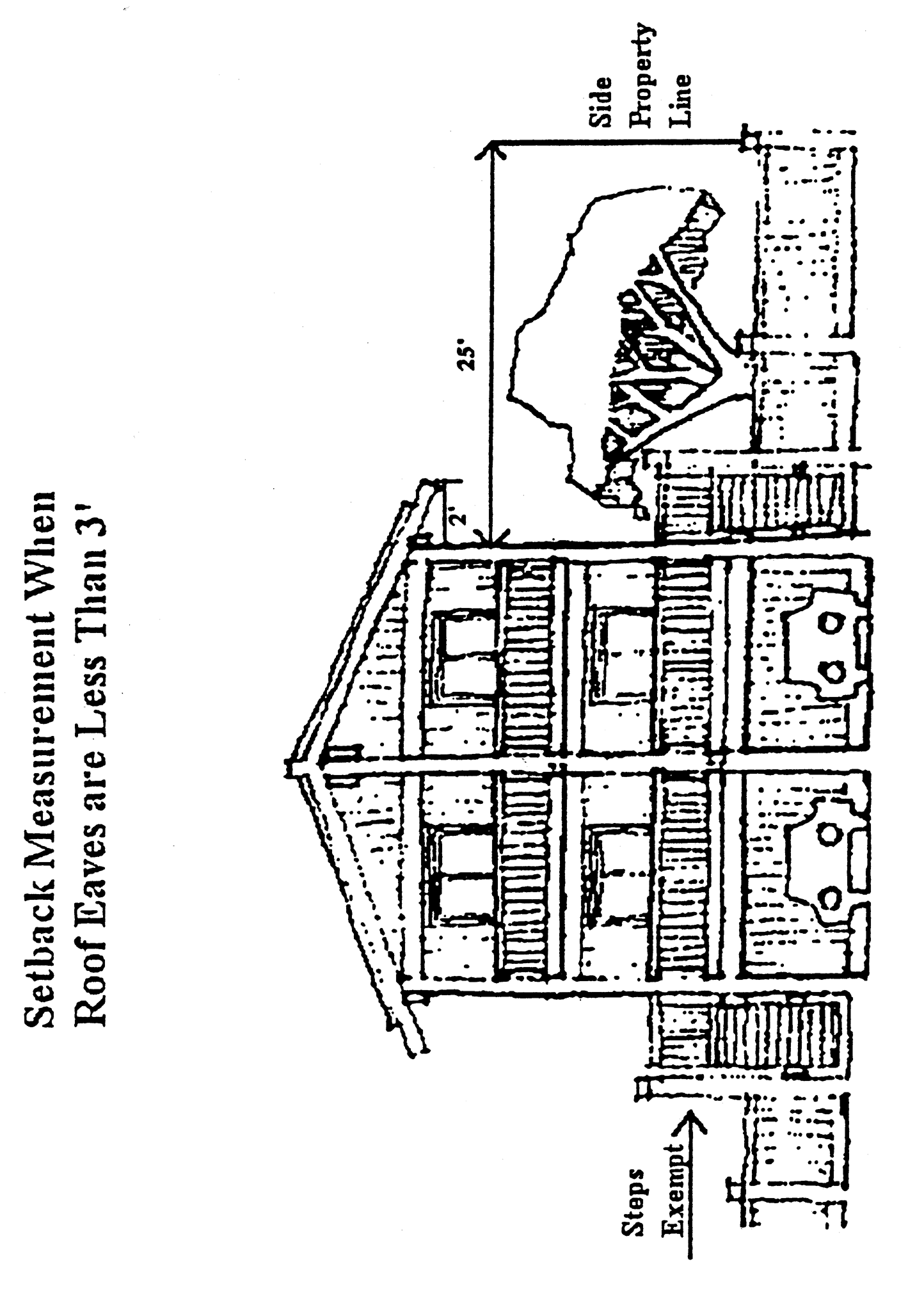
Front. An open space on the same lot as a building between the front line of the building (excluding steps and roof eaves less than three feet in width) and the front lot or street line, and extending across the full width of the lot.
Rear. An open, unoccupied space on the same lot as a building between the rear line of the building (excluding steps and roof eaves less than three feet in width) and the rear lot or street line and extending the full width of the lot.
Side. An open, unoccupied space on the same lot as a building between the side line of the building (excluding steps and roof eaves less than three feet in width) and the side line of the lot, and extending from the front yard line to the rear yard line.
(Ord. of 10-95; Ord. of 7-25-2024(1); Ord. of 8-29-2024(1))
(Ord. of 7-25-2024(1); Ord. of 8-29-2024(1))
Editor's note— The section numbers for individual definitions have been deleted pursuant to Ord. of 12-4-92. A history note indicates when changes were made to the definition preceding it.

