
Lees Summit City Zoning Code
ARTICLE 8
- SITE STANDARDS
SUBDIVISION 1. - INTRODUCTION TO DESIGN STANDARDS[1]
Editor's note—Ord. No. 10182, § 4(Exh. A), adopted August 12, 2025, repealed subdiv. 1, §§ 8.010 and 8.020 and enacted a new subdiv. 1 as set out herein. Former subdiv. 1 pertained to similar subject matter.
SUBDIVISION 2. - ARCHITECTURE AND BUILDING DESIGN STANDARDS[2]
Editor's note—Ord. No. 10182, § 4(Exh. B), adopted August 12, 2025, repealed subdiv. 2, §§ 8.030—8.100 and enacted a new subdiv. 2 as set out herein. Former subdiv. 2 pertained to planned residential district design standards.
SUBDIVISION 3. - SITE DESIGN STANDARDS[3]
Editor's note—Ord. No. 10182, § 4(Exh. C), adopted August 12, 2025, repealed subdiv. 3, §§ 8.110—8.1150 and enacted a new subdiv. 3 as set out herein. Former subdiv. 3 pertained to office, commercial and industrial district design standards.
SUBDIVISION 4. - PLANNED RESIDENTIAL DISTRICT DESIGN STANDARDS[4]
Editor's note—Ord. No. 10182, § 4(Exh. D), adopted August 12, 2025, repealed subdiv. 4, §§ 8-160—8-180 and enacted a new subdiv. 4 as set out herein. Former subdiv. 4 pertained to other required design standards.
Sec. 8.510. - Purpose and intent.
A.
The purpose of the parking and loading regulations is to ensure that all land uses have adequate off-street parking facilities and adequate facilities for vehicle movement and loading activities associated with a land or building use.
B.
The intent of these regulations is to ensure that the use of land does not negatively interfere with the use of and circulation on public rights-of-way, and that private on-site circulation does not pose a potential safety problem.
C.
The parking requirements contained in this division are minimum requirements only.
Sec. 8.520. - Applicability.
A.
The minimum standards of this division shall be applicable for any of the following:
1.
The construction of a new building;
2.
The enlargement of an existing building or the increase in capacity of an existing building, such as the addition of dwelling units, guest rooms, seats or floor area;
3.
The establishment of a new use or change of use;
4.
The expansion of an existing use;
5.
Where an existing building or use has insufficient parking at the time of passage of this division or any amendment thereto, said building may be enlarged or use intensified only if adequate parking is provided for the entire building and all uses on the property in accordance with the requirements of this division.
B.
Maintenance. Vehicle parking areas, including drives and drive aisles, shall be maintained in proper repair with the required surfacing and curbing. Pot holes and surface cracks shall be filled and sealed in a timely manner. (Note: Drive approach even when located in public right-of-way is the responsibility of the private property owner.)
C.
Time limit. All required vehicle parking areas shall be ready for use, including the surfacing requirement, before the issuance of a final certificate of occupancy (in the case of a new building or addition) or within 45 days after the issuance of an occupational license (in the case of a change of occupancy in an existing building). An extension of time may be granted by the Director due to adverse weather conditions. In no case shall any occupancy be permitted prior to the parking areas being striped.
Sec. 8.530. - Vehicle parking.
A.
Required spaces.
1.
Table 8-1 shall be utilized to determine the minimum number of parking spaces to be provided. For uses not specifically identified, the Director shall establish the parking requirements either based upon a listed use deemed most similar to the proposed use or based upon industry standards.
2.
The number of parking spaces to be provided for a particular use or development may be established through approval of an Alternate Parking Plan as described in this division. Use of an Alternate Parking Plan is encouraged in order to tailor the parking to the particular needs of the use or development and to allow introduction of operational solutions such as ride-sharing programs, shared parking or remote employee parking lots.
B.
Dedication to parking use.
1.
Parking lots. Unless approved otherwise, parking spaces located in parking lots provided to meet the minimum requirements of this division, along with the aisles and driveways necessary to provide access to those spaces, shall not be used for any other purpose than temporary vehicle parking. Specifically, no such parking area may be used for the sale, repair, dismantling or servicing of any vehicles, or for the sale, display or storage of equipment, goods, materials or supplies, except as further provided in this chapter or as specified in Chapter 16 Lee's Summit Property Maintenance Code of the Lee's Summit Code of Ordinances.
2.
Multi-family residential parking. Multi-family residential parking lots shall comply with Subsection 1. above.
3.
Single-family residential parking. Enclosed garage parking and associated driveways shall be used to meet minimum parking requirements. Garages may also be used for accessory storage provided there is still room for at least one vehicle. For inoperable vehicle maintenance and repair see Section 8.650.B. of this division.
C.
Computation of required parking.
1.
Multiple uses. Except as approved otherwise, developments containing two or more uses shall have the total number of parking spaces required for each use.
2.
Floor area. All required parking calculations shall be based on gross floor area unless otherwise stated. Gross floor area (gfa) shall mean the total area of all floors, measured between the exterior walls of a building. Gross leasable area (gla) shall mean the total area of all floors intended for occupancy and the exclusive use of tenants, specifically excluding public or common areas such as utility rooms, stairwells, enclosed malls and interior hallways.
3.
Fractions. Whenever the computation of the number of parking spaces required by this division results in a fractional parking space, one additional parking space shall be required for one-half or more fractional parking space, and any fractional space less than one-half of a parking space shall not be counted.
Table 8-1
MINIMUM PARKING BY USE
(Ord. No. 9562, § 1, 12-13-2022)
Sec. 8.540. - Alternate Parking Plan.
A.
A request for approval of an Alternate Parking Plan shall be accompanied by the following information:
1.
A parking demand study or other data that establishes the number of spaces required for the specific use. The study or data may reflect parking for the same use existing at a similar location or for similar uses at other locations. Published studies may be utilized to support alternative parking requests.
2.
If shared parking is proposed for a mixed use development, the sum of peak parking demands by use category shall be accommodated for day and night hours on weekdays and weekends. The guidelines for shared parking contained in this division may be used in lieu of a separate study.
3.
If a remote or off-site parking lot is proposed to meet any portion of the parking required, the site and its current zoning classification must be identified, along with the method to transport parking patrons to the use.
4.
If more parking spaces are proposed than would be allowed under the guideline standards of this division, a landscaping plan shall be submitted that illustrates compliance with the parking lot landscaping requirements of Division III of this division.
B.
Consideration of plan.
1.
Administrative process. The Director may approve an Alternate Parking Plan, including landbanking, as part of a final development plan if the Director determines that the number, configuration, location and landscaping, if applicable, of proposed parking spaces satisfies the demand for parking generated by the proposed development, when viewed in light of all relevant factors.
2.
Preliminary development plan process. The City Council may consider an Alternate Parking Plan as part of a preliminary development plan. Consideration of the preliminary development plan shall follow the procedures for approval of preliminary development plan applications as set forth in Article 2.
3.
Appeal process. If the Director denies a proposed Alternate Parking Plan, the reason for the denial shall be provided to the owner in writing within 15 days after the date a complete Alternate Parking Plan is submitted to the Director for consideration. The applicant may appeal the decision to the Board of Zoning Adjustments or may apply for a modification through the preliminary development plan process.
C.
Approved plan.
1.
Following approval by the Director or the City Council, the requirements of the approved Alternate Parking Plan shall be included in any sale, lease, or other transfer of right of occupancy affecting any part of the development.
2.
All tenants of the property or development, whether an owner, lessee, subtenant, purchaser, or other occupant, shall comply with the approved Alternate Parking Plan.
Sec. 8.550. - Shared parking guidelines.
Parking facilities may be shared by multiple uses which have different hours of operation or peak periods of parking demand, subject to the following:
A.
The applicant shall submit a shared parking analysis to the Director demonstrating that no significant conflict in the principal hours of operation or periods of peak parking demand for the uses for which shared parking is proposed will exist. It shall address, at a minimum, the size and type of the development, the composition and description of the uses and their operational characteristics, the anticipated rate of parking turnover and the anticipated peak parking and traffic loads for all uses that will be sharing spaces.
B.
The shared parking analysis shall be prepared pursuant to guidelines published by the Urban Land Institute or other generally accepted methodology.
C.
Parking spaces that are proposed to be shared must be clearly available to each use and not appear in any way to be serving a particular use through the use of signage or through design techniques that would tend to orient use of the spaces to a particular use or building.
D.
Shared parking arrangements assuring the continued availability of the number of parking spaces designated for shared use must be evidenced by a written agreement acceptable to the Director, and approved by the owners of each of the affected properties or uses. The approved agreement shall be recorded and a copy supplied to the Director.
E.
Should any of the shared parking uses be changed, or should the Director find that any of the conditions described in the approved shared parking plan or agreement no longer exist, the property owner shall have the option of submitting a revised shared parking study or of providing the number of spaces for each use as if counted separately. If the Planning Director determines that the revised shared parking study or agreement does not satisfy the off-street parking needs of the proposed uses, the shared parking request shall be denied, and no certificates of occupancy shall be issued until the full number of off-street parking spaces is provided.
Sec. 8.560. - Landbanking.
Landbanking is the setting aside of sufficient green space for future parking expansion needs of a particular use or building. Landbanking of future parking spaces may be approved as part of an Alternate Parking Plan by the City Council when approving a preliminary development plan or the Director as part of a final development plan when deemed to be appropriate for the particular development and not in conflict with the best interest of the City. The land area so delineated for future parking shall be brought to finished grade, landscaped and shall not be used for building, storage, loading or other purposes. Upon determination by the Director, City Council or owner that additional parking is needed, the owner shall construct it.
Sec. 8.570. - Queuing requirements for drive-through facilities.
In addition to meeting the off-street parking requirements of this division, drive-through facilities shall meet the following standards:
A.
Required queue spaces. The minimum number of required queue spaces shall be as shown in Table 8-2. Variations from these minimums may be allowed on a case-by-case basis by the Director. The applicant may appeal the decision to the Board of Zoning Adjustments or may apply for a modification through the preliminary development plan process.
Table 8-2
REQUIRED QUEUE SPACES
B.
Dimensions. Each queue space shall be a minimum ten feet wide by 20 feet long.
C.
Design. Each queue lane shall be clearly defined and designed so as not to conflict or interfere with other vehicular or pedestrian traffic using the site. Parking lots designed with one-way traffic flow shall have a bypass lane with a minimum width of ten feet or as required by the Fire Code. The bypass lane shall be clearly designated and distinct from the queuing area.
Sec. 8.580. - Accessible parking spaces.
Accessible parking spaces shall be designed and constructed to the standards found in the City's adopted version of the International Building Code.
(Ord. No. 8779, § 1, 12-10-2019)
Sec. 8.590. - Downtown area parking guidelines.
A.
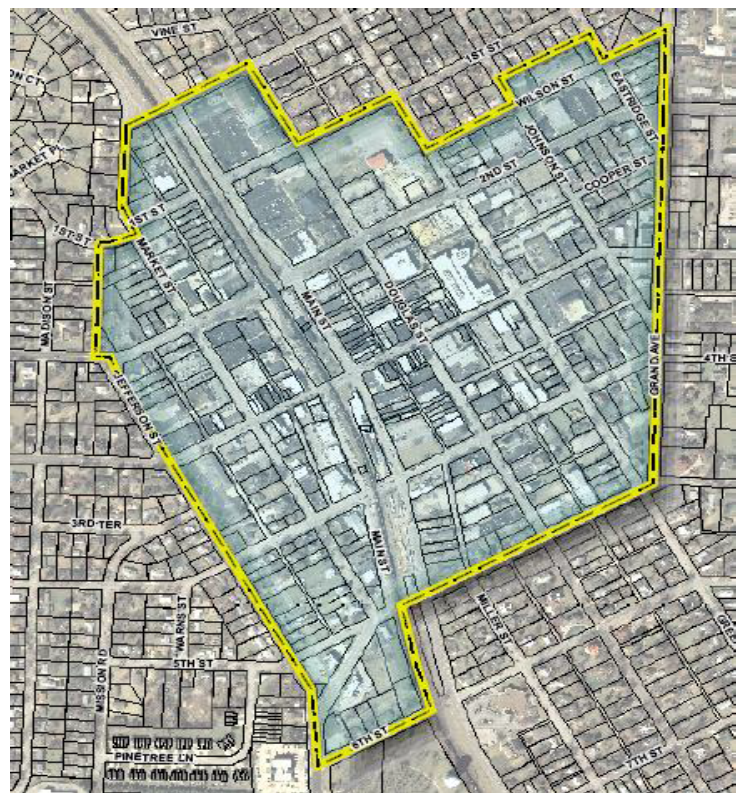
Downtown area defined. For the purposes of this section, "downtown area" shall mean the area loosely bounded by SE 1st Street on the north, SE 5th Street on the south, SW Jefferson Street on the west and SE Grand Street on the east.
B.
Residential uses. Vehicle parking shall be provided in accordance with Table 8-1.
C.
Non-residential uses.
1.
Vehicle parking.
a.
In the downtown area, the vehicle parking requirements of this division for non-residential uses shall apply only to the net increase in floor area of use intensity created by new construction or building expansion or a substantial change in use. A substantial change in use is defined as a change which results in an increase in the demand for parking by 25 percent or more from the previous use.
b.
The parking requirement calculation for each non-residential use in the downtown area shall be based on the requirements of this division, or five spaces per 1,000 square feet of gross floor area, whichever requires the fewer number of spaces.
c.
Any existing vehicle parking spaces that are eliminated by new construction or expansion must be replaced by that business or use, unless such spaces are in excess of the requirements for that business or use being served, and are in the same ownership.
2.
Shared parking district.
a.
The requirements for additional parking may be waived in the downtown area if available public parking is located on the same block or within 300 feet for residential or 500 feet for non-residential uses. This public parking must have sufficient capacity, as calculated by the City Traffic Engineer (or designee), to absorb the required number of spaces and cannot be on the opposite side of the railroad tracks running between SE Main Street and SW Main Street.
b.
Sufficient capacity will be based on a rolling 12-month inventory of public parking spaces in the area. This capacity will be evaluated against the projected demands determined by the City Traffic Engineer (or designee), taking into account time-of-day variations in parking demand as calculated by local data provided by the Urban Land Institute or Institute of Transportation Engineers.
3.
Loading zones.
a.
The application process for a curb loading zone shall be subject to the regulations of the Lee's Summit General Code of Ordinances.
b.
The use of curb loading zones shall be subject to the regulations of the Lee's Summit General Code of Ordinances.
Sec. 8.600. - Proximity of parking spaces to use.
A.
On-site parking. Unless otherwise provided under an approved Alternate Parking Plan, all parking spaces required to meet the standards of this division shall be located on the same lot as the use they serve.
B.
Off-site parking. If required parking spaces are not located on the same lot or on a contiguous lot owned or leased by the intended user thereof for the particular use or building they are intended to serve, the following shall apply:
1.
The parking spaces must be located on a property that has the same zoning classification as the property that the spaces serve, or a less restrictive zoning classification.
2.
No required parking spaces may be located across a major arterial street or any State or US highway from the use they are intended to serve, unless a grade-separated pedestrian walkway connection is provided.
C.
Park and rides. Parking lots intended for park and ride lots shall be approved only by Special Use Permit and shall comply with all setback, landscaping, stormwater detention/retention, and pavement requirements and any other city regulations associated with parking lot improvements.
Sec. 8.610. - Improvement of residential driveways.
A.
Residential driveways shall be constructed of asphaltic concrete, Portland cement concrete or masonry pavers engineered to support the weight of a vehicle. Parking or storage pads adjacent to driveways shall be located in side or rear yards.
B.
Parking on other than asphaltic concrete/Portland cement concrete/masonry paved driveways or pads is expressly prohibited, except for lots of one acre or greater in size zoned AG (agricultural) or RDR (rural density residential).
C.
Driveways on lots of one acre in size or greater zoned AG, RDR, RLL (residential large lot) or R-1 (single-family residential) shall be paved a minimum of 50 feet beginning from the edge of street pavement. The remainder may be gravel or paved.
D.
Where permitted, gravel driveways shall be maintained to meet the following standards:
1.
The surface of the driveway or parking area shall consist of a uniform layer of gravel evenly distributed from edge to edge, and shall be free of bare spots and vegetation.
2.
The depth of the gravel layer shall be an average of two inches and a minimum of one inch.
3.
The material used for a gravel driveway or parking area shall be rock or crushed stone not more than one inch in diameter and shall not contain dirt, sticks, construction debris or other foreign material. Sand, rock powder or other similar material less than one-eighth-inch in diameter is not prohibited, but shall not be included in the measurement of minimum gravel depth.
(Ord. No. 9562, § 1, 12-13-2022)
Sec. 8.620. - Parking lot design.
The provisions of this section apply to all vehicle parking spaces and parking areas, whether the parking meets or exceeds the number of required spaces established in this division.
A.
Head-in parking. Head-in parking from any public right-of-way or private street shall not be permitted, except that the use of head-in parking in the downtown area, as defined in this division, may be considered on a case-by-case basis. Driveways serving single-family, two-family, three-family and four-family residences are exempted from the head-in parking restriction.
B.
Parking setback.
1.
All parking lots shall be set back a minimum 20 feet from any public right-of-way or private street edge of pavement.
2.
Parking lots shall be set back a minimum 20 feet from any residential district or use.
3.
Parking lots shall be set back a minimum six feet from the side and rear property line when not part of shared parking and/or cross access.
C.
Dimensions.
1.
Standard parking space dimensions shall not be less than nine feet wide by 19 feet long.
2.
Where the head of the parking space abuts a six-foot wide sidewalk or curbed landscaped area, the length of the parking space may be reduced by two feet to allow for vehicle overhang. Such overhang shall be measured from the face of the curb.
3.
Parallel parking space dimensions shall not be less than nine feet wide by 23 feet long.
D.
Striping.
1.
All parking spaces shall be clearly demarcated with lines a minimum four inches in width. The width of each parking space shall be measured from the centers of the striping.
2.
Striping shall not incorporate advertising of any kind.
E.
Access and circulation.
1.
Access aisles in parking lots shall have the following dimensions:
Table 8-4
PARKING LOT ACCESS AISLE WIDTH (FT.)
* Refers to access aisles with no parking spaces located on either side.
2.
Minimum access aisle widths for parking lots with parking space angles different from those listed in Table 8-4 shall be determined on a case-by-case basis.
3.
One-way traffic aisles must be clearly marked with directional arrows on the pavement at each intersection with another aisle.
4.
Ingress and egress to parking areas shall be by means of paved driveways from the adjoining street. The minimum width of driveways for ingress and egress shall be the same as those specified above for aisles. Driveway width, for the purpose of this section, shall include only the pavement and not the curb and gutters.
5.
The location of all parking area driveways shall conform to the Access Management Code.
F.
Improvement of parking and loading areas.
1.
Surface.
a.
All vehicle parking areas and access drives shall be improved with one of the following:
(1)
A minimum four-inch asphaltic concrete base overlaid with a one and one-half-inch asphaltic concrete surface, constructed on a subgrade of six-inch granular base course, over either Geogrid or six-inch stabilized subgrade.
(2)
A minimum six inches of full depth unreinforced Portland cement concrete constructed on a subgrade of four inches of granular base course.
(3)
The City Engineer is authorized to consider an alternative design for an asphaltic concrete or Portland cement concrete surface engineered to support the weight of the anticipated loads.
b.
Designated fire lanes, delivery/freight truck access lanes, and loading areas shall be improved with one of the following:
(1)
A minimum five-inch asphaltic concrete base overlaid with a one and one-half-inch asphaltic concrete surface, constructed on a subgrade of six-inch granular base course, over either Geogrid or six-inch stabilized subgrade.
(2)
A minimum six inches of full depth unreinforced Portland cement concrete, constructed on a subgrade of four inches of granular base course.
(3)
The City Engineer is authorized to consider an alternative design for an asphaltic concrete or Portland cement concrete surface engineered to support the weight of the anticipated loads with certification from a geotechnical engineer that what is being proposed is equal to or greater than city standards.
Table 8-5
PARKING LOT PAVING
c.
Trash enclosure areas shall be improved with a Portland cement concrete pad and a Portland cement concrete approach 30 feet in length, measured from the enclosure opening. The pad and approach shall be improved with a minimum six inches of full depth unreinforced Portland cement concrete constructed on a sub-grade of four inches of granular base course.
2.
Curbing.
a.
All vehicle parking lot areas and access drives in all zoning districts shall have a boundary constructed of straight-back Portland cement concrete curbing (CG-1) or an integral Portland cement concrete sidewalk and curb with a vertical face. Driveways serving single-family, two-family, three-family and four-family residences are exempted from the CG-1 curbing requirement. This requirement shall also not apply to accessible parking spaces where the adjacent pedestrian walkway is designed to be at the same grade as the accessible spaces for the purpose of providing access to said walkway.
b.
The use of curb blocks in parking areas shall be prohibited, except at the head of accessible parking spaces when they are adjacent to a pedestrian walkway with no raised curb.
c.
Temporary asphalt curbs may be used in areas to be expanded only as shown and approved on the final development plan.
d.
Storage lots, excluding tow lots, in CS and PI zoned districts may utilize gravel instead of a hard surface pavement provided they are engineered to support the weight of the anticipated loads and provide for a minimum of a 100-foot paved drive measured from the concrete drive approach.
3.
Maintenance. See Section 8.520.
4.
Time limit. See Section 8.520 — Applicability.
Sec. 8.640. - Loading.
A.
Required loading spaces shall be determined on a case-by-case basis by the Director through the required approval process.
B.
The dimensions of loading spaces will be determined on a case-by-case basis depending on the requirements of each project, including the length of trucks to be served and configuration of building(s) on the site.
C.
All off-street loading areas shall be screened in accordance with Division III of this article.
Sec. 8.650. - Parking and storage regulations for private property.
The parking or storage of vehicles shall be in conformance with regulations as provided in the Lee's Summit Code of Ordinances, Chapter 16 Lee's Summit Property Maintenance Code.
(Ord. No. 9562, § 1, 12-13-2022)
Editor's note— Ord. No. 9562, § 1, adopted December 13, 2022, amended § 8.650 in its entirety to read as herein set out. Former § 8.65 pertained to restricted vehicles.
Sec. 8.660. - Reserved.
Editor's note— Ord. No. 9562, § 1, adopted December 13, 2022, repealed § 8.660, which pertained to recreational vehicles and utility trailers.
Sec. 8.010. - Purpose and intent.
The purpose and intent of the design standards is to:
A.
Protect property values, enhance community appearance, and preserve neighborhood character.
B.
Enable developers to create more attractive, efficient, sociable, and pedestrian-friendly living, shopping, and working environments.
C.
Increase beauty and quality of life by improving the character of building exteriors and surroundings.
D.
Increase public infrastructure efficiency through mixed uses and efficient densities.
(Ord. No. 10182, § 4(Exh. A), 8-12-2025)
Sec. 8.020. - Applicability.
The design standards are provided as a tool to be used by developers and property owners intending to improve or modify their property. These standards reflect standards of design that the City will use to guide and evaluate development proposals. All proposed development will be reviewed in accordance with these regulations and in conjunction with all applicable sections of this UDO.
(Ord. No. 10182, § 4(Exh. A), 8-12-2025)
Sec. 8.030. - Application of standards.
A.
The standards and regulations contained herein shall apply to new development and the renovation and redevelopment of existing sites and buildings within the City, with the exception of agricultural buildings, airport related industrial buildings within the AZ zoning district (for airport hangars see Section 8.350), and properties located within the Downtown Core Area as identified in Subdivision 8 of this division.
B.
Building types. For the purposes of this subdivision, all buildings shall be categorized as described in Section 8.050. The building type shall be determined by the Director or their designee. The building design standards shall be regulated by both building type and the zoning district in which the building is located.
C.
Accessory buildings. All accessory buildings and structures shall comply with the design standards required for the principal building. The exterior building materials and colors shall be similar to the principal building.
(Ord. No. 10182, § 4(Exh. D), 8-12-2025)
Sec. 8.040. - Exceptions and modifications.
A.
The following exceptions shall apply:
1.
Building expansions or additions, including successive additions, totaling less than 25 percent of the gross floor area of the existing building that will use the same or higher-class building materials to match or complement the existing building materials.
2.
Building and façade maintenance and repair including repainting of existing painted surfaces and window, door, siding, and roof replacement with identical or aesthetically similar materials.
B.
Following the procedures of Article 2, Division IV, the Approving Authority may approve modification requests from the standards contained in this Subdivision provided the following are met:
1.
The modification requested is not based solely on the anticipated cost of full compliance with the regulations contained herein; and
2.
The resulting overall design and aesthetic appearance of the building(s) will not detract from the aesthetics of the surrounding area nor negatively impact adjoining properties.
(Ord. No. 10182, § 4(Exh. D), 8-12-2025)
Sec. 8.050. - General provisions.
A.
Building types.
1.
Single-family residential: Detached single-family homes, accessory dwellings, bed and breakfast homestay, and group homes approved within a single-family or two-family home.
2.
Two-family residential: Two-family homes (duplex)
3.
Attached residential: Triplex, quadplex, townhome, and rowhouse.
4.
Multi-family residential: Apartments, bed and breakfast inn, nursing homes, hospice homes, treatment centers, homeless shelters, retirement villages, independent living or assisted living apartment communities, and other similar high density residential developments.
5.
Non-residential buildings in a residential zoning district: Schools, churches, places of assembly, community centers, community food and personal support services, cultural facilities, funeral homes and mortuaries, libraries, public facilities, and government buildings.
6.
Commercial/retail buildings: Single and multi-tenant commercial buildings, day care centers, restaurants, financial institutions, hotels, motels, mini/self-storage buildings, auto service businesses in commercial zoning districts, and recreational and entertainment buildings.
7.
Office and civic buildings: Single and multi-tenant office buildings including medical offices, clinics, and hospitals. When located in non-residential zoning districts: schools, universities, churches, places of assembly, community centers, cultural facilities, funeral homes and mortuaries, libraries, public facilities, and government buildings.
8.
Mixed-use buildings: Multi-story buildings that contain two or more different uses such as residential and retail/office uses.
9.
Downtown buildings: Buildings or structures located within the Downtown Core Area as shown in Subdivision 8.
10.
Industrial buildings: A building or structure constructed for warehouse, distribution, flex industrial, and other industrial uses and located within the Planned Commercial Services (CS), Planned Industrial (PI), or Planned Mixed Use (PMIX) zoning districts.
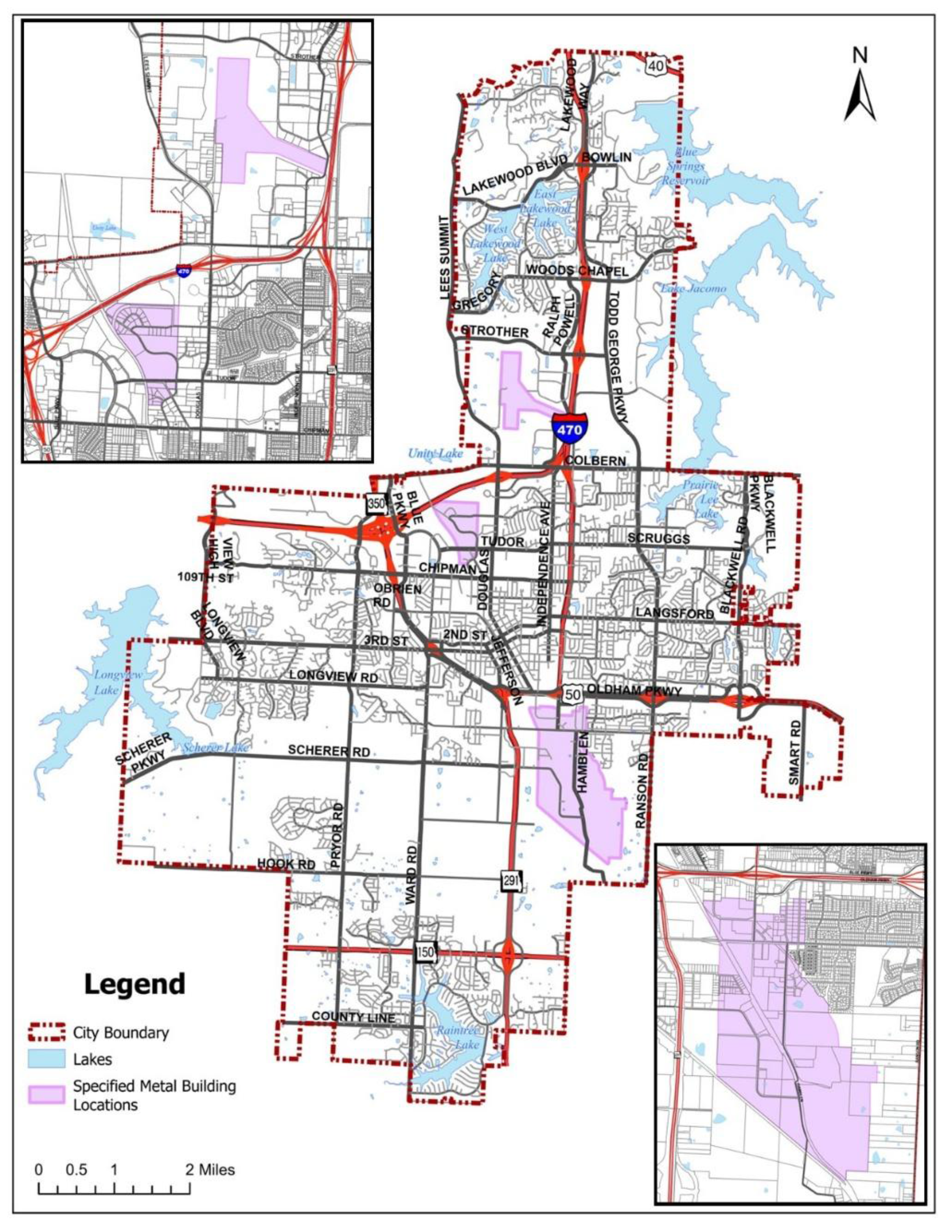
11.
Buildings within the specified metal building locations: Buildings or structures located within the boundaries of the Specified Metal Building Locations as shown on the map in Section 8.080.C.
B.
The following standards apply to all sites excluding single-family dwellings, two-family dwellings, and townhouse/row dwellings.
1.
Four-sided architectural design. Buildings shall incorporate four sided architecture. Architectural elements (horizontal or vertical) shall extend around the building and utilize the same, compatible, or complementary materials on all building facades.
2.
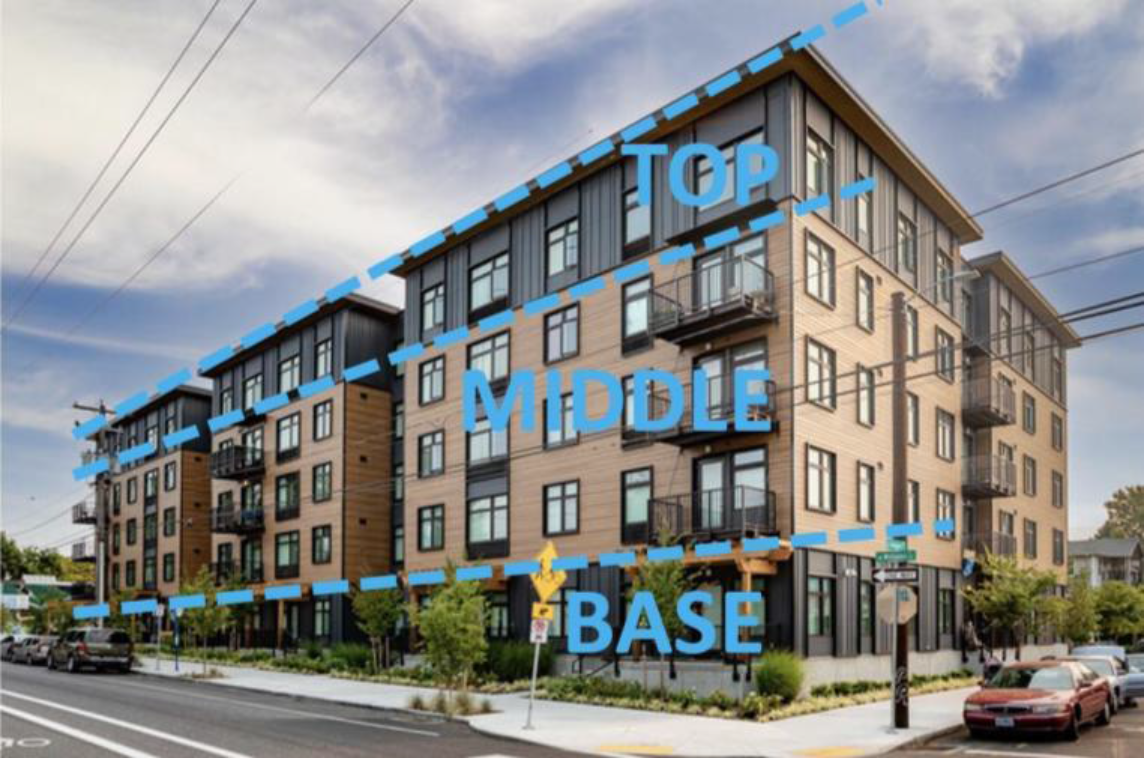
Top, middle, and base design. Buildings shall clearly express a top, a middle, and a base. Transitions from between the top, middle, and base shall be accomplished by a change in wall plane, roof overhang, and/or a change in building materials or color. The Approving Authority may waive this requirement based upon the building's architectural style, use, or other factors deemed relevant.
3.
Wall and roof articulation. Buildings shall have regular variations and changes (articulations) in the wall planes, roof lines, and roof slopes. The minimum wall and roof articulation requirements are provided in Sections 8.070 and 8.080 herein this subdivision.
a.
Examples of wall articulation methods include, but are not limited to:
i.
Projections or recesses in the wall plane of at least two feet in depth.
ii.
Use of columns, piers, pilasters, or other equivalent structural and/or decorative elements that project at least two feet beyond the wall plane in a manner that complements the overall aesthetic appearance of the building.
b.
Examples of roof articulation methods include, but are not limited to:
i.
A change in direction of the roof pitch or slope.
ii.
The raising or lowering of the parapet wall, if applicable.
iii.
The use of a tower element or other similar building feature.
4.
Application of exterior building materials on primary facades. This subsection contains information on the appropriate application when the following building materials are used:
a.
Multiple façade materials. The use of multiple façade materials is required and the transitions from one wall material to another shall follow a level horizontal or vertical line.
b.
Application of brick and stone masonry. Heavy exterior materials, such as any type of brick or stone masonry, shall be applied as traditionally used as a building foundation and structural material. Brick or stone masonry that appears to be unsupported or 'float' within a façade shall not be permitted, e.g., stone applied to a roof dormer or stone placed directly above doors/windows without a supporting lintel above the door/window.
c.
Painting of brick and stone masonry. Brick and stone masonry exterior finishes shall not be painted, unless approved by the Approving Authority based on the building design, architectural style, or current condition of the brick or stone.
d.
Exterior insulation and finish systems (EIFS). Subject to the provisions of Sections 8.070 and 8.080 herein, the use of Exterior Insulation and Finish System (EIFS) on a building façade is permitted above the first ten feet of the building finished floor elevation for a single-story building and is permitted on those floors above the first-floor elevation for a multi-story building.
e.
Thin brick and stone masonry veneer. Thin brick or stone masonry veneer, including brick and stone paneling, shall comply with the following:
i.
Thin brick and stone masonry veneer or paneling shall only be used in applications where the apparent thickness of the bricks or stones will not be distinguished or is otherwise addressed by adjustments in the wall plane to simulate the appearance of full depth brick or stone.
ii.
'L' shaped brick/stone corner pieces and full-depth brick/stone caps shall be utilized at all corners and edges to maintain the appearance of full-depth brick/stone.
iii.
Thin brick and stone masonry veneer or paneling shall be continued (returned) a minimum of 12 inches around all wall corners to further maintain the appearance of full-depth brick or real stone and shall be terminated at a ninety-degree angle inside corner along the given facade.
f.
Use of trim on primary façades. Appropriately scaled trim shall be included around all window and door openings, building corners, roof lines, and façade material transitions located on primary façades, unless the use of trim is considered inappropriate based on the building's architectural style.
g.
Building façadism discouraged. Building façadism is discouraged. Windows or dormers should be in proportion with and match the adjoining roof pitch and have the appearance of being functional and operational. Hip or mansard roofs that only partially conceal a roof well or low slope roof area are also discouraged.
h.
Franchise architecture discouraged. The use of franchise or trade-marked building shapes or integral building forms that are readily identifiable with a specific commercial franchise is discouraged. Buildings are encouraged to be designed to appear as their intended use, e.g., a restaurant building can look like a building for a restaurant; however, with the signage removed, the building should not be recognizable as belonging to a specific commercial business or franchise.
i.
Application of windows and doors on commercial storefronts. All commercial and retail building façades that face a public or private street shall conform with the following standards:
i.
Fenestrations with clear glass shall occupy no less than 50 percent of the pedestrian view zone.
ii.
All doors, including any overhead doors, located within the pedestrian view zone shall contain no less than 75 percent clear glass.
j.
Overhead doors. Street facing overhead doors (garage doors) are discouraged.
i.
Any street facing overhead door not regulated by subsection i above shall have no less than 50 percent clear glass and shall be recessed a minimum of 18 inches into the building wall plane; or
ii.
Shall include additional architectural enhancements or building materials to mitigate the visual impact from the right-of-way. Additional site design enhancements including fencing, landscaping, and increased setbacks may also be required.
k.
Awnings and canopies. Awnings and canopies are encouraged but must be functional, provide shade and shelter to the building entry, be designed in scale and proportion to the mass of the building, and constructed of high-quality and durable building materials.
(Ord. No. 10182, § 4(Exh. D), 8-12-2025)
Sec. 8.060. - Exterior materials classification.
For the purposes of this subdivision, exterior building materials shall be divided into the following four classification ranges by materials category. The range starts with Class 1 being the top-quality, very durable materials and ends with Class 4 being lower-quality, less durable materials.
All materials must be utilized in the application as intended by the manufacturer and follow proper installation requirements and standards, including management of water migration and installation of appropriate substrate material.
The Director or their designee may categorize a building material not listed below to a classification which includes materials of similar durability, quality, and appearance.
A.
Table 8.I-1. Exterior Materials Classification
(Ord. No. 10182, § 4(Exh. D), 8-12-2025)
Sec. 8.070. - Residential building types and standards.
A.
Residential building types.
1.
Single-family residential;
2.
Two-family residential;
3.
Attached residential;
4.
Multi-family residential.
B.
Single-family detached and two-family residential dwelling design standards.
1.
For both single-family detached and two-family residential lots that are 70 feet or greater in width, the following requirements shall apply:
a.
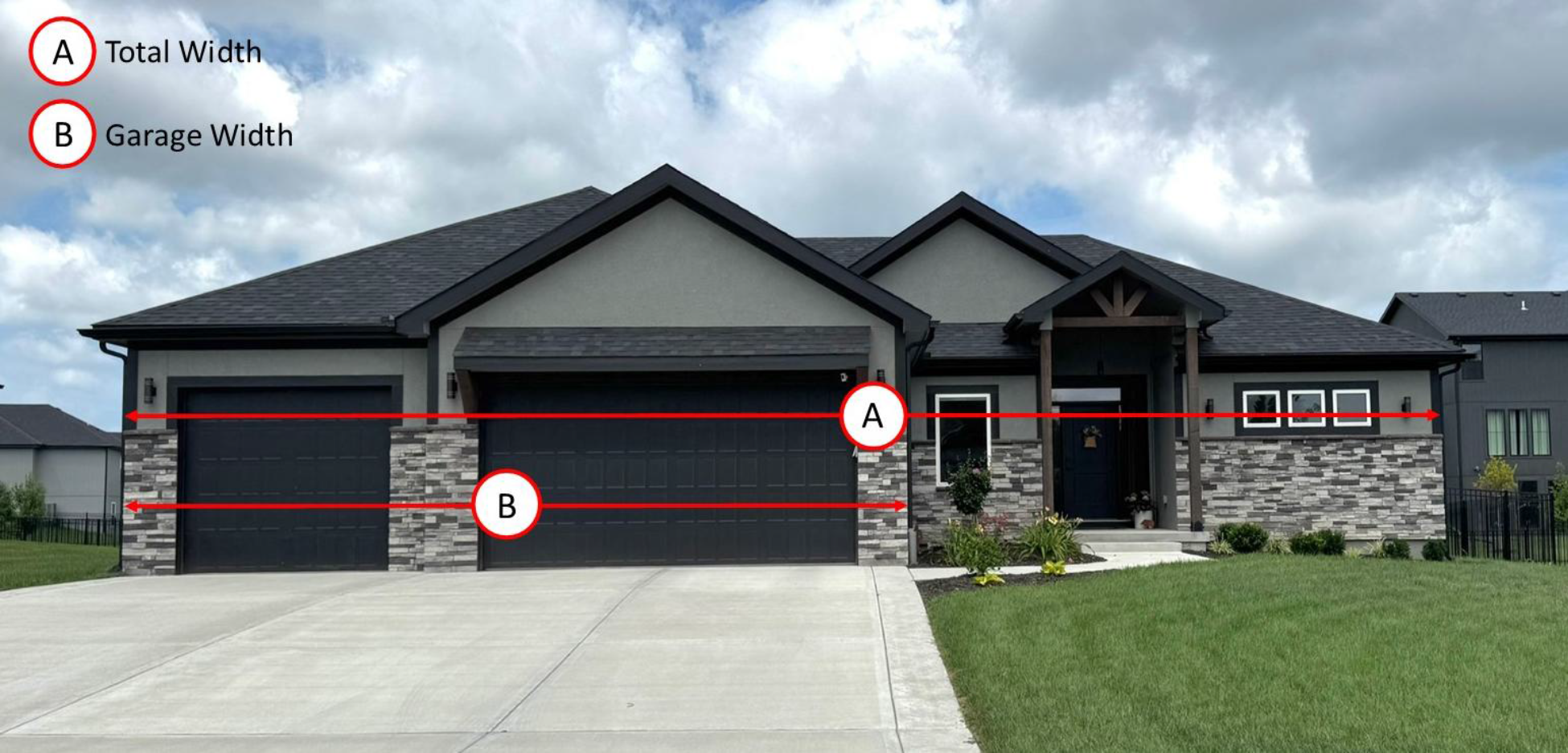
The width of garage doors shall not exceed 60 percent of the total width of the front façade. If the width of the garage doors exceeds 60 percent, then the garage doors and front façade shall include architectural treatments and decorative elements to mitigate visual impact.
b.
All third-car garages shall be recessed a minimum of one foot behind the plane of the two-car garage.
C.
Table 8.I-2. Standards by Residential Building Type:
(Ord. No. 10182, § 4(Exh. D), 8-12-2025)
Sec. 8.080. - Non-residential building types and standards.
A.
Non-residential building types.
1.
Non-residential buildings in a residential zoning district;
2.
Commercial/retail buildings;
3.
Office and civic buildings;
4.
Mixed-use buildings;
5.
Downtown buildings;
6.
Industrial buildings;
7.
Buildings within the specified metal building locations.
B.
Table 8.I-3. Standards by Non-Residential Building Type.
C.
Map of specified metal building locations.
(Ord. No. 10182, § 4(Exh. D), 8-12-2025)
Sec. 8.090. - Site design objectives.
A.
Development in office and commercial districts:
1.
Are encouraged to locate multi-family residences, businesses, and personal services within the district in a manner that provides for a high degree of walkability between buildings and services.
2.
Are encouraged to design the development as a "district" rather than a "strip", so that the groupings of buildings can be approached from more places around the perimeter, resulting in less congestion and more accessibility, especially for pedestrians and bicyclists.
3.
When located along public streets, parking areas and pedestrian walks shall connect internally to parking areas and pedestrian walks of existing adjoining businesses. Provisions shall be made for future connections to adjoining property not yet developed or redeveloped. Wherever possible, pedestrian walks shall be provided to connect building entrances to public sidewalks.
4.
Building entrances and entrances to business services are encouraged to face onto an existing street or a landscaped open space.
5.
Solar energy devices, if provided, shall be integral to overall site and building design.
B.
Public gathering places in office and commercial districts.
1.
A minimum of five percent of the development site shall be designated as open space usable for public gatherings. Open space remaining after the maximum impervious coverage is reached may be used to meet this requirement, provided other requirements of this article are met.
2.
The open space shall be directly accessible on foot from the entrance to offices and services.
C.
If a development abuts or contains an existing or proposed limited access highway or arterial street, the Commission and/or Council may require frontage roads or parallel streets to separate through and local traffic and to provide for visually safe and attractive roadways.
D.
Downtown core area. Development in the commercial and transition districts in the downtown core area is subject to the design standards in Subdivision 8 of this division.
(Ord. No. 10182, § 4(Exh. C), 8-12-2025)
Sec. 8.100. - Sidewalk location standards.
Sidewalks shall be a minimum width of five feet. A landscaping strip with a minimum width of five feet shall be located between the sidewalk and the curb. The sidewalk shall be placed one foot from the property line. Exceptions to this standard may be approved by the City Engineer if topographic or other constraints are encountered during construction. Meandering sidewalks may be used provided that where a sidewalk encroaches onto private property, outside the public right-of-way, an access and maintenance easement shall be provided to the City.
(Ord. No. 10182, § 4(Exh. C), 8-12-2025)
Sec. 8.110. - Screening standards.
A.
Application. The following screening standards shall apply to all sites excluding single-family dwellings, two-family dwellings, and townhouse/row dwellings.
B.
Building mounted equipment (roof-top and exterior building-mounted mechanical equipment).
1.
All exterior building-mounted and roof-top building equipment, including, but not limited to, HVAC and mechanical equipment, vents, piping, roof access ladders, and utility meters, shall be located out of view or otherwise screened from view by all adjacent public or private streets and any residentially zoned or developed properties. Appropriate screening methods may include the use of architectural features and/or landscape planting that provide immediate and opaque visual buffering.
2.
For roof-top equipment not adequately screened by the building parapet, a supplementary screen around all sides of the equipment shall be provided, composed of materials including prefinished architectural metal panels, stucco panels, masonry walls, or similar building materials that are consistent with the overall architectural design and finish materials of the proposed building. The height of any supplementary screens shall be no lower than the height of the equipment it is intended to screen. Site/building cross-section diagrams may be required to prove compliance with this screening requirement. The above provisions shall not apply to roof-mounted solar energy panels.
C.
Trash and recycling container and ground-mounted equipment.
1.
Trash and recycling enclosure design. All outdoor trash and recycling receptacles, dumpsters, and grease collection containers shall be opaquely screened on all sides by the use of a permanent enclosure, with gates and/or doors for access. The enclosure shall be constructed of permanent materials such as textured block, split faced concrete block, brick, or stone. The colors, materials, and design shall match or otherwise be compatible with the dominant architectural materials and design of buildings on site.
2.
Ground-mounted equipment. All ground-mounted building equipment, including, but not limited to, HVAC and mechanical equipment, power transformers, back-up power generators, shall be fully screened from view from adjacent public streets and residential properties with landscaping, masonry screen walls, decorative fencing, or a combination thereof.
3.
Placement and location. Trash and recycling enclosures and ground-mounted equipment shall be located behind major buildings and out of public view.
(Ord. No. 10182, § 4(Exh. C), 8-12-2025)
Sec. 8.120. - Planned residential design objectives.
A.
Encourage developments with mixtures of densities, housing types and land uses.
B.
Foster neighborhood security with means for maintaining activity at all times of the day. Examples include "corner stores", home offices and useable front porches.
C.
Link neighborhoods with safe, attractive pedestrian connections both along the street and on open space greenways.
D.
Connect residences to each other and to neighborhood parks, schools, and shops with direct pedestrian pathways.
E.
Provide for optional vehicular circulation routes through a neighborhood to distribute traffic evenly and avoid excessive traffic on any one street.
F.
Minimize cut-through traffic within a neighborhood.
G.
Emphasize the public realm, by encouraging parks and community facilities to be located as focal points in the neighborhood.
H.
Provide for varying front yard depths including allowance for increasing the proportion of rear yard area to front yard area to provide for privacy and to foster a more intimate and friendly neighborhood street.
I.
Facilitate people's ability to watch out for each other thereby improving neighborhood security.
J.
Maintain natural topography, substantial trees and tree groupings, and other existing landscaping features.
(Ord. No. 10182, § 4(Exh. D), 8-12-2025)
Sec. 8.130. - Planned residential district open space requirements.
An open space plan including the following elements shall be provided with all "planned" residential developments and shall be included with the preliminary development plan submittal:
A.
A minimum of ten percent of the total land area shall be devoted to open/green space area. The proportion of public to private open space and the designated uses of the open space shall be determined by the City, based upon particular recreational, environmental, cultural, and scenic objectives in the area where the development is to be located.
B.
The City may accept a fee in lieu of dedication when the city determines that it is in the City's best interest to do so. The appropriate fee shall be determined by the City.
C.
Common open spaces shall be designed with usable sizes and proportions.
D.
Common open spaces shall be distributed throughout the neighborhood.
E.
Existing natural features on a development site shall be preserved wherever possible by incorporating them into common open space.
F.
Natural areas that are unsafe for or not easily accessible to pedestrians, including steep slopes and wooded preserves may be included as common open space.
G.
The area occupied by non-residential buildings or uses, including active private recreation facilities, such as swimming pools, and tennis courts shall not be included in common open space calculations.
H.
Common open spaces may be crossed by easements for public utilities, where such easements will involve access by persons or vehicles only for periodic maintenance or repair. Land on easements for overhead electric transmission lines shall not be counted in common open space calculations.
I.
Other than motorized wheelchairs, no vehicles shall be operated within common open spaces except for maintenance purposes.
J.
Additional plan review and approval may be required for the following specific uses and conditions:
1.
Agricultural uses;
2.
Bridle paths;
3.
Environmentally sensitive areas; and
4.
Lakes, ponds, and flood control provisions.
K.
Common open space location and orientation, where possible, shall take into account significant vistas and view corridors toward natural or man-made community features. Particularly important views shall be retained in areas accessible to all residents in the neighborhood.
L.
Existing trees shall be protected in the creation and maintenance of any common open space.
(Ord. No. 10182, § 4(Exh. D), 8-12-2025)
Sec. 8.140. - Residential street design.
See article 7.
(Ord. No. 10182, § 4(Exh. D), 8-12-2025)
Sec. 8.150. - Residential sidewalks.
See article 7 and subdivision 3 of this division.
(Ord. No. 10182, § 4(Exh. D), 8-12-2025)
Sec. 8.160. - Pedestrian lighting in residential areas.
See subdivision 5, lighting standards.
(Ord. No. 10182, § 4(Exh. D), 8-12-2025)
Sec. 8.170. - Residential parking.
See division 2 of this article.
(Ord. No. 10182, § 4(Exh. D), 8-12-2025)
Sec. 8.180. - Residential traffic calming.
In planned residential district developments traffic-calming may be encouraged at the intersection of residential streets or along residential streets, including local and collector streets, subject to need, safety and effectiveness, as determined by the City Engineer.
(Ord. No. 10182, § 4(Exh. D), 8-12-2025)
Sec. 8.190. - Purpose and intent.
The purpose and intent of this section is to establish outdoor lighting standards in all zoning districts that:
A.
Reduce or eliminate glare, light trespass/spillover and overlighting from on premise light sources to off-premise properties, but not to include significant elevation differences as determined by the Director to be unreasonable to shield;
B.
Promote safety and security by incorporating Crime Prevention Through Environmental Design (CPTED) Principles per Subdivision 6 of this division;
C.
Encourage energy conservation and provide attractive lighting fixtures and layout patterns that contribute to a unified exterior lighting design of non-residential developments.
For purposes of determining light levels for installed light fixtures per this division, the Director shall use a digital light meter, illuminance meter, meeting C.I.E. (International Commission on Illumination) standards. Light meter readings shall be taken at three feet above grade on a horizontal axis unless otherwise specified.
Sec. 8.200. - Applicability and general provisions.
These lighting standards shall apply to the installation of new outdoor lighting fixtures or the replacement of existing outdoor lighting fixtures. Replacement of a fixture shall mean a change of fixture type or change to the mounting height or location of the fixture. Routine lighting maintenance, such as changing lamps or light bulbs, ballast, starter, photo control, lenses and similar components, shall not constitute replacement and shall be permitted provided such changes do not result in a higher light level output such as replacing a 150 watt bulb with a 200 watt bulb. If the housing of the fixture is deteriorated or damaged to point of needing replacement, it shall only be replaced with a permitted fixture type in accordance with this division.
Sec. 8.210. - Existing outdoor lighting fixtures.
Outdoor lighting fixtures lawfully existing prior to January 1, 2009, that do not conform to these provisions shall be deemed to be a lawful nonconforming use and may remain. A nonconforming lighting fixture that is changed to or replaced by a conforming lighting fixture shall no longer be deemed nonconforming, and thereafter such lighting fixture shall be maintained in accordance with this division.
Sec. 8.220. - General outdoor lighting standards.
A.
Light source. Metal halide, light emitting diodes (LED's), or other new light source technology approved by the Director shall be the required light source for all outdoor lighting. These outdoor lighting fixtures are to be color-correct types to ensure true- color at night for security purposes and support CPTED principles.
B.
Design of fixtures/prevention of spillover glare. All outdoor light fixtures shall use full cut-off lenses, as classified by the Illuminating Engineering Society of North America (IESNA), to prevent glare and light spill from the project site onto adjacent properties, buildings and roadways. All lights shall be International Dark-Sky Association (IDA) approved fixtures.
C.
Prohibited lights. The following lights are prohibited:
1.
Aerial or search lights;
2.
Laser source lights;
3.
Pulse, blinking, tracing or flashing lights;
4.
Outline lights;
5.
Mercury vapor lights;
6.
Fluorescent, except when used as accent lighting or in shielded wall packs or wall sconces;
7.
Neon, except when used as accent lighting;
8.
High and low pressure sodium;
9.
Halogen, except when used as accent lighting; and
10.
Flood light fixtures, except when used as Accent Lighting and only when directionally shielded eliminating glare to motorists and pedestrians.
D.
Exceptions. The following lights are excepted from these requirements:
1.
Egress lights as required by the building code 100 watts or less for incandescent, 26 watts or less for compact fluorescent, or 40 watts or less for other lighting sources;
2.
Construction and emergency lighting used by construction workers or police, firefighting, or medical personnel, provided said lighting is temporary and is discontinued immediately upon completion of the construction work or abatement of the emergency requiring said lighting;
3.
Security lighting controlled and activated by motion sensor devices for a maximum duration not to exceed 10 minutes and not to exceed 100 watts for incandescent, 26 watts for compact fluorescent, or 40 watts for other lighting sources.
E.
Exemptions. The following lights are exempted from these requirements:
1.
Lighting attached to one- and two-family dwellings;
2.
Airport lighting;
3.
Street lighting installed per the Design and Construction Manual.
Sec. 8.230. - Photometric plans required.
A photometric plan shall be required for all new development, redevelopment, parking lot development or expansion where outdoor lighting is proposed or when otherwise required by the Director. The photometric plan shall be prepared by a lighting professional that is certified by the National Council on Qualifications for the Lighting Professions (NCQLP), or a State licensed professional engineer, architect, landscape architect or land surveyor and shall contain the following information:
A.
Location and limits of the canopy or outdoor display area at a scale of not less than one inch equals 50 feet.
B.
Location and height of:
1.
All underside canopy lighting for service stations and service station convenience stores, and
2.
All pole and building mounted light fixtures for outdoor display areas, and
3.
All pole lights fixtures for parking lots.
C.
A photometric diagram showing predicted maintained lighting levels produced by the proposed lighting fixtures.
D.
The photometric plan shall indicate footcandle levels on a ten-foot by ten-foot grid. When the scale of the plan, as determined by the Director, makes a ten-foot by ten-foot grid plot illegible, larger grid spacing may be permitted.
E.
All photometric plans shall provide a breakdown indicating the maximum footcandle, minimum footcandle, average maintained footcandle, and the maximum to minimum ratio for each lighting zone.
F.
All photometric plans shall include all structure(s), parking spaces, building entrances, traffic areas (both vehicular and pedestrian), vegetation that might interfere with lighting, and adjacent uses that might be adversely impacted by the lighting. The plan shall contain a layout of all proposed fixtures by location, orientation, aiming direction, mounting height and type. The plan shall include all other exterior lighting (e.g., architectural, building-entrance, landscape, flag, accent, etc.).
G.
For projects abutting or adjacent to residential properties, a photometric plan providing the as-constructed lighting levels shall be provided to the Department of Planning and Development prior to the issuance of a Final Certificate of Occupancy. The as-constructed photometric plan shall indicate the footcandle levels on a ten-foot by ten-foot grid.
Sec. 8.240. - Pedestrian lighting in residential areas.
Pedestrian-oriented lighting (metal halide preferred) is permitted, on 12-foot poles at 82.5-foot or less spacing with light intensity and spread patterns to be determined by the governing body. Pedestrian-oriented lighting may either supplement or substitute for the standard street lighting, based upon acceptable intensity, spread and glare reduction characteristics.
Sec. 8.250. - Parking lot lighting.
A.
Parking lot lighting required. Multi-family, institutional and commercial uses or developments providing parking lots accommodating 11 or more parking spaces shall provide parking lot lighting in accordance with this division.
B.
Fixtures. Parking lot lighting shall utilize flat lens fixtures with full cut-offs and be mounted to the parking lot light pole at 90 degrees (horizontal to the ground) and shall be non-adjustable.
C.
Maximum base height. Concrete pedestals/bases shall not exceed three feet in height and shall be included in the maximum overall height.
D.
Maximum height. The maximum overall fixture height, measured to the top of the fixture from grade, shall comply with the following:
1.
All light fixtures on properties within or adjoining residential uses and/or districts shall not exceed 15 feet in height within the perimeter area. For purpose of this standard, the perimeter area shall be measured 100 feet from the property line closest to the residential use and/or district. Outside the perimeter area, the overall height may be increased to 20 feet, measured to the top of the fixture from grade.
2.
All light fixtures on properties within or adjoining residential uses and/or districts that are separated by a non-arterial street and are within the perimeter area shall not exceed 15 feet. Outside the perimeter area, the overall height may be increased to 20 feet in height, measured to the top of the fixture from grade.
3.
All light fixtures on properties adjoining residential uses and/or districts that are separated by an arterial street and are within the perimeter area shall not exceed 24 feet. Outside the perimeter area, the overall height may be increased to 28 feet in height, measured to the top of the fixture from grade.
4.
All light fixtures on properties that do not adjoin residential uses and/or districts in Subsections 1. through 3. above shall not exceed 28 feet.
5.
The solar panel for any solar powered light fixture may extend five feet above the height of the fixture.
E.
Maximum footcandles at residential property line. The maximum maintained vertical footcandle at an adjoining residential property line shall be 0.5 footcandles, measured at three feet above the grade.
F.
Uniformity ratios. Light pole fixtures shall be arranged to provide uniform illumination throughout the parking lot not to exceed ten footcandles.
G.
Maximum wattage.
1.
All fixtures on developments that adjoin residential uses and/or districts shall be limited to 175 watts maximum per head through the entire parking lot.
2.
All fixtures on developments separated from residential uses and/or districts by a non-arterial street shall be limited to 175 watts maximum per head along the perimeter area. For the purpose of this standard, the perimeter area shall be measured 100 feet from the property line closest to the residential use and/or district. Outside the perimeter area, higher wattage fixtures may be utilized, but shall not exceed 250 watts.
3.
All fixtures on developments separated from residential uses and/or districts by an arterial street shall be limited to 250 watts maximum per head along the perimeter area, as defined above. Outside the perimeter area, higher wattage fixtures may be utilized, but shall not exceed 400 watts.
4.
All fixtures on developments that adjoin commercial, office or industrial uses and/or districts shall be limited to 400 watts maximum per head.
5.
The total aggregate wattage for multiple headed fixtures mounted on a single pole shall be limited to 800 watts maximum.
H.
Maximum light fixture heads. Developments adjoining residential uses and/or districts including those separated by a street shall utilize single headed fixtures on the perimeter area.
I.
Lighting may be further restricted depending on physical characteristics of the site.
J.
Solar powered or LED light fixtures required. A minimum of 50 percent of the parking lot light fixtures shall be solar powered or 100 percent of the parking lot lighting shall utilize LED light fixtures.
K.
Mandatory illumination reduction. On all non-residentially developed lots which contain a minimum of four parking lot light poles, parking lot lighting levels for surface parking lots and the top levels of parking decks and structures shall be reduced by at least 50 percent of the full operational levels within 60 minutes after the close of business. Lighting levels may be reduced by turning off 50 percent of the parking lot lights or by dimming parking lot lighting levels to no more than 50 percent of the levels used during business or activity hours, or by some combination.
Sec. 8.260. - Wall-mounted lighting.
A.
Wall mounted lighting is defined as any light fixture mounted to the building wall excluding accent lighting, canopy lighting, and excepted lights, as identified in this subdivision.
B.
Full cut-offs. Wall-mounted lights shall utilize full cut-off fixtures.
C.
Maximum wattage. Wall-mounted fixtures shall be metal halide and not exceed 150 watts.
D.
Mounting height. Wall-mounted/building-mounted fixtures shall be attached only to walls, and the top of the fixture shall not exceed the height of the parapet or roof, whichever is greater. For structures within 100 feet of a residential use and/or district, the mounting height of these fixtures shall not exceed 15 feet measured from the top of the fixture to grade.
Sec. 8.270. - Accent lighting.
A.
Accent lighting is defined as any lighting used to accent architectural features, fascia, landscaping, flags, art or other objects for architectural or landscape purposes.
B.
Fixtures used for accent lighting shall be full cut-off or directionally shielded lighting fixtures that are aimed and controlled so that the directed light is substantially confined to the object intended to be illuminated to minimize glare, sky glow and light trespass. All lights shall terminate on opaque surfaces within the property.
C.
Fixture type allowed. The following fixture types may be used as accent lighting:
1.
Neon and fluorescent tube lighting when recessed or contained in a cap or architectural reveal. A diffusing or refracting lens that covers the recess, cap or reveal shall be provided.
2.
Floodlights;
3.
Wall sconces or lanterns;
4.
Recessed can lights; or
5.
Any other fixture type that, in the opinion of the Director or designee, meets the intent of this section.
D.
Maximum wattage. Fixture wattage shall not exceed 100 watts for incandescent, 26 watts for compact fluorescent, or 40 watts for other lighting sources.
E.
The maximum illumination of any vertical surface or angular roof surface shall not exceed 4.0 footcandles.
Sec. 8.280. - Canopy and drive thru lighting.
A.
Canopy and drive thru lighting shall be adequate to facilitate the activities taking place in such locations and shall not be used to attract attention to the business.
B.
Any facility utilizing a canopy or drive-thru area such as banks, service stations, convenience stores, car washes, etc., shall comply with the following requirements:
1.
Canopy light fixtures shall be recessed so that the lens cover is flush with the bottom surface (i.e., ceiling) of the canopy.
2.
Indirect lighting may be used where light is beamed upward lighting the underside of the canopy. Such fixtures shall be shielded such that direct illumination is focused exclusively on the underside of the canopy. The underside of the canopy shall be finished with a surface treatment that minimizes the potential of glare.
3.
Lights shall not be mounted on the top or sides (fascias) of the canopy, and the canopy sides or fascias shall not be illuminated except when approved as part of a preliminary development plan or separate sign package.
C.
Areas under the service station canopy shall be illuminated so that the minimum lighting level is at least 10.0 footcandles and no more than 30.0 footcandles.
D.
Automatic teller machines (ATMs). The lighting around freestanding ATMs shall be a minimum of 5.0 footcandles and not to exceed 16.0 footcandles, measured within a ten-foot radius from the ATM or 4.0 footcandles within a 30-foot radius.
Sec. 8.290. - Exterior display lighting.
A.
Exterior display lighting is any lighting used to illuminate any outdoor display or sales area including but not limited to vehicle sales, storage lots, garden center, etc.
B.
The display area lighting shall not exceed 25.0 footcandles with an average illumination to minimum illumination of not greater than 5.0:1.
C.
The height of the exterior light fixtures shall be as follows:
1.
Wall-mounted/building-mounted fixtures shall be attached only to walls, and the top of the fixture shall not exceed the height of the parapet or roof, whichever is greater. Fixtures on structures within 100 feet of a residential use and/or district shall not exceed 15 feet measured from the top of the fixture to grade.
2.
Pole mounted fixtures shall not exceed 20 feet as measured from finish grade to the top of the light fixture. Concrete pedestals/bases shall not exceed three feet in height and shall be included in the overall height. Fixtures within 100 feet of a residential use and/or district shall not exceed 15 feet measured from the top of the fixture to grade.
D.
Parking lot display illumination shall meet the mandatory illumination reduction requirement for parking lot lights between 10:00 p.m. and 7:00 a.m. when located adjacent to residential areas.
Sec. 8.300. - Outdoor recreation lighting.
A.
Lighting of outdoor recreational facilities (public or private), such as, but not limited to, football fields, soccer fields, baseball fields, softball fields, tennis courts, special event or show areas, shall meet the conditions in this section.
B.
Where playing fields or other special activity areas are to be illuminated, lighting fixtures shall be mounted, aimed and shielded so that their beams fall within the primary playing area and immediate surroundings.
C.
The main lighting of the facility shall be turned off no more than 60 minutes after the end of an activity or event. A low level lighting system shall be installed to facilitate patrons leaving the facility, cleanup, nighttime maintenance, etc.
D.
The maximum mounted heights for recreational lighting shall be in accordance with the following:
1.
Football fields — 70 feet;
2.
Soccer fields — 70 feet;
3.
Baseball/softball fields (250 feet or greater) — 70 feet;
4.
Baseball/softball fields (less than 250 feet) — 60 feet;
5.
Little league fields — 60 feet;
6.
Basketball court — 20 feet;
7.
Tennis court — 30 feet;
8.
Swimming pool — 20 feet;
9.
Track — 20 feet;
10.
Horseshoe court — 30 feet;
11.
Skate park — 30 feet;
12.
Volleyball court — 30 feet;
13.
Other recreational activities shall be determined on a case by case basis by the Director after consultation with the City's Parks and Recreation Department and/or industry standards. In no circumstance shall heights exceed 30 feet.
E.
The average maintained lighting levels for recreational uses, other than professional sports teams, shall not exceed the following:
1.
80.0 footcandles in the infield and 50.0 footcandles in the outfield for baseball/softball/little league fields. The maximum lighting level to average lighting level ratio shall not exceed 2.0:1.
2.
80.0 footcandles for football/soccer/tennis courts. The maximum lighting level to average lighting level ratio shall not exceed 2.0:1.
3.
50.0 footcandles for basketball court/track. The maximum lighting level to average lighting level ratio shall not exceed 2.0:1.
4.
20.0 footcandles for swimming pool. The maximum lighting level to average lighting level ratio shall not exceed 2.0:1.
5.
Other lighting levels shall be in accordance with IESNA, Illuminating Engineering Society of North America standards.
F.
All light fixtures/light poles shall be set back a minimum of one foot for every foot in height from any residential property line and/or right-of-way.
G.
Lighting levels shall not exceed 0.5 footcandles at any common property line with residential district and/or use.
Sec. 8.310. - CPTED defined.
CPTED is defined as the proper design and effective use of the built environment that can lead to a reduction in the fear and incidents of crime, and an improvement in the quality of life. The four basic CPTED principles include:
A.
Natural access control. Guides people entering and leaving space through the placement of entrances, exits, fences, landscaping and lighting.
B.
Natural surveillance. Uses design features to increase the visibility of a property or building.
C.
Territorial reinforcement. Physical design provides clear distinction between private and public property.
D.
Maintenance. Proper upkeep signals property is being well cared for and inhospitable to criminals.
Adopted for reference purposes are two publications dealing with CPTED. Designing Safer Communities* and CPTED Guidelines — Safety by Design: Creating a Safer Environment In Virginia**.
*Designing Safer Communities is a publication of the National Crime Prevention Council funded by the Bureau of Justice Assistance Programs, U.S. Department of Justice.
**Safety by Design is a publication of the Virginia Crime Prevention Association funded by a grant from the Allstate Foundation.
Sec. 8.320. - CPTED Review Committee established.
The CPTED Review Committee, CRC, is comprised of a select number of city staff members from the Development Review Committee, DRC, who have completed both basic and advanced training in CPTED Principles through the National Crime Prevention Council. The adopted "Mission Statement" of the CRC reads as follows:
"…to utilize CPTED principles and innovative crime prevention techniques to maintain and improve the quality of life by reducing crime and/or the fear of crime, whereby creating a safer environment."
Sec. 8.330. - CPTED review requirement.
All development applications shall be subject to CPTED review and recommendations. The application of CPTED concepts and strategies is site specific and the level of review shall be determined on a case by case basis. Some requests during development review will require mandatory compliance. Others will be strongly encouraged but compliance will be voluntary. Mandatory compliance elements will be addressed in Division 2 of Article 6 "Uses with Conditions".
Sec. 8.340. - CPTED uses specified.
The following uses have been classified as "Uses with Conditions" per Division 2 of Article 6 of this chapter, having been determined with a tendency toward an increased risk of crime. Specific conditions for such uses are found in Division 2 of Article 6 and shall be required to be met prior to receiving any zoning approval, business license or approval to occupy any commercial space:
A.
Bank/financial services;
B.
Bank drive-thru facility;
C.
Check cashing and payday loan business;
D.
Convenience store (C-Store);
E.
Financial services with drive-up window or drive-thru facility;
F.
Pawn shop;
G.
Title loan business, if performing on site cash transactions with $500.00 or more in cash on hand;
H.
Unattended self-serve gas pumps;
I.
Unsecured loan business;
J.
Medical marijuana dispensary facility;
K.
Medical marijuana cultivation facility;
L.
Medical marijuana-infused products manufacturing facility;
M.
Marijuana testing facility;
N.
Medical marijuana transportation facility;
O.
Comprehensive marijuana cultivation facility;
P.
Comprehensive marijuana dispensary facility;
Q.
Comprehensive marijuana-infused products manufacturing facility;
R.
Marijuana microbusiness facility;
S.
Microbusiness dispensary facility;
T.
Microbusiness wholesale facility;
U.
Marijuana transportation facility;
V.
Any other type of marijuana-related facility or business licensed or certified by the Department of Health and Senior Services, or its successor, under Article XIV of the Missouri Constitution..
W.
Other similar uses shall meet the same standards as the above.
(Ord. No. 8683, § 1, 7-16-2019; Ord. No. 9601, § 1, 1-17-2023)
Sec. 8.350. - Lee's Summit Municipal Airport.
Metal hangars shall be permitted at the Lee's Summit Airport provided that a painted or textured finish is provided.
Sec. 8.360. - Oil and Gas Well setbacks.
A.
In property where oil and/or gas wells are or have been in existence, the following setbacks must be maintained for all buildings or structures:
1.
Any foundation or any other part of any building or structure shall be set back at least ten feet from any capped well; and, if fill is placed over any well cap, the setback from the foundation or structure shall be increased by two feet for each one-foot of fill. The setback shall be measured from the cap or survey marker identifying the capped well.
2.
Any foundation or any other part of any building or structure shall be set back at least 150 feet from any active well.
3.
No setback is required for streets or driveways, which may be constructed over capped wells.
Sec. 8.370. - Vision clearance—Sight triangle.
A.
"Sight triangle" is defined as the triangular area for sight distance preservation defined by the American Association of State Highway and Transportation Officials (AASHTO) "Green Book." This sight triangle is normally formed by lines at least 25 feet in length along the edges of the pavement of intersecting streets or a driveway intersecting a street, from their point of intersection.
B.
No landscaping or screening materials, signs, parked vehicles, or other objects other than essential directional signs, traffic control devices, and utility structures approved by the city shall interfere with the line of sight between a height of two feet and eight feet above the adjoining street or driveway pavement, within the triangular area formed by:
1.
Lines 25 feet in length along the edges of the pavement of intersecting streets or a driveway intersecting a street, from their point of intersection.
C.
No landscaping or screening materials, signs, parked vehicles, or other objects other than essential directional signs, traffic control devices, and utility structures approved by the city shall interfere with the line of sight between a height of two feet and eight feet above the adjoining pavement, within the triangular area formed by:
1.
Lines 20 feet in length along the edges of the pavement of intersecting driveways or a sidewalk intersecting a driveway, from their point of intersection.
2.
A line connecting them in the following instances:
a.
A vehicular accessway or driveway and a sidewalk.
b.
Two or more vehicular accessways or driveways.
3.
Nothing in this section shall be construed to allow placement of objects in the public right-of-way.
4.
Near highway intersections, the American Association of State Highway and Transportation Officials (AASHTO) sight distance triangle requirement shall be utilized.
Sec. 8.380. - Maintenance.
Exposed walls and roofs of buildings shall be maintained in a clean, orderly, and attractive condition, free of cracks, dents, punctures, breakage, and other forms of visible marring. Materials that become faded, chalked, or otherwise deteriorated or unsightly shall be refinished, painted or replaced. Exterior grounds including parking lots and associated pavement shall be maintained without pot holes, unfilled cracks, broken sidewalks and curbing.
Maintenance occurring in the Downtown Core and Transition Area shall also comply with the regulations of Division VIII of this article, including 8.420.B.1.b.2).
Sec. 8.390. - Materials standards.
All materials approved for use as provided in this division shall be manufactured and installed in accordance with applicable ASTM and other standards and codes adopted and accepted by the City.
Sec. 8.400. - Adoption of administrative guidelines.
The Director of Planning and Development is authorized, as he/she deems necessary, to prepare an interpretation manual and administrative guidelines in order to augment, implement and provide further details for the carrying out of these minimum design standards. The Director is also charged in assisting City staff, the Planning Commission and City Council in the evaluation compliance with these standards for development applications.
Sec. 8.410. - Introduction.
A.
Statement of intent and purpose. The design standards for the Downtown Core Area are intended to provide parameters for the physical appearance, structure and placement of buildings located in the areas defined herein, for commercial, mixed use, non-residential and multi-family residential development. The purpose of these design standards is to:
1.
Promote development and redevelopment that are complementary and consistent with the character of existing historic, historically eligible and historically contributing structures.
2.
Foster reinvestment in and redevelopment of existing structures.
3.
Provide site plan and architectural standards to foster sustainable development, with an appreciation for the elements of scale and character of the historic buildings.
4.
Implement the Old Lee's Summit Downtown Master Plan, a part of the Lee's Summit Comprehensive Plan, including recommendations for the Downtown Core Area, as defined therein.
B.
Downtown core area. The boundaries of the Downtown Core Area shall be those shown in the Downtown Master Development Plan adopted as a part of the Lee's Summit Comprehensive Plan on May 10, 2005. (See map on the following page.)
C.
Two distinct areas are further defined within the Downtown Core, the Commercial Core Area and the Transition Area, both having their own set of standards for compliance purposes.
D.
Streetscape. When applicable the streetscape shall be consistent with the "Lee's Summit Downtown Improvements Street Reconstruction & Streetscape Plan."
E.
Local historic districts. Any conflict with this subdivision resulting from the voluntary establishment of a local historic district shall follow the requirements of the local historic district. Refer to Article 5, Division III, Historic Preservation Overlay District, of this chapter.
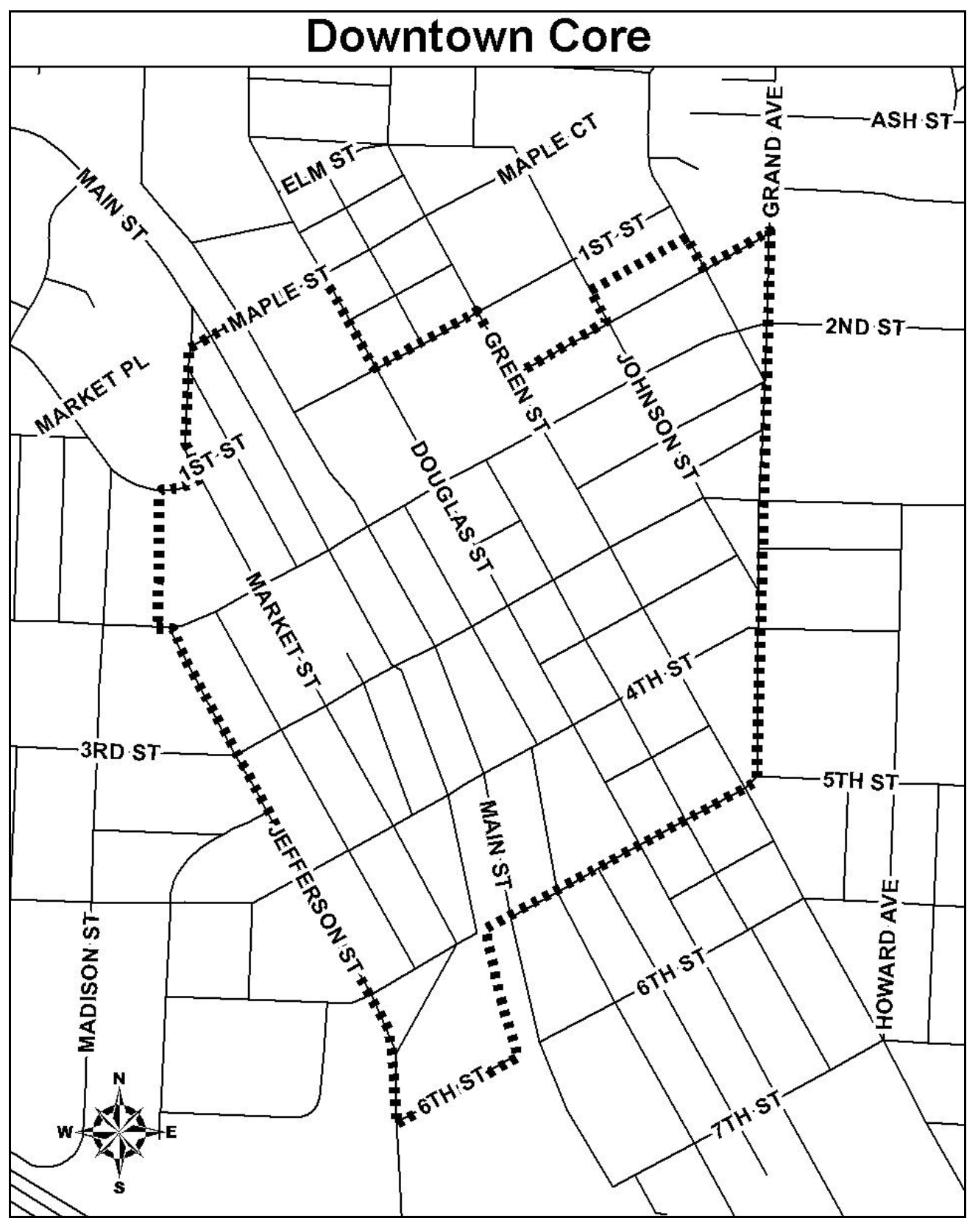
Sec. 8.420. - Development and renovation within the Downtown Core Area.
A.
Preliminary and final development plans. Applications for new development or redevelopment of any commercial or mixed use property in the Downtown Core Area shall be reviewed through the preliminary development plan and final development plan application, modification and appeal processes as set forth in Article 5, Applications and Procedures, of this chapter.
B.
Exterior renovation permit. An exterior renovation permit is required for all exterior work in the Downtown Core Area when the design standards of this division apply, but the preliminary and final development plan review processes of Article 5 do not apply, and as otherwise provided herein. The applicability of the design standards is described in detail in Sections 8.440.A. and 8.450.A. of this division.
1.
Requirements.
a.
An exterior renovation permit shall be required prior to any:
(1)
Exterior rehabilitation (returning to an original condition).
(2)
Exterior remodeling, including façade removal or replacement, window and door replacement.
(3)
Replacement lighting or similar fixtures within the Commercial Core.
(4)
Window replacement.
(5)
Signage, new or replacement in the Commercial Core.
(6)
Awnings, new or replacement in the Commercial Core.
(7)
New construction or reconstruction of a building addition or any other exterior work, not defined as maintenance herein, on any building located in the Downtown Core Area.
(8)
An Exterior Renovation shall be required prior to any work on a building listed in the National Register, for which tax credits are being requested and where the Secretary of the Interior's Standards for the Treatment of Historic Properties apply.
b.
An exterior renovation permit shall not be required for:
(1)
General repair and maintenance of existing single and two family dwellings occupied as a residential use in the transition area including:
(a)
Reroofing.
(b)
Siding replacement.
(c)
Exterior painting, provided colors are period specific or are compatible with colors typically seen in the neighborhood. Painting unpainted brick is specifically prohibited.
(d)
Tuck pointing.
(e)
Crack repair.
(f)
Sidewalk repair or replacement.
(g)
Driveway repair or replacement.
(2)
General repair and maintenance of buildings or properties located within the Commercial Core including:
(a)
Reroofing.
(b)
Tuck pointing.
(c)
Crack repair.
(d)
Exterior painting - provided period specific colors are used. Does not apply to painted wall signs, murals or unpainted brick.
(e)
Concrete step repair/replacement.
(f)
Parking lot repairs.
c.
An exterior renovation permit is not required for interior remodeling, underground utility work, or maintenance and repair of public infrastructure.
2.
Applications for an exterior renovation permit shall be made to Planning Services on a form provided by the Director. The Director shall review the application and issue a written decision based upon the provisions of this Division within ten business days of the receipt of the application. For the purpose of this section, the Director's decision is deemed to have been served on the date it is personally delivered, or if mailed, the date that is three (3) days from the date that the decision is placed in the U.S. mail.
3.
Appeal of a denial of an exterior renovation permit.
a.
If the Director disapproves an application for an exterior renovation permit or otherwise fails to approve or make a recommendation within ten business days on an application in the manner requested by the applicant, the applicant may appeal the Director's decision to the City Council by filing a written application for appeal with the City Clerk within 20 business days of the date that the Director's decision is served. Upon receipt of any appeal filed pursuant to this section, the City Clerk shall forward the written application for appeal to the Director, who upon receipt shall schedule an appeal hearing before the Planning Commission for its recommendation to City Council.
b.
Notice of the hearings before the City Council and the Planning Commission. Notice of such hearings, including the date, location and time, shall be provided by U.S. mail, postage prepaid, to all persons who own property or hold business licenses for businesses located on the same block as the subject property and those who own property or hold business licenses on the block that faces and is across the street from the subject property. In addition, the property shall be posted with the information regarding the date, location, time and summary of the appeal that is being presented.
c.
Appeal recommendation hearing before the Planning Commission. The purpose of the hearing before the Planning Commission is to make a recommendation to the City Council on appeals of denials of exterior renovation permits in the Downtown Core Area. The Commission shall hold a hearing upon notification by the Director that an appeal has been filed. During the hearing, the applicant and Director may present information, other persons who may provide information on their respective behalf, and other evidentiary matters for the Commission's consideration, but the formal rules of evidence shall not apply. Any person who received a mailed notice shall be permitted to provide information to the Commission. The Commission may also receive information from anyone who attends the hearing. Upon the close of the hearing, but not later than two regularly scheduled meetings of the Commission, the Commission shall submit to the City Council its recommendation on whether or not to affirm, reverse or modify the decision of the Director and the reasons therefore. In doing so, the Commission shall consider whether or not the application is compliant with the City's Code and guidelines as well as the same criteria as set out in Section 8.420.
d.
Upon receipt of the Commission's recommendation, the City Clerk shall place the consideration of the appeal on the next available regular session meeting agenda of the City Council and provide notice to the applicant of the date, time and place that the appeal shall be heard by the City Council. The applicant may present evidence and testimony in support of his/her appeal before the City Council in the same manner as a public hearing for a rezoning of property. The staff shall prepare a staff report for consideration by the City Council summarizing the evidence and testimony presented by all parties at the Planning Commission hearing. Rules of evidence in a court tried case shall not apply.
e.
In reaching its decision on the appeal and in addition to the recommendations of the Planning Commission, the City Council shall consider whether or not the renovations contained within the application:
(1)
Are consistent with the adopted guidelines for the area,
(2)
Are compliant with City Code,
(3)
Propose to use materials that were used in Lee's Summit at the time the building or structure in question was built,
(4)
Tend to or do preserve or hinder historic preservation of the structure in the present and future,
(5)
Are consistent with exteriors and materials currently used for buildings and structures in the immediate vicinity of the subject property,
(6)
Maintain historical aspects and architectural details of the building or structure including but not limited to location of doors, windows, and roofline,
(7)
Have any impact on property values of the subject and adjacent properties,
(8)
Have any impact on the structural integrity of the subject building or surrounding properties,
(9)
Are consistent with the strategic plan for the Downtown Core,
(10)
Are consistent with the Secretary of the Interior's standards; and
(11)
Will have an adverse or favorable impact on future historic district applications of the Downtown Core area or adjacent properties.
f.
The City Council shall vote on its initial decision at the end of the hearing of the appeal. If the City Council denies the appeal, it shall issue its written decision at the next scheduled regular session meeting of the City Council. If the City Council grants the appeal or modifies the decision of the Director, it shall also issue its written decision at the next scheduled regular session meeting of the City Council. The written decision shall include written findings of fact and conclusions of law which shall be adopted by passage of a Resolution approving same. In the event the City Council is unable to adopt findings of fact with an affirmative vote of five (5) members at the next regularly scheduled session meeting, the item shall be moved to the next agenda where it may be taken up again. It shall continue to be moved forward to agendas until a vote of five (5) members approves a set of findings of fact and conclusions of law. The decision of the City Council shall be final. Any persons aggrieved by the decision of the City Council may appeal such decision pursuant to Chapter 536, RSMo
Sec. 8.430. - Demolition and casualty loss.
A.
Demolition. Demolition of buildings and structures, including any demolition or de- construction of a building or structure in the Downtown Core Area, requires a demolition permit under Section 7-127 of the City of Lee's Summit Code of Ordinances. All applications for demolition permits involving demolition or de-construction of a building or structure in the Downtown Core Area, but not including demolition permits for interior demolition and remodeling, underground utility work, or maintenance and repair of public infrastructure, shall remain pending for 30 days from the date of the application, during which time the application shall be forwarded to the chair of the Historic Preservation Commission. The chair may place the application on an agenda of the Historic Preservation Commission as a discussion item, but shall have no authority to act on the permit. No such demolition permit may be issued until the date that is 30 days from the receipt of the application or the day of the Historic Preservation Commission's review, whichever comes first, except in those circumstances where the Building Official determines that demolition or de-construction is required because of an emergency or threat to public health, safety and welfare.
B.
Casualty Loss. The requirements of subsection 8.430.A. do not apply to demolition required as a result of a casualty loss, but the requirements of the Code of Ordinances, including, without limitation, the permit requirements of Section 7-127 of the Code, still apply.
Sec. 8.440. - Design standards—Commercial Core.
A.
Applicability. The Commercial Core Design Standards shall apply to all new construction or reconstruction but not to include maintenance items as defined in Section 8.380 and Section 8.420.B.1.b.2), within the boundaries shown on the map below, including, but not limited to, new buildings, building additions, exterior alterations, and changes or additions to parking areas or driveways. The standards do not apply to interior remodeling, underground utility work, or maintenance and repair of public infrastructure.
B.
Overview. All structures shall exhibit the basic features of traditional structures within the downtown area of Lee's Summit. These buildings shall align along the sidewalk edge or in relative relationship thereto consistent with traditional downtown building alignments, define the pedestrian zone and provide a sense of scale and visual interest. Strengthening this pattern of development will enhance the economic sustainability of the Downtown Core Area. The standards that follow establish a consistent identity while accommodating individual design solutions.
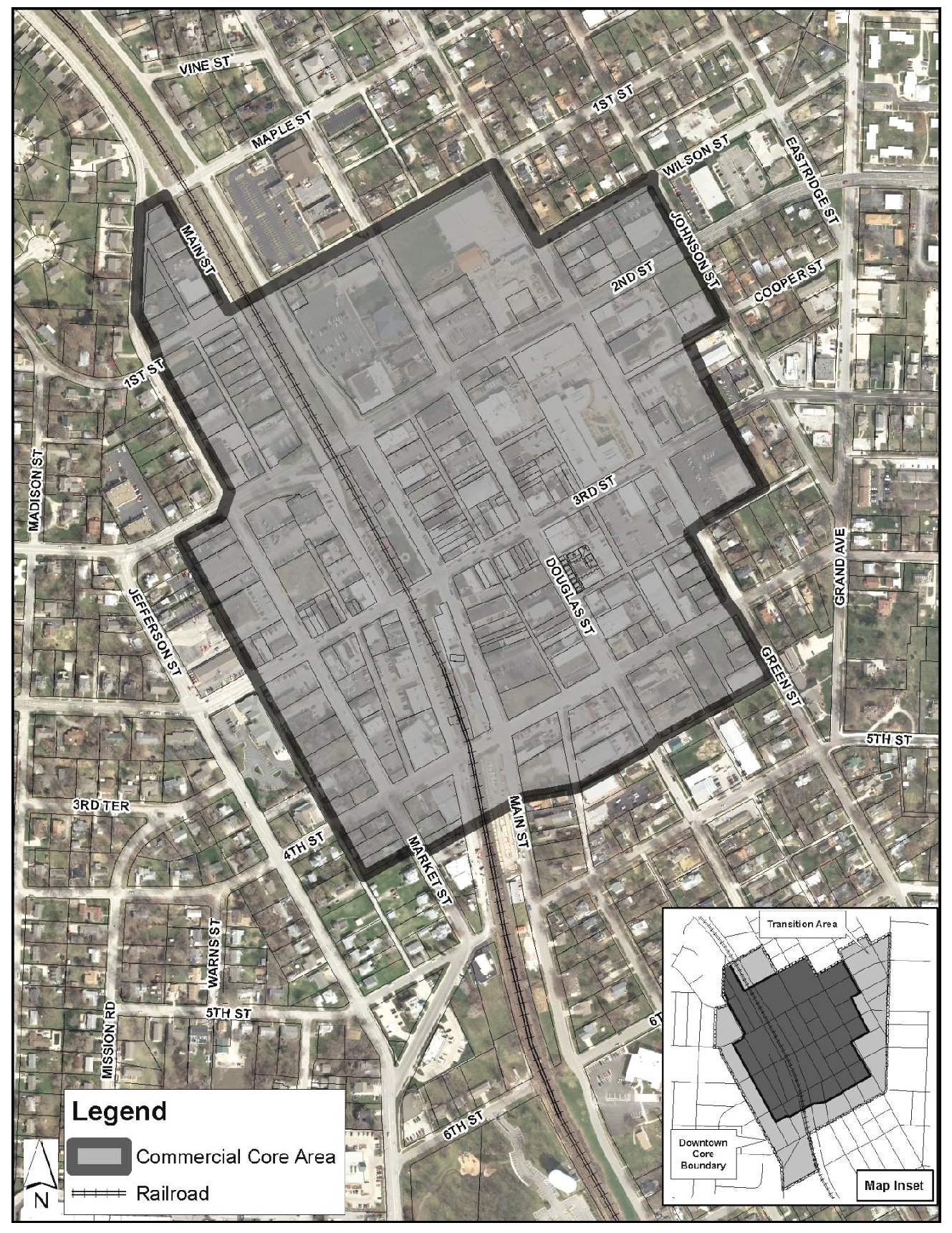
Commercial Core Area
C.
Other resources. For additional information and to use as a resource, see Lee's Summit Design Guidelines Manual for the Downtown Core Area, Lee's Summit, Missouri, prepared by the City of Lee's Summit, Missouri, and Thomason and Associates, Preservation Planners, and approved by the Historic Preservation Commission on June 26, 2006. If owners of properties listed in the National Register choose to participate in federal or state preservation programs, rehabilitation must follow federal guidelines. These guidelines are known as The Secretary of the Interior's Standards for the Treatment of Historic Properties by the U.S. National Park Service. The intent of these Standards is to assist the long-term preservation of a property's significance through the preservation of historic materials and features. For information regarding federal or state historic preservation tax credits, contact the Missouri State Historic Preservation Office.
D.
Historic architectural styles and building types. The downtown commercial buildings of Lee's Summit were largely built between 1877 and 1930. The fires of 1885 and the mid 1890's devastated the wooden structures that were predominant in the downtown commercial area. The majority of these buildings were replaced and were constructed of dark brick of one and two stories with either no discernible style or a formal architectural style, in particular, the influences of the Italianate and Late Victorian commercial styling of the late nineteenth century and the Modern Movement in the pre- and post-World War II period. Colonial Revival architectural style was used for the two government buildings in the downtown core area. These vernacular forms are known as "Tapestry Brick" or "Brick Front" and were widely built throughout the country at the turn-of-the-century. Most buildings from this period in downtown Lee's Summit are two stories in height, share similarities in their design, and have separate façade zones; the lower for commercial storefront businesses and upper facades for office use, or in some cases, residential use.
Storefronts were designed to be as transparent as possible for merchandise display. Storefronts were built with large display windows resting on short lower panels known as bulkheads, and often the front entrance had a single-light (glass in wood frame) door. Upper facades of one-story buildings generally feature decorative brickwork and cornices. In addition to the decorative brickwork and cornices, two-story buildings feature symmetrically placed windows. Buildings from the 1880s and 1890s generally have segmental brick arches over the windows.
During the early 20 th century, traditional storefront designs continued to be utilized for most downtown buildings. The influence of the Colonial Revival style led to more rectangular window forms and restrained detailing in contrast to the earlier Victorian styles. The use of stone, terra cotta, and cast concrete for decorative features was widespread from ca. 1900 to the 1920s. Little new construction occurred in the downtown area after the 1930s and the commercial district of Lee's Summit continues to be defined by its turn-of-the-century appearance.
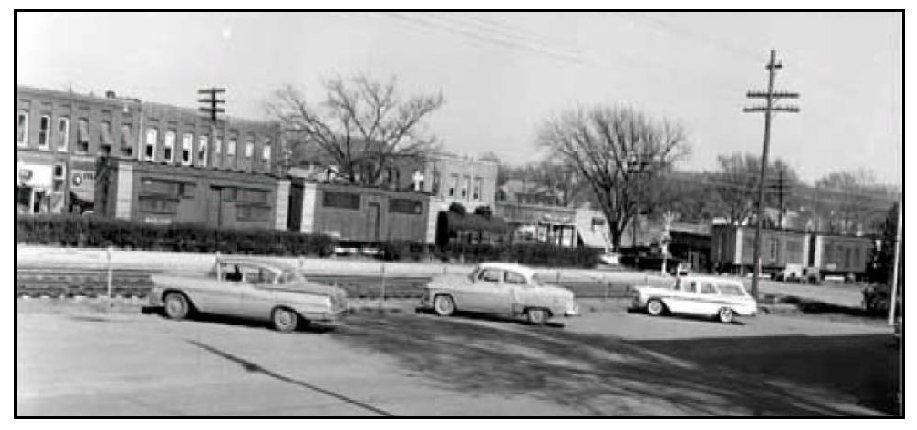
By the mid-twentieth century, downtown Lee's Summit continued to be characterized
by its turn-of-the-century commercial buildings.
(Photo courtesy of the City of Lee's Summit.)
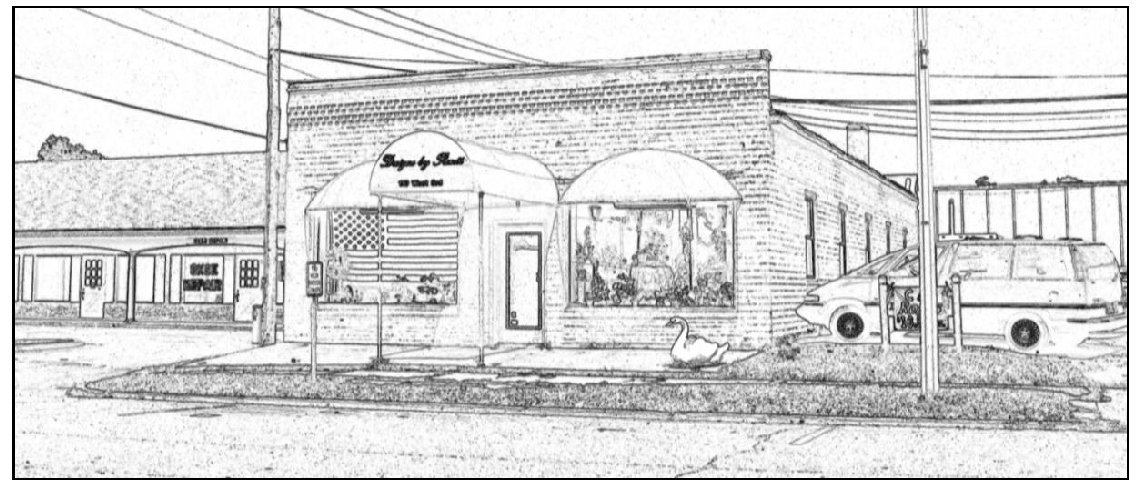
One-story Tapestry Brick commercial building at 110 SW 3rd Street. This building features
an intact storefront and corbelled brick cornice.
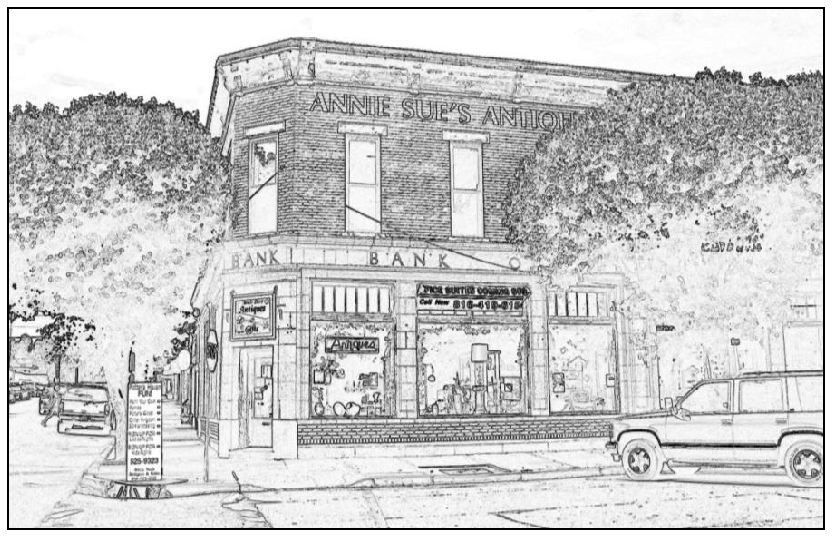
Two-story Tapestry Brick commercial building at 228 SW Main Street. This building's
storefront was remodeled in the early 20th century with terra cotta and large display
windows. At the roofline is a sheet metal cornice.
E.
Site design.
1.
Parking.
a.
To the greatest extent feasible, on-site parking shall be located behind buildings at ground level or completely above or below the first floor of a building.
b.
Parking shall be accessed from the rear of the property on parcels with alleys.
c.
For parcels without alley access, driveways serving on-site parking shall be avoided on arterial streets. When necessary, such driveways shall be minimized in width and provide for good visibility of pedestrians and traffic.
d.
A new parking lot shall not be located so that it interrupts storefront continuity along the sidewalk.
e.
If a new parking area is approved adjacent to an existing building, a brick screen wall, or a similar material compatible with the adjacent buildings, shall be used to avoid the appearance of missing teeth along the street. The screen wall shall be in line with the front walls of adjacent buildings. An upper story over the parking lot or an upper façade to give the appearance of a continuous building may be considered.
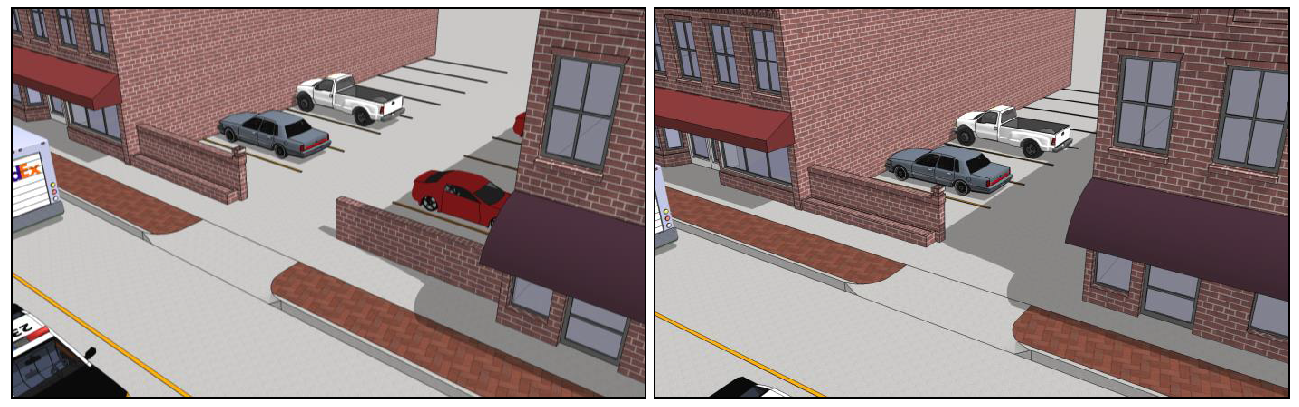
Parking areas added between buildings should be screened with a structure compatible
with adjacent buildings and in the same line as historic buildings.
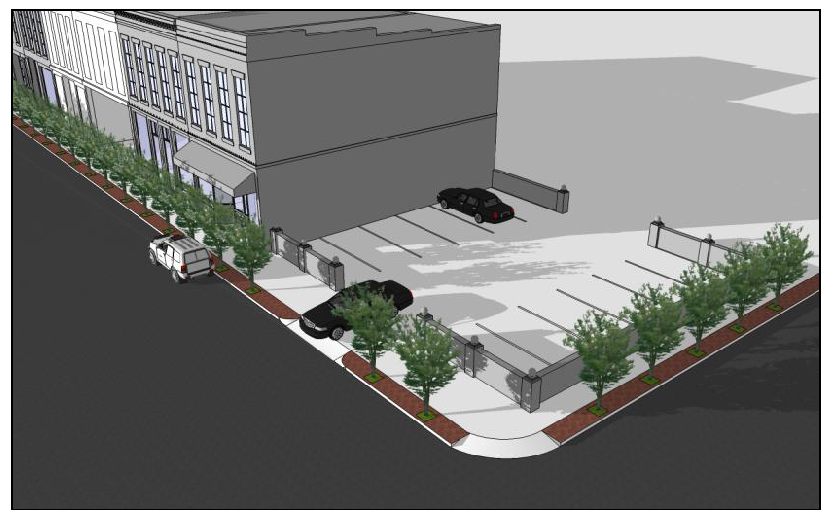
Corner parking lots shall have the edges defined through a masonry wall or other structure.
Landscaping may be used in conjunction with the solid screen wall.
2.
Mechanical equipment and service areas.
a.
Ground-mounted mechanical equipment and loading/service areas, including trash enclosures, shall be located out of public view whenever feasible and shall not front onto an arterial street. Ground-mounted mechanical equipment shall be located behind the building and screened from public view with fencing or landscaping or both.
b.
Electrical and communication transformers/cabinets shall be installed below grade in the right-of-way, including alleys, or located on-site and screened from public view.
c.
Electrical and gas meters, conduits, and other mechanical equipment should be located on rear facades.
d.
Backflow prevention/anti-siphon valves shall be integrated into the building design and concealed from public view. Such devices shall not be located within the public right-of-way.
e.
New buildings and building additions shall have rooftop mechanical equipment fully screened from view by using parapet walls of the same height as the mechanical units. New or replacement roof-top mechanical equipment on existing buildings may be screened with individual screening panels the same height as the proposed mechanical unit(s), be painted to match the building, or screening may not be required, depending on existing conditions.
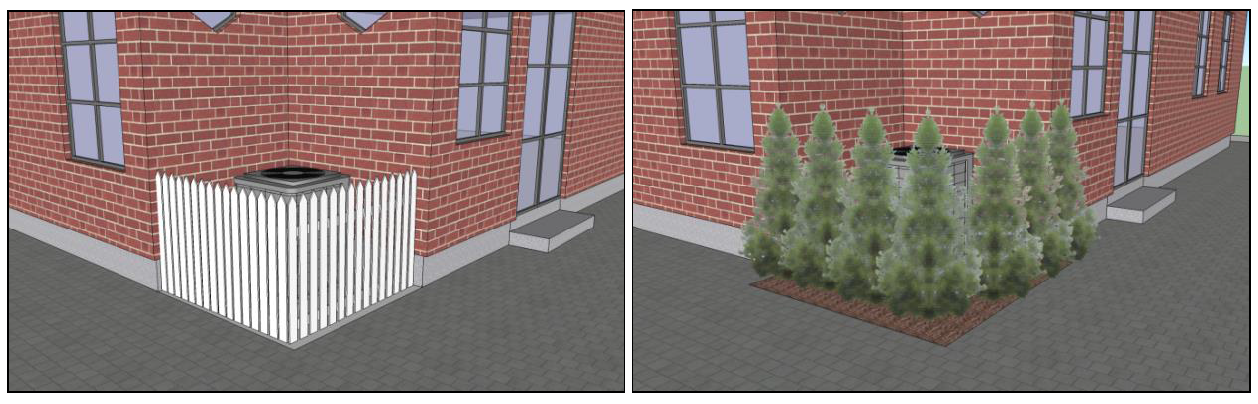
HVAC units and condensers at rear facades shall be screened through fencing or landscaping.
Units should have 36 inches of clearance to allow for maintenance and servicing.
f.
New trash enclosures shall be provided and shall be located behind the building when feasible. All exterior trash storage containers shall be stored within an enclosure so that they are not visible from off the property.
(1)
Each trash enclosure shall be constructed of:
(a)
Masonry walls or steel architecturally designed walls with: 1) a steel gate painted to be compatible with the color of the masonry walls and the building it is to serve, or 2) a steel/aluminum framed semi-opaque gate with a screen mesh material approved by the Director that provides an appropriate visual barrier; or
(b)
Structural steel tube frame construction clad in composite material with: 1) either a solid steel opaque gate painted to be compatible with the color of the steel walls and building it is to serve, or 2) a steel framed gate clad in composite material, or 3) a steel/aluminum framed semi-opaque gate with a screen mesh material approved by the Director that provides an appropriate visual barrier.
(c)
Steel used in the construction of trash enclosures shall be 16-gauge minimum thickness. Aluminum used in the construction of trash enclosures shall be 0.080-inch minimum thickness.
(2)
Each trash enclosure shall be protected through the installation of four-inch bollards along the interior rear wall of the trash enclosure or through other methods that provide an appropriate level of protection as approved by the Director.
F.
Mass and scale.
1.
In order to establish a pattern for more efficient land use, greater building height may be allowed; however, consideration shall be given to the traditional height of buildings in the Commercial Core.
a.
New buildings should be multi-storied to reflect the overall downtown look and vision.
b.
Although the maximum height of buildings in the Central Business Zoning District (CBD) is four stories, or 50 feet, consideration shall be given to the character and heights of buildings in the block or neighborhood. Buildings over two stories in height may be required to have the upper stories set back to reduce the mass and scale of the structure.
2.
New buildings shall be aligned with adjacent buildings along the street and conform to established setbacks.
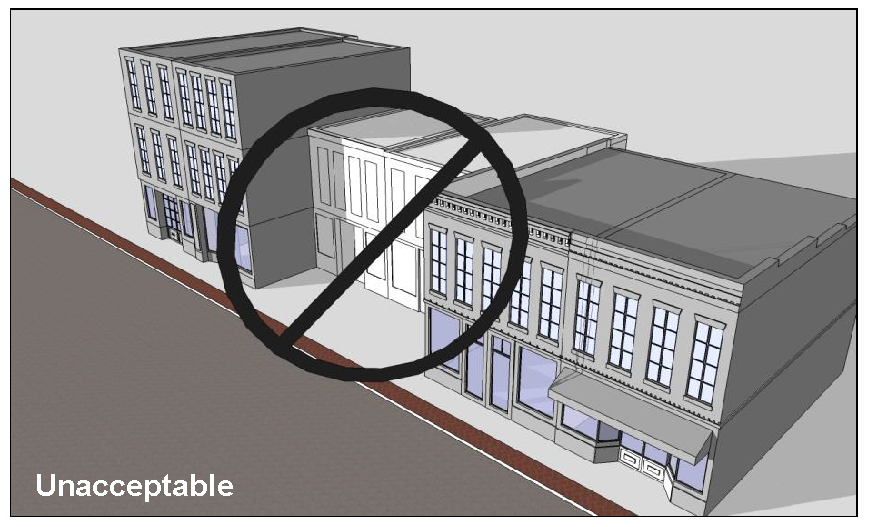
New commercial buildings shall be consistent with adjacent setbacks.
3.
New buildings and additions shall be delineated both vertically and horizontally to reflect traditional patterns and convey a human scale.
a.
The facades of new buildings shall be visually divided into "modules" that appear similar in scale to buildings seen traditionally.
b.
The facades of new buildings shall have vertical divisions similar in width to the pattern of existing buildings within the block.
c.
The facades shall depict a clear visual division between street level and upper floors.
4.
Floor-to-floor heights shall be consistent with adjacent buildings.
a.
First floor windows shall be a minimum of six feet in height.
b.
Upper floor windows shall be divided into individual units and not consist of a "ribbon" of glass.
c.
Primary upper floor windows shall have a taller vertical dimension than horizontal dimension.
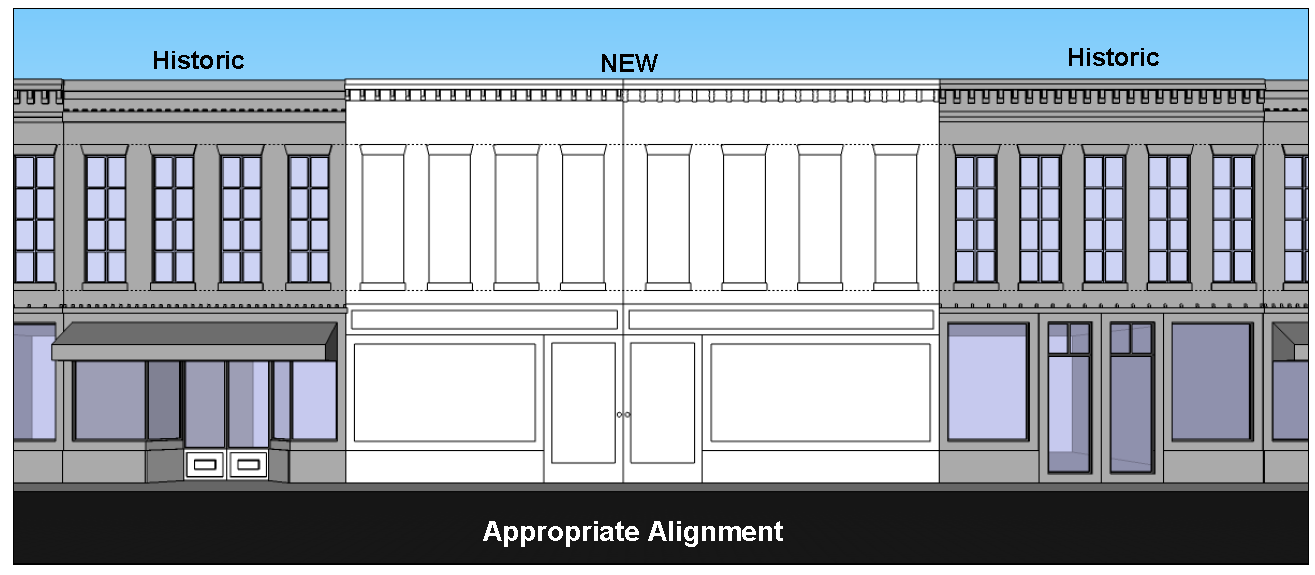
New construction shall be consistent with storefront and window size and spacing.
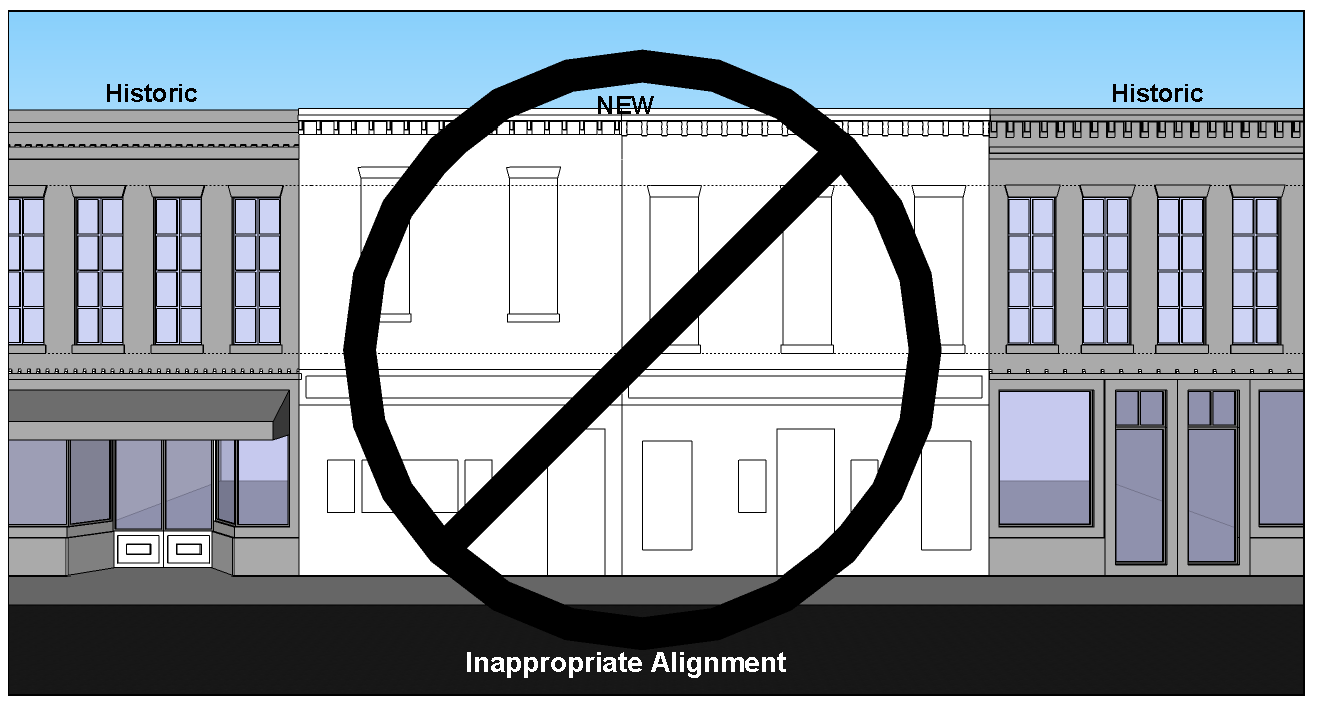
New construction shall be consistent with storefront and window size and spacing.
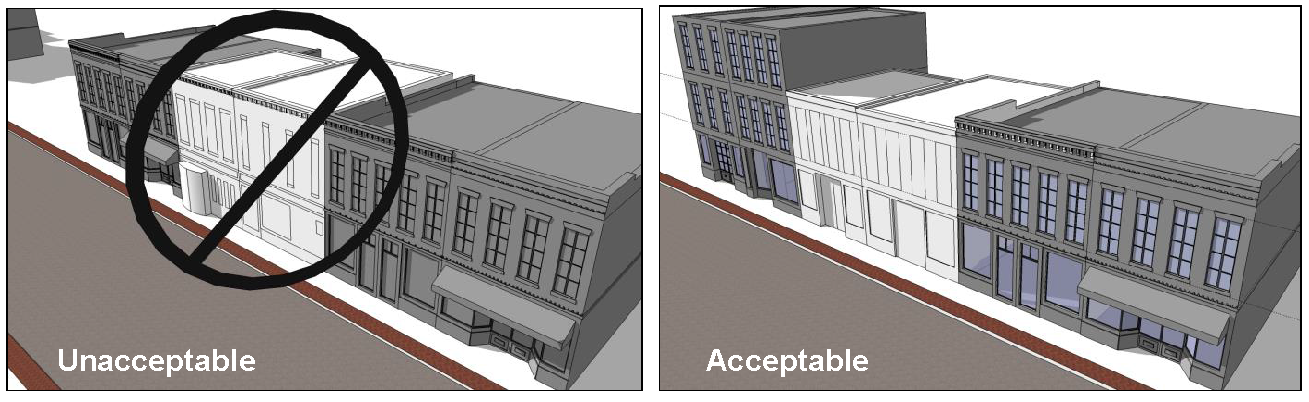
New Construction shall maintain traditional storefront and upper facade alignments.
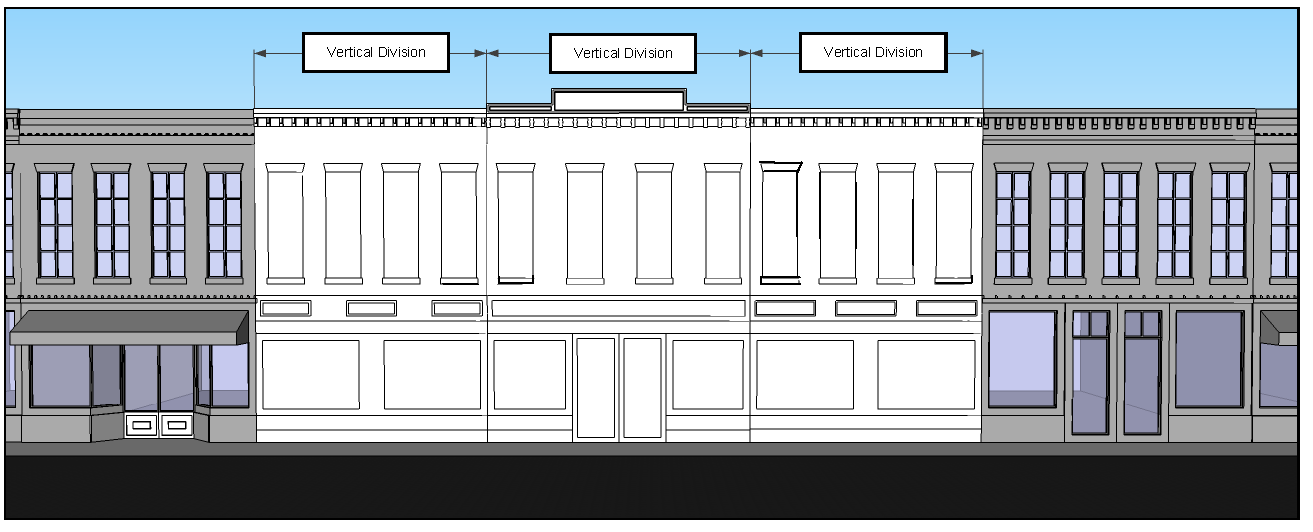
Large buildings of new construction shall have vertical divisions consistent with
building widths along the block.
G.
Building form and roofline.
1.
Simple rectangular building forms are preferred.
a.
New buildings and additions should be designed with simple rectangular volumes.
b.
Cylindrical, pyramidal and other elaborate building forms are prohibited.
2.
Flat roof forms are preferred.
a.
Parapet walls shall be used for screening flat roofs and be detailed with elements such as cornices to define the building roofline.
b.
Sloping roof forms may be considered in an incidental role, and on building additions on the rear of buildings. A sloping roof is defined as 3/12 pitch or less.
c.
Pitched roofs are prohibited. A pitched roof is defined as greater than 3/12 pitch.
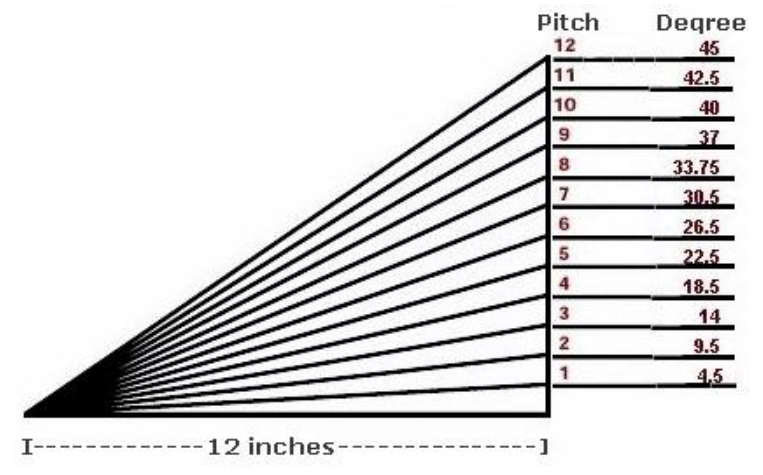
This drawing demonstrates how many degrees rise for each pitch of a typical roof.
Look at the column labeled pitch, then look under degrees to get the corresponding
amount of degrees. Example: 3/12 pitch = 14 degrees.
H.
Building entrances.
1.
Primary entrances.
a.
Primary entrances to ground floor spaces and upper stories shall be oriented to the sidewalk and primary pedestrian ways.
b.
Corner buildings may be designed with angled entrances at the corner.
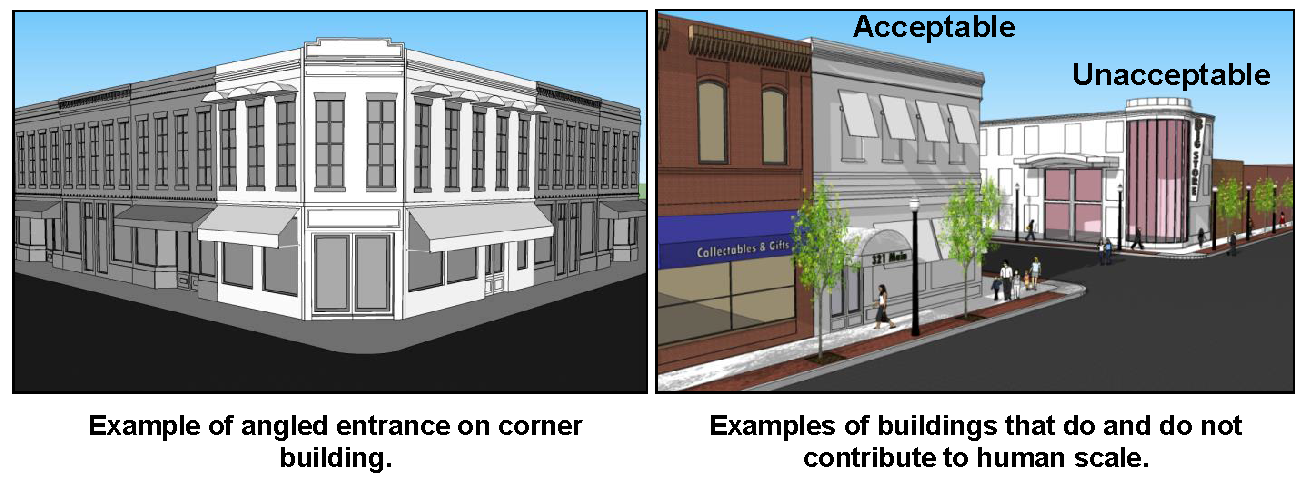
c.
The primary entrance shall be clearly identified.
d.
The primary entrance shall convey a sense of human scale.
e.
The entry may be defined by using an awning, a change in roofline or other architectural feature consistent with traditional Downtown Lee's Summit design.
f.
A sign mounted at the entry may be used to identify the primary entrance.
g.
Special paving treatments shall not be used to enhance the entry within the public right-of-way.
2.
Recessed entries.
a.
Should be retained and are encouraged in new storefront construction.
b.
Increase window display area and provide a sheltered transition to the interior of the store.
c.
Should be centered on the tenant space and be highly transparent.
3.
First floor entry doors shall contain a minimum of 50 percent glass. Solid or residential type entrance doors with less than 50 percent glass are prohibited.
I.
Awnings and canopies.
1.
The use of awnings on commercial buildings in downtown Lee's Summit is appropriate.
2.
Awnings may be retractable or fixed in place.
3.
Awnings should fit the opening to which they are applied. Shed/rectangular awnings are appropriate for rectangular openings while arched awnings are appropriate for arched openings.
4.
Awnings with bubble, concave, convex or mansard forms are prohibited.
5.
Storefronts and upper facade windows are both appropriate locations for awnings.
6.
Awning materials shall be high quality architectural metal, as determined by the Director, canvas, acrylic, or vinyl coated. (See prohibited materials.)
7.
Internally illuminated or translucent awnings and canopies are prohibited.
J.
Building materials (exterior) and color.
1.
All new construction and reconstruction.
a.
Street facing facades including alley facing facades (for corner buildings that have both) shall consist of:
(1)
First and second floor elevation: Brick,
(2)
Additional floors above the second floor: Durable masonry materials such as stone, brick, traditional stucco (a cement and sand based material), or pre- cast or poured-in-place concrete.
b.
Facades not meeting the criteria above shall consist of one or more of the following:
(1)
Those materials listed in subsection 1.a. above.
(2)
Rough faced masonry block.
(3)
Fiber cement siding (such as "HardiePlank").
(4)
New, high quality materials that are recognized by an approved third party testing agency which meet or exceed the quality of the materials listed.
(5)
Innovative or "green" materials, provided they appear similar in quality, texture, finish and dimension to permitted materials and which are recognized by an approved third party testing agency which meet or exceed the quality of the materials listed.
(6)
Architectural metal or historic metal, as determined by the Director, to match existing building.
2.
Prohibited materials shall include:
a.
Faux brick products (not made of fired clay).
b.
Painted brick, except existing painted brick
c.
Wood, except for deck floors and sub structures.
d.
Corrugated metal and sheet metal, except when it is determined by the Director to be high quality architectural metal.
e.
Vinyl, except vinyl coated awnings.
f.
Existing buildings with metal siding on the rear and sides may be maintained and repaired with similar materials.
g.
Exterior finish systems made of a lightweight synthetic wall cladding that includes foam plastic insulation and thin synthetic coatings; except as a trim, accent, cornice or profile material.
h.
Mirror glass which reflects more than 40 percent of incident visible light.
3.
Simple material finishes are encouraged.
4.
Matte finishes are preferred.
5.
Building colors.
a.
Brick buildings shall utilize traditional brick colors.
b.
Accent colors shall be selected to compliment and contrast the primary building color.
c.
Colors should be compatible to complement and support the overall character of Downtown Lee's Summit.
K.
Signs shall comply with Article 9, Signs, of this chapter.
L.
Lighting.
1.
The lighting standards set forth in this division, subdivision 5, Lighting Standards, shall apply, in addition to the standards below.
2.
Lighting fixtures shall be tied in historically with the building.
3.
Period lighting is encouraged to fit the historic framework of the Downtown Core Area.
4.
Exterior building lighting should be used to accentuate the building design and other overall ambiance of the Downtown Core Area.
5.
Architectural details and features may be highlighted with lighting integrated into the building design.
M.
Outdoor spaces.
1.
Outdoor spaces are encouraged and may consist of:
a.
Art gardens.
b.
Interior courtyards.
c.
Public spaces.
d.
Plazas.
e.
Outdoor spaces may not be used or converted for vehicle parking or product display.
2.
Upper story decks, balconies, staircases and railings:
a.
Modern additions to buildings and shall be simple rather than ornate in design.
b.
Shall be appropriately scaled and incorporated into the overall design of the building.
c.
Shall be inset if proposed on the street side of a building, and shall not extend beyond the property line.
d.
May project beyond the plane of the building only when located on the side and rear of a building, but may not extend over property lines or public right-of-way.
e.
Shall be metal and shall be painted to match or blend with the colors of the buildings.
f.
Decks may utilize wood, except for the railings, provided they are painted, stained or sealed to blend with the colors of the building.
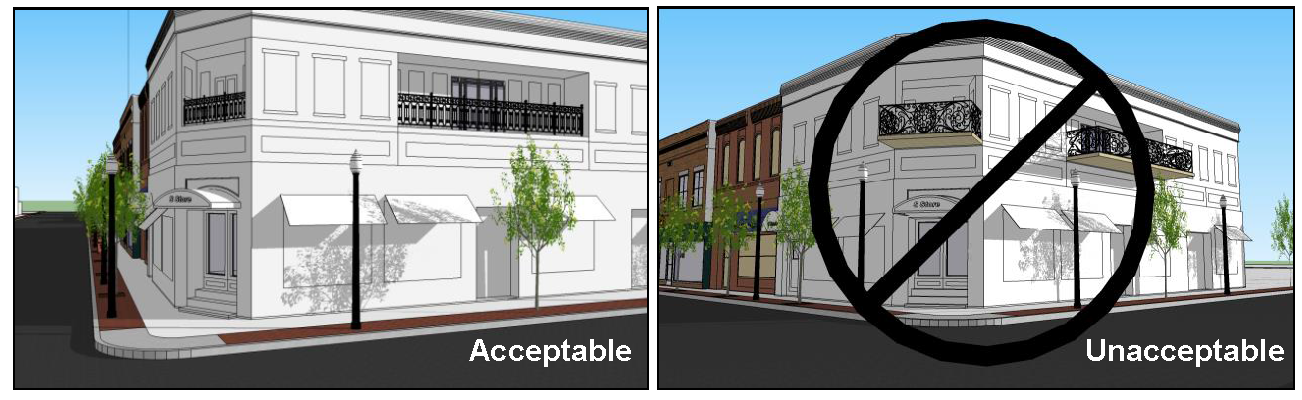
Upper story balconies on the front of buildings must be recessed, not projecting.
(Ord. No. 9413, § 1, 5-17-2022)
Sec. 8.450. - Design standards—Transition area.
A.
Applicability. These design standards shall apply to all construction for all uses within the transition area, within the boundaries shown on the map below, including, but not limited to, new buildings, building additions, exterior alterations, and changes or additions to parking areas or driveways. The standards do not apply to interior remodeling, underground utility work, or maintenance and repair of public infrastructure. These design standards shall apply to redevelopment and/or conversion of existing structures to new permitted uses, for example conversion of a residential home to an office or retail use, or to a mix of uses.
B.
Overview. The transition area is in transition from residential to mixed use, with commercial services being provided within a residential building type setting. Existing residential uses are often combined with these new commercial functions to create mixed use context. Many of the blocks within the transition area, outside of the Commercial Core, have a single-family residential design heritage and this general character should be retained. These standards attempt to identify the basic fundamental characteristics of the traditional residential neighborhoods and provide guidance with respect to neighborhood context and basic design elements. Characteristics upon which to draw include the way in which a building is located on its site, the manner in which it relates to the street and its basic mass, form and materials. When these design variables are arranged in a new building to be complementary to those seen traditionally in the area, visual compatibility results.
C.
Other resources. The following documents may be used as a resource for guidance:
1.
"Lee's Summit Design Guidelines Manual for the Downtown Core Area, Lee's Summit, Missouri," prepared by the City of Lee's Summit, Missouri and Thomason and Associates, Preservation Planners, and approved June 26, 2006, by the Historic Preservation Commission.
2.
"The Secretary of the Interior's Standards for the Treatment of Historic Properties" from the U.S. National Park Service.
D.
Objectives for these design standards are:
1.
To maintain a sense of connection with a single-family house design tradition while accommodating development with a mix of commercial and residential uses.
2.
To minimize the visual impacts of automobiles.
3.
To enhance and encourage pedestrian activity.
4.
To continue the tradition of tree planting near the street edge and in front yards.
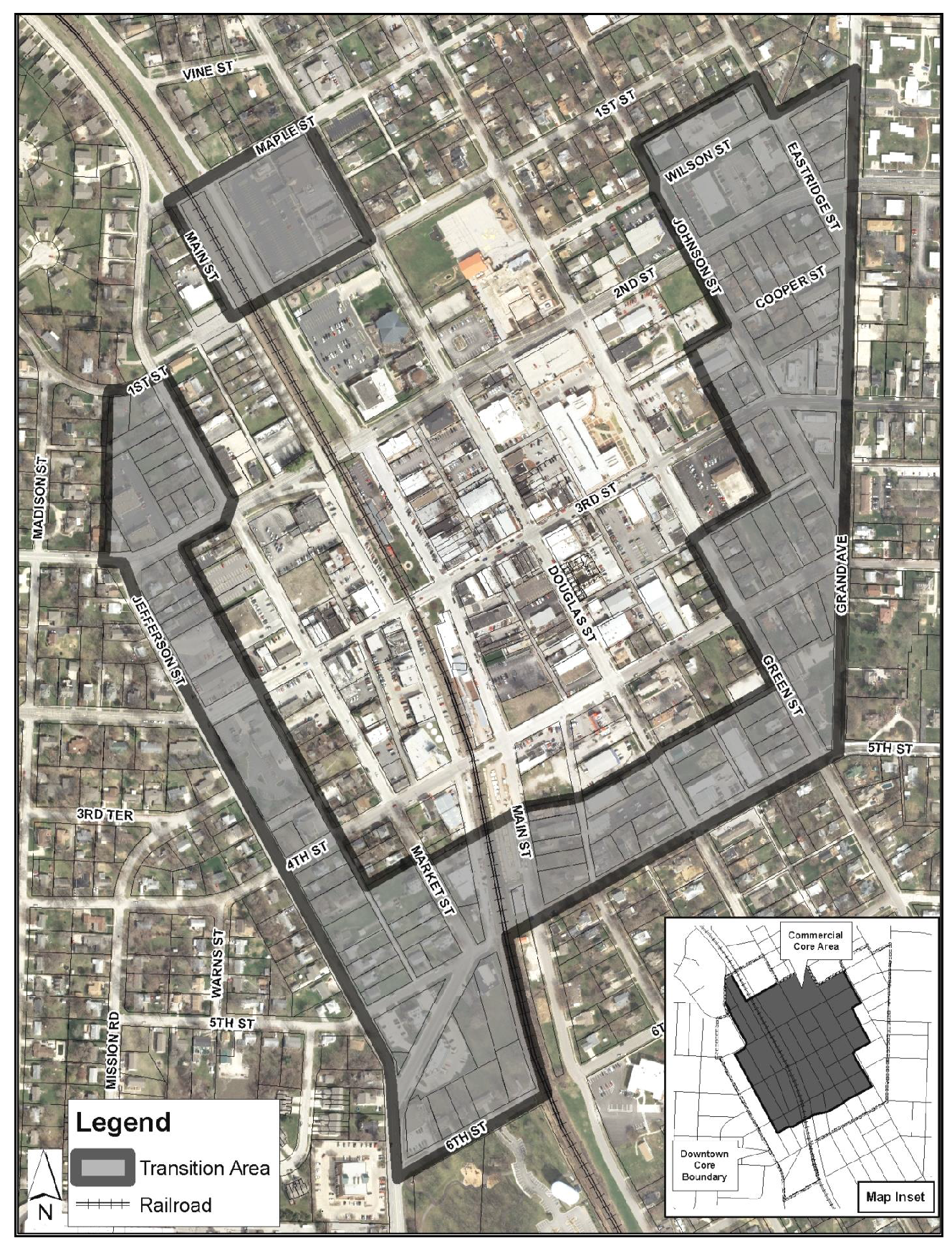
E.
Site design.
1.
The alignment and spacing patterns of buildings as seen along the block shall be maintained and incorporated into new construction.
a.
Traditional setbacks of buildings, reflecting residential development patterns, shall be maintained.
(1)
Building fronts shall be in line with existing uses along the block.
(2)
Where setbacks vary, a new building shall fit within the range of setbacks within the block.
b.
A sense of semi-public space shall be maintained in the front setback. A minimum of 50 percent of the area of the front building setback shall be green space, planted with grass, ground cover or low planting.
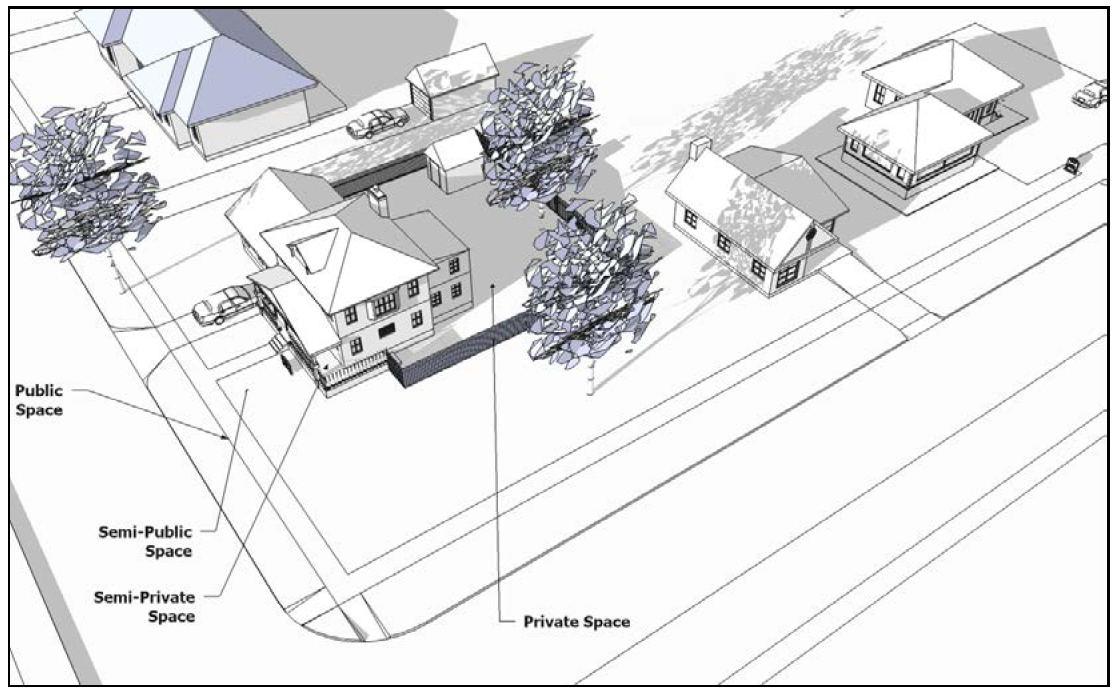
Public, semi-public, semi-private, and private spaces.
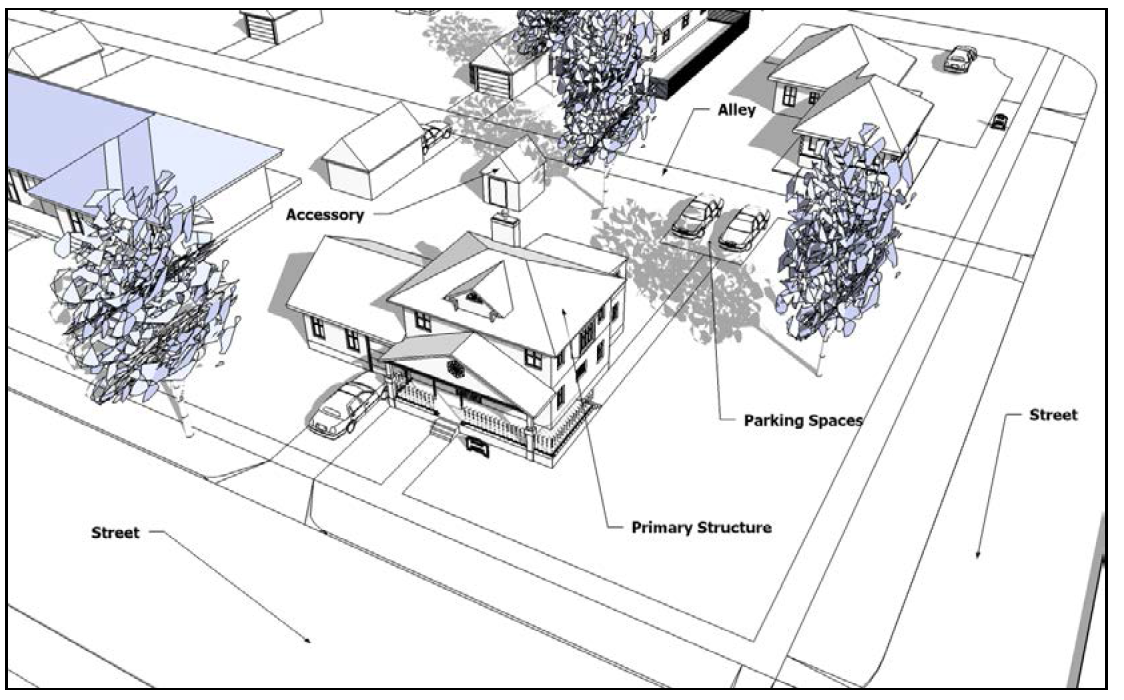
For a lot located on an alley, a detached garage, carport or parking area shall be accessed from the alley where feasible. Detached garages, carports or parking areas shall be located to the rear of primary buildings. This is an example of an appropriate repurposing or conversion of a residential home to a commercial use.
2.
All structures shall have the front of the building oriented to the street.
3.
Accessible ramps shall be integrated with the landscape and architecture. Ramps shall be located to the side or rear of the structure whenever possible. However, in the event that accessible ramps cannot be located to the side or rear of the structure, e.g. proximity to property lines or steep site topography, accessible ramps are not subject to front yard setbacks.
4.
Driveways and parking areas shall be designed and located in a way that minimizes their visual impact.
a.
Parking shall be accessed from an alley where feasible, with parking areas located to the side and rear of the building.
b.
For a lot not accessible from an alley, parking behind the primary building is preferred, with a driveway accessed from the street.
c.
Garages shall be located to the rear of a primary building to minimize their impact on the streetscape.
d.
Tandem (front to back) parking in a driveway is acceptable.
e.
Driveway width shall be minimized. Single-car width may be permitted from the edge of street until the driveway extends beyond the rear of the primary structure.
f.
The number of curb cuts shall be minimized.
g.
Required parking spaces should not extend beyond the front plane of the primary building.
h.
For multi-unit structures, parking in an interior courtyard or parking lot with a single access point is preferred to multiple driveways.
i.
The use of paved ribbons or strips, or pervious pavement methods, is encouraged for private driveways and parking surfaces.
j.
Parking lot setbacks:
(1)
Parking lots shall be setback a minimum of ten feet from any public right-of-way or private street edge of pavement.
(2)
Parking lots shall be setback a minimum of ten feet from any residential district or use.
(3)
The ten-foot required setbacks (above) may be reduced if a decorative screening wall or landscape screening is provided to shield vehicle lights.
k.
Screening. Parking areas shall be screened from public view to the maximum extent feasible, by means of fencing, hedges, trellises, decorative masonry walls, or other landscaping.
l.
Modifications to the parking requirements may be requested through the public hearing process, as provided in Article 2. Consideration may be given to preserve a feature of public significance, such as a landmark tree or tree of significance, a historic structure, a substantial mature hedge, or an exterior art feature.
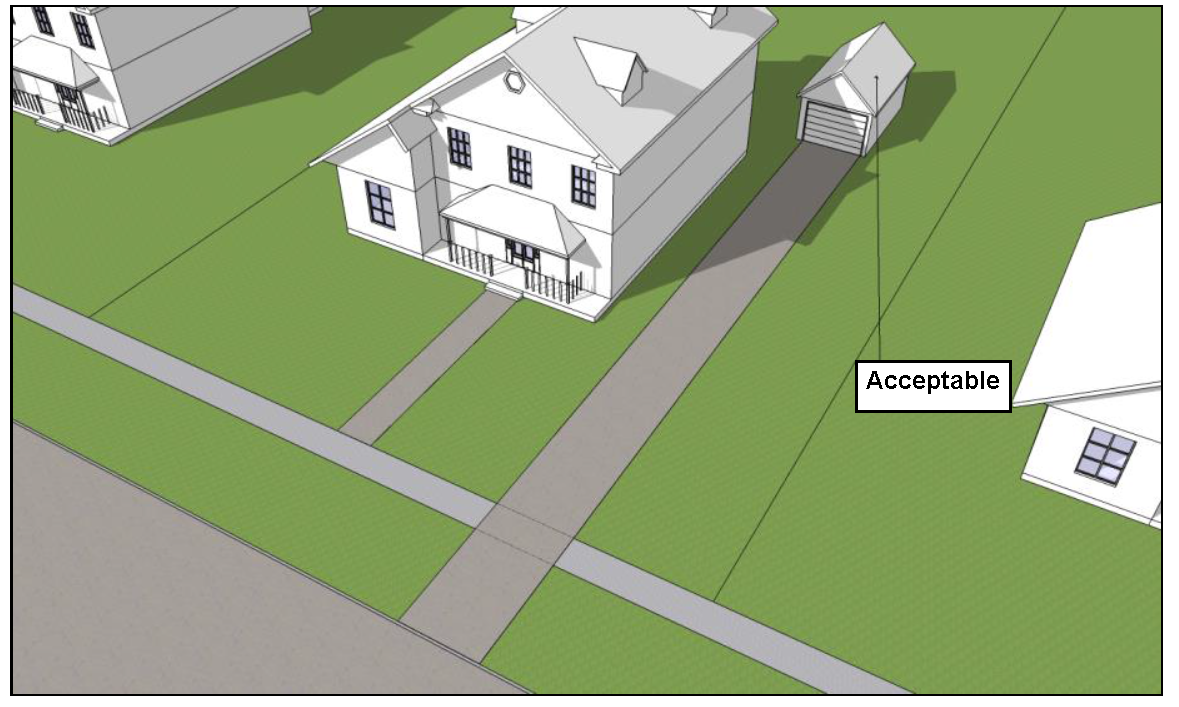
Parking location for lots without alley access are recommended to be placed to the rear of the primary building, in a driveway or detached garage accessed from the street. The preferred location for parking on these lots is at the rear or the lot.
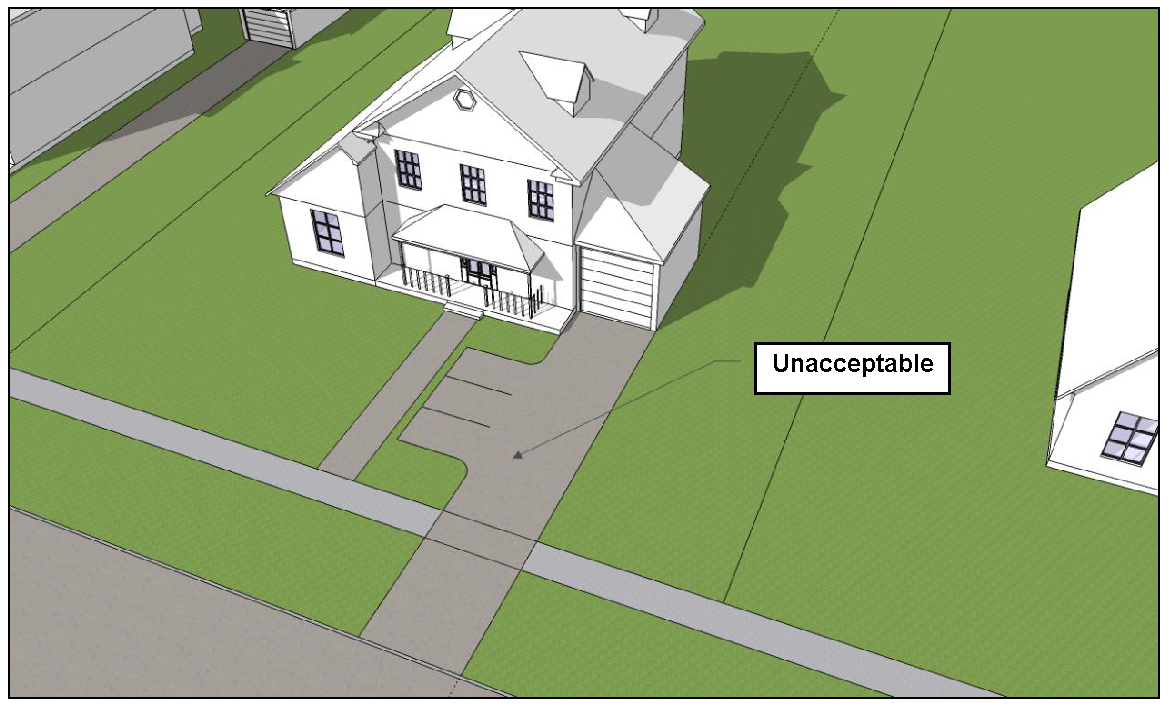
The driveway location and front yard parking spaces inappropriately alter the
character of this residence.
5.
Mechanical equipment and service areas.
a.
On lots with alley access, the back of the lot shall be used to accommodate service areas and minimize their visual impacts.
b.
Mechanical equipment and loading/service areas, including trash enclosures, shall be located out of public view whenever feasible and shall not front onto an arterial street.
c.
Electrical and communication transformers/cabinets shall be installed below grade in the right-of-way, including alleys, or located on-site and screened from public view.
d.
Electrical and gas meters, conduits, and other mechanical equipment should be located on rear facades.
e.
Backflow prevention/anti-siphon valves shall be integrated into the building design and concealed from public view. Such devices shall not be located within the public right-of-way.
f.
Rooftop mechanical.
(1)
New buildings and building additions shall have rooftop mechanical equipment fully screened from view by using parapet walls of the same height as the mechanical units.
(2)
New roof-top mechanical equipment on existing buildings shall be screened by using either a parapet or individual screening panels the same height as the proposed mechanical unit(s).
g.
Ground-mounted mechanical equipment shall be located behind the building and screened from public view with fencing or landscaping or both.
h.
Trash enclosures shall be provided and shall be located behind the building when feasible. All exterior trash storage containers shall be stored within an enclosure so that they are not visible from off the property. Each trash enclosure shall be constructed of masonry walls with a steel gate painted to be compatible with the color of the masonry walls and the building it is to serve.
F.
Mass and scale. "Mass and scale" refer to the physical bulk and proportion of a building or structure when compared with other structures in a defined area. In this context, perception is important. For example, two buildings of the same square footage can have very different "mass and scale" perceptions, depending on height, setbacks, building materials, and other features.
1.
Height.
a.
The height of a new structure shall be compatible with existing buildings on the block, or in the neighborhood, as determined by the Director.
b.
The rear portion of a building may be taller than the front, if it appears in scale with the neighborhood and does not exceed the height limitation in the zoning district.
c.
New structures should not overwhelm existing single-family structures in terms of height.
2.
Width.
a.
The width of a new structure shall be compatible with existing buildings on the block, or in the neighborhood, as determined by the Director.
b.
The primary building face shall not exceed the width of existing structures in the same neighborhood.
c.
A new structure may be wider overall, if the building front is divided into modules or distinctive wall planes with dimensions similar in size to buildings in the neighborhood, to reduce the scale.
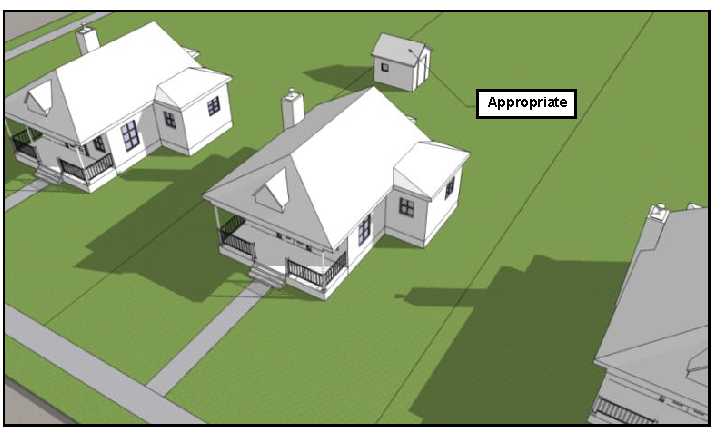
Appropriate: A separate secondary structure maintains a sense of open space.
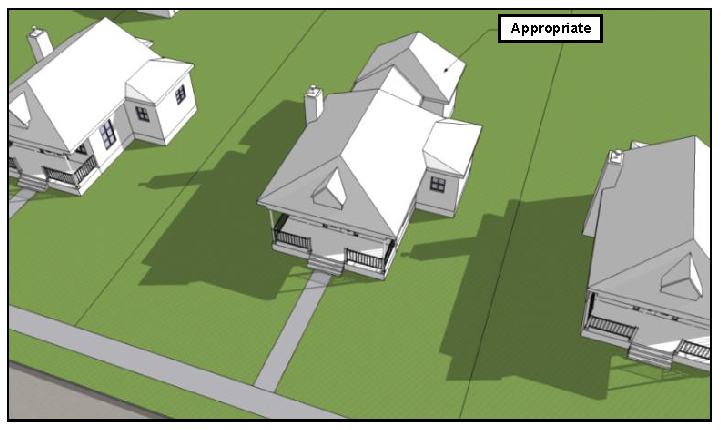
Appropriate: A smaller addition is linked with a connection and does not overwhelm
or distract from the original structures mass, scale, or architecture.
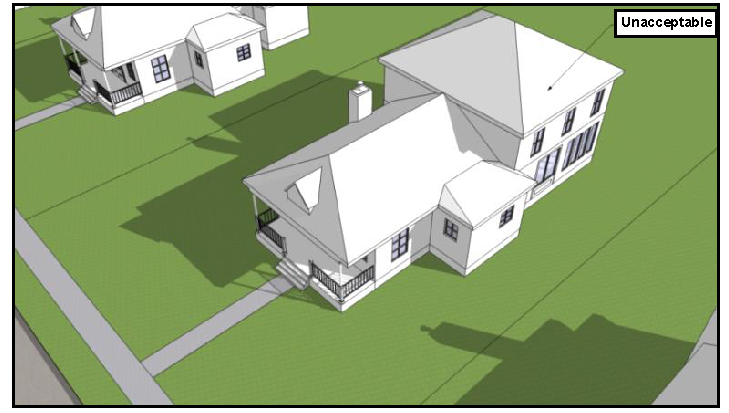
Unacceptable: A large mass occupies most of the rear yard and overwhelms the original
structure.
G.
Building form and roofline.
1.
Building form.
a.
Building forms shall be consistent with existing structures within the block or neighborhood.
b.
Simple rectangular solids are typically appropriate.
c.
"Exotic" building and roof forms that would detract from the visual continuity of the streetscape are prohibited. Examples include geodesic domes, A-frames, Cylindrical, pyramidal and other elaborate building forms.
d.
Raised foundations are preferred. Finished floor heights should be within the range typically seen in the neighborhood. Additionally, placement of potential future accessible ramps should be considered at the design phase of new construction.
e.
Accessible ramps shall be integrated with the landscape and architecture. Ramps shall be located to the side or rear of the structure whenever possible. However, in the event that accessible ramps cannot be located to the side or rear of the structure, e.g. proximity to property lines or steep site topography, accessible ramps are not subject to front yard setbacks.
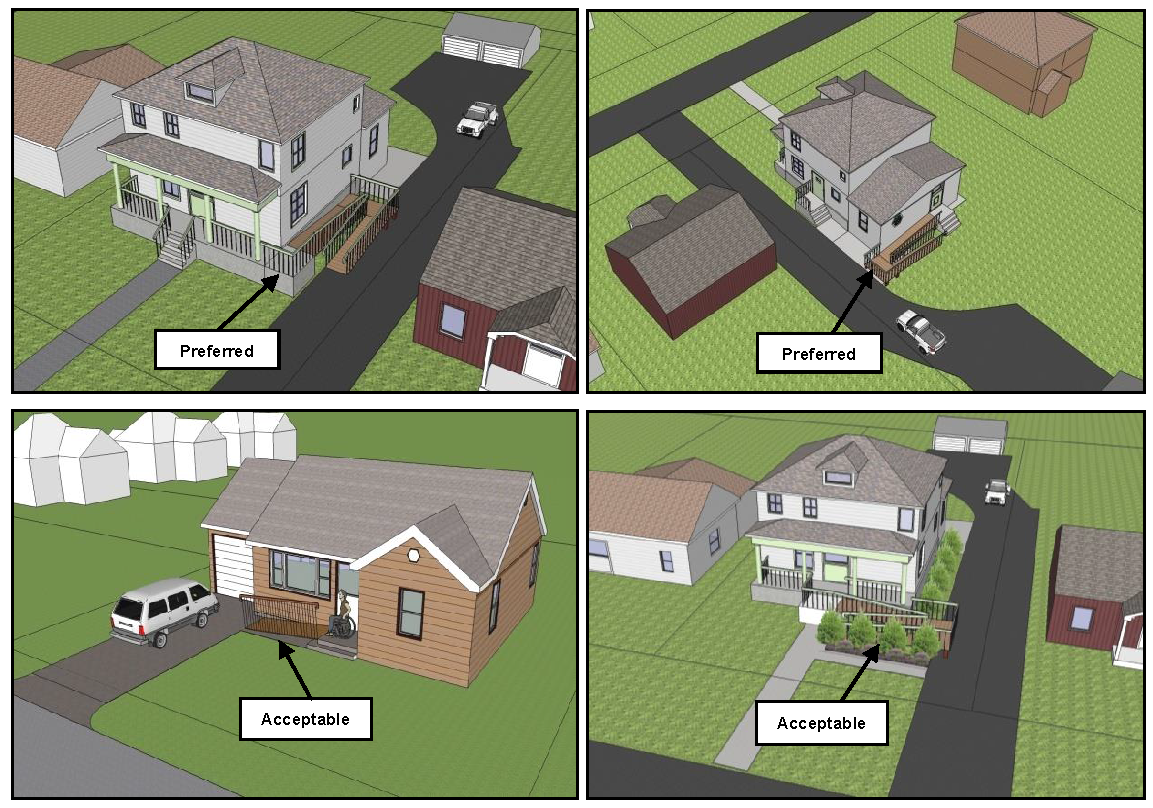
2.
Roof forms.
a.
Sloping roof forms shall predominate on new structures and additions, to fit into the context of existing buildings in the block or neighborhood.
b.
Hip or gable roof forms are preferred for the primary roof of a structure.
c.
Larger developments may include flat roofs, as seen in the Central Business Zoning District (CBD). Parapet walls shall be used for screening flat roofs and be detailed with elements such as cornices to define the building roofline.
H.
Building entrances.
1.
The principal structure shall have one primary entrance that faces the street. Additional entrances may be located to the side or rear.
2.
The primary entrance of a building shall be clearly identified.
3.
A front porch or stoop may be used to define the primary entrance. The porch or stoop:
a.
Shall be oriented to the street,
b.
Shall be functional as a means of access to the building,
c.
Should be open on the sides,
d.
Should be covered, and
e.
Shall be large enough to provide a transition area from public space to private space.
4.
Access to the primary entrance shall be clearly defined.
a.
The entry walkway shall be separate from the driveway.
b.
Special paving treatments may be used to enhance the entry. Special paving treatments within the public right-of-way must be approved by the City Engineer and are required to be maintained by the property owner.
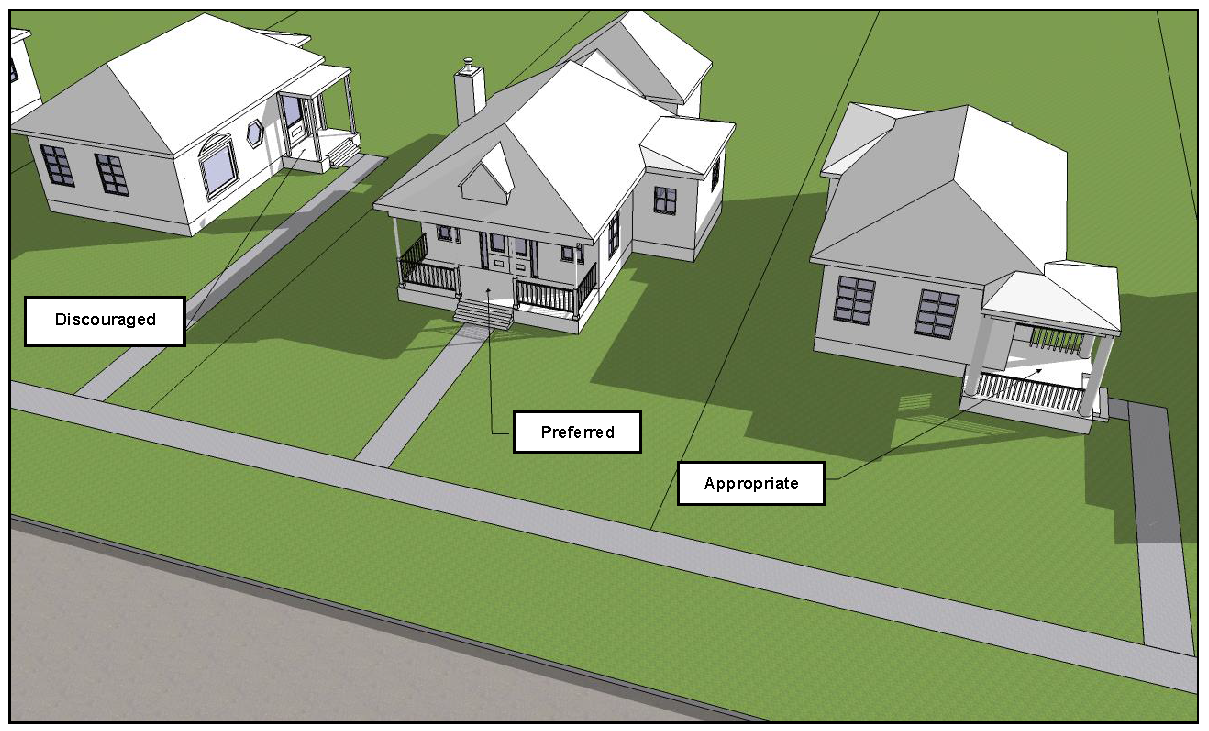
Examples of primary entrances.
I.
Architectural features.
1.
Architectural features consistent with traditional design in the neighborhood shall be used to enhance and maintain the character of the area.
2.
Features may include porches, awnings, balconies, bay windows and stoops. Such elements shall be similar in form and scale to those traditionally found in the neighborhood.
3.
Patterns created by similar shapes and sizes of building features in the neighborhood shall be repeated in new construction. Windows, porches and eaves are among the elements typically seen to align and create patterns along a block.
J.
Building materials.
1.
Materials used shall be consistent with materials traditionally and historically used within the neighborhood, to maintain the character of the area. The following are primary permitted materials, which are required on facades facing a street:
a.
Wood lap siding.
b.
Wood.
c.
Fiber cement siding (such as HardiePlank).
d.
Brick.
e.
Stone.
f.
Traditional stucco, a cement and sand based material, or stucco brick.
2.
Prohibited materials shall include:
a.
Metal siding.
b.
Exterior finish insulation systems (EFIS), a lightweight synthetic wall cladding that includes foam plastic insulation and thin synthetic coatings; except as a trim, accent, cornice or profile material.
c.
Masonite.
d.
Mirror glass which reflects more than 40 percent of incident visible light.
3.
Other building materials may be permitted, but may be limited to the rear and sides of buildings, or to upper floors, or as a percentage of a façade, or only permitted as an incidental or accent material. These include:
a.
Vinyl siding.
b.
New, high quality materials.
c.
Innovative or "green" materials, provided they appear similar in quality, texture, finish and dimension to permitted materials and which are recognized by an approved third party testing agency which meet or exceed the quality of the materials listed.
d.
Notwithstanding the requirements of this subsection, owners of single and two-family residential dwellings occupied and used as a residential use shall be permitted to repair and replace vinyl siding on building facades.
4.
Simple material finishes are encouraged.
5.
Matte finishes are preferred.
K.
Roof materials.
1.
Roof materials shall be compatible in appearance, with similar scale and texture, to those found traditionally in the neighborhood.
2.
Permitted roof materials include:
a.
High-quality composition.
b.
Tile.
c.
Stone-coated steel.
d.
New products which meet or exceed the quality of the listed materials above and which are recognized by an approved third party testing agency which meet or exceed the quality of the materials listed.
3.
Prohibited roof materials include metal products such as flat sheet metal panels, corrugated metal, and standing seam metal.
L.
Signs shall comply with Article 9, Signs, of this chapter.
M.
Lighting.
1.
The lighting standards set forth in this division, Subdivision 5, Lighting Standards, shall apply, in addition to the standards below.
2.
Exterior lighting, if provided, shall be limited and be of a pedestrian scale compatible with residential uses within the neighborhood.
3.
Maximum light intensity shall be 150 watts per fixture, or the CFL or LED equivalent to 150 watts.
4.
Wall pack lights shall comply with Section 8.290 of this division, Subdivision 5, Lighting Standards and are encouraged to be designed to fit the architectural character of the structure. Wall pack light fixtures without full cut offs are prohibited.
5.
Parking lot pole lighting is permitted for parking lots with over ten spaces. Period style lighting is preferred. An LED or solar-powered light source is required. The maximum height of pole lights is 15 feet. The solar panel for any solar powered light fixture may extend five feet above the height of the fixture/maximum pole height.
6.
Bollard type lighting may be used in parking lots, with a maximum height of four feet.
7.
Exterior building lighting may be used to accentuate building design and highlight architectural details and features, and should be integrated into the building design.
8.
Exterior lighting may be used to provide for a sense of safety.
9.
Accent lighting shall comply with Section 8.300 of this division, Subdivision 5, Lighting Standards.
N.
Outdoor spaces.
1.
Public outdoor space is encouraged to enliven the street edge and provide for human interest. The following are examples:
a.
A grassy front lawn.
b.
An interior courtyard.
c.
Flower pots.
d.
Paved plaza area.
e.
Street art or yard art.
f.
Street benches.
O.
Landscape shall comply with Division III of this article, Landscaping, Buffers and Tree Protection, and Article 4, Zoning Districts, of this chapter.
1.
Visibility of the primary structure from the street shall be maintained. The front setback area shall be designed to maintain a sense of openness of this semi-public space.
a.
Plantings within the front setback shall include low ground cover, turf, shrubs, and ornamental trees.
b.
Front yard fences are discouraged, except for required parking lot screening, consisting of a fence, wall or shrubs, which shall be a minimum of 30 inches and a maximum of 42 inches in height. Decorative front yard fences shall not exceed 42 inches and may only be used if they fit into the context of the neighborhood.
2.
Existing mature trees shall be preserved to the extent feasible.
a.
To the extent possible, new structures shall be located outside of the drip line of an existing tree to be preserved. Any required landscaping that is damaged or dead shall be replaced with a similar species.
b.
Root systems of existing trees shall be protected by fencing prior to construction, and by avoiding trenching or soil compaction within the drip line.
Sec. 8.710. - Purpose and definitions.
A.
Purpose. The purpose of this division is to improve the aesthetic qualities of the City and to protect and preserve the appearance, character and value of its neighborhoods and business areas by:
1.
Providing for quality and consistency in the design of landscaping and screening;
2.
Providing for the separation of incompatible types of land use; and
3.
Providing for the conservation of existing trees and the planting of new trees in conjunction with the development of land.
B.
Definitions. Unless specifically defined below, words or phrases used in this division shall be interpreted so as to give them the same meaning as they have in common usage and so as to give this division its most reasonable application:
1.
Berm. A mound or embankment of earth, usually two to six feet in height, used to shield or buffer properties from adjoining uses, highways or noise.
2.
Buffer. An area of natural vegetation or man-made construction that is intended to provide a visual and dimensional separation between dissimilar land uses.
a.
Natural buffer. A visual screen created by vegetation of such density so as to present an opaque visual separation when viewed from one side to the other throughout the year.
b.
Structural buffer. A visual screen created through construction of a solid wooden fence, decorative masonry wall, earthen berm, or combination of fence or wall with an earthen berm, which may be supplemented with vegetation, to present an opaque visual separation when viewed from one side to the other throughout the year.
3.
Caliper. The diameter of a tree (usually nursery stock) measured at a point six inches above the ground or top of the root ball for up to and including four-inch caliper trees, and at a point 12 inches above the ground or top of root ball for larger sizes.
4.
Critical root zone. The land area circular in shape and centered on the trunk of a tree, the radius of which circle is determined by the farthest extent of the drip line from the trunk.
5.
Development site. That portion of a tract of land that will be dedicated to a proposed development.
6.
Drip line. A perimeter formed by the points farthest away from the trunk of a tree where precipitation falling from the branches of that tree lands on the ground.
7.
Ground cover. A low-growing plant other than turf grass that forms a continuous cover over the ground surface.
8.
Landscape materials. Any combination of living plant materials and nonliving materials, such as rock, pebbles, sand, mulch, pavers, berms, fencing, walls, fountains and other decorative materials.
9.
Landscaping. The planting of shrubs, vines, turf, ground cover and the use of other landscape materials such as mulch, bark, decorative rock and other similar materials that are utilized to enhance the aesthetic and functional qualities of a site.
10.
Opaque. Impenetrable to view, or so obscuring to view that features, buildings, structures, and uses become visually indistinguishable.
11.
Plant materials. Living plants that include trees, shrubs, ground cover, grasses and perennial flowering plants, turf and vines that are suitable for ornamental or functional use.
12.
Screen. Natural vegetation or a decorative structure that creates an opaque visual block or obscures an unattractive view. Screening may consist of any combination of the following, as approved by the Director:
a.
Fencing.
b.
Masonry walls.
c.
Plant materials or natural vegetation.
d.
Earthen berms.
For the purpose of this article, a screen is opaque to a height of six feet, two and one-half feet for parking lots, above the ground surface or, for a screen of plant materials, has the maximum opacity obtainable with the approved arrangement and species of plant materials, to a height of six feet or two and one-half feet for parking lots.
13.
Shade tree. A broadleaf tree having an average height at maturity of a least 20 feet and having a broad spread relative to its height (excluding trees with pyramidal, conical, or columnar crowns) and a dense canopy, so as to provide shade in the summer months.
14.
Significant tree. A tree in fair or better condition that has been determined to be of a high value by a knowledgeable person because of its species, size, age or other professional criteria.
a.
A tree is considered in fair or better condition if:
(1)
Its life expectancy is greater than 15 years;
(2)
It has a relatively sound and solid trunk with no extensive decay or insect infestation.
b.
Hardwood trees such as oaks and hickories that are of a 12-inch caliper or more and soft-wood trees such as pines and cedars, which are 16 feet in height or more, and small hardwoods such as dogwoods, redbuds or sourwoods with calipers of 6 inches or more shall be considered significant trees due to size.
15.
Shrub. A self-supporting woody plant that normally reaches a height of less than 15 feet.
16.
Tree. A self-supporting woody plant that normally reaches a height of at least 15 feet.
17.
Turf. Ground cover composed of one or more species of perennial grass that is grown as a permanent lawn.
18.
Vine. A plant that is typically woody and climbs by supporting itself on some other plant or structure.
Sec. 8.720. - Landscaping and buffer plans; when required.
A.
Landscaping and buffer plans, as provided for in this section, shall accompany all preliminary and final development plan applications and be provided upon application for building permits for those developments not required to proceed through the Planning Commission or City Council development process.
B.
In cases where landscaping and buffer plan approval would cause harmful delay to the start of construction, the Director of Codes Administration may issue footing and foundation building permits for the project so that construction may proceed.
C.
Permits for construction beyond the footing and foundation shall not be issued until the landscaping and buffer plan has been submitted and approved.
D.
The provisions of this section shall not apply to structures for which landscaping and buffer plans have previously been submitted and approved.
E.
Except as noted herein, landscaping and buffer plans shall be approved prior to the issuance of a building permit.
F.
A landscaping and buffer plan shall only be required for that phase of development being considered for construction or for which a building permit is being acquired.
G.
Single-family and two-family (duplex) developments are exempt from landscaping requirements.
Sec. 8.730. - Landscaping and buffer plans; requirements.
Landscaping and buffer plans shall include the following information:
A.
North point and scale not to exceed one inch equals 50 feet;
B.
The location and size of all utilities on the site;
C.
The location of all existing and proposed parking areas, and sidewalks and other paved surfaces;
D.
The location of all existing and proposed buildings and structures;
E.
The boundary of any required tree conservation area;
F.
The boundaries of each required buffer or landscape strip;
G.
The location and mature size of all landscape materials proposed to meet the requirements of this division, drawn to scale; and a planting schedule indicating plant names (scientific and common), quantities and size at planting;
H.
A separate planting schedule for each buffer, landscape strip, tree conservation area, parking lot, or other identifiable area where plant materials are to be installed;
I.
The location, size and common name of all existing plant materials to be retained; and
J.
The location and construction details, including a profile section, of each structure proposed to meet buffering requirements;
Sec. 8.740. - Tree conservation plan.
A.
A tree conservation plan shall be submitted to the Department prior to any grading, bulldozing, or other removal of existing vegetation that may affect existing tree coverage.
1.
The full tree conservation plan shall show the following:
a.
The extent of the development site;
b.
All significant trees to be removed and all other trees of ten-inch caliper or larger to be removed;
c.
All significant trees and all other trees ten-inch caliper or larger that will remain on the development site and be protected during construction; and trees less than ten-inch caliper that are submitted for credit as part of the requirement of this division;
d.
In heavily wooded areas that will not be disturbed, the plan may show only the boundaries of each stand of trees and a list of the number, size, and type (e.g., hardwood, softwood; deciduous, evergreen) of trees in each stand that are submitted for credit;
e.
Locations of proposed on-site underground utility lines;
f.
Locations of other on- and off-site utility lines, indicating areas where trees cannot be planted because of interference with: (1) existing or proposed utilities on public rights-of-way or on utility rights-of-way or easements, and (2) existing utilities on adjoining properties;
g.
Limits of land disturbance, clearing, grading, and trenching;
h.
Limits of tree conservation areas, showing trees to be maintained and planted, specifying type and size;
i.
Grade changes or other work adjacent to a significant tree or any other tree ten-inch caliper or larger that would affect it adversely, with drawings or descriptions as to how the grade, drainage, and aeration will be maintained around the tree; and
j.
Planting schedule, if applicable.
2.
A preliminary tree conservation plan may be submitted for development of an industrial park where multiple sites will be cleared and graded for purposes of marketing vacant sites to prospects. Planting of new trees will not be required on a lot until a use is developed on that lot, and locations of new trees need not be shown on the preliminary plan. The preliminary tree conservation plan shall show the following:
a.
The extent of the development site;
b.
Limits of land disturbance, clearing, grading, and trenching;
c.
All significant trees to be removed and all other trees ten-inch caliper or larger to be removed;
d.
Grade changes or other work adjacent to a significant tree or any other tree ten-inch caliper or larger that would affect it adversely, with drawings or descriptions as to how the grade, drainage, and aeration will be maintained around the tree;
e.
Trees that will be required on the lot when it is developed, calculated by subtracting one-third of the lot area as assumed building area; and
f.
Removal of significant trees and other trees ten-inch caliper or larger shall be permitted only in conjunction with an approved preliminary tree conservation plan, an approved grading plan, and actual grading of building pads (i.e., not simply to clear the lot).
(Ord. No. 9782, § 4, 11-14-2023)
Sec. 8.750. - Acceptable plant materials.
A.
The following are the minimum plant sizes and conditions to be used in satisfying the requirements of this division. Acceptable plant materials for landscaping, buffers and tree replacement shall be as approved by the Director:
1.
Medium shrubs, 18- to 24-inch balled and burlapped or two-gallon container.
2.
Large shrubs, 24- to 30-inch balled and burlapped or five-gallon container.
3.
Ground cover, two and one-half-inch peat pot.
4.
Large deciduous trees shall be a minimum of 2.5 inches caliper, measured at a point 6 inches above the ground or top of the root ball, at time of planting. Small deciduous ornamental tress shall be a minimum of 1.5 inches caliper, measured at a point six inches above ground or top of the root ball, at time of planting.
5.
Evergreen trees shall be a minimum height of eight feet at planting.
B.
The American Standard for Nursery Stock, published by the American Association for Nurserymen, shall be the standard reference for the determination of plant standards. Publications of the University Extension, University of Missouri System, the Missouri Department of Conservation, and other authorities acceptable to the Director also may be used.
C.
Existing trees and/or shrubs that are to be retained to satisfy the requirements of this division shall meet the following standards:
1.
Evergreen trees shall be at least six feet in height.
2.
Deciduous trees shall be a minimum of a two-inch caliper.
3.
Trees shall be free from mechanical injuries, insect infestations and disease.
4.
Trees shall be protected from injury to roots, trunks and branches during grading and construction. Protective fencing, tree wells, or retaining walls shall be utilized where necessary to insure tree vigor upon completion of construction.
5.
Shrubs that meet acceptable sizes per Section 8.750.A. and that are free from injury and disease may be counted toward the requirements of this division.
(Ord. No. 9782, § 4, 11-14-2023)
Sec. 8.760. - Approval of plant materials.
Approval of a proposal to use a specific landscaping or buffer material shall be subject to a determination by the Director that the proposed material is appropriate for:
A.
The specific location, given surrounding land uses and the type of screening used on nearby properties, and
B.
The specific topography, soil, existing vegetation, and other factors that may influence the effectiveness of a plant material.
Sec. 8.770. - Installation of plant materials.
Plant materials, as required by the provisions of this division, shall be installed by the date specified on the approved landscaping and buffer plan. The Director may allow one planting season in a 12-month period in which the installation of plant materials shall be completed.
Buffers, if required, shall be installed before a certificate of occupancy permit is granted; except where the weather is not suitable for planting and escrow provisions are made in accordance with guidelines of the Department.
Sec. 8.780. - Maintenance of required plant materials.
A.
The owner, tenant and their agent, if any, shall be jointly responsible for the maintenance in good condition of the plant materials used to meet the minimum requirements of this division for landscaping, buffer or tree replanting. The plant materials shall be kept free from refuse and debris.
B.
Plants that are not in sound growing condition or are dead shall be removed and replaced with a plant of a species or variety as determined by the Director.
C.
Other landscape materials shall be maintained in proper repair and shall be kept clear of refuse and debris.
Sec. 8.790. - Landscaping—Minimum requirements.
A.
Street frontage.
1.
One tree shall be planted for each 30 feet of street frontage, public or private, within the landscaped setback abutting said street frontage. Such trees may be clustered or arranged within the setback if approved as part of the landscape plan. A minimum 20-foot-wide landscape strip shall be provided along the full length of any street frontage, except where the building setback is less than 20 feet.
2.
In commercial and industrial districts, any parking or loading area visible from a street shall be separated from the street right-of way with a landscape strip at least 20 feet wide.
3.
One shrub shall be provided for each 20 feet of street frontage, or portion thereof, within the landscaped setback abutting such frontage. Such shrubs may be clustered or arranged within the setback.
B.
Open yard areas.
1.
The minimum open yard area landscaping requirements shall be two shrubs per 5,000 square feet of total lot area (except for tracts of land for which this chapter imposes no yard requirements and permits 100 percent coverage of the lot by buildings), excluding building footprint area. For schools and churches/places of worship large sports/play fields and other areas specifically open to the public for use, i.e., tennis courts, paved play areas, paved parking lots etc. shall be excluded in the calculation of this requirement.
2.
All portions of the site not covered with paving or buildings shall be landscaped. Open areas not covered with other materials shall be covered with sod. Ground cover shall be utilized on all slopes in excess of 3:1 slope.
3.
In addition to the trees required based upon street frontage, additional trees shall be required at a ratio of one tree for every 5,000 square feet of lot area not covered by buildings/structures. For schools and churches/places of worship large open sports/play fields may be excluded in the calculation of lot area. The remaining open space shall be applied to the ratio for tree planting as stated herein.
C.
Trash storage containers. A detailed drawing of enclosure and screening methods to be used in connection with trash storage containers on the property shall be included with the landscaping plan. (See Section 8.290.G.)
Sec. 8.800. - Landscape strips along street frontage.
A.
Frontage landscape strips shall contain no structures, parking areas, patios, storm water detention facilities unless included in the landscape plan as an amenity or any other accessory uses except for the following:
1.
Retaining walls or earthen berms constructed as part of an overall landscape design;
2.
Pedestrian-oriented facilities such as sidewalks and bus stops;
3.
Underground utilities;
4.
Driveways required for access to the property; or
5.
Signs otherwise permitted by this chapter.
B.
All portions of a frontage landscape strip shall be planted in trees, shrubs, grass or ground cover, except for those ground areas that are mulched or covered by permitted structures.
C.
Plant materials in the frontage landscape strip are not to extend into the street right-of-way unless specifically allowed by the Public Works Department.
Sec. 8.810. - Parking lot landscaping and trees.
Deciduous shade trees shall be provided within any parking lot designed or intended to accommodate ten cars or more, in accordance with the requirements of this section.
A.
Landscape islands, strips or other planting areas shall be located within the parking lot and shall constitute at least five percent of the entire area devoted to parking spaces, aisles and driveways. Every four rows of parking shall include a landscape island of at least ten feet in width. Industrial zoned properties, PI-1, PI-2 and BP, shall be exempt from this requirement.
B.
As a minimum, a landscaping island shall be located at the end of every parking bay between the last parking space and an adjacent travel aisle or driveway. The island shall be no less than nine feet wide for at least one-half the length of the adjacent parking space. The island shall be planted in trees, shrubs, grass, or ground cover, except for those areas that are mulched.
C.
Tree planting areas shall be no less than ten feet in width. No tree shall be located less than four feet from the back of curb. All parking lot landscape islands, strips or other planting areas shall be curbed with minimum six-inch high curbs of the type required by this chapter or other regulations for parking areas.
D.
Planting requirements. See Section 8.790 of this division.
Sec. 8.820. - Screening, parking lot.
For any parking lot designed or intended to accommodate five cars or more and any area set aside for loading or unloading of trucks or vans, if such parking lot or loading area is visible from a street right-of-way, a visual screen shall be provided as required below.
A.
Screening to a height of two and one-half feet must be provided along the edge of the parking lot or loading area closest to and parallel to the street. A driveway to the parking lot or loading area may interrupt the screening.
B.
Screening shall be decorative and 100 percent opaque to a height of two and one-half feet above the elevation of the parking/loading area or the street, whichever is highest.
C.
Screening may be provided in any of the following ways:
1.
Planted only. A hedge consisting of at least 12 shrubs per 40 linear feet that will spread into a continuous visual screen within two growing seasons. Shrubs must be at least 18 inches tall at the time of planting and be of a species that will normally grow to at least two and one-half feet in height at maturity and be suitable for the parking lot application.
2.
Earthen berm. An earthen berm constructed to a height of two and one-half feet above the adjacent elevation of the street or parking/loading area, whichever is highest, shall not exceed a slope of 3:1 and shall have a crown of at least two feet. The berm shall be planted in ground covers and other plant materials to achieve a decorative effect to the satisfaction of the Director.
3.
Wall. A wall of brick, stone, PVC plastic fencing or finished and textured concrete may be constructed to a height of two and one-half feet and 100 percent opacity and landscaped with plant material to achieve a decorative effect to the satisfaction of the Director.
4.
Combination. Any combination of hedge, berm or wall that effectively provides a visual screen of the parking lot or loading area to a height of two and one-half feet and achieves a decorative effect through appropriate use of landscaping and plant material.
D.
The street-side screening treatment may be located within the landscape strip required under this division along the front yard of the property.
E.
Berming and/or screening shall not encroach into the required sight triangle of streets or access drives.
Sec. 8.830. - Parking lot permit—When required.
No person shall initiate construction of a new parking lot or expansion of an existing parking lot without first obtaining a permit from the Director. A parking lot permit shall not be required for the resurfacing or re-striping (painting) of an existing parking lot consistent with the current striping.
Sec. 8.840. - Parking lot permit—Application, content and submission requirements.
Application for a parking lot permit shall be made on a form provided by the Director and shall be accompanied by a site plan depicting:
A.
The parking lot layout; including proposed striping,
B.
Number and location of parking spaces, including handicapped spaces;
C.
Structures on the same property;
D.
Structures and parking areas on adjacent property;
E.
Ingress and egress for the property; and
F.
All other information required by the Director.
Sec. 8.850. - Parking lot permit—Consideration.
The parking lot permit application shall be considered by the Director. The permit may be issued if the Director determines that all requirements of this chapter have been satisfied and that criteria for parking lot construction pursuant to the Design and Construction Manual have been satisfied.
Sec. 8.860. - Parking lot permit—Appeals.
The applicant may appeal the non-issuance of a parking lot permit, and a permit holder may appeal the revocation of a parking lot permit, to the Board pursuant to Section 4.660.
Sec. 8.870. - Buffer/screen; where required.
A.
Buffer/screen between developments of differing land uses adjoining one another or separated from one another by only a street or alley shall comply with Table 8.890, Typical Buffers. The intensity of the required buffer/screen is established according to the intensity of the abutting uses, i.e., retail development adjacent to or across the street from a residential use or development requires a more intense buffer/screen than would retail adjacent to or across from office use, etc.
B.
If a single-family subdivision is approved or built adjacent to a previously approved or built but separate single-family subdivision, and the difference in the average minimum lot size between the two subdivisions is 120 percent or more, the subsequently approved or built subdivision shall contain a buffer/screen along the periphery adjacent to the previously approved or built subdivision.
Sec. 8.880. - Buffer design standards.
A.
General. Buffer areas shall contain no driveways, parking areas, patios, storm water detention facilities, or any other structures or accessory uses except for a fence, wall, or earthen berm constructed to provide the visual screening required to meet the standards of this chapter. Underground utilities may be permitted to cross a buffer if the screening standards of this division will be subsequently achieved. Required vehicular access through a buffer may be allowed as a condition of preliminary development plan approval.
B.
Natural buffers. Natural buffers may contain deciduous or perennial vegetation but shall contain evergreen shrubs and trees suitable to local growing conditions that will provide an opaque visual screen during all seasons of the year.
C.
Structural buffers. Structural buffers shall meet the following criteria:
1.
Structural buffers shall be vegetated throughout the minimum area required for the buffer around any fences or walls and upon any earthen berms, which may include grass, ground covers, shrubs, and trees.
2.
All earthen berms shall have a maximum side slope of three horizontal to one vertical (3:1). Earthen berms shall not be constructed within the drip line of any existing trees that will remain on the property.
3.
Trees shall be located or planted within any structural buffer at a density of no less than one tree for each 30 feet of buffer length or portion thereof. New trees shall have a caliper of no less than three inches upon planting and may be clustered for decorative effect, following professional landscaping standards for spacing, location, and design.
4.
Fences and freestanding walls shall present a finished and decorative appearance to the abutting property. Where a fence or wall is set back from the property line, shrubs, ground covers, or other vegetation shall be provided between the fence or wall and the property line so as to provide a decorative effect, following professional landscaping standards for spacing, location and design.
D.
Examples of buffers. The accompanying illustration above provides examples of natural and structural buffers. Typical buffer/screens are provided in the examples following Table 8.890 for low, medium and high impact screening.
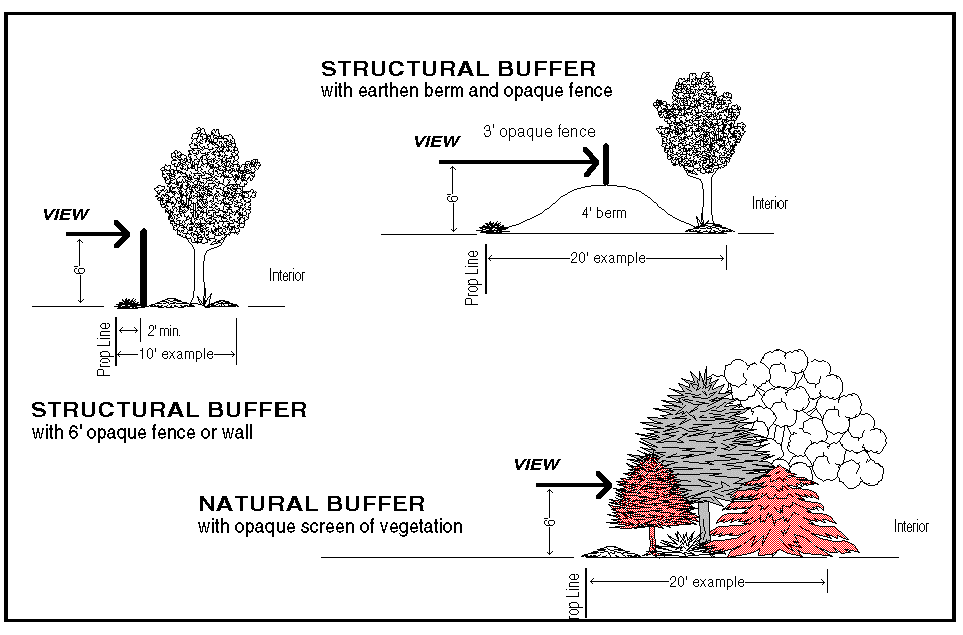
Sec. 8.890. - Minimum buffer/screen requirements.
A buffer/screen required by this chapter shall meet the following criteria:
A.
Width of buffer.
1.
Side lot line. Buffers required along any side lot line shall be no less than 20 feet or as approved by the Governing Body.
2.
Rear lot line. Buffers required along any rear lot line shall be no less than 20 feet or as approved by the governing body.
B.
Minimum required screening. Minimum required screening shall conform to Table 8.890 depending on the impact identified. Structural buffers (high impact screening) shall meet the height required when installed. Planted materials (trees and shrubs) shall meet the expected opacity within two growing seasons.
C.
Maintenance. Every buffer required by this chapter shall be maintained by the owner of the property where the buffer is located, in order to provide the visual screen at the opacity identified, on a year-round basis.
D.
Buffer modifications.
1.
If a structural buffer with landscaping is provided that creates an opaque screen to a height of no less than eight feet instead of six feet, the buffer may be reduced to a width of no less than ten feet.
2.
The Director may waive a buffer requirement or reduce its extent to a temporarily appropriate level of screening if the Comprehensive Plan anticipates future development on the adjoining property in a land use category such that a buffer would not be required by this chapter once the adjoining property is rezoned or developed.
Table 8.890
Buffer/Screen Impact
* If lot size differs by 120 percent or more, a low impact screen shall be provided.
** Per approved plan.
Screening options:
1)
Six-foot masonry wall.
2)
Six-foot opaque vinyl fence with masonry pilasters.
3)
Earth berms.
4)
Plant material.
Sec. 8.900. - Required typical impact screens.
The following impact screens shall be required between any district as identified in Table 8.890 in which the perspective development is located and adjacent to or across from:
A.
High impact screening. A 100 percent opaque screen between land uses, which are dissimilar in character. When the proposed plan is considered to have a high impact on surrounding properties or the adjacent property is considered to have an adverse impact, both of the following shall be installed within the 20-foot buffer yard: (1) a six-foot high masonry wall, opaque vinyl fence, or three-foot high berm, (2) and low impact screening.
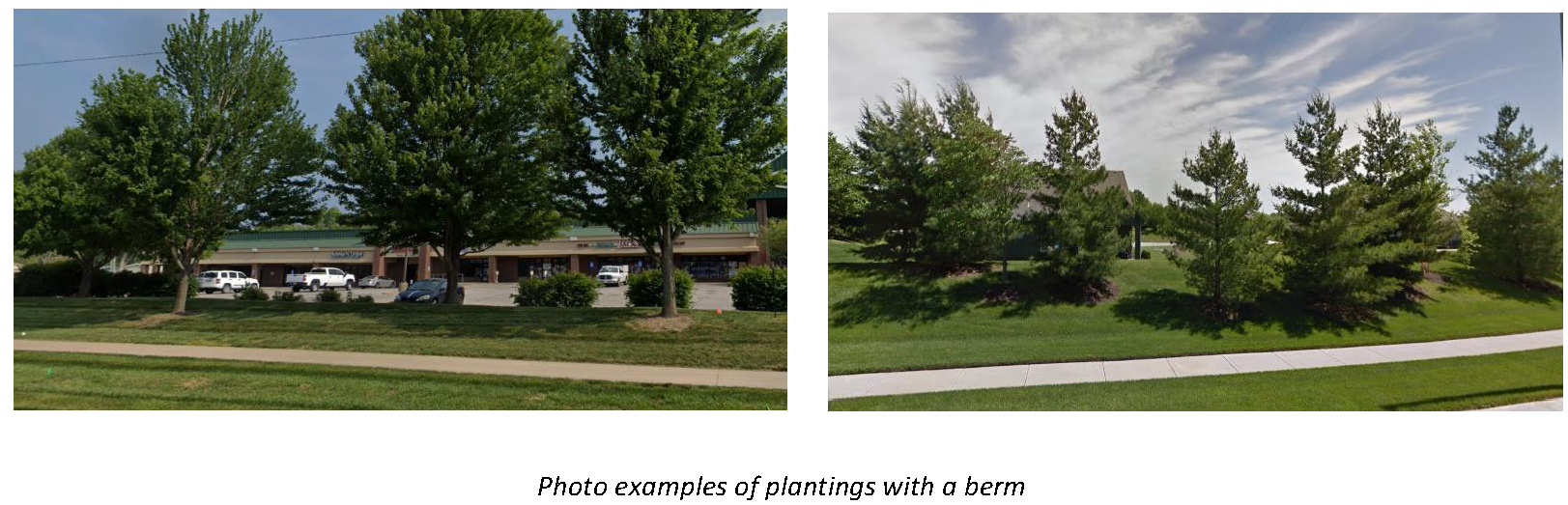
B.
Medium impact screening. A 70 percent semi-opaque screen between land uses which are dissimilar in character. Semi-opaque screening should partially block views from adjoining land uses and create a separation between the adjoining land uses. For medium impact screening, either a landscape screen or fencing is required. A medium impact landscape screen must meet one of the following screening options:
| Screen A | 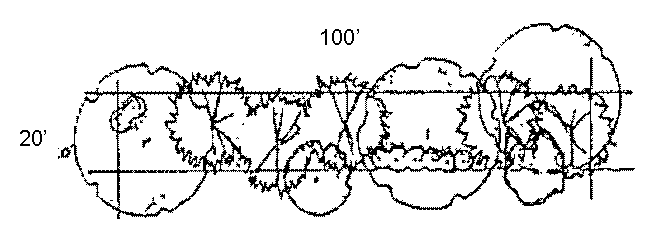 | |
| Shade trees | 1/500 sq. ft. | |
| Ornamental trees | 1/750 sq. ft. | |
| Evergreen trees | 1/300 sq. ft. | |
| Shrubs | 1/200 sq. ft. | |
| Screen B | 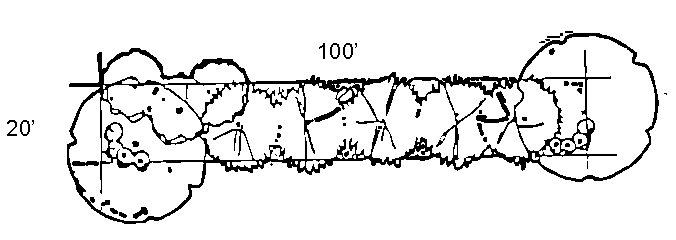 | |
| Shade trees | 1/1,000 sq. ft. | |
| Ornamental trees | 1/500 sq. ft. | |
| Evergreen trees | 1/300 sq. ft. | |
| Shrubs | 1/200 sq. ft. | |
| Screen C | 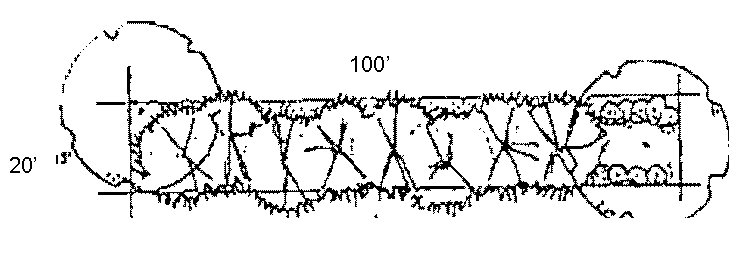 | |
| Shade trees | 1/750 sq. ft. | |
| Ornamental Trees | 0 sq. ft. | |
| Evergreen trees | 1/200 sq. ft. | |
| Shrubs | 1/200 sq. ft. | |
C.
Low impact screening. An open screen between relatively similar land uses. Open screening shall provide an attractive separation between land uses. A low impact landscape screen must portray one of the following screening options:
| Screen A | 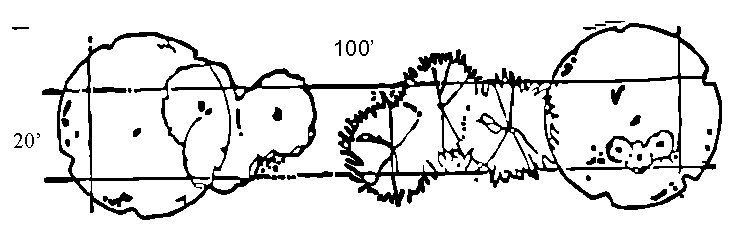 | |
| Shade trees | 1/500 sq. ft. | |
| Ornamental trees | 1/750 sq. ft. | |
| Evergreen trees | 1/500 sq. ft. | |
| Shrubs | 1/500 sq. ft. | |
| Screen B | 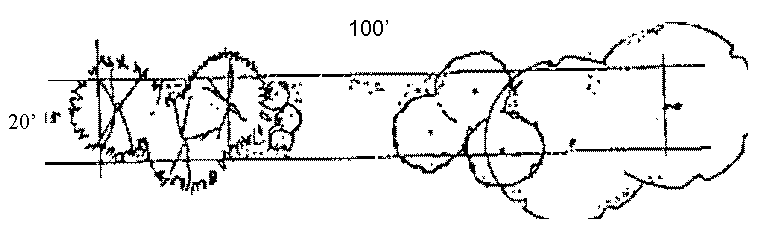 | |
| Shade trees | 1/1,000 sq. ft. | |
| Ornamental trees | 1/500 sq. ft. | |
| Evergreen trees | 1/500 sq. ft. | |
| Shrubs | 1/500 sq. ft. | |
| Screen C | 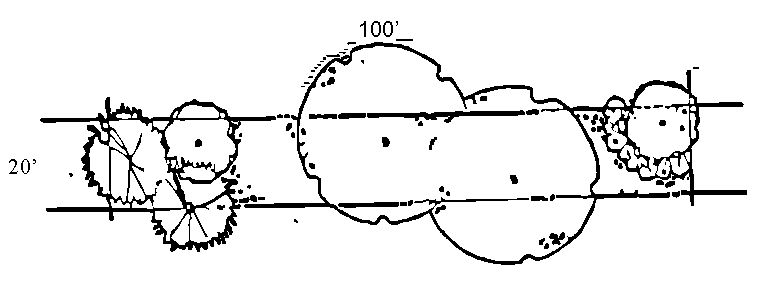 | |
| Shade trees | 1/750 sq. ft. | |
| Ornamental trees | 1/750 sq. ft. | |
| Evergreen trees | 1/750 sq. ft. | |
| Shrubs | 1/200 sq. ft. | |
(Ord. No. 9782, § 4, 11-14-2023)

