
Lees Summit City Zoning Code
ARTICLE 11
- RENEWABLE ENERGY AND GREEN DEVELOPMENT STANDARDS
Sec. 11.010. - Purpose.
The purpose of this article is to provide regulations and procedures for the review of applications for the installation of alternative sources of energy, including wind turbines and solar panels, in order to offer opportunities to help alleviate the rising costs of energy. These regulations and procedures seek to minimize the potential adverse effects on the public health, safety and general welfare without unduly restricting the potential of alternative energy production for sustainability.
Sec. 11.020. - Definitions.
Blades means the aerodynamic surface that catches the wind.
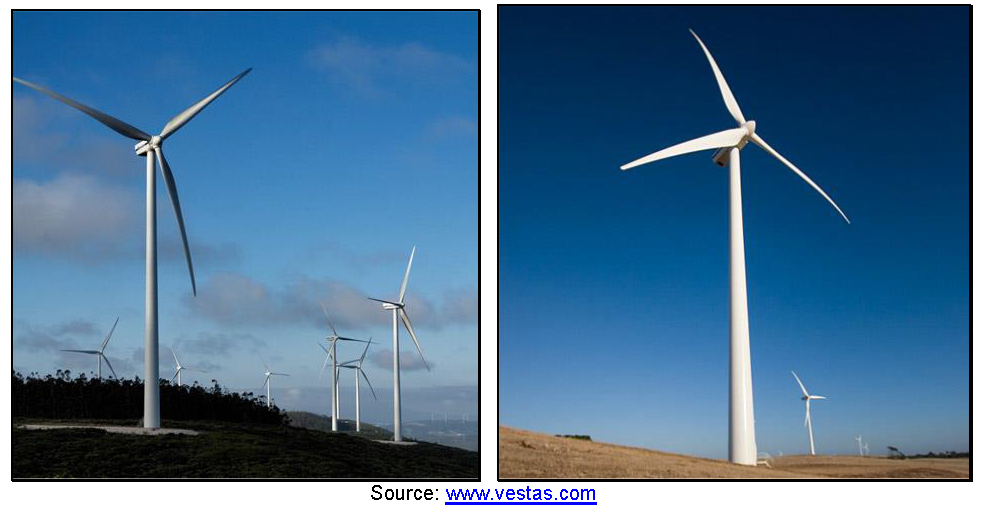
Large/utility scale wind turbine means a wind energy conversion system (WECS), consisting of a wind turbine, tower, and the associated control or conversion electronics, which has a rated capacity of more than 100 kW and which is intended to produce electricity for sale to a rate regulated or non-regulated utility or use off site. Turbines in this category are typically grouped together to form wind farms or a wind power plant, these groupings may also be referred to as a wind facility. The pictures below are examples of large scale wind turbines.
Meteorological or met tower means a temporary tower designed to support the gathering of wind energy resource data to determine how much wind power a site can be expected to generate. A met tower includes the tower; base plate; anchors; guy cables and hardware; anemometers (wind speed indicators); wind direction vanes; booms to hold equipment, anemometers and vanes; data logger; instrument wiring; and any telemetry devices that are used to monitor or transmit wind speed and wind flow characteristics over a period of time for either instantaneous wind information or to characterize the wind resource at a given location.
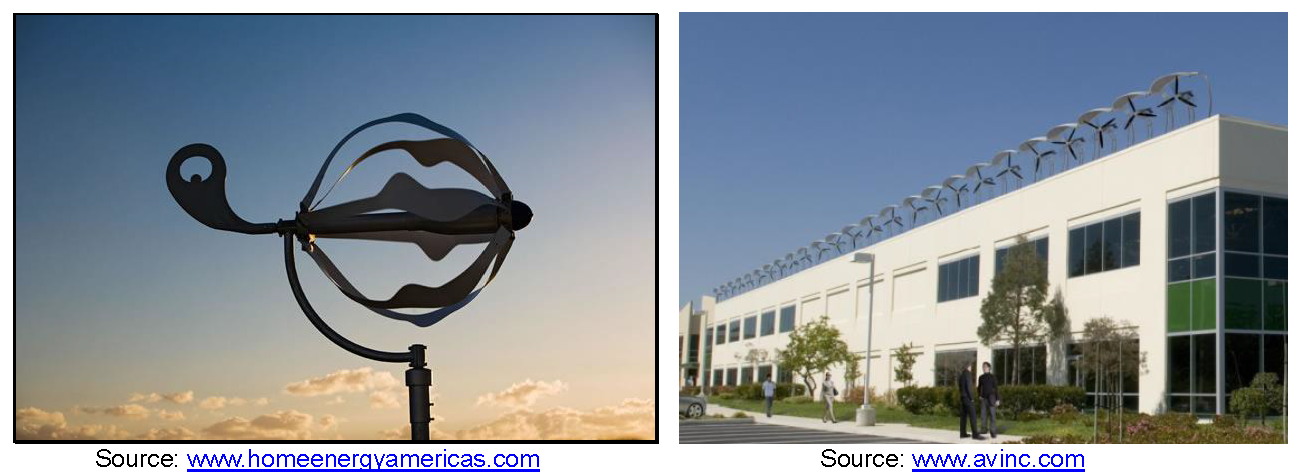
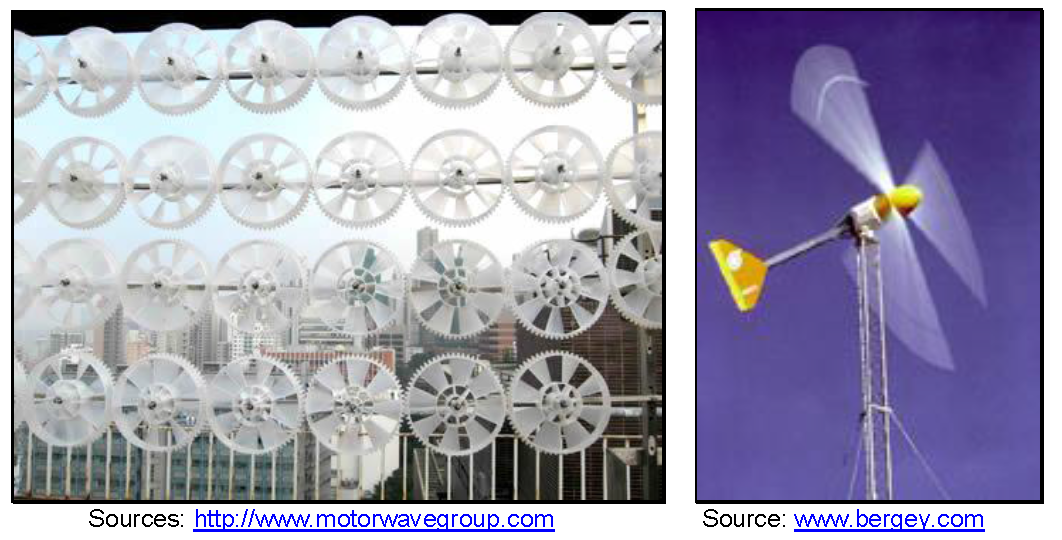
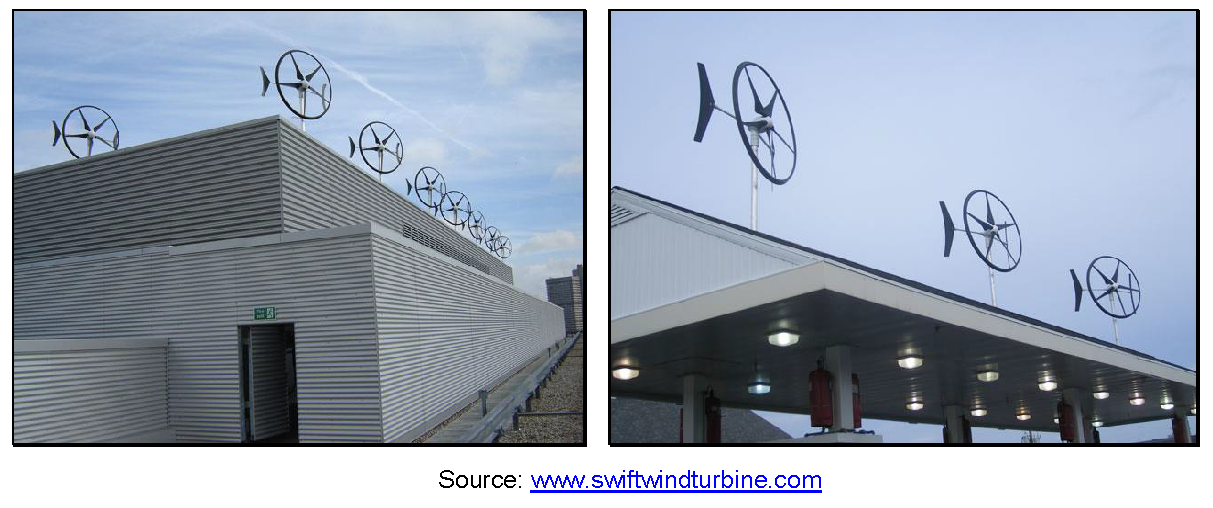
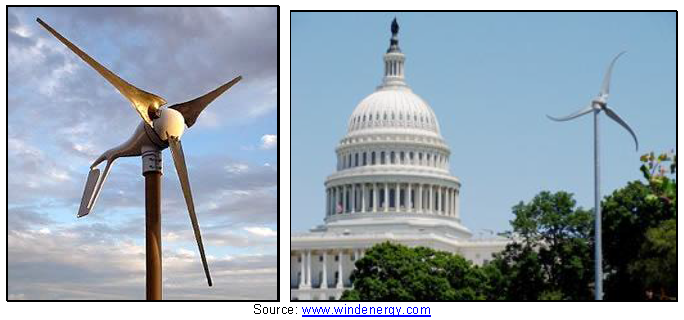
Micro wind turbine means a wind energy conversion system (WECS), consisting of a wind turbine, tower, and the associated control or conversion electronics, which has a rated capacity of ten kW or less. Examples of items they can be used to power include small appliances in boats and campers, a few lights, or portable communication systems, such as radio equipment. The images shown below and on the top of the next page are examples of micro wind turbines.
Small wind turbine means a wind energy conversion system (WECS), consisting of a wind turbine, tower, and the associated control or conversion electronics, which has a rated capacity of more than ten kW, up to and including 100 kW, which is primarily intended to reduce the on-site consumption of utility power. The picture below is an example of a small wind turbine.
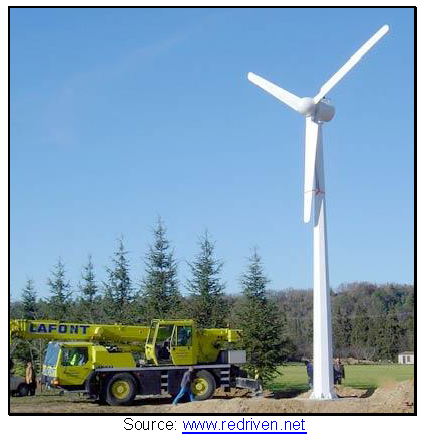
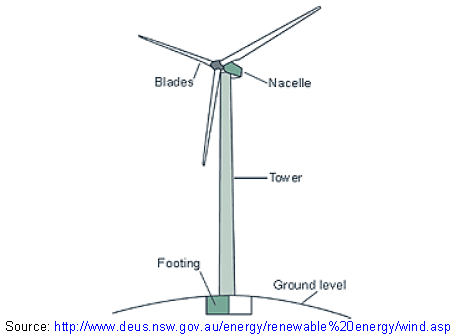
Tower means the monopole, freestanding, or guyed structure that supports a wind generator. Towers are made from tubular steel, concrete, or steel lattice. The vertical component of a wind energy conversion system that elevates and supports the wind turbine generator and attached blades above the ground up out of the turbulent wind.
Turbine means the parts of a wind system including the blades and nacelle.
Wind energy conversion system (WECS) means any machine designed for the purpose of converting wind energy into electrical energy. The WECS includes all parts of the system.
Wind facility means all equipment, machinery and structures utilized in connection with the conversion of wind to electricity. This includes, but is not limited to, transmission, storage, collection and supply equipment, substations, transformers, service and access roads, and one or more wind turbines.
Wind turbine sizes means the size categories wind turbines are generally divided into based upon their rated power (capacity).
Sec. 11.030. - Terms associated with wind generators.
Horizontal axis wind turbines (HAWTs) means the type of wind turbine that has the main rotor shaft and electrical generator at the top of the tower, and must be pointed into the wind. The turbine is generally pointed upwind of the tower, and the blades placed some distance in front of the tower. The pictures below are examples of this type of wind turbine.
Hybrid wind systems means small wind turbines used in connection with diesel generators, batteries, and photovoltaic systems.
Nacelle means the body of the propeller-type wind turbine.
Overspeed controls means mechanisms that are used to limit the speed of blade rotation to below the design limits of the WECS. The following systems describe different methods for slowing or stopping a wind turbine in the event of malfunction, for repairs, or any other incident as needed:
1.
Braking means a method of overspeed control that utilizes a disc brake, which can be applied mechanically, electrically, or hydraulically to stop the rotor in emergencies.
2.
Feathering means a method of overspeed control that rotates the blade axis, or rotors, at an angle to maintain the torque at above rated wind speeds.
3.
Furling means the method of overspeed control by which the blades are turned away from the direction of the wind.
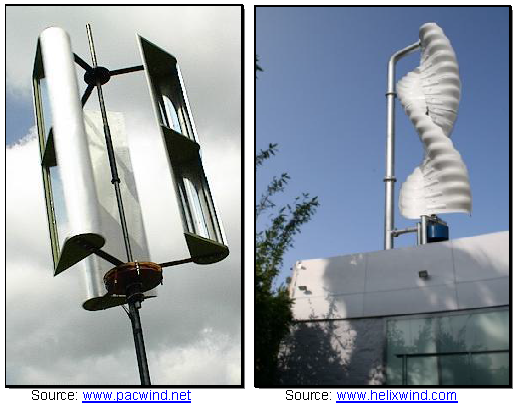
Vertical axis wind turbines (VAWTs) means the type of wind turbine that has the main rotor shaft arranged vertically; as a result this type of turbines does not have to be pointed into the wind. This type of turbine also allows the generator and gearbox to be placed near the ground, and is typically mounted either near the ground or on a building rooftop. The pictures on the top of the next page are examples of this type of wind turbine.
Sec. 11.040. - Standards.
A.
General.
1.
Federal and state regulations. All wind turbines shall meet or exceed current State and Federal standards and regulations including, without limitation:
a.
Applicable Federal Aviation Administration (FAA) regulations, including necessary approvals for installations close to airports. Any wind turbine proposed to be within 20,000 feet of the center of the existing airport runway is subject to a required review by the FAA to determine whether it is a hazard or obstruction to aviation users of the airport.
b.
RSMo 386.890, also known as the Net Metering and Easy Connection Act, which mandates that covered equipment conform to applicable safety, performance, interconnection, and reliability standards established by the National Electrical Code (NEC), the National Electrical Safety Code (NESC), the Institute of Electrical and Electronics Engineers (IEEE), Underwriters Laboratories (UL), and the Federal Energy Regulatory Commission.
2.
Building Code compliance. All wind turbines shall meet or exceed the current standards expressed in the adopted International Family of Codes, as amended.
3.
Utility connections. Reasonable efforts shall be made to locate utility connections from the wind facility underground, depending on appropriate soil conditions, shape, and topography of the site and any requirements of the utility provider. Electrical transformers for utility interconnections may be above ground if required by the utility provider.
4.
Electrical wires. All electrical wires associated with a wind energy system shall be located underground except for those wires necessary to connect the wind generator to the tower wiring, the tower wiring to the disconnect junction box, and the grounding wires.
5.
Self-supporting structures. All tower structures shall be of monopole construction unless attached to a structurally reinforced roof where such support is not warranted. No lattice structures shall be permitted. Towers requiring guy wire supports shall be limited to lots of one acre or more and the guy wires shall be setback from all property lines a minimum of ten feet.
6.
Tower access. The supporting tower shall either be enclosed with a six-foot tall fence or the base of the tower shall not be climbable up to 12 feet above ground level. All access doors to the tower and electrical equipment shall be locked.
7.
Safety shutdown. Each wind turbine shall be equipped with both manual and automatic overspeed controls to limit the rotational speed of the blade within the design limits of the rotor. Manual electrical and/or overspeed shutdown disconnect switches shall be provided and clearly labeled on the wind turbine structure. No wind turbine shall be permitted that lacks an automatic braking, furling, or feathering system to prevent uncontrolled rotation, overspeeding and excessive pressure on the tower structure, rotor blades, and turbine components.
8.
Lighting. Wind turbines shall not be artificially lighted unless such lighting is required by the Federal Aviation Administration (FAA) or other applicable authority. Large wind facilities may utilize security lighting around the base of the tower or other structure associated with the wind turbine(s) if the lighting complies with Article 8, Division I, and no light is directed toward adjacent properties or rights-of-way.
9.
Minimum blade clearance. The blade tip clearance for micro wind turbines shall, at its lowest point, have a ground clearance of not less than 15 feet. The minimum blade clearance for any other wind turbine shall be 30 feet.
10.
Noise. The noise emitted from any wind turbine shall not exceed 55 dbA, as measured at the nearest property line, except during short-term events such as utility outages and severe windstorms.
11.
Historic districts. WECS proposed for locations within any designated local historic district or for locations which will be visible from multiple points of a recognized historic district shall obtain a certificate of appropriateness.
12.
Signage. Signs shall be limited to the manufacturer's or installer's identification, and appropriate warning signs (e.g. electrical hazard or high voltage) placed on the wind turbine tower(s), electrical equipment, and the wind turbine. Commercial advertising is strictly prohibited.
13.
Color/finish. Wind turbines, exclusive of the towers, shall be painted a non-reflective, non-obtrusive color such as the manufacturer's default color option or a color that conforms to the environment and architecture of the community. Towers shall maintain galvanized steel, brushed aluminum or white finish, unless FAA standards require otherwise.
B.
Size specific.
1.
Micro and small WECS.
a.
Location. All micro and small wind turbines shall be located in the rear yard only. Exceptions to this standard for small wind turbines may be reviewed as part of the special use permit application.
b.
Utility notification. No building permit for a micro or small WECS shall be issued until a copy of the utility company's approval for interconnection of a customer-owned generator has been provided. Off-grid systems shall be exempt.
2.
Large/utility WECS.
a.
Soil. All new applications for large or utility scale wind turbines shall provide certification from a professional engineer registered in the State of Missouri that the soil and subsoil surface is capable of accepting the projected loads.
b.
Shadow/flicker. Large or utility scale wind turbines shall be sited in a manner that minimizes shadowing or flicker impacts. The applicant has the burden of proving that this effect does not have significant adverse impact on neighboring or adjacent uses and right-of-way through either siting or mitigation.
c.
Use of met towers. Met towers may be utilized for large or utility scale wind turbines only as approved by the Governing Body. The location, height, and length of time such structures are to be erected shall be provided as part of the application for preliminary development plan and special use permit.
Table 11-1: Standards for Roof-Mounted Wind Turbines
Table 11-2: Standards for Free-Standing Wind Turbines
*The height shall be measured from ground level (grade) to the top of the tower nacelle.
**The size, height, and approval process for districts zoned PMIX shall be determined based upon the underlying uses within that district.
C.
Homeowners associations and common property.
Table 11-3: Free-Standing Wind Turbines on Common Property
*The height shall be measured from ground level (grade) to the top of the tower nacelle.
**The size, height, and approval process for districts zoned PMIX shall be determined based upon the underlying uses within that district.
Sec. 11.050. - Application—Contents and submission requirements.
A.
Administrative process for conditional and accessory uses. The following items shall be submitted in support of an application for building permit for (a) micro or small wind turbine(s):
1.
Signed and notarized affidavits from all property owners who have a shared lot line with the applicant and consent to the proposed wind turbine. If a property owner sharing a lot line with the applicant does not consent to the proposed wind turbine, the use shall not be allowed as a conditional use. The applicant may proceed with an application for a special use permit. (For conditional use only.)
2.
A plot plan, utilizing a standard engineering scale not to exceed 1:100, indicating the placement of the wind turbine(s) and distances from the proposed turbine location to the nearest built structure, any above ground utilities, the nearest tree(s), and all property lines.
3.
Turbine information: Specific information on the type, model, size, height, rotor material, rated power output, performance, safety, and noise characteristics of each wind turbine being proposed, tower and electrical transmission equipment.
4.
Data in sufficient detail to allow for a determination that the proposed WECS shall meet all the aforementioned standards.
5.
Drawings of the wind turbine structure, including the tower, base, and footings. In addition, an engineering analysis of the tower showing compliance with the International Building Code certified by a licensed professional engineer.
6.
Building permit applications for micro or small wind energy systems shall be accompanied by a line drawing of the electrical components in sufficient detail to allow for a determination that the manner of installation conforms to the adopted National Electrical Code (NEC). All building permits require installations to be designed and sealed by an engineer licensed in the State of Missouri, designs shall include structural analysis.
B.
Special use permit process. The following items shall be submitted in support of a special use permit application for (a) large/utility scale wind turbine(s):
1.
All plan submission requirements of Sections 2.300 and 6.630.
2.
The site plan shall include the distance from the proposed turbine location to the nearest built structure, any above ground utilities, the nearest tree(s), and all property lines.
3.
The proposed location and design of the wind facility, including all turbines, ground equipment, appurtenant structures, transmission infrastructure, access, fencing, exterior lighting, etc.
4.
Turbine information: Specific information on the type, model, size, height, rotor material, rated power output, performance, safety, and noise characteristics of each wind turbine being proposed, tower, and electrical transmission equipment.
5.
A noise study, prepared by a qualified professional, shall demonstrate that except for during short-term events such as utility outages and severe windstorms, the large/utility scale wind turbine shall not produce noise in excess of 55 dbA at the property lines. The noise study shall include:
a.
A description and map of the project's noise producing features, including the range of noise levels expected, and the basis for such expectations.
b.
A description and map of the noise sensitive environment, including any sensitive noise receptors (e.g. residences, hospitals, libraries, schools, places of worship, parks, areas with outdoor workers and other facilities where quiet is important or where noise could be a nuisance) within 1,000 feet.
c.
A survey and report prepared by a qualified engineer that analyzes the pre-existing ambient noise (including seasonal variation) and the affected sensitive receptors located within 1,000 feet.
d.
A description and map of the cumulative noise impacts.
e.
A description of the project's proposed noise control features and specific measures proposed to mitigate noise impacts for sensitive receptors as identified above to a level of insignificance.
6.
Soil. A geotechnical report shall be furnished along with the certification which shall, at a minimum, include the following:
a.
Soils engineering and engineering geologic characteristics of the site based on on-site sampling and testing.
b.
Foundation design criteria for all proposed structures.
c.
Slope stability analysis.
d.
Grading criteria for ground preparation, cuts and fills, and soil compaction.
7.
Shadow/flicker. A shadow/flicker model shall demonstrate that shadow/flicker shall not fall on, or in any existing residential structure. The shadow/flicker model shall:
a.
Map and describe within a 1,000-foot radius of the proposed wind energy system the topography, existing residences and location of their windows, locations of other structures, wind speeds and directions, existing vegetation and roadways. The model shall represent the most probable scenarios of wind constancy, sunshine constancy, and wind directions and speed;
b.
Calculate the locations of shadow/flicker caused by the proposed project and the expected durations of the shadow/flicker at these locations, calculate the total number of hours per year of shadow/flicker at all locations;
c.
Identify problem areas where shadow/flicker will interfere with existing or future residences and roadways and describe proposed mitigation measures, including, but not limited to, a change in siting of the wind energy conversion system, a change in the operation of the wind energy conversion system, or grading or landscaping mitigation measures.
8.
Impact on wildlife. A study shall be provided by a professional that demonstrates that the development and operation of the wind turbine(s) in question shall not have an adverse impact on endangered or threatened avian or bat species and their critical habitats.
9.
The Director, Commission, or Governing Body may require additional technical studies deemed necessary to fully evaluate the application. Should the services of an outside consultant be needed to evaluate any such technical studies, the cost of such services shall be borne by the applicant.
Sec. 11.060. - Abandonment and removal.
A.
If the use of any wind turbine ceases, and the turbine is not used for a continuous period of 12 months, the turbine shall be considered abandoned, and the owner of such wind turbine shall remove the WECS within 90 days of receipt of notice from the City notifying the owner of such abandonment. If such wind turbine is not removed within said 90 days, the City may remove such wind turbine at the owner's expense.
B.
The owner of a large or utility scale wind turbine shall provide to the City financial security in the form of a bond, letter of credit, or other financial security as approved by the City Attorney; right of access; and any other measures necessary and sufficient to ensure such removal, should it become necessary.

