
Lees Summit City Zoning Code
ARTICLE 6
- USE STANDARDS
Sec. 6.010.- Other applicable regulations.
A.
The following sections or articles further regulate uses within each zoning district, the requirements of which shall be satisfied as applicable to any proposed development.
B.
Airports, flood plains, historic districts, residential cluster development and transportation corridors.
Applicable standards regulating development in or near airports, flood plains, historical districts, residential cluster subdivisions or major transportation corridors are contained in Article 5 (Overlay Districts).
C.
Design standards. Applicable standards regarding design requirements for residential, office, commercial and industrial development are contained in Article 8, Division 1 (Design Standards).
D.
Accessory uses and uses permitted with conditions. Applicable standards regulating accessory uses and uses permitted with conditions are contained in Divisions IV and II of this article respectively. (Accessory Uses and Structures and Uses Permitted with Conditions).
E.
Special use permits. For any use listed as a special use in Table 4-1, applicable standards regulating uses subject to special use permits are contained in Division III of this article (Special Use Permits).
F.
Parking requirements. Applicable standards regulating parking are contained in Article 8, Division II (Parking).
G.
Sign regulations. Applicable standards regulating signs are contained in Article 9 (Sign Regulations).
H.
Landscaping, buffering and tree protection. Applicable regulations regulating landscaping, buffering and tree protection are contained in Article 8, Division 3 (Landscaping, Buffering and Tree Protection).
Sec. 6.020. - Permitted, conditional and special use tables.
A.
Uses that are permitted by right or permitted by right but with conditions and uses permitted as special uses are shown in Table 6-1.
B.
In a PMIX District, permitted uses are specified as part of the zoning approval for each development.
C.
Any use not shown as a permitted, conditional or special use in a zoning district is specifically prohibited in that district.
D.
Uses that are allowed in the PMIX District pursuant to Table 6-1 may be modified by the Governing Body when it is determined that a better overall plan can be achieved.
Table 6-1
List of Permitted, Conditional and Special Uses
Use is permitted by right: P
Use is permitted by right but with conditions: C
Use may be permitted as a special use: S
Per approved plan: *
Use is not permitted:
(Ord. No. 6523, § 1, 12-18-2018; Ord. No. 8527, § 1, 12-18-2018; Ord. No. 8683, § 1, 7-16-2019; Ord. No. 9601, § 1, 1-17-2023; Ord. No. 9907, § 4, 5-14-2024)
Sec. 6.030. - Minimum lot size.
Every property upon which a principal use may be located shall meet or exceed the following requirements for its respective zoning district:
Table 6-2
Minimum Lot Sizes
*FAR — Floor Area Ratio: Ratio of building square footage to lot square footage.
NA — Not Applicable.
* The cluster development option in the RP-1, RP-2, and RP-3 may vary the lot size and lot width requirements. See Article 4
** Major streets include highways and existing and proposed 4-lane streets.
(Ord. No. 9907, § 4, 5-14-2024)
Sec. 6.040. - Minimum principal building setbacks.
All principal buildings on a lot shall be set back from the street rights-of-way lines and property lines bounding the lot no less than the distances shown in Table 6-3:
Table 6-3
Minimum Principal Building Setbacks
* Front yard setback may be reduced by 5 feet if garage is accessed from alley.
** Major streets include highways and existing and proposed 4-lane streets.
++Not applicable for townhouses, except for end units.
(Ord. No. 9907, § 4, 5-14-2024)
Sec. 6.050. - Maximum structure heights.
The maximum height of all structures in each zoning district (except as provided in the subsections below) shall be as follows:
Table 6-4
Maximum Structure Heights
Sec. 6.060. - Additional height and yard regulations.
A.
Height.
1.
Exemptions. The following are exempt from the district height standards:
a.
Agricultural buildings such as but not limited to barns, silos, windmills, grain elevators, and other farm structures, but not including dwellings.
b.
Cooling towers, gas holders, or other industrial structures where required as part of the manufacturing process.
2.
Additional regulations. The regulations and requirements as to height of buildings, and area of lots which may be occupied by buildings, yards and other regulations and requirements in the foregoing sections of this ordinance, shall be subject to the following exceptions and additional regulations:
a.
In any district, public or semi-public buildings, such as hospitals, hotels, churches, sanitariums or schools, either public or private, where permitted, may be erected to a height not exceeding 75 feet, provided that such buildings shall have yards the depth and width of which shall be increased one foot on all sides for each additional foot that such buildings exceed the specified height limit as established by the regulations of the district in which such buildings are situated.
b.
Parapet walls and false mansards shall not extend more than six feet above the height limit. Flagpoles, chimneys, cooling towers, electric display signs, elevator bulkheads, penthouses, finials, gas tanks, grain elevators, stacks, storage towers, radio, television or microwave towers, ornamental towers, monuments, cupolas, domes, spires, standpipes, and necessary mechanical appurtenances may be erected to a height in accordance with existing or hereafter adopted ordinances of the City of Lee's Summit, Missouri.
B.
Yard exceptions and additional regulations.
1.
Every part of a required yard or court shall be open from its lowest point to the sky unobstructed, except for the ordinary projections of sills, belt courses, canopies, cornices, chimneys, buttresses, ornamental features and eaves. None of the above projections shall extend into a court or into a minimum yard more than 36 inches.
2.
An open fire escape may project into a required side yard not more than half the width of such yard, but not more than four feet. Fire escapes, solid floored balconies and enclosed outside stairways may project not more than four feet into a required rear yard.
3.
In computing the depth of a rear yard for any building where such yard abuts an alley, one-half of such alley may be assumed to be a portion of the rear yard.
4.
Condominium ownership shall not constitute violation of the lot and yard requirements of this ordinance.
5.
Irregular lots, only within districts R-1 and RP-1, lots that are irregular in shape, i.e., the lot dimensions are such that it would be difficult to place a home within the building envelope established by the required setbacks (as determined by the Director), may be averaged. Examples of such lots may include:
a.
Lots that get significantly narrower from front to back.
b.
Lots where side lot lines are not equal in length thereby producing an odd shaped lot.
c.
Lots referred to as "flag" lots that have a very narrow access and then open into normal size and shaped lots may utilize the averaging only if the resulting area beyond the narrow access meets one of the other criteria as mentioned above.
In order to determine the dimension allowed for the rear yard, each side of the existing or proposed structure shall be extended in a straight line to its point of intersection with the property line. One additional measurement shall be included in the calculation and shall be determined by drawing a perpendicular line from the center of the structure to the property line. An average of these three measurements shall equal a minimum of 30 feet in R-1 and 20 feet in RP-1.
6.
Corner lots in Districts R-1 and RP-1. (See Table 6-5)
a.
On corner lots where no adjacent interior lot faces the side street, there shall be a side yard on the street side of not less than 15 feet.
b.
On corner lots where adjacent interior lots have been platted fronting the street the required setback shall be either equal to the front yard setback of the adjacent interior lot or may be reduced by not more than five feet.
7.
Homes angled on corner lots, in R-1 and RP-1 Districts where a home is to be angled on a corner lot the two front yard setbacks may both be reduced by five feet according to its respective district requirement. The other lot lines shall maintain a minimum setback of seven and one-half feet. (See Table 6-5).
8.
Single-family homes shall be a minimum of 720 square feet.
Table 6-5
Corner Lot Minimum Principal Building Setbacks
Sec. 6.110. - Intent and interpretation.
It is the intent of this article to identify certain activities or structures, which, if the use or structure complies with specifically identified conditions, shall be treated as a permitted use. For the purposes of this chapter, these uses shall be known as "Uses Permitted with Conditions." The regulations that govern uses subject to conditions are set forth in this article.
Sec. 6.120. - Identification and determination of uses subject to conditions.
A.
Pre-Application conference. A pre-application conference is required if applicant intends to operate a use or develop a structure that is intended to be occupied by a use set forth in this article. The purpose of the conference is to advise the applicant of any additional information required to determine whether the proposed use qualifies as a use permitted with conditions. Within ten days of the receipt of all information requested, the Director shall inform the applicant if the use as proposed by the applicant qualifies as a use subject to conditions pursuant to this article.
B.
It is anticipated that there may be instances in which applicant may not know at the time of the pre-application conference all of the uses to which a structures in a development will be put, therefore, applicant may seek a determination on whether a proposed use qualifies as a use permitted with conditions from the Director at any time. This request shall be submitted in writing with such information, as the Director shall request. Within ten days of receipt of all the requested information, the Director shall inform the applicant in writing of whether the proposed use qualifies as a use subject to conditions.
C.
No person, however, shall have any right to operate a use identified in this article as a Use Subject to Conditions unless all of the conditions specified in the section related to that use are currently and continuously complied with. It shall be a violation of Section 1.150 of this chapter to operate any use delineated in this article without complying with the applicable conditions.
Sec. 6.130. - Adult business/adult entertainment business.
An adult entertainment business may include such business as an adult media outlet, adult motion picture theater or adult night club. An adult entertainment business shall be permitted, subject to the following conditions and restrictions:
A.
All applicable licensing requirements of Chapter 3 of the City Code shall be satisfied; and
B.
All adult entertainment businesses shall be located in appropriate zoning districts, pursuant to the uses specified in Section 6.010 and Table 6-1 of this chapter.
C.
All conditions and restrictions of Section 6.140 Adult personal services shall also apply.
Sec. 6.140. - Adult personal service.
An adult personal service may include a bath house, body painting studio, escort service or bureau, dating service or bureau, or modeling studio. An adult entertainment business shall be subject to the following conditions and restrictions:
A.
All requirements of the Lee's Summit General Code of Ordinances, Chapter 3. Adult Services.
B.
Such use shall not be established within 1,250 feet of any church, school, day care facility, public building, public park, hospital or area zoned or used for residential purposes.
C.
No more than two uses regulated in Sections 6.130 and 6.140 may be located within 1,250 feet of each other. Measurements shall be made in a straight line, without regard to intervening structures or objects, from the nearest point on the property line of the applicant's business to the nearest point on the property line of the uses noted above.
D.
The 1,250-foot restriction between such regulated uses may be waived by the Governing Body after review and recommendation by the Commission, if the applicant demonstrates by substantial and competent evidence that:
1.
The proposed use will not be contrary to the public interest or injurious to nearby properties, and the spirit and intent of this chapter will be observed,
2.
The proposed use will not enlarge or encourage the development of a "blighted area" as defined in the Revised Statutes of Missouri,
3.
The establishment of such use in the area will not be contrary to any program of neighborhood conservation nor will it interfere with any program of community renewal, and
4.
All applicable regulations of this chapter will be observed.
Sec. 6.150. - Agricultural sales and service.
Agricultural sales and service, such as feed and seed stores, must be operated in accordance with county and state health department regulations and are required to be located at least 200 feet from any residential district or property line.
Sec. 6.160. - Agriculture operation.
A.
Commercial greenhouses, garden center or plant nursery.
1.
All plant stock not enclosed within a structure shall be set back at least 50 feet from any property under separate ownership or from residentially zoned property.
2.
Sufficient hard surface parking shall be provided on site to serve the anticipated need.
3.
Parking areas for customers must be paved.
4.
Fencing and screening must be provided in accordance with Article 8, Division III.
5.
All lighting and electrical wiring must meet applicable codes.
6.
All plant stock not enclosed within a structure shall be set back at least 50 feet from a residential property line.
7.
No merchandise shall be within the required yard setbacks.
8.
Greenhouses shall be maintained in good operating conditions.
9.
All outside storage of planting materials (soils, sand, peat moss, etc.), nutrients, pest sprays, etc. shall be screened from view within commercial districts.
10.
See "garden center" as an accessory use if use is accessory to other commercial operations.
B.
Kennel, fish hatchery, apiary and aviary. A kennel with outside runs, fish hatchery, apiary or aviary shall be located not less than 200 feet from any property under separate ownership or from residentially zoned property.
C.
Livestock, including poultry and fur-bearing animals.
1.
Minimum parcel size is ten acres.
2.
All livestock buildings or feeding areas shall be set back not less than 200 feet from any property under separate ownership or from residentially zoned property.
3.
There shall be at least 5,000 square feet of fenced lot area not covered by the principal structure for each animal (does not include poultry).
4.
Poultry houses shall be spaced 100 feet from one another and shall be set back not less than 200 feet from any property in separate ownership or from residentially zoned property.
D.
Stable.
1.
A private stable shall be allowed on a lot having an area of more than one acre, provided that it is located not less than 100 feet from the front lot line, nor less than 30 feet from any side or rear lot line. On such lots, there shall not be kept more than one horse, pony or mule for each 40,000 square feet of lot area.
2.
Where such stable exists or animals are kept, the owner or keeper shall maintain the premises in compliance with all applicable state, county and municipal sanitary and health regulations.
3.
A stable shall be set back not less than 200 feet from any property under separate ownership or from residentially zoned property.
E.
Tenant dwelling for persons employed on land used for bona fide agricultural purposes. Dwellings may not be rented for any purposes other than provide housing for persons employed by the agricultural operations upon which the dwelling is located.
Sec. 6.170. - Appliance repair service.
(See Repair services, nonautomotive.)
Sec. 6.180. - Automotive repair shop—Minor repair.
(See Repair services, automotive.)
Sec. 6.190. - Automotive service station.
(See Repair services, automotive.)
Sec. 6.200. - Automotive upholstery shop.
(See Repair services, automotive.)
Sec. 6.210. - Automotive rental agency.
Automotive rental agency provided:
A.
Automobiles stored on site shall be contained in a separate area not in required parking spaces.
B.
Two hundred feet minimum distance from residential district or use.
Sec. 6.220. - Bank/financial services.
A.
Lighting requirements. Light levels shall be in accordance with the following standards:
1.
Indoor-lobby. Light levels of sufficient intensity to provide for high resolution video data recording from the digital video surveillance cameras in accordance with the camera manufacturer's specifications.
2.
Outdoor. Minimum lighting levels of five footcandles shall be maintained at the stores entrance or shall be sufficiently lit to provide for high resolution video data recording of outside activity within 50 feet of the store entrance.
B.
Employee protection required.
1.
Hard-wired phone shall be installed inside walk-in vaults or other emergency measure shall be provided that is acceptable to the CPTED Review Committee.
2.
Banning disguises, i.e., no caps, sunglasses or visors, etc.
C.
Video surveillance camera(s), two-color digital high definition, required.
1.
To maintain view of cash register counter.
2.
To maintain view of all public and/or employee entrances into building/tenant space.
3.
To maintain view of customers leaving via a door mounted pinhole camera to be positioned at a height of between four and five feet from the bottom of the door.
4.
Capable of providing a minimum storage of 30 days of video surveillance data.
D.
Alarm system required.
1.
Alarm system shall be monitored off-site.
2.
Silent panic alarm shall be provided at each cash register.
3.
Each teller and each employee directly accessible to the public shall be provided a remote alarm to wear on their person.
4.
Provide alarm activation inside walk-in vaults.
E.
Automatic door lock required. An automatic door lock capable of being locked from any cash transaction counter shall be provided.
F.
Visibility maintained.
1.
Unobstructed line of sight shall be maintained at all times from the cash register to the front door.
2.
Window areas shall be free from posters, flyers and other such visibility blockers.
G.
Height strips shall be required at each public entrance in direct view of employees.
H.
"No loitering/trespass" signs shall be posted at the front entry to the building.
I.
Annual review required.
1.
An annual review of security measures shall be performed by each establishment with assistance from the Police Department.
2.
In the event of a robbery, the establishment where the robbery occurred shall, within 15 days of the event, schedule a review of security measures with the Police Department to determine steps to be taken to help deter additional robberies including, but not limited to, adding surveillance cameras, adding new lighting or increase the amount of existing lighting, adding a bullet resistant glass bandit barrier or man trap, adding landscaping for controlled access, etc.
3.
In the event of an additional robbery where the Police Department's recommendations have not been implemented from a previous robbery, grounds may exist for revocation of the business license.
Sec. 6.230. - Bank/financial service stand-alone ATM.
A.
Lighting requirements.
B.
Video surveillance camera(s), two-color digital high definition, required:
1.
To maintain view of vehicle occupants.
2.
To maintain view of drive through stalls.
3.
Capable of providing a minimum storage of 30 days of video surveillance data.
C.
View from street to be maintained.
Sec. 6.240. - Bank/financial service drive through facility.
A.
Provided there is a minimum of five-car stacking for a single window/lane or three car stacking per lane, for multiple lanes, measured from the point of service delivery, i.e., drive-up window, or delivery tube station.
B.
Provided on-site traffic circulation is not impeded by the required car stacking mentioned above.
C.
Lighting requirements.
1.
Undercanopy lighting shall include flush mounted LED fixtures.
2.
Minimum lighting levels of five footcandles shall be maintained at each delivery tube station.
D.
Employee protection required.
1.
Bullet resistant glass shall be used at all window viewing stations of each teller handling cash transactions at drive through facilities.
E.
Video surveillance camera(s), two-color digital high definition, required.
1.
To maintain view of cash register counter.
2.
To maintain view of all drive through stalls at delivery tube station.
3.
Capable of providing a minimum storage of 30 days of video surveillance data.
F.
Alarm system required.
1.
Alarm system shall be monitored off-site.
2.
Each teller shall be provided a remote alarm to wear on their person.
3.
Silent panic alarm shall be provided at each cash register/transaction station.
G.
Annual review required.
1.
An annual review of security measures shall be performed by each establishment with assistance from the Police Department.
2.
In the event of a robbery, the establishment where the robbery occurred shall, within 15 days of the event, schedule a review of security measures with the Police Department to determine steps to be taken to help deter additional robberies similar to those listed for banks and financial institutions.
3.
In the event of an additional robbery where the Police Department's recommendations have not been implemented from a previous robbery, grounds may exist for revocation of the business license.
Sec. 6.250. - Bar/tavern.
A.
Provided the front entrance of the facility is 300 feet or greater distance from any existing school or church, or residential district (RDR, RLL, R-1, RP-1, RP-2, RP-3, and RP-4) or residential use in any district, with the following exceptions:
1.
A bar/tavern located in the CBD district shall have no distance requirement from any existing residential use within the CBD district.
2.
A bar/tavern located in a CBD or CP-2 district shall have no distance requirement from any existing loft dwelling use which is located within a CBD or CP-2 district.
3.
A bar/tavern located in a CBD or CP-2 district shall have a 100-foot distance requirement from the front entrance of the facility to any existing residential use which is located within a TNZ or PO district.
4.
A bar/tavern located in the M-150 Corridor Development Overlay districts CDO-MR, CDO-MC, or CDO-ME shall have no distance requirement from any multi-family (apartment) or loft dwelling unit within any M-150 CDO-MR, MC or ME district.
Sec. 6.260. - Check cashing and payday loan business.
(See Unsecured loan business.)
Sec. 6.270. - Church, temple or synagogue.
A church, temple or synagogue, including associated accessory uses such as day care services, provided that:
A.
Buildings shall be located not less than 50 feet from the boundary of adjoining property zoned for residential use;
B.
Primary driveway access for any such use with more than 5,000 square feet of floor area shall be from a collector or arterial street; and
C.
Primary driveway access for any such use with more than 10,000 square feet of floor area shall be from an arterial street.
Sec. 6.280. - Civic or fraternal club.
A civic or fraternal club located in a residentially zoned area, with respect to which:
A.
All structures are at least 50 feet from any property line.
B.
Parking area is screened in accordance with the standards for parking lot screening.
C.
The exterior of the building maintains a residential character and blends harmoniously with surrounding residential properties.
Sec. 6.290. - Construction materials sales and services.
A.
A construction materials sales and services operation, such as a building supply or home improvement center, is permitted to store materials outside, provided such materials are located to the side or rear of the property and fully screened from view.
B.
Seasonal sales materials may be stored outside in front of the building provided that such materials shall be limited to placement adjacent to the front wall and outside of any paved travel way including parking areas and drive aisles. And further provided that a six-foot minimum width sidewalk separate the materials from any paved travel way or parking area. Seasonal sales intended to be displayed, stored or open for sale longer than 90 days shall be enclosed by a permanent decorative fence i.e., painted steel fence with brick pilasters as approved by the Director. See Section 6.500 Seasonal sales for additional restrictions. The Director's decision may be appealed to the City Council in writing requesting the reason for the appeal and asking for a time to be heard.
Sec. 6.300. - Construction contractor—With machinery, equipment and storage.
A.
All storage of machinery and equipment shall be placed in the rear or sides of the building and screened from street views with an opaque fence of sufficient height to hide the storage area.
B.
Storage areas not readily visible from any street need not provide screening.
Sec. 6.310. - Convenience store.
A.
Lighting requirements. Light levels shall be in accordance with the following standards:
1.
Indoor-lobby. Light levels of sufficient intensity to provide for high resolution video data recording from the digital video surveillance cameras in accordance with the camera manufacturer's specifications.
2.
Outdoor. Minimum lighting levels of five footcandles shall be maintained at the stores entrance or shall be sufficiently lit to provide for high resolution video data recording of outside activity within 50 feet of the store entrance.
3.
Pump islands. Under-canopy minimum lighting levels of 10.0 footcandles with a maximum of 30.0 footcandles shall be maintained at each pumping station.
B.
Video surveillance camera(s), two-color digital high definition, required.
1.
To maintain view of cash register counter.
2.
To maintain view of all public and/or employee entrances into building/tenant space.
3.
To maintain view of customers leaving via a door mounted pinhole camera, to be positioned at a height of between four and five feet from the bottom of the door.
4.
Capable of providing a minimum storage of 30 days of video surveillance data.
C.
Alarm system required.
1.
Alarm system shall be monitored off-site.
2.
Silent panic alarm shall be provided at each cash register.
3.
Employees shall be provided a remote alarm to wear on their person.
D.
Automatic door lock required. An automatic door lock capable of being locked from the cash transaction counter shall be provided.
E.
Visibility maintained.
1.
Unobstructed line of sight shall be maintained at all times from the cash register to the front door.
2.
Window areas shall be free from posters, flyers and other such visibility blockers.
3.
Displays set up in front of the window area, inside or outside, shall not inhibit the view from the front counter or cash transaction area.
4.
The floor area at the cash register shall be elevated a minimum of six inches above floor grade to assist employee surveillance throughout the store.
F.
Drop safes, bolted to floor shall be required.
G.
Height strips shall be required at each public entrance in direct view of employees.
H.
"No loitering/trespass" signs shall be posted at the front entry to the building.
I.
Annual review required.
1.
An annual review of security measures shall be performed by each establishment with assistance from the Police Department.
2.
In the event of a robbery, the establishment where the robbery occurred shall, within 15 days of the event, schedule a review of security measures with the Police Department to determine steps to be taken to help deter additional robberies including, but not limited to, adding surveillance cameras, adding new lighting or increase the amount of existing lighting, requiring a minimum of two employees on a given shift, etc.
3.
In the event of an additional robbery where the Police Department's recommendations have not been implemented from a previous robbery, grounds may exist for revocation of the business license.
Sec. 6.320. - Dance club.
A.
Provided the front entrance of the facility is 300 feet or greater distance from any school, church or residential district or use.
Sec. 6.330. - Drug store (pharmacy) with drive up window/facility.
A.
Provided there is a minimum of three-car stacking measured from the point of service delivery, i.e., drive-up window or pneumatic tube, etc.
B.
Provided on-site traffic circulation is not impeded by the required car stacking mentioned above.
Sec. 6.340. - Dry cleaners with drive-up window or drive-through facility.
A.
Provided there is a minimum of two-car stacking measured from the point of service delivery, i.e., drive-up window, door or pneumatic tube, etc.
B.
Provided on-site traffic circulation is not impeded by the required car stacking mentioned above.
Sec. 6.360. - Fast food restaurant with drive-through.
(See Restaurant, drive-through.)
Sec. 6.365. - Fire station—Municipal.
A.
Shall front on a collector or arterial classified street.
B.
Shall be architecturally compatible with surrounding development.
(Ord. No. 6523, § 1, 12-18-2018)
Editor's note— Ord. No. 6523, § 1, adopted December 18, 2018, set out provisions intended for use as § 6.370. For purposes of classification, and at the editor's discretion, these provisions have been included as § 6.365.
Sec. 6.370. - Horse riding stable, track or polo field (commercial).
A commercial horse riding stable, track or polo field:
A.
Shall be located on a site of at least ten acres, and
B.
All structures shall be located at least 200 feet from any property.
Sec. 6.380. - Martial arts studio.
A.
Limited to 12 students per class.
B.
Limited to one class at a time.
C.
One hour minimum time lapse between classes to lessen the parking impact on surrounding businesses.
Sec. 6.385. - Massage therapist (in-home as home occupation).
A.
Adherence to Code of Ordinances. Massage therapy to be conducted as a home occupation where the therapy is to take place in the home of the licensed massage therapist shall meet all requirements of Chapter 28, Division 2 of the Code of Ordinances of the City of Lee's Summit.
B.
Inspections. The massage facility shall be available for inspection in accordance with Chapter 28, Division 2 of the Code of Ordinances of the City of Lee's Summit.
C.
Intensity of use. There shall be only one licensed therapist per address operating at the home. No more than one room shall be used for massage therapy and the appointment times shall be spaced out during the day to elim inate patients waiting for their massage therapy appointment.
D.
Hours of operation. Hours of operation shall be limited to 7:00 a.m. to 9:00 p.m.
Sec. 6.390. - Massage therapy/parlor.
A.
See definitions in Article 15 of this chapter.
B.
See Chapter 28, Division 2 of the Code of Ordinances for licensing requirements.
Sec. 6.395. - Medical marijuana facilities and marijuana facilities.
A.
This section covers the following uses: All medical marijuana facilities, and all marijuana facilities.
B.
Definitions. As used in this section only, and notwithstanding definitions of the same or related words or terms in Article 15 of this UDO, the following words and terms shall have the following meanings in addition to the definitions contained in Article XIV of the Missouri Constitution related to medical marijuana and marijuana:
1.
Medical marijuana facility shall mean a medical marijuana cultivation facility, a medical marijuana dispensary facility, a medical marijuana-infused products manufacturing facility, a marijuana testing facility, a medical marijuana transportation facility, or any other type of medical marijuana-related facility or business licensed or certified by the Department of Health and Senior Services, or its successor, under Article XIV of the Missouri Constitution.
2.
Marijuana facility shall mean a comprehensive marijuana cultivation facility, a comprehensive marijuana dispensary facility, a comprehensive marijuana-infused products manufacturing facility, a marijuana testing facility, a marijuana microbusiness facility, a microbusiness dispensary facility, a microbusiness wholesale facility, a marijuana testing facility, or any other type of marijuana-related facility or business licensed or certified by the Department of Health and Senior Services, or its successor, under Article XIV of the Missouri Constitution.
C.
General standards. All medical marijuana facilities and marijuana facilities shall comply with the following regulations, in addition to all other regulations imposed upon such facilities by federal, state, or local law:
1.
A business license shall be obtained annually, and the medical marijuana license issued by the State of Missouri shall be displayed in an open and conspicuous place on the premises.
2.
Medical marijuana facilities and marijuana facilities must develop, implement, and maintain an odor control plan, which shall address odor mitigation practices including, but not limited to, engineering controls, such as system design and operational processes, which shall be reviewed and certified by a professional engineer or a certified industrial hygienist as sufficient to effectively mitigate odors for all odor sources. No use shall emit an odor that violates the provisions of Chapter 16, Section 302.1.2, Commercial odor.
3.
No medical marijuana facilities or marijuana facilities shall be located in a building that contains a residence, and no residences may be established or maintained in any such medical marijuana facility.
4.
No marijuana may be smoked, ingested, or otherwise consumed on the premises of a medical marijuana facility or marijuana facility.
5.
All operations and all storage of materials, products, or equipment shall be within a fully enclosed building. No outdoor operations or storage shall be permitted.
6.
If multiple licenses for a medical marijuana facilities or marijuana facilities are issued for one lot, tract or parcel of property, then restrictions for the highest intensity use shall apply. The highest intensity use shall mean the use that has the most restrictive regulations.
7.
Buffer.
a.
The applicant shall be responsible for submitting a survey that is compliant with the America Land Title Association requirements, or other form of certified measurement that can be verified by City staff, to prove that the proposed facility and property meets the distance requirements set forth in this section.
b.
Measurements shall be made along the shortest path between the demarcation points that can be lawfully traveled by foot.
c.
No new medical marijuana facility or marijuana facility shall be sited within 1,000 feet of any then-existing elementary or secondary school, child day-care center, or church. In the case of a freestanding facility, the distance between the facility and the school, daycare, or church shall be measured from the external wall of the facility structure closest in proximity to the school, daycare, or church to the closest point of the property line of the school, daycare, or church. If the school, daycare, or church is part of a larger structure such as an office building or strip mall, the distance shall be measured to the entrance or exit of the school, daycare, or church closest in proximity to the facility. In the case of a facility that is part of a larger structure, such as office building or strip mall, the distance between the facility and the school, daycare, or church shall be measured from the property line of the school, daycare, or church to the facility's entrance or exit closest in proximity to the school, daycare, or church. If the school, daycare, or church is part of a larger structure, such as an office building or strip mall, the distance shall be measured to the entrance or exit of the school, daycare, or church closest in proximity to the facility.
8.
All other City Codes requirements that are not inconsistent with the medical marijuana facility or marijuana facility regulations of the UDO shall apply to all such facilities.
9.
All medical marijuana facilities and marijuana facilities shall be constructed and operated in compliance with the rules and regulations issued by the Department of Health and Senior Services, or its successor.
(Ord. No. 8683, § 1, 7-16-2019; Ord. No. 9601, § 1, 1-17-2023)
Sec. 6.400. - Pawn shop.
A pawn shop shall be allowed provided that the following conditions can be met:
A.
A minimum of 5,280 feet distance between similar businesses.
B.
A minimum distance of 1,500 feet from any church, school, day care facility, public park or hospital.
C.
A minimum distance of 500 feet from any residential district or use.
Note: All distances shall be measured from the front door of the pawn shop to the property line of the other use.
D.
Lighting requirements. Light levels shall be in accordance with the following standards:
1.
Indoor-lobby. Light levels of sufficient intensity to provide for high resolution video data recording from the digital video surveillance cameras in accordance with the camera manufacturer's specifications.
2.
Outdoor. Minimum lighting levels of five footcandles shall be maintained at the stores entrance or shall be sufficiently lit to provide for high resolution video data recording of outside activity within 50 feet of the store entrance.
E.
Video surveillance camera(s), two-color digital high definition, required:
1.
To maintain view of cash register counter.
2.
To maintain view of all public and/or employee entrances into building/tenant space.
3.
To maintain view of customers leaving via a door mounted pinhole camera, to be positioned at a height of between four and five feet from the bottom of the door.
4.
Capable of providing a minimum storage of 30 days of video surveillance data.
F.
Alarm system required.
1.
Alarm system shall be monitored off-site.
2.
Silent panic alarm shall be provided at each cash register.
3.
Employees shall be provided a remote alarm to wear on their person.
G.
Automatic door lock required. An automatic door lock capable of being locked from the cash transaction counter shall be provided.
H.
Visibility maintained.
1.
Unobstructed line of sight shall be maintained at all times from the cash register to the front door.
2.
Window areas shall be free from posters, flyers and other such visibility blockers.
I.
Banning disguises, i.e. no caps, sunglasses or visors, etc.
J.
Drop safes, bolted to floor shall be required.
K.
Height strips shall be required at each public entrance in direct view of employees.
L.
"No loitering/trespass" signs shall be posted at the front entry to the building.
M.
Annual review required.
1.
An annual review of security measures shall be performed by each establishment with assistance from the Police Department.
2.
In the event of a robbery, the establishment where the robbery occurred shall, within 15 days of the event, schedule a review of security measures with the Police Department to determine steps to be taken to help deter additional robberies including, but not limited to, adding surveillance cameras, adding new lighting or increase the amount of existing lighting, adding a bullet resistant glass bandit barrier or man trap, requiring a minimum of two employees on a given shift, etc.
3.
In the event of an additional robbery where the Police Department's recommendations have not been implemented from a previous robbery, grounds may exist for revocation of the business license.
Sec. 6.410. - Pet motel or training with outdoor exercise area.
A pet motel or training facility with an outdoor exercise area shall be set back a minimum of 200 feet from the property line of a residential use or residential district and 100 feet from outdoor seating areas of commercial uses.
Sec. 6.420. - Plant nursery/garden center/greenhouse (commercial in AG and RDR districts only).
Parking shall be provided and paved with either asphalt or concrete.
Sec. 6.430. - Recreation facility or area, commercial (indoor and/or outdoor).
A commercial indoor and/or outdoor recreation facility or area shall be allowed provided the front entrance is 300 feet or greater distance from any residential district or use.
Sec. 6.440. - Repair services, automotive.
Repair services on equipment or vehicles, with respect to which:
A.
All activities are conducted within a building or fully screened area;
B.
Outside storage is confined to the rear of the property and visually screened in accordance with the buffer standards of Article 2;
C.
Do not generate noise, odors, or fumes that can be detected beyond the walls of the building in which the use is housed; and
D.
Overhead doors are to remain closed to eliminate associated noise from such uses that are within 300 feet of any residential district or use. (Ventilation, exhaust and air circulation should be considered by the prospective business operator and/or owner when the enactment of this condition is present. Such use may require special fans, air conditioning, etc.).
Sec. 6.450. - Repair services, non-automotive.
Repair services on nonautomotive equipment provided:
A.
All activities are conducted totally within a building; and
B.
Provision of services does not generate noise, odors, or fumes that can be detected beyond the walls of the building in which the use is located.
Sec. 6.460. - Restaurant, drive-in.
Restaurant, drive-in provided:
A.
All drive-in stations are screened from view of adjoining properties and streets to eliminate glare from automobile lights;
B.
Access is provided from a commercial collector street or internal drive, not a residential street;
C.
Building, drive and parking, including individual stations, shall be a minimum of 100 feet from any residential district or use;
D.
Outdoor music shall not be audible at the property line.
Sec. 6.470. - Restaurant, drive-up.
Restaurant, drive-up provided:
A.
Drive-up window is a minimum of 100 feet from any residential district or use;
B.
Minimum five-car stacking from window is provided;
C.
Drive-up lane is screened from view of adjoining residential district or use; and
D.
Drive-up lane is a minimum of 100 feet from any residential district or use.
Sec. 6.480. - Restaurant, drive-through.
Restaurant, drive-through provided:
A.
A minimum of five-car stacking from order box;
B.
Order box is screened from view and located to project sound away from residential districts or uses;
C.
Drive-through lane screened from view by high impact screen in accordance with Article 8, Division III in order to eliminate glare; and
D.
A minimum distance of 100 feet to any residential district or use shall be maintained to the order (speaker) box or pick-up window.
Sec. 6.490. - Restaurant, general.
A.
Restaurant, general stand-alone facility (individual building on separate lot or parcel) shall provide a minimum distance of 100 feet measured from the building to any residential district (RDR, RLL, R-1, RP-1, RP-2, RP-3, and RP-4) or residential use, with the following exceptions:
1.
A restaurant, general located in the CBD district shall have no distance requirement from any existing residential use within the CBD district.
2.
A restaurant, general located in a CBD or CP-2 district shall have no distance requirement from any existing loft dwelling use which is located within a CBD or CP-2 district.
3.
A restaurant, general located in a CBD or CP-2 district shall have a 100 foot distance requirement from the building to any existing residential use which is located within a TNZ or PO district.
4.
A restaurant, general located in the M-150 Corridor Development Overlay districts CDO-MR, CDO-MC, or CDO-ME shall have no distance requirement from any multi-family (apartment) or loft dwelling use within any M-150 CDO-MR, MC or ME district.
B.
Restaurant, general in-line tenant space facility (located in a strip center or series of attached commercial shops) shall provide a minimum distance of 50 feet measured from the building in which located to any residential district (RDR, RLL, R-1, RP-1, RP-2, RP-3, and RP-4) or residential use. Same exceptions apply as stated in Subsection A. above.
C.
Access is provided from a commercial street or internal drive from a commercial street.
Sec. 6.500. - Seasonal sales.
A.
Seasonal sales limited to 90 days (See Division V of this article, Special Events).
B.
Seasonal sales areas intended for sales longer than 90 days shall install permanent decorative fencing with brick or masonry pilasters to separate such sales from travel ways. Such sales areas shall first be approved by the Director prior to their placement. The following requirements shall govern their location:
1.
A maximum of ten percent of the total number of parking spaces dedicated to the primary business intending to operate seasonal sales shall be used;
2.
No fire lane or emergency access area shall be used at any time for either the sale of goods or pick-up or loading area;
3.
No handicapped parking spaces shall be used or interfered with at any time;
4.
Reasonable traffic flow shall be maintained in and around the sales area.
Sec. 6.505. - Short term rentals.
A.
Location:
1.
Parcels greater than one acre in size; or
2.
Located within the Old Town Master Development Plan area as shown in the comprehensive plan;
3.
Short term rentals are only allowed in single-family dwelling units or two-family dwelling units (duplex); and
4.
Short term rentals will not be located in any accessory dwelling unit (ADU) or accessory structure.
B.
The owner or a local representative must occupy a dwelling unit on the same parcel or an adjacent parcel.
C.
A maximum of two rooms shall be rented.
D.
A maximum of four unrelated guests or a family are permitted.
E.
The owner must obtain a business license with the City.
F.
The owner shall pay license taxes in accordance with Chapter 28, Division 7.
G.
The owner or local representative must provide their contact information to the City.
H.
Chapter 17, Article IX, Section 17-254, Regulations regarding control of noise and sound, must be posted in each room for rent.
I.
Units must be provided with:
1.
A functioning fire extinguisher;
2.
A smoke alarm in each bedroom;
3.
Child-proofed electrical outlets;
4.
A map identifying escape routes;
5.
Emergency contact information for the owner;
6.
Carbon monoxide detection as require by code.
(Ord. No. 9812, § 4(Exh. A), 12-12-2023)
Sec. 6.510. - Swimming pools, subdivision.
A.
Subdivision swimming pools to be located on platted tracts or common areas within an existing subdivision shall be allowed as a permitted use with conditions provided:
1.
The swimming pool, including concrete apron or deck structure and any associated mechanical equipment or other pool appurtenances, is setback from all property lines by a minimum distance of 20 feet;
2.
A medium impact screen is provided per Article 8, Division III of this chapter along any common property line shared with a residential dwelling; and
3.
Lighting of the swimming pool area, except by low level bollard type lighting or wall pack with 90-degree cutoffs, shall only be provided by special use permit, SUP (see Division III of this article).
B.
Subdivision swimming pools to be located on a platted lot (or lots) within an existing subdivision shall be allowed as a permitted use with conditions provided:
1.
The lot(s) on which the swimming pool is to be located is either owned or is to be owned and under the control of the homes association; and
2.
A medium impact screen, per Article 8, Division III of this chapter, is placed on all common property lines to any adjoining residential lots within the subdivision and located on a three-foot tall berm; or in lieu thereof, a six foot tall opaque vinyl fence with a low impact screen placed between the fence and property line; or
3.
A six-foot tall opaque vinyl fence with a medium impact screen planted between the fence and property line, per Article 8, Division III of this chapter, is placed on all shared property lines of residential property not within the subdivision; and
4.
The swimming pool, including concrete apron or deck structure and any associated mechanical equipment or other pool appurtenances, is setback from all property lines by a minimum distance of 20 feet; and
5.
Lighting of the swimming pool area, except by low level bollard type lighting or wall pack with 90-degree cutoffs, shall only be provided by special use permit, SUP (see Division III of this article).
Sec. 6.520. - Title loan business.
(See Unsecured loan business.)
Sec. 6.530. - Unsecured loan business.
Such businesses are allowed provided the following conditions can be met:
A.
A minimum of 5,280 feet distance between similar businesses.
B.
A minimum of 500 feet distance from any residential district or use.
C.
A minimum of 1,500 feet distance from any church, school, day care facility, public building, public park or hospital.
All distances shall be measured from the front door of the loan business to the property line of the other use.
In addition to the conditions above, businesses performing on site cash transactions shall meet the following requirements.
D.
Lighting requirements. Light levels shall be in accordance with the following standards:
1.
Indoor-lobby. Light levels of sufficient intensity to provide for high resolution video data recording from the digital video surveillance cameras in accordance with the camera manufacturer's specifications.
2.
Outdoor. Minimum lighting levels of five footcandles shall be maintained at the stores entrance or shall be sufficiently lit to provide for high resolution video data recording of outside activity within 50 feet of the store entrance.
E.
Employee protection required.
1.
Banning disguises, i.e., no caps, sunglasses or visors, etc.
F.
Video surveillance camera(s), two-color digital high definition, required.
1.
To maintain view of cash register counter.
2.
To maintain view of all public and/or employee entrances into building/tenant space.
3.
To maintain view of customers leaving via a door mounted pinhole camera, to be positioned at a height of five feet from the bottom of the door.
4.
Capable of providing a minimum storage of 30 days of video surveillance data.
G.
Alarm system required.
1.
Alarm system shall be monitored off-site.
2.
Silent panic alarm shall be provided at each cash register.
3.
Each employee shall be provided a remote alarm to wear on their person.
H.
Automatic door lock required. An automatic door lock capable of being locked from any cash transaction counter shall be provided.
I.
Visibility maintained.
1.
Unobstructed line of sight shall be maintained at all times from the cash register to the front door.
2.
Window areas shall be free from posters, flyers and other such visibility blockers.
J.
Drop safes, bolted to floor shall be required.
K.
Height strips shall be required at each public entrance in direct view of employees.
L.
No loitering/trespass signs shall be posted at the front entry to the building.
M.
Annual review required.
1.
An annual review of security measures shall be performed by each establishment with assistance from the Police Department.
2.
In the event of a robbery, the establishment where the robbery occurred shall, within 15 days of the event, schedule a review of security measures with the Police Department to determine steps to be taken to help deter additional robberies including, but not limited to, adding surveillance cameras, adding new lighting or increase the amount of existing lighting, adding a bullet resistant glass bandit barrier or man trap, etc.
3.
In the event of an additional robbery where the Police Department's recommendations have not been implemented from a previous robbery, grounds may exist for revocation of the business license.
Sec. 6.540. - Utility building and services.
A building or premises for public utility services authorized by the Public Service Commission or by permit of the Governing Body, provided the building or premises is enclosed, landscaped in accordance with the provisions of Article 8, Division III, and is in keeping with the appearance of the neighborhood.
Sec. 6.550. - Veterinarian.
A.
A veterinarian, with respect to which, all buildings and activities are located at least 100 feet from any property zoned or used for residential purposes.
B.
When all activity is conducted totally inside of the building the standard district setback shall apply.
Sec. 6.560. - Yoga studio.
A.
Limited to 12 students per class.
B.
Limited to one class at a time.
C.
One hour minimum time lapse between classes to lessen the parking impact on surrounding businesses.
Sec. 6.610. - Statement of intent.
The division of the City into zoning districts is based on the principle that similar conditions prevail throughout a particular district. Some uses of land are not appropriate as a "permitted use" in certain districts and are designated as special uses. These uses may be approved at a particular location because of factors or reasons not applicable to the zoning district as a whole. Special uses may have a unique impact on the adjoining uses of land, and are therefore subject to individualized considerations as to location and conditions of use to protect and promote the basic purposes of this chapter. A special use permit is issued by the Governing Body following the procedures set forth in Article 2.
Sec. 6.620. - When special use permit required.
A.
Special uses. Uses for which a special use permit is required are listed within this article and noted as "special uses" in Article 4.
B.
Uses not designated. Uses not specifically set forth as "permitted uses", "prohibited uses" or as "uses subject to conditions" elsewhere in this chapter shall be deemed to be "special uses" unless otherwise determined. The Commission and Governing Body may consider granting a special use permit for such uses in accordance with the requirements of Article 2.
Sec. 6.630. - Special use permit; application—Contents and submission requirements.
The following items shall be submitted in support of an application for a special use permit:
A.
All general application requirements contained in Article 2.
B.
A preliminary development plan accompanied by the number of copies required by the Director, containing all information set forth in Article 2, except when the SUP is for use of an existing building or property and where no substantial changes are proposed per Article 2.
C.
A comprehensive narrative description of the use sought, both as to function and operation, and as to structures, installations, equipment or surface improvements, changes or other requirements incidental to such use.
D.
The length of term of the use after the date of issuance of the permit, if applicable.
E.
Special conditions relating to the operation of the proposed use(s), site development and other pertinent descriptive factors.
F.
Color photographs of surrounding structures within 185 feet and elevation drawings of the proposed special use in sufficient detail to determine compliance with the zoning district regulations in which the special use is to be located.
G.
See this subdivision "General Provisions" and Subdivision 2 for "Specified Special Uses."
Sec. 6.640. - Consideration of special use permit applications.
A.
Public hearing required. Consideration of all applications for special use permit shall require a public hearing before the Commission and Governing Body, with publication notice, notice to surrounding property owners, and postings of signs as required by Article 2.
B.
Procedures. Except as provided, the procedures for Commission and Governing Body consideration of special use permit applications shall conform to the procedures set forth in Article 2.
C.
Protest petition. Protest petitions may be filed pursuant to Article 2.
Sec. 6.650. - Standards for approval.
A.
Special uses may be approved by action of the Governing Body after recommendation from the Commission using the procedures set forth in Article 2. Special uses may be approved with conditions including, but not limited to, requirements for special yards, open spaces, buffers, fences, walls, and screening; the installation of landscaping and maintenance; provisions for erosion control; requirements for street improvements, dedications, limitations on ingress and egress movements into and out of the site, and traffic circulation; limitation on signage; limitation on hours of operation and other characteristics of operation; conditions specifically listed under the individual special use and other conditions deemed necessary to insure compatibility with surrounding land uses.
B.
In considering any application for a special use permit, the Commission and Governing Body may give consideration to the criteria listed below, to the extent they are pertinent to the particular application.
1.
Character of the neighborhood;
2.
Compatibility with adjacent property uses and zoning;
3.
Suitability of the property for which the special use is being requested;
4.
Extent to which the proposed use will negatively impact the aesthetics of the property and adjoining properties;
5.
Extent to which the proposed use will injure the appropriate use of, or detrimentally affect, neighboring property;
6.
Impact on the street system to handle traffic and/or parking;
7.
Impact of additional storm water runoff to the existing system or to the water shed area if no storm sewer is available;
8.
Impact of noise pollution or other environmental harm;
9.
Potential negative impact on neighborhood property values;
10.
Extent to which there is need of the proposed use in the community;
11.
Economic impact upon the community;
12.
Extent to which public facilities and services are available and adequate to satisfy the demand generated by the proposed use;
13.
Comparison of the benefit gained to the public health, safety and welfare of the community if approved versus the hardship imposed upon the landowner if the requested application is denied;
14.
Conformance to the UDO, and current city policies and ordinances;
15.
Recommendation of professional staff;
16.
Consistency with permitted uses in the area in which the special use is sought.
Sec. 6.660. - Special use permits—Transferability, lapse, expiration, revocation and renewal.
A.
Transferability.
1.
A special use permit may be conveyed with the land only if the transferor has obtained a building permit for one or more structures authorized by the special use permit and construction of at least ten percent of the project has been completed in terms of the total expected cost of the project. The transfer of a permit in which these conditions have not been satisfied shall be invalid. Nothing in this article shall be construed to alter the expiration date of permits or the authority of the Governing Body to revoke a permit.
2.
A permit cannot be assigned or transferred to a different parcel of land.
3.
Every entity attempting to convey a special use permit shall give notice in writing to the Director within 72 hours after having sold, transferred, given away or otherwise disposed of an interest in or control of a parcel of land for which a special use permit has been issued. Such notice shall include the name and address of the successor in interest or control of the parcel. Receipt of such notice shall not constitute acceptance of an invalid transfer.
B.
Lapse. Unless a building permit for one or more structures authorized by the special use permit has been obtained and at least ten percent of the total expected cost of the project has been expended, the special use permit shall lapse and become void unless the applicant applies for any building permit incident to the proposed use within two years of the date of approval by the Governing Body. Upon the written request of the property owner and for good cause shown, the Director may grant one extension of not more than one year. An application for extension will be considered only if it is submitted, in writing, prior to the expiration of the initial period.
C.
Expiration. A special use permit shall be valid for a specific period of time if so stated in the permit. A permit may be renewed upon application to the Governing Body, subject to the same procedures, standards, and conditions as an original application. A special use permit for a lawful nonconforming special use may be granted or renewed without correcting the nonconforming aspects of the special use if the Governing Body finds that all standards set forth in Section 6.650, Standards for approval have been met. All regulations in Article 10 regarding lawful nonconforming uses shall apply to the extension of a nonconforming special use pursuant to this paragraph.
D.
Revocation procedure.
1.
Grounds of revocation. Any special use permit granted by the Governing Body in accordance with this chapter is subject to revocation for any or all of the following reasons:
a.
Non-compliance with all the conditions of approval established in the ordinance granting such special use permit;
b.
A change from the original use or the intensity of the original use for which the permit was issued resulting in a change in impact upon the surrounding neighborhood per Section 6.650, Standards for approval;
c.
Expiration of the special use permit;
d.
Violation of any provisions of this chapter; or
e.
Violation of any provisions of the Code of Ordinances pertaining to the use of land, construction or uses of buildings or structures, or activities conducted on the premises by the permit holder, agents of the permit holder or tenants and is declared to be a nuisance to the neighborhood in which located.
2.
Procedure for revocation.
a.
Revocation proceedings may be initiated by the Director or his or her designee.
b.
Notice of intent to revoke shall be mailed to the permit holder's last known address stating the grounds for the intended revocation, and the date, time and place of the hearing.
c.
The matter will then be placed on a designated Planning Commission agenda for hearing, which may be continued for good cause shown.
d.
The matter will then be forwarded to the City Council with the Commission's findings and recommendation.
e.
The City Council will consider the findings and recommendation of the Commission in rendering their final decision.
f.
No special use permit shall be revoked unless a majority of the City Council is satisfied by a preponderance of evidence that grounds for revocation exist.
E.
Renewal. A special use permit may be renewed using the same procedure as was used for the original approval set forth in this article. The Governing Body may grant a renewal containing modifications, but only for existing conditions, without the submission of a preliminary development plan.
Sec. 6.670. - Right to continue.
A.
The issuance of a special use permit gives no vested rights to the permit holder.
B.
The rights conferred by the authorization of a special use under this article shall not become effective until the project is constructed and the use actually started.
C.
A right to continue a specially permitted use shall only exist provided all conditions of the special use permit and all other City ordinances have been met and continue to be met, and until duly revoked under this article.
D.
The right to continue a special use authorized under this article shall last only as long as specified by the special use permit.
E.
As of the effective date of this chapter, existing permits shall be subject to the provisions for transferability as expressed in this chapter.
F.
Uses that are allowed without a special use permit prior to the effective date of this chapter, but are designated as special uses in this chapter, shall be allowed to continue as nonconforming uses if the requirements of Article 10 are satisfied.
Sec. 6.680. - Conditions to constitute amendment of regulations and restrictions.
All conditions imposed pursuant to Section 6.650.A., Standards for approval, and all conditions and restrictions imposed pursuant to any section of this division, shall constitute amendments, modifications, or changes to, or supplementation of, the regulations and restrictions of the use of buildings, structures, or land as set forth in this chapter.
Sec. 6.730. - Asphalt plant.
(See Industrial activity.)
Sec. 6.740. - Automotive sales, lease and rentals.
(See Outdoor sale or lease of vehicles/equipment.)
Sec. 6.750. - Aviation field, airport or heliport.
An aviation field, airport or heliport includes the sale of aviation fuel. A special use permit may be granted under such restrictions as the Governing Body may impose on the land, buildings or structures, within the approach, transitional, horizontal or conical zone, as defined in Section 5.010 to promote safety of navigation and prevent undue danger from confusing lights, electrical interference or other hazards.
Sec. 6.760. - Bed and breakfast homestay.
A bed and breakfast homestay property shall be subject to the following conditions and restrictions:
A.
Appearance. If located in an existing residence, the exterior residential appearance of the dwelling unit shall not be changed. If an addition is to be made to an existing residence or a new structure is to be constructed, building elevations shall be submitted for approval, and a residential appearance shall be maintained.
B.
Rooms. The maximum number of guest rooms shall be three.
C.
Parking location. Parking areas shall be located on the side or rear of the property and shall be screened from adjacent residential properties by a solid screen fence or wall.
D.
Food service. Food service may be provided to guest rooms. No cooking or food preparation will be allowed in guest rooms. Approval must be received from the Jackson County Health Department.
E.
Codes. The bed and breakfast homestay shall comply with all applicable requirements of the International Building Code, the International Fire Code and the International Residential Code, as adopted by the City of Lee's Summit.
F.
Inspections. The Fire Department and other city departments shall be permitted to perform inspections as in any other business.
G.
Length of stay. No person shall be an occupant of a bed and breakfast homestay for more than 14 consecutive days.
H.
Other criteria. In determining whether a bed and breakfast homestay is an appropriate use in the proposed location, the Commission and Governing Body may consider the following:
1.
Whether the use is appropriate in view of the use, development and zoning of adjacent and nearby property.
2.
Whether the use will adversely affect the existing use or usability of adjacent or nearby property.
3.
Whether the use is in conformity with the policy and intent of the comprehensive plan.
4.
Whether there are existing or changing conditions affecting the use or development of the property which give supporting grounds for either approval or disapproval of the proposed use.
Sec. 6.770. - Bed and breakfast inn.
A bed and breakfast inn property shall be subject to the following conditions and restrictions:
A.
Appearance. If located in an existing residence, the exterior residential appearance of the dwelling unit shall not be changed. If an addition is to be made to an existing residence or new structure is to be constructed, building elevations shall be submitted for approval, and a residential appearance shall be maintained.
B.
Ownership. The owner of the residence is not required to reside on the premises. If the owner does not live on the premises, a resident manager or resident employee shall be required, while guests are present.
C.
Rooms. The maximum number of guest rooms shall be 12.
D.
Parking location. Parking areas shall be located on the side or rear of the property and shall be screened from adjacent residential properties by a solid screen fence or wall.
E.
Food service. Restaurant facilities or food service shall be optional; and any such facilities or service shall require the approval of the Jackson County Health Department. No cooking or food preparation will be allowed in guestrooms.
F.
Codes. The residence shall comply with all applicable requirements of the International Building Code, International Fire Code and the International Residential Code, as adopted by the City of Lee's Summit.
G.
Inspections. The Fire Department and other city departments shall be permitted to perform inspections as in any other business.
H.
Landscaping and screening. A bed and breakfast inn shall be subject to the landscaping requirements of Article 9.
I.
Length of stay. No person shall be an occupant of a bed and breakfast inn for more than 14 consecutive days.
J.
Other criteria. In determining whether a bed and breakfast inn is an appropriate use in the proposed location, the Commission and Governing Body may consider the following:
1.
Whether the use is appropriate in view of the use, development and zoning of adjacent and nearby property.
2.
Whether the use will adversely affect the existing use or usability of adjacent or nearby property.
3.
Whether the use is in conformity with the policy and intent of the comprehensive plan.
4.
Whether there are existing or changing conditions affecting the use or development of the property which give supporting grounds for either approval or disapproval of the proposed use.
Sec. 6.780. - Boat (boat dealer) and recreational vehicle sales and service.
(See Outdoor sale or lease of vehicles/equipment.)
Sec. 6.790. - Boats, recreational vehicles and maintenance equipment storage.
A special use permit is required for storage of boats, recreational vehicles and maintenance equipment, whether in open or enclosed yards. Such facility shall meet the following conditions:
A.
The facility is to be located on land owned by, leased by, or under the control of the users or an association.
B.
Open yards are to be properly screened by means of a solid, sight-obscuring fence, not less than six feet in height. Screening directly adjacent to land zoned residential shall incorporate planted buffers as required in Article 8, Division III.
C.
All parking areas and access drives shall be paved.
D.
The requirements of the "exterior building materials design standards" in Article 8, Division 1, Subdivision 5, of this chapter shall apply to all applicable buildings.
Sec. 6.800. - Cemetery, mausoleum or crematory.
A.
A cemetery, mausoleum or crematory shall be subject to the following conditions and restrictions:
1.
All applicable state regulations are met.
2.
Access is via an arterial or collector roadway.
Sec. 6.810. - Billboards/outdoor display.
(See Article 9 of this chapter.)
Sec. 6.820. - Concrete batch plant.
(See Industrial activity.)
Sec. 6.830. - Convalescent, nursing or retirement home.
A convalescent, nursing or retirement home shall be subject to the following conditions and restrictions:
A.
The property shall have a minimum lot area of 40,000 square feet and shall have a minimum lot width of 200 feet.
B.
Not less than 500 square feet of lot area is provided for each patient/resident.
C.
Side yards shall be increased to double the side yard required in the district.
D.
The architecture of the facility shall maintain a residential character.
Sec. 6.840. - Day care, group.
Group day care is a special use in a residential structure occupied by a day care provider that cares for between five and ten persons for care for any part of a 24-hour day. The following requirements shall apply:
A.
The permit shall be issued to a particular provider. A change in the day care provider shall require another public hearing.
B.
All applicable state licensing requirements must be met. Proof of a current state license shall be required.
C.
Adequate access shall be provided that allows for pick-up and discharge of children or adults without creating traffic disruption on adjacent streets.
D.
Adequate outdoor space shall be provided for recreation purposes without creating a disturbance to surrounding properties.
E.
Usual hours of operation are limited to 6:00 a.m. to 6:00 p.m.
Sec. 6.850. - Equipment sales and services.
(See Outdoor sale or lease of vehicles/equipment.)
Sec. 6.860. - Garden center, plant nursery or greenhouse.
(See Plant nursery, garden center or greenhouse (excluding seasonal sales).)
Sec. 6.890. - Group home for the disabled.
A.
Defined. Group home facility for the disabled is a residential facility for the care of individuals who, upon completion of a course of treatment in a facility that provides an extensive treatment program for individuals with disabling emotional disturbances, are in need of an interim structured living situation to allow for their resocialization and reintegration into community living, or for permanent housing of developmentally disabled individuals. A group home facility does not include any home in which eight or fewer unrelated mentally retarded or physically handicapped persons reside (RSMo 89.020).
B.
A group home facility shall be subject to the following conditions and restrictions:
1.
The maximum number of persons in a facility shall not exceed ten individuals and two resident staff members.
2.
Parking shall be indicative of the neighborhood in which located.
3.
The facility shall be a secondary facility operated and maintained by a facility that provides intensive treatment for individuals with disabling emotional disturbances or a contract facility wherein the individuals remain under the jurisdiction of the County or the State or a facility operated for developmentally disabled.
4.
The property shall have a minimum lot area of 20,000 square feet.
5.
There shall be a minimum building size of 250 square feet per resident and resident staff.
6.
There shall be no sign advertising the nature of the use.
7.
The facility shall not be used as a residence for substance abusers or sex-offenders.
8.
At the time of original approval no facility shall be located within 1,000 feet of another such facility or of a halfway house, a convalescent home, nursing home, retirement home, a children's nursery or a day care home. However, the Governing Body shall have the authority to waive this requirement, provided that the facilities are separated by a major thoroughfare, railroad track, major waterway or other comparable man-made or natural barrier.
9.
The residential character of the structure shall be maintained.
Sec. 6.900. - Gun club, skeet or trap shoot, and outdoor target or archery range.
A gun club, skeet or trap shoot, and outdoor target or archery range shall be subject to the following conditions and restrictions:
A.
Being located on a site of at least two acres.
B.
A two-year time limit renewable by the Governing Body after a public hearing.
C.
Must be able to demonstrate that all measures have been or will be taken to minimize any risk to adjoining properties stemming from the activities associated the use of guns and/or archery equipment.
Sec. 6.910. - Halfway house.
A halfway house for parolees, prisoners, or juvenile shall be subject to the following conditions and restrictions:
A.
Paving and screening of all parking area.
B.
No more than four residents (excluding resident staff).
C.
No exterior evidence of such use and no sign advertising such use.
D.
The residential character of the structure shall be maintained.
E.
There shall be a minimum building size of 300 square feet for each resident and resident staff.
F.
At the time of original approval, no facility shall be located within 1,000 feet of another such facility, or a group home, or a convalescent center, or a children's nursery or boarding home, or a day care home. However, the Governing Body shall have the authority to waive this requirement if the facilities are separated by a major thoroughfare, railroad track, major waterway or other comparable man-made or natural barrier.
Sec. 6.920. - Heavy equipment sales and service.
(See Outdoor sale or lease of vehicles/equipment.)
Sec. 6.930. - Hospital, substance abuse treatment facility or mental health facility.
A hospital, substance abuse treatment facility or mental health facility shall be subject to the following conditions and restrictions:
A.
Health and sanitation requirements as may be imposed by the Governing Body and the Health Authorities of the City, County, or State.
B.
A minimum lot area of 20,000 square feet.
C.
The provision of at least 300 square feet of lot area for each patient or guest.
Sec. 6.950. - Industrial activity.
An industrial activity that uses or produces materials that can be offensive or dangerous by nature shall be subject to a special use permit. Such activity may include:
A.
Acid manufacture.
B.
Asphalt plant.
C.
Cement, lime, gypsum or plaster of paris manufacture.
D.
Chemical and allied products.
E.
Concrete batch plant.
F.
Distillation of bones.
G.
Explosive manufacture or storage.
H.
Fertilizer manufacture or storage.
I.
Gas manufacture.
J.
Garbage, offal, or dead animal reduction, processing or dumping.
K.
Hides and skins (storage, curing, and tanning).
L.
Meat or fish packing or storage plant.
M.
Meat processing.
N.
Miscellaneous manufacturing industries not permitted by right elsewhere.
O.
Petroleum or its products (refining of oil and gas).
P.
Processing or disposal plant, sewage or garbage.
Q.
Smelting of tin or copper, mining of iron ores.
R.
Stockyard or slaughter house.
S.
Stone clay glass and concrete products.
T.
Tar distillation or manufacture.
U.
Toxic waste or hazardous materials disposal site.
V.
Wholesale storage of Class I liquids.
W.
Wood distillation plant (charcoal, tar, turpentine, etc.).
Sec. 6.960. - Landfill, sanitary or demolition.
A sanitary or demolition landfill is subject to a special use permit and all requirements of Chapter 25 of the Lee's Summit General Code of Ordinances and all applicable State laws.
Sec. 6.970. - Reserved.
Editor's note— Ord. No. 9812, § 4(Exh. B), adopted December 12, 2023, repealed § 6.970 which pertained to loft dwelling units.
Sec. 6.980. - Manufactured home park.
A.
Definitions.
1.
Manufactured home. A dwelling fabricated in an off-site facility for installation or assembly at the building site, bearing a label certifying that it is constructed in compliance with the National Manufactured Housing Construction and Safety Standards Act (42 U.S.C. 5401—5445), which first became effective on June 15, 1976.
2.
Single sectional manufactured home. A manufactured home built in only one section at the factory, which section is transported over the road and forms a single-family residential structure at the site.
3.
Multi-sectional manufactured home. A manufactured home built in two or more sections at the factory, which two sections are transported over the road separately with assembly into a single-family residential structure at the site.
4.
Manufactured home lot. A parcel of land for the placement of one single or multi-sectional manufactured home and its accessory buildings for the exclusive use of its occupants.
5.
Manufactured home park. A parcel of land under single ownership that has been developed into lots for the placement of manufactured homes for residences.
6.
Manufactured home stand. That part of an individual manufactured home lot which has been reserved for the placement of the manufactured home, appurtenant structures or additions.
7.
Recreational vehicle. Vehicular unit mounted on wheels, designed to provide temporary living quarters for recreational, camping or travel use and of such size and weight as to not require special highway movement permits when drawn by a motorized vehicle.
8.
Seal. A device, label or insignia issued by the Missouri Public Service Commission, U.S. Department of Housing and Urban Development, or its agent, to be displayed on the exterior of the manufactured home to evidence compliance with applicable codes.
B.
General.
1.
Within a manufactured home park no building, structure, land or premises shall be used, and no building or structure shall be hereafter erected, constructed, reconstructed, moved or altered, except for one or more of the following uses:
a.
Single and multi-sectional manufactured homes.
b.
Parks, playgrounds, community centers and non-commercial recreational facilities.
c.
Structures and uses required for the operation of a public utility, the performance of a governmental function, or the operation or maintenance of the manufactured home park.
2.
In a manufactured home park, recreational vehicles shall not be occupied as living quarters and manufactured home sales lots shall not be permitted, but manufactured homes may be sold on lots they occupy in residential use.
3.
Commercial and service establishments intended to serve only persons within the manufactured home park may be constructed once a manufactured home park contains at least 100 manufactured home lots ready for occupancy. These establishments may occupy, including related parking area, no more than five percent of the area of the manufactured home park.
4.
Prior to the placement of a manufactured home for residential purposes within the corporate limits of Lee's Summit, a permit for the manufactured home shall be issued by the Building Official, subject to compliance with all provisions of this chapter.
5.
A manufactured home shall not be temporarily or permanently parked, stored or occupied on any public street or alley, nor on any lot or parcel within the City of Lee's Summit, except when in complete conformity to zoning and other applicable ordinances.
6.
Manufactured homes that do not bear a seal dated on or after June 15, 1976, shall not be permitted within the corporate limits of the City of Lee's Summit.
C.
Approval process for a manufactured home park. In addition to information required of all development plans, plans related to a manufactured home park shall contain the following elements:
1.
General layout of development with number of manufactured home lots and their approximate dimensions.
2.
Location of parking areas, size and capacity.
3.
Location and size of park and playground area.
4.
Location and type of accessory convenience building.
5.
Proposed street system for both public and private streets with setback lines indicated.
6.
General landscaping and screening plan.
7.
Typical layout of manufactured home lot showing size of lot, stand location and type, outdoor living area, location of refuse receptacles, walkways, parking area, curb and gutter location, and any other improvements included within the development.
8.
Gross and net density of proposed project and parking ratio.
D.
General site planning.
1.
Location. The development shall front on a primary thoroughfare or have frontage on a collector street and/or frontage road which has direct access to a primary thoroughfare.
2.
Access points. Minor streets shall not be connected with streets outside the park such that said minor streets will be used by through traffic. No lot within the manufactured home park shall have direct vehicular access to a street bordering the development.
3.
Peripheral yard setbacks. All sides of the manufactured home park shall have a 25-foot setback along exterior boundaries. Such yard may be used to satisfy open space depth requirements for individual lots, but shall not contain parking pads, carports, recreational shelters or storage structures.
4.
Landscaping. Along the property lines of the manufactured home park, fences or vegetative screening or a combination of fences and vegetative screening shall be provided.
5.
Storm shelters. The development shall provide a storm shelter or shelters. Such shelter facilities shall provide 15 square feet of unobstructed floor space per manufactured home space in structures either below ground or above ground with walls and roof designed to withstand a wind load of 200 miles per hour. The maximum distance to the entrance of the shelter from any manufactured home stand shall be 1,000 feet. Provisions shall be made for adequate emergency lighting and ventilating. At the time of submission of the building permit, the developer shall submit storm shelter drawings and certifications by an architect or engineer licensed in the State of Missouri that such proposed facilities meet the design standards of this section.
E.
Minimum standards.
1.
Minimum park size.
a.
No manufactured home park shall have a site smaller than 20 acres.
b.
The minimum tract width for portions used for general vehicular entrances and exits only shall be 100 feet; portions containing lots for dwellings and buildings, the minimum tract width shall be 200 feet. The tract shall be and remain in one ownership and shall be designed for the purpose of renting and/or providing spaces for placement of manufactured homes.
2.
Density. The maximum number of manufactured home units allowed within the manufactured home park shall be five units per acre.
3.
Minimum lots. No manufactured home park shall contain less than 100 lots, and at least 28 lots must be finished and ready for use with required storm shelter facilities prior to occupancy.
4.
Maximum lot coverage. A manufactured home and its accessory building(s) shall occupy not more than 35 percent of the lot area, except as follows:
a.
When a roofed area, such as a carport or outdoor recreation shelter, is open for 40 percent or more of its perimeter, its lot coverage shall be computed as one-half the area covered by the roof.
b.
When the manufactured home lot is adjacent to and has direct access to approved common open space not less than ten feet in minimum width, an additional five percent of the lot area may be occupied.
5.
Outdoor living area. An outdoor living area, commonly known as a patio, shall be provided on each lot equal to at least ten percent of its area. In no case shall such area be less than 300 square feet nor need be more than 500 square feet. The minimum horizontal distance of such area shall be not less than 15 feet. The outdoor living area shall be surfaced with concrete, asphalt or other approved hard surface. The parking area may not be considered to meet the requirements of outdoor living area.
6.
Spacing. All manufactured homes, including structural additions thereto, shall be located at least 20 feet from any other manufactured home, permanent building, interior roadways or common parking lot for more than two vehicles.
7.
Parking requirements. A minimum of two all weather parking spaces shall be provided for each manufactured home lot. These spaces may be located on the lot or in parking areas located not more than 60 feet from the manufactured home. Parking spaces shall be located off the public street or private drive. When parking is provided on each individual manufactured home lot, the minimum distance from roadway or street curb to manufactured home shall not be less than 25 feet. No parking area for more than two vehicles shall be designed in a manner to cause such vehicles to back out into the park's main road network.
8.
Common open space.
a.
No less than ten percent of the gross area of any manufactured home park shall be devoted to common recreational areas and facilities. Such open space shall be separate and aside from the open space provided on each manufactured home space. Said open space shall be sodded and/or landscaped or otherwise designed and made available for recreational use.
b.
One principal recreation and community area shall be provided that contains at least one-half of the total required open space. However, no principal recreation and community area need be larger than two and one-half acres.
c.
To be countable as common recreational area, interior-block ways for pedestrians or cyclists shall be at least ten feet in width and form parts of a system leading to a principal designation. Such ways may also be used for installation of utilities.
d.
To be countable as common recreational area, interior-block play areas for small children or other interior-block areas shall contain at least 1,000 square feet and be at least 20 feet at its smallest dimension.
9.
Stands and skirts. Each manufactured home space shall contain a Portland cement or asphaltic concrete stand on which the manufactured home will be situated. Each home shall be equipped with skirts on all sides and such skirting shall be of a finished nature and installed within 30 days of home placement.
10.
Anchoring. Each manufactured home shall be secured to the ground by use of anchors and tie-downs so as to resist wind overturning and sliding. Anchors and tie-downs shall be installed according to the rules and regulations of the State of Missouri and the Missouri Public Service Commission.
Sec. 6.990. - Manufactured home sales.
(See Outdoor sale or lease of vehicles/equipment.)
Sec. 6.1010. - Mining.
A.
Permits.
1.
Open face quarry, sand or gravel pit for the purpose of removing, screening, crushing, washing, or storage of clay, stone, gravel; concrete batching plant; asphalt plant; and related industries.
a.
No permit shall be issued until the location, development plan and method of operation, including necessary structures, have been submitted to and approved in writing by the Commission and Governing Body.
b.
Such operation shall make provision for the preservation or restoration of the ground surface and cover and shown on the Development Plan.
c.
The special use permit shall not exceed five years but may be renewed by the Governing Body after public hearing.
2.
Underground mine.
a.
No permit shall be issued until the location, development plan and method of operation, including necessary structures, have been submitted to and approved in writing by the Commission and Governing Body.
b.
The permit shall be for a limited period of time not to exceed ten years, and shall be subject to regulations and restrictions prescribed by the Governing Body.
B.
Prior to initiation of mining activities an application for a special use permit must be submitted that provides the following:
1.
Written stipulations that the activity will not have any harmful impacts on the environment (air, water, natural landscape), neighboring residents and businesses, or to livestock.
2.
A specific development plan indicating the extent of the area proposed to be mined and time schedule for completion of mining operations.
3.
Information as to how the operation will be buffered and methods to assure that no harmful off-site impacts will occur.
4.
A transportation plan detailing routes to be used by vehicles serving the site, weight limits and traffic volumes.
5.
Information on hours of operation and procedures (on- and off-site) related to any on-site blasting that might occur.
6.
Profiles describing any proposed subsequent use of the mined-out areas.
7.
Adequate financial bonding for damages.
C.
The removal area shall be completely enclosed with a fence not less than 6 feet in height.
D.
An earthen berm shall be provided that shields all operations from ground level view along all property lines.
E.
Where mining is occurring beneath agriculturally zoned properties the following conditions must be met:
1.
All surface access to such underground mine must be from a heavy industrial district.
2.
No activities shall be conducted upon the surface of such mine or mined-out area other than as permitted in the agricultural district.
3.
Exhaust air vents, air shafts or other surface features necessary and incidental to the underground operation shall be enclosed on four sides to a height of at least eight feet. No noxious gas or fumes shall emanate from any exhaust air vent on the surface of such mine or mined-out area. Such facilities shall not exceed 45 feet in height and be no closer than 30 feet to any property line.
Sec. 6.1020. - Mini-warehouse facility.
A mini-warehouse facility shall be subject to the following conditions and restrictions:
A.
In any non-industrial district, a mini-warehouse facility must be enclosed on all sides by a wall or earthen berm that shields the development from view.
B.
Colors selected must be of muted shades.
C.
Roof pitch shall be 1:3.
Sec. 6.1030. - Oil and gas production.
Oil or gas production shall include wells, storage tanks, tank batteries, cleansers and separators. Oil and gas production shall be subject to the following conditions and restrictions:
A.
Oil or gas production shall meet all requirements of Chapter 18, Lee's Summit General Code of Ordinances, as well as all Missouri State Statutes and regulations of the Missouri Department of Natural Resources and the Environmental Protection Agency.
B.
All state permits shall be obtained prior to application for a special use permit.
C.
Any oil or gas well within 150 feet of a residential district shall be visually screened.
D.
Any storage tank shall be located at least 150 feet from the property line.
E.
Any oil or gas well shall be removed after 180 days of non-production, as determined by production records.
Sec. 6.1040. - Off-premise directory signs.
(See Article 9.)
Sec. 6.1050. - Outdoor sale or lease of motor vehicles/equipment.
A.
Outdoor sale or lease of motor vehicles (including automobiles, vans, sport utility vehicles (SUV's), trucks less than one ton, personal watercraft or motorcycles) shall be subject to the following conditions:
1.
Motor vehicles must be set back ten feet from all property lines or in compliance with the district's setback lines, whichever is greater.
2.
No fencing is permitted in the area forward of the main building or within the front yard setback if no building exists on the premises.
3.
All display or storage area must be paved and the motor vehicles arranged in an orderly manner.
B.
Outdoor sale or lease of manufactured homes, motor homes, recreational vehicles, boats, trucks one ton or greater, large motorized maintenance, farming or construction equipment, and construction trailers shall be subject to the following conditions:
1.
Structures and vehicles for sale, lease or rental, must be set back 30 feet from all property lines or in compliance with the district's setback lines, whichever is greater.
2.
No fencing is permitted in the area forward of the main building or within the front yard setback if no building exists on the premises.
3.
All display or storage area must be paved and the vehicles/equipment arranged in an orderly manner.
Sec. 6.1060. - Outdoor secondary sales of motor vehicles.
Outdoor secondary sales of motor vehicles shall only be permitted as accessory sales at business locations where the primary business is vehicle related subject to the following:
A.
Primary motor vehicle related businesses shall include:
1.
Motor vehicle parts and supply.
2.
Motor vehicle repair services, both minor and major.
B.
Number and placement/display of accessory motor vehicles shall:
1.
Be limited to a maximum of five vehicles at any time.
2.
Be limited to existing parking spaces, for display purposes, in excess of the required parking spaces for the primary business use as determined by the Director on a case by case basis.
C.
Motor vehicle accessory sale locations shall be limited to specific areas identified in Figure 6-1 as follows:
1.
Major arterials. Allowed only within a one-quarter mile wide strip measured one-eighth mile from centerline on each side of the arterial.
2.
Entry gateways. Prohibited within one-quarter mile radius.
3.
Primary intersections. Prohibited within one-eighth mile radius.
D.
Minimum landscaping shall be required:
1.
Between street right-of-way and parking lot display of motor vehicles, and
2.
To include a 30-inch high berm with shrubbery and ornamental trees as approved by the Governing Body
E.
Signage.
1.
One sign per motor vehicle.
2.
Six square feet maximum area.
3.
Located inside motor vehicle
Sec. 6.1070. - Penal or correctional institution.
A penal or correctional institution shall be subject to a special use permit.
Sec. 6.1080. - Plant nursery, garden center or greenhouse (excluding seasonal sales).
A special use permit is required for a plant nursery, garden center or greenhouse as a primary use located in any district other than an agriculture district. The nursery, garden center or greenhouse shall meet the following restrictions or conditions:
A.
Parking areas for customers must be paved.
B.
Fencing and screening must be provided in accordance with Article 8, Division 3.
C.
All lighting and electrical wiring must meet applicable codes.
D.
All plant stock not enclosed within a structure shall be set back at least 50 feet from a residential property line.
E.
No merchandise shall be within the required yard setbacks.
F.
Greenhouses shall be maintained in good operating conditions.
G.
All outside storage of planting materials (soils, sand, peat moss, etc.), nutrients, pest sprays, etc., shall be screened from view within commercial districts.
H.
See "garden center" as an accessory use if use is accessory to other commercial operations.
Sec. 6.1090. - Produce stand, outdoor offsite.
A special use permit is required for an outdoor offsite produce stand. All applicable Jackson County Health Department regulations shall also be met.
Sec. 6.1110. - Recreational facility or area (outdoor/commercial).
An outdoor commercial recreation facility or area such as an amusement park, a baseball or an athletic field, a race track or fairground with incidental concession facilities, picnic grounds, fishing, swimming and other types of commercial recreation facilities shall be subject to the following conditions and restrictions:
A.
The facilities shall be set back from the boundaries of adjoining property as follows:
1.
The facilities and grounds shall be a sufficient distance from any area zoned or used for residential purposes so that noise, traffic generation and other effects will not adversely impact the residential development.
2.
Where the property adjoins an area zoned or used for residential purposes, no building or facility shall be nearer than on 100 feet and no driveway or parking area shall be nearer than 50 feet of such boundary unless topography or other factors justify a lesser setback.
B.
The design and layout of the facility shall be in a fashion that minimizes sound and light at the property line.
C.
A sound amplification system or any other noise caused by the operation shall not exceed 65 decibels as measured at such boundary.
D.
Outdoor lighting shall be so designed that light sources are not visible from such boundaries and include shields or cutoffs at the light source to redirect light away from such boundaries.
E.
Access to the property shall be directly from arterial streets, and traffic generation and other effects will be handled so as not to adversely affect adjoining property.
F.
Landscaping, berming, or fencing shall be provided as required to minimize adverse effects and in accordance with the provisions of Article 8, Division 3 of this chapter.
G.
A permit may be issued for a specified period as well as for an unlimited time. If the permit is for a specified period of time, the Governing Body may renew the permit upon expiration.
Sec. 6.1120. - Recreational facility or area (outdoor/non-commercial).
A.
A special use permit is required for an outdoor non-commercial recreational facility for team sports, for an accessory use to a subdivision, apartment development or church, or for any other non-commercial, principal recreation use if:
1.
It is lighted for night use,
2.
Is utilized for intensive play for leagues, tournaments or used by teams outside the subdivision, apartment development, church or other principal use to which the facility is accessory,
3.
Includes permanent or temporary spectator seating, or
4.
Is a baseball or softball field.
B.
The following setbacks from adjoining residentially zoned or used property boundaries shall apply:
1.
Courts and fields for one- or two-person teams (e.g., tennis courts) shall be set back at least 50 feet. Courts and fields for three- or more-person teams shall be set back at least 100 feet. All lighted courts and fields shall be set back 100 feet.
2.
Spectator seating areas shall be set back from such boundaries at least 100 feet and shall be located and oriented to minimize noise at such boundaries.
3.
A fence more than six feet in height shall be set back from such boundaries a distance equal to the height of the fence.
C.
The design and layout of the recreation facility on the property shall be in a fashion that minimizes sound and light at the property line.
1.
A sound amplification system or any other noise caused by the operation shall not exceed those established by Lee's Summit's Noise Ordinance as measured at such boundary.
2.
Outdoor lighting shall be so designed that light sources are not visible from such boundaries and reflectors and baffles at the light sources direct light away from such boundaries.
D.
Access to the property shall be directly from arterial or collector streets, and traffic generation and other effects will be handled so as not to adversely affect adjoining property.
E.
Landscaping, berming, or fencing shall be provided as required to minimize adverse effects.
Sec. 6.1130. - Recreational vehicles sales, lease or rental.
(See Outdoor sale or lease of vehicles/equipment.)
Sec. 6.1140. - Recycling collection facility.
A.
Definitions.
1.
Recycling collection facility. A recycling collection facility is a facility for the deposit or drop-off of recyclable materials. A recycling collection facility is not a salvage yard. Such a facility does not do processing except limited baling, batching, and sorting of materials. It is designed to allow for a combination of bins, boxes, trailers, reverse vending machines, and other containers for the collection of recyclable materials.
2.
Recycling processing facility. A recycling processing facility receives material from the public and/or other recycling facilities and uses power-driven machinery to prepare materials for efficient shipment by such means as flattening, sorting, compacting, baling, shredding, grinding and crushing.
3.
Recyclable material. Recyclable material is "feedstock" used for direct conversion to manufactured products. It includes, but is not limited to cans, bottles, plastic, and paper. Items composed of more than one material, such as salvaged vehicular parts, are generally not considered a recyclable material.
B.
Applicability.
1.
A special use permit for a recycling collection facility may be approved in any residential or non-residential district subject to the following conditions and restrictions:
a.
In a residential district, the facility is located on the grounds of a church or school.
b.
In all districts, the conditions specified in this section are met.
2.
This section does not apply to the following facilities:
a.
Temporary recycling collection facility (See Division IV of this article).
b.
Recycling processing facility. A recycling processing facility is considered a salvage yard and is subject to a separate special use permit.
C.
Conditions of special use permit approval.
1.
The days and hours of operation are approved by the Governing Body.
2.
A development plan is submitted showing traffic circulation on the site and showing how the sign, lighting, landscaping and fencing requirements of this chapter will be met.
3.
Materials are not stored or deposited on the premises in such form or manner that they may be transferred off the premises by natural causes or forces.
4.
Storage of materials is not allowed outside of the semi-trailers, bins, barrels or other appropriate containers.
5.
Containers are painted and well maintained.
6.
The site is kept clean and free of litter and debris, and weeds are controlled.
7.
Rodents and other pests are controlled.
8.
Activity is at least 150 feet from other property zoned or used for residential purposes.
Sec. 6.1160. - Salvage yard, tow lot, scrap yard, junkyard or automobile wrecking yard.
Salvage yard, tow lot, scrap yard, junkyard, automobile wrecking yard or similar operation is subject to the following restrictions and conditions:
A.
The operation shall be enclosed by a fence or wall not less than eight feet in height that provides total visual screening. Such screening shall be maintained in good condition and meet the standards established for buffers in Article 8, Division 3 of this chapter.
B.
The storage of vehicles shall be on an all-weather treatment of asphalt or concrete. Vehicles shall be arranged in rows and not stacked upon one another.
C.
No such activity may be conducted within 100 feet of any property line or 200 feet of any property zoned or used for residential purposes. The incidental sale of auto parts removed from cars on the site shall be permitted.
Sec. 6.1170. - Sewage treatment or garbage processing/disposal facility.
A sewage treatment or garbage processing/disposal facility shall meet all requirements of Chapter 18, Lee's Summit General Code of Ordinances and applicable State and Federal laws.
Sec. 6.1180. - Solid waste transfer station.
A solid waste transfer station shall be subject to a special use permit.
Sec. 6.1185. - Storage facility—Indoor climate controlled.
In addition to the special use regulations contained in this article, indoor climate controlled storage facilities shall be subject to the following conditions:
A.
All activities shall be carried on inside the structure.
B.
Four-sided architecture shall be required.
C.
No outside storage of any kind shall be permitted on the premises.
D.
PO District requirements shall be used for building placement, minimum lot size, height, setbacks, signage and landscaping.
(Ord. No. 8527, § 1, 12-18-2018)
Editor's note— Ord. No. 8527, § 1, adopted December 18, 2018, set out provisions intended for use as § 6.1190. For purposes of classification, and at the editor's discretion, these provisions have been included as § 6.1185.
Sec. 6.1200. - Telecommunication towers/antennas.
A.
Purpose. The purpose of these standards is to establish general guidelines for the siting of communication towers, antenna structures and antennas for commercial wireless telecommunications.
B.
Goals.
1.
Encourage the location of towers, where necessary, in non-residential areas;
2.
Encourage the joint use of new and existing telecommunication tower sites and other antenna structures;
3.
Encourage telecommunication towers, other antenna structures, and antennas to be configured in a way that minimizes the adverse visual impact on the community;
4.
Encourage users of communication towers, other antenna mounts, and antennas to configure them in a way that minimizes the adverse visual impact of those structures;
5.
Enhance the ability of the City to ensure that wireless telecommunications services are provided to the community quickly, effectively, and efficiently.
C.
Minimize the potential adverse effects associated with telecommunication towers through the implementation of reasonable design, landscaping, and construction practices; and:
1.
Conform to Federal and State laws that allow certain antennas to be exempt from local regulations.
D.
Definitions.
1.
Telecommunications tower. Any structure that is designed and constructed primarily for the purpose of supporting one or more antennas, including self-supporting lattice towers, guyed towers, or monopole towers. The term includes radio and television transmission towers, microwave towers, common-carrier towers, cellular telephone towers, and the like. Terms associated with tower shall mean as follows:
a.
Alternative communication tower structure shall mean man-made trees, clock towers, bell steeples, light poles and similar alternative-design mounting structures that camouflage or conceal the presence of antennas or towers.
b.
Antenna shall mean any exterior apparatus or apparatuses designed for telephonic, radio, data, Internet, or television communications through the sending or receiving of electromagnetic waves including equipment attached to a tower or building for the purpose of providing personal wireless services including, for example, cellular, enhanced specialized mobile radio and personal communications services telecommunications services, and its attendant base station.
c.
Antenna for non-commercial use shall mean any antenna external to a building, including any supporting structure such as a tower, which is not hand-carried while in use and is used for: Reception or electromagnetic signals, such as radio or television broadcasts or direct satellite television; or for transmission of electromagnetic signals by a licensed amateur radio operator or by means of an Earth-orbiting satellite communications device.
d.
Antenna, panel shall mean an antenna or array of antennas that are flat and rectangular and designed to concentrate a radio signal in a particular area. Also, referred to as directional antennas.
e.
Antenna support structure shall mean any mast, pole, tripod, tower or similar structure used to support an antenna.
f.
Antenna system shall mean the combination of an antenna and antenna support structure.
g.
Antenna system height shall mean the overall vertical length of the antenna system above grade. If such system is located on a building, the overall height shall include the height of the building.
h.
Antenna tower shall mean a structure designed and constructed to support one or more antennas used by commercial wireless telecommunication facilities and including all appurtenant devices attached to it. A tower can be free-standing (solely self-supported by attachment to the ground) or supported (attached directly to the ground and with guy wires), or either lattice or monopole construction.
i.
Antenna, whip shall mean an antenna that transmits signals in 360 degrees. They are typically cylindrical in shape and are less than six inches in diameter and measure up to 18 feet in height. Also called omni-directional, pipe, or stick antenna.
j.
Coaxial cable shall mean a cable consisting of one or more cylinders with a single wire running down the center of each cylinder.
k.
Mast shall mean any structure or part of an antenna that has vertical dimensions greater than five times its horizontal dimension that supports or lends support to any part of an antenna.
l.
Microwave shall mean electromagnetic radiation with frequencies higher than 1,000 MHz; highly directional signal used to transmit radio frequencies from point to point at a relatively low power level.
m.
Microwave radio shall mean a line-of-sign radio transmission using very short wavelengths, corresponding to a frequency of 1,000 megahertz or greater.
n.
Radio transmitting and receiving antenna shall mean an array or system of wires, tubing and supporting members mounted on a mast, tower or building, used for transmitting and/or receiving radio signals that include, but are not limited to, citizen band and other special frequencies.
o.
Satellite parabolic or dish receiving antenna shall mean a device incorporating a reflective surface that is solid, open mesh, or bar configured and is in the shape of a shallow dish, cone, horn, bowl, or cornucopia. Such device shall be used to transmit or receive radio or electromagnetic waves between terrestrially or orbitally based uses. This definition is meant to include but not be limited to what are commonly referred to as satellite earth stations, TVROs (television reception only satellite dish antennas), and satellite microwave antennas. See: Division IV, Table 6.IV-1 of this article.
p.
Satellite relay shall mean an active or passive satellite repeater that relays signals between two earth terminals.
q.
Standard residential receiving antenna shall mean an array made up of small metal tubing and supporting members that are commonly installed on or near residential buildings for the purpose of receiving television or radio signals. See: Division IV, Table 6.IV-1 of this article.
r.
Telecommunications carrier shall mean a company that provides wireless services. Telecommunication carriers may or may not own the tower they are on; if they are not the owner they are typically leasing the space from a tower company.
s.
Telecommunications facilities equipment shelter shall mean a facility, shelter, cabinet, shed, or vaults used to house and protect the electronic equipment necessary for processing wireless communications signals. Associated equipment may include, for example, air conditioning, backup power supplies and emergency generators.
t.
Tower company shall mean a company that owns, operates and maintains the tower infrastructure.
u.
Tower, guyed shall mean a monopole or lattice tower that is supported, in whole or in part, by guy wires and ground anchors or other means of support besides the superstructure of the tower itself.
v.
Tower, lattice shall mean a tower characterized by an open frame-work of lateral cross-members that stabilize the structure.
w.
Tower, monopole shall mean a telecommunications tower consisting of a single pole, constructed without guy wires and ground anchors.
x.
Tower, self-supporting shall mean a lattice telecommunications tower that is constructed without guy wires and ground anchors.
y.
Wireless telecommunication shall mean the transmission through the air of information in the form of electromagnetic or optical signals; including television, AM/FM radio, digital, microwave, cellular, telephone, or similar forms of electronic or optical wireless communication.
z.
Wireless telecommunication facility shall mean a facility including antennas and transmitting and receiving equipment for wireless telecommunication, including personal wireless services facilities.
E.
Applicability.
1.
Antenna and antenna structure. An antenna and antenna structure, any portion of which is located within the City of Lee's Summit, shall be subject to this chapter, except as otherwise provided herein.
2.
Utility poles. The provisions of this chapter shall not apply to utility poles that are utilized for the support of electrical, telephone, cable television, or other similar cables and wires, are located on public rights-of-ways or easements for that purpose, and are a part of a system of such poles throughout the City of Lee's Summit.
3.
Amateur radio, receive-only antenna. The requirements of section 6.1200 shall not govern any telecommunications tower or the installation of any antenna that is:
a.
Under 70 feet in height;
b.
Setback from all structures on the same lot, tract, or parcel, and all structures on adjacent lots, tracts, and parcels, a distance equal to its height; and
c.
Owned and operated by a federally-licensed amateur radio station operator.
4.
Pre-existing communication tower, other antenna structure, and antenna. A pre-existing communication tower, other pre-existing antenna structure, and pre-existing antenna shall not be required to meet the requirements of this section except upon expiration of an existing special use permit.
5.
Principal or accessory use. An antenna, a communication tower, or an antenna structure, and equipment accessory to the same, may be considered either principal or accessory uses. A different existing use or an existing structure on the same lot shall not preclude the installation of an antenna, telecommunications tower or other antenna structure, and equipment accessory to the same on such lot.
6.
Parcel boundaries. For purposes of determining whether the installation of a telecommunication tower or antenna complies with district development regulations, including but not limited to setback requirements, lot coverage requirements, and other such requirements, the dimensions of the entire lot shall control, even though the antennas or towers may be located on leased parcels within such lot.
7.
Non-conforming use. A tower or other antenna structure that is constructed or installed in accordance with the provisions of this chapter, although an addition to the property, shall not be deemed to constitute the expansion of a non-conforming use or structure.
F.
General requirements.
1.
Federal requirements.
a.
All wireless telecommunication facilities must meet or exceed current standards and regulations of the Federal Aviation Administration (FAA), the Federal Communications Commission (FCC), and any other agency of the federal government with the authority to regulate towers and antennas.
b.
If such standards and regulations are changed, then the owner(s) of the wireless telecommunication facility governed by this chapter shall bring such facility into compliance with such revised standards and regulations within six months of the effective date of such standards and regulations, unless a more stringent compliance schedule is mandated by the controlling federal agency.
c.
Failure to bring a wireless telecommunication facility into compliance with such revised standards and regulations shall constitute grounds for the removal of the facility at the owner's expense. Any such removal by the governing authority shall be in the manner provided in this section.
2.
Building codes and safety standards.
a.
To ensure the structural integrity of telecommunication towers, the owner of a tower shall ensure that it is maintained in compliance with standards contained in the International Building Code (IBC) and the applicable standards for towers that are published by the Telecommunications Industry Association (TIA)/Electronic Industries Association (EIA), as amended from time to time. Tower owners shall conduct periodic inspections of telecommunications towers at least once every three years to ensure structural integrity. Inspections shall be conducted by a structural engineer licensed to practice in Missouri. The results of such inspection(s) shall be provided to the Building Official.
b.
If, upon inspection, the Building Official concludes that a tower fails to comply with such codes and standards and is not a danger to persons or property, then a written notice will be sent to the owner of the tower with a copy of said notice to all of the known lease holders. Such notice shall include:
(1)
A description of the property;
(2)
A statement of the violation(s) and the reason the notice is being issued;
(3)
Statement that the owner shall have 30 days to bring such tower into compliance; and
(4)
A statement that the owner has a right to appeal the Building Official's findings to the Board of Appeals.
If the tower is not brought into compliance within the stated time period above, an extension may be requested by the owner. The extension request shall be in writing and include a proposed plan of action with a timeframe for completion of the work. The Building Official is authorized to grant in writing one or more extensions of time as deemed reasonable and appropriate; however, the owner shall provide proof that action is being taken. If tower is not brought into compliance within the stated time period and no extension is requested, the City may remove such tower at the owner's expense after notice is sent to the property owner and all known lease holders of a Notice Appeal Hearing and such hearing is held.
If, upon inspection, the Building Official concludes that a tower constitutes a danger to persons or property, then upon written notice being provided to the owner of the tower and any known lease holders, the owner shall have 15 days to inspect the tower and make the necessary repairs. If repairs are not made within the stated time period the City may take whatever action is necessary to remove or lessen the dangerous condition.
3.
Special use permit. A telecommunications tower shall be subject to a special use permit, in accordance with the following considerations:
a.
Setbacks. No new tower shall be constructed without setbacks from all property lines a distance equal to the height of the tower as measured from the base of the structure to its highest point or as otherwise authorized by the Governing Body in approval of the special use permit. Accessory structures shall be governed by the setbacks for that particular zoning district.
b.
Guy anchors. Guy anchor foundations shall be setback a minimum of ten feet from all property lines.
c.
Separation distances. The following are the required separation distances from other towers and residential:
(1)
A telecommunications tower over 90 feet in height shall be separated from any other telecommunications tower over 90 feet in height by a distance of at least one mile.
(2)
A monopole telecommunications tower with all antennae totally concealed within the monopole shall be located a distance equal to the tower height from any existing single-family or two-family dwelling that is not on the same lot with the tower, any property zoned for single-family or two-family residential use, and any property where the future use indicated by the Comprehensive Plan is low density residential use.
(3)
A monopole, lattice or guyed telecommunication tower with exposed antennae shall be located a distance of one and one-half times the tower height from any existing single-family or two-family dwelling that is not on the same lot with the tower, any property zoned for single-family or two-family residential use, and any property where the future use indicated by the Comprehensive Plan is low density residential use.
(4)
These separation distances may be waived if the Governing Body legislatively determines the application of these requirements would effectively prevent the provision of wireless telecommunications services within the City.
d.
Lighting. A telecommunications tower or other antenna structure shall not be artificially lighted unless such lighting is required by the FAA or other applicable authority. If lighting is required, the Governing Body may review the available lighting alternatives and approve the design that would cause the least disturbance to the surrounding views. Security lighting around the base of a communications tower or other antenna structure may be installed if the lighting complies with Article 8, Division 1 and no light is directed toward adjacent properties or rights-of-way.
e.
Signage. Signs located at the telecommunications tower shall be limited to ownership, contact information, the FCC antenna registration number and any other warning signs required by the FCC. Commercial advertising is strictly prohibited.
f.
Landscaping. A telecommunications tower facility shall be landscaped in accordance with Article 8, Division III to provide a buffer of plant materials that effectively screen the view of the telecommunications tower base and accessory structures from adjacent property. This may be waived by the Governing Body where natural growth and land forms provide an equivalent buffer. Existing mature tree growth and natural land forms on the site shall be preserved to the maximum extent possible. In certain locations where the visual impact of the tower would be minimal, such as remote agricultural or rural locations or developed heavy industrial areas, the landscaping requirement may be reduced or waived by the Governing Body.
g.
Parking areas and drives. Parking areas and drives associated with the telecommunications tower shall be paved in accordance with this chapter and the Design and Construction Manual or as otherwise authorized by the Governing Body in the approval of a special use permit after making a determination that additional impervious coverage is not in the best interest of adjacent property owners.
h.
Security fencing. A telecommunications tower shall be enclosed by fencing not less than six feet in height and equipped with an appropriate anti-climbing device. The type of fence shall be in accordance with Article 8, Division III or as otherwise authorized by the Governing Body in the approval of the special use permit.
i.
Visual impact. To limit the visual impact of a telecommunications tower, to the extent feasible, the tower shall be:
(1)
Located away from key public viewpoints;
(2)
Located down-slope from the top of ridge lines, so that from key public viewpoints, a smaller portion of the height of the tower is viewed against the sky;
(3)
Placed within forested areas with antennas just above the treeline;
(4)
Located or be of such a height not to necessitate FAA coloring and lighting;
(5)
Located in industrial areas;
(6)
Of the minimum height necessary for operation of the telecommunication system, considering the visual trade-off of a greater number of towers at lower heights; and
(7)
Located outside historic districts designated by the Governing Body and located unobtrusively so as not to be visible from historic structures.
j.
View of accessory equipment. Mobile or immobile equipment not used in direct support of a wireless telecommunications facility shall not be stored or parked on the site of the facility, unless repairs to the facility are being made.
k.
Design. The following standards shall apply:
(1)
A telecommunications tower shall, subject of any applicable standards of the FAA, be painted a neutral color approved by the Governing Body, so as to reduce visual obtrusiveness;
(2)
At a telecommunications tower site, the design of the buildings and related structures shall, to the extent possible, use materials, colors, textures, screening, and landscaping that will blend the tower facilities to the natural setting and built environment;
(3)
If an antenna is installed on an antenna structure other than a telecommunications tower, the antenna and supporting electrical and mechanical equipment must be of a neutral color that is identical to, or closely compatible with, the color of the antenna structure so as to make the antenna and related equipment as visually unobtrusive as possible; and
(4)
Tower design will be evaluated on a case by case basis utilizing the following design preferences:
(a)
Monopoles are highly encouraged;
(b)
Stealth technology shall be incorporated into the placement of antenna utilizing architectural elements or structures whenever feasible. Such antenna placement is appropriate around window frames, doorways, along guttering, incorporated into penthouses, cupolas, steeples, etc.;
(c)
Towers are to be architecturally compatible to the surrounding development(s); and
(d)
However, the Governing Body shall not mandate design requirements which have been found to be unreasonable under Missouri law.
4.
Accessory uses.
a.
Accessory uses shall include only such structures and equipment as are necessary for transmission and receiving functions and satellite ground stations associated with them and shall not include broadcast studios, offices, vehicle storage area, or other similar uses.
b.
Accessory uses/structures shall be placed in an underground vault when located within visual sight of an historic property, or adjacent to or within the public right-of-way.
c.
Accessory structures shall be in compliance with the requirements of this chapter.
5.
Exceptions. The Governing Body may reduce the requirements of this section if the goals of this section would be better served thereby.
G.
Shared use (co-location). Although not required pursuant to this chapter, co-location is encouraged and supported by the City in the process of siting new facilities.
H.
All telecommunications towers over 50 feet in height shall be designed to accommodate antennas for more than one user.
I.
Abandonment and removal. If the use of any antenna mounted on a telecommunications tower ceases, and the antenna is not used for a continuous period of 12 months, the antenna shall be considered abandoned, and the owner of such antenna and tower shall remove it within 90 days of receipt of notice from the City notifying the owner of such abandonment. If such antenna and tower is not removed within said 90 days, the City may remove such antenna and tower at the owner's expense. In the event the owner is defunct or cannot be located, the property owner shall be held jointly and severally responsible for the removal of abandoned facilities. If there are two or more users of a single tower, then this provision shall not become effective until all users cease using the antennas on the tower.
J.
Replacement or alteration of an existing communication tower.
1.
The Director may approve the replacement or alteration of an existing telecommunications tower under a current and valid special use permit if:
a.
All conditions of this article are otherwise met.
b.
The replacement or alteration does not result in an increase in height at or above 25 percent of the height of the existing telecommunications tower.
2.
All other replacements or alterations of telecommunications towers shall require a special use permit.
K.
Required submittals. The following items are required for any new tower application, existing tower renewal, or co-locate as indicated:
1.
New towers. New towers require the submittal of the following items:
a.
A preliminary development plan per Article 2;
b.
A special use permit as detailed in this division; and
c.
Supplemental technical studies as detailed below.
2.
Existing towers. The following items are required for existing telecommunication towers:
a.
A special use permit renewal per this division; and
b.
Supplemental technical studies as detailed below.
3.
Co-locations.
a.
Definition.
(1)
Placing or installing an antenna on an existing telecommunications tower of any height including the placement of additional mounts or other supporting equipment use in connection with said antenna, or
(2)
Placing or installing an antenna on an existing structure other than a telecommunications tower (such as a building, sign, light pole, water tower, or other free-standing non-residential structure), provided that:
(a)
Such structure is not designated as a historic structure by the Governing Body,
(b)
The antenna does not extend horizontally from the side of such structure farther than the minimum necessary for attachment, and
(c)
Where the antenna extends horizontally from the side of a building, it is camouflaged by the use of materials, colors, textures, or screening that will visually blend the antenna into the building.
b.
Approval criteria:
(1)
The co-location of an antenna shall be approved through the final development plan process set forth in Article 2.
4.
The Director, Commission, or Governing Body may require additional technical studies deemed necessary to fully evaluate the application. Should the services of an outside consultant be needed to evaluate any such technical studies, the cost of such services shall be borne by the applicant.
5.
Where required by the Director as essential to the evaluation of a proposed location, proposed mounting of an antenna shall be shown by an accurately-scaled photo simulation, from not less than three viewpoints approved by the Director.
6.
A map of the City and the first half-mile of all bordering communities showing the design of the applicant's entire existing and proposed wireless telecommunications network. Such map shall, at a minimum, indicate the exact location of all proposed and existing tower and antenna sites, their dimensions, specifications, and signal area coverage.
7.
Color photo simulations from several different angles showing the proposed site of the tower with a photo-realistic representation of the proposed tower as it would appear viewed from the closest residential property or properties and from adjacent roadways.
8.
A structural integrity study completed and certified by a licensed professional engineer. The study should include, at a minimum, the following items:
a.
Tower type, age, manufacturer, model number, and all current and proposed antennas and their owners;
b.
A review of wind and ice load design criteria under current conditions and with the proposed additions/changes; and
c.
A statement indicating the condition of the tower's foundation.
9.
Tower owners shall provide documentation (i.e., a copy of the FCC Antenna Structure Registration and any other relevant documents) indicating that each telecommunications tower is in compliance with all federal requirements. A statement declaring that the existing tower is still in compliance and will remain so after any proposed alterations or additions shall be submitted when the structure is altered or antenna(s) added.
10.
A copy of an inspection report current within the last three years.
11.
Proof of general liability insurance for claims from injury or death and property damage in an amount approved by the City, but not less than $2,000,000.00 per occurrence for personal injury and $2,000,000.00 per occurrence for property damage with the City listed and endorsed as an additional insured. The policy shall also include an endorsed waiver of subrogation against the City.
12.
The tower owner and/or landowner shall promptly notify the city within 30 days by certified or registered mail of the sale, transfer, or assignment of any tower or telecommunications facility. Each co-location shall be conditioned upon the co-locate obtaining the necessary approvals for the subject facility or site from the City prior to siting such facility.
L.
Pre-existing towers/non-conforming uses. All nonconforming telecommunication towers installed and in use on November 1, 2001 (which was the effective date of the Unified Development Ordinance) shall be allowed to continue their present usage as a legal non-conforming use and shall be treated as a non-conforming use in accordance with Article 10 of the UDO. Periodic structural integrity and inspection reports shall be submitted as required by this article.
M.
Maintenance. Routine maintenance on an existing telecommunications tower shall be permitted without need for a new application unless the structure is being altered beyond what currently exists per the latest approved plan.
N.
Denial. Upon denial of a special use permit tower application by the Governing Body the applicant or any other person, official or agency who is aggrieved by the final decision may appeal the denial pursuant to Article 2. Upon denial of an administrative use, the applicant or any other person, official or agency who is aggrieved by the decision may appeal the denial pursuant to Article 11. In either case, written findings shall be made available to the applicant. The findings should recite the requirements of the ordinance and the failure of the applicant to meet one or more of them.
O.
Preemption. Nothing in this section shall apply to any application or circumstances where to do so would violate applicable and valid provisions of federal law or laws of the State of Missouri.
(Ord. No. 8685, § 1, 7-23-2019)
Sec. 6.1230. - Tow lot.
(See Salvage yard, tow lot, scrap yard, junkyard or automobile wrecking yard.)
Sec. 6.1240. - Travel trailer camp.
A travel trailer camp shall meet the following restrictions and conditions:
A.
Site criteria. The site selected for a travel trailer camp area shall be well drained and primarily designed to provide space for short-term occupancy to the traveling public. Location of the site may not necessarily front on a major roadway or thoroughfare, but it shall be directly accessible to the major roadway by means of a private road or public road on which it has frontage.
B.
Site size and ownership. The minimum tract size shall be five acres and must be in one ownership.
C.
Density. The maximum number of travel trailer spaces allowed within the travel trailer camp shall not be more than 20 per acre. Consideration shall be given to whether the camp and the density level are designed accordingly. The densities of overnight use may be higher than destination type since it primarily serves as a short stopping point, while the destination type camp located at or near a scenic historical or outdoor recreational area provides for longer and extended stays of several days or weeks.
D.
Space design. Minimum width of a trailer space shall be 25 feet and it shall be so designed to provide space for parking both the trailer and towing vehicle off the roadway. No trailer unit shall be closer than ten feet to any other adjacent unit, structure or roadway and all spaces shall have direct access to the roadway. No unit shall be placed closer than 30 feet to any of the development property lines and shall be permanently maintained as a landscaped area.
E.
Common open space. The minimum open area required for a common use of the trailer camp shall not be less than ten percent of the gross area of the camp. Common open space shall be calculated as any open unoccupied area remaining after the dwelling spaces, buildings, roadways or streets, parking areas and the ten-foot permanent perimeter areas have been deducted. This open space shall be landscaped or otherwise designed and made available for recreational use.
F.
Parking areas. All parking areas and roadways shall be constructed and paved with a hard surface bituminous or concrete material.
G.
Lighting. The camp shall be provided with general outdoor lighting with a minimum of 0.3 foot-candles of general illumination.
H.
Landscaping. All yard areas and other open spaces not otherwise paved or occupied by structures shall be landscaped and shall be maintained.
I.
Central office. A central office or convenience establishment with an attendant shall be provided within the trailer camp to register guests and provide service and supervision to the camp.
Sec. 6.1250. - Truck sales, lease or rental.
(See Outdoor sale or lease of vehicles/equipment.)
Sec. 6.1260. - Underground space.
A.
Defined.
1.
An underground space is space located entirely beneath the ground surface, except for entrances or portals, ventilation shafts and equipment and surface utility easements.
2.
A special use permit for an underground space shall provide regulation of surface and underground (subterranean) uses that share the same vertical plane, but may be used differently than the ground surface.
B.
Permitted uses.
1.
Administrative and business offices.
2.
Professional offices.
3.
Arts and crafts studios.
4.
Building and grounds maintenance services.
5.
Commercial embalming services.
6.
Exterminating services.
7.
Laundry services.
8.
Research services.
9.
Light industrial uses.
C.
The uses permitted on the surface above any underground space shall not be affected by the uses approved for the underground space.
D.
Access to the underground uses shall be by rights-of-way through non-residentially-zoned lands.
E.
Underground or bulk storage of chemicals outdoors shall be prohibited except for incidental storage in connection with testing services.
F.
Underground space shall be developed in accordance with the provisions of Subterranean Space Building/Fire Code for the City of Lee's Summit, Missouri. In addition to information required of all development plans related to above and below ground conditions and improvements, plans for underground space shall contain the following elements:
1.
Limits of the underground space.
2.
Locations, size, pattern and spacing of pillars.
3.
Location of existing and proposed portal entrances with a horizontal accuracy of plus or minus one foot.
4.
Areas of other mines directly adjacent (within 100 yards).
5.
Location of ventilation equipment and utility installations. These shall be screened from surrounding uses located within 300 feet away or they shall be contained in a structure that is architecturally compatible with surrounding development.
6.
Location of all entrances, loading areas, portals and other exits. These shall be buffered with landscape materials in conjunction with earthen berms.
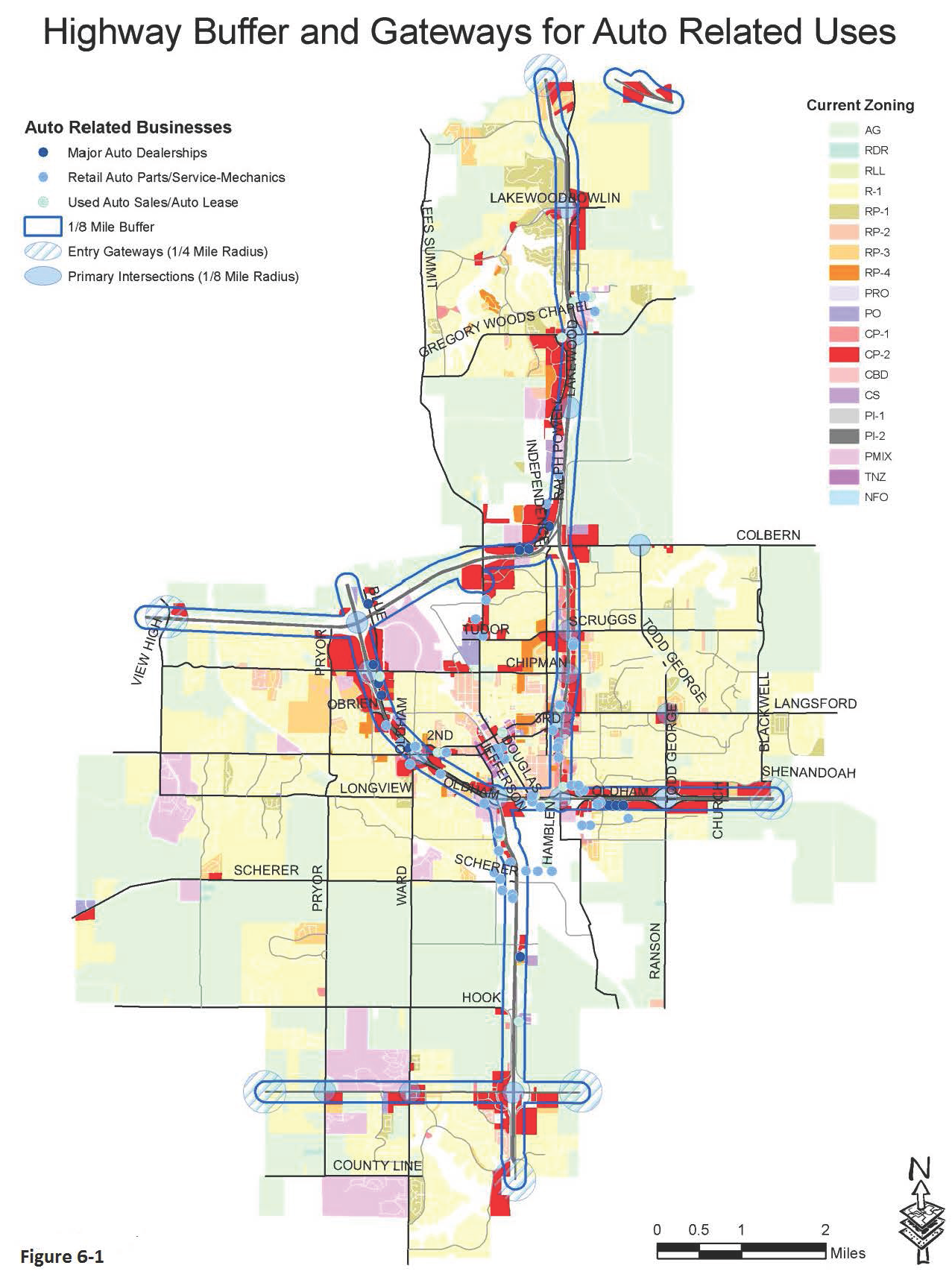
Sec. 6.1310. - Intent, definition and interpretation.
It is the intent of this article to regard certain uses and structures as being accessory to the principal use of the premises so that they may be carried on under the umbrella of the principal use. A use or structure will be considered "accessory" when it is being used in conjunction with the principal use and is incidental and integrally related to the principal use. All accessory structures are listed in Table 6.IV-1 with their respective requirements. Accessory structures or uses not identified in this chapter shall be submitted to the Director for consideration and interpretation. An interpretation made by the Director may be appealed through the process provided for in Article 14 of this chapter.
(Ord. No. 9812, § 4(Exh. C), 12-12-2023)
Sec. 6.1320. - Relationship to principal use.
A.
No accessory use or structure shall be allowed on any lot, except in the AG, Agricultural district, unless it is accessory to an existing principal use or structure on the lot on which it is to be located.
B.
Accessory structures shall not be permitted in a required front or side yard except as specifically provided in Table 6.IV-1.
C.
Residential accessory uses shall not be rented or occupied for financial consideration, except for an accessory dwelling unit as further provided for in this chapter.
D.
Construction of an accessory structure shall not commence until construction of the principal building has commenced.
E.
On a corner lot no accessory structure shall be located closer to the side street right-of-way line than the building setback line for the principal structure.
F.
When an accessory structure (excluding private swimming pools) is attached to the principal structure by a breezeway, passageway, or similar means, or is located within ten feet of the principal structure it shall comply with the yard requirements of the principal structure to which it is accessory.
G.
Accessory structures located in non-residential districts shall only be used by the owner, employees of the owner, or tenant of the premises.
H.
Accessory structures located in residential districts shall only be used by the owner or tenant of the principal structure located on premises except as further limited herein.
(Ord. No. 9812, § 4(Exh. C), 12-12-2023)
Sec. 6.1330. - Location, number and height of accessory use/structure.
A.
No accessory use or structure permitted by this article may be located except as specifically authorized in this article.
B.
Encroachments into easements or right-of-way. See City of Lee's Summit Encroachment Policy.
C.
Number. Any number of accessory structures is permitted provided that the lot coverage is not exceeded, except as further limited herein. The maximum impervious coverage for all residential uses in any district shall be 60 percent.
D.
Development requirements for accessory structures and permitted temporary structures are provided in Table 6.IV-1 below.
(Ord. No. 9812, § 4(Exh. C), 12-12-2023)
Table 6.IV-1. Accessory Structures
(Ord. No. 8556, § 1, 2-19-2019; Ord. No. 9812, § 4(Exh. C), 12-12-2023)
Sec. 6.1340. - AG Agricultural District—Permitted accessory uses and structures.
A.
All uses listed in Section 6.1350.
B.
A second single-family dwelling, provided the primary and accessory dwellings are on the same parcel of land under single ownership and the parcel contains a minimum of ten acres.
C.
Irrigation equipment used to water crops, such as a pump, pump housing, piping and compressor used to transfer and distribute water.
D.
Kennel. A commercial kennel with outside runs shall be located not less than 200 feet from residentially zoned property.
E.
Livestock pasturing.
1.
Minimum parcel size: Ten acres;
2.
Minimum parcel size per animal: 5,000 square feet fenced area.
F.
Paved, gravel or grass storage areas for operational equipment and materials for any agricultural operation.
G.
Repair shop, windmill, shed, garage, barn, silo, windmill, bunk house or any incidental structure commonly required to serve the principal use.
H.
Roadside stand not exceeding 200 square feet offering for sale only products produced on the premises.
I.
Stable.
1.
Minimum lot area: Ten acres.
2.
Setbacks (minimum):
a.
Front yard: 100 feet.
b.
Side yard/rear yard: 30 feet.
c.
From residentially zoned property: 200 feet.
3.
Maximum of one horse, pony or mule per acre shall be kept.
4.
All premises where stables or animals are kept shall be in compliance with all applicable state, county and city sanitary and health regulations.
J.
Wells (not including oil or gas), ponds or lakes.
(Ord. No. 9812, § 4(Exh. C), 12-12-2023)
Sec. 6.1350. - Residential districts—Permitted accessory uses and structures.
The following accessory uses and structures are permitted in residential zoning districts including, RDR, RLL, R-1, RP-1, RP-2, RP-3, RP-4, and TNZ unless otherwise stated within the sections below:
A.
Accessory dwelling unit. The purpose of accessory dwelling unit (ADU) regulations is to promote efficient use of land while providing for additional, affordable housing options; provide for an increase of density; and maintain the single-family dwelling character of the existing residence and neighborhood.
Only one ADU is permitted on a single-family residential lot and must be accessory to a principal single-family dwelling unit on the same lot. An ADU will include a building or portion of a building that provides complete independent living facilities for one or more people and provides such facilities as a kitchen, bathroom, and bedroom.
1.
Location:
a.
Properties located in the Old Downtown Lee's Summit Area as shown on Map 6.IV-1 below; or
b.
Properties ½ acre in size or larger that are zoned AG, RDR, RLL. R-1 or RP-1; or
c.
Properties approved through the Preliminary Development Plan process (See Article 2, Div. IV for process requirements).
Map 6.IV-1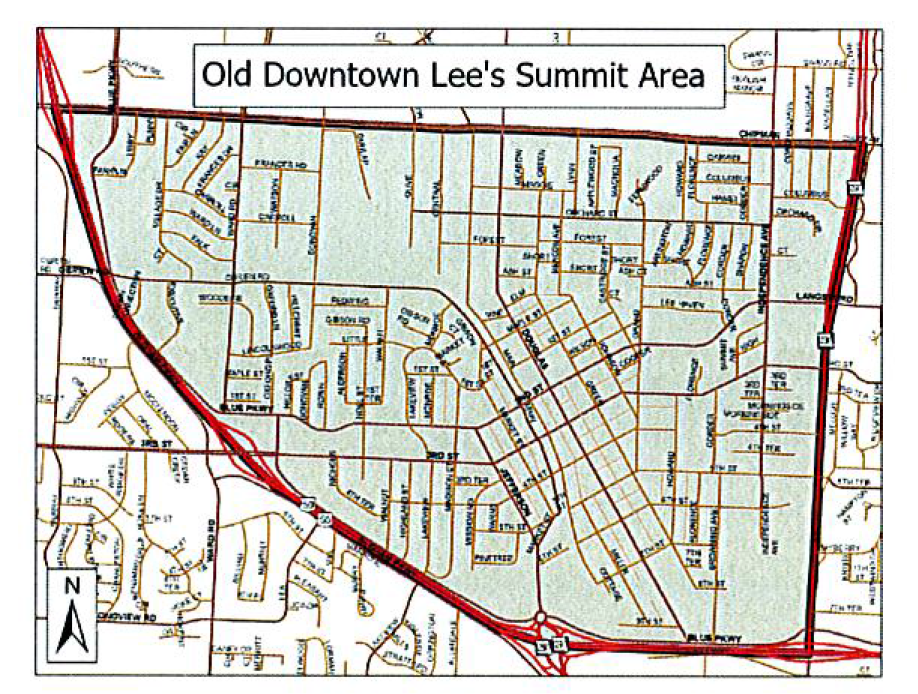
2.
An ADU may be built as:
a.
An internal conversion of an existing living area, basement, garage, or attic; or
b.
An addition to the principal single-family dwelling unit; or
c.
An addition to or conversions of an accessory structure such as a detached garage; or
d.
Construction of a new single-family detached house with an internal or detached accessory dwelling unit; or
e.
Construction of a detached accessory unit.
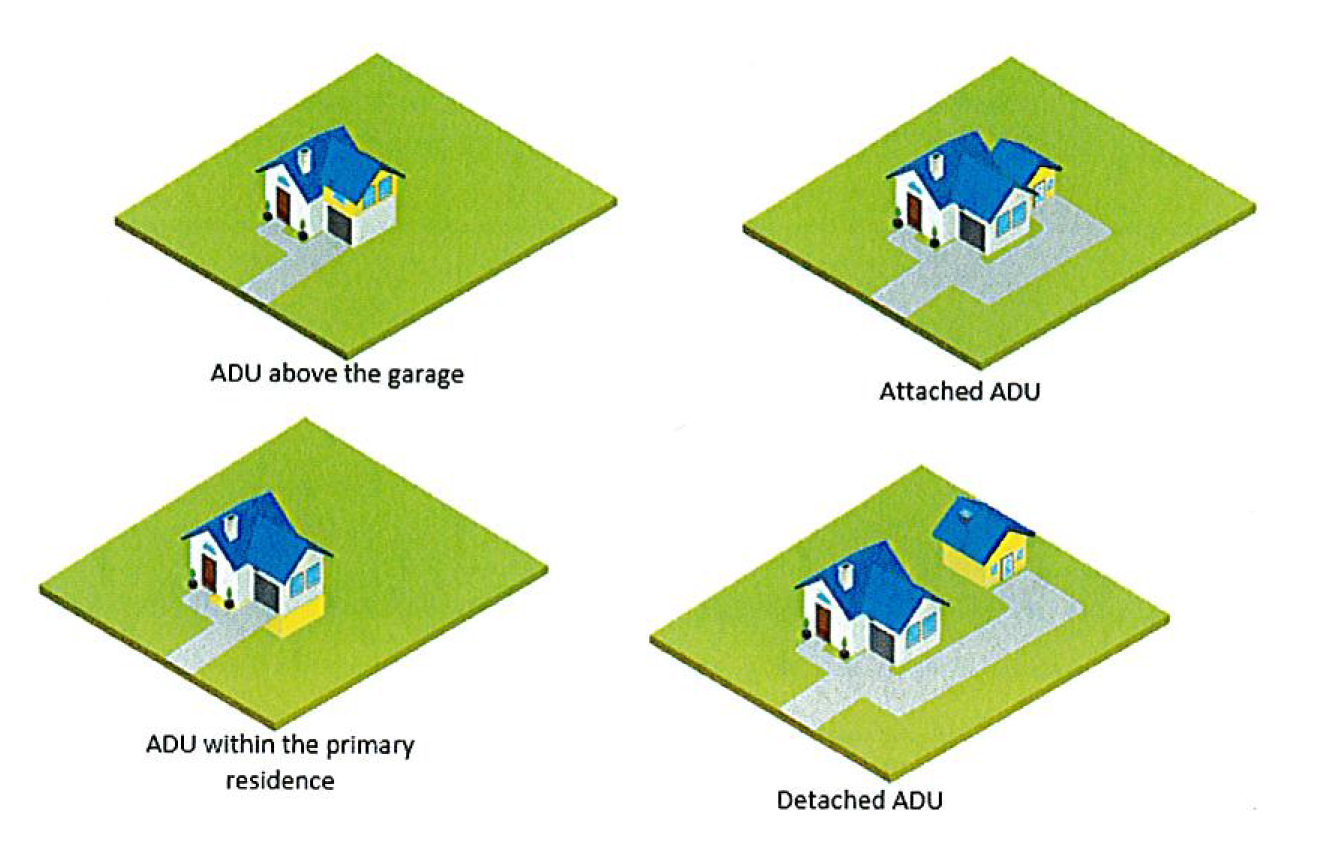
3.
Development requirements:
a.
All ADUs must be set back at least six feet behind the front of the principal single-family structure and set back at least 20 feet from the rear lot lines. This standard does not apply to ADUs located within the interior of an existing principal structure.
b.
All required zoning district side yard setbacks for a principal structure will apply to the ADU.
c.
Conversion of an attached or detached garage for an ADU is not permitted unless required parking is provided elsewhere on the property.
d.
The ADU must provide one off-street parking space with access to a public or private street. This space is in addition to that required for the principal single-family structure.
4.
Structure size and lot coverage:
a.
An ADU will not exceed a gross floor area of one thousand (1,000) square feet or more than 50 percent of the principal structure's floor area, whichever is less with the following exception:
i.
For residential lots located in Old Downtown Lee's Summit which are less than 15,000 square feet in size, an ADU will not exceed 500 square feet or more than 50 percent of the principal structure's floor area, whichever is less.
b.
An ADU will not cause the total impervious lot coverage of the residential lot to exceed 60 percent.
c.
A maximum of two bedrooms are permitted within an ADU.
d.
The height of the ADU will not exceed the height of the principal single-family structure.
5.
Design criteria:
a.
The architectural style of the ADU must be compatible with the existing neighborhood and principal single-family structure on the lot it is located through incorporation of similar materials, colors, and design style.
b.
The design of the ADU must be compatible with the height, bulk, and site location of the principal single-family structure.
6.
Permitting and occupancy:
a.
At the time of building permit application, the applicant will attest to owner occupancy of the premises for which the ADU will be located.
b.
Ongoing owner occupancy of either the primary dwelling unit or the ADU is required. (A temporary waiver of this requirement may be granted by the Director in the case of a documented need for the owner-occupant to leave the premises for up to one year due to employment, illness, or other circumstances.)
c.
The primary and accessory dwelling will remain under single ownership.
d.
ADUs must meet all building and fire code requirements as adopted and will be assigned a separate address.
e.
Short term rentals are not permitted within an ADU.
B.
"Day care home" is a permitted accessory use to a principal residential use. "Day care home" is defined as a family home in which a day care provider resides and provides family-like care for one to four persons not related to the day care provider, for any part of the 24-hour day, without overnight stays. The residential accessory use does not include "day care, group," with five to ten persons, which requires a special use permit in certain residential districts and is a permitted use in certain commercial districts. (See Definitions in Article 15 and Permitted and Special Uses in Article 4.)
C.
Deck, porch, gazebo, arbor, and patio.
1.
Decks are limited to the side and rear yard.
2.
Uncovered front porches may be constructed of materials listed in Subsection 8,4. below provided the walking surface does not exceed a height of 30 inches measured from ground level and provided it does not encroach into the required front yard by more than five feet.
3.
Covered front porches may be constructed of materials listed in Subsection B.4. below provided they do not encroach into the required front yard and provided the supporting structure underneath the walking surface is totally screened or enclosed by like materials or landscaping, not to include lattice.
4.
Uncovered front porches not encroaching into the required front yard may be constructed of wood, composite materials, wrought iron, metal or masonry.
5.
Uncovered attached decks, associated with detached single-family and two-family laterally attached homes may encroach into a required rear yard by five feet. Attached decks on all other dwellings shall meet the same side and rear setbacks as the principal structure.
6.
Gazebos may be attached to decks but must follow the setback requirements and not exceed the height of the principal structure.
7.
Arbors may be located in front side and rear yards as decorative yard features provided no visual impairment to site distance triangles, as defined in Article 8, Division 1, is created.
8.
Concrete at-grade patios may extend to the property line provided that storm water runoff/discharge is not directed onto adjacent property creating a nuisance.
D.
Fence or wall.
1.
Fence materials:
a.
Only wood, vinyl, steel, masonry or wrought iron materials may be used for residential fence construction.
b.
The number of materials shall be limited to two across the main surface of the exterior face of the fence.
c.
Accent pieces such as post caps are allowed in addition to the two primary materials noted in letter b. above.
2.
A fence or wall may be constructed to a maximum height of six feet above the average grade without a permit being required.
a.
If a fence or wall exceeds six feet in height, a building permit for a fence shall be obtained from the Building Official.
b.
A building permit for a fence shall be required for the replacement or reconstruction of 50 percent or more of the entire linear length of an existing fence that exceeds six feet in height.
c.
A fence or wall exceeding six feet in height (including a retaining wall) that is required as part of a preliminary development plan shall have final development plan approval prior to the issuance of any fence permit.
3.
A retaining wall may be permitted where it is reasonably necessary due to the changes in slope on the site, where the wall is located at least two feet from any street right-of-way, and where the wall does not extend more than six inches above the ground level of the land being retained unless the building code requires a guardrail for safety purposes. (See also the city's encroachment policy for additional restrictions.)
4.
A fence or wall constructed prior to the adoption of this chapter that does not meet the standards of this article, but which met previous codes of the city when originally constructed, may be replaced and maintained resulting in a fence of the same size, type and material. However, no fence shall be replaced or reconstructed in a manner that obstructs the sight triangles as defined in Article 8, Division I of this chapter.
5.
In residential districts, the following restrictions and standards shall apply to all fences and walls (See also Table 6.IV-1):
a.
Front yard. A decorative wall, or fence consisting of slats with a minimum of two-inch spacing not exceeding four feet in height may be constructed in a front yard and extend to the property line provided no sight distance triangle is compromised.
b.
Rear yard. A fence or wall up to six feet in height may be constructed on the rear property line, subject to further restrictions of the city's encroachment policy.
c.
Side yard. A fence or wall may be constructed on the side property line provided that:
• A fence or wall over four feet in height shall not extend beyond the face of the house on the lot on which the house is located.
• A fence or wall up to four feet or less in height may extend to the front property line, provided it does not obstruct the sight triangle and provided the fence materials meet the same requirements of (a) above for fences or walls extending into the front yard.
6.
Subdivision fence, wall, entry monument/feature.
a.
Entry monument signs shall be governed by Article 9 of this chapter. A sign permit shall be obtained prior to installation of any sign.
b.
Entry features such as decorative fences, walls, water features, and structures, that span the city right-of-way, and guard house/gatehouse are allowed provided they receive a license agreement and approval from the Governing Body.
7.
Design standards.
a.
A fence or wall shall be constructed with a finished side facing outward from the property. The posts and support beams shall be on the inside or shall be designed as an integral part of the finished surface.
b.
All fence segments abutting an arterial or collector street, except on corner lots, shall provide one gate opening per lot to allow access to the area between the fence and the edge of the street for maintenance and mowing.
8.
See the city's encroachment policy for additional restrictions on location of fences, walls, retaining walls, or other structures or features.
E.
Flag pole.
F.
Garage, carport or shed.
1.
For any one-family or two-family dwelling, there shall be permitted one detached garage or storage building/shed. An attached garage or carport shall be subject to the same required setbacks as the main structure, unless access is from an alley. In this case the setback is the same as a detached garage or shed. A detached garage or shed shall be subject to the setbacks required for detached accessory buildings. (See Table 6.IV-1 for required setbacks, height/size limitations, and special conditions.)
2.
Carports may be attached to a detached garage or shed provided the carport does not exceed the size of the detached garage or shed.
3.
For any multi-family residential development, a detached garage or storage shed shall be subject to the setbacks required for detached accessory buildings.
4.
In all residential districts, the design and construction of any detached garage, carport (when approved as part of a PDP) or storage building/shed, larger than 120 square feet, shall be similar to or compatible with the design and construction of the main building. The exterior building materials and colors shall be similar to the main building or shall be commonly associated with residential construction.
5.
For any permitted non-residential use in a residential district (such as a church or school), a detached garage or storage shed shall be permitted provided the design and construction is compatible with the main building and the residential district requirements are not exceeded in the particular district in which located.
G.
Garden.
H.
Gatehouse/guardhouse at entrance to a subdivision or multi-family development. (See subdivision fence, wall, entry monument/feature above.)
I.
Greenhouse, non-commercial.
J.
Hobby shop. A hobby shop may be operated as an accessory use by the occupant of a residential unit purely for personal enjoyment, amusement or recreation; provided that, the articles produced or constructed are not sold on the premises and provided that, such use will not be obnoxious or offensive by reason of vibration, noise, odor, dust, smoke or fumes.
K.
Home occupation (see Section 6.1400).
L.
Horse pasturing, non-commercial. Horses may be pastured in RDR, RLL and R-1 districts provided the following conditions are met:
1.
Minimum lot size: One acre.
2.
Setbacks: None, except if a small structure is to be used in conjunction with the pasturing for providing shelter in inclement weather, then the structure shall be set back from all property lines a minimum of 30 feet.
3.
Accessory structure shall not exceed 250 square feet per acre not to exceed 1,000 square feet, or the height of the principal dwelling.
4.
Maximum of one horse per acre.
5.
Horse pasturing is not to be used for commercial gain and is only to be used for the pleasure of the owner or current occupants of the principal dwelling located on the same lot.
M.
Play house and play equipment including a jungle gym, skate board/bicycle ramp, swing set and similar structures.
N.
Recreational facility, non-commercial (outdoor), except as provided in Division III of this article, Special Use Permits. A non-commercial recreational facility is any outdoor playground, facility, baseball field, softball field, or any other outdoor non-commercial recreational use, which is an accessory use to a single-family residential use, a single-family residential subdivision, a medium- or high-density residential development, or a church, and which meets the following conditions:
1.
It shall not be lighted for night use.
2.
It shall not be utilized for intensive play for leagues, tournaments or used by teams outside the subdivision, apartment development, church or other principal use to which the facility is accessory.
3.
No permanent or temporary spectator seating shall be provided.
4.
The following setbacks from adjoining residentially zoned or used property shall apply:
a.
Playgrounds for day care services for more than ten children shall be set back at least 20 feet.
b.
Courts and fields for one- or two-person teams (e.g., tennis courts) shall be set back at least 50 feet. Courts and fields for three or more person teams shall be set back at least 100 feet.
c.
A fence more than six feet in height shall be set back from such boundaries a distance equal to the height of the fence.
d.
A batting cage shall only be located on a minimum lot size of one acre provided it is located no closer than 50 feet to any other residential structure.
5.
The minimum lot area for an outdoor recreational facility for three- or more-person teams, including baseball and softball fields, shall be a minimum of one acre.
6.
Backstops or other fencing shall be provided if needed to prevent encroachment of balls or other activities onto adjacent property.
7.
The design and layout of the recreational facility on the property shall be such that it minimizes sound and light at the property line.
8.
Access to the recreational facilities and to the property on which the recreational facility is located shall be designed to minimize the adverse impact on residential properties.
9.
Landscaping, berming, or fencing shall be provided if needed to minimize adverse effects.
O.
Satellite dish antennae not exceeding one meter in diameter and attached to the principal structure.
P.
Signs per Article 9 of this chapter.
Q.
Solar collector (see Section 6.1450).
R.
Sport court (same as tennis court).
S.
Swimming pool, private.
T.
Swimming pool, subdivision (see Davison II of this article for conditions).
U.
Tennis court.
(Ord. No. 9384, § 1, 4-12-2022; Ord. No. 9812, § 4(Exh. C), 12-12-2023)
Sec. 6.1360. - Commercial and industrial districts—Permitted accessory uses and structures.
A.
Dwelling unit for security, management or maintenance personnel.
B.
Fences and walls.
1.
Location. Fences and walls may be constructed on any side or rear property line but shall not be located in any required front yard setback or be closer to any public or private street than the required setback for a building. (See also the city encroachment policy for additional restrictions.)
2.
Fence materials may include those listed for residential uses as well as chain link. However, chain link fences shall not be used for screening purposes as slats are prohibited. Chain link may only be used for screening purposes when used in combination with evergreen trees or shrubs, planted on the outside of the fence, providing an opaque screen that satisfies the screening requirements in Article 8, Division III of this chapter.
C.
Flag poles.
D.
Food service and vending machines for tenants or employees.
E.
Gate house.
F.
Garden center. A garden center as an accessory use to a commercial center shall be fully contained within a screened -portion of the primary structure.
G.
Outdoor patios/decks. The following outdoor patios/decks shall be allowed as accessory uses with the conditions stated:
1.
Strip centers/in-line tenant space.
a.
Outdoor patios/decks shall be set back a minimum of 100 linear feet from a residential district.
b.
Outdoor patios/decks adjacent to a residential district shall:
(1)
Provide a screened masonry wall from eight to ten feet in height around the patio/deck sides facing the residential district for the purpose of establishing a visual screen and block noise emanating from the patio area to the residential district. The wall height shall be sufficient to obscure the sight to the outdoor patio/deck from any adjacent residential dwelling's viewing station including patio, deck or window.
(2)
Outdoor patios/decks that cannot meet the screening requirement of Subsection a. above are prohibited unless approved by the City Council.
Exception: When located within a development with a perimeter fence screen that provides the visual obscurity required in Subsection (1) above, then a six-foot height masonry screen wall shall be utilized for noise control.
2.
Standalone/pad site.
a.
Outdoor patios/decks associated with standalone and pad site businesses shall:
(1)
Provide a minimum setback of 100 feet to any residential district.
(2)
Provide four-foot high security fencing around the patio/deck area when no residential adjacent property exists.
(3)
Provide a screened masonry wall from eight to ten feet in height around the patio/deck sides when adjacent to residential.
(4)
Provide noise control as further established below.
b.
Outdoor patios/decks located in front of businesses on a sidewalk shall:
(1)
Provide four-foot security fencing around the patio/deck perimeter.
(2)
Provide noise control as further established below.
3.
Noise control for both in-line and standalone businesses shall be established per City Code.
H.
Parking and loading areas.
I.
Private/public parking structure.
J.
Satellite dish antennae.
K.
Signs per Article 9 of this chapter.
L.
Solar collector (see Section 6.1450).
M.
Storage lot for vehicles engaged in the business. Per approved development plan or special use permit.
N.
Swimming pool, private. An indoor or outdoor swimming pool shall be allowed as an accessory structure/use to the following uses provided the district setbacks can be met:
1.
Fitness centers.
2.
Motels/hotels.
3.
Multi-family dwellings, garden apartment buildings/complexes.
4.
Clubs and organizations such as a YMCA.
Sec. 6.1370. - Commercial and industrial facilities—Permitted accessory uses.
The following uses are permitted temporary accessory uses in any district unless further limited herein:
A.
Construction/sales office trailer on site of a construction project provided such trailer is removed upon completion of the project. In residential districts, the construction trailer must be removed upon completion of the first residential dwelling unit for the subdivision or project or, in the case of a subdivision or project for which approval has been given for phased development, for the first dwelling unit for that phase. Setbacks are those established on the approved administrative plot plan.
B.
Portable storage containers, 14 days duration limitation (see also Article VII, Chapter 16 of the Code of Ordinances).
C.
Roll-off trash container during construction, limited to 30-day duration and may be allowed up to three nonconsecutive times in a one year period. (See also Article VII, Chapter 16 of the Code of Ordinances.)
D.
A temporary recycling collection facility sponsored by a business, school, church, or non-profit community group shall be allowed as an accessory use, provided the following restrictions and conditions are met:
1.
Containers are located on business, church, school or non-profit community group grounds;
2.
Activity is at least 100 feet from any adjacent property zoned or used for residential purposes; and
3.
The temporary facility is maintained in a clean, litter-free condition on a daily basis.
E.
Sales office in a new residential subdivision model home.
F.
Sales trailer within a residential subdivision on a vacant lot provided that:
1.
A sales trailer within a new residential subdivision or developing residential subdivision shall only be placed after a building permit for a model home has been issued and construction has commenced. Use of the temporary sales trailer shall cease upon the model home receiving a temporary certificate of occupancy.
2.
A sales trailer within a developing residential subdivision may utilize any vacant lot but only when a newly constructed home is not available for use as a model home/sales office and subject to compliance with "1." above.
3.
When used in this section the term "residential subdivision" means a single plat or multiple plats comprising a residential community or residential development. A residential subdivision shall be considered a developing residential subdivision if the remaining vacant lots constitute ten percent or more of the entire residential community or residential development.
G.
Signs per Article 9 of this chapter.
H.
Re-locatable classrooms/trailers are permitted as a temporary accessory use to schools and churches in any zoning district except when occupying a tenant space in an office or commercial building or complex or within a storefront or retail shopping center.
(Ord. No. 9812, § 4(Exh. C), 12-12-2023)
Sec. 6.1380. - Accessory uses permitted by interpretation.
Uses other than those listed herein may be determined to be accessory uses in any district based upon interpretation by the Director.
Sec. 6.1390. - Accessory use in religious, educational and community buildings.
Child care center, pre-school, Mother's Day Out and similar programs shall be permitted as an accessory use in religious, educational and community buildings.
Sec. 6.1400. - Home occupation—Accessory use in residential dwelling.
Home occupations shall be permitted as an accessory use in residential dwellings in any district subject to the following provisions:
A.
Purpose and intent. It is the purpose and intent of these requirements to:
1.
Maintain neighborhood integrity and preserve the residential character of neighborhoods by encouraging compatible land uses;
2.
Provide residents of the City with an option to utilize their residences as places to enhance or fulfill personal economic goals as long as the choice of home occupations does not infringe on the residential rights of neighbors;
3.
Establish criteria for operating home occupations in dwelling units; and
4.
Ensure that public and private services such as streets, sewers, water or utility systems are not burdened by home occupations to the extent that usage significantly exceeds that which is normally associated with a residence.
B.
General provisions. Home occupations shall be permitted as accessory uses within principal residential dwellings in any district provided they meet the following conditions and all requirements of the district in which located:
1.
The home occupation must be clearly incidental and secondary to the primary residential use of the dwelling;
2.
The home occupation must not change the outside appearance of the dwelling;
3.
Exterior signage for a home occupation is prohibited;
4.
The home occupation must not generate traffic, parking, sewerage or water use in excess of what is normal or customary in a residential neighborhood;
5.
The home occupation shall not create a hazard to person or property, result in electrical interference, or become a nuisance in the neighborhood;
6.
No outside storage of any kind related to the home occupation shall be permitted;
7.
No persons other than self or family members residing on the premises, plus one additional person not residing on the premises, shall be employed or involved in any business activity related to the home occupation on the premises;
8.
No more than 25 percent of the gross floor area of the dwelling unit shall be used for the operation of the home occupation. No accessory buildings shall be used in conjunction with a home occupation;
9.
Deliveries of materials to and from the premises in conjunction with the home occupation shall not require the use of vehicles other than parcel post or similar parcel service vehicles;
10.
Noise, vibration, smoke, odors, heat or glare as a result of a home occupation, which would exceed that normally produced by a single residence, shall not be permitted;
11.
The home occupation shall not utilize more than one private commercial vehicle limited to one ton capacity. The vehicle shall be capable of being parked or stored inside the garage and shall be required to be kept in said garage when not in use for the home occupation;
12.
Retail sales on the premises shall be secondary to the major operation of the home occupation;
13.
The primary use of the building in which the home occupation is situated shall clearly be the dwelling used by the person as his/her private residence;
14.
Home occupations shall maintain required licenses mandated by applicable local, state and/or federal laws;
15.
Persons intending to operate a home occupation should notify the HOA, Home Owners Association, of their intent prior to beginning operations. Said notification is to provide the HOA with notice of intent only.
C.
Permitted home occupations. Home occupations shall be approved by the Director upon his/her determination that the requirements of this ordinance can be satisfied. In the event a home occupation is denied by the Director, the reasons for the denial shall be given to the applicant in writing. Such decision for denial may be appealed to the City Council within 14 days of the date on the letter from the Director.
D.
Prohibited home occupations. The following uses by the nature of the investment or operation have a tendency once started to rapidly increase beyond the limits permitted for home occupations and thereby impair the use and value of a residentially zoned area for residential purposes. Therefore, the following uses shall be specifically prohibited as home occupations, except as further indicated below:
1.
Sales to the public on the premises not secondary thereto;
2.
Equipment rental;
3.
Automobile and other motor vehicle repair services and/or sales;
4.
Radio, television and similar electronic devices, small appliances and small engine repair services;
5.
Physicians, dentists;
6.
Chiropractor, except when located within a home on a lot that is a minimum of one acre in size and where access to a collector street from the residential driveway is no greater distance than one lot depth or 250 feet whichever is less.
7.
Upholstery and furniture making;
8.
Horse pasturing (does not include the accessory use of same);
9.
Pet grooming, except when:
a.
Only one animal is groomed or kept on the premises at a time, except for pets owned by the groomer,
b.
Only one person shall perform grooming services on the premises,
c.
All grooming activities shall be by appointment only,
d.
No animal runs, kennels or cages shall be kept on the premises in conjunction with the grooming business except for portable kennels necessary to transport the animal to and from the grooming appointment, and
e.
No more than five animals shall be groomed per day;
10.
Animal grooming (except as provided in Subsection 8. above), boarding, and/or related services;
11.
Uses requiring storage or use of highly flammable, toxic or other hazardous materials;
12.
Printing and/or typesetting services;
13.
Photographic studio, where photographs are taken on the premises, except when located within a home on a lot that is a minimum of one acre in size and where access to a collector street from the residential driveway is no greater distance than one lot depth or 250 feet whichever is less.
14.
Massage therapy, (to be conducted in the licensed massage therapist's home) except when operated as a conditional use under Article 13 of this chapter.
E.
Any proposed home occupation not specifically prohibited in this section may be permitted provided that all conditions listed above are observed.
Sec. 6.1410. - Hospital—Related accessory uses.
The following uses are accessory uses within a hospital when located within the main hospital building and designed to serve hospital personnel, visitors or patients: Residential quarters for staff and employees; nursing or convalescent quarters; storage and utility buildings; food service and vending machines; laundry and dry cleaning pickup and delivery; and flower and gift shops.
Heliports shall be allowed as an accessory use at a regional hospital, provided the following conditions are met:
A.
A heliport plan is submitted to the Director which includes all approach and departure paths as necessary to assure safe and adequate landing and take-off area and shall be supplemented by a favorable report by the local airport district office of the Federal Aviation Administration (FAA).
B.
Adequate safety provisions shall be provided and indicated by plans that control or restrict access to the landing and take-off areas by the general public.
C.
Landing and take-off areas shall be surfaced in such a manner as to avoid dust or dirt from blowing onto neighboring property.
Sec. 6.1420. - Hotel and motel—Related accessory uses.
The following uses are accessory uses within a hotel or motel provided the use is located within the main hotel building and designed to serve the occupants and patrons of the hotel or motel: Restaurants; clubs; drinking establishments; banquet rooms; package sales of alcoholic liquor or cereal malt beverages; sales of notions; newsstands; vending machines; barber shops and hair salons; arcades; and flower and gift shops.
Sec. 6.1430. - Kennel—Accessory use to veterinarian.
Kennels for small animals shall be subject to the following conditions:
A.
A kennel with outside runs as an accessory use to a veterinarian shall be located at least 100 feet from any property zoned or used for residential purposes.
Sec. 6.1440. - Outdoor storage in PI industrial districts—Accessory use.
In PI industrial districts, outside storage is restricted to new products manufactured or assembled on site or such materials that are used in conduct of the business and which shall meet the following conditions:
A.
The outside storage is to be located on land owned by, leased by, or under the control of the users.
B.
Outside storage shall be restricted to side or rear yards not within required yards and shall be screened from view of neighboring properties.
C.
Outside storage areas are to be properly screened by means of a solid, sight-obscuring fence, not less than six feet in height. A living screen may be substituted for the fence providing said screen shall provide a solid screen at planting. Fences used as screening directly adjacent to land zoned residential shall incorporate planted buffers as required in Article 8, Division III.
D.
All storage areas and access drives shall be paved.
E.
Outside storage of inoperative vehicles or equipment shall not exceed 72 hours.
Sec. 6.1450. - Solar collectors—Accessory use.
Solar collectors are permitted accessory uses, provided that the following performance standards are met:
A.
Roof-mounted solar collector components servicing the collector panel shall be concealed and all exposed metal shall be finished with similar colors to the structure on which it is mounted.
B.
Roof-mounted solar collectors located on front or side building roofs, which are visible from the public right-of-way, shall not extend above the peak of the roof plane on which they are mounted, and no portion of the solar collector shall extend more than 24 inches perpendicular to the point on the roof where it is mounted;
C.
Roof-mounted solar collectors located on the rear side of building roofs shall not extend above the peak of the roof plane on which they are mounted, and no portion of the solar collector shall extend more than four feet perpendicular to the point on the roof where it is mounted;
D.
Ground-mounted solar collectors shall not exceed eight feet in total height and shall be located within the rear yard at least 12 feet inside the property line; and
E.
All lines serving a ground-mounted solar collector shall be located underground.
Sec. 6.1460. - Tattoo/permanent cosmetic services/body piercing services as accessory use to primary use in district planned office (PO).
Tattoo/permanent cosmetic services/body piercing services are restricted as an accessory use business located in a planned office, PO, zoning district as follows:
A.
The accessory use business shall only be provided by the licensed professional as business owner of the primary business;
B.
The primary business shall be associated with an artist studio engaged in the application, teaching, or production of fine arts such as drawing, painting, and sculpture or in film editing and screenwriting and similar uses associated with the fine arts;
C.
Services shall be provided by appointment only and shall not become the primary business; and
D.
Signage shall be prohibited except for a logo, telephone number and email address.
Sec. 6.1470. - Permitted temporary accessory uses.
The following uses are temporary accessory uses in any district unless further limited herein:
A.
Construction/sales office on site of a construction project provided such trailer is removed upon completion of the project. In residential districts, the construction trailer must be removed upon completion of the first residential dwelling unit for the subdivision or project or, in the case of a subdivision or project for which approval has been given for phased development, for the first dwelling unit for that phase.
B.
Portable storage containers, 14 days duration limitation (see also Article VII, Chapter 16 of the Code of Ordinances).
C.
Roll-off trash container during construction, limited to 30-day duration and may be allowed up to three nonconsecutive times in a one year period. (See also Article VII, Chapter 16 of the Code of Ordinances.)
D.
A temporary recycling collection facility sponsored by a business, school, church, or non-profit community group shall be allowed as an accessory use, provided the following restrictions and conditions are met:
1.
Containers are located on business, church, school or non-profit community group grounds;
2.
Activity is at least one hundred (100) feet from any adjacent property zoned or used for residential purposes; and
3.
The temporary facility is maintained in a clean, litter-free condition on a daily basis.
E.
Sales office in a new residential subdivision model home.
F.
Sales trailer within a residential subdivision on a vacant lot provided that:
1.
A sales trailer within a new residential subdivision or developing residential subdivision shall only be placed after a building permit for a model home has been issued and construction has commenced. Use of the temporary sales trailer shall cease upon the model home receiving a temporary certificate of occupancy.
2.
A sales trailer within a developing residential subdivision may utilize any vacant lot but only when a newly constructed home is not available for use as a model home/sales office and subject to compliance with "1." above.
3.
When used in this section the term "residential subdivision" means a single plat or multiple plats comprising a residential community or residential development. A residential subdivision shall be considered a developing residential subdivision if the remaining vacant lots constitute ten percent or more of the entire residential community or residential development.
G.
Signs per Article 9 of this chapter.
H.
Re-locatable classrooms/trailers are permitted as a temporary accessory use to schools and churches in any zoning district except when occupying a tenant space in an office or commercial building or complex or within a storefront or retail shopping center.
Sec. 6.1480. - Prohibited accessory uses and structures.
The following accessory uses and structures are specifically prohibited:
A.
Automotive repair in residential districts except for personal vehicles being repaired inside a garage.
B.
Hog lots.
C.
Livestock commercial feed lots.
D.
Detached carports except when specifically approved as part of a preliminary development plan for a multi-family development.
E.
Outdoor vending machines, except for:
1.
Certain outdoor vending machines that are accessory to financial institutions, such as ATM's, self-service car wash business dispensers offering such items as cleaners, waxes and towels for vehicle washing and similar accessory uses and structures approved by the Director. Such accessory vending machines shall be attached to or built into exterior walls of the commercial business or integrated into a drive island, and
2.
Mobile food vending regulated in Division V of this article.
Note: Retail sales of products being displayed outdoors, provided such products are being sold within the commercial building where the products are being displayed shall not constitute an accessory use or structure. Said outdoor product display shall be located immediately adjacent to the wall of the building or within 20 feet of such wall, or in the case of a C-Store adjacent to the pump island, except for seasonal sales regulated by Division V of this article.
(Ord. No. 9812, § 4(Exh. C), 12-12-2023)
Sec. 6.1510. - Purpose and intent.
The purpose and intent of this article is to provide for the temporary use of land for special events in a manner consistent with its normal use and beneficial to the general welfare of the public. Furthermore, it is the intent of this article to protect nearby property owners, residents and businesses from special events that may be disruptive, unsafe or inappropriate given site conditions, traffic patterns, land use characteristics and the nature of the proposed event.
Sec. 6.1520. - Definitions.
The terms used in this article, for purposes of the regulations in this article, shall be defined as follows:
Non-profit group or organization means any person(s), partnership, association, non-profit corporation, a 501(c)3) corporation, or other group that does not distribute its surplus funds to its owners, shareholders or members, and whose activities are conducted for charitable, civic, or humanitarian motives, or for the benefit of others, and not for the private gain of any individual or group and may include, but shall not be limited to, patriotic, philanthropic, social service, welfare, benevolent, educational, civic, fraternal, cultural, charitable, scientific, historical, athletic, or medical activities.
Special event means a temporary, short-term use of land or temporary structure(s), located or conducted outside, that is, not within a permanent building or structure. A special event may be on public or private street right-of-way, public property, or private property within the corporate limits of the City of Lee's Summit, Missouri ("corporate limits"), and may include, but not be limited to, the following types of activities:
1.
Athletic event. An organized competitive or recreational event in which a group of people collectively engage in a sport or form of physical exercise, including but not limited to: running, jogging, walking, bicycling or skating, on any public street right-of-way or upon public property in the corporate limits.
2.
Auction/estate sale. Any sale where tangible personal property is sold by an auctioneer who is either the agent for the owner of such property or is in fact the owner thereof.
3.
Auto sales tent. A tent located on an auto sales lot for the purposes of a sales event and/or a promotional activity.
4.
Block party. A neighborhood event, in which a street is temporarily closed and designated as a "play street."
5.
Commercial event. Commercial activities, either on the same property as the primary commercial use, or on other private commercial property, which are intended to sell, lease, rent or promote specific merchandise, services or product lines, including, but not limited to: Tent sales, sidewalk sales, trade shows, flea markets, product demonstrations or parking lot sales of food, art work or other goods. This definition does not include mobile food vending (see Subdivision 2 of this division).
6.
Entertainment event. An organized event having as its primary purpose the entertainment or amusement of a group of people, including but not limited to: Carnivals, festivals, public firework displays, fairs, or concerts, on public or private property within the corporate limits.
7.
Film production. The process of making a film on public or private property within the corporate limits.
8.
Fireworks sales tent. A tent for the retail sale of allowed fireworks within the city limits of Lee's Summit, during a specified time period preceding July 4 of each year, as further described in the Code of Ordinances.
9.
Garage sales. The sale of personal property that is conducted on premises within a residential district upon which is located a dwelling, or on any portion of a lot used for residential purposes.
10.
Non-commercial events. Fund-raising or non-commercial events sponsored by non-profit groups or non-profit organizations.
11.
Parade. Any march or procession consisting of people, animals, or vehicles, or any combination thereof, except funeral processions, upon any public street, sidewalk, alley, jogging trail, or bike path, which does not comply with normal and usual traffic regulations or controls.
12.
Political event. An organized event, not including an athletic or entertainment event, having as its primary purpose the exercise of expressive activities of a political nature, including but not limited to speech making, picketing, protesting, marching, demonstrating or debating public issues.
13.
Seasonal sales. Farmer's market, Christmas tree sales, fruit, flower or vegetable sales, or sale of other seasonal products, when sold on property other than on the site where grown, constructed or assembled.
14.
Private events. Events held on private property meeting all applicable codes and ordinances, including but not limited to wedding receptions and birthday events.
Special event signage means signage that is temporary in nature, is not permanently attached to the ground or sign surface, and is used to advertise any type of special event as listed herein, whether or not a special event permit is required.
Sec. 6.1530. - Permit required.
A.
Except as otherwise provided under the exemptions section of this article (Section 6.1540), a Special Event Permit is required for the following special events, as defined above:
1.
Athletic event.
2.
Commercial event.
3.
Entertainment event.
4.
Non-commercial event, unless conducted entirely on private property owned or leased by the sponsoring non-profit group or organization.
5.
Seasonal sales event.
6.
All special events requiring street closure.
7.
All special events which include street vendors to be located on public right-of-way.
B.
A special event permit is not required for the following types of events, but other Code of Ordinance based permits are required. The Code of Ordinance sections for the applicable permits are listed below:
1.
Fireworks sales (Chapter 13, Article III, of the Code of Ordinances).
2.
Parades (Chapter 29, Article VI, of the Code of Ordinances).
3.
Play streets (block parties) (Chapter 29, Article I, Section 29-12, of the Code of Ordinances).
Sec. 6.1540. - Exemptions.
The following special events are exempt from the requirements of this section and do not require a permit, unless the special event requires street closure:
A.
Auctions/estate sales.
B.
Auto tent sales located on private property and on an existing, legal, or legal non-conforming auto sales lot, and having a maximum duration of six weeks.
C.
Commercial event, if it has a minimal impact on the community. Criteria for determining minimal versus significant impact shall include, but not be limited to the following: 1) public services required, 2) tent or other structure, 3) traffic circulation, 4) parking considerations, and 5) anticipated attendance. This could include centralized special events held within a shopping center parking area, not connected to individual businesses within the shopping center, with no off-site impact. The Director shall determine whether a permit is required for a specific commercial event, based upon the proposed extent of activities.
D.
Garage sales (up to four times per year), not to exceed five days per event and 20 days per year.
E.
Non-commercial event, if conducted entirely on private property owned or leased by the sponsoring non-profit group or organization, with a maximum duration of 72 hours.
F.
Political events.
G.
Private events.
H.
Any special event sponsored or co-sponsored by the City. Such events shall comply with the performance standards set forth herein. A City event requiring street closure requires a special event permit.
I.
Any special event held within a public park. These events shall be governed by other provisions of the Municipal Code regulating conduct in City parks and recreation areas.
J.
Any business already operating under a special use permit that regulates the display and sale of outdoor goods or authorizes the operation of any special event as defined herein.
Sec. 6.1550. - Fees for special event permits.
A.
Application fee. An application fee shall be required upon submittal of each special event application in accordance with the City's Schedule of Fees and Charges.
B.
Fees for City services. If the permit applicant requests City services, or City staff determines the need or the City Council upon referral or appeal, as described in this article, determines, as a condition of granting the permit, that public services or equipment must be provided to protect the public health or safety, the applicant shall be required to pay a fee for City services in accordance with the City's Schedule of Fees and Charges. Payment for City services shall be paid prior to issuance of the permit.
C.
Fees for athletic events. Specific routes have been designated for athletic events. See the City's Schedule of Fees and Charges.
Sec. 6.1560. - Application requirements.
A.
Application required. A special event application shall be submitted for any special event requiring a special event permit, as outlined above under "permit required."
B.
Application deadline. A complete application shall be submitted at least 20 calendar days prior to the requested start date of a special event. The Director shall have the authority to waive the application deadline.
C.
Submission requirements. The application shall set forth and contain the following information:
1.
Name and/or brief description of the event.
2.
Description of City services required for the event such as traffic control, street sweeping, etc.
3.
Fees, as required.
4.
A written narrative, fully describing the proposed event, including:
a.
Location.
b.
Hours of operation.
c.
Anticipated attendance.
d.
Buildings or structures to be used in conjunction with the event.
e.
Proposed signs or attention attracting devices.
f.
Public streets to be used, if any.
5.
A statement that the standards set forth in this article have been satisfied.
6.
A site plan in the form and the level of detail as required by the Director, showing the location of all existing or proposed uses, structures, parking areas, outdoor display areas, signs, streets, and property lines.
7.
Date and time of the event to include start and ending dates and times.
8.
Contacts: Name and address of the owner of the premises on which the proposed event is to be held and the name and address of the applicant.
9.
Written approval from the property owner agreeing to the proposed event, if the applicant is not the same as the property owner.
10.
Location and number of proposed temporary public toilets.
11.
Proposed temporary potable water supplies, which shall be reviewed by the Water Utilities Department, pursuant to the Code of Ordinances.
12.
A recycling plan, which shall include the following information:
•
Name of the sanitation company, hauler, and/or staff that will be providing bins, emptying bins, and transporting the bins for proper disposal.
•
Location where the recyclables will be transported for disposal.
•
Site plan indicating the location of bins.
•
Number of bins provided.
•
Description of any signage that will be used to advertise the recycling opportunity.
•
List of materials to be utilized at the event, and whether all of the materials will be offered for recycling.
•
Description of how often recycling bins will be emptied.
•
Description of how recycling bins will be differentiated from other trash bins. The recycle bins must be clearly labeled as such so as not to create confusion with regular trash bins.
•
Any other information deemed necessary by the Director in order to ensure compliance with the standards set forth in this article.
13.
Proof of liability insurance. If the special event will take place on public property, said certificate of insurance shall name the City as an additional insured party in an amount determined by the City Manager based on the nature of the special event.
14.
A statement that ensures indemnification of the City and that public property will be protected and/or restored to its condition prior to the Special Event.
Sec. 6.1570. - Performance standards.
Special events shall comply with the following standards:
A.
Location. Special events that do not require the use of public right-of-way shall be conducted on private property in a commercial or industrial zoning district, except that non-profit organizations may conduct special events on any property where the owner has granted permission. For all special events that require the use of public right-of-way, the permit shall clearly specify the streets to be used for the event and the time that the streets will be closed, if applicable.
B.
Land-use compatibility. The special event shall be compatible with the purpose and intent of this section and with adjacent land uses. The special event shall not impair the normal, safe and effective operation of a permanent use on the same site. The special event shall not endanger or be detrimental to the public health, safety or welfare or injurious to property or improvements in the immediate vicinity of the special event, given the nature of the activity, its location on the site and its relationship to it.
C.
Compliance with other regulations. All applicable provisions of the Building Code (Chapter 7 of the Code of Ordinances) and the Design and Construction Manual shall be met. Permit holders must at all times comply with all applicable legal and regulatory provisions, including, without limitation, health code regulations.
D.
Restoration of the site. Any temporary structure shall be promptly removed upon the cessation of the event. Within 48 hours of cessation of the event, the site shall be returned to its previous condition, including the removal of all litter, signage, attention-attracting devices or other evidence of the special event. If the site is not returned to its previous condition, the City may restore the site at the expense of the applicant.
E.
Hours of operation. The hours of operation of a special event shall be consistent with the surrounding land uses.
F.
Duration. The maximum duration of a special event shall be as set forth below, unless modified by conditions attached to the issuance of the special event permit.
1.
Athletic event: Three days.
2.
Auto tent sales (exempt): Six weeks.
3.
Commercial event: Three days.
4.
Commercial event (exempt): Three days.
5.
Entertainment event: Seven days.
6.
Garage sales (exempt): Five days per event, up to four times per year, not to exceed 20 days per year.
7.
Non-commercial event: Three days.
8.
Non-commercial event (exempt): Three days.
9.
Seasonal sales event:
a.
Ninety days if up to 20 percent of the parking lot is used for the event;
b.
One hundred eighty days if up to ten percent of the parking lot is used for the event.
G.
Traffic circulation. The special event shall not cause undue traffic congestion or accident potential given anticipated attendance and the design of adjacent streets, intersections, parking and traffic controls. All sidewalks shall be left open for pedestrian traffic unless special approval is received for blockage. No alleys, driveways, fire lanes or other access points shall be blocked by the special event unless specific approval is granted for the special event.
H.
Parking restrictions. Approval of a short-term parking restriction can be granted through a special event application as determined by the City Traffic Engineer. Special event permit recipients shall be responsible for securing, installing and immediate removal of all required no parking signs upon cessation of the event.
I.
Street closings and temporary traffic control. Special event permit holders shall be responsible for securing, installing and immediate removal upon cessation, all required temporary traffic control, including but not limited to all barricades and signs when street or lane closures are approved. All temporary traffic control shall be in accordance with the Manual on Uniform Traffic Control Devices, subject to approval by the City Traffic Engineer. The approval of a Special Event Permit shall waive the requirement for any applicable Temporary Traffic Control Permit required.
J.
Off-street parking.
1.
All off-street parking surfaces used for the special event shall be concrete or asphalt.
2.
No more than 20 percent of the parking stalls required for the structure associated with the parking lot in which the special event occurs shall be permitted to be used for a special event.
3.
For seasonal sales events with a duration of over 90 days and up to 180 days, no more than ten percent of the required parking stalls shall be permitted to be used for the special event.
4.
Special events shall not cause a shortage of parking for the primary use on the property on which they are located. Special events shall not create a shortage of parking for uses on properties surrounding the property on which they are located.
K.
Anchoring devices. No spikes, nails, anchors or other devices shall be driven into any public street or sidewalk. Such devices may be used on private parking lots provided any damage resulting therefrom shall be repaired upon cessation of the event and removal of the devices.
L.
Fire safety. The City's Fire Department shall be consulted for the following requirements and inspection, as necessary:
1.
Fire lanes a minimum of 20 feet in width and 12 feet in height or as otherwise approved by the Fire Chief, must be provided in order to allow Fire Department access within 150 feet of all structures and on at least two sides of all two-story structures within 500 feet of the location of the special event.
2.
All fire hydrants in the area of the special event must be left with five feet of clearance on all sides and shall be accessible from the fire lanes that are designated with the event.
3.
No open fires shall be permitted unless advance approval is obtained from the Fire Department.
4.
Fire extinguishers shall be available as determined by the Fire Chief.
5.
Temporary electrical wiring for the special event shall be installed in accordance with the requirements of the National Electrical Code.
6.
Tents shall comply with the Fire Code and applicable building codes.
7.
Exit signs and proper exiting aisles shall be provided in temporary special event structures.
M.
Public conveniences and litter control. Adequate on-site restroom facilities and solid waste containers shall be provided. The applicant shall calculate the demand for such facilities and specify how the need will be addressed.
N.
Recycling. A recycling plan shall be required. Beginning January 1, 2012, styrofoam and glass food and beverage containers will be prohibited at all special events. A recycling haulers report shall be required after the completion of the event.
O.
Nuisances. The special event shall not generate excessive noise, dust, smoke, glare, spillover lighting or other forms of environmental or visual pollution.
Sec. 6.1580. - Special event signs.
A.
No separate sign permit shall be required for signs related to a special event.
B.
Signs related to a special event which requires a special event permit, as defined and regulated in this article, shall be allowed only as authorized in the approval of the special event by the Director. The time limit for temporary signs advertising the event shall be specified in the special event approval, with 30 days being the standard guideline.
1.
Signs for community-wide special events, as determined by the Director, may be placed off-site throughout the community, on private property, subject to approval of the location(s), and permission of the property owner(s).
2.
Signs for special events that are not community-wide, as determined by the Director, may only be placed on the property where the event is being held.
C.
Signs related to a special event not requiring a special event permit shall be allowed only on the property where the event is being held.
Sec. 6.1590. - Consideration of special event application.
A.
The Director may approve any special event permit after determining that the event will comply with all special event performance standards and application criteria and requirements.
B.
Appeal of denial.
1.
The denial of any application by the Director shall be in writing.
2.
The applicant, in the event of a denial of a special event permit, and a permit holder, in the event of the revocation of a special event permit, shall have the right to appeal a decision of the Director to the City Council.
3.
Appeal to City Council. Applicants denied a special event permit may appeal to the City Council by filing such appeal with the City Clerk with full documentation supporting his or her application within ten days of the denial.
4.
Schedule. Appeals shall be placed on the first available City Council meeting agenda for consideration.
5.
City Council consideration. The City Council action shall be final and may include additional fees to cover the cost of providing city services and/or any other conditions deemed necessary to protect the general welfare of the City and the public.
C.
Prohibition on transfer. No special event permit issued under the provisions of this section shall be assignable or transferable to any other person or transferable to another location for the operation of a special event by that person or at a different location.
D.
Conditions of approval. When issuing a special event permit, the Director or City Council may establish additional conditions deemed necessary to ensure compatibility with adjacent land-uses and to minimize potential adverse impacts on nearby uses, including, but not limited to:
1.
Limitation of events. Special events which require City services during the event shall be limited to one per day or per weekend subject to availability of personnel, as determined by City staff. Scheduling shall be on a first come-first served basis.
2.
Pre-established routes. Specific routes have been designated for athletic events. Applicants will be given their choice of the pre-established routes from the selection list maintained by the Police Department. Such routes are subject to change due to unforeseen circumstances and as such, applicants should check the route status and confirm their route choice prior to advertising their event. Denial of a specific route may be appealed to the City Council pursuant to Subsection B. above.
3.
Signs. The number, size, location, or time limit for signs may be limited.
4.
Temporary arrangements for parking and traffic circulation.
5.
Modifications or restrictions on the hours of operation, duration of the event, size of the event or other operational characteristics.
6.
The provision of traffic control or security personnel to ensure the public safety and convenience.
7.
Posting of security, in an amount required by the City Manager, for special events where the anticipated attendance is 1,000 or more people to help ensure that the operation of the event and the subsequent restoration and cleanup of the site are conducted according to required special event standards and conditions of approval.
E.
2026 FIFA World Cup Temporary consideration of special event applications. For the time period of June 1, 2026 to July 31, 2026, special event permits will not be approved for the following types of events:
1.
Large public displays of fireworks except for those "legacy" fireworks displays for Raintree Lake and Lakewood subdivisions City sponsored or an official FIFA 2026 World Cup affiliated event.
2.
Commercial and/or entertainment events which require additional security as the event expects 1,000 or more attendees except for city sponsored or an official FIFA 2026 World Cup affiliated events.
3.
Athletic events except for city sponsored or official FIFA 2026 World Cup affiliated events.
(Ord. No. 10229, § 1, 10-21-2025)
Sec. 6.1600. - Definitions.
As used in this article, the following terms or phrases are defined as follows:
Mobile food vending means the act of selling food and/or beverages by operating a mobile food truck, a mobile food cart, or a mobile packaged food delivery truck.
1.
Mobile food cart. A non-self-propelled vehicle or stand limited to serving:
a.
Non-potentially hazardous foods, as defined by the Jackson County Environmental Health Department,
b.
Commissary-wrapped food maintained at proper temperatures, or
c.
Limited to the preparation and serving of hot dogs or similar sausages.
2.
Mobile food truck. An enclosed vehicle, truck or trailer licensed to operate on public roads in which a person travels from place to place to serve food or beverage.
3.
Mobile packaged food delivery truck. An enclosed vehicle or truck licensed to operate on public roads in which a person travels from place to place to deliver packaged food that has been previously ordered.
4.
Single-unit mobile food truck. A Federal Highway Administration (FHWA) Class 1-7 vehicle, with vehicle weight less than 33,000 pounds, that is licensed to operate on public roads in which a person travels from place to place to sell packaged food items.
Sec. 6.1610. - Permit required.
Except as otherwise provide in Section 6.1620 of this article, a mobile food vendor permit is required for the following:
A.
Mobile food carts, when:
1.
Located on a public sidewalk; or
2.
Located in public or private parking spaces
B.
Mobile food trucks.
Sec. 6.1620. - Exemptions.
A mobile food vendor permit is not required for the following:
A.
Mobile food carts, when:
1.
Conducted in front of a store on private property;
2.
The property owner permission has been obtained;
3.
Not occupying a parking space; and
4.
Not impacting pedestrian, bicycle, or motor vehicle traffic circulation or other safety issues.
B.
Mobile packaged food delivery trucks.
C.
Neighborhood refreshment stands and other similar products.
Sec. 6.1630. - Fees for mobile food vendor permits.
Application fee. An application fee shall be required upon submittal of each mobile food vendor permit application, in accordance with the City's Schedule of Fees and Charges.
Sec. 6.1640. - Application requirements.
A.
Applicants for mobile food vendor permits must comply with the application requirements set forth in Section 6.1560 of this article.
B.
If on private property, no site plan shall be required.
Sec. 6.1650. - Performance standards.
A.
Location on private property. Mobile food vending is permitted in all zoning districts on private property if: a) the vendor has obtained the permission of the property owner; and b) the vendor is in compliance with all provisions of this division, including those sections addressing permits; and c) the vendor must be located on a paved surface.
B.
Location in right-of-way.
1.
The vendor shall not locate within a 60-foot radius from the primary entry of a brick and mortar restaurant during posted hours of operation, unless they have written permission from the restaurant owner.
2.
Mobile food vending is prohibited from the right-of-way in residential areas, with the following exception:
a.
Single-unit mobile food trucks that do not exceed a 15-minute parking duration for sales/services are permitted.
C.
Location during an entertainment event (festival). The vendor shall not locate within one-half mile from the boundary of any entertainment event (festival) requiring street closure, except when:
1.
The vendor has written authorization from the festival/event coordinator to operate within the festival boundaries or within one-half mile thereof.
D.
Hours of operation and duration. Mobile food vendors can operate with no limitations on days and hours, with the following exception:
1.
Mobile food trucks in the CBD (Central Business District) area, shall be limited to 9:00 p.m. to 2:00 a.m. any night of the week, except that mobile food vendors participating in entertainment events (festivals) in the CBD shall be limited to the hours of the festival. Other hours can be approved by Director of Planning and Development on a case by case basis.
E.
Compliance with other laws and regulations. Vendors must at all times comply with all applicable legal and regulatory provisions, including, without limitation, health code regulations.
F.
Restoration of site. Immediately upon cessation of the vending, the site shall be returned to its previous condition, including the removal of all litter, or other evidence of the vending. If the site is not returned to its previous condition, the City may restore the site at the expense of the applicant.
G.
Health and safety criteria. Mobile Food Vending shall not impair the normal, safe and effective operation of a permanent use on the same site. Mobile food vending shall not endanger or be detrimental to the public health, safety or welfare or injurious to property or improvements in the immediate vicinity of the vending, given the nature of the activity, its location on the site and its relationship to it.
H.
Traffic circulation. Mobile food vending shall not cause undue traffic congestion or accident potential given anticipated attendance and the design of adjacent streets, intersections, parking and traffic controls. All sidewalks shall be left open for pedestrian traffic unless special approval is received for blockage. No alleys, driveways, fire lanes or other access points shall be blocked by the vending unless specific approval is granted for the vending.
I.
Off-street parking.
1.
All off-street parking surfaces used for mobile food vending shall be concrete or asphalt.
2.
No more than 20 percent of the parking stalls required for the structure associated with the parking lot in which the vending occurs shall be permitted to be used for mobile food vending.
3.
Mobile food vending shall not cause a shortage of parking for the primary use on the property on which they are located. Mobile food vending shall not create a shortage of parking for uses on properties surrounding the property on which they are located.
J.
Anchoring devices. No spikes, nails, anchors or other devices shall be driven into any public street or sidewalk. Such devices may be used on private parking lots provided any damage resulting therefrom shall be repaired upon cessation of the event and removal of the devices.
K.
Nuisances. The mobile food vending shall not generate excessive noise, dust, smoke, litter, glare, spillover lighting or other forms of environmental or visual pollution.
Sec. 6.1660. - Mobile food vending signs.
A.
No separate sign permit shall be required for signs related to mobile food vending.
B.
Signs related to a mobile food vendor shall be limited to signs that can only be affixed to the vehicle and one sandwich board sign in immediate proximity of the vendor unit or truck.
Sec. 6.1670. - Consideration of mobile food vendor application.
A.
The Director may approve any mobile food vendor permit after determining that the event will comply with all mobile food vending performance standards and application criteria and requirements.
B.
Appeal of denial.
1.
The denial of any application by the Director shall be in writing.
2.
The applicant, in the event of a denial of a mobile food vendor permit, and a permit holder, in the event of the revocation of a mobile food vendor permit, shall have the right to appeal a decision of the Director to the City Council.
3.
Appeal to City Council. Applicants denied a mobile food vendor permit may appeal to the City Council by filing such appeal with the City Clerk, with full documentation supporting his or her application, within ten days of the denial.
4.
Schedule. Appeals shall be placed on the first available City Council meeting agenda for consideration.
5.
City council consideration. The City Council action shall be final and may include additional fees to cover the cost of providing city services and/or any other conditions deemed necessary to protect the general welfare of the City and the public.
C.
Prohibition on transfer. No mobile food vendor permit issued under the provisions of this section shall be assignable or transferable to any other person or transferable to another location for the operation of mobile food vending by that person or at a different location.
Sec. 6.1680. - 2026 FIFA World Cup temporary performance standards—Mobile food vendors.
A.
For the time period of June 1, 2026 to July 31, 2026, the following performance standards shall apply in addition to other regulations within this division:
1.
Hours of operation restrictions for mobile food trucks in the CBD area shall not be restricted.
2.
In the CBD area, food trucks are only permitted on private property unless associated with a city sponsored or official 2026 FIFA World Cup event.
3.
Food carts are not allowed to be located on sidewalks or in public parking areas.
(Ord. No. 10229, § 1, 10-21-2025)

