
Lewisville City Zoning Code
SUBPART 3
DESIGN AND DEVELOPMENT STANDARDS
Section VIII.1.1. - General Provisions
Off-street parking shall be designed and provided in accordance with this Chapter.
A.
New Construction - The building lot shall comply with the parking requirements listed in the tables in Article VIII, Chapter 1, Subsection 4 below and as outlined herein when a new principal building or structure is constructed on the building lot.
B.
Expansions or Enlargements - The building lot shall comply with the parking requirements listed in the parking tables in Section VIII.1.4 below and as outlined herein when:
1.
The expansion or enlargement of the square footage of a non-residential building or structure results in a ten percent (10%) or more increase in the minimum number of required parking spaces;
2.
An increase in the number of dwelling units on a property results in a ten percent (10%) or more increase in the minimum number of required parking spaces; or
3.
The expansion or enlargement of a use not otherwise addressed in this subsection, including, an increase in the number of employees, students, beds, vehicle bays or seating capacity, results in a ten percent (10%) or more increase in the minimum number of required parking spaces.
C.
Change in Use - The building lot shall comply with the parking requirements listed on the Parking Tables in Subsection 4 below, when a change in use results in a ten percent (10%) or more increase in the minimum number of required parking spaces.
Section VIII.1.2. - Design Standards
A.
All parking lots, loading spaces, residential driveways and drive approaches, and parking spaces shall be paved with concrete or asphalt, except as provided for in Subsection VIII.1.3.C, below. Volume 1, Chapter 15.15-134 of the Code of Ordinances shall govern storage and parking of special vehicles and recreational vehicles, as those terms are defined in that section, on private property within any single-family, attached or detached, or duplex residential zoning district, and such storage shall not be governed by this Zoning Ordinance.
B.
In non-residential and multi-family uses, parking spaces shall be permanently and clearly identified by stripes, buttons, tiles, curbs or other approved methods. Paint used for striping shall be regularly maintained to ensure identification of spaces.
C.
A parking surface in the required front yard of a single-family detached dwelling or duplex shall:
1.
Be limited to 27 feet in width on lots 60 feet wide or greater or 45 percent of the lot width for lots less than 60 feet wide;
2.
For single-family detached lots greater than 4,000 square feet in size, parking and driveway areas shall not cover more than 45 percent of the required front yard or more than more than 50 percent of the area between the front building line and the front property line; and
3.
Be paved with concrete except that the existing material of the adjacent parking surface may be continued if the parking surface is expanded; provided that, the total expanded parking surface otherwise complies with the requirements herein.
D.
For front entry single-family detached and two-family lots platted after the adoption of this UDC, driveways shall be designed and located in accordance with one (1) of the following options:
1.
Located along one (1) side of the lot to access a detached or attached garage behind the main dwelling unit;
2.
Located to access an attached garage which does not face the public street; or
3.
Located to access an attached garage which faces the public street if the garage:
a.
Does not extend more than (5) feet from the front face of the main dwelling unit; and
b.
The garage doors are constructed of wood, have windows, or feature decorative exterior hardware.
Section VIII.1.3. - Calculating Minimum and Maximum Parking Required
A.
All required off-street parking shall be in accordance with the requirements listed in the parking tables in Article VIII.1.4 below.
B.
In order to meet the minimum number of required parking spaces, parking spaces may be collectively or jointly used.
1.
Where parking spaces are collectively or jointly used in order to meet the minimum number of required parking spaces, a written agreement assuring their retention for such purposes shall be submitted with the engineering site plan application, and if the engineering site plan is approved, the written agreement shall be filed with the appropriate county.
2.
Not more than 50 percent of the minimum required parking spaces for theaters or commercial amusement (indoor) uses and not more than 80 percent of the minimum required parking spaces for a religious facility may be provided and used jointly by other uses not normally open, used or operated during the same hours as those listed above.
3.
For restaurants which are located in shopping centers and do not exceed ten percent (10%) of the shopping center square footage (excluding single occupant, stand-alone buildings), minimum required parking spaces may be calculated as for retail stores and shops rather than using the "Restaurant" minimum parking requirements.
C.
The maximum number of parking spaces that may be provided for non-residential uses shall be the minimum parking requirement plus ten percent (10%). Parking spaces in excess of the maximum allowable number are only allowed as follows:
1.
The parking spaces are constructed with permeable pavement approved by the City Engineer who shall consider soil conditions, durability and efficacy of the proposed permeable pavement; or
2.
Additional landscaping is provided as follows:
a.
For each parking space constructed in excess of the maximum, seven (7) square feet of additional parking lot landscaping shall be provided; and
b.
One (1) additional tree is planted for each three (3) parking spaces constructed in excess of the maximum.
Section VIII.1.4. - Parking Requirements by Use
A.
In addition to meeting the standards in the tables below, all single family and duplex subdivisions must provide one-half (½) parking space per lot for guest parking. This requirement may be satisfied by off-street parking on an X lot and maintained by a homeowners' association or by on-street parking within the subdivision.
(Ord. No. 0665-24-ORD, § 3, 6-17-2024)
Section VIII.1.5. - Location of Parking Spaces and Residential Garages
All parking spaces shall be located on the same lot as the use served, except as follows:
A.
For non-residential uses, where an increase in the number of parking spaces is required by Subsections 1.B. or 1.C. of this Chapter or where such parking spaces are used collectively or jointly, the required parking spaces may be located on a separate lot from the use served, but no such parking space may be located more than 500 feet from the use served.
B.
Where the required parking spaces are not located on the same lot with the use served, a written agreement assuring their retention for such purposes shall be submitted with the engineering site plan application, and if the engineering site plan is approved, the written agreement shall be filed with the appropriate county.
C.
For lots with front entry upon which single-family detached dwellings and duplexes are located, Garages on single family detached and two-family dwelling are allowed facing the street only if the garage does not extend more than five (5) feet from the face of the dwelling. In addition, if the lot is 40 feet or less in width the garage doors shall either have windows, decorative hardware, or be limited to nine (9) feet in width.
Section VIII.1.6. - Minimum Dimensions for Off-Street Parking
A.
The minimum dimensions for off-street parking spaces, except for single-family attached and single-family detached dwelling and duplex uses, shall be as shown in Exhibit VIII.1.6-1; except that compact car parking spaces may be allowed as provided in Section VIII.1.6.C below.
EXHIBIT VIII.1.6-1 PARKING LAYOUTS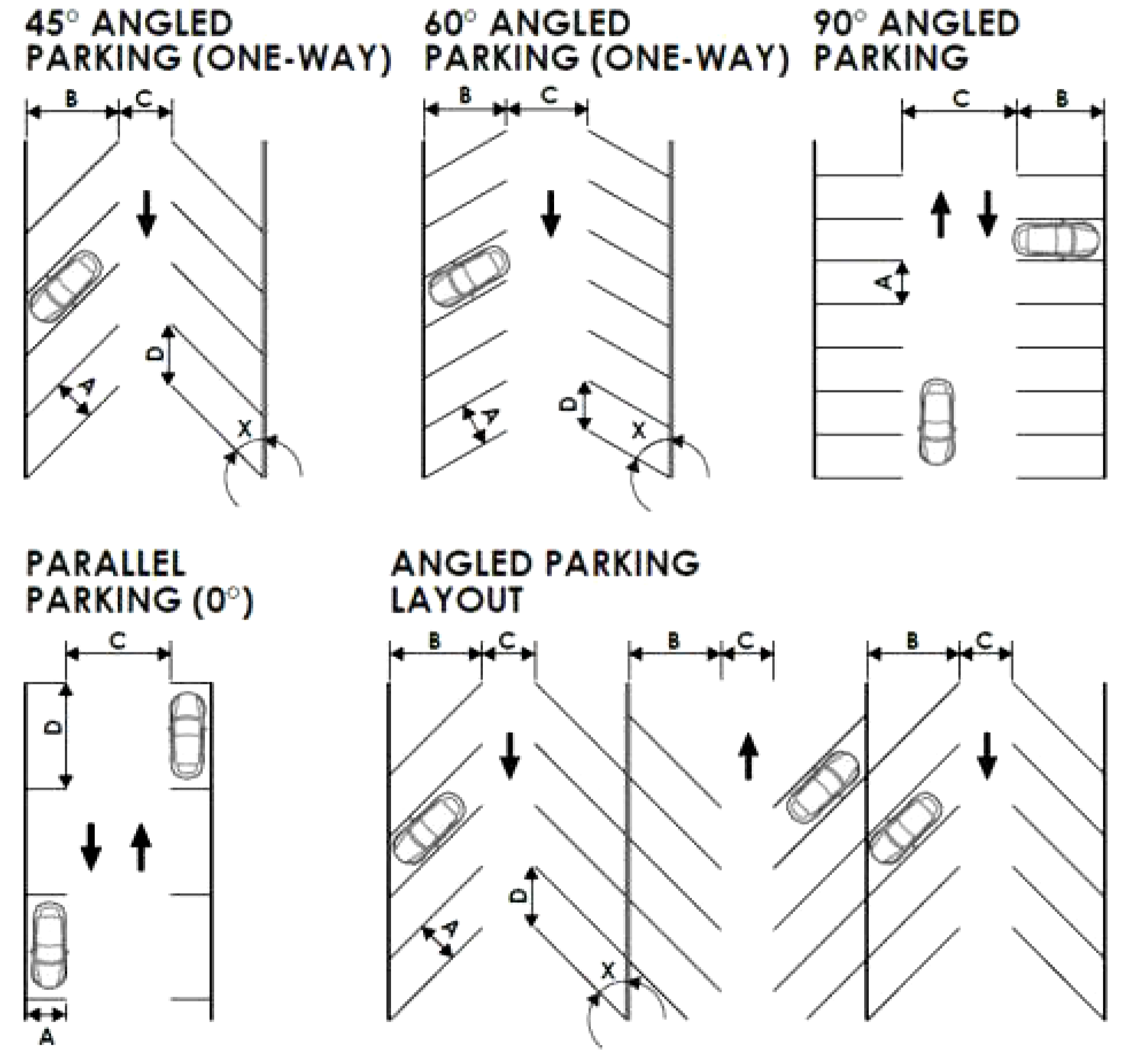
B.
For single-family attached and single-family detached dwelling or duplex uses, the minimum dimensions for off-street parking spaces shall be eight (8) feet by 20 feet, exclusive of right-of-way and alleys. The off-street parking spaces shall be at least as wide as the residential garage door.
C.
Compact car spaces may be used to fulfill a portion of the parking requirements for a non-residential use if they meet the following standards:
1.
The minimum dimensions for the compact car parking space shall be at least eight (8) feet by 16 feet, exclusive of access aisles;
2.
No more than ten percent (10%) of the minimum required parking spaces shall be compact car spaces;
3.
All compact car parking spaces shall be grouped and located in specific areas and not scattered throughout a parking lot or parking structure; and
4.
Each compact car parking space must be designated as "compact car only."
Section VIII.1.7. - Stacking Space Standards
Stacking spaces for operations with drive-thru service shall be provided as follows:
A.
A stacking space shall be eight (8) feet in width by 20 feet in length with one (1) parking space having direct access to a service window or station.
B.
Stacking spaces shall not be part of an access aisle, fire lane or other maneuvering space.
C.
For banks or financial institutions with a drive-through operation, three (3) stacking spaces shall be provided for each station through which service is provided.
D.
For restaurants with a drive-through operation, a minimum of four (4) stacking spaces shall be.
Section VIII.1.8. - Accessible Parking Requirements
All areas of newly designed or newly constructed buildings and facilities required to be accessible under federal and state law shall comply with the standards set forth in the Texas Accessibility Standards, as amended; the Building Code of the City of Lewisville, and the American with Disabilities Act (ADA), all as amended.
Section VIII.1.9. - Electric Vehicle Charging Stations
For all new developments which provide 100 or more parking spaces, five percent (5%) of the parking spaces must include the necessary infrastructure to accommodate the future installation of charging stations for electric vehicles. The necessary infrastructure shall include space to install charging stations, conduit, and electric capacity that is not less than 40-ampere and 208/240-volt terminating in a receptacle or junction box. Charging stations may serve multiple parking spaces.
Section VIII.2.1. - Off-Street Loading Space
A.
Every building or structure or part thereof erected or occupied for a use classified in one (1) of the following use categories in the use tables in Article VII.2.3 shall be required to provided loading space(s) as follows:
1.
Manufacturing and industrial uses - one (1) loading space for each dock door or dock bay.
2.
Warehouse and storage uses - one (1) loading space for each dock door or dock bay.
3.
Retail uses which are larger than 50,000 square feet and have single tenant - one (1) loading space for each dock door or dock bay.
4.
Retail uses which are smaller than 50,000 square feet and have a single tenant - one (1) loading space for a building or structure between 5,000 square feet to 25,000 square feet of gross floor area, or two (2) loading spaces for a building or structure between 25,000 square feet to 49,999 square feet of gross floor area.
5.
Retail uses which have multiple tenants - one (1) loading space for a building or structure between 5,000 square feet to 25,000 square feet of gross floor area, and one (1) additional loading space for each 25,000 square feet, or fraction thereof, of gross floor area in excess of 25,000 square feet.
6.
Service uses - one (1) loading space for a building or structure between 5,000 square feet to 25,000 square feet of gross floor area, and one (1) additional loading space for each 25,000 square feet, or fraction thereof, of gross floor area in excess of 25,000 square feet.
7.
Retail and service uses which are smaller than 5,000 square feet of gross floor area - no loading space required.
B.
The minimum dimensions of a required loading space shall be as follows:
1.
For uses identified in Section A, Subsections 1 through 3, above — 14 feet by 50 feet.
2.
For all other uses listed in Section A above — 14 feet by 25 feet
3.
All loading spaces shall have a minimum vertical clearance of 14 feet.
Section VIII.3.1. - Purpose
The purpose of this Chapter is to establish standards for the installation and maintenance of trees, shrubs and other plant material to improve the aesthetics, welfare and natural environment of the City. The addition of trees and other plant materials help to filter air pollution, reduce energy consumption, reduce impacts of urban heat islands, provide a natural habitat for birds, insects and other animals, increase property values, improve human health, and contribute to a livable community. These standards recognize the value and necessity of water conservation and the use of drought-tolerant plants and trees that are native or adapted to the region's climate, soils and environment.
Section VIII.3.2. - Applicability
The standards of this Chapter shall apply to new development and redevelopment.
Section VIII.3.3. - All Uses
These standards shall apply to all uses.
A.
A landscape plan in accordance with the requirements set forth in Article III.4.3 and III.4.4 shall be submitted for:
1.
All non-residential uses;
2.
Multi-family dwelling uses;
3.
Mixed-use developments; and
4.
Open space in residential subdivisions.
B.
Required landscaping must be maintained in a healthy growing condition at all times. The property owner is responsible for regular weeding, mowing of grass, irrigating, fertilizing, pruning and other maintenance of all landscaping. The property owner shall also replace dead and dying plant materials with comparable plant materials in accordance with the approved landscape plans.
C.
An automatic irrigation system is required for all landscaping and shall meet the requirements in Section VIII.3.3.K, below.
D.
All plant materials and irrigation systems installed in public rights-of-way or on other public property must be approved in writing by the Parks and Recreation Director and City Engineer.
E.
Within required clear vision areas as outlined in Article IX.2.3, no plant materials shall obscure visibility at elevations between two (2) feet and seven (7) feet above the established street grades.
F.
All plant materials shall be native or adapted to the North Texas climate, and appropriate for xeriscaping or other low-water use applications. No invasive species may be utilized. A list of invasive species shall be promulgated by the Parks and Recreation Director and kept in the office of the Planning Director.
G.
Trees and shrubs shall be chosen from the approved plant material lists provided in subsection I, below. An administrative modification may be requested to use other native and adapted species that are comparable to the species in the list.
H.
No more than 30 percent of required trees shall be the same species.
I.
Where a parking lot or access aisle is adjacent to any landscaping, including the permeable areas and drip lines around trees and planting beds used for visual screening, such landscaping shall be protected with curb openings, wheel stops, or similar semi-permeable barriers. See Exhibit VIII.3.3-1.
EXHIBIT VIII.3.3-1 PARKING LOT ISLAND (STANDARD CURB AND INTERMITTENT CURB)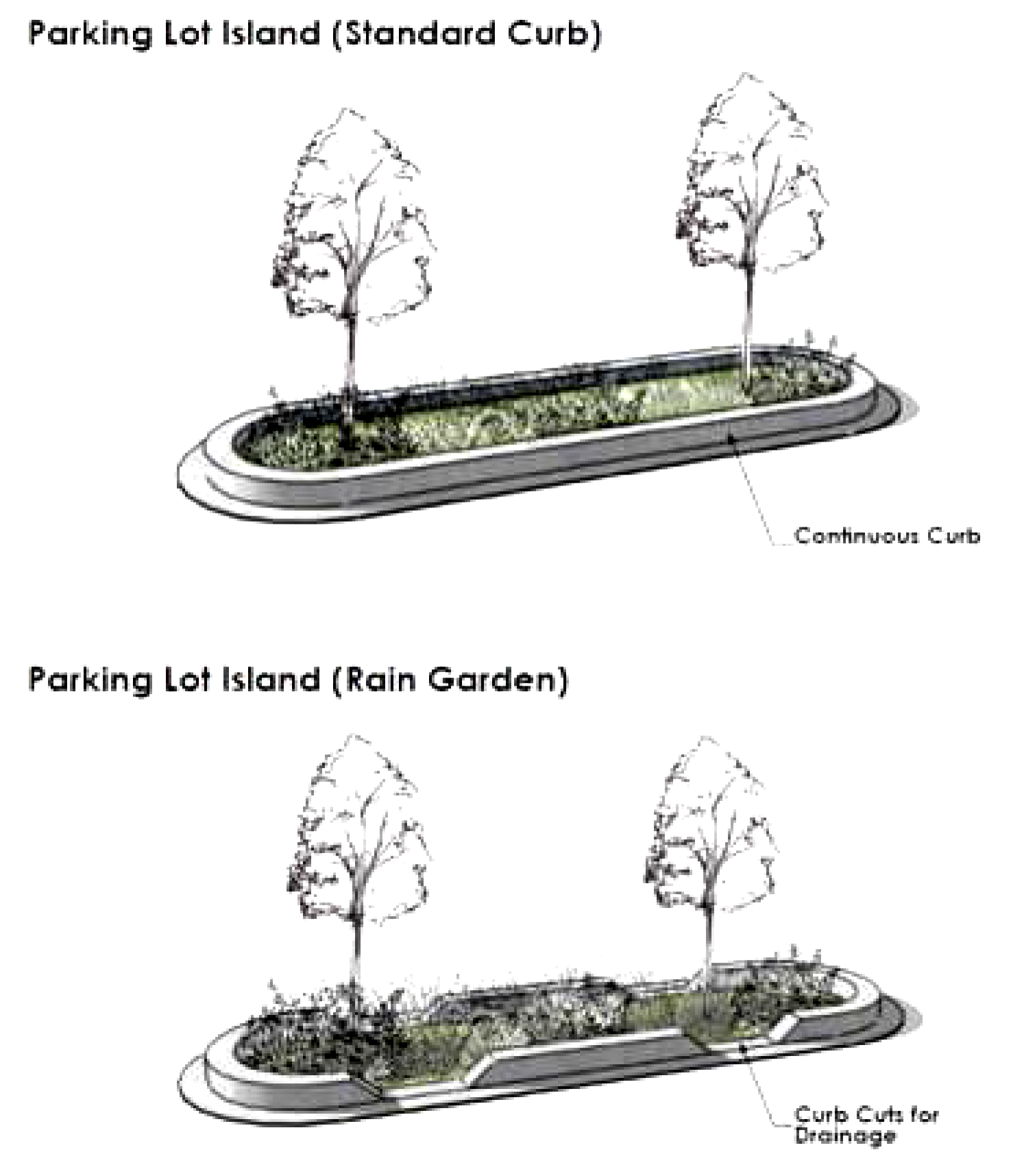
J.
Approved Plant Materials Lists
K.
Irrigation System Standards
1.
Automatic irrigation systems are required for all landscaping with the exception of individual lots for single-family detached and single-family attached dwellings and duplexes.
2.
Automatic irrigation systems required by this Section shall utilize drip irrigation, bubblers, soaker hoses and other systems that do not spray water, except that spray heads may be utilized for turf areas or where spray heads are the best solution for water conservation.
3.
Private irrigation lines and systems may not be located under public street or alley pavement.
(Ord. No. 0717-24-ORD, § 4, 12-9-2024)
Section VIII.3.4. - Non-Residential and Multi-Family Dwelling Uses
These standards shall apply to all non-residential uses and multi-family dwelling uses. Trees required under this Section may be used to meet tree mitigation requirements found in Section VIII.4.8.B.
A.
Landscaping along Rights-of-Way - Except as provided in Subsection 4.B. below, a minimum 30-foot-wide landscape strip shall be provided adjacent to all public and private streets, outside of the right-of-way. See Exhibit VIII.3.3-5.
>EXHIBIT VIII.3.3-5 TYPICAL LANDSCAPE STRIP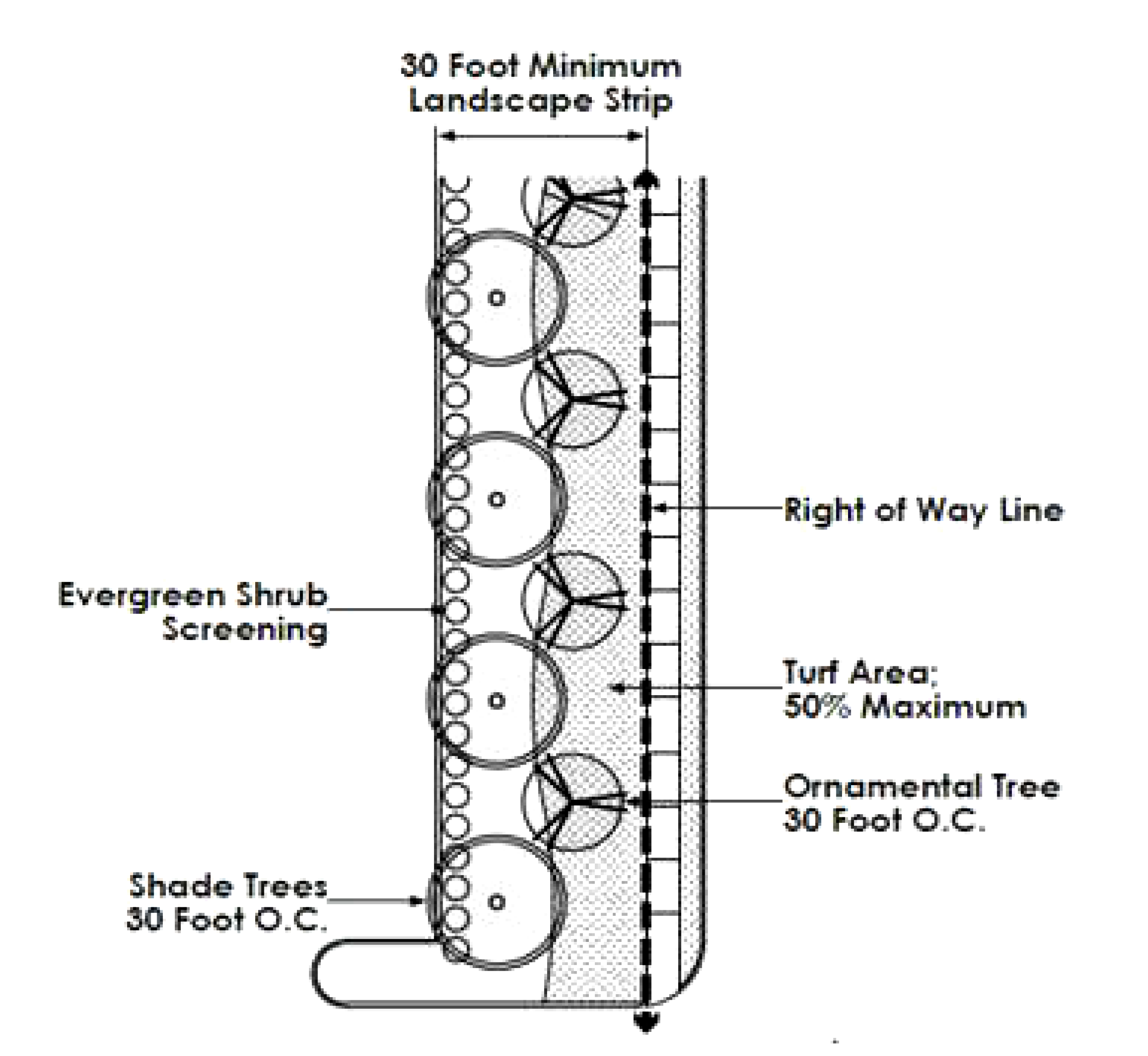
1.
A single row of shade trees (3-inch caliper minimum), spaced 30 feet on-center with a second alternating row of understory trees, spaced 30 feet on-center is required within the landscape strip. All fences must be placed on the interior side of the required landscape strip.
2.
Required landscape strips which abut any parking lot or access aisle shall be protected with intermittent curbs, wheel stops or similar semi-permeable barriers. Continuous curbs may be used if needed for detention or drainage purposes.
3.
An administrative modification may be requested to reduce the width of the required landscape strip to a minimum of ten (10) feet in width when the reduction is required to accommodate water, wastewater, stormwater, electric or franchise facilities.
4.
Any permeable surface within the required landscape strip which is not occupied by trees, shrubs, planting beds, or other allowable fixtures shall be landscaped with turf or other living groundcover.
a.
Turf areas within the required landscape strip shall be limited to 50 percent of the area of the required landscape strip. The remaining area shall be comprised of living groundcover, planting beds, mulched areas under trees or other low-water designs.
b.
Gravel, rock, bark mulch or other similar materials may only be used be used underneath tree canopy and shrubs in a required landscaped strip, except that an administrative modification may be requested to use such materials as part of a xeriscape or low-water landscaping design. Where bark mulch is allowed as a groundcover, it shall be contained with edging material and shall be maintained at a constant depth of four (4) inches.
5.
Where the location of existing overhead utility lines conflict with tree planting requirements within the required landscaping strip, two (2) options are allowed: See Exhibit VIII.3.3-6.
6.
Where easements containing underground utilities conflict with tree planting requirements within the required landscape strip, required tree planting shall be outside the utility easement on the property owner's side and adjacent to the required landscape strip.
7.
Evergreen shrubs, as provided in the list of approved shrub materials in Exhibit VIII.3.3-3. Approved Shrubs, must be provided for screening within the landscape strip. The shrubs must be a minimum of five (5) gallons in size and spaced to provide a solid two-foot (2') tall opaque screen after two (2) years. The screening must extend along the entire public street frontage, exclusive of driveways and clear vision areas. A landscape berm may be provided in lieu of required shrubs. The berm must be a minimum of 36 inches above the average grade of the street and parking lot curbs with a slope not to exceed 3:1. If the landscape strip is a minimum of 50 feet wide, no shrubs or berm for screening will be required.
EXHIBIT VIII.3.3-6 ALTERNATIVE LANDSCAPE STRIP OPTIONS (OVERHEAD INTERFERENCE)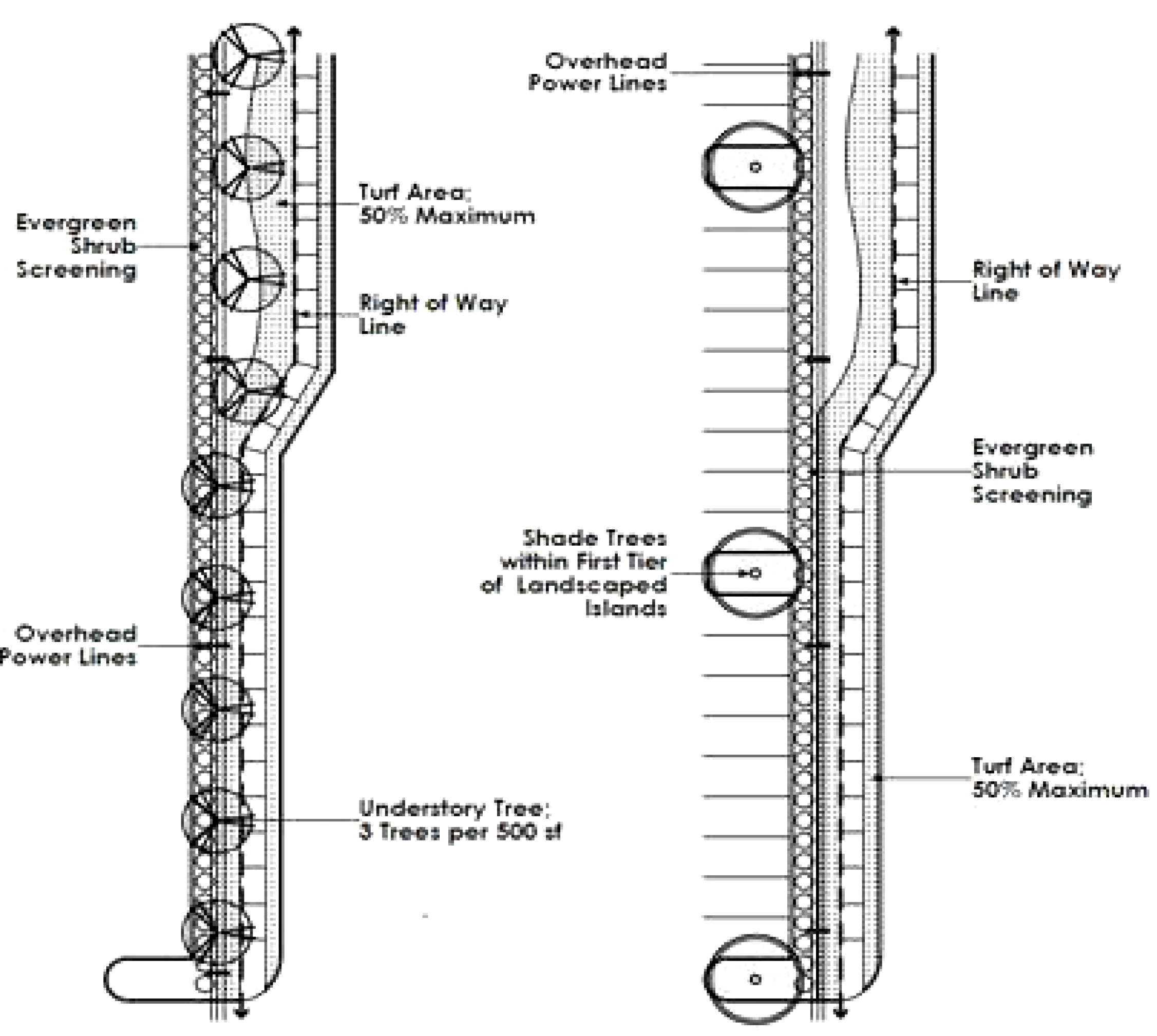
B.
Landscaping Standards - The following standards regarding minimum landscape strip width, required plantings, and required screening shall apply in lieu of those outlined in Section VIII.3.3.A., above. All other standards outlined in Section VIII.3.3.A., above, shall apply. Also see Exhibit VIII.3.3-7.
EXHIBIT VIII.3.3-7 TYPICAL LANDSCAPE STRIP (IF FACADE REQUIREMENTS ARE MET)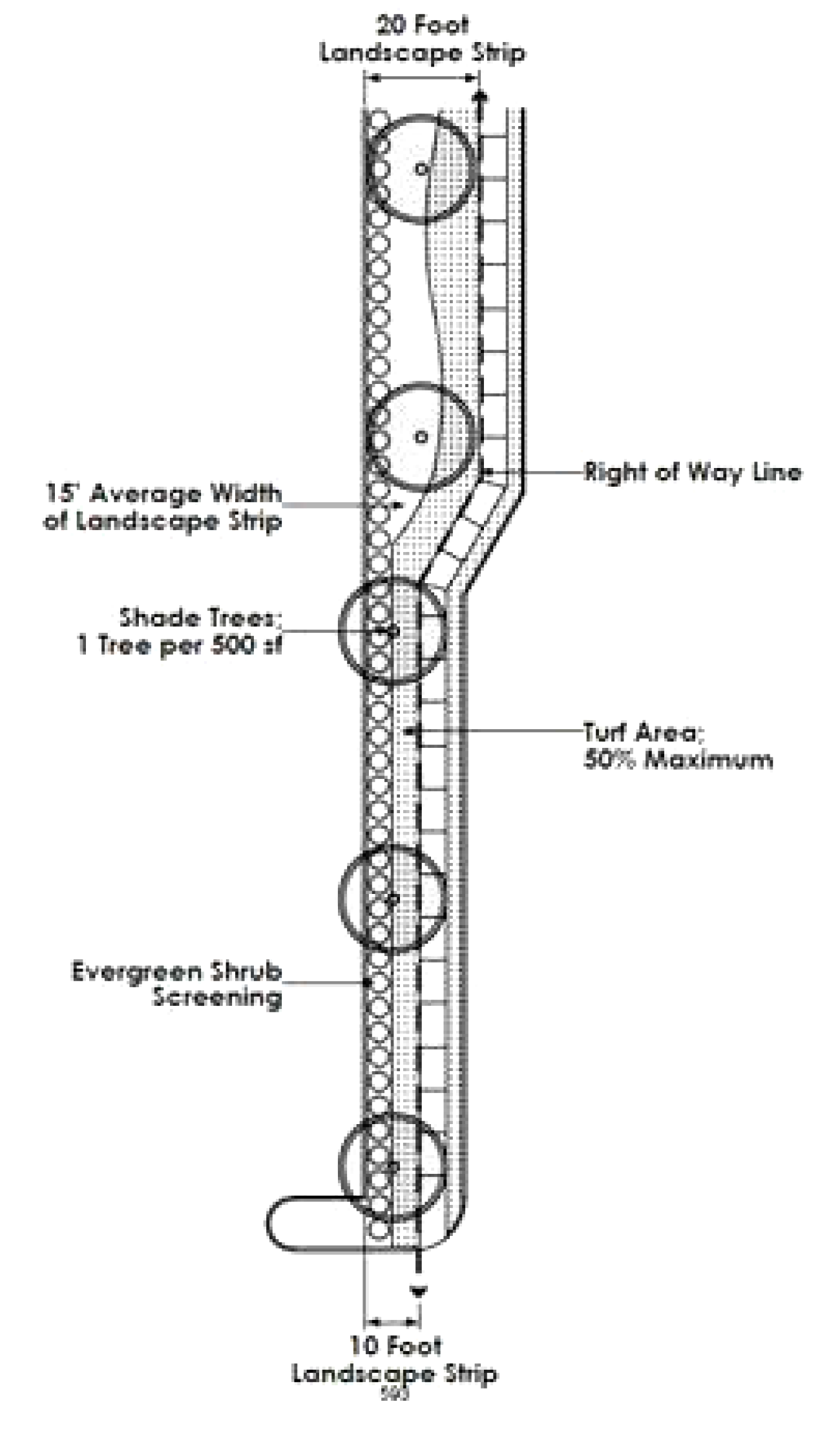
1.
Multi-Family Dwellings - Where the facades of all multi-family dwelling buildings on a building lot consist of not less than 80 percent brick veneer, measured as the aggregate total of all exterior wall elevations (excluding doors and windows) of each building, the following standards shall apply:
a.
Along each frontage, the average width of the required landscape strip shall be a minimum of 15 feet and shall not be less than ten (10) feet at any point.
b.
Within the required landscape strip, one (1) shade tree (three-inch (3") caliper minimum) shall be provided per every 500 square feet of landscape strip, or any fraction thereof. Trees may be planted in clusters not to exceed 80 feet between clusters.
c.
The evergreen shrubs or landscape berm meeting the standards outlined in Section VIII.3.3.A.7 above, shall be required only along parking lots and maneuvering space for vehicles.
d.
Additions to the principal building or structure must match exterior material ratios of the principal building or structure in order to preserve the existing alternative landscaping standards.
e.
The exterior finish of accessory buildings over 200 square feet must match the exterior material ratios of the principal building or structure in order to preserve the existing alternative landscaping standards.
2.
Non-Residential Buildings or Structures in Certain Corridors - For non-residential buildings or structures on a building lot that is within 200 feet of or served by an access aisle or mutual access easement that connects to State Highway 121, State Highway 121 Business, Farm-to-Market 407, Farm-to-Market 3040/Hebron Parkway, Farm-to-Market 544, Farm-to-Market 1171, Interstate Highway 35-East, Valley Ridge Boulevard, MacArthur Boulevard, Corporate Drive or Denton Tap Road, the following standards shall apply:
a.
Buildings or structures of 50,000 square feet of gross floor area or less shall have a minimum required landscape strip width of ten (10) feet with one (1) shade tree provided per 500 square feet of required landscape strip; provided that, the building does not consist of less than 80 percent brick veneer.
b.
Buildings or structures between 50,001—100,000 square feet of gross floor area shall have a minimum required landscaped strip width of 15 feet with two (2) shade or understory trees per 500 square feet of landscaped strip; provided that:
1)
Tilt wall or pre-cast construction is used and the building or structure does not consist of less than 50 percent brick veneer on the front elevation;
2)
Each elevation provides architectural features including reveals, articulations, chamfered edges, etc., so that areas bordered by said features do not exceed 100 square feet in size; and
3)
A minimum of two (2) colors are used on each elevation, and 80 percent of each elevation must utilize natural and/or earth tone colors.
c.
Buildings or structures over 100,000 square feet of gross floor area shall have a minimum required landscape strip width of 15 feet with two (2) shade or understory trees per 500 square feet of landscape strip; provided that:
1)
Tilt wall or pre-cast construction is used and the building or structure does not consist of less than ten percent (10%) brick veneer based on the street-facing elevation but applied anywhere on the building or structure;
2)
Each elevation shall provide architectural features including reveals, articulations, chamfered edges, etc., so that areas bordered by said features do not exceed 100 square feet in size; and
3)
A minimum of two (2) colors must be used on each elevation, and 80 percent of each elevation must utilize natural and/or earth tone colors.
4)
Trees may be planted in clusters not to exceed 80 feet between clusters.
3.
Other Non-Residential Buildings - Non-residential buildings or structures other than those included in subsection 2 above that consist of not less than 80 percent masonry veneer shall have a minimum required landscape strip width of ten (10) feet with one (1) shade tree per 500 square feet of landscaped strip. Trees may be planted in clusters not to exceed 80 feet between clusters.
C.
Parking Lot Landscaping
1.
Parking lots shall be landscaped in accordance with this Section in addition to the required landscape strip provided for in Subsections 3.A. and 3.B., above.
2.
The total area of landscaping within a parking lot shall be a percentage of the total area of the parking lot, in accordance with Exhibit VIII.3.3-8. The total area of the parking lot shall include the square footage of parking spaces, landscape islands, area behind curbs, and all interior access aisles except those with no parking spaces located on either side. Landscaping outside of the parking lot may not be used to meet the landscaping standards for the parking lot. See Exhibit VIII.3.3-9 and Exhibit VIII.3.3-10.
3.
A landscape island is required at the end of all rows of parking spaces and at a ratio of one (1) landscape island for every 15 parking spaces or fraction thereof. Landscape islands must be spaced no more than 15 parking spaces apart and must be a minimum of ten (10) feet by 18 feet in size. Each landscape island must contain one (1) three-inch (3") caliper shade tree, and turf is limited to 50 percent of the area of the landscape island. See Exhibit VIII.3.3-10.
4.
Except for customer and employee parking spaces, this Section does not apply to parking spaces used for vehicle display incidental to uses such as automobile sales and leasing, motorcycle sales, recreational vehicle sales, and similar uses.
5.
The required landscaping for parking lots shall be evenly distributed throughout the parking lot. Where the shape or size of the parking lot, the location of existing trees or other natural constraints require alternate distribution of required landscaping, the owner may apply for an administrative modification allowing a landscape plan with an alternate distribution of required landscaping, though the total required area of landscaping shall not be reduced.
6.
Required landscaping for parking lots shall be designed to function as part of the overall drainage system for the property, as that system is shown in the drainage plan required by Article III.4.3 and III.4.4.
EXHIBIT VIII.3.3-9 INTERIOR PARKING LOT LANDSCAPING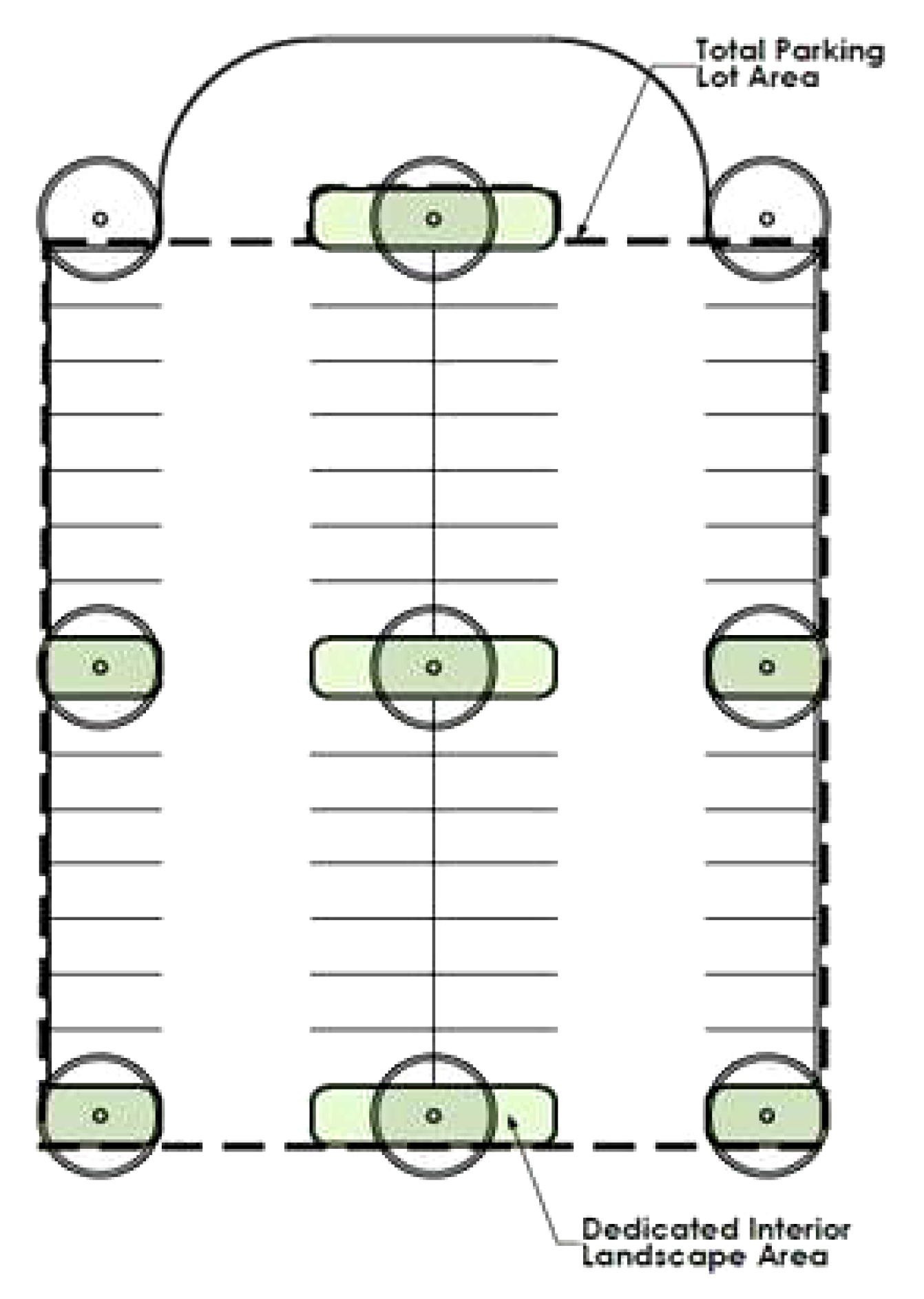
EXHIBIT VIII.3.3-10 PARKING LOT LANDSCAPING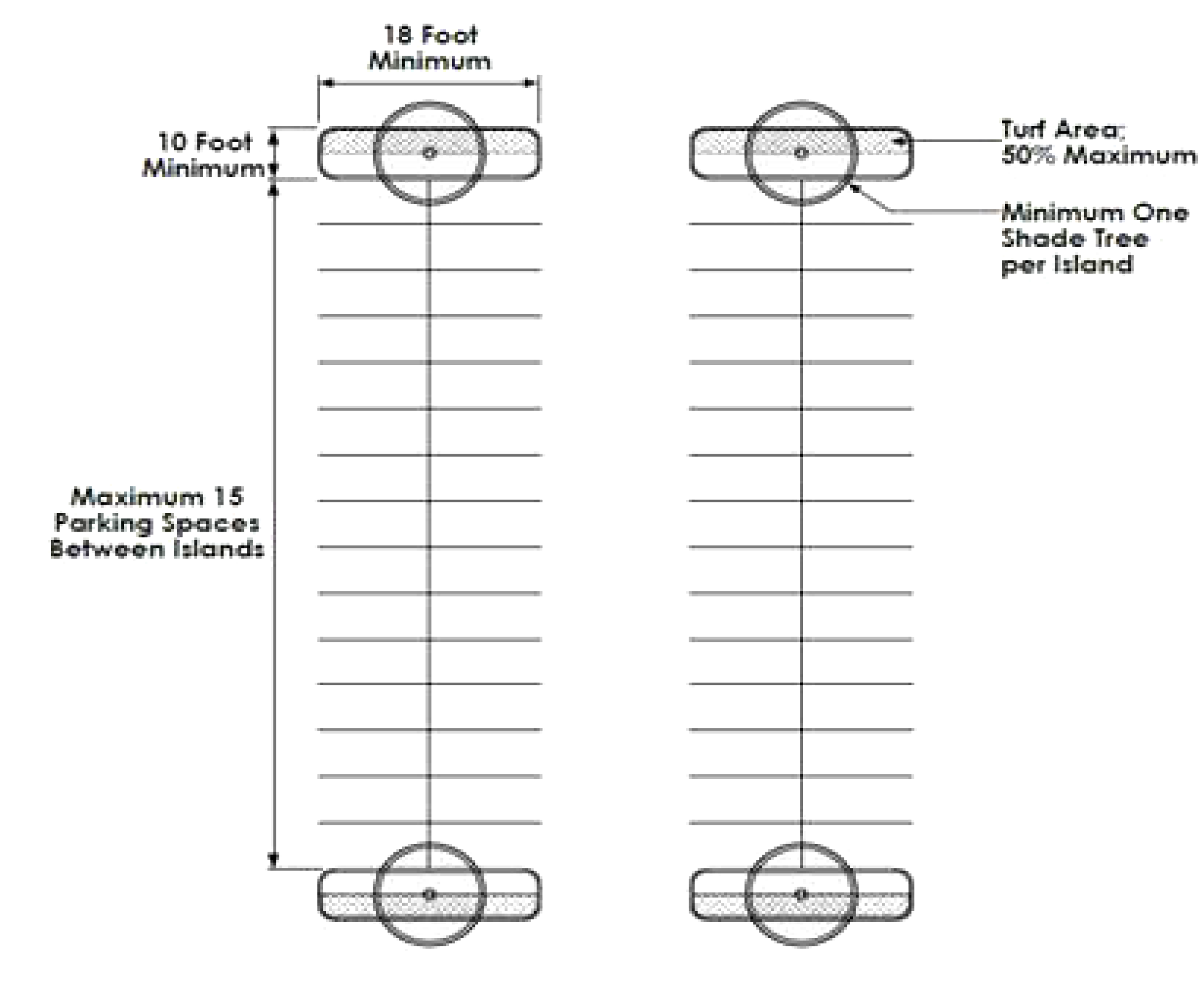
Section VIII.3.5. - Single-Family Residential Uses
A.
These standards shall apply to all single-family detached dwelling, single-family attached dwelling, duplex, and detached units condominium uses in accordance with V.T.C.A. Local Government Code § 211.006.
B.
Trees shall be provided for each lot as follows:
1.
R-12 and R-18 Districts: Two (2) shade trees or one (1) shade tree and two (2) ornamental trees which are at least three-inch (3") caliper in size.
2.
R-5, R-7.5, R-9, and DU Districts: One (1) shade tree which is at least three-inch (3") caliper in size.
3.
ETH, TH, and TH2 Districts: One (1) ornamental tree which is at least eight feet (8') in height at the time of planting.
4.
Condominium detached units, regardless of district: One (1) shade tree at least three-inch (3") caliper in size for each unit.
5.
Exception: Where the required front yard is ten (10) feet or less in depth, ornamental trees may be planted in lieu of shade trees. Where the required front yard is five (5) feet or less in depth, shrubs may be planted in lieu of shade trees.
Section VIII.3.6. - Landscape Strips and Open Space Lots Owned by A Homeowners' Association
A.
A minimum ten-foot-wide landscape strip shall be provided adjacent to all arterial and collector streets where such streets are adjacent to any use listed in Section VIII.3.3 above or along any streets abutting open space. Where a screening wall or fence is required by Article VIII.5.5 the landscape strip shall be located between the screening wall or fence and the streetline.
1.
One (1) tree which is at least three-inch (3") caliper in size shall be planted every 50 linear feet within the required landscape strip. However, tree placement may also be in accordance with Section VIII.4.A.5 and 6 above if those conditions exist.
2.
Turf within the required landscape strip shall be limited to 50 percent of the of the area of the required landscape strip. The remaining area shall be comprised of living groundcover, planting beds, mulched areas under trees, or other drought-tolerant materials.
B.
Any open space lots maintained by the Homeowners' Association must be landscaped with living plant material.
Section VIII.4.1. - Purpose
The purpose of this Article is to preserve, protect and enhance existing trees and the City's natural landscapes to contribute to and improve the overall quality of life, public health and environment. Trees are an integral part of healthy upland habitats as week stream and river corridors. In addition, trees are beneficial in reducing stormwater runoff, improving water quality, recharging groundwater, controlling erosion and dust, abating noise, improving air quality through removal of pollutants and provision of oxygen, sequestering carbon, reducing the urban heat island, reducing building energy costs, enhancing property values, and providing wildlife habitat, including for migratory birds. The natural environment and native tree species shall be preserved to the greatest extent possible during and after development or redevelopment.
Section VIII.4.2. - Applicability
These standards shall apply to all property within the City except for Existing Single-Family Attached, Single-Family Detached Dwellings or Duplexes — If the lot from which the protected tree(s) is being removed is a lot (a) which has a final plat; (b) upon which a single-family attached or single-family detached dwelling or duplex is located; and (c) for which the City has authorized such occupancy
Section VIII.4.3. - Clear-Cutting Prohibited
No clear-cutting of land is allowed.
Section VIII.4.4. - Tree Removal
A.
Protected Trees - Removal of protected trees shall require prior city approval in the form of a tree survey and tree preservation plan or tree removal permit, as provided for herein unless otherwise exempted.
1.
New Development and Redevelopment - Protected trees may be removed as part of new development or redevelopment only in accordance with a tree survey and tree preservation plan, meeting the requirements of this Article which is approved as part of the development plan and platting process.
2.
All Other Protected Tree Removal - A tree removal permit must be approved prior to removal of individual protected trees from properties to which Section VIII.4.4.A.1 does not apply.
B.
Underbrush and Unprotected Trees - An underbrush removal permit is required when access to a property being considered for development is needed to perform soil borings, property boundary surveys, to prepare a tree survey, or similar actions and such access requires the removal of underbrush and unprotected trees.
C.
Exemption - Notwithstanding the requirements of this Article, no permit shall be required for the tree removal activities listed in Section VIII.4.9. below.
Section VIII.4.5. - Tree Removal Permits
A.
An application for a tree removal permit shall be submitted to the Planning Director and shall include:
1.
The number, species, and health of the protected trees to be removed;
2.
The location of each protected tree to be removed;
3.
The size of the land area from which protected trees will be removed; and
4.
The location of floodplain, open drainageways, or creeks, if any, on the property.
B.
In determining whether to grant a tree removal permit, the Planning Director shall take into account whether the tree mitigation requirements outlined in this Article are met.
Section VIII.4.6. - Underbrush Removal Permit
A.
An underbrush removal permit shall be submitted to the Planning Director and shall include:
1.
The land area of the site;
2.
The area that will be impacted by underbrush and unprotected tree removal activities; and
3.
The location of floodplain, open drainageway, or creeks, if any, on the property.
B.
In determining whether to grant an under brush removal permit, the Planning Director shall take into account any engineering site plans in review or approved, the density of the foliage, proximity to floodplains and drainage ways, requirements of other departments, such as a Storm Water Pollution Protection Plan, and past actions of the applicant in adhering to tree removal requirements.
Section VIII.4.7. - Tree Survey and Tree Preservation Plan
A.
Tree Survey and Tree Preservation Plan Not Required - For properties with no trees, the applicant shall indicate such on the concept plan or engineering site plan, but no tree survey or tree preservation plan is required.
B.
Tree Survey and Tree Preservation Plan Required
1.
Tree surveys and tree preservation plans must be prepared by a civil engineer, certified arborist, landscape architect, or surveyor.
2.
The following information is required for tree surveys and tree preservation plans, but city staff may require additional information as deemed necessary:
a.
Tree survey - The exact location, size, condition and common name of each tree that is eight (8) inches DBH and larger. Trees within rights-of-way and other city easements do not have to be shown. If an area is to be left in its natural state and undisturbed during and after construction, the area may be designated as such on the tree survey, and individual identification of protected trees within the area is not required.
b.
Tree preservation plan - The exact location of all trees, whether each tree is to be preserved or removed, and the methods by which the trees will be protected during construction.
C.
Tree Survey Not Required/Tree Preservation Plan Required - If a property has ten (10) or fewer trees, the DBH and species may be shown on the concept plan or engineering site plan and supplemented with an aerial image instead of a tree survey. A tree preservation plan is required.
Section VIII.4.8. - Mitigation Required
The removal, or damage or destruction during construction, of protected trees requires mitigation in the form of either replacement of the protected trees or payment of a tree mitigation fee in lieu of the replacement of the protected trees as outlined herein.
Section VIII.4.9. - Exemptions
Mitigation shall not be required in the following circumstances, though tree removal permit or tree preservation plan requirements still apply:
A.
Public Utilities - In any existing right-of-way or easement dedicated to a public entity. Mitigation is required for trees in any newly required easements.
B.
When Required by City - If the City requires removal of a protected tree(s).
C.
Removal by Franchised Utility - In addition to rights granted by any applicable easement, utility companies franchised by the City may remove protected trees during or following a period of an emergency that are determined by the company to be a danger to public safety and welfare by interfering with utility service.
D.
Dead or Diseased Trees - If the City approves a tree survey and report from a certified arborist showing that the protected trees proposed to be removed are already dead, dying, or fatally diseased. The City can request any other information deemed necessary to prove the protected trees are dead, dying, or fatally diseased.
E.
As Required by Law - As required by V.T.C.A., Local Government Code § 212.905(h).
Section VIII.4.10. - Replacement of Protected Trees and Credits for Preserved Trees
A.
Protected trees, if removed, or damaged or destroyed during construction, shall be replaced with replacement trees at a one-to-one (1:1) ratio of caliper inch measured at DBH. All replacement trees shall be at least three (3) inches DBH. Replacement trees shall be shade trees from the approved list in Article VIII.3.3 or alternatives approved by the Planning Director. Trees required for landscape strips and landscaping in parking lots as required by Article VIII.3, may count towards the tree replacement requirement outlined herein.
B.
If the Planning Director determines that physical limitations of the property from which the protected trees are removed are such that replacement trees cannot be located on the property, the developer shall be required to plant replacement trees on property mutually agreed to with the City or pay a tree mitigation fee, as provided for in Section VIII.4.11, below.
C.
Tree Preservation Credits - For every tree in healthy, thriving condition that is preserved, tree preservation credits shall be given as shown in Exhibit VIII.4.10-1 below. Tree preservation credits may be used to offset the required replacement of protected trees required herein.
Section VIII.4.11. - Tree Mitigation Fee
A.
The developer shall pay a tree mitigation fee, as set forth in the adopted fee schedule in Volume 1, Chapter 2.VIII.201 of the Code of Ordinances, in lieu of the replacement of protected trees if replacement trees cannot be planted on the subject property or on other property mutually agreed to with the City.
B.
The tree mitigation fee shall be administered as required by V.T.C.A., Local Government Code § 212.905, as amended.
1.
The applicant may apply for a tree mitigation credit against the tree mitigation fee, through planting replacement trees as set forth in Section VIII.4.8 above.
2.
To qualify for a tree mitigation credit, a replacement tree must be planted on the property for which the tree mitigation fee was assessed or on other property mutually agreed to with the City.
C.
Payment of the tree mitigation fee is due as follows:
1.
New Development and Redevelopment
a.
Protected trees approved for removal - prior to release of a project for construction
b.
Protected trees damaged or destroyed during construction - prior to acceptance of the project by the City.
2.
All Other Protected Tree Removal
a.
Prior to issuance of a tree removal permit
b.
Under any other circumstance - Immediately upon notice by the City.
D.
Tree mitigation fees shall be designated to a tree mitigation fund dedicated to the replacement of protected trees and urban forestry management.
E.
If the developer chooses, they may have a certified arborist conduct an appraisal of some or all trees to be removed using the Guide for Plant Appraisal published by the Council of Tree & Landscape Appraisers. The mitigation fee for those trees would then be equivalent to the appraised replacement value of the tree and not based on the fee schedule in Chapter 2.VIII.201.
Section VIII.4.12. - New Development or Redevelopment of Single-Family Detached and Single-Family Attached Dwellings, Duplex, and Condominium Detached Units
A.
All protected trees must be preserved or mitigated.
B.
In order to facilitate preservation of trees, the City shall allow:
1.
Individual lots to be smaller than allowed by the zoning district; provided that, the average lot size for the subdivision meets or exceeds that which is required by the zoning district.
2.
For lots that contain protected trees which have been preserved, a reduction of five (5) feet in the required front and rear yards from that required by the zoning district, provided 20 feet is maintained in front of a front entry garage.
Section VIII.4.13. - Multi-Family and Non-Residential Developments
A.
All protected trees must be preserved or mitigated.
B.
For every protected tree in healthy, thriving condition that is preserved, the City shall allow:
1.
For proposed parking lots that contain protected trees, a reduction in the number of required parking spaces by one (1) parking space for every protected tree which is preserved within the area of the proposed parking lot, up to a maximum of 20 percent of the total required parking spaces.
2.
For lots that contain protected trees, a reduction of up to ten (10) feet in the required front and rear yards from that required by the zoning district.
Section VIII.4.14. - Tree Protection Measures During Construction
A.
For new development or redevelopment, developers shall, at minimum, adhere to the following tree protection measures on all construction sites:
B.
Prior to grading or construction, the developer shall:
1.
Clearly mark all protected trees to be preserved;
2.
Erect protective fencing a minimum of four (4) feet in height around each protected tree or group of protected trees to be preserved in order to prevent the placement of debris or fill or parking of equipment or vehicles under the canopy of the trees to be preserved, which must be maintained at all times during construction; and
3.
Cause a third-party inspection to be conducted verifying on-site compliance with the approved tree preservation plan, the results of which must be submitted to and approved by the City. The third party inspection may be conducted by the party that prepared the tree survey and mitigation plan.
C.
During construction:
1.
Cleaning, parking or storage of equipment, materials, and vehicles and disposing of any waste material, solvents, concrete, mortar, or similar products is prohibited within the dripline of any protected tree or group of protected trees to be preserved.
2.
Fill or excavation is prohibited within the dripline of a protected tree or group of protected trees to be preserved, unless retaining walls to preserve trees is approved on the tree preservation plan. Major changes of grade will require additional measures to maintain proper oxygen and water exchange with the roots.
3.
Boring shall be used to install utilities within the dripline of a protected tree or group of protected trees to be preserved.
Section VIII.5.1. - Purpose
This Chapter provides for visual screening as a transition between land uses of different character and to minimize noise, glare, light, litter and other potential nuisances. Screening required in this Chapter is intended to improve the appearance of development and provide an attractive streetscape.
Section VIII.5.2. - Types of Screening
A.
Screening types and composition are described below in Exhibit VIII.5.2-1
B.
Living screens shall be irrigated and utilize native or adapted plant species that are drought tolerant, from the approved plant in Exhibit VIII.3.3-3 list marked as evergreen or other species as may be approved by the Parks and Recreation Director. Shrubs shall be a minimum of four (4) feet in height at planting and shall achieve a height of six (6) feet in two (2) years (for a required six (6) foot tall living screen) or eight (8) feet in three (3) years (for an eight-foot (8') tall living screen). The property owner and/or developer shall furnish all labor, materials, equipment, accessories, meters, irrigation and services necessary to install, maintain, and replace all plant materials when and if they become damaged or die.
Section VIII.5.3. - Screening Between Different Zoning Districts, Uses, or Use Categories
EXHIBIT VIII.5.3-1 SCREENING REQUIRED BETWEEN DIFFERENT ZONING DISTRICTS, USES, OR
USE CATEGORIES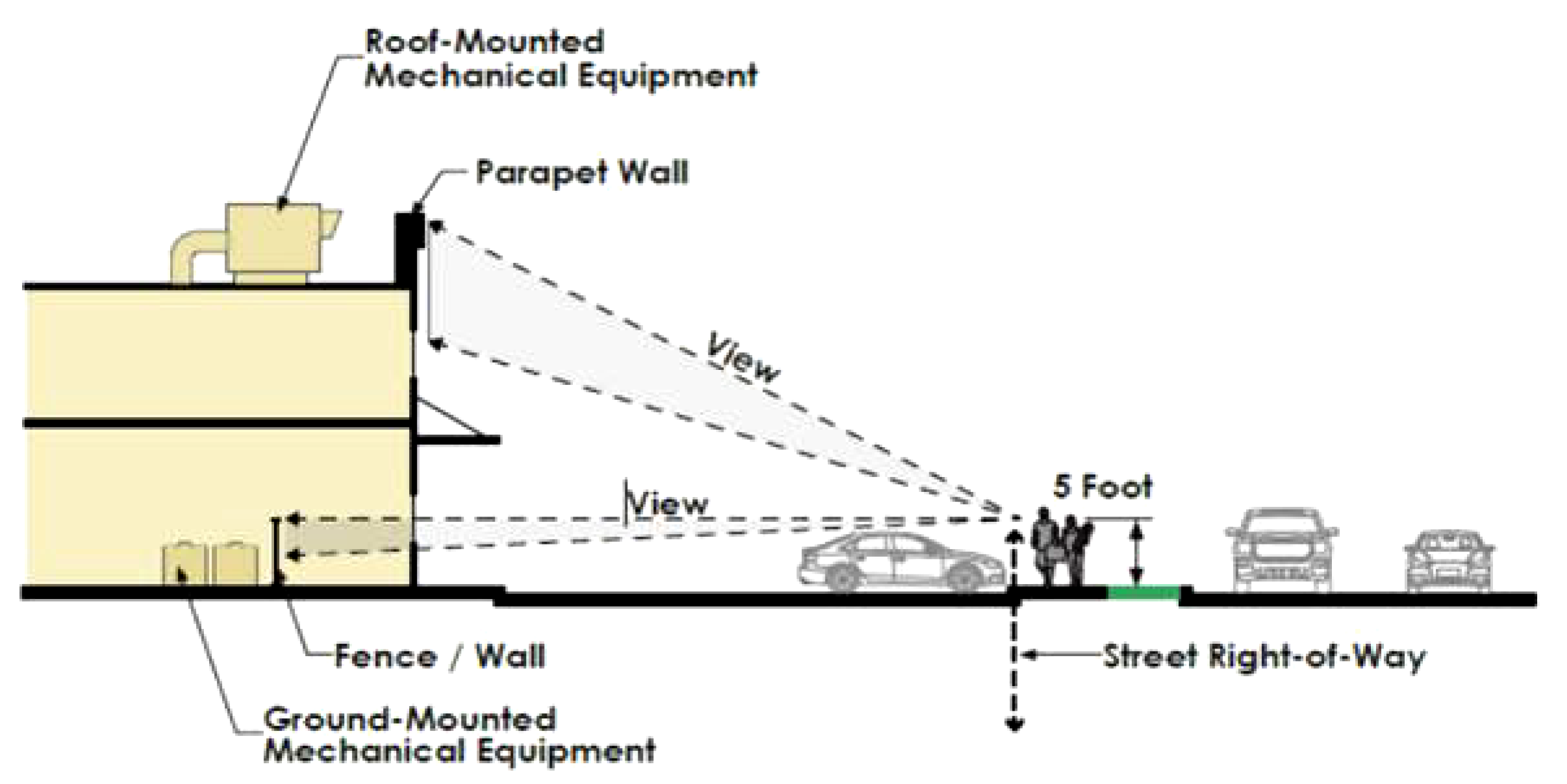
A.
Screening is required between the following zoning districts, uses, or use categories:
B.
Responsibility for Construction and Maintenance - Where development or redevelopment triggers screening as required in Exhibit VIII.5.3-1, the owner or developer of the development or redevelopment shall be responsible for constructing and maintaining, or causing to be constructed or maintained, said screening.
Section VIII.5.4. - Screening of Ground-Mounted and Roof-Mounted Equipment
A.
Roof-mounted equipment shall be screened from a viewpoint measured at five (5) feet above grade at the street line along all right-of-way frontages by a parapet wall or similar feature that is an integral part of the building or structure. See Exhibit VIII.5.3-1.
B.
Ground-mounted equipment shall be screened from view along all right-of-way frontages by a living screen, a wrought iron or tubular steel fence, or screening wall that is compatible with the architecture, materials, and landscaping of the site. The screening shall be of a height equal to or greater than the height of the ground-mounted equipment being screened. See Exhibit VIII.5.3-1.
Section VIII.5.5. - Screening Residential Adjacent to Thoroughfares
All new subdivisions for single-family detached, two-family and single-family attached lots which back or side to thoroughfares, as identified on the Thoroughfare Plan, shall provide screening from the thoroughfare. Screening is also required where an alley is parallel to and adjacent to a thoroughfare. Screening shall meet the following requirements:
A.
Screening Options - Developers may choose from Types 1—4 as described in Section VIII.5.2. above, and meet the requirements of this Section for wall materials and Chapter 3 of this Article for landscaping installation. See Exhibit VIII.5.4-1 for landscaped edge placement.
EXHIBIT VIII.5.4-1 LANDSCAPED EDGE PLACEMENT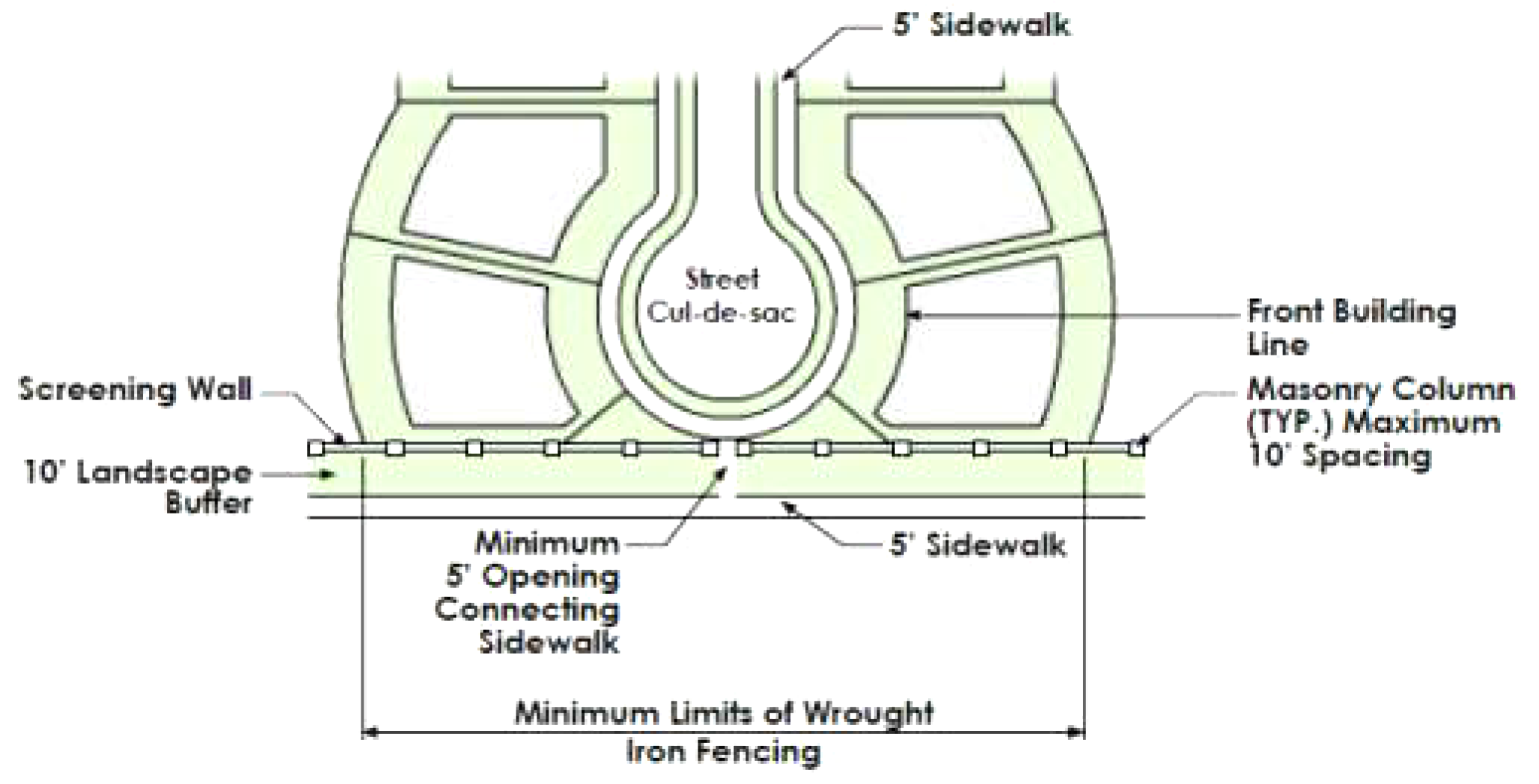
B.
Screening Placement
1.
Walls - Walls shall be placed on the property line of lots backing or siding to a street. A four-foot (4') wide easement shall be provided along the length of the wall for city maintenance.
a.
Adjacent to An Alley — Where an alley is parallel to and adjacent to the street, the wall shall be placed where the alley right-of-way meets the street right-of-way, as shown in Exhibit IX.2.3-22.
b.
Adjacent to Lots that Side to Thoroughfare - Where single-family lots side to a thoroughfare, a combination of a wall and tubular steel type fence may be installed if the tubular steel type fence does not exceed 40 percent of the surface of the wall. The tubular steel type fence shall not extend beyond the front yard setback as shown in Exhibit VIII.4-1, and where a cul-de-sac extends to the thoroughfare a five-foot (5') wide opening in the fence is required for pedestrian access, as shown in c.
2.
Landscaping and Living Screens as part of required screening under this Section VIII.5.5 shall be located in lots designated to be open spaces and owned and maintained by a homeowners' association.
C.
Maintenance Fee - The developer shall pay a screening wall maintenance fee as required by Volume 1, Chapter 2.VIII.201 of the Code of Ordinances (Fee Schedule) for Type 1 and Type 2 screening walls to supplement future maintenance costs.
Section VIII.5.6. - Administrative Modifications for Screening
The Planning Director may approve an administrative modification to the requirements of this Article that is being requested for one (1) of the following reasons:
A.
To accommodate a site-specific condition related to screening, including topography, existing vegetation, or other factors specific to the individual property. The Planning Director may approve the installation of either a living screen with irrigation or a wrought iron or tubular steel fence with masonry columns and a living screen with irrigation. Such living screens with irrigation shall meet the requirements contained in Section VIII.5.2.B above.
B.
To accommodate a site-specific condition related to ground-mounted or roof-mounted equipment. The Planning Director may approve other methods to reduce the visual impact of the equipment including increased required yards, additional landscaping, grouping of equipment on the property and painting or otherwise camouflaging the equipment.
C.
To allow existing screening devices on a property to remain in place as an alternative to the requirements of this Article. The Planning Director shall consider the condition and effectiveness of existing screening and its expected longevity and the compatibility of the specific uses in question and their potential to be reoccupied over time.
Section VIII.6.1. - Purpose
The purpose of these regulations is to allow privacy and demarcation of space, promote public safety, preserve neighborhood character, promote aesthetics, and to preserve property values. These standards shall apply to all fences except screening walls. Where the requirements of this Chapter and Screening, conflict, Chapter VIII.5 shall control.
Section VIII.6.2. - Procedures
A.
Permit required - A permit issued by the Building Services Department is required to erect, construct, enlarge, alter, repair, or replace any fence regulated by this Article except as provided herein. Permits and stamped approved plans must be kept on the job site.
1.
A fence permit shall not be required if it is determined by the Building Official that only minor repair up to replacement of ten percent (10%) of the fence or painting is necessary.
2.
The applicant shall file an application with the Building Services Department including at a minimum the following information, along with all fees as required by the fee schedule in Volume 1, Chapter 2.VIII.2-201 of the Code of Ordinances:
a.
Building or structure locations, area to be fenced, and location of the fence;
b.
Legal description or survey of the property upon which the fence will be erected, or a copy of the plat and an aerial photo showing the property line;
c.
Height of fence and type of materials to be used;
d.
Intersections of any rights-of-way, alleys and driveways;
e.
Zoning district of the property upon which the fence will be erected;
f.
Easements impacting the property upon which the fence will be erected; and
g.
Clear zone, when required, shall be shown.
B.
Inspections - A final inspection is required for all fences that require a fence permit and must be scheduled upon completion of the work authorized by the permit. The permit and inspection process shall be established by the Building Official.
C.
Expiration and revocation
1.
The permit shall expire if the authorized work is not begun within 180 days from the date of the issuance of the fence permit. A new fence application and permit is required if the original permit expires.
2.
The Building Official may, in writing, suspend or revoke a fence permit whenever the fence permit is issued:
a.
In error;
b.
On the basis of incorrect information; or
c.
In violation of any ordinance of the City, including this UDC.
Section VIII.6.3. - General Requirements
The following requirements shall apply to all fences except as otherwise specified.
A.
Clear Zones - When applicable, fences shall conform to the clear zone requirements shown in Exhibit VIII.6.3-1 and Exhibit VIII.6.3-2 below. Clear zones shall be provided for driveways on adjacent lots. An additional clear zone may be required by the City Engineer.
B.
Location
1.
No fence or portion thereof shall be constructed upon or extend over property that the City has control over, owns or has an easement over or under, except upon utility easements if written permission is granted by all users or upon, except that fence may cross utility easements perpendicular to the easement.
2.
No public drainage easement shall be fenced or obstructed in any manner if the drainage is above ground. Fences shall be allowed to be erected within private drainage easements provided that the materials used are chain link, tubular steel or board on board with open slat spacing. Such fencing shall be constructed to avoid backflow of water within the private drainage easement.
EXHIBIT VIII.6.3-1. ILLUSTRATED CLEAR VISION AREAS FOR FENCES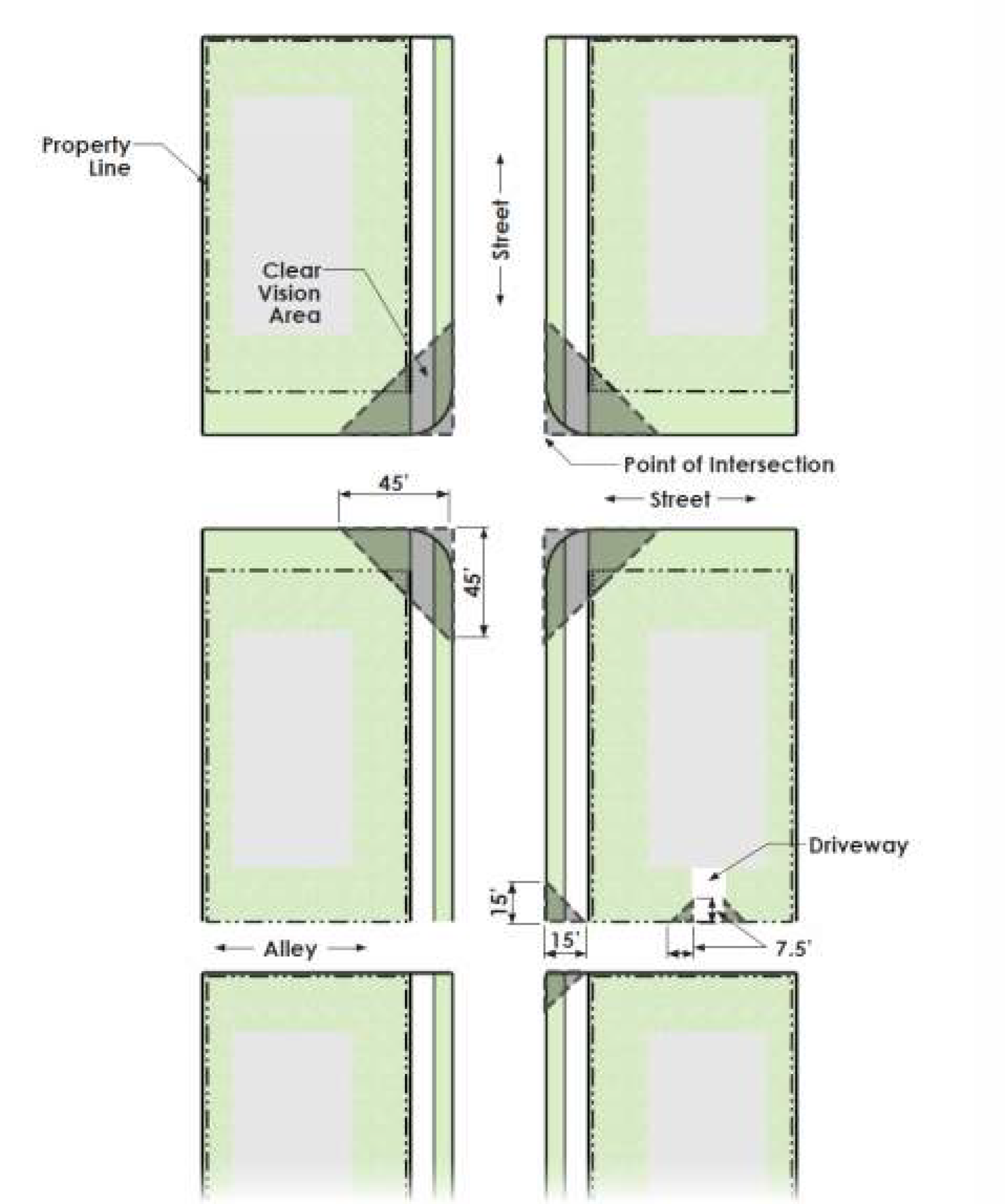
3.
Along public sidewalks, walkways, and trails, fences shall be set back at least two (2) feet from the sidewalk, walkway, or trail pavement. See Exhibit VIII.6.3-4.
4.
No fence shall be constructed on vacant or undeveloped property unless zoned Agricultural - Open Space District and used for agriculture, farming, or ranching uses.
C.
Height - No fence shall exceed eight (8) feet in height measured from the finished grade of the property upon which the fence is erected except as otherwise provided for in this Article.
D.
Materials
1.
A fence shall not be constructed of:
a.
Rope, string, or wire products including chicken wire, hog wire, barbed wire (except as permitted by Sections 4.C and 4.D below) wire fabric, razor ribbon wire and similar welded or woven wire fabrics, chain, netting;
b.
Cut or broken glass, paper, metal panels, corrugated metal panels, galvanized sheet metal, plywood, fiberglass panels or plastic panels;
c.
Used, damaged or unsafe materials, except the Building Official may determine that used materials meet the requirements of the building code for new materials; or
d.
Any other materials that are not manufactured specifically as fencing materials. The Building Official may require the applicant to provide the manufacturer's standards to establish the intended use of a proposed fencing material.
2.
No material, including metal, fiberglass, or bamboo, may be woven or used as slats through a chain link fence.
E.
Gates and Access
1.
Fences shall have a minimum of one (1) gate at least three (3) feet in width.
2.
Any gate over six (6) feet in width shall require a driveway approach approved by the City Engineer that conforms with all applicable requirements Article IX. A gate on a fence located on commercial, mixed use or multi-family developments shall provide a minimum 40 feet of space to allow stacking outside of the gate before a public right-of-way. This distance may be reduced by the City Engineer as an administrative modification based on the standards in Article IV.3.9.
3.
Where a fence is constructed adjacent to or clocking a city easement, a gate shall be required, where necessary to ensure access to said easement.
F.
Maintenance - The owner of the property upon which the fence is erected shall be responsible for maintaining fences as follows:
1.
In a safe and stable condition;
2.
Free from rotting wood, missing pieces, and faded or peeling paint or stain;
3.
Free from graffiti, which shall be removed immediately upon notification; and
4.
With all gates, locks, hinges or other appurtenances in an operable condition.
Section VIII.6.4. - Additional Standards
A.
Single-Family Detached and Single-Family Attached Dwellings and Duplexes - These standards apply to all single-family attached and single family detached dwellings and duplexes.
1.
Front Yards
a.
In the area of the front yard between the closest elevation of the building to the property line and the property line, but no less than ten (10) feet from the property line, as shown in Exhibit VIII.6.4-1, a fence shall not exceed three and one-half (3.5) feet in height and shall be a minimum of 50 percent open, meaning for the elevation of the fence at least 50 percent is free from building materials to allow air and light to pass freely, such as split rail, ornamental metal or picket style fences.
b.
In the area between the front building façade and the street, outside of the area described in subsection a above, a fence shall not exceed six (6) feet in height and shall be a minimum of 50 percent open, such as ornamental metal.
2.
Allowable Materials
a.
Wood, metal tubing, wrought iron, masonry, and vinyl or fiberglass composite materials if said materials are listed, designed and constructed for fencing materials.
b.
Chain link in rear and side yards but not along any public or private street, alley, or any portion of the front yard.
B.
Multi-Family and Non-Residential Uses, except Agricultural Uses - These standards apply to all multi-family and non-residential uses, except agricultural, farming, and ranching uses.
1.
Height and Location
a.
Fences in the front yard shall be a minimum of 50 percent open and constructed of tubular steel.
b.
Fences shall be placed behind the required landscape strip or at least ten (10) feet back from the street line, whichever places the fence further from the street line.
2.
Allowable Materials - Wood, metal tubing, wrought iron, masonry, chain link, and vinyl or fiberglass composite materials if said material are listed, designed and constructed for fencing materials.
C.
Manufacturing and Industrial Uses Use Category - Fences six (6) feet or greater in height on properties with uses outlined in the manufacturing and industrial use category may be constructed with angle arms at the top with barbed wire. Such arms shall not extend beyond the boundaries of the property upon which the fence is erected.
D.
Agricultural, Farming, and Ranching Uses - These standards apply to agricultural, farming, and ranching uses.
1.
Height and Location
a.
Fences shall be a minimum of 50 percent open.
b.
Fencing for the area which serves as a yard for a residence located on the property shall comply with applicable standards in Section VIII.6.4.A above. The applicant shall show on the permit the extend of the area used for the residence and not for agricultural purposes and provide information identifying the area for the front, side and rear yards.
2.
Allowable Materials - Wood, metal tubing, wrought iron, barbed wire, masonry, chain link, and vinyl or fiberglass composite materials if said material are listed, designed, and constructed for fencing materials.
E.
Fences Surrounding Swimming Pools
1.
Single-Family Detached and Single-Family Attached Dwellings and Duplexes with swimming polls shall have fences in compliance with the adopted building codes.
2.
Multi-Family and Non-Residential Uses
a.
All swimming pools shall have a minimum six-foot (6') tall fence or enclosure around the entire pool measured on the side of the fence which faces away from the swimming pool.
b.
This fence shall comply with all conditions required by this Article and the currently adopted Building Code.
Section VIII.7.1. - Purpose
These standards are intended to ensure adequate exterior lighting to provide safety at night while limiting its negative impacts.
Section VIII.7.2. - Applicability
These standards apply to all non-residential and multi-family dwelling uses.
Section VIII.7.3. - Exemptions
This Article does not apply to:
A.
Single-family attached or single-family detached or duplex uses, except where lighting is required by Section VIII.7.7. below for pedestrian pass-throughs.
B.
Public rights-of-way and public parks and playgrounds;
C.
Lighting required by the Federal Aviation Administration or the Federal Communications Commission; and
Section VIII.7.4. - Minimum Lighting Levels
Light levels shall not be less than 0.5-foot candles in areas utilized for travel, parking, biking, or walking.
Section VIII.7.5. - Maximum Lighting Levels
Light levels shall not exceed 20-foot candles on any property occupied by a non-residential use, with the following exceptions:
A.
Canopies or awnings as part of a gasoline service station use - Light levels shall not exceed 30-foot candles.
B.
Automobile sales and leasing use - Light levels shall not exceed 30-foot candles.
Section VIII.7.6. - Light Spillover
Light spillover shall not exceed 0.2-foot candles at any property line adjacent to a residential use as designated in Article VII.2.3.
Section VIII.7.7. - Pedestrian Lighting
A.
The lighting level for areas used for walking, including areas that are internal or immediately adjacent to non-residential and multi-family dwelling uses, may be achieved as follows:
1.
Through light fixtures installed in parking lots or on buildings or structures;
2.
Through bollard lights or light standards no taller than 15 feet.
B.
Where pedestrian pass-throughs are required mid-block or at the end of culs-de-sac in accordance with Section IX.2.2.B.2.c and Section IX.2.3.D.1.d, the requirements of Subsection 7.A above shall apply.
Section VIII.7.8. - Maximum Height for Light Fixtures in Parking Lots
Light fixtures in parking lots shall not exceed 30 feet in height.
Section VIII.7.9. - Building or Structure Lighting
A.
Wall packs must have a cutoff angle to eliminate glare from beyond the property line.
B.
LED Lighting
1.
LED strip lighting, LED module lighting, or rope lighting shall not be used to outline any of the following:
a.
Windows or doors;
b.
An individual occupancy of a multi-tenant building; or
c.
Any architectural feature of a building other than the roofline of an entire building.
Section VIII.7.10. - Light Fixture Design Requirements
A.
Full cut-off fixtures are required on all outdoor lighting including parking structures with open sides and the top level of parking structures except as otherwise provided herein.
B.
Landscape and architectural lighting must use full cut-off fixtures or directionally shielded luminaries aimed and controlled to direct and confine light to the object intended to be luminated.
C.
All canopies shall utilize full cut-off fixtures with flat lenses.
Section VIII.7.11. - Photometric Plan Required
A.
A photometric plan shall be required in the following circumstances:
1.
For development or redevelopment that requires an engineering site plan; or
2.
When light fixtures in parking lots are replaced.
B.
A photometric plan shall be prepared by a lighting professional and submitted with the engineering site plan as for new development and redevelopment projects requiring an engineering site plan and with required building permits if changes to lighting is proposed but no engineering site plan is required
C.
The photometric plan shall address the horizontal illuminance on the property.
D.
Each photometric plan requires the following information:
1.
A point-by-point foot-candle reading for horizontal grid points with a maximum spacing of ten (10) feet between each point across the entire site and ten (10) feet past the property line.
2.
A foot-candle reading under each light fixture.
3.
The lighting templates generated by the lighting design software program to calculate the foot candle readings for the fixture and lamp specified on the plans. The plan's fixture type identification shall match the cut-sheets, electrical site plan and the lighting schedule.
4.
Cut-sheets or detailed specifications for the light fixtures used.
5.
Identification of the initial maximum, minimum and average horizontal illuminance on the property.

