
Marshall Township City Zoning Code
ARTICLE 1000
ROUTE 19 BOULEVARD RB DISTRICT
Sec. 208-1001.- Purpose.
Purpose. The purpose and intent of this district is to bring unity and Design to the Streetscape, and facilitate safe and efficient pedestrian and vehicular traffic within the corridor. The purpose of this district is also to provide for commercial and associated USES which generate or depend on large volumes of traffic and businesses requiring access to Principal Arterial STREETS. This district will provide for the conversion of single FAMILY DWELLINGS into OFFICES, various DWELLING types and the CONSTRUCTION of new office BUILDINGS.
All CONSTRUCTION within this district shall be sensitive to the existing topography and include the preservation of STEEP SLOPES and WETLAND AREAS. Further, because this district is an important connection between the adjacent communities to the north and south where sidewalks, STREET TREES and uniform Streetscape standards are actively being provided, the Design standards provided in Section 208-1005 require this type of amenities.
(Amended 9-29-2008 by Ord. No. 393)
Sec. 208-1002. - Applicability.
A.
Where provisions in this Article conflict with provisions set forth in Chapter 208 and Chapter 174, the provisions of this Article take precedence.
B.
Only the following sections of the Corridor Enhancement District Overlay District shall apply within the boundaries of the District:
1.
Section 208-1501. Purpose.
2.
Section 208-1502. Applicability.
3.
Section 208-1503. Affected DEVELOPMENT.
4.
Section 208-1504. DEVELOPMENT Activity Permitted Within the District.
5.
Section 208-1505. Development Activity Prohibited Within the District.
6.
Section 208-1506. Tree Protection.
Sec. 208-1003. - Permitted Principal USES, CONDITIONAL USES and ACCESSORY USES.
A.
Principal USES permitted-by-right for the Route 19 Boulevard District are listed in the table of USES located in Article 300, Section 208-301.
B.
CONDITIONAL USES allowed within the Route 19 Boulevard District are listed in the table of USES located in Article 300, Section 208-301.
C.
ACCESSORY USES permitted-by-right or as a conditional USE in the Route 19 Boulevard District are listed in the table of ACCESSORY USES located in Article 300, Section 208-302. Requirements applicable to ACCESSORY USES in the district are located in Article 300, Section 208-304.
Sec. 208-1004. - Area and BULK regulations for all permitted USES.
A.
Area and BULK Standards for the Route 19 Boulevard District are listed in the table in Article 300, Section 208-303.
Sec. 208-1005. - Design Standards.
All LAND DEVELOPMENTS and/or changes in USE within the district shall be subject to the Design provisions contained herein.
A.
Conservation Provisions. Any DEVELOPMENT within the District shall be subject to the following standards:
1.
Conservation AREAS.
(a)
WETLANDS shall be preserved at one hundred (100) percent and remain undisturbed and set-aside outside of the buildable LOT AREA for protection.
(b)
FLOODPLAINS shall be preserved in accordance with Article 100 "Floodplain District" of this Chapter.
(c)
Not more than twenty (20) percent of the total area of all STEEP SLOPES twenty-five (25) percent or greater shall be disturbed.
(d)
Not more than sixty (60) percent of the total area of all STEEP SLOPES fifteen (15) percent to twenty-five (24) percent shall be disturbed.
2.
An Existing Resource Plan, submitted with the preliminary application, shall be completed at a scale no less than (1) inch equals one hundred (100) feet and identify the following features listed in Subsection A.1 above, as well as:
(a)
Existing STRUCTURES on the SITE.
(b)
DRAINAGEWAYS.
(c)
Existing TREES over 18 inches DBH.
B.
BUILDING Orientation.
1.
All main entrances of BUILDINGS shall front onto the public STREET. If Design dictates, the main entrance may face PARKING AREAS or defined public corridors as defined in Table B(3)(b). In no instance shall blank walls face the public STREET.
2.
Sixty (60) percent of the horizontal length of the STRUCTURE facing the STREET shall incorporate windows between three (3) feet and eight (8) feet in height above the sidewalk grade. In addition, sidewalks shall extend from the main entry point and link to the public sidewalk.
3.
Surface treatments to create visual interest such as cornices, brackets, window and door moldings and details, recesses, projections, AWNINGS, porches, steps, decorative finish materials and other architectural articulation shall be required along facade facing a public STREET.
C.
DRIVEWAY and Off-STREET PARKING AREA Requirements.
1.
Off-STREET PARKING AREAS shall not be permitted to be located between the public STREET and any PRINCIPAL BUILDING.
2.
Where practical, off-STREET PARKING AREAS shall be connected to adjacent parcels through a rear or SIDE YARD access drive constructed parallel to the public STREET to which the USE fronts or is located along. If the adjacent parcel is undeveloped or vacant, the access drive shall be extended to the LOT LINE for future connection to the adjacent parcel.
3.
Where practical, adjacent parcels should utilize shared DRIVEWAYS and off-STREET PARKING AREAS to minimize the number of curb cuts within the district.
4.
The number of required PARKING SPACES as well as other general Design standards shall be provided as outlined in Article 1900.
5.
Perimeter/Internal PARKING AREA Landscape Requirements. The following standards are in-lieu of the BUFFERYARD standards contained in Article 2000.
(a)
PARKING AREAS shall include a minimum perimeter landscaping planting area eight (8) feet in width to include a continuous planting of flowering shrubs or hedges (a minimum of 3½ feet in height) and shade TREES planted forty (40) feet on center for the length of the PARKING LOT boundary. The intent is to buffer vehicles, their headlights from the adjacent property and the STREET as well as to create a continuous canopy of shade TREES.
(b)
Perimeter hedgerow or shrub plantings may be Used in combination with fencing, to include an architectural masonry wall or other alternative fencing (not to exceed four feet in height), e.g., aluminum ornamental FENCE with brick piers. No wire fabric or similar material fencing shall be permitted.
(c)
One (1) shade tree shall be provided for every ten (10) PARKING SPACES. Shade TREES shall be planted in a terminal island located at both ends of each unbroken row of parking containing twenty (20) PARKING SPACES. Terminal islands shall be a minimum of fifteen (15) feet in length and a minimum of ten (10) feet in width. A landscaped island (landscape divider strip) shall be located every third row of adjoining parking to prevent traffic movement across parking isles. The planting island shall be eight (8) feet in width and include shade TREES planted every 40 feet on center.
(d)
Within the district, PARKING AREAS shall be broken into modules of no more than one-hundred (100) vehicles bounded by a public STREET, BUILDING, landscaped pedestrian walkway or structurally defined access drive.
(e)
PARKING AREAS shall include clearly defined and marked sidewalks within PARKING AREAS and for the length of the PARKING AREA to the entrances of ESTABLISHMENTS. The continuous sidewalk shall be distinguished from driving SURFACES through the USE of special pavers (bricks or scored concrete). The PARKING AREAS walkways shall be a minimum of eleven (11) feet in width to accommodate a five (5) foot wide sidewalk and a six (6) foot planting strip which includes shade TREES planted forty (40) feet on center.
D.
On-STREET Parking and STREET Lights. On-STREET parking is optional on other TOWNSHIP roads and private STREETS within the district and may be permitted on a case-by-case basis in front of a BUILDING and within the RIGHT-OF-WAY provided the parking is Designed in the form of "protected parallel on-STREET parking". On-STREET PARKING SPACES will be counted toward the required number of on-SITE PARKING SPACES.
1.
On STREET parking shall be Designed and constructed within the RIGHT-OF-WAY extending toward the centerline of the STREET and in accordance with Marshall TOWNSHIP specifications.
2.
SPACES shall not be located within twenty-five (25) feet of an intersection or a distance determined necessary to maintain a clear sight triangle.
3.
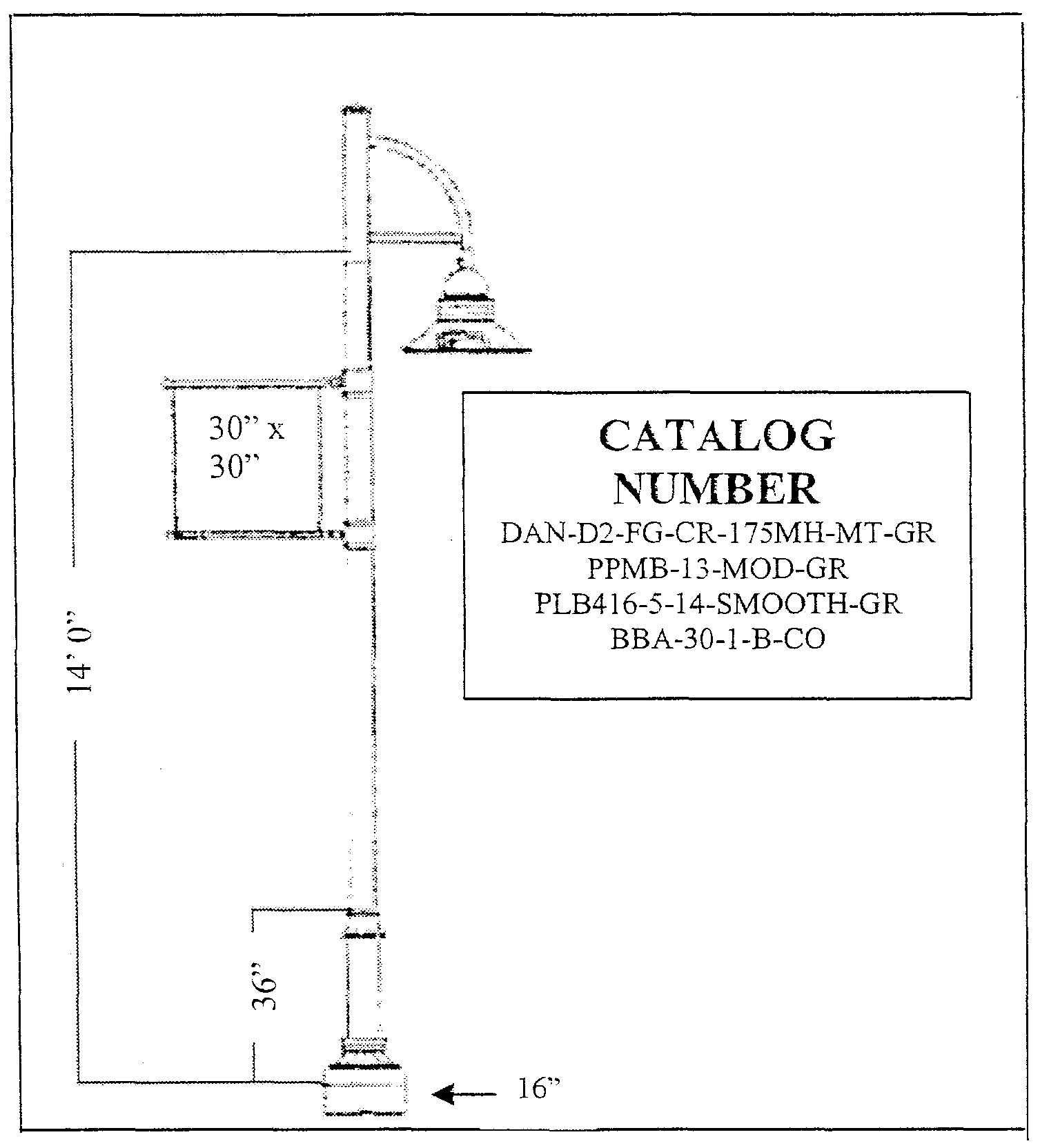
STREET lights shall be located in accordance with TOWNSHIP specifications.
(a)
STREET lights shall be a maximum of fifteen (15) feet in height on TOWNSHIP STREETS and be spaced one-hundred (100) feet on center and staggered, unless a lighting plan shows an acceptable alternative.
(b)
STREET lights to be located along Route 19 or Warrendale-Bayne Road (Red Belt) shall be a maximum of fifteen (15) feet in height and spaced one-hundred sixty (160) feet on center and staggered, unless a lighting plan shows an acceptable alternative.
(c)
STREET light fixtures shall be Designed in accordance with TOWNSHIP specifications.
E.
Sidewalks and STREET TREES.
1.
Sidewalks and STREET TREES are required and shall be located as per the following:
(a)
STREET TREES shall be planted forty (40) feet on center for the length of parcel frontage within a Designated planting strip. The planting strip shall begin at the edge of the curb and measure a minimum of five (5) feet in width toward the BUILDING SETBACK line. Sidewalks shall be located within the RIGHT-OF-WAY and begin at the back edge of the planting strip and extend toward the edge of the RIGHT-OF-WAY. Sidewalks shall measure a minimum of five (5) feet in width and connect to the LOT LINE of adjacent parcels.
(b)
If, due to other conflicts, the sidewalks and STREET TREES cannot be placed within the RIGHT-OF-WAY, they shall be located within a dedicated pedestrian EASEMENT measuring a minimum of fifteen (15) feet in width. The sidewalks shall begin generally +/- two (2) feet back from the edge RIGHT-OF-WAY and measure a minimum of five (5) feet in width toward the BUILDING SETBACK line. Sidewalks shall connect to the LOT LINE of adjacent parcels. STREET TREES shall be planted forty (40) feet on center with a continuous row of flowering or evergreen shrubs for the length of frontage within a Designated planting strip. The planting shall begin at the back edge of the sidewalk and measure a minimum of five (5) feet in width toward the BUILDING SETBACK line.
F.
Signage.
1.
Signage shall be regulated as set forth in Article 2100 with the following exceptions and ADDITIONS. Where conflict may exist with the provisions of Article 2100 the more restrictive provision shall take precedence. Note: the following SIGN standards assume all new Signage for a LOT. Should a LOT contain non-conforming Signage, such Signage shall be removed prior to application of this section.
2.
Each LOT within the District shall be permitted on one FREESTANDING SIGN. Each ESTABLISHMENT shall be permitted one FLAT WALL SIGN.
(a)
One freestanding MONUMENT SIGN permitted per parcel. Pole SIGNS are not permitted.
(i)
The height of the SIGN shall be a maximum of twelve (12) feet from ground level to top of SIGN.
(ii)
Maximum SIGN area shall be thirty-five (35) square feet.
(iii)
Illumination shall be from a concealed ground source only (no internal illumination).
(iv)
FREESTANDING SIGNS shall be behind the pedestrian EASEMENT and/or sidewalk and planting strip if proposed on a TOWNSHIP or private STREET.
(b)
One FLAT WALL SIGN shall be permitted per ESTABLISHMENT and limited to a maximum of five percent (5%) of the BUILDING facade facing the STREET not to exceed forty (40) square feet. The FLAT WALL SIGN shall not project more than six (6) inches from the face of the BUILDING. If the WALL SIGN is for an ESTABLISHMENT within a multi-USE BUILDING, WALL SIGN is limited to the area of the BUILDING facade occupied by such USE. Internal illumination is permitted for WALL SIGNS within the RB District.
3.
No TEMPORARY SIGNS Signaling an event, a sale or any other advertisement or statement shall be permitted with the exception of sandwich board SIGNS as detailed in Subsection 208-1501(F)(4) below.
4.
Sandwich Board SIGNS displaying a menu option for the particular USE and which are displayed only during normal business hours may be placed on the sidewalk immediately in front of the USE, provided a five (5) foot clear pedestrian passageway is maintained. Note, only one sandwich board SIGN is permitted per BUILDING and shall not exceed ten (10) square feet, unless there are several USES in a single PRINCIPAL BUILDING with a main access point onto the sidewalk, then this number may be increased by the number of entry points.
G.
BUILDING Materials/Colors/BUILDING Roof Treatment.
1.
BUILDING Exterior wall materials not permitted include:
(a)
Large split face BLOCKS (e.g., 8" × 16" or greater).
(b)
Tilt-up concrete panels.
(c)
Prefabricated steel panels.
(d)
Standard Concrete Masonry UNITS (CMU).
(e)
Comparable materials may be approved by conditional USE by the BOARD OF SUPERVISORS.
2.
Permitted exterior wall materials shall consist of:
(a)
Colors which are low reflectance, subtle, neutral or earth tone. The USE of high intensity colors or black may be permitted upon review of Design features. The USE of fluorescent color is prohibited.
3.
Roofs must have at least one (1) of the following features:
(a)
Parapets concealing flat roofs and rooftop equipment.
(b)
Overhanging eaves.
(c)
Sloped roofs.
H.
BUILDING Mechanicals.
1.
All BUILDING mechanical systems such as air conditioning UNITS, exhaust systems, satellite dishes, fire escapes, elevator housing, and other similar elements (including dumpsters) shall be integrated into the overall Design and character of the BUILDING and screened from view.
2.
Landscaping and other screening devices, including decorative opaque fencing shall be Used to soften the view of these features from the adjoining properties and the public STREET.
3.
Architectural lighting shall be recessed under roof overhangs or generated from a concealed source, low-level light fixtures. This includes lighting Used under canopies, e.g., canopies Designed over gas pumps.
I.
Loading and Storage AREAS. Loading docks, trash collection and similar facilities shall be incorporated in the overall Design of the BUILDINGS and the landscaping plan so that the visual and acoustic impacts of these functions are contained and out of view from adjacent properties and public STREETS.
1.
Loading dock facilities shall be screened by a solid masonry wall at least six (6) feet in height. Trash collection and similar facilities shall be completely enclosed within masonry wall or solid FENCE, at least six (6) feet in height on three sides and a self-closing gate on the fourth side. Dumpster AREAS shall have hardened, stabilized SURFACES constructed to prevent accumulation of stormwater runoff.
J.
Concrete Curbs.
(a)
Non-mountable, vertical concrete curbs shall be the only acceptable curbing material and shall be Used for all access drives, new STREET CONSTRUCTION and PARKING AREAS along Northgate Drive and AREAS Designated for on-STREET parking.
K.
Supplementary Regulations.
1.
Parking Requirements in Article 1900.
2.
Screening, Buffering and TREES in Article 2200.
(Amended 5-12-2008 by Ord. No. 389; 9-29-2008 by Ord. No. 393)

